
Tag Archives: Mark 3:20-35

Mark 3:20-35 – In Jesus we stand, divided we fall

The crowd came together again, so that Jesus and his disciples could not even eat. When his family heard it, they went out to restrain him, for people were saying, “He has gone out of his mind.” And the scribes who came down from Jerusalem said, “He has Beelzebul, and by the ruler of the demons he casts out demons.” And he called them to him, and spoke to them in parables, “How can Satan cast out Satan? If a kingdom is divided against itself, that kingdom cannot stand. And if a house is divided against itself, that house will not be able to stand. And if Satan has risen up against himself and is divided, he cannot stand, but his end has come. But no one can enter a strong man’s house and plunder his property without first tying up the strong man; then indeed the house can be plundered.

“Truly I tell you, people will be forgiven for their sins and whatever blasphemies they utter; but whoever blasphemes against the Holy Spirit can never have forgiveness, but is guilty of an eternal sin”— for they had said, “He has an unclean spirit.”

Then his mother and his brothers came; and standing outside, they sent to him and called him. A crowd was sitting around him; and they said to him, “Your mother and your brothers and sisters are outside, asking for you.” And he replied, “Who are my mother and my brothers?” And looking at those who sat around him, he said, “Here are my mother and my brothers! Whoever does the will of God is my brother and sister and mother.”

——————————————————————————-

This is the Gospel selection from the Episcopal Lectionary for the Third Sunday after Pentecost, Year B 2018. In the numbering system that lists each Sunday in an ordinal fashion, this Sunday is referred to as Proper 5. It will next be read aloud in church by a priest on Sunday, June 10, 2018. This reading is important because Jesus makes it clear that one cannot serve God part of the time and then serve self the rest of the time, because that is a recipe for disaster. In that way, one is not born into God’s favor, as the Jews deemed themselves as God’s chosen people. God does not choose part-time priests.

In this translation, where we read, “When his family heard it, they went out to restrain him,” this (I feel) is incorrect. The Greek words translated as “his family” – “hoi pará” – more accurately state, “others alongside of.” The Greek words translated as “restrain him” – “kratēsai auton” – more accurately state, “to seize hold of him.” In my mind, this better describes those who had parallel reputations as rabbis or teachers of Judaic Scripture (Pharisees).

Equals beside with greater fears of competition.

I struggle with the concept that the family of Jesus (as stated much later in the text) would not be considered “alongside of” or “beside” him.  They would know their place was behind him.  Nor can I accept that relatives would be so bold as to “seize” Jesus, as they would know full well his ministry would rock the Jewish boat. It makes more sense that Jesus would have told his family to keep a distance and stay mute.  Therefore, I see Peter (through Mark) recounting the rabbis of the synagogues in Galilee and the Pharisees there were joining with the “scribes who came down from Jerusalem” (actually “scribes, from Jerusalem” – those coming up to Galilee, not down[1]) in placing pressures against Jesus, because he was drawing such attention from the locals and pilgrims.

[[1] The use of “having come down” (from “katabantes” = “descended”) means the high-ranking scribes of Jerusalem had removed their holy buttocks from their golden seats in the Temple and ventured out amongst the “great unwashed” of Galilee.]

When we read the scribes (as well as the Pharisees and rabbis) saying, “He has Beelzebul, and by the ruler of the demons he casts out demons,” this stems from the trap the Pharisees had set in the synagogue where Jesus had been asked to lead the Sabbath service, only to enter and find a man with a withered hand in the congregation. When Jesus asked for comments, from the question, “Is it better to do good or evil on a Sabbath?” he then simply told the man to “stretch out your hand,” which the man did – healed. That act was then being deemed the act of Satan, by high authorities, after testimony given by well-respected Pharisees.

When the scribes had declared Jesus possessed by Satan, we read how Jesus “spoke to them in parables.” This leads one astray, since we tend to interpret a “parable” as: “A simple story illustrating a moral or religious lesson.” (American Heritage Dictionary) In reality, the Greek word “parabolais” comes from the word “pará” (“close beside” or “alongside of”) combined with the word “bállō” (“to cast”), which makes it a companion word to the prior statement that relates to “those beside” Jesus (the Pharisees). Thus, the word actually states that Jesus offered those who condemned him a “comparison” for themselves to consider.

Just as Jesus has addressed the synagogue in Capernaum (Galilee) with a question that went unanswered, he spoke again in questions. He first asked, “How can Satan cast out Satan?”
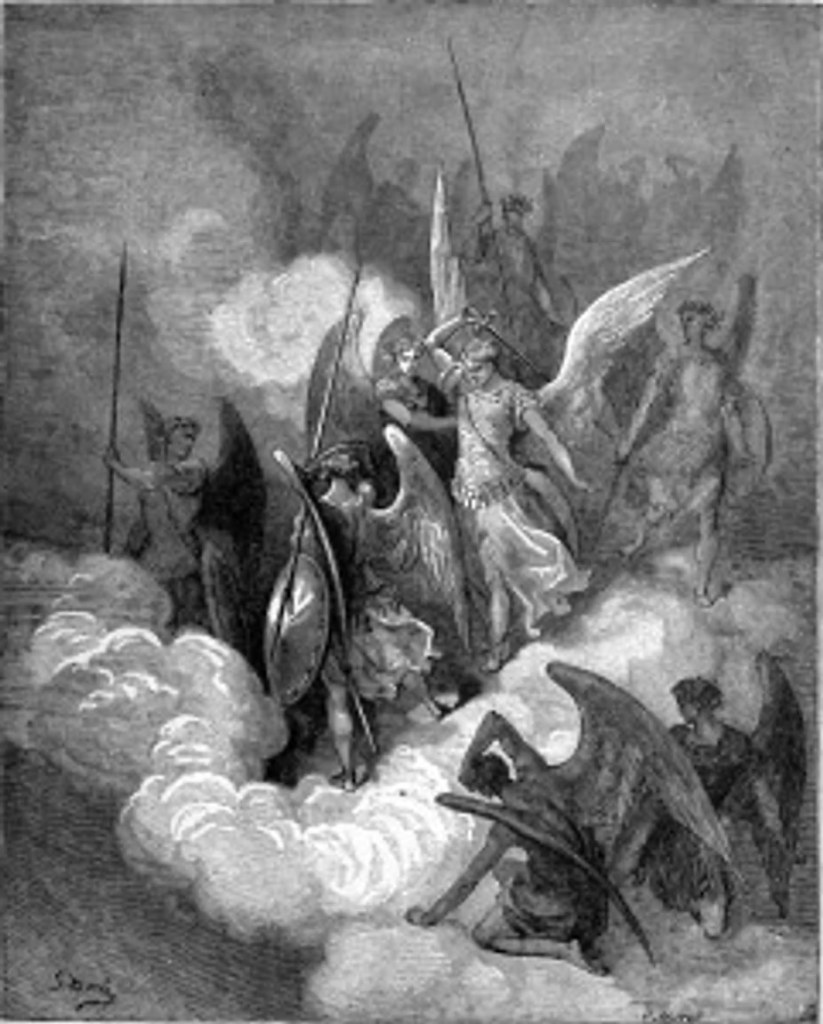
The optional Genesis reading this week is about the serpent being cast out of Eden. How could the serpent cast out the serpent?

The scribes had just implied that Jesus was able to straighten out a lame hand supernaturally, which (in the opinion of the Jerusalem think-tank) could only have been caused by Beelzebul (Satan). They then concluded that by calling upon that “ruler of demons” to “cast out demons” (those determined to be within men with lame hands), Jesus had called upon Satan to cast Satan out of a man’s lame hand. Jesus asked then (in essence), “How is what you propose even possible?”

The “comparison” spoken by Jesus (“parabolais”) was that the scribes and Pharisees were Satan. Here they were attempting to cast out Jesus, because they thought he was Satan. Jesus had simply asked, “Which is lawful on the Sabbath: to do good or to do evil, to save life or to kill?” That was excellent discussion material, but none of the Jews in the synagogue (including the teacher Pharisees) responded. When Jesus asked the man with the withered hand to straighten it out, and he did, why would that be grounds for saying Jesus did anything more than ask the man to stretch out his hand? If his hand was healed, was that good or evil?  And, if good, would that not be the work of God?

By the scribes, who came to speak judgment against Jesus based on the Pharisees who reported what Jesus had done, calling Jesus evil, they were answering the question posed by Jesus in the synagogue. They were saying it was unlawful to do good on the Sabbath. That inverts to a decree that says it is lawful to do evil on the Sabbath. The only one who would be so bold as to say that evil was lawful – EVER – even worse on the Sabbath – would be Satan. Therefore, the scribes had just claimed to be – themselves, not Jesus – those who called upon the ruler of the demons (Beelzebul), attempting to cast out the one who would break their laws and do good on the Sabbath.

Jesus spoke truthfully, when he made the scribes’ decree become a reflection on them. Jesus then said, “If a kingdom is divided against itself, that kingdom cannot stand.” That was a statement of history.

The scribes and the Temple priests, with the Pharisees, had become the straw bosses of ancient Israel. Unfortunately (for them), ancient Israel had split into Israel and Judah, with both falling to foreign invaders. The Promised Land of Canaan had been given to those who had to serve the LORD (by official Covenant) in order to keep their land. Instead, they waxed and waned, rising in devotion and falling in neglect. Then, tired from all the hard work, they asked for a king so Israel could be a kingdom, to be like other nations. Then that plan did not work, so they split one kingdom into two. Things then went from bad to worse, and Jerusalem was then in Roman Judea (not Judah), with Galilee another Roman province (not Israel). It all collapsed because the people followed bad rulers.

Jesus then added, “And if a house is divided against itself, that house will not be able to stand.” The use of “oikia” (“house”) is a step down from a “sovereign nation” or the “realm of a king,” where it means “household,” while inferring “family.” The whole claim to fame of the Israelites – as God’s chosen people – was ALL about being a house of worship, as a family linked through priesthood (and interbreeding only between the Twelve Tribes, with marriage to Gentiles forbidden).

That means Jesus was saying that the Pharisees running to tattletale on Jesus, and the scribes running to condemn Jesus by hearsay, was evidence of Jewish scholars being divided against a Jewish newcomer who was working miracles and drawing large crowds of followers. This division was not something that could ever be fixed (Nicodemus had attempted to sway Jesus to join their ranks, and failed), so the fact that Temple rulers (straw bosses) were up in arms about good having been done on a Sabbath, well then … “the house of Judaism was doomed to fall down.”

And that after so much work and planning had brought the exilic Jews back from Babylon. And that after so many years of work having been done, especially in the remodeling and beautification of the Second … ooops …. Herod’s Temple. And that after all the lamenting and complaining to their Roman overseers had allowed Jerusalem near city state status (but not quite). By 70 A.D. very little of that house would still stand, while the new house of Christianity was rapidly taking off.

That assessment can then be seen in Jesus next saying, “And if Satan has risen up against himself and is divided, he cannot stand, but his end has come.” There was still an opportunity for these Satan-serving scribes to run back to Jerusalem and spread the word, “Hey guys, we have it all backwards. This Jesus fellow from Nazareth is the real deal. We need to stop serving ourselves and drop everything and follow him.” Unfortunately, knowing in hindsight that was a BIG IF that did not happen, Jesus then prophesied the end of the Jews.  As Jesus died on the cross, God left the inner chamber of the Temple in Jerusalem for the last time.  Thus, because Satan had overtaken the Temple, Satan was reaching out to divide and conquer the remnants of Judaism.

Those “comparisons” of ancient failures and current failures were then addressed by Jesus, where he offered the solution. Jesus stated the exception to that history, saying, “But no one can enter a strong man’s house and plunder his property without first tying up the strong man; then indeed the house can be plundered.”  A “strong man” had been known prior as individual Judges, Prophets, and (from time to time) Kings who ruled benevolently over the people.  John the Baptizer had shown strength, and Jesus was certainly a “strong man” with a house he protected.

The lion is a symbol for strength. It is called the king of the jungle. One with a lionheart is courageous and strong.

By stating “a strong man’s house” (literally, “into the house of a strong man”), Jesus was saying the course to or from failure is each one’s responsibility, such that “the house” of “a strong man” was the domain of each Jew’s body. Their strength was then dependent upon that individual’s commitment to serving God as His priest. The strong individual does not seek any king other than God, who then sits upon the throne of one’s heart and soul. God is the source of a man’s strength.

When that state of service is established, no one can “plunder his property” (where “property” is “goods” [“skeuē”], which are the “works” of that individual). Jesus was such a “strong man,” whose “house” was truly holy; so the efforts of the Pharisees and scribes could not stop Jesus from being a holy and righteous man.

Still, Jesus offered the caveat that IF one “first tied up the strong man; then indeed the house could be plundered.” That means plundering would then have to be the objective, such that the good deeds of the strong man were inconsequential. Such a judgment would be only be meted by evil-doers. In such a case, even the house of a strong man could be plundered, which would be the execution of the pure and innocent, at the hands of the wicked. That could only be prevented if the plunderers were to likewise become strong men, in holy houses, refusing to go against their dominant tyrant rulers. Jesus would eventually be the strong man tied up in arrest and trial, his being judged a criminal, and his being executed by crucifixion.

In this regard, Jesus had just prophesied his own eventual death, symbolically, at the hands of the elite of Jerusalem.  He then forecast their ends, when he said, “Truly I tell you, people will be forgiven for their sins and whatever blasphemies they utter; but whoever blasphemes against the Holy Spirit can never have forgiveness, but is guilty of an eternal sin.”  For all who stand in churches today and promise that Jesus offered forgiveness to all, are those pastors remembering these words or excusing blasphemers of the Holy Spirit?

The Greek words written by Mark actually state, “tois huiois tōn anthrōpōn,” which is translated above simply as “people,” but is better grasped as “the sons them of men.”  Those who will be forgiven for their evil actions will be those following the orders of their elders. Those who were expecting their religious leaders to properly guide them would be forgiven for their sinful acts against the pure, when their “blasphemies” were echoing what their brains remembered their revered scribes saying. That day the common Jews heard the scribes blaspheme Jesus by saying, “He has Beelzebul, and by the ruler of the demons he casts out demons.”  Are not “sons of men,” rather than “sons of God” (Saints and Apostles), the ones who find excuses for sinners, because they cannot lead anyone to the Holy Spirit?

A leader who tempts with forbidden fruit is a son of man.

Because that blasphemy was uttered due to a man with a withered hand being healed, where the affliction was deemed by blind men leading the blind people to believe physical infirmities were signs of the presence of sin (i.e.: Satan or Beelzebul planted demons), then the only logical explanation of healing could be God.

The scribes would have to remember the fire-starting contest that Elijah initiated (1 Kings 18), where four hundred fifty priests of Baal could not summon him to light dry wood, while Elijah soaked his wood pile with water and it was lit into a roaring flame by God’s Holy Spirit.
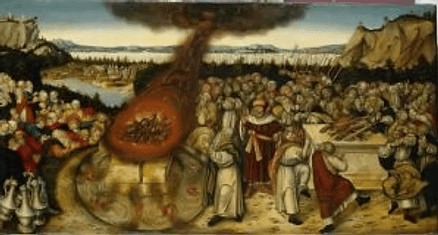
God is the power that makes the impossible possible. Therefore, those who would call God’s work that of someone calling upon Beelzebul were the utterers of a blasphemy of eternal proportions, unworthy of forgiveness.

Did the scribes think the four hundred fifty priests of Baal were forgiven after they called Elijah and his God names, accepting the challenge? Of course not.

Those evil priests, if one recalls, were priests imported by Jezebel into the Northern Kingdom, to guide Ahab and the common Israelites. They were the sons of men, not Sons of God.  Those priests of Jezebel all still burn in hell.

Jesus then said, “For they had said, “He has an unclean spirit.” I imagine there could have been a finger pointed when Jesus said “they said” (“elegon”), used in identifying the scribes and their Pharisees pals. “They said” the Holy Spirit of God, which makes crippled hands straight and strong, was the work of “an unclean spirit.”

I imagine Jesus pointed out “them” to the crowd that had been roused to a maddened state, murmuring that Jesus “had gone out of his mind.” I imagine Jesus silenced all of them as they pondered to themselves, “Did Jesus just say I am guilty of an eternal sin?”

Then, I imagine, Jesus went inside the house he and his disciples had been welcomed into, so they could sit peacefully and enjoy some lunch. As the door closed, the crowd was silently stunned … I imagine.

It is then that we read, “Then his mother and his brothers came.” This, again, was not an arrival based on fear for Jesus, as the implication can seem when reading, “When his family heard it, they went out to restrain him.” It might be that the Pharisees (“those beside” Jesus in responsibility, as teachers of Scripture) had stirred such a row that someone ran to tell Jesus’ mother that excitement was about. As this statement is actually separated into two segment (by a comma), it first says “and arrived the mother of him,” followed by a subsequent arrival, “and the brothers of him.” That would imply Mary told someone to go alert her other sons, so she left before them, with each Mary and the brothers arriving one right after the other, in the order of departure from where they were. One would then assume they came in support of Jesus, in case he was being threatened.

By reading, “and standing outside, they sent to him and called him,” they did not know the place where Jesus was with his disciples. Because it is not actually stated to be a home of someone, it could have been a public place, like an eatery. Their not entering could well have been due to the “crowd” that “was sitting around” Jesus was so many there was no room for them to wedge inside.

Good places to eat are not always big, so waits are common.

Thus, they sent word by asking strangers to tell Jesus who was outside. To ensure Jesus got the message, they hollered out Jesus’ name, in familiar voices he might recognize.

Then we read, “They said to him, “Your mother and your brothers and sisters are outside, asking for you.” The inclusion here of “sisters” should be read as the wives of Jesus’ brothers, as “sisters-in-law.” The point of Peter recalling “mother, brothers and sisters” is to make it a point that “the house” of Joseph, husband of Mary, and father of sons through at least two wives, they all had arrived to support their flesh and blood relative. They came to make a show that the “house of Jesus” was not divided, even though Jesus went and did his thing with his disciples, while the rest of the family did their things separately. They arrived to show solidarity of blood.

Jesus knew who was outside. God would have told him; but Jesus heard their cries and recognized them. Still, he did not want to make a show of how one family was strong in support of a common house; but he did want to demonstrate how one man had the strength to defend a holy house of righteousness. Thus, we read, “He replied, “Who are my mother and my brothers?”

Again, this is two segments, separated by a comma.  Jesus asked, “Who is the mother of me?” and then, “And [Who are] the brothers of me?”  Each separate focus questions not the identity of multiple people, but asked esoterically, “A I not an individual of responsibility?”

These questions were not directed at the physical people standing outside, as they are alluding to what makes a strong man. As a mother is the one who gives birth to a child, Jesus asked, “Who is it that gives birth to a strong man?” Is it one’s physical mommy? Or, is it God?

When Jesus then referred to other male siblings, he was then alluding to what makes a man truly strong. Does strength come in numbers of others who will come to one’s aid? Or, does true strength depend on the relationship that one has with the Holy Spirit?  Can one not find inner strength from knowing others like oneself have been made strong by God?

When we then read how Jesus looked “at those who sat around him, [and] said, “Here are my mother and my brothers! Whoever does the will of God is my brother and sister and mother,” that was not a claim of the present state of being.  It was prophetic. Certainly, Jesus did not see Mary, James, and his other brothers sitting around him. Instead, we see the twelve disciples that Mark had named earlier in chapter three. Even those twelve had nothing to do with what Jesus said.

Jesus actually did not say, “Here,” as that is a poor translation.  The Greek word he actually used was “Ide,” a form of “horaó.”  That word says, “Behold!” or “See!” or “Perceive!

Jesus was not pointing his finger at the human beings dining with him, or even tapping his finger forcefully on the table they were seated at.  Jesus probably had used his finger when he pointed to “those” outside who blasphemed the Holy Spirit. In my mind’s eye, at this point in the story, I “See!” Jesus lifting both arms high, inviting all who sat near to realize he held within him the mother of his faith and the lineage of all prior prophets of the LORD who were his brothers. Everyone sitting around him, and those outside calling out his name, would also be his own mother and brothers of Christ and all other Apostles, when they would become saints in the name of Jesus Anointed.

We realize that when Jesus then said, “Whoever does the will of God is my brother and sister and mother.” This is the recipe of a “strong man whose house cannot be plundered.” It is whoever does the will of God – not the will of Pharisees, not the will of scribes, not the will of friends who tell you someone might be in danger, and not the will of relatives who will defend one’s body without question.

The will of God is done by those who sacrifice their dependency on the outside world, so they only respond to the direction of the Holy Spirit. Of course, those all go by the same name – Jesus Anointed.

That name comes when one gives birth to a new you, after marriage to God in one’s heart (a holy house). You become the brother of Jesus of Nazareth, by being reborn as the Son of God. You become the sisters-in-law of Jesus, as human beings given away in marriage to the Father. The officiant of that sacrament is Holy Spirit, which washes away one’s sins, so God can take His throne.  A most holy matrimony through a most holy baptism, followed by a most holy christening [naming one as Jesus Anointed].

As the selected Gospel reading for the third Sunday after Pentecost, when one’s personal ministry for the LORD should be underway, Apostles are called to recognize they are either with Jesus, through the Holy Spirit – the mother and brother of Jesus the Anointed one – or they are standing outside, either calling out, “Sweet Jesus, come to me!” or “Cast out my demons, Jesus, if you are indeed holy!” or “Jesus was nothing more than another prophet who did some good things, but not the Messiah we still await.”  They are one or the other, not both.

A non-sacred cow.

The reality of today is there are crowds of people wanting a good show, in search of a dependable idol to worship. Few people are strong enough to keep themselves as a holy house worthy of God’s presence.

People remember how “Honest” Abe Lincoln quoted Scripture when he compared the divide between the slave states and the free states as a “house that cannot stand.” Few people realize that ordering the deaths of 620,000 Americans, through battles that would force the will of Abraham Lincoln (as the “king” of a nation divided) upon the people.  America has built a monument to Mr. Lincoln.  They immortalize some notes he scribbled on an envelops, while on a train to the battlefield where about 50,000 soldiers (both sides of battle) were killed, wounded, or went missing.  He wrote of forefathers, the ones who said states had rights, including the right to dissolve the union.  Abraham Lincoln rewrote the Constitution, as far as thirteen southern states were concerned.  The reality, as far as spirituality goes, is the United States of America fell in 1865, regardless of who claimed victory, simply because a son of man played god – calling upon Baal for all to worship.
Whoever hitches up their wagon to a country, or claims great pride in associations (political, racial, philosophical, or religious, et al) those people are bowing down before a master of lesser value that God Almighty. When Jesus said, “No one can serve two masters” (Matthew 6:24) the same lesson applies to the divisions that inevitably will arise in kingdoms and houses. Only a strong man in his own house, one of absolute devotion to God, stands a chance of surviving the destruction of his tabernacle (bodily temple).

The unnamed place that Jesus sat with his disciples, when he exclaimed, “Behold my mother and brothers!” is the epitome of a church. Jesus said, “Where two or three have gathered together in my name, I am there in their midst.” (Matthew 18:20) The church is not exclusively an elaborate brick and mortar building that is decorated with candlesticks, altar, crosses, stained glass windows and red carpeting between polished pews.

Jesus and his disciples might have gone into the equivalent of a pub or café, where he and his disciples shared a non-Passover loaf of bread and cups of wine. The disciples and the crowd were there because they wanted to be close to Jesus of Nazareth. When Jesus said there would be those who would later “gather in my name,” he meant Apostles in the name of Jesus Christ – as Jesus Christ reborn – the Holy Spirit and the Christ Mind would then be in their midst.

The sacrament of Communion is the gathering of Saints at a time when there is need to get away from the maddening crown that utters one blasphemy after another.  It has to do with sharing common experiences of body and blood, and very little to do with a wafer followed by a sip of wine from a fancy cup.  The disciples AND those who wanted to be near Jesus that day were in “communion” with Jesus of Nazareth, where that word is defined: “The sharing or exchanging of intimate thoughts and feelings, especially when the exchange is on a mental or spiritual level.”
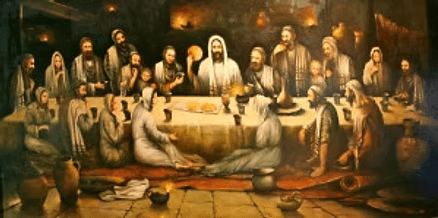
The message of ministry is not to go out memorizing words found in various translations of the Holy Bible. The Pharisees did that and misled the people. The scribes of Jerusalem did that and misled the people. Ministry for the LORD can only be done by His Son, Jesus Christ.

Apostles and Saints have made that possible since the day of Pentecost, when Jesus returned in twelve disciples, and they in turn filled another three thousand who heard them speak with the power of the Holy Spirit. All 3012 found Jesus Christ within their midst. Ministry is thus about that baton passing. Ministry is all about doing the will of God, so one can be reborn as a brother of Christ.

America has become a nation of king worshippers, regardless of which philosophical persuasion one swings. We love the thought of strength, when the only thing that stands in the way of Americans being attacked and invaded is the fear our enemies have created within themselves. That fear is being tested more and more these days, with a little terrorism here and a little insanity there. We are living in the times when the world has gone out of its collective mind.

There are sects of religions that worship Beelzebul.  Their leaders are calling upon the ruler of their demons to cast out the demons they see in a “Christian West.” They call America the “Great Satan,” as a motivator for hatred.  Hatred is an emotion of Satan, not God. So, again we have the lunacy of Satan calling to cast out Satan.

In the houses of religion in America, which call themselves “Christian,” we have one preacher praising the works of Donald Trump and condemn the works of Barack Obama. Meanwhile, in another denomination, there is another priest denouncing the works of Donald Trump, while longing for a return of the days when Barack Obama ruled the “kingdom.” Just like when ole Abe ruled the roost, America is a divided kingdom that cannot stand. It has no strong men and women who defend their holy temples as Saints and Apostles in personal ministry. There is no central house of religious thought, so everything sits upon a precipice, about to slide into the oblivion of the Great Abyss.

People question why Christianity is decreasing in numbers. People want to know why “Millennials” are turning away from churches. This video shows the reason as it sings, “You cannot save me. You cannot even save yourself.” This perfectly shows why true ministry was necessary in Jesus’ day, and why true ministry is necessary today.  It shows how decadent our society has become.  It screams out a need for the truth of Christ to guide us out of our lunacy.

We can be saved, but not as oneself and not by external means.  Salvation comes within, through the power of God.  For that to happen, one has to fall in love with God and get rid of the ego.  Satan loves Americans with big egos and sons of man who go out casting false  judgment on the holy, while pretending to know the Law.  Ministry is being a real representative of Jesus Christ, leading by example.

Stabbing Westward: Save yourself

Mark 3:20-35 – A house divided cannot stand

The crowd came together again, so that Jesus and his disciples could not even eat. When his family heard it, they went out to restrain him, for people were saying, “He has gone out of his mind.” And the scribes who came down from Jerusalem said, “He has Beelzebul, and by the ruler of the demons he casts out demons.” And he called them to him, and spoke to them in parables, “How can Satan cast out Satan? If a kingdom is divided against itself, that kingdom cannot stand. And if a house is divided against itself, that house will not be able to stand. And if Satan has risen up against himself and is divided, he cannot stand, but his end has come. But no one can enter a strong man’s house and plunder his property without first tying up the strong man; then indeed the house can be plundered.

“Truly I tell you, people will be forgiven for their sins and whatever blasphemies they utter; but whoever blasphemes against the Holy Spirit can never have forgiveness, but is guilty of an eternal sin”— for they had said, “He has an unclean spirit.”

Then his mother and his brothers came; and standing outside, they sent to him and called him. A crowd was sitting around him; and they said to him, “Your mother and your brothers and sisters are outside, asking for you.” And he replied, “Who are my mother and my brothers?” And looking at those who sat around him, he said, “Here are my mother and my brothers! Whoever does the will of God is my brother and sister and mother.”

——————–

This is the Gospel selection to be read aloud by a priest on the second Sunday after Pentecost, Year B, according to the lectionary for the Episcopal Church. This will follow either a track 1 or track 2 pairing of Old Testament and Psalm readings. If track 1 is chosen, a reading from 1 Samuel will be read aloud, including this verse where God told Samuel, “Listen to the voice of the people in all that they say to you; for they have not rejected you, but they have rejected me from being king over them.” The Psalm paired with that is Psalm 138, which sings: “The Lord will make good his purpose for me; O Lord, your love endures forever; do not abandon the works of your hands.” If track 2 is chosen, the there will be read aloud a selection from Genesis, where God judged, “Because you have done this, cursed are you among all animals and among all wild creatures; upon your belly you shall go, and dust you shall eat all the days of your life.” The accompanying Psalm will be 130, which sings: “O Israel, wait for the Lord, for with the Lord there is mercy; With him there is plenteous redemption, and he shall redeem Israel from all their sins.” In all Sundays the Epistle will come from Paul’s second letter to the Corinthians, where he wrote: “So we do not lose heart. Even though our outer nature is wasting away, our inner nature is being renewed day by day.”

Verse 20 begins with the segment of words that have been omitted from the reading. Mark wrote, “Kai erchetai eis oikon,” which begins with a capitalized “Kia,” signifying this is very important information being stated. The Greek text literally translates to say, “Kai he goes into a house [or dwelling].” The importance of this demands context.

In the first verse of Mark’s third chapter, he wrote, “Again he entered the synagogue,” where “synagōgēn” was written. In verses 7-12, Mark wrote about “the sea” and “a boat” to use to keep the crowd from crushing him, as so many were coming to him. In chapter 2, verse 1, Mark wrote, “he returned to Capernaum after some days, it was reported that he was at home.” This means that the “dwelling” Jesus entered was his house. The importance of a capitalized “Kai” then shows that one’s own home demands a sense of privacy. Jesus had accommodated the crowd of followers who wanted healing by going to the place where five thousand would later be fed; but he escaped by boat when they became uncontrollable. Now, the importance says the crowd had found out where Jesus lived; and, after he went into his house, they barged in.

To add an aside at this point, chapter 3 of Mark’s Gospel has 68 uses of “kai,” both lower case and capitalized. Those occur in 35 verses, meaning there are almost two per verse. In the verses of this reading selection there are twenty-five uses of “kai,” including the capitalized one that begins verse 20. This should not be seen as Mark stuttering or having some lack of imagination when it came to writing style and technique. Mark’s Gospel tells the accounts of Peter; and, Peter is clearly one who cuts out anything unnecessary. I like to call Mark the Dragnet version of Matthew, where Sergeant Friday was known to say, “Just the facts, ma’am. Just the facts.” The plenteous uses of “kai” must be seen as Mark writing with the attitude that says, “If it doesn’t need to be said, then don’t say it.” That says Jesus entering into a house has divine meaning of importance that is easily missed.

This means the “house” [“oikon”] of verse 20 is parallel to the use of “synagōgēn” in verse 1. The Hebrew word “sunagógé” means “a bringing together, an assembling; congregation, synagogue, either the place or the people gathered together in the place.” (Strong’s Definition and Usage) It is a place where those of faith come together to share their religion with others of like mind. By the time verse 20 comes, in the ‘facts only’ memories of Peter Jesus had begun his ministry by entering a synagogue, where he healed a man with a withered hand, on a Sabbath. That attracted large crowds seeking him for healing; and, that began the “Pharisees and Herodians” plotting how “to destroy” Jesus.

The popularity gained Jesus a large number of permanent followers, causing the need to name twelve as “apostles” [“apostolous”], who were not simple “disciples” [“mathētais”]. To avoid direct confrontation with the Pharisees and scribes, Jesus accommodated the crowds drawn to him by preaching in open ground [the reality of the “sermon on the mount”]. As such, Jesus himself became a “house of the holy,” so wherever he went that “tabernacle” moved with him. Thus, when Jesus entered into his own home, that “house” became a synagogue and the crowd felt it was open for all of faith.

This can be seen confirmed in the second segment of words, which also begins with the word “kai” [lower case]. There the literal English translation says, “kai assembled again that crowd.” Here, the word “synerchetai” has to be seen as having a similar root word as “synagogue” [“sunerchomai”], where “assembly, come together and congregate” says importantly that the “crowd” saw wherever Jesus was as a place necessary to gather.

In the segment that adds [NRSV], “his disciples could not even eat,” the Greek does not include any verbiage that states “disciples.” The Greek text does state “dynasthai autous,” which should be read as “those being strong souls.” That does refer to Jesus and to his newly named “apostles,” with Jesus’ “house” becoming so crowded with uninvited guests that “not even bread to eat” is what Mark wrote [literally translated into English]. When the two words are read independently from the other words in the segment, the ability to eat is less important than identifying who was invited into the home of Jesus.

By reading “dynasthai” in a higher sense than “are they able,” the truth of the root [“dunamai”] allows one to see “[they are]: (a) I am powerful, have (the) [em-]power[-ed] , (b) I am able, I can.” (Strong’s Usage) Therefore, those with Jesus had been passed the Spirit of ministry [a verse 14 statement]; so, they had a greater power than being able to chew “bread” [a specific not mentioned by the NRSV translation].

When Mark did specify “bread to eat” [“arton phagein”], this speaks more about a guest in a “house” being offered “bread to eat.” Mark was not recording Peter complaining that the house became so full of people that he could not eat bread. The value of this specific says the “house” of Jesus was without “bread to eat.” This acts as a mini-prophecy of the feeding of five thousand [men: the women and children increased that number significantly], such that the “bread to eat” that the apostles [twelve] passed out was spiritual manna, with the power [ability] to pass that out then given to them by Jesus. At this time, having just been named apostles and only possessing the powers of ministry, “they were not able to give spiritual food to feed the crowd.”

Verse 21 begins with a “kai,” which places important focus on one word: “having heard” [“akousantes”]. As a stand-alone word of importance it has multiple dynamics, as it reflects back upon the crowd and the apostles, where they were those “having heard” the divinity of Jesus, both in speech and in presence. The word here can equally mean “having listened.” When taken forward, where the following segment of words tells of an attempt to seize Jesus, the same word becomes important as those “having reported,” as well as those “having heard” the reports.

This importance being placed on “having heard,” which comes before a comma mark indicating separation and pause, is missed in the above translation that states: “When his family heard it, they went out to restrain him, for people were saying, “He has gone out of his mind.” In that, there are no words written that says “family” or “people.” That is intuited.

What is written literally translates to say, “those by the side of him came out to take hold of him.” In that, “those beside him” can be neighbors [Jews], who did not appreciate the sudden influx of strangers in their midst. It also says “those side-by-side with him,” who are the apostles. It also says “those in the presence of him,” which was the crowd that had come. The intuition of “family’ cannot be taken as truth, as it would be the family of Jesus who would come and be announced later in this reading. However, “family” can be the intuition of Jews, such that the “family” of Judaism was all trying to have control of Jesus [as being “possessed” by or “obsessed” with his power].

After a semi-colon mark of separation, as a new statement that is relative to the previous, a segment of words states, “they were talking indeed because.” While this implies a collective of “people” [the third person plural, as “they”], who were all “saying” the quote that would follow, the segment alone [without the quote] must be read as a new statement relative to those trying to “take hold of Jesus,” as now “they” were all “speaking” at the same time, “indeed because” of him and the crowd he had drawn. All were “talking” about Jesus: positive and negative.

The quote that follows is one word, which is capitalized. As a capitalized word, what was being said must now be seen as having divinely elevated meaning. The Greek word written is “Exestē,” which has been translated as: “He is out of his mind.” This spelling is the third person active subjunctive, where a hypothetical statement is made. The root word [“existémi”] actually states, “to displace, to stand aside from” (Strong’s Definition), with the implication then being (literally) “I remove from a standing position.” In the intransitive tenses it says, “I am astonished, amazed; I am out of my mind, am mad.” (Strong’s Usage) Thus, all people had various opinions about how the popularity of Jesus was above and beyond that of any ordinary Jew. Therefore, a better translation that could apply to everyone “speaking” would be: “He is not normal,” with the divine elevation meaning [spoken by those who stood by and flocked to be near Jesus]: “He is God incarnate.”

Verse 22 then begins with another capitalized “Kai,” which denotes much importance must be see in that which follows. The words written say, “Kai them scribes”. Because verse 21 spoke of those “side by side of him,” that spoke of those natural of Capernaum, including those visitors that were transitory from the regions north of Galilee. This makes the importance of verse 22 be now placed on those of the Temple, which is stated in the following segment as “scribes having come from Jerusalem.”

In that segment, the Greek word “katabantes” is translated as “having come down,” which is not a proper translation, when Jerusalem is south of Capernaum. That direction would be best serving the truth by saying “having come up” [which is does not say]. The truth now needs to be seen as “them from Jerusalem having descended” upon Capernaum, as if coming from the ‘higher realm’ of Jerusalem, to the country bumkins of Galilee. They were “coming down” because of the reports of this man who cast out demons and healed the sick on the Sabbath. They wanted to “come down” hard.

Because those academic Jews had been summoned to climb down off their high chairs of importance, as the ones who advised the teachers [lawyers] of Judaism in the tweaks and nuisances of the Hebrew text [and long before, their counterparts had advised the failed kings of Israel and Judah], they swooped down like birds of prey. To go to Capernaum and “speak because” of the reports of Jesus doing miracles and speaking insight about Scripture – insight that the “scribes” had never advised anyone about – they came with chests all puffed up, looking like well-to-do authorities. Thus, as the clamor was going on at the “house” of Jesus worship [“the house” of the Son of God], the “scribes said, “Beelzebub he possesses,” adding “kai because In then prince of the demons he casts out them demons.”

In that, following the “kai” marking importance to follow, is a capitalized “En,” which divinely elevates the word that normally means “In, On, At, By, With,” implying “Among.” (Strong’s) This means the “scribes” were speaking of an “Inner” possession of Jesus, acknowledging the man Jesus was not doing works of miraculous nature. Instead, they proposed that Jesus had been possessed by the “Lord of the flies” [the meaning of the name “Beelzebub”]. This implies “flies” are the nuisance of demonic possession, which cannot be controlled. Certainly, the “scribes” had figured out that God allowed the bodies of wayward Jews to be possessed by a demon, due to past sins. Therefore, the accusation they made was Jesus was possessed; and, the Lord of the flies was the power within Jesus that cast out its own, having power over all demon spirits.

Verse 23 then beings with another capitalized “Kai,” which says major importance must be realized in that which follows. The literal translation of the Greek says, “Kai having summoned themselves”. With this following the “scribes” having said Jesus was possessed by Beelzebub, as a demon casting out demons, verse 23 then makes the important statement that should be seen as the children’s taunt: “I am rubber, you are glue, what bounces off me sticks on you.” As such, “having summoned” Beelzebub by name [remember the movie Beetlejuice?], the “souls” of the “scribes” [the word “autous” means “selves,” which implies “souls”] had brought such a demonic possession upon their very own “souls” [“selves”].

Jesus was alert to that demonic possession when he then responded “in parables.” Jesus then said, “How is able Satan , Satan to cast out ?” This is two statements made in one question, with the first word being capitalized: “Pōs.” This raises the meaning to a divine level of inference, where “How, In what manner, By what means” becomes a question of spiritual presence, as a possession is accepted to be.

This word of question, best stated as “By what means,” leads to the word “dynatai,” which is a form of the same word that described those “beside” Jesus [his apostles], meaning “to be able, to have power.” Then, Jesus named “Satan” [not “the Lord of the flies”], which is a capitalized word that means “Adversary [of Yahweh’s faithful]” or “the Devil.” Thus, the first segment of words asks the “scribes” [who were the ones demonically possessed, without knowing it], “In what manner does Satan have power”?

The impact of this segment of words must be seen as Jesus saying, “Well now, isn’t this the pot calling the kettle black?” Jesus spoke in parables, meaning it flew well over the heads of the “scribes” [think-tank nobodies], because Jesus had no Temple authority to run and tell anyone not to have a demon cast out. The “scribes,” on the other hand, had been given such power to run tell people, “Stay away! He is making you whole, but it is only a trick of the Lord of the flies!” Their words were heard by all who “were listening” to Jesus [and the imbecile scribes] as absurdity, so Jesus asked the ones exercising demonic powers, “By what means does Satan exercise power?”

This makes the second segment of words begin with the capitalized word “Satan,” again speaking of demonic possession, through the influence of the world’s greatest trickster. Jesus then asked, “Satan to cast out ?” As those words came from his mouth, he was looking straight at those who had come from Jerusalem as “Satan to cast out,” meaning Satan proliferated in Jerusalem’s Temple. The “Adversary” of Jews who were trying to find the path for redemption of their souls, healing of their illnesses, and the meaning of the Word was everyone who pandered to the power possessed by a religious organization.

It is at this point that Jesus speaks in a parable that brings in the importance of a gathering at his “house” and the “house” that was the remnant of Israel [two failed nations, reduced to one city with a Temple, run by morons not possessed by Yahweh, but instead by Satan]. In verse 24, begun by a “kai”, he said: “kai if a kingdom against itself is divided , not is empowered to stand the kingdom that”. Here, the history of Israel has just been thrown in the face of the scribes, where the importance of the conditional [“if”] says Yahweh did not create a “kingdom,” the elders of the Israelites did [the 1 Samuel reading choice for today]. Without that “kingdom” being possessed by Yahweh, it would become “against itself” and “divide” [Israel > Israel and Judah]. This means Jesus just confirmed that “Satan had cast out scribes from Jerusalem,” because only a failed “kingdom” is possessed by Satan. The “power to fail” comes from Satan worship, not worship to Yahweh and obedience to His Law.

That is why Jesus then said, in verse 25 [also begun by “kai”], “kai if a house against itself is divided , not will be empowered that house there to stand”. Because of the example of Israel dividing into two kingdoms – Israel and Judah – falling to scattered remnants because of the kings of Assyria and exiles forced to serve Babylonian kings, divided kingdoms became the higher octave – a “house” that is not a kingdom. As a portion of one city in a Roman province, the Temple elite were allowed to be a “house” of religion. If the same division was to ever take place where unity must exist to be truly holy, then the same result must be expected. It is a principle or law of humanity, which is easily possessed by Satan, going to extremes to reject Yahweh.

The aspect of a “house” being “divided” was the known fact that sects existed, where the Pharisees, Sadducees, scribes, and Essenes did not all see eye to eye. The fact that crowds of people thirsted for the truth and saw how the power of Yahweh had manifested in a human being named Jesus; and, the fact that the Temple elite had hurried a group of “scribes” to go ‘spin doctor’ the narrative to be against Jesus – when they were all were of the “house” of Jews – all that says Judaism was indeed “divided” and should be expected to collapse [not stand or remain]. Because the “scribes” had raised their ugly heads as a sign of that pending collapse, coming to summon Satan upon themselves, in the name of “Beelzebub,” Jesus then furthered this historical-based expectation [a prophecy] to their saying Jesus was possessed by a demon.

Verse 26 then also begins with the word “kai,” saying: “kai if that Satan has risen up against himself kai has been divided , not he has the power to remain steadfast , otherwise the principle end is possessing”. This then makes “Satan” be the demon that possessed Israel, then Israel and Judah, and now the “house” of Judaism. So, if Jesus was possessed by a demon spirit – Satan, not the Lord of the flies – then Satan would never cast out his own demons that possessed Jews. To do that would mean he was divided against his own works, in the same way Israel [et al] had done. If anything were to make sense, according to what the satanic scribes were saying, Jesus would be casting out demons into Jews, not removing them. He was doing the opposite.

By bringing Satan into this series of logical assumptions, based on history, Jesus had just called the scribes demonically possessed by Satan. They proved that by showing up speaking of “Beelzebub” and talking about demons. The crowd had flocked to be close to Jesus, because they never felt the power of Yahweh when they marched like zombies to the synagogues on the Sabbath. They barged into the “house” of Jesus because their souls hungered for spiritual food, seeking to be fed manna from heaven. The scribes, on the other hand, same as Satan’s minions, tried to keep the masses enslaved to Satan, because they profited greatly by keeping them ignorant of spiritual food.

In verse 27, Mark drew a mathematical symbol [a left right arrow], in between the words that state “on the other hand not is empowered nothing” [“all’ ou dynatai oudeis”]. This becomes a statement of truth, such that what is stated to the left is true when that stated to the right is true. The same applies to the truth of falseness, if that to the left is false, then that to the right is also false.

When this symbol is applied to Jesus speaking of the “power” of Satan, then Satan gives “no one” [“oudeis”] any “powers” or “abilities,” such as those the scribes said Satan had given to Jesus. The symbol emphasizes this as a mathematical truth. Satan takes away power possessed by a soul over its body of flesh, causing one to be so lacking in power that one becomes a slave to sin, powerless to break free from that state of being. No true priest of Yahweh would ever teach that false narrative, unless he or she had been possessed by Satan.

This statement is then what led Jesus to speak about sins that will be forgiven by Yahweh, which is how those healed by Jesus had Yahweh forgive them and make them whole. On the other hand, the condemnations cast upon Jesus, by the scribes, would become a blasphemy standing eternally against their souls. When the NRSV translates Jesus saying: “Truly I tell you, people will be forgiven for their sins and whatever blasphemies they utter; but whoever blasphemes against the Holy Spirit can never have forgiveness, but is guilty of an eternal sin,” this needs closer inspection.

First of all, the word “people” was not written. Instead, Mark wrote the Greek words “huiois tōn anthrōpōn,” which literally translates as “sons those of mankind.” In that, “anthrōpōn” is the genitive masculine noun that says, “of mankind, of humanity, or of the human race,” which obviously includes males and females. The use of the lower case spelling of “sons” must be seen as expressing the masculine essence of “spirit, breath of life, soul,” where all “souls” are “sons,” even when they animate bodies of opposing gender, as males and females of “mankind.” By seeing this use of “sons” as “souls,” one can then grasp how the capitalization of “Son” becomes a divinely elevated “soul,” not simply one animating a body of flesh. Thus, Jesus said “all souls” will be forgiven the sins of their flesh [both male and female], including all “blasphemies” that make the flesh speak out against impossible interpretations of the Law to live up to. Forgiveness comes by sincere repentance of one’s sins.

In verse 29, Jesus made clear the one blasphemy that cannot be forgiven. He said, “who now might speak evil against unto this Spirit this Holy not has forgiveness into that age.” In that, the capitalization of “Pneuma” and “Hagion” must be read separately and not as one inverted name [“Holy Spirit”]. The divinely elevated meaning of “Spirit” [remembering “huios” is a “spirit” or “soul”] is that of Yahweh’s “Spirit,” which comes through a “soul” marrying Yahweh, meshing one’s “spirit” with His “Spirit.” More than a “breath of life” [a “soul”] one is then a wife of Yahweh in the flesh.

This is where one has to realize that a “soul” that has married Yahweh then becomes an extension of Yahweh on earth, as one who has become “Holy.” The capitalization here says a “soul” married to the “Spirit” of Yahweh has become “Sacred, Set apart by God,” therefore “Holy.” Yahweh is “Holy,” not His “Spirit.” Therefore the “soul” is not “Holy,” but Yahweh’s presence is, which comes through His “Spirit.” It is that presence of Yahweh that makes whoever Yahweh possesses become “Holy” ground. [Re-read the story of Moses and the burning bush.] This separation of “Spirt” and “Holy” must be read at all times in the New Testament.

Mark then made a point of adding the aside that made sure the readers knew what Jesus said was about the “scribes,” as “they had said, “He has an unclean spirit.” In that translation, they ignore the fact that Mark capitalized the word “Pneuma” again, meaning it was true that Jesus was divinely possessed by the “Spirit” of Yahweh, because his “soul” was married to the “Father,” being the “Son of man.” However, the blasphemy was in calling true “Holiness” – a “Saint” of Yahweh – a “demon spirit possession.” Since Jesus would only be the first of many [the movement called “Christianity”], the same blasphemy used against anyone filled with Yahweh’s “Spirit” and reborn as His “Son” is treading on thin ice. For one to say, “I am full of the “Spirit” and not be so, then that one has blasphemed the “Spirit” and condemned oneself [“soul”].

In verse 31, when we are most importantly [use of a capitalized “Kai”] read of the arrival of the “mother” and “brothers” of Jesus, this confirms it was Jesus’ house to which they had come. They came as visitors who were always invited to his home. It must be realized that they were “standing outside” because the house was full of a “crowd” of people who sought Jesus. The crowd came because they recognized he was married to the “Spirit,” and the family of Jesus assisted him while he held meetings with the people by the sea. Because the house was overflowing with people, it was impossible for Mary and James, et al to enter. So, they sent a message to Jesus, letting him know they were outside. They sent no demands to be let in. They expressed no fear that Jesus was in danger. They just sent a message letting him know they had arrived.

Because verse 21 has been incorrectly translated to say: “When his family heard it, they went out to restrain him’” the impression given is Mary and the brothers of Jesus came to rescue him from a hostile crowd. First of all, the mother and brothers of Jesus knew full well who he was and what Spiritual powers he possessed. They, most likely, had been traveling to get to Jesus’ house and were surprised to find his house full of people. They sent a message that was, at most, seen as a request for favoritism, because they were related by blood [all related to Mary]; but Jesus’ response was a statement against the favoritism.

After all, that was a satanic trait expressed by the Temple elite. They routinely made special places at the table for those who buttered their bread most heavily [the wealthy contributors].
They did that while all the poor commoners were forced to pay for glimpses of their elite status – much like going to Vatican City and hanging out at St. Peter’s Square, hoping one of the high and mighty might wink at you.

When told that his mother and brothers were outside, unable to get in, Jesus then said, “Behold!” [not translated by the NRSV]. This is a capitalized one-word statement of divine elevation. The divinity of what Jesus said must then be read as “See with Spiritual eyes!”, as a proclamation made to all who felt a strong need to be fed manna from heaven. That elevation of insight then led Jesus to say, “the mother of me , kai the brothers of me,” where the symbolism of “mother” and “brother” must be understood, especially [from use of “kai”] that of “brotherhood.”

One must realize Jesus had just given a command for all within his presence to “See!” with their souls, rather than with their physical eyes. He was in the center of that spiritual environment. His “house” had become like a synagogue; and, the “Spirit” married to the “soul” of Jesus made him speak for the Father that was within, as the “Son” submitted to the Will of the Father. Therefore, “me” is God-incarnate.

This made the “mother” of God having been incarnated in human form be the womb of necessity. Because so many had opened up their souls to receive the Spirit of Yahweh, they had conceived Jesus and brought him into the world. While Mother Mary gave birth to the physical Jesus, the need of the lost but faithful sheep [Jews] was his spiritual “mother.”

The importance [“kai”] of Jesus spreading open his arms as he said, “the brothers of me,” meant those closest to him were certainly the newly named “apostles.” They were those “side by side” with Jesus, as those having been given the power of ministry, as other servants of Yahweh in training, through the Son. Beyond them were all the crowd who made it inside the “house,” as those who came in close contact with Jesus, so their souls had become touched by Yahweh’s “Spirit.” That spiritual touch made them become spiritual “brothers,” whether or not their human gender was male.

This last reference point is confirmed when Jesus said in verse 35, “whoever indeed might act this desire of this of God , here brother of me , kai sister , kai mother is.” In this there are two uses of “kai,” one making “sister” be importantly recognized. That importance says a Son of man is not gender exclusive, as all of mankind is made of neuter essence souls [absorbing the feminine essence by having entered feminine matter], which becomes masculine essence once married to Yahweh. Therefore the lack of “kai” before “brothers” says all are “brothers” through receipt of the “Spirit,” as all will have been made “Holy.”

The ‘kai” before “sisters” clarifies this. Still, the “kai” before “mother” [an inversion of the prior order of presenting “mother and brothers”] becomes an important statement that all are then expected to give birth to the Son of man reborn, which is the soul of Jesus. The expectation is for all who marry Yahweh [males and females] to be wives of Yahweh, become impregnated by their “Holy” Husband and then give birth, each as the “mother” of Jesus reborn.

As the Gospel selection for the second Sunday after Pentecost, when one’s personal ministry to Yahweh should have commenced, this reading shows the strength of faith that must be within one’s soul. One must be driven by “desire” to marry one’s soul to Yahweh, so His “Spirit” resurrects Jesus’s soul within one’s soul-flesh being. As side-by-side souls, one instantly becomes a “brother” of Jesus, regardless of one’s human gender.

One must become divinely possessed by the “Spirt” that makes one’s soul “Holy.” One must cease being a divided “house,” which wants to go to church on Sunday, but then run wild in the world of sin every other waking moment. That can only happen when one’s soul is totally committed to letting Yahweh redeem one’s soul of its past sins of the flesh, so Jesus can be resurrected within, keeping that flesh from ever again being influenced by the brain-soul.

One must realize that rejecting Yahweh makes one just like the “scribes” who came to blaspheme the divine possession of Jesus. A soul cannot serve two masters. Divided it will collapse in ruin.