
Jesus said, “The kingdom of God is as if someone would scatter seed on the ground, and would sleep and rise night and day, and the seed would sprout and grow, he does not know how. The earth produces of itself, first the stalk, then the head, then the full grain in the head. But when the grain is ripe, at once he goes in with his sickle, because the harvest has come.”
He also said, “With what can we compare the kingdom of God, or what parable will we use for it? It is like a mustard seed, which, when sown upon the ground, is the smallest of all the seeds on earth; yet when it is sown it grows up and becomes the greatest of all shrubs, and puts forth large branches, so that the birds of the air can make nests in its shade.”
With many such parables he spoke the word to them, as they were able to hear it; he did not speak to them except in parables, but he explained everything in private to his disciples.
——————————————————————————–
This is the Gospel selection from the Episcopal Lectionary for the Fourth Sunday after Pentecost, Year B 2018. In the numbering system that lists each Sunday in an ordinal fashion, this Sunday is referred to as Proper 6. This will next be read aloud in church by a priest on Sunday, June 17, 2018. This is important because it presents a progression of analogies that use plant growth to explain the kingdom of God. Each of these becomes stages of development in human beings who become individual kingdoms of God, as was Jesus of Nazareth and are all Apostles and Saints.
It has become my belief that the parables told by Jesus were less random than they appear. To read chapters of Matthew and Mark (which both tell of the parable of the mustard seed) one could envision Jesus sitting calmly on a hill overlooking the Sea of Galilee, like a guru, and crowds of people would wander up, just to listen to Jesus speak in parables. The lack of clear verbiage that includes important timing elements (for example, “after a few days,” or “a week later”) causes the reader’s mind to think everything happened back-to-back-to-back, quickly, with little time between each parable told. One’s sense of timing is thrown off.
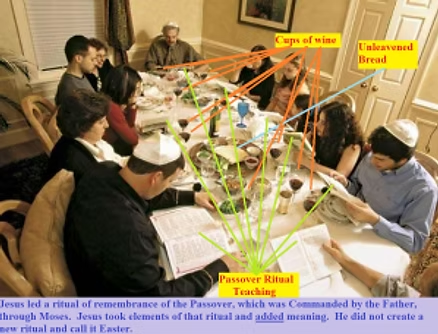
As such, non-Jews read of the Seder meal ritual without a clue about that event. The Seder ritual (actually on two night, back-to-back, beginning the Passover festival) lasts hours, beginning after 6:00 PM and ending when the men have passed out drunk on Seder wine, late into the night. That fact being unbeknownst to Gentiles-turned-Christians makes them read the words of the Gospels and think Jesus offered bread and wine in rapid succession. That was not the case.
Matthew and Mark, being Jewish and writing their Gospels primarily for Jews (in their brains), did not have any notion of Gentile Christians drawing wild conclusions about their words of Spiritual inspiration. Their words (in their brains) would easily be discerned by Jews who accepted Jesus as their Christ, having all experienced Passover Seder meals all their lives. The assumption would be that time lapses as time lapses, but the words of inspiration focus only on the important parts. In this way, all the Gospels are written as parables, where full understanding requires more than simply listening to a story being told.
That dawning within my mind then tells me that when we read in Mark 4:1, “Again Jesus began to teach by the lake. The crowd that gathered around him was so large that he got into a boat and sat in it out on the lake, while all the people were along the shore at the water’s edge,” this was on a Sabbath. Jesus (according to Matthew 13:1) was teaching, as a rabbi. By going beside the lake, he was speaking outside the synagogue, but he taught in the same manner. The crowds followed him because pilgrims were gathered (and increasing in numbers) and the synagogues might not have been large enough to accommodate them all. This would mean Jesus went out for the purpose of teaching on a Sabbath, which is why his disciples Matthew and Peter (his story told through Mark) were there to assist his ministry.
When I read one parable after another, the missing link is Scripture from the Torah that would bring about a question requiring a teaching answer. That answer would be told by Jesus in parable form. To cover readings from different scrolls and different verses of Scripture (like we have the Episcopal Lectionary schedule of readings), then explaining them as a sermon or statement designed to elicit questions, Jesus spoke in confusing words that required deep thought and reflection. Follow-up questions become automatic when teaching in parables.
Then why would Jesus take their minds away from the lesson just told by going into another riddle to solve? This is how many chapters in Matthew and Mark read – back-to-back parables. The answer in my mind is to grasp how we are misreading because of a lost sense of timing. Rather than read everything as happening on the same day, it is possible Jesus would go by the lake each day and teach the meaning of Scripture, which is the case in some chapters. Still, it makes more sense that Jesus would let each parable settle in by giving a week for the devoted to ponder each lesson – Sabbath-to-Sabbath. Without that clearly stated by the Gospel writers, we are led to assume differently.
In reference to a potential reading (in a synagogue a scroll would be taken from a case of scrolls and read aloud), the holiness of Jesus meant he could recite the scrolls through the Mind of God. Exodus 19:5-6 is then quite possibly the reading recited. It states (verse 6, spoken by God to Moses at Mount Sinai) “’You will be for me a kingdom of priests and a holy nation.’ These are the words you are to speak to the Israelites.” This reading would be why Jesus would begin speaking as a rabbi to a gathering of Jews (Israelites), telling a parable about this “kingdom of God.”
On the Jewish Encyclopedia website, in an article posted by Kaufmann Kohler, entitled “Kingdom of God (Malkuta de-Adonai),” the author made the following comments:
“The Hebrew slave who declares his wish to be a slave for life has his ear pierced, because “he casts off the yoke of God’s Kingdom to bend to the yoke of another sovereignty” (ref.). The yoke of God’s Kingdom—the yoke of the Torah—grants freedom from other yokes (ref.). Especially was it the principle of one party of the Hasidæans, the Zealots, not to recognize as king any one except God (ref.)”
In another article on Jewish Encyclopedia, entitled “Hasidæans” (by two authors), the statement is found that says, “Grätz (ref.) supposes them to have developed out of the Nazarenes[a first century – post Jesus sect, believed to have been headed by the Apostle Paul]. After the Maccabean victories, according to Grätz, they retired into obscurity, being plainly dissatisfied with Judas Maccabeus, and appeared later as the order of the Essenes—a theory which is supported by the similarity in meaning between Ἐσσηνοά or Ἐσσαῖοι (= Syriac stat. absolute , stat. emphat. , “pious”) and “Ḥasidim” (“pious”), and which has as many advocates (refs.) as opponents (refs.).”
This points at Jesus (called a Nazarene), who led the Passover Seder with his disciples in the Essenes Quarter of Jerusalem, in an upper room. As Jesus was certainly “Pious” and of a separate sect from the Pharisees and Sadducees (and had a disciple known as Simon the Zealot), one can deduce that the typical Jews would have been very much in the dark about what the Kingdom of God meant, because the Pharisees, Sadducees and Second Temple hierarchy heavily influenced what would be taught in the synagogues. What they did not know, the people knew less about. Because many questions went unsatisfactorily answered, many seekers were led to seek Jesus for guidance.
It was common to have individual Jews proclaim to have Messianic talents, based on possessing bravery and a willingness to lead a revolution that would overthrow foreign overlords and retake the kingdoms of Israel and Judah. The Jews had rebelled against oppressive rule from Roman emperors and surrogate kings and governors, including the Maccabean revolution. Jesus would then not be one to take a position that God’s “kingdom” would be ruled by anyone other than God, such as one leading a revolt against the Roman Empire, nor the elevation of the Temple’s elite as replacement rulers.
The conflict of being exiles who had returned to their old lands, without the strength of a national military at their disposal, and the history of having lost two lands under native kings who made poor decisions militarily and spiritually was causing seekers to ask, “What does God expect of us Jews in the kingdom of God told to Moses?” The Israelites had thought Israel was that kingdom – a physical realm – but Moses never set foot in the Promised Land of Canaan. “Where was the kingdom of God to Moses or what else could it mean if it wasn’t a nation ruled by a king devoted to God?” were a undoubtedly questions posed.
Knowing this background makes it easier to see how a “kingdom” can then be referred to as “seed on the ground.” This equates “the ground” to the Galilee and Judea, where Jews were the “seed” at the time of Jesus, sown amid Persian, Greek, and then Roman weeds. As such, “the ground” acted as a “nation unto God,” in the sense that it was an area of land that made God the owner, having scattered seed believing in Him. God would certainly cultivate that “kingdom,” so the land will yield fruit and become a worthwhile investment. Otherwise it would be fallow.
In Exodus 19:5, God told Moses, “Now if you obey me fully and keep my covenant, then out of all nations you will be my treasured possession. Although the whole earth is mine.” The seed can then be seen as God’s chosen people, those who maintained the Covenant given to Moses. Since God possessed the whole earth, the most “treasured nation” would be where God’s seed was sown. As God owns all the earth, the treasured nation is anywhere He will spread “a kingdom of priests and a holy nation.”
This then became Jesus speaking of “seed on the ground” as being purposefully placed into the earth, at which point patience is required. This period of wait is then said to be, “sleep and rise night and day.” Again, because one understands that Jesus is speaking in parable (“a simple story used to illustrate a moral or spiritual lesson, synonymous with allegory”), “sleep and wake night and day” must be read as a symbolic statement, more that the simplicity that one plants seeds, then goes to sleep and wakes up to find a plant has sprouted. It immediately evokes a meaning of patience being required, which all farmers know.
Because the topic is the kingdom of God, and because the Covenant through Moses initiated that thought, Jesus was then discussing a lesson that dated back at least fifteen hundred years. In that regard, “sleep and rise” should be seen as metaphor for reincarnation.
God spread the seeds on the earth that would experience periods of devotion, followed by periods of neglect. The number forty comes up a lot, as the “sleep” that would fall over the chosen people, until they would cry out to the Lord for help. That would be followed by forty years of “rise.”
Those periods can then be seen as times living in the darkness of death (“night”), followed by times of the light of truth guiding them to life (“day”). The symbolism can also reflect on the type of seeds planted, as some had lunar cycles and grow under the soil (root crops), while other seeds are planted to solar cycles, which grow above the soil (grains and vines). God’s nation of priests is then being inferred to be seed that is required to “rise” into the light of “day.”
This means when Jesus said, “the seed would sprout and grow,” that was the history of the Israelites, including the split into two nations, both their falls, the scattered remnants and the exiled Jews, which returned to the lands they had lost. All were the seed that had sprouted and grown, but the totality of that growth was still incomplete. The seed still had not grown fully into a “field” of priests. The kingdom of God still had not been fulfilled.
When Jesus then said, “he does not know how,” this translation makes it difficult to grasp. As a run-on from “and the seed would sprout and grow,” it is difficult to understand the pronoun “he.” To think “he” is God, as the planter not knowing, it totally confusing because God knows everything.

The solution comes from realizing the Greek word “autos” (translated as “he”) should be read as “it,” referring to the “seed.” The planter sows the land and then patiently waits, which is God. The seed, however, sprouts and grows but does not know how its growth is supposed to be, or when it will reach fruition. The seed does not know if it should grow according to the moon or the sun. The seed does not know it has died and been reincarnated many times over, still little more than a sprout or a stalk.
This is then a statement that reflects on a lack self-ego in the seed of the Lord. Just as a seed does not first develop a brain, from which it plans and maps out its own future development. It just grows; and so too will all of the seed of God’s kingdom.
In the masculine pronoun translation, “he” becomes the perfect reflection of the ultimate seed growth, which is matured as Jesus of Nazareth. That seed did not know how, known by Jesus saying “he” did not speak for himself, but for the Father. We do not learn “how” to get to the kingdom of God by the intellect of Jesus; but we see the path “he” took in total sacrifice of will and subjection of self. His path is the same as ours – where “we do not know how.”
When Jesus then said, “The earth produces of itself,” this is the agricultural truth that good soil makes for better plant growth. Jesus would tell a parable about hard, rocky earth and seeds falling into cracks, as well as weeds trying to choke out good seed; so, the metaphor of the earth is that it represents all that is on the material plane. Our bodies come from dust and our fetuses are growths in our mother’s wombs. Life for plants comes from the nutrients of the ground, the water made available, and the light (and warmth) provided. This means that a kingdom of the earth produces realms that know nothing of spiritual matters or the breath of life from God.
When Jesus then said the plants produced by the earth follow this pattern: “first the stalk, then the head [or ear], then the full grain in the head [or ear],” this says growth comes in phases. As far as the kingdom of God is concerned, the stalk is a commitment to the Law of Moses. It is the state of the student or disciple, where actions become the result of commands. A field of stalks can resemble the spears of soldiers standing in formation, awaiting orders.
This then leads to the development of heads, where the symbolism is the rabbis and other leaders who have memorized rules and procedures. An obedient soldier grows into a leader of other soldiers, while still needing higher commanders before acting. A disciple becomes a rabbi, which need not be more than teaching one’s children as one was taught by a father when a child.
The final stage is then the development of reason that begins to understand the order and structure of things. It becomes the “aha moment” of an epiphany, which then supplies nourishment to others, as well as new seed for new growth in another season. It is when the child asks a question that had always been asked before, but never answered, due to a lack of knowledge. Suddenly, a question causes words to fill one’s mouth with answers never thought possible. The disciple-turned-rabbi has become an Apostle of God.
Still, through these three developmental stages, the plant is not at liberty to remain for long in that ultimate state of existence. That requires death. This is when Jesus said, “When the grain is ripe, at once he [God] goes in with his sickle, because the harvest has come.”
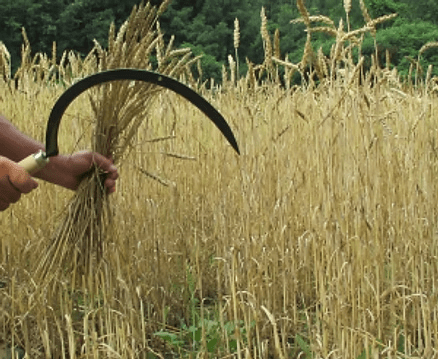
This says how one enters into the kingdom of God. The state of being “ripe” is when a priest of God has evolved from rote memorization and compliance to rules into one who has full ownership of ministry. The sickle then represents the cutting away of the self and one’s dependency on ego for survival in a world that produces of itself, letting one’s soul become the harvest God intended originally and waited patiently for it to come into ripeness, as baptized by the Holy Spirit. This can be seen as why Jesus commissioned his disciples to go tell the Israelites, “The kingdom of God has come near.” (Matthew 3:2; Matthew 4:17; Mark 1:15) It was in Jesus, and through him it was in them.
When one sees this explanation of what the kingdom of God means, as being those who have been sown by God and developed into ripe grain (or fruit), the harvest is synonymous with those who may enter God’s kingdom. Even though Moses had been told by God to free the descendants of Israel from slavery in Egypt, so they could become His seed, simply being a seed does not automatically grant entrance for one. The parable leading to the fullness of purpose that the seed has within it – becoming ripe grain – is the harvest God is patient to receive. Stalks and immature heads [or ears] can experience drought, disease, pestilence, or be choked out by weeds and never reach that final state that is worthy of harvest.
While that analogy could be heard and understood as a large field of ripe grain (or a vineyard of grapes), where the harvest was bountiful and plenty, Jesus then quickly offered a comparison. The comparison of the kingdom of God was then not made to a large quantity of grain, but to one tiny mustard seed. The kingdom of God was then compared to the individual and not the collective.

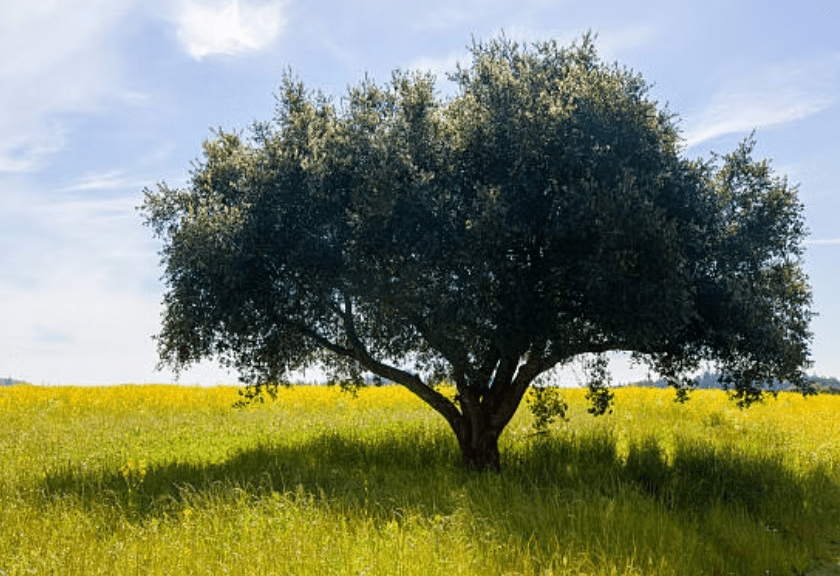
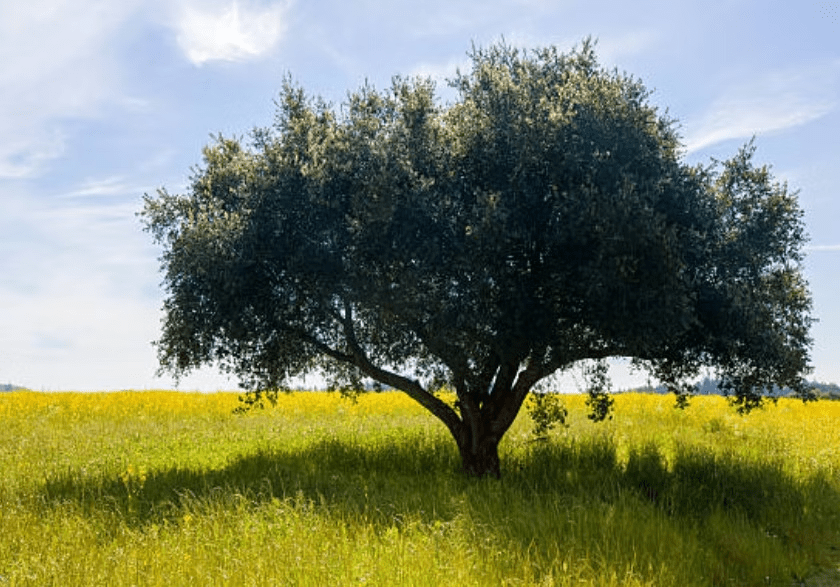
By Jesus then explaining the mustard seed as, “When sown upon the ground, is the smallest of all the seeds on earth; yet when it is sown it grows up and becomes the greatest of all shrubs, and puts forth large branches, so that the birds of the air can make nests in its shade,” this becomes metaphor for himself. The “smallest of all the seeds on earth” is a statement about his lack of pretense and pedigree, in the sense that he was known as a Galilean (a rube, or country commoner), as a Nazarene (from a small town with no prophecies of greatness), and as the son of a carpenter (not a priest, scribe, or prophet of the Temple, and certainly not of royal birth). Still, as Jesus’ ministry was underway, he was producing miracles, teaching the meaning of Scripture as no other rabbis were, and he was drawing larger and larger crowds of Jews wanting his experience what Jesus offered.
When we read, “the birds of the air can make nests in its shade,” this was metaphor about the disciples – the twelve ranking disciples and all the family who knew Jesus and had been touched by his presence. These would be under the protective arms of Jesus the Christ. They would, as well as all who sought the safety of the Jesus branches, become Apostles, touched by the Holy Spirit. This then makes a statement about the difference between “birds of the air” and one mustard seed.
When Jesus compared one mustard seed to the kingdom of God, with his being as that mustard shrub fully grown, the state of Jesus Christ is then the comparison to the kingdom of God. It means that each individual is a seed planted by God on the earth, which is planted in good soil – that which will offer the growing seed the nourishment of teaching that will lead it to seek shelter in Jesus (Christian religious thought, through churches and education). That sprout-stalk will begin to develop an immature Spiritual mind (a human brain), seeking to absorb more knowledge (Bible studies, seminary enrollment, reading books explaining Scripture, etc.). That effort will be seen by God and the seed will develop into one ripe for God to enter into that one’s heart. The result of that marriage is the mustard shrub as become one with harvested fruit, so the kingdom of God is found within, not some distant place far, far away.
When reborn as a mustard shrub, one becomes just like Jesus Christ, as a place for refuge to others. Simply by being filled with the Holy Spirit, willing to welcome all who come to find the truth and to have an effect on the healing of others, Jesus Christ is then working through one’s being. One has sacrificed all selfish desires, as one is like the seed that sprouted but “does not know how.” One comes from a seed planted into the ground, designed to be good fruit; but being good fruit means being harvested (ego death and subservience through marriage to God). The mustard shrub comes by the Holy Spirit baptizing the soul and Jesus Christ replacing one’s outward being. Therefore, the mustard shrub (Jesus Christ) IS the comparison to the kingdom of God.
When this reading ends by stating, “With many such parables [Jesus] spoke the word to them, as they were able to hear it; he did not speak to them except in parables, but he explained everything in private to his disciples,” the pronoun “them” refers the Jews who were not disciples or family of Jesus. This says that Jesus was not sent to earth to spread the explanation of the “word” (“logon”), just as he was not the planter who spread the seeds of Judaism (all who were descendants of Abraham-Isaac-Jacob). Jesus was the good soil that nourished the seeds so they could mature and ripen for harvest.
Thus, Jesus provided the Jews who sought him out with the basic nutrients that had to be processed inwardly, so that complete growth could take place (“and the seed would sprout and grow, he does not know how”). Still, Jesus could not make the individual plants in the field become mature, as that is totally the responsibility of each individual. This is seen repeatedly in the sick coming to Jesus for healing, only for him to say, “Go. Your faith has made you well.” The individual acted out of faith to seek Jesus; and in return they had opened their hearts to the Lord and received the Holy Spirit. As such, parables were attempts to draw the faith out of the people, so their own growth to maturity would be nourished.
When we see how the disciples and family of Jesus were treated differently (“but he explained everything in private to [those]”), this becomes parallel to Jesus the fully grown mustard shrub, where “his disciples” were those who sought shelter under his “large branches.” This makes the mustard shrub become synonymous with the religion of Christianity and all its branches, which would begin by the spread of “nests” made by the “birds of the air”– the Apostles. By Jesus going beyond the parable explanation, when “he explained everything,” this is synonymous with the “speaking in tongues” experienced by those in possession of the Christ Mind. It means that one who ponders the meaning of the parable, certain that it does hold truth, so the answer is still to be sought (like a common believer of the Torah and all that is called Judaism), that path of query will lead one under the mustard shrub of Christ. There all the answers to the truth are told “in private” – from one’s God-centered heart to one’s Mind of Christ, with the big brain bowing in submission.

As the Gospel reading for the fourth Sunday after Pentecost, when one’s personal ministry should be underway, this Scripture tells you parables that explain the kingdom of God. To be a minister of the Lord, one has to know where that kingdom lies and what path one must take to reach it. It is not an answer that can be told with maps and diagrams, as parable is the only way the Spiritual can be explained.
A minister to God will have become the resurrection of the kingdom of God, as the mustard shrub of Christ that offers the security of Spiritual matters a seeker needs. Still, as that mystical plant, one that is rooted in God, radiating as Christ so that one becomes a beacon of truth for others to seek. It becomes an order to go out and let the world encounter how “the kingdom of God has come near.”
If one has not yet found the commitment one needs to receive the Spirit and seek the truth, then one should see the stages of development that all Christians must take to reach that point of maturity and harvest. One needs to ask, “Am I a stalk? Do I simply go to church because my parents make me; or do I go because it increases my network base, from where business can be obtained?” Perhaps one is recovering from a tragedy in one’s personal life and religion has been said to be an outlet for hope. Maybe one has found need to hang with a tamer crowd? In such cases as these, one has sprouted but knows nothing; and a stalk is far from fruition.
One can ask the self, “What is the meaning to the many elements of Christianity that seems to be contrary to one another?” It is common to ask, “How can people believe blindly, without understanding?” It is more common to have peers who reject religion and will only associate with others of like minds of rejection. In these cases, one can fall waste by rejecting a religion without reason, because God offers reasonable reasons to have faith and belief.
These are the plights that lay waste to fields of seed these days. Christianity has so many common believers (just as Judaism had common Jews), when belief does not come from experience. There are the blind still leading the blind, and false shepherds taking advantage of the weak. Still, there is reason for the phrase, “Don’t throw the baby out with the bath water.” Christianity did not grow over two thousand years because of tricks, smoke and mirrors. It became ripe and was harvested.
A minister of the Lord does not call for the rejection of parables, because that is an admission of oneself denying there is truth. Jesus explained the truth to his disciples, but to others he spoke in parables. A failure to solve a riddle does not prove the riddle cannot be solved. If one continues to seek to grow into knowledge, then one has developed a head on one’s stalk. That progress comes without knowing the truth, but the truth is still sensed as one’s ultimate purpose for growth.
When one stops asking questions, then one is capable of giving answers to others. The “aha moment” of the Holy Spirit is upon one and the Christ Mind answers all questions. One has grown long enough, so a willing leap of faith is the next step. This is when ministry is at hand. Still, for one to be freed to become a shrub of refuge, one must be harvested of self, so only the fruit remains. Once harvested, one had found the kingdom of God within; and no matter how one explains that to others, it can only be parable until another has experienced that development personally.
 Explaining the Readings