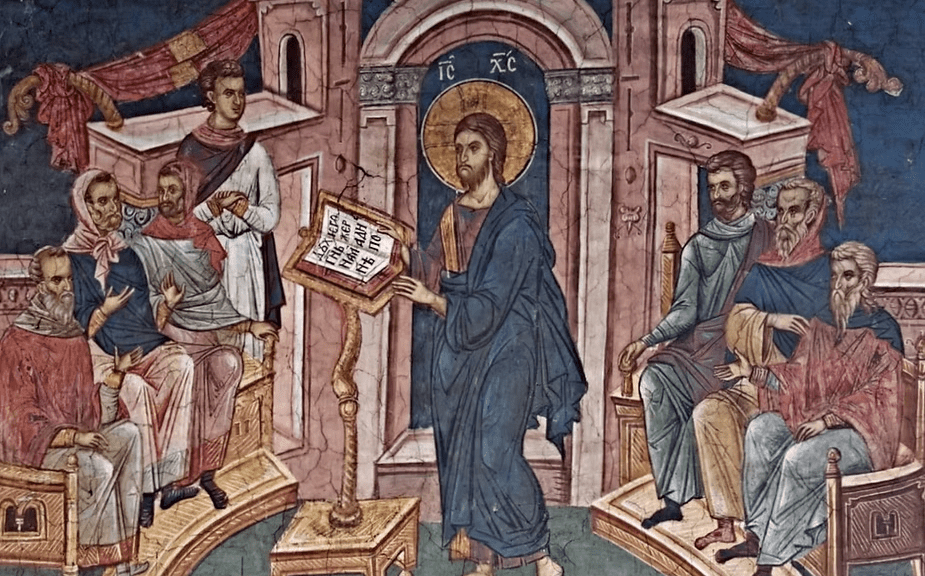
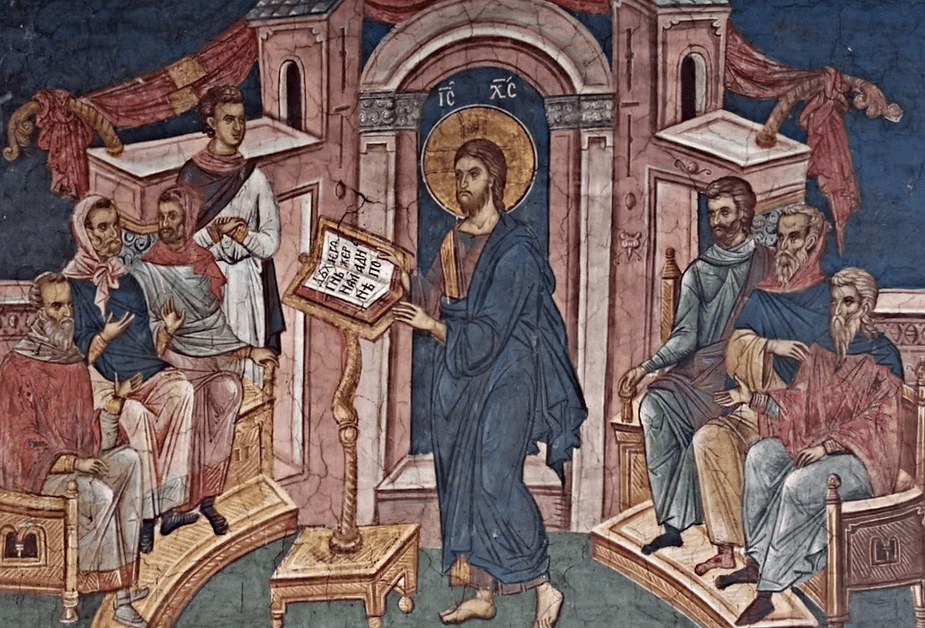
Jesus came to his hometown, and his disciples followed him. On the sabbath he began to teach in the synagogue, and many who heard him were astounded. They said, “Where did this man get all this? What is this wisdom that has been given to him? What deeds of power are being done by his hands! Is not this the carpenter, the son of Mary and brother of James and Joses and Judas and Simon, and are not his sisters here with us?” And they took offense at him. Then Jesus said to them, “Prophets are not without honor, except in their hometown, and among their own kin, and in their own house.” And he could do no deed of power there, except that he laid his hands on a few sick people and cured them. And he was amazed at their unbelief.
Then he went about among the villages teaching. He called the twelve and began to send them out two by two, and gave them authority over the unclean spirits. He ordered them to take nothing for their journey except a staff; no bread, no bag, no money in their belts; but to wear sandals and not to put on two tunics. He said to them, “Wherever you enter a house, stay there until you leave the place. If any place will not welcome you and they refuse to hear you, as you leave, shake off the dust that is on your feet as a testimony against them.” So they went out and proclaimed that all should repent. They cast out many demons, and anointed with oil many who were sick and cured them.
——————————————————————————–
This is an Gospel selection from the Episcopal Lectionary for the Seventh Sunday after Pentecost, Year B 2018. In the numbering system that lists each Sunday in an ordinal fashion, this Sunday is referred to as Proper 9. It will next be read aloud in a church by a priest, on Sunday July 8, 2018. This is important as it shows how Jesus was rejected by the Jews of Nazareth, just as were his disciples faced rejection in their appointed ministries. This is seen today in the fight among Christians to cast out anyone who offers wisdom without some degree of approved divinity, such as that handed out by professors of scholastic religion.
This is Mark’s version of the same story told by Matthew (13:53-58) and Luke (4:14-30), with Luke’s more detailed about Jesus being rejected in his hometown. Mark then followed with the commission of the twelve, which Matthew told of in his tenth chapter (the whole chapter) [slightly before Jesus was rejected in Nazareth] and Luke told of in his ninth chapter (verses 1-6) [well after Jesus was rejected in Nazareth]. Luke told the story of Jesus being rejected in Nazareth with much detail, well beyond what Mark wrote; but the inconsistencies of the chronology makes certainty of when each event occurrences difficult to pinpoint. Still, there is purpose to the order of presentation that is found here in Mark.
There is no mention of Nazareth specifically in either Mark of Matthew, but Luke does make that specifically known, with Mark telling that the people in the synagogue knew his father was a carpenter. One can assume Joseph died before Jesus began his ministry, certainly before he moved to Capernaum, because there was no mention of Joseph at the wedding in Cana.
By knowing all of the surrounding stories of the same events, a three-dimensional view of Mark’s story emerges. When we read, “Jesus came to his hometown, and his disciples followed him,” we know from Luke that Nazareth was one of several synagogues that Jesus taught in, after he “returned to Galilee in the power of the Spirit.” (Luke 4:14a) This means that Jesus did not go to his hometown solely for the purpose of showing off his teaching talents. The synagogue of Nazareth welcomed Jesus because of the “news about him [had] spread through the whole countryside” and “he was teaching in [multiple] synagogues, and everyone praised him.” (Luke 4:14b-15)
When Mark wrote, “On the sabbath [Jesus] began to teach in the synagogue,” Luke makes a point of stating, “he went into the synagogue, as was his custom” and “he stood up to read.”
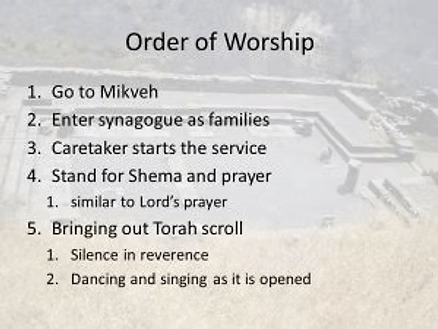
This means each Sabbath in the Hebrew calendar calls for specific readings to be read and discussed. Luke quotes the reading as being that of Isaiah 61:1-2a. In the “Calendar of Torah and Haftarah Readings,” for 2015 – 2018, the schedule for these two verses (plus verses 3-11) comes up in the reading for October 29, 2016 [27 Tishri 5777], which is called the “Blessing for Cheshvan” [Cheshvan = “Eighth Month”]. The same reading was also scheduled for September 9, 2017 [18 Elul 5777].
In the verses recited by Luke (Isaiah 61:1-2a only), the words from the verses include: “The Spirit of the Lord is on me;” and “He has sent me to proclaim.” Some English translation versions place a title on this chapter that comes from verse two-a, which is “The Year of the Lord’s Favor.” This portion of Isaiah 61 announces an unnamed prophet to come, which is not Isaiah but a prophecy of one who will bring freedom to those in captivity. Jesus stood and said, “Today this scripture is fulfilled in your hearing.” (Luke 4:18-21)
While Mark did not address this specific reading as what Jesus “began to teach” about, this is what led the Jews of Nazareth to be “astounded.” The use of the Greek word “exeplēssonto” means “astounded,” which might lead one to think Jesus impressed the Jews of Nazareth, as if he “bedazzled” them or “amazed” with his words. While Luke’s use of “ethaumazon” implies “wonder, marvel, and admiration,” it actually in a statement of “surprise.” Mark’s word most clearly shows that Jesus’ words had the effect of “striking them with panic or shock.”

This view is supported by seeing how those in attendance in the synagogue took this proclamation by Jesus as an insult. It led them to question his credentials: “Where did this man get all this? What is this wisdom that has been given to him? What deeds of power are being done by his hands!” Those questions did not in any way infer that what Jesus said was believable.
The question that asked where Jesus saw Isaiah foretelling of him was one asked in the tone of “What gall!” The use of “sophia,” as “wisdom,” misses the hint at “cleverness,” where a rabbi should teach the “intelligence” that comes from the standards of education, and not unfounded “insight.” The “deeds of power,” from “dynameis,” hints at a stunt proclaiming to be a “miracle.” The addition of “by his hands” is then meant as a preconceived “plan,” which is the art of shysters, made-up by Jesus only.
When the next question was, “Is not this the carpenter, the son of Mary and brother of James and Joses and Judas and Simon, and are not his sisters here with us?” they concluded that Jesus was just the boy down the lane who was the son of a carpenter. Growing up in Nazareth meant Jesus was from another poor family of Jews. His relatives were of no importance … pretty much like everyone from Nazareth … so the same expectations should be placed on Jesus. They let him teach out of respect for his being from Nazareth and some gossip that said, “Give him a chance,” but that sermon (in their minds) was a colossal failure.
To ensure that no one missed that point, Simon-Peter told Mark to be sure to write down, “And they took offense at him.” The Greek word written, “eskandalizonto,” is rooted in “skandalizó,” which in Latin is transcribed “scandalizabantur,” a word that is associated with the etymology of the English word “scandalous.” The “offense” caused was “disgraceful; improper or immoral.” The Nazarenes felt like they had fallen into a trap that had been set by Jesus, snared up quickly from their peaceful Shabbat Jewish selves and forced to become angry and wild in an attempt to free themselves.

Their anger led Jesus to say, “Prophets are not without honor, except in their hometown, and among their own kin, and in their own house.” As a true prophet of the LORD, such that everything Jesus said was the Word of God flowing through his mouth, the “honor” that comes to all “Prophets” (capitalization is purposeful, showing a divine connection, although the capitalization is from the paraphrase of translation) is the presence of God within.
Because a relationship with God requires many years to build up, into a marriage where a Prophet submits his (or her) personal will to the dominant Will of God – the Husband – even Jesus, as a child, was seen as no different as other children his age. Even though God spoke to Jesus daily, from human birth to human death and beyond, Jesus was free to express his personal opinions (albeit God-led) at all times prior to his Spiritual baptism, when the dove lit upon his spirit in the river Jordan, with John the Baptizer. That period of Jesus talking, rather than God speaking directly through Jesus, was not part of any written Gospel. The Jews of Nazareth, therefore, saw Jesus as a little more than an impudent human, one who (as far as they knew) was ordinary.
When we then read, “And he could do no deed of power there, except that he laid his hands on a few sick people and cured them. And he was amazed at their unbelief,” this says that the rejection of Jesus was so great that the Son of God could do little to reach through that refusal to accept holiness. It says that “unbelief” (“apistian”), which is a negative form of “faith.” It means “unfaithfulness” and “distrust” is the power of “disobedience” that pushes those professing “faith” away from God.
This makes Nazareth become a model for all of the Israelites, in particular those who maintain Judaism today, denying Jesus as their Christ. When the scope of definition for “Israelite” is broadened, to be seen as the children of God who do follow the promised Messiah that is Jesus Christ – Christians, Jewish and Gentile – then the same sense of “astonishment” and “taking offense” can be seen when so-called “believers” reject someone who is truly filled with God’s Holy Spirit. When Saints are seen as extremely rare, then the appearance of one teaching about Scripture in ways only God could know, it seems natural that those not in a relationship with God will fail to recognize one who is.
The same “unfaithful” (“offended”) have become led by people like them, who teach an ordinary message, so they set expectations for all substitute teachers – they must teach the same faithless message. Just as were the Jews of Nazareth so “disobedient” to the Lord that they ran Jesus out of town, with few being healed by his hands, Christians today are just as closed-minded to the truth. It is a knee-jerk reaction to reject the unknown, even when it scandalously slaps the truth in their face.

The message that so many fail to hear, and fail to learn, and fail to teach is that message that is repeatedly written in the Gospels and Epistles that says, “in the name of Jesus Christ.” Christians sit in pews and believe they should believe “in the name of Jesus Christ.” Christians believe they should be baptized “in the name of Jesus Christ.” Christians believe they should pray “in the name of Jesus Christ.”
Christians believe Jesus Christ is in Heaven with the Father, listening to prayers and placing check marks by the names of Christians who believe “in the name of Jesus Christ,” just like the Jews of Nazareth sat in pews in the synagogue and believed in the name of Isaiah. They all believed in the prophecies of Isaiah, but they all believed they would never see the day when any of Isaiah’s Saviors would come to town. Therefore, if a Christian stood up in a church on Sunday (or Saturday) after a priest or reader said the words “in the name of Jesus Christ” and loudly proclaimed, “I am in the name of Jesus Christ!” those Christians would (for the most part) be greatly offended.
Anyone who would hear that claim and come to Jesus Christ, in the person who knew he or she had been reborn as that Christian who proclaimed “the year of the Lord’s favor has come!” then he or she would benefit. A few of the whole would only amount to a few sick people who could be cured or have demons cast out of them by Jesus reborn. In that process, those few would have the torch of the Holy Spirit passed onto them, due to their faith. However, the many would shun that person, run him or her out of town, spread ugly gossip about him or her in that wake, and blacklist him or her from ever coming back to that church. In short, a Christian today would treat a reborn Jesus Christ just as the Jews of Nazareth scorned Jesus.
This means that when Jesus said, “Prophets are not without honor, except in their hometown, and among their own kin, and in their own house” that paraphrases as, “Persons gifted at expositing divine truth [true Prophets of Yahweh – “prophētēs”] are not despised, except when surrounded by those not filled with the Holy spirit [not also Prophets of Yahweh],who are not taught by persons gifted as expositing divine truth, thus who are not led to ever be expecting to meet one person gifted at expositing divine truth, much less ever become a “Prophet” themselves.
As such, “hometown” and “own house,” in today’s vernacular, represents one’s specific denomination of Christianity, in a specific church building. The version of Christianity that one holds dear leads one to go to a place where one feels at home. The church one goes to most regularly is then personal, as one’s own house of worship. This means “own kin” are all the others who go to the same church, in the same town, and (in the cases of the devout that adhere to the tenets of Christianity) it has been this way for generations.
As for Jesus, who was a Great Prophet who only spoke the Truth of the Father, his disciples were his “house” [“a church being wherever two or more gather in my name” – Matthew 18:20]. That included his mother, brothers, sisters, aunts and uncles who were all followers that would become “in the name of Jesus Christ” following Jesus’ death, resurrection, and ascension. The became his church, gathered in his name when Jesus Christ returned on Pentecost Sunday (the day after he ascended). They were strong supporters of Jesus as the Christ, who would continue his work when they also became Jesus Christ reborn. All honor and glory was given to Jesus of Nazareth by all who felt the presence of God in and surrounding him.
The Jews of Nazareth, those of Jesus’ hometown, did not bestow any honor onto Jesus, as they did not embrace him as the one Isaiah prophesied. Instead, they saw Jesus as a black sheep who had turned away from their simple mindset of belief … themselves as God’s chosen people … where all were chosen equally, with none to ever rise to the level of being truly righteous and responsible for the well-being of their family of Judaism.

This truth has to be seen in order to then understand why Simon-Peter told Mark (his Gospel writer), “Save the story of Jesus sending us disciple of Jesus out to minister in our hometowns, in the synagogues when we were raised, where the Jews who knew us before we were “in the name of Jesus Christ” could reject us also.”
Peter had Mark write about the commission of the twelve immediately after Jesus was rejected in Nazareth, because (in the imagined words of Peter), “We too were Jesus by extension, through God’s Holy Spirit being our authority.” Therefore, Mark’s story of the sending out of the twelve disciples then becomes the story of every Apostle who ever ministered Jews and/or Gentiles as Jesus Christ reborn. Matthew and/or Luke could chronologically state that event, with the same higher meaning intended to be found; but Mark’s retelling was for the purpose of understanding the future growth and spread of all true Christianity. The commission of the twelve was the commission of all Saints in the name of Jesus Christ.
When Mark wrote, “He called the twelve,” the most basic meaning is the twelve named disciples of Jesus, as of that time in Jesus’ ministry. In Matthew 10:2-4, amid his story of the commission of the twelve, Matthew named each disciple. This included (last and least), “and Judas Iscariot, the one who betrayed [Jesus].”
That inclusion of Judas and the disclaimer that will forever go along with his name is what makes the sending out of twelve guys from Galilee, around 30 A.D., be the least intent of this commission. We can assume Judas Iscariot went, like the others; but one has to ask, “Did he and his partner obey all the instructions and cast out demons?”
That makes the number twelve stand out as the eternal condition for those who would forever be “called” by Jesus Christ AND fully comply with those commands. This means that the number is symbolic, more than literal. Its use intends more than a number of physical disciples be discerned. It implies that twelve is the state of being that must be reached by all who heed that call … with Judas Iscariot failing to meet that requirement (as the note beside his name by Matthew implies).
Rather than attempt to teach a course in numerology, here is one of many web pages that explain the symbolic meaning of the number twelve. It is this symbolic nature that forms the core explanation as to why Jesus had twelve disciples, when he actually had many more followers and believers. Luke wrote of a commission that included seventy (or seventy-two) that were appointed in pairs. (Luke 10:1-20)
The number twelve represents a spiritual elevation, so the self is no longer controlling the soul. Twelve ‘boils down’ to a three (12 => 1 + 2 = 3), but is a special number that is like a “master number” (11, 22, 33). The number three represents “initial completion,” whereas twelve (as 12 => 1 + 2 = 3) is a number that represents “final completion.” We see this in the twelve signs of the zodiac and the twelve tribes of Israel.
A three is then representative of the self, while a twelve elevates the self by submission to God. Still, oneself can reject that elevation and reduce a twelve back to a basic three, which is symbolic of the free will the self maintains. In this regard, Jesus symbolically named twelve disciples to be those who assumed roles that were elevated above his other base followers. However, the inclusion of Judas Iscariot reflected how a title of respect does not guarantee complete subjection to God, as some will always choose self over becoming Jesus Christ.
When this concept of twelve is seen, it allows one to see the eternal potential of the commission of Jesus Christ into the world, through subjects that never knew him as the human being that was Jesus of Nazareth. They were then, are now, and will always be the ones sent out “two by two, given authority over unclean spirits.” That “authority” (“exousian”) is less about being a power over others, as it is more important as the power of the Holy Spirit, which rejects the presence of anything spiritually unclean to enter into an Apostle (i.e.: Saint).
This means that when Mark wrote, “They cast out many demons, and anointed with oil many who were sick and cured them,” it was the power of the Holy Spirit that had the effect of “anointing oil.” This has to then be read as more than olive oil that has somehow been blessed by a Saint. The use of “oil,” where the Greek word “elaion” means, “(figuratively) the indwelling (empowering) of the Holy Spirit,” means this has more power in a Spiritual sense, rather than a physical pouring of oil on one’s forehead. It becomes synonymous with baptism by the Holy Spirit, where physical water has no effect on a soul.
By realizing the power given to the disciples (elevated to Saints) was not self-generated or self-willed, but the power of God’s Holy Spirit passed onto them, we can then best understand Jesus’ instructions. When Peter told Mark that Jesus said, “Take nothing for their journey except a staff; no bread, no bag, no money in their belts; but to wear sandals and not to put on two tunics,” those instructions apply today as well as they applied then, because Jesus spoke in ageless metaphor.
In general, Jesus told the Saints who would be in the name of Jesus Christ, “Go into the world as ordinary looking people, with nothing about you hinting at piety.” In other words, Jesus said, “Go and make it so only the truly faithful to God will be positively drawn to you.” As a fishing analogy applied to fishers of men, Jesus sent them out fishing with just a line and a hook, but no pole, no net, no bait , no spinners, and no lures.
The Greek text of Jesus’ instructions actually states, “Nothing they should take for the journey,” where “hodon” says (in addition to “journey”), “path, road, and way.” This then becomes the path of Jesus, who said, “I am the way (“hodos”) , and the truth, and the life; no one comes to the Father but through Me.” (John 14:6, NASB) “Nothing” more is required, when one walks as Jesus Christ reborn through the Holy Spirit.

This makes the exception of “a staff” be not a walking stick (or crutch to lean on) but the authority of the Holy Spirit. It is like the invisible “rhabdos” that is the “scepter” of Christ the King. Jesus said, “My kingdom is not of this world,” (John 18:36) but when his subjects are the souls within the realm of their flesh, his staff of sovereignty appears as just another human being.
To have his Saints carry “no bread,” this is more than the him demanding they deny the physical necessity of food (fasting), where taking a “loaf of bread” would be viewed as a lack of faith, as if there would be an unwillingness to depend on manna from heaven. More than a demand to physically restrain one’s bodily needs, the symbolism of “bread” is relative to the symbolic presence of matzah is the Passover.
At the Seder meal (the “Last Supper”) ceremonial bread was broken (a ritual breaking, called the Yachatz) and the disciples were told to eat in remembrance of him. The Yachatz is actually hidden and must be found, so it can be eaten as a dessert. Children are the focus of this exercise; and Jesus called his disciples, “little children.” (John 13:33) As such, one is asked to seek and find Jesus Christ, who is hidden in the “bread” that is the Word of God. Scripture must be consumed to begin a journey that, when found, requires one be stripped of self. To reach that point of sacrifice, one must see the prophecies of Jesus in the holy text first.
As an instruction to the holy priests of the LORD who are sent out to teach the truth, “take no bread” means to take no prepared Scripture lessons to teach. A prepared lecture or sermon requires the intelligence of a brain, which cannot withstand questions the brain has not been prepared to answer. When one is without “bread” due to faith, then the manna from heaven will be sent to one.
Trusting Saints are sent unprepared so they can then receive the knowledge of the Mind of Christ that is promised to come, as needed. It comes so that not only will one be fed spiritually, but so too will one’s whole family be fed spiritually. All questions will be answered without conscious thought required, through teaching by the power of the Holy Spirit.
When we hear the instruction, “no bag,” this goes beyond the literal meaning of “a sack, wallet, or leather pouch for carrying provisions.” The intent here is like a quiver that holds a supply of Biblical arrows or Scriptural quotes that are intended to wound or defend one’s position. It means (to Jews) not to be lugging around a selection of Torah scrolls to read for Jews to hear. To a Christian, it means not to carry a copy of a Holy Bible to read to others. This means “no bag” is akin to thinking outside the box, where everything written in scrolls and Holy Bibles is relative to translation restrictions or pronunciation choices. It becomes an attempt to put God in “a bag” that limits Him and the truth of His Words spoken through prophets. Without that bag, God is free to enlighten an unfettered mind.
The requirement that says, “no money in their belts,” where “zōnēnchalkon” (literally “belt money”) can be read as “money belt” or “purse,” was stated at a time when “money” meant minted coins of precious metals. Still, when “belt” and “money” are seen as separate words, where “belt” means “girdle” or “waistband,” such as a leather strap tied around one’s mid-section, and “money” means coins of “brass, bronze, or copper,” the implication is not to go into the world displaying an underlying support (girdle) that is wealth-driven (money). It means not to travel like the scribes of the Temple, with an entourage of support encircling them; and it means not to go public in clothes that say, “Only I can afford this suit.”
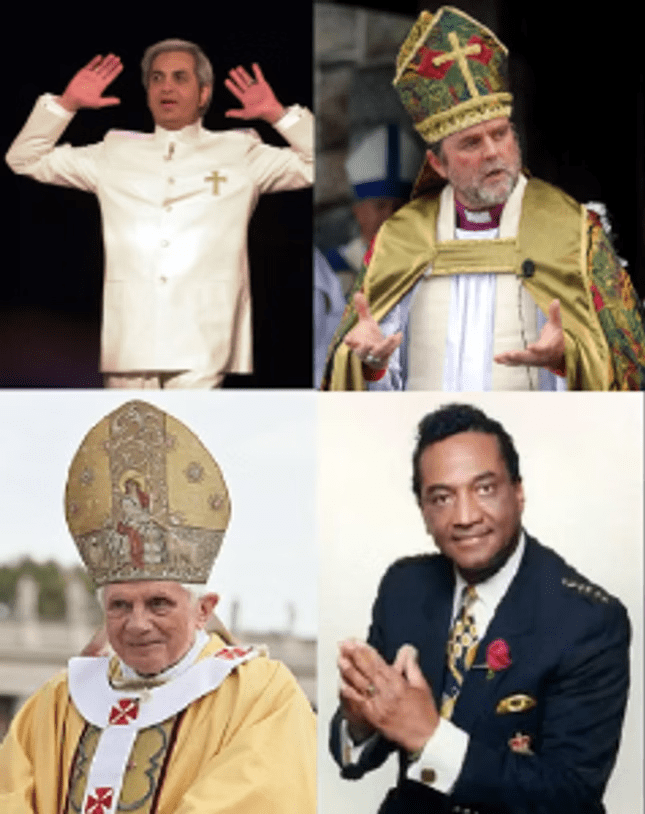
While such a restriction set by Jesus can easily be noticed in the television stardom of televangelists who plead for contributions to buy another $54-million private jet for ministry, it still applies to all mainstream organized religions, where priests, bishops, cardinals, and popes wear fancy costumes as if those clothes (hats, belts, miters, and staffs) deem them as holy. Further, many churches revel in ensuring their pastors live in nice homes and drive fine cars. The people tend to associate their piety in a figurehead deemed as their reflection. However, Jesus’ order means all of that flash and glitz only distracts from God’s message of sacrifice, causing others to focus on the outward appearances of others and not their own inner needs.
When Jesus said to “wear sandals,” that fashion statement does not means shoes cannot be a footwear replacement. A “sandal” is a piece of leather worn under the sole of the foot, as an invention for the purpose of human beings being able to walk boldly over rocky and sandy soil. It is protective clothing in that sense, which any modern version of footwear that is designed for outdoor walking can match. Still, by Jesus giving an order to wear sandals it has to be seen as symbolic of keeping the feet prepared to walk wherever the Lord sends one. The use of “sandals” is then akin to being a messenger, as God prophesied through Malachi: “Behold, I am going to send My messenger, and he will clear the way before Me. And the Lord, whom you seek, will suddenly come to His temple; and the messenger of the covenant, in whom you delight, behold, He is coming,” says the LORD of hosts.” (Malachi 3:1)
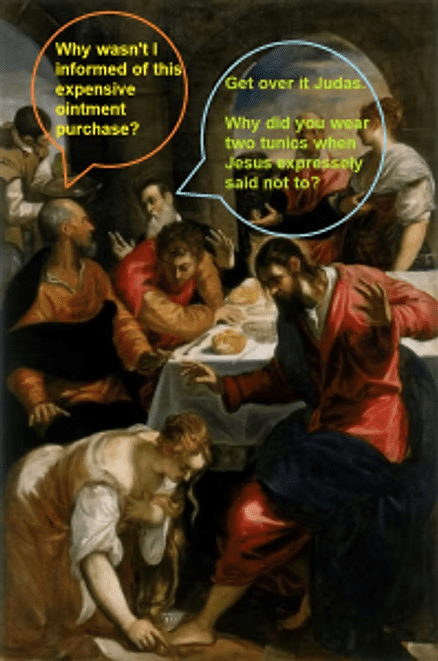
Finally, when Jesus said “not to put on two tunics,” the number two must be grasped. Two reflects the duality of humanity, which is the physical body joined with a spiritual soul. To “put on” or “be clothed” with “two tunics,” where the word “tunics” (“chitōnas”) implies “undergarments” or “shirts worn under a robe,” there is a hidden element that underlies the apparent. This should be seen as an instruction not to retain one’s self-ego under the cloak of righteousness. One can only be a messenger of God when one is wearing the robe of Jesus Christ and no one else. This is why a Prophet of the LORD is merely a nameless “mortal,” whose response to all God’s questions is, “LORD you know.”
With that state of being seen, we then read how Jesus said to the disciples, “Wherever you enter a house, stay there until you leave the place. If any place will not welcome you and they refuse to hear you, as you leave, shake off the dust that is on your feet as a testimony against them,” this should be seen as relative to the story Mark just told about Jesus being rejected in Nazareth. One should see how this connects to the “house” of worship (the synagogue in Nazareth) Jesus had just been rejected from, where as a messenger of God he was shown dishonor.
The symbolism of “dust” (“choun”) is as “earth” or “soil,” which relates to the physical and not the spiritual. God told His Son Adam, “For you are dust, And to dust you shall return.” (Genesis 3:19f) In Ecclesiastes we read, “All came from the dust and all return to the dust.” (Ecclesiastes 3:20b)
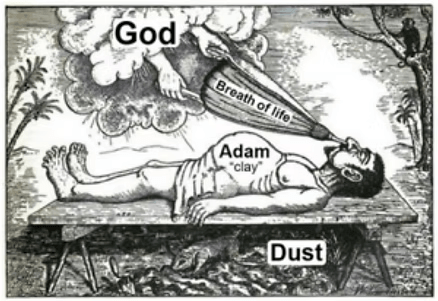
Therefore, the rejection of a Prophet of the LORD means the messenger (sandals) has been refused and the punishment means reincarnation on the worldly plane, not the reward of faith – eternal life in Heaven with God.
Mark then summed up Simon-Peter’s memory by stating, “So [the twelve] went out and proclaimed that all should repent.” The Greek word “metanoōsin” states the conditional, such that the recommendation is to repent, so one should repent; but one is free to do as one chooses. This means one must fully grasp the meaning of “repentance,” such that the Greek word “metanoeó” (the root verb) means, “change my mind, change the inner man (particularly with reference to acceptance of the will of God); properly, “think differently after,” “after a change of mind”; to repent (literally, “think differently afterwards”).” When “repent” is understood to basically mean, “to change one’s mind or purpose,” this becomes a recommendation to surrender one’s big brained ego (self) so the Christ Mind can be born within one’s being. A Saint’s purpose is then to recommend that one should make such a change of mind.
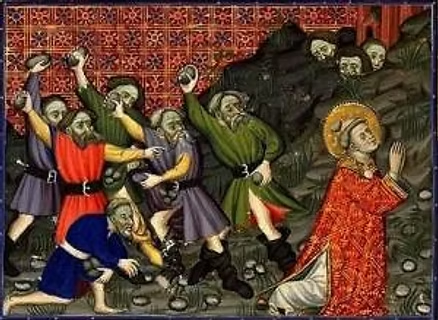
As a Gospel selection for the seventh Sunday after Pentecost, when one’s personal ministry to the LORD should be underway – one has truly repented – the intent should be to see the standard of rejection. In most cases, which can be seen in the story of Saul being transformed into Paul, rejection begins within one’s self. Saul stood holding the cloaks of those who rejected the messenger Stephen, so the persecutors’ hands would be free to stone a Saint (in the name of Jesus Christ) to death. They rejected Stephen just as the Jews of Nazareth rejected Jesus. Saul stood by and watched the rejection, not raising a hand to stop the mindset that bears the responsibility for neglecting everything Jesus ordered his disciples not to wear.
The ones who reject a change of mind hold their hard loaves of unleavened bread high, hoping the lack of yeast (the Holy Spirit) will punish those they swing hard at. Instead, that bread breaks and crumbles, unlike bread that was allowed to expand its basic ingredients into a tasty, life-giving softness. The hands with stones have bagged God as their personal slave, whose words say what they want them to say. They have transformed the exclusivity of being God’s chosen people into a lucrative businesses that caters to intellectual giants. The ones throwing the stones that killed Saints pretended to be upholding the Laws outwardly, while they are led by the fears of responsibility denied inwardly. These are the ones a minister of the LORD is called to confront.
Luke wrote of the people of Nazareth being so angered at Jesus that, “They got up, drove him out of the town, and took him to the brow of the hill on which the town was built, in order to throw him off the cliff.” (Luke 4:29) They could not harm Jesus, as Luke continued to say, because “he walked right through the crowd and went on his way.” (Luke 4:30)
As Stephen was dying, “Stephen prayed, “Lord Jesus, receive my spirit.” Then he fell on his knees and cried out, “Lord, do not hold this sin against them.” When he had said this, he fell asleep.” (Acts 7:59-60) That was Jesus again going on his way, because Stephen touched Saul on his path that led him to encounter Jesus Christ.
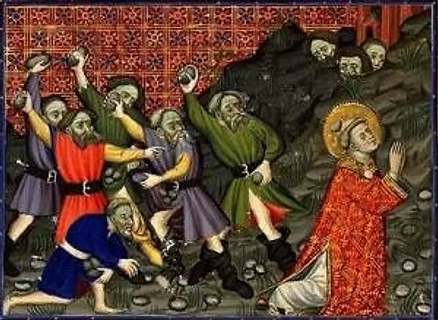
This says that all ministers of the LORD begin as those who have played their part in rejecting Prophets who have suggested a change of mind and the subjection of self-ego to the LORD. Ministers have been there, done tha;, so when they see others rejecting their transformed souls as being the old insolent human beings they were before, ministers then see themselves in reflection. This leads them to pray for God to forgive them all for being ignorant for so long, while really wanting to be saved.
Aside F.Y.I.: Deleted from this reading is the verse that is marked as an aside [in parentheses] that is a long ending to verse 11, following “a testimony against them.” It states “(Truly I say to you more tolerable it will be for Sodom and Gomorrah in day of judgment , than for that town.) This means rejecting a Prophet of the LORD calls for eternal damnation, assuming repentance does not come before the day of judgment.”
 Explaining the Readings