King Herod heard of Jesus and his disciples, for Jesus’ name had become known. Some were saying, “John the baptizer has been raised from the dead; and for this reason these powers are at work in him.” But others said, “It is Elijah.” And others said, “It is a prophet, like one of the prophets of old.” But when Herod heard of it, he said, “John, whom I beheaded, has been raised.”
For Herod himself had sent men who arrested John, bound him, and put him in prison on account of Herodias, his brother Philip’s wife, because Herod had married her. For John had been telling Herod, “It is not lawful for you to have your brother’s wife.” And Herodias had a grudge against him, and wanted to kill him. But she could not, for Herod feared John, knowing that he was a righteous and holy man, and he protected him. When he heard him, he was greatly perplexed; and yet he liked to listen to him. But an opportunity came when Herod on his birthday gave a banquet for his courtiers and officers and for the leaders of Galilee. When his daughter Herodias came in and danced, she pleased Herod and his guests; and the king said to the girl, “Ask me for whatever you wish, and I will give it.” And he solemnly swore to her, “Whatever you ask me, I will give you, even half of my kingdom.” She went out and said to her mother, “What should I ask for?” She replied, “The head of John the baptizer.” Immediately she rushed back to the king and requested, “I want you to give me at once the head of John the Baptist on a platter.” The king was deeply grieved; yet out of regard for his oaths and for the guests, he did not want to refuse her. Immediately the king sent a soldier of the guard with orders to bring John’s head. He went and beheaded him in the prison, brought his head on a platter, and gave it to the girl. Then the girl gave it to her mother. When his disciples heard about it, they came and took his body, and laid it in a tomb.
——————————————————————————–
This is the Gospel selection from Episcopal Lectionary for the Eighth Sunday after Pentecost, Year B 2018. In the numbering system that lists each Sunday in an ordinal fashion, this Sunday is referred to as Proper 10. It will next be read aloud in a church by a priest on Sunday July 15, 2018. This is important because it gives the details of John the Baptist’s execution, which has applications that should be realized by all readers.
In this reading selection, one has to notice how Mark (the writer for Peter) gave a base statement of how Herod Antipas (a.k.a: Herod Antipater), the ruler of Galilee and Perea, was informed of a man named Jesus, from Nazareth in Galilee.

At that time, according to Mark’s Gospel, Jesus was teaching in Galilee and drawing rising attention. By stating, “Some were saying, “John the baptizer has been raised from the dead,”’ this is following the death of John, ordered by Antipas. It was the news of John the Baptist’s death (Jesus’ cousin) that led Jesus to seek solitude across the sea, which led to the feeding of five thousand.
Matthew (Matthew 14:1-13) and Luke (Luke 9:7-10) also tell of the Herod’s role in the death of John the Baptist, with Matthew also giving the details found here in Mark. Matthew also speaks of the details of John’s beheading in hindsight, after telling how Herod had “heard reports about Jesus.” This hindsighted view is seen as “John’s Fate Recalled” (an artificial title placed before this story in the New American Standard Bible translation version). Such a title gives the impression that this story is rumor, rather than a truth personally witnessed.
The disciples of Jesus were attending to his needs, in particular on the Sabbaths, when Jesus would teach in synagogues around Galilee or from a hillside around the Sea of Galilee (that had natural acoustics that allowed a normal voice to be heard at a distance). Further, both Matthew and Mark connect Jesus’ being rejected in Nazareth to news of his travels in Galilee reaching Herod Antipas, and both prior to the feeding of five thousand. Luke, Matthew and Mark all say that Jesus sent out the twelve prior to the news of John’s beheading, which then led to the event of five thousand being fed.
This three-dimensional view says that the disciples did not venture close to Herod’s palace when they were sent out as extensions of Jesus. Even if one can assume that the prison and palace were in the capital city Antipas built – Tiberius, on the western shore of the Sea of Galilee (a.k.a: Lake Tiberius) – that presence in Galilee would not allow Jesus’ disciples into the palace. They certainly would not have been invited to a birthday party thrown for the king.
As poor Galilean fishermen of Jewish heritage, they would have had absolutely zero contact with any Roman approved ruler of Herod the Great’s kingdom. After his death over twenty years prior, Judea was split into quarters. Herod the Tetrarch (Antipas) was a ruler of “One Quarter” of that realm, which was divided four ways. Herod Archelaus ruled Judea, until he was disposed by Rome and replaced by a governor (several before Pilate). Herod Antipater received Galilee & Perea, while the half-brother Herod Philip II was assigned Batanea. Decapolis being an autonomous league of ten cities, which made up the fourth division.
It is even doubtful that Jewish scuttlebutt was allowed to be proclaimed about the beheading, which would clearly paint Antipas as an evil ruler. This means the news of John’s death by beheading, news of his body being claimed by relatives for burial, and any information given to those relatives as to why the decision to execute was made, can be second-hand by the time that news would have reached Jesus and his disciples. One could seriously doubt that John’s relatives were told this story of a daughter’s dance and the whispers of the wife-mother hatred.
The nuances of Mark’s Gospel make it stand out beyond Matthew’s statement that “Herod wanted to kill John, but he was afraid of the people, because they considered John a prophet.” (Matthew 14:5) Mark adds depth to the aspect of the Baptist having told Herod, “It is not lawful for you to have your brother’s wife.” More than Antipas wanting to kill John, but was afraid of what the people thought, Mark tells us, “Herod feared John, knowing that he was a righteous and holy man, and he protected him.”
Wanting to keep John alive is what set the ruler above the disdain his wife, Herodias, had for the prophet. When Mark writes that Herod “heard him” and “liked to listen to John,” this links the Judaic roots the Herodians had, as their blood was Jewish. While they were all largely disbelievers of the teachings of the Torah and much more inclined to see the value of Roman and Greek empirical ways of law and government, the Herodians knew the demands (weak as they were) of the Jews had to be respected. The disposition of Herod Archelaus proved that Rome did not want a civil war to deal with. Thus all the client kings of the Herodian kingdom knew how important it was to simply keep unrest at a minimum.
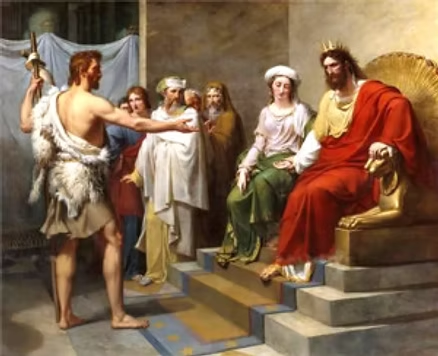
For Herod Antipater to enjoy listening to John the Baptist, this implies Herod would call upon John to answer questions about Scripture that he thought were the weak links in the Judaic faith. How King Herod would do this is unstated; but it could have happened any number of ways. John, undoubtedly, would speak words of truth that impressed Herod and made him rethink some of his inherent bias. Those words of wisdom probably kept him alive longer, but gave Herod no desire to free John.
Mark then identifies the “daughter of Herodias” as Herod’s, but Matthew clarifies this somewhat by simply stating, “On Herod’s birthday the daughter of Herodias danced.” Since Herodias had been the wife of Philip, it is more likely that Herod Antipater’s half-brother was the father of Salome. [Josephus confirms she divorced herself from Philip after the birth of Salome and then married Antipas in his Antiquities of the Jews, Book 18, chapter 5, paragraph 4 .]
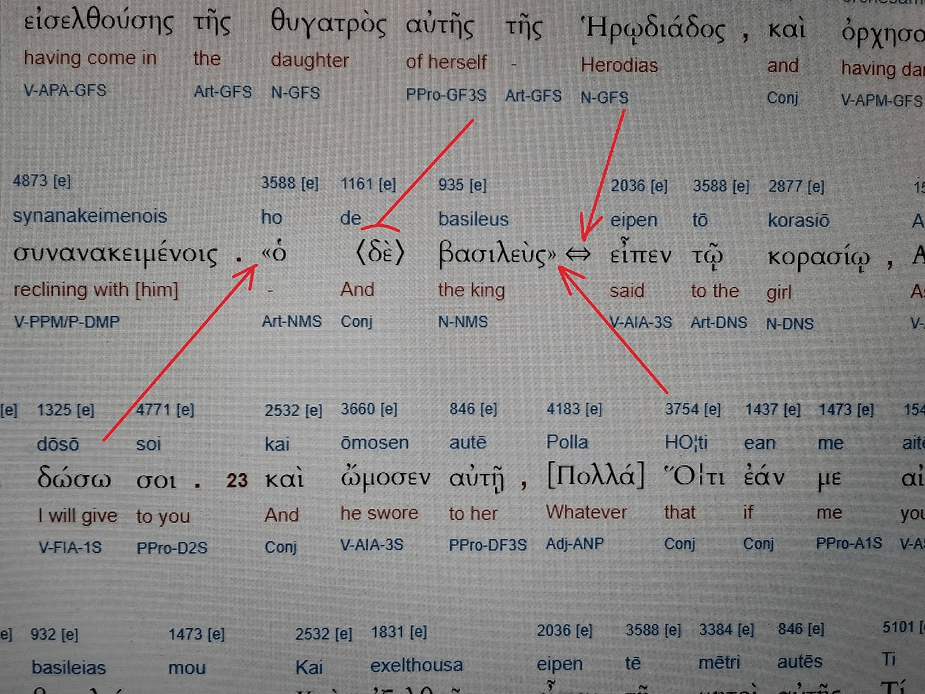
When we read, “the king said to the girl,” the Greek word “korasiō” is a statement that Salome was “a little girl, a young girl; a girl, maiden.” While it is possible to see her dance as sexually arousing, it should be understood that Salome was most likely a pre-teen, albeit close to, but still under that age of puberty that would make her a young woman. That youthful energy, combined with an innocence of naïveté, is then why we read: “She went out and said to her mother, “What should I ask for?”’

After Herodias told Salome to ask for the head of John the Baptist, one can assume that her suggestion was for John to be executed, such that “off with this head” is somewhat of a euphemism that is a harsh way of saying, “I would ask that John be executed.” Salome, however, took her mother’s suggestion most literally and went back to Herod and announced, “I want you to give me at once the head of John the Baptist on a platter.” That request by a little girl is then less capable of being heard as a general suggestion of a death sentence be given to a prisoner. It was made specific by her imagination of a platter.
When we read, “The king was deeply grieved,” Matthew used the Greek word “lypētheis,” which means “deep grief, or painful sorrow.” Mark wrote “perilypos,” which says “greatly grieved or very sorrowful.” Still, this should not necessarily be seen as severe distress over having John the Baptizer killed. Both Matthew and Mark tell that Herod ordered this act be done because he had publicly given his oath before guests. He was probably more grieved because he had given up control over what he was going to do to John.
After all, John had done little more than speak out against Herod Antipas as an adulterer and sinner, for having taking his brother’s wife as his wife, when his brother was still living. There probably was no official divorce involved, one following Mosaic Laws. Still, the grief felt by Herod was probably due to him having to account for the execution of a prophet that the people thought might have been their Messiah, when John had done nothing to warrant that sentence. If civil riots were to ensue, that would be the source of Herod’s inner anguish – punishment by Rome.
It is at the point that Herod “Immediately … sent a soldier of the guard with orders to bring John’s head.” The guard then “went and beheaded [John] in the prison, [and] brought his head on a platter.” Antipas then commanded that the guard give the head on a platter to the girl. When Salome then gave that gruesome gift to her mother, one could expect it was a sight she had never seen before and was one that would forever leave a mark in her memory. While Herodias was probably happy to see that her vengeance had been fulfilled, Salome had danced for no personal reward, other than her mother’s pleasure.
What one can overlook in the quick decision by Herod Antipater is how beheading was a form of execution that was largely reserved for important people, those who held some level of respect by Rome. While death was the ultimate price paid by beheading, it was swift, immediate, and (one can assume) relatively painless. When this reading begins by the rumors that Jesus was the reincarnation of John the Baptist (“raised from the dead”), this is like premonition of Jesus’ death and resurrection. However, Jesus would suffer from the disgraceful form of execution that was crucifixion, not the form of execution that would be suitable for a king. John the Baptist, by chance opportunity, was executed, but he was not tortured to death.
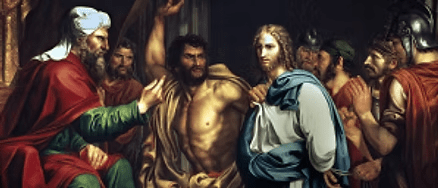
When we read, “But when Herod heard of it, he said, “John, whom I beheaded, has been raised,” this becomes the foundation for understanding why Herod Antipater would send Jesus back to Pilate, when Pilate sent him to be judged by Antipas because Jesus was a Galilean. In Luke we read, “When Herod saw Jesus, he was very glad, for he had long desired to see him, because he had heard about him, and he was hoping to see some sign done by him. So he questioned him at some length, but he made no answer.”
This says that Herod Antipater wanted to believe that his ordering the head of John the Baptist being taken was not a burden placed upon his soul, because John had been raised in Jesus. King Herod was “very glad,” having “long desired to see” Jesus, so Jesus could give “some sign” that he was indeed John raised again. John had “perplexed” Herod with his words and Antipas “liked to listen to him,” but Jesus said nothing to Herod Antipas. Because Jesus gave no signs he was John (which would have saved his life), Herod gave him over to his soldiers to mock and send back to Pilate.
When we read, “But others said, “It is Elijah,”’ referring to the increased popularity for (and increased protests against) Jesus, this is confirmation that prophecy was fulfilled by John the Baptist. To have some think John had been resurrected in Jesus, and to have other think John’s death brought about the return of Elijah in Jesus, that was people claiming the fulfillment of what had been prophesied to occur before the appearance of the Messiah.
In Matthew 11, after John the Baptist had been arrested and imprisoned, he sent messengers to Jesus asking, “Are You the Expected One, or shall we look for someone else?” Jesus sent the messengers back to John and then said to the crowd, “This is the one about whom it is written, ‘Behold, I send My messenger ahead of You, Who will prepare Your way before You.’” (Matthew 11:10) That implied that John was the reincarnation of Elijah; but when Jesus told his disciples, as they (Jesus, Peter, James and John of Zebedee) came down from the high mountain, “I tell you, Elijah has already come, and they did not recognize him, but have done to him everything they wished. In the same way the Son of Man is going to suffer at their hands.” Then the disciples understood that he was talking to them about John the Baptist,” (Matthew 17:12-13) that confirmed what had been felt by many Jews after John’s beheading.
From the depth that comes from this story told by Mark, which is echoed in those told by Matthew and Luke, the truth comes not from innuendo and rumor but from divine insight. Rather than a story being told of the execution of a prophet of the LORD, a story being recalled or remembered in the third person, by a man writing of it decades after the fact and in his own old age (60-ish), Mark [Peter], Matthew, and Luke (Mother Mary] saw what they wrote of divinely. All Scripture should be recognized as of divine origin, such that each writer of a book in the Holy Bible is divinely inspired (through the Holy Spirit).
In this way, God was present when Salome danced for King Herod Antipater and God knows of the private conversation held between Salome and Herodias. The truth is told, which may or may not confirm any scuttlebutt or hearsay that circulated then, because neither Mark nor Peter (both believed to have died in 68 A.D.) wrote from the memories of human brains. They told and wrote as commanded by the LORD, as Saints filled with God’s Holy Spirit, as each had been reborn as Jesus Christ. They each were shown the truth of that event.
As a selected Gospel reading for the eighth Sunday after Pentecost, when one’s personal ministry should be underway – as was Peter’s and Marks’s – the message here is the divine insight of truth. A minister will be led to know the truth, without the necessity of being present at events where the truth will be masked or covered-up.
The main perspective that comes from all Scripture comes when one can see the flaws of the characters portrayed as being the characteristics present in all human beings. This means all human are like Herod Antipas, all are like Herodias, and all are like the little daughter who danced to please her mother’s husband, and who asked for a gift that would please her mother. A minister learns not to see oneself as John the Baptist or as Jesus, even when becoming an Apostle means being reborn as Jesus Christ. To reach that lofty goal, one has to first see oneself as too flawed to become Jesus Christ without divine assistance.
In this way, each person is a king (or queen, perhaps for women?), as the supreme ruler of the kingdom that is oneself, one’s physical body. In the situation comedy Seinfeld, the joke was that each person is the “master of one’s domain.” Being a king or master is then how each human being develops an almost godlike view of self. This is how our minds look upon each part of our bodies as if they are vitally needed and must be served by the will of one’s mind. This is how the sum of the parts becomes greater than the whole, rather than the whole being determined by the sum of the parts.

This is the Big Brain that rules over us. In the typical decrees of self, we sin, just as Herod sinned by taking his brother’s wife as his wife. It is from our royal, all-powerful opinion of self that we approve adultery, divorce, adoption, and all other decisions we make. It is afterwards that we feel inner guilt over wrong decisions. We advise ourselves that there is no truth in religion that warrants we make the sacrifices, as the sacrificial ones are the less fortunate. We choose not to sacrifice because, after all, we recline when we dine (something only the rich do) and we throw parties for “courtiers, officers, and for the leaders,” those who have scratched our backs as we have scratched theirs.
In the rejection of religious sacrifice and any attempts to become righteous, initiated by the self-will (overseen by the Big Brain), one’s failures (sins) are internalized in private moments of shame and guilt. This is how we know John the Baptist (one’s conscience) is kept hidden in the personal jail cell of one’s personal palace. There is where one can ponder the legal clauses that one leans on, as crutches, which are the loopholes to do as one pleases. Once one seriously asks how is a natural or normal act deemed a sin, the wisdom of God brings those questioners glimpses of enlightenment. One sees in ways one had never seen before.
Just like Herod and John, one can be greatly perplexed when one hears that inner voice saying the truth about the condemnations of personal sins. Still, because no one else heard that truth be told, no one outside of the prison walls of one’s mind, one can delight in the sensation of hearing wisdom. One likes to hear what one’s inner voice says. It allows one time to manufacture a defense of sin, later in retort.
To cut off the head of one’s conscience is to completely forsake all attempts to justify one’s actions or to give any further thought to the dogma of religion. It is one’s oath before one’s personal collection of irreligious associates, where one feels one has finally sold one’s soul for good, willing to take the risk that there is no afterlife. If there is, then one accepts condemnation to hell, because one has become too attached to the rewards of the material world. The head one serves on a platter is none other than one’s own sense of righteousness. The “half of my kingdom” that has been sacrificed for the ‘dance’ of personal gain is that of an unseen spiritual realm and the promise of eternal bliss. With one’s head on a platter, one has made a deal with the devil and served up one’s soul.

This makes Herodias the epitome of Satan, a named evil entity, one which lurks behind the curtains of the stage where the dance of life is performed. She represents the element of wickedness that enters one’s life, to which one’s John the Baptist conscience screams, “Shame! Sinner be damned!” She whispers in the ear of a naïve act of pleasure, one seemingly innocent and pure, then suddenly that little vice has become a big trap.
Salome is unnamed because she represents the myriad of ways one can be tempted to give up one’s soul. She calls upon one’s standing in front of others as the oath one must live up to. This trick, like that whispered by Satan to Jesus, while he was tested in the wilderness, calls for one to look for honor among thieves, when there is no such thing. Herod catered to the will of a “little girl” because he made an oath before dignitaries that had no honor. Had Herod Antipas not cut his own head off, he would have told Salome, “Go to Hell,” just as Jesus told Satan, “Get out of my face.”
This is the lesson that a minister must heed. One has to make the life decisions that will take one away from the pretense of lavishness. The Jewish recognition of the Passover has them reclining for dinner, where they recognize only the wealthy can do that regularly. Jews only do it once a year (two evenings). The symbolism of the Passover is God giving protection to His chosen, those whose dedication and devotion will be rewarded with riches that are greater than any found on earth. That symbolism of a Seder meal has to then become the reality of one’s real life. One has to see the folly of pretending the material world offers anything of lasting value. Therefore, the call to sacrifice all addictions to the worldly means the head that is served on a platter is one’s self-ego … the illusion that is the Big Brain.
A minister of the LORD can then read the last line of this selection with understanding. “When his disciples heard about it, they came and took [John the Baptist’s] body, and laid it in a tomb.” That body was headless. Only the physical body was buried, so it could return to dust. Death is the end to all human bodies; but Heaven is the wake state that defeats human death.
The head of John the Baptist represents the Christ Mind, which is the gift of the Holy Spirit that makes one a prophet of wisdom. John sacrificed his Big Brain for a higher reward. That reward was told in this reading as him being the great prophet Elijah. King Herod thought John had been “raised again” in Jesus. He was half right. John was raised again as the soul of Elijah having returned to earth, for the purpose of announcing the Messiah was here.
This is then how a minister is sent by God to likewise preach to the people in general and to individuals privately, one-on-one. John the Baptist spoke the Word of the LORD because he was chosen at birth to serve God and he did so righteously. Still, John the Baptist had an ego that led him to question the authority of Jesus, because he was being held in prison and could not serve the LORD as he had been doing. Jesus responded to John’s messengers by saying:
“’Go and tell John the things which you hear and see: The blind see and the lame walk; the lepers are cleansed and the deaf hear; the dead are raised up and the poor have the gospel preached to them. And blessed is he who is not offended because of Me.’” (Matthew 11:4-6)
This means a minister of the LORD does as the LORD deems best. The LORD sends ministers so the truth comes to those who are blinded to Scripture and cannot be moved by it to act. Sinners have their souls cleansed by the Holy Spirit and those who have turned a deaf ear to the truth hear their consciousness telling them, “Listen!” Jesus knew John would be dead in the not distant future, but Jesus knew John would be raised up, returning to a better place, his work on earth done. Likewise, a minister of the LORD sends word that the Big Brain must die for the soul to be raised. Those who are poor of Spirit are transformed into Apostles who preach the Gospel, when they like to listen to wisdom speaking.


 Explaining the Readings