
The apostles gathered around Jesus, and told him all that they had done and taught. He said to them, “Come away to a deserted place all by yourselves and rest a while.” For many were coming and going, and they had no leisure even to eat. And they went away in the boat to a deserted place by themselves. Now many saw them going and recognized them, and they hurried there on foot from all the towns and arrived ahead of them. As he went ashore, he saw a great crowd; and he had compassion for them, because they were like sheep without a shepherd; and he began to teach them many things.
When they had crossed over, they came to land at Gennesaret and moored the boat. When they got out of the boat, people at once recognized him, and rushed about that whole region and began to bring the sick on mats to wherever they heard he was. And wherever he went, into villages or cities or farms, they laid the sick in the marketplaces, and begged him that they might touch even the fringe of his cloak; and all who touched it were healed.
——————————————————————————–
This is the Gospel selection from the Episcopal Lectionary for the ninth Sunday after Pentecost, Year B 2018. In the numbering system that lists each Sunday in an ordinal fashion, this Sunday is referred to as Proper 11. It will next be read aloud in an Episcopal church by a priest on Sunday July 22, 2018. It is important because it shows the care that Jesus had for the ones of faith in God, who acted upon their beliefs with faith. This includes the disciples who had returned from their assigned ministry and those who searched for Jesus and went to him when he was seen and recognized.
It should be realized that this reading comes from two parts of Mark’s sixth chapter. These two selected sets of verses let the reader see how the first segment came after the twelve had been sent out, and then upon their return hearing the news of John’s beheading. Verse 30 relates to the twelve returning and reporting their doings and teachings of their commission. Verse 31 relates to the news of John, as Jesus’ instruction, “Come away to a deserted place all by yourselves and rest a while” was not because their travels made them weary, but because some of the disciples had been disciples of John the baptizer. They needed time to reflect on that loss. Verse 32 then adds that the activity of travel had meant the disciples needed seclusion to rest and eat, in addition to grieving without the need to do chores for the church of Jesus.
Verses 33-34 precede the feeding of 5,000. When we read, “Now many saw them going and recognized them, and they hurried there on foot from all the towns and arrived ahead of them,” one can assume that some disciples went to get some food to eat, like preparing for a picnic once they reached the deserted place. The place was probably Capernaum, as that was where Jesus lived. Since the disciples were recognized, people surely asked them, “When will Jesus be around?” They probably answered with the truth, saying something akin to, “Probably tomorrow. We’re headed for some R & R in Bethsaida.”
That answer can be assumed because Luke (Mary’s story) says, “When the apostles returned, they reported to Jesus what they had done. Then he took them with him and they withdrew by themselves to a town called Bethsaida,” where “the crowds learned about it and followed him.” (Luke 9:10-11) Some disciple let that be publicly known.
Because Mark wrote, “they went away in the boat,” they had to have traveled in a large fishing vessel (used primarily for commercial purposes), which would have been required for twelve disciples, Jesus and others going to fit safely on board. A large fishing vessel then requires a marina with piers and docks in which to be moored, so it would most likely have been in a ‘slip’ in Capernaum.
We are told that Jesus moved to Capernaum from Nazareth and while walking by the sea (presumably there) he called Peter and Andrew and then James and John of Zebedee to follow him. (Matthew 4:18-22 & Mark 1:16-20) While Peter, Andrew and Philip (possibly Nathaniel too) lived in Bethsaida (John 1:44), their fishing business might have been best based in Capernaum. That may be where Zebedee maintained a spot on the dock for his fishing boat.
Based on the information in Luke (the truth told), this seems to indicate Jesus and his followers went by boat from Capernaum to Bethsaida; but because the crowd there would not let them have solitude, they then set sail again and went further south, along the eastern shore of the Sea of Galilee. The area known as the Bethsaida valley is shown in this map of Roman-era docks on Lake Tiberius, as the flood plain (in a semi-arid environment – steppe climate) at the northeastern shore of the lake. The map shows there were two docks that were in the Bethsaida valley, one at the mouth of the Jordan River and the other further to the south.
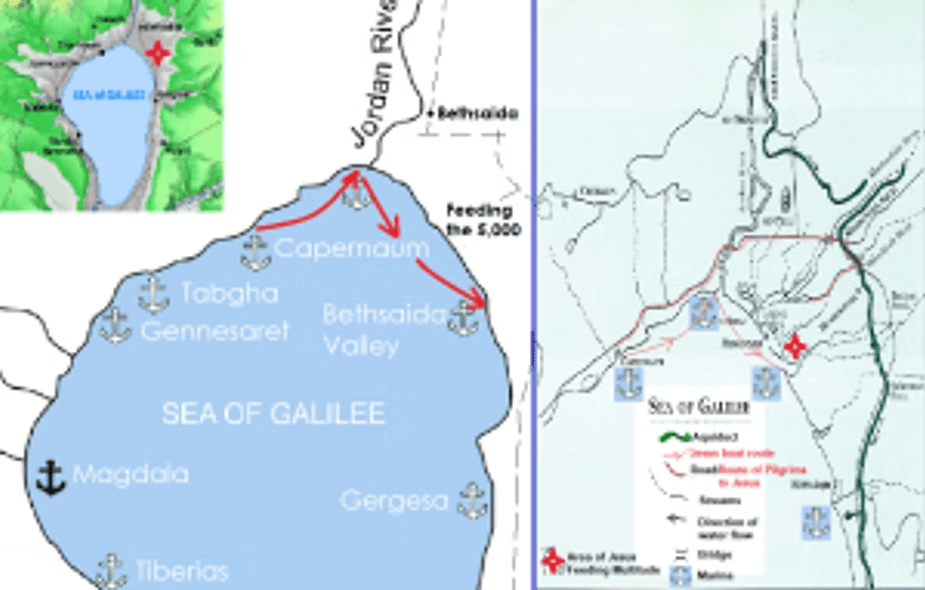
Seeing this segmented trip from Capernaum to Bethsaida and then to the somewhat marshy flood plain of Bethsaida (which the roads and aqueducts avoided) shows how the boat with Jesus would have traveled relatively close to the shore, thus be visible to those walking the road along the shoreline. Had Jesus and disciples set sail directly across the sea, the route of the boat would have made it difficult to spot from land. However, if it stayed close to shore the people who “hurried there on foot from all the towns” could have anticipated the marina the boat was headed toward and thus “arrived ahead of them.”
This makes it easier to fathom, “As [Jesus] went ashore, he saw a great crowd.” The Greek word written by Mark, “synedramon,” conveys more than “[the crowd] hurried there on foot.” That word means, “They ran (rushed) together,” or “they ran with,” where the crowd of people were running down a road while looking over their right shoulders to make sure they kept up with where the boat with Jesus was. When one reads that the multitude was five thousand strong, one has to realize that was men counted only. The crowd also included women and older children. When Jesus got off the boat, on the pier in the place he was taking the disciples for solitude, he went from a being surrounded by a sea of water to being surrounded by a sea of exhausted pilgrims.

Think about that sight, which only Simon-Peter wrote of in this manner. Mark wrote how Jesus “had compassion for them, because they were like sheep without a shepherd.” Get the picture in your mind now of sheep running when called home by their shepherd. Jesus looked out from the dock at the Bethsaida valley and figuratively saw the lost sheep of Israel lying down in the green pastures of that flood plain (albeit in the dry season) with still waters. Jesus felt compassion for this flock in search of a shepherd, because they had run, in growing numbers, from Capernaum to Bethsaida, only to have the shepherd lead them to a large open space where they could be fed – spiritually more than physically.
This is why Peter (through Mark’s Gospel) said, “[Jesus] began to teach them many things.” Jesus became the Good Shepherd. He acted as a rabbi would to his assembly, by teaching them the meaning of the scrolls. This brings up the question, “Why would so many Jews run away from their shepherd-rabbis and follow Jesus?”
The answer comes from John’s Gospel, when he wrote, “A great crowd of people followed [Jesus] because they saw the signs he had performed by healing the sick” (John 6:2), while adding, “The Jewish Passover Festival was near.” (John 6:4) The advent of large numbers of pilgrims in Galilee and Judea, filling all the inns and vacant rooms in Jewish homes means many Jews were left to their own observances of prayers and studies. They wanted more, but were nowhere close to home. Then, the news of this man Jesus reached out to them; and seeing the miracles he worked meant there were lots of lost sheep mixing in with established flocks, but they were not being taken care of by good shepherds. To spend time with such a marvelous rabbi was worth running to meet a boat before it landed.
In between verses selected for this Sunday’s reading are the verses that tell of Jesus feeding the multitude and then Jesus sending the disciples across the sea in the boat, while he stayed to pray in the mountains of Geshur (the eastern ridges overlooking the Sea of Galilee). Mark says Jesus stayed alone, but John (the son of Jesus – the “boy” holding the basket with five loaves of bread and two salted fish) stayed with his father. Jesus was alone only in the sense that John was a child (probably about ten then) and it was customary for adult Jewish males not to address women or children by name, much less give them credit for being an asset. Therefore, Jesus was alone because there was no adult male that stayed with him.
The verses skipped over also tell of how Jesus walked on water when the boat was difficult to oar against the wind. Jesus got into the boat when the disciples were frightened. In John’s Gospel, he wrote how” “When [the disciples] had rowed about three or four miles, they saw Jesus approaching the boat, walking on the water.” (John 6:19) The actual Greek states “twenty five to thirty furlongs,” which converts to 3.13 and 3.75 miles. The text of John also says, “They see Jesus walking on the sea,” which is true because they were on the sea and they saw Jesus walking. The assumption is Jesus walking on the water, not the land.
Knowing John was with Jesus, this either means Jesus was walking on the water while holding young John on his shoulders, or Jesus and John were walking along the road going around the sea and saw the lanterns in the boat on the water, knowing that was the disciples. With the wind strongly against a rowed boat, the distances stated by John can mean one mile forward and a half a mile back. Still, by John saying, “[The disciples] got into a boat and set off across the lake for Capernaum,” the straight-line distance from the Bethsaida valley dock was roughly two and a half miles. It would have been half that to Bethsaida’s dock.
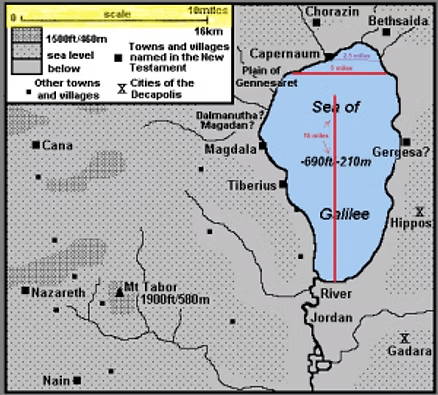
Mark wrote that Jesus told them to go to Bethsaida, which was only a three or so mile walk away, with a boat traveling about two miles in an arc. So, if the disciples changed the plan and decided to go to Capernaum instead, the contrary winds that made their rowing fruitless might have been spiritually created. The wind and rough water, naturally blowing eastward, with a downward flow into the sub-sea-level bowl that was the lake’s surface (nearly 696 feet below sea level), meant if they had a sail hoisted, then the wind would have been blowing them to the shore and the marina at Bethsaida. If Jesus had told them to sail there, then it would have been where he and John would have planned to walk and meet the disciples, after Jesus was finished praying in the mountains. [Keep in mind how John was the only Gospel writer who wrote of Jesus’ prayers late in the evening of the ‘Last Supper’].
When the disciples saw Jesus coming towards them, Mark reports it was around four o’clock in the morning (the fourth night watch is between 4:00 A.M. and 6:00 A.M.), so it was as dark as the night would be then. Jesus probably would have walked after dark with a torch or lantern to light the road he and John were taking. Jesus would then have carried this light with him as he walked out on the pier at Bethsaida. That light surrounding him, as seen from a boat being blown close to shore, would have made it seem like a ghost. Due to the lack of perspective in pitch black night, Jesus walking on the pier would seem as though he were walking on the water, because the fear in the disciples would have disoriented them from all sense of reality.
When John wrote that as soon as Jesus reached out his hand to those in the boat and got in with them, “immediately the boat reached the shore where they were heading.” This would have happened had Jesus been on the dock and got into the boat as it was time to throw out the ropes to secure the boat to the dock.
This omitted story is important to review because when we read, “When they had crossed over, they came to land at Gennesaret and moored the boat,” this does not mean there is an immediacy of Jesus seen walking and getting in the boat and “when they had crossed over.” There can be time between “when they had crossed over,” so the disciples were able to sleep and rest, well before “they came to land at Gennesaret.” This means a day or two could have passed, prior to Jesus traveling to Gennesaret.
When we then read, “When they got out of the boat, people at once recognized him, and rushed about that whole region,” we see that those who missed the opportunity to go to Jesus in the Bethsaida valley were equally running about like sheep who heard their shepherd’s call. Still, whereas the people who ran to meet Jesus first had sought him for teaching – spiritual feeding – the people on the western shore brought the sick to Jesus for healing. Here we read how the people “began to bring the sick on mats to wherever they heard he was.”
This led Peter to tell Mark, “Wherever [Jesus] went, into villages or cities or farms, they laid the sick in the marketplaces, and begged him that they might touch even the fringe of his cloak; and all who touched it were healed.” This means that Jesus did near the marina of Gennesaret as he would do many times, in other places in Galilee. Still, there is symbolism that this segregated reading selection points out, which can be missed due to the admiration all Christians have for Jesus.
Because everyone sees Jesus as the ‘miracle man’, whose feats can never be matched by other human beings, it is easy to hear Jesus teaching to a multitude before he miraculously fed them with five loaves and two fish. The tendency is to connect Jesus crossing over to Gennesaret as being after he had miraculously walked on water. By intuiting the miracles of Jesus, it is harder to see the common duality each disciple would show, as Jesus Christ reborn into Apostles.
To have this reading purposefully overlooking the miracles, the duality becomes visible. Jesus taught on the eastern plain of the Sea of Galilee; and then Jesus healed on the western plain, the one surrounding Gennesaret. In both places the people came to Jesus. This is the duality of preaching and healing, as two core talents of the Holy Spirit. While both are Spiritual, one is the body and bread, while the other is the wine and blood. The duality is a complimentary set of the completed Trinity, when body and soul are united with God. The people came to Jesus because they hungered and thirsted for those dual needs.
Jesus first fed his flock with spiritual food, which was him serving up the meaning in the Torah that no rabbi had ever before unlocked. Jesus taught as if giving the people the manna they needed for maintaining life in a barren world. Thus, Jesus raised the minds of all who heard the Word of God, to the point that physical food (five loaves of bread and two salted fish) seemed to satisfy their appetites supernaturally.
To have the disciples collect twelve baskets full of ‘leftovers’, the result of Jesus spiritually feeding the multitude meant the multitude began to speak in the tongues of understanding. Once filled with the Holy Spirit, the lost sheep gave back to Jesus and his disciples more than they had been given. By taking five loaves and two fish worth of inspiration, the presence of the Holy Spirit in new Apostles meant they had turned that spiritual food into twelve full baskets (symbolic of the Twelve Apostles) of God’s Word. The symbolism is the Word leads the faithful to Apostlehood.
Jesus then cared for his flock by mending their wounds. The people came to Jesus with their loved ones, carrying them and bringing the mats (or beds, mattresses) upon which they lay, as those sick of illnesses. It is most important to grasp how Mark wrote that the sick, “begged [Jesus] that they might touch even the fringe of his cloak.”
Jesus did not charge admission (or pass a plate for donations by cash or check), nor did he parade the sick across a stage while he made a big production of grasping the sick firmly, as if the harder he grabbed them with his hands the more the positive, healing energy within him would flow from his holy body into their unclean ones. Jesus never shouted out, “HEAL this sick person!” Jesus never presumed to be the one who would command God to act as he wished, because he acted as God commanded him.

The words of Peter, through Mark, are stating the same as Jesus told others who touched the fringe of his garment, “Your faith has healed you.” By having faith that Jesus is the Son of God – the Messiah – having the desire to “touch even the hem of his cloak” means to desire to become Jesus Christ reborn. The “touch” that faith seeks turns into far more than feeling the fringe of a shawl, as one’s faith transforms one into the human being wearing the resurrection of Jesus Christ. The stories that had spread across the countryside then are the equivalent today of those written into the Gospels of the Holy Bible. The fame and glory of Jesus of Nazareth is known, so all lost sheep can run to his voice.
Simply by recognizing Jesus as the Christ (professing to be Christian), one’s belief (not true faith) can lead one to limp or be carried on a sick bed to beg Jesus for wellness (prayer). True faith comes from first coming in touch with the Holy Spirit. That personal experience then becomes the stepping stone (the cornerstone of faith) that leads to the cure of all worldly ills, through the love of God and the submission of self for others.
In the first verse read in this selection, we read of the reports of the disciples, after they had served Jesus as Apostles. We read, “The apostles gathered around Jesus, and told him all that they had done and taught.” This is the duality that is then shown in Jesus – he taught and he healed. The disciples had achieved in the same way as did Jesus, because they too were passed the torch of the Holy Spirit. Their brains had not filled them with knowledge of the Torah, nor had their energy flow as living human beings cause them to glow like ghosts, visible in the dark. God had become temporarily married to them (an engagement) and they submitted to His Will, speaking in His tongues and doing as He commanded them. When one has God in one’s heart, then one is able to teach the Word and be healed of all sins.
This element of sin is how the Jews perceived sickness. This is why the disciples asked Jesus, relative to the blind man, “Who sinned, this man or his parents, that he was born blind?” (John 9:2) The commonly held belief was that sins were reflected openly as illness and disease. The cure, as shown in the story of Job, was faith. The problem (then, as now) was no one could teach anything beyond belief, as faith demands a personal relationship with God. When Jesus answered his disciples by saying, “Neither this man or his parents sinned, but this happened so the works of God might be displayed in him,” the meaning says that the “works of God” are the result of faith. To be healed of sins one must become Jesus Christ, thus know faith.
As the Gospel choice for the ninth Sunday after Pentecost, when one’s personal ministry to the LORD should be underway, the lesson is to teach and heal in the name of Jesus Christ (being reborn as Christ). So many feel the message is to prove one’s faith by spreading the “good news” of Jesus of Nazareth being the Messiah, which can only be done by evangelizing all around the globe. Going to tell a poor man in India or a sick man in Africa that Jesus Christ means salvation, while one is carrying food and medicine in a backpack, will get all kinds of compliance to religious dogma. Getting more people to say they “believe in Jesus” is not the message here.
A minister of the LORD realizes that the people seeking God’s love, the presence of the Holy Spirit, and the knowledge of the Christ Mind will come to meet a minister, like lost sheep seeking the care of a good shepherd. Most frequently, those are family, friends and neighbors, where one has a heartfelt relationship established. When they come to one, one feels compassion and acts to spiritually feed the faith in God those loved ones want and need.
The message of duality says that ministry calls for times of solitude and times of contact with others. When on the eastern shores of one’s life, one prays for those seeking to find God and Christ. As an Apostle that has been reborn as Jesus Christ, one is sent by God into public arenas so one’s presence (looking nothing like the pictures of Jesus of Nazareth) offers the fringe of the Savior’s cloak. This presence does not mean putting any demands on anyone or setting standards that others must meet. In both ways, a minister to the LORD lives inwardly and outwardly as a reflection of God’s love.


 Explaining the Readings