
Jesus set out and went away to the region of Tyre. He entered a house and did not want anyone to know he was there. Yet he could not escape notice, but a woman whose little daughter had an unclean spirit immediately heard about him, and she came and bowed down at his feet. Now the woman was a Gentile, of Syrophoenician origin. She begged him to cast the demon out of her daughter. He said to her, “Let the children be fed first, for it is not fair to take the children’s food and throw it to the dogs.” But she answered him, “Sir, even the dogs under the table eat the children’s crumbs.” Then he said to her, “For saying that, you may go—the demon has left your daughter.” So she went home, found the child lying on the bed, and the demon gone.
Then he returned from the region of Tyre, and went by way of Sidon towards the Sea of Galilee, in the region of the Decapolis. They brought to him a deaf man who had an impediment in his speech; and they begged him to lay his hand on him. He took him aside in private, away from the crowd, and put his fingers into his ears, and he spat and touched his tongue. Then looking up to heaven, he sighed and said to him, “Ephphatha,” that is, “Be opened.” And immediately his ears were opened, his tongue was released, and he spoke plainly. Then Jesus ordered them to tell no one; but the more he ordered them, the more zealously they proclaimed it. They were astounded beyond measure, saying, “He has done everything well; he even makes the deaf to hear and the mute to speak.”
———————————————————————————————————-
This is the Gospel selection from the Episcopal Lectionary for the Sixteenth Sunday after Pentecost, Year B 2018. In the numbering system that lists each Sunday in an ordinal fashion, this Sunday is referred to as Proper 18. It will next be read aloud in an Episcopal church by a priest on Sunday September 9, 2018. It is important because it shows how Jesus was sought out by both Gentiles and Jews, by seekers praying for help hearing news of Jesus having come near to them. Going to Jesus is symbolic of acting on one’s faith.
The city Tyre was in Phoenicia (the “region” now called Lebanon), as was Sidon. There were Israelites settled in the areas Jesus went, because both were cities of the Tribe of Archer. The path towards Decapolis was in land once part of the Tribe of Naphtali. This map shows the original allotment of lands to the twelve tribes and after Roman occupation.
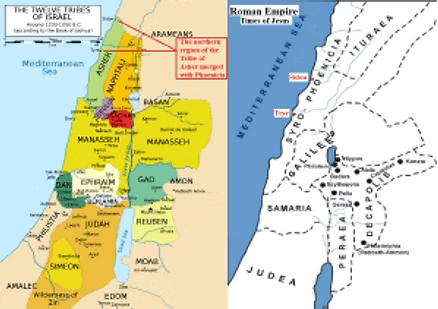
With this reading beginning at verse 24, in the middle of Mark’s seventh chapter, there is a liberty of paraphrase taken that has us hear recited, “Jesus set out and went away.” The actual Greek of Mark (Simon-Peter’s story teller) states, “From there also having risen up , he went away”. The change keeps one from asking, “Where was there, from which he went away?”
The answer is Jerusalem, which is where Jesus went for the second (maybe third) Passover of his ministry, the first accompanied by disciples. This reference is not casual statement of transition, as it is worthy of analysis.
In Mark’s sixth chapter, Jesus fed the five thousand pilgrims that had begun flooding the areas surrounding Jerusalem, in preparation for the Passover-to-Shavuot observances. It would have been typical for the pilgrims to stay through the two months that surrounded two events that spanned fifty days. That means Jesus would have had plenty of Jews to minister to in Jerusalem or back in Galilee, but he left and went far north, “into the region of Tyre (and Sidon).” [“and Sidon” is an aside that is left out of the translation above.]
The reason is then stated as “From there,” which was Jerusalem in Judea. Over a week’s time (written by Mark in 7:1-23), Jesus had “raised up” those he encountered there. The word “also” (from “de”) means not only in Jerusalem, but also prior in Galilee, in Nazareth, in Bethsaida, in Capernaum, and in Gennesaret (Mark 6). The Greek word “anistémi” (“having raised up”) not only states Jesus “got up from lying down,” but it more importantly implies that he “caused to be born” and “gave rise” to others.

The important purpose of this to be written [knowing Mark was a man of minimal words] says then that Jesus caused those who had been destined to face mortal death to be reborn in spirit and be given new life. That was the good Jesus did. Still, he also raised the ire of the ruling class of Jerusalem, who were beginning to be quite displeased with the following Jesus was amassing.
When Jesus had begun his ministry the year before, Nicodemus had followed Jesus out of town, probably to the home of Mary, Martha and Lazarus [of which John wrote], seeking to recruit Jesus into affiliation with that ruling body (the Sanhedrin). Jesus had refused then; now he was accusing the Pharisees and scribes of being defiled, due to the actions that come from within them. Therefore, Jesus went to Tyre because he had done the works of faith in Galilee and Judea AND he had caused the Pharisees and scribes to increase their clandestine efforts to spy on Jesus, hoping to catch him breaking a law.
Jesus went to a region where Israelites lived, but the rulers of Jerusalem had little reach. Because this region (then Syro-Phoenicia) was not far from Nazareth, one could assume that Jesus had relatives that lived there, or someone he knew from an encounter in Jerusalem (who was staying there the fifty days) and had written him a letter that allowed him and his disciples to stay in his home. This would explain why Mark then wrote, “[Jesus] entered a house and did not want anyone to know he was there.”
Since the Greek word “oikian” means “house, household, or dwelling,” that would be different from an inn or campsite for travelers and imply Jesus was welcomed there in some way. Further, the use of “ēthelen” says that Jesus “wished, wanted, desired, intended or designed” to stay in Tyre anonymously.

When we read, “he could not escape notice,” the better translation says, “he was not able to be concealed (or hidden),” where “lathein” states, “hidden, concealed, or escape notice.” While his “intent” would have been to not raise attention to himself, as the Son of God, sent to the Jews to announce “the kingdom of God has come near,” Jesus could not hide that purpose. God demands His Apostles go out and minister to the seekers.
When we then read, “a woman whose little daughter had an unclean spirit immediately heard about him,” this is because the attraction Jesus generated in Galilee and Judea was immediately attractive to the Jews of Tyre. Without any prior fanfare having those people laying palm branches on the street for Jesus’ entrance, he came in ‘under the radar’ but then quickly was healing the sick and opening the hearts of those who had been neglected all their lives, led by rabbis who knew nothing more than the words of the Torah, not the deeper meaning. This common ability of Jesus to attract crowds of followers is how the Syrophoenician woman (a Gentile) knew that a man of God was in town.
When we then read, “she came and bowed down at his feet” and “she begged him to cast the demon out of her daughter,” take a moment and capture this scene in your mind. The woman displayed subservience to a higher power and pleaded her wish before that power. The woman prayed to Jesus for help. The word “ērōta” means, “she asked, she made a request, and she prayed.” The word implies “she questioned,” which is like petitioning her Lord (from bowed subservience) through prayer.
Assuming her petition to Jesus was, “Lord, please help me by removing the demon that has possessed my little daughter,” it can be confusing to read that Jesus responded by stating, “Let the children be fed first, for it is not fair to take the children’s food and throw it to the dogs.” Often, the responses Jesus gave have this ability to seem like he did not hear what was said to him clearly. However, as always, the response by Jesus means we should ponder what he said; like so often our prayers to God are answered, just not in the way we wanted the answer to be manifest.
There was a “little daughter” that was the object of the mother’s prayer. By Jesus saying “children” (from “tekna”), it would seem that Jesus is answering her pray, saying (in effect), “Children should not be possessed by demons,” acknowledging the woman has a legitimate request. However, the word “teknon” is a statement that references the “descendants” of Israel, as the “children” of God. We are told that the woman, due to being of the Syrophoenician “race or origin,” is classified as a “dog,” with her “little daughter” considered to be a “little dog or puppy” (one of the “kynariois”).

This makes this statement by Jesus be comparable to the one he made, recorded by Matthew, “Do not give what is holy to dogs, and do not throw your pearls before swine, or they will trample them under their feet, and turn and tear you to pieces.” (Matthew 7:6, NASB) The Greek word used then was “kysin,” which was not a cute house dog but a “scavenging canine.” The implication was as “a spiritual predator who feeds off others.” Still, cute puppies filled with demon spirits will grow into these dangerous dogs, of which Jesus referred. Therefore, seeing this comparison means Jesus responded to the Gentile woman’s prayer, in effect stating that the One God, Yahweh, answers prayers petitioned by His faithful, before He grants the wishes of those who do not truly believe in Him.
When the woman heard Jesus’ statement, she immediately caught the true meaning and realized that her gods were what classified her (and her child) as those who did nothing that demanded her lineage (pedigree?) be devoted to laws of righteousness. Without defending her heritage, the woman said back to Jesus, “Sir, even the dogs under the table eat the children’s crumbs.”
The word translated as “Sir” is “Kyrie,” which is better translated as “Lord.” Still in a posture of subservience, the woman replied to Jesus as her “Master.” When she then said, “even the dogs under the table,” she acknowledged her lineage demanded she not worship other gods than those he ancestors worshiped. She accepted that that blood meant she and her kind were “under the table” of the Supreme God, not worthy of being seated at the table as God’s children. Still, she held no animosity towards the God of the Israelites, as she saw their commitment to Yahweh as worthy of being a model to live by. Therefore, she had heard of a Jew healer being served on the table of the Israelites and she went like a little puppy to beg for crumbs the children of Israel might pass down.
When Jesus heard this Gentile woman response, knowing in her heart she was speaking from a sincere emotional longing to know the God of Israel, but was forbidden, he was pleased with her words. Jesus knew the woman feared her daughter might become a scavenging canine in the unforgiving world of her people, who knew no true God. This caused Jesus to say, as the authority sent to earth by Yahweh, “For saying that, you may go—the demon has left your daughter.”
In that statement, the literal Greek has the word “hypage” separated between commas [according to the Bible Hub Interlinear presentation]. This is translated above as “you may go,” but the root word (“hupagó”) is more a statement of passing, as “you may go away, you may be gone, you may depart, and you may die.” Because the woman had spoken “the word” (“logon”), meaning “the thoughts of the Father through the Spirit,” more than simple uttering human words, this woman’s self-ego had been allowed to “go away,” making her an Apostle of the LORD, taking with her the Holy Spirit that made her as devoted to Yahweh as Jesus – a reborn Christ.
By Jesus saying, “the demon has left your daughter,” he was announcing that God had answered her prayer. The demon had left her daughter through her faith in the God of Israel and so the mother could pass the Holy Spirit onto her “little daughter,” raising her family from being scavengers of righteousness, to being those who set the table of God for others to be served.
We then read, “So she went home, found the child lying on the bed, and the demon gone,” the word “lying” is translated from “beblēmenon.” That stems from “balló,” which means the woman found her daughter had been “thrown or cast” onto her “bed or mat,” from the force of the demon having left her.

It implies that the “little daughter” has been wild and uncontrollable, due to the demonic possession, but the mother’s newfound faith and righteous state of her soul had caused the demon to itself become sick, rushing out of the girl from its own fears. Due to all the restlessness caused by the demon, the girl would have been relieved and remained in a state of peaceful rest on her sickbed. The symbolism here is that the daughter had also died of self-ego, giving her the faith of her mother and the protective presence of God’s Holy Spirit.
This encounter with the Syrophoenician woman then transitions to Jesus leaving Tyre. The translation above states, “Then he returned from the region of Tyre, and went by way of Sidon towards the Sea of Galilee, in the region of the Decapolis.” While that is stating the time had come for Jesus to head south to his home in Capernaum, staying to the east of the Jordan River, where the Jerusalem influence was weak, his going further north, to Sidon, is left to the imagination. However, the literal language offers more insight.
Verse 31 states, “And again having departed from the region of Tyre , he came through Sidon , to the sea the (one) of Galilee through the midst of the region of Decapolis .” In that first segment, the word “exelthōn,” translated as “having departed,” can also state, “having come out.” This is a parallel word to that stated prior – “apelthousa” – where verse 30 said the woman (in essence) “had departed” from Jesus, to go home. The immediate implication is that Jesus had made himself known as a healer (“having come out”), as demonstrated in the demons having been “cast out” of the “little daughter.” All of this took place in “the region” that was Syro-Phoenicia, the same region of Sidon. This means “again” (from the Greek “palin”) is a word stating a “further” act of healing that would result from the first.
When Jesus encountered the Samaritan woman at the well (John 4:1-42), the offering of the Holy Spirit (living waters that never need to be refilled) was so soul enriching that the woman asked Jesus (and his disciples) to spend more time with her whole town of Samaritans.
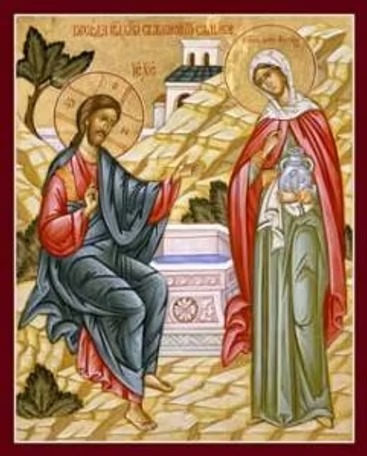
The same result should be seen in the Syrophoenician woman, whose news of her daughter having been healed spread to her kin in the same region, where a deaf and speech impeded Syrophoenician man lived in Sidon. This aspect of Gentiles being healed by Jesus is why “Jesus ordered them to tell no one,” because he was sent first for the children of Israel. The overall plan was to spread the Holy Spirit to all who would seek to serve God (including Gentiles), but that spread was to take off later. Still, the joy of the Holy Spirit flowing through God’s new Apostles was impossible to keep silent about.
This is how one should see that the Tribe of Archer blended into the Phoenician culture, which made many be religious but not completely devout to the Laws of Moses. The Samaritans knew of the Messiah promised to the Israelites, which means there were similar quasi-Israelites in the region now called Lebanon. This spread of God’s children into places that the Temple Jews saw as traitorous to Mosaic Law and Yahweh made them outcast publicly, but they still felt closeness to Yahweh, while bearing the guilt of their forefathers’ decisions. Jesus was drawn by God to Tyre, just as he was drawn to hold a conversation with a Samaritan woman at a well, because God knew the hearts of all seekers and where to send His Son to touch those hearts with His blessings.
This means that Jesus’ plan to return to Galilee would mean a slight detour to the north, to visit a man who, like the woman whose little daughter was possessed by a demon, prayed to the God of Israel for healing. Most likely, the Syrophoenician woman knew where this man lived, such that she led (or she had someone else lead) Jesus to him, accompanied by others she knew.
It is important to grasp the symbolism of a deaf Gentile, one who was also unable to clearly speak, due to his deafness. The metaphor is the man was unable to be led by religious mores or laws that were spoken to him. Had he been Jewish, or had access to reading Jewish holy texts (doubtful, due to his physical ‘sins’), he might have spoken the truth in ways that made no sense to those who had learned what to say Scripture meant. Because the man was not affected by what he could be told, he was not defiled by misinterpretations. The ones who led Jesus to this man probably knew he had something valuable to offer others, but the communication breakdown between him and others needed to be healed. Therefore, just as the woman was made a Saint set into a Gentile world, a woman was unable to speak freely to all; not like a man could.

We read, “[Jesus] took [the deaf man with a speaking impediment] aside in private, away from the crowd.” The crowd represented not only the noise of those who wanted to get a close view of Jesus’ work, but more the presence of “common people” (from “ochlou”). Even in complete silence (the world of the deaf man), there was psychic noise that was present; not all of which would have been positive thoughts. The privacy was so Jesus could hear the thoughts of the deaf man and he could hear those of Jesus. This would be why Jesus “put his fingers into [the deaf man’s] ears.” That touch was not because others had asked Jesus “to lay hands on him,” but because Jesus had to connect with the man through physical means first, before any spiritual change could occur.
When we read that Jesus then “spat,” the meaning should be understood as, “To express contempt or animosity, especially by ejecting matter from the mouth.” [American Heritage® Dictionary of the English Language, Fifth Edition.] Jesus was hearing the demon that was blocking a man of God from hearing and being heard. As a result of Jesus’ communication with the man, he reacted with disapproval for that demon. His disapproval then “spat” the demon out of the man’s brain.
After Jesus had removed that demon, with his fingers still physically touching the deaf man’s ears, we read, “touched his tongue.” This is a separated segment that literally states, “he touched the tongue of him,” where “hēpsato” is less a physical touch, but more figuratively, as “touching someone (something) in a way that alters (changes, modifies) them, i.e. “impact-touching.” [HELPS Word-Studies] The power of removing a demon blockage then deeply touched the man, so he could hear. The first words he heard spoken were when Jesus looked up to heaven, sighed and said, “Ephphatha,” that is, “Be opened.”

We then read that “immediately his ears were opened, his tongue was released, and he spoke plainly.” The word translated as “plainly” is “orthós,” which properly says “rightly.” It is a statement of the man speaking “correctly” and “without deviation.” We should read this and understand that Jesus was not healing people as some parlor trick, just to show people he could heal the sick and cause the lame to walk. Instead, the man began interpreting Scripture “correctly,” in the privacy of Jesus and himself. The man was freed from a demon that did not want the truth be told. Jesus then spiritually touched that man so he could go out and preach the Word of God for all to hear. He began speaking in the same way as would the Apostles on Pentecost day, after the Holy Spirit touched their tongues like as of fire.
After Jesus and the healed man rejoined the crowd, we read, “Then Jesus ordered them to tell no one; but the more he ordered them, the more zealously they proclaimed it. They were astounded beyond measure, saying, “He has done everything well; he even makes the deaf to hear and the mute to speak.” The segment that literally states, “more abundantly they were proclaiming,” this is due to the spread of the Holy Spirit being like fire set upon dried wood. The spread, once started, would burn as long as there were new seekers to add fuel to that fire. In the same way that the healed man began speaking “correctly,” he was verifying Jesus, as when the people said, “Well he has done everything,” the Greek word “Kalós” also means “Correctly and Rightly,” so they both spoke from the same source of Truth. The capitalization states the importance of being “Honorable, Commendable, Nobel and Rightly” in all things that a servant to God does.
As the Gospel lesson for the sixteenth Sunday after Pentecost, when one’s own personal ministry for the LORD should be underway – one has been freed of demons that keep one from serving God – the message here is to living in the border region that searches for scraps of righteousness in one’s life and serve the LORD with all one’s heart. This means being able to see an affliction in oneself and know the only way to change for good is through serious prayer and begging.
For Christians in America, who are vastly Gentiles with a wee bit of knowledge of the Laws of Moses, this reading should resonate loudly. American Christians are like the Syrophoenician woman, who lived in the region that was primarily pagan, with strong ties to a pagan culture. While America does not build altars to the multiple gods of Baal, many American Christians prostrate themselves before American Idol, NCAA sports teams, and the parties of political persuasion [et al the gods we say mean nothing, but yet there we go, once again kneeling before the gods of the common people].

In that regard, American Christians are the dogs under the table that live off the crumbs that fall from a Communion basket. Wafers are passed down to the cute puppies of Jesus, by the children who sit at the table as priests, pastors, ministers, and preachers. Why do American Christians enjoy being under the table, rather than sitting at it?
The call of this reading is “Ephphatha!” One must “Be opened!” and Receive the Holy Spirit. Otherwise, one is just groveling as a house dog of a church, until some traumatic event causes one to lose all beliefs and be outcast, forced to become a scavenging canine. Nothing holy is to be given to those dogs. However, if one can truly become a seeker and have God send a Saint into one’s region, one needs to be able to speak “the word” that can save one’s soul forever.
American Christians stand as those who wish to be raised up, but there is a demon spirit that blocks the brains of many, keeping them from clearly seeing the meaning of Scripture. That meaning has to be seen by each and every human being that ever expects to do the works of faith, and in return be blessed by God. All who sit and listen to sermons regularly presented on Sundays [or a few times a year], but then, ten minutes later, could not (and would not dare to) pass that meaning onto someone who was an outcast of a church is then equally a deaf person. That demon keeps one from clearly speaking the Mind of Christ and being an Apostle for the LORD. It keeps one a dog begging for crumbs fed to the children, but crumbs can never satiate one’s hunger.
A minster for the LORD has to go out into the world abundantly proclaiming the truth of the Word. This should be done, even if someone representing a reborn Jesus Christ says, “You have not yet graduated from seminary, so keep your thoughts to yourself a little longer.” One needs to know Jesus Christ personally – AS JESUS CHRIST RESURRECTED – to experience the joy and elation that comes with personal experience, not simply some things learned about him. When that has filled one’s being, there is no holding one back.


 Explaining the Readings