Jesus went on with his disciples to the villages of Caesarea Philippi; and on the way he asked his disciples, “Who do people say that I am?” And they answered him, “John the Baptist; and others, Elijah; and still others, one of the prophets.” He asked them, “But who do you say that I am?” Peter answered him, “You are the Messiah.” And he sternly ordered them not to tell anyone about him.
Then he began to teach them that the Son of Man must undergo great suffering, and be rejected by the elders, the chief priests, and the scribes, and be killed, and after three days rise again. He said all this quite openly. And Peter took him aside and began to rebuke him. But turning and looking at his disciples, he rebuked Peter and said, “Get behind me, Satan! For you are setting your mind not on divine things but on human things.”
He called the crowd with his disciples, and said to them, “If any want to become my followers, let them deny themselves and take up their cross and follow me. For those who want to save their life will lose it, and those who lose their life for my sake, and for the sake of the gospel, will save it. For what will it profit them to gain the whole world and forfeit their life? Indeed, what can they give in return for their life? Those who are ashamed of me and of my words in this adulterous and sinful generation, of them the Son of Man will also be ashamed when he comes in the glory of his Father with the holy angels.”
———————————————————————————————————-
This is the Gospel selection from the Episcopal Lectionary for the Seventeenth Sunday after Pentecost, Year B 2018. In the numbering system that lists each Sunday in an ordinal fashion, this Sunday is referred to as Proper 19. It will next be read aloud in an Episcopal church by a priest on Sunday September 16, 2018. It is important because Jesus taught his followers not to be swayed by outside influences, but to stand firm with the confidence that God will bring what is needed at the time of need.
The setting for this reading, as subsequent to the time Jesus and his disciples spent in Tyre and Sidon (last Sunday’s Mark 7 reading) is after they had traveled to Jerusalem for the Shavuot Festival and then returned north to Galilee. Having again encountered the Pharisees and refusing their demand for a sign that would prove Jesus’ divine authority, he returned to Bethsaida. From there, Jesus took his followers north, to Caesarea Philippi, in Gaulanitis (the Golan Heights). That is about twenty-five miles north of the Sea of Galilee, at the foot of Mount Hermon. That was the high mountain of the Transfiguration (Mark 9).
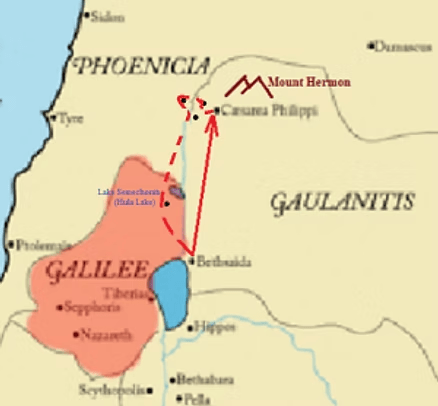
When we read, “Jesus went on with his disciples to the villages of Caesarea Philippi,” it should be recognized that the plural word “villages” (from “kōmas”) implies the group traveled over a number of days. If they traveled along the Jordan River, a village was near Lake Semechonitis (Hulah Lake), with a few in the bend in the river, to the west of Caesarea Philippi (Daphne being the closest). It might be that Jesus obtained supplies, including ropes, tents and warm clothing (rentals possibly), in preparation for his ascent on Mount Hermon, which maintains snow on its peaks most of the year. Since Jesus would only take Peter, James and John of Zebedee with him on the ascent, the remainder of his followers would have set up a ‘base camp’ near Caesarea Philippi.
When we read, “On the way [Jesus] asked his disciples, “Who do people say that I am?” this would imply he was referring to the people in the villages of Galilee, Phoenicia and Gaulanitis. They had a fresh opinion of Jesus, since this was not a region that Jesus had traveled into before in his ministry. Certainly, Jesus would have sought out scattered Israelites and Jews to speak with while in the Jordan River villages; but his miracles were low-key, if at all. This would mean his question was not to ask if he was doing all he could to keep the crowds coming, but to see what the people were saying when only seeing Jesus as an obvious leader of a religious ‘entourage’.
The question asked by Jesus actually uses the Greek word “legousin,” which literally says “do pronounce,” but implies “What conclusions do the people draw about me?” The answers given by the disciples of Jesus should be accepted as truthful, based on what specific guesses they had heard the people venture. Based on the responses that are written, the ideas of the descendants of Israel that came to mind were to associate Jesus with other great names in the history of Judaic holy men.
For someone to say “John the Baptist,” this would either be mistaking Jesus as the zealot who called for the sins of Jews to be bathed away in the waters of the Jordan River, or the assumption that the spirit of John had possessed Jesus. Possibly, the association of the recently dead John to Jesus, when they both lived as contemporaries, was that Jesus had risen to lead John’s disciples after his execution, as a disciple of John assuming the lead. That would be representative of others seeing Jesus as the rebellious ‘wildcat’ that rejected the establishment of Jerusalem.
To then say “others” thought Jesus was Elijah, the most important prophet of Israelite fame, who ascension to heaven without dying, leading to the belief that Elijah would return “before the coming of the great and terrible day of the LORD” (Malachi 4:5), as a harbinger of the coming Messiah, meant that some believed Jesus was a divine human prophet. Still, there were those who mentioned other great prophets of Israel and Judah, which means they thought Jesus was in touch with God, as another example of prophets past.
All of that opinion was the product of a brain trying to make sense of someone who had come into their world making an impact like none prior. Their opinions had been based solely on seeing Jesus, without knowing him. Their opinions were like those of an audience who sees a star’s performance, but never goes backstage; they never do the work of a ‘roadie’ or see the star as human like they are. Therefore, the people are more apt to place people they barely know on pedestals, unlike those who have a closer relationship: family and friends.
This is the reason we read that Jesus asked, “But who do you say that I am?” The disciples (and other followers) were those who saw Jesus eat, get angry at fig trees, and hold hands with Mary Magdalene. Jesus wanted them to state their opinion of him, while it should be realized how Jesus knew the hearts and minds of his disciples and family. Jesus knew in his soul that none of them (including Simon-Peter) felt they were smarter than those whose conclusions had been overheard or voiced to them directly.
Jesus was asking his followers, “When you hear these wild guesses, do you counter them with an opinion of your own?”
This is where one needs to cue the soundbite of crickets chirping.
When reading the translation above that says, “Peter answered him, ‘You are the Messiah,’” this is misleading. It gives the impression that Peter immediately stood up and answered Jesus. That is wrong, as one should pause when reading, between question and answer. The brain wheels were whirring, but no one was speaking; until Peter spoke up.
The verse (9b) literally states, “Answering , the one Peter concluded to him , You are the Christ .” The separation of the Greek word “Apokritheis” as a one-word statement (of importance due to capitalization) says, “Taking up the conversation.” This means Jesus did not ask anyone specifically, when he said “You” (capitalized “Hymeis“), understood to capture the plural number. It was a question for all to answer, as “Who do each of You say I am?”
As such, no one wanted to be the first to answer. This was because all were filled with doubts as to how to answer the question. The question asked by Jesus was followed by a pause of silence, when no one was bold enough to speak. Also, the Greek word “legei” is stating that Peter brought the pregnant pause to “closure” by speaking.
The reason it is so vital to see the presence of an extended pause being the immediate response, prior to Peter speaking, is that is points out the disciples had surrendered their egos in order to follow Jesus. They were too timid to speak for self, including Simon-Peter. That pause meant they were prepared to receive the Holy Spirit, when the time was right.
It means that Peter did not speak from his brain when he said, “You are the Messiah.” He spoke because the Holy Spirit of God flowed through him, “commanding” (a viable translation of legei) those words be spoken, as the disciples needed to hear it said aloud. Still, none of them was thinking that. Peter did not speak from his brain, but from his heart. They all felt the same way
When we read, “[Jesus] sternly ordered them not to tell anyone about him,” this was because such a suggestion is not to be told to anyone. Jesus did not want a promotional department going into towns before his appearances, using the powers of suggestion that the people needed to see “The Greatest Prophet on Earth!” Jesus warned his family and friends that it is up to each individual to come to that conclusion spiritually.
In other words, Jesus gave a rebuke of his disciples (as a lesson preparing them to become Apostles) to never tell anyone, “believe my words – Jesus is the Christ,” because people believing what others tell them to believe are defeating the purpose of God sending His Savior. That was sternly stated by Jesus to his students.
Think about that for a moment … silently.
In case anyone is struggling with the concept of Peter speaking via the Holy Spirit, from God flowing through his heart to his mind, the next segment of verses points out just how Peter’s human brain worked. That which follows points out how Simon-Peter was the self-proclaimed lead disciple. After all, Simon, son of Jonah, had been one of John the Baptist’s disciples that switched over to following Jesus. So (like Farmers insurance) he knew a thing or two. That reasoning power is where age and wisdom can fail those who put their trust in a Big Brain, rather than the One God.
We read, “Then [Jesus] began to teach them that the Son of Man must undergo great suffering, and be rejected by the elders, the chief priests, and the scribes, and be killed, and after three days rise again. He said all this quite openly.”
The Greek word “didaskein” is translated as “to teach,” but the root “didaskó” has more merit as “direct,” as Jesus “imparting knowledge.” That means his lesson was less about “teaching” and more about preparing them for the future. To know what is coming, before one sees the future be up close and personal as the present, prepares one to be forewarned, thus forearmed.
In that regard, the mention of “the Son of Man,” which (as “Huion tou anthrōpou”) actually states “the Son [the one] of man,” is preparing ALL DISCIPLES OF JESUS to become the Son (Jesus Christ) reincarnated as a human being. Jesus “said all this quite openly,” where “openly” (“parrésia”) means with great “confidence.” That certainty was because Jesus knew he had to die first, before the Christ Spirit could return (released through death – as everlasting life) in Apostles.
It must have been difficult for those brains to stay focused after Jesus said he had to be killed. They obviously missed hearing, “after three days rise again.” They had no idea that “rise again” would mean forty days of serious spiritual teaching – their final exam prep – sitting with the risen Lord before he Ascended into heaven the day before Pentecost … returning to rise again in them the next day. Thus, Jesus taught (subliminally) how the future would bring about an unlimited number of reborn Jesuses into the world, including eleven of the twelve disciples being guided to that end that day.
It was a lesson to be grasped in hindsight.
When we then read, “Peter took him aside and began to rebuke him,” this response is in contrast to Peter speaking out for the twelve, which he had done not long before. Instead of openly showing himself as the leader of the followers of Jesus, he “took Jesus aside.” That act should be read as if he thought of himself as an elder, if not an equal to Jesus. Remember, Peter knew some things … he thought.
A private conversation symbolizes the whispers of influence that are designed to gain control of one’s thinking and gently motivate one to do differently that one had initially planned. To “rebuke” Jesus meant Peter was warning Jesus. Simon-Peter was a student speaking to his master in the same manner of sternness that Jesus had used to warn the disciple not to tell anyone to believe Jesus was the Messiah.
What had gotten into Peter?!?!
We are told, when Jesus said to Simon-Peter, “Get behind me, Satan!” Peter was then being influenced by the opposite Spirit of God. He had not long before been motivated by God to speak up for the hearts of all the disciples. Now, however, he was being led to speak like the serpent in Eden or Satan when he appeared to Jesus in the wilderness.
Peter was suddenly overtaken by the Big Brain, when he thought he could rebuke the Son of God. [Remember, he had just announced Jesus as the Messiah.]
Whereas Simon-Peter was a blank slate that spoke for the disciples as channeling God’s Holy Spirit, he then had become a blank slate that was being possessed by the mind of Judas Iscariot, whose thoughts against what Jesus was saying were being manifest through the self-proclaimed leader of the disciples. God (and thus Jesus) knew the heart and mind of Judas. However, God would not expose Judas in that setting, because Judas was only a disciple for one purpose; being an example for a teacher to make a point with, about being led by Satan, while instructing students in a camp near Caesarea Philippi was not the right time.

When Jesus then said to Simon-Peter, “You are setting your mind not on divine things but on human things,” that was a continuation of the teaching that Jesus was giving to his followers. Where God had previously used Simon-Peter to demonstrate complete faith, through the sacrifice of self-ego, God then used Peter as an example of one who was not so self-sacrificing, instead holding dear to a plan to use Jesus for selfish rewards. Simon-Peter was not actually led by Satan, but by God, to show the disciples that Satan indeed sat in their midst. While that day it was Judas Iscariot, at all times Satan could be called out in anyone who “set their minds on human things” (i.e.: those who love the Big Brain).
When we then read, “He called the crowd with his disciples,” the “crowd” (from “ochlon”) is reference to “the people” that regularly followed Jesus (primarily family), but were not officially students of his teachings. In an encampment set up in Gaulanitis, there were no “common people” from the nearby villages that were there. By Jesus then saying, “If any want to become my followers,” that was addressing the general premise that all who were there considered themselves “Jesus followers.” Still, the translation is misleading, as the literal states, “If anyone desires after me to come,” which is less about walking “behind” Jesus, because “desires” is used more as a statement of “faith to come after Jesus.” Jesus based that word’s use on heart-centered devotion, which was the prerequisite teaching demanded to surpass the troubling times ahead.
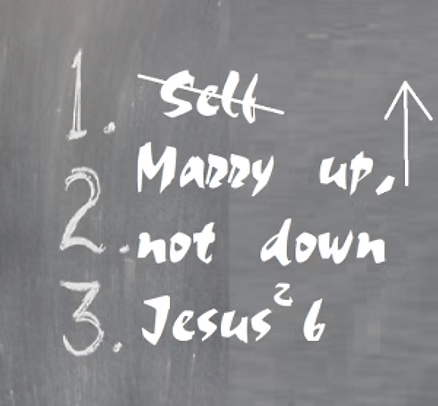
Jesus then taught all who had followed him to the camp in Caesarea Philippi, “let them deny themselves and take up their cross and follow me.” That was basically the same ‘three step’ approach that Jesus told the young rich ruler (the Pharisee that probably was Nicodemus): Obey the Law; sell your possessions and give the profits to the poor; and follow me. The difference was the Pharisee had not been following the Law, whereas the followers of Jesus were; Jesus was the embodiment of God’s Law. Therefore, the three steps were: 1.) Deny your self-ego – let it die – so you don’t have any problem with trading it in for eternal life; 2.) Raise up the stake that keeps your soul from dragging in the gutter [translated as “take up your cross”] by giving the talents of the Holy Spirit to those who do not have it [the “profits” to be given to “the poor”]; and 3.) Follow Jesus by being reborn as Jesus Christ.
When Jesus said, “For those who want to save their life will lose it, and those who lose their life for my sake, and for the sake of the gospel, will save it,” this, again, is reference to sacrifice of self-ego. If one refuses to sacrifice all that self-importance has brought one in the material world (as the young rich ruler walked away from Jesus, ashamed that he could not assure himself of heaven), all one can ever gain is the illusion of the temporary. However, if one sacrifices the self and becomes completely subservient to God’s Will, then the soul will be saved.
It is important to note that the translation states, “for the sake of the gospel,” which should not be read as modern Christians hear the word and assume a capital “G” is applied. Jesus spoke the word that in Greek is “euangeliou,” which means “good news.” It should be noted that the Gospels were written books of the Apostles, not the disciples. All of the New Testament is writings by those filled with the Holy Spirit, who sacrificed their self-egos to be reborn as Jesus Christ. They all proclaim that, such that THAT IS THE GOSPEL. This has to be understood as the meaning of Jesus’ word usage. The “good news” is every soul can find eternal life, from allowing Jesus to be reborn into oneself.
For Jesus to then ask, “For what will it profit them to gain the whole world and forfeit their life? Indeed, what can they give in return for their life?” those questions place focus on lifting up one’s being, by the sacrifice of ego. The young rich ruler had profited from leading other Jews to enslavement to the law (lawyers always profit from the miseries of others), without offering a peep of advice on how to avoid lawyers AND misery [i.e.: giving others good news for free]. Simply because there are laws, lawyers are given the world by those who want to follow the Law, but find that an impossible task. When they have been given the whole world of material possessions, what can they give in return for one saved soul – one’s own?
Hint: Money can’t buy that.

This reading then ends with Jesus saying, “Those who are ashamed of me and of my words in this adulterous and sinful generation, of them the Son of Man will also be ashamed when he comes in the glory of his Father with the holy angels.” The embarrassment comes from being “ashamed” of taking on the name Jesus Christ, giving up one’s given name. This is how one is afraid of being seen in public speaking the meaning of Scripture, when no one else says those things.
The reason is the one speaking is the Holy Spirit of Jesus Christ within a human body that looks nothing like Jesus. The fear comes from watching the persecution of Jesus Christ, just like Saul held the coats of those stoning Jesus Christ to death, because Jesus then looked like Saint Stephen. Stephen was not ashamed to proclaim the “gospel,” just as Jesus of Nazareth had done. All Apostles speak up as Jesus Christ, because the world will always be full of sinful people worshiping all the gods that pander to selfish gains. If fear keeps one from becoming Jesus Christ, one bows to Satan, not God. Only those bowing to God, having been reborn as Jesus Christ, are going to see the glory of the Father with the holy angels.
As the Gospel selection for the seventeenth Sunday after Pentecost, when one’s personal ministry for the LORD should be underway – one has sacrificed one’s self-ego and become a lifted up stake upon which the true vine bearing fruit in the name of Jesus Christ is raised – the message here is to realize one must walk in the footsteps of Jesus Christ. That means announcing to the seekers of the world, “The Kingdom of God has come near.” That announcement is done through righteous deeds, more than talking of one’s holiness.
When I mentioned earlier about the use of “the gospel” in this reading, it needs to be addressed how the use of “stauron” translates as “cross.” This too should not be read (or heard) as if with capitalized importance (as “THE Cross of Jesus”), because a cross is simply a + or a T or an X configuration, as two lines intersecting (usually forming right angles). In vineyards a “stauron” is simply an “upright stake” that the grapevines are strung upon, which keeps them off the ground. That is how this should be read.
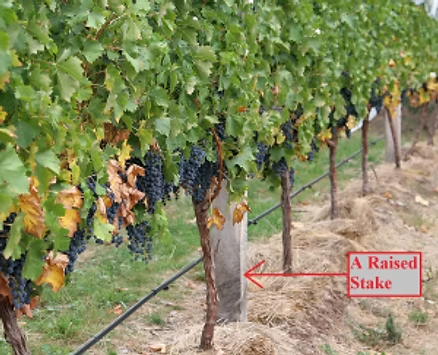
When Mark wrote (Mark the writer for Simon-Peter’s Gospel), “undergo great suffering, and be rejected by the elders, the chief priests, and the scribes, and be killed, and after three days rise again,” there was no mention of crucifixion or being killed on a cross. In fact, Roman execution by crucifixion was not a typical form of execution for ‘white collar criminals’, such as Jesus would deserve. Hanging a criminal on a cross was more typically ordered for rebels and those caught committing crimes against Romans. Despite Jesus saying he would “undergo great suffering” and “be killed,” it would not have been thought to be by the hands of the Romans, but by the Sanhedrin, by stoning to death. Thus, for Jesus to be heard demanding his followers “lift up their cross” that was not a statement that the disciples should be prepared to carry large wooden timbers, as a T-shaped crucifix, from a Roman prison in Jerusalem to the place of the skull.
For Christians to not be given these clarification and to let them hear “take up you cross and bear it,” few will be scared into action, simply because there are no longer executions by hanging criminals on crosses. Criminals have little to worry about in Western nations, because the people are too afraid to allow their governments to execute one. Therefore, such a catchphrase has little meaning.
While bearing a cross does speak of the responsibility of living an upright life, keeping the fruit of the true vine from the ground, as long as Jesus is seen as a spirit sitting on a throne at the right hand of God, who will come again sometime later … well then. There is still time to carry on business as usual, right?
The mark of Cain could be his refusal to listen to God telling him, “If you keep wallowing on the ground, then the influence of evil will take hold of you.” The mark is then the human addiction to the dirt bags that are temporary bodies given live by a reincarnated soul. The mark is the love of self-birth, not the sacrifice of self to be reborn as Jesus Christ, standing tall, having been cleansed of sins by the Holy Spirit. Is not the mark of Cain the possession of a Big Brain that listens to the influences of evil, denying God?
These three remembrances of Simon-Peter, recorded by Mark, are read together for a purpose. The purpose is they all link together to paint a picture of two alternatives: follow the influence of God or follow the influence of Satan.
God spoke through Peter, who like all the disciples of Jesus had been taught by Jesus by observation, watching him destroy the reasoning of the ruling elite of Jerusalem. What they thought was the meaning of Mosaic Law was proved time and again to be different than their brains had been led to believe. They had become obedient to the Word of God that came to them through Jesus and their egos had taken a backseat to Jesus, as students who thirsted for his knowledge. That is the model of ALL Apostles-to-be.
When Simon-Peter acted in a selfish way, rebuking Jesus for telling them he would be suffering and killed, Jesus called him Satan. That was the influence that would dare to speak out against the teacher. As wise and experienced as Peter thought he was, he knew nothing when he depended on a human brain, turning away from the Word of God. Because Peter was shown as a reflection of the intellectual disciple – Judas Iscariot – Peter represented how easy it is for those with good intentions to be led astray. The same can be said of Christians today. To covet one’s brain is to deny God and serve another master.
When Jesus called all his followers to listen carefully, he told them that they have to choose one master over the other. There can be no compromise. Jesus did not just call his disciples to hear that warning, as if only ministers, pastors, priests and preachers (and all their superiors) have to make such a choice. It goes for everyone that calls him or herself Christian. The warning was, is and will always be: Following Jesus does not mean putting a sticker on your car or a crucifix on your wall.

There is nothing about a crucifix that is part of this decision, although one’s self-ego needs to be sacrificed. You cannot hang a soul on a tree. One cannot become Jesus reborn when one still wants to keep the family name. All the comforts and privilege of a name, race, creed, and national origin has to be sacrificed. One’s opinion amounts to little more than wild guesses.
In this regard, one should look at how Saul changed his name to Paul. He was not embarrassed to be in the name of Jesus Christ; but he could no longer be the person he was when he had no heart – only brain. He took on a name that was better fitting the Jesus Christ he had become.
The same decision must be made by all Christians, realizing this is an individual responsibility, not a collective. No one can save a soul by words, signs, sprinkles, or smoke waved around. A life in the name of Jesus Christ means great suffering, and rejection by the establishment, who will seek to silence all who threaten their positions of wealth and power. One must be taught the expectations and consequences, in preparation for making life altering decisions.
Only the one possessing the soul can do that. No one can make the decision for anyone other than him or herself. To do that, then one must choose to marry God and give birth to His Son in one’s body.
Then it is time to start walking in the sandals of Jesus Christ.


 Explaining the Readings