
Jesus and his disciples passed through Galilee. He did not want anyone to know it; for he was teaching his disciples, saying to them, “The Son of Man is to be betrayed into human hands, and they will kill him, and three days after being killed, he will rise again.” But they did not understand what he was saying and were afraid to ask him.
Then they came to Capernaum; and when he was in the house he asked them, “What were you arguing about on the way?” But they were silent, for on the way they had argued with one another who was the greatest. He sat down, called the twelve, and said to them, “Whoever wants to be first must be last of all and servant of all.” Then he took a little child and put it among them; and taking it in his arms, he said to them, “Whoever welcomes one such child in my name welcomes me, and whoever welcomes me welcomes not me but the one who sent me.”
———————————————————————————————————-
This is the Gospel selection from the Episcopal Lectionary for the Eighteenth Sunday after Pentecost, Year B 2018. In the numbering system that lists each Sunday in an ordinal fashion, this Sunday is referred to as Proper 20. It will next be read aloud in an Episcopal church by a priest on Sunday September 23, 2018. It is important because Jesus told his disciples of his suffering to come for the second time. Jesus then taught his disciples that they had to give up seeking adult quests and welcome the birth of him in them.
In the sequencing of events, Jesus had first told his disciples about the suffering that would come at the hands of the rulers of Jerusalem (Mark 8). Now, he is remembered saying he would be “betrayed into human hands.”
The Greek text shows “paradidotai eis cheiras anthrōpōn,” which can translated clearly as “delivered into the hands of men.” The word “paradidotai” can mean “betrayed,” but that hint was not taken to mean “There is a traitor among us.” The same word, without a specific context, could mean “handed over, delivered, turned over, or abandoned.”

The difference between Jesus having named specifically “elders, chief priests, and scribes” earlier, but now saying “men” is a statement that people holding titles are still just human beings like everyone else. It implies the Romans will do the actual deed. The fact that Jesus said, “They will kill him,” rather than having generally stated before “to be killed,” meant the disciples were confused by the differences in the two stories. That confusion made them again miss the part of “on the third day he will rise, after being killed.”
When we read, “They did not understand [the things spoken] and were afraid to ask him,” the part they thought they understood – Jesus being killed – had drawn the ire of Jesus, after Peter took him aside and tried to sternly tell Jesus he should not talk such nonsense. Here, he repeated that he would be killed, but no one was brave enough to say to Jesus, “Excuse me master, but could you explain more about how you know this and why we cannot stop it from happening?”
No one wanted to be told they were Satan. Therefore, they were blank slates that had been conditioned to watch, listen, learn, and obey, as long as their egos never questioned divine wisdom.
We next hear read aloud by a priest, “Then they came to Capernaum; and when he was in the house he asked them, “What were you arguing about on the way?”’ This question by Jesus could have been asked while the group was “on the way,” so Jesus saved it for a more preferable time to bring up the matter. He asked while they were in the house of Jesus in Capernaum, where the familiar surrounding meant there were no chores to do and there was a period of rest after a long and eventful travel.
To then learn, “They were silent, for on the way they had argued with one another who was the greatest,” this means the disciples did not answer the question. There is no indication that the disciples spoke and answered Jesus. That absence says they refused to answer the question because they were still afraid of being called Satan by Jesus.
If Peter could be told to get behind Jesus as an evil demon, simple because he cared enough about Jesus to tell him, “You will not talk of death!” then they all could be seen as more evil than that for arguing about “who was the greatest” among them. As for that superlative written, the Greek word “meizōn” can also mean “most important.”

To then read, “[Jesus] sat down, called the twelve, and said to them, “Whoever wants to be first must be last of all and servant of all,” this implies that Jesus knew what they were arguing about. The question was rhetorical.
Even if they argued away from Jesus, when Jesus was by loudly running water, getting a drink; or when Jesus was sitting amid his family and engaged in conversation with them, Jesus knew what was going on. Jesus knew what his disciples were arguing about because God made him aware. If Jesus could know his future and teach his disciples to be prepared for his death, then he could know what is running through his disciples’ minds and hearts.
It should also be realized that while Jesus was on the high mountain with Peter, James and John of Zebedee, a father with a child who had a demon spirit possessing him, making the boy mute and threatening to kill him by convulsions, had come into the base camp. He asked the disciples to cure his son. Mark said “they did not have the power,” which presumes they tried to cast out the demon, but failed. The father and son stayed in the camp, drawing a crowd from the nearby village (including the ‘mayor’, called “a scribe”); so many were waiting for Jesus when he returned.
Jesus healed the boy, which left the boy apparently dead when the spirit departed his body. Several people attested that the boy was dead; but Jesus took the boy’s hand and raised him up, where the Greek word denoting that is “ēgeiren,” meaning “made awake.” That should be seen as metaphor for raised from death.
The disciples asked Jesus why none of them could cast out the unclean spirit. He told them that the demon spirit in the boy was one that required “prayer,” which meant only God could both cast out an evil spirit AND bring the dead boy back to life. In other words, Jesus explained to his disciples (privately) that they still were not full-fledged Apostles, married to Yahweh. They were still in training.
That event gives more reason for the disciples to be arguing about who was the “greatest” or “most important,” such that they were comparing their works of ministry to each other’s. Undoubtedly, they had each remembered the greatest healings achieved, how many spirits each had cast out, and how many people listened to them preach the meaning of the Torah and were touched spiritually. All had been given the ability to cast out unclean spirits, but the one in the mute boy was more than a mild case of illness by spirit. God undoubtedly assisted the disciples (or His angels) in their commission by Jesus, but the disciples were still unaware. So, with Peter’s pretense as ‘lead disciple’ now uncertain, they all argued about who could then be considered the best disciple Jesus had.
Jesus knew that divinely, leading him to instruct nicely, “Whoever wants to be first must be last of all and servant of all.” The point was to never let a big head make one think their brain had anything to do with their spiritual acts. The disciples had been taught to release their egos by being obedient to Jesus; but Jesus knew they were getting Big Brain syndrome and that evil spirit needed to be cast out quickly. Jesus did that gently. There was no need to call anyone Satan.
When Jesus used those words about “first” and “last,” or “prótos” and “eschatos,” which also can translate as “most important” and “the end things,” it is important to understand just who and what that meant. For all the arguing about which disciple was “most important” in the eyes of Jesus and Yahweh, one has to wonder what self-proclaimed accolades Judas Iscariot presented. Was his claim for being the “greatest” based on how much money he raised?

After all, wasn’t Jesus referencing Judas when he told the group he would be “betrayed,” “handed over” by someone unstated by name, “to be killed”? That would certainly qualify Judas for being “last” among the Gospel writers. There were many asides that pointed out beforehand – “Judas was the one who would betray Jesus.”
The point Jesus was making was less specific to one disciple and more applicable to the “men” whose hands Jesus would be turned over to. Judas was not quite in their category of “most important,” although he was [according to the Gospel of Judas] one who took great pride in mental exercises; supposedly Judas was a philosopher that loved debating logic with Jesus. Still, Judas would see thirty pieces of silver as big potatoes, while the Sanhedrin “men” dealt in finances that only the “most important” could fathom.
Those “men” were the ones who would reach their “ends” and be like the rich man who died and went to a hot place; still he expected poor Lazarus to come put a drop of cool water on his tongue. (Luke 16:19-31) Unfortunately, those are the ones who think they are the greatest until their demise, when they realize it would have been better to be the servant of all, rather than the opposite.
From that soft rebuke of rather simple disciples who argued about greatness, when they were already servants – ranking slaves as to how much they submit to the will of the great is pointless – Jesus then “took a little child and put it among them.”
The word translated as “a little child” is “paidion,” which can mean anything from an infant to a seven year old. The word implies, “a little child under training,” but some scholars believe it can mean, “a son or daughter up to 20 years old (the age of “complete adulthood” in Scripture).” [Helps Word-studies] The translation of “it” is from “auto,” such that the neuter gender third-person identification means the child had not yet matured, although “it” was either “boy” (“he”) or “girl” (“she”).

This is worth further analysis.
It was standard protocol in ancient times to ignore women and children in writings. Women were usually referenced generally, as being the wife or daughter of some specific man. Children were referred to generically also, with no names mentioned; unless it was in reference to a man in his childhood (Moses, Samuel, David, Solomon and Jesus, etc.).

In the Gospels of Matthew, Mark, and Luke, Jesus told the disciples to feed the five thousand men who came to hear Jesus preach. None of those writers made mention as to who was carrying the loaves and fish. John, however, said that Andrew spoke, saying “Here is a boy with five small barley loaves and two small fish.” In Mark’s Gospel (remembering Mark wrote the story of Simon-Peter), as Jesus was arrested and being carried away, he (and only he) wrote, “A young man was following [the arrested Jesus], wearing nothing but a linen sheet over his naked body.” (Mark 14:51) Neither reference identified specifically who those youths were, because of the age and, therefore, lack of importance.
The word written that translates as “young man” is “neaniskos,” meaning a male youth (i.e.: boy), simply because he is unnamed. Still, in the literal Greek of that verse, Mark wrote “neaniskos tis,” which says, “a certain young man,” meaning that boy was known and identifiable, just not old enough to put his name in print. Because the boy was “certain,” he was known. After all, what strange child would just happen to be with Jesus and his disciples at Gethsemane, around two in the morning, in his night robe?
Hint: None.
This is where one needs to realize that Jesus was in his home in Capernaum. He was in the house where his family lived with him. It would be completely normal to have children about in a Jewish household. Thus, the child who Jesus took up in his arms – the child under training – was the same child who carried the basket with loaves of bread and two smoked fish. It was the same young man who ran after Jesus when he was arrested, in his night robe, which boys put on before going to bed. He just happened to be under training during the Seder ritual and followed Jesus and the other adults as the disciples stumbled along drunk and fell asleep while Jesus prayed.
The young man – the youth – was John the Gospel writer, who recalled so much about that night. John was able to recall the teachings of Jesus because he was a boy and not allowed to get drunk with the adults. The adult disciples were busy getting plastered on wine (part of the Seder ritual) and could barely remember waking up to Jesus being arrested. Here, in Mark’s account of the disciples being in Jesus’ house, with John there, we see John is being used as an example about the least who serve all. John was the example of one who had no bragging rights about greatness; and they should be like him.
Still, one has to grasp the fact that a child in the house of Jesus would be a relative. John referred to himself as “the one Jesus loved,” which is a statement of relationship. John did not write of the excursion to Tyre and Sidon, nor did he write about the trip to Caesarea Philippi, when the Transfiguration took place. During both trips, Jesus was trying not to bring notice to himself by the Pharisees, or the Temple scribes and high priests. Simply from the potential danger involved, a child relative would have been left behind in Capernaum, with his mother and other relatives. Then, after Jesus had returned from a business trip, the child John was delighted at Jesus’ return. He was called by Jesus to sit with him and his disciples. John jumped into Jesus’ arms at the invitation.

This means that when Jesus said to his disciples, “Whoever welcomes one such child in my name welcomes me,” he just said, “Whoever welcomes John bar Jesus, my son, the boy with my name.” That statement is then stating a love relationship on a familial level.
Surely, John was the son of Jesus and thus bore the name of Jesus, as his father. Whoever welcomes that same relationship as that son, welcomes Jesus as their father. A disciple, therefore, is seen as least, in a Jewish society, the same as is a boy who gets no name recognition in writing, even though many people know the boy’s name; certainly they knew the name of that boy’s father. Therefore, if one welcomes being on the level of a child – a youth – an obedient child under training – a young man not yet grown into one of those “men who will kill” Jesus – then you welcome being the son of Jesus, which makes you also the grandsons of God, his Father.
The relationship would make the disciples God’s grandsons. It means the least have become the greatest, by their service to the Father, as His sons, born anew as Jesus Christ – the Son of God. It is most important to see the love factor, which is centered on family.
Jesus did not just reach out in his own home and grab the first random “it” child that ran by and use “it” as an example that was welcoming ALL children as a lesson (by example) that Jesus taught. What Jesus did was show his young son as how a disciple must see self-ego. As adults they must stay in touch with their inner child and love Jesus the same as his son, as a sign of respect for the name of Jesus.
Jesus chose his son as an example for ALL disciples – then and now – to model. They ALL have to welcome one another as members of the family that is born of Jesus. Just as John was a youth under training, so too were the disciples. Being obedient to the commands of Jesus means being obedient to the commands of God; just as Jesus was. It is a Master / servant, symbiotic relationship, built on the foundation of love. No disciple of Jesus should ever strive to be greater than the Master. The Master will always support His children that are in the name of Jesus … family.
As the Gospel selection for the eighteenth Sunday after Pentecost, when one’s personal ministry for the LORD should be underway – one should have ceased trying to make one’s ego larger – the message here is to enlist into the family of God. The higher one strives to become on earth, the further one falls from a place being secured in Heaven.
In this reading from Mark, the changes in the way Jesus told them a second time of his coming death and resurrection offers a blanket observation of those who would “turn him over,” “betray him,” or “deliver him into the hands of men.” This is pointing to the Gentiles, who were then the Romans, but today this is anyone who wishes to kill Jesus as the leader of a religion. While Judas was a disciple that would make those words come true then, today the pews are filled with unsuspecting Judases who talk a good Christian game, but run when anyone questions their knowledge of the Holy Bible. Those betrayers are the same as was Peter, who three times denied knowing anything about Jesus. He betrayed Jesus by throwing him under the bus, because Peter thought he was too adult to be lessened from his delusions of grandeur.
When Mark then wrote, “They did not understand what he was saying and were afraid to ask him,” I imagine there are a GREAT MANY CHRISTIANS that do not understand who John the Gospel writer was. Some confuse him with John the son of Zebedee because he is the only John named as a disciple of Jesus. Matthew and Mark were disciples and they wrote nearly identical Gospels. Luke wrote the remembrances of Mary the mother of Jesus, who shared some events with the disciples, while also having an exclusive familial view of Jesus and his ministry. John was with Jesus before he had any disciples. He was there when Nicodemus came to visit at night. However, John is an enigma that so many have been too afraid to ask, “Was John the child of Jesus?”
On my God! If that is so, then there goes the celibacy theme so many Christian monks have sworn vows to defend.
If John is Jesus’ son, then Jesus had a wife!?!? Oh my God! He was like every other Jewish adult male who followed God’s command to go and be fruitful.
Most of Jesus’ life was not written of. What is unknown is probably a lot like every other Jewish male that is born of a woman. Therefore, expectations of normal Jewish males would have been the expectations of Jesus … more so when we know his Father would have it no other way.
I once had a parishioner come to my house in a Nicodemian way and confide in me, “Robert, there is no way I could ever tell anyone what you say. It is all so crazy. No one would believe me.” He could not find anything I said was supported by Dietrich Bonhoeffer (I do not know who this was) … and my church friend thought Bonhoeffer rode the edge of religious reasoning. No one should ever go beyond his views, he seemed to think.
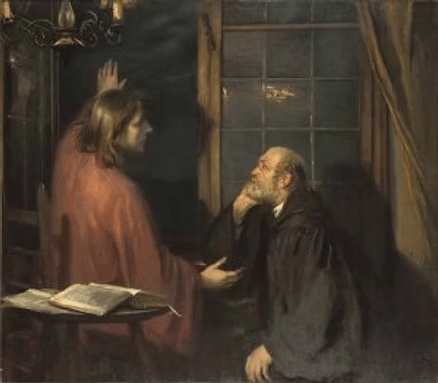
That man was even a lawyer, like Nicodemus. His good name and reputation depended on his ability to make money off Christians, who all had been taught to believe what someone else said to believe. It was okay to go to the library and find other sources that proved a scholar supported things commonly held dear (even, maybe, slightly different from the norm); but anyone unverifiable must be killed for speaking heresy!!!
That was what happened to Jesus, when he said a few things no one else had ever heard said before. He was turned over into the hands of men who had no relationship with God.
That is still a danger surrounding Jesus today. Too many arguing about who has the greatest Christian mind, based on book sales and television revenues raised (always needing a new private jet to zoom around the world in).
It is important that no one goes around saying, “Robert Tippett said ….” What I see and what I believe is not to be followed, because I see it or I believe it. I tell what I see and believe because I feel a strong need to share that with others. If others cannot see the same things and feel the same way as I do, then I accept that.
The purpose of the Pentecost season is ministry for those who have become servants for God. God speaks and servants do as told, happily … like little children. This is done out of a love relationship.
It is a marriage to God that gives birth to baby Jesus, within an old soul that has been cleansed by the Holy Spirit. The sinner (the least of humanity) has sought a higher reward than anything found on earth. The love of God is the repayment plan. Servitude is the earthly parole from the worldly prison.

The child one welcomes in that marriage to God is Jesus Christ. Jesus tells a minister what to look for and what to find; and that ignites the heart in belief that is personal and solid. It is the meaning of faith, which is beyond standard belief. True Faith is the “Get out of human sinner’s jail” card. A minister offers that to the world, in service to the Master.
It is just like the commissions of the seventy-two and the twelve. Go out and preach to all who will listen. If anyone tells you, “There is no way I can sacrifice my good reputation by repeating what you say,” then Jesus orders those ministers to kick the dust off their sandals and say as you walk away, “The kingdom of God has come near.”
Jesus Christ is the king of the earthly division of that kingdom; but nary a particle of dust can escape the kingdoms of earth.
#Mark93037 #Luke161931 #Mark1451 #GospelofJudas #Jesuscalledalittlechild #Theboyholdingtheloavesandfish
 Explaining the Readings