Tag Archives: Matthew 16:24

Exodus 20:1-4, 7-9, 12-20 – The Ten Commandments are the marriage vows between one’s soul and Yahweh [Eighteenth Sunday after Pentecost]

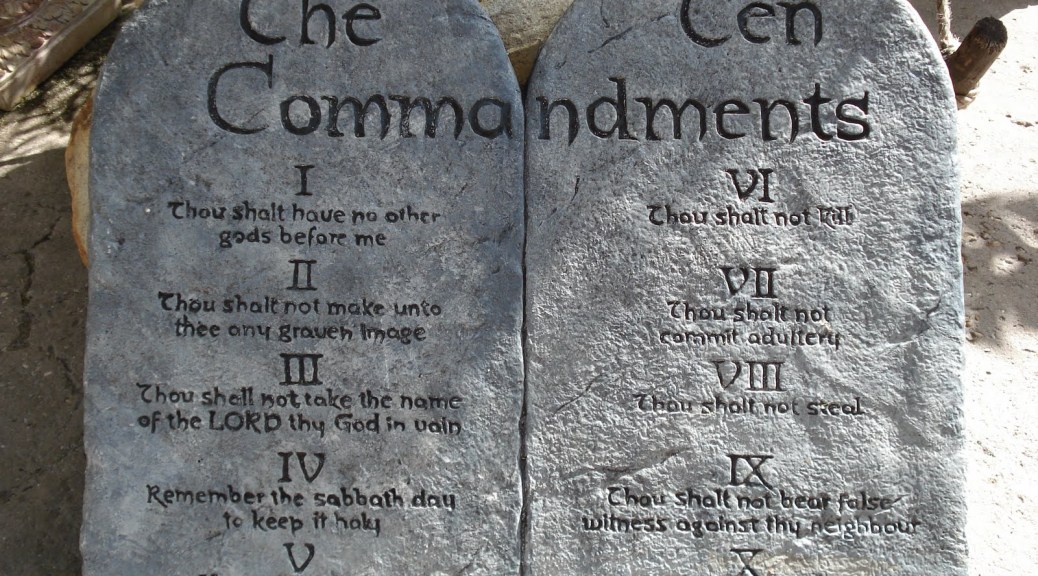
Exodus 20:1-4, 7-9, 12-20

“Then God spoke all these words:

I am the Lord your God, who brought you out of the land of Egypt, out of the house of slavery; you shall have no other gods before me.

You shall not make for yourself an idol, whether in the form of anything that is in heaven above, or that is on the earth beneath, or that is in the water under the earth.

You shall not make wrongful use of the name of the Lord your God, for the Lord will not acquit anyone who misuses his name.

Remember the sabbath day, and keep it holy. For six days you shall labour and do all your work.

Honor your father and your mother, so that your days may be long in the land that the Lord your God is giving you.

You shall not murder.

You shall not commit adultery.

You shall not steal.

You shall not bear false witness against your neighbor.

You shall not covet your neighbor’s house; you shall not covet your neighbor’s wife, or male or female slave, or ox, or donkey, or anything that belongs to your neighbor.

When all the people witnessed the thunder and lightning, the sound of the trumpet, and the mountain smoking, they were afraid and trembled and stood at a distance, and said to Moses, “You speak to us, and we will listen; but do not let God speak to us, or we will die.” Moses said to the people, “Do not be afraid; for God has come only to test you and to put the fear of him upon you so that you do not sin.”’

—————————————————————————————————

This is the Old Testament selection from the Episcopal Lectionary for Year A, Proper 22, the eighteenth Sunday after Pentecost. It will next be read aloud in a church on Sunday, October 8, 2017. It is quite important because this is what Christians call the Ten Commandments.

As a disclaimer: There can be no “pencil-whipped,” Cliff Notes explanation of this reading, as the Ten Commandments stands as the cornerstone of Judaic-Christian beliefs. This article of interpretation is therefore of some length, simply because it addresses each Commandment. Because a standard Episcopalian sermon is between ten and twelve minutes in length, one can expect the totality of time spent on this Old Testament reading selection will be the time the reader puts into reading it. At most, a priest might gloss over one or two laws, to suit the points of a sermon hammered solidly to the Gospel (after all, Christians aren’t Jews, so no need to spend a lot of time on the Law). This posting might be the only time some people will have any of this explained.

With those added words set into the word count, let me begin.

———-

A few things are important to realize before digging deeper into the meaning found in these selected verses (skipping a few between verse 1 and verse 20).

First, the Jews laugh when they hear Christians talk about “the Ten Commandments.” Statues have been removed from courthouse lawns that condense this reading to “10 easy steps to living holy.” The Jews recognize that Moses brought down 613 commandments.

Second, Moses did not come down the mountain and send out messengers to all nations of the world, telling them the news of laws that must be adopted universally. That inaction means ALL of the Laws of Moses (God’s Commandments) are directed at His priests, and only to those who were to be totally freed from the “house of slavery” – life in a world that allures with sin.

This means God was (and is) quite aware that: 1.) There are other gods mankind serves; 2.) Idol worship is normally accepted around the world; 3.) People everywhere play the “god card”; 4.) Some people like to play golf on Friday, some Saturday, and some Sunday, with all calling that their holy day; 5.) Everyone has a mother and father, even if everyone has not personally met them; 6.) Humans love to kill just about anything that moves; 7.) People love sex, in all forms; 8.) People love to have what others have, even if they cannot afford it; 9.) People commonly lie to protect their behinds from punishment; and 10.) People everywhere always think someone else has more than them.

In other words, God knew the world more commonly served Satan (Beelzebub, Baal, Lucifer, etc., etc., by many other names), so the males and females created by God regularly did what displeased YHWH, making Him turn His back to the world in general.   But, to save that world, God was laying down the Law only for those who would serve Him in that effort towards Salvation.

Third, these laws of God, sent down by Moses, were given to the Israelites who had followed Moses to Mt. Sinai, but they always apply to those who wish to enlist their services to the LORD. The Jews (of Jesus days and of today) follow these rules religiously (meaning they know when they have broken one or all). Christians (who have delighted in killing Jews in the name of the Jesus – a sin, as listed above) enjoy the fact that they are not Jews, so they can trim down the 613 laws to just ten (while retaining the holy right to amend and adjust the penalties stated by God, through Moses, as they see fit). Jesus, however, made it clear the Law is fixed and just the first step to being a priest for God, when he said, [After obedience to the Law] “sell your possessions and give to the poor, and you will have treasure in heaven. Then come, follow me.” (Matthew 19:21)  So, if you cannot live up to Ten Commandments, you might as well find another god to openly serve.

With those basic realizations grasped, it is next worth looking at what is actually written, versus the English translations that are posted above and will be read in churches.

For the First Commandment, the Hebrew of verse 3 is: “lō yih·yeh- lə·ḵā ’ĕ·lō·hîm ’ă·ḥê·rîm ‘al- pā·nā·ya.” Literally, this translates to state, “Not (lo) you shall have (yih·yeh-) to you (ḵā) gods (’ĕ·lō·hîm) other (’ă·ḥê·rîm) before me (‘al-) the face of (pā·nā·ya).” (Bible Hub Interlinear) When this is translated into English as saying, “You shall have no other gods before me,” an important element is lost – “the face of” (pā·nā·ya).

Certainly, a priest serving YHWH can have no other gods that he, she, or it holds in higher accord than the One God. In fact, I have met people who (supposedly) educate people for Christian ministry, who vehemently deny there are any other gods. They translate “elohim” as “God” (singular capitalized), when it is the Hebrew plural form of “el,” meaning “gods.” Genesis’s first chapter is filled with references to “gods” (“elohim”) acting during the Creation, but all those references have been lost in translation, so we learn: “God” did this and “God” did that.

True. God WAS … before the Creation. Therefore, “In the beginning [it was God who had] gods created.” YHWH made and then commanded little-g gods to do everything; and, this proves there are many other gods around (angels and Satan being a couple of examples of non-human spiritual entities … gods).

Sure, the First Law says do not worship any other gods; but isn’t that too simple? Doesn’t every Judaic-Christian believer get credit for that one (well, except the 51% of people in the 2010 U. S. Census who claimed their religion to be “Jew”, but then checked the “no” box asking, “Do you believe in God?”)?  Still, doesn’t every believer believe only in God?

The answer lies in “panaya” – “the face of.” That answer says, “It is not that simple.

While the English translators (and probably the Hebrew translators, way back to the time of origin?) see this as something like colloquialism, where “before me the face of” was an ancient way of overstating “before, above, over” God, whom all servant-priests must face. However, “panaya” (according to Brown-Driver-Briggs) “literally [means] [faces] of Man,” as found stated in “Genesis 43:31; 2 Samuel 19:5; 1 Kings 19:13; Leviticus 13:14; Daniel 8:18; Daniel 10:9, 15 +; ׳עוֺר”.

This says, Man thinks of himself or herself as just as important in the worldly scheme of things as is God. Humans can say they have no other God they believe in “above God,” but then they say that wearing that sinful “face” of himself or herself, when they plead “before God.”  Man has proven to be too full of itself to bow down “before God’s face,” so God’s face cannot be then reflected back at God, from the bald scalp of Man having self-sacrificed.

In Jesus message terms, the First Law goes beyond memorization of the words and continues on to giving away everything that keeps you bowing down before self, until you then follow in the ways of Jesus, as Jesus reborn, with the Christ Mind.  We know this because “Jesus said to his disciples, “Whoever wants to be my disciple must deny themselves and take up their cross and follow me.”‘ (Matthew 16:24)

A hint at how this is the correct meaning intended to be honored, I recommend reading the end of Exodus 19, as God told Moses a few things that are relevant here:

“So Moses went up and the Lord said to him, “Go down and warn the people so they do not force their way through to see the Lord and many of them perish. Even the priests, who approach the Lord, must consecrate themselves, or the Lord will break out against them.” Moses said to the Lord, “The people cannot come up Mount Sinai, because you yourself warned us, ‘Put limits around the mountain and set it apart as holy.’” The Lord replied, “Go down and bring Aaron up with you. But the priests and the people must not force their way through to come up to the Lord, or he will break out against them.” So Moses went down to the people and told them.” (Exodus 19:20b-25, NIV)

Moses and Aaron were holy (“consecrated” means that, as “sacred”). The mountain of God is therefore the Law. “Do not force your way through to see the LORD” means do not say you obey the Law, when you really do not understand it as non-consecrated plebes. “Even the priests, who approach the Lord, must consecrate themselves,” which applied to the elders then, the ones in the days of the Pharisees, and the ones who call themselves Rabbis, Pastors, Ministers, and Priests today. Just because you have a following that makes you feel mighty important, do not approach God wearing that face; “or the Lord will break out against you.”

Hint: One can only be sacred when a divine presence has joined with one’s soul. Moses and Aaron were so divinely possessed. Their souls were possessed by the soul of Jesus (a name meaning “YAH Saves“); and, that union is eternal. This means when alive in a body of flesh, one has forever submitted to serve Yahweh; and, Yahweh has sent His Son Jesus to forever keep one from breaking the marriage vows. So, when one dies and one’s soul goes “before” Yahweh, one will always wear the “face” of the Father, through the Son. First Commandment, therefore, demands this self-sacrifice to marry Yahweh and become His bride, as well as the ‘mother’ soul to His Son reborn.

If you have read this far and are thinking, “Wow! So many words on just the First Law! I don’t know if I have the time to read the rest,” then keep in mind how Jesus said, “’Love the Lord your God with all your heart and with all your soul and with all your mind. This is the first and greatest commandment. And the second is like it: ‘Love your neighbor as yourself.’ All the Law and the Prophets hang on these two commandments.” (Matthew 22:37-40, with similar in Luke 10:27; Mark 12:30-31) The following nine Commandments are relative to loving God and loving your neighbor as a God-loving you (consecrated, holy, sacred, and Saintly Apostle).

When you read the Second Commandment, ask yourself, “Have I ever watched American Idol?” We read this and think of the Golden Calf the Israelites made, when we never once think of our worship of idols and heroes, politicians and ministers, as being what God instructed against. America’s knees are flat from bowing down to movie stars, singers, activists and protesters, and even sweet Jesus himself.

I imagine it was the Holy Roman Emperor who saw the fish symbol (Pisces = sacrifice) and said, “Scrap that! Make the cross the symbol of Roman power and might. Hang a Jesus on it and put it around the necks of every Roman Catholic … and charge a pretty denarii for it!” This too is a graven image that is in the “form of earth,” as the instrument that killed the body of Jesus, even though it became an earthly symbol of his soul’s release to heaven.  In its precious metal presentation, a cross is an idol.

[Aside: The cross, as a symbol of death and destruction, is as pagan as a Roman temple to Pluto.  The holiness of a cross symbol comes through seeing it as representative of the Trinity: Horizontal (God) + Vertical (Son) + Intersection (Holy Spirit).  Each Christian must be that cross of the Trinity.  The presence of that Intersection makes each Christian be Jesus resurrected; but he sure ain’t hanging dead on it.  You are!  You cannot be reborn as Jesus with the Christ Mind while still being a living ego trying to control things in your world.]

The Third Law does not mean “Do not cuss like a sailor, using God as a word in that process.” This is actually why Jesus had such a problem with the Pharisees and Temple scribes and priests. They were using the name of God as a way to get rich and as a way to condemn those who challenged their racket. They used the Lord’s name in vain every time they said, “I condemn you in the name of the LORD!” Today, a whole lotta ministers go around saying, “I rebuke you in the name of Jesus Christ!” It is great theatrics; but God is not pleased when His name is tossed about like that.

The Forth Commandment seems like all a believer has to do is go to church on Sunday (a Christian Sabbath … not). The Jews who returned from exile, self-flagellating themselves for having strayed so far they lost their valuable property, made it a well-monitored rule that no one could do anything on the Sabbath, except walk to the synagogue and walk home. That is more than the Christian view of getting a day off work on Sunday, with attendance in a church optional. My deceased mother turned to watching religion on television, rather than go to church. She was not alone.

What is missed in this Law is the part that says, “For six days you shall labor and do all your work.” As a priest of YHWH, what “work” is that which makes one consecrated? Selling Ponzi scheme stock options, or used cars, or life insurance, or practicing being someone one is not, as an actor in the movie industry does? If one is going to be a priest for the One and Only God, the work required is 24/7 practice being His servant. He might want you to shear a sheep or hammer some nails and sweat a lot in the sun; or, He might want you to raise children right or tend to the elderly and sick.  You just get to stay home on the Seventh Day and eat the manna that God provided the day before and thank God He leads you in your labors.

Intermission: I know this is a long article, but what can be better than spending a whole Sabbath looking at the opinions of others and expanding you own views of the truth. Interpreting Scripture should be fun and uplifting, when one’s mind is seeking to be consecrated. After all, the Law comes from sacred ground, so take off your sandals and let the Holy Spirit guide your thoughts for a few hours. Remember, it is not what I think and write that matters. It is what you think and do that leads to Sainthood. That takes more work than one day a week can satisfy.

———-

When Law number five says, “Honor your father and your mother,” it does not mean draw a picture for the refrigerator for mom, or let mom tell you which tie to pick out for dad, two days a year. It does not even imply that you have parents worthy of any kind of respect. The Hebrew word “kab·bêḏ” means, “to be heavy, weighty, or burdensome.” Thus, you “honor” your parents by taking on the same “burden” they took on when they began cleaning up your messes as a baby. It means to be fruitful and multiply; but the true “honor” is to teach your children to serve the LORD, like you were taught (Charles Manson, et al, excluded).

The Sixth Commandment, “You shall not murder,” is one of those that Americans struggle with, especially those who want to have the government make it illegal for Americans to get their hands on guns and shooting anything that moves (forgetting that humans can kill with their bare hands and anything that fits into them can make killing easier). Cain used a rock, we think. On top of that, Americans think it is murder to execute someone who actually did murder, so there is less effect that law will keep anyone from murdering. Beyond that, Americans argue “murder versus kill,” and try to justify war, if certain criteria are met … none of which has anything to do with loving your neighbor like yourself.

If you are consecrated, you don’t go looking to kill anyone in any way. You do not love a country more than God, so some politician or general cannot order you to, “Go kill in the name of us.” Just don’t kill, unless God blesses you with an Ark and an order to do so. Then be prepared to die for God.

Here lies a true conscientious objector.

With the Seventh Commandment we come up with adultery, which is the human urge to have sex without planning to propagate. “Adultery” is a word used to denote (especially a man) having extramarital sex; still, Ezekiel, Jeremiah, and Isaiah used this same word (“naaph”) as figurative when a priest of YHWH cheats on Him (an indication that a priest is the wife, regardless of human gender). Still, as a word in English, the root word is “adult,” which makes the intent be related to those urges that begin at puberty, which usually results in getting married and making babies. However, adults who are led by their groins and sensuality will rub on anything, kind of like human hands love to grasp powerful instruments of death.

As such, “Do not commit adultery” means do not have sex with anyone and everyone prior to marriage.  It also means do not have sex with anyone other than your spouse after marriage.  It also means do not have sex with yourself.  It also means do not have sex with someone of the same sex (where making babies is impossible).  It also means do not have sex outside your own species.  It also means do not have sex with minors.  It means once you become a mature human being you have uncontrollable physical urges.  Congratulations!  You are normal; but normal and being sacred are two different creatures.

Again, I know this sexual limitation is almost impossible for anyone between the ages of 14 and 84 to comply with; but the point of consecration is why Paul wrote, “”It is good for a man not to have sexual relations with a woman.” (1 Corinthians 7:1). Sex becomes like one of those gods that likes to stand between you and God, when it is Face Time. That is why Jesus said, “And if your right hand causes you to stumble, cut it off and throw it away. It is better for you to lose one part of your body than for your whole body to go into hell.” (Matthew 5:30) The hand causes adults to stumble when it strokes those sensual parts of the body.
For the Eighth Law, “Thou shalt not steal,” the element of adultery implies consent with another adult, and what seems stolen from a spouse is really still there (just missing the heart part). This command is then relative to the material world and innate human lusts for things and gadgets. The people of Israel and Judah who owned land and grew crops were supposed to allow 10% of their crops (the outer fringes) to be for the needy. The needy were going to take what they needed, just to survive; so, one loves a neighbor by allowing one to take freely what one needs, rather than deny them that right. Denial would make them steal for it, because food is a necessity.  That is a way to love your neighbor as yourself.

This means stealing is relative to excess, or taking more than you need. That can mean taking that which is not yours to take; but that can also mean taking that which should be left for someone else. After all, how many billions of dollars does one need to live comfortably within the Law?

The Ninth Commandment then addresses bearing false witness against your neighbor. This is certainly meaning not to badmouth someone behind his or her back, where sowing the seeds of hate, in hopes of personal benefit, are a long way from being consecrated. I see it more as a warning to stay out of court as much as possible. Stay away from the “sue me sue you” mentality, especially as it has become such an easy way to make a profitable living – easy money. If you are called to witness in a trial, tell the truth – and that means no paid experts who are willing to twist the truth into a knot that benefits the highest bidder.

It is not coincidence that the Pharisees were Lawyers.  Their law practices dealt with the Laws of Moses exclusively.  Then, as now, lawyers are very closely related to the eighth No-No, stealing.  Middlemen, like people who charge interest on loans (Usurers), are like lawyers and advertisers who stir up business by promoting people bearing false witness.  (“I’m not a doctor, but I play one on TV.”) These are the people who say, “I’ll get you $100 and all you have to do is nod “yes” when I point to you.”  Then, after you follow those instructions, he gives you $50, saying “$40 goes to me and $10 to the court.”  Then you feel dirty and used … like an adulterer that has been robbed.

Finally, the Tenth Commandment is about coveting, which is all about jealousy and envy. As far as priests for YHWH go, if your mind is on what someone else has, what someone else looks like, or how important someone else seems to be, you are not serving the LORD. As the song sang, “Don’t worry, be happy,” you can only do that when you wear sacred blinders.  God will provide everything you need.  Everything beyond that is not yours for a purpose.  So, deal with it.  It is your test.

In conclusion, The Israelites “said to Moses, “You speak to us, and we will listen; but do not let God speak to us, or we will die.” Moses said to the people, “Do not be afraid; for God has come only to test you and to put the fear of him upon you so that you do not sin.”’ This point means it is so very easy … normal, common, expected … to let someone else be consecrated. Getting close to God is frightening, simply because of all the worldly things you like to do having a damper be put on them. However, that is just a typical fear of those who are addicted to the worldly.  The holy have no fears.  The consecrated can enter hallowed grounds.

Those fears are erased when you start to take the test and realize, “this is easier than I thought.” When the Holy Spirit comes everything is possible. The Holy Spirit is a reachable goal, just like Mount Sinai was. However, as is stated in Exodus 19, Moses set “limits around the mountain [to] set it apart as holy.” (Exodus 19:23b). It is the Law that forms those boundaries.

John 15:1-8 – The fruit of the true vine

Jesus said to his disciples, “I am the true vine, and my Father is the vinegrower. He removes every branch in me that bears no fruit. Every branch that bears fruit he prunes to make it bear more fruit. You have already been cleansed by the word that I have spoken to you. Abide in me as I abide in you. Just as the branch cannot bear fruit by itself unless it abides in the vine, neither can you unless you abide in me. I am the vine, you are the branches. Those who abide in me and I in them bear much fruit, because apart from me you can do nothing. Whoever does not abide in me is thrown away like a branch and withers; such branches are gathered, thrown into the fire, and burned. If you abide in me, and my words abide in you, ask for whatever you wish, and it will be done for you. My Father is glorified by this, that you bear much fruit and become my disciples.”

——————————————————————————-

This is the Gospel selection from the Episcopal Lectionary for the Fifth Sunday of Easter, Year B 2018. It will next be read aloud in church by a priest on Sunday, April 29, 2018. This is important as Jesus taught that his disciples must become part of the true vine, required to bear fruit into the world. The symbolism of the vine fits his command to “lift up your stakes and follow me,” as the “cross” that IS oneself is that which raises the vine off the ground and allows the good fruit to come forth.

To grasp the context of this reading, one has to understand that John alone wrote of Jesus teaching the disciples this lesson, which took place during the evening of the Passover Seder meal (commonly called “The Last Supper”). While Matthew and Peter (the writer of Peter’s account of the Gospel is Mark) were present at these lessons given by Jesus, they were busy getting drunk on wine that is part of the Seder ritual (a standard objective into the night).  John, on the other hand, was paying attention to what Jesus had to say.

This is how Jesus could make a reference about “going to my Father’s house to prepare a room for you,” only to have Thomas say, “We do not know where you are going, so how can we know the way?” (John 14:1-5) Thomas was getting drunk, so he was not thinking clearly.  So, Thomas would not recall these lessons. John, however, was a child, so not freely welcomed to drink. Therefore, he stayed alert and listened to Jesus speaking, which was recalled in chapters 14, 15, 16, and 17. This reading then focuses on the second phase of Jesus’ Passover teachings, after the group had left the upstairs room (John 14:31).

In this reading, Jesus said, “I am the true vine,” where the Greek word “ampelos” more specifically means “grapevine.” This statement generates mental imagery, especially in those who have never grown grapes as produce, nor possessed a vineyard, where it is easy to mistake a grapevine as being like power lines and telephone lines along the roadside – seeming to go on endlessly. This concept that lacks a farmer’s mentality leads one away from the power of Jesus’ statement.

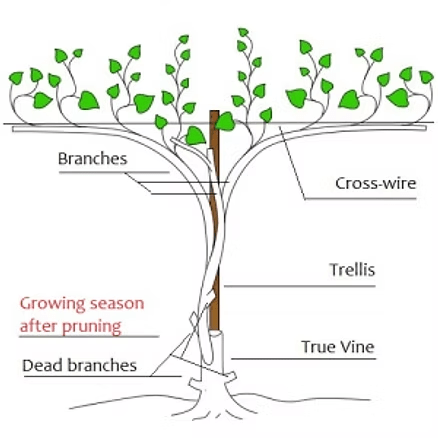
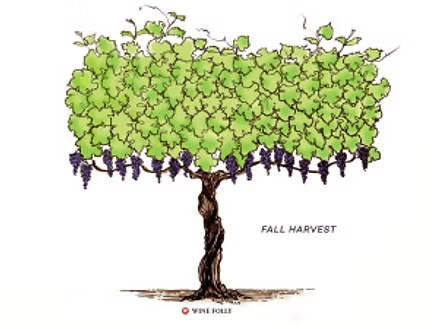
To say he is the “vine” is similar to Jesus saying he is the gate to the sheepfold. Both are self-contained, with limits, where the parameters or boundaries are of optimum value when those limits are full of purpose: a grapevine is full of grapes; and a sheepfold is full of sheep. This view of a “vine” being one (thus the “true vine,” implying others exist that are false), one can see how a vineyard is many grapevines together. Here is a diagram of one grapevine and a picture of a vineyard of grapevines in winter:

This imagery can then be used to see how the books of the Holy Bible tell of the previous harvests of good fruit, from Adam to Noah, from Abraham to Moses, and from David to the Prophets, with all being from the seed of God and the true vine of His Sons. In this reading from John’s Gospel, Jesus told his disciples how Jesus of Nazareth, the promised Messiah, was the true vine of God. He was speaking to the flowers that would soon bud into the branches that would produce his good fruit, the product of the Father. By understanding this terminology properly, everything Jesus told his disciples becomes crystal clear metaphor.

John remembered Jesus saying, “[The Father] removes every branch in me that bears no fruit. Every branch that bears fruit he prunes to make it bear more fruit.” This is routine maintenance of a grapevine that bears good fruit. As such, at the time Jesus said this Judas Iscariot was absent, having gone to betray Jesus. He was a branch that would never bear any fruit in the name of Jesus Christ. Judas would never submit his ego to God and become Jesus Christ reborn. He was pruned the day Judas hung himself from guilt. Still, the branches that would bear the fruit of Jesus of Nazareth – the Apostles – they would all lose their lives so more Apostles could be produced. They were pruned for the good of the true vine.

Here is a branch that was pruned so the vine could bear more fruit.

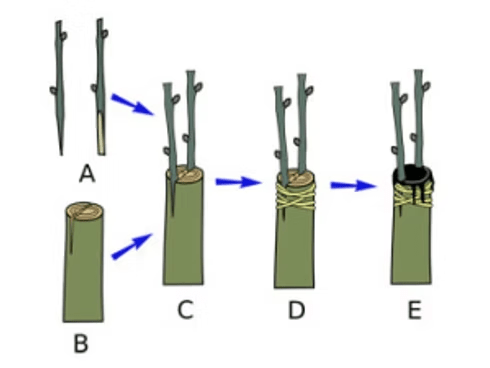
When Jesus then said, “You have already been cleansed by the word that I have spoken to you,” the word “katharoi” was used and translated as “cleansed,” and the word “logon” translated as “word.” This states in two segments, “Already you are pure [or clean]” and “by reason of the word that I have spoken to you.” The element of cleanliness loses focus on the metaphor of vineyard cultivation. The root meaning of “katharos” is “purity,” such that the example of grafting a shoot system (scion) to rootstock (the “true vine”), then the shoot will develop buds based on the root system. This means the “word” is the command of the true vine to regenerate cleanly from the rootstock, not from the root system the shoots were pruned, for the purpose of grafting. Thus, this verse told of Jesus informing his disciples their grafts had taken hold and they were then prepared for producing good fruit in the coming new season.

From common stock to disciples attached to the true vine to branches one with the true vine (Apostles).

“Abide in me as I abide in you” is then a statement that the eleven (and John) were no longer separate, but had become one (each individually) with Jesus. While all the disciples had mortal mothers and fathers, such that the DNA of those mortals was what made them reproductions in the likeness of their parents, they had become spiritually grafted to Jesus, whose Spiritual DNA was from the Father. Because of that linkage, the souls of the disciples were one with the soul of the Son of God, such that the Spirit of Jesus Christ was then within each of them.

Jesus then moved beyond this oneness to explain, “Just as the branch cannot bear fruit by itself unless it abides in the vine, neither can you unless you abide in me. I am the vine, you are the branches.” A branch (scion) that has been cut off from its root system is incapable of bearing fruit by itself. Once it is grafted onto good rootstock, the flow of growth is then passed onto the attached shoot (branch). The ability to bear fruit comes from the root. Since Jesus is the true vine (i.e.: rootstock for Apostles), his disciples were the newly budding branches, which were budding with the holiness of the Father, through the Son. Therefore, Jesus said, “I am the vine, you are the branches,” where each was grafted individually to the true vine.

It is important to grasp the implication of his next two statements. John wrote that Jesus said, “Those who abide in me and I in them bear much fruit, because apart from me you can do nothing. Whoever does not abide in me is thrown away like a branch and withers; such branches are gathered, thrown into the fire, and burned.” Rather than a statement of warning or threat, this was a statement of truth and fact. It goes beyond those who were gathered around Jesus, and well beyond the implication of Judas Iscariot being a discarded, as a withered branch.

These statements of Jesus say that the “true vine” is the only path to heaven and eternal life. Not only were the Jews not abiding in Jesus [as Jesus would soon be arrested by the Jews], neither were the Romans – who had their own religion that worshiped pagan gods. This truth says (without saying overtly) that no religion (as religion was known at that time) abode in Jesus, such that Islam (to come later, after Mohammed), Hinduism, Zoroastrianism, Buddhism, Taoism (or Daoism), Shintoism, etc., etc., and all forms of pagan worshipers all around the globe (monotheistic or polytheistic) are rootstock of death, not eternal life.

Because a religion is defined as “belief in and worship of a superhuman controlling power,” there is no “faith” that defines the process of a grapevine.  Just as Jesus was the “true vine of the Father,” there was no philosophy held by Jesus that defined what Jesus believed.
Jesus taught in parables that require one experience the meaning, rather than learn a set of rules to follow.  Because all ‘religions” fall into the error of belief in dogma, rather than being extensions (as reproductions) of the true vine, no “religion” seeks to become one with God.  As such, no “religion” abides in Jesus, who IS the true vine of God, the Father – the ONE GOD. Therefore, for Jesus to say, “Those who abide in me and I in them bear much fruit,” the whole world was, is, and is destined to be scions of false vines – the philosophical thoughts that act as “religion.”  The misled and misguided branches of philosophies will have to sever their shoots from their rootstock and seek to be grafted onto the Apostles … in order to become extensions of the oneness of true vine.

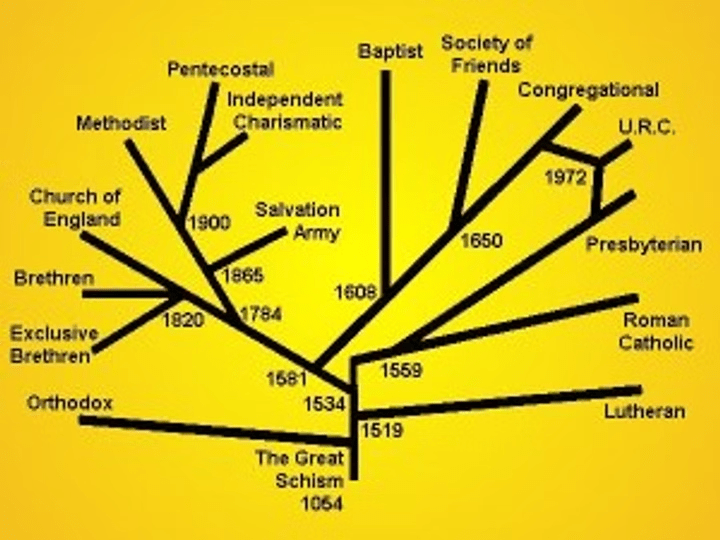
This broad stoke view of what Jesus said to his disciples should then be seen as John remembering a lesson for all who will sit and learn the lessons of Jesus Christ. The vast majority of proclaimed Christians around the world today are far from being branches that are producing the fruit of the true vine. The creation of branches within the “family tree” called “Christianity” (a religion), which veer wildly in many different directions, is not indicative of a grapevine producing fruit that carries the seeds of Sainthood. Instead, the millions who call themselves Christians seem to be at war with each other, more than simply being one with God’s love. It is more like the branches from the true vine have been pruned from truth and grafted onto false vine rootstock, making the present state reflect “Christianity” as weakened varieties of Jesus grapes, with none of them capable of producing good fruit.

Does this shape resemble the grapevine T-cross?

In this regard, I recommend the reader here look up the term “Cathars” and get a grasp of the original concept of true Christian. Much of their history has purposefully been destroyed, due to the hatred held by the leaders of the Roman Catholic Church against the Cathar people. Their name (as a group of people) was not theirs, as if they chose that name to be new branch of Christians. The name comes from the Greek word seen earlier – “katharoi” – which means “pure.”

Others, those who called themselves Christians, came to know these people (who primarily lived in Southwest France between 1,000 and 1230 A.D.) as those who were “pure” in their devotion to God.  They acted as those who were reborn as Jesus Christ, possessing profound knowledge of the word spoken by Jesus. The Roman Catholic Church exercised their first act of genocide to kill the Cathar people, because they would not convert to Roman Catholicism. To justify the first of several crusades known as Inquisitions, the Church called the Cathar people heretics, accusing them of being dualists and Gnostics, whose ways of life were not consistent with those philosophies held dear by the Vatican. In reality (in my opinion), the Cathar people were those who had “already been cleansed by the word that” Jesus had spoken, because they were true vine reproductions of Jesus Christ and knew the deeper meanings of Scripture, unlike typical Catholics.

Look up the Albigensian Crusade (aka Cathar Crusade).

From this awakening, which says true Christians should have more in common with Judaic teachings, where the communal commitment the Cathar people had to one another was similar to that of Jews living separately from Gentiles, the Cathar people were together as a Church of reproductions of Jesus Christ, as those reborn of his Spirit.  Jews, on the other hand, represented those branches growing from the vine of Moses, only to have grown wildly along the ground of the Promised Land, losing the “purity” of the “true vine” that Moses offered the Israelites through Law. Western Christians have likewise become wild grapes, through the ground clutter of philosophies that place more emphasis on the equality of inferior vines and branches, rather than seeking to maintain the “cleanliness of the word of Christ.”  American Christians today live among multicultural people they barely know, where governments force them to accept principals that are contrary to the teachings of Jesus Christ.  Unlike the Cathars, American Christians readily convert to the will of empires, with few willing to die for the way of the true vine.

This destruction of the true vine model can be seen in the statement of Jesus to his disciples, which said, “If you abide in me, and my words abide in you, ask for whatever you wish, and it will be done for you.” The promise that “whatever you wish will be done for you” meant – that night in Jerusalem, following Jesus’ last Seder meal – “whatever miracles you need to be able to perform in my name” – as the good fruit of the true vine – “you will have the power of God the Father available to you.” Modern Christians have mutated this statement into a weakened promise that makes Jesus Christ out to be some magic genie in a lamp, where you make a wish for wealth and it will be granted. All wishes today are selfishly based, with no one trying to heal any of the ills of the world, one Gentile convert at a time. All of this failure is due to no one abiding in Jesus Christ and he in one as Jesus Christ, Without that state of being reached first, all wishes can ONLY BE selfish, thus never granted by the One God.

In the last verse of this reading, John wrote, “My Father is glorified by this, that you bear much fruit and become my disciples.” The literal Greek makes this easier to understand, in terms of having one’s wish come true. The first segment says, “In this is glorified the Father of me.” That clearly says that “In this” abiding in the true vine, so the true vine becomes one’s Spirit leading one’s soul, then God the Father has made all desires for Oneness with God come true. By saying, “the Father is glorified,” where “edoxasthē” (from “doxazó“) is translated as “is glorified,” the reward of that wanted can only come from the sacrifice of self-ego, in “honor” and “praise” of the One God having entered one’s heart (and soul). When Jesus said, “the Father of me,” the intent is for a disciple to feel the power of the LORD within, such that one has to seek to become a rebirth “of me,” via “the Father.” Therefore, all desires cease to be of selfish motivations, only being wishes to serve the LORD’s needs, where “the Father is glorified” by the obedience of His servant.

The second segment can then be read literally as, “that fruit much you should bear.” This means that a branch extending from the true vine will produce grapes filled with the word of the Lord Christ. The succulence of full grapes from the true vine is then due to the holy water that has coursed through the xylem of that vine. From root system to branch to fruit, everything is filled with the word of God. It becomes a repeating of holy water poured out as in the miracle of Cana, which tasted as the finest wine that is usually served first. By keeping in mind how this “living water” that tasted like fine wine was taken from “purification” jugs, one can then see how the wedding guests had been cleansed by the word Jesus had spoken (to fill the jars with water).

The miracle of the purification water tasting like good fruit goes well beyond the physical.  It signifies the fermentation of the soul.  This means the disciples will produce more disciples, all who will become Apostles.  This miracle is opposed to the norm seen in the various denominations of churches gathering. like guests coming to celebrate a would-be marriage.  The norm can only expect a tithing pew sitter, who knows nothing that glorifies the Father, to show success by recruiting another tithing pew sitter, who also will know nothing of the Father.

The reason is a tithing pew sitter is a selfish ego and not one possessed by God’s love, reborn as His Son, Jesus Christ – the true glorification of the Father.  Today’s churches can be said by the master of the banquet to be typical, as the best wine of Jesus in his Apostles was served first, until the world was drunk and unable to notice that poor wine is now pouring freely.  Today’s Christians mistake their drunken state as being the fine wine from good fruit that glorifies the Father, when so much more is expected.

Finally, the last segment says, “and you shall be disciples of me,” where the glorification of the Father comes from “disciples of Jesus Christ.” This does not mean those who ONLY learn of Jesus Christ as pupils are true disciples. It means those whose hearts are afire with learning the power of Scripture, so their minds are filled with the knowledge of God – the Christ Mind – are those who thirst for truth. The purpose of learning is not to forever claim student status, but to graduate and become the teacher. The teacher (rabbi) was and is Jesus, who enlightens his disciples with a desire to become the Christ Resurrected. This is the call to all who seek the promise of eternal salvation, as that reward demands commitment to learn (deeply) and to apply that “education” freely, so others who are seekers of truth can find it alive in other human beings.

As a Gospel reading during the Easter season, a season when all lessons are calling disciples of Jesus to become the Resurrection of the Christ, we must grasp the concept of the grapevine and the branches that come from the “true vine.” In Scripture is the crucial point in time, when Jesus turned to his disciples and said, “If anyone wishes to come after me, he must deny himself, and take up his cross and follow me.” (Matthew 16:24) That command needs to be understood in terms of this reading and the dressing of grapevines.

First, the word translated as “wishes” is the Greek “thelei.” The same root Greek word, “theló,” was written here in John’s Gospel, meaning “wish, will, desire, intend, and design.” The intent of the word is therefore not to offer one a “wish” fulfilled, but to ask one if he or she “seeks” God, as their “desire, will, intent, design, or wish.” This means Jesus told his disciples on the evening of the Passover Seder, “whatever your heart desires, it will be fulfilled.” The result may or may not be God and the Christ Mind – thus the wisdom of “be careful what you wish for, as you just might get it.” When Jesus told his disciple to choose their path, he said, “If you desire to become me, then you must sacrifice your ego [deny oneself] and accept my righteous goals.”

Second, when Jesus told his disciples the path to “follow him” required one “take up his cross,” there are two grapevine elements contained in those words. First, the Greek word “aratō” means, “take away,” but it also means “raise” and “lift up.” It implies “hoisting,” as well as “carrying” and “bearing.” This becomes a demand for the strengthening of a grapevine, where years of growth and the crafting of the vines along a cross-wire create a T-cross that is capable of bearing weight. In terms of Scripture being the word spoken by the Christ Mind, like a tendril of a vine, one should always be close to Scripture and ever-reaching to see its deeper meaning.  That reflects a design to reach the optimum height, so the shoot strives to be uplifted and amplified in strength.  A vine does not reach high due to a philosophy or written plan.  It does so naturally, so it can not only produce branches, but also so it can grow to support the fruit produced. In spiritual terms, being “raised” means to go beyond self (“deny self”) and “[be-]come” Jesus Christ “after” him. This “uplifting” is in soul Spirit, where Christ abides in one and one abides in Christ.

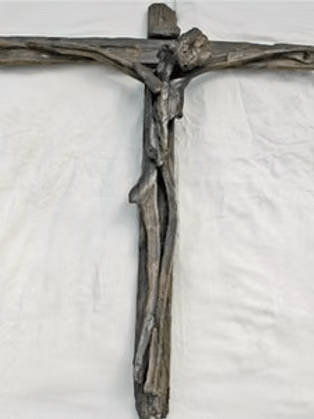
In reference to the Roman Catholic Church and their genocide of the Cathar people, one can see how this can be reduced to a level of symbolic focus. The Church reveres the crucifix and loves to nail the body of dead Jesus to dead wood – not a living vine. The original symbol of Christianity was the fish, which is associated with the astrological sign Pisces. Pisces represents self-sacrifice for a Spiritual reward. Therefore, to read Matthew 16:24 as if Jesus were telling his disciples to foresee his crucifixion as his end and the disciple’s time to follow on without him, that avoids the point of self-sacrifice (which may or may not be death by crucifixion) for a higher soul self (as Jesus reborn).

See how dead driftwood has been fashioned into a symbol that screams “dead branch”?
See the difference in imagery when we have become grafted onto a living cross within?

The second element in “take up his cross” is the word that translates as “cross,” which is “stauron.” It has been the teachings of the Roman Catholic Church that has taken this Greek word and absorbed its meaning into the dead timbers of a crucifix, as though the word solely means the pain and suffering of Jesus of Nazareth. The reality is “stauros” means “stake in the ground that forms a T.” The stake hold the cross-wire, which symbolizes the inner strength the Holy Spirit offers.  A crucifix forms a T, but many other T formations existed long before anyone figured out how to nail human beings to two dead tree trunks hewn and nailed together, in the shape of a cross. People cultivated grapevines into the shape of a T-cross well before the Romans saw that shape was strong enough to bear heavy weights. Thus, Jesus was telling his disciples to form a strong shape, just as he had shown through his strength in supporting his disciples and the Jews who sought him.

In this fifth Sunday in Easter, in the year 2018, this message to become branches of the true vine, as the fruit of the Father’s vineyard, goes along with the reading from Acts, where Philip produced good fruit in the Ethiopian eunuch. He did that be being tested in the wilderness, led by an angel of the Lord, where his strength was proved to bear the weight of Sainthood. It also accompanies the Epistle reading from 1 John, which defines God as love. The fruit of the Father’s true vine is the love of Christ, which is only found in true Saints – the fruit of the true vine.

The Easter call is to heed the word of Jesus and become “clean” and “pure.” One must be washed clean of past sins, in order to be given the reward of eternal salvation. To desire that reward, one must be a living branch of the true vine and produce good fruit. To be a living branch, one must be resurrected as Jesus Christ, so he abides in one, as one abides in him.

The purpose of Jesus dying on a cross was to show his disciples how death is not a permanent state of being, as a soul can never die. The soul will graft itself to another root system and be reborn according to that root-stock. Therefore, the purpose of the seven Sundays in the Easter season is to drive home the point that it is not enough to let Jesus die and be Resurrected, then Ascended. Christians miss the point of the price they too must pay.  If they do not follow that same path to salvation, by being reborn as the fruit of Jesus Christ, they will lose as fruitless branches thrown into the fire.