Tag Archives: Matthew 18:20

John 15:9-17 – The commandment to love one another as Jesus has shown love

Jesus said to his disciples, “As the Father has loved me, so I have loved you; abide in my love. If you keep my commandments, you will abide in my love, just as I have kept my Father’s commandments and abide in his love. I have said these things to you so that my joy may be in you, and that your joy may be complete.

“This is my commandment, that you love one another as I have loved you. No one has greater love than this, to lay down one’s life for one’s friends. You are my friends if you do what I command you. I do not call you servants any longer, because the servant does not know what the master is doing; but I have called you friends, because I have made known to you everything that I have heard from my Father. You did not choose me but I chose you. And I appointed you to go and bear fruit, fruit that will last, so that the Father will give you whatever you ask him in my name. I am giving you these commands so that you may love one another.”

——————————————————————————-

This is the Gospel selection from the Episcopal Lectionary for the Sixth Sunday of Easter, Year B 2018. It will next be read aloud in a church by a priest on Sunday, May 6, 2018. It is important because it tells of Jesus instructing his disciple to love one another, just as he has loved them. It is more important when one understands exactly what that commandment to love one another means.

———————————————————-

Preface Note: I believe this is a vital lesson that all Christians should be able to know and defend.  For that reason, I have expanded the scope of this interpretation to include other Scripture in support of this lesson.  As such, this writing is longer than usual, in order to make this reading fully understandable.

———————————————————–

It is worthwhile realizing that this reading from John is the second time where Jesus told his disciples to love one another. The first time is also found in the Gospel of John, two chapters earlier.  There one reads:

“A new command I give you: Love one another. As I have loved you, so you must love one another. By this everyone will know that you are my disciples, if you love one another.” (John 13:34-35)

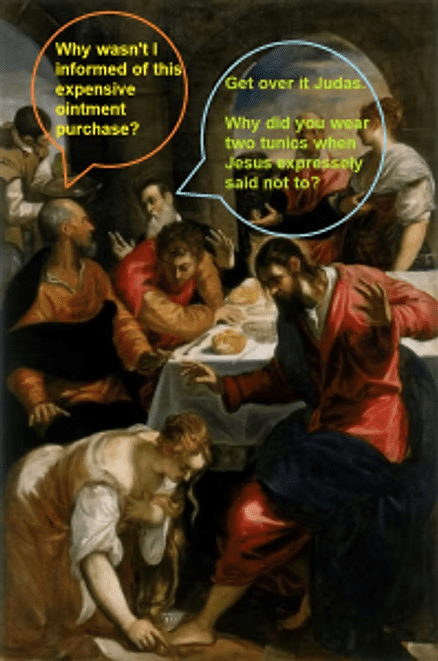
Both times that John recalled this instruction being given were on the same day – the the evening of the Passover Seder meal (15 Nisan). The first time was soon after the ritual dinner, not long after Judas left to betray Jesus. Jesus knew Judas was going to do that as he said, “What you are about to do, do quickly.” (John 13:27)

That timing makes it worthwhile to know that Jesus did not say to Judas, “Before you leave to betray me, I have a new commandment you need to hear first. It is: Love one another as I have loved you. Okay Judas, what you are about to do, do it quickly.”
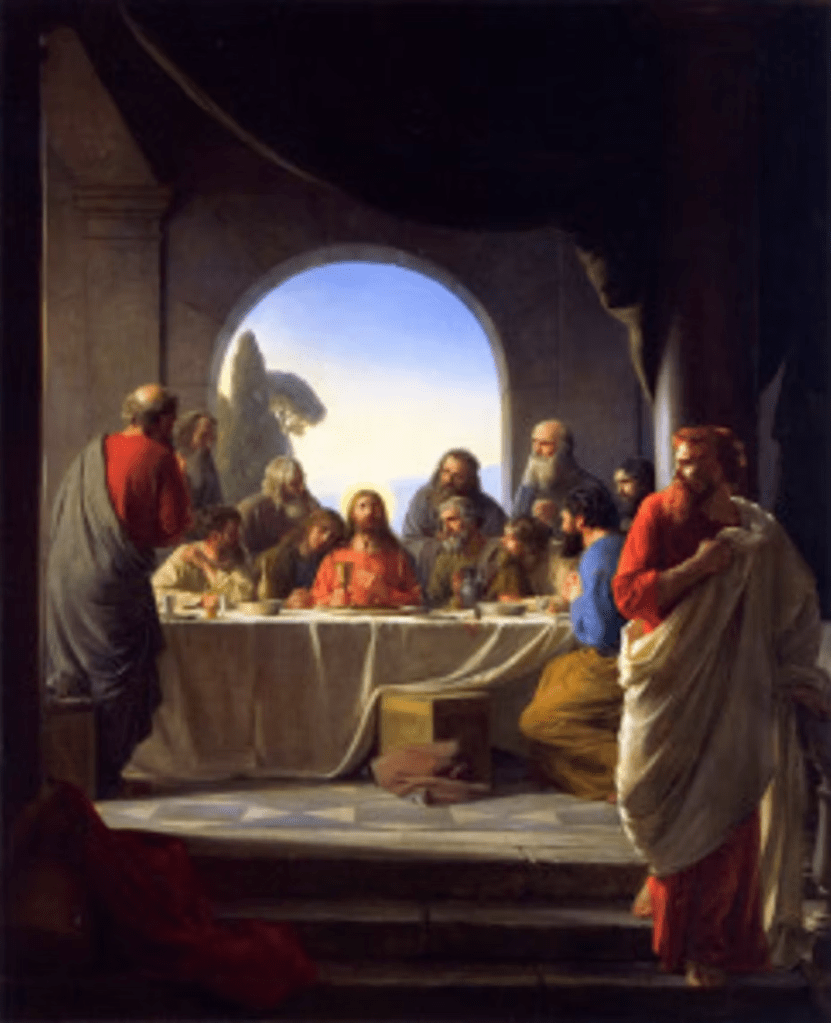
Leaving friends behind.

Because that conversation did not take place, nor get recorded as a lesson of love, the omission acts to show how Jesus gave this commandment to a select group of followers – his disciples. By waiting for a traitor to leave, Jesus did not say that commandment as a lesson for the whole world to follow.   Although that would be the ideal, just as would Heaven being on Earth would be ideal, the whole world would have to be followers of Jesus Christ; but because that cannot be, one cannot read that ideal as the intended message in this lesson.

Recently, I encountered a man who had solved the whole world’s problems, based on misunderstanding this teaching of Jesus. He had written a short story that used this flawed logic: Because Jesus said his disciples must love one another, then all the world’s problems are rooted in the failure of Christians to follow that order.

This man was less concerned with helping anyone but himself (through sales of his short story), because his ultimate motivation was to throw blame on Christians for not living up to the lessons of Jesus Christ, through the sacrifice of their beliefs to the beliefs of others. He surmised that all the mental problems in the world were due to Christians not forgiving sinners, as though love means not judging anyone. He rationalized that Christians are to blame for pushing guilt onto the guilty, making sinners become psychotic due to a lack of love and acceptance of sins.  This man concludes (I presume) that Jesus taught forgiveness as the only expression of love.

The sad thing is this man does not stand alone in using this passage from John 15 as a stick to beat Christians into submission to a world of sin.  His view is how so many misunderstand this lesson (especially atheists). People misunderstand this command given for several reasons, but foremost is the difficulty that people have understanding God’s love. The theme for the Sixth Sunday of Easter is God’s love, but the mistake comes from thinking Jesus gave a command relative to human “love.”

Before discussing today’s Gospel lesson, it should be noted that Jesus gave other commandments about love. Unless those commands are understood as still in effect, making this reading’s order be additional, one cannot properly grasp the meaning here.

First, Jesus presented this lesson about loving your enemies:

“You have heard that it was said, ‘Love your neighbor and hate your enemy.’ But I tell you, love your enemies and pray for those who persecute you, that you may be children of your Father in heaven. He causes his sun to rise on the evil and the good, and sends rain on the righteous and the unrighteous. If you love those who love you, what reward will you get? Are not even the tax collectors doing that? And if you greet only your own people, what are you doing more than others? Do not even pagans do that? Be perfect, therefore, as your heavenly Father is perfect.” (Matthew 5:43-48, but similarly in Luke 6:27-36)

It looks harmless.

That passage directly instructs one to love an enemy, but it refers to love of a neighbor also.  Jesus directly addressed that love later in his ministry. Jesus was asked what the greatest of the Commandments was, to which he said:

“‘Love the Lord your God with all your heart and with all your soul and with all your mind. This is the first and greatest commandment. And the second is like it: ‘Love your neighbor as yourself.’ All the Law and the Prophets hang on these two commandments.” (Matthew 22:37-40, but similarly in Mark 12:30-31)

When we read in John 13:34, “A new commandment I give you,” the Greek word “kainēn” means “fresh, new, unused, and novel.” That indicates Jesus was not offering a replacement or superseding command. In the same way, the New Testament is an additional Covenant with God, through Jesus Christ.  It does nothing to change or eliminate the importance of the Old Testament.

It is as Jesus said: “Do not think that I have come to abolish the Law or the Prophets; I have not come to abolish them but to fulfill them.” (Matthew 5:17) Therefore, Jesus did not make any changes to his previous statements about loving enemies and neighbors. He added another element to the love commands.

When the totality of these commandments to love is grasped, it is easy to see how Jesus recognized there were natural divisions in the world. For Jews, their “enemy” was any and all who sought to take their focus off Yahweh and their Covenant with Him (i.e.: Gentiles). For the disciples, collectively the family and followers of Jesus, they lived among Jews (by Law), many of whom not only broke the laws of Moses but also displayed anger and resentment towards the disciples and Jesus (i.e.: the Temple elite). This means the love that needed to be found between those closest to Jesus (one another) was different than the same love that needed to be found for enemies and neighbors.

When Jesus told those listening to his sermon on the mount, “You have heard it told, ‘Love your neighbor and hate your enemy,’” he was addressing the rulers of Judaism teaching the law based on human principles, not divine guidance. They taught a misleading principle, because they understood the Law only on human levels, not Spiritual .

Because there are enemies, it is human nature to hate those who are opposed to you.  Likewise, it is human nature to love those who agree with you. Because Mosaic Law speaks more about guarding from falling under the influence of people who worship other gods, demanding the Israelites submit to complete obedience to the Law of Yahweh, all who are of those distracting influences are deemed enemies.

Because Yahweh promised land to His Israelite people (those who agreed to His Commandments), the people who resided on that land prior (and subsequently) all worshipped other gods.  Those indigenous peoples saw the Israelites as their enemies, because they took their land from them. The result was a mixture of races and beliefs, where all who resided on opposing sides were then both neighbors to one another (the Israelites), while also enemies because they opposed one another (all the other inhabitants of Canaan – Israel).

Enemies confront one another.

When this view is established, one can see that neighbors are those who profess belief in the One God (the Jews and scattered Israelites collectively). Enemies are then all Gentiles. The commands to love all who profess belief in the same God and also love all who believe in other gods becomes a love that is above and beyond human “love,” because human “love” must be defined by “hate.”  Human emotions are like coins that must have two sides.  For every emotion, there is an equal and opposite counter-emotion.

The wheel of human emotions.

The way that God’s love allows one the capacity for an uplifting ability, to rise above all human differences, is done by reaching a state of love that is heart-centered and within oneself. The world’s petty differences become inconsequential because one has found the truth of being chosen by God; and that means loving all others who have not reached that state of bliss.   By allowing those who focus on differences to do as they choose, without interference, one is loving others of all kinds.

The love then shown to both neighbors and enemies is a willingness to “Do unto others as you would have them do unto you.” (Matthew 7:12, Luke 6:31)  This is not a recommendation to surrender one’s beliefs to another, but an understanding that others are like oneself.  Just as one does not want to be told to surrender one’s beliefs, one should not ask others to surrender their beliefs.  That mutual respect requires a higher level of love to accomplish.

This love is not self-willed, as an attempt to gain neighbors or eliminate enemies. As a human being in the world, human beings will always be divided and at odds with one another. Wars and fights will always be waged.  As such, God did not send Jesus into the world to bring about human peace and “love.”

Jesus said, “Do not suppose that I have come to bring peace to the earth. I did not come to bring peace, but a sword.” (Matthew 10:34) All Christians know that the presence of Jesus caused the ruling elite of Judaism to become the enemy of Jesus.  They plotted to kill Jesus; and they recruited Judas from his followers, while convincing the Roman governor to sentence Jesus to death. Thus, Jesus did not teach love as the way to transform the earth into such a wonderful place that no one would ever strive to be good enough to go to Heaven.

From this understanding, one can then see how Jesus is speaking to a select subset of those who profess belief in the One God (Yahweh) – “his disciples.” It is also vital to always keep in mind how Jesus spoke from a human being perspective, having been born of a woman, so he knew his personality was separate from the Father’s.   Still, everything Jesus said that is recorded in the Gospels of the Holy Bible was not his brain calculating, but the Mind of Christ that led him to speak.

We know this because Jesus said, “The Son can do nothing by himself; he can do only what he sees his Father doing, because whatever the Father does the Son also does.” (John 5:19) Further, Jesus also said, “I did not speak on my own, but the Father who sent me commanded me to say all that I have spoken.” (John 12:49)

Who said that?

This means that the commandments about love come from God, as requirements that will set one apart from normal human beings through the elevation to Christ status (sainthood). As such, “his disciples” were students on the path to righteousness.  That distinction makes “his disciples” unlike those who simply believed in the same God (neighbors) and those who believed in other gods (enemies).

In today’s aftermath of the spread of Christianity, “his disciples” are those who believe in the One God and take steps towards understanding the words Jesus spoke as the means to reach the elevated state of being truly Christian. Now, those who are merely professed Christians and never go beyond learning children’s Bible stories are the neighbors. Now, those who formulate ways to destroy Christianity through belief in lesser gods (philosophies and other worldly idols), some who may even mimic the One God (as false shepherds), they are the enemies.

The command is then to love in three different ways, as love expressed toward three different groups of human beings.  This means one must not be blind to the fact that there are indeed enemies, neighbors, and family in the world. This means that the love of God will be expressed differently, accordingly, through those who have received God’s love.

In the reading today from John, we begin by hearing Jesus tell his disciples, “As the Father has loved me, so I have loved you.” That has to be seen as a love of family, where the disciples were the children of Jesus.  All the others who followed his ministry and supported it were family members – as brothers, sisters, including his mother. The Gospel stories paint pictures of how Jesus acted differently, yet still from love, to his family, to his neighbors, and to his enemies.

First, his family sought to learn from Jesus. To receive that knowledge, they became subservient to his needs. They carried tents, fetched lunch, prepared meals, and anointed his head and feet with oil. That says a love of family is total commitment to one another.

In this regard, after the crowds would leave Jesus, having heard Jesus speak in profound, yet unclear and uncertain language (as in a parable or a question answered by words that required the listener to truly answer), the disciples were just as confounded as were neighbors and enemies. They would ask Jesus to explain his words; and, Jesus would explain to them. The difference, therefore, in family and friends from neighbors and enemies is the family of Jesus sought to know more.

The neighbors and enemies could sense that was where Jesus was going with his words and that was where they did not want to go. They did not ask questions for fear of being exposed as unknowing or ignorant.  When they did ask questions, it was to trap Jesus and expose him as a false leader; but Jesus always turned the tables on them, so they fell into their own traps.  Thus, Jesus loved his family and friends by guiding them closer to where they were ultimately intended to go.

Seeing an advisor on registration day is advisable.

As for the neighbors, this primarily meant the Jews. Jesus said he was only sent to the Jews (“the lost sheep of Israel”), which by extension included his disciples. In the great commission, Jesus ordered them, “Do not go among the Gentiles or enter any town of the Samaritans. Go rather to the lost sheep of Israel.” (Matthew 10:5-6) This identifies the Jews as the neighbors who were to be loved. Still, Jesus encountered the outcast neighbors, who typical Jews saw as enemies and worthy of hatred.

In the story of Jesus encountering the Samaritan woman at a well, the woman said to Jesus, “You are a Jew and I am a Samaritan woman. How can you ask me for a drink?” (John 4:9) In the story of Jesus encountering a Canaanite woman, Jesus said to his disciples (who urged Jesus to send the woman away), “I was sent only to the lost sheep of Israel.” (Matthew 15:26) A leper was essentially a Jew that was forced to be outcast because skin lesions were seen as signs of sin; and, contact with a sinner was forbidden by Jewish law. Jesus touched a leper, saying, “I am willing (to make you). Be clean.” (Matthew 8:3) Jesus then encountered a Centurion (a Roman officer who had Jewish slaves), who told Jesus one of his slaves was deathly ill. Again, Jesus would have been forbidden by Jewish law to visit the home of a Gentile, but he asked the Centurion, “Shall I come and heal him?” (Matthew 8:7) All of these examples (and the many more) show the love of Jesus to neighbors, as those who came to Jesus because they believed he was holy.

Because they sought him out, as those who lived in the neighborhood (so to speak) but were not approved Jews, those neighbors were given the same treatment as if they were family and friends. They were lost sheep that heard the voice of their shepherd and came to Jesus willingly, without him seeking them out (against Jewish law). Therefore, the unwritten message of neighbors is it represents all those who live together but in segregated into groups, because of cultural demands, kept from intermingling by protocols. 

Jesus loved those neighbors by not rejecting them at face value.

Some neighbors do not believe in cutting grass.

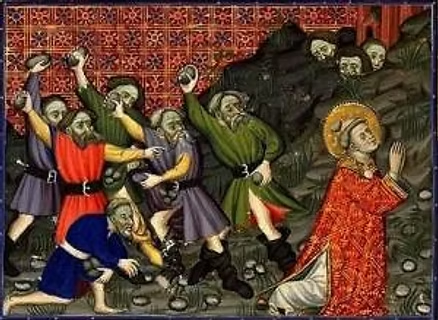
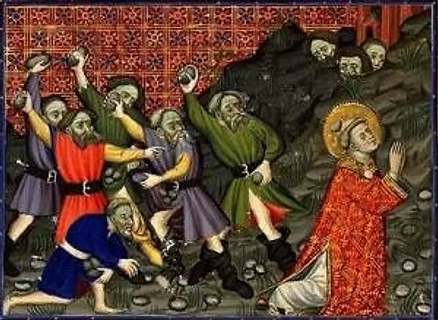
As for the enemies that surrounded Jesus, one has to look at the examples where Jews were angered by something said by Jesus. In Nazareth, we read how all the Jews in the synagogue there, “were furious when they heard [Jesus speak]. They got up, drove him out of the town, and took him to the brow of the hill on which the town was built, in order to throw him off the cliff.” (Luke 4:28-29) While speaking to the Jews on the steps of the Temple, he told them the truth would set them free, which led to them denying they were enslaved. Jesus then spoke of the Father, to which the Jews claimed Abraham as their parentage. This inability to hear the truth in Jesus’ words angered them so, “At this, they picked up stones to stone him.” (John 8:59) During the Feast of the Dedication (now called Hanukkah), we read how the Jews gathered around Jesus and asked when he would clearly say he was the Messiah. He explained to them how they had heard that but did not believe, due to them not being his lost sheep. We then read, “Again his Jewish opponents picked up stones to stone him.”

Those were all the enemies of Jesus, yet Jesus loved them by telling them the truth, even though the truth hurt. Jesus did not capitulate to their demands to accept illegitimate reasoning, as if “love” meant not causing a stir.

It is also important to see some of the acts of Jesus that were also motivated by the love of God are often misunderstood as if an expression of pent up human emotions. For example, when we read, “In the temple courts he found people selling cattle, sheep and doves, and others sitting at tables exchanging money,” we then see the response Jesus had was, “So he made a whip out of cords, and drove all from the temple courts, both sheep and cattle; he scattered the coins of the money changers and overturned their tables.” (John 2:14-15) Later in his ministry, we see how, “When Jesus entered the temple courts, he began to drive out those who were selling.” (Luke 19:45 and similar in Matthew and Mark)

As Jesus was commuting between Jerusalem and Bethany during the pre-Passover week, we read, “Seeing a fig tree by the road, he went up to it but found nothing on it except leaves. Then he said to it, “May you never bear fruit again!” Immediately the tree withered.” This is given a title “Jesus Curses a Fig Tree.” (Matthew 21:19)

It is very easy to miss how Jesus acted appropriately in each instance, because his actions were backed by Scripture, as God’s love being that of a Father (not a mother). His physical acts were vivid and shocking lessons, but they were all backed up by divine words.  By those actions, Jesus taught lessons to his family and friends, and also to neighbors and enemies who witnessed them.  Jesus demonstrated love as an act in defense of one’s beliefs.

You’ll thank me later, although that is beyond your grasp now.

With that in-depth interpretation of love being much more than human “love,” where one comes from God in one’s heart, with the other coming from self-will that is ever-changing, one can then fully grasp the true intent of Jesus having a heart-felt chat with his students, on the eve of their graduation to Sainthood. This is not a conversation that equally applies to anyone who has not proved a committed relationship with God, through a love bond with His Son. This means understanding these words requires the presence of the Holy Spirit, as the disciples who were told this command did not write about it. (John was not a disciple, as he was family.)

Thus, students of Jesus to this day will have these words fall upon drunken ears, only to forget them when the fear and panic – generated by a world that is filled with dangerous enemies – grabs hold of their hearts and fills them with doubt. (“Oh you of little faith, why did you doubt?” – Matthew 14:31; and, “You of little faith, why are you so afraid?” – Matthew 8:26)

When Jesus told his disciples, “abide in my love,” he had just said his love was that of the Father, so the disciples were commanded to be in the same state. The Greek word “menó” (root of “meinate”) not only translates as “abide,” but also as “await” or “wait for my love.” That must be taken as Jesus telling anyone who desires to be a Saint, like Jesus, how he or she must wait until he or she becomes Jesus reborn.

Because the Father spoke through Jesus, the Son, Jesus saying, “If you keep my commandments, you will abide in my love, just as I have kept my Father’s commandments and abide in his love,” is saying all who have God’s love in their hearts will always obey God’s Will. This means each disciple will never again disobey the Father out of selfish will. That is the sacrifice of self that is awaited, which brings forth the Mind of Christ, so one is a new Jesus.

When Jesus then said, “I have said these things to you so that my joy may be in you, and that your joy may be complete,” the friends and family of Jesus had been seeking the “joy” and “gladness” that comes from “rejoicing” (all derivatives of the Greek word “chara”) that the promised Messiah had been delivered. In modern terms, Christians have the same desire in the promise of Jesus returning. The Jews all said they believed in the Prophets who promised the coming of a Savior, in the same way that Christians believe in the interpretations of Scripture that predict a Rapture and Second Coming. The Jews are still waiting for their Christ, while Christians who do not become Saints are still waiting for the End Times.

The “joy made in” a true disciples is “complete” when the return of Jesus Christ is now, in oneself. As such, the Greek word “plērōthē,” which means “may be complete,” also represents the conditional form of “might be filled.” This “fulfillment” depends on whether or not one opens oneself up to receive the Holy Spirit, which first requires one accept a marriage to God, becoming subservient to His love.

Understanding that self-sacrifice is the conditional demand makes it easier to see how Jesus saying, “This is my commandment, that you love one another as I have loved you. No one has greater love than this, to lay down one’s life for one’s friends.”  That says how the ability to possess God’s love demands one sacrifice one’s ego (the Greek word “egó” is the first-person pronoun “I,” emphatically stated as “I am.”). It means that the reward of that sacrifice is love, which is much greater than human “love.”

That sacrifice makes one capable of understanding the divine love that had been established between themselves and Jesus, as the Father being in touch with them through the Son. Thus, as Saints, they would have the love of family and friends between others of the same person (all begat from YHWH – “I Am That I Am” – as the Son reborn).  They could then promote the same love in multiplicity to other seekers, so more would become the children of Jesus Christ.

While it is easy to hear Jesus speak of laying down his life for his friends, through the Big Brain Syndrome of knowing the end of the story from the beginning, we can jump to the conclusion that meant Jesus would soon die on a wooden cross.  Unfortunately, such a conclusion is wrong. Jesus did not die on a cross so “philōn” (“friends”) could be saved, because that would deny all neighbors and enemies the same opportunity for Salvation.

If that were the case, then call back all the missionaries who travel the world trying to preach the Gospel to heathen enemies.
The meaning of what Jesus said has to be applied to Jesus’ life, not his death.  His life began at his birth, which means Jesus willingly sacrificed his human life before his soul was breathed into the human body that was born of a woman. Jesus laid down his life as a mere mortal, so he could become the Son of God, the Messiah.

By his making that sacrifice – laying down his life prior to birth – Jesus could live to create family and friends who would be saved by God’s love through that living body of Christ. Therefore, the conditional demands one exude God’s love amid the lives of neighbors and enemies, so that one will attract the seekers who desire to be close to one of righteousness.

When Jesus said, “You are my friends if you do what I command you,” this is the conditional proposition. If one reads the New Testament of the Holy Bible – the Gospels and the Epistles – and hears Jesus speaking to oneself, then one is a friend of God and Christ. That friendship is then conditional on obedience, which is by definition, “submissive behavior.” (see Collins English Dictionary definition 2)

That then defines a disciple as a slave or servant, such that a student must follow the lead of the teacher in order to obtain a passing grade and the ultimate goal – graduation to teacher status. When one has progressed to teacher status, one has become part of the family of teachers, who then teach their own begotten student friends. When one becomes a teacher of the Word of God, then one has become reborn as Jesus Christ.

In this line of thought that projects a student-teacher relationship that is intended to make the students self-sufficient as teachers, one can see the purpose of Jesus saying, “I do not call you servants any longer, because the servant does not know what the master is doing; but I have called you friends, because I have made known to you everything that I have heard from my Father.” The sacrifice of self that yields obedience, or servitude to the master’s orders, is itself a relationship that calls for love that does not accept failure as passing.

The students are the friends of the master because the master’s desire is for the students to learn the correct way. That level of love for friends means dressing the student down who has failed a test and praising the student who has successfully grasped a lesson. Jesus did this to Peter when Peter tried to rebuke Jesus, when Jesus told Peter, “Get behind me Satan.” (Matthew 16:23) Still, Jesus praised Peter when Peter answered Jesus’ question, “Who do you say I am?” (Matthew 16:15) The praise was because Peter’s answer, “You are the Messiah, the Son of the living God” (Matthew 16:16) was divinely inspired and not memorized (or hearsay). Therefore, Jesus the master told Peter the student, “Blessed are you, Simon son of Jonah, for this was not revealed to you by flesh and blood, but by my Father in heaven.” (Matthew 16:17)

When Jesus said, “You did not choose me but I chose you,” this is a statement of family. It is the relationship a parent has with a child, such that the saying goes, “You can choose your friends, but not your family.” Jesus then became the father of his disciples, telling them, “Follow me” individually, as his children.

That was a selection process based on divine insight, which says (in a way) that the souls who fill the bodies of our children are divinely chosen, by God, with purpose. Nothing happens by chance.

Students do not choose a course of study because they idolize a certain teacher. They choose a course of study because they desire to know that discipline. The disciples of Jesus chose to know righteousness, through one identified as the Christ. They never expected to become Jesus. Therefore, Jesus said it is up to the student to choose to achieve a goal that is higher than the teacher; and, for that reason Jesus chose his disciples because of their hearts having already opened to learn to love God – the ultimate goal.

Realizing that, when Jesus said next, “I appointed you to go and bear fruit, fruit that will last, so that the Father will give you whatever you ask him in my name,” Jesus affirmed he had chosen the eleven because they too would become teachers. They were buds that would blossom and grow into fruit, filled with seeds that would continue as the spread of Christianity.  As soon to be fruit from the true vine, the Apostles would become the offspring, true duplications of the Christ fruit.

By seeing this and by realizing that Jesus spoke these words to his disciples after Judas had left to betray him, Judas was like the fig tree that had born no fruit, which became cursed and died. This statement says a true Christian is appointed to also teach disciples, so they too become Jesus Christ reborn. Only by having been so resurrected can one ask God in the name of Jesus Christ for anything that will bear favorable results. Therefore, to be chosen is to be resurrected as Jesus Christ.

With the ending statement being, “I am giving you these commands so that you may love one another,” one must grasp that Jesus was not sitting in the dark of night on the Mount of Olives, speaking to a multitude of doubting Jews and enemies. Jesus, again speaking for the Father, spoke of God’s love being the DNA that joined them all together as brothers, who within fifty days would be reborn as Jesus Christ via the Holy Spirit. This means the command “to love one another” is an order to form a church – a graduate school of brotherhood and sisterhood, where only true Christians can support one another on a human level, as family.  In a Church family, every member has bonded to God as His Son reborn. (“For where two or three gather in my name, there am I with them.” – Matthew 18:20)

See this view of Church as a teachers’ breakroom or a faculty lounge, as a place to go when there are no classes of students for the masters to teach.  As a teacher of God’s love, one is still “on the clock,” but occasionally in need of re-energizing.  The command to love one another is then a command to give support to those in the same “line of work.”  The Church is how Christians maintain connection with all who are in the name of Jesus Christ. That is then a new command to amend the teachings of the synagogue.

A Church should be modeled after the rules set forth by Moses, where there are three “break times” a year – Passover, Shavuot, and Sukkot – with a call for Christians to share their love with their neighbors and enemies on every Shabbat. The natural abuse that would then be inflicted on those Christians, by neighbors and enemies, would require them to help each other’s wounds in healing.

Lend a hand.

Jesus wept and felt human emotions, because he was human. He was unable to carry his instrument of destruction to his execution, because he was human. He was able to take all the abuse because of God’s love within him, overriding his human feelings. As Jesus hung dying on the cross, he looked down and saw the true members of his Church … his family and friends.

To all the subsequent graduates of Jesus’ teaching, it was knowing their sacrifices would be worthwhile, for a great reward to come. The addition of new student believers, those who sought to know more about the promised Messiah having been delivered, would add to the joy of completeness felt in all having been Jesus Christ reborn. Those new masters would always find support in the others just like them … their family and friends.

As a lesson in the Easter season, it should be easier to see how one fits into this command to love one another. One has to have served one’s time learning the foundations of one’s religion. One has to desire to know God and from that desire seek the teacher that is the Holy Bible and those who can explain its deeper meaning.

Then one has to die of self-will and be reborn of God’s Will, with His love in one’s heart and the Christ Mind exposing all the truth that divine Word holds. All the commandments become second nature and not forced. One lives a life or righteousness for the purpose of attracting more seekers to oneself.

One understands how loving enemies is done by allowing others to hate you, without adding fuel to that hatred. One understands how loving a neighbor is done by living at peace with others who share the same belief in the One God, although others may not share the same devotion to God’s Will. Finally, one understands how loving one another as Jesus loved friends and family means to support others who have also been reborn as Jesus Christ.  One is devoted to that end so that the fruit produced will come from enemies and neighbors, led to seek God by the master’s light shining from within a servant of the Lord.


Mark 3:20-35 – In Jesus we stand, divided we fall

The crowd came together again, so that Jesus and his disciples could not even eat. When his family heard it, they went out to restrain him, for people were saying, “He has gone out of his mind.” And the scribes who came down from Jerusalem said, “He has Beelzebul, and by the ruler of the demons he casts out demons.” And he called them to him, and spoke to them in parables, “How can Satan cast out Satan? If a kingdom is divided against itself, that kingdom cannot stand. And if a house is divided against itself, that house will not be able to stand. And if Satan has risen up against himself and is divided, he cannot stand, but his end has come. But no one can enter a strong man’s house and plunder his property without first tying up the strong man; then indeed the house can be plundered.

“Truly I tell you, people will be forgiven for their sins and whatever blasphemies they utter; but whoever blasphemes against the Holy Spirit can never have forgiveness, but is guilty of an eternal sin”— for they had said, “He has an unclean spirit.”

Then his mother and his brothers came; and standing outside, they sent to him and called him. A crowd was sitting around him; and they said to him, “Your mother and your brothers and sisters are outside, asking for you.” And he replied, “Who are my mother and my brothers?” And looking at those who sat around him, he said, “Here are my mother and my brothers! Whoever does the will of God is my brother and sister and mother.”

——————————————————————————-

This is the Gospel selection from the Episcopal Lectionary for the Third Sunday after Pentecost, Year B 2018. In the numbering system that lists each Sunday in an ordinal fashion, this Sunday is referred to as Proper 5. It will next be read aloud in church by a priest on Sunday, June 10, 2018. This reading is important because Jesus makes it clear that one cannot serve God part of the time and then serve self the rest of the time, because that is a recipe for disaster. In that way, one is not born into God’s favor, as the Jews deemed themselves as God’s chosen people. God does not choose part-time priests.

In this translation, where we read, “When his family heard it, they went out to restrain him,” this (I feel) is incorrect. The Greek words translated as “his family” – “hoi pará” – more accurately state, “others alongside of.” The Greek words translated as “restrain him” – “kratēsai auton” – more accurately state, “to seize hold of him.” In my mind, this better describes those who had parallel reputations as rabbis or teachers of Judaic Scripture (Pharisees).

Equals beside with greater fears of competition.

I struggle with the concept that the family of Jesus (as stated much later in the text) would not be considered “alongside of” or “beside” him.  They would know their place was behind him.  Nor can I accept that relatives would be so bold as to “seize” Jesus, as they would know full well his ministry would rock the Jewish boat. It makes more sense that Jesus would have told his family to keep a distance and stay mute.  Therefore, I see Peter (through Mark) recounting the rabbis of the synagogues in Galilee and the Pharisees there were joining with the “scribes who came down from Jerusalem” (actually “scribes, from Jerusalem” – those coming up to Galilee, not down[1]) in placing pressures against Jesus, because he was drawing such attention from the locals and pilgrims.

[[1] The use of “having come down” (from “katabantes” = “descended”) means the high-ranking scribes of Jerusalem had removed their holy buttocks from their golden seats in the Temple and ventured out amongst the “great unwashed” of Galilee.]

When we read the scribes (as well as the Pharisees and rabbis) saying, “He has Beelzebul, and by the ruler of the demons he casts out demons,” this stems from the trap the Pharisees had set in the synagogue where Jesus had been asked to lead the Sabbath service, only to enter and find a man with a withered hand in the congregation. When Jesus asked for comments, from the question, “Is it better to do good or evil on a Sabbath?” he then simply told the man to “stretch out your hand,” which the man did – healed. That act was then being deemed the act of Satan, by high authorities, after testimony given by well-respected Pharisees.

When the scribes had declared Jesus possessed by Satan, we read how Jesus “spoke to them in parables.” This leads one astray, since we tend to interpret a “parable” as: “A simple story illustrating a moral or religious lesson.” (American Heritage Dictionary) In reality, the Greek word “parabolais” comes from the word “pará” (“close beside” or “alongside of”) combined with the word “bállō” (“to cast”), which makes it a companion word to the prior statement that relates to “those beside” Jesus (the Pharisees). Thus, the word actually states that Jesus offered those who condemned him a “comparison” for themselves to consider.

Just as Jesus has addressed the synagogue in Capernaum (Galilee) with a question that went unanswered, he spoke again in questions. He first asked, “How can Satan cast out Satan?”

The optional Genesis reading this week is about the serpent being cast out of Eden. How could the serpent cast out the serpent?

The scribes had just implied that Jesus was able to straighten out a lame hand supernaturally, which (in the opinion of the Jerusalem think-tank) could only have been caused by Beelzebul (Satan). They then concluded that by calling upon that “ruler of demons” to “cast out demons” (those determined to be within men with lame hands), Jesus had called upon Satan to cast Satan out of a man’s lame hand. Jesus asked then (in essence), “How is what you propose even possible?”

The “comparison” spoken by Jesus (“parabolais”) was that the scribes and Pharisees were Satan. Here they were attempting to cast out Jesus, because they thought he was Satan. Jesus had simply asked, “Which is lawful on the Sabbath: to do good or to do evil, to save life or to kill?” That was excellent discussion material, but none of the Jews in the synagogue (including the teacher Pharisees) responded. When Jesus asked the man with the withered hand to straighten it out, and he did, why would that be grounds for saying Jesus did anything more than ask the man to stretch out his hand? If his hand was healed, was that good or evil?  And, if good, would that not be the work of God?

By the scribes, who came to speak judgment against Jesus based on the Pharisees who reported what Jesus had done, calling Jesus evil, they were answering the question posed by Jesus in the synagogue. They were saying it was unlawful to do good on the Sabbath. That inverts to a decree that says it is lawful to do evil on the Sabbath. The only one who would be so bold as to say that evil was lawful – EVER – even worse on the Sabbath – would be Satan. Therefore, the scribes had just claimed to be – themselves, not Jesus – those who called upon the ruler of the demons (Beelzebul), attempting to cast out the one who would break their laws and do good on the Sabbath.

Jesus spoke truthfully, when he made the scribes’ decree become a reflection on them. Jesus then said, “If a kingdom is divided against itself, that kingdom cannot stand.” That was a statement of history.

The scribes and the Temple priests, with the Pharisees, had become the straw bosses of ancient Israel. Unfortunately (for them), ancient Israel had split into Israel and Judah, with both falling to foreign invaders. The Promised Land of Canaan had been given to those who had to serve the LORD (by official Covenant) in order to keep their land. Instead, they waxed and waned, rising in devotion and falling in neglect. Then, tired from all the hard work, they asked for a king so Israel could be a kingdom, to be like other nations. Then that plan did not work, so they split one kingdom into two. Things then went from bad to worse, and Jerusalem was then in Roman Judea (not Judah), with Galilee another Roman province (not Israel). It all collapsed because the people followed bad rulers.

Jesus then added, “And if a house is divided against itself, that house will not be able to stand.” The use of “oikia” (“house”) is a step down from a “sovereign nation” or the “realm of a king,” where it means “household,” while inferring “family.” The whole claim to fame of the Israelites – as God’s chosen people – was ALL about being a house of worship, as a family linked through priesthood (and interbreeding only between the Twelve Tribes, with marriage to Gentiles forbidden).

That means Jesus was saying that the Pharisees running to tattletale on Jesus, and the scribes running to condemn Jesus by hearsay, was evidence of Jewish scholars being divided against a Jewish newcomer who was working miracles and drawing large crowds of followers. This division was not something that could ever be fixed (Nicodemus had attempted to sway Jesus to join their ranks, and failed), so the fact that Temple rulers (straw bosses) were up in arms about good having been done on a Sabbath, well then … “the house of Judaism was doomed to fall down.”

And that after so much work and planning had brought the exilic Jews back from Babylon. And that after so many years of work having been done, especially in the remodeling and beautification of the Second … ooops …. Herod’s Temple. And that after all the lamenting and complaining to their Roman overseers had allowed Jerusalem near city state status (but not quite). By 70 A.D. very little of that house would still stand, while the new house of Christianity was rapidly taking off.

That assessment can then be seen in Jesus next saying, “And if Satan has risen up against himself and is divided, he cannot stand, but his end has come.” There was still an opportunity for these Satan-serving scribes to run back to Jerusalem and spread the word, “Hey guys, we have it all backwards. This Jesus fellow from Nazareth is the real deal. We need to stop serving ourselves and drop everything and follow him.” Unfortunately, knowing in hindsight that was a BIG IF that did not happen, Jesus then prophesied the end of the Jews.  As Jesus died on the cross, God left the inner chamber of the Temple in Jerusalem for the last time.  Thus, because Satan had overtaken the Temple, Satan was reaching out to divide and conquer the remnants of Judaism.

Those “comparisons” of ancient failures and current failures were then addressed by Jesus, where he offered the solution. Jesus stated the exception to that history, saying, “But no one can enter a strong man’s house and plunder his property without first tying up the strong man; then indeed the house can be plundered.”  A “strong man” had been known prior as individual Judges, Prophets, and (from time to time) Kings who ruled benevolently over the people.  John the Baptizer had shown strength, and Jesus was certainly a “strong man” with a house he protected.

The lion is a symbol for strength. It is called the king of the jungle. One with a lionheart is courageous and strong.

By stating “a strong man’s house” (literally, “into the house of a strong man”), Jesus was saying the course to or from failure is each one’s responsibility, such that “the house” of “a strong man” was the domain of each Jew’s body. Their strength was then dependent upon that individual’s commitment to serving God as His priest. The strong individual does not seek any king other than God, who then sits upon the throne of one’s heart and soul. God is the source of a man’s strength.

When that state of service is established, no one can “plunder his property” (where “property” is “goods” [“skeuē”], which are the “works” of that individual). Jesus was such a “strong man,” whose “house” was truly holy; so the efforts of the Pharisees and scribes could not stop Jesus from being a holy and righteous man.

Still, Jesus offered the caveat that IF one “first tied up the strong man; then indeed the house could be plundered.” That means plundering would then have to be the objective, such that the good deeds of the strong man were inconsequential. Such a judgment would be only be meted by evil-doers. In such a case, even the house of a strong man could be plundered, which would be the execution of the pure and innocent, at the hands of the wicked. That could only be prevented if the plunderers were to likewise become strong men, in holy houses, refusing to go against their dominant tyrant rulers. Jesus would eventually be the strong man tied up in arrest and trial, his being judged a criminal, and his being executed by crucifixion.

In this regard, Jesus had just prophesied his own eventual death, symbolically, at the hands of the elite of Jerusalem.  He then forecast their ends, when he said, “Truly I tell you, people will be forgiven for their sins and whatever blasphemies they utter; but whoever blasphemes against the Holy Spirit can never have forgiveness, but is guilty of an eternal sin.”  For all who stand in churches today and promise that Jesus offered forgiveness to all, are those pastors remembering these words or excusing blasphemers of the Holy Spirit?

The Greek words written by Mark actually state, “tois huiois tōn anthrōpōn,” which is translated above simply as “people,” but is better grasped as “the sons them of men.”  Those who will be forgiven for their evil actions will be those following the orders of their elders. Those who were expecting their religious leaders to properly guide them would be forgiven for their sinful acts against the pure, when their “blasphemies” were echoing what their brains remembered their revered scribes saying. That day the common Jews heard the scribes blaspheme Jesus by saying, “He has Beelzebul, and by the ruler of the demons he casts out demons.”  Are not “sons of men,” rather than “sons of God” (Saints and Apostles), the ones who find excuses for sinners, because they cannot lead anyone to the Holy Spirit?

A leader who tempts with forbidden fruit is a son of man.

Because that blasphemy was uttered due to a man with a withered hand being healed, where the affliction was deemed by blind men leading the blind people to believe physical infirmities were signs of the presence of sin (i.e.: Satan or Beelzebul planted demons), then the only logical explanation of healing could be God.

The scribes would have to remember the fire-starting contest that Elijah initiated (1 Kings 18), where four hundred fifty priests of Baal could not summon him to light dry wood, while Elijah soaked his wood pile with water and it was lit into a roaring flame by God’s Holy Spirit.

God is the power that makes the impossible possible. Therefore, those who would call God’s work that of someone calling upon Beelzebul were the utterers of a blasphemy of eternal proportions, unworthy of forgiveness.

Did the scribes think the four hundred fifty priests of Baal were forgiven after they called Elijah and his God names, accepting the challenge? Of course not.

Those evil priests, if one recalls, were priests imported by Jezebel into the Northern Kingdom, to guide Ahab and the common Israelites. They were the sons of men, not Sons of God.  Those priests of Jezebel all still burn in hell.

Jesus then said, “For they had said, “He has an unclean spirit.” I imagine there could have been a finger pointed when Jesus said “they said” (“elegon”), used in identifying the scribes and their Pharisees pals. “They said” the Holy Spirit of God, which makes crippled hands straight and strong, was the work of “an unclean spirit.”

I imagine Jesus pointed out “them” to the crowd that had been roused to a maddened state, murmuring that Jesus “had gone out of his mind.” I imagine Jesus silenced all of them as they pondered to themselves, “Did Jesus just say I am guilty of an eternal sin?”

Then, I imagine, Jesus went inside the house he and his disciples had been welcomed into, so they could sit peacefully and enjoy some lunch. As the door closed, the crowd was silently stunned … I imagine.

It is then that we read, “Then his mother and his brothers came.” This, again, was not an arrival based on fear for Jesus, as the implication can seem when reading, “When his family heard it, they went out to restrain him.” It might be that the Pharisees (“those beside” Jesus in responsibility, as teachers of Scripture) had stirred such a row that someone ran to tell Jesus’ mother that excitement was about. As this statement is actually separated into two segment (by a comma), it first says “and arrived the mother of him,” followed by a subsequent arrival, “and the brothers of him.” That would imply Mary told someone to go alert her other sons, so she left before them, with each Mary and the brothers arriving one right after the other, in the order of departure from where they were. One would then assume they came in support of Jesus, in case he was being threatened.

By reading, “and standing outside, they sent to him and called him,” they did not know the place where Jesus was with his disciples. Because it is not actually stated to be a home of someone, it could have been a public place, like an eatery. Their not entering could well have been due to the “crowd” that “was sitting around” Jesus was so many there was no room for them to wedge inside.

Good places to eat are not always big, so waits are common.

Thus, they sent word by asking strangers to tell Jesus who was outside. To ensure Jesus got the message, they hollered out Jesus’ name, in familiar voices he might recognize.

Then we read, “They said to him, “Your mother and your brothers and sisters are outside, asking for you.” The inclusion here of “sisters” should be read as the wives of Jesus’ brothers, as “sisters-in-law.” The point of Peter recalling “mother, brothers and sisters” is to make it a point that “the house” of Joseph, husband of Mary, and father of sons through at least two wives, they all had arrived to support their flesh and blood relative. They came to make a show that the “house of Jesus” was not divided, even though Jesus went and did his thing with his disciples, while the rest of the family did their things separately. They arrived to show solidarity of blood.

Jesus knew who was outside. God would have told him; but Jesus heard their cries and recognized them. Still, he did not want to make a show of how one family was strong in support of a common house; but he did want to demonstrate how one man had the strength to defend a holy house of righteousness. Thus, we read, “He replied, “Who are my mother and my brothers?”

Again, this is two segments, separated by a comma.  Jesus asked, “Who is the mother of me?” and then, “And [Who are] the brothers of me?”  Each separate focus questions not the identity of multiple people, but asked esoterically, “A I not an individual of responsibility?”

These questions were not directed at the physical people standing outside, as they are alluding to what makes a strong man. As a mother is the one who gives birth to a child, Jesus asked, “Who is it that gives birth to a strong man?” Is it one’s physical mommy? Or, is it God?

When Jesus then referred to other male siblings, he was then alluding to what makes a man truly strong. Does strength come in numbers of others who will come to one’s aid? Or, does true strength depend on the relationship that one has with the Holy Spirit?  Can one not find inner strength from knowing others like oneself have been made strong by God?

When we then read how Jesus looked “at those who sat around him, [and] said, “Here are my mother and my brothers! Whoever does the will of God is my brother and sister and mother,” that was not a claim of the present state of being.  It was prophetic. Certainly, Jesus did not see Mary, James, and his other brothers sitting around him. Instead, we see the twelve disciples that Mark had named earlier in chapter three. Even those twelve had nothing to do with what Jesus said.

Jesus actually did not say, “Here,” as that is a poor translation.  The Greek word he actually used was “Ide,” a form of “horaó.”  That word says, “Behold!” or “See!” or “Perceive!

Jesus was not pointing his finger at the human beings dining with him, or even tapping his finger forcefully on the table they were seated at.  Jesus probably had used his finger when he pointed to “those” outside who blasphemed the Holy Spirit. In my mind’s eye, at this point in the story, I “See!” Jesus lifting both arms high, inviting all who sat near to realize he held within him the mother of his faith and the lineage of all prior prophets of the LORD who were his brothers. Everyone sitting around him, and those outside calling out his name, would also be his own mother and brothers of Christ and all other Apostles, when they would become saints in the name of Jesus Anointed.

We realize that when Jesus then said, “Whoever does the will of God is my brother and sister and mother.” This is the recipe of a “strong man whose house cannot be plundered.” It is whoever does the will of God – not the will of Pharisees, not the will of scribes, not the will of friends who tell you someone might be in danger, and not the will of relatives who will defend one’s body without question.

The will of God is done by those who sacrifice their dependency on the outside world, so they only respond to the direction of the Holy Spirit. Of course, those all go by the same name – Jesus Anointed.

That name comes when one gives birth to a new you, after marriage to God in one’s heart (a holy house). You become the brother of Jesus of Nazareth, by being reborn as the Son of God. You become the sisters-in-law of Jesus, as human beings given away in marriage to the Father. The officiant of that sacrament is Holy Spirit, which washes away one’s sins, so God can take His throne.  A most holy matrimony through a most holy baptism, followed by a most holy christening [naming one as Jesus Anointed].

As the selected Gospel reading for the third Sunday after Pentecost, when one’s personal ministry for the LORD should be underway, Apostles are called to recognize they are either with Jesus, through the Holy Spirit – the mother and brother of Jesus the Anointed one – or they are standing outside, either calling out, “Sweet Jesus, come to me!” or “Cast out my demons, Jesus, if you are indeed holy!” or “Jesus was nothing more than another prophet who did some good things, but not the Messiah we still await.”  They are one or the other, not both.

A non-sacred cow.

The reality of today is there are crowds of people wanting a good show, in search of a dependable idol to worship. Few people are strong enough to keep themselves as a holy house worthy of God’s presence.

People remember how “Honest” Abe Lincoln quoted Scripture when he compared the divide between the slave states and the free states as a “house that cannot stand.” Few people realize that ordering the deaths of 620,000 Americans, through battles that would force the will of Abraham Lincoln (as the “king” of a nation divided) upon the people.  America has built a monument to Mr. Lincoln.  They immortalize some notes he scribbled on an envelops, while on a train to the battlefield where about 50,000 soldiers (both sides of battle) were killed, wounded, or went missing.  He wrote of forefathers, the ones who said states had rights, including the right to dissolve the union.  Abraham Lincoln rewrote the Constitution, as far as thirteen southern states were concerned.  The reality, as far as spirituality goes, is the United States of America fell in 1865, regardless of who claimed victory, simply because a son of man played god – calling upon Baal for all to worship.

Whoever hitches up their wagon to a country, or claims great pride in associations (political, racial, philosophical, or religious, et al) those people are bowing down before a master of lesser value that God Almighty. When Jesus said, “No one can serve two masters” (Matthew 6:24) the same lesson applies to the divisions that inevitably will arise in kingdoms and houses. Only a strong man in his own house, one of absolute devotion to God, stands a chance of surviving the destruction of his tabernacle (bodily temple).

The unnamed place that Jesus sat with his disciples, when he exclaimed, “Behold my mother and brothers!” is the epitome of a church. Jesus said, “Where two or three have gathered together in my name, I am there in their midst.” (Matthew 18:20) The church is not exclusively an elaborate brick and mortar building that is decorated with candlesticks, altar, crosses, stained glass windows and red carpeting between polished pews.

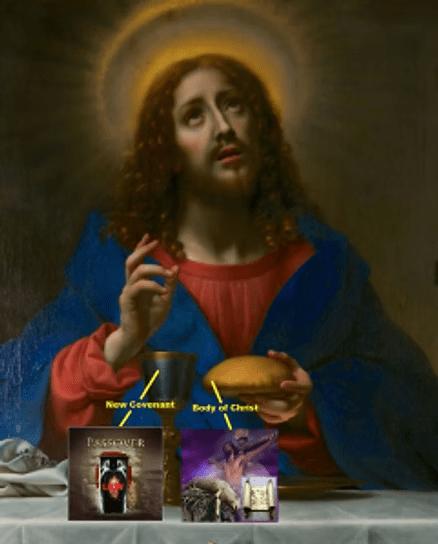
Jesus and his disciples might have gone into the equivalent of a pub or café, where he and his disciples shared a non-Passover loaf of bread and cups of wine. The disciples and the crowd were there because they wanted to be close to Jesus of Nazareth. When Jesus said there would be those who would later “gather in my name,” he meant Apostles in the name of Jesus Christ – as Jesus Christ reborn – the Holy Spirit and the Christ Mind would then be in their midst.

The sacrament of Communion is the gathering of Saints at a time when there is need to get away from the maddening crown that utters one blasphemy after another.  It has to do with sharing common experiences of body and blood, and very little to do with a wafer followed by a sip of wine from a fancy cup.  The disciples AND those who wanted to be near Jesus that day were in “communion” with Jesus of Nazareth, where that word is defined: “The sharing or exchanging of intimate thoughts and feelings, especially when the exchange is on a mental or spiritual level.”

The message of ministry is not to go out memorizing words found in various translations of the Holy Bible. The Pharisees did that and misled the people. The scribes of Jerusalem did that and misled the people. Ministry for the LORD can only be done by His Son, Jesus Christ.

Apostles and Saints have made that possible since the day of Pentecost, when Jesus returned in twelve disciples, and they in turn filled another three thousand who heard them speak with the power of the Holy Spirit. All 3012 found Jesus Christ within their midst. Ministry is thus about that baton passing. Ministry is all about doing the will of God, so one can be reborn as a brother of Christ.

America has become a nation of king worshippers, regardless of which philosophical persuasion one swings. We love the thought of strength, when the only thing that stands in the way of Americans being attacked and invaded is the fear our enemies have created within themselves. That fear is being tested more and more these days, with a little terrorism here and a little insanity there. We are living in the times when the world has gone out of its collective mind.

There are sects of religions that worship Beelzebul.  Their leaders are calling upon the ruler of their demons to cast out the demons they see in a “Christian West.” They call America the “Great Satan,” as a motivator for hatred.  Hatred is an emotion of Satan, not God. So, again we have the lunacy of Satan calling to cast out Satan.

In the houses of religion in America, which call themselves “Christian,” we have one preacher praising the works of Donald Trump and condemn the works of Barack Obama. Meanwhile, in another denomination, there is another priest denouncing the works of Donald Trump, while longing for a return of the days when Barack Obama ruled the “kingdom.” Just like when ole Abe ruled the roost, America is a divided kingdom that cannot stand. It has no strong men and women who defend their holy temples as Saints and Apostles in personal ministry. There is no central house of religious thought, so everything sits upon a precipice, about to slide into the oblivion of the Great Abyss.

People question why Christianity is decreasing in numbers. People want to know why “Millennials” are turning away from churches. This video shows the reason as it sings, “You cannot save me. You cannot even save yourself.” This perfectly shows why true ministry was necessary in Jesus’ day, and why true ministry is necessary today.  It shows how decadent our society has become.  It screams out a need for the truth of Christ to guide us out of our lunacy.

We can be saved, but not as oneself and not by external means.  Salvation comes within, through the power of God.  For that to happen, one has to fall in love with God and get rid of the ego.  Satan loves Americans with big egos and sons of man who go out casting false  judgment on the holy, while pretending to know the Law.  Ministry is being a real representative of Jesus Christ, leading by example.

Stabbing Westward: Save yourself

Mark 6:1-13 – Prophets seen with dishonor

Jesus came to his hometown, and his disciples followed him. On the sabbath he began to teach in the synagogue, and many who heard him were astounded. They said, “Where did this man get all this? What is this wisdom that has been given to him? What deeds of power are being done by his hands! Is not this the carpenter, the son of Mary and brother of James and Joses and Judas and Simon, and are not his sisters here with us?” And they took offense at him. Then Jesus said to them, “Prophets are not without honor, except in their hometown, and among their own kin, and in their own house.” And he could do no deed of power there, except that he laid his hands on a few sick people and cured them. And he was amazed at their unbelief.

Then he went about among the villages teaching. He called the twelve and began to send them out two by two, and gave them authority over the unclean spirits. He ordered them to take nothing for their journey except a staff; no bread, no bag, no money in their belts; but to wear sandals and not to put on two tunics. He said to them, “Wherever you enter a house, stay there until you leave the place. If any place will not welcome you and they refuse to hear you, as you leave, shake off the dust that is on your feet as a testimony against them.” So they went out and proclaimed that all should repent. They cast out many demons, and anointed with oil many who were sick and cured them.

——————————————————————————–

This is an Gospel selection from the Episcopal Lectionary for the Seventh Sunday after Pentecost, Year B 2018. In the numbering system that lists each Sunday in an ordinal fashion, this Sunday is referred to as Proper 9. It will next be read aloud in a church by a priest, on Sunday July 8, 2018. This is important as it shows how Jesus was rejected by the Jews of Nazareth, just as were his disciples faced rejection in their appointed ministries. This is seen today in the fight among Christians to cast out anyone who offers wisdom without some degree of approved divinity, such as that handed out by professors of scholastic religion.

This is Mark’s version of the same story told by Matthew (13:53-58) and Luke (4:14-30), with Luke’s more detailed about Jesus being rejected in his hometown. Mark then followed with the commission of the twelve, which Matthew told of in his tenth chapter (the whole chapter) [slightly before Jesus was rejected in Nazareth] and Luke told of in his ninth chapter (verses 1-6) [well after Jesus was rejected in Nazareth]. Luke told the story of Jesus being rejected in Nazareth with much detail, well beyond what Mark wrote; but the inconsistencies of the chronology makes certainty of when each event occurrences difficult to pinpoint.  Still, there is purpose to the order of presentation that is found here in Mark.

There is no mention of Nazareth specifically in either Mark of Matthew, but Luke does make that specifically known, with Mark telling that the people in the synagogue knew his father was a carpenter. One can assume Joseph died before Jesus began his ministry, certainly before he moved to Capernaum, because there was no mention of Joseph at the wedding in Cana.

By knowing all of the surrounding stories of the same events, a three-dimensional view of Mark’s story emerges. When we read, “Jesus came to his hometown, and his disciples followed him,” we know from Luke that Nazareth was one of several synagogues that Jesus taught in, after he “returned to Galilee in the power of the Spirit.” (Luke 4:14a) This means that Jesus did not go to his hometown solely for the purpose of showing off his teaching talents. The synagogue of Nazareth welcomed Jesus because of the “news about him [had] spread through the whole countryside” and “he was teaching in [multiple] synagogues, and everyone praised him.” (Luke 4:14b-15)

When Mark wrote, “On the sabbath [Jesus] began to teach in the synagogue,” Luke makes a point of stating, “he went into the synagogue, as was his custom” and “he stood up to read.”

This means each Sabbath in the Hebrew calendar calls for specific readings to be read and discussed. Luke quotes the reading as being that of Isaiah 61:1-2a. In the “Calendar of Torah and Haftarah Readings,” for 2015 – 2018, the schedule for these two verses (plus verses 3-11) comes up in the reading for October 29, 2016 [27 Tishri 5777], which is called the “Blessing for Cheshvan” [Cheshvan = “Eighth Month”]. The same reading was also scheduled for September 9, 2017 [18 Elul 5777].

In the verses recited by Luke (Isaiah 61:1-2a only), the words from the verses include: “The Spirit of the Lord is on me;” and “He has sent me to proclaim.” Some English translation versions place a title on this chapter that comes from verse two-a, which is “The Year of the Lord’s Favor.” This portion of Isaiah 61 announces an unnamed prophet to come, which is not Isaiah but a prophecy of one who will bring freedom to those in captivity. Jesus stood and said, “Today this scripture is fulfilled in your hearing.” (Luke 4:18-21)

While Mark did not address this specific reading as what Jesus “began to teach” about, this is what led the Jews of Nazareth to be “astounded.” The use of the Greek word “exeplēssonto” means “astounded,” which might lead one to think Jesus impressed the Jews of Nazareth, as if he “bedazzled” them or “amazed” with his words. While Luke’s use of “ethaumazon” implies “wonder, marvel, and admiration,” it actually in a statement of “surprise.” Mark’s word most clearly shows that Jesus’ words had the effect of “striking them with panic or shock.”

This view is supported by seeing how those in attendance in the synagogue took this proclamation by Jesus as an insult. It led them to question his credentials: “Where did this man get all this? What is this wisdom that has been given to him? What deeds of power are being done by his hands!” Those questions did not in any way infer that what Jesus said was believable.

The question that asked where Jesus saw Isaiah foretelling of him was one asked in the tone of “What gall!” The use of “sophia,” as “wisdom,” misses the hint at “cleverness,” where a rabbi should teach the “intelligence” that comes from the standards of education, and not unfounded “insight.” The “deeds of power,” from “dynameis,” hints at a stunt proclaiming to be a “miracle.” The addition of “by his hands” is then meant as a preconceived “plan,” which is the art of shysters, made-up by Jesus only.

When the next question was, “Is not this the carpenter, the son of Mary and brother of James and Joses and Judas and Simon, and are not his sisters here with us?” they concluded that Jesus was just the boy down the lane who was the son of a carpenter. Growing up in Nazareth meant Jesus was from another poor family of Jews. His relatives were of no importance … pretty much like everyone from Nazareth … so the same expectations should be placed on Jesus. They let him teach out of respect for his being from Nazareth and some gossip that said, “Give him a chance,” but that sermon (in their minds) was a colossal failure.

To ensure that no one missed that point, Simon-Peter told Mark to be sure to write down, “And they took offense at him.” The Greek word written, “eskandalizonto,” is rooted in “skandalizó,” which in Latin is transcribed “scandalizabantur,” a word that is associated with the etymology of the English word “scandalous.” The “offense” caused was “disgraceful; improper or immoral.” The Nazarenes felt like they had fallen into a trap that had been set by Jesus, snared up quickly from their peaceful Shabbat Jewish selves and forced to become angry and wild in an attempt to free themselves.

Their anger led Jesus to say, “Prophets are not without honor, except in their hometown, and among their own kin, and in their own house.” As a true prophet of the LORD, such that everything Jesus said was the Word of God flowing through his mouth, the “honor” that comes to all “Prophets” (capitalization is purposeful, showing a divine connection, although the capitalization is from the paraphrase of translation) is the presence of God within.

Because a relationship with God requires many years to build up, into a marriage where a Prophet submits his (or her) personal will to the dominant Will of God – the Husband – even Jesus, as a child, was seen as no different as other children his age. Even though God spoke to Jesus daily, from human birth to human death and beyond, Jesus was free to express his personal opinions (albeit God-led) at all times prior to his Spiritual baptism, when the dove lit upon his spirit in the river Jordan, with John the Baptizer. That period of Jesus talking, rather than God speaking directly through Jesus, was not part of any written Gospel. The Jews of Nazareth, therefore, saw Jesus as a little more than an impudent human, one who (as far as they knew) was ordinary.

When we then read, “And he could do no deed of power there, except that he laid his hands on a few sick people and cured them. And he was amazed at their unbelief,” this says that the rejection of Jesus was so great that the Son of God could do little to reach through that refusal to accept holiness. It says that “unbelief” (“apistian”), which is a negative form of “faith.” It means “unfaithfulness” and “distrust” is the power of “disobedience” that pushes those professing “faith” away from God.

This makes Nazareth become a model for all of the Israelites, in particular those who maintain Judaism today, denying Jesus as their Christ. When the scope of definition for “Israelite” is broadened, to be seen as the children of God who do follow the promised Messiah that is Jesus Christ – Christians, Jewish and Gentile – then the same sense of “astonishment” and “taking offense” can be seen when so-called “believers” reject someone who is truly filled with God’s Holy Spirit.  When Saints are seen as extremely rare, then the appearance of one teaching about Scripture in ways only God could know, it seems natural that those not in a relationship with God will fail to recognize one who is.

The same “unfaithful” (“offended”) have become led by people like them, who teach an ordinary message, so they set expectations for all substitute teachers – they must teach the same faithless message. Just as were the Jews of Nazareth so “disobedient” to the Lord that they ran Jesus out of town, with few being healed by his hands, Christians today are just as closed-minded to the truth.  It is a knee-jerk reaction to reject the unknown, even when it scandalously slaps the truth in their face.

The message that so many fail to hear, and fail to learn, and fail to teach is that message that is repeatedly written in the Gospels and Epistles that says, “in the name of Jesus Christ.” Christians sit in pews and believe they should believe “in the name of Jesus Christ.” Christians believe they should be baptized “in the name of Jesus Christ.” Christians believe they should pray “in the name of Jesus Christ.”

Christians believe Jesus Christ is in Heaven with the Father, listening to prayers and placing check marks by the names of Christians who believe “in the name of Jesus Christ,” just like the Jews of Nazareth sat in pews in the synagogue and believed in the name of Isaiah.  They all believed in the prophecies of Isaiah, but they all believed they would never see the day when any of Isaiah’s Saviors would come to town. Therefore, if a Christian stood up in a church on Sunday (or Saturday) after a priest or reader said the words “in the name of Jesus Christ” and loudly proclaimed, “I am in the name of Jesus Christ!” those Christians would (for the most part) be greatly offended.

Anyone who would hear that claim and come to Jesus Christ, in the person who knew he or she had been reborn as that Christian who proclaimed “the year of the Lord’s favor has come!” then he or she would benefit. A few of the whole would only amount to a few sick people who could be cured or have demons cast out of them by Jesus reborn. In that process, those few would have the torch of the Holy Spirit passed onto them, due to their faith. However, the many would shun that person, run him or her out of town, spread ugly gossip about him or her in that wake, and blacklist him or her from ever coming back to that church. In short, a Christian today would treat a reborn Jesus Christ just as the Jews of Nazareth scorned Jesus.

This means that when Jesus said, “Prophets are not without honor, except in their hometown, and among their own kin, and in their own house” that paraphrases as, “Persons gifted at expositing divine truth [true Prophets of Yahweh – “prophētēs”] are not despised, except when surrounded by those not filled with the Holy spirit [not also Prophets of Yahweh],who are not taught by persons gifted as expositing divine truth, thus who are not led to ever be expecting to meet one person gifted at expositing divine truth, much less ever become a “Prophet” themselves.

As such, “hometown” and “own house,” in today’s vernacular, represents one’s specific denomination of Christianity, in a specific church building. The version of Christianity that one holds dear leads one to go to a place where one feels at home. The church one goes to most regularly is then personal, as one’s own house of worship. This means “own kin” are all the others who go to the same church, in the same town, and (in the cases of the devout that adhere to the tenets of Christianity) it has been this way for generations.

As for Jesus, who was a Great Prophet who only spoke the Truth of the Father, his disciples were his “house” [“a church being wherever two or more gather in my name” – Matthew 18:20]. That included his mother, brothers, sisters, aunts and uncles who were all followers that would become “in the name of Jesus Christ” following Jesus’ death, resurrection, and ascension.  The became his church, gathered in his name when Jesus Christ returned on Pentecost Sunday (the day after he ascended).  They were strong supporters of Jesus as the Christ, who would continue his work when they also became Jesus Christ reborn. All honor and glory was given to Jesus of Nazareth  by all who felt the presence of God in and surrounding him.

The Jews of Nazareth, those of Jesus’ hometown, did not bestow any honor onto Jesus, as they did not embrace him as the one Isaiah prophesied. Instead, they saw Jesus as a black sheep who had turned away from their simple mindset of belief … themselves as God’s chosen people … where all were chosen equally, with none to ever rise to the level of being truly righteous and responsible for the well-being of their family of Judaism.

This truth has to be seen in order to then understand why Simon-Peter told Mark (his Gospel writer), “Save the story of Jesus sending us disciple of Jesus out to minister in our hometowns, in the synagogues when we were raised, where the Jews who knew us before we were “in the name of Jesus Christ” could reject us also.”

Peter had Mark write about the commission of the twelve immediately after Jesus was rejected in Nazareth, because (in the imagined words of Peter), “We too were Jesus by extension, through God’s Holy Spirit being our authority.” Therefore, Mark’s story of the sending out of the twelve disciples then becomes the story of every Apostle who ever ministered Jews and/or Gentiles as Jesus Christ reborn. Matthew and/or Luke could chronologically state that event, with the same higher meaning intended to be found; but Mark’s retelling was for the purpose of understanding the future growth and spread of all true Christianity.  The commission of the twelve was the commission of all Saints in the name of Jesus Christ.

When Mark wrote, “He called the twelve,” the most basic meaning is the twelve named disciples of Jesus, as of that time in Jesus’ ministry. In Matthew 10:2-4, amid his story of the commission of the twelve, Matthew named each disciple. This included (last and least), “and Judas Iscariot, the one who betrayed [Jesus].”

That inclusion of Judas and the disclaimer that will forever go along with his name is what makes the sending out of twelve guys from Galilee, around 30 A.D., be the least intent of this commission. We can assume Judas Iscariot went, like the others; but one has to ask, “Did he and his partner obey all the instructions and cast out demons?”

That makes the number twelve stand out as the eternal condition for those who would forever be “called” by Jesus Christ AND fully comply with those commands. This means that the number is symbolic, more than literal.  Its use intends more than a number of physical disciples be discerned.  It implies that twelve is the state of being that must be reached by all who heed that call … with Judas Iscariot failing to meet that requirement (as the note beside his name by Matthew implies).

Rather than attempt to teach a course in numerology, here is one of many web pages that explain the symbolic meaning of the number twelve. It is this symbolic nature that forms the core explanation as to why Jesus had twelve disciples, when he actually had many more followers and believers. Luke wrote of a commission that included seventy (or seventy-two) that were appointed in pairs. (Luke 10:1-20)

The number twelve represents a spiritual elevation, so the self is no longer controlling the soul. Twelve ‘boils down’ to a three (12 => 1 + 2 = 3), but is a special number that is like a “master number” (11, 22, 33).  The number three represents “initial completion,” whereas twelve (as 12 => 1 + 2 = 3) is a number that represents “final completion.” We see this in the twelve signs of the zodiac and the twelve tribes of Israel.

A three is then representative of the self, while a twelve elevates the self by submission to God. Still, oneself can reject that elevation and reduce a twelve back to a basic three, which is symbolic of the free will the self maintains. In this regard, Jesus symbolically named twelve disciples to be those who assumed roles that were elevated above his other base followers. However, the inclusion of Judas Iscariot reflected how a title of respect does not guarantee complete subjection to God, as some will always choose self over becoming Jesus Christ.

When this concept of twelve is seen, it allows one to see the eternal potential of the commission of Jesus Christ into the world, through subjects that never knew him as the human being that was Jesus of Nazareth. They were then, are now, and will always be the ones sent out “two by two, given authority over unclean spirits.” That “authority” (“exousian”) is less about being a power over others, as it is more important as the power of the Holy Spirit, which rejects the presence of anything spiritually unclean to enter into an Apostle (i.e.: Saint).

This means that when Mark wrote, “They cast out many demons, and anointed with oil many who were sick and cured them,” it was the power of the Holy Spirit that had the effect of “anointing oil.”  This has to then be read as more than olive oil that has somehow been blessed by a Saint.  The use of “oil,” where the Greek word “elaion” means, “(figuratively) the indwelling (empowering) of the Holy Spirit,” means this has more power in a Spiritual sense, rather than a physical pouring of oil on one’s forehead.  It becomes synonymous with baptism by the Holy Spirit, where physical water has no effect on a soul.

By realizing the power given to the disciples (elevated to Saints) was not self-generated or self-willed, but the power of God’s Holy Spirit passed onto them, we can then best understand Jesus’ instructions. When Peter told Mark that Jesus said, “Take nothing for their journey except a staff; no bread, no bag, no money in their belts; but to wear sandals and not to put on two tunics,” those instructions apply today as well as they applied then, because Jesus spoke in ageless metaphor.

In general, Jesus told the Saints who would be in the name of Jesus Christ, “Go into the world as ordinary looking people, with nothing about you hinting at piety.” In other words, Jesus said, “Go and make it so only the truly faithful to God will be positively drawn to you.”  As a fishing analogy applied to fishers of men, Jesus sent them out fishing with just a line and a hook, but no pole, no net, no bait , no spinners, and no lures.

The Greek text of Jesus’ instructions actually states, “Nothing they should take for the journey,” where “hodon” says (in addition to “journey”), “path, road, and way.” This then becomes the path of Jesus, who said, “I am the way (“hodos”) , and the truth, and the life; no one comes to the Father but through Me.” (John 14:6, NASB) “Nothing” more is required, when one walks as Jesus Christ reborn through the Holy Spirit.

This makes the exception of “a staff” be not a walking stick (or crutch to lean on) but the authority of the Holy Spirit. It is like the invisible “rhabdos” that is the “scepter” of Christ the King.  Jesus said, “My kingdom is not of this world,” (John 18:36) but when his subjects are the souls within the realm of their flesh, his staff of sovereignty appears as just another human being.

To have his Saints carry “no bread,” this is more than the him demanding they deny the physical necessity of food (fasting), where taking a “loaf of bread” would be viewed as a lack of faith, as if there would be an unwillingness to depend on manna from heaven. More than a demand to physically restrain one’s bodily needs, the symbolism of “bread” is relative to the symbolic presence of matzah is the Passover.

At the Seder meal (the “Last Supper”) ceremonial bread was broken (a ritual breaking, called the Yachatz) and the disciples were told to eat in remembrance of him. The Yachatz is actually hidden and must be found, so it can be eaten as a dessert. Children are the focus of this exercise; and Jesus called his disciples, “little children.” (John 13:33)  As such, one is asked to seek and find Jesus Christ, who is hidden in the “bread” that is the Word of God. Scripture must be consumed to begin a journey that, when found, requires one be stripped of self.  To reach that point of sacrifice, one must see the prophecies of Jesus in the holy text first.

As an instruction to the holy priests of the LORD who are sent out to teach the truth, “take no bread” means to take no prepared Scripture lessons to teach. A prepared lecture or sermon requires the intelligence of a brain, which cannot withstand questions the brain has not been prepared to answer. When one is without “bread” due to faith, then the manna from heaven will be sent to one.

Trusting Saints are sent unprepared so they can then receive the knowledge of the Mind of Christ that is promised to come, as needed. It comes so that not only will one be fed spiritually, but so too will one’s whole family be fed spiritually. All questions will be answered without conscious thought required, through teaching by the power of the Holy Spirit.

When we hear the instruction, “no bag,” this goes beyond the literal meaning of “a sack, wallet, or leather pouch for carrying provisions.” The intent here is like a quiver that holds a supply of Biblical arrows or Scriptural quotes that are intended to wound or defend one’s position. It means (to Jews) not to be lugging around a selection of Torah scrolls to read for Jews to hear. To a Christian, it means not to carry a copy of a Holy Bible to read to others. This means “no bag” is akin to thinking outside the box, where everything written in scrolls and Holy Bibles is relative to translation restrictions or pronunciation choices. It becomes an attempt to put God in “a bag” that limits Him and the truth of His Words spoken through prophets.  Without that bag, God is free to enlighten an unfettered mind.

The requirement that says, “no money in their belts,” where “zōnēnchalkon” (literally “belt money”) can be read as “money belt” or “purse,” was stated at a time when “money” meant minted coins of precious metals. Still, when “belt” and “money” are seen as separate words, where “belt” means “girdle” or “waistband,” such as a leather strap tied around one’s mid-section, and “money” means coins of “brass, bronze, or copper,” the implication is not to go into the world displaying an underlying support (girdle) that is wealth-driven (money). It means not to travel like the scribes of the Temple, with an entourage of support encircling them; and it means not to go public in clothes that say, “Only I can afford this suit.”

“Every girl crazy ’bout a sharp dressed man.” ZZ Top

While such a restriction set by Jesus can easily be noticed in the television stardom of televangelists who plead for contributions to buy another $54-million private jet for ministry, it still applies to all mainstream organized religions, where priests, bishops, cardinals, and popes wear fancy costumes as if those clothes (hats, belts, miters, and staffs) deem them as holy.  Further, many churches revel in ensuring their pastors live in nice homes and drive fine cars. The people tend to associate their piety in a figurehead deemed as their reflection.  However, Jesus’ order means all of that flash and glitz only distracts from God’s message of sacrifice, causing others to focus on the outward appearances of others and not their own inner needs.

When Jesus said to “wear sandals,” that fashion statement does not means shoes cannot be a footwear replacement. A “sandal” is a piece of leather worn under the sole of the foot, as an invention for the purpose of human beings being able to walk boldly over rocky and sandy soil. It is protective clothing in that sense, which any modern version of footwear that is designed for outdoor walking can match. Still, by Jesus giving an order to wear sandals it has to be seen as symbolic of keeping the feet prepared to walk wherever the Lord sends one. The use of “sandals” is then akin to being a messenger, as God prophesied through Malachi: “Behold, I am going to send My messenger, and he will clear the way before Me. And the Lord, whom you seek, will suddenly come to His temple; and the messenger of the covenant, in whom you delight, behold, He is coming,” says the LORD of hosts.” (Malachi 3:1)

Finally, when Jesus said “not to put on two tunics,” the number two must be grasped. Two reflects the duality of humanity, which is the physical body joined with a spiritual soul. To “put on” or “be clothed” with “two tunics,” where the word “tunics” (“chitōnas”) implies “undergarments” or “shirts worn under a robe,” there is a hidden element that underlies the apparent. This should be seen as an instruction not to retain one’s self-ego under the cloak of righteousness. One can only be a messenger of God when one is wearing the robe of Jesus Christ and no one else. This is why a Prophet of the LORD is merely a nameless “mortal,” whose response to all God’s questions is, “LORD you know.”

With that state of being seen, we then read how Jesus said to the disciples, “Wherever you enter a house, stay there until you leave the place. If any place will not welcome you and they refuse to hear you, as you leave, shake off the dust that is on your feet as a testimony against them,” this should be seen as relative to the story Mark just told about Jesus being rejected in Nazareth.  One should see how this connects to the “house” of worship (the synagogue in Nazareth) Jesus had just been rejected from, where as a messenger of God he was shown dishonor.

The symbolism of “dust” (“choun”) is as “earth” or “soil,” which relates to the physical and not the spiritual. God told His Son Adam, “For you are dust, And to dust you shall return.” (Genesis 3:19f) In Ecclesiastes we read, “All came from the dust and all return to the dust.” (Ecclesiastes 3:20b)

Therefore, the rejection of a Prophet of the LORD means the messenger (sandals) has been refused and the punishment means reincarnation on the worldly plane, not the reward of faith – eternal life in Heaven with God.

Mark then summed up Simon-Peter’s memory by stating, “So [the twelve] went out and proclaimed that all should repent.” The Greek word “metanoōsin” states the conditional, such that the recommendation is to repent, so one should repent; but one is free to do as one chooses. This means one must fully grasp the meaning of “repentance,” such that the Greek word “metanoeó” (the root verb) means, “change my mind, change the inner man (particularly with reference to acceptance of the will of God); properly, “think differently after,” “after a change of mind”; to repent (literally, “think differently afterwards”).” When “repent” is understood to basically mean, “to change one’s mind or purpose,” this becomes a recommendation to surrender one’s big brained ego (self) so the Christ Mind can be born within one’s being. A Saint’s purpose is then to recommend that one should make such a change of mind.

As a Gospel selection for the seventh Sunday after Pentecost, when one’s personal ministry to the LORD should be underway – one has truly repented – the intent should be to see the standard of rejection. In most cases, which can be seen in the story of Saul being transformed into Paul, rejection begins within one’s self. Saul stood holding the cloaks of those who rejected the messenger Stephen, so the persecutors’  hands would be free to stone a Saint (in the name of Jesus Christ) to death. They rejected Stephen just as the Jews of Nazareth rejected Jesus. Saul stood by and watched the rejection, not raising a hand to stop the mindset that bears the responsibility for neglecting everything Jesus ordered his disciples not to wear.

The ones who reject a change of mind hold their hard loaves of unleavened bread high, hoping the lack of yeast (the Holy Spirit) will punish those they swing hard at.  Instead, that bread breaks and crumbles, unlike bread that was allowed to expand its basic ingredients into a tasty, life-giving softness. The hands with stones have bagged God as their personal slave, whose words say what they want them to say. They have transformed the exclusivity of being God’s chosen people into a lucrative businesses that caters to intellectual giants. The ones throwing the stones that killed Saints pretended to be upholding the Laws outwardly, while they are led by the fears of responsibility denied inwardly. These are the ones a minister of the LORD is called to confront.

Luke wrote of the people of Nazareth being so angered at Jesus that, “They got up, drove him out of the town, and took him to the brow of the hill on which the town was built, in order to throw him off the cliff.” (Luke 4:29) They could not harm Jesus, as Luke continued to say, because “he walked right through the crowd and went on his way.” (Luke 4:30)

As Stephen was dying, “Stephen prayed, “Lord Jesus, receive my spirit.” Then he fell on his knees and cried out, “Lord, do not hold this sin against them.” When he had said this, he fell asleep.” (Acts 7:59-60) That was Jesus again going on his way, because Stephen touched Saul on his path that led him to encounter Jesus Christ.

This says that all ministers of the LORD begin as those who have played their part in rejecting Prophets who have suggested a change of mind and the subjection of self-ego to the LORD. Ministers have been there, done tha;, so when they see others rejecting their transformed souls as being the old insolent human beings they were before, ministers then see themselves in reflection. This leads them to pray for God to forgive them all for being ignorant for so long, while really wanting to be saved.

Aside F.Y.I.: Deleted from this reading is the verse that is marked as an aside [in parentheses] that is a long ending to verse 11, following “a testimony against them.”  It states “(Truly I say to you more tolerable it will be for Sodom and Gomorrah in day of judgment  ,  than for that town.)  This means rejecting a Prophet of the LORD calls for eternal damnation, assuming repentance does not come before the day of judgment.”

Ephesians 1:3-14 – Living for the praise of his glory

Blessed be the God and Father of our Lord Jesus Christ, who has blessed us in Christ with every spiritual blessing in the heavenly places, just as he chose us in Christ before the foundation of the world to be holy and blameless before him in love. He destined us for adoption as his children through Jesus Christ, according to the good pleasure of his will, to the praise of his glorious grace that he freely bestowed on us in the Beloved. In him we have redemption through his blood, the forgiveness of our trespasses, according to the riches of his grace that he lavished on us. With all wisdom and insight he has made known to us the mystery of his will, according to his good pleasure that he set forth in Christ, as a plan for the fullness of time, to gather up all things in him, things in heaven and things on earth. In Christ we have also obtained an inheritance, having been destined according to the purpose of him who accomplishes all things according to his counsel and will, so that we, who were the first to set our hope on Christ, might live for the praise of his glory. In him you also, when you had heard the word of truth, the gospel of your salvation, and had believed in him, were marked with the seal of the promised Holy Spirit; this is the pledge of our inheritance toward redemption as God’s own people, to the praise of his glory.

——————————————————————————–

This is the Epistle selection from Episcopal Lectionary for the Eighth Sunday after Pentecost, Year B 2018. In the numbering system that lists each Sunday in an ordinal fashion, this Sunday is referred to as Proper 10. It will next be read aloud in a church by a reader on Sunday July 15, 2018. This is important it touches on the predestination of Saints, where God released all human souls on the material plane with the instruction: “Come back. Don’t get lost in a physical body.”

When I was a young boy being raised in an Assemblies of God church, I remember there was a “prayer room.” It had folding chairs in it, at which people would kneel and pray.

As best as my young brain could discern (from what I saw happen in that room) was the room was a place to be trained in how to “speak in tongues.” According to the methods taught to me, as I knelt in front of one of those folding chairs, I was told to repeat the word “Glory,” over and over.  I would do that until my tongue got so tied up it would stop saying “Glory” and start making unintelligible noises. I was told those unintelligible sounds was “speaking in tongues.”  One traveling evangelists actually encouraged me to just make up any noises that I wanted.  When I did, I was praised by the congregation for “speaking in tongues.”

Reading this greeting written by Paul to the Christians of Ephesus, it dawned on me how repetition being the key to leading one to speaking in tongues was the truth. Someone, somewhere along the line of the foundation of the Assemblies of God church mistook reading Scripture (the Glory of God in writing) over and over, until it begins to make deep, spiritual sense, as how one speaks in the tongues of God. What is unintelligible to those who have no time for repetition then becomes crystal clear to those who eyes and ears (and mouths) that God has opened.

Paul is a classic example (in all his writings) of how repetition is the key to understanding. The faster one reads Paul the more it sounds like babble. However, when it is read slowly, over and over, praying for the deeper truth to be exposed, it begins to amaze with how accurately detailed Paul’s words were.  They are of divine origin.

With that short lesson about speaking in tongues complete, read this over and over and contemplate its deeper meaning: “Blessed be the God and Father of our Lord Jesus Christ.”

Perhaps knowing the Greek text will help, along with knowing alternative English translations: “Eulogētos ho Theos kai Patēr tou Kyriou hēmōn  ,  Iēsou Christou” or “Worthy of praise the [one] God and Father of the Master of us , Jesus the Messiah.”

Ask yourself as you repeat those words, several of which are capitalized, showing importance, “Is this a simple church greeting, where important words are written ceremoniously, or formally, or ritually, rather than with the intent to express the truth?”

Ask yourself, “Is God truly Worthy of praise, such that God is the epitome of ones Blessings?”

Was Paul pointing out that God is the Father of all Creation, including himself, all the people breathing air in Ephesus, as well as every living being on earth? Or, was Paul making an important statement about God being exclusively the Father of himself – an Apostle – and those true Christians of Ephesus – also Apostles? Did Paul intend his use of Patēr (capitalized as “the Father,” versus “ancestor, elder, or senior” in the lower case) to be meaningless or meaningful?

Why did Paul further that by stating God is the “Father of the Lord,” going on to say “the Lord of us”? What does the word “Kyriou” mean, when it is the “Lord” and/or “Master of us”?

If God is King of Heaven and Jesus was not a king of a nation, where would he be Lord? Where could his kingdom be, if not within an Apostle?

When a comma is placed after “hēmōn” (“of us”), indicating a pause in this line of thought, how then does that mark in the text act to denote a separation between “us” and “Jesus Christ”?

When you read these ten words over and over … slowly … allowing the truth and full scope of intent to sink in … can you see Paul stating, “I praise the One God as do you praise the One God [“Blessed be the God”], for together we are blessed to know God as the Father [“and Father”] of new state of spiritual being, having been born of His love in His sending us our Master [“of our Lord”], the new Lord of our souls in our flesh, such that we each have become a kingdoms of Jesus Christ [“Jesus Christ”], each being the resurrection of Jesus Christ”?

When your eyes begin to open to Paul having just made a powerful statement that he was a member of the church of Ephesus, where “church” is defined by Jesus as being “where two or three gather in my name, I am there in their midst,” (Matthew 18:20), those to whom Paul wrote were just like him, in the sense they had each been “Blessed” by “God,” who then was the “Father” of their rebirth, where the “Lord” of their bodies, minds, and souls was “Jesus Christ.”  They had each become Jesus Christ incarnate.  When that becomes clear, then you can begin to do the same repetition of the rest of this reading.

To speak in the tongue of God, as Paul was writing “in tongues” using the Word of God spoken to him, each Apostle in Ephesus was then capable of “reading in tongues” (a.k.a. “speaking”) and reading the words of Paul on a divine level of understanding (above a human brain level).  To an Apostle, there is not thought that goes into word selection, as some brain-powered trick of language.  Words naturally come to one filled with the Holy Spirit.  However, a disciple can be trained to begin proving the divinity in such tongues by following logical methods.

Like I am instructing, one has to practice reading slowly, repeating each word as it was meant to be read – using the full scope of each word’s usage, not just the standard or typical. That requires learning Greek (and Hebrew) as well as God knows Greek (and Hebrew), or using a tool to make up the difference (such as an online Interlinear translation of the foreign to the known.  One has to know God’s Mind is so great it chooses the precise words necessary to convey depth beyond the standard and typical; but intelligence is elevated to inspiration when one proves to oneself how great God is to choose words with so much meaning unseen.

(I am now going off the script above and will be using the literal (interlinear) English translation of the Greek written. Feel free to see how English alters the ordering of words written, to satisfy syntactical differences from Greek.)  By seeing that Paul said “Blessed [be] the [One] God,” as the source of Apostles having been reborn as Jesus Christ, next read:

“the [One] having blessed us with every blessing spiritual in the heavenly realms in Christ.”

God is “the [One] having blessed” Apostles. God has bestowed upon His servants “spiritual blessing,” rather than physical rewards. The spirit of a human being is the soul, so an Apostle’s soul has been made “worthy of praise,” due to it having been cleansed of sins by the Holy Spirit of God. They have been spiritually blessed so their souls can gain spiritual reward in the “heavenly realms.” The plural number of “realms” shows how heaven has become one with earth in an Apostle, of which there are many.  They have been blessed with the knowledge of God that comes to them because they are in Christ. They have been blessed with the Christ Mind.

Then read:

“just as he chose us in him before foundation of world  ,  to be for us blameless and holy before him  ;  in love.” [Notice the presence of punctuation marks, which are ‘road signs’ that say how to slow down more and shift gear.]

Again, “he” is God, who has Blessed them and they praise Him for those blessings. Paul is saying Apostles are predestined to become Saints. The Greek words “katabolēs kosmou” imply verbiage that says, “the foundation of the world,” but that is a limitation that plays on one’s brain. A brain thinks the only way that can be interpreted is from Creation, a long, long, time ago. It does not have to be that far-stretched. Each soul in “the world” is reincarnated into new flesh each earthly life. The word “katabolé” actually has a meaning that is relative to “conception,” so each human being’s “foundation” in “the world” is their birth. When rebirth is factored in, then being chosen “before being born as Jesus Christ” is the call to be a disciple. In Paul’s case, the spirit of Jesus Christ knocked Saul off his donkey and blinded him for three days before he took on the name Paul and began serving God as Jesus Christ reborn. The choice one makes that answers that call from God is completely and totally “to be blameless and holy before [God].” An Apostle is not forced to serve God; but one serves out of “love.” An Apostle falls “in love” with God. An Apostle becomes married to God [the cleansing of sin from the soul] and God’s love reigns in an Apostle’s heart.

Jesus is the round stone that rolls away from the entrance to the tomb, freeing the soul for eternal life.

After absorbing that, then next read:

“having predestined us for divine adoption as sons through Jesus Christ  ,  according to the good pleasure of the will of him.”

The Greek word “proorizó” means “I predetermine,” but it equally means “preordained” and “marked out beforehand.” By seeing how Paul said Apostles were “chosen at birth,” and that means being reborn “in him” – Jesus Christ – the view is now broadened to show one’s responding to God’s call is one’s “pre-ordination” towards becoming the Son of God. This is then a “divine adoption” by all human beings, of both sexes, those who answer the call, to be reborn as Jesus Christ.  His Spirit is resurrected within one’s soul, so all who are so adopted divinely are transformed into “sons through Jesus Christ.” This Spiritual adoption goes beyond human gender because of the “love” of God, so accordingly all “sons” are everyone who is filled with the “happiness of the will of him,” which is the presence of the Holy Spirit – the same that surrounded Jesus of Nazareth.

That revelation then prepares one to read further:

“to praise of glory of the grace of him  ,  which he has freely given us in the [One] beloved.”

This “good pleasure, happiness, and delight” that is brought on by God’s love, His Holy Spirit and the Mind of Christ is then the elation that instantly causes an Apostle to “praise the unspoken manifestation of God” inwardly. Such feelings of joy are due to the “favor” and “gift” of God, leading one to give in return “thanks” and “gratitude” to God. It means an Apostle acts as did Jesus of Nazareth, giving all “honor and glory to God.” This does not come by asking for favor. It comes “freely,” given by God to His ‘wives’, those who have subjected their will in marriage to God, accepting him into their hearts as “the [One] beloved.”

If that is difficult to grasp, keep repeating those words over and over, slowly. Understand that “praise” comes from inner delight that is beyond natural emotions, which are impossible to maintain by self-will. However, seeing “happiness” as a “gift of God” allows one to then read:

“in whom we have redemption through the blood of him  ,  the forgiveness all of trespasses  ,  according to the riches of the grace of him.”

Notice the repetition of the word “grace,” which in Greek is “charis.” The form written by Paul, “charitos,” is now being linked to “the blood of him,” where the Greek word “haimatos” means “blood” that has been spilled. This means that like Jesus of Nazareth spilled his “blood” in the act of crucifixion, where he willingly became a sacrificial lamb for a higher cause, so too are Apostles called to the same higher cause, through self-sacrifice.

By being reborn as Jesus Christ, one has been given the higher reward of “redemption,” where the sins of one’s life have been “ransomed” through a “blood” payment. Therefore, the “blood” of self no longer leads one’s body, because it has been replaced by the “blood of Christ.” The “blood” of Christ is the Holy Spirit that protects one from death.  Achievement of that reward means “forgiveness of all sins” – the baptism of one’s soul by the Holy Spirit. That cleansing is “according to the abundance of the kindness of God” – through His “granting the favor of Jesus Christ” to one.

Keep repeating those words until they speak to you on a personal level, rather than as a bystander looking at an old letter written by an Apostle to a church in ancient Greece. See how Paul was not spreading the truth of some blanket promise of redemption and worldwide forgiveness of sins, given to anyone who did little more than profess belief in Jesus as the Son of God. One cannot believe in Jesus Christ without letting go of selfishness and actually living as Jesus of Nazareth lived. When one has a firm hold on that “grace of him,” then read:

“which he lavished upon us in all wisdom and understanding  ;  having made known to us the mystery  ,  of the will of him  ,  according to the pleasure of him  ,  which he purposed in him.”

The Greek words that begin this series of segments, “hēs eperisseusen,” can equally translate as “that exceeded the ordinary” or “which abounded.” The use of “lavished” means the amount of the spirituality richly given by God to His Apostles is much more than they could ever possibly comprehend with a human brain. Those “riches” are now stated as “wisdom and understanding.” It is such divine insight that allows them to understand Scripture (“the mystery” is the hidden meaning in the words – such that I am expanding upon now) is made known instantly or with quick inspiration to know, not by the will of one’s intellect (a Big Brain) but by God’s whispers. God then delights in His servants finding enjoyment in seeing Scripture unfold before their eyes – meaning that astonishes – because everything was written with that deeper purpose intended. This is the knowledge of God being conveyed through the Mind of Christ, made available to an Apostle that has been reborn as Jesus Christ.

Then read the next series slowly and with repetition:

“for administration of the fullness the [one] of times  ;  to head up the all things in the Christ  ,  the things in the heavens  ,  and the things upon the earth.”

This series begins with the Greek words “eisoikonomian,” which can also state “for stewardship.” The translation read aloud in church states, “as a plan for.” The Christian view of “Stewardship” has been applied to the responsibility of Christians to take care of the earth.  There is “a plan for” this type of “administration.”  However, that view frequently turns into pleas for donations to the churches, so the burden will be taken on by Church, directing funds to outreach programs, allowing the individuals to have the comfort of knowing that doing little more than contributing money absolves them of this “administrative” duty.

The meaning here is different.  It means Scripture is never to be read as a stagnant story of one time past. Apostles are given divine insight so Scripture is seen to always apply to current times, so there is a “full complement” of timely interpretations of meaning. The one who heads this organization is not a bishop or pope, but Christ – the head of the Church. Therefore, Stewardship can only come through Apostles who are enlightened as to the “administration” of all things that fit the requirements that bring one to God and project the Christ in the flesh. The “administration” is not for a body of people – an organization called a church – but that which ensures each soul can return to heaven. Those are the deeds one’s flesh does, through the Christ, as one in the name of Jesus Christ, while here on the earthly plane.

Being able to grasp that vital message, then slowly read and reread this:

“in him  ,  in whom we also we have obtained an inheritance  ,  having been predestined according to purpose of the case all things working  ,  according to the counsel of the will of him.”

This begins with “in him,” which is a statement of being in Jesus Christ. The Greek words “enautō” state “in him,” but also can convey “with the same” or “in self.” This says an Apostle and Jesus Christ are one, not one on earth and the other in heaven.  The Greek word “eklērōthēmen” expands on the root “kléroó,” where “inheritance” means an “allotment” or “a share.” When “inheritance” is understood to be defined as, “something, as a quality or characteristic, received from progenitors or predecessors,” then the share received is the resurrection of the Son, born of the Father, into the inheritors.  That makes them also be (regardless of human gender) “sons of the Father.” Again, the “predestination” is less a birthright that comes from professing belief that Jesus was the Son of God, but more a statement about that period of devotion preceding one being filled with the Holy Spirit, married to God, and reborn as His Son. The Greek words “panta energountos” (“all things working”) means the “predestination” is “according to the purpose” of inheritance, where one does the works of the LORD – “of every kind.” This is how Saint James could truthfully argue: “Faith, without works, is dead.” (James 2:14-26)

Those “working” acts are then not led by brainstorming with a denomination of Christianity and its political agendas, where one is blindly led by the will of other human beings.  Instead, one possesses a brain that functions, made fully cognizant of how what one does under the direction (“counsel of the will”) of the Christ Mind is works based on the gifts of the Holy Spirit.  That subjection to the Will of God is how one inherits the resurrection of Jesus Christ within one’s being.

Allowing that vision to slowly appear makes one able to then progress to this series of words:

“for this to be us  ,  to praise of glory of him  ;  those having first trusted in the Christ.”

Here we see Paul stating that doing the works of faith, directed by the presence of Jesus Christ within on, is the only way such works can be done. It means the self must be sacrificed to serve the Will of God. It is the self that becomes filled with doubts and fears and hesitates doing the works the whispers (conscience) tell one to do. “for Jesus Christ to be us,” following the counsel of his will, “all things working” are accomplished. That accomplishment is in no way attributed to the power of the self, but to the “glory of God.” As an Apostle watches him or herself doing the works of Jesus Christ – according to the talents given, listed by Paul elsewhere – “praise” is given to the Trinity having involved oneself: as Father, Son, and Holy Spirit converging in one’s flesh. That promise of accomplishment is then the “predestination,” where “one first trusted in Christ,” which is faith. Faith alone is not enough, but it is a “first” step in the direction of discipleship. To do the works of faith, one has to learn belief through study of Scripture, praying for the truth to be revealed. Until one sees that truth personally (not simply being told, like I am doing here), such that “all things working” become one’s personal acts of investigation, one will not be enabled by God to progress to Apostle status.

Seeing that insight of a search for the truth and the acts of faith coming from personal belief, read this next series of segments slowly, repeating until the meaning is clear:

“in whom also you  ,  having heard the word these of truth  ,  the gospel of the salvation of you  ,  in whom also  ,  having believed  ,  you were seated with the Spirit this of promise  ,  the Holy.”

Notice how the last segment ended with the word “Christ,” who offered one “hope” (another translation of “proelpizó,” which states “trust”) as one’s “first” step towards marriage with God and giving birth (resurrection) to Jesus Christ, Paul then stated “Christ” is “in whom also you,” where Paul was in the name of Jesus Christ and so were the true Christians of Ephesus. They have all been elevated to the status of Apostle, as completely devoted servants of the LORD, because their “works” involved study of Scripture, through divine insight. By “having heard the word these of truth” coming from whispers of enlightenment inside one’s head, one has been able to find a personal relationship with God that gives delight in His glory. That experience moves one spiritually (in one’s soul-being) to submit to the Will of God. When one has become the wife of God (males and females He weds them), the “love” child is Jesus Christ reborn into another Son of the Father. That presence of Christ in one becomes the “good news” of one’s personal soul’s salvation. The Holy Spirit has baptized the soul clean, with all sins forgiven, and “all things working” henceforth are the Will of God, through Jesus Christ reborn in flesh (“in whom also”). All comes from true belief, not just obedience to dogma and being told what one should say that one believes. One is then “seated” with salvation through having received the Holy Spirit of God.

Having grasped that last important series of segments, look now closely at this final series in this reading:

“that is guarantee of the inheritance of us  ,  to redemption of the acquired possession  ,  to praise the glory of him.”

The Greek word “arrabōn” can be translated as “guarantee,” but the truest sense of the word “arrabón” is: “an earnest, earnest-money, a large part of the payment, given in advance as a security that the whole will be paid afterwards.” This means the receipt of the Holy Spirit must be seen as a pre-payment made in the worldly realm (while alive in the flesh) that then “guarantees the balance” that assures “the inheritance of us” in Heaven. This means one cannot sin an entire lifetime, doing nothing for anyone other than self (where all forms of altruism, without being led by the Christ Mind as one with a human being, is ultimately for selfish purposes) cannot find God on one’s death bed.  Repentance must be pre-paid by selfless acts. Try borrowing money for a house in the same manner, where one has never worked to earn anything that would then act as a promise that more productive work will qualify one for total repayment. No house loans come to slackards, just as no heaven comes to those claiming faith, but without works. One has to become Jesus Christ reborn to insure entrance into the heavenly realm for eternity. In order to acquire that heavenly promise, one has to “deliver” on the promissory note of living a “Holy” life, once married to God. The act of “redemption” is payment in full for works done. Again, nothing is self-praiseworthy as no self-willed donations of time or possessions will cause one “to praise the glory of God” for one’s acts of faith. Self-acts of faith are then due to guilt or delusions of grandeur (the prayers of the Pharisee and the Publican), where neither is worthy of divine reward.

One is acquitted of his sins before God (a sheep of the flock) and one is condemned (a false shepherd blowhard), but neither can keep from further sins without the Holy Spirit’s assistance.

As a selected Epistle reading for the eighth Sunday after Pentecost, when one’s personal ministry to the LORD should be underway – like that of Paul and the true Christians of Ephesus – the lesson here is a personal relationship with God, one where oneself has become subjected totally to God’s Will. A minister supports other ministers, while being a light of truth to those “predestined” to also become ministers.

The words of Paul are written minister-to-minister. This means it requires one be led by the Holy Spirit to write in divine ways, so only those who are filled with the Mind of Christ can fully grasp the deeper meaning. In the story told in Acts 2, where Peter stood with the eleven other new Apostles and “spoke in foreign tongues,” the pilgrims in Jerusalem who heard them were amazed. It was not amazing how twelves ‘rubes’ from Galilee, who had no foreign travel experience or formal training in foreign languages, were speaking fluently in languages that were understood by those who recognized their tongue being spoken. Some wrote that marvel off as being drunk on new wine, where some slurring drunkards had been mistaken before as speaking in foreign languages. That notion was discounted because of the knowledge that came from each foreigner hearing the truth of Scripture in his or her own native tongue. Therefore, we learn that three thousand pilgrims were filled with the Holy Spirit that Pentecost morning, because their ears were opened to the truth of God’s Word for the first time.

The repetition of Scripture can be found in those three thousand pilgrims having lived a lifetime studying the Torah, Psalms, and the Prophets, so they recognized what the Apostles were speaking about in their language. They wanted to know the truth, so their hearts were opened to receive it. They were predestined to receive the truth through devotion to a religious doctrine; but they had never been told the deeper meaning of God’s Word before that time.

Decades after I left the Assemblies of God church, I heard someone say that one can speak in tongues that are not understandable, but confirmation is then required as proof.  The confirmation requires one who can understand the tongue spoken. When this is guttural noises of meaningless origin being interpreted by someone who says what the meaning of meaningless is, I see that as wolves in sheep’s clothing leading lambs to the slaughter.  However, that still makes sense as a valid test of one having a gift of the Holy Spirit, which prophesying and interpreting prophecy are two.

Paul wrote in the tongues of the LORD.  This reading from Paul’s letter to the Ephesians has 255 words in it, with only six periods.  That is an average of 24.5 words per “sentence.”  Because the human brain is not accustomed to comprehending such long-winded statements, the “normal Christian” gets confused easily when reading Paul.  This is because the sacred texts are not written to be read “normally.”

Paul’s letters, like all Scripture, requires the willingness to read them meditatively and then listen for insights.  Those whispers come from the Mind of Christ.  Thus, the reality of one speaking unintelligible words of divinity (Paul and the other Biblical writers) is indeed confirmed by others who interpret those unintelligible words (Apostles) as the truth.  From what I have heard said to be a confirmation of one speaking in tongues, this could be what the Assemblies of God believes.

Still, when people stand and quote Scripture (such as a reader does in an Episcopal church each Sunday) and no one can understand what that Scripture means, it can seem as if it is double-talk or nonsense.  But, if a priest can stand before a congregation and explain that meaning, so that everyone present is suddenly filled with the Holy Spirit and transformed into Jesus Christ reborn, then an Apostle has confirmed the meaning publicly.  Both Paul and the Apostle-priest have spoken the truth as Jesus Christ.  However, the purpose of understanding the unintelligible is not to make a living writing books of explanation or standing on the stage of a mega-church selling oneself as a prophet.

God chooses who can understand His words; and He does that for the purpose of transforming disciples into Apostles.

Somewhere, long ago, someone laid that truth before those who were not filled with the Holy Spirit, but they felt the power of the truth and believed. Speaking in tongues is not gained by repeating the word “Glory” over and over. But, it is seeing the “Glory” of God in Scripture that must be repeated over and over.

The true meaning of a church of Christ is everyone who is a member is an Apostle. When Scripture is read in that church, everyone understands, because everyone is a priest that can stand up and speak the truth to a chorus of “Amen’s.” Those churches were where Paul sent letters that were fully understood. Therefore, those churches were more like a ‘teacher’s break room’, where they gathered in the name of Jesus Christ, to rest before going to a synagogue here or a meeting place there (a classroom), where the truth could be taught to those “predestined” to receive the Holy Spirit.

This is the time to begin doing “all things working” towards one’s personal salvation and earning the down payment required for a loan for eternal happiness. A minister of the LORD makes him or herself available to those seekers of faith. A minister of the LORD teaches those how to believe with praise to the glory, glory, glory of God.

#Matthew1820 #Ephesians1314 #speakingintongues #repetitionofScripture #James21426