Tag Archives: Matthew 18:21-35

Matthew 18:21-35 – The parable of the Unmerciful Servant [Fifteenth Sunday after Pentecost]

Matthew 18:21-35

“Peter came and said to Jesus, “Lord, if another member of the church sins against me, how often should I forgive? As many as seven times?” Jesus said to him, “Not seven times, but, I tell you, seventy-seven times.

“For this reason the kingdom of heaven may be compared to a king who wished to settle accounts with his slaves. When he began the reckoning, one who owed him ten thousand talents was brought to him; and, as he could not pay, his lord ordered him to be sold, together with his wife and children and all his possessions, and payment to be made. So the slave fell on his knees before him, saying, ‘Have patience with me, and I will pay you everything.’ And out of pity for him, the lord of that slave released him and forgave him the debt. But that same slave, as he went out, came upon one of his fellow slaves who owed him a hundred denarii; and seizing him by the throat, he said, ‘Pay what you owe.’ Then his fellow slave fell down and pleaded with him, ‘Have patience with me, and I will pay you.’ But he refused; then he went and threw him into prison until he would pay the debt. When his fellow slaves saw what had happened, they were greatly distressed, and they went and reported to their lord all that had taken place. Then his lord summoned him and said to him, ‘You wicked slave! I forgave you all that debt because you pleaded with me. Should you not have had mercy on your fellow slave, as I had mercy on you?’ And in anger his lord handed him over to be tortured until he would pay his entire debt. So my heavenly Father will also do to every one of you, if you do not forgive your brother or sister from your heart.”’

—————————————————————————————————–

This is the Gospel reading for Year A Proper 19, the fifteenth Sunday after Pentecost. It will next be read aloud by a priest on Sunday, September 17, 2017. This lesson is important because it addresses the issue of forgiveness by human beings, with the parable of the Unmerciful Servant told.

The context of this reading is it continues Matthew’s account of the Proper 18 lesson, when Jesus explained to his disciples (as a Sabbath clarification of a reading from the scrolls from Deuteronomy) how it was the responsibility of each follower to maintain the religious focus of other followers. That began by one confronting another who had sinned against that one. Having personally witnessed a breaking of the laws, each of God’s devoted faithful was required to bring such an offender to honest repentance.

When this reading begins by Peter asking Jesus a question about forgiveness limits, it does not mean that he rose in a synagogue and challenged Jesus’ instruction of how a Law of Moses should be applied to modern believers (then and now). It makes more sense that Peter had contemplated what Jesus said and later spoke outside the synagogue, when only Jesus and the disciples were present. Therefore, it should be noted that the Proper 18 Gospel focus was not on forgiveness, but the responsibility of confronting sinners; and Jesus was doing his share of pointing out how the Pharisees and priests of the Temple were in a confrontational state with little repentance openly stated by anyone.

Peter, who appears often as the spokesman of the disciples, was then asking Jesus when confrontation should end and complete separation begins, as far as keeping the “Church” pure. Because the Law forbid Jews from commonly associating with Gentiles (and the disciples were not yet Apostles), they could understand Jesus’ instruction to directly confront one on one, then confront in a small group, before advancing to confrontation before the whole gathering in the synagogue.

In general, all Gentiles were sinners, so there was no need to forgive them for not being born into the exclusive race-religion that bore the responsibility of being chosen by God. Thus, Peter’s question was about who excommunicates who among Jews and when? This was relative to one who had run the gamut of confrontations, but who (still was born Jewish) was just not feeling any responsibility to obey the laws of Moses.

For Peter to ask Jesus, “Lord, if another member of the church sins against me, how often should I forgive? As many as seven times?” it is important to realize that Peter did not just pick the number seven out of thin air. Seven is a special number, which is repeated in Biblical stories that include cycles of seven weeks and seven years, but the greatest aspect to grasp is seven days. The seventh day is the Sabbath, which God blessed as holy and rested from His work of Creation. Therefore, Peter was asking if devoted Jews should rest all complaints against those who simply would not comply with Law, and allow them to act unrepentant by simply being Jewish … God’s chosen people (remnants thereof).
When we then read: “Jesus said to him, “Not seven times, but, I tell you, seventy-seven times.”’ This has to be realized as Jesus saying, “Seven times eleven times.” This, like the number seven, is also use of numbers to symbolically make an important statement. This is because the number eleven is a holy number.

In Numerology (a division of Kabbalistic training that teaches how to recognize signs and symbols), there are nine base numbers: 1 through 9. A ten is a repeated 1, as 10=1+0 => 1. All numbers can be reduced to one of the base numbers, no matter how large the number. For example, 2017 is seen as 2+0+1+7=10 => 1+0=1. A 1 number symbolizes the beginning of a cycle; so the year 2017 is (generally) symbolic of a year starting a new cycle [such as a new President and new reaction to him … for one of many possible examples].

Still, besides the base numbers, Numerology recognizes three Master Numbers: 11, 22, and 33. Each of those numbers represents elevations from the mundane or base, due to holiness levels achieved. An 11 could be a base 2, with a 22 elevated from 4 and 33 a higher form of 6, with the difference being the presence of God in some way. As such, it is easy to reflect a 2, but it takes a special presence to reflect that as an 11.

The number 2 is a reflection of duality. A base 2, as seen in Peter’s question, is 1 relating to another 1, where 2 are the focus. Peter’s focus on how he (1) should deal with someone (1) who sins against him is an ordinary circumstance of relationship. For Peter to use the number 7 as how he (1) should accept the sins of another (1), he sought a peaceful solution that reflected forgiveness because “God said to rest.” It removed God from 2, where 1 acts as God says, and another 1 does not act that way.

Jesus said, “No!” to that common (human) response to another’s sin. Jesus said, “Let God be the influence for forgiveness.” This means Jesus said not to be 1+1=2 but be 1+10=11, where that number becomes 1+God (10). One’s self is then elevated intuitively, from the common and mundane, to a spiritual presence of God incarnate in 1. Thus, to act in a restful and holy way to the presence of sin in another, one should do more than react to what was being told by God through Moses.  Instead, act by the inspiration of the Holy Spirit within.  That is the true answer Jesus gave to Peter’s question.

Of course, neither Peter nor the other disciples (remember, Judas Iscariot is still present with the disciples then, and possibly Peter has witnessed Judas stealing – a sin against them all) were elevated as 11’s yet (much less 22’s or 33’s). They still stumbled around as 2’s, 4’s, and 6’s, so what Jesus said often flew over their human brains. While they would later full well recall this lesson and understand its meaning (after being filled with the Holy Spirit), they needed to hear Jesus tell a parable that would make everything about the 7×11=77 be more meaningful later.

Realizing this aspect of numerological values, the parable begins by saying, “For this reason the kingdom of heaven may be compared to a king who wished to settle accounts with his slaves.”  This is relative to the number seventy-seven (or seventy times [and] seven). The “kingdom of heaven” is brought to earth by God’s presence in one who does as Jesus says about how many times to forgive a sinner. Therefore, a king (more like an emperor) is reflective of the number seventy-seven, as an eleven times seven, such that an Apostle is the kingdom in which God presides.

The reason behind the royalty of Europe was a bloodline to Jesus. Thus, a king was elevated above commoners.

The slaves are each a one, just like the person was (like Peter) who wanted to “settle accounts” before he was elevated to that kingly status. While Jesus referred to God as the landowner or king in other parables, it is best to see the king (11 x 7) here as a human being (1) influenced by God (10).  After all, we are all humans first.

One needs to also see the parable addressing Peter, who along with the other disciples would become kings after the Holy Spirit lit upon them. Without that holy presence, the king of the parable would simply be someone like a Pharisee (a wealthy landowner with slaves), who would not otherwise “wish to settle accounts with his slaves.” That “desire” (an alternative translation for “ēthelēsen”) comes from an elevation from common human (one of Jewish race-religion) to one who wants to do the right thing and do as Jesus said (“forgive as a seventy-seven”). The title of king (“basilei,” which infers emperor) means one of great wealth, but material possessions (money and property) should be interpreted as side-effects of God’s blessings. Thus, the king gave his blessings to his slaves.  The measure in “talents” (as the symbolism of the parable of the talents) is more powerful when viewed as the gifts of the Holy Spirit.

The focus that then goes to “one who owed [the king] ten thousand talents,” who “was brought to [the king]” for repayment, should be seen as the type of person that spurred Peter’s question about how much should I give, with never any repayment. To see just how much value was placed upon ten thousand amounts of gold or silver (one talent was worth about 6,000 denarii silver, 18,000 denarii gold), this “slave” is more than just some Joe Schmo.

A talent is actually a weight (about 75 lbs.) of precious metal, which can then be smelted into denarii coins, with ten thousand talents being representative of 75,000 pounds of gold and/or silver (roughly $1.56 billion @ today’s price of gold). A king (or emperor, like Augustus Caesar) that “loans” that much wealth, would only do so to a governor (like Pilate, or the sons of Herod the Great), or perhaps whoever was in charge of the seemingly never-ending beautification and remodeling that going on at the second Temple of Jerusalem (Herod’s Temple). Since no small-time “slave” will ever be able to get that deep into debt, let’s pretend Jesus had in mind the High Priest of the Temple as the “one who owed … ten thousand talents” to the king (or emperor).

This would mean that the king (or emperor) was led by God to give or loan that much wealth; but because the “kingdom of heaven” made the king decide to settle up with those who owed him, the “kingdom of heaven” was then like a doctor telling the king he only had so much time left in this world. While love and recognition of God led to his benevolent loans, failure to be repaid with death so near meant the only way to get something back would be to sell the slave and his entire family and possessions.

This would mean changes would be foreseen in the management structure of the king’s empire, like him sending an envoy to an Assyrian king or Persian king, letting them know Galilee and Judea (along with a lovely Temple-Palace) was on the market to the highest bidder. This, of course, would upset the High Priest significantly, causing him to plead with the King (or emperor) not to let heathen take over the building where God lived.
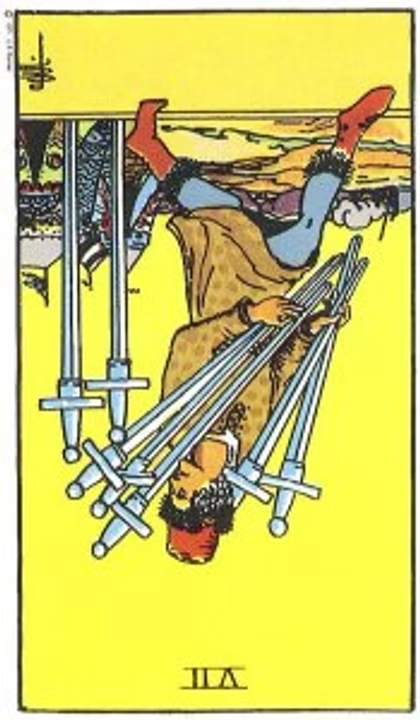
This “seven of swords” Tarot card (upside down) represents thieves caught.

When the slave “fell on his knees before [the king (or emperor)], saying, ‘Have patience with me, and I will pay you everything,’” that was like Peter catching Judas stealing funds for the group surrounding Jesus. Once confronted with being found committing the sin of living off the donations and personal contributions of the disciples and their families, Judas must have begged Peter to not tell anyone … he would repay everything he owed. If Jesus spoke to Judas about his sins, as the king (or emperor) warning how Judas was damning his soul, meaning his own deeds were selling him into the service to Satan and eternity is Hades, then Jesus would have done that individually, before progressing the issue to the whole group. Jesus confronting Judas would have had him pleading for forgiveness, like seen in the parable.

The personality of this slave in the parable shows that his first sin was as a thief; but he then followed that sin closely as being a liar. To have accepted large quantities of gold and silver as loans, when such quantities could only be repaid by a king (or emperor) and never a slave, was stealing. The promise of repayment, both prior to the loans and after payment was demanded, was a lie. Most probably, lies were made to get the loans. So, the slave is like the habitual sinner that Peter asked Jesus, “How often should I forgive a person like this?”

To then hear Jesus say, “Out of pity for him, the lord of that slave released him and forgave him the debt,” this is only done by the king (or emperor) acting as a seventy times [plus] seven. The Greek word “splanchnistheis” has been translated to read, “out of pity,” but it properly says, “having been moved with compassion,” which is more than some slight degree of sympathy or sorrow felt (imagine Bernie Maddoff telling all he owed money to how sorry he was and them releasing him of his debts “out of pity”).

The Greek word “splagchnizomai” (the root) is best read as meaning “to be moved in the inward parts” as feeling “compassion,” which becomes a statement of a higher presence that offers forgiveness. Such deep feelings come from God’s presence, which then offers forgiveness of debt.  When Peter suggested seven times, that meant a one-to-one exchange (a 2); but human beings do not get moved by the lies of thieves, when caught red-handed, so a common forgiveness is void of compassion.  The forgiveness Peter was referring to was by orders from God, leaving deep-seated residues of resentment. Therefore, Jesus was telling Peter, “You have no powers of forgiveness (as a 2), as only God can forgive sinners.”

It is easier to grasp this as the message when the forgiven slave then reacts to forgiveness like this in the parable:

“But that same slave, as he went out, came upon one of his fellow slaves who owed him a hundred denarii; and seizing him by the throat, he said, ‘Pay what you owe.’ Then his fellow slave fell down and pleaded with him, ‘Have patience with me, and I will pay you.’ But he refused; then he went and threw him into prison until he would pay the debt.”

There is a saying, “A leopard can’t change its spots.”

I wonder if there is symbolism to “being spotted”?

It actually comes from Jeremiah (13:23), who wrote, “Can an Ethiopian change his skin or a leopard its spots? Neither can you do good who are accustomed to doing evil.” (NIV) Jeremiah wrote that as a response to his writing, “And if you ask yourself, “Why has this happened to me?”– it is because of your many sins that your skirts have been torn off and your body mistreated.” (Jeremiah 13:22)  Therefore, the sinful slave, even after God-inspired forgiveness, will still be sinful.

The reason no lasting change will take place is we human beings are born to a sinful world and no matter how much we try to will ourselves to be sinless, we will always have that will broken by the lures of that sinful world. We are therefore 2’s, us (1) in the world (1). It is our dual nature.  Only by the elevation of God can we ceases being sinful AND forgive others of their sins against us.

In the parable told by Jesus, we read how other slaves saw what had happened and ran to tell the king. This is symbolic of how those led by God will be enlightened as to the truth that is often covered from them.

Into the right ear comes the whispers of good angels.

It is by being at that elevated state of eleven that we are led to the truth. This is how Peter became aware of those sinning against him and how Jesus knew everything about Judas, well before his final betrayal.

It becomes vital to grasp the change of attitude the king has in the parable, after he has been made aware of his “wicked slave!” We must realize that the forgiving king (or emperor) was led by God to forgive, by feeling compassion from an inner presence. That presence of the LORD has not left the king (or emperor), when he confronts that wicked slave a second time, knowing that the wicked slave has sinned once again against him. We read: “In anger his lord [the king] handed him [the wicked slave] over to be tortured until he would pay his entire debt.”

That is the answer given by Jesus to Peter, about how much forgiveness devout Jews should have in dealing with wicked Jews. Jesus said not to be forgiving simply because you believe in a merciful God, as it is written in Numbers:

[Moses said to the LORD] “In accordance with your great love, forgive the sin of these people, just as you have pardoned them from the time they left Egypt until now.” The LORD replied, “I have forgiven them, as you asked. Nevertheless, as surely as I live and as surely as the glory of the LORD fills the whole earth, not one of those who saw my glory and the signs I performed in Egypt and in the wilderness but who disobeyed me and tested me ten times—not one of them will ever see the land I promised on oath to their ancestors. No one who has treated me with contempt will ever see it.” (14:19-23, NIV)

Only the LORD can truly forgive, although common and mundane believers in God must accept sin in others as a way of the world, forgiving it when confronted and repentance is given by the sinner.  Disciples in training must both ask God for forgiveness and “forgive those who trespass against us,” in order to be elevated to Apostles.  However, forgiving as a means of forgiving someone else who reflects one’s own sins is not a state of true repentance (“forgive me for my sins like I forgive those who sin like me” misses the point).

This is why this parable ends with Jesus saying, “So my heavenly Father will also do to every one of you, if you do not forgive your brother or sister from your heart.” A disciple is training his or her brain to develop a will to obey the Laws of Moses, but an Apostle has gone beyond the thought process of self-power and fallen in love with God. When one loves the LORD, one opens their heart to receive God in marriage (“till death do us part”). With God in one’s heart, one will be led to forgive a brother or a sister from inner stirrings of compassion and pity. Still, with God in our hearts we will condemn those who are wicked and do not welcome the LORD as their lover.

It must be seen that this lesson in no way contradicts the prior lesson about maintaining the purity of the “Church,” where Jesus explained the process of confrontation that is a devoted believer’s responsibility. The issue of forgiveness is then a subset of confrontation, where we are also responsible for forgiving those who repent, once confronted and exposed as a sinner. At all times, a true Christian will attack the wicked who sin against Christ by saying they are Christian and not acting as such.

A true Christian also has God within him or her, so their ego has been sacrificed for the will of God to shine through him or her. The will of God will tell a true Christian when to show compassion and forgiveness from the heart (an inner part). However, the will of God will equally tell a true Christian when to cast evil out from his or her midst.

The moral of the story, which applied then as it applies today, is to elevate your common and mundane self to a self that is led totally by God. Then you don’t only act Christian on Sundays (day seven). You act Christians 24/7 (or seventy times [plus] seven).
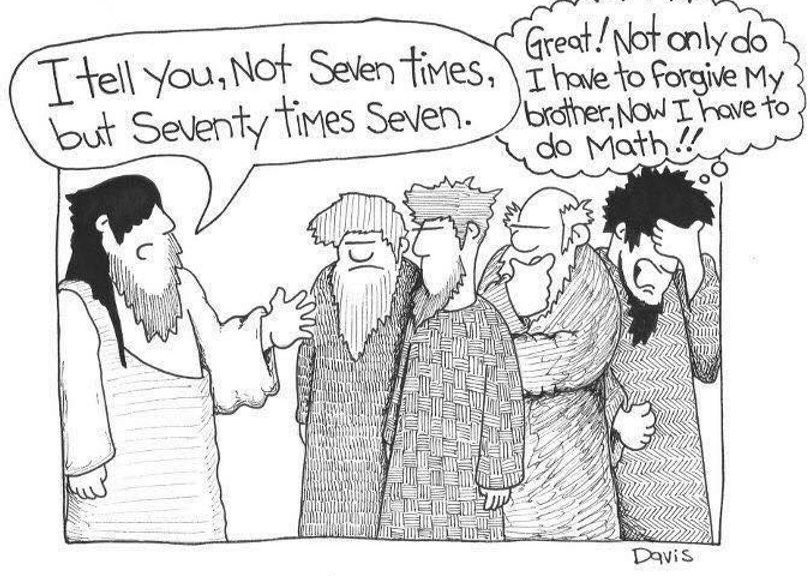
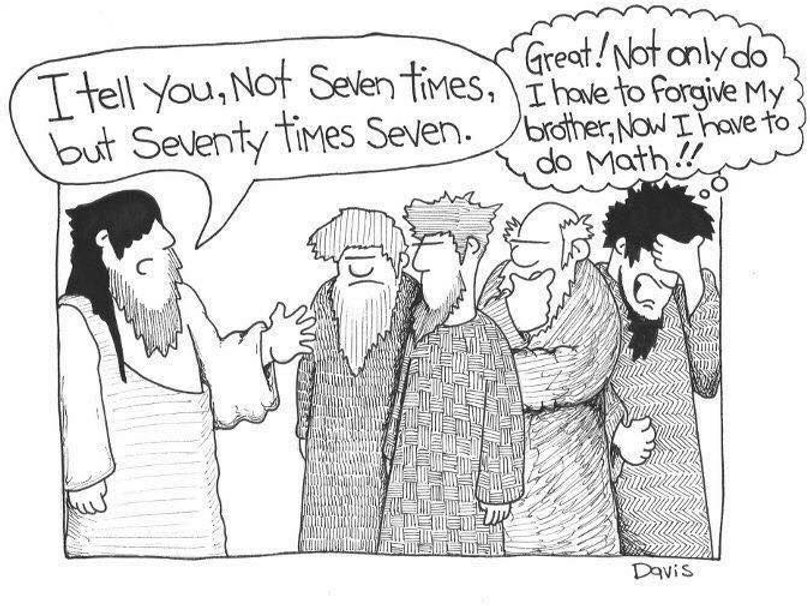
Matthew 18:21-35; Questions about forgiveness?

Note: I refer to an interpretation of Matthew 18:15-20 in this interpretation [relative to angle brackets used], but that interpretation is actually made in my interpretation of Ezekiel 33:7-11.  Sorry for any confusion created by that Old Testament reading being delegated “Track 2,” thus hidden under years of dust and barely seeing the light of priestly attention.

——————–

In my interpretation of Genesis 50 (a potential accompanying reading for this Gospel selection), I wrote of this reading in comparison: Joseph speaking to his brothers who sinned against him; and, Peter’s questions to Jesus about a brother who sins against him. I recommend reading that article for additional insight as to the meaning of this selection from Matthew’s Gospel, as I am not going to delve deeply here into the metaphor of the parable told by Jesus.  (I did that in the other article.)

I want to make the point here about what I have said about looking at the original text of Scripture, as a way of confirming the English translations are accurately presented.  Even when they are able to convey the truth, translation erases all potential for grasping deeper meaning.  Truth is hard to nail down to a singular cross of meaning, as it has a way of expanding beyond one dimension.

An example that I routinely use to point this out is the translation of Acts 2:14, which the NRSV translates as, “But Peter, standing with the eleven, raised his voice and addressed them, “Men of Judea and all who live in Jerusalem, let this be known to you, and listen to what I say.’”  Some can read that (or hear it read aloud) and think, “Man, I bet it was crowded there and Peter wanted those distant to hear him, so the poor fellow had to shout.  I hope he didn’t strain his vocal cords.”

The Greek word written,  “epēren,” is translated as “raised.”  According to Strong’s, it actually states “he lifted up,” in the third person singular, aortic active indicative form of “epairó.”  The simple truth says Peter was a ‘third person’ with a voice, so “he lifted up” his voice.

The Greek word translated as “voice” is “phōnēn.”  According to Strong’s that word can truthfully translate as “voice,” but it can equally be truthful as “language” or “dialect.”  Keep in mind that Peter and the other eleven new Apostles were speaking in foreign tongues in order to get everyone’s attention.  So, what “language” was Peter speaking loudly?

When I once explained that this does not place importance on Peter yelling loudly, but that his voice was “raised” spiritually, by the Holy Spirit, one woman screamed at me, “Then why doesn’t it [the translation] just say that?”

She did not want to hear anything of value come from me, so it was pointless to argue with her in a Bible study surrounding.  However, “it” does say that [when “it” is “ἐπῆρεν”], when one is reading the Greek text and having to look up every word, because one is not fluent in Greek.  The singular translation in a reading takes one away from that realization; but a singular translation is how people are given a general overview of the truth.  It is the stuff of syntax and how we make sense of anything spoken.

In Matthew 18:21 is another example, but this example is one that involves untranslatable marks that act as guides for the written text.  Often we see in a reading from John how he placed parentheses marks denoting him making an aside statement.  Such as: “Jesus crossed to the far shore of the Sea of Galilee (that is, the Sea of Tiberias),” from John 6:1.  Or, “(For not even his brothers believed in him.), from John 7:5.  Such marks do not change the text.  They just assist the reader in understanding.

The NRSV translates Matthew 18:21 as saying: “Peter came and said to Jesus, “Lord, if another member of the church sins against me, how often should I forgive? As many as seven times?” 

While that certainly can be a viable English translation that conveys the essence of what is stated, setting up that which follows, the reality is there is signage within that verse that is ignored.  Those marks of direction are important, as they point one to see how something deeper is stated.

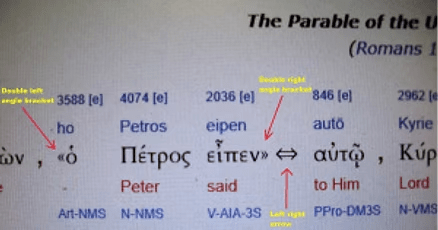
The Greek text shows the following (using transliterations and my system of marking punctuation as separation points that should be realized): “Tote proselthōn  ,  «ho Petros eipen  »⇔autō  ,  Kyrie  ,  posakis hamartēsei eis eme ho adelphos mou  ,  kai  aphēsō autō  ?  heōs heptakis  ?” 

Look closely at the symbols that are directions to the reader, which are ‘lost in translation.’  Notice also the comma mark followed by the Greek word “kai” is not something normally accepted by an English teacher, because it reads like someone stuttering.  The comma mark intuits “and,” so to follow that with the word “and” is redundant and unnecessary.  However, I believe “kai” is a marker word that does not simply say “and,” as it acts to identify  text that follows to be read with heightened importance, as divinely elevated.  That is why I make it bold text.

By noting this actual text, one can then see the importance of the capitalized Greek word “Tote” being overlooked by elimination.  Capitalization in divine text means more than simply a name, title, or first word of a sentence.  A capital letter (in Greek) is a mark that should be recognized in a heightened sense of direction.

The word “Tote” translates as “Then, At that time,” with the capitalization addressing the previous statements (the reading of Proper 18, Matthew 18:15-20).  Because this reading is separated from Jesus telling his disciples about addressing the sins of those said to be in his name (commonly called a “church” – “ekklēsia“), the importance of the timing (“At that time” or “Then”) is lost. 

The capitalization acts as its own stand-alone statement of divine elevation, making the timing important.  It then links (solely) to “proselthōn,” meaning “to approach, to draw near” (Strong’s definition) and “I come up to, come to, come near (to), approach, consent (to)” (Strong’s usage). 

The NRSV translation sees that word and makes a translation of “came,” implying Peter at some time later “went” to Jesus to ask this question.  That is misleading, as this should be read as saying  “As soon as Jesus finished telling the disciples to confront a sinner among themselves [not some global confrontation with sinners everywhere] Peter had “a revelation draw near.”  The NRSV translation does not paint this picture, because it diminishes the value of these words in translation.

To see this is indeed the purpose of Matthew being led by the Holy Spirit to write those words as he wrote them, he then used a comma mark to separate that statement of sudden dawning.  He then followed the comma mark with another mark, that of a double left angle bracket (“«“).  This symbol should be read in two ways.

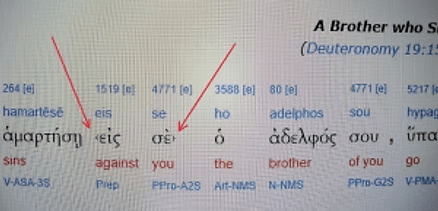
Relative to the first way to read it means one should read my analysis of Matthew 18:15-20 [found in the article Ezekiel 33:7-11], where a single left angle bracket and a single right angle bracket marks off the words “<eis se>“.  Matthew is now using a different set of marks, where the angles are doubled.  Individually, a double left angle bracket becomes a statement of “much lesser than,” whereas a single left angle bracket is a “less than” symbol. 

Jesus had stated generically the potential of a sinner “among you” (“<eis se>“), with the lesser than left angle bracket being a signal of one found to be less “in the name of Jesus” than the rest.  Again, this is found in the analysis of Matthew 18:15. [Ezekiel 33:7-11]

Here, in Matthew 18:21, the double left angle bracket now should be seen as Peter having a specific remembrance of one just as Jesus spoke.  Therefore, this untranslated mark makes a statement that the sinner Peter is remembering is a specific sinner that is indeed “among” them, sitting right there, who has done as Jesus warned the disciples to confront.  The mark does not name anyone specifically, meaning Peter can himself sense he has been much lesser than Jesus expects.

The double left angle bracket can then be read as a pronounced state that is relative to “Peter” (as “« ho Petros,” or “the answer [“proselthōn“] of a sinner [“«“] dawned  [“ho” as “this answer”] on Peter [the one Jesus called “the Rock”]”).  The double left angle bracket appearing after in the section immediately Matthew using a single left angle bracket has to be read as a guide to connect the two sections together, meaning “« ho Petros eipen  »” is complimentary to “<eis se>”.

That means the second way to read this double left angle bracket is as one-half of a tandem, with the double right angle bracket that follows the word “eipen” being the other completing one whole set of enclosing marks.  This means a set of brackets surround the words “ho Petros eipen” makes those words be indicated to be read together, as a silent aside rather than an outward statement.

The NRSV translates “eipen” as “said,” but Strong’s says it means “answer, bid, bring word, command.”  While “said” can be a statement of truth, seeing it in an enclosed setting, as a silent aside, means one should intuit nothing is actually “said” audibly.  Instead, this is the dawning that “drew near At that time,” within Peter’s mind.  Therefore, to understand “this Peter answer” or “this Peter command” means this aside is less about Peter speaking words to Jesus, and more about God having moved into Peter’s brain, spurring his memory to see an “answer” to what Jesus spoke, as well as being “commanded” by God to remember and then speak. 

Here, with the word “eipen” being followed by a double greater than symbol (the double right angle bracket), says Peter remembered a sinner among them.  When I wrote about the single right angle bracket (a “greater than” symbol) connected to the Greek word “se,” meaning “you,” I said Jesus implied his disciples would reach a “greater than” state of being, which would necessitate them confronting sinners “<among you>”.  Now, the “much greater than” indication of a double right angle bracket  following “answer” says Peter’s silent remembrance was led by God, urging him to raise a question to Jesus.  This element of interpretation is missed in the simple English translation.

Following the placement of double left and double right angle brackets surrounding “this Peter answer” is a mathematical symbol that is called a left right arrow (“ “).  I have written in the past about this symbol being used, where important clarity comes from realizing a statement is being made about the truth of a statement, or the falsity.  This is became the symbol says, if that said before is true, then that which follows is true; or, if that which is said is false, then that which follows is false.  The arrow is a marker to connect two together as one.  Here, that symbol points to the word “autō,” which is the dative singular form of “autos,” meaning “him” as an indirect object.

The implication of the double right angle bracket [a heightened state of awareness, due to the Holy Spirit moving within Peter] and the left right arrow symbol acts to project the truth being a reflection of Peter’s “answer,” which is a recall of sins that had been witnessed by “him.”  Jesus is, therefore, not the primary person being stated by “autō” (although that can be a secondary “him”).  This is not realized by a translation that implies simply, “Peter said to Jesus,” which is not written. 

The totality of double angle brackets setting off “this Peter command,” as a silent reflection within that becomes the “truth” pointing “to him,” says Peter was the one who knew the truth of which Jesus had just preached.  Peter had experienced a sinner among the group of disciples; but, the falsity was Peter’s having allowed the sins to go unconfronted.  That became a sin Peter had just realized “of himself,” which elevated “him” to confess to Jesus.

The indication of Jesus is then seen by two comma marks setting off the one capitalized word “Kyrie,” which translates as “Lord.”  That makes it appear to be an address to Jesus, where Peter called him “Master” or “Sir.”  This is relative to the NRSV translating “eipen” as “said.”  However, when the word is realized to Peter having a conversation with “himself,” inside his mind, the address of Jesus is less important to grasp (even if it is true).

Reading “Kyrie” that way diminishes the importance of a capitalized word, such that the comma marks separate the fact that Peter has just had an epiphany, based on what Jesus said about confronting one of their own who is found sinning.  This means the left right arrow pointing “to him” (as the “self” of Peter, a viable translation) has become the truth that is then separately identified as “Lord.”  As a stand-alone word of heightened divinity, the capitalization says the word is the same Holy Spirit existing in Peter as existed also in Jesus.  The comma marks then state the divine elevation (temporarily), when Peter became an Apostle in the name of Jesus Christ (the point of the prior lesson).  He then was coming forth as the “Lord,” addressing Jesus as another Son of the Father, a brother of Jesus.

Following the comma to the right of “Kyrie” begins a statement that implies a question, but does not end with that punctuation mark.  Stated literally is: “how often will make a mistake upon myself this brother mine”.  The same words can state, “how many times will sin among me this brother mine”.  While this is the root of a two-part series of words, which does end as the first of two questions, this is also Peter speaking in the presence of Jesus and the other disciples, as God announcing, “many times will sin brothers, both in front of you (to you and to others among you) and discretely, requiring one be led to realize sins having been done by a brother, based on deductions of reason made.”

To read that as a statement, one should see how God was speaking through a disciple who was not yet in the name of His Son.  When Jesus taught his disciples to confront sinners among themselves – as being in his name – they would be empowered with the Christ Spirit (the Holy Spirit), individually (an Apostle-Saint) and collectively (an assembly of Apostles-Saints), therefore enabled to cease all sins within one (Jesus) and many reborn as Jesus. 

When Jesus said to confront a sinner one-on-one, in a small group speaking to one, and finally for the whole “assembly,” all had to be in the name of Jesus Christ.  Only with that divine presence within “a church,” speaking to one sinner, could the result be the sinner returning to the fold (as a lost sheep) or be rejected (as a wolf pretending to be “among you”) through that correction process.  Thus, Peter was speaking as the voice of God, stating “there is not one among us who can cease sinning on one’s own will-power, as brothers of man are born sinners and will remain sinners until they have each become in the name of Jesus – the Son of man.”

The first of the two questions asked by Peter is then separated by a comma mark and followed by the Greek word “kai,” which is a marker word announcing importance must be read into “aphēsō autō  ?”  The word “aphēsō ” (“ἀφήσω”) is translated by the NRSV as [somewhat loosely saying] “should I forgive,” seen as a subjunctive form of “aphíēmi.”  That translation does not hold up to close inspection. 

The same word (“aphēsō “) also appears in John 14:18.  There it is translated as “I will leave,” relative to Jesus promising “Not I will leave you orphaned.”  There is no subjectivity used there, neither is anything pointing to “forgiveness” being the intent, based on the context.  This makes “should forgive” a poor translation.

The Greek word “aphíēmi” bears these definitions: “to send away, leave alone, permit.”  The usage adds, “(a) I send away, (b) I let go, release, permit to depart, (c) I remit, forgive, (d) I permit, suffer.” (All from Strong’s.) As the future active indicative first person singular, the word states what “I will” do, relative to “sending away, leaving alone, permitting, letting go, permitting to go on, or allowing to suffer.”  In this way, the word is a dependent form of the root verb, as a statement of an action completed in a moment.  This means any possibility of “forgiveness” is momentary, at the time of witnessing a sin being committed, meaning the question is relative to “I will look the other way” or “I will ignore the sin.”

The importance of this question has to be seen in the light of Peter having had an epiphany of awareness, based on what Jesus had just taught about confronting sins.  Because God’s Holy Spirit had forced Peter to realize “how may times” he has seen sins and not done anything to confront them, God was moving Peter to ask how “I will permit him?”  At the same time, Peter heard himself ask, “Will I forgive him?”

This is an important question for Peter to make, simply because the Pharisees witnessed Jesus’ hungry disciples eating grains from the field without washing their hands before eating – a sin they called a “break of tradition.”  Jesus was confronted by those leaders, because Jesus was the one expected to be responsible for the actions of his students. [Matthew 15:1-20]  Jesus responded to the Pharisees that it was not what goes into the body that defiles, but that which come out – from the heart.

When one sees Peter speaking as the mouth of God, via His Holy Spirit, the first person becomes God speaking.  God sees all sins and knows the hearts of all, especially those students of His Son.  So, Peter was given the eyes of a Saint and enabled to realize all the sins that God puts up with, while seeing himself as needing to trust God in this process taught by Jesus.  Therefore, the greatest importance of the first question is: “[how many times] must God ignore sin?,” while being rhetorical because the purpose of Jesus is to address this failure.

The follow-up question is then shown as being “heōs heptakis  ?”  That is translated by the NRSV as “As many as seven times?”  A better translation would be “until seven times,” noticing there is no capitalized word that should be given greater importance.  By seeing “until” as the translation, the point is less about a stroke count that needs to be remembered, as “until” allows for any number to pass as unaccounted for sins ignored or forgiven.  That makes “seven times” be the important element of this second question; and that demands one recognize the symbolism of the number “seven.”

The number seven is symbolic of perfection.  It bears the sense of completion, in a base-seven system, where Creation took six days [a non-fixed amount of time], and the seventh day was the day deemed holy by God.  [Today we are still in the “seventh day.”]  This should be read into the word “heptakis,” as “seven times” [only used here in Matthew and in Luke’s account of the same question by Peter] is relative to coming to that point of rest, after all the work of creating an Apostle has been done.  Man will always be sinners “until perfection is completed.”

When this one verse is read in this way, the question posed by God in Peter was asked for all the sinning disciples (remembering Judas was there) to hear, as “seven times” would immediately bring their minds to the Sabbath – as the seventh day.  Hearing one of their own ask “seven times” would get them to think the strength to confront a sinner amongst themselves would be greater if done only one day a week.  The question heard was then akin to them all asking, “Should I make confrontations to my brother(s) on the Sabbath, when sins are more in need to bring out into the open?” 

Keep in mind here that this was the consistent theme the Pharisees had against Jesus, for healing sinners on the Sabbath.  If healing was wrong on a Sabbath, then what about confronting someone for sinning?  Therefore, God had Peter ask a logical question about what day would be the best day to confront a sinner among Jesus’s followers.

The answer given by Jesus (who also spoke what God told him to say) was a resounding “No (from “Ou” being capitalized).  He said do not “wait until the seventh day.”  He said do not ignore sin for six days and only address it “once a week.”  Then, following a comma mark of separation, Jesus said, “but until seventy times seven.”  This is not meant to be read as 70 X 7 = 490!!! 

God does not speak trivially.  God does not mean for little articles, prepositions and conjunctions to be ho-hum wastes of breath.  Thus, the word “alla,” translated as “but,” also means “otherwise, on the other hand, except and however.”  When this is understood to be Jesus responding to Peter and the other disciples – none of whom were yet ready to confront anyone among themselves – “but” becomes the time of exception, when a permanent change would set upon them, making the Apostles-Saints, reborn as the Sons of God.  That is the meaning of “but” here.

Form that and the restatement of “until” or “as many as,” which confirms those listening who would find that change within themselves (remembering Judas would not make that cut), each number must be read separately: “seventy times” and “seven”  Here, again, numbers need to be understood symbolically.

The number seventy converts to “seven times ten.”  The number “ten” is another number that is associated Biblically to perfection, for various reasons.  The way I see it is numerologically, where it is an elevated form of one (as 1+0=1).  This is relative to the base-10 number system, where numbers 0 through 9 are ten numbers, which recycle, such that 10 is another 0 beginning on the first level above 0-9.  The number 1 equates to man or self, but 10 equates to the highest level man can achieve by himself.  Ten then becomes a symbol of one (1) striving to be the best one can be.  As such, all the disciples of Jesus were learning to be tens.

When that striving for perfection is done by each disciple seven days a week – not just on the Sabbath – then they become a seventy number.  Still, a seventy is no better than a Pharisee, Sadducee, scribe, high priest, or rabbi, as all see that as their responsibility seven days a week.  In today’s Christianity, a priest, minister, pastor or leader of a church equates to a seventy or “seventy times,” but a seventy is still man alone with his (or her) good intentions.  Thus, the Law (the Ten Commandments) is related to the symbolism of ten, with following the Law seven days a week equating to being a (self-willed) seventy.

That is where the extra “seven” added by Jesus becomes the perfection of God, which comes through the addition of the Holy Spirit.  That was where Jesus was, as a human being; and it was where the disciples would be, once the Holy Spirit had joined with their souls, in their flesh.  The extra “seven” makes a “seventy times” (10 x 7 = 70) become a seventy-seven (11 X 7 = 77). 

Eleven is a master number that numerologically is 1+1=11, where it could be reduced to a 2 (if a human refuses God’s help – ala Cain).  Cain spoke with God, thus he was one who had been raised to a level of seventy, as a disciple of Adam.  However, when it came time to become “seventy times seven,” Cain refused God’s help.  He was reduced to a 2 – a body with a soul.  An eleven equates to the one being the soul with the other one being the Holy Spirit, so when the two are added together they becoming an eleven.  That becomes the perfection of God walking in a human body seven days a week, not just on the Sabbath.  Therefore, this is the meaning of verses 21 and 22.

The parable told is then one that needs to be seen in this light, where God is the only one who can forgive the sins of any.  I wrote about this in my explanation mentioned earlier; but do keep in mind the aspect I mentioned about the Pharisees complaining to Jesus about his disciples not following tradition.  The end of that lesson says it is what comes from one’s heart that determines what defiles.  Likewise, this parable ends by Jesus saying, “So my heavenly Father will also do to every one of you, if you do not forgive your brother or sister from your heart.”