Putting away falsehood, let all of us speak the truth to our neighbors, for we are members of one another. Be angry but do not sin; do not let the sun go down on your anger, and do not make room for the devil. Thieves must give up stealing; rather let them labor and work honestly with their own hands, so as to have something to share with the needy. Let no evil talk come out of your mouths, but only what is useful for building up, as there is need, so that your words may give grace to those who hear. And do not grieve the Holy Spirit of God, with which you were marked with a seal for the day of redemption. Put away from you all bitterness and wrath and anger and wrangling and slander, together with all malice, and be kind to one another, tenderhearted, forgiving one another, as God in Christ has forgiven you. Therefore be imitators of God, as beloved children, and live in love, as Christ loved us and gave himself up for us, a fragrant offering and sacrifice to God.
——————————————————————————–
This is the Epistle selection from the Episcopal Lectionary for the Twelfth Sunday after Pentecost, Year B 2018. In the numbering system that lists each Sunday in an ordinal fashion, this Sunday is referred to as Proper 14. It will next be read aloud in an Episcopal church by a reader on Sunday August 12, 2018. It is important because Paul talks of the works of Sainthood, which can only be produced by sacrificing self, in servitude to God.
Once again, reading an English translation of a letter written by Paul leads to some superfluous platitudes that are easier said than lived up to. Of course, Paul did not write such banal statements. Reading Paul and understanding what he wrote requires one be led by the Holy Spirit’s wisdom. This is because the Holy Spirit’s wisdom led Paul to write his words. Therefore, one must learn to read Scripture (based on the writing of the Apostles) word by word, segment by segment, verse by verse, and chapter by chapter – starting small, before gobbling everything up at once.
Certainly good can be obtained by the translation into English above, which will be read aloud in Episcopalian churches. Not lying and telling the truth is a good way to live. Living a life where one is kind, tenderhearted, and forgiving is an ideal the world should strive towards. The problem comes when one addresses the issue of anger, which is a natural emotion that humans must encounter, because (like a volcano) trying to hold in built-up pressures will lead to explosive flows.
By seeing this reading as Paul saying such eruptions are forbidden is wrong; and this is because we must always be angry at the works of Satan. This reading addresses that and it is more clearly seen when one examines the literal Greek text, following the rules of slow digestion of the Word.
Below I offer a valid literal translation of the Greek written by Paul, verse by verse, segmented by the punctuation marks (real or inferred), based on the Interlinear translation of Ephesians 4 and 5, published by Bible Hub. It is best to practice reading these words slowly, looking at the broad scope of translations available. From that breadth, deeper meaning is found, aided by reflection, contemplation, and prayer. Practicing this until it becomes second nature shows God one is sincere about one’s faith.
Doing this for oneself can open up more meaning than can be told by someone else. Most Christians have a relationship with a pastor, minister, or priest, who is an external crutch that allows one to lean on the teachings of another (or others), without feeling a need to know more than the teacher. Self study of Scripture is how a personal relationship with God gets established, by demonstrating a desire to know the truth, more than simply being told what to believe … in the blind.
Before one begins to digest Paul’s reading selection that follows, it is important to know that twenty-four verses of chapter four are skipped over. Those verses establish the context of the whole chapter. This reading selection then sets one into the middle of a conversation (between God and you, as much as between Paul and the Christians of Ephesus), where the prior context is absent. This can be done with Scripture, for narrow focus intent. Still, this reading then bleeds over into the first two verses of chapter five, which is the lead-in to another thought set. It can be applied in this way (two chapter’s verses as one) because the truth told can apply at all times.
The purpose is to see why that is done in this reading selection now. To find this purpose, one needs to be cognizant of what Paul wrote. Then, just as the Holy Spirit led Church leaders to choose readings that link in theme, one is enabled to grasp a deeper understanding of the lessons of the prophets.
[Note how the new “sentences” chosen do not start with capitalized Greek letters, other than the first verse (4:25), yet important words are capitalized. Capitalization has been added to the translation above as a paraphrase, to fit one’s language customs.]
Chapter 4
25 Therefore having put off the [one] falsehood ,
let speak truth each one with the neighbor of him ,
because we are one another members .
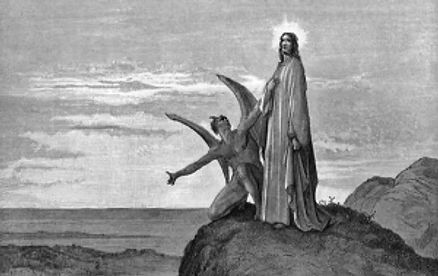
Notes: Leading into this first segment, Paul had written about turning away from one’s old ways of living and being corrupted. That was the “old man” of self that was replaced by one following a way of “righteousness and the holiness of truth, … according to God.” Since God is the one of truth, Satan is then the one of falsehood, such that an Apostle repeats as Jesus did, telling Satan, “Away from me, Satan!” (Matthew 4:10) To “put off the [one] of falsehood,” one has ordered evil influences to get out of that way of “righteousness and the holiness of truth.”
With the influence of corruption out of the way, one can then hear the voice of God speaking the truth. This truth comes from Scripture, more than simple truths that are less helpful to neighbors. A “neighbor” can be a friend, but the use of “plēsion” is more to denote anyone who has yet to come and believe in Jesus as the Christ. For Jews, they would live among other Jews, but many would deny Jesus as their promised Messiah. The truth would help their eyes be opened to that realization. For Gentiles, their neighbors could be a mixture of Jews, Gentiles, and Christians, with Christians falling into the “friend” category and the others being their “neighbors” who seek the truth, but have not yet found it.
When Paul then stated “we are one another members,” the Greek word “melē” is referencing only Christians. Christians are the ones who have found the truth, for the purpose of spreading it around. Spreading it to one’s neighbors makes one come to live in a place where the neighbors are friends of the same religious values. Christians are members in the body of Christ, which means they are the limbs (branches) of the living vine, as extensions of Jesus Christ (reborn). As a vine for Christ, the fruit is the neighbor that buds into a new limb, as the fruit of that vine. This makes the truth become the common blood that flows within those branches.
26 be angry ,
also not sin ;
the sun not let set on the basis of the [one] anger of you ,
Notes: Following a series of words that ended by placing focus on Christians being the “members” (“limbs, organs”), those forming the body of the living vine, where ALL are rooted in the resurrection of Jesus Christ, Paul wrote the one-word statement “orgizesthe.” That says, “be angry” or “be provoking” and “be irritating.” This is a direct statement that Christians have an obligation to “be angry.”
HELP Word-studies says of the root word (“orgízō”): “be angry, as expressing a “fixed anger” (settled opposition)” and “to show settled-opposition,” which “is positive when inspired by God – and always negative when arising from the flesh.” “Sinful (unnecessary) anger” focuses on punishing the offender rather than the moral content of the offense.”
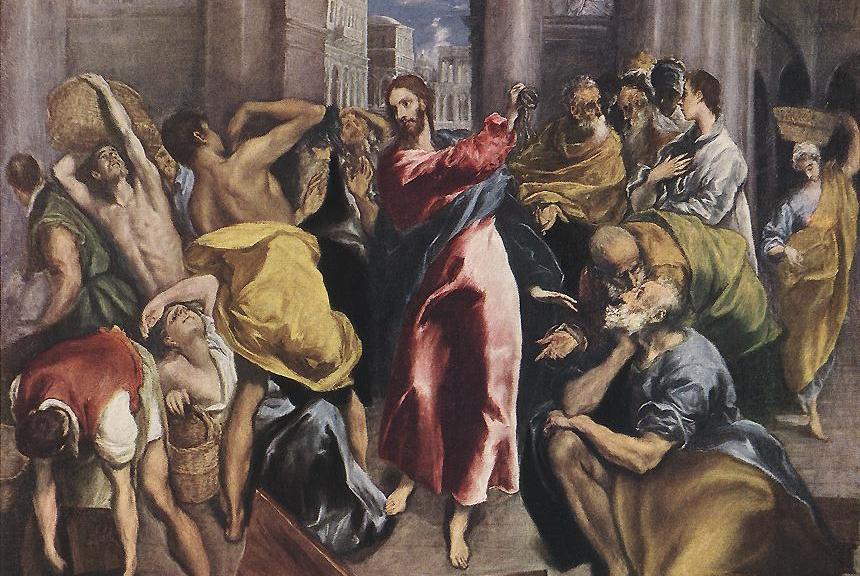
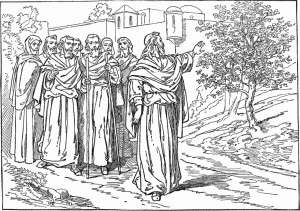
This is how one can read of Jesus commanding Satan to get behind him, his turning over the vendors tables, his calling Peter Satan, and his commanding a fruitless fig tree to wither and die. A true Christian must not compromise to evil, as one’s natural emotional outlet for anger is in opposition to that which opposes God. The Old Testament is a series of stories that tell of anger of the prophets against the opposition to God’s people. When those stories began telling of kings of Israel and Judah accepting prophets of lesser gods, they lost their lands and their Covenant.
To “be angry” but then “also not sin” is accomplished by the angels sent by God’s Holy Spirit to control one’s actions based on anger. The Greek word that translates as “sin” is “hamartanete,” which means “having no share in.” This equates to oneself being apart from all acts that are motivated by the influences of evil. One’s acts out of anger, like those of Jesus, are justified by God. God-led acts are not something to confess as human frailty, as if one is unable to control one’s actions caused by strong emotions. When one has totally sacrificed self so one can serve God, one’s actions are not based on the sins that arise from the flesh.
This is then confirmed by the use of “hēlios,” where “the sun” also represents “sunlight.” Jesus said, “”I am the light of the world. Whoever follows me will never walk in darkness, but will have the light of life.” (John 8:12) This means that Jesus is like the Sun, which always shines and never sets. It is the actions of the Earth that make it appear as if there is day and night, light and darkness. However, when one is reborn as Jesus Christ, a part of the living vine, with truth flowing through one’s being, no acts of anger can be deemed sins, because the light of Christ is always lit within, causing an act of anger to have a positive effect on those who see that light from their perspective in darkness.
[Note: The Greek god Helios is related to Apollos. It was Apollo’s chariot that pulled the sun around the earth, giving light to the world. Apollo was also the god of truth, whose oracle at Delphi could only tell the truth to questions posed. This mythological symbolism was embodied in Jesus Christ.]
27 not give opportunity to the devil .
Notes: Here we find confirmation that “the [one] falsehood” is Satan, who acts as “diabolō” – “the devil” – when given the opportunity to cast darkness around a mortal soul. The Greek word “diabolō” properly means, “a slanderer; a false accuser; unjustly criticizing to hurt (malign) and condemn to sever a relationship.” When this is realized in the context of speaking the truth to one’s neighbors, being in the light of Christ prevents words from flowing that will turn a neighbor away from the truth and towards the falsehoods of Satan.
28 the [one] stealing no longer let him steal ;
rather now let him toil ,
working with one’s own hands things good ,
that he might have to share whoever need having .
Notes: By seeing the element of Satan being opportunistic when one is not protected by God’s Holy Spirit and reborn to speak the truth of Jesus Christ, the act of stealing is less important as a condemnation of a human in need stealing things that assuage personal wants, desires, and needs. The most severe act of theft is Satan stealing one’s soul through the influences that bedevil the unprotected.
This first segment of verse twenty-eight ends with a semi-colon, which separates this statement against stealing from the one that encourages working for one’s gains. While the two are in the same vein of thought, the anger of a Christian expressed to a neighbor, one who has been caught stealing, becomes a valuable lesson that the neighbor needed to hear. More than a simple statement that payment for crimes will always come due, it places focus on the awakening of one’s soul spirit to the lures of Satan. It is instilling valuable lessons that plant the seeds of moral thoughts that are necessary to control evil urges.
Once moral standards are planted, not only must Satan work harder to steal a soul, but one must work harder to save a soul. In that regard, the Greek word “kopiatō” (“let him toil”) is used, which implies “exhausting labor” and “weariness.” Such hard work leads an unprotected soul to see self as not strong enough to keep Satan at bay, such that one is led through hard labors to cry out for God’s help.

The Greek word “ergazomenos” means “working,” but becomes a continuation of the “exhausting labor” mentioned prior, by now expressing an “acquisition by labor.” This is then a statement about how God watches to see how one will react to the influences of evil and the punishments meted when caught. One’s works of faith earn more rewards of protection by God, whereas one’s lack of good works brings eventual punishments.
This is how anger can be applied according to the sins of the flesh, where punishments received influence sinful acts of revenge and malice. However, through exhausting works by one’s own hands towards things done that are good, then one can find a doorway open in one’s heart for God’s love to enter.
The segment of words that says, “that he might have to share whoever need having,” is then less about two or more people sharing things with those in need, as it is more a statement of God presence in a new Apostle. This goes back to a true Christian expressing anger towards a neighbor that came as words of truth that shared the blessings of the Father to the Son, to one in need of hearing that message. Giving a thief what a thief wants will do nothing towards getting a thief to toil to do good things on his or her own, with his or her own hands. However, a slap of reason given by an Apostle, on the cheek of a misguided neighbor, is sharing one’s desire to save the wayward and to motivate the wayward to seek God for having one’s true needs met.
29 every kind of word unwholesome [corrupt] out of the mouth of you ,
not let go forth ,
except ,
if any good ,
for edification of the need that it might give grace to those hearing .
Notes: The Greek word “sapros” is translated as “unwholesome,” but also means “corrupt, rotten, useless, and depraved.” The first segment is a statement that mortal human beings do utter such words, often in anger. It is important to realize that such words do less towards harming anyone to whom such words are aimed, as the deeper harm is to oneself. Those who then utter such language are those who are in need of God’s help; and they are whom the anger of Apostles should be directed, in attempts to share the benefit of God through good works.
The Greek word written by Paul, “ekporeuesthō,” means “let go forth,” or properly, “go out from, emphasizing the outcome (end-impact) of going through a particular process or passage – i.e. the influence on the person (or thing) which comes forth.” [HELPS Word-studies] When the negative “mé” (“not, lest”) is added, the segment says one cannot “cast out, speak, flow out, burst forth, or spread abroad” anything that will prove oneself unwholesome and drive one who is unwholesome away from the light of truth. One must not speak in corrupt terms to be good, and one cannot lead the wayward to the truth with words that deprave. This is then a statement about the presence or absence of the Holy Spirit, as to what words flow from the mouths of people.
This then leads to a one-word statement, written as “alla.” This conjunction means “but,” but it bears more meaning and insight when translated as “except, nevertheless, on the contrary, on the other hand, and/or otherwise.” As one word of importance, Paul was stating that an Apostle cannot be typical of mortal human beings. One must set the example as an exception, one who is contrary to the ordinary, and one acts otherwise than the usual. One must let wholesome words go forth.
This exception must be so any good influence possible is shared with the one in need. The words spoken sternly to neighbors are for the purpose of building character in others, with one’s own character the goodness that supports the words spoken. This is how one passes on the Holy Spirit to those seeking the way to God, as a seeker will hear the truth and realize that; but any lies will lead a seeker to look elsewhere. This is the conditional “that it might give grace,” such that one builds with the materials supplied, as exemplified by houses built on sand foundations, versus houses built on rock foundations. (Matthew 7:24-27)

30 and not grieve the [one] Spirit the [one] Holy the [one] of God ,
by whom you were sealed for [the] day of redemption .
Notes: The Greek word “lypeite” translates as “grieve,” but the meaning is best understood as “find pain.” HELPS Word-studies states its usage to mean: “to experience deep, emotional pain (sadness), i.e. severe sorrow (grief),” while also representative of a state that “very intense and hence even used of the pain of childbirth.” This last usage allows one to see how pain and grief from the Holy Spirit of God is the birthing pains that come from the change from worldly (in the womb of the earth) to a soul Spirit that has been washed clean of sin. This is the yielding of the old ways to the new ones that are Holy and righteous. It is the necessary pangs of being reborn as the Son of God, Jesus Christ, regardless of one’s human gender.
In our modern society, we celebrate the physical birth of our children with parties and cakes with candles alit on top, asking for the fire to be blown out to get a wish fulfilled. Those parties turn to recognitions of age and the eventual breakdown of the physical body. The years pass by and turn from happiness to grief. Few mark the days when one’s soul was redeemed, largely because one day cannot express fully the joy of being filled with the Holy Spirit. It is almost like what Nicodemus asked Jesus – “How can someone be born when they are old?” Nicodemus asked. “Surely they cannot enter a second time into their mother’s womb to be born!” (John 3:4) – as the womb of the world has been replaced by the womb of God, when a soul is “sealed for redemption.” Being reborn as Jesus Christ means being in that womb until one dies, when the soul is released (born again) into the heavenly kingdom. That is truly a happy birthday to you.
31 every kind of bitterness ,
and anger ,
and wrath ,
and clamor ,
and slander ,
let be removed from you ,
along with all malice .
Notes: These segments can be read as the elements of self that must be released for redemption to be sealed. In a reverse view, these can be seen as the pains used against one by Satan, where neighbors who are not seekers begin to see one who is changing with eyes of persecution. One must let go of the devil’s urges to act from bitterness, anger, wrath, clamor, slander, and malice. Likewise, one must forgive those who use those sins against one. When the acts that accompany these mental and emotional states of being have been released from oneself, so one’s ego is no longer calling the shots, God’s Holy Spirit may use one in any and all ways to oppose Satan and those who serve him. An Apostle cannot read this instruction from Paul and assume it is good to capitulate to evil, as enemies give rise to these human reactions and the enemy of the righteous is the sinful. Therefore, when the sinful threaten the members of the body of the living vine, coming to use force against the innocent, it may be God’s Will that leads one to Holy War in response.

32 be moreover to one another kind ,
tender-hearted ,
forgiving each other ,
as also the [one] God in Christ forgave you .
Notes: This series of segments addresses how Apostles should deal with one another, as opposed to those who are neighbors and enemies. These are who Jesus said to love one another, just as he loved his disciples. The element of forgiveness should not be seen as a proclamation that it is okay to continue to sin, after one has had his or her soul cleansed of sins by the Holy Spirit of God, making one pure enough to be reborn as Jesus Christ. Forgiveness is for past sins (the same ones forgiven by God), prior to becoming an Apostle, who then never sins again – due to the sacrifice of self ego and that brain being replaced by the Christ Mind. That means prior enemies, neighbors, and friends can have past histories of conflict that become forgiven once all are born of the same Spirit.
Chapter 5
1 be therefore imitators those of God ,
as children beloved ,
Notes: The transition to a new chapter means a likewise transition to a new line of thought. One must be careful when reading backwards and not paying attention to the road signs, such as a new chapter, book, testament, where all changes have intent and purpose. Still, from the talk of members of the living vine sharing the fluid of truth that is Jesus Christ, it is that truth that one imitates.
The Greek word “mimētai” means both imitator and follower, such that it is the root word for the English “mimic.” Still, this is the truth of Jesus saying, “Whoever wants to be my disciple must deny themselves and take up their cross daily and follow me.” (Luke 9:23) Jesus never intended anyone to pretend to be him, as his statement says all of his disciples are expected to become Jesus in a lineage that will follow his time on earth. In order to achieve that rebirth-resurrection, one’s stake that supports the living vine must be raised, so the fruit does not attract vermin and weeds. An “imitator of God” is one who is exactly like Jesus of Nazareth was – completely subservient to the Father – such that Jesus Christ reborn into Apostles multiplies the presence of God that is incarnated without limits on earth.
2 and walk in love ,
even as also the [one] Christ loved us ,
and gave up himself for us ,
an offering and sacrifice the [one] to God ,
into an aroma of a sweet smell .
Notes: The first step towards being filled with the Holy Spirit (when one’s soul is cleansed of sins) is to give one’s heart to God. One has to desire being married to God, such that the union of one’s soul with God means willingly seeking total subservience, as a wife to a husband. This brings the love of God about one’s being, so one “walks in love.” To “walk in love” is to be completely thrilled at the awareness God gives to his wives.
This union in relationship with God then brings about the birth of the Christ Mind in one. As the resurrection of Jesus Christ, one becomes in touch with the love between the Father and the Son, such that Christ loves all who follow in his steps, sacrificing so his Spirit can be resurrected on the material plane. That sacrifice in an Apostle is no different than the sacrifice of Jesus of Nazareth, who had to die so his Spirit could be resurrected countless times in his devotees. All have sacrificed so God’s Will can be done on earth.
The last segment uses the Greek word “euōdias,” which translates as “of a sweet smell.” According to HELPS Word-studies, the figurative meaning is: “our efficiency in which the power of Christ himself is at work is well-pleasing to God.” It means that one does what is pleasing to God; and this is a comparison to the beauty and fragrance of a rose.
As the Epistle selection for the twelfth Sunday after Pentecost – when one’s ministry for the LORD should be underway – the message is to be emotional for God. This is like the letter sent by Jesus, through John of Patmos, to the church of Laodicea, which said, “I know your deeds, that you are neither cold nor hot. I wish you were either one or the other! So, because you are lukewarm—neither hot nor cold—I am about to spit you out of my mouth.” (Revelation 3:15-16) Love for God means anger for those who fail to honor God.
Certainly, when protected by God and given the Great Commission of being Jesus Christ reborn, one wants to please God in any and all ways. A minister of the LORD delights in being shown the truth and seeks those who desire to learn the truth.






 Explaining the Readings