
Naaman, commander of the army of the king of Aram, was a great man and in high favor with his master, because by him Yahweh had given victory to Aram. The man, though a mighty warrior, suffered from leprosy. Now the Arameans on one of their raids had taken a young girl captive from the land of Israel, and she served Naaman’s wife. She said to her mistress, “If only my lord were with the prophet who is in Samaria! He would cure him of his leprosy.” So Naaman went in and told his lord just what the girl from the land of Israel had said. And the king of Aram said, “Go then, and I will send along a letter to the king of Israel.”
He went, taking with him ten talents of silver, six thousand shekels of gold, and ten sets of garments. He brought the letter to the king of Israel, which read, “When this letter reaches you, know that I have sent to you my servant Naaman, that you may cure him of his leprosy.” When the king of Israel read the letter, he tore his clothes and said, “ha-elohim to give death or life, that this man sends word to me to cure a man of his leprosy? Just look and see how he is trying to pick a quarrel with me.”
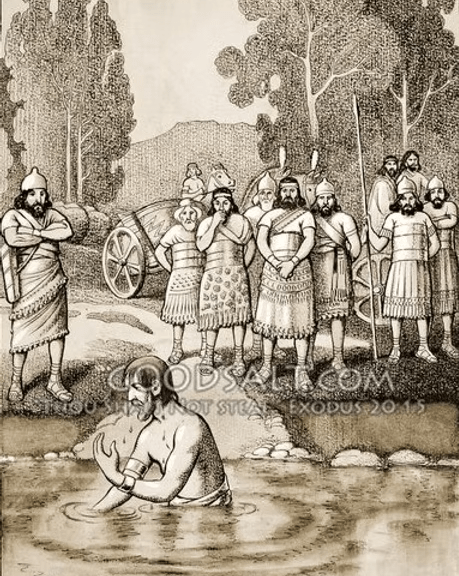
But when Elisha ish ha-elohim heard that the king of Israel had torn his clothes, he sent a message to the king, “Why have you torn your clothes? Let him come to me, that he may learn that there is a prophet in Israel.” So Naaman came with his horses and chariots, and halted at the entrance of Elisha’s house. Elisha sent a messenger to him, saying, “Go, wash in the Jordan seven times, and your flesh shall be restored and you shall be clean.” But Naaman became angry and went away, saying, “I thought that for me he would surely come out, and stand and call on the name Yahweh elohaw, and would wave his hand over the spot, and cure the leprosy! Are not Abana and Pharpar, the rivers of Damascus, better than all the waters of Israel? Could I not wash in them, and be clean?” He turned and went away in a rage. But his servants approached and said to him, “Father, if the prophet had commanded you to do something difficult, would you not have done it? How much more, when all he said to you was, `Wash, and be clean’?” So he went down and immersed himself seven times in the Jordan, according to the word of ha-elohim; his flesh was restored like the flesh of a young boy, and he was clean.
——————–
This is the Track 1 Old Testament selection to be read aloud on the fourth Sunday after Pentecost (Proper 9), Year C, according to the lectionary for the Episcopal Church. If an individual church is on the Track 1 path, then this reading will be followed by a singing of Psalm 30, which includes the verse: “Weeping may spend the night, but joy comes in the morning.” That pair will be followed by the Epistle from Galatians, where Paul wrote: “if anyone is detected in a transgression, you who have received the Spirit should restore such a one in a spirit of gentleness.” All will accompany the Gospel selection from Luke, where it is written: “See, I am sending you out like lambs into the midst of wolves. Carry no purse, no bag, no sandals; and greet no one on the road. Whatever house you enter, first say, `Peace to this house!’’
In the first verse of this reading, we read that Naaman was a “commander of the army of the king of Aram,” where “Aram” is also called Syria. Under Ahab, Israel warred against Aram, when its king was Ben-Hadad (1 Kings 20). Ahab defeated Ben-Hadad (whose name means “Son Of Thunder), but spared his life. By sparing Ben-Hadad’s life, his servant Hazael would murder Ben-Hadad and usurp his throne. But, that would not happen until 2 Kings 8, so Naaman was a commander under Ben-Hadad II [Wikipedia]. This was when Jehoram has succeed Ahab as King of Israel.
All of this must be seen as set in motion by Elijah’s spiritual anointment of Hazael, who would have known Naaman, well before that future came to be; with Elijah’s spirit being the anointment, before he ascended, as Elisha watched. It is said that Naaman renounced his pagan god and began to follow Yahweh. That would align him with the overthrow by Hazael. As for Jeroram, he would be killed by Jehu, who the spirit of Elijah would have anointed at the same time the soul of Hazael (and Elisha) was. While not overtly written, this assumption can be made by seeing a spiritual anointment grows over time.
When we read that Naaman “had given victory” by “Yahweh” [not “the Lord,” but named “Yahweh”], this says the “victory” was over Israel. Parts of the upper reaches of the Northern Kingdom (most all of Naphtali) had been taken by Ben-Hadad I, when warring against Ahab. Most likely, Naaman’s slave girl was an Israelite from that region, who knew Elijah had died and Elisha had taken his place as the prophet of Israel. For her to tell Naaman, “If only my lord were with the prophet who is in Samaria! He would cure him of his leprosy,” that cannot possibly be based on a “young girl” [“na·‘ă·rāh qə·ṭan·nāh” – “maiden unimportant”] from Naphtali having knowledge of Elisha having such powers.
This is where one needs to recall the lesson of Luke 4, when Jesus was rejected in Nazareth and spoke of prophets being rejected. In his defense of himself, his miracles already were greater than all those performed by Elijah and Elisha, for the people of Israel [the region of Galilee was in that former nation]. When Jesus mentioned Elisha curing Naaman of leprosy, with Naaman being a Syrian, not a Jew, that says no unimportant maiden taken as a slave to a commander of the army of Aram would know that feat beforehand. This says the “young girl” was possessed by an angel of Yahweh and made to prophesy. It is this presence that became obvious to Naaman (more than being known for taking advice from slave girls) that led him to petition his king [Ben-Hadad II] for a letter of marque, after an agreement was made with the King of Israel – Jeroram. Thus, when we read: “So Naaman went in and told his lord just what the girl from the land of Israel had said” – that was from sensing the girl was acting like an oracle of Yahweh, not some captive Israelite that felt sorry for her master having a skin disease.
When the story says that Ben-Hadad II wrote a letter to Jeroram, the King of Israel, requesting that he agree to let Naaman and an entourage freely travel to Bethel (a name meaning “House of God”), in Samaria (a name that means “Place Of Watch Keeping”), so Elisha “would cure [Naaman] of his leprosy,” angered Jeroram. This says the peace between the two nations was not firmly set; and, if Elisha “would not sure him of his leprosy,” then that would be grounds for a new war. This says the words of the “young Israelite slave girl” were perceived by Ben-Hadad II and Naaman as divine guidance. That says those from Aram (Syria) had more faith in Yahweh than did Jeroram.
When we read, “[Jeroram] tore his clothes,” this is something that routinely comes up in Old Testament text. Often it is translated as saying, “he rent his clothes in two” (or something like that). Rather than see this as a literal tearing of cloth (which would cause a tailor dismay), but a symbolic statement that says someone has been affected emotionally by some circumstance, where he is shaken to his core being – his soul – which has been forced to make a decision that makes one go against what his soul immediately says to do. In all cases, the “clothes rendered” are those of one who bears the responsibility of a title, such as a king or a priest-prophet.
The Hebrew word written that is translated as “clothes” is “bə·ḡā·ḏāw,” which is rooted in “begged,” meaning “treachery.” While the same word bears the meaning of “garment, clothing, raiment, robe of any kind,” this should be seen not as physical “clothes,” that what which covers over, even holds locked away an underlying ability to become “treacherous.” So, rather than read this as if ancient people liked to tear their clothes when they got angry, I feel it is better to see this as someone having been stripped naked to his bare soul, so the real person is forced to make a decision on a serious matter..
Because Naaman is said to have come bearing gifts: “ten talents of silver, six thousand shekels of gold, and ten sets of garments,” this says one is expected to allow favors for a price. This becomes the dilemma that Jeroram found himself placed, as the King of Israel was expected to follow the lead of his prophet (like Samuel and Nathan advised David), knowing the prophet could speak with Yahweh directly. While speaking with Yahweh was the expectation, for a king to receive gifts for healing, which was not guaranteed beforehand, Jeroram was torn … because Naaman brought some nice gifts.
Before Jeroram allowed Naaman and his entourage to freely travel to Bethel, he forwarded the letter from King Ben-Hadad II to Elisha, so he would know what was up and confer with Yahweh over this matter. Elisha, we read, wrote back to the king, saying “Why have you torn your clothes? Let him come to me, that he may learn that there is a prophet in Israel.” This says that Elisha expected more from Jeroram. The key to this comes from realizing Jeroram said, “ha-elohim,” and Elisha also said the same. While the NRSV translates both to say “Am I God” [Jeroram] and “man of God” [Elisha], that is a mistranslation from being incapable of realizing the meaning of “elohim.”
When Jeroram said, “hā·’ĕ·lō·hîm ’ā·nî lə·hā·mîṯ ū·lə·ha·ḥă·yō·wṯ,” that literally translates to say, “the elohim I to die and to make live.” In this, the word “elohim” (which is plural for “gods,” when said of pagan Gentiles) represents the inner spirit that is Yahweh’s anointment within one raised to the level of King over the children chosen by Yahweh as His.. Because Jeroram knew he was possessed within by this ‘angel guide,’ the “tore his clothes” that made him be king, because he possessed an “elohim.” The commitment to his “elohim” meant his ego must “die,” so his soul could be led by the “elohim” to eternal “life.” The gift of riches for agreeing to commit the prophet of Israel to do a ‘dog and pony trick’ meant Jeroram knew allowing Naaman into Israel for money would threaten his soul’s chance of eternal life.
Because all kings of Israel were anointed by prophets, so they could take the throne, Elisha would have been the one to anoint Jeroram. As a true prophet and also Elijah’s soul reborn, Elisha had a “double portion” of “elohim” in his soul. So, Elisha is called “’îš-hā·’ĕ·lō·hîm,” which says, “son of the elohim.” He was both the “son” of Yahweh (as Elijah reborn) and a prophet possessed by a the spirit “elohim.” Knowing Jeroram was anointed with an inner “elohim,” Elisha’s response to the letter sent to him about Naaman, said “Why did you tear your clothes?” That asked, “Why would you feel torn by this opportunity to prove Yahweh to a foreign power?” It asked why Jeroram was not led by his “elohim” to see there was no problem, because Yahweh had brought this offer to him, Elisha and all Israel. So, Elisha said, “Bring it on!”
Now, the name Naaman means, “Pleasant” or “Pleasantness,” which is not a threatening name for a military commander. It could be that this name is one applied to the commander of the Aram army by the history that is written in Second Kings. This would make “Naaman” be a statement of a convert to faith in Yahweh, rather than the real name of a Syrian general. The metaphor of having been unclean (leprosy) but made clean (pleasantness) makes Naaman a parallel to Cornelius, who was a Roman Centurion, who also was a convert to faith in Yahweh. Another comparison would be King Achish of Gath, the Philistine who David converted [the two hundred foreskins story that qualified David as a royal heir] and who protected David from Saul’s attempts to have David killed. Therefore, the name “Naaman” should be read as a “pleasant” statement about the soul within, as his soul was marked by Yahweh to be saved.
When we read, “Naaman came with his horses and chariots, and halted at the entrance of Elisha’s house,” this should not be thought to mean Elisha lived in a house, by a road, with a mailbox that had his name on it. The literal translation of the Hebrew written says Naaman “took a stance at the entrance of the house of Elisha.” When the Hebrew that makes up the name “Elisha” is understood to mean “God Is Salvation,” the place where Naaman “took a stance” was “at the threshold of salvation,” with that “salvation” coming from an inner “elohim.” Because Elisha would have lived in Bethel (the place of the House of God, where Jacob saw a ladder leading to the spiritual realm), Naaman “entered Bethel.” The information about “horses and chariots” says everyone in town knew someone from ‘out of town’ had just arrived.
That arrival then has us told, “Elisha sent a messenger to him.” In that, the Hebrew word “mal·’āḵ” (“malak”), which does translate as “a messenger,” but in 213 occurrences of this word found in the Hebrew text of Scripture, 101 times it is translated as “angel,” with another nine time in the plural, as “angels.” That outnumbers the twenty-four times it is translated as “messenger” (singular) and the seventy-six times in the plural, as “messengers.” When this is seen and knowing Naaman has taken an “upright stance on the threshold of the House of God,” where Elisha is the Son of Yahweh, as the physical prophet of Israel, it should make sense that Naaman was sent an “angel” who delivered the message spiritually. Even if a human being walked out to a chariot and said, “Elisha says go bathe in the Jordan River seven times and you will be healed,” this would be just like an oracle speaking through the mouth of a slave girl. Naaman would have heard the Son of Yahweh tell him, “Your faith has sent you here, so you do not need me. Your actions on your faith will heal you. You must be baptized in the water of Yahweh so the completion [the symbolism of the number “seven”] of your conversion will take place.”
When we then read that Naaman “became angry and went away,” this is contrary to the reaction had by Jeroram, when he became angry, causing him to “tear his clothes” – wrestle with his “elohim” – as Naaman simply “went away” (“way·yê·laḵ”). When we read two Hebrew words together: “na·‘ă·mān way·yê·laḵ,” this says, “pleasantness walked off.” The man from Aram who came expecting to be healed by Elisha had not even had the “pleasure” of meeting this “prophet of Israel.” This “walking away” led to the man saying, “I thought that for me he would surely come out, and stand and call on the name Yahweh elohaw, and would wave his hand over the spot, and cure the leprosy!” Here, “elohaw” implies that Elisha was less than the Son of Yahweh, but the wife of Yahweh (taking on His name), who would then call upon the inner “elohim” that was his in divine marriage, so all Elisha had to do then was wave a magic wand and <poof> a miracle takes place. That was Naaman walking away from his newfound faith that sent him deep into Israel for a cure. That was him rending his clothes with doubt.
Before we go further as to how Naaman had to come to grips with his doubts, it is most important for all modern Christians to see themselves as Naaman, and even as Jeroram, when we put on pretenses to believe in God, telling everyone how important prayer is – yada, yada, yada. Modern Christians love to wear an indention in a wooden pew, as that arrival at the threshold of the house of God is all one needs to do to show one’s faith. Just sit in a pew and listen to a sermon, eat a wafer, sip some wine and <poof> one’s soul is magically going to heaven. As soon as one leaves the church and gets in heavy traffic, seeing someone cut you off, then one rends one’s clothes of piety by screaming every obscenity known to mankind at someone who cannot even hear those words screamed. The thing Naaman is about to realize is what James wrote: Faith without acts (or works) is dead [and “dead” means not saved].”
When we then read that Naaman asked, “Are not Abana and Pharpar, the rivers of Damascus, better than all the waters of Israel?” the names here need to be analyzed. The word “Abanah” (from “’ă·ḇā·nāh”) means “Faith” or “Support.” The word “Pharpar” (from “ū·p̄ar·par”) means “Many Splits” or “Divisions Upon Divisions.” The word “Damascus” means “The Beginning Of Salvation.” The word “Israel” means “He Retains God,” where “God is actually “el,” with that short for the “elohim” of Yahweh. Knowing all of this, the question posed is then asking, “Is not Faith and Many Denominations that flow from the Source of Salvation better than all the emotions that flow where He Retains Yahweh lives?” In essence, the doubt raised was asking why Naaman had to come to Israel to be cured, if his faith led him in Aram, where his pagan religion was mixed with the religions of slaves, who recognized different gods. He wanted to know couldn’t he have been baptized clean by Yahweh in Damascus?
Here, it is important to point out the Hebrew text presents “’ă·ḇā·nāh” twice, with the first surrounded by brackets and the second surrounded by parentheses. This means the name that means “Faith” and “Support” (through “Confirmation”) is not verbally stated. It is an insight of thought that comes from within. When this is seen, all “Faith” is the inner insights from which all religions express, in “Divisions Upon Divisions” of outward projections of how to explain divine insight. All dogma, tenets, and laws written down for memorization never amount to the whole truth being outwardly expressed – clearly. That inability to project the whole truth concretely means “Many Splits” come from different interpretations of that written, without having the inner truth as one’s source to know. Thus, Naaman’s argument is just as valid today, when the religions of faith lead to competitions that ask why one is not better than the others.
When it reads, “he turned and went away in a rage,” the symbolism of “he turned” is his soul turned away from believing Yahweh’s prophet could cure his uncleanliness. He “went away” means he returned to “walk the path” that made him become a leper, as his soul’s debt to pay in this lifetime, for past life sins. His “rage” was self-hate boiling up. All of this is, again, common reactions to one’s failure to act upon faith, because those acts are not what our baby selves want to do. We want magic shows. We do not want to ever have to work to achieve our own miracles. We want to strike out at everyone with blame, when we know deep down inside it is all our own failures that disgust us, driving us to a rage of self-defeating hatred.
When this act of anger is done, we then read: “But his servants approached and said to him, “Father, if the prophet had commanded you to do something difficult, would you not have done it? How much more, when all he said to you was, `Wash, and be clean’?” Here, again, we see a slave telling Naaman something that he needed to hear. While it is possible to read “servant,” and see this as attendants in his entourage, after Naaman “took a stance on the doorway to the house of Yahweh” and Elisha sent him an “angel” with a message he heard, his rage returned his mind’s ear to that “servant” of Elisha, which had been spiritually sent to Naaman to serve his request for healing. Whatever the case, Naaman heard the voice of reason tell him, “What’s the big deal? The prophet of Yahweh did not say do anything difficult.”
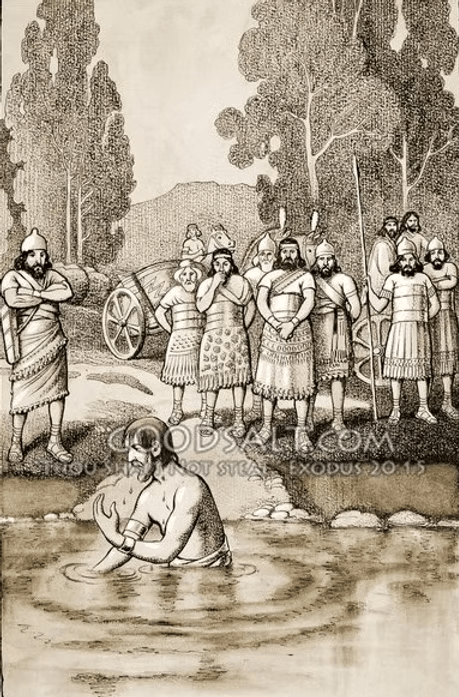
When we next read, “So [Naaman] went down and immersed himself seven times in the Jordan, according to the word of ha-elohim,” this is more than first appears. The Hebrew construct that says “so he went down” is “way·yê·reḏ,” rooted in “yarad,” meaning “to come or go down, descend.” This, like “he took a stance,” needs to be read spiritually, where Naaman “descended” from his fit of rage. He became calm and centered. He got off his ‘high horse’ of self-importance and “descended” in a posturing of submission to Yahweh, where he had originally put his faith. To then read “immersed himself,” the Hebrew written says “way·yiṭ·bōl,” translating as “and he dipped.” This is the meaning of the Greek word “baptizó,” as Strong’s defines it as saying “to dip, sink.” This root of the Christian word “baptize” says Naaman was “seven times baptized,” where “seven” is a number meaning “rest, completion, sacred.”

When one read about “seven times” (from “še·ḇa‘ pə·‘ā·mîm”), it is easy to think that Naaman was so anxious to get this bathing seven times in the Jordan over with, so he did seven dunks in the river, one right after the other. For some reason, I feel this became a daily bathing, taking place over a week’s time. As such, the first “dip” would have been on the first day of the week (Sunday), with the seventh on the Sabbath. That makes the end result be a “restoration like the body of a child unimportant that is clean.” Here, the same descriptive word is used as described the “young” girl – “unimportant” (from “qā·ṭōn,” meaning “small, young, unimportant”). This state of being a “child” (“na’ar”) should be seen as a rebirth. An newborn enters the world free of all sin. It takes life in the world to make one’s soul become dirty from sins. Thus, Naaman experienced a Holy Baptism in the Jordan River, which cleansed him of all his sins. With all his sins removed by Yahweh, his burden of leprosy on his face disappeared. Naaman wore the face of Yahweh, as his Son reborn – a soul converted by the works of faith.
As the Track 1 Old Testament selection for the fourth Sunday after Pentecost, Year C, it should be read as how ministry takes place. A minister should have a comparative history to Naaman – sins that are visible, in need of forgiveness and redemption. Our sins being known drives us to become forceful leaders, as a show of physical strength and mental agilities that forces others to allow our sins or face a battle. Deep down inside, our souls are crying out for a state of pleasantness to come over us. We all want to be healed of our sins. The problem is being afraid of the work that must be done to gain that redemption of our sins. We all want to reap the rewards of a sinful world, so many pretend to offer forgiveness, at a price; and, many are willing to pay our price, for the illusion of having been forgiven. Unfortunately, none of that false ministry shows the true power of Yahweh; so, few have come to know Yahweh has a prophet in those Who Retain Yahweh as one of His elohim. This reading says we must do the acts of faith, as that will baptize our souls for us.
 Explaining the Readings