Tag Archives: Ordinary time after Pentecost

Mark 9:30-37 – Welcoming a child in the name of Jesus

Jesus and his disciples passed through Galilee. He did not want anyone to know it; for he was teaching his disciples, saying to them, “The Son of Man is to be betrayed into human hands, and they will kill him, and three days after being killed, he will rise again.” But they did not understand what he was saying and were afraid to ask him.

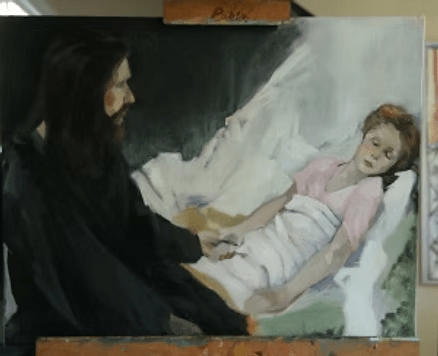
Then they came to Capernaum; and when he was in the house he asked them, “What were you arguing about on the way?” But they were silent, for on the way they had argued with one another who was the greatest. He sat down, called the twelve, and said to them, “Whoever wants to be first must be last of all and servant of all.” Then he took a little child and put it among them; and taking it in his arms, he said to them, “Whoever welcomes one such child in my name welcomes me, and whoever welcomes me welcomes not me but the one who sent me.”

———————————————————————————————————-

This is the Gospel selection from the Episcopal Lectionary for the Eighteenth Sunday after Pentecost, Year B 2018. In the numbering system that lists each Sunday in an ordinal fashion, this Sunday is referred to as Proper 20. It will next be read aloud in an Episcopal church by a priest on Sunday September 23, 2018. It is important because Jesus told his disciples of his suffering to come for the second time. Jesus then taught his disciples that they had to give up seeking adult quests and welcome the birth of him in them.

In the sequencing of events, Jesus had first told his disciples about the suffering that would come at the hands of the rulers of Jerusalem (Mark 8). Now, he is remembered saying he would be “betrayed into human hands.”

The Greek text shows “paradidotai eis cheiras anthrōpōn,” which can translated clearly as “delivered into the hands of men.” The word “paradidotai” can mean “betrayed,” but that hint was not taken to mean “There is a traitor among us.” The same word, without a specific context, could mean “handed over, delivered, turned over, or abandoned.”

The difference between Jesus having named specifically “elders, chief priests, and scribes” earlier, but now saying “men” is a statement that people holding titles are still just human beings like everyone else.  It implies the Romans will do the actual deed.  The fact that Jesus said, “They will kill him,” rather than having generally stated before “to be killed,” meant the disciples were confused by the differences in the two stories. That confusion made them again miss the part of “on the third day he will rise, after being killed.”

When we read, “They did not understand [the things spoken] and were afraid to ask him,” the part they thought they understood – Jesus being killed – had drawn the ire of Jesus, after Peter took him aside and tried to sternly tell Jesus he should not talk such nonsense. Here, he repeated that he would be killed, but no one was brave enough to say to Jesus, “Excuse me master, but could you explain more about how you know this and why we cannot stop it from happening?”

No one wanted to be told they were Satan. Therefore, they were blank slates that had been conditioned to watch, listen, learn, and obey, as long as their egos never questioned divine wisdom.

We next hear read aloud by a priest, “Then they came to Capernaum; and when he was in the house he asked them, “What were you arguing about on the way?”’ This question by Jesus could have been asked while the group was “on the way,” so Jesus saved it for a more preferable time to bring up the matter. He asked while they were in the house of Jesus in Capernaum, where the familiar surrounding meant there were no chores to do and there was a period of rest after a long and eventful travel.

To then learn, “They were silent, for on the way they had argued with one another who was the greatest,” this means the disciples did not answer the question.  There is no indication that the disciples spoke and answered Jesus.  That absence says they refused to answer the question because they were still afraid of being called Satan by Jesus.

If Peter could be told to get behind Jesus as an evil demon, simple because he cared enough about Jesus to tell him, “You will not talk of death!” then they all could be seen as more evil than that for arguing about “who was the greatest” among them. As for that superlative written, the Greek word “meizōn” can also mean “most important.”

To then read, “[Jesus] sat down, called the twelve, and said to them, “Whoever wants to be first must be last of all and servant of all,” this implies that Jesus knew what they were arguing about. The question was rhetorical.

Even if they argued away from Jesus, when Jesus was by loudly running water, getting a drink; or when Jesus was sitting amid his family and engaged in conversation with them, Jesus knew what was going on. Jesus knew what his disciples were arguing about because God made him aware. If Jesus could know his future and teach his disciples to be prepared for his death, then he could know what is running through his disciples’ minds and hearts.

It should also be realized that while Jesus was on the high mountain with Peter, James and John of Zebedee, a father with a child who had a demon spirit possessing him, making the boy mute and threatening to kill him by convulsions, had come into the base camp.  He asked the disciples to cure his son. Mark said “they did not have the power,” which presumes they tried to cast out the demon, but failed. The father and son stayed in the camp, drawing a crowd from the nearby village (including the ‘mayor’, called “a scribe”); so many were waiting for Jesus when he returned.

Jesus healed the boy, which left the boy apparently dead when the spirit departed his body. Several people attested that the boy was dead; but Jesus took the boy’s hand and raised him up, where the Greek word denoting that is “ēgeiren,” meaning “made awake.”  That should be seen as metaphor for raised from death.

The disciples asked Jesus why none of them could cast out the unclean spirit. He told them that the demon spirit in the boy was one that required “prayer,” which meant only God could both cast out an evil spirit AND bring the dead boy back to life. In other words, Jesus explained to his disciples (privately) that they still were not full-fledged Apostles, married to Yahweh.  They were still in training.

That event gives more reason for the disciples to be arguing about who was the “greatest” or “most important,” such that they were comparing their works of ministry to each other’s. Undoubtedly, they had each remembered the greatest healings achieved, how many spirits each had cast out, and how many people listened to them preach the meaning of the Torah and were touched spiritually. All had been given the ability to cast out unclean spirits, but the one in the mute boy was more than a mild case of illness by spirit. God undoubtedly assisted the disciples (or His angels) in their commission by Jesus, but the disciples were still unaware.  So, with Peter’s pretense as ‘lead disciple’ now uncertain, they all argued about who could then be considered the best disciple Jesus had.

Jesus knew that divinely, leading him to instruct nicely, “Whoever wants to be first must be last of all and servant of all.” The point was to never let a big head make one think their brain had anything to do with their spiritual acts. The disciples had been taught to release their egos by being obedient to Jesus; but Jesus knew they were getting Big Brain syndrome and that evil spirit needed to be cast out quickly. Jesus did that gently. There was no need to call anyone Satan.

When Jesus used those words about “first” and “last,” or “prótos” and “eschatos,” which also can translate as “most important” and “the end things,” it is important to understand just who and what that meant. For all the arguing about which disciple was “most important” in the eyes of Jesus and Yahweh, one has to wonder what self-proclaimed accolades Judas Iscariot presented. Was his claim for being the “greatest” based on how much money he raised?

After all, wasn’t Jesus referencing Judas when he told the group he would be “betrayed,” “handed over” by someone unstated by name, “to be killed”? That would certainly qualify Judas for being “last” among the Gospel writers.  There were many asides that pointed out beforehand – “Judas was the one who would betray Jesus.”

The point Jesus was making was less specific to one disciple and more applicable to the “men” whose hands Jesus would be turned over to. Judas was not quite in their category of “most important,” although he was [according to the Gospel of Judas] one who took great pride in mental exercises; supposedly Judas was a philosopher that loved debating logic with Jesus. Still, Judas would see thirty pieces of silver as big potatoes, while the Sanhedrin “men” dealt in finances that only the “most important” could fathom.

Those “men” were the ones who would reach their “ends” and be like the rich man who died and went to a hot place; still he expected poor Lazarus to come put a drop of cool water on his tongue. (Luke 16:19-31) Unfortunately, those are the ones who think they are the greatest until their demise, when they realize it would have been better to be the servant of all, rather than the opposite.

From that soft rebuke of rather simple disciples who argued about greatness, when they were already servants – ranking slaves as to how much they submit to the will of the great is pointless – Jesus then “took a little child and put it among them.”

The word translated as “a little child” is “paidion,” which can mean anything from an infant to a seven year old. The word implies, “a little child under training,” but some scholars believe it can mean, “a son or daughter up to 20 years old (the age of “complete adulthood” in Scripture).” [Helps Word-studies] The translation of “it” is from “auto,” such that the neuter gender third-person identification means the child had not yet matured, although “it” was either “boy” (“he”) or “girl” (“she”).

This is worth further analysis.

It was standard protocol in ancient times to ignore women and children in writings. Women were usually referenced generally, as being the wife or daughter of some specific man. Children were referred to generically also, with no names mentioned; unless it was in reference to a man in his childhood (Moses, Samuel, David, Solomon and Jesus, etc.).

In the Gospels of Matthew, Mark, and Luke, Jesus told the disciples to feed the five thousand men who came to hear Jesus preach. None of those writers made mention as to who was carrying the loaves and fish. John, however, said that Andrew spoke, saying “Here is a boy with five small barley loaves and two small fish.” In Mark’s Gospel (remembering Mark wrote the story of Simon-Peter), as Jesus was arrested and being carried away, he (and only he) wrote, “A young man was following [the arrested Jesus], wearing nothing but a linen sheet over his naked body.” (Mark 14:51)  Neither reference identified specifically who those youths were, because of the age and, therefore, lack of importance.

The word written that translates as “young man” is “neaniskos,” meaning a male youth (i.e.: boy), simply because he is unnamed. Still, in the literal Greek of that verse, Mark wrote “neaniskos tis,” which says, “a certain young man,” meaning that boy was known and identifiable, just not old enough to put his name in print.  Because the boy was “certain,” he was known.  After all, what strange child would just happen to be with Jesus and his disciples at Gethsemane, around two in the morning, in his night robe?

Hint: None.

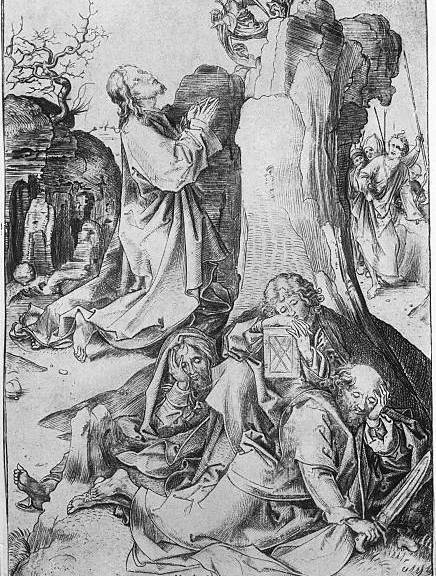
This is where one needs to realize that Jesus was in his home in Capernaum. He was in the house where his family lived with him. It would be completely normal to have children about in a Jewish household. Thus, the child who Jesus took up in his arms – the child under training – was the same child who carried the basket with loaves of bread and two smoked fish. It was the same young man who ran after Jesus when he was arrested, in his night robe, which boys put on before going to bed. He just happened to be under training during the Seder ritual and followed Jesus and the other adults as the disciples stumbled along drunk and fell asleep while Jesus prayed.

The young man – the youth – was John the Gospel writer, who recalled so much about that night.  John was able to recall the teachings of Jesus because he was a boy and not allowed to get drunk with the adults. The adult disciples were busy getting plastered on wine (part of the Seder ritual) and could barely remember waking up to Jesus being arrested. Here, in Mark’s account of the disciples being in Jesus’ house, with John there, we see John is being used as an example about the least who serve all.  John was the example of one who had no bragging rights about greatness; and they should be like him.

Still, one has to grasp the fact that a child in the house of Jesus would be a relative. John referred to himself as “the one Jesus loved,” which is a statement of relationship. John did not write of the excursion to Tyre and Sidon, nor did he write about the trip to Caesarea Philippi, when the Transfiguration took place. During both trips, Jesus was trying not to bring notice to himself by the Pharisees, or the Temple scribes and high priests. Simply from the potential danger involved, a child relative would have been left behind in Capernaum, with his mother and other relatives. Then, after Jesus had returned from a business trip, the child John was delighted at Jesus’ return. He was called by Jesus to sit with him and his disciples. John jumped into Jesus’ arms at the invitation.

This means that when Jesus said to his disciples, “Whoever welcomes one such child in my name welcomes me,” he just said, “Whoever welcomes John bar Jesus, my son, the boy with my name.” That statement is then stating a love relationship on a familial level.

Surely, John was the son of Jesus and thus bore the name of Jesus, as his father. Whoever welcomes that same relationship as that son, welcomes Jesus as their father. A disciple, therefore, is seen as least, in a Jewish society, the same as is a boy who gets no name recognition in writing, even though many people know the boy’s name; certainly they knew the name of that boy’s father. Therefore, if one welcomes being on the level of a child – a youth – an obedient child under training – a young man not yet grown into one of those “men who will kill” Jesus – then you welcome being the son of Jesus, which makes you also the grandsons of God, his Father.

The relationship would make the disciples God’s grandsons.  It means the least have become the greatest, by their service to the Father, as His sons, born anew as Jesus Christ – the Son of God. It is most important to see the love factor, which is centered on family.

Jesus did not just reach out in his own home and grab the first random “it” child that ran by and use “it” as an example that was welcoming ALL children as a lesson (by example) that Jesus taught.  What Jesus did was show his young son as how a disciple must see self-ego.  As adults they must stay in touch with their inner child and love Jesus the same as his son, as a sign of respect for the name of Jesus.

Jesus chose his son as an example for ALL disciples – then and now – to model.  They ALL have to welcome one another as members of the family that is born of Jesus. Just as John was a youth under training, so too were the disciples.  Being obedient to the commands of Jesus means being obedient to the commands of God; just as Jesus was. It is a Master / servant, symbiotic relationship, built on the foundation of love.  No disciple of Jesus should ever strive to be greater than the Master.  The Master will always support His children that are in the name of Jesus … family.

As the Gospel selection for the eighteenth Sunday after Pentecost, when one’s personal ministry for the LORD should be underway – one should have ceased trying to make one’s ego larger – the message here is to enlist into the family of God. The higher one strives to become on earth, the further one falls from a place being secured in Heaven.

In this reading from Mark, the changes in the way Jesus told them a second time of his coming death and resurrection offers a blanket observation of those who would “turn him over,” “betray him,” or “deliver him into the hands of men.” This is pointing to the Gentiles, who were then the Romans, but today this is anyone who wishes to kill Jesus as the leader of a religion. While Judas was a disciple that would make those words come true then, today the pews are filled with unsuspecting Judases who talk a good Christian game, but run when anyone questions their knowledge of the Holy Bible. Those betrayers are the same as was Peter, who three times denied knowing anything about Jesus. He betrayed Jesus by throwing him under the bus, because Peter thought he was too adult to be lessened from his delusions of grandeur.

When Mark then wrote, “They did not understand what he was saying and were afraid to ask him,” I imagine there are a GREAT MANY CHRISTIANS that do not understand who John the Gospel writer was. Some confuse him with John the son of Zebedee because he is the only John named as a disciple of Jesus. Matthew and Mark were disciples and they wrote nearly identical Gospels. Luke wrote the remembrances of Mary the mother of Jesus, who shared some events with the disciples, while also having an exclusive familial view of Jesus and his ministry. John was with Jesus before he had any disciples.  He was there when Nicodemus came to visit at night.  However, John is an enigma that so many have been too afraid to ask, “Was John the child of Jesus?”

On my God! If that is so, then there goes the celibacy theme so many Christian monks have sworn vows to defend.

If John is Jesus’ son, then Jesus had a wife!?!? Oh my God! He was like every other Jewish adult male who followed God’s command to go and be fruitful.

Most of Jesus’ life was not written of.  What is unknown is probably a lot like every other Jewish male that is born of a woman.  Therefore, expectations of normal Jewish males would have been the expectations of Jesus … more so when we know his Father would have it no other way.

I once had a parishioner come to my house in a Nicodemian way and confide in me, “Robert, there is no way I could ever tell anyone what you say. It is all so crazy.  No one would believe me.” He could not find anything I said was supported by Dietrich Bonhoeffer (I do not know who this was) … and my church friend thought Bonhoeffer rode the edge of religious reasoning.  No one should ever go beyond his views, he seemed to think.
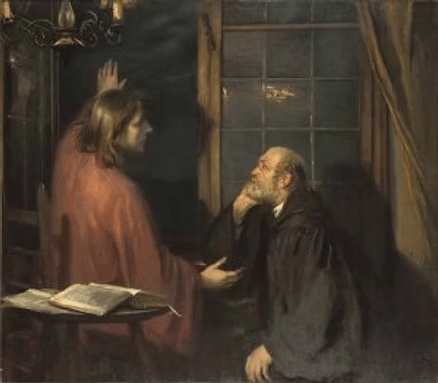
That man was even a lawyer, like Nicodemus. His good name and reputation depended on his ability to make money off Christians, who all had been taught to believe what someone else said to believe. It was okay to go to the library and find other sources that proved a scholar supported things commonly held dear (even, maybe, slightly different from the norm); but anyone unverifiable must be killed for speaking heresy!!!

That was what happened to Jesus, when he said a few things no one else had ever heard said before. He was turned over into the hands of men who had no relationship with God.

That is still a danger surrounding Jesus today. Too many arguing about who has the greatest Christian mind, based on book sales and television revenues raised (always needing a new private jet to zoom around the world in).

It is important that no one goes around saying, “Robert Tippett said ….” What I see and what I believe is not to be followed, because I see it or I believe it. I tell what I see and believe because I feel a strong need to share that with others. If others cannot see the same things and feel the same way as I do, then I accept that.

The purpose of the Pentecost season is ministry for those who have become servants for God. God speaks and servants do as told, happily … like little children. This is done out of a love relationship.

It is a marriage to God that gives birth to baby Jesus, within an old soul that has been cleansed by the Holy Spirit.  The sinner (the least of humanity) has sought a higher reward than anything found on earth.  The love of God is the repayment plan.  Servitude is the earthly parole from the worldly prison.

The child one welcomes in that marriage to God is Jesus Christ. Jesus tells a minister what to look for and what to find; and that ignites the heart in belief that is personal and solid. It is the meaning of faith, which is beyond standard belief. True Faith is the “Get out of human sinner’s jail” card.   A minister offers that to the world, in service to the Master.

It is just like the commissions of the seventy-two and the twelve. Go out and preach to all who will listen. If anyone tells you, “There is no way I can sacrifice my good reputation by repeating what you say,” then Jesus orders those ministers to kick the dust off their sandals and say as you walk away, “The kingdom of God has come near.”

Jesus Christ is the king of the earthly division of that kingdom; but nary a particle of dust can escape the kingdoms of earth.

#Mark93037 #Luke161931 #Mark1451 #GospelofJudas #Jesuscalledalittlechild #Theboyholdingtheloavesandfish

Wisdom of Solomon 1:16-2:1, 12-22 – Lying in wait for the righteous man

[1:16] The ungodly by their words and deeds summoned death;

considering him a friend, they pined away

and made a covenant with him,

because they are fit to belong to his company.

—–

[2:1] For they reasoned unsoundly, saying to themselves,

“Short and sorrowful is our life,

and there is no remedy when a life comes to its end,

and no one has been known to return from Hades.

—–

[2:12] Let us lie in wait for the righteous man,

because he is inconvenient to us and opposes our actions;

he reproaches us for sins against the law,

and accuses us of sins against our training.

[2:13] He professes to have knowledge of יְיָ [HaShem],

and calls himself a child ha-elohim.

[2:14] He became to us a reproof of our thoughts;

[2:15] the very sight of him is a burden to us,

because his manner of life is unlike that of others,

and his ways are strange.

[2:16] We are considered by him as something base,

and he avoids our ways as unclean;

he calls the last end of the righteous happy,

and boasts that יְיָ [HaShem] is his father.

[2:17] Let us see if his words are true,

and let us test what will happen at the end of his life;

[2:18] for if the righteous man is elohim child, he will help him,

and will deliver him from the hand of his adversaries.

[2:19] Let us test him with insult and torture,

so that we may find out how gentle he is,

and make trial of his forbearance.

[2:20] Let us condemn him to a shameful death,

for, according to what he says, he will be protected.”

[2:21] Thus they reasoned, but they were led astray,

for their wickedness blinded them,

[2:22] and they did not know the secret purposes of יְיָ [HaShem],

nor hoped for the wages of holiness,

nor discerned the prize for blameless souls.

——————–

This is the “The First Lesson” that can be chosen over Psalm 1, as the companion reading for the Track 1 Old Testament reading from Proverbs 31 to be read aloud on the eighteenth Sunday after Pentecost [Proper 20], Year B (2018), according to the lectionary for the Episcopal Church.  It will be a companion for Solomon writing, “[A capable wife’s] children rise up and call her happy; her husband too, and he praises her: “Many women have done excellently, but you surpass them all.”’  That pair will be presented before the Epistle from James, where the Apostle wrote, “You do not have, because you do not ask. You ask and do not receive, because you ask wrongly, in order to spend what you get on your pleasures.”  All will accompany the Gospel reading from Mark, where is written: “Then [Jesus] took a little child and put it among them; and taking it in his arms, he said to them, “Whoever welcomes one such child in my name welcomes me, and whoever welcomes me welcomes not me but the one who sent me.”’

To repeat my prior disclaimer about the Wisdom of Solomon being Apocryphal and thus not in my standard reference for the Hebrew text, it is too difficult for me to do any more than a rudimentary translation, which is quite taxing and time consuming.  What I have done is number the verses, based on a Bible.com English publication of this reading, confirmed by the NRSV translation, which the Episcopal Church has deemed unnecessary to number.  In this you will also find three more uses of “יְיָ” or what one Hebrew source stated as “HASHEM,” which means a proper name for “God,” like “adonay,” but not.  It also is not a standard abbreviation for “YHWH,” but is thought to be from the Hebrew word meaning “to be” [“haya”].  I also point out where one translation as “God” is actually the word “ha-elohim,” meaning “of elohim.”

In verse sixteen of chapter one, Solomon concluded a train of thought that dealt with soul marriage, although not one married to Yahweh.  The words “ungodly,” “death,” and “covenant” all speak of a soul falling in love with the material plane and marrying that which disappears when “death” comes.  Human being are mortals because “death” is the ‘god’ of the physical world.  Satan is the “lord” that sways souls away from divine marriage to Yahweh, so their “covenant” can be seen as a ‘pact with the devil.’  Being “fit to belong to his company” means a soul denied eternal life in heaven; so, those souls get to rejoin the worldly plane they sold their souls for,

The transition from chapter one to chapter two should be seen as a change of theme [not running out of space on parchment].  Thus, verse one is stating the theme that changed from one of ‘righteous versus ungodly’ to one of knowledge, where Solomon begins by saying “poor thinking” [“For they reasoned unsoundly”] is the difference between having a happy, rewarding life on earth and going to Hell [“no one has been known to return from Hades”].  While chapter one [entitled “Exhortation to Uprightness,” with verse sixteen entitled “Life as the Ungodly See It”] is focused on the duality of good and evil [the wisdom Solomon prayed to receive], chapter two is no advancing the notion that wicked people are those who just don’t have good brains on their shoulders.

From one bad brain is another sown.

The limitations that must be seen in Solomon’s worship of his own big brain is seen when he conject there is no return from “Hades,” which is actually written “sheól” [“שְׁאוֹל”]. For Solomon to think he could tell whether the guy standing next to him was not the reincarnated soul of some past king [or queen] of a foreign nation, one that crashed and burned, or even the reincarnated soul of one of the wicked Israelites who died in the wilderness, due to not obeying the Commandments, shows how little he knew in reality.  To even conject such an idea as wisdom is the same as science saying it is the only way to good judgment, when it is proved to be wrong many times, after declaring it was right.

The concept of Sheol was all souls went there.  The thinkers that returned from Babylon captivity divided into two sects: One believe there was nothing after death; and, the other thought death was a ticket to something akin to Purgatory.  Simply by being born a Jew [formerly Israelites], death mean that soul would be taken to heaven after the Messiah came.  Of course, that mindset figured all Gentiles were like dogs and cats, with death meaning they went and roasted in Hell.  That should be seen as who the wicked people Solomon was talking about, because (certainly) any right-minded Israelite of Solomon’s reign would see him as a god worthy of worship [smart as he was].

Skipping down from verse one of chapter two, to verse twelve, this is where Solomon is making himself out to be “a righteous dude,” as if Israel still had Gentile enemies they were worried about.  Of course, David’s Israel was always at war with those who refused to accept their God Yahweh had giving them that place to live, with the Philistines being those who still retained land that was not Israel’s.  They, however, were not an issue, since Solomon had married an Egyptian princess and had an ally that could put the squeeze on the Philistines.  Still, verse twelve is Solomon’s self-worth as a hero of the righteous, he equates all who would challenge his authority as being wicked.

So many wives and concubines to please.

It is in verse thirteen that the truth of Solomon’s wickedness is exposed.  In this verse there are two references to [NRSV translator] “God” and “the Lord.”  The reality of what is written (as best as I can look up the Hebrew) is this [using the NRSV otherwise]: “He professes to have knowledge of יְיָ [HaShem], and calls himself a child ha-elohim.”  In Solomon’s reign, the prophet Nathan was still actively advising the king.  Others like Nathan were those who claimed “to have knowledge of” Yahweh.  For Solomon to not write that name, but to instead write marks that are confusing, as to whom or what is being referenced [some say the letters are an abbreviated form of the verb translating as “to be”], says Solomon was not like his father David, nor the divine prophets who advised as the conduits of Yahweh.  Solomon saw himself as a god, who was married to the goddess Wisdom, with Yahweh believed to be the servant god who served him: יְיָ [HaShem].

In the NRSV translation, the world “child” is footnoted, with the footnote saying the word written can equally translate as “servant.”  For one to say he was “a servant of elohim,” that describes a prophet like Nathan to a T.  The point of the Hebrew word “elohim” is not to state “God” [the error of all translators], but to state the reality of “gods” [in the plural number], which are those soul married to Yahweh and thus given His powers on earth, as His “servants” [His “children”].  Thus, in verse thirteen, Solomon is placing himself above that of true prophets, because of his big brain.  This then equates his soul to a state of wickedness.

Verse fourteen then has Solomon scoff at the condemnations of the prophets, who say worldly wisdom is what condones evil ways.  Verse fifteen is Solomon belittling the true holy priests of Israel as the ones who take all the fun out of life, reminding everyone of the laws that keep souls from infidelity to their marriage vows with Yahweh.  Solomon is calling the restrictions placed on being a true priest of Yahweh as unnatural.  That is true, when a nation of people are being led away from adherence to their Covenant and finding normalcy in the ways of other nations.

In verse sixteen, Solomon again references the “HaShem” that is almost used as if he knew he would bring some physical condemnation upon his flesh [leprosy maybe?] by using the name “Yahweh,” as his father David had done frequently in his songs.  Here, Solomon belittles one who claims to be an “elohim” of Yahweh, because they make the claim that Yahweh is their “Father,” while also their Holy Husband.  This becomes Solomon cursing Jesus, who routinely told his disciples [not the whole world, not all of Judaism] to address Yahweh as their “Father.”  To call Yahweh “Father” means one must be His Son [all souls are masculine essence, especially when married to Yahweh’s Spirit … males and females in the flesh].

In verse seventeen, Solomon is beginning a series of verse that become the standard punishment governmentally set upon any who claim to be divine Sons of Yahweh.  To make such claims means to be put to death.  This concept would be viewed as holy wisdom, as Yahweh’s gift to Solomon, when in reality it was Satan’s serpent whispers [a marriage that made Solomon’s soul the demonic elohim of his demonic spiritual husband] that influenced all who would follow Solomon.  The routine would be marry foreign wives, import foreign priests, and kill any priest who spoke out against that process.  The culmination of this mindset of ‘wisdom’ was the execution of Jesus, the promised Messiah; but to believe in a promised Messiah, one has to first believe in Yahweh.  Solomon taught them not to believe in being “He [Who] Retains God” [the meaning of “Israel”].

We are here to tell you all you need to know about God and Jesus (for a price).

 In verse eighteen is a second use of “elohim,” which again must be seen as “gods,” specifically those whose souls have married Yahweh and become His hands on earth.  At the time of Solomon’s reign, all true divine “elohim” were priests of the Ark of the Covenant [transferred from the Tabernacle of Zion to the Temple of Solomon] and the holy prophets [such as Nathan].  In this verse, Solomon laughs at those who make claims to be divine Sons of man, such that Solomon’s mindset was cast into the future at Golgotha, when someone yelled out, “If he is the Messiah, let him save himself.”  Here, Solomon scoffs that the test of death will bring out the truth of being a “servant” [same use of “child”], by having Yahweh rescue that person.

Verses nineteen and twenty are Solomon giving the go ahead from that point in time onward to torture and insult the prophets of Yahweh.  To claim to be “peaceful” means Solomon’s plan was to beat hatred and anger into those who make such claims.  In today’s world, the destroyers of Christianity love to promote that Jesus is the Prince of Peace and would bend over and take it all day long, rather than strike anyone down in wrathful anger.  They persecute the believers to the point of forcing them away from Yahweh, by punishing their will to serve.  What those do not realize is the truth that every hateful strike they put forth against one of Yahweh’s children, the same return blows will come upon their souls, a hundred-fold. 

The NRSV then places one of its titles or headers before verse twenty-on, saying the rest of chapter two focuses on “Error of the Wicked.”  This is an assumption that “the wicked” are false prophets and not the true prophets of Yahweh.  Solomon was the intellect of humanity, as one who worshiped ‘Sherlock Holmes-like’ abilities to discern physical clues and make logical deduction that result in the truth.  None of that worldly wisdom is divine, thus far from all-knowing, as that given to Yahweh elohim.  Thus the title would be better stated as “Error of the Intelligent.”

Verse twenty-one is then a perfect summation of Solomon’s views that have been written on parchment.  By saying, “Thus they reasoned, but they were led astray, for their wickedness blinded them,” it is only the priests of logic and reason that deduce wrongly and are blinded by the science of the visible world.  No true priest of Yahweh is reading the Law [the Torah] and coming away with clear-cut, black and white knowledge.  Divine Scripture is written [according to Jesus] so the truth is hidden from the wise and intelligent, but exposed to the children [insert “servants” here].  The truth known by Yahweh elohim does not come from carefully crafted thought processes.  However, once the truth has been shown, all those arts and crafts can find a truth fully justified and true.  Thus, a simpleton [one of those Solomon belittled, when he prayed to his god “wisdom”] can be shown the truth of God, while all the big brains could not see the truth before their eyes.

Chance the simple gardener

In verse twenty-two [not the last verse, as chapter two has twenty-four verses], Solomon returned once again to displaying his fear of naming “Yahweh,” using his code-word called “HaShem” [יְיָ].  In this verse, Solomon sings that his lost soul never once considered self-sacrifice for the unseen rewards that are postmortem.  The wise and intelligent cannot possibly see that which is “secret” and thus spiritual.  They seek the material rewards that are the “wages” of being the elite, not the commoners.  They never seek to restrict themselves from that which can be freely taken, for the seeming bargain of one’s soul [everything material for nothing spiritual].  They have no desires for holiness.  They do not believe anything exists beyond death.  Therefore, they have no need for thinking blamelessness is a virtue.

As the optional “First Lesson” to accompany Proverbs 31 on the seventeenth Sunday after Pentecost, when one’s own personal ministry for Yahweh should already be well underway, the lesson here is to see the trap of intellectualism.  Solomon could not see how his words were condemning his own soul, all the while thinking he was making light of those who said they served Yahweh.  Solomon did not believe Yahweh was anything more than a stepping stone to a mastery of life on earth.  He did not believe in an afterlife; as there was no proof that anyone had ever returned from the depth of the ground.  The lesson that must be taken from this is being a “child of elohim,” which means having one’s soul be married to Yahweh, with His Son Jesus resurrected within one’s soul-flesh.  Having a big brain keeps one from having access to All Knowledge, readily available when needed.  No planning necessary.

Jeremiah 11:18-20 – Like a gentle lamb led to the slaughter

It was the Lord who made it known to me, and I knew;

then you showed me their evil deeds.

But I was like a gentle lamb

led to the slaughter.

And I did not know it was against me

that they devised schemes, saying,

“Let us destroy the tree with its fruit,

let us cut him off from the land of the living,

so that his name will no longer be remembered!”

But you, O Lord of hosts, who judge righteously,

who try the heart and the mind,

let me see your retribution upon them,

for to you I have committed my cause.

———————————————————————————————————-

This is an optional Old Testament selection from the Episcopal Lectionary for the Eighteenth Sunday after Pentecost, Year B 2018. In the numbering system that lists each Sunday in an ordinal fashion, this Sunday is referred to as Proper 20. If chosen, it will next be read aloud in an Episcopal church by a reader on Sunday September 23, 2018. It is important because Jeremiah spoke from the depths of prophecy, seeing through the eyes of Jesus Christ, as one totally in a committed relationship with God.

Verse eighteen is better translated by stating, “And the LORD gave me knowledge [of it], and I knew [it]; then thou showest me their doings.” The inclusion of “of it” and “it” are additions through assumption, based on the prior verses that are unknown here. The “it” is made part of the translation as “evil deeds.” “It” is “evil.”

Evil was described by Jeremiah as “found among the men of Judah, and among the inhabitants of Jerusalem.” (Jeremiah 11:9) “They are turned back to the iniquities of their forefathers, who refused to hear My words … [having] broken My covenant.” (Jeremiah 11:10) They will have brought the evil of the world upon themselves, building altars to Baal. The “evil deeds” are then the sacrifice of the innocents to the gods of evil.

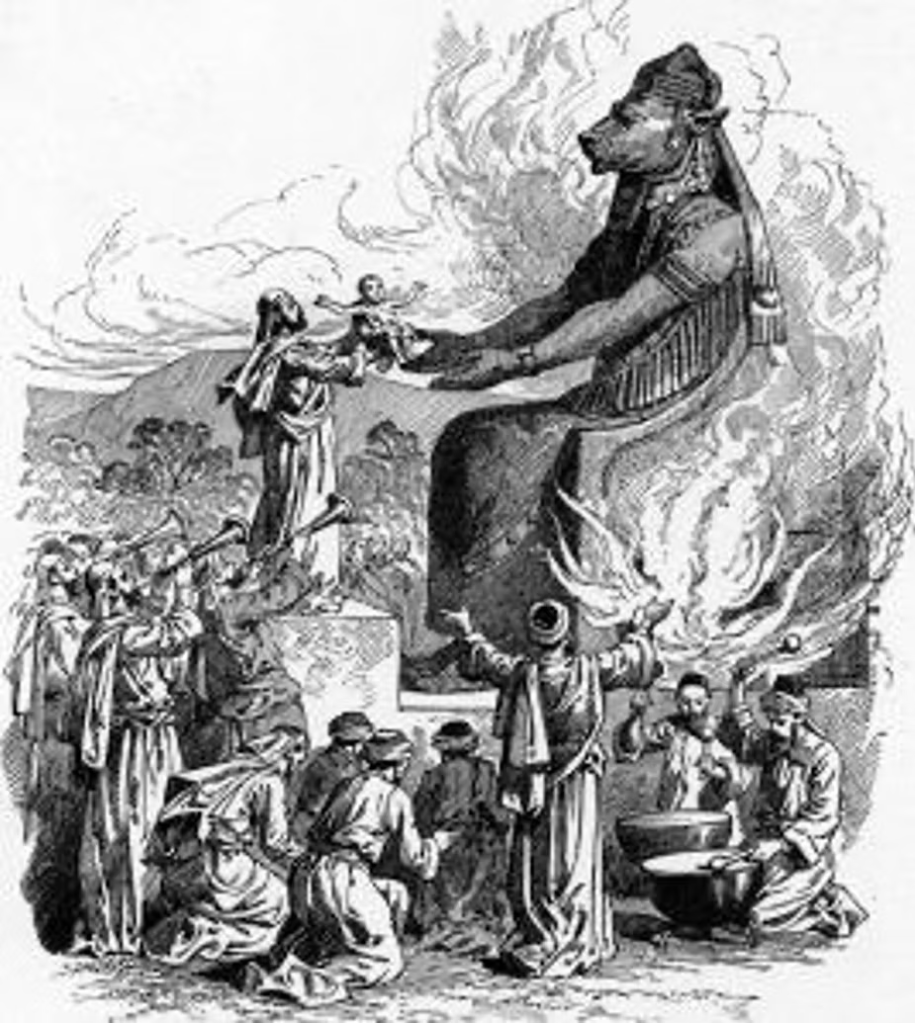
Moloch was a child sacrifice god, as Baal Hamon in Carthage.

When this is understood, we then read Jeremiah say, “But I was like a gentle lamb led to the slaughter.” This is a statement of willing sacrifice for a higher purpose. Jeremiah was channeling Jesus Christ, who would be the sacrificial lamb later in history, who had to die in order to release his soul so “it” could fill countless others. Still, Jeremiah was like all who would become Saints, as there can be no fear of evil deed doers; persecution is to be expected.

The literal Hebrew states, “I was like a lamb docile brought to the slaughter.” The word “I” is the word of the ego, stating “Myself.” This is then Jeremiah saying he was a lamb of God, who was brought to the point of self-slaughter willingly. It is the inner peace that one feels while in prayer with the Lord and the glory of God’s presence around one at other times that is most gentle. It is the comfort that keeps one from fearing anything, other than losing that closeness that God brings. This is then Jeremiah telling how the sacrifice of self-ego is an act of love for God.

Jeremiah then continued to tell of his prophetic sacrifice at the hands of priests serving Baal, saying, “And I did not know it was against me that they devised schemes, saying, “Let us destroy the tree with its fruit, let us cut him off from the land of the living, so that his name will no longer be remembered!”

This is illuminating the deception used by those who practice evil deeds. For Jeremiah to say “I did not know,” this is not a statement of his being unaware of plots against him. Instead, it says he did not live deceptively, by plotting against others.

When Jeremiah quoted the killers of righteousness as saying, “Let us destroy the tree with its fruit,” the Hebrew word translated as “tree” (“ets”) can also mean “wood, timbers, and logs,” with the implication of a “carpenters” handiwork, including a “gallows.”

Required for assembly: Two trees, large manual drill, wooden mallet and wood chisel.

Thus, the statement can also be seen as the use of a cross to destroy the fruit, rather than support the fruit of a grapevine.

Long before the Romans would dominate the lands of Israel and Judah, the planned destruction of the “tree with its fruit” was then to turn the pure grapes of Yahweh, through the Israelites delivered into “the land of the living,” by letting them turn to wild grapes, to be eaten by scavenger birds. The corruption of the religion that was based on Mosaic Law was to be degraded until no one remembered the name Moses. Jeremiah was a prophet of Judah who saw the evil deeds of its kings and the evil deeds of impure priests, leading to the fall of Judah and Jerusalem, with the Temple destroyed. This is the lament of this song; and it is the constant danger that surrounds all who serve the Lord.

When verse twenty says, “O Lord of hosts,” the Hebrew says “Yahweh tsaba.” This states who the true LORD is – Yahweh – and the “hosts” are the angels of Heaven, not a worldly army of believers. Thus, the judgment of Yahweh is said to be based on how the people of earth live their lives. The righteous are awarded Heaven, to dwell among the hosts; but the wicked will find nothing waits for their souls beyond the world they love so dearly.

The translation that says, “who try the heart and the mind,” can be better grasped as those who “test” the LORD and are “tested” for righteousness. When Jeremiah was inspired to write, “the heart and the mind,” this is the sequence that will determine the results of the tests. The righteous have found the Lord through their hearts, so their minds are led by the Will of God. Those whose lives are led by the brain they will harden their hearts to the Lord, instead loving the illusions of the earthly realm. Thus, as goes the heart, so goes the soul.

When Jeremiah sings, “let me see your retribution upon them,” the word translated as “your retribution” (“niq·mā·ṯə·ḵā”) is better understood as “your vengeance.” This seems to be Jeremiah taking delight in the punishment that God will set onto others, but that misses the duality of “’er·’eh (“let me see”).

Jeremiah is actually praying to the Lord to “see” the path of righteousness, because without the insight of Yahweh guiding one, one will become lost. Those who refuse to seek God’s guidance are then the ones who will use “great violence or force” (definition of “vengeance”) towards those who are devoted to God. All the vengeance of God’s judgment is then of their own making, not that of a vengeful God.

When Jeremiah then ends this stanza by singing, “for to you I have committed my cause,” he was stating his love of God. A servant of God can only act out of love for the Lord. That love is a commitment to serve Him completely.

The Hebrew word translated as “I have committed” is “gil·lî·ṯî,” equally says, “I have revealed,” “I have set forth,” and “I have opened.” This is the intimacy of a heart for a lover, where all defenses are removed and the oneness of union is the natural result. It is then the marriage of one to God, as a wife surrendering the self-ego so his or her (human gender is meaningless) cause is that of the Lord.

As an optional Old Testament reading selection for the eighteenth Sunday after Pentecost, when one’s personal ministry for the LORD should be underway – one has seen through the schemes of the world and found them lacking – the message here is to allow one’s soul to enter into marriage to God. It is the commitment to His cause that should be sought.

As an alternative to Proverbs 31, where Solomon listed the characteristics of a good wife and the truest intent means a “good wife” is a soul married to God, cleansed of sin by His Holy Spirit (a true sacrament of Baptism), one should not be shocked that Jeremiah was singing praises to the same commitment. Since these readings are brought up every three years in the Episcopal Lectionary cycle, Christians have long had access to these words, with Jews even longer. The problem is then how no one seems to know, or most people have huge misconceptions about, what “commitment” means.

Can all Christians since the Roman Emperor Constantine, leader of a failing empire, claimed he saw a vision in battle (a cross formation of clouds in the sky) and suddenly began to believe in a Jew named Jesus, beginning a devised plan to subject other believers of Jesus Christ in a new Kingdom of Rome, not see themselves as part of this plan? Does the verse that says, “And I did not know it was against me that they devised schemes” not explain the ignorance of lambs led to the slaughter?

Has not the system of Christianity that was devised by the Roman Catholics, to strip all believers of any concept of marriage to God, through His Holy Spirit, thus begetting a myriad of baby Jesus Christs (i.e.: Saints) in the world – to Save it – not been a fulfillment of Jeremiah’s words: “Let us destroy the tree with its fruit, let us cut him off from the land of the living, so that his name will no longer be remembered!”? Did they not sacrifice Saint Peter, who was in the name of Jesus Christ, so no more would Saints and Apostles proliferate?

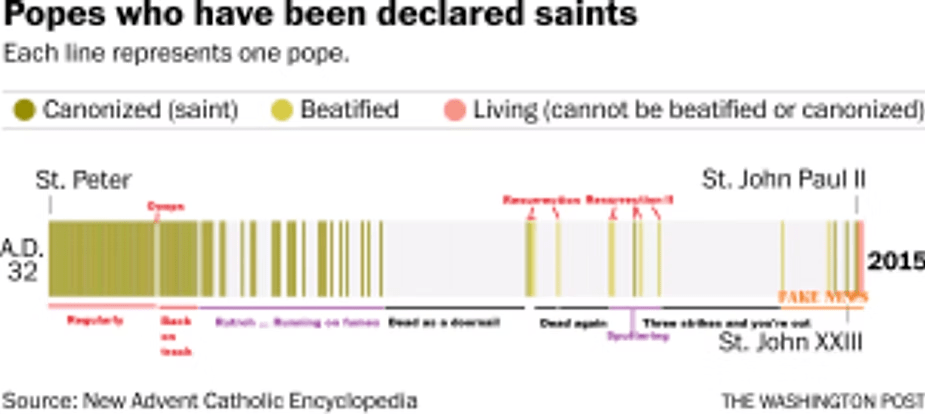
Lots of Saints called “pope” between 32 AD and 537 AD, but then a sputtering began, turning the papal seat over to corporate heads.

American Christians have been born into splinter groups of that false premise, making all conclusions based on that also false. We do not know anything about being married to GOD, because His name has been sacrificed when the corpse of Jesus of Nazareth was never allowed to rise from death and be reborn in true Christians. Women like the idea of marrying Jesus, while menfolk (gruff, gruff) have to keep a hard heart so they can bring home the bacon each month.  Jeremiah’s songs of lamentation were echoing the loss of a true religion by both men and women born into the religion created by God’s hand; given over into the hands of men who loved an icon name Baal, more than the true God. It is a story that keeps on keeping on because believers love to be subservient to a human leader, simply because they can physically sense that presence.

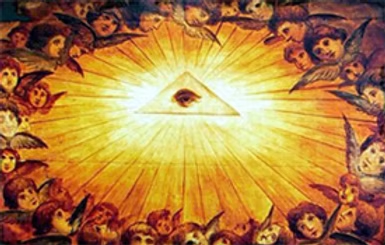
The message is there to be known – marry God.  Love God with ALL your heart. It is just clouded, such that to see through the mist one needs to be led inwardly, by the All-Seeing Eye of God (not a Masonic promotion).

So many have turned away from God because of the schemes of deception, revealed as false.  They ones wanting to believe in the unseen have mentally discerned Church deceptions as equating Christianity to the flaws of men. Ears have turned deaf to the truth, simply because so many lies have been told and foolishly believed.

In the Gospel message for the same Sunday this optional Old Testament reading might be chosen, Jesus foretold of his being killed by men. That prophecy fits this song of Jeremiah. It was the plot of pretending holy men then, and it has been the same since Moses took a bunch of slaves from Egypt into the wilderness. From pretending an idol of a golden calf could rescue the people, to pretending to breathe new life into a land lost, by rebuilding a Temple destroyed, believers have married to concepts and icons, but rarely God.  Only when Jesus died and his soul was freed by God to be reborn in Apostles has that marriage been known.  Men (and women now) do not like believers who have their own relationship with God and Christ.

It is the message of the Gospel that the greatest will be the least. That is a prophecy that says one cannot depend on another human being who says he or she is the greatest disciple of Jesus, because braggarts only have one soul’s interests at heart – their own; not anyone else’s.

Sunday after Sunday the message says, “God is the way to redemption and an eternity in Heaven.” For that way to be one’s own, one has to be more than human. For that to happen, one must surrender the human soul to God, which means become one with God. That is the truth of marriage. Once one has become one with God, then one stops knowing anything that would get in the way of complete servitude to God. In return, God allows one to know everything necessary, to be given to those seeking a good husband, possessing good wife potential.

Maybe one day all human souls will have the epiphany and their eyes will see that some spell has been cast over them, keeping them from accepting God’s proposal of marriage. As they wake up to divine understanding, maybe they will walk away from the human schemes and look at the true offer from God.

Maybe one day the world will be filled with only Saints. Maybe that day all souls will be in Heaven, not on earth.

Proverbs 31:10-31 – The good wife

A capable wife who can find?

She is far more precious than jewels.

The heart of her husband trusts in her,

and he will have no lack of gain.

She does him good, and not harm,

all the days of her life.

She seeks wool and flax,

and works with willing hands.

She is like the ships of the merchant,

she brings her food from far away.

She rises while it is still night

and provides food for her household

and tasks for her servant-girls.

She considers a field and buys it;

with the fruit of her hands she plants a vineyard.

She girds herself with strength,

and makes her arms strong.

She perceives that her merchandise is profitable.

Her lamp does not go out at night.

She puts her hands to the distaff,

and her hands hold the spindle.

She opens her hand to the poor,

and reaches out her hands to the needy.

She is not afraid for her household when it snows,

for all her household are clothed in crimson.

She makes herself coverings;

her clothing is fine linen and purple.

Her husband is known in the city gates,

taking his seat among the elders of the land.

She makes linen garments and sells them;

she supplies the merchant with sashes.

Strength and dignity are her clothing,

and she laughs at the time to come.

She opens her mouth with wisdom,

and the teaching of kindness is on her tongue.

She looks well to the ways of her household,

and does not eat the bread of idleness.

Her children rise up and call her happy;

her husband too, and he praises her:

“Many women have done excellently,

but you surpass them all.”

Charm is deceitful, and beauty is vain,

but a woman who fears the Lord is to be praised.

Give her a share in the fruit of her hands,

and let her works praise her in the city gates.

———————————————————————————————————-

This is an optional Old Testament selection from the Episcopal Lectionary for the Eighteenth Sunday after Pentecost, Year B 2018. In the numbering system that lists each Sunday in an ordinal fashion, this Sunday is referred to as Proper 20. If chosen, it will next be read aloud in an Episcopal church by a reader on Sunday September 23, 2018. It is important because it uses the feminine pronoun “she” and “her” as metaphor for devout human beings (of both genders) being in a committed relationship with God.

There are twenty-two verses in this selection from Proverbs. There are twenty-two letters in the Hebrew alphabet; each verse is marked by a separate letter, from aleph to tav. As such, this Proverb that has some versions of the Holy Bible identify it as “The Virtues of Noble Woman” or “The Wife of Noble Character” can be seen (somewhat) as the ‘A to Z’ of those virtuous character traits. Still, the letters bear the symbolism of their numerical numbering, from 1 to 22; and in Hebrew each number has its own symbolic meaning, which cannot be overlooked.

I welcome the reader to search the Internet for this symbolic meaning for oneself. Here is a link to one site that offers such opinion on this (Spiritual Meanings of the Hebrew Alphabet Letters). I will not be going into this aspect of this Proverb of Solomon; but it has to be recognized as present and that presence has intended meaning.

As to the summation that Solomon wrote about the qualities possessed by the perfect wife, it is easy to be misled, knowing the attraction that Solomon had to women. Having become known as having had seven hundred wives and princesses, plus three hundred concubines, one could then assume that this Proverb is based on Solomon having gotten to know many wives, concluding these are the best traits. Still, after getting to know one thousand ladies up close and personal, Solomon coming up with only twenty virtues of wives would seem to be based on the most repetitious traits he liked. However, that opinion of the noble character of a wife, or even of the concept of “woman” in general, is not the point of this writing.

One has to see that wise ole Solomon wrote this Proverb, even though he might have been smiling about all the women he knew while writing it, as a vehicle of Yahweh.  The true source of this wisdom was from God, flowing through Solomon’s hands as he wrote. These words of Proverbs 31 have a divine origin, with a spiritual meaning intended to be found.  There is nothing to be found in the Holy Bible that is mundane human opinion.

In the modern times, when human gender became a matter to protest publicly, there will certainly be women sitting in the pews who scoff at such male chauvinistic views as had Solomon. I doubt female priests will write lengthy sermons about this reading selection, unless driven by personal agendas that would misuse it to promote same-sex marriage between two women.  Such views as promoted wives being subservient to their husbands, as is still prevalent in Muslim culture, is now seen in the West as having set womanhood back thousands of years.  Still, that is the human opinion of divine writings misunderstood. The true meaning has to do with this writing being about the perfect servant to the Lord, where all the feminine pronoun usage points to Man (which includes woman).

I have written about this repeatedly, where those who want to achieve Heaven must submit to God and become His wife. This has absolutely nothing to do with human gender. No human being is going to know God through his or her sexual organs. God did not care what type of women floated Solomon’s boat; but He made it be known what a true servant of the Lord will do.

This translation is not completely accurate, throughout this long song; so I will not be spending thousands of words correcting those mistakes.  To give one example, the translation of “jewels” comes from “mip·pə·nî·nîm,” which could be shown to state “rubies, corals, or pearls.” To read “jewels” then leaves it up to the women who look for their value in huge diamonds placed into fine gold engagement rings. From that speculation, a verse focused on “capability” (from “ḥa·yil,” also read as “virtue”) is reduced to a value that crawls along the material plane, missing the spirituality of this wisdom.

From one example, I am not about to correct all the errors of a translation that begins with a premise (a preconception) that Solomon was giving guys advice on how to find the right girl, and in the process putting the seed of thought into the minds of girls that a good wife dotes on her husband … for trinkets.  Everything that leans in that direction is wrong.

I wonder which ones have the Holy Spirit talents in them? No shaking before opening!

This song must be read as God speaking to YOU, whoever YOU are – male, female, or child [neuter gender]. YOU have to know what God requires in His wives, regardless of what sex organs God gave you, and regardless of what other human beings make your sex organ tingle with delight. As such, YOU are “She” and “her.” YOU have to see that.

We call God the Father, despite how many women’s rights freaks try to twist that masculine principle into a misconception that promotes people should think, “God can also be a Mother.” That is false.

“God” means Masculine. “Goddess” means feminine. God is not a goddess, just as man is not a woman. There can still be equality in inequality.  Equality is complimentary.  As such, the Earth is the goddess who received God as her husband and gave birth to bags of dirt that were filled with souls. God, therefore, is the Father of life on Earth, with all life (as we know it) having Earth as its Mother.*

So it is written:

“I also said to myself, “As for humans, God tests them so that they may see that they are like the animals. Surely the fate of human beings is like that of the animals; the same fate awaits them both: As one dies, so dies the other. All have the same breath; humans have no advantage over animals. Everything is meaningless. All go to the same place; all come from dust, and to dust all return. Who knows if the human spirit rises upward and if the spirit of the animal goes down into the earth?’” (Ecclesiastes 3:18-21)

Nope. Just a bag of dust struck by lightning.

When one realizes how Jesus said, “So they are no longer two, but one flesh. Therefore what God has joined together, let no one separate,” (Matthew 19:6) this means the feminine of the Earth Mother is the flesh of a human body that has become one with God the Father via a soul of life being present in that flesh. It is the human equivalent of DNA, where a child is the combination of two parents that cannot be separated. Simply because of this reasoning, ALL human being bodies of flesh are feminine. Since that means we human beings are all ‘girls’ here, we are all potential “wives” to God.

That is all I have to say. I recommend each reader to go to the Bible Hub Interlinear website (here) and slowly read what was written, and investigate the full breadth of meaning each word contains. See if YOU can see yourself as meeting all these noble characteristics.

Take note that the second verse (the Beith letter verse) speaks of a husband’s heart having full trust in his wife. This is the love one has to have, in order to have a proposal of marriage made and be accepted. Love is the attraction that is essential. Therefore, the beith symbolism is: “The beginning of duality, with the One Creator bringing forth a created world.”

Two have cleaved together to make one, through love.

This is the result.

If one does not have a true love of God in one’s heart, one is not good wife material for Him. If YOU can feel this love, then take the time to see how the wisdom of Solomon used the next twenty verses to spell out what “She” (YOU) does for God.

With love, the work that comes from being in love with God becomes a joy.  It is the works of an Apostle.

———-

* Footnote: God – Yahweh – did not create mankind – male and female in His image.  God’s elohim created those ‘ordinary’ human beings.  Therefore Yahweh is not the Father of all humanity.  Yahweh is the source of all souls.  Yahweh is the one who orders souls to control bodies and join egg and sperm and split cells for growth of life-to-be.  Souls are elohim.  Yahweh is only the Father of holy human beings that are filled with the Holy Spirit of Yahweh and with each transformed from ‘ordinary’ human being into His Son reborn.  Only Sons, again, as human gender is meaningless.  Sons means the Spiritual association of gender, opposite the material association of gender.  Call it positive-negative or external-internal, if you like – opposites.  A man and a woman can each be reborn as Jesus Christ (a “Christian”), becoming “brothers and sisters” in the name of Jesus Christ – Sons of God.

James 3:13-4:3, 7-8a – Submit yourselves to God

Who is wise and understanding among you? Show by your good life that your works are done with gentleness born of wisdom. But if you have bitter envy and selfish ambition in your hearts, do not be boastful and false to the truth. Such wisdom does not come down from above, but is earthly, unspiritual, devilish. For where there is envy and selfish ambition, there will also be disorder and wickedness of every kind. But the wisdom from above is first pure, then peaceable, gentle, willing to yield, full of mercy and good fruits, without a trace of partiality or hypocrisy. And a harvest of righteousness is sown in peace for those who make peace.


Those conflicts and disputes among you, where do they come from? Do they not come from your cravings that are at war within you? You want something and do not have it; so you commit murder. And you covet something and cannot obtain it; so you engage in disputes and conflicts. You do not have, because you do not ask. You ask and do not receive, because you ask wrongly, in order to spend what you get on your pleasures.

Submit yourselves therefore to God. Resist the devil, and he will flee from you. Draw near to God, and he will draw near to you.

———————————————————————————————————-

This is the Epistle selection from the Episcopal Lectionary for the Eighteenth Sunday after Pentecost, Year B 2018. In the numbering system that lists each Sunday in an ordinal fashion, this Sunday is referred to as Proper 20. It will next be read aloud in an Episcopal church by a reader on Sunday September 23, 2018. It is important because James wrote of wisdom being divinely born, but also manifesting in “unspiritual” and “devilish” ways. In the change of chapters, James then wrote that the solution of selfish disputes calls for the sacrifice of the self-ego, to be replaced by the submission to God (i.e.: marriage to God).
In verse thirteen, where the translation above states, “Show by your good life that your works are done,” the literal translation shows a separate segment that states: “let him show out of the good conduct the works of him.” This means the acts of one “demonstrate” (from “deiknumi”) one’s “honorable behavior” or “noble manner of life (from “kalēs anastrophēs”). It implies people will display bad character.  The difference is the source of goodness.

When the literal translation from the Greek shows “him” repeated, this is a word for presented in the third person masculine, as a singular personal pronoun.  The dual references to the third person, as “him,” can be mistaken as the same person who acts “good” as being generated by “himself.”  This misses the duality of two that are combined as one.  As such, the implication is exposing two elements of the same one: the one exhibiting such “good life” (“him”) and Him as God within, the inspiration of those righteous acts.

When God is read into that segment, then “gentleness born of wisdom” is from a divine source. This is then contrary to the next verse, where “jealousy” (“bitter envy”) with a “bitter” spirit is the outward acts of inner distress. To have “selfish ambitions” (from “eritheian”) is James way of saying the absence of God within is due to the self-ego pushing Him away, preferring to worship one’s Big Brain. That dependency on intelligence then hardens the heart – the love center. Without the heart leading the mind, one becomes prone to “boast and lie against the truth” (“be boastful and false to the truth”).

The Big Brain is thus the god of self and generates a weaker form of “wisdom,” which “does not come down from above,” as it is not from God. This is the feminine goddess “Wisdom,” which Solomon referenced, such that the femininity is a reflection of the “earthly” (from “epigeios”).

Wisdom is ruled by elohim.
Aliens are assumed to have godlike powers of intelligence, by fools who think the Mind of God can fit into a bony box filled with gray matter.

Because it is of the earth (like science, dependent on observable data) it is “unspiritual” (from “psychikē”).  That root word implies “animal, natural, and sensuous,” as anything “of the earth,” not of the spiritual heaven.  This then leads to a conclusion that earthly wisdom is “devilish.”  However, the word translated as that is “daimoniōdēs,” which implies an “evil spirit.” That translation requires deeper insight.

The Greek word “daimónion” comes from Ancient Greek, meaning most basically “spirit.” This “spirit” can then be said to be divine, as miraculous and extraordinary manifestations on earth. This is rooted in the Greek word “daímōn,” which can mean anything from “a god or goddess, a guardian spirit, or a departed soul.” Their importance is only found in the worldly plane.

The etymology has it rooted in “daíomai,” which means “divide.” As such, Satan is a god that has divided from God (Yahweh) and has been cast into the earth (a goddess’ realm – the feminine), where Satan became an influence for evil, attempting to steal souls that have divided from God (life breath spirit – soul). In a sense, the division is symbolic of divorce, such that Lucifer cheated on his Husband, was caught and banished.  Thus, in humans, an “earthly spirit” is one led by the soul, which is more inclined to be misled by Satan’s evil influences (i.e.: loving sin), acting “devilish.”

From this insight, the translation of “devilish” means being under the influence that keeps one divided from God.  It is designed to lead one away from the reunification of a soul with God.  It is the influences of the world that trick one into turning away from a commitment to one, desiring to try as many delights as possible.

James then repeated the traits of an evil spirit as possessing “envy and selfish ambition,” such that following the thoughts of a brain will one’s life be scattered and ever-changing, lacking order. The Greek word written by James is “akatastasia,” where “disorder” means: “disturbance, upheaval, revolution, almost anarchy, first in the political, and thence in the moral sphere.” It implies a difficulty standing up for what is right, because everything has become unsettled, confused, and in tumult. All this comes from depending on a Big Brain to lead one properly, when the result is always to be deeper into the complexities of a sinful existence.

What have I done this time?!?!

The only escape from this madness is then God, by coming to rely on His “wisdom from above” (where “the from above” comes from “anōthen,” meaning “anew”). This implies being reborn, where the old self dies and God’s divine ego replaces the old. This new wisdom then comes from the Holy Spirit as Jesus Christ being resurrected in a human form.  With this new presence comes the Christ Mind, which leads the human brain to understand all acts that are motivated by the heart first.

To say this new self “is first pure” means one has to first and foremost be cleansed of all past sins that the soul has accumulated, through lives on the earthly realm. This cleansing becomes a baptism by the Holy Spirit, when means the soul has been immersed into a state of spiritual purity. This union with God’s Holy Spirit is then the marriage of one’s soul with God. It is a cleansing brought on by love, meaning the deep desires of one’s heart; the brain have submitted to the Will of God and having no say in this subjection and submersion.

To then have James write, “then peaceable,” this is like when John the Baptist lifted Jesus from the waters of the Jordan and (as Luke wrote) “the Holy Spirit descended in bodily form like a dove upon Him, and a voice came from heaven which said, “You are My beloved Son; in You I am well pleased.”’ (Luke 3:22)

The dove is symbolic of peace, and this is stated in the Greek word “eirēnikē.” That word says “peaceable,” but implies: “God’s gift of wholeness which results from knowing (discerning) the Lord’s will and obeying it.” [HELPS Word-studies]  This says “peace” is the state of one’s being, after marriage to God.

The descriptive terms then written by James, translated as “gentle, willing to yield, full of mercy and good fruits, without a trace of partiality or hypocrisy,” are the new way one is led to act, after being renewed by God. This is the resurrection of Jesus Christ within one’s being.  One being reborn as Jesus Christ then duplicates the lifestyle of Jesus of Nazareth, effortlessly, willingly, and delightfully.  It is not self-willed, but a natural way of being.

These ways, if deemed good by a Big Brain, would be impossible to maintain through self-will. God has to be in love with one’s soul, make it pure for His presence, and then the union of God and soul in a human form will reproduce the Son of God. Only Jesus Christ being reborn into one’s flesh can one achieve a righteous life, as stated by James; as James then stated this as, “A harvest of righteousness is sown in peace for those who make peace.”

The end of chapter three then means a freedom to start new thoughts of divine wisdom, prompting James to question those who are not in a divine state of peace in his fourth chapter. He asked, “Those conflicts and disputes among you, where do they come from? Do they not come from your cravings that are at war within you?”

It should be realized that “you” is less a focus on the collective or a group of people (Jews, to whom James ministered), and more designed to be personal, to all who would read this letter.

The Greek word “hymin” is a form of “su,” which is the second person singular personal pronoun, “you.” The use of “hymōn” twice then repeats this as “of you,” with the word “epithymeite” then pointing out the second person singular form of “to desire, covet, lust, and to set the heart upon.” It is “you” who leads oneself to sin, not anyone else.

The personal pronoun in the singular number says James is now speaking directly to “you” (the reader), asking, What are the causes of your inner disputes?” and “Why are you always at war with the call to find inner peace?”

All of the sins of the world are committed because of these inner conflicts and disputes. The most egregious sins are committed because one does not want to give up self-control and the love of intellect and the sweet nothing it seems to bring. Such selfishness, demonstrated in self-destructive acts, is why James then pointed out the obvious: “You do not have, because you do not ask. You ask and do not receive, because you ask wrongly, in order to spend what you get on your pleasures.”

This cycle of always doing the wrong things and being self-defeating can be summed up by the idiom: “Fool me one, shame of you. Fool me twice, shame on me.” Of course, for every number greater than two times fooled, the same shame still falls on “me,” the one fooled. But, then, some struggle remembering this phrase.

Geo. W. Bush Shame video

After skipping over several verses in this epistle reading, the answer to being fooled is then stated by James as, “Submit yourselves therefore to God.” In that, the plural number of “yourselves” is explained as applicable to all individuals whose self-ego has wrought the weight of pain and suffering on the soul. The answer to all who feel the guilt of worldly sins is to “subject themselves to God.”

The same Greek word written (“Hypotagēte”) means to make a major life change (due to the word being capitalized), from selfishness to submissiveness. Such a change means the death of the ego and the marriage of one’s soul to God.  This demands one take a completely submissive stance, as His wife (where human gender is meaningless).

To “resist the devil” is then a reference back to chapter three, when James wrote that earthly wisdom made one “devilish.” This is then an instruction that subjection to the Lord will mean to take a stance against the influence of worldly sins. In this, one should realize that James is not the source of this instruction, as he has surrendered his self-ego to be married to God.  James, like all other Apostles, is speaking as the voice of God, Jesus Christ. As such, becoming submissive to God’s influence will make it assured that Satan will be resisted.

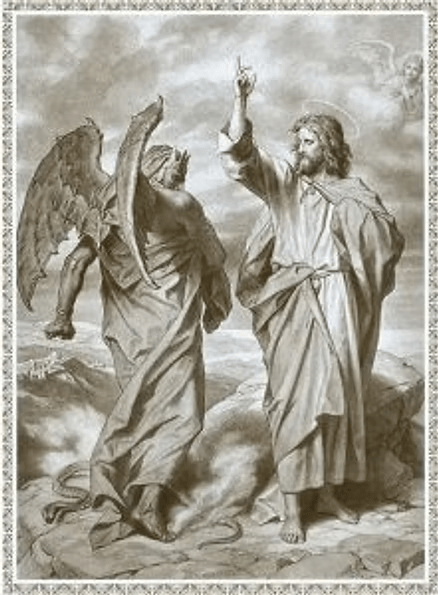
This means that James writing, “He will flee from you,” means “He” is the influence of the “evil demon” Satan. It is then just as Jesus commanded Satan, who tempted him, saying “Away from me, Satan!” From that command we then read, “Then the devil left [Jesus], and angels came and attended him.” (Matthew 4:10-11)

When Jesus Christ has been resurrected in one whose soul is married to God, then the urges to do wicked deeds will vanish.

It is then vital to understand the meaning of James writing, “Draw near to God, and he will draw near to you.” The repetition of the Greek word “eggizó” (as “engisate” and “engiei”) doubles the meaning of “extreme closeness, immediate imminence” [HELPS Word-studies], as “to join.” This is a way of stating to become one with God. It means marriage to God is recommended; but because God is the Most Holy Spirit, God does not join directly with human flesh.  So, God will not say “I do” on a physical altar.

God breathes the life of a soul into flesh, which is a soul spirit. That breath is the dividing of God into Him and you.  The marriage that draws near to God, and vice versa, is God’s Holy Spirit becoming one with one’s soul. It is the rejoining of a soul to its source.

This is the first step to a soul rejoining God in Heaven, after the death of physical flesh. Marriage to God means eternal life in Heaven, without the filthiness and guilt of a material body imprisoning a soul divided from God, which is repetition through reincarnation.

As the Epistle selection for the eighteenth Sunday after Pentecost, when one’s personal ministry for the LORD should be underway – one has found wisdom from above through one’s soul being reunited with God – the message here is to stop being fooled by earthly wisdom. Confusion, doubt, guilt and all the self-defeating sins of lust, greed, adultery and murder are erased when the heart is set on fire for Yahweh.

This Epistle reading selection is presented along with other readings that are calling one’s soul to the spiritual altar.  As I looked for pictures that would be symbolic of the title “Submit yourselves to God,” I came upon diagram produced by church organizations that used a series of umbrellas to show this message.  The largest umbrella was either depicted to be “God” or “Jesus Christ.”  Under it were two smaller umbrellas, depicting a “Husband” and a “Wife.”

The message of marriage that is assumed from reading the books of the Holy Bible is human, not Spiritual.  The leaders of churches, synagogues, mosques, and temples around the world, common in all religions, see females as commanded to be subservient to their male husbands.  While this human arrangement is resisted in modern Western societies, it is a reflection of the animal kingdom, which is “devilish.”  Not all animals on earth (humans included) adhere to the principles of marriage being a family, where husband, wife, and children all live happily together.

Just as all animals are naturally led to procreate and raise their young in variations of the family theme, humans also have variations that can be deemed “natural,” even though they differ from the norm.  This is not the point of marriage that comes from the words of Scripture.  God does not demand any life form on earth to submit to His Will.  God allows His breath to be divisions of Himself onto a plane where life forms were free to live according to self.

When animals express self, it is a natural program of survival.  Animals do not possess Big Brains that plot evil deeds.  Still, being predator and being prey is the natural order of that game of life.  Humans, however, do not have the same excuse as lower animals, because God gave them a large piece of flesh that reasons, while finding pleasures sought unnaturally.

To see a human rite of reason become the lone expression of most holy matrimony, where Man gets to pretend itself as god, while the feminine half of the species has to play the role of submissive animal, this is wrong.  It completely misses the point of one’s soul being rejoined with God, on a voluntary basis.  Males and females are expected to choose a marriage to God, in order to be freed from the prison in which their souls have been cast – the human form.  Humans are in the likeness of God because they have all been divided from God.  God is the pure Spirit.  Humans are the impure form.

For church organization to preach a need for good marriage values as the salvation of mankind, where a husband and wife together under God will live happily ever after is missing the most important point.  The institution of human marriage is in shambles because it has been corrupted by Satan.  The youth of today are turning away from traditional marriages and turning to alternative ways of co-existence and co-habitation, with children seen as an unwanted burden upon the world.

The human institution of marriage (as an official Sacrament of a Church is a relatively modern concept) is good, when it is a mutually willing commitment. It is good when it mirrors the oneness of two individual committed to God.  This sacred act is not always upheld, which makes it human, divided from God.  The answer is not to preach the wrongness of marriage born on the physical plane, where God gave souls a vacation from submission to only doing right.  Instead, it is important to preach the reminder: This is only a vacation.  Remember you are expected to go back to Heaven.  Renew your vows to God soon.

What Americans would think of taking a honeymoon in France and not make sure the Passport was in order?

Who says everyone can use a camera?

The eighteenth Sunday after Pentecost is when some wisdom came down from above and some wise men chose “marriage to God” lessons for priests in the name of Jesus Christ to explain to those still under training as disciples.  The heart needs to be softened and the brain needs to be lowered.  God is always offering His hand in marriage; but He will only join with those who prove a desire for Him.  A minister for the LORD will have accepted that proposal, so Jesus Christ can preach, “Let the little children come to me, and do not hinder them, for the kingdom of heaven belongs to such as these.”

That means marriage to God.  Rather than a lustful heart and a ritzy honeymoon, marriage means the love of a child for the Father, in the purest way.

Mark 9:38-50 – Salted with fire

John said to Jesus, “Teacher, we saw someone casting out demons in your name, and we tried to stop him, because he was not following us.” But Jesus said, “Do not stop him; for no one who does a deed of power in my name will be able soon afterward to speak evil of me. Whoever is not against us is for us. For truly I tell you, whoever gives you a cup of water to drink because you bear the name of Christ will by no means lose the reward.

“If any of you put a stumbling block before one of these little ones who believe in me, it would be better for you if a great millstone were hung around your neck and you were thrown into the sea. If your hand causes you to stumble, cut it off; it is better for you to enter life maimed than to have two hands and to go to hell, to the unquenchable fire. And if your foot causes you to stumble, cut it off; it is better for you to enter life lame than to have two feet and to be thrown into hell. And if your eye causes you to stumble, tear it out; it is better for you to enter the kingdom of God with one eye than to have two eyes and to be thrown into hell, where their worm never dies, and the fire is never quenched.

“For everyone will be salted with fire. Salt is good; but if salt has lost its saltiness, how can you season it? Have salt in yourselves, and be at peace with one another.”

———————————————————————————————————-

This is the Gospel selection from the Episcopal Lectionary for the Nineteenth Sunday after Pentecost, Year B 2018. In the numbering system that lists each Sunday in an ordinal fashion, this Sunday is referred to as Proper 21. It will next be read aloud in an Episcopal church by a priest on Sunday September 30, 2018. It is important because Jesus made it clear that being a part-time Christian would not qualify one eternal life in Heaven.

In this reading, Mark is first shown to identify a disciple of Jesus by name – “John.” This is the same John who had been chosen to go up the high mountain with Peter (whose story was recorded by Mark) and Jesus. John was accompanied by his brother James, both the sons of Zebedee. This means John was one of the first disciples Jesus chose, along with Simon-Peter. It is not John the writer of the Gospel by that name. That John was called “little child” (“paidion”) by Mark, in verses 36-37 of this chapter, meaning children were not mentioned by name.

Realizing that, we then read that the disciple John said to Jesus, “Teacher, we saw someone casting out demons in your name, and we tried to stop him, because he was not following us.” Before the response by Jesus should be understood, one needs to recall the Gospel lesson of the eighteenth Sunday after Pentecost and how Jesus had used his son, John, to tell his disciples, “Whoever welcomes one [like my son John] in my name welcomes me; and whoever welcomes me does not welcome me but the one who sent me.” (Mark 9:37) Now, in the very next verse (Mark 9:38), John’s memory has been joggled so that he remembered how on the trip down to Capernaum (while the disciples were arguing who was greatest among themselves) they saw someone claiming to be in the name of Jesus, casting out demons. And, oh by the way, John said, “We tried to stop him, because he was not following us.”

Now the heading for verses 38-41 of Mark’s chapter nine says “Intolerance Rebuked.” (Bible Hub Interlinear) Other websites that translate the Holy Bible and add such headings say, “Whoever is not against us is with us.” That is restating Jesus’ response to John (briefly), but it gives the impression that Jesus saw his disciples attempting to stop someone from casting out demons, while shouting out, “In the name of Jesus of Nazareth, I command you to leave this person!” The rebuke is, therefore, because someone is not a follower of Jesus does not mean he (or she) should be stopped.

The word “intolerance” can be defined as meaning, “An unwillingness or refusal to tolerate or respect contrary opinions or beliefs, persons of different races or backgrounds, etc.” [Random House Kernerman Webster’s College Dictionary] The fact that John admitted that he and the gang tried to stop someone from using the name of Jesus (not tried to stop someone from casting out demons) says they would not tolerate that association of healing with a man that person did not follow, as a student of Judaism [remember, John referred to Jesus as “Teacher”]. As such, the acts of the disciples were as intolerant as would be one branch of Christianity [a religion in the name of Jesus Christ] competing against another branch, simply because one sees the other as not following the teachings of Jesus Christ. While that is somewhat true, the focus on intolerance is misleading and misses the point of Jesus’ response.

Jesus said to John, “Do not stop him; for no one who does a deed of power in my name will be able soon afterward to speak evil of me.” That was first a command: “Do not stop him.” Then, it is an explanation in two parts.

The first says, “There is no one who can do a work of power that is contrarily in my name.” The use of the Greek word “epi,” which means “against, on the basis of, or to,” implying “upon,” such that Jesus said, “No one can cast out demons [a work of power] simply by calling out my name.” This then is a statement that says, “Only those who are me, reborn in my name, can do deeds of power that are born from above.”

Finally, reading that Jesus said, “Afterward to speak evil of me” is misleading. As a separate segment of words that literally state, “And will be able quickly to speak evil of me,” this is not a focus on the one in the name of Jesus who was casting out demons [doing works of power].  Instead, it refers to those who will witness such deeds and will call out the person in claiming to be in the name of Jesus as evil, not good.

By John and the other disciples trying to stop that person from doing good, they exemplified that point made by Jesus. That was then a statement about why Jesus would be “delivered into the hands of men who will kill him.” (Mark 9:31)

This is the point of Jesus then having said, “Whoever is not against us is for us.” That was not a watered-down version of the ancient proverb that says, “The enemy of my enemy is my friend,” such that Jesus was not telling his disciples, “It does not matter how wrong someone is, if they are going against those who are most wrong, as are we, then they are right.”

Those wanting to kill Jesus come disguised as religious men.

That means Jesus was not preaching tolerance to wrong, as “Two wrongs make a right,” if one wrong is better than the other. Jesus was saying that the enemy of his cause, which his disciples were learning, were those who persecuted the righteous. Thus, the assumption to be made from Jesus saying, “Whoever is not against us is for us” is that the one casting out demons in the name of Jesus was righteous, being for the same cause.

Keep in mind that Jesus was alive and well at that time.  No religion existed then that had believers calling themselves “Christians.”  The only ones who knew the name of Jesus, the Jesus of Nazareth, were those who came in direct contact with him.  It was not like today, when it is common to turn on the television and hear some televangelist shout out, “In the name of Jesus Christ be healed!”  One has to be able to see that there is a difference between using someone’s name and representing oneself as being the one named.

This perspective is clouded and difficult to comprehend when one does not grasp the influence Jesus had on those whose lives he affected, through healing.

I have written before and it bears repeating here now, someone who was born blind but was given sight by the presence of Jesus did not simply experience a miracle in the physical sense. The same goes for the lame made able to walk, the deaf made able to hear, the lepers cured, the dead raised, and even the ones who were fed bread and fish on the plain of Bethsaida.  All who experienced a miracle of Jesus were changed Spiritually.

While the pages of the New Testament do not tell the stories of the ones healed by Jesus, beyond their healing, one has to be able to intuit their futures.  They went forth into the world as the first Apostles, those unrecognized as such. They are then expressions of the epitome of what an Apostle is: One whose self-name is unimportant, because one has been reborn as Jesus Christ, sent forth to do the work of the Lord without recognition.  None of the Apostles ever sought recognition for themselves, desiring to take credit for miracles done in the name of Jesus Christ.

Realizing there were many Apostles in the name of Jesus prior to the disciples being filled with the Holy Spirit on a Sunday that was the Fiftieth Day Festival, that awareness brings more meaning to the words Jesus then spoke: “Whoever gives you a cup of water to drink because you bear the name of Christ will by no means lose the reward.” This translation is poor and should be inspected closer.

Symbolizing emotional and spiritual fulfillment.

The Greek written by Mark literally states, “Whoever for however might give to drink you a cup of water  ,  in name because Christ you are  ,  truly I say to you  ,  that none ever shall he lose the reward of him  .” I welcome all readers to look at this verse (Mark 9:41) and inspect this closer. I have only changed the double negative (“ou ”) from “no not” to a viable translation that says, “none ever.”

To repeat the use of water in all verses in the Holy Bible, the symbolism has to be realized as a word conveying the fluidity of emotions. Because water is needed for life to be maintained, we have likewise emotional needs that make life bearable.  As such, by Jesus saying “give you a cup of water,” this is metaphor for meeting an emotional need in one.

This is seen in the song of David, when he sang, “My cup runneth over.” (Psalm 23:5, KJV) It is the conversation between Jesus and the Samaritan woman at the well, when Jesus asked her, “If you knew the gift of God and who it is that asks you for a drink, you would have asked him and he would have given you living water.” (John 4:10) That focus on the element of water points to the spiritual uplift that comes from God and is always available to be poured out freely.  Therefore, what Jesus was then saying to John of Zebedee first was: “Many can meet the spiritual needs of others,” which was the obvious act the disciple witnessed, where some stranger was offering a cup of living water in the name of Jesus.  His trying to cast out demons in others was a God-sent gift, just like Jesus was offering.

This is why the second segment of words clarifies that the man they saw casting out demons was not lying, as some Jesus impersonator, but he was “in the name of Christ.” The Greek written here is “en onomati hoti Christou este.” Stating “in name because Christ is.” This is not a claim that he was saying he was “Jesus of Nazareth.”  Jesus said the man was “in Christ … because Christ is.”  That is sort of like saying the name of God is “I am that I am” (YHWH).

Tell them I AM WHO I AM sent you. Thus, I AM YOU. I speak through You.

The word “este” is a word of “being,” such that one takes on the name of Christ when one is filled emotionally by the Holy Spirit. One’s personal self state of being has moved aside, allowing the Holy Spirit to be the replacement self – the Christ.  This new state of being is then when one’s soul has become married with God, as One.

That is not a lie or a stretching of the truth, as Jesus confirmed: “Truly I say [this] to you.” That is the truth, as is the next statement from the final segment of words: “none ever shall he lose the reward of him.” This has two meanings.

The first is that the one who is in the name of Christ has been given the works of power from above, by Jesus [the Messiah], so he or she can have the reward of the Holy Spirit. Then, secondly, it says the one given that reward will not lose it.  So, having been given the name of Christ, such that one can act truly in the name of Jesus, means always having the same works of powers.

More than a cup of physical water given, the cup holds living waters that never leave one spiritually thirsty. Therefore, this series of segments is reflective of Jesus telling his disciples that they will be acting exactly as the one they saw, whom they tried to stop [but could not], while saying all who he had touched in his ministry were ahead of them, evangelizing as the Christ born in them [including the Gentiles healed].

Because Jesus had just told John and the rest of his disciples not to ever stand in the way of God working through one of His devotees, given the powers of the Christ, such a hindrance would be contrary to the ministry of Jesus. That awareness breathes new meaning into his warning, “Whoever is not against us is for us.”

The plural pronoun “us” is used to denote all who are married to God and committed to do His Will. One is then either part of the God team or one is against God, as influenced by Satan. As ‘black and white, right and wrong’ as that statement now becomes, it naturally follows that Jesus would then say, “If any of you put a stumbling block before one of these little ones who believe in me, it would be better for you if a great millstone were hung around your neck and you were thrown into the sea.”

Going against God is then a death sentence for the soul [the flesh that imprisons one].  Still, it is not a sentence by the judgment of God.  Instead, it is suicide, as a self-inflicted punishment.  Jesus was then using the metaphor of placing a heavy stone around one’s neck and then leaping into deep waters, where one would then die by drowning, as a better way to die than trying to save one’s life, while persecuting the righteous.  The metaphor of water (especially deep waters) as the means of self-sacrifice says it would be better to give up one’s ego and release one’s soul to the vastness of God’s living waters, than to try to keep living for self.  This example is then confirming Jesus having said, “Those who try to save their life will lose it.” (Mark 8:35)

This death of the soul is then stated by Jesus in the physical elements that represent the body parts of sensation, where the sacrifice of hands, feet, and eyes are symbolic of human aspirations. These aspirations are from adult minds that seek self-aggrandizement. It means the self “stumbles” as far as affecting the lives of “little ones” [where Jesus used the word “mikrōn” as a parallel to his prior use of his son, John, as a “little child” – “paidion”], who are those who have been accepted into the family of Jesus, as Sons of the Father [human gender insignificant]. It means acts against the children of God are against those who are reborn as Jesus Christ.

Jesus said, “If your hand causes you to stumble, cut it off; it is better for you to enter life maimed than to have two hands and to go to hell, to the unquenchable fire. And if your foot causes you to stumble, cut it off; it is better for you to enter life lame than to have two feet and to be thrown into hell. And if your eye causes you to stumble, tear it out; it is better for you to enter the kingdom of God with one eye than to have two eyes and to be thrown into hell, where their worm never dies, and the fire is never quenched.” Here, Jesus three times used a form of the Greek word “skandalizó”: “skandalisē” once; and “skandalizē” twice.

This word is synonymous with the English word “scandalize,” meaning, “to cause to stumble, cause to sin, cause to become indignant, shock, offend.” It literally means “to set a snare (a stumbling-block),” while implying “to hinder right conduct or thought.” [HELPS Word-studies] It means if any part of one’s body is used “to make a child of God fall into a trap,” one’s soul will be condemned forever.

Can anyone recall how often the word “scandalous” has been applied to the revelations associated with the Roman Catholic Church, involving money matters, murders, and the abuse of altar boys?

Vatican Bank’s Roberto Calvi, with ties to the Mafia, found hanging from bridge.  Just one of many scandals the Church has become known for.

The symbolism of one’s “hand” is based on the figurative meaning of “cheir”: “the instrument a person uses to accomplish their purpose (intention, plan).” [HELPS Word-studies] To cause one of the Apostles of God, in the name of Christ, to fall into a trap as part of a plot to destroy is then a prophecy of the leaders of Jerusalem plotting to destroy Jesus. Still, it foretells of the persecution that would befall many of the Saints of Christianity. To cut off such a “hand” means to sever one’s association with such figures. If those “hands” are passing thirty pieces of silver into the “hands” of a “little one,” causing him to sin, they are then responsible for the failure of that soul to return to God.

The symbolism of one’s “foot” is based on the path one travels. To cause one of the children serving God, in the name of Christ, to be misled, sending towards a trap into which they will be snared was the reason Jesus had been leading his disciples away from the normal routes taken by the Pharisees and Temple scribes. They expected all Jews to prostrate themselves at their feet. They taught Jews to follow in their footsteps, not how to walk in the ways of the Lord. It is better to hobble along a path that has evil-doers cause one to trip and fall, to be lifted up by the angels sent by God, than to take the easy road to ruin.

The symbolism of one’s “eye” is based on the figurative meaning of “ophthalmos,” where this is the “mind’s eye.” When one is led by the Mind of Christ, one will always be shown the light of truth. When one is led by the Big Brain, one envisions a course that is self-serving. The singular number, as “eye,” which had Jesus then say “it is better for you with one eye to enter the kingdom of God,” that is a willingness to be blinded to the distractions of a material world, becoming fully dependent on the All-seeing Eye of God to know the way to Heaven.

Those who see with two eyes are trapped in the physical plane and cannot see the value of Spiritual things. Nicodemus was a Pharisee ruler who had eyes but could not see in the ways of religion. They see well enough to bow down before science and its demand for obedience to the observable, condemning their souls to hell for failing to see through the wall of physical senses to the divine.

With these symbolic meanings explored, and each leading to hell, where the “fire is not quenched, “Mark wrote of Jesus stating, “For everyone will be salted with fire. Salt is good; but if salt has lost its saltiness, how can you season it? Have salt in yourselves, and be at peace with one another.” Here, words focused on “salt” are found repeated, meaning “salt” needs to be understood.

The Greek word “hals” translates as “salt,” which was a valuable commodity in ancient times, usually having to be mined. It is abundant in sea water, which is undrinkable. Salt was one form of preserving fish (along with smoking), meaning it pulls moisture from the fish, keeping the flesh from rotting. As a preservative, it would also add necessary salt to a human diet, while being a flavorful addition to an ordinarily bland food.

A friendly fire of life.

By realizing this, to hear Jesus say, “Everyone will be salted with fire,” this is a statement about the preservation of human souls. A soul is rolled in the salt of a human body that is seventy percent saltwater, much in the form of salty blood. The fire is smoking process or the sun drying that surrounds the salt wrap, which makes the soul a productive commodity.

When Jesus then said, “Salt is good,” it is the preservation of a soul that keeps it useful on the earthly plane. The loss of flavor is then the effect that sin has on that protective wrap. When one has sinned to the point of having lost all flavor, it has become useless. The question, “How can you season [salt that no longer is salty]?” can only be answered by realizing that salt without saltiness [the state of being salt] is nothing. The soul without a protective wrap is then like a fish out of water in the hot sun, without salt to keep it from rotting. A soul covered in sin cannot be restored to life, once the flesh surrounding it has burned away.

This is then why Jesus said to his disciples, “Have salt in yourselves, and be at peace with one another.” This returns to the family theme of all who will serve God in the name of Christ, because they have seen Jesus as the Son of the Father. Jesus is the salt that protects the soul. Jesus promised John of Zebedee and his brother James, “I will make you fishers of men.” They would all seek out the souls of men who needed to be rolled in the Holy Spirit (cast out demons) and then salted by God and Christ.

They should see themselves as salted by Jesus of Nazareth; but, like the one who they tried to stop casting out demons in the name of Jesus, they would be salted in the name of Christ soon enough. Once they reached that point in their lives, peace would come to all but Judas. The resurrected Jesus would appear to the eleven in the upstairs room, telling them, “Peace be with you! As the Father has sent me, I am sending you.” (John 20:21)

As a Gospel selection for the nineteenth Sunday after Pentecost, when one’s personal ministry for the LORD should be underway – one has removed all the limitations of hands, feet, and eyes and is fully trusting in God – the message here is to stop being part of the problem and begin being part of the solution. A minister in the name of Jesus Christ knows who is for God and who is against God.

This reading from Mark is a continuation of the past Sunday’s lesson, but few will be able to see that unless they are told to look closer. No one understands that the “little child” was Jesus’ son, and no one sees how that father-son relationship is vital for disciples of Jesus to see themselves in a Father-Son replication, as family. Being able to see that value of a family of God makes this lesson a continuation of the family theme. However, failing to see that makes this reading seem as if John of Zebedee just laughed Jesus off, saying, “Ha ha ha Jesus. But, changing the topic let me tell you how we tried to stop someone who was promoting himself as you.”

This lesson is more about the family theme, demanding that one understand the Father-Son lesson of last Sunday, which leads directly into this. Instead, there will be sermons galore about how Jesus taught us not to be intolerant to all the other people of the world, most of who are trying to kill Jesus and the truth of Christianity.  Most handouts at church doors will say, “Whoever is not against us is for us.”

By seeing with two eyes that read Scripture in socio-political ways, people promote themselves just like did the Pharisees, Temple scribes, and High priests. They find reason to justify sin, by misusing Scripture.  In doing so, they are trying to mishandle, trip, and get congregations to see things their way, so they benefit and others beat their chests as they pray to God to forgive their sins, which they know not how to stop.

Not again! Lord, please help us!

It used to be that preachers used the message of fear to get people to toe the line of righteousness. The told of fire and brimstone coming to those who did not follow Jesus religiously. That is a message that comes through loud and clear today, especially when Jesus said, “It is better for you to enter life maimed than to have two hands and to go to hell, to the unquenchable fire.” People today do not want to think of a theme of punishment, because they like to see Jesus in the light of all lovey-dovey forgiveness. It is that mean ole God that likes to burn souls in fire.

As I had stated before about every reference to water in the Holy Bible is metaphor for emotional needs, let me now add the metaphor that comes from fire. Fire is the different from emotions, as it symbolizes actions that come from within. Whereas the water of emotions can come as rushes, like waterfalls, river rapids, or tumultuous seas, they can also be still pools, quiet creeks, and the depth of oceans. Fire, on the other hand is a smoldering urge, an inspiring bonfire, or a raging forest fire. Whereas water can be solid, liquid or gas, as an indication of temperature – from frozen, to thawed, to evaporating – fire is transformative, such that the destruction of one state of matter is necessary for a return to elemental properties.

This analysis means “the unquenchable fire” (or “the fire not quenched”) means a state of existence has been reached where it is impossible for the emotions of love to become a cool touch on the tip of one’s tongue. The fire will rage on forever, always having fuel to feed it, rather than something damp to put it out. Since matter is the fuel that burns hottest, a soul will be condemned to always return into a body of flesh that will reignite into a burning spirit of selfishness, time after time after time (reincarnation). The only respite will be when the earth is cool enough to let a body of flesh grow before the flames burst forth again. Should mankind cause the planet to be too hot for any comforts, it will become the hell Jesus referred to (reincarnation no longer possible in a zombie world on fire).

Still, when Jesus said “Everyone will be salted with fire,” it is not from a vacuum that souls are drawn to the Holy Bible and the promise of Jesus Christ. I have used the analogy, “Wouldn’t it be nice to pray to God before bedtime, asking “God, please let me wake up and be a lawyer making lots of money.” If God were to answer such a prayer, it would be to send one the insight to study long and hard, so one could gain entrance into a prestigious law school. Then, after years of hard work, one could graduate from law school and begin at the bottom at some law firm. Then after years of doing all the hard labors of law, maybe one will come to understand that making a lot of money means selling one’s soul. Being a lawyer is only one way to sellout.

The moral of that story is everyone has to face the fire of testing. God will see how willing one is to do all the work He expects from a fiancée (human gender is insignificant). God will see how much flavor is in one’s salt. God will determine if one is worth His salt.

James 5:13-20 – The benefits of prayer

Are any among you suffering? They should pray. Are any cheerful? They should sing songs of praise. Are any among you sick? They should call for the elders of the church and have them pray over them, anointing them with oil in the name of the Lord. The prayer of faith will save the sick, and the Lord will raise them up; and anyone who has committed sins will be forgiven. Therefore confess your sins to one another, and pray for one another, so that you may be healed. The prayer of the righteous is powerful and effective. Elijah was a human being like us, and he prayed fervently that it might not rain, and for three years and six months it did not rain on the earth. Then he prayed again, and the heaven gave rain and the earth yielded its harvest.

My brothers and sisters, if anyone among you wanders from the truth and is brought back by another, you should know that whoever brings back a sinner from wandering will save the sinner’s soul from death and will cover a multitude of sins.

———————————————————————————————————-

This is the Epistle selection from the Episcopal Lectionary for the Nineteenth Sunday after Pentecost, Year B 2018. In the numbering system that lists each Sunday in an ordinal fashion, this Sunday is referred to as Proper 21. It will next be read aloud in an Episcopal church by a reader on Sunday September 30, 2018. It is important because James presents the power of prayer as being magnified within the family of God, when those of the same relationship in the name of Jesus Christ unite to work wonders.

In the first verse above (James 5:13) the Greek word “kakopatheó” is written. This is translated as simply “suffering.” The full meaning is “suffering evil,” “enduring affliction,” where the combined root words come from “pain” [pathos] “of a malicious disposition” [kakós]. Thus, instead of falling off a bicycle and breaking an arm (suffering), the word implies “experiencing painful hardship (suffering) that seems to be a “setback” but really isn’t.” [HELPS Word-studies]

Please let us destroy the other team for the glory of a pro ball contract. Amen

Seen in that light, James was saying that “prayer” was the answer to setbacks that are the result of evil deeds. While prayer can help ease one’s pain from wounds, scrapes and bruises, medical treatment is God’s gift to mankind, knowledge allowed to be used as physical treatments for physical maladies. The mental damage of sins, worries, guilt, and the pressures of life’s hardships, however, makes prayer be the prescribed remedy.

It is also important to read the words, “any among you,” knowing that James was not writing a letter blankly to all humanity. His congregation was Jewish, in particular those who accepted Jesus as their Messiah. They did not accept James as their holy leader, meaning as a subsequence they accepted Jesus within themselves, like James had. Instead, they accepted Jesus Christ into their souls, due to James evangelizing to them, so all were reborn as Jesus Christ, servants of the Lord. This is, therefore, to whom James referred prayer, as all humanity regularly suffers from evil afflictions; but whereas common Jews did not know how to pray properly, those who were in the name of Jesus Christ were being reminded of the power of prayer that was available to them.

Likewise, when James repeated the Greek word “tis,” which means “anyone, someone, or some people,” the word pointed to “certain ones.” As a question to “certain ones,” stated as “Are you cheerful?” that question, like the first question, was directed at those who were filled with the Holy Spirit.

As a question following the suggestion for prayer at times of mental anguish, when prayers are answered and the sufferings of evil are removed, the natural state is cheerfulness. For those whose prayers have been answered, “They should sing songs of praise.” This, of course, is not a generic song from a hymnal of praises, but a specific song from one’s heart, praising God for having answered one’s specific prayer.

The hymnal holder has been replaced by arm rests with cup holders. Now you just follow the bouncing ball on the big screen.

This then leads to the question, “Are any among you sick?” where, again, the use of “tis” implies Jews in the name of Jesus Christ. The question says that sickness is a common affliction that occurs in all human bodies. Some viruses and infections can have the effect of removing the soul from the body, simply to separate a soul cleansed of sin from a mortal body in the process of breakdown. This separation can keep the human brain from thinking thoughts of prayer, because the soul is disconnected from the pains of a sickness.

In these cases, the elders (those “certain ones” who lead “certain ones” in gatherings) should be called to pray for the one needing prayer. This is a case where a “church” (“ekklēsias”) was understood to be “an assembly” (gathering) of members, who are all in the name of Jesus Christ.

That is stating the family relationship that comes from all Christians being reborn as the Son of the Father, so they have all taken on the name of Christ as Christians. This is then stated in verse 14 where it says, “anointing them with oil in the name of the Lord.”

While that is a viable translation, the scope of meaning that comes from the literal Greek makes this more powerful when it says, “giving shares of penetrating comfort to impart healing [aleipsantes] themselves [auton] with the indwelling of the Holy Spirit [elaiō] manifesting the character [onomati] of the Lord.” This becomes a viable translation of the intent, based on the words chosen.

If you needed surgery, you would not like to find out a bunch of actors were pretending to be your doctors; so if you need prayer, it always helps to have real priests of God surrounding you, not actors.

This healing is then done by those empowered by the Holy Spirit of God, using prayer as their personal call for divine assistance.  This is holy work done by the “elders” (“presbyterous”), who have been reborn as Jesus Christ longer and spread the Holy Spirit to more others more often, thus teaching those taught and healing those who cannot use the Holy Spirit to heal their own bodies. Family does not simply smear oil on the foreheads of Christians and pray a generic prayer book prayer for a soul to return to a healed body.

That would be a prayer of belief, where a book told one what to say and what to believe. That is what an institution or organization does. James, however, said that elders offer a “prayer of faith” (“pisteōs”), which is a prayer “received from God, and never generated by us.” A prayer of belief offers “confidence,” which is from a human perspective – the self-brain. That is, therefore, generated by the one believing in prayer, without true faith. A prayer of faith is a prayer from one who has Jesus Christ speaking through him or her, as an extension of God in an Apostle.

This is why James then added, “A prayer of faith will save the one ailing.” Again, when one is sick and incapacitated, unable to offer prayer, it becomes the one(s) who send collective prayer from the Christ Mind to the Holy Spirit of the sick Apostle. That intercession calls upon God for salvation. James then said, “The Lord will raise them up.”

The Greek word “egerei” is used, which is the future active form of “egeiró,” translated as “will raise up.” It is then important to know that the word is implying strongly (and can be directly translated as) “will wake us.” This is where one needs to realize that the implication of James asking, “Are any among you sick?” the meaning was, “Are any of you dying?”

The word translated as “sick” is “astheneó,” which (if not used to denote one being morally ill, which an Apostle would not be) means in a state of feebleness and weakness. Therefore, “save” and “raise up” have a meaning that intercessory prayers by the elders are to request the Lord to receive the soul of an Apostle in Heaven; but if the soul has more use on the earthly plane, the Lord can reconnect the soul to the body and awaken the body and soul back to life … and back to health.

This aspect says the elders gather (as Apostles in the name of Jesus Christ) and offer prayers that would request God forgive any sins the sick person might have committed prior to his or her illness, because that person might have become unable to plead for forgives personally. This is why James added, “Anyone who has committed sins will be forgiven.”

It is important to realize that James did not give a blanket “Get out of Sins Free card” by those words. They are written about one having fallen gravely ill and in need of fellow Apostles to intercede for that soul and body.

When the translation above has James saying, “Confess your sins to one another,” the Greek written better translates as, “Confess therefore yourselves the sins,” where the Greek word “allēlois” is the dative plural form of “allélón.”  That says confession can only bring forgiveness from God. Therefore, all Apostles should admit their sins freely to God. This means James was foremost giving the instruction to keep one’s personal sins at a minimum; but when one does sin, the confession (among all Apostles, each other, one another, themselves) must be to the LORD.

Certainly, it is the presence of the Christ Spirit within one that reminds one of sin, so the shame of guilt should be to confess before Jesus Christ, who is merged with one’s soul.  So, that petition is set before God for forgiveness by the Christ Spirit as sincere. To then admit one’s sins to other Apostles should only be to admit the flaws of the human condition and praise the forgiveness that God has shown.  Confession to others can only be done by those (giving and receiving) who model the life of Christ, which became the life those have lived in return for God’s forgiveness of sins.

What? Again?

The confessional in a private booth, between one who is not an Apostle and a priest who is, cannot have penitence given by that Apostle. Such confession should bring forth a recommendation that the sinner establish a life that pleases God; as that is the true path to forgiveness. Confession to a priest who is not filled with the Holy Spirit means sinners will not be led toward a life devoted to God.

When James then said to “pray for one another,” this is of course what Apostles do within the gathering of Saints.  That is the purpose of a Church (not a building). Still, when the series of segments began with a confession of sins “yourselves” before the Lord, that confession is now being said to be through prayer. Prayer is one taking to God.

Each Apostle is advised to pray often. Since Saints are more often apart than together, confession of sins and daily prayer are developing the Father-Son relationship each needs.  This daily communication is part of the training process for an Apostle, as through prayer one develops an ability to see, hear, and touch the answers that come from God as subtle signs and whispers of insight.

When James then added, “so that you may be healed,” the Greek word “iathēte” is a statement about prayer as a routine maintenance for the body. It is a word stated in the conditional voice, where the result is not guaranteed; one understands that.  It asks God to protect one from physical disease and spiritual misdirection.  God will respond as is necessary for God’s Will to be done.

An Apostle-Saint is a soul sought by Satan, so lures and traps (stumbling blocks) are to be expected, as well as avoided. Prayer enlightens one to steer clear of such pitfalls. Routine prayer is then done to beg for forgiveness for having fallen into one of Satan’s traps and to learn to spot a trap before any damage is done. This two-way communication with God keeps one healthy and able to help lead others to the same healthy relationship with God, reborn as Jesus Christ.

James then made the statement, “The prayer of the righteous is powerful and effective.” The literal translation shows this as, “Much prevails [the] prayer of a righteous [man] being made effective.” There is more to this than might initially meet the eye.

The Greek word “ischyei” comes from “ischuó,” which states an “ability” that is “strong” and “powerful.” The point being made by James is that “prayer” having been fully developed in one becomes the “power” of the “righteous.” Hand-in-hand, “prayer” is the “power” that makes one “righteous.”

The word “energoumenē” is then a form that focuses on the “work” that is associated with “righteousness.” This is (in the present participle of “work”) “being made” in those “righteous,” coming from God.  This is the building of one’s relationship with God, such that it strengthens and becomes more powerful over time.  The more one acts for God, the more one is “being made effectively” into what deems one “righteous.” Those acts done are led by the influence of God, through the Christ Mind, so one willfully follows. Everything is “powered” by “prayer.”

James then gave the example of Elijah, when he wrote, “Elijah was a human being like us, and he prayed fervently that it might not rain, and for three years and six months it did not rain on the earth.” This begins with a statement that Elijah was not born righteous. He was just like all the Jewish Apostles that James knew, being a man of flesh and blood, alive with a soul breathed from God.

Elijah became righteous because he heard the voice of God and listened.  Following that guidance, Elijah  developed a powerful ability to call upon the Lord through prayer.  That powerful ability effectively made Elijah the most highly revered prophet in Israelite history.

James further explained how Elijah “prayed fervently that it might not rain, and for three years and six months it did not rain on the earth.” Elijah did not cause it not to rain. God answered the prayers of Elijah, which extended over three years and six months.  Each day Elijah was praying daily to God.

The word translated as “fervently” comes from “proseuché,” which means “a place for prayer.” Since this was prior to buildings of prayer (synagogues) in Israel, Elijah was himself the place of prayer to God. Therefore he prayed to God daily, more than once a day, wherever he went.  Elijah had developed the Father-Son relationship that a prophet must have.

That is the power of prayer. It links God to the servant, making the servant as powerful as God sees His servant needs to be. It should be realized that the Father is the Master and the Son is the willing slave.  This does not imply an abusive relationship, but a necessary one between a Teacher and an Apostle.  The student must prove an ability to demonstrate what has been taught.  Therefore, God saw the righteousness of Elijah’s prayer for drought, and He granted the wish.

The land of Israel had become overrun with wickedness. When we then read that “Then [Elijah] prayed again, and the heaven gave rain and the earth yielded its harvest,” this says the land had seen the error of its wicked ways and turned back to God. The prayers of Elijah were joined with those of others who had been denying God their devotion. Therefore, when we read, “the earth yielded its harvest,” this was more than vegetables growing from the land. The people of Israel had repented and returned to praying to God.

The Festival of Sukkot is a God-commanded observance of the earth’s harvest – in plants and children of God.

That ending brought by Elijah is then turned by James towards his audience. As male Jews who he addressed, He called them “Brothers of mine,” which is a statement of all Apostles being “Brothers” in the (masculine) name of Jesus Christ, the (masculine) Sons of God. All Jewish females then, those who had been filled with the Holy Spirit and made Apostles, were also included in this address as “Brothers.” James said to them all, “If anyone among you wanders from the truth and is brought back by another, you should know that whoever brings back a sinner from wandering will save the sinner’s soul from death and will cover a multitude of sins.”

That means that just like Elijah brought back all the sinners of Israel by prayer to God, then the same expectations are in themselves, set by God for them. As the embodiment of the resurrected Son of God, each of them had the same powers of prayer as did Elijah. All were as righteous in their paths as was Elijah. All the Apostles were sent forth into Israel (then Judea and Galilee, et al.) to “bring back sinners from wandering,” just as they were once wandering sinners, saved by accepting Jesus Christ as the Messiah within their soul.

Each of the Apostles had been brought back from the death of their self-egos and the potential of losing their souls to hell.  They were saved because God forgave them all their sins. They were then expected to be like Elijah and pray to God for the great powers that will lead sinners to penitence.  The same expectations exist today.

As the Epistle selection for the nineteenth Sunday after Pentecost, when one’s personal ministry for the LORD should be underway – one has found the value of daily prayer as a way to care for others – the message here is to talk to God as part of developing a life of righteousness. One has to see God as the Father, which is a close personal relationship between the child (Son) and its parent, more than seeing God as the Creator of all and distant through His greatness and invisibility.

It should be realized that James was the brother of Jesus, as the son from Joseph the carpenter’s loins. James was a follower of Jesus, as a family member, but he was not a disciple who saw Jesus as a teacher. The disciples asked Jesus to teach them how to pray, which is an indication that prayer was not taught by the rabbis in the synagogues. Despite being taught the Israelites were the children of God’s choosing, they were not told how to see God as a loving progenitor.

This is why Jesus immediately told his disciples to pray by first identifying the Lord as “Father” (Luke 11) or “Our Father in heaven” (Matthew 6). Today, there is the repetition of a set grouping of words called “The Lord’s Prayer.” This is not what Jesus told his disciples to recite. Rotely repeating the words of Jesus aloud in church is missing the point of Jesus teaching his disciples, using the words recited, that prayer is a son asking his Father for that which is needed.

A Son asks the Father for insight each and every day (daily bread). He asks for forgiveness of his sins done and to release his angers in his heart for other sinners. He asks his Father to keep him from being swayed by the temptations of evil. In this reading from James’ letter, he followed that model without repeating the words of The Lord’s Prayer.

This says that the Jewish Apostles to whom James wrote understood the intent of Jesus’ teaching his disciples how to pray. As those filled with the Holy Spirit and reborn as God’s Son, they all felt in their souls a close personal relationship with God, as each of them was the Son of the Father. This is not the case of Christians in pews, if they do not feel the same closeness with God.  Many fail to contact Him daily, so many fail to live righteous lives.

Jesus did not recite “The Lord’s Prayer,” as he was simply giving instructions as to what sons should ask of their Holy Father [not a pope]. After speaking those famous words, few are taught to remember how Jesus then told his disciples the explanation behind those words.  Jesus said:

Ask and it will be given to you; seek and you will find; knock and the door will be opened to you. For everyone who asks receives; the one who seeks finds; and to the one who knocks, the door will be opened.”

Jesus continued: “Which of you fathers, if your son asks for a fish, will give him a snake instead? Or if he asks for an egg, will give him a scorpion? If you then, though you are evil, know how to give good gifts to your children, how much more will your Father in heaven give the Holy Spirit to those who ask him!”” (Luke 11:9-13)

Jesus explained that the way to pray was to speak to God as one’s Father in heaven.

More importantly than an instruction to “say after me,” Jesus told his disciples to pray to God for help – help for strength amid weakness, help for others in need – because the Father listens and will not refuse His Sons. However, if the only prayer one knows how to say is “The Lord’s Prayer,” God listens and then says, “Yada, yada, yada. But what do you want specifically. TALK TO ME!”

[“Yada” is the Hebrew word meaning, “I know.”]

Seeing this relationship – this entrance into the family of God, as His Sons (regardless of human gender) – is where one needs to realize prayer is not for selfish needs. Parents will know how their children quickly learn the word “gimme.” They incessantly repeat that word – “gimme, gimme, gimme, gimme, gimme …” – without really wanting anything specific. They scream for self-satisfactions, which are rewarded whenever parents actually give the child what it screams for, just to make it stop begging.

Humans are like our own children, as we love to see what we can get for nothing.  Humans are also like our own parents, as we love to make our kids happy, even if it means doing without personally.  This is how we can call God the Father, because God (like dad, more than mom) knows how to turn a deaf ear to the brains of selfishness.  Instead, God listens to hear what our hearts desire.

This is why one has to die of self-ego, in order to become married to God the Husband (to all human gender wives) and begat His Son in each – Jesus Christ resurrected.  We have to become one of the family.  We have been adopted as believers in Jesus as the Christ.  We come into the family as the children of God.

The rebirth of God’s Son means a serious growth development in the child, where the asking is not for selfish demands, but petitions for a better world. Prayers submitted through the Christ Mind are for healing purposes and church gathering support.  They are not self-serving, but to gain God’s health in the body of Christ – the whole (Church) and the individual (an Apostle-Saint).

True prayer, such as James wrote of in his fifth chapter, is for those who have matured in Christ. It asks God to give an Apostle the strength and stamina to become a reflection of the Father to the little children on earth.

Esther 7:1-6, 9-10; 9:20-22 – Saving others as God’s Queen

The king and Haman went in to feast with Queen Esther. On the second day, as they were drinking wine, the king again said to Esther, “What is your petition, Queen Esther? It shall be granted you. And what is your request? Even to the half of my kingdom, it shall be fulfilled.” Then Queen Esther answered, “If I have won your favor, O king, and if it pleases the king, let my life be given me– that is my petition– and the lives of my people– that is my request. For we have been sold, I and my people, to be destroyed, to be killed, and to be annihilated. If we had been sold merely as slaves, men and women, I would have held my peace; but no enemy can compensate for this damage to the king.” Then King Ahasuerus said to Queen Esther, “Who is he, and where is he, who has presumed to do this?” Esther said, “A foe and enemy, this wicked Haman!” Then Haman was terrified before the king and the queen.

Then Harbona, one of the eunuchs in attendance on the king, said, “Look, the very gallows that Haman has prepared for Mordecai, whose word saved the king, stands at Haman’s house, fifty cubits high.” And the king said, “Hang him on that.” So they hanged Haman on the gallows that he had prepared for Mordecai. Then the anger of the king abated.

Mordecai recorded these things, and sent letters to all the Jews who were in all the provinces of King Ahasuerus, both near and far, enjoining them that they should keep the fourteenth day of the month Adar and also the fifteenth day of the same month, year by year, as the days on which the Jews gained relief from their enemies, and as the month that had been turned for them from sorrow into gladness and from mourning into a holiday; that they should make them days of feasting and gladness, days for sending gifts of food to one another and presents to the poor.

———————————————————————————————————-

This is an optional Old Testament selection from the Episcopal Lectionary for the Nineteenth Sunday after Pentecost, Year B 2018. In the numbering system that lists each Sunday in an ordinal fashion, this Sunday is referred to as Proper 21. If chosen, it will next be read aloud in an Episcopal church by a reader on Sunday September 30, 2018. It is important because the story of Esther saving her people from being executed wrongfully, in Persia, is symbolic of redemption by God, brought on by prayer.

In this story, we are told, “The king and Haman went in to feast with Queen Esther.” This feast is unnamed, but scholars believe it aligns closely (although not exactly) with the Persian-Iranian celebration called Nowruz, which is the Persian New Year (“New Day”).

Happy Nowruz!

That is on the day of the Vernal Equinox, or the first day of spring (March 21). Because the fourteenth and fifteenth of Adar align with the full moon during the last month of a Hebraic year (February-March), this would be within a couple of weeks prior to the beginning of spring. As the Book of Esther is one of value to the Judaic people (not the Persians), the month of Adar would be representative of their time in Egypt, prior to the Exodus, meaning this feast of the full moon would be recognized twenty-eight days before the Passover full moon (a lunar cycle).  The reason for recognizing Purim then would fit the timing in a year when the emotional judgment of Moses was found challenging Pharaoh for the safety of the Israelite people.  The plagues upon Egypt were to spare the Israelites, just as would Xerxes I’s execution of Haman save the Jews in Persia.

It is important to realize that (in the story told in the Book of Esther) the king of Persia did not know the religious practices of his wives, including Esther. Xerxes I had approved a plan by Haman to execute all the Jewish people in Persia, because he was told they refused to abide by Persian laws.

When we read that Esther told the king: “If I have won your favor, O king, and if it pleases the king, let my life be given me– that is my petition– and the lives of my people– that is my request. For we have been sold, I and my people, to be destroyed, to be killed, and to be annihilated. If we had been sold merely as slaves, men and women, I would have held my peace; but no enemy can compensate for this damage to the king,” that was news to Xerxes I (a.k.a. King Ahasuerus).

Esther, most likely, was one of many queens of Ahasuerus, as kings were expected to have many sons.  After the king’s prior wife, Vashti, refused to appear before the king and dance for him, he ordered for other women to choose from.  Esther was one of many young women who were then called to dance for the king, with the king choosing Esther based on her beauty and seductive dance moves. Her religious beliefs were the last thing on Xerxes I’s mind when he had sex with Esther afterwards.

It was then this sexual intercourse that forever bound the king to a queen, as intercourse was for the purpose of impregnating a woman with a child of the king (hopefully a son). As such, the designation of Esther as “queen,” is less about her having been given great powers of royalty and more about her being the “wife” of the King of Persia.  She was a mother-to-be in that role.

In chapter 2 of Esther, we see that Xerxes I took Esther as his wife in the tenth month (Anāmaka – December-January) of his seventh year of reign. He fell so in love with Esther that he took the crown away from Vashti and placed it on Esther’s head. He then planned a feast for Esther, which might mean he dedicated the feast of the New Day (Nowruz, on March 20 – 21) as when she would be recognized as the new queen. A two month window would give dignitaries time to travel to Susa for the feast.

“Events mentioned in the Old Testament book of Esther are said to have occurred in Susa during the Achaemenid period.” – Wikipedia

That timing of a standard two-day feast with the celebration of a new marriage would have been to symbolize the newness of the sexual encounters between the king and his new wife.  Expectations of a new child would be set so the kingdom could celebrate the coming of a new heir. This explains why the king offered to give Esther anything she wanted.

When Esther told Xerxes I, her husband, “my people” were “to be destroyed,” he did not know Esther’s people were the Jews that Haman had gotten approval to kill.  His approval had led Haman to build a gallows on his property, upon which to hang those who would not comply with Persian law. Mordecai was a trusted advisor to the king and the uncle of Esther, had overheard this plan and told his niece.

When we read that Mordecai pointed out the newly built gallows to Xerxes I, that visual immediately angered him to act.  Haman was ordered to be executed as the criminal, hung on the gallows he had built. That then led to the beginning of the Jewish recognition of the Feast of Purim.

The Hebrew word “Purim” is rooted in “pur,” which means, “lots,” as a form of “sortation” or “casting of lots” [confirmed via the aside “goral“).  In Esther 9:24 (not part of the reading selection) one finds written, “For Haman son of Hammedatha, the Agagite, the enemy of all the Jews, had plotted against the Jews to destroy them and had cast the pur (that is, the lot) for their ruin and destruction.” This means the name of the feast denotes how Haman took a gamble that his will would be done, through deceit and trickery. Haman ‘rolled the dice’ and he ‘crapped out’.

Rut roh.

The Jews celebrate that luck was on their side; but they attribute their luck as the Will of God.

As an optional Old Testament reading selection for the nineteenth Sunday after Pentecost, when one’s personal ministry for the LORD should be underway – one has been saved from the soul’s death plotted by Satan – the message here is to serve God as a loving wife, accepting His gift of a queen’s (Apostle’s) wish being granted. Just as Ester used her wish to save her people (her life was not in danger, as queen), God will protect those who serve Him. He will do this through His wives being elevated in His Spirit.

In the recent past we have discussed the Proverbs song about “a good wife.” Esther demonstrated those qualities in the way she impressed King Ahasuerus to love her and protect her. This symbolizes how all Apostles (males and females) should likewise impress God, so He loves us and protects us in the same manner.

The Jews of Persia, whose ancestors had been taken into exile by the Babylonians, had been freed by the Persian King Cyrus the Great, with he and his son Darius the Great rebuilding the Temple in Jerusalem. The Jews who went to Persia did so voluntarily, as willing servants to those who freed them, not as captives and slaves. In that way, all the Jews of Persia had submitted to the kings who had set them free.

Sure, we work for a living; but we don’t mind work because we get paid for our voluntary service. “Slavery” is a way of life and we love our work.

In the Epistle reading chosen to accompany this Old Testament reading option, James wrote of prayer being the way to end suffering, to bring cheerfulness, and to raise up the sick. This is then the lesson that Jesus taught to his disciples, when they asked him to teach them how to pray. Jesus told them to see God as their Father, where they ask Him for strength and miraculous powers of salvation. Jesus said, “If you ask you shall receive.” This is now seen in the story of Esther.

Esther had developed a relationship with King Xerxes I, as his wife. He then offered her the benefits of his power. All she had to do was ask, which she did truthfully. She begged the king to save her people, and out of love he answered her prayer. Esther is then symbolic of every Christian.

Like all Christians, we volunteer to serve the Master, because God has freed us from the oppression of worldly addictions that once enslaved us. We live in an earthly realm that is distant from heaven, devoted to living lives as piously as we can, resisting laws that demand we turn our backs to God. We are all called upon to dance before God, to show our willingness to do acts that will impress God with our loyalty to Him. This, in turn, excites God and leads Him to propose marriage. Christians are then put in a position to choose to please God by becoming His Queen (regardless of human gender). A “Queen” means being an Apostle of the Lord. That then makes us become the wives of God, bearing Him children that are all in the name of Jesus Christ.

Christians must have this willingness to love and serve the Lord our God unconditionally. It is that devotion that leads us to communicate directly to God, rather than see God as some unapproachable deity that is too great to care about us individually. We must see how God cares deeply for each of us who marry with Him and serve Him daily.

As the wives of a most powerful God, He hears our pleas for help, especially when those pleas are for others in need. Because of a relationship of love, God, the Father of the resurrected Son within us, will grant our requests. That favor will not only save many others, but it will grant each soul that is united with the Christ Spirit eternal salvation. That eternal celebration is then why Purim was commanded to forever be recognized.

It is also important to see how Esther, as a Jew, sacrificed herself before King Ahasuerus. She was willing to sacrifice returning to the land of Judah and Jerusalem, choosing to give up that option of self-importance, brought by returning to the land where Cyrus the Great had allowed Jews to openly serve their God again. By choosing to stay in Persia and dance before the Persian king, she had opted to live among Persians who served one god, under a different name (Ahura Mazda). That sacrifice of self is then symbolic of one’s sacrifice of self-ego, in order to serve divine will.

Christians often find the Book of Esther and her story as one that the women of the church can most readily identify with. Study groups composed only of women, led by female priests or pastors, see Esther as representative of a feminine only relationship with God.

Men do not try to crash those study groups, demanding equal rights under the Laws of Christianity, as they are comfortable with not having to understand Esther, Ruth, Deborah, the Queen of Sheba, or any other female character in the Holy Bible. Gender-based religious study represents the ways of denial, denying one’s self as being exempt from certain Scriptural stories.

Refusal to believe that stories involving women have anything to do with men is projecting the perceived importance of the male human body (or a female body), denying it is surrounding an asexual soul. It is no different than both sexes of Christians refusing to see themselves as the Pharisees, Temple scribes, or even Haman, here in the Book of Esther.  This becomes part of the problem that keeps all Christians from seeing Esther as himself or herself.  Christians must identify with all Biblical characters, in order to see the errors of all mortal ways.

In the accompanying Gospel message from Mark, we are told how John of Zebedee admitted to Jesus, “We saw someone casting out demons in your name, and we tried to stop him, because he was not following us.” (Mark 9:38)  See if you (regardless of human gender) can read those word told to Jesus and grasp them as capable of being restated now as, “We read of some woman was casting out demons in Persia, and we ignored her because we are men and she was female.”

Jesus later said to his male disciples, “Whoever gives you a cup of water to drink because you bear the name of Christ will by no means lose the reward.” (Mark 9:41)  Can that not also mean, “Esther presented the reader a cup of living water to drink because understanding that message means being reborn with the Christ Mind, whether in a male or a female form, so the reward of faith is gender nonspecific”?

Seeing Esther as a projection of one’s faith, through a personal relationship with God (as His Queen), means human sexuality is of no bearing.  She represents any and all who would be asking God to help others; and then, seeing that help comes through divine means is how God uses people of power to do His Will.

Hopefully, this element of marriage to God and bearing His Son as the responsibility of ALL Christians (males and females) can be grasped. This is why Esther was written and is read in Year B’s lectionary – a year when good wives and marriage to God is a pronounced message. Sacrifice of self-ego and submission before God is not something only one gender of humans are called to do.

———————————————————————————————————-

There are parts of this reading referenced in a sermon I presented in September 2017, posted on my previous blog.  On my old defunct website I also had published these “notes” below.  You might notice I utilized some of this in the above post.

Notes: (For Esther reading)

“We pick up the story of Queen Esther without knowing anything about her.  I feel it is important to see last week’s Proverbs 31 reading (about a capable wife) as leading to this story of a capable wife … a queen to a king.  The story told today, where we read, “they should keep the fourteenth day of the month Adar and also the fifteenth day of the same month, year by year,” tells of the first Jewish holiday known as Purim.  The word “purim” means, “lots,” as a form of “sortation” or “casting of lots.”  As such, Queen Esther (and her uncle Mordecai) gambled that exposing the truth would pay off and save the Jews of Persia, which it did.

When last week’s meaning is seen as a call for all believers in God to become joined with Him, as the truest form of marriage – God seated in one’s heart – one can now see God as the king, such that all of God’s faithful wives are queens.  We have a subservient place, but it is a place of respect and regality.  Thus, as capable wives to the King (as Christ is our true King, with God the Father), we are allowed to petition the Lord for favor.  Because of our faithfulness and devotion, when our pleas to God are heard, when they are warranted, then justice will be served and prayers are answered.

In last week’s lessons there was the repeated theme of “gentleness,” which would be tested by the evil in the world.  I said our sacrificial lamb characteristic is in our submission before God and Christ.  Still, injustice cries out for justice; and, it is not the place of us gentle lambs to determine what punishment those with evil hearts will find.  The same gentleness is now found in Queen Esther’s request to her husband, King Ahasuerus (Xerxes I), for her life and the lives of all Jews in Persia be spared.  She did not ask for Haman’s death by hanging; but justice came from the king as such.  The fact that Haman was hung on the gallows he had prepared for others is then symbolic of how the sins of others will be the cause of their own rewards, as justice will be served upon all injustices.

Numbers 11:4-6,10-16,24-29 – Crying for attention in all the wrong ways

The rabble among them had a strong craving; and the Israelites also wept again, and said, “If only we had meat to eat! We remember the fish we used to eat in Egypt for nothing, the cucumbers, the melons, the leeks, the onions, and the garlic; but now our strength is dried up, and there is nothing at all but this manna to look at.”

Moses heard the people weeping throughout their families, all at the entrances of their tents. Then the Lord became very angry, and Moses was displeased. So Moses said to the Lord, “Why have you treated your servant so badly? Why have I not found favor in your sight, that you lay the burden of all this people on me? Did I conceive all this people? Did I give birth to them, that you should say to me, ‘Carry them in your bosom, as a nurse carries a sucking child,’ to the land that you promised on oath to their ancestors? Where am I to get meat to give to all this people? For they come weeping to me and say, ‘Give us meat to eat!’ I am not able to carry all this people alone, for they are too heavy for me. If this is the way you are going to treat me, put me to death at once—if I have found favor in your sight—and do not let me see my misery.”

So the Lord said to Moses, “Gather for me seventy of the elders of Israel, whom you know to be the elders of the people and officers over them; bring them to the tent of meeting, and have them take their place there with you.

So Moses went out and told the people the words of the Lord; and he gathered seventy elders of the people, and placed them all around the tent. Then the Lord came down in the cloud and spoke to him, and took some of the spirit that was on him and put it on the seventy elders; and when the spirit rested upon them, they prophesied. But they did not do so again.

Two men remained in the camp, one named Eldad, and the other named Medad, and the spirit rested on them; they were among those registered, but they had not gone out to the tent, and so they prophesied in the camp. And a young man ran and told Moses, “Eldad and Medad are prophesying in the camp.” And Joshua son of Nun, the assistant of Moses, one of his chosen men, said, “My lord Moses, stop them!” But Moses said to him, “Are you jealous for my sake? Would that all the Lord’s people were prophets, and that the Lord would put his spirit on them!”

———————————————————————————————————-

This is an optional Old Testament selection from the Episcopal Lectionary for the Nineteenth Sunday after Pentecost, Year B 2018. In the numbering system that lists each Sunday in an ordinal fashion, this Sunday is referred to as Proper 21. If chosen, it will next be read aloud in an Episcopal church by a reader on Sunday September 30, 2018. It is important because it tells how God gets angry hearing the complaints of His children when they do not get what they want. God promised to deliver what they so wanted; but before He did so He filled seventy elders with the Holy Spirit, so they prophesied the truth of the LORD. This is a lesson that confirms God hears the prayers of His believers, while also being a lesson to be careful what one asks of God.

This is a long reading selection; it is only half of a longer story. I recommend everyone read the whole chapter here. The whole story gives one a view of how God and Moses were tired of the complaining that was going on. In verse four, the translation above shows: “The rabble among them had a strong craving; and the Israelites also wept again, and said, “If only we had meat to eat!” The literal can also state: “And the mixed multitude who were among them had yielded to cravings — and again so wept the sons of Israel and said , who will give us to eat meat ?”

This says the “rabble” (a valid translation of “wə·hā·sap̄·sup̄”) is only part of the whole “collection” of people. As a “mixed multitude,” one can assume there were people complaining loudly in each of the twelve tribes. Not everyone was complaining, but no one could escape the cries of lament.  Whatever percentage that “rabble” amounted to be in numbers (assuming it was a minority), it was their crying and weeping that ignited all of the “sons of Israel” to follow the lead of complainers.

It was like in the nursery of a day care facility, when one baby starts crying, soon all the babies join in. They were crying to be fed; but the babies were no longer satisfied with mother’s milk (manna on the dew). They wanted meat to eat, along with fresh vegetables, which were not available in the wilderness.

In the first three verses of Numbers 11 (not read aloud), the complaints angered Yahweh so much that He burned the outskirts of the camp. This might have been because people were going beyond the boundaries where the manna fell, in search of some other type of food (including forbidden meats). It might also have been because some on the outer fringes were where some children of Israel were running away from camp, attempting to go back to Egypt. Perhaps, God was making sure the Israelites knew where the nation of Israel’s temporary border was, since the Promise of a reward seemed to be the only reason many were ‘tagging along’?  Whatever the reason for God using fire to burn the earth, this is the context from which the “rabble” was moaning and groaning more loudly.

We then read that Moses became aware of the loud cried of complaints coming from the tents of the Israelites. Here, Moses complains to God (another time of several), referring to the Israelites as infants, with him expected to be their mother. This should be read as Moses being the wife of God, with his complaints being those of a wife to a husband.  Being the only adult in a house of demanding babies was frazzling to Moses and not only did the crying become contagious but so too did the anger God felt.

When God told Moses, “Gather for me seventy of the elders of Israel, whom you know to be the elders of the people and officers over them,” this amounts to 5 or 6 elders per tribe. What is not read (from verse twenty-one) is that Moses wondered how God was going to feed six hundred thousand “men on foot,” meaning there were probably a minimum of one million total Israelites, counting men, women and children. That means seventy elders were to be chosen, where each was a leader of about ten thousand people.

The vastness of this number has to be seen in the light of God promising to answer their complaints of no meat by sending in quail, so many that every Israelite would eat meat for a whole month (a lunar month of 28 days), “until [the meat] was coming out of their nostrils, becoming loathsome to them.” (Numbers 11:20)  To gorge a million people each day, that would mean at least two million quail would fly into the wilderness camp and land, to be killed each day!  They covered the entire camp two cubits deep (three feet)!  There were so many the birds had to be taken and eaten, just to make room for more the next day!

By realizing that, the calling of seventy elders to the tent of meeting was not a ‘sweet meet’, so God could try to pep up His priests or some “hang in there,” “attaboys.”  Remember that all had agreed to the Covenant, so being in the wilderness and eating manna was part of that contract.  If you have ever heard the term used that indicates a serious discussion (a reprimand) as a “Come to Jesus meeting,” then you can grasp how God was calling for a “come to Moses meeting,” with God’s cloud of smoke billowing angrily in view.

We then read, “Then the Lord came down in the cloud and spoke to [Moses], and took some of the spirit that was on [Moses] and put it on the seventy elders; and when the spirit rested upon them, they prophesied.” What is not explained fully is what they prophesied, knowing that “to prophesy” means: “To reveal or foretell (something, esp a future event) by or as if by divine inspiration.” [Collins English Dictionary – Complete and Unabridged, 12th Edition 2014]

This was not God impressing seventy Israelite men with His powers to make one dance wildly while singing unintelligible gobbledygook, like speaking in the tongues of fools. It was God showing those leaders the future that cry babying and endless bellyaching was about to bring upon a million Israelites. Since Moses telling them not to worry was not enough, the Holy Spirit on Moses was brushed onto seventy guys so they could see the light of truth that was coming their way.

“They said we’re going the wrong way. How do they know where we are going?”

We are then told, “They did not do so again,” meaning that was the only time those straw bosses would stand in the sandals of Moses and see the responsibility that a Saint bears, as opposed to some diaper crapping baby … the one that controls the overall mood of a nursery filled with about ten thousand babies. One time seeing what was coming was all they would need. The truth they were shown coming was enough to burn an indelible mark of spiritual reckoning in their minds. Call it an epiphany, if you will.  Afterwards, they would wish never to have an ominous future be shown them again.

THAT is the true meaning of a “come to Jesus meeting” … and once is all one ever needs.

When it is written about Eldad and Medad, their names should be understood, as naming them was for that reason. The Hebrew word “eldod” means “God has loved” and “yadid” means “beloved.” Thus, two did not go to the tent of meeting as ordered, choosing instead to remain in the general camp because of “love.”  That hint should remind the reader that Numbers 11 began with the complaints of those who had “strong cravings,” having “yielded” to cravings of desire.

Those two elders were then singled out as not going to surround the tent of meeting with the other sixty-eight on the list of those summoned. Either their love of God had kept them from complaining, so they felt it was a mistake to be called to be scolded; or, they were defiant in their love of complaining to God, refusing to be told to leave the camp. Whatever the case, God chose them to scare the bejebbers out of the Israelites in the camp by prophesying among the common folk, not at the sacred place of the tabernacle and tent of meeting.

[Personally, I like to see them as like an omen of prophets who would be forced to prophesy outside the confines of Jerusalem’s Temple.  That makes them rebels with a cause for God.]

By reading, “A young man ran and told Moses, ‘Eldad and Medad are prophesying in the camp.’ And Joshua son of Nun, the assistant of Moses, one of his chosen men, said, ‘My lord Moses, stop them!’” we see the shock and awe that their prophesying had. Those two were wildly speaking in understandable language, which the common Israelites heard and became immediately frightened to hear them.  Their message was so frightening that even Joshua was scared that two wild and crazy guys running amok and crying out what the future portends could cause a million people to stampede like wile wildebeests.

Moses seems to have gotten a chuckle out of it all, by responding to Joshua, saying “Are you jealous for my sake? Would that all the Lord’s people were prophets, and that the Lord would put his spirit on them!” Moses told Joshua (then a young devotee), “Do not worry is someone else speaks prophecy as I do.  It is always a good thing when a prophet of the Lord speaks the truth.”

[It is worthwhile to remember the Gospel lesson in Mark 9, where John of Zebedee told Jesus that he and the other disciples saw someone casting out demons in the name of Jesus, so they tried to stop him, because he was not a follower.  Jesus said, “He who is not against us is for us.”  Eldad and Medad were not speaking against God.  They were His agents in camp, speaking the truth of God.]

In terms of Moses being the wife of God, with Joshua his teen son who is trying to help mom take care of the babies that are crying, Moses spoke of a relieved mother.  His words said the same as that of a satisfied wife who has spent a full day telling disorderly children.  The prophecy, “Wait until your Father comes home and gets out the belt!” had had little effect.  Now, the quails were coming home to roost (so to speak).

[For those of you who have never experienced corporal punishment, it is at the root of Proverb that says, “Whoever spares the rod hates their children, but the one who loves their children is careful to discipline them.” (Proverbs 13:24)]

We do not read all the gory details of what Eldad and Medad were prophesying, but it follows that the quail came in such large numbers and the Israelites could not walk without gathering them up and preparing them to eat. The meat of the quail would get stuck in their teeth, which began a plague in the camp. That led to the deaths of those who “yielded to cravings.” The dead were then buried there. So many died and were buried that the place was named “Kibroth Hattaavah,” which means “graves of desire.”

[Please see the reason of a baby crying because it is teething.  This is a natural development in a baby’s body.  Teeth are necessary for chewing solid foods. That symbolism is why the quail meat became stuck in the teeth of the Israelites.  Their cries of desire to be fed meat would become the downfall of those who began that “teething” complaint for solid food, no longer satisfied with manna from heaven.]

As an optional Old Testament reading for the nineteenth Sunday after Pentecost, when one’s personal ministry for the LORD should be underway – one should have grown up and learned to stop complaining about one’s desires not being met by God – the message here is that cold chill that runs down one’s back when one realizes one just made a huge mistake. There is no way out of the punishment in the future, because one has a whipping’ coming and it will not be pretty.

As I was preparing to write this, I was distracted by the atrocity that was a slanderous claim made by a questionable woman, against a Supreme Court nominee. A hearing was held that was like a three ring circus [four when you count the sexual abuse lawyer as a side act]. The woman making claims of sexual misconduct [call it whatever you will] were clearly motivated by political reasons, with no evidence produced that would ever be upheld in a court of law.  One political party approved the reputation of one man to be smeared, just to buy time, hoping the future will bring them their cravings for power returned.  They were teething for the meat of America, which comes from control of the government.

The whole affair played out like the crybaby Israelites raising a stink about wanting fish, cucumbers, melons, leeks, onions, and garlic, like they once enjoyed back in Egypt. Egypt was the warm, fuzzy feelings of a prior administration, having forgotten that service to Yahweh means getting off one’s knees and stop bowing to the leaders of a nation.  Rather than a bunch of rubes being pulled out into the wilderness by God and His wives Moses, Aaron, and Joshua, this was a bunch of crybaby Democrats who were remembering the times past, when they controlled the House and Senate.

The whole nursery was wailing!

Certainly, the government established by the Constitution of the United States of America is not to be compared with Moses and the Laws given to him by God. The people of America are not priests that have been chosen by the One God [Yahweh]; they have been promised nothing. While the Congress is an equally inept group of elders [most appearing to be over seventy years of age, judging by the wrinkles], and the citizens of the U.S. of A. are a collection of people, divided into mixed multitudes [paid by some mega-billionaire, here or there, to be called either Democrat or Republican], there is nothing about America that compares to the Israelites in the wilderness … other than their dirty diapers, red faces, crocodile tears and leather lungs of desire.

If this country were to be truly Christian [ha ha ha ha … a Theocracy!] it would have to have the same “Come to Jesus meeting” as this story tells. There would have to be leaders screaming, “We are going to die if we do not change!,” causing great fear in the populace.

Then, those one-time prophets would be judged by all the philosophers, statisticians, atheists, and Baptists as actually being true prophets, because those prophecies of coming doom and gloom would have all come true exactly as foretold. So many people would have to die to prove a Prophecy of God that they would have to rename the United States of America the “Dead Zone” or “Graveyard of Doubters.”

[Aside: The actual purpose of prophecy is to: 1.) Listen; 2.) Believe; 3.) Perform Acts of Faith to Change; 4.) Avert the Foretold Disaster; and 5.) Prophesy … that the disaster is still actively in the future, if the changes fall apart and revert to the ways that brought the first Prophet to prophesy.  Thus, a true prophet’s prophecy might not come true IF people actually follow steps 1, 2, and 3 above.]

I imagine news of those deaths befalling Americans would further embolden America’s enemies, causing them to keep piling on the death. Remember, God would not be protecting us 350-million sinners, just because we called ourselves Christian. The moral of this story in Numbers 11 is God gets angry listening to the prayers of those who say they will follow His Laws and then wallow in sin, crying, “I’m dirty again daddy!”

Watching the hearings on television today made me sick to my stomach. It is hard to defend America as a Christian nation, when a man [at least publicly professing] said to be a life-long Christian had so much filth thrown on him by politicians who want to glorify their rank with the epitaph on their tombstones that says, “I kept it legal to kill fetuses … to tear asunder what God had joined together.”

God really does not care if America is just another pagan nation, like so many others on this planet. God does not care is governments reflect the evil hearts of the people.  God has not become angered by the desires and cravings of Americans, so God has not scorched the earth on the outskirts of the United States of America as if saying, “This is My turf!  It is sacred ground.  Take off your sandals of selfishness!”  Instead, God chooses those who willfully leave that insanity behind them and submit to the Will of the Lord.  God chooses those who choose Him and understand the wilderness is symbolic of self-sacrifice.  However, I think God gets mighty angry at those who say, “I love God!” and then do nothing that bears that claim up with verifiable evidence.

It seems to me to be “Every man to himself!” Sorry ladies. Let me add, “Every woman for herself!” too. We are all about self, not self-sacrifice for a higher goal. Half the people cheer one political party, while jeering the other.  The other half does the same thing in reverse.  Where are Eldad and Medad … the lovers of God?

I am sure there are small pockets of families that try to live righteous lives, somewhere in the world; but it seems less likely that the sell-out God demands is impossible to be found in a place where an I-Pod is in every hand, chips are implanted in stiff necks, and barcodes are tattooed on the wrists of people claiming to be Christians.  Being “Made in the U.S.A.” is no longer a birthright of righteousness, but a mockery of God.

God help us all. The zombie reality is here.

Mark 10:2-16 – Marriage means babies; Divorce means adultery

Some Pharisees came, and to test Jesus they asked, “Is it lawful for a man to divorce his wife?” He answered them, “What did Moses command you?” They said, “Moses allowed a man to write a certificate of dismissal and to divorce her.” But Jesus said to them, “Because of your hardness of heart he wrote this commandment for you. But from the beginning of creation, ‘God made them male and female.’ ‘For this reason a man shall leave his father and mother and be joined to his wife, and the two shall become one flesh.’ So they are no longer two, but one flesh. Therefore what God has joined together, let no one separate.”

Then in the house the disciples asked him again about this matter. He said to them, “Whoever divorces his wife and marries another commits adultery against her; and if she divorces her husband and marries another, she commits adultery.”

People were bringing little children to him in order that he might touch them; and the disciples spoke sternly to them. But when Jesus saw this, he was indignant and said to them, “Let the little children come to me; do not stop them; for it is to such as these that the kingdom of God belongs. Truly I tell you, whoever does not receive the kingdom of God as a little child will never enter it.” And he took them up in his arms, laid his hands on them, and blessed them.

———————————————————————————————————-

This is the Gospel selection from the Episcopal Lectionary for the Twentieth Sunday after Pentecost, Year B 2018. In the numbering system that lists each Sunday in an ordinal fashion, this Sunday is referred to as Proper 22. It will next be read aloud in an Episcopal church by a priest on Sunday October 7, 2018. It is important because Jesus used the door opened about the legality of divorce to explain the purpose of marriage as being to have children. Thus, both parents are responsible for the safety and care of children produced, as well as raising their children to be in the name of Jesus Christ.

The setting for this reading is established in verse one, which is not read aloud. Jesus has gone to the region beyond the Jordan. He would remain there until it was time for his final return to Jerusalem for the Passover. Jesus’ departure to the land  to the east of the Jordan River took him to the region of Perea, which was ruled by Herod Antipas, the same son of Herod the Great that ruled over Galilee. Jesus was safe from the reach of the leaders of Jerusalem’s Temple, who had influence on the Roman governor, Pontius Pilate.

In John’s Gospel, he told of Jesus going to Jerusalem for the Feast of Dedication (also called the Festival of Lights or Hanukkah), stating “it was winter.” (John 10:22) Jesus had a confrontation with the “Jews” at the Colonnade, who demanded Jesus make a clear claim that he was the Messiah. He said, “The Father and I are one,” which led the Jews to attempt to stone Jesus for blasphemy. However, he escaped their grasp when they tried to seize him, going “back across the Jordan to the place where John had been baptizing in the early days. There he stayed,” (John 10:40)

[Note: The fact that neither Matthew nor Mark wrote of that event in Jerusalem acts as evidence that the God-commanded holy observances that were convened in Jerusalem were family centered, not educational or institutional.  Participation was based on one’s commitment to the commands of God, through Moses, meaning Jesus did not make religious feasts a ‘business trip’.  While the disciples would have also been in Jerusalem at that time, they would have been with their families, voluntarily.]

Jesus would stay in that region of Perea until the time when the Passover would come, two weeks after the advent of spring (early April). Still, in the safety of Perea, Jesus did not lay low. Verse one of Mark 10 concludes by telling us, “again he was teaching them.” That means Jesus was in a synagogue of Jews, as a ‘guest rabbi’ reading the scrolls and leading the discussion about the meaning of that read.

This means that when we read, “Some Pharisees came, and to test Jesus,” this was based on the anger that the Temple had for Jesus. They were not trying to test his faith or learn to understand the meaning of Scripture; they were attempting to find reason to make formal charges against Jesus. Because one understands this took place in a synagogue or place of gathering by Jews on a Shabbat, where holy scrolls were stored or brought, it can be assumed this line of questioning was then based on the reading of that Sabbath.

The Greek word translated as “they asked” is “epērōtōn,” which means “interrogate,” in a “demanding” manner. The Greek word translated as “testing” (“peirazontes”) equally means they were “tempting” Jesus, such that their questioning was supposed to be a trap.

Jews that regularly attend synagogue worship will know that certain readings are read at certain times of the year. Since Jesus had gone beyond the Jordan in the equivalent month as December (the Hebrew month of Tevet), it could be that a Psalm, a reading from one of the Prophets, or from part of the Torah led to some mention of marriage.  I welcome Jews to ponder which reading ignited the conversation about marriage and divorce.

It is worthwhile to know that Jews write a physical contract of marriage, with it understood that there is a spiritual marriage and a physical marriage that contractually binds two together. In that contract are also the grounds for a possible divorce. Jesus referred to this when he said, “Moses allowed a man to write a certificate of dismissal and to divorce her.” When a divorce actually occurs, based on the grounds stated in the marriage contract, the marriage is dissolved and the written contract is burned (read here), as a sign that the contract was fulfilled and holds no further merit.

The question designed to entrap Jesus was then, “Is it lawful for a man to divorce his wife?” The key word in that question is “lawful,” coming from the Greek word “exestin.” The same word means “possible” or “permissible,” such that the question focused on asking, “Does a marriage contract permit divorce?”

Jesus then responded, beyond saying the Law was obvious on the subject, by adding, “Because of your hardness of heart he wrote this commandment for you.” Jesus repeated a form of the word “you” (“hymōn” and “hymin”), in the second person rather than the general, which directly called out the questioning Pharisees as the reason Moses allowed divorce to be written into a marriage contract. A “hardened heart” (from “sklērokardian”) means it was known that loveless marriages would be arranged and there would be males with “perverseness” and “obstinacy” in their character that would lead them to marry, simply because it was a way of appearing to be obedient to the Law of Moses.

Lawyers would not attract many clients if single and always ready to mingle. With a wife, however, the money comes flying in.  Since wealth corrupts, having too much means there is enough money hidden away from the spouse to buy some sexual fun on the side [Ref.: The number of politicians in Washington D. C. that have law diplomas.]

Jesus said that marriage between males and females [hold on … all you freakazoids that are screaming, “Gay marriage!!!”] had to have a “get out of responsibility free” clause because “From the beginning of creation, ‘God made them male and female.’” Way back at the beginning of humanity, the only reason God made two complimentary sexes [in most creatures, and all mammals] was so they would have to come together and have sex, so the species could repopulate.  Marriage means reproduction, not sexual playtime.

Besides, everyone knows the true reason dinosaurs went extinct was they all had Big Brains and figured out that homosexuality was the way to go – “No more need to share with anyone!” [Sorry.  I jest.  I was trying to make the freakazoids feel at ease.]

It is hard to believe someone else thought of this before me!

When we read that Jesus then said, “‘For this reason a man shall leave his father and mother,” the translation of “man” is misleading. The Greek word “anthrōpos” refers to anyone in the human race, which (believe it or not) includes both men and women. When that is understood, one can then easily grasp that “leave his father and mother” is a statement of being born.

If this were not to be directed at humans giving birth to children, there would be no need to use “father” and “mother,” as some word more general would work (such as “family”).  The words “patera” and “mētera” are written and they are words ‘invented’ to show the change between “men” and “woman,” and between “husband” and “wife,” although “husband” and “wife” are words ‘invented’ to denote the expectation of babies, coming from parents.

Pause and take as long as you need to grasp that “leaving” of one who has matured sexually, so both sons and daughters will leave the nest to make their own nest. This is not for the purpose of being sexual without mom and dad watching [thank God], but to have their own babies, as themselves becoming “father” and “mother.” Adults become responsible when they have children, so they stop being children that are cared for and start caring for their own children.  Therefore, after leaving, adults will “be joined” in opposite sex pairs.

The phrase, “to his wife,” then becomes a statement of opposite sex being a requirement for babies to be made.  This means “his” is the masculine pronoun that says a “male husband,” who seeks a “wife.”  The use of “wife” is a statement about the necessity of one of the two, the one who will carry the baby to be born of two adults.  Still, opposite sex parents have to mate for this to happen.

Please take another deep breath, count to ten, and ponder the real meaning of joining together. It has very little to do with the honeymoon exercise of sexual intercourse (or the pre-marriage squirming together in the splendor of nakedness), and everything to do with the squirting of urine on a pregnancy test strip.

If sex did not come with the possibility of pregnancy, there is no need for the pretense of marriage, where two people often “join” in intercourse, but no baby results.  This occurs when a woman (or a man) uses some form of birth control, most prominently “the pill.” This occurs every time two human beings of the same sex use non-reproductive organs in the manipulation of orgasm. This is the result whenever two teens engage in erotic stimulation that does not result in a male copulating inside a female’s vagina, such that no sperm has a chance of swimming to an egg.

THAT is where the true joining that matters takes place – a man’s semen inside a female vagina.  That automatically transforms a female into a “wife,” once that one little sperm rascal gets inside an egg and all kinds of splitting and replication takes place.

That is the truth of marriage. It is not a contract. It is not non-reproductive sex. It is when an egg receives a sperm and the DNA of two parents are joined. It is as Jesus said: “The two shall become one flesh.” That means two will become reproduced in their child. With EVERY child, the marriage of two parents is formed in “one flesh.”

Up until that point, Jesus had matter-of-factly been telling the Pharisees what was written in the Book of Genesis. Nothing he had said could be argued against. Nothing Jesus had said was found at the bottom of the pit, as the trap set by their ploy. With that truth understood (although they did not really grasp what Jesus meant), Jesus said, “So they are no longer two, but one flesh. Therefore what God has joined together, let no one separate.” That was Jesus saying, “You can quote me on this.”

That’s my opinion and I’m sticking with it!

Because the Pharisees did not really understand all the innuendo Jesus had just said (like the whole Christian world to this day doesn’t), it appeared that Jesus was drawing a philosophical conclusion, based on the premise of Genesis being accepted as truth (a feat of logic). Because the Pharisees had asked a question about divorce being legal, Jesus seemed to be having the opinion that divorce, while contractually possible, should never be, because it was the will of God for two human beings (opposite sex then, but hey … same sex today too, if two roll in the hay with warm, soft hearts, not cold, rock-hard hearts) to be joined in blessed matrimony.

Jesus did not offer that opinion.

As far as what Mark wrote about this trap set by the Pharisees and Jesus side-stepping it, Matthew wrote “Why then,” they asked, “did Moses command that a man give his wife a certificate of divorce and send her away?”

Good question.  Still, it should be realized that this question was not asked by the Pharisees. They had absolutely no interest in pursuing what Jesus thought about the issue of divorce, beyond his answer that it is legal, according to the Law of Moses. Thus, what Matthew wrote was asked was a question posed by the disciples, as a later question. Relative to what Matthew wrote, Mark wrote, “Then in the house the disciples asked him again about this matter.”

The answer Jesus gave to his disciples, once they were out of the synagogue and away from the Pharisees trying to test Jesus was: “Whoever divorces his wife and marries another commits adultery against her; and if she divorces her husband and marries another, she commits adultery.”

The implication here is that a wife has already given birth to one child (minimum), because the man and the woman are “married” by that definition. Unless a wife that is a mother willingly cheats on her husband with another man, there is no good excuse for divorce. Divorce, in all cases, boils down to adultery: adultery is the validity of divorce; and, adultery is the illegitimacy of divorce.

The illegitimate is then all about the selfishness of physical lust, disregarding the commitments and responsibilities of a spouse with children to raise.  This includes the illegitimacy of children born and left for mothers to raise, while the father is off giving the world more bastard children.  Those children are torn asunder by their being raised by single parents that get paid by the government to be birth machines.

[Aside: That is why people clamor for pro-choice for abortions.  That is government sponsored genocide of the lower classes, under the philosophy that it is not good for children to be raised by gangs, while the momma is off buying crack with welfare checks.  Abortion clinics are the spawn of Satan, as legal genocide is as evil as are gangs and crack use. To kill the babies means the residual effect will be to lessen the money used to buy drugs.]

In Matthew’s Gospel, he recalled Jesus repeating the aspect of hardened hearts, again referring to any loveless marriage between two mature adults.

One can then, knowing Jesus had just said God created two sexes in Man for the purpose of creating children, assume a bad marriage, where one or both have hearts that refuse to have sexual intercourse, means the allowance by Moses.  It would be for arranged couplings where a mismatch meant two who would not produce children.  Divorce is then necessary for adults to fulfill their reproductive purpose in life.

There is evidence in Genesis that supports this concept, in an unspoken manner. Three times Abram traveled with Sarai, when Abram introduced Sarai as his father’s daughter, leading important men to think that meant Abram traveled with his sister. Because of Sarai’s beauty (she was sexually arousing to men), three important men each planned to take Sarai as his wife. They did not plan to have a marriage ceremony. They planned to have sex with her and get her pregnant.  Because Abram and Sarai had no children (so none traveled with them), Sarai’s purpose as a female was seen as unfulfilled.

Since Abram and Sarai had no children together (at those three points in time), their contract together meant they could go their separate ways ‘legally’. Abram loved Sarai so much, he would allow another man to test the possibility that Abram was the impotent one of the two.  However, each time a man planned to take Sarai as his wife, someone urged Abram to speak up and say Sarai was indeed his wife, but barren.

Abram would follow that advice each time, causing the important men to apologize and back away from their marriage plans. This was how Abram was given Hagar to be Sarai’s handmaiden and bear Abram’s first son, Ishmael.

In Matthew’s Gospel, he recalled that the disciples remarked that it would be better not to marry, causing Jesus to add, “Not everyone can accept this word, but only those to whom it has been given.”

The “Ah-ha” moment of truth being revealed.

That meant that only those led by the wisdom of the Holy Spirit (especially at a time when no one on earth could grasp DNA and see inside a womb) could “accept this word,” meanings “receive divine speech” into a human brain. Jesus was so filled, understanding Scripture through the Christ Mind. Therefore, Jesus said marriage is most definitely the best thing one can do in the eyes of God; but there certainly were caveats to realize.

Matthew then recounted how Jesus said, “There are eunuchs who were born that way, and there are eunuchs who have been made eunuchs by others—and there are those who choose to live like eunuchs for the sake of the kingdom of heaven.” This clearly stated the one who could not shine brightly in the eyes of God, through their children, were those who were sterile.

Some human beings are born sterile. ALL of the barren wives of the Old and New Testaments were born incapable of having children, meaning their conception was due to a miracle happening within their bodies. Still, anyone who claims to be born into the wrong body today, as lacking interest in mating with the opposite sex, can be deemed “eunuchs who were born that way.”

A baby should not be raised by such freaks of nature.

Some were purposefully made sterile as slaves, so they could watch over the wives of important people and not be aroused. Still, then and now, children have accidents that keep them from having children naturally. As a form of birth control, women who take the pill (and other contraceptives) make themselves “eunuchs,” as do men who have vasectomies. This is then both willful and accidental life-changing decisions, where not having children is one’s outlook in life.

When Jesus said, “There are those who choose to live like eunuchs for the sake of the kingdom of heaven,” this does not mean they had not had children, because there was nothing keeping one from reproducing. For one to “choose to live like eunuchs,” one has been fruitful and multiplied, been a dedicated parent and spouse, but from a perspective of divine wisdom, one has chosen the point of celibacy for the remainder of one’s life.

My wife and I discussed my ministry and since the children are grown, she understood I had to be married to God. She married God as well.

For a Roman Catholic priest to be ordained out of seminary, having never been married and be under forty years of age, this is someone who has absolutely no experience in being a husband and parent (the R.C.C. still shuns women in ordination, so no reason to say a woman has no experience to counsel couples in the commitment of marriage, when unwed and childless). Having been there and done that was the point Jesus was making about those who chose a life of celibacy.

Paul would be a perfect example of who would meet this classification of willing eunuch.  He wrote about how ideal it would be for all Apostles to give up sex, because it causes as many (if not more) problems as does a love of money in human beings.  Jesus is viewed as a celibate Jewish male, which is a slap in the face of God.  What one does not know does not mean one has to right to make an ass out of you and me (the meaning of ass*u*me). Jesus had fulfilled his human duty, but it is not written of in the Gospels.  We know nothing of Paul’s life outside of ministry for God.  However, for devout Jews, in that period of history, one can logically deduce that because the Pharisees were not condemning Jesus for not having been fruitful and multiplied, he had been.

Puberty is not a biological function that God wants to overcome via the Holy Spirit.  There were no Jews, except those firstborn of Levite descent, who would be given to the Temple, without having first married and had babies.  One could imagine that a Temple priest would have been ordered by a superior – a teacher of God’s Word – to be married, have at least one baby, name it after God, and then raise it for forty years, when one would then be old enough to be a wise leader of Jews.  Not marrying and not having children was breaking God’s command to be fruitful and multiply.

When we then read, “People were bringing little children to him in order that he might touch them,” there is nothing that would transition Jesus and the disciples outside of the house in which they were staying, the one beyond the Jordan. Most likely, the house was owned by a relative of Jesus or someone whom he had come to know earlier in his life. The person who owned the house welcomed Jesus to stay with him and his family at any time, much like the man who would gladly let Jesus use his donkey colt, or the man who would let Jesus have an upstairs room in the Essenes Quarter for the Passover week. Jesus’ ministry did not depend on Jesus begging strangers for money to support him and his entourage. Jesus’ ministry stretched far beyond the words that were written of him.  The people Jesus knew, he knew well and they knew Jesus well, from soft, warm and loving heartfelt desires to share.

As I have mentioned prior, when Jesus was in his house in Capernaum and an unnamed child came and jumped into his arms, while the disciples were surrounding Jesus. Children were natural elements in a home environment. A Jewish household would ordinarily have children in it, due to multiple families living under the same root, all related by birth and marriage. In this house where Jesus was welcomed, “people were bringing little children to him in order that he might touch them,” which means (according to Matthew) for Jesus “to pray for them.” This is not a separate lesson, where the message is “Jesus loves the little children, all the children in the world.” It is a continuation of the “Marriage is children” message.

The disciples saw this as a bother to Jesus and spoke sternly to the people whose children were being brought to Jesus. Jesus, in turn, told his disciples to leave them alone. Jesus saw this rebuke by his disciples as if they thought Jesus was like a royal figure, who owned everything in his kingdom, so everyone owed him their respect and Jesus owed nobody anything in return. Jesus’ sharing with those he loved and who loved him was his touch of prayer and healing. The people who lived in the house shared the house, which came with the children, with Jesus. Jesus shared God with those he touched.  The disciples could not see this yet; but in time they would write epistles to those they came to love, as their having learned the lesson of sharing.

Jesus told the disciples, “Let the little children come to me; do not stop them; for it is to such as these that the kingdom of God belongs.” This was not Jesus speaking about little children, which would be classified as not yet matured sexually, so somewhere under the age of thirteen. Children grow into adults. This means Jesus was welcoming those with the soft, warm, trusting hearts of children.

Jesus called his disciples “little children,” such that they were the ones who answered the call to “Follow me.” That is the meaning of letting the children go to Jesus; and those who would be reborn as Jesus Christ would be those who were not stopped and were due the kingdom of heaven.

This is not what Jesus meant.

It is always important to realize that Jesus was not talking as the earthly man named Jesus, but as the divine being that spoke only what the Lord God had him say. Speaking for God, Jesus could say who would be granted entrance into heaven. When Jesus then said (as God speaking through him), “Truly I tell you, whoever does not receive the kingdom of God as a little child will never enter it,” he meant only those who married God and “received a little child” born into them would be given a share of God’s realm.

This means that all adults have to give up their self-egos and become as submissive as little Sons before the Father – in the name of Jesus Christ, reborn as little children – or they would not reach that goal.  Jesus, speaking for God, said, “If one does not receive this ‘second childhood’, then one gets reincarnated back into a body of flesh (try, try, and try again) or one’s soul gets the eternal punishment of hell’s flames.”  Jesus had already told Nicodemus how ignorant he was for thinking being reborn meant returning to the mother’s womb.  Therefore, you “receive the kingdom of God as a little child,” when your soul is reborn as baby Jesus.

When this reading ends by Mark writing, “And [Jesus] took [the children] up in his arms, laid his hands on them, and blessed them,” this is a scene that is designed to portray the truth for as long as this verse was, is, and will be read.  We are the children that have been brought to Jesus.  We are filthy with the illness of sin, but the arms of Jesus Christ around us means the Holy Spirit has washed that past filth away.  That says that an Apostle will be the child in “his hands,” by being reborn with him.  This is a blessing of God the Father, to be made a child again, with a loving heart of the Son that seeks that parental comfort.

It is very important that one see clearly this “marriage-children” lesson. This is why Jesus told the Pharisees that what God has joined together, let no one separate. This speaks out against abortion, certainly. It is God that has His hands on the one sperm that will be allowed in the egg that God also has His hands on. The whole reproductive process inside a woman’s womb is not because a woman is smart enough to think what needs to be duplicated next, and when to develop the eyes and lungs, hairs and fingernails.  All that takes place within a human being is God’s work.

As much as Women’s Rights advocates love to shout, “It’s a woman’s body,” let one woman demonstrate the power to keep that body from aging and dying.  The soul has no power but to direct the body to the most favorable maintenance, with the most favorable coming from prayer to God.  The body’s workings are enabled wholly by God and a woman’s womb is God’s laboratory for new life.  There is where God splits the DNA of two parents and splices the split halves together as one. No human brain should make the mistake of ripping a fetus apart in the womb, just because one has developed a case of hardened-heartitis.

Laughing as he said, “Oh I aborted some that were big enough to walk down to the bus stop and catch a bus.”

The most important message is to a soul that has married with God’s Holy Spirit and become pregnant with baby Jesus Christ in the womb. Woe be it to the person who tears that person asunder. If your mother and father gave birth to a baby that was promised to God, through baptism by water and holy oil, then let that little child become Jesus Christ. Do not stop him or her.

As the Gospel selection for the twentieth Sunday after Pentecost, when one’s personal ministry for the LORD should be underway – one has married God and given birth to His Son – the message here is the commitment that can only be lived up to with a heart full of love, to and from God. When one’s heart is filled with love, then the brain has no time to spend calculating contractual agreement language, trying to test God as to just how far one can go and still be within the legal limits.

In every lesson that is read each Sunday, it is up to the individual whose ears are hearing the words spoken to grasp them with divine inspiration. The test is placed on Christians, to see how the bad guys match parts of their lives. Here, each Christian should ask themselves, “Am I testing Jesus like the Pharisees? Do I try to find ways to divorce myself from certain responsibilities that I don’t like?”

We should consider, “Am I like the disciples, who could not understand what Jesus was saying? And, do I keep the children from developing a deeper spiritual understanding of God and Christ, because I know less than I pretend to know?”

As the saying goes, “The first step in solving a problem is to recognize that it does exist.”

In this modern world, all of the issues of this reading are prevalent.  Divorce is rampant.  The institution of marriage has been disgraced; and the desire to have children has dwindled.  We in the United States of America have been conditioned by influence (media propaganda and political agenda) to accept the institution of marriage as an outdated tradition.  As a result, the children are brought into a world that does not care about them and does not bring them to Jesus, as him reborn in new Apostles.

I have personal experience as a child of divorce, when it was a social stigma to be raised without a father.  I have experience as a husband to a wife that bore two children in our likeness, only to see the lives of those children be torn asunder by the divorce my wife and I went through, due to hardened hearts towards each other.  I married my wife, largely due to her having aborted a pregnancy that occurred when we were just dating.  After we married, we experienced three miscarriages because of the prior abortion.

I was young and stupid and my wife was also.  We did not know to trust God.  I only knew that abortion was the whispers I overheard, spoken by others my age, who were too young to be “tied down by marriage.”  I was to ignorant to see myself as one selfish fool.  I do not see myself as unique, in that respect.

I was influenced by an opinion that people should be given the right to choose how and when it is okay to kill a fetus.  In those days, the Church was dwindling in its influence and refusing to allow Catholic women to take the pill with its blessing.  Today, the failures of that Church (and others) have been magnified.  So many have turned against religion (Christianity specifically) that they would love to see any positive values brought forth by religious beliefs be destroyed.  Many would love to see America sterilized and doomed for extinction.

This then goes beyond the destruction of the institution of marriage as that bringing two adults together to give birth to children and raise them to maturity, having instilled in those children the morals of Christianity.  We have become a nation led by eunuchs that have been elevated into positions of power; and although the eunuchs number in the minority, their sterile ways are forced upon the majority as a standard acceptance.  That makes the children of today hear that influence and then be conditioned to think, “It must be okay.”

The eunuch leaders of today depend on the ignorance of children.  The Communists learned this long ago: If you want to erase religion from the hearts of millions of people, you have to work on the minds of their children.  Over time, the old ways dissolve into the new.  Just as I thought abortion was a viable solution to my grown up problem, through subtle indoctrination, I acted the way I was programmed to act.

America is laughed at by powerful nations that hate the strength that the U.S. of A. has represented since the Twentieth century began.  Those other countries openly abuse those among them that try to act like the American way is the holy way, when there is nothing holy about a nation that allows itself (by new laws) to be drug through the gutter because of minority will.  America’s will to fight for what is right has been weakened; and all attempts to correct the wrongs at home are being loudly protested, by paid, professional trouble-makers and foreign billionaires who are loving every moment.

While not read in Mark’s account of this event in the life of Jesus, this is how Matthew’s words are so important to understand.  When Jesus said to his disciples, “Not all receive the word of this [Scriptural lesson], but only those to whom the truth has been given,”  (Matthew 19:11) that explanation says to understand the truth of Scripture, one has to be led by the Holy Spirit.  For America to wake up and return to true religious values, it first needs to prove it can grasp spiritual meaning and live by that truth, while promoting understanding in others.

I have my doubts that more than a handful of Americas can do this.  That means we are doomed to fail; most likely gleefully running to that end with our proverbial hands down our pants (or some doctor’s scapel tearing asunder a fetus within our wombs).  Adultery is anyone who says he or she is a Christian, pretending to be married to Jesus, while sneaking off to wallow in the sins of all the gods of a lustful world.

America has been divorced by God.  By Mosaic Law, we cannot remarry God after divorce.  It is a valid divorce, because American Christians have lain with other lovers (seriously … too many to name).  All of our children are born of adultery, with none being led to Jesus the true way.