Tag Archives: Ordinary time after Pentecost

Mark 6:1-13 – Be careful who you reject

Jesus came to his hometown, and his disciples followed him. On the sabbath he began to teach in the synagogue, and many who heard him were astounded. They said, “Where did this man get all this? What is this wisdom that has been given to him? What deeds of power are being done by his hands! Is not this the carpenter, the son of Mary and brother of James and Joses and Judas and Simon, and are not his sisters here with us?” And they took offense at him. Then Jesus said to them, “Prophets are not without honor, except in their hometown, and among their own kin, and in their own house.” And he could do no deed of power there, except that he laid his hands on a few sick people and cured them. And he was amazed at their unbelief.

Then he went about among the villages teaching. He called the twelve and began to send them out two by two, and gave them authority over the unclean spirits. He ordered them to take nothing for their journey except a staff; no bread, no bag, no money in their belts; but to wear sandals and not to put on two tunics. He said to them, “Wherever you enter a house, stay there until you leave the place. If any place will not welcome you and they refuse to hear you, as you leave, shake off the dust that is on your feet as a testimony against them.” So they went out and proclaimed that all should repent. They cast out many demons, and anointed with oil many who were sick and cured them.

——————–

This is the Gospel reading choice for the sixth Sunday after Pentecost {Proper 9], Year B, according to the lectionary for the Episcopal Church. This will be accompanied by either a Track 1 reading from Second Samuel, where David is asked to be the King of Israel and Judah, when he took Jerusalem to be his city; or, a Track 2 option from Ezekiel, where Yahweh chose the prophet to go tell the leaders of the people that have done wrong. The Epistle reading will be from Paul’s second letter to the Corinthians, when he told them of a near-death experience he had, when he went to Paradise but then later carried a thorn of Satan that would always bring him pain.

I wrote deeply about this reading in 2018. I recommend anyone wanting to get to know Yahweh better, through deeper reflection on missed meaning in Scripture, read that posting by searching this site. Everything written in 2018 still applies today, as the translations of the original text have not changed. Now, I will address this from a different perspective, based on new insights about the Second Samuel, Ezekiel, and Paul’s letter readings that accompany this Gospel of Mark selection.

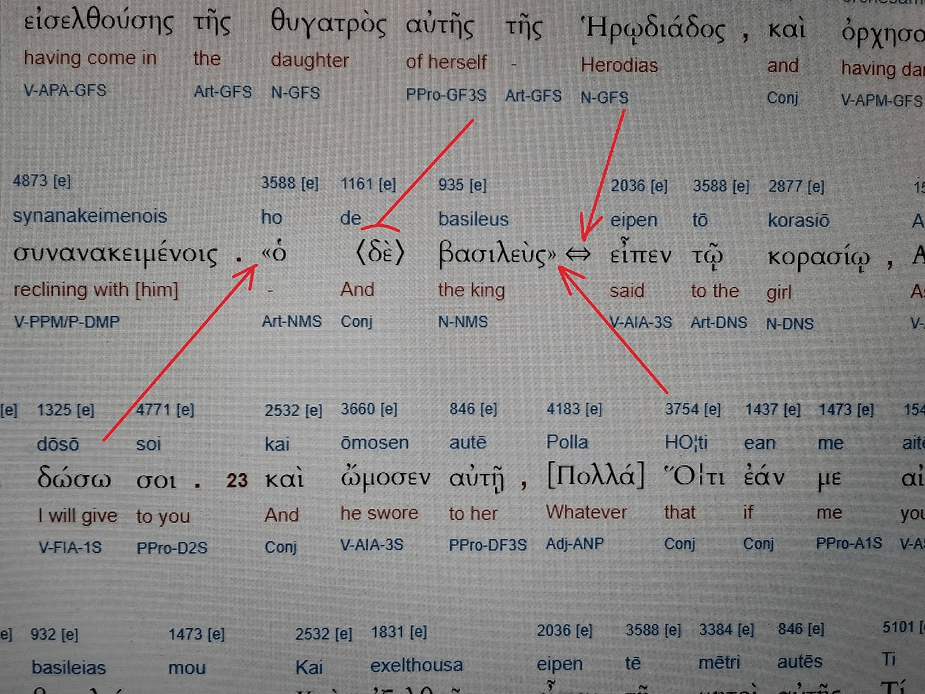
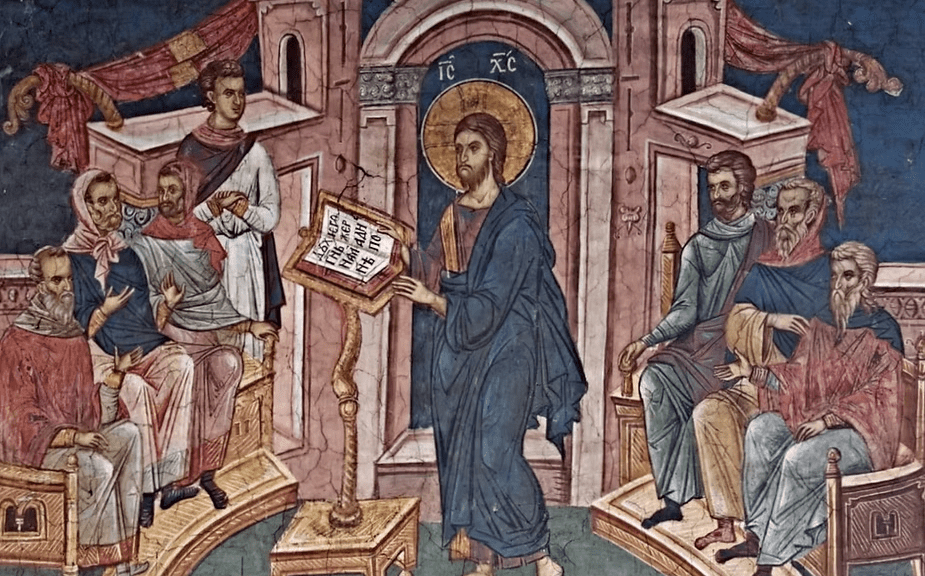
On the broad stroke view of this recollection of Peter, as written by Mark, it can be summed up as Jesus returning to Nazareth new to ministry; and, he was asked to speak [probably after offering his ministerial services] on a Sabbath meeting at the synagogue.
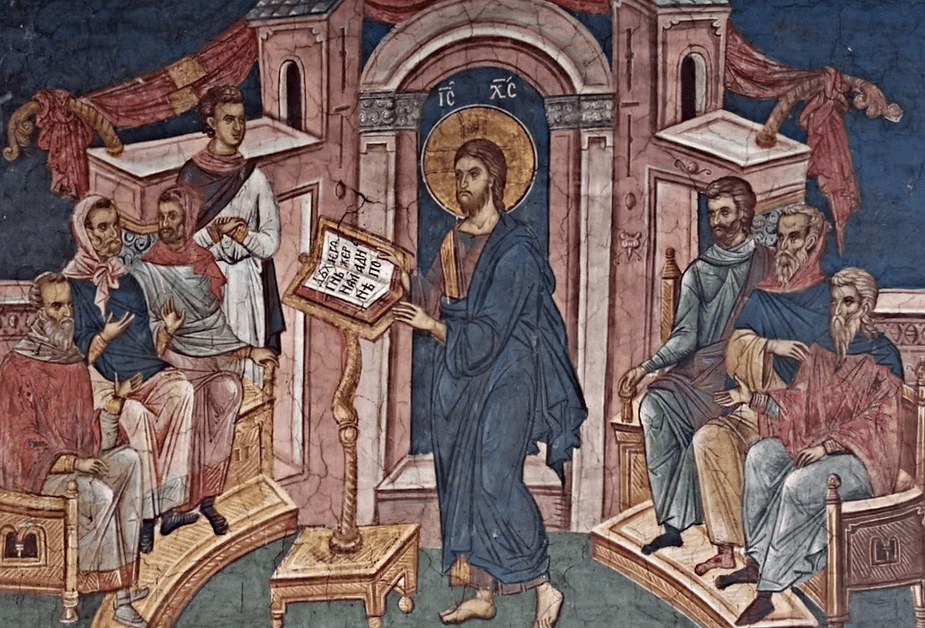
When he spoke, the people were shocked and angered. They struck out at Jesus for having the gall to use their offer as some way of making a name for himself. By mentioning the names of Jesus’ family, they were threatening him with holding them responsible for his actions. Such mention could have produced bad side effects, such as them being banished from their house of meeting. In the same way the Jews of Nazareth were shocked at what Jesus said, Jesus was led to wondering how anyone could reject the presence of Yahweh [by extension into flesh] in their midst. After all, the only reason for Jews meeting on a Sabbath was to keep in touch with Yahweh.

After Jesus left Nazareth, he commissioned his disciples to go out in pairs into ministry. He gave them specific instructions, along with the same powers of Yahweh to heal and cast out unclean spirits. Most likely, the disciples would go to their hometowns, where they would be recognized and more readily accepted. Jesus prepared them for the same rejection he experienced by telling them, “If any place will not welcome you and they refuse to hear you, as you leave, shake off the dust that is on your feet as a testimony against them.” They would do feats as Jesus had done in Nazareth. The unspoken message says they too were rejected in their hometowns, simply because everyone knew them as mere mortals.

The direction I want to take this rather simple reading is to see how the Jews of Nazareth were not ever expecting any real sign of Yahweh watching over them. For all the time they spent ritualistically doing the same things, Sabbath after Sabbath, nothing ever changed. The leaders of the synagogues and the rabbis would read dry scrolls and offer a few words that had little to do with the truth; and, then everyone would all go home happy, feeling like Yahweh was pleased with their rituals that were designed to impress Him. Woe be it to anyone who would come in and rock that boat and make waves.

For a people to consider themselves to be the children of God, one should expect them to be happy that Yahweh would send someone to fulfill the prophecies of the prophets, those which all expressed belief in. The problem the Jews had – and that problem went all the way back to the beginning with Moses leading the Israelites out of Egypt – is they never could take hold of the model intended for them all: to actually be a child of God. That model was designed so each individual Israelite was supposed to be a holy priest of Yahweh, which meant they were all supposed to be souls married to Yahweh. As such, they were all just as Jesus had said, “Today this scripture is fulfilled in your hearing.” (Luke 4:21 addition to this same story)

The problem was they all expected some kingly warrior to come in and announce, “Everyone stay where you are while I single-handedly defeat the Roman Empire and any others who object to my returning this land to its rightful owners!” Had Jesus said that – and looked the part (which he did not) – then everyone in Nazareth would have stood up and cheered. “Hip hip hooray for Jesus, our new king has arrived! Long live the king!” Then, they would have happily gone back to pretending to please Yahweh.

The significance of Jesus sending out his disciples after his being rejected in Nazareth says Jesus (himself) was the epitome of what a true synagogue was. When Jesus said, “Prophets are not without honor, except in their hometown, and among their own kin, and in their own house,” that said the responsibility for being a “prophet” [from “prophētēs”] means being “a person gifted at expositing divine truth.” (Strong’s Usage) Outside the family of kin – primarily those living under the same roof – everyone else was suspect. Rather than looking for reasons to believe, they were trained to look for flaws.

When a “prophet” is seen as the father-husband of a family, this brings out the truth of what Jesus said; which is: Not being a prophet is without honor.” Each head of household is expected to be “a person gifted as expositing divine truth.” When one does “Not” meet that requirement that lack means there is no “honor” coming from Yahweh. The same lack of respect for such a person who is “Not being a prophet” should make him an “exception” – an outcast – in his hometown. Their own kin should show them disdain; and, that includes a wife and children, those all under the same roof as one who does Not serve Yahweh as His priest. Jesus saying that called all the Nazareth Jews out as Not being able to tell him, “Hey Jesus, wasn’t that reading from Isaiah talking about you?”

Of course, the double-edge of what Jesus said says the truth that is the translation by the NRSV, which is the only way most people [if not all] read those words. The truth stated was Jesus was a true “prophet,” who was rejected in his hometown. Rather than him being rejected by his family and neighbors, the “kin” of Jews meant anyone born of a Jewish mother and practiced what is now called Judaism was his relatives, at least in his hometown. Those who knew the kin of Jesus [they did not really know Jesus, because he had gone away from many years] knew Joseph was a carpenter. While Joseph would have been homeschooled and taught his children what he knew, he was not recognized as a rabbi. The opposite edge of the sword of condemnation said, “If anyone other than a hometown boy had come in and said such things, he would be more believable than someone everyone knows is just as wayward as everyone else.”

When Jesus sent out his disciples in pairs, he “gave them authority over the unclean spirits.” That becomes a statement that those in Nazareth who rejected him had “unclean spirits,” but Jesus’ disciples had been made “clean souls.” That says the past does not make the future a certainty, as things [like redemption] can change.

In the Greek that is written, what is more appropriately stated by Mark is this: “he delivered to their souls power to act of them souls impure” [from “kai edidou autois exousian tōn pneumatōn tōn akathartōn”]. Because that statement is preceded by the marker word “kai,” that marks it as an important statement that “themselves” [from “autois,” where a “self” is a “soul”] were made spiritually pure, which is how one truly becomes a child of God. Only those whose souls have been cleansed of past sins become “clean” or “pure,” and all priests of Yahweh have that expectation. Along with that purity of soul, they are then empowered to go into ministry with the “authority” to lead other souls to become clean.

The history of the Israelites led them away from ‘the big city’ that was the hustle and bustle of Egypt. It took forty years alone in the wilderness, just so all the elders who remembered what civilization was like died. After that, all who entered the Promised Land knew marrying their souls to Yahweh was the only way to survive in a land that had peoples of unclean spirits wanting to kill them for not belonging there. Canaan was not their ‘hometown.’ After forty year the Israelites began to regress and they became influenced by those unclean spirits. Their souls likewise became unclean; and, once that happened, then things would go bad for them … until they prayed for saving. The message Jesus told his disciples to take was for “all to repent.”

Those prayers of repentance would have some judge be given the power of authority over the unclean spirits; and, from them leading the way the other Israelite people would follow suit. After they all got back on board the purity train, they would live in peace for forty years. Then the same thing would happen all over again, and again and again. It was the yo-yo effect of the people needing some one to be their priest of Yahweh that would keep reminding them all to repent and be pure. Then, the Israelites got tired of so much responsibility being placed on the individual souls that they told their judge [Samuel] to appoint them a king.

The point made by wanting a king, rather than a judge coming from out of nowhere – a true prophet of Yahweh who communicated with Him daily – a king would be a strong man who would force the people to follow rules. When a king died [and all judges also died eventually], then the oldest son would continue that line of rule; so, a blood line would replace a spirit line. When the elders went to Samuel, they asked for a king because his sons were not pure spirits like Samuel. The same fate befell Eli, the prophet before Samuel. They proved blood has nothing to do with a soul’s purity.

David was born of normal blood, as the youngest son of Jesse the Benjaminite. When Saul went against the command of Yahweh, given to him through Samuel, Yahweh anointed a boy’s soul to be the king-in-waiting. That anointment was spiritual, which made David’s soul clean. When David became the King of Israel and Judah, he was told by Yahweh:

“You’re it. I will anoint no more kings for the Israelites. They had me as their eternal king. You will be my hand on earth who will lead them like a judge in my name. After you die, the people will have to make a choice. Either they make me their individual king as it was before, or they choose your issue and become like other nations, which rise and fall like the tides and bend every which way with the changing winds of time.”

This conversation between David and Yahweh is unwritten; but the truth is what happened afterwards. After David’s illegitimate issue died [Solomon was born of David’s unclean spirit, not a pure soul], Israel and Judah once again split. The Israelites saw Solomon’s heir like their forefathers had seen the sons of Samuel [and Eli’s]. The reason for this split was a curse had been placed on the land, as the people began to worship the land [and whoever was named the king] much more than Yahweh. They called themselves the children of God, while doing nothing to repent and make their souls pure. The only ones who tried to warn them to return to Yahweh and repent were the prophets whose souls married Yahweh and became his priestly servants.

The curse began when Yahweh told David to take Jerusalem and make it his city of government. The Jebusites had played a role as servants of Yahweh, who protected the land for the Israelites. When things got bad for the Israelites, the Jebusites called out to Yahweh for a judge to be sent. When Yahweh anointed David’s soul as the King of Israel, he also told him to take Jerusalem and void that contract with the Jebusites. Once Jerusalem became the governmental center of Israel, it was up to David to lead the souls of the Israelites to likewise marry Yahweh and serve Him, because when David stopped being that judge over their souls, then there would be no more.

The loss of the lands then became the history of Israel and Judah. There is no land that is protected for them anymore. There never will be. When Jesus met with Nicodemus and told that ruler of the Jews, “Very truly I tell you, no one can see the kingdom of God unless they are born again,” [NIV] Jesus said that because Nicodemus approached Jesus as a recruit who clearly had the qualities of a judge. Nicodemus had told Jesus, “Rabbi, we know that you are a teacher who has come from God. For no one could perform the signs you are doing if God were not with him.” [NIV] Whether or not the ulterior motive of Nicodemus was to use this God-like powers of God, seen in Jesus, for the possible restoration of the land to renew Israel, Nicodemus was moved to speak in terms of the idiocy of that potential.

Nicodemus said to Jesus, “ How can someone be born when they are old? Surely they cannot enter a second time into their mother’s womb to be born!”

That was God moving his lips to say why Israel would never be resurrected. Israel had been born through its death as a nation [twice]. The baby had been born into the world, as soiled and as unclean as it was. There would never be a return to the former glory of having been a divine fetus implanted into the womb of Canaan, watched over by the midwife Jebusites. The stupidity of Nicodemus was spewing the curse of David moving his capital city to Jerusalem. The only way to be born again was to cleanse their souls through marriage to Yahweh, each soul in the flesh becoming a kingdom of Yahweh – a priest of God – each “a person gifted at expositing divine truth.”

This all means the reason Yahweh sent Jesus to be born was so his soul could pass the purity it possessed to disciples, who would then be reborn with souls pure. They would then be sent out in pairs, in much the same way judges would appear and move the people to follow their lead. Unlike the judges, the first Apostles were sent as reproductions of Jesus, each a soul that had married Yahweh and received His Spirit and the soul of Jesus to be their Lord. They would be multiple Jesuses who would spread the reality of what a true child of God is – a wife of Yahweh reborn as Jesus. There would be no worship of land in this process, as the flesh would become the temple, with Yahweh the King and Jesus the High Priest – in the order of Melchizedek, meaning a High Priest who would never die.

Herein lies the reason this reading is read, as nothing has changed. Everything remains the same. Christians have become just like the Israelites. They reject anyone who enters their churches and tells them they have it all wrong. They are not supposed to be sitting on their asses thinking they are the chosen ones of God, because that is a condemnation of their souls for thinking such. Each needs to be touched by a true Christian – an Apostle, a Saint – and led to feel the power of authority their souls have been given by Yahweh, as Jesus resurrected in new flesh. A true Christian then goes out into the world as a servant to Yahweh, as a priest reborn in the name of Jesus Christ.

As a Gospel selection for the sixth Sunday after Pentecost, when a personal ministry to Yahweh should be well underway, this says one is either Jesus reborn or one is those who reject Jesus. The rejection of a minister given divine authority means that is a soul’s right. The lesson one must be made aware of is this: You reap what you sow. To reject Jesus [in any human form presented before you] means your soul will be rejected when the true Judge determines your fate. The lesson is to do unto others as you would have others do unto you. To reject means to be rejected.
Psalm 48 – Becoming a citadel of Yahweh

1 Great is Yahweh, and highly to be praised; *

in the city elohenu is his holy hill.

2 Beautiful and lofty, the joy of all the earth, is the hill of Zion, *

the very center of the world and the city of the great King.

3 elohim is in her citadels; *

he is known to be her sure refuge.

4 Behold, the kings of the earth assembled *

and marched forward together.

5 They looked and were astounded; *

they retreated and fled in terror.

6 Trembling seized them there; *

they writhed like a woman in childbirth,

like ships of the sea when the east wind shatters them.

7 As we have heard, so have we seen,

in the city of Yahweh of hosts, in the city elohenu; *

elohim has established her forever.

8 We have waited in silence on your loving-kindness, elohim, *

in the midst of your temple.

9 Your praise, like your Name, elohim, reaches to the world’s end; *

your right hand is full of justice.

10 Let Mount Zion be glad

and the cities of Judah rejoice, *

because of your judgments.

11 Make the circuit of Zion;

walk round about her; *

count the number of her towers.

12 Consider well her bulwarks;

examine her strongholds; *

that you may tell those who come after.

13 This elohim is elohenu for ever and ever; *

he shall be our guide for evermore.

——————–

This is the accompanying Psalm for the Track 1 Old Testament possibility from 2 Samuel 5, which says, “David occupied the stronghold, and named it the city of David.” If selected, it will be the “Response” read aloud in unison or sung by a cantor on the sixth Sunday after Pentecost {proper 9], Year B, according to the lectionary for the Episcopal Church. The will precede a reading from Paul’s second letter to the Corinthians, where he said another and himself were “caught up into Paradise and heard things that are not to be told, that no mortal is permitted to repeat.” All will accompany the Gospel reading from Mark, where Jesus “called the twelve and began to send them out two by two, and gave them authority over the unclean spirits.”

I have amended the language above so it correctly states “Yahweh,” rather than the generic insult stated as “Lord.” More importantly, this song of praise accompanies a reading that tells of David taking Zion as his stronghold. He took Jerusalem from the Jebusites, who were not truly human beings. They were elohim, like David, due to their souls having been forever committed to serving Yahweh. David wrote about them in the Psalm, which is not readily seen because translators fail to translate what is truly written as what is truly written. I will explain these uses verse by verse.

In addition to liberties taken by translators, such as the New Revised Standard Version [NRSV], the Episcopal Church has waved its magic wand over this song and changed it from the fourteen verses it is, into one shown as thirteen verses. The NRSV agrees that this is fourteen verses, so the Church has condemned itself before Yahweh for promoting itself as a god that can mislead the flocks. I will explain each verse as is written, leaving the Episcopal Church to explain why it went against divine text as a false shepherd.

This song is identified by David as being written and composed as one “of the sons of Korah,” which needs to be understood. The Israelite Korah led a rebellion against Moses and Aaron in the wilderness [story told in Numbers]. As punishment, Yahweh caused the earth to open up, swallow Korah and then close up. Korah can then be seen as having gone underground. Samuel, a great prophet, was from the line of Korah – a name meaning “Baldness” [Abarim Publications] – and “the Korahites became doorkeepers and custodians for the tabernacle.” After David became king, the Korahites assisted him in battles. [Reference] Still, it must be understood that all of this history stems from the one man who led a rebellion against Moses and Aaron and who was swallowed up within the earth. The sons of Korah can then be understood to be Jebusite allies who assisted David’s reign, with eleven Psalms written and composed that are announced as being relative to them.

With this understood, verse one then sings, “Great is Yahweh, and highly to be praised; in the city elohenu is his holy hill.” This gives immediate praise to the greatness of Yahweh [not some generic “Lord”] as ALL elohim are His creations and from them were created the material universe, according to Yahweh’s plan. Mankind is then a breath of life in a body of flesh, which can be possessed by elohim.

When Korah rebelled, he was a custodian of the Tabernacle as a Levite under Aaron, but he also wanted to be a high priest as was Aaron. His followers among the Israelites were destroyed by fire and plague, to remove dissent from the midst of the whole. As punishment, Korah was forced by Yahweh to forever guard the city named Jerusalem, which was on and within Mount Zion [and beyond]. Yahweh made his descendants [his sons] be the protectors of the land given by Yahweh to those whose souls would be His wives. Thus, David moved from Hebron to Jerusalem, as a way of Yahweh releasing the Jebusites of that responsibility.

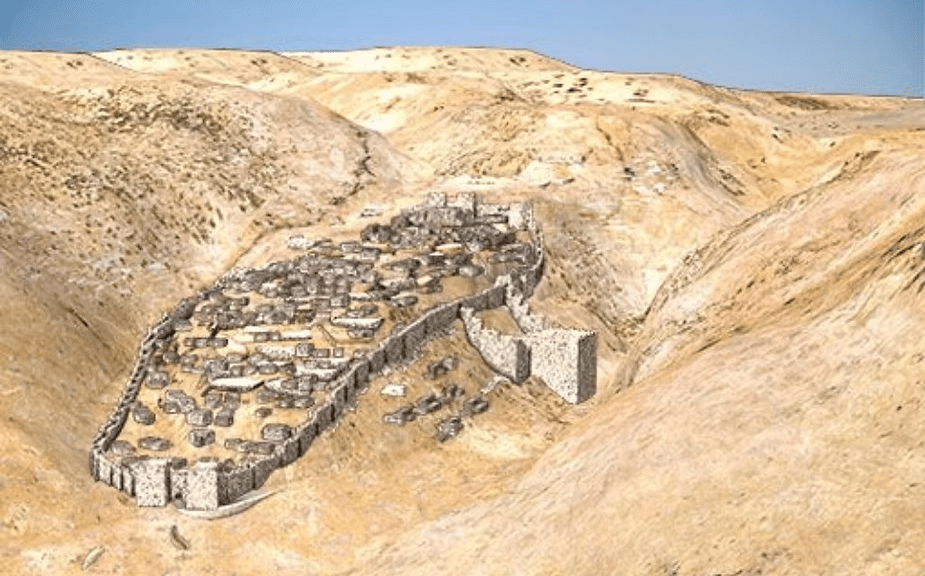
Verse two is then translated by the NRSV to state: “Beautiful and lofty, the joy of all the earth, is the hill of Zion, the very center of the world and the city of the great King.” In reality, the verse begins with the Hebrew words “yə·p̄êh nō·wp̄,” which actually say “appropriate elevation” or “fair [fitting] height.” When this then leads directly to naming “Mount Zion” [“har- ṣî·yō·wn”], this must be seen as a statement about the lowest of the seven hills in the Jerusalem area. That “height” is easily surmounted by all foes, thus a beautiful site for an invader’s eyes to see. To say that mount is “the joy of all the earth” misses the point that underneath that “hill” is the gate to Eden, which is truly “the joy of all the earth.”

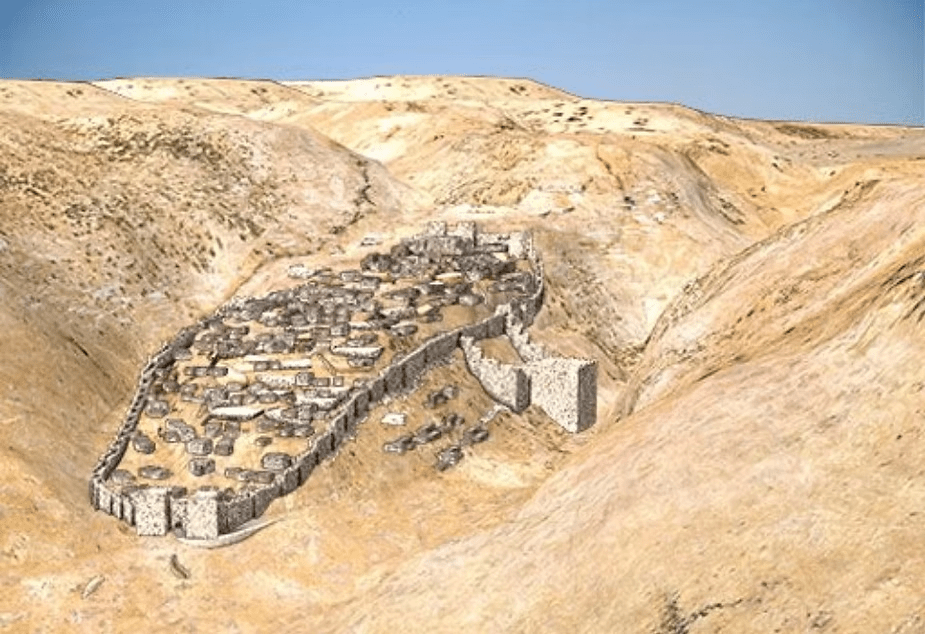
This is a good representation of how everywhere other than Mount Zion was strategically superior.

The addition of “the very center of the world” is a mutation of that written, which literally says “the sides north” [“yar·kə·ṯê ṣā·p̄ō·wn”]. As far as Biblical symbolism is concerned, the meaning of “north” is this: “the north—represented by the left hand—is also a symbol of disaster. The enemy of God’s people came from the north (Jer. 1:14, 15; Eze. 38:6), bringing destruction. In a sense, the enemy was the false king of the north who tried to usurp God’s role and is finally destroyed by the Lord (Zeph. 2:12; Dan. 11:21-45).” [Reference] The inference as at “the center of the world” says insight makes this within the earth, not on the surface. However, the truth of “the sides north” says it was a place watched by those who were the enemy of the people, those who were not truly Israel reborn [a name meaning “He Retains God”].

To further grasp this darker meaning as the intent, when David then added “city of the king of many,” that “king” [“me·leḵ”] was Melchizedek. Melchizedek had become a son of Korah [a son of Hebron], who ruled Salem [or Jebus or Jerusalem] by the will of Yahweh. Melchizedek never died, he ascended, so he could always come back whenever needed.

Verse three then says, “elohim is in her citadels; he is known to be her sure refuge.” Here, the use of “elohim” must be seen as intended to define the “sons of Korah,” who were divinely married souls that were possessed by Yahweh, in the same way as was David. The “elohim” are the equivalent of demi-gods, in the sense that they have divine powers afforded them, through their complete subservience to Yahweh. This means “her citadels” are the strongholds underground, such that “her sure refuge” was not some low hilltop, but the depths of tunnels underground.

Verse four then sings, “Behold, the kings of the earth assembled and marched forward together.” This verse is better translated as: “when found the royals appointed they passed through together.” The true meaning of “the royals” or “the kings,” seeing how David wrote this as only the third King of Israel in their history, with Saul and Ish-bosheth being the two prior losers, the intent is to point out the judges who routinely saved the Israelites. Those judges [including Samuel] were “together with” the “elohim” sent by Yahweh to lead the people back to serving Him. That history is what David said to “Behold!”

Verse five then sings, “They looked and were astounded; they retreated and fled in terror.” The translation of “they” must be seen as double-edged, where the acts of the judges did amaze those they defeated, but likewise the people of Israel. The words of the second half of this verse say “they were troubled and they hastened away.” Here, “they” is more in line with the people of Israel being “terrorized” with how their waywardness was about to ruin all their souls. So, while the enemies also were filled with terror and fled, the Israelites turned away from their sins and gave praises to Yahweh again.

At this point the Episcopal Church has changed this song, so their translations will be tossed aside, so my literal translations can be presented. Feel free to compare this breakdown to the above presentation to see where they have become false shepherds.

Verse six then literally sings, “trembling took possession of them there , writhing as a woman in birth pangs.” Here, this must be seen as the transformation of the Israelite people, who had been led by judges “together with elohim,” where the souls of the judges had likewise been “taken possession” by Yahweh’s Spirit. This divine possession makes their demon spirits within writhe in pains as they are cast out, no longer having control over human flesh. Thus, the comparison to a woman in labor pains says the Israelites were being reborn as truly Yahweh’s people, divine “elohim.” Rather than giving birth to a baby, they were casting out demon spirits and themselves being reborn as clean souls.

The true verse seven then sings, “with a spirit east , you break to pieces the ships of Tarshish.” Here, one finds David balancing “the sides north” with “a spirit east” [“bə·rū·aḥ qā·ḏîm”], where “east” becomes a reference to Eden. [Reference] This then has the intent of saying that the divine “elohim” that possessed the judges and thereby transferred to the souls of the wayward Israelite people, the “tree of life” [guarded by the Cherubim who descended into Jebusites] made all who were so possessed empowered to defeat the influences of sin. Those influences are then said to be like “the ships of Tarshish,” where the name “Tarshish” means “Breaking, Subjection.” The root word means “to break down and shatter,” which would be the influences to break down one’s commitment to Yahweh and shatter the Covenant. Because Tarshish was known as a seaport with many ships in its fleet, so it could have a far-reaching effect of foreign shores, the metaphor used by David says the Spirit of Yahweh shattered and broke to pieces all such foreign influences that always led to sin.

Verse eight then adds, “who we have heard , thus we have seen the city of Yahweh’s army in the city of [His] elohenu ; gods will set firm there forever . Selah”. In this, twice is written “bə·‘îr,” the first time joined with Yahweh, as “in the city of Yahweh” and again as a separate word leading to “elohenu,” which are “His gods” as divinely possessed earthly beings. The meaning of “in the city of Yahweh” must be understood as “Eden,” such that the word translated as “city” actually means “excitement.” This says a “city” is a place of “excitement,” where the “excitement” of “Yahweh’s place on earth” is the place where “elohenu” praise Yahweh constantly – a heavenly place. Such a place on earth is Eden. Eden has been guarded by Cherubim ever since Adam and Eve [and serpent] were cast out. Those guards have “been set firm” to ensure the path to the tree of life is forbidden to sinners. With that “city of Yahweh” being seen as Jebus or Jerusalem, the “army” or “host” of Yahweh are the Jebusites.

At the end of this one verse [one of fourteen] is found the word “Selah.” This word is not fully grasped by Biblical scholars. Many believe it is a note to the musicians to recognize, in their accompaniment to this song. However, the word in Hebrew means “to exalt, to lift up” and that meaning the “heavenly host” – the “elohenu of Eden” – are constantly singing praises that exalt Yahweh, while Yahweh “lifts up” their souls as heavenly beings.

Verse nine then sings, “we have become like gods from your lovingkindness , in the midst of your temple.” In this, the Hebrew word “dim·mî·nū” is written, where the root word is “damah,” meaning “to look like, resemble.” This has erroneously been translated as saying “wait silently.” The meaning must be seen as like that stated in Genesis 1, where the “elohim” made mankind [males and females] in their likeness. Now, the souls of David and the Jebusites “have become resembling gods,” as having been souls reborn as the “elohim” by Yahweh’s divine Spirit possessing them. Thus, “in the midst” becomes the same as the tree “in the midst” of the garden [or enclosure], where a soul is “in the midst” of one’s body of flesh. When Yahweh’s Spirit possesses that flesh, joined in marriage with a soul, the flesh becomes a “temple.” Thus, the “kindness” and “goodness” is extended to the plane of the earth through the hands of Yahweh that are His “elohim.”

Verse ten then sings, “from your name elohim , thus your praise to the boundaries of the material plane , righteousness , it is fully placed into your right hands [by you].” In this David clearly wrote “in the name of gods,” which is no different than the association of Jesus and all his Apostles as “being in the name” that is holy. What David made clear is only elohim are in the “name” of Yahweh [not some lesser generic “lord”]. Bein a divine “elohim” means being a Saint. Jesus and David were both “elohim,” as both were divinely possessed by Yahweh, through having [a word meaning possession] His Holy Spirit poured into their souls, as Anointed by Yahweh. Thus, all who are the “elohim” on the material plane will forever “praise” Yahweh by speaking what He tells them to say. They will only live “righteously.” They will all become His “right hands” as His servants [souls having become His wives in marriage].

Verse eleven then sings, “let rejoice ׀ Mount Zion , let rejoice the daughters of Judah , the purpose , of your judgments.” Here, the element of “rejoicing” or “being glad” is repeated, once alone and once joined with “the daughters of Judah.” The stand alone rejoicing is the presence of Yahweh as a potential Husband, whose offer of marriage goes out to all souls, seeking all to become His “right hands” in marriage [soul to Spirit]. That proposal is worthy of celebration. Mount Zion is separately stated as that is the altar where a divine marriage takes place metaphorically. David placed the Tabernacle, with the Ark of the Covenant and altar, on Mount Zion, atop steps that ascended from below. Physically, “Mount Zion” is the mound of earth covering the gate to Eden and the tree of life. Marriage allows one’s soul to find that path to eternal life. Thus, the celebration of eternal life must be shouted by all the “daughters of Judah,” as Judah is where Mount Zion is located. The “daughters” means the bodies of flesh [males and females] whose souls will be married to Yahweh’s Spirit, with Him the Husband. The “purpose” of marriage is to gain eternal life, for all made of flesh will find death leading a soul’s release to judgment. Wives of Yahweh will rejoice for their souls will have been forever saved.

Verse twelve then sings, “turn about Zion , and surround her , and count her towers.” This is a statement about the move of David from Hebron to Jerusalem, where the control of that citadel had “turned about” and changed hands. The walls of Zion became the City of David, which became the outer shell of that temple. The “towers” were metaphor for all who had taken that place and flown the flags of human rulers over that spot. David was the first and the Jebusites flew no flag and took no pride in a fortress built on the lowest hill in that area.

Verse thirteen then sings, “set well her soul defenses , go through her citadel , purpose you may recount generations following.” This is a clear call for all the Israelites to become like Jerusalem and marry their souls to Yahweh, bringing about His “bulwark” of strength protecting them from being overtaken by invading sins. Each Israelite was asked to become a model of that sanctuary of strength. The reason was for the continued success of Israel – as individuals, a people, and a nation – was so that all would realize the necessity of being seen as “He Retains God” [the meaning of “Israel”]. The call by David was for future generations beyond that one under David to follow suit, forevermore.

Verse fourteen then sings, “for this gods our gods forever and ever , he will be our guide to death.” Here, the words “elohim elohenu” must be read as “gods our gods,” so it becomes a statement of the continuation of “elohim” in the name of Yahweh. The future “gods” in His name will then be due to the “gods” of David and the Jebusites and the following Israelites, so one set of divine “gods” produce regenerating souls married to Yahweh, possessed by His Spirit. This was David’s prayer in song, as all souls born into bodies of flesh will find death eventually. Only those who would be guided to salvation as an “elohim’ will not be condemned to repeat life and death, through reincarnation.

This reading certainly fits the theme established in every other reading choice for the sixth Sunday after Pentecost. It explains why David moved to Jerusalem and took control of the citadel of the “elohenu” who were the Jebusites. As a song of praise during a time when all true Christians should be in ministry for Yahweh [not some unspecified “Lord”], this sings praises about oneself becoming a fortress of God, as one of His “elohim.” The only way to lead another soul to salvation is to know firsthand the experience of Yahweh’s presence within, when one is “in the name of Jesus Christ.” One must have lived the truth of Yahweh in order to preach the truth for others to hear.

Psalm 123 – The scorn of the indolent rich

1 To you I lift up my eyes, *

to you enthroned in the heavens.

2 As the eyes of servants look to the hand of their masters, *

and the eyes of a maid to the hand of her mistress,

3 So our eyes look to Yahweh elohenu, *

until he show us his mercy.

4 Have mercy upon us, Yahweh, have mercy, *

for we have had more than enough of contempt,

5 Too much of the scorn of the indolent rich, *

and of the derision of the proud.

——————–

This is the Track 2 accompanying “Response” to the Old Testament reading choice from Ezekiel 2, when Yahweh told him, “son of man, stand up on your feet, and I will speak with you.” If chosen, this will be read prior to the Epistle reading from Second Corinthians, where Paul wrote, “Three times I appealed to the Lord about [a thorn that was a messenger of Satan to torment Paul], that it would leave me, but he said to me, “My grace is sufficient for you, for power is made perfect in weakness.” All will accompany the Gospel reading from Mark, when “Jesus came to his hometown, and … they took offense at him.”

In the above, I have made changes in the English translation where “Yahweh” is written but translated as some unknown “Lord.” David knew Yahweh because his soul was married to Yahweh and David called his Spiritual Husband by His name. In addition, I have returned the Hebrew word written – “elohenu” – rather than let the mistranslation as “our God” stand. First, the word is written in the plural and must be seen as a word that denotes a soul that has married with Yahweh’s Spirit, as those demigods who have become divinely possessed, as His wives on earth. Finally, the numbering of this song of praise – a Song of Ascent – has become the creation of the Satanic church calling itself Episcopal. The New Revised Standard Version [NRSV], which the Episcopal Church lectionary page claims to be the source of its translations, clearly lists this psalm as having four verses. Please contact them and inquire as to what god they worship that gave them the idea they could rewrite divine Scripture. I will write about the meaning of the four verses based on the numbers written by David.

In the first verse, the meaning of “I lift up my eyes” must be read as beyond the scope of physicality. There are no “eyes” that can see Yahweh. If one were to see Yahweh physically, one would be die. Being removed from one’s sack of flesh means one’s soul no longer has the limitations that a body of flesh places on a soul. Physical eyes cannot possibly see spiritual things. Therefore, “lift up” becomes a statement of divine elevation, so “eyes” takes on the figurative meaning of spiritual trust for insight.

This means the second half of verse one is then saying Yahweh is not external to oneself [a “self” equates to a “soul”], but within one’s being. The place where Yahweh “dwells” [mistranslated as “enthroned”] is with one’s soul in one’s flesh, together as one, due to marriage of one’s soul to the Spirit of Yahweh. As such, one becomes mereged, as His hand reached into the physical realm. Thus, “the heavens” are not some distant place [such as outer space or in a cloud in the sky] but within; such that “heavens” are the source of life within dead flesh – souls plus possessing spirits. The plural form, as “heavens” rather than “heaven,” means there is a soul within each human being and this soul become a “heaven” when married to Yahweh’s Spirit, so many “heavens” are possible.

When one realizes this is a Song of Ascent, it was designed to be sung by Israelites walking up the steps carved into Mount Zion to the altar at the Tabernacle. This song was then like a marriage march, so one’s physical “eyes” could be raised to see the fire burning on the altar of spiritual marriage to Yahweh. As such, the smoke rising from the altar fire would be representing the transformation of a soul, from the flesh to the spiritual. This song was meant for all devout Israelites to sing as a vow before marriage, with the Covenant being the bond that held the soul to the Spirit forever.

Verse two then sings, “behold! as the eyes of the servants to the hand of the masters , as the eyes of the maidservant to the hand of her mistress , so our eyes to Yahweh us gods , until he has shown favor to us .” In this, the first word places focus on “beholding,” where this is more than a vision, as a presence that is felt and understood as all-powerful. The two aspects of metaphor [“servants” and “maidservants”] reflect both men and women are called to be “subjects” or “slaves” as wives to Yahweh. This relationship shows a union recognitzing that a “master” or a “mistress” is a source of stability and security, as a symbiotic necessity. The “eyes” are not to be read as for physical sight, but symbolic of an ability to see the value of servitude. Both men and women are then called to become the “hands” of a greater source of wealth and benevolence than can ever be the worldly reality of most.

It is here that David combined “Yahweh elohenu,” which is a statement of possession [like the genitive in Greek], which says “the gods of Yahweh” or “Yahweh’s gods.” The possessive form is attached to the plural “elohim,” which then says all of these “elohim” are divinely generated by Yahweh alone. Again, the “elohim” are the demigods formed from a soul marrying Yahweh and receiving His Spirit which makes those souls special: one Anointed [a Greek Christos] and Sacred – Set apart as holy – a Saint-Apostle. The plural number here says David wrote a song for all the Israelites to sing as they celebrated their individual soul’s marriage to Yahweh, where they would begin to see [be the “eyes”] as Yahweh led them to see. Lastly, this transformation within one marrying Yahweh – becoming His servant as a wife – would bring about the greatest favor of redemption and salvation, so eternal life would be granted for one’s payment in servitude.

Verse three then sings, “show favor to us Yahweh be gracious to us , for a great many , we are satisfied with contempt .” This becomes a prayer of repentance, as it confesses one’s waywardness that must come before the marriage becomes official. This Psalm is sung in accompaniment with the reading from Ezekiel 2, when that holy prophet had become married to Yahweh and was then sent out into ministry with the purpose of telling the wayward they too must repent or suffer the fate of their evil souls’ judgment. One must respect Yahweh as one’s Husband, acknowledging only He can show favor to a soul. If accepted as His wife in marriage, that favor will be His gracious forgiveness of past sins. A soul’s past debt will be wiped clean. This cleansing of spirits says many are still unmarried to Yahweh, as all have been filled with some level of contempt, as unwilling to submit totally or unworthy to be forgiven. This confession must be made to Yahweh to receive His forgiveness.

Verse four then sings, “a great many are filled to our soul with the scorn of those who are secure , with the contempt of the proud .” The above translation differs, as: “Too much of the scorn of the indolent rich, and of the derision of the proud.” The NRSV translation demans one see this only on the material view, which is not wrong, only limited. Again, as a companion piece to the fall of Jerusalem and the enslavement of the Judeans to Babylon, when Yahweh sent Ezekiel to warn them of His anger with their waywardness, this verse sings of David feeling then like Yahweh would feel in the end days to come. There is a false sense of security that comes when the flesh [and brain] enslaves a soul to do its bidding. Those souls then do not see any reason to themselves become a servant to anyone or anything [denying they are slaves to the flesh]. They bring ruin upon themselves [again, “self” equals “soul”] and those surrounding them as well. This makes those who serve Yahweh also feel His “scorn” as His “hands” on earth. This then ends with the identification of “pride” as a most deadly sin.

In the final days of Jerusalem, it was the pride of those who reigned as all-powerful in the Temple of Solomon that forever lost the land their forefathers had been given graciously by their Husband Yahweh. Their pride was in bloodline, not the spirit-line of souls marrying Yahweh. Their pride was centered on a birthright, seeing themselves [their souls] as the descendants of some people in the past who earned the right to call Canaan “Israel” and then leave it to their heirs in their deaths. When Yahweh sent Ezekiel [and Yahweh sent other prophets as well] it was to make sure the “sons of Israel” knew a prophet had been among them. It is this same sense of pride that leads Christianity to the same ruinous end.

As a companion song of praise to join with that Ezekiel reading on the sixth Sunday after Pentecost, when one’s personal ministry to Yahweh should be underway, the message here says one must find divine insight through a soul’s commitment to serving Yahweh [not some generic Episcopalian “Lord”] and become His “hand” on earth. This says one should go into ministry – as did Paul, as did Jesus, as did his disciples, and as have all true Christian Saints – to warn the wayward that they must repent and return their souls to Yahweh, before they die in the flesh and are forced to begin again in a new body of flesh [reincarnation]. The “scorn” felt by the souls merged with Yahweh [His elohenu] will lead them to find many who will reject them, as well as Yahweh.

2 Samuel 6:1-5, 12b-19 – Bringing the Groom to the bride

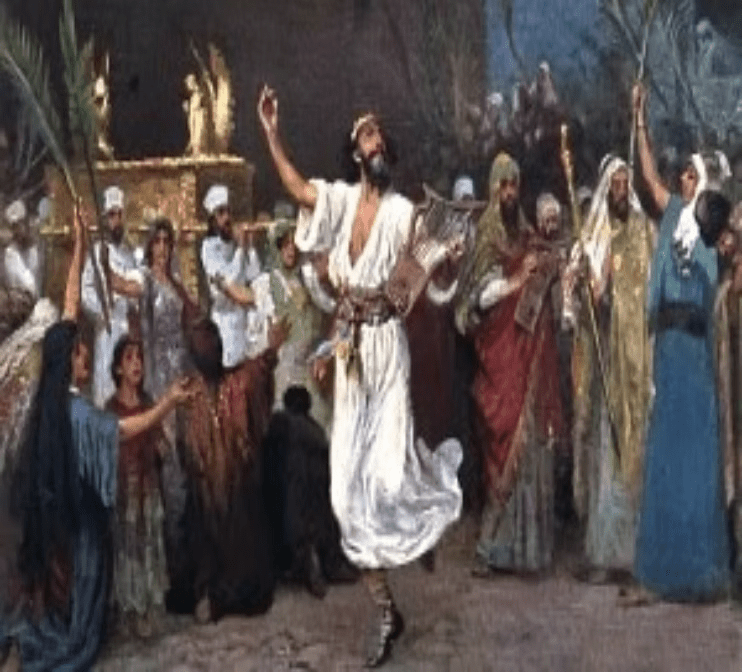
David again gathered all the chosen men of Israel, thirty thousand. David and all the people with him set out and went from Baale-judah, to bring up from there the ark of God, which is called by the name of Yahweh of hosts who is enthroned on the cherubim. They carried the ark haelohim on a new cart, and brought it out of the house of Abinadab, which was on the hill. Uzzah and Ahio, the sons of Abinadab, were driving the new cart with the ark haelohim; and Ahio went in front of the ark. David and all the house of Israel were dancing before Yahweh with all their might, with songs and lyres and harps and tambourines and castanets and cymbals.

So David went and brought up the ark haelohim from the house of Obed-edom to the city of David with rejoicing; and when those who bore the ark Yahweh had gone six paces, he sacrificed an ox and a fatling. David danced before Yahweh with all his might; David was girded with a linen ephod. So David and all the house of Israel brought up the ark Yahweh with shouting, and with the sound of the trumpet.

As the ark Yahweh came into the city of David, Michal daughter of Saul looked out of the window, and saw King David leaping and dancing before Yahweh; and she despised him in her heart.

They brought in the ark of Yahweh, and set it in its place, inside the tent that David had pitched for it; and David offered burnt offerings and offerings of well-being before Yahweh. When David had finished offering the burnt offerings and the offerings of well-being, he blessed the people in the name of Yahweh of hosts, and distributed food among all the people, the whole multitude of Israel, both men and women, to each a cake of bread, a portion of meat, and a cake of raisins. Then all the people went back to their homes.

——————–

This is the track 1 option for the Old Testament reading for the seventh Sunday after Pentecost [Proper 10], Year B, according to the lectionary for the Episcopal Church. If chosen, it will be paired with Psalm 24, which sings: “Who can ascend the hill of the Lord? and who can stand in his holy place?” That will precede a reading from Paul’s letter to the Ephesians, where he wrote: “In [Jesus reborn within] we have redemption through his blood, the forgiveness of our trespasses, according to the riches of [Yahweh’s] grace that he lavished on us.” Those will all accompany the Gospel reading from Mark, where is written: “When Herod heard of [Jesus], he said, “John, whom I beheaded, has been raised.”

In the above translation of the Hebrew text into English [said to be from the New Revised Standard Version], it should be noted that I have replaced all words translated as “the Lord” [in bold type] with the actual name written – “Yahweh.” In addition, all words translated as “the ark of God” have been returned to that written [in italics], as “the ark haelohim.” These changes force one to understand that this is “the ark of gods,” where the plural refers to the two Cherubim atop the ark. The Cherubim need to be recognized as the protectors of the ark. Thus, the ark represents both the presence of Yahweh and the presence of those divine eternal creations who forever guard where Yahweh is present.

I have written prior my interpretations of this reading, specifically back in 2018. Those views are still valid and I welcome all to read what I wrote then. You may search this site to find that article. I welcome comments and questions always.

The back story to this reading is the Ark of the Covenant had been lost in battle between the Israelites and the Philistines. This happened prior to Samuel becoming the judge of Israel. Eli was the prophet who tutored Samuel, and Eli’s sons died in the battle in which the Israelites were defeated and the ark taken. News of the loss caused Eli to die, which raised Samuel to become judge.

The ark was then moved by the Philistines from city to city, where they lived. Each move brought greater and greater plagues against them. After seven months they returned the ark to Beth Shemesh, where seventy Israelites died from looking at the ark. In 1 Samuel 7:1-2 this is written:

“So the men of Kiriath Jearim came and took up the ark of Yahweh. They brought it to Abinadab’s house on the hill and consecrated Eleazar his son to guard the ark of Yahweh. The ark remained at Kiriath Jearim a long time—twenty years in all.”

The statement about twenty years is then the time that elapsed before the Israelite elders demanded a king from Samuel. That says Samuel did not move the ark after it was set at Abinadab’s house in Kiriath Jearim; but after Saul was made king, it was moved for use in battle, then returned to the same place after use. A stone had been set there by Levite priests, for the purpose of setting the ark on it. One can then assume they also oversaw the construction and maintenance of a tabernacle to cover it while it was there. As Saul was king for twenty-two years and his heir Ish-Bosheth was king for two more years after Saul’s death, the ark had actually been at that site for roughly forty-five years before David became king at age thirty. It is more likely that the ark had been in Kiriath Jearim for fifty years, with the City of David refined and made ready to receive the ark properly.

The point of the ark being moved to Jerusalem must then be seen as another step that David was led to take, following the instructions of Yahweh. The change would have been relative to the removal of external protections of the land of Israel, forcing all Israelites to submit their souls in marriage to Yahweh. Because the ark had been in the same place for so long, with Gibeon being the official place of the Tabernacle, with Levitical caretakers in place for a long time there, there would be no reason to move it without the direction of Yahweh. That move then relates to David’s move to Jerusalem, when there was no need to leave Hebron and displace the Jebusites. Both moves were directed by Yahweh.

According to the website Abarim Publications:

“The name Kiriath-jearim obviously consists of two elements. The first part is the same as the name Kiriath, which is identical to an older variant of the Biblical noun קריה (qiryah), meaning city. It derives of the verb קרה (qara), meaning to meet or get together.”

“The second part of our name is a regular plural form of the noun יער (ya’ar), meaning forest, from the unused root יער: The verb יער (ya’ar) isn’t used in the Bible and it’s a complete mystery what it might have meant. Noun יער (ya’ar) is the common word for forest or thicket, and the identical noun יער (ya’ar) means honeycomb. It is, of course, perfectly possibly that these two nouns are not two but one, describing something general like a thing that consists of many elements, which contain energetic nutrients (either fruits or honey), and which are patrolled by ferocious animals. The latter noun also occurs as the variant יערה (ya’ra), honeycomb.”

Since it is less likely that a city would be placed in a forest, I am certain the place where the ark was kept was named the “City of Honeycombs.” That name would mean an underground system of caves that was where many lived. The history of Kiriath-jearim is that it was a Gibeonite city, who were a people much like the Jebusites. When Joshua was defeating all the peoples in the Promised Land, he encountered the Gibeonites, who said they were foreigners, which kept Joshua’s army from going to battle with them. Then, it was found that the ‘foreign’ place they were from was right in the middle of Canaan, so they were made the slaves of the Israelites and forced to serve in the tabernacles. It then becomes likely that the Gibeonites were indeed “foreigners” as “elohim.” The honeycomb city they dwelled in was underground, which became a sanctuary for the ark, as they had sworn themselves into service for the Israelite people, as maintainers of their holy place and ark. In the same way the Jebusites were allowed to keep Jebus [or Salem / Jerusalem], because they lived underground guarding the path to the tree of life, the Gibeonites were the keepers of the ark.

From this perspective, it makes it easy for me to read the three references to “ark haelohim” and see that as not only a statement about the ark having golden Cherubim on the top of the ark, but that the ark was so powerful it could not be entrusted to mere mortals to protect it. It had to be watched by “elohim,” who were the Gibeonites. As “elohim” created by Yahweh, being divine “foreigners” set in that most holy land, the movement of the ark demanded both the assistance of Yahweh and His “elohim.”

From this realization, one can more closely examine the Hebrew text that says, “‘ō·wḏ dā·wiḏ ’eṯ- kāl- bā·ḥūr bə·yiś·rā·’êl šə·lō·šîm ’ā·lep̄”, which literally translates as “again David with all chosen of Israel thirty thousand” (with no internal punctuation marks). While this assumes David personally chose all the young soldiers of Israel to accompany him for this mission, that number seems excessively high. After all, the ark was loaded on a cart pulled by animals, so it would seem ordering so many men to go with him for the trip would have meant they would get in the way, more than help. The Philistines had no desire to come near the ark, so the men would not be needed for battle. This means it would be a stronger translation to see those “chosen of Israel” were not Israelites but Gibeonites, who lived in the City of Honeycombs and whose ancestors had been chosen by Joshua to guard and maintain the Tabernacle, which for the past fifty years housed the Ark of the Covenant.

Those Gibeonites numbered thirty thousand.

Verse two actually supports this concept totally. The NRSV translation [with my restorations] says: “David and all the people with him set out and went from Baale-judah, to bring up from there the ark haelohim, which is called by the name of Yahweh of hosts who is enthroned on the cherubim.” The literal breakdown shows: “and went David , and all with the people , from Baale Judah , to ascend from there , the ark of elohim , who are called , name by name Yahweh of host who dwell the Cherubim over .” When this verse is read like the NRSV translates it, it comes off as storytelling, which becomes a pointless waste of words. Because nothing in divine Scripture is pointless or a waste, the literal breakdown shows a series of statements being made, about the “people” who went with David and the ark.

They were “from Baale Judah,” which was where the ark had been for fifty years. The ‘name’ means, “Lord Of Let Him Be Praised.” Because Kiriath-jearim and Gibeon were in Benjamin [as well as Jerusalem-Jebus], there was nothing about the land designated as relative to Judah. Thus, the people who left with David and the ark were those who praised the presence of Yahweh in the ark. Since the foothills of Benjamin were a series of one hill after another, with valleys in between, they were not “bringing up” the ark, as a directional indication. The ark was a place of ascent, from which Yahweh rose as an unseen power of divine elevation. Thus, the ark consisted of divine gods [non-humans in form], while needed to be attended by divine gods [those in human form]. All of them were called by Yahweh into that service to Him; and, all were individually souls joined with the Spirit of Yahweh, so they were a name with a name, where the ‘last name’ was Yahweh. They were some of “the hosts of Yahweh,” as his ‘angels on earth’ and descendants of His Cherubim.

Because of the omission of verses that tell of Uzzah, a son of the house of Abinadab, being killed because he touched the ark, thinking it was going to fall off the wagon, the story resumes after the ark has been left by David at “the house of Obed-edom.” That was where a winepress was located, not far from where the accident took place. That name, “Obed-edom,” means “Servant Of The Red One,” which [when wine is seen] could be an indication of vineyards producing red grapes for red wine. The information given, that the house was a “obed-edom gittite,” the word “gittite” must be seen as meaning “winepress,” not a woman inhabitant of Gath [a Philistine city]. David left the ark there for three months, which would not be a problem during the summer, when vineyards are not busy, letting the grapes grow.

The symbolism of leaving the ark at a place where wine was made, again realizing that David was able to ask Yahweh for direction [and he had prayed for advice after Uzzah died], the ark was back-tracked to the winepress location for a purpose. The symbolism of wine must then be seen as how the ark was representative of the Spirit that revitalized the soul. The three months the ark was left there is then symbolic for when new wine would be produced and fermented. Therefore, before the ark could be moved into Jerusalem the ark had to ‘age.’

When verse twelve says, “So David went and brought up the ark haelohim from the house of Obed-edom to the city of David with rejoicing,” the word translated as “rejoicing” [“bə·śim·ḥāh”] is better seen as saying “mirth from festivity.” If it was indeed the time of wine to be delivered [at a festival such as Sukkot], the dancing before the parade of the ark into Jerusalem would be seen as an act of one “drunken from the wine of celebration.”

The “dance” would be symbolic of an after marriage celebration. David wearing a “linen ephod,” which is a priestly garment, such as a mantle like worn by Elijah, says he was the officiant of the wedding celebration that bringing the ark into Jerusalem meant. Thus, everything about David and the ark’s entrance into Jerusalem was symbolic of a new marriage, where the ‘husband and wife’ were the Ark of the Covenant [the marriage vows of Yahweh the Husband] being joined with the new bride that was Jerusalem [the new home the Husband would enter]. David, as the one who arranged this marriage, was the priest who brought the two lovers together in holy matrimony.

Verse sixteen then says, “As the ark Yahweh came into the city of David, Michal daughter of Saul looked out of the window, and saw King David leaping and dancing before Yahweh; and she despised him in her heart.” This verse becomes another that simply seems to be giving useless information. However, when one realizes that Michal was the wife of David, the marriage theme shine bright. Michal was projected as an unhappy wife.

This verse paints Michal as “daughter of Saul,” rather than the queen of Israel and Judah. She resides in the place named after her husband, but she sees herself as above the status held by David. Her father was dead, having been a disgrace to Israel; and, while she was initially attracted to David as a young girl, she is now looking down on David [from an upstairs window] and her “heart” [meaning her soul] saw David with “contempt.” She saw her husband as if he was “despicable” and worthless to her. A daughter given away in marriage became the property and responsibility of her husband; but because Saul began a quest to kill David after David married his daughter and became an heir to the throne [a lowly son of a Benjaminite], his marriage to Michal was without child. She had helped David escape Saul; but she was later given by Saul to another husband. She was returned to David [angering her second husband] as a term of truce between David and Saul’s successor, Ish-Bosheth.

Because Michal is such an insignificant character in the history of David, her mention here must be seen as symbolizing the grand scope of where the Israelites’ true “heart” was. While David was anointed by Yahweh and the Spirit of Yahweh was forever one with his soul, the commitment the Israelites would be found to have is always be looking down on anyone who promoted sacrifice of self-ego and self-will, in order to have one’s soul be ‘given away’ in marriage to Yahweh. Being filled with the Holy Spirit and wildly celebrating Yahweh’s presence was not what the elite of Israel sought, nor wanted. After David fell from grace as a king and his sons turned against him, only to be killed, his death left (in essence) a bastard son to take his place. Solomon, for all he did to bring wealth to Israel, was seen by the elders of the Northern Kingdom-to-be as “despicable” and unworthy of ruling over them. They would break apart the marriage between Israel and Judah and tear up the Covenant as the marriage agreement with Yahweh. In this way, Michal becomes a reflection of just how minor all the subsequent kings of those two nations would become, as none of them would become a soul married to Yahweh like was David’s.

The remaining verses of this reading tell of the celebration of the people in the city of David, who came, ate and drank, celebrated the new ark in the tent David had pitched, where a tent [a chuppah] was typically where a new husband took his bride to consummate the wedding.

When the last verse says, “Then all the people went back to their homes,” the reality of the literal translation has it say, “so departed all the people each to his house.” Here, the “house” must be seen as that of David, as Israelites living under his rule. The celebration of the marriage between the ark and Jerusalem – in the City of David – was what they all departed with. By eating the food – the bread, meat, and fruit – of marriage, they all went home engaged to Yahweh.

As an Old Testament reading possibility for the seventh Sunday after Pentecost, when one’s personal ministry to Yahweh should be underway, this says one must find the Spirit of Yahweh and invite it into one’s heart [meaning soul]. The omitted verses say one’s soul has no say in what that marriage will bring. Before the ark can become one with one’s soul, the Spirit of engagement must be received. One must feel elated with the proposal and look forward to serving God with all one’s might, with nothing held back. Marriage of a soul to Yahweh is the only way to save one’s soul.

This reading also shines light one the sense of superiority human beings think they deserve to possess. The reflection of Michal is she represents everyone who proclaims to be someone special, who is allowed to look down on others with contempt. So many Christians become a reflection of Michal as they look upon others calling themselves Christians, but with differing views. All are wrong, thinking each is superior to the other, all while the enemy lurks, waiting for the time to pounce and kill all Christians [false or hired hands]. Everyone loves a wedding banquet, but few want to give up themselves as a “daughter in marriage,” when they see their fathers as better than Yahweh.

——————–

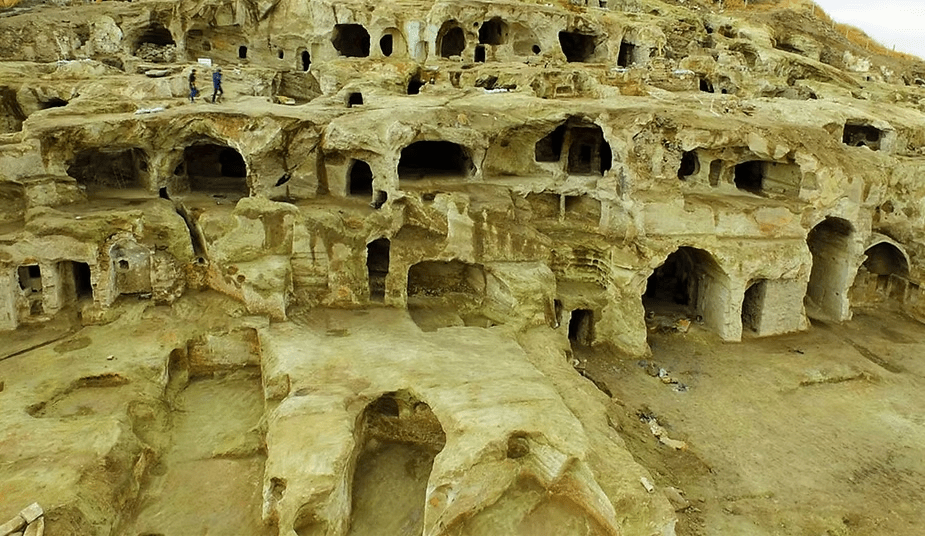
After writing this, I turned on the television and the History Channel had a show that featured this recent discovery in Turkey. This make my point of naming a place “City of Honeycombs.”

Amos 7:7-15 – Being a true priest without pedigree

This is what adonay Yahweh showed me: adonay was standing beside a wall built with a plumb line, with a plumb line in his hand. And Yahweh said to me, “Amos, what do you see?” And I said, “A plumb line.” Then the adonay said,

“See, I am setting a plumb line in the midst of my people Israel; I will never again pass them by; the high places of Isaac shall be made desolate, and the sanctuaries of Israel shall be laid waste, and I will rise against the house of Jeroboam with the sword.”

Then Amaziah, the priest of Bethel, sent to King Jeroboam of Israel, saying, “Amos has conspired against you in the very center of the house of Israel; the land is not able to bear all his words. For thus Amos has said,

‘Jeroboam shall die by the sword, and Israel must go into exile away from his land.'”

And Amaziah said to Amos, “O seer, go, flee away to the land of Judah, earn your bread there, and prophesy there; but never again prophesy at Bethel, for it is the king’s sanctuary, and it is a temple of the kingdom.”

Then Amos answered Amaziah, “I am no prophet, nor a prophet’s son; but I am a herdsman, and a dresser of sycamore trees, and Yahweh took me from following the flock, and Yahweh said to me, ‘Go, prophesy to my people Israel.’”

——————–

This is the track 2 optional Old Testament reading for the seventh Sunday after Pentecost [Proper 10], Year B, according to the lectionary for the Episcopal Church. If chosen, this will be accompanied by a partial reading from Psalm 85, where David sang, “I will listen to what ha-el Yahweh is saying, for he is speaking peace to his faithful people and to those who turn their hearts to him.” Those readings will then precede the Epistle selection from Paul’s letter to the Ephesians, where he wrote: “[You] had believed in him, were marked with the seal of the promised Holy Spirit; this is the pledge of our inheritance toward redemption as God’s own people.” That will all accompany the Gospel reading from Mark, where we read: “The king was deeply grieved; yet out of regard for his oaths and for the guests, he did not want to refuse her. Immediately the king sent a soldier of the guard with orders to bring John’s head.”

It should be noted that the above English translation [said to come from the NRSV] has been amended such that it is seen where Amos actually wrote “adonay” and “Yahweh,” which are not to be generalized as “Lord God.” This is because Yahweh is not to be seen as an external Spirit that commands human beings to act. A soul is the “lord” of one’s flesh and a soul will quite often become lorded over by the flesh it possesses. Many things of the world can then become “lords” over a soul-flesh entity, all allowed by Yahweh. Thus the combination of “adonay Yahweh” becomes a statement that one’s soul has married Yahweh, so His Holy Spirit has become the “Lord” over one’s flesh, through its union with one’s soul, giving the soul the strength to overcome the influences of the flesh to sin.

In this translation, the introduction that says, “This is what adonay Yahweh showed me” actually comes from verse one, which has now been superimposed onto verse seven. The first six verse tell of “adonay Yahweh” allowing Amos to see and “behold!” locusts devouring the crops and grasses, followed by a fire that spread across the land. Both times Amos prayed for Yahweh to make those things go away. With that having been symbolically shown to Amos, as the kings acting as locusts who destroy the source of spiritual bread for the Israelite people, the fire is symbolizing the coming ruin from invaders that will rage uncontrollably. Now, after Amos prayed to make it stop, he was shown the symbolism of a plumb line.

The metaphor of a wall needs to be seen as the split that had occurred that divided Israel from Judah, after the death of Solomon. Jeroboam was the first King of Israel, which would become known as the Northern Kingdom. They refused to follow Rehoboam, who was the son of Solomon and thereby the first King of Judah, the Southern Kingdom. The plumb line being held by “adonay,” which is a statement of Amos seeing his own soul holding it, at the direction of Yahweh, means the wall was not upright. Yahweh said the measure of that necessary perfection was “in the midst of my people,” which needs to be better understood.

The name Jeroboam means “May The People Contend” or “He Pleads The People’s Cause” [Wikipedia], while also meaning “May The People Increase” or “Whose People Are Countless.” This says that Jeroboam [most likely] took a kingly name that became like a pope being elected and losing his given name, in order to be known by a symbolic name. This says Jeroboam was the puppet creation of the people, because the people wanted more ability to do as they pleased; and, they feared following a son of Solomon might force them to give their souls to Yahweh and become true priests of Him, rather than being allowed to be the self-serving evil creatures they wanted to be. Thus, in the haste to break from the monarchy of one Israel, they threw down some rocks and called it a wall of separation, with nothing square, nothing upright, not the people and not the king.

When Yahweh told Amos the plumb line was in the “midst of the people,” the Hebrew word “bə·qe·reḇ” means “in the inward part,” which is the “soul” [or the “heart”]. Yahweh was not calling Amos to serve him because he wanted him to go present arguments that would change the brains of selfish people, to warn them that they were all leaning askew and about to fall over. Yahweh was telling His new prophet that the souls of the Israelites had not been eating spiritual food and the new change of separation was about to bring a swarm of manna-eating locust kings and queen all over Israel, creating a famine that would dry out their souls, making them become kindling for the first spark of lightning that would throw those souls into the eternal fires of hell and damnation. Kings were just the front men. Yahweh wanted Amos to go to the new temple Israel had set up in Bethel, where a real crooked cornerstone had been laid with Amaziah [a false prophet].

When Yahweh told Amos, “I will never again pass them by,” this is a reference to their souls no longer being saved from death, as the firstborn of Yahweh’s priests established to feed the truth to the world. By breaking away from the place where Isaac was placed on an altar by Abraham, to be sacrificed to Yahweh as a lamb of God, Isaac was passed over and a ram would take his place. That place of sacrifice was Mount Moriah, where Solomon had built a Temple. By breaking from Judah, the “high places of Isaac would become desolated” by the Israelites no longer going there. The inference is then that the Israelites would begin to ignore the Passover commitment that kept their souls married to Yahweh, through the rituals of their bodies of flesh. Therefore, Amos was told to tell them their souls were in grave danger.

The creation of new sanctuaries in Bethel would be destroyed. The house of Israel [the Northern Kingdom] would come to ruin. The sword would come from wars over centuries, with the final sword coming from the Assyrians.

The transition to Amaziah sending a message to Jeroboam, telling on Amos then says Amos did as his visions of Yahweh told him to do. That ‘in your face’ message had Amaziah seeking revenge, which required papal approval. When the translation says, “Amos has conspired against you in the very center of the house of Israel,” here, again, is the use of the Hebrew “bə·qe·reḇ,” which says Amos plucked on a “heart” string, which is connected to the ‘soul bones.’ That being in “the midst” of the house of Israel made Amos an “elohim,” whose “adonay” was Yahweh. That fear felt by Amaziah caused him to take it upon himself to cast out Amos himself, telling him: “O seer, go, flee away to the land of Judah, earn your bread there, and prophesy there; but never again prophesy at Bethel, for it is the king’s sanctuary, and it is a temple of the kingdom.” That says Amaziah knew Amos was a prophet, greater than he was, so he needed to run him off as soon as possible.

Where the translation says, “earn your bread there,” the Hebrew written is “we·’ĕ·ḵāl-šām le-hem,” which says “eat there bread.” While it has been seen as evidence that Amaziah was a hired hand prophet, who earned his keep by telling the king what he thought the king wanted or needed to hear, the meaning of “eat your bread” says “receive your manna from heaven somewhere else, other than here.” To see that as “earning” the knowledge of prophecy, that translation admits Amaziah saw Amos as one who truly could prophesy. One thing about prophecy that is revealing is it rarely says good things, like “You will win lots of friends and influence many people.” True prophecy says things like “Yahweh is going to cut Jeroboam’s head off with a sword.” To tell Amos to go to Judah with a divine message like that meant, “Yeah. Go tell someone who wants to hear that news, because we certainly don’t want that.”

When the translation says, “never again prophesy at Bethel, for it is the king’s sanctuary, and it is a temple of the kingdom,” the reality of what is written makes a stronger point of saying “Bethel is holy.” The Hebrew written says “miq·daš-me·leḵ,” or “the sacred place of the king.” That did not mean that Jeroboam hung out in the temple in Bethel, as much as it meant the king would call upon his priests in Bethel for divine guidance. While the king’s residence was nearby, in the same town, the “royalty” was earthly or worldly, not divine or heavenly. Amos had come to let that be known, but Amaziah was already acting like an advisor to a king like those other nations had, not one that had Yahweh as it King. Therefore, there was not true “sanctuary” anywhere in Bethel; and, had not been since the Ark of the Covenant was removed by the sons of Eli.

When Amos listened to Amaziah tell him to leave Israel and go to Judah, Amos told him the truth. He said he lived in Israel, as a landowner that herded sheep and tended to the fruit yielded by sycamore trees, which must be cut off when green and left to ripen. Such a landowner would have been working the land for some time, probably inheriting it from his father. One does not pack up and take sheep and sycamore trees with one to Judah. As such, Amos said he was there to stay; and, besides that, he was not some fancy robe-wearing temple priest. He was one of those influenced by David, in some way [his Psalms perhaps], who was also a shepherd, with Amos representing one of his ripened fruits whose soul had married Yahweh. It was due to that marriage commitment that Amos did as his Holy Husband said.

As an optional reading choice for the seventh Sunday after Pentecost, when one’s personal ministry for Yahweh should be well underway, Amos says how a ministry of Yahweh acts. One receives the message of Yahweh and then one goes and delivers it. Certainly there will be those who hold contempt in their souls over being told their souls are in grave danger if they keep playing gods on earth. However, a true prophet boldly goes and delivers all messages, whereas a hired hand takes offense at having the truth be told to him or her.

As a reflection of modern Christianity, Amos becomes the epitome of a true priest whose soul has found unity through commitment to Yahweh [not some “lord,” which can be anything from a Bishop to a seminary Dean, to a vestry writing the paychecks for a hired hand]. A true priest listens to what Yahweh says, as one whose true “Lord” is Yahweh. So many priests who stand on podiums and deliver college-level sermons that would impress on their college professors, never inspiring a soul-body to suddenly stand up at their pew and praise Yahweh for having been delivered a message that needed to be heard, because none of those hired hands have ever been told to submit to Yahweh and become His face to the world [not anything less than Jesus resurrected within one’s being]. So many priest, pastors, and ministers in Christianity today are resurrections of Amziah. That means the message of the plumb line hold true for the United States of America and all the Christian world. The true cornerstone must be put in the proper place – ONE’S SOUL – or everything will come to ruin – all the holy places will be destroyed – all the Martin Luther King and Pope John Paul II worshipers will fall before the judgment of Yahweh.

Ephesians 1:3-14 – Dearly Beloved we are gathered here today …

Blessed be the God and Father of our Lord Jesus Christ, who has blessed us in Christ with every spiritual blessing in the heavenly places, just as he chose us in [Christ – “him”] before the foundation of the world to be holy and blameless before him in love. He destined us for adoption as his children through Jesus Christ, according to the good pleasure of his will, to the praise of his glorious grace that he freely bestowed on us in the Beloved. In him we have redemption through his blood, the forgiveness of our trespasses, according to the riches of his grace that he lavished on us. With all wisdom and insight he has made known to us the mystery of his will, according to his good pleasure that he set forth in [Christ – “him”], as a plan for the fullness of time, to gather up all things in him, things in heaven and things on earth. In Christ we have also obtained an inheritance, having been destined according to the purpose of him who accomplishes all things according to his counsel and will, so that we, who were the first to set our hope on Christ, might live for the praise of his glory. In him you also, when you had heard the word of truth, the gospel of your salvation, and had believed in him, were marked with the seal of the promised Holy Spirit; this is the pledge of our inheritance toward redemption as God’s own people, to the praise of his glory.

——————–

This is the Epistle reading for the seventh Sunday after Pentecost [Proper 10], Year B, according to the lectionary for the Episcopal Church. It will follow either a Track 1 or Track 2 tandem of Old Testament and Psalm readings, relative to David bringing the ark in his city and Amos being sent by Yahweh to the false prophet of Jeroboam predicting ruin. The songs of praise support those themes, with everything accompanying the Gospel reading from Mark, where the story of John the Baptist’s beheading is told.

I have written deeply about this reading selection before. I posted my observations in 2018, with that commentary available on this website. It can be found by searching this site; and, I welcome all to read what I wrote then, as the same words have that meaning today. Today, I want to narrow my focus just a little.

The Second Samuel reading about David dancing before the ark has to be seen as a wedding celebration. The ark must be seen as the Holy Spirit, which is set in place by the directions of Yahweh. The site in the City of David, which had before been the fortress of the Jebusites, who were the watchers of the path to the tree of life [Eden on earth], that represents the symbolism of two joining together and must be realized as David demonstrating how each Israelite [and therefore all subsequent Christians] must likewise become a soul [a Jebusite] in a body of flesh [Jebus, the gate to Eden] that becomes the welcoming bride of Yahweh’s Holy Spirit within [the ark set in the Tabernacle on Mount Zion]. That story is told as metaphor, although David enacted it for all to see; and, those actions were recorded for all to read. It is a story that says, “From then on, every soul is responsible for being individually married to Yahweh, if one wants one’s soul to pass through the gate of death to the place of eternal life, Eden.”

Conversely, the optional reading from Amos tells the story of those who would break away from that recognition of commitment to Yahweh, following a king whose name means “The People Contend,” who is led by a false prophet that is only in that position for the money and benefits. A prophet was sent by Yahweh to tell them their future led to abject failure and ruin. The same reading holds merit in today’s world of rainbow religion calling itself Christianity. Amos is still read because Yahweh wants a prophet expressing the sword of judgment always being held over the necks of those who tell Yahweh’s prophets, “Leave this place and go be a prophet somewhere else, because we love worshiping the sterility of homosexuality and our god Penis and our goddess Vagina.”

In this selection from Paul’s greetings sent to the true Christians of Ephesus, the word “Christ” had been translated five times, although the NRSV translation liberally translates “him” twice more as “Christ,” which is wrong [as I will explain shortly]. In those five uses, Paul wrote “Christō” three times and “Christou” twice. Each time he wrote “Christou” is followed by his naming “Iēsou.” Each time he wrote “Christō” the word translating as “Christ” stood alone. By writing “Christō” without “Iēsou” says the two are separate, not one. Therefore, the word “Christ” cannot be seen as a ‘last name’ of “Jesus,” so it is wrong to call “him” [the man] by the name “Christ,” because “him” says “Jesus” … and “Jesus” was a body of flesh, just like Paul and just like all the Ephesians.

The word “Christ” comes from the root Greek word “Christos,” which means “Anointed One; the Messiah, the Christ.” (Strong’s Usage) The capitalization reflects a divinely elevated meaning, such that the lower-case spelling (as “christos”) would yield the basic definition: “smear or rub with oil, typically as part of a religious ceremony.” (Oxford Languages, Google search) When Yahweh told Samuel to anoint one of Jesse’s sons, Samuel poured oil from a horn on David’s head. Therefore, David was a “christō,” in the lower-case, even though Samuel was a divinely led priest; but when we also read, “the Spirit of Yahweh came upon David,” David became a capitalized “Christō,” when Greek is applied, replacing the Hebrew “Mashiach” or “Messiah.”

When one realizes it is Yahweh who becomes the meaning in the capitalization of “Christos,” one can see the Greek ending that creates “Christou” makes it possessive, in the Genitive case. It is then a statement that “Jesus” was “of the Christ,” which becomes a statement that “Jesus” was one “of” all who Yahweh anoints. This simple understanding of what is written [which English struggles to state simply] says Yahweh is so powerful a God that He can Anoint a limitless number of “Christs” or “Messiahs,” with the capitalization meaning all so anointed have become souls merged with Yahweh’s Spirit; and, I call that union a divine marriage between a soul and Yahweh’s Spirit.

When one realizes that the angel Gabriel told Mary what the name of her son would be, the instant she became divinely pregnant, says that name bears vital meaning that must always be understood whenever that name is read in Scripture. “Jesus” means “Yah[weh] Saves.” Gabriel took a message from Yahweh to Mary [and thus to all who read her story] that ‘“Yahweh Will Save” souls as My Son to be born from your womb. In that event, Mary’s soul was married to Yahweh’s Spirit, so “Jesus” was literally within her being [soul-flesh entity] as soon as Gabriel appeared before her. Mary was Anointed by Yahweh; thus she was a “Christ,” who would give birth to a son that also was a “Christ,” but not because of his mother.

In these twelve verses, other than the capitalized words “Jesus” and “Christ,” there are seven other capitalized words, each used only one time. The seven are: “Eulogētos” [“Blessed”], “Theos” [“God”], “Patēr” [“Father”], “Kyriou” [“Lord”], “Ēgapēmenō” [“Beloved”], “Pneumati” [“Spirit”], and “Hagiō” [“Holy”]. All of those must be seen as relative to a theme of divine marriage between a soul in the flesh and Yahweh’s Spirit. The lesson of this reading selection, as an accompaniment to the other possible reading selections, means each of these divinely elevated words must be seen in that light of union – Holy Matrimony in the truest sense.

In the first word of this reading, Paul wrote “Eulogētos” as a statement of “Blessing” that is beyond anything one human being can bestow upon another, as far as being “well spoken of.” The root word “eulogétos” is found in the English word “eulogy,” which is something “well spoken of” the dead. The same should be read here, because the marriage of a bride to a bridegroom means the death of the old and the birth of a new state of being. The old that passed away is the singular sense of being – one soul – which has died and been reborn in a union – one soul with one Spirit. That making this union “Blessed” is the Spirit – that of Yahweh – and that makes the togetherness become most Holy.

When that is seen, it becomes natural that Paul would then affirm that divine “Blessing” can only come from “Theos,” or “God.” Because that word is Greek and the Greeks were a polytheistic people, as were the Romans, the capitalization and the singular number identifies “One God,” above all others “gods.” Because there were so many gods to build temples to and assign priests to attend to those gods, the generality of “God” is akin to the capitalization of “Lord,” such that the generality lends to the confusion of ambiguity. Because the Greeks did not use the name of the Hebrew “Yahweh,” and because Paul was ministering to a Greek-speaking mixture of Jews and Gentiles, the writing of “Theos” as a capitalized word was the way Yahweh was identified. Because Christianity is deemed a monotheistic religion, there is only “One God,” which means His Son cannot be in any way a competitor, such as would be Zeus being in competition with Ares or Hermes.

As for the capitalization of the word “Patēr,” this divinely elevates the relationship one has with “God,” when one has been “Blessed” by marriage of one’s soul to Him. This highlights the mundane role a “father” has in a wedding. The father of the bride gives her away to her new husband and his family in marriage. While two families are joined in relationship, the daughter is given away, as the possession of her husband. The purpose of a divine marriage is not to have legal sex, as souls cannot generate any new souls, only flesh requires propagation. This means divine marriage is so one’s flesh can be filled with a soul in union with Yahweh. This is selective, as Yahweh cannot be seen as every human being’s “Father,” any more than anyone has the right to run outside and hug every older male on planet earth, while screaming, “father!” Those who are truly not one’s “father” will pull back and immediately say, “I do not know you!” Therefore, the capitalization of “Father” means a special relationship with Yahweh (“God”), through marriage that adjoins the resurrected soul of Jesus to the marrying soul – two souls possessing one body of flesh. This give one the right to call Yahweh the “Father,” due to marriage AND reproduction (a.k.a. resurrection).

When one’s soul has married Yahweh and received His Spirit, so two have been “Blessed” by having been united as One, as an extension of “God” in the flesh [His hand on earth], then that marriage is consummated spiritually – the sole purpose of marriage. The soul-flesh then becomes the womb in which the Spirit raises the soul of “Jesus,” so one’s soul is not only merged with the Spirit of Yahweh but one’s soul becomes possessed by the resurrected soul of Jesus. This birth of “Jesus” within makes a soul-flesh entity that went by some name given by one’s earthly father then become “in the name of Jesus,” which makes one also “in the name of the Father.” Again, the meaning of the name “Jesus” is “Yah[weh] Saves,” where the “name of the Father” is also “the name of the Son.” This is why Paul changed his name from Saul; and, it is why Jacob was told his name was changed to “Israel” – a name meaning “He Retains God.”

From this presentation of “Father,” Paul then made a divinely elevated statement that Yahweh was “the Father of our Lord,” where “Kyriou,” like “Christou,” is a Genitive form that states possession – “of.” This says Yahweh is “the Father” of “the Lord of us.” That says, without Yahweh’s presence [His Spirit married with one’s soul], there would be no consummation of that marriage, therefore no offspring. With that, the offspring of “the Father” is “the Lord of us.” This Greek word makes a clear statement that “Lord” is not the same as “God” and is not the same as “Father,” which is why the Hebrew texts that state “Yahweh” should not be translated as “Lord,” because Yahweh is not one’s “Lord” directly. Marriage means one’s soul has united with Yahweh, which means the reception of His Spirit; and, the Spirit speaks to a soul as the voice of God. Yahweh is the name of one’s Spiritual Husband and although He becomes one’s Master and Lord indirectly – through an Advocate and holy offspring that will be the actual “Lord” – the soul, as the wife of Yahweh, must be on a ‘first name’ basis. That means referring to “Yahweh” specifically, not referencing Him as anything else.

It must be realized that a soul is, in and of itself, the “lord” of one’s flesh. From first breath at birth, when Yahweh gives the breath of life [“ruach”] into a body of flesh, the body of flesh grows and becomes enamored with external stimuli. This leads the soul to find esoteric influences that are processed by the human brain and seen as married to one’s life direction. These influences become absorbed “lords.” Still, as the flesh matures and feels strong urges to explore the outer world, other people, places, or things can lead the flesh to influence the soul, through the brain, to worship those external entities. These then become “lords” to whom a soul becomes enslaved, unless the flesh can be led to rebel against those influences. In this way, worldly addictions [sins] become the most prevalent “lords” we humans know, even if we deny they exists and refuse to believe they control our souls.

This is where the separation of a soul from Yahweh does not make Yahweh ever be the “Lord” of one soul and its flesh. That is why Yahweh becomes the “Father” through marriage. The child born of that most Holy Matrimony is His Son Jesus, whose individual soul is resurrected in each and every one of Yahweh’s wives [the souls of males and females on earth], so that soul possesses the body of flesh and leads the body-soul it inhabits as its capitalized “Lord.” Without that divine leader, where Jesus becomes the king of one’s kingdom of flesh and bones, one’s soul alone is incapable of resisting the external influences of the world. Without Jesus as one’s “Lord,” reborn within one’s flesh, as a twin with one’s soul, one will not end life on earth sin-free. It is when one has become “Jesus” reborn that one has been Spiritually “Anointed” as “God’s Son,” with Yahweh the “Father.”

From all that stated in verse three alone, where seven capitalized words are found written [with both “Christou” and “Christō” used], verse six then includes the capitalized word “Ēgapēmenō,” meaning “Beloved.” In the NRSV translation that says, “to the praise of his glorious grace that he freely bestowed on us in the Beloved,” this must be read similarly as one sees David dancing and singing mightily before the parade of the ark. This is Paul saying the union of a soul with Yahweh’s Spirit is due to love: that of God and that to God in return. It is why a priest or pastor says before a wedding, “Dearly beloveds we are gathered here today ….” Still, the divine elevation from capitalization says the love of God has been placed on earth, in the form of one of His wives, led by the soul of His Son resurrected.

This then leads to verse thirteen, where the two remaining capitalized words are found, but they are written in a presentation that differs from the NRSV translation as “Holy Spirit.” What is actually written in the Greek is this: “esphragisthēte tō Pneumati tēs epangelias tō Hagiō.” That literally states, “you were sealed thereupon Spirit of this promise then Holy.” This clearly states “Spirit” to come first, such that the result is then a state of being unlike before. This needs to be seen as the pronouncement that the marriage has been completed – “You may kiss the bride.”

In the two words that lead to each “Spirit” and “Holy,” the first makes a statement about being “sealed.” This should be seen like the exchange of rings between bridegroom and bride. The ring symbolizes eternity, as its circular shape always has it following the same path forever. Rather than wedding bands of gold, it is the “Spirit” of Yahweh that seals two as one, forevermore. The capitalization of “Spirit” says it is what we refer to as the “Holy Spirit,” but because it is the Spirit of Yahweh it is known to be perfection, which is incapable of human beings alone. To say Yahweh is “Holy” is unnecessary, as it is the presence of Yahweh that makes the unholy “Holy.” It is the presence of Yahweh’s “Spirit” that brings about the “promise” that “then” leads one to be “Holy.”

The “promise” can also be stated as a “command,” which means all the questions that a priest or pastor asked each bridegroom and bride then become the marriage vows, from which “promises” are made to always and forever keep – till death do us part. While asking questions of fidelity, during both times of good and times of bad, means a promise of commitment, in response to each of the questions posed. Human beings often fail to live up to those promises made. That is because human beings are flawed, thus unholy. The promises that make one “Holy” are then the Commandments brought down from the mountain by Moses. The marriage vows a soul makes with Yahweh are those “Ten Commandments” (plus), primarily [as Jesus said] “to love Yahweh with all one’s heart, all one’s mind, and all one’s soul.” This is what it truly means for Yahweh to write His laws on each wife’s heart. It is this seal forever. It is the protection of Yahweh’s “Spirit” that makes it possible for the “promises” to be kept, as one will “then be Holy.”

Now, if must be realized that Paul was writing this to true Christians who understood all about their souls being married to Yahweh and being reborn in the name of Jesus Christ. What is easy to overlook is how Paul wrote all his epistles as an extension of his eternal commitment that made him “Holy, Sacred, Set apart by God” – a “Saint.” Being made “Holy” means one serves Yahweh till death do you part from your flesh. There is nothing “Holy” about sitting in the same pew, week after week, doing nothing to even think about anyone else [outside one’s family], much less send them a kind word. Thinking a sip of wine at the rail makes one feel the “spirit” sure does not seem to have the after effect of making those sippers “holy.”

Again, I took this selection in a more direct breakdown in 2018. I encourage everyone to read that commentary. I felt it was best to show how what Paul wrote fits a marriage theme very well. Therefore, I chose to only talk here about the capitalized words he wrote in this selection. Feel free to compare what I wrote here to what I wrote before.

As an Epistle selection to be read on the seventh Sunday after Pentecost, when one’s own personal ministry to Yahweh should be well underway, it is important to see how ministry cannot be done properly without one’s soul having married Yahweh and one becoming His Son resurrected within. Without that divine guidance, one does not have the truth to present to others, as the reason they too should marry their souls to Yahweh and also go into ministry. This is the problem facing all Christian churches today; and, this is the result of David having taken Jerusalem and moved the ark into marriage there, because never again could one rest on the laurels of someone other than oneself for redemption. No longer could the Israelites lean on a judge to save them. No longer can a Christian lean on Jesus, as an external, divine, unseen savior. One must be Jesus reborn in your flesh, or suffer the indignity of rejecting marriage to Yahweh.

Mark 6:14-29 – Off with her head!

King Herod heard of Jesus and his disciples, for Jesus’ name had become known. Some were saying, “John the baptizer has been raised from the dead; and for this reason these powers are at work in him.” But others said, “It is Elijah.” And others said, “It is a prophet, like one of the prophets of old.” But when Herod heard of it, he said, “John, whom I beheaded, has been raised.”

For Herod himself had sent men who arrested John, bound him, and put him in prison on account of Herodias, his brother Philip’s wife, because Herod had married her. For John had been telling Herod, “It is not lawful for you to have your brother’s wife.” And Herodias had a grudge against him, and wanted to kill him. But she could not, for Herod feared John, knowing that he was a righteous and holy man, and he protected him. When he heard him, he was greatly perplexed; and yet he liked to listen to him. But an opportunity came when Herod on his birthday gave a banquet for his courtiers and officers and for the leaders of Galilee. When his daughter Herodias came in and danced, she pleased Herod and his guests; and the king said to the girl, “Ask me for whatever you wish, and I will give it.” And he solemnly swore to her, “Whatever you ask me, I will give you, even half of my kingdom.” She went out and said to her mother, “What should I ask for?” She replied, “The head of John the baptizer.” Immediately she rushed back to the king and requested, “I want you to give me at once the head of John the Baptist on a platter.” The king was deeply grieved; yet out of regard for his oaths and for the guests, he did not want to refuse her. Immediately the king sent a soldier of the guard with orders to bring John’s head. He went and beheaded him in the prison, brought his head on a platter, and gave it to the girl. Then the girl gave it to her mother. When his disciples heard about it, they came and took his body, and laid it in a tomb.

——————–

This is the Gospel selection to be read aloud on the seventh Sunday after Pentecost [Proper 10], Year B, according to the lectionary for the Episcopal Church. It will be preceded by one of two optional pairings of Old Testament and Psalm readings, with one focused on David bringing the Ark of the Covenant into the City of David and one focused on Yahweh sending Amos to prophesy to the false prophet Amaziah and the new break-away king Jeroboam, head of the new Northern Kingdom. The song of praise support those themes. The Epistle reading that will precede this Gospel reading comes from Paul’s letter to the Ephesians, where he wrote about the values of an apostle, writing: “In Christ we have also obtained an inheritance, having been destined according to the purpose of him who accomplishes all things according to his counsel and will.”

I wrote about this reading in 2018 and posted it on this website. You can read it by searching this site. I encourage you to read it and offer your opinions and questions. The same reading now was the reading then, so everything I wrote then still applies today. However, now I want to take a different angle on this reading.

Because I have seen the story in Second Samuel, of David and the ark, as a marriage celebration symbolic of Yahweh being joined with the earth, at the place guarding the gate to Eden, this theme of marriage is all centered on the release of a soul at the time of death. Likewise, the track 2 option of Amos being chosen by Yahweh to take the message of pending doom, due to the divorce breaking in two what had married Israel and Judah under David, becomes focus placed on an end known to come. Therefore, the death of John the Baptist is echoing the promise begun by David’s early actions as king over the united lands of Israel, which is through spiritual marriage eternal life defeats physical death, when the soul is released from the body.

The first part of this reading explains that Jesus was making a name for himself, such that the name that used to be spreading was that of his cousin, John. Because the people are always mingled with ‘secret police,’ the rumors and scuttlebutt will always be made known to the powers that be. Back then, one power was Herod Antipas, one of the sons of Herod the Great, who reigned over Galilee and Perea.

The word passed on to Antipas by his informants is stated in the capitalized specific names “John” and “Elijah.” Those two names are then further expanded through the capitalized use of “Baptizer” and “Prophet.” Thus, the people was saying “Yah Is Gracious, Yah Has Been Gracious” [the meaning of “John”], “Yah is God” [the meaning of the name “Elijah”], “Submerger” [the meaning of “Baptizōn”], and “Interpreter Of Divine Truth” [the meaning of “Prophētēs”]. While all those individual elements were spoken, the conglomerate of them all is the truth that Jesus was the “Graciousness of Yahweh,” who was an extension of “God” on earth, whose presence was “Submerged” within his flesh, married with his soul, made empowered by Yahweh to be an “Interpreter” of the truth held in Scripture for all Jews to know.

After we read that Herod Antipas had heard the reports, but came to the conclusion “John, whom I beheaded, has been raised,” this speaks symbolically that the king believed in the immortality of Yahweh’s graciousness. That says he believed death was not an end on this plane of existence for a soul that had been married to Yahweh. By saying he knew John had been killed, but had been raised, he meant the Spirit of John never died. He believe the Spirit of Yahweh continued and was found in the man named Jesus. Therefore, the part of the reading that leads to this conclusion is a series of statements that the people – all the way up to the king – believed death was not an end, when a soul was married to Yahweh and given eternal life; and, that speaks of David celebrating the marriage of the Spirit and the soul by dancing and celebrating before the ark.

When the story then appears to be a leap back in time to retell the events of John and Antipas, we then find this focus takes one from the promise of belief [not true faith] and the external influences that keep one from living up to one’s beliefs. It becomes a reflection of the things people do that lead them to kill the opportunity to marry Yahweh, with all Christians today becoming reflected in Herod Antipas. Each soul in a body of flesh that professes to be a Christian, but then turns around and does the acts of Antipas, is showing how their souls have refused to marry Yahweh and make His Spirit [the birth of His Son anew with their souls] the King over the nation that is their flesh. They act in self-defeating ways.

First they imprison the graciousness of Yahweh [the meaning of “John”] and keep that from freely expressing the Word of God. John pissed off the wife of Antipas – Herodias – telling the truth about a sin having been committed. It was Antipas who sinned and Herodias was the instrument of sin; so, her opinions against the truth led Antipas to cover up his sins and lock them away in a prison. Placing the truth in a prison is how many Christians know they are sinners, but feel that as long as they hide their sins they can still rule over their lives and do as they please.

The name “Herod” means “Freeman, Wanderer, Fugitive, Trembler, or Coward,” depending on how the root Hebrew is read. The name “Herodias” means “Of The Realm Of Herod,” which says the sin of Antipas that caused him to imprison John was his cowardly response, wanting to remain a freeman who went against the laws of his Judaic claims of heritage and belief. While Herodias reflects one of the external influences of sin in the life of Herod Antipas, the acts he committed must be seen as his own responsibility. Thus, everything that subsequently happened because of a fight against the calls for repentance is the path of waywardness [Wandering] that condemns a soul after death. This then reflects the rejection of marriage to Yahweh and the call of Amos to prophesy before one, saying to repent.

When we read that Herod Antipas “gave a banquet for his courtiers and officers and for the leaders of Galilee,” his doing that on his birthday made his own self-ego be placed on display for all to see. A marriage of one’s soul to Yahweh demands one’s self-ego be killed, sacrificed into submission to the higher Spirit’s domination. This is the symbolism of John having been killed so Jesus could rise. By throwing his own ‘birthday party’ Herod was presenting himself as a god for all to behold. A “self” equals a “soul,” and a “self” is all about “ego” that wants to be known.

The symbolism of the daughter of Herodias dancing for the guests says she reflects a daughter of his realm. She was the daughter of his sinful wife, so she was a daughter of sin that was within his realm, thereby becoming another influence of sin. The symbolism of a “daughter” is as an immature thought coming from within one’s mind. All souls inhabiting bodies of flesh must be seen in the feminine sense, as the flesh is receptive of the Spirit [a masculine essence] that penetrates the flesh and unites with the soul – like sperm piercing an egg. All souls must then be seen as “daughters” to be given away in marriage to Yahweh. To have a “daughter” dance enticingly before Herod [forget about the guests at this point], she represented his own filthy thoughts of sin that became his lusts and desires. In reality, a mature “daughter” would be shown to prospective bridegrooms, in order to give her away in a merger of families that would benefit the father. Since the dance was for Herod’s pleasure, on his special day of recognition, she becomes a reflection of one’s own private lusts and wild imaginations that should be controlled.

In the Greek text of Mark, where he told Peter’s story and Peter did not name children specifically [the daughter’s name was Salome, which means “Peace”], there is a mathematical symbol, called a left right arrow, which becomes a statement saying, “if true, then true.”

That symbol is placed between a bracketed “this indeed the king” and “said thereupon girl”. The brackets indicate the inner being that was Herod Antipas, which was his true inner self being projected onto the “girl.” That is then the truth being stated as what the inner “king” said that was then a transference “thereupon girl.” That symbol then says Herod would use the daughter of sinful lusts to make him commit to another sin. Thus, what he said was what he wanted the girl to tell him to do, by him telling a “daughter,” “Ask me for whatever you wish, and I will give it.”

Keep in mind how Americans use a birthday celebration as a day when wishes come true. When we tell our children, “Make a wish and blow out the candle so it will come true,” we are teaching our children to make the light go away, so a desire can be received. In the same way, Herod wanted to be told to do something that would push the envelope to a higher level. He did not know what it was, but he was making a wish that something taken to the edge would bring a new degree of excitement into his soul. He made that wish because his soul knew death and eternal damnation was his future and sin gave his soul the illusion of stimulation.

The promise of a reward, “up to half my kingdom,” says all Herod had to offer was his flesh. That half of his “kingdom” would be left when he died. The other “half” was his soul, which could not be given away. He could have given everything away to Yahweh in marriage, but he protected his soul as his to possess forever.

Because the “daughter” was not a fully mature thought, just a tantalizing idea that something more sinful could grow into full maturity, that inkling needed to merge with an already known sin, which was Herodias – the adulterous wife. That prior suggestion that John be killed for bad-mouthing her, when Herod had been turned aside by Antipas, he had feared Yahweh’s punishment for an act of murder. When Herodias told Salome to tell Herod she wanted John killed, that evil influence became a line drawn in the sand that Herod would be forced to cross [as a suggestion, not a command].

The excuse for a mortal sin that would forever condemn the soul of Herod Antipas – the king of nothing after death – was said to be ego-protecting. Because he had made a public promise, he could not suffer the self-caused indignity of going back on his word. He wanted to kill John, but he was too afraid to do so without cause – and John had done nothing other than tell the truth of a law having been broken. This is why the left right arrow is placed where it is, because Herod would become the girl’s command as a wish publicly granted. Salome said what Herod wanted, so he would have an excuse to do greater sins.

The beheading of John is then a parallel to the dividing of Israel into two halves – Israel and Judah. What David had ordered was the truth John had uttered. Both said, “You cannot sin and gain eternal life for a soul. Marriage to Yahweh is the only way; and, that means sacrifice of self-ego.” Amaziah and Jeroboam were just like Herod Antipas. They wanted some daughters to dance before them and tell them what to do, because they wanted lives of sin, not submission to Yahweh. Thus, the head Herod ordered cut off was his own. Jesus being raised from that beheading says John lived on, while Herod’s soul became dead.

As a Gospel selection for the seventh Sunday after Pentecost, when one’s personal ministry for Yahweh should be well underway, the lesson of Herod has to be seen as one’s own soul decision having to be made. All of the side characters – the wife to a worldly existence, the daughter of sinful ideas, the dignitaries that all play roles in support of one’s sinful life – they are nothing more than excuses not to marry Yahweh. None of those sidekicks will die for you and save your soul from your sins. Each individual soul is responsible for saving itself [a “self” equals a “soul”]. The longer one goes in life denying that responsibility [which David began when he moved the ark into the Tabernacle in Jerusalem], the closer one comes to soul suicide. One is simply waiting for the idea to consult prior past failures and come up with the new idea that says, “Cut off the head of the beast!” The beast is self-ego; and, it can be cut off through self-sacrifice in marriage to Yahweh, or it can be your own head cut off from the cardinal sin of wanting self to be a king.

Psalm 24 – Lift up the gates in your heads

The earth is Yahweh’s and all that is in it, *

the world and all who dwell therein.

2 For it is he who founded it upon the seas *

and made it firm upon the rivers of the deep.

3 “Who can ascend the hill of Yahweh? ” *

and who can stand in his holy place?”

4 “Those who have clean hands and a pure heart, *

who have not pledged themselves to falsehood,

nor sworn by what is a fraud.

5 They shall receive a blessing from Yahweh *

and a just reward from me-elohe of their salvation.”

6 Such is the generation of those who seek him, *

of those who seek your face, Jacob. Selah.

7 Lift up your heads, O gates;

lift them high, O everlasting doors; *

and the King of glory shall come in.

8 “Who is this King of glory?” *

Yahweh, strong and mighty,

Yahweh, mighty in battle.”

9 Lift up your heads, O gates;

lift them high, O everlasting doors; *

and the King of glory shall come in.

10 “Who is he, this King of glory?” *

Yahweh of hosts,

he is the King of glory.” Selah.

——————–

This is the companion Psalm for the Track 1 Old Testament selection from Second Samuel, telling of David bringing the ark into Jerusalem. If chosen, it will be read aloud in unison or sung by a cantor on the seventh Sunday after Pentecost [Proper 10], Year B, according to the lectionary for the Episcopal Church. This set of readings will precede an Epistle reading from Paul’s letter to the Ephesians, where he wrote: “In him we have redemption through his blood, the forgiveness of our trespasses, according to the riches of his grace that he lavished on us.” All will accompany the Gospel reading from Mark, which tells of the beheading of John being followed by the rise in popularity of Jesus.

In the reading as shown above, I have removed all translations of the word “Yahweh” that erroneously say “Lord.” In addition, there are two verses in this song of praise that end with the word “Selah.” I have added them in bold text. The word “selah” translates as “lift up, exalt,” which must be seen as an indication that one’s soul must become elevated through marriage to Yahweh. Therefore, it would be remiss to exclude that direction from the song.

Verse one makes more sense in a literal translation, as “the earth” must be seen as metaphor for a body of flesh. The translation says, “Yahweh the earth and its fullness ,
inhabited world , and to dwell therein .” This says a soul is in its fullness when it is married with Yahweh. The “inhabited world” [from “tebel”], or simply “inhabited,” means the flesh [the “earth”] has become where Yahweh “inhabits.” Yahweh does not dwell in “the earth,” as He made the physical universe as a compliment to the spiritual universe. Thus, Yahweh only entends to “the earth” as a Spirit that possesses the physical. It is “elohim” who Yahweh creates that dwell in “the earth.” The dwelling, or sitting, or remaining [from “yashab”] makes a human being become the hand of God on earth.

Verse two then literally says, “for he upon the seas has founded it , and upon the rivers ,
has set firm .” Here, the use of “seas” and “rivers” are water references that are metaphor for the emotions brought by the presence of Yahweh within. This extends beyond the physicality of the five senses that create the feelings of a human body, as the presence of Yahweh is Spiritual. The Spirit is greater than a ‘sixth sense.’ Thus, the “seas” and all engulfing waters reflect as the marriage that pours in the Spirit of eternal life that becomes one with a soul. The “rivers” are then the flow of the Word that causes one’s body of flesh to move as directed by Yahweh.

Verse three poses the question, “Who may ascend into the hill of Yahweh?” To grasp the directions of “ascent,” in conjunction with “into,” one needs to visualize the setting on Mount Zion. There were steps carved into the stone of the mountain or “hill,” which led to the place of the Tabernacle near the top, under which the ark was placed. The “ascent” is metaphor for the steps up the mountain to reach the altar, with “into the hill” meaning a marriage that “uplifted a soul” to the point within the place that was Jebus. Jebus [or Jerusalem] reflects where the entrance “into Eden” was; and, it is there that a soul gains entrance, as the result for a soul having married Yahweh. Thus, the answer to the question “Who,” is “all souls who marry Yahweh.”

The subsequent question then literally asks, “then who may stand in place his holy?” This is a question about the elevation of a soul still in its flesh, so the flesh becomes an upright body [“standing” on a path of righteousness], which makes that person become representative of God incarnate. Only as one with Yahweh can one truly be “sacred” and “set apart by Yahweh as holy.” Again, the answer to that question is all who marry their souls to Yahweh.

Verse four then becomes a clarification of these answers, saying literally, “clean hands , and pure soul [that’s] who ׀ not to suffer to an idol his soul , nor sword deceitfully .” In this, there is no need to indicate anyone needs to possess “clean hands.” The word “clean” is stated, which is the answer to “who?” Those who seek redemption are thereby those cleansed of past sins, having been made “clean” by Yahweh. After such cleansing, those souls will each become Yahweh’s “hand” on earth. The word translated as “heart” [“lebab”] means, “inner man, mind, will” [in addition to “heart”], which is more importantly seen as a statement of one’s “soul.” By a “soul” being “pure,” this is an indication of both Yahweh’s Spirit and the resurrection of the “soul” of Jesus, as the “lord” of the flesh to command righteousness has become reborn. This addition marries one in a Trinity union [three in one]. Those are the answers to “who.”

The last part of this verse can be read two ways, based on the words stating “not to lift, carry, take.” In the positive sense, as a continuation of the “clean” and “pure,” they will “not suffer” [an alternative use of “nasa”] from “idol” worship, thereby condemning one’s “soul.” The married to Yahweh “souls” do not “swear” the wedding vows “deceitfully.” However, on the opposite end of the spectrum, as to “who not,” those are the souls that do “not” marry Yahweh, such that they will “not be uplifted” spiritually, so by “not” marrying they will “suffer to the idols” of their worldly lusts. They will call themselves Christians, while having “deceitfully sworn” to believe in and follow commandments they will not keep.

Here, it must be understood that a soul married to Yahweh does become an “idol,” such that the English defines this as the image of God, but the Hebrew means “vanity and emptiness.” The Law that says one should not worship idols says an entity, such as Jesus and all Saints and Prophets, are images and representations of Yahweh on earth. They should be listened to as the voices of God; but they must not be worshiped as gods. A truly holy icon is then empty of self, with all vanity placed upon Yahweh. Thus, one’s own soul should become an “idol,” so one’s “soul does not suffer” after death; but an “idol” brings suffering to all who think Yahweh has made another a god to worship upon the earth, so a true Saint can only be deemed as such postmortem.

Verse five then sings, “he shall receive blessing from Yahweh , and righteousness from elohim .” Here, the use of “elohim” [as “me-elohe”] becomes yet another way to understand how “elohim” are those eternal beings of spirit who are merged with a divine Spirit, who do the acts commanded by Yahweh. An “elohim” can be a law of science and mathematics, thus inhuman but never changed by the wills of humans. An “elohim” can be angels, who are spirits created by Yahweh to be His messengers; but they are never wholly human, although they may appear in human form. Angels cannot be defeated by human souls; and Yahweh commanded His elohim to serve Man. Then, there are the “elohim” who are the saints and apostles, who are wholly human in the flesh, but not influenced by worldly things. Being chosen as an “elohim” of Yahweh through marriage means one’s soul has found “salvation.” Therefore, this verse sings of the “who” that marry Yahweh, as they will be shown “favor” by His Spirit, which makes one become an “elohim” that acts “righteously” in His name, taking forward the message of “salvation” to others.

Verse six then sings, “this a generation of those who seek , who seek your face Jacob . Selah .” In this, the word “generation” must be seen as a “time” or “period” that dwells upon one, as something necessary. Because David had brough the ark into the City of David, forever symbolizing a “generation” of personal soul responsibility for the Israelite people, that was a “time” when birthright no longer did anything for one’s soul. Thus, all had to become “seekers” of redemption and salvation from that point in time on.

When the reference turns to “your face” [from “panim”], this is a direct restatement of the First Commandment, which is the marriage vow that says the wife [soul] of Yahweh will lower his or her face [self-ego] and wear only the face of Yahweh [no other gods before my face].
That “face” does not come by being born a Jew. This becomes the lesson of “Jacob,” who was the second of two twins born, thereby not entitled to a birthright from Isaac. The parents of Jacob named him that because the word captured the essence of him “holding his brother’s heel” [or “He Who Closely Follows” or “Supplanter”]. The divine marriage of Jacob’s soul to Yahweh led to him receiving the name “Israel,” which means “He Retains God,” as one who then had Yahweh within his being. Thus, to seek to earn the “face” of God requires one sacrifice one’s own self-ego [one’s own “face”], so that new “face” can be worn.

It is at this point that the first of two uses of “selah” is found. Again, this word means “to lift up, exalt.” Following the use of “Jacob” [where the capitalization as a proper name is assumed in translation only], the aspect of Jacob must be realized that he was a twin, the lesser of the two from being second-born. This means Jacob reflects the status of one’s own soul, after it has been merged with the Holy Spirit, where that Spirit becomes the ‘firstborn’ and thus the one who rightfully inherits the body of flesh. It is that presence that must be celebrated as a “lift up” and reason to “exalt” that presence. Therefore, the word is not written as a musical direction alone [if at all]. It says rejoice!

Verse seven then sings, “lift up the gates of your head , be lifted up doorways everlasting ; and shall come in the king of glory .” It should not take much to realize the “head” is where a brain is kept. The brain is the central control organ of the being, as the soul communicates with the flesh through that center. It should also be seen that a city is protected by walls, with “gates” opened and closed as needed. When the “gates of the head” are closed, the brain has become the keeper of the flesh, more than simply keeping the body alive when one sleeps. An “open gate” means being receptive to the Spirit being welcomed in to take control of the brain. Once the brain has been reduced to a function that acts as an influence to righteousness, then the doorway to Eden is opened to the soul. The gates of Eden are guarded by Cherubim [“elohim”], as through those doors lie the tree of life and eternity in heaven. Therefore, once one has removed all blockages to the tree of life, then one shall become one with Yahweh “the King of all that is glorious.”

Verse eight then asks the question, “who this king of glory?” That answer is then sung out as, “Yahweh powerful and strong , Yahweh mighty in battle .” The answer clearly says “Yahweh” is “the king” [from being stated twice], but the deeper question about “who” is relative to those whose brains will receive the Spirit. There is no way a human being can understand the “power, strength, or might” of Yahweh, since the ethereal is not measured by such material principles. Therefore, the question of “who” asks what souls in the flesh will receive the ability of the Holy Spirit [Jesus and Paul referred to them as talents and gifts], to become “powerful” enough to fight the “war” against the lures of sin, cast out by the world. Yahweh grants that power and might to His wives, through the resurrection of His Son Jesus, who is truly “this king of glory.”

Verse nine then sings a refrain of verse seven, stated now as “lift up the gates of your head , and lift up doorways everlasting ; and shall come in the king of glory .” The repetition says those who open themselves [again, a “self” equals a “soul”] up to receiving the Spirit of Yahweh, coming through divine marriage, then there will be no need to repeat the first proposal of marriage. The first opportunity taken [verse seven] means a soul welcomes Yahweh into their submissive body and soul, so the subsequent times when “power” and “strength” and the “might to battle” comes, all “gates” and “doors” will have remained “open,” so no souls will be caught with their ‘gates down.’ The marriage will last eternally, beyond the time a brain will remain fleshy.

Verse then then sings a refrain of verse eight, asking the same questions of “who “ and giving the same answer that is “Yahweh.” The change now says “Yahweh of hosts,” which says the “might of battles and wars” are all easily won by those who form the heavenly “armies” of Yahweh. Yahweh is still “the King of all glorious.” This, once more, is followed by “selah,” which is another statement of “exaltation” from an uplifted soul to salvation.

As the accompanying Psalm for the Second Samuel readings about David taking the ark into Jerusalem, this confirms a theme of marriage between a soul and Yahweh. As a song of praise sang on the seventh Sunday after Pentecost, when one’s own personal ministry for Yahweh should be well underway, this sings the praises of wearing the face of Yahweh, after the submission of one’s own self-ego unto Yahweh, accepting His gift of a righteous life being possible. All the battles against sin will be personally won, because once one opens the gates that resist and reject holy matrimony, then all things are possible. The sustaining strength of ministry does not come from self-will. It comes from the sacrifice of self so one can be lifted up into service.

Psalm 85:8-13 – Restoration through holy matrimony

8 I will listen to what ha-el Yahweh is saying, *

for he is speaking peace to his faithful people

and to those who turn their hearts to him.

9 Truly, his salvation is very near to those who fear him, *

that his glory may dwell in our land.

10 Mercy and truth have met together; *

righteousness and peace have kissed each other.

11 Truth shall spring up from the earth, *

and righteousness shall look down from heaven.

12 Yahweh will indeed grant prosperity, *

and our land will yield its increase.

13 Righteousness shall go before him, *

and peace shall be a pathway for his feet.

——————–

This is the companion Track 2 song for the reading from Amos, where Yahweh showed him a wall and a plumb line. If chosen, it will be read aloud in unison or sung by a cantor on the seventh Sunday after Pentecost [Proper 10], Year B, according to the lectionary for the Episcopal Church. These two will precede an Epistle reading from Ephesians, where Paul wrote, “when you had heard the word of truth, the gospel of your salvation, and had believed in him, [you] were marked with the seal of the promised Holy Spirit.” All will accompany the Gospel reading from Mark, where we learn a mother coached her daughter to say: “I want you to give me at once the head of John the Baptist on a platter.”

Verse eight begins this reading selection. In this is written “hā·’êl Yah-weh,” which the NRSV has translated as “God the Lord.” I have restored what was written above, but still this does not show the presence of a vertical bar in between the two words, which may or may not be a direction to the musicians accompanying this song of restoration.

To better understand this, it becomes important to realize Psalm 85 is stated in verse one to be “to the enduring sons of Korah,” where Korah was one who challenged Moses and Aaron as a Levite wanting more responsibilities in the Tabernacle, more than cleaning up after sacrifices [and such]. God opened up the earth and had Korah swallowed, while all his supporters among the Israelites were destroyed by fire. The “sons of Korah” [a.k.a. “Korahites”] (I believe) were the priests who became the watchers of the Ark of the Covenant, when it was placed in the City of Honeycombs at Baale-judah [or Kirjath-Jearim]. When the descendants of Korah are seen as servants of Yahweh sent underground, then they become “elohim.” Thus, David was singing a song that said he would listen to a “god” that had been divinely inspired to speak for Yahweh, as that would amount to “hā·’êl Yah-weh.”

Verse eight literally translates to sing, “I will hear , what will speak hā·’êl Yahweh for he will speak soundness , for his people and to his pious , not let them turn back to stupidity .” The first word form [“I will hear”] says a soul married to Yahweh will listen for instructions. By “hearing,” one is not telling anything first. After “hearing,” then one’s flesh “will speak” as an extension of Yahweh that acts as “a god,” which can only happen after one’s soul [an eternal spirit] has been merged with the Spirit of Yahweh. That establishes a marriage of commitment by both parties. By “speaking as a god of Yahweh,” that says what He “will speak” one then passes on, becoming a prophet. Thus, this Psalm selection is paired with the marriage of Amos’ soul with Yahweh, when he did likewise. What is “spoken” is “soundness,” such that everything spoken relates to the divine texts, where a prophet is necessary both to write them and to bring them “completeness” and “soundness” by explaining them.

When David sang out that this prophecy will be “for his people,” this refers to all who call themselves the children of God. In David’s time, those people were called Israelites. In Jesus’ time, those people were called Jews. In our times, those people are called Christians. At all times, those people are the ones who seek knowledge that leads to understanding; therefore, they are the people who makes pleas for redemption and receive a divine proposal for marriage with acceptance. By oneself [a “self” equals a “soul”] being married to Yahweh’s Spirit, then one is truly one of “his people,” as a “saint” or one whose soul has been cleaned of all past sins, forevermore to be “pious.” That is a merger that is forever, which means once married there will be no divorce or turning back to the ways of sin.

Verse nine then literally sings, “surely related to those who fear [losing] his salvation ; that may dwell glory in our land .” This first addresses a “fear” of God, where rejecting His marriage proposal means accepting the full responsibility of one’s sins at judgment. Only those souls who fear losing Yahweh in their lives, by their own actions that turn away from His presence, will choose to sacrifice self-ego while living in the flesh. That sacrifice in the present will bring the promise of salvation to be known later.

The second half of this verse is much less focused on Yahweh “dwelling in the land,” as the only way this factors into this verse is through those souls who have married Yahweh going to others in Israel and ensuring they too marry Yahweh, as a protection of “His people” there. The real meaning of “land” or “earth” is the flesh of one’s body that surrounds one’s soul. Yahweh’s Spirit will “dwell” where His wives [males and females] “dwell.” In those will be found the ”glory” of His presence.

Verse ten then literally sings, “goodness and truth have met together ; righteousness and completeness have kissed .” In this, two sets of pairs are united, with the second set saying “have kissed.” That act of “kissing” certainly reflects as a common act of love. This verse is then singing about the union of a soul with Yahweh’s Spirit. The sins of the past are forgiven as the dowry paid by the wife [males and females], meaning “goodness” replaces wickedness and “righteousness” replaces waywardness. In return, the union with God means “truth” becomes an essence of one’s new being, as well as a calmness or “peace” that knows “completeness” and “soundness.”

Verse eleven then sings literally, “truth out of the earth shall spring ; and righteousness , from heaven shall grow .” Here, again, the use of “eretz” or “earth, land” must be read as “truth springing out of one’s flesh.” That “spring” becomes the free-flow of “truth” that comes from Yahweh. It is the never-ending flow of living waters that makes one’s being act righteously, as a well offering eternal life that always quinches any hint of thirst. This is the ministerial nature of divine marriage, as each soul becomes a prophet who spreads the meaning of Scripture to others who are seeking the “truth.”

This “spring” also becomes a sign of the “living waters” that eternally have been opened to lead one’s life; and, that becomes a new way of living, which only walks a righteous path. All paths will be divinely led, coming from “heaven” as the influence of the Spirit, so one’s ministry in service to Yahweh “will grow,” never decreasing. This also means the Spirit will wholly encompass one’s being; so, the way one views the world will be from above, “looking down” on all influences of sin.

Verse twelve then sings literally, “moreover Yahweh will give good ; and our land will yield its increase .” Once more, the use of “land” or “earth” has little to do with reaping the bounties of crops and herding. The material world of a soul is its flesh. This means, again, the body will be given a “pleasure” from the presence of Yahweh’s Spirit within one’s soul, so all troubles will be able to be dealt with positively. This is a gift of marriage; so, one who rejects Yahweh in marriage, but then reaps bountiful harvests, those benefits must not be seen as a gift of God. It is not the One God who gives material rewards, but a lesser god of the world who brings gains and profits to humans as lures to sin. To be given “good” means one will be removed from evil. Thus, that becomes a state of being that is more profitable than all the world can bring.

Verse thirteen then literally sings, “righteousness before him will go ; and shall make pathway his footsteps .” This verse sings of one walking a path of “righteousness,” which cannot be done alone. One’s soul cannot will oneself to walk a sin-free life, as a soul cannot defeat a god, which Satan most assuredly is. One can only defeat Satan by being married to Yahweh, becoming His possession through His Spirit. When that marriage has taken place, then all steps one takes will be those of a wife who follows the Will of her Husband [males and females following Yahweh].

As an accompanying Psalm to the Amos reading possibility, it should be seen that this reflects the marriage between Yahweh and the prophet Amos, while also reflecting the message he took to the false prophet Amaziah, to give to Jeroboam. Neither of them accepted the marriage proposal made necessary by David’s actions years before; therefore neither were leading the Israelites towards that spiritual end. If this set is chosen for reading on the seventh Sunday after Pentecost, when one’s personal ministry to Yahweh should be underway, it speaks of the growth one can expect to come from holy matrimony with Yahweh. This says the only “land” or “earth” anyone should be focused on is that which confines one’s soul. All else is a trick of illusion. To see the truth, one must hear the voice of Yahweh and speak those words to others.

2 Samuel 7:1-14a – Becoming a house of worship

When the king was settled in his house, and Yahweh had given him rest from all his enemies around him, the king said to the prophet Nathan, “See now, I am living in a house of cedar, but the ark ha-elohim stays in a tent.” Nathan said to the king, “Go, do all that you have in mind; for Yahweh is with you.”

But that same night the word of Yahweh came to Nathan: Go and tell my servant David: Thus says Yahweh: Are you the one to build me a house to live in? I have not lived in a house since the day I brought up the people of Israel from Egypt to this day, but I have been moving about in a tent and a tabernacle. Wherever I have moved about among all the people of Israel, did I ever speak a word with any of the tribal leaders of Israel, whom I commanded to shepherd my people Israel, saying, “Why have you not built me a house of cedar?” Now therefore thus you shall say to my servant David: Thus says Yahweh of hosts: I took you from the pasture, from following the sheep to be prince over my people Israel; and I have been with you wherever you went, and have cut off all your enemies from before you; and I will make for you a great name, like the name of the great ones of the earth. And I will appoint a place for my people Israel and will plant them, so that they may live in their own place, and be disturbed no more; and evildoers shall afflict them no more, as formerly, from the time that I appointed judges over my people Israel; and I will give you rest from all your enemies. Moreover Yahweh declares to you that Yahweh will make you a house. When your days are fulfilled and you lie down with your ancestors, I will raise up your offspring after you, who shall come forth from your body, and I will establish his kingdom. He shall build a house for my name, and I will establish the throne of his kingdom forever. I will be a father to him, and he shall be a son to me.

——————–

This is the Track 1 Old Testament option for reading aloud on the eighth Sunday after Pentecost [Proper 11], Year B, according to the lectionary for the Episcopal Church. If chosen, it will be accompanied by a partial singing of Psalm 89, where is written: “I will establish his line for ever and his throne as the days of heaven.” Those will precede an Epistle reading from Ephesians, where Paul wrote: “So he came and proclaimed peace to you who were far off and peace to those who were near; for through him both of us have access in one Spirit to the Father.” All will accompany the Gospel reading from Mark, where it is written, “[Jesus] saw a great crowd; and he had compassion for them, because they were like sheep without a shepherd; and he began to teach them many things.”

In the first verse, where the NRSV translation shows, “When the king was settled in his house,” the meaning of “house” should not be limited to a physical structure. The statement says the “house” was also that of his reign as king over a united Israel and Judah. The verb translated as “settled” can also be used to mean “sat enthroned” or even “married.” [NAS Exhaustive Concordance] This then says time had elapsed since David moved the Ark of the Covenant into the City of David; and, during this time “a house of cedar” had been constructed and furnished.

In these selected verses, the name “Yahweh” was written seven times, with all translated benignly by the NRSV to say “the Lord.” The name of the God of Moses is Yahweh; and, that specific name being uttered in writing says Yahweh was married to the writer and all characters to whom Yahweh communicated. The general meaning of a capitalized “Lord” says an eternal presence that inhabits a body of flesh and possesses the soul of that flesh. Satan is such a “Lord,” as well as all demonic possessions or evil spirits that would cause a soul to lead a life of sin. Rejecting Yahweh, by name, means one is inclined towards an evil spirit coming to the threshold of one’s soul, wanting to come in and be one’s “Lord.” David and Nathan were both possessed by their souls having married Yahweh, specifically; thus, that specific God is named. All true Christians should feel comfortable naming Yahweh as their Husband.

When we then read that “Yahweh had given [David] rest from all his enemies around him,” this says the conflicts that had faced Saul’s Israel had ceased. In 2 Samuel 6:17-25, after David was made King of Israel and Judah, he led an attack against Philistines who challenged his new reign over that expanse of a kingdom, defeating them. In verse 25 is written: “David did just as Yahweh had commanded him; and he struck down the Philistines from Geba all the way to Gezer.” In that, it must be understood that David was possessed by Yahweh, so that possession made him as powerful as he had been when he faced Goliath. With that possession, there was no need to call for the Ark to be brought out, where the Ark was a know place where Yahweh sat enthroned between two Cherubim. David being possessed by Yahweh [not some generic “Lord”] was the embodiment of the Ark; therefore, Israel was given “peace” [synonym of “rest”] when David became King of Israel and Judah.

With peace at hand and the Ark resting on Mount Zion in the place where David had prepared, David saw his new cedar house having been completed as a sign to make a permanent structure for the Ark to be properly housed. The motivation of this thinking must be realized as David being one with Yahweh, just as Yahweh was one with the Ark. If David deserved a cedar house for him to reside in, as a soul married to Yahweh, then so too should the Ark deserve the same, rather than a canvass Tabernacle. This should be seen as the logic of a human brain being used to think for God; and, David is now shown how human logic is flawed, when applied to Yahweh. When Nathan told David, “Go, do all that you have in mind; for Yahweh is with you,” that recognized David’s “soul” [“bil·ḇā·ḇə·ḵā” was written, meaning “in your heart,” with a “heart” meaning “inner man” or “soul”] was possessed by marriage to Yahweh. Therefore, David’s thought was assumed to be the Word of Yahweh telling David what to do, such as he took Jebus and moved the Ark [and probably ordered his own cedar house to be built too] because of that inner voice.

When we next read, “But that same night the word of Yahweh came to Nathan,” that says Nathan’s soul had likewise married Yahweh, so he was a true prophet. As a true prophet, Nathan’s only goal in life was to please Yahweh. Knowing David was also married to Yahweh, Nathan knew David was the same way in his desire to please their God. When Nathan told David, “Because your heart and soul are married to Yahweh, go where your heart tells you to go,” that was based on the same human state of being that David used to think logically, rather than pray to Yahweh for guidance. This exchange between Nathan and David says they conversed as would wives of Yahweh, discussing ways to please Him without being told what to do. This says a soul married to Yahweh still has the freedom to think independently, as Yahweh is not a micromanager of the lives of His souls possessed.

To sum up what Yahweh told Nathan, He spoke to the eternal soul of Nathan, which was not limited to only that current incarnation as the prophet of Israel. By Yahweh saying, “I have not lived in a house since the day I brought up the people of Israel from Egypt to this day,” that goes beyond the written texts of the Torah and speaks the truth that was known by Yahweh and the soul of Nathan. In the text, neither the Ark nor the Covenant existed when the children of Israel were led my Moses out of Egypt. There was a pillar of cloud that went before them by day, and stood behind them by night. The Tabernacle of canvass was requested for housing the Ark afterwards, so that became a tent of meeting between the soul of Moses and Yahweh. Anything permanent was both unnecessary and unwanted.

In the translation of the NRSV that says, “I have moved about among all the people of Israel,” the actual Hebrew states: “hiṯ·hal·laḵ·tî bə·ḵāl bə·nê yiś·rā·’êl.” That literally translates to say, “I have moved about with all the sons of Israel.” This says Yahweh was married with many souls of the Israelites, spread through all the tribes, possessing all the elders, as well as most of the others. This says the marriage vows were not only written in stone and kept in a special box, protected by elohim [ark ha-elohim], but also in the hearts of all who served Yahweh. Wherever those souls took their flesh, they also took Yahweh with them. That widespread marriage between the Israelite people and Yahweh had been broken many times over their history, but repaired through repentance. During those times of breakage, the presence of Yahweh married to the Ark meant their prayers would be heard and a judge would be sent to bring the hearts of the people back to Yahweh. However, when the elders chose to have a king, that was the last break allowed; and, David was the last ‘Mr. Fix-it’ that would ever be sent to the Israelites, meaning David was the messenger [an elohim Israel] sent to keep Yahweh readily available to all those souls under David.

The reason “sons of Israel” should not be generalized as “people of Israel” is it reduces the meaning in the same way that reducing “Yahweh” to “the Lord” does. The masculinity of “sons” [Hebrew “benê”] is stating the spiritual ‘gender,’ not human gender. While men certainly ruled the day back when in the wilderness, up till well after David’s reign came and went, all souls in human flesh are deemed neuter gender, with them taking on the essence of the flesh, which is feminine. Therefore, a “son of Israel” means a soul [neuter, of feminine flesh] married to Yahweh [masculine Spirit] has taken on the ‘masculinity’ of a “son,” regardless if in the feminine flesh of males or females.

The word “yiś·rā·’êl” must then be seen as a statement of this masculine Spiritual presence, such that the word means “He Retains God” or “God Is Upright.” This was what the soul of Jacob was told he could identify with, after his elohim wrestling match. All of the children of Jacob had to be taught to become children who were “Israel,” as “sons” [males and females, husbands and wives] whose souls were married to Yahweh. Thus, David was being reminded, through Nathan, that he had become a “Messiah” – an Anointed one of Yahweh – to shepherd the people to return to the sheepfold where all knew they needed to each be “sons” of Yahweh, “Israel” in being.

By realizing the importance of “yiś·rā·’êl,” as it is repeated five times in this reading selection, one can see Yahweh speaking to the soul of Nathan refers to the divine level of meaning, much more than the mundane name of a wayward people who had demanded they no longer be led by Yahweh, but by some human king. Thus, when Yahweh said this to Nathan: “I will appoint a place for my people Israel and will plant them, so that they may live in their own place, and be disturbed no more; and evildoers shall afflict them no more, as formerly, from the time that I appointed judges over my people Israel; and I will give you rest from all your enemies,” that speaks loudly of each soul under David – his flock of priests for Yahweh – would no longer be rescued by an Ark that sat in a cave, guarded by elohim, which meant the people thought they were free to break all their marriage vows and still claim to be “He Retains God.” Therefore, there would never be a time when Yahweh should ever again be seen as a god that was no longer needed, so He could be kept in a house or a fixed place.

At this point, Yahweh tells Nathan to say to David, “Moreover Yahweh declares to you that Yahweh will make you a house.” In that, the literal translation says more clearly, “you Yahweh , that house will make you Yahweh.” This says that David is where Yahweh resides, so the ‘House of David’ will become synonymous with a ‘house of servants’ who will be the “ark of elohim.” Each individual born into that house will then be like David, as all their souls will be individually married to Yahweh. Because the name David means “Beloved,” all of the ‘house of David’ will be wives of God.

When this understanding of “a house” is seen, where there was no promise made for God to physically allow a box for Him to be stowed away in, the following states, “When your days are fulfilled and you lie down with your ancestors, I will raise up your offspring after you, who shall come forth from your body, and I will establish his kingdom.” While the history of Israel makes this appear to be Yahweh prophesizing the coming of Solomon and his kingdom, that is not the deeper truth revealed to Nathan. The “offspring” [from “zar·‘ă·ḵā,” meaning “sowing”] are not any of the sons of David. They are the “sons of Israel” that will follow the spiritual ‘house of David,’ being all the prophets whose souls would marry Yahweh and become the voices of God speaking to all the wayward kings, queens, and false prophets that would come. These would all be like David, as physical bodies whose souls were led by Yahweh’s Spirit. This would be the true “kingdom” Yahweh intended, where all of His children would have Yahweh as their king, each individually.

Where the NRSV has translated, “He shall build a house for my name, and I will establish the throne of his kingdom forever,” this again is wrong to think Yahweh was so nearsighted that he would only look forward to Solomon, as Solomon would lead the union of Israel and Judah to the ruin of divorce. The Temple built took on the name of its builder, not Yahweh. This means the “house for my name” is “Jesus,” whose name means “Yah[weh] Will Save.” The soul of Jesus will become the king of a ‘house of Yahweh,” where each ‘house’ will be an Apostle-Saint. Those ‘kingdoms’ will last “forever,” through those souls having gained eternal life. That prophecy given to Nathan then extends throughout the duration of all Christianity, where “Christ” becomes a “house built for my name,” as a house of those Anointed by God as holy.

Again, Solomon was not the intent, although he was the heir to David’s physical throne. When this reading ends with Yahweh telling Nathan, “I will be a father to him, and he shall be a son to me,” this speaks of Jesus, but also all who will be reborn in his name, through the marriage of their souls to Yahweh. Here, again, is the element of “sons of Israel” being foretold to be continued through all who would be Anointed by Yahweh, as was David, as were the Prophets, as was Jesus, and were all the Apostles and Saints to this day. All are the “sons” of Yahweh, with Him the “Father” of all.

As the Old Testament optional reading for the eighth Sunday after Pentecost, when one’s personal ministry to Yahweh should be well underway, this speaks of one’s own body of flesh needing to become a “house” of Yahweh. That can only come from one’s soul marrying Yahweh and receiving His Spirit. It also says one must become Anointed, as a new Christ, which means the Spirit has allowed one’s soul to be possessed by the resurrected soul of Jesus. One becomes a “house in the name of Yahweh” by being reborn as His Son Jesus. Because Yahweh told Nathan to tell David He did not want, had never wanted, nor would ever want a fixed structure of materials made for him to be housed in, this not only rejected a house of cedar and a temple of stone, it also rejects a church, cathedral, and/or any house said to be a place of God. The only place where Yahweh resides is human flesh, where the soul within has solemnly married Yahweh.