Woe to the shepherds who destroy and scatter the sheep of my pasture! says Yahweh. Therefore thus says Yahweh elohe of Israel, concerning the shepherds who shepherd my people: It is you who have scattered my flock, and have driven them away, and you have not attended to them. So I will attend to you for your evil doings, says Yahweh. Then I myself will gather the remnant of my flock out of all the lands where I have driven them, and I will bring them back to their fold, and they shall be fruitful and multiply. I will raise up shepherds over them who will shepherd them, and they shall not fear any longer, or be dismayed, nor shall any be missing, says Yahweh.
The days are surely coming, says Yahweh, when I will raise up for David a righteous Branch, and he shall reign as king and deal wisely, and shall execute justice and righteousness in the land. In his days Judah will be saved and Israel will live in safety. And this is the name by which he will be called: “Yahweh is our righteousness.”
——————–
This is the Track 2 Old Testament reading option for the eighth Sunday after Pentecost [Proper 11], Year B, according to the lectionary for the Episcopal Church. If chosen, it will be accompanied by a reading of Psalm 23, which says, “The Lord is my shepherd; I shall not be in want.” That pair will be read before a reading from Ephesians, where Paul wrote, “So then you are no longer strangers and aliens, but you are citizens with the saints and also members of the household of God, built upon the foundation of the apostles and prophets, with Christ Jesus himself as the cornerstone.” All will be followed by the Gospel reading from Mark, where it is written: “As [Jesus] went ashore, he saw a great crowd; and he had compassion for them, because they were like sheep without a shepherd; and he began to teach them many things.”
In these six verses, it is most important to realize that Jeremiah wrote what Yahweh said to him in ecstatic trance, as it was not a voice coming from some unnamed [thus unknown] “Lord.” When it says “Yahweh elohe,” that defines Jeremiah [and all prophets like him, whose souls were married to Yahweh] as an extension of Yahweh on earth – thus one of His “gods.” To fully understand this, one needs to be like Jeremiah and speak the name of one’s spiritual Husband, knowing personally how He speaks.
The message sent by Yahweh through Jeremiah is then a warning to all who pretend to be shepherds of His flock. At the time, Jeremiah prophesied to a wayward Judah, long after the Northern Kingdom had fallen to the Assyrians and the Israelites had been scattered to the four ends of the globe. The leaders [including the priests of their holy places] had been false shepherds who received what Jeremiah prophesied was still to come. Because the same warning must be seen as once true, then always true, the value of this warning persists to this day. “Woe to the shepherds who destroy and scatter the sheep of my pasture! Says Yahweh.”
Because Jeremiah was a prophet of Judah, and the nation named “Israel” had already been destroyed and scattered, as well as most of Judah, with Jerusalem under siege, for him to write, “Therefore thus says Yahweh elohe of Israel” [from “lā·ḵên kōh- ’ā·mar Yah-weh ’ĕ·lō·hê yiś·rā·’êl”], it must be understood that the word translated as “Israel” means “He Retains God” or “God Is Upright,” with that the intent. Therefore, Yahweh is identified as the source of power within human “gods who retain God and stand upright.” While the flocks were the children dependent on it leaders to shepherd their souls into the sheepfold of marriage to Yahweh, only to be destroyed and scattered by thieves and hired hands who ran from danger, there were still those who stood up and spoke the Word of truth for all to hear and heed.
When Yahweh identifies the actions of these bad shepherds as “evil doings” [“rō·a‘ ma·‘al·lê·ḵem”], this needs to be realized as being the opposite of “righteous doings.” The word “maalal” means “dealing, doing, deed, practice.” A human being with a normal soul will naturally develop activities that fill one’s natural needs. When one goes to extremes, either to the left [sinister, evil, bad] or to the right [righteous, holy, good] one has become possessed by a greater spirit than simple soul. This means that Yahweh is calling out all who would scatter, destroy, or leave unattended those souls that need to be directed to the right [away from the left] as demonically possessed and agents of “evil” [“roa”].
The gathering of remnant souls [the “sheep” of Yahweh] who know, believe, and pray to Yahweh will be rescued. The prophecy of being fruitful and multiplying says Yahweh spoke of times when true Christians would become the good fruit of the vine that would grow from Jesus, going out into ministry as extensions of the good vine [a holy possession of Spirit] and multiply by producing more good fruit. The “shepherds” who would be their shepherds would be Saints and Apostles.
When the reading then says, “The days are surely coming, says Yahweh, when I will raise up for David a righteous Branch,” the capitalization is purely from a translator’s perspective. While “Yahweh” is certainly seen as the proper name of the One God and “David” is the proper name of the greatest King of Israel, the name “David” means “Beloved.” Additionally, the word translated as a capitalized “Branch” [“tsemach”] means, “growth [of a vine], sprout, or bud.” Thus, the same written words can prophesy a time when Yahweh “will raise as beloved a growth [of a vine] righteous.” This way of reading these words then equates David to righteousness, such that all grown from that vine will be beloved souls married to Yahweh … the intent of David’s Anointing and his reign as king.
When Jeremiah was told by Yahweh, “he shall reign as king and deal wisely, and shall execute justice and righteousness in the land,” this identifies properly “a king of prudence.” The Hebrew words “me·leḵ wə·hiś·kîl,” says “a king” will come as a “teacher, who has insight, and great attention that will yield prosperously” to those taught. Because David was a “prince” who was chosen to be a king, the true “king” that reigned through David was Yahweh. Whereas David did not teach the Israelites to become like him, he taught by example, physically demonstrating that his success was due to his soul having been Anointed by the Spirit of Yahweh. He was known to have Yahweh with him.
Jesus would come like a David [a “Beloved” of Yahweh], who led and taught disciples as a rabbi [a teacher]. Jesus would not be the king “of the earth” [“bā·’ā·reṣ”], but “of the flesh,” as a soul resurrected within those who he had prepared to receive the Spirit through divine marriage. Those would then be reborn as Jesus, so Jesus resurrected within a kingdom of flesh could be led to “judgments of righteousness” and have their souls saved.
When the NRSV translation says, “In his days Judah will be saved and Israel will live in safety,” these two proper names need to be understood as the meaning, not the places. Since both Israel and Judah became lost lands [the present artificial government called “Israel” is far from the meaning of that name, thus false], this is not about “righteousness on the earth,” but all about “righteousness in the flesh.” This then says those who “Let Him Be Praised” [name meaning of “Judah”] will be “delivered, saved, freed, and/or victorious.” Those souls who have been deemed “He Retains God” or “God Is Upright” in them will then dwell in the “safety and security” of eternal life.
Because the false State of Israel is called that, named by the infidels of Zionism, they obviously did not remember this prophecy that says, “the name by which he will be called: “Yahweh is our righteousness.” There is no belief in Yahweh in modern Israel and that is clearly demonstrated by their complete lack of “righteousness.” Thus, the one named by Yahweh, through Jeremiah, is a true Christian whose soul has submitted to Yahweh in marriage; so, the soul of Jesus, His Son, will lead a body of flesh to be “Upright as God’s” hand on earth.
As an alternate Old Testament reading for the eighth Sunday after Pentecost, when one’s own personal ministry for Yahweh should be well underway, this says one must become a good shepherd and properly tend the souls of Yahweh’s flock. The only way to do this is to be divinely possessed by the Spirit of Yahweh and be made Holy. One must be reborn as Jesus, one like David who has had the Spirit poured out upon one’s soul, thus a Christ. Only with that divine presence can one minister to the souls and feed them the spiritual food they need, until the time they too can be married to Yahweh and continue the branch of righteousness as new good shepherds.
Remember that at one time you Gentiles by birth, called “the uncircumcision” by those who are called “the circumcision” —a physical circumcision made in the flesh by human hands— remember that you were at that time without Christ, being aliens from the commonwealth of Israel, and strangers to the covenants of promise, having no hope and without God in the world. But now in Christ Jesus you who once were far off have been brought near by the blood of Christ. For he is our peace; in his flesh he has made both groups into one and has broken down the dividing wall, that is, the hostility between us. He has abolished the law with its commandments and ordinances, that he might create in himself one new humanity in place of the two, thus making peace, and might reconcile both groups to God in one body through the cross, thus putting to death that hostility through it. So he came and proclaimed peace to you who were far off and peace to those who were near; for through him both of us have access in one Spirit to the Father. So then you are no longer strangers and aliens, but you are citizens with the saints and also members of the household of God, built upon the foundation of the apostles and prophets, with Christ Jesus himself as the cornerstone. In him the whole structure is joined together and grows into a holy temple in the Lord; in whom you also are built together spiritually into a dwelling place for God.
——————–
This is the Epistle reading for the eighth Sunday after Pentecost [Proper 11], Year B, according to the lectionary for the Episcopal Church. It will follow one of two optional tracks that pair Old Testament readings with Psalms. The first tells of David telling Nathan his plan to build a house for the Ark, only to have Yahweh tell Nathan He wants no house of cedar. The second tells of Jeremiah being told by Yahweh that bad shepherds who destroy and scatter His flock will be punished. All will precede the Gospel reading from Mark, when Jesus told his disciples, “Come away to a deserted place all by yourselves and rest a while.”
I posted about this reading in 2018. I went into great detail about each verse, based on the written Greek text. I welcome everyone to read that commentary by searching this site. I wrote that because Paul’s writings can be very difficult to follow; and, this is one that can be seen as confusing. For that reason, with a deep explanation of everything written already done [looking each word up becomes painstaking work that must be done], I will leave what I wrote before to speak for the whole meaning. Now, I will only address a few things in a different light.
On the broad view, verse eleven must be seen as Paul reminding the true Christians of Ephesus that before they married their souls to Yahweh they had been different in a physical sense. They were considered natural people of the world, as “races” and “nations” of people, or “ethnos,” where the males were uncircumcised. That differed from those who had been marked as Yahweh’s children, soon after birth, by “a physical circumcision made in the flesh by human hands.” This ritualistic act, which would be known through nakedness, but otherwise concealed by clothing, physically marked one as believing in Yahweh, while all others were free to follow the gods of the world. That remembrance must be seen stating the importance of physical change being required in order to serve Yahweh.
Verse twelve then transitions from the physical changes that mark one as a bride of Yahweh and places focus on the spiritual changes. The translation that says, “remember that you were at that time without Christ” must be seen as containing one capitalized word “Christ.” That word means “Anointed One,” but in the form written – “Christou” – that is the genitive case, which states possession, as “of the Anointed.” The word “Christ” is not a statement about Jesus, as if his last name was “Christ.” Jesus was the “Anointed One” of Yahweh. This must be grasped firmly, as Paul writing “you were at that time without Christ” says “you were at that time without an Anointment from Yahweh.”
In that statement in Greek is the little word “ēte,” which is a past tense form of “I am, I exist,” translated as “were.” That is a statement of being that is elevated from the physical body of flesh, as the soul. When that is seen as the intent, the past state of one’s soul [“you were”] was like the past state of the flesh when it was identified as “ethne,” or “of the world” – “Gentile.” In this way being “without Christ” is now compared to being “uncircumcised,” but on a soul level of being, beyond the physical.
When the NRSV translation then shows Paul writing, “being aliens from the commonwealth of Israel,” this gives the impression that being “without Christ” was because the Greeks of Ephesus did not live in the land of Jesus. That is not what Paul meant by this; and, this needs to be fully understood. First of all, the word “being” is transferred to this segment of words, as directly referencing the state of being that was – “ēte” – “you were.” That state of “being” is now said to be “alienated from” [“apēllotriōmenoi”] “of this” [“tēs” is the genitive form of “the”], where “commonwealth” is actually meant as “citizen body” [from “politeias”] that relates to a spiritual level, not being a “race” or nation” of people, as is the physical body of flesh.
A better way of translating “apēllotriōmenoi” would be as “estranged,” which is less inducive of making one think being “foreign” to “Christ,” as if living in another country made one such an “alien.” When “estranged” is read, the meaning implies “having lost former closeness and affection,” such that the realization that the “Christ” is a Spiritual Anointment from Yahweh, it says a soul in a body of flesh [symbolically “uncircumcised”] was once close to Yahweh, but after birth into a body of flesh lost that closeness. As “estranged,” there is a psychic sense of longing to return to that relationship, which is then viewed in the sense of “citizenship” of heaven, as having rights, through “franchise,” to be a “Christ” once more.
That sense of disenfranchisement is then relative to “tou Israēl” or “of Israel,” where the genitive case is once again stated. Those two Greek words become reflective of “Christou,” “of Israel” is a synonym of “of Christ.” This is where Paul’s writing “Israēl” is not a statement about a place, because the Northern Kingdom that was named “Israel” had been lost around eight hundred years before. When Jesus walked the face of the earth, he traveled in lands known as Galilee, Judea, Perea, Gaulanitis, Decapolis, and Phoenicia. Jesus traveled and ministered to Jews – the circumcised – and even though he said he came for Israelites; he was never about being in a land named “Israel.”
This is where one’s mind needs to see the truth of the use by Paul. The meaning behind the name, which was given divinely to Jacob, in his spiritual conversion to being a wife of Yahweh, says: “He Retains God” or “God Is Upright.” That name was never given to be applied to anything physical, as it can only be applied to souls. Therefore, the “alienation” or “disenfranchisement” or “estrangement” felt was by souls that have not returned to a “Christ” state of being, because they have not married Yahweh and in turn had their souls named “Israel.”
When this is understood, Paul then emphasized by his writing the word “kai” and followed that with: “strangers to the covenants of promise.” Here, again, is a reference to the “alienation” factor, where “strangers” [from “xenoi”] is relative to souls who are “foreign” to Yahweh. The “covenants” are those personal agreements made between two – in this case a soul and Yahweh – which are the Commandment Moses brought down from Mount Sinai as the marriage agreement that was demanded of the Israelites, which made their souls become His wives. Thus, the agreements become those “of promise” [the genitive “tēs” applied to “epangelias”], where both soul and Spirit are sworn to uphold their ends of the agreement. This becomes an important statement [led by “kai”] of marriage vows. This says all who are “estranged” souls [symbolically “uncircumcised”] are so because they have not agreed to submit to Yahweh and serve Him as His wives in marriage.
It is the failure to come to the altar of spiritual marriage that then led Paul to write, “having no hope and without God in the world.” The Greek word translated as saying “without God” [“atheoi”] is better stated as “godless.” This means one’s soul is “pagan,” in the sense that those people of the world that have not been brought to know Yahweh will invariably worship multiple “gods” of nature, which makes all those “gods” [the truth of the word “elohim,” which can be laws, angels, or those who have become Saints, like Paul and the Ephesians] the same as Yahweh – external to their state of being. To set Yahweh up as an idol of worship means to reduce Him to a “god,” such that the truth of the word “atheoi” is it says a soul stands separate from Yahweh, thereby being “without Yahweh” married to it.
Because Paul was writing to souls who had been brought to the altar of marriage and all had come to now Yahweh as their Husband, he wrote: “But now in Christ Jesus you who once were far off have been brought near by the blood of Christ.” In that he wrote “Jesus” for the first time in this series of verses, while repeating the word “Christ” twice. All there words are capitalized, which means they are all raised to a divine level of meaning, higher than simply stating a name or catchphrase.
The first segment of this verse states, “But now in Christ Jesus,” which states a transformation has taken place, due to souls having married Yahweh. By “now in Christ,” the spiritual state of being “uncircumcised” has changed. Being “in Christ” [“en Christō”] states a singular state of being for each soul married to Yahweh. For as many Ephesians as Paul led to divine marriage, each individual soul reached a state where “in” means “with, among, at, and by,” where this is stating there is no longer an externalization that made a soul “godless” or “without God.” It says each has become an “Anointed One, individually, so each has become a “Christ.” This changed state of being is then the spiritual act of circumcision, where instead of paring away the foreskin of a male penis, all souls [in both bodies of males and females] are joined with the soul of Jesus, so his name is resurrected within all souls married to Yahweh. In this sense, the meaning of the name “Jesus” must be realized as a statement like “Israel,” which says “Yah[weh] Will Save” or “Yah[weh] Saves.” Being a soul reborn in the name of “Jesus” says that soul has been saved, through marriage to Yahweh.
By seeing this change as the spiritual reality that is opposite to the pretense of physical difference, the issue of “alienation, estrangement, and exclusion” has been removed. Paul writing “you who once were far off have been brought near by the blood of Christ,” says the externalization of Yahweh has been removed. In this case, “near” [“engys”] means “at hand.” [NAS Exhaustive Concordance] It is so “near” that Yahweh’s Spirit flows within one’s body of flesh, like does one’s physical “blood.” Here, again, the Greek word “en” is written, but the NRSV has chosen to translate it as “by,” giving the false impression that one’s physical “blood” has been changed, as if a transfusion took place. That is as impossible as would be a spiritual hand come out of the sky and snip off a foreskin. The “blood” musts be seen as a statement of sacrifice.
Christians go to great lengths to distance themselves [a “self” equals a “soul”] from Yahweh. They see that name as the God of the Jews, and Christians like to be different from Jews [they caused Jesus to be crucified, after all]. In that desire to “estrange” themselves [self again] from the Jews, they do nothing that has them recognize the rituals handed down from Moses to the Israelites, the foremost of which was the Passover. The Passover is a remembrance of the sacrifice of special lambs, whose blood was spread over the doorposts, which notified Yahweh [coming as the angel of death] He should pass over all houses painted in the “blood” of the sacrificial lamb. Christians love to pretend the coming of Jesus made belief in him as the Son of God [they do not dare say “Yahweh”], so they pretend the “blood of Jesus” is his spilled in crucifixion, changing everything the Jews ritually maintained so new rituals could be invented. The problem is the Jews who crucified Jesus then were as corrupt a dogmatic religion as has Christianity become today.
By Paul saying “in the blood of Christ,” this must be seen as the act of self-sacrifice that slaughters oneself on the altar, releasing one’s soul to Yahweh. That sacrifice means one has become an equal sacrificial lamb of purity, so the figurative “blood” that flows in one’s body of flesh has been spread over the doorposts of one’s soul, so that soul is spared death, through the receipt of eternal life. This makes the “blood of the Anointed One” make one a saved soul in a body of flesh, as a model of Jesus reborn.
Seeing the truth in what Paul wrote, the following four verses relate to this change. For the specifics of what Paul wrote in those verses, I return you to my offer of reading what I wrote in 2018. As a quick summary, those verses place a focus on two, as “both groups into one” [actually “both one,” from “amphotera hen”] and “one new humanity in place of the two” [actually “two he might create in his own towards one new man”] and “both groups to God in one body” [actually “both in one body”]. From that, I will jump forward in the text to verse eighteen, which the NRSV translates as saying, “for through him both of us have access in one Spirit to the Father.” In that, the literal Greek states: “because on account of his we possess this admission these both in one Spirit with this Father.” This translation requires closer inspection.
In that series of Greek words, the word “autou” has been translated by the NRSV as “him.” The word can actually be used as an adverb, as “here” or “there,” but “him” denies the genitive case and the possessive of “autós,” which would be more appropriately translated as “his.” The root word [“autós”] emphatically means “self.” While it would ordinarily refer to the third person singular as “he,” that would be in the physical sense; and, Paul has been writing in the spiritual since, beginning with verse thirteen. Thus, knowing a “self” means a “soul,” the duality that has become the focus is now stated as “because on account of his,” which means the marriage of a “self” [“soul”] to Yahweh, where one’s soul has submitted unto “him.”
This brings about a state of possession, where the Greek word “echomen” is the plural number of “echo,” which states “we” as a couple who each agree “to have and to hold,” where one becomes the possession of the other. As a collective of true Christian souls making the same commitment of a couple in wedlock, all are then “his” as a shared relationship that “we have.” It is that bond between two – a oul and Yahweh’s Spirit – that then allows a soul “access,” where the better word is “admission,” such that two are “brought together” in an intimate face-to-face relationship. [HELPS Word-studies] This is then strongly suggestive of marriage, on a spiritual level.
This then states “both in one Spirit,” where “both in one” [“amphoteroi en heni”] is a statement of union, as two together as one entity. This is where the past reference to Jesus becomes two souls merged as one being, which is a divine possession, It is this divine possession that occurs through the sacrifice of self-will and self-ego that the “Spirit” of Yahweh allows His wife to be reborn as His Son. The emergence of the Jesus soul as the dominant soul in one’s life allows the “Spirit” to be expressed through one’s flesh, as being reborn in the name of Jesus. It is this change – like going from uncircumcised to circumcised – that makes oneself [self equals soul] not only a wife of Yahweh, but also His Son reborn in one’s flesh; and, that becomes a dual relationship with Yahweh as the “Father.”
The remaining verse further state this marriage and rebirth, which I again refer one to my assessment written and published in 2018. The point I want to make here, which was not so much the focus in 2018, is the clear verbiage that says one must change spiritually in order to be saved and given eternal life. One’s soul must relinquish self-control and let Yahweh lead one through His Spirit. That Spirit will make one’s flesh become Sacred, as His new Saints in ministry, all being sent out anew as Jesus walking the earth in a body of flesh.
As the Epistle selection for the eighth Sunday after Pentecost, when one’s own personal ministry to Yahweh should be well underway, the difficult to see, but vividly clear when the time is taken to look deeply as what Paul wrote, says a spiritual marriage to Yahweh is mandatory. The world is full of two types of souls – those unsaved and those saved. This cannot be determined by the shape of one’s penis, as there is nothing physical that marks one for salvation. The only marker is the presence of Yahweh’s Spirit within one’s soul. That makes one become Jesus reborn; and, the only reason Yahweh will return the soul of His Son to the worldly plane is for it to take a body of flesh out to the world, in order to save more lost souls.
When the them for this Sunday places focus on shepherding, especially the warnings given to false shepherds, marriage of one’s soul to Yahweh is how one knows oneself is truly a good shepherd. Anything less is false; and, being a false shepherd places one’s soul in greater danger of punishment, more than simply being one of the sea of lost souls, commonly called Gentiles. Rather than physical mutilation of the flesh being the determining factor of a servant to Yahweh, it is the mutation of the soul from self-absorbed to self-sacrificing for a higher goal.
The apostles gathered around Jesus, and told him all that they had done and taught. He said to them, “Come away to a deserted place all by yourselves and rest a while.” For many were coming and going, and they had no leisure even to eat. And they went away in the boat to a deserted place by themselves. Now many saw them going and recognized them, and they hurried there on foot from all the towns and arrived ahead of them. As he went ashore, he saw a great crowd; and he had compassion for them, because they were like sheep without a shepherd; and he began to teach them many things.
When they had crossed over, they came to land at Gennesaret and moored the boat. When they got out of the boat, people at once recognized him, and rushed about that whole region and began to bring the sick on mats to wherever they heard he was. And wherever he went, into villages or cities or farms, they laid the sick in the marketplaces, and begged him that they might touch even the fringe of his cloak; and all who touched it were healed.
——————–
This is the Gospel selection to be read aloud by a priest on the eighth Sunday after Pentecost [Proper 11], Year B, according to the lectionary for the Episcopal Church. This reading will be preceded by one of two pairs of Old Testament – Psalm, called Tracks 1 and 2. Track one focuses on Second Samuel’s story of David suggesting to Nathan the need to build a house for the Ark, only to have Yahweh say, “No,” to that idea. Track two then centers on a reading from Jeremiah, where Yahweh spoke to him, telling of the danger those who falsely lead His flock shall face. Both Psalms allude to David being a house of Yahweh, in the flesh, while Psalm 23 is the “Lord is my shepherd” song. The Epistle reading from Ephesians accompanies these, where Paul wrote of the marriage of souls to Yahweh, which states how one becomes a good shepherd.
This reading begins with the section of Mark that tells of the feeding of the five thousand and then Jesus walking on water, but both of those events are skipped over. It begins with the arrival of the flock and then the flock following Jesus to the other side of the sea, to Gennesaret. I wrote about this reading selection and posted it on y website in 2018. I comes with maps and diagrams and is information still pertinent today. I welcome everyone to read that commentary by searching this site and offer comments, questions and suggestions. Grammar checkers are always welcome. Today, I will take a different view on a few things that come from these selected verses.
Verse thirty is a statement of transition, one that tells of the apostles returning from their commission in pairs. In this that says they “gathered around Jesus,” the Greek text written is “synagontai hoi apostoloi pros ton Iēsoun,” where it should be recognized that the word “synagontai” is the same root from which comes “synagogue.” A “synagogue” is from the Greek word “synagogē,” meaning “assembly” or “gathering together.” This statement is then saying that the apostles found their “synagogue” as wherever Jesus was.
It should be remembered that Mark wrote about Jesus being rejected in Nazareth (Mark 6:1-6), which then led to his telling that Jesus sent his disciples out in pairs (Mark 6:7-13). While the apostles were out in ministry, probably each going to his hometown and also finding rejection there, John the Baptist was beheaded by Antipas and his body taken and buried by his followers (Mark 6:14-29). Prior to this timing, Jesus had riled the leaders and scribes in other synagogues; thus, in the interim, Jesus had found a safe place to comfortably teach, without disturbing any of the Jewish elite. The beginning of verse thirty is then designating Jesus as a traveling synagogue.
In the segment of words the NRSV has translated as saying “and told him all that,” the Greek text says: “kai apēngeilan autō panta,” which is importantly marked [use of “kai”] to be understood fully, rather than miss the meaning by not realizing these words make a profound statement. When “apēngeilan autō” are simply translated as only saying, “they told him,” that importance is missed. The words “apēngeilan autō” is better stated as “they proclaimed him,” where “autō” is a statement of “self,” with a “self” equating to a “soul.” This then says “all” the apostles [from “panta”] had gone into ministry as extensions of Jesus, such “they proclaimed” to those they ministered as would have done Jesus, because their “selves” had become one with the “soul” of Jesus. Jesus was not yet dead and his soul fully separated from his body of flesh, but his soul was still allowed by Yahweh to possess his disciples, making them apostles [“messengers”] ‘in the name of Jesus.’ Thus, “everything” they did in ministry [from “panta”], they did the same as would have Jesus; and, that “all” is then stated as “what they had done kai what they had taught.”
It should be understood that Jesus was not ‘in the dark’ about what his “messengers” would do and teach. All were connected to Yahweh at that point, so Jesus did not need a ‘report back’ about what they experienced. Certainly, like excited children explaining to their parents what Santa Claus brough them for Christmas, the wanted to tell Jesus everything. Certainly, he let them talk. However, he knew “all” because his soul was with them “all.”
In verse thirty-one, Mark [thus Peter] denoted it was important [from the use of “kai”] to grasp what Jesus said to his returning apostles. The NRSV translation has this as, “Come away to a deserted place all by yourselves and rest a while.” A literal translation of the Greek has this transform into: “Come you yourselves apart own into solitary place ,kai refresh small .” This needs a full breakdown.
The Greek word “Deute” is capitalized, meaning the word takes on a divine level of meaning, beyond the routine and ordinary “come hither” or “come!” Rather than Jesus giving an order to his apostles to “follow” him some place, he was actually speaking as Yahweh’s voice, explaining how the apostles had done things and taught things beyond their routine and ordinary capabilities. As such, Jesus said they had “Come” to a state of being that was heavenly, so they had been empowered to be like him.
This then leads to the Greek words “hymeis autoi” which ordinarily says, “you yourselves,” but the statement of “you,” which is the second person plural identification of a soul –“ego” – all of those self-identifications had “Come” to Jesus to see what could be done and taught. By the addition of “yourselves,” as the second person plural of “self” or “soul,” all of their souls that had identified with different bodies of flesh, different relationships and families, all of those souls had “Come” to Jesus. Therefore, Jesus was not telling anyone where to go, but he was telling them to where that had “Come” with him.
The Greek word “kat’ ” (abbreviation of “kata”) can then be translated as “apart,” as “of that which so joins itself to one thing as to separate itself from another.” [1.e of Thayer’s Greek Lexicon], where the meaning says the souls of the apostles had been separated from the routine and ordinary control their souls exercised over their bodies of flesh. For a soul to be “apart” [or to Come “down from, i.e. from a higher to a lower plane” – HELPS Word-studies] from its flesh and the flesh still be alive [not dead], this says a divine possession was the reason. As such, the spirit of Jesus joined with each of the souls of the apostles, becoming the dominant controller of those bodies of flesh. One of the abilities they had [what “they had done”] was cast out unclean spirits, which was an opposite form of possession, where the souls of bodies of flesh were “apart” from their actions, instead being led to do sinful acts.
The Greek words “eis erēmon topon” then says, “into solitary place,” where “into” properly says, “”motion into which” implying penetration (“unto,” “union”) to a particular purpose or result.” [HELPS Word-studies] This says the souls of the apostles [twelve] were each “in union” with a “solitary” direction. The word “solitary” does not mean singular, but each self-ego had been set “apart,” as “deserted,” so rather than twelve different ideas of what to do in ministry had been overtaken by one same direction, due to all having been made “desolate” of self-purpose. This unity of spirit was then the “opportunity” that was given to them – their “place” as messengers of Yahweh – as a forecast of where they would be, each individually, after ‘graduation’ from the ‘school of Jesus.’
Following a comma mark and another use of “kai,” Mark stated the importance of “refresh small.” Here, the Greek word “anapausasthe” is routinely and ordinarily translated as “rest,” which gives the impression that being a “messenger” of Yahweh is such hard work that after a few weeks of ministry one needs a ‘sabbatical.’ The intent here has quite the opposite meaning, as Jesus was telling his apostles that their self-egos had been given a break from having to make decisions on what to do and say, due to “you yourselves apart into solitary place.” All the pressures of resisting sinful influences and all the pressures of not knowing how to respond to the forked tongues of lawyers masquerading as holy priests was set aside. The ‘sabbatical’ was ministry, when they no longer had to deal with being nobodies of importance, so they could take pride in their souls being so insignificant and “small.” This realization would be why the egotist Saul changed his name to Paul, meaning “small” [in Latin].
From seeing the meaning of what Jesus said, the second half of verse thirty-one, as well as verses thirty-two through thirty-four is a statement that the souls of the apostles having been married to Yahweh – as newbie reborn Jesuses – they became necessary ‘deacons’ in the “synagogue” of Jesus, which was across the sea from Capernaum [where Jesus lived and where the fishermen’s boats were moored]. When is says “those coming kai those going were many ,kai not even to eat they had opportunity,” this is not speaking of the apostles. It speaks of those who attended this newly formed gathering around Jesus, where he held sermons in a “solitary place” that was outside the government of Galilee, where a flood plain met a steep hillside [with great acoustics]. The part about “not even to eat” [led by the word “kai,” thus important to truly grasp] means those seekers were starved of spiritual food, which is supposed to be the reason for “gatherings” of Jews. When Jesus set up his “synagogue” with twelve freshly trained ‘deacons,’ those who were starving spiritually had finally found an “opportunity” to be fed.
It is essential to read these verses in this new light, as the feeding of the five thousand men [who came with families intact, meaning probably ten to twelve thousand were crammed into the Jesus synagogue, all hungry for spiritual food] required the food be passed out by apostles. Those twelve need to all be seen as if Jesus was doing the handing out, times twelve. While the apostles had been interning as ministers, Jesus had others assist him in beginning his new place of gathering, which Peter was not a party to, so he did not write about that. Therefore, it is important to see that Jesus was not worried about how tired his disciples were, as it makes more sense to see him greet their return by saying, “Now that you see how easy this is [with Yahweh’s help], we have some real work to do.”
Because of the leap over the nineteen verses that lead to the final four verses in this chapter [and this reading selection] there is missing the aspect of the apostles still doing works of the Spirit, while also having doubts were swirling stormily within them. The doubts they experienced on the sea when Jesus was not with them physically signify their souls fighting against the presence of a divine possession, in the same way that Jacob wrestled with himself before he gave in and accepted Yahweh within. They would not rid themselves [and again “self” equates to a “soul”] of their natural drives to control their own bodies of flesh, always keeping their ego intact as much as they could, until Jesus was seen tortured to death and buried; and, the timing of this series of events is still in the first year of Jesus’ ministry.
This means the link between the first verses and the last verses lies in verse thirty-one, which says “not even to eat they had opportunity.” [The NRSV says, “they had no leisure even to eat.”] All of the verses, beginning at verse thirty-three, deal with feeding both the apostles and the other Jewish seekers with the spiritual food they needed. This is where the “shepherd” theme is stated in verse thirty-four.
When the NRSV translation says, “Now many saw them going and recognized them, and they hurried there,” this speaks of the sheep of the flock recognizing Jesus and his apostles. In this way, the apostles were like the rams that led their own sheep that followed their lead. Jesus was recognized as the shepherd, who cared for all the rams and sheep alike. This makes the synagogue or the gathering place be the sheepfold. There is great imagery of a flock of sheep running to the call of their shepherd, when it is time to be protected, in the words that say: “they hurried there on foot” (in verse thirty-four) and “[they] rushed about” (verse fifty-five).
When all of this is related to shepherding, one needs to see that the flock is fed by being led out to pasture. In that basic need being met, there are illnesses and injuries, as well as growth of wool, all of which needed tending. The shepherd learns the way the flock communicates their needs and lets a need for medical treatment be known. Thus, the key statement that leads all of this says, “[Jesus] had compassion for them.”
The Greek word “esplanchnisthē” was written, which the NRSV has simplified as “had compassion.” The root word [“splagchnizomai”] means “to be moved in the inward parts, to feel compassion.” (Strong’s Definition) The implication of its usages says “to have pity on, to be moved.” (Strong’s Usage) HELPS Word-studies says the root comes from “splanxna, ‘the inward parts,’ especially the nobler entrails – the heart, lungs, liver, and kidneys,” where the physical organs are merely symbolic of the soul of Jesus having deep feelings for the souls of his Father’s flock, to whom he was sent to shepherd. This must be seen as a trait of all divinely possessed ministers of Yahweh, as one’s soul must be moved to help other souls, not be content with thinking one’s own soul [or those souls in flesh that are friendly and related] is all that matters.
As a Gospel reading chosen to be read aloud on the eighth Sunday after Pentecost, when one’s own personal ministry for Yahweh should be well underway, it is this shepherding aspect that is the central theme [vividly clear and present underlying] in all the accompanying readings. One must set aside one’s own self-ego [as much of a struggle as that will be] and let one’s soul become led by Yahweh’s Spirit to become Jesus reborn. That will open one’s soul to deep feelings that care for others. One must go to the people, so the seekers will sense the presence of Yahweh and be drawn [rushing] towards one. The souls of this world are starving from lack of spiritual food; and, Yahweh sent His Son to be spread to all those souls who want to serve him as apostles.
32 I will punish their transgressions with a rod *
and their iniquities with the lash;
33 But I will not take my love from him, *
nor let my faithfulness prove false.
34 I will not break my covenant, *
nor change what has gone out of my lips.
35 Once for all I have sworn by my holiness: *
‘I will not lie to David.
36 His line shall endure forever *
and his throne as the sun before me;
37 It shall stand fast for evermore like the moon, *
the abiding witness in the sky.’ “
——————–
This is the accompanying Psalm to the Track 1 Old Testament reading from Second Samuel, which tells of David telling Nathan he wants to build a house for the Ark to be placed inside. If chosen, this pair of readings will precede the Epistle selection from Paul’s letter to the Ephesians, where he wrote: “In him the whole structure is joined together and grows into a holy temple in the Lord; in whom you also are built together spiritually into a dwelling place for God.” All will be presented along with the Gospel reading from Mark, when Jesus told his apostles, “Come away to a deserted place all by yourselves and rest a while.”
This not a song written by David, but by Ethan the Ezrahite. This whole song is called “a contemplation of Ethan the Ezrahite.” Ethan is said to be a cymbal player in David’s court. Because faith believes all Holy Scripture is of divine origin, every reference to “I” must be seen as Ethan being moved by the Spirit of Yahweh to write this song. Therefore, a “contemplation,” from the Hebrew “maś·kîl,” should be seen as a statement both of a “skillful and artistic song” and “a didactic and instructive song.” In it, there are fifty-two verses; but only seventeen are presented here.
Verse twenty says, “I have found David my servant; with my holy oil have I anointed him.” This speaks of Yahweh choosing David as the Israelite who would replace Saul as king. Yahweh knew Saul (the choice of the elders) would fail, so He also knew David would be the choice. Samuel was the one who “found David,” where the Hebrew can also mean “attain,” meaning David was the one Israelite soul who was most able to “attain” the successes Yahweh planned for the Israelite people. To reach those heights, David had to be a servant of Yahweh, which Saul most certainly was not. The word that is translated as “holy” can also mean “sacred,” and the word translating as “oil” come before “sacred.” That means it was not the “oil” poured on David by Samuel that made him “sacred.” David’s soul was made “holy” after Samuel anointed him with “oil,” which was when Yahweh poured out His Spirit upon David. That “anointment” made David a “Messiah” or [in Greek] a Christ.
Verse twenty-one then sings, “My hand will hold him fast and my arm will make him strong.” This translation makes it appear that Yahweh was external to David, as a holy hand reaching down from heaven, with a holy arm giving him strength. In reality, the literal Hebrew translation begins with “who” [“’ă·šer”], which is totally focused on David. That is then “who” is “my hand” that “shall be firm with” or “who shall be established with.” In that use of “my hand,” it is David “who” is a “hand” of Yahweh, which says Yahweh was within his soul, “firmly” guiding his body of flesh. When the Hebrew of the second half says “also my arm,” this says the “hand of Yahweh” will “also” be how Yahweh will extend outward into the Israelite people. As their king, David “shall be strengthened” divinely, as that “arm” of their One God.
Verse twenty-two then sings of this divine presence in David, singing “The enemy shall not outwit him, the wicked shall not humble him.” Because of the history told in the Old Testament of the “enemies” of the Israelites, as those who fought against their presence into the Promised Land [they knew nothing of any promise], that human level of existence is ”not” what this verse sings about. Because of the divine possession of Yahweh, absent from his soul [“not” as “lo-”] was Satan. It is Satan, who as the serpent was the craftiest of the animals in Eden, who is the true “enemy” that the presence of the Yahweh Mind knows all beforehand, so David could not be tricked by Satan’s influences. It was then the “sons of wickedness” [“ū·ḇen-‘aw·lāh”] who were those people who made war against the Israelites, as their souls had become demonically possessed and led to sin. None of their sinful ways could penetrate the armor of Yahweh that David’s soul always wore.
Verse twenty-three then sings, “I will crush his foes before him and strike down those who hate him.” Here is the first person singular returning, as “I will beat down” those “enemies” of Israel. What is missing in this NRSV translation is “before him” actually says “before his face” [“mip·pā·nāw”], where the root word is “paneh” meaning “face.” This says David’s self-ego will have been lowered, in submission to Yahweh, so David did not wear the “face” of self [as Saul had worn], giving all honor and glory to the successes of Israel to Yahweh. David followed the First Commandment in this verse, which sings he had no other gods before the face of Yahweh [which for most is their own face seen as a god]. Therefore, when David went into battle, it was always as the “hand” and “arm” of Yahweh, which “crushed” and “struck down” all who challenged David’s marriage to the true One God. Those who “hated” David and were David’s “foes” were those against Yahweh, who always lose in battle.
Verse twenty-four then sings, “My faithfulness and love shall be with him, and he shall be victorious through my Name.” The key word to this verse is “ū·ḇiš·mî,” which translates as “in my name” [where “shem” means “name”]. One must understand that “in my name” is something said by a Husband to His wife, as the wife is then the property of the Husband and “in his name.” This is seen in the livestock industry as branding, where the owner’s symbol is burned into the hides of animals they possess. Instead of a physical brans making it known that David was the wife of Yahweh, it was “my faithfulness” and “my kindness” [“we·’e·mū·nā·ṯî wə·ḥas·dî”] that marked David [as “with him,” from “‘im·mōw”]. The element of being “victorious” is actually stated as “qar·nōw,” which means the “horn” David would blare [a ram’s horn or shofar] to announce all victories were Yahweh’s. The symbolism of the “horn” that was “exalted” says David was the lead sheep of a flock, who all bore the mark of Yahweh.
Verse twenty-five then sings, “I shall make his dominion extend from the Great Sea to the River.” This is a poor translation, as it forces one to ask, “What river?” The nation of Israel extended beyond the Jordan, but not as far east as the next major river, so is this verse wrong? The answer comes from seeing the literal translation and realizing the metaphor of “sea” and “rivers.”
The literal translation [BibleHub Interlinear] says, “and I will set over the sea his hand ; and over the rivers his right hand .” This speaks of the “sea” of souls who would be married to Yahweh through the “hand” of David. Because David’s “hand” had been taken in divine marriage, so too would a “sea” of Israelite souls become married as extensions of that one “hand.” As such, all Israel would be considered a “sea” of souls married to Yahweh. It would then be the actions of David that became outward flows of spirituality from Yahweh to the Israelites, which are now metaphorically called “rivers” that moved the Israelites to become the “right hands” of Yahweh. In all cases where a “hand” is referred to specifically as a “right hand,” the inference is not a left hand, which is that marriage of souls to Satan, as the hands of wickedness.
Verse twenty-six then sings, “He shall cry to me, ‘You are my Father, my God, and the Rock of my salvation!’” This accurate translation makes it clear that David was a Son of God, just as was Jesus, as any soul that has married Yahweh will be reborn as his feminine flesh will have been transformed by the presence of Yahweh’s positive Spirit, making David an “elohim.” For Christians, such an elohim is a Saint, whose soul has submitted its control over a body of flesh to Yahweh, wherein is resurrected the Son, whose soul is that of Jesus. To be able to truthfully call Yahweh “Father,” one’s soul has to have married Him, been anointed by His Spirit [made a Messiah or Christ] and be reborn as His Son. The name “Jesus” means “Yahweh Saves,” so David was reborn as “Jesus,” thus he cried out Yahweh was his “rock of salvation.” When one calls Jesus the “cornerstone” that the builders rejected, that “rock” was then said to be the “rock” upon which the soul of David was built.
Verse twenty-seven then sings, “I will make him the firstborn, the highest of the kings of the earth.” In this, it is important to see how David being denoted as “the firstborn” [from “bə·ḵō·wr”] that designation says the soul of David gained the right of eternal salvation, the inheritance of submission in marriage to Yahweh AND having been reborn as His Son. This then says the soul of David had been lowered in submission to the soul of Adam entering and merging with his soul-flesh, such that David had the right of eternal life through becoming Adam reborn. This is important to grasp, as Jesus referred to himself as the “Son of man,” where the Greek word for “man” equates to the Hebrew word, which is “adam.” This says Jesus was the reincarnation of Adam’s soul, making him a “firstborn” at conception in Mary’s womb. As Christians realize Jesus to be the King of the “highest” caliber, his kingdom is always the flesh he is resurrected within, alongside but ruler of a host soul that has married Yahweh. Therefore, “kings of the earth” can be seen as “rulers of the flesh,” as no soul or lesser god ruling flesh will ever reach the height of Yahweh’s Son reborn in the flesh.
Verse twenty-eight then sings, “Forever I will keep my steadfast love for him, and my covenant with him will stand firm.” In this, the word “forever” [“lə·‘ō·w·lām”] becomes a statement of eternal union. The word means a “continuing existence,” where “love” is a repeat of the “kindness, goodness” seen earlier, in verse 24. Still, the aspect of “love” [which is beyond the sensations called “love” in the physical flesh] is the foundation upon which marriage comes. Thus, “my covenant” [“ū·ḇə·rî·ṯî”] becomes the marriage vows, of which the first states to lower one’s face and wear the face of Yahweh. By having this agreement “standing firm” [“ne·’ĕ·me·ne”], this says the laws of marriage will have been written on the walls of one’s heart [the ‘love center’]. Still, the meaning of “heart” is the “soul,” which is the only marriage of significance [no nunneries or monasteries necessary, nor monuments on courthouse property].
Verse twenty-nine then sings, “I will establish his line forever and his throne as the days of heaven.” This is another weak translation, as it makes one think all the Israelites who became Jews [after centuries of failing to marry Yahweh] are “forever established as a holy line of human beings.” This is not what is sung; therefore it is a wrong impression to take away. The literal translation expands this to all souls who do marry Yahweh, and that becomes a spiritual lineage that includes all true Christians and Jews who became Apostles and Saints.
The BibleHub Interlinear translation shows: “and I will set forever his seed ; and his seat of honor as the days of heaven .” In that, the use of “forever” is again the promise of eternal life, which equates to the “salvation” cried out about in verse 26. Again, Yahweh’s salvation is stated in the name “Jesus.” This then promises all who are the “seed” [those “sown” or the “offspring”] will be souls, not temporal bodies of flesh [which cannot live “forever”]. This becomes a vine of eternal life, from which souls are married to Yahweh, all becoming His Son, such that a lineage is created by souls who are all related as brothers [Spirit is only masculine] that are all Anointed ones by Yahweh. This then says the “seat of honor” [or “throne”] is only allowed to those souls who marry Yahweh and become “enlightened” by the eternal presence of “day,” which is only possible in the spiritual realm of a soul [“heaven”], not a body of flesh in a rotating world that repeats night and day.
Verse thirty then sings, “If his children forsake my law and do not walk according to my ordinances,” which begins a four-verse series of stipulations and conditions for the aforementioned lineage of David. This sets up the scenario that would befall Israel, including David, where Yahweh is set as an external deity and no longer married spiritually. When a rejection of “law” [from “tō·w·rā·ṯî”] is seen to mean one’s soul is no longer “directed, instructed, or taught” by the Spirit, so one’s soul always maintains the conditions of the marriage agreement, then one separates from that union of bond. This verse then sets up the foundation of spiritual divorce, where sin has crept into one’s fleshy brain and influenced one to stop eating only from the tree of life [eternal salvation] and take a bite of the apple from the tree of know sin in the world, after knowing the law only allows good.
The continuation of this development is then sung in verse thirty-one as: “if they violate my statutes and do not keep my commandments,” where the conditional of “if” is repeated. The foremost example of this “violation of statutes” was when David became tired and did not lead the troops out in the spring. He knew lust in his soul.
As king, he had the right to command anything and anyone to follow his orders, which was an automatic compliance by those expecting David to only speak the Word of Yahweh. Instead, David knew he was breaking the laws and he hid his adultery. He had a love child and he tried to make Uriah lay with his wife, Bathsheba, so she could lie and tell him her baby with David was his. When Uriah was led by Yahweh to not follow the ruse of Satan, that forced David to have Uriah killed in battle, which meant he condoned murder. All of these acts became one sin compounding another, because the soul of David had separated from Yahweh and raised the ugly face of self-will against the face of God. The seduction that befell Saul would befall David, as he violated known statutes and cheated on his marriage vows with Yahweh.
The continuation of this possibility of waywardness, from breaking one’s promise in marriage to Yahweh, verse thirty-two sings, “then I will punish their transgression with the rod and their iniquity with scourges;” where this verse says waywardness will not be tolerated. The use of “rod” here [from “ḇə·šê·ḇeṭ,” root “shebet”] should not be taken as an act of utter destruction. While a “rod” would shatter a potter’s vase into shards, the “rod” was also a stick used by a shepherd to force sheep who acted waywardly into the fold. Thus, in Psalm 23 we read how David sang there was comfort in knowing the shepherd used the “rod” as a tool of caring. It becomes the root of the proverb, “Spare the rod, spoil the child.” As such, no breaking of the laws of a soul’s marriage to Yahweh will go unpunished; but punishment does not mean being cast into the outer darkness, as eternally punished.
When the verse adds “their iniquity with scourges,” there is no addition of any word beyond the first statement of “transgressions” [“piš·‘ām”]. As the central word in this verse, it can be assumed to apply to the “stripes” or “scourges,” as a whipping as punishment can only come due from “transgressions” or sins. Here, the implication of a whip must also be seen as a tool of herding, where the primary use is to get the attention of a stubborn animal and force it into compliance. Returning to the theme of being branded in marriage to Yahweh, where Yahweh possesses a soul as would a rancher possesses livestock, the tools of a rancher are not designed for a purpose to inflict pain and suffering. They are merely intended to be used for guidance, to ensure that the dumb animals do what is best for them wellbeing. Only humans take a tool and misuse it as an instrument of destruction for personal pleasure.
The final verse in this run of verses that state the conditional of stubbornness in a wife of Yahweh, verse thirty-three sings out the hope maintained, singing “but I will not remove from him my steadfast love, or be false to my faithfulness.” Here, once again, is the “kindness and goodness” of “checed” being stated, which has been seen as the “love” that binds two in marriage. The repeating of “steadfastness,” as the “firmness” of “commitment” that is the promise of marriage vows, says waywardness is not grounds for breaking a divine marriage.
In the example of David, Yahweh knew before pouring out His Spirit onto the soul of David that he would break the vows and err. That was all part of the plan that had a committed David set up everything for his own fall, as all subsequent falls from grace would demand a marriage with Yahweh to prevent a divorce. This verse says the soul of David retained the eternal reward, even though his body of flesh left behind a legacy of failure. His flesh’s fall says all flesh will fail. Therefore, each soul must be committed to Yahweh for redemption after death.
Verse thirty-four then sings, “I will not violate my covenant, or alter the word that went forth from my lips.” This verse must be seen as the marriage agreement set by Yahweh on Mount Sinai and taken down by Moses to the Israelites to agree with, which is forever the marriage vows of ALL CHILDREN OF YAHWEH – not just the Jews of today – such that none of them are open for discussion and none of them can be amended. The terms of a souls return to be one with Yahweh are His and His only. All souls are given the freedom to chose whatever face to wear they want. This verse then sings that there is only one Covenant set forth from the “lips” of Yahweh and that are the terms that must be either fully accepted in submission of self, or fully rejected as being a god unto thyself. Like pregnancy, there is no halfway state of being.
Verse thirty-five then sings, “Once and for all I have sworn by my holiness; I will not lie to David.” This verse is better understood by seeing it literally set to English. BibleHub Interlinear shows it as: “once I have sworn by my sacredness , if to David I will not lie .” Here, perhaps most of all statements of the name David, the meaning of that name needs to be realized as meaning “Beloved.” Therefore, this becomes a statement of commitment by Yahweh that says, “All souls who have become my Saints through marriage; I will fill them only with the truth that comes from shared love.” The conditional [not shown by the NRSV translation] says, “if a soul becomes the Beloved of Yahweh, then that soul will always know the truth, and truth is the bond of commitment.”
Verse thirty-six then sings, “His line shall continue forever, and his throne endure before me like the sun.” Here, again, the use of “zar·‘ōw,” as “line,” when the truth says “seed,” gives the false impression that human beings born of the flesh have some special right to eternal life [“foreverness”]. The reality of this verse is it sings about those souls [a truly “forever” entity] who follow the established model of each Israelite soul needing to marry Yahweh, in order to achieve salvation. Here, Israelite needs to be seen as meaning “He Retains God,” as a statement of divine marriage, not birthright. Thus, that begun by David being anointed by Yahweh will forever continue to all souls who become the offspring of that model.
The repeating of “the seat of honor” [or “throne”] says all who will have their flesh become led by the Son of Yahweh [Adam and Jesus] will make their bodies become “thrones” upon which that divine soul will sit. This becomes the light of truth, which is symbolized by the “Sun.” That metaphor matches the use of “days” in verse 29, which makes verse 36 be a repeating of that former verse. The reward of eternity means forever being in the light of truth, never again in darkness.
The last verse in this reading selection is number thirty-seven. It sings, “It shall be established forever like the moon, an enduring witness in the skies. Selah.” It should be noted that the NRSV does include the word “Selah,” which means “to praise, exalt,” but the Episcopal Church chooses not to include it in their presentation for reading aloud. This verse then becomes a reflection of verse 36, just “like the moon” is a body that reflects the light of the sun, itself having no light to project on its own. The light of the sun is the truth that a servant of Yahweh will become a “witness” for. As a “witness,” it will testify to the truth, so that light is reflected from Yahweh to others through the body that is His wife. This way of leading other souls to marriage with Yahweh, through bodies that reflect the light of the sun [the Son], as moons in service to their Husband, the people will forever be shown to look upwards for a better solution to the worries of life. In this, the “sky” [from “baš·ša·ḥaq,” meaning “dust, cloud”] becomes the inner self, or the soul, which is that cloud that is known to be present, but cannot clearly be seen. All praise for Yahweh can only come from the soul.
As a long Psalm that can be read aloud or sung is Track 2 is chosen on the eighth Sunday after Pentecost, when one’s own personal ministry for Yahweh should be well underway, this makes it clear that a true priest of Yahweh is in the offspring of David, where one’s soul has married Yahweh. There can be no faking ministry. Ministry is not for self-glorification, where one’s soul cares nothing about any other soul. In such cases, one lost can never lead any other lost souls to be found. Being “found” is the first focus of this song of praise. A soul “found” is pure and open to be taken by Yahweh. No souls are “found” in the libraries of a seminary or university, while doing a term paper that will earn one’s flesh a passing grade.
In the spring of the year, the time when kings go out to battle, David sent Joab with his officers and all Israel with him; they ravaged the Ammonites, and besieged Rabbah. But David remained at Jerusalem.
It happened, late one afternoon, when David rose from his couch and was walking about on the roof of the king’s house, that he saw from the roof a woman bathing; the woman was very beautiful. David sent someone to inquire about the woman. It was reported, “This is Bathsheba daughter of Eliam, the wife of Uriah the Hittite.” So David sent messengers to get her, and she came to him, and he lay with her. (Now she was purifying herself after her period.) Then she returned to her house. The woman conceived; and she sent and told David, “I am pregnant.”
So David sent word to Joab, “Send me Uriah the Hittite.” And Joab sent Uriah to David. When Uriah came to him, David asked how Joab and the people fared, and how the war was going. Then David said to Uriah, “Go down to your house, and wash your feet.” Uriah went out of the king’s house, and there followed him a present from the king. But Uriah slept at the entrance of the king’s house with all the servants of his lord, and did not go down to his house. When they told David, “Uriah did not go down to his house,” David said to Uriah, “You have just come from a journey. Why did you not go down to your house?” Uriah said to David, “The ark and Israel and Judah remain in booths; and my lord Joab and the servants of my lord are camping in the open field; shall I then go to my house, to eat and to drink, and to lie with my wife? As you live, and as your soul lives, I will not do such a thing.” Then David said to Uriah, “Remain here today also, and tomorrow I will send you back.” So Uriah remained in Jerusalem that day. On the next day, David invited him to eat and drink in his presence and made him drunk; and in the evening he went out to lie on his couch with the servants of his lord, but he did not go down to his house.
In the morning David wrote a letter to Joab, and sent it by the hand of Uriah. In the letter he wrote, “Set Uriah in the forefront of the hardest fighting, and then draw back from him, so that he may be struck down and die.”
——————–
This is the Track 1 Old Testament option for reading on the ninth Sunday after Pentecost [Proper 12], Year B, according to the lectionary of the Episcopal Church. If chosen, this will be accompanied by a singing of Psalm 14, which says, “The fool has said in his heart, “[There are] no elohim.” All are corrupt and commit abominable acts; there is none who does any good.” That pair will be read before the Epistle reading from Ephesians, where Paul wrote, “I bow my knees before the Father, from whom every family in heaven and on earth takes its name.” All will precede the Gospel reading from John, where his accounts of the feeding of five thousand and Jesus walking on water took place.
I wrote about this and published my views in 2018. That commentary can be found by searching this site. I welcome all to read what I wrote then, as it still applies today. However, now I want to explore a different angle on this reading selection.
While reading this selection again, I was taken to a higher view of the sum of David’s reign, such that he had successfully ruled over the Israelite people as their king for thirty years. In those thirty years, he would have been King of Judah that entire time; but he would have been the King of Israel [and Judah] for twenty-two [and a half] years. These numbers make David become a reflection of Saul, who became king at age thirty, ruling for forty years. It says Saul probably was a king led by Yahweh (through Samuel) for ten years, before he acted against the will of God, then ruling corruptly for thirty years – an inverse of David’s reign.
From this perspective, David – as the foremost King of Israel in its history of kings – has to be seen as equally flawed as a replacement to Yahweh as the King of the Israelite people, thus bound to eventually fail. While all the kings of Israel and Judah would have some degree of devotion to Yahweh, as a version of David, all would equally have some degree of rebellion against Yahweh, as a version of Saul. Just as David wrote the Song of the Bow, where a “bow” reflects the trajectory of what goes up must then come down, the same fate of David is told in this story of his failure: How the mighty have fallen.
This means the literal story transforms into a metaphoric story, where the names of the characters brings forth hidden meaning that needs to be realized to see the depth of truth come forth. Here is a list of the personified words taken simply as names and identifications, without thought placed on the meaning behind the names [from Abarim Publications]:
David – Beloved
Joab – Yah Is Father, Whose Father Is Yah
Israel – He Retains God
Ammonites – A People, Kinsmen
Rabbah – Great
Jerusalem – In Awe Of Peace, Teaching Peace
Bathsheba – Daughter Of Seven, Daughter Of An Oath
Eliam – God Of The People, God Of Kinsmen
Uriah – Yah Of Light, Light Of Yah
Hittite – Terrors, Terrible
By knowing the meaning behind the names, verse one can be stated as: “In the spring of the year, the time when kings go out to battle, Beloved sent Whose Father Is Yah with his officers and all He Retains God with him; they ravaged the Kinsmen, and besieged Great. But Beloved remained at Teaching Peace. From this, I see it is easier to see that David, as a soul married to Yahweh [Beloved, Whose Father Is Yahweh] gave up on being a king. When “kings go out to battle,” David let Yahweh be the king overseeing “his officers.” As those who retained Yahweh [Israelites], they did battle with all their relatives who resisted marrying their souls to the One God, which meant besieging the physical property they worshiped as “Great.” As that was an ongoing and yearly rite for human beings and their worldly leaders, Beloved remained In Awe Of Peace, which is an inner placement of the Ark, where the Covenant is written on the walls of one’s soul. Thus, David came to the end of the line as a King over Israel and Judah, simply because his soul saw setting a human example of a holy ruler did the Israelites no good, in the long term.
With this abdication of rule seen as done because David felt in his heart and soul his role as king was over, he arose one morning and went out onto his rooftop, symbolizing he had reached the pinnacle of his life. From this position David was high above the ordinary scope held by the common people, meaning he was looking down as one with absolute authority, as a royal, in the same condescending way Michal had watched him dance and celebrate publicly as the Ark entered the city. He was aloof and saw the nakedness of a young woman who was ritually cleansing herself in the public bathhouse. At the age of sixty, David was not seeing nakedness as an experienced husband, with several wives and children born. He was seeing nakedness as did Adam and Eve see themselves as sexually appetizing, after they had opened their eyes to that which was good and bad. For the first time, David saw a young naked woman with lust in his heart; and, that newfound lust was made possible because he had surrendered his responsibility to lead the troops out in the spring.
Verse three can then be shown to say, “Beloved sent someone to inquire about the woman. It was reported, “This is Daughter Of An Oath daughter of God Of Kinsman, the wife of Yah Of Light the Terrible.” In this verse, the Hebrew word “baṯ-“ is repeated, which means “daughter.” Here, it becomes vital to grasp that all human beings [regardless of gender] are feminine essence, with a neuter soul animating it. This means all human beings the live are “daughters” of Yahweh; and, as “daughters” they are all proposed to by Yahweh, where a divine marriage proposal accepted makes all “daughters” become bridesmaids [human males and females alike]. That divine marriage would then demand acceptance to the Covenant with Yahweh as the wedding vows – an “oath.” This means David saw Bathsheba as the “idea” of a marriage vow [a daughter of an oath], which was also an “idea” David having become a “god of kinsmen,” who were all Israelites – and Bathsheba was an Israelite. Bathsheba then became a “woman” who was married in soul to Yahweh, through the “light” of David’s rule [being filled with Yahweh’s Spirit], but she represented a “terrible” place for David to go with his lusts, as to see her as a potential sexual partner meant breaking his vow against adultery.
When the Israelite elders went to Samuel and demanded they have a king, in order to be like other nations, Yahweh had Samuel make it perfectly clear to those elders what having a human king would mean. In a nutshell, it meant surrendering everything they held dear to the will of that ruler. Without specifically stating so, the king would be able to take any woman he wanted and keep her as his plaything. Similarly, Saul took David to keep from Jesse, although not for sexual purposes. This means David, like Saul, had the right as king to take whatever he wanted as his own. However, because David’s soul was married to Yahweh and his having sex with Bathsheba struck a loud chord within him, as breaking his vows of marriage, David reacted with guilt, in the same way Adam and Eve knew they had sinned, trying to hide their sin from Yahweh their Father.
When David began to consult Joab and have him bring Uriah to him, that was when David began to act like a repeat of Saul. Uriah, whose name means “Yah Of Light,” becomes a reflection of young David. Thus, it is possible to read verse six as saying, “So Beloved sent word to Yah Is Father, “Send me Yah Of Light the Terrible.” That acts as a prayer from David’s soul, asking Yahweh to show him how his younger self would counter such an act that broke the Covenant with Yahweh.
When David plotted to give Uriah liberty from the siege of Rabbah, suggesting that he take this valuable time back home to go lay with his wife, Uriah will not leave the palace of David. We then read Uriah telling David, “The ark and Israel and Judah remain in booths; and my lord Joab and the servants of my lord are camping in the open field; shall I then go to my house, to eat and to drink, and to lie with my wife? As you live, and as your soul lives, I will not do such a thing.”
That must be seen as the Light of Yah exposing to David the truth of commitment. The ark in its tent was the marriage David officiated by bringing it into his city where the purpose was Teaching Peace. The young men of Israel [those who retained God] and the young men of Judah [those who praised God] were likewise under tents of commitment to Yahweh, because David was their king. Joab [meaning a son of God] was also committed to serve Yahweh, as commanded by David. Thus, the light of truth requested by David, in prayer to Yahweh, was answered by Uriah saying, “as your soul lives, I will not do such a thing.” A “soul living” means one granted eternal life through marriage to Yahweh. Therefore, Uriah [as the reflection of young David and how he would react to the offer to take time off from your responsibilities and duties in service to Yahweh and go have sex with a woman] said, “A soul married to Yahweh will not break the marriage vows.”
In the same way that Saul heard from Samuel that he was no longer supported by Yahweh, with that being news Saul refused to hear, David reacted in the same way as had Saul. Rather than admit his sin to Uriah, David compounded his one sin by lying and then when Uriah would not go along with the lie David plotted for Uriah to be killed in battle. David was successful in killing himself, whereas all the efforts of Saul to kill him had failed. When Uriah would be murdered, as the final sin of David, David sealed his abdication as the king of Israel, because that sin marked all who would forevermore lead Israel and Judah as from the House of Cain, who would kill a brother rather than live forever in peace.
In this new insight I have been shown in this reading, I have also come to realize that a Hittite was who sold Abraham the property on which the cave [Machpelah] used as a tomb for Sarah. They were said to be allies of Abraham and scholars say they rose to be a very strong kingdom, which had collapsed by the time David became king. This connection to Abraham has the Hittites be linked to the Jebusites, who were allies of Israel: the Hittites supplied the material needs of the Israelite people [above ground]; the Jebusites supplied the spiritual needs of them [underground]. Thus, to name Uriah as a Hittite says he was an ally to David’s material needs.
Still, to state that Bathsheba was the “daughter or Eliam,” whose name means “el of the kinsman,” says she was a woman [“wife” equals “female, woman, wife”] that reflected the marriage of two peoples of elohim. This would mean Bathsheba and Uriah became two halves of one whole that brough the Hittites and the Jebusites together. Neither would be significant outside of Jerusalem, as both would only find prominence in that holy city taken by David as his capital. When the two are seen as one overall divine entity, with two faces, the pair become a trap set for David before he was anointed by Yahweh and made King of Israel and Judah.
The aspect of the Israelites going out to ravage the Ammonites, the history of the Ammonites is they were the descendants of Lot, through a son born to one of his daughters incestuously. As descendants of Lot, the nephew of Abraham, they were the “Kinsmen” of the “Israelites,” with their city of refuge being “Rabbah,” which means “Great.” Yahweh had given instructions for the Israelites not to disturb the Ammonites, but the tribes of Gad and Reuben took their land, with Rabbah remaining their stronghold there. This place is known today as Amman, Jordan. For the troops of David to go into battle against their own relatives, while David stayed at home and had a symbolic incestuous relationship with Bathsheba [so she “sent and told David, “I’m pregnant.”‘], says the refusal of Uriah to cover up David’s sin reflected how Uriah was not a descendant of Lot – a name meaning “Covering.”
In verse fourteen is written, “In the morning David wrote a letter to Joab, and sent it by the hand of Uriah,” which can be adjusted to state: “In the morning Beloved wrote a letter to Yah Is Father, and sent it by the hand of Light Of Yah.” This speaks of David’s soul taking the Covenant between his soul and Yahweh and placing it in the “hand” of Yahweh that David had been in his youth. We read about how David had Uriah murdered because the “letter” has been placed in the “hand of the light of truth” that is Second Samuel. Just as David arose from sleep, before he committed adultery, he arose from sleep and wrote a letter that would make him responsible for murder.
Because Jesus is seen as (and said to be) a branch of David, the same should be seen in Uriah. Uriah has been deemed a sacrificial lamb by a ruler of Jerusalem, whose innocent blood being spilled is all over his human hands. David now reflects the future of Jerusalem, where its leaders well into the future will routinely sacrifice the innocent for their own power and privilege. Uriah is therefore a model of Jesus, as both held in their hands a death sentence, which they both were divinely aware of and both bravely went forward to their deaths.
In this way, the passing of a letter to the prototype of his younger self and the Jesus still to come should be seen as the passing of the baton of the true kingship that comes from marriage of a soul to Yahweh from a human king of Israel and Judah to one who stood on a much higher realm as a soul totally committed to divine marriage, to the point of self-sacrifice for a higher cause.
The reading about the fall of King David must be seen as known by Yahweh to come, knowing it was inevitable and necessary, just as was the plague allowed to be set unjustly on Job and just as was the unjust killing of Jesus. When David was anointed, we read: “and came the Spirit of Yahweh upon David from that day and forward” [literal translation of 1 Samuel 16:13b], it was known that David would eventually sin. He had to sin to prove the failure of human kings will always occur. In this light, one must see how Adam and Eve were set up to fail, because without them knowing sin and the guilt that comes from having turned away from Yahweh, there could be no concept of true repentance and Yahweh’s forgiveness. Therefore, David was not eternally punished for his sins, as he was unaware that Yahweh knew what he would do, the same as Adam and Eve were that naive. David’s fall then becomes a lesson for all who would climb the mountain of power that comes from sacrifice to be an obedient servant, as when the eyes open and the power of Yahweh is seen at one’s command, then watch how fast it will all fall in upon oneself.
A man came from Baal-shalishah, bringing food from the first fruits to the man ha-elohim: twenty loaves of barley and fresh ears of grain in his sack. Elisha said, “Give it to the people and let them eat.” But his servant said, “How can I set this before a hundred people?” So he repeated, “Give it to the people and let them eat, for thus says Yahweh, ‘They shall eat and have some left.’” He set it before them, they ate, and had some left, according to the word of Yahweh.
——————–
This is the optional Track two Old Testament reading for the ninth Sunday after Pentecost [Proper 12], Year B, according to the lectionary for the Episcopal Church. If chosen, it will be paired with verses sung from Psalm 145, where some lyrics sing: “The eyes of all wait upon you and you give them their food in due season.” Those would precede the Epistle reading from Ephesians, where Paul wrote: “I pray that you may have the power to comprehend, with all the saints, what is the breadth and length and height and depth.” All will accompany the Gospel reading from John, where Jesus fed the multitude and walked on the sea.
I wrote a commentary about this reading and published it in 2018. Everything I wrote then is still applicable for understanding this reading. I welcome all to read that article by searching this site. As always, I welcome comments, questions and suggestions. I will only add a little now, as this reading is short and sweet, fairly easy to understand when seen as a possible Old Testament reading to accompany the Gospel reading from John, when five thousand men were fed from five loaves and two fish.
In the reading from Second Kings, it is important to realize that a famine had spread across the Northern Kingdom. Most likely, the famine was caused by drought. According to rabbinical scholars, all famines were considered to be the result of the sinful ways of the people, meaning the people were led by sinful kings and priests. This must then be seen as not only a time when rainfall was not allowing for plentiful plant growth, but also a time when spiritual drought meant the people were not led properly. As a result of bad shepherding, the flock was not led to green pastures, where they could be fed the manna that poured down from heaven.
In the designation that says, “A man came from Baal-shalishah, bringing food from the first fruits to the man ha-elohim,” it must be seen that two men as the focal points. I have adjusted the NRSV translation that says “man of God” to the truth written, as “man ha-elohim” is a statement of a soul married to Yahweh, so a “man Saint” identifies Elisha as that “man.” The assumed ‘place’ named “Baal-shalishah” is only found in the Bible in this verse. That rarity then says this is not a place, but “a man from the lord of three,” as “baal” means “lord, master,” and “shalosh” pertains to the number “three.” Therefore, the “man” who “came” was sent by Yahweh [the “lord”] as a Trinity, meaning he had become possessed by the Spirit and divinely led to do what he did. In this way, Elisha had prayed to Yahweh for a sign from God that would become spiritual food for his prophets that were hidden in two caves.
Because the man brought a sack that contained the first fruits, he was a priest of the temple in Bethel. During a famine, the growers of fruits and grains were still obligated to take omers [dry measure, like a bushel] of their crops to the temple, prior to the Passover. After fifty days [what the Greeks call Pentecost], on Shavuot, the high priest would bless the first fruits and a feast would be held that day. Because this man was possessed by Yahweh, he was able to access this bounty of ripe grains and fruits and take enough barley grain for twenty loaves of bread, after which he was led to where Elisha had gathered with his prophets.
Because the food had been deemed ready for consumption amid times of famine, the arrival of a Yahweh-sent bearer of grain should be seen as the answer to Elisha’s prayer having arrived. He immediately told the divinely possessed man to “Give it to the people and let them eat.” This is where the specific number of “a hundred” must be seen as the prophet hid in two caves. The two caves should then be seen as reflecting how the Northern Kingdom not only had a temple in Bethel, but also one at Dan, designed that way to keep the Israelites from thinking they needed to go to Jerusalem for the three yearly festivals. Thus, the “hundred people” were the prophets of Yahweh who served both temples of Israel, as they were the ones in need of manna from Yahweh to maintain their faith.
In what Elisha said to the divinely possessed man who Yahweh used to bring His food, twice he said “Yahweh.” I have changed the NRSV translations of “the Lord” to reflect Elisha was in direct communication with Yahweh, not some generic “lord.” When the word “baal” is realized to translate as “lord,” with many people accepting “baal” worship, due to the false kings and foreign queens, who brought in their pagan priests to corrupt the Israelites, it is vital to see Elisha referred specifically to “Yahweh.”
When it was Yahweh who told Elisha, “They shall eat and have some left,” and “they had some left,” this speaks of how spiritual food is unlike physical food. Whereas physical food would not have fed a hundred people, the divine messenger brought spiritual food that was more than a hundred people could consume at once. When we read “they had some left,” their souls had been nourished, with more nourishment left over to nourish not only them, but others who were in need, due to spiritual famine. The “some left” was those prophets being given the ability to go out and lead others to marry their souls to Yahweh and feed off spiritual food because they had fed off that.
As an optional reading during the ninth Sunday after Pentecost, when one’s own personal ministry to Yahweh should already be well underway, this short reading speaks of one being fed spiritual food. For spiritual food to have an effect, one’s soul must be married to Yahweh. To be a minister of Yahweh, one needs to be a “man from baal- shalishah,” such that one has been led by Yahweh to take spiritual food to the people starving from spiritual famine and feed them. Just as that divinely possessed man knew nothing about how many could be fed on just a little spiritual food, this becomes a reflection on how little a true priest of Yahweh needs to know, in order to feed the flocks and keep their souls healthy and nourished. All a true priest needs to do is show up with a sack of Scripture [the lectionary lessons that can feed a multitude if presented divinely] and let Yahweh do the rest. That requires the faith of the Trinity; and, unfortunately, the spiritual famine now covering the lands of Christianity means there are few Saints carrying the spiritual message to the people.
I bow my knees before the Father, from whom every family in heaven and on earth takes its name. I pray that, according to the riches of his glory, he may grant that you may be strengthened in your inner being with power through his Spirit, and that Christ may dwell in your hearts through faith, as you are being rooted and grounded in love. I pray that you may have the power to comprehend, with all the saints, what is the breadth and length and height and depth, and to know the love of Christ that surpasses knowledge, so that you may be filled with all the fullness of God.
Now to him who by the power at work within us is able to accomplish abundantly far more than all we can ask or imagine, to him be glory in the church and in Christ Jesus to all generations, forever and ever. Amen
——————–
This is the Epistle selection for the ninth Sunday after Pentecost [Proper 12], Year B, according to the lectionary for the Episcopal Church. This will be read following either a Track 1 or Track 2 pairing, which either David’s fall because lust, lies, and murder or Elisha receiving first fruits that fed a hundred men, with some left over. The songs sing of fools and of those who have faith. All will precede the Gospel reading from John, which tells of Jesus feeding the multitude and then walking on the sea.
Being there is different than praying to be there.
In this translation a segment of words that is enclosed in angle brackets or chevrons [< >] has been omitted. That act of omission has been done as if those separating marks were written by Paul to denote optional reading material. The marked segment follows “Father,” in verse fourteen. The words within the brackets add “<of whom lord of us of Jesus of Christ> ,” which is a statement that Paul’s [and all the true Christians of Ephesus] bowing before the “Father” was as the Son, in whose name his soul had been reborn. To ignore this statement, where the angle brackets show Paul’s “knees bowed” from the inner presence [the angle brackets indicating this] that was his Anointment as Jesus, is remiss.
According to the Wikipedia article entitled “Bracket,” under the heading “Angle Brackets,” this is written: “Chevrons are infrequently used to denote words that are thought instead of spoken.” To assume that meaning was the intent of Paul in this letter to the true Christians of Ephesus makes this become an indication that Paul was not alone in his thinking. By being led to write a letter, while divinely inspired through his soul married to Yahweh, such a ‘thought’ becomes a statement of the duality of his divine possession. By beginning the first segment with the first person word “kamptō,” as “I bend,” the following that is set within marks of ‘thought’ are adding that Paul, as well as all the true Christians of Ephesus [as “us”], all share the name Jesus [ the genitive form “of Jesus”], whose soul is joined with all theirs. As such, “I bend” is a statement of “we bend,” two together as one [the same in multiple bodies]. To remove this necessary segment of words removes all ‘thought’ of the reality that is true Christianity, as all must be reborn as Jesus; all must be Anointed ones of Yahweh, so as the Son they can truly call Yahweh the “Father.”
When the NRSV then translates the following [verse fifteen] as, “from whom every family in heaven and on earth takes its name,” the exclusion of the name “Jesus” makes a reader-listener think this is the “name” of “the Father.” When Episcopalians [and other readers of English translations] are too afraid to even say the name “Yahweh,” it makes one wonder what name that is [especially when they fail to realize the meaning of the name “Jesus”]. To compound this confusion more is the fact that the NRSV does not divide verse fifteen into the two segments of words it was written in. Seeing that makes what Paul wrote be more understandable.
The literal translation of what Paul wrote is this: “from out of which every ancestor in heaven kai upon earth is given a name.” In that, the presence of the word “kai” must be seen as a marker word noting importance that follows that marker. The use of “kai“divides the verse into two focuses: one on heaven and the other on earth. When the used of “heaven” [“ouranois”] and “earth [“gēs”] are realized as the spiritual [soul-self] and the physical [body-self], this is then explaining that written within angle brackets [chevrons].
The last word in the statement of ‘thought’ is “of christ,” where “christou” is the genitive case, stating a condition of possession; and, it is not capitalized. It is then this “christ” state of being that comes “from out of heaven,” making all in this spiritual state of possession be related to Yahweh through marriage. The “christ from out of the spiritual” is a soul that has received the Spirit of Yahweh. That means a divine marriage, where the “name of the Father” means one’s soul has married into His “family.” That “family” or “lineage” or “ancestry” is not of human blood, but of “heavenly” marriage. The placement of “kai” then says it is important to see this familial relationship taking place within one’s flesh [that of the “earth”], being “given the name” stated prior: Jesus. The name “Jesus” means “Yah[weh] Will Save” or “Yah[weh] Saves.”
Because there is no comma mark used to break this “heaven and earth” into two separate statements, the lack of such punctuation then states the reality that is human life. All humans are “heaven and earth,” as a soul within a body of flesh. The important marker – kai – is then making the important statement that Paul and the true Christians of Ephesus were not normal souls in bodies of flesh. They were all divinely transformed, as “of whom lord of us Jesus of Christ,” which made them all family under the same name.
The name they were known by was “Jesus,” as that was the name of “the Christ” sent by Yahweh to be “on earth.” By having married Yahweh Spiritually, their souls had all become related in “heavenly” terms, as the “christs” of Yahweh, all reborn as Jesus in their bodies of flesh. Thus, the “name” that has been created through that rebirth is “Jesus Christ,” which is the foundation “name” of the movement known as “Christianity.” All true Christians are then only those whose souls have married Yahweh, so all members are related as a “christ of Yahweh.”
I wrote about this reading in 2018; and, at that time I did not delve into this omitted segment of words. That commentary can be read by searching this site. I welcome all visitors to read that, as the same meaning I saw then still applies today. However, because of this newfound insight coming from omitted text, I will readdress this reading now.
In verse sixteen, the NRSV has translated, “I pray that.” In reality, there is nothing in all of this third chapter of Paul’s letter that says “I pray.” The words “prayer” and “pray” are totally nonexistent here. The BibleHub Interlinear places a header before these verses which says “Paul’s Prayer for the Ephesians.” That is the only place the word “pray” comes up as a search term. This whole assumption comes from when Paul begins by writing, “kamptō ta gonata,” which says, “I bend these knees,” and it ends when he wrote “Amen.” While that leads one to see a prayer is here, it is not a prayer for the Ephesians, as it was a statement of truths about them.
Episcopalians [and others] have built-in kneelers on the backs of their pews, for routine kneeling. There the physical knees are bent, multiple times over an hour-long service. The true meaning of Paul “bending his knees to the Father” is he submitted his soul to Yahweh in marriage. The act of bowing is an act of submission to a higher power; so, one bends physical knees when one comes into the presence of a royal figure [Queen Elizabeth, for instance]. Paul was not speaking in physical terms; and, the angle brackets around the ‘thought’ that says “we all did,” when all made Jesus their lord, says all true Christians likewise “bend their knees” spiritually in submission to Yahweh. This submission is for the purpose of marrying their souls to His Spirit. Thus, to read Paul uttering a prayer on paper makes his words be less the truth of Yahweh being expressed and makes it come off like all the prayers Episcopalians offer on kneelers [much ado about little of value].
Because verse sixteen does not begin with the words “I pray that,” it becomes valuable to know what was actually written. The literal English translation according to the BibleHub Interlinear is this: “in order that he might give yourselves according to this wealth of this honor of soul , power , to be strengthened on account of this Spirit of soul into this within a human.” Instead of thinking Paul was asking for the moon, as the NRSV projects [through “I pray that, according to the riches of his glory, he may grant that you may be strengthened in your inner being with power through his Spirit”], the reality is Paul was stating what being in the “name” of “Jesus Christ” entailed.
A “self” seen as a “soul” says Paul knew [as did the true Christians of Ephesus] that oneself had become divinely empowered by the addition of a “soul” [“autou” means “of self,” thus “of soul”]. This is where all is relative to the presence of the “Spirit” [capitalized, therefore that of Yahweh, only possible through divine marriage with one’s “soul”]. All of that presence is “within human” flesh, where the “soul” resides. For true Christians, Paul made a statement of fact, not a ‘wish upon a star prayer.’
When the NRSV then translates verse seventeen as saying, “and that Christ may dwell in your hearts through faith, as you are being rooted and grounded in love,” the better translation is stated differently. Literally, this says, “may dwell this Christ on account of this faith in those hearts of yourselves , in love being established , being firmly established.”
In this, the word translating as “hearts” [“kardiais”] must be known to figuratively mean “mind, character, inner self, will, intention, center.” (Strong’s Usage) This becomes a statement of the “soul center,” which is where true “love” is much more than touchy-feely physical emotions. Again, “yourselves” [from “hymōn”] becomes a statement of the “souls” of the Ephesians. The element of ‘wishful thinking’ – from “may dwell” being a wish – that wish is realized through “faith,” which is greater than “belief.” It is greater because of “love being established” within one’s soul, which is the acceptance of Yahweh’s proposal for marriage. Once joined in Holy Matrimony, that “love” bond is made ever stronger by “being firmly established,” where the presence of Yahweh [His “being”] has become one with one’s soul.
Because the NRSV has become the author of this letter, by creating another nonexistent use of “I pray,” their translation of verse eighteen says, “I pray that you may have the power to comprehend, with all the saints, what is the breadth and length and height and depth.” Here, again, brings a need to look at the truth of what was written.
The literal English translates as this: “in order that you may have strength enough comprehend together with all those sacred who this breadth kai length kai height kai depth.” This is then adding to the ‘wish’ that comes from having “faith,” which leads to divine possession by Yahweh’s Spirit. This is such that the “power” and “strength” that overcomes one’s flesh is an ability to understand everything written by others who were likewise “sacred” and “holy.” When “sacred ones” [from “hagiois”] must be seen both as texts, as well as the authors of “sacred” books, but also to everyone who is truly a Christian [“Saints”]. This scope of understanding of who the “sacred ones” are is then paul stating who possessed an ability to discern the meaning of all Scripture. Sacred texts are written by sacred authors; so, sacred texts are not simply read two-dimensionally, but from a three-dimensional perspective, where the third diminsion demands a sacred reader. Paul then wrote this knowing there with the “sacred ones” who would read his words and understand their meaning. They survive as “sacred ones” for all readers thereafter to discern, because Yahweh was indeed with them all and expects the same marriages today, for understanding to still come. Again, this is not a prayer, but a statement of reality that should be expected by all Saints in the name of Jesus Christ.
That presence makes one’s soul be likewise a “Christ,” as marriage of one’s soul to Yahweh brings about His “Anointment” [the meaning of “Christ”]. This is in the same way that David had more than oil from Samuel’s horn poured onto his physical head. Having the “Spirit” of Yahweh poured into one’s soul makes one divinely “Anointed” [the meaning of the capitalization of the word]. As such, when verse nineteen then repeats this “Christ” state of being, it only implies one’s soul has been raised by the resurrection of Jesus’ soul along with one’s own soul.” It is that resurrection within one’s soul-flesh being that makes Jesus becomes one’s lord [“kyriou,” a statement of possession]. As such, the NRSV translation that says, “and to know the love of Christ that surpasses knowledge, so that you may be filled with all the fullness of God” needs closer inspection to understand.
The literal English translation of verse nineteen says, “to know both this transcending this wisdom benevolence this of Christ , in order that you may be complete towards all this fullness that of God.” Here, there is no “and” written that would indicate some new line of thought being added. The word “to know” [“gnōnai”] is directly explaining that which was written prior: “comprehending the sacred [texts] breadth and length and height and depth.” That full-scope of understanding means “both” [from “te”] means a statement of one’s soul being one with the soul of the writer of Scripture [“both” author and text]. In that way, understanding is on “both” ends of communication, where the common bond is Yahweh’s Spirit. That makes one’s ability for “transcending wisdom” be only through the “benevolence” of Yahweh, which is only bestowed upon His “Christs.” This completeness says one’s soul has been elevated to a Christ Mind state of full awareness, which is then the purpose of all saints and their sacred writings. Sacred texts are purposefully written to pass on divine “knowledge” for the “benefit” of others in the future, with the caveat being one needs sacred assistance discerning the truth. It is this way to ensure that lost souls can always find “God.”
Verse twenty is then translated by the NRSV as saying, “Now to him who by the power at work within us is able to accomplish abundantly far more than all we can ask or imagine.” This gives an impression of a power having been received; although, this is still glimpsed as a prayer, not a true state of being already in hand. When the NRSV capitalizes “Now,” this misses the truth of Paul capitalizing “Tō,” which must be read as the conjunction that says, “Thereupon.” Here, the capitalization reflects back on “you may be complete with the fullness of God,” such that the divine elevation of “Thereupon” is a statement that says “God” [Yahweh] is indeed with one’s soul, in one’s flesh. This is not a statement of wishful thinking, as it is a loud statement that this presence of God is with one.
This makes the following words express that the presence of God “now” makes one capable [“being able” or “having the power,” from “dynamenō”], from “above,” which is “beyond” anything possible by normal human beings. Here, Paul wrote this was “what we ask or think,” which is how Jesus told his disciples prayer was known by Yahweh before you can formulate the words. This is then explained as from a greater presence than a human brain can conceive, as it is not an individual soul or its fleshy parts making things happen. Instead, it is a “power working in” those who have married their souls to Yahweh.
When verse twenty-one is then shown to state, “to him be glory in the church,” the word “ekklēsia” [“church”] must be understood to only mean the souls who gather in the name of Jesus, as all are Christs [thus the truth of Christianity]. The Greek usage of “ekklēsia” never has anything whatsoever to do with a building of wood and stone, or even the organization that employs human beings to maintain such a building. There can only be “glory” [from “doxa” meaning, “an especially divine quality, the unspoken manifestation of God, splendor”] placed on a soul, never on anything physical or material.
This is then why Paul wrote another “kai,” in order to mark the importance of knowing that a “church” is and can only be where one is “in Christ Jesus into all those generations of the age of ages.” That says those who are truly identifiable as “Jesus,” because their souls have been likewise “Anointed” by Yahweh, will always be the truth of Christianity: a human “church generated” as the one and only path to salvation. When Paul then ended with the word “amēn,” this is less a statement ending a prayer and more a statement that says, “this is the truth.”
As an Epistle reading for the ninth Sunday after Pentecost, when one’s own personal ministry for Yahweh should be well underway, Paul is writing to all who want to become like him and the true Christians of Ephesus, because ministry can only be carried out by Saints. This part of Paul’s letter was read as the truth being told, understood by those who knew that truth from personal experience. Paul was not praying the Ephesians would become Saints, as much as he was stating what they knew as the steps that others must take to become like them all. Thus, this becomes a prayer for all who read it today. For that to be fully understood by seekers today, it demands one who has experienced this truth to show them all of this truth has been done, is being done, and can always be done in the future. The key element is “faith,” which takes belief to the level of personal experience.
Jesus went to the other side of the Sea of Galilee, also called the Sea of Tiberias. A large crowd kept following him, because they saw the signs that he was doing for the sick. Jesus went up the mountain and sat down there with his disciples. Now the Passover, the festival of the Jews, was near. When he looked up and saw a large crowd coming toward him, Jesus said to Philip, “Where are we to buy bread for these people to eat?” He said this to test him, for he himself knew what he was going to do. Philip answered him, “Six months’ wages would not buy enough bread for each of them to get a little.” One of his disciples, Andrew, Simon Peter’s brother, said to him, “There is a boy here who has five barley loaves and two fish. But what are they among so many people?” Jesus said, “Make the people sit down.” Now there was a great deal of grass in the place; so they sat down, about five thousand in all. Then Jesus took the loaves, and when he had given thanks, he distributed them to those who were seated; so also the fish, as much as they wanted. When they were satisfied, he told his disciples, “Gather up the fragments left over, so that nothing may be lost.” So they gathered them up, and from the fragments of the five barley loaves, left by those who had eaten, they filled twelve baskets. When the people saw the sign that he had done, they began to say, “This is indeed the prophet who is to come into the world.”
When Jesus realized that they were about to come and take him by force to make him king, he withdrew again to the mountain by himself.
When evening came, his disciples went down to the sea, got into a boat, and started across the sea to Capernaum. It was now dark, and Jesus had not yet come to them. The sea became rough because a strong wind was blowing. When they had rowed about three or four miles, they saw Jesus walking on the sea and coming near the boat, and they were terrified. But he said to them, “It is I; do not be afraid.” Then they wanted to take him into the boat, and immediately the boat reached the land toward which they were going.
——————–
This is the Gospel reading selection to be read aloud by a priest on the ninth Sunday after Pentecost [Proper 12], Year B, according to the lectionary for the Episcopal Church. It will accompany one of the two Tracks that pair Old Testament readings with Psalms, the first of which being the sins of David bringing about his fall. The other is from Second Kings, which tells of first fruits miraculously feeding a hundred of the prophets of Elisha. Both Psalms fit those two themes generally. Before this reading, a selection from Paul’s letter to the Ephesians will be read, where Paul said, “you may have the power to comprehend.”
I have published a commentary about this reading selection, written back in 2018. It has maps and diagrams and pictures that help explain the logistics involved. I invite all to read that posting, as the insight I offered then is still valid now. The article can be accessed by searching this site. At this time, I will only offer a few additional observations.
First of all, the specific numbers presented highlight the numbers “five” [“pente”] and “two” [“dyo”], both of which are multiplied as “five thousand” [“pentakischilioi”] and “Two hundred” [“Diakosiōn”], as a hundred fold and a thousand fold. “Six months’ wages” is actually “Two hundred denarii,” with “Diakosiōn” [“two hundred”] capitalized.
Five is representative of the Torah. It must be realized that the “synagogue” Jesus had created by the “Sea of Tiberias” was specifically chosen because it could seat many more people than could a building made of mud and stone. This means the “crowd” that numbered “five thousand” had come from the four corners of the world because of their belief in the Torah. The primary offering – spiritual food for soul thought, their manna from heaven – came from the scrolls of the “five” books of Moses.
The use of the number “two,” as always, represents a duality. As a duality of the Scriptural readings in Jewish synagogues, the prophets must be seen as those who were divinely possessed by Yahweh, so no longer was one soul maintaining a body of flesh, but the soul was joined with the Spirit of Yahweh, such that “two” was their identity. With “two” reflecting a soul possessed, the “two” fish reflected Jesus and his newly ordained apostles, having just returned from their internships [in pairs], as those who would administer this spiritual feeding that took place. The use of “Two hundred denarii,” where “Two hundred” is capitalized, shows a divine level of meaning placed on that number, denoting the value set on the souls of those waiting to be fed was beyond calculation in material terms.
When Jesus asked the question, “Where are we to buy bread for these people to eat?” this must be seen as him seeing a parallel of that setting by the sea and Moses having led the Israelite multitude into the wilderness. Neither place was conducive to marketplaces being nearby. John knew Jesus asked that question as a “test” of Philip’s soul, as a Jew who was raised to know the complaints of the Israelites for food [and water]. This says Philip failed the test of his soul having married Yahweh, because he did not answer as did Ezekiel, saying, “You know, Yahweh will provide.” This makes the question Jesus asked, which John implied he knew what Jesus was thinking [perhaps from his adult soul looking back with all the answers], be a test of how so many will be fed, when the only answer can be, “God will provide.”
When we find Jesus giving the instruction: “Make the people sit down” [NRSV], the Greek text actually says “Poiēsate tous anthrōpous anapesein,” where two aspects here need to be realized. First, the word “Poiēsate” is capitalized, which makes “you make,” or “you accomplish” be raised to a divine level of meaning, where the second person plural form of “make” or “accomplish” becomes an instruction from Yahweh [through Jesus’ mouth] that told the apostles to “shepherd His flock.” The second aspect has to do with the word “anapesein” meaning “recline,” rather than “sit.” This not only plays into earlier information stated, “Now the Passover, the festival of the Jews, was near,” where “reclining” before eating was symbolic of royalty; and, during the Passover Seder meals [there are two each year], the Jews recline as a symbolic act of being royalty as Yahweh’s chosen children. This instruction to “Make those people recline” is then an inference to the apostles symbolically representing the ritual Seder meal that would be served to them. Still, there is another aspect relative to “reclining.”
The third element of Scripture routinely found in a Jewish synagogue is the singing of Psalms. Because the instruction must be seen as given to the apostles to become shepherds of a flock, the preceding verse has John giving the information [that seems benign and unimportant] that says, “Now there was a great deal of grass in the place; so they [reclined], about five thousand in all.” [NRSV] The element of “grass” then makes this a reenactment of Psalm 23:2, which sings, “He makes me lie down in green pastures, he leads me beside quiet waters.” By having stated the grass was beside the Sea of Tiberius, that instruction must be seen as the act of Yahweh as the Good Shepherd leading His flock, just as David had been led.
The element of “giving thanks” is for Yahweh having provided the Torah and the Prophets for the ‘open air’ synagogue he had been led to create, as a place where the Ark of the Covenant was free to rise as a pillar of cloud before the multitude. When John wrote, “he distributed to those reclining,” the third person singular says the soul of Jesus led each of his twelve apostles as they fed the flocks with the spiritual food that was the Torah and the Prophets, all while their imaginations saw those lessons taught to them were the consumption of physical bread and fish. This then leads to the leftovers that were gathered.
The number “twelve” needs to be seen as the number of tribes of Israelites. When Moses told the elders [those leading the twelve tribes] to instruct the people how to gather manna, they were told not to take more than their families could consume in one day. The exception was gathering two days’ worth on Friday, before the rest of the Sabbath. Excess would turn to mush filled with maggots. Thus, more manna fell than was needed, so the twelve baskets of leftovers says there was always more spiritual food than any of the tribes could handle in one day. This gathering of twelve full baskets of leftovers says there will always be more than anyone’s soul can digest in one day, with plenty left over to look forward to. That is a statement about the greatness of Yahweh’s Word.
In verse fifteen there is the idea that implies the crowd was about to “seize [Jesus] to make him king.” This must be read as Jesus knowing the souls of the people had just been fed spiritual food, more than they could eat in one sitting. They ate their fill for one day. That statement says Jesus knew they would all become Christians in due time. Verse fourteen leads to this, literally translating to say, “These therefore people [chosen] , having perceived what he had caused [within their souls] , miracle [fed them spiritually] , were saying because , This one being [soul] truly this prophet who is coming into the world.” That needs to be slowly broken down to understand the deeper meaning.
First, the Greek word “Hoi” begins this, which divinely elevates “These” to mean the group just fed were “Those” of Yahweh, as His chosen people. As pilgrims from out of town, having traveled to Galilee in preparation for the Passover, they were devout Israelites, who were seeking to repent for their wayward ways and become truly the people of God. In the feeding, they realized what had just happened, because their souls had been enlightened. They had been caused to be filled, both physically and spiritually. This was known by them to be a miracle. It was that miracle they realized that caused them to say, “This one” was Jesus foretold. The capitalization of “Houtos” divinely elevated “This one” to be the promised Messiah. The element of “truly this prophet” means the acts performed by the twelve apostles, as instructed by Jesus, was all the inspiration of Yahweh. Therefore, those fed spiritual food knew Jesus was the one that the Israelite peoples had long been awaiting.
By them realizing Jesus had touched them all through the extensions that were his apostles, the crowd was not going to run and grab Jesus and attempt to make him a king. The word that translates as “to seize” [“harpazein”] should be seen as the same term Paul used in his second letter to the true Christians of Corinth, when he wrote about both he and Barnabas being “snatched away,” where twice was used words rooted in “harpazein” [“harpagenta” and “hērpagē”]. In both of those uses, Paul spoke of their souls being taken from their bodies. This must be seen as the root meaning of what Jesus said, as he had no fear at all that his body would be “seized.” He knew that those fed spiritually would become reborn as Jesus, when their souls would be “seized” by his soul and they would be reborn as Jesus resurrected, with that soul the king of their bodies of flesh.
In the commentary I posted in 2018, I made it clear that this writing states John was the “boy” who was holding the basket that contained the lunch for Jesus and the twelve [plus others of family there]. I want to add now that proof to this is found when verse nine begins by stating, “Being a little boy here” [“Estin paidarion hōde”]. That segment of words identifies John, as he was the author. The capitalization of “Estin” becomes a divinely elevated statement of “Being,” with that “Being” then identified as “a little boy.” The divinely led “Being” was John, who then was “a little boy,” not yet an adult. The aspect that “here” means “in that setting,” for “a little boy” to be “here,” at the top of a mountain where Jesus met with his “disciples,” says John would only be there if he was related to Jesus. For him to be “a little boy” who knew what Jesus was thinking, Jesus was his father and Jesus had explained afterwards why he did what he did, teaching his son as a father would.
As for the element of Jesus walking on the water, I refer to what I wrote in 2018. I firmly believe John writing about this is the proof that John was not on the boat, being the son of Jesus, as both walked back to Capernaum in the dark, most likely using a lantern that illuminated Jesus. Because of the lateness stated by other Gospel writers, the possibility arises that it could have been a dream that John realized spiritually, later in life. The importance that needs to be grasped from the fear experienced by the apostles, when the seas got rough, is it shows a difference between them having already been given the opportunity to see what “seizing Jesus and making him king” over their soul-bodies and those fed spiritual food by them, as Jesus within their souls. The paradox then acts as a prophecy of the fear the apostles would have after Jesus had physically left them, when they hid from everyone, rather than delight that their time had finally come.
As the Gospel selection to be read aloud on the ninth Sunday after Pentecost, when one’s own personal ministry for Yahweh should be well underway, the lesson of this reading says to look forward to when one’s soul will be married to Yahweh, do not fear the turbulence that will come when that day comes. The miracles of feeding five thousand and Jesus walking above the rough waters must be seen as totally attainable by oneself, not something only Jesus could do. To think no more miracles can happen, because Jesus is sitting on a throne in heaven, next to Yahweh, is to have a defeatist attitude that fears letting Yahweh possess one’s soul and bring about the resurrection of His Son’s soul within another’s.
1 The fool has said in his heart, “There is no elohim.” *
All are corrupt and commit abominable acts;
there is none who does any good.
2 Yahweh looks down from heaven upon us all, *
to see if there is any who is wise,
if there is one who seeks after elohim.
3 Every one has proved faithless;
all alike have turned bad; *
there is none who does good; no, not one.
4 Have they no knowledge, all those evildoers *
who eat up my people like bread
and do not call upon Yahweh?
5 See how they tremble with fear, *
because elohim is in the company of the righteous.
6 Their aim is to confound the plans of the afflicted, *
but Yahweh is their refuge.
7 Oh, that Israel’s deliverance would come out of Zion! *
when Yahweh restores the fortunes of his people,
Jacob will rejoice and Israel be glad.
——————–
This is the Track 1 accompanying Psalm to the Old Testament choice from Second Samuel, when David falls into sin. This will be read aloud in unison or sung by a cantor if chosen on the ninth Sunday after Pentecost [Proper 12], Year B, according to the lectionary for the Episcopal Church. This will precede the Epistle reading from Paul’s letter to the Ephesians, where he wrote, “he may grant that you may be strengthened in your inner being with power through his Spirit.” All will accompany the Gospel reading for John 6, where Jesus told his fearful disciples, “It is I; do not be afraid.”
In the presentation above, I have restored seven words to what was written by David. Four are removing the NRSV translations of “Yahweh” to “the Lord.” I have returned “Yahweh” as the specific name David used, as it is the name known by all souls truly possessed by Yahweh in marriage. The other three all pertain to the translation of “elohim” as “God.” I have returned those to the original Hebrew, because “elohim” is the theme of this psalm. The first of these uses appears in the first verse, where the NRSV translated “God” [capitalized, in the singular] from “elohim” [not capitalized, in the plural number]. This use of “elohim” must be seen as why this Psalm was chosen to accompany a reading that tells of David’s fall into sin.
Verse one literally states in the Hebrew, “’ā·mar nā·ḇāl bə·lib·bōw ’ên ’ĕ·lō·hîm,hiš·ḥî·ṯū,hiṯ·‘î·ḇū ‘ă·lî·lāh,’ên ‘ō·śêh-ṭō·wḇ”. That literally translates in English to say, “to say foolish inner man no elohim, they lead to ruin , they have done abominable works , none are good”. This becomes a statement that is akin to the scholars of Hebrew and other languages that say, “Pppppppttt to “elohim” meaning “gods.” I will change it to “God,” so I can make sense of what David wrote, as there is only one God, so only fools say there is “no God.”
In reality, David would have never defeated Goliath, evaded Saul’s spear, converted two hundred Philistines, or done any of the other good works he did, if he had not been one of Yahweh’s “elohim,” which as divinely possessed souls. To deny they exist is “foolishness.” By teaching there are “no elohim,” then the teachers are “fools,” who lead others “to ruin” and do “abominable” acts [such as promote homosexuality as a forgiven sin], because all who think that way are “no good.” This first verse must be seen as the theme of failure; and, that is why it is attached to the reading that tells of David living up to his own statement of truth, as a self-fulfilling prophecy. He was a fool to do what he did.
To prove this is the meaning, David wrote in verse two a second use of “elohim,” where he explained they were those seeking to assist Yahweh, through the submission of their souls to Him in marriage. The reality of what the literal translation says in English is this: “Yahweh from heaven looks down upon the sons of Adam to see if there are any who are prudent , who ask for elohim”. This says that “heaven” is the spiritual realm in which souls connect to Yahweh. Rather that “looking down” from the sky, the all-seeing eye of Yahweh “looks out” for those souls who are descended from His Son Adam, as servants who believe, pray, and act according to Mosaic Law. Those who demonstrate a “competency” for marriage with His Spirit those whom Yahweh proposes marriage. Those who say, “Yes,” and receive His Spirit are then those who become a spiritual wife of Yahweh, becoming one of His elohim. David, again, was one of the elohim; and, so too was Jesus and all his Apostles-Saints. Every time one reads “elohim” in Old Testament [Hebrew] texts, this can be translated into English as a statement of the Saints [or true angels].
With this understood about the qualification for who Yahweh chooses to become His elohim [Saints], verse three then lays it on the “fools” named in verse one. In the NRSV English translation that says, “Everyone has proved faithless; all alike have turned bad; there is none who does good; no, not one,” this captures the essence, but not the whole truth. The truth says, “All have turned aside [from being] united [allowing their souls to] have become corrupt [morally] — [of those] none have done good ; none , not one”. This places focus on the Hebrew word “yaḥ·dāw,” which means “unitedness” (Strong’s); and, this is a word stating their lack of faith, which has rejected marriage with Yahweh [“turned aside” – “sār”]. Instead, their souls have “united with” unclean spirits, which is what has “corrupted them [morally]” [“ne·’ĕ·lā·ḥū”]. It is from this evil possession that “none have done good,” because “good” only comes from souls who have married Yahweh.
Verse four is then presented as one long question, such that the NRSV shows: “Have they no knowledge, all those evildoers who eat up my people like bread and do not call upon Yahweh?” The question is asked in the first two words [“hă·lō yā·ḏə·‘ū”], which asks, “have no knowledge?” As the central question, the root word “yada” [“to know”] is not focusing on the powers of a human brain, as that is the organ through which Satan does his tricks of corruption. Therefore, the question asks, “Do they not seek wisdom?”
The following words are not written to give the example of bread as something eaten, such that those who reject marriage to Yahweh are cannibals, who eat Yahweh’s chosen “people” like “bread.” The truth of that series of words says those who reject marriage to Yahweh are Israelites who are the “workers” of Satan [“pō·‘ă·lê”], whose “iniquities [“’ā·wen”] are judged and known to be by all routinely “consuming” [“’ō·ḵə·lê”] divine Scripture, which is the “bread” that is manna from heaven to “people of Yahweh [and David].” For all the memorization those wicked ones do, none of them “call upon Yahweh” to unite with them and show them how to live by His Word.
Verse five then adds the third use of “elohim,” and in divine Scripture repetition is important to realize. The NRSV translation [with “elohim” kept intact] says, “See how they tremble with fear, because elohim is in the company of the righteous.” This translation takes the repetition of “dread” [“pā·ḥă·ḏū p̄a·ḥaḏ”] and morphs “great dread” into “tremble with fear.” This denies the existence of Israelites [in name only] who bow down and worship demons, who then possess them until they cannot escape. More then trembling with fear as coming from an external source, this is “great dread” that has set upon their souls, within their bodies of flesh. Therefore, David then followed that demonic possession with the alternative, which is “for elohim, [there is an inner] dwelling that brings righteousness.” This is then a statement of divine possession, which defines one of the “elohim.”
Verse six then literally translates into English as saying, “the advice of the poor you shames , but Yahweh shelters”. This says that those who “greatly dread” their state of being are told by those “poor” souls that have married Yahweh to do likewise and their “dread” will be erased. Instead of accepting that “advice of the poor” [“‘ă·ṣaṯ- ‘ā·nî”], where “poor” is better stated as “humble,” from subjection to a higher power, they spit the “shame” their souls feel outward onto those who dare to call them out. However, the “shame” is known to be upon their souls only, as “Yahweh has sheltered” all His wives from harm.
Verse seven then sings [NRSV], “Oh, that Israel’s deliverance would come out of Zion! when Yahweh restores the fortunes of his people, Jacob will rejoice and Israel be glad.” This translation misses the points made in several places, as “Israel,” Zion” and “Jacob” have all been assigned proper name status, which blinds the reader from the underlying truth. The Hebrew written is this: “mî yit·tên miṣ·ṣî·yō·wn yə·šū·‘aṯ yiś·rā·’êl bə·šūḇ Yah-weh šə·ḇūṯ ‘am·mōw,yā·ḡêl ya·‘ă·qōḇ,yiś·maḥ yiś·rā·’êl”. Literally, this translates into English saying, “who gives out of a dry place [the meaning of “Zion”] the salvation of he who retains God [the meaning of “Israel”] when returns Yahweh the captivity of his people , let rejoice supplanter [the meaning of “Jacob”] , be glad he retains God [the meaning of “Israel”].” This verse sings loudly that the freedom of the Israelites from Egypt signifies their release from an unclean spirit ruling over their bodies of flesh. Still, that release from bondage then made their souls the “servants” or “slaves” of Yahweh, as His people. Therefore, the rejoicing is for the transformation of a sinner [Jacob] to a Saint [Israel], all by divine possession, which makes those like David become “elohim.”
As the accompanying Psalm for the Second Samuel optional reading that tells of David’s fall from his commission of sins, David foresaw this when he most likely was seeing Saul when he wrote this [not realizing it would become him too, when the time was deemed right by Yahweh]. David’s transformation into a sinner become the reverse image painted in this song of warning. The protection of David, which made him the greatest king in the history of Israel was due to his soul having joined with Yahweh’s Spirit, so David did as Yahweh commanded. This Psalm 14 then sings about the constant presence of sinners in one’s midst, who are always trying to take one down. David’s fall was purposeful, as no king should ever last in the realm of death that is the material world. Thus, a soul’s only hope for eternal salvation comes through divine marriage and becoming one of Yahweh’s elohim.
If Track 1 is chosen and this song is sung aloud on the ninth Sunday after Pentecost, when one’s own personal ministry to Yahweh should be well underway, the call is to examine the truth of one’s soul state of being. It is not enough to covet salvation for oneself only [a “self” equates to a “soul”], as an elohim is one soul subjected to serve Yahweh, as His willing conscript. If one “dreads” having to deal with the “poor souls” who constantly do nothing to help themselves, or “dreads” having to tell anyone the only way to salvation is through total self-sacrifice, then one is a soul that has “turned aside” the marriage proposal from Yahweh, instead choosing to kneel down at the altar of self and pray one’s own soul is a god. Not only will that not save one’s soul, it will not save anyone else’s; and, that is the danger that needs to be seen in this song. It has never been about your soul. It has always been about all souls, with your just a drop in that bucket.
Q Ms Gk Syr”; and, they are not numbered as verse 14.]
15 [14] Yahweh upholds all those who fall; *
he lifts up those who are bowed down.
16 [15] The eyes of all wait upon you, Yahweh, *
and you give them their food in due season.
17 [16] You open wide your hand *
and satisfy the needs of every living creature.
18 [17] Yahweh is righteous in all his ways *
and loving in all his works.
19 [18] Yahweh is near to those who call upon him, *
to all who call upon him faithfully.
——————–
This is the accompanying Psalm to the Track 2 Old Testament reading from Second Kings 4:42-44, where Elisha instructed: “Give it to the people and let them eat, for thus says Yahweh, ‘They shall eat and have some left.’” If chosen, this song will be read aloud in unison or sung by a cantor on the ninth Sunday after Pentecost [Proper 12], Year B, according to the lectionary for the Episcopal Church. Both will precede the Epistle reading from Paul’s letter to the Ephesians, where he wrote: “you may have the power to comprehend.” All will be presented before the Gospel reading from John 6, where he told of the multitude being fed and afterwards seen walking on the sea.
It must be noted that I have made adjustments to this song of praise, where the Episcopal Church has taken it upon itself to renumber the verses, as if David’s hand was inadequate and their more divinely led. The NRSV, to whom the Episcopal Church notes is the source of its translations into English, presents two lines as unnumbered, between verses fourteen and fifteen. They note those two lines as coming from a source other than the standard verses of Psalm 145. That note brings into question the source and ask why it is included at all. The Episcopal Church has yanked that football from the NRSV and begun running hard towards their own endzone, foolishly playing gods. I have bracketed the actual verse numbering that the NRSV presents, as they do not number the added lines. As an error on both their parts, they fear calling the God of David “Yahweh,” as did David. They put the words “o Lord” on his quill, rather than call Yahweh the name that is their God. I have returned all the mentions of a specific “Yahweh” to that state, as Yahweh is MY GOD.
It should also be noted that Psalm 145 is fully twenty-one verses, with each verse identified by a letter in the Hebrew alphabet. These letters numerically align with the verse number, such that the first Hebrew letter [aleph] is assigned to the first verse, and so on. Verse thirteen has the thirteenth letter assigned to it [mem – מ], but the fourteenth verse has assigned to it the fifteenth letter [samech – ס], which makes the fourteenth letter [nun – נ] be excluded, which makes the addition of a missing verse take that position, as the NRSV has placed it. Still, the point now is this reading is only a portion of the alphabet’s representations. Psalm 145 is read on five different dates in the lectionary cycle, once entirely and the other times partial, like this reading is. This is the only reading during Year B, with it optional. The added verse [numbered 14 by the Episcopal Church] will also be part of selected verses during the Proper 9 service, Year A. Two other readings [the exception being the one whole reading] avoid the verse 14 anomaly.
Verse ten is shown to say, “All your works praise you, Yahweh, and your faithful servants bless you.” While not read, verse nine ends by singing of “his works” [“ma·‘ă·śāw”], which is now continued in verse ten as “your works” [“ma·‘ă·śe·ḵā”]. The error of this translation is it makes it seem that “the works” [“massah”] appear out of thin air, for all to marvel at and praise. The reality must be seen as all of “the works” of Yahweh referenced here are those done by those married to Yahweh’s Spirit. As such, those doing “the works” must give “praise to Yahweh.” These are “the works” done by “the pious,” therefore “saints” [from “chasid”], who have been “blessed” by Yahweh to do these “works,” which then also “bless” others.
Verse eleven is then shown to say, “They make known the glory of your kingdom and speak of your power.” This says the “glory of Yahweh’s kingdom will speak” through those who have become the place where Yahweh rules. That place makes their bodies of flesh be His “kingdom.” As such, their “works” are what “speak” of that “glory,” as normal human beings are incapable of producing such “works.” Because normal human beings cannot produce such “works,” that reflects upon a divine “power,” which is only possible for those whose souls have married Yahweh.
Verse twelve is then improperly translated as “That the peoples may know of your power and the glorious splendor of your kingdom,” because “the peoples” is a paraphrase of that written. David wrote, “lə·hō·w·ḏî·a liḇ·nê hā·’ā·ḏām gə·ḇū·rō·ṯāw,” which literally translates to say, “he makes known through the sons of man his mighty acts.” The implication that “peoples may know” misinforms, as it gives the impression that all peoples have knowledge of what great things Yahweh makes happen. Those things are the “works” of the “sons of man,” of whom Jesus said he was one. The truth of knowledge [rooted in “yada”] is it means personal experience, from which comes true faith. This is knowledge the normal people do not possess, just as they cannot perform miracles and great things.
Verse thirteen then sings, “Your kingdom is an everlasting kingdom; your dominion endures throughout all ages.” This accurate translation requires one to recall verse eleven also speaking of a “kingdom.” Yahweh is Yahweh. Yahweh is the King only in the sense that a soul inhabiting a body of flesh is itself a ‘king’ with the power of that realm being its flesh – its ‘kingdom.’ This means a soul is “everlasting,” such that the submission of that soul, through marriage to Yahweh, makes Yahweh’s “kingdom” be the realm of each wife’s flesh, which is temporal and bound to die. Thus, David was not singing about Yahweh being a God so great that he lived in some vast place that is the fantasy of ‘heaven,’ because the reality of Yahweh’s kingdom is the soul and body of David, which was all David knew. To marry one’s soul to Yahweh means the “dominion throughout all ages” is eternal salvation earned by one’s soul.
The unnumbered verse, which would naturally seem to fall under the position for the letter nun, my seeking Hebrew websites that present Psalm 145 in the Hebrew, along with English translations, none of them show twenty-two verses, which is the number of Hebrew letters. All show Psalm 145 as a twenty-one-verse psalm. From investigating the esoteric meaning of the letter nun, the word means “snake” in Hebrew, with the glyph thought to be borrowed from the Egyptian hieroglyphic of a snake. The word also means “eel,” in Aramaic. Simply from this meaning, it seems quite possible that this one letter would be the one omitted from the Hebrew alphabet, so twenty-one verses would still be seen as metaphor for the whole alphabet. The one letter to leave out would be that designated to the serpent.
Because there are no sources of the Hebrew to audit, with only the insertion by the reference source listed by the NRSV to evaluate the English, it seems snakelike to offer any opinions in this commentary. I will add that the NIV makes a better footnote about what the Episcopal Church has assigned a number fourteen to, stating: “One manuscript of the Masoretic Text, Dead Sea Scrolls and Syriac (see also Septuagint); most manuscripts of the Masoretic Text do not have the last two lines of verse 13.” That will be as far as I can go with this set of words. It seems someone must have felt the need to add what seemed to be missing; and, I am certain whoever that was did not write in English; and, anything seen as “the Lord” would mean “Yahweh” was written.
Verse fourteen then sings, “Yahweh upholds all those who fall; he lifts up those who are bowed down.” In this fairly accurate translation of the Hebrew, the aspects of “fall,” “bow down,” “uphold” and “uplift” need to be see in spiritual terms, more than physical. The spiritual “upholding” and “falling” needs to be seen as the forgiveness of sins, when a soul makes sincere repentance to Yahweh. This leads to marriage of one’s soul to Yahweh’s Spirit. This continues through the persecution that comes, up to and including death, when the body “falls” away, while the soul is “upheld.” When the aspect of “uplifting” is seen, this is both the state of righteousness a soul leads while in the flesh and also the reward of eternal life after death. This spiritual “uplifting” comes after marriage, which is when one’s soul “bows down” or “bends” to the Will of Yahweh, as His servant as His wife.
Verse fifteen then sings, “The eyes of all wait upon you, Yahweh, and you give them their food in due season.” This verse most closely aligns with the Second Kings reading of the first fruits taken to Elisha, where grain for twenty loaves fed one hundred prophets, with leftovers remaining. This means “the eyes” are not physical, but those of spiritual insight, such that the truth is looked for, expected to be coming from Yahweh. The aspect of “in due season” means the truth will be exposed when the time is right. All “food” is spiritual knowledge which is fed to His wives so their devotion is enhanced daily, as omers of manna gathered.
Verse sixteen then sings, “You open wide your hand and satisfy the needs of every living creature.” In this, there should be a comma mark after “hand,” which separates the words that begin this verse saying, “you open your hand.” This must not be read as some cloudy “hand” of God coming down to earth and “surprise!” something material falls out for good little boys and girls to gather freely – like manna. A wife of Yahweh is “His hand” on earth. Therefore, to be “open” means the soul of that “hand” is no longer closed to receiving His Spirit.
To then read, “and satisfy the needs of every living creature,” the word translated as “living creature” is “ḥay” [“chay”], which means “living, alive.” This needs to be seen as a statement that a soul has gained the promise of eternal life – beyond the grave of physical death – so the “satisfaction” that comes is not for a need [that word, like “creature,” is an addition of paraphrase and not written] but for desire. Once a soul has been opened as a “hand” of Yahweh, the desire is to “satisfy” all the commands of Yahweh [as a submissive wife in marriage], because one’s soul has come “alive.”
Verse seventeen then sings, “Yahweh is righteous in all his ways and loving in all his works.” In this, the first word of the verse actually places focus on a state of “righteousness.” It is ridiculous to think Yahweh acts in any way, as Yahweh IS, thus the name “I AM That I Am.” It is only on the worldly plane that acts of life occur, with most acts being self-motivated, thus bound to eventually find sinful acts as routine. Those souls who have married Yahweh and become one with His Spirit then submit their bodies of flesh to His Will. That Will allows a soul to resist the influences of sin and that becomes one’s path that is “righteous.” That path is impossible to travel alone, with a soul not married to Yahweh.
The word translated as “loving” is “wə·ḥā·sîḏ” [from “chasid”], which means “kind, pious, godly, good, merciful, and saint.” This comes after a comma mark, which means this state of being [“following His ways”] has transformed a human being into one others will naturally gravitate to, either to persecute or learn from. The intuition of “love” makes this relationship justified as being a state that has come from marriage, where marriage is based on a love relationship. Still, this “love” is not to glorify one person’s soul, as it is to produce the “works” that are “saintly” and bring other souls to Yahweh.
The last verse in this selection is actually verse eighteen, which sings, “Yahweh is near to those who call upon him, to all who call upon him faithfully.” In the first half of this verse, the operative word is “near” [“qā·rō·wḇ”]. This word must be seen in terms of being “in relationship” with Yahweh, where “near” means being married – soul to Spirit. As Christians, a soul that is the wife of Yahweh then gives birth to the soul of His Son Jesus, which is resurrected alongside one’s soul. That divine presence then becomes the dominant soul in divine possession, which causes one’s body to act in righteous ways. As far as Yahweh being “near” then, the relationship that IS marriage [wife to Husband] then changes to also be a soul becoming another Son of man, making Yahweh be the Father. This is the purpose of David using that word first.
When one then sees this “near” state of being is due to “those who call upon him,” this does not mean Yahweh responds like a dog when called, where all one has to do is pray to Yahweh and He comes to the rescue. The word translated as “who call upon him” [“qō·rə·’āw”] means “those who proclaim [or speak] as him.” The word then written that has been translated into “faithfully” [“be·’ĕ·meṯ”] means that “called out” by His Saints will always be “the truth,” with “firmness” that cannot be bent and twisted to mean something other than the “truth.” The “faithfulness” is then, again, in the receiver of Yahweh’s Spirit, not Yahweh being “faithful” to someone who is not in relationship with Him.
This Psalm is chosen to accompany the Second Kings reading of a miracle of first fruits feeding a hundred prophets during a famine. This song of praise says Elisha and his hundred prophets were all married souls to Yahweh and the first fruits were the spiritual food that was Yahweh’s gift to them, to give them strength to continue without fear. Each verse in this song of praise places focus on a personal relationship that a soul must have with Yahweh. In that regard, one must be in love with God enough to call Him by name, not mumble out something generic, like “the Lord,” which every pagan on the planet has a god like that. One must have the soul guts to know Yahweh personally.
As a reading chosen to be sung aloud on the ninth Sunday after Pentecost, when one’s own personal ministry for Yahweh should be well underway, this sings of a know presence of Yahweh that others do not know and cannot know. This song of praise must be the individual saint’s song that revels in understanding, because one has ‘been there, done that.’ A ministry without a grasp of the meaning found here is lost and wayward. One must cease denying one’s soul marriage to Yahweh and begin a true ministry that knows the truth afforded upon one’s soul.








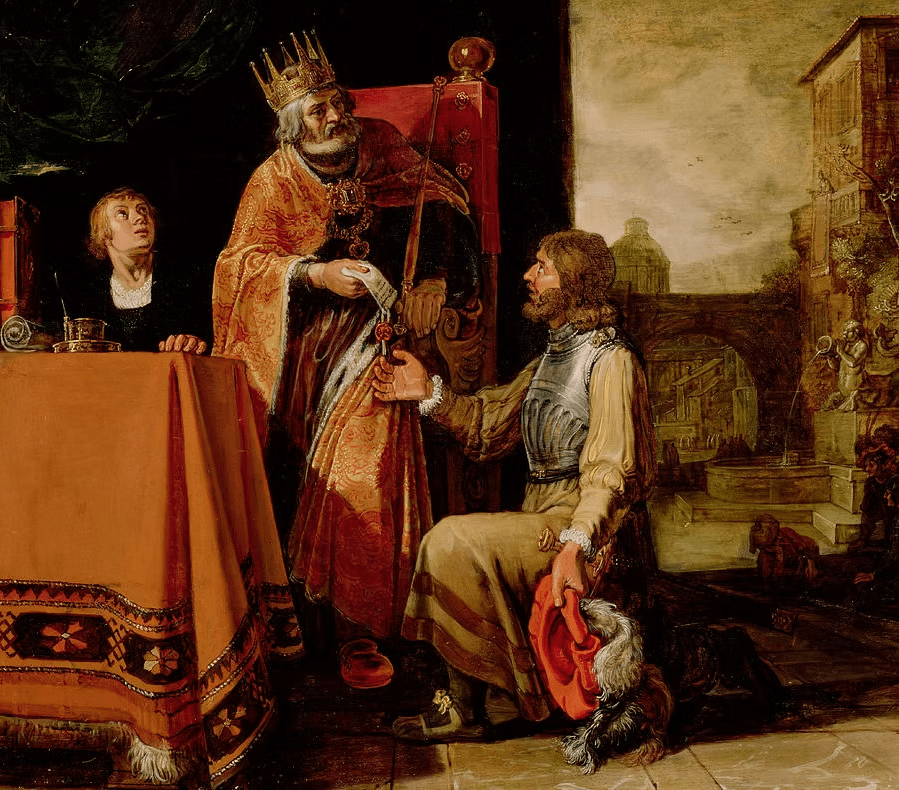










 Explaining the Readings