Tag Archives: Ordinary time after Pentecost

Wisdom of Solomon 7:26–8:1 – The nature of wisdom

[7:26] For wisdom is a reflection of eternal light,

a spotless mirror of the working of el,

and an image of his goodness.

[7:27] Although she is but one, she can do all things,

and while remaining in herself, she renews all things;

in every generation she passes into holy souls

and makes them friends of יְיָ and prophets;

[7:28] for יְיָ loves nothing so much as the person who lives with wisdom.

[7:29] She is more beautiful than the sun,

and excels every constellation of the stars.

[7:30] Compared with the light she is found to be superior,

for it is succeeded by the night,

but against wisdom evil does not prevail.

[8:1] She reaches mightily from one end of the earth to the other,

and she orders all things well.

——————–

This is the second of two possible songs that are designated as companions with the Track 1 Old Testament from Proverbs 7 that can be read aloud in unison or sung by a cantor on the sixteenth Sunday after Pentecost [Proper 19], Year B, according to the lectionary for the Episcopal Church. If chosen, it will follow the words of Solomon that say, “Wisdom cries out in the street; in the squares she raises her voice.” The pair will be presented before the Epistle reading from James, where the Apostle wrote, “For all of us make many mistakes. Anyone who makes no mistakes in speaking is perfect, able to keep the whole body in check with a bridle.” All will accompany the Gospel reading from Mark, where Jesus asked his disciples who they thought he was, so we read, “Peter answered him, “You are the Messiah.” And [Jesus] sternly ordered them not to tell anyone about him.”

This optional reading is Apocryphal, meaning is is not accepted as Canon, although widely accepted as true. Because it is not Canon, my reference site [BibleHub Interlinear] does not offer the Hebrew of the Wisdom of Solomon. As such, I do not have access to the literal translations or have an easy reference to the definitions of Hebrew words that they provide. There are, however, Hebrew sites that offer semblances of that, although they are much harder for me to navigate and ascertain the deeper meaning. As such, I offer a most rudimentary interpretation of this song-poem of Solomon.

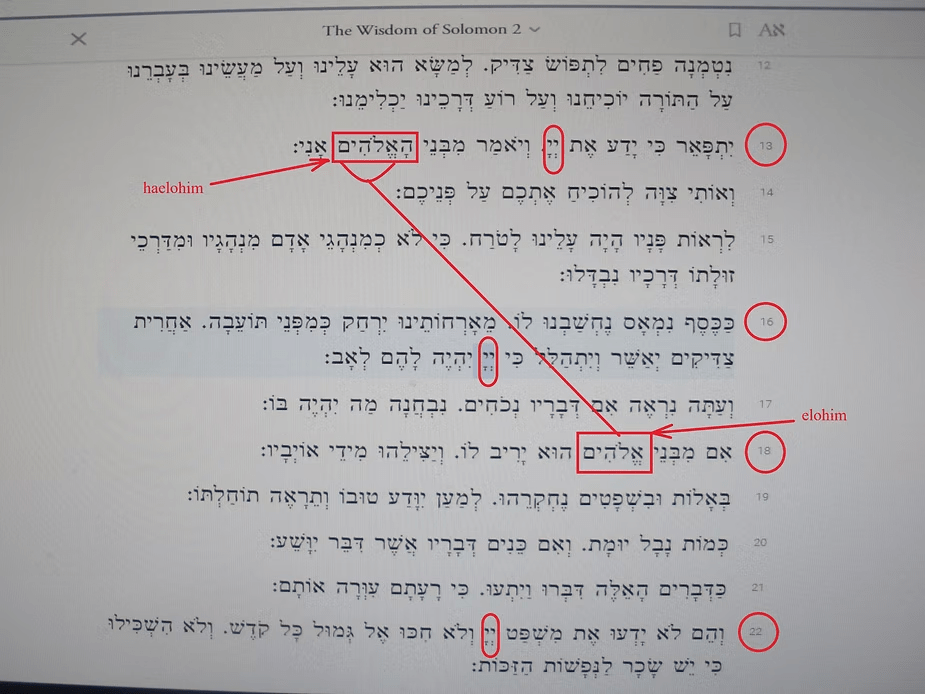
There are thirty-one verses in the seventh chapter. This reading is then the last six verses of that chapter and the first verse of chapter eight, making a total of seven verses. I have applied the verse numbers in bold type, within brackets, to assist in my analysis when referring to verses. Those numbers come from the NRSV translation, which the Episcopal Church claims to be their source. However, the Episcopal Church has modified that translation. In verses twenty-seven and twenty-eight there are two times that a Hebrew word has been translated as “God.” I have removed that translation and replaced it with the Hebrew written [“יְיָ”], sometimes called “HaShem.”

When this reading is seen as an optional selection to Psalm 19, Psalm 19 has one use of “el” that is translated as “God.” In many other Psalms, David wrote “elohim,” which commonly are erroneously translated as “God.” This is erroneous because the word is “el” is singular, so to be translated here are “God” means it is ludacris to pretend a word written in the plural number (“elohim“) is anything other than “gods” [not worthy of capitalization]. This means Solomon wrote something that amounts to an abbreviation [or something less], which makes it worthwhile to understand what “יְיָ” [“HaShem“] means.

According to the definition supplied by the Klein Dictionary, directed from the Sefaria.org website (where the Hebrew text of the Wisdom is found), this is the explanation:

יְיָ masculine noun: the proper name of God in the Bible, Tetragrammaton. [It prob. derives from הוה (= to be). The usual transliteration ‘Jehovah’ is based on the supposition that the Tetragrammaton is the imperfect Qal Hiph. of הוה and lit. means ‘the one who is, the existing’, respectively ‘who calls into existence’. In reality, however, the pronunciation and literal meaning of the Tetragrammaton is unknown. cp. יָהּ ᴵ.] (Klein Dictionary)

In verse twenty-six, the above translation that had Solomon writing, “For wisdom is a reflection of eternal light, a spotless mirror of the working of el, and an image of his goodness,” one very important word is left out. According to all Hebrew sites I could find that offered the Hebrew text, verse twenty-six begins with the word “הִיא” or “hiy,” which means “she.” The Roman Catholic translation of this verse states, “for she is a reflection,” not “wisdom.” The NRSV translation also includes that feminine third-person pronoun, which says the Episcopal Church wants to make it clear to the lambs in the pews that “she” means “wisdom,” without any questions asked. This should bring up the question, “Why is wisdom referred to as a “she”?”

In my writings posted here, I have regularly commented that the call of divine Scripture is for a soul to marry Yahweh; and, in that scenario of marriage, I have regularly stated that human souls are the brides or wives of Yahweh [both males and females], who is the bridegroom and Husband. This is because Yahweh is “the Father,” thus masculine. Anything of the physical universe (including flesh, bones, and blood) is of feminine essence. As such, those who believe in gods and goddesses see “Mother Earth” as a “she,” which makes all souls in human flesh be feminine in essence because their flesh is part of Mother Earth. This same analogy is stated by Solomon when he routinely referenced wisdom as feminine.

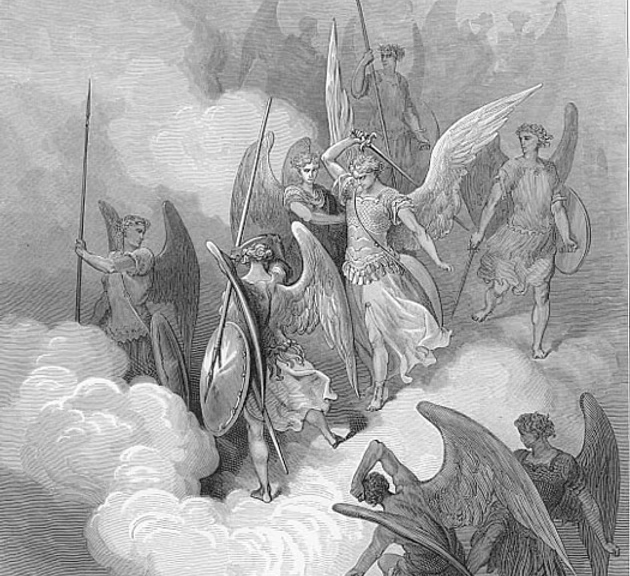
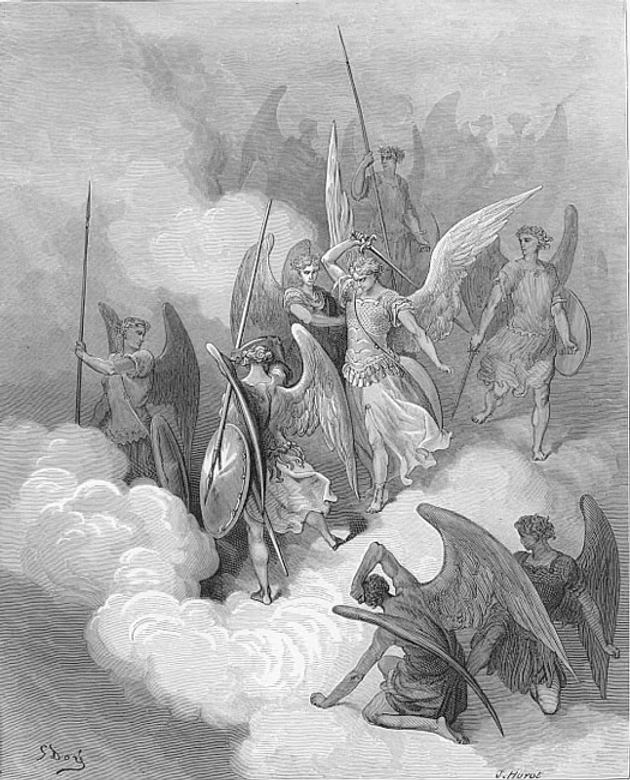
In a past Old Testament reading, when David died and Solomon encountered Yahweh in a dream, I wrote how Yahweh stepped aside and let Solomon converse with Satan, the elohim who had been cast into the depths of the earth. Satan’s reign is thus worldly, but as a demon of the earth his spirit manifests as feminine. When young Solomon asked for the knowledge of good and evil, he sought the forbidden fruit that keeps a soul from achieving heaven. This means it was Satan who granted a young boy king the greatest wisdom – a gift known well by the serpent of Eden – in addition to worldly riches. Yahweh does not tempt human souls with material things. Therefore, wisdom is a she because it is the external world connecting to the human brain, in metaphysical ways that are the gifts of intuition and psychic abilities that are deductions of mind, not the all-knowing instant wisdom of Yahweh.

For anyone who has studied metaphysical topics, such as astrology, one can readily see how a translation saying, “she is a reflection of eternal light, a spotless mirror of the working of el, and an image of his goodness” becomes a statement of the sun (the eternal source of light) and the moon (a reflective mirror of light). The goodness of the sun’s light gives life to earth, whereas that goodness of the moon is weak, beyond an effect on waters of the earth, so it can only provide dim light to the darkness. The moon’s reflection of goodness during daylight is nil. That means the sun reflects the light of life, while the moon reflects the light of death. Everything is metaphoric and symbolic; but just as the sun and the moon reflect heavenly lights, day and night, so too does goddess wisdom confirm that there is a stronger wisdom – that of Yahweh – which the goddess wisdom can only mimic in reflection. The pronoun “she” says the wisdom of Solomon is not and inner light of truth, but an ability to discern external variables through enhanced intelligence.

In the statement that includes “el” – “a spotless mirror of the working of el” – the use of “el” should not be seen as Yahweh per se, because Yahweh does not Himself shine in the material realm. As such, He is unable to be reflected, like is the sun. That makes the sun be metaphor for Jesus – the Son of man – who shines as an elohim [an el] of Yahweh. This makes Saints, as those who are reborn as Jesus, each be like a sun, as a Christ resurrected [the light of Christ]. Therefore, Solomon was saying the powers of brain (called the goddess wisdom) is the mirror image of a true Saint. A true Saint has all the knowledge of Yahweh readily available (as needed), whereas a false prophet has lots of tricks up his or her sleeves. [Remember how Moses was enabled divinely by Yahweh, when he did battle with the priests of Pharaoh, who performed reflective deeds of wisdom.]

When verse twenty-seven begins by stating, “ Although she is but one, she can do all things, and while remaining in herself, she renews all things,” the focus needs to be on the number stated – “one.” To know that Yahweh is the only true “one,” who is the Creator of all that is, including every elohim, including all the spiritual powers of the universe, wisdom can be nothing more than one of many, meaning wisdom was insignificant in the grand scheme of Creation. This means it can only be Solomon stating he was the “one” in whom wisdom reigned. As far as Solomon was concerned, he was the only “one” in whom such great powers of wisdom mattered. For as many as Solomon reigned over as king, he could never become outside of Solomon, so he could never experience more than the “one” that was himself, his own soul-flesh being.

This should be seen as a flaw, which can also be projected on the flaw of thinking Yahweh [like Solomon’s wisdom] can only be in “one.” This is the flaw found in the failing religion that is Christianity, as it is a parallel to Solomon initiating the failure of the concept of Israel as being all individuals who retained Yahweh, the One God. Solomon led the Israelites to worship lesser gods, marrying women who imported pagan religious ideas into the mindset of the people of Israel [the name of a nation]. The same worship of wisdom [intelligence] makes every man and woman a god, like Solomon saw himself as, such that Christians worship themselves [like gods], while seeing only “one Christ,” specifically named the “one Jesus Christ,” to whom they pray to be given great wisdom. All eyes are taken away from the inner soul’s need for Yahweh – the Creator of all souls – instead placing focus on icons of the world, turning all away from a proposal for all souls to marry Yahweh and become His Son resurrected within their souls.

The second half of verse twenty-seven then says, “in every generation she passes into holy souls and makes them friends of יְיָ and prophets.” Here, the first presentation of the unknown Hebrew ‘word’ is found. When Solomon said, “she passes into holy souls,” this should be read as a spiritual possession, where a “soul” has become overcome with a worship of intellectual being. A “holy soul” is one that is “generated” by Yahweh, and only Yahweh; but a soul in a body of flesh is set free, allowed to find its way back to Yahweh. In that process, all souls become possessed by this goddess that expands the brain. It is a necessary growth of the flesh that needs to learn discernment, as normal education. To then see how that “makes them friends,” this is coming to realize there are many deities to be recognized, many other than Yahweh. This means the writing of “יְיָ” becomes a reflection of polytheism, not simply Yahweh. Thus the addition of “prophets” says all “gods” [elohim] have those who worship them exclusively and benefit from such selling of their souls. Solomon’s wives brought in many ‘priests’ of foreign gods, beginning the downfall of Israel. [Remember how Elijah challenged the priests of Baal (450 in number), where those who failed were the “friends” of Ahab and Jezebel, as the “prophets” of a dead god, with “יְיָ” symbolizing Baal.]

For verse twenty-eight to then repeat the use of “יְיָ,” stating “for יְיָ loves nothing so much as the person who lives with wisdom,” this again takes one away from the concept of Yahweh, the Father [masculine essence], where “יְיָ” is “she” who “loves nothing so much.” The “nothing” is the reward of being such a servant or subject of wisdom. This then says the “nothing loved” is given to souls who “live with wisdom,” where “life” is the false appearance of the world [the realm of death] seeming full of “life.” That is only the illusion of an eternal soul animating dead matter. This says wisdom is only possible through material means; so, when the body dies and the soul is released, wisdom cannot be taken with a soul. Wisdom is therefore like material wealth, which gets left behind at death bringing about separation of a soul from all in that realm.

Verse twenty-nine then states “She is more beautiful than the sun, and excels every constellation of the stars.” In this, “beauty” must be seen as in the eyes of the beholder, such that what Solomon meant is this: You can look at the full moon and see imaginations possible; but if one stares at the full sun, one will go blind. By speaking about “every constellation of the stars,” the imaginary lines that connect the tiny dots of light that the stars are, turning separate points of light into a figure within one’s brain, this becomes a statement that says external facts [stars] can be read through reason, deduction, inference, and induction, such that wisdom is that ability to ‘connect the dots.’ That can sometimes lead to the truth, if the mathematics of true logic is applied; but often reason is flawed and the conclusions are (more often than not) invalid and false.

In verse thirty the translation says, “Compared with the light she is found to be superior, for it is succeeded by the night, but against wisdom evil does not prevail.” Here, the meaning of “superior” is akin to the heuristic that says, “the whole is greater than the sum of the parts.” [Gestalt theory] There is nothing greater or superior to Yahweh; and, the light of the Son [an Anointed soul in flesh] is the truth, at all times. Because nothing of mind can be superior to the truth, wisdom (“she”) can only shine in darkness, where ignorance is always inferior to knowledge. When Solomon said, “against wisdom evil does not prevail,” “evil” has no need to use ploys against a soul already committed in marriage to a demonic possession. The aspect of being “succeeded by the night” says wisdom is given to those who choose death [“night”] over life [“light”]. Overall, this verse speaks of the values of having knowledge of good and evil, which is the fruit that prevents a soul from attaining a return to be one with Yahweh.

Whenever the Episcopal Church chooses to combine the end of one song with the beginning of the next (as is done here, with the first verse of the eighth chapter next to be read), the impression given is all being on the same page. The reason for a separate chapter is not running out of parchment. The eighth chapter begins a new line of though, from a new set of core ideas. That needs to be understood when reading, “She reaches mightily from one end of the earth to the other, and she orders all things well.” This is less about specific comparisons of wisdom to natural phenomena and turning to address the way wisdom can direct one’s life.

In the titles given to sections of Scripture, to guide the thought processes of readers, the Catholic Bishops page says verses 23 to 30 of Chapter 7 can be expected to be about “Nature and Incomparable Dignity of Wisdom.” That, of course, is based on the meaning of the words found written in those verses by Solomon. In this regard, the NRSV also applies a header, one that says, “The Nature of Wisdom.” Relative to Chapter 8, the Bishops place a header before verse two, saying, “Wisdom, the Source of Blessings,” while the NRSV puts one in the same place, which states, “Solomon’s Love for Wisdom.” Both do not reflect upon verse 1 of the eighth chapter, as if it were some lost verse, stuck at the top of a random chapter. It should not be read as the leftover thoughts of “The Nature of Wisdom,” but the precursor of “Solomon’s Love of Wisdom.” In that regard, Solomon soon after [verse two] wrote of marrying wisdom, taking it as another of his many wives.

This means Solomon saw the appeal of wisdom, as an asset to behold, or a conquest to be obtained. This is nothing like a comparison of the light, as a reflection, which has to do with the enhancement of mental capacities. This is about the worldly lusts that wisdom can bring within one’s grasp. Thus, “from one end of the earth to the other” praises the vast array of “material things” that wisdom can reveal the secrets for obtaining them. When Solomon said, “she orders all things well,” this should be seen as a value ranking, such as that in which metal objects fall in line with. The rarest are the most valuable, while the most plentiful are the least valuable. The prettier are more valuable than the uglier. This has nothing to do with the truth, as it has only to do with the opinions of an individual. As a king, Solomon could lust for the rarest and the prettiest, so wisdom was his way to achieve all of his lustful desires.

I want to add that the Safaria.org website offers the Hebrew text, with some words searchable as to meaning and definition on their site, linking to the Klein Dictionary. Many Hebrew words are not found on that site, but can be found on other translation websites. In my rudimentary attempts to verify the translations of the NRSV, the Hebrew text presented by Safaria does not translate anywhere close to what the NRSV shows. While I could see how verse twenty-six is most likely correctly translated, verse twenty-seven went far off the rails. Here is what is listed above, compared to what I found:

“Although she is but one, she can do all things, and while remaining in herself, she renews all things” [from verse 26 above]

“by herself she could all turn work and reason all affairs. Appointed time fit in the minds worthy industry my love towards getting.” [My literal translation gleaned.]

In this, there is a very broad scope of leeway given to the translators, which makes everything become a paraphrase that fits snugly into whatever agenda the translator had to begin with. It says this “Wisdom of Solomon” can become more Satanic than it already appears, if one was to seriously dig deeply into what was written. I feel dirty from what I have done to this point; so, I do not care to go further.

As a potential accompaniment to the reading from Proverbs 7 on the sixteenth Sunday after Pentecost, when one’s own personal ministry for Yahweh should already be well underway, the lesson here is to be wary of wisdom. For Solomon to flaunt wisdom as a “she” or “her” is to pronounce his lust for worldly matters, not having any spiritual concerns of value. The focus of this translation says to be a light in the darkness for those who love the night, fearing their exposure in daylight. This makes the lesson to be wary of the dangers of evil that come dressed up in packages of intelligence. So many priests and pastors line the walls of their offices with sheets of paper that profess them to be full of wisdom. However, to have never married one’s soul to Yahweh, being reborn as His Son Jesus, none of the people who sit in the churches of those so-called religious leaders [the children of wisdom] will ever be able to ‘graduate’ and receive grandiose diplomas of wisdom from their church leaders. No souls will be made better, much less have themselves be able to go find a job in a church and have their own office, where they too can line the walls with trinkets of wisdom.

The lesson is then be Jesus, so one can touch the souls of others and have them too become Jesus reborn. That is far better than playing ‘Father Brainy, Mother Superior, or Lady Wisdom” in the eyes of Yahweh.
Psalm 116:1-8 – Finding paradise before reaching Sheol

1 [1] I love Yahweh, because he has heard the voice of my supplication, *

[2] because he has inclined his ear to me whenever I called upon him.

2 [3] The cords of death entangled me;

the grip of the grave took hold of me; *

I came to grief and sorrow.

3 [4] Then I called upon the Name of Yahweh: *

Yahweh, I pray you, save my life.”

4 [5] Gracious is Yahweh and righteous; *

welohenu is full of compassion.

5 [6] Yahweh watches over the innocent; *

I was brought very low, and he helped me.

6 [7] Turn again to your rest, O my soul, *

for Yahweh has treated you well.

7 [8] For you have rescued my life from death, *

my eyes from tears, and my feet from stumbling.

8 [9] I will walk in the presence of Yahweh *

in the land of the living.

——————–

This is the companion Psalm that will be read aloud in unison or sung by a cantor on the sixteenth Sunday after Pentecost [Proper 19], Year B, if the Track 2 Old Testament option is chosen, according to the lectionary for the Episcopal Church. In that track, a reading from Isaiah will state, “Yahweh helps me … therefore I have set my face like flint, and I know that I shall not be put to shame; he who vindicates me is near.” That pair will precede the Epistle reading from James, where the Apostle wrote, “Not many of you should become teachers, my brothers and sisters, for you know that we who teach will be judged with greater strictness.” All will accompany the Gospel selection from Mark, where Jesus said, “Those who are ashamed of me and of my words in this adulterous and sinful generation, of them the Son of Man will also be ashamed when he comes in the glory of his Father with the holy angels.”

In the above English translation of Psalm 116, you will note that I have made some amendments. First, in one place the text had been incorrectly translated to say, “our God, when the Hebrew written is “welohenu,” which is in the plural number, as “our gods.” I have restored the Hebrew text. Next, there are seven places where “Yahweh” has incorrectly been translated as “the Lord.” Yahweh is a proper name, while “Lord” is a generic that David did not praise. He named “Yahweh” specifically, for a purpose; so, I have restored those proper names. Finally, the Episcopal Church has made the executive decision to change the numbering of this Psalm, as the numbers they show do not reflect what the truth is AND what the NRSV shows [supposedly the source for what the Episcopal Church presents]. I have adjusted the verses to show the correct numbering [there are nine, not eight], shown in bold type, between brackets. This is odd (in my mind), as half the time the Episcopal Church simply does not number anything. Perhaps that is because when they do number the verses, they do it wrong?

Psalm 116 is nineteen verses in length, in total. It is a little odd, in that it does not begin with an announcement of any kind, such as: A psalm of David. It simply begins. Half of it will be read today and on a day during Easter week. The other half will be read on two other dates in the lectionary cycle; with one other reading being some of these verses, combined with the verses from the second half. So, a total of five times some part of Psalm 116 will be read aloud. Because of the misnumbering by the Episcopal Church, I can only assume [without deeper investigation] verses eighteen and nineteen are read on those dates when the second half is read aloud. Otherwise, verses eighteen and nineteen will never be read.

The literal English translation of verse one is this: “I love that he has heard ׀ Yahweh ; my voice , my supplications .” In this, there is a bar [“׀”] placed after “he has heard” and before “Yahweh,” which acts as [I assume] a musical direction that can relate to a pause. That pause makes “I love that he has heard” be a statement, with “Yahweh” being the explanation of who “he” is, after the mark of pause. In the BibleHub Interlinear heading of verses, this whole song is headed: “He Listens to My Voice.” The NRSV heads it as “Thanksgiving for Recovery from Illness.” Neither headers were part of the actual song. However, the assumption made by the BibleHub Interlinear translator is that the Yahweh listens to what prayers ask for. I think this is limited and a one-way view of what is written by David.

Because “Yahweh” is followed by a semi-colon, the second half of this verse is a separate thought, although related to that before. The relationship is Yahweh hearing the one praying to Him. The separation must then also be read as relative to both Yahweh and the soul praying. As such, “my voice” is more than one praying for help. It says Yahweh has answered the prayer and become one’s “voice.” That “voice” is then the actions of “Yahweh” within a wife of His, who has not just listened to one’s “supplications,” but acted on them. It says Yahweh has asked the one praying [His wife] to do what needs to be done, as Yahweh pleading with His wife to follow His directions. Those then become the wife’s to comply with, as “my supplications.” The key to this assumption of a Husband listening to and then helping His wife reverts back to the first word of this verse – “’ā·haḇ·tî” – which says “I love.” That is a statement of the “love” that reciprocates in marriage.

The literal English translation of verse two then sings,

“that he has extended his ear to me ; as long as I live I will proclaim .

When this verse is read as if David sang, “Oh boy! Yahweh listens to me! Now I can ask for everything in the Sears Wish Book!” it is wrong. By seeing how the “ear” of Yahweh has been “extended,” it is then David’s “ear” that can divinely hear the Spiritual insights of his Holy Husband. Therefore, after the semi-colon, David stated he could hear what Yahweh spoke to him, so he would “proclaim” that heard. That becomes a reflection of ministry, so others can also hear the Word of God. The aspect of “as long as I live” means marriage is forever; but ministry in divine marriage does not stop while one is a soul in the flesh, once ministry begins.

Verse three then literally translates into English as singing: “surrounded me the bands of death , the distress of Sheol found me ; distress and sorrow I discovered .” Here, when David wrote “ḥeḇ·lê-mā·weṯ,” as [NRSV] “the cords of death,” where “chebel” can mean “cord, territory, band” (Strong’s), the “territory” of death is one’s body of flesh. It is the “rope” that ties a soul to the material realm, keeping it captive, unable to freely return to the spiritual realm. The “distress of Sheol” means the threat of death AND Judgement, as a place in between, where a soul is still kept from returning to the spiritual realm, pending Yahweh’s review of the life past in the flesh.

The Hebrew word “sheol” refers to “underworld (place to which people descend at death).” (Strong’s) This means a soul descends into a non-physical realm, where it is in holding before Judgment. This means “Sheol” is where a soul is either deemed clean spiritually and able to ascend into the divine plane with Yahweh; or, when its sins committed in the flesh condemn that soul, causing it to return into new flesh [start over again], or worse [be cast into the eternal darkness due to unredeemable sins]. For David to then moan, “distress and sorrow I discovered,” this means his soul has been made aware of all its past sins, through having an “ear extended” to and from Yahweh.

Verse four is then literally translated into English as: “and in the name of Yahweh I proclaimed ; I beseech you Yahweh save my soul .” In this, it must be realized that “in the name of” [from “ū·ḇə·šêm”] is a statement of marriage, such that a wife takes on the “name” [“shem”] of the husband. When David sang about being “in the name of Yahweh,” he declared he was such a wife; therefore, he proclaimed as Yahweh’s extension on earth. His declarations “implored” outwardly to others to also marry their souls to Yahweh, because salvation is only possible through such a divine marriage of love.

The literal English translation of verse five then sings, “gracious Yahweh and just ; of us elohim of love .” In this verse is found the Hebrew “welohenu,” where the plural number [“elohim” as “gods”] is amended to be more than simply David, but others like him. As such, that says Yahweh has many “elohim” [therefore the plural]. The multiplicity is then “of us” or “our,” in the possessive or genitive case. By beginning this verse singing, “gracious Yahweh,” this speaks of the presence of Yahweh upon a soul, which is the truth of His “grace.” That, again, sings of divine marriage; and, it says that this union of Holy Matrimony is what makes all past sins “justified,” as the soul-flesh then becomes totally submissive to the Will of God, out of reciprocal love. Therefore, following the semi-colon, David sang out that this state of being is the same in all of Yahweh’s wives, with all being divinely possessed “elohim.”

Verse six then literally translates into English as singing, “keeps watch the simple Yahweh ; I was brought low , and me he delivered .” In the segment of words in this verse that says, “keeps watch the simple Yahweh,” the mind wants to only see them as saying “Yahweh watches over His wives.” While that is true, the same words also say that the wives of Yahweh [His elohim] also “keep watch” or “care” [from “shamar”] the “simple” [“pthiy”]. In that, the wives of Yahweh have sacrificed self-ego, so their brains are not an altar of self-worship, making them “open-minded” or “simple” in knowledge. This makes them like children who need to be taught; and, in that way the wives of Yahweh will “care” for the “simple” who know nothing about how to marry their souls to Yahweh.

Following the semi-colon mark, the segment that says, “I was brought low” stems from the Hebrew word “dalal,” which means, “bring low, dry up, be emptied, be not equal, fail, be impoverished, be made thin.” This should be seen in terms of the word “pthiy,” or the state of being “simple.” The biggest hurdle to clear, when a soul is being led to accept a marriage proposal from Yahweh, is its own brain making a soul think it is self-sufficient and all-knowing. It is that obstacle within that must be “emptied, made thin, and impoverished,” relative to one’s dependence on intellect. This is so one stops thinking how to be saved and one accepts the brain cannot supply that state of being. This reflects on receiving Yahweh’s Spirit and from personal experience [unknown prior] one being able to have true spiritual faith. It says one must die of self-ego and self-will, from having reached the depths of self-reliance, so one can become simply led by Yahweh. Then salvation can be gained.

The seventh verse then translates literally into English as, “return my soul to your permanence ; for Yahweh has dealt adequately with you .” When one is searching for the assured state of salvation, the singing of David that says [NRSV], “Turn again to your rest, O my soul,” the “return” of a “soul” to the presence of Yahweh is divine marriage. This takes place when a soul is still animating its flesh. When the death of the flesh comes and a soul has not married Yahweh prior then, instead of finding the “permanence” that is “rest,” such peace will not be found after descending into Sheol for Judgment. Without receiving Yahweh’s Spirit prior to physical death, no soul is capable to die with all sins washed clean. This means a soul must find its way to sacrifice its self-will [symbolic death], so Yahweh’s Spirit can return the soul into that presence of eternal life while the soul is still residing in a body of flesh. Thus, when David then sang, “for Yahweh has dealt adequately with you,” this sings of the path of righteousness that a soul-flesh will lead, which must be walked in order to find a favorable Judgment for a soul in Sheol.

Verse eight then literally translates into English as singing, “for you have withdrawn my soul , from death my eyes from tears ; my feet from falling .” In this, the Hebrew word “chalats” means “to draw off or out, withdraw,” with an intent of use being “to rescue” or “to ready, arm, make fat.” This scope of meaning says one’s “soul” has been increased, by the addition of a divine Spirit, which “withdraws” the soul from control over its body of flesh, so it backs away in submission to a higher power. This is the only way a human being can truly live righteously. That transfer then eliminates all fear of “death,” so the soul no longer sees that transition as a point of Judgment, foreseeing sorrow to come. When David sang of his “feet” kept “from falling,” this sings of his body of flesh being led by the Spirit of Yahweh to walk in His ways. This sings of a joyful ministry for Yahweh.

The final verse in this selection [verse nine] then translates literally into English as singing, “I will walk before Yahweh ; in the land , of the living .” Here, the Hebrew word written that translates as “before” is “lip̄·nê,” which is rooted in “panim,” meaning “face.” This then says David will “walk” while wearing the “face” of Yahweh “before” his own “face.” This is the truth of the First Commandment, which literally says, “not you shall have other elohim upon face.” The last two Hebrew words there are “‘al- pā·nā·ya,” which says “upon face.” The meaning says to wear one’s own face [self-ego] is to deny Yahweh and not wear His face before one’s own face. Such a refusal says one’s self-ego will not have been “withdrawn” and moved back in submission. Refusing to agree to the first vow of divine marriage means one’s soul rejects Yahweh and turns away from Him, seeing self as more important. Therefore, David sang about his soul’s marriage to Yahweh, by singing that he wore the “face of Yahweh” when he “walked” [righteously].

Following the semi-colon mark, David then made it clear that his “walking” was “in the land,” or “on the earth,” which means “of the flesh” and “in the physical.” This says salvation is only assured when one marries Yahweh while a soul in the flesh, so all past sins are cleansed and a new self [one’s soul led by the Spirit] then proceeds through life, wearing the “face” of righteousness, in the name of Yahweh. Because the “earth” or “land” [“eretz”] is a soul giving animation to the death of matter, the following statement – “of the living” – is then the truth of salvation. That sings of when the soul can truly be freed to eternal life, no longer trapped in the death that is a body of flesh, in the physical realm.

As the accompany Psalm to Isaiah 50, to be sung aloud on the sixteenth Sunday after Pentecost, when one’s own personal ministry for Yahweh should already be well underway, the lesson of David’s song is to marry one’s soul to Yahweh and wear His face to the world. Ministry for Yahweh can only come from His presence, so His voice is personally heard and His message proclaimed for all to know. Wanting to be good and trying to read lots of good researched opinions and then go out armed with those opinions as one’s own will invariably lead one to be positioned between a rock and a hard place. There, one will be forced to admit, “It wasn’t my idea, so I can’t explain it.” True ministry for Yahweh makes one’s mouth appear before others, unprepared, as one who is “simple.” Then, welcomed by others as non-threatening, one lets Yahweh do the talking. No one will be led to marry their souls to Yahweh by preaching a sermon only one person can understand.

Proverbs 31:10-31 – Worshiping the feminine

A capable wife who can find?

She is far more precious than jewels.

The heart of her husband trusts in her,

and he will have no lack of gain.

She does him good, and not harm,

all the days of her life.

She seeks wool and flax,

and works with willing hands.

She is like the ships of the merchant,

she brings her food from far away.

She rises while it is still night

and provides food for her household

and tasks for her servant-girls.

She considers a field and buys it;

with the fruit of her hands she plants a vineyard.

She girds herself with strength,

and makes her arms strong.

She perceives that her merchandise is profitable.

Her lamp does not go out at night.

She puts her hands to the distaff,

and her hands hold the spindle.

She opens her hand to the poor,

and reaches out her hands to the needy.

She is not afraid for her household when it snows,

for all her household are clothed in crimson.

She makes herself coverings;

her clothing is fine linen and purple.

Her husband is known in the city gates,

taking his seat among the elders of the land.

She makes linen garments and sells them;

she supplies the merchant with sashes.

Strength and dignity are her clothing,

and she laughs at the time to come.

She opens her mouth with wisdom,

and the teaching of kindness is on her tongue.

She looks well to the ways of her household,

and does not eat the bread of idleness.

Her children rise up and call her happy;

her husband too, and he praises her:

“Many women have done excellently,

but you surpass them all.”

Charm is deceitful, and beauty is vain,

but a woman who fears the Lord is to be praised.

Give her a share in the fruit of her hands,

and let her works praise her in the city gates.

——————–

This is the Track 1 Old Testament reading selection fot the seventeenth Sunday after Pentecost [Proper 20], Year B, according to the lectionary for the Episcopal Church. If Track 1 has been determined to be a church’s path during Year B, it will be accompanied by a choice of readings, the first of which is Psalm 1, which sings, “They are like trees planted by streams of water, bearing fruit in due season, with leaves that do not wither; everything they do shall prosper.” The other optional accompaniment is from Solomon’s Book of Wisdom, which states, “We are considered by him as something base, and he avoids our ways as unclean.” Whichever two will be read aloud, they will then precede an Epistle reading from James, where the Apostle wrote, “Show by your good life that your works are done with gentleness born of wisdom. But if you have bitter envy and selfish ambition in your hearts, do not be boastful and false to the truth.” All will accompany the Gospel reading from Mark, where we read of Jesus saying, “Whoever wants to be first must be last of all and servant of all.”

I wrote of this reading when it was last a selection in the lectionary cycle. I published my views on my website, and that commentary can be viewed by searching this site. I stand by my comments then, although I no longer appreciate much that has to do with Solomon’s Proverbs or his Wisdom. I see the truth of Yahweh coming from the words of Solomon, but those nuggets of truth are more difficult to realize than are those of other Scripture. I invite all to read my relatively short and painless offering of the meanings of wifely virtues, as they still apply today. However, I will now make new observations.

In the first verse of this reading, the first two words (combined as one) in the Hebrew is “’ê·šeṯ-ḥa·yil,” which translates [NRSV] as “a capable wife.” In reality, the two word independently are “ishshah” and “chayil.” The Hebrew word “ishshah” means, “woman, wife, female.” In Genesis 2 and 3, there is no mention of the name “Eve,” as the only references to her is as “ishshah.” In Genesis 4, when Cain and Abel are born to “man” and “woman-wife,” we read “and Adam [man] knew,” then in the Hebrew, “ḥaw·wāh ’iš·tōw” (from “chavvah ishhah”). In that, “chavvah” (which means “life”) is where “the first woman” is named, as “Eve.” In that, “the first ishshah” is a better understanding, as “Eve” was not a ‘day six’ creation. As for Solomon combining “ishshah” with “chayil,” the word “chayil” means “strength, efficiency, wealth, army.” Thus, instead of “a capable wife,” Solomon meant “a valuable woman.”

In the vast history of the world, a man without offspring, most notably a male heir, is seen as worthless. As such, a man needs a woman to be his wife and produce his heirs. Because man is a mortal creature, his strength comes from being a link in an unbroken chain of souls in a lineage of souls. To be childless means to break the chain; and, that becomes the importance of men whose wives were barren in Genesis (Sarai and Rachel the two most prominent), but Yahweh intervened to show His power, so a “wife” can become the “strength” and “wealth” a man needs.

Because Solomon was the king of Israel, his wives would be deemed “queens.” Before he had his dream about wishing for great powers to understand good and evil, an arranged marriage between young Solomon and an Egyptian princess had taken place. His taking a foreign wife was not a wise decision, according to Mosaic laws. David was chastised in hindsight by scholars for having married Maacah, the daughter of Talmay, king of Geshur. This is wrong because in the genetics of the Israelites the woman born of Israelite lineage will always produce another of that line. Conversely, a woman of a Gentile line will always produce Gentile children, unless some official conversion paperwork is submitted and probably some holy water sprinkled to remove the Gentile from the wife of an Israelite.

In the story of Esther, she was a Jewish woman who had been taken as one of many wives of a Persian king. Like Solomon’s many sexual partners, Esther ended up on the ‘used wives’ pile in the harem of Ahasuerus. This history says, in essence, a “woman, wife, female” is only good for producing babies; but when a husband tires of the same ole same ole and a little strange is the perk-me-up needed, then it is time for another “wife, woman, female.” The woman never gets the luxury of such variety in life.

Because the ancient times have melted down into the modern acceptance of same sex marriage, where sterility is an excuse to adopt the unwanted children of who knows what lineage, with women more often than not preferring to wear the pants and control as many men as possible. To read Proverbs 31 makes more women mad, than those who love to please their husbands ‘the old fashioned way.’ This is why my 2018 commentary went into that direction. This reading has little appeal in these times when Christianity is dwindling into the acceptance of perverse ideas, simply to pay the electric bills of churches and keep food and medical benefits on the plates of its hired hands.

What needs to be read into these words of Solomon, where the feminine gender is applied to Hebrew words creating twenty times “she” is translated into English. That goes along with twenty-seven times the feminine possessive is applied as “her.” All stem from verse ten identifying “ishshah,” which of course is feminine [as “wife”]. It gives the impression that Solomon is in control, as the masculine. So, even though a wife was necessary for Solomon’s strength to come forth, for him to be known, Solomon had to marry with a counterpart, so that two became one, while always realizing that Solomon is still the controlling factor. This attitude needs to be seen as egotistical and unequal. Solomon needs to be seen – for all the wisdom he proclaims to have – as blind as a bat to the reality of marriage.

Because Solomon has delightfully proclaimed the wonders of “wisdom” as his bride, it should be recognized that he is not singing praises to a human woman, because those are a dime a dozen to him. He is singing praise to his true wife, the goddess to his god-ship. This means Solomon saw himself as an “elohim,” where his divine marriage to Wisdom brought him great physical strength, through the powers of a brain to discern things. In Roman terms, Solomon saw himself as a Caesar … a god in human flesh. In reality, his soul was the feminine plaything for his spiritual husband, Satan.

This brings up the polytheistic comparison, from Greek mythology, of the twin gods (Titans) Prometheus and Epimetheus. The two together created a whole, where alone their divine powers were reduced, but together they were strongest. The two names mean, in Greek, Foresight and Hindsight. Prometheus can be seen as the Husband, while Epimetheus can be seen as the Wife. Solomon saw himself as Prometheus, and his thousand wives and concubines as the lessons of the past that had nothing to do with the future. Still, in this comparison, the Titans were the ancient gods and goddesses, which were replaced by the ‘new wave’ gods and goddesses. As such, Solomon could not see the future beyond the realm of worldly reality. So, he could not see how all his selfish plans were the condemnation of his soul. Solomon sold his soul for about fifty years of Wisdom’s service, only to spend eternity wishing he had never been born.

As the Track 1 optional Old Testament reading to be read on the twentieth Sunday after Pentecost, when one’s own personal ministry for Yahweh should already be well underway, the lesson here is see the dangers of self-worship. The feminine essence is everything in the material realm, including the powers of the brain, which see self as more important than Yahweh. This reading being so heavily leaned towards adoration of womanly traits, judged from a male’s perspective, should be a warning not to see oneself as able to judge in the ways Solomon did. Ministry for Yahweh is the subjection of the feminine to the masculine [His], where receipt of the Spirit means to be sent into service for Yahweh [as a Son reborn from the feminine]. Anything short of that obedience is rejection in the eyes of Yahweh.

Jeremiah 11:18-20 – Lambs to the slaughter willingly

[18] It was Yahweh who made it known to me, and I knew;

then you showed me their evil deeds.

[19] But I was like a gentle lamb

led to the slaughter.

And I did not know it was against me

that they devised schemes, saying,

“Let us destroy the tree with its fruit,

let us cut him off from the land of the living,

so that his name will no longer be remembered!”

[20] But you, Yahweh of hosts, who judge righteously,

who try the heart and the mind,

let me see your retribution upon them,

for to you I have committed my cause.

——————–

This is the Track 2 Old Testament selection, which will be read aloud if a church is on the Track 2 path during Year B, on the seventeenth Sunday after Pentecost [Proper 20], according to the lectionary for the Episcopal Church. If the Track 2 path is chosen, then this reading will be paired with Psalm 54, which sings, “For the arrogant have risen up against me, and the ruthless have sought my life, those who have no regard for elohim.” That pair will precede a reading from the Epistle of James, who wrote, “if you have bitter envy and selfish ambition in your hearts, do not be boastful and false to the truth. Such wisdom does not come down from above, but is earthly, unspiritual, devilish.” All will accompany the Gospel reading from Mark, where is written: “[Jesus] was teaching his disciples, saying to them, “The Son of Man is to be betrayed into human hands, and they will kill him, and three days after being killed, he will rise again.” But they did not understand what he was saying and were afraid to ask him.”

I wrote about these three verses the last time they came up in the lectionary cycle, and I posted those views on my website in 2018. That commentary can be viewed by searching this site. I stand behind the words I wrote then, as they still apply today as valid insights. I welcome all to read what I wrote then and compare it to what I am about to add. Comments, suggestions, questions and corrections are always welcome.

In this presentation of the reading, the verse numbers have been left off by the Episcopal Church. Presumably, this is their way of remedying the fact that when they do number verses from the Old Testament, they often do so incorrectly. I have supplied the verse numbers in bold type, within brackets. I will then refer to those numbers in the analysis, if need be. Also, in two places you will note that I have placed “Yahweh” in bold type. This is restoring the truth of what was written, whereas the NRSV has generalized this specific name as “Lord.” If one were to actually read all of Jeremiah 11, one would see how Yahweh told the prophet:

“Then the cities of Judah and the inhabitants of Jerusalem will go and cry out to the gods to whom they make offerings, but they will never save them in the time of their trouble. For your gods have become as many as your towns, O Judah; and as many as the streets of Jerusalem are the altars to shame you have set up, altars to make offerings to Baal.” (Jeremiah 11:12-13)

In both places where “gods” is written [“ha-elohim” and “eloheka”], that can be generalized as the many “lords” of the wayward people of Judah and Jerusalem. A “Lord” can be seen as “Baal,” when generalized as such, with nothing specifically naming what “Lord” Jeremiah [et al] was talking about. The specific name, “Yahweh,” has thus been restored; and, it should be learned by Christians today.***

These verses are shown differently by the NRSV, where the text prior and the text after is presented in standard story fashion. These three verse are displayed in song style, as Jeremiah breaking into an ecstatic chant, channeling the voice of Yahweh. As such, it is displayed like a psalm, rather than as normal prose. Because of that difference in presentation, the NRSV places a title before verse 18, which says, “Jeremiah’s Life Threatened.” BibleHub Interlinear gives it a header that says, “The Plot against Jeremiah.” Those titles extend beyond these three verses, to the end of Jeremiah 11, to verse 23.

While the observation I presented in 2018 dealt with the content of this from that perspective of Jeremiah’s conditions and ministry, I will take a broader scope of it and present how this selection fits into it being an alternate selection to the Proverbs 31 reading [Track 1]. It is important to know that all was not rosy in Israel, after David died and Solomon began to mislead the people. There has to be realized that at some point in time the Israelite people began a slow slide to oblivion; and, the Track 1 readings are pointing out the origins of that failure to serve Yahweh as His people, with Track 2 showing the destruction and ruin of long periods of bad habits and practices.

The origin of their demise was (of course) their being human beings, thus nothing any more special than all the other “Gentiles” in the world; but Year B is pointing out the history that first became endangered, when the elders of the tribes went to Samuel and demanded him appoint a king to rule over them, like other nations. Track 1 shows the beginning of that bad decision, while Track 2 shows the end results of that bad decision. The same failures made by the Israelites are made by Christians today, because it all comes down to realizing no human beings are special, especially when those people disregard the name of their marriage partner [“Yahweh”] and shuffle Him off to being some “Lord,” while bowing down before so many “gods” it is disheartening to think about how Yahweh dislikes all who do that.

This means the Proverbs 31 ooze of filth that prays to the slut “wisdom” as one’s “woman” of virtues is part of the reason Jeremiah was tapped by Yahweh to go tell the wayward, “Yahweh has disowned you guys.” It all began with goddess worship, of which Solomon promoted. When one sees how “wisdom” is the god of the 21st Century, as “science” and “philosophy” that cries out, “Beware getting a cold that might kill you.” They influence us, like Solomon’s Wisdom and Proverbs did then, to put your faith in young boys and girls [med school graduates] whose brains have been paid [hired hands] to think the way of profiteering [government and business] and selling faith in knowledge to the masses [religions] will save mankind. So, they pretend to create preventions that are impossible to create by Man. When one can see that parallel to today in Proverbs 31, then reading Jeremiah 11 becomes the parallel for tomorrow.

In verse eighteen, when Jeremiah sang, [literally translated into English] “Yahweh gave me knowledge and I know ; then you let me see their doings” this has to be seen as contrary to how Solomon schmoozed, “She opens her mouth with wisdom, and the teaching of kindness is on her tongue.” All the wise of Judah and Jerusalem were being led to sacrifice children – human sacrifices to Moloch – which Yahweh never ordered. One can only imagine a child would be burned to death after parents were soothed by the “teaching kindness from the tongue” of some priest of a goddess – “The gods will bless you for your sacrifice.” Imagine how a priest saying homosexuality is blessed by God, when that form of sterility means the end of a line. Are they not giving the go ahead – “Burn, baby, burn!”?

When one has been made aware of the “doings” of the souls who have been sold into slavery in a world that is temporal and offers absolutely nothing beyond death [a foreseen conclusion to all human lives], there is then a decision that needs to be made. Solomon was lobbying for more to sell their souls, singing nonchalantly, “Strength and dignity are her clothing, and she laughs at the time to come.” So, one can choose to join the club and go with the flow of sewage to eternal damnation; or, a soul can choose self-sacrifice to Yahweh.” Both ways you die; but one way leads to salvation and the other leads to the failure of repetition.

By knowing the “doings” of wicked ways, Jeremiah then sang of being “like a docile lamb brought to the slaughter.”

Rather than think of poor ole Jeremiah not having a clue about what was going to happen to his fluffy-haired throat, think of Jeremiah as being exactly like young Isaac, who asked daddy Abraham, “If we’re going to make a sacrifice to Yahweh, aren’t we forgetting the lamb?”

Isaac figured out he had to do what his father led him do, even if it meant dying for a cause. Americans make a lot about veterans of military service (something that usually is just a few years of a young adult’s life), making heroes of the ones killed in action or maimed for life. [“Thank you for your service,” the ones who never served say.] So, both Isaac and Jeremiah willingly went forward with self-sacrifice, knowing faith in Yahweh would make their souls A-Okay.

When Jeremiah sang, “not did I know that against me they had devised schemes,” that lack of knowledge is best. Whereas Solomon confused the brains of the Israelites by singing about “wisdom,” as if that worship of intellect was the ‘cat’s meow’ for some beauty to make one’s wife, Isaac and Jeremiah both knew only what was important: What Yahweh wanted their souls to know. The “devised schemes” are the workings of self-worshiping brains that are bowed down in subservience to a “Lord” of demonic qualities.

When verse nineteen then sings, “Let us destroy the tree with its fruit, let us cut him off from the land of the living, so that his name will no longer be remembered!” this is the scheme devised. Jeremiah was the fruit and they were the tree – Judah and its leaders. Their scheme to “destroy the tree” was akin to thinking wisdom had led them to commit suicide, in order to punish those who still wanted to be servants of Yahweh. When Jerusalem would fall and the Temple would be destroyed, the tree would bear no more fruit from there. The fruit is filled with the seeds of Yahweh; so, just like from the stump of Jesse would come a new shoot, the tree is replaceable. Therefore, those who forsake Yahweh will forever be forgotten.

In verse twenty, Jeremiah sang out, “Yahweh of hosts is who will judge righteously.” That does not mean Yahweh is so “righteous” that He gets to “judge.” It means Yahweh is who makes human beings act “righteously.” When Jesus cursed the fig tree that bore no fruit, the metaphor is the same as Judah being some worthless tree that no longer produced any worthwhile fruit. Just as that fig tree withered and died, so too did Judah, the land from which “Jews” get their name. The whole point of true Christianity is this: EVERY member of that group is a CHRIST, which means Anointed by Yahweh through divine marriage with a soul, so EVERY member is His Son resurrected in his or her flesh. That means EVERY TRUE CHRISTIAN “is who will judge righteously.” Yahweh is “Yahweh of hosts” because He can Anoint as many souls as He sees fit to be Anointed. When they say, “An apple doesn’t fall from the tree,” the meaning here is the fruit of “righteous” living has to fall from any tree calling itself “Christian.” If that fruit does not fall, then regardless of what a tree calls itself, if it is a fruitless Christian tree, then it will be cursed for using that name in vain.

When Jeremiah then sang, “testing the mind and the heart,” the words of Proverbs 31 is Solomon failing the test of the mind. He had terminal ‘Big Brain Disease’ and was so full of himself that he though intelligence was his “woman,” his main ‘squeeze.’ All the kings and priests of Israel and Judah, all who followed the lead of Solomon and took to the ways of wickedness, never giving righteous living a chance, they all were tested by how their brains thought and they all failed miserably. In terms of Dr. Seuss, they all had tiny, tiny black hearts, which were incapable of finding one iota of love for Yahweh [they called Him “Lord,” I imagine].

This means a human being today, in the Age of Wisdom, when praying to the scientists is en vogue, the test is just as applicable as always. A brain is a terrible thing to waste; and, using a brain to navigate Salvation is never going to find a soul anywhere positive. A tested mind means self-sacrifice – death of an ego – so the Mind of Christ can come and use the fleshy organ to find reason to follow all the insight that comes and verifies it as simply amazing! A well tested mind hears a question from Yahweh and says, “Whatever you say boss!” A poorly tested mind comes up with arguments that try to change the Mind of God. [Never a good thing to do.]

The test of a heart means following the advice of Jesus, when he was asked, “What is the most important Commandment?” When he said, “Well, of course, the first thing is to love Yahweh with all your heart, all your soul and all your mind,” that says marriage to Yahweh must come; and, it must come from a deeply seated love. Failure to be a soul married to Yahweh [thus His Son reborn into one’s flesh] means the heart test failed.

When Jeremiah sang [NRSV], “let me see your retribution upon them, for to you I have committed my cause,” that says as long as one’s soul is married to Yahweh, it does not matter what happens to all the riffraff that plot and scheme to rule the world. Souls like those of Solomon and the kings of Judah (Zedekiah) are like how Jesus said “dead branches will be pruned from the tree and thrown into the fire and burned.” The fates of the wayward are brought about by their own devices; and, that makes them self-fulfilling prophecies of “retribution upon them.” The element of “commitment my cause” speaks loudly of marriage vows to Yahweh that will not ever be cause to rebel against.

As a reading possible for the seventeenth Sunday after Pentecost, when one’s own personal ministry for Yahweh should already be well underway, the lesson of Jeremiah is to be a sacrificial lamb. The only thing that gets in the way of the “commitment of cause” is one’s big brain making one think, “There’s no guarantees. Woe is me. What if there is no God and I turn my back on all the luxuries of life I have become addicted to. I might never get all my things lost back!!!” If your brain thinks like that, you can have no ministry for Yahweh. You worship Solomon and his daddy – Satan. A life of abject poverty and miserable suffering is like a fleeting memory, once eternity comes and the things of this world are left far behind. Ministry means Yahweh will provide as needed. No other opinions need be considered.

***

Moses asked, “Suppose I go to the Israelites and say to them, ‘The God of your fathers has sent me to you,’ and they ask me, ‘What is his name?’ Then what shall I tell them?” (Exodus 3:13, NIV) The answer given was, “I am who I am. This is what you are to say to the Israelites: ‘I am has sent me to you.’” (Exodus 3:14, NIV) The actual Hebrew text that is translated as “I am who I am” is ’eh·yeh ’ă·šer ’eh·yeh, where this is the root meaning of “Yahweh.” In Judges 13:18 is written, “the angel of YHWH said to him, “Why do you ask my name, seeing it is incomprehensible?”‘ (Abarim Publications) Still, the word “Yahweh” is written 6,220 times in the Hebrew text, without any attempt to make that ‘name’ stand out. As Yahweh told Moses, “I AM WHO I AM” was an instruction to Moses that said, “If anyone asks who empowers you to go in my name, you tell them “I AM” here, because “I AM” sent by the One.

This is most important to realize, as “Yahweh” means one’s soul has been made a Christ (word meaning “Anointment” by Yahweh’s Spirit) and is in His name (YAH Saves is the meaning of “Jesus”). A LORD that is anywhere other than in oneself (one’s soul) is a lesser god. Yahweh was in the soul of Jeremiah. He was thus a gentle lamb led to slaughter willingly, to be led in His name.

James 3:13-4:3, 7-8a – The wisdom from heaven

Who is wise and understanding among you? Show by your good life that your works are done with gentleness born of wisdom. But if you have bitter envy and selfish ambition in your hearts, do not be boastful and false to the truth. Such wisdom does not come down from above, but is earthly, unspiritual, devilish. For where there is envy and selfish ambition, there will also be disorder and wickedness of every kind. But the wisdom from above is first pure, then peaceable, gentle, willing to yield, full of mercy and good fruits, without a trace of partiality or hypocrisy. And a harvest of righteousness is sown in peace for those who make peace.

Those conflicts and disputes among you, where do they come from? Do they not come from your cravings that are at war within you? You want something and do not have it; so you commit murder. And you covet something and cannot obtain it; so you engage in disputes and conflicts. You do not have, because you do not ask. You ask and do not receive, because you ask wrongly, in order to spend what you get on your pleasures.

Submit yourselves therefore to God. Resist the devil, and he will flee from you. Draw near to God, and he will draw near to you.

——————–

This is the Epistle reading selection for the seventeenth Sunday after Pentecost [Proper 20], Year B, according to the lectionary for the Episcopal Church. It will follow a pair of Old Testament selections, with an accompanying song, based on a church’s path during Year B, either Track 1 or Track 2. If Track 1 is the path, then a reading from Proverbs 31 will be read aloud, which says, “The heart of [a capable wife’s] husband trusts in her, and he will have no lack of gain.” That will be paired with either Psalm 1 or Wisdom 1 -2. Psalm 1 sings, “Therefore the wicked shall not stand upright when judgment comes, nor the sinner in the council of the righteous.” The Wisdom says, “Let us lie in wait for the righteous man, because he is inconvenient to us and opposes our actions; he reproaches us for sins against the law, and accuses us of sins against our training.” If Track 2 is the path, then the Old Testament reading will come from Jeremiah, who said, “And I did not know it was against me that they devised schemes, saying, “Let us destroy the tree with its fruit, let us cut him off from the land of the living, so that his name will no longer be remembered!” All will accompany the Gospel reading from Mark, where Jesus said, “The Son of Man is to be betrayed into human hands, and they will kill him, and three days after being killed, he will rise again.”

I wrote about this reading and published my views the last time it came up in the lectionary cycle, in 2018. That commentary can be read by searching this site. I welcome everyone to read my observations from three years ago, as they are still valid today. However, at this time I will take a different approach and discern James more in a perspective of the other readings that this is read with. Feel free to compare the two articles and offer comments and suggestion, ask questions or point out where corrections need to be made.

In the first question posed here by James – “Who is wise and understanding among you?” – it becomes important to realize that Proverbs 31:10-31 is headed [NRSV] “Ode to A Capable Wife.” That “wife” is his metaphor for the goddess “wisdom,” whom Solomon saw are his divine wife, as if he were a god. That means all the wonders of a human female-woman-wife is not what ‘Mr. Loverboy’ ever looked for. Solomon had seven hundred wives and three hundred concubines, meaning [one can deduce] he never met a human being that could be a wife capable enough for ole Solly to be committed to for long. Thus, every ‘woman’ he wrote poetry or wisdom about was his inner self, which was his lust for being the smartest guy around. So, Solomon would have raised his hand, if he heard James ask this question.

The reason we need to disregard everything Solomon wrote, in particular everything he wrote to make his brain appear to be the biggest the world had ever known, is Solomon would have egotistically read what James wrote incorrectly, just like every average Joe does. In the Greek text of James, it literally translates into English as asking, “Who wise kai
understanding in yourself ?” In that, the word “Tis” is capitalized, which means the word must be elevated to a divine level of meaning, higher than the simple definitions: “who?, which?, what?, why?”

This means the question can be shortened to asking, “Who in your soul?” That means “Who, What, Which” is all a statement of Yahweh’s presence “in yourself,” which means one with one’s soul. Therefore, seeing that means realizing James is asking a rhetorical question to other Saints of Christianity, because Yahweh is their true source of “wisdom and most important [from “kai”] “skillful, experienced, knowing” [the true definitions of “epistémón”]. Solomon saw his personal intelligence as a goddess that belonged solely to him; but James saw the knowledge of the movement that was Christianity as all souls married to Yahweh sharing all the knowledge they needed.

James then followed his question with: “Show by your good life that your works are done with gentleness born of wisdom.” This can literally translate into English as saying, “let him show out of this good conduct these works of same self.” In that, a “self” equals a “soul,” and “same” refers to the marriage of a soul to Yahweh, so the “soul” then acts the “same” as He would have done. When “wisdom” is then that “born” from this divine marriage, the feminine “wife” is then all souls who receive the Spirit of Yahweh. This is then the truth of “a capable wife,” as it is not something determined by Solomon – a human in control of his soul – but by Yahweh. Thus, everything Solomon said about some imaginary “woman, female, wife” [“ishshah”] must be applied to all souls [those of both men and women] who welcome Yahweh into them; and, therein lies the truth of His wisdom, not the smarts of a big brain.

In verse fourteen, James addressed the lady friend of Solomon and his lust for intelligence, by writing [NRSV], “But if you have bitter envy and selfish ambition in your hearts, do not be boastful and false to the truth. Such wisdom does not come down from above, but is earthly, unspiritual, devilish.” This is what I have been led to see of Solomon. It was not Yahweh who offered him a gift for burning incense and making blood sacrifices in holy places, because the impish young king was not approved to enter such places and do such things, not being a priest [which being king does not make]. When Yahweh asked Solomon what punishment he deserved, Solomon requested, “Fruit from the tree of knowledge of good and evil, please; and, more than anyone ever before.” At that point Yahweh told Satan, “He’s all yours.” That made Solomon demonically possessed, probably with him not given the wisdom to realize that.

In verse sixteen, James wrote the Greek word “anōthen,” which means: “from above, from heaven,” and the NRSV translates the verse as: “But the wisdom from above is first pure, then peaceable, gentle, willing to yield, full of mercy and good fruits, without a trace of partiality or hypocrisy.” The implication from that says “wisdom” can come “from below” or “not from heaven,” which must be realized as worldly knowledge. Worldly knowledge is taught in public school and ‘pay-to-play’ colleges and universities. This includes [and this must be seen as the whole point of James’ views, as he was not a ‘secular’ kind of guy] the schools of wisdom that produce priestly-dressed fellows, those who would advise kings in religious matters. Think of James being there to say this verse [had he been there] when Jesus marveled at how Nicodemus taught religious wisdom, while not understanding spiritual matters. Just because someone wears robes on Sunday does not mean they have “wisdom from above.”

Verse seventeen, which is the last verse in chapter three, sums up who has wisdom from heaven,” when he pointed out “fruit.” James specifically said this “fruit” came from a tree or vine that produced “righteousness,” not dogma. When James repeated the word “eiréné” twice, meaning “peace,” he was not speaking like an old hippie from the sixties [which is how many Episcopal priests present the word, as a catchphrase]. The word “peace” should be read as the seeds of righteousness that must be sown, not promoted beforehand, as the acts of an Apostle who truly “walks in peace.” One sows peace without pointing out: “Hey are you watching me? I’m walking in peace. You should try it.”

At this point, the reading jumps into chapter four, going through the first three verses, before skipping on to verse seven, and the first part of verse eight. The BibleHub Interlinear heading for chapter four is “Warning against Pride.” The NRSV header says, “Friendship with the World.” Obviously, the “wisdom” talk is no longer the theme; but, that can still carry over, since Solomon certainly took pride in his main ‘squeeze,’ wifey Wisdom. He was friendly throwing her name about as often as he could find a pen and paper.

The focus of chapter four initially is on arguing and bickering, which has to be James pointing this out in rabbinical circles, especially those who wanted to debate the theology of Jesus being the long awaited “Mashiach.” Everything the ruling elite of Jerusalem did was break every law in the Holy Book of Moses, when they put their big brains together and determined killing Jesus was the way to go. Some, obviously, could argue that they had to break the laws, if Jesus was the one, even if they could not defend doing what they did in that regard. After all, Jesus said he must die; and only the Apostles knew that means his death freed his soul to be resurrected in countless others.

James said the bickering was within each. That would relate back to them saying “Peace, brother” a lot, but never finding true “peace.” Even the Jews who were on the fence, wanting to believe Jesus was the promised Messiah, they were struggling with how to tell and be told what to do. This becomes the problem of still being strongly attached to their love affair with a big brain [like Solomon]. Verse three has James telling them, “You ask and do not receive, because you ask wrongly, in order to spend what you get on your pleasures.” This has to be seen as the ongoing failure of Christianity, especially today; so, this needs to be explained.

For as long as I can remember, being raised in a Christian denomination at the young age that had me watched in a nursery crib in my mother’s church, prayer has been a promotional tool used by religions. Certainly, there is a power of prayer; but James is saying prayers are not answered. He says they are not answered because “you ask wrongly.”

In my mother’s church, the pews had printed forms in slots, along with a pencil, which was titled “Prayer Request.” I imagine, some people might have actually filled out one of those forms and turned it in some place. After that, members of the church would gather in the “prayer room” and pray for the people requesting prayers. I was not old enough to submit a prayer request; but my adult mind tells me there is a chance that is a door-opener to getting names and phone numbers, in order to get new members and new sources of income. That equates to “your pleasures,” more than it does any good knowing what people want prayers for.

My mother’s life was saved by some person who answered the Oral Roberts Prayer Hotline, when she called for prayer when she was having congestive heart failure. The person kept her on the line and called 9-1-1 and reported a medical emergency at my mother’s address. On a Facebook group, Episcopalians regularly ask for prayers, because of one’s illness or tragic accident, dangerous operation or medical procedure, even for someone about to die. It comforts people to think others are helping them pray.

As an Episcopalian, I found they have little use for Bibles in racks on pews; but they make sure many Prayer Books are available. They have prayers pre-written for many possible reasons. The Jews also have many prayers they memorize and recite ritually; so, it is quite possible solicitation of prayers and having ‘canned’ prayers have made prayer requests be like taking a Xanex. However, having books of prayers ready for those who are not souls married to Yahweh seems to be putting the cart before the horse.

Because the focus on prayer is so strong in religions, with Judaism and Christianity not the only ones, this takes one back to the wisdom not from heaven point made by James, in chapter three. The “disputes and quarrels” that can be applied to dogma and ritual, as intellectual approaches to prayer, says it was almost a foregone conclusion that a prayer was not expected to be answered, as it was coming from an intellectual perspective, where prayer was an expectation of duty. To think prayer is demanded of faith, in order for God to see one was making an effort to memorize all the songs and prayers, that is faulty reasoning, as if prayer was done so God could deem who was a ‘good Jew.’ The same can be applied to Christians.

To think God led some to write prayers and put them in books, so all the intellectual work was done ahead of time, saving the dimwits from having to think up words to pray, seems Solomonesque, in my mind. That formalized form of prayer can then be seen as at the root of Jesus’ disciples asking Jesus to teach them to pray. As Jews, having been taught to recite prayers for everything under the sun, their question could then be seen as less about, “What is prayer and how should we go about it?” Instead, it was more like asking, “Does praying help us in any way?”

When Jesus gave his disciples [not the whole wide world] and example of how each soul married to Yahweh should talk to him, beginning by calling Him “Father” [an individual statement applied to twelve disciples (maybe some more followers) means Jesus would say “our,” as a way of specifically speaking to that one group that was more than one], Jesus was not suggesting to them, “Hey guys! You know how you always memorized prayers and that work led you to ask, “How do I pray, so Yahweh hears me?” Well, memorize this one too!”

In that bit of teaching (which seems to be totally overlooked), Jesus said this:

“And whenever you pray, do not be like the hypocrites; for they love to stand and pray in the synagogues and at the street corners, so that they may be seen by others. Truly I tell you, they have received their reward. But whenever you pray, go into your room and shut the door and pray to your Father who is in secret; and your Father who sees in secret will reward you. When you are praying, do not heap up empty phrases as the Gentiles do; for they think that they will be heard because of their many words. Do not be like them, for your Father knows what you need before you ask him.” (Matthew 6:5-8)

Every one of those rules is broken by anyone standing in a church (or synagogue), reciting a prayer from memory or one published in a book. It makes understanding the meaning of “hypocrite,” which is: “a person who puts on a false appearance of virtue or religion.” [Merriam-Webster] In Luke 11, Jesus told them to use less verses like those he said [similar to Matthew], but then he told about a scenario where someone asked them for something. Prayer should be like that example, when a friend comes asking for help ‘after hours.’ Jesus pointed out someone asking for free bread because of a surprise happening – another friend came visiting when the man was not prepared for a visit. Illnesses and accidents, surgeries and deaths come unexpectedly, when one is not prepared to handle it. At those times of need, Jesus said, “Ask and you will receive.” The point is this: Jesus did not tell his disciples to fill out a wish list and give the list to a friend, expecting to have the friend buy them everything they want, without ever having to do squat.

When Jesus said to call Yahweh “Father,” that is a special relationship that everyone in the world cannot truthfully say. It means a love relationship must be developed. The capitalization of “Father” raises it to a divine level of meaning, where Yahweh becomes one’s “Teacher.” This says the disciples were to Jesus the way Jesus was to Yahweh. All were in the same family of love. Jesus was not telling the members of the Sanhedrin to call Yahweh “Father,” because Jesus would have then promoted them lying, knowing their hearts were far from loving Yahweh. Thus, their souls were far from joining Yahweh’s personal family, which means a soul marrying Him and receiving His Spirit.

Next, when Jesus said Yahweh will know your prayer before your brain can even formulate it into a question [“Ask and you will receive”], look at how often people [Gentiles and Jews] came to Jesus out of faith, from having unspoken a prayer for healing. Jesus told them many times, “Go, your faith has healed you.” Their prayers were answered because they did something, based on faith. Without true faith, one’s soul has no personal experience with Yahweh [most don’t even know His name], so “You ask and you do not receive.”

This is where it is good to recall James writing, “Faith without works is dead.” When that is applied to prayer, it says prayers are normal conversations between a soul and Yahweh. Yahweh knows what one needs before one asks; so, the faith that does what Yahweh says to do, without questioning, means prayers will be answered without having to ask. One knows what others need, so one acts towards meeting those needs. When asked for bread late at night, after the doors are closed and locked, that means do the work required to give the bread asked for. One must have faith that Yahweh sent a prayer to you, for you to answer.

To minimally meet the “friend” status, one has to do something to impress Yahweh first. So, when one goes knocking on Yahweh’s door after it has been closed for the night, asking for some bread to serve someone who came visiting unexpectedly, He at least knows who the heck that one soul is. Being a “friend” of Yahweh means being one of His family. Going and sitting on a church pew and reciting some prayers out of a book is not establishing that kind of close, personal relationship Yahweh wants from His “friends.”

As an optional reading selection to be read aloud on the seventeenth Sunday after Pentecost, when one’s own personal ministry for Yahweh should already be well underway, the lesson of James is to stop thinking you own God, so all you have to do to get to heaven is minimal dogma and ritual stuff: give to a church; go a couple of times a year; own a Bible and a Prayer Book; join some Facebook group for Christians; and put a decal on your car window. All of that might be headed in the right direction, but it is still headed down a path of wisdom that is not from heaven. Being a Christian that has a single soul, not married to Yahweh, possessed by His Spirit, is like being a twelve-year old sister of an older sister who is: a.) married; and, b.) pregnant with her second baby. One can watch that all day long and believe it is real; but until one goes through the same, one has absolutely no faith in one being married and one being a mother. Ministry is not about seeing someone else do it and thinking that’s the way it works.

Mark 9:30-37 – Welcoming the boy Jesus and God the Father in your arms

Jesus and his disciples passed through Galilee. He did not want anyone to know it; for he was teaching his disciples, saying to them, “The Son of Man is to be betrayed into human hands, and they will kill him, and three days after being killed, he will rise again.” But they did not understand what he was saying and were afraid to ask him.

Then they came to Capernaum; and when he was in the house he asked them, “What were you arguing about on the way?” But they were silent, for on the way they had argued with one another who was the greatest. He sat down, called the twelve, and said to them, “Whoever wants to be first must be last of all and servant of all.” Then he took a little child and put it among them; and taking it in his arms, he said to them, “Whoever welcomes one such child in my name welcomes me, and whoever welcomes me welcomes not me but the one who sent me.”

——————–

This is the Gospel selection that will be read aloud by a priest on the seventeenth Sunday after Pentecost [Proper 20], Year B, according to the lectionary for the Episcopal Church. It will follow one of two pairs of Old Testament and accompaniment readings, based on a predetermined path for an individual church, being either Track 1 or Track 2. The Track 1 option reads Proverbs 31, where Solomon wrote, “[A capable wife] looks well to the ways of her household, and does not eat the bread of idleness.” That is balanced either by Psalm 1, which sings, “Happy are they who have not walked in the counsel of the wicked, nor lingered in the way of sinners, nor sat in the seats of the scornful!” Or, a reading from Wisdom 1-2, where Solomon wrote: “The ungodly by their words and deeds summoned death; considering him a friend, they pined away and made a covenant with him, because they are fit to belong to his company.” If the Track 2 path is the route, then the Old Testament reading will be from Jeremiah, where the prophet wrote, “But you, Yahweh of hosts, who judge righteously, who try the heart and the mind, let me see your retribution upon them, for to you I have committed my cause.” That will be paired with Psalm 54, which sings, “Hear my prayer, elohim; give ear to the words of my mouth.” One of the two pairing will precede a reading from James’ Epistle, where he wrote, “Submit yourselves therefore to God. Resist the devil, and he will flee from you. Draw near to God, and he will draw near to you.”

The last time this full reading came up in the lectionary cycle (2018), I wrote my observations and published them on my website. That commentary can be read by clicking on this link. What I saw then is still valid today; so, I welcome all to read that article and then compare what I wrote to what will follow now. As always, I welcome comments, suggestions, questions, and corrections. What I will address now will differ slightly, as additional thought that need to be expressed.

Last Sunday the Gospel selection was from Mark 8, the chapter before this. Jesus had gone to the north, to Caesarea Philippi, when he asked his disciples who they thought Jesus was. While in that same populated area, Peter rebuked Jesus for saying he would suffer, die and be raised; at which point Jesus rebuked Satan and told all his followers there to “take up your cross and follow me,” adding that “those who want to save their life will lose it, and those who lose their life for my sake, and for the sake of the gospel, will save it.” [NRSV] That took place before the “Transfiguration,” which was an event on a “high mountain,” which is Mount Hermon, not far from Caesarea Philippi.

With that logistical setting known, it was on the trip south, to Capernaum, that today’s reading is focused. This means that Jesus again made mention of what the near future held, to prepare his ‘children’ for what was coming. Whereas before Peter tried to tell Jesus he would hear no more of this talk of suffering and death, when Jesus said Peter was Satan-possessed, talk on this matter at this point in their travels did not elicit a response from the disciples. Mark says, “they did not understand what he was saying and were afraid to ask him.”

What Jesus said that the disciples fully understood was Jesus saying he would be made to suffer and be killed by the Temple elite. Because Jesus told everyone, clearly, do not tell me differently, they were afraid to talk back to the teacher again. However, among themselves they were trying to figure out who was the strongest among them; and thereby, who would be the best bodyguard to always stay close to Jesus. That needs to be seen as what Jesus knew they were “ arguing about on the way.”

The Greek word that is translated as “greatest” is “meizōn.” As an adjective, it represents a comparative by degrees of measurement, which can be read as them questioning, “Who is strongest?” or “Who is largest?” This would make James and John of Zebedee be immediately lead candidates, as their nickname was “Sons of thunder,” meaning they were probably the meanest and burliest looking pair of the lot. So, that would mean a discussion as to who might best intervene if someone came to take Jesus and make him suffer. After all, Peter would make sure he carried a knife with him to Gethsemane, like he saw himself as an armed guard. Still, the same word has a noun meaning.

The word “meizōn” also means “village elder.” If that were the intent of the word, then rather than a “village,” the disciples and followers would better classify as a “church” or “synagogue” – an “assembly” or “gathering” that would be similar to a “village.” This direction of argument would then be akin to someone questioning, “What if Jesus is right and there is nothing we can do to stop his being killed? Who leads then?” In this light, the “greatest” takes on the meaning that questions, “Who has learned the most, so he can take over running the gathering like Jesus?”

When this reading is read on a Sunday when Solomon is giving long and loud praise to what makes a capable wife, where “wife” is metaphor for the “greatest” smarts; and, when James was questioning where the “greatest” form of “wisdom” comes from [above or below], this needs to now guide this reading from Mark. This must then factor into explaining why Jesus said, “Whoever wants to be first must be last of all and servant of all.”

When Peter had before taken Jesus aside, he became the student chastising the master. Peter put himself above all the others when he did that, which was a statement of self-importance and self-will. While Peter figured [a wisdom from the brain thing] his views were in line with the views of all the other disciples and followers, making all be equally fearful of facing religious life without the guru Jesus to lead them, Peter was acting like a spoiled brat, jumping in the face of his parent who had told him something he did not want to hear. Because Peter (most likely) was a little older than Jesus, thus probably the elder of the disciples [measured by age], he felt that age superiority gave him the freedom to act like he knew more than the teacher.

In the Greek written by Mark, the word “prōtos” has been translated as “first,” giving the impression that “greatest” means being “first.” The word can also mean, “before, principal, most important” (Strong’s Usage), and “beginning, best, chief.” (Strong’s Exhaustive Concordance) The word translated as “last” is “eschatos,” which can also mean “extreme” (Strong’s Definition), “at the last, finally, till the end” (Strong’s Usage), and “end, uttermost.” (Strong’s Exhaustive Concordance) Thus, a different way of reading what Jesus said about their argument about who would lead them, should Jesus die, was: “Whoever wants to be the beginning must be until the end and most importantly [from the use of “kai”] servant of all.”

When Solomon has set a theme of “wives,” knowing that his intellectual focus was on females and women, take a moment to reflect on the concept of a mother-wife in a household. The mother-wife must become the reality of what Jesus told his all-male lead disciples. In a society that placed ALL importance on menfolk, so men constantly argued over who did the most work and needed to be given the most respect, the women-wives-mothers got no such respect, while doing all the day-to-day chores, including raising the children, to the point that their age meant nothing. They were the servants to all, from morning till night, from the beginning of the day until the end of night. Thus, Jesus just told his group of studs, “If you want to replace me, then you have to be a capable wife to Yahweh.”

From seeing this lesson being taught by Jesus to his twelve male disciples, knowing that they had come to Capernaum, where Jesus had purchased a house and lived, the followers of Jesus include his mother, aunts and uncles, and his wife Mary Magdalene, sister-in-law Martha, and brother-in-law Lazarus. The women followers did all the washing, cooking, mending, and getting water and food, to keep the ministry of Jesus thriving. Included in this mix was John, the son of Jesus and Mary Magdalene. At that point in time, John was a boy, probably around ten years of age. Without a wife, Jesus would have had no son. Thus, after having told his male disciples if they want to replace him, then they need to be prepared to serve everyone … like a wife … then they need to make a baby … like Jesus had done in his son John.


After a few hours of suffering, the life of self-importance will forever die and one will be reborn as a mother – slave to all that is family.

I went into my views on how John the Beloved, the Gospel writer, was the son of Jesus. The point does not require anyone believe that, in order to grasp the lesson of Jesus saying, “Whoever welcomes one such child in my name welcomes me, and whoever welcomes me welcomes not me but the one who sent me.” That says a lot.

First it says, “Whoever welcomes one such child.” That means a good wife bears children. Being Jesus’ replacement means more than being top dog. It means receiving the Spirit and giving birth to a baby boy soul within … a new you.

Second, it says, “one such child in my name.” That means receiving a specific soul that possesses one’s own soul and body, which comes with the name “Jesus.” The name “Jesus” means “Yah[weh] Saves.”

Third, it says a soul-body “welcomes me,” where the “child in my name” is not only named “Jesus,” but whoever that baby boy soul was born into “welcomes” being reborn in that identity. It means the love of a mother welcoming this new birth as as the extension of Yahweh to be His servant, as His Son resurrected.

Finally, when Jesus said, “whoever welcomes me welcomes not me but the one who sent me,” that says a soul who “welcomes a child named Jesus,” who is “not” the one named Jesus before [fill in your name here]. One’s self-ego has died and moved to the rear in submission to divine possession, which is the soul of Jesus raised again in the flesh. For one being who “welcomes the one who sent me,” that soul has married Yahweh [not some generic “lord”], having become His “capable wife.”

This means just as Jesus was not selfish [or gay], so that he did not made life be all about building up a singular ministry, refusing to not do any of the mandatory things demanded of all Jewish male adults, he exemplified obedience to the Laws. Jesus followed all the rules and expectations set upon a Jewish male. All the Jewish females did the same. As human beings devoted to a religious cause, they all followed the law that commanded, “be fruitful and multiply.” Jesus cursed a barren fig tree to wither and die. Had Jesus been fruitless [without child], it would have been hypocritical for him to have been that selfish. Jesus sired one son. That physical reality was Yahweh’s plan for all the followers of Jesus to do the same – SPIRITUALLY.

The true followers of Jesus must become wives of Yahweh – SPIRITUALLY. The true followers of Jesus must give birth to the one Son of their most Holy Husband – SPIRITUALLY. As a capable wife of the Father and the subservient mother of the Son, one must serve all, from beginning until end, in a ministry that is in the name of Jesus … another Christ of Yahweh raised from the dead of mortal existence. Ministry as Jesus reborn is led by Yahweh’s SPIRIT.

This means the message of this reading calls upon all who call themselves followers of Jesus – as a devotion to the human man, based on belief – to go beyond that belief and experience the truth of faith. To do that, one must:

1. Become a wife of Yahweh, through love and absolute submission of self-will to His Will.

2. Become impregnated with the soul of Jesus, which makes that soul be “in the name of Jesus,” no longer in the name of one’s biological father.

3. Enter into ministry as Jesus reborn, becoming a servant to all, as “a capable wife” for Yahweh.

As the Gospel reading to be read aloud on the seventeenth Sunday after Pentecost, when one’s own personal ministry for Yahweh should already be well underway, the lesson is to stop planning how great one’s future will be, when you die and go to heaven. That is a mindset that serves oneself alone and nobody else. One must die of self, which means one will follow in the footsteps of Jesus: suffer, die, resurrect – before one will amount to a capable wife of Yahweh. In order to die of self-ego, one must truly love Yahweh, so His love is returned in a proposal of marriage. One must enter the nuptial tent as the wife of Yahweh and receive His Spirit that makes one full of the fruit that is His Son [no daughters allowed, only Jesuses]. Then one lets Jesus lead one’s body of flesh into ministry, however Yahweh sees fit.

Psalm 1 – Choosing the right path [out of two]

1 Happy are they who have not walked in the counsel of the wicked, *

nor lingered in the way of sinners,

nor sat in the seats of the scornful!

2 Their delight is in the law of Yahweh, *

and they meditate on his law day and night.

3 They are like trees planted by streams of water,

bearing fruit in due season, with leaves that do not wither; *

everything they do shall prosper.

4 It is not so with the wicked; *

they are like chaff which the wind blows away.

5 Therefore the wicked shall not stand upright when judgment comes, *

nor the sinner in the council of the righteous.

6 For Yahweh knows the way of the righteous, *

but the way of the wicked is doomed.

——————–

This is the accompanying Psalm for the Old Testament reading from Proverbs 31, which will be read aloud in unison or sung by a cantor on the seventeenth Sunday after Pentecost [Proper 20], Year B, according to the lectionary for the Episcopal Church. This Psalm is optional and may not be sung, as the Proverbs 31 reading can be accompanied by a “First Lesson” that is from the Book of Wisdom. In either case, Proverbs 31 says, “ A capable wife who can find? She is far more precious than jewels.” The pair of readings will precede an Epistle reading from James, where the Apostle questioned, “Those conflicts and disputes among you, where do they come from? Do they not come from your cravings that are at war within you?” All will accompany the Gospel reading from Mark, which says, “Whoever wants to be first must be last of all and servant of all.”

Please take note of the two places where I have restored “Yahweh,” because that is the transliteration of the word written by David [“יְהוָ֗ה” – “YHWH”]. The NRSV [et al] love to transform this to “Lord,” as if using the name of God that David used is not allowed. David was not a Jew. David was an Israelite, a name that means “He Retains God.” To reduce David from that divinely elevated state of being to be a Jew whose God was named “Yahweh,” the name of the God of Israel, therefore not the name of the God of Christians, is demonic thinking. The name “Israel” was the holy name given to the soul of the flesh named “Jacob,” as Jacob had been Spiritually transformed into one “Who Retained God.” David was like that; and all should be like David, which is signaled by calling one’s God “Yahweh.”

The BibleHub Interlinear presentation of this Psalm shows a title that says, “The Two Paths.” The NRSV header is about the same, saying, “The Two Ways.” In this six verse song there are four times the word “wicked” is found. When “Yahweh” is found repeated also [twice used], the “two” roads taken must be seen as those walking “in the law of Yahweh” and those walking “in the counsel of the wicked.” One is a path of righteousness, while the other is “the way of sinners.” In this, it is valuable to realize the truth of the Hebrew word “rasha,” which has been translated as “the wicked.”

The word “rasha” means, “wicked, criminal” (Strong’s Definition), but implies “condemned, guilty, ungodly, wicked man, that did wrong” (Strong’s Exhaustive Concordance) According the NASB translations, it appears in Scripture 262 times, translated as: “evil (1), evil man (1), evil men (1), guilty (3), man (1), offender (1), ungodly (1), wicked (228), wicked man (21), wicked men (2), wicked one (1), wicked ones (3).” The BibleHub Interlinear translates this word as “the ungodly,” which I see as appropriately identifying all who walk an unlawful path, as being unmarried souls to Yahweh.

When this particular Psalm is seen as an accompaniment to the Proverbs 31 reading, where Solomon gave his opinions as to who qualifies as “a capable wife,” this now sings that Solomon’s views also follow two paths. In one way, “a capable wife” is metaphor for “wisdom,” which is an “elohim” [one of the gods] that possesses a soul and makes a brain become ‘book smart.’ That would be the path of the “wicked,” not the righteous. Thus, the righteous way to see “a capable wife” is as a soul in a body of flesh, which makes it a feminine essence bride-to-be of Yahweh, so once divinely united with His Spirit, then the body of flesh walks the path of the law … naturally, willingly, lovingly, and without needing a brain to determine which way to go.

In the first verse, the literal translation into English has it saying, “blessed the man , who ׀ not does walk in the counsel of the ungodly or the path of the sinful nor take that stance ; and in the dwelling place of the mockers not remains .” This translation makes it clearer that being “blessed” [as well as being “happy”] is a statement of love, because it is from one’s heart that happiness comes. This means being “blessed” is when the soul of a “man” [meaning mankind generally] has become possessed by Yahweh. Following the word “who” [“’ă·šer” or “asher”] is a bar [“׀”] that symbolizes a musical rest, therefore a verbal pause. The placement of the bar designates the first of two paths that “man” can take. In this, it is important to realize the Hebrew word for “man” is “ish,” which is what Solomon’s “wife-woman-female” comes from, as the Hebrew “ishshah.” This reflection says “man” can be either negative-feminine-receptive or positive-masculine-penetrating.

Following the bar marker, David wrote the word “not” [“”], which becomes a statement of the “negative-feminine-receptive,” as “man” is “blessed” by going the path that is positive-masculine-penetrating, and “not” the natural essence of the material realm. Here, it is important to realize that “happiness” can seem to be all the rewards of the material realm, but such ‘rewards’ are “not” based on love or heartfelt spiritual desires being satisfied.

Where the NRSV translates “lingered in the way of sinners,” the Hebrew word translated as “lingered” is “amad,” which translates as “to take one’s stand, [or] stand.” (Strong’s) While it can be seen that “standing” is akin to idling, thus lingering, that perspective should be seen as taking pleasure in the “path of the sinful,” implying that remaining in such a place says one enjoys sinful acts. According to Strong’s Exhaustive Concordance, the implication of “amad” is “abide behind, appoint, arise, cease, confirm, continue, dwell, be employed,” such that one sees sinful ways and takes a stance in support of those ways. Therefore, lingering becomes a sign of someone desiring to be sinful, enough to argue those ways of sin do have virtues.

The Hebrew word translated as “scornful” is “lê·ṣîm,” the plural form of “luts.” This word means “ambassador, have in derision, interpreter, make a mock, mocker,” such that to apply “scorn” [defined as “the feeling or belief that someone or something is worthless or despicable; contempt.”] reflects more on a directive towards those who are righteous; and, the usage becomes confusing otherwise. To make the translation “mockers” means one does not linger or “dwell” in a place where no shame is placed on sins, because one enjoys a sinful existence, becoming an “ambassador” that “interprets” one’s acts and beliefs not as sin, but as pleasures. This is justifiable because “happiness” comes to one when one does such acts. For one to be “mocked” in such a place, then one has to point out how those pleasurable acts are deemed against one’s laws, therefore “criminal.” It is then that which brings out mockery of such ideas. As such, the first verse paints a clear picture that mankind has two different paths in life; and, it will always remain that way. Life’s primary path leads a soul in the flesh to know sin, as a natural way of the world; and, from learning to walk a path that puts one alongside everyone else, the safety in numbers makes all who walk a different path be the focus of ridicule and condemnation.

Verse two then confirms the truth that began verse one, where those “blessed” are those who reject the path of the wicked are those who “take delight in the laws of Yahweh.” In this, one needs to realize that David knew “the laws” were not of Moses, but passed on by Moses to the Israelite people, by Yahweh. The “laws,” from “torah,” are the marriage vows that each soul must agree to as the only source of “instruction” that one’s life is led by. Being “chosen” means a soul proposed to; so, being chosen means agreeing to the vows of divine marriage. Those who are “blessed” are then those married to Yahweh; and, that marriage is not to be a partial commitment. It is full-time, as one must “meditate on those instructions day and night.” In that, “day” is during the easy times, while “night” is the dark times of trouble, when having the inner link to Yahweh’s voice (through divine marriage) keeps one’s soul from becoming lost and wandering back onto the path of the wicked.

Verse three then states this marriage metaphorically, saying “he shall be like a tree planted by the rivers of water so its fruit comes forth in its season.” There, the word “planted” is a direct statement of purposeful “transplanting,” not some natural luck of a seed falling onto fertile soil in a good location. By actually being purposefully “planted,” this becomes another statement of marriage, where one’s soul must make a decision that demands the commitment of putting down roots, so growth comes from a permanence of being in solid ground. This means a soul is planted in Yahweh, and He in turn with one’s soul. The “rivers of water” represents His Spirit; and, the “fruits” are the works of righteousness, which projects to others a way to live.

When David then continued in verse three, singing “whose foliage shall not wither , and whatever he does shall prosper .” this sings of eternal life. Because the divine spiritual realm is the place where it is always day and always happy and youthful, the acts in the material realm are irrelevant as far as what is determined prosperous. There can be nothing worldly that will ever diminish the reward of righteous living; and, that can only come through holy matrimony between a soul and Yahweh, while in the flesh.

Verse four then sings, “not so the ungodly ; for if like chaff , that drives away like by wind .” Whereas verse three sang of eternal life, verse four is singing of reincarnation. By not being married to Yahweh [as the “ungodly”] they will die. Their bodies of flesh will fall away, just like chaff falls away from the kernel of grain. The soul is that kernel, which is then blown back into the material realm, into a new body of flesh [a newborn baby], through reincarnation. This means the “wind” is like the recurring weather patterns, which are always the same, over and over and over again.

Verse five then sings, “upon this not shall stand ungodly in judgement ; nor the sinful , in the congregation of the righteous .” This sings the truth of Judgment, which will find the “ungodly” and the “sinful” not being able to achieve salvation. Seeing how all human beings are born with souls in bodies of flesh, set on the path of life that always offers two choices, the main road travelled is that of the sinners. That is why a soul must be “planted like a tree by rivers of water,” because without a conscious decision to change paths and commit to servitude to Yahweh [not self], one cannot find redemption. The “fruit” of one’s ways of righteousness is then how one can be considered to be “in the congregation of the righteous.” This places everything as the responsibility of the soul to choose, with Yahweh offering to help those who choose to marry Him.

Verse six then sings, “for knows Yahweh the way of the righteous ; but the way of the ungodly shall perish .” This says Yahweh knows which path one’s soul travels. He especially knows the way of the righteous, as those souls walk with Him, having been united as one with His Spirit. Those who do not walk as one with Yahweh will be known for that absence. When all souls come from death of the flesh to the time of Judgement, the righteous will live forevermore. Alas, the sinful will die and come back to die again. The place where souls “perish” is the physical world; and, their worship of the flesh will prophesy their way to find “happiness.”

As a companion song to the Proverbs 31 reading on the seventeenth Sunday after Pentecost, when one’s own personal ministry for Yahweh should already be well underway, the lesson is simple. There are two paths in life. One serves self and the other serves Yahweh. Any ministry taken into the world by a single soul, one ‘living together’ with ‘lady wisdom,’ has nothing of value to offer the world. One is then “lingering with sinners,” not to help them, but to wallow in their love of wickedness. To preach that sinners are loved by Yahweh is to mislead souls to ruin; and, that will bring a double share of their ruin upon one’s own soul. This says sacrifice your self-egos and become planted by the living waters that are Jesus Christ resurrected with one’s soul. Otherwise, expect to return to a world you love, perhaps not with all the blessing you enjoy in this life now being repeated in the next.

Wisdom of Solomon 1:16-2:1, 12-22 – How to use a Big Brain to belittle the children of God

[1:16] The ungodly by their words and deeds summoned death;

considering him a friend, they pined away

and made a covenant with him,

because they are fit to belong to his company.

—–

[2:1] For they reasoned unsoundly, saying to themselves,

“Short and sorrowful is our life,

and there is no remedy when a life comes to its end,

and no one has been known to return from Hades.

—–

[2:12] Let us lie in wait for the righteous man,

because he is inconvenient to us and opposes our actions;

he reproaches us for sins against the law,

and accuses us of sins against our training.

[2:13] He professes to have knowledge of יְיָ [HaShem],

and calls himself a child ha-elohim.

[2:14] He became to us a reproof of our thoughts;

[2:15] the very sight of him is a burden to us,

because his manner of life is unlike that of others,

and his ways are strange.

[2:16] We are considered by him as something base,

and he avoids our ways as unclean;

he calls the last end of the righteous happy,

and boasts that יְיָ [HaShem] is his father.

[2:17] Let us see if his words are true,

and let us test what will happen at the end of his life;

[2:18] for if the righteous man is elohim child, he will help him,

and will deliver him from the hand of his adversaries.

[2:19] Let us test him with insult and torture,

so that we may find out how gentle he is,

and make trial of his forbearance.

[2:20] Let us condemn him to a shameful death,

for, according to what he says, he will be protected.”

[2:21] Thus they reasoned, but they were led astray,

for their wickedness blinded them,

[2:22] and they did not know the secret purposes of יְיָ [HaShem],

nor hoped for the wages of holiness,

nor discerned the prize for blameless souls.

——————–

This is the “The First Lesson” that can be chosen over Psalm 1, as the companion reading for the Track 1 Old Testament reading from Proverbs 31 to be read aloud on the seventeenth Sunday after Pentecost [Proper 20], Year B, according to the lectionary for the Episcopal Church. It will be a companion for Solomon writing, “[A capable wife’s] children rise up and call her happy; her husband too, and he praises her: “Many women have done excellently, but you surpass them all.”’ That pair will be presented before the Epistle from James, where the Apostle wrote, “You do not have, because you do not ask. You ask and do not receive, because you ask wrongly, in order to spend what you get on your pleasures.” All will accompany the Gospel reading from Mark, where is written: “Then [Jesus] took a little child and put it among them; and taking it in his arms, he said to them, “Whoever welcomes one such child in my name welcomes me, and whoever welcomes me welcomes not me but the one who sent me.”’

To repeat my prior disclaimer about the Wisdom of Solomon being Apocryphal and thus not in my standard reference for the Hebrew text, it is too difficult for me to do any more than a rudimentary translation, which is quite taxing and time consuming. What I have done is number the verses, based on a Bible.com English publication of this reading, confirmed by the NRSV translation, which the Episcopal Church has deemed unnecessary to number. In this you will also find three more uses of “יְיָ” or what one Hebrew source stated as “HASHEM,” which means a proper name for “God,” like “adonay,” but not. It also is not a standard abbreviation for “YHWH,” but is thought to be from the Hebrew word meaning “to be” [“haya”]. I also point out where two translations as “God” are actually the word “ha-elohim,” meaning “of elohim,” with another that is clearly “elohim.”

In verse sixteen of chapter one, Solomon concluded a train of thought that dealt with soul marriage, although not one married to Yahweh. The words “ungodly,” “death,” and “covenant” all speak of a soul falling in love with the material plane and marrying that which disappears when “death” comes. Human being are mortals because “death” is the ‘god’ of the physical world. Satan is the “lord” that sways souls away from divine marriage to Yahweh, so their “covenant” can be seen as a ‘pact with the devil.’ Being “fit to belong to his company” means a soul denied eternal life in heaven; so, those souls get to rejoin the worldly plane they sold their souls for.

The transition from chapter one to chapter two should be seen as a change of theme [not running out of space on parchment]. Thus, verse one is stating the theme that changed from one of ‘righteous versus ungodly’ to one of knowledge, where Solomon begins by saying “poor thinking” [“For they reasoned unsoundly”] is the difference between having a happy, rewarding life on earth and going to Hell [“no one has been known to return from Hades”]. While chapter one [entitled “Exhortation to Uprightness,” with verse sixteen entitled “Life as the Ungodly See It”] is focused on the duality of good and evil [the wisdom Solomon prayed to receive], chapter two is now advancing the notion that wicked people are those who just don’t have good brains on their shoulders.

Solomon sings, “I’m too brainy for my head.”

The limitations that must be seen in Solomon’s worship of his own big brain is seen when he conjects that there is no return from “Hades,” which is actually written “sheól” [“שְׁאוֹל”]. For Solomon to think he could tell whether the guy standing next to him was not the reincarnated soul of some past king [or queen] of a foreign nation, one that crashed and burned, or even the reincarnated soul of one of the wicked Israelites who died in the wilderness, due to not obeying the Commandments, shows how little he knew in reality. To even surmise such an idea as wisdom is the same as science, saying it is the only way to good judgment when it is proved to be wrong many times (after declaring it was right), is idiocy.

The concept of Sheol [from the second Temple perspective] was all souls went there. The thinkers that returned from Babylon captivity divided into two main sects: One believe there was nothing after death [Sadducees]; and, the other thought death was a ticket to something akin to Purgatory [Pharisees]. By simply by being born a Jew [formerly Israelites], the Pharisees believed death meant that soul would be taken to heaven after the Messiah came. Of course, that mindset figured all Gentiles were either like dogs and cats [soulless], or they had evil souls, so death meant they went and roasted in Hell. That should be seen as who were the wicked people of whom Solomon was talking about, because (certainly) any right-minded Israelite of Solomon’s reign would see him as a god worthy of worship [smart as he was].

Skipping down from verse one of chapter two, to verse twelve, this is where Solomon is making himself out to be “a righteous dude,” as if Israel still had Gentile enemies they were worried about. Of course, David’s Israel was always at war with those who refused to accept their God Yahweh had given them that place to live, with the Philistines being those who still retained land that was not Israel’s. They, however, were not an issue, since Solomon had married an Egyptian princess and then had an ally that could put the squeeze on the Philistines, from the west. Still, verse twelve is Solomon’s self-worth as a hero of the righteous coming forth, as he equates all who would challenge his authority as being wicked.

It is in verse thirteen that the truth of Solomon’s wickedness is exposed. In this verse there are two references to [NRSV translator] “God” and “the Lord.” The reality of what is written (as best as I can look up the Hebrew) is this [using the NRSV otherwise]: “He professes to have knowledge of יְיָ [HaShem], and calls himself a child ha-elohim.” In Solomon’s reign, the prophet Nathan was still actively advising the king. Others like Nathan were those who claimed “to have knowledge of” Yahweh. For Solomon to not write that name, but to instead write marks that are confusing, as to whom or what is being referenced [some say the letters are an abbreviated form of the verb translating as “to be”], this says Solomon was not like his father David, nor the divine prophets who advised as the conduits of Yahweh. Solomon saw himself as a god, who was married to the goddess Wisdom, with Yahweh was believed by Solomon to be the servant god who served him: יְיָ [HaShem].

Look closely at the Hebrew text and see the “HaShem” marks [ovals] and the words “haelohim” and “elohim,” in the verses circled.

In the NRSV translation, the world “child” is footnoted, with the footnote saying the word written can equally translate as “servant.” For one to say he was “a servant of elohim,” that describes a prophet like Nathan to a T. The point of the Hebrew word “elohim” is not to state “God” [the error of all translators], but to state the reality of “gods” [in the plural number], which are those souls married to Yahweh and thus given His powers on earth, as His “servants” [His “children”]. Thus, in verse thirteen, Solomon is placing himself above that of true prophets, because of his big brain. This then equates his soul to a state of wickedness.

Verse fourteen then has Solomon scoff at the condemnations of the prophets, who say worldly wisdom is what condones evil ways. Verse fifteen is then Solomon belittling the true holy priests of Israel as the ones who take all the fun out of life. IIt was the true priests and true prophets of Israel who were reminding everyone of the laws, reminding the leader [Solomon] that maintenance of those vows is what keeps souls from infidelity, or breaking their marriage agreement with Yahweh. Solomon was calling the restrictions placed on being a true priest of Yahweh as unnatural. That is true, when a nation of people are being led away from adherence to their Covenant and finding normalcy in the ways of other nations.

In verse sixteen, Solomon again references the “HaShem” in a way that makes it be used as if he knew he would bring some physical condemnation upon his flesh [leprosy maybe?] by using the name “Yahweh,” as his father David had done frequently in his songs. Solomon took purposeful steps away from his father, by refusing to write the proper name “Yahweh” [“יְהוָ֣ה”] Here, Solomon belittles one who claims to be an “elohim” of Yahweh, because they make the claim that Yahweh is their “Father,” while also implying He is their Holy Husband. This becomes Solomon cursing Jesus, who routinely told his disciples [not the whole world, not all of Judaism] to address Yahweh as their “Father.” To call Yahweh “Father” means one must be His Son [all souls are masculine essence, especially when married to Yahweh’s Spirit … males and females in the flesh].

In verse seventeen, Solomon is beginning a series of verses that become the standard punishment governmentally set upon any who claim to be divine Sons of Yahweh. To make such claims means to be put to death. This concept would be viewed as holy wisdom, as Yahweh’s gift to Solomon, when in reality it was Satan’s serpent whispers [a marriage that made Solomon’s soul become the demonic elohim of his evil spiritual husband] that influenced all who would follow Solomon. The routine Solomon established would be for kings to marry foreign wives, import foreign priests, and then kill any priest who spoke out against that process. The culmination of this mindset of ‘wisdom’ was how the elite of Jerusalem could even fathom it would be okay to plan the execution of Jesus, the promised Messiah; but to even believe in a promised Messiah, one has to first believe in Yahweh. Solomon taught them not to believe in being “He [Who] Retains God” [the meaning of “Israel”].

In verse eighteen is a second use of “elohim,” which again must be seen as “gods,” specifically those whose souls have married Yahweh and become His hands on earth. At the time of Solomon’s reign, all true divine “elohim” were priests of the Ark of the Covenant [transferred from the Tabernacle of Zion to the Temple of Solomon] and the holy prophets [such as Nathan]. In this verse, Solomon laughs at those who make claims to be divine Sons of man, such that Solomon’s mindset was cast into the future, executed at Golgotha, when someone yelled out to a dying Jesus, “If he is the Messiah, let him save himself.” Here, Solomon scoffs that the test of death will bring out the truth of being a “servant” [same use of “child”], by having Yahweh physically rescue such a servant.

Verses nineteen and twenty are Solomon giving the go ahead from that point in time onward to torture and insult the prophets of Yahweh. To claim to be “peaceful” means Solomon’s plan was to beat hatred and anger into those who made such claims. In today’s world, the destroyers of Christianity love to promote that Jesus is the Prince of Peace and would bend over and take insults and torture all day long, rather than strike anyone down in wrathful anger. They persecute the believers to the point of forcing them away from Yahweh, by punishing their will to serve. What those do not realize is the truth that every hateful strike brings them in return. When they put forth persecution against one of Yahweh’s children, the same return blows will come upon their souls, a hundred-fold.

The NRSV then places one of its titles or headers before verse twenty-one, saying the rest of chapter two focuses on the “Error of the Wicked.” This is an assumption that “the wicked” are false prophets [like Solomon’s wisdom] and not the true prophets of Yahweh. Solomon reflected the intellect of humanity, as one who worshiped ‘Sherlock Holmes-like’ abilities to discern physical clues and make logical deduction that result in the truth. None of that worldly wisdom is divine, thus far from all-knowing, as that given to Yahweh elohim. Thus the title would be better stated as “Error of the Intelligent.”

Verse twenty-one is then a perfect summation of all Solomon’s views that have been written on parchment. By saying, “Thus they reasoned, but they were led astray, for their wickedness blinded them,” this projects as truth upon the priests of logic and reason that deduce wrongly and are blinded by the science of the visible world. No true priest of Yahweh is reading the Law [the Torah] and coming away with clear-cut, black and white knowledge. Divine Scripture is written [according to Jesus] so the truth is hidden from the wise and intelligent, but exposed to the children [insert “servants” here]. The truth known by Yahweh elohim does not come from carefully crafted thought processes. However, once the truth has been shown, all those arts and crafts can find a truth fully justified and true. Thus, a simpleton [one of those Solomon belittled, when he prayed to his god “wisdom”] can be shown the truth of God, while all the big brains could not see the truth before their eyes.

In verse twenty-two [not the last verse, as chapter two has twenty-four verses], Solomon returned once again to displaying his fear of naming “Yahweh,” using his code-word called “HaShem” [יְיָ]. In this verse, Solomon sings that his lost soul never once considered self-sacrifice for the unseen rewards that are postmortem. The wise and intelligent cannot possibly see that which is “secret” and thus spiritual. They seek the material rewards that are the “wages” of being the elite, not the commoners. They never seek to restrict themselves from that which can be freely taken, for the seeming bargain of one’s soul [everything material for nothing spiritual]. They have no desires for holiness. They do not believe anything exists beyond death. Therefore, they have no need for thinking blamelessness is a virtue.

As the optional “First Lesson” to accompany Proverbs 31 on the seventeenth Sunday after Pentecost, when one’s own personal ministry for Yahweh should already be well underway, the lesson here is to see the trap of intellectualism. Solomon could not see how his words were condemning his own soul, all the while thinking he was making light of those who said they served Yahweh. Solomon did not believe Yahweh was anything more than a stepping stone to a mastery of life on earth. He did not believe in an afterlife; as there was no proof that anyone had ever returned from the depths of the ground. The lesson that must be taken from this is being a “child of elohim,” which means having one’s soul be married to Yahweh, with His Son Jesus resurrected within one’s soul-flesh. Having a big brain keeps one from having access to All Knowledge, readily available to the children of Yahweh, when needed. No planning necessary.

Psalm 54 – Having not determined the enemy has Yahweh on their side

1 Save me, elohim, by your Name; *

in your might, defend my cause.

2 Hear my prayer, elohim; *

give ear to the words of my mouth.

3 For the arrogant have risen up against me,

and the ruthless have sought my life, *

those who have no regard for elohim. [Selah.]

4 Behold, elohim is my helper; *

it is adonay who sustains my life.

5 Render evil to those who spy on me; *

in your faithfulness, destroy them.

6 I will offer you a freewill sacrifice *

and praise your Name, Yahweh, for it is good.

7 For you have rescued me from every trouble, *

and my eye has seen the ruin of my foes.

——————–

This is the accompanying Psalm for the Track 2 Old Testament reading from Jeremiah 11 that will be read aloud in unison or sung by a cantor on the seventeenth Sunday after Pentecost [Proper 20], Year B, according to the lectionary for the Episcopal Church. In Jeremiah is read, “I did not know it was against me that they devised schemes, saying, “Let us destroy the tree with its fruit”. That pair will be presented before the Epistle reading from James, where the Apostle wrote, “Where there is envy and selfish ambition, there will also be disorder and wickedness of every kind.” All will accompany the Gospel reading from Mark, where is written: “Then they came to Capernaum; and when [Jesus] was in the house he asked them, “What were you arguing about on the way?” But they were silent, for on the way they had argued with one another who was the greatest.”

In the above translation [NRSV], you will note that I have amended the text in six places. In four places the Hebrew word “elohim” [“אֱ֭לֹהִים”] is written, which is the plural form for “el,” translating [unquestionably] as “gods.” In the first two places where “elohim” was written, the NRSV has translated “O God” [a theatrical addition], while in the third and fourth [verses three and four] the same word is translated simply as “God” [no theatrics]. All are wrong, so there is a need to recognize that. Additionally, also appearing in verse four is found the plural Hebrew word “adonay” [“אֲ֝דֹנָ֗י”] written, which is the plural form of “adon,” so the translation [unquestionably] should be “lords.” This also has been restored to the Hebrew text. In the cases of “elohim” and “adonay,” those words were written to indicate those who have a special Spiritual connection to Yahweh, like angels in human flesh, given the powers of Yahweh’s Spirit. Therefore, to simply correct the words to “gods” and “lords” would become confusing; so, I have restored the Hebrew for the reader to learn the importance of those words.

At the end of verse three is the word “Selah,” which the NRSV shows in its translation; but the Episcopal Church has deleted from their readings. It is worthwhile to realize why David wrote this word once in the Psalm and placed it where he did. Thus, I have restored it to the text, in brackets. Finally, in verse six David mentioned the proper name of his God, which is Yahweh. Yahweh is my God also. Yahweh should be your God too, if you are a true Christian. However, the translators of Hebrew into English transform that proper name to a generic “Lord” [here the theatrics return as “O Lord”], which is wrong because it diminishes the value of knowing Yahweh’s name. Therefore, I have restored that name for readers to learn and love.

Not included in the above translation is the precursor language that is technically part of verse one, but read as instructional, guiding one’s feel for the whole song. The NRSV translates all of this as such: “To the leader: with stringed instruments. A Maskil of David, when the Ziphites went and told Saul, “David is in hiding among us.”’ They also give this song a title, which is “Prayer for Vindication.” A literal translation into English for all this is: “to the chief musician of stringed instruments , an instructive poem of David . when went the Ziphites and spoke to Saul ; not is David hiding with us .

In that, the presence of “hă·lō,” meaning ‘is not,” seems to have been overlook by the NRSV, as it states the opposite of what the NRSV says. They say that because 1 Samuel 26:1 says, “Then the Ziphites came to Saul at Gibeah, saying, “David is in hiding on the hill of Hachilah, which is opposite Jeshimon.” While that is what they told Saul, David [who was a dignified person in Judah] might have sent the Ziphites to tell that to Saul, so Saul would make a move David was prepared for. In that reasoning, I see David as receiving divine insight from Yahweh; so, the Ziphites were more of an ally to David than Saul. Therefore they did tell Saul “David hiding with us,” but that information “is not” a betrayal of trust. It “is not” what it seemed to be to Saul.

Now, in the first four verses the plural Hebrew word “elohim” is written. Instead of translating what David wrote, translators read the translation manual, which must state, “Everywhere you see “elohim,” it must be translated as “God.”’ That means they then face the task of having to twist and turn the words written, in order to match everything up to “God,” not the human souls married to Yahweh, as His “gods” on earth. They are forbidden from giving Yahweh credit for making “elohim” and “adonay.” This means verse one does not make a plea for “God” to “save me.”

The literal translation into English one finds in verse one is this: “elohim by your name deliver me ; and by your strength judge me .” This becomes a statement that David is a divine extension of Yahweh on earth. The Hebrew word “bə·šim·ḵā” pulls from the root “shem,” meaning “name.” Seeing how the translation can equally be “in your name,” this speaks of marriage. The statement of “elohim” says David is claiming to be one of the many who are the wives of Yahweh, as His extensions on earth. Being “in the name” means being truly “Israelites,” a name meaning “He Retains God.” With “God” being “el,” then many retaining “God” are “elohim.”This means David is one and the Ziphites are others. By seeing the plural number as a reflection of many on earth who serve Yahweh through their souls united with His Spirit, this says the safety of David and the Ziphites was assured, because they followed the direction of their One God [named Yahweh]. By being assured of the “strength” of Yahweh in their being, the Ziphites could tell Saul the truth, exonerating the people of Ziph, while also preparing David to play the ‘cat and mouse’ game with Saul, as the winner.

Verse two repeats this aspect, using “elohim” again. This verse literally translates into English as this: “elohim hear my prayer ; give ear , to the words of my mouth .” In this, because one sees the people of Judah having been led to marry their souls to Yahweh, following the lead of David as obviously divinely led by Yahweh, the “prayer” of David is known not only by Yahweh, but by all His “elohim.” This says the majority of the Ziphites did not know where David was exactly, although they all knew where he was generally. This knowledge was due to all having divine insight. Therefore, they all listened to the whispers of Yahweh to lead them; and, from being led divinely, they would speak the “words” as directed – which would lead Saul into the place where David could further display how Yahweh protected his servant David.

Again, in verse three, the use of “elohim” is found, which confuses the translators following a false premise. The literal English translation of this verse says: “for the estranged have taken a stance against me , and ruthless men have sought after my life ; not they have determined they have elohim before them .” Here, the Hebrew word “zā·rîm” is written, pulling from “zuwr,” meaning “to be a stranger.” This usage can mean “become estranged,” where Saul and his followers were foreigners to Yahweh’s Spirit. Thus, they had taken up a stance against David, because they followed the orders of their king. The soldiers under Saul were “ruthless men” [“wə·‘ā·rî·ṣîm,” from “aritz”] in their pursuit of a military objective. They had been told to kill David, so that was their whole mission. However, as strangers to Yahweh’s presence within them, they had never before encountered “elohim,” who were those divinely possessed by the One God. Saul and his men professed to serve Yahweh, but none of them personally knew Him and none had ever been confronted by those who served Him truly.

It is here that the lone use of “Selah” is written. The word “selah” means “to life up, exalt.” Following David singing praise to the strength possessing “elohim,” which must be understood as how true Israelites routinely defeated their “stranger” foes. The ‘Promised Land’ was defended because Yahweh was with their souls, giving them unprecedented abilities in warfare. Thus, David sang high praise to the “elohim” that would bravely face the soldiers of Saul, because they were “uplifted” and “exalted.”

In verse four, there is not only the use of the fourth “elohim,” but also the use of “adonay,” with both words in the plural number [“gods” and “lords”]. The literal English translation here says, “behold! elohim helper me ; lords , with those who uphold my life .” In the NRSV translation that has “elohim” translated as “God,” they have David singing that “God is my helper.” While that rolls off the tongue easily and can act as the way things can be seen [in hindsight], think for a moment about how egotistical such a statement is. It makes Yahweh out to be some lackey that does what one commands, not the other way around. The truth is one must be a servant to Yahweh, through love and devotion, where one is then the helper of Yahweh, as was David and the people of Judah. Therefore, David was singing out loudly – “behold!” – because he was an “elohim helper” that all must see in his being.

That then leads to the one-word statement “adonay.” The singular ‘adon” means “lord.” Thus, “adonay” is a statement that says “lords.” Still, this is like “elohim” in the sense that all whose souls are married to Yahweh have Him [His Spirit] with them. This is an inner presence that makes Yahweh the “lord” of that body of flesh. Therefore, all who are “elohim” are those who have Yahweh as their “lord,” being those “lords” of Yahweh. As emissaries of Yahweh on earth [like Saints], they present Yahweh to the world as ‘tabernacles’ of His residence. Thus, the focus has now shifted from “See me! I am a Son of man!” to “See us all like me! We all are the “lords” on earth commanded by Yahweh!”

This then leads to the final segment of words, where the two prior segments are spliced together, as both are “with those who uphold my life”. Those are “elohim” and “adonay,” all of whom are promised eternal “life” through marriage and service in the name of Yahweh. When David’s life on earth is upheld, his life is assisted by others like him. The result is all are upholding a life in the name of Yahweh. The reward of such service is a true life that is Spiritual, not physical.

Verse five then literally translates into English to say, “[he will return] (for their evil) my enemies ; in your faithfulness , cut them off .” In this, the first words are bracketed, as an aside, and then comes words in parentheses, as an unspoken thought, where those additions in the verse become focused on “my enemies.” The enemies of David and his true Israelites were souls who had become reincarnated after having lived prior lives as sinners. The bracket “yā·šîḇ” [from “shub”] says the enemies of David are “returned” souls. The whispered reason for their returns is “for their evil deeds” [“hā·ra‘,” from “ra’”]. The “enemies” [from “sharar”] are the enemies of Yahweh’s goodness; and, they will always be souls returned to the worldly plane, due to being “estranged” from Yahweh.

When the segment following the semicolon says, “in your faithfulness,” this is a statement of David’s devotion to Yahweh as His servant. David has true faith, from personal experience of Yahweh within. David is not acting on beliefs taught to him, as his “faithfulness” [“ba·’ă·mit·tə·ḵā,” from “emeth”] is from a “firm” identity as one who is with Yahweh. This is contrary to his enemies, who are also the enemies of Yahweh, as there the souls have been “cut off” from a divine union with Yahweh. There is no love between sinners and Yahweh, being enemies.

The sixth verse then literally translates into English, saying “voluntarily I will sacrifice to you ; I will praise your name Yahweh for good .” In this, to “voluntarily” or “freely” submit in “sacrifice” to another means marriage, such that a wife becomes a submissive member of her husband’s family. This is done “freely,” out of love, whether the love is for her parents or her new husband. This is the “sacrifice” of self that must be made for any such transition to become anything more than forced slavery. Yahweh does not force any souls to marry Him. Thus, David sang that his soul willingly submitted itself to the Will of Yahweh; and, that is the name he specifically praised. By David writing “Yahweh” here, he has confirmed all the “elohim” and “adonay” to be equally submissive wives of Yahweh, in service to their One God. To do “good” means to do as Yahweh commands, as only Yahweh is “good” [per Jesus].

Verse seven then literally sings in English, “for out of all trouble he has delivered me ; and upon my enemies , has seen my eye .” As the concluding verse to a song that was introduced as about when David was being hunted by Saul and his army of soldiers, this says his being married to Yahweh is how he escaped capture and defeat. David was free to not only elude Saul, but to let Saul know he would never defeat David, because of his divine union with the Almighty. That is how the successes of David would always equate to the failures of his enemies. This is less about David having seen physically the results of that protection; but more about the foresight that allowed David to see what to do, because he had faith in the All-seeing Eye of God leading him.

As the companion Psalm for the Jeremiah 11 Track 2 offering, to be sung aloud on the seventeenth Sunday after Pentecost, when one’s own personal ministry for Yahweh should already be well underway, the lesson is to trust in Yahweh and let His Spirit lead one away from enemies and the troubles they bring. Ministry should be the unification of souls who are seeking release from evil ways and failed attempts at controlling the uncontrollable. Ministry is therefore showing others how to marry Yahweh and have their souls freed from the returns to the material plane, due to bad decisions. Yahweh sends out His priests so others will be allowed to have eternal life through soul submission into faithfulness. Of course, to be able to preach that message, one has to have been there, done that, like David and the people of Judah.

Esther 7:1-6, 9-10; 9:20-22 – Queen for a day

The king and Haman went in to feast with Queen Esther. On the second day, as they were drinking wine, the king again said to Esther, “What is your petition, Queen Esther? It shall be granted you. And what is your request? Even to the half of my kingdom, it shall be fulfilled.” Then Queen Esther answered, “If I have won your favor, O king, and if it pleases the king, let my life be given me– that is my petition– and the lives of my people– that is my request. For we have been sold, I and my people, to be destroyed, to be killed, and to be annihilated. If we had been sold merely as slaves, men and women, I would have held my peace; but no enemy can compensate for this damage to the king.” Then King Ahasuerus said to Queen Esther, “Who is he, and where is he, who has presumed to do this?” Esther said, “A foe and enemy, this wicked Haman!” Then Haman was terrified before the king and the queen.

Then Harbona, one of the eunuchs in attendance on the king, said, “Look, the very gallows that Haman has prepared for Mordecai, whose word saved the king, stands at Haman’s house, fifty cubits high.” And the king said, “Hang him on that.” So they hanged Haman on the gallows that he had prepared for Mordecai. Then the anger of the king abated.

Mordecai recorded these things, and sent letters to all the Jews who were in all the provinces of King Ahasuerus, both near and far, enjoining them that they should keep the fourteenth day of the month Adar and also the fifteenth day of the same month, year by year, as the days on which the Jews gained relief from their enemies, and as the month that had been turned for them from sorrow into gladness and from mourning into a holiday; that they should make them days of feasting and gladness, days for sending gifts of food to one another and presents to the poor.

——————–

This is the Track 1 “First Reading” selection that might be selected to be read aloud on the eighteenth Sunday after Pentecost [Proper 21], Year B, according to the lectionary for the Episcopal Church. If this reading is chosen, it will be paired with one from Psalm 124, which sings, “If Yahweh had not been on our side, when enemies rose up against us; Then would they have swallowed us up alive in their fierce anger toward us.” That pair will precede the Epistle selection from James, where the Apostle wrote, “The prayer of faith will save the sick, and the Lord will raise them up; and anyone who has committed sins will be forgiven.” All will accompany the Gospel reading from Mark, where Jesus said, “No one who does a deed of power in my name will be able soon afterward to speak evil of me. Whoever is not against us is for us.”

I wrote about this reading and posted my views on my website, the last time it came up in the lectionary cycle [2018]. That commentary can be read by searching this site. I believe that assessment is thorough and still worthy of being read. In it I addressed the links to this reading with Solomon’s writing of the past Sunday and also to the James reading for this Sunday. Thus, I welcome all to read my prior observations and offer comments, suggestions, questions and corrections, as always. I will now be brief in adding additional thoughts.

In my homily that I recently constructed, based on the Proper 20 readings, I placed focus on divine motherhood. In my 2018 commentary about this reading from Esther, I mentioned that she was a queen of King Ahasuerus, not because she was of princess origin; but because she was young and sensuous, thereby a sexual partner of the king, for the sole purpose of giving him a child. Relative to the Proverbs 31:10 verse of Solomon, Esther became “a capable wife.” Such capabilities mean (as Jesus said to his disciples) becoming a mother meant being a servant of all: the king, her people, her child and her God.

In this regard, where motherhood means being all-in, as all things to all others, with self coming in last, my thoughts are now set upon the whole history of the children of Israel, which by this point in time had stretched out over thousands of years [3,403 in the Hebrew calendar, with the event of Purim taking place in 357 B.C.E.]. Judah and Jerusalem had fallen 240 years prior; so, the time the baby was in the womb of the motherland was roughly 2,900-3,000 years. The final collapse of Israel and Judah meant the purpose of that land promised was the equivalent of Esther promising King Ahasuerus her womb, as the sacrifice of herself for him and his child.

The captivity of the Jews in Babylon was only sixty years or so, so the time from that fall to Esther being a queen to Ahasuerus was roughly sixty or seventy years. That was about the length of time the Jews had returned to Jerusalem; but, many Jews remained where they were. While Susa was the ‘capital’ of Persia [one of their main cities], it is probable that Babylon was still occupied and it was there that Ahasuerus was “king.” It would be about 450 years later that Herod would be remodeling the Second Temple and Jesus would be sent by Yahweh to be born. All of this might seem like a long time, but in the grand scheme of Yahweh time the history says a divine seed was planted, it developed and grew, until it was born into the world, forced from its mother’s womb as a necessary act to give life upon the earth.

From this perspective, Esther becomes a reflection of all souls who are of this holy lineage. We are all called to be servants of Yahweh, which means we are all called to be His queens through divine marriage and giving birth to His Son. It is from this story that a true Christian should be seen as an individual servant in ministry, who served Yahweh above all. In that service, we also serve within a legal framework that is whatever laws of whatever nation, under whatever kings and authorities that exist. Esther told her king-husband, “If we had been sold merely as slaves, men and women, I would have held my peace.” That says the world is not meant for us to change to suit our needs, because we are to be servants of all and least of importance, in order to be first in the eyes of Yahweh; but in the name of our Father and all who are our brothers in Christ [this included all human genders] that family brings about a responsibility to speak out for all who are like us, when injustice is done to Christians.

What if Ahasuerus were reincarnated and hosted a ‘game show’ in the Fifties?

By seeing the fall of Israel and Judah as the physical body’s natural expulsion of the placenta and baby, because it could no longer grow in that environment of “the mother’s womb,” the return to Jerusalem must be seen as a newborn being placed to the mother’s breast to suckle and be nourished. Still, the Jews were not given anything by the Persians that they had not been given by the Babylonians, or even the Greeks and Romans that would follow. The “freedom” they experienced was still slavery to the will of higher powers. No deeds to property were given or returned. This is the flaw of philosophies such as “democracy,” as “freedom” is an illusion, such that one cannot ever be free until one accepts life in the material world as being a necessary slavery, in the same way that being bound inside a mother’s womb is no different. Freedom comes when one’s soul marries Yahweh and experiences the inner peace that knows the future means an eternal love of servitude to the King.

The character named “Haman” must be seen as metaphor for what the name means in Hebrew. According to Strong’s, the name means “to rage, be turbulent.” According to Abarim Publications, they say the name was probably Persian and the true meaning has been lost. However, the Hebrew leads one to conject it meaning “Unique, Magnificent, Illustrious; Certainty, Trustworthy; and/or Noisy Bunch.” Seeing how Haman is identified as “Haman the Agagite or Haman the Evil,” who was a high-ranking advisor or minister to Ahasuerus, this makes him be a parallel to the wisdom loved by Solomon. As such, his character reflects the flaws of a ‘big brain,’ especially when it is making deductions based on external stimuli and historical data, not being divinely led by Yahweh. It is this form of knowledge that gains the ears of high dignitaries, often leading them to approve evil agendas, because of misplaced trusts.

It is not coincidence that the method of execution in this story of Esther is by hanging. That typically causes the neck to snap, severing all nerve connection to the brain. For the gallows to be “fifty cubits high” [75 feet], it would be the equivalent of five stories high. The symbolism of “five” [the numerology of “50” is: 5 + 0 = 5] must be seen as relative to the “five” books of the Torah. Thus, the ‘big brain’ of Haman planned to execute the Jews for their belief in their God; but the turn about that is fair play says it was the God of the Jews that destroyed Haman, gaining them freedom from oppression in Persia. Just as they had been freed from the oppression of Egypt, when the plagues of Moses could not be matched by the priests [advisor ‘big brains’] of Pharaoh, they were free to live outside the womb from where they were born.

The character named “Mordechai” is said by Abarim Publications to mean “Of Marduk, Of Bitter Oppression,” where “Marduk” was the “Bull Calf Of Utu (the solar deity).” He was also an advisor to the king, along with Haman, but he refused to prostrate himself before Haman. That caused Haman to plot to kill Mordechai and all Jews like him. Mordechai was a cousin of Esther, but he raised her like a father; and, it was his knowledge of the king wanting to find virgins to dance for him that he brought Esther to that event. She was chosen by Ahasuerus, becoming a queen, which led to her being offered her wish to be granted. As such, Mordechai reflects the opposite of the ‘big brain,’ as his wisdom was from divine sources; so, he was led by Yahweh.

The failure of modern Christianity is seen when female characters in the Holy Bible [Old Testament] become some form of goddess worship, such that special classes are offered but “Women Only” are allowed to attend. This is the essence of female subservience to men, allowing men to be the dominators and controllers of women. All Biblical characters are reflections on oneself, regardless of human gender, because all reflect on souls, which are all sexless. Because these Biblical characters are studied separately by sex, not seen as reflections of all Christians, regardless of their human gender, women characters [which are fewer] seem to be nuggets of wisdom only for the ladies of Christianity. In the same way that women cannot feel their role is to be seen reflected in David and Jesus as wives of Yahweh [through their souls being Anointed by His Spirit], men do not dwell on how someone like Esther projects a need within them. Thus, the ‘big brain’ continues to try and destroy the faith of those seeking the truth, forcing all to be reduced from souls seeking salvation, to being bodies of flesh that identify by their reproductive organs.

As an optional “First Reading” to be read aloud on the eighteenth Sunday after Pentecost, when one’s own personal ministry for Yahweh should already be well underway, the lesson here is to be led by the Spirit of Yahweh. Esther was not seeking to become a queen; and, she did not see that title as anything more than “wife” of a king. She did not try to act ‘like a man’ and step up onto a soapbox and proclaim how there is injustice in the world. She never let the ‘big brain’ lead her, just as Mordechai did not. She spoke the truth, led by Yahweh – her divine Husband – and Ahasuerus responded for right, because he was a king that valued wise advice.

So many in Christian ministry today try to position themselves as high and mighty, based on how many diplomas from universities and seminaries they possess. They build themselves up fifty cubits in height, planning to hang anyone who dares challenge their knowledge of the Holy Bible. Then, a simple wife of Yahweh can have them hanging by their own words of error. Therefore, it is much better to offer one’s soul to Yahweh, give birth to His Son, and let Jesus Christ do all one’s talking. Yahweh has All-Knowing abilities, greater than any school on earth.