Tag Archives: Ordinary time after Pentecost

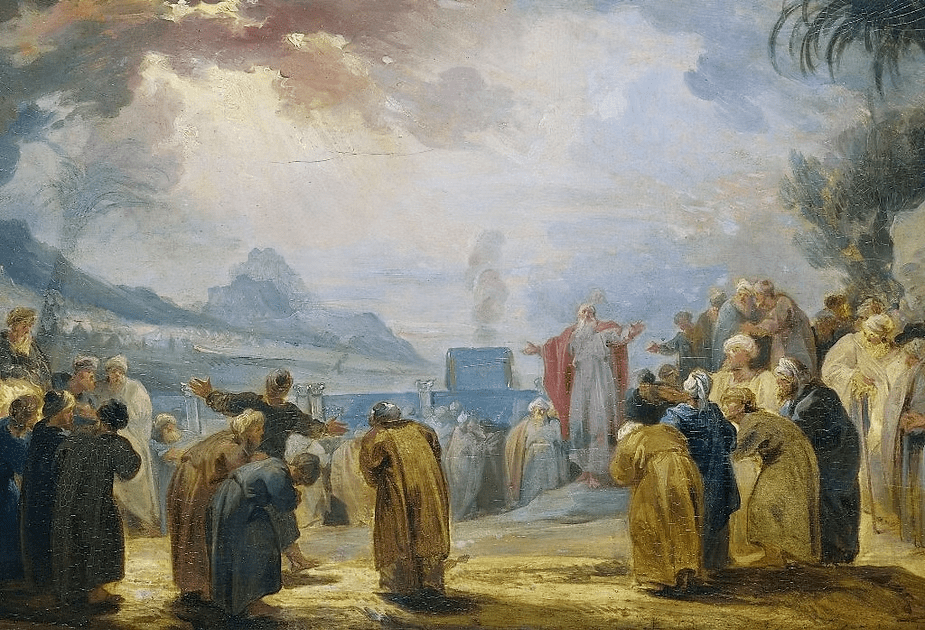
Numbers 11:4-6, 10-16, 24-29 – No more frat parties!

The rabble among them had a strong craving; and the Israelites also wept again, and said, “If only we had meat to eat! We remember the fish we used to eat in Egypt for nothing, the cucumbers, the melons, the leeks, the onions, and the garlic; but now our strength is dried up, and there is nothing at all but this manna to look at.”

Moses heard the people weeping throughout their families, all at the entrances of their tents. Then Yahweh became very angry, and Moses was displeased. So Moses said to Yahweh, “Why have you treated your servant so badly? Why have I not found favor in your sight, that you lay the burden of all this people on me? Did I conceive all this people? Did I give birth to them, that you should say to me, ‘Carry them in your bosom, as a nurse carries a sucking child,’ to the land that you promised on oath to their ancestors? Where am I to get meat to give to all this people? For they come weeping to me and say, ‘Give us meat to eat!’ I am not able to carry all this people alone, for they are too heavy for me. If this is the way you are going to treat me, put me to death at once—if I have found favor in your sight—and do not let me see my misery.”

So Yahweh said to Moses, “Gather for me seventy of the elders of Israel, whom you know to be the elders of the people and officers over them; bring them to the tent of meeting, and have them take their place there with you.

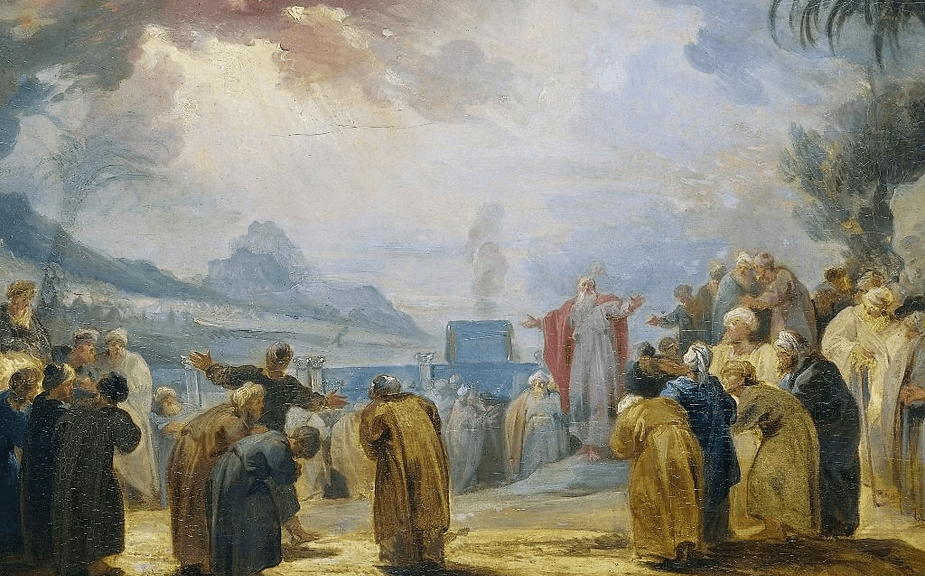
So Moses went out and told the people the words of Yahweh; and he gathered seventy elders of the people, and placed them all around the tent. Then Yahweh came down in the cloud and spoke to him, and took some of the spirit that was on him and put it on the seventy elders; and when the spirit rested upon them, they prophesied. But they did not do so again.

Two men remained in the camp, one named Eldad, and the other named Medad, and the spirit rested on them; they were among those registered, but they had not gone out to the tent, and so they prophesied in the camp. And a young man ran and told Moses, “Eldad and Medad are prophesying in the camp.” And Joshua son of Nun, the assistant of Moses, one of his chosen men, said, “adoni Moses, stop them!” But Moses said to him, “Are you jealous for my sake? Would that all Yahweh people were prophets, and that Yahweh would put his spirit on them!”

——————–

This is the Track 2 optional “Old Testament” reading that can be chosen over a reading from Esther 7 & 9, on the eighteenth Sunday after Pentecost [Proper 21], Year B, according to the lectionary for the Episcopal Church. If this option is chosen, then it will be paired with a partial reading from Psalm 14, which sings, “The law of Yahweh is perfect and revives the soul; the testimony of Yahweh is sure and gives wisdom to the innocent.” Those will precede an Epistle reading from James, where the Apostle wrote, “Are any cheerful? They should sing songs of praise.” All will accompany the Gospel reading from Mark, where Jesus told his disciples, “If any of you put a stumbling block before one of these little ones who believe in me, it would be better for you if a great millstone were hung around your neck and you were thrown into the sea.”

I published my views on the whole reading the last time it came up in the lectionary cycle [2018]. That commentary can be read by searching this site. The last five verses were also read on Pentecost Sunday [2020], with those views [plus those on an Epistle reading] also can be read by searching this site. As my prior observations still hold merit, I invite readers to read those offerings and compare them to what I offer here today. I welcome comments, questions, suggestions and correction, at all times.

First of all, in 2018 I was not pointing out how Moses had written “Yahweh” every time he referred to what the translators like to call “Lord.” I now see how such an address must be seen as like some early American Christian immigrants, when a married couple would address one another as “Husband” or “Wife,” never by their actual names. If one were to be comfortable doing that in today’s society, where marriage simply means ‘sex object that one is willing to take a gamble on,’ calling a spouse by a generic title would be smooth. One would never have to learn a name, as “Husband” or “Wife” would be a ‘fill-in-the-blank’ generic for ‘spouse of the year.’ In the case of “Yahweh” versus “Lord,” there are many “lords” who run the lives of human souls: Money, Sex, Drugs, and Rock-n-roll [a.k.a. Idolatry of Entertainers]. To reduce “Yahweh” to a generic name means that can raise the question, “Which “lord” are we talking about?” Such a question shows just how lame one’s faith is, based on a soul worshiping “self” as “Lord,” not ever considering any need to marry one’s soul to “Yahweh,” in order to earn eternal salvation Therefore, in the above translation, one will see that I have placed in bold type the reality of what was written in the Hebrew text.

[Logic point: If you are going to call Yahweh “Lord,” why not call Moses “the man”?]

In verses 4-6, the concept of how long the Israelites had been wandering with Moses and Aaron [and the Tabernacle with the Ark and the Covenant, thereby Yahweh] needs to be realized. To spend forty years away from the hustle and bustle of the ‘big city’ has to be seen as the children of Israel needing two generations to pass, simply to rid their minds of their addictions to worldly lusts, and become strengthened by Spiritual marriage. These verses say those brains were still resistant to a divine marriage between their souls and Yahweh’s Spirit. This is even when Moses was so Anointed by that Spirit that his face glowed so brightly it scared the people. This means these verses should be read [as all between Exodus and Joshua] as though the first true seminary had been created, with Moses the Head Master, Aaron the Head Priest, the Tabernacle the place of worship on campus. All the Israelites must be seen as the students [who signed up, were admitted, and who paid the fees of admission]. The elders can then be seen as the ‘senior class.’

Boohoo. We remember when we were young and stupid and we want to be that again! Boohoo.

The Torah is not to be read simply as a history book. The Holy Bible is a living text that has to be seen more as a reflection on all history; so, the waywardness of the Israelites reflects upon the waywardness of human beings always. In the comparison to a seminary, many are placed purposefully away from metropolis environments, where students are then forced to apply their study skills to the mastery of whatever degree program they have entered. The students of seminaries might be older in years on earth (many with prior degrees from colleges or universities), so they are re-entering the educational environment to be retrained in how to work for a religious organization. When they graduate and take jobs as hired hands in those religious organizations, they then apply the same education they learned onto their flocks. Still, the return to a university setting immediately brings back the child that wants to play, more than work and study. Because most students do as little as possible and see a learning environment as a playground to escape and party wildly, the complaints found in verse 4-6 must be read as an age-old statement of the students always saying, “When will this school life be over, so we can go back to being like we were before!?!?”

One must want to be there voluntarily; and even when there seriously, the presence of one crying baby in the nursery makes all the babies begin to cry.

When one realizes the truth of becoming a child of Yahweh, where “Israelite” means “One Who Retains God,” where “el” is less about naming Yahweh and more about saying one is an “elohim,” this is always the point of religion. A religion is not meant to be a place to go sit and learn some stuff, then party hardy when not in a desk or pew, because it is meant to be a lifestyle that one never strays from. That commitment is why marriage is the only way one’s soul can lead a body of flesh to not always want the fun things, never wanting to do the sacrificial things. Marriage of a soul to Yahweh brings inner rejoicing; and, ministry in pairs means two will share plenty of good times together. Those good times come from helping others see that light of truth, which is not found in the things the world loves to flash before our eyes.

This is why everyone who claims to be a Christian must see himself or herself as Moses, who regularly is in communication with Yahweh [not some generic lord]. Aaron is one’s partner in ministry. Thus, when we read, “Then Yahweh became very angry, and Moses was displeased,” that should say YOU are displeased when people claiming to be Christians are bellyaching: “Woe is me. I am a homosexual and if I engage in same sex with another, I am judged as bad. I call myself Christian, so I should be forgiven all my sins because I believe that is why Jesus died.” Such arguments are why it is hard to be truly religious today, when there still is as “weeping throughout their families, all at the entrances of their tents,” because poor babies missed “the cucumbers, the melons, the leeks, the onions, and the garlic” that used to make sinful life so much fun.

The children of Israel [remember, that is a name that means “He Retains God”] were in Moses’ seminary by choice. All the rest of the world was not there. The rest of the world was allowed by Yahweh to remain where it was; so, anyone who wants to sin and feel okay with sin needs to rejoin the rest of the world and stop pretending to be something chosen by God. The meaning of “He Retains God” says one’s soul has married Yahweh and taken on His name. Whatever one did before that sacred union [when all human beings know sin up close and personal] ceases to be, from then on, for eternity [souls never die]. Heaven is not divided into sections, where the gays are over there and the murderers in that place, with Saints getting the preferred housing. Heaven is the presence of Yahweh, and sin is not allowed where Yahweh is.

A true Christian, as one whose soul is just as Anointed as was Moses’ [a true Christ], should hear himself or herself saying to Yahweh, “They [the souls failing Yahweh] come weeping to me and say, ‘Give us meat to eat!’ [meaning, “Allow us to sin as before!] I am not able to carry all this people alone, for they are too heavy for me.” That says Moses knew all he could do was be Jesus reborn [thousands of years before Jesus was born] and demonstrate true faith before others, so they too could be like Moses [Jesus reborn]. Other than that, there is nothing more one can do. Each soul has to save itself; and “Jesus” means “Yah[weh] Will Save.” It is up to each individual to marry Yahweh, become His wife, and let Him impregnate one’s soul [“Receive the Spirit”], so one’s soul gives rise to the soul of Jesus resurrected [regardless of where on history’s timeline one is].

Now, this reading is an optional selection because the Gospel reading from Mark tells of disciples coming to Jesus, saying they saw someone they did not know casting out demons in the name of Jesus. Here, Joshua son of Nun came to Moses saying basically the same thing: “adoni Moses, stop them!” In that, I have restored the Hebrew text that has erroneously translated as if Joshua said, “My lord Moses.” The word “adoni” is like the world “elohim,” in the sense it says Moses was married with Yahweh, so he was one of His “lords” on earth, possessed divinely by Yahweh’s Spirit. Joshua was a strong guy, who easily could have killed Eldad and Medad, keeping them from prophesying in the camp as freewheelers, not part of the secluded party of prophesying that was going on by Moses. That says others can be touched – they were seniors in the seminary after all, so they had learned a few things – without having to be standing by Moses [or Jesus] for Yahweh’s hand to touch them. That says, if one wants to know Yahweh through marriage, one does not need to be blessed by some university professor. One needs to apply to the school of Divine Marriage and pay the tuition that opens one’s heart to receiving His Spirit. It is more rewarding than a sheepskin to hang on the wall in an office, afforded one by an employer.

As an optional Track 2 reading chosen over the Esther 7 reading, one needs to see how the grumbling that angered Yahweh in ‘Moses’ school for freed Israelites’ is the same as Yahweh being angered at the thoughts of Haman, who prepared a gallows to hang Mordechai and all the other Jews in Susa. Moses could have easily killed enough Israelites, so that those left alive would have said, “Okay. We get your point! We believe!” However, that does little to lean souls towards saying, “Yes,” to Yahweh’s marriage proposal. On the other hand, give them a taste of the Spirit, so they run amok in divine ministry [a real frat party at a seminary], frightening others like Moses without his veil on, that sends a stronger message to others. To have King Ahasuerus kill Haman and establish a day of recognition for that event says, “Evil was defeated today.” That is like Yahweh’s Spirit falling on the two who did not attend the meeting as instructed; so, Eldad and Medad learned just how wrong their souls had been, in the same way Haman’s did when hung to death on his own device built.

As a reading to be read aloud on the eighteenth Sunday after Pentecost, when one’s own personal ministry for Yahweh should already be well underway, the lesson to receive is the realization that complaining about the way the world is does nothing of value. The material universe is the only place that sin can exist; so, sin cannot be stopped here. The only world that matters is the fleshy body that surrounds a soul – yourself [a “self” equals a “soul”]. One must sacrifice one’s own soul, so all the delights of a world that can only offer sins and death [then reincarnation or hell, for the losers] are willingly denied. One needs to be cut loose from one’s addictions of the past and let Jesus be reborn within.

With Jesus living within one’s fleshy body, he will then become the “Lord” of that tabernacle, who reads all applications from the world that want to pollute a true seminary. Jesus reborn will reject all outside influences from admission, if they have no value being in one’s life. Having never known what past addictions had called, one’s soul is no longer lusting for what was, therefore no longer complaining. That is what true ministry for Yahweh means. You live like Jesus reborn, not worrying about what used to be. Everything is then rejoicing about what has come and will always remain.


James 5:13-20 – Praying for a miracle

Are any among you suffering? They should pray. Are any cheerful? They should sing songs of praise. Are any among you sick? They should call for the elders of the church and have them pray over them, anointing them with oil in the name of the Lord. The prayer of faith will save the sick, and the Lord will raise them up; and anyone who has committed sins will be forgiven. Therefore confess your sins to one another, and pray for one another, so that you may be healed. The prayer of the righteous is powerful and effective. Elijah was a human being like us, and he prayed fervently that it might not rain, and for three years and six months it did not rain on the earth. Then he prayed again, and the heaven gave rain and the earth yielded its harvest.

My brothers and sisters, if anyone among you wanders from the truth and is brought back by another, you should know that whoever brings back a sinner from wandering will save the sinner’s soul from death and will cover a multitude of sins.

——————–

This is the Epistle reading to be read aloud on the eighteenth Sunday after Pentecost [Proper 21], Year B, according to the lectionary for the Episcopal Church. It will follow either a Track 1 or Track 2 pair of readings, depending on the church’s schedule. Track 1 will present Esther 7 and her making a wish for her king to save her cousin-father figure, Mordechai, whom Haman planned to execute for being a Jew. The Track 2 offering will feature Moses and Yahweh becoming angry at the constant grumblings of the Israelites, causing Yahweh to fill the elders with His Spirit, so they prophesied. The accompanying Psalms sing of the protection Yahweh brings His wives [“elohim”] and the rewards that come from divine marriage of a soul to His Spirit. All will accompany the Gospel reading from Mark, when disciples reported a stranger casting out demon spirits in the name of Jesus; so, Jesus told them, “If your hand causes you to stumble, cut it off; it is better for you to enter life maimed than to have two hands and to go to hell, to the unquenchable fire.”

I wrote about this selection the last time it came up in the lectionary cycle [2018] and posted it on my website then. That commentary can be read by searching this site. In my observations then, I focused on the terminology of the Greek text and explained James’ focus on prayer. I stand behind my views expressed in 2018 and I welcome all to read that article and compare it to what I will add here today. I will try not to rewrite that already said, as I plan to address this reading selection from a position that links it with the other readings of the same Sunday.

When this Epistle selection is seen as relative to the readings from Esther and Numbers, the element of “prayer” presented by James must be seen. Even the Gospel reading from Mark must be seen as the prayer written of by James as being present. Those readings need to be reviewed now, in order to see how James wrote words about divine prayer, which manifest in the other readings.

In the Esther reading, one must assume that Mordechai and Esther were not typical Jews, but those whose faith in Yahweh made their souls be married to Him. They were his “elohim,” as both a male human being (Mordechai) and a female (Esther). In essence, when King Ahasuerus asked Esther what he could give her, she offered her prayer. She said, “Let my life be given me—that is my petition—and the lives of my people—that is my request.” Her prayer was answered. That was not because she was a Jew and that was not because she was a queen. Her prayer was her love of Yahweh and those who also loved Yahweh; so, she had not given deep thought about what she wanted, as much as she cared for the freedom of all Jews to worship Yahweh.

In the Numbers reading, we read how the Israelites selfishly prayed, “If only we had meat to eat! We remember the fish we used to eat in Egypt for nothing, the cucumbers, the melons, the leeks, the onions, and the garlic; but now our strength is dried up, and there is nothing at all but this manna to look at.” Yahweh heard those prayers and was angered. Moses heard weeping from every tent, which made Yahweh angrier and Moses displeased. The answer to the prayers of the people was not to bring them all the foods of Egypt, but instead to bring the Holy Spirit upon them. After all, they were not on a forty-year camping trip that never ended in order to get what they wanted. The Israelites were learning to give up all the worldly pleasure of the past and find the love of Yahweh that would unite His Spirit to their souls. That is the lesson of the wrong kind of prayers being sent forth by Yahweh’s children, where the answers to those prayers is a ‘Come to Jesus” experience.

In the Gospel reading from Mark, where disciples came complaining to Jesus that someone was casting out demon spirits in the name of Jesus, when he was not one of Jesus’ disciples [who had been given the soul-spirit of Jesus for intern ministry], Jesus told them whoever is not against us is for us. Obviously (in my mind), the person seen by the disciples had been previously in contact with Jesus, where that contact was the answer of his prayers. That says prayers are a matter of faith (more than belief), such that faith is a statement about one’s soul having married Yahweh. Prayer is then an instrument to be used by the wives of Yahweh, who are empowered to be Christs in the world.

With these connections to prayer seen, then when James asked, “Are any among you suffering?” the question is about persecution because of one’s faith. Ministry means being sent as Jesus out to do the works of faith; but Jesus knew rejection would be a typical result. The answer James offered is to talk to Yahweh.

When James then followed his first question with another that asked, “Are any cheerful?” this speaks of the presence of Yahweh’s Spirit with one’s soul and the resurrection of His Son in one’s flesh, which is an amazing reason for rejoicing. James then said to sing songs of praise. This can be the Psalms of David that Jews typically memorized [like ‘Ole Time Religion’ favorites], but David was moved by the presence of Yahweh’s Spirit, so David made songs that Yahweh spoke through him. Thus, James was saying prayer is being able to be the voice of Yahweh, for all to hear.

In my 2018 analysis, I pointed out the meaning of the Greek that says “sick.” I do not need to restate that now. However, James advising that the “sick” should “call for the elders of the church and have them pray over them, anointing them with oil in the name of the Lord.” That needs more understanding.

People called “charismatics” have long existed. They were around before Jesus was born. There is much that can be said about the powers of enthusiasm and positive thinking. There are courses that can be taken [at a price], where one can train oneself to be ‘the best you can be.’ That works until is doesn’t. These days there are no “elders of the church” who can “anoint” anyone with anything more than “oil.” No oil purchased from a store will make one be “in the name of the Lord.” There are plenty of people [some even well-intentioned] that like the idea they can “anoint in the name of the Lord,” but when James said have them “pray over them,” this means the “oil” is spiritual, not physical, coming from prayer.

Recently, I saw an Internet posting about a man named Rife, who theorized cancerous tumors emitted electromagnetic frequencies, which could be determined and a counter frequency applied [called “radionics”] that would kill the microbes and viruses, thus curing one of disease. He invented what is called a “Rife machine,” which his application said had a high cure rate, with no dangerous side effects. Unfortunately, tests since have not been able to duplicate his success rates, causing the machine to be deemed a hoax by the American Medical Association. People have continued to show faith in his ‘science’ and died due to rejecting normal cancer treatments, leading to lawsuits against those selling the Rife machines as legitimate treatment.

The point I want to make about this is people told they are going to die [the reality of the Greek word meaning “sick”] will do anything to stay alive as long as possible, with many seeking ‘miracle’ cures. Faith healing is something that falls into the category of a Rife machine, in the sense that it becomes fear of death that is known to exist in all human beings, so there are those who take advantage of those willing to pay anything to stay alive. Medicine can find no reason to verify prayer as having more positive effect than a Rife machine. Still, the industry that makes trillions of dollars treating disease, knowing treatment (without cure) keeps business booming, has no interest in furthering the concepts from which the Rife machine was born [he ran out of money and went bankrupt, going to his deathbed stating his belief that radionics would indeed cure cancers], because there is no money to be made from real miracle cures. Thus, there are few supporting James’ suggestion that prayer by elders of a church is something those with terminal disease should consider seriously.

Prayer must be realized to be only of true value when it is a communication between a soul married to Yahweh. Jesus said Yahweh will know one’s needs, before one can formulate the words to express that need in prayer. What James is saying in verse fourteen should be heard as the truth of last rites. While this seems to be some institutional work of clergy [the same with “Confession”], if the clergy is not a soul truly married to Yahweh and if the soul in a body of flesh about to die has not been a Saint [marriage to Yahweh brings this state of being to be], then it is much ado about nothing. James is referring only to those souls that have become Yahweh’s wives and given rebirth to His Son. To have Jesus be “an elder of one’s church” [of true Christians], then death does not necessarily mean the end. One can be resurrected, like Jesus raised Lazarus, because bringing in Jesus for last rites can mean resurrection [if Yahweh needs one to serve Him some more in the flesh]. That becomes a true miracle, which can only come when prayer is more than some tossed around word.

James wrote, “The prayer of the righteous is powerful and effective.” The key word there is “righteous.” That word is impossible to realize by a soul unmarried to Yahweh. That state of being can only come by Jesus being resurrected within one’s soul-flesh, so one’s soul submits to the Will of God and His Son then directs one’s flesh so it rejects all influences to sin. Being “righteous” can only come when Jesus has been truly reborn into the flesh. Thus, prayer is “powerful and effective” when it is Jesus doing one’s praying. This can be done by all who seek that power and effectiveness; but only when one’s self-ego has been lowered, in submission to Yahweh, when a soul unites with His Spirit. That death of one’s ego allows for the new ego – that of Jesus – to possess one’s body of flesh and lead it down a path of righteousness.

Lately, I have monitored a Facebook group page, where Episcopalians routinely pander to others in that group for prayer. They are free to ask others to pray for those sick [mentally and physically] and dying. In between asking for prayer assistance, they ask questions that condemn any and all who do not think the way they think, belittling anyone of true faith that sees the Episcopal Church as effective as a Rife machine in bringing souls to marry Yahweh. This means that prayer, as the Apostles wrote about it, is wholly misunderstood and really does not want the truth to be discovered. That reason is also, “There is no money in it.” Churches would all go out of business if the people seeking truth from Yahweh to lead their lives were taught that prayer means marrying one’s soul to Yahweh and submitting one’s flesh to being Jesus resurrected. Then, after eternal life has been gained, there can never be any worry about what happens to mortal flesh [it all dies eventually].

In the last verses [19 & 20], James wrote, “If anyone among you wanders from the truth and is brought back by another, you should know that whoever brings back a sinner from wandering will save the sinner’s soul from death and will cover a multitude of sins.” This focus begins with finding the truth, with the truth being the knowledge that comes from a soul’s marriage to Yahweh. The world is mostly lost and far from the truth, especially when it comes to understanding the meaning of “prayer.” The roots of “sinning” are based on a self [“self” equals a “soul”] being alone in its decisions regarding its flesh. Self-worship forbids one from marrying Yahweh. A soul must sacrifice self and submit to the Will of Yahweh. Being brought back from wandering means being reborn as Jesus. That resurrection means death is meaningless, when one’s soul has been assured eternal life. Sins will forever cease when one has become the Christ reborn.

As an Epistle reading to be read aloud on the eighteenth Sunday after Pentecost, when one’s own personal ministry for Yahweh should already be well underway, the lesson is to understand “prayer” as one being able to hear the voice of God, and thereby tell God how one feels. Ministry cannot bring back any lost sheep, when oneself is just as lost. Ministry should not promote “prayer” as some Rife machine that usually does not work, but “Man, when it works, Wow!” One must know “prayer.’ Then one must become the answers of other’s prayers, so one has been sent by Yahweh, as Jesus reborn, to make contact with the seekers of faith.

Mark 9:38-50 – Learning not to persecute true Christians

John said to Jesus, “Teacher, we saw someone casting out demons in your name, and we tried to stop him, because he was not following us.” But Jesus said, “Do not stop him; for no one who does a deed of power in my name will be able soon afterward to speak evil of me. Whoever is not against us is for us. For truly I tell you, whoever gives you a cup of water to drink because you bear the name of Christ will by no means lose the reward.

“If any of you put a stumbling block before one of these little ones who believe in me, it would be better for you if a great millstone were hung around your neck and you were thrown into the sea. If your hand causes you to stumble, cut it off; it is better for you to enter life maimed than to have two hands and to go to hell, to the unquenchable fire. And if your foot causes you to stumble, cut it off; it is better for you to enter life lame than to have two feet and to be thrown into hell. And if your eye causes you to stumble, tear it out; it is better for you to enter the kingdom of God with one eye than to have two eyes and to be thrown into hell, where their worm never dies, and the fire is never quenched.

“For everyone will be salted with fire. Salt is good; but if salt has lost its saltiness, how can you season it? Have salt in yourselves, and be at peace with one another.”

——————–

This is the Gospel selection to be read aloud by a priest on the eighteenth Sunday after Pentecost [Proper 21], Year B, according to the lectionary for the Episcopal Church. It will follow one of two pairs of readings that present the Old Testament and Psalms. The Track 1 pair focuses on the story of Esther and her expressing the wish for King Ahasuerus to spare the lives of Mordechai and the Jews in Persia, who advisor Haman planned to execute. Psalm 124 sings, “If Yahweh had not been on our side, when enemies rose up against us; Then would they have swallowed us up alive in their fierce anger toward us.” The Track 2 pair deals with a Numbers reading, when Yahweh addressed the complaints of the Israelites by filling their elders with His Spirit, causing them to prophesy. Psalm 19 then is shown to sing, “By them also is your servant enlightened, and in keeping them there is great reward.” One of those pairs will precede the Epistle reading from James, where the Apostle wrote, “The prayer of the righteous is powerful and effective.”

I wrote about this reading the last time it came up in the lectionary cycle, three years ago [2018], and I posted my view on my website then. That commentary can be read by searching this site. In that article, I expressed sound views about this reading, examining the Greek text deeply. Therefore, those observations are still valid today and worthy of being read by discerning seekers of the truth. I welcome all to read those words and then compare them to what I will add today. As always, I welcome comments, questions, suggestions and corrections; but now I will take a different approach on these words of Mark, which I did not focus on before.

To begin with, I want to focus on the element of divine marriage that is stated in the Greek of these words. When John [of Zebedee] said “we saw someone casting out demons in your name,” the Greek words “en tō onomati sou” literally translate as “in this name of you.” There, the use of “onomati” must be read within the scope of meaning that is “name, authority, cause,” (Strong’s Definition) as well as “character, fame, and reputation.” (Strong’s Usage) The genitive case of “sou,” which is the possessive form of “su,” as “yours” [from “you”] is stating the marriage of Jesus’ soul to the soul of the stranger, said to be using Jesus’ “name.”

A statement “in the name of” says one of two things. First, it is a statement of one’s father, where his children share his name. John of Zebedee is a name that says John is the son of his father named Zebedee. Second, it is a statement of relationship to a brother of the same father. Jesus is the Son of man, meaning the Son of Yahweh in the flesh; so, the stranger was stating he had the same name as a brother of Jesus, because they shared the same Father. In this way, James [of Zebedee] the brother of John, could say “In the name of John,” because both brothers shared the same name. Still, John was not a female, but a wife was identified by the husband who possessed her, such as Mary of Clopas. That name is identifying a woman as being in the name of her husband. Therefore, “in the name of you” states familial relationship, which says a stranger was seen saying his relationship with Jesus gave him the ability to cast out demon spirits.

When Jesus was heard to say, “Whoever is not against us is for us,” the Greek written says this: “hos gar ouk estin kath’ hēmōn , hyper hēmōn estin .” This literally translates to say, “who indeed not is against us , on behalf of us is .” In Mathew 12:30a is a similar quote, where Jesus said, “Whoever is not with me is against me.” In that, the Greek word of focus is “emou,” rather than “hēmōn.” In “emou” the genitive case [possessive form], in the singular number, which is stated for “egṓ,” or “I.” The word “hēmōn” is the genitive case [possessive form], in the plural number, which is stated for “egṓ,” or “I.” As such, the same thing is said in both places, where the stranger casting out demons in the name of Jesus was “us” as the plural of Jesus, through divine possession. Jesus was the singular soul possessed by the Father, when he used the singular “emou.”

Now, I understand that the way I am explaining this text seems to be against all standard translations of Greek to English, as nobody would ever use the plural possessive of “us” and mean dual souls inhabiting one body of flesh. This is just one of the many examples of how the depth of true meaning is written in plain view, but carefully hidden from the wise and intelligent. There is certainly a case to be made for Jesus speaking normal talk and Mark writing normal talk down. However, faith says one recognizes Yahweh’s divine hand was in play in everything said and written; so, there is a normal way to read the words and then there is a Spiritual way to read the same words.

This reading from Mark, as read on this Sunday, appears in a vacuum, as if nothing prior had happened, before John went up to Jesus and began this line of conversation. In reality, the broad view or whole scope connects this to last Sunday’s reading, when Jesus called his twelve disciples close to him, when he told them: “Whoever welcomes one such child in my name welcomes me, and whoever welcomes me welcomes not me but the one who sent me.” In that, Jesus said (in Greek), “dexētai epi tō onomati mou , eme dechetai ; kai hos an eme dechētai , ouk eme dechetai , alla ton aposteilanta me .” This is five segments of words that must be read literally in English as such:

“shall receive in the name of me ,

me receives ;

kai who might me shall receive ,

not me receives ,

but him having sent me .

This says anyone who welcomes the birth of a boy in the name of Jesus then Spiritually receives the soul of Jesus [“me”] AND IMPORTANTLY (from the use of “kai”) if one does receive Jesus [“me”] that is not all [“not only me”], as he or she will receive the Father who sent Jesus into them [“the one who sent me”]. So, after Jesus said that to the twelve, that receipt of Jesus into others brought back to John’s memory how they had tried to stop a stranger from casting out demons in the name of Jesus. It dawned on John of Zebedee that what Jesus had just said could explain what he and the others tried to stop.

This brings up their actions against strangers being Jesus reborn as being selfishly misguided. When Jesus said, “If any of you put a stumbling block before one of these little ones who believe in me,” the “little ones who believe in me” are the example of John the Beloved, who Jesus brought into the middle of the twelve, beginning his teachings of acceptance. It is “little ones who believe” that connects this Sunday’s reading to last Sunday’s reading. Jesus then commenced to tell the disciples what stopping the advent of true Christianity would mean.

He first said, “it would be better for you if a great millstone were hung around your neck and you were thrown into the sea.” That would be an act of self-inflicted death. Death means the soul has no time left to repent and make the necessary arrangements to marry Yahweh [according to His schedule]. To act out selfishly against a soul one does not recognize as Jesus reborn is then spiritual suicide.

Jesus then said, “If your hand causes you to stumble, cut it off; it is better for you to enter life maimed than to have two hands and to go to hell, to the unquenchable fire.” Here, the blame is not on causing another to “stumble” [“skandalizó”], but the acts against another in the name of Christ that cause oneself to “stumble” [“skandalizē”]. By placing focus on one’s “hand” [“cheir”], this says if one refuses to offer a helping “hand” to one in the name of Jesus,” then that refusal will condemn your actions. Thus, one should immediately do everything possible to help those in that name spiritually. To let petty jealousies condemn one’s soul to hell is faithless.

Then the focus was on feet, when Jesus said, “if your foot causes you to stumble, cut it off; it is better for you to enter life lame than to have two feet and to be thrown into hell.” Here, rather than offering a hand to those in the name of Jesus Christ, the state of being that is not in that holy name is failing to reach out and be touched by Yahweh, so one is not walking the path of righteousness that one in that name does. Staying away from a commitment to Yahweh is then another form of self-condemnation, where one’s soul will never reach eternal life in heaven.

Jesus then added how one’s failure to see to this list of self-punishing acts that need to be avoided. He said, “And if your eye causes you to stumble, tear it out; it is better for you to enter the kingdom of God with one eye than to have two eyes and to be thrown into hell, where their worm never dies, and the fire is never quenched.” This is stating denial that souls can marry Yahweh. It is denying that Jesus can be reborn in other bodies of flesh, at the Will of the Father. If one refuses to see the dual meaning in the words written in sacred texts, only seeing them as having one possible meaning – YOUR SELFISH WAY OF UNDERSTANDING – then one is refusing to see the truth that is right before your eyes.

Seeing with two eyes is called “binocular vision,” which allows for depth of field. This is seeing two ways merged as one, so this is the way humans have been taught to see. That dual vision Has one place primary focus on the material, and physical, refusing to accept that there is a soul that is invisible. The soul and the spiritual exist in divine Scripture AT THE SAME TIME standard language rules forbid seeing beyond the normal. Binocular vision means the normal leads one to look deeper; but one needs to see the truth for oneself [which I am trying to teach how to see it for yourself], taking the time to see two separate fields of vision. That demands personal work that (with practice) becomes the ONLY WAY to see Scripture [once you learn how to see with “one eye”].

This past January [2021], I wrote about Matthew quoting Jesus about the salt of the earth. I refer you to read that short commentary that explains salt cannot lose its saltiness. That can be read by searching this site. When you understand that, to read how Jesus said [Mark 9, NRSV]: “For everyone will be salted with fire. Salt is good; but if salt has lost its saltiness, how can you season it? Have salt in yourselves, and be at peace with one another.” That means have life in your body of flesh. Life comes from a soul being married to Yahweh. Without the “salt of life” one is a dead man [or woman] walking. To lose your saltiness is to die and go to hell. Therefore, the lesson here is “Have life in your souls, and be at peace with one another.” One another means your submissive soul and the resurrected soul of Jesus that enters your body of flesh, giving it eternal life.

As a reading to ponder on the eighteenth Sunday after Pentecost, when one’s own personal ministry for Yahweh should already be well underway, the lesson is to stop trying to make Scripture meet your selfish needs and sinful failures and accept that there are strangers that have already been truly touched by Yahweh, reborn as His Son, and it is not your role to get in the way. So many men and women ‘of the cloth’ are nothing but selfish followers of Jesus, who want to rid the world of anyone who does not march to the beat of their drum. They need to understand this message is sent by Yahweh to slap them across the face with their failures: to lend a helping hand to true Saints that do not dress up like fancy Dans and prima Donnas, to pretend to be pious. Sainthood means walking a path of true righteousness, by submitting one’s soul to Yahweh and becoming His Son reborn. To see the truth of Scripture, which no seminary on earth can teach, demands one’s soul be committed to Yahweh and be led to see the truth of His Word [not some best selling religious author’s moneymaking ideas].

Psalm 124 – Escaping the snare

1 If Yahweh had not been on our side, *

let Israel now say;

2 If Yahweh had not been on our side, *

when enemies rose up against us;

3 Then would they have swallowed us up alive *

in their fierce anger toward us;

4 Then would the waters have overwhelmed us *

and the torrent gone over us;

5 Then would the raging waters *

have gone right over us.

6 Blessed be Yahweh! *

he has not given us over to be a prey for their teeth.

7 We have escaped like a bird from the snare of the fowler; *

the snare is broken, and we have escaped.

8 Our help is in the Name of Yahweh, *

the maker of heaven and earth.

——————–

This is the Track 1 accompanying Psalm to the Old Testament reading from Esther 7, which will be read aloud in unison or sung by a cantor on the eighteenth Sunday after Pentecost [Proper 21], Year B, according to the lectionary for the Episcopal Church. If a church is on the Track 1 schedule, then this will follow Esther saying, “If I have won your favor, O king, and if it pleases the king, let my life be given me– that is my petition– and the lives of my people– that is my request.” That pair will precede an Epistle reading from James, where the Apostle wrote, “if anyone among you wanders from the truth and is brought back by another, you should know that whoever brings back a sinner from wandering will save the sinner’s soul from death and will cover a multitude of sins.” All will accompany the Gospel message of Mark, where Jesus said, “For everyone will be salted with fire. Salt is good; but if salt has lost its saltiness, how can you season it? Have salt in yourselves, and be at peace with one another.”

In the English translation above, you will not that in four places I have restored the name of “Yahweh” in bold text, which was written in the Hebrew text of David. This proper name [“the name of the God of Israel” – (Strong’s)] has erroneously been translated as “Lord,” which for centuries has caused people claiming to be “Christians” to call Yahweh their “Lord,” when in truth that is a lie. This misdirection has the effect of making it easy to see Yahweh as some unseen President or Prime Minister, who one might have voted for, while never personally knowing. If Yahweh has become your “Lord” in this way, then like those who claim to serve under a President and a Prime Minister, you will act accordingly and do as you please [sin] thinking the government is not watching closely. Yahweh is not like the government, as He sees all and knows all. Your soul depends on knowing His name, so it can establish a personal relationship with Him.

Psalm 124 is potentially read or sung aloud on three occasions in the Episcopal lectionary cycle, with the only time it is assured to be presented being Holy Innocents day, which is not recognized on a Sunday. This Psalm will be an option once in Year A [Ordinary after Pentecost season] and here in Year B. This means it could be recognized every year [by the devout Episcopalians], every other year or less frequently [by regular Episcopalians]. It is announced by David [although not read aloud] to be one of his songs of ascent, meaning it would have been chanted as priests or the people approached the Tabernacle, ascending the steps carved into Mount Ophel.

Verse one literally translates into English saying, “if not Yahweh committed remained ; to say now Israel”. This is a very important verse that has David speaking the truth. To translate it as saying, “If Yahweh had not been on our side” makes “Yahweh” be like some giant, like Goliath, who [for whatever reason] was some ‘bigger than the average bear’ [a Yogi-ism] ally. This makes Yahweh out to be some paid servant, which is wrong to think.

The Hebrew word [transliterated] “še·hā·yāh” stems from “hayah,” which means “to fall out, come to pass, become, be.” (Strong’s) According to Strong’s Exhaustive Concordance the word can be translated as “become, altogether, accomplished, committed, like, break, cause,” with the root said to be “to exist.” This is then stating a change of state that comes from Yahweh, where it is important to see the Covenant as vows of “commitment.” The word has been translated as “committed” in Scripture. [NASB translations] Thus, “if not Yahweh committed” in marriage of their souls to His Spirit, then Yahweh would be like Yahweh is to all human beings on earth – unknown and not involved.

The Hebrew word “lā·nū” is said to be non-translatable, but it is said to be the “third-person plural past of לָן‎ (lan)” [Wiktionary], with “לָן‎ (lan)” meaning “to stay overnight.” Other sources show the word associated with designating “we” or “us,” such that the first segment of verse one then says, “if not Yahweh committed us,” which is still a statement of marriage, where Yahweh is not committed to them [those not “us”]. However, the aspect of “remained” becomes a statement of fidelity in marriage, so the commitment was enduring.

This focus on commitment in a divine setting [which “Yahweh” brings about], then leads to the second segment of words in verse one that say, “to say now Israel.” When a divine marriage is understood as having been first said, the second segment is David saying such a marriage made the wives of Yahweh take on His name, which is said to be “Israel.” This is then not a deep focus on a nation of people, but the truth behind the name that is then reflected upon the people collectively. The name “Israel” means “He Retains God” or “God Is Upright.” That is then a statement of truth that David said all who followed his leadership could truthfully say they were the result of their souls’ marriage to Yahweh. All were those people in whom Yahweh was Retained, so their souls being married to Yahweh made them Righteous in their lives on earth.

Having gathered that as the theme statement for this song, verse two then repeats verbatim the first segment of words from verse one. Again, David sang, “if not Yahweh committed us [and remained committed],” then “when risen above men.” While the NRSV translation has the Hebrew translate as “when enemies rose up against us,” the reality says those who rightfully could claim to be “Israel” were then “elevated above” the status of ordinary “men” [mankind in general]. In this, the transliterated Hebrew word “bə·qūm” is a statement of “qum,” meaning “to arise, stand up, stand.” Anytime Scripture speaks of “standing up” or “arising,” this brings on a divine spiritual meaning, where the soul is no longer alone. The soul has “risen” through marriage with Yahweh’s Spirit. This is greater than ordinary human beings, and thus it is the truth of the words “elohim” and “adonay,” as “gods” in the flesh, who have Yahweh within them, making them become His “lords.” This is then stating how other “men rising up” to challenge those in whom Yahweh has them stand righteously will never defeat those truly in the name of Israel.

Verse three then translates literally into English as, “then lively they would have engulfed us ; when kindled with anger their faces against us”. In this, the Hebrew word “hay-yim” is rooted in “chay,” meaning “alive, living.” This must be seen as a statement of spiritual excitement, such that the divine marriage of the Israelites would give them the promise of eternal life, which is a strong aura of “life” that radiates outward onto others. Those who had previously resided in the Promised Land were then activated by that presence, so their souls also became “lively,” driven like wild beasts to attack or run from that presence. This presence would have “engulfed” the Israelites themselves, but attracted their enemies to attempt to overtake them and cast them out or devour them. This means the first segment of words in verse three speaks that the presence of Yahweh in His wives will not go unnoticed, as it will activate all souls that come in contact with His presence.

In the second segment of words, the Hebrew transliteration “ba·ḥă·rō·wṯ” is written, stemming from “charah,” meaning “to burn or be kindled with anger.” The use of “’ap·pām,” as the plural of “aph’,” meaning “a nostril, nose, face, anger,” says the presence of Yahweh will bring out the “faces” of evil, where like wild bulls their “nostrils” will flare and the fire of inner evil will erupt against the faces of Yahweh, worn by all true Israelites. This “anger” will reveal the truth of those whose souls are possessed by Satan.

Verse four then literally translates into English as saying, “then the waters would have overflown us ; a torrent , would have passed through our souls”. Here, the use of “mayim,” as “waters,” must be read as a symbolic statement of an emotional flow, rather than a physical flow of water. The element water [one of four basic elements, along with fire, air and earth] is reflective of one’s emotional being, which ebbs and flows through life, easily changing states from solid, to liquid, to gas, and back again. As such, “waters” becomes metaphor for a divine marriage, where many have become the Anointed ones [many Christs, in Greek] of Yahweh, where the Spirit has engulfed all His wives [males and females]. It is then “the torrent” that radiates outward from all who possess that inner source of Yahweh, so each body of flesh represents the high place where the emotional waters of righteousness flows downward. This is the presence of Yahweh that passes through the souls of His wives onto the land they have been given.

Verse five then continues this theme of “waters,” literally translating to say, “then would have passed through our souls ; the waters , boiling”. Here, the second segments of words from verse four are restated in variation, which is saying the Spirit of Yahweh is a flood of presence that one’s body of flesh cannot contain. The Hebrew word ending this verse is transliterated as “haz·zê·ḏō·w·nîm,” stemming from its “zedon” root, meaning “insolent, raging.” Still, Strong’s Exhaustive Concordance says “proud” is a translation for this word, saying it is rooted in “zuwd,” which means “boiling of water, i.e. Wave — proud.” That says the “torrent” of verse four is further stated here as an uncontrollable flow. That sense of “pride” is relative to the “anger faced” in verse three. Thus, David was saying the hand of Yahweh reaches out to those who have not come to know Him, as a “raging flood” of a most powerful God that cannot be defeated.

Verse six then literally translates into English saying, “to kneel Yahweh ; who not has given us prey , for their teeth”. In the NRSV translation that says, “Blessed be Yahweh!” one needs to ask, “Who on earth can “bless Yahweh or say He is blessed?” Those whose souls are married to Yahweh become those “blessed,” because the presence of His Spirit has filled their souls. That state of being not the norm then is what determines how a previous lost soul [a sinner] has been “blessed,” by no longer being one condemned to die and be reincarnated or worse [eternal pit of fire kind of alternative]. This means the Hebrew word “barak” needs to be translated as intending that one has “knelt” before “Yahweh,” which is a statement of submission and thereby marriage.

By seeing this meaning stated in “bā·rūḵ Yah-weh,” one can then assess the second segment that says, “who not has given us prey.” The “who” stated is both the Israelite souls married to Yahweh, “knelt” in subservience to His Will, who are “not” what they had been before, which is exactly like all enemies they face after divine marriage. Still, it is those “who not” are aware of Yahweh and His desire to bring all souls to Him willingly. Therefore, the projected presence of Yahweh that is uncontrollable by one’s soul-flesh is to bring all ”who not” know Yahweh. It is they who have been “given” to the wives of Yahweh as “prey” to save. While they do not know that and they come in anger, attempting to harm Israelites, they will consume their own souls, with no bites bringing harm to Yahweh’s children. David was then singing that the enemy is only an enemy until they can chew of the truth of their God.

Verse seven then sings literally in English as, “our life , as a bird has escaped from the snare of the fowlers the snare is broken , and we have escaped”. Here, importance is stated in the one word that stands alone, “nap̄·šê·nū.” The root word is “nephesh,” which means “a soul, living being, life, self, person, desire, passion, appetite, emotion.” (Strong’s) This word is completely ignored by the NRSV translation. It is ignored because they are not able to make “a soul” fit the following scenario of a bird escaping a trap. The truth of this verse depends on grasping the dual way this word can relate to both “a soul” and “a life,” in the plural number [“our”].

All human beings are souls in dead bodies of flesh, animating death so it resembles life. True “life” comes to a “soul” when it is married to Yahweh. It is then that marriage that grants true “life” and frees a “soul” from the “snare” that is a body of flesh. The aspect of a “bird” must be seen as a winged creature, which becomes a soul freed to be an angel. The relates a “fowler” to those who “lay bait or lures” [the meaning of “yaqosh,” from which “fowler” comes], who are those in the world who serve Satan and set his traps to “ensnare” souls to the death that all unmarried souls are bound. To “break that snare” [“hap-pah niš·bār”] means to be freed, so a soul can no longer be held in the realm of death that the physical universe is. The breaking of the trap is Salvation, which only comes from a soul marrying Yahweh.

Verse eight then concludes this song of ascent by literally translating into English singing, “our helper in the name Yahweh ; who made , heaven and earth”. Here, the “help” or “helper” is relative to the “escape” from the trappings of mortality. This says that the “snare” will not be “broken” by simply being trapped inside it. To “escape” demands “help.” That “help” comes through divine marriage, when one’s soul submits to His Will and is then “in the name” given by “Yahweh,” which is “Israel” – “He Retains God” or “one whose soul “Is Upright [by] God.” This union is based on “who made” the sacrifice of self-will and self-ego, so that Yahweh could make one’s soul free.

That means the freedom comes at the cost of servitude, so the remainder of one’s life in a body of flesh is “made” righteous by Yahweh, to be sent into the world as His priest. Thus, freedom means service to the “heavenly,” while still being “on earth.” The union of a soul in a body of flesh is the basic version of “heaven and earth,” but the divinity that allows for escape and the breaking of the snare of the material plane is receipt of “heaven” into one’s “earthly” body. That receipt of the Spirit is so one becomes an extension of “heaven” on “earth,” so others can be saved.

As the accompanying Psalm to the Esther reading, which is to be read aloud on the eighteenth Sunday after Pentecost, it is important to see the message of David having been a prophecy of that future event, when there still existed true Israelites in a foreign land where anger existed that others would serve a God unlike those known there. One can see how Esther and Mordechai were freed from the snare of mortal existence, because their souls were married to Yahweh and it was Yahweh’s help that led King Ahasuerus to turn the tables on Haman and destroy him by his own wicked device. Thus, the lesson to be learned at this time, when one’s own ministry for Yahweh should already be well underway, is to marry one’s soul to Yahweh and stop worrying about anyone’s anger shown against that true commitment in service to Yahweh. This Psalm sings both of the comfort that comes from trusting in Yahweh’s guidance, while also showing the traps that come from anger and rage towards others.

Psalm 19:7-14 – A Numbers viewpoint

7 The law of Yahweh is perfect

and revives the soul; *

the testimony of Yahweh is sure

and gives wisdom to the innocent.

8 The statutes of Yahweh are just

and rejoice the heart; *

the commandment of Yahweh is clear

and gives light to the eyes.

9 The fear of Yahweh is clean

and endures forever; *

the judgments of Yahweh are true

and righteous altogether.

10 More to be desired are they than gold,

more than much fine gold, *

sweeter far than honey,

than honey in the comb.

11 By them also is your servant enlightened, *

and in keeping them there is great reward.

12 Who can tell how often he offends? *

cleanse me from my secret faults.

13 Above all, keep your servant from presumptuous sins;

let them not get dominion over me; *

then shall I be whole and sound,

and innocent of a great offense.

14 Let the words of my mouth and the meditation of my

heart be acceptable in your sight, *

Yahweh, my strength and my redeemer.

——————–

This is the accompanying Track 2 Psalm that goes with the Numbers 11 reading. If the church is on the Track 2 path, this song of David will follow Yahweh telling Moses, “Gather for me seventy of the elders of Israel, whom you know to be the elders of the people and officers over them; bring them to the tent of meeting, and have them take their place there with you.” That pair will precede the Epistle selection from James, where the Apostles wrote, “Elijah was a human being like us, and he prayed fervently that it might not rain, and for three years and six months it did not rain on the earth. Then he prayed again, and the heaven gave rain and the earth yielded its harvest.” All will accompany the Gospel reading from Mark, when Jesus said, “If your hand causes you to stumble, cut it off; it is better for you to enter life maimed than to have two hands and to go to hell, to the unquenchable fire.”

Psalm 19 was read in its entirety two Sundays past, on the sixteenth Sunday after Pentecost [Proper 19], when it accompanied the Track 1 reading from Proverbs 1. Because that full reading was Track 1 and this half-reading is Track 2, this Psalm is assured of being [at least partially] read during the Year B cycle. Because I explained all the verses at a time not long ago, I will now simply duplicate what I wrote then. The following comes after the first six verses have been explained. I will add additional comment after each verse and a new ending paragraph.

In the next three verses David wrote the name “Yahweh,” twice in each verse. That identifies the Husband that has been discretely mentioned in the previous six verses. Verse seven then literally sings in English, “the direction Yahweh complete returning the soul ; testimony Yahweh confirm , making wise simple .” After having sung about one coming full circle, the warmth of marriage with Yahweh is now praised. By taking on the name of God [“Jesus” means “Yahweh Will Save”] a soul is promised eternal life, which comes from “returning the soul” to Yahweh’s “heavenly” realm. To reap this promise of reward, a soul then must speak the Word of Yahweh that comes from His Spirit. One “confirms” that salvation is possible. In one’s “testimony” the truth comes forth, which is greater than any brain-led wisdom. This verse makes this Psalm be the response to the Proverbs 7 message of goddess worship, where he claimed wisdom was reason to belittle the simple. Here, David sang that Solomon was nothing, even with his Satanic gifts of wisdom and wealth, because he lacked the truth of Yahweh.

Addition: Relative to this being now paired as a companion to Numbers 11, when the people complained about worldly things they no longer had available to them, this verse then sings prophetically of the presence of the Spirit upon one’s soul is much greater than all the simple pleasures of life. The elders of the people were all made to speak like Moses, unlike before. The Spirit possessing Moses was then multiplied seventy-two times.

Verse eight then literally sings, “the precepts Yahweh straight rejoicing the heart ; the covenant Yahweh is pure , enlightening the eyes .” The first words of verses seven and eight can be read as “laws” and “statutes,” such that “the direction” is the “law” within one’s heart and the “precepts” are the marriage vows of the Covenant. Seeing those as statements confirming a marriage agreement and the commitment that comes, David sang that following the lead of Yahweh makes one walk a “straight” path [righteousness]. This ability makes the soul [“heart”] “rejoice,” as such perfection is impossible alone. When David sang, “the covenant Yahweh is pure,” this means marriage erases all past sins and debts, so one’s soul has been made “pure” by marriage. That divine union of the utmost holy matrimony means Yahweh’s presence will bring forth the “enlightenment” of truth.

Addition: Here, the elders’ eyes were open to see the truth of why they had been chosen. The “covenant” was more than an agreement, it was a marriage vow of eternal commitment to Yahweh and Yahweh only. Their bodies of flesh were reminded of the sins of the past; and to begin prophesying meant their souls were purifying their minds, so their righteous displays could lead others to likewise become pure and see the truth.

Verse nine then becomes the final in a trilogy that repeats Yahweh’s presence with a soul. This verse then states in English, “fear Yahweh pure to take one’s stand perpetually the judgments of Yahweh truth ; righteous unitedness .” This says it is only natural to experience Yahweh with one’s soul and then “fear” losing that presence. It is that “pure fear” that motivates a soul to submit fully to Him and meet all agreements of His Covenant. This becomes a commitment for eternity and adherence to His demands are done lovingly, always accepting His Will as best, without question. The Hebrew word “yaḥ·dāw,” meaning “unitedness,” makes it clear that “righteousness” can only come through divine marriage of a soul to Yahweh’s Spirit.

Addition: Here, the double statement of “Yahweh” says purity is impossible without His presence possessing one’s soul. Following Moses for decades in the wilderness was an act of self-will and personal desire to be seen as better than others; but it was not righteous living. The Israelites were not living up to that name, thus their brains did as Moses said, while dreaming of times past. Their souls needed to become “united” with Yahweh to know the truth, forget the past and joyfully look only to the future.

Verse ten then sings, “more to take pleasure in , than gold and yea pure gold much ; and sweeter than honey , flowing honey from the comb .” Here, David is singing that the presence of Yahweh with one’s soul is beyond comparison to anything worldly. The “unitedness” of divine marriage brings a sense of elation that is unlimited “desire,” coming from true love (given and received). It is a presence that is of greater value than anything on earth can match. It is greater than the sweetest taste, where “sweetness” becomes a statement of the five senses. As such, human feelings cannot describe how amazing this presence is. In the last segment, David is saying that the greatness is beyond one’s ability to control it; so, it flows outward from a wife of Yahweh, just as honey flows from a honeycomb.

Addition: This sings of the greatness of Yahweh’s presence within one’s soul. Divine possession is an ownership that far outweighs anything the world can offer. No matter what one drapes around one’s flesh, and no matter what one puts inside one’s body temporarily, the lasting power of Yahweh’s presence if much more valuable.

Verse eleven then literally translates into English as, “moreover your servant is enlightened by them ; in keeping them reward great .” The initial focus is on being “your servant,” which is one’s subjection of self through marriage. By receiving the “light” of Yahweh, one is not entrapped by the dangers the world naturally sets for souls in bodies of flesh. When one is doing the works of Yahweh, one becomes a light that shines upon others. By being obedient and subservient – a dutiful wife – the promise of salvation is earned.

Addition: The presence of Yahweh’s Spirit expands one’s brain to access to the Mind of the All-Knowing. All questions will be answered as needed. One does not need to struggle with learning. One is led to examine the truths that come through divine insight.

Verse twelve then sings out, “errors ? who can discern , from concealment empty mine .” In this verse, the one word “errors” is presented as itself being a question. The answer is then saying no human soul alone “can discern” what the right path should be. This means that all human beings will make the wrong choices and sin. It is inevitable. However, from divine marriage, where the Spirit of Yahweh is “secretly” within one’s flesh, merged with one’s soul, then all past sins and “errors” will be erased and remembrance of things done wrong become lessons to share with others. Knowing sin and redemption allows a soul to speak with authority, thus demonstrating true faith.

Addition: This is seen in the complaining the Israelites were known for. By putting more faith in their intelligence, than trust in Yahweh and His servants (Moses, Aaron, and Joshua), they were keeping themselves from experiencing what was offered to their souls in divine marriage. Their brains were too weak to solve the problem of boredom, which emptied their abilities to see the beauty that was right before their eyes (unseen).

Verse thirteen then literally translates into English, saying “moreover from insolence refrain your servant , not let them have rule over me then I shall be blameless ; and then I shall be empty of transgression much .” Here, the element of redemption is put in focus, as the ability to “refrain” from the “insolence” that is the “arrogance” of human brains, such as Solomon’s worship of his big brain (gifted him by Lady Wisdom), makes their egos become their “gods.” It becomes external sources of power that become the lords who “rule” over their souls, making them be possessed by unclean spirits [demonic possession]. They all bring the blame of sin upon their souls, which David prayed not to have that happen to his soul. The prayer is for one’s soul to be cleansed of all past wrongs, which one makes in a plea to have Yahweh come into one’s soul and lead all one’s future actions.

Addition: The issue of “insolence” is common for all human beings, because self is the god so many worship. It is self-worship that keeps a soul [a “soul” equals a “self”] from making the ultimate marriage commitment to Yahweh, where the very first agreement is to lower one’s face of self [as a “god”] and do not let it appear before the face of Yahweh. To show one’s face is to turn away from Yahweh in an act of “insolence.” It is far easier to find others of like mind to support one’s worship of self, so one finds rejecting Yahweh easier through ‘safety in numbers.’ To enter into a divine marriage, one needs to leave all the jealousies of other single souls behind and begin walking in the footsteps led by Yahweh.

The final verse in this companion Psalm to Proverbs 7 [and Numbers 11] then literally sings in English, “become present goodwill speaking from my mouth and be the meditation of my heart in your eyes ; Yahweh my strength and my redeemer .” Here is another prayer to Yahweh, such that David wanted Yahweh to see his actions that spoke of his obedience and displayed the true meditation of his soul, to be the acts that pleased his Holy Husband. By listening and acting David became strong as a leader of Israel; and, not only was his soul redeemed, but those also of the Israelites who followed David’s lead.

Addition: This is the reality of the seventy-two prophesying automatically, including the two ‘rebels’: Eldad and Medad. It all centers on the heartfelt emotion of divine love, which opens ones eyes to see the real truth that cannot be seen otherwise. The marriage of a soul to Yahweh is the assurance of Salvation, with all past evils forgiven.

As a potential Psalm to be sung on the eighteenth Sunday after Pentecost, when one’s own personal ministry for Yahweh should already be well underway, the lesson is to turn away from the lures of the past – to bow down before sins of self-worship – and find the love of Yahweh that has been sewn into the fabric of every soul. The theme here is of divine marriage, when one’s soul ceases self-idolatry and submits to the highest power possible. Once Yahweh’s Spirit has merged with one’s soul, one fears ever losing that inner presence. The Law is inscribed on the walls of one’s soul and one exudes faith and the light of truth. Ministry cannot be true if one’s soul turns away from Yahweh and only references Him through worship of His Son. The lesson here is to become that Son, regardless of what genitalia one’s body possesses.

Job 1:1; 2:1-10 – Seeing what is hidden there

There was once a man in the land of Uz whose name was Job. That man was blameless and upright, one who feared elohim and turned away from evil.

One day the heavenly beings [the sons haelohim] came to present themselves before Yahweh, and Satan also came among them to present himself before Yahweh. Yahweh said to Satan, “Where have you come from?” Satan answered Yahweh, “From going to and fro on the earth, and from walking up and down on it.” Yahweh said to Satan, “Have you considered my servant Job? There is no one like him on the earth, a blameless and upright man who fears elohim and turns away from evil. He still persists in his integrity, although you incited me against him, to destroy him for no reason.” Then Satan answered Yahweh, “Skin for skin! All that people have they will give to save their lives. But stretch out your hand now and touch his bone and his flesh, and he will curse you to your face.” Yahweh said to Satan, “Very well, he is in your power; only spare his life.”

So Satan went out from the presence of Yahweh, and inflicted loathsome sores on Job from the sole of his foot to the crown of his head. Job took a potsherd with which to scrape himself, and sat among the ashes.

Then his wife said to him, “Do you still persist in your integrity? Curse elohim, and die.” But he said to her, “You speak as any foolish woman would speak. Shall we receive the good at the hand haelohim, and not receive the bad?” In all this Job did not sin with his lips.

——————–

This is the Track 1 Old Testament reading that will be read aloud (if the church is on this track) on the nineteenth Sunday after Pentecost [Proper 22], Year B, according to the lectionary for the Episcopal Church. If read, it will be accompanied by Psalm 26, which sings, “Do not sweep me away with sinners, nor my life with those who thirst for blood.” That pair will precede a reading of the Epistle Hebrews, where Paul wrote, “Long ago God spoke to our ancestors in many and various ways by the prophets, but in these last days he has spoken to us by a Son, whom he appointed heir of all things, through whom he also created the worlds.” All will accompany the Gospel reading from Mark, when Jesus responded to a question about divorce from some Pharisees, saying “Moses allowed a man to write a certificate of dismissal and to divorce her,” adding, “Because of your hardness of heart he wrote this commandment for you.”

I wrote about this reading selection the last time it came up in the lectionary cycle (2018) and posted those views on my website at that time. That commentary can be read on this website bysearching this site. At that time I was not focused on the English translations that routinely transform “Yahweh” to “Lord” and the plural “elohim” to “God.” Because I have done that to this reading, those clarifications make it necessary to add more comments to my prior interpretation. The meaning stated in 2018 is still valid today; and, I welcome all readers to read that posting and compare what I said then to what I will now say. As always, I welcome comments, questions, suggestions and corrections.

In the above English translation that the Episcopal Church says comes from the New Revised Standard Version [NRSV], you will note where I have placed “Yahweh” in bold text [eight times] and versions of “elohim” in italics [five times]. While chapter one’s first verse does not include any adjustments in the text that shows “Yahweh” written as “Lord,” that proper name is found written ten times there. The use of “elohim” or “haelohim” is found written seven times in chapter one, with all translated as “God” or “of God.” All of this is significant to realize when interpreting this reading.

In the first verse of chapter two, the translation says “the heavenly beings,” which is innocuous enough to totally miss what that says. One can assume it means Yahweh met Satan, as one could assume both are “heavenly beings.” The Hebrew written [transliterated] is “bə·nê hā·’ĕ·lō·hîm,” or “sons of elohim,” means “sons of gods.” The “sons” are then the creations of Yahweh; and, the fact they are “gods” says they are angels, as “elohim” means an eternal being. Satan is an angel, with his being named making him stand out in this reading as a purposeful creation of Yahweh to test the Creation.

The reality of the Hebrew text of verse one begins by stating [transliterated], “way·hî hay·yō·wm,” which translates to state, “and came to pass the day.” This must be seen as more than some fairy tale beginning, as “Once upon a time,” because in those two words is stated “the day,” which is the seventh “day,” after Creation had rested. We still live in “the seventh day” today, as that is the day that Yahweh hand-made His Son and his mate in Eden, before releasing them into the world as His first priests.

In chapter one [unread] is basically the same text as is written in chapter two, verses 1 through 3a. At that point in chapter one, Satan said to Yahweh, “Have you not put a fence around him and his house and all that he has, on every side?” In that NRSV translation, the Hebrew word “śaḵ·tā,” from “suk,” has been translated as “fence,” while equally meaning “hedge.” That was stated by Satan as his recognizing a protective environment had been made by Yahweh, in which Job lived. That “fence” or “hedge” prevented Satan from touching Job. As such, the “hedge” can be seen as Eden, with Job being the equivalent of Adam.

If that is so, then while Adam was in Eden, he and “wife” (some call her “Eve”) had children (seven sons and three daughters). He also had many livestock. However, once Satan met with Yahweh at a prior meeting of the “sons of elohim,” Job no longer had the protective “hedge,” and Satan’s first attack on Job was to cause him to lose his children and livestock. [The unread story in chapter one.] That attack did not sway Job away from being true to Yahweh, saying, “Yahweh gave and Yahweh has taken away,” while still worshiping Yahweh.

That becomes the set-up for what we read in chapter two; but if Job is not Adam, then he is a direct descendant of that lineage because he offered burnt offering as a priest, when nobody else on earth was doing so. In support of that concept, Yahweh said, “There is no one like him on the earth.” (Job 2:3b)

When one takes into consideration that it was the Book of Enoch that told of the war of angels, listing two hundred fallen “watchers,” for Satan to meet with Yahweh says this rebellion took place after Adam had been expelled from Eden. After the rebellion – brought on because of a refusal to serve man [Adam?], rather than only Yahweh – Satan was cast into the depths of the earth and forbidden from ever appearing before Yahweh again. Thus, for Satan to appear before Yahweh twice in Job (chapters one and two) becomes a statement that this was “the day” of rest, when Yahweh made a Holy man [a Son of man]. Job is therefore the test Yahweh allowed for His Son to endure, which would lead Satan to rebel and be forever condemned.

The authorship of the Book of Job is unknown, although Moses is said to be the one who orated the story first. Like the story of Creation and all that happened before the Book of Exodus, all of Genesis comes from the Mind of Yahweh through a prophet of His. That is a Yahweh elohim and Moses was certainly one. This means Job was real and not a parable.

Because Adam is a Hebrew word that means “man” it is not necessarily his proper name. The name “Job” (while uncertain) is believed to be from Aramaic, meaning “he who turns (to God).” This can then be seen as “Returning.” [Abrahim Publications] Such a name would then aptly apply to Adam, as after his sin expelled him from Eden, his passing the test of Satan allowed his soul to “Return (to God)” after he died. Still, the statement that Job “was a man in the land of Uz,” this can be a statement that he was born as a descendant of Noah: A son of Aram, a son of Shem, a son of Noah (Genesis 10:23). This would mean Job was a descendant of Adam, prior to the birth of Abram.

In this regard, I want to address what Satan said to Yahweh, which is “Skin for skin! All that people have they will give to save their lives. But stretch out your hand now and touch his bone and his flesh, and he will curse you to your face.” In that, first of all, the Hebrew word “or” is repeated, transliterated as “‘ō·wr bə·‘aḏ-‘ō·wr,” translated as “skin for skin.” That should be seen as a statement that “man” had to take the “skins” (hides, pelts) of animals to cover his “skin,” because his “skin” was not made strong and able to face harsh environments.

Look and see if you see something to skin for warmth.

That becomes the weak link between human beings and the other animals on earth. For having life on earth (“all that people have”), they have to take the lives of animals, so they can eat their flesh and clothe themselves in their furs and hides (“they will take to save their lives,” with “nathan” acceptable when translated as “take”). This means “skin” is a statement about the presence of a living soul [a minor form of elohim] in a body of flesh [death animated], where “skin for skin” is merely the exchange of one soul’s dead flesh to be additional dead covering for another soul.

Seeing this meaning, when Satan said, “But stretch out your hand now and touch his bone and his flesh,” this speaks of an elohim attempting to unite with a living soul, so that a spiritual possession within the death of flesh is natural to resist and reject. By saying, “he will curse you to your face,” this is not about a living soul cursing Yahweh, but Satan saying the Son of man made by Yahweh would curse all elohim [“heavenly beings,” like Satan] from joining his soul. The rejection of that possession would similarly be opposite of how the Son of man did not curse his taking of animal life to cover his weakness – fair skin.

That rejection must be seen as stated by Yahweh, when he told Satan that Job was “a blameless and upright man who fears elohim and turns away from evil.” In that “fear” is more that of losing the presence of Yahweh within, by facing an elohim that would be an influencer of “evil.” That “fear” would be in losing Yahweh’s presence, for some spirit less than Yahweh. As such, when Satan said, “he will curse you to your face,” the reality of that written translates literally as saying, “and not to your face he will surely curse you.”

In that, the word “pā·ne·ḵā,” from “paneh,” has little to do with the “skin” of a “face,” but the Spiritual “face of Yahweh” that the Sons of man all wear. They wear the “face” of Yahweh and curse any other “face” that would suggest it be worn, especially that “face” of an evil elohim. As such, a Son of man will willingly put the skin of an animal over its skin, but it will curse the idea of putting the “face” of evil over the human face that glows with the “face” of Yahweh.

When Yahweh [who is All-Knowing, so able to know the ending of a story at the beginning] agreed to let His Son be tested by Satan, saying, “he is in your power; only spare his life,” that command to “spare his life” needs to be understood. All creatures that live on earth and breathe oxygen in any manner have souls that animate the death of matter that is their flesh. That says a soul equals “life.” Thus, the command was that Satan had free use of his powers of influence and present changes that effected dead matter, but he could not destroy the flesh to the point that it forced the release of Job’s soul from it. Therefore, “spare his life” means do not cause his soul to exit his flesh.

When Satan caused the skin of Job to be covered in painful sores, from the bottom of his feet to the top of his head, he looked as if he was covered in evil. Even with the face of Job covered in sores, the face of Yahweh glowed through them. For Job to then scrape the boils with a sharp piece of pottery and spread ashes in the wounds, he was attempting medical treatment and putting his trust in Yahweh that natural healing would occur. When healed wounds became new sores, his wife told Job it was not Yahweh causing this plight, but an evil elohim. Thus, she said, “Curse elohim, and die.” The aspect of death means the wife knew the soul would be released from a diseased body of flesh that had been overtaken demonically. There never was any suggestion that Job should curse Yahweh, because to do than and then “die” would be time for Judgment, which would not go well.

That is why Job responded to his wife, saying, “You speak as any foolish woman would speak. Shall we receive the good at the hand haelohim, and not receive the bad?” Because Job knew Yahweh was greater than all elohim combined (having Created them all), it would be foolish to give up on that power, simply because of some unsightly and painful boils all over the skin. The “integrity” of being Yahweh’s “hand” on the earth (“the good at the hand haelohim”), which meant being a beacon to all other human beings that marriage of one’s soul to Yahweh means eternal reward that is freedom from the physical plane, it was foolish to see life in the flesh as anything more than a temporary period of limitation [even knowing Adam lived for nine hundred and thirty years]. That says “the bad” IS being in the flesh, which is known to die at some time. In other words, Job knew his soul was being tested by Yahweh, not Satan.

My new perspective on this reading, beyond what I have just added, deals with how the other readings on this Sunday relate to a theme of angels and marriage. The alternate Old Testament reading comes from Genesis 2, when the wife for the Son was made from his rib [sex chromosome] and divine marriage was made to project in physical unions. The Gospel reading has Jesus refer to this Genesis reading, in answer to a question about divorce [a test of Satan]. Paul wrote of man being made “a little lower than angels” [a quote from David], which is his divine knowledge of elohim, in the same way Job and wife knew of their spiritual presence [evil and watchers]. Thus, this reading selection states hidden terms that make it adhere more strongly to the others needs to be exposed.

As a reading for the nineteenth Sunday after Pentecost, when one’s own personal ministry for Yahweh should already be well underway, the less of Job is to be a soul married to Yahweh, which is the only way to be blameless [sinless] and upright [righteous]. From that strength of divine possession, there can be no capitulation to the threats of evil in the world. All of the sins of the world cover the skin that is the presence of humanity, from one end of the globe to the other, in all directions [head to toe]. Because sin exists (“the bad”), ministry for Yahweh means not to give that too much credit, so one sells one’s own soul cry-babying about all that is evil, becoming blind to all that is “good of elohim.” Being a wife of Yahweh as a soul married to His Spirit, means one is a “good elohim,” regardless of whatever persecution the world throws at your flesh of death. The lesson is to be one in the name of Yahweh, as Job – a name that means “Returning” to Eden, when this life’s work is finished.

Genesis 2:18-24 – Bone of my bones and flesh of my flesh

Yahweh elohim said, “It is not good that the man should be alone; I will make him a helper as his partner.” So out of the ground Yahweh elohim formed every animal of the field and every bird of the air, and brought them to the man to see what he would call them; and whatever the man called every living creature, that was its name. The man gave names to all cattle, and to the birds of the air, and to every animal of the field; but for the man there was not found a helper as his partner. So Yahweh elohim caused a deep sleep to fall upon the man, and he slept; then he took one of his ribs and closed up its place with flesh. And the rib that Yahweh elohim had taken from the man he made into a woman and brought her to the man. Then the man said,

“This at last is bone of my bones and flesh of my flesh; this one shall be called Woman, for out of Man this one was taken.”

Therefore a man leaves his father and his mother and clings to his wife, and they become one flesh.

——————–

This is the Track 2 Old Testament reading that will be read aloud if a church is following the Track 2 path during Year B. It will be read on the nineteenth Sunday after Pentecost [Proper 22], according to the lectionary for the Episcopal Church. If read aloud, it will be paired with a singing of Psalm 8, which includes the verse praising, “You have set up a stronghold against your adversaries, to quell the enemy and the avenger.” Those will precede the Epistle reading from Hebrews, where Paul wrote, “It was fitting that God, for whom and through whom all things exist, in bringing many children to glory, should make the pioneer of their salvation perfect through sufferings.” All will accompany the Gospel reading from Mark, where is written: “Some Pharisees came, and to test Jesus they asked, “Is it lawful for a man to divorce his wife?”’

In 2018, the last time this reading came up in the lectionary cycle, I wrote my observations and posted them on my website. I placed focus on the genetics of ‘Adam’s rib,’ which is the remarkable truth that is to be found in this reading. Therefore, I firmly stand behind what I wrote three years ago, as I feel it is necessary to see that truth come forth. I invite all readers to search this site and read what I wrote then, as it still applies today. Again, I welcome comments, questions, suggestions and corrections. However, at this time I will take a different angel approach to this reading, as it is an anchor for all the readings on this Sunday.

In the above translation I have amended the text to show the specific combination of words written (four times) that are “Yahweh elohim.” In all of these places, the NRSV [like all translators] states this simply as “the Lord God,” as if saying “the Lord” was not enough for Moses (the author), feeling the need to specify, “Oh, you know the God Lord, not just any old Lord.” That ridiculousness [putting words into the mouth of a Son of man (Moses)], when translators would not know Yahweh if He spoke to them in a dream, denies the obvious truth that says “el” translates as the singular “god” [not capitalized] and “elohim” translates as the plural “gods” [again, not capitalized].

In Genesis 1 Moses recited for rote memorizers to eventually put down on scroll parchment the word “elohim” thirty-two times. Not once did Moses [who was told by God, “Tell them I Am That I Am … or Yahweh for short.”] have the memorizers memorize the name “Yahweh.” Genesis 1:1 begins by stating, “In the beginning created elohim.” That infers creation was all possible only by Yahweh, so the first step in that process was the creation of “elohim” or little-g gods. Call them angels or call them the laws of physics, all of them are eternal beings and none of them possessed material bodies, as that was the point of the Creation: from the Spiritual came the material.

Now, the people who try to build ladders to stand on, which makes them feel higher than Yahweh [call them science worshipers], they like the idea that Genesis 2:1-3 was written by some guy they call “E” [short for the “Elohim writer”]. They theorize that “E” wrote Genesis 1 and then began to write Genesis 2, but somebody yelled out “Break time!” so E ran off, never finishing Genesis 2. The Big Brains figured out that E left a piece of scroll mostly unused, so this “J” guy [the Germans pronounce a “Y” like a “J”, so this is who they presume is the “Yahweh writer,” or “Yahwehist”] comes in and finishes Genesis 2, where he writes “Yahweh elohim” (in that exact same order) eleven times. So, rather than be devoted to Yahweh and asking Him to guide their understanding of this change, the eggheads say, “E wrote Genesis 1, which includes Genesis 2:1-3 as the end of Genesis 1; and, J wrote Genesis 2:4 through Genesis 4.

By seeing the word “elohim” as clearly meaning the “gods” created by Yahweh, to create the physical realm (by His design), it is then a simple adjustment in the minds of divinely led readers, to see the seventh day [a day we still live in today] as being when “Yahweh elohim” were “gods” possessed by Yahweh Himself. Two, in particular [Man and wife], would be angels placed within bodies of flesh, formed by the hand of God. This is then the creation of the first Saint, the one we love to call “Adam,” and the first “Saint” [the French would denote gender as “Sainte”], the one we love to call “Eve.” By being “saints” they were “Yahweh elohim,” while all the human beings [male and female, made by the elohim on day six] were not elohim and did not have a clue who Yahweh was. So, Yahweh created “Yahweh elohim” for the purpose of sending them to earth as the first priests of Yahweh [ergo teachers of religion].

In these verses, when it seems as if “Yahweh elohim is more like Yahweh talking to Himself [the Lord God], this should be read in multiple ways. First, in the Creation of the first “six days” [eons of time uncalculatable otherwise], when “elohim” means all kinds of spiritual, unseen presences directing things [aka “matter”] to form. These same “spirits” were the heavenly host who stayed closest to Yahweh, as “Yahweh elohim.” Second, “Yahweh elohim” can be seen as the soul that was to be placed into the body that would be a divine “man.” Because a soul is only a creation of Yahweh, those creatures created on “day six” by the elohim, using Yahweh’s design, were all life souls that came from Yahweh, but because they were not directly formed from earth by Yahweh, they were simply life forms – souls in bodies of flesh – unable to hear the voice of Yahweh. This means the soul of Adam was a “Yahweh elohim” before it was placed into an earthly form. Third, once the soul of Adam was in his body of flesh, he became a “Yahweh elohim” that had form. In a body, Adam was able to communicate with Yahweh directly.

At this time, when in Eden (the garden or enclosure), Adam (man) was like a demigod, rather than a pure human being, meaning he did not age fast, although he did age, because he was formed from the earth. Just like a “day” of Creation is an unfathomable number of years in earth time, the forming of Adam in Eden cannot be seen as being fixed, according to the conception of time human beings accept. Thus, from his infancy, Adam was able to communicate with Yahweh, as an elohim in the flesh, which could have placed Adam in this protective environment for quite some time, relative to the geological and archeological assessments of the earth’s age.

In this selected reading, the Hebrew word “ezer” is written, which means “helper.” This is after we read Adam was “alone.” The Hebrew word translated as “alone” is “bad” [transliterated “lə·ḇad·dōw”], but the word better states “separated” or “apart.” This should be understood as Adam being created in something akin to a bubble, where he existed in the flesh on the earth, but not part of all the other things existing in the flesh on the earth. Think of this like Hollywood loves to present ‘haunted houses,’ where ghosts live in the same place, but in different states of being that keep one from knowing the other is there.

This means a “helper” should be seen as a necessary aid for all souls, such that in all life forms on earth none can exists in solitary. This becomes the way lifeforms congregate in numbers of their own species, such that all souls in the flesh are social creatures. The reason there is “safety in numbers” is because many provide help that otherwise would be absent. Therefore, Yahweh created ‘special’ animals (not necessarily the creatures that existed on the earth – like giant fish, lizards and fowl called dinosaurs) that could see Adam and Adam could see and touch them. That social interaction was then a help to Adam.

The aspect of Adam being able to name animals is a statement that divine communication existed. As this occurred well before the Greek and Roman Empires arose and the languages of Greek and Latin were created, such that this is less a statement about phylum and genus being determined, this takes one down to the individual relationship level, where each and every creature [“every animal of the field and every bird of the air”] had a personal relationship with Adam. I imagine language in this rudimentary era means human beings grunted like animals, with their grunts understood; so, language was more telepathic than oral. More than a lion being called a “lion,” the meaning here is something like: “Adam called that lion Rusty,” because Adam asked the lion what its name was and was told, “I like the name Rusty, because my fur is red.” The animals all had souls that could communicate divinely.

This is where it must be realized that Adam and all the animals were divine creatures, not simply those animals created on days five and six. The creations on days five and six (including the fish of the sea) all needed to breathe, eat and drink to live, mate to propagate their species, and age from birth to death. Those creatures created by Yahweh elohim on the seventh day, in the garden of Eden, were of divine nature in form, thus none of them needed to kill or be killed, none needed to breathe, or eat food and drink, and mating and aging were unnecessary. The fruit from the two trees in the center of the garden must be seen as spiritual food, not physical food. To eat only the fruit from the tree of life means there was no necessity to breathe air. Life was the presence of Yahweh within them all, making all creations of day seven in Eden be Yahweh elohim. They were essentially angels placed in physical bodies of flesh.

When we read [NRSV], “but for the man there was not found a helper as his partner,” the Hebrew translated as “helper as his partner” is (transliterated) “‘ê·zer kə·neḡ·dōw” [from “ezer neged”], which actually says, “helper opposite to.” This says Adam [a male form, albeit sterile, like a child] not only had no other forms of flesh holding a divine soul that were human, but he had no other souls in human form that were his opposite [a female form, albeit sterile, like a child]. This is where the DNA genetics is important to catch.

Yahweh certainly had the ability to whip up some more earth (like He did making the divine animals of Eden) and make a female version of Adam. Because Yahweh did not do that, each of the creations He personally crafted as Yahweh elohim had a most specific genetic code. For Yahweh to make a female like Adam would be the difference between the elohim creating Neanderthals and Cro-Magnons – similar, but different. Each creation had a specific DNA sequence, so as each were made, “male and female elohim made them.” Each species was made as opposites, so each could mate and propagate on the earth. Yahweh, of course, played a role in the formation of babies and the breathing in of souls, in all species.

When we read, “Yahweh elohim caused a deep sleep to fall upon the man, and he slept,” sleep must be seen as metaphor for death. Since a soul cannot die, being an eternal being – an elohim – death means the separation of the soul from the physical form. Just as Lazarus was “only sleeping,” Jesus knew Yahweh had placed the soul of Lazarus outside his body of flesh, with the plan being to restore that flesh to life, by returning the elohim to it. In this case with Adam, his soul was taken away so Yahweh could duplicate his DNA code in a second body of earth, with the difference being instead of an XY sex chromosome, the opposite form would be made XX. When two opposite forms of flesh were complete, the soul of Adam was returned to his male form, while the soul of Eve was breathed into the female form.

Again, because Adam had no opposite prior, there was no need for him to be making babies in Eden. One can assume that Adam was created in the bubble of an womb, which would have been with the Yahweh elohim that is Mother Earth. As such, baby Adam would take an unknown amount of heavenly time to grow and develop to something like a ten-year old child. Eve would have been made the same, again using the divine egg of Mother Earth and her Yahweh elohim womb. This would mean Eve was given to Adam in the same way a son would be allowed to hold his new baby sister, having come from the same parents. The ‘age difference’ would be planned as appropriate for a male to have a younger wife. Still, Adam and Eve were more like identical twins at different stages of development, more like brother and sister than husband and wife.

When we then read of Adam saying, “This at last is bone of my bones and flesh of my flesh; this one shall be called Woman, for out of Man this one was taken,” this is him being presented a new ‘animal’ to name, just as he had been presented other creatures of the air and ground. By saying, “This at last is bone of my bones and flesh of my flesh,” Adam recognized Eve was his opposite, of the same species, not an animal and not a different type of man. Because the only difference was in sexual orientation, he said, “this one shall be called Woman, for out of Man this one was taken.” In that, the Hebrew needs to be realized, as the word meaning “man” as a sexual statement is “ish,” and the Hebrew word for “female, woman, wife” is “ishshah.” In other words, Adam named Eve “the opposite of me.”

This then leads to the concluding verse that says [NRSV], “Therefore a man leaves his father and his mother and clings to his wife, and they become one flesh.” Jesus will bring this out in the Gospel reading from Mark, when talking to Pharisees about divorce. This is seen as a statement of marriage; but Adam was not old enough to realize what the purpose of marriage was. The translation of “ishshah” as wife, when in Adam’s mind he was saying “female,” means Adam knew that he (“man” – “ish”) and Eve (his sister, “ishshah”) came from a “father” and a “mother,” which means a child has both – without a clue what makes a “father” be that and a “mother” be that as well. To Adam [the equivalent of a ten-year old boy], Yahweh and Earth were Yahweh elohim; and, those two kept bringing him new creations to name. Now, they had brought him a female form of himself, so the two opposites made one whole, both of the same flesh.

If one jumps ahead in the banishment portion of this story (Genesis 3), one sees how the punishment of sin would mean all the realities of men and women living as mortals on the earth, with all the pains of childbirth and parenthood completely unknown to both Adam and Eve. Thus, the “cleaving, clinging, or joining” [from “wə·ḏā·ḇaq,” rooted in “debaq”] actually means “keeping close” as the same species, with the exact DNA chromosome count. The divine element that comes from this [because Adam was a Yahweh elohim] says Adam was paired with another Yahweh elohim like himself, both him and Eve having come from the merger of Yahweh and Earth, as divine, which is better than being simply human. This needs to be seen as why Jesus responded to the Pharisees that divorce was adultery, in the same way that rejecting a soul’s marriage to Yahweh was sinful. One needs to marry one’s soul to Yahweh, in the same way that the DNA of a sperm merges with the DNA of an egg – all split and rejoined by the Hand of Yahweh – so the union of the two can never be separated or torn asunder.

As the Track 2 Old Testament reading for the nineteenth Sunday after Pentecost, when one’s own personal ministry for Yahweh should already be well underway, the lesson here is divine marriage to Yahweh. One is called to be the wife of Yahweh so one’s soul is made into a Yahweh elohim. Because Eve had been created and handed into Adam’s arms, he proclaimed that both men and women could become Yahweh elohim, as souls born from the father and the mother that were Yahweh and elohim. Both could be one in the flesh. Ministry is all about this divine marriage. The message to preach is the truth of divine marriage, which is the truth of marriage as a Sacrament. Marriage of this divine nature cannot be given to anyone else. It is up to each soul to bow down before Yahweh and receive His Spirit. Then, ministry is spreading the truth so others will seek to do likewise. Only in that way can a Saint pass on the sacredness of divine marriage.

Hebrews 1:1-4; 2:5-12 – The angels of God

Long ago God spoke to our ancestors in many and various ways by the prophets, but in these last days he has spoken to us by a Son, whom he appointed heir of all things, through whom he also created the worlds. He is the reflection of God’s glory and the exact imprint of God’s very being, and he sustains all things by his powerful word. When he had made purification for sins, he sat down at the right hand of the Majesty on high, having become as much superior to angels as the name he has inherited is more excellent than theirs.

Now God did not subject the coming world, about which we are speaking, to angels. But someone has testified somewhere,

“What are human beings that you are mindful of them, or mortals, that you care for them?

You have made them for a little while lower than the angels; you have crowned them with glory and honor, subjecting all things under their feet.”

Now in subjecting all things to them, God left nothing outside their control. As it is, we do not yet see everything in subjection to them, but we do see Jesus, who for a little while was made lower than the angels, now crowned with glory and honor because of the suffering of death, so that by the grace of God he might taste death for everyone.

It was fitting that God, for whom and through whom all things exist, in bringing many children to glory, should make the pioneer of their salvation perfect through sufferings. For the one who sanctifies and those who are sanctified all have one Father. For this reason Jesus is not ashamed to call them brothers and sisters [“adelphous”], saying, “I will proclaim your name to my brothers and sisters [“adelphois”], in the midst of the congregation I will praise you.”

——————–

This is the Epistle reading to be read aloud on the nineteenth Sunday after Pentecost [Proper 22], Year B, according to the lectionary for the Episcopal Church. It will follow one of two pairs of Old Testament and Psalm readings that will be either Track 1 or 2, depending on the church’s course set for Year B. Track 1 will focus on a reading from Job, which states, “One day the heavenly beings came to present themselves before Yahweh, and Satan also came among them to present himself before Yahweh.” Psalm 26 sings, “I will wash my hands in innocence Yahweh, that I may go in procession round your altar.” The Track 2 Old Testament reading is from Genesis, stating, “A man leaves his father and his mother and clings to his wife, and they become one flesh.” Psalm 8 then sings, “You have made him but little lower than the angels; you adorn him with glory and honor.” Whichever are chosen, all will accompany the Gospel reading from Mark, where Jesus said, “Let the little children come to me; do not stop them; for it is to such as these that the kingdom of God belongs.”

I wrote about this reading and posted my views on my website the last time it came up in the lectionary cycle [2018]. That commentary can be read by searching this site. At that time, I went deeply into discerning this reading, because all of the Epistles are written in language that seems to make sense; but it is so much deeper than first caught that readers without the time (and devotion) of a true Christian will walk away, leaving much left behind. Because I went to such depth, I will not repeat that here now. I welcome all readers who would enjoy seeing how the depth rises to read that three-year old posting and send their comments, questions, suggestions and corrections to me. For today, I will take a different approach.

In the above English translation, you will note where I placed the repeated word “angels” in bold type. Any time that a word is repeated in Scripture [in the same text] it takes on greater importance. I have also stricken out the words not written (“and sisters”) as that is a distraction produced by modern slavers, who pander to the sexuality of humanity, not attempting to explain why men and women Christians are all “brothers.” Still, my primary focus now is on Paul having written about “angels.” These selected words, coming from two chapters in his epistle to the Hebrew-speaking people (Jews) of Rome, were so chosen because of the “angels” in both Old Testament readings of today; and, that is where I am going with this analysis today.

In the reading [Track 1 course] from Job, we read “One day the heavenly beings came to present themselves before Yahweh, and Satan also came among them to present himself before Yahweh.” [My adjustments replace “Lord” with the proper name written in the text.] In that, the Hebrew words translated as “heavenly beings” are [transliterated] “bə·nê hā·’ĕ·lō·hîm.” That Hebrew text actually says “sons of gods,” where the lower-g “gods” are “elohim.” It is vital for all who seek to become true Christians, those that Paul wrote of here [and in all his letters], to learn the word “elohim,” because “elohim” are “angels.” The meaning of “angels” is then eternal spirits that have no material form and are not confined within the parameters and limitations of a physical realm. We imagine them with wings; but that human view is an addition that makes “angels” have the ability to fly like birds.

In my analysis of the Job reading, I pointed out how “Satan also came among [the sons of elohim] to present himself before Yahweh” means Satan was not yet a “fallen angel.” That made me see [for the first time] that Job is actually Adam. In the Creation story of Genesis 1, there are thirty-two references to “elohim,” with zero references to “Yahweh.” The assumption has to be that Genesis 1:1a saying, “In the beginning created elohim” means an unnamed Yahweh first “created elohim,” or “angels.” The “elohim” are thus the ‘worker bees’ of the One God – Yahweh.

In the above English translation of Hebrews 1 and 2, I have underlined seven times where Paul wrote “God.” Of those seven, two in chapter one are assumptions deduced from “autou” having been written [“of him”] and three in chapter two are likewise leading translations, not what was actually written. Twice [once in chapter one and once in chapter two] are capitalized forms of “Theos” written, which clearly states “God.” The only point I wish to make about this is Greek is a different language than Hebrew. Although Paul was a Jew [obviously who spoke Hebrew], he wrote “Theos” [“God”] and “angelous” [“angels”], while meaning “Yahweh” and “elohim.” That is important to always keep in mind.

In the Genesis 2 reading, four times “Yahweh elohim” is translated as “Lord God.” That mistranslation keeps one from realizing that the making of Adam [“ha-a-dam”] means his soul was taken from the “elohim” and placed into a body formed from the earth. In the same way, divine creatures [beasts of the field and birds of the air] were made for Adam to have playmates. When Adam went into a “deep sleep” [metaphor for the removal of his angelic soul from his body of flesh, or death] a duplication of his DNA made a separate body of flesh that would be given the angelic soul of Eve. One has to see that the reason this Old Testament reading goes with this Epistle from Paul is because the “angels of God” were no longer only non-material. The creations of Yahweh in Eden were the first of the Sons of man, who are “Yahweh elohim.”

When Paul wrote, “he sustains all things by his powerful word,” this was referencing those in human form [“prophets”], including Jesus [“a Son”]. The aspect of Yahweh creating Adam [“a Son”] means that creation by the hand of God became the prototype for all who are sustained by the “word of God.” Thus, when Paul added, “having become as much superior to angels as the name he has inherited,” this “having become” is the divine possession that makes a “Yahweh elohim” or an “angel of God,” which is “superior” to being mere mortals [souls in flesh]. The “name inherited” is “Jesus,” which means “Yah[weh] Saves.”

Paul then wrote these words, which come from Psalm 8, which is the companion song of praise to the Genesis 2 reading option:

“What are human beings that you are mindful of them, or mortals, that you care for them? You have made them for a little while lower than the angels; you have crowned them with glory and honor, subjecting all things under their feet.”

In that quote in Greek, of the Hebrew that was written by David, verse four shows “human beings” and “mortals” as translations from “anthrōpos” and “huios anthrōpou.” The Greek literally says, “human” and “son of man.” The transliterated Hebrew written by David is “’ĕ·nō·wōš” [“enosh”] and “ū·ḇen-‘ā·ḏām” [“ben adam”], literally saying “mankind” and “son of man”. Because Jesus referred to himself as a “Son of man” [with a capitalized “Huios”], the Hebrew that states “son of Adam” should be read as “Yahweh elohim,” when the questions are on Yahweh being “mindful” and “caring” of those “sons of man.”

When David sang of those like himself, who was Anointed by Yahweh, thus one of Yahweh’s Christs (as King of Israel-to-be), it was by the hand of Yahweh that he was “made for a little while” to be an “angel” in the flesh [Yahweh elohim]. The flesh, being from material substance, is lower than that of divine spirit, as are angles [elohim]. David’s use of “tə·‘aṭ·ṭə·rê·hū” [from “atar”], as “you have crowned,” and “tam·šî·lê·hū” [from “mashal”], as “you have made him to have dominion,” sings of the kingly presence of Jesus being resurrected within one’s body of flesh – as a Saint.

Seeing that as the reason Paul quoted David, as Paul was one whose soul had married Yahweh and was a resurrection of Jesus within, Paul then wrote: “We do see Jesus, who for a little while was made lower than the angels.” That says Jesus was in the flesh, thus visible to human eyes. Jesus of Nazareth was a real human being that walked and talked like other real human beings. He was not invisible, as would be an “angel” or “elohim.” However, Jesus was an “elohim” that had been made by the hand of Yahweh to be in the flesh “for a little while.” After thirty-something years in the flesh, Jesus the elohim was freed from his flesh, so that elohim could be reborn in countless others of flesh, who submitted to Yahweh the King and Jesus His High Priest. That is the meaning of Paul writing, “so that by the grace of God [“Theou”] he might taste death for everyone.”

When Paul then wrote, “For the one who sanctifies and those who are sanctified all have one Father,” that says: A. The elohim that is the angel of Jesus sanctifies sinful flesh; B. All who have been reborn with the elohim of Jesus have become Saints; and, C. The elohim of Jesus and all who are reborn as the elohim of Jesus come from the hand of Yahweh, so all have the same “Father.” This is then a mirror image of Genesis 2, when Adam stated, “This at last is bone of my bones and flesh of my flesh; this one shall be called wife, for out of mankind this one was taken.” To become a Yahweh elohim means to become the wife of Yahweh, taken from being a mere mortal and transformed into Jesus Christ.

As the Epistle reading to be read aloud on the nineteenth Sunday after Pentecost, when one’s own personal ministry for Yahweh should already be well underway, the lesson that needs to be seen is to stop being a mere mortal and transform into an angel of God [a Yahweh elohim]. That means being a Saint; and, it means Jesus again entering ministry [in another’s flesh] so others can be divinely led. It means being another in a long line of “prophets” who are “sustained by his word.” It means being an angel that can be seen, so others can believe and find faith.

Mark 10:2-16 – Letting no man tear one’s soul asunder

Some Pharisees came, and to test Jesus they asked, “Is it lawful for a man to divorce his wife?” He answered them, “What did Moses command you?” They said, “Moses allowed a man to write a certificate of dismissal and to divorce her.” But Jesus said to them, “Because of your hardness of heart he wrote this commandment for you. But from the beginning of creation, ‘God made them male and female.’ ‘For this reason a man shall leave his father and mother and be joined to his wife, and the two shall become one flesh.’ So they are no longer two, but one flesh. Therefore what God has joined together, let no one separate.”

Then in the house the disciples asked him again about this matter. He said to them, “Whoever divorces his wife and marries another commits adultery against her; and if she divorces her husband and marries another, she commits adultery.”

People were bringing little children to him in order that he might touch them; and the disciples spoke sternly to them. But when Jesus saw this, he was indignant and said to them, “Let the little children come to me; do not stop them; for it is to such as these that the kingdom of God belongs. Truly I tell you, whoever does not receive the kingdom of God as a little child will never enter it.” And he took them up in his arms, laid his hands on them, and blessed them.

——————–

This is the Gospel selection that will be read aloud by a priest on the nineteenth Sunday after Pentecost [Proper 22], Year B, according to the lectionary for the Episcopal Church. It will follow one of two pairs of Old Testament and Psalm readings, either Track 1 or Track 2, depending on the individual church’s path for Year B. Track 1 will feature a reading from Job, where Satan was allowed by Yahweh to test Job’s faith. Psalm 26 sings, “As for me, I will live with integrity; redeem me, Yahweh, and have pity on me.” Track 2 features a reading from Genesis 2, when Yahweh made Adam’s opposite companion, Eve. Psalm 8 then sings, “You have made him but little lower than the angels; you adorn him with glory and honor.” The Epistle from Hebrews will then be read, where Paul wrote, “When he had made purification for sins, he sat down at the right hand of the Majesty on high, having become as much superior to angels as the name he has inherited is more excellent than theirs.”

I wrote about this reading the last time it came up in the lectionary cycle (2018) and posted those views on my website back then. That commentary is available to be read on this website; and, it can be found by searching this site. That article is quite deep with reflections and background that deal with the issues of marriage and having children. I stand firmly behind my opinions expressed then; and, I invite all readers to read those observations and compare them to those I will add here soon. As always, I welcome comments, questions, suggestions and corrections via the website contact form or signup and comment on the blog article as a regular visitor. Now, I will address some views that take this reading in the whole-view of the other readings presented with it.

Jesus quoted from Genesis in his response to the question on divorce, presented to him by “some Pharisees.” When he said, “God made them male and female,” this comes from the day six, where the Hebrew translates as “in the image elohim it created with him, male and female it created them.” In the English translations that take “elohim” [meaning “gods”] and have it state “God” [thirty-two times “elohim” is translated as “God” in Genesis 1], means examination of Jesus saying “God” [in Greek] needs to take place.

What is found in the Greek of Mark is this: “arches ktiseōs , Arsen kai thēly epoiēsen autous”. In that, there is no capitalized use of “Theos,” meaning “God.” What is written that Jesus said is this: “beginning of creation , Male kai female it made them”. In that, the Greek word “epoiēsen” is written in the third-person [he, she, it] aorist [past] active indicative [speaking of the past in the present], meaning “it made.” One must also take note that “Male” is capitalized, which gives it a divine level of meaning, which can be seen as a statement about “Adam,” which was the divine “Male” first made by “Yahweh elohim.” (Genesis 2) It is also important to read this as a sexual statement (“Male”), rather than a statement of mankind or man. The presence of the word “kai” marks importance to follow, such that “female” is a statement that reproduction demanded a sexual counterpart to “Male,” in order for generation to take place. By quoting Genesis 1, Jesus was saying marriage was an intended union of a male and a female, for a species to grow. However, by making divine importance be places on “Male,” as Adam, Jesus did not quote Genesis 2, but spoke of the focus that comes from the reading that accompanies this reading in Mark, from Genesis 2.

It is in Genesis 2:24 that Jesus quoted, “For this reason a man shall leave his father and mother and be joined to his wife, and the two shall become one flesh.” In this translation, the confusion comes from “gynaika” being translate solely as “wife.” The word also means “a woman” (Strong’s Definition) or “my lady.” (Strong’s Usage) In the Hebrew of Genesis 2:24 is written “bə·’iš·tōw” [transliterated], which is rooted in “ishshah,” meaning “woman, wife, female.” Because this verse tells of Adam having been presented the baby that is customarily named “Eve,” to assume Adam knew what a “wife” was is poor judgment. The words of Adam, repeated by Jesus, are the truth coming from a child’s mind that expressed joy that he [the “Male” of Yahweh and Earth, “father and mother”] now had another human being as a playmate [previously he only had animals to play with], and that playmate [more like a twin sibling] was a “female.” Seeing that intent behind the words spoken by Adam, that makes it possible to understand this is not a plan of Adam’s for making babies [the sole purpose of a “wife”].

In the mind of Adam [I surmise his brain was as developed as a ten-year old boy], he was happy that he had another of the same species. As such, he did not name Eve, he said now “male” has a “female” [from “ish” comes “ishshah”]. Because Adam had not come from human parents, his “father” was “Yahweh” and his “mother” was the “elohim” that was Mother Earth, he was not thinking like ordinary human boys think. Thus, in the mind of a ten-year old boy, he was celebrating a “Yahweh elohim” [a divine soul in a body of flesh] that was not only “Male” [him, Adam], but also one that was “female” [the one we love to call Eve]. As such, Jesus was not quoting Genesis 1 and Genesis 2 as examples of what Moses said about human marriage, but what Moses was told by Yahweh to write down as an example of divine marriage that should take place between a soul and Yahweh, in a body of flesh.

When Jesus stated, “What God has joined together, let no one separate” [using the capitalized Greek word “Theos”], this is speaking of divine marriage. In the aspect where a man and woman marry and become husband and wife, then father and mother, they can never do more than get real close and feel as one flesh. A man and a woman will always remain that. The two are capable of reproduction because of possessing bodies of flesh that have opposite reproductive organ; but still, all a man can do is leave a sperm deposit within a woman’s vagina.

Everything that happens beyond that deposit is done by elohim, who were created by Yahweh’s design. Sperm swims as “gods.” An egg rejects all but one particular sperm as one of the “egg gods” inside a woman’s body of flesh. The splicing of DNA, the RNA-transfer, the re-splicing together are done by “elohim,” guided by the hand of Yahweh. The entire growth of the fetus in the womb is done by “elohim,” guided by the hand of Yahweh. Thus, once Yahweh has made a baby, from the parts of a father and a mother, to abort that baby or kill it unnaturally is sinful; but that was still not the point made by Jesus.

In the argument presented by the trickster Pharisees, their question about divorce should be seen as motivated by a reading from the Torah or a Psalm that dealt with marriage. According to the Wikipedia article “Jewish views on marriage,” they state: “In traditional Judaism, marriage is viewed as a contractual bond commanded by God in which a man and a woman come together to create a relationship in which God is directly involved.” In Deuteronomy 24:1 is stated the aspect of a divorce. This was what Jesus referred to, but when he said, “Because of your hardness of heart he wrote this commandment for you,” that was a statement about what a “contractual bond commanded by God” means. Because the Pharisees were just pretending to be in a relationship with God, it was their hardened hearts that kept their souls from marrying Yahweh and being true Israelites.

Because Jesus told the Pharisees their souls [metaphor for “hearts”] were cold, that said they had no real love of Yahweh. To them, Yahweh was just the God who made them special, as chosen people. They had absolutely no concept that marriage [as Jews understood it, contractually … being lawyers] was possible in any way other than by physical pairings. To them, it could only be between Jewish males and females, with many marriages arranged and plenty of adultery about, due to arranged marriages not being sexually pleasing. When Jesus said, “What God has joined together, let no one separate,” his disciples heard that like the Pharisees, who walked away muttering, “Yeah, right. Tell that to Moses. He knew why it was necessary for a contract of marriage allowing for divorce.” The disciples [all married men with children] probably knew well the difficulties of having a non-pleasing wife, to whom one was forever stuck, because of children.

Once the Pharisees were gone and Jesus and his disciples were inside the house where they were staying, the disciples asked why Moses would be wrong about allowing divorce. Jesus then spoke of the human lusts of the flesh, where all sex outside of marriage to a wife – the mother of one’s children – is adultery. Animals might do similar things, as far as being promiscuous and non-committal, but they have no brains that think like human beings. Humans have the option of divorce, because Moses knew human beings were just animals by nature. This makes sin be unavoidable, unless one’s soul is married to Yahweh; and, that was the whole point of Moses taking Israelites [not Jacobites] out of Egypt.

When Jesus then said, “Let the little children come to me; do not stop them; for it is to such as these that the kingdom of God belongs,” this reflects back on Adam being the equivalent of a ten-year old boy [regardless of how many ‘years’ he had lived in a body of flesh in Eden] and Eve was just a newborn baby girl. Both were of the same species, so their chromosome count made it possible for them to mate, after the serpent got involved; but, at that time, they were both two “Yahweh elohim,” formed not merely by a soul joined with a body of flesh, but divine angels placed in the womb of Mother Earth. Those children had become the marriage of their souls to Jesus, as divine human beings.

The “kingdom of God” is a body of flesh, so that flesh becomes the temple of the soul, where Yahweh sits enthroned. Jesus is the High Priest of that temple. Jesus was one of the Yahweh elohim to whom Yahweh spoke, before Adam was born. Adam was Jesus. All who are Saints are the same.

As the Gospel selection to be read aloud on the nineteenth Sunday after Pentecost, when one’s own ministry for Yahweh should already be well underway, the lesson here is to marry Yahweh and become the little child that welcomes being in the name of Jesus, as a child welcomes being in the arms of its Father. One has to know that state of being, in order to present it to others; so, they too will become that child in heart and soul.

Psalm 26 – Being governed by Yahweh so one walks with integrity

1 Give judgment for me, Yahweh,

for I have lived with integrity; *

I have trusted in Yahweh and have not faltered.

2 Test me, Yahweh, and try me; *

examine my heart and my mind.

3 For your love is before my eyes; *

I have walked faithfully with you.

4 I have not sat with the worthless, *

nor do I consort with the deceitful.

5 I have hated the company of evildoers; *

I will not sit down with the wicked.

6 I will wash my hands in innocence, Yahweh, *

that I may go in procession round your altar,

7 Singing aloud a song of thanksgiving *

and recounting all your wonderful deeds.

8 Yahweh, I love the house in which you dwell *

and the place where your glory abides.

9 Do not sweep me away with sinners, *

nor my life with those who thirst for blood,

10 Whose hands are full of evil plots, *

and their right hand full of bribes.

11 As for me, I will live with integrity; *

redeem me, XXXXX and have pity on me.

12 My foot stands on level ground; *

in the full assembly I will bless Yahweh.

——————–

This is the companion Psalm to be read aloud in unison or sung by a cantor following the reading of Job on the nineteenth Sunday after Pentecost [Proper 22], Year B, according to the lectionary for the Episcopal Church. In Job is written: “[Job] was blameless and upright, one who feared God and turned away from evil.” This pairing will precede a reading from Hebrews, where Paul wrote, “God did not subject the coming world, about which we are speaking, to angels. But someone has testified somewhere … You have made them for a little while lower than the angels; you have crowned them with glory and honor, subjecting all things under their feet.” All will accompany a reading from Mark’s Gospel, where is written: “[The Pharisees] said, “Moses allowed a man to write a certificate of dismissal and to divorce her.” But Jesus said to them, “Because of your hardness of heart he wrote this commandment for you.”

You will note that in six places I have restored the text written, as “Yahweh,” in bold type. In each of those places the English translation has erroneously shown “Lord.” That was not written. Additionally, in verse eleven you will find my insertion of “XXXXX.” This is to show my erasure of the NRSV translation [there may be other translators also, I don’t know] of “Lord,” where nothing was written in that regard, meaning it is a fabrication of Holy text. Because of these errors making everything presented be a paraphrase of what was actually written, with paraphrases having a tendency to mold themselves to personal, hidden agendas, I will not analyze the verses as translated. Instead, I will offer a literal translation into English and interpret from that.

Verse one literally says, “govern me Yahweh that I in my integrity have walked ; Yahweh I have trusted , not shall I waver .” In this, the Hebrew word “shaphat” begins this verse, meaning “to judge, govern.” This means David is placing immediate focus on his submission of self-will to that of Yahweh’s. For Yahweh to “govern” (or “judge”) David, Yahweh has to be married to David’s soul. This makes the theme statement for this song be relative to all souls, like David’s, who allow divine possession to guide one’s actions.

The Hebrew word “ani” means “I.” This must be seen as the equivalent of the Greek “ego,” which is a statement of “self.” When David stated “that I in my integrity have walked” (with “my” being a statement about the possession of self), the use of “I” and “my” says Yahweh has taken the role of “I” from David, although David gets credit for that guidance being perceived by others as his “integrity.” The Hebrew word “tom” means “completeness, integrity, also part of the high priest’s breastplate,” and the same word was used in Job 2:9, when Job’s wife asked Job why he still held onto his “integrity” [from “tom”]. This is then why this psalm is linked to the Job reading; and, “integrity” becomes a statement about one’s self being possessed by Yahweh, with that soul not wavering from that guidance.

When David used the first person form of “batach” in saying, “I have trusted,” this is the ego of David having faith in the presence of Yahweh leading his actions. It is the personal experience (“I”) that knows Yahweh through divine possession (“have trust”), not someone telling him about this, as an influence to believe. It is only from that personal possession experience that “trust” becomes the cornerstone of faith, which does not ‘waver.” Thus, David is establishing a song of praise that states his steadfast love of Yahweh, who is one with his soul.

Verse two then says, “try me Yahweh and test me , [refine] (my inward being) and my heart .” In this, “try me” and “test me” must be seen as one who understands metallurgical testing, where the combination of Yahweh with a soul is like the addition of carbon to iron, mixed with other metals. These metals are smelted with fire and pounded with hammers, to mix the elements together into a strong alloy, before quenched in oil or water, to prove the metal to be hard and strong.

In the second half of this verse, “refine” [“tsaraph”] becomes a similar heating process, but because this word appears in brackets, it should be seen as a statement that is non-physical. The brackets [not shown in translation] are an indication of the soul’s “refinement,” as opposed to the body being fused with a new Spirit. Then, following that soul’s testing, David wrote in parentheses “kilyah,” which literally means “kidney,” but reflects “inward parts” or “inmost being.” That should be seen as the soul. Again, the surrounding of this word with marks [brackets and parenthesis] show this not to be physical parts, but the soul of the body, now being alongside a Spirit of Yahweh. No longer just a soul in a body of flesh, Yahweh has joined as an overriding purifier. This becomes a test of purity, where “my heart” is a statement of one’s “soul” or “inner mind, mind, will” being made refined by the presence of Yahweh testing.

Verse three then says, “for goodness before my eyes ; and I have walked , in your truth .” This is David singing about his wearing the face of Yahweh, so the “goodness” of Yahweh becomes the face through which David sees. By having that divine face glowing upon his face [the sign of a true Saint – artistically depicted as a halo], the “I” of David has walked righteously. That path of righteousness is based on being shown the “truth” of the world, known by Yahweh. It also is the “truth” of the meaning of Scripture, which otherwise is overlooked and unknown.

Verse four then says, “not I have dwelt with men of emptiness ; and with pretenders , nor will I go in .” This is David singing about the company he keeps, as a wife of Yahweh. Those of his family, as well as those of his nation of people, all are likewise filled with the Spirit of Yahweh, from also having married their souls to Him. In David’s Israel, the name of the nation was a true reflection that all within its boundaries were truly “Those Who Retained God.” There were no ”pretenders,” where the Hebrew word “alam” means “to conceal,” where the meaning is to hide the fact that one’s soul has been retained for selfish purposes. David’s Israel found those out and converted them to welcome divine marriage or be banished. When David sang “I will not go in,” this says there was nothing offered by the Gentile peoples surrounding Israel that lured him to turn away from Yahweh, to seek their ways.

Verse five then sings, “I have hated the congregation of evildoers ; and with the criminal not will remain .” In this verse, David is saying that Israel still had those who broke the laws of Moses and promoted lives that were not righteous. Saul was an example of that. Samuel had sons who did not follow in his ways. So, there were pockets of people calling themselves Israelites, but who were the ones retaining their own souls, while doing lip-service to Yahweh and Moses. David is saying that one whose soul is married to Yahweh will find disgust in those who do evil works; and, he will not add any support to those who think of ways to sidestep Mosaic Law.

Verse six then says, “I will wash in innocence my feet ; so I will walk about your altar Yahweh .” Here, the Hebrew word “kaph” means, “hollow or flat of the hand, palm, sole (of the foot), a pan,” such that the standard translation would be “hands.” In the Tabernacle, according to the decrees of Exodus that a “bronze laver” was constructed for the priests of the Tabernacle to wash both their hands and their feet, before going to the altar of sacrifice. [Exodus 30:17-21] As feet are dirtier than hands, from walking in sandals in dusty ground, it is more important to see “feet” as that area [the sole or instep] least likely to be clean. The aspect of Jesus washing feet needs to be seen here. Each body in submission to Yahweh is a sacrifice upon His altar. Thus, the Hebrew word “sabab,” which means “to turn about, go around, surround,” is viable in translation as “will walk about.” As for “innocence,” instead of water to bathe in, the outpouring of Yahweh’s Spirit is the “innocence” that cleans a soul.

Verse seven then sings, “that I may hear of the sound of thanksgiving ; and relate all your wonders .” This is David singing that all who are the wives of Yahweh are not silent about His presence within them. There is the singing of praises for all He does. It is not just one guy telling everyone how wonderful it is, when no one else could hear that as anything more than selfish bragging. This sings of the widespread glory given Yahweh from His faithful.

Verse eight then says, “Yahweh I have loved the dwelling of your house ; and the standing place , tabernacle of your gloriousness .” In this, the first half of the verse sings about Yahweh “dwelling” within one’s being, such that David was the “house” in which Yahweh lived and gave him true life [eternal life]. The second half is then relating to the Tabernacle, where the Ark and the Covenant was where Yahweh rested between the Cherubim.

Verse nine then sings, “not do gather with the sinners my soul , not with men bloodthirsty for my life .” This is David singing about his knowing that there were enemies that wanted to kill him. This verse can be seen as the truth of Jesus saying to “love your enemies and pray for those who persecute you,” because “[Yahweh] causes his sun to rise on the evil and the good, and sends rain on the righteous and the unrighteous.” The way to love your enemy is to leave them alone to hate you, while you pray Yahweh will lead them to righteousness, without your presence igniting hatred within them. Faith in Yahweh working miracles without one’s presence needed elsewhere, which means sometimes it is better to stay in a state of love oneself, while others find the same.

Verse ten then says, “who in one’s hands a wicked scheme ; and whose right hand is full of bribes .” In this, the mention of both “hands” says one who plots evil against others has put his or her own soul in the “hands of wickedness.” This says “one’s hands are full,” which does not leave any room for anything other than evil doings. Because the “right hand” [“yamin”] is typically a statement of that which leads a soul, when it is holding “bribes” it has been paid by Satan in material gains, none of which will have any lasting value. Rather than be at the “right hand” of Yahweh, as His servant, with Him leading one’s soul, one’s soul has been sold for thirty pieces of silver.

Verse eleven is where the non-existent “Lord” was removed above. It literally sings, “but I in my integrity will walk , ransom me and show favor to me .” Following a verse that says the wicked will waste their time planning to get rich and powerful, at the expense of others, David is now saying his soul will not be distracted by such temporary profits. He will reject bribes because Yahweh will maintain his “integrity” and committed state of divine being. When the Hebrew word “padah is read as “ransom me,” rather than “redeem me,” David is saying he sacrifices himself to be the “bribe” that draws others to Yahweh. David is willing to be used by Yahweh, trusting that whatever happens to his body of flesh, his soul will be promised “favor.”

Verse twelve then says, “my foot takes a stance in uprightness ; in the assemblies I will kneel to Yahweh .” This sings of the stability that comes from having the “integrity” of David and the patience of Job in one’s soul, married to Yahweh’s Spirit. All who share this inner presence, as an “assembly” of His wives who are all known truly as Israelites, the kneeling to Yahweh is a restating of the wedding vows. All who acknowledge the Covenant as their contract to be the people of Yahweh, they must all “kneel” in submission of their souls to His presence, in order to live up to that agreement.

As the accompanying Psalm to the Job reading, to be read on the nineteenth Sunday after Pentecost, when one’s own personal ministry for Yahweh should already be well underway, the lesson here is stated in the theme of verse one: Let Yahweh govern your life, so you walk with the integrity of Job. Yahweh boasted to Satan how faithful Job was. It should be one’s ministry to be equally committed to walking with true faith that is unwavering. Only with that commitment can others see Yahweh on your face and feel His presence.