Tag Archives: Ordinary time after Pentecost

Joshua 24:1-3a, 14-25 – Serving Yahweh must be a personal choice [Twenty-third Sunday after Pentecost]

Joshua gathered all the tribes of Israel to Shechem, and summoned the elders, the heads, the judges, and the officers of Israel; and they presented themselves before God. And Joshua said to all the people, “Thus says the Lord, the God of Israel: Long ago your ancestors—Terah and his sons Abraham and Nahor—lived beyond the Euphrates and served other gods. Then I took your father Abraham from beyond the River and led him through all the land of Canaan and made his offspring many.

“Now therefore revere the Lord, and serve him in sincerity and in faithfulness; put away the gods that your ancestors served beyond the River and in Egypt, and serve the Lord. Now if you are unwilling to serve the Lord, choose this day whom you will serve, whether the gods your ancestors served in the region beyond the River or the gods of the Amorites in whose land you are living; but as for me and my household, we will serve the Lord.”

Then the people answered, “Far be it from us that we should forsake the Lord to serve other gods; for it is the Lord our God who brought us and our ancestors up from the land of Egypt, out of the house of slavery, and who did those great signs in our sight. He protected us along all the way that we went, and among all the peoples through whom we passed; and the Lord drove out before us all the peoples, the Amorites who lived in the land. Therefore we also will serve the Lord, for he is our God.”

But Joshua said to the people, “You cannot serve the Lord, for he is a holy God. He is a jealous God; he will not forgive your transgressions or your sins. If you forsake the Lord and serve foreign gods, then he will turn and do you harm, and consume you, after having done you good.” And the people said to Joshua, “No, we will serve the Lord!” Then Joshua said to the people, “You are witnesses against yourselves that you have chosen the Lord, to serve him.” And they said, “We are witnesses.” He said, “Then put away the foreign gods that are among you, and incline your hearts to the Lord, the God of Israel.” The people said to Joshua, “The Lord our God we will serve, and him we will obey.” So Joshua made a covenant with the people that day, and made statutes and ordinances for them at Shechem.

———————————————————————————————————

This is the Old Testament selection from the Episcopal Lectionary for Year A, Proper 27, the twenty-third Sunday after Pentecost. This will next be read aloud in church on Sunday, November 12, 2017. This is important as it clearly states that a Christian must serve only the LORD, totally, and there can be no variation in that service.

This selection begins by stating, “Joshua gathered all the tribes of Israel to Shechem.” This was a very special place, as Abram reached “the great tree of Moreh at Shechem,” where Abram built an altar and made a sacrifice to the LORD. (Genesis 12:6-7) This was where the LORD promised Abram’s descendants the land of the Canaanites.

The word “Moreh” is believed to mean “teacher” or “oracle.” The word “elon,” which is translated as “tree,” can mean specifically an “oak tree,” or generally a “tall tree.” As such, the site of Shechem (from shékém), indicates a “Saddle” or “Shoulder,” which sat between two ridges – Mount Gerizim and Mount Ebal. That resting place, situated between figurative shoulders and hips, is then important as the “Saddle” that was at a holy “tree.”

This makes Shechem similar to the place where Moses found the “burning bush,” on Mount Horeb. Moses was told to take off his sandals, because that was holy ground. The prophetess Deborah was said to get insights from God between two hills (near Beth-el, in Ephraim), under a palm tree.  Shechem must also be seen as where a tree of prophecy invoked the voice of the LORD, making that place be holy.

A mighty oak tree and the Kabbalah Tree of Life

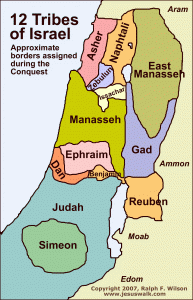
Shechem was in the land given to the Manasseh tribe, which was split into two parts, on both sides of the Jordan River. Western Manasseh was between the far northern and southern reaches of Israel. Joshua was a member of the Ephraim tribe, whose land was just south of the western half of Manasseh. Because Manasseh was in a central location in Israel, and because it was the holy ground where God promised Abraham that his descendants would possess that land, and it was a place that Abram built an altar and offered sacrifices, it makes sense that Shechem was chosen for purposes that are not clearly stated in the Book of Joshua.

It is also worthwhile to realize that this reading from chapter 24 comes well after the Proper 26 reading, from chapter 3. Chapter 23 states that Joshua is getting old and is about to turn the leadership reigns over to the leaders of each tribe. This is why Joshua “summoned the elders, the heads, the judges, and the officers of Israel” to Shechem. Twenty-eight years (give or take a few months) had passed since the crossing of the Jordan, and many wars had been fought (and won), which had then secured all the lands that were subsequently divided among the tribes.

With this setting understood, the reading today is under the heading “Joshua’s Farewell Address” (Chapter 23, NASB), while this specific text falls under the overview entitled “The Covenant Renewed at Shechem” (Chapter 24, NIV). This review of the history of the Israelites, from Abraham being called by God out of Ur, to that holy ground in Shechem, where the land of Canaan was promised, to being back in Shechem again, symbolizes the history of the Israelites had come full circle. Thus, it was a time of transition, where the cycles of time repeat.

As a time of transition, Joshua said, “Choose this day whom you will serve.”  That led to him saying, “For me and my household, we will serve the Lord.”

What do you seek? I seek the Holy Grail.
Who does it serve? It serves You.

That additional statement is a powerful statement to grasp.

Joshua had told the leaders of the twelve tribes that they came from ancestry that had worshipped many different gods in the past. He basically said, “Your flesh and blood calls you as a distraction. It takes your eyes off YaHWeH” and lets your brain think, “If it was good for ole granpappy, it ought to be good for me.”’

It is the common ancestry of all human beings, since God had elohim create animal men and animal women in their likeness. Man will always find a way to do what Man wants; and knowing the difference between Good and Evil will never keep Man from being tricked into serving little-g gods: gods of harvest; gods of fertility; gods of buildings; gods of property; gods of money; and all the gods of pride, envy, lust, gluttony, sloth, wrath, and greed.

It’s what Man does.

So, serving the LORD goes beyond the oral promises made to men long since gone.  It goes well past physical agreements written or etched into stone; and it exceeds belief that someone died on a wooden cross, two thousand years ago (give or take a few decades). Serving the LORD is not what someone else did for you, so you could benefit without having to help anyone but yourself.

The cycles of time means the old is done and the new has begun.  Holding onto the past means you have an imaginary deed to a Promised Land.  It is the epitome of “What have you done for me lately?” The past is a dream that dissipates when reality wakes you up in the present.

“Oh dear! Oh dear! I shall be too late!”

Joshua said, “For me and my household, we will serve the Lord.”

The use of “we” means the plural pronoun indicating only those whom Joshua could influence via teaching [i.e.: his family]. The power of that says the history of the world is the illusion – the dream – that is as fleeting as is mortal life on earth. The future is imagination of that which one wishes for, but has no foundation in reality.

The Lord makes the reality of NOW be known, when one is awake and alive with promise fulfilled, through being in touch with YaWHeH’s Holy Spirit. NOW lasts forever, when one’s soul loves God with its whole heart and the dream state of the world becomes the holy ground upon which one walks, which others cannot detect.

Thus, each individual has to be like Joshua said and: “Choose this day whom you will serve.”  There is no better time than the present.

Of course, in the now, as one hears these words be read aloud in church or as one reads them here or in the Book of Joshua, chapter 24, as a Christian or a Jew (reading in English translation or in Hebrew on scrolls), the easy and fast answer is the same as Joshua heard shouted in unison by the leaders of the twelve tribes: “Far be it from us that we should forsake the Lord to serve other gods. Therefore we also will serve the Lord, for he is our God.”

“Here! Here!”

“Well said!”

“Same here!”

“I hear you, brother Joshua!”

“I agrees with the brother!”

“Amen to that!”

Forty years later … … prayers would go out from some last vestige of those who so gladly agreed to serve the Lord, when Joshua was old and gray (or grey). “Help us Lord,” someone cried, “for we have gone astray!”
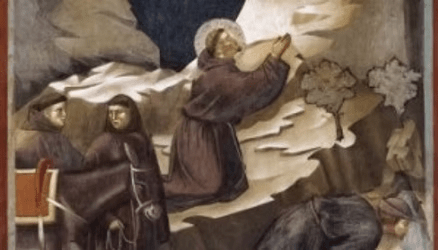
That cycle of history repeated every 80 years: 40 years serving God, followed by 40 years serving themselves (little-g gods).  They needed Judges to bail them out.  They wanted a king, then two; and then they lost everything.

You cannot serve the Lord by edict, where someone says, “You must do this or you must do that.”

Governments do that, and all government-fearing citizens do the true patriotic thing, year in and year out: They hire a lawyer, and an accountant, and a financial advisor (or adviser) that recommends their actions, where all the letters of the laws are bent every which way.  Governments purposefully write laws in gray (or grey), between the official looking black and white of legal legislation, because everyone knows the people love ways to get around the Law.  The high and mighty are selected from among the low and feeble, so it is proclaimed okay to serve as many little-g gods as your heart desires.  That way one is still (legally) able to say, “I am a Christian!” or “I am Jewish!”

“I have the receipts to prove it, dang it!” some say.

Jesus said it best: “No one can serve two masters. Either you will hate the one and love the other, or you will be devoted to the one and despise the other. You cannot serve both God and money.” (Matthew 6:24) However, Joshua said the same basic thing, well before Jesus.
Adolf wasn’t the only one not filled with the Holy Spirit to misuse Scripture. How many Americans today (NOW) would sacrifice the State or the Party, as a master destroyed? I say few, if any.

Joshua told all those Israelites, the leaders who had seen a few things firsthand over the prior 70 years (give or take a couple of years), from Egypt to Shechem: “You cannot serve the Lord, for he is a holy God. He is a jealous God; he will not forgive your transgressions or your sins. If you forsake the Lord and serve foreign gods, then he will turn and do you harm, and consume you, after having done you good.”  Joshua said, “I know you guys.  I’ve been there and seen how stubborn you can be.”

That says that you can only serve YaWHeH by being holy [i.e.: righteous; sanctified; saintly]. There can be no “two- hours sitters” (give or take a couple of hours), as those who sit in a church or synagogue pew for that long each week, who can call themselves “servants of the Lord.”

That goes for “the elders, the heads, the judges, and the officers of Israel,” which translates in modern times (forevermore) as also going for “priests, pastors, ministers, rabbis, bishops, cardinals, archbishops, popes,” and anybody and everybody who is a leader of some religious tribe that professes complete devotion to the One God.

If you take 30 minutes off to make sure your tax receipts are in order, so you don’t miss out on any deductions; or if you take a couple of hours one day, shopping for the finest clothes to be seen wearing in church; or if you take a week off to look at exclusive properties near the beach, as an investment; or if you take 30 minutes to abuse a child sexually, or take the same 30 minutes to look the other way while that happens; or if you take a few hours to plan some political demonstration, because your fav politician-lawyer thinks your presence will have an impact on others; and so on and so on … then you are under the misconception that God does not see you serving yourself, over God.

Joshua, having been a common human being prior to becoming holy and righteous, prior to being able to hear the LORD, after being touched by Moses. He knew where the hearts of commoners (and their leaders) lay.  Hearts are fleshy muscles pumping blood, before they become spiritual reservoirs that flow forth living waters.  Joshua understood where the Israelites were bound and determined to go, whether they would admit it or not.

Joshua clearly said, “[YaHWeH] is a jealous God; he will not forgive your transgressions or your sins.”

But … but … but … Jesus said … didn’t he …?

This is because rule number one has been broken, “You shall not wear the face of any other gods before My face.” God will not forgive part-time believers or those of come-and-go faith.  It means that you cannot have a drawer of godly faces that you decide are okay to wear, interchangeably, depending on the special occasion. By thinking it up to you to decide when it is okay to take off the face of God and slide on another face of your choosing, you just made mistake Number One.

God don’t like that.

This means the moral of this story of old Joshua renewing the Covenant (the Holy Agreement, which came with legally binding words) with the Israelites (and thereby all of their spiritual descendants, Christian and Jewish) can be summed up with this statement: “Then put away the foreign gods that are among you, and incline your hearts to the Lord, the God of Israel.”

I have underscored and made bold the pronouns “you” and “your.” Please make sure you read those in the singular, as if old Joshua were having a face-to-face with you, individually. After all, nobody else in this world matters.

You think, therefore you are.” Everyone else – past, present, or future – is imaginary. Joshua wore the face of God, as His servant. Therefore, Joshua was speaking as if God where here NOW, telling you this.

This means that when we read the conclusion above: “So Joshua made a covenant with the people that day, and made statutes and ordinances for them at Shechem,” it was like when God spoke to Abram many years before.  Abram built an altar and made sacrifices after the covenant of his descendants was made.  Keep in mind that Abram had no – nada – zero – zilch – children then, meaning the agreement was based on the imaginary, not the real.  Likewise, Joshua made the leaders of Israel throw their egos on the altar he made that day, as immediate acts that sealed that agreement (with new statues and ordinances spoken).  Those leader sacrificed themselves on the altar built by Joshua, burning their egos in the flesh, so the smoke of their spiritual blood plumed towards heaven.
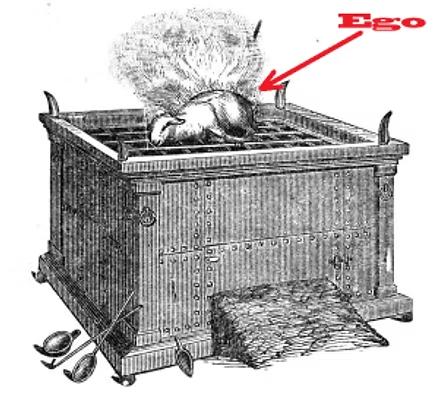
How would you like your ego cooked?


1 Thessalonians 4:13-18 – The reincarnated dead without Anointment will gain another chance for redemption [Twenty-third Sunday after Pentecost]

We do not want you to be uninformed, brothers and sisters, about those who have died, so that you may not grieve as others do who have no hope. For since we believe that Jesus died and rose again, even so, through Jesus, God will bring with him those who have died. For this we declare to you by the word of the Lord, that we who are alive, who are left until the coming of the Lord, will by no means precede those who have died. For the Lord himself, with a cry of command, with the archangel’s call and with the sound of God’s trumpet, will descend from heaven, and the dead in Christ will rise first. Then we who are alive, who are left, will be caught up in the clouds together with them to meet the Lord in the air; and so we will be with the Lord forever. Therefore encourage one another with these words.

———————————————————————————————————-

This is the Epistle selection from the Episcopal Lectionary for Year A, Proper 27, the twenty-third Sunday after Pentecost. It will next be read aloud in church on Sunday, November 12, 2017. This is important as it addresses the issue of death and the soul’s return to God, as understood by an Apostle and Saint.

Again, as I have done previously with the words of Paul, so we are forced to read what is written slowly and ponder translations that are valid, not what has been presented for us, let me simply present the above block (seemingly) paragraph in segmented fashion. Simply read this as the lines of a psalm that is slowly sung and let your mind’s eye see the message being unfolded before you. Read this before I offer an interpretation.

You can read along with the Interlinear breakdown of Greek and English here, and see how the translation above (the New American Standard Bible version) is compatible to the translation below.

13. I do not want you to be ignorant,
brothers,
concerning those who have fallen to sleep [that of death],
that not you should be grieved,
like are the rest,
those not having hope (confidence, trust, expectation).
14. If indeed we believe that Jesus died and rose again,
so also [we believe in] God,
those having fallen to sleep [that of death] for the sake of Jesus,
will bring (guide, lead away, go, carry) with him (the same).
15. This [statement of promise] indeed we declare to you in word of [the] Lord,
that [declaration] we the living surviving (left behind, remaining),
towards the coming (arrival, advent, presence) of the Lord,
all not shall proceed those having fallen to sleep [that of death],
16. because himself the Lord with a loud command (arousing outcry, word of command),
with the voice of the ruler of angels (archangel),
and with trumpet of God.
Will descend from heaven (the atmosphere, the starry heavens, the sky),
and the dead (lifeless, mortal) in Christ will rise before (at the beginning, first, in the first   place).
17. Then we the living remaining (left behind, surviving),
together with them,
will be caught away in clouds for meeting of the Lord in air (air we breathe);
and so always with the Lord will be.
18. Therefore encourage one another with these words.

If you noticed the repeating word, “died,” good for you! The repetition makes this the theme of this reading selection. Certainly, by comparing the two versions of translation, you noticed the word “died” has been replaced with “fallen to sleep” on three occasions, with “died” being maintained the other time.

The use of “fallen to sleep” is used as a symbolic statement of “death.” That translation comes from the words “koimōmenōn” (1x) and “koimēthentas” (2x), which are rooted in the word “koimaó.” The word “koimaó” (which is a variation of “keimai” – “to be laid, lie”) means, “sleep, fall asleep, die,” implying, “I fall asleep, am asleep, sometimes of the sleep of death.”

This is not insignificant, as in John 11:11 we are told Jesus said. about the news of Lazarus being “sick,” “Our friend Lazarus has fallen asleep; but I go, so that I may awaken him out of sleep.”  In John 11:4, the element of “death” was addressed when Jesus said, “This sickness is not to end in death, but for the glory of God, so that the Son of God may be glorified by it.”  Jesus being glorified by one falling asleep is an important message to hold onto as you read here how Paul wrote of that topic.

Jesus used the same Greek word as Paul used, referring to “having fallen to sleep,” with the word “thanaton” (rooted in “thanatos “) clearly meaning “death.”  The word maintained in translation here, as “died,” is “apethanen.” Immediately, a completely different word is visible (other than variations of koimaó ) as having been translated exactly the same as if rooted in “falling asleep.” The word “apethanen” is a form of the word “apothnéskó,” which means, “to die,” implying a usage saying, “I am dying, am about to die, wither, decay.”

Because the New American Standard Bible translation has presented a translation of “died” four times, with no indication of differences in the Greek, the reader’s and/or listener’s mind believes the exact same meaning is the intent, creating mental imagery of dead people in coffins, and all the finality that comes from mortal death. It then is important to grasp that the one use of “apethanen” is used in verse 14, where Paul wrote, “If indeed we believe that Jesus died and rose again.”  That states the common belief that Jesus died.

While Jesus was the name attached to a body of flesh and blood (like those possessed by Paul and the Thessalonians who had received this epistle), that state of finality (mortal death) did not end Jesus’ life. Because Jesus rose again, Jesus still lives.  Jesus lives in the bodies of Apostles and Saints. Thus, the implication in that statement (lost in translation) is that death – to a Christian (Christ Jesus and those filled with the Christ Mind) – is like being laid down to rest on a temporary basis, just like one goes to bed, sleeps, and then rises again.

To read a long-winded sentence that says, “For since we believe that Jesus died and rose again, even so, through Jesus, God will bring with him those who have died,” it is easy to come away thinking, “I believe Jesus died and was resurrected, so that belief means God will take my soul when I die.” That is as common a mistake as is thinking, “Jesus died for my sins.”

If Jesus did not die (he rose again), then Jesus awaits to awaken you from the death that is guaranteed by your sins.  Because the man Jesus was released from his physical body, his Spirit can continually rise again in others that die of sinful egos.  The ego goes to sleep, so the Mind of Christ can live again.

Nothing Jesus said in the Gospels (especially the parables where people think like that and find out the sad truth) says that anyone can sin all they want, while going to Heaven is guaranteed by belief in Jesus. Paul (even if it seems like he is saying all you have to do is believe and go to heaven) is telling believers you have to be Jesus reborn to get that reward.  It becomes a matter of seeing what you want to see, and that seeing then becomes the basis for believing.

Look again at verse 14 broken down into four segments. The first states, “If indeed we believe that Jesus died and rose again.” This segment begins with the Greek word “Ei,” which is a conjunction that relates this segment to the previous statement, “those not having hope,” which is a statement about those who do not have “trust, confidence,” or any “expectation” in eternal life. Thus, this segment depends on “If” that is the case,” “for as much as” that is the case, or as a direct reference to “that” lack of “hope,” then Christians indeed believe in a temporary state of death, because Jesus rose again.

The second segment then states how that resurrection was possible. Only God could cause a dead Jesus to rise again with life. Therefore, to believe in that miracle of the Resurrection, so also God is believed. Jesus did not raise himself from a state of being dead for three days (72 hours). God raised His Son.

Those two beliefs are more than simply the result of someone being told to believe in the resurrection of Jesus and the power of God. Keeping in mind that Paul was filled with the Holy Spirit of God, and he was writing to Christians in Thessaly who were likewise filled with the Holy Spirit of God, everybody was on the same page when Paul wrote, “those having fallen to sleep for the sake of Jesus,” he meant those who died like Jesus did – filled with the Holy Spirit.

The Greek word “dia” has been translated as “for the sake of” here, but as “through” in the NASB translation. The word means, “through, on account of, because of,” implying “through, throughout, by the instrumentality of, by reason of,” and “for the sake of.” The word is a preposition that is often used as a prefix, such that its use indicates “successfully across” (to the other side). Therefore, Paul was stating that for death to not be without “hope” or “expectations,” then one has become one with Christ Jesus, so one’s soul simply goes to sleep, to be resurrected in Heaven, because of that Christ presence within oneself.

From that realization, the fourth segment is clearly stated, such that we know Christ Jesus “will lead away with him,” “the same” as Jesus Christ “died and rose again.” Even for those who have no “hope,” they too will be “guided through” the soul’s removal from their dead mortal flesh, in an experience that is spiritual and heavenly. However, the impression given above (by the NASB), “God will bring with him those who have died,” is not stated; but to infer that meaning, one then has to realize that God will only keep those who have died as His Son reborn, with the rest recycled back into the mortal realm (reincarnation).

Paul then said that this promise of eternal life in Christ is the “word of the Lord,” which means it comes from God the Father, but was spoken by Apostles as Christ the Son. That “word” is truth, and when Paul then said, “we the living left behind,” “the living” means all those filled with God’s Holy Spirit, so those born of mortal bodies – “born of death” – had been made “living,” because they were then “alive” in Christ. That is the meaning of “towards the presence of the Lord,” as Paul explaining “we the living.”

The last segment of verse 15 begins with a double negative, “no not” or “no lest” (“ou ”), with “ou” also capable of being an indication of “all” (rather than “no”). As such, this then acts as a statement to be read two ways.

First, it says that “those having fallen asleep” (without the “presence of the Lord”) “will not proceed” to Heaven, while equally saying second, “all [that do] not expect” death, when “those have fallen asleep,” (because of the “coming of the Lord”), they will be the ones to go to Heaven. The double negative is then a reflection that not everyone (“not all”) who says they believe in Jesus and God will be saying “yes” to the “presence of the Lord” (due to the work that commitment involves).  That failure to say “yes” means, “no” “not” going to Heaven.

Verse 16 is then Paul telling of that “presence of the Lord” or the “coming of the Lord.” The first segment fails to see the importance of each word, when we think it says “the Lord with a loud cry.” We need to slow down and see the words saying, “because himself the Lord with,” where “himself” is not the Lord, but the one “the Lord is with.”

We get caught up in the imagery of God being this nebulous, separate entity on a cloud somewhere in the sky, but “the coming of the Lord” and “not” having to be recycled at death is “because the Lord is with oneself.” When one experiences God within, then there is a “loud” and clear “word of command” one hears.  It is not some sound that is audible, as vibrations registered in decibels. It means that  Christians let loose the “word of the Lord, loudly.”

It is then the Apostle who takes on the “voice” of the “ruler of angels,” and it is the “angels” sent by God that bring the whispers of the Mind of Christ. The one filled with the Holy Spirit then becomes the one who “trumpets” their faith in “God.”

At that point, “God will descend from the spiritual heavens,” in the ether that is the breath of life those born “dead,” as “mortals.”  By God coming down from above, His entrance into one’s heart means that one “will rise for the first time in Christ.” With that presence within, one stops fearing death and begins living as the resurrection of Christ.

When Paul wrote, “Therefore encourage one another with these words,” the “words” were about who dies and goes to Heaven. Not everyone gets to go to that spiritually everlasting paradise. Only those who become Jesus Christ reborn get that reward. There are only rooms set aside in Heaven for those who gave up selfishly living their mortal lives, so Jesus could return again, as the judge of who is “living” and who is dead. (See 1 Peter 4:5 and 2 Timothy 4:1)

The Greek word “parakaleite” is translated here as “encourage.” It can also mean “to call to or for, to exhort,” implying “I send for, summon, invite; I beseech, entreat, beg; I exhort, admonish; I comfort, encourage, console.” Paul was sending this letter to drive home the point to the Thessalonian Christians that they need to preach that message. No only should those filled with the Holy Spirit know their deaths are little more than falling asleep, waking up in Heaven; but, more importantly, they need to “encourage” those who are “like the rest” of humanity, “those not having hope,” that becoming a reborn Jesus is the way of “hope.”

This letter, again, was written for all who will read it, through all times, in all places. If you think you have Heaven solved and all you have to do to get there is believe Jesus died and was raised again, it is like thinking your beauty will pass that final exam, the one that will graduate you from the first grade to a doctorate in some field that means early retirement and exclusive homes on a paradise beach. You have to sacrifice to get the things you want in life … put in a lot of work, more mental than physical. Why would you think that same principle would not apply for the attainment of a spiritual goal?

The biggest problem the world has today is thinking. Heads filled with Big Brains ache when they read the epistles of the Holy Bible. To alleviate that ache, brains turn Greek words into English (or any other language, I presume, including that understood by Greek people) that makes Scripture say what they want to hear be said.

Those brains take the word “brothers” and turn it into “brothers and sisters,” so the sex organs of mortals – those born to die – are accommodated. It is so hard to see how all male and female Christians – those reborn as Jesus Christ – are all “brothers,” due to all being reborn as Jesus, the Son of the Father.

Commentaries of this selection that can be found published online focus on the “comfort of Jesus coming” to those who “have died” and to those left grieving the dead. We like to think that faith in Jesus will bring that deliverance, after it is time for us to leave this materialistic place we so fondly call home.

If we are still living to see it, then we expect Jesus to come down on a cloud at the end of the world and Rapture us, so we can watch all the heathen be fried like ants under a magnifying lens.

“Ha, ha, ha, ha,” they can say then, “Told you so, suckers!”  “You should have believed!”

Otherwise, we think it is all a matter of “We believe.  We die.  We go to Heaven.”  Since all moms are Saints, we will be greeted by mom, and she will probably have a hot apple pie ready for our arrival!

If you wait until death to find Jesus coming, then expect to be popping out of your new momma sometime soon afterwards. God will review all the common mistakes that mortals make; and, then <poof> your soul is in a mortal body again!

And the recycle of life rises again.

Everyone needs to read all the parables Jesus told and put themselves in the setting as the “fool,” rather than seeing themselves as Jesus talking about fools. The parables all say, “Never put off for tomorrow what you can do today.” Tomorrow is too late, as tomorrow may never come.

The only way to rest in peace is to know mortal death just means going to sleep, because the soul has a place reserved in Heaven. Those reservations require one’s ego taking a long, deep slumber, so God can send His Son in to make one’s body walk for the Lord and one’s tongue talk for the Lord. Now is the time to secure that reservation, because there is no better time than the present.

Matthew 25:1-13 – Vigilant and devoted bridesmaids [Twenty-third Sunday after Pentecost]

Jesus said, “Then the kingdom of heaven will be like this. Ten bridesmaids took their lamps and went to meet the bridegroom. Five of them were foolish, and five were wise. When the foolish took their lamps, they took no oil with them; but the wise took flasks of oil with their lamps. As the bridegroom was delayed, all of them became drowsy and slept. But at midnight there was a shout, ‘Look! Here is the bridegroom! Come out to meet him.’ Then all those bridesmaids got up and trimmed their lamps. The foolish said to the wise, ‘Give us some of your oil, for our lamps are going out.’ But the wise replied, ‘No! there will not be enough for you and for us; you had better go to the dealers and buy some for yourselves.’ And while they went to buy it, the bridegroom came, and those who were ready went with him into the wedding banquet; and the door was shut. Later the other bridesmaids came also, saying, ‘Lord, lord, open to us.’ But he replied, ‘Truly I tell you, I do not know you.’ Keep awake therefore, for you know neither the day nor the hour.”

———————————————————————————————————-

This is the Gospel selection from the Episcopal Lectionary for Year A, Proper 27, the twenty-third Sunday after Pentecost. It will next be read aloud in church by a priest on Sunday, November 12, 2017. It is important because of the warning of preparedness, as told in the parable of the ten bridesmaids.

This parable seems quite straightforward, in the sense that it paints a clear picture of being prepared for when the bridegroom comes, which appears to be Jesus in allegory. Of course, nothing is Scripture is that simple, as there is deeper meaning always embedded in the specific verbiage used. Every word coming from Jesus, and remembered by Matthew, came from the All-Knowing Mind of God. Each word of Greek is perfectly chosen.

In fact, one can see such knowledge as allegorically mentioned in this parable, as the oil that the lamps burn for light. Light is metaphor for the truth.  One assumes that some oil is already in the lamp, which had been lit in the evening.  By there being ten different lamps, this becomes metaphor for ten different ways the same words written in Greek can be made available to “light” one’s way in translation. However, meditation that goes beyond the apparent and ponders the scope of meaning that is possible from the Greek, then that acts as an extra “flask of oil” from which the “light” of truth can shine.

This Gospel reading is presented on the same Sunday as the story I interpreted about Joshua, who in his last year of life told the leaders of the Twelve Tribes, “Choose to serve God, or choose to serve the gods of others.” It also goes along with the first letter Paul sent to the Christians of Thessaly, where he wrote words that were read in church as saying “died,” but in reality three times the word implying death was used, metaphorically saying, “having fallen asleep.”

Can you see how this parable strongly links to those themes, when the bridesmaids have fallen asleep, with half having extra oil, and half only having the oil that was already in their lamps?  Can you see how “to become drowsy and sleep” is the same metaphor of death?  Can you see Jesus telling a parable that warns to be prepared for that time of death, which all mortals cannot escape?

In the interpretation I wrote referring to 1 Thessalonians 4, I wrote how one only needs to look at the parables that Jesus told and place oneself in the story “as the fools,” rather than as Jesus – the one telling the story. I had not read this Gospel accompaniment at that time; but as I prepared to write this, I saw the word “fool” used. Exactly as I stated prior, one has to ponder, “How am I one of the five bridesmaids that were foolish?”

This brings us back to the point that I have made previously, where we are all called to marry the King (and become his Son), as was the allegory in the parable of the Wedding Banquet. That thought, humanly mistaking the proposal to be to marry Jesus, causes manly men to stand up and pronounce, “That is gay! No man can marry another man!” Meanwhile, all the female Christians (especially Roman Catholic nuns and nuns of other denominations) gleefully proclaim, “I am already wearing the ring of marriage to Jesus Christ!”

As I have said, sex organs play no role in spiritual matters. When Jesus told Nicodemus that being reborn did not mean finding some physical way to get back into the mother’s womb, he was heard saying, “Truly, truly, I say to you, unless one is born of water and the Spirit he cannot enter into the kingdom of God.” (John 3:5) Jesus was not talking about bridesmaids being exclusively females because sex organs are not “born of water and the Spirit.” That says “water” is symbolic of “love,” and “the Spirit” is the HolySpirit.”

Love of God brings the Holy Spirit, as the marriage of the Son to the human being of faith, devotion, and submission – the traits of God’s bridesmaids.  That marriage of one’s heart with God – a Holy Union – in turn allows one entrance into the Kingdom of Heaven. That was what Jesus was talking about to Nicodemus – being reborn is what gains entrance into God’s Kingdom (Heaven). Therefore, the bridesmaids are symbolic of Christians that have sacrificed their self-egos, to be married to God.

In this way, anyone who thinks like Nicodemus and wonders how an old man can get back into his momma’s womb (via momma’s sex organ) is as “foolish” as a bridesmaid without extra oil for a lamp. Think of it as some male Christian saying he will marry God and have God’s baby Jesus Christ be born in him, but then that “fool” never gets the extra oil of Scriptural knowledge, to help him through the threshold of death, or “having fallen asleep” like Lazarus (the one Jesus loved) did.

When we read, “When the foolish took their lamps, they took no oil with them,” one can assume they took a lamp that had some oil already in it, so the lamp was able to shine a light for a few hours. All ten bridesmaids have lamps, so the similarity means all ten are led by the light of religion. That religion represents belief in the One God, YaHWeH, the LORD. So, they are either Jewish lamps or Christian lamps today, while Jesus was talking to Jews then.

Simply by having a lamp does nothing for anyone, so being Jewish or Christian in name only (by birth), with no knowledge of what that means as an adult, means one is not  deeply committed to God. No holy light leads one’s path through life. One is (figuratively) still “playing the field,” and “keeping one’s options open.”  One is a bachelor-bachelorette and not a bridesmaid (remembering that sex organs do not matter).

The oil that is already in the lamps should then be seen as one’s personal knowledge of what one’s religion says to believe. As such, all active Christians carry the knowledge that fuels the light that shines faith in God. Jews carry around lamps that are full of the oil that reflects memorizing 613 commandments, sent from God through Moses. In this way, the extra oil that five of the bridesmaids have with them is the oil of the New Testament, which fuels the light that shines faith in Jesus Christ, as the Son of God. The foolish bridesmaids do not carry that extra oil.

Still, the five foolish bridesmaids can be broken down into five different types of Christians and Jews. These can be compared to the seven churches, to which the Spirit of Jesus told John to write letters (in The Revelation). The Jews that reject Jesus as their Messiah, while remaining devout in their adherence to the laws of Moses, simply do not have that extra oil needed to get them beyond death, into Heaven. This was the reason Jesus preached in parables to such holy Jews in Jerusalem, to no avail. But, Christians who mirror those Jews in Jerusalem today, who maintain devotion to amassing fortunes and things, through  a misguided belief that God blesses His believers with things, they are not being filled with God’s Holy Spirit; and that means a “foolish” waste of holy oil.

When the ten had waited so long they had “became drowsy and slept,” this then states symbolically that the “delay” leading to that point of rest was a lifetime of waiting “to meet the bridegroom.” The Greek word that is translated as “slept” is “ekatheudon.” That is rooted in the word “katheudó,” which Thayer’s Greek Lexicon states is used: euphemistically [as], “to be dead,” and metaphorically [as], “to yield to sloth and sin, and be indifferent to one’s salvation.”

This hints at the weights placed upon human beings, as mortals, such that the “drowsiness” is brought on not only by the deterioration of bodily parts, from age, but the weariness that comes from denying oneself the lures of the world (being faithful and true to the bridegroom), as well as succumbing to them (secretly cheating on one’s verbal commitment).  It is a lifetime of temptation to worldly things that wears one out and makes one tired.

To then hear Jesus say, “At midnight there was a shout, ‘Look! Here is the bridegroom! Come out to meet him.’ Then all those bridesmaids got up and trimmed their lamps,” the symbolism of “midnight” has to be grasped. The actual Greek words written are “mesēs de nyktos,” which says, “the middle of the night.” That can be simplified as “midnight,” but a viable implication of “nyktos” (from “nux”) can be “midnight,” by itself.  As such, the simplification makes one miss the point of the word “mesēs” (form of “mesos”), where “in the middle” becomes less a statement of time of day, and more a statement about being in transition, from life to the afterlife, when “in the middle” means the transition of death.

Seeing “the middle” from that perspective, then one can grasp how death is that period of darkness when an absence of light surrounds one’s soul. This is termed “spiritual dryness,” but St. John of the Cross, OCD, wrote a poem that has been called “The Dark Night of the Soul.” An article on that poem and its topic explains: “The term “dark night (of the soul)” in Roman Catholic spirituality describes a spiritual crisis in the journey toward union with God.” The same “crisis towards union” can be seen in this parable told by Jesus.

Jesus, the teller of this parable, said, “There was a shout, ‘Look! Here is the bridegroom! Come out to meet him,’” which can be read as Jesus Christ making that cry of alert. Seeing that as the voice of the Christ Mind exclaiming, “Good News!” is then confirmed when Jesus said at the end of this story, “Keep awake therefore, for you know neither the day nor the hour.” This is clearer when the Greek text is found to add, “in which the Son of man comes,” (“en hē ho huios tou anthrōpou erchetai“), words with translations omitted, as they have not been included in the NASB translation above.

This parable then projects the future, when Jesus told his followers, while on the other side of the Jordan, about the death experienced by Lazarus. Jesus said, “Our friend Lazarus has fallen asleep; but I go, so that I may awaken him out of sleep.” (John 11:11) That parallels this story that tells allegorically of vigilance. The Lazarus story ended when we read, “There was a shout,” as John wrote, “He cried out with a loud voice, “Lazarus, come forth.’” (John 11:43)

The slumbering bridesmaids were awakened by a shout to “Look!” or “Behold!” or “See with the Mind of Christ!” (which is the intent of “horaó”). In both stories, the command was to “Come out,” which is an invitation to leave the darkness of death, but also the darkness of mortality. That command is to enter the heavenly realm of eternal life.

Kate Bush Video Waking the witch

In the statement, “Then all those bridesmaids got up and trimmed their lamps,” the Greek word “ekosmēsan” is translated as “trimmed.” It is the past tense of the word “kosmeó,” which means “to order, arrange,” implying “I put into order; I decorate, deck, adorn.” The word “trimmed” is then used like “trimming the Christmas tree,” and not like cutting a wick, or pulling the wick of a lamp out, so it can be re-lit. According to Thayer’s Greek Lexicon, this specific usage implies “to put in order,” as well as “to make ready” and “prepare” the lamp for the meeting of the bridegroom. This is where adorning the lamp ceremoniously would mean putting the extra oil into effect, as that was what would make meeting the bridegroom possible.

We know that is the case, because we read how Jesus then said, “The foolish said to the wise, ‘Give us some of your oil, for our lamps are going out.’” Because the “fools” said that, as a command to “Give,” this makes an important point of what makes a “fool” “foolish” and not “wise.” People expect to be given Heaven. They expect to be “placed, allowed, put, bestowed, granted, and permitted” (among other possibilities stemming from “Dote,” rooted in “didómi”), rather than having to do work themselves.

Can you hear St. James saying, “Faith without works is dead”? (James 2:14-26)

One can be given many things, but entrance into Heaven (the Kingdom of God) requires the work of the wise. This means being “wise” comes from being filled with the Holy Spirit, with all the “smarts” of the Christ Mind guiding one’s works. It is that presence of the Christ Mind’s “wisdom” that gives the five “wise bridesmaids” that “flask of oil.” That “oil” anoints them with the talents of the Holy Spirit, to prophesy and to understand prophecy, which is the fuel that “lights” their way to Heaven. It is the Holy Spirit that “adorns” the “lamp” of religion and simple faith.

Matthew 11:25 writes of Jesus saying, “I praise you, Father, Lord of heaven and earth, because you have hidden these things from the wise and learned, and revealed them to little children.”  There, “sophōn kai  synetōn” says “cleverness  importantly  intelligence” is the mistake of thinking a Big Brain will be all the ‘oil’ one’s lamp needs to stay awake until the bridegroom comes.  God does not come to meet those fools.  God does not propose to those who fall in love with convoluted masses of synapses that only serve mortal existence.  God proposes to “little children” whose faith is not hindered by the limits a human organ presents one’s soul.  Children are those who are neuter gender and not those who have not become limited to love that follows the lead of a sex organ.

In one commentary that I briefly skimmed over, the refusal of the five “wise bridesmaids” to “Give” lamp oil to the five “foolish” ones was seen as selfishness or petty bickering and jealousy. This is not the case at all.

To grasp that, I want you to think now of the story Jesus told about poor Lazarus, who in life sat at the gate of the rich man, begging for the crumbs off his table. In death, it was the rich man who begged Abraham’s Spirit to let Lazarus “Give” his tongue a touch of “cool water.” When Abraham refused, because the chasm between Heaven and Hell was too wide for Lazarus to cross, the rich man still wanted Lazarus to “Give” notice to his still living brothers, so they might change their ways (which were the ways of all rich humans).

In this parable, the five “wise bridesmaids” have to be seen exactly like poor Lazarus is seen, after death. None of them were able to “Give” what was not theirs to “Give.”  It was not a matter of selfishness, but the lesson that requires one earn that which one is “Given.”  Lazarus earned reward, while the rich man earned punishment.

The translation presented by the New American Standard Bible (NASB) has the “wise” saying, with an exclamation point, “No! there will not be enough for you and for us.” This is not what is written. The capitalized first word of this reply is “Mē¦pote” (root being “mépote”) which means “Lest.” It implies, “Lest at any time” and “Perhaps,” with the connotation of “Not” beginning their reply (without that being exclaimed).

The Greek written literally states the reply to a command to be “Given” the Holy Spirit, in the form of lamp oil.  The written words say, “Not cannot no [a triple negative] it is assistance for us and you.” That does not say there is not enough to be shared. It says there is plenty to go around, but they “cannot” “Give” that which the “wisdom” allows them to know: “not is it assistance for me and you.” The statement of reply says, “No cannot  [for] it is not to suffice for us and you.”  The “wise bridesmaids” knew, through the Christ Mind, that each individual must work for the unlimited shares that God has to Give.

The completion of the “wise bridesmaids’” reply, “you had better go to the dealers and buy some for yourselves,” states this individual responsibility to secure the holy oil necessary, by which one can enter Heaven. The literal translation says this in two segments: “but go rather to those selling,” and then “buy for yourselves.”

When one is hearing an allegory told, it is natural to think in normal, human terms; so when one hears lamp oil needed (a commodity), then it is natural to go to a lamp oil “dealer” to purchase that. In this story, we visualize some stupid girls running in darkness, trying to get an oil shop to open up and sell them some lamp oil.  However, the metaphor of “oil” is spiritual oil, or holy oil.

This means the “sellers” and “dealers” of holy oil are churches and synagogues. Therefore, the lack of work done by the “foolish” is being pointed out by those of “wisdom.” The ones who said they were “Giving” away “get to Heaven oil without working for it” I.O.U.’s are those who never “Gave” them the Holy Spirit’s “oil.”  They could not give what they did not themselves have; or they refused to give what they selfishly thought they had – scholarly knowledge – not wanting ignorant commoners to be special like them.  If you have the extra flask of oil and you are still alive, then you Give it away to those who seek it.

This, certainly, was a slap to the face of the Pharisees, Sadducees, scribes and Temple priests in Jerusalem, as Jesus was speaking allegorically in parable.  That was because it pointed the finger of “wisdom” at the lack of spiritual competence in those religious leaders.

Nicodemus, identified by John as “a man of the Pharisees” and “a ruler of the Jews” (John 3:1), was asked by Jesus, “Are you the teacher of Israel and do not understand these things (the spiritual meaning of being reborn)?” (John 3:10) This made Nicodemus one of those getting rich off selling the “oil” of Mosaic Law; but he and his pals never had in stock (as a commodity to sell) “spiritual oil,” the kind that anoints one for entrance into the Kingdom of God.

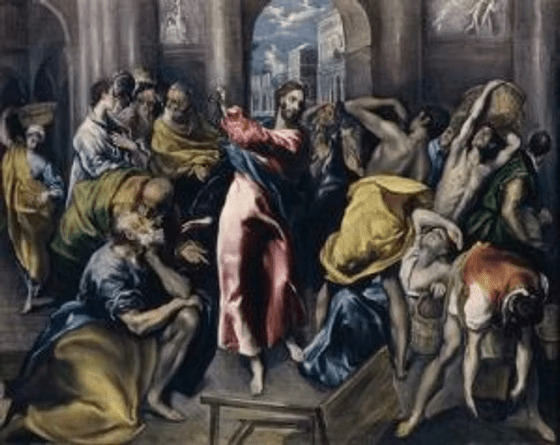
Jesus demonstrated how selling in the Father’s house was unappreciated.

Because the Holy Bible is a Living document, that which was written in ancient times, of ancient people, still applies at all times, to all people.  The eternal value of Scripture is as Paul wrote to the Hebrews of Rome: “For the word of God is living and active and sharper than any two-edged sword, and piercing as far as the division of soul and spirit, of both joints and marrow, and able to judge the thoughts and intentions of the heart” (Hebrew 4:12). Therefore, this slap at the leaders of Judaism in Jerusalem, by Jesus speaking in parable, is equally a slap at all religions professing belief in YaHWeH, the One God (the “lamps” of religion) that keep their flocks filled with costly physical “lamp oil” (like the vendors of the marketplace, selling shares of responsibility in the costs of buildings and programs), and do nothing that anoints the believers with the spiritual oil that prepares them to go beyond mortal death.

Those who are “wise” have become so by coming in touch with someone with the Holy Spirit. Jesus passed that onto his Apostles (who became Christ Jesus reborn), and they passed the Holy Spirit onto those they contacted (such as Paul and the Thessalonians). Apostles today have been led to Scripture, by those teaching programs of churches in the denominations of Christianity (readings, sermons, Bible studies, etc.); but the Holy Spirit does not come by trick or by human command.

Individuals have to show God their sincerity in wanting to become His bridesmaids-in-waiting, so that the extra flask of holy oil (the Holy Spirit) will be born within them. That rebirth of Christ Jesus in Apostles sends those Apostles out to “Give” that same opportunity to others. However, all who receive the Holy Spirit have to prove themselves as worthy, through the works of evangelism.

By the time one reaches that point of slumber, ready to meet the bridegroom they have worked so hard to please, there is no place a soul can go and “buy” or “purchase” the Holy Spirit. When Jesus said, “You cannot serve two masters. You cannot serve both God and money” (Luke 16:13), we see now how that means you cannot “purchase” a ticket to Heaven. You cannot reserve a room in the Father’s house with a credit card.

Seeing how the bridesmaids’ slumber is reference to death, after being told to go and “buy for yourselves,” the only place those five “foolish” souls could go was their own funerals.

Their souls would then hover over those grieving their passing, only to find prayers being recited over their physical corpses, as they were being lowered into the ground. Those souls then returned to the place of the wedding banquet, bringing with them the words spoken by priests, ministers, pastors, preachers, and rabbis, asking God to receive them.

Prayers are good.  Prayers are helpful to the living.  However, prayers for released souls are more for those left remaining in grief, than of any benefit for the dead.  A prayer cannot trump the requirement of being in possession of the Holy Spirit.

Reading, “Later the other bridesmaids came also, saying, ‘Lord, lord, open to us.’ But he replied, ‘Truly I tell you, I do not know you,’” that says those “virgins” (actual meaning of the word “parthenoi,” which is translated as “bridesmaids”) had supposedly set themselves apart from other lords, as committed to marry the bridegroom (God). While they promised their hearts to God, and confessed to others that was where their hearts were, the truth exposed (“Amēn legō” – “Truly I say”) is that they never did as promised nor publicly proclaimed.

God did not know those souls intimately. They were still “virgins,” “bridesmaids” with no real, committed relationship with the Lord; AND remember – we are not talking females for marriage. ALL are “virgins” until God consummates a relationship by sending His wives-to-be His Son and His Holy Spirit. The allegory of that is there must be possessed an extra “flask of oil.” Without that to light the lamp to Heaven, God can truly say, “I have not known you (in the Biblical sense).”

You have to be reborn as Christ Jesus to gain entrance into Heaven.

Jesus then said, as the storyteller who spoke for the Father, “Keep awake therefore, for you know neither the day nor the hour.” “Keep awake” means do not die before you have become baby Jesus reborn in the flesh. Do not die before the Holy Spirit has used you as an Apostle, to bring other bridesmaids-in-waiting to the Lord.

Keep awake because you never know when death will make it too late to run to the church and get some Holy Spirit.  You need to be prepared beforehand.

Judges 4:1-7 – The judge Deborah [Twenty-fourth Sunday after Pentecost]

The Israelites again did what was evil in the sight of the Lord, after Ehud died. So the Lord sold them into the hand of King Jabin of Canaan, who reigned in Hazor; the commander of his army was Sisera, who lived in Harosheth-ha-goiim. Then the Israelites cried out to the Lord for help; for he had nine hundred chariots of iron, and had oppressed the Israelites cruelly twenty years.

At that time Deborah, a prophetess, wife of Lappidoth, was judging Israel. She used to sit under the palm of Deborah between Ramah and Bethel in the hill country of Ephraim; and the Israelites came up to her for judgment. She sent and summoned Barak son of Abinoam from Kedesh in Naphtali, and said to him, “The Lord, the God of Israel, commands you, ‘Go, take position at Mount Tabor, bringing ten thousand from the tribe of Naphtali and the tribe of Zebulun. I will draw out Sisera, the general of Jabin’s army, to meet you by the Wadi Kishon with his chariots and his troops; and I will give him into your hand.’”

———————————————————————————————————-

This is the Old Testament selection from the Episcopal Lectionary for Year A, Proper 28, the twenty-fourth Sunday after Pentecost. It will next be read aloud in church on Sunday, November 19, 2017. It is important because it tells of God’s response to cries to help, through those who never lost their connection to God.

To make this shorter, I refer readers here to an analysis that I published on this “blog” in November 2014, about this same reading. I entitled that article “The Truth of the Prophetess Deborah.” If one browses the selected reading above, one will find that there are no less than nineteen names of people and places plus words identifying things, all which have hidden meaning that needs to be understood for this “simple” story to unfold fully. I explained this reading based on understanding those name-word meanings in that article; so I will not repeat that interpretation.

I will state in brief review that my thoughts of three years ago focused on Deborah being a High Priestess, more than on her being a “wife.” While that is certainly an identification based on the Hebrew text, there is question as to the meaning of Lappidoth.  Is it naming a husband or a personification of self-identity?  If the latter, then “ishshah” may take on a secondary meaning as the primary intent, intended to state that Deborah was nobody’s “wife,” but a female of Lappidoth.  For this interpretation, however, I will focus more on the traditional translation of Deborah being a “wife,” while looking at a couple of “side items.”

One is a view that I touched on a short while back, when I mentioned the Prophetess Deborah was an ancient example of God working through females.  Simply by her called a “prophetess” all priestly claims for male superiority (Roman Catholics primo uno) are false. My point was that female servants of God, when filled with the Holy Spirit and reborn as Christ Jesus, are not “mothers.” Likewise, males are not “fathers,” in the sense that the word implies progeneration.

All who speak the word of the LORD do not speak as the personal bringer of life to people. The words they speak come from the one they become identified with, through the title of “Father.” A female priest is not meant to nurse all of a congregation’s boo boos away, or give group hugs and lead pep rallies. A female priest calls upon the name of Jesus Christ, the same as does a male priest.  Therefore, a female priest is the Father, in the same way as a male priest is.  This is a simple matter of Spirituality, where the sex of the human cannot change the masculinity of God.

The example of Deborah says, foremost, that she was a “wife,” based on “ishshah” used as an identifier. The Hebrew text says, “’iš·šāh nə·ḇî·’āh” (rooted in “ishshah nebiah”), followed by some indication of separation (written or implied), then “’ê·šeṯ lap·pî·ḏō·wṯ” (rooted in “ishshah Lappidoth”). The word “ishshah” means “wife,” so the actual text says Deborah was “a wife prophetess.” Following that identification, we are told she was “the wife of Lappidoth.” This repeating of “wife” says that Deborah was married to a man who supported her. Together they were husband and wife.

The word “husband” comes from Old Norse, meaning “master of the house,” while implying “a man who has land and stock.” It also strongly implies a man who has a spouse. While these modern times are almost totally focused on the sexuality of a couple, so that “marriage” is only for two single people to have all the sex they want, without any plans for children, the true purpose for marriage is often overlooked.

Rather than marriage being between two lovers, to have and to hold till death does them part (a highly unlikely scenario in the modern world of divorce and multiple marriages), marriage means to have children. It is the marriage of one’s DNA to another’s that “can never be torn asunder.”  A child remains “married” to its parents, regardless of how the parental sexual appetites wane and begin to look elsewhere.

While overlooked today, it was clearly understood in ancient times;  such that a “husband” was more able to tend his land and stock with the assistance of male children.  The “wife” was able to have the female children help her as “mistress of the house.”

As a “wife,” it is then stated indirectly that Deborah was a “mother.” To understand this, I recommend reading Genesis and the history of Abram and Sarai, who were married – as a man and a woman who had sexual relations together, exclusively – but Abram kept introducing Sarai (to important men) as his “sister.” This was probably stated as, “Sarai is the daughter of my father,” which was the truth of a woman who had been “given away” in marriage. However, Abram could not truthfully say, “Sarai is my wife,” because that would cause the important men to inquire, “Oh, nice! Where are the kids?”

When one grasps that Deborah was a “wife” first, which meant she was (in essence) “Mother Deborah,” her sex organs that delivered and nursed babies had absolutely nothing to do with her identification as a “prophetess.” The Hebrew word “nebiah” says, “prophetess,” as the feminine form of “nabi,” which says “prophet.” This says that Deborah was a “wife” who “prophesied.”

In Isaiah 8, the Lord spoke to the “prophet” Isaiah, and in that process we read (Isiah 8:3a): “So I approached the prophetess, and she conceived and gave birth to a son.” This “prophetess” is believed to be the “wife” of Isaiah, the “prophet.” This relationship of a husband prophet to a wife prophetess is then more than a wife taking on the female title of the male (like “father-mother”), or the text would read, “So I approached the wife, and she conceived.” It says Isaiah the prophet was married to a woman who not only shared his household and bed, but a woman of like mind, who was also able to be in touch with God.

This means the prophet Isaiah was married to his female compliment; and that example can then be applied to the relationship between Deborah and Lappidoth. It says a “prophet” or “prophetess” cannot be joined with someone who acts like Darren Stephens, while Samantha was twitching her nose – always trying to get her to stop doing what came naturally. A husband prophet becomes supportive of a wife prophetess, so each knows when the word of God is being spoken by one or both. The words “prophet” and “prophetess” become statements of equality, although one is male and one is female.

According to one web page I found, in a search of “ancient school of prophets,” Samuel initiated that formal institution. It can be presumed that this school focused on presenting Kabbalistic studies to first-born male students who had been given to the priesthood by their parents. Thus, being an “educated” prophet can be seen as a parallel in modern times (since the advent of Christianity) to monasteries, seminaries, and schools of divinity and theology. The difference between then and now is a school of prophecy was designed to educate those who would advise kings, whereas Christian schools are designed to educate the heads of churches and parishes.

The Roman Catholic Church’s program of only allowing males to be leaders of churches, where those males were called “priests,” threw dirt and mud on the concept of a female “priestess.”  That title became associated with the pagan religions. like that Rome had. Forget the Greek mythology of the Oracle of Delphi, where a “priestess” spoke only the truth of Apollo (the Sun god), while in a trance of ecstatic prophecy, if the truth is spoken by a female, then it is a lie. Where a “prophet” and a “prophetess” have equal status, a “priest” and a “priestess” do not.

This is why female priests become such a difficult entity, where giving one a proper title is not as easy as tossing out the female form of the male title. That is where “Mother” comes from, even though people forget that “Mother” is the title of the head nun in a convent. Since a female “priest” is an educated head of a Christian church, the use of “prophetess” would imply almost the same as “priestess” (“oooh! Pagan!”), with neither seeming appropriate.

Still, “Mother” indicates “the Mistress of the Church,” while “Father” means, “I speak for God.”

What most Christians fail to grasp is the differences between human beings – man (little-a adam, identified as “zā·ḵār” – “male”) and woman (identified as “neqebah” – female) – versus holy man (capital-A Adam, made by the breath of God and identified as “the man whom Yahweh had formed” – “hā·’ā·ḏām” – “the man”) and holy woman (identified as “hā·’ā·ḏām lə·’iš·šāh” – “the wife of the man”). Because the human beings that Christians call “Adam and Eve” were created on the Sabbath day – the Holy Day – they are the first “prophet” and “prophetess” (because they spoke with God) AND they are the first “priest” and “priestess” (because they taught sacred rites). They are a complimentary pair, with both sent to the earth as the seeds of religion, teaching animal man and animal woman the differences between good and evil.

When we read of Adam’s son making altars, and Abram making altars, and Abraham going out with Isaac to make an altar and do a sacrifice, the purpose of those Patriarchs was to be “holy priests,” and only “holy priests” build altars and make sacrifices to the LORD. A father teaches his sons, just like the Father teaches His sons (to be the Son). What is not written, but can be assumed, is “holy wives” were also “holy priestesses,” who taught their daughters, just like the Fathers teaches His daughters (to be the Son).

While the sons of fathers turned out frequently to not be as holy as the father (Cain being the first example, but the sons of Eli, Samuel, and David are others – et al), one can see that God sending holy man and holy woman to the earth (a realm of evil), there were “priests” and “priestesses” who did a Darth Vader, and turned to the dark side. The lesson in that is a title is a way of self-aggrandizement, so the ones more likely to truly be holy priests and holy priestesses are those who do not stand before others in pretentious form, so the focus is on them and not the Father.

That is why I have a problem with a female graduate of a Christian seminary being referred to as “Mother.” If a “priest” is a male leader of a congregation, then “priestess” should be the natural feminine gender compliment title.  However, since “priestess” seems muddied by its association to pagan religions, then it might be worthwhile to look at the Jewish title of “rabbi,” which is the same for both sexes.  That translates as “Teacher.”  Both are called the same, with neither insinuating harder or softer.

The “prophetess” that was Deborah means she, like a male “prophet,” spoke to God and then passed that wisdom on to those in need. She taught what the LORD told her.  Ehud did as well, I presume.  That is what holy men and holy women do. It is called being filled with the Holy Spirit, where one prophesies via speaking in tongues – the Word of the LORD.

Seminaries and schools of prophecy cannot teach that; so they have no title for those who do that.  Graduates are sent to seek employment by religious institutions, which then ordains priests (male and female) and assigns them to buildings with congregations.  The problem with “Teacher” (for ordained Christians) is then the onus put on that title by ordained priests who really do not like a ministry shepherding congregations.  Some quit doing that mundane work and return to a school, in order to teach flocks of seminarians.  Fortunately, those add Professor to their title, rather than “Teacher.”

Another thing I wish to point out from this reading selection is the first verse, which states, “The Israelites again did what was evil in the sight of the Lord, after Ehud died.” Ehud was a judge from the Tribe of Benjamin, which was the area of land settled between Jericho, Jerusalem, and Gabaon (Gibeon).

Deborah was also a judge, like Ehud had been. This is a statement of equality, which has nothing to do with the sex of a judge and everything to do with one’s connection to the LORD. This means a “judge” is not some official title of government, as much as it identifies someone filled with the Holy Spirit, as one who is constantly in touch with God.  This ultimately makes God the true Judge. Therefore, Ehud and Deborah were vehicles of God’s judgment.

That judgment was essential because the Israelite people had turned away from their LORD and “did what was evil in [His] sight.” This would be a repeating theme of the Book of Judges. As it was then, so it is now, and forever.

Human beings who claim devotion to the LORD but then run and play like their heathen neighbors are no longer “children of the LORD.” They are no longer His chosen people. To be common is to be like 99.9% (plus) of humanity is, which is unholy (“evil”) and given over to following whomever or whatever human individuals can choose to follow. In this case it was some high ruler in Canaan, but that “King” can be reflective of any President, Pope, or movie star – anyone who puts people on their knees worshipping someone other than the One God, YaHWeH.

Finally, I will address the location of Deborah, which is said to be, “between Ramah and Bethel in the hill country of Ephraim.” Ephraim was the area of Israel that bordered Benjamin, to the north.

Ephraim was the tribe of Joshua; and Joshua was also one who judged Israel for God. Other than what I have written previously about the implications coming from the name meanings that add value in this story, this verse can be a clue as to Deborah’s heritage.  If it is an indication that Deborah (and/or Lappidoth) were descended from a line of holy men and women from the house of Joshua, this would help explain how she became a prophetess. This would mean Deborah was raised with priestly values taught to her, to which she adhered fervently and that devotion led to her abilities as a “prophetess.”

In this scenario, Deborah’s “husband” would be God.  Her marriage to the LORD was then what filled her with the Holy Spirit and allowed her to prophesy.  In the grand scheme of the books of the Holy Bible, the thread from Genesis to The Revelation is holy lineage, as the Tree of Life or the Vine of Christ, which includes many names of the dead branches that were gathered up and thrown into the fire.

The lesson of that lineage is the work involved in being filled with God’s Holy Spirit. Just as Deborah probably never knew Joshua (Ehud judged Israel for 80 years after Joshua died), people today never knew any of the holy figures of the Scriptures. We have to study the word of God, through His prophets and prophetesses and adhere to that teaching.  With hard work and prayer, God will see that devotion as worthy of allowing us to prophesy as God’s judges.

Lord knows we need that.

1 Thessalonians 5:1-11 – Stay awake and sober for when the day of the Lord will come [Twenty-fourth Sunday after Pentecost]

Now concerning the times and the seasons, brothers and sisters, you do not need to have anything written to you. For you yourselves know very well that the day of the Lord will come like a thief in the night. When they say, “There is peace and security,” then sudden destruction will come upon them, as labor pains come upon a pregnant woman, and there will be no escape! But you, beloved, are not in darkness, for that day to surprise you like a thief; for you are all children of light and children of the day; we are not of the night or of darkness. So then let us not fall asleep as others do, but let us keep awake and be sober; for those who sleep sleep at night, and those who are drunk get drunk at night. But since we belong to the day, let us be sober, and put on the breastplate of faith and love, and for a helmet the hope of salvation. For God has destined us not for wrath but for obtaining salvation through our Lord Jesus Christ, who died for us, so that whether we are awake or asleep we may live with him. Therefore encourage one another and build up each other, as indeed you are doing.

——————————————————————————————————–

This is the Epistle selection from the Episcopal Lectionary for Year A, Proper 28, the twenty-fourth Sunday after Pentecost. This will next be read aloud in church on Sunday, November 19, 2017. It is important as it echoes the theme of being prepared for everlasting life, as was seen in the parables of the Ten Bridesmaids and the Rich Fool.

The selected reading from the fifth chapter of Paul’s first letter to the Christians of Thessaly begins with the capitalized Greek word “Peri,” followed by the conjunction “de.” This has been translated as, “Now concerning,” which is a reversal of the written words’ order, rather than literally translating, “Concerning now.” Certainly, this translation reflects translation via standard syntax; but standard syntax misses the subtle intent of capitalization, which places a need to focus some importance onto the word “Peri.”

The word “peri” means, “about, concerning,” and “around,” which “denotes place, cause or subject.” Its implied usage infers, “consideration where ‘all the bases are covered.’” As such, the important focus by the capitalization of this states, “Circumstances now” or “Conditions on top of.”

Because 1 Thessalonians 4:18 (reviewed in the Proper 27 lesson) ended chapter four with a plea to continue teaching the value of being in possession of the Holy Spirit, prior to death, chapter five is then referencing that plea and that message.  This beginning is then stating these are the “Conditions on top of” that prior statement. This next chapter is then adding focus on the “Circumstances now,” which were surrounding Apostles who were filled with the Holy Spirit. While that is also reflected in stating, “Now concerning,” there is something lacking in such an, “Oh, by the way” introduction.

This introduction then refers to “the times and the seasons,” which sounds reminiscent of the song found in Ecclesiastes 3:1-8, made popular by The Birds, with their song “Turn, Turn, Turn” (1965).

The two key words her are “chronōn” and “kairōn” (rooted in “chronos” and “kairos”), which can also state, “durations” and “opportunities.” This means the “Circumstances” that are “next” for those in their positions as Apostles is to look at how long (“times”) they have to serve the LORD, with their new purpose being to seek new believers to bring to Christ (the “opportunities”). Thus, this chapter places focus on that “time” and “purpose’ each Apostle has, relative to preaching the Gospel, and does not reflect an estimation of when one’s “time” is up.

Because Paul then addressed the whole body of Christians in Thessaly as “brothers,” then “the times and the purposes” or “the durations and the opportunities” were those only held by bodies holding the risen Lord (Christ Jesus) within (meaning male and female Thessalonians were “brothers in Christ,” as Jesus reborn). That holy presence, coming with the Christ Mind, means there was “no need to have written” a checklist of “Apostle To-dos” or a schedule for what “times” one should go to church and what “seasons” does a Church recognize, denoted by when it is appropriate to wear robes of green, white, red, purple, black, pink (rose), gold and blue.

Above all, Paul (via the Holy Spirit) was not indicating the Christian Thessalonians thought someone should tell them when they would die and write that in a letter. The deeper meaning is the written Mosaic Laws are no longer external to them, for them to memorize and forcibly follow. The presence of God in their hearts has written His acceptable ways in their hearts.

The translation, “For you yourselves know very well that the day of the Lord will come like a thief in the night,” is shown to be three segments in the Greek text. The dividing points come after a statement that confirms the presence of the LORD within, such that is states, “Yourselves fully know that day of the LORD.” The love of God and His marriage to them, in their hearts, has become “that day of the Lord,” meaning there is no need to follow “cookbook” rules that will make “that day” be in the future. Thus, following a comma (written or implied) is the statement “as a thief in night.” This becomes read separately, as the day of the LORD being when they had their darkness of night was stolen from them.

The final segment of this verse concludes, “in this way comes.” That “manner” is then the “stealth” in which God transforms one from a mortal born of death (“the night”), to a soul with the promise of eternity that become “known” on “that day of the LORD.”

Of course, the double entendre (dual meaning) speaks of “night” as the “time” of death, which is not foretold “in writing.” The “day of the LORD” becomes the “light” of awareness when the soul meets face-to-face with God, who takes the soul “like a thief.’ The factor of “night” becomes representative of the “time” of death.

In verse 3, where the translation is “When they say, “There is peace and security,” the second segment (in quotation marks) is “Eirēnē kai asphaleia,” where the capitalization leads to those referenced (as “they”) saying, “Peace and security.”The presence of capitalization is important to recognize.

It is also worthwhile to know that “eirēnē” was used as an “invocation of peace [as] a common Jewish farewell, in the Hebraistic sense of the health (welfare) of an individual.” Capitalizing this word then infers someone pronouncing “I am healthy and well.” This becomes similar to the common thoughts of mortals, as stating, “I am so good that God has rewarded me physically, with good health.” The word “asphaleia” then adds to that proclamation of physical health the “reliability, firmness, and safety,” which (again) are thought to be from the good graces of YaHWeH.

For Paul to write that to Christians in Thessaly, who undoubtedly were a mix of former Jews and former Gentiles, such words were understood to be those commonly expressed. They were catchphrases, rather than deep beliefs. People of professed faith, who think they have been blessed by God (due to the comfort of their status and position) can then pretend to be a god with a catchy farewell.  This gives the impression: “As I have peace and security, I give you a pinch of that peace and security to keep as your own.”

The same can be said as happening to this day, especially when an Episcopal service comes to the point of “The Peace.” The priest motions everyone to rise, and says, “May the peace of the Lord be with you,” to which the congregations replies, “And also with you.” I expect we do it today because they did it yesterday.

Now, that is all well and fine, IF everyone knows what that means and means what that says.

Myself, not being a “cradle to grave” Episcopalian, I was not confirmed in the Episcopal Church until the ripe old age of fifty-something. After the ceremonial proceedings, the Bishop spoke with me privately, while the others were leaving the nave. He shook my hand and said, “May the peace of the Lord be with you.”

When I heard that, I was thinking, “Wow. That was so nice of the Bishop to say that … to wish me well.” So, I replied, “Thank you.”

As he was walking up the aisle to leave it struck me, “Idiot, that was an Episcopal catchphrase.” As soon as I realized my mistake, I hollered out to the Bishop, “And also with you!”

He didn’t look back; but he kinda waved his left hand to the side, letting me know he heard. Maybe he didn’t want me to see him trying not to laugh?

That becomes symbolic of what Paul was writing; as people think saying the right things is all they have to do to get to Heaven. However, Paul then wrote, “Then sudden destruction will come upon them, as labor pains come upon a pregnant woman, and there will be no escape!” This says that talking a good game is no replacement for sacrificing your Big Brain for the love of God and the Mind of Christ.

When that self-sacrifice is done, then” you do not need to have anything written to you” to memorize as a farewell.  A catchphrase is an automatic statement that comes without out deep thought and meaning.  “Peace and security” implies “I already have this, which only works when that is the truth.

To follow that up with, “sudden destruction will come” means “ruin, doom, destruction, and death” has just been wished upon oneself, simply from thinking one is prepared to enjoy life because God loves him or her, and not doing the will of the LORD. That meaning of “destruction” comes from the Greek word “olethros,” which also “emphasizes the consequent loss that goes with the complete “undoing.”’ One is thus undoing all of their pleasant thoughts of health and safety by boasting about you being well-to-do.  All the counting of one’s chickens before they have hatched will have been “undone” by having the gall to think God loves you so much that He is your slave.

Now, in the verse where it says, “as labor pains come upon a pregnant woman,” this too is spoken with dual meaning intended. First is the obvious, which is “labor pains” come suddenly, when a “pregnant woman” is due to give birth to a baby. Their onset becomes a ‘drop everything’ mentality, with going into rush mode an immediate response. For a lot of married couples who are pregnant, the parents-to-be practice for that time when action needs to be quick. When it is time to react swiftly, looking up something in a book or calling someone to ask what to do is not the best way to get moving.

Second, which is a deeper meaning, relates to my having said prior that all mortal human beings are called to be the brides of God. God wants to impregnate both males and females with His Holy Spirit; but God is not going to rape anyone that refuses to get engaged and become married to Him (in Spirit). Therefore, the metaphor means the “destruction” of death will come suddenly, because mortal human beings (males and females) became “pregnant” from their own rejections of God and Christ.

There is a vulgar saying that involves a word beginning with “F” and involves “yourself.” Consider that the secret second meaning here.

Still, the Greek words only imply a “pregnant woman,” which is the translation provided by the New American Standard Bible (NASB). The actual Greek text says, “ōdin en gastri echousē.” The closest that comes to “labor pains upon a pregnant woman” is as “the pain of childbirth to her [feminine “the”] in the belly holding.” The actual birth of a baby or child is implied, but not said.

A viable alternate translation can be, “the acute pain to her in the stomach having.” This then becomes a reference to a woman that has not become pregnant, as the sudden announcement from “her belly” that mensuration is about to begin sloughing and unused egg. As metaphor, males can know this “sudden pain in the gut” after eating some bad food.

The point is to not get caught up in looking for ways that, “This cannot be a worry for me,” as Paul was not trying to tell of pregnant women suddenly dying. The comparison is to how the state of “death comes so quickly” that “there can be no escape.”

In verse 4, Paul again refers to the recipients of his letter as “brothers.” The translation as “beloved” recognizes a familial relationship, in the same way that John wrote that Jesus loved Mary Magdalene, Martha, John, and Lazarus. The actual identification as “brothers” says Jesus had been reborn in each and all.  The new persona became their escape from the sudden throes of death.

Paul then stated Apostles (males and females) “were not in darkness.” That means they had been elevated from the level of mortal sinner (where darkness always exists) to righteous Saint, where the light of Christ was surrounding them.  This can be seen as the halos depicted above a Saint’s head in art.  This light was brought upon them by God’s Holy Spirit, so that God had snatched away (good translation of “katalabē”), “like a thief,” their souls from Satan.

The presence of this light that removes all possibility of darkness from the Christians of Thessaly is said above to be due to them being “children of light and children of the day.” The actual Greek states, “huioi phōtos” [comma] and “huioi hēmeras.” The word “huioi” is repeated, lending it an importance of identification. Those repeated word are rooted in the singular word “huios,” which properly means “sons.”  The Biblical implication of “huios” as “sons” means it can state (as understood use), “Anyone sharing the same nature as their Father.” (Helps Word Studies for “hyiós“) Certainly, “their Father” has to be understood as God, the LORD.

According to the Helps Word Studies explanation of the Biblical meaning, this word is expanded further by this definition: “For the believer, becoming a son of God begins with being reborn (adopted) by the heavenly Father – through Christ (the work of the eternal Son).” Therefore, while it can be assumed the Christians of Thessaly included men and women, husbands and wives, this use of “sons” clearly identifies them all as the “sons of light” and the “sons of day,” as those embodying the Mind of Christ, Jesus the Son.

By Paul stating “we are” (“esmen”), he was writing as one of those “sons of light,” “sons of day,” so he knew the same as the Christians of Thessaly, because they all were filled with the Mind of Christ as the same Son. Still, “we are” is actually led by the capitalized “Ouk,” meaning “Not.”

The importance of that negative says the voice in Paul’s mind spoke loudly, “Not are we of night nor of darkness.” Paul knew all the writers and addressees had escaped death and the dark night of the soul after death.  They had been saved by each being a reborn Jesus, who said, “I am the light of the world. Whoever follows me will never walk in darkness, but will have the light of life.” (John 8:12) “Follows” means be the next Jesus.

The translation of verse 6, “So then let us not fall asleep as others do,” can seem like Paul was giving a pep talk, urging them not to drift off and die, when they have “light” and “day” on their sides. In reality, the Greek text literally states, “So then not we should sleep like the rest.” The “conditional” form of “katheudó” implies that none will reach death and have a soul lost in darkness because they are “sons of light” and “sons of day.” This conditional form reminds us of verse 1, which said this chapter would address “Conditions on top of” (“Peri”) being tasked to spread the Gospel of Christ.  One condition is Apostles should not sleep like the rest.

Paul then stated the additional responsibilities Apostles have, which is stated where he wrote, “but let us keep awake and be sober.” The word translated as “awake” is “grégoreó,” which is the conditional form of the root word “grēgorōmen.” The proper translation states, “but we should be vigilant.” This is then followed by the word translated as “sober,” which has “néphó” as its root, from the conditional form written– “nēphōmen.” The completion of the statement is then “and we should be free of illusions,” where “not being delusional” is a viable substitute for “sober.” Again, Paul spoke in the conditional form, which maintains the theme set in the introduction of “Conditions on top of” preaching the word of God.

The translation that says, “for those who sleep sleep at night, and those who are drunk get drunk at night” is actually shown in the Greek text for verse 7 as having four segments, with a semi-colon splitting this verse in the middle. Those language ‘road signs’ say pause and reflect on each segment before proceeding to the next. The four segments literally translate as, “those indeed sleeping,” “by night sleep,” [semi-colon] “and those becoming drunk,” “by night get drunk.” Each segment has its own separate idea that needs to be grasped, before one can run and toss everything together in one quick breath of reading.

To begin with, “those indeed sleeping” recognizes the need for an Apostle to remain alert and free of illusions because (“gar” = “indeed,” => “cause”) the rest of humanity is “sleeping,” as mortals born of death. Only those who are alert and awake can rouse those asleep from their slumbering lives. The separate segment that says “by night sleep,” is a focus being placed on the absence of light that night brings. That, in turn, maintains how ‘dead’ humans of normal life sleepwalk towards a dark end. Following a longer pause for reflection on those statements (the intent of a semi-colon), the next segment then continues (“and”) by placing focus on this life of darkness assisting a sleepwalker because mortals born of death have “become drunk.”

This state of “intoxication” is not caused by drinking alcoholic beverages (as if drinking was the only sin of darkness, only done after nightfall).  Instead, it projects all the artificial “highs” and addictive “lows” that one gets from the excesses of the material plane. Excessive drinking can be representative of anything the world has to offer that places the user in an altered state of being, incapable of “seeing the light.” This is then supported in the final segment, “which states “by night get drunk.”

Because “drunk” represents the illusions of life (they used to say drunks saw hallucinations of pink elephants), “sober” is the opposite, where one is “free of illusions.” Paul then encouraged the Thessalonians (in the conditional) to remain “sober,” as those who are led by the light “of day.” That ability to remain focused on helping those who are still in darkness, is then stated as if an Apostle should dress like a ‘Christian soldier’, with a breastplate and helmet.

Halloween – Almost normal
All other days of the year – delusional

That ‘armor’ of protection is then a reference back to the Holy Spirit being the truth of “Peace and safety.” Because a “breastplate” covers the heart area, it becomes the armor of one’s “faith and love” of God. The “helmet,” as the crown of one’s “hope of salvation,” is then the “security” an Apostle receives from the Mind of Christ (with a helmet covering one’s Big Brain of ego).  As visual as the verbiage seems, this armor is invisible and comfortably worn by all Saints.

The translation of verse 9 above (NASB), “For God has destined us not for wrath but for obtaining salvation through our Lord Jesus Christ,” is again set without the pauses Paul indicated. There are four segments here, which literally say, “because not has destined us God to wrath,” followed by “but for obtaining salvation,” and then “through the Lord of us.” The final segment states “Jesus Christ,” which is the entity that true Christians become. “Jesus Christ” becomes the author of our “salvation,” when God changes one’s assignment from mortal born of death to a soul allowed everlasting life in light.

When the translation sums this identity of “Jesus Christ” as, “who died for us,” millions of Christians think: Because Jesus died and went to Heaven, anyone who believes that will also go to Heaven.  This is wrong, because that it an over-simplification of that which was written. The literal Greek says of “Jesus Christ” that he is “the [One] having died for us.”

The word translated as “for” is that word “peri” again, so “Jesus Christ having died” was conditional “(condition on top of”). Further, the singular number of the word “the” (implying “One,” as “the [One]”) is then followed by the plural pronoun “us.” The plural number says “Christ Jesus died so there could be many Jesus Christs.” As One (the singular), Jesus was limited to only being that guy from Nazareth, born in Bethlehem. However, by him “having died,” then “Jesus,” as the “Christ” “could be us.”

Verse 10 then continues in the conditional (not shown in the NASB translation) saying, “that [a reference back to the death of Jesus leading to Christ in us] whether we might watch or we might sleep.” This is saying that by having Christ be one with an Apostle (the same in all Apostles), then the human being that becomes the risen Lord has nothing to worry about in life (“we might be alert and watchful”) or our body’s eventual death (“we might fall into the sleep of death”). We do not have to worry because (the next segment says), “together with him we might live.” The conditional statements then speak of being filled with God’s Holy Spirit, bringing about that ‘living together’ arrangement.

Verse 11 then ends this selected reading with the Greek text showing three segments. The first says, “Therefore encourage each other.” This is what Paul’s letter is doing. It is a statement that Apostles and Saints “console, send for, invite, beg, admonish, and comfort” one another (from “parakaleó”). This is as opposed to Christians glad-handing for five minutes during “the Peace,” and then silently slinking off, never to call upon a fellow Christian otherwise (unless there is money to be made).

The next segment says, “and build up one another,” which says to add strength to the ones who may be older, or sicker, or (in those ancient times) put in jail for being Christian. To “build up one another” is like “encouraging one another,” as it means a compliment here and a handshake there, with going out of one’s way to recognize the works of faith in one other than oneself. It means sharing, because you want others to share with you.  This recommends a fulfillment of the command, “Do unto others as you would have them do unto you.”

Finally, Paul ended with the assurance, “just as you are doing.” The Greek word “poieite” (“you are doing”) is the present infinitive of “poieó.” That is a verb stating “action.” It means “manufacturing, making, constructing, acting and causing.” It is an encouragement to “keep up the good works.” That says Paul knew their “works” and wanted them to know he knew.

This act of kindness, as a written ‘pat on the back’, is what being Christian is all about. If you cannot compliment another Christian for their good deeds, then perhaps some are actually standing in a tunnel of darkness, looking at the light at its end. Depending on how big and bright that light appears, some might still be afraid to step out into that light. Once one does, one will stand with other Saints and Apostles, turning back to the tunnel, so all can be reaching out to someone else who was also lost and afraid.

Come into the light, brother and sister.

Matthew 25:14-30 – What to do with spiritual wealth made avilable? [Twenty-fourth Sunday after Pentecost]

Jesus said, “It is as if a man, going on a journey, summoned his slaves and entrusted his property to them; to one he gave five talents, to another two, to another one, to each according to his ability. Then he went away. The one who had received the five talents went off at once and traded with them, and made five more talents. In the same way, the one who had the two talents made two more talents. But the one who had received the one talent went off and dug a hole in the ground and hid his master’s money. After a long time the master of those slaves came and settled accounts with them. Then the one who had received the five talents came forward, bringing five more talents, saying, ‘Master, you handed over to me five talents; see, I have made five more talents.’ His master said to him, ‘Well done, good and trustworthy slave; you have been trustworthy in a few things, I will put you in charge of many things; enter into the joy of your master.’ And the one with the two talents also came forward, saying, ‘Master, you handed over to me two talents; see, I have made two more talents.’ His master said to him, ‘Well done, good and trustworthy slave; you have been trustworthy in a few things, I will put you in charge of many things; enter into the joy of your master.’ Then the one who had received the one talent also came forward, saying, ‘Master, I knew that you were a harsh man, reaping where you did not sow, and gathering where you did not scatter seed; so I was afraid, and I went and hid your talent in the ground. Here you have what is yours.’ But his master replied, ‘You wicked and lazy slave! You knew, did you, that I reap where I did not sow, and gather where I did not scatter? Then you ought to have invested my money with the bankers, and on my return I would have received what was my own with interest. So take the talent from him, and give it to the one with the ten talents. For to all those who have, more will be given, and they will have an abundance; but from those who have nothing, even what they have will be taken away. As for this worthless slave, throw him into the outer darkness, where there will be weeping and gnashing of teeth.’”

——————————————————————————————————-

The is the Gospel reading selection from the Episcopal Lectionary for Year A, Proper 28, the twenty-fourth Sunday after Pentecost. It will next be read aloud by a priest in church on Sunday, November 15, 2017. It is important because it addresses being given the talents of the Holy Spirit and one’s use of those in God’s service, as told in the Parable of the Talents (or Minas).

In reference to this reading, it is one that I feel is most important to grasp. I have posted on WordPress about the meaning of the parable of the talents twice before. Once on two previous blogs I had.

They both address my feelings on this allegory told by Jesus; and the posting on Bus Stop Sermons addresses this Gospel reading being joined with the other readings on that Sunday – the prophetess Deborah and Paul’s encouragement for vigilance.  That was in October 2014, when Proper 28 fell during “stewardship month,” so few sermons were preached on any of the readings, although “talents” was a lead-in to pointing out how much savings the congregation was sitting on, not giving all they could to the church.

It must be clearly understood that this reading has absolutely nothing to do with money, just as Jesus was not trying to preach to Jews how to build silos to store grains, nor was he teaching how to store lamp oil for future needs. The use of “talents” must be seen as the immensity of power that one receives when blessed by God’s (the Master’s) gifts of the Holy Spirit.

All that glisters is not gold. (The Merchant of Venice)

The Greek word “talanta” is plural number of the word “talanton,” which actually refers to a weight of silver or gold – roughly 75 pounds.  This weight equates to about 6,000 silver denarii, but increases to 180,000 denarii (30x more) if the weight was in gold.  There is nothing in the words of this parable that differentiates this weight of value as one or the other. Nowhere does the words “gold” or “silver” appear. This means a “talent” is meant to be understood as a general statement of value, which (as the money commercials for silver say) “Will never be worth nothing!” Still, a “talent” should be read generally as a precious commodity, one in which time usually yields increased value to fixed amounts held.

For this writing, I will try not to repeat what I have already posted; but because I strongly want to expound on a greatly ignored and misunderstood (or misrepresented) parable, I will add a few tidbits that I now see exposed.

(Isn’t it wonderful how re-reading Scripture always has something new to offer?)

First of all, we are presented a translation in verse 14 (the first verse of this reading), where we read: “Jesus said, “It is as if a man, going on a journey, summoned his slaves and entrusted his property to them.” The Greek text literally states, “Just like for a man going on a journey called their own servants”  ,  “and delivered to them the possessing of him.”

As two segments, the implication of the masculine plural “tous” allows me to see this as a statement of God using man as His servants, so “man going on a journey” becomes not the Master, but the Apostle(s).  The journey will be a commitment of servitude, and that service to the LORD will lead to their being called “slaves.”

By reading the segment that says, “delivered to them the possessing of him,” this makes clear (in Christian ideology terms) the possession of the Holy Spirit. Because these three men have promised to serve the Master, that allowed them the addition (“and”) “of him” within.  The Master never left them as they journeyed; he was in their hearts and minds. That presence means the three became elevated in Spirit by the gifts of “talents.”

Second, when we see the talents have been dispersed unequally (five to one, two to another, and one to the third), we read: “to each according to his ability.” The impact of those words makes one think in terms of “how much the slaves can handle.” This is not the only way the word “dynamin” should be read.

For such a “servant” to have some level of proven “ability” with money, it begs the question: “If the slave was so able to wisely invest money, why is he a slave and not a rich man in the first place, with his own slaves?”  This possibility becomes the most likely, after one sees the “man on a journey” is a volunteer for God, sacrificing self-serving goals for the Father.  Therefore, all three men should be equally able.

I imagine three children of a father being given their allowance.  To the nine- year-old the father hands a five dollar bill. To the seven-year-old he hands a two dollar bill; and to the four-year old he hands a one dollar bill. After the father walks away, I’m sure the conversation between young boys would be something like this:

“Hey!” said the seven-year-old, “How come you get five dollars and I just get two?”

“Its cause you’re just little!” replies the nine-year-old.

Meanwhile, the four-year-old looks at the one dollar bill and says, “I’m going to buy lots of candy with my money.”

None of them could spend any of their money, since the father left.  Without any ability to do anything with pieces of paper, there would no way the boys could spend it (much less invest it).

This is why “according to his ability” means what each had done to get the allowance – through chores and responsibilities that had been previously demonstrated. It has more to do with what one has earned, than being a statement of how able one is to run a farm or a household with land.

In the scenario of three sons, the older boy would have done more work than the younger boys.  They were given an allowance that was proportionate, based on age. Thus, the nine-year-old was able to do more work and it was that experience that made him wiser, thus more capable of earning more. The youngest would have done the least, and therefore would be the least experienced mentally and be less physically adept. His lack of age and maturity would make him incapable of knowing how to volunteer for extra work (for pay) and he would not know how to do any unlearned work (for any bonuses that might come with pay).

This comparison to children and those immature of minds and bodies does not work as a comparison to this parable, once one sees the reaction the Master has when the slave given one talent does not produce a yield. When we hear the Master say to the one given one talent, “You wicked and lazy slave!”, we are told all three were equal mentally and physically.  There were no lowered expectations from this third slave.

That third slave is then addressed based on the mind-body equality of the other two.  By being called “Wicked” (from “Ponēre“) this becomes a statement of personal thought and the brain’s control.  By being called “lazy” (from “oknēre“), that becomes a statement of personal effort.  The capitalization of “Wicked” and the lower-case spelling of “lazy” is a subtle way of saying, “Where the brain leads, the body follows.”

That man admitted he had been “afraid” (“phobētheis”) and his only action was based on fear.  That act was “to hide” (“ekrypsa”) the talent given him. To admit to burying it in the “ground” (“”), he confessed to feeling more secure with worldly values, than the spiritual gift he had been given.

This view of the Master’s, based on the misuse of a talent, says that the three slaves were the equivalents of people saying they served God, with all their heart and all their mind.

The first slave is then the example of one who had studied the Laws, prayed for guidance in understanding, gave a fair share of his wealth to the poor, raised his family to be faithful, and shared his knowledge of faith with others of like mind, who sought answers.

The second slave also studies the Laws and prayed for guidance, but he had no money, so he had no family, and had no influence because of that.

The third slave simply memorized the Laws, well enough to become wealthy from it, but that was his only positive. Otherwise, he prayed loudly in public, so his prayers were answered by those listening on earth (not God); he invested his wealth in the Temple, so he became richer as a business associate; he married for pleasure, to a woman only pretentiously faithful; and he never had children (at least of faith, none who could not see through his façade).

This unspoken way of seeing the Jews of Jesus’ day makes the allegory of the parable have real dimensions that helps to explain the symbolism of the Master giving different amounts of wealth to his slaves. While this view is not to be taken as “the Gospel,” it shows how the works of the slaves merited the dispersal of talents. Since many of the parables and stories told by Jesus were intended to slap the faces of those “wicked and lazy slaves” that were the Pharisees, Sadducees, scribes and Temple priests, this would then be how to see the one slave who did nothing to take a talent and make it grow.

Understanding this parable in that light then makes it possible to direct that light on today’s Christians. There are those who do the works necessary to warrant multiple gifts of the Holy Spirit. There are those who do what they can in limited circumstances, which thereby limits how many gifts they can use, so nothing goes to waste (their ability). Those are the ones whom the Master says, “Well done!” (“Eu“)

Then, there are those who know Scripture, but for all the wrong reasons. They are the ones who are afraid of losing what they can gain in the world, simply by telling people how to find God. They could “witness for Christ,” but there is no money to be made from that sacrifice.  Some might call this group the “wolves in sheep’s clothing.”

When the Master told that last slave, “You ought to have invested my money with the bankers, and on my return I would have received what was my own with interest,” this points the finger of guilt towards the ones who claim their success is proof that it had been given to them by God.

The beneficiary is “God.”

While those Christians may contribute to have beautiful churches to call their own, no church has ever saved one soul from damnation (as only people can). This means it would be better to give “one talent” of cash ($19.8k in going silver rates; $2.34 million if gold) to a local cab company, which would then instruct their drivers to wait outside the places of the night, with instructions to drive the guilty of sin (free of charge) to that man’s church.  They the drunken bodies could be dumped on the church steps, so that maybe one in a million would actually go inside and pray to God for help. That one soul would then represent some R.O.I. as interest on the worth some man reaped from professing to believe in God. Instead, the analogy is that the wicked slave just paid bills for his or her church, which kept the lights and A/C on, the water bill paid, and a new roof in place every 20 years, while writing all that off on his income tax.

Finally, I would like to comment on the condemnation, where the Master gave the order, “Throw him into the outer darkness, where there will be weeping and gnashing of teeth.”  This gives the impression that God has some “bouncer angels” that stand by His side, when He comes to visit the wicked and lazy.  It gives the impression that God punishes people for evil deeds.  That is wrong, simply because it takes the actions of a weak soul and makes God seem like a vengeful deity.

The word translated as “Throw” is “ekbalete,” which is fully shown as “throw out,” or “cast out,” or “banish.” It means “to drive out,” which makes this command not for someone else to administer, as it is done by the Master speaking.  The slave immediately became an “outcast,” based on self actions (or inactions).

With this parable from the Gospel of Matthew being linked with the epistle of Paul, which spoke of sleeping at night and being in darkness, as opposed to true Apostles being “sons of light” and “sons of day,” the same use of metaphor is stated in this expulsion. All three slaves of the Master had the benefit of light and day, from which their talent(s) could grow and expand. However, because the one slave “hid” his talent “in the ground,” he covered that light up.

This is then an enactment of the English proverb, “to hide one’s light under a bushel.” That saying was rooted in Matthew 5:15, which states: “nor does anyone light a lamp and put it under a basket, but on the lampstand, and it gives light to all who are in the house.” Because the one slave was more in love with the darkness and drunkenness of the earthly realm, he was the one who sealed his own fate by his confession of his deed. He got what he preferred. He sought an external light (the meaning of “exoteron,” or “outer”), rather than one that shines within his or her own heart and mind.  Unfortunately, that external illusion of light is the darkness of mortal death.

When God, as the Master said, “Where there will be weeping and grinding of teeth,” an alternative translation of “weeping” is “lamentation.”

No, say it ain’t so! Make this failed election go away!

As Jeremiah wrote of the cries and tears that came from the Jews who had lost their precious land to invaders, the “weeping” was known by God.  It is the moans and cries of those who realized their mistakes too late. God had ‘been there, done that’ with the Jews and Israelites, who wept and gnashed greatly; so Jesus could safely project that was the way of all losers – speaking for the Father.

The “gnashing (or grinding) of teeth” is what people do when they are angry, in one or two ways.  Either anger causes teeth to grind because one faces a complete loss of control, when one wants to do something other than what one is being forced to do; or the gnashing of teeth comes when one has no one to blame but oneself. <Cue picture of Homer Simpson saying “Doh!”>

Both scenarios equally applied in this man’s case.  Therefore, the Master simply pointed out what people bring upon themselves, where the 20/20 of hindsight means lots of tears and eroded enamel are typical.  It is that fuzzy line between prophecy and high probability.

The moral of the story is to put oneself into this man’s position, where God presents one with a talent to use wisely. Then, rather than taking the money and running (or digging a hole in the ground and burying it), one needs to prove to God you will not waste away a good thing. A talent is a heavy responsibility (75 pounds); but you have to bear that load well and say, “Thank you Sir. May I have another?”

#Matthew251430 #Matthew515 #parableofthetalents

Ezekiel 34:11-16, 20-24 – Gathering lost sheep [Christ the King Sunday]

Thus says the Lord God: I myself will search for my sheep, and will seek them out. As shepherds seek out their flocks when they are among their scattered sheep, so I will seek out my sheep. I will rescue them from all the places to which they have been scattered on a day of clouds and thick darkness. I will bring them out from the peoples and gather them from the countries, and will bring them into their own land; and I will feed them on the mountains of Israel, by the watercourses, and in all the inhabited parts of the land. I will feed them with good pasture, and the mountain heights of Israel shall be their pasture; there they shall lie down in good grazing land, and they shall feed on rich pasture on the mountains of Israel. I myself will be the shepherd of my sheep, and I will make them lie down, says the Lord God. I will seek the lost, and I will bring back the strayed, and I will bind up the injured, and I will strengthen the weak, but the fat and the strong I will destroy. I will feed them with justice.

Omitted: [17 “As for you, My flock, thus says the Lord God, ‘Behold, I will judge between one sheep and another, between the rams and the male goats. 18 Is it too slight a thing for you that you should feed in the good pasture, that you must tread down with your feet the rest of your pastures? Or that you should drink of the clear waters, that you must foul the rest with your feet? 19 As for My flock, they must eat what you tread down with your feet and drink what you foul with your feet!’” ]

Therefore, thus says the Lord God to them: I myself will judge between the fat sheep and the lean sheep. Because you pushed with flank and shoulder, and butted at all the weak animals with your horns until you scattered them far and wide, I will save my flock, and they shall no longer be ravaged; and I will judge between sheep and sheep.

I will set up over them one shepherd, my servant David, and he shall feed them: he shall feed them and be their shepherd. And I, the Lord, will be their God, and my servant David shall be prince among them; I, the Lord, have spoken.

———————————————————————————————————

This is the Old Testament selection from the Episcopal Lectionary for Year A, Proper 29, the last Sunday of Pentecost. It will next be read aloud in church on Sunday, November 26, 2017. As the last Sunday of Pentecost, it is recognized as Christ the King Sunday. Verses 17 through 19 are omitted from the service reading, but I have been included in the presentation above because they add depth to understanding fat sheep. This is important as it prophesies the coming of Jesus the Messiah, after God will gather the scattered sheep (Israelites and Jews) from their lost places (Babylon and beyond), for him to Shepherd.

This reading’s lead-in (verses 1-10, which are not read aloud) has the title “Prophecy against the Shepherds of Israel,” as the title that appears on the Bible Gateway website, specifically for the New American Standard Bible translation. For the verses shown above, the title changes to “The Restoration of Israel.” The omitted verses lean more towards the main title, rather than about God restoring the chaos caused by bad shepherds. Still, in the beginning and at the start of these verses, Ezekiel is continuing what he stated in verse 1: “The word of the Lord came to me,” which is a clear statement of God speaking through a Prophet.

After reading these verses of God searching for his lost sheep, I recalled an episode of the reality TV show “Alaska: The Last Frontier.” Two of the ranchers had to go to find cattle that had become lost after freezing weather had come in, and a larger storm was to follow that one. The cattle were in danger being on frozen tundra, unable to forge swollen and freezing rivers.

Here is a video clip.

This video is just a portion of what the episode covers; but where someone says the cows get scared and hide under a cedar tree, it becomes clear that the cattle kind of like their new stomping grounds. They would rather hide in fear, than come out and say, “Here we are.  So glad you found us!”

The scattered cattle have to be rounded up and headed back to their respective ranches, or they would happily stay where they were … lost … until a predator killed them for dinner or winter kept them from finding any food. Either way, the out of place cattle would end up dead. The point of my bringing up these cattle is they can then become a parallel for the sheep in this reading, as cattle and sheep are both dumb animals that have a hard time knowing what’s good for them … and what’s evil.  So they need a herder.

Imagining that the scattered sheep in the scenario spoken of by Ezekiel, for God, are like those lost cattle on a cable show, it becomes easier to see how the scattered sheep probably were not baa-ing for saving. After “the days of clouds and thick darkness,” they probably did the best they could and grazed wherever they could.  For a lost grazer, anywhere can be called home.

Sometimes it is hard to tell the sheep from the sheep. They blend in so well.

So, when God spoke and said, “I will bring them out from the peoples and gather them from the countries,” the lost sheep were probably allowing foreign “people” to be their shepherds, and they had gotten used to the vegetation of foreign “countries.” They acquired a taste for strange people and places.  However, God had a plan for them: find them; bring them back to the fold; and have them be led by His “servant David,” which means Jesus (of the Bethlehem heritage).

Reading this prophecy of Ezekiel made me think of the Parable of the Prodigal Son, which is not the Gospel reading that will accompany this Old Testament reading. (I know because I checked.) The Gospel of Proper 29 is Matthew 25:31-46 and it is a perfect fit for a reading with the title that says it is “against shepherds.” It ties into the Christ the King theme, but has Christ separating the sheep to his right and the goats to his left.  While Ezekiel 34 feeds that theme, Luke 15:11-32 (the parable of the prodigal son) deals with the aspect of foreign people and foreign countries.

That parable deals with the prodigal son becoming lost, with the end of the story being the celebration of the lost being found – “But we had to celebrate and rejoice, for this brother of yours was dead and has begun to live, and was lost and has been found.” (Luke 15:32) As this reading from Ezekiel is about finding lost sheep, it projects God as if He were planning on going out and selectively choosing which sheep to be found. In an anthropomorphic story, it appears that God lost a little of his All-Knowing Mind and All-Seeing Eye.

In the parable of the prodigal son, the father allows his son to become lost and does nothing to go find him. The father does not send spies to keep up on his son’s whereabouts.  It is through that lens of seeing the Father allowing the lost to be lost that this Ezekiel reading becomes more powerful.  The assumption that God would hunt for lost sheep should be inverted, such that God will make it possible for the sheep to find Him.

In the translation above, including the omitted verses and all coming from the New American Standard Bible version, the word repeated the most times (in variations of usage) is “feed.” It appears six times in the NASB translation, while the actual Hebrew text shows seven times (in verses 11-24).  The translation above, “they must eat,” is the missing time. This repetition is significant, especially when “fat” (2x) and “lean” (1x) are allusions to how much the lost sheep have been fed. This focus on food (which implies grass, upon which sheep graze) becomes an overall statement about how God will search for His lost sheep.

Rather than God Himself taking physical form and hunting for lost livestock (“I myself will search for my sheep, and will seek them out”), the lost will be found by the Word of God.  That is the food that will remain present among the sheep, no matter where they roam. God first sent manna as the food for the Spirit of the Israelites.  They forever remembered being found by God in the breaking of bread at Passover.  When Jesus said, “eat this [bread] in remembrance of me,” the meaning is the food that leads one back to God.

Ezekiel was one of those who would serve God and seek the lost sheep, to return them to the foal. Still, the feed of Israel is the Holy Scriptures, orally recited from memory, as well as written onto scrolls and kept safely secured. That history of promise and all the Laws of the Covenant, with all the songs of praise and prophecies of doom (the “clouds and thick darkness”), that IS the “rich pasture on the mountains of Israel” from which the lost sheep can always feed.

Because God said through Ezekiel that “I myself will judge between the fat sheep and the lean sheep” and “I will judge between sheep and sheep,” one can assume that all of the lost sheep reclaimed will have been fed by God. Some will be fed more than others, with some fed on pure pasture and clean water, while others are left ‘the crumbs off that tableland’. The omitted verses (17-19) state how some of the sheep will walk all over the grass the others graze from and then drink from clean waters, before muddying the streams by walking through that water. This states the quality of the feed (the graze) the lost sheep will have available to them, with the rams taking the best and leaving the other sheep the rest.

In the parable of the prodigal son, it was food that brought him back home. Sure, he had taken his inheritance and squandered it in a foreign country; but he was willing to hire himself out to one individual of that country (probably another lost sheep), rather than consider going home and be seen as a loser. In the midst of a famine that befell that land, the prodigal son fed the scraps from his foreign master’s table to the swine, while he was starved. It was then the memory of the plentiful food that was given to the lowest of his father’s hired hands and the livestock that motivated the lost son to go home.

In the Ezekiel reading, we hear God saying: “I will seek the lost, and I will bring back the strayed, and I will bind up the injured, and I will strengthen the weak, but the fat and the strong I will destroy. I will feed them with justice.” In the parable of the prodigal son, we find of the son’s decision to admit his sins and beg to taken back as a hired hand, led to the father seeing his return.  The son had found his way back home, to the father’s delight.

We read, “while he was still a long way off, his father saw him and felt compassion for him, and ran and embraced him and kissed him.” (Luke 15:20) This says that repentance will be the that which will find, bring back, mend, and strengthen the lost. Those who repent will be those who were lost but then were found. Their repentance will have come from the feed of Scripture, which promises justice.

It is important to see this connection between being fed the Word of God. This Word is ignored by those of foreign countries, who worship other gods and have no concept of resurrection and a lost soul’s return to be with God the Father. Thus, it is the sheep metaphor that represents those of Judaic-Christian heritage and tradition. The sheep are those who graze upon the Word of God. However, there are those among the sheep that dilute the words of God, for the purpose of getting themselves fat, while the other sheep get lean.

The fat sheep are then the bad  (or false) shepherds, who were those who lost the Promised Land and then came back to Jerusalem as the Pharisees, Sadducees, scribes and Temple priests. They offered sacrificed to God as the high and mighty (the fat and the strong), while keeping for themselves the best parts (the good pastures) and leaving the others the guilt (tread upon pastures). They amended the laws (the clear waters) to suit their needs, while forcing (pushed with flank and shoulder, and butted) the rest to comply.

When God said, “I will save my flock, and they shall no longer be ravaged; and I will judge between sheep and sheep;” adding, “I will set up over them one shepherd, my servant David, and he shall feed them: he shall feed them and be their shepherd,” this means more than God sending Jesus (a descendant of the House of David, through Jesse) to Jerusalem. Jesus was one in a line of Holy Prophets who kept the food of Scripture pure, and the spirit of the Word clean.  However, Jesus Christ sired a line of Apostles in his name.

This means the judgment between “sheep and sheep” is determined by whose soul appears at the doorsteps of Heaven. Are they the souls of sheep who were shepherded there by the Mind of Christ? Or, are they the souls of those shepherded by the brains of men, who did nothing to lead another sheep’s soul home to God?  Were they sheep who had fun being with foreign people and the ways of foreign countries?  Or, were they afraid of their absence from the LORD, hiding under trees, before they were found by an Apostle and herded to holy use?
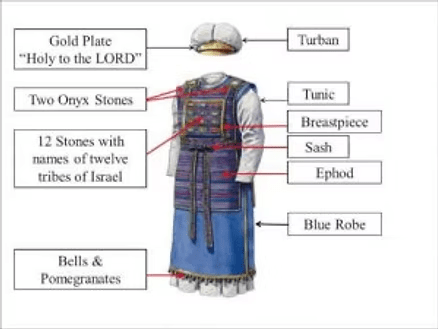
In the parable of the prodigal son, the son proclaimed, “Father, I have sinned against heaven and in your sight; I am no longer worthy to be called your son.” To have “sinned against heaven” means a confession for having allowed the flesh between the earholes (the Big Brain) to guide him selfishly. He had wanted his inheritance in advance, which he then squandered.  He understood that he had done nothing to deserve a return home to Heaven, to be again with the father as his son.

The prodigal son had intended on asking his father if he would take him as a hired hand; but because the father went to meet the son, before he could make that request, the father embraced the son with love. That symbolism is God entering into the heart of the wayward son in a union that was the desire of the wayward son. Once that presence was in the heart, the father ordered his slaves, “Quickly bring out the best robe and put it on him, and put a ring on his hand and sandals on his feet.” (Luke 15:22)

That “best robe” was the wedding gown of marriage. We have read of it in other parables.  The ensuing celebration and feast was the marriage banquet of the sheep to the Father, as an Apostle, as a Saint. It was that holy union that made the return to Heaven possible, as the judgment of the Father was to recognize a sheep that had been led back home by its having the Good Shepherd within.

This is how one should read the last verse, where it says “I will judge between sheep and sheep.” As those who profess to be Christians, we are all sheep on this earth. In order to gain entrance into the Spiritual realm of the Father, we have to determine what kind of sheep we are: Are we the sheep who serve God, through the Holy Spirit and the Mind of Christ, being led by the Good Shepherd? Or, are we the sheep who serve self, who trample underfoot the Word and weaken the spirit of faith in others, being led by Satan?

It is possible to read all Scripture in a vacuum and reach a full understanding of what this reading from Ezekiel means. When we link its meaning to other Scripture, that understanding compounds greatly.

It is the presence of God in one’s heart that seeks understanding – one wants not to be lost. It is the Christ Mind that whispers to seek the same message of one passage to be mirrored in many others. The truth of meaning is how one ceases doubting and finds faith. It takes repentance to seek to be found and worthy of becoming a hired hand for God.

This will become clearer when one reads the accompanying Gospel: Matthew 25:31-46.  That one has the title “Judgement.”

Ephesians 1:15-23 – Praying the spirit of wisdom will come [Christ the King Sunday]

I have heard of your faith in the Lord Jesus and your love toward all the saints, and for this reason I do not cease to give thanks for you as I remember you in my prayers. I pray that the God of our Lord Jesus Christ, the Father of glory, may give you a spirit of wisdom and revelation as you come to know him, so that, with the eyes of your heart enlightened, you may know what is the hope to which he has called you, what are the riches of his glorious inheritance among the saints, and what is the immeasurable greatness of his power for us who believe, according to the working of his great power. God put this power to work in Christ when he raised him from the dead and seated him at his right hand in the heavenly places, far above all rule and authority and power and dominion, and above every name that is named, not only in this age but also in the age to come. And he has put all things under his feet and has made him the head over all things for the church, which is his body, the fullness of him who fills all in all.

——————————————————————————————————–

This is the Epistle selection from the Episcopal Lectionary for Year A, Proper 29, the last Sunday of Pentecost, Christ the King Sunday. It will next be read aloud in church on Sunday, November 26, 2017. This is important because Paul addressed the power of Christ in the world, whose power is spread through Apostles like Paul  and those to whom he wrote in Ephesus.

I apologize for turning selections from Paul’s letters into dissertations of what was written and what the Greek says the meaning is, simply because Paul wrote in a manner that was directed by the Holy Spirit, which intended for his words to be most difficult to grasp. I have explained that I have been led to understand the writings of Nostradamus (relative to his work Les Propheties), which involves close attention to punctuation marks and other ‘guideposts’ of language. However, in the above translation, a long-winded Paul wrote nine verses, with four period marks – seemingly somewhat understandable, if the reader in church takes a breath at those four places of ‘full-stop’ rest.

I have posted the literal translation below, with each break point as indicated by the Greek text found here; and you will find that 180 words of English translation are written (some Greek words indicated multiple English words), all with only one period mark … the one at the end. There is one semi-colon (for emergency air intake), which appears after 144 words have been stated. However, if this selection of Paul is read line by line, in the way I have shown it, it makes 34 statements, such that the commas act as period marks, with the period mark showing where this selection altogether ends.

Because the translation above (New American Standard Bible version) is taking the standard liberties of normal syntax adjustments between Greek and English, they see the long run-on and attempt to make one tremendously long address be more like a very educated fellow, who would need to puff on his pipe four times, just to keep it lit. When this translation reaches a volunteer reader, who may be scared to death in front of an audience, or even a seasoned reader of Scripture, the speed of the reading means the listeners have only seconds to grasp words that hold deep thoughts – from God. Needless to say, Paul flies quickly over the heads of most readers and listeners, so Paul is known to cause heads to ache thinking about what he meant.

To read Paul in the manner that I have made possible below, the purpose is to slow down and listen to what your heart and mind tell you. In the small and manageable segment bits, one is able to see how this becomes Paul speaking conversationally, in the language of God. One has to be involved in the parts prior to this selection, as one set of words is connected to the next. Still, it makes one think and research. This difficulty is so only those who love God can understand – as were the Ephesians, who (like Paul) were given an ability to “speak in foreign tongues.”

The literal translation below should be read and its intent and meaning grasped, one line segment at a time. Nothing is superfluous or unnecessary.

15. Because of this ,
I also ,
having heard of the among you faith in the Lord Jesus ,
and the love the toward all the saints ,
16. not do cease giving thanks for you ,
mention making in the prayers of me ,
17. that the God of the Lord of us ,
Jesus Christ ,
the Father the of glory ,
might give to you spirit of wisdom and revelation ,
in knowledge of him ,
18. being enlightened the eyes of the heart of you ,
in order the to know you ,
what is the hope of the calling of him ,
in the saints ,
19. and what the surpassing greatness of the power of him ,
toward us ,
those believing according to the working of the might of the strength of him ,
20. which he worked in the Christ ,
having raised him out from dead ,
and having set at right hand of him ,
in the heavenly realms ,
21. above every principality ,
and authority ,
and power ,
and dominion ,
and every name being named ,
not only in the age this ,
but also in the coming ;
22. and all things he put under the feet of him ,
and him gave head over all things to the church ,
23. which is the body of him ,
the fullness of the the all things ,
in all filing .

Now, in this literal translation there are multiple points where an awkward “the” shows. Frequently, the Greek-English text will show no translation for these words, although each one is a version of “the” (such as indicating masculine singular or masculine plural, or other versions of “the”). Sometimes, words will be added or added with brackets, often showing “the [One].” This is an indication that an awkward “the” should be read as “the One,” meaning God.

With this presentation done, I will leave the bulk for the reader to ponder. However, I will address a few elements that spoke to me.

First of all is Paul’s use of the word “pistis,” which is properly translated above as “faith.” The context of that use is Paul’s opening statement (for this selection), “I have heard of your faith in the Lord Jesus.” The literal statement is, “having heard of the among you faith in the Lord Jesus,” where the awkward “the” is “tēn,” which is the singular feminine accusative form of “ho.” Because “pistis” is a feminine noun, a feminine article is attached, meaning this can state, “having heard of among you the faith in the Lord Jesus.”

I point this out because the concept many Christians have of “faith” is it means “belief.” As such, “faith in the Lord Jesus,” when said all at once, real fast, in one breath, means to most people: I have heard the story of Jesus’ death, resurrection, and ascension AND I believe that story, as Jesus being the Lord that sits at God’s right hand.” However, the word “faith,” as “pistis,” means more than that.

The word “pistis” brings a translation of “faith, belief, trust, confidence; fidelity, faithfulness,” while being rooted in “peithô,” which means “persuade” or “be persuaded.” According to HELPS Word Studies, Strong’s word number 4102 (“pistis”) infers a meaning that “is always a gift from God, and never something that can be produced by people. In short, 4102/pistis (“faith”) for the believer is “God’s divine persuasion” – and therefore distinct from human belief (confidence), yet involving it. The Lord continuously births faith in the yielded believer so they can know what He prefers, i.e. the persuasion of His will.”

One should read “yielded believer” as one who has sacrificed self will, in order to serve the LORD. The word means one listens to, obeys, yields to and complies with God’s will, more than being talked into belief by the Lord. Therefore, “faith” is “belief” based on personal experience and not simply word of mouth instructions that sound good.

Second, I would like to address Paul’s use of “hagious” and “hagiois,” both of which are properly translated as “saints.” This represents a repeated usage, which makes Paul’s usage be worthy of further inspection.

In the NASB translation above, we find it within the context of “your love toward all the saints” and “inheritance among the saints.” The literal translations I presented show this as “the love the toward all the saints” and “in the saints,” following the segment that states, “what is the hope of the calling of him.”

In the literal translation, one finds another of the awkward “the” uses, where “the love the toward all the saints” shows the word “tēn” again. The word “agapé” (“love”) is a feminine noun, requiring a feminine “the,” but the intent is to denote “the one of love,” which is relative to “Lord Jesus,” stated in the prior segment. When Paul recognized this “love,” he stated it was sent spiritually to “all” who were saints. Thus, Paul (as a saint) was making an assurance that the Ephesians too were saints.

The preposition “eis” is translated as “toward,” but has definitions that can equally be stated as “into, in, unto, to, upon, towards, for, among.” This means the direction of “the love of the Lord Jesus” is not projected outward, but “into, in, unto and among.” Therefore, it is that inner love of the “Lord” that brings “the love into” a “saint,” who becomes reborn as “Jesus.”

This view makes it important to fully grasp what a “saint” means. While looking up that word in English shows synonyms such as “a person who is deemed holy by a Christian church” or “consecrated,” that is itself a failure to grasp the full meaning.

According to HELPS Word Studies, the Greek root word (“hágios”) is properly read as meaning “different (unlike), other (“otherness”), holy; for the believer, 40 (hágios) means “likeness of nature with the Lord” because “different from the world.’” That site continues to state, “The fundamental (core) meaning of 40 (hágios) is “different” – thus a temple in the 1st century was hagios (“holy”) because different from other buildings (Wm. Barclay). In the NT, 40 /hágios (“holy”) has the “technical” meaning “different from the world” because “like the Lord.’”

Following an assumption that Paul fully understood this meaning as “different,” such that Apostles were those “set apart” from normal human beings (be they Jewish or Gentile), Paul was stating the marriage (“the love”) of God with one of deep “faith” means that God is “calling him” (or “calling Jesus”) to be “in the saints.” Therefore, a “saint” has nothing to do with some external reward or bestowing of a title from any institution of men (and/or women), as (just like “faith”) a saint is “never something that can be produced by people.” Only God determines who the saints will be.

This brings about a third element of Paul’s letter that needs clarification. In the NASB translation above, one finds the statement, “may give you a spirit of wisdom and revelation as you come to know him.” (Ephesians 1:17) This makes it appear as if Paul is making a wish (in the form of a prayer) that continued study (“come to know”) “may give you a spirit of wisdom and revelation.” This can sound to some as if Paul was wishing the Ephesians would use the Holy Scrolls in the same way that witches use magic spell books to educate themselves, so they can call upon the spirits and produce “miracles.”

As ludicrous as this may seem, the ruling class of Jerusalem saw Jesus in this exact light; and atheists of science see all miracles as trickery, never as divine presence.

In the literal translations I have presented, this single statement of “coming to know” “God the Father” and “Jesus Christ” (so “faith” and “love of the saints” can manifest) is actually split into two segments: “might give to you spirit of wisdom and revelation,” and “in knowledge of him.” The conditional form of “may give” is harder to see, than is “might give,” where “might” becomes a clearer statement of meeting the conditions that warrant the “giving” of a “gift.”

Those conditions are then to be seen as set by “God the Father,” where one “might” get the “gifts” “of wisdom and revelation,” if one has received within “Jesus Christ.” That then allows the “Christ” Mind to be the source of “wisdom and revelation,” so that all this comes “within,” as the “knowledge of him.” It says one can ONLY “come to know Jesus Christ” by BEING the resurrection of the Son of God in earthly form.

The fourth item I will address is the use of the word “elpis,” which has correctly been translated as “hope.” The NASB translation shows this word appearing in the statement, “you may know what is the hope to which he has called you.” (Ephesians 1:18b) The literal translation that I have provided shows this in the segment stating, “what is the hope of the calling of him.”

An English translation of the word “hope” finds verb usage as: “To wish for a particular event that one considers possible;” and “To desire and consider possible.” As a noun it means, “The longing or desire for something accompanied by the belief in the possibility of its occurrence.” When its meaning is applied to Christian ideology, the definition becomes, “The theological virtue defined as the desire and search for a future good, difficult but not impossible to attain with God’s help.” These definitions have become so ingrained into the intellect of humans that speak English fluently that one reads “hope” in a Scriptural context and immediately thinks, “That is some big wish made by Paul for the Ephesians to live up to.”

That is not what Paul meant when he wrote the word “elpis.” The word is rooted in the Greek word “elpō,” which means, “to anticipate, welcome” – properly, expectation of what is sure (certain); hope.” As such, “elpis” means “expectation, trust, and confidence,” which means that “hope” becomes the conditions by which God calls His Son to use a believer as one of His saints.

Hope is the expectation of devoted service. It is the trust that God has in His Son. It is the confidence that the presence of the Holy Spirit brings to an Apostle. Therefore, the only “hope, desire, longing and wishing” is not IN the saint, but in those who are called to Jesus by one confidently presenting hope in a world of despair.

Finally, I would like to comment about the verse that states, “and above every name that is named” (NASB), which I show literally to say, “and every name being named.” (Ephesians 1:21e). This segment follows a trinity of traits held by Christ, as King (the theme of Christ the King Sunday): authority, power, and dominion. All fall with his realm of “principality,” where Jesus Christ rules as the Prince of Peace. Because this series of kingly attributes leads to Paul writing of the church (“ekklésia”), it is easy to bounce right over this speed bump that says, “every name being named.”

Since God rules in Heaven, Jesus Christ can only be King of the Earth. Because Jesus told Pilate, “My kingdom is not of this world. If it were, my servants would fight to prevent my arrest by the Jewish leaders. But now my kingdom is from another place” (John 18:36) the Earth is the matter of which human beings are made – flesh, sinew, bones and blood, all metaphorically deemed as “clay”.

This means the verses that say, “and him gave head over all things to the church, which is the body of him” (Ephesians 1:22b and Ephesians 1:23a) are directly referring to the physical body of a saint as the church of him, where that body’s brain, in the head, becomes the throne upon which the Mind of Christ rules. Christ is King of the kingdom of saints, where each individual is a church and a collection of saints represents the Church.

When this view is grasped, then one can read “and every name being named” as “pantos onomatos” is stating “each character” or “all reputation” that is “authority, and power, and dominion” of “Christ, raised from dead” (as one born mortal to one eternal in Spirit), that only goes by one name – Jesus Christ. Therefore, the realm of Christ is that which is “onomazomenou,” or “being named” in “each character” identified as saints.

As I see that I have now surpassed the 2,800 word mark (given that about 360 are from stating the Epistle twice), I will conclude with these observations. These observations (I feel) are most important for Christians to understand. Of course, I could go word-by-word in this selection of Paul’s letter to the Christians of Ephesus, and exceed 4,000 words AND still leave many interpretations incomplete. So, I will leave the rest for the reader, as holy homework.

Good studies!

Helpful Hints:

The LOVE of God is Jesus.

One can only LOVE God with all one’s heart, soul, strength and mind by being JESUS reborn in flesh.

The soul of Jesus joined with your soul makes Jesus your NEIGHBOR, who you LOVE as Yahweh.

A CHRIST is a soul Baptized by the Spirit of God (Yahweh), as Christos and mashiach both mean Anointed, where the capitalization (in Greek) means Spiritual Baptism by Yahweh.

When you think “in the name of Jesus Christ,” you must be:

1.) Married to Yahweh, via becoming cleansed of all past sins through Spiritual Baptism [made a Christ];

2.) You become a wife soul of Yahweh (physical flesh makes a soul feminine) , so you take His Name upon you in the sacrifice of your soul to Him in divine union; and,

3.) That Name is then “Jesus” [meaning “YAH Saves”], who (as two souls joined in one body of flesh – Ephraim) becomes one’s soul-flesh LORD, such that his commands over his “kingdom” [your soul-flesh] keep you always a Christ [Spiritually Baptized and without sins].

The meaning of “Christian” only is truth if one is a Christ, reborn as Jesus as one’s Lord, as a physical resurrection of the Son of God again in ministry on the earth, without sin – a SAINT.

1 Samuel 3:1-20 – Hearing the call of ministry

Now the boy Samuel was ministering to the Lord under Eli. The word of the Lord was rare in those days; visions were not widespread.

At that time Eli, whose eyesight had begun to grow dim so that he could not see, was lying down in his room; the lamp of God had not yet gone out, and Samuel was lying down in the temple of the Lord, where the ark of God was. Then the Lord called, “Samuel! Samuel!” and he said, “Here I am!” and ran to Eli, and said, “Here I am, for you called me.” But he said, “I did not call; lie down again.” So he went and lay down. The Lord called again, “Samuel!” Samuel got up and went to Eli, and said, “Here I am, for you called me.” But he said, “I did not call, my son; lie down again.” Now Samuel did not yet know the Lord, and the word of the Lord had not yet been revealed to him. The Lord called Samuel again, a third time. And he got up and went to Eli, and said, “Here I am, for you called me.” Then Eli perceived that the Lord was calling the boy. Therefore Eli said to Samuel, “Go, lie down; and if he calls you, you shall say, ‘Speak, Lord, for your servant is listening.’” So Samuel went and lay down in his place.

Now the Lord came and stood there, calling as before, “Samuel! Samuel!” And Samuel said, “Speak, for your servant is listening.” [Then the Lord said to Samuel, “See, I am about to do something in Israel that will make both ears of anyone who hears of it tingle. On that day I will fulfill against Eli all that I have spoken concerning his house, from beginning to end. For I have told him that I am about to punish his house forever, for the iniquity that he knew, because his sons were blaspheming God, and he did not restrain them. Therefore I swear to the house of Eli that the iniquity of Eli’s house shall not be expiated by sacrifice or offering forever.”

Samuel lay there until morning; then he opened the doors of the house of the Lord. Samuel was afraid to tell the vision to Eli. But Eli called Samuel and said, “Samuel, my son.” He said, “Here I am.” Eli said, “What was it that he told you? Do not hide it from me. May God do so to you and more also, if you hide anything from me of all that he told you.” So Samuel told him everything and hid nothing from him. Then he said, “It is the Lord; let him do what seems good to him.”

As Samuel grew up, the Lord was with him and let none of his words fall to the ground. And all Israel from Dan to Beer-sheba knew that Samuel was a trustworthy prophet of the Lord.

——————————————————————————–

This is one of two Old Testament selections from the Episcopal Lectionary for the Second Sunday after Pentecost, Year B 2018.  The lessons of this Sunday are placed in a Proper Ordinary Time grouping, numbered Proper 4.  If chosen, this will next be read aloud by a reader on Sunday, June 3, 2018.  It is important because it tells how a servant of the LORD heard His call and answered, “Here I am.”  This is how all Saints respond to the call of ministry.

To begin this reading, we hear stated, “Now the boy Samuel was ministering to the Lord under Eli. The word of the Lord was rare in those days; visions were not widespread.”  This is important information that should not be overlooked.

It first of all states that “the boy Samuel was ministering to the Lord.”  Typically, children were not important enough to be named.  Samuel is named because this is a book that bears his name, which says that even as a youth, he “was ministering to the Lord.”

Samuel was a miracle birth, having been granted to his barren mother as the answer to her prayers.  The mother dedicated Samuel to serve God at birth, but kept him until he was weaned.  Then, she turned Samuel over to the high priest Eli.  Therefore, Samuel “was ministering to the LORD under Eli,” meaning Samuel was learning the religion of the Israelites and the One God.

Think of Samuel as an altar boy, in the purest sense.

Second, we are told that “The word of the Lord was rare in those days; visions were not widespread.”  This explains why Eli would not immediately understand why Samuel was coming to him as he slept, saying, “Here I am, for you called me.”  Eli twice told Samuel just to go back to bed, before telling him to reply to any further calls by saying, “Speak, Lord, for your servant is listening.”  That says hearing the voice of God speak was rare then, but a priest like Eli (whose “lamp of God had not yet gone out”) would eventually have it dawn on him that young Samuel was having an auditory hallucination (only he could hear the voice), which was not artificially onset (because of his young age he had not been drinking alcohol).  The third time Samuel came to Eli meant he understood this call to Samuel was of divine origin.

To experience “visions” (divine visual revelations), such as Moses seeing the burning bush that was not destroyed by the fire, was even rarer.  Dreams, such as Jacob’s ladder, when he saw angels going up and down, from heaven and earth, and Joseph’s ability to interpret dreams,  as well as Abraham, Isaac and Moses regularly hearing the voice of God guiding them, that ability had seemed lost.  Where it once was written as normal for the Patriarchs to hear the voice of God, that frequency dropped to only the select few.  Still, for those dedicated to ministry to the Lord, hearing the voice of God, seeing angels of the Lord, and having dreams with voices was not deemed a psychiatric disease or mental disability.  It was a sign of righteousness.

Let that sink in, as Christians who are deeply devoted to a church (the building and organization that maintains it) are just as likely to say, “The word of the Lord was rare in those days; visions were not widespread.”  The only times the news reports someone saying, “The voice of God told me” is after some gruesome murder or other act of violence.  We are just as trained in our brains to deny voices and visions as ever being divine.  Thus, we are models today of that synopsis set up in verse 1, because we find it most rare to hear a voice that is not human created.  That has been the circumstances for the most part since the Israelites were deposited in the Promised Land, continuing to this day.

It is not insignificant that Samuel heard the voice of God calling him three times, before Eli told him how to respond, should a fourth call occur.  Three is a mystical number, which is symbolic of initial completion.  In the Sacred Tarot, the Three of Cups represents celebration and achievement.

This is the accepted proposal of God’s love, as the celebration of engagement.  This is the promise of the Trinity.  Still, the Three of Wands projects the journey ahead still requires a road be traveled, before one reaches the end destination.  The three of Pentacles represents this is just the first recognition of work done, with more refinement required in the future.  Sadly, the Three of Sword represent the end of the old you, where heartbreaks of the past, over time to come, will no longer be the root cause of doubts and worry.  Samuel knowing to respond to God, not another human being, was such an initial accomplishment in his life.

The number four is symbolic of a foundation.  Following the celebration of engagement, the Four of Wands represent a marriage to be celebrated.  The Four of Cups offers the symbolism of answered prayers, where the world’s attractions have lost their gleam.  The Four of Swords represents the call to step back from ordinary activity, where rest and sleep is the loss of self.  Finally, the Four of Pentacles represents a new sense of values that one holds dearly onto, not ever wanting to lose.

The fourth time God called Samuel, Samuel responded to God’s voice. The two were married in Spirit.  Samuel’s soul had been made pure by God.  As His servant, God told Samuel a prophecy of punishment coming to Eli, should he not correct the evils of his sons.  This was a prophecy Eli knew, from his time in service to the Lord.  Another prophet had sternly warned Eli prior.

When we then read how Samuel laid in bed until morning, when “he opened the doors of the house of the Lord,” this states the ministry Samuel had under Eli.  He was an attendant of a building.  He had been given routine duties and responsibilities, which he accomplished without fail.  Young Samuel did as instructed, probably not seeing the symbolic nature of making “the house of the Lord” be open to those who sought the Lord.  Samuel himself the night before had opened the door of his heart to God, becoming a human house of the Lord.

When we read, “Samuel was afraid to tell the vision to Eli,” this is the apprehension one feels when one has to stop acting as an underling to the Man – the establishment with powers of influence – and begin acting as God’s servant.  When we read, “Eli said [to Samuel], “What was it that [the Lord] told you? Do not hide it from me. May God do so to you and more also, if you hide anything from me of all that he told you,” those were the words of a servant of God who knew he was due punishment.

Eli knew his sins and was ready to be punished, because he loved his sons too much to punish them for blaspheming God.  Eli had become blind to the truth.  Still, Eli was old and tired, but he did not want Samuel to suffer his same mistakes as he.  Eli demanded that Samuel tell the truth about what God had told him.  Samuel then spoke the whole truth, and Eli accepted that fate.

This becomes a parallel to how Christians today read the Holy Bible, hear a reader read Scripture aloud, or listen to a sermon that speaks to their hearts.  They hear the truth be told through prophecy.  They know punishment is theirs to come, if they do not listen, hear the voice of God speaking to them, and act appropriately to prevent that end.  Like Eli, Christians whisper to themselves, “I accept my fate, because I simply cannot make myself change.  I’m in too deep.”

This also becomes a statement about the priest’s role who is preaching the sermons about the readings from Scripture.  They have to be like Samuel and speak the truth, even if that truth hurts the ones listening.  A priest should be able to hear the voice of God speaking the truth about Scripture.  It is the responsibility of a priest to maintain the routine of the house of the Lord.  They do that by preaching the truth, even if the truth hurts someone.  Otherwise, it is as Eli said, “What was it that [God] told you? Do not hide it from [the congregation]. May God do so to you and more also, if you hide anything from [the congregation] of all that [God] told you.”

Sadly, the buildings of the Lord today are finding more and more apologists of sins.  They speak to congregations as Eli would speak to his evil sons.  A priest who appeases sinners, for whatever reason, becomes the embodiment of Eli.  He or she who speaks to sinful congregations and does “not restrain them,” then the Lord will likewise “swear to the house of [that church and/or denomination] that the iniquity of [that church’s priest’s] house shall not be expiated by sacrifice or offering forever.”

In other words, it will be just as God’s messenger had told Eli, “Those who honor me I will honor, but those who despise me will be disdained.” (1 Samuel 2:30d)  Any priest who takes a position of piety and uses that for selfish reasons (politically motivated these days) are committing blasphemy.  The call is to not be a wicked priest (like Eli’s sons Hophni and Phinehas), just as the call is not to be a lazy priest to blesses sins because of human blood ties.  The call is to be like Samuel and minister to the Lord under God.

Pope Hophni and Pope Phinehas?

As an Old Testament possible selection in the early stages of Ordinary Time (when we are called to move into ministry, leaving the crib of helplessness), we are to become Samuel.  To be Eli, who was a priest with two evil sons acting as priests, who would be cursed by God for doing nothing to cease the evil-doings of his sons (the dilemma of family blood coming before spiritual blood), we are just as guilty of ignoring the call of our religion.

Too often the challenge to one’s faith comes when one must decide to pick between serving God and serving family.  Too often we choose to offer our souls up to God as sacrifices for protecting the sins of family and friends.  Too often we act priestly, where that pretense does nothing of value, nothing that has one hearing God’s call to serve Him.  Being Eli then reflects how we have to actually accept that God does call his servants, even though we have only read about such things in books.  We have to become Eli before we can become Samuel; but we stand as the evil sons of Eli, if we do nothing, while claiming to be Christian.

At the end of the reading, where we read, “As Samuel grew up, the Lord was with him and let none of his words fall to the ground,” and “all … knew that Samuel was a trustworthy prophet of the Lord,” this is how we should aspire to be.  Do you realize that this Scripture reading is the word of the Lord?  Do you understand that they fall to the ground when you refuse to understand them AND explain that understanding to others?

Samuel was righteous for all Israel, not just himself and his fellows in the school of priests, the house of the Lord before there was a Temple in Jerusalem.  We too are called to serve others, not serve ourselves.  We are expected to respond, “Here I am.”  We are called to serve God, beyond a dedicated service that tells the leaders of the church buildings that honor God, “Here I am.”

The leaders of the churches today are much like Eli, having lost their ability to see and the inner drive to do more than lay down and sleep on duty.  They seek to be near holy objects, rather than become themselves holy objects – the arks of the Lord’s power; the commitment to learn the words of the Covenant, while enabled to maintain those laws.  At some point in time, our commitment as God’s servants to God’s buildings will be rewarded: either as a call for more money and more time donated to a church; or a call to stand before evil and tell it to stand down in the name of the Lord.

If one is listening through one’s heart, one will hear the voice calling.  The rewards of commitment that comes from one’s heart is a call to be God’s wife.  God wants to marry with your soul, baptizing it with the Holy Spirit.  Once that engagement is celebrated, the marriage makes one a reborn Samuel.  The rewards of having answered God’s proposal are great; but one will have to wait until one reaches the end of one’s time on earth to reap those rewards.

Deuteronomy 5:12-15 – When is the Sabbath anyway?

Observe the sabbath day and keep it holy, as the Lord your God commanded you. Six days you shall labor and do all your work. But the seventh day is a sabbath to the Lord your God; you shall not do any work—you, or your son or your daughter, or your male or female slave, or your ox or your donkey, or any of your livestock, or the resident alien in your towns, so that your male and female slave may rest as well as you. Remember that you were a slave in the land of Egypt, and the Lord your God brought you out from there with a mighty hand and an outstretched arm; therefore the Lord your God commanded you to keep the sabbath day.

——————————————————————————–

This is one of two Old Testament selections from the Episcopal Lectionary for the Second Sunday after Pentecost, Year B 2018. The lessons of this Sunday are placed in a Proper Ordinary Time grouping, numbered Proper 4. If chosen, this will next be read aloud by a reader on Sunday, June 3, 2018. It is important because it states the Commandment that the Sabbath day be maintained as a day to honor God exclusively.

Deuteronomy chapter five states what is affectionately called the Ten Commandments. More laws would come, but the ten were written in stone by God. Today’s reading is Commandment number four, which (in short) states, “Observe the sabbath day and keep it holy.”

While not read today, chapter five begins by Moses stating to the Israelites, “Hear, Israel, the decrees and laws I declare in your hearing today. Learn them and be sure to follow them. The Lord our God made a covenant with us at Horeb. It was not with our ancestors that the Lord made this covenant, but with us, with all of us who are alive here today.” (Deuteronomy 5:1-3) What that says is clear: The Ten Commandments and all the following laws are not made as a pact between the whole world and God.

This means the whole world can do as it wants relative to the sabbath day. The sabbath day is just a day, unless one has made a pact with the Lord.  One has to have been removed from the world’s ordinary human beings, “brought you out from there with a mighty hand and an outstretched arm,” leading one to commit wholly to God.  Only then can one grasp how the sabbath day is deemed holy.

If one understands the Hebrew calendar, the word “yom” means day. Every day of the week is then Yom fill in the number. Sunday is “Yom Rishon,” which means “Day First.” Thus, Sunday is the first day of the week.

If one looks at a calendar today, Sunday is listed above the far left-hand column, which is the first day position. That then shows Saturday as the seventh day, above the seventh column.

In Hebrew, the day Americans call Saturday is “Yom Shabbat,” or Day Seventh. Still, God never told the whole world to make a calendar with weeks that are seven days long.  Somehow, everyone just fell in line with this idea.

It is worthwhile to realize that there are seven orbs in our solar system that can be seen by the naked eye, which are luminaries (2) and planets (5). Uranus, Neptune, and Pluto require telescopes and computers to see, so they don’t get special attention.  However, the orbs of light did.

The Romans named each day of the week after those seven visible (mostly at night for the planets) orbs: Sunday for the Sun; Monday for the Moon; Tuesday for Mars; Wednesday for Mercury; Thursday for Jupiter; Friday for Venus; and Saturday for Saturn. All cultures seem to adhere to a seven-day week, but some begin the week with Sunday, some with Saturday, and others with Monday. This makes a “seventh day” become confusing, but the confusion allows Christians to call the first day of the week (Sunday shows in that position on the calendar) the Sabbath (seventh day).

This reading selection is optional because the Gospel selection is about some Pharisees complaining to Jesus about his disciples picking grains from the field to eat on a Shabbat. Jesus then told the Pharisees, “The sabbath was made for humankind, and not humankind for the sabbath.”

That says, in essence, the Sabbath Day is less about when it is marked on a calendar and more about it being marked in one’s heart. Thus, the truest meaning of “the Sabbath” is realized when one of humankind stops being one of a sinful world and begins shining the light of Jesus Christ forevermore. One becomes the Son, who was like the Sun, having said, “I am the light of the world.” (John 9:5)  This transformation makes one become like Sunday, at all times, once one truly agrees to the Covenant with God – which become one’s marriage vows with the Lord (true holy matrimony).

By understanding this Commandment on a level that places oneself in-line with the Creation, where the Israelites were descended from a six-day period of formulation that led them to a commitment to remain righteous (and each day in that Creation was deemed good), the Sabbath is representative of a continual state of being, rather than just one 24-hour period each week.

This is why the Covenant is not between “our ancestors,” “but with all of us who are alive here today.” Just as Moses stood alive before a group of Israelites who were alive, the same words apply to living, breathing Christians today.  By being alive, we stand before God, through the words of Moses, making this Covenant be forever renewed by all current human beings willing to make a commitment to uphold these same Commandments. However, we need to see how permanent righteousness still requires a twenty-four hour period of rest, just as God rested after His Creation.

When we read, “Six days you shall labor and do all your work. But the seventh day is a sabbath to the Lord your God; you shall not do any work,” that simply goes in one ear and out the other.

When God said, through Moses, “The seventh day is a Sabbath to the Lord your God,” that does not mean, “Set aside a couple of hours one day a week to go sit on wooden pews and listen to a sermon.” When God said, “Six days you shall labor and do all your work,” that includes normal chores that are in the “hunter-gatherer” category of maintaining life for a family, but is also demands extended study of holy documents, including prayer and teaching one’s children all they must know. Only by having labors of devotion to God, where work is giving thanks to God, can one find a Sabbath day as a day of rest, when no work is done.

Think of it as being employed as a priest, where six days of work means tending to one’s flock AND preparing for a Sabbath event. Keep in mind the Israelites were separated from the world to be God’s priests, not His pet humans.  The day of rest is then when one stands and opens one’s mouth, letting God do all the work of speaking.

To read, “You shall not do any work—you, or your son or your daughter, or your male or female slave, or your ox or your donkey, or any of your livestock, or the resident alien in your towns, so that your male and female slave may rest as well as you,” this says you must recognize how you do not control how other breathing human beings act. If you have done good work the six days prior, then you have surrounded yourself with others who respect your day of no work, even moving them to personally choose to make the same commitment to God as you have. It is hard labor forcing others to do what they do not want to do, so it always behooves one to work smarter, not harder. You draw more flies with honey, than with vinegar.

When God said, through Moses, “Remember that you were a slave in the land of Egypt, and the Lord your God brought you out from there with a mighty hand and an outstretched arm,” this says, “Remember when you were a human being of the world, a slave to the influences of evil.” That memory is the guilt held within of past sins, based on a calendar that has no recognition of God’s Sabbath day. Egypt stands for all governments that separate their laws from those commanded by God.

In America now, we recognize how one man’s Sabbath is Friday, while another man’s Sabbath is Saturday, and still another man’s Sabbath is Sunday. To make laws that accommodate all men, let no Sabbath be recognized as holy.

I remember back in the days of my youth there were “Blue Laws.” Most businesses were closed on Sunday, for the purpose of promoting Christians being afforded a day of worship and rest. Those businesses that were necessary to keep open were required to pay their employees extra money. Those laws were challenged in the courts by people who did not believe Sunday was their Sabbath day and they won. Say goodbye to government mandating holy days.

The point is not for an outside entity, including governments or employers, to force recognition of holiness on people. That is hard work and always results in more problems being created than any problems solved. This is why Moses said, “Therefore the Lord your God commanded you to keep the sabbath day.”

You are the one who determines when the Sabbath occurs. It all depends on how you feel about doing nothing that demands others recognize your right to rest and worship. It is how you take twenty-four hours happily serving God, just basking in the glory of His presence.  You cannot keep the sabbath day holy, if you have not come to be holy.

As an optional selection for the Second Sunday after Pentecost, when one’s personal ministry should be underway, the message here is to a total commitment to God. The Jews wrote all kinds of amendments to this law, determining how far one could walk outside the city limits, what was deemed work and not deemed work, what acts of cooking were permitted and which were not, and so on. That becomes the focus in the Gospel reading from mark.  However, rules and checklists have no bearing on the Sabbath, as the Sabbath IS Ministry.

The point of this reading from Deuteronomy 5 is to see it as an understanding that once God is in one’s heart, and the Christ Mind is within one’s brain, and the Holy Spirit has baptized one’s soul clean of sins, the Sabbath day is the remainder of one’s life.  You rest because you have done the work necessary to bring God into your being.  The Sabbath day is when your love is God’s love and it radiates as a beacon to others; and it takes no effort to do so.  Ministry to the Lord is not work.

Let that be a lesson to those who leave church after receiving the sacraments of bread and wine, not capable of staying another ten minutes in the same building with others who are partaking of holy food. They are just too busy to stay in church on a Sunday, because they have no clue about keeping the Sabbath day holy. Those people should just stay home in bed or go play golf or shop in the stores that are all open on Sunday.  The world, like Egypt and Las Vegas, is open for business twenty-four seven.

Some cities glorify themselves by saying, “We never sleep.” That says those cities do not recognize the Sabbath.

Being a slave of Egypt means work, work, work, with no days designated as holy. It is like always being stuck in God’s sixth day of Creation, refusing to make a commitment that means no more hustling for personal gains, no more beating one’s head against a pyramid trying to make others do what you want them to do. Ministry to the Lord means letting God do all the work through you. The self-ego takes a long nap.