
This is an explanation of the parables told in Matthew’s Gospel that will be read aloud in Episcopal churches on the Eighth Sunday after Pentecost (Proper 12). This next reading is scheduled for Sunday, July 26, 2020.
Matthew 13:31-33,44-52
Jesus put before the crowds another parable: “The kingdom of heaven is like a mustard seed that someone took and sowed in his field; it is the smallest of all the seeds, but when it has grown it is the greatest of shrubs and becomes a tree, so that the birds of the air come and make nests in its branches.”
He told them another parable: “The kingdom of heaven is like yeast that a woman took and mixed in with three measures of flour until all of it was leavened.”
“The kingdom of heaven is like treasure hidden in a field, which someone found and hid; then in his joy he goes and sells all that he has and buys that field.
“Again, the kingdom of heaven is like a merchant in search of fine pearls; on finding one pearl of great value, he went and sold all that he had and bought it.
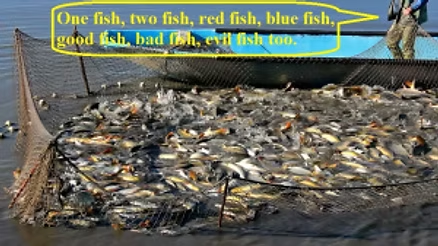
“Again, the kingdom of heaven is like a net that was thrown into the sea and caught fish of every kind; when it was full, they drew it ashore, sat down, and put the good into baskets but threw out the bad. So it will be at the end of the age. The angels will come out and separate the evil from the righteous and throw them into the furnace of fire, where there will be weeping and gnashing of teeth.
“Have you understood all this?” They answered, “Yes.” And he said to them, “Therefore every scribe who has been trained for the kingdom of heaven is like the master of a household who brings out of his treasure what is new and what is old.”
—————
In Exodus 16 Yahweh told Moses, “I will rain down bread from heaven for you. The people are to go out each day and gather enough for that day. In this way I will test them and see whether they will follow my instructions. In the sixth day they are to prepare what they bring in, and that is to be twice as much as they gather on the other days.” (Exodus 16:4-5, NIV)
Manna (Hebrew meaning, “What is it?”) was spiritual food from heaven, which fed the souls of the Israelites. It was not physical food, from which normal life was sustained [they had livestock for that]. Therefore, God placed a limit on how much spiritual food can be properly digested by a soul trapped inside a body of flesh, so the soul’s health is maintained as a good servant of God.
A daily omer of Spiritual food means being given enough to have a new spiritual dawning that keeps one’s faith at the proper level of excitement for God’s knowledge. Taking more spiritual food than one can possibly use in one day is then no different than eating too much at the all-you-can-eat buffet [when those existed prior to the pandemic]. Eating too much physical food makes the excess be stored around one’s fatty regions, so one looks grossly unfit.

Similarly, trying to eat too much spiritual food makes all the excess go into the fatty regions of one’s brain, where the result is a life-shortening case of the Big Brain symptom. Relative to that nasty disease, we are told that pigging out on spiritual food led to one being “full of maggots,” with the Big Brain beginning “to smell.” That is the same thing as we see these days, when a priest stands before a gathering of listeners and begins to speak dead words that stink to high heavens.
The all-you-can-eat warning is necessary because today’s Gospel selection amounts to three days worth of spiritual food [minimally, more than two]. Given that two days worth is allowed before the Sabbath (technically Saturday, but Christians cut the grass and play gold on that day of rest), three days worth breaks the rules [as does two and a half]. That can then be expected to lead to bad sermons.

The reason this is three days worth because the mustard seed and the yeast was one parable that Jesus told to a crowd that had gathered along the shore of the Sea of Galilee. Possibly, Jesus and his disciples were having lunch – what we would call hoagies – and someone asked, “Can you pass the mustard?”

That led Jesus to point out the source of mustard was the smallest seed and the fluffy tastiness of the hoagie roll was the yeast. Thus, he stood and spoke to the crowd below, speaking those parables. The meaning is: From small, seemingly insignificant things (like you and I) are grow huge rewards that benefit others in many ways (the planned ministries of ALL who call themselves Christians).
Then, after lunch, one of the disciples (or more) asked Jesus to explain his previous parable about the weeds, which was metaphor that flew over their heads. That explanation is the time lapse of the missing verses in this week’s reading. Last Sunday, the Seventh Sunday after Pentecost, we read about Jesus telling that parable and then explaining it, skipping over the mustard seed and yeast in flour parables.
Seeing that time did pass by before Jesus then spoke again to the disciples, with the crowd able to hear, Jesus spoke about things of great value – the treasure known to be buried in a field and a great pearl. While those two parables can be seen as counting as one serving of manna (an omer), the parable about catching fish is like that one little extra helping at the buffet, which puts one over the limit. Still, since the three are all led by Jesus saying, “the kingdom of heaven is like,” the three can pass the omer test as simply being a plate of chocolate pudding and jello, with a side of a pineapple slice – for a variety dessert.
When Jesus had finished telling those three parables, he asked his disciples, “Have you understood all this? They said, “Yes,” which means Jesus was not explaining the meaning of a parable to the commoners by the sea. He was only teaching those who would follow in his footsteps, as him reborn. After all, the crowd was just gathered in case Jesus was handing out free food (wafers and wine?) and not as interested in having parables explained.
Because the disciples said, “Yes” to Jesus’ question, everyone in an Episcopal church today should likewise need no explanation. Right?
I forget.
Disciples are few and far between these days, with nobody even close to being Jesus Christ reborn, so only crowds show up for the ‘buffet at the rail.’ Everything needs explaining.
In case you noticed, all of the parables told in Matthew 13 are about what the kingdom of heaven is like. When the disciples asked Jesus why he spoke in parables, which were not always easy to understand, he told them, “To you it has been given to know the secrets of the kingdom of heaven, but to them it has not been given.” (Matthew 13:11) Jesus was teaching the next generation of rabbis, which means they too would be teachers of divine wisdom as Apostles [Saints].
They would then have their own schools of students seeking to gain divine wisdom, which is the parable of the vine and the good fruit. The good fruit is an Apostle-Saint, who produces seeds that are disciples needing to be informed in divine matters. Thus, a priest should be expected to be an Apostle-Saint and a pewple should be expected to be a student whose heart yearns to be fed spiritual food – once a day, just not gathered on Sunday.
In case there is anyone out there that fits that scenario, here is an omer of insight about the treasure in a field, a perfect pearl, and the great catch of fish that will be sorted.
The kingdom of heaven is like a quest that is driven by the heart, not the head. If you have ever watched the History Channel shows The Curse of Oak Island or Lost Gold of World War II, you see people whose heads lust for the reward of physical wealth. The kingdom of heaven does not care about physical treasures or things that have great value in the material realm. Thus, the kingdom of heaven is like a physical treasure or thing of material value, meaning the reality of something greater – as spiritual worth.
Jesus said two men, each seeking different things, sold everything they had to buy into the same goal – what they ultimately sought that was worth selling everything in order to obtain. We are never told that they found what they were looking for, but the implication is they found what they sought. That implication reflects one’s faith, not needing to be told, “Oh, and they both got rich.”
We are only told that the first man sold everything and with “joy” he bought the field said to contain the treasure. That joy is stated in the Greek word “charas,” which also translates as “delight, gladness, a source of joy,” but implies in Scripture: “the awareness (of God’s) grace, favor, joy (“grace recognized”).”
That means the quest is as valuable as the reward. That means a disciple yearns to know more each day (especially on Sunday), as each day comes understanding that keeps the heart burning with desire to search for the ultimate reward, which is spiritual knowledge that cannot be kept to oneself. A burning desire to share what one sees as most valuable – worth giving everything up for – can be understood as the most valuable thing anyone can search for. Sharing that found is more rewarding than keeping something for one’s private use.
The kingdom of heaven is like that. The United States of America is not like that. Oak Island, Nova Scotia, Canada is not like that. Mountain tunnels in the islands of the Philippines is not like that. Nothing about this material world is like that.
Now, if one is a student of the all-you-can-eat Holy Bible, especially loving the food available at the New Testament bar, one might recall Jesus telling the rich, young ruler [Temple elite, a Pharisee of the Sanhedrin], step two in the process of being assured entrance into the kingdom of heaven means: “If you wish to be perfect, go, sell your possessions, and give the money to the poor, and you will have treasure in heaven.” (Matthew 19:21) In the parables of the treasure in a field and a great pearl, the seekers did just that. The metaphor of those objectives is then the same as the question posed to Jesus about the quest for “eternal life.” That says: If you want eternal life in the kingdom of heaven, then you will be driven to obtain that goal. Otherwise, like the rich, young ruler, you go away grieving because you have too many possessions to release from your grasp.
The lesson of those two parables is then: You get out of life what you are willing to put into life.
Since human life is known to always end in death, human things symbolize rewards of death. Since eternal life is not available in a physical body, one must be willing to sacrifice oneself for something unseen – the buried treasure that was hidden from sight. The great pearl was seen but cost everything to acquire. You cannot have something you want without paying the price. Both parables reflect someone having great faith that possession of a right to the kingdom of heaven (assurance) is worth sacrificing a lifetime’s accumulation of material things.
Faith like that reflects the ideal of knowing, “You can’t take it with you.”
The sad thing about this parable is everyone gets that. Everyone knows how giving up all the things one has is too hard, if impossible to do.
The rich young ruler is no different than a lawyer I knew in a church, who gave tremendous amounts of his wealth (far from all) and tremendous amounts of his time (which the wealthy also have in abundance) to that church. I’m sure the rich young ruler likewise gave in support to Jesus’ ministry [can you say “Nicodemus”?]; but, when he walked away grieving about having too much to give it all away, in the same way that wealthy lawyer said about such a proposition, “That doesn’t work out very well.”
Talk all you want about give, give, give, and give some more, but Christians are like turnips -you can’t get blood out of them. All people have bills to pay. Living in the real world is not free.
We are forced by society to turn away from this parable and pretend we don’t understand what it means.
We hear these parables and we hear Jesus ask us, “Have you understood all this?”
We gulp as we say, “Yes.” We know what selling everything means. Then, we gulp again.
We overlook how Jesus then said, “Therefore every teacher of the law who has become a disciple in the kingdom of heaven is like the owner of a house who brings out of his storeroom new treasures as well as old.”
We hear those words words in physical terms so we generate images of teachers (Pharisees, rabbis, priests), of houses (Temples, synagogues, churches), businesses (tables of the vendors, rooms where the scrolls are kept, and the sacristy where the chalices and trays are washed). We miss the true meaning, just like the disciples did not know the truth when they said, “Yes” to Jesus’ question.
Every teacher of the law is meant to be Jesus Christ reborn. Jesus meant that, but the disciples (at that point in time) were clueless. Jesus knew that a teacher of the law would become a disciple in the kingdom of heaven, which means an Apostle-Saint. A disciple, like those who said “Yes” when they were really clueless, is incapable of being a teacher in the kingdom of heaven.
Jesus Christ is the only teacher in the kingdom of heaven. This means the kingdom of heaven is wherever Jesus Christ is teaching; and, that means a human body of flesh and bones is “the owner of a house.” That becomes more than the body being the temple of the soul, as it elevates to meaning the body becomes the Temple unto the Lord, with Jesus Christ the presiding lecturer [High Priest / King] at the altar [a human brain] each day.
It is from that fleshy, convoluted “storehouse” that all divine wisdom is processed and spoken through mouths of teeth, tongues and lips. The law is written on the hearts of the Apostle, but the Christ Mind knows the depth of truth the words of the law mean. The words are then the sermons of old and new revelations [what the words clearly appear to state and the “Aha! I see!” of what the words hide that is intended to state]. Hearing a sermon spoken by Jesus Christ through an Apostle’s lips becomes the epitome of spiritual food, which is then the appropriate daily allotment for the maintenance of the spiritual health of that owner’s house of worship.
This means that “sell everything you own and give to the poor” has nothing to do with material commands. Having a materially rich Peter sell everything to give the proceeds to poor Paul does nothing more than make Peter poor and Paul rich.
“Sell everything” means kill your self-ego. It means cease letting the lusts of a material world keep you from gaining eternal life in the kingdom of heaven. It means stop selling your soul for you to be you. Instead, sacrifice you to become reborn as Jesus Christ.
To do that, you have to fall madly in love with God and marry Him. Marriage to God means you become His wife [regardless of human gender], so you becomes absolutely subservient to whatever your Husband says. The consummation of that marriage means you bear the Son of God, so the birth of baby Jesus within you becomes you in his name. In the name of Jesus Christ, you can then call God your Father, so you become a Son of God too [regardless of human gender]. You then join in the Church of Christ [true Christianity] along with all other Apostles-Saints.
Now, this realization takes us back to the third extra serving about fishing. To remind everyone about what Jesus said, this is it:
“Again, the kingdom of heaven is like a net that was thrown into the sea and caught fish of every kind; when it was full, they drew it ashore, sat down, and put the good into baskets but threw out the bad. So it will be at the end of the age. The angels will come out and separate the evil from the righteous and throw them into the furnace of fire, where there will be weeping and gnashing of teeth.”
The world is the sea. It is a sea of humanity.
Human souls are the fish. Souls come “of every kind” – red, yellow, black, brown, and white; atheists, Hindu, Muslims, Jews, and Christians; and, Methodists, Baptists, Catholics, Pentecostals, and Anglican-Episcopalians.
The net is death, because we all have to be caught in that trap and pulled away from our bodies that are left in the sea.
The shore is the entranceway into the kingdom of heaven – eternal life with God. That is where the sorting of the souls takes place. Notice how there is no mention of ‘pearly gates’ or Saint Peter. Imagine God does the pointing and His angels do the casting.
Into “good baskets” are put the “righteous” souls, with the “bad-evil” souls thrown into the “furnace of fire where there will be weeping and gnashing of teeth.”
All of this should be fairly clear, but it really isn’t. Let me explain this sorting part a little.
This falls under the category of “new treasures” that come from the ole noggin (“storehouse”), when Jesus Christ is doing the talking. It is new because it came to me not long ago, as I wrote about the Parable of the Weeds [Seventh Sunday after Pentecost]. There, Jesus explained the sorting of the weeds and the good grain, where he said: “They will throw [the weeds] into the blazing furnace, where there will be weeping and gnashing of teeth.”
There, the metaphor of a weed is the same as a fish here, with metaphor meaning not a physical weed and not a physical fish. When you realize the common element being sorted is souls, which as purely ethereal, immaterial, and without physical anything, then the weeping and gnashing is something that can only be done with physical eyes and teeth. Add to the realization that a “blazing furnace” would have absolutely no effect on souls [cue the Uncle Remus line cried by Br’er Rabbit – “Pleeease don’t throw me in the blazing furnace.”], there is truth to that end that needs to be realized.

As I stated in the other sermon I wrote, the earth is a big ball of matter (as far as us tiny specks of humanity are concerned), which (according to what the scientists tell us) has a big molten-rock center, which plays a role in the laws of gravity. This has to be seen as the age-old view of hell, which is a hot place within the earth. It was there that the fallen angels were cast – into the depths of the earth. John called it “the fiery lake of burning sulphur,” but some have called it Hades [the name of the Greek god of the underworld, which is synonymous with his realm]. That is then the “furnace of fire” and the “blazing furnace” – the center of the earth.

Of course, this too has to be seen as metaphor rather than literal, so a soul separated and determined to be “bad” and “evil” is then sent back to the earth, where the “furnace of fire” means gravity having hold of a physical entity. The material realm means reincarnation into another body of flesh and bones.
As far as Eastern religions like to believe [and they prefer reincarnation to the blandness of eternal bliss in heaven], Karmic debt plays a role here. When “bad” and “evil” is seen as not having earned enough ‘Brownie points’ to return in a similar position of power, wealth, and influence one enjoyed in a past life, the debt is repaid by coming back in a worse state of life. As far as coming close to righteousness pays some dividend, that would be akin to the young, rich rulers of the world – who lived according to the Law but could not sell everything – might only slip back a little or stay in a similar position. Rather than a terrible fate, that sorting would be more like a Homer Simpson “Doh!” than “weeping and gnashing of teeth.”
That way of reading this statement of truth by Jesus says the truly wicked do not even get to walk the face of the earth. They would actually be put back in dead bodies and be forced to spend eternity in a grave; or they would go to Dante’s Inferno. Those options mean a worse fate than being reincarnated in India or southern Mississippi, both of which do occasionally catch a cool breeze.
Still, as far as the parables here are concerned – a human desiring the great reward of eternal life means the “bad” and “evil” souls must be seen as having fallen short of that drive for perfection. The ones who sell everything for the ability to walk righteously (which can only be done by becoming Jesus Christ resurrected) are the “good” fish, placed in the “good basket.” They are the ‘keepers.’
The Greek word “kala” is translated as “good.” It is a form of “kalos,” which means, “beautiful, as an outward sign of the inward good, honorable character; good, worthy, honorable, noble, and seen to be so.” (Strong’s usage) In the story of Jesus and the Rich Man [the young, rich, ruler, as told in Matthew 19, Mark 10 and Luke 18], the use of “good” was discussed.
Matthew can be read so the Pharisee asked Jesus what “good” he could do to be assured of eternal life, while Mark and Luke heard the man call Jesus “good Teacher.” Jesus jumped all over the man (the same by all three) by asking him what he thinks “good” is. Jesus told him “no one is good,” “only God is good.”
The Greek root word used in those three Gospel accounts is “agathos,” of which Strong’s states: “ intrinsically good, good in nature, good whether it be seen to be so or not, the widest and most colorless of all words with this meaning.” This usage explains how Jesus challenged the man for his conception that “good” could be accomplished alone, without God … without being reborn as God’s Son.
That then says here that “good” fish are indeed those who were reborn Sons of God [regardless of human gender]. ANYTHING short of self-sacrifice in order to marry God and give birth (rebirth) to His Son means one’s soul chose to not be “good,” which then brings about just judgment as souls that are “bad” or “evil.”
The Greek word “sapra” is translated as “bad.” It describes the fish that are not placed in the “good basket.” That word is defined as meaning “rotten, worthless, useless, corrupt, depraved.” It is a word used to describe over-ripe fruit. Over-ripe fruit is “bad fruit,” usually that fallen to the ground and picked clean by birds and rodents. This is then like the bottom-feeder fish that would be rejected by Jewish fishermen.
The Greek word translated as “evil” is rooted in “pontéros,” which means “toilsome, bad, evil, wicked, malicious, slothful.” All of these applications in human lives means a state of selfish desires led to wrong decisions. That is the outcome one can expect from trying to ‘go it alone’ and be righteous without giving up the ole self-ego.
The moral of the parable is then an either-or, all or nothing choice. You either sell everything that keeps you from being good or you keep all the worldly things that rock your boat and end up being deemed bad and evil when your soul leaves this world.
Any priest, pastor, minister, or preacher that gladly takes your tithes and gets paid to wear robes and such for speaking sermons about Scripture, who does not tell you those are the only options stated here, that person is just like you and really does not believe the truth. He or she is just like the crowds Jesus spoke to in parables, meaning he or she is clueless. He or she is just like the rich, young ruler, who has too much self-worth – as a priest, pastor, minister, or preacher – to even think about giving up that exclusive right to claim eternal life – the greatest possession he or she owns.
Just think how much your newborn teeth will gnash when you find out the field of dreams you bought into, sold to you by someone you trusted your soul’s safekeeping to (a discounted rate for assurance of heaven), turned out to be a bill of goods, not the good kind. Washing up on the shore of Heaven without that official paper in your spiritual hands means karmic debt is uninsurable. Realizing that lie then would be enough to bring tears to those new little baby eyes in the next life on earth.
Amen?
 Explaining the Readings