Tag Archives: Pentecost Sunday

Ezekiel 37:1-14 – Prophesying to the soul

The hand of the Lord came upon me, and he brought me out by the spirit of the Lord and set me down in the middle of a valley; it was full of bones. He led me all around them; there were very many lying in the valley, and they were very dry. He said to me, “Mortal, can these bones live?” I answered, “O Lord God, you know.” Then he said to me, “Prophesy to these bones, and say to them: O dry bones, hear the word of the Lord. Thus says the Lord God to these bones: I will cause breath to enter you, and you shall live. I will lay sinews on you, and will cause flesh to come upon you, and cover you with skin, and put breath in you, and you shall live; and you shall know that I am the Lord.”

So I prophesied as I had been commanded; and as I prophesied, suddenly there was a noise, a rattling, and the bones came together, bone to its bone. I looked, and there were sinews on them, and flesh had come upon them, and skin had covered them; but there was no breath in them. Then he said to me, “Prophesy to the breath, prophesy, mortal, and say to the breath: Thus says the Lord God: Come from the four winds, O breath, and breathe upon these slain, that they may live.” I prophesied as he commanded me, and the breath came into them, and they lived, and stood on their feet, a vast multitude.

Then he said to me, “Mortal, these bones are the whole house of Israel. They say, ‘Our bones are dried up, and our hope is lost; we are cut off completely.’ Therefore prophesy, and say to them, Thus says the Lord God: I am going to open your graves, and bring you up from your graves, O my people; and I will bring you back to the land of Israel. And you shall know that I am the Lord, when I open your graves, and bring you up from your graves, O my people. I will put my spirit within you, and you shall live, and I will place you on your own soil; then you shall know that I, the Lord, have spoken and will act,” says the Lord.

——————–

This is the Alternate First Lesson for Pentecost Sunday, Year B, according to the lectionary for the Episcopal Church. This reading will be read aloud if the mandatory reading from Acts 2 is chosen to fill the New Testament position. This will then precede a selection from Psalm 104, which sings, “You hide your face, and they are terrified; you take away their breath, and they die and return to their dust.” That will precede the Acts reading, which states: “All of them were filled with the Holy Spirit and began to speak in other languages, as the Spirit gave them ability.” All will be read before the Gospel selection from John, where Jesus said, “And when he comes, he will prove the world wrong about sin and righteousness and judgment.”

In 2018 I posted a commentary about this reading from Ezekiel. As the reading has not changed, what I wrote then still applies today. Please feel invited to read that posting by searching this site. As with all divine Scripture, there is new insight that comes each time one pondered what is written through prayer and exploration led by divine guidance. Desiring to ponder Scripture comes from the love of God; whereas, love of self makes one easily bored and causes a soul to struggle with paying any attention to the Word of God.

This is a very powerful reading, one that fits well with the Acts reading’s quotations from Joel and David, told by Peter to the crowd of pilgrims. No doubt, that is why this reading has been chosen by the elders who were married to Yahweh and led to devise a system of readings [the lectionary]. However, I want to direct that power now towards the Easter theme that I have been shown, which makes it be a season of preparation for ministry.

Knowing one’s soul has married Yahweh and His Son Jesus now lives within, the Easter “weeks” reflect a time when it is necessary to let the resurrection of Jesus within [the Christ Mind] lead one to find understanding in Scripture, as his willing disciple. Jesus lives, resurrected in new flesh, teacher and student as one.

This is this same state of being that Ezekiel reported, when he wrote: “hā·yə·ṯāh ‘ā·lay yaḏ-Yah·weh way·yō·w·ṣi·’ê·nî ḇə·rū·aḥ Yah·weh.” This is one segment of words that the NRSV has broken in two and added to the following segment. That misleads, as it is not what was written. Each segment must be understood, separate from the following segment[s], before putting them together contextually. The Hebrew written literally translates to say, “became upon me hand-of-Yahweh and brought me out in the spirit of Yahweh.” That needs closer inspection.

The first word is rooted in the Hebrew word “hayah,” which means “to fall out, come to pass, become, be.” The past tense then says Ezekiel “fell out, came to pass, became,” or “existed” [as a statement of “being”]. One must not imagine a scene where Ezekiel was just sitting comfortably in a chair, when up “came” Yahweh. Ezekiel is saying – clearly – that he became the right hand of God. Yahweh did not reach out a physical “hand,” as if a ‘come with me little fella’ invitation was made. Ezekiel knew Yahweh possessed him [from the combination of “yaḏ-Yah·weh” – “hand of Yahweh”], which was a “spiritual” possession [from “ḇə·rū·aḥ” – “in the spirit”], as Ezekiel being married to Yahweh, as His wife.

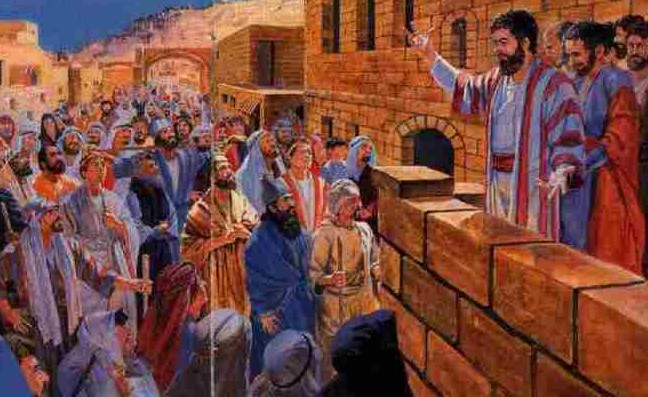
Certainly, Ezekiel had a vision or a dream, just like Joel prophesied, which Peter explained to the Jewish pilgrims. Still, Ezekiel [like Joel, and all prophets filled with Yahweh’s Spirit, as His ‘right-hand men’] wrote his book from a lucid state of being, while at the same time writing his book as the “hand of Yahweh,” so every word was divinely chosen. That means Ezekiel [and Joel, et al] was just like Peter, the other eleven, and the rest of the one hundred twenty that chose Matthias to replace Judas. They all knew Yahweh was their Master, with them his servants [“hands of Yahweh”], with them all knowing they had been Anointed ones [Christs, just as Ezekiel and all the prophets had so been anointed by the Spirit], so they all knew they were reborn versions of Jesus [Christ was not his last name]. Peter was telling all the visitors in Jerusalem, “Just like Joel wrote, so too are we prophesying.”
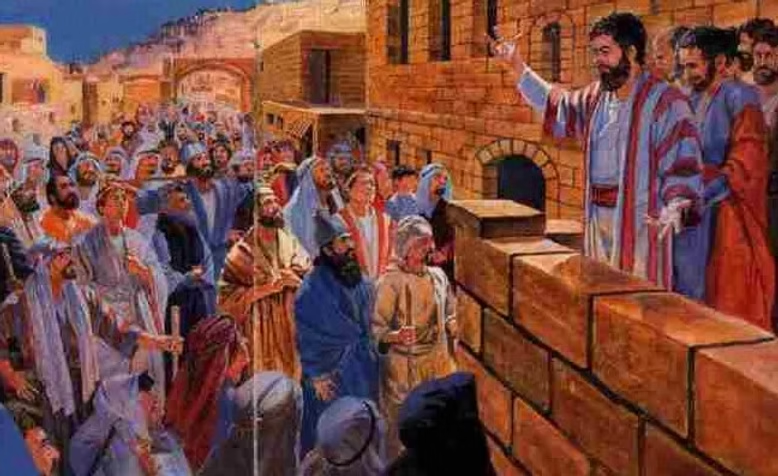
Yahweh led Ezekiel to write [NRSV translation]: “He said to me, “Mortal, can these bones live?” I answered, “O Lord God, you know.” This states the Master-servant / Husband-wife / Teacher-student relationship that was established in Ezekiel, as there was no ‘equality’ present. A big problem allowed to manifest today is anyone and everyone are allowed to question authority, even when unprepared to run one’s own life successfully. When Yahweh asked a question, Ezekiel answered as one committed to being led, not one trying to play smart.

When all the social issues of today are raised, it is Yahweh asking, “Can these bones live?” The same question is valid, because it speaks to the death of eternal souls wasting away in mortal bodies of flesh. Every minute of every hour or every day of every year of every period of history, the ‘socially correct’ call is to sin. “After all, we’re dead already, why not die a little more?” is the ignoramus question that asks everyone to join in the debauchery of a sinful world. Yahweh always asks those who serve Him the rhetorical question, “Can these morons of death save their souls?”

Rather than give the answer of commitment to Yahweh, as his “hand” on earth [as Ezekiel did], most everyone who leads a congregation in Christian churches today feel the need to play god [little-g], and say, “I think God would say …” or “I think Jesus would say …,” when the answer is right before them: “O Lord God, you know.” [“I know nothing but what you tell me to know.”]

If one does not speak what Yahweh says to speak, then Yahweh does not care what dead, dry bones think. Thinking for themselves [as little-g gods] is what turned them into dry bones. The question is [as always], “Can these bones live?”

Yahweh then led Ezekiel to write: “Then he said to me, “Prophesy to these bones, and say to them: O dry bones, hear the word of the Lord. Thus says the Lord God to these bones: I will cause breath to enter you, and you shall live. I will lay sinews on you, and will cause flesh to come upon you, and cover you with skin, and put breath in you.”’

That says, “prophesy” [“hin·nā·ḇê,” from “naba”], which means let Yahweh speak through His “hand.” It does not say, “orate an opinion, because like assholes everybody has one.” To even begin to “prophesy,” one has to “hear the word of Yahweh.” That means not thinking what one presumes God would say, but opening one’s mouth and letting Yahweh speak. As His words come out, one “hears the word of Yahweh” at the same time others listening “hear the word of Yahweh.” If anyone stands before a congregation of Christians and does not prophesy, from having heard the word of Yahweh, then that person is either a hired hand [who cares not for the sheep] or a false shepherd [who wants the sheep sacrificed to his or her will].

What Yahweh told Ezekiel then says “say to them: hear the word of Yahweh“ [the NRSV is too embarrassed to call Yahweh by His name, so they cower and whimper “the Lord”]. Every human body has a “lord,” which is its soul. That soul will lord over a body of flesh until the body of flesh takes control of the brain and makes the soul its servant. That makes the flesh become “lord” over a soul. Satan can be called a “lord” in that case. Therefore, one must know the truth that says, “the word of Yahweh” is “prophecy.”

The “prophecy” Ezekiel preached was this: “you shall live – you shall know that I Yahweh.” While that assumes “I am,” the “I” is the ego of self, which is a soul. When one lives, then one’s soul has earned eternal life … no longer the mortals made of dry bones. At that point, one’s soul is married to Yahweh, becoming His possession. That transforms “I” into “I Am,” which means knowing Yahweh. When Moses was told “I Am Who I Am,” that says, “If you are Me, then I Am you.” This marriage brings the promise of eternal life, which perks up the ears of all dry bones bound to die. By listening to “prophecy” they were given “breath,” which was an eternal “soul” that returned the essence of life to that still bound to die.

We then read that Ezekiel did as Yahweh told him and the bones began to develop bodies of flesh. This is where one needs to realize that dry bones reflect every mortal creature on earth. The bones symbolize that death one is born to experience, through mortality of flesh and bones. To use “prophecy” to those born dead – mortals just waiting until death turns them back into bones and dust – means to give the dead of the world the religion that was born of Moses, given to the descendants of Abraham, Isaac, and Jacob.

This says that every pilgrim who stood within earshot of Peter and the other one hundred nineteen on Pentecost morning were walking and talking dry bones with flesh around them. The “breath” of life had returned, through reincarnation. Same souls returning with new bodies of sinews, flesh, and skin. They were still bound to die; but they, at least, had their souls back [to some degree], so the renewed sous can then lead their bags of bones to comply [somewhat] with Yahweh’s Commandments.

Then Yahweh said to Ezekiel, where he wrote: “Then he said to me, “Prophesy to the breath, prophesy, son of man, and say to the breath: Thus says adonay Yahweh: Come from the four winds, O breath, and breathe upon these slain, that they may live.”’

That says Yahweh told Ezekiel to speak not to bodies of flesh, but to the “breath” [“ruach”] within them. That became the “lord” of Ezekiel’s soul speaking – “Yahweh” [from “adonay Yahweh”] – so the “prophecy” spoken by Ezekiel reverberated spiritually to the souls of dry bones. When Yahweh told Ezekiel to write of the “four winds,” that matches the “sounds” of the “Spirit” that came “from heaven and filled all” who were together in the upper room with Peter. This “wind” times “four” [symbolic of a foundation] becomes receipt of the “Holy Spirit” upon a soul, so it is one with Yahweh – Yahweh is that soul’s “lord” [“adonay Yahweh”].

This is why Yahweh then led Ezekiel to write: “Then he said to me, “Mortal, these bones are the whole house of Israel. They say, ‘Our bones are dried up, and our hope is lost; we are cut off completely.’ Therefore prophesy, and say to them, Thus says the Lord God: I am going to open your graves, and bring you up from your graves, O my people; and I will bring you back to the land of Israel. And you shall know that I am the Lord, when I open your graves, and bring you up from your graves, O my people. I will put my spirit within you, and you shall live, and I will place you on your own soil; then you shall know that I, the Lord, have spoken and will act,” says the Lord.”

That says the resurrection of Yahweh within one’s soul earns a soul the reward of eternal life, beyond the grave. It is the promise made to all who have regained possession of their souls, so their souls no longer serve Satan and lead a body of flesh to ruin. Being religious leaves one needing true “prophecy” spoken to those reincarnated “souls,” not political agendas that are as temporal as yesterday’s newspaper [speaking in the age of the Internet]. It says the only way for anyone religious [the “house of Israel” whose “hope is lost,” being “cut off completely” from both sin and salvation – “damned if you do, damned if you don’t”] to feel the joy of Salvation and the release of bondage to a world of sin is to marry Yahweh and become [like Ezekiel wrote Yahweh called him – “son of man”] Jesus reborn.

The escape from the tomb of death can only come after one has married Yahweh, so the tombstone that keeps one returning as dry bones, life after life [reincarnation], is to make Jesus the rounded stone that can be rolled away after one’s death. That exit allows the soul to return to be one with Yahweh, never again to be dry bones. That was the way Ezekiel knew the presence of Yahweh within him, as he was reborn in the name of Yahweh, earning the name that means “Yah[weh] Saves” [“Jesus”].

Likewise, all the one hundred twenty souls gathered together after the soul of Jesus had escaped the tomb of death. The soul of Jesus came and was “breathed” into them; and, they “received the Spirit.” As such, ALL stood as flesh and bones that were their souls joined with that of Jesus. ALL stood as Jesus resurrected. His wounds were in their flesh. They all knew their state of death had been released by that “lord Yahweh” within their souls.

As a reading selection that is possible to be heard read aloud on the fifth Sunday in Lent [Year A], this lesson might not be read aloud on Pentecost, if the Acts 2 reading is chosen over it. Still, the power held in this reading from Ezekiel fits perfectly into the preparation for ministry that one reborn as Jesus, another Christ of Yahweh, must enter. Ezekiel was married to Yahweh, so when Yahweh called upon His “hand,” His “hand” immediately responded. Ezekiel accepted the Will of Yahweh as his will, which he happily accepted as the wife of Yahweh [a submissive soul earning eternal life]. One cannot enter ministry unless one has become an equal to Ezekiel, an equal to Peter and the other one hundred nineteen. All are equal because their souls have merged with the soul that Saves – Jesus.

The parallel of the Pentecost reading from Acts 2 is Peter and the rest “prophesied to the breath,” which was the souls of the pilgrim Jews. They were the lost house of Israel, just as today the house of Jesus [Christianity] has become just as lost, with no hope, cut off from everything without being damned. Those souls are seeking redemption and are therefore looking for someone – anyone – who can share the truth of Scripture with them. Thus, Ezekiel was told by Yahweh to “prophesy to the word of Yahweh,” in the same way the “Spirit” of Yahweh landed upon His hands [120 of them], so they also “prophesied” [explaining Joel and David]. The seekers heard the truth and were redeemed [almost 3,000]. That is what ministry for Yahweh is all about.

It is important that one see how Jesus walked for three years in ministry, taking the “word of Yahweh” with him wherever he went. It was seekers that came to Jesus. It was always their faith that healed them. It was always their faith that made them whole. It was always their faith that transformed them into true Christians, after they encountered the truth of Jesus. All of those events should be seen as Jesus “prophesying to the word of Yahweh,” as a soul speaking to the soul of a seeker, where audible words were never spoken, like they were spoken by Peter and the others. Jesus spoke to them spiritually – soul to soul – so they were transformed spiritually [a perfect example is the Samaritan woman at the well].

Because the Day of Pentecost is the official graduation day, when the Easter season is left behind and ministry is to begin now and last forever, it is good to know that the practice of forty days with Jesus [him being one with one’s soul] is to spiritually communicate with Yahweh, Jesus, and others. Explaining Scripture can be moving, but as John wrote about the time the disciples spent learning to be Jesus reborn, “Jesus did many other things as well. If every one of them were written down, I suppose that even the whole world would not have room for the books that would be written.” The hope of ministry is to be there and to voice religion; but the truth of ministry is to let Jesus speak spiritually through one’s acts, so the seekers can be filled. Sitting in a church office or sitting in a church pew does little towards making Jesus available for seekers.


Romans 8:22-27 – Have you ever read such things?

We know that the whole creation has been groaning in labor pains until now; and not only the creation, but we ourselves, who have the first fruits of the Spirit, groan inwardly while we wait for adoption, the redemption of our bodies. For in hope we were saved. Now hope that is seen is not hope. For who hopes for what is seen? But if we hope for what we do not see, we wait for it with patience.

Likewise the Spirit helps us in our weakness; for we do not know how to pray as we ought, but that very Spirit intercedes with sighs too deep for words. And God, who searches the heart, knows what is the mind of the Spirit, because the Spirit intercedes for the saints according to the will of God.

——————–

This is the optional New Testament reading for Pentecost Sunday, Year B, according to the lectionary of the Episcopal Church. It will be read aloud if the mandatory Acts 2 reading is chosen over the possibility of Ezekiel 37, as the First Lesson. In that case, the Acts will present this verse: “All of them were filled with the Holy Spirit and began to speak in other languages, as the Spirit gave them ability.” A selection from Psalm 104 will then follow, where David sang, “You give it to them; they gather it; you open your hand, and they are filled with good things.” This reading from Romans will then precede a Gospel of John reading, where Jesus is shown to say, “When the Spirit of truth comes, he will guide you into all the truth; for he will not speak on his own, but will speak whatever he hears.”

In 2018, I wrote and posted about this reading. The same words were interpreted then, so the same interpretation holds true today still. I welcome you to read that commentary by searching this site for the title: Romans 8:22-27 – Groaning in labor pains. Still, every time Scripture is pondered deeply, new revelations rise to be seen. It is from that new view that I will again interpret this reading of Paul’s words.

I will add to the above statement that the interpretation I presented in 2018 went fairly close to what the New Revised Standard Version translation shows [that read aloud]. It is from that acceptance of standard transformation of divine text into somewhat understandable English that I now veer away from. All of the Epistle selections were written by Saints, which means their souls had married Yahweh, becoming His submissive wives, who then gave birth [rebirth or resurrection] to His Son Jesus within their bodies of flesh. As divine persons, they all wrote in the divine language of Yahweh, which can only be understood when Jesus has been reborn within. This is the truth of “speaking in tongues,” which Acts 2:3-4 tells. Therefore, this interpretation takes a fresh look at what was truly written and brings forth the amazing depth that is contained in Paul’s words [spoken to him by God], which are not discernable in the NRSV presentation.

In this selection, verse 22 begins with the capitalized Greek word “Oidamen,” which is rooted in the verb “eidó,” meaning “be aware, behold, consider, perceive” (Strong’s Definition), adding in application “I know, remember, appreciate.” (Strong’s Usage) The form written is the first person plural active indicative, which is “used only in certain past tenses; properly, to see (literally or figuratively); by implication, (in the perfect tense only) to know.” This means the plural number is the reason for capitalization, as the plural simply means many have been elevated divinely to a state of knowledge, which can only be known through accessing the Godhead or the Christ Mind. Without seeing this written through capitalization, one misses the divinity of verse 22 saying, “Knowledge is ours indeed because all this creature laments jointly kai suffering in painful and laborious efforts together until of this just now.”

The NRSV translation makes it seem that “the Creation” is an event that has long “been groaning in labor pains” to give birth to something that Paul says “now” has come. While that is true, to some degree, it misses the mark by translating “ktisis” as “creation.” The same word can mean “creature.” It should be read as that, as man is little more than a “creature,” like a lost sheep.

The context missing is Paul having written that same word three times prior, once each in in verses 19, 20, and 21. In verse 21 Paul wrote, “the creation itself will be set free from its bondage to decay and will obtain the freedom of the glory of the children of God.” [NRSV] This makes it easier to see “the creation” as a “self” [meaning “soul”] that is in “bondage” relative to mortality [“decay”], as a child seeking to be “of God.” This says, “Knowledge coming from God is what all mortals are born without; and, it is the commonality of lament and suffering that drives one to seek Yahweh.”

The NRSV then translates verse 23 as saying, “and not only the creation, but we ourselves, who have the first fruits of the Spirit, groan inwardly while we wait for adoption, the redemption of our bodies.” This is where confusion is added to confusion, leading readers of all the Epistles to be continuously dumbfounded and lost. The implication here in this verse says “the creation,” when that is not written in the text. It is an addition by paraphrase, based on a misguided assumption that a word written prior must now be added, when it is not [I call that ‘playing god’]. In reality this verse is complex and must be broken into segments and carefully contemplated.

The whole of verse 23 has this Greek text: “ou monon de , alla kaiautoi , tēn aparchēn tou Pneumatos echontes , hēmeis kaiautoi en heautois stenazomen , huiothesian apekdechomenoi , tēn apolytrōsin sōmatos hēmōn .” This is six segments of words and each must be understood separately, before one can jump to another. The marks of separation cannot be erased and the words cannot be rearranged or mixed as one sees fit. The separation of segments are God-given, which means they cannot be combined in paraphrase, without weakening the truth, or even destroying it. This means each segment will be discerned separately now.

The first segment literally translates to say, “not alone on top of this.” After ending verse 22 with the change in a “creature” that had been long lamenting and painfully suffering with desire to know how to please Yahweh; that had come … as “now” [from “nyn” not “de”]. This means the change now that differs from the long struggle is one becoming “not alone.” The small Greek word “de” can translate as “now,” but not as an adverb of time. It is a conjunction that says, “on top of, next, after, or indeed now.” (HELPS Word-studies) Therefore, Paul is saying the change in self means companionship of some kind. It is hard to be led to that conclusion by a translation that says, “and not only the creation.” [NRSV]

The second segment is two words divided by the marker word “kai.” The first word, “alla,” has been translated by the NRSV as “but,” when that translation plays no role of fluency [as a conjunction] when placed before another conjunction [“kai,” which the NRSV ignores]. Because the prior segment has alluded to more than one [“not alone”], the more viable translation is “on the other hand” or “otherwise,” as “alla” is the neuter plural of “állos,” meaning “other.” That designation, as “on the other hand” is relative to “not alone on top of this” and leads to the important marker word [“kai“] that says “self” must be seen as importantly different, as “ourselves” have changed. The NRSV weak translation – “but we ourselves” – needs to be tossed.

Seeing this state of “self” [which means “soul”] having changed, so a soul is “no” longer “alone,” the third segment of words literally translate to say, “which the beginning of a sacrifice of this Spirit possessing.” Here, the aspect of “first fruits” has been replaced by the root meaning, which is “sacrifice.”

Following an important statement about “self” [a soul], it is that “which” is no longer “alone.” The word translated as “first fruits” [“aparchēn”] is said to mean, “the beginning of a sacrifice, i.e. the first fruit” (Strong’s Definition), where the usage is said to be: “the first-fruits, the earliest crop of the year, hence also metaphor, for example, of the earliest converts in a district; there is evidence in favor of rendering in some passages merely by: sacrifice, gift.” (Strong’s Usage) When the simple translation of “sacrifice” is used, the segment says, “which sacrifice of this Spirit possessing,” where it is clear to see Paul saying the lack of understanding [“knowing of God”] is “now” relative to a divine possession [“echontes” meaning “having, holding, possessing”]. Again, the confused translation of the NRSV – “who have the first fruits of the Spirit” – makes no sense, other than to sense something about the Apostles somehow being “first fruits.”

To insert a point here now that is relative to faith, as far as Christianity is concerned, there are many places in Biblical text where demonic possession is presented. Jesus was known to routinely cast out demon spirit that had possessed Jews who needed help casting them out. Jesus sent out intern disciples with the power to cast out some demon spirits in his name. Christians will go to the mat defending Jesus, stating belief that demons spirits do exist. Evil deeds are often blamed on demons within [multiple personality disorder is what it is called these days]. Roman Catholic priests [some] are trained in exorcisms, which is some ritual way of casting out a demon spirit. With all of that faith in Scripture, why does all that disappear when it comes time to admit being filled with a Spirit that makes one Holy and Sacred, Set apart by God? Why is that not the same joining of a soul, with a divine Spirit that equally “possesses” a soul? In this regard, I advise those of true faith to read this Wikipedia article called “Eudaimonia.” This is something that pre-existed Christianity and explains what Paul is saying here.

Seeing divine possession as being what Paul said keeps a “self” [“soul”] “not alone,” the fourth segment of words is another that includes the marker word of importance – “kai.” This literally translates to say, “we kai ourselves with itself compressed internally and unexpressed.” The NRSV has reduced what was written [because that program is blind to divine translation] to simply “groan inwardly.”

In this, the pronoun “hēmeis” means “we, us, our,” but all are forms of “being,” as forms of “egó.” The plural has to be seen as applying to each individual “self” [“soul”], while projecting to “selves” as being further in the plural. Thus “we” is for all individually, so one soul becomes “we,” due to possession by the Spirit of Yahweh [holy matrimony]. Because of the marker word “kai” immediately following “we,” this word stands alone and must be seen as marked separately from that coming next.

This understanding is then emphasized [“kia” usage] importantly as “ourselves with [or in] itself.” Here, the Greek word “stenazomen” becomes confusing as it typically translates as “groaning” [flashback to “labor pains,” as the same root word is involved here and there]; but the word comes from “stenós,” meaning “compressed, constricted.” Thus, Paul is saying the expanse of God’s knowledge is a strain on a human brain to comprehend; so, it is best to allow its presence to be compressed within one’s being [“eimi”], without expressing its presence.

The fifth segment of words literally translates as, “sonship eagerly awaiting.” The Greek word “huiothesian” is properly translated as “sonship,” meaning placement within a family of means [royalty]. Because of that, the word is often translated as “adoption as a son,” because females would not be adopted, instead married. It is important to realize this male designation of “sonship” means that Yahweh is masculine, as is all of the Spirit realm [that heavenly]. Everything material [in the physical realm] is feminine in essence. Jesus was then the “Son of man” because of the Spirit within him [a Holy creature]. Had Jesus been born into a female body, that body would still be an “adopted son,” because Spirit is masculine essence.

The Greek word “apekdechomenoi” translates as “eagerly expecting, looking for, or awaiting,” such that it is patience with desire. Following a segment telling of a compression of Spirit within one’s soul, the adoption is that of Jesus to be resurrected. This says there is more to come, after a soul has married Yahweh’s Spirit. The consummation of that union brings about the son adopted.

Finally, the sixth segment of words literally translates as: “who setting free of this body of us.” Here, the Greek word “apolytrōsin” translates as “redemption,” but the word actually means “a release effected by payment of ransom.” (Strong’s Definition) In that, the word properly translates as “redemption,” with the caveat being: “buying back from, re-purchasing (winning back) what was previously forfeited (lost).” (HELPS Word-studies) This then says the “eagerly awaited” resurrection of Jesus within is the sacrifice one must make in order to be redeemed and earn eternal life for a soul – one released from the bondage of reincarnation. A soul [“self”] is no longer married to a physical body [life after life reincarnations] once Jesus has been resurrected within one’s flesh, one with one’s soul.

Hopefully, the breakdown I have just presented for verse 23 can be seen as very specific and thorough. After reading what the Greek actually means, to then read the above NRSV translation that says, “and not only the creation, but we ourselves, who have the first fruits of the Spirit, groan inwardly while we wait for adoption, the redemption of our bodies,” it can then make sense. Still, without that realization of what Paul wrote to the Christians of Rome, one scratches one’s head and asks, “What was the other optional reading in place of Romans 8?”

This reading becomes a sermon in itself, as it perfectly fits [all Epistles do] the theme of Acts 2:1-21, in the sense that “speaking in tongues” is about explaining words written, which even those fluent in Greek could not figure out … completely … as souls alone. Verse 23 is an example that needs to be shouted from the rooftop, explaining what it truly means, so those who are seeking the truth can receive Yahweh’s Spirit and be made Set apart by Yahweh [Holy, Sacred, Saintly].

Verse 24 then literally translates to say: “which indeed confidence we were rescued ; trust on top of this being discerned , not exists expectation ; that indeed perceives why what ,
he believes ?” That compares to the NRSV above, which translates: “For in hope we were saved. Now hope that is seen is not hope. For who hopes for what is seen?”

Here, again, the NRSV has created three sentences, when the presence of two semi-colons shows that is possible; but all thoughts are relative to one central theme. The three sentences do not show breaks in the second and third ‘sentences,’ such that they become two segments each, joining everything together as one. That makes it more difficult to see precisely what Paul intended.

In the three ‘sentences’ created by the NRSV, the word hope is repeated [four times]. The Greek words translated as “hope” [or using “hope”] are “elpidi,” “elpis” (twice), and “elpizei.” There, the last word is rooted in “elpizó.” That word means, “to expect, to hope (for)” (Strong’s Definition), with it usage stated to be “I hope, hope for, expect, trust.” The other three Greek words are rooted in “elpis,” which is defined and used as “expectation, hope, trust, confidence.” (Strong’s) Because “hope” is one of those nebulous words that everyone understands, but nobody can accurately define what it means [religiously], I have used the viability of substitution to insert “confidence, trust, expectation, and believes” [“believes” viable according to Wiktionary] into the translations. All can be summed up as relative to “hopes and expectations,” but my translation leads a human brain to better discern the intent.

These five segments, divided into three lines of thought on the same theme, can now be set up in this manner:

  1. [Jesus reborn within one’s body, bringing the promise of redemption …] That presence is “which indeed confidence we were rescued.” In that, the Greek word “esōthēmen” has been translated as “we were rescued,” but it can also state, “we were saved” “we were healed,” or “we were preserved.” Because the presence of Jesus within is known, the element of “hope” is not such an iffy condition, but one of “confidence.”
  2. [Relative to this introduction of “confidence, hope, expectation, trust” …] “trust on top of this being discerned.” Here, the Greek word “de” is translated as “on top of this,” but it can be “moreover, indeed now, or next” [HELPS Word-studies]. I used “on top of this” because the presence of Jesus’ soul supersedes one’s own “self” [“soul”], because it is “not alone.” Jesus’ soul takes the “top” position, as “Lord” of one’s body of flesh. This “possession” is willingly allowed, because of “trust, confidence, hope, and expectation” that the Christ Mind is that then “being discerned.” In that, the Greek word “blepomenē” is the present participle, as “looking, seeing, perceiving, or discerning.” This says one’s human brain is able to “discern” divinely, in a supernatural way, based on the “trust” coming from divine possession.
  3. This then leads to the second part of this second line of thought, which adds: “not exists expectation.” There, the Greek word “estin” is a word translated as “is,” but “is” is a statement of “being” or “existence.” This says the joint possession of one body of flesh by two souls – one dominant, one submissive – says the submissive soul does “not exist” in an outward way as before. The saved soul sets no “expectations,” so it does not pray or hope to be given what it wants [selfishly]. Thus, the whole of ‘sentence’ two is “trust in the Spirit does not come from personal expectations.”
  4. [Relative to the “trust that has divinely come upon one’s soul and body, such that one’s soul has totally bowed down before Yahweh, allowing His Son to guide one’s acts …] “that indeed perceives why what.” In that, the Greek word “blepei” is a repeating of the prior ‘sentence’s’ “blepomenē,” where “discernment” is now translated as “perception.” All is relative to what the Christ Mind runs through a human brain, so the submissive “self” [“soul”] becomes fully aware (“sees”) everything one’s body of flesh is led to do [acts]. As such, the combination of two words saying the same thing [“tis ti” – with both meaning, “who, which, what, why”] means the “self” understands [“perceives”] the answer to all the questions – the “what” and “why.”
  5. This then leads to the addition that is simply one word in Greek – “elpizei.” This is one of the forms of “hope” used, but it is stated in the “third-person singular present active indicative,” which BibleHub translates as “does he hope for.” This one word then leads to a question mark. The question mark implies the whole of verse 24 is a question, which the NRSV translates only the third ‘sentence’ as: “For who hopes for what is seen?” The question can now be seen as relative to the one word, which demands closer scrutiny into what “elpizei” means. According to Wiktionary, “elpízō” means: “to hope for, to look for, expect.” That site then subdivides those “hopes” and “expectations” as being relative to being “of evils,” “with present infinitive,” and “with dative.” Because the form written is the third person singular present active infinitive, the category “with present infinitive” leads one to see a translation relative to: “to think, deem, suppose, believe.” Therefore, the question, stemming from a Spirit within that “perceives why what” one asks, “what does he believe?” or “why does he believe?” That becomes the question. The question centers on one’s faith, more than the casual way people say they “I believe.”

This is then explained in verse 25, which the NRSV translates as saying, “But if we hope for what we do not see, we wait for it with patience.” The literal Greek translation is this: “forasmuch as next , which not we see we expect , on account of patience we eagerly await.”

From a question that asks about the source of one’s beliefs, verse 25 then begins with the scenario that is relative to what comes “next” [from “de”], or “moreover, indeed now, on top of this.” [HELPS Word-studies] Beliefs are not based on hopes for what will come next, based on beliefs memorized or externally held; but rather from a confidence that knows what will come. One knows personally “why” it will come “what” will be a necessary next step. This is “not” a set expectation by “us, ours or we,” which are the submissive souls stepping aside so the soul of Jesus will make us do what it righteous. Having set no such personal expectations, the only expectations are then based on what and why one believes, which is that it will be what it will be. That knowledge creates a sense of excitement [eagerness] that cannot the future be rushed. One is led to “wait and see,” knowing whatever comes it will be what is best.

The Greek word “hypomonēs” is translated as “patience,” but the word equally means, “a remaining behind, a patient enduring” (Strong’s Definition), and “endurance, steadfastness, patient waiting for.” (Strong’s Usage) The intent by Paul says one’s soul has willingly stepped aside [remaining behind] as a statement of faith, so it eagerly awaits what the soul of Jesus within will bring ‘next.”

Verse 26 is then translated by the NRSV to say, “Likewise the Spirit helps us in our weakness; for we do not know how to pray as we ought, but that very Spirit intercedes with sighs too deep for words.” In reality, the Greek text needs insight to see the capitalization of the first word – “Hōsautōs” – where “Likewise” needs to be read with divine elevation.

The Greek word actually means, “in like manner, likewise, just so.” (Strong’s Usage) A divine elevation means the soul-body divinely possessed now acts “In like manner” to Jesus of Nazareth. This becomes the divinity of faith that being a true Christian is all about. One eagerly awaits what Jesus will do next, because Jesus is acting in one’s body of flesh. This “Likewise” presence is in countless others who have married their souls to Yahweh, so His Son could resurrect within them as well. This divine repetition of being “Just so” is due to [literally] “the Spirit joins to help the weakness of us.” The “weakness of us” is the inability of a soul alone to bring about a righteous state of being, thereby being prone to the failures of sin. The “Spirit” comes from a soul sacrificing itself when it submits to Yahweh in marriage.

The literal words that follow a semi-colon that follows the first segment of words in verse 26 translate as: “that for which we should offer prayers for according as what is proper.” In this segment of words there is no reference to “not,” which the NRSV has pulled forward from the subsequent segment. The weakness of our individual souls is assisted by the presence of the “Spirit” [see Jesus’ references to “the Advocate”], such that one then acts “Likewise” to Jesus and “prays for what is proper” [or “how to pray as we ought”].

The following segment of words is simply translated as “not we know” or “not we are aware of” or “not we remember.” The use of “not” is relative only to what one’s “self” or “soul” knows – which is nothing, as it has become submissive. Jesus prays for us, once his presence is within, because our prayers alone would be useless if dwelled upon by our human brains. Prayers are released once they have been sent and forgotten. When a soul alone prays, it dwells on a need for proof God heard what we want, so much that the prayer is not released; all the while, God knows all needs. Jesus knows how to pray properly.

The segment of words that then follows that admission by Paul that our souls know nothing is where he wrote [literally translated]: “on the other hand self [soul] which Spirit makes petitions.” Here, the use of “auto” [meaning “self; he, she, it; the same”] must be seen as the adjoining “self” [“soul”] that makes one’s own soul be “not alone.” Paul is now explaining that prayers of intercession are only generated by the “Spirit” within one’s “self” [“soul”]. This becomes inaudible and not sensed by physical means. It is how Jesus could do little more than tell people in need of help, “Go. Your faith has made you well.” It was the “Spirit” within Jesus that prayed for others silently.

That is confirmed in the last segment of verse 26, which literally translates to say, “with groanings inexpressible.” Here, the word “stenagmois” relates one back to the “labor pains,” which was the compression inwardly and unexpressed presence of Yahweh’s Spirit – All-Knowing pressed into a brain that knows nothing of value otherwise. Those now are the deep Spiritual feelings for the agonies suffered by others, those of faith. Therefore, miracle healings come without words needing to be uttered. The Greek word “alalētois” translates as “unutterable, that baffles words, unexpressed.” (Strong’s Usage)

Verse 27 is then translated by the NRSV as saying, “And God, who searches the heart, knows what is the mind of the Spirit, because the Spirit intercedes for the saints according to the will of God.” That presents a four-piece segmentation of words. In reality, Paul only broke these words into three segments. The literal translation states: “that on top of this searching those inner souls perceives what this thought of the Spirit , because sent down from God ,
he intercedes for the sake of those set apart by God .

This says first: The Jesus soul on top of a submissive saved soul is always diligently alert for lost souls seeking to be found and their cries are heard by the Spirit of Yahweh. Second, Paul said: The soul of Jesus inside the flesh of a self-body receives orders, where to go and who to help, sent by the Father; and, as the Son, he goes where sent. Third, Paul wrote: The Jesus soul acts for the sake of those who are seeking to be made holy; and, those made holy by the Spirit go to where that Spirit can be passed on.

As a reading possibility on the Day of Pentecost [Christian style], this reading says Christianity is a ministry of those reborn as Jesus, also the Christ reborn. It is a collection of Saints, none of who claim that title. All souls are submissive to the Will of Yahweh, for the purpose of serving Him as His Son resurrected, for the guarantee of eternal life after the body falls away. This reading from Paul’s letter to the Christians of Rome is an example of speaking in tongues, which a true Christian possesses, as Jesus reborn.

John 15:26-27; 16:4b-15 – Advocating the resurrection of Jesus

Jesus said to his disciples, ”When the Advocate comes, whom I will send to you from the Father, the Spirit of truth who comes from the Father, he will testify on my behalf. You also are to testify because you have been with me from the beginning.

“I did not say these things to you from the beginning, because I was with you. But now I am going to him who sent me; yet none of you asks me, ‘Where are you going?’ But because I have said these things to you, sorrow has filled your hearts. Nevertheless I tell you the truth: it is to your advantage that I go away, for if I do not go away, the Advocate will not come to you; but if I go, I will send him to you. And when he comes, he will prove the world wrong about sin and righteousness and judgment: about sin, because they do not believe in me; about righteousness, because I am going to the Father and you will see me no longer; about judgment, because the ruler of this world has been condemned.

“I still have many things to say to you, but you cannot bear them now. When the Spirit of truth comes, he will guide you into all the truth; for he will not speak on his own, but will speak whatever he hears, and he will declare to you the things that are to come. He will glorify me, because he will take what is mine and declare it to you. All that the Father has is mine. For this reason I said that he will take what is mine and declare it to you.

——————–

This is the Gospel selection for Pentecost Sunday, Year B, according to the lectionary for the Episcopal Church. Before this is read aloud by a priest, the First Lesson will either be from the mandatory Acts 2 reading, which says: “Peter, standing with the eleven, raised his voice and addressed them.” That reading will be read either as the First Lesson or the New Testament. Ezekiel 37 will be the First Lesson if Acts replaces Romans 8. The Ezekiel reading states, “So I prophesied as I had been commanded; and as I prophesied, suddenly there was a noise, a rattling, and the bones came together, bone to its bone.” If the Acts 2 reading replaces the Ezekiel reading, then the New Testament selection will be Romans 8, where Paul wrote, “God, who searches the heart, knows what is the mind of the Spirit, because the Spirit intercedes for the saints according to the will of God.” Regardless, a selection from Psalm 104 will be read, which sings, “I will sing to the Lord as long as I live; I will praise my God while I have my being.”

I wrote about this reading in 2018. As the selected verses read aloud are still the same, that 2018 interpretation is still valid today. In it I address the Greek text, so it is a deep commentary that needs careful examination. I welcome those seeking to know Scripture deeper to find that article by searching this site for the title: The spirit of truth brings sainthood.

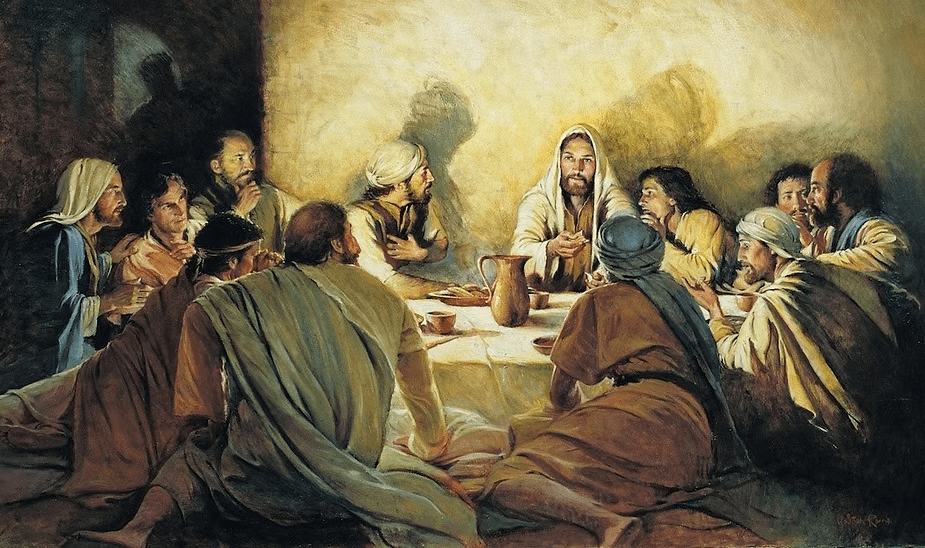
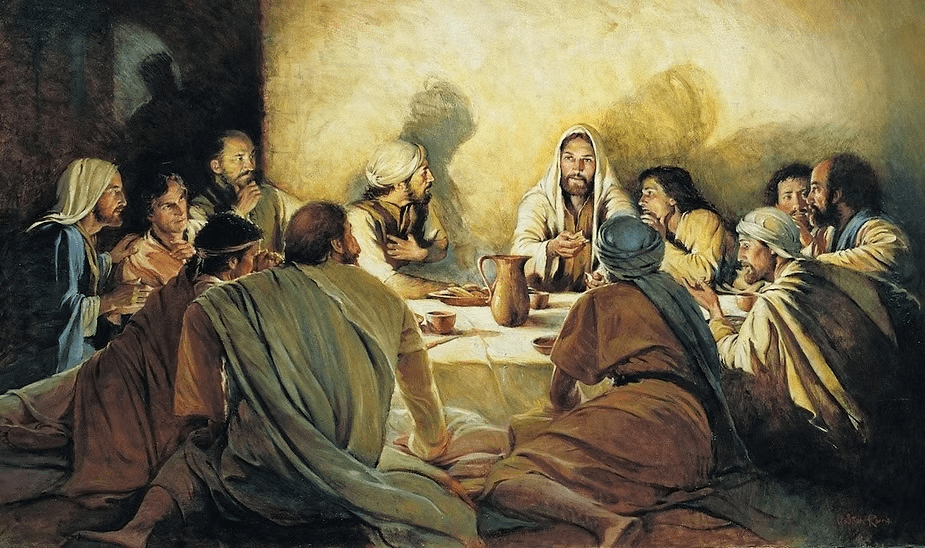
As it is with all divine Scripture, especially a selection as long as this one [19 verses], so much can be found that was not seen before. I will now view this reading from a position that relates to my recent insight that the Easter season is when one should already know that he or she has married its soul to Yahweh, with Jesus’ soul risen within one’s being. That is the lesson of Easter Sunday. Knowing that presence is how one becomes a witness to that resurrection, as laying physical eyesight on Jesus out of the tomb was impossible then and is still impossible today. Easter is Jesus’ soul rising within one’s own flesh, so one knows Jesus personally and can thereby testify to that presence. Because Pentecost is the final Sunday symbolizing receipt of this Spirit and the subsequent preparation for ministry that is required, one must learn to be comfortable as Jesus reborn, I will now view this reading from that specific perspective.

Leading up to the two verses from John 15, Jesus spoke of the hatred saints in his name would face in the world. He explained this hatred would be because of him – they will have become him – so the world will always love to hate Jesus. That hatred will be because the world is the only place where sin can exist; and, Yahweh sent Jesus to lead souls away from that prison, where Satan is the jailer. Satan hates Yahweh and His Son, because Satan is nothing without souls enslaved; and, Yahweh sent Jesus to free the slaves. Therefore, out of hatred, Satan will persecute all who attempt to escape by sacrificing their souls to Yahweh in marriage, so Jesus can be risen in each one. In Satan’s effort to destroy Jesus and Yahweh, those human forms receiving the Spirit and made Holy will likewise be persecuted by the world that Satan lords over.

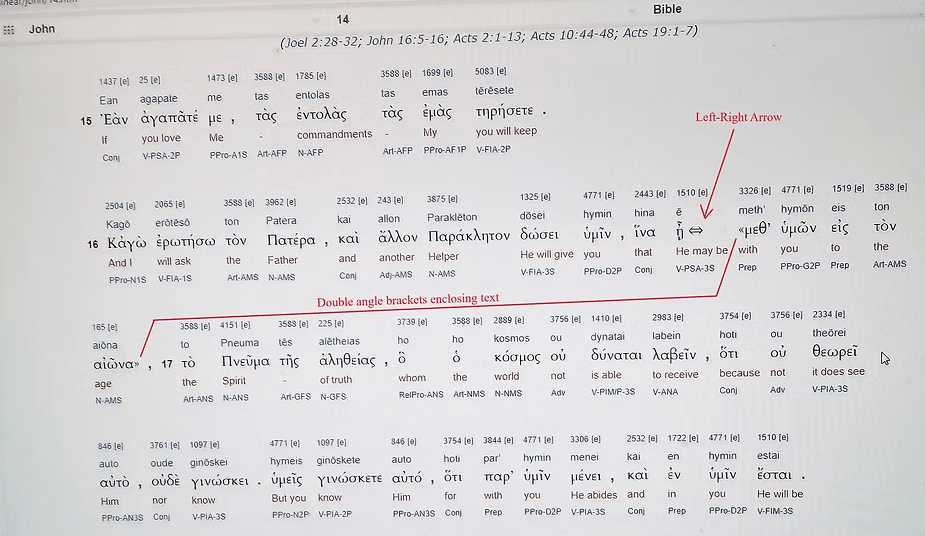
The only time a universal catholic Christian will hear those words of warning is October 28th each year, attending church on the Feast of Saints Simon and Jude. Still, the warning to be prepared to face persecution in the name of Jesus, reborn as the Christ, exists; and, this is why Jesus told his drunken disciples about a “Helper” that will come. The reason a soul needs a “Paraklētos” [“(a) an advocate, intercessor, (b) a consoler, comforter, helper, (c) Paraclete.” – Strong’s Usage] is it is impossible for a soul alone to handle the hatred of the world. A soul alone will bend to the will of Satan [his lures, whispers, suggestions, and punishments] and sin.

Not as good as Jesus; but this model will help more Christians to stand and walk than will fake speaking in tongues.

Where the NRSV translates: “the Spirit of truth who comes from the Father, he will testify on my behalf,” one must realized that Jesus routinely said, “Verily” of “Truthfully I say.” That was because Jesus was possessed by the “Spirit” [“Pneuma”] that brought to him the “truth” [“alétheia”]. Jesus was not the source of this “truth,” as it came from the “Father” [“Patros”]. Those disciples “who come from the Father” will become Apostles [Saints, those Sacred, those Set apart by God]. They will then also speak the “truth,” as “witnesses” [“martyrēsei”] being Jesus reborn. Therefore, Jesus had the same “Helper” that will be forever sent by Yahweh to His wives – the “Spirit” that leads them to always speak the “truth.”

When Jesus then prophesied to his drunken disciples, “You also are to testify because you have been with me from the beginning,” that actually says, “you then bear witness” [“martyreite”], “because you then beginning” anew. At that point in time, “with me you are” [“met’ emou este”]. In that, “este” is a statement of “being” or “existence, when one is “with” [“meta” – “implying “change afterward” (i.e. what results after the activity)] the “existence” or “being” of Jesus. When “existence” is realized to be a soul – the animator of lifeless flesh – the meaning of “with” must be understood as the divine possession of two souls in one body of flesh. Jesus is not external to one’s “being,” as one’s “being” has joined with the “being” of Jesus.

This does not make Jesus the “Advocate.” The “Advocate” is the “Spirit.” When the risen Jesus [his soul] appeared at the place where his family, followers and disciples hid in fear of the world [feeling the world’s hatred of them, for having followed Jesus] that soul spoke in unuttered speech, which John described as: “And with that he breathed on them and said, “Receive Spirit Holy” [“Labete Pneuma Hagion”]. (John 20:22)

There, the capitalization of three words shows the divine elevation to a soul level of hearing, where “Receive” is the marriage of a soul to Yahweh. “Spirit” is the union that is Yahweh in the physical realm, when merged with a soul. Finally, it is the union taking place in the flesh that makes one become “Set apart by God,” as one “Sanctified” by His presence, making one be a “Holy” extension of Yahweh on the material plane; and, that makes one the resurrection as His Son, one Anointed by Yahweh to serve Him.

The transition from John’s fifteenth chapter to his sixteenth can be seen as movement of the group, from one place [the Essene Quarter streets] to another [outside the Essene Gate]. As the group stumbled along drunk [all but Jesus and John], in this next location Jesus again spoke of the hatred, which was stated as the prophecy that those reborn as Jesus would be thrown out of the synagogues. This introductory conversation is omitted in the reading selection today, as the point is to skip forward when the talk of “the Advocate” returns. Still, warnings that being a true Christian are not read [and John 16:1-4a are never scheduled to be read aloud in Episcopal churches], so one can be lulled into thinking sitting in a church pew is all one needs – Salvation without ever having to admit to any of the hatred. Aaah, so nice.

When the NRSV translates, “yet none of you asks me, ‘Where are you going?’ this gives the impression of indifference. What Jesus said is explained in the accompanying reading, found in Paul’s letter to the Romans, where he wrote: “not we know , on the other hand soul which Spirit makes petitions.” [Romans 8:26c] This is Jesus making a statement that the souls of his Apostles-Saints will have submitted all self-will to Yahweh, so they will not be asking questions, of any kind.

Keeping in mind Jesus was speaking to John, as the eleven disciples nearby were drunk on Seder wine and unable to focus on what Jesus was saying, it is easy to hear Jesus telling them about how he told them he would go to Jerusalem and be mistreated, killed, but after three days he would rise. For him to then tell them, “Remember when,” is not the point of his speaking words at this point. Thus, when the NRSV has Jesus telling the disciples, “Nevertheless I tell you the truth: it is to your advantage that I go away,” there is a much deeper meaning to be found in those words, which the Easter season is all about.

The Greek text here states: “all’ egō tēn alētheian legō hymin , sympherei hymin hina egō apelthō .” That literally translates to say, “on the other hand ego that truth tells to you , it is profitable to you in order that ego should go away .

Simply from replacing the “I” of Jesus with a statement about the “I” of the disciples, as the repetition of “egō,” Jesus is saying [to John], the “Spirit” of Yahweh that is the “Helper” sent by Yahweh and only speaks “truth,” when that “speaks to you” and “tells you” that “it is profitable to you that your I should go away,” Jesus just said a soul must sacrifice self in order to receive the Spirit.” Otherwise, “for if your I does not go away, the Advocate will not come to you.” Selfish disciples can be summed up in one word: Judas [as in Iscariot].

When the NRSV translates: “And when he comes, he will prove the world wrong about sin and righteousness and judgment,” that waters down what is truly written. First of all, this verse [16:8] begins with a capitalized “Kai,” which marks it as extremely important to grasp. The word most important is “elthōn,” which is the aorist active participle form of “erchomai,” stating “having come.” This then says verse eight is extremely important to realize the following, once one’s soul has married Yahweh and become one with the “Spirit.”

When that has happened, then “that one will expose that ordered system encompassing failure , kai encompassing righteousness , kai encompassing decisions :” Here, “elenxei” has been translated [NRSV] as “prove wrong,” when the word legitimately translates as “will expose.” The word “kosmon” has been translated [NRSV] as “world,” when the root “kosmos” literally means, “something ordered,” properly, an “ordered system.” (HELPS Word-studies) Thus, “sin” is “failure,” which is “encompassed” in the whole of life, opposite “righteousness” and the “decisions” [“judgment”] that one needs to make, based on one being with or without divine insight.

The failures [or sins] are all based on a lack of faith. This goes beyond a statement of “belief,” where the “Advocate” has remained a promise and not a spiritual reality. That lack means beliefs lead to sins, just as does no beliefs in God. However, when “your I” goes away, after marriage to “the Father,” then sin will be “no more.” This is because one’s soul “experiences” Jesus [“theōreite me”]. All “decisions” at that point are made by the “Spirit,” as Jesus resurrected, so the One who makes all the rules of the ordered system [Yahweh] has made the Son keep one’s flesh failure-free.

When the NRSV translates verse 12 as saying, “I still have many things to say to you, but you cannot bear them now,” this not only was a statement that his disciples were then in an incapacitated condition, but it speaks more of them being souls alone in their bodies of flesh. They had not yet married Yahweh, in the same way that Jesus had not yet gone away, which would literally take place not long after these words were spoken. Jesus knew he would be taken away and punished till death. The “Spirit” was leading the group to Gethsemane for the arrest. His following death had to take place, in order for his soul to be released from his physical body of flesh; so, that soul would be free to resurrect within his disciples. Until all that had taken place, the disciples “could not bear” the responsibility of hearing his words [a physical sensation]; and, they were physically and spiritually incapable of living up to anything Jesus could say verbally, at that time. This lesson says, no one has that capability: not Jew, not Christian, not anyone whose only concept of God is as some unseen, external presence.

When the NRSV translates verse 13 as saying, “When the Spirit of truth comes, he will guide you into all the truth; for he will not speak on his own, but will speak whatever he hears, and he will declare to you the things that are to come,” this again speaks of the “Spirit” and the “truth” that will come from Yahweh.

The “truth” is the guide that always keeps one from failure [sin]. The aspect of “not speaking on his own” comes from the Greek that literally translates to say, “not indeed it will speak for oneself,” where all references to “self” refer to the “soul.” That means Yahweh will not send His “Spirit” for the benefit of “oneself.” No one filled with the “Spirit” that speaks the “truth” of Yahweh will be able to run out and tell the world, “Look at me! I am special. I know what Jesus would say!” The converse means Yahweh sends His “Spirit” to souls that are submissive to His Will and thereby the “Spirit” will listen to Yahweh, as to where the “Spirit” is needed; and, that will be where “oneself” goes, to help others in need.

Verse 14 is translated by the NRSV to state: “He will glorify me, because he will take what is mine and declare it to you.” In that, “the Greek literally translates to say, “that one [the Spirit] me [Jesus] will honor,” meaning Jesus will be represented in the flesh by the presence of Yahweh’s “Spirit.” This then leads to s segment of words that literally say, “because from out of which mine he will receive.” That says the soul of Jesus will be received within the soul of a wife married spiritually to Yahweh. Then, following a marker of importance [“kai”], the one reborn as Jesus “will announce to you,” meaning one will speak the “truth,” just as did Jesus.

Verse 15 then says [NRSV]: “All that the Father has is mine. For this reason I said that he will take what is mine and declare it to you.” In this, the first segment of words literally translate to say, “all how much possesses this Father,” which is a statement that there is no limit to “how much” or “how many” [“hosa”] can be resurrections of Jesus’ soul. “All” will be divinely in “possession” of the “Father,” through holy matrimony. All who are so “possessed” become reborn as Jesus [“mine are,” where “are” is a statement of “being”]. It will then be “because of these” [“dia touto”], Jesus will speak as the Lord of that body of flesh [“eipon” as “I command”], but only in those who Yahweh has sent His “Spirit.”

Because Acts 2 tells of the twelve newly risen Apostles entering into ministry, one must see how Jesus foretold it would be him speaking through those, as they had been selected by the Father for marriage. The soul of Jesus entered one hundred twenty family, followers, and disciples on Easter Sunday. The forty days Jesus spent within each of those who had “Received Spirit” and were made “Set apart by God,” they spent forty days becoming acquainted to their newly submissive selves, becoming comfortable being led by Jesus within.

It is important to see, during this last official day of the Easter season, that everything Jesus prophesied came true on Pentecost Sunday. Still, it is more important to see how the same prophecy extends endlessly, to all times thereafter. Christians today must consider themselves just as drunk as were the disciples, for having lived a life thinking, “I am Christian because I believe Jesus was-is-will be the Christ.” That drunkenness denies Jesus, as did Peter. Without Jesus reborn within one’s soul, fear of the world’s hatred always sends one running to hide. Not being reborn by the “Spirit” means sinning whenever the world wants to persecute Christians [the message covered over by the Episcopal lectionary, like a cat covering poo in a liter box], as John 15 tells of “The Hatred of the World” [BibleHub section heading] or “The World’s Hatred” [NRSV heading].

This prophecy of Jesus says being divinely filled with the “Spirit of truth” – the “Advocate” or “Helper” – means Jesus will be reborn within one’s soul, leading one’s body of flesh to live righteously, avoiding all possibilities of failures the world might present. With Jesus at the helm of one’s being, all decisions will be the approved judgments of Yahweh. Without, there can be no ministry, no Christianity, because belief is denying faith as a witness.

The gross negligence of Christianity today is the childish idea that one can do as one pleases, with Jesus always nearby, alongside God. The error of reasoning is thinking God loves everyone and Jesus loves me most of all. With such flimsy reasoning, no one does anything to marry Yahweh and become Jesus resurrected. Everyone wants to do as one pleases and always feel heaven is just waiting for one’s soul to get there … always forgiven for those countless sins, which regular tithing to a church organization wins some kind words at a funeral or memorial service. Nothing in Scripture says church priests are any different than the failures that constantly befell Israel and Judah, or the synagogues that kicked Jesus out.

The Easter season is the time to lose all that nonsense of thought and start practicing being Jesus in the flesh, without being able to tell anyone that. All work and no play might make Jack a dull boy, but it does wonders for allowing one’s soul the comfort of knowing heaven is well worth working for.

Psalm 104:25-35, 37 – Harpooning the Leviathan

25 O Lord, how manifold are your works! *

in wisdom you have made them all;

the earth is full of your creatures.

26 Yonder is the great and wide sea

with its living things too many to number, *

creatures both small and great.

27 There move the ships,

and there is that Leviathan, *

which you have made for the sport of it.

28 All of them look to you *

to give them their food in due season.

29 You give it to them; they gather it; *

you open your hand, and they are filled with good things.

30 You hide your face, and they are terrified; *

you take away their breath,

and they die and return to their dust.

31 You send forth your Spirit, and they are created; *

and so you renew the face of the earth.

32 May the glory of the Lord endure for ever; *

may the Lord rejoice in all his works.

33 He looks at the earth and it trembles; *

he touches the mountains and they smoke.

34 I will sing to the Lord as long as I live; *

I will praise my God while I have my being.

35 May these words of mine please him; *

I will rejoice in the Lord.

37 Bless the Lord, O my soul. *

Hallelujah!

——————–

This is the Psalm that will be read aloud in unison or sung by a cantor on Pentecost Sunday, Year B, according to the lectionary for the Episcopal Church. This song of praise will follow the First Lesson, which will either be from the mandatory reading from the Acts of the Apostles (chapter 2 this Sunday), which states: “All were amazed and perplexed, saying to one another, “What does this mean?”’ or, the First Lesson will come from Ezekiel’s prophecy that says, “Thus says the Lord God: Come from the four winds, O breath, and breathe upon these slain, that they may live.”’ If the Acts reading is the First Lesson, then the New Testament reading will come from Paul’s letter to the Christians of Rome, where he wrote: “Likewise the Spirit helps us in our weakness; for we do not know how to pray as we ought, but that very Spirit intercedes with sighs too deep for words.” All will precede the Gospel reading from John, where Jesus said: “Now I am going to him who sent me; yet none of you asks me, ‘Where are you going?’”

I wrote about this selection in 2020. It is short and sweet, to the point. Everything I interpreted then still has value today, so I welcome those who are seekers of Yahweh to read that commentary by searching this site for the title: Pentecost Sunday 2020 – Part III (Psalm 104).

The source that I use for the Hebrew and Greek written text is BibleHub Interlinear. It presents the punctuation marks where they actually appear in the divine text, the capitalization [Greek only, Hebrew has no capital letters] and other special marks that are written, but cannot be translated. In the Psalms, there often is a discrepancy in the numbering of the verses, between my source and that designated by the Episcopal Church. This can be seen in Psalm 104, as the verses listed as 25-35, with 37 added, is shown by BibleHub to actually be verses 24-34, with 35b being the addition. Whereas the Episcopal lectionary page cites their translations to be from the NRSV, the NRSV also only has 35 total verses in Psalm 104, matching the numbering of BibleHub. Still, the NRSV lists verse 25 as what BibleHub shows as verse 24. I will now list notes from each verse, according to the BibleHub presentation, with asides to what the NRSV claims.

First of all, I want to point out that this Psalm has twenty-three verses that lead up to this reading presentation. All sing praises to Yahweh, as the God of Israel, specifically named. In all thirty-five verses, “Yahweh” is written nine time, with nine being a mystical number that cannot be ignored or thought to be happenchance. Of those nine times, two appear in verse 1. Another appears in verse 16. The remaining six appear in the verses selected for reading on Pentecost Sunday.

All six have been translated by the NRSV as “Lord.” This is not what is written. When Moses asked, “Who shall I say sent me?” The answer was not, “O just tell them you come from the Lord.” To not call Yahweh by the name that says, “I Am Who I Am,” says “I Ain’t got no Lord” in oneself.

Verse 24 [NRSV 25] sings about how much Yahweh can do. When David sang, “how manifold are your works!” he was not looking out the window, while sipping on a toddy, leaning over from his recliner, watching Yahweh build pyramids, cities, defeat evil, and all kinds of things that make Christians sweat just thinking about them all. The “manifold” of “works” come from those like David, who serve Yahweh as those who ACT in His name.

Seeing that, when David then sang, “in wisdom you have made them all,” this then reflects on the presence of the Christ Mind [the Godhead allowed those Anointed ones of Yahweh]. The intelligence of commoners pales in comparison to the “wisdom Yahweh has made” come to His servants. It is this “wisdom” that causes ACTS that create miracles and does the works of Yahweh on earth.

The last word in verse 24 [25] is “qin·yā·ne·ḵā.” This form is rooted in the Hebrew word “qinyan,” which means “something gotten or acquired, acquisition.” BibleHub translates this word as saying “your possessions.” The NRSV translates it to say “your creatures.” The point of this says “wisdom” from Yahweh has made “creatures” [dumb animals called humans, no matter how smart they think they are] His “possessions,” as He has “acquired” their souls as His wives. In return, those “creatures” have become divinely “possessed” by the Spirit of Yahweh, bringing His “wisdom” upon them.

In verse 25 [NRSV 26], David spoke metaphorically about the expanse of Yahweh being like “a sea.” His words “gā·ḏō·wl ū·rə·ḥaḇ yā·ḏā·yim” have been translated as saying, “great and wide.” In reality, they state “great wide hand,” where “yā·ḏā·yim” is rooted in “yad,” meaning “hand.” This is David comparing his Israel as a “sea” of those who served Yahweh, all as His right “hands.” This is the same “sea” that became Christianity, so the metaphor still applies today.

When David then sang of those “there teeming innumerable” [NRSV = “too many to number”], he then added “ḥay·yō·wṯ” [from “chay”], meaning “alive” or “living.” This element of “alive” means the “hand” of Yahweh is a “sea” of “souls,” all eternally “alive” as redeemed. They include those from all ranks in life: “great and small.” Still, all are “both small” [“qə·ṭan·nō·wṯ”] “with great” [“‘im- gə·ḏō·lō·wṯ”], as souls who had been lost and alone [small], until they submitted themselves to Yahweh, uniting with the greatest possible.

Verse 26 [27] then continues the metaphor, placing “ships” that “sail about.” Here, one must see that a “ship” floats atop the waters of the “sea,” not united with it. Within the “sea” is known to be the “leviathan,” or “a sea monster-dragon.”

The motto of humanity is this: If it breathes, kill it!

This is said by David to be a creation of Yahweh, made “to play there” or “to laugh there” [from “lə·śa·ḥeq- bōw”]. The NRSV says “which you have made for the sport of it.” When one sees the “sea” as those souls saved through marriage with Yahweh, the “sea dragon made” by Yahweh is the Spirit that is Sacred, which knows which “ships” are seeking to marry Yahweh. Still, the “ships” fear the Spirit, because it means sinking all that makes them float above the “sea,” as something special [not “small”]. Therefore, the sport [“laugh”] is the game we love to call religion, where Christians and Jews alike try to play the role of Captain Ahab, all trying to spear the Great White whale, to make the Spirit their prize possession, so they can hold their superiority above all others. They risk losing everything, rather than admitting defeat to a greater power and becoming possessed by it.

When verse 27 [28] then sings [NRSV], “All of them look to you to give them their food in due season,” this says the “ships” are the synagogues of Israel, which correlate today to the churches [many denominations] of Christianity. They enter the “sea” that is the outstretched “hand” of Yahweh, seeking the fish of that “sea,” with expectations to be fed spiritual food. Still, the truth of what David wrote is this: “kul·lām ’ê·le·ḵā yə·śab·bê·rūn,” which literally says, “these all to you inspect.” That says the religious read what Yahweh has fed them [spiritual food in Scripture], at the same time Yahweh waits for that feeding to lead one to say, “Yes” to Yahweh’s marriage proposal [the Covenant]. When the “time” is right [“in due season”] the “leviathan” will rise out of the “sea” and the Spirit of Yahweh will consume their souls.

Verse 28 [29] then sings [NRSV], “You give it to them; they gather it; you open your hand, and they are filled with good things.” This says the religious will find what is needed to bring about a personal love of Yahweh. It is up to them to prove their worthiness to become a bridesmaid [not a human gender word]. Here, “your hand” [from “yā·ḏə·ḵā”] is a reflection back on the “hands” [from “yā·ḏā·yim”] in verse 25 [26]. This is the “sea” of souls that are in Yahweh’s “hands,” such that here it means Yahweh’s “hand” is “open” [from “tip̄·taḥ”] to welcome another soul to His “sea.” To enter that realm of Salvation, those souls “will be filled with good” [from “yiś·bə·‘ūn ṭō·wḇ”].

Verse 29 [30] then sings [NRSV], “You hide your face, and they are terrified; you take away their breath, and they die and return to their dust.” This begins with the statement, “you conceal your face,” which implies Yahweh turns away from seekers, which would only be those who reject Him as their Husband. In reality, a marriage of a soul to Yahweh means that human body [male or female] then secretly wears the face of Yahweh, as the meaning of the First Commandment. There, wearing the “face” of Yahweh is the only “face” allowed, where “pā·ne·ḵā” is written as “paneh.” [“Thou shall have the face of no other gods before my face.”]

This then leads one to see death as the result, which is the greatest fear to which all human beings hold dearly. That fear is said by David to be “they are terrified” [from “yib·bā·hê·lūn”], but the only fear one is allowed is that of Yahweh. Therefore, that explains this “fear,” which is brought on by putting on the “face” of their Master. When that leads to David singing, “you take away their breath,” that “breath” [from “rū·ḥām”] is their “soul of life.” The only reason Yahweh would take away His “breath of life” [“ruach” or “spirit-soul”] is through marriage. Yahweh then takes possession of a soul upon marriage to Him.

The aspect of death, from “they die and return to their dust,” this relates to the sacrifice of self in marriage to Yahweh, so the “soul” is released from a prison that keeps a soul on the physical plane. Death does not come instantly, but when it comes the body of flesh remains in the material realm, while the “soul” has been taken away to remain forever with Yahweh.

Verse 30 [31] then begins by singing, “You send forth your Spirit, and they are created.” This is not some opposite way that Yahweh behaves, but a continuation of the freedom given to the soul of a wife to Yahweh. After taking away a “breath of life” [a “soul”], Yahweh then “sends forth” that “soul” combined with the “spirit” [both from “rū·ḥă·ḵā”]. This in not a new “creation,” as all souls are as eternal as Yahweh, with no beginning and no end. What is “created” [from “yib·bā·rê·’ūn”], however, is a Saint, Apostle, or one newly Anointed by Yahweh as His Son on earth [regardless of human gender].

This is confirmed in the words that have been translated to say, “so you renew the face of the earth.” In reality, the Hebrew text says, “and you renew” [from “ū·ṯə·ḥad·dêš”], where the root word “chadash” also means “repair.” To “renew” or “repair” a lost soul, that soul becomes “reborn” as a likeness of Yahweh’s Spirit. That likeness is then “the face” [“pə·nê”] of Yahweh that is hidden beneath the skin and bones of the “face” of a new wife. It is in this way that mortal human beings are continuously replenished with divine extensions of Yahweh, which enter into the flesh “of the earth” – the material realm.

Verse 31 [32] then confirms that intent, by repeating the name “Yahweh” twice. The NRSV translation suffices by saying, “May the glory of [Yahweh] endure forever; may [Yahweh] rejoice in all his works.” In this, “endurance” [assumed from “yə·hî … lə·‘ō·lām”] is relative to a human characteristic, which is the “patience” Paul wrote of in his letter to the Romans. (Romans 8:25) This means the wives of Yahweh will set aside their personal ego-driven desires, in order to do the many “works” [“bə·ma·‘ă·śāw”] that are His through His wives on earth.

Verse 32 [33] then returns to David’s use of metaphor, which sings out [NRSV], “He looks at the earth and it trembles; he touches the mountains and they smoke.” To presume that Yahweh has eyes like human beings, so “he looks” [from “ham·mab·bîṭ”] “at the earth,” is as if something might be missed if he stopped looking. That is a human perspective and therefore flawed reasoning.

David meant that Yahweh sees all; but His extended eyes on earth see all the evil that is there. This becomes reminiscent of Jesus coming upon the man who had many demons within, called Legion. The simple presence of Jesus had that demon cream out, “What do you want of me!?” Thus, the presence of Yahweh’s wives in ministry makes evil in the world “tremble” [“wat·tir·‘āḏ”].

The aspect of “touching” can be seen as a laying on of “hands,” but the “touch” [“yig·ga‘,” from “naga”] of Yahweh is His Spirit, not physical hands. Thus, Jesus could heal without having had any physical contact with those in need. This presence is felt by those who think they are most high – the “mountains” or “hills” [“be·hā·rîm”] – when they are nothing more than “small” [from verse 25 [26]]. Feeling how powerless those most high are, next to one possessing Yahweh within, they “smoke” with “anger” [“wə·ye·‘ĕ·šā·nū”], causing them to strike out against the flesh containing God Almighty. Still, the metaphor of a “mountain mist” says no matter how high in the material realm one reaches, it cannot escape the all-surrounding vapors of Yahweh [His “sea”], none of which can be grasped, controlled, or forced away.

Verse 33 [34] then sings praises, such that David promised [NRSV]: “I will sing to the Lord as long as I live; I will praise my God while I have my being.” While David certainly did live up to his love of Yahweh, the repeated used of “I” must be seen as a confession sung by everyone whoever sings this song of praise. This says “I” (the first person singular) is forever those souls who are married to Yahweh and set free from the cycle of reincarnation.

Verse 34 [35] is then David wanting to please his Yahweh, where the Hebrew written first says, “ye·‘ĕ·raḇ,” which acts as a prayer that seeks to please Yahweh, as conditions set for “sweetness.” Following, David wrote, “‘ā·lāw śî·ḥî,” which says, “to him my complaints,” as well as “to him my musings.” This speaks of prayer that tells all to Yahweh, whether or not words are expressed.

This is followed by the word “’ā·nō·ḵî,” which stands as a one-word statement about “I.” It says the ego of self has become one with the Spirit of Yahweh, so prayer is as easy as an inkling of thought. That single thought then leads to David writing, “’eś·maḥ Yah-weh,” which says his soul “will be glad in Yahweh.” That “rejoices” His presence, which caused David to sing songs of praise to his God.

Verse 35b [numbered as 37 by the NRSV] then says [NRSV], “Bless the Lord, O my soul.” In reality, verse 35a has sang about the destruction of the sinful and wicked of the world, so 35b becomes a new sentence that sings, “be nothing knelt [before] my soul.” That must be seen as a promise made by David that sings of commitment, such that the soul of David will never profess to be anything, without Yahweh. There will be no lures of the world worthy of kneeling before in worship. No sacrifices of the soul will be made to Satan. Only to Yahweh will David’s soul be given, which led him to “praise Yah” [from “hal·lū- yāh”] which is the translation of “Hallelujah.”

As a song of praise lifted up to Yahweh on Pentecost Sunday, the element of graduation into ministry after forty days of maturing as Jesus reborn, that theme is sung loudly by these lyrics of David. Everything is based on one’s soul being married to Yahweh. Well before the birth of Jesus of Nazareth [born in Bethlehem], David was singing about the Spirit of Yahweh merging with one’s soul. This is the “Advocate” Jesus prophesied to come to his disciples. The element of patience and endurance matches what Paul wrote.

The distraction of this psalm is the leviathan, which is seen as a sea monster, mistaken as an evil creature. This is the fear that possesses all those calling themselves religious, as the vast majority are too afraid to sacrifice a job that pays all the bills, for service as a wife of Yahweh. A servant to Yahweh must put in the “works” that reflects the “hands” of God.
All that “work” is too much, when added to 40-70 hour weeks at the old slat mine. Everyone sees Yahweh as a monster beneath the water that is waiting to pounce on one whose guard has been lowered. All who hear and sing along with these words do little to ponder the meaning these words contain.

In the last day of the Easter season, when a soul should have been practicing to be comfortable with Jesus reborn within one’s flesh, few will make the grade on this graduation day. Few will be praising Yah from their hearts [a soul’s center]. The sad truth is most people have given up on Jesus coming, just like the Jews long ago gave up on their promised Messiah and actually expecting Elijah to come back. Everyone is just going through motions, floating on the “sea” that is Yahweh’s outstretched “hand.” Few are willing to become the “hand” of Yahweh on earth, leaving all the “many works” required for a soul to be saved up to someone else.

Acts 2:1-21- In the last days it will be, God declares

When the day of Pentecost had come, the disciples were all together in one place. And suddenly from heaven there came a sound like the rush of a violent wind, and it filled the entire house where they were sitting. Divided tongues, as of fire, appeared among them, and a tongue rested on each of them. All of them were filled with the Holy Spirit and began to speak in other languages, as the Spirit gave them ability.

Now there were devout Jews from every nation under heaven living in Jerusalem. And at this sound the crowd gathered and was bewildered, because each one heard them speaking in the native language of each. Amazed and astonished, they asked, “Are not all these who are speaking Galileans? And how is it that we hear, each of us, in our own native language? Parthians, Medes, Elamites, and residents of Mesopotamia, Judea and Cappadocia, Pontus and Asia, Phrygia and Pamphylia, Egypt and the parts of Libya belonging to Cyrene, and visitors from Rome, both Jews and proselytes, Cretans and Arabs– in our own languages we hear them speaking about God’s deeds of power.” All were amazed and perplexed, saying to one another, “What does this mean?” But others sneered and said, “They are filled with new wine.”

But Peter, standing with the eleven, raised his voice and addressed them, “Men of Judea and all who live in Jerusalem, let this be known to you, and listen to what I say. Indeed, these are not drunk, as you suppose, for it is only nine o’clock in the morning. No, this is what was spoken through the prophet Joel:

`In the last days it will be, God declares,

that I will pour out my Spirit upon all flesh,

and your sons and your daughters shall prophesy,

and your young men shall see visions,

and your old men shall dream dreams.

Even upon my slaves, both men and women,

in those days I will pour out my Spirit;

and they shall prophesy.

And I will show portents in the heaven above

and signs on the earth below,

blood, and fire, and smoky mist.

The sun shall be turned to darkness

and the moon to blood,

before the coming Yahweh great and glorious day.

Then everyone who calls on the name Yahweh shall be saved.’ “

——————–

This is the mandatory reading from the Acts of the Apostles that will be read on Pentecost Sunday, Year C (and every Year), according to the lectionary for the Episcopal Church. It will be read aloud as either as a First Lesson or as a New Testament selection. If as the First Lesson, it will precede a singing of verses from Psalm 104, where David wrote: “There move the ships, and there is that Leviathan, which you have made for the sport of it.” If as the New Testament selection, its place will be filled by a reading from Genesis 11, which tells of the Tower of Babel. There is written: “Yahweh said, “Look, they are one people, and they have all one language; and this is only the beginning of what they will do; nothing that they propose to do will now be impossible for them. Come, let us go down, and confuse their language there, so that they will not understand one another’s speech.” In that scenario, if the Acts reading comes as the First Lesson, then the New Testament selection will be from Paul’s letter to the Christians of Rome, where he wrote: “All who are led by the Spirit of God are children of God.” Everything will accompany the Gospel selection from John, where he wrote, “Jesus said to [Philip], “Have I been with you all this time, Philip, and you still do not know me? Whoever has seen me has seen the Father. How can you say, `Show us the Father’? Do you not believe that I am in the Father and the Father is in me?

I have written about this standard Pentecost Sunday reading on several occasions. Here are links to commentaries I have published prior, which can be searched under these titles: A refresher about what Pentecost means (2021); Pentecost Sunday 2020 – Part I (Episcopal Lectionary & Acts 2:1-21); and, The Feast of Fifty Days (2018). There is not much I can add to the same verses; but, as this is the first time I have written about this during Year C, I will make references to this reading that align with the Year C reading selections [Genesis 11:1-9; Romans 8:14-17, and, John 14:8-17,(25-27)].

First, when we read the NRSV translation that says, “suddenly from heaven there came a sound,” the Greek needs closer inspection. Luke wrote, “aphnō ek tou ouranou ēchos,” which literally translates to mean, “suddenly from within out of this spirit roaring.” This says that nothing flew in the window and nothing came mysteriously through the wall, as if “heaven” is some mystical place that is somewhere not within. This becomes a statement that the soul of Jesus had entered his disciples and remained with their souls – within their beings – for forty days prior. Now, after his appearance of a physical body ascended – meaning Jesus would never again look physically like Jesus the man in a body of flesh [sorry Hollywood Jewish movie moguls] – the soul of Jesus (the seed implanted within the souls of his good fruit) came suddenly roaring out. That has to be seen and understood.

The Greek word that follows this “roaring” (“ēchos”) is “hósper,” which means “just as, even as.” The NRSV translates that as “like.” This key word says “not a violent wind,” but metaphorically “just as” that. Not too long ago, I heard a Baptist preacher bend over and look at his audience and say Jesus cried tears of blood in Gethsemane [only told in Luke’s Gospel]. He failed to understand the metaphor stated in that verse, which says “hōsei thromboi haimatos,” or “just as clots of blood” or “even as large drops of blood.” Jesus was not bleeding out from his eyes. He was sweating profusely, and the large drops of sweat were symbolic of a sacrificial lamb before the slaughter. Such errors of intellect lead the weak-minded to follow the lead of imbecilic preachers, all happily prancing together towards the great pit of ruin. Thus, Acts 2:2 speaks metaphorically of “violent wind,” not literally.

Following this revelation, when we read the NRSV translate: “it filled the entire house where they were sitting,” that makes it seem like a room in a house was filled with the ‘Holy Spirit.’ Rooms and houses are inanimate objects, all made of dead matter, possessing no soul. The Greek written says, “kai eplērōsen holon ton oikon hou ēsan kathēmenoi”. That literally translates to say, “importantly he made complete the whole this dwelling in what place they existed enthroned”. In that, two third-person verbs are found, one singular (“he”) and one plural (“they”). This references the soul of Jesus being in “the whole this dwelling,” as that soul dwelt within everyone in that room. This is important to grasp (from the use of “kai” leading this statement). The disciples were not “sitting.” The soul of Jesus and the throne of Yahweh was “enthroned” (viable translation of “kathēmenoi”) within everyone’s soul (men and women followers of Jesus). The Greek word “eplērōsen” is the third-person singular (“he”) attached to “pléroó,” meaning “to make full, to complete,” properly meaning “fill to individual capacity.” This is like how the soul of Jesus (an angel or elohim) told John’s soul about the symbol of omega (“Ὦ”), where the open allowing in sin needs to be “complete,” as the “closure” of Jesus, making the “Great O” be a “complete” circle (“Ō”).

In verse three, the Greek word “ōphthēsan” is translated by the NRSV as “appeared,” which is correct. Still, the truth of the word “horaó” says, “to see, perceive, attend to,” implying “I see, look upon, experience, perceive, discern, beware.” HELPS Word-studies says the metaphorical meaning of this word is: “to see with the mind” (i.e. spiritually see), i.e. perceive (with inward spiritual perception).” This must be understood, as there were no visible tongues of any physical type flying into the mouths of the disciples. The word should be read as the disciple each “perceived” within their bodies of flesh a “tongue” that was “divided” from their natural tongue (learned language), coming not from their brains (not subliminally taught and forgot), but from the “spirit of Yahweh within their souls.”

Now, the “dividing tongues” (from “diamerizomenai glōssai”) become a reference to the reading from Genesis 11, where the story tells of Yahweh seeing mankind building a tower and everyone being one, with the same language. When Yahweh saw this would lead mankind away from seeking a Spiritual return to Yahweh, seeing human greatness as a more pleasing god to worship, Yahweh ordered His elohim (angels) to “divine their tongues,” to confuse their brains. Now, in Acts, the “Spirit” within, which was not the soul, but the “Spirit” that elevated a soul in a body of flesh to “Sacredness,” as one “Set Apart by God” [made “Holy”], the “dividing tongues” was the ability to understand everyone in a telepathic way, where physical words were not necessary. In fact, physical words only make it harder to understand what someone is attempting to say. The “Spirit” within gave all within the upper room an ability to think as Jesus, so others of different languages could hear Jesus speaking in their “tongues.”

This multiplicity is seen in the long list of languages spoken by the pilgrim in Jerusalem for the Passover-Shavuot festivals. That multiplicity says everyone there heard “magnificence of this of God” communicated to them, which was mot likely whatever Scriptural questions each had within, which no one had ever fully addressed, to further enhance his or her faith in Yahweh. Before we read specific words spoken by Peter, coming from the prophet Joel, everyone’s attention was drawn by many different enlightening words heard by their souls (seeming as if only one voice was being shouted from an upstairs room), when thousands each heard a voice speaking his or her specific language, fluently, revealing the truth of Scripture. That amazing happening froze the faithful in their places, drawing all focus and attention of some rubes, obviously from the rural setting of Galilee.

In the Greek translations of Peter quoting John 2:28-32, it should be realized that Peter was a rube Galilean, so it was not him speaking Scripture in every different language mentioned prior. Peter spoke one language, which was Hebrew. In the Hebrew of Joel’s prophecy, he wrote “Yahweh” four times in the last two verses. That is where you will find I have restored that name, replacing the poor translation that says “of the Lord” (from the Greek “Kyriou”). Every pilgrim in that area of Jerusalem [the Essene Quarter] would have known “Yahweh” to be the name of their God. They would have all memorized those Hebrew words of Joel; and, they all would know the truth of those words spoken in prophecy was being fulfilled in their presence at that time … the truth of what Joel prophesied having come true in their souls.

Each of those pilgrims, whose hearts and souls were opened because of their faith, then received the Spirit, just as Joel said. This is how Paul wrote in Romans, “you did not receive a spirit of slavery to fall back into fear, but you have received a spirit of adoption. When we cry, “Abba! Father!” it is that very Spirit bearing witness with our spirit that we are children of God, and if children, then heirs, heirs of God and joint heirs with Christ.” Paul was not one of those filled with the “Spirit” and made a “Saint” on that Pentecost Sunday. His completing the Great O would come later; but the way he explained it as he was close to his execution by the Romans who imprisoned him, he knew the soul within his soul – Jesus – made him able to call Yahweh his “Father” – “Abba” – in the same way each of those Pentecost Sunday pilgrims knew they were able to also replace “Yahweh” with “Father.” As their “Pater,” they had all (men and women alike) become Sons of Yahweh, brothers each, all because they became Jesus reborn.

It is this element of “Fatherhood” that is central in the reading from John, when a drunken Philip asked Jesus to tell them where his “Father” lived. He told them the “Father dwells in me.” He repeated, “the Father is in me.” When he then said, “I am going to the Father, I will do whatever you ask in my name, so that the Father may be glorified in the Son. If in my name you ask me for anything, I will do it.” When the prophecy of Joel came true, the soul of Jesus entered into every soul of welcoming pilgrims, so all were able to ask the Father for anything, in the name of Jesus. Whatever they asked in that new name, it would be done.

As the mandatory reading for every Pentecost Sunday, it is important to realize this is the final day of the Easter season. It is the end of one’s internship bearing only a portion of Jesus’ soul, through extension. This prophecy of Joel says the time of preparation of the green fruit has taken place. The festival of Shavuot (the Fiftieth Day announcement that the first fruits are ready to be served to the faithful) is when those prepared to be good fruit (not rot and wasted) will be fed to those desiring the bread from heaven and thirsting for ever-living waters of eternal salvation. Those pilgrim who heard Peter and the eleven (and any others whose souls were ready to ‘speak in tongues’ in the upper room) were not listening with human ears. Their souls heard the Spirit of the Son speaking to them, pouring out the love of Yahweh, just as it had been poured out into the Son in Eden, when the seventh day began. Pentecost Sunday becomes a reflection when one is deemed good fruit to be served to the faithful. If one has not been prepared for this word to be heard, then one’s soul is not good fruit. One’s soul is turning to rot and spoiling everything surrounding that soul.

Genesis 11:1-9 – Towers falling from the heavens

Now the whole earth had one language and the same words. And as they migrated from the east, they came upon a plain in the land of Shinar and settled there. And they said to one another, “Come, let us make bricks, and burn them thoroughly.” And they had brick for stone, and bitumen for mortar. Then they said, “Come, let us build ourselves a city, and a tower with its top in the heavens, and let us make a name for ourselves; otherwise we shall be scattered abroad upon the face of the whole earth.” Yahweh came down to see the city and the tower, which mortals had built. And Yahweh said, “Look, they are one people, and they have all one language; and this is only the beginning of what they will do; nothing that they propose to do will now be impossible for them. Come, let us go down, and confuse their language there, so that they will not understand one another’s speech.” So Yahweh scattered them abroad from there over the face of all the earth, and they left off building the city. Therefore it was called Babel, because there Yahweh confused the language of all the earth; and from there Yahweh scattered them abroad over the face of all the earth.

——————–

This is the First Lesson alternate to be read aloud if chosen on Pentecost Sunday, Year C, according to the lectionary for the Episcopal Church. This selection will be read before a singing of certain verses from Psalm 104, where David wrote: “You hide your face, and they are terrified; you take away their breath, and they die and return to their dust.” With this selection form Genesis chosen as the First Lesson, the New Testament choice becomes the mandatory Acts reading for every Pentecost Sunday, where Peter recited Joel’s prophecy as being fulfilled by their speaking in tongues. Peter said, “And I will show portents in the heaven above and signs on the earth below, blood, and fire, and smoky mist. The sun shall be turned to darkness and the moon to blood, before the coming of Yahweh’s great and glorious day.” All readings on this day will accompany one from John, where the prophet wrote of Jesus saying, “If you love me, you will keep my commandments. And I will ask the Father, and he will give you another Advocate, to be with you forever. This is the Spirit of truth, whom the world cannot receive, because it neither sees him nor knows him. You know him, because he abides with you, and he will be in you.”

In the first verse, where the NRSV translates: “Now the whole earth had one language and the same words,” this relates to the two prior chapters, which tell of the repopulation of the earth by Noah’s three sons. We learn of the curse placed on Ham and all the sons that came from Japheth, Shem, and Ham. In this repopulation, it must be understood much like the way Cain was banished and then was able to find a wife and have sons. This says others existed beyond the narrow scope of a story told of Adam and Eve and their children. The sole focus on Noah and his three sons cannot be seen from a lone perspective of inbreeding. Others obviously escaped the Great Flood, in various ways, just as there were other human beings on earth (created on the sixth day of Creation), which preexisted the fall of Adam and Eve. Adam and Eve were not the first human beings. They were the first priests sent by Yahweh to humanity. Likewise, all the descendants of Noah were not fit to be holy priests (as the curse on Ham shows), so they intermingled with others who escaped the Great Flood and joined together as survivors. To then find that collective with everyone speaking the same language becomes a statement that everyone was (as always, like Cain) suffering from the curse that is a natural tendency for human beings (souls within bodies of flesh) to fall away from Yahweh. This means “one language” means “one” is a self-directed form of “speech.” They do not talk to Yahweh for guidance anymore.

In the translation that says, “they migrated from the east,” the Hebrew says, “they set out from the formerly,” which means “the east” is a reflection (symbolically) on the ways of Noah; but the descendants had gone away from those ways. The Hebrew word translated as “plain” can equally mean “a valley,” where either “plain” or “valley” becomes a statement of stagnation (“plain”), if not some abysmal sinking to new lows (“valley)”. While the name “Shinar” is cloaked in mystery, one source says it means “Cast Out A Breach,” where “Breach” projects a “Gap” or “Rupture,” as well as a “Violation of Law.” When this is related to the “one language,” this place named “Shinar” speaks of self being a break from Yahweh, as a collection of peoples who no longer were the priestly descendants of Noah.

When verse three has these mutations come up with the idea that says, “Come, let us make bricks,” it is important to see a “brick” as a building block. More than a piece of mud baked into a physical “brick,” stuck together with tar or bitumen, the metaphor must be seen as a “brick” being an “idea.” In language, the building blocks are words that become joined together by rules of syntax. To take an “idea” and “burn” it means to purify it through testing the strength of “ideas” strung together; so, the result is a human brain has come up with a “truth.” When that is realized, the “one language” becomes mathematics, which is all based on tested truths – laws. Those became “truths” that were set in “stone.”

When we then come to verse four telling us those peoples then said, “let us build ourselves a city, and a tower with its top in the heavens, and let us make a name for ourselves,” the Hebrew word translated as “city” means “excitement.” This means they were building themselves a ‘religion’ – something worldly to worship – which would “excite” their brains, making them think of themselves a gods. The “tower” is then not a physical structure, but everything up which the foundations of mathematics have been laid. This becomes everything constructed within a civilized society, where the physical is transformed into a model of the spiritual.

When this is built to the “heavens,” this literally means plans to travel into outer space, even colonize moons and planets, with televisions invented and Jews hired to creates fake projections of human beings conquering all universes known to human brains. When we are talking about post-Great Flood times, this could be the ancient tales of Atlantis (a civilization ten thousand years ago), where their “one language” was telepathy. In that sense,man had figured out a way to blow up a planet between Earth and Mars (the asteroid belt), while destroying all life that had previously existed on Mars. All of that kneels down and worships at the altar of almighty science, where the god “Maximus Cerebrum” is king [a.k.a. “Biggy Brain”].

When we begin reading that “Yahweh came down to see the city and the tower,” the Hebrew word translated as “came down” should be read as “descended.” It is foolishness to think Yahweh is not everywhere, at all times, All-Knowing and All-Seeing; so, to have “Yahweh descended” means the soul of Adam (the Son of Yahweh) is what was placed within human flesh on earth. This would lead to Abraham, in the lineage of souls that leapt over the multitudes of common humans, from Adam to Noah to Abraham (all in the ancestry of Jesus). “Yahweh descended” means the coming of the Yahweh elohim born into every Saint that has ever walked the earth. When mankind begins to think of itself as godlike, the Son of man needs to be around to show it the true path to everlasting life (away from reincarnation). Building nuclear bombs might make humans feel godlike; but it will condemn the souls of those who come up with those “bricks” of knowledge.

To confuse those big brains, Moses was sent to created a language of Yahweh, memorized (then written) in the “one language” of Yahweh – Hebrew. While all the peoples of the earth knew that “one language,” it told them no man is a god. Nothing created by mankind will ever redeem a soul from death. No soul in the flesh will invent a way to free itself from a return to the flesh of a little baby, having to start all over again … and again … and again. None of the big brains could figure out how to create a soul and give it immortality in the flesh. However, time and again they found they were masters at creating innovative ways for finding death, causing souls to start all over again.

When we find the Hebrew word “puwts” written twice (transliterated as “way·yā·p̄eṣ” and “hĕ·p̄î·ṣām”), translated by the NRSV as “scattered,” this should be seen as the flaw of human intelligence, which for all its strokes of genius is more often than not “scatter-brained.” For every “idea” laid, problems not planned on always jump up and cause the greatest minds to screech to a halt. “So, you figured out how to split an atom, did ya? Well, what do you do with the waste?” they are always asked. They scratch their heads, trying to motivate their brains to think harder. That is always the confusion that human brains create for themselves, when they try to play god. Thus, mankind ceased trying to make a name for itself. The presence of Saints led them to tremble and moan, “Yahweh please save us from ourselves!”

As an alternate reading for Pentecost Sunday, it is important to remember that the season of Easter is still in place. The Easter season is when the lessons are telling human beings their souls must be saved, which means raising them up from the death of a mortal existence. In this lesson, it is easy for big brains to begin to think they understand what Easter is all about; and, then they run off pretending to be graduates from Jesus’ school of Saints, when they are still unripe fruit, more apt to turn to rot than serve Yahweh as His Son again placed in ministry. The lesson of Genesis 11 is to stop trying to be a god and start submitting your whole being – body and soul – to Yahweh. When you kill the god within you – your big brain – you can be raised from the dead by the soul of Jesus taking the place of your sacrificial lamb soul. Only Jesus is allowed to go beyond Pentecost Sunday, even though Jesus will walk in many different bodies of flesh when that time comes.

Psalm 104:24-35 – The song of the Leviathan again sung

25 [24] Yahweh, how manifold are your works! *

in wisdom you have made them all; the earth is full of your creatures.

26 [25] Yonder is the great and wide sea with its living things too many to number, *

creatures both small and great.

27 [26] There move the ships, and there is that Leviathan, *

which you have made for the sport of it.

28 [27] All of them look to you *

to give them their food in due season.

29 [28] You give it to them; they gather it; *

you open your hand, and they are filled with good things.

30 [29] You hide your face, and they are terrified; *

you take away their breath, and they die and return to their dust.

31 [30] You send forth your Spirit, and they are created; *

and so you renew the face of the earth.

32 [31] May the glory of Yahweh endure forever; *

may Yahweh rejoice in all his works.

33 [32] He looks at the earth and it trembles; *

he touches the mountains and they smoke.

34 [33] I will sing to Yahweh as long as I live; *

I will praise lelohay while I have my being.

35 [34] May these words of mine please him; *

I will rejoice in Yahweh.

37 [35] Bless Yahweh, O my soul. *

Hallu-YAH!

——————–

This is the Psalm that will be read aloud in unison or sung by a cantor on Pentecost Sunday, all Years, according to the lectionary for the Episcopal Church. It will follow the First Lesson choice, which can be the mandatory Acts selection, where the Spirit filled the Apostles with the ability to speak in foreign languages, attracting the attention of the pilgrims in Jerusalem for the Shavuot festival. We read: “All were amazed and perplexed, saying to one another, “What does this mean?” But others sneered and said, “They are filled with new wine.”’ If the First Lesson comes from Genesis, we will then read, They said to one another, “Come, let us make bricks, and burn them thoroughly.” And they had brick for stone, and bitumen for mortar. Then they said, “Come, let us build ourselves a city, and a tower with its top in the heavens, and let us make a name for ourselves; otherwise we shall be scattered abroad upon the face of the whole earth.”’ Following the first two readings, the New Testament selection will either be the Acts mandatory reading, or one from Paul’s letter to the Romans. In that he wrote, “When we cry, “Abba! Father!” it is that very Spirit bearing witness with our spirit that we are children of God, and if children, then heirs, heirs of God and joint heirs with Christ”. All will accompany the Gospel selection from John, where we are told Jesus told his disciples, “I have said these things to you while I am still with you. But the Advocate, the Holy Spirit, whom the Father will send in my name, will teach you everything, and remind you of all that I have said to you.”

I have written my views on these selected verses from Psalm 104 twice before, when they were sung in Years A and B. Those commentaries can be viewed by searching these titles: “Pentecost Sunday 2020 – Part III (Psalm 104)” and “Harpooning the Leviathan” (2021). Both do well in explaining the words of David. Rather than restate what has been written before, I will only focus now on how this song of praise relates to the Year C readings that accompany it, as the grand finale to the Easter season.

The three unique reading selections for Pentecost Year C are those from: Genesis 11; Romans 8; and, John 14. Two of those three will be read aloud, along with the standards from Acts 2 and this Psalm 104. The Genesis reading places focus on the tendency of mankind to fall away from Yahweh, no matter how closely related they are by physical blood (lineage) to most holy men. The ones of Genesis 11 are all descendants of Noah; but they are headstrong for a self-identity that rejects a life devoted to serving Yahweh. That is until they realize the errors of their ways of self. The key words to understand in that reading are when we read “Yahweh descended.” This is relative to the Spirit made by Yahweh to possess souls (His Son – Adam-Jesus), who would confuse the brains of those who thought they knew it all, in a similar manner that Jesus confused the thinking of the Temple elite in Jerusalem.

In the Romans reading, Paul made it clear that those “led by the Spirit are the children of God.” That says, without being written, the vast majority that reject God and do not receive His Spirit are not His children. This is the error of thinking that makes so many Christians today think they are saved, simply because Jesus died on a cross thousands of years ago, knowing mankind was too weak to make such a sacrifice. That rubbish is like trying to build a tower to heaven, which cannot be done physically. When we read Paul say, “it is that very Spirit bearing witness with our spirit that we are children of God,” “our spirit” is each individual’s soul. Paul said to be a child of Yahweh, able to truthfully call Him “Father,” then one’s soul must be filled with “the very Spirit” that allows one to know that relationship. Paul wrote of a divine possession that must take place; and, people reject that Spirit by believing in false ideas that say, “Jesus did all the work, so you don’t have to do any work at all.” That denies the reason we always read on Pentecost from the Book of the Acts of the Apostles.

In the John reading, a drunken Philip has been moved by his possessing spirit (a taste of Jesus’ soul before the real deal would come on Pentecost) to ask Jesus, “Where does your father live?” When Jesus said, “Do you not believe that I am in the Father and the Father is in me?” that question confirms what Paul wrote, as Jesus’ soul was divinely possessed by Yahweh’s Spirit. Jesus then repeated, “Believe me that I am in the Father and the Father is in me,” then adding: “Very truly, I tell you, the one who believes in me will also do the works that I do and, in fact, will do greater works than these, because I am going to the Father.” That is an explanation that the sacrifice Jesus is about to make (being killed) will release his soul to fully fill the souls of his disciples. That foretold that their coming divine possession (on Pentecost Sunday) would make them all become Jesus reborn, each sent out into ministry, just as Jesus had been out in ministry.

When those clear themes of spiritual possession are seen, David’s Psalm 104 is the one that has him dwell on the Leviathan. Where David wrote, “Yahweh, how manifold are your works!” that says “many are the Acts of Yahweh,” with the NRSV saying “creatures,” when the word written in Hebrew means “possessions.” The Hebrew root word “qinyan” means, “something gotten or acquired, acquisition,” where the implication is “goods, possessions, or property.”
Because Yahweh is wholly Spiritual, His “acquisitions” in the material realm are souls animating bodies of matter. It is this element of “possession” that led David to speak of the “sea dragon” or “sea serpent” that swam among the “sea” of “living things,” which are souls.

When David sang [NRSV translation], “There move the ships, and there is that Leviathan, which you have made for the sport of it,” the “ships” refers more to the “sailors,” rather than the lifeless crafts they man. This becomes a statement that parallels who Jesus said to Simon (Peter), James and John (of Zebedee), who were “sailors” as fishermen, told by Jesus, “I will make you fishers of men (meaning “men’s souls”). This becomes Jesus says his divine possessing soul within the souls of his apostles would be like the Leviathan David sang of, where the soul of Jesus was created by Yahweh “for the sport” of saving men’s souls from other equally possessing ‘Leviathans’ that swam among a sea of souls.

When David sang [NRSV], “All of them look to you to give them their food in due season,” this is like the bait on a fishhook. It says a fish can only be caught when it is ready to receive the spiritual food dangled in the water before it. When an apostle is filled with the Spirit of Yahweh and has the soul of Jesus resurrected within its soul, this becomes the bait, while the apostle is merely the hook. A hook alone will catch nothing; but when the hook holds the truth of the Word, a soul ready to sacrifice itself for salvation will ‘take the bait’ … ‘hook, line, and sinker.’

This receipt of the Spirit is then the larger fish eating the smaller ones whole. That physical reality is reversed in the spiritual truth. Rather than being swallowed whole, it is the soul that swallows whole the ‘Leviathan’ of Jesus’ soul. The soul dies in that transaction (given salvation and eternal life beyond the flesh), while it remains to animate its flesh as Jesus reborn. This is the meaning behind David then singing, “You give it to them; they gather it; you open your hand, and they are filled with good things.” “You give” and “they gather,” as “filled with good things” is a verse singing of divine oneness, where two are merged together as one, with the giver the new Lord and Master, leading the “gatherer” to “good” Acts.

For a soul alone in a sea of soul, which are all lost, given their freedom to find a home in the material world, to have David sing, “You hide your face, and they are terrified; you take away their breath, and they die and return to their dust,” the “face” of Yahweh is His Son. In the First Commandment [the first vow of divine marriage], a bride soul agrees, “I will not wear any other face before my Yahweh than His face” [where “panim” is the key Hebrew word to discern). A bride wears a veil to hide her face, only lifting it up after married, so her face is then that as a wife possessed by her husband. To “hide your face” speaks of a soul afraid to take the bait of truth and sacrifice self for a new face. Yahweh does not ever hide His face. The “terror” is brought on by one’s fear of submission of self, to a higher cause. To “hide one’s face” from marriage to Yahweh, so one will not wear the face of His Son (the possessing soul within one’s soul), then death takes away one’s “breath” that is a soul in a body of flesh, making the flesh return to dust, while the soul is judged as a failure (thrown back into the sea).

When David sang of the alternate taking place: “You send forth your Spirit, and they are created; and so you renew the face of the earth,” this sings of a soul submitting to Yahweh, receiving the Spirit of Yahweh in divine union, so a new self is “created.” The “earth” is one’s body of flesh, which takes on a new “face,” which is that of one possessed by Jesus. This leads one to become a “sailor” who helps Yahweh in ministry, fishing for men’s souls to marry Yahweh.

This ministry is the meaning found in David singing [NRSV], “May the glory of Yahweh endure forever; may Yahweh rejoice in all his works.” The “glory of Yahweh” is the soul He created in Adam-Jesus. That “honor, renown, glory” endures “forever” as the soul that allows souls eternal life, while never dying, as long as more men’s souls are caught and the continuation of Jesus reborn lasts. The ”sport” of the “Leviathan” created by Yahweh never ceases through the dead continuously being raised to salvation. The “rejoicing” is then done by those souls possessed by Jesus’ soul, who sing songs of praise by doing the Acts of the Apostles.

All of these verses sing of divine possession and the saving of soul by Yahweh. The name “Jesus” means “Yahweh Will Save.” This was found occurring after Noah’s death, after the sea of soul began to think they were gods, as nothing more than fish with tiny brains in a sea of lostness. Yahweh sent His Son to descend upon that school of fish and string them on a line as Yahweh’s catch. When Paul sat constrained in a Roman prison, he wrote that he had long before been caught by Yahweh, when His Son came and asked him why he persecuted Jesus. Jesus told his disciples that just as his soul was possessed by Yahweh, so too would their souls be possessed by Him, likewise being Jesus in the Father and the Father in Jesus reborn. That ability to call Yahweh “Father” made all souls [in the flesh of male and female bodies] brothers, all in the name of “Jesus.” Thus, this song of praise sys David also knew this possessing Spirit and the divine Son whose face David wore. All of Israel would become the fish caught and transformed into ministers for Yahweh.

As the Psalm to be sung aloud on Pentecost Sunday, when the lessons of being raised from the dead [the Easter message] must still be heeded, the “sport of the Leviathan” becomes the challenge placed before all Apostles, before they enter ministry. It is one thing to be caught and saved; but it is another thing to become the bait dangled on a hook, for the sport of saving souls. To enter ministry one must become the Leviathan of Yahweh, in the name of His Son, because that is the only way one is capable of feeding lost souls the truth, so they will take that bait and be saved.

Romans 8:14-17 – So clear, yet so misunderstood

All who are led by the Spirit of God are children of God. For you did not receive a spirit of slavery to fall back into fear, but you have received a spirit of adoption. When we cry, “Abba! Father!” it is that very Spirit bearing witness with our spirit that we are children of God, and if children, then heirs, heirs of God and joint heirs with Christ– if, in fact, we suffer with him so that we may also be glorified with him.

——————–

This is the optional New Testament reading choice, if Acts 2 is read as the First Lesson on Pentecost Sunday, Year C, according to the lectionary for the Episcopal Church. It will follow the Acts reading, where it is written that Peter told the crowd of pilgrims, “This is what was spoken through the prophet Joel: `In the last days it will be, God declares, that I will pour out my Spirit upon all flesh, and your sons and your daughters shall prophesy”. That will be followed by a singing of Psalm 104, where David wrote: “You send forth your Spirit, and they are created; and so you renew the face of the earth. May the glory of Yahweh endure forever; may Yahweh rejoice in all his works.” All will accompany the Gospel reading from John, where at the final Seder meal for Jesus he told his disciples, “If you love me, you will keep my commandments. And I will ask the Father, and he will give you another Advocate, to be with you forever. This is the Spirit of truth, whom the world cannot receive, because it neither sees him nor knows him. You know him, because he abides with you, and he will be in you.”’

These verses are included within the whole selected for public reading on Trinity Sunday, in Year B. I wrote about Romans 8:12-17 and published that commentary in 2021. That posting is named “Being a child of God demands self-sacrifice” and can be accessed by clicking on the link. Today, I will address just these verses set aside for reading on Pentecost Sunday, Year C.

Yahweh is within. His radiance is his face on a Saint, as Jesus resurrected.

Because the NRSV translation above is a paraphrase that takes a preconceived idea and supports that agenda, making it difficult for a casual reader to discern the truth by oneself, I will do literal translations of these four verses. You will notice how verse fourteen follows a period mark that ended verse thirteen, making verse fourteen become a new statement of thought. However, the first word of verse fourteen is not capitalized. This shows that the rules of syntax (from which preconceived paraphrases come) are to be discarded, so a divine syntax shows importance to be found in every capitalized word (in the Greek text).

Verse fourteen states in the Greek:

hosoi gar Pneumati Theou agontai , houtoi huioi eisin Theou .

Please take note of the presence of a left-right arrow (⇔), which is a mathematical symbol that states, “if true to the left, then true to the right.” Thus, this symbol of truth being written in words says, “eisin” is equal to “Theou,” when all tests of truth are made. This becomes an unstated statement, which the NRSV cannot tell (or prefers not to).

The translation of verse fourteen is this:

“how many indeed to Spirit of God (they) are guided , these sons (they) exist of God .

This rather simple statement says the test of truth is relative to “how man indeed” are those souls that “exist truly of God”. This does not include everyone, simply because all souls are the “breath” (a lower-case “pneumati”) “of God,” placed within their bodies of flesh at birth. Those are then “sons” (lower-case) and daughters of man, born of human parents. This makes the test of the truth of the left-right arrow be a soul (lower-case “breath”) having been raised by the “Spirit” (capitalized, thus having a divinely elevated meaning, relative to Yahweh). The soul must “indeed” go “to Spirit” and have receive the “Spirit of God,” so that inner presence (not something told them by some external source) makes each “be guided, led, carried, or brought” by that “Spirit of God.” Not everyone is so “guided,” therefore the first word poses this to be the variable, as “how many” is “indeed” to be determined by a test of truth.

The Greek word written by Paul that has been poorly translated as “children” is “huioi,” which is the plural form of “huois,” meaning “a son.” It is possible to expand the scope of this word’s usage to “a descendant,” which is relative to a bloodline of human beings; but “children” is nothing more than some male-dominated theological philosophers getting together and coming up with the agenda that says, “Hey guys. You know most men have stopped following Christian religions because we are so obviously fakes; but we still have the women in the fold, thanks to letting women become priests. So, what say we change all the text that we do not understand about the masculine spiritual plane to “sons and daughters,” “brothers and sisters,” and generically “children”? Sound good to you guys?”

The reason Paul wrote “sons of God” is because the “how many indeed” that survive the test of truth are those who are ALL Jesus resurrections in new bodies of flesh (be them male or female). So, since ALL are tested to be true as Jesus reborn, then ALL are “sons of God,” ALL are Jesuses reborn (a male Spiritual entity). But, then, it takes a soul who passes the test of truth to know that and teach that to other souls.

Now, there is reason for the NRSV to be influenced to see “huioi … Theou” and pull “children” out. This is because verse sixteen says, “tekna Theou,” which does translate as “children of God.” Still, “tekna” does not “children” make out of “huioi.” The word “tekna” will be written in verse seventeen, but not directly connected to “Theou.” All of that is putting the cart before the horse; and, it does not speak as passing a test of truth, when one makes up bad translations for divine text.

Verse fifteen is then written as this:

Ou gar elabete pneuma douleias palin eis phobon , alla elabete pneuma huiothesias , en hō krazomen , Abba ! ho Patēr !

In that, the words “elabete pneuma” are repeated, where “pneuma” is written in the lower-case, so it is not a reference to the capitalized “Pnumati”. Those two words say, “you have received a spirit,” where the lower-case can be understood as a soul, which is the “breath” or “spirit” of life, in an otherwise scoop of dead matter (clay, dust, cells, etcetera). By realizing that, the whole of verse fifteen translates literally to state:

“Not indeed you have received a spirit of slavery once more into something to fear , but you have received a spirit of adoption [of sons into a divine family] , within which we scream out , this Abba ! this Father !

The first word in this verse is capitalized (following the period mark that ended verse fourteen), but the capitalization of “Not” is divinely elevated to be a statement of what “Not” a spiritual presence is (one making one truthfully “exist” as a “son of God”). Here, the “Not” leads to “a spirit received” again being placed in possession (from the Genitive case stating first “of slavery” and second “of adoption”). The “Not” is then a divinely elevated statement that says “sons of God” (when truth be told) are “Not” possessed by lesser “spirits,” such as we read last Sunday about the “spirit Python,” and we read today in David’s Psalm 104 of the “spirit of the Leviathan.” A demonic “spirit” would most certainly “enslave” a soul to sinful acts; but the girl told of in Acts was a “slave” to a lesser “spirit” than Yahweh’s “Spirit.” Those lesser (lower-case) ‘spirits” cause the souls they possess great “fears.”

Now, the possessive case of the Greek word “huiothesias” (from “huiothesia”) says one is “of adoption” spiritually. The root word is defined as “adoption,” implying “adoption as a son into the divine family.” (Strong’s Usage) HELPS Word-studies adds, “properly, sonship (legally made a son); adoption.” When the word “sons” is then seen as gender specific for this “adoption,” the reason is girls would not be “adopted.” They would be married, as a state of possession that is ownership. Girls would become the wives of the men possessing them; but boys would be adopted, becoming “sons” of the men possessing them. While that is a physical world definition, when Paul was writing about “spirits,” his second segment in verse fifteen is then pointing out a soul (“a spirit of adoption”) would be possessed as “a son,” which is then a statement of the resurrection within that soul by the Son of Yahweh – Adam-Jesus. When that “adoption into the family” is made, then the “sons existing truthfully of God” are reborn as the Son of Yahweh, who we Christians call Jesus.

Now, this “spirit of adoption” is one’s soul. A soul is “a spirit.” The soul in a body of flesh is feminine, thus not adoptable. A soul in a body of flesh becomes a girl (feminine essence, brought on by the body of flesh, where the earth is feminine essence), which must marry Yahweh. That divine union brings forth His “Spirit” (capitalized “Pneumati”) and that “Spirit” then possesses the soul and the flesh, cleaning them so all sins are removed. Once the cleansing has taken place, then the soul becomes opened to receive the soul of the Son of Yahweh. Since souls are masculine essence (everlasting), the presence of Jesus’ soul in a married soul makes that soul be “adopted as a son,” to match the spiritual gender of Jesus. This means one’s soul is first a wife (a girlie girl), before it becomes a “son of God” (a manly man). All gender in the spiritual realm is masculine, therefore it penetrates into the femininity of the material realm, which received in order to reproduce life.

It is then this sudden change within one’s soul, where one personally knows Yahweh as Jesus reborn; and, that immediately leads the soul of Jesus to “cry out, Abba!” This identification as Jesus reborn, where one’s soul is one with the Son of Yahweh, makes one’s soul also “scream out,” from first awareness of this divine relationship – a brother of Jesus (regardless of what physical sex organ the body of flesh possesses) and a “son of Yahweh.” One’s own soul cries out with Jesus, saying, “Father!”

In verse sixteen, Paul then tied these two concepts together. His Greek states this:

auto to Pneuma symmartyreitō pneumati hēmōn hoti semen tekna Theou .

In this, the Greek words “auto” and “hēmōn” are similar, in the fact that each becomes a statement of a soul or souls, such that “self” or “oneself” (in the singular) and “a multitude of “I”s or “us” is relative to the life “breath” that comes from a “spirit” animating dead matter. Thus, it is important to see the live souls involved as the true focus of this verse. It can literally be translated in that regard to say this:

“one’s soul this Spirit [divinely capitalized, as of Yahweh] (itself) testifies together with this spirit (lower-case, ordinary soul) of our souls [ourselves] because we exist children of God .

In this, the capitalized “Spirit” can only be known by a lower-case “spirit” (a “soul”), in order for it to “testify” or be a “witness” of that presence “together with” it, so two are one. The Greek word “summartureó” means “to testify or bear witness with,” implying “I bear witness together with.” (Strong’s) This must be seen as personal experience, so it is in no way hearsay evidence presented. This relates back to the left-right arrow, where the test of truth is personal experience, where knowledge makes one verifiable as a “witness.” It is not being told to believe something, when the only personal experience one has is with the one telling one to believe. To be able to “bear witness with” the “Spirit,” one must be a soul married to Yahweh, having received His “Spirit” in divine Baptism, so one has FAITH enough to “testify together with” that “Spirit.” This is what it means to be an Apostle (a word meaning “messenger,” where the message brought forth is the truth of Yahweh, from the Son).

This is then the proof that two joined as one are the “children of God,” “because we exist” two as one. Following the oneness of one’s soul with Yahweh’s “Spirit,” one’s soul then gives birth to the Son (the purpose of marriage is to make a child). Because this is a Spiritual marriage, the child born is the soul of Jesus resurrected in one’s soul. This rebirth in one’s soul is what makes one be a “son of God.” So, many souls all reborn as the same Jesus makes them all able to “testify together with our souls, because we exists as the children of God” … all named Jesus. All are the “sons of God.”

This then led Paul to write verse seventeen, where the Greek he wrote is this:

ei de tekna , kai klēronomoi ,klēronomoi men Theou , synklēronomoi de Christou , eiper sympaschomen , hina kai syndoxasthōmen .

This literally translates to state:

“for as much as now children , heirs , heirs truly of God , co-inheritors now of Christ , if so we suffer together with , so that kai we may be joined approvingly .

Having ended verse sixteen telling that the union of the “Spirit” with the “spirit” (that is one’s soul) is what establishes the relationship that allows a soul to call Yahweh “Father.” As such, being “children of God” means one inherits eternal life. This can only come through this divine union and oneness. This becomes the truth of the left-right arrow being confirmed, when Paul wrote “heirs truly of God.” Only when one’s soul is possessed by Yahweh (the Genitive case “Theou”) can one inherit salvation.

When Paul wrote of being “co-inheritors now of Christ,” the Genitive case applied to “Christou” says one is possessed by Yahweh, which is evidenced by His “Spirit,” which is only given to His wife-souls. The word “Christ” is NOT the last name of Jesus. The word “Christ” is NOT singular because Yahweh is limited to one “Christ” (by some idiot human being that thinks that nonsense). David was a “Christ,” although the Hebrew word written in First Samuel says he was a “Messiah” (English translation of the Hebrew “mashiach,” with capitalization implied in English). The whole world could be “Christs,” if Yahweh so chose, Him having found all souls willing to marry Him and submit fully to His Will. What Paul is saying here is all who are truly resurrections of the Jesus soul in theirs, becoming “children of God” as Jesus reborn in all, those individually are granted salvation (the name “Jesus” means “Yahweh Saves”). Thus, as “co-inheritors of salvation, through Jesus,” each will have been “Anointed” (the meaning of “Christ”) by Yahweh, as His Son reborn.

In the Greek word “eiper,” which means “if perhaps,” implying “if indeed, if so,” while properly meaning “if it be so,” “if really,” “if indeed,” “if after all (since)” [Strong’s and HELPS Word-studies], the truth is confirmed when “we suffer together with” Jesus. Just as Jesus died on the cross to release his soul to resurrect in the souls of others [the Easter theme of being raised from the dead], so too does a soul have to equally “suffer death” and get “buried” in the past. There is no one who knows the truth written by Paul that says, “Jesus died on the cross so your sins can be redeemed.” Jesus died, so too do every other soul in flesh have to die of self-ego, so the death allows the soul of Jesus to resurrect within it. Dying of self-ego is necessary to submit one’s soul to Yahweh and be washed clean of all past sins by His “Spirit.” When Jesus comes into a cleansed soul, it will be as the new Lord over that dead soul and flesh, leading it to righteousness, so there will be no returning to sinful ways.

In the Gospels telling of Jesus suddenly appearing in the upper room, in their midst when the door was locked, that tells of the soul of Jesus suddenly appearing within each soul present in that room. Because Jesus had just died on a cross and had wounds that proved who he was, his soul amid each of the other souls caused them to likewise suffer as he had, so their bodies of flesh projected the same wounds Jesus’ body had. When they saw the nail holes in his hands, they saw them in their own hands. Likewise, the pierced side wound was present in each body of flesh in whom the soul of Jesus suddenly appeared. We are told by an angel, “Do not look for Jesus in an empty tomb, as he is risen.” Similarly, Jesus told the Sadducees that Yahweh “is a God of the living, not of the dead.” So, to suffer with Jesus is to known his wounds in one’s own flesh.

When Paul then wrote “so that,” that says one willingly submits oneself to the suffering of death … as one used to be … so the soul of Jesus can then be “joined approvingly” for eternity. The Greek word “syndoxasthōmen” matches the conditional of “for as much as” or “if,” by saying “one may join in approving” or “be glorified together.” In the use of the word “glorify,” this means to take on the “love” of Yahweh that was built into the Son. This says only a soul filled with the “glory” of Jesus will be judged by Yahweh as worthy of His heavenly realm. Thus, Yahweh approves a soul and the soul approves the presence of Jesus’ soul; and all live together happily forever and ever.

As an alternate reading selection, which will also be read in another season (so, not a one shot deal), the Easter purpose for this selection is to show Paul writing clearly what is required for salvation. One’s soul must be raised from the dead and possessed by Yahweh and His Son Jesus. There is no getting into heaven alone, through will-power. While the NRSV has translated these four verses so generically that no one will be led to self-sacrifice because of what they say was written, it is up to each individual soul to care about salvation, enough to take more than the three minutes the modern attention span is for religious studies and see for yourself what these verses say TO YOU! You are the one who will pay the price for doing nothing, based on others telling you, “It’s okay. I do nothing too. Jesus died for my sins. I believe that.” What’s another eighty year’s worth of repeating life in a new body of flesh to find out the truth?

John 14:8-17 (25-27) – Jesus having a ‘heart to heart’ with your soul

Philip said to Jesus, “Lord, show us the Father, and we will be satisfied.” Jesus said to him, “Have I been with you all this time, Philip, and you still do not know me? Whoever has seen me has seen the Father. How can you say, `Show us the Father’? Do you not believe that I am in the Father and the Father is in me? The words that I say to you I do not speak on my own; but the Father who dwells in me does his works. Believe me that I am in the Father and the Father is in me; but if you do not, then believe me because of the works themselves. Very truly, I tell you, the one who believes in me will also do the works that I do and, in fact, will do greater works than these, because I am going to the Father. I will do whatever you ask in my name, so that the Father may be glorified in the Son. If in my name you ask me for anything, I will do it.

“If you love me, you will keep my commandments. And I will ask the Father, and he will give you another Advocate, to be with you forever. This is the Spirit of truth, whom the world cannot receive, because it neither sees him nor knows him. You know him, because he abides with you, and he will be in you.”

[“I have said these things to you while I am still with you. But the Advocate, the Holy Spirit, whom the Father will send in my name, will teach you everything, and remind you of all that I have said to you. Peace I leave with you; my peace I give to you. I do not give to you as the world gives. Do not let your hearts be troubled, and do not let them be afraid.”]

——————–

This is the Gospel selection that will be read aloud by a priest on Pentecost Sunday, Year C, according to the lectionary for the Episcopal Church. It will follow a Frist Lesson, which will either be the mandatory Easter reading from Acts, or a selection from Genesis. If the Acts choice is first, then we will read, “[When pilgrims from all around the world heard Galileans speaking] in our own languages we hear them speaking about God’s deeds of power.” All were amazed and perplexed, saying to one another, “What does this mean?”’ The Genesis selection (if chosen) will state, “Now the whole earth had one language and the same words.” That will precede a singing of Psalm 104, where David wrote: “All of them look to you to give them their food in due season. You give it to them; they gather it; you open your hand, and they are filled with good things.” That will be followed by the New Testament reading, which will either be the Acts choice or one from Paul’s letter to the Romans. If the Acts selection is the First Lesson, then we will hear Paul saying, “if children [of God], then heirs, heirs of God and joint heirs with Christ– if, in fact, we suffer with him so that we may also be glorified with him.”

In this last Sunday of the Easter season, where all Gospel readings have come from John’s Gospel, it is worthwhile to point out that John was not old enough to get drunk on Seder wine. Neither he nor Jesus (his father) had become drunk on wine; so, John wrote much more detail of the words Jesus spoke to his disciples at the second Seder meal and the time for singing songs and getting drunk afterwards. In the other three Gospels that tell of the ‘Last Supper,’ Matthew wrote nineteen verses about that dinner, before entering Gethsemane. Mark wrote twenty; and, Luke wrote thirty-two. Those three Gospels amass seventy-one total verses about this evening, before Jesus’ arrest at the place of the wine press. John, on the other hand, wrote five whole chapters, totaling one hundred fifty-five verses. His mind was lucid, while all the brains of the other adults involved (who wrote of their witness) were so dulled by alcohol that they wrote less than half as much as did John, with much of that written by the three being repetitive, adding little that is new. This says that John was sober; and, this reading selection begins with Philip being drunk on Seder wine, which prompted his tongue to wag freely, letting how little he knew prior be known then.

Verse eight begins this reading, omitting that which Jesus said prior, which motivated Philip to say, “Lord , show us the Father ¸ kai it satisfies us .” Here, the use of the word “kai” says John made it important to know that Philip spoke for all of the disciples (“us”), saying their being able to see Jesus’ “Father” was then necessary for them to truly know what Jesus meant, when he spoke of the “Father.” When Jesus spoke that word, the disciples heard it in the lower-case, as “father,” meaning their brains computed that relationship title with their own biological “fathers.” They also knew Joseph (the husband of Mary, and the “father” of James, Jesus’ half-brother) was dead; so, Philip was loosened by Seder wine (and the presence of Yahweh’s Spirit) to speak the truth: that all disciples questioned much of what Jesus said. They (when not drunk) were used to biting their tongues, when they heard Jesus say confusing things to them.

What Jesus said, stated in the unread verse seven, is this: “if you had perceived me , kai this Father of me could you have perceived ; away from at this moment you perceive him kai you have perceived him .” In this, the Greek pronoun “auton” is repeated twice. That word generally means “him.” It is the third-person singular possessive pronoun that also says “himself” or “him same,” with the element of “self” referring to a living spirit, as a “soul.” This means the depth of what Jesus had said is this: “if your soul [“you” or “yourself”] had perceived my soul [“me” or “myself”] , kai this Father of my soul [“me” or “myself”] could your souls [“yours” or “yourselves”] have perceived ; away from at this moment your souls [“you” or “yourselves”] perceive him [His Spirit] kai your souls [“you” or “yourselves”] have perceived him [His Spirit] .

In that, when Jesus say “away from at this moment,” this is the drunken state that all the adults were in, which prompted Philip to speak freely. This is says the drunken state allowed the souls of the disciples and followers to cease seeing only in the physical, so they could glimpse the spiritual. When not drunk on Seder wine, Jesus said his disciples were ‘drunk’ on the Spirit of Yahweh that Jesus afforded them to be possessed by. That divine possession elevated their souls (much like alcohol does artificially), so through their mind’s eye they could see Yahweh on the face of Jesus. This is depicted in art as a halo that radiates out from the head. The disciples “perceived” there was something about Jesus that was godly, even though their normal eyes kept them from seeing the spiritual truth.

On a physical level that stated the truth, “away from at this moment you perceive him” says at that time in the disciples’ lives, they saw Jesus as separate from (and above) them. When they looked at Jesus, he was “away from” them. In the same externalizing of ‘holy men,’ the disciples ‘saw’ Yahweh (God) as “away from” them too. As such, they externalized Yahweh as the God of heaven, seeing heaven as some distant, unknown spot … like above the clouds, in outer space. What Jesus was telling them was, “When you see me, you see Yahweh, because I wear His face over my face. This is because ‘heaven’ is the divine Spirit of Yahweh within. Yahweh cannot be external, at any time.”

When Jesus then responded to Philip, saying “So much to time in company with your soul [“you” or “yourself”] I exist , kai not your soul [“you” or “yourself”] has perceived my soul [“mine” or myself”] ?” This says (when words like “hymōn,” “eimi” and “me,” along with the second-person attachment of “you”) that Jesus explained to Philip that their two souls had been joined since the beginning, when Jesus welcomed Philip as a disciple of his. That spiritual connection (an inward presence known) should have made it understandable to Philip who Jesus was.

That then moved Jesus to say, “this having perceived me has seen this Father ; by what means you say , Show me this Father ?” In this, John capitalized the Greek word “Deixon,” which divinely elevates the meaning intended by Jesus speaking that word, which means “to show,” while implying “I point out, show, exhibit; met: I teach, demonstrate, make known.” The divine elevation asked Philip “How does one make known the Father?” when the Father is clearly known to be Yahweh. This is Jesus asking all the disciples, “Do you not think I am the Son of Yahweh?” In that regard, it implies, “Don’t I resemble the Father, as His Son?”

In verse ten, Jesus asks the question that projected beyond Philip and beyond the human beings sitting in that room with Jesus, reaching the souls of everyone calling himself or herself a Christian today. His asking, “Not you have faith because I [your self-identity] within this Father , kai this Father within my soul exists ?” That asks the basic question of faith, which can only come from personal experience (the “I”) that knows the Father, because one’s soul has Yahweh within oneself. It is then the presence of Yahweh within Jesus (he is THE Yahweh elohim), so one’s soul knows Yahweh because one’s soul has the resurrection of the soul of Jesus within one, so one’s soul knows Yahweh through the Son. This question then asks us today, “What do you think the meaning of Christianity is? Some club you join and pay dues to be a member, without ever having to do anything more?”

Jesus then added, “these words that I [again, one’s self-identity] speak to your soul , away from my soul not I speak , this now this Father within my soul dwelling he causes these words of His Spirit .” This says that Jesus does not manufacture anything he says, as he only speaks what the Father leads him to say. This is then a clear statement of divine possession, where the soul of Jesus [a creation of Yahweh in Eden – as Adam] is totally possessed by Yahweh. For Jesus to have even one disciple, it would be for the same purpose of divine possession. So, by understanding that simple principle [and true believers have faith that souls possessed by demonic spirits were cleaned by the soul of Jesus speaking as Yahweh commanded to remove those spirit possessions], all true Christians will speak what the Father has Jesus say through their bodies of flesh, after having committed their souls to Him in divine union (possession willingly, as a marriage of two as one).

In this, it is important to realize that the Greek word “pisteuó” means “belief” and is translated as that. The word also means “have faith,” where there must be seen a difference between “belief” and “faith,” such that “belief” relates to physical functions of a brain [reason and rationale], whereas “faith” relates to a sense of feeling that goes beyond a need for a brain to justify it. This is the question Jesus asked to Philip being clarified, because it is an impossibility to prove Yahweh to a brain. However, when one has experienced the presence of Yahweh within, then one develops “faith,” which cannot be defined in physical terms.

As such, verse twelve has Jesus saying, “Truly , truly , I say to your souls , this having faith into my soul , these works that I [again, self-identity] do , kai he likewise he will do , kai greater than these he will do , because I [self-identity] advantageous for this Father am journeying .” In this, Jesus is making mention of the disciples having been given special talents in intern ministry, where they all performed deeds in the name of Jesus. They did them as “I,” which was the soul of Jesus within them. Jesus was next speaking about the future, when the apostles would do “greater works” than those of interns. This would then be when the apostles identify as Jesus reborn, so the soul of Jesus “goes” or “travels” in their bodies of flesh, which is “advantageous for” both “the Father” and the souls of the apostles. In short, when Jesus said “I for the Father am journeying,” that spoke not of his pending death [him going away to the Father, because the Father was already in him], but of the apostles’ pending ministry.

In verse thirteen, Jesus then continued, by saying “kai whatever you might ask within this name of my soul , this I will do , in order that he may be honored this Father within this Son .” This is led by the word “kai,” which says importance must be found in this greater ministry that will come “in the name of Jesus.” When the word “mou,” is stating the Genitive case (the possessive) that says one’s soul is ”of mine” or “of my soul,” says being “in the name” means two identify as one, with Jesus the dominant Lord and the host soul the submissive subject (a possession). When a soul “asks” for something to be done for another, then it will be Jesus (“I will do”) that Acts, in the body of the apostle-messenger-servant. It is then those Acts in the name of Jesus that will prove one has been “glorified” by the inward presence of the Love of Yahweh, which is the renown of His Son.

Here, the word “glorified” must be seen as more than some indefinable glow (the aura) that overcomes one. No one will ever come up to an apostle and ask, “What is the glow around your head?” prompting an apostle to respond, “Oh, that’s just my glory.” The Greek word “doxazó” means “to render or esteem glorious (in a wide application)” (Strong’s Definition), where that “wide application means it is near impossible to clearly define what “glory” or “glorified” means. I have written about this before; but to repeat now, “glory” is the love of Yahweh placed into His Son Adam (who is the Yahweh elohim that was created so “Yahweh Saves” souls, therefore his name is also “Jesus.” Thus, the simple and clear meaning of “glorified” is a soul having become one with the soul of Jesus, so “glory” means knowing the love of Yahweh [which is far beyond any human definitions of “love.”

In verse fourteen, Jesus then added by saying, “if a certain thing you petition my soul within this name of my soul , I [self-identity] will act .” In this, the NRSV translates the Greek word “ti” as if Jesus offered his apostles a blank check – “anything.” The word (wholly as “tis”) means “a certain one, someone, anyone,” while implying “any one, someone, a certain one or thing.” Just to be clear, Jesus did not promise any televangelists that they could cry crocodile tears, pleading before television cameras, “Jesus … PLEASE … in your holy name … JEEESUS … give me the money to buy a ninth personal private jet, to go along with my fifth mansion … that I need to do your work on earth.” Satan will grant that wish; but Jesus told his apostles, “if you ask for certain things or certain people, as a soul Jesus has been resurrected within … the truth of “in his name” … then Jesus will Act, while it appears a normal human being did those acts.

In verse fifteen, John recorded Jesus proposing another conditional scenario, this time writing a capitalized “Ean,” which becomes divinely elevated as a ‘Big IF.’ This should be read as establishing how Jesus said “if a certain thing you petition” is met. The “Big IF’ that all televangelists do not possess is the “love” that should [a conditional word, in the subjunctive mood] come into one’s soul as Jesus resurrected – “in my soul” [“me”]. “If” that “love” is within one’s soul, then “these commandments these mine you will keep.” This says the “love” of Yahweh that brings about a divine union between His Spirit and one’s soul will then bring the ”love” of Yahweh into one’s soul as the soul of Jesus resurrected. Because this is all relative to a divine marriage, the marriage vows are the Law, which will then be written upon the walls of a soul (one’s heart-center). The bond of “love” with Yahweh means always abiding by the Covenant agreement. Jesus comes within one’s soul to ensure those Laws are forevermore maintained. So, “If you love mine,” then you obey all commands. That is the obedience of a subservient wife to a most Holy Husband.

When the capitalized “If” of verse fifteen is assured and one keeps the commandments of Yahweh from “love,” then Jesus began verse sixteen (as John wrote) with the capitalized “Kagō,” which is a contracted word that combines “Kai” and “egó,” as an important statement of “I” (Jesus’ soul) being joined with another soul (the great importance of two in one). This verse then says literally, “Kai I will ask this Father , kai another Helper he will give your soul , in order that he may exist ⇔ « in company with your souls into this age » ,” Within this is a mathematical symbol, called a left-right arrow, where a statement of truth must be found. That truth is “he may exist,” which is the “Helper” sent by the Father, where that coming will last forever (“into this age”). In this, the “Helper” is the soul of Jesus resurrected within a soul possessing a body of flesh, made possible by the “Spirit” of Yahweh (divine marriage). The double angle brackets enclosing “in company with your souls into this age” makes that a statement of spiritual presence, not physical. Thus, Jesus will exist reborn into flesh, while the soul Jesus has been resurrected within will be forever joined with the Spirit of salvation to that soul.

Following the double angle bracket that ended verse sixteen, verse seventeen then has Jesus clarifying, “this Spirit of this of truth , which this world not it is able to take hold of , because not it perceives itself , nor knows it . your souls you know it same , because beside your souls it remains , kai within your souls it will exist .” This is Jesus answering Philip, telling him why he cannot “show him the Father.” The “Father” is as visible as is “the truth,” which can only be known when “this truth” takes possession of one’s soul, via the ”Spirit,” so the “truth” is known. The “world” becomes the generality of other human beings, whose souls are married to their physical bodies of flesh. Because the “Spirit” is not physical, it is impossible for the world to perceive it, Yahweh, or even their own souls, demons or ghosts.

In the last segments of this verse, Jesus used the third-person regularly to make it easier to call the “Spirit of this of truth” an “it,” rather than a separate entity, like a soul. Still, “it” can only be “perceived” when “it” is the “same” with one’s soul [“you” or “yourself”]. The Greek word “para” means “from beside, by the side of, by, beside,” where that is another statement that says two are joined as one. This presence “close beside” says “it” “remains” with “your souls” [“you” or “yourselves”]; and, John placed a “kai” to make it importantly be known that the intent of Jesus was to say “within your souls [“you” or “yourselves”] it will exist.”

At this point, the Episcopal Church skips forward eight verses, making verses twenty-five through twenty-seven optional for a priest to read. Part of the reason for the skip over and optional reading verses is verses twenty-three through twenty-nine are read on the sixth Sunday of Easter (just two weeks prior); so, they will not have been ignored. The reason for repeating these three verses (optionally) is Jesus refers for a second time to a capitalized “Paraklētos,” or “Helper” – the only two times that word is written in chapter fourteen [John is the only writer to use that word, writing it five times: four in his Gospel and once in his first letter]. This means the Church has made it possible for a priest (thus the congregation) to teach about this “Helper,” further clarifying it is the “Spirit” of Yahweh.

In verse twenty-five, John wrote of Jesus saying, “These words I have said to your souls , beside to your souls abiding .” This becomes a repeat of that said at the end of verse seventeen, where the same use of “para” says more than Jesus being in the same room with his disciples. When the word “hymin” (written twice) as the possessive pronoun plural, meaning “yourselves,” the element of “selves” should be seen as “souls.” Thus, Jesus is saying to his drunken disciples (who will not clearly remember these words to write them in their Gospels) spiritually the truth. The soul of Jesus is speaking with the souls of his disciples, with those souls being able to recall this conversation once they are fully resurrected as Jesus. That will be when their souls submit fully to Yahweh (not themselves, sacrificing their souls to His Spirit), so when Jesus’ soul is later resurrected within theirs, it will no longer be “beside” their souls (as a taste of Jesus within), but the Lord over their soul-body entities. At that time, Jesus will lead his apostles to do his Acts on earth, as their Spiritual Lord.

It is in verse twenty-six that Jesus repeated the word “Paraklētos,” with that full verse translating literally as this: “this now Helper , this Spirit this Sacred , this he will send this Father within this name of myself , that one your souls will direct all kai he will cause to remind your souls all that have said to your souls I [the self-identity that has Jesus within] .” Here, Jesus clearly said that his presence (partially) within the souls of his disciples – as a spirit presence “beside” theirs – was “this Helper.” It was the soul of Jesus extending from his place in his physical body into them and theirs, which was limited in how much Jesus could be divided and present partially in many others. Still, his presence as “this now Helper” was how the disciples could do miracles ‘in the name of Jesus,’ while in internship.

From that, Jesus further clarified this was only possible through “this Spirit,” which is the marriage of a soul to Yahweh. It is His “Spirit” that makes all things possible Spiritually. Souls are breathed into bodies of flesh by Yahweh; but His “Spirit” is what makes one become “Sacred, Holy, or Set apart by God.” Only when one’s soul has been cleansed of all past sins can one be deemed “Holy.” Here, it is vital to understand that the “Spirit” is not that to be deemed “Sacred” or “Holy,” as such a judgment becomes a lowly soul in just cleaned flesh casting judgment on the “Spirit” of Yahweh, which becomes judgment on Him. No human being has the authority to judge Yahweh, in any way; and, Yahweh will not tell Jesus: “Oh, I need some love today, so tell the apostle to deem me Holy.” The only thing that can be deemed “Sacred, Holy, or Set apart by Godis the soul in a body of flesh. It is the presence of Yahweh’s “Spirit” that makes that spiritual transformation take place, transfiguring a formerly lost and lowly soul on the earth plane into a Saint (as Jesus reborn). Thus, the repetition of the Greek article “ho” makes a soul in the flesh become “this.” It is “this Spirit” within a soul in the flesh that makes “this Sacred” on the earth.

In the third segment, Jesus is explaining that his soul can be sent into other souls partially by the power of Yahweh, “this Father.” The soul that is “named” “Yahweh Will Save” (the meaning of “Jesus”) can then be extended into countless other souls, because Yahweh is omnipotent. He has the ability to do anything Spiritually.

Jesus then said that his soul extended into theirs (“beside” their souls) was to “direct” them to act righteously, in “everything” they do. Here, Jesus importantly (from John writing the word “kai”) said his soul (extended into theirs by the hand of Yahweh) will “cause to remind” them spiritually of “everything” Jesus taught them Spiritually. Jesus has been their teacher – their Rabbi – so his lessons have been meant to be remembered. Rather than them needing to carry a book of notes (Things Jesus Taught), as reminders, Jesus told them the extension of his soul “beside” theirs was the “reminder” to act as Jesus, while interns in ministry.

In verse twenty-seven, Jesus then added, “Wholeness I permit to your souls ; joined together mine I [self-identity of Jesus] place to your souls ; not according as this world places , I offer to your souls . not he let be troubled of your souls this inner soul , nor he let it fear .” Here, twice Jesus spoke the word “Eirēnēn,” the first time capitalized and the second time in the lower-case. This is first a divinely elevated statement, where the routine translation is as “Peace” (when nobody can define that so all understand it … like “glorified”). The reality is the word means “Wholeness,” which relates back to John’s Revelation, where twice Jesus’ soul said he was “this Alpha,” which brings “Completeness” to the incomplete “Ὦ” (John wrote the letter symbol – capitalized). As such, the meaning of “omega” can be realized by the presence of Jesus within one’s soul – bringing about the “Great O” [“O mega”]. Thus, the second use is better stated as the intent of “joining together” two souls: that of Jesus and that of the host being saved by Yahweh.

The first-person presentation of “egō didōmi” (where forms of “didómi” are written twice) can translate as “I give,” but the word implies also “I offer; I put, place.” In that regard, it is not so much a gift (as “give”) but an opportunity for “Wholeness” to be gained. Thus, the presence of Jesus’ soul in one’s soul is an “offer” for salvation. That means it is then up to that soul to take that “offer” and produce the Acts that justify salvation. This is then why the soul of Jesus is “put” or “placed” within one’s soul. That can only come after one’s soul has been Baptized by the “Spirit” of Yahweh and made sin free, as one “Sacred” to receive the soul of Jesus.

When the Greek word “kardia” is written, this is routinely translated as “heart.” That is wrong, when one understands that Jesus is speaking to his disciples about spiritual matters. Since a “heart” is a physical organ – one that affords a body of flesh continued life (for as long as the “heart” pumps blood) – the metaphor of a “heart” is viable as “mind, character, inner self, will, intention, center.” (Strong’s Usage) This means the “heart” is the “inner self,” where (again) a “self” equals a “soul.” The “world” only has “hearts” of flesh, which give out over time; so, the promise of receiving the soul of Jesus means the “fear” of death has been removed. While the flesh will certainly give out and die, the soul has been offered eternal salvation. Therefore, Jesus will afford one’s soul the everlasting life of a spiritual “heart.”

As a Gospel selection to be read aloud on Pentecost Sunday, by a priest standing in an aisle (when fear of airborne diseases do not close the churches), this reading from John strongly states the raised from the dead theme. We read Jesus speaking to his drunken disciples, who reflect the drunken souls of those calling themselves ‘Christians,’ when they have never been taught the whole truth. The syntax limitation used to turn Greek into English makes it most difficult to hear the truth being told in these words written by John. It is clear, when one stops letting “you” be some generic and meaningless pronoun, so one refuses to hear “your souls” being repeatedly stated. Jesus was not talking to drunks. He was talking to souls, as the soul created by Yahweh to Save other souls. One must sober up and hear the truth of this divine message, so one can marry one’s soul to Yahweh and give birth to His Son within one’s own soul.