Tag Archives: Pharisee and the Publican

Luke 18:9-14 – The Pharisee and the Publican (Twentieth Sunday after Pentecost)

This reading is scheduled as Proper 25, Year C. The text is as follows:

Jesus told this parable to some who trusted in themselves that they were righteous and regarded others with contempt: “Two men went up to the temple to pray, one a Pharisee and the other a tax collector. The Pharisee, standing by himself, was praying thus, `God, I thank you that I am not like other people: thieves, rogues, adulterers, or even like this tax collector. I fast twice a week; I give a tenth of all my income.’ But the tax collector, standing far off, would not even look up to heaven, but was beating his breast and saying, `God, be merciful to me, a sinner!’ I tell you, this man went down to his home justified rather than the other; for all who exalt themselves will be humbled, but all who humble themselves will be exalted.”

———-

This passage from Luke is known generally as The Pharisee and the Publican.   The Publican is also known as a “tax collector.”  It is a story that everyone should know.
It seems to be hard to get the meaning of Jesus pointing this out “to some who trusted in themselves that they were righteous and regarded others with contempt.”  I can’t tell you how many times a sermon is laser pointed towards the poor old tax collector and how “this man went home justified rather than the other.”  The stress that is put on this parable falls on the humility angle.

Well, that misses the point of Jesus telling this to a select group.  Guess what group that would be?  It would be a group of Pharisees, or Sadducees, or even the priests of the Temple.

That is why the Pharisee is standing there saying how glad he is like he is and not like losers, like that tax collector over there.  He is just like those in the group Jesus is telling a parable to.

The tax collector is no saint.  He is filthy with sin and he knows it.  He beats his chest with anguish over his inability to stop sinning.  He is just like you and me, as long as you feel guilty for not always being the best you can be.  We have a prayer in the book for us to read aloud each week, which says, “Forgive me God for I have sinned yet again.  Still can’t get through a week without doing something wrong. Sorry.”

Sure, we who go to church and get on our knees and beg for forgiveness.  Then we can go home justified, because we have humbled ourselves.  BUT … to be justified and then go sin again is inexcusable.  You cannot get to Heaven with sin all over you.  So, we repeat the cycle, with nothing new ever happening.

Adam fell from grace for less sin than we do in a week’s time.  What makes anyone think they can get to Heaven when they are not justified?  Jesus did not come saying, “Look guys, try your best to do what I do, but if you makes some errors, no big whoop.  It’s okay.”  Jesus said you do not go to the Father’s house with the dirt of sin on you.

So, guess why the Pharisees are the focus of this parable?  Give up?

The Pharisees are the ones that have the responsibility of placing the people like the Publican on the road to righteousness.  Rather than stand around thanking God for their comfy lives, they should be teaching the sinners how not to sin, if only by being examples of Apostles and Saints, as Jesus models.

The Pharisee in the Temple, as far as any parable about a Pharisee goes, is symbolic of a rabbi or priest.  He is in this parable because he represents a leader.  He is the shepherd.  The tax collector represents the flock.

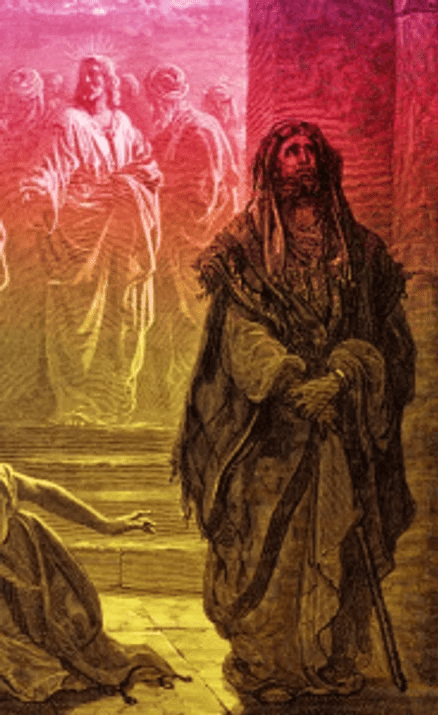
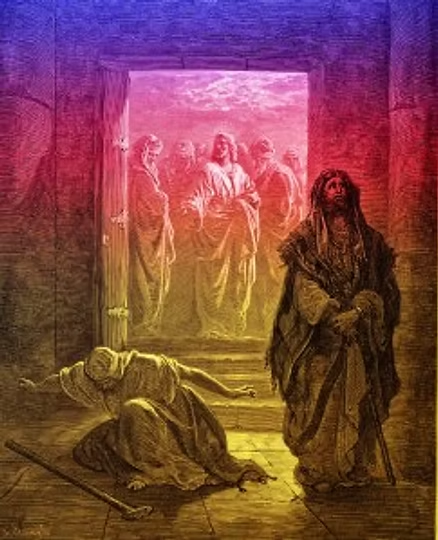
Symbols are the meaning, not the reality of one Pharisee and one tax collector.  Two represents the duality of a church.  One is the head, one is the body.  Can you see that depicted in the picture above?

Literally, one thinks Jesus is telling how a Pharisee was being loud so everyone can overhear him saying, “God, I thank you that I am not like other people: thieves, rogues, adulterers, or even like this tax collector. I fast twice a week; I give a tenth of all my income.”  No!  He is speaking so everyone can hear.  The hear him because he is the leader speaking to them, their preacher, their trusted teacher.

Instead of being the good shepherd, he is calling out sinners as if he is not one, giving the impression that he is righteous.  Simply by wearing a fancy robe or a shiny new suit and power tie, the one standing up before a congregation and talking out loud is assumed to be honest, pure, offering a helping hand.

Jesus is making this point because the whole problem the Israelites had, the reason why they lost the land God gave them, the reason they were under Roman domination in Jerusalem was the spiritual leaders of the Jews were not teaching the people HOW to WANT to live by the Law.  Sure, they taught the Law, but they used that knowledge to throw it in the faces of the sheep that had no clue how to save themselves.

Jesus was in town to change things.  He called the Pharisees out time and time again.  He ate dinner with a tax collector, but that was not condoning sin, it was challenging the Pharisees.  Jesus was not sent by God to justify sin.  He was sent to teach people how to receive the spirit of the Law, and how to open their hearts to welcome the Holy Spirit.  That wasn’t happening, so the people were always sinning, and always feeling guilty.  Some took advantage of the guilty.

The reason this parable is so powerful and why it must be understood properly today is Christianity has become the dead vine that the Temple of Jerusalem was.  Once upon a time in the land of Christianity the Apostles taught new Apostles.  Saints bred new Saints.  Then everything ground to a halt and it magically turned back into the Pharisee and the Publican in the church building.

Humility is good.  However, humility is impossible to maintain by will power.  A mantra like, “I will be Christian.  I will be Christian.  I will be Christian.” will not cut it.  You have to receive the spirit of the Law.  You have to be able to see the true meaning of the lessons.  You have to teach others this and let others teach you more.  Then, you have to let the Holy Spirit overwhelm you and take control over your actions.

———-  

As an Episcopalian, whose wife was an Episcopalian priest, I was able to make contact with human beings in that Church organization that I ordinarily would have to make an appointment to see and have just cause for seeing one of those high-ranking officials. My wife followed many on her Facebook page and would read their views on the lessons of Scripture. After my wife passed to the other side, I monitored Facebook sermons posted, to see if everyone was on the ‘same page’ as I was. This was more important during the COVID19 year(s), when the government takeover of churches drove the faithful (should I asy faithless) away in droves. When this reading came up in the cycle (October 26, 2022), I read a sermon posted by a bishop on his webpage, which my wife was a follower of. His sermon was basically a ‘cut and paste,’ ‘same ol same ol’ of the humility lesson, which misses the deeper purpose for Jesus pointing this whole situation out to his disciples. Certainly, the poor old sinned Publican was the obvious scapegoat, but what about the Pharisee? What was he further away from salvation.

I was moved to sent this bishop an email about his sermon. I did not know him other than by title, He did not know me at all. I asked him if he had ever seen himself as the Pharisee, writing sermons as if he were closer to God, whille all the pewples were so sinful they were the ones who should practice humiity. I asked why all sermons focus on blaming the sheep for being lost, when it is the shepherd’s role to gather them and take them to shelter.

He actually responded to my email. He said (I paraphrase), “Everybody has their own way of reading Scripture.”

Hmmmm. And everybody needs to hear your opinion why?

#god #Christianity #PhariseeandthePublican #duality #Pharisee #symbolisminparables #Apostle #HolySpirit #GoodShepherds #Jesus #Taxcollector

Matthew 21:23-32 – The authority to be a reluctant yet obedient son or a liar versed in expected answers [Seventeenth Sunday after Pentecost]

When Jesus entered the temple, the chief priests and the elders of the people came to him as he was teaching, and said, “By what authority are you doing these things, and who gave you this authority?” Jesus said to them, “I will also ask you one question; if you tell me the answer, then I will also tell you by what authority I do these things. Did the baptism of John come from heaven, or was it of human origin?” And they argued with one another, “If we say, ‘From heaven,’ he will say to us, ‘Why then did you not believe him?’ But if we say, ‘Of human origin,’ we are afraid of the crowd; for all regard John as a prophet.” So they answered Jesus, “We do not know.” And he said to them, “Neither will I tell you by what authority I am doing these things.

“What do you think? A man had two sons; he went to the first and said, ‘Son, go and work in the vineyard today.’ He answered, ‘I will not’; but later he changed his mind and went. The father went to the second and said the same; and he answered, ‘I go, sir’; but he did not go. Which of the two did the will of his father?” They said, “The first.” Jesus said to them, “Truly I tell you, the tax collectors and the prostitutes are going into the kingdom of God ahead of you. For John came to you in the way of righteousness and you did not believe him, but the tax collectors and the prostitutes believed him; and even after you saw it, you did not change your minds and believe him.

——————————————————————————————————–

This is the Gospel reading from the Episcopal Lectionary for Year A, Proper 21, the seventeenth Sunday after Pentecost. It will next be read aloud in church by a priest on Sunday, October 1, 2017. This in an important lesson because it addresses who has God’s approval to shepherd His flocks.

This reading reminds me of my experience at a seminary school. I was not a seminarian (my wife was), but I socialized with them at school functions and in the neighborhood housing arrangements. I saw several glaring problems with the whole system of educating priests (too many to get into now), but the statement, “the chief priests and the elders of the people came to [Jesus] as he was teaching, and said, “By what authority are you doing these things?” hit home for me.

I was writing books back then, which explained how to read Nostradamus, so that what he wrote can be understandable. Nostradamus can be seen as John the Baptizer, as “the chief priests and elders of the people” have not believed as I believe – that Nostradamus was a prophet of Jesus Christ. Because I fully believe that, I cannot hold my tongue about that belief.

When asked, “What do you do?” I told seminary students about Nostradamus. I told some teachers about Nostradamus. I even told some invited guest speakers coming to that school (whom I picked up or took back to the major airport nearby) about Nostradamus.

It was like I asked them all, “Do you believe The Apocalypse of John of Patmos is similar to The Prophecies of Nostradamus?”  It was like I posed the question, “Whose authority did those books come from: Prophet of Christ or Charlatan?”

Some wanted to shun me forever; but some were patronizing.  It was as if their minds were calculating, “If we say, ‘Prophet of Christ,’ he will say to us, ‘Why then did you not believe him?’ But if we say, ‘Charlatan,’ we are afraid we might be talking to an unstable, dangerous person.”  They all seemed well-versed in the “smile and nod” reaction to uncertain situations.

My amazing ability to understand Nostradamus was a gift given to me by God. There can be no other explanation for that talent.  I was the last person on earth who I figured would be able to understand Nostradamus; but I was led by a higher power, and not simply to understand his cryptic writings.  I found that I was able to apply the same systems applicable to making sense of Nostradamus to everything in the Holy Bible. That syntax is God’s, as His Holy Language … Speaking in Tongues not taught in schools.  So, it applies to everything He had His people write for Him.

There really are no authorities that grant doctorates or even bachelor’s degrees about the meaning of Nostradamus; so if I am seen teaching about his writings, authority figures have no reason to confront me. They just snicker and poke each other.  However, since I have been allowed to put Nostradamus on the back burner (so to speak), due to carpal tunnel in both wrists from writing so much, I have been encouraged to write Biblical interpretations. That will attract some frowns and questions by the religious elite.

What school did you attend to learn that? What scholastic volumes of books have you read and footnoted, while preparing properly detailed papers and dissertations that have been argued before expert authorities? How many reputable scholars can you quote in support of your views?

I will answer your questions, if you let me ask you one first. If you can answer that, then I will answer your question.

What seminary did Jesus and his Apostles attend? The same one begun by Moses in the wilderness, or a different one?

When Jesus said, “Neither will I tell you by what authority I am doing these things,” we all know he was authorized by God the Father. We know because he said that a few times, as noted in the Gospels.

“Very truly I tell you, the Son can do nothing by himself; he can do only what he sees his Father doing, because whatever the Father does the Son also does.” (John 5:19)  “ Then Jesus said to them, “When you lift up the Son of Man, then you will know that I am He, and that I do nothing of Myself; but as My Father taught Me, I speak these things.” (John 8:28)  “For I did not speak on my own, but the Father who sent me commanded me to say all that I have spoken.” (John 12:49)

The original plan was to have ALL the Israelites be ordained priests for YWHW. When Moses first took them on a 40-year hike, you have to look at the Israelites as babies and infants, because they were incapable of doing anything on their own. Forty years of rote memorization of the laws was priestly training that was more like children’s church on Sunday mornings. They just learned the stories, but the deep meaning escaped them.

When the Israelites were supposed to be priests for YHWH in the Promised Land, they were like teenagers under the Judges – always backsliding and getting into trouble, while having to be bailed out time after time. They entered the rebellious age.  By the age they asked for a king, “to be like other teens,” they were like young adults who no longer lived by the rules of their parents. But, by the time Israel and Judah fell in ruin, led by politicians whose only god was self, they were like twenty-somethings with arrest records. All their promise was washed away.

By the time the Jews had formed from those Israelite ashes and been released from Babylon, they were like thirty-somethings, who were “street smart.”  You could say they had become charismatic, prison ordained street preachers. That was who Jesus ran afoul of in Jerusalem. It was them acting with the know-it-all of young adults – their audacity – that made them the priest police.

In the parable-like question that Jesus posed to those learned men of the Law. both sons sinned against the father. One refused to go at first, but then thought about it and went (to stay out of trouble). The other said he would go, but flat out lied – a sin against his father. However, the one who refused, but then changed his mind, he was easier to forgive.

This lesson is no different than the one Jesus taught when observing the Pharisee and the Publican in the Temple. When Jesus said here, “Truly I tell you, the tax collectors and the prostitutes are going into the kingdom of God ahead of you,” this is not saying the son who lied by saying “No,” but then did “Yes,” is the exact same as a prostitute or tax collector (Publican). Saying “No,” and then thinking about it, before acting, put him in the same boat. Both were sinners, so unless change comes, both are forbidden from heaven.

What Jesus was really saying was, “You Law police fellows are too full of yourselves to ever realize you are going in the opposite direction of heaven.”

Thank you God for making me holy and not like the riffraff of the world. This is the pretense of a priest who knows nothing of spiritual matters.

At least the tax collectors and prostitutes are aware of their sins. They just can’t see how to stop sinning, in a world that forces sin upon everyone.  That is where a good teacher – such as John the Baptizer and Jesus – can get the losers to stop being a loser and change.

When the Pharisees and high priests see good teachers like that, they want to hurl stones at them. They certainly don’t want to pull up a chair and listen to what good teachers are saying. They might learn something then.  However, whose authority determines who the good teachers are, without a sheepskin to prove one has that approval?

Remember when Jesus said, “Watch out for false prophets. They come to you in sheep’s clothing, but inwardly they are ferocious wolves.” (Matthew 7:15)  That was the Pharisees wearing clerical robes, and what was then has always been and will continue to be.

This is why I see Christianity turning into a cesspool of teachers. It is not that all the sordid pieces and parts of waste in a cesspool were made for that ultimate purpose. Waste is the degradation of value.  What goes in good is split in two: the unseen nourishes, while the residue usually does not pass the smell test.  That gets flushed with good water.  It is just that when you mix the bad in with the good water, the good water has to be purified before it can be good water again.

A couple of years ago, my wife (a priest now) followed a bishop of another diocese on Facebook. She liked a few of his sermons that he posted on his website. He wrote one about the lesson of the Tax Collector and the Publican (Luke 18:9-14), which was uninspiring to me.  It was what I call out of the “puppy mill” of sermons. What priest has stood in the pulpit and looked at the smiling faces of tithers in the pews and not said the message of the Pharisee and the Publican was, “The sinners of the world have hope, because they are closer to heaven than those who think they have it made”? (The same sermon that can be preached about the two sons who disobeyed the father.)

That bishop published a sermon that had nothing new in it. What is the lesson of “being closer to heaven than some other guy,” if the sinners never hear a good teacher tell them how to “get to heaven.” Jesus was giving a sermon that said YOU bishop (and every priest who cannot see him or herself in this story) are the Pharisee in that story.  Forget about the obvious sinners, because it is YOU who Jesus said is farther away from salvation.

Telling those who feel guilt about their sins, “Have hope!  Keep coming here and I will keep telling you to have hope!” they will always come back for more of the same sermons.  But, who wants to stay in a pew when the priest says, “Jesus was pointing out how far away from heaven I am. But hey, who gets to heaven anyway?”

That’s entertainment, not a good shepherd.

A good sermon would be a true Apostle (like were Peter and Paul), who stands in front of a group of attentive sinners, all of whom want to hear how to stop sinning, and admit they too were sinners … sinners who changed.

In a good sermon the priest says, “I was the Pharisee in this story. I was farther away from heaven than you people are now; but I saw myself and felt ashamed. I had lied to the Father when I went into the priesthood. It was all about me being holier than thou. I was young and stupid and thought learning about religion would make me holy.  Therefore, I raised my arms to the sky and thanked God for giving me a sweet job that has so many fringe benefits.

Then I realized all my work had been only for me, even when I made it seem like I was helping others. I was only imagining I was working in the vineyard, when I was simply tasting the wine. I want to apologize for having not made every one of you self-sufficient priests for Yahweh.

I now speak to the LORD every day and He wants me to teach you the real meaning of the Scriptures, so you can understand by the Holy Spirit and go tell others the truth.  Truth comes not from having learned what someone else knows, but from a love of God that thirsts within one for His knowledge.

Please, I invite each and every one of you to join me in Bible Studies and fellowship, so our love of God branches out and produces fruit. Amen”

I made a post on that bishop’s blog, which suggested this alternative view … politely, in different words than here above. While he politely responded to my post, it was another example of people not really hearing what is being said or not being truthful about what they heard. He wrote back something like, “But who would be left in the pews, if I told them that?”

Wasn’t that the point when Moses freed the Israelites from Egypt? At some point the baby has to grow up, the student has to graduate from school and get a job. God didn’t free cradle to grave sons that say, “Yes sir! I’ll be working in that vineyard bright and early!” who then never do.

Did He?