Tag Archives: Proper 11 Year C

Amos 8:1-12 – How to be seedless fruit and walk in darkness

This is what adonay Yahweh showed me– a basket of summer fruit. He said, “Amos, what do you see?” And I said, “A basket of summer fruit.” Then Yahweh said to me,

“The end has come upon my people Israel; I will never again pass them by.

The songs of the temple shall become wailings in that day,” says adonay Yahweh;

“the dead bodies shall be many, cast out in every place. Be silent!” פ

Hear this, you that trample on the needy, and bring to ruin the poor of the land, saying, “When will the new moon be over so that we may sell grain; and the sabbath, so that we may offer wheat for sale?

We will make the ephah small and the shekel great, and practice deceit with false balances, buying the poor for silver and the needy for a pair of sandals, and selling the sweepings of the wheat.”

Yahweh has sworn by the pride of Jacob: Surely I will never forget any of their deeds.

Shall not the land tremble on this account, and everyone mourn who lives in it, and all of it rise like the Nile, and be tossed about and sink again, like the Nile of Egypt? פ

On that day, says adonay Yahweh, I will make the sun go down at noon, and darken the earth in broad daylight.

I will turn your feasts into mourning, and all your songs into lamentation; I will bring sackcloth on all loins, and baldness on every head; I will make it like the mourning for an only son, and the end of it like a bitter day.

The time is surely coming, says adonay Yahweh, when I will send a famine on the land; not a famine of bread, or a thirst for water, but of hearing the words of Yahweh.

They shall wander from sea to sea, and from north to east; they shall run to and fro, seeking the word of Yahweh, but they shall not find it.

——————–

Please note there are four uses of the combined words “adonay Yahweh” in these twelve verses, with another four single uses of “Yahweh.” After the fifth Sunday after Pentecost presented the same combinations and single of “adonay Yahweh” and “Yahweh,” the explanations given in the commentary for Amos 7 [the wall and the plumb line] apply for this next chapter being the Track 1 Old Testament selection for the sixth Sunday after Pentecost [Proper 11].

“Yahweh” is who speaks to Amos: “Yahweh said to me;” “Yahweh has sworn;” “hearing the words of Yahweh;” and “seeking the word of Yahweh,” but “Yahweh” speaks within Amos’ soul by His Son’s soul [Adam-Jesus] having been resurrected there. That presence is the “Yahweh elohim” written in Genesis 2 [the creation of Adam on the seventh day], so the “adonay” is the “elohim” becoming the ”Lord” over Amos’ soul and flesh. Thus, Amos heard the voice of “Yahweh” through His Son’s soul being merged with the soul of Amos. This is always the meaning of “adonay” in holy Hebrew Scripture.

Reading “adonay Yahweh showed me” in verse one, this is identical to what Amos wrote in the seventh verse of his seventh chapter, with his writing there, “he showed me and behold adonay stood on a wall with a plumb line.” It is the inner presence of Yahweh’s elohim – the Lord [adonay] over Amos’ heart, soul, strength, and mind – so Amos can become a true prophet of “Yahweh” and be shown divine visions. If Amos did not have this “adonay” in him from “Yahweh,” he would simply be a sheep herder and trimmer of sycamore trees – a normal worker of the land in the Northern Kingdom.

While Amos’ possession by Yahweh’s adonay showed him the Northern Kingdom was near collapse, through the vision of a wall next to a plumb line made true by Yahweh’s presence within “the midst of Yahweh’s people,” the vision shown by adonay Yahweh is a “basket of summer fruit” [“kə·lūḇ qā·yiṣ”]. In the rituals commanded by Yahweh, spoken by Moses, the gathering of first fruits in the early spring, placed in omer measures in baskets, those fruits and grains were kept in the Tabernacle-Temple for fifty days. On the Fiftieth Day [Pentecost], in the festival of Shavuot [Weeks – numbering seven] the fruit was deemed ripe and this ritual was metaphor for the Israelites [sons of Israel] being fit to serve Yahweh and His Sons [each being possessed by adonay Yahweh]. A “basket of summer fruit” then related to the last summer festival Sukkot [Booths or Tabernacles], where the “Harvest” or “Ingathering” becomes the festival of fall.

According to the website Kabbalah.info the spiritual meaning of Sukkot is this: “The holiday of Sukkot represents an essential change of values. By changing our values—from individualistic and egoistic to connective and altruistic—we will be able to create a safe, harmonious and happy world.” This means “the basket of summer fruit” seen by Amos was determined by Yahweh to be “individualistic and egotistic,” having no signs of commitment to Yahweh, with no adonay present in that “summer fruit.” This is why “has come the end upon my people Israel.” Then, Yahweh added, “not joined with them again I will pass by them.” This says, “no longer will Yahweh see the people of Israel as having the doorways to their souls painted with the blood of the lamb – His Son Adam-Jesus, Yahweh’s adonay.

When Yahweh then told Amos about the death that would be coming, this has to be seen as relative to the “basket of summer fruit.” Just as the omer baskets of first fruits came in the spring, they came from seeds planted in the fall. The “summer fruit” were what produced those seeds. What Yahweh saw, which Amos could not see with human eyes, was seedless fruit. Once that fruit was consumed [a festival of selfishness] there were no seeds from which would come the first fruits of the spring. The seeds became the metaphor for Yahweh’s pass over. Without them, all the firstborn males of the Northern Kingdom would die. Death is not a statement of the physical body separating from the soul, but the judgment that comes to a soul once released. A judgment of death then means no opportunity for eternal life.

In the NRSV translation of verse four, we read: “Hear this, you that trample on the needy, and bring to ruin the poor of the land,” the Hebrew text has “the poor” written in parentheses and brackets, as “[‘an·wê-](‘ă·nî·yê-)”. The enclosures surrounding masculine plural constructs of “anav” signal that which is “poor, afflicted, humble, meek” is within, of a spiritual nature [thus masculine, not feminine]; and, that is one’s soul. The words leading up to that inward state of being says “and cease or desist [make fail]” this inward source of life that is a ‘seedless’ soul. Following these marks of enclosure is the construct that says, “of the earth.” Here, “earth” must be read as metaphor for the stuff human bodies of “flesh” are made of: dust and clay. Thus, the inner soul gives life to the outer flesh; but for the selfish that “trample [or swallow up] the needy [or poor], they do so without souls being possessed by adonay Yahweh.

In verse five where the NRSV translates: “saying, “When will the new moon be over so that we may sell grain; and the sabbath, so that we may offer wheat for sale?” this refers to the return of spring, when the “new moon” marks the beginning of the first month Nisan. On the first full moon after that “new moon” comes the recognition of Passover; but the minds of the spiritually dead are focused on the selling of the first fruits, as a business to profit from. They no longer see the commanded festivals as recognitions of their souls in commitment to serve Yahweh as “his people.” The people of the Northern Kingdom were more concerned with cheating the believers and stealing from the poor to become rich, while pronouncing the first fruits fit for consumption, when they are little more than the “sweeping” of dust and chaff as good wheat.

When we find written: “Yahweh has sworn by the pride of Jacob: Surely I will never forget any of their deeds,” the name “Jacob” means “Supplanter.” That name represents one who cheats his brother out of his birthright, lying to his father, before running in fear from his brother. Yahweh will never forget the deeds of sinners. Jacob had to wrestle with his inner demons – his spiritual poverty – before he found his soul had to serve Yahweh, for his guilts to be released. Paul the apostle was a model of Jacob, with both men having their spiritual (soul) names changed, to represent their deaths of self, in submission to Yahweh. That submission brought each the adonay Yahweh that would be named “Israel.” That name means “Who Retains Yahweh through the possession of adonay in one’s soul.”

The life of those who are ‘seedless,’ without divine possession, Yahweh used the symbolism of the waters of the Nile in Egypt, which bring plenty from the land when the waters run high, but then bring famine to the people when the waters run low. The sending of Moses to take the descendants of Jacob away from that inconsistency of inner fortitude means Yahweh places His Son’s soul [Yahweh elohim] in all His people, so they never experience the famines of spirituality, having only the plenty of faith to sustain their “flesh.”

In verse eight is another instance of dual words being enclosed by parentheses and brackets. That written says, “and mourn everyone who dwells in the flesh , and shall swell like the Nile , the whole of it , and cast out [to sink] (to sink down) like the Nile of Egypt .” This says the ebb and flow is based on the physical source of all life on earth – water to replenish the flesh. To be an Egyptian was to be married to the death the flesh was bound to find .. in the ebb and flow. The enclosure marks once again become signals to see the ebb as when the failures of human existence have “cast out” the flesh, so the soul cannot save one to that state of existence, as it can only “sink down” along with the decline of the flesh. The marks of spirituality says dependence on a river in a land is worthless, as the only salvation of a soul comes from rising and being uplifted by adonay Yahweh.

At this point, verse nine states, “and it shall come to pass in the day this his , says adonay Yahweh , that I will make to go down the sun at noon , and I will darken the earth in daylight broad .” This is Amos prophesying the coming of His adonay that is the released of the soul of His Son Jesus. The “light” that gives life to the world of flesh [“the sun”] will be extinguished, as far as being an external source of life. The Hebrew that translates as “go down” also says, “come in.” The source of life then only matters to the soul, not the flesh [relative to the ebb and flow of the Nile in Egypt].. The timing of “noon” is “midday,” when the “sun” is expected to shine brightest. This then predicts divinely the end of individuals [kings or prophets] that will be the external “light” by which others will follow. All such external guides “will be darkened,” which means none will be able to save the souls of others. Even if they possess adonay Yahweh, their internal “light” cannot be made available to “the flesh” [“the earth”]. Only souls will be allowed to find the ”daylight” of Yahweh, by earnestly seeking that blindly [as was Paul stricken blind for three “days”].

Verses ten and eleven then prophesy the death of the nations that worshiped the wealth of the world, in the same way as the Egyptians had done. All of the “feasts” commanded by Yahweh will no longer reflect the spiritual commitment of all the people, but be turned into ceremonies that say the deaths of those nations has come. The peoples of Israel and Judah will become trails of tears into captivity, lamenting all the sins that will suddenly dawn upon themselves. Their bodies of flesh will reflect their deaths as the children of Israel, having become seedless. Their bodies will cover their souls like black sackclothes of mourning. The uncut hair of the men, symbolizing a total commitment to Yahweh, will become bald. When Yahweh told Amos this would be “like mourning for an only [son],” this means they will not have been spared death by Yahweh’s Passover.

In verse eleven, Amos wrote, “says adonay Yahweh , I will send a famine on the land ; not a famine of bread nor a thirst for water , but for a hearing of the words of Yahweh.” This means all “the bread” that can feed a soul already exists for the soul’s salvation. That “bread” is the ‘manna from heaven,’ or ‘the spiritual food’ that was fed to them as the writings of Moses, David, and the Prophets. The “water” is the living waters of adonay Yahweh being joined permanently with one’s soul. That food and drink provides by the possessing adonay Yahweh makes one a Saint [like Amos], thereby capable of seeing visions and listening to the commands of adonay Yahweh. In terms of soul salvation, through being fed Spiritually all that one’s soul can possibly need, nothing more can be added [although the New Testament will be restatements of the original divine texts … but they will come when the famine has ended, with the fulfilled prophecy of Jesus’ death by the hands of evil men].

In verse twelve, Amos was told to write, “and they shall wander … seeking the word of Yahweh , but they shall not find it.” This prophecy is still in effect today. The modern versions of Judaism [not true Christianity] are blinded from seeing the truth that is written in Scripture. The blindness comes from the ‘Big Brain Syndrome’ that makes certain leaders [along with their ‘scribes’ called translation into English services] out to be gods [send in your checks and money orders now!!!]. They lead the people’s souls to ruin, in the exact same way as did the failed leaders and false prophets sent those expecting profits from being a believer in God into darkness. Once a prophecy, always a prophecy. The only escape from that guarantee of that to come is death of self-identity and total submission to Yahweh. When one receives adonay Yahweh, then one will know the LOVE of Yahweh, through His Son’s resurrection; and, one’s soul will know the promise of eternal life.

As the Track 1 Old Testament selection for the sixth Sunday after Pentecost, this is Amos singing the same song, different verse, from that he sung on the fifth Sunday after Pentecost. It shows a “basket of summer fruit,” which is a reflection of all the seedless [souls not married to Yahweh, becoming led by His adonay], which was the Northern [as well as the Southern] Kingdom, led by the evil Jeroboam and his false prophet Amaziah. Those failed leaders project forward to all times, through the prophecy Yahweh told Amos. All the Oral Roberts, Joel Osteen, Presiding Bishop Michael Curry, Pope Benedict, et al, are promised to be walking in darkness as external beacons of light. NONE of these leaders today are Saints; so, NONE of them are touching the souls of lost flocks with the “daylight” of an adonay Yahweh. It is foolishness to expect a false shepherd to explain the truth, by hearing him or her say, “I have no clue what anything means; so, if I were you, I would go someplace else.” The industrial produced wafers they then serve are nothing more than the sweepings from the threshing room floor, where Scripture is discerns by the adonay teacher … which false shepherds and hired hands refuse to receive.
Psalm 52 – Protected from souls that love evil by an inner elohim

1 You tyrant, why do you boast of wickedness *

against el all day long?

2 You plot ruin; your tongue is like a sharpened razor, *

O worker of deception.

3 You love evil more than good *

and lying more than speaking the truth. Selah

4 You love all words that hurt, *

O you deceitful tongue.

5 Oh, that el would demolish you utterly, *

topple you, and snatch you from your dwelling, and root you out of the land of the living! Selah

6 The righteous shall see and tremble, *

and they shall laugh at him, saying,

7 “This is the one who did not take elohim for a refuge, *

but trusted in great wealth and relied upon wickedness.”

8 But I am like a green olive tree in the house elohim; *

I trust in the mercy elohim for ever and ever.

9 I will give you thanks for what you have done *

and declare the goodness of your Name in the presence of the godly.

——————–

Above, you should take note that the masculine singular noun “el” is written twice, in verses one and five. The masculine plural noun “elohim” is written three times in verses, once in verse seven, and twice in verse eight. Go ask your elementary school English teacher how both the singular (“el”) and the plural (“elohim”) can be translated as “godly [lower-case], God, God, God and God [all upper-case]. After sitting in the time out corner, facing the wall for an hour, you should come to the realization that the above translation [provided by the NRSV] is bogus crap. David’s words are so misunderstood from personal agendas, the truth cannot shine forth for standardized English translation programs that (at best) only produce paraphrases.

Entirely missing from what is written by David in his first verse is the setup that says [literally translated into English], “coming from he who is preeminent [Yahweh] , a divine instruction to beloved [David] . when came in ׀ full of fear [Doeg] a son ruddy [implication of Esau, as Edomite] and he boldly stated to asked for [Saul] and said to him ; has entered beloved [David] into dwelling brother of the king [Ahimelech] .” When this Psalm 52 is recognized to be an accompaniment to the Track 1 Old Testament reading from Amos 8, where he repeatedly spoke of being shown visions and hearing the voice of Yahweh, through his being personally possessed by adonay, to forget that and overlook David saying this Psalm is like that shown Amos – “coming from he who is preeminent, a divine instruction to beloved,” that misses the Spiritual connection that is Yahweh’s “loved one,” where David (like Amos) was a soul married to Yahweh, out of “love.” To ignore the meaning behind the names written is to be like a standardized translation service.

The Day of Doeg

The translation of verse one above then begins, where the literal English translation says, “how do you shine with evil as mighty ; goodness el , all the days .” In that, the principles of “shine” and “the days” should be understood as symbolic of the moon and the sun. To pretend that a reflection of the “sun” off a material surface [the flesh] shows one’s “might” or “strength,” while being obviously led to do “evil” or “bad” deeds, always comes to naught, when the sun’s rays of life go dark [at death]. There is no “might” or “strength” to be found in a dead body of flesh. The sun, however, “always produces the light of day,” which is the “goodness” of Yahweh [His “el” within] that is true “might” and “strength.” The Hebrew words that translate as “all the days” then must be read as saying the soul married to Yahweh [possessed by adonay – stated here as “el”] has the “might” and “strength” of eternal life.

Verse two then literally translates into English singing, “evil desire it will invent your tongue ; like a sheath sharp , making treachery .” In this, the intent of “desire” is read as “in a bad sense,” thus the “desire” is for self, not others. In order to suit one’s personal “desires,” one will “calculate” what one says, so one’s “tongue” speaks like the serpent did to Eve, thinking itself to be the craftiest of the animals in the flesh. Like the serpent, who is always caught and exposed to the truth, one’s “tongue” becomes like the “sheath” held by a priest of the Tabernacle [a Levite in David’s time], who cuts the throat of sheep to be burned in sacrifice. While certainly not a lamb inspected to be without blemish – as one of this nature is “making treachery” – the “knife” comes to all animals in the flesh. When Judgment before Yahweh comes, it will be one’s own unwashed sins that will be the instrument of “destruction” that soul faces.

In verses three and four, David was divinely led to speak of “love,” beginning both verses with “you love” (from “’ā·haḇ·tā”). For all the people wearing robes and chains with crosses in today’s modern version of Christianity, they all run around wildly spewing out words of “love.” These two verses of David point the finger at them, making them be the same people that existed in David’s time, where he wrote, “you love evil more than good.” This speaks of human emotions, where “love” connects the brain to the heart to the groin, touching all places where pains and pleasures are mistaken as “love.” None of those ideas about “love” come close to the truth that is Yahweh’s “love.” David was not referring to Yahweh’s “love” in these two verses.

Verse three fully sings [in English translation], “you love evil more than good ; falseness ׀ rather than speaking righteousness .” David then wrote “selah,” which says this judgment is not his own. It is a “lifted up” judgment, from the “exaltation” of Yahweh speaking through his hand. The placement of a vertical bar must be read as a place of pause, where every “lie” told comes with a soul being told the “right” way is not to be “false.” Jumping to “deceit” after this inner warning makes one’s judgment be “rightful” punishment by Yahweh. The statement “more than good” says all the good one does is flushed down the drain by all the “evil” one does … no matter what the percentages of deeds is.

Verse four then literally sings in English: “you love all speech devouring , tongue treachery .” Here, the repeated use of “tongue” and treachery” matches that of verse two. Here, Yahweh told David that evil souls “love” telling lies, even though they destroy their souls while doing so. Ask Joe Biden and Bill Clinton (all politicians) how they can only lie, even when the world knows they are lying. It is this “tongue treachery” that will be their own words that cut their throats at Judgment.

In verse five we find another use of “el,” which brings up a clarification of Yahweh telling David to write, “you love evil more than good.” As I stated prior with the name of David meaning “Beloved,” that name usage was an “instruction” coming from the “preeminence” of Yahweh that stated a divine marriage, where the soul of David united with the Spirit of Yahweh, so His “love” means that union of marriage. Such a divine marriage then resurrected the Yahweh elohim that is His Son’s soul. In Genesis 1 is written “elohim” thirty-two times, with every one of those uses denoting an angel, spirit, or law of physics, such that all who were created by the plan of Yahweh [unnamed in Genesis 1] were “elohim” not a Son of Yahweh. Thus, an “el” can be a spirit that either helps one [leads one to do good] or hinders one [leads one to do evil]. These are the demon spirits that possess souls, which need to be casting out. However, it is “love of evil more than good” that marries a soul to Satan’s minions. This is brought out in verse five.

Verse five then literally translates into English as singing: “moreover el will pull you down enduringly it will take you away and pull you out of your tabernacle ; and uproot you from the flesh of the living .” This verse is also one where David added “selah,” meaning this is an “exalted” promise from Yahweh. At every place where the second-person is used – as “you” – this should be read as “your soul,” as there is no “you” without that animating the dead “flesh” that surrounds “you.” The ”tabernacle” should be read as one’s commitment to Yahweh, as one of those who sided with David’s lead [where verse one indicates this Psalm 52 was when Saul was king], the “tabernacle” is one’s flesh with a soul led by elohim [adonay]. The use of “uprooting you from the earth” has been changed by me to show “earth” as “flesh.” The removal of a soul from a “tabernacle” is due to the soul falling in “love” with the “el” that pleases the “flesh;” and, the taking away from “the living” means a Judgment for sins that will prevent eternal salvation of the soul.

It is with verse six that the divine inspiration brought to David by Yahweh changes, going from those souls alone in their flesh [selfish] and those souls married to demon spirits to those souls like David’s – married to Yahweh and possessed by His elohim. The whole of verse six then literally translates into English, singing, “and they will see those righteous and fear , and above it they will laugh .” In this, it is the souls that “love evil” and “love words that devour” will encounter those souls who are divinely possessed and led to live righteous lived. That will be seen as souls saved; so, those evil souls will feel the cold chill run down them, fearing their judgment coming at death. Because those they encounter will be elevated spiritually by Yahweh’s Spirit having merged with their souls, cleaning them forever with a divine Baptism, they will hear the voice of an inner Lord, which leads them to “laugh” in the face of the wicked.

In verse seven, David was led to write [literally translated into English], “behold! the man , not set elohim , his strength and his trust in abundance of his riches .” In this, the words “behold! the man,” where the root Hebrew word for “man” is “geber,” not “adam.” This makes those souls in flesh, ruled by demons, and those souls in flesh, ruled by elohim, equals in their outer coverings that qualify them both as “man.” Each sees the other physically, with the souls of the wicked sensing the “righteousness” of those whose souls are not like theirs. Those souls who have not married Yahweh and become “set” or “placed” with a possessing elohim [to mark a wife in His name], they will judge the success of others by the amount of things of material value they possess. Their fear comes from realizing the rich and poor, alike, never take any material possessions with them when they die. That means all laughs from being rich, materially over the poor, turns into mourns, when the souls led to righteousness by their elohim get the last laugh.

In verse eight, David was divinely inspired to sing [translated literally into English], “but I like an olive tree green in the house elohim ; I trust in the goodness elohim forever and ever .” In this, the two first-person [“I”] statements must be viewed as a lack of self-identity, such that a soul in flesh married to Yahweh has sacrificed all sense of selfishness. This make the first-person identified by the “elohim” within a host soul, where “I” becomes a statement of that divine soul’s control over a host soul and its flesh [an adonay – Lord]. This makes the metaphor of an “olive tree,” which is “fresh” and “green,” be a statement of forever youth, where the elohim leads one to continuously produce good fruits. The “house” is then the framework of one’s body of flesh, where the fruits put forth are the ministry led by the elohim within. The use of “trust” is then based on a close, inner, personal experience, which makes “trust” be synonymous with true faith. The ministry [willing servitude] for “goodness” will not be until one reaches retirement age, when one can rest on all the riches false ministry brings to false shepherds, because ministry is for saving other souls. Once one’s own soul has been saved for an eternity, nothing more of a reward is possible.

In the final verse, the literal English translation has David singing, “I will praise you forever for you have produced ; and I will wait for your name that for good , in sight of your saints .” Here, again, the first-person is the identification of the inner elohim that leads a wife-soul of Yahweh to do acts of goodness. This means the “praise” [rooted in the verb meaning “to throw, cast”] is the elohim casting out the voice of Yahweh through His servant’s lips. The “praise” done by the wife-soul is then an echo of this; just as David’s Psalms of praise were the echoes of his divine inspirations, heard first within. These inner insights are the commands a submitted and devoted soul then follows in his or her flesh, so the good fruits are “produced.” The “name” of the elohim is today Jesus; so, each wife-soul married to Yahweh [in His name] will be reborn “in the name of Jesus – a Christ” Anointed by the Father, so divine patience keeps one from knee-jerk acts of sin. It is the inner presence of elohim within one’s soul that makes all works and deeds be seen as saintly by others; but the true “saint” is unseen, as the soul of Jesus resurrected within the soul-flesh of an apostle [male and/or female].

As the companion Psalm for the Track 1 Old Testament reading selection from Amos 8, one needs to see the opposite principles of souls who marry Yahweh [like did Amos and David], versus souls who resist such a commitment and fall prey to the influences of the world, becoming sinners. This is divine insight that came to David, while the powerful Saul [the King of Israel] sought to kill David. David knew the world was filled with souls married to demon spirits. Saul and Doeg the Edomite were two souls that loved evil more than goodness. The same world exists today, where all who seek to be like David must find the protection of Yahweh’s elohim, in order to escape the forces of evil.

This Psalm 52 then paints a picture of the divine protection Amos had as a true prophet of Yahweh, which protected him from the sword of Jeroboam. Today’s governments in Christian nations run roughshod over the churches, such as the perceived threat of COVID19 forced churches to cease operations. Saul and Doeg the Edomite are alive and well in the reincarnated bodies of modern politicians and false priests, whose soul have been sold for riches. Still, the prophecy sings, “and will see the righteous and fear”. The “righteous” these days do not wear robes and stand out as obvious – to be killed by an angry king, led by evil influences. Instead, they find refuge “in the house of the king’s brother,” which is metaphor for the twin souls within David’s “house” of flesh – his subservient soul, led by his inner king – Adam-Jesus – his elohim.

Footnotes:

A glossary needs to be present to understand “love” and “beloved.”

el – an individual eternal spirit, which includes a soul alone inhabiting a body of flesh

elohim – the joining of two (or more) el within a body of flesh: one soul el + one (or more) possessing el

Yahweh elohim – the Son of Yahweh called “Adam” (Man), Job (He Who Returns), and/or Jesus (YAH Saves)

love (aheb) – human emotions that ebb and flow like th moon changes shapes, based on the earth blocking the sun’s light

love of Yahweh – (aheb Yahweh eloheka) an el possessed divinely by the Yahweh el, to make a Beloved elohim in the flesh

adon – an individual lord, such that the soul el is the lord over its body of flesh

adonay – the joining of two (or more) el within a body of flesh, where the possessing el becomes the lord over that soul and its flesh

Genesis 18:1-10a – Meeting the Trinity as a branch of Abraham

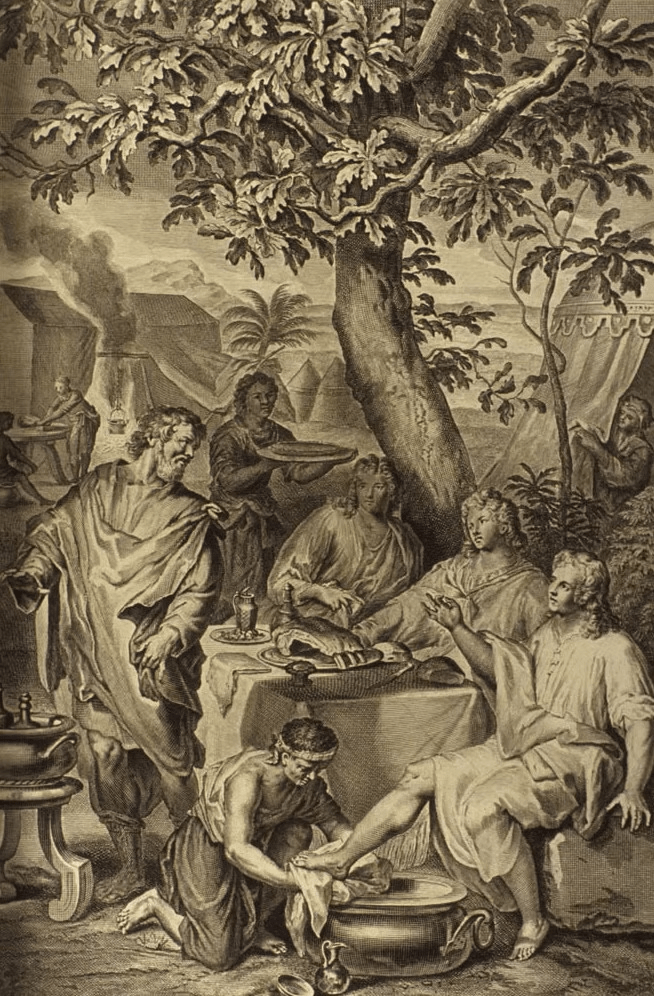
[1] Yahweh appeared to Abraham by the oaks of Mamre, as he sat at the entrance of his tent in the heat of the day. [2] He looked up and saw three men standing near him. When he saw them, he ran from the tent entrance to meet them, and bowed down to the ground. [3] He said, “adonay, if I find favor with you, do not pass by your servant. [4] Let a little water be brought, and wash your feet, and rest yourselves under the tree. [5] Let me bring a little bread, that you may refresh yourselves, and after that you may pass on– since you have come to your servant.” So they said, “Do as you have said.” [6] And Abraham hastened into the tent to Sarah, and said, “Make ready quickly three measures of choice flour, knead it, and make cakes.” [7] Abraham ran to the herd, and took a calf, tender and good, and gave it to the servant, who hastened to prepare it. [8] Then he took curds and milk and the calf that he had prepared, and set it before them; and he stood by them under the tree while they ate.

[9] They said to him, “Where is your wife Sarah?” And he said, “There, in the tent.” [10a] Then one said, “I will surely return to you in due season, and your wife Sarah shall have a son.”

——————–

Please note that the name “Yahweh” has been restored [from “the Lord”] and the word “adonay” has been presented in its Hebrew, as written [translated incorrectly as “my lord”]. These corrections are necessary for the truth to come forth. I have also added the verse numbers above [in brackets], so one will be able to keep up with what was actually written, in my translation analysis below.

In the Track 1 schedule the past two Sundays, we have been presented with readings from Amos, who likewise had a divine appearance” before him, stated as “adonay stood on a wall with a plumb line” and “showed me adonay Yahweh … a basket of summer fruit.” If you need a moment to grab notepaper and a pencil to write down all the times such a divine “appearance” has happened in your life, please do so; and, consider you soul in league with true prophets and devote servants of Yahweh. All kidding aside [you heathens], “Yahweh appeared to Abraham by the oaks of Mamre” in a divine vision or dream. Yahweh did not ‘beam down from outer space in a material form,’ reducing Himself to the limits of a material world. Instead, the soul of Abraham [like those of Amos and David] was “into you Yahweh my soul I take” [Psalm 25:1].

The symbolism of “by the oaks,” or “the terebinth” [a turpentine tree] is many grow solitary, in places where there are no other trees. They are known to have deep roots; and, they can live a thousand years. This being written should not be seen as happenchance. The deeper meaning intended is Abraham was himself growing from the deep roots of holy men, who descended from Adam. He would become the central trunk of spiritual mightiness, from which would grow strong limbs bearing ancestry to his soul. As such, Abraham was a new “oak” that was surviving in a drought, so his limbs were the twigs of his wife, servants, and cousins. Abraham knew the patience of such strength as “the oaks,” so (like always) he did not complain about things not going his way. His way was where Yahweh directed him.

The name “Mamre” means one of three possibilities: “From Seeing or Understanding; Adversity; From Being Fat or Well Fed.” Abraham can fit each translation, as he was a soul-wife of Yahweh, whose “seeing and understanding” came to him by the insight of Yahweh. Abraham’s “adversity” was due to being an old man, with an old wife [ten years his younger], who had no heir. That was somewhat of a predicament, seeing how Abraham was “well fed” and enjoyed much ‘fat of the land,’ from his many possessions. Thus, under the branches of an “oak tree” Moses “sat” in rest, shaded from the “heat of the day,” most likely taking a siesta or nap. It was then in this state of being, “at the entrance of his tabernacle,” that “Yahweh appeared.” In that, “his tabernacle” or “his tent” is metaphor for the body of Abraham being opened to receive divine inspiration, with his body in a state of symbolic death [sleep], Yahweh entered Abraham’s soul.

In verse two, the simpleton imagery presented makes the reader that dozing Abraham “looked up and saw three men.” The truth of that leans heavily on a spiritual vision, more than a physical meeting. The Hebrew says, “so he lifted” or “so he carried,” with that root Hebrew word [“nasah”] connecting to words that say, “his eyes and saw.” When one realized “he took, carried, or lifted his eyes and saw” in a spiritual vision, this says what Abraham “saw” was divinely presented before “his eyes” – his mind’s eye that “sees” divine visions. Before one needs to address what Abraham “saw” spiritually, one needs to realize this vision would be invisible to any ‘fly on the wall’ passerby; as, it was taking place within Abraham’s soul.

When the Hebrew then says [in English translation], “and behold! three men,” this gives the impression that two Hebrew words that are divinely inspired by Yahweh for Moses to have this written [“three men”] is some statement of a number of men. Each word written must be seen as standing alone in its divine meaning intended. When Scripture is realized to be read from a spiritual perspective [not a physical view of an event], then “three” has to be seen [“beheld! Spiritually] are symbolic of divinity , as the Trinity. When the word “men” [the plural of “man” – “ish”] is read spiritually, this becomes a statement of the spiritual realm, which is where the masculinity of Yahweh, angels, elohim, spirits, and souls are separate from the femininity of the material realm. So, this says the “three” are of masculine essence, with this being the Trinity of Father, Son, Spirit all joining within Abraham [the Son soul within his soul]. What his “eyes were lifted to behold! was the presence of Yahweh, with His Son, in Adam’s soul [“three men”], all possible by the Spirit of Yahweh. This is the same as Amos writing he was shown or adonay Yahweh appeared to him. His visions state the same presence of what Moses called “three men.”

When this then says, “standing before above him,” the Hebrew root “natsab” is the same word used by Amos, where adonay took a stance on a wall holding a plumb line.” The spiritual intent of “standing” or “taking a stance” is coming into an “upright” and divine state, which took the soul of Abraham out of his body of flesh, into the realm of Yahweh.

When verse two then says, “and he ran to meet them at the opening of his tent,” this states the eagerness and willingness to have this spiritual encounter with Yahweh. The verb “he ran” shows how much the soul of Abraham went “with haste” to “meet” or join with this divine presence that was “seen” by Abraham’s mind’s eye. The “opening of the tent” says the flesh of Abraham had become “opened” to receive this divine visitor. The “tent” then makes Abraham’s body the dwelling place of his soul; so, his soul “opened” to receive the Trinity of Yahweh.

When the end of verse two says, “he bowed himself down to the ground,” the translation of the third-person masculine singular is speaking of the “soul” [souls are masculine, flesh is feminine], such that the intent is “Abraham submitted his soul down.” The element of “ground” or “earth,” where the Hebrew construct is the third-person feminine singular, means the “flesh” of Abraham was in total submission to Yahweh and the marriage of His Son’s soul with the soul of Abraham, while that soul existed within the confines of his flesh.

In verse three, we find Moses using the word “adonay,” in the same way that Amos used it. The verse translates literally into English, saying “he said ; adonay , if now I have found favor in your sight , not now you pass over above your servant .” In “he said” the third-person masculine singular is referencing the soul of the Son possessing the soul of Abraham [a masculine spirit – elohim] speaking (not Abraham physically). This is the voice of the Lord of Abraham’s soul, through marriage of Abraham’s soul to Yahweh and the resurrection of His Son’s soul within [Yahweh elohim, or Adam-Jesus]. The conditional of “if” is the Son telling the Father, the truth of “favor” can be found in the “adonay” present and speaking for Abraham. The request to “not now you pass over” means to find the blood of the lamb upon the “opening of the tabernacle” to Abraham’s soul. That requests Abraham’s soul be granted eternal life, due to the “favor” found from the adonay.” This then says the “adonay” is indeed the Lord “above your servant,” which controls his acts towards righteousness.

In verses four and five, where “water” and “bread” are offered by the “adonay” speaking for the soul of Abraham [still in a vision stated], the “water” are ‘living waters’ that Baptize souls in ceremonious union between a soul and Yahweh, where the “rest” found is the promise of eternal life. A “morsel of bread” is the truth of Yahweh, upon which the soul of Abraham is fed. It is this spiritual food – manna from heaven – that “refreshes the heart” [meaning the “inner man” or soul of Abraham] – where that nourishment is again a statement of the blood of the lamb [the “adonay”] that has saved the life soul of Abraham. These proofs are offered in the presence of Yahweh’s Spirit, which says “afterwards you may pass over … your servant.”

In verse six, we again find “Abraham hurried into the tent to Sarah.” In this, the name “Abraham” [while questionable] is believed to mean “Our Shield.” This implies the “Shield” that protects the soul of Abraham is the “Exalted Father” that is his soul having taken the name of Yahweh in marriage. The “Father” has then brought forth His Son Adam-Jesus as the “adonay” of Abraham. In this divine relationship, the element of “Sarah” inside the “tent” means the truth behind the name “Sarah” must be read. The name “Sarah” means “Princess,” such that rather than a spiritual vision including a separate physical body of flesh or a second soul, the soul of Abraham within his “tabernacle” of flesh is the “Princess” bride of Yahweh the King. The command to quickly knead flour into bread says Abraham called upon his Messiah [Anointed by Yahweh in marriage] mind to recall the lessons taught to him by the Spirit.

To then ”run” to “the herds” and select a ‘he-calf’ [a young bull], which he gave to a “young man,” this reflects on how long Abraham had performed sacrifices to Yahweh, as a priest in His name. Since Abraham was a “youth,” his soul had been married to Yahweh, so his soul was Anointed by Yahweh’s Spirit, poured out upon his soul forever. This [although not written in Scripture] says Abram was like Samuel and David, made “Messiahs” while souls “young in flesh.

When verse eight says the soul of Abraham then “placed curd and milk and the calf which he had prepared,” one must notice the third-person masculine singular of “he had prepared” excludes any soul other that Abraham’s as having done any of this work to please his soul’s divine guests. It says the soul of Abraham pleased Yahweh the divine Husband, as an obedient and subservient wife-soul. Whe we then read, “and he stood by them under the tree and they ate,” this says the soul of Abraham was elevated or lifted up, so his soul “stood” alongside the Trinity – Yahweh the Father, Adam-Jesus the “adonay” Son, and the Anointed by the Spirit soul of Abraham, as the devoted wife-soul and mother-soul of Yahweh’s Son son.

When we then read in verse nine, the divine spiritual question posed to the sacred soul of Abraham, “Where Sarah your wife ?” this was not a divine presence not knowing all answers to all questions. When Abraham’s soul said, “here in the tent,” this was not a logistical answer, which implied that a physical woman was in a back room in a very large tent. It says the soul of Sarah was under the same covering of divinity, such that her soul dwelled in the same spiritual servitude to the commands of Yahweh. Sarah shared the inner “adonay” of Abraham that led her to follow the will of Yahweh, by following her husband Abraham.

When verse ten-a presents the promise of “a return to you in due time of living , a son Sarah your wife .” This says the labors of Abraham and his wife Sarah had been seen by Yahweh, known by His “adonay in Abraham’s soul, so the promise of a “living” bloodline would be his reward (and his wife’s). The promise if Sarah’s soul also marrying Yahweh, so His Spirit will have her give birth to her own soul’s “adonay” – a “son” that will become her Lord. That presence will come through her becoming like Mother Mary and her cousin-aunt Elizabeth, where giving physical birth to a divine soul placed into divine flesh will leave the mother a new wife-soul of Yahweh. To think in terms of this only meaning the promise of a physical “son” to be born to a woman of ninety years, is enough to make any human being laugh [the point made be Genesis:18:10-b makes, which is withheld from reading today].

As a Track 2 Old Testament reading selection, it is vital to see this in the same spiritual vision terms as is the Track 1 reading from Amos 8. It is easy to get caught up in the imagery of Abraham taking a nap under a tree [much as we found Elijah under a broom tree], when the deeper message of Scripture is always revealed when reading it from a spiritual meaning, rather than taking a material view. In this way, Abraham becomes a repeat of Amos, David, Paul and Jesus, all of whom were souls married to Yahweh, possessed by His adonay. This means the eternal lesson is always there for the reader to see what is expected from him or her. All souls must take a ‘nap’ of death of self, where like Jesus showed us, we crucify our love of evil and turn to love of good. We must create an opening in our tents, so Yahweh’s Spirit – the Trinity – can enter. We must submit our souls to His possession, as his divine wives in submission to His Will.

Psalm 15 – The question of which souls will invite Yahweh into their tent

1 Yahweh, who may dwell in your tabernacle? *

who may abide upon your holy hill?

2 Whoever leads a blameless life and does what is right, *

who speaks the truth from his heart.

3 There is no guile upon his tongue; he does no evil to his friend; *

he does not heap contempt upon his neighbor.

4 In his sight the wicked is rejected, *

but he honors those who fear Yahweh.

5 [4] He has sworn to do no wrong *

and does not take back his word.

6 [5] He does not give his money in hope of gain, *

nor does he take a bribe against the innocent.

7 [5] Whoever does these things *

shall never be overthrown.

——————–

There are only five verses in Psalm 15. The NRSV confirms this. The Episcopal Church has taken it upon itself to change divine Scripture to meet whatever hidden agenda that have. They forget that Jesus says “Woe to those who run around changing things to suit their selfish needs.” [Not even one little dot over an i of one little cross of a t is allowed.] Also, twice the proper name “Yahweh” is written, which the NRSV [and all other translation services] mutate as “Lord.” These corrections have been made above.

In verse one David poses two questions. The first asks, “Yahweh who he will sojourn to your tent?” Here, the key word in translation is “yā·ḡūr,” which is rooted in the verb “guwr.” That word meant “to sojourn,” but the NRSV shows it as “may dwell.” To grasp the meaning of “sojourn,” rather than change the text to suit a personal agenda, it is important to recall the story of Laban being sent by Abraham to his homeland to find a wife for Isaac. That was a “temporary stay, which involved a trip from one place to another, then back. The return trip with Rebekah, was to enter into the “tent” of Sarah, where Isaac and Rebekah officially became married. From this story, one should see David being led divinely to ask, “Whose soul has been sent for by Yahweh, to agree to return and enter the tabernacle of holiness that marries a soul to Yahweh?”

The follow-up question then asks, “who he will dwell in mountain your sacredness?” Here, the Hebrew word “yiš·kōn” is written, which is rooted in the verb “shakan,” meaning “to settle down, abide, dwell.” The metaphor for Yahweh is “the mountain,” which denotes great size and lasting strength. The word translated as “sacredness” also mean “apartness,” where Yahweh is not “sacred.” His ”tabernacle” demands one’s soul be “apart” from its flesh’s influence [self-sacrifice in divine marriage, taking on the name of Yahweh], thereby led by an inner elohim that leads a soul-wife in the flesh to act righteously. In the use of “he will sojourn” and “he will dwell,” both constructs utilize the third-person masculine singular, where the masculine denotes an eternal spirit-angel-soul. This designation of “he” is then not gender specific to any flesh whatsoever, as no flesh can ever enter “the tabernacle of Yahweh.”

When this is seen, the focus placed on “apartments” and “sacredness” is then stated in verse two, as “him walking complete and him acting righteousness ; and speaks the truth , in his inner being .” Here, it is vital to understand that no human being – a soul animating a body of flesh – can will oneself [one’s soul] to ignore the worldly influences upon a body of flesh made from the earth [dust and clay]. The soul must attain the apartness of the flesh, which can only come from marrying the soul to Yahweh. That marriage brings forth an outpouring of His Spirit upon one’s soul, which bring this “sacredness” and ability to no longer sin. That then brings about the resurrection of Yahweh’s Son [Adam-Jesus] within one’s soul [twin souls, like Esau and Jacob in Rebekah’s womb]. The soul of Adam-Jesus then becomes the Lord over the soul and its body of flesh, forevermore forbidding it from sinning again. This is the “inner man” who “speaks the truth” and makes one “complete” [the meaning of “peace” – Hebrew “eiréné,” which properly means “wholeness”]. When a soul is joined with the soul of Yahweh elohim [Adam-Jesus], then it is found “walking righteously.” This makes “sacredness” be the equivalent of a Saint in the name of Jesus.

In verse three David was inspired to write [in literal English], “not he who slanders ׀ with his tongue , not he acts to his companion evil ; and a disgrace , not does he raise up against those near .” Here, the third-person masculine singular is stated four times, meaning this is not talking about a soul in a body of flesh [the feminine that marries eternal spirits – masculine]. This is then making a profound statement about the other type of marriage, where a soul becomes joined with a demon spirit. The vertical bar after “not he slanders” must be read as a point of pause, from which a soul is offered divine marriage to Yahweh and rejects it. Following the vertical bar is said, with his tongue,” which is a physical part of a body of flesh; however, the third-person masculine singular says rejecting divine marriage to Yahweh can then make a demon possess a soul and use the “tongue” of its minion as its voice. Rather than “speaking the truth,” a soul demonically possessed will speak lies. When I have translated “companion” and “those near,” the NRSV translates “friends” and “neighbor.”

When “lə·rê·‘ê·hū” (rooted in “rea”) is seen to mean “friend, companion, fellow” in the third-person masculine singular, this is a demon spirit in “companionship” with a soul, as both are of masculine essence as eternal entities. This becomes the key point that Jesus made about “Who is my neighbor?” where one has the choice to “slander” Yahweh or receive Him as His wife-soul. A demon spirt in possession of a soul will make its “companion” host “act evil.” The soul will be “disgraced” by the sins of the flesh it has become filthy from. A demonically led soul in the flesh will “lift up” its views against righteous living, by defending evil deeds as god-given [as humans, not true elohim] rights.

In the fourth verse written by David (which the Episcopal Church shows as verses four and five), mistranslation can become reason to see “those who fear Yahweh” as a statement that is not made. The whole of this verse is David singing out about the dangers that come from rejecting Yahweh and fearing submission to His guidance. The literal English translation of the whole of verse four states: “him despising ׀ in his eyes him rejecting and those fearful Yahweh he will become burdensome ; he swears to be evil , and not does change .

After the first statement made by a masculine singular participle that says, “he despising” is placed a vertical bar of pause. Another way of reading “despising” is “being careless.” This says a soul in the flesh will be warned by an inner voice (sub conscience) that tells one it is dangerous to proceed the way outer influences are leading. The third-person masculine singular construct that follows by indicating “in his eyes,” which is the soul possessing a body of flesh influenced by the physical sense of sight. To then “reject” the warning sent by a guardian angel is to “reject” Yahweh. This joins one’s soul-flesh with all “those fearful” of submission of self, to be totally controlled by Yahweh [Baptized clean of past sins and sent an inner Yahweh elohim to become one’s Lord]. This means “rejecting and being fearful of Yahweh” will make one’s soul become “burdened” or “weighed down” by a demon possessor. That becomes a demonic marriage, where one’s soul “swears” an oath to Satan, “to be evil.” Once such an “evil” marriage is made [a pact with the devil signed by one’s soul], then there is no hope for that soul to be saved from eternal damnation.

In the fifth verse, which the Episcopal Church presents as verses six and seven, the whole translates into literal English saying, “his money ׀ not he does put as his usury and a present above clean , not does he take his acting these , not will be shaken forever .” Here, the first word is the third-person masculine singular, where the soul has been sold into slavery. The “money” or “silver” received is the flesh; and, Satan may find bringing plenty of temporal profits into the soul-flesh as justifiable for making the soul sell itself so cheaply. A vertical bar of pause then makes one focus on the dowry paid to a husband by a daughter to be taken in marriage. No such payments are made to Satan – no “interest” or “usury” will make this arrangement pay greater rewards in the long run [eternity]. There is no payments made on one’s debts of past sins, nor future prevention of such debts incurred. The soul-flesh sold to Satan will then be found “acting” as Satan demands (like a puppet on a string), because everything promised is the illusion of the material realm. Nothing seen as a gain will remain when the flesh returned to the world of death and the soul is left to pay for mistakes made in a lost life.

As the accompanying Psalm to the Track 2 Old Testament reading from Genesis, where Abraham encountered the Trinity of Yahweh and invited that divine presence within his “tabernacle” [his flesh], this is David painting a clear picture of the dangers that happen to those lost souls who ask, “Yahweh who he will sojourn to your tent?” Those who question this offering of divine union (as opposed to demonic possession) are those Satan preys upon: those despising self-sacrifice, rejecting His proposal for divine marriage, fearing Yahweh would make life less fruitful for their financial portfolio. This is the danger the world so easily falls prey to. It is a bottomless pit one’s soul fall into.

Colossians 1:15-28 – The steps towards eternal salvation

[15] Christ Jesus He is the image of the invisible God, the firstborn of all creation; [16] for in him all things in heaven and on earth were created, things visible and invisible, whether thrones or dominions or rulers or powers– all things have been created through him and for him. [17] He himself is before all things, and in him all things hold together. [18] He is the head of the body, the church; he is the beginning, the firstborn from the dead, so that he might come to have first place in everything. [19] For in him all the fullness of God was pleased to dwell, [20] and through him God was pleased to reconcile to himself all things, whether on earth or in heaven, by making peace through the blood of his cross.

[21] And you who were once estranged and hostile in mind, doing evil deeds, [22] he has now reconciled in his fleshly body through death, so as to present you holy and blameless and irreproachable before him—[23] provided that you continue securely established and steadfast in the faith, without shifting from the hope promised by the gospel that you heard, which has been proclaimed to every creature under heaven. I, Paul, became a servant of this gospel.

[24] I am now rejoicing in my sufferings for your sake, and in my flesh I am completing what is lacking in Christ’s afflictions for the sake of his body, that is, the church. [25] I became its servant according to God’s commission that was given to me for you, to make the word of God fully known, [26] the mystery that has been hidden throughout the ages and generations but has now been revealed to his saints. [27] To them God chose to make known how great among the Gentiles are the riches of the glory of this mystery, which is Christ in you, the hope of glory. [28] It is he whom we proclaim, warning everyone and teaching everyone in all wisdom, so that we may present everyone mature in Christ.

——————–

Like with all Epistles in the New Testament, the failure to translate them into English accurately [telling the whole truth beheld within the original text] is due to the souls of translators not being led by the Mind of Yahweh’s Christs [His Anointed – by Baptism of His Spirit], nor are any possessed divinely by having the soul of Jesus resurrected within theirs – writing in the name of Jesus (as a Christ in his name reborn). For this reason, I have inserted the verse numbers above (in bold type, within brackets), to point out how paraphrases that seem to follow the rules of translation syntax (between Greek and English) are not in play when reading text written according to the perfection of divine text. Paul did not simply grab some paper and begin writing down some random thoughts he originated. In the same way David did not think he had so much personal lyrical-musical talent he should try out to be an idol of adoring fans, ALL divine Scripture [that of the Holy Bible] is written the way Yahweh’s elohim of divine marriage and the Lord in possession of a Saint’s soul dictates. Like Ezekiel when asked, “Mortal, can these dry bones live?” the answer is always, “Yahweh, you know.” The translators act like they have the powers of Yahweh to rewrite more than one iota of divine text (miss-crossing more than one t), so they can receive a paycheck and tell the customers what they will pay to hear.

When this reading begins “Christ Jesus,” this is not written in verse fifteen. It is the Episcopal Church intuiting the prior fourteen verses, which lists “of Christ of Jesus” [verse 1]; “to Christ” [verse 2]; “of Jesus of Christ” [verse 3]; “to Christ to Jesus” [verse 4]; and “of Christ” [verse 7] as catch words they incorrectly pull from … to keep their pewples abreast of what was missed. As can be seen from what was actually written prior, it becomes obvious the Church has been misled by English mistranslations, so it thinks Jesus carries around a heavenly ‘driver’s license’ that identifies him as “Jesus Christ” [or “Christ, Jesus”]. Both words are capitalized, so divinely stated by Yahweh-Jesus to Paul not to drop a name, but to state two principle that must be understood. That understanding comes through divine guidance. Because the Church [all churches are in the same sinking boat] bows down to and worships translation services [not Yahweh], they make this insertion without any divine inspiration. Therefore, I have stricken through “Jesus Christ” and written the English translation for what is actually written – which is “He,” from “Hos.”

The Greek word “Hos” is a nominative masculine singular relative pronoun, where the capitalization raised “He” to a divine level of meaning. The masculine singular is stating the divinity of Yahweh, which is also present in His Spirit and His Son’s soul [a Yahweh elohim], sent to possess a wife-soul. All of the spiritual realm is masculine, but Yahweh must be read as the truth behind “He.” Here, it is vital to recall how often Jesus said, “I don’t think things up from my human brain and tell them to you to write down. I speak for the Father, who is in me, as I am in the Father.” Notice the masculine singular being stated in all that. Thus, Yahweh is “He,” as is the Son,” because he is in the Father and the Father is in him, with the Spirit being the masculine projection of the spiritual realm into the material realm – occupying a soul trapped in a body of flesh.

The first nine verses of this reading are separated under an artificial heading applied by my main research source (BibleHub Interlinear) that says, “The Supremacy of Christ.” The NRSV uses the same heading, which says this title comes from the text; but there is a complete absence of the word “Christos” (in any form) in these nine verses. This means the application of “Christ” is misused, as it is a reference to the identification card of the Son made by the hand of Yahweh, for the purpose of possessing His wife-souls and leading them to be Jesus reborn – the truth of Saints. This means these first nine verses are Yahweh using His Son’s resurrected soul in Paul (made a Saint), so Paul wrote as Jesus reborn. Paul as Jesus reborn wrote to other wife-souls of Yahweh who were likewise Jesuses reborn and Saints just like Paul. The word “Christ” is then the supremacy of souls born into bodies of sinful flesh becoming “Anointed” [the meaning of “Christos”] by Yahweh [the purpose of the capitalization of “Christos”], so many wife-souls were reborn in the name of Jesus IS the reason such a spiritually transformative presence of the Trinity in the flesh [Father-Son-Spirit] is called Christianity. ALL true members of that ‘religion’ are the presence of the Father [Yahweh], as the Son resurrected [Jesus the Lord over a wife-soul], due to the Anointment of that wife-soul by Yahweh’s Spirit [all made Christs].

Verse fifteen is written in two segments: “He exists likeness of this of God of this of unseen , firstborn of all of creation ,” The first segments says Yahweh’s “likeness” or “image” is His Son, who was made by the hand of Yahweh on the seventh day. That creation was Adam, a “Yahweh elohim” (as stated eleven times in Genesis 2). The place where Yahweh created Adam was Eden, which is not wholly physical. It is a realm where the most holy spiritual joins with the most holy material – thus “Yahweh” [“God”] and “elohim” [Yahweh’s spirit within flesh]. This creation was divine, therefore spiritual; and, the spiritual cannot be “seen.” It is the “invisible” presence that, like a soul within a body of flesh, cannot be seen.

When the second segment adds, “firstborn of all creation,” the creation of Adam [“Yahweh elohim”] was on the seventh day, after the Creation was complete. Animal man – males and females in the likeness of spirits: “elohim” [stated thirty-two times in Genesis 1, with four more individual “elohim”in the first four verses of Genesis 2] – was created on day six. Therefore animal man [males and females] are not the “creation” this segment refers to. This says the “unseen” Yahweh elohim made by Yahweh was His “likeness” to be placed in all subsequent priests of Yahweh that would come after Adam [and his mirror “image” ‘Eve’] left Eden and became incarnate on earth. Adam begat the first of “all” wife-souls of Yahweh, which is the truth of what “Christianity” means: souls Anointed by Yahweh and given a possessing Lord over their souls: Adam-Jesus.

Verse sixteen then furthers this concept of “firstborn of all of creation” (where the Genitive case [possessive] is stated in “of this firstborn” and “of creation of firstborn”), by beginning with “because,” where the “reason for the “firstborn” is to possess divinely. The whole of this verse literally translates to say, “because within to himself he was created this all within to these to spirits kai upon of this of flesh this visible kai this invisible , if dominion if rulers if powers to act ; this all on account of of himself kai into himself he has been created .” This is powerful to understand; so, it must be gone through closely.

The first segment begins by explaining the reason Yahweh created His “Yahweh elohim” was “to his soul” [“himself” > “his soul,” where a “self” is a “soul”] was the ‘soul’ of Adam-Jesus made (“created”) to be joined with “all” or “every” soul that will be saved. The Greek word “en” translates as “in,” but to read “because in to himself he was created” makes it appear to mean the same as hearing, “believe in Jesus.” The word means “within” properly, such that “within” becomes a statement of the divine possession of a wife-soul of Yahweh’s. The soul of Adam-Jesus “was created” as “this” possessing soul that must become the Lord over “all,” where it joins with the soul “within,” so “to these” two “spirits” – the soul of a wife to Yahweh and the soul of His Son become joined spiritually (as an invisible union). The plural word “ouranois” (in the Dative case) means “to heavens,” where one “heaven” must be realized to mean an unseen spiritual presence [not outer space]. Therefore, the union “within” is that which joins “to spirits,” so more than one soul exists “within.”

After Yahweh-Jesus led Paul to write that in the first segment, he was led to place the marker word “kai,” which denotes importance to follow. That importance follows the joining of two “spirits” [host soul with divine Salvation soul] by saying “this” union is “upon this flesh,” which is “this visible.” In that, the Greek word “gēs,” is written, which ordinarily translates as “earth” or “land” [dust and clay]; but when the “heavens” are joined, this makes “the earth within” becomes the “flesh” of a body that houses a host soul [a wife of Yahweh, mother of Jesus reborn]. This “visibility” is then then importantly marked [from another use of “kai”] as necessary to realize the “flesh” housing “spirits” is “this invisible.” That “invisibility” is a union of souls [divine possession] that are joined “within” one body of “flesh.”

The second segment is then separated from the next by the use of a comma mark, where follows is the conditional “if.” This section of this segment places focus on the conditions that must be met for this union to be confirmed. Contained within this section are three uses of “if” (“eite”), where four conditions each met each begets the next condition being met. Each condition is stated in the plural number, which confirms the repeated “all” [“panta”] of the first section of the first segment. This means “if” in one, then in “all” alike. The first condition says there will be established a “throne” within the soul possessed, where that intends “all” souls must surrender of themselves [their souls] to the higher power, allowing that adjoining soul of Jesus to become Lord over the wife-soul. The place of the ”thrones” will be where the heart center is the soul of a body of flesh; and, that “seat” becomes where a ”ruler” will then sit. The “rulers” will have the power of “dominion.” This translation of “dominions” can also be translated as “lordships” (from “kyriotētes”), from where the word “Kyrie” comes. The third condition met is “rulers,” where the Greek word “archai” can be read as “kingly or magisterial duties held.” The fourth condition is then the “powers to act,” where the Greek word “exousiai” can translate equally as “authorities.” This says the possessing soul of Jesus [“Yahweh elohim” resurrected] has full “authority” to lead the host soul and its body of ‘flesh” to act righteously; and, these acts are what deems one to be a Saint.

Following a semi-colon mark of breakage, the third segment of the verse sums up all of these conditions having been met, such that is states: “these [host souls meeting the aforementioned conditions] all (or every) on account of of his soul kai into his soul has been created .” In this, the Greek words “autou” and “auton” have been translated as “of his soul” and “his soul,” where the standard translations would be “of himself” and “himself.” The Genitive case stating “of himself” is the possessing soul of Jesus, with “himself” being the host soul that has married Yahweh and given rebirth to His Son. The two sections joined by the importance marker “kai” says “every” true Christian must meet the criteria of divine union, so one’s soul-body acts “on account of” the possession and “lordship” of Yahweh’s Son, because His Son importantly has been sent “into his soul” [all of the spiritual realm is masculine, as eternal]. That is the “creation” of Saints in the name “of Jesus,” where “all” are marked by Yahweh as His, via the Baptism of His Spirit – made Christs.

With this stated, verse seventeen begins with a capitalized “Kia,” which denotes this is of major importance – to be grasped divinely – that importantly sums up that stated in verses fifteen and sixteen. Here, Paul wrote [literally translated into English]: “Kai his soul [himself] he exists in front of [before or ahead of] of all (possessed souls) , kai these all within to his soul [to himself] he stands near [he is composed of, in union, together with] .” Again, by seeing “himself (“autos” and “autō”) as “his soul,” where a “self’ is the life animating dead “earth,” the great importance comes from realizing Yahweh-Jesus led Paul to write how “all” and “every” true Christian (“all”) is and can only be when “he exists” in union with “his soul,” so “his soul” is raised “before” one’s own soul in importance. The comma separating that greatly important statement is then followed by another important follow-up [use of “kai”] where the clarification of this must be realized to be “within all these” their souls have submitted to Yahweh completely, which has cleansed their souls of all past sins, allowing their souls to become virgin wombs to give rebirth (many times over) to the Son of Yahweh – Adam-Jesus. That soul becomes the Lord of all host souls, as Adam-Jesus “stands in union with” those souls possessed. The use of “he stands with” or “he holds together” is seen in the Amos vision of his seeing “adonay standing on a wall holding a plumb line.”

Verse eighteen then also beings signaling importance (“kai”), where the literal English translation states: “kai his soul it exists this head [or ruler, lord] of this of flesh [or of body] , of this of assembly [or of congregation, of church] , which he exists (this) beginning , firstborn from out of of these of dead [or that subjected to death] in order that he might be born [or he might come into being] within to all (souls) his soul [or himself] to have the first place [or hold preeminence] .” This says the possession of the resurrected Jesus soul becomes the Master over one’s soul-flesh. All in whom his soul is reborn are then a selected “assembly” or “congregation,” such that to use the word “church” here means to selectively exclude “all” who are not so divinely possessed from being called members of the Christian “church.”

When it then says, “which (or in whom) he exists [the possessing soul of Jesus with an existing soul in flesh] there is a new and fresh start, as a new “beginning,” which is a statement of a rebirth of the sinful soul cleansed and a new “beginning” of the Jesus soul, once again in control of human flesh. This “beginning” is then clarified as being the ‘firstborn,” which is the Yahweh elohim [Adam soul] of Genesis 2 (on the seventh day), who is resurrected “from out of” (implying “within”) “these of death.” Here, a soul filthy dirty from past sins (everyone prior to Salvation) is ‘living dead,’ where the eternal soul is bound to physical death, followed by eternal judgment. Therefore, the “firstborn” was made to save soul from “death,” “in order that his soul” – that of Adam-Jesus – becomes the Lord of that wayward soul, so as “to have the first place” means the controller of two souls in one body of flesh. For Jesus to “have preeminence,” one’s soul subjects totally to his will [Jesus is one’s king on the throne of one’s soul-body], making one be in the name of Jesus, because one’s soul no longer is the “head” of its “body,” nor taking “first” position in decisions on what the flesh wants or desires.

Verse nineteen then explains why “all” souls who are possessed by the Son of Yahweh. It is not for personal gain. Instead, Paul wrote [literally in translated English], “because within to his soul [to himself] he was well-pleased wholly this completion to inhabit ,” Here, the key term to focus on is “he was well-pleased” (“eudokēsen”), which should evoke memories of Yahweh speaking loudly (to those who could hear his voice loudly), “this is my son in who I am well-pleased.” When that divine voice spoke when John was baptizing in the Jordan River, we mistakenly think Yahweh spoke about His being “well-pleased” with Jesus. When He spoke during the Transfiguration. We think the same thing. In reality, Yahweh spoke loudly that “H was well-pleased” with a lost soul being returned to the fold, so His Son – the Good Shepherd – could keep the lost sheep safe for eternity. That means Yahweh “was well-pleased” with those being baptized by John and Peter, James, and John who accompanied Jesus up Mount Hermon. It goes without saying that Yahweh was well-pleased with His creation on the seventh day – his perfect “firstborn.” The use of “completion to inhabit” (from “plērōma katoikēsai”) is another allusion to Jesus saying, “Peace, receive the Spirit” to his disciples, as “peace” properly implies “wholeness,” where “completion” comes from an unattached half not receiving the divine compliment to that half, making it be “complete” through divine “inhabitation.”

Verse twenty is presented in five segments, with the first begun by the word “kai,” denoting importance is to be found in Paul writing [literal English translation], “kai on account of of his soul [of himself] to reconcile these all into his soul [himself]”. The use of “to reconcile” (from “apokatallaxai”), where the root word also means “to change from one state of being to another” (Strong’s), says the old state is one where the soul was led by the sinful desires of the flesh, where “reconciliation” would then be to Baptize a sinful soul clean, so it could then change into a soul never again to son. To be able to make such a drastic change, one’s soul [“himself”] would have to become possessed by the soul of Jesus [“of himself”].

Following a comma mark of separation, the remaining four segments literally state in English: “having reconciled on account of of this of blood of this of upright stake [or cross] of his soul [or of himself] , on account of of his soul [“or of himself] , if these upon of this of flesh [or of earth] , if these within to these to divine spirits [or to heavens] .” Here, there are eight words written in the Genitive case (possessive), where the focus must be on a divine union being explained. When Paul wrote of “after reconciled,” this is when one’s soul has sacrificed self and submitted to Yahweh totally and completely. The words stating, “on account of [or through] of this of this blood,” there can be no physical “blood” when only heavenly spirits are concerned. This makes “of blood” [the Genitive case – possessive] be a statement about relationship, such that the outpouring of Yahweh’s Spirit upon one’s soul not only cleanses that soul of all past sins it marries that soul to Yahweh, making a wife-soul be part of His family or “of blood.” This divine union then is for the purpose of making that wife-soul bear the Son of Yahweh in that cleansed state of being [a virgin womb]. That is when one’s soul is possessed “of his soul [of himself]. Rather than placing misunderstood focus on “of cross” – giving one an image of a physical cross and Jesus dying upon that, which like “blood” is material, not spiritual – the meaning of “staurou” is “upright stake,” which is metaphor for the soul of Adam-Jesus possessing one’s soul and propping it upright – acting righteous.

Following a comma mark, the third segment then presents the conditional “if” (“eite”), as seen in verse sixteen, where “if these” are those cleansed of past sins and stood “upright” from within, then they are “of this” divine possession. The result will be the righteous acts seen coming from this possession “of flesh,” which is the actions of Paul and other Saints. The importance of the “cross” has little to do with Jesus dying on one physically made of wood (although that released the soul of Jesus to forever change those souls who are led by Saints to marry Yahweh and become Jesus resurrected as well. The “cross” symbolism is like that found in vineyards, which support the vines that produce good fruit.

The last segment (following a comma mark of separation) then presents another “if,” where the condition that follows confirms those “staked upright” are “these within” their “flesh” who have become saved souls, transformed [“changed into”] “to these divine spirits,” where the plural of “heavens” is translated as such.

Verse twenty-one is then another that begins with a capitalized “Kai,” which denotes great importance to be aware of. That leads to a one-word statement, before a comma mark separates that word from the second segment of this verse. The one word is “hymas,” which ordinarily translates as “you” or “yourselves” (second-person plural), but should be read as a most important focus on “your souls.” This personal address by Paul was certainly written to the true Christians he had led to marry their souls to Yahweh in Colossae; but the divine intent coming from Yahweh through Jesus in a Saint says “your souls” speaks to all reading this letter. It is then most important for “you” personally (the reader here) to grasp what Paul wrote next.

The remainder of verse twenty-one then literally translates into English saying, “formerly existing estranged kai hostile to this to understanding within to these to works to these to evil .” This says that everyone is a soul born freely into a body of flesh, which as the years of life progress the soul will be led to routinely sin. It says this is a natural “estrangement” or “alienation” from Yahweh, from whom one’s soul was “formerly” one with. This then leads to the use of “kai,” where “alienation” importantly develops into a “hostility,” which rejects reunion with Yahweh, with this attitude brought on by “the enemy” of one’s soul – Satan. The influences of “evil” will cloud one’s “mind” or “understanding” of a spiritual necessity to return to Yahweh, as His wife-soul in marriage. Instead of being led to “understanding” the promise of eternal life, verses temporal pleasures, Satan will possess one’s soul “within” – a demonic union. This will become a path of life that becomes repeated “acts” or “deeds” or “works” to do “evil.” This verse most importantly says no souls are excluded from this “estrangement” from Yahweh, no matter what religious upbringing one has learned.

Verse twenty-two then continues this line of thought begun in verse twenty-one, about the great importance “your souls” should grasp, relative to being born “alienated” from Yahweh, with a known history of evil needing to be washed away. Here, the literal English translation states: “immediately now he has reconciled within to this to body of this of flesh of his soul [of himself] on account of of death , to stand by your souls [you or yourselves in the plural number] sacred [or set apart for God] kai without blemish kai unreproveable before the face of of his soul [of himself] ,” This says the marriage to Yahweh, which allows a wife-soul to be where the soul of Adam-Jesus is resurrected is “immediate,” such that Paul wrote to the true Christians in Colossae that they “now were reconciled” as souls united once again with Yahweh. As souls in “bodies” of flesh the divine possession “of flesh of his soul” meant (like Saul changed his name to Paul) the old “you” was no longer how oneself identifies. All are in the name of Jesus, “on account of” his divine presence, which was a possession “of death,” meaning the old “you” had to die, in order for eternal Salvation to be gained.

The comma mark that follows then presents the second segment in three sections, where two uses of “kai” denote important aspects of the new “you,” which is Jesus reborn. The first section of this segment then literally says in English, “to stand by your souls (that have become) set apart for God.” In that, the root for the Greek word written by Paul (“parastēsai”) means, “to place beside, to present, stand by, appear,” implying a “presence” that “stands close beside.” This directly relates back to the use of “staurou” in verse twenty, such that an “upright stake” [a wooden cross in a vineyard] is a separate “presence” that keeps the vine from falling to the ground and producing bad fruit, by being so close as touching – one with the vine. It is this support that comes from self-sacrificial “death.”

This element of being “sacred” or “set apart for God” [the meaning of a Saint] is then followed by two sections begun by the marker word for importance – “kai.” The important words are “without blemished,” which must be readily recognized as the Passover lambs that are inspected for four days before being slaughtered and offered to Yahweh on the altar. This means the lamb is all those souls – each a “you” – that has been made blemish-free by the soul of Yahweh’s Son. After that, the next use of “kai” denotes the importance of being “blameless” or “unreproveable,” where that is due wholly to one’s soul no longer wearing the “face” of self-worth or self-identity, but instead wearing “before the face of” one’s own face, the possessing “face of his soul.” This states the death of self-worth has been replaced by the “face” of Yahweh, as projected by the Son’s “presence” within, holding one upright and saintly. This “face” worn “before” one’s face is why Saul changed his name to Paul, as this “sacred face” makes one’s soul-flesh become in the name of Jesus, as his soul reborn into a body of flesh.

The remainder of this reading selection should now become your personal assignment to discern, praying for the divine assistance of Yahweh to bring one the insight of understanding. What I have presented is the core truth that must be understood. It clearly states what needs to happen for one’s soul to be saved from reincarnation [start all over again a place or two above or below where one left off at death] or worse [eternal damnation]. The words written by Paul were those divinely inspired by Yahweh, through his soul having become possessed by Adam-Jesus, in that name. To understand the intent of what Paul wrote in all his letters, one must also be possessed divinely and a reborn Jesus (as were the Colossians, to whom Paul wrote). Listening to people recite mistranslations of agenda-driven paraphrase will do little towards moving one’s soul to self-sacrifice, so one’s soul-flesh can be another Jesus reborn.

Luke 10:38-42 – Martha doing her Peter imitation

As Jesus and his disciples went on their way, Jesus entered a certain village, where a woman named Martha welcomed him into her home. She had a sister named Mary, who sat at the Lord’s feet and listened to what he was saying. But Martha was distracted by her many tasks; so she came to him and asked, “Lord, do you not care that my sister has left me to do all the work by myself? Tell her then to help me.” But the Lord answered her, “Martha, Martha, you are worried and distracted by many things; there is need of only one thing. Mary has chosen the better part, which will not be taken away from her.”

——————–

This short reading from the end of Luke’s tenth chapter seems simple to understand: It is a story of Jesus going into the home of Martha, where she lived with her sister Mary. The imagery presented shows Martha busily working to provide a meal for the welcomed visitor, Jesus, while Mary does nothing but lay at the feet of Jesus. This should be seen as similar to the business Abraham went through when he was visited by three men at his tent. This makes Abraham be a parallel character to Martha. What is less clear is the presence of Mary inside the home makes her be parallel to Sarah, who Abraham left the three men to go tell to help him prepare a meal for their guests.

While that parallel connects two readings presented on one Sunday (if a church is on the Track 2 path), that misses the greater truth presented in both of the stories read aloud. Everything about Scripture – Old Testament and New Testament [Psalms and Prophets, et al] – comes from reading the divine text on a spiritual level of understanding, not a physical level. This means the three men, the tent, with an oak tree nearby, has little to do with the intent, even though the visual imagery makes the story memorable. The same physicality of this story misses the truth of the intent meant to be grasped.

Where we read translated, “As Jesus and his disciples went on their way,” the truth of the literal English translation has verse thirty-eight beginning with a capitalized “En.” In the lower-case spelling, this means “in,” but conveys an intent that says, “within,” meaning internal to the body of flesh, thereby meaning wherein lies the soul that gives life to the flesh. The capitalization of this word means to see the truth of Yahweh’s Spirit being “Within,” with the first segment’s words then saying, “Within now to this traveling their souls [themselves].” Thus, verse thirty-eight says Jesus and his travel companions [his students that called him “Teacher” or “Master”] were all filled with the Spirit of Yahweh “Within” their souls.

When we then read, “Jesus entered a certain village,” there actually is no naming of “Jesus” in any of these verses. While his name is stated three times in this tenth chapter [all in reference to the man named “Jesus” speaking], there is no such naming here. This is important when grasping the spiritual meaning, over the physical imagery. Instead, the Greek word “autos” is written, which ordinarily translates simply as “he,” but on a spiritual level of understanding becomes “himself,” with that reducing to “his soul,” because a “self” is the life that animates a body of flesh, as the “soul.” When we realize that it was “the soul of Jesus that entered into a village that was known (“certain”), this sets up the rest of this story to be understood on a spiritual level. More important than Jesus physically walking into a place [Bethany], where Jews lived [“certain village”], is the “soul of Yahweh’s Son “entering” where it was received.

With this understood, verse thirty-eight is then separated by a semicolon, where that symbolizes a separate statement following, which is relative to the prior statement. With the soul of Jesus having entered into Bethany, we then read [literally translated into English]: “a woman now certain named Martha received his soul [“him” or “himself”].” That must be seen as relative to receipt of “his soul” that “entered” the place where “Martha” lived. This must then be correlated to the first segment, begun by “En,” where Jesus traveled with those whose souls likewise “his soul had entered.” This means “Martha” is stated to be a disciple of Jesus, whose self-soul has submitted fully to do the will of Jesus. This must be seen as parallel to the way Abraham reacted when “three men” were “certain” to him, because they [the Trinity] had entered and become one with his soul.

Confusion comes when the NRSV presents that “Martha welcomed [Jesus] into her home.” The visual of “a home,” from “oikian” meaning “a house,” makes it easy to become distracted and taken away from the spiritual meaning, to the physical. The problem comes from realizing the NRSV translation service does not (and cannot logically in a program of translation) recognized parentheses or brackets, other than to omit such text found within those marks [which they do not understand]. Here, the words “( eis tēn okian )” are written between parentheses [or angle brackets]. That signals the meaning of “into this house” as intended to say “into this dwelling,” where it was Martha’s soul that “dwelled” within her flesh. The express purpose of the parentheses is to signal the reader to see this “entrance” as meaning “into Martha’s soul;” and, “Martha welcomed” this presence within.

There, the Greek word “hypedexato” is the third-person singular Aorist Indicative form of “hupodechomai,” which means “to receive under one’s roof, to receive as a guest,” while implying “I receive as a guest, entertain hospitably, welcome.” (Strong’s) According to HELPS Word-studies, the proper intent of the word is: “welcome under, i.e. to receive someone (something) as under their personal responsibility (note the hypo). This welcoming portrays what is received as under one’s personal care (to see to the needs, etc.).” When this ‘responsibility’ is less about making food for a guest, and more about doing what a “Master” soul says do, this says Martha submitted her self-will and self-identity unto Jesus.

It is at this point that it is important to realize that the name “Martha” is capitalized, so it is important to understand the meaning behind the name. The root language is said to be Chaldean, meaning “mistress.” The Hebrew root word (“marar”) is the same root to “Mariam” or “Mary,” which means “myrrh” or “bitter, strong.” It is best to read the divinely elevated meaning of “Martha” as meaning “Mistress,” which means: “a woman of power and authority, who owns a home which she runs;” while also bearing the archaic meaning “as a title prefixed to the name of a married or unmarried woman.” All of this should be considered in understanding the “woman named Martha.”

There are thirteen times in the New Testament that “Martha” is named. Five times are in Luke, with eight in John. Women being named during the times when the Gospels were written (of the times they recall) was not usually acceptable [nor naming children], so finding this as the first naming of “Martha” makes this important to understand her name. It implies she was not a married woman, which means she inherited the “house” and the property that went with it, which says she is the eldest of her siblings. She has self-perceived importance, such that marriage to a man might be for her putting men off with her attitude of power and control; but it can also say she had married, only to have her husband die and leave her his estate to manage (alongside her siblings). In any case, the name “Martha” must convey the self-importance that everyone today who calls himself or herself “Christian” must identify with. To “welcome the soul” of Jesus into one’s soul means complete submission to his will. To think of oneself as equally important with things to accomplish – even as a good Christian – denies allowing the soul of Jesus to direct one’s actions.

Following a period mark at the end of verse thirty-eight, verse thirty-nine begins a new and separate thought, with Luke beginning it with the word “kai” [first word of a ‘sentence’ written in lower-case]. This is a whole verse written in three segments, with two comma marks between the three. The literal English translation has this verse state: “kai to her he existed a sister named Mary , who kai having sat down beside at these feet of this of Lord [or Master] , it was hearing this word of his soul [or himself] .” Here, it can be easy to see this verse stating a relationship between Martha and Mary, but the beginning word being “kai” says to see the two as in relationship to Jesus, more than each other. This means, “to her he existed” says Jesus was also joined spiritually to another. This other is then identified as “a sister named Mary.”

In the naming of “Mary” [or “Mariam”], the capitalization acts in the same way as with “Martha,” where the meaning behind the name must be seen. Here, the Egyptian root [as “Miriam”] brings out the original meaning of “Beloved.” Here, one can see stated in the name a “love” relationship between Jesus and Mary, which is different from that between Jesus and Martha. It is then this soul that is named that will have prior been in relationship with Jesus, “having sat down beside” Jesus. While that physically states the two were married as “Beloveds,” the spiritual reading here simply says “Mary” had already “welcomed his soul” to be one with hers, prior to “her sister.” Still, at this time, to read “at these of this” says both sisters were spiritually joined to Jesus, as his disciples. This once again refers back to the capitalized “En” that begins this reading.

Following the first comma mark, the word “who” is presented, where the importance that follows is both sisters “having sat down beside” the soul of Jesus, so both of “these” equally referred to “his soul” as “Lord” and “Master.” This is how Jesus is named, as a capitalized “Lord,” which means the “sitting down beside his soul” meant each woman (like all his disciples) knew Jesus was their spiritual guide to eternal salvation. What Jesus told their souls to do, they did. This becomes the truth of “at these feet,” where all disciples of Jesus were to be the ones “traveling” to tell others what Jesus taught them. The aspect of “at these feet” can also indicate the disciples were insignificant, bowed down in submission to their “Lord,” but that is secondary, as all disciples willingly submitted to Yahweh first, in order to then “welcome his soul entry into theirs.”

This is where the last segment places focus on “Mary” “hearing this word of his soul,” which is why disciples lay their souls before their “Lord” and “Master.” To be taught the message to take to others, one must pay attention and listen. This becomes the set up to the issue developed between Martha and Jesus. It is the purpose of this reading.

Following the period mark at the end of verse thirty-nine, verse forty then presents six segments, as two separate but related series, divided by a semicolon. Leading to that semicolon Luke wrote [translated literally into English]: “this now Martha it [of she: her soul] was drawn away concerning much service [or ministry]”. This says that verse forty is taking two souls [Martha and Mary] that were devoted disciples of Jesus, who both called him “Lord” or “Master,” and saying “this now” (that spiritual relationship between each of the two sisters and Jesus) is different in Martha, because instead of placing her soul “at these feet” of Jesus and “listening” to his instructions, “her soul was drawn away” or “distracted” from taking that position. Here, again, the capitalization of “Martha” speaks of her as a “Mistress,” where her sense of self-importance and responsibility had her soul scattered and lost spiritually, “concerning much ministry.” In other words, she was not busy around the house [the physical view of this story], as much as she was trying to act as Jesus, before she was fully prepared to be Jesus reborn. That time was still in the future; and, in the mean time there was much left for their souls to be taught.

Following the semicolon, a separate but relative series of five segments string together to state the following [in literally translated English]: “having stood near now , her soul [or she] commanded , Lord [or Master] , not it concerns to your soul [or you, yourself] because this sister of my soul [or of me, of myself] only my soul [or me, myself] it has left behind [or she, her soul has left behind] to minister ? command therefore to her soul [or to her, to herself] in order that to my soul [or to me, to myself] her soul should help [or she, herself should assist] !” Here, it must be seen that the Aorist participle that states “having stood near” is in contrast to verse thirty-nine stating “having sat down beside.” While both souls in Martha and Mary “were sitting at the feet of Jesus,” as his disciples, Martha is “now standing near,” rather than “sitting at these feet.” She was like a female Peter, who was always trying to “stand near” Jesus, as his equal. While she “stood” with the lessons of Jesus having been deeply believed (as “near” his soul), her soul was being Jesus prematurely. Martha thought her soul was responsible for the soul of her sister – in the same way Peter thought he was similarly a leader of the other eleven lead disciples.

It was then this sense of self-importance that must be seen as the lesson of Zen meditation, where the teachers say, “When you think you have reached nirvana, you have not.” Jesus is called “Lord” or “Master,” but Martha is “commanding” the soul of Jesus what to do her bidding … in order to please her self-ego. Her soul questioned the “concerns” of the soul of Jesus, when she knew full well that the soul of Jesus was “concerned” about leading all lost wife-souls of Yahweh back to Him and to eternal Salvation. Martha thought her soul was the guide for the soul of Mary, as they both “dwelled” together, with Martha the elder “sister.” This is the same flaw Peter fell prey to routinely, which shows that he was seeing his years of experience on earth (his ‘seniority’) as something to brag about. To have the gall to question anything of Jesus’ soul was to be led by the influences of Satan.

When the last segment is shown to end in an exclamation point, denoting Martha strongly “commanding” Jesus to do her soul’s will – as one of equal “standing” … while in that physical “house” – says her soul has become lost in her own sense of self-pride, from self-importance. The lessons of Jesus’ soul instruct the opposite, which is to become the least, as the one who serves all first, with self of no value. By the soul of Marth “having stood near,” she reflects upon all modern leaders of Christianity, who put in the time to study Scripture (unlike the majority), but then they fall prey to thinking they are higher and mightier than the rest. To even act as a leader becomes a danger to one’s own soul, as the only “Lord” or “Master” is the soul of Jesus having been resurrected within one’s soul, so one’s own soul has died of self-worth and is in complete submission [“having sat down beside at these feet of his soul”] to that divine will. Like Ezekiel said when questioned by Yahweh about what his brain thought about dry bones returning to life, the only answer is, “Lord you know.” That says one’s own soul only knows what it is told to know, with nothing else relevant.

Verse forty-one then begins with a capitalized “Apokritheis,” which says “him Answering.” The capitalization not only makes it clear that the masculine singular is Jesus [the only male physically in a house], but it says Yahweh spoke in response to an exclamation demanding His Son do the will of a “servant soul,” recognizing that soul (like Peter) was overzealous. In terms of what the soul of Jesus told John in his Apocalypse, Martha was certainly not lukewarm; she was hot about making things happen towards the good. This divinely elevated word then should be read as the Father hearing through the Son, so one who still retained too much self-worth, as a Father kindly teaching His child what not to do.

The whole of verse forty-one then literally translates into English saying, “him Answering now , he commanded to her soul [or to her, to herself] this Lord [or Master] , Martha , Martha , your soul is distracted [or you, yourself is overanxious] kai your mind is agitated [or you are disturbed] concerning much ;” This is the Father not allowing a child to act ready to pretend to know everything. In divine “Response,” the soul of Martha was “commanded” to stop what her soul was doing immediately. This is the foot being firmly put down, letting her soul know clearly who is “this Lord” [or Master]. To repeat the name “Martha” says the two meanings behind the name must be seen, so the first calls her out as a “Mistress,” which is the female equivalent of a “Master.” This becomes a divine statement about her self-worth being called out. The second then goes to the Hebrew root, where “Marar” means “Bitter” or “Strong” [like the spice myrrh]. This says her soul’s acting as an equal to Yahweh and His Son is coming on too “Strong” and shows “Bitterness” from not getting one’s way.

When the soul of Jesus then importantly [use of “kai”] told her soul, “your mind is agitated concerning much,” this says she was thinking too much. While it is easy to see the physical, of Martha in her house busily trying to do many things all by herself, while her sister Mary is lounging lazily at the feet of Jesus and not helping Martha, the real lesson here is to see oneself in a modern world, where so much distracts one’s brain from doing what one’s soul knows it should do. We are all Martha, in the sense that a soul in the flesh is a female wife-to-be to Yahweh, as engaged to be divinely married. Because that wedding has not yet come [we are bridesmaids whose lamps must always be kept full of oil], Martha is a reflection for how often our souls start thinking that divine union has already come, making each one of us seem as if we have some right to command others to do our bidding … as a wife [Mistress] of God. The “service” or “ministry” Martha is pretending to be responsible for [in her house] reflects just how easy it is to act self-righteous, trying to foresee everything, when we can foresee nothing. To try and play God becomes “agitating to our minds,” because we are not God.

In verse forty-two, following a semicolon that separates this as a new statement, while informing the reader it is relative to this state of “agitation” Martha was experiencing, three segments are presented. The whole of this verse then translates literally into English saying, “of little now he exists need , than of one Mary indeed this good part she has chosen , whoever not it will be taken away from of her soul [or of her, of herself] .” In this, when the soul of Jesus explained to Martha, “of little now he exists need,” the Genitive case (possessive) that states “of little” says Martha and Mary has souls that “had sat down beside his soul,” which says not yet had either become “one” with the soul of Jesus. That state of oneness was not yet “a necessity,” as Yahweh had no “need” for many to be resurrected as His Son, while His Son was walking the face of the earth. Still, the example of Mary was the “need” to have all disciples be like “Mary,” whose soul was strongly drawn to the nearness of Jesus’ soul, so his teachings were “indeed this good part” her soul knew must be followed. When the soul of Jesus explained, “she has chosen,” this is the commitment a bride makes in an engagement to be married, such that one must “choose” to keep one’s lamp filled with the oil that allows the light of Yahweh’s “goodness” to shine forth. Mary was showing her lamp was full of oil, while Martha was showing how she was too busy with unnecessary things to remember to keep her lamp filled with the goodness Jesus taught her soul.

This makes the last segment be the lesson of the ten bridesmaids, where five would be left behind, having lamps that had run out of oil. This says there were those disciples [Judas Iscariot certainly one] that had sat down beside Jesus and then stood near, as if they were ready to replace Jesus as the leader of their souls. The words Jesus spoke that say, “whoever not it will be taken away from of her soul” explains not all disciples will gain eternal salvation. This becomes the parable of the sheep and goats, where both sheep and goats would be disciples of Jesus, just as were Martha and Mary and Judas and the other eleven. It will be in the time of Judgment that one will find out if self-importance has one’s soul deemed to be a goat, which will be cast into the outer darkness. The outer darkness can be seen as a lamp that produces no light, therefore out of the influence of Jesus.

As a Gospel reading selection for the sixth Sunday after Pentecost [Proper 11], the lesson is the same as that told in Amos [the basket of summer fruit] and that told in Genesis [Abraham meeting the Trinity]. This Gospel reading places focus on the duality of those who serve Jesus as his disciples. Some will be good fruit (not seedless) and some will do everything possible to make a divine guest know one’s love and devotion (rather than some acting prematurely as divine). This Gospel reading becomes a strong reflection placed upon modern Christians as being too self-righteous to truly serve Yahweh. It is so much easier to pretend to be Jesus, because one has read a thing or two that he said, than it is to be Jesus resurrected and allow Jesus to enter ministry again in the flesh (one’s own sacrificed into marriage to Yahweh). It says there are way too many “Mistresses” wearing robes and suits, where physical human beings feel the agitation to lead flocks, based on the written words of Jesus in the Gospels, rather than become Jesus reborn and live those words so others will be led to do the same.