Tag Archives: Proper 12 Year B

2 Samuel 11:1-15 – Overcome by the swells of worldly influence

In the spring of the year, the time when kings go out to battle, David sent Joab with his officers and all Israel with him; they ravaged the Ammonites, and besieged Rabbah. But David remained at Jerusalem.

It happened, late one afternoon, when David rose from his couch and was walking about on the roof of the king’s house, that he saw from the roof a woman bathing; the woman was very beautiful. David sent someone to inquire about the woman. It was reported, “This is Bathsheba daughter of Eliam, the wife of Uriah the Hittite.” So David sent messengers to get her, and she came to him, and he lay with her. (Now she was purifying herself after her period.) Then she returned to her house. The woman conceived; and she sent and told David, “I am pregnant.”

So David sent word to Joab, “Send me Uriah the Hittite.” And Joab sent Uriah to David. When Uriah came to him, David asked how Joab and the people fared, and how the war was going. Then David said to Uriah, “Go down to your house, and wash your feet.” Uriah went out of the king’s house, and there followed him a present from the king. But Uriah slept at the entrance of the king’s house with all the servants of his lord, and did not go down to his house. When they told David, “Uriah did not go down to his house,” David said to Uriah, “You have just come from a journey. Why did you not go down to your house?” Uriah said to David, “The ark and Israel and Judah remain in booths; and my lord Joab and the servants of my lord are camping in the open field; shall I then go to my house, to eat and to drink, and to lie with my wife? As you live, and as your soul lives, I will not do such a thing.” Then David said to Uriah, “Remain here today also, and tomorrow I will send you back.” So Uriah remained in Jerusalem that day. On the next day, David invited him to eat and drink in his presence and made him drunk; and in the evening he went out to lie on his couch with the servants of his lord, but he did not go down to his house.

In the morning David wrote a letter to Joab, and sent it by the hand of Uriah. In the letter he wrote, “Set Uriah in the forefront of the hardest fighting, and then draw back from him, so that he may be struck down and die.”

——————————————————————————–

This is an optional Old Testament selection from the Episcopal Lectionary for the Tenth Sunday after Pentecost, Year B 2018. In the numbering system that lists each Sunday in an ordinal fashion, this Sunday is referred to as Proper 12. It will next be read aloud in an Episcopal church by a reader on Sunday July 29, 2018. It is important because it is an example of how those who have God with them are still able to stray from the path of righteousness.  This can serve to remind one how the destructive powers of the world can only be overcome by the presence of God within.

When the Israelites went to Samuel and demanded they be given a king, Samuel talked with God about how to respond. Of the things God told Samuel to make sure the Israelites understood, one was: “This is what the king who will reign over you will claim as his rights: He will take your sons and make them serve with his chariots and horses, and they will run in front of his chariots.” (1 Samuel 8:11) God then had Samuel say, “He will take your daughters to be perfumers and cooks and bakers.” (1 Samuel 8:13) Another added, “Your male and female servants and the best of your cattle and donkeys he will take for his own use.” (1 Samuel 8:16) Samuel concluding by telling the Israelite elders, “When that day comes, you will cry out for relief from the king you have chosen, but the Lord will not answer you in that day.”

Being reminded of this broad stroke of power ceded to a king, David did not exceed the powers of his position.  Surely, there have been many kings and leaders of nations, both before and after David, who did the same or worse. Having absolute power at one’s disposal can lead to decisions that mere mortals question.  David, as the King of Israel, had no human laws that bound him, so everything he did was legal. Still, as an Israelite king, David owed his sovereignty to Yahweh; so the people of Israel had to be led to follow the Laws of Moses, under a king anointed by God’s blessing.  Therefore, the dilemma in this story comes from David serving his personal desires while maintaining his responsibilities to the Israelites – a godly nation.

This would-be King of Camelot has an image that is greater than the man who seduced women adulterously.

This is the problem with allowing self to have absolute rule over one’s body is it challenges one’s promise to allow God to have absolute rule over one’s soul. The body must submit to the will of a king, but the soul must submit to the Will of God. David had broken several Laws as a priest to God (as an Israelite), but, as king, David was the only one of flesh who could find him at fault. David then becomes a reflection of the dilemma that is set upon each individual, as each body is its own kingdom where the only controls placed upon self are based on one’s subjection to God above, and one’s obedience in following His rules of righteousness.

In the first verse, we read, “In the spring of the year, the time when kings go out to battle.”  This states the animal instincts within human beings, where a soul falls under the influence of the physical plane. The cycle of the seasons reflects changes worldly beings go through.  Spring is the time of Aries – when the sun shines light amid the sign of the Ram – symbolizing the rebirth of the land from the dead of winter.
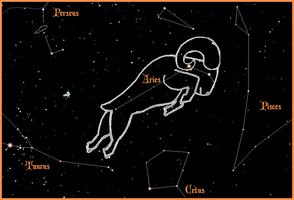
A ram is a leader of sheep.

As such, reading how spring is “the time when kings go out to battle,” an innate desire to show dominance and power comes forth.  The newness drive brings a fresh drive to change into activity from dormancy.

This natural drive is where the rights of parentage come, in a world that depends on survival of the fittest. The winners of wars become the ones who then love with abandon, so the winner’s seed is not wasted. This is how the saying, “All is fair in love and war,” comes into being, as all are equally able to compete, but to the winners go the spoils.  Thus, this story of David’s lust for Bathsheba stems from this influence of nature.

From this statement of the time when battles are fought, we then read, “David remained at Jerusalem,” rather than go to battle. This is a sign of age setting in. While the year had turned to spring, David had turned to the downside of life. Long gone were the vigorous days of his youth, when he led the troops out and back in, evaded Saul and his soldiers, and when he danced wildly before the Ark of the Covenant.  David had already married six women and had children by them; and he may have had concubines, as was his right as king.  Those came when he took pleasure going out to do battle with the enemies of Israel.   However, now he stayed in Jerusalem, showing the thrill of being a young man was gone.
There are those who have tried to figure out how old David was when he became enthralled with Bathsheba; and while David’s age then is uncertain, it is assured that David was significantly older than she. Some have estimated that David had reached the midpoint of his forty-year reign, making him fifty years of age. However, I feel David was closer to sixty, beyond the ‘mid-life crisis’ period, and no longer interested in the accolades of battles won.  The the youth of Solomon (the second born between David and Bathsheba) when he became king (at age ten?) is the determining factor; so if David was fifty-eight when he impregnated Bathsheba, fifty-nine when that baby was born and died, then Solomon’s birth would have been when David was sixty years of age.

Seeing David as being closer to the end of his reign, rather than at the apex of his time of rule, we are then better able to see the contrast that comes when we are introduced to Uriah the Hittite, who was the husband of Bathsheba. One should be able to see his youthful exuberance as closely relating to young men fresh out of high school who joined the military and quickly discovered sex, marrying equally young women.  Uriah shows how he was filled with a love of God, country, and family – taught all the right things to serve, in the right order.  Uriah was why patriotic Americans say to veterans, “Thank you for your service.”

The name Uriah cannot be overlooked, as it means, “Flame of Yahweh” or “Light of Yahweh.” When David called for Uriah to come from the field of battle to Jerusalem, where he was wined and dined by the king, David was in essence confronting himself in Uriah. That young Israelite man reflected the dedication and devotion to “the Ark of Israel and Judah” that David once had. While David was living with the Philistines in Gath and Ziklag (the symbolism of Uriah being identified as a Hittite), his wife Michal had been given by Saul to another man. Uriah was like David was, as both were too young and too poor to afford the dowry required to marry; but both could afford wives through their dedication to their military service.  Thus, Uriah was that light of the past shining before an aging David. Uriah represented the eternal flame of devotion to the LORD. David had let that fire dwindle down to embers.

The name Bathsheba means “Daughter of Seven” or “Daughter of an Oath,” depending on the vowel sound inserted (sheba or shaba). As the representation of a daughter of seven, where seven reflects the day the Lord made holy, Bathsheba was holiness. She would become David’s seventh known wife and eventually give birth to David’s successor, Solomon.  Still, as the representation of a daughter of an oath, Bathsheba was dedicated at birth to serve the One God. When called to serve her king, who was anointed by God, she was not displaying youthful promiscuity, but devotion as a servant.

When Bathsheba is identified as the daughter of Eliam, whose name means, “God of the People” or “God is Kinsman,” Bathsheba then reflects Israel, to which David was king. As such, David did not simply happen to see Bathsheba naked, as she ritually bathed to cleanse herself, as God sent Bathsheba to David “in the spring of the year” for a divine purpose.  David needed to be tested by God and that test was presented in Bathsheba.

And a father of twins!

That purpose would bring forth the next heir to the throne of Israel, as God knew the sons of David by other wives were wayward and unworthy of His blessing. When we read, “The woman conceived; and she sent and told David, “I am pregnant,” we know by that news that more than a month had passed since that one sexual encounter. One should not assume an adulterous relationship developed between a young Israelite woman and King David, as only one encounter is stated.  When we read that Bathsheba sent word to David to inform him of the pregnancy, that says she did not tell David while in his embrace.

When David received that information, his immediate reaction was to make it seem that Uriah, the husband, was the father of the child that was expected. Before Bathsheba began to show evidence of her pregnancy, David tried to make it possible for Uriah to be the father of Bathsheba’s illegitimate child, by bringing Uriah home, away from battle.  Once home, he would be reunited with his wife. That plan shows David did not seek to take Bathsheba from her rightful husband, meaning David felt guilt for his actions.  It was only after Uriah would not go to his home, which made his having sex with Bathsheba an impossibility, that David gave orders to let Uriah be killed in action. With that death, David could ‘make Bathsheba an honest woman’ by marrying her as a widow.

This story becoming an example of how the best laid plans of mice and men often go awry then shows how an emotionally stimulated sin goes from bad to worse, when one begins adding lies to the mix.  Once David knew Bathsheba was the wife of Uriah the Hittite, he should have walked away from his covetous thoughts.  He should have realized he was  forcing Bathsheba to commit adultery when she was escorted to David’s house.  David should have admitted his sin to Uriah and offered his servant the opportunity to decide the outcome of the pregnancy.  Had David done all that, David would have proved his heart still was on fire for the LORD; but David did as the story says because David needed that fire stoked by David coming to know sin for the first time.

As for Uriah, one needs to see him as a template for the sacrificial lamb, whose blood saved the Israelites from the angel of death in Egypt. When Uriah was let out of the king’s house and told to go home, Uriah slept at the king’s doorway, like a lost sheep. When Uriah would not make David’s trickery work, he even gladly carried his own death sentence to Joab, like a lamb being led to its slaughter. Uriah then was a flame of Yahweh that would also be present in Jesus centuries later; but Uriah was the flame of innocence.

While not read, this episode in David’s life would be condemned by God, told to David by the prophet Nathan (2 Samuel 12). Nathan would even use a parable of a poor man who only had a ewe lamb as his worldly possession, which was taken by a rich man with many sheep, who then ordered the ewe lamb killed to serve as food for the rich man’s guest.  David was aghast at the audacity of such a thief, leading Nathan to proclaim, “You are that man!”

We read beyond this story that David would be forgiven by God, but David would still face the death of his love child with Bathsheba. That baby would die on its seventh day of life, giving insight into Bathsheba being the Daughter of Seven. That firstborn child would be the ewe lamb taken and sacrificed so that David’s soul would not die for his sins of coveting, adultery, and murder (by the sword of his enemy).

As the selected Old Testament reading for the tenth Sunday after Pentecost, when one’s personal ministry for the LORD should be underway, the lesson that should be gained from this story about David, Bathsheba, and Uriah the Hittite is one of responsibility. We are all human beings born into a world that has natural cycles and inherent drives, some of which overcome us like an ocean wave crashing down upon driftwood. At times, we fail to see the errors of our ways (as did David). At times, we submit to the will of others out of a sense of obligation (as did Bathsheba). At times we sacrifice for the higher good, even though we do not know what sacrifice entails (as did Uriah). Still, at all times it is our souls that are the buoyancy that brings us back to the surface, so we can be reoriented to our service to God.

The physical plane is not heaven.  It can be as volatile as it can be peaceful.  Sin is at home in the material world.  David represents a child of God that has never known sin; and like God’s Son Adam, knowing sin was necessary to help others.  To find one’s way back to God, one needs to know the pleasures of the worldly environment are a test that block that return.  Only with God’s help can one’s soul return to God, and only by knowing sin can one seek that divine assistance.

A minister to the LORD thus knows sin personally.  It is the power of personal knowledge that is the strong foundation of faith.  More than believing sin is dangerously addictive, because one read a warning pamphlet about drug use, or one telling of sexually transmitted diseases, or one telling how all work and no play makes Jack a dull, but rich boy cannot convey the power of actually being trapped in an addictive spiral.  In the same way that knowing sin leads one to find faith in God, the true power of faith comes from personally experiencing God’s presence … not reading about it in books.

One should never be so bold as to think one is anointed by God, as was David, so one feels empowered to guide human laws and societal standards to meet personal ideas and visions or right and wrong. The laws of the land are always due to the will of the land’s rulers, regardless of how many or how few those rulers are. A minister needs to be reminded how the legislative struggles of government are like “the spring of the year, the time when kings go out to battle.” Youthful exuberance leads the righteous to seek out evil and slay it in the name of God.

While there is a time for the good fight, the success of those fights require the ark of God be within those doing battle. Still, there comes a time when the constancy of war gets old and tiresome.  The thrill of beating one’s chest after another victory is no longer satisfying.  After all, sin lives freely in this world; so, there comes a time when one decides not to join a war to save the world as before.  Defeating sin becomes a tiresome burden to bear, which makes leading others away from sin, based on experience, the better way to proceed.

Sometimes it is time to set the status quo aside and let God lead one to a test. Adam and wife were tested in Eden, when God knew the result would be failure (a sin). Job was tested when he did nothing wrong; but God allowed Job to suffer miserably, because Satan wanted Job’s faith pushed to the max. David was tested because the flame of Yahweh had been reduced to a pilot light. David, like Adam and wife, knew only the experience of serving God, before they came to know sin.  God has His ways of shaking things up within His faithful, just to renew the convictions that were what once proved faith. Sins can then be wake-up calls that are necessary for one’s soul.

It is a test to read the words of this optional lesson and see David cast into the light as a sinner of the greatest magnitude and not think that God has a separate set of rules for His favorite human beings. That is not the case, according to Scripture. David was punished for his sins, which he freely admitted he deserved punishment for; but the punishment David received was like Job’s, in the sense that David’s punishment caused harm to others, more than David. That suffering led David to know deep and lingering pains that could never disappear. Throughout the rest of David’s life, God stayed by his side, although David had a completely different perspective about how the other half lived.

This is the responsibility of ministry. Apostles and Saints have to freely admit all of their individual sins committed; and, they have to accept punishment for those sins in this lifetime, in order to free their souls for eternal life. Still, there are no bonus points for doing that publicly, as the whole of Israel would have been in danger of collapse (as a priestly nation), had David told everyone he was stepping down as king and sentencing himself to prison for breaking the Laws set by God. More innocent people would have been hurt had that happened. Therefore, David privately repented, earnestly prayed for others, and continued to stand strong for the children of God, all while watching his own family crumble under the pressures of God’s punishments.

This means the message carried by ministers to the LORD steers away from lament and tears of what woulda, coulda, shoulda. Life is filled with ups and down, in and outs, and highs and lows. Keeping one’s eyes on the prize – the sin free soul’s release to heaven – means to be the optimist to others, knowing that with God’s help anything is possible. Therefore, the message shown in King David’s greatest sins is to fight through it by seeing the positive of growth and a learning experience, rather than lose faith and turn away from God. When one is committed to serve God wholly, then there is no time to wallow in self-misery. That does nobody any good.

2 Kings 4:42-44 – A miracle of the first fruit

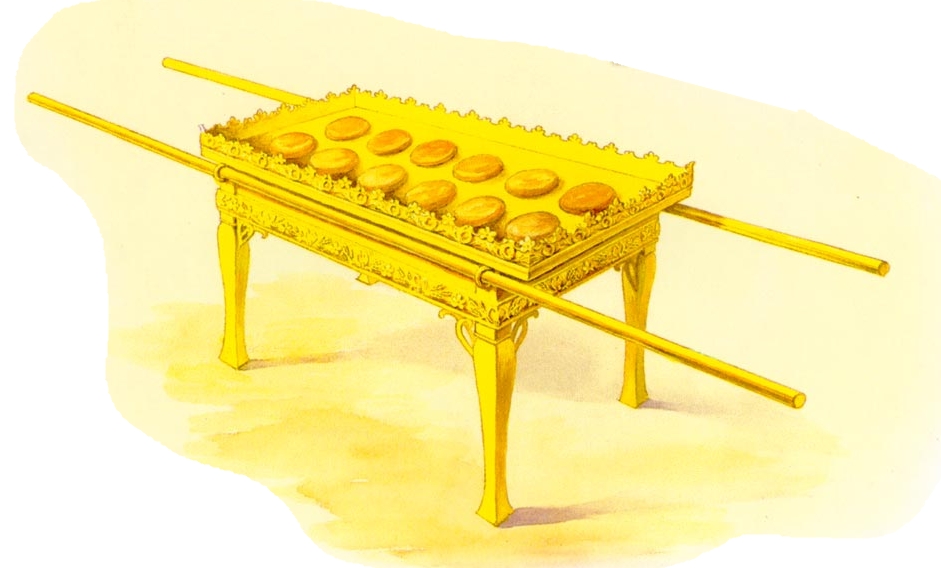
A man came from Baal-shalishah, bringing food from the first fruits to the man of God: twenty loaves of barley and fresh ears of grain in his sack. Elisha said, “Give it to the people and let them eat.” But his servant said, “How can I set this before a hundred people?” So he repeated, “Give it to the people and let them eat, for thus says the Lord, ‘They shall eat and have some left.’” He set it before them, they ate, and had some left, according to the word of the Lord.

——————————————————————————–

This is an optional Old Testament selection from the Episcopal Lectionary for the Tenth Sunday after Pentecost, Year B 2018. In the numbering system that lists each Sunday in an ordinal fashion, this Sunday is referred to as Proper 12. It will next be read aloud in an Episcopal church by a reader on Sunday July 29, 2018. It is important because it acts as a prophecy of Jesus feeding the multitudes, while being metaphor for the Word of God.

In this short reading, one who is not Jewish or a student of Scripture will not understand that “the first fruits to the man of God” is a yearly ritual. It stems from Moses telling the Israelites that God would feed them with manna – the bread from heaven. Here are some verses from the Book of Exodus that relate to this ritual:

Exodus 16:18 – “And when they measured it by the omer, the one who gathered much did not have too much, and the one who gathered little did not have too little. Everyone had gathered just as much as they needed.”

Exodus 16:22 – “On the sixth day, they gathered twice as much—two omers for each person—and the leaders of the community came and reported this to Moses.

Exodus 16:33 – “So Moses said to Aaron, “Take a jar and put an omer of manna in it. Then place it before the Lord to be kept for the generations to come.”

Exodus 16:36 – “(An omer is one-tenth of an ephah.) An “ephah” = “an ancient Hebrew dry measure equivalent to a bushel (35 liters).”

This means the “man from Baal-shalishah bringing … twenty loaves of barley and fresh ears of grain in his sack,” where the Hebrew word “le·ḥem” is translated as “loaves,” but could equally mean “twenty bundles of barley flour” (from which bread is made).  Seeing the contents of the man’s “sack” (where “bə·ṣiq·lō·nōw” can mean “in the husk,” with “sack” an uncertain translation) as being little more than the basic delivery of a bushel of barley and wheat grains, which was enough flour to 20 loaves of bread.  A bushel (or ephah) means the man brought about 35,000 grams of unmilled barley and wheat, which was then an omer in dry measure.

In the ritual that was lost and then recreated in captivity, the delivery of the omer of first fruits was placed in the Temple of Jerusalem, put under the care of a high priest. It has been noted by those of Jewish scholastic minds that Elisha was a prophet of Israel (the Northern Kingdom) and not a high priest of the temple in Gilgal (the equivalent of Jerusalem in Judah). As such, those scholars argue that delivery of first fruits to the prophet Elisha was improper.

It should also be realized that during this time, in the region surrounding Gilgal, there was a famine.  When we read the man question, “How can I set this before a hundred people?” the “hundred people” are the priests of the temple and not ordinary citizens.  This leads scholars to believe that the man coming from Baal-shalishah [1] brought an omer of first fruits to the company of prophets in Israel, who were led by Elisha.  The scholars believe the man would not have delivered his sack to prophets in Gilgal, instead of to the temple and the high priest there.

This confusion can be eliminated by seeing how proper ritual was observed and the first fruits were taken to the temple, as was commanded.  Then after fifty days of having being placed before God, then the blessed flours, dried fruits and grains were to be consumed by the people of Israel.  This means a man was sent with a share for the company of prophets (100), as an emissary of the temple in Gilgal.

This would explain Elisha saying, “Give it to the people and let them eat,” because that was the ritual and the recognition of Shavuot (known by Christians as Pentecost) – held yearly on 6 Sivan. That represents the fiftieth day after the Israelites were freed from Egypt (the day after the Passover – Pesach), when Moses came down with the tablets (the count beginning 16 Nissan). As seen in Exodus 16:33, this practice was to be continued in ritual, which would have the gathered early harvest placed before the Lord in the temple.

Exodus 16:18 says each family of Israelites were allotted an omer of manna (collected by the father), with some questioning if this meant one omer per family tent, or multiple omers that matched the number of people living in the tent. Exodus 16:22 says twice that number was allowed on the sixth day, which could be baked or boiled and left overnight for the Shabbat, without spoiling.

One can assume that each family then began to gather one omer of their first fruits of the fields in the Promised Land, taking that to the temple priest. As long as it sat before God, who resided between the cherubim of the Ark, then it was blessed and would not spoil.  Therefore, many omers of grain would be ritually held in the temple until it was fed to the people in the Festival of Weeks (Shavuot), as blessed food for the Sabbath (spiritual food).

We then read that the servant of Elisha asked, “How can I set (twenty loaves of barley and fresh ears of grain) before a hundred people?” Elisha said, “Give it to the people and let them eat, for thus says the Lord, ‘They shall eat and have some left.’”

You might want to consider self-serve and multiple tables.

This was not a direct quote from God in Exodus; but, as a prophet, God might have told Elisha to quote Him then. Still, it could well be a paraphrase of God telling Moses to tell the Israelites to collect twice the manna on Friday, for food on the Sabbath as well (manna did not fall on Saturdays).  That might be a sign that the man delivered the food (during a famine) on a Friday, implying there would be food left for the Day of Rest.

Regardless of the reality that had to have surrounded the telling of this event, when we read, “He set it before them, they ate, and had some left, according to the word of the Lord,” a miracle occurred. It is the miracle of manna – that any other day of the week, if left overnight for the next day, would be filled with maggots and stink – that is relative to the miracle of little food becoming plentiful food during a famine. Certainly, this miracle of Elisha and the first fruits is then prophetic of Jesus feeding the five thousand, such that the words of the Lord, spoken by Elisha resonated in the words spoken by Jesus.

This connection to Jesus feeding the five thousand is than why this reading is optional for this Sunday, because the Gospel reading is John’s version of that miracle (all four Gospels share perspectives on this miracle of Jesus). In my interpretation of the Gospel reading from Mark 6, for the ninth Sunday after Pentecost, I made a point of showing how that selection skipped over this miracle, focusing only on the gathering of the lost flocks of Israel that sought out Jesus.  In my writing, I mentioned how the twelves baskets filled with leftovers was more than physical bread and meat left on fish bones that the disciples gathered. This is because the bread of the first fruits, like manna and like five loaves and two fish, is spiritually sustaining.

This means the reading about Elisha points to the root meaning of manna being the bread from heaven, which is spiritual food.  Manna met physical needs, but its presence went above and beyond the limitations of physical food. According to Judaic scholars, Gentiles could never get a firm grasp on manna, even though they saw it (which assumes the Israelites passed travelers while wandering). Supposedly, it would slip out of their hands.  That indicates that manna was only sent by God for his chosen people.

The scholars of the Torah also say that the manna fell closer to the tents of the true believers who followed Moses, while those filled with more doubts had to walk a distance to gather their omers of manna. That says the first fruits are not all capable of miraculous results.  It depends on who is passing them out and what the circumstances are.

Some scholars also say that some Israelites worked hard to gather the manna for their families, while others lazily lay on the ground and caught the manna as if slowly drifted to earth. This says that those who are working to get fulfillment from spiritual food can feel a sense of self-achievement when their work is done.  Still, those who let God bring the spiritual food to them, without trying to give self free reign, can be seen as following the axiom: Work smarter, not harder.

All of this scholastic insight then becomes symbolic of the bread of heaven being the more than physical food.  The manna was the compliment to the waters that came from the rock that was struck by the staff of Moses.  More than keeping the Israelites alive as mortals, their souls were being raised by the Word of God (later to be put in writing by Moses) and the Holy Spirit of living waters.  The first fruits, those blessed by God’s presence, then become symbolic of the people who serve God, like Elisha and his company of prophets.

This symbolism can be summed up by the proverb, “Give a man a fish and you feed him for a day. Teach a man to fish and you feed him for a lifetime.”

A medieval Sephardic Jewish philosopher who became one of the most prolific and influential Torah scholars of the Middle Ages. (Wikipedia)

God gave Moses the Law, but merely memorizing those words have less effect of good, than living a life by those rules. The fiftieth day (Pentecost in Greek; Shavuot in Hebrew) represents the feast of celebrating the Law and the Covenant with God being available to the Israelites. The six days of gathering a daily amount of food, where collecting more than one day’s worth was fruitless, was transformed when the days changed from physical to spiritual – from weekdays to the holy day. That is when the daily food becomes able to feed for a lifetime. Therefore, the symbolism of Elisha’s faith, and that of Jesus, was the Word of God feeding the devoted so that they produced manna within themselves, which was then left for the future.

The ritual of land owners taking the first fruits of their harvests and placing those harvests in the temple for God’s blessing, so they would be released back to the people after fifty days, was to recreate the blessing that was manna from heaven. The days of working to gather daily bread was then celebrated by the presence of God’s Law and one’s excited agreement to serve God faithfully for the rest of one’s life. The physical limitations that befell a ritual act of remembrance – when the high priests had sons that were priests in name only; when the tabernacle replaced by a brick and mortar temple; and when the Ark of the Covenant became the lost Holy Grail – the past then reflected the return of weekdays.

The loss of the time when God’s priests lived lives that reflected the day God blessed and deemed holy … when they were the first fruits God said, “Give them to the people and let them consume” … then that was how little the ritual of Passover and the Counting of the Omer until Pentecost (Shavuot) meant in the times of Elisha and in the times of Jesus. Other than the holy ones – “the men of God” – everyone else had reverted to living day-to-day, memorizing rules, seeing no meaning to Scripture easily within one’s grasp, while searching far and wide to find any meaning only led to too much confusion to put solid faith into.  Elisha and Jesus both found people incapable of living up to the writings they said their ancestors had agreed to forever live by.

The miracle is not that Elisha had faith, as he knew what God had said. Likewise, the miracle was not that Jesus had faith that five loaves and two fish could feed a multitude. The miracles were that one hundred prophets saw the true meaning of the first fruits. The five thousand had their hearts opened, more than their stomachs, so they became the first fruits that would be sent to the Temple in Jerusalem for the Passover that was nearing. The miracle of both stories is the birth of faith, as the normal had transformed into the holy. Friday had changed into the Sabbath, for a lifetime to come; and that transformation came with plenty of food for spiritual thought left to be shared.

The first fruits of thought all begin with the tiniest of seeds, which then grows mightily.

As an optional Old Testament selection for the tenth Sunday after Pentecost, when one’s personal ministry should be underway, the lesson is to go beyond the limitations of physical needs (as a stomach’s desire for food reflects) and let God into one’s heart for the soul’s eternal blessing. The lesson says to listen to God’s Word and then proclaim it with faith and confidence. The lesson is to be one of the one hundred who received the Word from Elisha and then give that Word so others could be filled.

The first fruits symbolize both the work involved in the gathering of the fruits of one’s labors and the blessing of that harvest by God. That becomes the promise of plenty in a time of famine, where work today will have miraculous rewards later. A minister of the LORD looks beyond the limitations of the present, simply by letting God fill one’s heart. One becomes the first fruits that will feed the famished who are in need and deserving their share.

In today’s world, where so many are struggling to get from one day to the next, a minister to the LORD offers living waters and spiritual food to nourish those seeking more than the simple Word offers. A minister becomes the servant who set the twenty loaves of barley and fresh ears of grain before the hundred, so they could eat blessed food – manna from heaven. How much of that spiritual food is left afterwards then depends on those who are gathering the manna for the members of their family tent.

[1] Nobody is certain what Baal-shalishah means, but many jump to the conclusion that it means a place in either Israel or Palestine, with those admittedly guesses.  The etymology of the Hebrew says the “name” listed means “Lord” or “Master” (“Ba’al”) of “three” (“shalosh”). This means the element of a Trinity is in play, such that “the man” was “from” the “Master of the third” phase, concerning the ritual of the first fruits.  This means Elisha met a man sent from the Master of First Fruits dispersion, whose title meant he oversaw who received the gathered and blessed by God (first and second steps of the first fruits) on Shavuot – when Father, Son, and Holy Spirit were joined collectively and individually as one.

Ephesians 3:14-21 – Praying to be like Paul’s Ephesians

I bow my knees before the Father, from whom every family in heaven and on earth takes its name. I pray that, according to the riches of his glory, he may grant that you may be strengthened in your inner being with power through his Spirit, and that Christ may dwell in your hearts through faith, as you are being rooted and grounded in love. I pray that you may have the power to comprehend, with all the saints, what is the breadth and length and height and depth, and to know the love of Christ that surpasses knowledge, so that you may be filled with all the fullness of God.

Now to him who by the power at work within us is able to accomplish abundantly far more than all we can ask or imagine, to him be glory in the church and in Christ Jesus to all generations, forever and ever. Amen.

——————————————————————————–

This is the Epistle selection from the Episcopal Lectionary for the Tenth Sunday after Pentecost, Year B 2018. In the numbering system that lists each Sunday in an ordinal fashion, this Sunday is referred to as Proper 12. It will next be read aloud in an Episcopal church by a reader on Sunday July 29, 2018. It is important because Paul prays that the “church” (“ekklēsia”) will be an assembly of Apostles reborn as Jesus Christ, based on each possessing the character traits that he stated in this part of his letter.

I have to ask this question first: If, sitting on a church pew, you heard read aloud, “I bow my knees before the Father, from whom every family in heaven and on earth takes its name,” then what would you think that meant to you?

Certainly, everyone sitting in a church on Sunday is a member of a “family on earth,” but what about Muslims kneeling on a mat in a mosque elsewhere? One would assume they too are of “every family on earth,” as well as Indians lighting candles in Hindu shrines. Even the members of the Communist Parties in Russia and China, who reject the concept of “the Father” as God (and all other gods and religions), instead indoctrinating their children to see the State as god, are they not part of “every family on earth”?

Consider that a rhetorical question, as the answer is obvious; even though the ideal is to make all human being believe in God the Father of Jesus Christ, the reality is otherwise. Only Christians – those in the purest sense – are the ones of whom Paul wrote, because the key words in that statement by Paul are “takes its name.” Actually, there is only one Greek word, “onomazetai,” which translates as “is named” or “calls upon the name.” That name is then relative to “the Father,” but not the name of God, Yahweh, or any other name God is recognized by (in Hebrew, Greek, or English, et al).

The name “from whom every family in heaven and on earth takes its name” is Jesus Christ.  It is that name from which only Christians can claim; and that is because only true Christians are reborn as Jesus Christ.  It is that change of name (from Billy or Sue) that  qualifies them to go to heaven (sin-free), unlike the rest of the people in the world. That name then denotes a special “family, lineage, ancestry, and/or tribe” (from “patria”) that comes from being related to the same Father above.

This answer becomes clear when one realizes that the reading selection, as presented by the Episcopal Lectionary for the readers to read aloud, omits an aside penned by Paul.  It is the last half of verse 14 (the first verse in this reading), which could be seen as verse 14b.  There, stated within marks of parenthesis, Paul wrote, “tou kryiou hēmōn Iēsou christou”. That qualifying and amplifying phrase says, “the [one] master of our Jesus anointed one.”  The implication of that says, “the Lord of our Jesus Christ,” with capitalization applied that was not written.

If that phrase, separated as an insertion of commonly known fact that is a digression from the theme of that stated (definition of parentheses usage), it acts like an aside whisper.  It then adds the obvious to the reading, such that there is no confusion as to Paul’s focus.  When included in the public reading, one hears read aloud: “I bow my knees before the Father, the one master of our Jesus anointed one, from whom every family in heaven and on earth takes its name.”  With that included, no one would venture beyond an understanding that Jesus Christ is the name of the heavenly family on earth.

With that understood, one then has to remove the thought of Paul uttering a written prayer for the Ephesians. The separation of a fact that states the plural of “our” (“hēmōn”), where that plural is rooted in the singular word “egó ,” meaning the self, must mean it was understood by Paul that he and the Christians of Ephesus were likewise individually under the mastery of the Father, reborn as Jesus in name.  All of them were already equally distinguished as the anointed ones of God, as His Sons; so, there was no need for Paul to pray for that transformation.  Therefore, stating the obvious would be digressing from the discourse of all having already been formed as a family of God, in the name of Jesus Christ; ergo the parentheses.

Because Paul wrote, “I bow my knees before the Father,” he created the image in a modern Christian’s mind of a stance of prayer. That leads to the translation that states, “I pray that,” but Paul did not write those words.  He did not indicate in any way that a prayer was unfolding. While he ended this chapter with the word, “Amēn,” that is a statement that says, “So let it be” (as the truth having been said), it is the modern brain that associates that word as the indication that a prayer has just ended.  However, rather than getting on his knees to pray for the Ephesians (who were already in the name of Jesus Christ), Paul was stating the obvious, that all in the name of Jesus bow before the Father as a servant of God (as were the Ephesian Christians), in thanks for having been made a holy family member, as brothers of Jesus of Nazareth, sharing in his presence within one’s soul.

This means all the truth that is then told by Paul (his use of “Amen”) is not a wish for things to come, but a statement of the character traits possessed by all who were then (as always) in the name of Jesus Christ. Those character traits are then blurred by the evaporation of punctuation guidance and the reduction of holy text into English paraphrases.

Maybe he was paraphrasing in a lost tribal language?

This again calls for a segment of an Epistle to be broken down into the literal, word-for-word translations of the Greek text, so each separate segment of words can be seen for their full impact of meaning.

Simply for one to follow along with the reading as presented above, the English paraphrase should be matched to the Interlinear segments stating the truth. I will mark the paraphrase with quotation marks. The Greek text will then follow, denoted by bold text. After one is able to seek the differences stand out, I will then present a simple interpretation of the characteristics Paul stated already existed, both in himself and the Ephesians to whom he wrote.

“I pray that, according to the riches of his glory, he may grant that”  –  that he might give you according to the riches of the glory of him  ,  :  The Greek word “” is presented in the third person conditional, as “he might give, may offer, could put, or might place.”  That reflects upon the plural form of “I or self” stated prior (“hēmōn” as “our). This means “he” is the presence of the Spirit of Jesus Christ in an Apostle-Saint.

This is not conditional as to a prayer being answered, but the condition of the talents of the one accepted by the Father as the resurrection of His Son. Paul wrote of those offering being the “gifts of the Holy Spirit,” of which all Apostle-Saints have minimally one, with some having multiple holy gifts. All come “according to the riches of the glory of Jesus Christ,” as all those gifts of God were held by Jesus of Nazareth.

“you may be strengthened in your inner being with power through his Spirit,”  –  to be strengthened by the Spirit of him  ,  in the inner man  ;  : The paraphrase translation continues the conditional voice here incorrectly, as the comma’s separation follows with the Greek word “krataiōthēnai,” which states the infinitive form of the verb “krataioó,” meaning “to be strengthened, confirmed, passed, or made strong.” This is an assurance that all talents that might come are “to be,” as an elevation of powers that come from “the Spirit of Jesus Christ.” This is not to manifest as visible evidence that one has become Jesus Christ, for others to marvel over, as the strength of Jesus Christ reborn means the presence of his Holy Spirit having cleansed one’s soul of sins. This means the soul is “the inner man” (where “man” or “anthrōpon” means “one of the human race”).

“and that Christ may dwell in your hearts through faith, as you are” – to dwell the [one] Christ  ,  through the faith  ,  in the hearts of you  ,  : Again, it is an error to translate the conditional, as the Greek word “katoikēsai” is the infinitive form of the verb “katoikeó,” means “to dwell, to settle in, to establish in (permanently), and to inhabit,” such that the Christ Spirit takes up permanent residence within one’s soul. The presence comes when one “bows the knees before the Father” and the self then projects that the soul has submitted to sacrifice, to be the anointed one [Christ] named Jesus.

This presence of “the Christ” is then separately stated as the true meaning of “faith,” which is well beyond a mental concept that is called “belief.”  The personal experience of “the Christ” within, means one has gone far beyond “belief” [like that held by children in Santa Claus] and come to know the truth that guides one’s life. Whereas belief is centered in one’s brain, where doubts can erode belief [such as finding presents hidden under a bed or in a closet], such as previously unknown facts challenge what one has been taught to believe, faith is centered in one’s heart.

The Greek word “kardiais” means more than a physical organ of the body, as it implies “mind, character, inner self, will, intention, and center.” This is a love of God, as seen in the bending of one’s knees, where one’s self has submitted to serve God through marriage, where the soul and God become one, while together in a living human body. That union brings about the knowledge of God, which is the Christ Mind. Therefore, faith is not brain-centered, but this centering of God in you, as you (as self) have been reborn as the Son of God (both human genders).

“being rooted and grounded in love.”  –  in love being rooted and being founded  ,  : In the two Greek word written, “errizōmenoi” and “tethemeliōmenoi,” the perfect past participle form is stated in both words, first as “being rooted, being planted, being fixed firmly, and being established” and second as “being founded, grounded, firmly established, and laid with the foundation.” The word for “love” (Greek “agapē”) then relates one’s marriage to God, such that His love has made one “become rooted and become grounded” in His “benevolence, good will, and esteem.”

When one’s being has been affixed to this eternal source of love, then it is that giving of one’s self, as an act of love for God in return, that reciprocal heart-felt desire keeps one’s loving eyes always on God, while God’s love becomes the motivation of one’s actions. This is then a natural state that comes from the heart and not the brain, so one does not go about calculating how to show the love of God to others. One simply acts as God commands, due to one’s love for God.

“I pray that you may have the power to comprehend, with all the saints,”  –  that you may be fully able to comprehend with all the saints  ,  : The Greek conjunction “hina,” as “that, in order that, or so that,” is a direct reflection back on that just stated, which in this case is the presence of God being what roots and founds one in love. That state of love allows one the fullness of a condition of ability “to understand.”

The Greek word “katalabesthai” then states the present state brought on as the full ability “to seize tight hold of, arrest, catch, capture, appropriate” that which brings one the knowledge of God, in heightened abilities of “perception and comprehension.” Again, this is the state of love that each and every Apostle-Saint can expect, so one is not desirous of knowledge that one does not naturally possess – such as wishing to have the smarts of “the Saints” – because one is “with all the saints,” as one made “holy, sacred, and set apart by (or for) God” – the meaning of the Greek word “hagiois.”

The reason the conditional form is used (“exischysēte” says, “you might be fully able, or you may have strength (for a difficult task)” is that this ability to understand, coming from the Christ Mind, is conditional on need. One who is “with all the saints” does not go about telling people, “I know this or I know that.” It is conditional of one seeking to know, who encounters an Apostle-Saint.  Such a meeting is divinely led, such that a need to speak from the Mind of God enables an Apostle-Saint to do so.

Also note that in this segment of Greek text, nothing was stated that says Paul “prayed” for the Ephesians.  The inclusion of the words “I pray” is an erroneous addition of paraphrase.

“what is the breadth and length and height and depth,”  –  what [is] the breadth  ,  and length  ,  and height  ,  and depth  , : This is defining the scope of a saint’s knowledge, where the Word of God that is Scripture expands what is written in all directions. The “breadth” then applies to all possible meanings of each word written (in this letter and in all Scripture), so questions will naturally arise when one limits one’s understanding to a narrow field of view.

The “length” is especially seen here and in all of Paul’s letters, as normal humans have trained brains that regulate the attention span of statements in written text to brevity and in direct focus. This is how the “length” of Paul’s ‘sentences’ become regularly shortened through paraphrase, even though this normal view of sentence structure misses how sentences of thought can be made through individual words and short segments of words.

The “height” is then the understanding the source of the Word as above the brain capacity of mere mortals, as all Holy Scripture comes from the Mind of God, through Saints. It is an error to reason to think that Paul was using his own brain to write his epistles. Every word of every book in the Holy Bible (original text and language) comes from the Mind of God.

How to build a baptismal pool?

Finally, the “depth” is relating the source of meaning found in words as being multi-faceted, such that multiple meanings can be the intent and purpose of a set of fixed words.  That meaning is then based on the conditions of need, such that one verse of Scripture can be helpful to one meaning one thing, but then appear most helpful in a totally new way later, based on changing conditions in one’s life.  The word’s use here also states the “depth” of one’s soul, where the Holy Spirit means the mundane of past history has equal application at all times, in all places, relative to all people.  This means the depth of Paul’s words in the mid first century carries as if his letter were written to all true Christians today.

“and to know the love of Christ that surpasses knowledge,”  –  to know moreover experiences  ,  surpassing other knowledge  ,  love of the [one] Christ  ,  : This says a complete scope of knowledge is the understanding of Saints. The Greek article “tēn,” which is the neuter form of “the,” but due to the presence of a comma after this word, it then acts as “the cause or interests, the purposes, of God,” such as “what the possessed had done and experienced” (Thayer’s Greek Lexicon for Strong’s NT 3588). According to “the breadth and length and height and depth,” the word “the” can be seen as going beyond a simple statement (“to know moreover (the)” and “know by experience,” through God. This elevates one’s ability “to know” to being with the Mind of Christ and “experiencing” the intent of the chosen word by being transported spiritually to see past events and grasp the reality surrounding past times.  To experience the past is to feel the power of that emotion in the present, by reliving what is written.

This is how the Holy Spirit allows a Saint to be “surpassing other knowledge,” where again we find a form of the article “the” stated (“tēs”). Instead of reading “surpassing (the) knowledge,” one can see how: “The article is prefixed to substantives expanded and more precisely defined by modifiers,” such that its use indicates “when adjectives are added to substantives, either the adjective is placed between the article and the substantive, as – other examples.” (Thayer’s Greek Lexicon for Strong’s NT 3588). Reading the article as a defining word, rather than omit its use because of the language differences between normal Greek and English, is going beyond the ordinary to the extraordinary. Standard knowledge is surpassed by extraordinary spiritual insight.

Finally comes the segment that again omits the article “the,” such that the translation says “love of Christ.” Here, the inclusion as “the (one) Christ” misses the individuality of only one Christ, which is Jesus Christ. In this segment, the Greek word “Christou” is capitalized, as the title that was bestowed only on one man. Previously, in the lower case spelling above, it is intuited that the name of the Father’s family was from Jesus Christ; but the name is actually only Jesus, such that the one who becomes Jesus reborn is thus the “anointed one” – Jesus “the Christ” resurrected.

Still, the addition here of “the (one)” makes it possible to see “the love of the (one),” who is then the servant in love with God, who in return has received the love of God, as “Christ” reborn. Each of these three segments then act to state the understanding that comes to all Saints, while making that point in words that have been neglected as coming from God – three forms of “the.”  Each use projects the divine intent and purpose (in all directions) of all words written in Scripture, which is missed by those not being in the name of Jesus Christ.

“so that you may be filled with all the fullness of God.”  –  that you might be filled unto all the fullness under God  .  : Again, the use of “that” reflects back to the “love of the (one),” which brings “the Christ”. It is because “you” have been “filled” with the Christ Mind for the condition of serving God as needed. This is available “unto all” Saints, but not for personal gain. It is a gift of God, to be wisdom dispensed “unto all” who seek that knowledge.

This receipt of the Christ Mind by Saints, for the purpose of imparting the gift of Spiritual wisdom unto those who God also wants as His brides, then becomes the “fullness, the full complement, the fulfillment, and the completion” of the Covenant that places one’s soul “under God.” Whereas the Israelites accepted the Law, through Moses, they could not reach the fulfillment of that agreement to serve the LORD their God, because their brains were used more than their hearts. When the Law is written on one’s heart by the finger of God, then one has made a full commitment to God, where the New Covenant then reflects the completion of one’s soul returning to God, as Jesus Christ.

Here, again, the word “under” is an expansion of the article “the,” as the Greek word “tou” is written. The NASB options for “” (neuter form of “the”) shows one use of this as “under,” in accepted translation.  This is such that when the article is accompanied with the noun “Theos” it is a word “spoken of the only and true God,” reflecting “under the word” of God.  That use identifies an Apostle-Saint as a subject to “the (one) God.”

Jeremiah knew happiness under the yoke of God.

“Now to him who by the power at work within us is able to accomplish abundantly far more than all we can ask or imagine,”  –  To the [one] moreover being able above all things to do exceedingly above that we ask or think  ,  according to the power the working in us  ;  : The capitalized Greek article “” is now reflecting upon the importance of “The (one)” who was just stated prior as “God” (“Theou”). This then is saying those who are individually “The (one)” filled with God’s presence are “Those” who are “being able” to do “all things” that are “moreover” impossible to people not so filled. The powers allowed to human beings by God as “above all things” possible to mere mortals. Coming from God, they are powers from “above.”

The deeds of the Holy Spirit, from God, sent to those reborn as His Son, are “exceedingly above” anything capable of being produced by a human brain and self-will. God’s Mind leads His faithful servants above and beyond what a Saint could ever “ask or think,” because a servant does not control the Master. The way a Saint “questions” and “ponders” is relative to the meaning of Scripture, and only for one’s own abilities to understand, so one can better serve others and their questions and thoughts. Still, all that comes from human thoughts and questions is relative to “the power” of the Christ Mind, and dependent on if that wisdom is “working in us.”

“to him be glory in the church and in Christ Jesus to all generations, forever and ever. Amen.”  –  to him [be] the glory in the church and in Christ Jesus  ,  to all the generations of the age of the ages  .  Amen  .  : When we read “to him be glory,” the Greek word “autō” means, “self, as used (in all persons, genders, numbers) to distinguish a person or thing from or contrast it with another, or to give him (it) emphatic prominence.” (Thayer’s Greek Lexicon for Strong’s NT 846). This means “him” is “the same” as the one filled by God’s love and the cleansing of soul by the Holy Spirit, bringing about the rebirth of Jesus Christ.  The pronoun “him” is then relative to “the Father,” “Jesus Christ” and “the (one) filled” by the Holy Spirit.

As such, it means “To the Trinity the glory,” where the Greek word “doxa” states, “honor, renown; glory, an especially divine quality, the unspoken manifestation of God, and splendor.” Thus, the Trinity is present in each individual who collectively become a multitude of Apostles and Saints.  Thus, “the assemblage and congregation” that is “the collective body” of true Christians is the true meaning of a “church.”

The addition (“kai” as “and”) that identifies a “church” (“ekklēsia”) is then furthering the concept of “church,” by adding that all are “in Christ,” such that all have become “Jesus” reborn. This was not a one-time deal, such that Apostles and Saints only existed long ago, but an eternal requisite for all times. It stretches from the first Apostle-Saint to “all the generations of the age.”  The appearance of organized ‘Churches’ (Roman Catholic, regional Orthodoxies, and all variations of organized Protesters) has nothing to do with eliminating the necessity that all members of the true church of Jesus Christ are the embodiments of holy Jesus resurrected, who act based on the experience of faith, confident in their assurance of eternal life.

The Greek word “geneas” is translated as “generations,” but the word intends one understand it meaning as “race and family.” This word brings this reading full circle, as it relates to “patria,” in verse 15.  A “church” is relative to the “family” that “takes its name” as “Jesus,” becoming themselves the “anointed ones.” While “age of the ages” is read as a fancy way of stating eternity, it is vital to know that an “age” (“aiōnos”) is “a cycle (of time)” or “a time span,” which can be determined (generally) through the “Axial precession (precession of the equinoxes).”

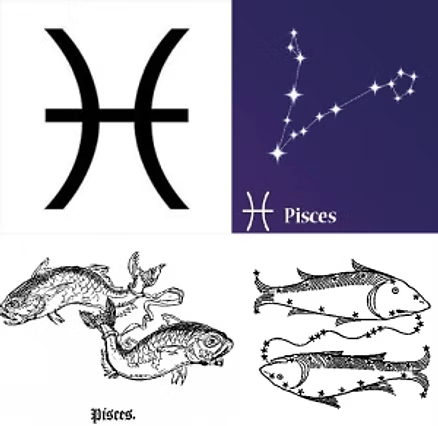
An “age” is then when a new sign of the zodiac appears aligned with the equator on the first day of spring (when the world is born anew). The astrological sign is recognized as perpetually being Aries, but due to the earth’s slow axial wobble, the current sign is Pisces (about 29 degrees away from 0-degree Aries) , heading to a change that has become commonly known as the Age of Aquarius. It is not a coincidence that Jesus of Nazareth ushered in the Age of Pisces, where the first sign of Christianity was the fish (<><).  As each “age” is roughly 2,100-2,200 years long, the “age of the ages” is now reaching it end, not to return for (roughly) another twenty-three thousand years. This reflects the end of that “age” of Jesus Christ, which increases the urgency for humanity to gain faith through submission to God now.

The eternal view of “age of the ages” must then be seen as one’s soul having been saved.  The age of Pisces is then related to the symbolic meanings of the astrological sign, where faith and self-sacrifice are important elements.  To find eternal reward, then one must make worldly sacrifices of body, so the Soul can be cleansed.  One must be willing to submit one’s being to God, so one can be reborn as the one who symbolized the age of the ages.  As Jesus told his disciples, expected to be persecuted in my name.

The word “Amen” then cannot be seen as Paul praying for things to occur, because things had already occurred and all subsequent changes were wholly the decisions of the seekers, then and now. Therefore, Paul wrote to the Ephesians a separate statement that reminded them: “So let it be.”  The “church” is when two or more meet in the name of Jesus, for in that assembly can be found Jesus Christ.

As an Epistle selection for the tenth Sunday after Pentecost, when one’s personal ministry to the LORD should be underway, the message here is one of the spirituality of family. A minister of the LORD is born of the Father, as a brother to Jesus of Nazareth, who is reborn in an Apostle-Saint as the resurrection of the anointed one – the Christ. This adoption into the Holy lineage, brought on by the Trinity, makes one part of the living vine of Christ, where one must become a living branch that produces good fruit.

Paul’s encounter with the Jews and Gentiles of Ephesus produced the good fruit of true Christians there. Paul did not pray for them to find Jesus after he left. Paul, like the Ephesians, were all walking, talking, and ministering resurrections of Jesus Christ. That made them all brothers (and some were female forms of the Son of God), thus an assembly on earth in the name of Jesus Christ, as a true Church. While Paul traveled the world where Jews (Israelites) had been scattered, accepting seeker Gentiles who sought the truth of good news, the Ephesians stayed put and deepened the faith of those in Ephesus. They raised their families to also become Apostles and Saints.

Today, Paul still travels with his message sent to the Christians of Ephesus, as his written words are still in search of true Christians who will be joyful with the breadth, length, height and width in the meaning they contain. A minister of the LORD should ensure that Paul’s intent is not overlooked or misunderstood. The truth is above all things expected and exceedingly above what one would ask or think. A minister of the LORD’s purpose is to stimulate deeper questions and higher thoughts, leading workhorses to living waters that they want to drink.

The signs of modern times are clearly warning that the religions of the world (including the philosophies of politics) are leading the people away from self-sacrifice for God (servants who tend to the living vine) and towards dangerous allegiances with leaders and cults (the Baal worship and golden calves). The age of the ages is slowly closing. A minister of the LORD knows this urgency, but lets the Christ Mind lead him or her to make the path to salvation be truly known.

So let it be.

John 6:1-21 – Feeding the assemblies spiritual food

Jesus went to the other side of the Sea of Galilee, also called the Sea of Tiberias. A large crowd kept following him, because they saw the signs that he was doing for the sick. Jesus went up the mountain and sat down there with his disciples. Now the Passover, the festival of the Jews, was near. When he looked up and saw a large crowd coming toward him, Jesus said to Philip, “Where are we to buy bread for these people to eat?” He said this to test him, for he himself knew what he was going to do. Philip answered him, “Six months’ wages would not buy enough bread for each of them to get a little.” One of his disciples, Andrew, Simon Peter’s brother, said to him, “There is a boy here who has five barley loaves and two fish. But what are they among so many people?” Jesus said, “Make the people sit down.” Now there was a great deal of grass in the place; so they sat down, about five thousand in all. Then Jesus took the loaves, and when he had given thanks, he distributed them to those who were seated; so also the fish, as much as they wanted. When they were satisfied, he told his disciples, “Gather up the fragments left over, so that nothing may be lost.” So they gathered them up, and from the fragments of the five barley loaves, left by those who had eaten, they filled twelve baskets. When the people saw the sign that he had done, they began to say, “This is indeed the prophet who is to come into the world.”

When Jesus realized that they were about to come and take him by force to make him king, he withdrew again to the mountain by himself.

When evening came, his disciples went down to the sea, got into a boat, and started across the sea to Capernaum. It was now dark, and Jesus had not yet come to them. The sea became rough because a strong wind was blowing. When they had rowed about three or four miles, they saw Jesus walking on the sea and coming near the boat, and they were terrified. But he said to them, “It is I; do not be afraid.” Then they wanted to take him into the boat, and immediately the boat reached the land toward which they were going.

——————————————————————————–

This is the Gospel selection from the Episcopal Lectionary for the Tenth Sunday after Pentecost, Year B 2018. In the numbering system that lists each Sunday in an ordinal fashion, this Sunday is referred to as Proper 12. It will next be read aloud in an Episcopal church by a priest on Sunday July 29, 2018. It is important because John gives a unique view of the miracles surrounding Jesus feeding the multitude and his walking on the sea.

It is important to know that the feeding of the five thousand is one of only ten events in Jesus’ life that are told by all four Gospel writers. (article) It is the only specific event of Jesus’ ministry all witnessed, prior to his entrance into Jerusalem for his final Passover Festival and the last two weeks of his life. Because each of the four Gospel writers reflect different personal views of the same event, based on relationships with Jesus (as educational teacher and blood relation), this four-sided view creates a solid three-dimensional realization of how this event actually occurred. As each Gospel view is the truth that is told, all differences must then be adjusted to fit the truth, without anything being discounted or changed.

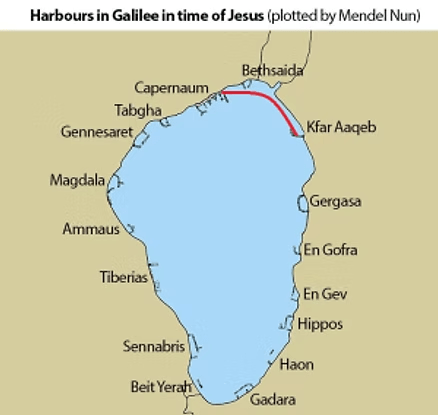
In John’s words we read “Jesus went up the mountain” and “he withdrew again to the mountain by himself.” In both places John wrote the Greek word “oros,” which translates as “mountain,” but also as “hill.” As John also stated, “Jesus went to the other side of the Sea of Galilee,” it is important to realize that the Sea of Galilee is “the lowest freshwater lake on Earth and the second-lowest lake in the world,” due to it being 686 feet below sea level. (Wikipedia) This means that the hills surrounding the bowl in which the sea is formed seem like mountains, when viewed from the sea shore. As all the towns of the Sea of Galilee are basically along the shoreline of the water, the mountains that Jesus went to are those overlooking all the activity of civilization.

This means that by John saying, “Jesus went up the mountain” in verse three, that “mountain” was not necessarily the same “hill” as he stated in verse fifteen. Since the entirety of the Sea of Galilee is overlooked by a rim of hills, going once and “again” to “the mountain” simply means to escape the hubbub of the places where humanity swarms.

Seeing that freedom of motion, John’s Gospel fits snugly into the puzzle that had Jesus go from Capernaum to Bethsaida, as told in Luke’s Gospel. It was then that “Jesus went up the mountain and sat down there with his disciples.” Jesus and his followers, including Mother Mary (the voice of Luke), sought solitude there first, before going to the deserted plain of Bethsaida. They changed locations because, “A large crowd kept following him, because they saw the signs that he was doing for the sick.” They followed him from Capernaum to the mountain above Bethsaida. The crowd was large because, “the Passover, the festival of the Jews, was near,” and new pilgrims were arriving all over Galilee and Judea every day, as the Passover Festival approached.

When we read, “When he looked up and saw a large crowd coming toward him,” this is best read literally, according to the Greek text. By seeing how Jesus, “Having lifted up then the eyes of the (one) Jesus,” the comma’s indication of pause tells of a separation in time having occurred, before reading “and having seen that a great crowd is coming to him.”  Those segments of words are telling of two phases of the same event.

First, “having lifted up” means Jesus was raised by the Holy Spirit, so his “eyes” were filled with the Christ Mind. That affirms how Mark wrote (as the voice of Simon-Peter) of Jesus arriving by boat to the dock at the Bethsaida Valley, seeing the lost sheep of Israel in need of a shepherd, so Jesus taught them in a “lifted up mind” way. Second, after having preached to the multitude, Jesus realized the crowd was receiving the Holy Spirit from his lessons. This was due to “having seen that a great crowd was coming to him,” as disciples whose hearts were welcoming the presence of the Holy Spirit within them.

Then John wrote of the following exchanges: “Jesus said to Philip, “Where are we to buy bread for these people to eat?” He said this to test him, for he himself knew what he was going to do. Philip answered him, “Six months’ wages would not buy enough bread for each of them to get a little.” One of his disciples, Andrew, Simon Peter’s brother, said to him, “There is a boy here who has five barley loaves and two fish. But what are they among so many people?”

John named the disciples Philip, Andrew, and Simon-Peter, which means John was present and close enough to hear these exchanges and see those disciples, but not once did Jesus turn and directly ask John the Gospel writer to do anything.  John did not once name himself in this narrative (such as, “then Jesus asked the one he loved”). Instead, John heard everything as “a boy who was holding onto five barley loaves and two fish.”  He wasn’t a vendor (certainly), so he had to be one of the picnic party.

This means John was “a boy” (actually “a little boy,” as “paidarion” implies). It means John was not a disciple, but a relative accompanying Jesus; and, it means John was carrying the lunch intended to feed those who went by boat to the docks on the plain, where the crowd ran to meet them. Importantly, it strongly implies that John was the son of Jesus of Nazareth, which explains why the voice of John is so different than the other Gospel writers, and why John wrote of personal and private parts of Jesus’ ministry no one else did.

After Jesus told the disciples to get all of the people in the crowd to sit down on the grass of the dry, fertile flood plain, he told that it was “Jesus” who “took the loaves, and when he had given thanks, he distributed them to those who were seated; so also the fish, as much as they wanted.” This says that Jesus personally gave the loaves and fish to five thousand men (said Luke, implying more in all, with any family they had with them not counted). Matthew, Mark, and Luke all say that Jesus gave the bread and the fish to the disciples, to then be handed out. However, this means one should grasp the truth in John’s account.

In the other three Gospels, Jesus had sent out the twelve in ministry, prior to this event. They had just returned to report back to Jesus all the things they had done, in teaching and healing. Upon their return, they heard the news of John the Baptist’s beheading. Jesus then took them to the mountain of Bethsaida to relax from their travels and mourn the passing of John. Young John the Gospel writer was not present to witness that assignment in ministry or the return from ministry or the knowledge of John the Baptist being killed. However, now with the whole gang by the sea, John saw the disciples acting in the name of Jesus, so they went forth in ministry as an extension of Jesus. They then taught the Jews of Galilee as Jesus.

The disciples healed the sick, in their commissioned travels, as Jesus. Thus, they then handed out loaves of barley bread and salted fish as Jesus.  In that way, John saw the truth of this miracle story, as the twelve disciples (whose names he knew) became Jesus before a young boy’s eyes, as they fed the five thousand.

This brings one to the gathering of the leftovers, which John said filled “twelve baskets.” All four of the Gospel writers tell of “twelve baskets of fragments (or broken pieces) gathered.” In each of the accounts, that lone use of “baskets” is stated. While it is easy to assume that the boy holding onto five barley loaves and two fish had them in one basket, where did “twelve baskets” come from?

The only possibility that makes any sense is that the baskets were on the fishing boat they arrived in, as those that the fish would be placed in after being hauled up in a net. The baskets of catch would then be how the fish would get from ship to shore. To collect the leftovers, Jesus would have sent for twelve empty baskets from the boat, giving one to each disciple.

Seeing how the “baskets” were those used by fishermen, the “twelve baskets” were the twelve disciples, who were the prophesied “fishers of men” that Jesus promised.  As fishermen of freshwater fish, they knew all the ropes and tricks of that trade; but as far as teaching and healing, each of those “fishers of men” had to become the extension of Jesus. Therefore, the disciples (who would become Apostles, sans Judas Iscariot) became the “baskets” that would gather the broken pieces and fragments of those who also sacrificed themselves (like fish willingly caught in nets to feed mankind), in order to also be transformed into Jesus.

This means that when John wrote, “When the people saw the sign that he had done, they began to say, “This is indeed the prophet who is to come into the world.”’ The five thousand (plus) knew that Jesus was the Messiah.  The people had “come to Jesus” just as Jesus sensed after preaching to the crowd.

The “sign” they needed for complete conversion was spiritual food (like manna and quail).  That was fed to them as soul cleansing nourishment, appearing as a morsel of barley bread and a tad of salted fish; but it was much more than the physical. It was just as Jesus had instructed his disciples when they embarked in ministry, “Tell them the kingdom of God has come near.”  The blessed and broken loaves and fish became that kingdom of God consumed.

This means it is worthwhile to see the symbolism of the numbers involved: five loaves; and two fish.

We last discussed the number five in the account in 1 Samuel, where David gathered five smooth stones from the wadi. Then, I mentioned the flatness of smooth stones represented two sides, such that five is the number of laws on each stone table brought down by Moses. The duality of each stone (top and bottom) meant the stone that hit Goliath in the forehead was the Law of Moses, which was the agreement that joined the Israelites and God as one. The laws of the One God slays the Gentile in one and kills all pagan gods lurking in one’s big brain. That same analogy can be used here; but there is a broader meaning that is associated with the number five.

The number five has an ancient connection with love and marriage. In astrology, the fifth house is symbolic of children, which come from relationships of love. The five books of the Torah reflect the Covenant with the Israelites, such that the Commandments were the marriage agreement between two parties in love. As such, each tablet of the Law stated five demands that must be met. As five loaves of bread, which is another way of stating the manna of God, this is then the food for thought that the Torah represents. To consume that food is to show love for God.

Two fish is the representation of the astrological sign Pisces.

Much can be found on the Internet that explains the nature of people born under the sun sign of Pisces, but the sign itself symbolizes the traits of “selfless, spiritual and very focused on their inner journey.” (ref.) It is the natural sign of the twelfth house [remember “twelve baskets” for “twelve disciples”?], which represents the area of life that is unconscious, where compassion flows freely and spirituality is more natural than physicality. Pisces is traditionally ruled by Jupiter (the ‘big G’ god of the solar system and the zodiac), which also rules over the sign Sagittarius. Both signs ruled by Jupiter focus (in part) on religion, with Sagittarius leaning towards dogma and Pisces being all about faith, dreams, and inner intuitions. In the accompanying interpretation of Paul’s ‘prayer’ for the Ephesians, I wrote about the Age of Pisces, which has been the past two thousand years that Christianity has grown, with the original symbol being the fish.

When this is realized, along with the love and marriage factor of five, where the Law becomes written on the hearts of brides and submission to God’s Will is all about the self-sacrifice associated with Jesus and the sign Pisces, Jesus handing out the spiritual food (the manna and quail) that were loaves of bread and salted fish, as Jesus appearing in the form of disciples in his name, the ‘R.O.I.’ (return on that investment of food) was the creation of five thousand (again that number five, now multiplied a thousand fold, divided into groups of fifty, as five times ten) Apostles, who would all do as Jesus’ disciples had done, being ministers of the Word taught to them by Jesus.

The hearts of those pilgrims had become married to God, doing as Jesus promised his disciples they would do after he was gone: “Very truly I tell you, whoever believes in me will do the works I have been doing, and they will do even greater things than these, because I am going to the Father.” (John 14:12)  A pinch of bread and fish returning a handful represents “greater things than these.”

That is the symbolism of twelve fish baskets of broken pieces being gathered, after only one small lunch basket of bread and fish had been passed out. It was as if Jesus recited to each of the five thousand pilgrims just one small piece of Scripture; and then, when through, he asked, “What does that mean to you now?”

Rather than have devoted Jews recite a psalm or a verse they had memorized, they told Jesus all the wonders they had realized from those tiny morsels. They gave back to Jesus more than he had given them.  They did so because Jesus gave them a burning heart that opened to God and His Holy Spirit, enlightening their brains with the Mind of Christ.

It was this spiritual uplifting that Jesus fed the pilgrims, where the disciples appeared as twelve representations of Jesus, which is a parallel scene to the Sunday Pentecost story in Acts, when the disciples were touched by the Holy Spirit and made able to speak in tongues of fire. They went outside and began passing out spiritual food to more pilgrims who were standing around outside, in the street and square of the Essenes Quarter.

One can assume that not all the pilgrims sitting in groups of fifty in the grass of the Bethsaida plain spoke the same language, meaning the unspoken amazement of Pentecost (three years later) was duplicated then. The disciples, appearing as Jesus, had to speak fluently in foreign languages as they passed out the loaves and fish. They were speaking with voices spiritually elevated both times; but, in this story of John’s, they quietly spoke in tongues, rather than shout out loudly with raised voices.

This is why John wrote, “When Jesus realized that they were about to come and take him by force to make him king, he withdrew again to the mountain by himself.”  No one would make someone a king, just from letting one eat his lunch for free. They were aroused by finding the Messiah was with them … the kingdom of God had indeed come near.  It was in them!

I have heard of hypnotists that do stage acts getting volunteers from the audience, who then then place a suggestion in their minds to do something crazy as soon as the “magic word” is said.

No one would try to elect a hypnotist as the leader of a country, simply because he or she was good at tricks. An atheist could argue that Jesus never fed five thousand people (and families) with such a small amount of physical food. That is as impossible as is walking on water.  According to John, the disciple Philip agreed with that conclusion. Still, what Jesus did was not an illusion or trick, because everyone present was satisfied they had eaten real food AND had much more than the total amount to begin with left over. That miracle led the crowd to want to sing “Hosanna” and pave the road to Jerusalem with palm branches too early. That is why Jesus disappeared up the mountain alone.

In Matthew and Mark, the Greek word “euthys” is written, which is translated commonly as “immediately. It is used to state that “as soon as” the five thousand had been fed, the disciples departed by boat, leaving Jesus and (minimally) John behind. Both wrote, “Immediately Jesus made his disciples get into the boat and go on ahead of him to Bethsaida, while he dismissed the crowd.” They both then say that Jesus went up the mountain to pray.

John, as one left behind with Jesus, said the disciples left at “evening” time (“opsia”), which implies after 6:00 PM, thus night time.  Night means after 6:00 PM, and in April there was most likely still some light available for the disciples to set sail and so the crowd could safely walk back to the towns they came from. This means it took some time for five thousand to be fed spiritually, as Jesus had first taught them (I assume) around noon, before organizing the feeding event.

Because John wrote the Greek word “katebēsan,” meaning “went down” or “descended,” this implies the disciples went up the mountain with Jesus, but allowed him the seclusion to pray alone. The immediacy of them getting in the boat then came when Jesus returned to the disciples and gave them instructions to sail to Capernaum.

One could assume that decision was so Jesus and John could walk the route the pilgrims had taken, to ensure that none of them got lost and needed help. That would be the decision of the Good Shepherd that Jesus was; and it would support Mark’s writing how Jesus saw the crowd as if, “they were like sheep without a shepherd.”

John then wrote how the disciples had struggled against the wind and stormy water, having rowed “twenty five or thirty furlongs,” which calculates to more than three miles, but less than four. From a perspective that overlooked the water, with the boat lit up with lanterns at night, the slow progress and distance could be estimated from shore, whereas on board the boat all attention of rowing and navigating would make such distance impossible to determine in the dark of night. The map below shows that the widest part of the Sea of Galilee is 8 miles, with fragments of that distance also shown.

The cool air flows eastward and falls into the valleys of the hills, running across the warm, moist water-level environment, especially at night. This flow of air makes the Sea of Galilee known for violent storms.

Because Matthew and Mark say they saw Jesus when it was “the fourth watch” (translated as “shortly before dawn”), they had struggled with the boat on the water until after 3:00 AM, when the Dawn Watch of night begins. At that time of night, the warm air at the sea level, meeting the cool winds off the Mediterranean Sea, causes a downdraft from the west, blowing against the boats rowing from the east, over shallow waters that become quickly agitated. The result would be hours of rowing forward (without a sail being useful), while being blown backwards, as the choppy waters would push the boat on an angle to the north.

When we then read, “they saw Jesus walking on the sea and coming near the boat,” the ability to spot Jesus and identify him in the dark says the disciples were close enough to see his features. The Greek word “epi” is written by all the Gospel writers who told of Jesus walking on water, where that word has been commonly translated as “on” or “upon.” However, this preposition is not as fixed to only one translation, as English creates multiple prepositions for all directional values. The word “epi” bears this scope of intent, where its use includes: “2. used of vicinity, i. e. of the place at, near, hard by, which.” (Thayer’s Greek Lexicon, Strong’s NT 1909)

This means John could have intended to state that the disciples (who were struggling against strong winds on a rough sea) “saw Jesus walking,” because Jesus was “at the sea” (in the vicinity of, but on the land surrounding the water). The presence of “and” in the statement actually follows a comma, which makes that segment of seeing Jesus be separate from (when “and” indicates an additional, yet subsequent step) the segment that says, “near the boat coming” (where “engys” means “near, close, nearer”).

This means that after the disciples saw Jesus walking, because the boat was near enough to identify Jesus (who was walking on land or a pier), Jesus then appeared to be coming nearer to the boat, because the boat was coming nearer to Jesus – blown by the wind and moved by the force of the waves.

John then simply stated “they [the disciples] were frightened.” That statement does not mean John could see fear expressed by the disciples; instead, it means he knew this fact by hearing their screams of fear. In Matthew and Mark, they state, ‘“It’s a ghost,” they said, and cried out in fear” (Matthew 14:26b) and “they thought he was a ghost. They cried out,” (Mark 6:49b)

Because the disciples saw Jesus appear as a ghost, but John could not see that reasoning for fear (instead, he must have assumed the weather was causing their fright), this says that John was following behind Jesus (on land or pier), with Jesus illuminated by a torch or lantern that he carried in the darkness, to light his path. Thus, it was a source of light that made Jesus appear to the disciples, who were themselves on the water, as a ghost. Their perspective from the water, based on fear in a storm in the dark, would make the boat’s going closer to shore seem like Jesus (walking on shore or a pier) was walking on the water.

The element of Matthew and Mark seeing Jesus appear as a ghost, while physically explainable, is a powerful symbolic statement.  They saw the form of Jesus as spiritually approaching them, as the Holy Ghost.  Their fear meant they had yet to be filled with the soul-Spirit of Christ.  John, on the other hand, did not see Jesus as a Spirit, as he was with Jesus all along, totally devoted to his father’s guidance.

When they all say Jesus got in the boat and they were immediately at the shore, this says the boat had been blown and rocked to the shore or a pier.  Jesus got in the boat to cast off the ropes to John, so the boat could then tied off safely.  It was then that everyone got off the boat. The harbor where they saw Jesus was either the one it Bethsaida or the one in Capernaum.

It certainly would have taken Jesus and John less than six hours to walk there from the plain of the Bethsaida Valley. They might have reached that destination well before the disciples made it to land, catching a few winks as they waited. Matthew and Mark gave credit to Jesus for stopping the winds, but John wrote nothing about this. Therefore, when Mark wrote, “[The disciples] had not understood about the loaves; their hearts were hardened,” this was why they had fears.

The presence of Jesus made all their fears go away, which made the wind no longer being a problem seem as if Jesus had ceased the storm. Because their hearts had not been opened by the feeding of the five thousand, Mark then was admitting what John said about Jesus being who fed the pilgrims, as the spiritual extension on the faces of the disciples. While the five thousand men were moved to spiritual transformation, the disciples’ hard hearts had blinded them from that.

As such, they lacked the true faith the pilgrims had gained, which then was reflected in their inability to row a boat across shallow waters without Jesus being with them. The disciples had placed all the blame on acts of nature being against them, rather than open their hearts and let God into their souls. With God’s presence within them, the winds would have been in their favor, not against them.

As the Gospel selection for the tenth Sunday after Pentecost, when one’s personal ministry should be underway, the lesson here is to receive the Spirit by doing more than assist Jesus, so he does all the spiritual work and you just hand out Sunday leaflets, bowls of charity soup, or let someone enter onto the Interstate without making it seem like a theft of space is occurring. A minister of the LORD realizes that Jesus has promised that an Apostle-Saint can do greater feats than he did, as long as you can hear Jesus speaking to you, saying from within, “It is I; do not be afraid.”

A minister of the LORD knows he or she IS the boat that is equipped to fish for the souls of human beings. When powered solely by physical human strengths, such as the self-ego rowing and a cunning brain tossing out the net, nature alone is a greater power. The fishermen catch no fish and then cry like babes when the going gets rough.  This is the true meaning behind the ‘bark of St. Peter’, as he, like all Apostles-Saints, are boats fishing for men’s souls (men = both sexes), with divine guidance … not personal will.

Without the presence of God to command the winds and seas, without the Holy Spirit providing the nets and riggings, and without the Son of Man to carry the souls of the fish caught to the market in fish baskets, in order to pay off the mortgage on the boat, the boat will eventually succumb to the waves of nature and sink to the bottom, with all lost to the world. A minister of the LORD draws in an owner (a soul) that will make the boat sail-worthy, so it will attract this holy crew.

Both of these stories told by John involve movements by a fishing vessel. We fail to see how each harbor the boat docked was where it cast out the nets, fishing for souls. The symbolism of the five loaves and two fish is then that of a minister giving a taste of the lessons found in the Holy Bible, just enough to whet the appetite of the seeker. The collection of the broken pieces is the element of two-way communication, which is the questioning: What did you get out of that sampling? What ingredients did you taste? What is missing?

If the seeker is delighted with that offering, he or she will pour forth views and suggestions that go well beyond that told.

The Judaic religion has its rabbis, who are the teachers of the meaning of the Torah. They offer regular classes that are held in synagogues and schools, and they perform customary rituals as well as give private counselling to the assembly of Jews they serve. The duties of a Christian priest or minister are modeled in kind, with ordination of a priest or minister requiring a formal education in the tenets of denominational dogma (with most generally the same). Still, few synagogues or churches pack in five thousand people who want to be inspired with deep knowledge about what they believe in Scripture (even on the most Holy Days); and fewer still seek out deeper education through Bible Studies and special seminars or instructions.

One would wonder if a true Christian, him or herself a resurrection of Jesus Christ, would be rejected for speaking boldly about the meaning of Scripture, without any seminary professor, ordained clergy, or bestselling religious book author able to verify the sources and proofs of what that true Christian said. I imagine he or she would be rudely treated, as was Jesus in Nazareth, causing him to prophesy, “No prophet is accepted in his (or her) hometown.” (Luke 4:24)

It becomes doubtful that Jesus could reappear, looking just like so many people think he will, and be seen as anything other than some dirty hippie-homeless beggar.  That is, unless he could prove he could walk on water and easily turn a loaf bread into a holy feast.  Without credential from a respected university, he probably would be asked to leave and not come back.

A minister of the LORD is led by a higher mind to speak the truth of the Word, without any plan to do so. Jesus responded to questions with parables and questions in return, which forced those who did not like his message to think about their initial position and find the flaws in their own arguments. After all, faith does not come from being told to believe, but from a personal epiphany about the truth.  Therefore, Jesus did not get into Scripture-quote knife fights; but he also did not step down to those whose flaws were keeping the Jews from becoming priests for Yahweh (without an official degree).

A minister of the LORD does not try to force personal opinion onto others, claiming “Jesus meant to do this” or “Jesus said this to Jews, so I’m sure Jesus wants Christians to say that to every Gentile being in the world.” Jesus never ran for any office.  He actually denied that his kingdom was of this world; and he never hung up any “Re-elect Caiaphas as high priest” posters around Jerusalem (nor “Free Barabbas” ones either).

To reduce any religion to the gutter state of politics is to turn that religion away from the face of God, which brings about the fears the disciples had when they tried to row against the wind and rough seas, while holding onto hardened hearts for God above. Trying to tell others what Jesus would do, without becoming Jesus reborn, is never going to attract any crowd that will want to elevate that orator to kingly status.

A minister of the Lord sees how the three-dimensional view of John’s story of Jesus feeding the five thousand, such that his recalling: “Jesus said, “Make the people sit down.” Now there was a great deal of grass in the place; so they sat down, about five thousand in all,” was said implying (as the other Gospel writers wrote) the pilgrims sat in one hundred groups of fifty. That means (on average) each disciple appeared to pass out bread and fish to either eight or nine groups (8.33). As John saw that scene, all one hundred groups were met by Jesus and all five thousand returned more than they were given.

That scenario means that each group of fifty men (plus families and one disciple) was a gathering of two or more who were in the name of Jesus Christ. It does not matter who those fifty people were before they ran for five miles to meet Jesus as he landed at the harbor of Kfar Aaqeb (see map of harbors). When John saw Jesus pass out the manna and quail of God (“Jesus took the loaves, and when he had given thanks, he distributed them to those who were seated”), all who received the Spirit became Jesus Christ looking at Jesus Christ in the bodily shape of a disciple. All became a collective of fifty churches on the grass, with Jesus Christ coming to preach a sermon in each church, speaking words that opened all their hearts to receive the Christ Mind.

This is what ministry of the LORD is. If that talent can be found grading research papers in any seminary, then that is like having a finely sculpted and equipped fishing boat in the back yard, getting dry rot.  One has to set sail, without fear of rejection or persecution, if one wants to be a fisher of souls.

2 Samuel 11:1-15 – Being tired of responsibility

In the spring of the year, the time when kings go out to battle, David sent Joab with his officers and all Israel with him; they ravaged the Ammonites, and besieged Rabbah. But David remained at Jerusalem.

It happened, late one afternoon, when David rose from his couch and was walking about on the roof of the king’s house, that he saw from the roof a woman bathing; the woman was very beautiful. David sent someone to inquire about the woman. It was reported, “This is Bathsheba daughter of Eliam, the wife of Uriah the Hittite.” So David sent messengers to get her, and she came to him, and he lay with her. (Now she was purifying herself after her period.) Then she returned to her house. The woman conceived; and she sent and told David, “I am pregnant.”

So David sent word to Joab, “Send me Uriah the Hittite.” And Joab sent Uriah to David. When Uriah came to him, David asked how Joab and the people fared, and how the war was going. Then David said to Uriah, “Go down to your house, and wash your feet.” Uriah went out of the king’s house, and there followed him a present from the king. But Uriah slept at the entrance of the king’s house with all the servants of his lord, and did not go down to his house. When they told David, “Uriah did not go down to his house,” David said to Uriah, “You have just come from a journey. Why did you not go down to your house?” Uriah said to David, “The ark and Israel and Judah remain in booths; and my lord Joab and the servants of my lord are camping in the open field; shall I then go to my house, to eat and to drink, and to lie with my wife? As you live, and as your soul lives, I will not do such a thing.” Then David said to Uriah, “Remain here today also, and tomorrow I will send you back.” So Uriah remained in Jerusalem that day. On the next day, David invited him to eat and drink in his presence and made him drunk; and in the evening he went out to lie on his couch with the servants of his lord, but he did not go down to his house.

In the morning David wrote a letter to Joab, and sent it by the hand of Uriah. In the letter he wrote, “Set Uriah in the forefront of the hardest fighting, and then draw back from him, so that he may be struck down and die.”

——————–

This is the Track 1 Old Testament option for reading on the ninth Sunday after Pentecost [Proper 12], Year B, according to the lectionary of the Episcopal Church. If chosen, this will be accompanied by a singing of Psalm 14, which says, “The fool has said in his heart, “[There are] no elohim.” All are corrupt and commit abominable acts; there is none who does any good.” That pair will be read before the Epistle reading from Ephesians, where Paul wrote, “I bow my knees before the Father, from whom every family in heaven and on earth takes its name.” All will precede the Gospel reading from John, where his accounts of the feeding of five thousand and Jesus walking on water took place.

I wrote about this and published my views in 2018. That commentary can be found by searching this site. I welcome all to read what I wrote then, as it still applies today. However, now I want to explore a different angle on this reading selection.

While reading this selection again, I was taken to a higher view of the sum of David’s reign, such that he had successfully ruled over the Israelite people as their king for thirty years. In those thirty years, he would have been King of Judah that entire time; but he would have been the King of Israel [and Judah] for twenty-two [and a half] years. These numbers make David become a reflection of Saul, who became king at age thirty, ruling for forty years. It says Saul probably was a king led by Yahweh (through Samuel) for ten years, before he acted against the will of God, then ruling corruptly for thirty years – an inverse of David’s reign.

From this perspective, David – as the foremost King of Israel in its history of kings – has to be seen as equally flawed as a replacement to Yahweh as the King of the Israelite people, thus bound to eventually fail. While all the kings of Israel and Judah would have some degree of devotion to Yahweh, as a version of David, all would equally have some degree of rebellion against Yahweh, as a version of Saul. Just as David wrote the Song of the Bow, where a “bow” reflects the trajectory of what goes up must then come down, the same fate of David is told in this story of his failure: How the mighty have fallen.

This means the literal story transforms into a metaphoric story, where the names of the characters brings forth hidden meaning that needs to be realized to see the depth of truth come forth. Here is a list of the personified words taken simply as names and identifications, without thought placed on the meaning behind the names [from Abarim Publications]:

David – Beloved

Joab – Yah Is Father, Whose Father Is Yah

Israel – He Retains God

Ammonites – A People, Kinsmen

Rabbah – Great

Jerusalem – In Awe Of Peace, Teaching Peace

Bathsheba – Daughter Of Seven, Daughter Of An Oath

Eliam – God Of The People, God Of Kinsmen

Uriah – Yah Of Light, Light Of Yah

Hittite – Terrors, Terrible

By knowing the meaning behind the names, verse one can be stated as: “In the spring of the year, the time when kings go out to battle, Beloved sent Whose Father Is Yah with his officers and all He Retains God with him; they ravaged the Kinsmen, and besieged Great. But Beloved remained at Teaching Peace. From this, I see it is easier to see that David, as a soul married to Yahweh [Beloved, Whose Father Is Yahweh] gave up on being a king. When “kings go out to battle,” David let Yahweh be the king overseeing “his officers.” As those who retained Yahweh [Israelites], they did battle with all their relatives who resisted marrying their souls to the One God, which meant besieging the physical property they worshiped as “Great.” As that was an ongoing and yearly rite for human beings and their worldly leaders, Beloved remained In Awe Of Peace, which is an inner placement of the Ark, where the Covenant is written on the walls of one’s soul. Thus, David came to the end of the line as a King over Israel and Judah, simply because his soul saw setting a human example of a holy ruler did the Israelites no good, in the long term.

With this abdication of rule seen as done because David felt in his heart and soul his role as king was over, he arose one morning and went out onto his rooftop, symbolizing he had reached the pinnacle of his life. From this position David was high above the ordinary scope held by the common people, meaning he was looking down as one with absolute authority, as a royal, in the same condescending way Michal had watched him dance and celebrate publicly as the Ark entered the city. He was aloof and saw the nakedness of a young woman who was ritually cleansing herself in the public bathhouse. At the age of sixty, David was not seeing nakedness as an experienced husband, with several wives and children born. He was seeing nakedness as did Adam and Eve see themselves as sexually appetizing, after they had opened their eyes to that which was good and bad. For the first time, David saw a young naked woman with lust in his heart; and, that newfound lust was made possible because he had surrendered his responsibility to lead the troops out in the spring.

Verse three can then be shown to say, “Beloved sent someone to inquire about the woman. It was reported, “This is Daughter Of An Oath daughter of God Of Kinsman, the wife of Yah Of Light the Terrible.” In this verse, the Hebrew word “baṯ-“ is repeated, which means “daughter.” Here, it becomes vital to grasp that all human beings [regardless of gender] are feminine essence, with a neuter soul animating it. This means all human beings the live are “daughters” of Yahweh; and, as “daughters” they are all proposed to by Yahweh, where a divine marriage proposal accepted makes all “daughters” become bridesmaids [human males and females alike]. That divine marriage would then demand acceptance to the Covenant with Yahweh as the wedding vows – an “oath.” This means David saw Bathsheba as the “idea” of a marriage vow [a daughter of an oath], which was also an “idea” David having become a “god of kinsmen,” who were all Israelites – and Bathsheba was an Israelite. Bathsheba then became a “woman” who was married in soul to Yahweh, through the “light” of David’s rule [being filled with Yahweh’s Spirit], but she represented a “terrible” place for David to go with his lusts, as to see her as a potential sexual partner meant breaking his vow against adultery.

When the Israelite elders went to Samuel and demanded they have a king, in order to be like other nations, Yahweh had Samuel make it perfectly clear to those elders what having a human king would mean. In a nutshell, it meant surrendering everything they held dear to the will of that ruler. Without specifically stating so, the king would be able to take any woman he wanted and keep her as his plaything. Similarly, Saul took David to keep from Jesse, although not for sexual purposes. This means David, like Saul, had the right as king to take whatever he wanted as his own. However, because David’s soul was married to Yahweh and his having sex with Bathsheba struck a loud chord within him, as breaking his vows of marriage, David reacted with guilt, in the same way Adam and Eve knew they had sinned, trying to hide their sin from Yahweh their Father.

When David began to consult Joab and have him bring Uriah to him, that was when David began to act like a repeat of Saul. Uriah, whose name means “Yah Of Light,” becomes a reflection of young David. Thus, it is possible to read verse six as saying, “So Beloved sent word to Yah Is Father, “Send me Yah Of Light the Terrible.” That acts as a prayer from David’s soul, asking Yahweh to show him how his younger self would counter such an act that broke the Covenant with Yahweh.

When David plotted to give Uriah liberty from the siege of Rabbah, suggesting that he take this valuable time back home to go lay with his wife, Uriah will not leave the palace of David. We then read Uriah telling David, “The ark and Israel and Judah remain in booths; and my lord Joab and the servants of my lord are camping in the open field; shall I then go to my house, to eat and to drink, and to lie with my wife? As you live, and as your soul lives, I will not do such a thing.”

That must be seen as the Light of Yah exposing to David the truth of commitment. The ark in its tent was the marriage David officiated by bringing it into his city where the purpose was Teaching Peace. The young men of Israel [those who retained God] and the young men of Judah [those who praised God] were likewise under tents of commitment to Yahweh, because David was their king. Joab [meaning a son of God] was also committed to serve Yahweh, as commanded by David. Thus, the light of truth requested by David, in prayer to Yahweh, was answered by Uriah saying, “as your soul lives, I will not do such a thing.” A “soul living” means one granted eternal life through marriage to Yahweh. Therefore, Uriah [as the reflection of young David and how he would react to the offer to take time off from your responsibilities and duties in service to Yahweh and go have sex with a woman] said, “A soul married to Yahweh will not break the marriage vows.”

In the same way that Saul heard from Samuel that he was no longer supported by Yahweh, with that being news Saul refused to hear, David reacted in the same way as had Saul. Rather than admit his sin to Uriah, David compounded his one sin by lying and then when Uriah would not go along with the lie David plotted for Uriah to be killed in battle. David was successful in killing himself, whereas all the efforts of Saul to kill him had failed. When Uriah would be murdered, as the final sin of David, David sealed his abdication as the king of Israel, because that sin marked all who would forevermore lead Israel and Judah as from the House of Cain, who would kill a brother rather than live forever in peace.

In this new insight I have been shown in this reading, I have also come to realize that a Hittite was who sold Abraham the property on which the cave [Machpelah] used as a tomb for Sarah. They were said to be allies of Abraham and scholars say they rose to be a very strong kingdom, which had collapsed by the time David became king. This connection to Abraham has the Hittites be linked to the Jebusites, who were allies of Israel: the Hittites supplied the material needs of the Israelite people [above ground]; the Jebusites supplied the spiritual needs of them [underground]. Thus, to name Uriah as a Hittite says he was an ally to David’s material needs.

Still, to state that Bathsheba was the “daughter or Eliam,” whose name means “el of the kinsman,” says she was a woman [“wife” equals “female, woman, wife”] that reflected the marriage of two peoples of elohim. This would mean Bathsheba and Uriah became two halves of one whole that brough the Hittites and the Jebusites together. Neither would be significant outside of Jerusalem, as both would only find prominence in that holy city taken by David as his capital. When the two are seen as one overall divine entity, with two faces, the pair become a trap set for David before he was anointed by Yahweh and made King of Israel and Judah.

The aspect of the Israelites going out to ravage the Ammonites, the history of the Ammonites is they were the descendants of Lot, through a son born to one of his daughters incestuously. As descendants of Lot, the nephew of Abraham, they were the “Kinsmen” of the “Israelites,” with their city of refuge being “Rabbah,” which means “Great.” Yahweh had given instructions for the Israelites not to disturb the Ammonites, but the tribes of Gad and Reuben took their land, with Rabbah remaining their stronghold there. This place is known today as Amman, Jordan. For the troops of David to go into battle against their own relatives, while David stayed at home and had a symbolic incestuous relationship with Bathsheba [so she “sent and told David, “I’m pregnant.”‘], says the refusal of Uriah to cover up David’s sin reflected how Uriah was not a descendant of Lot – a name meaning “Covering.”

In verse fourteen is written, “In the morning David wrote a letter to Joab, and sent it by the hand of Uriah,” which can be adjusted to state: “In the morning Beloved wrote a letter to Yah Is Father, and sent it by the hand of Light Of Yah.” This speaks of David’s soul taking the Covenant between his soul and Yahweh and placing it in the “hand” of Yahweh that David had been in his youth. We read about how David had Uriah murdered because the “letter” has been placed in the “hand of the light of truth” that is Second Samuel. Just as David arose from sleep, before he committed adultery, he arose from sleep and wrote a letter that would make him responsible for murder.

Because Jesus is seen as (and said to be) a branch of David, the same should be seen in Uriah. Uriah has been deemed a sacrificial lamb by a ruler of Jerusalem, whose innocent blood being spilled is all over his human hands. David now reflects the future of Jerusalem, where its leaders well into the future will routinely sacrifice the innocent for their own power and privilege. Uriah is therefore a model of Jesus, as both held in their hands a death sentence, which they both were divinely aware of and both bravely went forward to their deaths.

In this way, the passing of a letter to the prototype of his younger self and the Jesus still to come should be seen as the passing of the baton of the true kingship that comes from marriage of a soul to Yahweh from a human king of Israel and Judah to one who stood on a much higher realm as a soul totally committed to divine marriage, to the point of self-sacrifice for a higher cause.

The reading about the fall of King David must be seen as known by Yahweh to come, knowing it was inevitable and necessary, just as was the plague allowed to be set unjustly on Job and just as was the unjust killing of Jesus. When David was anointed, we read: “and came the Spirit of Yahweh upon David from that day and forward” [literal translation of 1 Samuel 16:13b], it was known that David would eventually sin. He had to sin to prove the failure of human kings will always occur. In this light, one must see how Adam and Eve were set up to fail, because without them knowing sin and the guilt that comes from having turned away from Yahweh, there could be no concept of true repentance and Yahweh’s forgiveness. Therefore, David was not eternally punished for his sins, as he was unaware that Yahweh knew what he would do, the same as Adam and Eve were that naive. David’s fall then becomes a lesson for all who would climb the mountain of power that comes from sacrifice to be an obedient servant, as when the eyes open and the power of Yahweh is seen at one’s command, then watch how fast it will all fall in upon oneself.

2 Kings 4:42-44 – Enough spiritual food to have some left over

A man came from Baal-shalishah, bringing food from the first fruits to the man ha-elohim: twenty loaves of barley and fresh ears of grain in his sack. Elisha said, “Give it to the people and let them eat.” But his servant said, “How can I set this before a hundred people?” So he repeated, “Give it to the people and let them eat, for thus says Yahweh, ‘They shall eat and have some left.’” He set it before them, they ate, and had some left, according to the word of Yahweh.

——————–

This is the optional Track two Old Testament reading for the ninth Sunday after Pentecost [Proper 12], Year B, according to the lectionary for the Episcopal Church. If chosen, it will be paired with verses sung from Psalm 145, where some lyrics sing: “The eyes of all wait upon you and you give them their food in due season.” Those would precede the Epistle reading from Ephesians, where Paul wrote: “I pray that you may have the power to comprehend, with all the saints, what is the breadth and length and height and depth.” All will accompany the Gospel reading from John, where Jesus fed the multitude and walked on the sea.

I wrote a commentary about this reading and published it in 2018. Everything I wrote then is still applicable for understanding this reading. I welcome all to read that article by searching this site. As always, I welcome comments, questions and suggestions. I will only add a little now, as this reading is short and sweet, fairly easy to understand when seen as a possible Old Testament reading to accompany the Gospel reading from John, when five thousand men were fed from five loaves and two fish.

In the reading from Second Kings, it is important to realize that a famine had spread across the Northern Kingdom. Most likely, the famine was caused by drought. According to rabbinical scholars, all famines were considered to be the result of the sinful ways of the people, meaning the people were led by sinful kings and priests. This must then be seen as not only a time when rainfall was not allowing for plentiful plant growth, but also a time when spiritual drought meant the people were not led properly. As a result of bad shepherding, the flock was not led to green pastures, where they could be fed the manna that poured down from heaven.

In the designation that says, “A man came from Baal-shalishah, bringing food from the first fruits to the man ha-elohim,” it must be seen that two men as the focal points. I have adjusted the NRSV translation that says “man of God” to the truth written, as “man ha-elohim” is a statement of a soul married to Yahweh, so a “man Saint” identifies Elisha as that “man.” The assumed ‘place’ named “Baal-shalishah” is only found in the Bible in this verse. That rarity then says this is not a place, but “a man from the lord of three,” as “baal” means “lord, master,” and “shalosh” pertains to the number “three.” Therefore, the “man” who “came” was sent by Yahweh [the “lord”] as a Trinity, meaning he had become possessed by the Spirit and divinely led to do what he did. In this way, Elisha had prayed to Yahweh for a sign from God that would become spiritual food for his prophets that were hidden in two caves.

Because the man brought a sack that contained the first fruits, he was a priest of the temple in Bethel. During a famine, the growers of fruits and grains were still obligated to take omers [dry measure, like a bushel] of their crops to the temple, prior to the Passover. After fifty days [what the Greeks call Pentecost], on Shavuot, the high priest would bless the first fruits and a feast would be held that day. Because this man was possessed by Yahweh, he was able to access this bounty of ripe grains and fruits and take enough barley grain for twenty loaves of bread, after which he was led to where Elisha had gathered with his prophets.

Because the food had been deemed ready for consumption amid times of famine, the arrival of a Yahweh-sent bearer of grain should be seen as the answer to Elisha’s prayer having arrived. He immediately told the divinely possessed man to “Give it to the people and let them eat.” This is where the specific number of “a hundred” must be seen as the prophet hid in two caves. The two caves should then be seen as reflecting how the Northern Kingdom not only had a temple in Bethel, but also one at Dan, designed that way to keep the Israelites from thinking they needed to go to Jerusalem for the three yearly festivals. Thus, the “hundred people” were the prophets of Yahweh who served both temples of Israel, as they were the ones in need of manna from Yahweh to maintain their faith.

In what Elisha said to the divinely possessed man who Yahweh used to bring His food, twice he said “Yahweh.” I have changed the NRSV translations of “the Lord” to reflect Elisha was in direct communication with Yahweh, not some generic “lord.” When the word “baal” is realized to translate as “lord,” with many people accepting “baal” worship, due to the false kings and foreign queens, who brought in their pagan priests to corrupt the Israelites, it is vital to see Elisha referred specifically to “Yahweh.”

When it was Yahweh who told Elisha, “They shall eat and have some left,” and “they had some left,” this speaks of how spiritual food is unlike physical food. Whereas physical food would not have fed a hundred people, the divine messenger brought spiritual food that was more than a hundred people could consume at once. When we read “they had some left,” their souls had been nourished, with more nourishment left over to nourish not only them, but others who were in need, due to spiritual famine. The “some left” was those prophets being given the ability to go out and lead others to marry their souls to Yahweh and feed off spiritual food because they had fed off that.

As an optional reading during the ninth Sunday after Pentecost, when one’s own personal ministry to Yahweh should already be well underway, this short reading speaks of one being fed spiritual food. For spiritual food to have an effect, one’s soul must be married to Yahweh. To be a minister of Yahweh, one needs to be a “man from baal- shalishah,” such that one has been led by Yahweh to take spiritual food to the people starving from spiritual famine and feed them. Just as that divinely possessed man knew nothing about how many could be fed on just a little spiritual food, this becomes a reflection on how little a true priest of Yahweh needs to know, in order to feed the flocks and keep their souls healthy and nourished. All a true priest needs to do is show up with a sack of Scripture [the lectionary lessons that can feed a multitude if presented divinely] and let Yahweh do the rest. That requires the faith of the Trinity; and, unfortunately, the spiritual famine now covering the lands of Christianity means there are few Saints carrying the spiritual message to the people.

Ephesians 3:14-21 – When a prayer becomes a statement of truth

I bow my knees before the Father, from whom every family in heaven and on earth takes its name. I pray that, according to the riches of his glory, he may grant that you may be strengthened in your inner being with power through his Spirit, and that Christ may dwell in your hearts through faith, as you are being rooted and grounded in love. I pray that you may have the power to comprehend, with all the saints, what is the breadth and length and height and depth, and to know the love of Christ that surpasses knowledge, so that you may be filled with all the fullness of God.

Now to him who by the power at work within us is able to accomplish abundantly far more than all we can ask or imagine, to him be glory in the church and in Christ Jesus to all generations, forever and ever. Amen

——————–

This is the Epistle selection for the ninth Sunday after Pentecost [Proper 12], Year B, according to the lectionary for the Episcopal Church. This will be read following either a Track 1 or Track 2 pairing, which either David’s fall because lust, lies, and murder or Elisha receiving first fruits that fed a hundred men, with some left over. The songs sing of fools and of those who have faith. All will precede the Gospel reading from John, which tells of Jesus feeding the multitude and then walking on the sea.

Being there is different than praying to be there.

In this translation a segment of words that is enclosed in angle brackets or chevrons [< >] has been omitted. That act of omission has been done as if those separating marks were written by Paul to denote optional reading material. The marked segment follows “Father,” in verse fourteen. The words within the brackets add “<of whom lord of us of Jesus of Christ> ,” which is a statement that Paul’s [and all the true Christians of Ephesus] bowing before the “Father” was as the Son, in whose name his soul had been reborn. To ignore this statement, where the angle brackets show Paul’s “knees bowed” from the inner presence [the angle brackets indicating this] that was his Anointment as Jesus, is remiss.

According to the Wikipedia article entitled “Bracket,” under the heading “Angle Brackets,” this is written: “Chevrons are infrequently used to denote words that are thought instead of spoken.” To assume that meaning was the intent of Paul in this letter to the true Christians of Ephesus makes this become an indication that Paul was not alone in his thinking. By being led to write a letter, while divinely inspired through his soul married to Yahweh, such a ‘thought’ becomes a statement of the duality of his divine possession. By beginning the first segment with the first person word “kamptō,” as “I bend,” the following that is set within marks of ‘thought’ are adding that Paul, as well as all the true Christians of Ephesus [as “us”], all share the name Jesus [ the genitive form “of Jesus”], whose soul is joined with all theirs. As such, “I bend” is a statement of “we bend,” two together as one [the same in multiple bodies]. To remove this necessary segment of words removes all ‘thought’ of the reality that is true Christianity, as all must be reborn as Jesus; all must be Anointed ones of Yahweh, so as the Son they can truly call Yahweh the “Father.”

When the NRSV then translates the following [verse fifteen] as, “from whom every family in heaven and on earth takes its name,” the exclusion of the name “Jesus” makes a reader-listener think this is the “name” of “the Father.” When Episcopalians [and other readers of English translations] are too afraid to even say the name “Yahweh,” it makes one wonder what name that is [especially when they fail to realize the meaning of the name “Jesus”]. To compound this confusion more is the fact that the NRSV does not divide verse fifteen into the two segments of words it was written in. Seeing that makes what Paul wrote be more understandable.

The literal translation of what Paul wrote is this: “from out of which every ancestor in heaven kai upon earth is given a name.” In that, the presence of the word “kai” must be seen as a marker word noting importance that follows that marker. The use of “kai divides the verse into two focuses: one on heaven and the other on earth. When the used of “heaven” [“ouranois”] and “earth [“gēs”] are realized as the spiritual [soul-self] and the physical [body-self], this is then explaining that written within angle brackets [chevrons].

The last word in the statement of ‘thought’ is “of christ,” where “christou” is the genitive case, stating a condition of possession; and, it is not capitalized. It is then this “christ” state of being that comes “from out of heaven,” making all in this spiritual state of possession be related to Yahweh through marriage. The “christ from out of the spiritual” is a soul that has received the Spirit of Yahweh. That means a divine marriage, where the “name of the Father” means one’s soul has married into His “family.” That “family” or “lineage” or “ancestry” is not of human blood, but of “heavenly” marriage. The placement of “kai” then says it is important to see this familial relationship taking place within one’s flesh [that of the “earth”], being “given the name” stated prior: Jesus. The name “Jesus” means “Yah[weh] Will Save” or “Yah[weh] Saves.”

Because there is no comma mark used to break this “heaven and earth” into two separate statements, the lack of such punctuation then states the reality that is human life. All humans are “heaven and earth,” as a soul within a body of flesh. The important marker – kai – is then making the important statement that Paul and the true Christians of Ephesus were not normal souls in bodies of flesh. They were all divinely transformed, as “of whom lord of us Jesus of Christ,” which made them all family under the same name.

The name they were known by was “Jesus,” as that was the name of “the Christ” sent by Yahweh to be “on earth.” By having married Yahweh Spiritually, their souls had all become related in “heavenly” terms, as the “christs” of Yahweh, all reborn as Jesus in their bodies of flesh. Thus, the “name” that has been created through that rebirth is “Jesus Christ,” which is the foundation “name” of the movement known as “Christianity.” All true Christians are then only those whose souls have married Yahweh, so all members are related as a “christ of Yahweh.”

I wrote about this reading in 2018; and, at that time I did not delve into this omitted segment of words. That commentary can be read by searching this site. I welcome all visitors to read that, as the same meaning I saw then still applies today. However, because of this newfound insight coming from omitted text, I will readdress this reading now.

In verse sixteen, the NRSV has translated, “I pray that.” In reality, there is nothing in all of this third chapter of Paul’s letter that says “I pray.” The words “prayer” and “pray” are totally nonexistent here. The BibleHub Interlinear places a header before these verses which says “Paul’s Prayer for the Ephesians.” That is the only place the word “pray” comes up as a search term. This whole assumption comes from when Paul begins by writing, “kamptō ta gonata,” which says, “I bend these knees,” and it ends when he wrote “Amen.” While that leads one to see a prayer is here, it is not a prayer for the Ephesians, as it was a statement of truths about them.

Episcopalians [and others] have built-in kneelers on the backs of their pews, for routine kneeling. There the physical knees are bent, multiple times over an hour-long service. The true meaning of Paul “bending his knees to the Father” is he submitted his soul to Yahweh in marriage. The act of bowing is an act of submission to a higher power; so, one bends physical knees when one comes into the presence of a royal figure [Queen Elizabeth, for instance]. Paul was not speaking in physical terms; and, the angle brackets around the ‘thought’ that says “we all did,” when all made Jesus their lord, says all true Christians likewise “bend their knees” spiritually in submission to Yahweh. This submission is for the purpose of marrying their souls to His Spirit. Thus, to read Paul uttering a prayer on paper makes his words be less the truth of Yahweh being expressed and makes it come off like all the prayers Episcopalians offer on kneelers [much ado about little of value].

Because verse sixteen does not begin with the words “I pray that,” it becomes valuable to know what was actually written. The literal English translation according to the BibleHub Interlinear is this: “in order that he might give yourselves according to this wealth of this honor of soul , power , to be strengthened on account of this Spirit of soul into this within a human.” Instead of thinking Paul was asking for the moon, as the NRSV projects [through “I pray that, according to the riches of his glory, he may grant that you may be strengthened in your inner being with power through his Spirit”], the reality is Paul was stating what being in the “name” of “Jesus Christ” entailed.

A “self” seen as a “soul” says Paul knew [as did the true Christians of Ephesus] that oneself had become divinely empowered by the addition of a “soul” [“autou” means “of self,” thus “of soul”]. This is where all is relative to the presence of the “Spirit” [capitalized, therefore that of Yahweh, only possible through divine marriage with one’s “soul”]. All of that presence is “within human” flesh, where the “soul” resides. For true Christians, Paul made a statement of fact, not a ‘wish upon a star prayer.’

When the NRSV then translates verse seventeen as saying, “and that Christ may dwell in your hearts through faith, as you are being rooted and grounded in love,” the better translation is stated differently. Literally, this says, “may dwell this Christ on account of this faith in those hearts of yourselves , in love being established , being firmly established.”

In this, the word translating as “hearts” [“kardiais”] must be known to figuratively mean “mind, character, inner self, will, intention, center.” (Strong’s Usage) This becomes a statement of the “soul center,” which is where true “love” is much more than touchy-feely physical emotions. Again, “yourselves” [from “hymōn”] becomes a statement of the “souls” of the Ephesians. The element of ‘wishful thinking’ – from “may dwell” being a wish – that wish is realized through “faith,” which is greater than “belief.” It is greater because of “love being established” within one’s soul, which is the acceptance of Yahweh’s proposal for marriage. Once joined in Holy Matrimony, that “love” bond is made ever stronger by “being firmly established,” where the presence of Yahweh [His “being”] has become one with one’s soul.

Because the NRSV has become the author of this letter, by creating another nonexistent use of “I pray,” their translation of verse eighteen says, “I pray that you may have the power to comprehend, with all the saints, what is the breadth and length and height and depth.” Here, again, brings a need to look at the truth of what was written.

The literal English translates as this: “in order that you may have strength enough comprehend together with all those sacred who this breadth kai length kai height kai depth.” This is then adding to the ‘wish’ that comes from having “faith,” which leads to divine possession by Yahweh’s Spirit. This is such that the “power” and “strength” that overcomes one’s flesh is an ability to understand everything written by others who were likewise “sacred” and “holy.” When “sacred ones” [from “hagiois”] must be seen both as texts, as well as the authors of “sacred” books, but also to everyone who is truly a Christian [“Saints”]. This scope of understanding of who the “sacred ones” are is then paul stating who possessed an ability to discern the meaning of all Scripture. Sacred texts are written by sacred authors; so, sacred texts are not simply read two-dimensionally, but from a three-dimensional perspective, where the third diminsion demands a sacred reader. Paul then wrote this knowing there with the “sacred ones” who would read his words and understand their meaning. They survive as “sacred ones” for all readers thereafter to discern, because Yahweh was indeed with them all and expects the same marriages today, for understanding to still come. Again, this is not a prayer, but a statement of reality that should be expected by all Saints in the name of Jesus Christ.

That presence makes one’s soul be likewise a “Christ,” as marriage of one’s soul to Yahweh brings about His “Anointment” [the meaning of “Christ”]. This is in the same way that David had more than oil from Samuel’s horn poured onto his physical head. Having the “Spirit” of Yahweh poured into one’s soul makes one divinely “Anointed” [the meaning of the capitalization of the word]. As such, when verse nineteen then repeats this “Christ” state of being, it only implies one’s soul has been raised by the resurrection of Jesus’ soul along with one’s own soul.” It is that resurrection within one’s soul-flesh being that makes Jesus becomes one’s lord [“kyriou,” a statement of possession]. As such, the NRSV translation that says, “and to know the love of Christ that surpasses knowledge, so that you may be filled with all the fullness of God” needs closer inspection to understand.

The literal English translation of verse nineteen says, “to know both this transcending this wisdom benevolence this of Christ , in order that you may be complete towards all this fullness that of God.” Here, there is no “and” written that would indicate some new line of thought being added. The word “to know” [“gnōnai”] is directly explaining that which was written prior: “comprehending the sacred [texts] breadth and length and height and depth.” That full-scope of understanding means “both” [from “te”] means a statement of one’s soul being one with the soul of the writer of Scripture [“both” author and text]. In that way, understanding is on “both” ends of communication, where the common bond is Yahweh’s Spirit. That makes one’s ability for “transcending wisdom” be only through the “benevolence” of Yahweh, which is only bestowed upon His “Christs.” This completeness says one’s soul has been elevated to a Christ Mind state of full awareness, which is then the purpose of all saints and their sacred writings. Sacred texts are purposefully written to pass on divine “knowledge” for the “benefit” of others in the future, with the caveat being one needs sacred assistance discerning the truth. It is this way to ensure that lost souls can always find “God.”

Verse twenty is then translated by the NRSV as saying, “Now to him who by the power at work within us is able to accomplish abundantly far more than all we can ask or imagine.” This gives an impression of a power having been received; although, this is still glimpsed as a prayer, not a true state of being already in hand. When the NRSV capitalizes “Now,” this misses the truth of Paul capitalizing “,” which must be read as the conjunction that says, “Thereupon.” Here, the capitalization reflects back on “you may be complete with the fullness of God,” such that the divine elevation of “Thereupon” is a statement that says “God” [Yahweh] is indeed with one’s soul, in one’s flesh. This is not a statement of wishful thinking, as it is a loud statement that this presence of God is with one.

This makes the following words express that the presence of God “now” makes one capable [“being able” or “having the power,” from “dynamenō”], from “above,” which is “beyond” anything possible by normal human beings. Here, Paul wrote this was “what we ask or think,” which is how Jesus told his disciples prayer was known by Yahweh before you can formulate the words. This is then explained as from a greater presence than a human brain can conceive, as it is not an individual soul or its fleshy parts making things happen. Instead, it is a “power working in” those who have married their souls to Yahweh.

When verse twenty-one is then shown to state, “to him be glory in the church,” the word “ekklēsia” [“church”] must be understood to only mean the souls who gather in the name of Jesus, as all are Christs [thus the truth of Christianity]. The Greek usage of “ekklēsia” never has anything whatsoever to do with a building of wood and stone, or even the organization that employs human beings to maintain such a building. There can only be “glory” [from “doxa” meaning, “an especially divine quality, the unspoken manifestation of God, splendor”] placed on a soul, never on anything physical or material.

This is then why Paul wrote another “kai,” in order to mark the importance of knowing that a “church” is and can only be where one is “in Christ Jesus into all those generations of the age of ages.” That says those who are truly identifiable as “Jesus,” because their souls have been likewise “Anointed” by Yahweh, will always be the truth of Christianity: a human “church generated” as the one and only path to salvation. When Paul then ended with the word “amēn,” this is less a statement ending a prayer and more a statement that says, “this is the truth.”

As an Epistle reading for the ninth Sunday after Pentecost, when one’s own personal ministry for Yahweh should be well underway, Paul is writing to all who want to become like him and the true Christians of Ephesus, because ministry can only be carried out by Saints. This part of Paul’s letter was read as the truth being told, understood by those who knew that truth from personal experience. Paul was not praying the Ephesians would become Saints, as much as he was stating what they knew as the steps that others must take to become like them all. Thus, this becomes a prayer for all who read it today. For that to be fully understood by seekers today, it demands one who has experienced this truth to show them all of this truth has been done, is being done, and can always be done in the future. The key element is “faith,” which takes belief to the level of personal experience.

John 6:1-21 – Being fed spiritual food without fear

Jesus went to the other side of the Sea of Galilee, also called the Sea of Tiberias. A large crowd kept following him, because they saw the signs that he was doing for the sick. Jesus went up the mountain and sat down there with his disciples. Now the Passover, the festival of the Jews, was near. When he looked up and saw a large crowd coming toward him, Jesus said to Philip, “Where are we to buy bread for these people to eat?” He said this to test him, for he himself knew what he was going to do. Philip answered him, “Six months’ wages would not buy enough bread for each of them to get a little.” One of his disciples, Andrew, Simon Peter’s brother, said to him, “There is a boy here who has five barley loaves and two fish. But what are they among so many people?” Jesus said, “Make the people sit down.” Now there was a great deal of grass in the place; so they sat down, about five thousand in all. Then Jesus took the loaves, and when he had given thanks, he distributed them to those who were seated; so also the fish, as much as they wanted. When they were satisfied, he told his disciples, “Gather up the fragments left over, so that nothing may be lost.” So they gathered them up, and from the fragments of the five barley loaves, left by those who had eaten, they filled twelve baskets. When the people saw the sign that he had done, they began to say, “This is indeed the prophet who is to come into the world.”

When Jesus realized that they were about to come and take him by force to make him king, he withdrew again to the mountain by himself.

When evening came, his disciples went down to the sea, got into a boat, and started across the sea to Capernaum. It was now dark, and Jesus had not yet come to them. The sea became rough because a strong wind was blowing. When they had rowed about three or four miles, they saw Jesus walking on the sea and coming near the boat, and they were terrified. But he said to them, “It is I; do not be afraid.” Then they wanted to take him into the boat, and immediately the boat reached the land toward which they were going.

——————–

This is the Gospel reading selection to be read aloud by a priest on the ninth Sunday after Pentecost [Proper 12], Year B, according to the lectionary for the Episcopal Church. It will accompany one of the two Tracks that pair Old Testament readings with Psalms, the first of which being the sins of David bringing about his fall. The other is from Second Kings, which tells of first fruits miraculously feeding a hundred of the prophets of Elisha. Both Psalms fit those two themes generally. Before this reading, a selection from Paul’s letter to the Ephesians will be read, where Paul said, “you may have the power to comprehend.”

I have published a commentary about this reading selection, written back in 2018. It has maps and diagrams and pictures that help explain the logistics involved. I invite all to read that posting, as the insight I offered then is still valid now. The article can be accessed by searching this site. At this time, I will only offer a few additional observations.

First of all, the specific numbers presented highlight the numbers “five” [“pente”] and “two” [“dyo”], both of which are multiplied as “five thousand” [“pentakischilioi”] and “Two hundred” [“Diakosiōn”], as a hundred fold and a thousand fold. “Six months’ wages” is actually “Two hundred denarii,” with “Diakosiōn” [“two hundred”] capitalized.

Five is representative of the Torah. It must be realized that the “synagogue” Jesus had created by the “Sea of Tiberias” was specifically chosen because it could seat many more people than could a building made of mud and stone. This means the “crowd” that numbered “five thousand” had come from the four corners of the world because of their belief in the Torah. The primary offering – spiritual food for soul thought, their manna from heaven – came from the scrolls of the “five” books of Moses.

The use of the number “two,” as always, represents a duality. As a duality of the Scriptural readings in Jewish synagogues, the prophets must be seen as those who were divinely possessed by Yahweh, so no longer was one soul maintaining a body of flesh, but the soul was joined with the Spirit of Yahweh, such that “two” was their identity. With “two” reflecting a soul possessed, the “two” fish reflected Jesus and his newly ordained apostles, having just returned from their internships [in pairs], as those who would administer this spiritual feeding that took place. The use of “Two hundred denarii,” where “Two hundred” is capitalized, shows a divine level of meaning placed on that number, denoting the value set on the souls of those waiting to be fed was beyond calculation in material terms.

When Jesus asked the question, “Where are we to buy bread for these people to eat?” this must be seen as him seeing a parallel of that setting by the sea and Moses having led the Israelite multitude into the wilderness. Neither place was conducive to marketplaces being nearby. John knew Jesus asked that question as a “test” of Philip’s soul, as a Jew who was raised to know the complaints of the Israelites for food [and water]. This says Philip failed the test of his soul having married Yahweh, because he did not answer as did Ezekiel, saying, “You know, Yahweh will provide.” This makes the question Jesus asked, which John implied he knew what Jesus was thinking [perhaps from his adult soul looking back with all the answers], be a test of how so many will be fed, when the only answer can be, “God will provide.”

When we find Jesus giving the instruction: “Make the people sit down” [NRSV], the Greek text actually says “Poiēsate tous anthrōpous anapesein,” where two aspects here need to be realized. First, the word “Poiēsate” is capitalized, which makes “you make,” or “you accomplish” be raised to a divine level of meaning, where the second person plural form of “make” or “accomplish” becomes an instruction from Yahweh [through Jesus’ mouth] that told the apostles to “shepherd His flock.” The second aspect has to do with the word “anapesein” meaning “recline,” rather than “sit.” This not only plays into earlier information stated, “Now the Passover, the festival of the Jews, was near,” where “reclining” before eating was symbolic of royalty; and, during the Passover Seder meals [there are two each year], the Jews recline as a symbolic act of being royalty as Yahweh’s chosen children. This instruction to “Make those people recline” is then an inference to the apostles symbolically representing the ritual Seder meal that would be served to them. Still, there is another aspect relative to “reclining.”

The third element of Scripture routinely found in a Jewish synagogue is the singing of Psalms. Because the instruction must be seen as given to the apostles to become shepherds of a flock, the preceding verse has John giving the information [that seems benign and unimportant] that says, “Now there was a great deal of grass in the place; so they [reclined], about five thousand in all.” [NRSV] The element of “grass” then makes this a reenactment of Psalm 23:2, which sings, “He makes me lie down in green pastures, he leads me beside quiet waters.” By having stated the grass was beside the Sea of Tiberius, that instruction must be seen as the act of Yahweh as the Good Shepherd leading His flock, just as David had been led.

The element of “giving thanks” is for Yahweh having provided the Torah and the Prophets for the ‘open air’ synagogue he had been led to create, as a place where the Ark of the Covenant was free to rise as a pillar of cloud before the multitude. When John wrote, “he distributed to those reclining,” the third person singular says the soul of Jesus led each of his twelve apostles as they fed the flocks with the spiritual food that was the Torah and the Prophets, all while their imaginations saw those lessons taught to them were the consumption of physical bread and fish. This then leads to the leftovers that were gathered.

The number “twelve” needs to be seen as the number of tribes of Israelites. When Moses told the elders [those leading the twelve tribes] to instruct the people how to gather manna, they were told not to take more than their families could consume in one day. The exception was gathering two days’ worth on Friday, before the rest of the Sabbath. Excess would turn to mush filled with maggots. Thus, more manna fell than was needed, so the twelve baskets of leftovers says there was always more spiritual food than any of the tribes could handle in one day. This gathering of twelve full baskets of leftovers says there will always be more than anyone’s soul can digest in one day, with plenty left over to look forward to. That is a statement about the greatness of Yahweh’s Word.

In verse fifteen there is the idea that implies the crowd was about to “seize [Jesus] to make him king.” This must be read as Jesus knowing the souls of the people had just been fed spiritual food, more than they could eat in one sitting. They ate their fill for one day. That statement says Jesus knew they would all become Christians in due time. Verse fourteen leads to this, literally translating to say, “These therefore people [chosen] , having perceived what he had caused [within their souls] , miracle [fed them spiritually] , were saying because , This one being [soul] truly this prophet who is coming into the world.” That needs to be slowly broken down to understand the deeper meaning.

First, the Greek word “Hoi” begins this, which divinely elevates “These” to mean the group just fed were “Those” of Yahweh, as His chosen people. As pilgrims from out of town, having traveled to Galilee in preparation for the Passover, they were devout Israelites, who were seeking to repent for their wayward ways and become truly the people of God. In the feeding, they realized what had just happened, because their souls had been enlightened. They had been caused to be filled, both physically and spiritually. This was known by them to be a miracle. It was that miracle they realized that caused them to say, “This one” was Jesus foretold. The capitalization of “Houtos” divinely elevated “This one” to be the promised Messiah. The element of “truly this prophet” means the acts performed by the twelve apostles, as instructed by Jesus, was all the inspiration of Yahweh. Therefore, those fed spiritual food knew Jesus was the one that the Israelite peoples had long been awaiting.

By them realizing Jesus had touched them all through the extensions that were his apostles, the crowd was not going to run and grab Jesus and attempt to make him a king. The word that translates as “to seize” [“harpazein”] should be seen as the same term Paul used in his second letter to the true Christians of Corinth, when he wrote about both he and Barnabas being “snatched away,” where twice was used words rooted in “harpazein” [“harpagenta” and “hērpagē”]. In both of those uses, Paul spoke of their souls being taken from their bodies. This must be seen as the root meaning of what Jesus said, as he had no fear at all that his body would be “seized.” He knew that those fed spiritually would become reborn as Jesus, when their souls would be “seized” by his soul and they would be reborn as Jesus resurrected, with that soul the king of their bodies of flesh.

In the commentary I posted in 2018, I made it clear that this writing states John was the “boy” who was holding the basket that contained the lunch for Jesus and the twelve [plus others of family there]. I want to add now that proof to this is found when verse nine begins by stating, “Being a little boy here” [“Estin paidarion hōde”]. That segment of words identifies John, as he was the author. The capitalization of “Estin” becomes a divinely elevated statement of “Being,” with that “Being” then identified as “a little boy.” The divinely led “Being” was John, who then was “a little boy,” not yet an adult. The aspect that “here” means “in that setting,” for “a little boy” to be “here,” at the top of a mountain where Jesus met with his “disciples,” says John would only be there if he was related to Jesus. For him to be “a little boy” who knew what Jesus was thinking, Jesus was his father and Jesus had explained afterwards why he did what he did, teaching his son as a father would.

As for the element of Jesus walking on the water, I refer to what I wrote in 2018. I firmly believe John writing about this is the proof that John was not on the boat, being the son of Jesus, as both walked back to Capernaum in the dark, most likely using a lantern that illuminated Jesus. Because of the lateness stated by other Gospel writers, the possibility arises that it could have been a dream that John realized spiritually, later in life. The importance that needs to be grasped from the fear experienced by the apostles, when the seas got rough, is it shows a difference between them having already been given the opportunity to see what “seizing Jesus and making him king” over their soul-bodies and those fed spiritual food by them, as Jesus within their souls. The paradox then acts as a prophecy of the fear the apostles would have after Jesus had physically left them, when they hid from everyone, rather than delight that their time had finally come.

As the Gospel selection to be read aloud on the ninth Sunday after Pentecost, when one’s own personal ministry for Yahweh should be well underway, the lesson of this reading says to look forward to when one’s soul will be married to Yahweh, do not fear the turbulence that will come when that day comes. The miracles of feeding five thousand and Jesus walking above the rough waters must be seen as totally attainable by oneself, not something only Jesus could do. To think no more miracles can happen, because Jesus is sitting on a throne in heaven, next to Yahweh, is to have a defeatist attitude that fears letting Yahweh possess one’s soul and bring about the resurrection of His Son’s soul within another’s.

Psalm 14 – The difference between faithlessness and righteousness

1 The fool has said in his heart, “There is no elohim.” *

All are corrupt and commit abominable acts;

there is none who does any good.

2 Yahweh looks down from heaven upon us all, *

to see if there is any who is wise,

if there is one who seeks after elohim.

3 Every one has proved faithless;

all alike have turned bad; *

there is none who does good; no, not one.

4 Have they no knowledge, all those evildoers *

who eat up my people like bread

and do not call upon Yahweh?

5 See how they tremble with fear, *

because elohim is in the company of the righteous.

6 Their aim is to confound the plans of the afflicted, *

but Yahweh is their refuge.

7 Oh, that Israel’s deliverance would come out of Zion! *

when Yahweh restores the fortunes of his people,

Jacob will rejoice and Israel be glad.

——————–

This is the Track 1 accompanying Psalm to the Old Testament choice from Second Samuel, when David falls into sin. This will be read aloud in unison or sung by a cantor if chosen on the ninth Sunday after Pentecost [Proper 12], Year B, according to the lectionary for the Episcopal Church. This will precede the Epistle reading from Paul’s letter to the Ephesians, where he wrote, “he may grant that you may be strengthened in your inner being with power through his Spirit.” All will accompany the Gospel reading for John 6, where Jesus told his fearful disciples, “It is I; do not be afraid.”

In the presentation above, I have restored seven words to what was written by David. Four are removing the NRSV translations of “Yahweh” to “the Lord.” I have returned “Yahweh” as the specific name David used, as it is the name known by all souls truly possessed by Yahweh in marriage. The other three all pertain to the translation of “elohim” as “God.” I have returned those to the original Hebrew, because “elohim” is the theme of this psalm. The first of these uses appears in the first verse, where the NRSV translated “God” [capitalized, in the singular] from “elohim” [not capitalized, in the plural number]. This use of “elohim” must be seen as why this Psalm was chosen to accompany a reading that tells of David’s fall into sin.

Verse one literally states in the Hebrew, “’ā·mar nā·ḇāl bə·lib·bōw ’ên ’ĕ·lō·hîm , hiš·ḥî·ṯū , hiṯ·‘î·ḇū ‘ă·lî·lāh , ’ên ‘ō·śêh-ṭō·wḇ”. That literally translates in English to say, “to say foolish inner man no elohim , they lead to ruin , they have done abominable works , none are good”. This becomes a statement that is akin to the scholars of Hebrew and other languages that say, “Pppppppttt to “elohim” meaning “gods.” I will change it to “God,” so I can make sense of what David wrote, as there is only one God, so only fools say there is “no God.”

In reality, David would have never defeated Goliath, evaded Saul’s spear, converted two hundred Philistines, or done any of the other good works he did, if he had not been one of Yahweh’s “elohim,” which as divinely possessed souls. To deny they exist is “foolishness.” By teaching there are “no elohim,” then the teachers are “fools,” who lead others “to ruin” and do “abominable” acts [such as promote homosexuality as a forgiven sin], because all who think that way are “no good.” This first verse must be seen as the theme of failure; and, that is why it is attached to the reading that tells of David living up to his own statement of truth, as a self-fulfilling prophecy. He was a fool to do what he did.

To prove this is the meaning, David wrote in verse two a second use of “elohim,” where he explained they were those seeking to assist Yahweh, through the submission of their souls to Him in marriage. The reality of what the literal translation says in English is this: “Yahweh from heaven looks down upon the sons of Adam to see if there are any who are prudent , who ask for elohim”. This says that “heaven” is the spiritual realm in which souls connect to Yahweh. Rather that “looking down” from the sky, the all-seeing eye of Yahweh “looks out” for those souls who are descended from His Son Adam, as servants who believe, pray, and act according to Mosaic Law. Those who demonstrate a “competency” for marriage with His Spirit those whom Yahweh proposes marriage. Those who say, “Yes,” and receive His Spirit are then those who become a spiritual wife of Yahweh, becoming one of His elohim. David, again, was one of the elohim; and, so too was Jesus and all his Apostles-Saints. Every time one reads “elohim” in Old Testament [Hebrew] texts, this can be translated into English as a statement of the Saints [or true angels].

With this understood about the qualification for who Yahweh chooses to become His elohim [Saints], verse three then lays it on the “fools” named in verse one. In the NRSV English translation that says, “Everyone has proved faithless; all alike have turned bad; there is none who does good; no, not one,” this captures the essence, but not the whole truth. The truth says, “All have turned aside [from being] united [allowing their souls to] have become corrupt [morally] — [of those] none have done good ; none , not one”. This places focus on the Hebrew word “yaḥ·dāw,” which means “unitedness” (Strong’s); and, this is a word stating their lack of faith, which has rejected marriage with Yahweh [“turned aside” – “sār”]. Instead, their souls have “united with” unclean spirits, which is what has “corrupted them [morally]” [“ne·’ĕ·lā·ḥū”]. It is from this evil possession that “none have done good,” because “good” only comes from souls who have married Yahweh.

Verse four is then presented as one long question, such that the NRSV shows: “Have they no knowledge, all those evildoers who eat up my people like bread and do not call upon Yahweh?” The question is asked in the first two words [“hă·lō yā·ḏə·‘ū”], which asks, “have no knowledge?” As the central question, the root word “yada” [“to know”] is not focusing on the powers of a human brain, as that is the organ through which Satan does his tricks of corruption. Therefore, the question asks, “Do they not seek wisdom?”

The following words are not written to give the example of bread as something eaten, such that those who reject marriage to Yahweh are cannibals, who eat Yahweh’s chosen “people” like “bread.” The truth of that series of words says those who reject marriage to Yahweh are Israelites who are the “workers” of Satan [“pō·‘ă·lê”], whose “iniquities [“’ā·wen”] are judged and known to be by all routinely “consuming” [“’ō·ḵə·lê”] divine Scripture, which is the “bread” that is manna from heaven to “people of Yahweh [and David].” For all the memorization those wicked ones do, none of them “call upon Yahweh” to unite with them and show them how to live by His Word.

Verse five then adds the third use of “elohim,” and in divine Scripture repetition is important to realize. The NRSV translation [with “elohim” kept intact] says, “See how they tremble with fear, because elohim is in the company of the righteous.” This translation takes the repetition of “dread” [“pā·ḥă·ḏū p̄a·ḥaḏ”] and morphs “great dread” into “tremble with fear.” This denies the existence of Israelites [in name only] who bow down and worship demons, who then possess them until they cannot escape. More then trembling with fear as coming from an external source, this is “great dread” that has set upon their souls, within their bodies of flesh. Therefore, David then followed that demonic possession with the alternative, which is “for elohim , [there is an inner] dwelling that brings righteousness.” This is then a statement of divine possession, which defines one of the “elohim.”

Verse six then literally translates into English as saying, “the advice of the poor you shames , but Yahweh shelters”. This says that those who “greatly dread” their state of being are told by those “poor” souls that have married Yahweh to do likewise and their “dread” will be erased. Instead of accepting that “advice of the poor” [“‘ă·ṣaṯ- ‘ā·nî”], where “poor” is better stated as “humble,” from subjection to a higher power, they spit the “shame” their souls feel outward onto those who dare to call them out. However, the “shame” is known to be upon their souls only, as “Yahweh has sheltered” all His wives from harm.

Verse seven then sings [NRSV], “Oh, that Israel’s deliverance would come out of Zion! when Yahweh restores the fortunes of his people, Jacob will rejoice and Israel be glad.” This translation misses the points made in several places, as “Israel,” Zion” and “Jacob” have all been assigned proper name status, which blinds the reader from the underlying truth. The Hebrew written is this: “mî yit·tên miṣ·ṣî·yō·wn yə·šū·‘aṯ yiś·rā·’êl bə·šūḇ Yah-weh šə·ḇūṯ ‘am·mōw , yā·ḡêl ya·‘ă·qōḇ , yiś·maḥ yiś·rā·’êl”. Literally, this translates into English saying, “who gives out of a dry place [the meaning of “Zion”] the salvation of he who retains God [the meaning of “Israel”] when returns Yahweh the captivity of his people , let rejoice supplanter [the meaning of “Jacob”] , be glad he retains God [the meaning of “Israel”].” This verse sings loudly that the freedom of the Israelites from Egypt signifies their release from an unclean spirit ruling over their bodies of flesh. Still, that release from bondage then made their souls the “servants” or “slaves” of Yahweh, as His people. Therefore, the rejoicing is for the transformation of a sinner [Jacob] to a Saint [Israel], all by divine possession, which makes those like David become “elohim.”

As the accompanying Psalm for the Second Samuel optional reading that tells of David’s fall from his commission of sins, David foresaw this when he most likely was seeing Saul when he wrote this [not realizing it would become him too, when the time was deemed right by Yahweh]. David’s transformation into a sinner become the reverse image painted in this song of warning. The protection of David, which made him the greatest king in the history of Israel was due to his soul having joined with Yahweh’s Spirit, so David did as Yahweh commanded. This Psalm 14 then sings about the constant presence of sinners in one’s midst, who are always trying to take one down. David’s fall was purposeful, as no king should ever last in the realm of death that is the material world. Thus, a soul’s only hope for eternal salvation comes through divine marriage and becoming one of Yahweh’s elohim.

If Track 1 is chosen and this song is sung aloud on the ninth Sunday after Pentecost, when one’s own personal ministry to Yahweh should be well underway, the call is to examine the truth of one’s soul state of being. It is not enough to covet salvation for oneself only [a “self” equates to a “soul”], as an elohim is one soul subjected to serve Yahweh, as His willing conscript. If one “dreads” having to deal with the “poor souls” who constantly do nothing to help themselves, or “dreads” having to tell anyone the only way to salvation is through total self-sacrifice, then one is a soul that has “turned aside” the marriage proposal from Yahweh, instead choosing to kneel down at the altar of self and pray one’s own soul is a god. Not only will that not save one’s soul, it will not save anyone else’s; and, that is the danger that needs to be seen in this song. It has never been about your soul. It has always been about all souls, with your just a drop in that bucket.

Psalm 145:10-19 – Singing praises of one’s relationship with Yahweh

10 All your works praise you, Yahweh, *

and your faithful servants bless you.

11 They make known the glory of your kingdom *

and speak of your power;

12 That the peoples may know of your power *

and the glorious splendor of your kingdom.

13 Your kingdom is an everlasting kingdom; *

your dominion endures throughout all ages.

15 [14] Yahweh upholds all those who fall; *

he lifts up those who are bowed down.

16 [15] The eyes of all wait upon you, Yahweh, *

and you give them their food in due season.

17 [16] You open wide your hand *

and satisfy the needs of every living creature.

18 [17] Yahweh is righteous in all his ways *

and loving in all his works.

19 [18] Yahweh is near to those who call upon him, *

to all who call upon him faithfully.

——————–

This is the accompanying Psalm to the Track 2 Old Testament reading from Second Kings 4:42-44, where Elisha instructed: “Give it to the people and let them eat, for thus says Yahweh, ‘They shall eat and have some left.’” If chosen, this song will be read aloud in unison or sung by a cantor on the ninth Sunday after Pentecost [Proper 12], Year B, according to the lectionary for the Episcopal Church. Both will precede the Epistle reading from Paul’s letter to the Ephesians, where he wrote: “you may have the power to comprehend.” All will be presented before the Gospel reading from John 6, where he told of the multitude being fed and afterwards seen walking on the sea.

It must be noted that I have made adjustments to this song of praise, where the Episcopal Church has taken it upon itself to renumber the verses, as if David’s hand was inadequate and their more divinely led. The NRSV, to whom the Episcopal Church notes is the source of its translations into English, presents two lines as unnumbered, between verses fourteen and fifteen. They note those two lines as coming from a source other than the standard verses of Psalm 145. That note brings into question the source and ask why it is included at all. The Episcopal Church has yanked that football from the NRSV and begun running hard towards their own endzone, foolishly playing gods. I have bracketed the actual verse numbering that the NRSV presents, as they do not number the added lines. As an error on both their parts, they fear calling the God of David “Yahweh,” as did David. They put the words “o Lord” on his quill, rather than call Yahweh the name that is their God. I have returned all the mentions of a specific “Yahweh” to that state, as Yahweh is MY GOD.

It should also be noted that Psalm 145 is fully twenty-one verses, with each verse identified by a letter in the Hebrew alphabet. These letters numerically align with the verse number, such that the first Hebrew letter [aleph] is assigned to the first verse, and so on. Verse thirteen has the thirteenth letter assigned to it [mem – מ], but the fourteenth verse has assigned to it the fifteenth letter [samech – ס], which makes the fourteenth letter [nun – נ] be excluded, which makes the addition of a missing verse take that position, as the NRSV has placed it. Still, the point now is this reading is only a portion of the alphabet’s representations. Psalm 145 is read on five different dates in the lectionary cycle, once entirely and the other times partial, like this reading is. This is the only reading during Year B, with it optional. The added verse [numbered 14 by the Episcopal Church] will also be part of selected verses during the Proper 9 service, Year A. Two other readings [the exception being the one whole reading] avoid the verse 14 anomaly.

Verse ten is shown to say, “All your works praise you, Yahweh, and your faithful servants bless you.” While not read, verse nine ends by singing of “his works” [“ma·‘ă·śāw”], which is now continued in verse ten as “your works” [“ma·‘ă·śe·ḵā”]. The error of this translation is it makes it seem that “the works” [“massah”] appear out of thin air, for all to marvel at and praise. The reality must be seen as all of “the works” of Yahweh referenced here are those done by those married to Yahweh’s Spirit. As such, those doing “the works” must give “praise to Yahweh.” These are “the works” done by “the pious,” therefore “saints” [from “chasid”], who have been “blessed” by Yahweh to do these “works,” which then also “bless” others.

Verse eleven is then shown to say, “They make known the glory of your kingdom and speak of your power.” This says the “glory of Yahweh’s kingdom will speak” through those who have become the place where Yahweh rules. That place makes their bodies of flesh be His “kingdom.” As such, their “works” are what “speak” of that “glory,” as normal human beings are incapable of producing such “works.” Because normal human beings cannot produce such “works,” that reflects upon a divine “power,” which is only possible for those whose souls have married Yahweh.

Verse twelve is then improperly translated as “That the peoples may know of your power and the glorious splendor of your kingdom,” because “the peoples” is a paraphrase of that written. David wrote, “lə·hō·w·ḏî·a liḇ·nê hā·’ā·ḏām gə·ḇū·rō·ṯāw,” which literally translates to say, “he makes known through the sons of man his mighty acts.” The implication that “peoples may know” misinforms, as it gives the impression that all peoples have knowledge of what great things Yahweh makes happen. Those things are the “works” of the “sons of man,” of whom Jesus said he was one. The truth of knowledge [rooted in “yada”] is it means personal experience, from which comes true faith. This is knowledge the normal people do not possess, just as they cannot perform miracles and great things.

Verse thirteen then sings, “Your kingdom is an everlasting kingdom; your dominion endures throughout all ages.” This accurate translation requires one to recall verse eleven also speaking of a “kingdom.” Yahweh is Yahweh. Yahweh is the King only in the sense that a soul inhabiting a body of flesh is itself a ‘king’ with the power of that realm being its flesh – its ‘kingdom.’ This means a soul is “everlasting,” such that the submission of that soul, through marriage to Yahweh, makes Yahweh’s “kingdom” be the realm of each wife’s flesh, which is temporal and bound to die. Thus, David was not singing about Yahweh being a God so great that he lived in some vast place that is the fantasy of ‘heaven,’ because the reality of Yahweh’s kingdom is the soul and body of David, which was all David knew. To marry one’s soul to Yahweh means the “dominion throughout all ages” is eternal salvation earned by one’s soul.

The unnumbered verse, which would naturally seem to fall under the position for the letter nun, my seeking Hebrew websites that present Psalm 145 in the Hebrew, along with English translations, none of them show twenty-two verses, which is the number of Hebrew letters. All show Psalm 145 as a twenty-one-verse psalm. From investigating the esoteric meaning of the letter nun, the word means “snake” in Hebrew, with the glyph thought to be borrowed from the Egyptian hieroglyphic of a snake. The word also means “eel,” in Aramaic. Simply from this meaning, it seems quite possible that this one letter would be the one omitted from the Hebrew alphabet, so twenty-one verses would still be seen as metaphor for the whole alphabet. The one letter to leave out would be that designated to the serpent.

Because there are no sources of the Hebrew to audit, with only the insertion by the reference source listed by the NRSV to evaluate the English, it seems snakelike to offer any opinions in this commentary. I will add that the NIV makes a better footnote about what the Episcopal Church has assigned a number fourteen to, stating: “One manuscript of the Masoretic Text, Dead Sea Scrolls and Syriac (see also Septuagint); most manuscripts of the Masoretic Text do not have the last two lines of verse 13.” That will be as far as I can go with this set of words. It seems someone must have felt the need to add what seemed to be missing; and, I am certain whoever that was did not write in English; and, anything seen as “the Lord” would mean “Yahweh” was written.

Verse fourteen then sings, “Yahweh upholds all those who fall; he lifts up those who are bowed down.” In this fairly accurate translation of the Hebrew, the aspects of “fall,” “bow down,” “uphold” and “uplift” need to be see in spiritual terms, more than physical. The spiritual “upholding” and “falling” needs to be seen as the forgiveness of sins, when a soul makes sincere repentance to Yahweh. This leads to marriage of one’s soul to Yahweh’s Spirit. This continues through the persecution that comes, up to and including death, when the body “falls” away, while the soul is “upheld.” When the aspect of “uplifting” is seen, this is both the state of righteousness a soul leads while in the flesh and also the reward of eternal life after death. This spiritual “uplifting” comes after marriage, which is when one’s soul “bows down” or “bends” to the Will of Yahweh, as His servant as His wife.

Verse fifteen then sings, “The eyes of all wait upon you, Yahweh, and you give them their food in due season.” This verse most closely aligns with the Second Kings reading of the first fruits taken to Elisha, where grain for twenty loaves fed one hundred prophets, with leftovers remaining. This means “the eyes” are not physical, but those of spiritual insight, such that the truth is looked for, expected to be coming from Yahweh. The aspect of “in due season” means the truth will be exposed when the time is right. All “food” is spiritual knowledge which is fed to His wives so their devotion is enhanced daily, as omers of manna gathered.

Verse sixteen then sings, “You open wide your hand and satisfy the needs of every living creature.” In this, there should be a comma mark after “hand,” which separates the words that begin this verse saying, “you open your hand.” This must not be read as some cloudy “hand” of God coming down to earth and “surprise!” something material falls out for good little boys and girls to gather freely – like manna. A wife of Yahweh is “His hand” on earth. Therefore, to be “open” means the soul of that “hand” is no longer closed to receiving His Spirit.

To then read, “and satisfy the needs of every living creature,” the word translated as “living creature” is “ḥay” [“chay”], which means “living, alive.” This needs to be seen as a statement that a soul has gained the promise of eternal life – beyond the grave of physical death – so the “satisfaction” that comes is not for a need [that word, like “creature,” is an addition of paraphrase and not written] but for desire. Once a soul has been opened as a “hand” of Yahweh, the desire is to “satisfy” all the commands of Yahweh [as a submissive wife in marriage], because one’s soul has come “alive.”

Verse seventeen then sings, “Yahweh is righteous in all his ways and loving in all his works.” In this, the first word of the verse actually places focus on a state of “righteousness.” It is ridiculous to think Yahweh acts in any way, as Yahweh IS, thus the name “I AM That I Am.” It is only on the worldly plane that acts of life occur, with most acts being self-motivated, thus bound to eventually find sinful acts as routine. Those souls who have married Yahweh and become one with His Spirit then submit their bodies of flesh to His Will. That Will allows a soul to resist the influences of sin and that becomes one’s path that is “righteous.” That path is impossible to travel alone, with a soul not married to Yahweh.

The word translated as “loving” is “wə·ḥā·sîḏ” [from “chasid”], which means “kind, pious, godly, good, merciful, and saint.” This comes after a comma mark, which means this state of being [“following His ways”] has transformed a human being into one others will naturally gravitate to, either to persecute or learn from. The intuition of “love” makes this relationship justified as being a state that has come from marriage, where marriage is based on a love relationship. Still, this “love” is not to glorify one person’s soul, as it is to produce the “works” that are “saintly” and bring other souls to Yahweh.

The last verse in this selection is actually verse eighteen, which sings, “Yahweh is near to those who call upon him, to all who call upon him faithfully.” In the first half of this verse, the operative word is “near” [“qā·rō·wḇ”]. This word must be seen in terms of being “in relationship” with Yahweh, where “near” means being married – soul to Spirit. As Christians, a soul that is the wife of Yahweh then gives birth to the soul of His Son Jesus, which is resurrected alongside one’s soul. That divine presence then becomes the dominant soul in divine possession, which causes one’s body to act in righteous ways. As far as Yahweh being “near” then, the relationship that IS marriage [wife to Husband] then changes to also be a soul becoming another Son of man, making Yahweh be the Father. This is the purpose of David using that word first.

When one then sees this “near” state of being is due to “those who call upon him,” this does not mean Yahweh responds like a dog when called, where all one has to do is pray to Yahweh and He comes to the rescue. The word translated as “who call upon him” [“qō·rə·’āw”] means “those who proclaim [or speak] as him.” The word then written that has been translated into “faithfully” [“be·’ĕ·meṯ”] means that “called out” by His Saints will always be “the truth,” with “firmness” that cannot be bent and twisted to mean something other than the “truth.” The “faithfulness” is then, again, in the receiver of Yahweh’s Spirit, not Yahweh being “faithful” to someone who is not in relationship with Him.

This Psalm is chosen to accompany the Second Kings reading of a miracle of first fruits feeding a hundred prophets during a famine. This song of praise says Elisha and his hundred prophets were all married souls to Yahweh and the first fruits were the spiritual food that was Yahweh’s gift to them, to give them strength to continue without fear. Each verse in this song of praise places focus on a personal relationship that a soul must have with Yahweh. In that regard, one must be in love with God enough to call Him by name, not mumble out something generic, like “the Lord,” which every pagan on the planet has a god like that. One must have the soul guts to know Yahweh personally.

As a reading chosen to be sung aloud on the ninth Sunday after Pentecost, when one’s own personal ministry for Yahweh should be well underway, this sings of a know presence of Yahweh that others do not know and cannot know. This song of praise must be the individual saint’s song that revels in understanding, because one has ‘been there, done that.’ A ministry without a grasp of the meaning found here is lost and wayward. One must cease denying one’s soul marriage to Yahweh and begin a true ministry that knows the truth afforded upon one’s soul.