Tag Archives: Proper 13 Year B

2 Samuel 11:26-12:13a – A marriage made in heaven

When the wife of Uriah heard that her husband was dead, she made lamentation for him. When the mourning was over, David sent and brought her to his house, and she became his wife, and bore him a son.

But the thing that David had done displeased the Lord, and the Lord sent Nathan to David. He came to him, and said to him, “There were two men in a certain city, the one rich and the other poor. The rich man had very many flocks and herds; but the poor man had nothing but one little ewe lamb, which he had bought. He brought it up, and it grew up with him and with his children; it used to eat of his meager fare, and drink from his cup, and lie in his bosom, and it was like a daughter to him. Now there came a traveler to the rich man, and he was loath to take one of his own flock or herd to prepare for the wayfarer who had come to him, but he took the poor man’s lamb, and prepared that for the guest who had come to him.” Then David’s anger was greatly kindled against the man. He said to Nathan, “As the Lord lives, the man who has done this deserves to die; he shall restore the lamb fourfold, because he did this thing, and because he had no pity.”

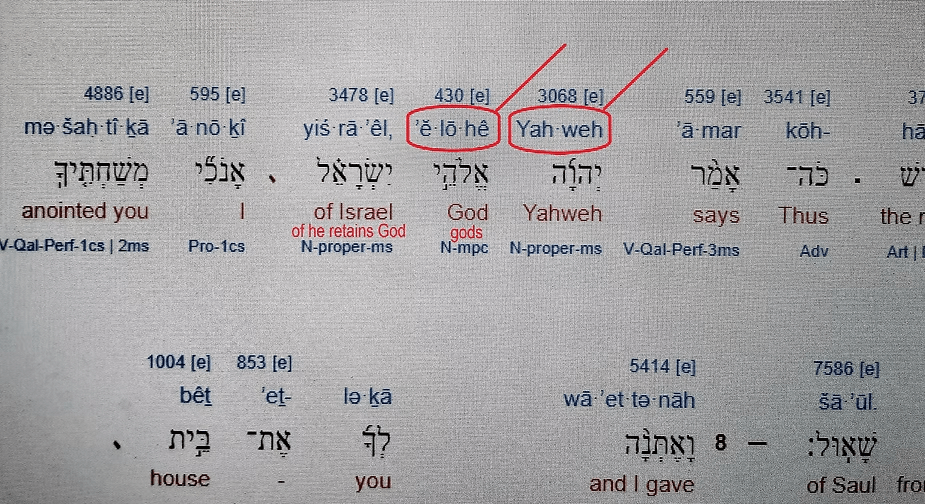
Nathan said to David, “You are the man! Thus says the Lord, the God of Israel: I anointed you king over Israel, and I rescued you from the hand of Saul; I gave you your master’s house, and your master’s wives into your bosom, and gave you the house of Israel and of Judah; and if that had been too little, I would have added as much more. Why have you despised the word of the Lord, to do what is evil in his sight? You have struck down Uriah the Hittite with the sword, and have taken his wife to be your wife, and have killed him with the sword of the Ammonites. Now therefore the sword shall never depart from your house, for you have despised me, and have taken the wife of Uriah the Hittite to be your wife. Thus says the Lord: I will raise up trouble against you from within your own house; and I will take your wives before your eyes, and give them to your neighbor, and he shall lie with your wives in the sight of this very sun. For you did it secretly; but I will do this thing before all Israel, and before the sun.” David said to Nathan, “I have sinned against the Lord.”

——————————————————————————–

This is an optional Old Testament selection from the Episcopal Lectionary for the Eleventh Sunday after Pentecost, Year B 2018. In the numbering system that lists each Sunday in an ordinal fashion, this Sunday is referred to as Proper 13. It will next be read aloud in an Episcopal church by a reader on Sunday August 5, 2018. It is important because this tells more than of the punishment of sin, but of the self-imposed punishment of turning away from God after having been given all the blessings of God. This is the difference between sinning while believing there is God, and sinning after having come to know God personally.

In the tenth Sunday after Pentecost’s optional Old Testament interpretation (last week) that dealt with the sins of David, I delved into this reading.  It should be evident that the two are difficult to separate. It is important to see that David, as king, had no laws of Israel that he could break, when Israel had chosen to have a king to be like other nations. David, because he had been anointed by God, through Samuel, was the Law.  In that sense, Bathsheba is freed of sin because she was obeying the orders of the king. Uriah was then a willing sacrifice unto the king’s desires.

This links to that, meaning the whole sin sequence becomes a human reflection of how the Israelites were in a committed relationship with God, who was essentially their true King and husband.  The purity of David, as the reflection of God incarnate, made him appear divine, which made it possible for him to teach the nation of Israel to know that everyone should do only as God commands.  Such loving devotion meant the result would always be that one’s soul is cleansed free of sins against God. However, in this conclusion to that story, David becomes an example to the children of Israel as one who chose to serve a human king, rather than serve only God above.

The moral of the story is that souls become responsible for their sins that break the Law.  David was like Adam, before each experienced their original sins.  They disobeyed and were punished.  They tried to hide their sins, but were caught as cheaters.  Both cheated themselves by thinking they could do whatever they desired to do, without seeking God’s advice before their leaps of selfishness.
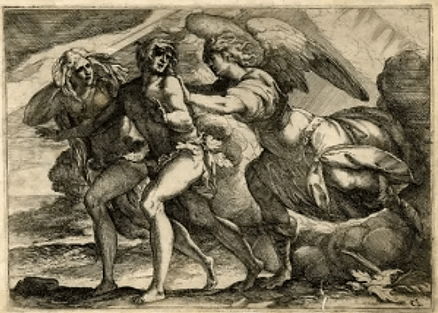
It is vital that Christians realize how the Israelites set themselves up for failure when they told Samuel to give them a human king.  Saul was a sinner king and his selfishness destroyed his reign.  David fell from grace, like Saul, because he reduced himself from divine king to a human king that broke his marriage vows to God.  This story then tells of an an unholy divorce from the One King, one which forced the Israelites to be remarried to a human being with human flaws.

The Covenant with the Israelites was a marriage contract with God that made every one of them (adult men and wives) His brides. That commitment was to live as priests for Yahweh.  When your husband is God Almighty, you do not want to file for divorce, simply because any other husband (used in a submissive sense, as whatever gods men and women choose to follow … like presidents, political parties, moolah, etc.) is a huge step down in class.

Marriage to God, ever since a guy named Jesus of Nazareth came along (the Christ or the Messiah of the Jews), has meant an exercise of the brain, such that one learned the Laws that pertained to that Holy Matrimony. God was the Father, David was the mother, and the Israelites were the children that were to be raised as holy before God.  The Law was kept in a box, but also written on the heart of Mother David.  With the Holy Mother running the household of Israel, the Law of David was one thing the Israelites feared to break.  They listened to their Mother and did what David said, because none of them ever wanted to hear mom say, “Just wait until your Father comes home!”

Because the Israelite children would lose respect for the Mother and no longer fear the Father, they would suffer greatly by the divorce that hit that marriage.  David’s failures in this story are why a written contract that is external to a couple can never again be the definition of “marriage to God.” It was then, beginning with this reading of God’s punishment set upon David (ergo Israel), no longer enough to simply say the words, “I do.” All trust was erased that a Law kept in a box, and no longer in their king’s heart, would be given anything more than lip-service.

Jesus would come to teach the scattered children of Israel how one must become one with God, in a holy union where He is in one’s heart, not elsewhere.  That love center is where His name is then written, “I Am that I Am” (YHWH).  A child of God must become an extension of God, through complete submission to God’s Will, so that the I of God become the I of God’s human wife (males and females). Two egos must merge into one, where one is dominant (the Husband) and one is submissive (the wife).  That marriage of soul-to-body IS the defining factor for Holy Matrimony. Therefore, there is nothing sacred about a verbal commitment, as actions speak louder than words.

Nothing lasting can come from the pageantry of a marriage between two humans (as was the celebrated marriage between David and the Israelites).  David was made their king and all was well; but then David lost his desire to do the same ole same ole – go do battle in the spring, like all kings did.  He had a ‘mid-life crisis’ and let his eyes wander.  While no one stood in holy robes, holding a holy book, saying the words, “Till death do you part,” the marriage of David as King to the Israelites was supposed to have that forever commitment, with a fairy tale ending.

It did not.  The condition was then “Till divorce do you part.”  The “death” was not only to the relationship between God and ex-wife David, but the destruction of the children of Israel.  They needed to fear the Father to maintain the Law.  Unfortunately, the disgrace that fell upon their Mother David meant all the threats about a belt in the Father’s closet were lies; because none of the children had the intimacy of a relationship with God as Husband, only that believing God was the Father.

The reality of divorce means the sanctimony of human marriage is suspect, at best.  Marriage between human is supposed to reflect an individual’s marriage to God above.  We like to think that means we are all born of the Father because we have a soul.  Unfortunately, David had a soul, just as Adam had a soul, and souls are more easily influenced by the whispers of Satan, than those of God.  Souls love to stroke egos, more than be self-sacrificing.  Souls love to play the field and be promiscuous.

This becomes a problem for all the church denominations of Christianity, as marriage (that between two human beings) is considered one of the sacraments (i.e.: “A rite believed to be a means of or visible form of grace.”). Unfortunately, that logic fails to be confirmed when David and Bathsheba became husband and wife (“she became his wife”).  This failure is realized in the text of the story; but the translation above, of the last verse in chapter eleven (2 Samuel 11:27b), has conveniently disappeared.

That ending omitted says: “But what David had done [including marry Bathsheba] was evil in the sight of Yahweh.” Feel free to look it up and see for yourself.

An evil union (reasons stated by Nathan to David above) cannot be blessed by a priest of Yahweh (God the Father of all Christians and Jews). Nathan flat out called David’s theft of Bathsheba a sin and he told David that God promised there would be nothing blessed in Israel, because of that unholy union. David admitted to Nathan (and thus confessed before his priest – another sacrament), “I have sinned against the Lord.”

Again, there has been all faith lost in human words of promise.  When one proves a lie was spoken when the words “I do” were uttered, thy then should anyone believe a confession that admits one is a liar?

It is important to take notice how Nathan did not bless David’s confession.  Nathan did not wrap motherly arms around David, to make his boo boo feel better.  God spoke through Nathan; and God was not telling Nathan to tell David how much David’s words of sorrow to God were heard and approved, so everything would all be okay. Nathan could talk to God as a prophet, because he too was married to God and knew better than to think that relationship gave him the right to start acting like God on earth. Nathan was not pretending to speak for God; and God had no blessing for David in this matter.  No matter what words David said (unwritten and otherwise) would save Israel from an unholy end, albeit and end that would come centuries later.

As unholy as David’s “marriage” was to Bathsheba, he was indeed married to her and she was officially David’s wife, once she moved into David’s house. This is how people today see marriage.  Jews, Gentiles, and Christian alike see “marriage” as moving in together.  However, the reality and sole defining act by Bathsheba that proved she was married to David was that she “bore him a son.”  That is the root meaning of “husband and wife.”  Two adults [of the opposite sex] come together to make babies.  Anything less than that is two children ‘playing house’ together [regardless of their neuter genders as children].

This birth of a son, although it would only live seven days (unread here), was the confirmation of the marriage. Bathsheba mourned the death of her husband Uriah first, and then she shacked up with David before the baby was born.  That togetherness made it look like sex before marriage was made right.  Shotgun weddings are descended from the same logic.  Lustful sex out of wedlock brings about a socially forced bonding, as father and mother, which are the titles given to parents of babies.  Those title changes are the epitome of being married.

That means understanding what marriage truly is.  Understanding that word, in my humble but strongly held opinion, yields the deep, underlying purpose for this reading on the eleventh Sunday after Pentecost. Marriage is not about someone proclaiming two people can go happily out into the world, free to have sex before God, because that flimsy definition leads people towards understanding a physical act of procreation as marriage, not the raising of children that must follow.  It transforms “marriage” into a lessened meaning, where approval is given (blessing “marriage” as saintly) to a sin – that of worshiping the god of pleasure and delight.

A Hollywood image of happiness in sterility.

Man, as an animal, will always procreate because of natural urges. Some animals mate as set pairs for life, but some animals mate with any available mate, or with the one who wins one of those battles of spring.  Often, the animal mothers are left to raise the young alone or with the help of other ‘single moms’, other females and their young male and female children.  Only a few crazy people in California would bring in a priest to bless an animal mating union, which means animals generally do not have a “rite of marriage” that “blesses” their unions.  Therefore, all animals (including man) are “married” by their offspring – when the DNA of two parents are forever joined as one in the child (or in case of multiple births – children).

When Jesus encountered the Pharisees that wanted to trick Jesus into saying a man’s right to divorce his human wife was wrong (Matthew 19:1-14), Jesus said:

“Haven’t you read,” he replied, “that at the beginning the Creator ‘made them male and female,’ and said, ‘For this reason a man will leave his father and mother and be united to his wife, and the two will become one flesh’? So they are no longer two, but one flesh. Therefore what God has joined together, let no one separate.”

This statement dates back to the beginning of mankind (male and female He made them), when male and female human beings were harry animal-like creatures (caveman and cavewoman). Back then, they paired off to mate, without any religion existing. There were no priests or ministers to make any pairing official or legal tender. However, by stating, “A man will leave his father and mother and be united to his wife, and the two will become one flesh,” the “one flesh” is a baby.”  Certainly, two newlyweds will try their hardest to stay cleaved together for as long as possible, but unlike the lore about the soft-rock star Sting, men and women spend much more time apart than joined.

The “wife” is the mother of that baby.  This means God Created males and females to become fathers and mothers, committed (a bond beginning with a live birth of a child) to raise their child(ren) until adulthood.

When Jesus said, “What God has joined together, let no one separate,” this is not God gently guiding a male and a female into a sexual act, patting them on the rear ends with a smile of His blessing. God does not work towards leading males and females to have sex. God made creatures so they would do that instinctively.  Sex happens regardless. However, once a male’s semen is swimming around a female’s egg, then God goes to work joining those two together.

That means God goes to work making all the necessary changes occur that develop an embryo into a fetus.  God’s handiwork in a woman’s womb is what readies a new mass of functioning flesh for receiving a soul.  That flesh takes possession of a life soul with its first breath after birth. Thus, “let no one separate” applies to anyone who would unnaturally abort a child in the womb or kill one after birth, before it can reach adulthood.

Keep in mind how Jesus only came for the Jews.  Jesus did not come to condemn any Gentile society that wants to kill its children.  Jesus never came to tell the Romans how to live as priests to Yahweh.  Jesus, as the Son of God, knew there was a world led by Satan to sin; but God sent His Son to make sure some true priests of the One God were available for all the lost souls on the planet.  Obviously, as Jesus listened to Pharisees not have any understanding of marriage, much less divorce, Jesus was not sent by God to change the illegitimate children of Israel into those that would become true priest of God, married to Him as His wives, knowing the love of God and fearing life without the Father always present.

Simply by being able to grasp how two adult human beings are married in the sight of God, by getting pregnant and preparing to raise that child together … until it becomes a responsible adult … makes it possible to see that marriage can only be Holy Matrimony when the union is between the Spiritual and the physical. God develops babies (as this is not some natural result of a living being’s will, absent of God), just as God develops His priests (as this is not some natural result of a living student’s will, absent of God).

When Jesus told the Pharisees, “Let the little children come to me, and do not hinder them, for the kingdom of heaven belongs to such as these,” that means that parents should teach their children the religious values that are based on the lessons of the Holy Bible.  That assumes the parent are both married to God.  Such a holy marriage raises holy children, which leads the adult children to leave their parents and cleave with the Word of God that promises them a Messiah. Once they find Jesus and are reborn as the Christ, they will have gained the kingdom of heaven.  Then, that formula is to be repeated, over and over.

This is what was lost by David’s sins, which led to a “shoot from the stump of Jesse” being Jesus Christ. Holy Matrimony can no longer be obtained by finding God through an external Law. One has to seek to become the child of God that is Jesus Christ reborn; and that comes by the union of a bride of the earth (physical males and females as unfertilized eggs) with the divine ‘semen’ of the Father’s Word being joined.  The consummation of that marriage yields another example of the Trinity being born.

In my interpretation of 2 Samuel 11 for the tenth Sunday after Pentecost, I mentioned that David had never sinned until he saw Bathsheba naked, after he did not go out with the soldiers in spring to do battle. David was a virgin wife of God, given to the LORD at birth by Jesse. The baby God and David birthed was Israel – all of the Israelites – and together that pair of parents ( Spiritual joined with physical) would raise their child to be a holy nation of priests serving Yahweh. Then, when David sinned, he became a wife who had cheated on the husband by having sex with another human being – a mere mortal. The words of Nathan then need to be read as a divorce decree.

Sayeth the LORD, the husband of David:

I anointed you king over Israel, and I rescued you from the hand of Saul; I gave you your master’s house, and your master’s wives into your bosom, and gave you the house of Israel and of Judah; and if that had been too little, I would have added as much more. Why have you despised the word of the Lord, to do what is evil in his sight?”

Does that not sound like a husband scorned by his wife? It states the grounds for divorce.  David cheated.  He coveted.  He forced Bathsheba into adultery.  He had Uriah unjustly killed, and made it look like an enemy could be blamed.  What God spoke through Nathan was like a husband who came home to find out his wife had slept with a neighbor, after getting drunk in a bar, then driving wildly through a school zone, killing multiple people in the process.  Not only was her infidelity an issue, she was going to prison, leaving the children without a mother to raise them!

Still, it was not poor little ole Bathsheba who lured David into sin. It was David choosing to please David, without one iota of thought to his husband above – God. Excuse me ladies out there, but it is a wife’s duty to be submissive to the husband, just as it is the husband’s duty to provide for his wives. Commitment works both ways and David had never wanted in his entire life.  [Keep in mind that human males and females are to become the wives of the LORD, so human gender does not remove the element of submission to God.  Humans of the world should reflect this arrangement if an earthly marriage is to be blessed.]

“The LORD is my shepherd. I shall not want. He maketh me to lie down in green pastures. He leadeth me beside still waters. He restoreth my soul. He leadeth me in the paths of righteousness for his name’s sake. Ye though I walk through the shadow of death, I shall fear no enemy, for thou art with me; thy rod and thy staff they comfort me. Thou preparest a table before me in the presence of mine enemies: thou anointest my head with oil; my cup runneth over. Surely goodness and mercy shall follow me all the days of my life: and I will dwell in the house of the Lord for ever.” (Psalm 23, KJV)

David wrote that song. It came from his heart for his LORD and Master. It is a love song that admits, “What more could a religious guy want from a heavenly husband?”  It is a love song all should sing to God.

Now we read that David had sinned egregiously. God told Nathan to write down in the divorce decree what David gets to take with him in the split.

[Also, notice how Nathan – a true prophet – handled this divorce. No lawyer was called in.  It would later be something the lawyer types in the temple would administer; so much so that now the law demands one have a lawyer to get divorced.  No one directly quotes God these days.]

The LORD said, “I will raise up trouble against you from within your own house; and I will take your wives before your eyes, and give them to your neighbor, and he shall lie with your wives in the sight of this very sun. For you did it secretly; but I will do this thing before all Israel, and before the sun.”

So much for God being the influence David needed to raise the baby that had been a stubborn people ever since Moses was married to God. The Israelites would slowly forget about the Father, who they saw shine on the face of their true King. Now, after the divorce, David became just another king … like those of other nations. The children began to run wild without the threat of the Father’s belt.

Still, like a good ex-husband, the child support checks arrived in the mail, as Solomon would turn Israel into one of the wealthiest nations in the known world. But, without Solomon being a good wife to God (he did love his human wives and concubines), the children would squabble so much over their inheritance that they would rip the nation in two, letting just about anyone lord over their lives (and ruin their religious devotion to Yahweh).

That end was stated in Nathan’s parable to David, where Israel was the poor man with nothing but a little ewe lamb to his name. That stands for the Israelites and the Law, which is impossible to understand without God; but the Law was warm and fuzzy and sounded sweet to the ears, so much that a bond of love made the poor feel like they had something special. Then, that Law was broken by the rich man (David), who had everything (as king). Without just cause, the rich man killed and cooked the Law (the little ewe lamb) and served it up to some guest. The guest was Bathsheba, but she represented any foreign nation (Gentile pagans with worship to lesser gods) that could dance a sexy dance and whisper sweet nothing into a king’s ear.  Bathsheba would become Jezebel, who would see Israel’s Law (the little ewe lamb) as the distraction that kept a nation from being rich.

David killed the Law, just like Moses slammed down the holy tablets when he saw the Israelites had built an idol to Ba’al and were appeasing that guest.  God purged the wayward Israelites from those who would be redeemed.  Moses got a second chance set of tablets.  David and Israel were the last straw on that camel’s back.

David’s divorce from God meant there would be no more kings of Israel acting as His wives. Only a living vine of prophets would keep the poor man and his little ewe lamb alive in Spirit, until God would send His next virgin bride to Jerusalem, named Jesus of Nazareth. God and Jesus would marry and beget the child known as Christianity, named after the union that is the Father, the Son, and the Holy Spirit, christened Jesus Christ. Those who fall in love with God and marry, so His Law is then written on the hearts of individuals, can give life again to the poor man and his little ewe lamb, watched over by the Good Shepherd.

As an optional reading selection for the eleventh Sunday after Pentecost, when one’s personal ministry to the LORD should be underway – married to God and dutifully bringing up the children to Jesus Christ – the lesson is the fidelity demanded in Holy Matrimony. The message of this story, as told the Sunday prior, was responsibility, which is not much different than the “faithfulness to obligations, duties, or observances,” which defines “fidelity. Still, the intent now is on the commitment to intimacy, for the purpose of yielding Jesus Christ resurrected, and tending forever to that most holy child.

A minister to the LORD is able to see the truth of marriage, because the ‘other nation’ view, the Big Brain thought of Gentiles who have no love of God, is to tear down the idol that false shepherds have created – the sacrament of the love between a man and a woman. That is not holy matrimony, even if it tries to mirror it. Legal marriage is not holy, when it is making sex between two human beings the lesson taught to children.

A minister knows sexual desires have been around since the beginning of time, and when sex is called love (an emotion of sudden urge), then all forms of that kind of “love” destroy the truth of love.  Perverse forms of “love” began long, long ago, soon after the first male and female ever mated. They say prostitution is the world’s oldest profession.  In the words of God to Nathan, what mankind considers “love” often displeases the Lord and is evil in his sight.

That does not men God wants anyone to stop doing perverse physical acts, or cease justifying them in the name of “love”. It means those who do evil acts do not have God’s blessing. Man (males and females) is as free to do whatever man (males and females) wants to do to man (males and females), in any combination(s) thereof; and, man (males and females) is free to have it all forms of “love” be glorified by pagan priests (those serving gods like Ba’al) or have none be glorified, using the logic that sex is what animals naturally do.  What man (males and females) does without God is evidence of a lost soul, one destined to forever wander the face of the earth, with no chance of eternal redemption.

Worldly ways must feel guilt.  Guilt must lead to repentance.  Repentance must lead to a marriage to God, leaving the world and all its lures behind.  Without ministers of the LORD to help that recovery, man will only find snakes in the grass whispering bad ideas.

It is without a doubt that a minister of the LORD knows – as Jesus Christ reborn and as a bride of the Father (males and females) – that God’s hand-guides a baby’s development in the womb. The ancients used to smash unwanted babies (usually females) on the rocks below a cliff, using the excuse that the unwed mother (or very young couple) was too poor to afford a child. Female babies are still killed in some countries today, using the poverty angle as the justice. In America, women march in protest about men writing laws that take away their rights to abort a baby, regardless of the reasoning.  They march without caring that the majority of women aborting babies are of minority races.

A woman’s rights assumes a leadership role within a “marriage,” or the lack of willingness to submit to anyone in union.  If they deny a man’s rights, where is the equality sought?  Sexual freedom begat “the pill,” which does not do away with the need for abortion, because poor people can’t always afford medications that prevent pregnancy.  With all that to consider, there have been times in modern history when ethnic cleansing became medical sterilization that was forced upon certain classes of people.  Jesus spoke of forced eunuchs way back then; but now the popularity of same-sex couples is like waving a wand over a group of people and convincing them they want to be sterilized … without any need for force.

The institution that has been called “marriage” is unpopular with children today.  Many come from split homes, many forced to know multiple parents that want to be called mom or dad.  Children detest their being torn asunder in this way, knowing they only have one father and one mother.  There is nothing setting a good example for marriage, much less having children.  Children raised in broken homes are less likely to want to share the personal pain they know with a child of their own, especially when the economy is weak, the family unit is weaker, and religious values are at their weakest in history.  No one trusts that commitment is permanent anymore.  It is just a meaningless word used without deep thought.

Jesus spoke of these issues when he talked to the Pharisees about divorce. A minister of the LORD can see that the world of man is free to act like animals, so the only thing one can do is stay committed to what one’s heavenly husband says to do. Commitment is an individual relationship with God, where one’s rights are what God says, without argument and without complain.  Commitment founded in God’s love is forever lasting.  Therefore, bring the child in you to Jesus Christ and give that child the opportunity to gain the kingdom of heaven.

The lesson of David is then the virgin state one is given by God, when one sacrifices one’s own Big Brain and lets the selfishness of ego turn to total submission to the Holy Husband’s commands. An Apostle-Saint is like David in that sense, as David, prior to his sins surrounding his lustful sex with Bathsheba, was like Jesus – pure as the driven snow. Thus, David shows what happens to a wife that cheats on her Holy Husband. It is an emptiness that is greater than that felt by Judas Iscariot, when he too realized, “I have sinned against the Lord.” It is a return to the agony of a sinful existence, prior to finding the love of God and a heartfelt desire for redemption.
David still had God by his side after divorce, because he was a ‘first-time offender’, much like the parable Jesus told, of the father who still loved his prodigal son. Unfortunately, to have lived as a sinner first, then found God and became Jesus Christ, only to have God throw one out in divorce, the Law is clear. Moses wrote that you can never be taken back.

That divorce by God means all the subsequent “husbands” (lower-g god worship) make it impossible to go back to the LORD. Moses wrote, as the laws of divorce, those which the Pharisees tried to trick Jesus on, “then her former husband who sent her away is not allowed to take her again to be his wife, since she has been defiled; for that is an abomination before the Lord, and you shall not bring sin on the land which the Lord your God gives you as an inheritance.” (Deuteronomy 24:4)

Food for thought.

A minister of the LORD knows that, lives it willingly out of love of God, and raises any children that have been sent to Jesus Christ for teaching to follow the same written Law. All one can do is follow the Father’s commands and not fear. Even in today’s world, where the children are as wild as were those leading Israel and Judah to ruin, a minister to the LORD stands tall amid persecution … and smiles.

The truth whispered by God is much more pleasurable and lasting that human sex can ever be.

You are

Exodus 16:2-4, 9-15 – The test of manna

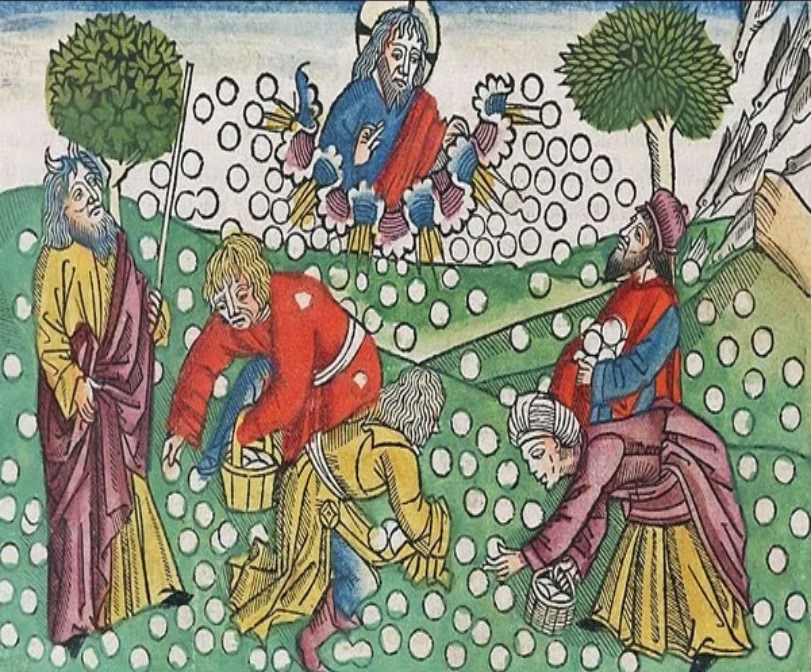
The whole congregation of the Israelites complained against Moses and Aaron in the wilderness. The Israelites said to them, “If only we had died by the hand of the Lord in the land of Egypt, when we sat by the fleshpots and ate our fill of bread; for you have brought us out into this wilderness to kill this whole assembly with hunger.”

Then the Lord said to Moses, “I am going to rain bread from heaven for you, and each day the people shall go out and gather enough for that day. In that way I will test them, whether they will follow my instruction or not.

Then Moses said to Aaron, “Say to the whole congregation of the Israelites, ‘Draw near to the Lord, for he has heard your complaining.’“ And as Aaron spoke to the whole congregation of the Israelites, they looked toward the wilderness, and the glory of the Lord appeared in the cloud. The Lord spoke to Moses and said, “I have heard the complaining of the Israelites; say to them, ‘At twilight you shall eat meat, and in the morning you shall have your fill of bread; then you shall know that I am the Lord your God.’“

In the evening quails came up and covered the camp; and in the morning there was a layer of dew around the camp. When the layer of dew lifted, there on the surface of the wilderness was a fine flaky substance, as fine as frost on the ground. When the Israelites saw it, they said to one another, “What is it?” For they did not know what it was. Moses said to them, “It is the bread that the Lord has given you to eat.”

——————————————————————————–

This is an optional Old Testament selection from the Episcopal Lectionary for the Eleventh Sunday after Pentecost, Year B 2018. In the numbering system that lists each Sunday in an ordinal fashion, this Sunday is referred to as Proper 13. It will next be read aloud in an Episcopal church by a reader on Sunday August 5, 2018. It is important because it tells how God will sustain His people in a world (an environment) that is barren of God’s guidance.

In the interpretations that I presented for the tenth Sunday after Pentecost, where Elisha and his company of prophets ate from the first fruits and Jesus fed the multitude, I referenced this reading from Exodus, where God fed the Israelites with manna. My same conclusion that “spiritual food” is unlimited in how many it can feed, with manna being “spiritual food” still applies here. Forty years of living on the same foodstuff, day and night, would seem tiresome and boring; but the spiritual aspect of food from heaven makes manna become the inner drive to thrive on minimal external needs. Therefore, this reading selection tells how spiritual food feeds the mind, so the soul opens and God is able to reside in one’s heart.  This view is above and beyond what the filling of a stomach with physical bread and meat can do.

As a stand-alone reading selection, which is without linkage to all subsequent history, I believe it is important to grasp how the exit of the Israelites from Egypt mirrors their initial entrance there, some two hundred fifteen years prior (430 since their entrance into Canaan). Their sojourn began from hunger and is now beginning a new phase in their journey with the threat of death from lack of food. A widespread seven-year famine was in its second year when Jacob took his family from the hills of Gilead to Egypt, where his son Joseph had advised Pharaoh to stockpile grain in years of plenty, and in preparation for a foreseen drought and famine coming.

Egypt then offered the illusion of being a land of plenty; but had it not been for God, working through His servant Joseph, Egypt would have been suffering equally from lack of food.  We read here today of that Egyptian mirage of plenty was making a return to slavery seem like a good idea.  However, God would again bring nourishment to the children of Israel.

If the Israelites were a group of educated adults then, possessing excellent memories, they would easily recall what had recently happened to them. Most recently, they had visited an oasis named Elim, where they had fresh spring water and a variety of fruits from palm trees (“seventy palm trees” means a variety of fruit offerings). Prior to that, the sea had opened and closed, so the Israelites could safely cross, while angry Egyptian soldiers would no longer be chasing them. Prior to that, an angel of death had not cause the first born males in any of their families to die, which was when they were last close by a “flesh pot” in Egypt. Prior to that, there had been a series of plagues that befell Egypt, which meant not many people sat around flesh pots and had bread that wasn’t swarmed by flies, amid the stench of death from rotting fish and frogs. Don’t forget, also, the locust had come destructively on Egypt, making good meal for bread difficult to find. So, the grumbling Israelites were not speaking as adults in this reading, ones that remembered God was leading them in a pillar of smoke.

This shows that human beings, at heart, are all complainers, bellyachers, crybabies, and whiners when things do not go their way.

The Israelites were chosen by God, because of an agreement made with Abraham; but they were called “children” because they were just like babies taking their first screaming breath into a new world. Babies do not have brains that function like adults, so they cannot understand languages, nor can they talk. All the miracles they lived through were like shadows passing before a baby’s still developing eyes.

When it is feeding time, a baby cries to let its keepers know it is hungry. A baby can only know selfishness, because without that instinctual demand for attention a baby’s life is at risk.  Therefore, this story is setting up Moses, Aaron and God as if they were all first-time parents and the Israelites were their baby needing food.

Seeing the Israelites as an infant that was born after Moses pulled them through the birth canal that was the parting of the Red (or reed) Sea, their entire history can be seen (on a grand symbolic scale) as the growth of a child, from infant to teens, to young adulthood. By seeing them in this light, one is able to see that every human being on earth is just as flawed as the Israelites were then; such that the Jews as a people reflect the young son that squandered his inheritance, obtained in advance. Christianity then represents the prodigal son’s return to the Father, all grown up and ready to receive the Holy Spirit.

By having this broader view of what the stories coming from the books of the Holy Bible, one is then more enabled to see those stories become personally relative.  Rather than think the Old and New Testaments are showing two peoples and two sides of God, it is best to see God as the Father that had two sons. God is the constant that never changes; but His sons reflect the duality of humanity on earth, where some stay selfish babies all their lives, and others sacrifice everything to serve the Father.

We all come into this world as babies that only know that crying states a personal need and expectation, and every time those needs and expectations are met, we all learn to perfect the arts of complaining and selfishness. The more one’s cries bear fruit, the more one learns to fake crying when all else fails.  Still, when hunger is the reason for complaint, it does not matter where it comes from.

The bread of all nations is fleeting.  This is because satiated hunger only means the next day brings another need for more bread.  While just beginning their trek into the wilderness, the worry was all those future days ahead was being addressed.  We know from hindsight that need would stretch forty years.  This means the manna from heaven (and quail on occasion) would last as long as the Israelites accepted God as the Father.

In my interpretation of Jesus feeding the five thousand, along with Elisha and his company of one hundred prophets making an omer of first fruits easily feed everyone, I compared it to the manna in the wilderness.  One would think that Moses and the Israelites came across many travelers over their forty year trek, simply because of trade routes. I wrote before about hos Jewish scholars said manna would slip from the hands of Gentiles, because it was not food that could be consumed by other peoples. One would think that opinion comes from the ancient texts indicating the Israelites encountered nomadic tribesmen and attempted to trade manna for more exotic foods, only to have the Gentiles unable to gather it.

Such a possibility, given forty years of wandering, shows how manna was not for anyone.  The bread of other nations, made from grains that grow abundantly in fertile regions of the Middle East, was limited in the way it only met physical wants and needs.  This says the Israelites were not in need for bread of that kind, as normal bread could do nothing to satisfy spiritual needs. Therefore, God was not feeding the Israelites quail and manna as food for physical sustenance.  He would not have freed them from Egypt without physical food being covered.

One thing that seems contradictory in the Exodus story, which I have touched on in previous writings, is the Israelites took livestock with them. Goats can give milk and goat milk can yield cheese.  Certainly livestock, especially chickens, could provide meat and eggs.  Thus, the physical needs of the Israelites were not in danger at this point in their journey.

This means the grumbling is less about being starved for food and wishing they were back in Egypt and more about them crying out for another feeding of inspiration and desire to be alone in the wilderness, with Moses and Aaron leading them.  Again, they were crying like babies; but their cries came from their souls, not their stomachs.

The Israelites (according to verse 8 – unread in this selection) were not actually complaining about Moses and Aaron, even though Moses and Aaron heard all the complaints in a personal sense. God told Moses that the grumbling was not against them, but against Him. Simply by that statement, one can see that the complaints were about not having any way of knowing God was there and leading them.  God set Moses straight, by telling him the Israelites were calling out to God, while standing before a guy with one mighty staff.

Its not you! I just need to get this off my chest!

The grumbling of the Israelites is not exclusive to them (or their later descendants, the Jews). This is exactly how Christians complain against God, when they are forced into being responsible for their souls, being told they have to act on faith. The bellyaching meant they were so starved of the nutrients that feed faith (learning what the words of the Holy Bible truly mean) that they were too weak to do anything but grumble. While it is always a human being that is put into a position of authority, where Moses and Aaron were like prophet and high priest, just like the denominations of Christianity place priests, ministers, and pastors so they are available to the followers of God, the people always beat their chests in anguish when they hunger for spiritual knowledge and no one is giving it to them. They complain to human beings, but they blame God for not hearing their cries.

God answers those cries with spiritual food, not packages of surplus cheese or peanut butter mailed by governments (or stamps that can be redeemed for food, alcohol, and/or tobacco). Still, when figurative babies are the ones crying for spiritual direction, one needs to see manna as baby food falling from the sky. It is tasty, spiritually fulfilling, and stores easily for a day or two. This means manna is easy to swallow and easy to digest food that keeps the baby content and cooing for forty years, when the time for solid food would come around.

The quail were not a daily fare, which makes their appearance at twilight symbolize that time when the sun has dropped below the horizon, but there is still light. This timing is that link between day and night, or the symbolic link between life and death. All that is physical has life due to the presence of the soul, and death from the absence thereof. Thus, the quail were food for the soul (according to several metaphysical sites I explored); and in that line of thought, there are those who say quails symbolize spiritual needs for the soul. Because quails stay close together, protecting one another by their closeness, the element of family is also a symbolic aspect of quails. Therefore, God sent a migrating flock of quails to fill the souls of the children of Israel, to protect the oneness of their soul, through the solitude in the wilderness that would stretch over forty years.

When God was talking to Moses, He said, “I am going to rain bread from heaven for you, and each day the people shall go out and gather enough for that day. In that way I will test them, whether they will follow my instruction or not.” This says that God does test his servants, in the same way that parents test their children.

All good Fathers and mothers test their children to see if they follow instructions. It is irresponsible for a parent not to prepare their children to know why they have been told to do certain things, after they have proven they have listened and obeyed, because they have complete trust in their parents.  The growth of a child is in steps and stages; and parents learn to test a child to go beyond one point of growth to the next.  Therefore, God tested the children of Israel to prepare them for the next phase of their saga.

Finally, the word “manna” is not a noun, but a question. It says, “What?!?!” According to the etymology of “manna” (from “man”), it is written: “Most probably [it means] ‘What is it?’ the question being intended as a popular etymology of מָן ‘manna,’ based upon the late Aramaic word meaning What?” (Brown – Driver – Briggs)

This means the food that appeared covering the ground each morning (after the dew lifted) was not something the Israelites had ever seen before, as they had no word for it. That says the “fine flaky substance, as fine as frost on the ground” was not of this world. It was of heavenly origin, although with physical properties. It fell like the rain falls to the earth, which has the effect of springing the earth to life. As such, God rained life sustaining essence onto the Israelites.

As the optional Old Testament selection for the eleventh Sunday after Pentecost, when one’s personal ministry for the LORD should be underway – willingly being tested by God – the message should be seen as the infancy required to reach the full state of Apostle. The Israelites were descended from Abraham, Isaac and Jacob, but none of them had ever talked to God. The had as much chance of becoming a priest for Yahweh as any Egyptian (any and all Gentiles), without Moses and Aaron knowing God personally and being instructed so they could teach them how to grow into priests.

As far as I have had others in the Episcopal Church explain to me (laypeople and priests), the Sacrament of the Eucharist means to them that physical wafers are transformed into spiritual food (like manna).  This is done by a prayer that calls the Holy Spirit of Jesus Christ down to earth (where he falls like rain) onto the wafers that a priest then places on a member’s palm or tongue. Swallowing the wafer is then consuming the Christ Spirit.

Because some of this “host” (a word from Latin, hostiameaning the sacrificial lamb) is left over until the next service, the leftovers are then placed in a “tabernacle” that is locked. I have been told that the reason one bows before entering a pew is because Jesus is inside the tabernacle, on leftover wafers, which are near the altar.  We do not bow to a cross of stained glass window, but to Jesus in the box.

Such little-known tidbits of information are expected to be taught the children of the Episcopal Church, where “cradle-to-grave Episcopalians” might know these details; but anyone converting to the Anglican Church from some other religion (or having no religious schooling prior) is left out in the cold. People do wonder why things are said or done, but newcomers are afraid of rejection if they ask questions.  Of course, answering questions can put others on the spot, so silence is a theme when in a church.

While there are certainly classes one can take to get brushed up on all the ins and outs of any denomination of Christianity, no expectations are set and few ask questions. All of this is like God testing His children, to see if they have learned the rules and how well they follow them once known.  God wants people to know all the whos, whats, whens, wheres, whys, and hows.  Those who know should welcome (if not go offering) those seeking to know.

When one sees manna as the Pablum (trademark name, but from the Latin word pabulum meaning “foodstuff”) of spiritual nourishment, manna is designed for those not yet in possession of teeth and mature digestive systems. Just as children are to be taught what they must believe, just as they must also be taught why belief is more than listening to someone telling them to believe.  Children need to how to become one of faith, by learning who they must become reborn in soul.  This means learning when they can know everything they have ever been told is the truth … the Gospel.

Being an adult eating a wafer of spiritual food one day a week is like a baby (still) that is starving for spiritual nourishment.

That realization then leads to the question that asks, “Why are such “Christians” not complaining in the wilderness of their lives, because whoever led them to be at retirement age and still eating spiritual baby crackers in pews, “brought [them] out into [their] wilderness to kill [the] whole assembly [of Christianity] with hunger.”  When all an adult knows is the details of Bible stories taught in Sunday School, that adult is severely malnourished spiritually.

A minister of the LORD must have the real spiritual food that is needed to feed the congregations. It too comes from heaven, as the insight of the Christ Mind, brought by the Holy Spirit. The real food is the meaning of the Holy Bible. The Holy Bible, as translated and as naturally read by those fluent in Hebrew, Greek, and Latin is nothing more than words that scream out, “What!?!? What is that to me? What does it mean?”

The Word of God is manna.

Beginning with Jesus and continued through every Apostle that has been reborn as Jesus Christ, the Word of God has been explained so it becomes real food – the TRUTH OF GOD. Ever since Jesus began preaching this holy wisdom, people have been so touched by that knowledge that they have begun doing the same. A minister of the LORD carries on this holy lineage, as brothers and sisters of the Son of God the Father. All have given God’s instructions to seekers, and the seekers who passed the test that demands His servants follow His instructions to a T, they have been rewarded with redemption and eternal salvation.

The story of the children of Israel says they were a stubborn lot, often refusing to follow instructions. Many have failed the test and failed God. Ministers of the LORD are like teachers who want all their students to pass all their tests. By speaking God’s TRUTH, the students have the spiritual nourishment to put in the time and effort to learn.  A minister of the LORD plants the seeds that grow into a desire to learn and a love of personal discovery.

Ephesians 4:1-16 – Sheltering from the hurricanes of philosophy

I therefore, the prisoner in the Lord, beg you to lead a life worthy of the calling to which you have been called, with all humility and gentleness, with patience, bearing with one another in love, making every effort to maintain the unity of the Spirit in the bond of peace. There is one body and one Spirit, just as you were called to the one hope of your calling, one Lord, one faith, one baptism, one God and Father of all, who is above all and through all and in all. But each of us was given grace according to the measure of Christ’s gift. Therefore it is said,

“When he ascended on high he made captivity itself a captive; he gave gifts to his people.”

(When it says, “He ascended,” what does it mean but that he had also descended into the lower parts of the earth? He who descended is the same one who ascended far above all the heavens, so that he might fill all things.) The gifts he gave were that some would be apostles, some prophets, some evangelists, some pastors and teachers, to equip the saints for the work of ministry, for building up the body of Christ, until all of us come to the unity of the faith and of the knowledge of the Son of God, to maturity, to the measure of the full stature of Christ. We must no longer be children, tossed to and fro and blown about by every wind of doctrine, by people’s trickery, by their craftiness in deceitful scheming. But speaking the truth in love, we must grow up in every way into him who is the head, into Christ, from whom the whole body, joined and knit together by every ligament with which it is equipped, as each part is working properly, promotes the body’s growth in building itself up in love.

——————————————————————————–

This is the Epistle selection from the Episcopal Lectionary for the Eleventh Sunday after Pentecost, Year B 2018. In the numbering system that lists each Sunday in an ordinal fashion, this Sunday is referred to as Proper 13. It will next be read aloud in an Episcopal church by a reader on Sunday August 5, 2018. It is important because Paul (once again) clearly stated one’s complete sacrifice to God allows one to be reborn as Jesus Christ.

To cherry-pick a few words written by Paul to analyze (rather than turn 316 words of Paul into a short book on the meaning of these sixteen verses), the word translated as “prisoner” is “desmios.” This word certainly says “prisoner,” but equally says, “one bound, one in bonds, and one captive,” where “prisoner” can imply judgment and/or force to make one go where one would not choose freely to go – a prison. However, this prison is “in [the] Lord,” where “Kyriō” means “one who has control of, as the master,” which makes “the Lord” like a prison warden.

That is not the case at all, as Paul (and the Christians of Ephesus) were servants (not prisoners) to “the sovereign, prince, or chief” – the Lord. While one can assume “the Lord” means Jesus Christ, the reality is God is the ultimate LORD. When one is in the Lord, then one is one with God and Christ. When that oneness is seen as being “bound in,” as “captive within,” one is under the control of God, which then emanates as one being “in Jesus Christ,” as Jesus of Nazareth reborn.

Jesus Christ is captive in my flesh. I will not set him free because he came to me!

This is the meaning of Paul writing, “There is one body and one Spirit.” It is important to grasp each individual’s captivity in this way. Each Apostle is captivated by love of God and God’s love in return, through oneness. Paul wrote to other individuals who were just as one with God and Christ, so “one body and one Spirit” equally means a church or assembly, where all members of that body are the individual resurrections of the Son of God. However, to jump to that meaning without realizing the individual must be one body and one Spirit first, one is putting the cart before the horse and there is no equation to a church body of ordinary people who all agree they believe Jesus (one body) was one who was the Son of God (one Spirit).

When Paul wrote, “Just as you were called to the one hope of your calling, one Lord, one faith, one baptism, one God and Father of all,” this has nothing to do with some external ritual that fell under Roman Church discretion, three hundred years later. Each individual has become captive by one Lord of their physical bodies and spiritual souls – Jesus Christ. Each individual has personal experience of what oneness with Jesus Christ is, so belief (external words written or spoken) has transformed to faith – the knowledge of the Christ Mind. Each individual has had his or her soul washed clean of all past sins by the Holy Spirit – not bathed by water. Finally, each individual has to be adopted by God above as His Son, the resurrection of Jesus Christ, so God then truly becomes one’s Father – the Father of all like individuals who have each been adopted in the same way.

When Paul then wrote, “Each of us was given grace according to the measure of Christ’s gift,” one cannot envision Jesus Christ being some external Spirit standing like a woman on All Hallows Eve, passing out free candy to those stopping by.

The Greek word “charis” is translated as “grace” so often that few know what that means. The word means “favor, gratitude, and thanks,” which comes from God above, the LORD. As thanks for one’s sacrifice of self-ego (each individual’s), God gives the gifts of the Holy Spirit, which are duplications of those talents possessed (also gifted by God) by Jesus of Nazareth. Therefore, all gifts are facets of Jesus’ powers on earth, which Paul measured as seven in total.

When Paul wrote (as a quote), “When he ascended on high he made captivity itself a captive,” the Greek words “ēchmalōteusen aichmalōsian” are better stated as, “he held captive a multitude of captives.” Again, this element of captivity is the oneness of the Holy Spirit of Jesus Christ with a multitude of individuals who have become changed into Jesus of Nazareth reborn. Jesus of Nazareth was himself captive to God’s Holy Spirit, which made him the most holy Son of God; but it was his death (the rising of his soul spirit to heaven) that created the possibility for many others to become the same most holy Son of God on earth.

To grasp Paul’s writing, “he had also descended into the lower parts of the earth,” this is not solely meaning Jesus’s Holy Spirit went to Sheol and looked at all the souls who had died, freeing them to go to heaven. God IS the Father of all souls, so God decides who comes to heaven, who gets recycled back into a new human body, and who gets eternally banished from ever returning to heaven. This means Paul said Jesus of Nazareth was dead as a human being, after three days of death. However, that death was with purpose, so Jesus Christ could descend upon the sinners of the world who were living (dead as mortals destined to die and be reincarnated) and cleanse their souls for eternal life with the Father.

When Paul then wrote, “The gifts he gave were that some would be apostles, some prophets, some evangelists, some pastors and teachers, to equip the saints for the work of ministry, for building up the body of Christ, until all of us come to the unity of the faith and of the knowledge of the Son of God, to maturity, to the measure of the full stature of Christ,” this long series states God’s gifts to those reborn as His Son. Take note that the Greek word “hagiōn” (translated as “saints”) is a basic identification of Christians, as all apostles, prophets, evangelists, pastors and teachers are ministers as Saints – those “set apart by God as holy and sacred.” The gifts of God’s Christ are not given to special people who will lead the ignorant masses, but only to Saints, for the purpose of creating more Saints.

This means that no Christians are without these gifts of God that build up “the body of Christ” (individually and collectively) in faith and knowledge, as that held by Jesus of Nazareth, the Son of God. It means that all Christians are required to be Saints, worthy of heavenly gifts.  So, one cannot call oneself Christian if one is not a Saint, without belittling what a true Christian is.

When Paul then wrote, “We must no longer be children, tossed to and fro and blown about by every wind of doctrine, by people’s trickery, by their craftiness in deceitful scheming,” this means maturity is the measure of “the full stature of Christ.”  This means growing up spiritually, which usually takes (minimally) decades of belief and study.  However, maturity means no longer requiring someone external to oneself to tell him or her what to do and what to believe.

In this regard, I recommend reading the accompanying Proper 13 interpretation that I published, about the optional Old Testament reading from Exodus, where manna is spiritual baby food. Growing up means taking responsibility for one’s own spiritual soul, requiring faith and knowledge that can only come through being reborn as Jesus Christ. Without that sacrifice, one is blown by the wind of Big Brain philosophies, which are never going to reward the masses with anything more than misery, and are always going to reward the cheaters and deceivers with worldly gains and the eternal frustrations of death.

Finally, when Paul wrote, “Speaking the truth in love, we must grow up in every way into him who is the head, into Christ, from whom the whole body, joined and knit together by every ligament with which it is equipped, as each part is working properly, promotes the body’s growth in building itself up in love,” this states one’s commitment to God. One must fall in love with God and show God one’s willingness to be fully submitted to His Will, where one becomes one with God through a marriage in one’s heart (in love).

The consummation of that marriage replaces the Big Brain of self motivations with the Mind of Christ. The immersion of one’s soul with the Holy Spirit then allows all parts of one’s body to become outlets for the gifts of Christ – his touch, his voice, and his presence. This build-up in the individual then spreads to others, who then also experience individual growth in their bodies, with the whole body (assembly or congregation) also growing as one.

As the Epistle selection for the eleventh Sunday after Pentecost, when one’s personal ministry to the LORD should be underway – an individual reborn as Jesus Christ in support of a collective of individuals likewise reborn – the message is being captivated by God’s love. A minister of the LORD projects the thrill and joy of being led by the Mind of Christ to know the experience of Jesus Christ reborn. This projection becomes the aura depicted in paintings around the heads of Saints; and that is not to signify personal achievement, but the radiant attractiveness surrounding one from the Holy Spirit, that acts as a magnet to others.

The natural way this began, when the disciples were filled with the Holy Spirit on Pentecost (on the first day of the week – Sunday), twelve Apostolic priests held twelve church services at once in the same place, with each in a different language and with each telling the truth of the Word that Jews from many nations had heard before, but never known. They believed the words of Scripture; but they had never had faith overwhelm them, because of the stories in the Torah only seemed historical. Hearing the Word of truth converted three thousand Jews into true Christians, because the spirituality of truth hit their hearts. This, then, is the true power of a sermon preached.

So, you know by telling the truth you are helping God?

Paul continued this preaching of the Good News – the Euaggelion – the Announcement of the Truth. Paul then wrote to those whom he converted to Christianity, to further speak the wisdom of the Holy Spirit to those likewise filled with the Holy Spirit. All the Apostles, explained the Prophets, as Prophets. They were Evangelists because they sought out Jews and scattered Israelites who might not yet have heard that the Messiah had come. It was the truth of the Word that turned those believers into practitioners of faith, as Jesus Christ reborn. All then became pastors of flocks and teachers of their families and neighbors, with none ever going to a school to be taught classes in sermon writing and oration.  None ever interviewed for a position as official priest of Yahweh.

Then, relatively suddenly, that way of Christ’s voice, touch, and presence became silenced by an empirical Church.  The collapsed Roman Empire, led by Constantine, saw profit to be made from forcing religious belief on pagans that followed lesser gods. Regardless of the thought processes involved, they were doctrinal, from Big Brains, and not from the Christ Mind.  The system God created (which works perfectly still) was scrapped for the organizational expertise of Rome.

The weathering that change, from reborn Jesus Saints coming from low-level devotees to systemic practices spoken in Latin by men in big hats, reverted back to beliefs, away from true faith.  Over the next fifteen hundred years, that wind of philosophy has left the flag of Christianity torn and tattered, “tossed to and fro and blown about by every wind of doctrine, by people’s trickery, by their craftiness in deceitful scheming.” Simply by foretelling that future, Paul was gifted the talent of prophecy, proved when the words he wrote came true.

In these dangerous times, when people sit in pews, separated by an aisle that puts the goats to the left and sheep to the right, the Word of God is read aloud and then a political oration takes place. The brevity of an Episcopal “sermon” is the only goodness served up now days, often only pretending to be the Gospel. The ministers of the LORD are given fewer and fewer flocks to pastor, leaving them without an easy ability to replenish the Christian population.

With fewer Apostles and Saints in the world, the more dangerous the world becomes. The leaders of the world (those currently in power and the ones subverting those in power, so they can scratch and claw on top) are less the cause of the destruction of Christianity, than they are the result of it.  The people who idly sit by and allow this devolution to happen are who own the lion’s share of responsibility in this demise. Still, all is not lost as long as God keeps the torch of truth alive.

God wants His children back from waywardness. Jesus Christ wants the truth be told. Saints risk persecution so God and Christ are pleased, through their willful obedience. The only thing missing is seekers of the truth. The world can be saved when they get on board.

John 6:24-35 – Becoming the bread of life

The next day, when the people who remained after the feeding of the five thousand saw that neither Jesus nor his disciples were there, they themselves got into the boats and went to Capernaum looking for Jesus.

When they found him on the other side of the sea, they said to him, “Rabbi, when did you come here?” Jesus answered them, “Very truly, I tell you, you are looking for me, not because you saw signs, but because you ate your fill of the loaves. Do not work for the food that perishes, but for the food that endures for eternal life, which the Son of Man will give you. For it is on him that God the Father has set his seal.” Then they said to him, “What must we do to perform the works of God?” Jesus answered them, “This is the work of God, that you believe in him whom he has sent.” So they said to him, “What sign are you going to give us then, so that we may see it and believe you? What work are you performing? Our ancestors ate the manna in the wilderness; as it is written, ‘He gave them bread from heaven to eat.’” Then Jesus said to them, “Very truly, I tell you, it was not Moses who gave you the bread from heaven, but it is my Father who gives you the true bread from heaven. For the bread of God is that which comes down from heaven and gives life to the world.” They said to him, “Sir, give us this bread always.”

Jesus said to them, “I am the bread of life. Whoever comes to me will never be hungry, and whoever believes in me will never be thirsty.”

——————————————————————————–

This is the Gospel selection from the Episcopal Lectionary for the Eleventh Sunday after Pentecost, Year B 2018. In the numbering system that lists each Sunday in an ordinal fashion, this Sunday is referred to as Proper 13. It will next be read aloud in an Episcopal church by a priest on Sunday August 5, 2018. It is important because Jesus scolds the pilgrims for being idol worshipers, rather than being him.

In this translation above, we read, “The next day, when the people who remained after the feeding of the five thousand saw that neither Jesus nor his disciples were there,” this is an incorrect paraphrase that acts to misdirect the reader from what was really stated. The Interlinear Bible for John 6:24 shows:

“when therefore saw the crowd that Jesus not is there  ,  nor the disciples of him  ,  they entered themselves into the boats  ,  and came to Capernaum  ,  seeking the [one] Jesus  .

From the real words written (maintaining the ordering and segmenting of them), one can see that “The next day” is an addition that was stated in verse 22, for the purpose of separating this reading selection and letting the reader know when this story is focused, relative to the event of feeding five thousand. Verse 24 does not state this setting, as it should be understood from the overall context. However, following that setting, the grouping of “neither Jesus nor his disciples” as one collective view of scope makes it appear that those pilgrims still in the area were looking for some theater troupe, whose act had moved to another town.

By seeing the segments as written and knowing that the punctuation of the Interlinear shows where one should pause and absorb a segment of words, before attempting to join other segments into one’s understanding process, reading, “therefore saw the crowd that Jesus not is there” has significant impact. That is a statement that a fraction of the five thousand awoke and found “Jesus is not there” in them. Then, seeing that meaning be revealed, “nor the disciples of him” can be read differently (using the same words written) as, “not the disciples of him.”  The focus is not placed on some of the five thousand men, who had not been reborn as Jesus Christ, so they were not his disciples sent out into the world.

There were still some who took part in the miracle of spiritual food being dispensed that had not been transformed into Apostles. Again, referring to the word written in the unread verse 22, the word translated as “crowd” is the Greek word “ochlos.” That word does mean “crowd,” which bears the most common meaning that says, “A large number of persons gathered together; a throng.” When one sees that translation in context with “the feeding of the five thousand,” one is misled to envision the vast majority of that number getting “into the boats.”

The number can be seen as much fewer when the word “ochlos” can simply mean “the common people,” which is an acceptable definition coming from the word “crowd.” Thus, “the people who remained” were “the common people,” those whose “perception” of the world was “not [that of] a disciple of Jesus,” because “Jesus was not there” within them (… like he was there in the disciples who handed out bread and fish).

Simply by being able to focus one’s sight on that absence of Jesus Christ in a handful of those who were reborn as him by the Holy Spirit, from being fed spiritual food, one is not confused by the question and answer that follows. The question: “Rabbi, when did you come here?” is actually a statement that says, “Because we have not been reborn as you, not knowing where the external Jesus is at all times, we have come to see another one of your miracle shows.” Jesus’ answer then addresses their lack of faith, while seeing their belief as reason to want to be near to Jesus, but not make the sacrifices necessary to be Jesus reborn.

Jesus saying, “Very truly, I tell you, you are looking for me, not because you saw signs, but because you ate your fill of the loaves. Do not work for the food that perishes, but for the food that endures for eternal life, which the Son of Man will give you,” says he understood not everyone would receive the Spirit. Those folk were too much into their intellect, and too little into opening their hearts.

They loved the sermon Jesus gave to the five thousand. They wanted to hear more. They had eaten their fill of physical bread; but even though the hearts and minds of most of the five thousand immediately opened wide to the divinity that just a small morsel contained, these common people missed that boat. All of the pilgrims that came to Judah and Galilee for the coming Passover obligation were looking for their Messiah. Most of the five thousand (plus family that were women and children) found that Jesus was the Christ that became them. The miracle of five loaves and two fish was unknown to them, thus signs did not transform them into the earliest Christians. Most of the five thousand had become the Son of Man, still feeding on the “food that endures for eternal life.” A small “crowd” of them (maybe those served by Judas Iscariot … or one-twelfth of them [5000/12=417]) wanted Jesus to repeat what he had done the day before.

Before any more analysis can be presented on this reading, I want you to think about the prophecy of this exchange between those Jews-Israelites and Jesus. They wanted to come sit on the grass on a regular basis and listen to Jesus teach some encouraging things about Scripture. Then, they wanted to be given some tiny morsel of physical food, which would last them until the next time visiting Jesus.

Can you not see this foretelling of the lackadaisical state of Judaism and Christianity, where no one is ever filled with the Holy Spirit, thus transformed into an active minister of the LORD as Jesus Christ reborn?  Both Christians and Jews just sit there and enjoy the signs of pageantry that expresses to their brains, “Aren’t I special?” However, they keep their hearts closed to God and their minds heavily guarding the almighty self-ego and all the physical ‘bread’ that common spirit brings.

Back again?

It becomes important to grasp that most of the pilgrims who received the spiritual food that was passed out by disciples, who were themselves the projections of Jesus Christ [the essence of a true Apostle-Priest-Saint], were not jumping on boats and setting sail to Capernaum. They were out passing on what Jesus had given to them, even if that meant they were just as poorly received as was Jesus. It was the rejects that kept following Jesus around, where “rejects” is defined as: “Those who reject becoming Jesus Christ, via marriage to the One God – the Father – and baptized of sin by the Holy Spirit.”

With that said, look how those rejects then questioned Jesus, asking: “What must we do to perform the works of God?” This question, which was asked in the conditional voice – “that we might perform” – is on the level of intellect. It is like those who want to know the conditions of this “new agreement” Jesus was proposing, when the Jews and Israelites had spent a lot of time memorizing (intellectualizing) the Covenant made between God and Moses. This question wanted to know how many more external, written rules were necessary to confess belief in, in order to be able to say they were doing the works of God. After all, were not Jews doing the works of God just by being Jews?

Let that concept settle into the reader’s mind now.

Ask oneself if Christians are not similarly asking Jesus for the steps to righteousness. Is it not enough to be doing the works of God simply by going to church, paying tithes, donating to charities, voting for political candidates that say they believe in God, and doing (of course) the Ten Commandments … for the most part?

Can you see how this question implies asking, “If I score a 75% on the Christian test, then that means I go to heaven, right?”  How would you feel if you hired a lawyer with those credentials?  Or, a doctor that graduated last in his or her class?

Jesus responded to that question by saying, “This is the work of God, that you believe in him whom he has sent.”

That brings up the “belief” word, which is misleading. It is like when the young rich Pharisee (probably Nicodemus) went to Jesus and asked how he could be assured of going to heaven. Jesus said, “Well there is the Law,” to which the rich man said, “Every day I uphold the Law!” Then Jesus said, “Okay. Now sell what you have, give it to the poor, and become me.” “Belief” means more than just following some steps written on a piece of paper (that is always locked away in a box).

The Greek word that is translated as “believe” is “pisteuó.” In the response by Jesus, John wrote “pisteuēte,” which stated the conditional, “you should believe.” Still, the word has more meaning when translated as, “you should have faith,” such that faith implies a stronger level of “belief,” just as one being assured of going to heaven requires a stronger path in obedience to God than those stated in Law. That faith is only possible when it come from being “in whom [God] has sent.” That means faith is becoming Jesus Christ reborn, because that is the only way to do the work of God.

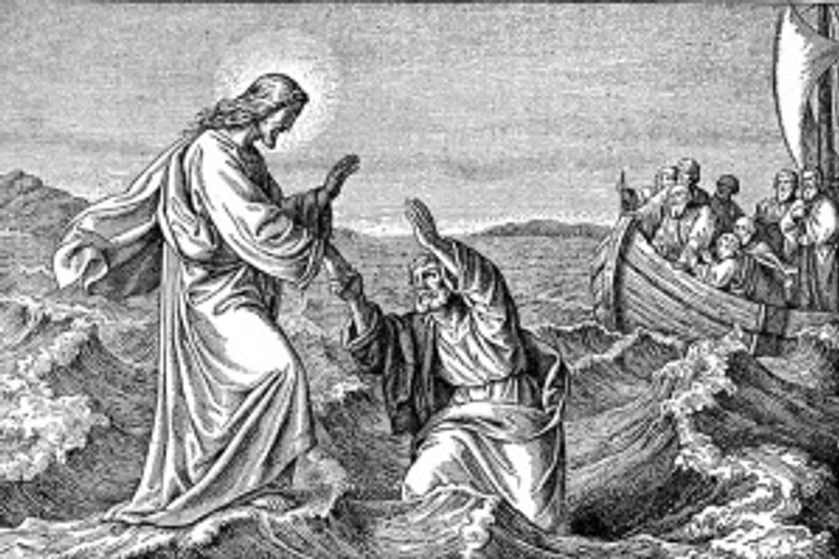
Maybe Jesus was on a pier and Peter could not see that in the dark, filled with fear?

[Reminder: Every time the disciples cried out in fear, they believed in Jesus; but Jesus would say, “Oh you of little faith.”]

The rejects (obviously) did not understand what Jesus just said to them, which is the same reaction most Christians have when they read this selection as well. They heard the words, but they flew way over their heads … because Jesus was not there in them. So, in an argumentative spirit they said, “What sign are you going to give us then, so that we may see it and believe you? What work are you performing? Our ancestors ate the manna in the wilderness; as it is written, ‘He gave them bread from heaven to eat.’”

The word translated as “sign” is “sēmeion,” which also means, “miracle, indication, mark, and token.” These rejects asked for a sign worthy of belief, after the great majority of the five thousand were given the “mark of Christ” when they were fed spiritual food. Those immediately acted from the faith of personal experience with the Holy Spirit and God, just as Jesus of Nazareth was then doing in Capernaum.

Still, by seeing the feeding of a multitude with five loaves and two fish as a miracle, there were some common people who believed that was a magic trick. Because it could have been good theatrics, they needed to get more than an “all you can eat” buffet of physical bread. After all, Moses did work a miracle of God that lasted forty years in the wilderness … which none of them witnessed personally, but they believed. Jesus, a relative unknown, needed to do a verifiable miracle before their eyes, or those common rejects were not about to stay his fans much longer.

Jesus responded to their challenge by saying, “Very truly, I tell you, it was not Moses who gave you the bread from heaven, but it is my Father who gives you the true bread from heaven. For the bread of God is that which comes down from heaven and gives life to the world.”

Jesus straightened out the facts of the Exodus story of the manna, saying God rained bread from heaven, such that Moses only told the Israelites what to expect from God. Still, the manna was spiritual food, which afforded the Israelites life in a wilderness that had little life to offer human beings. Still, when Jesus said, “It is my Father who gives you the true bread from heaven,” Jesus just restated, “The work of God” is “life to the world,” and, that when “you believe in him whom [my Father] has sent,” then you become “the true bread of heaven” that never stops feeding the soul.  Eternity is a greater feat than forty years.

*Cue the sounds of a flock of ducks flying overhead, because the rejects heard “bread” and could only think in physical terms.*

I don’t get it.

They said to Jesus, “Sir, give us this bread always.”’

They were still expecting everything to be handed to them, without any work of God performed. Just like some Masoretic scholars believe about God’s gift of manna – that some Israelites lazily laid on the ground outside their tent and caught the manna as it drifted down to earth from heaven – they wanted Jesus to make it rain bread. They said this to Jesus as if the only way he could prove he was sent from their God, was to hand out free bread for the rest of their lives, like God did when they complained to Moses.  They wanted to be given that gift then, on the spot.

Tongue in cheek, perhaps.  I think they expected Jesus to actually deliver on that demand, about as much as hurricane disaster victims actually expects FEMA to give out $100 Walmart gift cards forever.

First come, first served. Only 500 available.

Since Jesus was fully able to read the hearts and brains of the reject doubters, being always filled with the Holy Spirit and the Mind of Christ, he made this statement: “I am the bread of life.”’ Jesus affirmed that he was the manna sent from God, but this time the “bread” was “of life,” not simply for staying alive in a wilderness. Life meant staying awake and vigilant, as an escape of mortal death and the reincarnation that follows a soul’s sleep state. It meant the hands, lips, teeth, esophagus, stomach, and intestines had nothing to do with consumption of Jesus bread. Only the heart could take in God’s gift of love.

When Jesus said, “Whoever comes to me will never be hungry, and whoever believes in me will never be thirsty,” the same problem with having a low expectation of the meaning stated in “come to me” and “belief in me” is why Christians go to church on Sundays, but would never ever dare to tell someone, “I think I am Jesus Christ reborn.” Humans are always hungry and thirsty; but souls hunger for hope and salvation and thirst for redemption and promise. As such, “come to me” means being reborn as Jesus Christ, so one can perform the same miracles of faith that are only possible in Jesus Christ.

As the Gospel selection for the eleventh Sunday after Pentecost, when one’s personal ministry for the LORD should be underway – filled with the bread of life – the message is to face up to the rejection of doubters. Just as the young rich Pharisee walked away from Jesus when told, “Oh, there is much more than external rules to learn. You have to become the resurrection of Jesus Christ, which means self-sacrifice and works!” … many do not want to hear that message because they know they are too weak to do that.

A minister of the LORD knows the sacrifices demanded. The vast majority of those who are cleansed by the Holy Spirit and adopted by the Father as His Son (regardless of human gender), reached the bottom, in one way or another, and cried out for God’s help. Hope becomes the beginning of a spiritual rise from that depth, with hope the inspiration that comes as the spiritual food one needs to find life in service to God. A minister to the LORD knows this path to salvation and is ready to assist one who seeks to find the value of that service’s reward of heaven and eternal life.

Paul wrote about hope and said anyone who hopes for what one already knows, then that is not true hope. People know worldly riches and goals, whether or not they have achieved them. True hope is desiring that which cannot be seen in this world. The common people who could not see themselves as Jesus, who followed Jesus to Capernaum, they could not understand that proof of Jesus being the bread of life is impossible in a worldly state. Only within one’s heart and mind can one prove that to oneself. Only from one’s soul can one know this truth.  Therefore, no minister of the LORD can prove what only faith can prove … not simply belief.

If one studies the Gospels just a little, one finds that Jesus answered more questions with other questions, rather than state concrete answers that can be judged as true or false, based on the powers of observation and physical measurements. When one hears Jesus ask a question, in response to a personal question, the Holy Spirit is whispering guidance. Those who test that guidance find their own answers, and that personal experience changes belief into faith that is personally proved. A minister of the LORD can treat seekers as disciples, and give more explanation, just as Jesus privately told his devoted students. Still, it is ultimately up to the student to prove to him or herself what it is the teacher is teaching.

When the pilgrim rejects said to Jesus, ‘Sir, give us this bread always,” this is like kneeling by one’s bed as a child and praying, “Lord, please let me be a doctor when I grow up.” (Or lawyer, or professional actor, or movie star, or some wealthy professional.)

God does answer those prayers. He says one must learn that science, craft, or art until one has ownership of it (mastered it completely). The problems come when people who pray for such dreams are not willing to listen to advice and do what it takes.

Some advice now: It is easier to get what you want in the physical world than it is to get what you want spiritually … if you do everything alone and without help. Some people are actually self-made millionaires (breaking many laws along that journey). However, no one has ever reached heaven by selfish means.

2 Samuel 11:26-12:13a – You are the sinner!

When the wife of Uriah heard that her husband was dead, she made lamentation for him. When the mourning was over, David sent and brought her to his house, and she became his wife, and bore him a son.

But the thing that David had done displeased Yahweh, and Yahweh sent Nathan to David. He came to him, and said to him, “There were two men in a certain city, the one rich and the other poor. The rich man had very many flocks and herds; but the poor man had nothing but one little ewe lamb, which he had bought. He brought it up, and it grew up with him and with his children; it used to eat of his meager fare, and drink from his cup, and lie in his bosom, and it was like a daughter to him. Now there came a traveler to the rich man, and he was loath to take one of his own flock or herd to prepare for the wayfarer who had come to him, but he took the poor man’s lamb, and prepared that for the guest who had come to him.” Then David’s anger was greatly kindled against the man. He said to Nathan, “As Yahweh lives, the man who has done this deserves to die; he shall restore the lamb fourfold, because he did this thing, and because he had no pity.”

Nathan said to David, “You are the man! Thus says Yahweh elohe of Israel: I anointed you king over Israel, and I rescued you from the hand of Saul; I gave you your master’s house, and your master’s wives into your bosom, and gave you the house of Israel and of Judah; and if that had been too little, I would have added as much more. Why have you despised the word of Yahweh, to do what is evil in his sight? You have struck down Uriah the Hittite with the sword, and have taken his wife to be your wife, and have killed him with the sword of the Ammonites. Now therefore the sword shall never depart from your house, for you have despised me, and have taken the wife of Uriah the Hittite to be your wife. Thus says Yahweh: I will raise up trouble against you from within your own house; and I will take your wives before your eyes, and give them to your neighbor, and he shall lie with your wives in the sight of this very sun. For you did it secretly; but I will do this thing before all Israel, and before the sun.” David said to Nathan, “I have sinned against Yahweh.”

——————–

This is the Track 1 Old Testament reading that can be chosen to be read aloud on the tenth Sunday after Pentecost [proper 13], Year B, according to the lectionary for the Episcopal Church. If chosen, it will be accompanied by a reading of Psalm 51, which sings, “Purge me from my sin, and I shall be pure; wash me, and I shall be clean indeed.” Those readings will precede an Epistle reading from Ephesians, where Paul wrote, “ lead a life worthy of the calling to which you have been called, with all humility and gentleness, with patience, bearing with one another in love.” All will accompany the Gospel reading from John, where Jesus told those who followed him after the miracle of feeding five thousand, “Very truly, I tell you, it was not Moses who gave you the bread from heaven, but it is my Father who gives you the true bread from heaven.”

I wrote and posted a lengthy commentary on this reading in 2018. I welcome everyone to read that by searching this site. What I wrote in 2018 still applies today. Rather than restate many elements previously said, I will take a different approach today.

First of all, in 2018 I did not adjust the text to show what was actually written, which has been changed to accommodate English translations [and other languages, certainly]. In these selected verses, there are seven translations of “the Lord,” when “Yahweh” is written. One appears in the last verse of chapter eleven and the other six are in chapter twelve. In verse seven of chapter twelve is written “Yahweh elohe yisrael,” which has been translated as “the Lord God of Israel.” That translation has been modified to “Yahweh elohe of Israel,” because the word “elohe” is a clear Hebrew word that states “gods,” and to change it to “God” means two things: First, people who do not personally know Yahweh cannot discern how “gods” fits their agendas; and, second it says they also do not understand that “yisrael” is not a country, but a statement of “elohe,” where they all are souls that reflect “he retains God.” Therefore, in 2021 I return what was written to its rightful state, not for myself, but for your investigative reading.

As far as all Scripture reading should be seen, to sit back in a pew with a large soda and a bucket of buttered popcorn, pretending this is some black and white movie staring Gregory Peck and Susan Heyward is wrong.

The point of Scriptural readings is THEY ALL reflect on the brain hiding between a pair of ears. If you want to see an old movie, then imagine the end of Reefer Madness, where some second-rate actor begins pointing at the camera, saying, “It could be you … or you … or you.” Regardless of human gender, this reading must be seen as a reflection on just how much EVERYONE is sinful David. No one is Nathan. No one is Uriah the Hittite. No one is Bathsheba. No one, most certainly, is Yahweh; so, all men and women who have ever had extramarital sex needs to hear Nathan speaking to you … and to you … and to you!

In these Old Testament readings, the characters speak with Yahweh, not some generic “Lord.” They call him by name, and He calls them by name. Nathan was a prophet who spoke with Yahweh; and, one can assume that when Yahweh poured out His Spirit onto David, that Spirit was not like the oil poured out by Samuel. Samuel’s oil went on David’s head and ran down his face and neck, as a physical anointing. Yahweh poured out His Spirit upon David’s soul, meaning David probably talked with Yahweh too. He certainly knew His name, as far as his Psalms are concerned.

Maybe it is time to realize the ‘parabola effect’ has taken Christianity from being one hundred percent elohe [or elohim], as the truth of each being reborn as Jesus, all being anointed in the same way as was David. In the beginning, there was a rapid spike upwards; but now, after centuries of having translators have call Yahweh just a “lord” and make the plural of “gods” created by Yahweh be just another name for Him, the tail end of Christianity has come. That is why Scripture is more important than ever, but the problem is it being little more than the blind leading the blind towards a great pit.

As far as the other addition I would like to make at this time, it is relative to the story Nathan told David, about the ewe lamb. This is why this reading is chosen to accompany a Gospel reading about Jesus talking about bread from his Father; and, it is why the alternative Track 2 Old Testament reading comes from Exodus, talking about the Israelites complaining to Moses about not having “fleshpots” in the wilderness, like they had back in Egypt. We do not read how Moses probably got fed up with the complaints and told them, “Well you worshipped lords back where they had fleshpots and now you worship Yahweh. Learn the name and get with the program, The way to a sinful life is easy. Just follow the footprints to the sea and then jump in.”

When the Israelites complained to Moses, like the Jewish pilgrims complained to Jesus, the people who run around calling Yahweh a “lord” are the same ones who never tell anyone the Israelites left Egypt with all their livestock. Given the vegetation in the wilderness was not as lush as it was in Egypt, the had a source of milk; and, from milk can be made cheese. If need be, they could sacrifice some lambs every Passover; so, they were not really starving from a lack of food. They were complaining because the rich Israelites – the one with most of the sheep, goats, and cattle – were tired of being expected to share with the poor Israelites, who had no animals one just one ewe lamb they bought from a rich Israelite.

Likewise, any pilgrim traveler far away from home would never think about traveling without some trail mix or jerky in their bags, because it gets costly feeding the family for two months on the road. This means all the people who reclined on the grass to be fed by Jesus and his apostles had their own food with them. They knew there were no marketplaces at the Jesus ‘open air synagogue,’ so many of them probably told the apostles, “Here, take some of mine to pass out.” That would easily explain how twelve extra baskets of leftovers was gathered, wouldn’t it?

The point of both those readings is not about being fed physical food. It is all about being fed spiritual food, because people in need of a reason to be ‘away from home’ need some positive news and uplifting motivational speeches to continue on. The people who followed Jesus to Capernaum were those who ate physical food, not those nourished by spiritual food. They were pretend people of faith, much like those who belittle Yahweh by calling him a lord. The Israelites in the wilderness with Moses were those complaining, “Listen Moses. We need a miracle every day. It has been a while since the last. We didn’t sign up to be contestants on Alone, so feed us some miracles of faith so we can keep following you and believing in Yahweh.”

By seeing that in the other reading choices for this Sunday, the rich man with “very many flocks and herds” is metaphor for a human being whose soul is void of Yahweh. Having the things that calculate as the measure of wealth is what all rich men and women bow down before and worship. That makes wealth their “Lord,” which is a “Lord” so commonplace that any specific name given to it [like “Mammon”] is still as dead as is the material things the rich think are the rewards due to a worshipper. This is where Christianity is failing today, especially in the United States of America, because so many Christians believe some “Lord” has made them wealthier than the rest of the world. Still, few want to give any of their wealth away to the poor, because they see the poor as not being as religious as they are.

When one sees the “very many flocks and herds” as a statement of plenitude, this should be seen as how many “Lords” there are that people worship. People worship their cushy jobs, where the do little work and reap millions of dollars. People worship fancy cars and mansions in exclusive gated communities. People worship the politicians that make it easier for them to steal from the poor and not get caught. If these people were to be asked who is God, few [if any] would say Yahweh.

That becomes the many verse the one, when it comes to the poor man who bought one ewe lamb and then raised it like a member of his family, loving it with his heart and soul. That is the individual relationship that every true Christian is expected to have with Yahweh – not Jesus – because Yahweh is what allows the poor to afford one ewe lamb. The one ewe lamb is then sacrificed, which makes it then reflect Jesus; and, it also becomes a reflection of Uriah, who was the one ewe lamb sent to his death unjustly. The difference must be seen as having many things or having just one source of love.

Nathan then told David a parable about “there came a traveler to the rich man” and he wasn’t about to spend any of his flocks and herds feeding some “wayfarer,” so “he took the poor man’s lamb and prepared that for the guest.” The wandering wayfarer [from “lā·’ō·rê·aḥ”] are the pilgrims reclining in the grass by the sea and the Israelites led out into the wilderness by Moses. For the rich man to not offer up one of his sacrificial animals for the guest says he had nothing of value to offer, even having as much as he had. While Moses and Jesus offered up themselves [as a ewe lamb] to feed the people, the Temple priests and their hired hands could not satisfy the needs of the people. The same lack of value is found in the Christian churches that close and bar the doors because of COVID19, as they would rather kill someone else than make an offering of one of their valuable [tithes paying] pewples.

Now, David still had the Spirit of Yahweh poured out upon his soul, which would stay with him forever; so, he was able to see how evil it was for a rich man to not sacrifice one of his own animals, instead stealing a poor man’s family member and slaughter it. David was allowed to fail by Yahweh, so no human king would ever be able to boast, “I was perfect all my life!” That means David saw the evil in his own actions, when Nathan cried you, “You are that rich man!”

This is where David becomes a reflection of Christians, as it is very easy for them to yell “Sin!” at someone else; but they are blind to their own failures to serve Yahweh. David’s anger at the sinner had to become his own acceptance of punishment, all while still realizing he had to go back to being the king and go back to working, when he thought he could retire early. David’s remaining decade would be the payments he had to make, so his soul could still be redeemed. Every prophecy of Yahweh through Nathan would come true. For all the spiritual feeding of the flocks David had done in fifty years came to naught; and, David had to take his licks, because a soul does not gain eternal life without hard work for Yahweh.

As the Track 1 optional reading for the tenth Sunday after Pentecost, when one’s own personal ministry for Yahweh should be well underway, the lesson now needs to be realizing selfishness will not gain one salvation. Selfishness is a sin that most people are blind to, as they see the world as ‘dog eat dog.’ Every act David did was legal for a king; but what is legal for a king is not the same as what one’s commitment vows to Yahweh say. The problem with saying, “I believe in the Ten Commandments” is belief is a flimsy excuse for breaking every law as one sees fit. If one does not know the commitment vows, then it is impossible to serve up that to a guest, who comes asking, “How do I get into heaven?”

Exodus 16:2-4,9-15 – Manna from heaven

The whole congregation of the Israelites complained against Moses and Aaron in the wilderness. The Israelites said to them, “If only we had died by the hand of Yahweh in the land of Egypt, when we sat by the fleshpots and ate our fill of bread; for you have brought us out into this wilderness to kill this whole assembly with hunger.”

Then Yahweh said to Moses, “I am going to rain bread from heaven for you, and each day the people shall go out and gather enough for that day. In that way I will test them, whether they will follow my instruction or not.

Then Moses said to Aaron, “Say to the whole congregation of the Israelites, ‘Draw near to Yahweh, for he has heard your complaining.’“ And as Aaron spoke to the whole congregation of the Israelites, they looked toward the wilderness, and the glory of Yahweh appeared in the cloud. Yahweh spoke to Moses and said, “I have heard the complaining of the Israelites; say to them, ‘At twilight you shall eat meat, and in the morning you shall have your fill of bread; then you shall know that I am Yahweh elohekem.’“

In the evening quails came up and covered the camp; and in the morning there was a layer of dew around the camp. When the layer of dew lifted, there on the surface of the wilderness was a fine flaky substance, as fine as frost on the ground. When the Israelites saw it, they said to one another, “What is it?” For they did not know what it was. Moses said to them, “It is the bread that Yahweh has given you to eat.”

——————–

This is the Track 2 Old Testament option for the tenth Sunday after Pentecost [Proper 13], Year B, according to the lectionary for the Episcopal Church. If chosen, it will be paired with a reading from Psalm 78, which sings, “He rained down manna upon them to eat and gave them grain from heaven.” Those will precede the Epistle reading from Ephesians, where Paul wrote, “There is one body and one Spirit, just as you were called to the one hope of your calling, one Lord, one faith, one baptism, one God and Father of all, who is above all and through all and in all.” All will accompany a Gospel reading from John, where Jesus told the people who followed him there, “Very truly, I tell you, you are looking for me, not because you saw signs, but because you ate your fill of the loaves. Do not work for the food that perishes, but for the food that endures for eternal life, which the Son of Man will give you.”
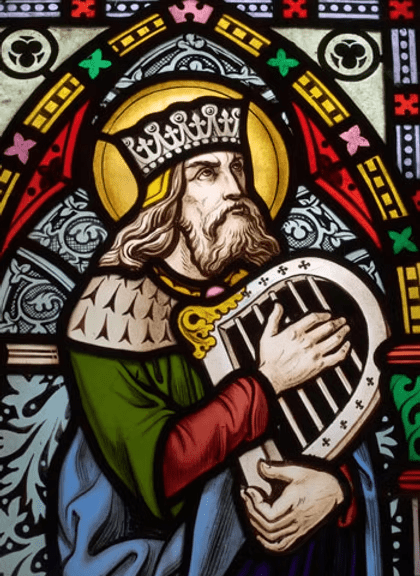
I wrote an update of this reading and posted it publicly on my website in 2020. I welcome all who are interested in reading that commentary by searching this site. I had previously written about this and published in 2017 [including all verses 2-15], which also can be read by searching this site. I welcome all to read what I have written prior on this Exodus story about the manna and quail, as nothing has changed that keeps that meaning seen from still being applicable today. Now, I will offer a slight angle on this reading that is designed to make it an easier reflection on the Track 1 Old Testament choice [Nathan tells David, “You are that man!”] and the Gospel where Jesus is encountered in Capernaum after having fed the multitude free food.
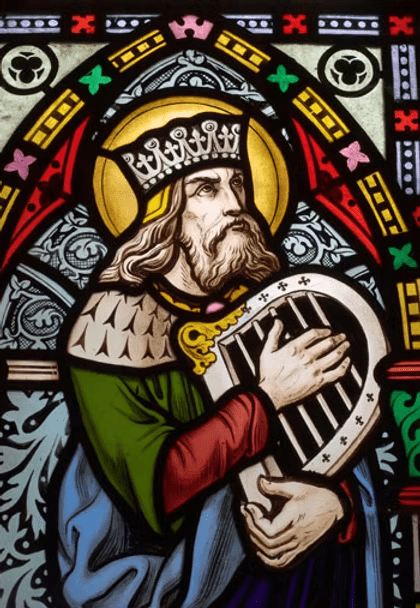
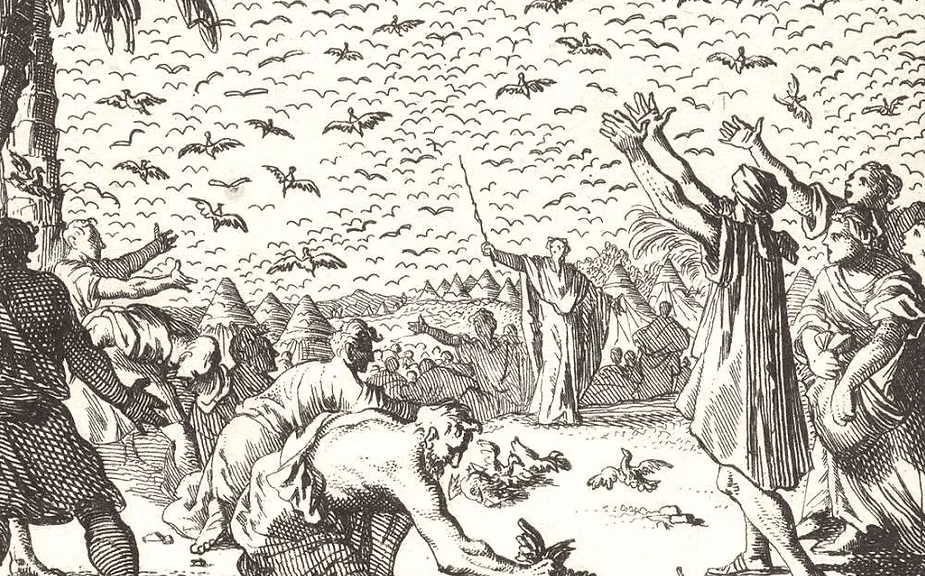
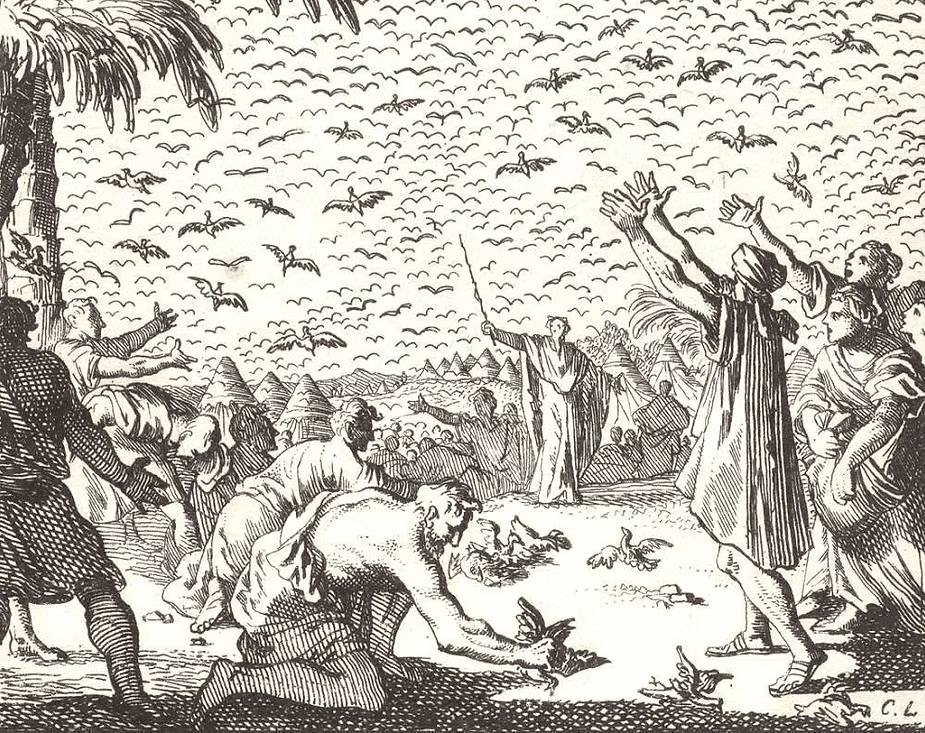
An adjustment that I am now doing is relative to my refusal to continue the naming of Yahweh as “the Lord.” In that effort, I have place [in bold type] the name “Yahweh” in the places it was written, but changed by some translation company to “the Lord.” Just so everyone is clear that the Israelites have a word that translates as “lord” [“adon” in the singular, “adonay” in the plural], there are absolutely zero uses of that word anywhere in Exodus chapter sixteen. Also, I have come to the realization that the plural number of “god” [in the Hebrew “elohim”] must not be altered to the singular and then be given capitalization status, as “God.” There are many “gods” that have been created by Yahweh, which can be a universal law [non-human], an angel [non-human], and a Saint [a human soul united with Yahweh’s Spirit]. Moses, David, and Jesus are just three examples of Yahweh elohim, and Yahweh has the power to create as many elohim as He sees fit. Since the translators of Scripture into English most certainly are not elohim, they make mistakes like calling Yahweh a lord and changing “gods” into “God.”

To hear the Israelites complain, “If only we had died by the hand of Yahweh in the land of Egypt,” that is a major statement against having the protection of Yahweh guarding their souls. It says, “If only we had not sacrificed an unblemished yearling lamb, cooked it and ate it, after marking our doorways with that lamb’s blood.” If says, “If only Yahweh had come into our houses and struck dead the firstborn, like happened to Pharaoh and all others who did not follow Moses’ instructions.” That is like hearing a famished Esau say to his brother Jacob, “Birthright!? What birthright? I wants stew now!” In other words, it is something only a child or a fool would say.

When Nathan told David the parable about a rich man and a poor man, the rich man with many flocks and herds is like Egypt, where fleshpots and bread a plenty was always readily available … as long as there was no famine or war that would interrupt that image of what was once before. The metaphor of a poor man is like the Israelites out in the wilderness, with nothing of value that would make him stand out above the crowd. That then makes the metaphor of the little ewe lamb be these men Moses and Aaron and this God named Yahweh, which was not just something representing immense value, but family. The little ewe lamb meant abounding love, both to and from the poor man’s family and the lamb. The complaints made to Moses and Aaron say the Israelite people were still of a mindset that saw themselves as rich men and women, who deserved all their wealth reflected in their many flocks and herds, while also having the birthright to snatch away someone else’s God as their own too. The complaints of the Israelites said they were selfish; and, being selfish is not the way to have one’s soul assured of salvation.

Now, the people who followed Jesus from the synagogue by the sea, where they reclined in the grass and ate their fill of fish and bread [like the rich did, way back in Egypt], they had followed Jesus simply because he meant free food for pilgrims from out of town. They were not poor, as they had traveled long and far to go to Judea for the Passover, so they had enough money to take along food for the trip. Finding Jesus was only a way to keep their many flocks and herds and snatch this ewe lamb as their own, to save cash while feeding their bellies. In that way, they were just like the Israelites complaining to Moses and Aaron, with one exception. That exception is the pilgrim following Jesus were not babies. They were full-grown adults.

The Israelites were like the glint in the Father’s eye, forty years before they would be formed into a fetus in the womb called Israel. That baby would be born when it was cast out into the world when the water burst and the uterus that was Israel and Judah squirted out a new religion for the world to come to know. Because of that difference in age, Yahweh treated the complaining Israelites like would a Father and His screaming baby, who was always either hungry, thirsty, or so messy it needed to be cleaned. Babies are totally incapable of caring for themselves, so parents have to do everything. By the time the pilgrims followed Jesus and began acting like babies, Jesus told them acting like babies no longer cuts it.

The gifts of manna and quail [the quail being a onetime feast] was the equivalent of setting baby in a high chair and letting it splash around in pablum and Cheerios. Because all the Israelites were adults and quite capable of eating goat stew, with cheese and water, the baby in them was their souls. The manna and quail was soul food, designed to pacify the baby, so the ugly adult did not take control and complain unnecessarily.

The manna was akin to spiritual food, before Moses completed writing his five books called the Torah. The manna stopped raining like bread from heaven when Moses left them at the Jordan River with five scrolls he wrote. After that, the spiritual food of the Israelites came from memorizing those words. By the time David was sent as the man with a little ewe lamb, showing all the Israelites they needed to be just like him for the meaning of all those memorized words to come forth. When David changed back into a rich man with many flocks and herds, Uriah became the poor man with one ewe lamb; and, David then sacrificed that as a symbolic act that the Israelites had a soul that knew Yahweh, but to realize salvation would come after their birth and stumbles into adulthood. Jesus then came to touch those souls, waking them up from their slumbers that had allowed the memorization of Scripture to make them rich men with many flocks and herds, but none understood as requiring self-sacrifice.

When David loudly said to Nathan after hearing the parable about his sins, “As Yahweh lives, the man who has done this deserves to die,” he was proclaiming the answer to understanding self-sacrifice. That self-sacrifice would mean trouble being raised in David’s own house. The embryo Israel would be born with a pure soul, in a body of sinful flesh. It would be born from failure and raised with the troubles of a world that offered no safe harbor. It had been blessed by being given manna from heaven; but it had been cursed by thinking that gift – which it could not understand – made it special in Yahweh’s eyes. To learn self-sacrifice, Israel would have to live up to its name by becoming elohim. It would have to stop being the crying infant only concerned with “me, me, me!” It had die, so it could be reborn and rise again as “He Retains God” [the meaning of “Israel”].

As a reading option for the tenth Sunday after Pentecost, when one’s own personal ministry to Yahweh should be well underway, the lesson to be found is learning that Egypt and its fleshpots with plenty of bread reflects where civilization demands the sacrifice of a soul for material things. By having the angel of death pass onto one’s soul, “Welcome to Egypt! Land of a seventy year existence [beyond childhood].” The problem is an eternity of reincarnation, coming back time and time again as some loser, scattered to the four corners of the earth, never finding a place to call home. Get used to worshiping Mammon in this life and find abject poverty and enslaving abuses for several lifetimes after. The only release from that cycle is getting in touch with that pure soul, before it is sold on the free market one more time. There has to come a time when the soul stands up against the flesh and stops selfishly selling out for an illusion that is here today and then gone in a flash.

The only way to have the soul stand up is spiritual food. Spiritual food comes from the divine Scripture that is found in the Holy Bible. It is written in codes that your eyes can read, but not quite understand. To begin to understand, one needs to gather the manna daily – not just once or twice a year [Easter and maybe Christmas]. One needs to consume a day’s worth before trying to eat the who book all at once. Yahweh will be watching, as Scripture is a test, to tell “whether you will follow His instruction or not.” The longer you follow the gathering instruction, the more spiritual food will begin to feed you soul and return it to strength, allowing it to stand up against the flesh. Spiritual food gives the soul the desire to marry Yahweh [not some nameless lord, as the world has too many of those to list]; and, marriage to Yahweh makes one’s soul in union with His Spirit become one of His elohim.

Ministry is worthless when placed in the hands of the selfish, whose only soul cared for is one’s own. The selfish prance about in clothes that make them appear higher and mightier than everyone else, all the while they are abusing those who are poor, with only a pure soul to hold onto. A bad shepherd is one who never leads a flock to green pastures of spiritual food, beside still waters, because that thief has no interests whatsoever in tending one flock. There is money to be made in having many flocks to steal from and many herds to point at as perfections of creation, as unclean as them may be in reality.

The world is so full of bad ministers that is why Yahweh had Moses lead the Israelites away from where sin pulses freely and loudly. It is impossible for a bad shepherd to tell anyone the meaning of manna from heaven, because he or she [add in its these days] has never been taught any meaning beyond Sunday School and children’s church, when the point of manna being said to mean “what is it?” says a minister explains what it is. When false shepherds begin to make up stuff, they begin taking the little ewe lamb of some published author and pretending that baby lamb is their own to serve up for dinner. One has to come to Yahweh to know the meaning of His bread from heaven.

Ephesians 4:1-16 – Capitalizing on the truth

I therefore, the prisoner in the Lord, beg you to lead a life worthy of the calling to which you have been called, with all humility and gentleness, with patience, bearing with one another in love, making every effort to maintain the unity of the Spirit in the bond of peace. There is one body and one Spirit, just as you were called to the one hope of your calling, one Lord, one faith, one baptism, one God and Father of all, who is above all and through all and in all. But each of us was given grace according to the measure of Christ’s gift. Therefore it is said,

“When he ascended on high he made captivity itself a captive; he gave gifts to his people.”

(When it says, “He ascended,” what does it mean but that he had also descended into the lower parts of the earth? He who descended is the same one who ascended far above all the heavens, so that he might fill all things.) The gifts he gave were that some would be apostles, some prophets, some evangelists, some pastors and teachers, to equip the saints for the work of ministry, for building up the body of Christ, until all of us come to the unity of the faith and of the knowledge of the Son of God, to maturity, to the measure of the full stature of Christ. We must no longer be children, tossed to and fro and blown about by every wind of doctrine, by people’s trickery, by their craftiness in deceitful scheming. But speaking the truth in love, we must grow up in every way into him who is the head, into Christ, from whom the whole body, joined and knit together by every ligament with which it is equipped, as each part is working properly, promotes the body’s growth in building itself up in love.

——————–

This is the Epistle reading to be presented aloud on the tenth Sunday after Pentecost [Proper 13], Year B, according to the lectionary for the Episcopal Church. This will be preceded by one of the two pairing possibilities of Old Testament and Psalm readings. Track 1 places focus on Yahweh telling Nathan to tell David his fate for sinning. Track 2 places focus on the Israelites complaining about hunger, so Yahweh promised to send them manna from heaven. The two Psalms then support themes of lament and praise, in accompaniment. All will accompany the Gospel reading from John, where the people followed Jesus to Capernaum and wanted more free bread.

I wrote about this selection and published it publicly on my website. I welcome all to read what I had to say about in 2018 and posted it on my website, which can be found by searching this site. Because the Epistles are designed to force a seeker to delve deeply into the meaning of what the Saints wrote, so much is possible to be seen that it requires more than a casual English translation to begin to unfold its truth. The Epistles are written in this way to prove a priests is indeed filled with the Spirit of truth; and, they are written in this manner to expose the truth to the true seekers, so seeing for oneself raises their souls to a state of faith. For that reason, I will simply analyze a portion of this Epistle selection, as an approach that differs from that taken in 2018. What I wrote then is still applicable, as what I add now only supports that meaning.

The New Testament is made up of writings produced by people after Jesus’ life on earth had ended. It becomes important to see the entire “new bible” as being the writings of men [and women too in apocrypha], who all had become the spiritual resurrections of Jesus. There is no need to canonize any book written by anyone less possessed spiritually. This means the New Testament is the fulfillment of the promise that was presented in the Old Testament, after Yahweh sent Moses to collect human being possessing souls and teach them to become possessed by Yahweh’s Spirit, which became the writings of those individuals who divinely knew that history, wrote divinely inspired songs and became the prophets who were the prototypes of Jesus resurrected [before his birth].

For anyone to believe anything in the Holy Bible is just a book of opinions, written by men who wanted to make a name for themselves, with that opinion possibly flawed [as seen when apparent contradictions seem to make human flaws stand out], there is no benefit to be found from reading Scripture. Holding that opinion means one cannot explain Scripture so others can be led to their souls marrying Yahweh, allowing Jesus to be resurrected within them, saving their souls from another wasted life in the flesh. Only those who see the divinity of every word written, as coming from the voice of Yahweh speaking through a divine author, can one be a continuation of the New Testament.

The Epistles are the test of one’s learning to see the truth of each word. The amazing power of that truth speaks loudly in many ways, which takes their discernment far above and beyond the limitations of normal syntax. It is now with that declaration of the Epistles being Yahweh speaking through Paul that I want to focus here on the capitalized words written in these sixteen selected verses from his letter to the true Christians of Ephesus. The extraction of only those words becomes a letter within a letter.

In these sixteen verses there are seventeen capitalized words.

Parakalō” – “Invite” [“Advocate”]

Kyriō” – “Lord”

Pneumatos” – “of Spirit”

Pneuma” – “Spirit”

Kyrios” – “Lord”

Theos” – “God”

Patēr” – “Father”

Heni” – “One”

Christou” – “of Anointed one”

Anabas” – “having Ascended”

Anebē” – “he Ascended”

Kai” – A marker word denoting importance to follow. [It begins verse 11.]

Christou” – “of Anointed one”

Huiou” – “of Son”

Theou” – “of God”

Christou” – “of Anointed one”

Christos” – “the Anointed one”

Every capitalized word must be viewed as a divinely elevated statement, above and beyond the ordinary or normal meaning. For example, a “lord” or a “master” can be anything to which one is enslaved or in submission to, which can range from a job that pays the bills and an addiction that one cannot kick. The capitalization, however, makes the word take on the meaning of Yahweh’s presence within one’s soul-flesh, where “Lord” becomes a Spiritual “Master” that one’s soul has bowed down before. All of the capitalized words take on this heavenly association; and, this is the only reason the Apostles [Saints] ministered and then wrote to continue that ministry.

Without any of the other words written by Paul seen, simply take these capitalized words and read them as them making a most divinely elevated command. They form as: “Invite Lord of Spirit – Spirit Lord – God Father – One of Anointed one having Ascended – he Ascended * – of Anointed one of Son of God – of Anointed one the Anointed one.” If one struggles with hearing what Yahweh is saying through these words alone, then one is far away from salvation; and, more personal work must be done to open one’s soul to Receive the Spirit of understanding.

At the place where I placed an asterisk [*], this is where a capitalized “Kai” is written. The word “kai” should not be read as a word, but instead as a marker of importance to follow. In Ephesians 4 are found 26 uses of “kai,” with two capitalized. In these sixteen verses, there are fourteen of the twenty-six, with only the one capitalized. The capitalization comes at the beginning of verse eleven, which makes the first segment of words in that verse most important to grasp in a heavenly sense, with the whole of the verse maintaining that elevated sense of meaning. That means understanding verse eleven is most important to realize, as necessary information that goes along with this capitalized meaning found in these verses.

Verse 11 then states: “autos edōken tous men apostolous , tous de prophētas , tous de euangelistas , tous de poimenas kai didaskalous .” Translating to: “soul placed them truly messengers , them indeed prophets , them indeed missionary preachers , them indeed shepherds and teachers .” This becomes an important statement about all of the capitalized words stated prior. The primary elevated statement says the “selves” [“autos” means “self,” with a “self” elevated spiritually as a “soul”] are those “souls” that have listened to the “Urgency” for Spiritual marriage and allowed Yahweh’s “Spirit” to become their “Lord.” In those “souls” a divine union has made “God” their “Father,” as His “Son,” each “having Ascended” Spiritually to a state of “One.” Here, those “souls” are called “messengers” [“apostles” and also “elohim” in Hebrew], such that God’s creations become “prophets, evangelists, shepherds,” with this importantly noted to be “teachers” or “rabbis” [in Hebrew].

It is vital to realize these capitalized words can only be found in the Greek text [Hebrew has no capital letters in its alphabet] and not the English translations. Many English versions will take the liberty of taking a word like “autos” and capitalizing that as “He,” if they want the reader to follow their line of though [an agenda] that says the pronoun refers to Jesus. That misses the truth that a “soul” or a “self” is not elevated until it has married Yahweh and become His wife [a “Christ”].

In the quote stated by Paul: “When he ascended on high he made captivity itself a captive; he gave gifts to his people,” it is important to realize this is parsed from Psalm 68:18. The NRSV states that verse fully as: “You ascended the high mount, leading captives in your train and receiving gifts from people, even from those who rebel against the Lord God’s abiding there.” In that, the truth is David did not write “the Lord God’s.” He wrote, “Yah elohim,” which must be understood to say, “Yahweh gods,” where “elohim” or “gods” are what these sixteen verses of Paul’s epistle are speaking of, in capitalized letters.

As an Epistle reading selected to be read aloud on the tenth Sunday after Pentecost, when one’s personal ministry to Yahweh should already be well underway, Paul is teaching what a true “messenger” of Yahweh is. It is a soul who has fully submitted itself to Him, to be the soul that will resurrect as His “Son” Jesus, as two souls that have become “Anointed one” in the same body of flesh, all “One” with “God.” If one’s “Lord” is not Jesus, through his divine rebirth within one’s being, then one is only pretending to be religious; and, that leads the flock away from Yahweh, which harms one’s soul as a false shepherd.

John 6:24-35 – Calling Jesus “My Rabbi”

The next day, when the people who remained after the feeding of the five thousand saw that neither Jesus nor his disciples were there, they themselves got into the boats and went to Capernaum looking for Jesus.

When they found him on the other side of the sea, they said to him, “Rabbi, when did you come here?” Jesus answered them, “Very truly, I tell you, you are looking for me, not because you saw signs, but because you ate your fill of the loaves. Do not work for the food that perishes, but for the food that endures for eternal life, which the Son of Man will give you. For it is on him that God the Father has set his seal.” Then they said to him, “What must we do to perform the works of God?” Jesus answered them, “This is the work of God, that you believe in him whom he has sent.” So they said to him, “What sign are you going to give us then, so that we may see it and believe you? What work are you performing? Our ancestors ate the manna in the wilderness; as it is written, ‘He gave them bread from heaven to eat.’” Then Jesus said to them, “Very truly, I tell you, it was not Moses who gave you the bread from heaven, but it is my Father who gives you the true bread from heaven. For the bread of God is that which comes down from heaven and gives life to the world.” They said to him, “Sir, give us this bread always.”

Jesus said to them, “I am the bread of life. Whoever comes to me will never be hungry, and whoever believes in me will never be thirsty.”

——————–

This is the Gospel reading to be read aloud by a priest on the tenth Sunday after Pentecost [Proper 13], Year B, according to the lectionary for the Episcopal Church. This will be preceded by one of the two pairs of Old Testament and Psalms optional for this Sunday. Track 1 places focus on Nathan telling David that Yahweh will hold him responsible for his sins, with Psalm 51 a song of lament, singing: “Wash me through and through from my wickedness and cleanse me from my sin.” Track 2 places focus on the complaints of hunger by the Israelites to Moses and Aaron, leading Yahweh to begin the feeding program that would be manna from heaven. Psalm 78 sings out, “He let it fall in the midst of their camp and round about their dwellings.” The Epistle reading from Ephesians will be read before this Gospel selection, where Paul wrote, “He who descended is the same one who ascended far above all the heavens, so that he might fill all things.”

I wrote about this reading and published a commentary on my website in 2018. That article can be read by searching this site. I welcome all to read those views, as the same still applies today. Because I explained the bulk of what this reading selection says, I will now only offer a few observations from different angles.

One thing that became a sudden insight to me just the other day, something I had never thought of before is relative to the feeding of the five thousand. While this reading deals with the day after that feeding, my thought has bearing on this following of people to find Jesus in Capernaum. In my past thoughts on this miracle, I saw Jesus instructing his twelve apostles not only to have the five thousand recline in the grass but also having the twelve separate the five thousand into twelve sections, which would make for about four hundred sixteen each. Each apostle was then given a portion of the five loaves and two fish to distribute to the section assigned to him. Before, I saw the miracle being each of the twelve being possessed with the Spirit of Jesus, so each filled their section with the same Spirit, as spiritual food more than physical food.

Recently, I have seen the abundance of twelve baskets of leftover bread as having a logical explanation, no longer requiring that miracle needing one to believe something magical occurred, beyond the realm of nature, where atheists refuse to believe it is possible for bread to spontaneously be created, turning five loaves in one basket into twelve baskets full of bread pieces. The logic says the five thousand brought their own physical food with them, as they were traveling pilgrims that were prepared to feed themselves. As the apostles preached to the twelve sections of people, the people shared in common what they had, so everyone was filled with physical food, with much left over. In that process, the five thousand were more importantly filled with the spiritual food that was the real reason they came to find Jesus. While fed spiritually by apostles ‘in the name of Jesus,’ they knew Jesus would be the soul who would be “seized” in their soul’s marriage to Yahweh, knowing divinely that Jesus would become the “king” of their bodies of flesh – each an individual realm for his reign.

The thought that now comes strongly upon me is this: The model of the twelve sections of four hundred sixteen people then became the prototype of twelve modern churches, with each apostle acting as the priest or pastor leading a flock of that many sheep. The small portions of the five loaves and two fish is now seen by my imagination as the first offerings of symbolic physical food, which in Episcopal churches [all the universal catholic branches] that constitutes a wafer or cracker. The twelve baskets of leftover bread pieces is then akin to the offerings collected by the apostles; but these first examples of Christian churches do not set the precedence of begging the people for money and they do not pass out free wine. This modern concept of Christian churches, which set expectations that the people should show up expecting a free wafer, with the addition of a sip of wine, all paid for by the congregation’s hefty donations, is the reason John’s chapter six takes an ugly bend with these verses today [and the ones that follow – about “eating my flesh and drinking my blood”]. The roots of a failed “Church” are shown in this reading and the others to follow.

In my 2018 observations on this chapter of John’s, I saw the aspect of Judas Iscariot being one of the twelve as why not all of the five thousand would be spiritually satisfied and no longer seek after Jesus in the flesh, content to await his coming spiritually. Those who listened to a sermon on the Torah and the Prophets [a portion of the five loaves and two fish] were just as dissatisfied as were the normal Jews who attended a synagogue, always being fed meaningless banter. While everyone in that sectional flock shared the food they had, the offering of spiritual food by Judas was quickly turned to nothing. Those would be the ones who followed Jesus, to whom Jesus said, “Very truly, I tell you, you are looking for me, not because you saw signs, but because you ate your fill of the loaves. Do not work for the food that perishes, but for the food that endures for eternal life, which the Son of Man will give you.”

When one realizes the vast majority of the five thousand did indeed receive the miracle of the Spirit, as distributed to them by the apostles ‘in the name of Jesus,’ the vast majority of them would have left spiritually satiated, themselves [a “self” equals a “soul”] finally fulfilled through attendance in a synagogue [‘open air’ as it was]. They would have left the grassy flood plain of the sea, most likely gone to spread their newfound joy with others [the reality of Christianity]. Those who would have been fed the standard lack of spirituality all the rabbis of Galilee had, would have hung around, not realizing others had their souls touched by Yahweh, through His pastors of His flock. Those fed nothing of value by Judas, proclaiming to be taught by the Master Jesus, were found wanting more, after the food from yesterday became the waste of tomorrow.

Between the Gospel reading from John on the ninth Sunday after Pentecost and today’s tenth Sunday offering are two missing verses. John 6:22-23 are left out, seemingly as not fitting the storyline of either. Therefore, the Episcopal Church has omitted them as superfluous and unnecessary.

I see them as now being necessary to be read. Those two verses say [NRSV]:

“The next day the crowd that had stayed on the other side of the sea saw that there had been only one boat there. They also saw that Jesus had not got into the boat with his disciples, but that his disciples had gone away alone. Then some boats from Tiberias came near the place where they had eaten the bread after the Lord had given thanks.” (John 6:22-23)

First of all, this says not everyone had stayed the night where they had been fed the evening before. When the translation says, “the crowd that had stayed on the other side of the sea,” that indicates only a portion, while still numerous enough to be “a crowd” [“ochlos”]. When the translation then says, “They also saw that Jesus had not got into the boat with his disciples, but that his disciples had gone away alone,” this explains why they hung around. Whereas the vast majority had been touched by the Spirit of Jesus, passed on from one truly ‘in his name,’ the ones who had Judas preach to them were without that touch; so they waited to see the one that came to see … not some impostor.

In verse twenty-three, the NRSV has translated, “after the Lord had given thanks.” This is actually a separate segment of words in the Greek text [the last of three segments in verse twenty-three], where a comma mark introduces: “eucharistēsantos tou Kryiou,” which literally translates to say, “having been thankful for God’s good grace of this of Lord.” That sounds like a prayer was said; and, the Jews prayer after a meal, rather than before. The genitive case of “tou” and “Kryiou” says the reason for “having given thanks” [in prayer] means “of this” – the feeding of “bread” – was food provided for by God – “of the Lord.” The capitalization of “Kyriou” must be seen as a reference to Yahweh, as to whom “thanks were given,” more than John referring to Jesus. Still, to the ones waiting to see Jesus, the feeding of the “bread” occurred in his ‘open air’ synagogue; so, they also “gave thanks” to Jesus as an instrument of Yahweh – the “Lord.”

What needs to be seen from the word “eucharistēsantos” is the root Greek word is “eucharisteó,” from which comes the Christian term “eucharist” [“eucharistia”]. Everything about that word means “giving thanks” or “thanksgiving,” and this is especially read by Christians as being related to the Passover Seder meal, at which time Jesus said the ritual Jewish prayer before the breaking of the bread [which is never eaten], called the HaMotzi – meaning “blessing over the bread.” Therefore, a standard Jewish prayer of thanksgiving had been said, which gave thanks to Yahweh for physical bread consumed, with that having happened the evening before boats arrived at the pier near where a crowd of people remained gathered.

When this use of “eucharistēsantos” is seen as a commonly recited Jewish prayer over having eaten bread [or anything of substance], then the truth of verses twenty-four and twenty-five say these Jews were “seeking this Jesus” [“zētountes ton Iēsoun”], saying to him when they found him, “Rabbi , when here have you come ?” [From “Rhabbi , pote hōde gegonas ?”] This identification of Jesus as “My teacher,” the meaning of “Rabbi,” has to be seen as an important statement [capitalized words are always divinely elevated in meaning] that told Jesus, “Here come the bunch that listened to Judas.” Because Judas had left them wanting [like all other rabbis they had ever listened preach], they wanted Jesus, meaning understanding the capitalization of “Rhabbi” important to grasp.

According to HELPS Word-studies, “Rabbi” literally means, ‘My great one; my honorable sir,” such that “my” acts as a statement of possession. Whereas the ordinary usage implies a personal preference to one teacher, as “the teacher of me,” the capitalization raises this meaning to become a statement that says those who sought Jesus and found him felt in their souls that Jesus owed them something. For having shared their bread with others, expecting to get something uplifting in return from coming to Jesus’ ‘open air’ synagogue, they had left their ‘bread’ in the ‘offering’ basket, only getting a nibble of holy bread [a wafer] and a hint of fish. Because they saw Judas as the hired hand of Jesus, they felt that they had bought the right to call Jesus “My Rabbi.”

This needs to be seen as where the current state of Christianity is today. It goes to church [or watches church on some media], makes a financial offering [or mails in pledges and tithes], listens to a hired hand pretend to be Jesus reborn, and then eats a wafer and sips some wine, prays some canned prayers and goes home spiritually empty. The reason Christians go to church is to feel like Jesus is theirs, bought and paid for; but the result is always disappointing. This should be seen as why people searched for Jesus in Capernaum. Unlike the vast majority who had been fed spiritual food by true apostles, those who get the shaft from pretenders keep seeking some value in return for their money and support.

Simply by understanding the divine elevation of “Rhabbi” as a powerful statement of the failure of a religion to serve the needs of the flock [as the Jewish temple-synagogue system had, just as like the Christian church-denomination system does now], it is easy to see that was what Jesus responded to, rather than the question, “when did you come here?”

It is because Jesus was called “My Rabbi” he said, “Very truly, I tell you, you are looking for me, not because you saw signs, but because you ate your fill of the loaves.” In that, the segment of words that says, “not because you saw signs” can be Jesus knowing what they did not see. He told them “because you saw signs,” means “sēmeia” means both “miracles” and “tokens.” Whereas the vast majority went away talking about the miracles they witnessed, all this group fed by Judas saw was some token objects: tiny shreds of bread and some crumbled fish. Whereas the vast majority praised they finally understood the meaning of some Scripture, all the group that listened to Judas heard was the ‘same ole same ole nothings’ they always hear preached. Thus, Jesus knew by them calling him [who none had ever heard preach before] “My Rabbi,” it was because they had “not seen miracles.”

By Jesus then saying, “because you ate your fill of the loaves,” he was saying he knew they all shared commonly what bread they had brought with others, so all were filled physically with food. That was a cost to them, which they willingly paid; but for that price of admission they expected to see the show, the same one the vast majority saw. Judas had shown them nothing they had not seen many, many times before. That failure to live up to the price of feeding neighbors their own bread meant Jesus owed them. He could then be called “My Rabbi.”

With that, I will leave it up to the reader to ponder how the ensuing conversation between Jesus and the crowd unfolds. Again, this chapter of John is heading towards an ugly end, where the Jews will think Jesus is promoting cannibalism. This means, unlike the vast majority who had left spiritually satisfied who left and did not follow Jesus angrily, the ones who sought Jesus because they felt he owed them something is an attitude of birthright. They were Jews in pilgrimage, which says they followed the rules of Mosaic Law [as best they knew how to] and they expected to go to heaven, because they were the select group known to be God’s chosen people. Therefore, the conversation between Jesus and those who feel they deserve rabbis like Jesus to bless them and tell them they are going to heaven needs to be seen from a Christian perspective, where Christians assume much the same.

Again, I offered insight into the whole reading in my prior posting. Feel free to read that as the rest of this reading is pondered. Pay close attention to the “works of God” and think about those who say “belief” is all that is needed, with “works” left for others. Think how so many Christians poopoo James’ statement that “belief without works is dead,” because so many misunderstand “pistis” by thinking “belief” is the same as “faith.” Belief without works is dead faith. Calling oneself a Jew or a Christian is having a “belief.” However, calling oneself either without doing the “works of God” means a soul bound to reincarnate after the flesh is dead.

As the Gospel reading chosen to be read on the tenth Sunday after Pentecost, when one’s personal ministry for Yahweh should be well underway, the tendency is to see the crowd as doing a good thing. They all just wanted to follow Jesus, in the same way the vast majority of people calling themselves Christians today want to say they are always looking for Jesus. The lesson is to see oneself as one of those who did not sail away on the filled with the Holy Spirit boat, as not being one of those whose souls were engaged to Yahweh, knowing by doing good works their souls would be joined with the soul of Jesus – their king and lord. Todays lesson is seeing how often one calls Jesus “My Rabbi,” as if Jesus was some fictional character in a book, who is never one with one’s soul. The lesson is to realize one is not seeing any miracles surrounding one’s life.

A ministry for Yahweh begins by being able to know that name. A ministry must realize through one’s soul marrying Yahweh that the name “Jesus” means “Yahweh Saves,” so to be “in the name of God” one is “Jesus” reborn. One cannot stand like a Judas Iscariot, making up things one heard in Sunday School when six years old and then acting like a preacher, crying crocodile tears for emotional theatrics. One must be Jesus resurrected in one’s flesh, so the miracles of spiritual feeding never ceases. Wherever one goes as Jesus reborn, the miracles keep on satisfying the crowds. Anything less always leaves them wanting more and looking for where the truth can be found.

Psalm 51:1-13 – David’s song admitting his sins, begging for forgiveness

1 Have mercy on me elohim, according to your loving-kindness; *

in your great compassion blot out my offenses.

2 Wash me through and through from my wickedness *

and cleanse me from my sin.

3 For I know my transgressions, *

and my sin is ever before me.

4 Against you only have I sinned *

and done what is evil in your sight.

5 [4] And so you are justified when you speak *

and upright in your judgment.

6 [5] Indeed, I have been wicked from my birth, *

a sinner from my mother’s womb.

7 [6] For behold, you look for truth deep within me, *

and will make me understand wisdom secretly.

8 [7] Purge me from my sin, and I shall be pure; *

wash me, and I shall be clean indeed.

9 [8] Make me hear of joy and gladness, *

that the body you have broken may rejoice.

10 [9] Hide your face from my sins *

and blot out all my iniquities.

11 [10] Create in me a clean heart elohim, *

and renew a right spirit within me.

12 [11] Cast me not away from your presence *

and take not your holy Spirit from me.

13 [12] Give me the joy of your saving help again *

and sustain me with your bountiful Spirit.

——————–

This is the Track 1 psalm that accompanies the 2 Samuel 11-12 reading about David’s sins and Nathan giving him Yahweh’s judgment against him. This song of lament was written by David specifically because of that event with Nathan, making it the perfect accompaniment. The pair of readings will precede a reading from Paul’s letter to the Ephesians, where he wrote, “We must no longer be children, tossed to and fro and blown about by every wind of doctrine, by people’s trickery, by their craftiness in deceitful scheming.” All will accompany the Gospel selection from John, where Jesus said, “I am the bread of life. Whoever comes to me will never be hungry, and whoever believes in me will never be thirsty.”

Verse one of this Psalm actually includes what the NRSV has separated and presented as the heading for this song. They identify Psalm 51 as “A Psalm of David, when the prophet Nathan came to him, after he had gone in to Bathsheba.” This is written into verse one, but omitted from that presented as verse one.

The Episcopal Church, in all it’s almighty David-being-equal self has changed the numbering of this song, although the words of the NRSV are maintained. Verse 4, according to the NRSV, is four lines, like verse one but the other verses all only have two lines. The Episcopal Church has looked down upon this as a glaring mistake, waved its holy wand and <poof & presto> they have added a nonexistent verse that happily [in their eyes] throws more confusion onto the Christian faithful, which they have no intention of ever addressing, much less explaining. You will note that I have amended the verse numbers to what they really are.

Also in my corrections above are two uses of “elohim” [there is a third in the verses not included in this reading] that have been erroneously translated as “O God.” The Hebrew word “elohim” is the plural form of “el,” clearly translating as “gods,” of which none of the translators recognize. They all take a word clearly written in the plural number and transform it into being a capitalized “God.” The name of the “God” David, Nathan, Bathsheba, and Uriah the Hittite worshipped was “Yahweh.” The use of “elohim” is important to see as the “elohim” are the angels and saints who are two as one with Yahweh, as His messengers to the world. David had been one of the “elohim,” but now his fall has endangered that state of being.

It should be realized that David was not just some talented songwriter. The lyrics of the Psalms were divinely inspired. This should be seen as an example of his soul still be married to Yahweh, after Yahweh poured out His Spirit upon David’s soul [after Samuel poured physical oil from a horn on his head]. That spiritual event would remain with David’s soul forever. David was allowed to fail in order to condemn the line of kings that would rule the land they coveted more than Yahweh. Thus, it was as an “elohim” that David wrote this song of lament, after Nathan had told him Yahweh’s judgment upon his human house, which had been disgraced.

It should also be understood that Yahweh does not inspire His elohim to write Scripture for simply telling historical facts and figures. Everything David did and was punished for is a reflection of everything sinful done ever since and to this day [and well beyond]. The reader of Scripture needs to see how Scripture is a finely tailored fit for the reader’s past, present, or future. Scripture is thus written for the benefit of warning others that what has happened once will happen again; no one is immune to the trappings of sin.

In the part of verse one that follows the introduction that has been omitted, three Hebrew words start, which are: “ḥān·nê·nî ’ĕ·lō·hîm kə·ḥas·de·ḵā”. These words make a statement in the first segment of words, saying “show favor upon me elohim according to your loving kindness.” This needs to be read as David requesting Yahweh show favor to his status as an elohim [a wife whose soul has forever merged with Yahweh’s Spirit], with that state of being said to be because of Yahweh’s “loving kindness.” The aspect of “love” is read into this translation because that elohim relationship was due to a marriage based on love and subjection.

That statement containing elohim is then followed by two more segments of words, which say, “according to multitude of your mercies” and “blot out my transgressions.” This says that not only has Yahweh created many elohim out of “kindness,” but He also has created states of forgiveness very many times, as all human souls face lives knowing sin before they become sincerely repentant and submit their souls to Yahweh for judgment. All who have married their souls with Yahweh’s Spirit, having become His elohim, have had all of their “transgressions blotted out” and erased. Verse one is David’s plea for forgiveness, which comes from admitting his sins, as made clear to him by Nathan about his dealings concerning Bathsheba.

Verse two then furthers this state of having sins blotted out, where the comparison is being “washed clean.” The NRSV translates this as, “Wash me through and through from my wickedness and cleanse me from my sin.” So many Christians hear about baptism by the Spirit [the anointing Yahweh personally poured out unto David’s soul] and then load up on trucks and drive down to the nearest Christian church and stand in line for a baptism by water. David is not expecting holy water to be poured over his head, because he had no concept of water doing anything more than washing filth off one’s body. This means verse two is David asking for a second helping of Yahweh’s divine Spirit to be the cleansing agent that restores his transgressed soul to elohim status.

In verse three, David confesses his sins. This is a required element of repentance. To remove a problem, one first has to admit one has a problem. David did that by stating [NRSV], “For I know my transgressions, and my sin is ever before me.” In that, to say “I know my transgressions,” the Hebrew word for “know” [“yada”] is more than a brain remembering how events of the past went down. Because David was an elohim and his soul was married to Yahweh, his “knowledge” came from the Mind of God [as a “Christ” or “Messiah” or “Anointed one”], so David totally “knew” his “transgressions,” because his soul had become immersed in his sinful acts. His actions became ever-present to his being, haunting his soul, as if the soul of Uriah had become his constant reminder surrounding him.

The first half of verse four states [NRSV], “Against you only have I sinned and done what is evil in your sight.” This says David had the legal right to do everything he did, as a king. Because Yahweh had instructed Samuel to set the framework for what having a human king meant for the Israelite people, David had broken none of those parameters. He had the free reign to rule as corruptly as would any other human king, like those who ruled over other nations. The marriage of David’s soul to Yahweh raised him to a level of responsibility that meant David’s soul was where Yahweh was the only King. As long as David lived righteously, as a good wife to Yahweh, then Yahweh ruled as King of Israel, with David along for the ride. However, when David began to act as that king, he cheated on his commitment to Yahweh; so, everything a human king ever does with unchecked power is “evil” in the eyes of Yahweh.

The second half of verse four [which the Episcopal Church calls verse five], says [NRSV], “And so you are justified when you speak and upright in your judgment.” This is David admitting he did everything he has been blamed by Yahweh for having done, saying Yahweh spoke justly in his judgment that David’s house will face ruin. Nathan told David that Yahweh had promised: “I will raise up trouble against you from within your own house” and “I will do this thing before all Israel, and before the sun.” That said David’s kingship would collapse publicly, as punishment for his sins. David agrees that spoken through Nathan was “justified” and “upright.”

It is this verse four that is what separates the souls of sinful Christians from the soul of sinful David. The lesson to be taught here is accept one’s punishment in the physical world, no matter how hard and bad it may be. David admitted he sinned and asked for Yahweh to wash clean his soul; and, if that meant destroying his kingship and everything surrounding him in the physical world, then let that be. It is far better to suffer for ten years until death and then have one’s soul released to eternal life, all debts of sins paid in full, than it is to beg God to forgive one’s sins and then beg to not lose everything one has sinned a lifetime amassing. Christians beg Yahweh for all kinds of luxuries in the material realm, when none have ever considered their soul’s need to marry Yahweh and become an elohim. In that way, they all play King of Self, subjecting God to being their lackey who needs to be forgiving, with perks.

In verse five, David wrote a truth that all human beings must realize. He sang [NRSV], “Indeed, I was born guilty, a sinner when my mother conceived me.” This fairly accurate translation is still in need of tweaking, because there is absolutely nothing anyone knows about David’s mother being the bearer of sinners into the world. A literal translation of the Hebrew makes this verse state: “behold in iniquity I was brought forth , and in sin , conceived me my mother.” This becomes the elohim of David singing, because when the Spirit poured out upon David’s soul, it surrounded him with the presence of the Father. That is different from “my mother,” where the masculinity of Yahweh and the femininity of the material world is what is being stated here, not maternal birth.

The “mother” that must be seen is the ‘goddess’ known as “Earth.” The world is the realm of the feminine essence, with “Mother Earth” also being one of Yahweh’s elohim. The feminine essence, being the opposite of the masculine Spiritual essence, makes the material realm ripe for offers that turn souls away from Yahweh and towards “mother” earth. This is the meaning of David saying, he looked [“behold!] and was lured into the world of “iniquity,” so he “was brought forth” into the feminine essence, away from the masculine. Once away from Yahweh, David “sinned.” Rather than being a product of union in the masculine – a soul merged with divine Spirit [an elohim] – David became “conceived” of “my mother,” not the Father. While the general statement of this verse says ALL HUMAN BEINGS are born of sin, being neuter souls implanted into feminine essence bodies of flesh, that becomes a crutch – an excuse for sins – which is easily overcome through divine marriage of a soul to Yahweh. It is, however, easier to not marry Yahweh than it is to make that commitment.

Verse six then sings [NRSV], “For behold, you look for truth deep within me, and will make me understand wisdom secretly.” In this, there is balance or symmetry that reflects on the “Behold in inequity” of verse five, now with “Behold truth” David was able to see, in a state of being that was the opposite of sins. Rather than reading “you look for truth deep within me, “”truth” is the Spirit that leads all elohim. The element “deep within me” comes from “ḇaṭ·ṭu·ḥō·wṯ,” which means “inward parts.” The “inward parts” of a human being is the “soul,” which can also be stated as one’s “heart.” That then leads to the literal stating, “and in the hidden wisdom you will make me to know.” This says Yahweh does no look for truth within, as much as David made it clear that truth is wisdom, which comes through the unseen element of one’s soul, through marriage to Yahweh.

Verse seven then sings [NRSV], “Purge me from my sin, and I shall be pure; wash me, and I shall be clean indeed.” In this, the NRSV has eliminated the presence of “hyssops,” which is an aromatic fragrance that adds a pleasing scent to that which is washed. This then leads to “wash me than the snow I shall be whiter than.” What David sang here says the stench of his sins needed to be purged with strong aromatic smells that mask the odors of sin that surrounded David. There was also a blackness of filth that surrounded his soul’s glow, which he wanted scoured until gleaming white. The symbolism is a soul married to Yahweh is fragrant and clean, not foul and dirty.

Verse eight then sings [NRSV], “Make me hear of joy and gladness, that the body you have broken may rejoice.” In the first part of this verse, the converse says David could not sense the sounds of happiness that came from those who surrounded him, because not only were they lamenting his plight, but so too was his own wails of sorrow drowning out everything else. When David wrote, “may rejoice the bones you have broken,” this is more than a plea for his body to stop aching, as much as “bones” [from “‘ă·ṣā·mō·wṯ”] is more a statement about “self,” or his “soul” no longer feeling the presence of Yahweh. David feels his “substance” has become “broken” away from Yahweh; and he longs to “rejoice” the mending of that break.

Verse nine then sings [NRSV], “Hide your face from my sins and blot out all my iniquities.” Whenever the Hebrew word “paneh” is written, the meaning of “face” must be seen as relative to the first Commandment, where one married to Yahweh promises to always wear only the “face of Yahweh before Him.” Thus, what David is saying here is he “hid the face of Yahweh” by wearing the “face” of self, which then led him to “sins.” Again, David’s soul makes a plea for the sins of the flesh to be removed from the soul, restoring the eternal union of an elohim.

Verse ten then returns to that concept of an elohim, as David sang [NRSV], “Create in me a clean heart elohim, and renew a right spirit within me.” Here, the literal translation says, “a heart clean create in me elohim , and a spirit steadfast , renew inward parts”. In that, the word translated as “heart” [“leb”] also means, “inner man, mind and will.” As “inner man,” this balances the use of “qereb” at the end, or “inward parts.” They are both the same, as a soul. Thus, David was pleading to be made “clean of soul,” where “ruach” is the “steadfast spirit” of Yahweh married to David’s soul, which will “renew” his “soul” by the return of Yahweh’s presence.

Verse eleven then sings [NRSV], “Cast me not away from your presence and take not your holy Spirit from me.” This repeats the word “ruach” [both uses as “wə·rū·aḥ” – “and spirit, breath, wind”], where the plea specifically asks Yahweh “not to cast away” David’s soul from the presence of Yahweh. One must see this as a cheating wife begging her Husband [who refuses to grant or demand a divorce] not to keep her around, while having nothing to do with her as punishment. The translation of “holy spirit” is misleading, as the Spirit of Yahweh can be nothing other than Yahweh, the epitome of holiness. The “spirit” is the same as in verse ten, which is more than a “soul” [a “breath of life” into a body of flesh], because the “Spirit” is the marriage of Yahweh to a soul. Thus, the condition of “sacredness” or “holiness” is that the “spirit” projects upon the “soul” of the wife. David is pleading that his status as an elohim not prevent him from continuing to do Yahweh’s work on earth.

Verse twelve then sings [NRSV], “Give me the joy of your saving help again and sustain me with your bountiful Spirit.” Here, the idea of doing Yahweh’s work is confirmed, as David pleaded, ‘restore to me the joy of your salvation,” where the true “joy” came from David leading all the Israelites to be saved. Again repeating the word “wə·rū·aḥ” [“and spirit”] for the third verse in a row, David is asking Yahweh to be generous to those who depend on David [as their king] to benefit from a leader that was divinely married to Yahweh and the conduit of His Spirit for the people.

It is important to realize this song of prayer for cleansing continues for seven more verses, none of which will ever be read aloud in an Episcopal church. The point made by these verses is David was led by the love of Yahweh to sincerely repent his wrongdoings in song, asking not for a return to the way things were, but to allow him to salvage some good in the remainder of his time on earth. One must realize that Yahweh led David to write this song for the many others after David who would also know the failure of their souls to wear the face of Yahweh and become His elohim through divine marriage.

As an accompanying song of lament that is clearly the choice to sing along with the sad story of Nathan’s words told to David, about Yahweh’s judgment against David, the lesson to be gained on the tenth Sunday after Pentecost, when one’s own personal ministry for Yahweh should be already well underway, is to see the warning placed upon one’s soul. David was righteous as a spiritual wife to Yahweh for over fifty years of his life, having been anointed when just a boy shepherd. David was allowed to turn away from Yahweh and fail miserably, in order to forever set a curse upon the lineage that would be the rulers of nations that claim assistance from Yahweh. This song of repent and lament has to be seen as one’s own, should one ever lie about being “in His name” or murder the pure and innocent, where Uriah is a projection of Jesus. It is very easy to let oneself fall into this web of deception and think punishment is unjust.

David was rewarded with eternal life, just as was Adam and Eve after breaking the laws; but the remainder of David’s life was anything but peaceful. There are so many ways that one’s physical body can become the punishment for past sins, where the test is to allow that sad state of existence, always praying to Yahweh for strength to stay the course of pain and suffering, so one can be released to eternal peace. So many false shepherds in Christianity today pander to the moans and groans of the few who cry the loudest, never giving any comfort to the ones who silently withstand pain and suffering, knowing the truth that this world is no longer worth sacrificing eternal peace for a moment of restitution. All priests who pander to social media and politics should resign their positions and begin a lifetime of self-flagellation, while begging Yahweh to forgive their selfish blindness.