Tag Archives: Proper 14 Year B

2 Samuel 18:5-9, 15, 31-33 – Suspended in the forest of Ephraim

The king, David, ordered Joab and Abishai and Ittai, saying, “Deal gently for my sake with the young man Absalom.” And all the people heard when the king gave orders to all the commanders concerning Absalom. So the army went out into the field against Israel; and the battle was fought in the forest of Ephraim. The men of Israel were defeated there by the servants of David, and the slaughter there was great on that day, twenty thousand men. The battle spread over the face of all the country; and the forest claimed more victims that day than the sword. Absalom happened to meet the servants of David.

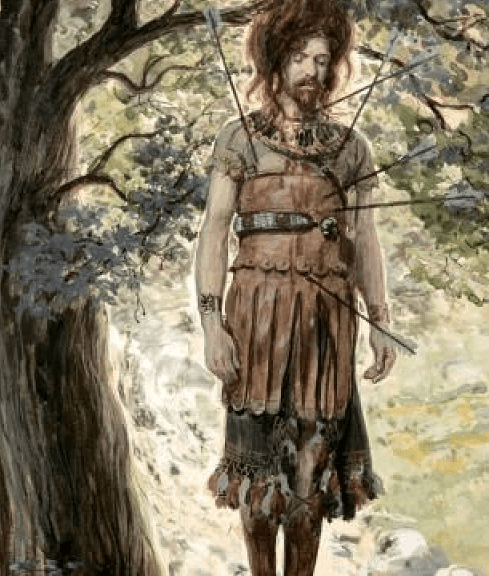
Absalom was riding on his mule, and the mule went under the thick branches of a great oak. His head caught fast in the oak, and he was left hanging between heaven and earth, while the mule that was under him went on.

And ten young men, Joab’s armor-bearers, surrounded Absalom and struck him, and killed him.

Then the Cushite came; and the Cushite said, “Good tidings for my lord the king! For the Lord has vindicated you this day, delivering you from the power of all who rose up against you.” The king said to the Cushite, “Is it well with the young man Absalom?” The Cushite answered, “May the enemies of my lord the king, and all who rise up to do you harm, be like that young man.”

The king was deeply moved, and went up to the chamber over the gate, and wept; and as he went, he said, “O my son Absalom, my son, my son Absalom! Would I had died instead of you, O Absalom, my son, my son!”

——————————————————————————–

This is an optional Old Testament selection from the Episcopal Lectionary for the Twelfth Sunday after Pentecost, Year B 2018. In the numbering system that lists each Sunday in an ordinal fashion, this Sunday is referred to as Proper 14. It will next be read aloud in an Episcopal church by a reader on Sunday August 12, 2018. It is important because it tells that the hardest fights ever fought are against loved ones, but the fights supported by God must be fought.

One should notice this reading selection is missing some verses. In the first verse, where is read, “The king, David, ordered Joab and Abishai and Ittai,” these are the allies of David, with Joab and Abishai being brothers that were nephews of David. Ittai was a Gittite (a Philistine from Gath) who remained loyal to David. These men led what can be considered to be the “elite guard” of the king, as military leaders who were committed to following David’s orders into battle.

The verse that states, “And ten young men, Joab’s armor-bearers, surrounded Absalom and struck him, and killed him,” is out of context.  This is read, while omitting the previous verses that say Joab found Absalom hanging by his hair in an oak tree limb. Joab was accompanied by ten boys (under the age of twelve). The conjunction “And” says it follows as an additional statement.  It says ten young boys killed Absalom after Joab threw three javelins into Absalom’s chest (or his heart area).

Ten boys did not kill a defenseless Absalom by themselves.  Rather than have Absalom bleed to death, Joab ordered his armor bearers to finish Absalom off. This is important information omitted, as David had personally told Joab, “Deal gently for my sake with the young man Absalom.”
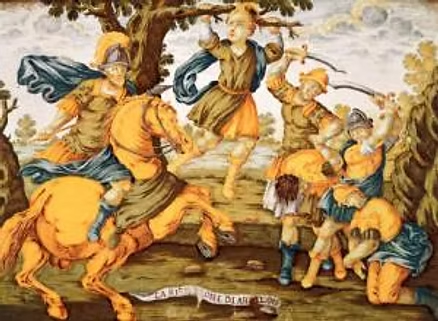
When the reader is introduced to “the Cushite,” it should be realized that a Cushite is from the Kingdom of Kush, in Africa, south of Egypt. It is generally known today as Ethiopia, but more accurately called Nubia then. The one who delivered the message of Absalom’s death to David was one selected by Joab, presumably because of his ability to run fast. Still, the presence of a Gittite and a Cushite in the numbers of “servants” that supported David and defended him and Jerusalem, should not be seen as slaves taken by David in foreign wars.

Ittai had been exiled by his people, but he was welcomed by David. David told him to leave him and return to his land, because defending David would be most dangerous. Ittai refused to leave David and this should be recognized as a Gentile who had become accepted as a follower of Yahweh.  He is like Uriah (who David had killed in battle so he could take his wife), who was a Hittite, or from the area now known as Turkey-Syria. By Uriah marrying an Israelite woman, he had been cleared for that through conversion.

The same can be said of the Cushite, because he addressed David as “my lord the king” twice. After Saul tried to fall on his sword and die before the Philistines would torture him, an Amalekite (an Arabian) came and helped Saul by killing him.  When the Amalekite went to tell David, much in the same way as did the Cushite about Absalom’s death, David ordered the Amalekite killed for having admitted he killed Saul (because Saul begged him to do so). David, still pure as a servant to God, ordered the Amalekite killed for having killed a king anointed by God.  The Amalekite was a “Gentile” who was an enemy of those who served Yahweh.

When the Cushite praised the death of Absalom, David did not judge him like he had the Amalekite years earlier.  It was not because David had grown old and soft.  It was because the Cushite had converted to belief in the One God.  He was not an enemy, but a servant to God, one who saw David as anointed by Yahweh.  That Cushite can be seen as a precursor of Solomon’s relationship with the Queen of Sheba (southern Arabia) and the presence of Judaism in Ethiopia.
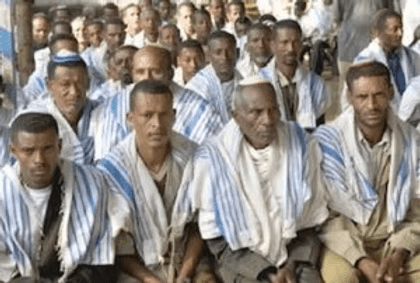
This acceptance of others by David shows the holiness of God in him. When Saul was trying to kill David, David was given refuge in Gath, the town where Goliath was from. The king of Gath gave David wives and the town Ziklag, out of respect for David being without sin and one with his God.  While the Philistines respected David as a powerful man of God, their respect did not lead them to convert to David’s God. However, one can assume that every foreign wife taken by David, and every Israelite under David who did likewise, made sure their spouse became a convert to the Laws of Moses and all the ritual demands.

This says Gentiles were not denied acceptance into Israel. Only those who challenged the right of the Israelites to worship Yahweh as the true One God were fiercely rejected as enemies.

The slow decline of faith, following David’s sins, would be due to the acceptance of people of other beliefs, while forcing out the priests of Yahweh.  Not warring against those who worshiped lesser gods brought about the destruction of the Northern and Southern kingdoms, with the exile of the Judeans to Babylon. The exilic Jews determined it was this foreign influence that was the cause of all their problems (refusing to admit not being led by a holy king made each Israelite personally responsible), so the return to Jerusalem brought a stronger adherence to separation from those of other religions.

That new dogma meant it was to be forbidden for Jews to have any contact with Gentiles (which included the remnants of the Northern Kingdom – the Samaritans).  Further, any Jew who had a physical deformity or illness was branded a sinner to be rejected. None of this was the truth of David’s Israel.

This reading reflects that future, as it was the beginning of the fulfillment of God’s punishment set upon David, which He said through Nathan, “Out of your own household I am going to bring calamity on you. Before your very eyes I will take your wives and give them to one who is close to you, and he will sleep with your wives in broad daylight. You did it in secret, but I will do this thing in broad daylight before all Israel.’” (2 Samuel 12:11-12) Thus, the problem that befell David’s Israel was not from outsiders, as much as it was from in-fighting.

We read the lament of David as told: “The king was deeply moved, and went up to the chamber over the gate, and wept; and as he went, he said, “O my son Absalom, my son, my son Absalom! Would I had died instead of you, O Absalom, my son, my son!” The Israelites would become known for their lamentations. The Jews have continued them over the centuries since, because they are still being punished for David’s sins. They are punished because they cannot see their fault.

Just as the returning Jews thought (a power of a brain reasoning) they could show repentance to the LORD by rejecting the voices of evil, even seeing their sick as being punished by God, the Israel led by Absalom thought it was ridding itself of an admitted sinner in David.  None of them (especially Absalom) saw their own sins as a reflection of themselves upon their king, making them responsible too.

David knew his fault and accepted full blame; and the LORD stayed with David. Still, the house that David built would never be the same.  The Israelites never realized how rejecting God as their King (each individual as a responsible priest) meant they had failed to show responsibility (individually and collectively) through complete devotion to David (or his heir by natural death, anointed by a prophet of the LORD).

The flaw of Israel can be seen to stand out in the verse that says, “The men of Israel were defeated there by the servants of David.” The Hebrew word “am” is used to denote the “men” or “folk, nation, people, or followers.”  That word speaks loudly as stating the Israel of Absalom (their elected judge) was made up of ordinary citizens – not priests of Yahweh . However, the word “ebed” is used to denote the “servants” or “slaves, subjects, or attendants” of David, such that David (as the anointed king of God) was defended by those who served God, through David.

The Swiss Guard supposedly protects the pope in the same manner, but one has to wonder how fast they would run when attacked.

It was this devotion by all who called David “my lord the king” that had made the nation of Israel great. A servant of God, who serves Him as his (or her) King, is elevated above the common folk status of follower. The responsibility of a subject is unconditional surrender of oneself to His (or Her) Highness (a statement of God’s presence in one).  Submission is then for the best of the whole. The oneness with God rewards all equally. However, to follow a human king who has no favor from the LORD God, as shown in this story’s “slaughter of twenty thousand men,” leads common folk and so-called kings to flee for their lives through the forest that is one’s inner self.

To see Absalom caught in a low branch of a mighty oak tree, his long hair wrapped around limbs and leaves – unable to pull himself free – is a sight that should be seen as if he was being held by the arm of justice (the Law?), suspended before the judgment that was surely pending. Being “between heaven and between earth,” Absalom awaited his fate.

While it can be assumed his hair was caught in the branch (which would have been long, because Israelite men only cut their hair once a year – due it becoming too heavy when too long), the Hebrew word written says “head” (“rosh”). This means it was the Big Brain of Absalom that put him in this predicament of judgment – for having declared himself to be a judge of Israel, one that was not sent by God to save the Israelites.

The branch also symbolizes that any would-be kings of Israel that would follow David – those not one with God (like David was, repentant sinner that he had become) would mean a dead branch – branch of death – was their prophecy.  Israel was meant to reflect “One nation under one king,” where the union of God with all is within IS the oneness a nation under God.  The split between Absalom and David, between Israel and her king, is symbolic of the doubt within oneself, as to one’s relationship to God.  Splitting Israel into two separate nations was then a magnification of this split.

The over-arching theme seen in this battle between David and his own flesh and blood is it is a perfect example of how Jesus said, “If a kingdom is divided against itself, that kingdom cannot stand. If a house is divided against itself, that house cannot stand.” (Mark 3:24-25) Jesus said this in response to the Pharisees who said Jesus was possessed by Beelzebub, making him able to cast out demons. Jesus asked them, “How can Satan drive out Satan?” (Mark 3:23) before telling them about divisions within a nation or house.

Absalom was what Jesus saw in the Pharisees.  He, like them, would attack the one human being on earth that was one with God.  David’s sin had been made public; but he repented to save his marriage to a nation.  Jesus was attacked by the teachers of the Jews, finding fault with a Jew without sin.

As an Old Testament reading option for the twelfth Sunday after Pentecost, when one’s personal ministry for the LORD should be underway – not hanging by one’s head awaiting Judgment Day – the message is to unite, rather than divide. An “in-house” rebellion must be quelled, like a cancer must be purged, so one body can become whole again.  Thus, the servants of God, who are Jesus Christ reborn, must stand and fight those calling themselves Christians, who are attempting to divide that Sacred Branch unjustly.

The story of David and his son Absalom is one that should be known. I recommend serious Christians research this more for themselves, to find the details of that story. I suggest looking at the parallels to modern life.  Still, it is also good to know that the name, “Absalom,” given by David to his third son, means “The Father Of Peace” or “My Father Is Peace.”

11 May 1939, London, England, UK –On the eve of war the contentious objectors protested.

That name represented the internal peace that the nation Israel experienced under David, when David was pure. David intended Israel be at peace with the LORD, as a strong and healthy body of God’s priest on earth.  David also named Solomon, such that the word “shalem” and “shalom” are his wish for Israel, reflected in his son.  Not only was “peace of the father” the wish (“shalom“) but so too was for Israel to be “unbroken” and “whole” (“shalem”).

Absalom broke that inner peace by revenge; but David did not address the sin that led to the revenge or the sin in response properly. Absalom broke that inner peach that oneness brings by splitting Israel and turning the common people against their holy father and king.  David’s desire for peace and the favor of a father to a son spoiled Absalom, causing Absalom to lose respect for David.

It is, thus, a story that says, “Give them an inch and they will take a mile.”

The whole world of Christianity lives surrounded by enemies, just as David’s Israel had enemies on all sides of it. The whole time Saul was king (one who lost the favor of God), the Israelites warred with their neighbors, most notably the Philistines. The same need to do battle with the enemies of Israel lasted through David’s reign, but the victories were plentiful and at little cost.  That was because God was with David and Israel saw David as God’s anointed king.

America was once proud of promoting itself as a Christian nation that preferred peace to war.  In the twentieth century, America twice entered foreign wars and experienced the glory of being victorious.  Americans gave credit to God and Christ. However, since Korea and Vietnam, America has struggled with wars, much like Saul’s struggles, and the peace at home has been derisive.

Those military struggles have gone hand-in-hand with the weakening of Judeo-Christian values that a once victorious nation now feels shame in the population at home. The peace at home has spoiled the child, so the child has grown insolent and disrespectful. America has welcomed foreigners into its land, but it has not expected any conversions to its religious beliefs.

America has given rise to many presidents that have sought peace, even in the face of sinful acts against its values, preferring not to go to war. They have given inch after inch to appease foreigners.  The more this fear of facing a necessary battle grows, the enemies are emboldened and the more audacious will be the acts against America and its Christian allies.  I point out the increased murders of police officers and the shooting being committed in public places as only two such examples; but the West faces many threats and breakdowns.

The evidence shows that the enemy has entered the lands of Christianity and that enemy is preparing to do the insults that Absalom did against David.  It is less a threat from foreigners, than it is a threat from the common folk who feel the urges to accept foreign influences, while rejecting the oneness that was once a devotion to the One God and His Son Jesus Christ.  The biggest enemy is the disease that has befallen Christianity.  It can no longer lead strongly, just as David became weak from sins.  The threat is from Christians that are misled.

The point of this reading is it told of an inner battle then, which means there is another such battle upcoming, as an unavoidable showdown that will settle a feud that has been brewing for some time. It will be another bloodbath in the “forest of Ephraim,” whatever place that may be symbolic of in America and/or the Christian world. It will not involve the overt enemies of Christianity – the wolves that love to feast on sheep – but between the various factions of Christianity, where bad shepherds have set themselves up as judges.

When a family member hurts and refuses to get help, do you let them choose to die slowly and painfully? Or do you go to war to save a family member, knowing pain is unavoidable?

David and his servants of God won that battle fought on this day in the Scripture reading; but the question now has become, “Who does God support; and who is truly a servant to the One God?”

The answer to these questions is that God supports all who have placed His holy throne in their hearts. For God to be the King of a human being – His servant or subject – one has taken on the power of Jesus Christ. This means becoming the equivalent of an army that was David and his servants.  Today, that must be a collection of Apostles-Saints, who are the servants of Christ the King, who is One with God.  That army is a Church in its truest sense.

Those who follow Absalom are the divisions of organized Christianity that split it in two.  The many barren and low-hanging branches of Christianity represent the Twelve Tribes of Israel that united behind David’s son, Absalom. They try to claim the right to judge Christianity-America-Western civilization as if government worship [Socialism or worse] is the path to heaven.  The battle that is brewing will determine the future of all religions on earth.

In this reading, the element of Joab, one of David’s “generals,” having actually killed Absalom – casting three darts through his heart – has been skipped over. Instead, we read, “And ten young men, Joab’s armor-bearers, surrounded Absalom and struck him, and killed him.”

It is important now to know that an “armor-bearer” is a “lad’s” job, meaning a young male that is not yet an adult (between the ages of ten and twelve). This makes Joab a teacher of children, just as a lioness has to teach young lions how to kill the prey.  This verse is then set apart to show the importance of adults teaching lessons and instilling values in their children.  Teaching the values of the adults is so the children will grow to carry those lessons on. Therefore, the children of Christianity must be taught by their adult leaders how to defeat an enemy within, so the children can do the same when they grow up.

The enemy within Christians today is doubt. Those who believe but doubt those beliefs have little faith.  It is doubt that reduces one from a subject of God to common folk that follows anyone showing strength as a leader. It was doubt that filled David after Nathan told him God’s punishments for his sins. It is doubt that has leaders today screaming, “I know what Jesus said to do!  Don’t you?”

This reading of Absalom’s death shows the abject sorrow David felt for losing his own flesh and blood. David, as the King of Israel, anointed by God, should have taught his son the ways of righteousness, so such sorrow would have been avoided. David, instead, had been reduced to the same fate as Eli and as Samuel, such that as holy as those prophets were, the failures of their children to follow in their footsteps shows that holiness does not easily pass down to one’s children. Young lions raised in captivity never know how to kill prey, so they starve if someone does not feed them.  This is then the deepest meaning of “spare the rod, spoil the child.”
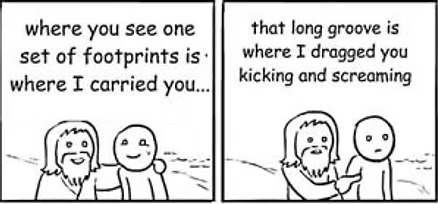
The actual source of that lesson says, “He who withholds his rod hates his son, But he who loves him disciplines him diligently.” (Proverbs 13:24, NASB) The word translated as “rod” is “shebet,” more aptly means “staff,” such as the prod a shepherd uses to keep his flock in line. This means a “rod” is not used primarily as a device for corporal punishment, but as a sign or signal that must be followed.  Rather than an implement for punishment, it is a necessary tool that is used often, to keep the sheep from getting lost. The absence of such direction (where an occasional slap on the butt is required to get one’s attention) translates as “hate.” Use of direction is a sign of “love.”  It is what determines if one a good shepherd or one leading lambs to the slaughter.

This is how a battle should be waged to save Christianity from internal division and eventual collapse. True Christians must stand up against those who are like Absalom was to David. The fight is not for the pleasure of defeating evil, but as a sign for the future direction that Christianity will take. Until that fight is fought, Christianity hangs suspended between heaven and between earth.
1 Kings 19:4-8 – Asleep under a broom tree

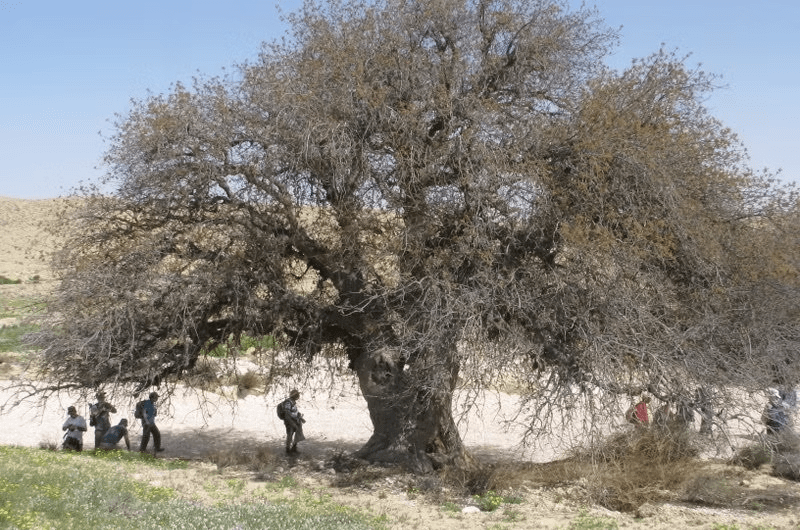
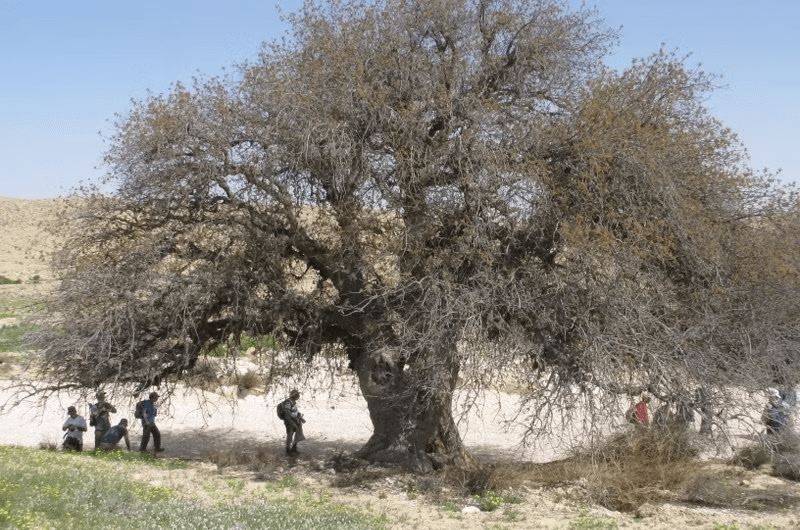
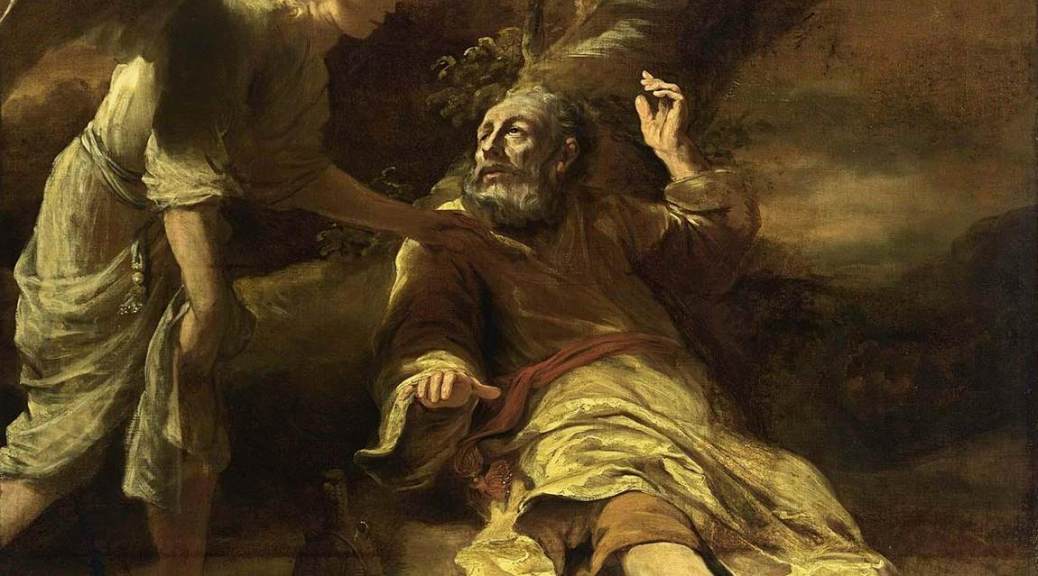
Elijah went a day’s journey into the wilderness, and came and sat down under a solitary broom tree. He asked that he might die: “It is enough; now, O Lord, take away my life, for I am no better than my ancestors.” Then he lay down under the broom tree and fell asleep. Suddenly an angel touched him and said to him, “Get up and eat.” He looked, and there at his head was a cake baked on hot stones, and a jar of water. He ate and drank, and lay down again. The angel of the Lord came a second time, touched him, and said, “Get up and eat, otherwise the journey will be too much for you.” He got up, and ate and drank; then he went in the strength of that food forty days and forty nights to Horeb the mount of God.

——————————————————————————–

This is an optional Old Testament selection from the Episcopal Lectionary for the Twelfth Sunday after Pentecost, Year B 2018. In the numbering system that lists each Sunday in an ordinal fashion, this Sunday is referred to as Proper 14. If chosen, it will next be read aloud in an Episcopal church by a reader on Sunday August 12, 2018. It is important because it tells of the power of spiritual food that comes from sacrifice for God.

This selection seems odd, when viewed in the context of the chapters surrounding it. It reminds me of the vision Abraham had of Lot in Sodom and Gomorrah, where angels visited Lot’s family and the native people there were so evil that God had the cities destroyed. I say that because both that story from Genesis does not match the mundane story told of Abraham rescuing Lot from the kings of the five cities on the plain.  This story in 1 Kings 19 also seems to be dream sequence, rather than actual events, simply because the before and after do not match.

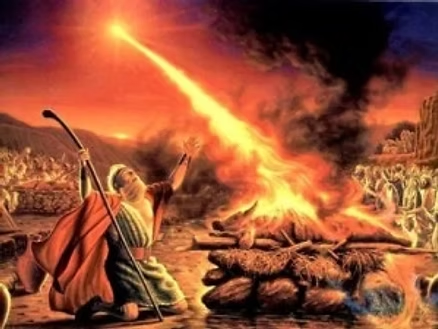
I say this because 1 King 18 tells of Elijah’s ‘sacrificial calf cook off’ against 450 priests of Ba’al.  Jezebel’s prophets lost both the challenge to have their god light their altar wood and their lives.  Even after letting the Baal priests have a head-start, while dousing his wood and sacrificial animal with water, Elijah won.  Yahweh lit his altar’s fire.

After the contest was over, Elijah had all 450 prophets of Ba’al killed in the Kishon Valley (1 Kings 18:40). Ahab witnessed this and the people of Israel’s response , who saw Elijah’s fire be lit by God.  We read, “they fell prostrate and cried, “Yahweh—he elohim! Yahweh—he elohim!” (1 Kings 18:39)

They said, “Yahweh hū elohim,” not “Ba’al.”  The people, including Ahab, recognized the God of Israel was the only supreme deity.  They recognized Elijah as a prophet of that Almighty God.  Thus, they would be fools to go against that God and His prophet.

Additionally, prior to that contest, Elijah had met with Obadiah, who had hidden one hundred prophets of Israel in two caves (fifty prophets in each cave), and there was nothing that says either Ahab or Jezebel knew where those prophets were. In 1 Kings 19, prior to these verses read above, Ahab told Jezebel that her prophets had been killed and she threatened to have Elijah killed that day. While nothing said she planned to kill or had killed in response all the prophets of Israel, in 19:10, Elijah told God he was the only prophet left, which could only be true if he was seeing the future in a dream.

It is also important to see the symbolism of sleep and death, which coincides with Elijah’s statement to God, “It is enough; now, O Lord, take away my life, for I am no better than my ancestors.”

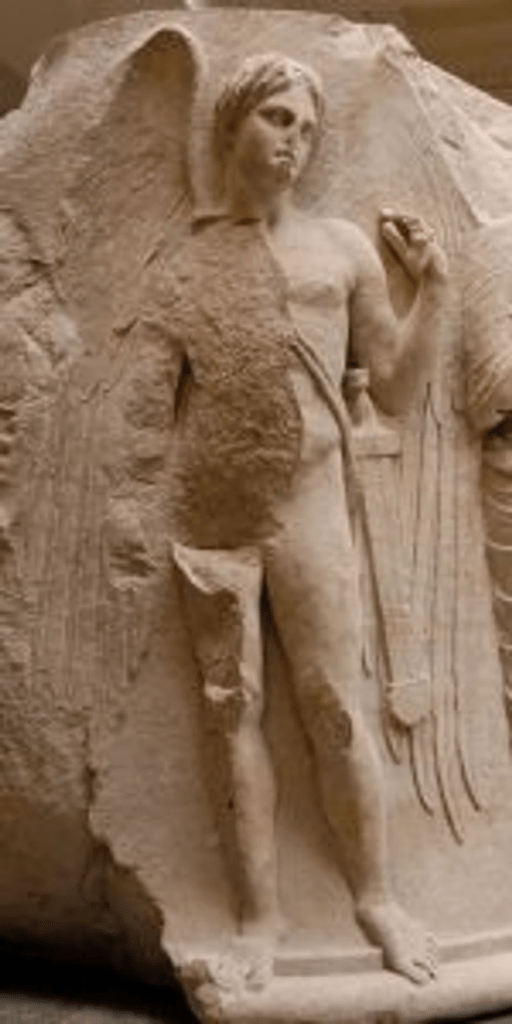
Thanatos
The Greek poet Hesiod established in his Theogony that Thánatos is a son of Nyx (Night) and Erebos (Darkness) and twin of Hypnos (Sleep).

Following that surrender of his self, Elijah then went to sleep. The angel’s presence, twice, can then be seen as similar to the angels that were present in the tomb of Jesus. This possibility of a death dream sequence makes Elijah’s seeming ascension without death become more like the ascension of Jesus, following his death and resurrection, aided by angels.

The bread and water provided by the angel is like Jesus being attended by angels while he was in the wilderness, after he encountered Satan.  The angels also fed Jesus the spiritual food that allowed him to last forty days and nights in the wilderness.  This is then the same as the manna and water from the rock that nourished the Israelites spiritually during forty years of wandering

This means this chapter is Elijah’s talk with God after his symbolic death, but before his taking Elisha to be his replacement. He could have actually died and been reborn by the angel’s touch, replenished by the food and water from heaven.  This transformation also acts to explain the unnamed prophet of 1 Kings 20, who asked other prophets to strike him with a sword, as a resurrected Elijah would be appearing as someone other than himself, just as Jesus did when he resurrected.

The forty days and forty nights spent in the wilderness without food or drink is then a parallel to Moses on Mount Horeb, as well as Jesus in the wilderness prior to beginning his ministry. It then is parallel to the Transfiguration of Jesus on the high mountain, when Peter, James and John (of Zebedee) saw Jesus talking with Moses and Elijah. These comparisons make Moses, Elijah and Jesus like souls as they all submitted fully to the will of God. They are then the models of whom all followers should become, where sleep and death are symbolic of one’s sacrifice of self-ego.

When we read that Elijah ended one day in the wilderness by sitting “under a solitary broom tree,” we need to realize the timing of night, when sleep normally takes place. If the temperatures turned cooler at night, it is possible that this tree supplied wood to burn for warmth. If so, it is good to know that a broom tree is also a juniper tree, as the Hebrew word “rō·ṯem” implies.

According to the symbolic nature of a juniper tree is its wood is not good for fast burning, but for slow burning and the release of aromatic scents. According to one site, the smoke of juniper wood, “was used for the ritual purification of temples. The smoke was said to aid clairvoyance, and continued to be burned for purification and to stimulate contact with the Otherworld.” This aspect can then be seen as why Elijah “asked that he might die.”

As a dream sequence, more than an actual event, the wilderness represents Elijah embarking on a journey where he has had all the prophets of Jezebel killed and is aware of her threat to have him killed in response. Rather than risk death at the hands of an evil queen, the symbolism is Elijah praying for the LORD to take his soul, regardless of what physical punishment Jezebel can cause. The response of that prayer is the presence of a guardian angel sent by God to nourish one with spiritual food and living water, thus enabling one to withstand any persecution that may arise.

As an alternate reading selection for the twelfth Sunday after Pentecost, when one’s personal ministry for the LORD should be underway – one is on a journey into uncharted waters, no longer following the desires of personal ego – the message of Elijah is willing sacrifice. It is up to each individual to ask God that he or she might die of self-importance, so an angel of the LORD can be sent to assist one on one’s journey. That angel can be understood as being God’s Holy Spirit.

Again, it is most important when reading Scripture not to get caught up in the antiquity and seeing no comparison in a modern world. While our mind’s eye might see a desertscape in southern Judah, in a place so barren that only one prickly shrub is around, this wilderness is no different than a life in the world today that is void of true commitment to Yahweh – the LORD elohim (God of gods). One has to be willing to place oneself in the sandals of Elijah and feel the fear of living in a place that scorns prophets of the One God. One has to be able to see the solitary broom tree as one’s own soul amid a barren setting, where survival is impossible alone. One needs God’s help; and the first step towards that grace is realizing a big brain cannot lead a soul to eternal happiness.

The setting in which one finds Elijah is void of any external source of support. This says that no matter how many people, institutions, or holy places one puts trust and value in, when death comes and one’s soul is separated from one’s flesh, there will be only God and His reckoning of one’s soul. One will become accountable for all of one’s misgivings in a life. However, if one seeks this redemption prior to one’s physical death, one can die of self and then be resurrected to serve God’s needs in the world of flesh.

A minister of the LORD has made this sacrifice and knows the value that the presence of God within brings. One becomes a presence among those who have yet to show their trust in God, much less give up their self-importance for the unseen and intangible. Much of this can be a ministry of spreading the truth of Scripture in a way that makes it both profoundly believable and personally enlightening. Anyone who teaches, ministers, preaches, and prophesies can only make a doorway become available for a seeker to open and enter. That threshold is the wilderness and entering into service of the LORD requires one sit under that broom tree and request God to accept one’s soul as His servant.

Ephesians 4:25-5:2 – Angry for the love of God

Putting away falsehood, let all of us speak the truth to our neighbors, for we are members of one another. Be angry but do not sin; do not let the sun go down on your anger, and do not make room for the devil. Thieves must give up stealing; rather let them labor and work honestly with their own hands, so as to have something to share with the needy. Let no evil talk come out of your mouths, but only what is useful for building up, as there is need, so that your words may give grace to those who hear. And do not grieve the Holy Spirit of God, with which you were marked with a seal for the day of redemption. Put away from you all bitterness and wrath and anger and wrangling and slander, together with all malice, and be kind to one another, tenderhearted, forgiving one another, as God in Christ has forgiven you. Therefore be imitators of God, as beloved children, and live in love, as Christ loved us and gave himself up for us, a fragrant offering and sacrifice to God.

——————————————————————————–

This is the Epistle selection from the Episcopal Lectionary for the Twelfth Sunday after Pentecost, Year B 2018. In the numbering system that lists each Sunday in an ordinal fashion, this Sunday is referred to as Proper 14. It will next be read aloud in an Episcopal church by a reader on Sunday August 12, 2018. It is important because Paul talks of the works of Sainthood, which can only be produced by sacrificing self, in servitude to God.

Once again, reading an English translation of a letter written by Paul leads to some superfluous platitudes that are easier said than lived up to. Of course, Paul did not write such banal statements. Reading Paul and understanding what he wrote requires one be led by the Holy Spirit’s wisdom. This is because the Holy Spirit’s wisdom led Paul to write his words. Therefore, one must learn to read Scripture (based on the writing of the Apostles) word by word, segment by segment, verse by verse, and chapter by chapter – starting small, before gobbling everything up at once.

Certainly good can be obtained by the translation into English above, which will be read aloud in Episcopalian churches. Not lying and telling the truth is a good way to live. Living a life where one is kind, tenderhearted, and forgiving is an ideal the world should strive towards. The problem comes when one addresses the issue of anger, which is a natural emotion that humans must encounter, because (like a volcano) trying to hold in built-up pressures will lead to explosive flows.

By seeing this reading as Paul saying such eruptions are forbidden is wrong; and this is because we must always be angry at the works of Satan. This reading addresses that and it is more clearly seen when one examines the literal Greek text, following the rules of slow digestion of the Word.

Below I offer a valid literal translation of the Greek written by Paul, verse by verse, segmented by the punctuation marks (real or inferred), based on the Interlinear translation of Ephesians 4 and 5, published by Bible Hub. It is best to practice reading these words slowly, looking at the broad scope of translations available.  From that breadth, deeper meaning is found, aided by reflection, contemplation, and prayer.  Practicing this until it becomes second nature shows God one is sincere about one’s faith.

Doing this for oneself can open up more meaning than can be told by someone else. Most Christians have a relationship with a pastor, minister, or priest, who is an external crutch that allows one to lean on the teachings of another (or others), without feeling a need to know more than the teacher.  Self study of Scripture is how a personal relationship with God gets established, by demonstrating a desire to know the truth, more than simply being told what to believe … in the blind.

Before one begins to digest Paul’s reading selection that follows, it is important to know that twenty-four verses of chapter four are skipped over.  Those verses establish the context of the whole chapter. This reading selection then sets one into the middle of a conversation (between God and you, as much as between Paul and the Christians of Ephesus), where the prior context is absent. This can be done with Scripture, for narrow focus intent.  Still, this reading then bleeds over into the first two verses of chapter five, which is the lead-in to another thought set.  It can be applied in this way (two chapter’s verses as one) because the truth told can apply at all times.

The purpose is to see why that is done in this reading selection now.  To find this purpose, one needs to be cognizant of what Paul wrote.  Then, just as the Holy Spirit led Church leaders to choose readings that link in theme, one is enabled to grasp a deeper understanding of the lessons of the prophets.

[Note how the new “sentences” chosen do not start with capitalized Greek letters, other than the first verse (4:25), yet important words are capitalized.  Capitalization has been added to the translation above as a paraphrase, to fit one’s language customs.]

Chapter 4

25 Therefore having put off the [one] falsehood  ,

let speak truth each one with the neighbor of him  ,

because we are one another members  .

Notes: Leading into this first segment, Paul had written about turning away from one’s old ways of living and being corrupted. That was the “old man” of self that was replaced by one following a way of “righteousness and the holiness of truth, … according to God.” Since God is the one of truth, Satan is then the one of falsehood, such that an Apostle repeats as Jesus did, telling Satan, “Away from me, Satan!” (Matthew 4:10)  To “put off the [one] of falsehood,” one has ordered evil influences to get out of that way of “righteousness and the holiness of truth.”

With the influence of corruption out of the way, one can then hear the voice of God speaking the truth. This truth comes from Scripture, more than simple truths that are less helpful to neighbors. A “neighbor” can be a friend, but the use of “plēsion” is more to denote anyone who has yet to come and believe in Jesus as the Christ. For Jews, they would live among other Jews, but many would deny Jesus as their promised Messiah. The truth would help their eyes be opened to that realization. For Gentiles, their neighbors could be a mixture of Jews, Gentiles, and Christians, with Christians falling into the “friend” category and the others being their “neighbors” who seek the truth, but have not yet found it.

When Paul then stated “we are one another members,” the Greek word “melē” is referencing only Christians. Christians are the ones who have found the truth, for the purpose of spreading it around. Spreading it to one’s neighbors makes one come to live in a place where the neighbors are friends of the same religious values. Christians are members in the body of Christ, which means they are the limbs (branches) of the living vine, as extensions of Jesus Christ (reborn). As a vine for Christ, the fruit is the neighbor that buds into a new limb, as the fruit of that vine. This makes the truth become the common blood that flows within those branches.

26 be angry  ,

also not sin  ;

the sun not let set on the basis of the [one] anger of you  ,

Notes: Following a series of words that ended by placing focus on Christians being the “members” (“limbs, organs”), those forming the body of the living vine, where ALL are rooted in the resurrection of Jesus Christ, Paul wrote the one-word statement “orgizesthe.”  That says, “be angry” or “be provoking” and “be irritating.” This is a direct statement that Christians have an obligation to “be angry.”

HELP Word-studies says of the root word (“orgízō”): “be angry, as expressing a “fixed anger” (settled opposition)” and “to show settled-opposition,” which “is positive when inspired by God – and always negative when arising from the flesh.” “Sinful (unnecessary) anger” focuses on punishing the offender rather than the moral content of the offense.”

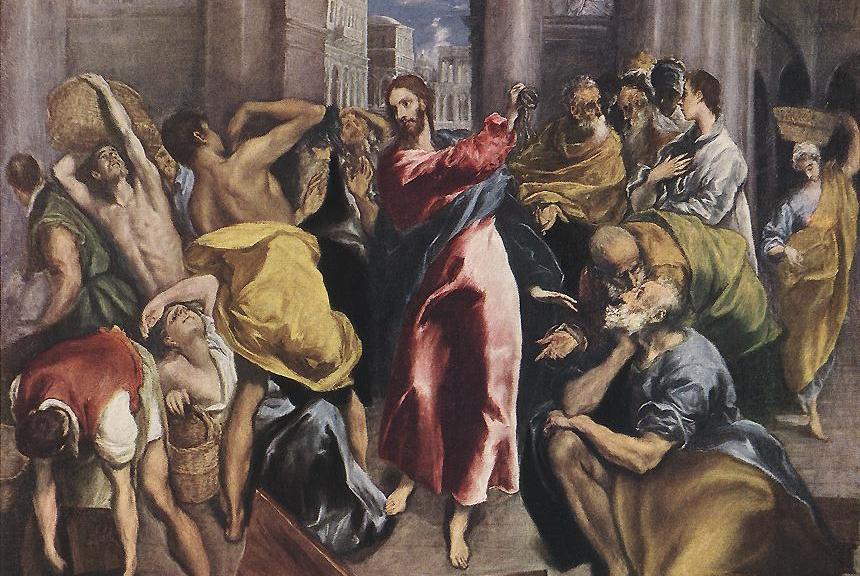
This is how one can read of Jesus commanding Satan to get behind him, his turning over the vendors tables, his calling Peter Satan, and his commanding a fruitless fig tree to wither and die. A true Christian must not compromise to evil, as one’s natural emotional outlet for anger is in opposition to that which opposes God.  The Old Testament is a series of stories that tell of anger of the prophets against the opposition to God’s people.  When those stories began telling of kings of Israel and Judah accepting prophets of lesser gods, they lost their lands and their Covenant.

To “be angry” but then “also not sin” is accomplished by the angels sent by God’s Holy Spirit to control one’s actions based on anger. The Greek word that translates as “sin” is “hamartanete,” which means “having no share in.”  This equates to oneself being apart from all acts that are motivated by the influences of evil. One’s acts out of anger, like those of Jesus, are justified by God.  God-led acts are not something to confess as human frailty, as if one is unable to control one’s actions caused by strong emotions. When one has totally sacrificed self so one can serve God, one’s actions are not based on the sins that arise from the flesh.

This is then confirmed by the use of “hēlios,” where “the sun” also represents “sunlight.” Jesus said, “”I am the light of the world. Whoever follows me will never walk in darkness, but will have the light of life.” (John 8:12) This means that Jesus is like the Sun, which always shines and never sets. It is the actions of the Earth that make it appear as if there is day and night, light and darkness. However, when one is reborn as Jesus Christ, a part of the living vine, with truth flowing through one’s being, no acts of anger can be deemed sins, because the light of Christ is always lit within, causing an act of anger to have a positive effect on those who see that light from their perspective in darkness.

[Note: The Greek god Helios is related to Apollos.  It was Apollo’s chariot that pulled the sun around the earth, giving light to the world.  Apollo was also the god of truth, whose oracle at Delphi could only tell the truth to questions posed.  This mythological symbolism was embodied in Jesus Christ.]

27 not give opportunity to the devil  .

Notes: Here we find confirmation that “the [one] falsehood” is Satan, who acts as “diabolō” – “the devil” – when given the opportunity to cast darkness around a mortal soul. The Greek word “diabolō” properly means, “a slanderer; a false accuser; unjustly criticizing to hurt (malign) and condemn to sever a relationship.” When this is realized in the context of speaking the truth to one’s neighbors, being in the light of Christ prevents words from flowing that will turn a neighbor away from the truth and towards the falsehoods of Satan.

28 the [one] stealing no longer let him steal  ;

rather now let him toil  ,

working with one’s own hands things good  ,

that he might have to share whoever need having  .

Notes: By seeing the element of Satan being opportunistic when one is not protected by God’s Holy Spirit and reborn to speak the truth of Jesus Christ, the act of stealing is less important as a condemnation of a human in need stealing things that assuage personal wants, desires, and needs. The most severe act of theft is Satan stealing one’s soul through the influences that bedevil the unprotected.

This first segment of verse twenty-eight ends with a semi-colon, which separates this statement against stealing from the one that encourages working for one’s gains. While the two are in the same vein of thought, the anger of a Christian expressed to a neighbor, one who has been caught stealing, becomes a valuable lesson that the neighbor needed to hear. More than a simple statement that payment for crimes will always come due, it places focus on the awakening of one’s soul spirit to the lures of Satan. It is instilling valuable lessons that plant the seeds of moral thoughts that are necessary to control evil urges.

Once moral standards are planted, not only must Satan work harder to steal a soul, but one must work harder to save a soul.  In that regard, the Greek word “kopiatō” (“let him toil”) is used, which implies “exhausting labor” and “weariness.” Such hard work leads an unprotected soul to see self as not strong enough to keep Satan at bay, such that one is led through hard labors to cry out for God’s help.

The Greek word “ergazomenos” means “working,” but becomes a continuation of the “exhausting labor” mentioned prior, by now expressing an “acquisition by labor.” This is then a statement about how God watches to see how one will react to the influences of evil and the punishments meted when caught. One’s works of faith earn more rewards of protection by God, whereas one’s lack of good works brings eventual punishments.

This is how anger can be applied according to the sins of the flesh, where punishments received influence sinful acts of revenge and malice. However, through exhausting works by one’s own hands towards things done that are good, then one can find a doorway open in one’s heart for God’s love to enter.

The segment of words that says, “that he might have to share whoever need having,” is then less about two or more people sharing things with those in need, as it is more a statement of God presence in a new Apostle. This goes back to a true Christian expressing anger towards a neighbor that came as words of truth that shared the blessings of the Father to the Son, to one in need of hearing that message. Giving a thief what a thief wants will do nothing towards getting a thief to toil to do good things on his or her own, with his or her own hands. However, a slap of reason given by an Apostle, on the cheek of a misguided neighbor, is sharing one’s desire to save the wayward and to motivate the wayward to seek God for having one’s true needs met.

29 every kind of word unwholesome [corrupt] out of the mouth of you  ,

not let go forth  ,

except  ,

if any good  ,

for edification of the need that it might give grace to those hearing  .

Notes: The Greek word “sapros” is translated as “unwholesome,” but also means “corrupt, rotten, useless, and depraved.” The first segment is a statement that mortal human beings do utter such words, often in anger. It is important to realize that such words do less towards harming anyone to whom such words are aimed, as the deeper harm is to oneself. Those who then utter such language are those who are in need of God’s help; and they are whom the anger of Apostles should be directed, in attempts to share the benefit of God through good works.

The Greek word written by Paul, “ekporeuesthō,” means “let go forth,” or properly, “go out from, emphasizing the outcome (end-impact) of going through a particular process or passage – i.e. the influence on the person (or thing) which comes forth.” [HELPS Word-studies] When the negative “” (“not, lest”) is added, the segment says one cannot “cast out, speak, flow out, burst forth, or spread abroad” anything that will prove oneself unwholesome and drive one who is unwholesome away from the light of truth. One must not speak in corrupt terms to be good, and one cannot lead the wayward to the truth with words that deprave. This is then a statement about the presence or absence of the Holy Spirit, as to what words flow from the mouths of people.

This then leads to a one-word statement, written as “alla.” This conjunction means “but,” but it bears more meaning and insight when translated as “except, nevertheless, on the contrary, on the other hand, and/or otherwise.” As one word of importance, Paul was stating that an Apostle cannot be typical of mortal human beings. One must set the example as an exception, one who is contrary to the ordinary, and one acts otherwise than the usual. One must let wholesome words go forth.

This exception must be so any good influence possible is shared with the one in need. The words spoken sternly to neighbors are for the purpose of building character in others, with one’s own character the goodness that supports the words spoken. This is how one passes on the Holy Spirit to those seeking the way to God, as a seeker will hear the truth and realize that; but any lies will lead a seeker to look elsewhere. This is the conditional “that it might give grace,” such that one builds with the materials supplied, as exemplified by houses built on sand foundations, versus houses built on rock foundations. (Matthew 7:24-27)

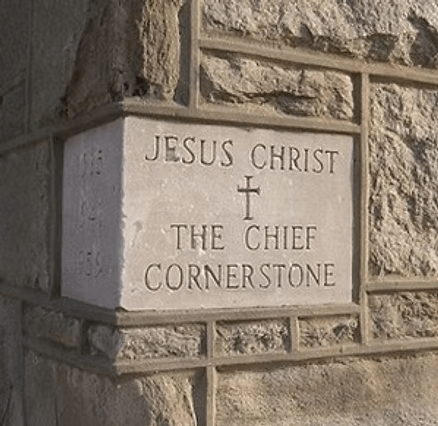
This is a stone the builder love. The ones rejected are round, meaning they can be removed so a soul can escape the tomb. Yahweh’s temple is mobile, not fixed.

30 and not grieve the [one] Spirit the [one] Holy the [one] of God  ,

by whom you were sealed for [the] day of redemption  .

Notes: The Greek word “lypeite” translates as “grieve,” but the meaning is best understood as “find pain.” HELPS Word-studies states its usage to mean: “to experience deep, emotional pain (sadness), i.e. severe sorrow (grief),” while also representative of a state that “very intense and hence even used of the pain of childbirth.” This last usage allows one to see how pain and grief from the Holy Spirit of God is the birthing pains that come from the change from worldly (in the womb of the earth) to a soul Spirit that has been washed clean of sin. This is the yielding of the old ways to the new ones that are Holy and righteous. It is the necessary pangs of being reborn as the Son of God, Jesus Christ, regardless of one’s human gender.

In our modern society, we celebrate the physical birth of our children with parties and cakes with candles alit on top, asking for the fire to be blown out to get a wish fulfilled. Those parties turn to recognitions of age and the eventual breakdown of the physical body. The years pass by and turn from happiness to grief. Few mark the days when one’s soul was redeemed, largely because one day cannot express fully the joy of being filled with the Holy Spirit. It is almost like what Nicodemus asked Jesus – “How can someone be born when they are old?” Nicodemus asked. “Surely they cannot enter a second time into their mother’s womb to be born!” (John 3:4) – as the womb of the world has been replaced by the womb of God, when a soul is “sealed for redemption.” Being reborn as Jesus Christ means being in that womb until one dies, when the soul is released (born again) into the heavenly kingdom. That is truly a happy birthday to you.

31 every kind of bitterness  ,

and anger  ,

and wrath  ,

and clamor  ,

and slander  ,

let be removed from you  ,

along with all malice  .

Notes: These segments can be read as the elements of self that must be released for redemption to be sealed. In a reverse view, these can be seen as the pains used against one by Satan, where neighbors who are not seekers begin to see one who is changing with eyes of persecution. One must let go of the devil’s urges to act from bitterness, anger, wrath, clamor, slander, and malice. Likewise, one must forgive those who use those sins against one. When the acts that accompany these mental and emotional states of being have been released from oneself, so one’s ego is no longer calling the shots, God’s Holy Spirit may use one in any and all ways to oppose Satan and those who serve him. An Apostle cannot read this instruction from Paul and assume it is good to capitulate to evil, as enemies give rise to these human reactions and the enemy of the righteous is the sinful. Therefore, when the sinful threaten the members of the body of the living vine, coming to use force against the innocent, it may be God’s Will that leads one to Holy War in response.

32 be moreover to one another kind  ,

tender-hearted  ,

forgiving each other  ,

as also the [one] God in Christ forgave you  .

Notes: This series of segments addresses how Apostles should deal with one another, as opposed to those who are neighbors and enemies. These are who Jesus said to love one another, just as he loved his disciples. The element of forgiveness should not be seen as a proclamation that it is okay to continue to sin, after one has had his or her soul cleansed of sins by the Holy Spirit of God, making one pure enough to be reborn as Jesus Christ. Forgiveness is for past sins (the same ones forgiven by God), prior to becoming an Apostle, who then never sins again – due to the sacrifice of self ego and that brain being replaced by the Christ Mind. That means prior enemies, neighbors, and friends can have past histories of conflict that become forgiven once all are born of the same Spirit.

Chapter 5

1 be therefore imitators those of God  ,

as children beloved  ,

Notes: The transition to a new chapter means a likewise transition to a new line of thought. One must be careful when reading backwards and not paying attention to the road signs, such as a new chapter, book, testament, where all changes have intent and purpose. Still, from the talk of members of the living vine sharing the fluid of truth that is Jesus Christ, it is that truth that one imitates.

The Greek word “mimētai” means both imitator and follower, such that it is the root word for the English “mimic.” Still, this is the truth of Jesus saying, “Whoever wants to be my disciple must deny themselves and take up their cross daily and follow me.” (Luke 9:23) Jesus never intended anyone to pretend to be him, as his statement says all of his disciples are expected to become Jesus in a lineage that will follow his time on earth. In order to achieve that rebirth-resurrection, one’s stake that supports the living vine must be raised, so the fruit does not attract vermin and weeds. An “imitator of God” is one who is exactly like Jesus of Nazareth was – completely subservient to the Father – such that Jesus Christ reborn into Apostles multiplies the presence of God that is incarnated without limits on earth.


2 and walk in love  ,

even as also the [one] Christ loved us  ,

and gave up himself for us  ,

an offering and sacrifice the [one] to God  ,

into an aroma of a sweet smell  .

Notes: The first step towards being filled with the Holy Spirit (when one’s soul is cleansed of sins) is to give one’s heart to God. One has to desire being married to God, such that the union of one’s soul with God means willingly seeking total subservience, as a wife to a husband. This brings the love of God about one’s being, so one “walks in love.” To “walk in love” is to be completely thrilled at the awareness God gives to his wives.

This union in relationship with God then brings about the birth of the Christ Mind in one. As the resurrection of Jesus Christ, one becomes in touch with the love between the Father and the Son, such that Christ loves all who follow in his steps, sacrificing so his Spirit can be resurrected on the material plane. That sacrifice in an Apostle is no different than the sacrifice of Jesus of Nazareth, who had to die so his Spirit could be resurrected countless times in his devotees. All have sacrificed so God’s Will can be done on earth.

The last segment uses the Greek word “euōdias,” which translates as “of a sweet smell.” According to HELPS Word-studies, the figurative meaning is: “our efficiency in which the power of Christ himself is at work is well-pleasing to God.” It means that one does what is pleasing to God; and this is a comparison to the beauty and fragrance of a rose.

As the Epistle selection for the twelfth Sunday after Pentecost – when one’s ministry for the LORD should be underway – the message is to be emotional for God. This is like the letter sent by Jesus, through John of Patmos, to the church of Laodicea, which said, “I know your deeds, that you are neither cold nor hot. I wish you were either one or the other! So, because you are lukewarm—neither hot nor cold—I am about to spit you out of my mouth.” (Revelation 3:15-16) Love for God means anger for those who fail to honor God.

Certainly, when protected by God and given the Great Commission of being Jesus Christ reborn, one wants to please God in any and all ways. A minister of the LORD delights in being shown the truth and seeks those who desire to learn the truth.

John 6:35, 41-51 – The bread of life

Jesus said, “I am the bread of life. Whoever comes to me will never be hungry, and whoever believes in me will never be thirsty.”

Then the Jews began to complain about him because he said, “I am the bread that came down from heaven.” They were saying, “Is not this Jesus, the son of Joseph, whose father and mother we know? How can he now say, ‘I have come down from heaven’?” Jesus answered them, “Do not complain among yourselves. No one can come to me unless drawn by the Father who sent me; and I will raise that person up on the last day. It is written in the prophets, ‘And they shall all be taught by God.’ Everyone who has heard and learned from the Father comes to me. Not that anyone has seen the Father except the one who is from God; he has seen the Father. Very truly, I tell you, whoever believes has eternal life. I am the bread of life. Your ancestors ate the manna in the wilderness, and they died. This is the bread that comes down from heaven, so that one may eat of it and not die. I am the living bread that came down from heaven. Whoever eats of this bread will live forever; and the bread that I will give for the life of the world is my flesh.”

——————————————————————————–

This is the Gospel selection from the Episcopal Lectionary for the Twelfth Sunday after Pentecost, Year B 2018. In the numbering system that lists each Sunday in an ordinal fashion, this Sunday is referred to as Proper 14. It will next be read aloud in an Episcopal church by a priest on Sunday August 12, 2018. It is important because Jesus speaks of “living bread,” adding to the living water that means one “will never be thirsty.”  It is vital to understand the “bread” meaning in this selection.

I posted an article that explained how to understand John’s chapter six (March 6, 2015). An atheist can read the exchanges between the pilgrims in Capernaum, who were part of the five thousand fed miraculously by Jesus and his disciples, and claim Jesus preached cannibalism. That was not the case at all; and, I stand by those opinions of three years ago.
But now the cycle again turns to Jesus saying, “I am the bread of life” and “I am the living bread that came down from heaven.”

The frightening part that some people shudder to even think about is the meaning that comes from Jesus having said, “Whoever eats of this bread will live forever; and the bread that I will give for the life of the world is my flesh.”

Rather than becoming confident in what this means, well enough to explain it to others and alleviate their fears and uncertainties, many Christians choose to walk away from the difficult passages and return their heads to the warm sands of ignorance.

Hopefully, everyone who reads John’s chapter six in his Gospel realizes that Jesus stood before the Jews as a human being, made of flesh, bones, organs, and blood. Since he was not a loaf of bread and knowing that he was not a glass of water either, one has to realize that Jesus spoke metaphorically.

In the Gospel reading selection for the eleventh Sunday after Pentecost (the past Sunday), Jesus encountered those Jews who were not filled with the Holy Spirit in the gathering on the flood plain of Bethsaida. Jesus told them they sought food that perishes, when they should be seeking “food that endures for eternal life,” which Jesus offered. For many of the five thousand (with women and children adding to that figure), they were fed the Holy Spirit by Jesus. Those did not follow Jesus to Capernaum, seeking more “signs” involving physical bread and dried fish.

When Jesus said, “I am the bread that came down from heaven,” the Jews imagined manna falling like rain from the sky. The Greek word written by John, “ouranos,” can be interpreted as “the visible heavens: the atmosphere, the sky,” and even “the starry heavens,” but Jesus meant “the spiritual heavens.” A “spiritual” anything is invisible and not of the “physical” world. Thus, while manna was a physical manifestation of tiny flakes of “what is it?” (the meaning of the Hebrew word “manna”), which formed somehow in the atmosphere in the wilderness of the Sinai, Jesus was not that kind of bread.

God had “been there, done that” and was not repeating the bread falling from the sky. Instead of “manna” what God sent was “umee-zoh” – “who is this?”  The Jews confronting Jesus in Capernaum were asking that under their breath.

The English word “bread” has these acceptable definitions (among others) listed for it: “Food in general, regarded as necessary for sustaining life; and, something that nourishes; sustenance.” (American Heritage Dictionary of the English Language) This means the metaphor has to be applied in these ways, such that Jesus is necessary for sustaining life, as one who nourishes. “Nourish” means Jesus is necessary for life and growth, as one who fosters the development of those who “eat of this bread” he represents.

When Jesus said, “I am the bread that came down from heaven,” this supported his having said, “Whoever comes to me will never be hungry, and whoever believes in me will never be thirsty.” The word “never” (Greek “ou”) means that hunger and thirst will not be a problem for anyone nourished by the bread Jesus represents. A physical body demands food and water for life to be sustained. However, a soul, which is eternal, never requires anything physical to continue its immortal designation.

Neither government officials nor minister can hand out the bread of life freely. It is God’s to give through Jesus.

The middle of this selection has Jesus making reference to the Father. This clarified that he had come down from the spiritual heaven of God, not the physical atmosphere: like rain, a meteorite, or manna. It is worthwhile to note that the Jews asked, “Is not this Jesus, the son of Joseph, whose father and mother we know?” That is opposed to the insult of Jesus preaching in Nazareth, where he was referred to as “the son of Mary,” his mother (in Matthew 13:55 and Mark 6:3), not dignifying him as the son of Joseph (although Luke 4:22 referred to him in that manner). That reference in Capernaum led Jesus to explain his having been sent by God, while stating indirectly that Joseph was not his biological father. His reference to “the Father” was heard in human terms, not heavenly ones.

Jesus referred to “the Father” four times, saying “by God” one other time, as he told the Jews: “No one can come to me unless drawn by the Father who sent me; and I will raise that person up on the last day. It is written in the prophets, ‘And they shall all be taught by God.’ Everyone who has heard and learned from the Father comes to me. Not that anyone has seen the Father except the one who is from God; he has seen the Father.”

This is important to follow.

First, the translation, “No one can come to me unless drawn by the Father,” is not quite that simple. It is a series of segments that say: “No one is able to come to me,” followed by “if not the Father,” followed by “the [one] having sent me,” followed by “draws him.” The use of the Greek word “helkysē,” which translates as “draws,” means, “to draw by inward power, lead, impel.” [HELPS Word-studies] Rather than “to come to me,” the Greek can translate to say “to enter with me.”

This means “if not the Father” says only those who can call God “the Father,” like Jesus, are those who will also be Jesus, in union “with” him. The Greek word “pempsas,” which is translated as “having sent,” can also say “permitting to go,” where “the Father” determines who will be “with” Jesus, as His Son reborn (able to call God “the Father” too). All of this combines to state that the only ones who can become Jesus are those whose inner spirit leads them to be like Jesus.

By being able to see how Jesus meant that with his statement, look how the conclusion makes more sense. Jesus added, “I will raise that person up on the last day.” By stating the first person future conditional form of the verb “anistémi,” “I will raise up” says Jesus will elevate another, by “standing with” that one. This is a spiritual elevation that is allowed by “the Father” in heaven. At that time, one will experience their “last day” as an ego driven, selfish soul, where darkness abounds, as the light of “day” will forever shine for those servants of the LORD, who are then “in the name of Jesus Christ.”

With halo = raised up.

Jesus then said, “It is written in the prophets, ‘And they shall all be taught by God.’” This is quoting from Isaiah 54, where the prophet wrote:

“All your children will be taught by Yahweh, and great will be their peace.”

“In righteousness you will be established: Tyranny will be far from you; you will have nothing to fear.  Terror will be far removed; it will not come near you.”

“If anyone does attack you, it will not be my doing; whoever attacks you will surrender to you.” [Isaiah 54:13-15]

Isaiah told of the future glory of Zion, which has to be seen as heaven. When Jesus said “they shall be taught by God,” this is the Christ Mind that comes to all who are reborn as Jesus Christ. When one is “entered with” Jesus, and “raised up” spiritually by a soul cleansed of sin, one is then “taught” the will of Yahweh. Everything known by God is available to His servants, just as it was available to Jesus of Nazareth, coming at the time of need. This is the spiritual depth of meaning [the wine] that must accompany the bread of Scripture.

Realizing that source of teaching is the Christ Mind, one can then see how Jesus saying, “Everyone who has heard and learned from the Father comes to me,” means one has become one “with” Jesus. One hears the insight of holy wisdom. One learns the meaning of the Word, from God’s whispers of thought. It is repeating the previous statement, confirming this state of hearing and knowing means one has “entered with” Jesus.

This segment of statements about “the Father,” said by Jesus to the Jews, concludes with his saying: “Not that anyone has seen the Father except the one who is from God; he has seen the Father.” This is a statement that is again segmented, with the first segment stating, “Not that the Father has seen anyone,” which means “no one has seen the Father,” but also broadens to say “the Father” only has one Son [Adam], which is “the one who is from God.”  As such, the Greek word “heōraken” [“has seen”] actually refers to a spiritual “knowing,” and God has only “known” one that has “seen the Father,” again in the “knowing” sense.

When Jesus then seemingly changed course abruptly, saying, “Very truly, I tell you, whoever believes has eternal life,” this is relative to seeing God. The saying goes, “Seeing is believing,” but another saying is “The hand is quicker than the eye.” The Greek word “pisteuōn” translates as “believing,” but is best read as “having faith in.” There is a significant difference between belief and faith, such that Jesus regularly asked his disciples, “Oh you of little faith, why did you doubt?”

Doubts come from “seeing,” but faith-based belief comes from “knowing,” which is the depth of commitment that comes from personal experience, not second-hand rumor. Therefore, “faith” leads to becoming Jesus reborn, which is the promise of eternal life.

When Jesus repeated, “I am the bread of life,” and then said to the Jews, “Your ancestors ate the manna in the wilderness, and they died. This is the bread that comes down from heaven, so that one may eat of it and not die,” this demands one understand the manna from heaven.

Manna had physical qualities that were like Jesus in the flesh; but once the physical was gone (when the manna stopped falling, when the Israelites entered the Promised Land; and, when Jesus was executed by crucifixion) the spiritual qualities must take over.  Manna had no lasting effect, in eternal terms.  Jesus offered everlasting life, avoiding the shortfall of death.

I have written in these posting from time to time about the symbolism of Jesus at his last Seder meal (the Last Supper). The unleavened bread and the four cups of wine are ritual symbols for all Israelite descendants: of freedom from bondage [bound to a temporal world] and the spiritual uplifting that transforms a normal human being into a priest of Yahweh [intoxicated by the Holy Spirit – the reason alcoholic drinks are called “spirits”]. The Jews to whom Jesus spoke [including the disciples who would later partake of Jesus’ last Seder meal] could not see beyond the memorization of ritual that thanked God for making them a separate people – special people in God’s eye, as a race linked by blood that He created.

Christians today have reverted to this same repetition of symbolism, using Jesus as their gift of specialty and favor.   Unfortunately, most Christians do not feel the first Covenant, which demanded three periods of recognition each year, for eternity, which the Israelites (Jews) honor, is required of Gentile converts.  Without knowing the presentation of matzo and wine are a fixed part of the ritual Jesus followed (as a devout Jew), the Christian substitutions of wafers and wine [or grape juice] are being offered metaphorically as Jesus’ body and blood, without realizing the deeper meaning.  One purposefully comes before the other, as a natural progression towards eternal salvation; but Christians believe Jesus has been called down from heaven to become one with the wafer that goes on their tongue, washed down by a sip of wine [fermented or not].

The bread symbolizing the body of Christ is the same as the manna that fell from the sky was that fed the Israelites spiritually. The wine symbolizing the blood of Christ is the same as the living water from the rock that kept the Israelite alive, as they interbred into a race of holy priests. The bread (the body of Christ) is then the holy writings (the Law, the psalms, and the prophets) that foretold of the coming Christ. The wine (the blood of Christ) is then the continuation of the Christ (the legacy of lineage), as those who are the fruits of the living vine.

In a recent posting about the manna falling to the Israelites, I mentioned that this spiritual bread (in physical form) was not to keep the bodies of flesh alive. The Israelites took with them livestock and probably grew crops from the water Moses struck from the rock with his staff. The manna fed their will to serve God for forty years – three generations of the children of Israel’s growth as priests serving the One God.

Think about those forty years spent in the wilderness. Those words of timing slide right over one’s head without the slightest realization of how long that time is. What was one to do in a wilderness environment, beyond gathering manna, caring for the children born, caring for the beasts of burden, the preparation of food to eat, the washing and mending clothes, the milking goats and cattle, and all the mundane things of a normal life? There were no I-phones; there was no Internet, no television, no sports, no concerts, no movie theaters, and no places to go and spend one’s idle time. What does one do over forty years to pass the time and make wilderness living gratifying and rewarding?

There were no radios to tap out with when the Israelites were in the wilderness.

The Sabbath was a day of rest – ALL DAY LONG – but that did not mean walking to a synagogue for a couple of hours of dutiful attendance, with others of the same religious practices. There was time spent praying to Yahweh. In their spare time the Israelites learned the Laws passed down to them by Moses. They memorized the history of the world, up to that point (Genesis). That activity was their entertainment, as they looked forward to living up to their commitment to God. The manna from heaven nourished their desire to do that. Likewise, Jesus, as the bread of life, has to have the same effect on Christians.

When Jesus said, “Your ancestors ate the manna in the wilderness, and they died,” this is another use of symbolism, where “they died” is not meant in physical terms. All mortals die. Mortals do not live for a thousand years; so, it was natural for ancient ancestors to have died in the flesh. Therefore, their only having eaten manna in the wilderness, but not in the Promised Land, says the land of Canaan, which became Israel (and its split into Israel and Judah), could not guarantee eternal life.

Once in the land that had been given to them, and because they stopped being spiritually motivated to keep alive the traditional Word, the Israelites died of commitment to the Father.  The Israelites broke their covenant with God by finding sustenance only from the land. The Law as their bread from heaven became only a physical document (scrolls) and not their motivation to find union with God, so the Law never could pump through their bodies spiritually. The land became the bread of Israel, of which they ate under kings that were not Yahweh. That bread was unable to sustain an inner desire to serve Yahweh, so the land, the Israelites, and their covenant with the One God died.

The same error is found in every place on earth where country or nation is seen as of the utmost importance. The laws of all nations, regardless of what holy documents they may or may not be based upon, are nothing more than the bread that leads to mortal death. The leaders of all nations are merely human beings, incapable of offering eternal life, simply because humans are mortal and all things coming from humans are short-lived. Just as human beings are born to die, so too are nations, as neither the lands nor its kings can lead human beings to serve God. That can only be done individually, spiritually, between a soul and the Father.

When Jesus then said, “I am the living bread that came down from heaven. Whoever eats of this bread will live forever,” he restated “I am the bread of life” a third time. This means Jesus is the incarnation of God on earth. “Whoever eats of this bread” actually states the conditional, in a segment that reads: “if anyone shall have eaten of this the [one] bread.”

This means Jesus is only for those who “consume the divine provisions” that Jesus brings from God. Those divine provisions have been recorded in the Gospels and the Epistles of the Saints. Those divine provisions point out how the Torah, the Psalms, and the Prophets spoke the Word of God prophesying Jesus, who came as the truth answered. To have faith in the truth that is Jesus Christ, one has to eat those holy words and digest them into one’s spiritual being.

The promise of eternal life is then assured by Jesus stating, “The bread that I will give for the life of the world is my flesh.” The physical being that was Jesus was the fulfillment of Scripture; but that fulfillment did not end when Jesus died, was buried, resurrected, and/or ascended. The promise means that once Jesus was sent as the bread of life, Jesus would forever more be resurrected in the flesh of his followers. They would be followers because they would be reborn as Jesus returning into the world, as a Holy Soul united with a cleansed soul in human flesh.

To see “the bread” in light of “my flesh” one has to see these as surface elements. A body without life is a corpse; but a body freshly dead will give the appearance of flesh that is only sleeping.

That look can make one think life still inhabits the body, when it in fact does not. This is symbolic of unleavened bread. There are only the basic ingredients used, which makes bread that is flat. Without the life of yeast within bread’s crust, giving rise to much more desirable bread, unleavened bread simply keeps one alive from day to day. This is the difference between the manna and the bread of life.

Jesus must be mixed within the ingredients of one’s being, so his Spirit gives rise to a human being that is more than a mortal born to die. Jesus must be consumed within one’s being, so his presence can elevate one to eternal life. Just as one cannot tear apart a loaf of fresh hot bread and point to the yeast that gave it rise, one cannot tear apart a Saint and point to Jesus within. Still, Jesus is present in all Saints because they have become one with Jesus Christ in the flesh.

As a Gospel selection for the twelfth Sunday after Pentecost, when one’s personal ministry for Yahweh should be underway, the message is to reproduce the bread of heaven so Christ can feed the seekers called by God today. One needs to be filled with the “yeast” that is the Holy Spirit, being reborn as the Son of God.

The “bread of heaven” is the insight found in Scripture. Feeding the truth of Scripture to the hungry nourishes them in a spiritual manner. The “bread comes down from heaven” because the deep meaning to the Word comes from the whispers of God. The “bread of life” is the elevated way an Apostle follows in the holy footsteps of Jesus, led by the Mind of Christ. Those who consume the meaning then spread that way of living to those seeking to know God and Christ, giving them the opportunity to be blessed with eternal life.

A minister of Yahweh knows the difference in the symbolism of bread in ritual practices, designed to remind one of God’s sending of priests into the world. Whereas the Israelites died when the manna ceased, God sent His Son as the spiritual food that gives rise to the matzo of the Seder meal. Christians, Jews, and Gentiles are all unleavened until they receive the Holy Spirit and are reborn as Jesus Christ. Once they become the flesh of the Son of man, the blood of Christ fills their bodies.  Thus, a minister of the LORD teaches we remember Jesus as the bread of life by finding delight in the breaking of the afikoman and we remember his Holy Spirit – as the Christ – when his blood has become one with ours.

2 Samuel 18:5-9, 15, 31-33 – A head caught between heaven and earth

The king, David, ordered Joab and Abishai and Ittai, saying, “Deal gently for my sake with the young man Absalom.” And all the people heard when the king gave orders to all the commanders concerning Absalom. So the army went out into the field against Israel; and the battle was fought in the forest of Ephraim. The men of Israel were defeated there by the servants of David, and the slaughter there was great on that day, twenty thousand men. The battle spread over the face of all the country; and the forest claimed more victims that day than the sword. Absalom happened to meet the servants of David.

Absalom was riding on his mule, and the mule went under the thick branches of a great oak. His head caught fast in the oak, and he was left hanging between heaven and earth, while the mule that was under him went on.

And ten young men, Joab’s armor-bearers, surrounded Absalom and struck him, and killed him.

Then the Cushite came; and the Cushite said, “Good tidings for my lord the king! For the Lord has vindicated you this day, delivering you from the power of all who rose up against you.” The king said to the Cushite, “Is it well with the young man Absalom?” The Cushite answered, “May the enemies of my lord the king, and all who rise up to do you harm, be like that young man.”

The king was deeply moved, and went up to the chamber over the gate, and wept; and as he went, he said, “O my son Absalom, my son, my son Absalom! Would I had died instead of you, O Absalom, my son, my son!”

——————–

This is the Track 1 Old Testament optional reading for the eleventh Sunday after Pentecost [Proper 14], Year B, according to the lectionary for the Episcopal Church. If chosen, this will be accompanied by a reading from Psalm 130, which sings, “Out of the depths have I called to you Yahweh; adonay hear my voice; let your ears consider well the voice of my supplication.” Those will be followed by the Epistle reading from Ephesians, where Paul wrote, “Be angry but do not sin; do not let the sun go down on your anger, and do not make room for the devil.” All will accompany the Gospel reading from John, where Jesus said, “No one can come to me unless drawn by the Father who sent me; and I will raise that person up on the last day. It is written in the prophets.”

I wrote about this and published my thoughts in 2018. That commentary can be found by searching this site. I offer background insight, which is valuable; but I see how my view of David and the division of Israel was not properly presented. I will offer new insights that have come to me recently, leaving the insights of 2018 as still valid. I welcome all readers to read what I offered for consumption three years ago.

Last Sunday Yahweh spoke through Nathan, who told David, “I will raise up trouble against you from within your own house; and I will take your wives before your eyes, and give them to your neighbor, and he shall lie with your wives in the sight of this very sun.” All of this would come to be through David’s third son, Absalom, whose mother was Maacah, the daughter of the King of Geshur.

This is the meaning of those names:

Absalom means “King of Peace.”

Maacah means “Oppression,” “Squeezed,” or “Crushed.”

Geshur means “Stronghold” or “Fortress.”

Talmai [the name of the father of Maacah, King of Geshur] means “Plowman” or “Furrowman”

There is some report of Jewish insight, which says David was cursed by taking a non-Jewish wife, when he married Maacah. They use symbolism that says one bad deed brings about another; and, they equate David’s plight to this marriage out of his ‘race-religion,’ which did not exist at that time [i.e.: that opinion is hogwash]. The marriage between David and Maacah must be seen as led by Yahweh, for a specific purpose. That purpose was broken when David sinned. Therefore, one punishment would be the loss of a wife, with her given to David’s neighbor.

Geshur means “Stronghold,” which was the place taken by David, named Jebus. The land that was called Geshur is that area east of the Sea of Galilee, which was where Jesus fed the five thousand spiritual food. The name of the king’s daughter being Maacah should be seen as a word meaning to crush grapes, in order to make wine. Her name should not be seen as a slave captured by David taking a conquest, as the Geshurites were like the Jebusites, as peoples never able to be overcome by the people of the Tribe of Manasseh. Thus, the King of Geshur gave his daughter to David to unite the Israelites to the Geshurites, it was a symbolic marriage between soul and Spirit, as the metaphor of David being an elohim of Yahweh. Maacah represented the blood of the Spirit mixed with the blood of David in their offspring. The third child of that marriage was named for David, as he was then a “King Of Peace.”

When Nathan spoke for Yahweh, saying, “I will take your wives,” the removal of Maacah becomes a divorce that ceased that divine union that made David a judge of Israel and Judah, reducing him to just a man. The trouble that befell his house would destroy all his children of that divine marriage.

In the story of Absalom, he declared that he should become the judge of Israel. That says David was the judge sent by Yahweh, who the people of Israel and Judah chose to be their king. As the judge of the people, the people followed the divinity of the judge. When David sinned and was punished by Yahweh, that divinity as the judge of Israel vanished. With that, so did the divine influence over the hearts and souls of the people. That led Absalom to begin natural human lusts for power and influence; and, that human drive won him the hearts and souls of both Israel and Judah. It was so strong that David was forced to abandon his kingdom.

David went back to where he lived, when Saul was trying to kill him. Absalom is then symbolic of a fallen king of Israel being resurrected. That failure would be the way of Israel and Judah, until both collapsed in ruin. David found his closest allies with him in Gath. It was Gath where David went and preached the divinity of Yahweh to the Philistines, so two hundred soldiers willingly converted to faith in Yahweh and allowed themselves to be circumcised. David took their foreskins to Saul, claiming his right to royalty, which came through his marriage to Michal [the promised benefit of the foreskins being delivered]. While David had followers who knew his soul was still filled with Yahweh’s Spirit, there were those who were allied to David because of hatred for Absalom.

Because Yahweh was still spiritually with David, with David knowing his kingdom was doomed, Yahweh would not allow a return to a Saul-like ruler. The symbolism of Absalom being caught in the branches of “a tenebenth” tree [“hā·’ê·lāh,” or “elah”], which is not truly an “oak tree,” but more like a “turpentine tree.”

The metaphor from reading, “His head caught fast in the tenebenth, and he was left hanging between heaven and earth,” says the “branches” of Israel’s paths would not allow the “head” of a fool-sinner overrun one anointed by Samuel, married divinely to Yahweh. Absalom became “suspended between heaven and earth” as a pretender to the throne. His rise was not fully to the top; and, his fall was not fully to the bottom. Absalom becomes the Song of the Bow revisited, while being an example that all who live by the sword will die by the sword, in the sense that Yahweh said through Nathan that Uriah was killed by the “swords of Ammon,” so too would sword would cut David’s house. Absalom becomes a reflection of the “sword” of battle between enemies.

Th element of armor bearers being the ones depicted in this ‘cut and paste’ reading as the killers of Absalom needs to be seen as a reflection of David having been of the same age when he slew Goliath. This makes Absalom the reflection of the true line of David having become an ugly monster that then hung from the branches of the Promised Land. That turpentine tree becomes metaphor for the vast number of peoples, all who sought to destroy the invading Israelites, so Absalom became the giant that was the tree, whose head hanging was like the head of Goliath, where David’s stone sunk in. The young boys did not throw the three spears or javelins into the chest of Absalom; but they finished him off, much like the bodies of Saul and his son Jonathan [and another] were mutilated after death.

David gave a clear instruction about the defeat of Israel’s army under the lead of Absalom, saying: “Deal gently for my sake with the young man Absalom.” The reality of what David said [“lə·’aṭ-lî lan·na·‘ar lə·’aḇ·šā·lō·wm”] is this: “gentleness of me is in this young man Absalom.” That is David explaining the “Father of Peace” was built into the name of Absalom, as he was born of David when his soul-flesh was at peace with Yahweh and Israel and Judah were divinely led by David. This means what David said metaphorically was, “The gentleness of my soul rests on this young man Absalom.” That said, if Absalom dies, I die with him. It is a prophecy, more than a request to take it easy on Absalom.

The character that is Joab is enigmatic. He always seems to play ‘devil’s advocate,” as he is routinely shown to be behind evil acts, whether necessary or not. Joab is the nephew of David, the son of David’s sister. He would be condemned by David, when David lay on his deathbed, and executed by Solomon; so, he is not a hero figure in Israelite history. Still, Joab becomes a reflection of what Freud called the “Id” and Jung called the “Shadow.” In this way Joab becomes the character David would have been, had he not been married to Yahweh, submitting his soul to the Will of God. By David not condemning Joab much sooner, while having access to the Mind of Yahweh [with appointed prophets to advise him], this says David was no different than his predecessor Saul. By seeing that connection symbolically, Joab killing Absalom with javelins was an act condoned by David.

When David weeps and bemoans the death of Absalom, he is actually crying over his own death as the King of Israel. His plan was to have Absalom take his place, even though Absalom had committed similar crimes as had David. The sorrow David felt for a wicked son says David was no different than was Eli or Samuel, both holy men whose sons were nothing like them. David was not looking at his young son Solomon as his replacement, because he knew Solomon was the product of his wicked self. The death of Absalom was like the death of Jonathan in reverse, as Jonathan was the good son of an evil king.

Solomon would not be a great King of Israel, as the nation would split after his death. The whole element of sons and birthrights and inheritances must be seen as a flawed system, because the only system that leads a soul to eternal life is that when a soul is led to marry Yahweh and submit fully to His Will. All who do that cannot make any other soul do likewise; and, the more likely scenario is the codling of an offspring spoils that soul and drives it away from divine marriage. Thus, no human can ever become a king of anything other than failure.

As a reading for the eleventh Sunday after Pentecost, when one’s own personal ministry to Yahweh should be well underway, the lesson is to see how powerless one is to make things happen in the world. While victories can be planned and arranged, they will never come without some form of loss accompanying the gains. The loss of Absalom must be seen as the part of each self-soul, which is always seen as some form of reserve to self-ego and self-will. This is the symbolism of a Big Brain, as our heads always get tangled up in the branches. The hair of one’s head is then the flowing mane of a king lion – king of the jungle that is a deadly world. If we do not totally release our souls in submission to Yahweh, there will always be a chink in the armor that will be one’s downfall. Absalom reflected the Achilles heel of David, where he thought some gentle form of self could survive. David then reflects the wails over self-sacrifice.

1 Kings 19:4-8 – Death under a Juniper tree

Elijah went a day’s journey into the wilderness, and came and sat down under a solitary broom tree. He asked that he might die: “It is enough; now, Yahweh, take away my life, for I am no better than my ancestors.” Then he lay down under the broom tree and fell asleep. Suddenly an angel touched him and said to him, “Get up and eat.” He looked, and there at his head was a cake baked on hot stones, and a jar of water. He ate and drank, and lay down again. The angel of Yahweh came a second time, touched him, and said, “Get up and eat, otherwise the journey will be too much for you.” He got up, and ate and drank; then he went in the strength of that food forty days and forty nights to Horeb the mount ha-elohim.

——————–

This is the Track 2 optional Old Testament reading for the eleventh Sunday after Pentecost [Proper 14], Year B, according to the lectionary for the Episcopal Church. If chosen, it will be paired with a selection of Psalm 34, which sings, “The angel of Yahweh encompasses those who fear him, and he will deliver them.” That set will be presented prior to the Epistle reading from Ephesians, where Paul wrote, “do not grieve the Holy Spirit of God, with which you were marked with a seal for the day of redemption.” All will accompany the Gospel reading from John, where Jesus said to the crowd, “Whoever eats of this bread will live forever; and the bread that I will give for the life of the world is my flesh.”

I wrote about this reading and published those thoughts back in 2018, the last time it came up in the reading cycle. I welcome all to view that commentary by searching this site. I include some background details that place these five verses in historical context; and, what I wrote then is still valid conclusions today. I offered that I saw this reading as symbolic, perhaps a dream; but I will now offer new insights, which do more to highlight why the ‘elders’ chose these verses as an option to the other Old Testament reading from Second Samuel.

The clear connection between a reading about the death of Absalom and this episode of Elijah telling Yahweh to “take away my life” is a tree setting. Absalom’s troops of Israel were routed in the forest [“bə·ya·‘ar” – also “thickets, woods”] of Ephraim, but he himself became entangled in one of the “tenrebinth” [“ḇā·’ê·lāh” – “elah”] or “turpentine trees.”. This becomes the similarity here, as Elijah “sat down under a solitary broom tree” [“rō·ṯem”], which means a “juniper tree.” While the differences in tree species can lend additional symbolism to each story, the commonality of “tree” is it is a trunk coming from roots, with a myriad of branches that make both trees uninviting to human presence. Thus, the tree symbolism in both cases needs to be seen as metaphor for the history of Israel being planted into the Promised Land.

Broom tree or Juniper.

In both stories the ‘victims’ found under a tree were running away from danger. Absalom’s army had lost twenty thousand men, many to the branches of the turpentine trees that created a thicket that was difficult to navigate swiftly. Those who did not slow down when they reached the thicket in Ephraim were killed by swords, arrows and spears. Those who attempted to rush through the branches were beheaded or pierced by tree limbs. Absalom’s hair became entangled in a branch, which left him hanging (still alive) “between heaven and earth.” Isaiah was likewise running away from the threat upon his life, ordered by Ahab and Jezebel. As Elijah sat down under a “broom tree,” he too was suspended between heaven and earth in a figurative way.

In the case of Absalom (the verses selected to be read), he was hanging still alive, after Joab had come upon him and [not read], “(Joab) took three spears in his hand, and thrust them into the heart of Absalom.” For this not to have killed Absalom, the fact that Joab had “armor bearers” with him says Absalom most likely also wore armor which kept the act by Joab from killing him. The “three spears” can be seen as one spear with three points – a trident. The “heart” can then be read as the chest of Absalom, where there was enough penetration to strike at the “will” [alternate translation of “bə·lêḇ”], so Absalom was still alive, but unconscious and utterly defenseless. He had been reduced to the state of incapacitation that ten children could then strike his body and kill him.

This is a three-pronged fork [mazleg], which was used as an altar tool for uplifting and turning large portions of sacrificial meat. If Joab took one into battle with him, it would be for symbolically using it on enemies representing sacrificial beasts.

In that story [mostly unread aloud in church], Joab represented Ahab and Jezebel (the evil influence behind the king), with Absalom being seen the same way Elijah was seen by his pursuers. Absalom had risen to become a king of Israel and Judah; so, his head became one worthy of being transcribed in the history books [like First Kings is], which David ordered the Song of the Bow be written into the Book of Jasher [the history of leaders the Philistines remembered]. Absalom was just another human being who rose to be a king, but then fell back to the earth, in the arc and trajectory of self-importance. He lived by the sword and he died by the sword. The end.

Elijah, on the other hand, sat down under a tree of branches, of his own free will. Instead of his head being caught up in self-importance he welcomed death. He invited Yahweh to take his life. When the NRSV translation says, “ He asked that he might die,” it must be realized that Elijah was “asking” this of Yahweh, so the Hebrew word “way·yiš·’al” [“shaal”] can be read as “he prayed.” One can imagine that Absalom’s ego had him trying to free himself the whole time he hung on the branch, trying to free himself to live another day as a threat to his father. Elijah, on the other hand, represents a willing sacrifice to Yahweh, praying: “It is enough; now, Yahweh, take away my life, for I am no better than my ancestors.”

In that translation, the Hebrew word “mê·’ă·ḇō·ṯāy” is translated generically as “ancestors.” The core word in that [“ab”] means “fathers.” This relates Elijah to a lineage of prophets, where the “fathers” – Abraham, Isaac, and Jacob – were not to be confused with the masses that ascribed blood relationships, but only those whose souls were related through marriage to Yahweh. The prayer then meant with his being condemned to death by Ahab, Elijah’s acts proving the divinity of Yahweh as the God of Israel was over. There was nothing more Elijah could do, after he had Yahweh ignite his altar wood and burn his sacrificial cow, which then led to the slaughter of four hundred fifty priests of Ba’al. Rather than try to save himself from being killed by Ahab, Elijah was offering his soul into Yahweh’s hands.

Now, the reason a “broom tree” is called that is because the branches grow straight, with prickly small leaves at the end. They are said to be capable of providing shade for one person, with little room for covering more. All of that becomes metaphor for Elijah being a singular prophet of note in the history of the “fathers” of those peoples. The symbolism of a Juniper tree is as a protector of evil spirits. [Ref.] That acts as how the divine “ancestors” of Yahweh protected the laws [the marriage vows] of Moses from corruption. Thus, Elijah was one broom of Yahweh, which was sent to sweep out the evil presence [the grime and filth] that had dirtied the Northern Kingdom.

The aspect of Elijah going to sleep must be seen as his death. Minimally, his soul left his body of flesh, which means Yahweh granted his prayer; but, unlike the death of Absalom, where children came to hack his body to pieces, Elijah was attended to by an angel. More than a dream Elijah had while asleep, the angel bringing bead and water must be seen as his soul being cared for, protecting Elijah from evil. If one sees Elijah physically dying under a tree, just as Absalom died under a tree, one can begin to equate everything written about his subsequent life as the equivalent of Jesus’ resurrection from death, whereby no second physical death would be necessary before his ascension to heaven before witnesses [divine replacements].

When this physical death is seen, to read “there at his head was a cake baked on hot stones, and a jar of water,” the aspect of “by his head” [“mə·ra·’ă·šō·ṯāw,” rooted in “meraashoth”] needs to be seen as parallel to Absalom’s head being “suspended between heaven and earth.” The presence of bread and water by Elijah’s “head” says his ego was replaced with spiritual food [bread cooked on coals] and everlasting water [a jar of water]. Because Elijah was “touched by an angel,” his soul had become joined divinely. When death is seen at the point of that touch, being told “Get up and eat” – the actual command is “arise” [from “qūm”], meaning leave the body of flesh and enter the heavenly realm – Elijah was commanded to partake of the offerings of Yahweh.

When we then read that Elijah “ate and drank, and lay down again,” rather than see Elijah as being very tired [after only a day’s journey], one needs to see the duality of two. When one means death, two means the resurrection, as “again” returning to life in the body of flesh. This then means the soul of Elijah “lay down again” in the body of flesh that was dead. When we then read, “The angel of Yahweh came a second time, touched him, and said, “Get up and eat, otherwise the journey will be too much for you,”’ this becomes Elijah being resurrected from death. In the same way that Jesus told Jarius “give her [his risen daughter] something to eat” there is a need for spiritual food to feed the soul returned to the body of flesh. This is not a need for physical food, as resurrection from death is not about the physical flesh but for the soul to be strengthened.

We then read, “He got up, and ate and drank; then he went in the strength of that food forty days and forty nights to Horeb the mount ha-elohim,” where I have corrected the translation to show the Hebrew “ha-elohim.” The plural number that says “of the gods” [rather than “of God”] becomes a statement that Elijah’s eternal soul had been joined with the “angel of Yahweh” [“mal·’aḵ Yah-weh”], which clearly is a non-human, spiritual entity of eternal life. Simply from two eternal entities joining as one, the result is an “elohim.” This is not to say that Elijah was not also an “elohim” while a living prophet, as the fact that he was a prophet who called upon Yahweh says Elijah was a soul married to Yahweh’s Spirit [another “angel” – “malak”]. The distinction now says the resurrected body of flesh that was Elijah is no longer necessary for Elijah to carry around. Thus, “the forty days and forty nights to Horeb” was impossible in a physical body of flesh.

In my 2018 commentary, I speak of the similarity of Moses, Elijah and Jesus spending forty days in the wilderness, where that was s link that had them all appear together in the Transfiguration. More than that being a statement of time [although it can be that too], the purpose here is to say that Elijah was in a state of being that no longer required a physical body. When Mount Horeb is seen as a place of union with Yahweh, so Elijah did not need to travel to a distant land and climb up a mountain, Elijah was divinely elevated to a state of being that parallels Moses and Jesus. The cave in which Elijah would go [another Sunday’s reading] is his tomb, which makes that parallel to the tomb in which Jesus’ body was placed after his death from crucifixion. No longer needing a physical body, as his body could be seen as an angel can be seen, the second helping of bread and water was to feed this presence.

Again, returning to the comparison of the Absalom head caught in a turpentine tree branch, where he was incapable of avoiding his pending death, Elijah becomes the precursor of Jesus, in the sense that he willingly sacrificed his body of flesh so his soul could be resurrected as an angel walking the face of the land. Absalom would be mutilated and disgraced, which became a reflection of the kingship that David had used to lead the Israelites to serve Yahweh as their king. Absalom’s death ended all thought of the mangled tree of Israel ever producing a worthy king. Elijah was not sent to be a prophet of Israel for the purpose of overthrowing a king. He sacrificed his body of flesh so that an “elohim of Yahweh” could be preserved.

As an optional reading for the eleventh Sunday after Pentecost, when one’s own personal ministry for Yahweh should already be well underway, the lesson of this reading is to see the fear of death as a selfish quest for power that can never be obtained. One must sacrifice one’s life through marriage to Yahweh. One must die and then be reborn by the marriage that sends an angel to be one with one’s soul. Today, Christians know that angel by the name of Jesus – a name that means Yahweh Will Save. To have one’s soul saved by Yahweh, one must die of self-ego and self-will and be resurrected as Jesus, the Son of man reborn.

Jesus then becomes the bread baked on coals and the jar of water that nourishes one’s soul. This makes this reading option fit the Gospel reading from John, where it is repeated that Jesus said, “I am the bread of life.” The bread of life is set by one’s head, when one’s head has been emptied of self-ego. Otherwise, one hangs suspended between heaven and earth, trying to figure a way to save one’s life, when that is an impossibility. Elijah shows us the true quest should be to save one’s soul; and, that means telling Yahweh, “This is enough. Take my life.”

Ephesians 4:25-5:2 – Transitioning from good person to Saint

Putting away falsehood, let all of us speak the truth to our neighbors, for we are members of one another. Be angry but do not sin; do not let the sun go down on your anger, and do not make room for the devil. Thieves must give up stealing; rather let them labor and work honestly with their own hands, so as to have something to share with the needy. Let no evil talk come out of your mouths, but only what is useful for building up, as there is need, so that your words may give grace to those who hear. And do not grieve the Holy Spirit of God, with which you were marked with a seal for the day of redemption. Put away from you all bitterness and wrath and anger and wrangling and slander, together with all malice, and be kind to one another, tenderhearted, forgiving one another, as God in Christ has forgiven you. Therefore be imitators of God, as beloved children, and live in love, as Christ loved us and gave himself up for us, a fragrant offering and sacrifice to God.

——————–

This is the Epistle reading selection that will be read aloud on the eleventh Sunday after Pentecost [Proper 14], Year B, according to the lectionary of the Episcopal Church. It will be preceded by one of the two sets of optional readings, which are a Track 1 or a Track 2 Old Testament and Psalm pairing. Track one places focus on the death of David’s son Absalom, while Track two places focus on the prophet Elijah going to sleep under a broom tree. The two songs offer supporting prayers of lament and praise. All will accompany a reading from John’s Gospel, where Jesus said, “It is written in the prophets, ‘And they shall all be taught by God.’ Everyone who has heard and learned from the Father comes to me.”

I wrote about this reading selection and published my thoughts in 2018, the last time it came up in the reading cycle. That commentary can be viewed by searching this site. Because the Epistles are all so much deeper than the surface translations make appear, I broke this reading down minutely, by segments of words, where I delved into the Greek text. This is how all the Epistles should be read; and, it is why they appear so confusing when they are read aloud (without pause for reflection). The confusion is why so little is preached correctly about the Epistles; but the truth contained in the Epistles explains the true meaning of Christianity, which is meaning that has been lost from modern grasps. I welcome all to read what I offered in 2018, as it is still valid today. However, at this time I will veer away from such depth of analysis and offer new insights that have come to me.

Transformation

When this reading is taken alone, without any context, it speaks the truth as Paul saying becoming a Christian means a transformation occurs within oneself. Paul tells that these changes will make one cease lying to others, to cease uncontrollable anger that acts against others, to cease stealing, and to cease gossip and slander towards others. The confusion of this reading comes from pulling in the first verse of the following chapter, which implies all this transformation can come from pretending to be Christian. It makes a lovey-dovey ‘kumbaya’ touchy-feely magic be seen as the way to make oneself change. That is wrong.

When the context of this Epistle is seen as a thread that connects this insight to the insight coming from Absalom being caught in the branch of an oak tree, his death soon to come, with Elijah also found dying under a tree of a different kind, while Jesus confronts Jewish pilgrims who struggle with how a man can be the bread of heaven, the two chapters combined into one reading need to be seen as together in support of one another. This aspect is hard to see, when there is no line that marks the woulda-coulda of chapter four and the peace that comes in chapter five. The transition from one chapter to the next must be seen as the transformation from life to death and from death to resurrection. One cannot pretend – cannot imitate – death and resurrection.

When one sees the death of Absalom as reflecting the death all human beings are bound to face, Absalom reflects a human’s natural drive to lie, cheat, steal, and use violent force against others, in order to get one’s way. That lifestyle always gets one’s soul hung up in the tangle of the evil that human lives weave. When one is caught hanging by the head “between heaven and earth,” then the time to confess one’s sins and beg God for forgiveness is long past. One can expect Yahweh to send someone like Joab to pierce one’s heart with an altar spear, leaving the carcass to be destroyed by children taught the same disrespect for human life one’s soul promoted by one’s actions in the flesh.

When one sees how Elisha did not go to sleep, but in fact did die, sacrificing his life to Yahweh – ala Jesus – he shows how self-sacrifice is the way to resurrection. The first touch by the angel of Yahweh removed his soul from his flesh, which was the death of self-sacrifice that was as peaceful as sleep. The second touch by the angel of Yahweh returned the soul to the flesh as the resurrection of Christ. This is the transition from Paul’s fourth chapter to his fifth. Elijah was not an “imitator of God,” but an elohim of Yahweh that was His Son reborn, from a death symbolizing the marriage of his soul to Yahweh’s Spirit – a union of love.

When the Gospel reading from John shows a confrontation between Jesus and the pilgrims, who include those who knew Jesus as the son of Joseph in Nazareth, this parallels the approach of Absalom by Joab and his armor bearers. The children were raised to attack foes, so as adults they have learned all the ‘tricks of the trade,’ which is lying, stealing, and violent force. When Jesus said he was the “bread of heaven,” that was the bread cooked on hot coals that was beside Elijah’s head, which fed him in the transition from death to resurrection. The first loaf was to become the changed person Paul wrote of. The second loaf was to transition to eternal being risen without the limits of a body of flesh.

As a reading selection set aside for the eleventh Sunday after Pentecost, when one’s own personal ministry for Yahweh should already be well underway, the lesson Paul sent is to sacrifice self-ego for the Will of the Father. One must not try to deal with the world alone, or one will find oneself all tangled up in the messes one has made, unable to wrestle one’s soul free to repent in time to change. A soul must submit to Yahweh so it’s body of flesh can make the necessary changes WITH GOD’S HELP. If it were a simple matter of changing from liar to truth-teller, from thief to honest person, from angry striker to loving embracer, then there would be no real need for religion on earth. The problem is (of course) this is an unobtainable goal by human beings. The world is like the forest of Ephraim, a thicket awaiting one’s ego to find.

When Paul wrote, “be imitators of God, as beloved children, and live in love, as Christ loved us and gave himself up for us, a fragrant offering and sacrifice to God,” that change of chapters says one has to serve Yahweh as a priest or prophet and do all Yahweh demands of His bridesmaids – His fiancées awaiting marriage. The transition from one chapter to another is the transition of death, when one ceases being a self of importance and one begins acting as Jesus reborn in the flesh. Pretending to be a good person can only work for so long. For that reason, one must die of self and be reborn as Jesus, also a Christ, also a Son of man [human gender irrelevant].

John 6:35, 41-51 – Coming to Jesus means being drawn by the Father

Jesus said, “I am the bread of life. Whoever comes to me will never be hungry, and whoever believes in me will never be thirsty.”

Then the Jews began to complain about him because he said, “I am the bread that came down from heaven.” They were saying, “Is not this Jesus, the son of Joseph, whose father and mother we know? How can he now say, ‘I have come down from heaven’?” Jesus answered them, “Do not complain among yourselves. No one can come to me unless drawn by the Father who sent me; and I will raise that person up on the last day. It is written in the prophets, ‘And they shall all be taught by God.’ Everyone who has heard and learned from the Father comes to me. Not that anyone has seen the Father except the one who is from God; he has seen the Father. Very truly, I tell you, whoever believes has eternal life. I am the bread of life. Your ancestors ate the manna in the wilderness, and they died. This is the bread that comes down from heaven, so that one may eat of it and not die. I am the living bread that came down from heaven. Whoever eats of this bread will live forever; and the bread that I will give for the life of the world is my flesh.”

——————–

This is the Gospel reading that will be read aloud by a priest on the eleventh Sunday after Pentecost [Proper 14], Year B, according to the lectionary for the Episcopal Church. It will follow either a Track 1 or Track 2 pairing of Old Testament and Psalm readings. Track 1 places focus on the death of David’s son Absalom, while Track 2 tells of Elijah falling asleep under a broom tree. The sons that accompany them are lamentations and praises, accordingly. All will be presented with a reading from Ephesians, where Paul wrote, “Therefore be imitators of God, as beloved children, and live in love, as Christ loved us and gave himself up for us, a fragrant offering and sacrifice to God.”

I wrote about this reading and published it in 2018, when it last came up in the lectionary cycle. That commentary can be read by searching this site. I welcome all to read that posting, as it is still valid today. However, I will add comments now that direct the focus of this reading towards the thread that connects all the readings grouped with it on this Sunday after Pentecost.

Before I go in that direction, as an act designed to see the importance of the capitalized words written by John in Greek, I found more evidence of the divinity of Scripture, which is remarkable. I did this two Sundays back, with the Paul letter to the Ephesians. Simply by reading the capitalized words, a supporting statement appeared that guided the other text to a point of focus. The same thing appears in the capitalized Greek words in this selection (verses 41-51). Here is the list of the capitalized words and their translations into English:

Egongyzon” – “were Grumbling” – “I whisper, murmur, grumble (generally of smoldering discontent).”

Ioudaioi” – “Jews” or “Judeans”

Egō” – “I” [Jesus]

Ouch” – “Not” – the Jews against Jesus as heavenly

Iōsēph” – “Joseph” A name meaning “Increaser” or “May He Add”

Ek” – “From, From out of” – A question of where

Apekrithē” – “Answered” “Replied, Took up the conversation” – Jesus responding

Iēsous” – “Jesus”

” – “not” to grumble, said Jesus

Patēr” – “Father”

Kai” – importance to follow

Theou” – “of God”

Patera” – “of Father”

Theou” – “of God”

Patera” – “of Father”

Amēn” – “Truly”

When these words are stated as a divine statement of Yahweh, who was guiding the mind and the pen of John, it becomes an intentional use of capitalization, which John could never have planned from a simple human brain. It shows the source as divine. Here is the statement made by these words (in their order of appearance in these eleven verses):

“Were Grumbling Jews – I Not Joseph From – Answered Jesus – Not Father – * – of God of Father – of God of Father.”

Where I have placed an asterisk ( * ), this is where the capitalized word “Kai” would be found. Rather than a word translated as “And,” the word is a marker of importance that must be grasped to follow. When this word is capitalized, it brings about greater importance, of a divine level of meaning. The words that follow “Kai” need to then be seen as most important in this series of capitalized words, such that they should be found as a strong statement about what “Not Father” means. That following statement says this:

“they will exist all taught of God,” which leads to the following capitalized word “of God.”

This then places great importance on “all” who “will be” [a statement of future being] “taught.” That important focus explains who can truly claim Yahweh as the “Father.” The grumbling Jews all saw themselves as the children of God, but because none of them had ever be “taught” how to be a Son of Yahweh and live righteously, none of them could make that claim. Thus, their focus on Joseph says their fathers were all human, not spiritually taught to teach their children to likewise be taught. The importance of this is then Jesus saying the Jews were lost and could only be found by becoming true children of Yahweh.

Seeing this arise from the capitalized words is not what I planned to write, although this adds support to the commentary I am about to present. The theme that runs through all the readings on this Sunday is one of children of the Father. In the Second Samuel reading, Absalom is the son of David, his human father. Paul wrote in the beginning of his fifth chapter to the Ephesians, “be imitators of God, as beloved children,” where the word translated as “imitator” is better translated as “emulator.” John wrote of Jesus saying, “No one can come to me unless drawn by the Father who sent me; and I will raise that person up on the last day. It is written in the prophets.”

It is more difficult to see this Father-Son relationship in the short optional reading from First Kings; but it is there. When we read of the “angel of Yahweh” [not written “the Lord”], it is the voice of Yahweh that says, “Get up and eat.” This is the soul of Elijah being taught by Yahweh. It is the truth of what Jesus said to the Jews.

When that is seen, the bread given to Elijah for him to eat is then the spiritual food that made him the Son of Yahweh. It is the bread that feeds one’s soul the goodness of Yahweh that grants one eternal life. It is how Jesus said, “Your ancestors ate the manna in the wilderness, and they died,” because manna is spiritual food for a day.” Daily consumption leads to the death of the body, when the soul separates. When manna is seen as Scripture, the bread given by the angel of Yahweh to Elijah is the bread that transforms one into the Son, with Yahweh the Father. Jesus was that angel speaking to the disgruntled Jews. He was telling them, “Arise and eat.”

In the two Old Testament readings the heavy thread that connects them both is that of a tree. The oak branches that caught Absalom [a name that means “Father Of Peace”], one must see the history of Israel. The shade of the broom tree that covered Elijah must be seen as the prophets and judges of Israel, with the oak tree for the kings and tribal patriarchs. That element is now stated by John when he addressed the “Jews,” which was a capitalized word. They had become the stump of Jesse, as there no longer was any tree their history could be written in. Jesus was the new shoot from which the “Jews” who were not disgruntled could become the new branches, all as saints. Jesus represented the mustard seed from which would grow the largest tree in the garden.

As the Gospel selection for the eleventh Sunday after Pentecost, when one’s own personal ministry to Yahweh should already be well underway, the lesson here is to listen to Jesus when he says, “No one can come to me unless drawn by the Father who sent me.”

Today’s Christians see Jesus as a co-equal to Yahweh, like the new name for God. So often Christians say, “You have to believe in Jesus,” when in reality one has to believe in Yahweh [not some generic Lord or God]. One has to believe Yahweh has offered believers His hand in marriage; but, to take hold of that hand, one must submit oneself fully and completely to Yahweh, as His wife. Without that marriage of one’s soul to Yahweh’s Spirit, there can be no belief in Jesus, because Jesus is not external to anyone. Jesus is the product of one’s marriage to Yahweh.

Jesus is the Son of man, as the soul-spirit of repentant Adam, the only Son of Yahweh. The name “Jesus” means “Yah[weh] Will Save.” The only way to receive eternal life is through becoming the Son resurrected within one’s soul-flesh being. Studying Scripture and being led to see its meaning does not make one Jesus reborn. One has to reach that broom tree and beg Yahweh to let one’s self die, so one can be reborn as the Son. The bread one must eat is Jesus. One must consume the life-giving Spirit of Jesus to gain eternal life. The only way to be able to call Yahweh the Father is by eating the bread of life and them emulating the Son in the flesh again.

Ministry with being Jesus is being a child, playing church. Absalom was the son-king of a holy man who had sinned against Yahweh. As the son of a man, Absalom was as great a sinner as was his father. Absalom was conceived when his Father Was At Peace with Yahweh, but being born of a holy man does not make one a holy man. Each soul is separate; each soul is the property of Yahweh. No soul can return to the Father without consuming the bread of life and being reborn as His Son. Anything short of that is pretense and self-worship.

Psalm 130 as a prayer for the bread of life as one’s Lord

1 Out of the depths have I called to you, Yahweh;

adonay, hear my voice; *

let your ears consider well the voice of my supplication.

2 If you, Yah[weh], were to note what is done amiss, *

adonay, who could stand?

3 For there is forgiveness with you; *

therefore you shall be feared.

4 I wait for Yahweh; my soul waits for him; *

in his word is my hope.

5 My soul waits for adonay,

more than watchmen for the morning, *

more than watchmen for the morning.

6 O Israel, wait for Yahweh, *

for with Yahweh there is mercy;

7 With him there is plenteous redemption, *

and he shall redeem Israel from all their sins.

——————–

I last posted a commentary about this Psalm on May 27th of 2021. It was the song of praise that accompanied the presentation of David’s Song of the Bow, after Saul died (along with Jonathan). The same breakdown of each of these seven verses applies now, when Absalom has likewise reached his peak of human achievement and fallen back down hard, can be found by searching this site. I will simply offer now a short adjustment to the accompanying readings for the Proper 14 reading selections.

As a Psalm that fits well with the Epistle reading from Paul’s letter to the true Christians of Ephesus, the chapter four verses about how one needs to transform oneself [a “self” always equates to a “soul”], away from cheating, towards commitment, away from lying, towards the truth, away from theft, towards giving, and away from violence, towards peace, the only way for one to make such drastic changes is to make Yahweh one’s salvation. The truth of the Hebrew word “adonay,” is it means “lords” [the plural number of “adon”]. The body of “self” has many “lords” that rule over it. They are everything that is external to one’s soul, including one’s body of flesh. The only way those “lords” that lead one to cheat, lie, steal, and hurt can be overcome is through marriage to Yahweh and the union of His Spirit with one’s soul.

The Old Testament reading from First Kings [which has its own Psalm connected to it] speaks of the bread and water set by Elisha’s head, after he lay down and fell asleep. The metaphor of sleep is death. Elijah surrendered his soul to Yahweh, much in the same way David’s Psalm 130 sings of calling upon Yahweh for help. This Psalm is then like manna from heaven, as Yahweh strengthening David’s resolve to defeat his “lords” and gain forgiveness. Elijah, on the other hand, died of self and was fed the spiritual food of rebirth. Elijah would be reborn as the Son of Yahweh.

In the Gospel reading from John, Jesus is announcing he is the fulfillment of David’s prayer in song. He is the “lord” of the Jews; but he cannot be an external king that lords over them. For Jesus to become their “adonay” [one soul ruling many soul-body combos, each individually], they have to sacrifice their heads [self-egos] and die of self, to arise and eat the bred of life that will transform them into Jesus.

“and there at his head was a cake baked on hot stones”

As a song asking for the help of salvation, one a day when so many big brains hang suspended in the web of branches, born from their sinful pasts, the lesson so often sung in Psalm 130 is to marry Yahweh and stop sinning. A marriage to Yahweh takes one beyond the daily strength one helping of manna will bring. It brings the bread of life and the everlasting waters of an eternal presence with Yahweh as one’s wedding gift. Only by turning one’s back to the “lords” of sin can Yahweh bring the “Lord” of a soul into one’s being. The whole purpose of ministry is to become Jesus resurrected in the flesh, so others can know Yahweh offers them the same opportunity for salvation.

Psalm 34:1-8 – Being saved from fears

1 I will bless Yahweh at all times; *

his praise shall ever be in my mouth.

2 I will glory in Yahweh; *

let the humble hear and rejoice.

3 Proclaim with me the greatness of Yahweh; *

let us exalt his Name together.

4 I sought Yahweh, and he answered me *

and delivered me out of all my terror.

5 Look upon him and be radiant, *

and let not your faces be ashamed.

6 I called in my affliction and Yahweh heard me *

and saved me from all my troubles.

7 The angel of Yahweh encompasses those who fear him, *

and he will deliver them.

8 Taste and see that Yahweh is good; *

happy are they who trust in him!

——————–

This is the accompanying Psalm to the First Kings reading selection that tells of Elijah falling asleep under a broom tree [when “sleep” equates to “death”]. If Track 2 is chosen for Year B, then this pair will be read along with the Ephesians reading, where Paul wrote, “do not grieve the Holy Spirit of God, with which you were marked with a seal for the day of redemption.” All will join with the Gospel reading from John, where Jesus said, “I am the living bread that came down from heaven. Whoever eats of this bread will live forever; and the bread that I will give for the life of the world is my flesh.”

Today’s verses from Psalm 34 will present eight of the twenty-two that compose this song of praise. Next Sunday a second set of verses from Psalm 34 will be read. A Sunday later a third set will present every verse in this Psalm, with some parts read again on three other occasions; so, this is a Psalm that gets much attention.

One will note that I have taken the NRSV translations [others do the same] that call Yahweh by the generic name “Lord.” Please, feel free to call upon some generic Lord all you want. David specifically named Yahweh and the Jews who ‘assist’ Christians with translations that say “O Lord” have as close a relationship with some “Lord” as do the Christians who happily dance along behind people who barely believe in God, much less ever dare to say His name. David wrote a song of praise to the specific God named Yahweh; and, I have placed that name back into the translation.

Missing from the Episcopal Church’s presentation of verse 1 is the words that the NRSV has spliced out and turned into the ‘header’ of this son. Their translation states: “[A Psalm] Of David, when he feigned madness before Abimelech, so that he drove him out, and he went away.” According to my research into Abimelech, the popular opinion is the name is actually Ahimelech, who was the only priest with a name similar that David encountered. He was the high priest of Nob [a place near the border of Judah and Benjamin, close to Jerusalem], where the Tabernacle was kept during Saul’s reign.

When David was fleeing Saul, along with his devoted soldiers, David entered the Tabernacle in Nob and convinced Ahimelech that he was on a mission ordered by Saul, David convinced the high priest to give David five loaves of showbread [which routinely was only to be consumed by priests, but Ahimelech saw hunger and need the reason to give those loave away to David, to feed his troops]. This story would make the ‘title’ be less about David faking madness and transform it into saying, “David went beyond normal protocols by presenting the face of poor judgment to Ahimelech, who saw that face of David as a demon that he cast out of David, sending him away healed [with five loaves of showbread].”

In what David wrote in verse one [as the ‘introduction’], the Hebrew word “lip̄·nê” is rooted in “paneh” or “face.” Whenever “paneh” or “panim” is used in Hebrew Scripture, it needs to be read as the “face” one wears to the world, which is either the “face” of Yahweh [a righteous soul-body] or the “face” of a lesser god [like self]. When one sees how David showed his “face” to Ahimelech, he was fearful, due to Saul pursuing him, wanting to kill him.

While the Spirit of Yahweh had been poured out upon David’s soul, David was seeking some form of asylum within the lands of the Israelites; and, he entered the Tabernacle unjustly. David would have to find refuge in Gath, under Philistine protection; but fear of killing Saul drove him to the Tabernacle, which could be considered a form of madness. Either way, Ahimelech played a role for Yahweh, where the face of fear was removed from David, so David could continue to evade Saul, without worry about Saul being killed by David. This fortunate encounter should be seen as Yahweh’s blessing of David guiding him, beyond the loyalty of David’s body of flesh; and, that becomes the motivation for this song of praise.

Verse one [according to the translation read aloud] is then a statement that no other faces will be worn by David again. He will give Yahweh the praise of his body and voice by only wearing the face of God to lead others.

Verse two sings that the face David will wear will come from the marriage of his soul to Yahweh. Verse two sings the word “nap̄·šî,” which is rooted in “nephesh,” meaning “a soul, living being, life, self, person, desire, passion, appetite, emotion.” The NRSV translation seems to have translated this as “glory,” when in reality David said his “soul” would be “humbled” by having married Yahweh. This will lead to a sense of joy and gladness that comes from his soul, no longer afraid of anything.

The aspect of verse three that leads the NRSV to translate “Name” as a capitalized word [meaning the name of Yahweh], becomes affirmation of this spiritual marriage. The word written is “šə·mōw,” rooted in “shem,” which means “name.” David was singing that his soul would wear the face of Yahweh as His wife, completely in willing submission to the Will of Yahweh. A wife routinely takes on the “name” of her husband; and, David’s body of flesh was feminine to the masculinity of the Spirit. Here, one must see the absurdity of one taking on the “Name” of one’s Husband, and being to idiotic to call that Husband by His Name [instead wallowing around the bush, saying “Lord”].

Verse four is then where the ‘heading’ can be found to make sense, as it was the ‘madness’ or “judgment” that was led by “fear” that was driven out of David by Ahimelech. The translation by the NRSV that says, “I sought Yahweh, and he answered me and delivered me out of all my terror,” takes “mə·ḡū·rō·w·ṯay” and states it as “my terror.” The root word, “megurah” or “magur” means both “storehouse” and “fear.” As such, David’s body acted like a silo that filled up with fear, as that was the crop being harvested by Saul’s madness over the land. David sought the help of a high priest to be “delivered,” where “hiṣ·ṣî·lā·nî” [rooted in “natsal”] meant having the storehouse “stripped clear” or emptied. Thus, David’s fears were “cast out.”

Verse five is then the only verse in this sequence that does not directly name Yahweh. Instead, David speaks in the plural, as “their faces,” which “were not ashamed.” This speaks of Ahimelech and the other tabernacle priests at Nob, who were not shaken by the fears David brought into their presence. The face of Yahweh was worn by them all, as the “radiance” of Yahweh glowed as “their faces.”

Verse six is David’s confession that he was lacking the wealth of faith, as he proclaimed he was “a poor man [“‘ā·nî”] who cried out” from “troubles.” Yahweh heard his pleas, so He led David to the tabernacle in Nob.

In verse seven, David wrote that “the angel of Yahweh encamps all around those who fear Him.” This is the angel that is one with one’s soul, making that soul be elevated to an elohim. David had that angel within his being; but his fears had crippled that presence. Therefore, David was divinely led to enter a presence where the “radiance of Yahweh” could ease the fears and Ahimelech could cast out his demons.

Verse eight then speaks of Ahimelech “tasting” the fear that overwhelmed David, with David likewise “tasting the good” that was in Nob. Yahweh was with Ahimelech and also with David, so the fear was cast out of David and that place.

As a reading selection that accompanies the story of Elijah asking Yahweh to take his life, he too was afraid of Ahab, who had promised Elijah’s death, after he heard Elijah had killed four hundred fifty priests of Ba’al. While David found the angel of Yahweh in Ahimelech, Yahweh sent an angel of transition to Elijah, which made it impossible for Ahab to kill that which was already self-sacrificed to Yahweh. Elijah experienced the same casting out of fear while under the broom tree. Thus, the lesson here is to recognize fear cannot lead one to righteousness. One must be purged of fear, so the only fear that remains is the fear of Yahweh and losing eternity with His presence.