Tag Archives: Proper 17 Year B

Song of Solomon 2:8-13 – Adoration of the bride

The voice of my beloved!

Look, he comes,

leaping upon the mountains,

bounding over the hills.

My beloved is like a gazelle

or a young stag.

Look, there he stands

behind our wall,

gazing in at the windows,

looking through the lattice.

My beloved speaks and says to me:

“Arise, my love, my fair one,

and come away;

for now the winter is past,

the rain is over and gone.

The flowers appear on the earth;

the time of singing has come,

and the voice of the turtledove

is heard in our land.

The fig tree puts forth its figs,

and the vines are in blossom;

they give forth fragrance.

Arise, my love, my fair one,

and come away.”

———————————————————————————————————-

This is an optional Old Testament selection from the Episcopal Lectionary for the Fifteenth Sunday after Pentecost, Year B 2018. In the numbering system that lists each Sunday in an ordinal fashion, this Sunday is referred to as Proper 17. If chosen, it will next be read aloud in an Episcopal church by a reader on Sunday September 2, 2018. It is important because it sings of God’s proposal to a potential bride. As it was written by King Solomon, human gender is insignificant when God is the bridegroom calling to His lover.

This is a song of love; but although it brings forth the sensuality of the love between a man and a woman, where the union of marriage and the sensation of carnal touch is heavily implied by Solomon (known asto be a lover of women), it is a holy love song. The songs of Solomon go beyond the physical plane and elevate to a highly spiritual level.

In the Bible Hub Interlinear presentation of the second chapter of Solomon’s love songs they list break points, stating this poem as a duet, between “Solomon” and “The Bride,” with verses 8-13 listed as “The Bride’s Adoration.” However, one must refocus one’s eyesight and see it instead as words of love spoken between God and Solomon, which means this song is applicable to all who fall in love with God and accept His proposal of union.

I will make some observations of the poetry of this song, taken from the translation above and also the literal from the Interlinear version.

“The voice of my beloved  !” is the inner voice of God, whose whispers of insight act as flashes of the light of inspiration that are signs of His love, in courtship with a human soul.

The word “hin·nêh,” which is translated as “Behold !,” is used three time (in verses 8, 9, and 11), where it is not the eyes that physically see, but the presence of God’s love that is “now” and “surely” felt. “Behold !” is then a one-word statement of an important and overwhelming feeling … an uplifting emotion.

“he comes leaping on the mountains  skipping on the hills  .” says that God suddenly comes into one’s being, through the heart, making one reach figurative height of joy, as if one rises to the top of the world and then roller coasters to ripples of thrill and excitement.

“my beloved is like a gazelle [roe] or a young stag [hart]  .” says the presence of God within brings the sense of “beauty” (the implication of “liṣ·ḇî,” or “gazelle”). The “young stag” or “deer/hart” is the youthfulness of male energy. The presence of the love of God can be seen penetrating one’s being, with one’s soul receiving that Spirit.

“Behold  !” is again a one-word statement of an important feeling that follows the hearts piercing by the presence of God’s love. This can be read as the ecstasy that comes from being filled with God’s Holy Spirit.
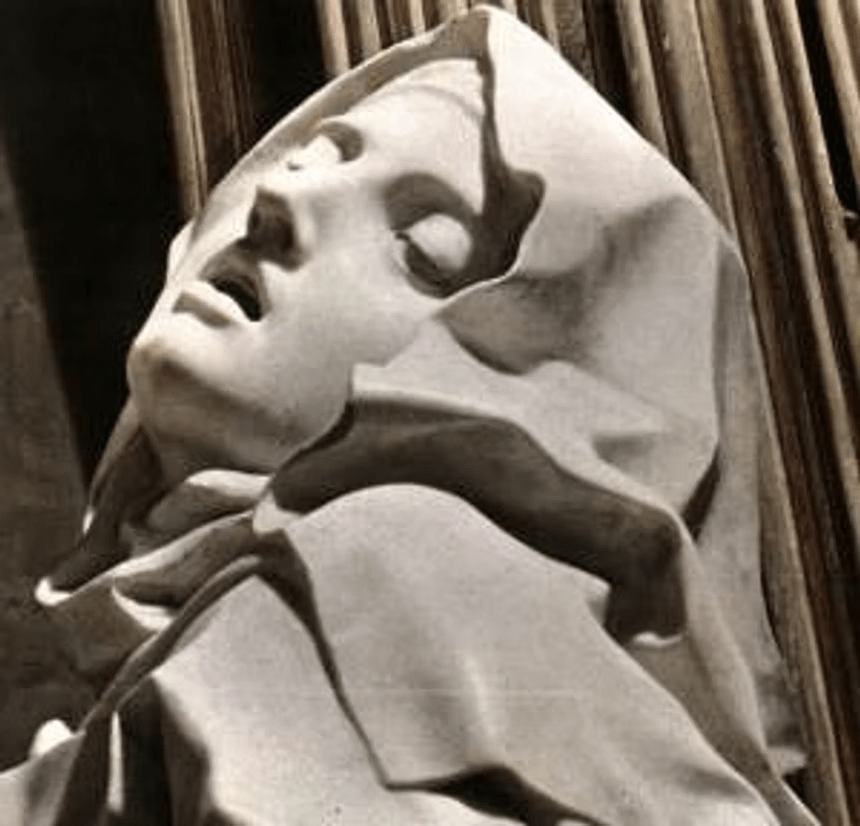
Saint Teresa of Avila experienced the ecstasy of beholding an angel of God piercing the walls of her heart with a golden spear.  It is not a rapture possible only for women.

“he stands behind our wall  ,  he looks forth at the windows  ,  showing himself through the lattice  .” This series of lyrics sing of God’s presence within one’s being, where “our wall” uses the plural possessive pronoun with “wall” (“kā·ṯə·lê·nū” for “kothel”). The “wall” is then one heart shared by two, in one body shared by two. The “windows” (plural number in the first person) are then the eyes of that body, which refers one to Matthew 6:22, where Jesus spoke during his sermon on the mount, “the eye is the lamp of the body.” This lamp, which shines light within one’s being, also then acts as a beacon to others, shining “through the lattice,” giving rise to the phrase, “the eyes are the windows to the soul.” This means one’s marriage to God allows one to be the vehicle through which God is present among others.

“spoke  ,  and my beloved said to me rise up  ,  to me love  ,  my fair one  ,  and to come away  .” The pause inflections (commas) place more emphasis on the voice of God heard within one’s mind. The one-word statement, “spoke” (“anah”), means, “sing, shout, testify, and announce,” where one is filled with the awe and joy of truth. God speaks through His brides.  This voice says “rise up,” where “qū·mî” means to “awaken” to a new life, where one also “stands” as God “stands behind our wall.” This rise is due to one’s acceptance of God’s love, brought about by opening one’s heart to God, from love shown Him. One stands in the light of God’s “fair one” or “beauty” (from “yapheh”) as the “gazelle” reflected in one’s being and presence. One then “walks” in the ways of the LORD.

“because  ,  behold  ,  [the death of] winter is past  ,  the rain is gone over  .” When one walks in the ways of the LORD, the cause is known to be one’s submission to God’s Will. One is able to “behold” changes in oneself that were unknown before. One has awoken from the slumber of mortal death and been reborn into eternal salvation. The tears of regret and sorrows of past mistakes have been washed away by a baptism (holy downpour) by the Holy Spirit. The fears of death have been removed from one’s soul.

“the flowers appear in the land – the time of singing [as birds] has come  ,  and the voice of the turtledove is heard in our land  .” The union with God has brought about the newness of spring, where a flower is the onset of new fruit. One’s heart is like a nest of hatchlings, filled with songs to be fed by the Father. The turtledove (from “tor”) is symbolic of the birds released by Noah, who returned with the message that the flood was over and new birth was at hand. The first four gifts sung of in The Twelve Days of Christmas are birds (partridge, doves, hens, and canaries), such that birds sing from the heights, like angels have wings. Therefore, “the voice of the dove is heard in our land” is the presence of new Saints, whose births come from their love of God.

“the fig tree puts forth her green figs  and the vine the tender grape give a [pleasant] smell  .” The Saint is like a green fig, as the new fruit of the tree of eternal life. The Saint is the continuation of God’s love, who radiates goodness that is attractive to others.

“arise  ,  come away  .” The call of a Saint speaks the voice of God to other potential brides. A Saint calls those who are asleep in mortal death to awaken and rise up. The call is to stand and walk in the ways of the LORD also.

“my love  ,  my fair one  ,  come .” God speaks through His brides. The call is to “be His.” The proposal is passed on through His Saints. It becomes personal and individual when one takes the steps that “come” to God’s love.

As an optional Old Testament selection for the fifteenth Sunday after Pentecost, when one’s personal ministry for the LORD should be underway – one has married God and become His bride Saint – the message is to open one’s heart and fall in love with God. This message goes beyond the sensuality of human love, such that one needs to have one’s eyes opened to a proposal made that has been rejected from ignorance.

In ancient times, like those of King Solomon, it would have been simpler to fall in love with the God of Israel, because there was no Jesus born into the world at that time. Today, knowing all about Jesus – being Christians – it seems the call is to be lovers of Jesus Christ, not God. It seems there is a tendency to see the God of the Old Testament as too harsh and too old to marry; but Jesus is young and appealing.

In the Roman Catholic Church (minimally), nuns are supposed to be married to Jesus. Priests are not seen as brides-to-be of God, but reflections of God, called “Father.” Female priests, of Christian churches that allow such recognition of women, are called “Mother,” where that is a human gender application to the “Father.” God has been replaced by those who pray to Jesus as their god.

Jesus of Nazareth loved God. He referred to God as his Father, which was a direct familial relationship he had, making that reference be more personal than the Old Testament presentation of God as the Father of all Creation. Jesus called himself the Son of Man, where “Adam” was the Hebraic word for “Man.” Jesus was the Son of God reincarnated, bearing the soul of Adam. The Jews, on the other hand, saw themselves as the sons of Abraham, Isaac, and Jacob, as those men were their fathers.  They heard Jesus speak of the Father and knew he meant God, but they did not see him as God’s son.  They recognized Joseph as the father of Jesus.

One has to realize that Jesus loved God because his soul was the bride that was married to God. Adam and God had become One, because of a heartfelt love for one another. As Husband (God) and wife (Adam), their union had created Jesus, who was in the flesh because he was born of a woman; but Jesus was the offspring of his soul’s love with the Father. Marrying God meant Jesus could be born of Adam.

Solomon wrote a sensual love song that was prophetic of this union that would produce Jesus, while also being prophetic of this union bringing forth countless resurrection of Jesus Christ.  Just as Adam’s soul married God, all of our souls are welcomed to accept the same proposal.  Acceptance means a cleansing of sin and a new life of complete righteousness.  That can only come from God’s forgiveness and submission to follow God’s guidance.  From that cleansing by God’s Holy Spirit, one receives the blessing of being with child – being reborn as Jesus Christ.

If one loves Jesus Christ, without being Jesus Christ reborn, one is rejecting the husband’s love, dreaming of a baby that will never be reborn within. Jesus of Nazareth is the model of what comes to those who love God and accept His proposal for marriage. Marriage to God means a union that can never be broken. It is a purity of love that begets the Christ Mind within one’s flesh and blood.

One cannot be a Father without surrendering completely to God. One cannot be a Mother when all brides of God have no human gender differentiation, with all God’s wives giving birth to the masculinity of Jesus Christ – in the Father as the Father is in him. To marry Jesus as a female devotee, one becomes a priestess in a pagan temple.  The builders of that temple is then to whom one’s service is committed … not to God.  All of these acts that are believed to be praising the Son of God is idolatry and denies one’s love from God.

Jesus said, “No man can serve two masters: for either he will hate the one, and love the other; or else he will hold to the one, and despise the other.” (Matthew 6:24)  There is only one master – Yahweh – the LORD. Jesus Christ is the result of loving only the LORD. Jesus Christ is the outward sign of inner grace that comes from being one with God. To love the outer and hate the inner is to serve self, pretending to be God.

The Songs of Solomon have a strong sensual appeal that arouses the sexual appetite, because man should be fruitful and multiply. Human marriage and the making of children should be a reflection of the love God allows through the pleasures of union. Humans experience pleasure in sexual encounters, unlike animals that mate instinctively. However, the higher meaning of Solomon’s love songs is to find pleasure in a personal relationship with God Almighty.  One arises above the physical sense of love to the spiritual.

The call is a proposal of holy matrimony. The call is to be fruitful and bring forth Jesus Christ, so others can be fed spiritually.

“Arise, my love, my fair one, and come away.”

Deuteronomy 4:1-2, 6-9 – What are we teaching our children?

Moses said: So now, Israel, give heed to the statutes and ordinances that I am teaching you to observe, so that you may live to enter and occupy the land that the Lord, the God of your ancestors, is giving you. You must neither add anything to what I command you nor take away anything from it, but keep the commandments of the Lord your God with which I am charging you.

You must observe them diligently, for this will show your wisdom and discernment to the peoples, who, when they hear all these statutes, will say, “Surely this great nation is a wise and discerning people!” For what other great nation has a god so near to it as the Lord our God is whenever we call to him? And what other great nation has statutes and ordinances as just as this entire law that I am setting before you today?

But take care and watch yourselves closely, so as neither to forget the things that your eyes have seen nor to let them slip from your mind all the days of your life; make them known to your children and your children’s children.

———————————————————————————————————-

This is an optional Old Testament selection from the Episcopal Lectionary for the Fifteenth Sunday after Pentecost, Year B 2018. In the numbering system that lists each Sunday in an ordinal fashion, this Sunday is referred to as Proper 17. If chosen, it will next be read aloud in an Episcopal church by a reader on Sunday September 2, 2018. It is important because Moses made sure the Israelites knew their Promised Land was contingent on the people following the laws set before them by God. Those laws were their direct link to God, which made them wise enough to maintain the laws, with God’s help.

Repeated in these verses are the words that state “great nation” (derived from the root words “goygadol”). The implication of “you,” “yourselves,” and “your” means the collective sum of the people that learn to follow the statutes and ordinances passed down by God through Moses are what makes a nation great. A nation is not a system of law that is great. Greatness can only come from the people – all individuals being as of one mind – being living examples of the statutes and ordinances that distinguishes them as a nation. Greatness is possible because God is the one mind of all.

Singapore thinks it is pretty great; but their god has different laws, right?

Of course, the history of the nation that became Israel, after the Israelites were delivered into the land God promised them (in return for them observing His laws diligently), was they repeatedly forgot to live by the laws of Moses. They needed judges to rescue them and lead them temporarily; and they relied on prophets to be their liaison to God. Then they decided they would do very little, as far as following the laws, because they would leave it up to a king to start a continuous line of judges, whose commands would speak for God, to them, like Moses had, and like the judges and prophets had.

That application of righteousness onto a surrogate did not work out very well.

By blindly putting their souls in the hands of human beings, no one was maintaining the laws of God then and other nations began seeing the land of Israel and Judah as land they wanted to take. Without God watching over His diligently righteous priests that served Him by living by His Law, the Israelites and Jews were scattered like chaff in the wind. Their land and their nations were lost.

This history lesson means that there is absolutely no (zero, nada) nations on earth that shine “the wisdom and discernment” of diligent servants of God, to the people of other nations. There is no (zero, nada) one that will say about any nation of earth, “Surely this great nation is a wise and discerning people!” Because of that lack, when Israel and Judah DIED as nations, there was no longer a land deal offered by God (Yahweh, the LORD) to any of the other nations or their peoples.

Looking to start a great nation here?

For some politician-businessman like Donald Trump, who campaigned for President of the United States of America with the slogan “Make America Great Again,” this plays into the beliefs that America is a “great nation.” Rather that seemingly endless natural resources and vast areas of productive lands of all types, the peoples of America have seen themselves as if it were a “great nation [that] has a god so near to it as the Lord our God” (“Yahweh elohenu”). Eisenhower’s officers and representatives thought that strongly enough to put “In God We Trust” on the money of that great nation.  However, that belief is nothing more than political hype, because the United States of America is not a land governed by the statutes and ordinances of a theocracy, much less a land of people that give heed to the teachings of Moses.

The United States of America calls itself a “republic,” which means there is no official “king” (monarchy) that tells the peoples of America what statutes and ordinances must be followed … or else. Without a royal lineage, where children rise to assume the seat of power, when an old monarch passes away, a republic offers a system where the peoples vote for their leaders, officers and representatives.

China has a republic too.

America then incorporates a democratic voting system; all the peoples (meeting certain criteria) get to vote, so (theoretically) the government does what the people say. This means if the law of such a nation is based on the Laws of Moses (kinda), the peoples get to pick and choose how much of each law is applicable to the peoples. In other words, Americans routinely add and subtract from God’s Law, so it has been totally reduced to just another nation status.

The re-creation of a nation called Israel, which is generally a theocracy and also a democracy, still does not re-create the great nation the children of Israel were called to be – through service as priests of Yahweh.  This reproduction today is far from being great again, meaning the peoples still make the same additions and subtractions to God’s Law. While some Palestinians and Christians have limited voting rights is modern Israel, the ruling body of Israel (the Knesset) is determined by limitations put on areas of the land, with restrictions as to who can run and who can vote.  This is so there is no chance of the Jewish religion being overturned as the core of their democratic theocracy. Therefore, Israel is also on the other nation status list, as it has governmental laws that have nothing to do with God’s Law.

The fact that there has been no nation on earth that has been like the children of Israel, a group of peoples whom Moses freed from bondage to one of the “other nations” of the world and taught the Laws of their Covenant with Yahweh, does not mean that all hope is lost. God sent Jesus as the Savior of Israel, but not the great nation of peoples on one land. Jesus came to renew the Spirit that was set upon Jacob, when he was renamed a word that means “God Strives” or “God Persists” (“Israel“).  It is a name that is passed down to all his children, which is applicable to all who raise up the Covenant between the LORD, as those who persist for God so God persists through them.

Jesus is the king of this kingdom that is not a nation set upon land, but a kingdom made up of individual subjects that maintain all the statutes and ordinances of God’s Law. Jesus said he did not come to change anything about that Law, as was God’s command. Jesus brought with him a new Covenant, where God would reside within each subject’s hearts. There, upon the walls of one love of God, would be written the Laws of God … not in the lobes of human brains, where the convolutions tend to bend the words of the Laws, and the gray matter makes some disappear and others mysteriously appear.

With the Laws of God written in one’s heart, one acts according to those laws from a love of God. Each individual of this nature is oneself a great nation, whom others will exclaim, “Surely this person is wise and discerning, and as righteous as a Saint.”  Jesus Christ is the shared King of all such spiritual nations.

In my writings here, from time to time, I have mentioned the peoples of the Eleventh to the Thirteenth Centuries, called “Cathars,” a name given to them by those who came to know them. The name stems from the Greek word “katharoi,” meaning “Pure ones.” The Cathar peoples primarily flourished in the southern region of France known as Occitania. They had no leader or ruler and they claimed no land as theirs. They lived peacefully amongst peoples who were both French and Roman Catholics. They were true Christians, although the Church branded them Gnostics and heretics. They were asked to convert to Roman Catholicism and swear an oath to the pope. When they refused, a genocidal crusade was mounted that basically erased the Cathar people from the world’s consciousness (see Albigensian Crusade). However, to this day the region of Languedoc and Midi-Pyrénées, and especially the town of Carcassonne is considered “Cathar Country.”

This is an example of what God originally intended when He told Moses to instill the Laws within the Israelite peoples. God promised them land so that seed could have a womb in which to develop. God knew it was impossible for human beings to maintain holy statutes and ordinances alone, without divine guidance.  It was known in advance that separating themselves from those peoples of other nations, while also welcoming the peoples of other nations to come see how great Israel’s peoples were –  as a great nation, made up wholly of righteous priests to Yahweh – was impossible to not be influenced by those outsiders.

The original nation of Israel was like posting a speed limit on a road and then giving peoples vehicles that can easily exceed those limits. It is like putting cookies in a jar on a table and telling a toddler not to eat any, before walking away and leaving the toddler to contemplate that law.  It is easier to break a law if it seems too strict … and nobody is looking.

When one is a true Christian, then one wants to live amongst others of like mind and like heart. That makes a great nation of Christians a true church, where all members have been reborn as Jesus Christ, filled with God’s Holy Spirit. This is how Jews tried to live in other nations (separate but equal), ever since they were dispersed from Israel and Judah. God wants His priests where they will be needed, amongst the Gentiles who need to witness righteous peoples first hand.

True Christians will influence those who seek to know the truth, while gathering together as the family of God to praise Him. This reading is then pertinent to today’s Christian world, as it says a child of God will “take care and watch [them]selves closely, so as neither to forget the things that [their] eyes have seen nor to let them slip from [their] mind all the days of [their lives]; [and they will] make them known to [their] children and [their] children’s children.”

As an optional Old Testament reading for the fifteenth Sunday after Pentecost, when one’s personal ministry for the LORD should be underway – one is adhering to the Laws of God that have been written on their heart’s walls – the message is to know that it is impossible to fulfill this promise without complete submission to God’s Will. The only way a “great nation” is fully committed to God is to be a Saint – ruled by the Spiritual King of one’s soul, Jesus Christ.

It is a huge mistake to read the Old Testament and ignore it, by writing it off as “just another example of how the Jews failed God.” Those failures are just as readily reflections of peoples today that think they are great because of God’s blessing them with greatness. Americans who boast of being a great nation under God need to slip that to a lower case “g” and see how they are bragging on being just another nation sworn to Mammon or Baal.

Our Supreme Court – a branch of governmental law – cannot even allow replicas of the Ten Commandments to be erected on public land (land stolen from Native Americans, by force, accompanied by lies and broken agreements), because we welcome citizens from ever religious theocracy in the world to come and subvert our legal system. We honor the killing of babies in the womb as a woman’s right; but then we deny the execution of those convicted of the most heinous crimes, because criminals have rights. Few in government will agree that babies in the womb or the ones suffering from heinous crimes committed against them have rights. We pretend to stand behind Mosaic Law, but then we add new laws that are contrary to it and amend old law to fit modern acceptances.

God, being the All-Knowing God that He is, knew when the peoples were doing the things that would be written into the book called Deuteronomy that they would fail miserable. He knows the fake religion that America and other nations claim to honor has nothing to do with the Laws He gave to Moses to install. God knew when John wrote the Book of Revelations (The Apocalypse) that the world would splinter into seven types of churches, none of which would be maintaining all the Law, with all needing to make some corrections or suffer the loss of eternal life.

I sure would not want to have God look at me and say, “I know your deeds, that you are neither cold nor hot. I wish you were either one or the other! So, because you are lukewarm—neither hot nor cold—I am about to spit you out of my mouth. You say, ‘I am rich; I have acquired wealth and do not need a thing.’ But you do not realize that you are wretched, pitiful, poor, blind and naked. I counsel you to buy from me gold refined in the fire, so you can become rich; and white clothes to wear, so you can cover your shameful nakedness; and salve to put on your eyes, so you can see.” (Revelations 3:15-18)

That sounds an awful lot like America’s form of religious lukewarmness to me.

James 1:17-27 – The listeners and doers of God’s Will

Every generous act of giving, with every perfect gift, is from above, coming down from the Father of lights, with whom there is no variation or shadow due to change. In fulfillment of his own purpose he gave us birth by the word of truth, so that we would become a kind of first fruits of his creatures.

You must understand this, my beloved: let everyone be quick to listen, slow to speak, slow to anger; for your anger does not produce God’s righteousness. Therefore rid yourselves of all sordidness and rank growth of wickedness, and welcome with meekness the implanted word that has the power to save your souls.

But be doers of the word, and not merely hearers who deceive themselves. For if any are hearers of the word and not doers, they are like those who look at themselves in a mirror; for they look at themselves and, on going away, immediately forget what they were like. But those who look into the perfect law, the law of liberty, and persevere, being not hearers who forget but doers who act-they will be blessed in their doing.

If any think they are religious, and do not bridle their tongues but deceive their hearts, their religion is worthless. Religion that is pure and undefiled before God, the Father, is this: to care for orphans and widows in their distress, and to keep oneself unstained by the world.

———————————————————————————————————-

This is the Epistle selection from the Episcopal Lectionary for the Fifteenth Sunday after Pentecost, Year B 2018. In the numbering system that lists each Sunday in an ordinal fashion, this Sunday is referred to as Proper 17. It will next be read aloud in an Episcopal church by a reader on Sunday September 2, 2018. It is important because James, the brother of Jesus and a Saint, told how one must be the kingdom of Christ, fully devoted to serving God the Father.

James wrote in the same manner as did Paul. This is because Saints do not write to display their ability with language, but because God leads them to send a letter. Thus, all Saints speak the language of God, which appears to the eyes of a novice to be ordinary language. Novices translating the texts of Saints into words means most miss the depth each letter contains.

Here is a breakdown of this segment of James’ first chapter, based on the literal words written, the implied punctuation, and the translations of the Bible Hub Interlinear presentation [or viable substitutes]:

17 “every act of giving good  ,  One needs to realize that the acts of giving are those of God to each of His beloved. It is God’s gifts [those of the Holy Spirit] that make one’s soul cleansed of sin, thus good. When one preaches that giving by human beings makes one good, as “every act of giving is good,” that only holds truth when everyone has something good to give. That error makes it seem as if one is bad, when one is impoverished. It also raises the question, “How much good giving will God expect from me?” When the giving is left up to God, then the good given that is given to others is the Holy Spirit; but only God can give that. An Apostle-Saint can only announce, “The kingdom of God has come near,” and let the seekers also marry God and be given His gifts of goodness.

“and every gift perfect  ,  Perfection is a characteristic of God. Humans are all flawed [sinners] until washed clean through Spiritual baptism. Then, a Saint becomes a reflection of the perfection of God, whose gifts come from that perfection [not manmade money or donated material goods].

“from above is  , Above is Heaven, the Spiritual realm of God. “Above” is one’s elevated spiritual presence, when one is raised up, above the plane of physical wants and desires.

“coming down from the Father the [one] of lights  ,  Again, we are raised up when God comes to the earthly plane in an Apostle-Saint. That is when one is reborn as Jesus Christ, who shines the light of truth within one.

“with whom not there is variation  ,  There is only one Jesus Christ – one model of righteousness in whom Saints are formed – so that Holy Spirit is resurrected in countless numbers of souls that find their love of God and become one with God.

“or shifting shadow  .  The Greek word “aposkiasma” means “a faint image or copy of.” This means there is no version of Jesus Christ that retains any control over a life of sin – a dark edge, where living in the shadows is partially allowed by God. In other words, one is not holy one minute and then doing dirty deeds the next, only to expect God’s forgiveness. That is the god of self still being served.

18 “having desired  ,  The Greek word “boulētheis” is a statement of “intent, desire, and wish,” which reflects a mutual desire between a disciple of Jesus Christ and His Father. One has come to realize the message of Jesus, through Scripture and deep reflections on the word of the Gospels, so one’s heart opens with desire for the LORD.

“he brought forth us by word of truth  ,  The rebirth of Jesus Christ is one’s ability to speak the same truth as did Jesus.

“for those to be us first fruits certain man  ,  The “certain man” is Jesus of Nazareth, the Son of Man, who is the true vine – the vine of truth – from which the first fruits were James, Peter, and Paul, who were those first to be bodies in which Jesus was resurrected.

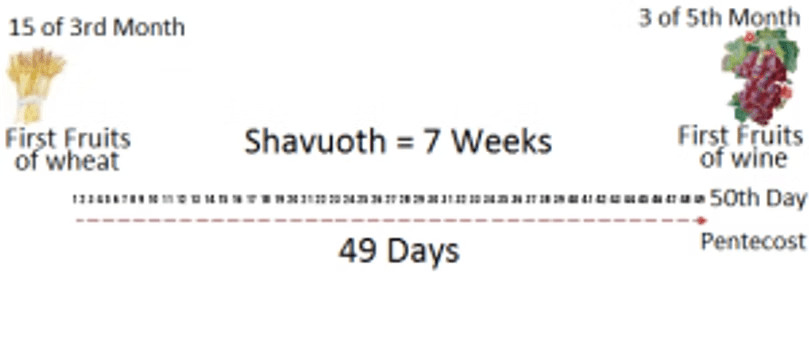
The first fruits are symbolized in the Passover to Pentecost festivals commanded by God.

“the one of his created  ,  Each Apostle-Saint is a reproduction of Jesus of Nazareth, in possession of the Christ Mind. All are the creations of God the Father, making all the Sons of God (regardless of human gender), as multiple Jesuses have been reborn as Anointed souls.

19 “so that  ,  “That” is the rebirth of the Christ Spirit.

“brothers ourselves beloved  ,  All are “brothers” (regardless of human gender) because all are of the same Father, and all are resurrections of the same Son. The totality of this replication of the Trinity in multiple human life forms is the wholeness of love, to and from God.

“let also every man swift in order this to hear  ,  Whereas the onset of love for God comes through meditative, prayerful thought, listening to God’s whispers as to the meaning of His Word, the filling of a Saint with the Holy Spirit and the Christ Mind means one is given an instantaneous knowledge [wisdom] and understanding. A Saint immediately hears and knows the truth, because the brain has been bypassed by the Christ Mind.

“slow in order this to speak  ,  When God speaks, one listens. One does not question what God says. One ponders anything that seems to go against all human teachings of religion. One absorbs an ownership of truth by proving the truth through tests of logic. To be a teacher, one has to first be taught; but when an Apostle opens his or her mouth, it is Jesus Christ that speaks.

“slow to anger  ;  Anger is a response to evil; but anger is controlled by God’s influence. Anger promotes prayer, more than it promotes the ‘Old Testament style sword’ that destroys the wicked. Prayer can bring God’s punishment, which is more lasting than any physical wounds can bring. “Slow to anger” means the development of patience.

20 “anger indeed of man  ,  Anger stems more often from the influences of evil, where the selfish desires of a soul are often not the results gained. Anger is then against one’s failures, but Satan will project those failures of self onto others, suggesting acts that harm one’s soul.

“righteousness of God not produces  ,  When one is open to the influences of Satan, there can be no acts of righteousness as the result. One has turned away from God, instead serving evil.

21 “therefore  ,  The Greek word “dio” means “wherefore,” derived from “diá, “across to the other side.” This one-word statement then places focus on the opposite of God’s influence, which is Satan’s.

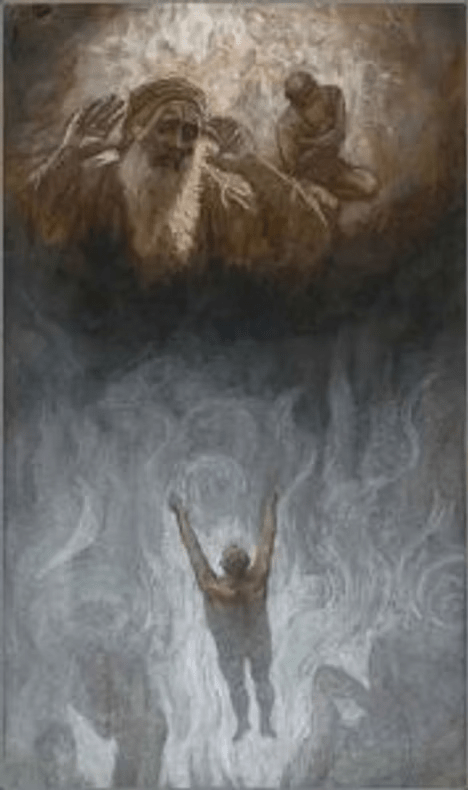
Lazarus looking upon the rich man in the opposite realm.

“having put aside all filthiness and abounding of wickedness  ,  When one turns away from the temptations of evil and the material plane’s traps, one’s soul has ceased being filthy by sins and addicted to the pleasures of selfishness.

“in humility receive the inborn word  ,  The Greek word “prautés” means “mildness, gentleness, and humility,” but emphasizes a divine origin in “meekness (“gentle strength”) which expresses power with reserve and gentleness.” This is the surrender of self-ego and the sacrifice of a Big Brain, so all the noise of an evil world ceases and God’s Word can be heard.

“which has ability to save the souls of you  .  Being able to hear the voice of God within is vital for one’s soul being saved.

22 “be moreover performers of [the] word  ,  The Greek word “poiētai” means “doers, performers, and those who carry out.” [It can also identify a “poet.”] This is the theme of James, where faith without acts [deeds] is dead. (James 2:14-26) He is setting that theme up here. One’s actions should not be self-motivated or influenced by Satan’s whispers, but based on Scripture’s lessons, interpreted by the Christ Mind.

“and not listeners only  ,  One who listens to the voice of Jesus and does nothing more is a Judas Iscariot.

“deceiving yourselves  .”  Judas was a disciple of Jesus of Nazareth as a traitor. Still, Judas was deceiving himself by not realizing Jesus knew he would betray him.

23 “because if any man a listener of [the] word is  ,  Anyone who is allowed to hear the voice of God’s wisdom is expected to act on that knowledge.

“and not a performer  ,  If one does not do the deeds spoken by God, one is like a wife who cheats on her husband. One who does not listen and obey is adulterous with self-ego love.

“this man is like one looking at face which natural of him in a mirror  .  This element of “face” (from the Greek word “prosōpon,” also meaning “countenance”) is the First Commandment stated by God to Moses: “Not you shall have to you gods other upon the face of.” (Exodus 20:3) We recognize this as “Thou shall have no other gods before me,” losing grasp of the Hebrew word “pā·nā·ya,” which states “face of.” A “mirror” is then a reflection of one’s face worn (one’s “countenance”) before God, such that the only “face” God wants a wife of His to wear before Him is His face, demonstrating that wife (male and female He makes them) is completely subservient to God [not self or some other lesser god].

24 “he has looked indeed himself and has gone away  ,  When one wears one’s self-face before God, it is the same as having turned one’s “face” away from God. That person has then gone away from God, towards whatever influence that person chooses to follow.

“and immediately has forgotten like what he was  ,  One whose back is turned to God immediately forgets what the presence of God is like, as God is no longer there to guide that traitor.

25 “all however having looked intently at law perfect  ,  Each individual who hears the voice of God within is able to deeply realize the perfection of God’s Law. From an inner wisdom illuminating one to the truth found in Scripture, the eyes can then see the perfection that each word contains. This is because all authors of holy text are writing from the perfection of God’s inner voice.

“that which of freedom  ,  The Passover and the Exodus are the stories of the children of Israel being freed from the bondage of Egypt. From that freedom Moses gave them the Laws of God. One has to understand that Egypt reflects the control of the earthly plane, rather than the will of one Pharaoh who disliked foreigners in his nation. Freedom that comes from the perfection of God’s Laws is freedom from the trap of the same ole same ole that is reincarnation of a soul that is snared by sin. To gain that freedom from bondage, one must listen to the voice of God, see the perfection, and then act according to that Word.

Freedom is the release from the repetition of a cycle of death.

“and having continued in  ,  The freedom of bondage requires one continuously be led by God’s Will. When one allows oneself to be married to God, via His Holy Spirit, one then continues to be free of death and mortal pains. If, however, one continues to listen to the inner voice, but act in worldly ways, then one has lost the freedom of eternal life with God.

“not a listener forgetful having been  ,  When one hears the inner voice speaking and takes heed, such that one’s soul does not fail to take notice (from the Greek word “epilésmoné”) of God’s guidance and direction, one is preparing to act upon that which is heard.

“but a performer of work    One then does the deeds of the LORD and sets aside the desires of the flesh. One does holy deeds, led by holy wisdom.

“this one blessed in the work of him will be  .  Those who act to carry out God’s wishes are then blessed with happiness and good fortune (from the Greek word “makarios”), such that the favors of God show on one’s face (“countenance”). Others who see that Mosaic glow will be envious, such that seekers will come to one to inquire how they can also be happy and fortunate.

26 “if anyone seems religious to be  ,  The Greek word “thrēskeia” means “ritual worship, religious, devout, and/or following ritual acts.” One appears to be religious by simply wearing the clothing of religious clerics. Some, such as Jesus witnessed the Pharisees doing, will make a point of being seen “acting” religious, rather than being religious. The Greek word “dokei” is rooted in the word “dogma,” where beliefs are ritualized and ceremoniously displayed. This means “seems to be religious” is the difference between “belief” and “faith,” where making a show of one’s beliefs is a form of works, deeds, and acts that appear religious. This is seen Biblically in the priests of Baal, who seemed to be religious, causing the Israelites to follow their leads. Those priests differed from the prophets of God, who demonstrated faith, which appeared to be rebelliousness instead of religious. Jews going to the synagogue on Saturday and Christians going to church on Sunday “seems to be religious.”

… and so many more.

“not bridling tongue of himself  ,  The Greek word “chalinagōgōn” means “to curb, restrain, sway and bridle.” To bridle one’s own tongue, one needs to cease letting one’s Big Brain speak for oneself, if one is to truly be religious. Knowing that Jesus never once spoke about any presidents of the United States of America (he cared little for Roman politics, so he cared none for those of our Western societies), any priest, preacher, minister, or pastor who stands at a podium and tells a congregation how to think, in terms of politics, is “not bridling his or her own tongue,” putting on the airs of being religious by wearing robes and tippets, but serving the priest of self will and political sway.

“but deceiving heart of himself  ,  The way one speaks [remember “slow to speak”?] tells where one’s heart lies. A “heart of himself” is being in love with self-ego and leaving no room in one’s heart for God. Without one’s heart married to Yahweh, one speaks for self, which is deceiving those who listen to the words of someone “seeming to be religious,” but is actually doing the deeds of a wolf in sheep’s clothing. In one’s deceptions, one is also deceiving oneself, believing it is the clothes that makes the man (or woman).

“of this one worthless the religion  .  Acting religious, while speaking words of self for others to follow is worthless (from the Greek word “mataios”). This is because the words of self-ego are: “vain, unreal, ineffectual, unproductive; practically: godless.” Without God’s word being spoken, one ceases to be following the ritual of servitude to the One God, thus one is absent of religion.

27 “religion pure and undefiled before the [one] God and Father this is  :  The only religious ways are those directed by Yahweh. One acts as God commands, which is the deeds, acts, and works of purity. A religious person is undefiled by the world of selfishness and greed.

All Saints allow Jesus his continuation of prayer.

“to visit orphans and widows in tribulation of them  ;  The Greek word “thlipsis” means “tribulation, persecution, distress, affliction.” The purpose of an Apostle-Saint is to go to where there is need and where others are seeking true religion. More than looking for children who have no parents, the Greek word “orphanos” means to go to the “Fatherless” and make God’s presence be known [“The kingdom of God has come near.”]. The widows are then those whose human husbands [or marriage to lesser gods] have died, offering them the hand of Yahweh in marriage. Religious seems to be going to visit orphanages and old folks homes; but true religion is making God be known, so all who seek His help can know the only thing that keeps one alone is one’s self-will and the freedom to be stubborn.

“unstained oneself to keep from the world  .  The Greek word “aspilos” means “undefiled, pure, spotless, and morally unblemished.” This is the characteristics of one who is truly religious, who worships the One God through submission to His Will. One cannot be “unstained” in a world that is an influence to sin, without the presence of God within and letting His Will be done through His servant.

As the Epistle selection for the fifteenth Sunday after Pentecost, when one’s own ministry to the LORD should be underway – one is a listener and a doer of God’s Will – the message here is to stop acting religious and demonstrate one’s complete devotion to God above.

American Christians are the most giving peoples on the planet, as far as donations of money to every known possible charity under the sun; but how many of them are giving others the gift of the Holy Spirit and entrance into the brotherhood (regardless of one’s human gender) of those reborn as Jesus Christ?

The message of James is the same as the message found in all of the Epistles, written by all the Saints: Each individual must become resurrections of Jesus Christ. Anything less that that is either fear of commitment to God or pretense.

Mark 7:1-8, 14-15, 21-23 – The dirty work of God’s servants

When the Pharisees and some of the scribes who had come from Jerusalem gathered around him, they noticed that some of his disciples were eating with defiled hands, that is, without washing them. (For the Pharisees, and all the Jews, do not eat unless they thoroughly wash their hands, thus observing the tradition of the elders; and they do not eat anything from the market unless they wash it; and there are also many other traditions that they observe, the washing of cups, pots, and bronze kettles.) So the Pharisees and the scribes asked him, “Why do your disciples not live according to the tradition of the elders, but eat with defiled hands?” He said to them, “Isaiah prophesied rightly about you hypocrites, as it is written,

‘This people honors me with their lips,
but their hearts are far from me;
in vain do they worship me,
teaching human precepts as doctrines.’

You abandon the commandment of God and hold to human tradition.”

Then he called the crowd again and said to them, “Listen to me, all of you, and understand: there is nothing outside a person that by going in can defile, but the things that come out are what defile.” For it is from within, from the human heart, that evil intentions come: fornication, theft, murder, adultery, avarice, wickedness, deceit, licentiousness, envy, slander, pride, folly. All these evil things come from within, and they defile a person.”

———————————————————————————————————-

This is the Gospel selection from the Episcopal Lectionary for the Fifteenth Sunday after Pentecost, Year B 2018. In the numbering system that lists each Sunday in an ordinal fashion, this Sunday is referred to as Proper 17. It will next be read aloud in an Episcopal church by a priest on Sunday September 2, 2018. It is important because Jesus quoted Isaiah, saying the pretentiousness of religious appearance, shown by upholding traditions as holy doctrines without sincerity, is not pleasing to God.

As Christians in today’s environment of social acceptance of just about everything imaginable, it is easy to be caught up in a love of Jesus, which blinds many from seeing themselves represented in the Pharisees of this reading. The Pharisees seem to reflect the failures of our government to maintain the standards of Christian morals, where Christians see themselves as the disciples following Jesus and trying to be devout; but those damn elected representatives and appointed judges always find something to complain about, always striking down the things Christians do as not applicable to the minorities that are not Christian. However, the focus of this reading is on Christians being self-serving, like the Pharisees, in their ways that have misinterpreted Scripture.

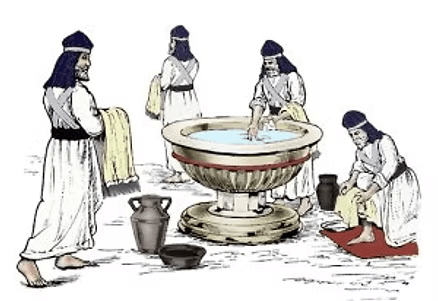
Instead of seeing the disciples as sinners that Jesus forgave, due to physical urges that had them cook food in unwashed pots and then prepare and eat food without washing their hands thoroughly, one should see Jesus never once spoke against the ritual act of handwashing. The Pharisees were speaking of the Law that applied especially to the priests of the tabernacle, which is written:

“Then the Lord said to Moses, “Make a bronze basin, with its bronze stand, for washing. Place it between the tent of meeting and the altar, and put water in it. Aaron and his sons are to wash their hands and feet with water from it. Whenever they enter the tent of meeting, they shall wash with water so that they will not die. Also, when they approach the altar to minister by presenting a food offering to the Lord, they shall wash their hands and feet so that they will not die. This is to be a lasting ordinance for Aaron and his descendants for the generations to come.” (Exodus 30:17-21)

Since the Jews were descended of the people of Judah, of which the Levites served as priests in Solomon’s Temple, Jesus was recognized as a teacher (a rabboni) of God’s commandments to all who would be priests of God. The Pharisees were less concerned about the disciples of Jesus not acting priestly, than they were in pointing out to Jesus how unpriestly his teachings were, as demonstrated by his disciples.

This led to Jesus quoting from Isaiah (Isaiah 29:13), where it was clear that ritual observed without an emotional connection – a desire that makes the ritualistic act meaningful to the person enacting it – is vanity [i.e.: worthless as far as Yahweh is concerned].  This is the intent of Jesus saying, “You abandon the commandment of God and hold to human tradition.”

The Pharisees were pointing out what they thought were sins in others [i.e.: the sin police], while there was no heartfelt understanding of the reason handwashing was commanded to be maintain by God.

Now, the Episcopal Lectionary website lists a break in the verses read, but where they say the final section of the reading is verses 21-23, the Bible Hub Interlinear website shows “there is nothing outside a person that by going in can defile” as their paraphrase translation of verse 18.  Perhaps there are different editions of Mark, or perhaps they are parsing and pasting so freely that skipping over bits and pieces gets confusing.  This translation, by whatever verse, is misleading.

Simply by reading that translation as a statement made by Jesus, one could reject that statement as false. Certainly, if someone picked up a rat that was infested with fleas that carried the bubonic plague virus (something external to one), and if one of those fleas were to bite the one picking it up, then something outside that person could defile him or her with the Black Plague. To the Jews, diseases were recognized as signs of sin, thus defiling.  This means “nothing outside … can defile” is wrong.  However, Jesus did not say that.

The problem is attaching the negative word “not” (“ou”) to the word that says “everything” (“pan”) and then changing “not everything” to “nothing.” Jesus actually said and intended his words to reflect: “Not everything from outside entering within a man can defile him.” [This also a paraphrase, as verse 18 has three segments, with the last two being combined to make this over simplification be the statement.]

Jesus was then talking about not washing pots and pans or food before making a meal and then eating it with unwashed hands. A lunch meal, also, is not sacrificial food prepared at the altar by a priest of the temple. Therefore, Jesus was pointing out the “compare apples to apples” argument, where comparing apples to oranges is flawed from the beginning.

Just wipe your hands in the prairie grass before eating [or pants].  For cowpokes it is optional.

Jesus actually posed that statement to the Pharisees and scribes as a question, meaning he turned the tables on them by questioning how they could think they were so priestly and not understand that. The second part of his statement is also presented as a question, where “not” is repeated, as “[Dirty hands, pots, and food is] not able to defile.” It was said as, “You do not know that, right?”

In this way, the questions asked to Jesus about his disciples were answered by more questions.  This was a common tactic of Jesus, as a rabbi teaching those who thought they knew it all. This is similar to how Jesus asked Nicodemus, “You are a teacher of Israel and you do not know these things?” (John 3:10)

When we read the translation above that has Jesus state, “but the things that come out are what defile,” this is actually verse 20, according to the Bible Hub Interlinear. This verse is also broken into three segments, such that the first places focus on “moreover,” which is like saying, “And another important thing to know.”

The second segment then places importance on the results: “that which comes out of a human being.”  The results are the actions, works and deeds a human being gives rise to. The focus is on the fact that one’s actions are not easily written off as being the product of one’s environment, as due to cause and effect, based on what one eats, absorbs, or lives amidst. Human beings generate acts that are not wholly uncontrollable and predictable.  The unseen variable is God’s protection.

The final segment shows the importance of understanding that it is the man (any human being) that is responsible for acts that defile. This last segment reads literally as, “that defiles the man.” However, the word “that” directly points back to the second segment’s focus on what comes out of a human being.  So, those acts that “defile” are owned by the one performing those acts.

Jesus then clarified outward acts that defile, by stating, “For it is from within, from the human heart, that evil intentions come: fornication, theft, murder, adultery, avarice, wickedness, deceit, licentiousness, envy, slander, pride, folly. All these evil things come from within, and they defile a person.”

By saying, “from the human heart,” this means acts that defile are not those that the brain leads, which can be classified as instinctual. A hungry person that is starving is not led by emotions to eat, just as a wild predator does not hunt and kill out of malice of heart. Therefore, each of the twelve acts that come out of humans that are defiling are based on the heart leading the brain to act in evil ways.  This says that it is the heart link that determines what acts are sinful and what acts that appear sinful are simply natural.

More than seven deadly sins is Dante’s many steps down into Hell. Jesus just named twelve.

As the Gospel selection for the fifteenth Sunday after Pentecost, when one’s personal ministry to the LORD should be underway – one is acting naturally, based on a profoundly deep love of God in one’s heart – the message here is to focus one one’s inner being, rather than point fingers at others. The failures of the Pharisees and scribes of Jerusalem’s temple was they were all brain for God’s Laws, with no heartfelt understanding. Thus, the message is to know one’s own heart.

When Christians today hear these words read aloud in church by a priest, who holds high the ceremonial book of Gospel readings, a human tradition is unfolding before their eyes. I remember my first times going into a church where standing, sitting, and kneeling was so confusing to a newcomer that I was always doing the opposite of what the regular congregation was doing.

My Pentecostal upbringing had taught me to silently allow someone in the congregation to stand suddenly and make loud noises, with arms raised, and then sit down. Others would quietly say, “Praise the Lord.” I witnesses newcomers break out into laughter when they experienced what I had been raised to accept as normal.

All of this is human tradition, none of which Jesus of Nazareth had ever encountered.

The fractured denominations of Christianity, where each differs from the rest due to some degree of Scriptural interpretation or another, they all point fingers at one another [whether or not that is the intent] in ways that are parallel to the Pharisees calling out Jesus for having not disciplined his disciples. This is how one should see this reading. One must be prompted to look within one’s heart to understand why it is one sits in a pew in a church, listening to Scripture being read and sermons being preached.

One must ask oneself, “Am I just honoring God with my lips and not my heart, because I come to church in vain, loving the presentation of ritual and tradition as doctrine, more than loving God through ministry that gets my hands dirty in self-sacrifice?”

The question Christians must ask themselves individually is, “Have I become a Pharisee?”

From the twelve branches of sin named by Jesus, look at how many we can see reflected in the Pharisees and scribes, simply from their displayed ignorance of the truth of God’s Laws. While the dirtiness of external contact is readily grasped – as the physical acts of sin – see if you can realize the spiritual acts that are most harmful to a soul.

The translation of “fornication” comes from the Greek word “porneiai,” which can equally state “idolatry” and “sexual immorality.” As priests of the LORD, who should have been married to God in their hearts, did the Pharisees not cheat on God by idolizing Moses? Do Christians not do the same with Jesus, wearing crosses around their necks and bowing to figurines of Jesus hanging on a cross?

When the act of “theft” is considered, it is easy to think in terms of stealing food to eat. In terms of the Pharisees and scribes, they stole the wealth of the Jews, taking it as their own. Still, was their greater theft not the fact that they used their positions of leadership to mislead those who followed them, taking them away from service to God? Do Christian churches not mislead in the same ways, keeping members as lost sheep, rather than souls freed by the Holy Spirit?

All throughout the ministry of Jesus of Nazareth the Pharisees and scribes plotted to “murder” Jesus, while using the Law and accusations of heresy as justification. While killing a threat to the flock can be determined a justifiable act, just as killing a sacrificial animal before the altar was necessary in ancient Israel, “murder” is the intentional, unjustified slaughter of innocence. Have Roman Catholic priests not murdered the children that represented the future life blood of that institution, driving them away unjustly? Is not the simple question, “Why are millennials leaving the Church?” a sign of Christianity being murdered by the purposeful lack of true faith shown by Christians?

In human terms, “adultery” is “Consensual sexual intercourse between a married person and a person other than the spouse.” [American Heritage® Dictionary of the English Language, Fifth Edition]. On spiritual terms, is this not seen in how the Pharisees loved their wealth, possessions, and their powers of influence, as having spiritually made “love” to the god Mammon, who appeared in any form that whispered ‘sweet nothings’ into their mental ears, telling them how important self was? Likewise, are Western Christians not so involved with material quests that they lie down with whatever sin promises to make their cell phone payments, their cable-satellite TV payments, the fancy car payments, and their lavish home mortgage payments? Does the Church not still offer forgiveness of “adultery” through indulgences?

The sin of “avarice”, from the Greek word “pleonexiai,” means “covetous desires,” while being a statement of “aggressiveness and a desire for advantages.” Did the Pharisees and scribes not covet the attraction that the newcomer Jesus was having with the Jews? Was his popularity not taking away from them what they believed was theirs to possess? Do Christians today not believe that Jesus wants them to have as much as their credits cards will allow, as if a pastor driving the newest Cadillac is a sign of how powerful their God is?

The Greek word “ponēriai” translates as “wickedness,” also meaning “iniquities.” This means one is led to grossly immoral acts, which are unjust and harmful. This is an outward manifestation of one’s lack of righteousness. Religions that serve lesser gods, especially the churches of Satan, where everything practiced is the opposite of that taught by God, while reflecting the same rituals of Roman Catholicism, are wickedness. Was the Temple of Jerusalem not a wicked reproduction of Solomon’s Temple, which God had never sought to be built to house Him? Can this same error of reasoning, where money is praised in the form of lavish building of worship, not be deemed a form of wickedness that is reproduced by many denominations of Christianity?

The aspect of “deceit” surrounded all of the encounters between Jesus and the Pharisees. After Jesus rejected the advances of Nicodemus, most of them pretended to be attempting to counsel Jesus, so he would be a better rabbi.  The reality was they were attempting to catch him committing an offense punishable by their laws. Still, their souls were deceiving themselves, leading them away from eternal salvation. They attempted to deceive God as to whom they pretended devotion; all the while God knew their hearts and their devotion to self. Do not the Christian churches deceive themselves, when the passing on of the Holy Spirit is their task, but they have no ability (or intention) to fulfill that task?

The Greek word “aselgeia” is translated as “licentiousness,” which is an excessive sense of freedom to act as one desires, also known as “wantonness.” While the word is used to denote lewd behavior, especially of a sexual and lustful nature, can you see how the Pharisees and scribes took great pleasures in their sense of self-righteousness? Has Christianity not produced its own version of these self-serving flashy pastors, whose presence in the finest clothes and imported colognes sends out signals to those who will faint in their presence? Have not the robes of some Roman Catholic clerics [too many] not been used at the expense of those who trusted them?

The “envy” of the Pharisees is similar to their covetousness of the popularity Jesus had with the people. Still, they were often befuddled by how Jesus turned the tables on their plots and ploys. Jesus had a way of understanding people, in addition to knowing all the laws and Scripture verses the Pharisees and scribes had memorized.  That talent in Jesus meant the Pharisees and scribes were envious of the quickness of the Christ Mind that Jesus had. Are not Christians today following the leader, memorizing (as best they can) what someone wrote or said about the meaning of God’s Word, wishing they had the ability to understand like ‘the professionals’? Does that envy not have the same effect that seeks to “kill the messenger,” when a prophet speaks in ‘out of the box’ ways?

The word “slander” has legal ramifications, which means the Pharisees knew well what could be deemed “abusive or scurrilous language, blasphemy.” They listened to what Jesus said intently, waiting for words that were slanderous to the Laws of Moses. Still, were the Pharisees not guilty of slander by speaking out against Jesus, who was the messenger of God, as a prophet? Is it not blasphemy for a professed Christian to speak for Jesus Christ [“Jesus would say _______”], when he or she has not been reborn as Jesus Christ [so Jesus speaks through he or she as “I say ________]?

The element of “pride” is found in the confidence the Pharisees and scribes felt in their self-anointed superiority as the ‘wise men’ of Judea and Galilee. It was the pride that had them speak out against Jesus and his disciples, because had they instead been humble, they would have said nothing. The pride in the minds of those leaders saw the meek as easily controlled and dominated. A prideful mind is too busy seeking self-glorification to ever allow God to be the one to whom all praise and glory is due. Do Christian nations and peoples not display the same sense of superiority to the world, missing the point of being God’s lowly servants?

The Greek word “aphrosynē” is translated as “folly,” but it is better understood as “foolishness.” The word is described as, “senselessness, i.e. (euphemistically) egotism; (morally) recklessness.” This is the “foolishness” that has one thinking any mortal human being is a god, worthy of worship. The Pharisees and scribes were fools to reject Jesus, closing their minds to God’s messenger, who was sent to tell them, “You are going the wrong way.” Fools never listen to good advice until it is too late. How many Christians today are being “foolish” with their souls, when the messages read aloud in churches each Sunday are telling them to stop worshiping at the altar of egotism and sacrifice self for a higher goal?

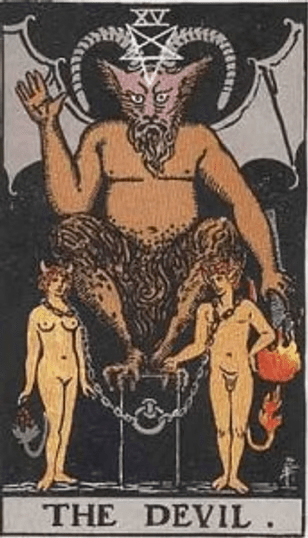
It should be clear that all of these sins are intertwined as the ‘rope’ of Satan. Allowing one strand to wrap around one’s neck means all the others will be there as well. In the Tarot there is a Major Arcana card that is called “The Devil,” which depicts human beings (a male and a female) bound by the chains that seemingly hold one captive to sin.

Those chains, however, are not tight, meaning freedom is simply a matter of removing the chains and walking away. People’s hearts love sin more than God.  The power to lift those chains off one’s shoulders is possible when one receives God in one’s heart.  When that happens within, then the outer actions that burst forth are to leave sin and Satan behind, freed by the love of God.

In this reading from Mark, the disciples can be seen as innocent children, happily doing what comes natural to God’s children. Jesus oversees them as their earthly Father, who teaches them values and then lets them be themselves with a heart that is engaged to God. “Children” means a sense of innocence that has not yet let the traps of the world overwhelm them. Thus, their sins are not soul condemning, as much as life lessons and personal experiences that should not be repeated.

Becoming an Apostle or Saint, reborn as Jesus Christ brings about that innocence of childhood. When one acts because God is in one’s heart, one’s brain is not calculating the value of one’s actions – if any good or if any evil will result. One acts as God wills, without a worry in the world.

When one is doing the work of God, one is not judgmental of self or others. However, if someone wants to pick a fight with one of God’s servants, one will speak as did Jesus, so the truth will be known.

Song of Solomon 2:8-13 – The Bride’s Adoration

The voice of my beloved!

Look, he comes,

leaping upon the mountains,

bounding over the hills.

My beloved is like a gazelle

or a young stag.

Look, there he stands

behind our wall,

gazing in at the windows,

looking through the lattice.

My beloved speaks and says to me:

“Arise, my love, my fair one,

and come away;

for now the winter is past,

the rain is over and gone.

The flowers appear on the earth;

the time of singing has come,

and the voice of the turtledove

is heard in our land.

The fig tree puts forth its figs,

and the vines are in blossom;

they give forth fragrance.

Arise, my love, my fair one,

and come away.”

——————–

This is the Track 1 Old Testament reading option for the fourteenth Sunday after Pentecost [Proper 17], Year B, according to the lectionary for the Episcopal Church. If selected, this song will be paired with verses picked from Psalm 45, which sings, “My heart is stirring with a noble song; let me recite what I have fashioned for the king; my tongue shall be the pen of a skilled writer.” Both will precede the Epistle selection from James, where he wrote, “In fulfillment of his own purpose he gave us birth by the word of truth, so that we would become a kind of first fruits of his creatures.” All will accompany the Gospel reading from Mark, where Jesus said, “It is from within, from the human heart, that evil intentions come: fornication, theft, murder, adultery, avarice, wickedness, deceit, licentiousness, envy, slander, pride, folly. All these evil things come from within, and they defile a person.”

I wrote about this and published my opinions in 2018. That article can be found on this website by searching the reading name and number. I welcome all to read those observations, which I stand behind today, as I read this song of love not as the seductions of a man and a woman, but as a soul and Yahweh. The comments I crafted in 2018 take a view of this song as if Solomon was divinely inspired by Yahweh. While I think less of Solomon these days, I still see that divinity; but I give less credit to Solomon today. Therefore, I will not rehash what I said in 2018, instead adding a broader view of the whole now.

I want to repeat my views that have consistently been presented about marriage to Yahweh. This has nothing to do with the physical, as divine marriage only is possible between the eternal. The body of flesh is temporal and bound to die. The death of a body of flesh is merely the death of matter no longer being able to sustain the life force that a soul provides. When new life is seen with the birth of a baby, there is nothing actually new. Ask any scientist and they will tell you that everything that existed in Creation still exists today, only in changed states. Thus, a baby is recycled matter and a soul is likewise recycled spirit. Yahweh is the provider of the spirit of life – the “ruach” or “breath, spirit, wind” – which animates matter, giving it the appearance of life. However, the soul is life, the body of flesh is death, and because a soul can either be repeated through reincarnation or elevate back into the heavenly realm as a return to Yahweh, the soul takes on a neutral gender.

The call to marry Yahweh is made to souls so they can escape the recycling of reincarnation. The promise of eternal life means to return to the true place of living, rather than be returned to a body of flesh that has to start over as a newborn and spend years growing and developing, only to grow to the point that the resources of dead matter can no longer sustain a habitat for a living soul. A return to that state of life in dead matter equates to being born dead. That is a return to the realm of death, as opposed to being returned to the realm of true life.

The duality of life and death can then be seen reflected in the duality of the spiritual and the material. This duality is present in a soul within a body of flesh. This duality is expressed in the bodies of flesh being either masculine or feminine. The duality of human sexuality is for the purpose of regeneration of bodies of flesh, which will then provide a home for a spirit of life. In the same way, the spiritual is a projection of the masculine, with the material being a projection of the feminine. As such, when I talk about a marriage to Yahweh, this means a soul in a body of flesh has taken on the essence of femininity because a neuter gender soul has taken on the feminine essence of a body of flesh, regardless of the human gender that body of flesh possesses. All souls in human flesh are then feminine, as brides-to-be for the masculine Yahweh Spirit.

This concept of metaphysics should be simple enough to grasp, but because human beings live in a world that makes it difficult to contemplate the unseen, life takes on the roles of masculine and feminine, based on the birth gender. When religious material is seen in terms of appearing to favor the masculine, the difficulty that comes from disassociating that gender reference from human genitalia creates a world of males dominating females and females who scheme against males from a pretense of subjection. There really is nothing about divine literature that gives greater preference to males, still kings are greater than queens and women have long had little voice in public. Children are the neuter gender, which makes a soul like a child that has to decide what it will be when it grows up.

In the story of Solomon the past two Sundays, he encountered Yahweh in a dream. Solomon was a child king, so he was a neuter gender soul in a masculine body of flesh, which was of feminine essence, being made of dead matter. Yahweh asked the young Solomon, “’ĕ·lō·hîm šə·’al māh ’et·ten-lāḵ,” which says, “elohim ask what shall I give you.” In that question, the Jews assist the Christians in translating “elohim” as a statement of “God” asking the question, “What can I give to you.” That mistranslation keeps both Christians and Jews from recognizing Yahweh would not speak to a child about material gifts. Yahweh addressed the neuter elohim Solomon as a soul that needed marriage to the divine, simply because Solomon had risen to become the King of Israel, which was a nation of God’s chosen people.

The question pertained to the actions of a pertinent brat, one who had broken the laws of high places and burned incense and offered animal sacrifices. Solomon made those actions when he was not a Levite or a high priest. The actions of Solomon meant Yahweh spoke to him in a dream like He spoke to Cain, when his countenance was low, counseling his soul to get up spiritually. When Solomon heard the voice as if it was God coming to serve little boy king Solomon, he began to spout egotistical crap, causing Yahweh to step back and let Satan [“adonay”] be the one who was delighted to hear Solomon wanted to eat the fruit of knowledge of good and evil. Thus, “elohim” stated Solomon’s neuter soul would reject marriage to Yahweh and become married to Satan.

I bring all this up because we are now given a song of love written by a soul that had become enslaved by Satan. This means the author of this love song should not be seen as worthy of praise. The good contained in the words put down in writing comes from Yahweh, not from the brain of Solomon. In fact, one can assume that the brain of Solomon was thinking how much more the ladies would be attracted to him, because of how well his brain could think of words to write that would make the women all swoon and then strip naked before him. This is how the divine works of Yahweh manifest. This is a double-edged sword, which cuts sensually into the lusts of material pleasures, along with the realities of male domination and female submission, while also being metaphor for the soul’s submission to Yahweh.

In this later sense, Satan must be seen as a creation of Yahweh, as a elohim that must submit to the Will of Yahweh. When a third of the angels of heaven rebelled, that is a human myth, as Yahweh made elohim that would act in lustful ways for the material Creation and be forever sent to only manifest within that realm. The serpent was one of these who was present in the divine realm of Eden. The serpent is metaphor for the elohim that can possess all souls who reject Yahweh. So, even when they have that possession under their godly control, they still must step aside and allow Yahweh access. This means a soul demonically possessed can be freed from that oppression, allowing that soul to then marry Yahweh. Therefore, even though Solomon was demonically possessed, his soul could be inspired divinely to write words that not only satisfied his egotistical lusts, but also serve the needs of Yahweh.

The selected verses of this song – 8 to 13 – are said to be the voice of the bride, as “The Bride’s Adoration,” with other verses attributed to the voice of “Solomon.” When the influence of Yahweh is seen, the voice of the bride is relative to all human beings on earth, regardless of their human gender. That means the voice of Solomon is then that of Yahweh. The theme of marriage is clearly seen in the repetition of the word translated as “beloved” [“dod”]. This means marriage is not arranged or forced upon any soul. It sings about the desire to be possessed totally by Yahweh, completely submissive to His Will.

The adoration of the bride must come from a child’s eyes, where love equates to trust. A virgin soul is an elohim unmarried to a greater Spirit. It is when one’s heart and soul want to be one with the Father forever.

In these modern times, when the perversities of humankind have corrupted many of the leaders of the churches purporting to serve Yahweh, such love can be seen as reflected in this song. Human love is unnecessary for a sexual relationship to take form, although the pleasures of the flesh can easily be mistaken for love. The institution of marriage, which solely means the union of a man’s sperm into a woman’s egg [which is guided by the hand of Yahweh], has become an demonic elohim of worship, where the bodies of human flesh are altars where human gender are sacrificed, with Satan putting his blessing on all animalistic unions. The story of Jonathan’s love of David, as brotherly soul mates [not homosexuals wallowing in the gutter of human lusts] is how divine texts can be twisted in perverted ways to make Satan happy. All references to “love” and “heart” are divinely elevated to mean a soul’s desire for salvation leads a soul to seek to do everything possible to please the only entity that can make that happen.

Again, as to the specifics of this song, I refer one back to what I wrote in 2018. I no longer feel the need for human gender pleasures of the flesh. I no longer seek to find inspiration that leads my soul to Yahweh from that relative to Solomon. I leave that up to the younger generations to experience.

As for an optional Old Testament reading for the fourteenth Sunday after Pentecost, when one’s own personal ministry for Yahweh should already be well underway, the lesson of this song of love is only one’s soul experiencing the love of Yahweh. That love rises well beyond the limitations of human flesh. The love that comes from divine marriage of a soul to Yahweh’s Spirit cannot be measured in physical terms. The terms used by Solomon have to be metaphor, because it is impossible to specifically state what divine love is. Ministry without this love is empty and will find no suitors. The lesson of this song is to preach the Word of Yahweh [which is unknown by human brains], so the souls of others will be awakened to this Word and their hearts opened to receive that Spirit.

Deuteronomy 4:1-2, 6-9 – Being Israel

Moses said: So now, Israel, give heed to the statutes and ordinances that I am teaching you to observe, so that you may live to enter and occupy the land that Yahweh elohe of your ancestors, is giving you. You must neither add anything to what I command you nor take away anything from it, but keep the commandments of Yahweh elohekem with which I am charging you.

You must observe them diligently, for this will show your wisdom and discernment to the peoples, who, when they hear all these statutes, will say, “Surely this great nation is a wise and discerning people!” For what other great nation has elohim so near to it as Yahweh elohenu is whenever we call to him? And what other great nation has statutes and ordinances as just as this entire law that I am setting before you today?

But take care and watch yourselves closely, so as neither to forget the things that your eyes have seen nor to let them slip from your mind all the days of your life; make them known to your children and your children’s children.

——————–

This is the optional Track 2 Old Testament reading for the fourteenth Sunday after Pentecost [Proper 17], Year B, according to the lectionary for the Episcopal Church. If chosen, it will be read along with Psalm 15, which asks in song, “Yahweh, who may dwell in your tabernacle? who may abide upon your holy hill?” Those will then be followed by a reading from James, who wrote, “If any think they are religious, and do not bridle their tongues but deceive their hearts, their religion is worthless.” All will then accompany the Gospel reading from Mark, where Jesus said, “Listen to me, all of you, and understand: there is nothing outside a person that by going in can defile, but the things that come out are what defile.”

I wrote about this reading selection the last time it came up in the lectionary cycle, back in 2018. At that time there had been a political change in America that was showing how divided this nation had become [and is only getting more greatly divided now], which leaned my opinions too far away from the point of this reading to fully appreciate now. I stand behind what I wrote then and see how those comments still hold truth today. Therefore, I welcome all to view that commentary by searching this site; however, I will now make additional comments that were not made then.

In 2018 I was not focused on correcting the English translations that deny Yahweh His due. Moses met with Yahweh regularly. Moses did not refer to Yahweh generically, as a “lord.” Moses called Yahweh by name, and that name was told to the Israelites. Thus, looking up the Hebrew word “כַּיהוָ֣ה” will find it transliterated as “Yah-weh,” regardless of what Jews today say about that pronunciation. The definition of the word-name is “the proper name of the God of Israel.” (Strong’s) By substituting a generic title for the proper name is an insult to any souls who claim Christianity is spawned from Yahweh, because there are many “lords” in the world, none of them offering eternal life.

In the time since 2018, I have become more drawn to see the importance of the Hebrew word “elohim” as much more that the English translators of the Old Testament give it credit for meaning. To translate a word that is clearly the plural form of “el” as “God” is just flat out wrong, constituting a lie perpetrated against all who seek eternal salvation. In addition to the literal translation of “elohim” being “gods” [not “God”], I have since found the usage to have a much deeper meaning, which is relative to a soul’s devotion to Yahweh. Therefore, because of this importance needing to be seen, I have restored the language above so it reflects where Yahweh was identified; and, I present how the forms of “elohim” must be seen, in order to have the truth be understood.

In 2018 I placed greater importance on Moses calling those who followed him a “nation.” The Hebrew word translated as such is “gō·w,” which stems from “goy.” The word translates into English as “nation, people” (Strong’s), but there can be no “nation” that exists without “people.” For that reason, I wish to redirect my focus on the “people” who followed Moses, as the intent of this reading.

With that now understood, when verse one begins with Moses saying, “Now Israel,” he must be seen as addressing the “people” who followed his lead from their lives as “people” of Egypt, where those lives had become oppressive in that “nation.” In reality, the people following Moses were the descendants of Jacob’s twelve sons [not counting Joseph]; but as “people” all related by one central ancestor, Moses did not call them Egyptians, nor did he call them Jacobites. Every one of the “people” who followed Moses did so because they worshiped one specific God; and, that made the Egyptians see them as outsiders or aliens that needed harsher treatment in their “nation.” That demands one understand how Jacob took on the name Israel, which his descendants also took.

Jacob was not an upright individual. His mother influenced him to take advantage of his brother, who was more manly than the fair skinned, relatively hairless Jacob. Jacob learned recipes from mom and cooked stew, while his brother was out working hard all day, coming home famished. Rather than feed his brother the stew he made, he used food as a way to make Esau to swear away his birthright. Then when his father Isaac was not about to let stew be the reason to give blessings to a second-born twin, with Isaac old, blind and near death, mother Rebecca told him to paste fur on his body so he could trick Isaac into thinking Esau was about to receive his blessing. Then, after Jacob stole Isaac’s blessing, when Esau went in to see Isaac to be blessed, he was cursed. So, Jacob was not anyone to hold up as a hero. Jacob reflects everyone who is a sinner, because he sinned. The name Israel has nothing to do with Jacob, whose name means “Supplanter.”

After Jacob’s two wives and two maid-servants (who bore him sons) had given him eleven sons [before Joseph and Benjamin were born from Rachel], Jacob wrestled with his own soul [which is an elohim or “angel of Yahweh”]. This was to purge Jacob of the sinful soul that had possessed his being. Jacob had been led by a demonic elohim in his acts that led him to steal from Laban, the father of Leah and Rachel. When Laban found out, Jacob fled from Laban, but Laban came after him and had a confrontation. Jacob then realized he had to change. He returned to make amends with Esau but encountered “angels elohim,” which led Jacob to send messengers ahead to tell Esau he was returning in peace. That night Jacob’s soul wrestled with the evil elohim within him, with the assistance of a Yahweh elohim. The demonic possessing spirit was removed and Jacob was then possessed by Yahweh, in a divine marriage of his soul to the Spirit. It was then the new soul presence within Jacob that the Yahweh elohim told Jacob that he was then “He [who] Retains God,” the meaning of “Israel.”

It is vital to realize that the demonically possessed Jacob had sired eleven sons, who had been raised to witness a father who lied, cheated, and stole to get his way. The sons of Jacob, after Jacob had been delivered a twelfth son, Joseph (who he loved best of all his sons), those sons of evil Jacob acted demonically in attempting to kill Joseph, only to fail and then sell him into slavery, telling Jacob Joseph had been killed by wild beasts. They were no prizes to write home about either, being the sons of an evil father. They are the bloodlines that beget the “people” who followed Moses. So, to call that collection of “people” “Israel” meant everyone of them had done the same as their forefather Jacob and rid their souls of demonic possessions, all having become divinely married to Yahweh. That must be seen as the truth of Moses’ address to the “people” as “Israel.”

The word “Deuteronomy” literally means “second law” from Greek deuteros + nomos.” This means the firsts law was given as soon as Moses brought down the Commandments, which are the marriage vows one must agree with to become a Yahweh elohim, as an “Israel.” The Hebrew name of the fifth book of the Torah [a.k.a. Deuteronomy] is “Devarim,” which means “The Words [of Moses].” This book is the ‘parting reminders’ given by Moses, about the Laws [about the marriage agreements], before the “people” would be released into the land they had been promised by Yahweh. Those reminders were to make sure all the “people” understood the Promised Land was (in essence) a womb into which the seeds of righteousness would develop into a lineage of most holy priests, who would be born into the world serving Yahweh forevermore.

Thus, when we read Moses say, “to enter and occupy the land that Yahweh elohe of your ancestors, is giving you;” “keep the commandments of Yahweh elohekem;” and “what other great people has elohim so near to it as Yahweh elohenu,” the focus is not on national pride but on the maintenance of the divine presence of Yahweh elohim. There can be no “people” and no “nation” worthy of being freely taken from a land and nation where they lived before and then be transplanted into another land, where other people have lived and existed equally. The only reason physical land [a place on earth] was promised must be seen as Yahweh making a spiritual promise to a soul that says, “I will take you from your father and plant you into your mother and let you develop in her womb, until the time that you will be born and I will breathe my divine Spirit into you, so you can serve me in the world.” The father was Abraham’s soul and Abraham’s blood, promised the womb of Canaan, where Yahweh had called Abram to come, leading him away from Ur. The promise made by Yahweh to Abraham was not that of a forthcoming nation with a human king, to forever be installed in what is now called the Middle East. The promise made by Yahweh to Abraham was Christianity, which would come from the soul of Abraham’s lineage, not his genetics; and, his soul’s lineage means all who will be Yahweh elohim.

This reading leads to the conclusion that states, “But take care and watch yourselves closely, so as neither to forget the things that your eyes have seen nor to let them slip from your mind all the days of your life; make them known to your children and your children’s children.” When Moses warned, “watch yourselves closely,” that speaks loudly of the ways of a soul that has not married Yahweh. Moses had murdered out of anger. He knew he needed to watch his actions (and forty years of leading bellyachers and complainers around the wilderness certainly aroused his anger often), because without a soul married to Yahweh all sin can break loose. Yahweh promised Abram he would have many descendants. As a Yahweh elohim, Abram would become the father of many “peoples.” Yahweh promised to make a covenant with those descendants; and, those descendants would be given Canaan. Moses was warning that the promises made between Yahweh and Abram were only for Yahweh elohim, so “take care and watch yourselves closely.”

When Moses said, “neither forget the things that your eyes have seen nor to let them slip from your mind all the days of your life,” this still applies to all who read these words. Your eyes have read them, your mind’s eye has formed a picture for you to see. You have seen the works of Yahweh manifest through a divine Yahweh elohim, in the deeds of Moses. Regardless of how many “people” heard Moses speak, all “people” forever who wear the face of Yahweh as His wives will possess His eyes and see the truth that comes to all Yahweh elohim. To be led around life by a brain that has become controlled by a demonic spirit having possession of one’s soul is the danger of never letting slip from one’s mind the powers of Yahweh manifested within His elohim. To forget is to be wayward and lost.

When Moses said, “make them known to your children and your children’s children,” this means one is not blessed by Yahweh, so as to be given the freedom to do nothing and gain eternal life. A true Yahweh elohim is a minister of His Word. All the world becomes the children that need to be taught to submit their souls, willingly and lovingly to Yahweh, in divine marriage. The souls of those whose genetics can be traced to Abram does not guarantee them this promise of Yahweh, of which Moses talked. To be a child of Yahweh is to be Jesus resurrected with one’s soul. All your children and their children are from the Jesus in your soul-flesh being passed on to their souls. They too have to become Yahweh elohim. Otherwise, the world is full of demonically possessed Jacobs and his evil son’s descendants, none of whom are promised anything.

As an alternate Old Testament reading possibility, in contrast to the Song of Solomon that sings of a bride’s attraction to her bridegroom, the message can cut two ways. The flesh can hear these words of Moses as a promise to gain wealth from property in the world, as an inheritance that means little more than being born a descendant of someone holy. Likewise, a sensual young sex partner can seem like all the wonders of the world are youthful … until things change and things grow older. The truth of this reading is one must submit one’s soul to Yahweh, in order for His laws of marriage to be written on the walls of one’s heart. In like manner, the divine truth of the love song of Solomon says a soul must long for marriage to Yahweh. As readings chosen for the fourteenth Sunday after Pentecost, when one’s own personal ministry for Yahweh should already be well underway, the lesson is submit your soul to Yahweh. Without Yahweh possessing your soul, making your soul a Yahweh elohim, there is nothing more to expect, once the world comes to an end [and it will eventually]. Ministry for Yahweh – the purpose of your soul being promised the land that is your flesh – is to bring other souls to the same divine realization. Otherwise, one’s soul is just wasting its time in the flesh.

James 1:17-27 – Taking a long, hard look in the mirror

Every generous act of giving, with every perfect gift, is from above, coming down from the Father of lights, with whom there is no variation or shadow due to change. In fulfillment of his own purpose he gave us birth by the word of truth, so that we would become a kind of first fruits of his creatures.

You must understand this, my beloved: let everyone be quick to listen, slow to speak, slow to anger; for your anger does not produce God’s righteousness. Therefore rid yourselves of all sordidness and rank growth of wickedness, and welcome with meekness the implanted word that has the power to save your souls.

But be doers of the word, and not merely hearers who deceive themselves. For if any are hearers of the word and not doers, they are like those who look at themselves in a mirror; for they look at themselves and, on going away, immediately forget what they were like. But those who look into the perfect law, the law of liberty, and persevere, being not hearers who forget but doers who act-they will be blessed in their doing.

If any think they are religious, and do not bridle their tongues but deceive their hearts, their religion is worthless. Religion that is pure and undefiled before God, the Father, is this: to care for orphans and widows in their distress, and to keep oneself unstained by the world.

——————–

This is the Epistle selection to be read aloud on the fourteenth Sunday after Pentecost [Proper 17], Year B, according to the lectionary for the Episcopal Church. It will be preceded by one of two pairs of Old Testament and Psalm readings, the first of which is a love song of Solomon, which metaphorically sings about a soul’s adoration of Yahweh. The other option is from Deuteronomy, when Moses addressed the people about watching how they acted, as those chosen by Yahweh as His brides. All will accompany a Gospel selection from Mark, where some Pharisees challenged Jesus about his disciples eating grain without washing their hands, at which point Jesus quoted the prophet Isaiah, telling them, “This people honors me with their lips, but their hearts are far from me; in vain do they worship me, teaching human precepts as doctrines.”

I wrote deeply about this reading selection, delving into the meanings of the words written by James, because all of the Epistles are written in the divine language of Yahweh. None of the letters offer the opinion of one soul, as all are souls that are Yahweh elohim, acting as His messengers, speaking what Yahweh tells them to write, and what specific language to write. The depth of that explanation is difficult for many to easily grasp [matching last Sunday’s Gospel message, when the followers of Jesus said, “This teaching is difficult; who can accept it?”]. While I fully stand behind what I wrote in 2018 (the last time this reading selection came up in the lectionary cycle), and I welcome all to examine what I wrote then, I will now take a different view [a whole-view perspective], based on this Epistle being chosen to accompany the other readings for this Sunday. Please read the 2018 commentary by searching this site.

Due to the Old Testament readings being a love song written by Solomon and Moses reminding the Israelites to always [a statement about eternal souls, not temporal bodies of flesh] remember the laws of Yahweh, the truth of both talks about the necessity of a soul to marry Yahweh. The bride adores the bridegroom, just as the soul finds deep love for the One God. The people of Israel were called so because each of their souls reflected “He [Who] Retains God.” A soul retains Yahweh by holy matrimony, so the Spirit possesses the soul, as Husband and wife.

This is always the truth of the Epistles, no matter who the auteur de jour is, which says each was a soul married to Yahweh, so each wrote what their Holy Husband directed them (lovingly) to write. One must understand that his having taken a position of complete subservience was what drove James to write this letter. It was his soul being filled with the Spirit of Yahweh that led his hands to write the truth in words.

In verse seventeen, the “gift” [“dōrēma”] is the presence of the Spirit. It is that presence that brings the light of truth, to which no “shadow” [“aposkiasma”] can be cast. Verse eighteen then confirms this as the “word of truth” [“logo alētheias”], where James and the other Saints were the “first fruits” [“aparchēn”] of common souls being married to Yahweh, for the purpose of letting other common souls know the marriage proposal was extended to them too.

When James wrote the key to “righteousness” [“dikaiosynēn”] means the ability to control one’s “anger” [“orgēn”], the only way that control becomes humanly possible is from divine powers within one’s soul. The body of flesh is connected to the sensory perceptions of the emotions, so “anger” is an automatic emotional response. The only way one tempers the urges of the flesh is from being divinely possessed. That possession is what Jesus called “the Advocate,” which is the Spirit of truth that makes it possible for his soul to then be joined with one’s soul. This emotional control system cannot be taught [like escaping life through Zen meditation]. It only comes from being reborn as Jesus, with his soul overriding one’s brain.

When James wrote, “Therefore rid yourselves of all sordidness and rank growth of wickedness, and welcome with meekness the implanted word that has the power to save your souls,” that is like Moses telling the Israelites, “Don’t forget all the laws I taught you.” That becomes more easily said and much harder to do. The only way to “rid yourselves” [“apothemenoi”] of anything is to stop being controlled by one’s own soul [the meaning of a “self”]. To eliminate that control over one’s body of flesh, one either has to physically die [and leave the body completely] or metaphorically die of self-ego [and step aside to a greater power of possession]. That can only come from submitting one’s soul to Yahweh and letting Yahweh impregnate one’s soul with that of His Son. That divine possession does indeed “rid yourselves” of all weaknesses that follow emotional outbursts.

James then wrote, “If any are hearers of the word and not doers, they are like those who look at themselves in a mirror; for they look at themselves and, on going away, immediately forget what they were like.” This was directed to Jews, none of whom knew what the deeper meaning “of the word” [“logou”] was, much less know how to always do what the word said do; and, that is still a perfect fit capture of Christians today. It is easy to “hear the word” and do nothing, especially when priests these days are saying, “Do nothing, because Jesus loves you the way your sinful behind is.”

When you look into the mirror, do you see yourself as a king [self-worship], or do you see your soul wearing the face of God, through submission of your self to His Will?

Recognizing one as a sinner is the meaning of “those who look at themselves in a mirror; for they look at themselves.” Again, a “self” is a “soul,” so sinners know their souls cannot abide by any laws written down in a book and preached about by sinners who disguise themselves [that soul word again] as pious. Thus, when all the looking at one’s soul is over [lasting about as long as an Episcopal service lasts], they walk out the door and “immediately forget what they were like.”

Can you say, “Nothing changes”?

James made that statement [divinely inspired] because change is the only way to look at your soul and not forget about your soul being too weak to stop sinning.

That change is hinted at when James then wrote, “those who look into the perfect law, the law of liberty, and persevere, being not hearers who forget but doers who act – they will be blessed in their doing.” The use of “perfect law” [or “law perfect,” from “nomon teleion”] reflects back on verse seventeen’s use of “gift perfect” [“dōrēma teleion”], where the only one “perfect” is Yahweh. The “perfect law” is that written on the walls of one’s heart [a “heart” equals a “soul”], which can only come from divine marriage. When Yahweh’s Spirit moves into one’s flesh, he nails a copy of the wedding vows inside one’s heart, so one never forgets the promises of love. One never forgets because the Spirit is the loving overseer of one’s flesh.

The major focus of this reading selection comes when James then wrote, “If any think they are religious, and do not bridle their tongues but deceive their hearts, their religion is worthless.” That not only defined the waywardness of Judaism two thousand years ago, but it hits the nail on the head as to the theft of true Christianity by the Roman Emperor, who then made himself a pope. The ordinances and dogma of “religions” [“thrēskeia”] becomes an external distraction from the inner Spirit. For all whose souls have yet to marry Yahweh it is this distraction that becomes competition against the holy matrimony one’s soul is proposed to come to. It is the false teachings of the “religious” [“thrēskos”] that makes those teachings “worthless” [“mataios”]. The meaning of “mataios” is “vain, unreal, ineffectual, unproductive, and useless,” but more importantly “godless.” Without one’s soul married to Yahweh, there can be no true acts that are deemed “religious.”

As the Epistle reading selected to be read aloud on the fourteenth Sunday after Pentecost, when one’s own personal ministry to Yahweh should already be well underway, the lesson here is to realize where one’s soul is. One needs to take a long, hard look inside, where the mirror of truth exposes the state of one’s soul within. The lesson is to ask oneself [one’s soul], “Am I a church-goer simply because some sinful priest tells me Jesus loves me, even though I am too sinful to ever get to heaven; but the priest never tells me to change and never tells me how to change”?

The season of Pentecost is ALL ABOUT MINISTRY and ministry can only come from a soul marrying Yahweh and becoming the flesh into which is resurrected Jesus, causing the Son of man to be reborn. It has always been the right of a soul to choose whether or not it will be a sinner or a saint. To stand alone in a world, which is the only place where sin can freely exist, means one will be influenced to be a sinner. One is powerless to stop the wiles of Satan, when one stands alone. When there are no longer any priests who are perfectly religious, then the people will be led to become sinners. The purpose of this reading today is to realize the system is the flaw and take matters into one’s own hands. Open your heart and receive the Spirit of marriage to Yahweh. Become His Son again in the flesh. Go forth and preach the perfect truth, so others will be led by that light.

Mark 7:1-8, 14-15, 21-23 – Maintaining the Commandments of marriage

When the Pharisees and some of the scribes who had come from Jerusalem gathered around him, they noticed that some of his disciples were eating with defiled hands, that is, without washing them. (For the Pharisees, and all the Jews, do not eat unless they thoroughly wash their hands, thus observing the tradition of the elders; and they do not eat anything from the market unless they wash it; and there are also many other traditions that they observe, the washing of cups, pots, and bronze kettles.) So the Pharisees and the scribes asked him, “Why do your disciples not live according to the tradition of the elders, but eat with defiled hands?” He said to them, “Isaiah prophesied rightly about you hypocrites, as it is written,

‘This people honors me with their lips, but their hearts are far from me; in vain do they worship me, teaching human precepts as doctrines.’

You abandon the commandment of God and hold to human tradition.”

Then he called the crowd again and said to them, “Listen to me, all of you, and understand: there is nothing outside a person that by going in can defile, but the things that come out are what defile.” For it is from within, from the human heart, that evil intentions come: fornication, theft, murder, adultery, avarice, wickedness, deceit, licentiousness, envy, slander, pride, folly. All these evil things come from within, and they defile a person.”

——————–

This is the Gospel selection to be read aloud by a priest on the fourteenth Sunday after Pentecost [Proper 17], Year B, according to the lectionary for the Episcopal Church. It will be preceded by one of two pairings of Old Testament and Psalm readings, with the first option placing focus on a love song of Solomon, singing about the adoration of the bride for her bridegroom. The other option tells of Moses’ reminder to the Israelites about never forgetting the laws they had committed to, before they were sent into the Promised Land. Both Psalms sing praises to Yahweh. Those will precede a reading from the Epistle of James, where he wrote, “Religion that is pure and undefiled before God, the Father, is this: to care for orphans and widows in their distress, and to keep oneself unstained by the world.”

I wrote about this reading selection, the last time it came up in the lectionary cycle. I published my opinions in 2018, which can be read by searching this site. That commentary addresses this reading as it is, without placing focus on the accompanying readings for this Sunday. I welcome all to read what I published three years ago, because what I wrote then still applies now; but for this exercise, I will focus on how this lesson is reflected in the other lessons, so all are on the same page.

To begin with, the leaders of Jerusalem had approached Jesus as if he were one of them. As Pharisees and scribes, their opinions led all of Judaism at that time. They saw themselves as God’s gift to humanity, with that gift being little more than the right to prance around as if the Jews of the world were the closest things on earth to God. This made the leaders and the writers of Judaic opinion be the little g gods of the greatest religion on earth. It was then the way those prima donnas spoke down to all those Jews they saw breaking any Mosaic Laws [as would a god to the peons below]. It was from that self-aggrandizing position of perfection that this reading begins.

When Jesus quoted Isaiah, that must be seen as Yahweh speaking through a prophet that told why ruin was coming to Judah. The leaders of Judah were saying what the law said, but they were not doing what they said, because their hearts were not into Yahweh. They were not in love with Yahweh; thus they were a people who no longer were souls married to Yahweh. Their “human precepts” were being taught as “doctrines” then, which led to the collapse and ruin of Judah. The Jews had later been freed by the Persians and returned to their former land and capital city; but they came back as underlings to a powerful overlord. The Pharisees and scribes were proving how easy it is to repeat the same mistakes their forefathers had made, which led Jesus to tell them, “You abandon the commandment of God and hold to human tradition.”

That assessment (one made by Yahweh, through the Son) becomes the lesson of the Song of Solomon, where the verses sung are those of the ‘bride’s adoration’ for her bridegroom. The metaphor of lovers, in a song of marriage, is divinely intended to be a song of praise from a soul in love with Yahweh, about to become married and begin a true life in His name. To read the words and see the “human precepts” of male domination of a young female; and, to read the words and become aroused by the human desires of sexual anticipation, both lead one to the human doctrines of marriage, between a man and a woman. While the same divine principles should be applied to the human institution of marriage, to ensure human marriage is a union based totally on love and commitment – until death do you part – the reality is “human precepts” always fall short of the intended mark; and, the doctrines of human marriage (as seen in recent times) have a tendency to be misinterpreted and difficult to uphold in a society where everyone is not a follower of Mosaic Laws.

When the reading from Deuteronomy is seen as associated to this statement made by Jesus to the Pharisees and scribes who spoke down on him and his disciples, the point of Moses speaking to the Israelites was to remind them not to let their children, or their children’s children ever reach a state of “human precepts” that would lead to changed “doctrines” which fit the mindset of human beings. That warning was made because Yahweh (speaking through His prophet Moses) knew any soul that was not a wife of Yahweh would fail to understand, much less comply with the wedding vows of their marriage [the Commandments]. That lack of divine marriage would lead to the “abandonment of the commandments of God.”

By understanding this central theme of marriage between a soul and Yahweh, Jesus confirmed that it is impossible to maintain the letter of the Law without the divine assistance that comes from taking Yahweh’s name in marriage. Without the presence of Yahweh’s Spirit to lead a soul to willing and lovingly submit to the Laws, without ever needing to give human thought to how that should be (“human precepts”), there are no vows that matter, because no marriage has taken place. It is then for this reason that Jesus said, “Listen to me, all of you, and understand: there is nothing outside a person that by going in can defile, but the things that come out are what defile.”

For a soul not married to Yahweh – one who does not understand – what Jesus said is heard with ears (or read with eyes connecting to a brain) that think in human terms. The omitted verses that speak of eating food that becomes human waste make it harder to see how Jesus was not talking about physical acts in the material world; but “nothing outside” and “things that come out” give the impression of the physicality of ‘what goes in must come out.” This leads to conjuring up ideas – wild imaginations – that have one’s mind leaning towards words heard spoken and words spoken in response. After all, it was the Pharisees and scribes who were speaking ill words of Jesus and his disciples.

The same use of words against Jesus then can be seen as coming from the opposite extreme in the words used today by so many people claiming to be ministers of Jesus. Instead of condemning people because of the Laws (the ‘fire and brimstone’ approach to ministry), they defile themselves by making up “human precepts” that lead to false “doctrines” that say, “If Jesus were here today, he would wrap his arms around the whole wide world and say love every imaginable sin, because the sins were forgiven by Jesus dying on a cross.” [Or, some bullshit like that.] Modern priests and ministers who bend to public opinions and changing social mores (mutations of degeneration), do so so they fit Scripture to meet their needs. This is what Jesus slammed the Pharisees and scribes for doing: “You abandon the commandment of God and hold to human tradition.” What comes out in the form of people saying, “Jesus would say today,” is the same thing back then as the Jewish leaders letting come out, “Moses would say.”

The reason Jesus then clarified by saying, “For it is from within, from the human heart, that evil intentions come: fornication, theft, murder, adultery, avarice, wickedness, deceit, licentiousness, envy, slander, pride, folly. All these evil things come from within, and they defile a person,” is because the “within” is not about physical organs, but a soul. It is a soul that must marry Yahweh, or else it forms a “human heart,” where the Greek word “kardia” means “the heart; mind, character, inner self, will, intention, center.” When this “inner self” [a “self” equals a “soul”] is “human” [from the Greek “anthrōpon,” meaning “of man, mankind”], it is not divine. Instead of marriage to Yahweh, a soul has bowed down before the altar of “self,” so one’s god of preference is one’s own ego and one’s own will. When that god proves to be too weak to make any of one’s selfish desires come true, the soul will then marry a demonic spirit, which then makes it possible for all Laws to be broken, leading to acts of: sexual perversion, theft, murder, adultery, avarice, wickedness, lying, sexual waywardness, envy, slander, pride, and foolishness.

When Jesus listed all those evil acts, all of which commonly take place in the world, as that which “defiles a person,” the word translated as “person” is once again “anthrōpon,” or “mankind, human race, man.” This says being born as one of “mankind” is why Yahweh chose the spiritual ‘bloodline’ of Patriarchs to always be His wives and serve His needs in the world. Mankind is born flawed, as a soul in a body of flesh cannot keep from being influenced to sin, thereby leading a soul further away from returning to be one with Yahweh in heaven – the eternal life realm. Thus, the human souls must be led to marry Yahweh, so they can enter the protection of the eternal realm, while in the material universe. Only with that protection can one keep from being recycled, through reincarnation [or worse].

This all says that the world is everything that is external to a soul. As long as the world stays outside one’s soul, the world can do no harm. Marriage to Yahweh brings a soul His protective Spirit, which keeps the world external. However, if one brings the world within, one’s soul has just become demonically possessed; and, demonic possession will always lead a soul to commit sins of the flesh. Therefore, the song of marriage to Yahweh and the reminders of Moses to always remain a soul married to Yahweh (and teach your children to do so too, by example) are why those readings are presented along with this Gospel selection.

As the Gospel reading chosen for the fourteenth Sunday after Pentecost, when one’s own personal ministry for Yahweh should already be well underway, the lesson here is to stop defiling one’s soul. Refusal to marry Yahweh, for human concepts of self: I must serve a work master in order to pay my bills; I must serve my family no matter how much they sin; I must serve my philosophies of politics and religion; and I must serve no beliefs that do not serve my personal needs to climb higher in this world. Everything one does while one’s soul remains unmarried (or disengaged from a planned divine marriage) to Yahweh, with it impossible to be the resurrection of Jesus as the Christ reborn into human flesh, means everything done defiles that soul. A defiled soul cannot pretend to be a minister to Jesus. A defiled soul cannot pretend to speak for him or God. A saved soul is married and faithfully submits to doing the work of Yahweh and Jesus Christ on earth. However, none of that work will be motivations from human precepts or self-imposed doctrines.

Psalm 45:1-2, 7-10 – A marriage made in heaven

1 My heart is stirring with a noble song;

let me recite what I have fashioned for the king; *

my tongue shall be the pen of a skilled writer.

2 You are the fairest of men; *

grace flows from your lips,

because elohim has blessed you forever.

7 [6] Your throne, elohim, endures for ever and ever, *

a scepter of righteousness is the scepter of your kingdom;

you love righteousness and hate iniquity.

8 [7] Therefore elohim eloheka, has anointed you *

with the oil of gladness above your fellows.

9 [8] All your garments are fragrant with myrrh, aloes, and cassia, *

and the music of strings from ivory palaces makes you glad.

10 [9] Kings’ daughters stand among the ladies of the court; *

on your right hand is the queen,

adorned with the gold of Ophir.

——————–

This is the accompanying Psalm to the Track 1 Old Testament selection from the Song of Solomon 2, which are selected verses that sing of ‘a bride’s adoration’ for her bridegroom. That song of marriage must be seen as why this Psalm’s verses were selected in accompaniment, to be read aloud in unison or sung by a cantor on the fourteenth Sunday after Pentecost [Proper 17], Year B, according to the lectionary for the Episcopal Church. If chosen, this pair will precede the Epistle from James, where was written, “You must understand this, my beloved: let everyone be quick to listen, slow to speak, slow to anger; for your anger does not produce God’s righteousness.” All will be read along with the Gospel selection from Mark, where Jesus said, “Listen to me, all of you, and understand: there is nothing outside a person that by going in can defile, but the things that come out are what defile.”

This Psalm actually begins, as verse 1, stating: “upon the flowers of the sons of Korah ; an instructive song [or didactic poem] , a song of love moving my heart to speak good , I recite my work as king ; my tongue styles recount ready .” The NRSV lists this as a heading, showing: “Ode for a Royal Wedding – To the leader: according to Lilies. Of the Korahites. A Maskil. A love song.” It then adds as verse 1: “My heart overflows with a goodly theme; I address my verses to the king; my tongue is like the pen of a ready scribe.”

Once again, it is important to realize this song of David is dedicated to the “flowers of the sons of Korah,” where some hypothesize the “flowers” might be “lilies.” Because the flower is the blossom of a fruit, one can see this “song of love” as focusing on the elohim of the Tabernacle, which was the symbol of Israel’s marriage to Yahweh [knowing “Israel” means “He Retains God”]. The history of Korah, as the cousin of Moses who led a rebellion for greater responsibilities in the Tabernacle and who Yahweh had the earth open up and swallow, says his “sons” [one of whom was Samuel] were the Yahweh elohim who judged the waywardness of the people, based on the vows of marriage. Therefore, this love song is announced to be on a much higher plane than simply singing about a man and a woman joining in wedlock.

In these selected verses, I ask that you take note of the three places when the NRSV translation into English has changed the plural Hebrew word “elohim” into the singular “God.” The word was used to direct the singer and listener to the need to be a soul married to Yahweh’s Spirit, where that becomes a union of the divine, where an extension of God on earth has manifest. Rather than be an angel, which may or may not be seen, an elohim of soul in the flesh yields a Saint, which is a human form with godly talents. It is this proposed creation that comes from a divine marriage that led David to sing, “My heart is stirring with a noble song,” or literally, “a song of love moving my heart to speak good , I recite my work as king.”

In verse two, David wrote [literally translated], “you are more beautiful than the sons of man , is poured out favor from your speech ; together with then has knelt you elohim always .” In this translation, which differs significantly from the NRSV paraphrase, the key Hebrew words to closely examine are “yā·p̄ə·yā·p̄î·ṯā” (from “yaphah”), “bə·śə·p̄ə·ṯō·w·ṯe·ḵā” (from “saphah”), and “bê·raḵ·ḵā” (from “barak”). In the order of presentation, the English translations from the root words are as such (all from Strong’s):

yaphah” – “to be fair or beautiful”

saphah” – “lip, speech, edge”

barak” – “to kneel, bless”

Seeing the scope of meaning that is viable to insert into a literal English translation, it is important to first of all see “sons of man” [“mib·bə·nê ’ā·ḏām”] as love that is directed towards the masculine, which then becomes the perspective of the feminine. As an accompanying psalm to the verses from the Song of Solomon that are clearly those spoken by a bride of her bridegroom, the same scenario fits here. However, the “beauty” or “fairness” of appearance must be seen not in physical terms, but in terms of promise. Yahweh is then the love focus of David, such that there can be no human [male or female, but male in particular as a “son of mankind”] that offers more promise in marriage than Yahweh.

The NRSV translation of “grace flows from your lips” that misses how “chen” can mean, “favor, grace, charm, or pleasures,” with “grace” making one lean more in the direction of refined speech, with “lips” drawing an image of a kiss. This takes on a seductive view that makes the aforementioned “beauty” be aligned with sexual appeal. When one sees how it is “favor” that makes the “beauty” greater than that offered by any man on earth [including kings], it is not so much because of having succulent “lips,” but the words spoken from the “speech” or voice of Yahweh. For David, such “love” talk would be the Torah, or the books of Moses.

From that realization that David would not be singing a love song about another man, knowing it was his love of Yahweh that drew his soul to the metaphorical altar, the last segment places focus on that step, where “kneeling” is a sign of submission. That becomes a statement about a soul’s marriage to Yahweh, so the Hebrew “‘al-kên” better translates as “together with then,” rather than what the NRSV portrays. Here, the use of elohim makes the statement that the marriage has not been human, but a divine elevation in spirit, one where an eternal bond has been created between Yahweh and His bride.

At this point, the Episcopal Church has changed the numbering of verses six through nine, portraying them as seven through ten. This does not match the NRSV numbering, although there are Hebrew sites that list a numbering that matches the Episcopal Church; but that system states verse one to be verse two, and the Episcopal Church shows verse one as verse one. Therefore, I have bracketed the actual verse numbers and placed them in bold text; and that will be my reference numbers now.

In verse six is another of the references to elohim. There, the literal translation says, “your seat of honor elohim always perpetuity ; staff of uprightness , scepter of your royal power .” Because translators of elohim have transformed it into “God,” rather than the reality [“gods”], the Hebrew word “kis·’ă·ḵā” (from “kisseh”) has been read as a “throne of God.” When elohim is read truthfully as a divine creation of Yahweh, from marriage to a soul in human flesh, there is no need to portray Yahweh as some mystical entity that requires a “throne” to rest on. It anything, Yahweh resides between the Cherubim [elohim] atop the Ark [which is not a “throne”]. This makes “seat of honor” be a better choice in translation, when David is singing about the honor that comes from having Yahweh within his soul [the true “throne”]. It is taken for granted that Yahweh is “always perpetuity” (eternal), but the “seat of honor” comes from a soul born into dead flesh having received that promise of eternal life.

In the two subsequent segments of words, the Hebrew word “šê·ḇeṭ” (from “shebet”) means “rod, staff, club, scepter, tribe.” Because there are multiple translations possible, there is no need to repeat the same translation. Thus, the middle segment places focus on the ability to stand upright or be righteous, which is only possible in human beings [Yahweh is Yahweh]. With there no need for Yahweh to possess a “scepter” to prove His “uprightness,” the usage then best applies as a description of the tool given by Yahweh to a human being, enabling him or her to be righteous. That tool is best described as a “staff,” like that given to Moses, or as a “rod” or “staff” utilized by shepherds. The translation as “scepter” best fits in the last segment, where David has honored Yahweh as his King, where a “scepter of royal power” becomes that admission.

Verse seven then presents the reader with the back-to-back combo that says, “elohim eloheka.” This is important to grasp, as verse seven ventures into the realm of the “wickedness” (“re·ša‘,” from “rasha”). The importance of this says David realized that demonically possessed souls were likewise elohim, as they too were led by a spiritual (thus eternal higher power) entity that had them do bad and evil deeds. That makes “elohim eloheka” become a statement that marriage to Yahweh created elohim that were “your gods,” where the modification to include “your” acts as a possessive case; and, this is a statement of divine Spiritual possession that prevents acts of “wickedness.”

The literal English translation of verse seven then sings, “you love righteousness and hate wickedness together with then you have anointed elohim [that are] eloheka [“your gods”] with the oil of rejoicing more than your companions .” Here, again, is the focus on “love” [“’ā·haḇ·tā,” from “aheb”], which is the whole reason a marriage takes place. Those who Yahweh takes as His brides (souls in human flesh) then have the ability to act righteously, as opposed to sinful. All past sins are forgiven, with no future acts of sin possible, because Yahweh “hates wickedness.”

That becomes a huge statement that tells all the sinners today (those promised the moon by sinful false shepherds [i.e.:” Jesus loves homosexuals,” for one example]), two things: First, it says sinful acts that cannot be controlled by a soul are due to demonic possession, as Yahweh’s presence removes all such inabilities to refrain from sins; and, Second, it says Yahweh’s hatred of sin prevents Him from ever marrying a soul that serves self and does not seek to change to attract Yahweh in marriage.

Again, as was seen in verse two, the words “‘al-kên” are presented, which should be translated as “together with then,” as a sign of marriage. This combination of words is written three times in this love song, but the third is in the last verse (seventeen), which is not part of this reading selection. This statement of union, based on the “love” shared between a soul and Yahweh, is what creates a righteous state in an elohim that is Yahweh’s elohim, not a demon-possessed elohim. David then used the metaphor of oil being poured to anoint a couple in marriage, where the “oil of anointment” is Yahweh’s Spirit that brings about that state of “righteousness.” That is the addition (“more”) that comes upon Yahweh’s marriage “companion” [“mê·ḥă·ḇê·re·ḵā,” from “chaber”].

Verse eight then literally translates into English as, “with myrrh and aromatic tree oils [aloes] , cinnamon all your robes , from the temples ivory harp has made you rejoice .” Following a verse that sings of anointment, David then specifically named pleasing scents, which were “aloes,” or oils from aromatic trees, used in the making of perfumes. The use of “cassia” [“qə·ṣî·‘ō·wṯ,” from “qetsiah”] means the powered bark of a cinnamon tree, which was used in Egypt in embalming fluids. When the use of “ivory strings” [“n min·nî”] is seen as a harp made of ivory, the combination of all these named scents and sounds have the air of being imported, thus of great expense. The “rejoicing” from the music can then be seen as the wedding celebration, after a couple has been married, where that one-time event spares no expense. Still, the hint of embalmment offers a celebration of death, where the ways of the past have been buried, with the celebration being the promise of the future. It says the stench of sin has been replaced with the sweet fragrance of righteousness.

Verse nine then literally translates into English as saying, “daughters kings among your highly valued women ; stands the consort at your right hand , in gold from Ophir .” While the combination of “daughters, women, and consorts [or queens]” gives this verse some sense of Yahweh being a ‘lady’s man,’ the reality is all souls in human flesh take on the femininity of being earthbound, therefore all human beings are of female essence. This is how David was a bride of Yahweh, in the same was as was Moses, Abram, Samuel, et al. To bring a soul to marriage with Yahweh and receive His Spirit within one’s being, that whole point of penetration is the point of a marriage: a man [masculine] enters his wife [feminine]. The male projects and the female receives. Thus, David was a “king” who was a “daughter” soul that married Yahweh, becoming a “highly valued woman” [“bə·yiq·qə·rō·w·ṯe·ḵā,” from “yaqar”] over the Israelites, in the sense that one whose soul has married Yahweh becomes “precious, rare, splendid, weighty” among the common folk.

When the middle segment places focus on the “queen at His right hand” [“šê·ḡal lî·mî·nə·ḵā”], this paints a picture of Jesus in heaven at God’s right hand. David had Yahweh within him, in the same way that Jesus was born with Yahweh within his soul-flesh, so both represented the “right hand” of Yahweh extended into the earth plane. Again, the feminine gender, as a “consort” or a “queen” is a statement of human essence being in the feminine gender, with an empowerment [as a queen] coming from a royal wedding that is meant to lead others, not do nothing. The “gold from Ophir” is then another statement of an import of valuable resources that are not naturally found within. The presence of Yahweh’s Spirit is then stated in metaphor as being more valuable than “gold.”

In this accompanying Psalm to the love song found in the Song of Solomon, chapter two, the connection of both comes from seeing the divine level of union, which is a soul’s marriage to Yahweh, not the common marriage of a man and a woman. When chosen to be read or sung aloud on the fourteenth Sunday after Pentecost, when one’s own personal ministry for Yahweh should already be well underway, the lesson is to stop seeing human gender as anything relative to a soul.

A soul has no gender, because it is eternal and has no need nor any capability to regenerate. A soul does need to submit itself to Yahweh in marriage to be cleansed of past sins and be returned forever to the eternal realm after the flesh dies away. Human beings become so distracted by the day-to-day actions of material life that they refuse to accept that material life is an illusion, because all matter is dead. Matter can only sustain a soul for a limited amount of time. Accepting that before one’s flesh begins to show signs of aging and wear, making death become a closer reality, means a soul-flesh entity can have time to serve Yahweh as His instrument on earth. After all, one’s soul is not so important that it must be forced into marriage by Yahweh, in order to save it from reincarnation [or worse]. That importance is self-ego, which blocks a soul from divine marriage. It is the other lost souls who have importance, making a soul saved become the saint used by Yahweh to serve those needs.

Psalm 15 – Being at home in the tent of Yahweh

1 Yahweh, who may dwell in your tabernacle? *

who may abide upon your holy hill?

2 Whoever leads a blameless life and does what is right, *

who speaks the truth from his heart.

3 There is no guile upon his tongue;

he does no evil to his friend; *

he does not heap contempt upon his neighbor.

4 In his sight the wicked is rejected, *

but he honors those who fear Yahweh.

5 [4] He has sworn to do no wrong *

and does not take back his word.

6 [5] He does not give his money in hope of gain, *

nor does he take a bribe against the innocent.

7 [5] Whoever does these things *

shall never be overthrown.

——————–

This is the accompanying Psalm for the Track 2 Old Testament reading option, from Deuteronomy, where Moses spoke to the Israelites about forever retaining Yahweh, so they can always obey the Commandments. If that set is chosen, they will be read before the Epistle selection from James, where he wrote, “For if any are hearers of the word and not doers, they are like those who look at themselves in a mirror; for they look at themselves and, on going away, immediately forget what they were like.” All will accompany the Gospel reading from Mark, where Jesus said, “For it is from within, from the human heart, that evil intentions come: fornication, theft, murder, adultery, avarice, wickedness, deceit, licentiousness, envy, slander, pride, folly. All these evil things come from within, and they defile a person.”

In the presentation above, it should be noted that I have restored “Yahweh” to the two places where the NRSV has made the common error of generalizing the proper name of the God of Israel, as “Lord.” In addition, it must be realized that this Psalm is only five verses, not seven. The NRSV shows five verses, but the Episcopal Church has modified this for some unknown reason. I have bracketed and listed in bold type the actually verse numbering. I will refer to the actual verse numbers in this analysis.

The literal English translation of verse one is this: “Yahweh who may sojourn in your tabernacle ? who may dwell , in hill of your sacredness ?

To understand this verse, one must have a firm grasp on the meaning of “bə·’ā·ho·le·ḵā,” which is rooted in “ohel,” meaning “a tent.” Because the first word addresses “Yahweh,” the proper name of the God of Israel, it has to be accepted that Yahweh rested atop the Ark, which was within the Tabernacle, which was an elaborate “tent” that surrounded that holy presence. From that realization, the Hebrew word “yā·ḡūr” is written, which stems from “guwr,” meaning “sojourn.” Strong’s Exhaustive Concordance expands this usage as “abide, assemble, be afraid, dwell, fear, gather together, inhabitant, remain.” I see “sojourn” as a reflection of the reason the Tabernacle was designed to be taken down, moved as needed, and reassembled, so it always went where the Israelites went. This mobility is best reflected in “sojourn,” still the movement allowed that “tent” to be where the people “dwelled.”

The questions asked are two: “who may sojourn?” and then “who may dwell?” In those is stated there is no certainty that all “may” enter that “tent.” The subjunctive assumes a condition that must be met first. The second question then centers on the subjunctive, “mî-yiš·kōn” (rooted in “shaken”), where the root means “to settle down, abide, dwell.” Again, the conditional is surrounding the essence of “living,” where “living” means “motion” and “rest.” The seemingly automatic answer to both would be: the Levites. It was they who were the ones allowed within the “tent,” with the High Priest also of that lineage. Still, that is not the intent of David’s song.

Verse two then answers the questions of verse one. It literally translates into English to state: “he who walks uprightly and acts righteously ; and speaks the truth in his soul .” When the first question of verse one is seen to ask about a “sojourn” or “temporary stay,” meaning after a major portion of life has passed, the aspect of “walking uprightly” fits this translation. The Hebrew word written, rooted in “tamin,” says the answer is “he who is complete or sound.” Thus, to enter Yahweh’s “tent” covering, one has to have been made clean of anything incomplete or unsound. This completeness is then equated to “righteousness” [“ṣe·ḏeq,” from “tsedeq”]. The final segment of words then sings about the “truth” [from “emeth”], which comes from the “heart” [“lebab”], meaning the “inner man” or “soul.” When the “soul” is seen as the point of truth’s origin, this is not a soul alone coming to an understanding of what is true or false. The “truth” can only come from Yahweh.

Verse three then literally translates into English as, “not does he slander with his tongue ,
not does he do evil to his fellow ; and a disgrace , not does he take up against those near .” In this, the first key word in Hebrew to examine is “rā·ḡal” (“ragal”). According to Strong’s, this word means “to go about on foot,” with the NASB informing us that the word has been used in Scripture twenty-six times, with the most times (20 total) being translated as “spies” or “spy;” but other translations used have been “slander, slandered, spied, taught to walk.” This means “to go about on foot” brings the connotation of being a gossip, where one is seen as part of the background, so others act naturally around one; but that witnessed is then talked about in a negative light. Obviously, this verse is now explaining the difference between the “truth” coming from one’s “heart” (“soul”) and that which does not come forth for the betterment of others. This now, instead, comes from a brain in a body of flesh that is controlled by a negative presence within. This is not what comes from the mouth of a soul married to Yahweh in the flesh, who is “righteous.”

In the next segment of words, the “not” (“lo-“) is repeated, where the key word now becomes “lə·rê·‘ê·hū,” rooted in “rea,” meaning “friend, companion, fellow.” Here, other uses found also translate as “another, lover, neighbor, and opponent.” From “rā·‘āh” (“ra’”) bringing “bad, evil” into the focus, the expansion moves from “not slandering with one’s speech” to “not making friends, foes, companions, lovers, or neighbors evil.” The operative word now is “‘ā·śāh,” which means “do [or] make.” This is a statement that one’s actions come forth as deeds, like words come forth from speech. A righteous person will neither say or do that which is “evil” or “bad” towards another, but the righteous also will not make another act or react in evil ways. While being righteous can elicit evil to come forth from others, in their own sinful acts of persecution, the righteous never make evil, because speaking the “truth” and acting “righteous” can only make others see the light of properly how to be.

Following a mark of separation, taking one’s focus from what a righteous person does not say or do, David wrote one word that was to be separate from the rest. That Hebrew word is “wə·ḥer·pāh,” from “cherpah,” meaning “a reproach,” while allowing that to also imply “contempt, disgrace, scorn, shame, and taunting.” (NASB Translations) This single word, set apart from the rest, must be seen as a summation of those who are not righteous and not filled with the truth of Yahweh. The summation of those souls is a “disgrace” to Yahweh, which is a soul that has turned away from Yahweh from “shame.”

In the final segment of words in verse three, the key word to contemplate is “nā·śā” (“nasa”), which means “to lift, carry, take,” with the implication being “accept, arise, forgive, exalt, spare, or take” [plus many other uses shown by the NASB]. This has been translated by the NRSV as “take back,” in “take back his word.” That misses the point of this series of segments. Here, the negative (“not”) places focus on one who is sinful and cannot “raise” others from their evil ways. This means a positive sign of one who is “righteous” is he or she does will uplift those near to them. That elevation comes by speaking the truth and demonstrating how the righteous act. In that way they pass on the desire to be like them, which opens their hearts to receiving the Spirit of Yahweh.

Verse four then translates into English literally to say, “is despised in whose eyes is a vile person , but those who fear Yahweh he honors ; he swears to his own evil , and not does change .” This furthers the view of one who does not marry his or her soul to Yahweh, as a sinner. Because humans love the saying, “Beauty is in the eye of the beholder,” the use of “eyes” (“bə·‘ê·nāw,” from “ayin”) should not be seen as physical “eyes,” but “in whose eyes” is Yahweh. The “eyes” are what highlights one’s face, so when one is not wearing the face of Yahweh [the First Commandment], then one is wearing the “eyes” of one who is “a vile person.” In that, the Hebrew word written, “nim·’ās,” from “ma’ac,” actually means “reject.” This is not description of a “reject” from a mold, but a statement that the reason one does not wear the “eyes” of Yahweh is because that soul “rejected” His face, refusing to marry one’s soul to His Spirit.

In the second segment of words another Commandment is stated, where those of faith “fear only Yahweh.” This comes when one’s soul is married to His Spirit; and, then the only “fear” is losing that relationship. This then says “he honors” those who wear His face in the presence of physical life that is “heavy, weighty, or burdensome,” the true meaning of “yə·ḵab·bêḏ” (from “kabed”). That fearlessness comes from the presence of Yahweh, as an “honor” shared by the faithful with Yahweh.

In the third segment of words, the Hebrew word “niš·ba” is written, which means “to swear.” This must be seen as a statement of one’s admission of past sins, coming at the altar of divine marriage, when a soul “curses” its past existence without Yahweh, while agreeing to the Covenant of marriage set by Yahweh, sent down by Moses. In this way one admits “to his own evil,” and begs for forgiveness, while bowing one’s face to the ground, submitting self-ego to wear the face of Yahweh. Still, this segment of words cuts two ways, as those who do not so submit to Yahweh will then “curse” their own soul, having instead married “his own evil.”

The final segment alludes to this failure to submit to Yahweh, where the sign of an evil human being is it becomes addicted to doing bad deeds and will never “change.” The twist in this segment that must also be seen, it the Hebrew written – “wə·lō yā·mir” – says, “and not does change.” This means the indication of “does change” for the good, when one chooses “not” to serve Satan. Both ways are marked in this segment, so the Word of Yahweh tells the whole “truth,” in unseen ways.

Verse five then literally translates into English as saying, “his money he does not pay in interest as a bribe against the innocent , not does he take he who does these ; not shall be shaken forever .” The first segment of words says no value can be placed on sins, such that it is impossible to do as the Roman Catholic Church once offered – indulgences. This says the “interest” (from “neshek,” meaning “usury”) for future sins cannot be paid in advance, as a way of using “silver” – a material substance – to pay the debts of a soul. This says donations given to charitable organizations [supposedly “the innocent”], while living a self-indulgent lifestyle, will not become a negotiation ploy, in some concept of weighing out the positives versus the negatives, hoping to find some slight advantage in one’s favor on the Day of Judgment. A soul is only saved when all past sins have been absolved by Yahweh, through one’s total submission of self-will at the divine marriage altar, forevermore.

The second segment of words is then focused on that Judgment of a soul, such that it is Yahweh who does not “take” pre-payments. Likewise, Yahweh does not take souls who try to sidestep innocence, where the Hebrew translated as that (“naqiy”) means, “clean, free from, exempt.” There is no way to enter into the realm of eternal salvation without having totally paid the price of one’s soul living in the flesh as a servant to Yahweh on earth – sin free from divine marriage until death do you part the flesh. There is nothing short of that payment in full that allows a soul to return to heaven.

This is then confirmed in the third segment of words, which places focus on “eternity” (“lə·‘ō·lām,” from “olam”). This usage is translated by the NRSV as “never,” but the same spelling is found in many other Old Testament verses, translated consistently as “forever,” which is a relative of “never.” To “never” be overthrown means to “forever” not be overthrown. The translation of the Hebrew word “yim·mō·wṭ” (from “mot”) as “overthrown” takes excessive liberties of paraphrase, for a word that means “to totter, shake, slip,” with allowances in usage to be “be carried, cast, be out of course, be fallen in decay, exceedingly, falling down.” Again, the initial focus being set on “not” allows for everything after to cut two ways. One whose soul is married to Yahweh will “never be shaken” from His Will. Conversely, those souls “not” married to Yahweh will “forever be shaken.”

It is important to realize this short Psalm was purposefully selected to pair with a short reading from Deuteronomy, which has Moses address the children calling themselves [a “self” equals a “soul”] “Israel.” The Laws were their marriage Covenant. Their souls had to be married to Yahweh forever, in order to receive the promise of eternal salvation (not some land of monetary value in the Middle East, and nothing else). This Psalm sings about the two ways of being that the future held: either a soul is married to Yahweh; or, a soul is married to the material realm of Satan. That is why Moses told them to teach their children’s children to never forget the marriage vows. One’s soul is either saved or not. There is no in between, when death comes [and death will always come to mortals].

As a Psalm to be read aloud in unison or sung solemnly by a cantor on the fourteenth Sunday after Pentecost, when one’s own personal ministry to Yahweh should already be well underway, the lesson is to hear David ask yourself the questions, “Who may sojourn in your tabernacle of Yahweh? And, “Who may dwell in the hill of His sacredness?” Those questions say not everyone will make that commitment, realizing how hard it is for a soul to sacrifice self for a higher goal. The tabernacle of Yahweh must be seen as one’s body of flesh, with one’s soul being the inner sanctum, where the Holy of Holies resides. One cannot pretend to be sacred, as that will be wearing a face with the eyes of wickedness; and, punishment will be harsh for those pretending to be righteous, while misleading the innocent to ruin. This song sings about marrying Yahweh and speaking the truth, so others can be saved.