[1:16] The ungodly by their words and deeds summoned death;
considering him a friend, they pined away
and made a covenant with him,
because they are fit to belong to his company.
—–
[2:1] For they reasoned unsoundly, saying to themselves,
“Short and sorrowful is our life,
and there is no remedy when a life comes to its end,
and no one has been known to return from Hades.
—–
[2:12] Let us lie in wait for the righteous man,
because he is inconvenient to us and opposes our actions;
he reproaches us for sins against the law,
and accuses us of sins against our training.
[2:13] He professes to have knowledge of יְיָ [HaShem],
and calls himself a child ha-elohim.
[2:14] He became to us a reproof of our thoughts;
[2:15] the very sight of him is a burden to us,
because his manner of life is unlike that of others,
and his ways are strange.
[2:16] We are considered by him as something base,
and he avoids our ways as unclean;
he calls the last end of the righteous happy,
and boasts that יְיָ [HaShem] is his father.
[2:17] Let us see if his words are true,
and let us test what will happen at the end of his life;
[2:18] for if the righteous man is elohim child, he will help him,
and will deliver him from the hand of his adversaries.
[2:19] Let us test him with insult and torture,
so that we may find out how gentle he is,
and make trial of his forbearance.
[2:20] Let us condemn him to a shameful death,
for, according to what he says, he will be protected.”
[2:21] Thus they reasoned, but they were led astray,
for their wickedness blinded them,
[2:22] and they did not know the secret purposes of יְיָ [HaShem],
nor hoped for the wages of holiness,
nor discerned the prize for blameless souls.
——————–
This is the “The First Lesson” that can be chosen over Psalm 1, as the companion reading for the Track 1 Old Testament reading from Proverbs 31 to be read aloud on the seventeenth Sunday after Pentecost [Proper 20], Year B, according to the lectionary for the Episcopal Church. It will be a companion for Solomon writing, “[A capable wife’s] children rise up and call her happy; her husband too, and he praises her: “Many women have done excellently, but you surpass them all.”’ That pair will be presented before the Epistle from James, where the Apostle wrote, “You do not have, because you do not ask. You ask and do not receive, because you ask wrongly, in order to spend what you get on your pleasures.” All will accompany the Gospel reading from Mark, where is written: “Then [Jesus] took a little child and put it among them; and taking it in his arms, he said to them, “Whoever welcomes one such child in my name welcomes me, and whoever welcomes me welcomes not me but the one who sent me.”’
To repeat my prior disclaimer about the Wisdom of Solomon being Apocryphal and thus not in my standard reference for the Hebrew text, it is too difficult for me to do any more than a rudimentary translation, which is quite taxing and time consuming. What I have done is number the verses, based on a Bible.com English publication of this reading, confirmed by the NRSV translation, which the Episcopal Church has deemed unnecessary to number. In this you will also find three more uses of “יְיָ” or what one Hebrew source stated as “HASHEM,” which means a proper name for “God,” like “adonay,” but not. It also is not a standard abbreviation for “YHWH,” but is thought to be from the Hebrew word meaning “to be” [“haya”]. I also point out where two translations as “God” are actually the word “ha-elohim,” meaning “of elohim,” with another that is clearly “elohim.”
In verse sixteen of chapter one, Solomon concluded a train of thought that dealt with soul marriage, although not one married to Yahweh. The words “ungodly,” “death,” and “covenant” all speak of a soul falling in love with the material plane and marrying that which disappears when “death” comes. Human being are mortals because “death” is the ‘god’ of the physical world. Satan is the “lord” that sways souls away from divine marriage to Yahweh, so their “covenant” can be seen as a ‘pact with the devil.’ Being “fit to belong to his company” means a soul denied eternal life in heaven; so, those souls get to rejoin the worldly plane they sold their souls for.
The transition from chapter one to chapter two should be seen as a change of theme [not running out of space on parchment]. Thus, verse one is stating the theme that changed from one of ‘righteous versus ungodly’ to one of knowledge, where Solomon begins by saying “poor thinking” [“For they reasoned unsoundly”] is the difference between having a happy, rewarding life on earth and going to Hell [“no one has been known to return from Hades”]. While chapter one [entitled “Exhortation to Uprightness,” with verse sixteen entitled “Life as the Ungodly See It”] is focused on the duality of good and evil [the wisdom Solomon prayed to receive], chapter two is now advancing the notion that wicked people are those who just don’t have good brains on their shoulders.
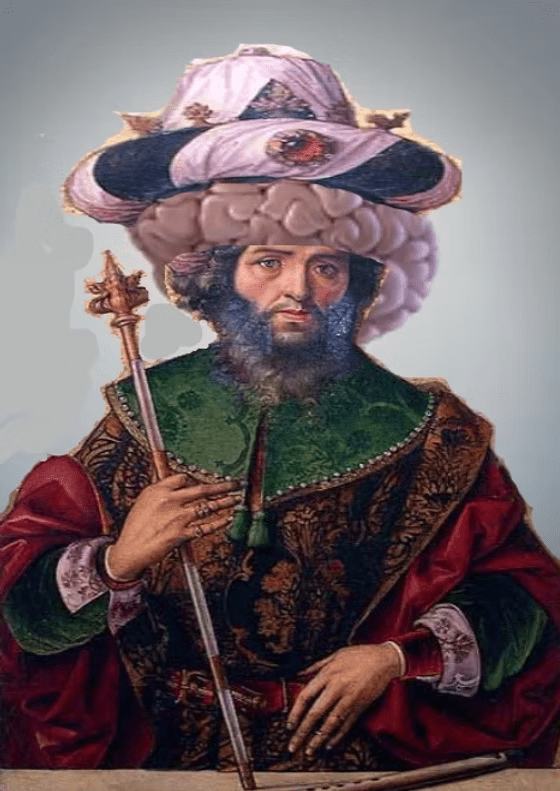
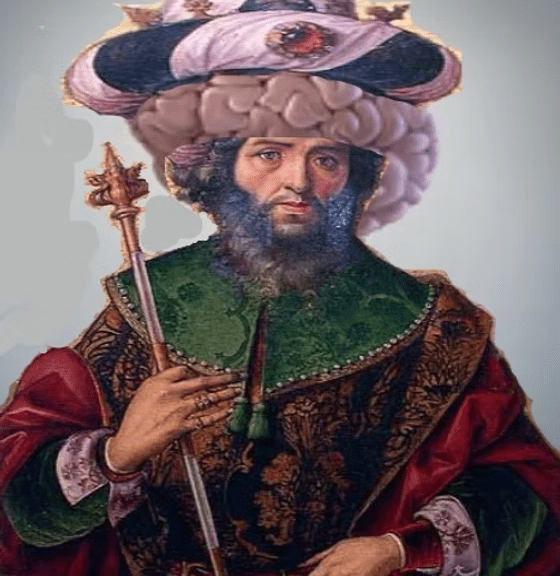
The limitations that must be seen in Solomon’s worship of his own big brain is seen when he conjects that there is no return from “Hades,” which is actually written “sheól” [“שְׁאוֹל”]. For Solomon to think he could tell whether the guy standing next to him was not the reincarnated soul of some past king [or queen] of a foreign nation, one that crashed and burned, or even the reincarnated soul of one of the wicked Israelites who died in the wilderness, due to not obeying the Commandments, shows how little he knew in reality. To even surmise such an idea as wisdom is the same as science, saying it is the only way to good judgment when it is proved to be wrong many times (after declaring it was right), is idiocy.
The concept of Sheol [from the second Temple perspective] was all souls went there. The thinkers that returned from Babylon captivity divided into two main sects: One believe there was nothing after death [Sadducees]; and, the other thought death was a ticket to something akin to Purgatory [Pharisees]. By simply by being born a Jew [formerly Israelites], the Pharisees believed death meant that soul would be taken to heaven after the Messiah came. Of course, that mindset figured all Gentiles were either like dogs and cats [soulless], or they had evil souls, so death meant they went and roasted in Hell. That should be seen as who were the wicked people of whom Solomon was talking about, because (certainly) any right-minded Israelite of Solomon’s reign would see him as a god worthy of worship [smart as he was].
Skipping down from verse one of chapter two, to verse twelve, this is where Solomon is making himself out to be “a righteous dude,” as if Israel still had Gentile enemies they were worried about. Of course, David’s Israel was always at war with those who refused to accept their God Yahweh had given them that place to live, with the Philistines being those who still retained land that was not Israel’s. They, however, were not an issue, since Solomon had married an Egyptian princess and then had an ally that could put the squeeze on the Philistines, from the west. Still, verse twelve is Solomon’s self-worth as a hero of the righteous coming forth, as he equates all who would challenge his authority as being wicked.
It is in verse thirteen that the truth of Solomon’s wickedness is exposed. In this verse there are two references to [NRSV translator] “God” and “the Lord.” The reality of what is written (as best as I can look up the Hebrew) is this [using the NRSV otherwise]: “He professes to have knowledge of יְיָ [HaShem], and calls himself a child ha-elohim.” In Solomon’s reign, the prophet Nathan was still actively advising the king. Others like Nathan were those who claimed “to have knowledge of” Yahweh. For Solomon to not write that name, but to instead write marks that are confusing, as to whom or what is being referenced [some say the letters are an abbreviated form of the verb translating as “to be”], this says Solomon was not like his father David, nor the divine prophets who advised as the conduits of Yahweh. Solomon saw himself as a god, who was married to the goddess Wisdom, with Yahweh was believed by Solomon to be the servant god who served him: יְיָ [HaShem].
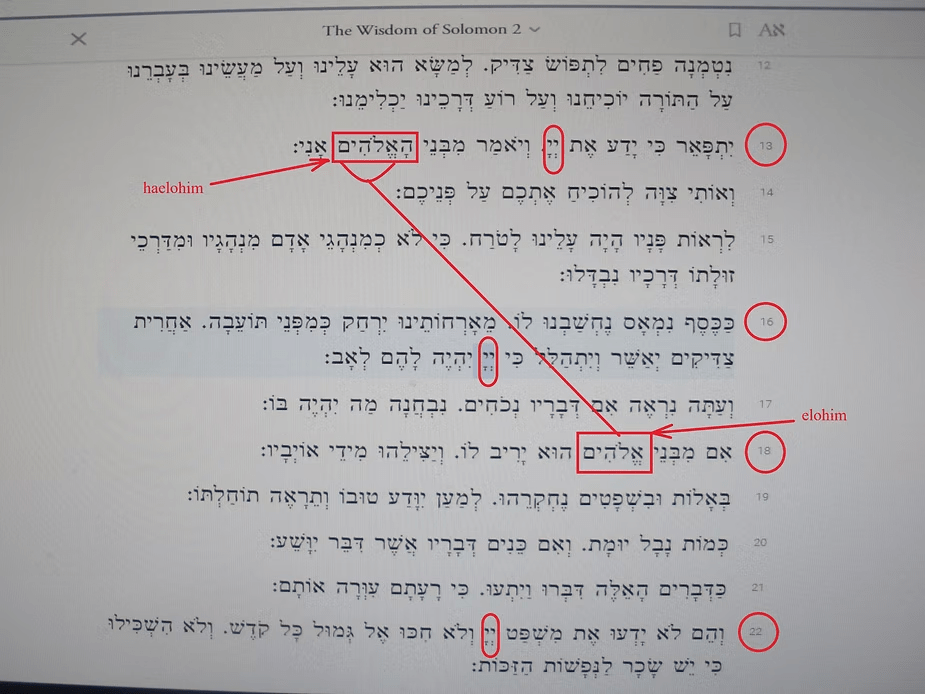
In the NRSV translation, the world “child” is footnoted, with the footnote saying the word written can equally translate as “servant.” For one to say he was “a servant of elohim,” that describes a prophet like Nathan to a T. The point of the Hebrew word “elohim” is not to state “God” [the error of all translators], but to state the reality of “gods” [in the plural number], which are those souls married to Yahweh and thus given His powers on earth, as His “servants” [His “children”]. Thus, in verse thirteen, Solomon is placing himself above that of true prophets, because of his big brain. This then equates his soul to a state of wickedness.
Verse fourteen then has Solomon scoff at the condemnations of the prophets, who say worldly wisdom is what condones evil ways. Verse fifteen is then Solomon belittling the true holy priests of Israel as the ones who take all the fun out of life. IIt was the true priests and true prophets of Israel who were reminding everyone of the laws, reminding the leader [Solomon] that maintenance of those vows is what keeps souls from infidelity, or breaking their marriage agreement with Yahweh. Solomon was calling the restrictions placed on being a true priest of Yahweh as unnatural. That is true, when a nation of people are being led away from adherence to their Covenant and finding normalcy in the ways of other nations.
In verse sixteen, Solomon again references the “HaShem” in a way that makes it be used as if he knew he would bring some physical condemnation upon his flesh [leprosy maybe?] by using the name “Yahweh,” as his father David had done frequently in his songs. Solomon took purposeful steps away from his father, by refusing to write the proper name “Yahweh” [“יְהוָ֣ה”] Here, Solomon belittles one who claims to be an “elohim” of Yahweh, because they make the claim that Yahweh is their “Father,” while also implying He is their Holy Husband. This becomes Solomon cursing Jesus, who routinely told his disciples [not the whole world, not all of Judaism] to address Yahweh as their “Father.” To call Yahweh “Father” means one must be His Son [all souls are masculine essence, especially when married to Yahweh’s Spirit … males and females in the flesh].
In verse seventeen, Solomon is beginning a series of verses that become the standard punishment governmentally set upon any who claim to be divine Sons of Yahweh. To make such claims means to be put to death. This concept would be viewed as holy wisdom, as Yahweh’s gift to Solomon, when in reality it was Satan’s serpent whispers [a marriage that made Solomon’s soul become the demonic elohim of his evil spiritual husband] that influenced all who would follow Solomon. The routine Solomon established would be for kings to marry foreign wives, import foreign priests, and then kill any priest who spoke out against that process. The culmination of this mindset of ‘wisdom’ was how the elite of Jerusalem could even fathom it would be okay to plan the execution of Jesus, the promised Messiah; but to even believe in a promised Messiah, one has to first believe in Yahweh. Solomon taught them not to believe in being “He [Who] Retains God” [the meaning of “Israel”].
In verse eighteen is a second use of “elohim,” which again must be seen as “gods,” specifically those whose souls have married Yahweh and become His hands on earth. At the time of Solomon’s reign, all true divine “elohim” were priests of the Ark of the Covenant [transferred from the Tabernacle of Zion to the Temple of Solomon] and the holy prophets [such as Nathan]. In this verse, Solomon laughs at those who make claims to be divine Sons of man, such that Solomon’s mindset was cast into the future, executed at Golgotha, when someone yelled out to a dying Jesus, “If he is the Messiah, let him save himself.” Here, Solomon scoffs that the test of death will bring out the truth of being a “servant” [same use of “child”], by having Yahweh physically rescue such a servant.
Verses nineteen and twenty are Solomon giving the go ahead from that point in time onward to torture and insult the prophets of Yahweh. To claim to be “peaceful” means Solomon’s plan was to beat hatred and anger into those who made such claims. In today’s world, the destroyers of Christianity love to promote that Jesus is the Prince of Peace and would bend over and take insults and torture all day long, rather than strike anyone down in wrathful anger. They persecute the believers to the point of forcing them away from Yahweh, by punishing their will to serve. What those do not realize is the truth that every hateful strike brings them in return. When they put forth persecution against one of Yahweh’s children, the same return blows will come upon their souls, a hundred-fold.
The NRSV then places one of its titles or headers before verse twenty-one, saying the rest of chapter two focuses on the “Error of the Wicked.” This is an assumption that “the wicked” are false prophets [like Solomon’s wisdom] and not the true prophets of Yahweh. Solomon reflected the intellect of humanity, as one who worshiped ‘Sherlock Holmes-like’ abilities to discern physical clues and make logical deduction that result in the truth. None of that worldly wisdom is divine, thus far from all-knowing, as that given to Yahweh elohim. Thus the title would be better stated as “Error of the Intelligent.”
Verse twenty-one is then a perfect summation of all Solomon’s views that have been written on parchment. By saying, “Thus they reasoned, but they were led astray, for their wickedness blinded them,” this projects as truth upon the priests of logic and reason that deduce wrongly and are blinded by the science of the visible world. No true priest of Yahweh is reading the Law [the Torah] and coming away with clear-cut, black and white knowledge. Divine Scripture is written [according to Jesus] so the truth is hidden from the wise and intelligent, but exposed to the children [insert “servants” here]. The truth known by Yahweh elohim does not come from carefully crafted thought processes. However, once the truth has been shown, all those arts and crafts can find a truth fully justified and true. Thus, a simpleton [one of those Solomon belittled, when he prayed to his god “wisdom”] can be shown the truth of God, while all the big brains could not see the truth before their eyes.
In verse twenty-two [not the last verse, as chapter two has twenty-four verses], Solomon returned once again to displaying his fear of naming “Yahweh,” using his code-word called “HaShem” [יְיָ]. In this verse, Solomon sings that his lost soul never once considered self-sacrifice for the unseen rewards that are postmortem. The wise and intelligent cannot possibly see that which is “secret” and thus spiritual. They seek the material rewards that are the “wages” of being the elite, not the commoners. They never seek to restrict themselves from that which can be freely taken, for the seeming bargain of one’s soul [everything material for nothing spiritual]. They have no desires for holiness. They do not believe anything exists beyond death. Therefore, they have no need for thinking blamelessness is a virtue.
As the optional “First Lesson” to accompany Proverbs 31 on the seventeenth Sunday after Pentecost, when one’s own personal ministry for Yahweh should already be well underway, the lesson here is to see the trap of intellectualism. Solomon could not see how his words were condemning his own soul, all the while thinking he was making light of those who said they served Yahweh. Solomon did not believe Yahweh was anything more than a stepping stone to a mastery of life on earth. He did not believe in an afterlife; as there was no proof that anyone had ever returned from the depths of the ground. The lesson that must be taken from this is being a “child of elohim,” which means having one’s soul be married to Yahweh, with His Son Jesus resurrected within one’s soul-flesh. Having a big brain keeps one from having access to All Knowledge, readily available to the children of Yahweh, when needed. No planning necessary.
 Explaining the Readings