(“Why have they provoked me to anger with their images,
with their foreign idols?”)
[20] “The harvest is past, the summer is ended,
and we are not saved.”
[21] For the hurt daughter of my poor people I am hurt,
I mourn, and dismay has taken hold of me.
[22] Is there no balm in Gilead?
Is there no physician there?
Why then has the health daughter of my poor people
not been restored?
—–
[1] O that my head were a spring of water,
and my eyes a fountain of tears,
so that I might weep day and night
for the slain daughter of my poor people!
——————–
In these selected verses taken from Jeremiah 8, Yahweh has spoken to His prophet about the anger He has for the waywardness of people claiming to be His children. That anger will allow Yahweh to let the Judeans to have as much rope as they want to hang themselves. Then, when released from their bodies of flesh they worship as gods, they will face the full wrath of Yahweh in Judgment for their souls. These verses 18 – 22 are Jeremiah’s mourning words for the people he was one of, although Jeremiah did not stray from the voice of Yahweh.
It is important to realize that Jeremiah wrote (in Hebrew) “baṯ-‘am·mî” four times. Each time, the translation read aloud by the Episcopal Church shows “of my poor people.” The Hebrew word “ammi” (construct from “am”) says “my people.” The word “bat” means “daughter,” as the feminine version of “bar” (meaning “son”). The NASB translates all of these verses correctly, as “the daughter of my people.” However, the Episcopal Church – which goes to great lengths to change Greek text that says “brothers” (“adelphoi”) as “brothers and sisters.” They do that to encourage the women widows in the congregations to see how important them bequeathing their estates to the Church when they did. Here, however, they decide to hide the femininity of “daughters” and simply infer that all women as “poor.”
Knowing this element of “daughters,” which is not a statement about physical females, but a statement of the femininity of a soul trapped within a body of flesh, where physical bodies of both genders are called “daughters,” these verses in Jeremiah’s voice (following many verses spoken by Yahweh) are not to be read as if he were assessing his physical torment, based on all Yahweh said. Jeremiah speaks spiritually about his soul trappend within a body of flesh, but one that has been promised eternal life after death, because Jeremiah’s soul was married to Yahweh, had received His Spirit of Anointment, Bpatized pure by that Spirit, and a soul where the soul of Yahweh’s Son Adam-Jesus had resurrected, becoming the Lord over his life.
Seeing that, verse eighteen is poorly conveyed as if Jeremiah were lamenting, “My joy is gone, grief is upon me, my heart is sick.” All of that speaks of poor physical Jeremiah, not about the soul of Jeremiah saying, “I comfort my soul in sorrow , over me my mind faint .” That says the sorrows Yahweh had projected as coming to the wayward Judeans was not Jeremiah’s to experience. His soul was “comforted” through its complete subjection to Yahweh’s Will in divine union. Yahweh had sent Jeremiah His Son’s soul to Lord over his soul-flesh, so “above me” is knowledge that is greater than “my mind” (where “lib·bî” means “my inner man, my will, my mind, and/or my heart”). That speaks of Jeremiah sacrificing his “heart, mind, soul” to Yahweh, totally and completely, out of the deepest love, as stated as the foremost Commandments. The use of “faint” is then a statement that all self-ego Jeremiah might have once possessed has grown “faint,” in its fading into the background (follower mode) of the soul of Adam-Jesus, which had become his Lord.
When that is seen as a strong statement by Jeremiah that his soul was a wife-soul of Yahweh, verse nineteen than presents the first of four uses of “daughter of my people,” where marriage is stated in “Yahweh in Jeremiah’s dry place” (the meaning of “Zion”), whereas the other wayward Jews were unable to find Yahweh bringing ever living waters of eternal life into their souls. Their souls had become dry, like a woman’s womb can only produce young for so many years. When Jeremiah asked, “If her king is not in her,” this is a statement about the penetration of marriage, on the bed of consummation. For any descendant of the people Moses led to the promised land to be called Israel, not to have Yahweh’s Son spring from each “daughter’s “ womb – a soul Baptized by the Spirit and made virginally pure – meant those wayward “daughters” had turned to “images and foreign idols,” which was akin to an adulterous affair by a bride-to-be.
In verse twenty, when Jeremiah says “the harvest is past, summer is over and we not are saved,” this speaks of the limited season of planting and growing, where this refers to “daughters” bringing forth new bodies of flesh (male and female) that will received souls (breaths of life) from Yahweh. Those new “daughters” are to be taught to prepare for divine union with Yahweh, so the “harvest” will be when one’s soul-flesh has died figuratively, so a new soul – that of Yahweh’s Son – can keep the expansion of eternal life, as truly “Yahweh’s people.”
In verse twenty-one, twice the Hebrew word “sheber” (constructed as “še·ḇer” and “hā·šə·bā·rə·tî”) has been translated as a form of “hurt.” The word means “a breaking, fracture, crushing, breach, crash.” This makes “darkness” (from “qā·ḏar·tî”) come from the “breaking” be the Covenant, which are the vows of divine marriage to Yahweh. Without the presence of Yahweh surrounding one’s soul-flesh (from His Spirit of purification) and the soul of His Son resurrected within a “daughter’s” soul, becoming it guiding light, then “horror” (from “šam·māh”) fills one’s whole being and the “waste” of a soul means it has been taken hold of by Satan and his demon spirits.
In verse twenty-two (the last of chapter eight), the name of the place “Gilead” must be known as meaning “perpetual fountain.” To say to this “no balm” and “no healer” in the void of one’s soul-flesh, then the “perpetual fountain” is the ever living waters of eternal salvation. The flesh can only develop sores and sicknesses; but those will all vanish when Judgment comes after the weak body dies away. A saved soul is cured of all ailments of the flesh, forever. There can be “no recovery” from sins and their markings upon the flesh and soul, because the only salve that can remedy the path of the wayward Judeans would for each to become a true “daughter of Yahweh’s people” and submit one’s soul to His service – willingly and lovingly – so the “health” of the soul is more important than the restrictions a body of flesh places on a soul.
It must be realized that verse one, coming from a new chapter (9) is not a natural continuation of that stated in a prior chapter. Because Jeremiah expresses his wish that the everlasting waters (Spiritual, not physical) within his soul could fill his “head” and flow from his “eyes like a fountain of tears,” which the wayward could drink freely from. In this, his “weeping day and night” says the light of truth would be exposed by living waters and the darkness of selfishness would be enlightened. Those “slain” are the souls in bodies of flesh that sacrifice their soul-flesh unto Yahweh, so they can be reborn in the name of His Son. If they die of evil deeds – self-sacrificing as “slaying” their own response to the urges of their flesh – and marry their souls to Yahweh, then they return to the truth of the status that is “a daughter of Yahweh’s people,” the same as Jeremiah and all Yahweh’s prophets.
1 elohim, the heathen have come into your inheritance; they have profaned your holy temple; *
they have made Jerusalem a heap of rubble.
2 They have given the bodies of your servants as food for the birds of the air, *
and the flesh of your faithful ones to the beasts of the field.
3 They have shed their blood like water on every side of Jerusalem, *
and there was no one to bury them.
4 We have become a reproach to our neighbors, *
an object of scorn and derision to those around us.
5 How long will you be angry, Yahweh? *
will your fury blaze like fire forever?
6 Pour out your wrath upon the heathen who have not known you *
and upon the kingdoms that have not called upon your Name.
7 For they have devoured Jacob *
and made his dwelling a ruin.
8 Remember not our past sins; let your compassion be swift to meet us; *
for we have been brought very low.
9 Help us, elohe our Savior (“yesha”), for the glory of your Name; *
deliver us and forgive us our sins, for your Name’s sake.
——————–
While the above translation does not identify Psalm 79 as such, it is stated simply to be “a psalm of Asaph” (as “miz·mō·wr lə·’ā·sāp̄”). The word “asaph” means “gatherer,” and this is how one must see the divine soul within David’s soul – the soul of Adam (a.k.a. Jesus) – the resurrected soul of the “Yahweh elohim” listed eleven times in Genesis 2, when Yahweh created Adam (Jesus). Because David’s soul had merged with this Yahweh elohim when Yahweh poured out His Spirit upon David’s soul, David became the Son of Yahweh reborn into flesh. That then became the ‘magnet’ of Spirit that acted upon the people of Israel, in the same way Jesus was such a “gatherer” of souls that would be led to marry Yahweh divinely, receive the outpouring of His Baptismal Spirit and become a wife-soul that would resurrect the soul of Adam-Jesus within, so it becomes the Lord over that soul and flesh. Thus, the “psalms of asaph” are all divine inspirations that call upon the seekers and believers to do as their leader’s soul has done, so all become the truth of the name “Israel” – “Who Retain the elohim of Yahweh.”
Now, verse one is show to begin with the mistranslation of the plural masculine construct “elohim” as the singular masculine noun “God.” This mistranslation leads all gathered away from the truth, as images of “God” sitting on a cloud in heaven is conjured up. It leads the seekers away from the realization that a divine “elohim” must become one with each follower’s soul. This means the word “elohim” is the plurality of souls that can be merged with the spiritual addition of “elohim.”
The following translation of David’s words as if saying “the heathen have come into your inheritance.” The literal translation is this: “elohim have come in the people ׀ into your possession ,” which says “elohim” is not only the spiritual possession by Yahweh’s “elohim,” but the worldly demon spirits who are those fallen “elohim,” who follow Lucifer-Satan and refuse to assist mankind. Thus, when David then adds, “they have made unclean the temple your sacredness they have set upon the teaching peace in ruins .” In that, the name “Jerusalem” is stated as the meaning behind the name: teaching peace. The “temple” is the soul-body of each of “the people,” all of whom were sworn to serve Yahweh by agreeing with His Covenant of divine marriage. Once possessed by demon “elohim,” those bodies of flesh “have been made sinful,” transforming everything said to be “holy” that “teaches peace” (like a gatherer will do) into “the ruins” of the truth.
This “ruin” is then seen stated in verse two as, “they have given this corpse of your servants food for the flying creatures of the spiritual ; the flesh of your saints , to that alive in the flesh .” In this, “they” is the demon “elohim,” where “a corpse” is a statement about the state of death they lead souls towards. The souls born into those “corpses” were intended to be “servants” of Yahweh, as His brides in divine union. The words translated as “birds of the air” actually say “flying creatures of the spiritual” realm, which as demonic angels enslaved in the physical realm. The “flesh of your pious” or “of your saints” are supposed to serve Yahweh, as ministers in the name of His Son. The only “living” element of a body of “flesh” (from “the earth”) is a soul, as all souls are eternal. However, demonic possession removes the promise of eternal release from the physical realm of death, whereas divine possession makes that promise be true.
Verse three again begins with the third-person plural “they,” which is demon “elohim.” David writes here: “they have shed their blood ׀ like water surrounding them teaching peace , nothing to bury .” The placement of a vertical bar forces one to pause and reflect on David singing, “they have shed their blood.” This speaks physically of the lineage that makes the children of Jacob that Moses led to the Promised Land, where their blood was not their right of passage to eternal salvation. This means “shedding their blood” says the people possessed by demon “elohim” have no life-blood that is filled by the Spirit of Yahweh. They bear no relationship to Him, as that can only come from divine union and receipt of His Spirit upon their souls. To have “shed” that relationship, all of those then “teaching peace” (the meaning of “Jerusalem”) do so as those baptized by “water,” not Spirit. They know no whole truth of Scripture, as they only mouth watered-down versions of the Law. This lack of substance as spiritual food being fed to the people means their souls have been lost; so, when their bodies return to a state of death, then there is “nothing to buddy” in water.
In verse four, when David sings, “We have become a reproach to our neighbors,” the hidden truth of “to our neighbors” (from “liš·ḵê·nê·nū”) is the truth that answers the question asked of Jesus, “Who is my neighbor.” The Hebrew root word “shaken” means “neighbor,” but also “inhabitant.” This means the truth of “a neighbor” is a “co-inhabitant” of one’s soul, in one’s body of flesh. To become a “disgrace” to such a spiritual possession, means to shun divine union with Yahweh’s Spirit, so one’s “neighbor” is the soul of His Son resurrected in flesh, to instead allow a demon spirit to take that place of control. Thus, to pretend to be “teaching peace” in the name of Yahweh, while obviously seen with “scorn” by true Israelites and as a “laughing-stock” to those who had feared those led by Yahweh, the whole of the Promised Land has been reduced to a piece of dead earth, with no deeds possessed for eternal life in the spiritual realm with Yahweh gained.
Verse five then places focus on the eternal life promise having been lost, in three questions that ask: “how long with Yahweh?” “will His anger last forever?” and “will He burn like a passionate fire?” All point to the temporal value of a soul inhabiting a body of dead earth, which will always die off and return to dust, ash, and clay. The soul comes from Yahweh, so it is eternal and everlasting. The questions are then, “Why would anyone sell his or her soul for eternal damnation, when service to Yahweh might mean a few decades of trials and tribulations to prove one’s merit?”
Verse six is then David singing out a plea to Yahweh to act to destroy all that falsifies His name on earth. Rather than “pour out” your Spirit, David sings that “wrath” will fill the souls of those who reject Yahweh as their spiritual Husband. When his words single out “those people who do not know you,” this sings of the infidelity of wayward daughters (bridesmaids) that refuse to be divinely penetrated by Yahweh’s Spirit. When David then sang of this “wrath” befalling those “kingdoms not in Yahweh’s name,” that name can only be truthfully pronounced by bowing before the altar of divine marriage, whereby a bride takes on the name of her Husband. All who lie about this relationship of marriage are taking Yahweh’s name in vain, as there is no truth to such false claims.
In verse seven, David’s use of the name “Jacob” must be read as the meaning behind that name, which is “supplanter.” When his words sing, “for they have eaten the supplanter,” where “supplanter” means “one who wrongfully or illegally seizes and holds the place of another,” their souls have stolen a birthright that is not rightfully theirs. Jacob had to come to terms with his name’s meaning, when he wrestled with his soul all night long, before the soul of Yahweh’s “elohim” told Jacob he would then spiritually be called “Israel” – as one “Who Retains the elohim of Yahweh as his Lord.” Unless that sin has been equally washed clean by the Spirit of Yahweh in divine union, then the flesh possessed by a supplanter soul (the “dwelling place” of a demon spirit) will be “laid waste.”
Verse eight is then David pleading for salvation, asking Yahweh, “do not remember and hold against us our iniquities.” This is a prayer of repentance, which is followed by David singing out, “former speedily let come to meet us your tender mercies.” This begs for a return to a soul’s “former” state of being, so as soon as one’s soul is threatened by a demon “elohim,” send your protector angel (Adam-Jesus) to “meet us” and bring in to our souls “your tender mercies,” rather than your wrath. When David sang, “for we have been brought low very,” this is admission of sin and submission of one’s soul unto Yahweh for forgiveness. Those souls who are demonically possessed do not admit sin, as they defend them as their right on earth, where sins raise their status artificially.
In verse nine, David wrote “help us,” followed by a vertical bar of pause. This, again, is repentance in a prayer for divine assistances, as no soul in its flesh alone can resist inequities without Yahweh’s “help” being sent. Following the vertical ba, David then wrote “elohe yisenu,” which actually names Jesus as the “elohim” of “salvation.” David then knew this possessing soul was the “word glorious of your name,” which says being in “the name” of Jesus is the same as being in the “name of Yahweh.” Yahweh speaks through His servants that are possessed by His soul of salvation (Jesus’ name means “YAH Saves”) and those “words glorious” are spoken by ministers and gatherers, so other will also be saved. It is then the service of following Jesus as one’s Lord that takes the path of righteousness as the model that others will follow spiritually. That will be the acts of “atonement for one’s sins.” This means one sacrifices one’s name at the altar of marriage, so one can find “atonement” “in the name of Jesus.”
[4] Hear this, you that trample on the needy, and bring to ruin the poor of the land,
[5] saying, “When will the new moon be over so that we may sell grain; and the sabbath, so that we may offer wheat for sale? We will make the ephah small and the shekel great, and practice deceit with false balances,
[6] buying the poor for silver and the needy for a pair of sandals, and selling the sweepings of the wheat.”
[7] Yahweh has sworn by the pride of Jacob: Surely I will never forget any of their deeds.
——————–
Verse 4: “Hear this you who pant after the poor ; and make desist [ humble ] ( afflicted ) flesh .”
In this verse, the Hebrew word “ebyon” is constructed to say “those in want, the needy, or the poor.” Placed within brackets, followed by parentheses are constructs of “anav,” which equally means “poor, afflicted, humble, meek.” What is missed by not following the signs written in marks, the statements about “humble” and “afflicted” are not physical conditions, but spiritual – soul related – disease. When the word “erets” follows without enclosure marks, this says “the earth” is the “flesh” that holds a soul. Thus, the result of those who seek to live off the ”poor,” or love the freebies given because one is of “the poor,” the physical condition of poverty (feigned or real) is never to be what leads one’s soul through life. There are “the poor” and there always will be. By not “panting after the poor,” one is filled with the comfort and serenity of Yahweh, knowing physical needs AND spiritual needs will be met. Those souls corrupted and impoverished spiritually need to “hear this” message, coming from Yahweh through His prophet Amos.
Verse 5: “saying , when will be past the new moon that we may sell grain , and the sabbath that we may sell wheat ; making small the ephah and large the shekel , falsifying the scales by deceit .”
Here, the beginning of verse four and “hear this” is now relative to hearing yourselves in prayer to Yahweh, as what the people are “saying” is a desire to forego the sacrifices of festival times, because the pretends of piety they are forced by ritual to display hides the true nature that possesses the people: greed and corruption. The metaphor for “grain” and “wheat” is the people are supposed to be the good fruit that feeds the wayward with spiritual food, which can lead thm to self-sacrifice unto Yahweh. To then desire “to sell” this which comes freely to them causes them to reduce the amount of truth being sold, while charging more in return for false measures of Law. The “falsifying the scales by deceit” becomes a projection of the judgments made against their soul upon death.
Verse 6: “that we may acquire for money the poor , and those in need for a pair of sandals ; and even the chaff of wheat sold as grain .”
In the metaphor of this verse, the implication of “buying with silver” or “acquiring for money” is what one sells one’s soul for. Nothing that has value on the material plane has any lasting value beyond death, when a soul is released for Judgment. All shiny things stay in the realm of death. The price a soul pays for “silver” and “money” (especially that printed on paper and backed by nothing) is the flesh dresses richly, eats find foods, and employs servants; but the soul having been sold leaves a soul “poor.” This means the souls made “poor” were not “in need” of material things, as they need to be set on a path of righteousness, which comes from divine union with Yahweh’s Spirit and the resurrection of His Son’s soul with the soul not sold for worldly trinkets. Those bodies of flesh need “sandals” to walk the path of righteous ministry in the name of Adam-Jesus (as Israel). When the final assessment says, “even the chaff is sold as grain,” this says the flesh is that which is the “refuse” or “the hanging parts” surrounding a “grain” of wheat. Thus, it is what you put on your dead flesh (mortal) that indicates what true value the soul within has.
Verse 7: “has sworn Yahweh by the redemption of Jacob (supplanter) ; if I will forget perpetually all of the deeds .”
In the name “Jacob,” which means “supplanter,” as one who takes unrightfully what is his (or hers), the price for “redemption” is divine union with Yahweh. This means “has sworn Yahweh” is a statement of the oath of marriage, which means the marriage vows are agreement to the terms of the Covenant. In order to be “redeemed” for past sins, then one must “have sworn” total commitment to “Yahweh” as His wife-soul. This then leads to an “if” scenario, which says such a divine marriage is not forced, but desired. Only those who lovingly and willingly submit their souls in self-sacrifice to Yahweh’s Will will be those whose sins He “will forget perpetually.” That is eternal salvation, which means His Spirit has purged a sinful soul of “all of the deeds” of transgression in the past. To gain that salvation (the name “Jesus” means “YAH Saves”), one must be reborn as Yahweh’s Son, which is the meaning of the name given to “Jacob:” Israel. The name Israel means “Who Retains the elohim of Yahweh,” within one’s soul.
5 Who is like Yahwehelohenu, who sits enthroned on high *
[6] but stoops to behold the heavens and the earth?
6 [7] He takes up the weak out of the dust *
and lifts up the poor from the ashes.
7 [8] He sets them with the princes, *
with the princes of his people.
8 [9] He makes the woman of a childless house *
to be a joyful mother of children. praise YAH!
——————–
Note: Verse six is shown as a second half of verse five, which it is not. There are nine verses in Psalm 113. Verse nine has words omitted from this singing, as it ends with a second “Praise YAH!”
Psalm 113 will only be read on this designated Sunday (once), in the three-year Episcopal lectionary cycle. It is the Track 2 companion lesson with the Old Testament reading selection from Amos 8. In the Track 1 companion Psalm 79 reading selection, not sung aloud in Episcopal churches is the introduction that states, “a psalm of asaph,” where the Hebrew word “asaph” means “gatherer.” Here, in Psalm 113, there are introductory words written, which in Hebrew are “hal·lū yah.” This, much like the misunderstanding of “asaph,” has been diminished in value, by a translation into English that says “hallelujah.” This leads singers of Psalm 113 to miss the meaning of “halal yah,” in the same way the ignorance of “asaph” keeps singers of Psalm 79 from understanding a spiritua; gathering is the intent of that psalm.
The Hebrew word “halal” is translated into English as “praise,” but the true meaning of the word is “to shine.” The Hebrew word “yah” (“יָ֨הּ”) is an abbreviated form of “Yahweh.” The two Hebrew words written to begin verse one – “hal·lū yah” – are followed by a vertical bar of pause (“׀”), which acts as a separation point for the instructional guidance for Psalm 113 being like that introducing Psalm 79, where Psalm 113 is a psalm “to shine Yahweh.” When “to shine” is seen, rather than “praise,” this makes the “gatherer” intent of Psalm 79 is spiritual, rather than physical; so, the spiritual intent of “to shine Yahweh” is also not a call for audible words of “praise.” The truth then of “to shine Yahweh” is to emit a halo of sacredness outwardly, emanating from within one’s soul.
In other psalms of David, where he seems to speak of “praising Yahweh,” it has become clear to me that David is not singing a command for readers of his songs to physically “praise Yahweh.” He sings that along with usage of the word “elohim,” where the true indication of David’s words are singing that the inner presence of the “elohim” is emanating this “praise” of Yahweh, which is actually a “shine” or halo. This means physical “praise” is impossible to maintain, as human emotions are like the Moon, always in a state of flux, waxing and waning. It is then physically impossible to “praise Yahweh” by human will-power. Thus, the only way possible to “praise Yahweh” is to be Spiritually Anointed by Yahweh (become a “Messiah” or a “Christ”) and spiritually elevated by the resurrection of Yahweh’s Son’s soul (Adam-Jesus) within one’s own soul, where that “elohim” becomes one’s Lord. That inner presence of the soul of Adam-Jesus then is the “shine of Yahweh” that David is calling his followers to also possess.
When all of this is seen and understood, then the remainder of verse one sings, “shine servants of Yahweh ; shine the name of Yahweh .” This says all souls that “shine Yahweh” are His “servants” or “slaves,” which is metaphor for a soul becoming a totally submissive wife of Yahweh. When “servant” is seen as a soul married to Yahweh, then “shine the name of Yahweh” is stating the assumption of a bride as a possession of her Husband, which places her soul (all souls trapped in human flesh are feminine, thus receptive of Spirit) “in His name.” The “name of Yahweh” is “Israel,” meaning one “Who Retains the elohim of Yahweh.” However, when that “elohim” has a “name” – as Adam or Jesus (a name meaning Yahweh Saves”) – then being “in that name” means being a minister of the Son, for the Father.
In verse two, David then expands on the intent of “to shine the name of Yahweh.” Here he sings, “come to pass the name of Yahweh kneeling,” where the Hebrew word “mə·ḇō·rāḵ” (rooted in “barak”) is translated as “blessed,” but also means, “to kneel.” The aspect of “blessing” is not something any soul trapped in a body of human flesh can do, just as no human can forever “praise Yahweh.” When the spirituality of “blessing” is seen as when Yahweh’s Spirit pours out upon a soul, then the element of “kneeling” says this occurs spiritually at the altar of divine marriage between a soul in flesh and Yahweh. Thus, the remainder of verse two sings, “from this time forth and forevermore.” That says the “blessing” of “kneeling” is the eternal salvation that comes from a soul permanently being infused with the soul of Yahweh’s Son (the presence of “shine,” thus “praise”), who becomes a wife-soul’s Lord ever after.
Verse three is translated above to project the sun’s rise and setting, but that is inaccurate. The Hebrew construct “mə·ḇō·w·’ōw” is rooted in “mabo,” meaning “entrance, a coming in, entering.” This in no ay projects an absence of light, as would be the case of the sun setting. This means verse three actually says, “from the rising of the sun until coming in ; to be shining , name of Yahweh .” This then says the “rising of sun” is the period of one’s life when a soul begins to see the light of truth that leads one to a commitment to Yahweh. The “rising of the sun” means the darkness of ignorance is removed and the truth of Scripture is sought. Those souls seeking the truth will then find the answers to their spiritual questions “coming in” to their souls, so their fleshy brains will begin to understand in a “new light” – the dawning of truth. It is from this path of truth that leads a soul to prove its commitment to Yahweh in spiritual marriage that the union between soul and Spirit then brings on the “shining,” which stays forever in the soul of the Son joining with a wife-soul. This is again restating the marriage that allows a soul to take on “the name of Yahweh.”
In verse four, the Hebrew word “gō·w·yim” is the masculine plural form of “goy,” which means “nation, people.” Because Yahweh does not marry “nations,” it is imperative to understand “people” is the intent of this usage by David. This means the verse sings, “exalted above all people ׀Yahweh ; over the souls his glory .” Here, the Hebrew word “haš·šā·ma·yim” (from the root “shamayim”) is commonly translated as “heavens” or “sky,” but this (again) is a physical sense of understanding the spiritual. The truth of “the heavens” is that projects all eternal spirits or souls that exists between the physical realm and Yahweh. Yahweh created the “elohim” of Creation (who did His work) and “souls” are eternal spirits that are trapped in human bodies of flesh. The vertical bar of pause, placed after “above all the people,” forces one to contemplate how the “people” are souls trapped in bodies of flesh. The following use of “Yahweh” then says “the people” are eternal souls breathed into their flesh by “Yahweh.” The marriage of a soul in flesh to Yahweh is then what creates Yahweh’s Spirit and His Son’s soul joining those wife-souls, with the soul of Jesus being “over the souls [heavens] his glory.” This then says “his glory” is relative to “the shine of Yahweh.”
Verse five might imply the word “is,” but that statement of being is not written. David wrote, “who as Yahweh our elohim ; exalted who dwells .” In this, a letter added to “Yahweh” adds the preposition that becomes “of Yahweh,” “as Yahweh,” or “in Yahweh,” which says “who” is an extension that comes from “Yahweh,” who takes possession of “our” souls for Yahweh, becoming “our elohim,” which is the soul of the Son of Yahweh. This is then stated to “dwell” or “remain” as “our” possessing “elohim,” as that soul “exalted” within our souls, which is the source of the “shine of Yahweh.”
At this point, each of the first five verses has expressed direct association to the name “Yahweh.” Verse five is then the only verse that connects “Yahweh” to “our elohim.” This then becomes a signal that the following verses in this Psalm 113 are singing about this “elohim” that has taken possession of one’s soul, having been sent “by Yahweh” to be “our” Lord.
Verse six literally states in English (from the Hebrew): “this being brought down to behold ; in the souls and the flesh .” This says that this soul of Adam-Jesus is not to be some ‘pie in the sky’ imagination that is never personally known. Instead, it comes from on high (Yahweh) and is “brought down” into the worldly plane so a wife-soul can “behold” this divine presence within. Following the semi-colon mark, the metaphor of “heavens and the earth” must be related to “the people,” who are “souls and the flesh.” This says Yahweh sends His Son’s soul into the worldly plane of soul existence to save lost souls, who are imprisoned in the flesh of the earth.
In verse seven, it is important to see how David spoke from divine inspiration, knowing the soul of Jesus within his soul, well before the name Jesus became synonymous with the soul of Adam reincarnated into flesh by that name. When Jesus told his followers they would have to “raise you your stakes in the ground” (which commonly misleads as “your crosses,” making this act of support that raises a soul be seen as the self-sacrifice of death on a crucifix) be missed. Here, David sings, “he rises within the dust of the poor ; within the ash heap , he exalts the needy .” This is the meaning of what Jesus told his followers. It says every soul trapped in “dust” cannot be a soul married to Yahweh and one with the soul of His Son Jesus, unable to follow his lead as one’s Lord, unless one has taken the steps on the path that leads to divine marriage and the rebirth of Yahweh’s Son “within dust.” The “exaltation” of “the needy” says souls lost, seeking divine assistance, who sacrifice themselves in total submission of Yahweh’s Will, is found when the soul of His Son is found to be that “raised stake within the dust” and “within the ash heap” that is a self-ego burned to nothingness, in order to serve Yahweh as His wife-soul.
Verse eight then sings of “princes,” where the proper English translation has verse eight sing: “that he will dwell with princes , with princes him to the people .” In this, it must be realized that a “prince” is the son of the king, an heir in line to the throne. This title of royalty then means that the only “Prince” in line to Yahweh’s kingdom is Adam-Jesus; so, every soul that his soul possesses (as Lord) means those souls (those in both male and female bodies of flesh) will likewise be Sons of man and therefore “princes” in his name (Jesus – Yah Saves). Once thos divine soul has become the Lord that “dwells” within a soul and its flesh, these “princes” in the name of Jesus will be sent as “him to the people.” This states the ministry of saints in the name of Jesus, as the whole intent and purpose for Yahweh marrying a soul and sending His Son into that soul. It is not to save just one soul. It is for the Son to be reborn into the flesh many times over, so “Yahweh Saves” all lost souls who seek to marry Yahweh and become His Son reborn into ministry.
Verse nine then sings: “his dwelling ׀ the barren a human body , like a mother of children joyful , to shine Yahweh .” In this, the presumption to add “women” to the word written – “barren” – becomes limiting these words to the physical. Because all souls breathed by Yahweh into a body of flesh (either male or female) are of feminine essence, all souls (regardless of gender) are “barren” and unable to reproduce within their souls another soul. This makes the vertical bar denoting a time to pause and reflect on “his dwelling” being to realize “his dwelling” in any soul-flesh is NOT by any human design. Wishing to be a soul saved does not make one a saved soul, because ALL souls are “the barren in human bodies.” When David sings, “like a mother of children joyful,” this is the story told often in Scripture, when a “barren” woman” would be made pregnant with child, bring great “joy” into her life. As such, a soul that had been “barren in human body” knows “his dwelling” within his or her soul is an act of Yahweh, when the “barren” have now given resurrection to the Son of Yahweh, so his soul is reborn within each’s “human bodies.” The “joy” felt within that soul is then the theme of this Psalm 113: “to shine Yahweh.”
[1] First of all, I urge that supplications, prayers, intercessions, and thanksgivings be made for everyone, [2] for kings and all who are in high positions, so that we may lead a quiet and peaceable life in all godliness and dignity. [3] This is right and is acceptable in the sight of God our Savior, [4] who desires everyone to be saved and to come to the knowledge of the truth. [5] For there is one God; there is also one mediator between God and humankind, Christ Jesus, [6] himself human, who gave himself a ransom for all — this was attested at the right time. [7] For this I was appointed a herald and an apostle (I am telling the truth, I am not lying), a teacher of the Gentiles in faith and truth.
——————–
The first word of the Greek of verse one is a capitalized “Parakalō.” That is the first-person singular form of “parakaleó,” meaning “(a) I send for, summon, invite, (b) I beseech, entreat, beg, (c) I exhort, admonish, (d) I comfort, encourage, console.” (Strong’s Usage) As a capitalized word, the meaning is divinely elevated to a level of Yahweh, where Paul is writing the words that Yahweh is speaking to his soul, through the soul of His Son as the Lord over Paul’s soul and flesh. As the first word of a new chapter, this should be seen as the presence within Paul that made him a saint saying, “It is Strongly Encouraged,” as “A Call to Act” (Strong’s Definition). That “Call” is then connected to the Greek word “oun,” meaning “therefore,” which is a statement that says this “Encouraged Call to Act” is based on a change from the past that is moving to a different future. This is due to the word implying. “By extension, here’s how the dots connect.” (HELPS Word-studies)
Following a comma mark, this transition is then said to be “at the beginning of everything,” where the “Call to Act” that is “Strongly Encouraged” is not just for a select few, nor for only a number of sins that many find impossible to break, but for “all” who heed the “Call to Act,” as the “first” step in changing “everything” that was before, so the old self has changed “everything.”
Following a comma mark of separation, Paul then wrote these changes are “to be enacted prayers,” where the Greek word “deēseis” is the plural form that says, “needs, entreaties,” implying in usage “supplications, and/or prayers.” This should then be defined as Paul saying the “first” step in this “Call to Act” is “to make humble requests” that are relative to this future state of being.
Following a comma mark of separation, Paul then clarified his statement to “prayers,” writing in Greek “proseuchas,” which is a plural form of the word clearly stating “prayers,” while implying in usage “prayers (to Yahweh)” and/or “a place for prayers.” This should be read as a statement that each individual soul in a body of flesh that heeds the “Call to Act,” to change from what one was to what one will be, means “humble requests” that comes from a close relationship with Yahweh, so communication with the Godhead is routine; and, one’s body and soul has become a temple (or tabernacle) unto Yahweh, with His Son the High Priest who leads the “Call to prayer.”
Following a comma mark of separation, Paul then wrote the Greek word “enteuxeis,” which means “petitions (of prayer) and supplications,” where the implication in usage is again “prayers,” as “intercessions.” This means the purpose of one’s “prayers” are for “interventions” that are “led by God, marking intersection between heaven and earth as it reflects the Yahweh’s specific will.” (HELPS Word-studies) This means these “prayers” are not for self-assistance, but for guidance so others can be helped.
Following a comma mark of separation, Paul then wrote the Greek word “eucharistias,” which is a plural form of prayers “of thankfulness” or “giving thanks.” This implies a follow-up set of communications with Yahweh that “give Him thanks,” in “gratitude” for His guidance and assistance where help was needed. This is not “giving thanks” for having made one be special in the eyes of others; but “thanksgiving” for one’s being enabled to serve Yahweh as He sees fit.
Paul then followed another comma mark of separation by ending verse one saying all of this devotion to Yahweh is “for the sake of all of humanity” or “mankind.” This is then a strong statement that says heeding the “Urgent Call to Act” as a servant of Yahweh, as His Son reborn into ne flesh on earth, this is not for one’s own personal benefit. Yahweh does not choose servants to do His Will as His Son’s resurrected flesh on earth, so Yahweh picks His own pet souls to save. Yahweh chooses those souls who desire to change from a sinful past to a righteous future, which is only done through complete subjection of self-will and self-ego, for the “whole” purpose of being in communication with Yahweh, doing what He Commands, so more lost souls imprisoned within “mankind” can be freed to eternal salvation.
Following a comma mark of separation at the end of verse one, Paul then began verse two by stating, “for the sake of kings, which he then followed with the word “kai,” which is a marker word that denotes importance to follow “kings,” as relevance to those. Here Paul added, “of all of these within to superiority of existence”. While this can come across as if Yahweh is leading Paul to pray for all kings, the word “kings” is importantly defined as being in the Genitive case, which is the possessive. This then says “kings” are “of all … of these … within to superiority of existence”. The use of “en” as a statement of one’s soul “existing” in the possession of Yahweh and His Son’s soul within makes “of these” be a reference back to verse one, as “these” who heed the “Urgent Call to Act” as servants of Yahweh and forever change. This divine possession is then the meaning of “to superiority of existence,” as one’s past soul alone in its past body of flesh is no longer. The new soul-flesh has become the possession of Yahweh, which makes self-sacrifice become “for the sake of kings,” with the word “kings” now seen as having nothing to do with the kingdoms of “mankind,” but those who will reign in the kingdom of heaven as Yahweh’s saved souls.
Following another comma mark of separation, Paul then explains this divine possession is “in order that tranquil” is a release of human tensions, relative to being possessed by the guilt of sins and transgressions. Here, Paul added another use of “kai,” which importantly explains “tranquil” to be a state of “quite” that is “peaceful.” To be possessed by “peace” means a soul has found completion in the quest to return and be one with Yahweh. The added statement of “life” goes beyond the simple “life” of a breath of life breathed into a body of flesh as birth, as that “life” is limited to the timeframe a body of flesh takes to become a corpse and return from whence it came. Thus, “life” is relative to eternal “life,” which is only known when one’s soul has found the “peacefulness” of Yahweh and His Son surrounding one’s soul-flesh. The Greek word written next by Paul – “diagōmen” – is the first person plural subjunctive that says “we may pass” or “we might carry over.” This says that eternal “life” extends beyond the time a body can support the breath of “life,” so that “life may carry over” in “these” who have found the “peace” of salvation.
Following a comma mark of separation, Paul then concluded verse two by adding, “within to all to godliness kai to seriousness .” Again, the use of “en” is a statement about the soul being possessed, were all “these” saved have been moved “to godliness,” which is then importantly explained as being the sincerity of commitment, where there is no semblance of falseness or pretense. To be moved “to seriousness” is a statement of divine union at the altar of subjection totally, completely, and willing through love to Yahweh forever.
Following the period mark that ends verse two, it is important to see that the first word of verse three is the lower case “touto,” meaning “this.” This absence of capitalization shows the syntax of normal language does not apply to divine Scripture, where capitalization of the first word completely diminished there being any extra value denoted in common capitalization. This being seen must then take one back to the capitalized first word of verse one (“Parakalō”), such that in divine syntax there is nothing that should be overlooked as common and needless. All capitalized words in divine Scripture (just like all uses of “kai” are to be read as markers, not words simply stating “and”) must be seen as part of the divine syntax that led the hand of an Apostle to write the Word of Yahweh.
Following verse two ending with the importance of one’s soul being moved “to seriousness,” verse three is then directly pointing to that state of “dignity,” by beginning with “this.” Because “this” begins a new series of words in a new train of thought (following a period mark), the same “this” also becomes reference to everything stated prior, in verses one and two, relative to heeding an “Urgent Call to Act” so one’s soul (and those of others) will be saved. Here, Paul then wrote the Greek word “kalon,” which says “this” can be described as “beautiful” or “good,” with the implication of usage allowing it to say, “an outward sign of the inward good, noble, honorable character; good, worthy, honorable, noble, and seen to be so.” (Strong’s) In that, it becomes important to recall how Jesus scolded the young, rich man who addressed him as “good teacher,” when Jesus replied, “Only God is good.” Here, the same intent must be understood, as Paul was led to say “this” change from the old to the new is the “beauty of Yahweh’s work.”
At that point, Paul wrote another “kai,” which importantly explains “good” as a change that makes one “worthy” or “acceptable to be received before the face of this Savior of our souls”. Here, the Greek word “enōpion” means “in sight of” or “before,” where the implication has it project “before the face of, in the presence of, in the eyes of.” (Strong’s) This says that one’s soul (the “within”) must be made “good,” which is a cleansing by the Baptism of Yahweh’s Spirit, so one’s soul-flesh is deemed “worthy,” in terms of purity and without sin. From that state of cleansing, one’s flesh can then become the physical “face” of Jesus, as the Son of Yahweh reborn. The name “Jesus” means “YAH Saves,” which makes the soul of Jesus (a.k.a. Adam) become the “Savior. This presence is again “within” one’s soul (not separate or external), so the use of the Greek plural possessive pronoun “hēmōn” is translates as “ourselves,” but the use of “selves” can only mean “souls.” Therefore, Paul wrote that the “Savior of our souls” possesses each soul individually; and, Paul then wrote the capitalized word “Theou,” which divinely elevates “of God” to say Yahweh possesses each of His wife-souls through His Son’s presence, sent by Him to those souls that heed the “Call to Act” for salvation.
Following a comma mark at the end of verse three, verse four then begins by Paul stating (inspired by Yahweh), “which all humanity (men and women) intend to be saved”. In this, the Greek word “anthrōpous” (which was stated at the end of verse one, as “anthrōpōn”) is a plural statement of “men,” but must be read as “mankind” or “humanity.” This is then a statement that the only thing that separates a human being from a corpse is the soul animating otherwise dead flesh to the semblance of life. It is those individual souls that make up the totality of “man” or the “human race” that knows coming into its flesh at birth, each soul has committed to Yahweh to find its way back to Him again, before death releases a soul for Judgment. Thus, each soul of “humanity intends to be saved.” That, however, is not the case, after a soul becomes enslaved by its flesh and the urges whispered into human brains by Satan.
Following another comma mark of separation, Paul then wrote another “kai,” which denotes the importance of understanding “into knowledge of truth to come”. This says the “intent to be saved” demands a soul seek Yahweh to guide him or her, so “into” one’s soul “comes the truth” that leads to taking the first step towards change from the sinful to the pious. Here, “of truth to come” (where the Genitive case shows “truth” possessing one’s soul) this is relative to divine Scripture, which is easily read, but impossible alone to decipher for the “truth.” This says possession “of truth” is that of the soul of Jesus, who leads one’s brain to see divine Scripture in a new light, one “of truth.” To fulfil the “intent to be saved,” it is important to realize this “intent” cannot be fulfilled alone. It demands divine possession and submission of self-intellect to receive insights “of truth.”
Following the period mark that ends verse four, verse five begins with the capitalized Greek word “Heis,” which means “One.” With verse four ending by saying, “into knowledge of truth to come,” the number “One” must be seen as divinely elevated to the level of Yahweh, where Yahweh is the “One” God, Jesus is His “Only” Son, and the soul of one saved has become “One” with Yahweh and Jesus, through divine marriage and the soul of Jesus joining with one’s soul, becoming its “One” Lord. Paul then added that “One” is “indeed God,” where the possession “of truth” can “Only” come from Yahweh.
Following a comma mark of separation, Paul then repeated the word “heis,” this time in the lower case, which says “one” is the union of a soul with the soul of Jesus, where two souls merge as “one.” With the capitalized “One” said to “indeed” be “God,” the lower case “one” is then importantly (from use of “kai”) “the mediator” or “go-between” “of God,” where the Genitive case again states the divine possession “of God.” This is then importantly said to be (from another “kai” written) “of mankind,” which says the “mediator” comes from “God” to possess the souls “of mankind.”
Following a comma mark of separation, Paul then ended verse five by stating, “mankind Christ Jesus,” where two capitalized words are written back-to-back, with each separately divinely elevated to a level of Yahweh. Both “Christ” (from “Christos”) and “Jesus” (from “Iēsous”) are then that which differentiates normal “mankind” from that possessed by God, as that “of mankind.” Here, it is vital to realize that the Greek word “Christos” is a statement of divine “Anointment,” where the level of Yahweh means Baptism by His Spirit, which cleanses a soul, making it possible to be possessed by the most pure Son, “Jesus.”
The word “Christos” is synonymous with the Hebrew word “Mashiach,” which in English is “Messiah.” Both mean (in the lower case) a ceremonial “anointment” with oil, by a high priest. Because David was both lower case and capitalized “Anointed” as a boy (by Samuel and Yahweh’s Spirit poured out upon his soul forever), there is no limit to the word “Christ” or “Messiah” to only being that human being that walked the earth, by the name of “Jesus.” The name “Jesus” (told to be the name given by Gabriel when Mary was informed she was pregnant with the Son of God) means “YAH Saves.” As such, the name “Jesus” here means “YAH Saves” all souls who He has Anointed, by sending the soul of His Son to Save their souls. The prerequisite for salvation is then being made pure, as a “Christ” of Yahweh. The Son of Yahweh is then the “mediator between God and mankind.”
Following a comma mark ending verse five, verse six has Paul explaining the final remark in verse five: “mankind Anointed so YAH Saves.” Here, Paul wrote, “this having given his soul a ransom on behalf of all”, which says the physical Jesus was “himself” (where “self” equates to a “soul”) the soul of Adam reincarnated. Adam is the Son created by Yahweh for the purpose of saving souls, which was planted by Yahweh into the womb of a virgin girl, to be born of a woman, destined to die, “so his soul would be the payment for redemption on behalf of all” souls seeking salvation. Paul then added this even had already taken place, releasing “his soul as ransom on behalf of all,” due to “this testimony to event to one’s own.” Saul was “testimony” or “witness” to the result of Jesus’ death releasing his sol to save others, as the truth of Christianity’s spread. Paul, himself, was a “witness” to the soul of Jesus speaking to his soul, when Paul was saved.
After a comma mark ending verse six, Paul began verse seven by expanding on “this testimony to event to one’s own,” especially placing focus on “his own testimony” that the soul of Jesus was “ransomed” to pay Saul’s debts of sin. In this, Paul wrote, “into this I was placed my soul a proclaimer kai an apostle — truth I speak”. This says Paul was a “witness” to this resurrection of the soul of Jesus in new flesh, merging with a host soul, becoming the Lord of that entity. Because the Greek possessive pronoun “egō” is translated as “myself,” with “self” equating to Paul’s “soul,” it was not Paul who spoke, but the soul of Jesus having come into Paul’s soul that “speaks the truth.” Because Paul was recognized as “speaking the truth,” he announced he was “a delegate” or “an apostle” in the name of Jesus. That possibility was because Paul was Anointed by Yahweh as a Christ, so the soul of Jesus could join his purity with that made pure.
Following a semi-colon mark that separates that statement from a similar, yet different statement, Paul added: “not I speak falsely — a teacher of Gentiles”. That means Paul speaking to those who knew nothing of Hebraic Law would know what Saul was raised to believe, falsely, which led him to persecute Christians wrongly. By “teaching Gentiles,” Paul could only bring their souls to submit to Yahweh by speaking the truth. Following a comma mark of separation, Paul then concludes verse seven by adding, “within to faith kai to truth .” This, once more, states “en” as a soul level of commitment brought about by speaking the truth. It sets true “faith within,” which is far greater than beliefs without proof. The proof of “faith” is importantly a soul being able to understand the “truth,” from divine insight “within” their souls.
Jesus said to the disciples, “There was a rich man who had a manager, and charges were brought to him that this man was squandering his property. So he summoned him and said to him, `What is this that I hear about you? Give me an accounting of your management, because you cannot be my manager any longer.’ Then the manager said to himself, `What will I do, now that my master is taking the position away from me? I am not strong enough to dig, and I am ashamed to beg. I have decided what to do so that, when I am dismissed as manager, people may welcome me into their homes.’ So, summoning his master’s debtors one by one, he asked the first, `How much do you owe my master?’ He answered, `A hundred jugs of olive oil.’ He said to him, `Take your bill, sit down quickly, and make it fifty.’ Then he asked another, `And how much do you owe?’ He replied, `A hundred containers of wheat.’ He said to him, `Take your bill and make it eighty.’ And his master commended the dishonest manager because he had acted shrewdly; for the children of this age are more shrewd in dealing with their own generation than are the children of light. And I tell you, make friends for yourselves by means of dishonest wealth so that when it is gone, they may welcome you into the eternal homes.
“Whoever is faithful in a very little is faithful also in much; and whoever is dishonest in a very little is dishonest also in much. If then you have not been faithful with the dishonest wealth, who will entrust to you the true riches? And if you have not been faithful with what belongs to another, who will give you what is your own? No slave can serve two masters; for a slave will either hate the one and love the other, or be devoted to the one and despise the other. You cannot serve God and wealth.”
——————–
To best grasp the intent of Jesus telling this parable, one must see how Luke wrote the word “kai,” denoting importance that must be found is “advantageous for those disciples” (as “pros tous mathētas”). This parable is directed to those who followed Jesus, including more than the named twelve, as a story of his ministry. This means the individual highlighted in the parable is the “unrighteous manager” Judas Iscariot, who Jesus knew was the keeper of the purse for the ministry; and, that purse was losing funds due to mismanagement by a corrupt money handler. Still, while that immediate focus is calling Judas out amid his peers (without clearly being known), the implications go far beyond that one individual who cheated the group and all who gave to the ministry of Jesus, to every Christian organization existing from then until today (and beyond), as all have in their midst the same wolves in sheep’s clothing.
When Luke then wrote of a capitalized “Anthrōpos,” the capitalization elevates the meaning to a divine level equal to Yahweh, taking it well beyond the simplicity of “man, mankind, a human being or one of the human race.” As a capitalized “Man” the meaning is then the Son of Yahweh, where the Hebrew word “Adam” means “Man.” When Luke followed this with the words saying, “a certain one he existed” (from “tis ēn”), this not only implies the “Man” was of those considered to be the children of Yahweh (Jews), but it was a known “Man” that “existed” and known to be “rich.” Here, the word meaning “wealthy” must be seen as a “Man” in possession of that which Jews were known to seek; so, there was no shortage of ‘customers’ seeking the “Man’s” material offerings. This also means the “Man” was “rich” in friends who wanted to be close to such a “wealthy” person. Still, the deeper truth of “rich” is that the “Man” possessed the Spirit of Yahweh within his soul-flesh, which was the true product the “Man” offered that Jews sought – the truth of salvation and eternal life beyond death.
When Luke then wrote that the “Man” had a “manager,” the Greek word written (“oikonomon”) properly states “a manager of a household,” implying “a steward, guardian,” who was often a “freedman” that had once been a slave. While this makes one assume the “manager” was in some position as an accountant, Luke actually wrote (divinely inspired to read the truth): “kai he [the manager] had charges brought upon his soul according as squandering these possessions of his soul [of the Man]”. Here, the use of “possessions,” from “hyparchonta,”meaning “I begin, am, exist, am in possession,” this is less about things grown on a farm, because the source of the “Man’s wealth” is not stated. Here, the “possessions” is more intended to be read as a “freedman” being “possessed” by the “Man,” as a dutiful servant in his name, who “manages” the “wealth” of popularity the “Man” receives from Jews. The use of “kai” says it is important to realize the “manager” had ”squandered” the trust and responsibility given freely to him by the “Man.” As an asset to the “Man,” as one in his “possession,” the “manager” was expected to represent the “Man” on a high standard, as a “freedman,” but he instead failed to demonstrate his being so “possessed” by the “richness” of the “Man’s” Spirit.
Now, when we read that the “manager had charges brought against his soul (where “autō” equals “himself, with “self” representing a “soul”),” the assumption is some Jew came forward secretly and informed the “Man” that his “manager” was not representing him justly. When the capitalization of “Man” is seen to be the Son of Yahweh, the All-Knowing One God, then “the charges brought forth” is Jesus stating he knew Judas Iscariot was wrongfully representing Jesus, because the Father informed the Son through divine insight Jesus possessed. This means when the ”Man” “called” upon “the soul of the manager” (“his soul,” from “himself”) and asked, “What this I hear concerning you?” that heard was divinely stated, because Yahweh knew the soul of the “manager.” When nothing was said in response by the “manager,” his lack of defense becomes a statement that his soul could not lie in Judgment by Yahweh, spoken through the Son. Therefore, the responsibility held by the “manager” to represent Jesus was taken back, because his soul had proved unwilling to be “possessed” by the soul of Jesus, as an extension of the “wealth the Man possessed,” by the Spirit of the Father.
When we do hear the inner thoughts of the “manager” (from “Said then within his soul” – “Eipen de en heautō”), he said he was too weak to dig and too ashamed to beg.” In that, “to dig” means he was not strong enough spiritually to face the grave. Knowing he was not ready to die, he also said he was not about to “beg” for forgiveness. That means the “manager’s soul” was in denial of his due Judgment coming.
In verse four it is important to see the scheme devised by the outcast “manager.” The Greek written by Luke states: “dexōntai me eis tous oikous heautōn,” which translates into English as this: “they may welcome me into these dwelling of their souls”. To assume that the “manager” has been living at the “dwelling” of the “Man,” as the “manager” of his “wealth,” this in reality states the soul of the “manager” has been claiming to be filled with the Spirit of Yahweh, through the “richness” of Spirit the Father allowed to His Son. Once the soul of Jesus announces to the irresponsible “manager” that his soul no longer “dwelt” with Yahweh’s Spirit, the device crafted by the “manager” is to join his corrupted soul with those who were like he had been, their souls also “dwelling” with the Spirit of Yahweh, through the “wealth” of the “Man” they followed. This announces the “manager” as having been possessed by demon spirits, making him be cast out by Jesus from his midst. The plan was then to merge his demon soul with those who likewise were not as committed to serving Yahweh as they put on.
In verse five, Luke began with a capitalized “Kai,” which denotes great importance needs to be understood in his writing, “having called to his soul [the outcast manager] one each of these debtors of this of lord of his soul [each debtor]”, this is greatly important to grasp as a demon spirit visiting a soul that has sins that need to be paid. The “master” or “lord” is then the “Man” who is “rich” with the Spirit of the Father. Each sinner – as regularly described in the Gospels as tax collectors, Pharisees, Sadducees, scribes, high priests, lepers, blind, sick, frail, etc. – has come to the “Man” and received free offerings of the “wealth” of Spirit he has been given by the Father to give. As such, their debts of sin have been paid by the “Man,” as a ‘loaner’ Baptism of Spirit. Each will be expected to honor this debt of cleansing of worldly ailments when the “Man” has his soul released and it is then free to totally possess a debtor soul after that soul marries Yahweh, is made pure by the Spirit, and is then the virgin womb in which the soul of Jesus is then resurrected, so that soul-flesh can enter ministry for the Father, in the name of Jesus. This great importance must be understood in this part of the parable.
In verse five, Luke then has the outcast “manager” ask, “How much you owe to this master (or lord) of my soul ?” Here, the Greek word “Poson” is capitalized, elevating the meaning to a divine level that equals Yahweh. This means the question posed is relative to asking “How much” the first debtor’s soul was worth, as far as sins set aside until later, when spiritual payment would come due. To then say, “you owe to the master of my soul,” the question is then a challenge to have the demon spirit that was the “lord” over the outcast “manager’s” soul become the new spirit to whom the first debtor would owe later. This becomes relative to the conclusion, where Jesus spoke of being unable to serve two masters. The demon spirit that had overtaken the soul of Judas Iscariot, turning his soul away from Jesus (while he pretended to still serve him and Yahweh), was offering to do the same to a spiritual debtor whose past sins had been partially forgiven, pending the release of Jesus’ soul, at his physical death. This means the question asked here and in verse seven to the second debtor is relative to Satan asking, “How about I let you keep some sins, without asking you to pay for them in Judgment, if you will allow my lord to become your lord too?”
In the two debtors asked, thy responded seemingly in physical products that they had received freely, which they were expected to pay for in full later. The first is an amount of “oil,” which is understood to be “olive oil.” The second is an amount of “wheat” or “grain,” with both amounts much more than one person would consume himself. Here, the “olive oil” should be seen as the first debtor being given the ability to anoint others with the blessed “oil” of the “Man,” much as a priest or minister in a Christian church will routinely do, as a way of marking souls as promised to Yahweh in spiritual marriage. The second is then the spiritual food that was given by the “Man,” so the second debtor could feed the spiritually poor in the name of the Son. When the outcast “manager” offered to allow half of the “oil” to be wasted, where no souls would be marked as saved, while the other half would believe the “oil” marked them for salvation, keeping them devoted to the “Man” and the Father, the suggestion is for two “masters” to be in play: one blessing “oil,” with the other blessing nothing. As for the spiritual food, the offer to reduce the meaning of Scripture by twenty percent says half-truths would be offered to all, with only a portion served the partial truth being led to seek the missing truth. This has to be seen as the way churches that are led by false shepherds (like the Temple in Jerusalem), taught poorly by hired hands (like the rabbis in synagogues beholding to their master in Jerusalem) would result in a watered down version of religion, keeping souls from finding salvation, accepting the promise of half-truths as the path to righteousness.
In verse eight, after the “manager” has cheated the “Man” and his “debtors,” Luke wrote another capitalized “Kai” to denote more great importance needed to be found following. Here, Luke wrote that the “master praised, commended, or applauded” (from “epēnesen”) the “manager” for having become in the possession “of this of unrighteous,” where the Genitive case is stated in “tēs adikias,” implying the “manager” was “applauded” for acting “unjust” and “hurtful” against the “master” and his “debtors.” The “applause” was then stated to be “because wisely, prudently, and/or sensibly” his “acts” had been.
This is of great importance because it says the “manager” had “acted” secretly, rather than sit down with both the “Man” and his “debtors” to negotiate openly a discount in debts owed. While the “manager acted” privately, letting no one know he had been dismissed from his service as the “manager” of his “master’s wealth,” nothing his soul did, which involved the souls of others related to the “master” went by unknown. This says that Yahweh knows all sins, from all times; and, it says that all sins of all kinds are motivated by thoughts from a fleshy brain, which perceives one’s own soul as “wise, prudent, and sensible.”
The wisdom “applauded” by the “master” is then said to be “because these sons of this age to this more intelligent than these sons of this light into this generation this of their souls they exist.” In this, the repetition of “sons” (in the lower case) needs to be understood as a statement of souls (which are eternal and spirit, thus of masculine essence – as “sons”) that are born into bodies of flesh, where all are “descendants” of Yahweh’s breath of life. Those who are “sons of this age” is then a statement about the wisdom and intellect that the flesh projects into a fleshy brain, based on external worldly stimuli, to be discerned to fit the wants and needs of the enslaved soul within. On the other hand, the “sons of this light,” or “radiance” that was Jesus, as the Son of Yahweh in the form of a “man,” were souls that rejected the external influences of false “wisdom,” instead being led by the ”light” of truth within, coming from their soul being merged with the soul of this “man of wealth” from the Father. The “existence” that comes into “sons of this light” is a dual soul sent into them by Yahweh, which makes their past sins be washed clean, creating within their souls a debt that must be repaid in service to Yahweh, through the Son.
This is then followed by Luke beginning verse nine with another capitalized “Kai,” denoting great importance that needs to be in the next statement by the “master” to his former “manager.” Here, the “master” spoke as Yahweh, as “egō” is a statement about “I AM,” who then spoke “to your souls,” which were both those swayed by the “unrighteous manager” to reduce their expectations of debt repayment, willing to cheat the “man” who was the “master of the wealth” of eternal life. Yahweh then said, “to your souls you cause beloveds from out of wealth of this of unrighteousness.” In that, the Genitive case – “of wealth of this of unrighteousness” – is a statement of demonic spirit possession by the lesser (and worldly) god Mammon (as Luke wrote “mamōna” as a statement of “wealth”). The Greek word is actually derived from Aramaic, where it means “riches, money, possessions, property,” while implying “mammon.” This says their souls have sought “to trust” (implied by the word “mammon”) in “unrighteous possession” of worldly things, rather than seek to fully repay Yahweh for His Spirit making it possible for their souls to gain an everlasting reward.
Following a comma mark of separation, Luke then had Yahweh say to their souls, “so that whenever it comes to an end they may welcome your souls into these age-lone dwellings.” This is a strong statement that says when the flesh in which they put so much “trust” “fails” and “comes to an end,” then those released souls “might be welcomed” back into the world of “mammon,” where the “sons of the age” live according to the flesh, not the “light” of truth. This says reincarnation is what many Christians perceive as ‘Hell.’
Verse ten then begins with a capitalized “Ho,” which places a divinely elevated focus of “This,” which is the punishment of reincarnation that “unrighteous” souls must suffer, time and time (or age and age) again. As a condolence to this foreseen state of misery, where past sins never repaid are heaped higher and higher in a karmic debt that demands a soul seek to be “sons of this light.” As such, the world is always to be a place where “very little faith within” souls can be expected. However, importantly (from a “kai” written) each reincarnated soul has “within” it the capability to find “many faithful existing.” These are the ministers in the name of Jesus who will still be paying off their erasure of past debts, speaking the truth from the “light” within their souls. This will be the kindling of fire that can set the seekers of redemption into either those of “very little unrighteousness,” or importantly “very much unrighteousness existing,” continuing to condemn their souls to reincarnation into a world of hurt.
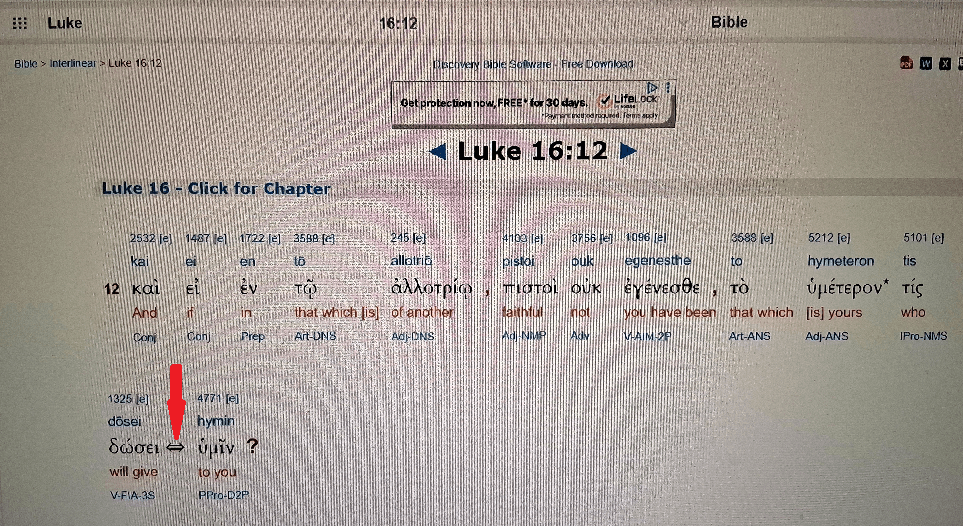
This then led Yahweh to ask the question of condition, “if therefore within to this belonging to another , faithful not your souls have been , thisyour souls who will give ⇔ to your souls ?”
This written includes a symbol that is not translated into meaning. It is a “left right arrow,” which says “if that to the left is true, then that to the right is true.” Conversely, “if that to the left is false, then that to the right will equally be false.” When Yahweh says, “within to this belonging to another,” that refers to submission of one’s soul to Yahweh in divine marriage. That cleanses one’s soul of past sins (from the Baptism by Spirit), which allows the soul of Jesus to resurrect as “this belonging to another.” Submission to Yahweh then submits to the soul of Jesus as the Lord over one’s soul and flesh. The “if” scenario then askes, “if this is not one’s soul’s act of “faithfulness,” then to “who does one give one’s soul?” If one choses a self-sacrifice to “unrighteousness,” then “your soul” will reincarnate once again. If one chooses self-sacrifice to the “righteousness” of Jesus, the Son of Yahweh, then “your soul” will gain eternal life.
The ”if” scenario is then a statement that says self-sacrifice can only be made to one, not to two. Thus, verse thirteen states the ‘moral of the parable story,’ where a soul “cannot serve two masters.” This becomes a “love-hate” relationship, where trying to serve two “masters” leads one to choose one over the other. This then says a soul becomes “devoted” – a statement of spiritual union, as “beloveds” – where one is welcomed within one’s soul, while the other is cast out and rejected. In the final statement, the translation of “money” misses the point of the Greek written, which is again “mamōna,” meaning “Mammon.” Whereas the “riches” of the world are quite easily seen through things of value, like “money,” the truth of the options of service has Yahweh state, “you cannot serve God kai Mammon.”






 Explaining the Readings