Tag Archives: Proper 21 Year A

Exodus 17:1-7 – Thirsting for everlasting waters [Seventeenth Sunday after Pentecost]

“From the wilderness of Sin the whole congregation of the Israelites journeyed by stages, as the Lord commanded. They camped at Rephidim, but there was no water for the people to drink. The people quarreled with Moses, and said, “Give us water to drink.” Moses said to them, “Why do you quarrel with me? Why do you test the Lord?” But the people thirsted there for water; and the people complained against Moses and said, “Why did you bring us out of Egypt, to kill us and our children and livestock with thirst?” So Moses cried out to the Lord, “What shall I do with this people? They are almost ready to stone me.” The Lord said to Moses, “Go on ahead of the people, and take some of the elders of Israel with you; take in your hand the staff with which you struck the Nile, and go. I will be standing there in front of you on the rock at Horeb. Strike the rock, and water will come out of it, so that the people may drink.” Moses did so, in the sight of the elders of Israel. He called the place Massah and Meribah, because the Israelites quarreled and tested the Lord, saying, “Is the Lord among us or not?”’

———————————————————————————————————-

This is the Old Testament selection from the Episcopal Lectionary for Year A Proper 21, the seventeenth Sunday after Pentecost. It will next be read aloud in church on Sunday, October 1, 2017. It is the story of Moses striking the rock at Mount Horeb and making water flow to quench the thirst of the Israelites.

In Proper 20’s Old Testament reading from Exodus, the Israelites were complaining about being taken out into the wilderness to die of hunger. God responded with manna and quails. Here, they are complaining about having no water. Whereas their complaint for food did not mention the “children and livestock” that were in their numbers, now it does.

As I explained about Exodus 16:2-15, their pleas of hunger were less spoken from their bellies and more from their minds. They needed spiritual food to consume, so they would have reason to live … live in a largely barren land. The fact that they had children and livestock that were not mentioned before says the adults were the ones needing inner motivation, as the babies and beasts would follow them wherever they went. Water, on the other hand, was a need for everyone, women, children, goats, sheep, and cattle; but, similarly, the need expressed here is not meant to be seen solely in a physical way.

To understand this, one needs to grasp how “water” is one of the four basic elements, metaphysically. The four are water, fire, air, and earth. I have repeatedly stated (so I will state again), “Water represents emotions.” Thus, this whole reading is a statement about the emotional needs of all living creatures in an environment that screams, “Get me out of here!” While being mentally motivated by spiritual food will keep one’s determination strong, will power is limited, with those limits eroded away by changing emotional states. Therefore, the Israelites are metaphorically telling Moses, “We need to be confident in our love for God, which means God needs to show us His love so we don’t worry and doubt.”

In the first verse of this reading, beginning chapter 17, the reader is told, “From the wilderness of Sin the whole congregation of the Israelites journeyed by stages, as the Lord commanded.” This is important information that is relative to understanding this theme of “water.” Relative to the “wilderness of Sin,” this is written on a Wikipedia page under that heading:

“The Wilderness of Sin or Desert of Sin (Hebrew: מִדְבַּר סִין, Midbar Sin‎‎) is a geographic area mentioned in the Hebrew Bible as lying between Elim and Mount Sinai. Sin does not refer to sinfulness, but is an untranslated word that would translate as the moon; biblical scholars suspect that the name Sin here refers to the semitic moon-deity Sin, who was worshipped widely around the entire periphery of pre-Islamic Arabia, the Levant, and Mesopotamia.”

In astrology, the Moon is seen as a symbol of “water.” The Moon is the ruler of the sign Cancer – a water sign. The Moon symbolizes the inner self and its emotional realm. The Moon is associated with water because of its phases, from New Moon, to Full Moon and back to New Moon. That change reflects how emotions change (have fluidity), as they wax and wane, over and over – the thrill of victory and the agony of defeat.

By knowing this (whether or not you believe it), one can read how “From the wilderness of Sin the whole congregation of the Israelites journeyed by stages, as the Lord commanded” is referring to emotional tests. The “stages” of travel means they moved and stopped, picked up and set up camp multiple times, by the directions of God. Those “stages” can be read as changing states of emotion because they are “of the Moon” (“of Sin”).

When one reads, “They camped at Rephidim, but there was no water for the people to drink,” the Hebrew root verb for Rephidim (rapad) means “to spread.” In a desert setting (like the changing Moon), places that once had vegetation and water can be overcome by “desertification,” which is defined as: “The transformation of arable or habitable land to desert, as by a change in climate or destructive land use.”* Thus, the name for that campsite was given because Moses thought there would be water there, but that place had changed (“spread”) to desert.

When the Israelites “quarreled with Moses,” he asked them, “Why do you test the Lord?” Moses had knowledge of the area, which came from God, so they had arrived to a place that was no longer an oasis for some unknown reason.  Moses, taking offense at the quarreling, gave an emotional response to an emotional confrontation, brought on by fears that everyone (children and animals included) would die of thirst. Therefore, it was with strong emotions that Moses “cried out to the Lord, “What shall I do with this people? They are almost ready to stone me.”’

In the emotional outburst made by the Israelites about food (Exodus 16), we are told “The whole congregation of the Israelites complained against Moses and Aaron in the wilderness.” However, there was no report about crying by Moses, as we then simply are told how the LORD told Moses how that problem would be solved.

Since the transition from chapter 16 to chapter 17 is not clearly timed, the statement of “From the desert of the Moon (Sin)” can be an indication that one complete lunar cycle had passed. If that was the 29 days from full Moon to full Moon, then the Israelite people complained the easiest when that “stage” occurred.  The symbolism would then be they complained when everyone’s emotions ran high and it was easy to become angered.

Knowing God told Moses to establish the Hebrew calendar, beginning with 1 Nissan, with the Passover on 15 Nissan, and knowing that calendar is lunar based, the Passover occurred when it was full Moon. In Exodus 16, we read that the setting was “on the fifteenth day of the second month,” so the issue over food was also taking place on a full Moon.  One can now assume they reached this place where no water was found, again, when the Moon was full.

Additionally, there are some who say the name Israel is a combination of the Egyptian gods Isis (the Moon), Ra (the Sun), and the Hebrew word El (Saturn). Astrologically, the Sun and the Moon, together, project humanity’s duality of an inner soul (Moon) with a bodily projection (Sun); and Saturn (El) represents God and the Law, while el is the Hebrew word for “god.” So, it is important to realize the role the Moon played in Israelite history, as being chosen by God was not because their bodies looked good. They were chosen because of their inner being (descendants of holy men).

Because we read how Moses became upset and expressing fear that the emotions of the people may be so high they would stone their leader, the one who was God’s emissary, we can see that Moses also was affected emotionally. As it is always best to count to ten during times when emotions are overtaking reasonable thought, God responded to Moses, giving him instructions that would solve the problem.

The solution then becomes an uplifting emotional experience for all of the Israelites to witness. The same staff that Moses used at the Nile, when “in the presence of Pharaoh and his officials [he] struck the water of the Nile, and all the water was changed into blood” (Exodus 7:20b), would symbolize God working through Moses, creating miracles.  To have wafers of spiritual food (manna) was good to set the head straight; but to have water flow freely in a desert was an uplifting reinforcement that straightened out their hearts.

In my analysis of Exodus 16:1-15, I offered that the manna and quail represented spiritual food, which equate to the body of Christ. One cannot come to Jesus, from a true faith mindset, without devoted study of the holy documents that prophesied his coming, as he came. That requires a deep level of understanding that is aided by the Mind of Christ.
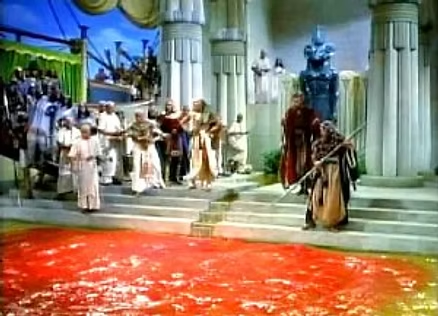
Here, in Exodus 17, the water rushing from the rock, which quenched the thirsts of the Israelites, is then symbolizing the blood of Christ. Because God told Moses to use the staff that turned the Nile waters into blood, rather than the same staff that parted the sea, that specific staff reference is then saying that Moses released the blood of Christ from the rock.  That release was to revitalize the Israelites and their children and animals.

The rock (in Greek petra, or in English Peter), symbolizes the cornerstone upon which the blood flows. Therefore, the blood of Christ is the emotional swelling of faith, like that which one feels when fermented wine enters the bloodstream and, from the heart, the body feels high. The Israelites had their faith uplifted by the miracle of Moses and his staff at Horeb, while their emotional distress over lack of water was quelled by flowing water.

This reading can then be seen as a parallel to Jesus speaking with the Samaritan woman at the well, who Jesus told he could provide her with “living water.”  In John 4:10 we read, “If you knew the gift of God, and who it is who says to you, ‘Give Me a drink,’ you would have asked Him, and He would have given you living water.”  The Israelites were asking Moses, “Give us a drink.”  The same lesson can be seen here, as when Jesus said, “Everyone who drinks of this [well] water will thirst again; but whoever drinks of the water that I will give him shall never thirst; but the water that I will give him will become in him a well of water springing up to eternal life.” (John 4:13-14)  God was providing, through Moses, this “living water.”
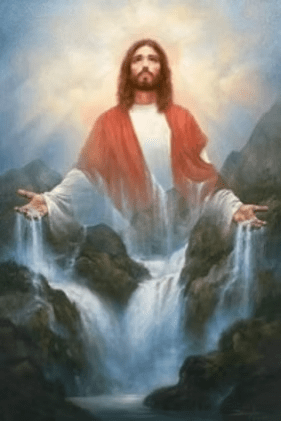
This reading ends with the statement: “He called the place Massah and Meribah, because the Israelites quarreled and tested the Lord, saying, “Is the Lord among us or not?” The name Massah is said to mean “Testing,” as a “test by trial.” The name Meribah means, “Quarrel” or “Place of Strife.” When verse one says, “the whole congregation of the Israelites journeyed by stages, as the Lord commanded,” this means reaching the point of need for spiritual knowledge is one stage of development in one’s faith, while reaching the point of need for becoming emotionally uplifted is another stage in that development.

Faith is a journey in stages, with God’s test of one’s faith requiring emotional outbursts. Without one quarreling, there is no emotional connection at all. This is supported in the New Testament, when God spoke through the Spirit of Christ, saying, “I know your deeds, that you are neither cold nor hot. I wish you were either one or the other! So, because you are lukewarm–neither hot nor cold–I am about to spit you out of my mouth.” (Revelations 3:15-16)

This is why God posed the question at that place, “Is the Lord among us or not?” The question asks, “Is God in your heart?  Are you committed to love the LORD? … Or, not?”  Caring for God, enough to quarrel over His tests, is a sign of love and commitment, as in a marriage.  It is a testing stage all marriages come to, necessarily.  “Are we in this thing together or not?”

A marriage built on love and devotion is rock solid, from which flows unconditional love.  A marriage built on selfish desires will fail the difficult tests.  The aspect of this reading placing focus on the “children and livestock” reflects the symbolism of a marriage extending beyond the realm of two, with those “offspring” not having the mental capacities to understand the reasoning of faith.  Every living creature, however, has the capacity for deep-felt emotions.

The metaphor also says human beings are the children of God, with the devoted faithful being his servants, like beasts of burden.  Therefore, God will lead us, as David wrote in Psalm 23:

The Lord is my shepherd,
I shall not want.
He makes me lie down in green pastures;
He leads me beside quiet waters.
He restores my soul;
He guides me in the paths of righteousness
For His name’s sake.

* Fair use.
Philippians 2:1-13 – All saints share the same Christ Mind as brothers in the name of Jesus [Seventeenth Sunday after Pentecost]

If then there is any encouragement in Christ, any consolation from love, any sharing in the Spirit, any compassion and sympathy, make my joy complete: be of the same mind, having the same love, being in full accord and of one mind. Do nothing from selfish ambition or conceit, but in humility regard others as better than yourselves. Let each of you look not to your own interests, but to the interests of others. Let the same mind be in you that was in Christ Jesus, who, though he was in the form of God, did not regard equality with God as something to be exploited, but emptied himself, taking the form of a slave, being born in human likeness. And being found in human form, he humbled himself and became obedient to the point of death– even death on a cross. Therefore God also highly exalted him and gave him the name that is above every name, so that at the name of Jesus every knee should bend, in heaven and on earth and under the earth, and every tongue should confess that Jesus Christ is Lord, to the glory of God the Father.

Therefore, my beloved, just as you have always obeyed me, not only in my presence, but much more now in my absence, work out your own salvation with fear and trembling; for it is God who is at work in you, enabling you both to will and to work for his good pleasure.

——————————————————————————————————–

This is the Epistle reading from the Episcopal Lectionary for Year A, Proper 21, the seventeenth Sunday after Pentecost. It will next be read aloud in church on Sunday, October 1, 2017. It is important because Paul tells how true Christians are resurrections of Jesus Christ.

If one goes to the BibleGateway.com website and looks up this selection, you are offered some of those summary headings I have talked about before. For the New International Version, the two segments in the presentation above each have a heading. The first part says, “Imitating Christ’s Humility,” with the second part entitled, “Do Everything Without Grumbling.” For the New American Standard Bible, the whole reading is under the heading, “Be Like Christ.”

That NASB heading sounds an awful like the old (I’m dating myself now) “Be like Mike” commercials for Gatorade. Mike was Michael Jordan. Of course, nobody drank Gatorade and became Michael Jordan. Certainly, lots of players of all ages and all skills drank Gatorade, like Michael Jordan did (at least for the commercials), and many of those played basketball in all types of basketball courts, indoors and outdoors; but none other than Michael Jordan was ever Mike (the person dunking basketballs in the Gatorade commercials).

Do the people at the New American Standard Bible think God wants a lot of pretend Jesuses being as bad at ministry as those who thought drinking Gatorade would make them soar down the lane with a basketball held high before a slam dunk?

If they really do, they should slip a few bucks to the Gatorade advertisers and ask permission to begin a “Be like Christ” campaign. They could sell Nike Jesus sandals and Under Armour Jesus robes, and for the kids some costume Jesus wig-beard head gear. Somebody would get rich; but they would get the exact same result as Gatorade got … still only one Christ, and he (like all superstars promoted on TV) cannot be duplicated … only imitated (as implied by the NIV heading).

When someone reads (or hears read) this excerpt of Paul’s letter to the Philippians and then preaches that it means, “Dear brothers and sisters, it is imperative to live your lives like Jesus did,” one ends up with a world exactly like we have surrounding us today. It is a world that is lost and has little hope of finding itself.  After all, who knows how to live like Jesus?

I’m sure there are many who think, “Today’s times are so different than those back then.  I bet Jesus would be different if alive today.”

Reading that into the message from Paul – who was an Apostle, a Saint, a Christian – is to be a chirstian like the vast majority of Westerners who have called themselves that since Constantine reorganized a Spiritual movement into a business plan for an Empire. Today’s Christians are more creations of the Church of Rome than Apostles, as that Church routinely read Latin verses to people who could barely read, much less understand Latin, while telling their captive audiences, “Just do as we say, not as we do” (mostly).

It begat the mindset that has one pondering, “What would Jesus do?” when confronted with life’s decisions.

Certainly, those who ponder like that – and make the right decisions and live a good life of sacrifice – are headed in the right direction; but that direction, invariably, leads to a plateau, with high mountains that must be climbed still well in the distance. It represents a return to the same state of life that was for Jews in Judea and Galilee, who were plateaued believers in God when Jesus and followers were walking the land. The Jews then were people who were trying to ponder, “What did Moses tell us to do?” but people who were unable to make all the sacrifices and good life choices (consistently) the Law said to do.

And were miserable then, just as many are today.

“Forgive me God. I go to church but nobody ever tells me how to stop sinning.”

There is a statement of faith openly recited in Episcopal churches each week (and other brands of churches), which is labeled “the Nicene Creed.” There is a variation of that, known as “the Apostle’s Creed,” where an “Apostle” should be defined as “a Saint,” with a “Creed” being defined as, “A formal statement of religious belief; a confession of faith.”

It is a statement that is supposed to be read aloud only by Saints, as the true Church is an exclusive body (although it welcomes seekers of truth).  Both Creeds are confessions of faith that all true Christians fully understand. This is especially understood when Saints say, “He [Jesus Christ, God’s only Son, our Lord] will come again to judge the living and the dead.” The Nicene Creed varies that to state, “He will come again in glory to judge the living and the dead, and his kingdom will have no end.”

What a true Apostle realizes – knows – when he or she makes that public confession of faith is what Paul wrote in this selection of his letter to the Christians of Philippi. While the ordinary – do as I say and not as I do – Christian is asked, “What does that mean … will return again?” they smile and say, “Shhhhhh! We don’t talk about Judgement Day or the End Times in church.”

That implies, “That is what those evangelicals do.”  It fosters an “Us vs. Them” mentality.  It represents divided brains and not One Mind in Christ.

Such views totally miss the point of how Jesus Ascended on the 49th day and “came again” the next day (the 50th day – Pentecost). The spread of true Christianity meant an exponential return of Christ, with 3,000 filled with the Holy Spirit because the Mind of Christ opened that many eyes, ears, and hearts that day.  That spread was why Paul had to write letters to those in his wake, telling them to, “Keep up the good works.”

But, that rapid spread of true Christianity was slowed by those who dreamed of empires.

The Day of Pentecost was when eleven disciples (and close family of Jesus who were in the upstairs room) were filled with the Holy Spirit and became multiple New reproductions of Jesus of Nazareth, in possession of the same Christ Mind. At that time, those Apostles were judged by Jesus Christ as being worthy of climbing those distant mountains – the boundaries of mortal death – thus gaining eternal life.  The disciples-turned-to-Apostles began living at that point.

Their bodies became the “kingdom” of God, with the Christ Mind being the right hand of the LORD within them.  They bowed down to Christ Jesus, so each human body’s soul would forevermore serve God.

When Paul wrote, “Be of the same mind, having the same love, being in full accord and of one mind,” he was saying, “You cannot keep your big brain and try to figure out what God and Christ want you to do, when the love in your heart is for self and the brain in your head keeps trying to ask, “What would Jesus do?”

You cannot be like Christ, when you like being you more.

And darn it, we like being us.

When Paul then wrote, “Let the same mind be in you that was in Christ Jesus,” we have to remember that Jesus’s name was not “Christ.” The statements of faith that say, “[Jesus] was conceived by the power of the Holy Spirit and born of the Virgin Mary. He suffered under Pontius Pilate, was crucified, died, and was buried,” all acknowledge that Jesus was a human body, just like all of us are. What made Jesus the promised Messiah was the presence of a Messianic Mind, coming from God, via the Holy Spirit.

The same process came upon the followers of Jesus on Pentecost, when they too became with “the same mind that was in Christ Jesus.”  With tongues like fire they became Christ Peter, Christ James of Zebedee, Christ John of Zebedee, etc., etc. They suddenly became filled with the same mind.

This is why Paul wrote, “Therefore God also highly exalted him and gave him the name that is above every name,” which is “Christ,” or the name-title as the “Messiah.” That title is greater than any title ever held by any human rulers; but it is a title that human beings, like Jesus, can gain.

This means that when Paul wrote, “So that at the name of Jesus every knee should bend,” all true Christians are to bend a knee to Jesus, by sacrificing their own name, being knighted as Christ Jesus reborn.  You must sacrifice your brain to the service of the Christ Mind.  Your brain is not capable of figuring out what Jesus would do.

“Every tongue should confess that Jesus Christ is Lord, to the glory of God the Father,” is stated in the Apostle’s Creed where it says, “We believe in the Holy Spirit, the Lord, the giver of life, who proceeds from the Father and the Son.  With the Father and the Son he is worshiped and glorified.” Still, “every tongue” in every Apostle stops saying, “I think this is what Jesus would have us do,” as those tongues wag to an ego-driven brain.

An Apostle’s tongue speaks as Jesus spoke, and as Peter spoke with the other ten, when they all spoke to the crowds of pilgrims in Jerusalem. They spoke what God told them to say, which is why Jesus repeatedly said, “For I did not speak on my own, but the Father who sent me commanded me to say all that I have spoken.” (John 12:49)

Jesus of Nazareth, born in Bethlehem to a Virgin Mother, as a mortal human being, was never quoted in the Gospels, because his tongue confessed that his being the Christ was due to the LORD, with all glory going to God the Father.  The answer to the question, “What would Jesus say?” is “Jesus would say, ‘You know, LORD.”‘  That is what those with the Christ Mind always say.

This devotion is why Paul encouraged the Christians of Philippi to “work out your own salvation.” You will not save your soul by eavesdropping and overhearing someone say, “You know, I’ve been thinking about what Jesus would want us to do, and that is ….” You cannot be like Christ by repeating what the Apostles Matthew, Mark, Luke and John said Jesus said. You have to do as Jesus did. You have to work for God in order to be saved by the Christ Mind.

This means “to will and to work for his good pleasure” is a statement that only God’s will can guide one’s actions. One does the work of Christ, for his good pleasure, which means one is reborn as Jesus, led only by God, through the Christ Mind. This is why the Acts of Jesus are called Gospels, and the Acts of the Apostles is the first book that follows those four. All of the letters written are also Acts of Apostles, as it is the work of Christ that does “nothing from selfish ambition or conceit, but in humility regard others as better than yourselves. Let each of you look not to your own interests, but to the interests of others.”

Scene from the 1980 movie The Resurrection.

There are no words that can tell one how to be filled with the Holy Spirit and gain the Mind of Christ. If words could make that happen, then just do this: “If you want to be perfect, go, sell what you have and give to the poor, and you will have treasure in heaven; and come, follow Me.” (Matthew 19:21)  Too many read those words and start looking down at the footsteps of Jesus, trying hard to place their foot in the same prints. You do not follow Jesus by walking behind his legacy. You follow Jesus by being another Jesus Christ; and that requires happily working for others.

Next!

Matthew 21:23-32 – The authority to be a reluctant yet obedient son or a liar versed in expected answers [Seventeenth Sunday after Pentecost]

When Jesus entered the temple, the chief priests and the elders of the people came to him as he was teaching, and said, “By what authority are you doing these things, and who gave you this authority?” Jesus said to them, “I will also ask you one question; if you tell me the answer, then I will also tell you by what authority I do these things. Did the baptism of John come from heaven, or was it of human origin?” And they argued with one another, “If we say, ‘From heaven,’ he will say to us, ‘Why then did you not believe him?’ But if we say, ‘Of human origin,’ we are afraid of the crowd; for all regard John as a prophet.” So they answered Jesus, “We do not know.” And he said to them, “Neither will I tell you by what authority I am doing these things.

“What do you think? A man had two sons; he went to the first and said, ‘Son, go and work in the vineyard today.’ He answered, ‘I will not’; but later he changed his mind and went. The father went to the second and said the same; and he answered, ‘I go, sir’; but he did not go. Which of the two did the will of his father?” They said, “The first.” Jesus said to them, “Truly I tell you, the tax collectors and the prostitutes are going into the kingdom of God ahead of you. For John came to you in the way of righteousness and you did not believe him, but the tax collectors and the prostitutes believed him; and even after you saw it, you did not change your minds and believe him.

——————————————————————————————————–

This is the Gospel reading from the Episcopal Lectionary for Year A, Proper 21, the seventeenth Sunday after Pentecost. It will next be read aloud in church by a priest on Sunday, October 1, 2017. This in an important lesson because it addresses who has God’s approval to shepherd His flocks.

This reading reminds me of my experience at a seminary school. I was not a seminarian (my wife was), but I socialized with them at school functions and in the neighborhood housing arrangements. I saw several glaring problems with the whole system of educating priests (too many to get into now), but the statement, “the chief priests and the elders of the people came to [Jesus] as he was teaching, and said, “By what authority are you doing these things?” hit home for me.

I was writing books back then, which explained how to read Nostradamus, so that what he wrote can be understandable. Nostradamus can be seen as John the Baptizer, as “the chief priests and elders of the people” have not believed as I believe – that Nostradamus was a prophet of Jesus Christ. Because I fully believe that, I cannot hold my tongue about that belief.

When asked, “What do you do?” I told seminary students about Nostradamus. I told some teachers about Nostradamus. I even told some invited guest speakers coming to that school (whom I picked up or took back to the major airport nearby) about Nostradamus.

It was like I asked them all, “Do you believe The Apocalypse of John of Patmos is similar to The Prophecies of Nostradamus?”  It was like I posed the question, “Whose authority did those books come from: Prophet of Christ or Charlatan?”

Some wanted to shun me forever; but some were patronizing.  It was as if their minds were calculating, “If we say, ‘Prophet of Christ,’ he will say to us, ‘Why then did you not believe him?’ But if we say, ‘Charlatan,’ we are afraid we might be talking to an unstable, dangerous person.”  They all seemed well-versed in the “smile and nod” reaction to uncertain situations.

My amazing ability to understand Nostradamus was a gift given to me by God. There can be no other explanation for that talent.  I was the last person on earth who I figured would be able to understand Nostradamus; but I was led by a higher power, and not simply to understand his cryptic writings.  I found that I was able to apply the same systems applicable to making sense of Nostradamus to everything in the Holy Bible. That syntax is God’s, as His Holy Language … Speaking in Tongues not taught in schools.  So, it applies to everything He had His people write for Him.

There really are no authorities that grant doctorates or even bachelor’s degrees about the meaning of Nostradamus; so if I am seen teaching about his writings, authority figures have no reason to confront me. They just snicker and poke each other.  However, since I have been allowed to put Nostradamus on the back burner (so to speak), due to carpal tunnel in both wrists from writing so much, I have been encouraged to write Biblical interpretations. That will attract some frowns and questions by the religious elite.

What school did you attend to learn that? What scholastic volumes of books have you read and footnoted, while preparing properly detailed papers and dissertations that have been argued before expert authorities? How many reputable scholars can you quote in support of your views?

I will answer your questions, if you let me ask you one first. If you can answer that, then I will answer your question.

What seminary did Jesus and his Apostles attend? The same one begun by Moses in the wilderness, or a different one?

When Jesus said, “Neither will I tell you by what authority I am doing these things,” we all know he was authorized by God the Father. We know because he said that a few times, as noted in the Gospels.

“Very truly I tell you, the Son can do nothing by himself; he can do only what he sees his Father doing, because whatever the Father does the Son also does.” (John 5:19)  “ Then Jesus said to them, “When you lift up the Son of Man, then you will know that I am He, and that I do nothing of Myself; but as My Father taught Me, I speak these things.” (John 8:28)  “For I did not speak on my own, but the Father who sent me commanded me to say all that I have spoken.” (John 12:49)

The original plan was to have ALL the Israelites be ordained priests for YWHW. When Moses first took them on a 40-year hike, you have to look at the Israelites as babies and infants, because they were incapable of doing anything on their own. Forty years of rote memorization of the laws was priestly training that was more like children’s church on Sunday mornings. They just learned the stories, but the deep meaning escaped them.

When the Israelites were supposed to be priests for YHWH in the Promised Land, they were like teenagers under the Judges – always backsliding and getting into trouble, while having to be bailed out time after time. They entered the rebellious age.  By the age they asked for a king, “to be like other teens,” they were like young adults who no longer lived by the rules of their parents. But, by the time Israel and Judah fell in ruin, led by politicians whose only god was self, they were like twenty-somethings with arrest records. All their promise was washed away.

By the time the Jews had formed from those Israelite ashes and been released from Babylon, they were like thirty-somethings, who were “street smart.”  You could say they had become charismatic, prison ordained street preachers. That was who Jesus ran afoul of in Jerusalem. It was them acting with the know-it-all of young adults – their audacity – that made them the priest police.

In the parable-like question that Jesus posed to those learned men of the Law. both sons sinned against the father. One refused to go at first, but then thought about it and went (to stay out of trouble). The other said he would go, but flat out lied – a sin against his father. However, the one who refused, but then changed his mind, he was easier to forgive.

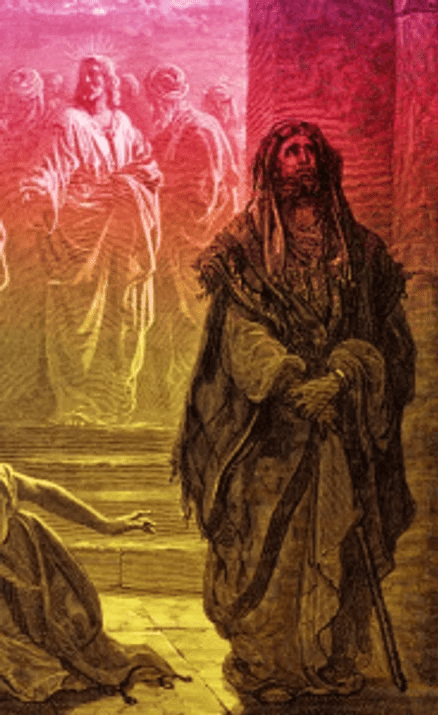
This lesson is no different than the one Jesus taught when observing the Pharisee and the Publican in the Temple. When Jesus said here, “Truly I tell you, the tax collectors and the prostitutes are going into the kingdom of God ahead of you,” this is not saying the son who lied by saying “No,” but then did “Yes,” is the exact same as a prostitute or tax collector (Publican). Saying “No,” and then thinking about it, before acting, put him in the same boat. Both were sinners, so unless change comes, both are forbidden from heaven.

What Jesus was really saying was, “You Law police fellows are too full of yourselves to ever realize you are going in the opposite direction of heaven.”

Thank you God for making me holy and not like the riffraff of the world. This is the pretense of a priest who knows nothing of spiritual matters.

At least the tax collectors and prostitutes are aware of their sins. They just can’t see how to stop sinning, in a world that forces sin upon everyone.  That is where a good teacher – such as John the Baptizer and Jesus – can get the losers to stop being a loser and change.

When the Pharisees and high priests see good teachers like that, they want to hurl stones at them. They certainly don’t want to pull up a chair and listen to what good teachers are saying. They might learn something then.  However, whose authority determines who the good teachers are, without a sheepskin to prove one has that approval?

Remember when Jesus said, “Watch out for false prophets. They come to you in sheep’s clothing, but inwardly they are ferocious wolves.” (Matthew 7:15)  That was the Pharisees wearing clerical robes, and what was then has always been and will continue to be.

This is why I see Christianity turning into a cesspool of teachers. It is not that all the sordid pieces and parts of waste in a cesspool were made for that ultimate purpose. Waste is the degradation of value.  What goes in good is split in two: the unseen nourishes, while the residue usually does not pass the smell test.  That gets flushed with good water.  It is just that when you mix the bad in with the good water, the good water has to be purified before it can be good water again.

A couple of years ago, my wife (a priest now) followed a bishop of another diocese on Facebook. She liked a few of his sermons that he posted on his website. He wrote one about the lesson of the Tax Collector and the Publican (Luke 18:9-14), which was uninspiring to me.  It was what I call out of the “puppy mill” of sermons. What priest has stood in the pulpit and looked at the smiling faces of tithers in the pews and not said the message of the Pharisee and the Publican was, “The sinners of the world have hope, because they are closer to heaven than those who think they have it made”? (The same sermon that can be preached about the two sons who disobeyed the father.)

That bishop published a sermon that had nothing new in it. What is the lesson of “being closer to heaven than some other guy,” if the sinners never hear a good teacher tell them how to “get to heaven.” Jesus was giving a sermon that said YOU bishop (and every priest who cannot see him or herself in this story) are the Pharisee in that story.  Forget about the obvious sinners, because it is YOU who Jesus said is farther away from salvation.

Telling those who feel guilt about their sins, “Have hope!  Keep coming here and I will keep telling you to have hope!” they will always come back for more of the same sermons.  But, who wants to stay in a pew when the priest says, “Jesus was pointing out how far away from heaven I am. But hey, who gets to heaven anyway?”

That’s entertainment, not a good shepherd.

A good sermon would be a true Apostle (like were Peter and Paul), who stands in front of a group of attentive sinners, all of whom want to hear how to stop sinning, and admit they too were sinners … sinners who changed.

In a good sermon the priest says, “I was the Pharisee in this story. I was farther away from heaven than you people are now; but I saw myself and felt ashamed. I had lied to the Father when I went into the priesthood. It was all about me being holier than thou. I was young and stupid and thought learning about religion would make me holy.  Therefore, I raised my arms to the sky and thanked God for giving me a sweet job that has so many fringe benefits.

Then I realized all my work had been only for me, even when I made it seem like I was helping others. I was only imagining I was working in the vineyard, when I was simply tasting the wine. I want to apologize for having not made every one of you self-sufficient priests for Yahweh.

I now speak to the LORD every day and He wants me to teach you the real meaning of the Scriptures, so you can understand by the Holy Spirit and go tell others the truth.  Truth comes not from having learned what someone else knows, but from a love of God that thirsts within one for His knowledge.

Please, I invite each and every one of you to join me in Bible Studies and fellowship, so our love of God branches out and produces fruit. Amen”

I made a post on that bishop’s blog, which suggested this alternative view … politely, in different words than here above. While he politely responded to my post, it was another example of people not really hearing what is being said or not being truthful about what they heard. He wrote back something like, “But who would be left in the pews, if I told them that?”

Wasn’t that the point when Moses freed the Israelites from Egypt? At some point the baby has to grow up, the student has to graduate from school and get a job. God didn’t free cradle to grave sons that say, “Yes sir! I’ll be working in that vineyard bright and early!” who then never do.

Did He?