Tag Archives: Proper 21 Year B

Mark 9:38-50 – Salted with fire

John said to Jesus, “Teacher, we saw someone casting out demons in your name, and we tried to stop him, because he was not following us.” But Jesus said, “Do not stop him; for no one who does a deed of power in my name will be able soon afterward to speak evil of me. Whoever is not against us is for us. For truly I tell you, whoever gives you a cup of water to drink because you bear the name of Christ will by no means lose the reward.

“If any of you put a stumbling block before one of these little ones who believe in me, it would be better for you if a great millstone were hung around your neck and you were thrown into the sea. If your hand causes you to stumble, cut it off; it is better for you to enter life maimed than to have two hands and to go to hell, to the unquenchable fire. And if your foot causes you to stumble, cut it off; it is better for you to enter life lame than to have two feet and to be thrown into hell. And if your eye causes you to stumble, tear it out; it is better for you to enter the kingdom of God with one eye than to have two eyes and to be thrown into hell, where their worm never dies, and the fire is never quenched.

“For everyone will be salted with fire. Salt is good; but if salt has lost its saltiness, how can you season it? Have salt in yourselves, and be at peace with one another.”

———————————————————————————————————-

This is the Gospel selection from the Episcopal Lectionary for the Nineteenth Sunday after Pentecost, Year B 2018. In the numbering system that lists each Sunday in an ordinal fashion, this Sunday is referred to as Proper 21. It will next be read aloud in an Episcopal church by a priest on Sunday September 30, 2018. It is important because Jesus made it clear that being a part-time Christian would not qualify one eternal life in Heaven.

In this reading, Mark is first shown to identify a disciple of Jesus by name – “John.” This is the same John who had been chosen to go up the high mountain with Peter (whose story was recorded by Mark) and Jesus. John was accompanied by his brother James, both the sons of Zebedee. This means John was one of the first disciples Jesus chose, along with Simon-Peter. It is not John the writer of the Gospel by that name. That John was called “little child” (“paidion”) by Mark, in verses 36-37 of this chapter, meaning children were not mentioned by name.

Realizing that, we then read that the disciple John said to Jesus, “Teacher, we saw someone casting out demons in your name, and we tried to stop him, because he was not following us.” Before the response by Jesus should be understood, one needs to recall the Gospel lesson of the eighteenth Sunday after Pentecost and how Jesus had used his son, John, to tell his disciples, “Whoever welcomes one [like my son John] in my name welcomes me; and whoever welcomes me does not welcome me but the one who sent me.” (Mark 9:37) Now, in the very next verse (Mark 9:38), John’s memory has been joggled so that he remembered how on the trip down to Capernaum (while the disciples were arguing who was greatest among themselves) they saw someone claiming to be in the name of Jesus, casting out demons. And, oh by the way, John said, “We tried to stop him, because he was not following us.”

Now the heading for verses 38-41 of Mark’s chapter nine says “Intolerance Rebuked.” (Bible Hub Interlinear) Other websites that translate the Holy Bible and add such headings say, “Whoever is not against us is with us.” That is restating Jesus’ response to John (briefly), but it gives the impression that Jesus saw his disciples attempting to stop someone from casting out demons, while shouting out, “In the name of Jesus of Nazareth, I command you to leave this person!” The rebuke is, therefore, because someone is not a follower of Jesus does not mean he (or she) should be stopped.

The word “intolerance” can be defined as meaning, “An unwillingness or refusal to tolerate or respect contrary opinions or beliefs, persons of different races or backgrounds, etc.” [Random House Kernerman Webster’s College Dictionary] The fact that John admitted that he and the gang tried to stop someone from using the name of Jesus (not tried to stop someone from casting out demons) says they would not tolerate that association of healing with a man that person did not follow, as a student of Judaism [remember, John referred to Jesus as “Teacher”]. As such, the acts of the disciples were as intolerant as would be one branch of Christianity [a religion in the name of Jesus Christ] competing against another branch, simply because one sees the other as not following the teachings of Jesus Christ. While that is somewhat true, the focus on intolerance is misleading and misses the point of Jesus’ response.

Jesus said to John, “Do not stop him; for no one who does a deed of power in my name will be able soon afterward to speak evil of me.” That was first a command: “Do not stop him.” Then, it is an explanation in two parts.

The first says, “There is no one who can do a work of power that is contrarily in my name.” The use of the Greek word “epi,” which means “against, on the basis of, or to,” implying “upon,” such that Jesus said, “No one can cast out demons [a work of power] simply by calling out my name.” This then is a statement that says, “Only those who are me, reborn in my name, can do deeds of power that are born from above.”

Finally, reading that Jesus said, “Afterward to speak evil of me” is misleading. As a separate segment of words that literally state, “And will be able quickly to speak evil of me,” this is not a focus on the one in the name of Jesus who was casting out demons [doing works of power].  Instead, it refers to those who will witness such deeds and will call out the person in claiming to be in the name of Jesus as evil, not good.

By John and the other disciples trying to stop that person from doing good, they exemplified that point made by Jesus. That was then a statement about why Jesus would be “delivered into the hands of men who will kill him.” (Mark 9:31)

This is the point of Jesus then having said, “Whoever is not against us is for us.” That was not a watered-down version of the ancient proverb that says, “The enemy of my enemy is my friend,” such that Jesus was not telling his disciples, “It does not matter how wrong someone is, if they are going against those who are most wrong, as are we, then they are right.”
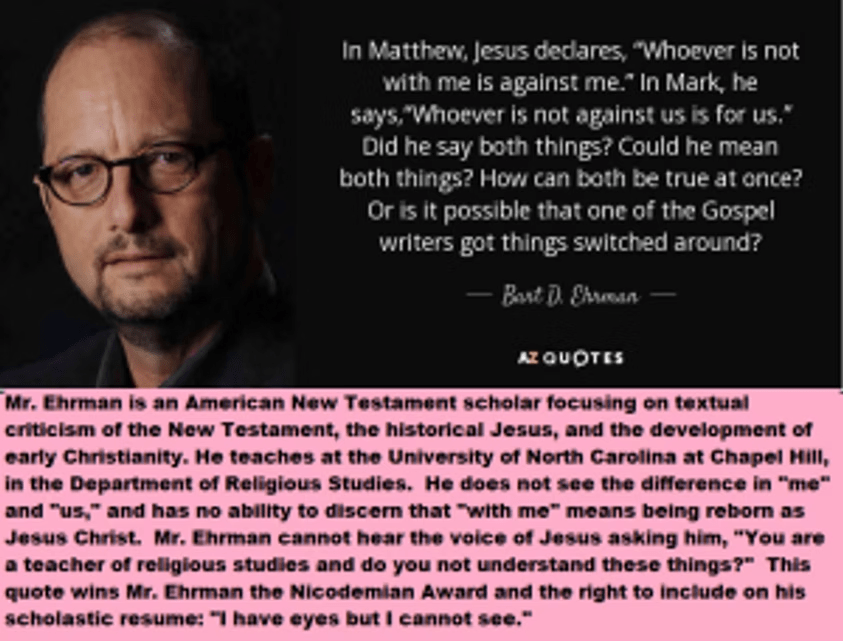
Those wanting to kill Jesus come disguised as religious men.

That means Jesus was not preaching tolerance to wrong, as “Two wrongs make a right,” if one wrong is better than the other. Jesus was saying that the enemy of his cause, which his disciples were learning, were those who persecuted the righteous. Thus, the assumption to be made from Jesus saying, “Whoever is not against us is for us” is that the one casting out demons in the name of Jesus was righteous, being for the same cause.

Keep in mind that Jesus was alive and well at that time.  No religion existed then that had believers calling themselves “Christians.”  The only ones who knew the name of Jesus, the Jesus of Nazareth, were those who came in direct contact with him.  It was not like today, when it is common to turn on the television and hear some televangelist shout out, “In the name of Jesus Christ be healed!”  One has to be able to see that there is a difference between using someone’s name and representing oneself as being the one named.

This perspective is clouded and difficult to comprehend when one does not grasp the influence Jesus had on those whose lives he affected, through healing.

I have written before and it bears repeating here now, someone who was born blind but was given sight by the presence of Jesus did not simply experience a miracle in the physical sense. The same goes for the lame made able to walk, the deaf made able to hear, the lepers cured, the dead raised, and even the ones who were fed bread and fish on the plain of Bethsaida.  All who experienced a miracle of Jesus were changed Spiritually.

While the pages of the New Testament do not tell the stories of the ones healed by Jesus, beyond their healing, one has to be able to intuit their futures.  They went forth into the world as the first Apostles, those unrecognized as such. They are then expressions of the epitome of what an Apostle is: One whose self-name is unimportant, because one has been reborn as Jesus Christ, sent forth to do the work of the Lord without recognition.  None of the Apostles ever sought recognition for themselves, desiring to take credit for miracles done in the name of Jesus Christ.

Realizing there were many Apostles in the name of Jesus prior to the disciples being filled with the Holy Spirit on a Sunday that was the Fiftieth Day Festival, that awareness brings more meaning to the words Jesus then spoke: “Whoever gives you a cup of water to drink because you bear the name of Christ will by no means lose the reward.” This translation is poor and should be inspected closer.

Symbolizing emotional and spiritual fulfillment.

The Greek written by Mark literally states, “Whoever for however might give to drink you a cup of water  ,  in name because Christ you are  ,  truly I say to you  ,  that none ever shall he lose the reward of him  .” I welcome all readers to look at this verse (Mark 9:41) and inspect this closer. I have only changed the double negative (“ou ”) from “no not” to a viable translation that says, “none ever.”

To repeat the use of water in all verses in the Holy Bible, the symbolism has to be realized as a word conveying the fluidity of emotions. Because water is needed for life to be maintained, we have likewise emotional needs that make life bearable.  As such, by Jesus saying “give you a cup of water,” this is metaphor for meeting an emotional need in one.

This is seen in the song of David, when he sang, “My cup runneth over.” (Psalm 23:5, KJV) It is the conversation between Jesus and the Samaritan woman at the well, when Jesus asked her, “If you knew the gift of God and who it is that asks you for a drink, you would have asked him and he would have given you living water.” (John 4:10) That focus on the element of water points to the spiritual uplift that comes from God and is always available to be poured out freely.  Therefore, what Jesus was then saying to John of Zebedee first was: “Many can meet the spiritual needs of others,” which was the obvious act the disciple witnessed, where some stranger was offering a cup of living water in the name of Jesus.  His trying to cast out demons in others was a God-sent gift, just like Jesus was offering.

This is why the second segment of words clarifies that the man they saw casting out demons was not lying, as some Jesus impersonator, but he was “in the name of Christ.” The Greek written here is “en onomati hoti Christou este.” Stating “in name because Christ is.” This is not a claim that he was saying he was “Jesus of Nazareth.”  Jesus said the man was “in Christ … because Christ is.”  That is sort of like saying the name of God is “I am that I am” (YHWH).
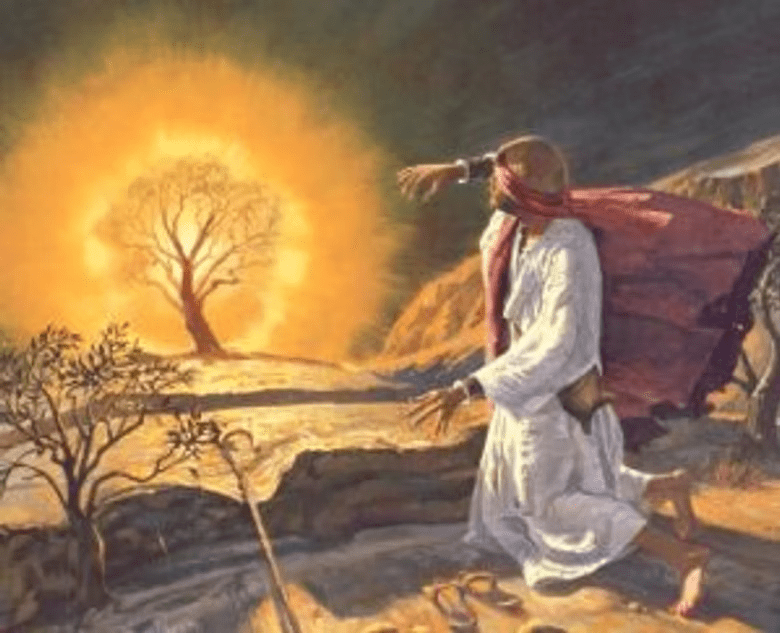
Tell them I AM WHO I AM sent you. Thus, I AM YOU. I speak through You.

The word “este” is a word of “being,” such that one takes on the name of Christ when one is filled emotionally by the Holy Spirit. One’s personal self state of being has moved aside, allowing the Holy Spirit to be the replacement self – the Christ.  This new state of being is then when one’s soul has become married with God, as One.

That is not a lie or a stretching of the truth, as Jesus confirmed: “Truly I say [this] to you.” That is the truth, as is the next statement from the final segment of words: “none ever shall he lose the reward of him.” This has two meanings.

The first is that the one who is in the name of Christ has been given the works of power from above, by Jesus [the Messiah], so he or she can have the reward of the Holy Spirit. Then, secondly, it says the one given that reward will not lose it.  So, having been given the name of Christ, such that one can act truly in the name of Jesus, means always having the same works of powers.

More than a cup of physical water given, the cup holds living waters that never leave one spiritually thirsty. Therefore, this series of segments is reflective of Jesus telling his disciples that they will be acting exactly as the one they saw, whom they tried to stop [but could not], while saying all who he had touched in his ministry were ahead of them, evangelizing as the Christ born in them [including the Gentiles healed].

Because Jesus had just told John and the rest of his disciples not to ever stand in the way of God working through one of His devotees, given the powers of the Christ, such a hindrance would be contrary to the ministry of Jesus. That awareness breathes new meaning into his warning, “Whoever is not against us is for us.”

The plural pronoun “us” is used to denote all who are married to God and committed to do His Will. One is then either part of the God team or one is against God, as influenced by Satan. As ‘black and white, right and wrong’ as that statement now becomes, it naturally follows that Jesus would then say, “If any of you put a stumbling block before one of these little ones who believe in me, it would be better for you if a great millstone were hung around your neck and you were thrown into the sea.”

Going against God is then a death sentence for the soul [the flesh that imprisons one].  Still, it is not a sentence by the judgment of God.  Instead, it is suicide, as a self-inflicted punishment.  Jesus was then using the metaphor of placing a heavy stone around one’s neck and then leaping into deep waters, where one would then die by drowning, as a better way to die than trying to save one’s life, while persecuting the righteous.  The metaphor of water (especially deep waters) as the means of self-sacrifice says it would be better to give up one’s ego and release one’s soul to the vastness of God’s living waters, than to try to keep living for self.  This example is then confirming Jesus having said, “Those who try to save their life will lose it.” (Mark 8:35)

This death of the soul is then stated by Jesus in the physical elements that represent the body parts of sensation, where the sacrifice of hands, feet, and eyes are symbolic of human aspirations. These aspirations are from adult minds that seek self-aggrandizement. It means the self “stumbles” as far as affecting the lives of “little ones” [where Jesus used the word “mikrōn” as a parallel to his prior use of his son, John, as a “little child” – “paidion”], who are those who have been accepted into the family of Jesus, as Sons of the Father [human gender insignificant]. It means acts against the children of God are against those who are reborn as Jesus Christ.

Jesus said, “If your hand causes you to stumble, cut it off; it is better for you to enter life maimed than to have two hands and to go to hell, to the unquenchable fire. And if your foot causes you to stumble, cut it off; it is better for you to enter life lame than to have two feet and to be thrown into hell. And if your eye causes you to stumble, tear it out; it is better for you to enter the kingdom of God with one eye than to have two eyes and to be thrown into hell, where their worm never dies, and the fire is never quenched.” Here, Jesus three times used a form of the Greek word “skandalizó”: “skandalisē” once; and “skandalizē” twice.

This word is synonymous with the English word “scandalize,” meaning, “to cause to stumble, cause to sin, cause to become indignant, shock, offend.” It literally means “to set a snare (a stumbling-block),” while implying “to hinder right conduct or thought.” [HELPS Word-studies] It means if any part of one’s body is used “to make a child of God fall into a trap,” one’s soul will be condemned forever.

Can anyone recall how often the word “scandalous” has been applied to the revelations associated with the Roman Catholic Church, involving money matters, murders, and the abuse of altar boys?

Vatican Bank’s Roberto Calvi, with ties to the Mafia, found hanging from bridge.  Just one of many scandals the Church has become known for.

The symbolism of one’s “hand” is based on the figurative meaning of “cheir”: “the instrument a person uses to accomplish their purpose (intention, plan).” [HELPS Word-studies] To cause one of the Apostles of God, in the name of Christ, to fall into a trap as part of a plot to destroy is then a prophecy of the leaders of Jerusalem plotting to destroy Jesus. Still, it foretells of the persecution that would befall many of the Saints of Christianity. To cut off such a “hand” means to sever one’s association with such figures. If those “hands” are passing thirty pieces of silver into the “hands” of a “little one,” causing him to sin, they are then responsible for the failure of that soul to return to God.

The symbolism of one’s “foot” is based on the path one travels. To cause one of the children serving God, in the name of Christ, to be misled, sending towards a trap into which they will be snared was the reason Jesus had been leading his disciples away from the normal routes taken by the Pharisees and Temple scribes. They expected all Jews to prostrate themselves at their feet. They taught Jews to follow in their footsteps, not how to walk in the ways of the Lord. It is better to hobble along a path that has evil-doers cause one to trip and fall, to be lifted up by the angels sent by God, than to take the easy road to ruin.

The symbolism of one’s “eye” is based on the figurative meaning of “ophthalmos,” where this is the “mind’s eye.” When one is led by the Mind of Christ, one will always be shown the light of truth. When one is led by the Big Brain, one envisions a course that is self-serving. The singular number, as “eye,” which had Jesus then say “it is better for you with one eye to enter the kingdom of God,” that is a willingness to be blinded to the distractions of a material world, becoming fully dependent on the All-seeing Eye of God to know the way to Heaven.

Those who see with two eyes are trapped in the physical plane and cannot see the value of Spiritual things. Nicodemus was a Pharisee ruler who had eyes but could not see in the ways of religion. They see well enough to bow down before science and its demand for obedience to the observable, condemning their souls to hell for failing to see through the wall of physical senses to the divine.

With these symbolic meanings explored, and each leading to hell, where the “fire is not quenched, “Mark wrote of Jesus stating, “For everyone will be salted with fire. Salt is good; but if salt has lost its saltiness, how can you season it? Have salt in yourselves, and be at peace with one another.” Here, words focused on “salt” are found repeated, meaning “salt” needs to be understood.

The Greek word “hals” translates as “salt,” which was a valuable commodity in ancient times, usually having to be mined. It is abundant in sea water, which is undrinkable. Salt was one form of preserving fish (along with smoking), meaning it pulls moisture from the fish, keeping the flesh from rotting. As a preservative, it would also add necessary salt to a human diet, while being a flavorful addition to an ordinarily bland food.

A friendly fire of life.

By realizing this, to hear Jesus say, “Everyone will be salted with fire,” this is a statement about the preservation of human souls. A soul is rolled in the salt of a human body that is seventy percent saltwater, much in the form of salty blood. The fire is smoking process or the sun drying that surrounds the salt wrap, which makes the soul a productive commodity.

When Jesus then said, “Salt is good,” it is the preservation of a soul that keeps it useful on the earthly plane. The loss of flavor is then the effect that sin has on that protective wrap. When one has sinned to the point of having lost all flavor, it has become useless. The question, “How can you season [salt that no longer is salty]?” can only be answered by realizing that salt without saltiness [the state of being salt] is nothing. The soul without a protective wrap is then like a fish out of water in the hot sun, without salt to keep it from rotting. A soul covered in sin cannot be restored to life, once the flesh surrounding it has burned away.

This is then why Jesus said to his disciples, “Have salt in yourselves, and be at peace with one another.” This returns to the family theme of all who will serve God in the name of Christ, because they have seen Jesus as the Son of the Father. Jesus is the salt that protects the soul. Jesus promised John of Zebedee and his brother James, “I will make you fishers of men.” They would all seek out the souls of men who needed to be rolled in the Holy Spirit (cast out demons) and then salted by God and Christ.

They should see themselves as salted by Jesus of Nazareth; but, like the one who they tried to stop casting out demons in the name of Jesus, they would be salted in the name of Christ soon enough. Once they reached that point in their lives, peace would come to all but Judas. The resurrected Jesus would appear to the eleven in the upstairs room, telling them, “Peace be with you! As the Father has sent me, I am sending you.” (John 20:21)

As a Gospel selection for the nineteenth Sunday after Pentecost, when one’s personal ministry for the LORD should be underway – one has removed all the limitations of hands, feet, and eyes and is fully trusting in God – the message here is to stop being part of the problem and begin being part of the solution. A minister in the name of Jesus Christ knows who is for God and who is against God.

This reading from Mark is a continuation of the past Sunday’s lesson, but few will be able to see that unless they are told to look closer. No one understands that the “little child” was Jesus’ son, and no one sees how that father-son relationship is vital for disciples of Jesus to see themselves in a Father-Son replication, as family. Being able to see that value of a family of God makes this lesson a continuation of the family theme. However, failing to see that makes this reading seem as if John of Zebedee just laughed Jesus off, saying, “Ha ha ha Jesus. But, changing the topic let me tell you how we tried to stop someone who was promoting himself as you.”

This lesson is more about the family theme, demanding that one understand the Father-Son lesson of last Sunday, which leads directly into this. Instead, there will be sermons galore about how Jesus taught us not to be intolerant to all the other people of the world, most of who are trying to kill Jesus and the truth of Christianity.  Most handouts at church doors will say, “Whoever is not against us is for us.”

By seeing with two eyes that read Scripture in socio-political ways, people promote themselves just like did the Pharisees, Temple scribes, and High priests. They find reason to justify sin, by misusing Scripture.  In doing so, they are trying to mishandle, trip, and get congregations to see things their way, so they benefit and others beat their chests as they pray to God to forgive their sins, which they know not how to stop.

Not again! Lord, please help us!

It used to be that preachers used the message of fear to get people to toe the line of righteousness. The told of fire and brimstone coming to those who did not follow Jesus religiously. That is a message that comes through loud and clear today, especially when Jesus said, “It is better for you to enter life maimed than to have two hands and to go to hell, to the unquenchable fire.” People today do not want to think of a theme of punishment, because they like to see Jesus in the light of all lovey-dovey forgiveness. It is that mean ole God that likes to burn souls in fire.

As I had stated before about every reference to water in the Holy Bible is metaphor for emotional needs, let me now add the metaphor that comes from fire. Fire is the different from emotions, as it symbolizes actions that come from within. Whereas the water of emotions can come as rushes, like waterfalls, river rapids, or tumultuous seas, they can also be still pools, quiet creeks, and the depth of oceans. Fire, on the other hand is a smoldering urge, an inspiring bonfire, or a raging forest fire. Whereas water can be solid, liquid or gas, as an indication of temperature – from frozen, to thawed, to evaporating – fire is transformative, such that the destruction of one state of matter is necessary for a return to elemental properties.

This analysis means “the unquenchable fire” (or “the fire not quenched”) means a state of existence has been reached where it is impossible for the emotions of love to become a cool touch on the tip of one’s tongue. The fire will rage on forever, always having fuel to feed it, rather than something damp to put it out. Since matter is the fuel that burns hottest, a soul will be condemned to always return into a body of flesh that will reignite into a burning spirit of selfishness, time after time after time (reincarnation). The only respite will be when the earth is cool enough to let a body of flesh grow before the flames burst forth again. Should mankind cause the planet to be too hot for any comforts, it will become the hell Jesus referred to (reincarnation no longer possible in a zombie world on fire).

Still, when Jesus said “Everyone will be salted with fire,” it is not from a vacuum that souls are drawn to the Holy Bible and the promise of Jesus Christ. I have used the analogy, “Wouldn’t it be nice to pray to God before bedtime, asking “God, please let me wake up and be a lawyer making lots of money.” If God were to answer such a prayer, it would be to send one the insight to study long and hard, so one could gain entrance into a prestigious law school. Then, after years of hard work, one could graduate from law school and begin at the bottom at some law firm. Then after years of doing all the hard labors of law, maybe one will come to understand that making a lot of money means selling one’s soul. Being a lawyer is only one way to sellout.

The moral of that story is everyone has to face the fire of testing. God will see how willing one is to do all the work He expects from a fiancée (human gender is insignificant). God will see how much flavor is in one’s salt. God will determine if one is worth His salt.
James 5:13-20 – The benefits of prayer

Are any among you suffering? They should pray. Are any cheerful? They should sing songs of praise. Are any among you sick? They should call for the elders of the church and have them pray over them, anointing them with oil in the name of the Lord. The prayer of faith will save the sick, and the Lord will raise them up; and anyone who has committed sins will be forgiven. Therefore confess your sins to one another, and pray for one another, so that you may be healed. The prayer of the righteous is powerful and effective. Elijah was a human being like us, and he prayed fervently that it might not rain, and for three years and six months it did not rain on the earth. Then he prayed again, and the heaven gave rain and the earth yielded its harvest.

My brothers and sisters, if anyone among you wanders from the truth and is brought back by another, you should know that whoever brings back a sinner from wandering will save the sinner’s soul from death and will cover a multitude of sins.

———————————————————————————————————-

This is the Epistle selection from the Episcopal Lectionary for the Nineteenth Sunday after Pentecost, Year B 2018. In the numbering system that lists each Sunday in an ordinal fashion, this Sunday is referred to as Proper 21. It will next be read aloud in an Episcopal church by a reader on Sunday September 30, 2018. It is important because James presents the power of prayer as being magnified within the family of God, when those of the same relationship in the name of Jesus Christ unite to work wonders.

In the first verse above (James 5:13) the Greek word “kakopatheó” is written. This is translated as simply “suffering.” The full meaning is “suffering evil,” “enduring affliction,” where the combined root words come from “pain” [pathos] “of a malicious disposition” [kakós]. Thus, instead of falling off a bicycle and breaking an arm (suffering), the word implies “experiencing painful hardship (suffering) that seems to be a “setback” but really isn’t.” [HELPS Word-studies]

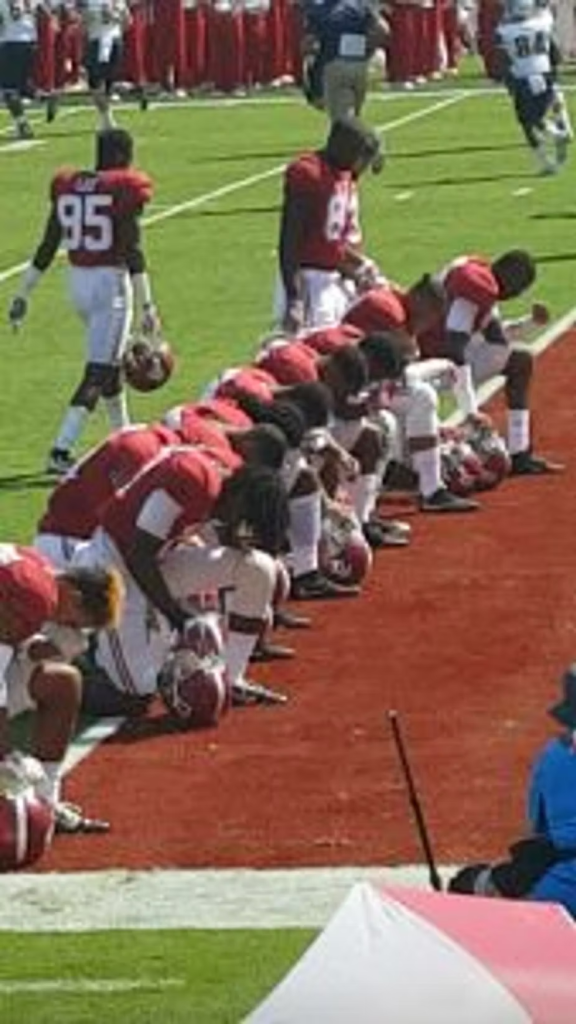
Please let us destroy the other team for the glory of a pro ball contract. Amen

Seen in that light, James was saying that “prayer” was the answer to setbacks that are the result of evil deeds. While prayer can help ease one’s pain from wounds, scrapes and bruises, medical treatment is God’s gift to mankind, knowledge allowed to be used as physical treatments for physical maladies. The mental damage of sins, worries, guilt, and the pressures of life’s hardships, however, makes prayer be the prescribed remedy.

It is also important to read the words, “any among you,” knowing that James was not writing a letter blankly to all humanity. His congregation was Jewish, in particular those who accepted Jesus as their Messiah. They did not accept James as their holy leader, meaning as a subsequence they accepted Jesus within themselves, like James had. Instead, they accepted Jesus Christ into their souls, due to James evangelizing to them, so all were reborn as Jesus Christ, servants of the Lord. This is, therefore, to whom James referred prayer, as all humanity regularly suffers from evil afflictions; but whereas common Jews did not know how to pray properly, those who were in the name of Jesus Christ were being reminded of the power of prayer that was available to them.

Likewise, when James repeated the Greek word “tis,” which means “anyone, someone, or some people,” the word pointed to “certain ones.” As a question to “certain ones,” stated as “Are you cheerful?” that question, like the first question, was directed at those who were filled with the Holy Spirit.

As a question following the suggestion for prayer at times of mental anguish, when prayers are answered and the sufferings of evil are removed, the natural state is cheerfulness. For those whose prayers have been answered, “They should sing songs of praise.” This, of course, is not a generic song from a hymnal of praises, but a specific song from one’s heart, praising God for having answered one’s specific prayer.

The hymnal holder has been replaced by arm rests with cup holders. Now you just follow the bouncing ball on the big screen.

This then leads to the question, “Are any among you sick?” where, again, the use of “tis” implies Jews in the name of Jesus Christ. The question says that sickness is a common affliction that occurs in all human bodies. Some viruses and infections can have the effect of removing the soul from the body, simply to separate a soul cleansed of sin from a mortal body in the process of breakdown. This separation can keep the human brain from thinking thoughts of prayer, because the soul is disconnected from the pains of a sickness.

In these cases, the elders (those “certain ones” who lead “certain ones” in gatherings) should be called to pray for the one needing prayer. This is a case where a “church” (“ekklēsias”) was understood to be “an assembly” (gathering) of members, who are all in the name of Jesus Christ.

That is stating the family relationship that comes from all Christians being reborn as the Son of the Father, so they have all taken on the name of Christ as Christians. This is then stated in verse 14 where it says, “anointing them with oil in the name of the Lord.”

While that is a viable translation, the scope of meaning that comes from the literal Greek makes this more powerful when it says, “giving shares of penetrating comfort to impart healing [aleipsantes] themselves [auton] with the indwelling of the Holy Spirit [elaiō] manifesting the character [onomati] of the Lord.” This becomes a viable translation of the intent, based on the words chosen.

If you needed surgery, you would not like to find out a bunch of actors were pretending to be your doctors; so if you need prayer, it always helps to have real priests of God surrounding you, not actors.

This healing is then done by those empowered by the Holy Spirit of God, using prayer as their personal call for divine assistance.  This is holy work done by the “elders” (“presbyterous”), who have been reborn as Jesus Christ longer and spread the Holy Spirit to more others more often, thus teaching those taught and healing those who cannot use the Holy Spirit to heal their own bodies. Family does not simply smear oil on the foreheads of Christians and pray a generic prayer book prayer for a soul to return to a healed body.

That would be a prayer of belief, where a book told one what to say and what to believe. That is what an institution or organization does. James, however, said that elders offer a “prayer of faith” (“pisteōs”), which is a prayer “received from God, and never generated by us.” A prayer of belief offers “confidence,” which is from a human perspective – the self-brain. That is, therefore, generated by the one believing in prayer, without true faith. A prayer of faith is a prayer from one who has Jesus Christ speaking through him or her, as an extension of God in an Apostle.

This is why James then added, “A prayer of faith will save the one ailing.” Again, when one is sick and incapacitated, unable to offer prayer, it becomes the one(s) who send collective prayer from the Christ Mind to the Holy Spirit of the sick Apostle. That intercession calls upon God for salvation. James then said, “The Lord will raise them up.”

The Greek word “egerei” is used, which is the future active form of “egeiró,” translated as “will raise up.” It is then important to know that the word is implying strongly (and can be directly translated as) “will wake us.” This is where one needs to realize that the implication of James asking, “Are any among you sick?” the meaning was, “Are any of you dying?”

The word translated as “sick” is “astheneó,” which (if not used to denote one being morally ill, which an Apostle would not be) means in a state of feebleness and weakness. Therefore, “save” and “raise up” have a meaning that intercessory prayers by the elders are to request the Lord to receive the soul of an Apostle in Heaven; but if the soul has more use on the earthly plane, the Lord can reconnect the soul to the body and awaken the body and soul back to life … and back to health.

This aspect says the elders gather (as Apostles in the name of Jesus Christ) and offer prayers that would request God forgive any sins the sick person might have committed prior to his or her illness, because that person might have become unable to plead for forgives personally. This is why James added, “Anyone who has committed sins will be forgiven.”

It is important to realize that James did not give a blanket “Get out of Sins Free card” by those words. They are written about one having fallen gravely ill and in need of fellow Apostles to intercede for that soul and body.

When the translation above has James saying, “Confess your sins to one another,” the Greek written better translates as, “Confess therefore yourselves the sins,” where the Greek word “allēlois” is the dative plural form of “allélón.”  That says confession can only bring forgiveness from God. Therefore, all Apostles should admit their sins freely to God. This means James was foremost giving the instruction to keep one’s personal sins at a minimum; but when one does sin, the confession (among all Apostles, each other, one another, themselves) must be to the LORD.

Certainly, it is the presence of the Christ Spirit within one that reminds one of sin, so the shame of guilt should be to confess before Jesus Christ, who is merged with one’s soul.  So, that petition is set before God for forgiveness by the Christ Spirit as sincere. To then admit one’s sins to other Apostles should only be to admit the flaws of the human condition and praise the forgiveness that God has shown.  Confession to others can only be done by those (giving and receiving) who model the life of Christ, which became the life those have lived in return for God’s forgiveness of sins.

What? Again?

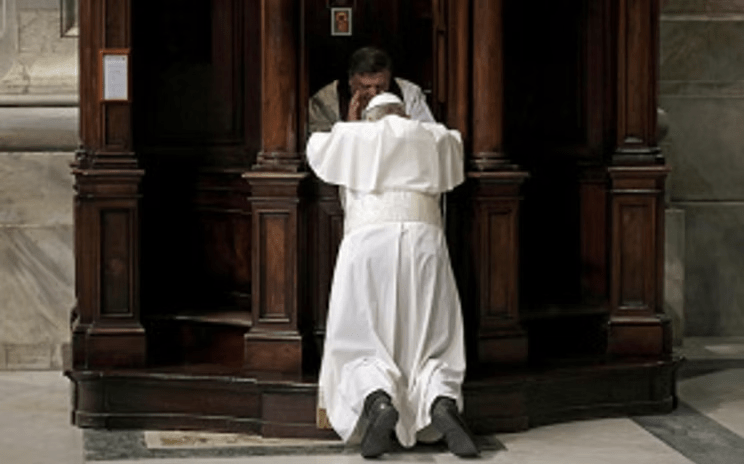
The confessional in a private booth, between one who is not an Apostle and a priest who is, cannot have penitence given by that Apostle. Such confession should bring forth a recommendation that the sinner establish a life that pleases God; as that is the true path to forgiveness. Confession to a priest who is not filled with the Holy Spirit means sinners will not be led toward a life devoted to God.

When James then said to “pray for one another,” this is of course what Apostles do within the gathering of Saints.  That is the purpose of a Church (not a building). Still, when the series of segments began with a confession of sins “yourselves” before the Lord, that confession is now being said to be through prayer. Prayer is one taking to God.

Each Apostle is advised to pray often. Since Saints are more often apart than together, confession of sins and daily prayer are developing the Father-Son relationship each needs.  This daily communication is part of the training process for an Apostle, as through prayer one develops an ability to see, hear, and touch the answers that come from God as subtle signs and whispers of insight.

When James then added, “so that you may be healed,” the Greek word “iathēte” is a statement about prayer as a routine maintenance for the body. It is a word stated in the conditional voice, where the result is not guaranteed; one understands that.  It asks God to protect one from physical disease and spiritual misdirection.  God will respond as is necessary for God’s Will to be done.

An Apostle-Saint is a soul sought by Satan, so lures and traps (stumbling blocks) are to be expected, as well as avoided. Prayer enlightens one to steer clear of such pitfalls. Routine prayer is then done to beg for forgiveness for having fallen into one of Satan’s traps and to learn to spot a trap before any damage is done. This two-way communication with God keeps one healthy and able to help lead others to the same healthy relationship with God, reborn as Jesus Christ.

James then made the statement, “The prayer of the righteous is powerful and effective.” The literal translation shows this as, “Much prevails [the] prayer of a righteous [man] being made effective.” There is more to this than might initially meet the eye.

The Greek word “ischyei” comes from “ischuó,” which states an “ability” that is “strong” and “powerful.” The point being made by James is that “prayer” having been fully developed in one becomes the “power” of the “righteous.” Hand-in-hand, “prayer” is the “power” that makes one “righteous.”

The word “energoumenē” is then a form that focuses on the “work” that is associated with “righteousness.” This is (in the present participle of “work”) “being made” in those “righteous,” coming from God.  This is the building of one’s relationship with God, such that it strengthens and becomes more powerful over time.  The more one acts for God, the more one is “being made effectively” into what deems one “righteous.” Those acts done are led by the influence of God, through the Christ Mind, so one willfully follows. Everything is “powered” by “prayer.”

James then gave the example of Elijah, when he wrote, “Elijah was a human being like us, and he prayed fervently that it might not rain, and for three years and six months it did not rain on the earth.” This begins with a statement that Elijah was not born righteous. He was just like all the Jewish Apostles that James knew, being a man of flesh and blood, alive with a soul breathed from God.

Elijah became righteous because he heard the voice of God and listened.  Following that guidance, Elijah  developed a powerful ability to call upon the Lord through prayer.  That powerful ability effectively made Elijah the most highly revered prophet in Israelite history.

James further explained how Elijah “prayed fervently that it might not rain, and for three years and six months it did not rain on the earth.” Elijah did not cause it not to rain. God answered the prayers of Elijah, which extended over three years and six months.  Each day Elijah was praying daily to God.

The word translated as “fervently” comes from “proseuché,” which means “a place for prayer.” Since this was prior to buildings of prayer (synagogues) in Israel, Elijah was himself the place of prayer to God. Therefore he prayed to God daily, more than once a day, wherever he went.  Elijah had developed the Father-Son relationship that a prophet must have.

That is the power of prayer. It links God to the servant, making the servant as powerful as God sees His servant needs to be. It should be realized that the Father is the Master and the Son is the willing slave.  This does not imply an abusive relationship, but a necessary one between a Teacher and an Apostle.  The student must prove an ability to demonstrate what has been taught.  Therefore, God saw the righteousness of Elijah’s prayer for drought, and He granted the wish.

The land of Israel had become overrun with wickedness. When we then read that “Then [Elijah] prayed again, and the heaven gave rain and the earth yielded its harvest,” this says the land had seen the error of its wicked ways and turned back to God. The prayers of Elijah were joined with those of others who had been denying God their devotion. Therefore, when we read, “the earth yielded its harvest,” this was more than vegetables growing from the land. The people of Israel had repented and returned to praying to God.

The Festival of Sukkot is a God-commanded observance of the earth’s harvest – in plants and children of God.

That ending brought by Elijah is then turned by James towards his audience. As male Jews who he addressed, He called them “Brothers of mine,” which is a statement of all Apostles being “Brothers” in the (masculine) name of Jesus Christ, the (masculine) Sons of God. All Jewish females then, those who had been filled with the Holy Spirit and made Apostles, were also included in this address as “Brothers.” James said to them all, “If anyone among you wanders from the truth and is brought back by another, you should know that whoever brings back a sinner from wandering will save the sinner’s soul from death and will cover a multitude of sins.”

That means that just like Elijah brought back all the sinners of Israel by prayer to God, then the same expectations are in themselves, set by God for them. As the embodiment of the resurrected Son of God, each of them had the same powers of prayer as did Elijah. All were as righteous in their paths as was Elijah. All the Apostles were sent forth into Israel (then Judea and Galilee, et al.) to “bring back sinners from wandering,” just as they were once wandering sinners, saved by accepting Jesus Christ as the Messiah within their soul.

Each of the Apostles had been brought back from the death of their self-egos and the potential of losing their souls to hell.  They were saved because God forgave them all their sins. They were then expected to be like Elijah and pray to God for the great powers that will lead sinners to penitence.  The same expectations exist today.

As the Epistle selection for the nineteenth Sunday after Pentecost, when one’s personal ministry for the LORD should be underway – one has found the value of daily prayer as a way to care for others – the message here is to talk to God as part of developing a life of righteousness. One has to see God as the Father, which is a close personal relationship between the child (Son) and its parent, more than seeing God as the Creator of all and distant through His greatness and invisibility.

It should be realized that James was the brother of Jesus, as the son from Joseph the carpenter’s loins. James was a follower of Jesus, as a family member, but he was not a disciple who saw Jesus as a teacher. The disciples asked Jesus to teach them how to pray, which is an indication that prayer was not taught by the rabbis in the synagogues. Despite being taught the Israelites were the children of God’s choosing, they were not told how to see God as a loving progenitor.

This is why Jesus immediately told his disciples to pray by first identifying the Lord as “Father” (Luke 11) or “Our Father in heaven” (Matthew 6). Today, there is the repetition of a set grouping of words called “The Lord’s Prayer.” This is not what Jesus told his disciples to recite. Rotely repeating the words of Jesus aloud in church is missing the point of Jesus teaching his disciples, using the words recited, that prayer is a son asking his Father for that which is needed.

A Son asks the Father for insight each and every day (daily bread). He asks for forgiveness of his sins done and to release his angers in his heart for other sinners. He asks his Father to keep him from being swayed by the temptations of evil. In this reading from James’ letter, he followed that model without repeating the words of The Lord’s Prayer.

This says that the Jewish Apostles to whom James wrote understood the intent of Jesus’ teaching his disciples how to pray. As those filled with the Holy Spirit and reborn as God’s Son, they all felt in their souls a close personal relationship with God, as each of them was the Son of the Father. This is not the case of Christians in pews, if they do not feel the same closeness with God.  Many fail to contact Him daily, so many fail to live righteous lives.

Jesus did not recite “The Lord’s Prayer,” as he was simply giving instructions as to what sons should ask of their Holy Father [not a pope]. After speaking those famous words, few are taught to remember how Jesus then told his disciples the explanation behind those words.  Jesus said:

Ask and it will be given to you; seek and you will find; knock and the door will be opened to you. For everyone who asks receives; the one who seeks finds; and to the one who knocks, the door will be opened.”

Jesus continued: “Which of you fathers, if your son asks for a fish, will give him a snake instead? Or if he asks for an egg, will give him a scorpion? If you then, though you are evil, know how to give good gifts to your children, how much more will your Father in heaven give the Holy Spirit to those who ask him!”” (Luke 11:9-13)

Jesus explained that the way to pray was to speak to God as one’s Father in heaven.

More importantly than an instruction to “say after me,” Jesus told his disciples to pray to God for help – help for strength amid weakness, help for others in need – because the Father listens and will not refuse His Sons. However, if the only prayer one knows how to say is “The Lord’s Prayer,” God listens and then says, “Yada, yada, yada. But what do you want specifically. TALK TO ME!”

[“Yada” is the Hebrew word meaning, “I know.”]

Seeing this relationship – this entrance into the family of God, as His Sons (regardless of human gender) – is where one needs to realize prayer is not for selfish needs. Parents will know how their children quickly learn the word “gimme.” They incessantly repeat that word – “gimme, gimme, gimme, gimme, gimme …” – without really wanting anything specific. They scream for self-satisfactions, which are rewarded whenever parents actually give the child what it screams for, just to make it stop begging.

Humans are like our own children, as we love to see what we can get for nothing.  Humans are also like our own parents, as we love to make our kids happy, even if it means doing without personally.  This is how we can call God the Father, because God (like dad, more than mom) knows how to turn a deaf ear to the brains of selfishness.  Instead, God listens to hear what our hearts desire.

This is why one has to die of self-ego, in order to become married to God the Husband (to all human gender wives) and begat His Son in each – Jesus Christ resurrected.  We have to become one of the family.  We have been adopted as believers in Jesus as the Christ.  We come into the family as the children of God.

The rebirth of God’s Son means a serious growth development in the child, where the asking is not for selfish demands, but petitions for a better world. Prayers submitted through the Christ Mind are for healing purposes and church gathering support.  They are not self-serving, but to gain God’s health in the body of Christ – the whole (Church) and the individual (an Apostle-Saint).

True prayer, such as James wrote of in his fifth chapter, is for those who have matured in Christ. It asks God to give an Apostle the strength and stamina to become a reflection of the Father to the little children on earth.

Esther 7:1-6, 9-10; 9:20-22 – Saving others as God’s Queen

The king and Haman went in to feast with Queen Esther. On the second day, as they were drinking wine, the king again said to Esther, “What is your petition, Queen Esther? It shall be granted you. And what is your request? Even to the half of my kingdom, it shall be fulfilled.” Then Queen Esther answered, “If I have won your favor, O king, and if it pleases the king, let my life be given me– that is my petition– and the lives of my people– that is my request. For we have been sold, I and my people, to be destroyed, to be killed, and to be annihilated. If we had been sold merely as slaves, men and women, I would have held my peace; but no enemy can compensate for this damage to the king.” Then King Ahasuerus said to Queen Esther, “Who is he, and where is he, who has presumed to do this?” Esther said, “A foe and enemy, this wicked Haman!” Then Haman was terrified before the king and the queen.

Then Harbona, one of the eunuchs in attendance on the king, said, “Look, the very gallows that Haman has prepared for Mordecai, whose word saved the king, stands at Haman’s house, fifty cubits high.” And the king said, “Hang him on that.” So they hanged Haman on the gallows that he had prepared for Mordecai. Then the anger of the king abated.

Mordecai recorded these things, and sent letters to all the Jews who were in all the provinces of King Ahasuerus, both near and far, enjoining them that they should keep the fourteenth day of the month Adar and also the fifteenth day of the same month, year by year, as the days on which the Jews gained relief from their enemies, and as the month that had been turned for them from sorrow into gladness and from mourning into a holiday; that they should make them days of feasting and gladness, days for sending gifts of food to one another and presents to the poor.

———————————————————————————————————-

This is an optional Old Testament selection from the Episcopal Lectionary for the Nineteenth Sunday after Pentecost, Year B 2018. In the numbering system that lists each Sunday in an ordinal fashion, this Sunday is referred to as Proper 21. If chosen, it will next be read aloud in an Episcopal church by a reader on Sunday September 30, 2018. It is important because the story of Esther saving her people from being executed wrongfully, in Persia, is symbolic of redemption by God, brought on by prayer.

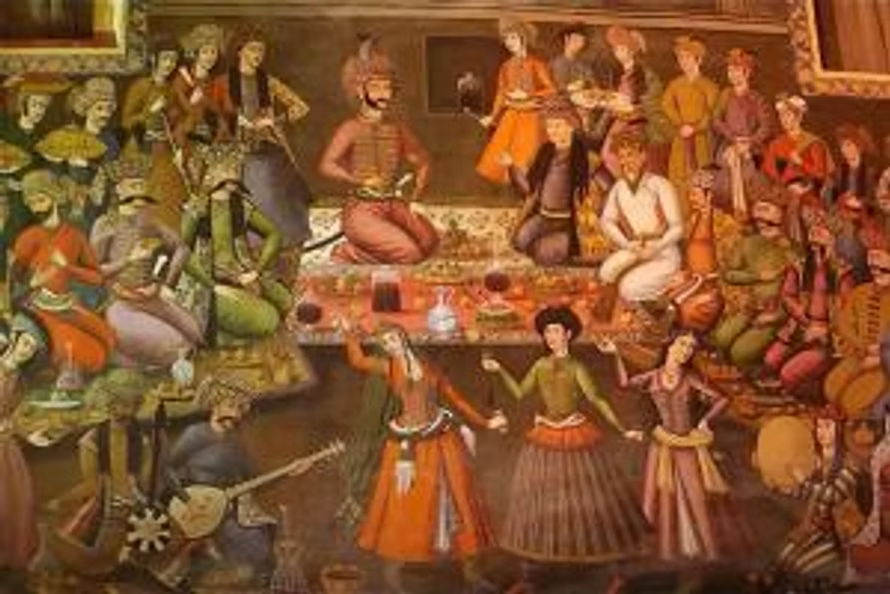
In this story, we are told, “The king and Haman went in to feast with Queen Esther.” This feast is unnamed, but scholars believe it aligns closely (although not exactly) with the Persian-Iranian celebration called Nowruz, which is the Persian New Year (“New Day”).

Happy Nowruz!

That is on the day of the Vernal Equinox, or the first day of spring (March 21). Because the fourteenth and fifteenth of Adar align with the full moon during the last month of a Hebraic year (February-March), this would be within a couple of weeks prior to the beginning of spring. As the Book of Esther is one of value to the Judaic people (not the Persians), the month of Adar would be representative of their time in Egypt, prior to the Exodus, meaning this feast of the full moon would be recognized twenty-eight days before the Passover full moon (a lunar cycle).  The reason for recognizing Purim then would fit the timing in a year when the emotional judgment of Moses was found challenging Pharaoh for the safety of the Israelite people.  The plagues upon Egypt were to spare the Israelites, just as would Xerxes I’s execution of Haman save the Jews in Persia.

It is important to realize that (in the story told in the Book of Esther) the king of Persia did not know the religious practices of his wives, including Esther. Xerxes I had approved a plan by Haman to execute all the Jewish people in Persia, because he was told they refused to abide by Persian laws.

When we read that Esther told the king: “If I have won your favor, O king, and if it pleases the king, let my life be given me– that is my petition– and the lives of my people– that is my request. For we have been sold, I and my people, to be destroyed, to be killed, and to be annihilated. If we had been sold merely as slaves, men and women, I would have held my peace; but no enemy can compensate for this damage to the king,” that was news to Xerxes I (a.k.a. King Ahasuerus).

Esther, most likely, was one of many queens of Ahasuerus, as kings were expected to have many sons.  After the king’s prior wife, Vashti, refused to appear before the king and dance for him, he ordered for other women to choose from.  Esther was one of many young women who were then called to dance for the king, with the king choosing Esther based on her beauty and seductive dance moves. Her religious beliefs were the last thing on Xerxes I’s mind when he had sex with Esther afterwards.

It was then this sexual intercourse that forever bound the king to a queen, as intercourse was for the purpose of impregnating a woman with a child of the king (hopefully a son). As such, the designation of Esther as “queen,” is less about her having been given great powers of royalty and more about her being the “wife” of the King of Persia.  She was a mother-to-be in that role.

In chapter 2 of Esther, we see that Xerxes I took Esther as his wife in the tenth month (Anāmaka – December-January) of his seventh year of reign. He fell so in love with Esther that he took the crown away from Vashti and placed it on Esther’s head. He then planned a feast for Esther, which might mean he dedicated the feast of the New Day (Nowruz, on March 20 – 21) as when she would be recognized as the new queen. A two month window would give dignitaries time to travel to Susa for the feast.

“Events mentioned in the Old Testament book of Esther are said to have occurred in Susa during the Achaemenid period.” – Wikipedia

That timing of a standard two-day feast with the celebration of a new marriage would have been to symbolize the newness of the sexual encounters between the king and his new wife.  Expectations of a new child would be set so the kingdom could celebrate the coming of a new heir. This explains why the king offered to give Esther anything she wanted.

When Esther told Xerxes I, her husband, “my people” were “to be destroyed,” he did not know Esther’s people were the Jews that Haman had gotten approval to kill.  His approval had led Haman to build a gallows on his property, upon which to hang those who would not comply with Persian law. Mordecai was a trusted advisor to the king and the uncle of Esther, had overheard this plan and told his niece.

When we read that Mordecai pointed out the newly built gallows to Xerxes I, that visual immediately angered him to act.  Haman was ordered to be executed as the criminal, hung on the gallows he had built. That then led to the beginning of the Jewish recognition of the Feast of Purim.

The Hebrew word “Purim” is rooted in “pur,” which means, “lots,” as a form of “sortation” or “casting of lots” [confirmed via the aside “goral“).  In Esther 9:24 (not part of the reading selection) one finds written, “For Haman son of Hammedatha, the Agagite, the enemy of all the Jews, had plotted against the Jews to destroy them and had cast the pur (that is, the lot) for their ruin and destruction.” This means the name of the feast denotes how Haman took a gamble that his will would be done, through deceit and trickery. Haman ‘rolled the dice’ and he ‘crapped out’.

Rut roh.

The Jews celebrate that luck was on their side; but they attribute their luck as the Will of God.

As an optional Old Testament reading selection for the nineteenth Sunday after Pentecost, when one’s personal ministry for the LORD should be underway – one has been saved from the soul’s death plotted by Satan – the message here is to serve God as a loving wife, accepting His gift of a queen’s (Apostle’s) wish being granted. Just as Ester used her wish to save her people (her life was not in danger, as queen), God will protect those who serve Him. He will do this through His wives being elevated in His Spirit.
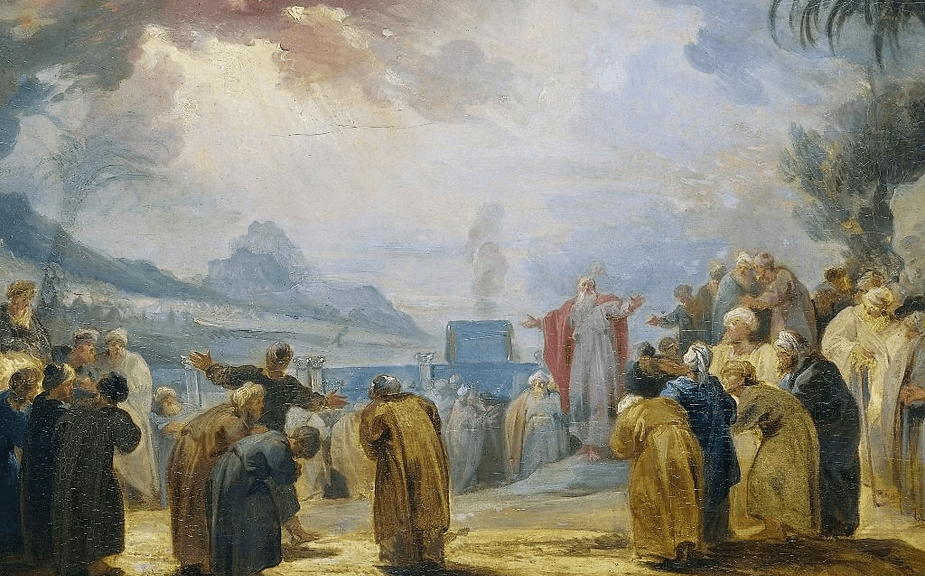
In the recent past we have discussed the Proverbs song about “a good wife.” Esther demonstrated those qualities in the way she impressed King Ahasuerus to love her and protect her. This symbolizes how all Apostles (males and females) should likewise impress God, so He loves us and protects us in the same manner.
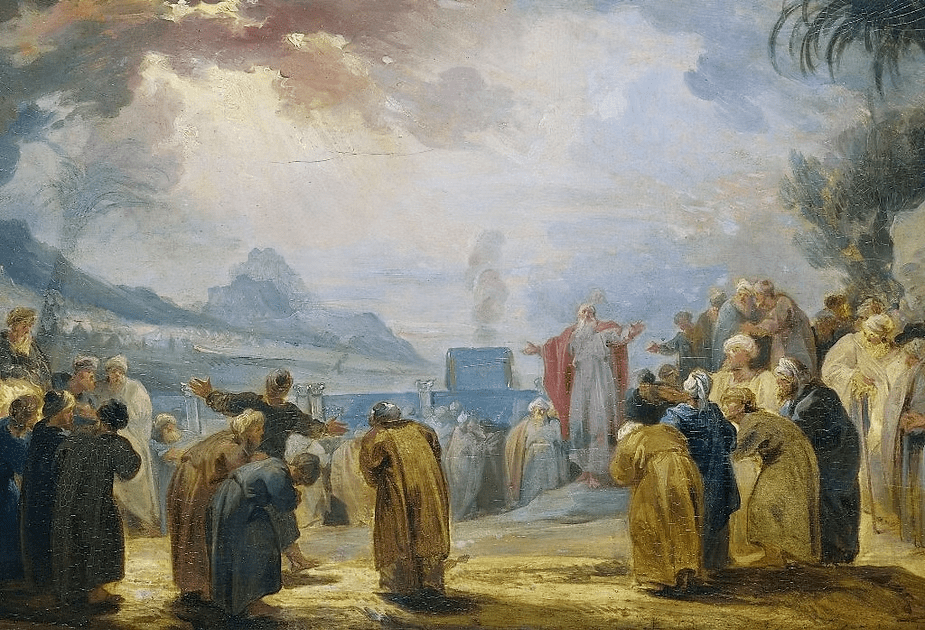
The Jews of Persia, whose ancestors had been taken into exile by the Babylonians, had been freed by the Persian King Cyrus the Great, with he and his son Darius the Great rebuilding the Temple in Jerusalem. The Jews who went to Persia did so voluntarily, as willing servants to those who freed them, not as captives and slaves. In that way, all the Jews of Persia had submitted to the kings who had set them free.

Sure, we work for a living; but we don’t mind work because we get paid for our voluntary service. “Slavery” is a way of life and we love our work.

In the Epistle reading chosen to accompany this Old Testament reading option, James wrote of prayer being the way to end suffering, to bring cheerfulness, and to raise up the sick. This is then the lesson that Jesus taught to his disciples, when they asked him to teach them how to pray. Jesus told them to see God as their Father, where they ask Him for strength and miraculous powers of salvation. Jesus said, “If you ask you shall receive.” This is now seen in the story of Esther.

Esther had developed a relationship with King Xerxes I, as his wife. He then offered her the benefits of his power. All she had to do was ask, which she did truthfully. She begged the king to save her people, and out of love he answered her prayer. Esther is then symbolic of every Christian.

Like all Christians, we volunteer to serve the Master, because God has freed us from the oppression of worldly addictions that once enslaved us. We live in an earthly realm that is distant from heaven, devoted to living lives as piously as we can, resisting laws that demand we turn our backs to God. We are all called upon to dance before God, to show our willingness to do acts that will impress God with our loyalty to Him. This, in turn, excites God and leads Him to propose marriage. Christians are then put in a position to choose to please God by becoming His Queen (regardless of human gender). A “Queen” means being an Apostle of the Lord. That then makes us become the wives of God, bearing Him children that are all in the name of Jesus Christ.

Christians must have this willingness to love and serve the Lord our God unconditionally. It is that devotion that leads us to communicate directly to God, rather than see God as some unapproachable deity that is too great to care about us individually. We must see how God cares deeply for each of us who marry with Him and serve Him daily.

As the wives of a most powerful God, He hears our pleas for help, especially when those pleas are for others in need. Because of a relationship of love, God, the Father of the resurrected Son within us, will grant our requests. That favor will not only save many others, but it will grant each soul that is united with the Christ Spirit eternal salvation. That eternal celebration is then why Purim was commanded to forever be recognized.

It is also important to see how Esther, as a Jew, sacrificed herself before King Ahasuerus. She was willing to sacrifice returning to the land of Judah and Jerusalem, choosing to give up that option of self-importance, brought by returning to the land where Cyrus the Great had allowed Jews to openly serve their God again. By choosing to stay in Persia and dance before the Persian king, she had opted to live among Persians who served one god, under a different name (Ahura Mazda). That sacrifice of self is then symbolic of one’s sacrifice of self-ego, in order to serve divine will.

Christians often find the Book of Esther and her story as one that the women of the church can most readily identify with. Study groups composed only of women, led by female priests or pastors, see Esther as representative of a feminine only relationship with God.

Men do not try to crash those study groups, demanding equal rights under the Laws of Christianity, as they are comfortable with not having to understand Esther, Ruth, Deborah, the Queen of Sheba, or any other female character in the Holy Bible. Gender-based religious study represents the ways of denial, denying one’s self as being exempt from certain Scriptural stories.

Refusal to believe that stories involving women have anything to do with men is projecting the perceived importance of the male human body (or a female body), denying it is surrounding an asexual soul. It is no different than both sexes of Christians refusing to see themselves as the Pharisees, Temple scribes, or even Haman, here in the Book of Esther.  This becomes part of the problem that keeps all Christians from seeing Esther as himself or herself.  Christians must identify with all Biblical characters, in order to see the errors of all mortal ways.

In the accompanying Gospel message from Mark, we are told how John of Zebedee admitted to Jesus, “We saw someone casting out demons in your name, and we tried to stop him, because he was not following us.” (Mark 9:38)  See if you (regardless of human gender) can read those word told to Jesus and grasp them as capable of being restated now as, “We read of some woman was casting out demons in Persia, and we ignored her because we are men and she was female.”

Jesus later said to his male disciples, “Whoever gives you a cup of water to drink because you bear the name of Christ will by no means lose the reward.” (Mark 9:41)  Can that not also mean, “Esther presented the reader a cup of living water to drink because understanding that message means being reborn with the Christ Mind, whether in a male or a female form, so the reward of faith is gender nonspecific”?

Seeing Esther as a projection of one’s faith, through a personal relationship with God (as His Queen), means human sexuality is of no bearing.  She represents any and all who would be asking God to help others; and then, seeing that help comes through divine means is how God uses people of power to do His Will.

Hopefully, this element of marriage to God and bearing His Son as the responsibility of ALL Christians (males and females) can be grasped. This is why Esther was written and is read in Year B’s lectionary – a year when good wives and marriage to God is a pronounced message. Sacrifice of self-ego and submission before God is not something only one gender of humans are called to do.

———————————————————————————————————-

There are parts of this reading referenced in a sermon I presented in September 2017, posted on my previous blog.  On my old defunct website I also had published these “notes” below.  You might notice I utilized some of this in the above post.

Notes: (For Esther reading)

“We pick up the story of Queen Esther without knowing anything about her.  I feel it is important to see last week’s Proverbs 31 reading (about a capable wife) as leading to this story of a capable wife … a queen to a king.  The story told today, where we read, “they should keep the fourteenth day of the month Adar and also the fifteenth day of the same month, year by year,” tells of the first Jewish holiday known as Purim.  The word “purim” means, “lots,” as a form of “sortation” or “casting of lots.”  As such, Queen Esther (and her uncle Mordecai) gambled that exposing the truth would pay off and save the Jews of Persia, which it did.

When last week’s meaning is seen as a call for all believers in God to become joined with Him, as the truest form of marriage – God seated in one’s heart – one can now see God as the king, such that all of God’s faithful wives are queens.  We have a subservient place, but it is a place of respect and regality.  Thus, as capable wives to the King (as Christ is our true King, with God the Father), we are allowed to petition the Lord for favor.  Because of our faithfulness and devotion, when our pleas to God are heard, when they are warranted, then justice will be served and prayers are answered.

In last week’s lessons there was the repeated theme of “gentleness,” which would be tested by the evil in the world.  I said our sacrificial lamb characteristic is in our submission before God and Christ.  Still, injustice cries out for justice; and, it is not the place of us gentle lambs to determine what punishment those with evil hearts will find.  The same gentleness is now found in Queen Esther’s request to her husband, King Ahasuerus (Xerxes I), for her life and the lives of all Jews in Persia be spared.  She did not ask for Haman’s death by hanging; but justice came from the king as such.  The fact that Haman was hung on the gallows he had prepared for others is then symbolic of how the sins of others will be the cause of their own rewards, as justice will be served upon all injustices.

Numbers 11:4-6,10-16,24-29 – Crying for attention in all the wrong ways

The rabble among them had a strong craving; and the Israelites also wept again, and said, “If only we had meat to eat! We remember the fish we used to eat in Egypt for nothing, the cucumbers, the melons, the leeks, the onions, and the garlic; but now our strength is dried up, and there is nothing at all but this manna to look at.”

Moses heard the people weeping throughout their families, all at the entrances of their tents. Then the Lord became very angry, and Moses was displeased. So Moses said to the Lord, “Why have you treated your servant so badly? Why have I not found favor in your sight, that you lay the burden of all this people on me? Did I conceive all this people? Did I give birth to them, that you should say to me, ‘Carry them in your bosom, as a nurse carries a sucking child,’ to the land that you promised on oath to their ancestors? Where am I to get meat to give to all this people? For they come weeping to me and say, ‘Give us meat to eat!’ I am not able to carry all this people alone, for they are too heavy for me. If this is the way you are going to treat me, put me to death at once—if I have found favor in your sight—and do not let me see my misery.”

So the Lord said to Moses, “Gather for me seventy of the elders of Israel, whom you know to be the elders of the people and officers over them; bring them to the tent of meeting, and have them take their place there with you.

So Moses went out and told the people the words of the Lord; and he gathered seventy elders of the people, and placed them all around the tent. Then the Lord came down in the cloud and spoke to him, and took some of the spirit that was on him and put it on the seventy elders; and when the spirit rested upon them, they prophesied. But they did not do so again.

Two men remained in the camp, one named Eldad, and the other named Medad, and the spirit rested on them; they were among those registered, but they had not gone out to the tent, and so they prophesied in the camp. And a young man ran and told Moses, “Eldad and Medad are prophesying in the camp.” And Joshua son of Nun, the assistant of Moses, one of his chosen men, said, “My lord Moses, stop them!” But Moses said to him, “Are you jealous for my sake? Would that all the Lord’s people were prophets, and that the Lord would put his spirit on them!”

———————————————————————————————————-

This is an optional Old Testament selection from the Episcopal Lectionary for the Nineteenth Sunday after Pentecost, Year B 2018. In the numbering system that lists each Sunday in an ordinal fashion, this Sunday is referred to as Proper 21. If chosen, it will next be read aloud in an Episcopal church by a reader on Sunday September 30, 2018. It is important because it tells how God gets angry hearing the complaints of His children when they do not get what they want. God promised to deliver what they so wanted; but before He did so He filled seventy elders with the Holy Spirit, so they prophesied the truth of the LORD. This is a lesson that confirms God hears the prayers of His believers, while also being a lesson to be careful what one asks of God.

This is a long reading selection; it is only half of a longer story. I recommend everyone read the whole chapter here. The whole story gives one a view of how God and Moses were tired of the complaining that was going on. In verse four, the translation above shows: “The rabble among them had a strong craving; and the Israelites also wept again, and said, “If only we had meat to eat!” The literal can also state: “And the mixed multitude who were among them had yielded to cravings — and again so wept the sons of Israel and said , who will give us to eat meat ?”

This says the “rabble” (a valid translation of “wə·hā·sap̄·sup̄”) is only part of the whole “collection” of people. As a “mixed multitude,” one can assume there were people complaining loudly in each of the twelve tribes. Not everyone was complaining, but no one could escape the cries of lament.  Whatever percentage that “rabble” amounted to be in numbers (assuming it was a minority), it was their crying and weeping that ignited all of the “sons of Israel” to follow the lead of complainers.

It was like in the nursery of a day care facility, when one baby starts crying, soon all the babies join in. They were crying to be fed; but the babies were no longer satisfied with mother’s milk (manna on the dew). They wanted meat to eat, along with fresh vegetables, which were not available in the wilderness.

In the first three verses of Numbers 11 (not read aloud), the complaints angered Yahweh so much that He burned the outskirts of the camp. This might have been because people were going beyond the boundaries where the manna fell, in search of some other type of food (including forbidden meats). It might also have been because some on the outer fringes were where some children of Israel were running away from camp, attempting to go back to Egypt. Perhaps, God was making sure the Israelites knew where the nation of Israel’s temporary border was, since the Promise of a reward seemed to be the only reason many were ‘tagging along’?  Whatever the reason for God using fire to burn the earth, this is the context from which the “rabble” was moaning and groaning more loudly.

We then read that Moses became aware of the loud cried of complaints coming from the tents of the Israelites. Here, Moses complains to God (another time of several), referring to the Israelites as infants, with him expected to be their mother. This should be read as Moses being the wife of God, with his complaints being those of a wife to a husband.  Being the only adult in a house of demanding babies was frazzling to Moses and not only did the crying become contagious but so too did the anger God felt.

When God told Moses, “Gather for me seventy of the elders of Israel, whom you know to be the elders of the people and officers over them,” this amounts to 5 or 6 elders per tribe. What is not read (from verse twenty-one) is that Moses wondered how God was going to feed six hundred thousand “men on foot,” meaning there were probably a minimum of one million total Israelites, counting men, women and children. That means seventy elders were to be chosen, where each was a leader of about ten thousand people.

The vastness of this number has to be seen in the light of God promising to answer their complaints of no meat by sending in quail, so many that every Israelite would eat meat for a whole month (a lunar month of 28 days), “until [the meat] was coming out of their nostrils, becoming loathsome to them.” (Numbers 11:20)  To gorge a million people each day, that would mean at least two million quail would fly into the wilderness camp and land, to be killed each day!  They covered the entire camp two cubits deep (three feet)!  There were so many the birds had to be taken and eaten, just to make room for more the next day!

By realizing that, the calling of seventy elders to the tent of meeting was not a ‘sweet meet’, so God could try to pep up His priests or some “hang in there,” “attaboys.”  Remember that all had agreed to the Covenant, so being in the wilderness and eating manna was part of that contract.  If you have ever heard the term used that indicates a serious discussion (a reprimand) as a “Come to Jesus meeting,” then you can grasp how God was calling for a “come to Moses meeting,” with God’s cloud of smoke billowing angrily in view.

We then read, “Then the Lord came down in the cloud and spoke to [Moses], and took some of the spirit that was on [Moses] and put it on the seventy elders; and when the spirit rested upon them, they prophesied.” What is not explained fully is what they prophesied, knowing that “to prophesy” means: “To reveal or foretell (something, esp a future event) by or as if by divine inspiration.” [Collins English Dictionary – Complete and Unabridged, 12th Edition 2014]

This was not God impressing seventy Israelite men with His powers to make one dance wildly while singing unintelligible gobbledygook, like speaking in the tongues of fools. It was God showing those leaders the future that cry babying and endless bellyaching was about to bring upon a million Israelites. Since Moses telling them not to worry was not enough, the Holy Spirit on Moses was brushed onto seventy guys so they could see the light of truth that was coming their way.

“They said we’re going the wrong way. How do they know where we are going?”

We are then told, “They did not do so again,” meaning that was the only time those straw bosses would stand in the sandals of Moses and see the responsibility that a Saint bears, as opposed to some diaper crapping baby … the one that controls the overall mood of a nursery filled with about ten thousand babies. One time seeing what was coming was all they would need. The truth they were shown coming was enough to burn an indelible mark of spiritual reckoning in their minds. Call it an epiphany, if you will.  Afterwards, they would wish never to have an ominous future be shown them again.

THAT is the true meaning of a “come to Jesus meeting” … and once is all one ever needs.

When it is written about Eldad and Medad, their names should be understood, as naming them was for that reason. The Hebrew word “eldod” means “God has loved” and “yadid” means “beloved.” Thus, two did not go to the tent of meeting as ordered, choosing instead to remain in the general camp because of “love.”  That hint should remind the reader that Numbers 11 began with the complaints of those who had “strong cravings,” having “yielded” to cravings of desire.

Those two elders were then singled out as not going to surround the tent of meeting with the other sixty-eight on the list of those summoned. Either their love of God had kept them from complaining, so they felt it was a mistake to be called to be scolded; or, they were defiant in their love of complaining to God, refusing to be told to leave the camp. Whatever the case, God chose them to scare the bejebbers out of the Israelites in the camp by prophesying among the common folk, not at the sacred place of the tabernacle and tent of meeting.

[Personally, I like to see them as like an omen of prophets who would be forced to prophesy outside the confines of Jerusalem’s Temple.  That makes them rebels with a cause for God.]

By reading, “A young man ran and told Moses, ‘Eldad and Medad are prophesying in the camp.’ And Joshua son of Nun, the assistant of Moses, one of his chosen men, said, ‘My lord Moses, stop them!’” we see the shock and awe that their prophesying had. Those two were wildly speaking in understandable language, which the common Israelites heard and became immediately frightened to hear them.  Their message was so frightening that even Joshua was scared that two wild and crazy guys running amok and crying out what the future portends could cause a million people to stampede like wile wildebeests.

Moses seems to have gotten a chuckle out of it all, by responding to Joshua, saying “Are you jealous for my sake? Would that all the Lord’s people were prophets, and that the Lord would put his spirit on them!” Moses told Joshua (then a young devotee), “Do not worry is someone else speaks prophecy as I do.  It is always a good thing when a prophet of the Lord speaks the truth.”

[It is worthwhile to remember the Gospel lesson in Mark 9, where John of Zebedee told Jesus that he and the other disciples saw someone casting out demons in the name of Jesus, so they tried to stop him, because he was not a follower.  Jesus said, “He who is not against us is for us.”  Eldad and Medad were not speaking against God.  They were His agents in camp, speaking the truth of God.]

In terms of Moses being the wife of God, with Joshua his teen son who is trying to help mom take care of the babies that are crying, Moses spoke of a relieved mother.  His words said the same as that of a satisfied wife who has spent a full day telling disorderly children.  The prophecy, “Wait until your Father comes home and gets out the belt!” had had little effect.  Now, the quails were coming home to roost (so to speak).

[For those of you who have never experienced corporal punishment, it is at the root of Proverb that says, “Whoever spares the rod hates their children, but the one who loves their children is careful to discipline them.” (Proverbs 13:24)]

We do not read all the gory details of what Eldad and Medad were prophesying, but it follows that the quail came in such large numbers and the Israelites could not walk without gathering them up and preparing them to eat. The meat of the quail would get stuck in their teeth, which began a plague in the camp. That led to the deaths of those who “yielded to cravings.” The dead were then buried there. So many died and were buried that the place was named “Kibroth Hattaavah,” which means “graves of desire.”

[Please see the reason of a baby crying because it is teething.  This is a natural development in a baby’s body.  Teeth are necessary for chewing solid foods. That symbolism is why the quail meat became stuck in the teeth of the Israelites.  Their cries of desire to be fed meat would become the downfall of those who began that “teething” complaint for solid food, no longer satisfied with manna from heaven.]

As an optional Old Testament reading for the nineteenth Sunday after Pentecost, when one’s personal ministry for the LORD should be underway – one should have grown up and learned to stop complaining about one’s desires not being met by God – the message here is that cold chill that runs down one’s back when one realizes one just made a huge mistake. There is no way out of the punishment in the future, because one has a whipping’ coming and it will not be pretty.

As I was preparing to write this, I was distracted by the atrocity that was a slanderous claim made by a questionable woman, against a Supreme Court nominee. A hearing was held that was like a three ring circus [four when you count the sexual abuse lawyer as a side act]. The woman making claims of sexual misconduct [call it whatever you will] were clearly motivated by political reasons, with no evidence produced that would ever be upheld in a court of law.  One political party approved the reputation of one man to be smeared, just to buy time, hoping the future will bring them their cravings for power returned.  They were teething for the meat of America, which comes from control of the government.

The whole affair played out like the crybaby Israelites raising a stink about wanting fish, cucumbers, melons, leeks, onions, and garlic, like they once enjoyed back in Egypt. Egypt was the warm, fuzzy feelings of a prior administration, having forgotten that service to Yahweh means getting off one’s knees and stop bowing to the leaders of a nation.  Rather than a bunch of rubes being pulled out into the wilderness by God and His wives Moses, Aaron, and Joshua, this was a bunch of crybaby Democrats who were remembering the times past, when they controlled the House and Senate.

The whole nursery was wailing!

Certainly, the government established by the Constitution of the United States of America is not to be compared with Moses and the Laws given to him by God. The people of America are not priests that have been chosen by the One God [Yahweh]; they have been promised nothing. While the Congress is an equally inept group of elders [most appearing to be over seventy years of age, judging by the wrinkles], and the citizens of the U.S. of A. are a collection of people, divided into mixed multitudes [paid by some mega-billionaire, here or there, to be called either Democrat or Republican], there is nothing about America that compares to the Israelites in the wilderness … other than their dirty diapers, red faces, crocodile tears and leather lungs of desire.

If this country were to be truly Christian [ha ha ha ha … a Theocracy!] it would have to have the same “Come to Jesus meeting” as this story tells. There would have to be leaders screaming, “We are going to die if we do not change!,” causing great fear in the populace.

Then, those one-time prophets would be judged by all the philosophers, statisticians, atheists, and Baptists as actually being true prophets, because those prophecies of coming doom and gloom would have all come true exactly as foretold. So many people would have to die to prove a Prophecy of God that they would have to rename the United States of America the “Dead Zone” or “Graveyard of Doubters.”

[Aside: The actual purpose of prophecy is to: 1.) Listen; 2.) Believe; 3.) Perform Acts of Faith to Change; 4.) Avert the Foretold Disaster; and 5.) Prophesy … that the disaster is still actively in the future, if the changes fall apart and revert to the ways that brought the first Prophet to prophesy.  Thus, a true prophet’s prophecy might not come true IF people actually follow steps 1, 2, and 3 above.]

I imagine news of those deaths befalling Americans would further embolden America’s enemies, causing them to keep piling on the death. Remember, God would not be protecting us 350-million sinners, just because we called ourselves Christian. The moral of this story in Numbers 11 is God gets angry listening to the prayers of those who say they will follow His Laws and then wallow in sin, crying, “I’m dirty again daddy!”

Watching the hearings on television today made me sick to my stomach. It is hard to defend America as a Christian nation, when a man [at least publicly professing] said to be a life-long Christian had so much filth thrown on him by politicians who want to glorify their rank with the epitaph on their tombstones that says, “I kept it legal to kill fetuses … to tear asunder what God had joined together.”

God really does not care if America is just another pagan nation, like so many others on this planet. God does not care is governments reflect the evil hearts of the people.  God has not become angered by the desires and cravings of Americans, so God has not scorched the earth on the outskirts of the United States of America as if saying, “This is My turf!  It is sacred ground.  Take off your sandals of selfishness!”  Instead, God chooses those who willfully leave that insanity behind them and submit to the Will of the Lord.  God chooses those who choose Him and understand the wilderness is symbolic of self-sacrifice.  However, I think God gets mighty angry at those who say, “I love God!” and then do nothing that bears that claim up with verifiable evidence.

It seems to me to be “Every man to himself!” Sorry ladies. Let me add, “Every woman for herself!” too. We are all about self, not self-sacrifice for a higher goal. Half the people cheer one political party, while jeering the other.  The other half does the same thing in reverse.  Where are Eldad and Medad … the lovers of God?

I am sure there are small pockets of families that try to live righteous lives, somewhere in the world; but it seems less likely that the sell-out God demands is impossible to be found in a place where an I-Pod is in every hand, chips are implanted in stiff necks, and barcodes are tattooed on the wrists of people claiming to be Christians.  Being “Made in the U.S.A.” is no longer a birthright of righteousness, but a mockery of God.

God help us all. The zombie reality is here.

Esther 7:1-6, 9-10; 9:20-22 – Queen for a day

The king and Haman went in to feast with Queen Esther. On the second day, as they were drinking wine, the king again said to Esther, “What is your petition, Queen Esther? It shall be granted you. And what is your request? Even to the half of my kingdom, it shall be fulfilled.” Then Queen Esther answered, “If I have won your favor, O king, and if it pleases the king, let my life be given me– that is my petition– and the lives of my people– that is my request. For we have been sold, I and my people, to be destroyed, to be killed, and to be annihilated. If we had been sold merely as slaves, men and women, I would have held my peace; but no enemy can compensate for this damage to the king.” Then King Ahasuerus said to Queen Esther, “Who is he, and where is he, who has presumed to do this?” Esther said, “A foe and enemy, this wicked Haman!” Then Haman was terrified before the king and the queen.

Then Harbona, one of the eunuchs in attendance on the king, said, “Look, the very gallows that Haman has prepared for Mordecai, whose word saved the king, stands at Haman’s house, fifty cubits high.” And the king said, “Hang him on that.” So they hanged Haman on the gallows that he had prepared for Mordecai. Then the anger of the king abated.

Mordecai recorded these things, and sent letters to all the Jews who were in all the provinces of King Ahasuerus, both near and far, enjoining them that they should keep the fourteenth day of the month Adar and also the fifteenth day of the same month, year by year, as the days on which the Jews gained relief from their enemies, and as the month that had been turned for them from sorrow into gladness and from mourning into a holiday; that they should make them days of feasting and gladness, days for sending gifts of food to one another and presents to the poor.

——————–

This is the Track 1 “First Reading” selection that might be selected to be read aloud on the eighteenth Sunday after Pentecost [Proper 21], Year B, according to the lectionary for the Episcopal Church. If this reading is chosen, it will be paired with one from Psalm 124, which sings, “If Yahweh had not been on our side, when enemies rose up against us; Then would they have swallowed us up alive in their fierce anger toward us.” That pair will precede the Epistle selection from James, where the Apostle wrote, “The prayer of faith will save the sick, and the Lord will raise them up; and anyone who has committed sins will be forgiven.” All will accompany the Gospel reading from Mark, where Jesus said, “No one who does a deed of power in my name will be able soon afterward to speak evil of me. Whoever is not against us is for us.”

I wrote about this reading and posted my views on my website, the last time it came up in the lectionary cycle [2018]. That commentary can be read by searching this site. I believe that assessment is thorough and still worthy of being read. In it I addressed the links to this reading with Solomon’s writing of the past Sunday and also to the James reading for this Sunday. Thus, I welcome all to read my prior observations and offer comments, suggestions, questions and corrections, as always. I will now be brief in adding additional thoughts.

In my homily that I recently constructed, based on the Proper 20 readings, I placed focus on divine motherhood. In my 2018 commentary about this reading from Esther, I mentioned that she was a queen of King Ahasuerus, not because she was of princess origin; but because she was young and sensuous, thereby a sexual partner of the king, for the sole purpose of giving him a child. Relative to the Proverbs 31:10 verse of Solomon, Esther became “a capable wife.” Such capabilities mean (as Jesus said to his disciples) becoming a mother meant being a servant of all: the king, her people, her child and her God.

In this regard, where motherhood means being all-in, as all things to all others, with self coming in last, my thoughts are now set upon the whole history of the children of Israel, which by this point in time had stretched out over thousands of years [3,403 in the Hebrew calendar, with the event of Purim taking place in 357 B.C.E.]. Judah and Jerusalem had fallen 240 years prior; so, the time the baby was in the womb of the motherland was roughly 2,900-3,000 years. The final collapse of Israel and Judah meant the purpose of that land promised was the equivalent of Esther promising King Ahasuerus her womb, as the sacrifice of herself for him and his child.

The captivity of the Jews in Babylon was only sixty years or so, so the time from that fall to Esther being a queen to Ahasuerus was roughly sixty or seventy years. That was about the length of time the Jews had returned to Jerusalem; but, many Jews remained where they were. While Susa was the ‘capital’ of Persia [one of their main cities], it is probable that Babylon was still occupied and it was there that Ahasuerus was “king.” It would be about 450 years later that Herod would be remodeling the Second Temple and Jesus would be sent by Yahweh to be born. All of this might seem like a long time, but in the grand scheme of Yahweh time the history says a divine seed was planted, it developed and grew, until it was born into the world, forced from its mother’s womb as a necessary act to give life upon the earth.

From this perspective, Esther becomes a reflection of all souls who are of this holy lineage. We are all called to be servants of Yahweh, which means we are all called to be His queens through divine marriage and giving birth to His Son. It is from this story that a true Christian should be seen as an individual servant in ministry, who served Yahweh above all. In that service, we also serve within a legal framework that is whatever laws of whatever nation, under whatever kings and authorities that exist. Esther told her king-husband, “If we had been sold merely as slaves, men and women, I would have held my peace.” That says the world is not meant for us to change to suit our needs, because we are to be servants of all and least of importance, in order to be first in the eyes of Yahweh; but in the name of our Father and all who are our brothers in Christ [this included all human genders] that family brings about a responsibility to speak out for all who are like us, when injustice is done to Christians.

What if Ahasuerus were reincarnated and hosted a ‘game show’ in the Fifties?

By seeing the fall of Israel and Judah as the physical body’s natural expulsion of the placenta and baby, because it could no longer grow in that environment of “the mother’s womb,” the return to Jerusalem must be seen as a newborn being placed to the mother’s breast to suckle and be nourished. Still, the Jews were not given anything by the Persians that they had not been given by the Babylonians, or even the Greeks and Romans that would follow. The “freedom” they experienced was still slavery to the will of higher powers. No deeds to property were given or returned. This is the flaw of philosophies such as “democracy,” as “freedom” is an illusion, such that one cannot ever be free until one accepts life in the material world as being a necessary slavery, in the same way that being bound inside a mother’s womb is no different. Freedom comes when one’s soul marries Yahweh and experiences the inner peace that knows the future means an eternal love of servitude to the King.

The character named “Haman” must be seen as metaphor for what the name means in Hebrew. According to Strong’s, the name means “to rage, be turbulent.” According to Abarim Publications, they say the name was probably Persian and the true meaning has been lost. However, the Hebrew leads one to conject it meaning “Unique, Magnificent, Illustrious; Certainty, Trustworthy; and/or Noisy Bunch.” Seeing how Haman is identified as “Haman the Agagite or Haman the Evil,” who was a high-ranking advisor or minister to Ahasuerus, this makes him be a parallel to the wisdom loved by Solomon. As such, his character reflects the flaws of a ‘big brain,’ especially when it is making deductions based on external stimuli and historical data, not being divinely led by Yahweh. It is this form of knowledge that gains the ears of high dignitaries, often leading them to approve evil agendas, because of misplaced trusts.

It is not coincidence that the method of execution in this story of Esther is by hanging. That typically causes the neck to snap, severing all nerve connection to the brain. For the gallows to be “fifty cubits high” [75 feet], it would be the equivalent of five stories high. The symbolism of “five” [the numerology of “50” is: 5 + 0 = 5] must be seen as relative to the “five” books of the Torah. Thus, the ‘big brain’ of Haman planned to execute the Jews for their belief in their God; but the turn about that is fair play says it was the God of the Jews that destroyed Haman, gaining them freedom from oppression in Persia. Just as they had been freed from the oppression of Egypt, when the plagues of Moses could not be matched by the priests [advisor ‘big brains’] of Pharaoh, they were free to live outside the womb from where they were born.

The character named “Mordechai” is said by Abarim Publications to mean “Of Marduk, Of Bitter Oppression,” where “Marduk” was the “Bull Calf Of Utu (the solar deity).” He was also an advisor to the king, along with Haman, but he refused to prostrate himself before Haman. That caused Haman to plot to kill Mordechai and all Jews like him. Mordechai was a cousin of Esther, but he raised her like a father; and, it was his knowledge of the king wanting to find virgins to dance for him that he brought Esther to that event. She was chosen by Ahasuerus, becoming a queen, which led to her being offered her wish to be granted. As such, Mordechai reflects the opposite of the ‘big brain,’ as his wisdom was from divine sources; so, he was led by Yahweh.

The failure of modern Christianity is seen when female characters in the Holy Bible [Old Testament] become some form of goddess worship, such that special classes are offered but “Women Only” are allowed to attend. This is the essence of female subservience to men, allowing men to be the dominators and controllers of women. All Biblical characters are reflections on oneself, regardless of human gender, because all reflect on souls, which are all sexless. Because these Biblical characters are studied separately by sex, not seen as reflections of all Christians, regardless of their human gender, women characters [which are fewer] seem to be nuggets of wisdom only for the ladies of Christianity. In the same way that women cannot feel their role is to be seen reflected in David and Jesus as wives of Yahweh [through their souls being Anointed by His Spirit], men do not dwell on how someone like Esther projects a need within them. Thus, the ‘big brain’ continues to try and destroy the faith of those seeking the truth, forcing all to be reduced from souls seeking salvation, to being bodies of flesh that identify by their reproductive organs.

As an optional “First Reading” to be read aloud on the eighteenth Sunday after Pentecost, when one’s own personal ministry for Yahweh should already be well underway, the lesson here is to be led by the Spirit of Yahweh. Esther was not seeking to become a queen; and, she did not see that title as anything more than “wife” of a king. She did not try to act ‘like a man’ and step up onto a soapbox and proclaim how there is injustice in the world. She never let the ‘big brain’ lead her, just as Mordechai did not. She spoke the truth, led by Yahweh – her divine Husband – and Ahasuerus responded for right, because he was a king that valued wise advice.

So many in Christian ministry today try to position themselves as high and mighty, based on how many diplomas from universities and seminaries they possess. They build themselves up fifty cubits in height, planning to hang anyone who dares challenge their knowledge of the Holy Bible. Then, a simple wife of Yahweh can have them hanging by their own words of error. Therefore, it is much better to offer one’s soul to Yahweh, give birth to His Son, and let Jesus Christ do all one’s talking. Yahweh has All-Knowing abilities, greater than any school on earth.

Numbers 11:4-6, 10-16, 24-29 – No more frat parties!

The rabble among them had a strong craving; and the Israelites also wept again, and said, “If only we had meat to eat! We remember the fish we used to eat in Egypt for nothing, the cucumbers, the melons, the leeks, the onions, and the garlic; but now our strength is dried up, and there is nothing at all but this manna to look at.”

Moses heard the people weeping throughout their families, all at the entrances of their tents. Then Yahweh became very angry, and Moses was displeased. So Moses said to Yahweh, “Why have you treated your servant so badly? Why have I not found favor in your sight, that you lay the burden of all this people on me? Did I conceive all this people? Did I give birth to them, that you should say to me, ‘Carry them in your bosom, as a nurse carries a sucking child,’ to the land that you promised on oath to their ancestors? Where am I to get meat to give to all this people? For they come weeping to me and say, ‘Give us meat to eat!’ I am not able to carry all this people alone, for they are too heavy for me. If this is the way you are going to treat me, put me to death at once—if I have found favor in your sight—and do not let me see my misery.”

So Yahweh said to Moses, “Gather for me seventy of the elders of Israel, whom you know to be the elders of the people and officers over them; bring them to the tent of meeting, and have them take their place there with you.

So Moses went out and told the people the words of Yahweh; and he gathered seventy elders of the people, and placed them all around the tent. Then Yahweh came down in the cloud and spoke to him, and took some of the spirit that was on him and put it on the seventy elders; and when the spirit rested upon them, they prophesied. But they did not do so again.

Two men remained in the camp, one named Eldad, and the other named Medad, and the spirit rested on them; they were among those registered, but they had not gone out to the tent, and so they prophesied in the camp. And a young man ran and told Moses, “Eldad and Medad are prophesying in the camp.” And Joshua son of Nun, the assistant of Moses, one of his chosen men, said, “adoni Moses, stop them!” But Moses said to him, “Are you jealous for my sake? Would that all Yahweh people were prophets, and that Yahweh would put his spirit on them!”

——————–

This is the Track 2 optional “Old Testament” reading that can be chosen over a reading from Esther 7 & 9, on the eighteenth Sunday after Pentecost [Proper 21], Year B, according to the lectionary for the Episcopal Church. If this option is chosen, then it will be paired with a partial reading from Psalm 14, which sings, “The law of Yahweh is perfect and revives the soul; the testimony of Yahweh is sure and gives wisdom to the innocent.” Those will precede an Epistle reading from James, where the Apostle wrote, “Are any cheerful? They should sing songs of praise.” All will accompany the Gospel reading from Mark, where Jesus told his disciples, “If any of you put a stumbling block before one of these little ones who believe in me, it would be better for you if a great millstone were hung around your neck and you were thrown into the sea.”

I published my views on the whole reading the last time it came up in the lectionary cycle [2018]. That commentary can be read by searching this site. The last five verses were also read on Pentecost Sunday [2020], with those views [plus those on an Epistle reading] also can be read by searching this site. As my prior observations still hold merit, I invite readers to read those offerings and compare them to what I offer here today. I welcome comments, questions, suggestions and correction, at all times.

First of all, in 2018 I was not pointing out how Moses had written “Yahweh” every time he referred to what the translators like to call “Lord.” I now see how such an address must be seen as like some early American Christian immigrants, when a married couple would address one another as “Husband” or “Wife,” never by their actual names. If one were to be comfortable doing that in today’s society, where marriage simply means ‘sex object that one is willing to take a gamble on,’ calling a spouse by a generic title would be smooth. One would never have to learn a name, as “Husband” or “Wife” would be a ‘fill-in-the-blank’ generic for ‘spouse of the year.’ In the case of “Yahweh” versus “Lord,” there are many “lords” who run the lives of human souls: Money, Sex, Drugs, and Rock-n-roll [a.k.a. Idolatry of Entertainers]. To reduce “Yahweh” to a generic name means that can raise the question, “Which “lord” are we talking about?” Such a question shows just how lame one’s faith is, based on a soul worshiping “self” as “Lord,” not ever considering any need to marry one’s soul to “Yahweh,” in order to earn eternal salvation Therefore, in the above translation, one will see that I have placed in bold type the reality of what was written in the Hebrew text.

[Logic point: If you are going to call Yahweh “Lord,” why not call Moses “the man”?]

In verses 4-6, the concept of how long the Israelites had been wandering with Moses and Aaron [and the Tabernacle with the Ark and the Covenant, thereby Yahweh] needs to be realized. To spend forty years away from the hustle and bustle of the ‘big city’ has to be seen as the children of Israel needing two generations to pass, simply to rid their minds of their addictions to worldly lusts, and become strengthened by Spiritual marriage. These verses say those brains were still resistant to a divine marriage between their souls and Yahweh’s Spirit. This is even when Moses was so Anointed by that Spirit that his face glowed so brightly it scared the people. This means these verses should be read [as all between Exodus and Joshua] as though the first true seminary had been created, with Moses the Head Master, Aaron the Head Priest, the Tabernacle the place of worship on campus. All the Israelites must be seen as the students [who signed up, were admitted, and who paid the fees of admission]. The elders can then be seen as the ‘senior class.’

Boohoo. We remember when we were young and stupid and we want to be that again! Boohoo.

The Torah is not to be read simply as a history book. The Holy Bible is a living text that has to be seen more as a reflection on all history; so, the waywardness of the Israelites reflects upon the waywardness of human beings always. In the comparison to a seminary, many are placed purposefully away from metropolis environments, where students are then forced to apply their study skills to the mastery of whatever degree program they have entered. The students of seminaries might be older in years on earth (many with prior degrees from colleges or universities), so they are re-entering the educational environment to be retrained in how to work for a religious organization. When they graduate and take jobs as hired hands in those religious organizations, they then apply the same education they learned onto their flocks. Still, the return to a university setting immediately brings back the child that wants to play, more than work and study. Because most students do as little as possible and see a learning environment as a playground to escape and party wildly, the complaints found in verse 4-6 must be read as an age-old statement of the students always saying, “When will this school life be over, so we can go back to being like we were before!?!?”

One must want to be there voluntarily; and even when there seriously, the presence of one crying baby in the nursery makes all the babies begin to cry.

When one realizes the truth of becoming a child of Yahweh, where “Israelite” means “One Who Retains God,” where “el” is less about naming Yahweh and more about saying one is an “elohim,” this is always the point of religion. A religion is not meant to be a place to go sit and learn some stuff, then party hardy when not in a desk or pew, because it is meant to be a lifestyle that one never strays from. That commitment is why marriage is the only way one’s soul can lead a body of flesh to not always want the fun things, never wanting to do the sacrificial things. Marriage of a soul to Yahweh brings inner rejoicing; and, ministry in pairs means two will share plenty of good times together. Those good times come from helping others see that light of truth, which is not found in the things the world loves to flash before our eyes.

This is why everyone who claims to be a Christian must see himself or herself as Moses, who regularly is in communication with Yahweh [not some generic lord]. Aaron is one’s partner in ministry. Thus, when we read, “Then Yahweh became very angry, and Moses was displeased,” that should say YOU are displeased when people claiming to be Christians are bellyaching: “Woe is me. I am a homosexual and if I engage in same sex with another, I am judged as bad. I call myself Christian, so I should be forgiven all my sins because I believe that is why Jesus died.” Such arguments are why it is hard to be truly religious today, when there still is as “weeping throughout their families, all at the entrances of their tents,” because poor babies missed “the cucumbers, the melons, the leeks, the onions, and the garlic” that used to make sinful life so much fun.

The children of Israel [remember, that is a name that means “He Retains God”] were in Moses’ seminary by choice. All the rest of the world was not there. The rest of the world was allowed by Yahweh to remain where it was; so, anyone who wants to sin and feel okay with sin needs to rejoin the rest of the world and stop pretending to be something chosen by God. The meaning of “He Retains God” says one’s soul has married Yahweh and taken on His name. Whatever one did before that sacred union [when all human beings know sin up close and personal] ceases to be, from then on, for eternity [souls never die]. Heaven is not divided into sections, where the gays are over there and the murderers in that place, with Saints getting the preferred housing. Heaven is the presence of Yahweh, and sin is not allowed where Yahweh is.

A true Christian, as one whose soul is just as Anointed as was Moses’ [a true Christ], should hear himself or herself saying to Yahweh, “They [the souls failing Yahweh] come weeping to me and say, ‘Give us meat to eat!’ [meaning, “Allow us to sin as before!] I am not able to carry all this people alone, for they are too heavy for me.” That says Moses knew all he could do was be Jesus reborn [thousands of years before Jesus was born] and demonstrate true faith before others, so they too could be like Moses [Jesus reborn]. Other than that, there is nothing more one can do. Each soul has to save itself; and “Jesus” means “Yah[weh] Will Save.” It is up to each individual to marry Yahweh, become His wife, and let Him impregnate one’s soul [“Receive the Spirit”], so one’s soul gives rise to the soul of Jesus resurrected [regardless of where on history’s timeline one is].

Now, this reading is an optional selection because the Gospel reading from Mark tells of disciples coming to Jesus, saying they saw someone they did not know casting out demons in the name of Jesus. Here, Joshua son of Nun came to Moses saying basically the same thing: “adoni Moses, stop them!” In that, I have restored the Hebrew text that has erroneously translated as if Joshua said, “My lord Moses.” The word “adoni” is like the world “elohim,” in the sense it says Moses was married with Yahweh, so he was one of His “lords” on earth, possessed divinely by Yahweh’s Spirit. Joshua was a strong guy, who easily could have killed Eldad and Medad, keeping them from prophesying in the camp as freewheelers, not part of the secluded party of prophesying that was going on by Moses. That says others can be touched – they were seniors in the seminary after all, so they had learned a few things – without having to be standing by Moses [or Jesus] for Yahweh’s hand to touch them. That says, if one wants to know Yahweh through marriage, one does not need to be blessed by some university professor. One needs to apply to the school of Divine Marriage and pay the tuition that opens one’s heart to receiving His Spirit. It is more rewarding than a sheepskin to hang on the wall in an office, afforded one by an employer.

As an optional Track 2 reading chosen over the Esther 7 reading, one needs to see how the grumbling that angered Yahweh in ‘Moses’ school for freed Israelites’ is the same as Yahweh being angered at the thoughts of Haman, who prepared a gallows to hang Mordechai and all the other Jews in Susa. Moses could have easily killed enough Israelites, so that those left alive would have said, “Okay. We get your point! We believe!” However, that does little to lean souls towards saying, “Yes,” to Yahweh’s marriage proposal. On the other hand, give them a taste of the Spirit, so they run amok in divine ministry [a real frat party at a seminary], frightening others like Moses without his veil on, that sends a stronger message to others. To have King Ahasuerus kill Haman and establish a day of recognition for that event says, “Evil was defeated today.” That is like Yahweh’s Spirit falling on the two who did not attend the meeting as instructed; so, Eldad and Medad learned just how wrong their souls had been, in the same way Haman’s did when hung to death on his own device built.

As a reading to be read aloud on the eighteenth Sunday after Pentecost, when one’s own personal ministry for Yahweh should already be well underway, the lesson to receive is the realization that complaining about the way the world is does nothing of value. The material universe is the only place that sin can exist; so, sin cannot be stopped here. The only world that matters is the fleshy body that surrounds a soul – yourself [a “self” equals a “soul”]. One must sacrifice one’s own soul, so all the delights of a world that can only offer sins and death [then reincarnation or hell, for the losers] are willingly denied. One needs to be cut loose from one’s addictions of the past and let Jesus be reborn within.

With Jesus living within one’s fleshy body, he will then become the “Lord” of that tabernacle, who reads all applications from the world that want to pollute a true seminary. Jesus reborn will reject all outside influences from admission, if they have no value being in one’s life. Having never known what past addictions had called, one’s soul is no longer lusting for what was, therefore no longer complaining. That is what true ministry for Yahweh means. You live like Jesus reborn, not worrying about what used to be. Everything is then rejoicing about what has come and will always remain.

James 5:13-20 – Praying for a miracle

Are any among you suffering? They should pray. Are any cheerful? They should sing songs of praise. Are any among you sick? They should call for the elders of the church and have them pray over them, anointing them with oil in the name of the Lord. The prayer of faith will save the sick, and the Lord will raise them up; and anyone who has committed sins will be forgiven. Therefore confess your sins to one another, and pray for one another, so that you may be healed. The prayer of the righteous is powerful and effective. Elijah was a human being like us, and he prayed fervently that it might not rain, and for three years and six months it did not rain on the earth. Then he prayed again, and the heaven gave rain and the earth yielded its harvest.

My brothers and sisters, if anyone among you wanders from the truth and is brought back by another, you should know that whoever brings back a sinner from wandering will save the sinner’s soul from death and will cover a multitude of sins.

——————–

This is the Epistle reading to be read aloud on the eighteenth Sunday after Pentecost [Proper 21], Year B, according to the lectionary for the Episcopal Church. It will follow either a Track 1 or Track 2 pair of readings, depending on the church’s schedule. Track 1 will present Esther 7 and her making a wish for her king to save her cousin-father figure, Mordechai, whom Haman planned to execute for being a Jew. The Track 2 offering will feature Moses and Yahweh becoming angry at the constant grumblings of the Israelites, causing Yahweh to fill the elders with His Spirit, so they prophesied. The accompanying Psalms sing of the protection Yahweh brings His wives [“elohim”] and the rewards that come from divine marriage of a soul to His Spirit. All will accompany the Gospel reading from Mark, when disciples reported a stranger casting out demon spirits in the name of Jesus; so, Jesus told them, “If your hand causes you to stumble, cut it off; it is better for you to enter life maimed than to have two hands and to go to hell, to the unquenchable fire.”

I wrote about this selection the last time it came up in the lectionary cycle [2018] and posted it on my website then. That commentary can be read by searching this site. In my observations then, I focused on the terminology of the Greek text and explained James’ focus on prayer. I stand behind my views expressed in 2018 and I welcome all to read that article and compare it to what I will add here today. I will try not to rewrite that already said, as I plan to address this reading selection from a position that links it with the other readings of the same Sunday.

When this Epistle selection is seen as relative to the readings from Esther and Numbers, the element of “prayer” presented by James must be seen. Even the Gospel reading from Mark must be seen as the prayer written of by James as being present. Those readings need to be reviewed now, in order to see how James wrote words about divine prayer, which manifest in the other readings.

In the Esther reading, one must assume that Mordechai and Esther were not typical Jews, but those whose faith in Yahweh made their souls be married to Him. They were his “elohim,” as both a male human being (Mordechai) and a female (Esther). In essence, when King Ahasuerus asked Esther what he could give her, she offered her prayer. She said, “Let my life be given me—that is my petition—and the lives of my people—that is my request.” Her prayer was answered. That was not because she was a Jew and that was not because she was a queen. Her prayer was her love of Yahweh and those who also loved Yahweh; so, she had not given deep thought about what she wanted, as much as she cared for the freedom of all Jews to worship Yahweh.

In the Numbers reading, we read how the Israelites selfishly prayed, “If only we had meat to eat! We remember the fish we used to eat in Egypt for nothing, the cucumbers, the melons, the leeks, the onions, and the garlic; but now our strength is dried up, and there is nothing at all but this manna to look at.” Yahweh heard those prayers and was angered. Moses heard weeping from every tent, which made Yahweh angrier and Moses displeased. The answer to the prayers of the people was not to bring them all the foods of Egypt, but instead to bring the Holy Spirit upon them. After all, they were not on a forty-year camping trip that never ended in order to get what they wanted. The Israelites were learning to give up all the worldly pleasure of the past and find the love of Yahweh that would unite His Spirit to their souls. That is the lesson of the wrong kind of prayers being sent forth by Yahweh’s children, where the answers to those prayers is a ‘Come to Jesus” experience.

In the Gospel reading from Mark, where disciples came complaining to Jesus that someone was casting out demon spirits in the name of Jesus, when he was not one of Jesus’ disciples [who had been given the soul-spirit of Jesus for intern ministry], Jesus told them whoever is not against us is for us. Obviously (in my mind), the person seen by the disciples had been previously in contact with Jesus, where that contact was the answer of his prayers. That says prayers are a matter of faith (more than belief), such that faith is a statement about one’s soul having married Yahweh. Prayer is then an instrument to be used by the wives of Yahweh, who are empowered to be Christs in the world.

With these connections to prayer seen, then when James asked, “Are any among you suffering?” the question is about persecution because of one’s faith. Ministry means being sent as Jesus out to do the works of faith; but Jesus knew rejection would be a typical result. The answer James offered is to talk to Yahweh.

When James then followed his first question with another that asked, “Are any cheerful?” this speaks of the presence of Yahweh’s Spirit with one’s soul and the resurrection of His Son in one’s flesh, which is an amazing reason for rejoicing. James then said to sing songs of praise. This can be the Psalms of David that Jews typically memorized [like ‘Ole Time Religion’ favorites], but David was moved by the presence of Yahweh’s Spirit, so David made songs that Yahweh spoke through him. Thus, James was saying prayer is being able to be the voice of Yahweh, for all to hear.

In my 2018 analysis, I pointed out the meaning of the Greek that says “sick.” I do not need to restate that now. However, James advising that the “sick” should “call for the elders of the church and have them pray over them, anointing them with oil in the name of the Lord.” That needs more understanding.

People called “charismatics” have long existed. They were around before Jesus was born. There is much that can be said about the powers of enthusiasm and positive thinking. There are courses that can be taken [at a price], where one can train oneself to be ‘the best you can be.’ That works until is doesn’t. These days there are no “elders of the church” who can “anoint” anyone with anything more than “oil.” No oil purchased from a store will make one be “in the name of the Lord.” There are plenty of people [some even well-intentioned] that like the idea they can “anoint in the name of the Lord,” but when James said have them “pray over them,” this means the “oil” is spiritual, not physical, coming from prayer.

Recently, I saw an Internet posting about a man named Rife, who theorized cancerous tumors emitted electromagnetic frequencies, which could be determined and a counter frequency applied [called “radionics”] that would kill the microbes and viruses, thus curing one of disease. He invented what is called a “Rife machine,” which his application said had a high cure rate, with no dangerous side effects. Unfortunately, tests since have not been able to duplicate his success rates, causing the machine to be deemed a hoax by the American Medical Association. People have continued to show faith in his ‘science’ and died due to rejecting normal cancer treatments, leading to lawsuits against those selling the Rife machines as legitimate treatment.

The point I want to make about this is people told they are going to die [the reality of the Greek word meaning “sick”] will do anything to stay alive as long as possible, with many seeking ‘miracle’ cures. Faith healing is something that falls into the category of a Rife machine, in the sense that it becomes fear of death that is known to exist in all human beings, so there are those who take advantage of those willing to pay anything to stay alive. Medicine can find no reason to verify prayer as having more positive effect than a Rife machine. Still, the industry that makes trillions of dollars treating disease, knowing treatment (without cure) keeps business booming, has no interest in furthering the concepts from which the Rife machine was born [he ran out of money and went bankrupt, going to his deathbed stating his belief that radionics would indeed cure cancers], because there is no money to be made from real miracle cures. Thus, there are few supporting James’ suggestion that prayer by elders of a church is something those with terminal disease should consider seriously.

Prayer must be realized to be only of true value when it is a communication between a soul married to Yahweh. Jesus said Yahweh will know one’s needs, before one can formulate the words to express that need in prayer. What James is saying in verse fourteen should be heard as the truth of last rites. While this seems to be some institutional work of clergy [the same with “Confession”], if the clergy is not a soul truly married to Yahweh and if the soul in a body of flesh about to die has not been a Saint [marriage to Yahweh brings this state of being to be], then it is much ado about nothing. James is referring only to those souls that have become Yahweh’s wives and given rebirth to His Son. To have Jesus be “an elder of one’s church” [of true Christians], then death does not necessarily mean the end. One can be resurrected, like Jesus raised Lazarus, because bringing in Jesus for last rites can mean resurrection [if Yahweh needs one to serve Him some more in the flesh]. That becomes a true miracle, which can only come when prayer is more than some tossed around word.

James wrote, “The prayer of the righteous is powerful and effective.” The key word there is “righteous.” That word is impossible to realize by a soul unmarried to Yahweh. That state of being can only come by Jesus being resurrected within one’s soul-flesh, so one’s soul submits to the Will of God and His Son then directs one’s flesh so it rejects all influences to sin. Being “righteous” can only come when Jesus has been truly reborn into the flesh. Thus, prayer is “powerful and effective” when it is Jesus doing one’s praying. This can be done by all who seek that power and effectiveness; but only when one’s self-ego has been lowered, in submission to Yahweh, when a soul unites with His Spirit. That death of one’s ego allows for the new ego – that of Jesus – to possess one’s body of flesh and lead it down a path of righteousness.

Lately, I have monitored a Facebook group page, where Episcopalians routinely pander to others in that group for prayer. They are free to ask others to pray for those sick [mentally and physically] and dying. In between asking for prayer assistance, they ask questions that condemn any and all who do not think the way they think, belittling anyone of true faith that sees the Episcopal Church as effective as a Rife machine in bringing souls to marry Yahweh. This means that prayer, as the Apostles wrote about it, is wholly misunderstood and really does not want the truth to be discovered. That reason is also, “There is no money in it.” Churches would all go out of business if the people seeking truth from Yahweh to lead their lives were taught that prayer means marrying one’s soul to Yahweh and submitting one’s flesh to being Jesus resurrected. Then, after eternal life has been gained, there can never be any worry about what happens to mortal flesh [it all dies eventually].

In the last verses [19 & 20], James wrote, “If anyone among you wanders from the truth and is brought back by another, you should know that whoever brings back a sinner from wandering will save the sinner’s soul from death and will cover a multitude of sins.” This focus begins with finding the truth, with the truth being the knowledge that comes from a soul’s marriage to Yahweh. The world is mostly lost and far from the truth, especially when it comes to understanding the meaning of “prayer.” The roots of “sinning” are based on a self [“self” equals a “soul”] being alone in its decisions regarding its flesh. Self-worship forbids one from marrying Yahweh. A soul must sacrifice self and submit to the Will of Yahweh. Being brought back from wandering means being reborn as Jesus. That resurrection means death is meaningless, when one’s soul has been assured eternal life. Sins will forever cease when one has become the Christ reborn.

As an Epistle reading to be read aloud on the eighteenth Sunday after Pentecost, when one’s own personal ministry for Yahweh should already be well underway, the lesson is to understand “prayer” as one being able to hear the voice of God, and thereby tell God how one feels. Ministry cannot bring back any lost sheep, when oneself is just as lost. Ministry should not promote “prayer” as some Rife machine that usually does not work, but “Man, when it works, Wow!” One must know “prayer.’ Then one must become the answers of other’s prayers, so one has been sent by Yahweh, as Jesus reborn, to make contact with the seekers of faith.

Mark 9:38-50 – Learning not to persecute true Christians

John said to Jesus, “Teacher, we saw someone casting out demons in your name, and we tried to stop him, because he was not following us.” But Jesus said, “Do not stop him; for no one who does a deed of power in my name will be able soon afterward to speak evil of me. Whoever is not against us is for us. For truly I tell you, whoever gives you a cup of water to drink because you bear the name of Christ will by no means lose the reward.

“If any of you put a stumbling block before one of these little ones who believe in me, it would be better for you if a great millstone were hung around your neck and you were thrown into the sea. If your hand causes you to stumble, cut it off; it is better for you to enter life maimed than to have two hands and to go to hell, to the unquenchable fire. And if your foot causes you to stumble, cut it off; it is better for you to enter life lame than to have two feet and to be thrown into hell. And if your eye causes you to stumble, tear it out; it is better for you to enter the kingdom of God with one eye than to have two eyes and to be thrown into hell, where their worm never dies, and the fire is never quenched.

“For everyone will be salted with fire. Salt is good; but if salt has lost its saltiness, how can you season it? Have salt in yourselves, and be at peace with one another.”

——————–

This is the Gospel selection to be read aloud by a priest on the eighteenth Sunday after Pentecost [Proper 21], Year B, according to the lectionary for the Episcopal Church. It will follow one of two pairs of readings that present the Old Testament and Psalms. The Track 1 pair focuses on the story of Esther and her expressing the wish for King Ahasuerus to spare the lives of Mordechai and the Jews in Persia, who advisor Haman planned to execute. Psalm 124 sings, “If Yahweh had not been on our side, when enemies rose up against us; Then would they have swallowed us up alive in their fierce anger toward us.” The Track 2 pair deals with a Numbers reading, when Yahweh addressed the complaints of the Israelites by filling their elders with His Spirit, causing them to prophesy. Psalm 19 then is shown to sing, “By them also is your servant enlightened, and in keeping them there is great reward.” One of those pairs will precede the Epistle reading from James, where the Apostle wrote, “The prayer of the righteous is powerful and effective.”

I wrote about this reading the last time it came up in the lectionary cycle, three years ago [2018], and I posted my view on my website then. That commentary can be read by searching this site. In that article, I expressed sound views about this reading, examining the Greek text deeply. Therefore, those observations are still valid today and worthy of being read by discerning seekers of the truth. I welcome all to read those words and then compare them to what I will add today. As always, I welcome comments, questions, suggestions and corrections; but now I will take a different approach on these words of Mark, which I did not focus on before.

To begin with, I want to focus on the element of divine marriage that is stated in the Greek of these words. When John [of Zebedee] said “we saw someone casting out demons in your name,” the Greek words “en tō onomati sou” literally translate as “in this name of you.” There, the use of “onomati” must be read within the scope of meaning that is “name, authority, cause,” (Strong’s Definition) as well as “character, fame, and reputation.” (Strong’s Usage) The genitive case of “sou,” which is the possessive form of “su,” as “yours” [from “you”] is stating the marriage of Jesus’ soul to the soul of the stranger, said to be using Jesus’ “name.”

A statement “in the name of” says one of two things. First, it is a statement of one’s father, where his children share his name. John of Zebedee is a name that says John is the son of his father named Zebedee. Second, it is a statement of relationship to a brother of the same father. Jesus is the Son of man, meaning the Son of Yahweh in the flesh; so, the stranger was stating he had the same name as a brother of Jesus, because they shared the same Father. In this way, James [of Zebedee] the brother of John, could say “In the name of John,” because both brothers shared the same name. Still, John was not a female, but a wife was identified by the husband who possessed her, such as Mary of Clopas. That name is identifying a woman as being in the name of her husband. Therefore, “in the name of you” states familial relationship, which says a stranger was seen saying his relationship with Jesus gave him the ability to cast out demon spirits.

When Jesus was heard to say, “Whoever is not against us is for us,” the Greek written says this: “hos gar ouk estin kath’ hēmōn , hyper hēmōn estin .” This literally translates to say, “who indeed not is against us , on behalf of us is .” In Mathew 12:30a is a similar quote, where Jesus said, “Whoever is not with me is against me.” In that, the Greek word of focus is “emou,” rather than “hēmōn.” In “emou” the genitive case [possessive form], in the singular number, which is stated for “egṓ,” or “I.” The word “hēmōn” is the genitive case [possessive form], in the plural number, which is stated for “egṓ,” or “I.” As such, the same thing is said in both places, where the stranger casting out demons in the name of Jesus was “us” as the plural of Jesus, through divine possession. Jesus was the singular soul possessed by the Father, when he used the singular “emou.”

Now, I understand that the way I am explaining this text seems to be against all standard translations of Greek to English, as nobody would ever use the plural possessive of “us” and mean dual souls inhabiting one body of flesh. This is just one of the many examples of how the depth of true meaning is written in plain view, but carefully hidden from the wise and intelligent. There is certainly a case to be made for Jesus speaking normal talk and Mark writing normal talk down. However, faith says one recognizes Yahweh’s divine hand was in play in everything said and written; so, there is a normal way to read the words and then there is a Spiritual way to read the same words.

This reading from Mark, as read on this Sunday, appears in a vacuum, as if nothing prior had happened, before John went up to Jesus and began this line of conversation. In reality, the broad view or whole scope connects this to last Sunday’s reading, when Jesus called his twelve disciples close to him, when he told them: “Whoever welcomes one such child in my name welcomes me, and whoever welcomes me welcomes not me but the one who sent me.” In that, Jesus said (in Greek), “dexētai epi tō onomati mou , eme dechetai ; kai hos an eme dechētai , ouk eme dechetai , alla ton aposteilanta me .” This is five segments of words that must be read literally in English as such:

“shall receive in the name of me ,

me receives ;

kai who might me shall receive ,

not me receives ,

but him having sent me .

This says anyone who welcomes the birth of a boy in the name of Jesus then Spiritually receives the soul of Jesus [“me”] AND IMPORTANTLY (from the use of “kai”) if one does receive Jesus [“me”] that is not all [“not only me”], as he or she will receive the Father who sent Jesus into them [“the one who sent me”]. So, after Jesus said that to the twelve, that receipt of Jesus into others brought back to John’s memory how they had tried to stop a stranger from casting out demons in the name of Jesus. It dawned on John of Zebedee that what Jesus had just said could explain what he and the others tried to stop.

This brings up their actions against strangers being Jesus reborn as being selfishly misguided. When Jesus said, “If any of you put a stumbling block before one of these little ones who believe in me,” the “little ones who believe in me” are the example of John the Beloved, who Jesus brought into the middle of the twelve, beginning his teachings of acceptance. It is “little ones who believe” that connects this Sunday’s reading to last Sunday’s reading. Jesus then commenced to tell the disciples what stopping the advent of true Christianity would mean.

He first said, “it would be better for you if a great millstone were hung around your neck and you were thrown into the sea.” That would be an act of self-inflicted death. Death means the soul has no time left to repent and make the necessary arrangements to marry Yahweh [according to His schedule]. To act out selfishly against a soul one does not recognize as Jesus reborn is then spiritual suicide.

Jesus then said, “If your hand causes you to stumble, cut it off; it is better for you to enter life maimed than to have two hands and to go to hell, to the unquenchable fire.” Here, the blame is not on causing another to “stumble” [“skandalizó”], but the acts against another in the name of Christ that cause oneself to “stumble” [“skandalizē”]. By placing focus on one’s “hand” [“cheir”], this says if one refuses to offer a helping “hand” to one in the name of Jesus,” then that refusal will condemn your actions. Thus, one should immediately do everything possible to help those in that name spiritually. To let petty jealousies condemn one’s soul to hell is faithless.

Then the focus was on feet, when Jesus said, “if your foot causes you to stumble, cut it off; it is better for you to enter life lame than to have two feet and to be thrown into hell.” Here, rather than offering a hand to those in the name of Jesus Christ, the state of being that is not in that holy name is failing to reach out and be touched by Yahweh, so one is not walking the path of righteousness that one in that name does. Staying away from a commitment to Yahweh is then another form of self-condemnation, where one’s soul will never reach eternal life in heaven.

Jesus then added how one’s failure to see to this list of self-punishing acts that need to be avoided. He said, “And if your eye causes you to stumble, tear it out; it is better for you to enter the kingdom of God with one eye than to have two eyes and to be thrown into hell, where their worm never dies, and the fire is never quenched.” This is stating denial that souls can marry Yahweh. It is denying that Jesus can be reborn in other bodies of flesh, at the Will of the Father. If one refuses to see the dual meaning in the words written in sacred texts, only seeing them as having one possible meaning – YOUR SELFISH WAY OF UNDERSTANDING – then one is refusing to see the truth that is right before your eyes.

Seeing with two eyes is called “binocular vision,” which allows for depth of field. This is seeing two ways merged as one, so this is the way humans have been taught to see. That dual vision Has one place primary focus on the material, and physical, refusing to accept that there is a soul that is invisible. The soul and the spiritual exist in divine Scripture AT THE SAME TIME standard language rules forbid seeing beyond the normal. Binocular vision means the normal leads one to look deeper; but one needs to see the truth for oneself [which I am trying to teach how to see it for yourself], taking the time to see two separate fields of vision. That demands personal work that (with practice) becomes the ONLY WAY to see Scripture [once you learn how to see with “one eye”].

This past January [2021], I wrote about Matthew quoting Jesus about the salt of the earth. I refer you to read that short commentary that explains salt cannot lose its saltiness. That can be read by searching this site. When you understand that, to read how Jesus said [Mark 9, NRSV]: “For everyone will be salted with fire. Salt is good; but if salt has lost its saltiness, how can you season it? Have salt in yourselves, and be at peace with one another.” That means have life in your body of flesh. Life comes from a soul being married to Yahweh. Without the “salt of life” one is a dead man [or woman] walking. To lose your saltiness is to die and go to hell. Therefore, the lesson here is “Have life in your souls, and be at peace with one another.” One another means your submissive soul and the resurrected soul of Jesus that enters your body of flesh, giving it eternal life.

As a reading to ponder on the eighteenth Sunday after Pentecost, when one’s own personal ministry for Yahweh should already be well underway, the lesson is to stop trying to make Scripture meet your selfish needs and sinful failures and accept that there are strangers that have already been truly touched by Yahweh, reborn as His Son, and it is not your role to get in the way. So many men and women ‘of the cloth’ are nothing but selfish followers of Jesus, who want to rid the world of anyone who does not march to the beat of their drum. They need to understand this message is sent by Yahweh to slap them across the face with their failures: to lend a helping hand to true Saints that do not dress up like fancy Dans and prima Donnas, to pretend to be pious. Sainthood means walking a path of true righteousness, by submitting one’s soul to Yahweh and becoming His Son reborn. To see the truth of Scripture, which no seminary on earth can teach, demands one’s soul be committed to Yahweh and be led to see the truth of His Word [not some best selling religious author’s moneymaking ideas].

Psalm 124 – Escaping the snare

1 If Yahweh had not been on our side, *

let Israel now say;

2 If Yahweh had not been on our side, *

when enemies rose up against us;

3 Then would they have swallowed us up alive *

in their fierce anger toward us;

4 Then would the waters have overwhelmed us *

and the torrent gone over us;

5 Then would the raging waters *

have gone right over us.

6 Blessed be Yahweh! *

he has not given us over to be a prey for their teeth.

7 We have escaped like a bird from the snare of the fowler; *

the snare is broken, and we have escaped.

8 Our help is in the Name of Yahweh, *

the maker of heaven and earth.

——————–

This is the Track 1 accompanying Psalm to the Old Testament reading from Esther 7, which will be read aloud in unison or sung by a cantor on the eighteenth Sunday after Pentecost [Proper 21], Year B, according to the lectionary for the Episcopal Church. If a church is on the Track 1 schedule, then this will follow Esther saying, “If I have won your favor, O king, and if it pleases the king, let my life be given me– that is my petition– and the lives of my people– that is my request.” That pair will precede an Epistle reading from James, where the Apostle wrote, “if anyone among you wanders from the truth and is brought back by another, you should know that whoever brings back a sinner from wandering will save the sinner’s soul from death and will cover a multitude of sins.” All will accompany the Gospel message of Mark, where Jesus said, “For everyone will be salted with fire. Salt is good; but if salt has lost its saltiness, how can you season it? Have salt in yourselves, and be at peace with one another.”

In the English translation above, you will not that in four places I have restored the name of “Yahweh” in bold text, which was written in the Hebrew text of David. This proper name [“the name of the God of Israel” – (Strong’s)] has erroneously been translated as “Lord,” which for centuries has caused people claiming to be “Christians” to call Yahweh their “Lord,” when in truth that is a lie. This misdirection has the effect of making it easy to see Yahweh as some unseen President or Prime Minister, who one might have voted for, while never personally knowing. If Yahweh has become your “Lord” in this way, then like those who claim to serve under a President and a Prime Minister, you will act accordingly and do as you please [sin] thinking the government is not watching closely. Yahweh is not like the government, as He sees all and knows all. Your soul depends on knowing His name, so it can establish a personal relationship with Him.

Psalm 124 is potentially read or sung aloud on three occasions in the Episcopal lectionary cycle, with the only time it is assured to be presented being Holy Innocents day, which is not recognized on a Sunday. This Psalm will be an option once in Year A [Ordinary after Pentecost season] and here in Year B. This means it could be recognized every year [by the devout Episcopalians], every other year or less frequently [by regular Episcopalians]. It is announced by David [although not read aloud] to be one of his songs of ascent, meaning it would have been chanted as priests or the people approached the Tabernacle, ascending the steps carved into Mount Ophel.

Verse one literally translates into English saying, “if not Yahweh committed remained ; to say now Israel”. This is a very important verse that has David speaking the truth. To translate it as saying, “If Yahweh had not been on our side” makes “Yahweh” be like some giant, like Goliath, who [for whatever reason] was some ‘bigger than the average bear’ [a Yogi-ism] ally. This makes Yahweh out to be some paid servant, which is wrong to think.

The Hebrew word [transliterated] “še·hā·yāh” stems from “hayah,” which means “to fall out, come to pass, become, be.” (Strong’s) According to Strong’s Exhaustive Concordance the word can be translated as “become, altogether, accomplished, committed, like, break, cause,” with the root said to be “to exist.” This is then stating a change of state that comes from Yahweh, where it is important to see the Covenant as vows of “commitment.” The word has been translated as “committed” in Scripture. [NASB translations] Thus, “if not Yahweh committed” in marriage of their souls to His Spirit, then Yahweh would be like Yahweh is to all human beings on earth – unknown and not involved.

The Hebrew word “lā·nū” is said to be non-translatable, but it is said to be the “third-person plural past of לָן‎ (lan)” [Wiktionary], with “לָן‎ (lan)” meaning “to stay overnight.” Other sources show the word associated with designating “we” or “us,” such that the first segment of verse one then says, “if not Yahweh committed us,” which is still a statement of marriage, where Yahweh is not committed to them [those not “us”]. However, the aspect of “remained” becomes a statement of fidelity in marriage, so the commitment was enduring.

This focus on commitment in a divine setting [which “Yahweh” brings about], then leads to the second segment of words in verse one that say, “to say now Israel.” When a divine marriage is understood as having been first said, the second segment is David saying such a marriage made the wives of Yahweh take on His name, which is said to be “Israel.” This is then not a deep focus on a nation of people, but the truth behind the name that is then reflected upon the people collectively. The name “Israel” means “He Retains God” or “God Is Upright.” That is then a statement of truth that David said all who followed his leadership could truthfully say they were the result of their souls’ marriage to Yahweh. All were those people in whom Yahweh was Retained, so their souls being married to Yahweh made them Righteous in their lives on earth.

Having gathered that as the theme statement for this song, verse two then repeats verbatim the first segment of words from verse one. Again, David sang, “if not Yahweh committed us [and remained committed],” then “when risen above men.” While the NRSV translation has the Hebrew translate as “when enemies rose up against us,” the reality says those who rightfully could claim to be “Israel” were then “elevated above” the status of ordinary “men” [mankind in general]. In this, the transliterated Hebrew word “bə·qūm” is a statement of “qum,” meaning “to arise, stand up, stand.” Anytime Scripture speaks of “standing up” or “arising,” this brings on a divine spiritual meaning, where the soul is no longer alone. The soul has “risen” through marriage with Yahweh’s Spirit. This is greater than ordinary human beings, and thus it is the truth of the words “elohim” and “adonay,” as “gods” in the flesh, who have Yahweh within them, making them become His “lords.” This is then stating how other “men rising up” to challenge those in whom Yahweh has them stand righteously will never defeat those truly in the name of Israel.

Verse three then translates literally into English as, “then lively they would have engulfed us ; when kindled with anger their faces against us”. In this, the Hebrew word “hay-yim” is rooted in “chay,” meaning “alive, living.” This must be seen as a statement of spiritual excitement, such that the divine marriage of the Israelites would give them the promise of eternal life, which is a strong aura of “life” that radiates outward onto others. Those who had previously resided in the Promised Land were then activated by that presence, so their souls also became “lively,” driven like wild beasts to attack or run from that presence. This presence would have “engulfed” the Israelites themselves, but attracted their enemies to attempt to overtake them and cast them out or devour them. This means the first segment of words in verse three speaks that the presence of Yahweh in His wives will not go unnoticed, as it will activate all souls that come in contact with His presence.

In the second segment of words, the Hebrew transliteration “ba·ḥă·rō·wṯ” is written, stemming from “charah,” meaning “to burn or be kindled with anger.” The use of “’ap·pām,” as the plural of “aph’,” meaning “a nostril, nose, face, anger,” says the presence of Yahweh will bring out the “faces” of evil, where like wild bulls their “nostrils” will flare and the fire of inner evil will erupt against the faces of Yahweh, worn by all true Israelites. This “anger” will reveal the truth of those whose souls are possessed by Satan.

Verse four then literally translates into English as saying, “then the waters would have overflown us ; a torrent , would have passed through our souls”. Here, the use of “mayim,” as “waters,” must be read as a symbolic statement of an emotional flow, rather than a physical flow of water. The element water [one of four basic elements, along with fire, air and earth] is reflective of one’s emotional being, which ebbs and flows through life, easily changing states from solid, to liquid, to gas, and back again. As such, “waters” becomes metaphor for a divine marriage, where many have become the Anointed ones [many Christs, in Greek] of Yahweh, where the Spirit has engulfed all His wives [males and females]. It is then “the torrent” that radiates outward from all who possess that inner source of Yahweh, so each body of flesh represents the high place where the emotional waters of righteousness flows downward. This is the presence of Yahweh that passes through the souls of His wives onto the land they have been given.

Verse five then continues this theme of “waters,” literally translating to say, “then would have passed through our souls ; the waters , boiling”. Here, the second segments of words from verse four are restated in variation, which is saying the Spirit of Yahweh is a flood of presence that one’s body of flesh cannot contain. The Hebrew word ending this verse is transliterated as “haz·zê·ḏō·w·nîm,” stemming from its “zedon” root, meaning “insolent, raging.” Still, Strong’s Exhaustive Concordance says “proud” is a translation for this word, saying it is rooted in “zuwd,” which means “boiling of water, i.e. Wave — proud.” That says the “torrent” of verse four is further stated here as an uncontrollable flow. That sense of “pride” is relative to the “anger faced” in verse three. Thus, David was saying the hand of Yahweh reaches out to those who have not come to know Him, as a “raging flood” of a most powerful God that cannot be defeated.

Verse six then literally translates into English saying, “to kneel Yahweh ; who not has given us prey , for their teeth”. In the NRSV translation that says, “Blessed be Yahweh!” one needs to ask, “Who on earth can “bless Yahweh or say He is blessed?” Those whose souls are married to Yahweh become those “blessed,” because the presence of His Spirit has filled their souls. That state of being not the norm then is what determines how a previous lost soul [a sinner] has been “blessed,” by no longer being one condemned to die and be reincarnated or worse [eternal pit of fire kind of alternative]. This means the Hebrew word “barak” needs to be translated as intending that one has “knelt” before “Yahweh,” which is a statement of submission and thereby marriage.

By seeing this meaning stated in “bā·rūḵ Yah-weh,” one can then assess the second segment that says, “who not has given us prey.” The “who” stated is both the Israelite souls married to Yahweh, “knelt” in subservience to His Will, who are “not” what they had been before, which is exactly like all enemies they face after divine marriage. Still, it is those “who not” are aware of Yahweh and His desire to bring all souls to Him willingly. Therefore, the projected presence of Yahweh that is uncontrollable by one’s soul-flesh is to bring all ”who not” know Yahweh. It is they who have been “given” to the wives of Yahweh as “prey” to save. While they do not know that and they come in anger, attempting to harm Israelites, they will consume their own souls, with no bites bringing harm to Yahweh’s children. David was then singing that the enemy is only an enemy until they can chew of the truth of their God.

Verse seven then sings literally in English as, “our life , as a bird has escaped from the snare of the fowlers the snare is broken , and we have escaped”. Here, importance is stated in the one word that stands alone, “nap̄·šê·nū.” The root word is “nephesh,” which means “a soul, living being, life, self, person, desire, passion, appetite, emotion.” (Strong’s) This word is completely ignored by the NRSV translation. It is ignored because they are not able to make “a soul” fit the following scenario of a bird escaping a trap. The truth of this verse depends on grasping the dual way this word can relate to both “a soul” and “a life,” in the plural number [“our”].

All human beings are souls in dead bodies of flesh, animating death so it resembles life. True “life” comes to a “soul” when it is married to Yahweh. It is then that marriage that grants true “life” and frees a “soul” from the “snare” that is a body of flesh. The aspect of a “bird” must be seen as a winged creature, which becomes a soul freed to be an angel. The relates a “fowler” to those who “lay bait or lures” [the meaning of “yaqosh,” from which “fowler” comes], who are those in the world who serve Satan and set his traps to “ensnare” souls to the death that all unmarried souls are bound. To “break that snare” [“hap-pah niš·bār”] means to be freed, so a soul can no longer be held in the realm of death that the physical universe is. The breaking of the trap is Salvation, which only comes from a soul marrying Yahweh.

Verse eight then concludes this song of ascent by literally translating into English singing, “our helper in the name Yahweh ; who made , heaven and earth”. Here, the “help” or “helper” is relative to the “escape” from the trappings of mortality. This says that the “snare” will not be “broken” by simply being trapped inside it. To “escape” demands “help.” That “help” comes through divine marriage, when one’s soul submits to His Will and is then “in the name” given by “Yahweh,” which is “Israel” – “He Retains God” or “one whose soul “Is Upright [by] God.” This union is based on “who made” the sacrifice of self-will and self-ego, so that Yahweh could make one’s soul free.

That means the freedom comes at the cost of servitude, so the remainder of one’s life in a body of flesh is “made” righteous by Yahweh, to be sent into the world as His priest. Thus, freedom means service to the “heavenly,” while still being “on earth.” The union of a soul in a body of flesh is the basic version of “heaven and earth,” but the divinity that allows for escape and the breaking of the snare of the material plane is receipt of “heaven” into one’s “earthly” body. That receipt of the Spirit is so one becomes an extension of “heaven” on “earth,” so others can be saved.

As the accompanying Psalm to the Esther reading, which is to be read aloud on the eighteenth Sunday after Pentecost, it is important to see the message of David having been a prophecy of that future event, when there still existed true Israelites in a foreign land where anger existed that others would serve a God unlike those known there. One can see how Esther and Mordechai were freed from the snare of mortal existence, because their souls were married to Yahweh and it was Yahweh’s help that led King Ahasuerus to turn the tables on Haman and destroy him by his own wicked device. Thus, the lesson to be learned at this time, when one’s own ministry for Yahweh should already be well underway, is to marry one’s soul to Yahweh and stop worrying about anyone’s anger shown against that true commitment in service to Yahweh. This Psalm sings both of the comfort that comes from trusting in Yahweh’s guidance, while also showing the traps that come from anger and rage towards others.

Psalm 19:7-14 – A Numbers viewpoint

7 The law of Yahweh is perfect

and revives the soul; *

the testimony of Yahweh is sure

and gives wisdom to the innocent.

8 The statutes of Yahweh are just

and rejoice the heart; *

the commandment of Yahweh is clear

and gives light to the eyes.

9 The fear of Yahweh is clean

and endures forever; *

the judgments of Yahweh are true

and righteous altogether.

10 More to be desired are they than gold,

more than much fine gold, *

sweeter far than honey,

than honey in the comb.

11 By them also is your servant enlightened, *

and in keeping them there is great reward.

12 Who can tell how often he offends? *

cleanse me from my secret faults.

13 Above all, keep your servant from presumptuous sins;

let them not get dominion over me; *

then shall I be whole and sound,

and innocent of a great offense.

14 Let the words of my mouth and the meditation of my

heart be acceptable in your sight, *

Yahweh, my strength and my redeemer.

——————–

This is the accompanying Track 2 Psalm that goes with the Numbers 11 reading. If the church is on the Track 2 path, this song of David will follow Yahweh telling Moses, “Gather for me seventy of the elders of Israel, whom you know to be the elders of the people and officers over them; bring them to the tent of meeting, and have them take their place there with you.” That pair will precede the Epistle selection from James, where the Apostles wrote, “Elijah was a human being like us, and he prayed fervently that it might not rain, and for three years and six months it did not rain on the earth. Then he prayed again, and the heaven gave rain and the earth yielded its harvest.” All will accompany the Gospel reading from Mark, when Jesus said, “If your hand causes you to stumble, cut it off; it is better for you to enter life maimed than to have two hands and to go to hell, to the unquenchable fire.”

Psalm 19 was read in its entirety two Sundays past, on the sixteenth Sunday after Pentecost [Proper 19], when it accompanied the Track 1 reading from Proverbs 1. Because that full reading was Track 1 and this half-reading is Track 2, this Psalm is assured of being [at least partially] read during the Year B cycle. Because I explained all the verses at a time not long ago, I will now simply duplicate what I wrote then. The following comes after the first six verses have been explained. I will add additional comment after each verse and a new ending paragraph.

In the next three verses David wrote the name “Yahweh,” twice in each verse. That identifies the Husband that has been discretely mentioned in the previous six verses. Verse seven then literally sings in English, “the direction Yahweh complete returning the soul ; testimony Yahweh confirm , making wise simple .” After having sung about one coming full circle, the warmth of marriage with Yahweh is now praised. By taking on the name of God [“Jesus” means “Yahweh Will Save”] a soul is promised eternal life, which comes from “returning the soul” to Yahweh’s “heavenly” realm. To reap this promise of reward, a soul then must speak the Word of Yahweh that comes from His Spirit. One “confirms” that salvation is possible. In one’s “testimony” the truth comes forth, which is greater than any brain-led wisdom. This verse makes this Psalm be the response to the Proverbs 7 message of goddess worship, where he claimed wisdom was reason to belittle the simple. Here, David sang that Solomon was nothing, even with his Satanic gifts of wisdom and wealth, because he lacked the truth of Yahweh.

Addition: Relative to this being now paired as a companion to Numbers 11, when the people complained about worldly things they no longer had available to them, this verse then sings prophetically of the presence of the Spirit upon one’s soul is much greater than all the simple pleasures of life. The elders of the people were all made to speak like Moses, unlike before. The Spirit possessing Moses was then multiplied seventy-two times.

Verse eight then literally sings, “the precepts Yahweh straight rejoicing the heart ; the covenant Yahweh is pure , enlightening the eyes .” The first words of verses seven and eight can be read as “laws” and “statutes,” such that “the direction” is the “law” within one’s heart and the “precepts” are the marriage vows of the Covenant. Seeing those as statements confirming a marriage agreement and the commitment that comes, David sang that following the lead of Yahweh makes one walk a “straight” path [righteousness]. This ability makes the soul [“heart”] “rejoice,” as such perfection is impossible alone. When David sang, “the covenant Yahweh is pure,” this means marriage erases all past sins and debts, so one’s soul has been made “pure” by marriage. That divine union of the utmost holy matrimony means Yahweh’s presence will bring forth the “enlightenment” of truth.

Addition: Here, the elders’ eyes were open to see the truth of why they had been chosen. The “covenant” was more than an agreement, it was a marriage vow of eternal commitment to Yahweh and Yahweh only. Their bodies of flesh were reminded of the sins of the past; and to begin prophesying meant their souls were purifying their minds, so their righteous displays could lead others to likewise become pure and see the truth.

Verse nine then becomes the final in a trilogy that repeats Yahweh’s presence with a soul. This verse then states in English, “fear Yahweh pure to take one’s stand perpetually the judgments of Yahweh truth ; righteous unitedness .” This says it is only natural to experience Yahweh with one’s soul and then “fear” losing that presence. It is that “pure fear” that motivates a soul to submit fully to Him and meet all agreements of His Covenant. This becomes a commitment for eternity and adherence to His demands are done lovingly, always accepting His Will as best, without question. The Hebrew word “yaḥ·dāw,” meaning “unitedness,” makes it clear that “righteousness” can only come through divine marriage of a soul to Yahweh’s Spirit.

Addition: Here, the double statement of “Yahweh” says purity is impossible without His presence possessing one’s soul. Following Moses for decades in the wilderness was an act of self-will and personal desire to be seen as better than others; but it was not righteous living. The Israelites were not living up to that name, thus their brains did as Moses said, while dreaming of times past. Their souls needed to become “united” with Yahweh to know the truth, forget the past and joyfully look only to the future.

Verse ten then sings, “more to take pleasure in , than gold and yea pure gold much ; and sweeter than honey , flowing honey from the comb .” Here, David is singing that the presence of Yahweh with one’s soul is beyond comparison to anything worldly. The “unitedness” of divine marriage brings a sense of elation that is unlimited “desire,” coming from true love (given and received). It is a presence that is of greater value than anything on earth can match. It is greater than the sweetest taste, where “sweetness” becomes a statement of the five senses. As such, human feelings cannot describe how amazing this presence is. In the last segment, David is saying that the greatness is beyond one’s ability to control it; so, it flows outward from a wife of Yahweh, just as honey flows from a honeycomb.

Addition: This sings of the greatness of Yahweh’s presence within one’s soul. Divine possession is an ownership that far outweighs anything the world can offer. No matter what one drapes around one’s flesh, and no matter what one puts inside one’s body temporarily, the lasting power of Yahweh’s presence if much more valuable.

Verse eleven then literally translates into English as, “moreover your servant is enlightened by them ; in keeping them reward great .” The initial focus is on being “your servant,” which is one’s subjection of self through marriage. By receiving the “light” of Yahweh, one is not entrapped by the dangers the world naturally sets for souls in bodies of flesh. When one is doing the works of Yahweh, one becomes a light that shines upon others. By being obedient and subservient – a dutiful wife – the promise of salvation is earned.

Addition: The presence of Yahweh’s Spirit expands one’s brain to access to the Mind of the All-Knowing. All questions will be answered as needed. One does not need to struggle with learning. One is led to examine the truths that come through divine insight.

Verse twelve then sings out, “errors ? who can discern , from concealment empty mine .” In this verse, the one word “errors” is presented as itself being a question. The answer is then saying no human soul alone “can discern” what the right path should be. This means that all human beings will make the wrong choices and sin. It is inevitable. However, from divine marriage, where the Spirit of Yahweh is “secretly” within one’s flesh, merged with one’s soul, then all past sins and “errors” will be erased and remembrance of things done wrong become lessons to share with others. Knowing sin and redemption allows a soul to speak with authority, thus demonstrating true faith.

Addition: This is seen in the complaining the Israelites were known for. By putting more faith in their intelligence, than trust in Yahweh and His servants (Moses, Aaron, and Joshua), they were keeping themselves from experiencing what was offered to their souls in divine marriage. Their brains were too weak to solve the problem of boredom, which emptied their abilities to see the beauty that was right before their eyes (unseen).

Verse thirteen then literally translates into English, saying “moreover from insolence refrain your servant , not let them have rule over me then I shall be blameless ; and then I shall be empty of transgression much .” Here, the element of redemption is put in focus, as the ability to “refrain” from the “insolence” that is the “arrogance” of human brains, such as Solomon’s worship of his big brain (gifted him by Lady Wisdom), makes their egos become their “gods.” It becomes external sources of power that become the lords who “rule” over their souls, making them be possessed by unclean spirits [demonic possession]. They all bring the blame of sin upon their souls, which David prayed not to have that happen to his soul. The prayer is for one’s soul to be cleansed of all past wrongs, which one makes in a plea to have Yahweh come into one’s soul and lead all one’s future actions.

Addition: The issue of “insolence” is common for all human beings, because self is the god so many worship. It is self-worship that keeps a soul [a “soul” equals a “self”] from making the ultimate marriage commitment to Yahweh, where the very first agreement is to lower one’s face of self [as a “god”] and do not let it appear before the face of Yahweh. To show one’s face is to turn away from Yahweh in an act of “insolence.” It is far easier to find others of like mind to support one’s worship of self, so one finds rejecting Yahweh easier through ‘safety in numbers.’ To enter into a divine marriage, one needs to leave all the jealousies of other single souls behind and begin walking in the footsteps led by Yahweh.

The final verse in this companion Psalm to Proverbs 7 [and Numbers 11] then literally sings in English, “become present goodwill speaking from my mouth and be the meditation of my heart in your eyes ; Yahweh my strength and my redeemer .” Here is another prayer to Yahweh, such that David wanted Yahweh to see his actions that spoke of his obedience and displayed the true meditation of his soul, to be the acts that pleased his Holy Husband. By listening and acting David became strong as a leader of Israel; and, not only was his soul redeemed, but those also of the Israelites who followed David’s lead.

Addition: This is the reality of the seventy-two prophesying automatically, including the two ‘rebels’: Eldad and Medad. It all centers on the heartfelt emotion of divine love, which opens ones eyes to see the real truth that cannot be seen otherwise. The marriage of a soul to Yahweh is the assurance of Salvation, with all past evils forgiven.

As a potential Psalm to be sung on the eighteenth Sunday after Pentecost, when one’s own personal ministry for Yahweh should already be well underway, the lesson is to turn away from the lures of the past – to bow down before sins of self-worship – and find the love of Yahweh that has been sewn into the fabric of every soul. The theme here is of divine marriage, when one’s soul ceases self-idolatry and submits to the highest power possible. Once Yahweh’s Spirit has merged with one’s soul, one fears ever losing that inner presence. The Law is inscribed on the walls of one’s soul and one exudes faith and the light of truth. Ministry cannot be true if one’s soul turns away from Yahweh and only references Him through worship of His Son. The lesson here is to become that Son, regardless of what genitalia one’s body possesses.