Tag Archives: Proper 21 Year C

Luke 16:19-31: The Rich Man and Lazarus

Luke 16:19-31

19 “There was a rich man who was dressed in purple and fine linen and lived in luxury every day. 20 At his gate was laid a beggar named Lazarus, covered with sores 21 and longing to eat what fell from the rich man’s table. Even the dogs came and licked his sores.

22 “The time came when the beggar died and the angels carried him to Abraham’s side. The rich man also died and was buried. 23 In Hades, where he was in torment, he looked up and saw Abraham far away, with Lazarus by his side. 24 So he called to him, ‘Father Abraham, have pity on me and send Lazarus to dip the tip of his finger in water and cool my tongue, because I am in agony in this fire.’

25 “But Abraham replied, ‘Son, remember that in your lifetime you received your good things, while Lazarus received bad things, but now he is comforted here and you are in agony. 26 And besides all this, between us and you a great chasm has been set in place, so that those who want to go from here to you cannot, nor can anyone cross over from there to us.’

27 “He answered, ‘Then I beg you, father, send Lazarus to my family, 28 for I have five brothers. Let him warn them, so that they will not also come to this place of torment.’

29 “Abraham replied, ‘They have Moses and the Prophets; let them listen to them.’

30 “‘No, father Abraham,’ he said, ‘but if someone from the dead goes to them, they will repent.’

31 “He said to him, ‘If they do not listen to Moses and the Prophets, they will not be convinced even if someone rises from the dead.’”

———————————————————

FOREWORD: This is a rather long explanation of a well-known Biblical story.  It is a rather simple (seeming to be) story of a repeated lesson that warns the wealthy believers in Yahweh, while giving solace to the poor of faith.  It is so seemingly simple to grasp that it is easy to ‘ho-hum’ it and just yawn.  I was led to look at it deeper than I had before and was surprised to see what is sweetly hidden in the verbiage that makes this lesson told by Jesus take on a fresh appearance.

Recently, my writing on a book had me researching the mythology behind the names of the planets.  What I learned about Pluto was very interesting, which is most befitting the discovery of that orb (since downgraded to a dwarf planet or planetoid).  Pluto was discovered in 1930, with the element plutonium discovered in 1934, and produced and isolated in 1940, named as an honor to the discovery of a new planet.  Pluto became the symbolic dawning of the nuclear age.  The same Greek word from which “Pluto” comes is the same word from which comes “rich man” in this reading (and others of similar focus).

One important thing I found in this reading is relative to each of the characters being named, when it appears only Lazarus stands out.  The name Lazarus is representative of a class of people, making the “rich man” also be representative of the same.  Therefore, we are all today either one or the other.  As such, I write this in-depth explanation for all who might want to know this.  Still, it is less for the Christians that sit in pews and more for the ones who will stand before the pewples.  My hope is they will give this lesson the proper attention it deserves.

————————————————————-

The Greek text of this lesson taught by Jesus, recounted by Mother Mary to the doctor Luke, begins with a statement about each of two men. Both are identified as “certain,” from the Greek word “tis.” This identifies each man as known individually, while identifying two who were associated with many like them. Their “certainty” is what bonds two of opposite status levels together in this story.  As a lesson taught by Jesus to the Jews of Galilee, that use of “certain” then spoke of specific members from their religious group. Therefore, the two men identified in verses nineteen and twenty were not people of uncertain religious beliefs, as each adhered to the principles of Mosaic Law.  Being Jewish was “certain” of both men.

The second man is identified as “certain,” with this further specified as “named Lazarus,” from the Greek words “onomati Lazaros.” The mistake that is made in reading those two words that way comes from thinking one man was named Lazarus, which eliminates other symbolic meaning. That not only ignores the meaning behind the name, but it disconnects all later students from relating to the characters of this story.  Reading that there was a “man named Lazarus” into a teaching by Jesus leads all who read these words or hear them read aloud in a church and think, “Well this is about somebody long ago, “named Lazarus,” who I have no affinity with.”  The mistake comes from not seeing oneself as “Lazarus.”

The truth that Jesus spoke to a Jewish audience bears deep meaning to all Christians also.  Christians are supposed to be founded in the principles of Mosaic Law … at least those commonly termed “the Ten Commandments” … but are truly supposed to be seeking to be reborn as Jesus Christ. When one reading this lesson realizes that Jesus spoke in metaphor about Christians today (those who are supposed to be “in the name of Jesus Christ”), then understanding the meaning behind that name “Lazarus” is most important.

The name “Lazarus” (Greek spelling “Lazaros”) is “the Hellenized version of the Hebrew name אלעזר, Eleazar.” (Abarim Publications) The name is then like “El-azarus.” The Hebrew meaning of the root name is then “God Has Helped” or “Helped Of God.” (same Abarim Publications source)

The capitalization should then not be read as simply stating a proper name (a syntactical rule of the English language that misleads, taking one away from the importance of the meaning behind a name), but a significantly important word of meaning, which identifies more than one human being.  “Lazarus” is intended to be one character of parable that reflects upon a whole class of faithful that are like “Lazarus.”

This means the capitalized word “Lazaros” is making two statements.  First, it is stating the importance of the One God (El) in all who believe in Yahweh.  Second, it is stating the importance of all who are “named” as “certain,” being relative to a specific religious set of beliefs commanded by El. That name is then a statement of all who see the value of the Laws of God, through Moses, as worthy of complete commitment and submission.  Therefore, “Lazarus” is not naming one person but naming all Jews and Christians who “God Has Helped.”

When one has become comfortable overcoming that limitation of the word “Lazaros” and understand how the capitalization makes this lesson be pointed at every Jew and Christian who believes in Yahweh, the question should be, “Then why is Lazarus (one who God Has Helped) identified in the translation as a “beggar”?

It is important to read these verses (or have them read aloud in one’s presence) and question, “I feel like I have been helped by God, because I am a successful person; so why is one Helped Of God laid at a gate as a beggar?”

One needs to ponder, “If I am truly helped by the One God, how am I reflective of one who is covered in sores?”

The reasoning should be to find out who oneself identifies with in this teaching, as Jesus was not only speaking to a group of Jews in Galilee when he gave this lesson.  The reasoning should be to see Jesus speaking to everyone who will read his words forevermore.  The reasoning should be to understand what one has overlooked in the past, as a student called again to listen to a lesson with a more mature mind.

First of all, verse twenty begins by stating the Greek word “ptōchos,” a word that is not capitalized. English syntax calls for the first word in a sentence be capitalized, but Biblical Greek text is following divine syntactical rules. The word “ptōchos” translates as “poor, destitute, spiritually poor, either in a good sense (humble devout persons) or bad.” (Strong’s) The lack of capitalization says (silently) that poverty is not an important issue.  The lack of material wealth is not an issue for any whom God Has Helped. As this story (eventually) tells of “Lazarus” going to Heaven, one should assume the identification is to one who is “a humble devout person,” whose “poor” status does not deter God from having his needs met, as a devoted servant. The result of one “Helped Of God” is one is “poor” due to a lack of material needs.

HELPS Word-studies states, relative to Jesus’ usage of “ptōchos,” the word’s usage acts as an assumption of a reduction in physical stature, which leaves one a beggar.  They state: “ptōxós (from ptōssō, [meaning] “to crouch or cower like a beggar”) – properly [means], bent over; (figuratively) deeply destitute, completely lacking resources (earthly wealth) – i.e. helpless as a beggar. (ptōxós) relates to “the pauper rather than the mere peasant, the extreme opposite of the rich.”’

This word’s usage has led translators to paraphrase what Jesus said, making his words be twisted, creating a misleading visual by saying Lazarus “was laid a beggar.”  In reality, those who belong to the class of people “God Has Helped” are “bent over” to Yahweh, subservient to His Will.  They are “lacking earthly wealth” that simply keeps them from identifying with the materially “rich.”  IF there are any sores visible on their bodies, the sores signify the admission of their sins, which places them prostrate before the gate of Heaven, begging for forgiveness from God.

Knowing this about the identification of one “God Has Helped” makes not seeing Lazarus as a beggar easier to fathom. The descriptive term that makes this lesson of Jesus more powerful says that the person identified as Lazarus was the “extreme opposite of [one who was deemed] rich.” [HELPS Word-studies]  Seeing a lame beggar covered in sores as helpless, reduced to seeking crumbs (metaphor for alms for the poor) for survival, makes it quite difficult to grasp the evil of a “rich man.”  It almost excuses being rich today, while caring little about how many poor people there are in the world, as if with the attitude, “They should pray to God more.”

Understanding that verse twenty is Jesus setting up a lesson where the one “Helped Of God” is the “extreme opposite of the rich” means looking closer at verse nineteen is important. The literal translation of that verse states, “A man now certain existed rich  , and he was clothed in purple  and  fine linen  ,  making good cheer every day in splendor.” This verse has three segments of words, set off by the presence of comma marks.  It is important not to erase this punctuation (whether it is imagined or real), as it keeps one from paraphrasing what was written.  Paraphrase is a trick of human language, but it is the application of syntax not spoken by Jesus.

I have found that wherever the Greek word “kai” (typically translated as “and”) appears it should be read as a statement of importance to come (that which is stated next), rather than as simply stating “and.” English syntax frowns on placing “and” and a comma mark together, so when we see “, and” above this concept that “kai” is written-spoken as a mark of importance to come is supported.  Strong’s Concordance states that “kai” is written in the New Testament 9079 times.  That repetition should be viewed as more significant than simply being a sttutering use of “and,” like “oh yeah, add this.”

The comma mark separates like a conjunctive word (“and”), while the word “kai” acts as a signal of importance to follow. This non-translation of “kai” as a conjunction (which finds many are deleted from translation, due to redundancy) also means that where it is written “purple and fine linen” there are two statements made.  By simply stating “and” (the trick of syntax again), the mind quickly computes “fine purple linen,” missing the importance of “purple.”  The word translated as “fine linen” is a separately important description that follows the symbolism of the word translated as “purple.”  The word “kai” says, “See the separate elements, “purple” followed by “fine linen.”

When one read verse twenty previously and found that “certain” was followed by “named Lazarus,” where “Lazaros” was less about the name of a specific person but an identification of all devout believers in the One God (and all to come), the parallel should be seen in verse nineteen. There, the word “certain” is followed by the Greek word “plousios,” which has been translated as “rich man.” This should be seen as a parallel ‘name’, just as is “Lazarus.”

The word “plousios” is defined as meaning, “rich, abounding in, wealthy; subst: a rich man.” (Strong’s)  This says that the translation as “rich man” is a substitute for the true meaning.  Realizing that means “plousios” is how this “certain man” is ‘named’, which separates him from all uncertain wealthy people, misses that he, like “Lazaros,” is named “Plousios,” without the importance of capitalization.

HELPS Word-studies adds to this understanding of usage as such: “ploúsios (an adjective, derived from 4149 /ploútos, “abundance”) – properly, fully resourced; rich (filled), by having God’s “muchness” – i.e. His abundance that comes from receiving His provisions (material and spiritual riches) through faith (4102 /pístis).” This is another way that seemingly justifies seeing value in the “rich man,” as his wealth is assumed to be due to his “faith.” That assumption allows one to wrongfully think, “rich duds on the outside correlates to a wealth of inner goodness.”

This later assumption of “God’s muchness,” which includes “material riches” must be seen as not fitting the set-up that is opposite the lack of material concerns sought by one “God Has Helped.” Yahweh, as the One God, does not help His believers become materially “rich,” making this lesson demand seeing that truth.  Despite the mega-churches that have ‘slick Willy’ preachers in thousand dollar suits that only preach, “Jesus wants you to be rich,” that is a lie that does not match what this lesson by Jesus teaches.

It is better to remember what Jesus said to his disciples later in his ministry.  Then he said, “Truly I tell you, it is hard for someone who is rich [“plousios“] to enter the kingdom of heaven. Again I tell you, it is easier for a camel to go through the eye of a needle than for someone who is rich [‘plousion‘] to enter the kingdom of God.” (Matthew 19:23-24)  Jesus said that after he told a young man [one who owned lots of possessions] how to be assured of going to heaven.  The young man walked away sadly, after being told following the Law was (of course) required, but the key to getting to heaven was this: “If you want to be perfect, go, sell your possessions and [“kai“] give to the poor [“ptōchois“] ,  and [“kai] you will have treasure in heaven. Then [“kai” translated as a capitalized “Then”] come, follow me.” (Matthew 19:21)

It becomes important to see how the “certain man” of verse nineteen is then given the name of “plusious” (lower-case of insignificance), just as the “certain man” of verse twenty was “named Lazarus.” The lack of capitalization is then a statement of the lack of importance that Jesus gave to all believers who (exactly like the rich men of Jerusalem and Galilee when he taught) place wealth as a statement of their piety. This makes the substitute translation of “rich man” realize another substitute implication, as an identifying name – both for an individual and a group of Jews [and Christians].

The Romans named their god of the underworld Pluto, because Pluto was a form of “plusious.”  Pluto’s etymology, according to the Wikipedia article “Pluto (mythology)” is: “Plūtō (genitive Plūtōnis) is the Latinized form of the Greek Plouton. Pluto’s Roman equivalent is Dis Pater, whose name is most often taken to mean “Rich Father” and is perhaps a direct translation of Plouton.” The Romans revered that lesser god as the god of abundance (and with abundance comes power and influence). The equivalent Greek god was named Hades, who was not revered in any way by the Greeks. However, the Romans saw the underworld as where the riches of the world came from, as mineral rich ores that were mined from under the earth’s surface.

By seeing this in verse nineteen, Jesus gave the rich man the extreme opposite name to “God Has Helped,” as being one specifically who the god of the underworld has helped.  Verse nineteen can be read as naming an individual Jew named Pluto (or Shepha or Mamónas), if there is only one man named Lazarus.  The two men, or those Jews and Christians who are just like one of those two men, claim to be believers in Yahweh, but the verse nineteen group prays to two gods, while those of the second group pray to One God.

This awareness means that it was abundance that enabled the “certain man” of verse nineteen to be “clothed with purple.” The Greek word “porphyran” is a color that represents “power or wealth.” (Strong’s) Purple is the color of the robes of kings, because they wield the power and wealth of nations of people, whose “certainty” is a nationality, more than religious beliefs. To wear that color was a statement of royal status.  More importantly, it was a Self-assumed state of power and influence, as no Jews in Galilee or Judea were truly of royalty.

At the time that Jesus taught this lesson, the “certain” Jews of Jerusalem had the power and wealth of the Second Temple that allowed them to pretend to be royalty.  The fall of Israel and Judah was due to having followed their human kings to ruin.  The were no kings in Jerusalem after Herod the Great died, and Herod owed his royal dynasty to his Roman masters that placed him in power.  As the Roman Emperor sought to pacify the Jews of Jerusalem, by letting them think they ran a city state within the province of Judea, that region was placed under a governor from Rome, after Herod the Great died.  After their return from exile in Babylon, the ruling class Jews of the Temple had forgotten that God should be their King.

This means the use of “enedidysketo porphyrin” (“he was clothed in purple”) is a statement that one who claimed to be a Jew (today a Christian or believer in Jesus Christ) was “putting on airs.” He (and all like him) “was clothed in” the invisible robes of Self-importance, based solely on how much wealth one had amassed (at the expense of others). The extreme opposite view that fits this segment of words is “putting on the clothes of righteousness.” Righteous is not the view one should have, when reading what Jesus said identifying the one as “rich” (“pluto“).

Evidence in this regard comes from the Apocalypse of John, who wrote of righteous clothing in two verses. He wrote, “But you have a few people in Sardis who have not soiled their garments; and they will walk with me in white [not purple], for they are worthy.” (Revelations 3:4) John also wrote, “It was given to her to clothe herself in fine linen, bright and clean; for the fine linen is [metaphor for] the righteous acts of the saints.” (Revelations 19:8) Isaiah also wrote of righteous clothing (Isaiah 11:5; 59:17; 61:10; and 64:6), and Zechariah 3:4 also spoke of this. David wrote, “Let your priests be clothed with righteousness, And let your godly ones sing for joy” (Psalm 132:9).  That was a statement that those of “certain” faith, who served in the Tabernacle.  Those priests would wear the sacred garments of the servants of Yahweh, not the garments of kings.

The use of “kai” says that simply dying common clothing the color “purple” was not all the abundant ones did.  They enhanced that signal of royalty greatly by adding that color to “fine linen,” which could have been “purple” or any other color when purchased. The Greek word used by Jesus is “bysson,” which [according to HELPS Word-studies] means, “fine linen, i.e. a very expensive (sought-after) form of linen – “a specific species of Egyptian flax or linen made from it that is very costly, delicate.” (J. Thayer).”

This means that in addition to putting on the clothes of self-glorification, rather than the clothes of righteousness, the people who were like this “certain man” always made sure people could tell their status by the clothes they wore, knowing their fabric was imported. This is like men and women today that wear expensive suits that clearly say, “I am powerful.” It reflects an inner drive that forces one to selfishly live up to the English saying: “You have to spend money to make money.”  More money must be reinvested in self-appearances and airs.

The comma then leads to the final segment of words that add detail to this acting like royalty that separates oneself from the common class of people by dressing in finery, all because one is of a “certain” faith. The Greek states “euphrainomenos kath’ hēmeran lamprōs,” which literally translates as “making good cheer every day in splendor.” This says, basically, the abundance of one’s position of wealth has made them “feast” (“euphrainomenos “) twenty-four-seven (“kath’ hēmeran“) on the finest of everything (“lamprōs“).

This makes the sum of verse nineteen be about one’s opulence, which is a sign of one’s decadence caused by wealth.  That means that if Yahweh has initially given one abundance, then it was as a test of faith.  Jesus told the young rich Pharisee how to pass that test and be “perfect.”  However, he walked away sad, reflecting how most rich Jews (and Christians today ) fail to deal with “abundance” properly.  The projection of self-worth, while ignoring the “poor,” is an imperfect state of being that keeps one from heaven.

When one has a firm grasp of verse nineteen being about everyone of Judaic-Christian values (who believe in Jesus Christ’s lessons), it points to those who misjudge wealth as God’s blessing for them to rule the world. When one can see how “Lazaros” is a powerful statement of true Christians that have been filled with God’s Holy Spirit and been reborn as Jesus Christ (bearing his name as “God Has Helped”), then it is easy to see how verse twenty needs some translation adjustments, so that those who are the extreme opposites of the rich are not seen as crippled beggars.

Verse twenty’s Greek states two segments, separated by one comma mark: “ebeblēto pros ton pylōna autos  ,  heilkōmenos.” That can literally say about “God Has Helped” that one of His faithful “was thrown to outsiders porch same  ,  being full of sores.”  This is because “ebeblēto” (from the root “balló“) means, “to throw, cast,” in a stronger sense than “laid” implies (somewhat) “with care” or “gently.”  The Greek word “pylōna” refers to “a large gate; a gateway, porch, vestibule,” meaning something more significant than a private gate to a country villa on a dirt road.  It implies an entrance to a palace, which fits the royal motif.

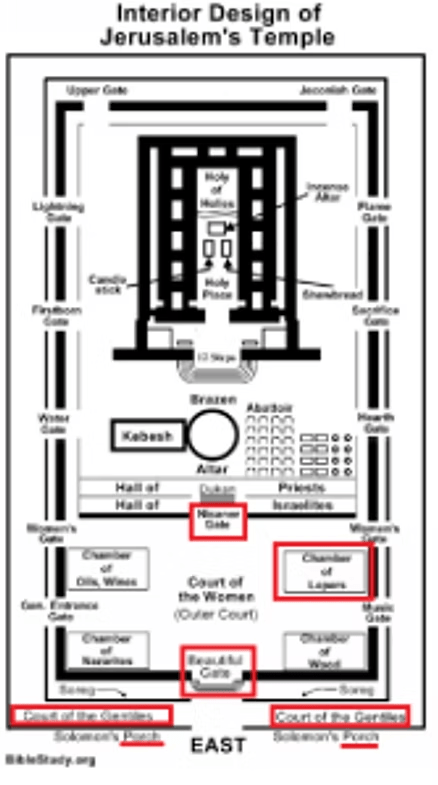
When “pylōna,” is realized to translate as “a large gate; a gateway, porch, vestibule,” then this word should be seen as representing Herod’s Temple – a fixture of Jerusalem.  It then is a statement that this “certain poor man” of Jewish faith was denied access to the inner courts, deemed too poor to gather along with well-to-do Jews.

The Greek word “ton” simply translates as “the,” but NASB (New American Standard Bible) lists three times it translates as “outsiders,” and four times as “others.” The implication is then creating the imagery of one being “cast” or “thrown” outside the Temple proper, to the Court of the Gentiles, which was beyond the Beautiful Gate and near Solomon’s Porch.

Following the separation from a comma mark, the Greek word “heilkōmenos” states the one exception to this general banishment. If one was “covered in sores,” then one could gain access to the Court of Lepers, in the general area of the Women’s Court, not far from the Nicanor Gate.  Still, it would be better to stand outside the temple with “outsiders,” even if the rich and powerful saw that association with Gentiles as sores covering one’s body.
When verse twenty-one begins by stating “kai,” this is again signaling a level of importance that is relative to “longing.” The Greek word “epithymōn” means “desiring,” usually in a negative sense of lustful wanting or longing; but it also means “setting one’s heart on,” where the heart is the seat of the soul. As one “named God Has Helped,” one can make the assumption that that soul’s heart is pure, in this case. Therefore, “to be fed” (from “chortasthēnai“) is less a reference to physical food, and more a statement of needing one’s heart be fed with spiritual food.

The Greek word “chortasthēnai” bears the meaning, “to be satisfied, filled,” where there is an emptiness that needs filling or satisfaction, but that does not necessarily mean in one’s belly.  To desire such nourishment “to fall from the table of the rich man” is a statement of lack from the “rich man,” rather than plenty that is shared.  Since no one places a “table” (“trapezēs“) in one’s ‘driveway’ by a “gate,” Lazarus was never able to see the “table” of the wealthy.  That Greek word, when associated with money, implies a “money-changing or business” “table,” from which Lazarus was denied.

This means that those who pretend to be holy (based on abundance of wealth) and wear fancy clothes rather than priestly robes rarely (if ever) produce morsels of insight that nourish the souls of the faithful.  Still, the sequence of words actually states (from the Greek), “from that falling from the table away from the table of the rich man,” where the Greek word “piptontōn” equally states, “falling under (as under condemnation)” and “falling prostrate.”  This is then not waiting for food to fall from a dinner table, but “falling down” from having been outcast (“falling under” the decrees of royal priests) and praying to God (“falling prostrate”) outside the Temple gate.

The translation that has verse twenty-one concluding with the statement, “Even the dogs came and licked his sores,” needs refining. The new sentence is confusing, as the word for “dogs” (“kynes“) implies “scavenging canines,” who ran wild and were disdained by the citizens.  For Lazarus to be portrayed as a lame beggar that was hungry for crumbs to keep him alive, one would assume a stray dog would likewise compete with him for any crumbs.  To lick his wounds, after stealing his crumbs, would be like adding insult to injury.  However, this segment of words is poorly translated.

Following a semi-colon mark (absent in the translation above) is the word of exception “alla.” That means “but” or “however,” such that there is a caveat being stated by Jesus, one that is relative to this “falling from the table of the wealthy.”  After notice of an exception comes the Greek word “kai” again, which prepares one for an important statement to follow. That statement comes in three segments, which literally can say: “but kai outsiders dogs  ,  coming  ,  were licking clean this wounds the same.”

The exception is then pointing to the importance of “ta kynes,” or “the dogs.” It is the presence of “kai” that alerts the reader to look for meaning that is greater than a simple article (a, an, or the).  In this regard, the word “ta” is another that typically translates as “the,” but the NASB lists the same translation options as “outsiders” or “others” (seen for the Greek word “ton“).  This way of seeing that translation working here, where “ta” is identified as important, means that “outsiders” become the Gentiles that were also barred from the tables inside the Temple.  This makes “dogs,” the literal translation of “kynes,” refer to the figurative translation of the word, so “dogs” is a statement (importantly) of the way the elite Jews viewed Gentiles.

The one-word statement next, following a comma mark, is “coming.”  This is then relative to those who were not Jews, but came to the Temple just to stand outside.  This would have been Samaritans and Greeks, or any of the scattered Israelites who had become mixed blood, while still believing in the God of their ancestors who were Israelites. It would be outside the Temple that teachers (like Jesus, and later his Apostles) would offer insight about Scripture. The Gentiles came for those morsels falling from the table, rather than hoping to get inside where nothing of importance was ever said. Thus, being among those who were seeking to find God, whether Jew or Gentile, all “were licking the wound” of banishment, exile, and rejection for past sins unforgiven.  That is especially true for those of great faith, as not being able to join with those of “the same” stated religious beliefs (the “certain”) is hurtful.

The aspect of “covered in sores” and dogs licking “sores” is what makes it seem that some man named Lazarus was a leper and a poor beggar (perhaps lame too). In the times of Jesus, people like that would have been banned from holy spaces and blamed for their physical plights.  “Sores” were seen as outward projections of imperfections stemming from one’s inner being, which were then deemed as evidence of sins.

The Greek root word “helkos” means “a wound, a sore, an ulcer,” often used to denote a “(festering) sore.” (Strong’s) Still, the one-word statement that assumes one person was “full of sores” can also allow for the assumption that one was treated like a leper, when the only ‘sores’ that covered his body were from the honest wear and tear a poor man of values earns from hard labors.

When invisible “sores” are angers that fester within one’s soul, due to unfair treatment at the hands of the rich and powerful (with no recourse other than suck it up and bear it), there is no doubt a faithful follower of Yahweh would be falling prostrate before God asking for forgiveness and strength to continue.  Job was an upright man who suffered mightily from sores he did not deserve.  Job fell prostrate before the Lord, as he blamed himself for not knowing what sins he did to bring about his plight.  Never was Job found blaming God for his plight (although others advised him to do so).

It is very important to see this lesson of Jesus from the perspective of two who have been placed on God’s scales of judgment. God would judge both men (just as God judges all human beings), based on each individual’s faith as “certain men” who claimed to serve Yahweh.  They would not be judged by how much wealth and abundance one had or who had physical maladies that others saw as evidence of sins.  God’s judgment is based on souls that have no flesh to drape with finery and no flesh to ooze from sores.

This becomes quite evident after both have died. God’s judgment found the one who professed faith in Him (a “certain man”), but lived only to satisfy himself and deny others, as being worthy of entering an eternity of suffering. The one who served God (a “certain man”) and was identified as “God Has Helped” (“Lazarus”) was “carried away by the angels,” taken to the embrace of Abraham in the spiritual realm. The one who most pew-sitting Christians today would root for (as many see themselves in that man), would be the one to go to a burning place.

This is where one must understand that Jesus was not teaching about two imaginary individual characters.  He was speaking instead with metaphor, of all who were identified as Jews, which has evolved today to the present state where it includes all who identify as Christians.  Jesus told of the fate of everyone who claims to be devoted to Yahweh.  His lesson says: Be rewarded in the material world by the joy of fleeting riches, and know the soul will suffer in the afterlife; or, be assured that the soul will be rewarded in the spiritual world by eternal bliss, after momentary suffering in a world that is careless.

This lesson is no different than when Jesus said, “No one can serve two masters. Either you will hate the one and love the other, or you will be devoted to the one and despise the other. You cannot serve both God and money.” (Matthew 6:24)  The word for “money” is “mamónas,” which many have translated as the personified deity Mammon.  The lower case can make that statement, as Mammon was a lesser god, not close to earning  the distinction of personification, where capitalization states important.  Still, so many worship “money” as their god, when that “love of money” means a hatred of Yahweh (regardless of what their tongues say).

[“For the love of money is a root of all kinds of evil. Some people, eager for money, have wandered from the faith and pierced themselves with many griefs.” (1 Timothy 6:10)]

It is again at this point of death that the ‘rich man’ is identified by the Greek word “plusios,” as Jesus said, “Died next  kai this plusios  kai  was buried.” The same words identify what appears to be an unnamed entity that bears the same name as everyone who serves the god of abundance, who the Romans called Pluto. It becomes important to read “plusios ” as one would read “mamónas,‘ where the lower case reflects the inferiority of the god they are named after.  Thus, Jesus said, “Died next  *  this servant of abundance  *  was buried (i.e.: placed in the ground and covered with earth).”

This is then a powerful statement about the god of the underworld. Hades, according to the Greeks, hated those who attempted to escape the eternity of his unseen realm.  Hades would find those who escaped to the surface and bring them back.  The god of the Underworld is why it is so poetically stated, “ashes to ashes, dust to dust,” during funeral rites.  The human body is said to now be worth one U.S. dollar, based on the breakdown of elements it contains.  As little as that is worth in currency, you still cannot take anything you own with you when you die.

The Greek name of the god of the underworld is Hades, whose name means “the Unseen.” The Greeks paid as little attention as possible on this god, whom they loathed. Their ignorance, countered by the Roman’s adoration of Pluto as a god of abundance from within the earth (i.e.: iron, salt, gold, silver, copper, tin, etc.), left the name Hades relegated to being the name of the realm he ruled. The Underworld became synonymous with Hades.

[Although there is no Hebrew or Israelite mythology, the equivalent master of the Underworld would be the fallen angel that was cast within the Earth for going against God.  There is the name Azazel, one of the fallen angels written of by Enoch, but Christians prefer the name Lucifer or Satan.  Some Hebrews spoke of Beelzebub.  They all share common threads with Hades and Pluto.]

By understanding this mythological ‘history’, then see how Jesus said one who worshipped Pluto in life died and was promptly placed back into the earth (interment underground, either in a tomb hewn into rock, or a six foot deep hole dug into soil), as the rightful property of his god. Jesus said next (in verse 23), “kai en tō hadē,” which very capably states, “kai in the realm of the one Hades.”

[Notice how “hadē” is written in the lower case, but loves to be capitalized in translation?]

Neither “plusios” nor “hadē” is given the respect of capitalization, because those ‘proper names’ are worthy of lower case identification (as lesser gods); but the lesson of Jesus here is: All who worship Pluto (the god of abundance, wealth, riches, and opulence) will find their souls going to Hell (Pluto’s realm), where their god Hades reigns. This is regardless of what came out of their mouths when in the flesh, which made them “certain” as believers in Yahweh.

When the one identified as Lazarus died, his body of flesh was not carried by angles to the bosom of Abraham. His flesh was returned to the earth (give unto Pluto what is Pluto’s).  The burial of his flesh is inconsequential, as his flesh had no value to him, nor anyone God Has Helped.  It was the soul of one whom God Has Helped that spiritual messengers lifted away. The implication is that Lazarus lived in the spiritual real while trapped in his body, having sacrificed his life in the flesh to serve God [like an Apostle or Saint].  This makes Lazarus like the Lazarus Jesus raised (his brother-in-law), who was then another soul living in the spiritual realm within a body of flesh that had been sacrificed to serve the Lord.  When Jesus was resurrected, he too was a living Spirit in a dead and worthless body of flesh.

That identifies all who serve Yahweh in the flesh and suffer momentarily (twenty to sixty human years are like a split second in eternity) from the disrespect of the souls whose worship of Pluto (a.k.a. Mammon), who are treated as ‘second class’ or ‘lepers’ of society, as being “named Lazarus.” All who earn that name, especially those reborn in the name of Jesus Christ, are quite capable of withstanding the suffering of a material world, where the lures of riches no longer are appealing to them. They abstain from taking any more than is necessary to serve Yahweh with strength, meaning they refuse to sell their souls for temporary comfort.

[Joseph of Arimathea was a “rich man,” but he used his wealth to support God’s ministry in Jesus.  He did not love money; he loved Yahweh.  God rewarded him with money to use supporting God’s Apostles.  Had he given all his wealth to those in the name of Jesus Christ, then God would know to trust him with renewed wealth, as an eternal flow of living waters flowing from the earth.  This would be as opposed to the efforts required to dig riches from the Underworld.]

The soul of the “rich man” is immediately found unable to withstand an existence that has discomfort, to the point of torment. Fresh from a life in the flesh, where those like Lazarus saw his pretense of royalty and felt the finery of his imported clothing, that soul called out for his fellow “certain man” to serve him with a drop of water placed on the tip of his burning tongue. His soul was so used to living a life of decadence to the max, once removed from a physical body it screamed out for pity, when his former ears ignored the pleas for help that other living beings made to him daily. The karmic reward is shown as being that souls who worship lesser gods in the flesh will find no relief for their souls once removed from that flesh.

Finding that hard lesson too late, the soul that was the property of Hades begged that the one who God Has Helped show mercy on the wealthy brothers he left behind (who probably were even wealthier then, after their brother had died). He wanted Lazarus to go appear as a ghost to warn them of the fate that awaited them. However, Abraham said there would be no ghosts sent to those who serve the god of wealth and abundance; they have Moses and the prophets to guide them, because they profess to be “certain men.”  Faith is based on a promise of future gains, not gains realized in the present. They would have to earn their way to the good place, as had “Lazarus.”

The lesson is one that speaks of everything one needs to serve the Lord.  That need is Spiritual, not material.  This is repeatedly written in the Holy texts. This lesson by Jesus is another in a long line of lessons that repeatedly say, “Love the Lord with all your heart, all you soul, and all your mind.” There is even a Charles Dickens novel that tells the rich to be warned against selfishness.

The problem now is, as it has always been, the souls who pray to “god” for wealth and get it will always make the mistake of thinking the “god” they prayed to was Yahweh.  The sad reality is they are praying to Pluto; and Pluto will pay any price in material goods, knowing nothing material will ever be lost from this world. Hades is a hateful god that has claims on every soul in the flesh; and the only way to escape his realm is through Jesus Christ. Then one’s soul will be carried away to eternal bliss by angels.
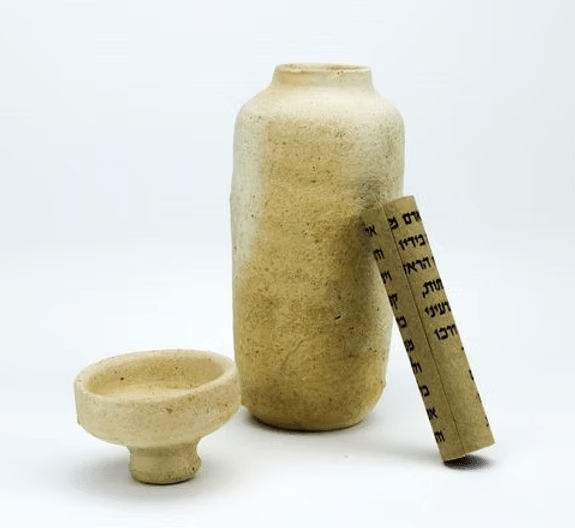
Jeremiah 32:1-3a, 6-15 – A prophecy to buy worthless land on the promise it can be valuable some day

[1] The word that came to Jeremiah from Yahweh in the tenth year of King Zedekiah of Judah, which was the eighteenth year of Nebuchadnezzar. [2] At that time the army of the king of Babylon was besieging Jerusalem, and [3] the prophet Jeremiah was confined in the court of the guard that was in the palace of the king of Judah, where King Zedekiah of Judah had confined him.

—–

[6] Jeremiah said, The word of Yahweh came to me: [7] Hanamel son of your uncle Shallum is going to come to you and say, “Buy my field that is at Anathoth, for the right of redemption by purchase is yours.” [8] Then my cousin Hanamel came to me in the court of the guard, in accordance with the word of Yahweh, and said to me, “Buy my field that is at Anathoth in the land of Benjamin, for the right of possession and redemption is yours; buy it for yourself.” Then I knew that this was the word of Yahweh.

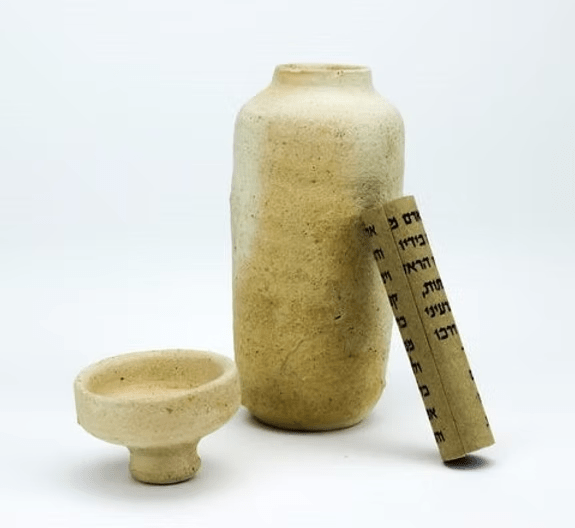
[9] And I bought the field at Anathoth from my cousin Hanamel, and weighed out the money to him, seventeen shekels of silver. [10] I signed the deed, sealed it, got witnesses, and weighed the money on scales. [11] Then I took the sealed deed of purchase, containing the terms and conditions, and the open copy; [12] and I gave the deed of purchase to Baruch son of Neriah son of Mahseiah, in the presence of my cousin Hanamel, in the presence of the witnesses who signed the deed of purchase, and in the presence of all the Judeans who were sitting in the court of the guard. [13] In their presence I charged Baruch, saying, [14] Thus says Yahweh of hosts, elohe of Israel: Take these deeds, both this sealed deed of purchase and this open deed, and put them in an earthenware jar, in order that they may last for a long time. ס

For thus says Yahweh of hosts, the elohe of Israel: Houses and fields and vineyards shall again be bought in this land. פ

——————–

This is actually a rather simple story of prophecy, which prophesizes reincarnation, along with the continuation of prophets and priests who will be made available to the seekers of salvation, whose souls have (for the most greatest part) been abject failures to return and be one with Yahweh, forevermore ceasing their sinful ways. The metaphor of burying the deed in the ground is that of death, with the Covenant between a soul and Yahweh equally rising in future lives, so the two can be joined again “bought in this land equates to “so again dwellings of flesh and spiritual blood within flesh be possessed by in divine marriage by the elohim of those Who Retain Yahweh as their Husband.”

What is missed in the simple reading of these words, to reach that conclusion, is the depth and beauty of the words read simply as names – of people and places. There are fourteen such separate ‘names,” which are divinely written as a way of presenting the spiritual amid the historical, some of which may or may not be repeated anywhere else in the Old Testament. Those fourteen ‘names’ are:

1. Zedekiah – Yah Is Righteousness

2. Judah – Praised, Let Him Be Praised

3. Nebuchadnezzar – Protect Your Servant

4. Babylon – Gate Of God; Anointed, Saturated

5. Jerusalem – Teaching Peace

6. Jeremiah – Yah Throws, Yah Loosens; Elevated Of Yah

7. Hanamel – Grace of God

8. Shallum – Perfect, Agreeable

9. Anathoth – Answers, Afflictions

10. Benjamin – Son Of The Right Hand, Son Of The South

11. Baruch – Blessed

12. Neriah – Yahweh Is A Lamp, Lamp Of The Lord

13. Mahseiah – A Hiding Place Is Yah

14. Israel – Who Retains God

In the set-up that makes it historically be told when Yahweh spoke to Jeremiah, relative to when King Zedekiah had reigned over Judah for ten years, while Nebuchadnezzar had reigned eighteen years and his army was besieging Jerusalem, while Jeremiah had been placed under ‘house arrest,’ the story also says this:

“[1] The word that came to him elevated of Yahweh from Yahweh in the tenth year of king saying Yahweh is righteousness letting him be praised, which was the eighteenth year of he who protects your servant.

[2] At that time the army of the king of the anointed was besieging the teaching of peace;

[3] and the prophet elevated of Yahweh was confined in the court of the guard in the palace of the king praised, where king saying Yahweh is righteousness of the praised had confined him.”

In this translation, where the names have been replaced with the meaning of the words used as names, the antiquity dissolves and the same set-up can be seen as applicable to all times, in all places. The numbers ten and eighteen can boil down numerologically to one (10 = 1+0 =>1) and nine (18 = 1+8 => 9), which reflect selfishness (one) and conclusive change (nine). The title “king” is then either one who wears the crown of self or those whose souls have submitted to a higher power that Lords over their souls, as king. A place of “confinement” is more accurately translated as “imprisonment,” which should be seen as a soul being placed into a body of flesh, from which it can only escape from through submission to Yahweh, so death becomes a rite of passage into eternal life.

This then mean the leap forward from the set-up, to the story Jeremiah told of hearing the word of Yahweh speaking to him, this is then the story of his cousin (of an uncle) prophesied to come to him requesting that he buy land he possessed in a town in the region allotted to the Tribe of Benjamin. Because of Jerusalem being under siege, this land would have been in enemy hands and basically worthless. The metaphor here is a sinner (the “cousin” of an “uncle,” thus one related by blood to the land of Judah) coming to a priest of Yahweh offering his possession in the flesh to Yahweh, as payment for his sins committed. Because this “cousin” was sent by Yahweh and Jeremiah knew of it before it happened, this says Jeremiah confirmed the physical appearance and offer was not to be rejected (knowing the details of how worthless land in enemy hands would be at that time), but accepted. Jeremiah then accepted his “cousin’s” soul as surrendering to Yahweh in marriage, so there would be value well into the future, through eternal salvation.

The verses that tell of the prophecy and it being physically presented can then be read as this:

“[6] The one elevated of Yahweh said, The word of Yahweh came to me:

[7] grace of God born of your uncle perfect is going to come to you and say, “Buy my field that is at afflictions, for the right of redemption by purchase is yours.”

[8] Then my cousin grace of God came to me in the court of the guard, in accordance with the word of Yahweh, and said to me, “Buy my field that is at afflictions in the land of son of the right hand, for the right of possession and redemption is yours; buy it for yourself.” Then I knew that this was the word of Yahweh.”

Here, words such as “field” and “land” must be understood as being of the physical realm, thus of the “flesh.” The “court” of the “guard” is the flesh of a soul submitted unto Yahweh in divine marriage, becoming a priest in the name of the Son – Adam-Jesus. This is one “elevated of Yahweh,” so he or she can be the officiant in the salvation of seekers that also submit their souls to Yahweh. A “field that is at afflictions” is then a sinner who feels strongly the guilt of past deeds, who knows he or she must sincerely repent, in order to be saved. To “buy my field that is at afflictions” means to offer one’s soul up to Yahweh in divine union, so Yahweh’s Spirit will pay the ‘asking price’ – Baptism by the Spirit, eliminating all past debts owed for sins. This means the purpose of a prophet-priest of Yahweh is to receive those seeking divine union and prepare those willing to self-sacrifice for salvation for a most holy matrimony.

When we see how a prophet-priest of Yahweh is led by the inner voice of his elohim (Adam-Jesus) to know when Yahweh has led a sincere repentant soul to the altar of self-sacrifice, then the next set of verses can be read as forever saying this:

“[9] And I redeemed the flesh at afflictions from my relative (in Christ) through the grace of God, and weighed out the debt owed to him, eight (symbolic of power owed to authority) handful of sincere value.

[10] I signed the deed, sealed it, got witnesses, and weighed the debt as balanced.

[11] Then I took the sealed Covenant of commitment, containing the terms and conditions for salvation, and the scroll of Scripture;

[12] and I gave the repayment of debts owed to the blessed new son as a lamp of Yahweh the son existing in the hiding place of Yahweh’s new wife-soul, in the presence of my relative (in Christ) as the grace of God, in the presence of the angelic witnesses who signed the repayment of debts owed Yahweh, and in the presence of all those who praise Yahweh who were sitting in the temple of flesh saved still guarded on earth.

[13] In their presence I charged the newly blessed (meaning a Saint), saying,

[14] Thus says Yahweh of hosts, elohe of all who retain the elohim of Yahweh as their soul’s Lord: Take these promise of everlasting life, both this written on the walls of his or her heart by the hand of Yahweh erasing all past debts owed Him and this book of Scripture, and put them in an earthenware jar, in order that they may last for a long time. ס”

This then can be seen as always applying to the duality of the word of Yahweh that is heard by a soul, versus the written word of Scripture in scrolls and books, which demands the inner presence of Yahweh, His Spirit and His Son resurrected to understand the immensity of the truth the written word contains. It should be seen how deep the above translation becomes, when the whole of Scripture is allowed to unfold before one’s mind’s eye (led by the inner Lord of a Christ), so this goes well beyond the timing of Jeremiah in a waning Judah.

This then leads to the final verse, which says the following:

“[15] For thus says Yahweh of hosts, the elohe of all who retain the elohim of Yahweh as his or her inner Lord: dwellings and flesh and holy blood from the vine of Yahweh’s Son on earth shall again be bought in this physical world that imprisons reincarnated souls. פ”

This is important that “elohe” is a masculine plural form of “el,” as a shortened version of “elohim.” The word does not mean “God” (in the singular), and it only means “gods” (in the plural) when in a lower-case spelling. The word reflects ALL spirits, angels, souls and eternal entities created by Yahweh, with this including those demons spirits that have been cast into the earth, where evil is only allowed to exist. Yahweh placed it as the guards of imprisoned souls, to test if a soul will submit to Yahweh in divine marriage, in order to gain freedom to eternal life in the spiritual realm. The only way for this to happen is for a soul in its flesh to become like Jeremiah (and all the prophets, priests, and saints) and become possessed by “the elohe of Yahweh.” The alternative is to become married to the demons spirits of the world (evil elohim) and build up debt that will be impossible to repay when the fields where one sowed his or her sins is about to be possessed by Satan. The promise is reincarnation will not come without some prophets-priests-saints of Yahweh to become the “lamp of Yahweh” to lead a lost soul to the light.

Psalm 91:1-6, 14-16 – Beneath the wings of one’s guardian angel

1 He who dwells in the shelter of the Most High, *

abides under the shadow of the Almighty.

2 He shall say to Yahweh, “You are my refuge and my stronghold, *

elohay in whom I put my trust.”

3 He shall deliver you from the snare of the hunter *

and from the deadly pestilence.

4 He shall cover you with his pinions, and you shall find refuge under his wings; *

his faithfulness shall be a shield and buckler.

5 You shall not be afraid of any terror by night, *

nor of the arrow that flies by day;

6 Of the plague that stalks in the darkness, *

nor of the sickness that lays waste at mid-day.

—–

14 Because he is bound to me in love, therefore will I deliver him; *

I will protect him, because he knows my Name.

15 He shall call upon me, and I will answer him; *

I am with him in trouble; I will rescue him and bring him to honor.

16 With long life will I satisfy him, *

and show him my salvation.

——————–

This is the companion Psalm for the Track 1 Old Testament reading selection from Jeremiah 32, where Yahweh spoke to His prophet telling him to buy land from his cousin and seal the deed in an earthen jar, which would be buried in the ground, preserved for a long time. The symbolism of that story is one of repentance for past sins, with reincarnation the promise to have another chance to live a life in the flesh for Yahweh (as His prophet, or priest, or saint), with the promise also being that the future will include those like Jeremiah, who are the necessary agents of Yahweh who lead willing souls to the altar of marriage and then officiate that most holy union. The lesson says to be a soul saved and to gain freedom from the imprisonment a body of flesh in a sinful world – to die and be granted eternity with Yahweh in His spiritual realm – one must be led into that light by the servants of Yahweh on earth. Psalm 91 sings of both the divine possession of saints by Yahweh and His Son’s soul, while also being the truth they personally know and teach to seekers, so their souls in their flesh can duplicate that prophet, priest, and saint in many others.

The above translation into English is weak; so, I will reproduce what was written and then interpret each verses.

Verse 1: “he who dwells in the secrecy as the highest , as the shadow of the flesh shall abide .

In this, the Hebrew word “elyown” is translated as “highest,” with “most high” a common replacement. The word is said to be “the name of God.” (Brown-Driver-Briggs) This makes the implication of “he who dwells in the secrecy” of Yahweh, as the shadow of the flesh” is a profound statement of divine spiritual possession of a soul in its flesh, by the Son of Yahweh – Adam-Jesus. When the masculine singular is recognized as a statement of a non-physical entity – as a spirit, angel, eternal soul – as a masculine entity, this relates to the Son’s soul. For it to “dwell” and “abide” in “secrecy,” “as a shadow,” then this is a second soul resurrected within the host soul of a body of flesh. To “abide” then means this divine second soul “will lodge” or “pass the night” in a host soul, keeping it from the darkness of a world without light.

Verse 2: “I will say , Yahweh is my refuge and my stronghold ; my elohim , I will trust in him .

This is not David pronouncing “I will say,” but the “shadow of the flesh” that has become the Lord over his flesh (willingly and lovingly). This means David is led to hear and enthusiastically support the soul of Yahweh’s Son “saying, Yahweh is my refuge and my stronghold.” In this, “Yahweh” is specifically named, unlike the weak English translations that throw that name out with the garbage associated with the Jews who killed Jesus. This says ALL souls that will be Anointed by the Spirit of Yahweh (like David – made a “Messiah” [Hebrew] and a “Christ” [Greek]) will likewise hear an inner voice speaking that the Lord within comes from “Yahweh.” That gift is a wedding gift, as the consummation of a divine marriage, where the Son is each time reborn in a new soul, in new flesh. The presence of the Son is then the guardian that protects a once sinful soul (cleansed by the Baptism by Yahweh’s Spirit) from ever sinning again. One’s soul takes “refuge” as a soul that follows that divine lead and, a Lord over one’s soul-flesh, will be the inner strength that will keep all urges to sin from ever being heard, thus never followed. This will then make the “Yahweh elohim” that is the Son (Adam-Jesus) become one’s own personal “elohim.” This is the necessary resurrection that ensures salvation. With that inner strength as one’s Lord, then one has transformed from the belief of religion based on Scripture, to “trust in him,” which is the deep faith that the Son enlightens one to the light of truth, making all questions of darkness disappear.

Verse 3: “for he will deliver you from the snare of the trapper , from the plague of desires .

Again, the third-person masculine pronoun “he” (“”) is reference to the soul of Yahweh’s Son within one’s soul-flesh, as its Lord and protector. The essence of “to deliver” means to “to snatch away” from the dangers of sin. The Hebrew words translated as “the snare of the trapper” can equally say “the bird trap of the fowler,” where the metaphor of a bird (as a winged creature) is that of an angel, which also relates to the ethereal realm as a spirit or soul. The soul is ensnared in a body of flesh and naturally wants to fly away, which means death, when the soul is released to Yahweh. The “fowler” or the “trapper” is then no different than the serpent in Eden, as the craftiest of the creatures. He is himself a spirit, fallen angel, condemned soul, who earned that distinction by going against Yahweh command to help mankind. Instead, he tries to lure souls into the “snares” of sin, which not only keeps a soul imprisoned within a body of flesh, but makes it come back again (reincarnation), if those sins have not been redeemed. This means “he will deliver you” has to do with Yahweh erasing past sins by His Baptism of Spirit upon one’s soul forever, with His Son then sent in to make sure no further “traps” will be entered.

Verse 4: “with his wings I he will overshadow you and underneath his wings you will find refuge ; target and shield his truth .

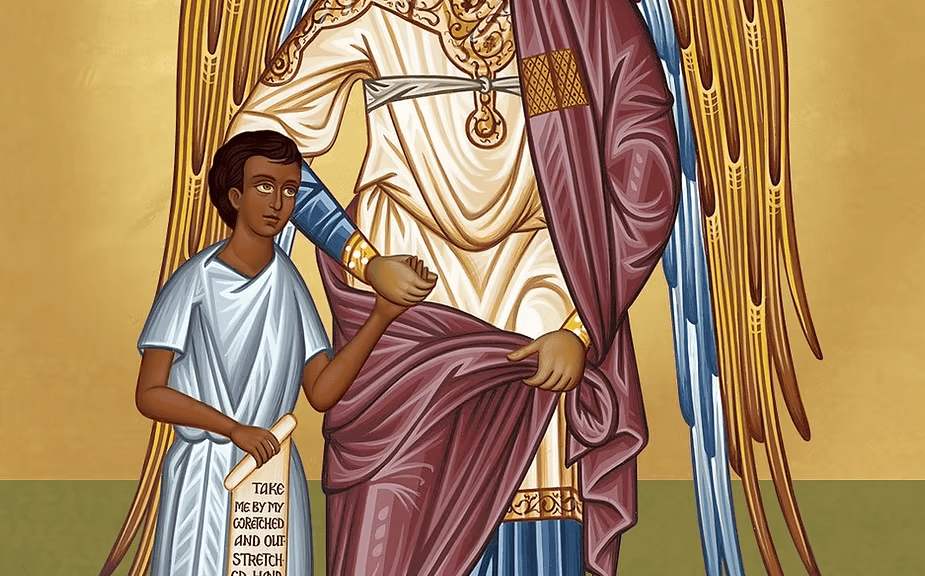
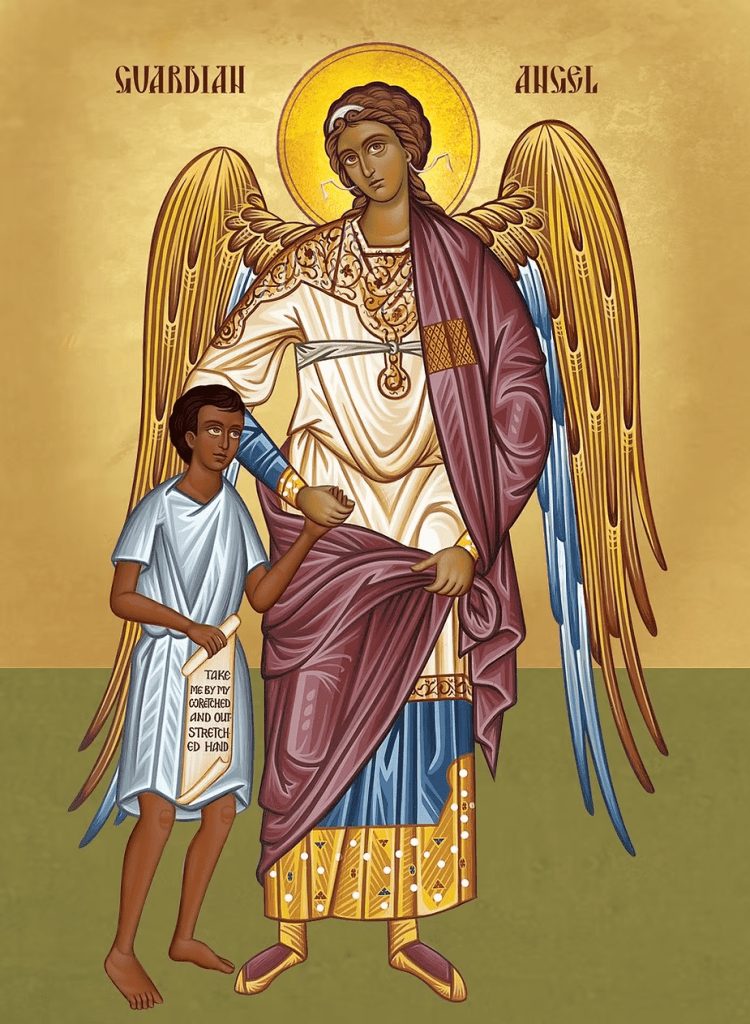
Here, the metaphor of birds continues, where the inner soul of the Son (Adam-Jesus) is projected as a most divine angel of Yahweh that uses “his wings” as the protection that surrounds a wife-soul of Yahweh and its body of flesh. The vertical bar denotes a place to pause and reflect on “his wings” being a statement that the soul of Adam-Jesus is indeed a guardian angel. Following the vertical bar (I), the Hebrew word that can state “cover” is translated as “overshadow,” which matches the statement in verse two: “as the shadow of the flesh shall abide.” When “his wings” are seen as “over” one’s soul and flesh, one is then “underneath his wings,” and that is where “refuge’ is provided. This says one cannot be separate from Yahweh’s Spirit, nor the possession of His Son’s soul, as a soul in flesh that ‘believes’ in God and Jesus, but never commits to the truth of that personal experience, which can only come from self-sacrifice and complete submission to Yahweh. This makes one’s soul and flesh become a “target” (also translatable as the ”hook” sought by demon spirits, but “his wings” act as the “shield,” defending one from the lies of demonic persuasion, by knowing the “truth” of all attacks coming forth.

Verse 5: “not you will fear from the dread of night ; of the arrow , it will fly by day –“

In this verse, the opposites presented in “day” and “night” have to be understood as the “light” of truth that comes from the inner voice and the covering of angelic “wings” enlightens the submissive soul-flesh to all dangers that the presence of Adam-Jesus is defending. The “arrow” is then the flight taken by the truth, against all incoming threats. With the truth always shooting down lies, there is no “dread” coming from unseen lures, urges, or demonic whispers. The “arrow will fly by day” as the light of truth setting the path of righteousness, from which one will not be sways to veer off.

Verse 6: “in the plague of darkness walks ; to the destruction will lay waste in daytime .

Here, David sings that the “darkness of fear” lurks. The Hebrew construct “ya·hă·lōḵ,” rooted in “halak,” the meaning “to go, come, walk” can also be found in Scripture translated as “crawls, grows, prowls and wanders.” This says the “pestilence” or “plague” that lurks in “darkness” tries to remain hidden, so “fear” will “come” into one’s soul and flesh. The cure for that “fear” is the “destruction” of the “darkness,” which comes in the dawning of light, “laying waste” to all “fears,” as they are seen for what they truly are – illusions of shadows. The soul of Adam-Jesus is then the protector who brings the “daytime” and “destroys” the darkness.

—– skip forward in the verses —–

Verse 14: “when on me he has set his love then he will rescue me ; he will set me on high , because his has become my name .

In this, it is important to grasp the truth of spiritual “love” (rooted in “chashaq”). Spiritual “love” is well above and far beyond anything that can be related to the physical emotion of the flesh, which is called ‘love.’ Spiritual “love” comes from the Son of Yahweh, as Adam-Jesus IS the truth of Spiritual “love.” Only by having “his love set upon” one’s soul-flesh can one begin to attempt to put into words what that ‘feels’ like. It is indescribable in human terms. It can only be known by personally experiencing the presence of Adam-Jesus within one’s soul, as the Lord over one’s self. That presence means one’s soul has been “delivered” or “rescued” from all past sins, which can only be washed away by the Spirit of Yahweh pouring out upon one’s soul forever. That cleansing by the Spirit makes it then possible for one’s soul to receive the soul of the Son, who is the epitome of Spiritual “love.” To be “set on high” means to ‘feel’ the presence of Spiritual “love,” which is on the level of Yahweh, with nothing possible to be “higher.” When David sang, “because he has become my name,” this is a statement of a soul’s self-sacrifice at the altar of divine marriage, so one’s soul-flesh is in His “name.” When one receives the soul of the Son, then one’s flesh walks the earth in ministry, “in the name” of the Son – Adam-Jesus reborn.

Verse 15: “he will call upon me ׀ and I will answer him , from him I am in distress ; he will rescue me and I achieve honor from him .

This is a statement of ministry, where the “call” is to serve as a devoted wife-soul. The vertical bar leads one to pause and reflect on this “call” being an expectation. A soul cannot “call upon Yahweh” and tell Him to serve one’s needs. Total submission means to be on “call” for the lead of His Son’s soul within – as one’s Lord – which makes the “call” to be ministry “in his name,” for the purpose of leading others to self-sacrifice unto Yahweh and being reborn as His Son. When one has not made this divine “union” – one’s soul to the Spirit of Yahweh – then one will forever be in “distress,” due to the guilts of sins committed. When David sang, “he will rescue me,” this sings about the redemption of all past sins, where the payment agreed to (the Covenant vows of marriage) is to heed the “call” that will come from His Son’s soul within one’s soul-flesh. When one obeys the “call,” then one will “achieve honor from him” – the name of Adam-Jesus – as a saint in his name leading the lost to salvation with words of truth.

Verse 16: “with eternal life I will satisfy him ; and see him , my salvation .

This is David singing to the marriage that is sealed with a soul’s self-sacrifice and forever commitment to Yahweh. In return, the wedding gift is His outpouring of Spirit that cleanses a soul forevermore. That gift is like a wedding band, which signifies an eternity of satisfaction between two Spiritual lovers. In the eternal realm one is able “to see Yahweh,” because the warning says, anyone who sees Yahweh will die.” When one has been “satisfied” with “eternal life” – a great length of daylight” – the no death can ever occur to the soul. When a souls’ body of flesh can no longer support a soul within it, then the flesh will die; but the soul will never again experience the punishment of death when sins have not been paid. The “salvation” gained is “mine,” which is a possessive pronoun that says that soul is possessed by Yahweh in divine marriage (in His name) and also possessed by the soul of the Son (in his name in the flesh).

Amos 6:1a, 4-7 – Pretending to be holy

[1a] Alas for those who are at ease in Zion, and for those who feel secure on Mount Samaria.

—–

[4] Alas for those who lie on beds of ivory, and lounge on their couches,

and eat lambs from the flock, and calves from the stall;

[5] who sing idle songs to the sound of the harp,

and like David improvise on instruments of music;

[6] who drink wine from bowls, and anoint themselves with the finest oils,

but are not grieved over the ruin of Joseph!

[7] Therefore they shall now be the first to go into exile,

and the revelry of the loungers shall pass away. פ

——————–

In verse one, the ‘name’ that appear need to be read as the meaning of the words, from which the names are formed. The word “zion” (“tsiyyon”) comes from the root noun “sayon,” which means “dry place or sign post.” The Arabic root verb means “to defend.” This means the word written by Amos, sent to him through divine inspiration, bears an everlasting meaning that makes the statement: “Alas for those who are at ease in a dry place or standing individually as a fortress against evil, let those be sign posts that warn where not to go.”

When the first half of verse one then speaks of “Mount Samaria,” there is no such place. Further, Hebrew as a written language does not have capital letters, as do other languages, so that written says “the hill country of shomrom.” The place “shomrom” was the capital of the Northern Kingdom (after the splits), which is typically called “Samaria.” Still, the word behind that ‘name’ bears the meaning (from the root Hebrew word “shamar”) “place of watch keeping,” as the root verb means “to keep or guard.” Thus, the continuation of Amos’ warning in verse one says, “and for those who feel secure on higher ground keeping watch over their souls.” Because Amos was a prophet of Yahweh and spoke what Yahweh told him to speak (or write), the only concern Yahweh has for “those in a dry place” and “those who pretend to be vigilant from higher positions in life (the rich and famous), the material that relates to places and bodies of flesh is nothing. Yahweh spoke spiritually to a prophet, about the souls of those who pretended to serve Yahweh spiritually, when they only served themselves (self-egos).

Verse 4: “those lying down on beds of ivory , and those unrestrained on your couches ; and eat lambs from the flock , and calves from the midst of the stall

The symbolism of “lying down on beds” is sleep; and, sleep is metaphor for death. This makes the warning posed by Yahweh, through His prophet Amos, be those who find comfort and wealth (symbolism of “ivory”) from the material realm, where the soul is imprisoned in a body of flesh that is bound to die, releasing the soul for Judgement. To then be “unrestrained on your couches” is a symbolic statement about the Jews who only reclined to eat the Passover meal, because eating while lounging on a “couch” is a sign of the opulent royals of the world. To be “unrestrained” to pretend to be of royal blood (as children said to be of Yahweh, through His Law given to them by Moses) are further positioning their bodies of flesh in the ‘bound to die’ position. To then “eat lambs from the flock” is not only a statement of the Paschal lamb that spreads the blood of the Son on the doorway to one’s spiritual dwelling, saving the soul within its flesh, the statement by Yahweh is to devour the innocent “lambs of the flock” by teaching them nothing of value, while pretending to be rich in the Word of God (like Amos was as a prophet of Yahweh). The element of eating “calves from the midst of the stall” is then a statement about veal, where young calves are fed in cages, not allowed to exercise and strengthen their muscles. There is doubt about the slaughter of calves as being ‘kosher’ food for Jews; but the metaphor must be seen here as the calves reflecting the children of the Norther Kingdom, the leaders of which Amos preached. They kept the children in stalls, not allowing their souls to exercise the truth of Scripture, while being fed fattening falsehoods and half-truths, which weakened their ability to be ‘beasts of burden’ for Yahweh.

Verse 5: “those who chant upon the mouth a psaltery , like beloved they will account for their souls vessels of song .

In this verse, Yahweh led Amos to write the Hebrew construct “kə·ḏā·wîḏ,” which is typically read as “like David,” as if a proper name is the implication. Again, the meaning behind the name is “beloved one.” This means “those who chant upon the mouth” are those who sing the psalms of David, which all Israelites and Judeans (people of the two kingdoms, not the truth behind the meaning of those names) did. After the fall of those two kingdoms and the speaking of the prophets were recorded on scrolls, the Jews would read some of each every Sabbath, much like Christians in branches that are catholic or universal read Old Testament, Psalm, Epistle and Gospel. To simply “chant upon the mouth” those most divine words does not make one’s soul be in close relationship with Yahweh (His wife). The use of “psaltery” or “instrument like a harp,” the pretense of singing the psalms of David makes them spear (to each other) as “like beloveds” of Yahweh – when they are not. The reason Yahweh chose His prophet Amos to warn the pretenders was they endangered their souls, because “they will account for their souls” as if singing the words (or repeating them in unison, wholly or by alternate verses) makes them as if they are the “vessels of song,” like David or Amos. The danger is pretending to be a prophet (or saint), when one’s soul if filthy dirty from sins; and, singing psalms of David does nothing to wash away sins.

Verse 6: “those drinking from bowls wine , and with the choicest oils they anoint themselves ; but not they are sickened over the breaking of the increaser .

Once again there is what appears to be a proper name written, which is “Joseph” (from “yō·w·sêp̄”). The word behind the name means “increaser,” from the verb “yasap” meaning “to add, increase, or repeat.” The Biblical character known as “Joseph” was the most spiritually elevated of the sons of Jacob, who had “supplanted” his brother’s birthright and then fought his soul to be pronounced “Israel,” a word that means “who retains the elohim of Yahweh as his Lord. Because the sons of Jacob were all far from being spiritually elevated souls, they were those who “broke the addition” of the soul of Yahweh’s Son from being their personal Lord (each reborn as the truth of the word Israel). When this is seen, the Amos was led to write about the audacity of lost souls pretending to be the children of Abraham, Isaac, and Jacob “drinking from bowls,” supposedly filled with the “wine” that is the blood of a Messiah or a Christ – the blood painted on the doorway of their dwellings, saving their souls from the pass over of death. Instead, they drink themselves drunk on the thought that they can do as they wish, never to be punished and forbidden life eternal with Yahweh. Likewise, they heap spoonfulls of oil – deemed holy by a false shepherd or hired hand – in the same way Christian employees of religious organizations use the finest olive oil to pretend to bless as holy. Meanwhile, none of these false shepherds “are sickened over the breaking of the increaser,” where the whole point of a holy lineage is spiritual salvation, requiring teachers of the truth of Scripture that leads the lost to be found and saved.

Verse 7: “thus now they will go uncovered as the head of those removed ; and those turned aside , banquet those who go free .

The use of the Hebrew construct “bə·rōš,” as a form of the word “rosh,” is translated as “the head,” where the saying goes, “as the head goes, the body will follow.” In between is two uses of “galah,” meaning “to uncover, remove.” Here, the dual meaning says the “heads” that lead the body wrongly will be “uncovered,” such that the result is that all who follow them (the body of those claiming bloodlines to Jacob) will be “removed” from that distinction. The segment that then places focus of “those turned aside” means the “head uncovered” will be as false shepherds and hired hands, whose profitability as religious leaders is all about turning the people away from Yahweh and to their control. Still, the reward for those who will turn away from those false leaders will find the wedding “banquet” as the celebration of their own soul’s union with the Spirit of Yahweh and being possessed divinely by His Son’s soul. Those will be the souls that “go free” to eternal life, no longer imprisoned by the beds and couches of bodies of flesh that lead to the sleep of mortal death.

Psalm 146 – Shine Yahweh and heed the warning of Amos

1 Hallelujah! Shine YAH!

Praise Shine Yahweh, O my soul! *

[2] I will praise shine Yahweh as long as I live;

I will sing praises lelohay while I have my being.

2 [3] Put not your trust in rulers, nor in any child of earth, *

for there is no help in them.

3 [4] When they breathe their last, they return to earth, *

and in that day their thoughts perish.

4 [5] Happy are they who have se-el of Jacob for their help! *

whose hope is in Yahweh elohaw;

5 [6] Who made heaven and earth, the seas, and all that is in them; *

who keeps his promise for ever;

6 [7] Who gives justice to those who are oppressed, *

and food to those who hunger. 7 Yahweh sets the prisoners free;

[8] Yahweh opens the eyes of the blind; *

Yahweh lifts up those who are bowed down; 8 Yahweh loves the righteous;

[9] Yahweh cares for the stranger; *

he sustains the orphan and widow, but frustrates the way of the wicked.

9 [10] Yahweh shall reign forever, *

elohayik, O Zion, throughout all generations. Hallelujah! Shine YAH!

———————

I have posted about this Psalm 146 three times prior. I advise those who are interested in what this Psalm 146 says to review the links to those three commentaries. The postings are as follows:

October 2021: Psalm 146 – Same song, Elijah verse

September 2021: Psalm 146 – Praising Yahweh as a reflection on Naomi and Ruth

August 2021: Psalm 146 – Praise Yahweh

All are the same verses, sung aloud in the Ordinary after Pentecost season for Year B. Psalm 146 is also scheduled to be sung aloud on Proper 5 Sunday, in the Year C, but the year 2022 had Trinity Sunday (the first Sunday of the Ordinary after Pentecost season) be on the equivalent of Proper 6, with no Proper 5 readings scheduled in 2022. Still, the point that must be seen in this (along with an absence from the Year A schedule) is this song that places focus on Praising Yahweh! (more accurately Shining Yahweh! from within one’s soul) is an advanced lesson, whose repetitiveness makes it vital to understand.

As the only public singing of this Psalm 146 in Year C for the calendar year 2022, it becomes important how it is companioned now with the Amos 6 reading selection, when Yahweh spoke through His prophet about the laziness of the wayward. That desire to sleep in beds of ivory, while devouring the souls of those putting their trust in false shepherds that wear fancy robes, high hats and carry ornate shepherd’s crooks (never been used to save any souls), this Psalm 146 warns the truly faithful to not follow the liars and cheats of the world.

In verse one, the main focus must go to David singing “nap̄·šî,” where this construct is the feminine (the “soul” – from “nephesh”) and “of me” or “mine,” which is stating the femininity of an eternal “soul” (masculine, as spiritual, non-material) in a body of flesh, where “my” is a statement of the flesh possessing the “soul” – not the other way around. This then makes the repetition of “shine YAH!” and “shine of Yahweh” become a statement that a “soul” alone is incapable of “shining” (therefore “praising” as well) as a feminine entity, a “soul” alone in its body made from the physical realm.

The ability to “shine” – from the word “halal” being an imperative masculine plural – comes from “YAH,” as “of Yahweh,” with both words in Hebrew being masculine singular nouns, denoting the spiritual allowing the material to “shine” a spirituality that is unseen physically, but depicted in Christian religious artwork as a halo. No leaders of temples or synagogues or cathedrals or churches can lead a soul trapped in a body of flesh to emit a divine radiance – the “shine” – as this is an individual commitment between the feminine soul and the masculine Yahweh. It says “to shine of Yahweh” is to be spiritually married to Him, so the outpouring of His Spirit upon one’s “soul” forever is the only way this “shine of Yahweh” can manifest.

In verse two the repetition if the first-person constructs that sing, “I will shine” and “I will make music (to Yahweh).” In that the first-person is a combined spirituality that is the masculine Spirit of “I Am” and the feminine soul that is the sacrificial “I” that receives the Spirit. This is then singing of a union of two as one, where this union brings the promise of eternal “life,” which is guaranteed by the offspring of that divine union, which is “to my elohim I gain my continuance.” The Spirit makes it possible to receive the seed soul of the Son, who merges with a soul forever, making a soul be saved as a reproduction of Yahweh’s Son of love.

It is after David sings two verses about “shining Yahweh,” through the presence of his “elohim” within his “soul” that David then warns of the dangers of following the lead of those who would steal that “shine of Yahweh” away.

While beginning verse three singing “not will put your trust in nobly inclined” humans berobed in the finest cloths, David sings loudly, “in the son of man.” In that, those who will falsely lead souls away from “shining Yahweh” will be deemed “sons of men,” denoting their obedience to bloodlines and souls trapped in sinful bodies of flesh. However, the double edge of that cutting segment says, “in the Son of Adam,” where the Hebrew word “’ā·ḏām” is the name of the Yahweh elohim of Genesis 2, when the divine priestly Man we call Adam was created by the hand of Yahweh. This segment then places a name on what David called “my elohim.” To this name, David then sang, “nothing else offers salvation;” and, here it is vital to know the name “Jesus” means “YAH Saves.”

In verse four, David sings about his inner “elohim” of “salvation.” When one sees “in the son of Adam,” where the preposition indicates this inner union with David’s soul, he then explains this phenomena of “the son” resurrecting there. He sings, “it departs his spirit it will return it to the flesh,” where the Hebrew word “adamah” means “ground, land,” this is metaphor for the material real where souls inhabit bodies of flesh (not ground or land). When the soul is seen as that “returning,” then “it departs” refers to the death of Adam’s flesh, which took 930 human years to accomplish, after the departure from Eden. It is then not the flesh of “the son Adam” that “will return,” but his “soul,” which will divinely possess a soul married to Yahweh, joining with that wife-soul in its body of flesh. This “return” will bring an eternity of “day” – the light of truth within – that will keep a host wife-soul from ever ‘perishing” of soul. Like Adam, when the death of the flesh comes, then the soul will be released to do the work of the Father, as He sees fit.

Verse five then begins with the Hebrew word “esher,” which means “happiness, blessedness.” The construct leads one to sing “blessed” as the first word of this verse. Here, David wrote a vertical bar of rest, which forces the singer to contemplate this word “blessed.” The insight comes from the Greek written by Matthew, which told what Jesus spoke on the mount by the sea, called the Beatitudes. They are called that because the Latin word “beātī” means “happy, rich, or blessed” (plural adjective). The Greek word written by Matthew is capitalized, as “Makarioi” (plural adjective), meaning “happy, blessed,” and implying “to be envied.” The capitalization of the Greek elevates this word to a divine level of meaning, which is “shining Yahweh.” The word then goes much higher than a word of human emotion (as “happy” or even “blessed”), so it should be read as Jesus explaining the attributes of “Saints.” Thus, David’s mark of pause to reflect on “blessed” relates to the “day” light of truth that “shines Yahweh” that is Yahweh’s “plan” to keep His souls from “perishing.” They avoid that fate as being “sainted.”

Following the mark of pause, David sang, “this el of supplanter it needs a helper.” In this, the singular construct “še·’êl” says “the soul” of a body of flesh acts as royalty, as a “god” that always runs into trouble, attempting to “supplant” the possessions and material things of others, to claim as one’s own. This is the guilt of sins heaping up to a debt that must be repaid; and, the only way to repay that debt is to join spiritually with “a helper.” This is the Advocate Jesus promised to send to his disciples who served Yahweh. That coming is then sung to be “his hope in Yahweh his elohim.” This says the “hope” of sins being forgiven comes from divine union with Yahweh’s Spirit, so “his elohim” (“the son of Adam”) will be sent as the savior.

In verse six, David sings about the power of Yahweh. As the Creator, David wrote the Hebrew construct “‘ō·śeh,” rooted in “asah,” meaning “making.” David then wrote a vertical bar of pause for the singers to reflect on this “Yahweh elohaw” that ended verse five. That says “Yahweh His elohim,” which is the Son “made” on the seventh day, after Creation was ended. In Genesis 1:1a, Moses had written (translated into English), “in the beginning created elohim.” This says Yahweh Created all the elohim of Creation, so spirit, angels, gods, laws, and souls did the work that Yahweh planned. Those “elohim of His” are those ethereal beings that were “making” everything; so, everything is “made” was of the plan of Yahweh. Following the vertical bar of pause, David sang of “heaven” and “earth,” which becomes metaphor for “souls” within “flesh.” The totality of mankind (created on day six, unlike Adam) is then a ‘sea” of these souls within flesh. Mankind is then like the fish of the sea, who breathe the least breath of Yahweh to live; so, like the fish of the sea, mankind must be caught by souls in flesh possessed by the Yahweh elohim that is Adam-Jesus – the “son of Adam.” Once caught, those would will be led to the altar of marriage (if willing and loving), where the “truth can be kept in them forever.”

In verse seven, David began with the same word as that beginning verse six (“ō·śeh”), but then he added the word “judgement” to “making,” before placing another vertical bar marking pause for reflection. By being filled with the “truth” that comes into one’s “soul and flesh” (“heaven and earth”) from Yahweh’s elohim, this is “making judgment” an event that a soul can face securely, or with great fear. Following the vertical bar, David wrote the Hebrew construct that places focus on “those who are the oppressing,” which are those souls who reject divine union with Yahweh, making their own souls be the lords over their flesh, seeing themselves as gods. It is they who “oppress” those other souls trapped in bodies of flesh, by leading them to believe there will be no harsh “judgment” to come. Thus, it is they who are “making judgment,” based on lies and half-truths.

Following a comma mark of separation, David then sang of the masculine soul (the son of Adam) that is “giving bread to the hungry.” While modern pastors and priests can take such words and see it as the duty of a religious organization to collect “food” donations and open “bread lines” for the poor, this is missing the intent. In the same way Jesus said, “Give a man a fish and feed him for a day, but teach a man to fish and you feed him for a lifetime,” the purpose of pastors and priests is to offer spiritual food (the truth of Scripture) to seekers (“the hungry”), sos they can be led to themselves seek the truth of Jesus, through divine marriage to Yahweh. That will transform a lost soul into a saint, who will be transformed in that way to serve Yahweh as His Son on earth. It is then from such commitment (divine marriage forever) that David sang, “Yahweh is giving freedom to those in bindings.” This “freedom” is the promise to a soul for eternal life beyond the grave, as a saintly servant in the name of Jesus who saves other souls in His name.

Next, David begins verse eight with the singular word “Yahweh” (“יְהוָ֤ה”), followed by the placement of a vertical bar of pause. This makes one place reflective focus on “Yahweh” as the only way a soul that is bound in flesh, which is wrapped with the “bindings” of sin can be “freed” from repeating that eternal soul’s “imprisonment” in the worldly realm, away from “Yahweh” forever in His spiritual realm. Relative to the “truth” being told, David then sang of “Yahweh” – “opening the eyes of the blind,” which is as Jesus said to many, “you have eyes but cannot see.” The translation “of eyes” is assumed, as this fits the following “of the blind,” but in reality the “opening” is not physical (as making “eyes” see the “truth”) but spiritual. The “truth” is ‘seen’ through divine inspirations, such that the written word does not readily make the “truth” visible to the naked eyes reading those words. The inner “elohim” must whisper this truth to the mind’s ears, which project the “truth” onto the written word with the mind’s eye.

David then sang in verse eight, “Yahweh raises up those who have bowed down.” This is not a statement about religious ritual, where souls trapped in human flesh believe intellectually that they are born special and can do no wrongs on earth, as long as they enter holy buildings, where false shepherds and hired hands are employed, who then direct the believers to kneel before an altar and pray prayers from a book or scroll … mindlessly and without emotional commitment. The “truth” meant by “bowing down” is a soul kneeling spiritually at the altar of divine union, when that soul will become the wife-soul of Yahweh, receiving His outpouring of Spirit, so one’s soul will be pure and able to receive the soul of His Son, resurrecting there within. Thus, David sang of “Yahweh loving the righteous,” where “loving” is the bond of total commitment, where a soul self-sacrifices out of ‘love” for Yahweh, who then are given His “love,” as the Son’s soul resurrected within a wife-soul. It is the presence of the Son’s soul that leads the “sojourner” to change its path and walk “righteously.”

David then again begins verse nine with the word “Yahweh” (“יְהוָ֤ה”), which he also then followed with a vertical bar of pause. David then sings that “Yahweh” – “watches over sojourners,” who are eternal souls “traveling” from body of death to body of death, until “freed” from that cycle, through divine union with Yahweh, becoming His Son resurrected in flesh. Each of those lost souls are then said to be “fatherless and a widow,” which says their most holy Husband has died to them and they have no Son in His name to be their redeemer. At this point, David sang of “Yahweh,” – “he will return them,” – which sings both of the repetition of reincarnation of souls “returning” to the material realm, while also singing the wonder of a soul being found by a saintly priest, who has those lost souls “returning” to be one with Yahweh, in divine marriage of their souls to His Spirit. This then happens to ‘those who sojourn the paths of the wicked,” when “Yahweh” will “bend their course,” or turn their paths “upside down,” so the “criminal” can become lawful (out of love).

In verse ten, David begins with the words that say, “will reign Yahweh.” Here, he again posted a vertical bar mark of pause and reflection. From seeing the end of verse nine speak of “the journey of the wicked will be bent,” we can now confirm that the change of course will be relative to a future course coming, when “will reign Yahweh” over all souls who marry with His Spirit. This means a total and complete subjection of self-will and self-ego, so a soul will never ‘think’ it is an equal to Yahweh. Yahweh “will reign” as King, just as Yahweh told Samuel (when the people asked for a king to be like other nations), “I Am their King.” Yahweh commands and His wife-souls respond, “Yessir, with love to You Master.” David then sang, following the vertical bar of pause, “forever.” This is a statement of eternal salvation, saying that a soul has “returned” to be one with Yahweh and will “forevermore” serve Him as a Yahweh elohim, in the name of His Son.

Following a comm mark of separation, this “foreverness” is confirmed to be as a Yahweh elohim, as David sang, “your elohim” (from “elohayik”). To this, David added “Zion,” which is a word that means “dry place.” This “dry place” is then “to all the generations,” which becomes a statement that Yahweh is not related to any souls trapped in human bodies of flesh, based on a bloodline or a lineage of physical birth. This means “a dry place” is the emotionless flesh that is devoid of spirit relating it to Yahweh, when only a lost soul animates dead ground to mimic life. This then says “your elohim” is the flow of Yahweh’s Spirit that relates all lost souls to Him, which is then the symbolism of the blood of the lamb on a doorway and the blood of Jesus metaphor for that symbolism, where his blood was spilled and run dry in death on a cross. Likewise, all lost souls must bleed their self-egos dry, so they can open their souls to receive the Spirit and be saved. It is at this point that David again sang, “shine YAH!” The flow of the blood of a Christ comes into a wife-soul of Yahweh when it has become reborn in the name of the Son. Then, it can “shine of Yahweh,” as that Son again on the earth in ministry, in new flesh that has been purified forevermore.

Here, with the lesson of Psalm 146 presented, it is important to look back at my reproduction of the reading above, where verses six through ten have many bold references to “Yahweh,” which routinely is translated into English as some generic “Lord.” Beginning in verse six, David placed vertical bars at the beginning of all verses following. To look simply at those words that are supposed to be paused and reflected upon, the following is sung by David:

6 “him making ׀

7. “him making judgment ׀

8. “Yahweh ׀

9. “Yahweh ׀

10. “shall reign Yahweh ׀

Relative to this Psalm 146 being chosen as the companion to the Amos 6 reading selection (Track 2), it should be seen that David is likewise making it a clear warning that it is much easier to do nothing that seeks eternal salvation, when one is born as a baby and told, “You are special and can do no wrong in God’s eye.” These five places where David makes the singer pause and reflect says, “You have to be made special by a relationship with Yahweh. That relationship begins by realizing unrepentant sins will bring a surprise judgment from Yahweh. Yahweh is the only way. Yahweh is the only one who can wash away sins. To have that purification as repayment of past crimes against the Law, you must fully submit before Yahweh and serve him in your cleansed flesh – as His Son reborn anew – or salvation will not be found.” The name “Jesus” must be understood to mean “YAH Saves.” Jesus does not save. Jesus was Adam, who was made by Yahweh for the purpose of saving lost soul; but to do that, Adam had to die in the flesh, so his soul could be released to serve the Father, as the Son of Adam being resurrected in new flesh throughout the ages. Submission unto Yahweh in divine marriage does not allow any soul to ‘think’ “There can only be one Adam and one Jesus, because Yahweh cannot make one soul return as the same soul in different flesh.”

1 Timothy 6:6-19 – More than this appears to be at first glance

[6] There is great gain in godliness combined with contentment; [7] for we brought nothing into the world, so that we can take nothing out of it; [8] but if we have food and clothing, we will be content with these. [9] But those who want to be rich fall into temptation and are trapped by many senseless and harmful desires that plunge people into ruin and destruction. [10] For the love of money is a root of all kinds of evil, and in their eagerness to be rich some have wandered away from the faith and pierced themselves with many pains.

[11] But as for you, man of God, shun all this; pursue righteousness, godliness, faith, love, endurance, gentleness. [12] Fight the good fight of the faith; take hold of the eternal life, to which you were called and for which you made the good confession in the presence of many witnesses. [13] In the presence of God, who gives life to all things, and of Christ Jesus, who in his testimony before Pontius Pilate made the good confession, [14] I charge you to keep the commandment without spot or blame until the manifestation of our Lord Jesus Christ, [15] which he will bring about at the right time– he who is the blessed and only Sovereign, the King of kings and Lord of lords. [16] It is he alone who has immortality and dwells in unapproachable light, whom no one has ever seen or can see; to him be honor and eternal dominion. Amen.

[17] As for those who in the present age are rich, command them not to be haughty, or to set their hopes on the uncertainty of riches, but rather on God who richly provides us with everything for our enjoyment. [18] They are to do good, to be rich in good works, generous, and ready to share, [19] thus storing up for themselves the treasure of a good foundation for the future, so that they may take hold of the life that really is life.

——————–

Foreword:

These fourteen verses are much more than the first appear to be. My main reference for the Greek text (BibleHub Interlinear) divides these fourteen verses into three separate sections, each with a heading that is added by translators to lead the reader as to what Paul wrote (Paul is so deep, it makes translators scratch their heads from time to time, and feel a need to organize their paraphrases, when they seem to go off-track). The first heading (verses 6 – 10) says “Contentment in Godliness.” The second header (verses 11 – 16) says “Fight the Good Fight.” The third heading (verses 17 – 19) states “A Charge to the Rich.” The NRSV does not see this the same, including verses 3 – 5 with verses 6 – 10 and puts those under the heading “False Teaching and True Riches.” They then place the rest of these verses under a header that says, “The Good Fight of Faith.” Other references (certainly) will offer similar additives. Buyer beware! All are wrong.

These fourteen verses all run smoothly together, telling a continuous lesson that is Paul (a saint) writing to Timothy (a saint) about what others will need to know to become saints. There is nothing about material riches intended to be read in this lesson.

Because Paul is so deep to interpret, sixteen verses is more than most ‘Sunday Christians’ can handle. I imagine this ‘article’ has over 6,000 words of explanation about what Paul intended saints to understand. Becoming a saint is not as easy as going to a church, sitting on a pew, drifting off during a sermon, then swallowing an industrial wafer with some sweet wine. It requires work and effort … like reading this entire commentary … even if it takes a few days to digest it all completely.

The problem with the world today is Christianity has fallen into the laziness that the story of King Arthur tells, when the sword was lost and the kingdom fell into squalor. There are not enough saints around to search for the ‘holy grail’ and save the kingdom.

—–

Verse six actually begins with the capitalized Greek word “Estin,” which is the third-person singular form of the verb “eimi,” meaning “I am, I exist.” This is then a divine statement of “Being,” where the capitalization raises the meaning to a level equal of Yahweh. This is then a major statement by Paul that “It Exists.” Paul then added “now a means of gain great”. This says a soul in human flesh is raised to a divine level of “Existence,” such that at the time that raising up takes place (“now,” thus forevermore) there is a presence of Yahweh that is “a means of gain” that is far beyond normal human “existence,” which is quantified as “great.”

Paul then explained “this” divine “greatness” as “piety,” which means a state of saintliness having been that “gained.” To “this” Paul added that state came “in company with a state of “contentment,” which also means “self-sufficiency, self-satisfaction, and independence.” (Strong’s) Here, one must see a “great gain” that attaches to oneself – meaning one’s soul – is spiritual and the truth of all who are “raised up” to a level of divine “Existence” is the “great gain” that is not singular, but “in company with” another soul being added to one’s soul, which is the soul of Yahweh’s Son – Jesus. Therefore, verse six points one (all readers who understand this divine text) to a conclusion that “independence” or “self-sufficiency” means one is freed from needing to crawl to a place where false shepherds and hired hands know nothing of spiritual matters (i.e.: Nicodemeans), because the divine “Existence” means the source of all truth being “now” within all saints reborn as Jesus.

In verse seven, Paul wrote, “nothing indeed we brought into this world , then moreover not carried out anything we are able .” This states the obvious that is somehow impossible to souls in human bodies of flesh to grasp. The words “nothing” (“ouden”) and “anything” (from “ti”) are relative to the material realm, from which every particle of human flesh and bone is made. The “nothing” is reference to a soul, which is spiritual and thereby non-material – “no thing.” When we ponder the ability to “bring into” and “carry out,” the negatives “nothing” and “not” (or “neither) say we are not even capable of controlling where our souls go: into the pretense of life in the flesh; out of the flesh at death to stand naked before the altar where Yahweh will cast Judgment on our souls.

In verse eight, the easy translation of the Greek word “echontes” is as “having,” where “food” (above) or “sustenance” becomes a material possession one needs for the flesh. The word “echontes” should be read as if Paul were saying, “possessing now nourishment,” so this fits the set-up of the two prior verses. The divine “Existence” within one’s soul is “now” explained as a spiritual “possession” – by the Spirit of Yahweh and the soul of His Son resurrected within one’s soul – so that divine presence is “now” one’s “ability” to understand Scripture, thereby being “nourished” with spiritual “food.” This is then followed by Paul writing the Greek word “kai,” which is a marker word that does not translate, but indicates importance to follow.

That importance is then said to be “raiment’s,” where the divine “Existence” that is “possessing now” and “nourishing” one’s soul is worn like the robes of a high priest, with the possessing “ability” to understand spiritual matters is “covering” one’s “Being” totally. It is then (following a comma mark of separation) explained by Paul as “to these” [“raiment’s” of “piety”] that the prior statement of “contentment” or “self-sufficiency” is confirmed, as Paul said “these raiment’s bring contentment to us.” Here, the Greek word “arkeó” is “contentment” through one being of “assistance” to a higher power (“being able”) that brings one’s soul complete “satisfaction.”

Paul then began verse nine with a capitalized “Hoi,” which is the plural article indicating “Those.” The divine elevation in meaning raises this meaning to the level of “Those” like Paul, who are divinely possessed by Yahweh’s Spirit and the soul of His Son Jesus. After pointing out that “contentment” can only come to “Those,” Paul then wrote “now,” which can be read as “on top of this,” “moreover,” or a statement of exception, as “but.” This points one away from “Those” who are “content” through divine possession, as the greater portion of “those” in the world (Jews and Gentiles), who are full of discontent.

Paul then explained that the discontent are “desiring to become rich,” which means lusts for “having many resources” that are material or only applicable in the physical realm. This “desire” is the motivation they seek, which is unlike the “desire” found in seekers of truth, who “wish” to please Yahweh and obey the Law, seeing the path to eternal salvation as the great wealth “Those” prefer. For the exceptions of humanity that are discontent without “riches,” they “fall into temptation”. The elohim who leads the fallen angels, who were cast into the earth – Satan and his demonic minions – become the influences and whisperers of the earth that play on the “desires” of the flesh. Thus, Paul wrote “kai snares,” which importantly says the souls trapped in bodies of flesh will follow the desires of their flesh, influenced by satanic whispers, so their hunt for “riches” leads them into the “snares” of sins.

Following a comma mark of separation, Paul then wrote another “kai,” which importantly led to Paul writing, “lusts many not understanding.” Here, the importance can be seen in the Jewish (and then Christian) concept that taking steps in life to secure financial gains and amass great possessions. This includes the power of influence over others, so the rich can sway the poor to think desires to get rich are favors from God. This is the legacy of the Jews since their failed revolt against Roman domination, when they were cast to the four corners of the globe. The “many not understanding” comes from those who teach Jewish Scripture (having nothing to do with accepting Jesus and the New Covenant), which becomes a state of the ‘blind leading the blind,’ so none are divinely possessed by Yahweh nor His Son, so the teachers teach lies and half-truths to the masses who learn nothing; so, all not “Those” have been caught in the “snares” of sinful “lusts for riches,” because they no longer seek divine knowledge and true understanding” what being a child of God means.

The Greek word written that I have translated as “not understanding” is “anoētous.” The translation above (NRSV) shows this as “senseless,” with “foolish” another possibility, which adds to the “not understanding” as being without forethought and reckless. After this word written by Paul, he wrote another “kai,” leading to the word meaning “hurtful, injurious,” implying “harmful.” The importance of being reckless with one’s “desires” in life is it not only “hurts” those whose riches are taken as one’s own (through a variety of schemes and business practices) is it is most “harmful” to one’s own soul. The traps set for souls in flesh, leading lustful bodies to seek riches, influenced by demon spirits, is one’s soul becomes a debtor to Yahweh. The “injury” comes when a soul refuses to pay those debts, prior to physical death, when the soul will have to pay spiritually.

To that regard, Paul then followed a comma mark of separation to explain this “hurt” experienced, writing “whatsoever they sink these humans into death kai eternal ruin”. When one sees how a wealthy individual of philosophical beliefs teaches those beliefs to followers of his or her riches, so they seek the same great gathering of material things, they too will be led to the same “hurtful” experience of those teaching lies as believable. This becomes the rich man who died, who stood apart from Father Abraham (alongside the soul of Lazarus, the beggar), pleading for Lazarus to go tell his five brothers not to make the same lustful mistakes he made. The same response fits here, as the soul of Abraham said, “They have Moses and the Prophets; let them listen to them,” adding “‘If they do not listen to Moses and the Prophets, they will not be convinced even if someone rises from the dead.” (Luke 16:29 & 31)

In verse ten, Paul begins by saying, “a root indeed of every kind of of this of evils it exists this love of money” or “of covetousness.” To paraphrase this simply as “For the love of money is a root of all kinds of evil” misses the deeper truth that “love” (the “philia” of “philarguria”) or “affectionate regard, friendship, usually between equals” is a strong statement of where a soul’s adulterous affairs come from. Rather than have a true “love” of Yahweh (“agápē”), one believes the accumulation of riches makes one be an equal to a god on earth, as blessed by Yahweh above. There are many laws written by Moses, all coming from Yahweh, which reject all forms of “covetousness,” where that accumulated is more than the jingle-jangle of precious metal coins (“money”) in one’s purse. Thus, the “affectionate regard for material realm things” (what a neighbor possesses, women married to others, reputations held by others, etc.) is the true “root” from which “evils of every kind” grow.

Following a comma mark of separation, Paul then added, “of which some reaching after to acquire they have been led to go astray away from of this of faithfulness”. Here, the explanation for this “love of money” or the “covetousness” for material possessions is easily manipulated by demon seductions made to the flesh. A natural soul is inquisitive and through the growth period its brain is expanded with knowledge; but, once puberty hits, the body begins to learn to lust after things that are not part of his or her routine world. The body is then primed to be “led astray away from” the possession of religious knowledge taught before puberty hits. The foundations of “faithfulness” are then being able to find the truth in Scripture that not only supports the identification of sins – which come so naturally to all souls born into human flesh – but advanced teaching that become intellectual knowledge how not to fall into these snares of sin. This then says it is not only the natural influences of the world upon the flesh to sin, but the failure of the parents and leaders to teach their children how to seek Yahweh in divine marriage. Because nobody taught them that lesson, they sinned like their children sinned; so, there is only the contentment of blessing sins, with nothing leading the lost sheep back to the fold.

Following a comma mark of separation, Paul then wrote the word “kai,” denoting importance that must be understood that is relative to this waywardness from “faith.” Paul wrote, “their souls they have pierced to pains to much”. Here, the importance is saying “their souls” (from “heautous,” meaning “themselves, but a “self” equals a “soul”) are that that “led astray away from faithfulness.” In the parable of the Prodigal Son, which Jesus told, the son that left and squandered his inheritance in a world that sees easy targets and strips them of everything valuable, leaving them in a squalor of sorrow, the pains of the flesh can be repaired in many cases. When it is “their souls,” however, which “they have pierced to pains,” this becomes an important statement of addiction to sins. Even if the flesh feels continuing down a certain path will be ruinous, the soul “pierced to pains” will keep driving its body of flesh to seek more self-gratification. This is then what becomes “to much,” where a soul will never seek salvation or redemption.

In verse eleven, Paul began by writing a capitalized “Sy,” which is the second-person singular possessive pronoun that translates as “You.” It is the capitalization that elevates this to a divine level of meaning, on a level of Yahweh, where “You” must be converted to “Yourself,” which becomes “Your soul.” This is an indication that Timothy (and all others who read this epistle) are pointed to by Paul as being a soul saved. As such, Paul wrote, “now , oh human of God.” In his writing the capitalized “Theou,” in the genitive case, this states a divine possession of “Your soul” by “God.” As a “human of God,” this indicates one has become like Paul and Timothy, as saints.

Following a comma mark of separation, Paul then indicated these who were “human souls” possessed by “God” were not to be heaped with the lost souls, as “to these” the possessed by “God souls” escaped that painful outcome, where too “much” sin has addicted their soul-bodies from seeking Yahweh for salvation. After a semi-colon mark of separation, where a new but related statement is written, Paul said, “[Your souls] pursue now righteousness , piety , faith , love , steadfastness , gentleness .” Each of these qualities can be seen as led by the possessing soul of Jesus, who becomes the Lord over “Your soul” and its body of flesh. A path of righteousness cannot be lived without this presence. That divine presence within then leads one to a state of “piety” that is true sainthood. It expresses in ministry to others, so one’s “faith” is shared with those lost souls seeking to be found. This is the radiance that David sang of, where “hallu YAH” says sine Yahweh with the halo of “faith.” The presence of Jesus’ soul means one knows the truth of the “love” of Yahweh, which far surpasses any human emotion that can be described. The “steadfastness” or “endurance” is a statement of eternal life, which is secured by one’s soul becoming reborn as the Son of Yahweh forevermore. The “gentleness” says one’s soul stands back and follows the lead of Jesus within, with absolutely not self-will or self-ego that challenges his Lordship.

In verse twelve, it appears that Paul says (translation above – NRSV), “Fight the good fight of the faith”. This is a wonderful suggestion for everyone to hop on the band wagon and cheer loudly; but the reality is there is a double edge to this statement that is missed. The Greek written translates as this: “you fight this good fight of this of faith.” When one sees that Paul has just stated that “faith” (“pistin”) is a reward of receiving the presence of Jesus within one’s soul, for him to then say “you fight” or “you contend for a prize” or “you struggle,” especially following the last word of verse eleven – “gentleness” – Paul is now saying there are those who “struggle” and “contend” with “this good” that comes from the presence of Jesus within. Thus, to “struggle” with “this good” – which is Yahweh (and Jesus explained that the only “good is God”) – means to “contend” with the self-sacrifice demanded for Yahweh’s Spirit to be poured out upon one’s soul forever. Therefore, this “contention” will a “struggle” finding the path of “righteousness” that leads to “piety” (sainthood, as Jesus reborn) and being the aura (halo) of “faith” that shines Yahweh through the Son’s resurrection within.

Following a period mark that ends that statement of “struggle,” Paul began a new statement that says, “you taken hold of this of eternal of life”. Here, three words are stated in the genitive case (the possessive), which says one’s soul (“you”) is “seized” and “taken hold of” in Yahweh’s possession. This Baptism by the Spirit then envelops one’s soul, possessing it “of this” (Spirit), which promises that soul to be in possession “of eternal” – Yahweh and His spiritual realm that never ends – and this means the soul is given possession “of life,” no longer worried about the consequences of sins of the flesh to pay for, upon death and the release of the eternal soul for Judgment. After a comma mark of separation, Paul added, “into which you were called” or “invited.” This adds that “eternal life” is already granted to a soul, as no soul ceases being after the death of its body. This then says one must respond to this “call” or “invitation,” meaning one must do acts of commitment that show Yahweh one’s sincerity towards His “invitation” to divine marriage.

After a comma mark of separation, Paul then wrote the Greek word “kai,” which denotes importance to follow. That importance explains this “call,” which a soul must hear and respond to. Paul then wrote: “you did agree this good before the face of of many of witnesses .” Here, the Greek word “hōmologēsas” is the second-person form of “homologeó,” meaning “to speak the same, to agree,” implying “(a) I promise, agree, (b) I confess, (c) I publicly declare, (d) a Hebraism, I praise, celebrate.” This must be recognized as a statement of kneeling at the marriage altar, where both parties say, “I do.” This is a “promise,” which “confesses” love and commitment for a partner, which is done “publicly” or “before witnesses.”

The importance that must be seen is a divine “promise” made, following a “call” or “invitation” to join as one. When Paul then wrote the Greek word “enōpion,” meaning “in sight of, before,” implying in usage “before the face of, in the presence of, in the eyes of,” the translation allowance of “before the face of” refers one to the First Commandment, which says “you shall wear the face of no other gods before My face.” This is then why a bride wears a veil in a marriage ceremony, because it hides her “face,” so she is submitting fully to the “face of” her Husband. As a kneeling “before the face of many of witnesses,” this says those who are “of many of witnesses” are all also the brides of Yahweh, who have made the same commitment in “agreement” and “promise,” so when the bride and her Bridegroom are wed, the bride may lift the veil and be the “face” of her Husband, then wearing His name forevermore.

In verse thirteen, Paul began with the capitalized Greek word “Parangellō,” which in the first-person is a statement of “I.” The root verb “paraggelló” means “to transmit a message, to order,” implying “I notify, command, charge, entreat solemnly.” The capitulation raises this word to a divine level of meaning, where it is on the level of Yahweh. That makes the “I” be the voice of Yahweh, which comes through the Son ‘s soul within. Paul was a prophet of Yahweh, in the same manner as were every writer of holy books, many of which are collected into the library of holy books, called the Holy Bible. Seeing this as Yahweh speaking through Paul’s pen, the verse begins with him writing, “I command < to your soul > before the face of of this of God”. In this, the Greek word “soi” is enclosed within angle brackets, which says the voice of Yahweh (through Paul) is not heard by ears of flesh (those possessed by “you”), but by the “soul” within “you,” which can hear the voice of Yahweh speaking, rather than Paul’s. Following the enclosure of “your soul” is written “before the face of” again, in the same way it was written in verse twelve. This says Yahweh “Commands” those souls possessed by Him in divine union, which is seen in the genitive case words stating “of this of God.” This confirms that Paul’s soul was “of this of God,” so it was Yahweh who had him write, “I command.”

Following a comma mark, Paul identified “of God,” by writing “of this of bringing forth life these all,” which is a statement that there would be no “life” on earth, if not for Yahweh breathing eternal souls into material void of life breath. “All” that breathes the oxygen of life on earth are souls breathed out by Yahweh, at their births. Here, Paul separated that though from the next with a comma mark, followed by the word “kai,” indicating an important statement will follow, relative to his writing “of this of bringing forth life these all.” Here, Paul wrote, “of Christ of Jesus,” where two capitalized words are written in the genitive case, as divinely elevated words on the level of Yahweh, indicating His possession of those possessing His eternal life. Each of those souls has been Baptized by Yahweh’s Spirit, in divine union. That means each soul has had the Spirit of Yahweh poured out upon each individual soul, “Anointing” it as His forevermore. The Greek word “Christos” is the equivalent to the Hebraic word “mashiach,” with the level of Yahweh being a divine “Anointment” that can only come from Yahweh. The capitalization of “Iēsou” means “these all importantly Anointed” are then each the resurrection “of Jesus” within those “Anointed” souls. Here, the name “Jesus” must be understood to mean “YAH Saves.” Therefore, to be saved by Yahweh, one’s soul must be merged with the soul “of Jesus,” who then becomes the Lord over that soul-body, who is “Anointed” to go into ministry for Yahweh, in the name of His Son.

Following a comma mark of separation, this concept “of Christ of Jesus” as divine possession by Yahweh, Paul explained, “of this of bearing witness to of Pontius of Pilate this good agreement”. In this, the genitive case is stating the soul “of Jesus” [“of this”] stood before Pilate and was asked, “Are you a king?” It was then the soul “of Jesus” that “bore witness” or “gave evidence” in “testimony” that did not deny the man Jesus most certainly “Anointed” as a king [remember the “Anointment” of boy David here], but that kingdom was not of this material world. Again, the use of “good” (“kalēn”) must be read as a statement of Yahweh, as the one who “Anointed Jesus” as the king soul whose kingdom would be all the souls married to Yahweh. The “agreement” to the Covenant meant the possession “of Jesus” was the soul of Yahweh’s Son coming in to defend that portion of Yahweh’s kingdom. Here, the genitive case “Pontiou” must be read as the meaning behind that name, which is “of Five.” The number “Five” is divinely elevated to reflect the Torah’s “Five” holy books. The capitalized “Pilatou” then means “of Freedman.” This takes “of Christ of Jesus” and relates it to “of Pentateuch of Saved souls,” with the name Pontius Pilate a secondary interpretation, as a historical figure.

In verse fourteen, as a confirmation of those who “confess” to be a “Christ” in the name “of Jesus,” who authority to be king over the kingdom possessed by the Father, which is “your soul,” Paul then wrote, “guarded your soul this commandment unstained”. Here, this is a statement that one’s soul has been reborn in the name of the Son, who is the true “guardian” of “your soul,” which relates back to Yahweh speaking through Paul, saying “I Command,” spoken in a voice only heard by “your soul,” which wears the “face of God.” That “face of God Commanded” is the Son. It is then Jesus’ soul who “guards your soul” so it will forevermore remain “unstained.” That level of “guardianship” is then said to be “without reproach,” where the Greek word written (“anepilēmpton”) means “never caught doing wrong.” This makes “unstained” be clarified as an eternal “guard” over a soul, so it earns the salvation of eternal life with Yahweh.

Following a comma mark of separation, Paul then clarified this state of being that is “irreproachable,” writing “as far as of this of manifestation of this of Lord of Jesus of Christ”. Here, the genitive case is stating a divine possession can be the only way one’s soul is “guarded unstained” and “without reproach.” This is only achieved “of this” that is divine possession, which is “of manifestation” or “of appearance” in a body of flesh that ministers to the world as did Jesus,” which proves to the true seekers of salvation “of this” guardianship being possible through divine union with Yahweh. When one is married to Yahweh’s Spirit and the resurrection of His Son comes into one’s soul, then those twin souls agree that the soul “of Jesus” is the “Lord of” one’s whole being. This makes one be reborn “of Jesus” [“YAH Saves”], because one’s soul has been forgiven it past sins and is “Anointed” by Yahweh, so “of Christ” status.

After a comma mark of separation, Paul then began verse fifteen by writing, “which to fitting season to one’s own he will make known , this blessed kai alone Ruler , this King of those of those reigning over , kai Lord of those of those reigning over”. Here, the Greek word written (“kairois”) is the dative plural that means “times, seasons,” implying in usage “fitting seasons, opportunities, and occasions.” When this is connected to the word translating as “to one’s own,” this becomes a statement of divine possession taking advantage of the talents a wife-soul has shown, through it “time” of commitment and serious submission to study (keeping the oil in the lamp that shines the light of truth).

In my case, I had prior knowledge of astrology and some idea about Nostradamus, which became useful in my service to Yahweh, when the “times” brought about the events of September 11, 2001. Those ‘talents’ were then put to use evolving my understanding of the truth, because I did not resist going where I was led to go. These ‘talents,’ just like the ’times’ and ‘seasons,’ will certainly differ in all who become reborn as Jesus, each “Anointed” as a “Christ.” That divine presence makes one’s soul-body “blessed,” which is a statement of being used as a saint in the name of Jesus.

The soul of Jesus joins with the soul of the saved, with the soul of Jesus becoming the “Lord” over each individual saved soul and its body of flesh. This is the truth of what Jesus told Pontius Pilate, as he is the “King” over “those” souls who will submit in divine marriage to Yahweh, so that union brings forth the divine presence of Jesus’ soul to become the “Ruler”-guardian of “those whom his soul is reigning over.” Likewise, the soul of Jesus becomes the “Lord” over “those” souls who submit fully to Yahweh and willingly (and lovingly) become “those being lorded over.”

Following another comma mark of separation, Paul then wrote in verse sixteen: “this alone possessing freedom from death , light inhabiting unapproachable , which it has experienced no one of mankind not to perceive it can , to which a price kai dominion eternal . amen .” This becomes a clear statement that the only way to Salvation, when a soul has been redeemed of all past sins by the Baptism of Yahweh’s Spirit, making it possible for the soul of Jesus to “inhabit” and “dwell” in a soul with a body of flesh, but it says once this inner change takes place, it is “unapproachable” or far beyond the possibility of any of mankind to duplicate it alone. It is the “light” of truth that cannot be seen through normal eyes. The presence of Jesus’ soul – the truth of the love of God – cannot be imagined by unsaved souls. Paul says there is “a price” that has to be paid for this presence; and, that is to serve Yahweh, as His Son reborn into the world, as a priest or minister in his name. To pay that price importantly means “freedom from death,” allowed to return an be one with Yahweh in His “eternal dominion.” To end this verse with the word “amen” means this (and everything else written by Paul, et al) is the “truth.” To see the “truth,” one needs divine assistance.

When verse seventeen is shown (above, NRSV) to say, “As for those who in the present age are rich,” this misses the truth that was written. Paul began the verse with a capitalized “Tois,” which is the dative masculine singular article that says, “to Those” or “to These.” Because this is capitalized, the word is elevated to a divine level of meaning, which is on the level of Yahweh. The masculine gender becomes an indication of the spiritual realm, from which all spirits, angels, gods, and souls are immaterial and eternal. This means Paul is not pointing “to those who in the present age are rich,” as the lost souls who squander their souls for material gains, but “to These” he just wrote the “truth” about, who importantly share in the “dominion eternal.” This awareness then makes one see the Greek word “plousiois” as meaning spiritually “wealthy,” as “to These” spiritually “rich” and “abounding in” the “dominion eternal” of Yahweh. This means Paul is not asking for prayers to control the souls in slavery to Satan and his worldly offerings, but to all souls that are saved to project this spiritual “wealth” to all lost souls seeking “in the present age.”

Following a comma mark of separation, Paul then wrote, “you transmit a message not to be high-minded , and not to expect upon of wealth to indefiniteness , but upon to God to this to furnish to our souls all abundantly into enjoyment .” In this, the Greek word “hypsēlophronein” translates as “to be high-minded,” but the inference of this means “to be self-exalted,” which “reeks of unwarranted pride (a false sense of superiority).” (HELPS Word-studies) As such, Paul is saying that the spiritual “wealth” of marriage into Yahweh’s family, led by the voice of Yahweh through His Son’s soul as Lord over one’s soul-body, is “not to be self-exalted,” as the Pharisees, Sadducees, scribes and high priests of the Temple in Jerusalem acted. To act in that way speaks loudly, saying, “I am not saved. I have no promise of eternal life beyond physical death.” This arrogance is seen projected by people who call themselves pope, archbishop, cardinal, bishop (presiding or otherwise), and all underlings who wear fancy robes and act holier than thou … because they studied religion in a special school that offers employment in religious organizations.

Paul clearly stated, “you transmit a message,” which is the ministry that spreads the truth of Scripture, which makes the voice of Yahweh be heard in seeking souls, so they are led to marry Yahweh and become saints in ministry, in the name of Jesus. None of the truth comes from preparation of sermons, which explain personal moments in life when one realized, “I am special!” All truth comes from the Godhead, through the Lord Jesus within, for the purpose of exposing the truth to the unsaved. It is not for self-exaltation. Instead, it is a permanent state of “enjoyment” that comes to one saved, hearing the truth being poured out of one’s mouth, as an ever-widening understanding that was makes one smile at the depth the truth holds.

Following a comma mark of separation, verse eighteen states: “to perform good deeds , to be rich within to acts to good , willingly sharing to exist”. In this, the key word of translation is “en,” which ordinarily translates as the simple preposition “in.” The truth of the meaning coming from this word is it means “within,” The word “properly [means], in (inside, within); (figuratively) “in the realm (sphere) of,” as in the condition (state) in which something operates from the inside (within).” (HELPS Word-studies) When that is seen, the second segment says “wealth” or “riches” are not external to one’s being (as material things), but the spirituality that is “within,” “in” one’s soul. It is from this inner presence of divine leadership that the ministry of a saint, in the name of Jesus, is “to perform good deeds” (with all that is “good” being from Yahweh). This is a “willingness to share” what one has divinely received, so others can likewise come “to exist” in the same spiritual way.

Following a comma mark of separation, Paul wrote in verse nineteen: “they storing away to their souls for a foundation good into this in general sure to happen , in order that they might take hold of of this truly life .” In this, the Greek word written (“apothēsaurizontas”) is the plural participle form of “apothésaurizó,” meaning “they storing away” or “them treasuring up,” which must be read as “them” or “they” (the plural) being like chests in which “riches” or “valuables” are “stored away” or “treasured up.” This is the “foundation” of “good” that comes when the Spirit of Yahweh has paved the way for the soul of His Son to enter a wife-soul and become the Son reborn in new flesh on the earth. The works of a minister are not preset by design, but “in general sure to happen,” based on the talents displayed by the wife-soul during the term of the engagement to Yahweh. It is this “wealth stored away” that is Jesus within that leads one into ministry in his name. This is a mandatory repayment for the absolution of past sins, so all debts are squared away. This then allows ministry in the name of Jesus to lead one on the path of righteousness (a saint in his name) that assures a soul it will “truly” find the promise of eternal “life” awaiting, beyond death of the flesh.

Luke 16:19-31 – The Man wealthy and the poor man God has helped

Jesus said, [19] “There was a rich man who was dressed in purple and fine linen and who feasted sumptuously every day. [20] And at his gate lay a poor man named Lazarus, covered with sores, [21] who longed to satisfy his hunger with what fell from the rich man’s table; even the dogs would come and lick his sores. [22] The poor man died and was carried away by the angels to be with Abraham. The rich man also died and was buried. [23] In Hades, where he was being tormented, he looked up and saw Abraham far away with Lazarus by his side. [24] He called out, `Father Abraham, have mercy on me, and send Lazarus to dip the tip of his finger in water and cool my tongue; for I am in agony in these flames.’ [25] But Abraham said, `Child, remember that during your lifetime you received your good things, and Lazarus in like manner evil things; but now he is comforted here, and you are in agony. [26] Besides all this, between you and us a great chasm has been fixed, so that those who might want to pass from here to you cannot do so, and no one can cross from there to us.’ [27] He said, `Then, father, I beg you to send him to my father’s house—[28] for I have five brothers– that he may warn them, so that they will not also come into this place of torment.’ [29] Abraham replied, `They have Moses and the prophets; they should listen to them.’ [30] He said, `No, father Abraham; but if someone goes to them from the dead, they will repent.’ [31] He said to him, `If they do not listen to Moses and the prophets, neither will they be convinced even if someone rises from the dead.'”

——————–

This reading selection is led by Jesus being asked by Pharisees ridiculing Jesus about his parable of the unrighteous steward. This led Jesus to speak of the law and the prophets, which comes up as the conclusion of this story. In verse seventeen (not read aloud from above), Jesus said, “it is easier for heaven and earth to fall away, than to have one stroke of a letter of the law be dropped.” After that, Jesus said, “Anyone who divorces his wife and marries another commits adultery, and whoever marries a woman divorced from her husband commits adultery,” which was a law ignored by many Jews. This is comparable to what Jesus said in Matthew 5:31-32.

I wrote about this parable in a book I published (Explaining the Parables: From the Gospel of Luke). In that work, I realized the translation above paints a poor picture of what Jesus intended to be seen. I invite readers to buy that book and see the depth that I revealed, as I will not rewrite the entirety of that interpretation here.

First, it is important to see that the Greek written by Luke begins verse nineteen with a capitalized “Anthrōpos,” where the capitalization elevates “A Man” to a level of Yahweh, where this “Man” is related to Yahweh. When this is followed by Luke writing, “de tis ēn,” which translates to say in English, “now certain he was,” this means “A Man” was a Jew, so he was taught the Torah, Psalms, and Prophets. It is then this knowledge of Yahweh and the Law that made this “Man wealthy” (from “plousios”). This becomes a statement that the “wealth” possessed by the “Man” was relative to his knowing about Yahweh and the Word sent by Yahweh to His people.

When Luke then wrote a comma mark of separation, followed by the Greek word “kai,” denoting importance that must be found next, relative to the “wealthy Man,” was the “Man” was “clothed in robes colored purple kai fine linens.” This is what says the “Man” took his “wealth” of religious knowledge and then sold it to Jews, as if he were royalty because he had memorized the Hebraic scrolls. From the profit as a ‘lawyer,’ the “Man” ruled over the Jews as if he were connected to some line of David or another king of Israel or Judah. Luke then added in the last segment of verse nine that the “Man” lived every day in the lap of luxury, always cheerful for being rich and respected as powerful, with no one making his life miserable.

Now, from seeing that this “Man” is not just some ordinary Joe rich guy (like a Roman or other nationality that makes a living as a vendor of wares people love to spend their money on), it is important to see verse ten setting up a description of the opposite of the “Man” who profited from Yahweh’s Word. Here, Luke wrote of “a poor man now certain,“ where there is no capitalization that relates this Jew’s “poverty” to the level of Yahweh. This says the “man poor” was a Jew, whose lack was not from worldly possessions, but from being unable to find the spiritual wealth he sought. Whereas Luke did not bother to name the “Man now wealthy,” he wrote this “poor man now certain” was “name Lazarus.” Here, the repetition of “now” (from “de”) is a statement that both the “wealth” of the “Man” and the “poverty” of the “man” were relative to a temporary slice of time, which was then the present. The present does not forecast the future; so, one who is “wealthy” may not always be so, neither can a “poor man” always be projected to be “poor.” Thus, the name “Lazarus” means “God Has Helped” or “God Is My Helper.” That is an indication that the spiritual poverty of the “poor man” that was a Jew would be supplied with spiritual food, whereas there was nothing naming the “Man wealthy” as having such help to count on in his future.

Now, when the English translation says “at his gate lay a poor man named Lazarus, covered with sores,” this implies that Lazarus was either lazy and unwilling to stand, or he was crippled and could not stand on his own. This is not what was written. The Greek text literally translates into English saying, “[Lazarus] was cast (or thrown) advantageous for this porch (or gateway, vestibule) of him [the “Man wealthy”]. This does not say that Lazarus lay at the gate of some mansion owned and lived in by the “Man wealthy,” but it says the “Man wealthy” wore his fancy robes and clothing in the Temple of Jerusalem, where the “poor man” was an outcast, one who had to remain outside the steps where the Pharisees orated. He had to wait with the great ‘unwashed’ Jews, on Solomon’s Portico. The reason for this casting out of the Temple was the “poor man” “was full of ulcers, sores, or wounds,” which to Jews was an indication the “poor man” was a sinner.

With verses nineteen and twenty developing two different Jews, one welcomed into the Temple and one outcast, verse twenty-one then ties the two together in a relationship. This verse is led by Luke writing a “kai,” indicating importance needs to be understood from what is written next. Here, Luke wrote (literally translated into English): “desiring to be fed from of these of their fallings away from of this of dining table”, this says the “poor man” Jew was not simply interested in what the Temple ‘lawyers’ said Scripture meant, he was “desiring” or “lusting after” spiritual food from Scripture. His expectation was to be “fed from” the lessons and sermons “of these” who were all “wealthy” from knowing the Law to afford “purple robes kai fine linens” to wear, as ornate and haughty rulers. Instead, the ‘crumbs’ that were “their fallings away” were not dropping that fell on the floor, but indications “of these” who sold knowledge of Scripture had “fallen under” the condemnations of Yahweh. The “dining table” where the truth of Scripture would be shared by saints and true men in sacred standing with Yahweh was empty, with no spiritual food upon it.

Following a semi-colon, which says a new statement is made, relative to the prior statement where those of the Temple were worthless, empty of spiritual knowledge about Scripture, Luke then wrote: “on the other hand kai these dogs , coming , they were licking these wounds of him (the poor man)”. This has nothing to do with physical canine animals; and, it has nothing to do with physical lesions of the flesh, such as sores would be. The use of “dogs” must be seen as all of the outcast Jews who were just like this “poor man,” who were also “coming” to the Temple for spiritual nourishment. The “wounds” were the heartfelt sorrows that the “poor man” felt from not getting the answers he sought from the truth of Scripture. To the “Man wealthy,” all the outcast Jews were “dogs,” which means they were sinners. He, nor any of the Temple rulers like him, saw in value in “dogs,” as they had no money that could be taken and kept for their own “rich” tastes in material things. This lead all the “dogs” that were Jews and even though outcast were still “coming” to hear the Word of Yahweh spoken, so they could be forgiven for their sins. They commiserated with the “poor man,” which led him to be divinely inspired to begin preaching the Word of Yahweh, which made the “poor man” who “God Has Helped” become a saint like Jesus.

In verse twenty-two, we have statements that both the “poor man” and the “Man wealthy” die. This parallels the statements on verses nineteen and twenty, about the two different lives these Jews led. With the “poor man” death, we find he “was carried away by angels” and then taken “into the bosom of Abraham.” Here, it is vital that one has a grasp of the meaning of the name “Abraham” – “Their Shield.” The Jews believe they are the children of God because of the covenant Yahweh made with Abraham, about all of his descendants being more numerous than the stars in the heavens. The truth of that lineage is it is spiritual, not a promise made to a bloodline. Only those souls who marry Yahweh and become His Son reborn – as had Abram – are those descendant that shine the light of truth in the vast darkness of those souls lost in their flesh. Thus, to be taken “into the bosom of Abraham” says the “poor man’s” soul was indeed one reborn as Jesus, thus a shining star of Abraham’s spiritual line. It is also a big clue for this conclusion that the soul of the “poor man” was “carried away by angels” – Yahweh’s elohim.

When we read of the “Man wealthy” dying, Luke wrote, “within to this Hades,” where “within (from “en”) means the soul of the “Man wealthy, and “Hades” means “Underworld,” which is where valuable ores are mined. While the source of the “Man wealthy’s” riches were precious metals (coins), to have his soul go to the “Underworld,” which was the “Land of the dead,” the connection between that mined from underground and their material value is they both remain in the realm of the earth, which is where mortals come to die. It was in this place of death that the “Man wealthy” was placed when buried – death to be mined for more death.

When the once “wealthy” man sees Lazarus with Abraham, he calls out to Abraham as if his is part of his lineage, when he is not. Lazarus never responds to the calls from the man’s soul in Hades. This says the soul gone to Hades is actually amid a sea of other lost souls awaiting their Judgment, but none of them can see the others. In the same way, Lazarus can neither see not hear the calls from the soul of the “Man” who was once materially “wealthy,” falsely profiting from the name of Yahweh (and Abraham). The refusal of Abraham to do anything to assist the wants of the soul suffering in Hell says the soul was no longer a “Man certain,” as his soul was no longer a Jew, no longer associated in any way to Yahweh, His Law, or His Word. The responses of Abraham say to the lost soul, “Yahweh does not know you.” The element of the Law and the prophets can save the soul’s five brothers (who his soul was no longer related with, because of his physical death) says the “Man wealthy” had everything he needed to warn his physical brothers, when he was a ‘lawyer,’ but he chose to do like everyone in his physical family, which was cheat the poor and steal the wealth of Yahweh as their own worldly gain. To have in the material world means to have not in the spiritual world.