
Tag Archives: Proper 23 Year C

Jeremiah 29:1, 4-7 – Finding completeness with Yahweh

These are the words of the letter that the prophet Jeremiah sent from Jerusalem to the remaining elders among the exiles, and to the priests, the prophets, and all the people, whom Nebuchadnezzar had taken into exile from Jerusalem to Babylon.

—–

Thus says Yahweh of hosts, elohe of Israel, to all the exiles whom I have sent into exile from Jerusalem to Babylon: Build houses and live in them; plant gardens and eat what they produce. Take wives and have sons and daughters; take wives for your sons, and give your daughters in marriage, that they may bear sons and daughters; multiply there, and do not decrease. But seek the welfare of the city where I have sent you into exile, and pray to Yahweh on its behalf, for in its welfare you will find your welfare.

——————–

Verse one is included in this reading because it sets up the whole chapter. In it are words read as proper nouns, which become limiting in the reader’s reception of this announcement as personally meant for he or she to understand. When people hear about ancient names and places no longer around, the whole reading goes in one ear and out the other. Meanwhile, the priest, pastor, minister or preacher does little to explain why these words are sent by Yahweh, through His prophet Jeremiah, for them to be grasped individually as meaningful, at all times, in all places.

Because Hebrew has no capital letters (and only two vowels – aleph and yod), there is no distinction made in the words written that say, “This is a proper noun.” It is the translators who make Hebrew have capital letters, just as it is the translators who fill in the missing vowels. Once those translations come out as English to American Christians’ eyes and ears, the meanings behind the proper nouns are lost. This makes a translation confusing, requiring the student (disciple) of Scripture to seek out someone highly educated, who can fill in the blanks and explain the meaning of divine texts. However, as Jesus explained to the Pharisees, Sadducees, scribes and high priests of the Temple and the synagogues of Judea and Galilee, those Big Brains knew nothing of value. Thus, the people seeking guidance were lost; and, it was for this reason Yahweh sent His Son to save the lost, who wanted to be found.

The capitalized translations found in verse one are actually words with meaning behind the names. Those meanings are as follows:

Jeremiah – “Yah Throws, Yah Loosens” or “Elevated Of Yah”

Jerusalem – “In Awe Of Peace” or “Teaching Peace”

Nebuchadnezzar – “Nebo, Protect Your Servant” or “A Prophet Is A Preservative Jar”

Babel (or Babylon) – “Gate Of God”

By knowing this, verse one can now literally be translated into English properly, as follows:

“and these the words this writing , which it sent ‘elevated of Yahweh’ this prophet ‘from teaching peace’ , to the remainder of the elders the captive , and to the priests and to the prophets and to all the people , whom it has removed ‘a prophet is a preservative jar’ ‘to teaching peace’ ‘it gate of god’ .

In this verse, the Hebrew words “han·nā·ḇî” and “han·nə·ḇî·’îm” reflect both the singular and plural forms of “nabi,” meaning “a spokesman, speaker, prophet.” In the translation above, I have (as have other translators) used “prophet” (the singular of “Jeremiah”) and “prophets” (the plural of the “captives” taken holding that title). However, the word “spokesman” can be seen as more viable in the case of those of the Temple of Jerusalem, who did not have a marriage of spiritual commitment with Yahweh; so, they were not ‘elevated of Yahweh,’ as the name “Jeremiah” means.

Their “captivity” is then specifically pointed out as to whom “the words of this writing” are directed, because neither the “priests,” their “spokesmen,” nor “the people” were souls married to Yahweh, being incapable of Yahweh leading them away from “captivity.” This translation I present now makes it clear that everyone living today, calling himself or herself ‘Christian’ is just as clueless, because their souls are likewise incapable of hearing the voice of Yahweh guide them away from being “captives” of the worldly ways and wills.

When the reading then skips forward to verse four, we read, “thus says Yahweh of hosts the gods ‘he retains within [from Yahweh]’”. In this, each reader is informed that “these the words this writing” are “spoken” by “Yahweh.” Yahweh is greater than “a god” (“el”), as He is the Creator of “hosts” of immortal spirits, angels, souls and laws, where each reader is an eternal soul (one “el”) within a body of flesh. The Hebrew word written – “elohe” – is a masculine plural construct, which says “the elohim,” where the word “elohim” refers to the conjoined “gods” within one body of flesh, where there are two souls together as “the elohim Israel.” That means being a soul possessed by Yahweh’s Son’s soul – THE “Yahweh elohim” of Genesis 2 (Adam), whose divine soul placed in a body of flesh (in Eden) was made for the purpose of saving souls, with the word “Jesus” meaning “Yah[weh] Saves.” Thus, verse four begins by stating “these the words this writing” as “spoken by Yahweh” to all souls who will become His Son reborn, thereby saved from death and the captivity of reincarnation back into a fleshy prison.

The remainder of verse four then says this “writing of Yahweh” is addressed “to all who were exiles”, which means everyone today that lives as a soul in a body of flesh that has turned away from Yahweh. In that sense, the “exile” of each soul is due to one’s own actions. By understanding that, the first-person “I” in the construct that says, “I have removed,” implying “I have brought, carried, led, and appeared” as a representation of “I” – the self – is self-imposed “exile” from Yahweh. In that, each soul addressed has personally resisted “teaching peace” [Jerusalem] as a means for reaching its “gate of god” [Babylon]. Here, the meaning of the word “Babelah” is not referring to a heavenly gate, like the one envisioned as manned by Saint Peter, but the “threshold of self-importance,” where one “teaches” all the wrong things, promoting self as one of the “gods.” It is this selfishness that has (and always will) lead souls into a “captivity” that leaves a trail of tears.

From this, we then read what Yahweh said. Verse five literally translates into English as this: “you all build houses and you all inhabit ; and you all plant orchards and consume their produce”. Because this is Yahweh speaking in words in a letter written by a true prophet, the words are solely meant to be spiritual directions, not material concerns. This then says “houses” are the bodies of flesh being “built” up (versus being torn down) as temples into which Yahweh’s Spirit and the soul of His Son can “dwell.” Rather than live in an outer world of deception, confusion and waywardness, each soul is then directed to remain within one’s soul-state, where Yahweh’s influence will “inhabit” their souls. It will then be from this divine inner presence that the seeds of ministry (‘teaching peace’) will be planted, where the “fruits” of those seeds “planted” will be the spiritual food of heaven – the truth of the Word. This “produce” will then be “consumed” by each soul, so each will become enlightened to the truth. This personal experience “builds” faith within each soul.

This then leads to us reading Yahweh say, “take wives , and you all bring forth sons and daughters and take for your sons wives , and it your daughters give to husbands so that they may bear sons and daughters ; that you may become great there in and not suffered to decrease .” In this, the Hebrew word translated as “take” (written twice) is “qə·ḥū,” rooted in “laqach,” which also implies marriage (translated 21 times in Scripture as either “married, marry, or marries.”). The masculinity of “sons and daughters” and “wives” and “husbands” becomes shortsighted, when one reads this as a command to ancient people, who physically were being told by Yahweh to do what is natural of human beings. The spiritual meaning is then what makes this command by Yahweh everlasting and directed to all who will read these words, throughout all times (even today when marriage has become corrupted to the point that “sons and daughters” are not even sure of those basic distinctions).

Yahweh is speaking to souls in spiritual terms. This means “take wives” is a command for themselves (souls in either male or female bodies of flesh) to realize that a soul imprisoned in a body of flesh is feminine, as its ‘jailer’s’ gender (the world of matter) governs each soul. To then “take wives” is a command to see self (a soul) as “wife” material for Yahweh. Each soul must “take” this submissive posture before Yahweh and hear His offer of divine marriage, then take that to heart. One must prepare one’s soul (regardless of one’s physical gender) to be Yahweh’s “wife.”

The divine marriage of a soul to Yahweh “brings forth” His Spirit of Baptismal cleansing; so, all past sins are erased and one’s soul-flesh is made virgin pure as His “wife.” This virginal state then prepares one’s soul to “bring forth sons and daughters,” where the soul of the Son (Adam-Jesus) makes one’s soul be reborn in the name of the Son, as a Son of man. The soul that marries Yahweh remains in one’s flesh, as the “daughter,” who is then submissive to the Son’s soul as its Lord. A body of flesh is then “brought forth as a son and daughter” set of souls. This, in essence, “takes for your sons wives,” where the greater relationship of Yahweh’s Spirit to one’s soul-flesh is mirrored in the inner union between two souls, both of which are the children of Yahweh, “brought forth” in divine marriage.

This spiritual rebirth in the name of Adam-Jesus (where the name “Jesus” means “Yah[weh] Saves) then leads one to follow one’s Lord (“husband” soul in the flesh) into ministry in the name of the Son. This attracts the “sons and daughters,” who will then “bear” the marriage proposal by Yahweh. Every marriage proposal means agreement to the Covenant, which lists the vows of commitment each and every soul must “take” in marriage. This spread of truth through ministry in the name of the Son will continue to bring souls in the flesh as “sons and daughters” to spiritual “wives” willing to “take” Yahweh’s proposal to heart and sacrifice self-will to serve Him. In return for this submission of commitment and love, the soul will be granted eternal life.

In verse seven, there are three words that focus on the root word “shalom,” meaning “peace,” but also “completeness, soundness, and welfare.”Seeing this, the whole of verse seven can be read in literal English translation as saying, “and seek the completeness the excitement,where I have removed you all there,and interpose from it to Yahweh for in its welfare he will come to pass you soundness.”Here, the word “peace” is not used in translation, because it is a nebulous word.To know the name “Jerusalem” means “teaching peace” is less understood than the alternative “cast out completeness.”The Jews of Judah and Jerusalem were far from being capable of “teaching peace,” because they were so incomplete as soul unmarried to Yahweh.Thus, Yahweh is saying to them they need to “seek excitement” (the alternative of a “city”) from within, not from following the influences of an outer collection of lost souls.To be “removed” from that influence, Yahweh will have set a soul engaged to be married alone with His Spirit.This then sets His Son’s soul as the presence that “interposes” between Yahweh and the outer influences to do evil,This allows the passover of Yahweh to cease the influence of the flesh over its imprisoned soul, bringing “welfare” and “soundness” to a soul returned to be one with Yahweh.
2 Kings 5:1-3, 7-15c – Being Baptized by the Spirit and made clean

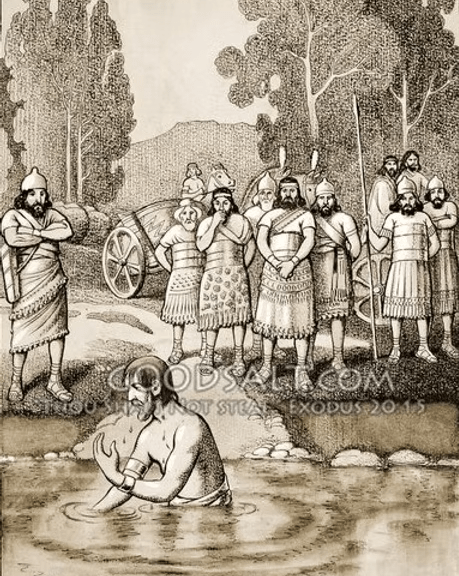
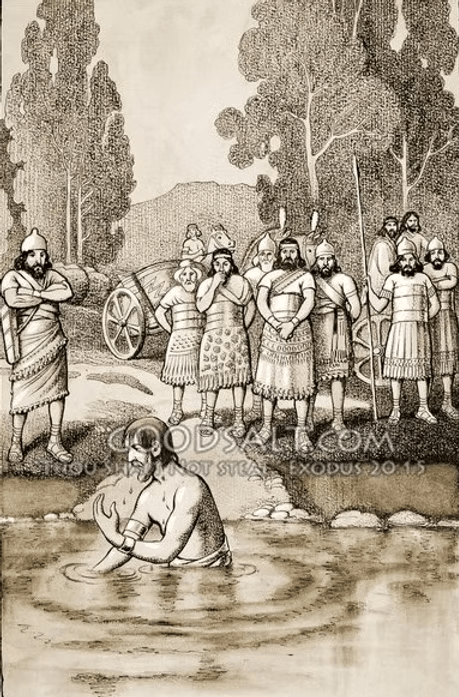
[1] Naaman, commander of the army of the king of Aram, was a great man and in high favor with his master, because by him Yahweh had given victory to Aram. The man, though a mighty warrior, suffered from leprosy. [2] Now the Arameans on one of their raids had taken a young girl captive from the land of Israel, and she served Naaman’s wife. [3] She said to her mistress, “If only my lord were with the prophet who is in Samaria! He would cure him of his leprosy.”

—–

[7] When the king of Israel read the letter, he tore his clothes and said, “Am haelohim, to give death or life, that this man sends word to me to cure a man of his leprosy? Just look and see how he is trying to pick a quarrel with me.”

[8] But when Elisha the man haelohim heard that the king of Israel had torn his clothes, he sent a message to the king, “Why have you torn your clothes? Let him come to me, that he may learn that there is a prophet in Israel.” [9] So Naaman came with his horses and chariots, and halted at the entrance of Elisha’s house. [10] Elisha sent a messenger to him, saying, “Go, wash in the Jordan seven times, and your flesh shall be restored and you shall be clean.” [11] But Naaman became angry and went away, saying, “I thought that for me he would surely come out, and stand and call on the name of Yahweh elohaw, and would wave his hand over the spot, and cure the leprosy! [12] Are not Abana and Pharpar, the rivers of Damascus, better than all the waters of Israel? Could I not wash in them, and be clean?” He turned and went away in a rage. [13] But his servants approached and said to him, “Father, if the prophet had commanded you to do something difficult, would you not have done it? How much more, when all he said to you was, `Wash, and be clean’?” [14] So he went down and immersed himself seven times in the Jordan, according to the word of the man haelohim; his flesh was restored like the flesh of a young boy, and he was clean.

[15] Then he returned to the man haelohim, he and all his company; he came and stood before him and said, “Now I know that there is no elohim in all the earth except in Israel.”

——————–

I wrote about verses one through fourteen of this reading selection when it was the Track 1 Old Testament selection for the fourth Sunday after Pentecost (Proper 9), Year C. You can read those observations by clicking on this link: 2 Kings 5:1-14 – Letting our own acts of faith wash our sins away. Feel free to read that commentary, as it is now a Track 2 option, which means the lessons of this reading are important to expose in this Year C.

The name “Naaman” means “Pleasant, Pleasantness.”

The name “Aram” is often translated from the Hebrew into English as “Syria,” but the word means “Elevated, Citadel.”

The name “Israel” goes beyond being a name for the Northern Kingdom, as it is rooted in the spiritual identification of Jacob’s soul (and all who would become like his spiritual soul), meaning “He Retains the el of Yahweh.” That is an indication of a soul married to Yahweh and merged spiritually with the soul of His Son (Adam-Jesus), who is then the Lord of that host soul and its flesh.

The name “Elisha” means “God Is Salvation.”

When all this is known, one can look at verse one where it says, “by him [Naaman] Yahweh had given victory to Aram”. This says Naaman was recognized as an honorable commander of the army he led; such that the northern reaches of the Northern Kingdom were in some way violating the Laws Yahweh set forth for them, so Naaman was “given victory” as an arm of justice empowered by Yahweh. By seeing this, to then read verse one end, stating “and a man he became mighty strong striking leprosy,” this is less a statement that Naaman had leprosy and more of a statement that his “victory” was over the leprous [a figurative and literal assessment of the people of the Northern Kingdom causing a need to be raided]. It was therefore from these acts of valor and strength in confronting the leprous that Naaman himself became a leper.

When we read of the “girl from the land of Israel,” this can be read spiritually as saying “a girl of the flesh which retains the el of Yahweh.” When we read that she was a servant to the wife of Naaman, this must be seen as a parallel lesson as that of the Track 1 Old Testament reading selection from Jeremiah 29. When Jeremiah instructed the captives of Judah to not cease doing the things that honor Yahweh, this girl in this reading is demonstrating that resistance to thinking being a soul married to Yahweh could only be maintained in one physical place on earth. This means the girl was motivated by the Spirit of Yahweh and her inner elohim to guide Naaman (one assisted by Yahweh) to remove the blight that had come upon him.

In verses seven through fifteen there are six references that have been incorrectly translated in some ways as “God,” where there are two direct namings of “Yahweh,” which is the only way He can be identified. The Hebrew word “elohim” is the masculine plural form of “el” meaning “gods” in the lower-case. A “god” is then an eternal creation of Yahweh – as seen stated in “Yahweh elohaw” – being then a spiritual and eternal being, like an angel, a spirit, a demon (good or bad), a law of physics, and/or a soul. When this is then stated in the plural number, as “elohim,” this then states a condition within a human being where two “el” reside together. As such, Elisha is identified as a “man of elohim,” meaning the soul of Elisha was joined with the soul of the Son of Yahweh (“Yahweh elohim”), and thereby led by that divine inner soul having become the Lord of Elisha. The generality of “elohim” being plural then says Elisha was not the only human )one soul in one flesh) that could become where Yahweh would send His Son’s soul to reside and Lord over that being.

When verse seven tells us “the king of Israel read the letter” delivered to him from the King of Aram and “he tore his clothes,” this is a statement that the true nature of the king became exposed. His kingly robes may or may not have been “torn,” but the covering they provided, leading all who looked upon a man in fine robes think this man is royal of Yahweh and led by His elohim, was quickly revealed as not being so. Thus, when verse eight has Elisha ask, “Why have you done this?” (reveal your lack of faith in Yahweh), “Send the leper to me,” this says Elisha, as “a man haelohimknew that a foreign military commander was sending a prayer (with gifts) to have Yahweh rid him of the leprosy he had (caused by repelling leprous people of the Northern Kingdom, with Yahweh’s spiritual support).

When verse eight has Elisha receiving word that the king has exposed he has no inner elohim leading him and Elisha sends word back, saying “Send him to me so he can see Yahweh does exist in a prophet of Israel,” the truth of “Israel” must be grasped as Elisha saying he Retained the el of Yahweh. For Yahweh there is nothing that cannot be done for those of faith. This means Elisha was told by his inner elohim that Naaman was a servant of Yahweh who deserved the cure he sought.

In verse nine, the translation above ignores the presence of a repeated word that is enclosed by parentheses and brackets. After we read, “and went Naaman,” the following is written: “[ bə·sū·sōw ] ( bə·sū·sāw )”. The word repeated is translated above only once, as “horses.” This repeated word is rooted in the Hebrew “cuwc,” which means “swallow, swift (type of bird),” with one implication being a “crane” (another type of bird). The word can be read as “horse” or “chariot horse,” but that can only satisfy the physical intent of a reading; and, the enclosure marks (along with the repetition) is a statement of a spiritual travel, rather than one physically drawn by horses. The “winged creature” meaning must be then read spiritually as Naaman’s soul being transported to Elisha; and, this would have been while Naaman was in his “chariot,” outside the residence of the king. This spiritual transportation then had the soul of Naaman be found “standing at the door of the house of Elisha.” In that, the “door of the house” must be read spiritually as the “opening to the inner dwelling” of Elisha.

When this spiritual connection is understood, it is then easy to grasp how verse ten says, “and sent to him Elisha a messenger,” where the word translated as “messenger” is “malak,” which is a word translated 110 times in Scripture as “angel” or “angels.” The “messenger-angel” is then coming from the “door opening” to Elisha’s soul, where it is joined by the elohim of Yahweh. This “messenger” is then the soul of the Son of Yahweh speaking to Naaman, telling him what to do, in order to be restored to youthful flesh. Thus, it was a spiritual encounter occurring that has the soul of Naaman meet the soul of Elisha, where Elisha did indeed prove to Naaman that a “prophet of Israel” is exist. The proof was the voice of Yahweh coming from His Son’s soul that was the Lord over Elisha’s soul-flesh; so, the soul of Elisha met the elohim that possessed his being.

In verse eleven, the anger expressed by Naaman must be seen as how so-called Christians today have expectations set for them by those like the king, whose torn clothes exposed he had no power of Yahweh within him. Leaders preach to pray for forgiveness and pray for miracles and then sit back and wait for Jesus to deliver. When those miracles do not happen quickly, or if someone else prayed for dies, then one’s faith is easily lost.

This is because the soul of the so-called Christians are not Christian, because their souls reject the presence of Yahweh’s Son within them. To sacrifice self for service to Yahweh and the commands of His Son as one’s Lord means giving up all dependency of material things; and, people do not want to make that decision. They would instead prefer that someone come and “wave a hand” and make their problems go away. When the voice of Yahweh said through His Son the elohim of Elisha, “Go and wash,” this says, “You must act as commanded, if your request is to be fulfilled.” There are no miracles for lazy souls in selfish bodies of flesh that refuse to do as Yahweh commands.

The name “Jordan” means “descending” or ‘descender,” from a root infinitive “to descend.” This must be known, as Naaman was not so much told to go to a specific river and baptize his flesh with water than originated from the north, passing through Syria. Rather, his soul was told to take his body of flesh that influenced his soul and “descend” into self-sacrifice. This makes this command be equal to Jesus having to die on the cross and then “descend” into death for three days, before he could ascend resurrected. The number “seven” is then symbolic of the ”completion” that comes from the “seven” days of Creation. The soul of Naaman was then told to “descend” from the influence of his flesh, so he died of self, until his soul had returned to be one with Yahweh, where “completion” would manifest the soul of Yahweh’s Son within his soul, as his Lord and Savior (“Yah Saves” is the meaning of the name “Jesus”).

When Naaman’s rage is then said to be calmed by us reading, “and came near Yahweh’s servants (as angels speaking to the soul of Naaman, rather than physical slaves daring to talk to their master as if they knew better than he) and declared to Naaman, “my father [Yahweh] speaks great from the prophet [of Israel].” Then the angels asked, “Would you not do as told if Elisha had spoken those words to you?” This then becomes the aides of Yahweh to those who seek salvation, but are afraid to take the necessary steps of self-sacrifice. The voice of reason will continue to speak to servants who comply with the commands of Yahweh, leading them in their descent from self to saved soul.