Tag Archives: Proper 24 Year B

Mark 10:35-45 – Being the hands of Jesus

James and John, the sons of Zebedee, came forward to Jesus and said to him, “Teacher, we want you to do for us whatever we ask of you.” And he said to them, “What is it you want me to do for you?” And they said to him, “Grant us to sit, one at your right hand and one at your left, in your glory.” But Jesus said to them, “You do not know what you are asking. Are you able to drink the cup that I drink, or be baptized with the baptism that I am baptized with?” They replied, “We are able.” Then Jesus said to them, “The cup that I drink you will drink; and with the baptism with which I am baptized, you will be baptized; but to sit at my right hand or at my left is not mine to grant, but it is for those for whom it has been prepared.”

When the ten heard this, they began to be angry with James and John. So Jesus called them and said to them, “You know that among the Gentiles those whom they recognize as their rulers lord it over them, and their great ones are tyrants over them. But it is not so among you; but whoever wishes to become great among you must be your servant, and whoever wishes to be first among you must be slave of all. For the Son of Man came not to be served but to serve, and to give his life a ransom for many.”

———————————————————————————————————-

This is the Gospel selection from the Episcopal Lectionary for the Twenty-second Sunday after Pentecost, Year B 2018. In the numbering system that lists each Sunday in an ordinal fashion, this Sunday is referred to as Proper 24. It will next be read aloud in an Episcopal church by a priest on Sunday October 21, 2018. It is important because the disciples are seen to fear the death of Jesus that he foretold a third time.  Jesus told them not to think in terms of fists of strength but hearts of service to others.

It is important to realize three background elements of this reading. First, this follows the third time Jesus told his disciples of his coming death. He did this after they had gone to the other side of the Jordan following the Feast of the Dedication (late December on the Roman calendar) and now they were beginning their return to Jerusalem for the coming Passover, about three months later. Jesus said his death would be in Jerusalem (Mark 10:33), so that factors into this reading.

Second, Matthew’s version of this request by James and John of Zebedee was made by their mother (Matthew 20:20-28), although one can assume she brought her two sons along with her to make the request we read here now. This means that James and John did make the request; but, rather than them going directly to Jesus, their mother initiated the discussion.
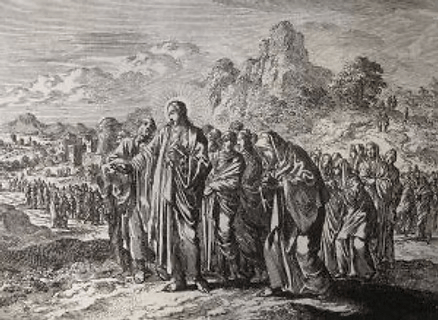
The presence of their mother is important as it shows that Jesus would not take his disciples away from their families for an extended period of time; and it shows that women were routine followers of Jesus, who assisted in the care and maintenance of Jesus’ ministry. Mark (Peter’s account of Jesus’ ministry) was not one to give much credit to those who were part of his Gospel, accompanying him or encountering him, as far as naming them or giving them specific recognition. However, it is important to know that women did follow Jesus and have influence on him and his disciples.

When one accepts that the Gospel of Luke is the story of Jesus’ ministry as seen through the eyes of his mother, Mary, one can see how chapter 18 of the Gospel of Luke recounts the same events as Mark’s chapter ten and Matthew’s chapter nineteen, including Jesus heading to Jerusalem.  All recount how Jesus told the disciples again of his coming death. This means the mother of Jesus, minimally, crossed the Jordan to hear her son teach in the synagogue (probably one in Bethany Across the Jordan).  She was present when Jesus made that announcement.  Mothers were then welcomed to accompany their sons as Jesus traveled and the disciples followed their teacher.

John, on the other hand, told of Jesus escaping Pharisees attempting to grab hold of Jesus and stone him, when he said he was the Son of God at the Feast of the Dedication. John did not write of any teachings of Jesus while on the other side of the Jordan River; but he told of Jesus being alerted that Lazarus had fallen very ill. This absence of John says (minimally) that he was not an adult and certainly not John of Zebedee.  Because Mother Mary knew where Jesus could be located, John was probably allowed to go with the party sent to tell Jesus of Lazarus having fallen ill, then returning to Bethany afterwards. Jesus would begin to return to Jerusalem because of that message and because it was time for the Passover Festival.
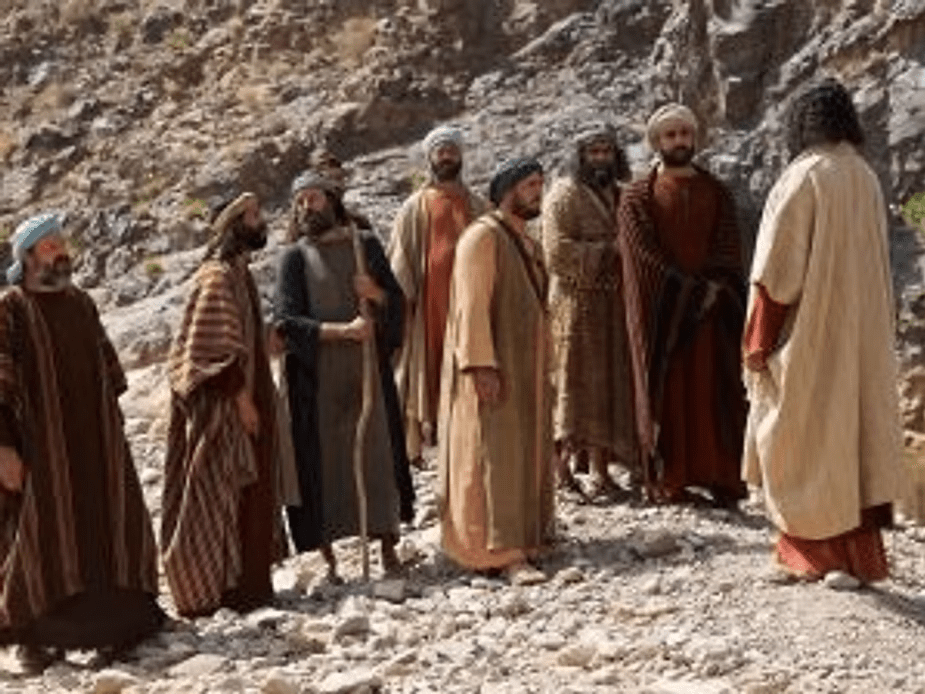
Jesus, we have come to tell you Lazarus is gravely ill and you are needed in Bethany.

Third, it should be recalled from the Gospel reading for the twenty-first Sunday after Pentecost that Jesus, while explaining how difficult it was for a rich man to get to heaven, concluded by saying, “Many who are first will be last, and the last first.” While that event might have been some time prior (perhaps a month or so), it should be remembered as a factor for James and John of Zebedee asking to be given Jesus’ approval to sit to his right and left. One can assume they recalled that teaching and were not asking for those positions as a favoritism.

When one has a three-dimensional view of the setting for this reading from Mark’s Gospel, one can get a feel for how James and John (and their mother) were not trying to gain favor in the eyes of the other disciples. They sought to be close to Jesus to protect him, after Jesus said the rulers of Jerusalem and the Gentile governor would take him and kill him (but after three days he would rise). Because Peter had tried to rebuke Jesus for talking such nonsense (to him), the direct approach of rebuking Jesus was known not to work (Jesus told Peter, “Get behind me Satan!). The motherly approach (the idea of James’ and John’s mother) was to ask Jesus to let the two strongest, most muscular disciples (burly from being sailors and fishermen) always stand closest to Jesus, where they would give up their lives in order to save their Teacher (Rabboni).

Seeing their request in this light, one is able to see them saying, “in your glory” as a statement of the “dignity, honor,” and “praise” that was due Jesus. They were not trying to get closer to an important person, as they were already close. The Greek written shows this separate segment of words as stating, “We might stay in the realm (sphere) of [a figurative statement, conditional of future “sitting”] under divine quality of you” (from “kathisōmen en doxē sou”). This makes it more evident that the request was as protection, so the disciples (and other followers of Jesus) would be able to defend the life of Jesus, as his “hands” of strength.

It should then be understood that Jesus knew full-well the intention of the request. The way it was worded, James and John (and their mother) had heard Jesus say, “Truly I tell you that if two of you on earth agree about anything they ask for, it will be done for them by my Father in heaven,” (Matthew 18:19) and thought that if two disciples asked for the same thing, then they could coerce Jesus “to do for us whatever we ask of you.” Jesus was talking then about Apostles who were joined with the Father in Heaven, while being on earth, as the definition of a Church. The disciples only understood earthly matters, not those heavenly. Therefore, Jesus said to them, “You do not know what you are asking.”

To answer James and John (and their mother), Jesus asked, “Are you able to drink the cup that I drink, or be baptized with the baptism that I am baptized with?” This question had nothing to do with asking, “Can you drink out of the same cup I drink from” or “Can you be baptized by the same water as I was baptized in?”

The “cup” (from “potērion”) that Jesus drank (the contents thereof) was the emotionally uplifting “wine” of God (where “wine” is an undistilled “spirit,” by alcohol content). The “baptism” that Jesus was “baptized with” was the Holy Spirit having merged with the soul of Jesus. At that point in time, none of the disciples could make the claim that their souls had been submerged into the Holy Spirit, so the Will of God was not then totally leading their actions.

When Jesus added, “To sit at my right hand or at my left is not mine to grant, but it is for those for whom it has been prepared,” this was Jesus knowing that his “hands” would be Apostles in the name of Christ. Neither his right hand nor his left hand would be idly by his side, waiting like Secret Servicemen, to act after a threat had been exposed.

Little did the disciples know that Jesus had already touched the souls of many people in his three years of ministry (in all of his miracle healings) leaving the bodies of those souls as the first Apostles, who became the “hands” of Christ that extended to the right (Jews) and the left (Gentiles). They had all been “prepared” or “made ready” (from “hētoimastai”) to receive the Holy Spirit because their hearts had opened to God’s love and they were born of true faith.

By James and John saying “We are able,” they were not hearing Jesus asking them if they were prepared to receive the Holy Spirit (the “cup” and the “baptism”). They felt prepared to drink ceremonial wine and be figuratively washed clean in the Jordan River, as the two who would defend Jesus with their lives. The Greek word written by Mark, which was their answer to Jesus was the capitalized “Dynametha,” which said, “We are powerful” or “We have the strength.” Not only did that mean they were able-bodied men, but they were mentally prepared to die defending Jesus.

When the reading then says that the other ten disciples became angry at James and John, this says the two brothers had not planned this with the other disciples. Hearing their proposal made them angry and moved by great grief (from “aganaktein”), because their request made it seem that the other ten were thought to not be willing to die defending Jesus. Not only that, the other ten were not physically suited to be strongmen, meaning they could be harmed without being effective in that role.  Their anger had nothing to do with James and John asking to sit next to Jesus at dinner time.

The disciples knew James and John of Zebedee were nicknamed by Jesus “Boanerges” – the sons of thunder. (Mark 3:17) This name, stemming from Aramaic (“bēn” [“sons”] and “regesh” [“of thunder, tumult”]), probably was because of how easy it was to tick them off, at which point they would get loud and break things. (Perhaps, they had a history of easily getting into fights, prior to following Jesus?)
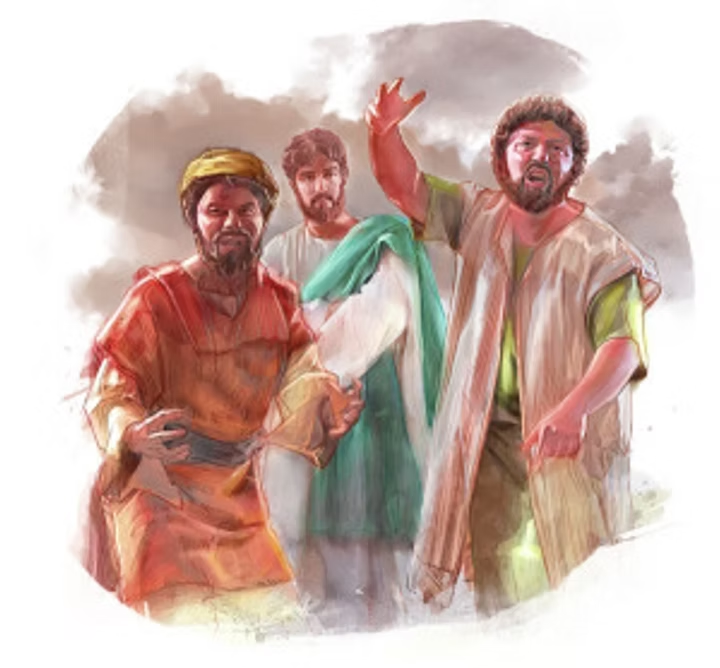
Easy boys.

When Jesus encountered Samaritans balking at making accommodations for the group, it was James and John that said, “Lord, do you want us to call fire down from heaven to destroy them?” (Luke 9:54) One would have to think their nickname spurred them to use the “fire from heaven” metaphor [lightening], as thunder comes before such strikes.

Jesus also chose the two brothers to go up the high mountain with him and Peter (Mark 9:2), probably because they were needed to carry most of the gear (tabernacles, rope, warm clothing, food, etc.). Their being picked because of the strength necessary to a somewhat dangerous journey safer means Jesus did not favor James and John of Zebedee over any of the other disciples.  It was logical to pick the strongest men.

With that realized, the other ten knew James and John were going into the area of brains, when their forte was brawn.  Asking to be the bodyguards of Jesus is what made the other disciples incensed at the thought that James and John (and mother) tried to maneuver it so they could keep Jesus alive by a show of manly-man strength.  Their thick skulls kept them from realizing the dangerous position that would put the others in, when they were probably less physically imposing.

Jesus saw just reason for the ten disciples to be angry, so he called them all together and said, “You know that among the Gentiles those whom they recognize as their rulers lord it over them, and their great ones are tyrants over them.” This is a somewhat misleading translation, which needs to be clarified.

The Greek word “katakyrieuousin” means “exercise authority over, be the master of, and hold in subjection,” as well as “lord it over.” This is followed by the Greek word “katexousiazousin” that means, “exercises power over” or “exercises authority over,” with abuse of those powers implied, such that oppression and strong domination can lead one to assume tyranny. Because the identification here is “ethnōn,” meaning “heathen people” or “foreigners,” such that “Gentiles” is translated rather than Romans, one needs to look closer at who Jesus was referring to when he said, “You know” or “You remember” (from the capitalized “Oidate“) to his disciples.

It is always easier to remember the past horrors than to see the present dangers.

In all of the four Gospels there is little mention of the Roman presence in Galilee and Judea, until Jesus is tried, whipped and crucified. It is understood that the Roman Empire was in control of all that was ancient Israel, but nothing was written about Romans accosting Jesus and his entourage, in Judea or Galilee, in Tyre, Caesarea Philippi, Gardara (or Gergasa of the Decapolis), or any of the places beyond the Jordan. The rulers of tyranny that all the disciples knew amounted to those in Jerusalem. Those rulers were those in power who knew Rome would rather give the Temple elite whatever they wanted, than not.  Rome sent a governor that would appease Jerusalem’s rulers, simply to avoid another costly revolt led by religious zealots.

This makes the third announcement of Jesus’ coming death, which he recently repeated to his disciples, become important to understand, now that Jesus has talked about leaders who exercise authority over subjects, to the extent of being tyrants. Jesus had just recently told his disciples, “Behold, we are going up to Jerusalem, and the Son of Man will be delivered to the chief priests and the scribes; and they will condemn Him to death and will hand Him over to the Gentiles.”

The word translated as “Gentiles” is “ethnesin,” which is a form of the same word Jesus just spoke (“ethnōn”), rooted in “ethnos.” Whereas the word “gentile” (in the lower case) is a general classification of races and peoples of nations that were non-Jewish, the implication was heavily leaned towards an identification of idolatry worship and not worshiping the same God of the Jews. When that classification is understood, the rulers of Jerusalem were capable of being put into this category of peoples, simply because they worshiped money and power. In the same way that Samaritans were deemed gentiles by the Temple Jews, the same shoe fit them in the eyes of God.

As the third (and final) time Jesus would predict his death, it is worthwhile to realize the details of the other two. The first time, Mark said Jesus “began to teach them that the Son of Man must suffer many things and be rejected by the elders, the chief priests and the teachers of the law, and that he must be killed and after three days rise again.” (Mark 8:31) That focused solely on the Temple rulers.

Then, the second time Jesus said, “The Son of Man is going to be delivered into the hands of men. They will kill him, and after three days he will rise.” (Mark 9:31b) That focused solely on the gentiles, who would be those executing the judgment brought about by the ones who truly exercised authority as tyrants, using injustice to make it seem otherwise.

Now, the third time, Jesus combined the two, so it would be the chief priest and the scribes that would condemn Jesus, handing him over to the gentiles to do their dirty work.  This becomes the necessary background element that caused Jesus to importantly remind his students about the tyrants they knew personally, not some emperor far away in Rome.

It must be seen how Jesus pointing out the exercise of authority in oppressive ways was accepted as how Rome maintained control over a vast empire. The Romans would have no moral difficulties in executing condemned men, whether they would judge them by Roman laws or have some local yokels use their laws to judge their own. Still, for Jesus to break into this aspect of tyranny, one must realize that had absolutely nothing to do with James and John wanting to sit next to Jesus at dinner time.

Jesus saw their intent was to surround Jesus with brute force bodyguards, which the other ten saw as an open invitation for the Romans to suddenly have a problem with Jesus, as a leader of rebels against Roman domination. Jesus then was telling his disciples (paraphrasing), “We are not like them.” (Literally translated above, “It is not so among you.”)  That meant, “We do not depend on might making right, in a physical sense.  We are about the inner strength and power of God.”

Jesus told his twelve disciples, “Whoever wishes to become great among you must be your servant, and whoever wishes to be first among you must be slave of all.” As Jews under the denomination of Rome and the Temple of Jerusalem, greatness was dependent on being a slave of all, as a servant of God.  Jesus had sent all his disciples out to serve the needs of the Jews; not to incite an overthrow of oppression.  Service meant giving spiritual strength to those suffering from oppression, thus freeing them to also serve God.
We are all slaves to gravity, even those born with silver spoons in their mouths. Wait until the next Great Depression and see how many will volunteer to be slaves, rather than be free to die.

This meant (even though they would not understand this meaning until after they were filled with God’s Holy Spirit) that Jesus said, “If you are to drink from the cup of salvation,” (remembering that Judas would not) “then you will be baptized by the Holy Spirit and be reborn as me.”  Jesus was teaching his disciples to lead by example, where greatness came from serving the spiritual needs of seekers.  Sacrifice of self made being a slave of all the lesson of Jesus.

To reach that point of commitment to God, there could be no revolt against the tyranny of Rome, or the tyranny of the Temple in Jerusalem. Greatness does not come from calling upon God to rain fire upon one’s enemies, such that one man’s punch given in anger deserved a punch likewise in return. Worldly power is exemplified by the pendulum, where one swing to the right means an equal and opposite swing to the left.  The hands of linear time pound the drumbeat of both victory and defeat.

The Temple rulers saw themselves as the great among the Jews, just as the Romans saw themselves as the great of the western world; but (in time) they would dissolve into nothingness. While the Temple’s ruling class of Pharisees, Sadducees, scribes, Sanhedrin, and high priest held the common Jews as their slaves, just as the Romans held their conquered as their slaves, (in time) they would become the slaves of others (Saracens and Barbarians). Those who would be filled with God’s Holy Spirit would be freed to eternal life, by submitting to marriage to God and living as His Son, Jesus Christ.

This is why Jesus then concluded this reading selection by stating, “For the Son of Man came not to be served but to serve, and to give his life a ransom for many.” Jesus told his disciples that just as he came to serve others, they (in time) would be reborn as the Son of Man and likewise expected to serve God, the Father.

It would be that subjection to God – as a wife to one’s Husband, so the Father of all Sons of Man will come as Jesus Christ reborn – that would cease trying to use brute force to change the will of powerful worldly men.  Subjection to God would mean the use of spiritual power to influence the masses to likewise forego rebellion against tyranny and serve God as true Christians. That holy service, just like the service of Jesus, would bring about persecution by the great, leading to a servant’s death. However, giving a life as the ransom paid for many other lives to be saved means eternal life and the greatness of Heaven.

As the Gospel selection for the twenty-second Sunday after Pentecost, when one’s own personal ministry for the LORD should be underway – one has already become a hand of Christ reaching out to serve others – the message here is to stop trying to use strong-arm tactics to force one’s will onto others, is some ill-conceived plan to save Jesus from being killed. One cannot act like James and John of Zebedee (and their mother) and expect Jesus to grant your wish, just because it makes good sense personally, but regardless of how little thought one gives to others following Jesus.

As it is with all Scripture, the reader needs to put oneself in the role of the characters that are not Jesus. Rather than have a priest stand before a congregation and preach his or her personal politics, which uses the “servant of all means greatness” theme as reason to vote for this politician or hate that politician, while not thinking once about how many innocent lambs are slaughtered by such persecutory speech, one needs to tune those ideas out and simply serve God. When one serves God, God will have one serve those in need of God’s help.

When Jesus asked James and John (and their mother), “Are you able to drink the cup that I drink, or be baptized with the baptism that I am baptized with?” the knee-jerk response is exactly like theirs: “We are able.” Simply by walking around town or posting memes on social media that proclaim, “I am Christian,” one is saying, “I drink the holy wine of Communion (and eat the wafer too!), which is my right as a baptized (by holy water) Christian (denominational specific membership).” However, that is totally missing the point.

The only way to “drink the cup that [Jesus] drinks, or to be baptized with the baptism that [Jesus is] baptized with” is to be Jesus. That metaphor is not some fancy chalice kept in a ‘Jesus box’ in a church, washed clean by some altar guild member after each use, as it is not a physical cup that holds physical drink.

The cup is symbolic of deep-felt emotions, which cannot be touched physically. Science cannot observe the emotional center of the human body, although they can probe and monitor electrical impulses stimulated in the heart and brain and try to measure them. The cup that Jesus drank was the love of God within his heart-center, which came from Jesus being married to God, thus His servant forever. Thus, Jesus asked every reader of this reading (and everyone listening to this reading be read), “Have you married God, having submitted your self-ego fully to His Will, lovingly speaking only the truth, from the love of God that makes one’s cup runneth over with joy?”

People dance ecstatically and wave their arms in the air for a love of Jesus, but do they love God?

The ones dancing each should be Jesus Christ reborn, but if they are truly Christians, wildly dancing and praising Jesus as the one he or she loves, then that either says: a.) I am a liar and not Christian; or b.) My heart is not devoted to God, but to an idol named Jesus.

James and John of Zebedee were the same way. So too were the other ten disciples, including Judas Iscariot, such that each worshiped Jesus of Nazareth as a most holy prophet that could never be replaced by another human being. They were, after all (at that time), Jews and not yet Christians. They believed God is great, which meant they believed God sent them a great prophet named Jesus.

That is an opinion not exclusive to Christians. Jesus would be killed because most Jews did not believe in a Messiah, unless he was a strong man that would overthrow Rome and return the land of Israel to the remnant Jews. Jesus would not pass the physical test of immortality. The Muslims, unlike the Jews, say Jesus was a most holy prophet … just not the last great prophet. They think (like did James, John, their mother, and the other ten disciples of Jesus) with their brains (and brawn); not feeling the love of God in their hearts and souls.

Christians feel faith with their hearts and follow the insights of the Christ Mind.  They go beyond the limits of belief (the words of others), feeling a presence they had never felt before, which is more than human emotions can attach a word to.  They see in inexpiable ways, with inaudible whispers leading them to go places their brains would have never thought for them to go.  They experience God, so there is no need to memorize His words through others, when a Christian has the same knowledge of God as did all true prophets.  To worship a prophet then means to take one’s eyes off God.

When Jesus asked James and John of Zebedee (and mother), “[Can you] be baptized with the baptism that I am baptized with?” one only has to remember the words of John the Baptist. He said, “I baptize you with water for repentance. But after me comes one who is more powerful than I, whose sandals I am not worthy to carry. He will baptize you with the Holy Spirit and fire.” (Matthew 3:11) Again, baptism is a word that means “submerged,” implying water. But the Holy Spirit and fire do not represent a physical “dipping,” but a spiritual transformation.

Few people understand the Holy Spirit. While they can grasp the Father and the Son of the Trinity … because they have physically seen fathers and sons … there is difficulty explaining the Holy Spirit to doubters.

Does that mean belief in ghosts?

Many Christians cannot answer that question, nor can they explain the Holy Spirit to non-believers. The reason is few people are indeed filled with the Holy Spirit.

Again, dancing wildly with ones hands raised in the air is not an indication of being filled with the Holy Spirit.  The hands of God reach out to seekers, not towards a sky or ceiling.

Being filled with the Holy Spirit comes after one’s marriage to the love of God. It is when one’s soul is submerged with God’s Spirit, so the two are one. Sin becomes a thing of the past. That union brings the resurrection of God’s Son in a new servant in his name. One serves God as Jesus reborn, which means “whoever wishes to be first among you must be slave of all.” It means the expectation has been set, “to give [one’s] life [as] a ransom for many.”

It does not mean being a pastor of a megachurch. It does not mean having a need to demand donations for another new private jet. It does not mean greasing one’s path to a fast track to riches, vacation homes, and fancy cars. It does not mean being so poor that others will not take the time to listen to what one’s message from God says.

Being married to God and baptized by the Holy Spirit means raising a family of Christians, who may or may not be one’s own physical flesh and blood. It means loving God with all one’s heart and wearing His face always. It means telling the truth and shedding the light into a world of lies and darkness. It means being persecuted for doing that, but with nary a worry.

Hebrews 5:1-10 – According to the order of Melchisedek

Every high priest chosen from among mortals is put in charge of things pertaining to God on their behalf, to offer gifts and sacrifices for sins. He is able to deal gently with the ignorant and wayward, since he himself is subject to weakness; and because of this he must offer sacrifice for his own sins as well as for those of the people. And one does not presume to take this honor, but takes it only when called by God, just as Aaron was.

So also Christ did not glorify himself in becoming a high priest, but was appointed by the one who said to him,

“You are my Son,

today I have begotten you”;

as he says also in another place,

“You are a priest forever,

according to the order of Melchizedek.”

In the days of his flesh, Jesus offered up prayers and supplications, with loud cries and tears, to the one who was able to save him from death, and he was heard because of his reverent submission. Although he was a Son, he learned obedience through what he suffered; and having been made perfect, he became the source of eternal salvation for all who obey him, having been designated by God a high priest according to the order of Melchizedek.

———————————————————————————————————-

This is the Epistle selection from the Episcopal Lectionary for the Twenty-second Sunday after Pentecost, Year B 2018. In the numbering system that lists each Sunday in an ordinal fashion, this Sunday is referred to as Proper 24. It will next be read aloud in an Episcopal church by a reader on Sunday October 21, 2018. It is important because Paul wrote of a high priest being the designation God gave to Jesus Christ, which is manifest in mortals as Apostles and Saints that have been reborn as that high priest. All become high priests according to the order of Melchizedek.

In this reading one can clearly see how Jesus is a high priest in the order of Melchizedek. The wonder of knowing that is meaningless. If Jesus is a high priest in that order of high priests – where one must assume God was the one who established that order – why do we want to kneel down before a cross nailed to the wall with an icon of dead Jesus hanging from it and pray to a dead and long gone high priest?

“Oh,” you might say, “Jesus didn’t stay dead; he ascended to be with the Father.”

Okay. Then since Melchizedek never died, and always is, like God, why don’t we worship him? Elijah ascended into Heaven without dying, and he appears next to Moses in the Transfiguration. Why don’t we kneel down and pray to Elijah?

Don’t forget Enoch, the son of Jared who fathered Methuselah. He lived for only 365 years, when Enoch “walked with God: and he was no more; for God took him.” That is kinda like Jesus only living 34 years before God took him early in life. Let’s throw some worship towards Enoch too!

Okay, I have been facetious long enough. Jesus is the high priest in the same way that God is the King. God sits on the throne of one’s heart, while His high priest controls the spiritual direction of God’s kingdom (one’s body) as the Christ Mind. Paul wrote of this often; and Paul wrote of this in this reading. If one cannot see this appear from the words Paul wrote (as his spiritual direction from the Christ Mind leading him), then one will never become a Saint in the name of Jesus Christ.

As I have done before and do again now, I have broken down the Greek segments of words (based on pause points), so one can see how each segment should be read as a stand-alone statement that then connects to the next stand-alone statement, and so on. The translations I use are based on the Greek word analysis provided by links in the Bible Hub Interlinear of Hebrews 5.

My translations differ from those set by Bible Hub, which are more inclined to lead one to paraphrase the Greek into seemingly understandable English (American version). However, reading Paul in the manner I have painstakingly prepared makes it easier to see the true intent of his words, rather than some fluffy, warm and fuzzy, misconstrued gobbledygook that is based on preconceived notions of only one can be a high priest in the order of Melchizedek (except the aforementioned others that fit the qualification, not to mention David and Aaron).

Nope. Still not gonna let you kick that ball around.

Here is my literal translation of the Greek segment of words:

1. All for high priest  ,

out from among men being laid hold of  ,

for the sake of men being put in charge  ,

they interfacing with the [one] God so that he should offer gifts not only offerings beyond sinful deeds  ,


2. to preserve moderation in the passions empowered  ,

to those having no knowledge and being misguided  ,

seeing that also the same is surrounding frailty  ;


3. and by reason of them he is indebted  ,

according to the manner in which about those people [of the Lord]  ,

in this manner also about self  ,

to make an offering concerning sinful deeds  .


4. Namely not upon oneself a certain one takes hold of this honor  ,

but instead being name given by the [one] God  ,

according to the manner in which also Aaron  .


5. Thus also the Christ not himself did bestow value to come about a high priest  ,

but one who having spoken referring [to] him  :

Son of mine are you  ,

I today have begotten you  .  [Psalm 2:7]


6. Just as also on another he tells  :

You [are] a priest for the ages  ,

according to the order of Melchizedek  . [Psalm 110:4]


7. Whom in those days together body the same  ,

entreating both and olive branches of peace  ,

towards those who were powerful to rescue him from physical death  ,

after outcry vehement and tears having made a sacrifice  ,

and having been intently heeded  ,

deserting companions godly fear  ,


8. although being Son  ,

he gained knowledge away from this he suffered  ,

those submissiveness  ,


9. also having been made perfect  ,

he was born to all others obeying him  ,

the cause of salvation eternal  ,


10. having been addressed by name under authority one God a high priest according to the order of Melchizedek  .

Let’s break this down now.

Verse one, basically, says the plan for a human “high priest,” based on the system established by God, through Moses. Those were physical beings of righteous status who allowed entrance into the holy places and were allowed to offer sacrifices to God and communicate with God, all for the children of Israel.  They are not to be mistaken as the high priests of pagan gods.

Verse two says the purpose for a “high priest” was to be the source of strength for the weak masses. Because of that common lack of knowledge and general tendency to wander and get lost spiritually, God would offer the people guidance and stability for all, through the wisdom given to their spiritual leader.

Verse three then adds that the presence of a “high priest,” for the benefit of the people of God, leaves all the people in debt to God. This is not all people in the world, but those who believe in Yahweh – the One God of Israel. The debt is oneself, such that each individual should sacrifice their self-identity as an offering for their sins. The ultimate purpose of a “high priest” is to remind the children of God of that debt and personal responsibility for their sins.

Verse four is how one receives the title of “high priest.”  In the system of order that Moses set in place, fathers named their children; usually this was some name that devoted a child to service to God. The child did not take credit for a name given to it; but a child was expected to live up to that name. Likewise, the title of “high priest” was a name given by God to His servant, as the ceremonial one who would lead the whole gathering of Israel. As such, the child named Aaron was made “high priest” of Israel by God, the Father. All honor and praise given to that title was due to God.

Verse five then directs this theme of “high priest” to Jesus of Nazareth, who Paul referred to as “the Christ” (or “the Messiah”). Jesus of Nazareth never called himself a “high priest,” because that hat was worn by a rotation of Sanhedrin members (such as Annas and Caiaphas). God made Jesus Christ be a spiritual “high priest,” with Paul using David’s Psalm 2:7 as a prophecy of that anointment. One can then assume that David was also a “high priest” of God in a spiritual sense.

Verse six then has Paul quote another verse from David’s Psalms (Psalms 110:4), where God told David he was a “high priest according to the order of Melchizedek.” There, the Hebrew word translated as “order” (“dibrah”) means, “cause, reason, and manner.” This means it is important to understand that Melchizedek was essentially the physical embodiment of the angel placed at the entrance into the Garden of Eden, after Adam and Eve were banished. That place on earth became known as Salem and/or Zion, where Melchizedek was the King and High Priest. This was also where David was King and spiritual “high priest” of Israel. Thus, Paul compared Jesus Christ to the Holy Spirit that forbids sinners from entrance into Heaven.

Abram meeting Melchizedek in Salem.

This comparison to Melchizedek should be investigated. The name Melchizedek means “King of Righteousness.” Jesus Christ is also called a King, but he said, “My kingdom is not of this world … but … from another realm.” (John 18:36) That makes Jesus the King of Heaven on Earth, as Melchizedek was the King of Salem, which was the earthly terrain on which Jerusalem was built, but the spirituality underneath that terrain was Eden. Seeing this High Priest title as the one who allows entrance into the Father’s kingdom makes it be how Jesus said, “I am the gate; whoever enters through me will be saved. They will come in and go out, and find pasture.” (John 10:9) That is like the Angel who guards Eden.

Archangel Uriel is said to guard as written: “After he drove the man out, he placed on the east side of the Garden of Eden cherubim and a flaming sword flashing back and forth to guard the way to the tree of life.” (Genesis 3:24)

Verse seven then is Paul explaining how “the order of Melchisedek,” as “high priest” named by God (not an election by men) means a joining together of this Angelic guardian Spirit to the body of a human (as was Jesus of Nazareth joined with the Christ Spirit of God), so both are peacefully as one. This presence is then the promise of eternal life (entrance into Heaven), which is the power that rescues one from mortal death. This does not prevent death of the body; in fact, it promises to bring persecution from those who cry out against such a holy presence, along with the tears offered by those who fear death more than they fear God. Only those who are joined with God’s Holy Spirit can hear His comforting call, fearing nothing but losing that closeness to the Father.

Verse eight then is Paul explaining that even though Jesus of Nazareth was the Son, he was made man. Only by knowing the sufferings of human beings can one gain “high priestly” understanding through the Christ Mind. That spiritual guidance can only be known through complete submission of oneself (self-ego) to God’s Will.

Verse nine says that perfection can only be a result of one’s past sins being erased through baptism of the Holy Spirit, when God sits on the throne within one’s heart-center and the soul has been merged with complete righteousness. Jesus Christ has been born as the “high priest” that must be raised within each of God’s faithful, so only those perfected can return to Eden. All who will be reborn in the name of Jesus Christ will have Jesus Christ as their personal “High Priest.” They will obey his commands, and in return they will be granted eternal life.

Verse ten is then Paul saying that each Apostle and Saint will be addressed by the name of Jesus Christ, which is the title that comes under the authority of God. As such, each Apostle and Saint becomes the embodiment of a “high priest” on the earthly realm. As a “high priest,” one like Paul is another “according to the order of Melchisedek.” This is the ultimate result of “All for high priest.”

As the Epistle selection for the twenty-second Sunday after Pentecost, when one’s own personal ministry for the LORD should be underway – one should have received the high priest Jesus Christ within one’s flesh – the message here is arise to the state of being where God speaks to us individually, telling each and every one of us, “You are My Son, today I have begotten you” as another in the holy order of Melchizedek. Each of us has to be reborn as the Angel that not only guards the stairway to Heaven that Jacob witnessed in a dream, but become the high priest that instructs others what it takes to return to God’s garden.

It is too easy to read Paul’s words here and see Jesus of Nazareth as that very special guy that could put up with the insults, the false claims against him, the scourging, the ridicule as a lowly commoner claiming to be a king, the nails piercing his flesh and bones, the spearing in his side, and the rolling of dice to see who would take possession of a fine robe, too nice to cut into pieces. It is too easy to say, “He was a better man than I (regardless of one’s human gender)” and pretend that Jesus suffered so others could never suffer, while getting the password that gets them past the Angel that forbid Adam from coming back. After all, Adam ate a cookie from the cookie jar after being told not to. Whose sins could ever be greater than that?!?!

The problem with Christianity is having too many people not having a clue what being Christian means. As long as Jesus is the spiritual high priest in Heaven watching over our miserable selves, forgiving all our sins if we believe in the cross of his murder, why should anyone ever try to become Jesus Christ reborn? As long as we let common men stand up on pedestals, proclaiming, “I am the High Priest” (a.k.a. those like Mr. Roman Pope), it is just a matter of paying an indulgence fee and then go out and play. This modern version of Christianity is all about self, with very little being about sacrifice of self to God.

The holy order of Melchisedek has left the building … so to speak. The world had reverted into paganism, where an unknown number of people have posters, icons, and statues made in their likeness. Babies are named after them (when not just randomly chosen letters pulled out of a Scrabble bag arranged in some order).

Those who are given names from the Old Testament (fewer these days) have little idea of the name’s original meaning. Therefore, no one grows into a responsibility to be a servant of God Almighty.

As an accompanying reading to the Gospel reading where James and John of Zebedee asked Jesus to give them the right to be the right hand and left hand of Jesus, when Jesus told them, “You do not know what you are asking. To sit at my right or left is not for me to grant. These places belong to those for whom they have been prepared.”

Newsflash: The preparation was for all the followers of Jesus of Nazareth to be prepared to receive his Holy Spirit and become a high priest.

Maybe the reason is no one is teaching this lesson? Listen carefully to the sermon coming soon to a Christian church near you. See if that message is preached.

Job 38:1-7, [34-41] – Gird up your loins like a man

The Lord answered Job out of the whirlwind:

“Who is this that darkens counsel by words without knowledge?

Gird up your loins like a man,

I will question you, and you shall declare to me.

“Where were you when I laid the foundation of the earth?

Tell me, if you have understanding.

Who determined its measurements—surely you know!

Or who stretched the line upon it?

On what were its bases sunk,

or who laid its cornerstone

when the morning stars sang together

and all the heavenly beings shouted for joy?

[“Can you lift up your voice to the clouds,

so that a flood of waters may cover you?

Can you send forth lightnings, so that they may go

and say to you, ‘Here we are’?

Who has put wisdom in the inward parts,

or given understanding to the mind?

Who has the wisdom to number the clouds?

Or who can tilt the waterskins of the heavens,

when the dust runs into a mass

and the clods cling together?

“Can you hunt the prey for the lion,

or satisfy the appetite of the young lions,

when they crouch in their dens,

or lie in wait in their covert?

Who provides for the raven its prey,

when its young ones cry to God,

and wander about for lack of food?”]

———————————————————————————————————-

This is an optional Old Testament selection from the Episcopal Lectionary for the Twenty-second Sunday after Pentecost, Year B 2018. In the numbering system that lists each Sunday in an ordinal fashion, this Sunday is referred to as Proper 24. If chosen, it will next be read aloud in an Episcopal church by a reader on Sunday October 21, 2018. It is important because God finally responds to Job, not only showing that patience is indeed a virtue but showing why Job was a righteous man that God knew would pass Satan’s test.

The last we read from the Book of Job (the previous Sunday, Proper 23), it was from chapter 23. Now, we have moved ahead to chapter 38. In between three friends came to counsel Job, basically saying no true God would punish the righteous. Then, from out of nowhere, comes this person named Elihu, who rebukes those three, saying there is good reason for the righteous to be punished, because it can prevent sin.

When Elihu spoke, everyone listened.

The character named Elihu is questioned by modern scholars, as possibly a late addition to the book, because Elihu was not mentioned early in Job and he is not mentioned after his monologues cease. Elihu spoke in the last part of chapter 34 and all of chapters 35-37. Here, in chapter 38, is God finally responding to Job … not Elihu.

The name Elihu means “He Is My God.” This means Elihu is not a physical character, but the Holy Spirit within Job. It is the Holy Spirit within Job that has made him a righteous man, as no man alone it capable of withstanding the sufferings of a physical life without the presence and assistance of the Holy Spirit. Elihu is, therefore, the reason God accepted the challenge by Satan, because Satan was right that no ordinary man punished unjustly will remain faithful to God.

In the Gospel reading that this Old Testament reading is associated with, Jesus told James and John of Zebedee that no one can be allowed to sit at the right hand or the left hand of Jesus, to sit in his glory, because Jesus was not the one who could grant such a request. That had to come from God, and then it was only for those who had been prepared to receive His glory – the Holy Spirit. The Holy Spirit does not sit beside one, like Job’s three friends did, but within one, as Elihu did in Job.

Imagine yourself as the Temple-Tabernacle, with the Law written inside the ark in your heart, with the high priest being the Christ Mind that makes offerings at this holy altar inside you.

The Epistle reading that associates with this Old Testament reading is from Paul’s letter to the Hebrew-speaking Jews of Rome, when he told all Apostles there to have Jesus Christ as their high priest. Jesus Christ is not a high priest that is to the right or the left, or above in Heaven. Jesus Christ is one’s high priest when he has been resurrected within one’s being. As such, Elihu was the Christ Spirit within Job, meaning Job was a high priest according to the order of Melchizedek also.

When one sees Elihu as within Job, one can then see how chapter 38 is God’s response to Job, after Elihu had spoken through Job. When one sees how Elihu equates to Jesus Christ, Elihu is then relative to what John wrote at the beginning of his Gospel:

“In the beginning was the Word, and the Word was with God, and the Word was God. He was with God in the beginning. Through him all things were made; without him nothing was made that has been made.” (John 1:1-3)

When one reads this response by God, realizing that Job had “the Word” within him, a whole new light shines. The Hebrew word translated as “darkens” (“maḥ·šîḵ,” rooted in “chashak”) also means “hides, conceals, or obscures.” As such, the first question asked by God is, “Who is this that conceals counsel by words without knowledge?”

The answer is now understood to be:

“The high priest Elihu speaks the Word within thy servant Job, who has no opinion of his own to voice.”

The question that follows, “Where were you when I laid the foundation of the earth?” is now answered by Elihu, who strengthened the man he was within, so the answer would be, “I was with you Father, in the beginning.”

The whole of this reading changes complexion. It ceases to sound like Angry God, who was perturbed that the mortal He knew [God is omniscient] would not succumb to the sores of Satan, unjustly.  Job would not lose faith because of Elihu being with Job.  God knew that because God sent Elihu to be in Job.  The whole of this chapter now sounds like Loving God having a nice chat with His Son, the High Priest in Job.

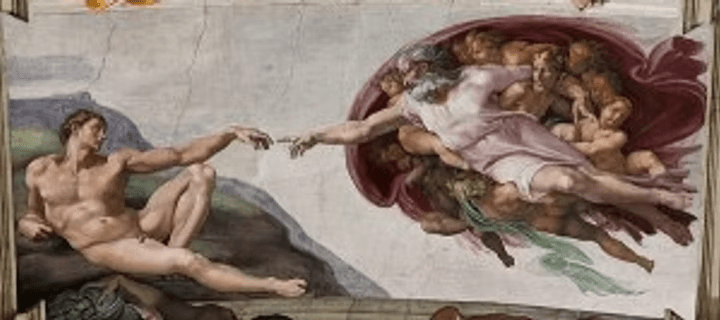
Hey Son. Finger bump!

As an optional Old Testament reading selection for the twenty-second Sunday after Pentecost, when one’s own personal ministry for the LORD should be underway – one has the high priest Jesus Christ within one, bringing with him all the knowledge of God – the message here is to gird up your loins (regardless of one’s human gender) and find the strength of Christ within you.

As I write these interpretations week in and week out, I am able to churn them out regularly because I spend little time looking up what someone thought about this reading or that reading. If I had to depend on what someone else had to say, I would just let someone else say it and save myself a lot of time trying to duplicate what comes from the brains of others. Sometimes I recall a reading and bits of pieces of things I have written before, but I always approach a reading like it is the first time.

In this process (which is not some grand plan or checklist of intelligent things to do), I find myself going back in time, as though I lived the events of the reading. By feeling a part of the past, I am able to understand the past just like I understand the present. Insight whispers to me, saying “Look this up” or “Go over there.” I follow those leads and astonishing revelations come forth. The timing of the Age of Information helps a lot; but … without the Interlinear assistance of Greek translations (Greek is Greek to me), the ability to search ideas and concepts, people, places and thing I previously knew nothing about, God could certainly ask me, “Who is this that conceals counsel by words without knowledge?”

“Not I, Lord,” I would say. “You know that.”

“Lord, you know.”

What I find every time is amazing to me. I write these for my own benefit. It is a joy and a passion. I thank God for letting me use my computer to voice His Word.

Isaiah 53:4-12 – The arm of the Lord

Surely he has borne our infirmities

and carried our diseases;

yet we accounted him stricken,

struck down by God, and afflicted.

But he was wounded for our transgressions,

crushed for our iniquities;

upon him was the punishment that made us whole,

and by his bruises we are healed.

All we like sheep have gone astray;

we have all turned to our own way,

and the Lord has laid on him

the iniquity of us all.

He was oppressed, and he was afflicted,

yet he did not open his mouth;

like a lamb that is led to the slaughter,

and like a sheep that before its shearers is silent,

so he did not open his mouth.

By a perversion of justice he was taken away.

Who could have imagined his future?

For he was cut off from the land of the living,

stricken for the transgression of my people.

They made his grave with the wicked

and his tomb with the rich,

although he had done no violence,

and there was no deceit in his mouth.

Yet it was the will of the Lord to crush him with pain.

When you make his life an offering for sin,

he shall see his offspring, and shall prolong his days;

through him the will of the Lord shall prosper.

Out of his anguish he shall see light;

he shall find satisfaction through his knowledge.

The righteous one, my servant, shall make many righteous,

and he shall bear their iniquities.

Therefore I will allot him a portion with the great,

and he shall divide the spoil with the strong;

because he poured out himself to death,

and was numbered with the transgressors;

yet he bore the sin of many,

and made intercession for the transgressors.

———————————————————————————————————-

This is an optional Old Testament selection from the Episcopal Lectionary for the Twenty-second Sunday after Pentecost, Year B 2018. In the numbering system that lists each Sunday in an ordinal fashion, this Sunday is referred to as Proper 24. If chosen, it will next be read aloud in an Episcopal church by a reader on Sunday October 21, 2018. It is important because Isaiah spoke of how weak all human beings are, but the ones who hold true to God are upheld.

Not read in this selection is verse one, which says this song of praise was written with a theme that asks, “To whom has the arm of the Lord been revealed?” The “arm of the Lord” is known today as Jesus Christ, as the Christ Mind brought within those to whom that “arm” has been “revealed.” Therefore, the verses in this reading are addressing (as a prophecy, but also as a truth that is always) characteristics that would later become identifiable as the Son of Man, Jesus of Nazareth.

Because God was speaking through the prophet Isaiah, who was a human being of faith (an Israelite of Judah), Isaiah spoke the words sent by God to his Holy Spirit companion that was the Christ Mind. Before there was a physical Jesus of Nazareth, there always existed the arm of God, with God, as God. John called that presence “the Word” (“Logos”). As such, Isaiah knew Jesus Christ as his high priest, without knowing him by that name. All Prophets, Apostles and Saints have this reach of God within them, so all become the arm of God in the earthly realm.

This manifestation of the Holy Spirit that is Jesus Christ then heals those of their worldly maladies. Jesus Christ comes to increase the faith of others, passing them the torch of fire for God, so sins become a failure of the past. Those who are lost and seeking God’s help will be found.

Still, because the earth is the realm of Satan, who tries to always lead mankind away from the true God, all who carry the Holy Spirit of Jesus Christ will face oppression. Silence and obedience comes from the strength of God, not fear of Man. Humans abort the Law of God and pervert justice. Because of that lack of a firm cornerstone to build trust upon, the future for godless Man is always in doubt. However, Jesus Christ offers the reward of eternal life, by his presence in the righteous.

Those who sell their souls for worldly gains will find them all short-lived. Their deaths will be when their souls pay the price of retribution, for having tried to harm the flesh of God’s perfect servants. In this way, Jesus Christ bore the transgression of many, not once flinching from fear of his own flesh being harmed. Those who are reborn as Jesus Christ have the same strength given to them; all they have to do to earn that strength is go out and be a beacon of light to all seekers of faith.

As an optional Old Testament reading for the twenty-second Sunday after Pentecost, when one’s own personal ministry for the LORD should be underway – one should have become the arm of the Lord reborn – the message here is to expect persecution without fear. When Jesus Christ has been resurrected within one’s being, then the only fear one should have is failing to serve God with all one’s heart.

This alternative reading restates the unjust punishment Satan laid upon Job. The reading from Job that is the option that parallels this reading from Isaiah says that Job, like Isaiah, was a righteous man, with both filled with God’s Holy Spirit that allowed them to be righteous. That presence brings a most holy presence into one’s soul, joining the soul to its Maker. The Son of God is then reborn in both Job and Isaiah, allowing them to speak to God and speak for God.

The sufferings stated by Isaiah that prophesy the coming of Jesus of Nazareth, which paralleled the sufferings of Job, project the expectations of all minister for the LORD. The easy way out is the way of sin, as Satan takes it easy on those who turn away from God. The lessons of Job and Isaiah are the same, as no ordinary human being can remain righteous by self-will alone. This is where sufferings come from the sacrifice of self-ego, while accompanied by a smile, knowing all worldly pains are fleeting. The reward of eternal life is lasting.

Close up of man’s arm showing biceps

For those who are too weak of spirit to find love in their hearts for God, they will become married to the material, which can only exist on the physical plane. For those who cannot pay the dowry required for marriage to God (the change of lifestyle that comes with commitment to only one), then there will be no offspring coming that will be called the Son of God. For all the comforts a soul can be sold for, the life expectancy of an American is merely 75 years. That time pales in comparison to eternity, as it is only a dewy thought of one drop in a bucket of time.

Isaiah should be read based on one’s commitment to God. Without a commitment, Isaiah wrote of some imaginary figure in the clouds of Heaven – pie in the sky that is unseen, and not proved. With a commitment to God, one feels the reality of Jesus of Nazareth, as if one lived through all his pains and sufferings.

Job 38:1-7, (34-41) – Hearing the voice of God for the first time

[1] Yahweh answered Job out of the whirlwind:

[2] “Who is this that darkens counsel by words without knowledge?

[3] Gird up your loins like a man,

I will question you, and you shall declare to me.

[4] “Where were you when I laid the foundation of the earth?

Tell me, if you have understanding.

[5] Who determined its measurements—surely you know!

Or who stretched the line upon it?

[6] On what were its bases sunk,

or who laid its cornerstone

[7] when the morning stars sang together

and all the heavenly beings bene elohim shouted for joy?

[[34] “Can you lift up your voice to the clouds,

so that a flood of waters may cover you?

[35] Can you send forth lightnings, so that they may go

and say to you, ‘Here we are’?

[36] Who has put wisdom in the inward parts,

or given understanding to the mind?

[37] Who has the wisdom to number the clouds?

Or who can tilt the waterskins of the heavens,

[38] when the dust runs into a mass

and the clods cling together?

[39] “Can you hunt the prey for the lion,

or satisfy the appetite of the young lions,

[40] when they crouch in their dens,

or lie in wait in their covert?

[41] Who provides for the raven its prey,

when its young ones cry to el,

and wander about for lack of food?”]

——————–

This is the Track 1 Old Testament reading selection to be read aloud on the twenty-first Sunday after Pentecost [Proper 24], Year B, according to the lectionary for the Episcopal Church. If ta church is on the Track 1 path for Year B, this reading will be accompanied by a singing of Psalm 104, which says, “You wrap yourself with light as with a cloak and spread out the heavens like a curtain.” This pair will precede a reading from Hebrews, where Paul wrote, “So also Christ did not glorify himself in becoming a high priest, but was appointed by the one who said to him, “You are my Son, today I have begotten you.” All will accompany a Gospel reading from Mark, where Jesus told his disciples, “You know that among the Gentiles those whom they recognize as their rulers lord it over them, and their great ones are tyrants over them.”

I wrote about this expanded selection from the thirty-eighth chapter of Job the last time it came up in the lectionary cycle, in 2018. That writing can be viewed by searching this site. I wrote about verses one through eleven, focusing on explaining what “gird your loins” means, with that commentary also available by a search of this site. That was posted in May of 2021, as my assessment of the reading assigned for the Proper 7 Sunday readings [the fourth Sunday after Pentecost, Year B]; so, it is fairly recent. Still, that was an expansion on the commentary I produced in the previous cycle of Year B (2018), when I posted this commentary here. I stand behind all of my prior postings, because there is merit in all that comes from the Word of this reading selection. I welcome all readers to view each of my prior publications and compare them to one another and what I will now add today. As always, I invite your comments, question, suggestions and corrections. Please sign up to comment to the blog, so others can see your opinions.

In the above presentation of the verses to be read, I have attached the verse numbers. I feel it is important to see where the verses are separated from one another, and to know where the leap from verse seven to verse thirty-four comes, rather than make that assumption from the brackets, which mark verses seen as appropriate to be read optionally. Also, in verse one I have restored the name appearing in the text of Job, which is “Yahweh,” replacing the erroneous translation that says “the Lord.” Further, in verse seven I have stricken out the translation that says “heavenly beings,” restoring the Hebrew written – “bene elohim” – which says, “sons gods.” Finally, in verse forty-one, the translation of “God” has been replaced by the Hebrew word written: “el.” It is foolishness, in a dialogue of Yahweh, to have Him refer to Himself [the implication of a capitalized “God”], when Yahweh is much more that the simplicity of an “el.”

Today, I want to address this reading from the perspective of all readers being Job. See it as written to each individual whose soul has married Yahweh, making it possible to long for His voice AND to be able to hear His voice when it speaks. I am reminded of a time when a mentor of religious studies asked the class, “I wonder what the voice of God sounds like, because I have never heard it.” I told him, “It would sound like your voice, as when you speak to yourself in your thoughts.” I want everyone to imagine this response of Yahweh to be to you, as if you have longed to hear the voice of God.

The Hebrew word translated as “whirlwind” is “ca’ar.” The word means “tempest,” which is metaphor for the storms of life. See this as one who has become lost in the speed of the world and the complexities of thoughts that then constantly surround one, all coming from outside sources (family, career, news of the day, etc.), Yahweh’s voice becomes the eye of the storm, where calm can be found. Thus, the voice of Yahweh is centering calm.

When verse two asks, “who here who darkens counsel by words,” this speaks of the mistranslations of English versions of the divine Scripture of the Holy Bible. It is “words” that I have amended above, from the “words” produced by the NRSV and the Episcopal Church.
One needs to be “here,” in front of a reading from the Book of Job, trying to figure out how it relates to you, the reader. Your vision of the truth has been darkened, so the truth cannot become a true source of “counsel.”

It is following a comma mark (that the NRSV fails to let you be aware of) that Yahweh says of them, “without knowledge.” Just like all those false shepherds who spoke to Job had no knowledge of Yahweh, so too does any translator of Hebrew into English know Yahweh by divine marriage. They are “without knowledge” of the intent behind the “words.” All they can do is read Hebrew and make things up, because the truth is hidden from the wise and intelligent, only revealed unto Yahweh’s children by marriage.

Verse three is where I have had so many views in the past, with Internet searches being, “What does gird your loins mean?” To see this as a statement by Yahweh to Job, as a ‘man to man talk’, leaves all the women on the sidelines, waiting for the church ladies’ group to talk about Esther or some other female figure. Perhaps it is women without loins that are searching the Internet for answers? The way to read “gird your loins like a man” [from “ezar-na kegeber”] is to see Yahweh speaking to one’s soul, not one’s flesh.

The words written can equally state, “encompass yourself like a man,” where it becomes necessary to realize the Spirit of Yahweh AND all His elohim is masculine in spiritual essence. A human being, as an eternal soul animating a body of dead matter, takes on the essence of femininity (or negativity, or receptivity), such that all males and females [earthlings] are “like mother earth” and not “like a masculine deity.” A “soul” alone is like a neuter-gender child, where its puberty has yet to develop.

There is absolutely nothing that says “loins” in the Hebrew text. The Hebrew word “na” means “I (we) pray, now,” implying “I beseech pray thee you, go to, now, oh.” (Strong’s) It is adjoined to “ezar,” which means “to gird, encompass, equip,” implying “bind compass about, gird up, with.” (Strong’s again) Thus, Yahweh is saying to “bind oneself” [where a self equals a soul] to the Spirit of Yahweh, so one’s soul is a masculine elohim and not some wimpy, whiney human being of either adult gender.

As Job was already a Yahweh elohim, Yahweh was simply telling him, stop crying like a girly man and we can talk, like we used to. That says to you, the reader, if you want to hear the voice of God and know what it sounds like, then “man up.” That means both males and females need to marry their souls to Yahweh and become His elohim through Spiritual growth. Growing up means transforming from the femininity of a soul led by a body of flesh (all genders) to the masculinity of a divine soul married to the Spirit of Yahweh and led to do His Will.

When verse four asks, “where were you when I laid the foundations of the world?” it is vital to see how Job is metaphor for Adam, who was the Son of Yahweh. The soul of Job, as Adam, possessed the soul of Jesus. This makes the statement at the end of the verse – “if you have understanding [of where one was when Yahweh Created]” – that demands one be a Yahweh elohim.

The answer to the question is found in John 1:1, where he wrote, “In the beginning was the Word, and the Word was with God, and God was the Word.” When a soul has been merged with the Spirit of Yahweh, then it gives resurrection to the soul of Jesus, a name that means “Yahweh Saves.” In Genesis 1 is written, “In the beginning created the elohim,” which were the souls-angels-heavenly spirits made by Yahweh. So, as an elohim created by Yahweh, the answer to the question is, “I was sent by you to lay the foundations of the world in the beginning.”

This means verses five, six, and seven all have the same answer. “I did all the work you say, Father, by your direction, with your hand guiding my angelic form.” is a truthful answer by a Yahweh elohim. Thus, verse seven ends by saying, “You did these things as My Sons elohim.” All of this says you, the reader, will also possess knowledge of all times – past, present, and future – through the Godhead (or Christ Mind) – when your soul loves Yahweh so intently that He takes your soul as His bride and impregnates your soul with His Son. You then become the Word, with God from the beginning, doing all things commanded by Yahweh.

When the Episcopal Church decides to leap forward to verse thirty-four, one sees that Yahweh is still asking questions that can only be answered by the “sons elohim,” with “sons” being a confirmation of the command to “encompass yourself like a Yahweh elohim [masculine spirit].” Here, the questioning is focusing on the ethereal being made worldly, from the metaphor of “clouds, lightning, and wisdom, being applied to dust in clumps.” Again, the answer is always the same, as only an elohim of Yahweh have this capability.

Verse thirty four asks, “can you raise dark clouds with a sound that an abundance of water may cover you?” This refers back to the question, “who darkens,” where the “clouds” are the failures of mere mortals to grasp the depth of meaning in Holy Scripture. Yahweh is asking if you, the reader, can make the emotions of truth flow freely from the pages of the Holy Bible, through speaking in divine tongues and explaining from the emotion of divine ecstasy? You can with His help.

Verse thirty-five then asks, “can you send out lightning bolts that they might walk; and say, “behold!”? Imagine the scene from an old Frankenstein movie, where lightning was used to bring life into a corpse. Relive the scene where Doctor Frankenstein shouts, “It’s alive!”

This is Yahweh asking you, the reader, can you jolt life into the dead by explaining Scripture, so dry bones can prophesy? The answer is you can, with God’s help, as His elohim.

Verse thirty-six then asks, “who has set the inward parts of wisdom? Or, who has given one’s soul understanding?” Everything comes from Yahweh, through His bringing the Christ Mind through His Son resurrected within one’s soul. There is no question that cannot be answered. The truth flows forth from all Yahweh’s angels in the flesh.

Verse thirty-seven asks, “who has the wisdom to count dust particles on earth? Or, know how many jars will contain the sky above?” Again, only Yahweh knows these answers; but they are made available to those He creates through divine marriage.

Verse thirty-eight then asks, “when flows the castings and the clods to cling together?” This is a question of who joins souls to flesh [“clods”] and guides the formation of a fetus in the womb? Only Yahweh can make a body and give it life. In the same way that the miracle of life comes into dead matter, the greater miracle is the promise of releasing that soul of life to eternal life, once again with the Father in heaven. This creation comes when a soul has shown love and devotion to Yahweh, so He has made that soul His wife, to become the mother of His Son.

Verse thirty-nine then asks, “can you hunt prey like a lion? Or, give life that satisfies the young lions?” This becomes a question of ministry, where one hunts for souls who are seekers and ready to die of self and become reborn as young lions. This is when the metaphor of C. S. Lewis lion character [Aslan], seen as a Christ [meaning an Anointed one]. A “Christ” is one anointed by the Spirit of Yahweh, as His elohim.

Verse forty states the scenario of “when they crouch in their dens and lurk in their lairs lying in wait.” This becomes the courage of the heart of a lion, which has no fear. When one has married Yahweh, losing that presence is one’s only fear. Thus, the dangers of persecution in the world [which Job knew all so well] does not deter a Yahweh elohim from going into ministry, seeking those who seek to die of self and be reborn as saints.

The final verse is then where the presence of “el” is found. Here the question is, “who provides ravens as game when the children of el cry and wonder about lack of food?” Here, the metaphor is of “eating crow,” which becomes synonymous with the “darkened counsel” of bad translations of Scripture into English. One big “crow” or “raven” is seeing the word “elohim” and translating it one time as “God,” then another time as “gods,” and still another time as “heavenly (sons).” You cannot feed the children so they grow up to be “el” material, seeking to marry their souls to Yahweh, crap that is untrue, misleading, and full of errors.

The word translated as “lack” is “taah,” which actually means “to err.” Only when one is filled with the Spirit of Yahweh, can one then fill one’s “children” with the same heavenly bread. This is how Jesus said, “I am the bread of life,” so to become a Yahweh elohim, one must consume Jesus. One consumes Jesus by being reborn in his name.

As a reading possible for the twenty-first Sunday after Pentecost, when one’s own personal ministry for Yahweh should already be well underway, the lesson is to stop cry babying about a little difficulty here or a little pain and suffering there. Everything in one’s life will have meaning, if one can die of self-ego and be reborn in the name of Jesus, as a Christ. All questions can be answered. All things are possible with Yahweh’s help. Yahweh wants wives who will go forth and multiply on the face of the earth, making more become Jesus reborn. Thus, you, the reader, need to hear this reading as Yahweh talking to your soul.

Isaiah 53:4-12 – Black sheep at the shears of the Good Shepherd

[4] Surely he has borne our infirmities

and carried our diseases;

yet we accounted him stricken,

struck down by elohim, and afflicted.

[5] But he was wounded for our transgressions,

crushed for our iniquities;

upon him was the punishment that made us whole,

and by his bruises we are healed.

[6] All we like sheep have gone astray;

we have all turned to our own way,

and Yahweh has laid on him

the iniquity of us all.

[7] He was oppressed, and he was afflicted,

yet he did not open his mouth;

like a lamb that is led to the slaughter,

and like a sheep that before its shearers is silent,

so he did not open his mouth.

[8] By a perversion of justice he was taken away.

Who could have imagined his future?

For he was cut off from the land of the living,

stricken for the transgression of my people.

[9] They made his grave with the wicked

and his tomb with the rich,

although he had done no violence,

and there was no deceit in his mouth.

[10] Yet it was the will of Yahweh to crush him with pain.

When you make his life an offering for sin,

he shall see his offspring, and shall prolong his days;

through him the will of Yahweh shall prosper.

[11] Out of his anguish he shall see light;

he shall find satisfaction through his knowledge.

The righteous one, my servant, shall make many righteous,

and he shall bear their iniquities.

[12] Therefore I will allot him a portion with the great,

and he shall divide the spoil with the strong;

because he poured out himself to death,

and was numbered with the transgressors;

yet he bore the sin of many,

and made intercession for the transgressors.

——————–

This is the Track 2 Old Testament reading to be read aloud in churches following the Track 2 path on the twenty-first Sunday after Pentecost [Proper 24], Year B, according to the lectionary for the Episcopal Church. On the Track 2 course, an accompanying reading from Psalm 91 will come, which says, “Because you have made Yahweh your refuge, and the Most High your habitation, There shall no evil happen to you, neither shall any plague come near your dwelling.” That set will come before a reading from Hebrews, where Paul wrote, “Every high priest chosen from among mortals is put in charge of things pertaining to God on their behalf, to offer gifts and sacrifices for sins.” All will accompany the Gospel reading from Mark, where we read, “James and John, the sons of Zebedee, came forward to Jesus and said to him, “Teacher, we want you to do for us whatever we ask of you. … Grant us to sit, one at your right hand and one at your left, in your glory.”

I wrote about these selected verses the last time they came up in the lectionary cycle (2018). I posted those observations on my website then, which is available on this website and can be viewed by searching this site. I stand behind that commentary as they are still valid opinions today; and, I welcome all readers to view my commentary and then and compare it to the additional thoughts that I am inspired to write now. I welcome any comments, questions, suggestions or corrections to be sent via email. You can sign up to post directly on the article posted.

You will notice in the above English translation provided by the Episcopal Church that I have added the verse numbers. The NRSV – the source of the translations – would not think of presenting a writing of Scripture without the verse numbers; but the Episcopal Church [obviously] does not think numbering the verses [in this case] is necessary. I feel it is important to know these transition points, so I have added them within brackets. Also, three times I have restored the proper name written in Isaiah 53, which is “Yahweh” [in bold type]. This replaces the erroneous translation as “the Lord.” Using the proper name says one has an established relationship with Yahweh, so he is not some “lord” that might be “the lord” of others, but “I didn’t vote for Him.’ The truth of Scripture can only be seen by those whose souls know Yahweh by name. Finally, in verse four is found the word “elohim,” which I have restored, replacing the false translation that says “God.” The word is plural, not singular, and there is no capitalization involved in understanding the meaning of “gods.”

In 2018 I was not focused on the mistranslations, so I used “Lord” and “God” routinely in my writings. In the years since, I have come to see that bad translations lead people to have poor faith. To call Yahweh a “Lord” is to generalize Christianity. It gives the impression that Christians have some war with Jews; so, it is ‘off limits’ to use a Jewish name for God, because Christians are not Jews. I hope you can see the racism of such a rejection of the name Yahweh.

In the element of the plural “elohim” [plural of “el”] being elevated to be “God,” that is basically the same generalization that forbids anyone from demanding an explanation how the writers were so stupid. It blocks one from the realization that Yahweh is not a “god,” but THE GOD, who is the creator of “gods,” in all manner, like, shape and form. Verse four of Isaiah 53 speaks of one type of “gods” that have been created by Yahweh and allowed to exist in the worldly realm.

Verse four needs to be read in the same light of the complaints of Job, as this is the core of belief that says, “Surely he has borne our infirmities and carried our diseases; yet we accounted him stricken.” That says a soul married to Yahweh has the sureness of knowing Yahweh, knowing it is His presence that has helped a soul maintain the health of its body. This is why the Jews saw the afflictions of skin-born disease as a sign that Yahweh was not married to such a person’s soul. That was why ‘friends’ of Job had come to advise him to curse Yahweh and be done with Him. However, Job knew the truth of Yahweh’s presence within him; so, all his ‘friends’ can be seen as referencing it was demonic “elohim” that needed to be turned away from.

When verse four says [NRSV], “struck down by elohim, and afflicted,” the truth of the Hebrew says, “touched smitten by elohim bowed down to.” In that, the Hebrew word that ends the verse is [transliterated] “ū·mə·‘un·neh,” rooted in “anah.” That word means, “to be bowed down or afflicted” (Strong’s Definition), with Brown-Driver-Briggs adding meanings relative to: 1. Be occupied, busied with; 2. Be bowed down, afflicted, as “be put down or become low; be depressed, downcast; and humble oneself.” When one realizes that Yahweh [who was named by Isaiah in verses six and ten] is more than an “elohim,” being the Creator of all, including “elohim” [angels, souls, spirits eternal], then “to bow down and be afflicted by disease,” one’s soul is then married to Yahweh [as was Job’s, as was Isaiah’s]. That means such problems of the flesh are brought on by the same source as was Job’s ailments – Satan. To “bow down” to a lesser “god” or “gods” means one was never a soul married to Yahweh in the first place.

Verse five can then be read as a series of tests that bring a soul to realize serving lesser “elohim” will not be tolerated by Yahweh. The Covenant is the vows of divine marriage; and, the first rule is, “You will have no other “elohim” before My face,” which means, “Do not come around me stinking like you have been sleeping with self-pleasure and expect me to meet you at the door with anything other than the rolling pin.” To prove to Yahweh your soul is marriage material, you need to see the wounds of your sins, feel the pain of your wrongs, and accept any punishment the world gives (because your soul is not married to Yahweh). Without receiving those stripes of punishment, one’s soul will never see how powerless a soul alone in a body of flesh is, being insignificant. Satan enjoys leading souls away from Yahweh, knowing they will squeal like pigs, agreeing to do anything Satan says, just to stop the sufferings of his afflictions.

Verse six says a “sheep” of “Yahweh” is a member of a flock to the ultimate Good Shepherd. Lost sheep take their souls into all the most dangerous places. Once those dangers have become part of one’s being, they cannot be returned to the fold visibly filthy dirty, or else the other sheep will think a dangerous place is safe. The stench of all transgressions has to be removed first.

Baaaah. I have some confessions to make. Baaaah.

This is why verse seven sings of being sheared. The lost sheep is silent before its shearer, who cuts away all the filthy hair that has rubbed against Satan’s wolves. To even get to this point of having Yahweh cut away one’s sins, brought on by evil “elohim,” making an innocent lamb need a spiritual washing, the lamb has to willing to be led to slaughter. That means the killing of self-will, to be replaced by the Spirit of Yahweh, marking one’s soul as His own. Washing sins with water is not enough. One needs to be washed by the blood of the lamb: Out with the bad blood, in with the good.

The NRSV is using some mishmash translation that strays from the truth. The literal translation of the Hebrew into English has it saying, “from restraint and from judgment [the lamb] was taken , and its dwelling who will complain it was cut off from the land of the living , for the transgression of my people it was stricken .” In this, the first word (“oster”) also means “barren, coercion, opposition, prison,” where the flesh is a condition that “coerces” a soul to sin. It keeps a soul from doing as it told Yahweh it would do, before birth into a prison of flesh. Death, as a willing sacrifice, becomes a release of a soul for “judgment” (“mishpat”).

To sacrifice one’s soul [a “self”] to Yahweh means to be accepted by Him in marriage. One is no longer the name one had, as one becomes in the name of Yahweh, as His Son [males and female alike]. That means being “cut off from the earth,” no loner a soul animating dead flesh, but as “the living,” as a soul promised eternal life. All prior afflictions were because of following the accepted ways of “the people,” who claimed to be promised Salvation because they were born into a certain race.

In verse nine, the words of Isaiah are singing of the people from whom a righteous soul has departed. The death of the wicked are marked by tombs that declare how much wealth from the land had been possessed by one in life. Their “god” is worldly, so it is their tombstones that become their altars of worship. Those who sacrifice their souls to be judged worthy by Yahweh say nothing in prayer for worldly things. They do not perform acts of violence that steal from the people, so others will suffer. Instead, they teach the truth through mouths led by the divine Spirit.

Verse ten is then where Isaiah named Yahweh twice. Here, it says “Yahweh took delight in crushing him to weakness.” This is not Yahweh taking delight in the crushing of a human body of flesh, a poor lost lamb soul; but it is a reference to the crushing o an “elohim” that would attempt to bring danger upon a soul that had given itself up to be Yahweh’s wife. The delight taken is in the soul having turned away from the “elohim,” as was the case with Job. The fear of losing Yahweh makes one turn away fro Satan’s “gods” of influence. Instead of selling a soul to Satan for the right to sin, the soul sacrifices that offering of transgression, staying focused on Yahweh. That love and devotion is what pleases Yahweh; and, that will bring the soul greater profits than land and field animals. It will bring the reward of eternal life.

In verse eleven, when Isaiah sang, “the labor of a soul shall be satisfied,” that can be seen in the light of the works of faith that James wrote of. To then say, “by his knowledge shall righteous and just many servants” of Yahweh, this “satisfaction” is then based on mutual love and devotion, so a soul no longer does the works of sin. Instead, a soul chooses to instead do the works of faith. In that trust, Yahweh becomes the bearer of all challenges from Satan, casting them aside effortlessly.

In verse twelve, Isaiah then says, “I shall divide a portion to him to be great.” That speaks of the “two-edged sword Paul wrote of, which divides a soul, so the Spirit can become adjoined with the soul. This is the meaning of Isaiah, as his soul became a saint by receiving the Spirit of Yahweh in divine marriage. Isaiah became one “el” of all the many Yahweh elohim, all of whom have been given eternal life as Yahweh’s wives.

The division of a soul means death, much like Adam was made to sleep so Yahweh could duplicate his body of flesh to create Eve’s DNA. Likewise, Jesus had to die and be freed from the limitations of only one body of flesh, so he could become the servant of Yahweh to possess all his wives, the mothers of His Son reborn. This is the meaning of Isaiah singing [NRSV], “yet he bore the sin of many, and made intercession for the transgressors.” This was Isaiah singing praise to Jesus in prophetic means, as his soul had become where Jesus’ soul was resurrected, well before Jesus was born into the flesh, from a womb of a mother.

As an optional reading for the twenty-first Sunday after Pentecost, when one’s own personal ministry for Yahweh should already be well underway, the lesson here is to see the truth of “elohim.” The world is full of lost souls sold into slavery to Satan, from marrying his “gods” of evil. As an alternative reading to Yahweh’s response to Job – a “blameless and upright man” – one needs to see Isaiah as one who followed in the same path of righteousness as did Job. The lesson to learn it is the expectation for a soul to be washed clean of past sins and enter ministry for Yahweh. That sacrifice of self is done for the promise of gaining freedom from the prison that is a body of flesh. A soul can only be released by death, at which time the souls of transgressors will be sent back into a new body of flesh, forced to re-live lives of sin, over and over and over again. The lesson is to stop that madness. One needs to marry a soul to Yahweh by dying of self at a time when the flesh can then pay for sins through service to Yahweh, as a saint. That means being reborn as Jesus, as His Son.

Hebrews 5:1-10 – The All or nothing about an appointment as high priest

Every high priest chosen from among mortals is put in charge of things pertaining to God on their behalf, to offer gifts and sacrifices for sins. He is able to deal gently with the ignorant and wayward, since he himself is subject to weakness; and because of this he must offer sacrifice for his own sins as well as for those of the people. And one does not presume to take this honor, but takes it only when called by God, just as Aaron was.

So also Christ did not glorify himself in becoming a high priest, but was appointed by the one who said to him, “You are my Son, today I have begotten you”; as he says also in another place, “You are a priest forever, according to the order of Melchizedek.”

In the days of his flesh, Jesus offered up prayers and supplications, with loud cries and tears, to the one who was able to save him from death, and he was heard because of his reverent submission. Although he was a Son, he learned obedience through what he suffered; and having been made perfect, he became the source of eternal salvation for all who obey him, having been designated by God a high priest according to the order of Melchizedek.

——————–

This is the Epistle selection to be read aloud on the twenty-first Sunday after Pentecost [Proper 24], Year B, according to the lectionary for the Episcopal Church. It will follow one of two pairings of Old Testament readings with Psalms, either a Track 1 or Track 2 option, based on the path chosen by an individual church for Year B. Track 1 offers Yahweh’s response to Job, after he had complained and was advised by friends. Psalm 104 sings, “Yahweh, how manifold are your works! in wisdom you have made them all; the earth is full of your creatures.” Track 2 offers Isaiah’s song of a suffering servant being like a sheep before slaughter silently waiting. Psalm 91 sings, “There shall no evil happen to you, neither shall any plague come near your dwelling.” All will accompany the Gospel reading from Mark, where Jesus asked the Zebedee brothers, “Are you able to drink the cup that I drink, or be baptized with the baptism that I am baptized with?”

I wrote about this full reading the last time it came up in the lectionary cycle (2018). This past Lent (Year B, Lent 5), verses five through ten were cycled; so, I wrote about the second half of this reading then. The 2018 commentary can be read by searching this site. The commentary from this past Lenten season can be found also by searching this site. Both place focus on the reason why Melchizedek is mentioned; so, both have merit that stands today. I welcome all readers to read both and then compare what my prior observations were, in relation to what I will now add. As always, I welcome reader feedback and input.

Last Sunday from Hebrews we read, “The word of God is living and active, sharper than any two-edged sword, piercing until it divides soul kai spirit” (Hebrews 4:12) and “Since, then, we have a great high priest who has passed through the heavens, Jesus, the Son of God, let us hold fast to our professions [to the marriage agreement – the Covenant].” (Hebrews 4:14) This was written by the same Paul who now spoke more about “Every high priest chosen from among mortals is put in charge of things pertaining to God on their behalf, to offer gifts kai sacrifices for sins.” (Hebrews 5:1) As the main theme statement for these selected verses, it is imperative to realize the meaning of “every high priest”

The Greek written that begins this chapter is “Pas gar archiereus,” which literally translates as “All indeed high priest.” In that, “Pas” is capitalized, which means it must be read with a divine level of meaning, not as simple conversation. The divinity of “All, the Whole, Every kind of” (Strong’s Definition of “Pas”) is a “Total” commitment to Yahweh, which is not singular, but plural. It is a standard requirement for “All” who will “indeed” be a “high priest.” When one realizes the word “archiereus” is nominative masculine singular, this becomes a divine statement that the one “high priest” is “indeed” that to “All,” with that singularity being Jesus. What is missed in “archiereus” is it can also be expressing the genitive case, where possession is stated, as “of the high priest,” where the first segment of words states, “All indeed of high priest.” That says more than “All” who will let one be his or her “high priest” (a statement of belief), because it now says, “All indeed of high priest,” where the “high priest” (Jesus) possesses “All, indeed.”

Now, the “high priest” who possesses “All” – where that numbering counts “All” who are those “Totally” committed to Yahweh in marriage, as their souls to His Spirit – that is what slices the soul in two, just like a DNA splits to be joined with the DNA of one’s partner in marriage (sperm in egg). Two halves are joined as one, and what Yahweh has joined together let no man separate. The marriage of Yahweh with one’s soul makes a soul in a body of flesh be His forevermore (not just on Saturdays or Sundays, sometimes for thirty minutes of prayer during the week).

When one’s soul-body has been married to Yahweh, then one’s flesh becomes the Temple unto Him. A Temple needs a high priest; so, the marriage brings about the baby Son of God, Jesus, to be resurrected within each and “Every” soul-wife of Yahweh. That “high priest” will likewise be forever joined by Yahweh to the soul of His wives [“All” of them individually], so there will be no tearing asunder allowed there either.

This means the divine importance of “All, Every, Whole” to which Paul wrote “indeed” about is this not only took place after the death of Jesus, but it has been happening since Genesis 1 stated, “In the beginning elohim created.” (Genesis 1:1a) The “high priest” is how John wrote of Jesus: “In the beginning was the Word, and the Word was with God, and God was the Word.” [“En archē ēn ho Logos , kai ho Logos ēn pro ton Theon , kai Theos ēn ho Logos .”] Therefore, the “high priest” was in Job. The “high priest” was in David. The “high priest” was in Isaiah. The “high priest” was in Paul; and, of course, the “high priest” was in Jesus. The word “All” does not leave anyone out, including YOU, the reader now (once your soul is married to Yahweh’s Spirit).

In the Job reading, it can be confusing, as if Yahweh suddenly forgot all about His knowing at the beginning that His Son Job was up to the task of turning away from Satan, including all his underling elohim sent to confuse Job into forsaking Yahweh. In verse four, where we read Yahweh asking, “Where were you when I laid the foundation of the earth? Tell me, if you have understanding,” it is those not married to Yahweh who read that and stick their tails between their legs, saying, “Rut roh.” The answer for Job is not that weakling response, but his knowing [as a “high priest”], “I was there with You in the beginning. I have always been with You and always will be with You.” All of the questions posed in Job 38 can be answered by “All” of the “high priests.” Knowing the answers is born into “All” of the wives of Yahweh the same way. Only those who refuse to sacrifice themselves [a “self” is a “soul”] in marriage to Yahweh fear these questions.

David sang in Psalm 104 about this presence of Yahweh: “You make the winds your messengers and flames of fire your servants. You have set the earth upon its foundations, so that it never shall move at any time.” In that, the wind is metaphor for the change from sinner to saint; and, the fire is metaphor for the metamorphosis of a mortal in a body of flesh to an immortal soul in the process of losing its flesh forevermore. The “foundations of the earth” is the presence of the “high priest” within “All” Yahweh’s holy wives, where the birth and rebirth of Jesus is the “cornerstone” of faith. That makes “All” be the possession of Jesus, the Son of God, who only do his will as the “slaves” that are Yahweh elohim.

Isaiah knew this divine presence was within him when he wrote: “He was oppressed, and he was afflicted, yet he did not open his mouth; like a lamb that is led to the slaughter, and like a sheep that before its shearers is silent, so he did not open his mouth.” Isaiah knew the “high priest” within his soul, which Christians readily identify as Jesus. This says Isaiah knew Jesus long before Jesus manifested in human flesh.

David sang about this presence in Psalm 91, where the lyrics say, “Because you have made Yahweh your refuge, and the Most High your habitation, There shall no evil happen to you, neither shall any plague come near your dwelling.” The “habitation” and “dwelling” is one’s soul – divine marriage to Yahweh’s Spirit – and one’s body of flesh – the Temple in which Yahweh resides and where the Son is one’s “high priest.”

When Paul wrote, “So also Christ did not glorify himself in becoming a high priest, but was appointed by the one who said to him, “You are my Son, today I have begotten you,” those parts missed is Paul writing “Houtōs kai ho Christos ouch heauton edoxasen genēthēnai archierea.” That literally translates into English to say, “In this manner kai this of Christ not oneself does bestow to be born a high priest.” The capitalization of “Houtōs” divinely elevates the meaning of that word to be a statement of heavenly process that is unchangeable and always present: In this manner … one is like “Aaron,” the first “high priest” of the Tabernacle, who was “called by God.”

Following that divine statement of how one becomes a “high priest” like “Aaron,” “called by God” to serve Him in His “dwelling,” one finds the word “kai” written, which is always a signal word that says, “Be alert, because an important statement is coming!” That important statement says, “this of Christ,” where “Christos” is the genitive case, stating possession. The word “Christ” does not mean ‘the last name of Jesus.” It is a capitalized word that must be seen as a divinely elevated statement of “Anointment.” That says all who will be the wives of Yahweh [His possessions] will then be His “Anointed ones,” or His “Christ” individually. This is then “not” a state of being that “oneself bestows” willingly. It is the outpouring of Yahweh’s Spirit upon those souls He chooses to be His wives. It is then from that divine wedding that the wife becomes the Holy Mother of Jesus, who is “to be born.” This is then what makes one be “a high priest.” By thinking there is only one “Christ,” one misses the full meaning of this statement by Paul.

When Paul wrote, “was appointed by the one who said to him, “You are my Son, today I have begotten you,” Paul was one of the “All” who had been Anointed by Yahweh; and, Paul was one of the “All” who had then given birth to Yahweh’s Son, Jesus. So Paul was Jesus reborn. Paul could not know that as someone who only read words written on pages, none of which could be explained by men wearing robes. Paul was himself a “high priest” of Yahweh, by appointment by the Father. Because Paul was quoting a Psalm of David, David was also appointed by the Father to be His Son, Jesus reborn, well before Jesus became flesh.

This then led Paul to add another quote from a Psalm of David, writing, “You are a priest forever, according to the order of Melchizedek.” Now, the naming of Melchizedek makes one look closely at that, in the same way one’s eyes focus solely on “Christ.” What is missed is “priest forever,” from “hiereus eis ton aiōna” [in Greek], which says, “priest to the age.” In Hebrew [transliterated], David wrote, “ḵō·hên lə·‘ō·w·lām” [from “kohen olam”], which means “priest everlasting.” The word written by David that is translated as “order” is “dibrah,” meaning “a cause, reason, manner.” The equivalent used by Paul [“taxin”] means “a regular arrangement” or “an appointed succession.” Thus, this means an “order” or “manner” or “sequence” in which things occur. This takes us back to the capitalization of “Houtōs,” where “the order of Melchizedek” is “In the manner of” Yahweh’s determination.


Melchizedek was the King of Salem, also known as Jebus. Abraham bought a cave from a Hittite; but the cave went underground all the way to Jebus, causing the need for a treaty between Abraham and the Jebusites, one that said he would not attack them from below.

Now, the element of Melchizedek is he was a “priest forever.” This must be seen in the descendant of Adam, who was Enoch. After 365 years in the flesh, Enoch was taken up by Yahweh, without ever dying. This is also thought to be what happened to Elijah (although I now believe he died under the broom tree and was resurrected to eternal life). Jesus was like Elijah, in the sense that his soul has continued to return as the Son of man, in all who are made Christs by marriage to Yahweh and are those who give rebirth to Jesus, since “In the beginning.” Because Melchizedek blessed Abram, making Abram be officially said to be a Son of Yahweh, Paul was speaking as another Son of man, knowing the Spirit is the same in all Holy Sons.

When Paul wrote, “In the days of his flesh, Jesus offered up prayers and supplications, with loud cries and tears, to the one who was able to save him from death, and he was heard because of his reverent submission,” this is a restatement of the life of Job as well. Paul never knew Jesus (that we know of), as he was a persecutor of the first Jews who believed in Jesus and became Jesus reborn. As Saul, he knew Jesus as well as he knew Job [heard stories]; but as Paul he knew both personally, as all were of “the order of Melchizedek.” All will do whatever Yahweh asks, without question; but all will cry out in love for their Holy Husband, the Father of their “high priest” within.

This Epistle is to be read on the twenty-first Sunday after Pentecost, when one’s own personal ministry for Yahweh should already be well underway, because it is the lesson that all who want to be truthfully Christian must be married to Yahweh and become Anointed by His outpouring of Spirit. One is not Christian by simply memorizing a few quotes of Scripture and attending church a few times a year. Believing in Jesus is selfishness, which helps no one other than one’s self, who finds some false sense of calm from thinking it is okay to sin and go to heaven. Having priests, pastors and ministers to confirm that false belief are headed down the same road to perdition and are careless about the souls of others. One must become Jesus reborn into a body of flesh, which can only be by appointment of Yahweh. One must become His wife [regardless of human gender], so one can become the mother of His Son. One must be made this “In the manner of” everyone holy, since the beginning of time.

Psalm 104:1-9, 25, 37b – Kneels my soul to Yahweh

1 Bless Yahweh, O my soul; *

Yahweh elohay, how excellent is your greatness!

you are clothed with majesty and splendor.

2 You wrap yourself with light as with a cloak *

and spread out the heavens like a curtain.

3 You lay the beams of your chambers in the waters above; *

you make the clouds your chariot;

you ride on the wings of the wind.

4 You make the winds your messengers *

and flames of fire your servants.

5 You have set the earth upon its foundations, *

so that it never shall move at any time.

6 You covered it with the Deep as with a mantle; *

the waters stood higher than the mountains.

7 At your rebuke they fled; *

at the voice of your thunder they hastened away.

8 They went up into the hills and down to the valleys beneath, *

to the places you had appointed for them.

9 You set the limits that they should not pass; *

they shall not again cover the earth.

25 [24] Yahweh, how manifold are your works! *

in wisdom you have made them all;

the earth is full of your creatures.

37b [35b] (Bless my soul with Yahweh) Hallelujah!

——————–

This is the accompanying Psalm for the Track 1 path for a church that will be read aloud in unison or sung by a cantor on the twenty-first Sunday after Pentecost [Proper 24], Year B, according to the lectionary for the Episcopal Church. It will follow a reading from Job 38, where Yahweh responds to Job, saying “Gird up your loins like a man, I will question you, and you shall declare to me.” This set will precede a reading from Hebrews, where Paul wrote, “So also Christ did not glorify himself in becoming a high priest, but was appointed by the one who said to him, “You are my Son, today I have begotten you”; as he says also in another place, “You are a priest forever, according to the order of Melchizedek.” All will accompany the Gospel reading from Mark, where Jesus said to his disciples, “You know that among the Gentiles those whom they recognize as their rulers lord it over them, and their great ones are tyrants over them. But it is not so among you.”

In the above English translation presented by the Episcopal Church, you will notice how I have replaced with bold type the proper name “Yahweh.” Three times in these selected verses the error has been made in translating the name Yahweh with “the Lord,” reducing the significance of His name to a generality. I have restored that truth. Also, in verse one is found the word “elohay,” which translates as “us gods,” not “my God.” That translation is wrong and misleading one away from asking, “What does elohay mean?” Further, the NRSV [supposedly the source of the Episcopal Church’s translation] shows Psalm 104 with a total of thirty-five verses. The Episcopal Church has then misnumbered what the NRSV shows as verse twenty-four and verse thirty-five, as “25” and “37b.” I have restores the proper verse numbers, in brackets. Finally, Verse thirty-five ends by repeating what verse one begins with: “Bless my soul with Yahweh,” but they want to ignore that repetition and simply use the last two words written by David: “hal·lū-yah.” I have added the omitted repetition, placed in parentheses.

You might notice that the literal English translation that I have placed in verse thirty-five (in parentheses) is not the same as the same words translated by the NRSV, in verse one. To read, “Bless the Lord, O my soul; the Lord my God, how excellent is your greatness,” sounds like David (the author) or you (the reader) are really the special one in this verse. That special state is because you can whistle Yahweh over, like a dog, and tell Him, “Bless my soul. That’s a good boy. It is so wonderful for me to have a good pet God at my command.” This is (minimally) confusing, because American Christians love every crack in the armor to falsely pretend to honor a God they cannot see and have no true relationship with.

Verse one literally translates into English saying this: “kneels my soul , to Yahweh Yahweh gods of me you become great very ; majesty and splendor you clothe me .” In this, the Hebrew word that begins the verse is “barak,” which means “to kneel, bless.” To translate it as “to kneel,” one sees that this is a “soul” taking a position of subservience, such as a knight would kneel before his king. This means “bless” is a request from obedience and servitude, so one bows down in submission first, in order to be “blessed.” It is not human flesh that is kneeling or being blessed. It is “my soul” or the “soul of me.” The first two words are then a prayer by David, which must be uttered by all who love Yahweh.

As Paul wrote, “Put on the full armor of God, so that you can take your stand against the devil’s schemes.”

The name “Yahweh” is stated in back-to-back words. The first connects to the One to whom a soul seeks blessing. “Yahweh” is the name a human being (soul in flesh) kneels at the altar of marriage with, where all souls in human flesh are the brides of Yahweh, bowing down in a solemn act of union. The “blessing” that comes from that marriage is the name Yahweh. When married, a soul does not run around showing everyone his or her ring (a halo), saying, “I am now Mrs. Lord.” The soul proclaims “Yahweh.” Anything less says a soul has never been to the altar and “knelt one’s soul” down before “Yahweh.”

The second use of “Yahweh” leads to the Hebrew word “elohay,” which is a possessive use of “elohim,” which is plural in number and means “gods” [certainly not God, in the singular, upper case]. The possessive says “Yahweh” has many “gods” who serve Him in marriage, where the “elohim” are His creations: angels, spirits, and souls; but they are those “elohim” who serve only “Yahweh,” not the fallen “elohim” (angels), who love to play games with souls in human flesh. Thus, the meaning of “Yahweh elohay” is one’s soul has married into a great family of divine creatures, all of who have taken on the name “Yahweh” as His wives, so “Yahweh’s gods” are those to whom one’s “soul” has joined (“of me I am one”).

This marriage of a “soul” to the Spirit of “Yahweh” is how one then knows (from personal experience) that “Yahweh is great.” The Hebrew word rooted in what David wrote here is “gadal,” which means “to grow up, become great.” Because Yahweh cannot be bigger than He already is [Yahweh is EVERYTHING], then it is only one’s “soul” that can experience such “growth” of “greatness.” One’s soul does not become itself “great,” but it has become merged with a “greatness” that makes one’s soul feel minute and insignificant. This is why one stays kneeled before “Yahweh,” serving His Will in any way He commands.

The final segment of words in the first verse then speaks of how a “soul” feels the “greatness” of “Yahweh” wholly encompassing it. It brings on “honor” and “majesty” that did not exist when simply a soul giving life to a body of death. It is this sense of “splendor” that the metaphor becomes a soul’s “clothing.” This is the truth of being in the name of “Yahweh,” as His presence brings on the robes of righteousness and that clothing keeps one from wanting to ‘run outside and play in the dirt,’ like a foolish child. It brings on the sense of royalty that is the responsibility to live according to the marriage vows, which are generally termed “the Covenant.”

Verse two then expands on this holy clothing. David sang, “which cover with light like a garment ; which stretches out spiritually like a curtain .” The use of “light” means one’s righteous ways can be seen, but the source of the “light” is unseen. Thus, the translation of “shamayim” should not be read like the “light” of the “heavens,” where the earth’s sun shines and other stars twinkle; but the word means “spirituality” that penetrates through walls and is ever-present. The “curtain” becomes the unseen presence of Yahweh’s Spirit, which has become one with one’s soul.

Verse three then sings literally, “his encounters are like in the waters , his roof chamber makes the nebulosity of clouds his chariot ; who comes upon the wings of the spirit .” Because the last word of this verse is “ruach,” meaning “spirit,” everything is relative to that marriage to a soul. It comes on like an outpouring of water. This is why baptism is associated with a cleansing by water, but it is purely Spirit. The head is the “roof chamber” of one’s body of flesh, where one’s brain connects the body of flesh to the soul’s commands. The Spirit of Yahweh is like a cloud that cannot be seen, but is completely known to be. This makes one’s body of flesh become the “chariot” in which Yahweh moves on the earth. When “wings” is applied to this, it should be seen as a supporting statement about an “elohim” being an angel; but “wings” are metaphor for the merger of soul with Spirit, as one of Yahweh’s angels in the flesh. Christians know this as the presence of Jesus’ soul within one’s being, which gives one his “wings” of ministry.

Verse four then repeats “rauch,” saying, “which his messengers spirits ; his servants blazes of fire .” In this, the Hebrew word for “messengers” is the same that says “angels,” as a “malak” is an “angel” of Yahweh who becomes His “messenger” on the earth. The word that translates as “servants” is the same that means “ministers,” where “sharath” is a statement of “ministry,” as Yahweh’s “messengers.”

Verse five then sings literally, “added earth above the foundations ; not it should be shaken , futurity and perpetuity .” While it is easy to see these Hebrew words and think of the greatness of Yahweh during the Creation, as “You have set the earth upon its foundations, so that it never shall move at any time,” that is meaningless drool. The “addition” to the “earth” is the marriage of the Spirit to the flesh of a human being. This raises that “flesh above the foundations” that were its prior self-entity. This divine union is then not possible to be “shaken” loose, where a soul in marriage is able to divorce Yahweh. Marriage of this divinity is forever, beyond the soul’s animation of dead matter (“futurity) and through all eternity (“perpetuity”).

David then sang literally in verse six, “with the sea a garment you covered it ; above the mountains stood the waters .” This appears to be David recounting the Great Flood, when all the “earth” was under the “waters” of the oceans and “seas.” This is speaking metaphorically of the baptism of the earth by water, which was the only time such a cleansing by water would take place. The metaphor of water is the emotional state of being, from which love is one totally misunderstood by human brains. The metaphor David used from the Noah theme was telling how Yahweh elohim are those who are totally engulfed by His Spiritual presence, so much that if one was a “hill” or one was a “mountain” among men, one is unable to break the surface of Yahweh’s “raiment.” One bows down before that immense greatness.

In verse seven the Hebrew then literally translates into English as, “from your rebuke they escaped ; from the sound of your thunder , they hurried away .” This verse needs to be seen as having applications to the accompanying Gospel (Mark 10:35-45), as James and John, sons of Zebedee, were known as the “sons of thunder” (“Boanerges”). This would be because they were big and burly (formerly fishermen) and could intimidate others with a fierce look. Here, David is saying Yahweh is much greater than the most powerful of earth (kings and rulers). Those are who Yahweh causes to tremble and run. When seen as demonic elohim trying to steal a soul, this sings of those souls who “escaped” damnation, because they turned away from evil elohim. Thus, the “sound of Yahweh’s thunder” is as booming as Jesus telling Satan, “Away from me, Satan! For it is written: ‘Worship the Lord your God, and serve him only.’” There is no evil spirit that will challenge Yahweh for a soul.

In verse eight, David returned to the “mountains that the “waters” had “stood above.” [Verse six.] Following the “rebuking” of the evil elohim, we see that souls have “ascended above the mountains and descended into the valleys ; into the place you established for them .” Here, the lesson taught by Jesus in Mark’s Gospel reading – “whoever wishes to be first among you must be slave of all” – the highs and lows of life says the “place established” by Yahweh for “them” is their souls. It is the soul that becomes heaven, due to the presence of Yahweh. So, regardless of what the world throws before one, a soul has been promised eternal life beyond the physical realm.

David then literally sings in verse nine (in English), “a boundary you have set not that they might pass over ; not that they may return , to cover the earth .” In this verse, David sang divinely of the duality that is first a “boundary” that determines who “might go beyond.” It then refers to those who earn the right to Salvation and those who do not. In this, the root of the Hebrew word “abar” is written [transliterated as “ya·‘ă·ḇō·rūn”], with this word meaning “Passover.” This become the “boundary” that is “death,” where physical “death” is the separation of a soul from its body of flesh. To “Passover” to eternal life, a soul must have been married to Yahweh prior to death and a servant of His in ministry prior to death. Those who have met this “Passover” requirement gain eternal life; but those who do not meet the demands, they will be recycled: reincarnation – same soul, different body of flesh.

This then leads to the two segments following the semi-colon, where those souls that “not may return” to be One with Yahweh will then be those who “to cover the earth.” Again, the word “earth” expands beyond dust and dirt, meaning the physical cells that grow and form into bodies of flesh, maintained by Yahweh and a soul of living breath. Of course, the Exodus story of the “Passover” says a soul must wear the blood of the sacrificial lamb around its doorframe, in order to avoid the angel of death [Yahweh elohim]. Christians know this as the blood of Jesus; and, that means to “Passover” one must have married a soul to Yahweh [be an Israelite] and then be reborn in the name of His Son Jesus, so one’s own physical blood becomes the blood of Jesus. Still, the use of blood becomes metaphor for the Spirit, which is the inundation of waters that encompasses one’s soul.

Here the Episcopal Church leaps forward to what the NRSV shows is clearly verse twenty-four [not twenty-five]. In that verse David literally sang (in English translation), “how many your deeds Yahweh them all in wisdom you have made ; is full of the earth , your acquisitions .” In this, it is imperative to realize that nothing happening on the physical plane is done by Yahweh. Yahweh created elohim to make all that is not the pure Spirit of Yahweh. Thus, all “deeds” or “works” done in the world are those coming from the “wisdom of Yahweh,” which comes through those souls in the flesh who do His Will [His elohim]. That is the meaning of the word “acquisitions,” which means those souls “possessed” by Yahweh’s Spirit.

This is then where the Episcopal Church jumps to the last two words of the Hebrew text, converting them to the misunderstood word “Hallelujah!” The two words are combined as “hal·lū-yah,” where “hallu” means “praise” and “yah” is an abbreviated form of “Yahweh.” Thus, the word means “give Yahweh praise!. That praise is owed to Him by souls who have found Redemption and Salvation.

This is why I also add the repetition of the beginning words from verse one, which sings, “kneel my soul to Yahweh.” This is the submission of one’s soul to the only way to find eternal life returned to one’s soul, no longer having to be recycled through reincarnation. Thus, a soul “gives Yahweh praise” because He has accepted one’s soul in marriage, both kneeling together at His most Holy Altar. [Realize a soul has no sexual identification. It is a wife because it is within a body of matter, which reflects the feminine or receptive state of existence.]

As the accompany Psalm to the Track 1 reading from Job 38, where Yahweh responds to His servant Job, Yahweh spoke to Job as a happy Father, knowing Job had passed the test allowed by Yahweh, which made it possible for Satan and his elohim to challenge the marriage commitment between Job’s soul and Yahweh. Job 38 is then Yahweh speaking to His wife in the same way that David knew Yahweh speaking to his soul. This is why knowing the proper name Yahweh is so important. It states the name of one’s Husband in marriage, the One whose name one takes in that transaction, so Yahweh becomes much more than some “lord.”

As a reading for the twenty-first Sunday after Pentecost, when one’s own personal ministry for Yahweh should already be well underway, the lesson here is to see the truth of “Yahweh elohay.” One needs to see the plurality of many “gods” [Saints] who are in the name of “Yahweh,” with one’s own soul expected to become one as well. Yahweh must be seen as so “great” that His Spirit could encompass every soul on earth; if they would all open their hearts to His love and “kneel down before Him” in submission and marriage. The lesson is to see the truth of “ministry,” which can only come when one has been Anointed by Yahweh’s Spirit and sent out into the world as His servant-messenger-angel. The lesson to realize is no good can come from pretending to be a servant of Yahweh, when one refuses to say His proper name, because one worships Jesus as a god, replacing Yahweh as one’s elohim. Jesus is the servant sent by Yahweh into His wives, so one can minister to the world as a true extension of Yahweh, as a soul that has indeed passed over.

Mark 10:35-45 – Wanting to sit at the left and right of Jesus

James and John, the sons of Zebedee, came forward to Jesus and said to him, “Teacher, we want you to do for us whatever we ask of you.” And he said to them, “What is it you want me to do for you?” And they said to him, “Grant us to sit, one at your right hand and one at your left, in your glory.” But Jesus said to them, “You do not know what you are asking. Are you able to drink the cup that I drink, or be baptized with the baptism that I am baptized with?” They replied, “We are able.” Then Jesus said to them, “The cup that I drink you will drink; and with the baptism with which I am baptized, you will be baptized; but to sit at my right hand or at my left is not mine to grant, but it is for those for whom it has been prepared.”

When the ten heard this, they began to be angry with James and John. So Jesus called them and said to them, “You know that among the Gentiles those whom they recognize as their rulers lord it over them, and their great ones are tyrants over them. But it is not so among you; but whoever wishes to become great among you must be your servant, and whoever wishes to be first among you must be slave of all. For the Son of Man came not to be served but to serve, and to give his life a ransom for many.”

——————–

This is the Gospel selection that will be read aloud by a priest on the twenty-first Sunday after Pentecost [Proper 24], Year B, according to the lectionary for the Episcopal Church. It will follow one of two pairs of Old Testament and Psalm readings, depending on what Track an individual church is on for Year B. The Track 1 pairing has Yahweh respond to Job, after his complaints and the visits from ‘friends’ that try to sway him to admit his wickedness and move on. Psalm 104 has David sing, “You have set the earth upon its foundations, so that it never shall move at any time.” The Track 2 pairing offers Isaiah singing about the troubles of the world, with a lyric that says, “When you make his life an offering for sin, he shall see his offspring, and shall prolong his days.” Psalm 91 then has David praising: “Because he is bound to me in love, therefore will I deliver him; I will protect him, because he knows my Name.” Whichever the path, they will precede a reading from Hebrews, where Paul wrote, “In the days of his flesh, Jesus offered up prayers and supplications, with loud cries and tears, to the one who was able to save him from death, and he was heard because of his reverent submission.”

I wrote about this reading from Mark’s tenth chapter the last time it came up in the lectionary cycle (2018). I posted my observations on my website, which is not available her to read; simply search this site. I went into some depth of explanation, including adding some background material, which I will not repeat at this time. I welcome all readers to view that three-year old posting and then compare what I wrote then to what I will now add. I invite all comments, questions, suggestions and corrections. Send them to me via email; or, sign up to post directly to a post in the blog.

Today, I want to turn the focus on how this Gospel reading supports and is supported by the other readings that come forth on this twenty-first Sunday after Pentecost. In that, it helps to realize the Gospel reading from the Sunday prior ended at verse thirty-one, with this reading beginning at verse thirty-five, making three verses from Mark’s tenth chapter be leaped over. Those three verses tell of Jesus explaining to his disciples a third time that he was going to be punished in Jerusalem, handed over to the Romans and killed. That needs to be understood as the motivation behind “James and John, the sons of Zebedee, came forward to Jesus.”

In the story of Job, Yahweh finally speaks to His servant, in the thirty-eighth chapter. Many chapters have been the set-up, with Job complaining about wanting to know what he did (so he could never do that again), while being advised by all kinds of ‘friends,’ all of whom have attempted to sway Job from his devotion to Yahweh. This becomes a parallel to the three times Jesus told his disciples of his coming future. Three came to Job: Bildad; Eliphaz; and, Zophar, with an uninvited Elihu coming before Yahweh spoke to Job. All of them represent “elohim,” which Yahweh had said Job feared elohim and turned away from them.

When we see now that two of Jesus’ disciples heard of Jesus seeming to complain about an unrightful persecution by the leaders of Jerusalem, they “came forward” (from “prosporeuontai” meaning “come to, approach”) like the ‘friends’ of Job. Rather than be direct and tell Jesus, “We are your two strongest followers and we wish to be close to you, so we can prevent what you say will come from coming,” they made a simple request to be the two always closest to Jesus. They stated their request as being “Grant us to sit, one at your right hand and one at your left, in your glory.” When Jesus then told them, “You do not know what you are asking. Are you able to drink the cup that I drink, or be baptized with the baptism that I am baptized with?” that explains what the friends of Job were attempting to become.

The left and right are symbolic of wrong and right. In a way, this is a request to be the evil and good of Jesus; and, that is a request coming from the serpent, as they sought to become extensions of Jesus that controlled his future through acts that could both be good and evil. They then sought to become “elohim” over the soul of Jesus, where his allowing them a preferred position in his life would be no different that Job taking the advice of his ‘friends’ and letting them remove Yahweh as his One God in marriage, who represents always the Tree of Life.

Jesus then asked James and John if they could “drink the cup that I drink, or be baptized with the baptism that I am baptized with.” That was Jesus saying his soul was totally possessed by Yahweh the Father. Jesus drank from the cup of living waters. Jesus was baptized with the outpouring of Yahweh’s Spirit, which had granted him eternal life, not just one mortal existence on planet earth. When James and John said, “We are able” [“Dynametha,” a capitalized word elevated to a divine level of meaning], they lied as would all misled by Satan elohim. Their only ability was to weaken Jesus and make him fear death, which he knew was part of his coming future.

This needs to be heard as why Yahweh asked Job, “Who is this who darkens counsel by words without knowledge.” Yahweh knew the ‘friends’ of Job were more attempts by Satan to test Job, hoping Job would break under the pretense of ‘friends’ seeking what would be best for Job. Both James and John, sons of Zebedee, were possessed by Satan, leading their brains to say what they said, hearing Satan whisper, “How great you will be among men, if you protect your Teacher from harm.” They spoke with darkened counsel, using words that announced, “We know nothing of value.”

Jesus then told the two, “The cup that I drink you will drink; and with the baptism with which I am baptized, you will be baptized; but to sit at my right hand or at my left is not mine to grant, but it is for those for whom it has been prepared.” That says the cup of drink and the baptism within Jesus was Yahweh and nothing else. While Yahweh knew James and John would become Apostles and serve Him as Jesus reborn, that time still to come would be from their souls also marrying Yahweh, becoming His wives. At that time, they would become the right hands of Yahweh, as was Jesus. Jesus, himself, was committed to Yahweh, so he could not do anything other than turn away from such a suggestion. The suggestion said neither James nor John were prepared to marry Yahweh at that time.

When Mark then wrote of the other ten disciples getting angry at the request made by James and John, that says they each wanted to be the one to save Jesus. None of them wanted him to be punished and die. This says they each saw Jesus as their elohim that they would sell their soul to be close to. This speaks of all of Christianity today, as Christians love to continuously hold a Passion Play, where Jesus once again tells of his coming arrest, punishment and death, forgetting all about the Easter message of resurrection WITHIN ALL TRUE CHRISTIANS! Everyone wants to save Jesus from death by remembering his death eternally; while no one anymore [or very few] see the death as a necessary step that freed the soul of Jesus to become reborn in the flesh of a new CHRISTIAN.

Jesus then said, “You know that among the Gentiles those whom they recognize as their rulers lord it over them, and their great ones are tyrants over them.” A “Gentile” is anyone who is a soul not married to Yahweh, so a “Gentile” was a term that equally applied to all the rulers of Jerusalem, because none of them were servants of Yahweh, as His divine wives. In the same way, people wearing the same attire – robes and high hats – become the rulers of all the denominations of “Christianity,” where a pope deems what sacrifices a Catholic needs to made (unwillingly). An Archbishop of the Church of England decides it is okay to marry a royal family member (a half-breed) to a half-breed American (a mongrel), as if that is blessed by Yahweh. An Episcopal Presiding Bishop parades around his own version of racism and declares it is now okay to marry homosexuals in his churches. This is the tyranny of Gentile religions; and, the governments of Gentile nations [no matter what religion or philosophy they say they hold dear] have no moral compass by which they guide souls.

Jesus then added, “But it is not so among you; but whoever wishes to become great among you must be your servant, and whoever wishes to be first among you must be slave of all.” This says Jesus knew the souls of all but Judas Iscariot would become brides of Yahweh and reborn as Jesus, merged with their souls. Jesus knew they would be TRUE CHRISTIANS. A true Christian is then defined as a servant of all, and least among men. This was the third time Jesus has told them this scenario in the past month. That says all rulers of religions are not to be listened to, as they are all those elohim ‘friends’ of Job, trying to get him to turn away from Yahweh.

In Isaiah’s song, he sang as a soul sacrificed to Yahweh. His lyrics sound as if he were prophesying the coming of Jesus, who would be the lamb led silently to slaughter. The truth is Isaiah was Jesus when he wrote that song divinely. Isaiah is like all the disciples of Jesus would be, when they were prepared for divine marriage to the Spirit. All who will be Jesus reborn must willingly go to the altar to be sheared and slaughtered, offered up as a soul for Yahweh. One cannot stay the same elohim led around by Satan and expect to gain eternal rewards. Thus, one needs to know just how much these words apply to all who seek Redemption:

“Therefore I will allot him a portion with the great, and he shall divide the spoil with the strong; because he poured out himself to death, and was numbered with the transgressors; yet he bore the sin of many, and made intercession for the transgressors.”

As a reading to be read aloud on the twenty-first Sunday after Pentecost, when one’s own personal ministry for Yahweh should already be well underway, the lesson here is to stop trying to tell Jesus what to do. One needs to realize the error of being a tiny, meaningless “god” of Satan, who always goes around telling others how to live their lives, never once doing what he or she says do. The lesson here is to hear the words of Yahweh to Job and realize I know none of the answers to the question, or I know all of the answers because my soul knows Yahweh intimately. One is either a Gentile ruler of the world, who loves to persecute, oppress, and tyrant over others [using names of gods and Biblical characters in the process]; or, one is a wife of Yahweh who says to others, “to sit at my right hand or at my left is not mine to grant.” Sadly, the world is full of chiefs, with very few servants to go around.

Psalm 91:9-16 – Knowing the name Yahweh

9 Because you have made Yahweh your refuge, *

and the Most High your habitation,

10 There shall no evil happen to you, *

neither shall any plague come near your dwelling.

11 For he shall give his angels charge over you, *

to keep you in all your ways.

12 They shall bear you in their hands, *

lest you dash your foot against a stone.

13 You shall tread upon the lion and adder; *

you shall trample the young lion and the serpent under your feet.

14 Because he is bound to me in love,

therefore will I deliver him; *

I will protect him, because he knows my Name.

15 He shall call upon me, and I will answer him; *

I am with him in trouble;

I will rescue him and bring him to honor.

16 With long life will I satisfy him, *

and show him my salvation.

——————–

This is the companion Psalm to the Track 2 Old Testament reading from Isaiah 53, where the prophet wrote, “like a lamb that is led to the slaughter, and like a sheep that before its shearers is silent, so he did not open his mouth.” This song will be read aloud in unison or sung by a cantor on the twenty-first Sunday after Pentecost [Proper 24], Year B, according to the lectionary for the Episcopal Church. The pair will precede a reading from Hebrews, where Paul wrote, “[Jesus] learned obedience through what he suffered; and having been made perfect, he became the source of eternal salvation for all who obey him, having been designated by God a high priest according to the order of Melchizedek.”

This is the second half of Psalm 91. The first half will be read (six verses) during the Ordinary after Pentecost season in Year C. You will notice how I have restores the proper name written by David – “Yahweh” – replacing the poor substitute that says “the Lord.” In verse two, there is another mention of the proper name “Yahweh,” with a later word in the verse that is “elohay,” which means “gods of me” or “my gods.” This is a signal that David knew the difference between one particular God – Yahweh – and the One of many “gods.” And, he knew that those who served Yahweh were His “gods,” as souls married to His Spirit, becoming extensions of Him on earth. This should already be realized by the time one reads verse nine; so, I have filled you in on what the reader needs to know for this song of praise to make sense: One needs to be one of Yahweh’s elohim.

Verse nine literally translates into English from the Hebrew as stating, “when you Yahweh my shelter ; the highest , have set your dwelling place .” This sings of marriage to Yahweh. To have Yahweh as one’s shelter or refuge, one has then submitted to His Will by agreeing to His terms of marriage – the Covenant. To think that Yahweh will be some form of protection otherwise means to think Yahweh is one’s bought and paid for bodyguard, who comes whenever you whistle for Him. That is the lowest way of thinking about Yahweh [seen by those who call Him “the Lord,” not His name – because it is not his or her name through marriage]. The “highest” is how one’s soul has been elevated through divine marriage, which is how Yahweh is one’s “shelter.” When David sang of Yahweh dwelling in him, he knew the presence of Yahweh within, as one of His elohim.

Verse ten then literally translates to say, “not shall encounter towards evil ; any plague not shall come near your tabernacle .” In this verse, David is continuing praise for one whose soul has become one with Yahweh and the “shelter” that affords one’s soul. That soul will not be approached by evil elohim, trying to steal that soul for Satan. The presence of Yahweh’s Spirit will be known by those “evil” elohim as being off limits. When the story of Job tells of a “plague” placed upon his skin, that was allowed by Yahweh. Satan had complained that Job had a “hedge” that kept evil away, which Yahweh lowered in that case; but the soul where Yahweh resides becomes His Tabernacle (within a body of flesh) and no pox will come near that spiritual residence. This is not a guarantee against physical ailments, as it only is insurance that the soul will never again be led to take its body towards sin.

Verse eleven literally translate to sing, “when his angels he will command over you ; to preserve you in all his manners .” Here, if one can find it within oneself to believe in “angels,” which comes from the Hebrew word “malak,” a word that truly means “messengers,” then one must believe the elohim are the same. If one believes Yahweh has the great power to Create “gods,” then one can see the eternity of a soul as a “god,” which “lords” over one body of flesh. David is then saying that one’s soul, once committed to Yahweh in marriage, will be given elohim as his or her assistants, in the same way that Jesus said he would send an Advocate. This is not some book or idol to keep in one’s home or on one’s body, as some lucky charm. It is the presence of Yahweh coming into possession of His wives, via divine spirits in His name. It is this presence that makes one capable of righteousness.

Verse twelve can then be read as singing, “above hands they shall lift you up ; lest you strike a stone with your foot .” In this, the preposition “above, over, upon” (from “al”) becomes a statement of elevated assistance, which is just like we read in Matthew 4:11b, “angels came [to Jesus after he was tested by Satan] kai were ministering to him.” To be “lifted” means the same as reading Job was an “upright man.” That does not say Job stood up on his own two feet. It says to be divine, as a saint, a soul has to be “raised” by heavenly “hands.” The use of “eben,” as a “stone” in one’s walk path, is actually metaphor for the “stone” tablets that have the Covenant inscribed on them (etched in stone by Yahweh). The “foot” is metaphor for sin (a body in touch with the earth), so David sang that one’s path (one of righteousness) is raised off the level of a sinner, so no sins will be possible.

Verse thirteen then sings literally: “above the lion and venomous serpent you shall tread ; you shall trample the young lion and the sea monster .” In this, two pairs or similar words are repeated. The Hebrew word “shachal” means “lion,” which is a beast that symbolizes courage. It is then stated as “kephir,” which says “young lion,” which becomes a symbol of restless energy, or uncontrolled violence. In the beginning is written “pethen,” which is a venomous serpent, thought to be a “cobra.” This then symbolizes a quick strike capability, with deadly consequences. This word is then offset by the use of “tannin,” which is a “serpent, dragon, sea monster.” The symbolism here is the Leviathan, which is the elohim that lurks within a sea of souls on the earthly plane. Thus, with all of this seen, David was singing that all of Yahweh’s elohim, as souls married to Yahweh and assisted by His angel elohim, become more powerful than a courageous lion and more agile than a cobra; so, this elevated position acts as a restraint that keeps one from falling as prey to the acts of youthful exuberance and soul-condemning acts where a soul is sold to a demon spirit (the metaphor of a “sea monster”).

Verse fourteen then sings literally, “when I have been attached by love therefore I will escape ; set upon the most high , that to know name .” In a verse that sings of “love” (from “chashaq”) and “name” (from “shem”), this sings of a theme where a wife (a soul) taking on the name of her Husband (Yahweh). The “escape” (from “palat”) is both the trappings of Satan while in a body of flesh [the rising above the “lion and cobra”] and the soul’s freedom to eternal life after death. Marriage to Yahweh means no more reincarnations and having to start all over again, trying to find one’s way to loving Yahweh and saying “Yes” to His proposal for marriage. Once one has made that divine commitment, then one’s soul become “highest” one can be,

Verse fifteen then sings literally in English, “he shall call and I shall answer , with him I am in trouble ; I will withdraw with honor .” This is David singing about the servitude of a wife of Yahweh. It says a soul is in touch with His voice; so, when He calls, His wives will respond. The Hebrew words “‘im·mōw-’ā·nō·ḵî” (from “im anoki”) say, “with I.” That becomes a statement that says: when a soul is married to Yahweh, then the “I” (or “ego”) becomes the sacrifice. One’s ego is the source of all “troubles,” but when Yahweh becomes one’s “I” (in His name), then all troubles are nothing to fear. In these cases, a Son of man (males and females included here) will be sent into places of “trouble,” with no fears. Therefore, when one’s ego has “withdrawn” (from “chalats”), it then becomes a saint, with all “honor” given to Yahweh.

Verse sixteen then literally sings in English: “long days I will satisfy him ; and regard him , my salvation .” The Hebrew words “orek yamim” literally state “long days.” The essence of “long” is eternity, for as “long” as it lasts, which is forever. The plural of “yom” then places focus on the light of “day,” where there is no darkness. Heaven is where only the light of “day” exists, as there is no earth to rotate and turn away from the light of Yahweh. This means for one to reach that heavenly state of being, one’s soul will have “satisfied” the Will of Yahweh, so that soul has been allowed that wonderful state of existence. The root Hebrew word “raah” is translated as “regard,” when it literally means “to see.” This means one has become an angel of Yahweh who “sees” His light and sings eternal praises to His graciousness. Those praises are due to it being for “my salvation,” which is the Judgment of a soul that has married Yahweh and passed all the tests of the worldly plane.

As the accompanying Psalm to Isaiah’s song praising Yahweh’s protection over the innocent who serve Him, defeating evil, the lesson here is to become married to Yahweh in soul. One needs to take on His name, which is “Jesus” – a name that means “Yahweh Saves.” The only way a soul finds “my salvation” is through subservience to Yahweh, serving Him as His Son resurrected within one’s flesh. In the period after Pentecost, which is a season when ministry for Yahweh should have begun, in repentance for redemption towards salvation, one should be the truth embodied for others to see. Nobody wants to hear one’s opinion what one thinks Jesus would say. All seekers need to hear Jesus speak to them, so they desire to be Jesus speaking to others also. This song of praise celebrates all souls who take those steps in divine sacrifice.