Tag Archives: Proper 25 Year B

Mark 10:46-52 – Take heart; get up, he is calling you

Jesus and his disciples came to Jericho. As he and his disciples and a large crowd were leaving Jericho, Bartimaeus son of Timaeus, a blind beggar, was sitting by the roadside. When he heard that it was Jesus of Nazareth, he began to shout out and say, “Jesus, Son of David, have mercy on me!” Many sternly ordered him to be quiet, but he cried out even more loudly, “Son of David, have mercy on me!” Jesus stood still and said, “Call him here.” And they called the blind man, saying to him, “Take heart; get up, he is calling you.” So throwing off his cloak, he sprang up and came to Jesus. Then Jesus said to him, “What do you want me to do for you?” The blind man said to him, “My teacher, let me see again.” Jesus said to him, “Go; your faith has made you well.” Immediately he regained his sight and followed him on the way.

———————————————————————————————————-

This is the Gospel selection from the Episcopal Lectionary for the Twenty-third Sunday after Pentecost, Year B 2018. In the numbering system that lists each Sunday in an ordinal fashion, this Sunday is referred to as Proper 25. It will next be read aloud in an Episcopal church by a priest on Sunday October 28, 2018. It is important because it tells of the healing of a blind beggar, who symbolizes all those who would follow Jesus as Apostles, due to their faith raised in the presence of Jesus, allowing the Holy Spirit to be upon them.

The setting in this reading is Jesus is returning to Bethany (in Judea) from across the Jordan River. The return takes him naturally through Jericho. When we read, “[Jesus] and his disciples and a large crowd were leaving Jericho,” it should be realized that all of the regions surrounding Jerusalem had been filling up with Jewish and Israelite pilgrims, because of the soon approaching Passover festival. Jesus was returning to Bethany because he had received news that Lazarus (his brother-in-law) had become gravely ill.

The crowd that Jesus walked with, for the most part, was not followers of Jesus.  Those in Jericho knew of him because Jesus had made himself known as a teacher in the region of Perea, especially in Bethany (beyond the Jordan).

It is also worthwhile to know that Matthew and Luke also wrote about this event that Mark tells. John did not write of it because he was too young to go on an extended trip across the Jordan. He stayed at home in Bethany, with his mother, aunt and uncle, waiting for Jesus to come back. Mother Mary (and her other sons) and the disciples (and their families) did not follow Jesus to Bethany (in Judea), as is seen in the fact that no one other than John would write about Jesus raising Lazarus (his brother-in-law) to life.  Lazarus was raised after being dead four days and stinking of death. That event was quite special; so absence is the only reason the others did not write about that miracle. They did not witness it.

In this miracle that was witnessed by three of the Gospel writers, Mark names “Bartimaeus son of Timaeus,” and calls him “a blind beggar.” Matthew says there were “two blind [men],” naming no one. Luke [Mary’s account] writes of “a blind [man] certain,” in the singular number, with “certain (from “tis”) being an indication that a blind man was known, in some way.

The name stated by Mark is redundant (as an aside clarifying the name), such that “Bar-timaeus” means “son of Timaeus.” The name Timaeus is believed to be Greek, meaning “Highly Prized.” This would mean “Bartimaeus” was named by his father as a “Son of Honor.”

Some say that the name could be rooted in Hebrew, because of the redundancy factor yielding no meaning of merit.  As such, the Hebrew verb “tame,” when seen as the root, would change the name to meaning Son of Uncleanness or Son of the Unclean One. Since Bartimaeus did not say he had been blind since birth, that history could mean a name with dual meanings, to fit the life he grew into.  That view would allow for him being a highly valued baby when born, but due to some later factor (perhaps working in an unclean environment caused cataracts to grow?) he went blind.
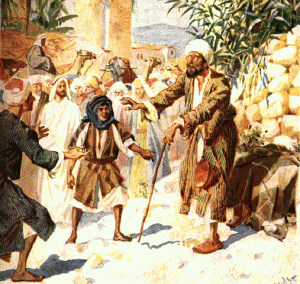
If there were indeed two blind beggars in the same place on the side of the Jericho road (as Matthew’s account must be seen as true), then Bartimaeus might be a name generally given to blind beggars, by Peter or others in common, to identify blindness as a sin of unclean living. That was somewhat the opinion the Pharisees had when Jesus healed a blind man from birth (who also begged), putting mud on his eyes on a Sabbath, telling him to wash the mud off in the pool of “Sent.” (John 9) Even when the man was able to see (thus no longer a sinner), the Pharisees threw him out of the Temple for giving credit to Jesus for being able to see. As such, each of two blind beggars could have been referred to a Bartimaeus, which would then be a “certain” term commonly used.

Regardless of the name stated, Mark tells us that when the beggar “heard that it was Jesus of Nazareth,” this was due to a crowd passing being louder than normal, prompting those without eyesight to ask, “What’s going on?” While Matthew is similar to Mark in the generality of what the beggar(s) heard, Luke makes it clear that they asked and were told what Mark said they heard. Still, while being told that “Jesus of Nazareth” was passing by, when he was just one in a “large crowd,” that would only have meaning to those who had heard Jesus give public sermons.

Any healings that Jesus might have done along the Jericho road (where one can assume the blind beggar had been for some time), or in Jericho, were not written of by his disciples. Only through the rumor mill would Bartimaeus have known who Jesus of Nazareth was.  It would be wrong to assume that the blind beggar(s) had traveled to Jericho to wait for Jesus, even though a traveler giving alms to the poor might have told him (them), “If a man named Jesus of Nazareth comes by here, then ask him to help.  He is a healer.”

When the beggar(s) began shouting, “Jesus, Son of David, have mercy on me!” and again,  “Son of David, have mercy on me!” this was not a call that was based on what they were told by bystanders with good eyes. The shout was based on what they “heard” from the Holy Spirit moving through him (them). The shouts were akin to when Peter blurted out, “You are the Messiah, the Son of the living God.” (Matthew 16:16) In other words, God was signaling His Son by those shouts, identifying Jesus as a descendant of the holy Davidic line. That was what Jesus heard.
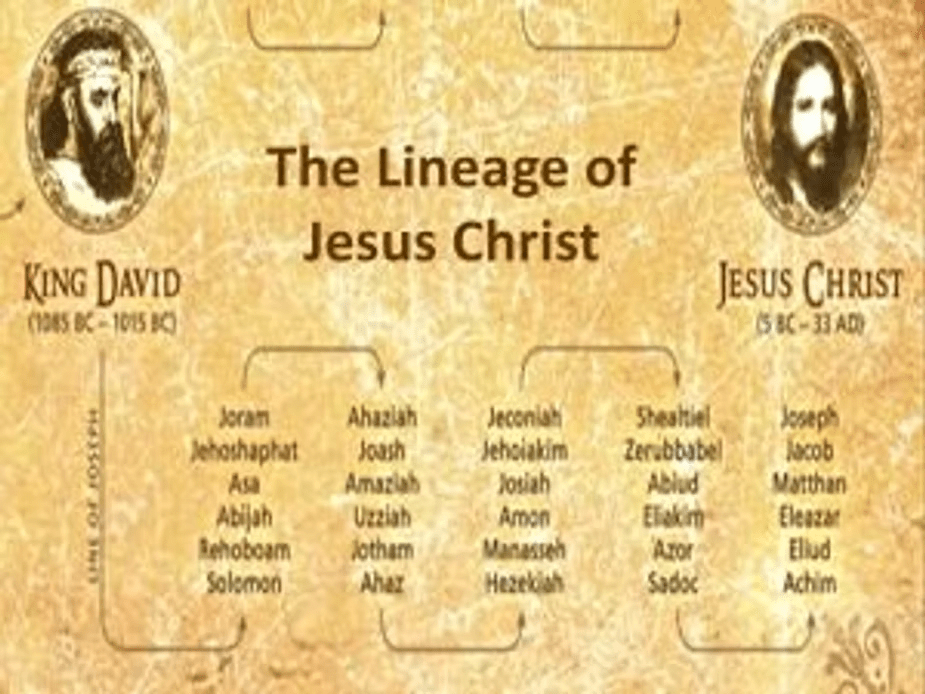
The Lineage of Jesus

It is important to know that the Greek word hollered by the blind man (men) that is translated as “Son” is “huios,” which is not capitalized. The lower-case spelling means a more accurate translation would be “descendant,” although figuratively the word could state “likeness.” Still, the translation as “son of David” has to be seen as coming from one whose blindness made him be known as a “Son of Uncleanness,” from a man who wanted to be returned to a “Son Highly Prized.” God knew this blind man’s heart and God knew it was time to return eyesight to a man that spoke the words of God, without regard for those rebuking him to doing so.

When Bartimaeus (and another) are said to have twice shouted out, “Have mercy on me (us),” all Gospel writers used the Greek word “eleēson,” which means “to have pity,” or “to show mercy.” The same word can imply the receipt of or the finding of mercy, when directed at someone asking for it.

The root word, “eleéō,” means “to show mercy as God defines it, i.e. as it accords with His truth (covenant) which expresses “God’s covenant-loyalty-mercy” (i.e. acting only on His terms).” [HELPS Word-studies] Thus, Jesus heard his name called, along with recognition of his holy lineage, with a plea that both requested help and stated an inner presence of God’s Holy Spirit in one of the onlookers.

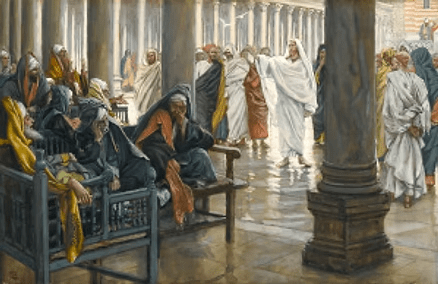
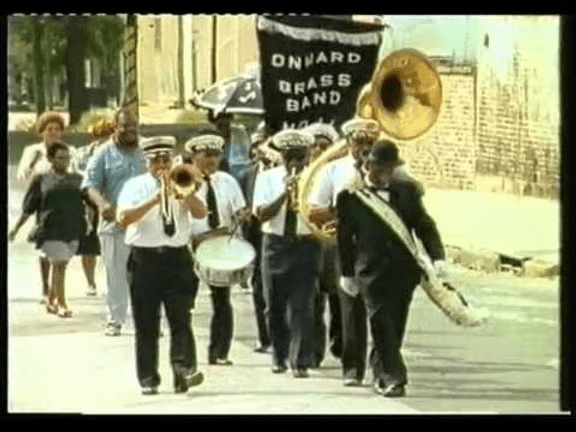
This means that Jesus was not hearing over the loudness of a large crowd the voices of those making selfish requests. One can imagine that a large crowd of pilgrims were walking along with Jesus and his disciples and family (all headed generally towards Jerusalem) generated a parade-like effect, where the people on the sides of the road had heard Jesus speak in the synagogue of Jericho before and recognized him. Like it is when parades are held, recognizable people (celebrities) are asked to ride in convertible cars or fancy floats, simply to wave to the crowd. All the foreign pilgrims walking along with Jesus were just like the high school marching bands, Cub Scout troops, and local public servants in their cars and trucks (with lights flashing), where the bystanders did not know those people.  However, some of them recognized Jesus of Nazareth.

One would expect that when one of the known people was spotted, people would call out their names, as a friendly, “Hello!” No one would expect a parade to stop because a bystander recognized a celebrity and asked for an autograph.  An obnoxious screamer in the crowd would be told to shut up.

This is how those near the blind beggar(s) rebuked his (their) cries, sternly ordering the man (men) to be quiet. Parade protocol does not allow for requests to be made of the paraders. Because of the din of the traffic was noisy, the people were annoyed at how loud the cries for attention were. The people got angry because the shouts were quite loud and (in their minds) unwarranted; but the common people of Jericho were not filled with the Holy Spirit.

We then read, “Jesus stood still,” where the actual Greek written begins with “Kai stas.” That is a capitalized adverb, joined with an verb, as a two-word statement that importantly states, “Namely stopped.” Before that segment of words identifies with “Jesus,” we need to grasp how the parade, the noise, the hubbub all kept moving along, but the one whose name had been called loudly then “stopped.”

The common conjunction “kai” usually means “and,” but when capitalized it becomes more than an important conjunction. The Thayer’s Greek Lexicon for “kai” states a third usage as such:

“3. It annexes epexegetically both words and sentences (καί epexegetical or ‘explicative’), so that it is equivalent to and indeed, namely.” This is: “A.); equivalent to and indeed, to make a climax, for and besides … our and this, and that, and that too, equivalent to especially,” [Thayer’s Greek Lexicon]

This flexibility of translation (and intent) being attached to what appears to be a new ‘sentence’ beginning with the word “And” is instead detailing the one called “son of David” and bridging to the one named “Jesus.” He was “especially called,” as “indeed” the one among the many, “besides” all the rest, thus “namely” Jesus was indicated. Based on the definition of “namely,” the “son of David” “specifically stopped,” as he was named “Jesus.”

The word “histémi,” from which “stas” is the past historic form, can actually translate as “Namely became a bystander.” It states the importance of “Jesus taking a stand,” rather than moving on by with the rest, ignoring the cries made from the bystanders.

It can be assumed that the large crowd on the same road as Jesus and his disciples (and families) did not come to a halt. They had not been spiritually called to “Stand still.” I imagine Jesus made his way to the side of the road, so those going to Jerusalem would not be blocked by him standing in their way [the parade must go on]. It would have been there that Jesus would instruct his disciples, “Call him here.” In reality, based on the Greek written, Jesus was not quoted. The text states that Jesus “commanded [the blind beggar] be brought to [Jesus].”

Neither Matthew nor Luke include the specifics that Peter recounted to Mark, such that he alone wrote, “They called the blind man, saying to him, “Take heart; get up, he is calling you.” So throwing off his cloak, he sprang up and came to Jesus.”’ This means that Peter was one of the disciples sent to bring the blind beggar(s) to Jesus.

The capitalized Greek word “Tharsei” is written, which is translated as “Take heart.” The root word, “tharseó,” also means “good courage, good cheer, and emboldened.” The substitution of “heart” indicates the emotional plea made by the blind beggar(s) was heard and felt. The capitalization shows the importance given, which shows the strength of the blind beggar(s) cries.  Bartimaeus moved Jesus by his heart touching the heart of Jesus, joining them emotionally.

This one-word statement of importance [again, realizing that every word of the Gospels is the Word of God, through an Apostle], is then followed by the command to “get up” or to “rise up.” It should be recalled [from past interpretations that use this word] that the word “egeiró” has more than the mundane meaning to getting up from a sitting position, as it means “wake up” and to “elevate.”

Wake up! It is time to be born again into a new day.

The symbolic aspect of waking makes it a command to rise from death, where sleeping has that double meaning too. Likewise, to become “raised,” in a spiritual sense, means to “rise above” the mundane to the heavenly, as were the Apostles on the day of Pentecost. Therefore, Peter issued a second one-word statement relative to “Courage,” where heartfelt emotions had just elevated a lowly blind beggar (or two), saying, “be risen.”

Mark also is the only Gospel writer to indicate that the blind beggar(s) did anything other than be led to Jesus. Mark wrote (as translated in the reading), “So throwing off his cloak, he sprang up and came to Jesus.” What was written, but untranslated as a word of unspoken value, is the capitalized word “Ho,” which is the article “The.” This is then followed by another unspoken word, “de,” which is routinely not a spoken word, seen in English as “a weak adversative particle, generally placed second in its clause.” [Strong’s Concordance]

One must see how those words were purposefully written by Mark, as directed by God, with the realization that they would not translate in Greek or English, as not having any spoken worth or value.  Common people translate in common ways; but those led by God to understand holy Scripture see words that are key to understanding the cloak removal aspect.

Often “ho” is used to identify Jesus or God, such that it indicates “the[one]” who is God or the [one] who is Jesus.  It is unnecessary to speak those words in reference to those who are important individuals; set apart by the factor of being “one” of a kind.  Still, such words act to indicated “the” important singularity of “one.”

The word “de” is then more than a weak adversative particle, but a statement of conjunction that has joined with “The [one],” and that “having cast away.” As such, “de” makes sense appear from out of nowhere, as “on the other hand,” or “on top of this.”  The word that was invisible “The [one] on the other hand having cast away the cloak of him,” says that the hand of God has become one with the blind beggar(s), removing his robe of insignificance.

We then read Mark having stated fully: “The [one] on the other hand having cast away the cloak of him  ,  having risen up  ,  he came to Jesus  ”  Those series of word segments allows one to see both the mundane and the Spiritual.

As for the mundane, Jesus was traveling through Jericho before the commanded ritual of spring [Passover], so it might have been chilly in the shade of March [Roman calendar]. That would have required a sedentary beggar wear a cloak or outer robe for warmth. For a beggar (or two), one would expect this to be some rag for warmth, which was too unseemly for those with eyes, but good enough for a blind man (or two). When the blind beggar(s) was called to go to Jesus, his warmth came from within, causing him to toss aside his outer garment.

Even as that reality was witnessed, Peter told Mark that the blind beggar was Spiritually touched by Jesus welcoming him.  It was then the hand of God that removed the cloak of invisibility the blind beggar (or two) had been forced to wear, as unclean and unwelcome.  God raised him (them) to a higher spiritual state of being.  In the truest sense of a “come to Jesus” experience, Bartimaeus went to Jesus.

When the parade has passed you by, the cloak of invisibility keeps the rejected from seeing those who ignore them.

Jesus was indeed quoted, once the blind beggar had been set before him, as he asked, “What do you want me to do for you?”

Here, one needs to remember how Jesus only spoke the truth of the Father. This means God asked, through Jesus, His Son, “Ask and you shall receive.” (Matthew 7:7) God had spoken those words through His Son when he spoke the truth during a sermon on the mount. Now, Jesus was making that promise become true to a blind beggar (or two).

Bartimaeus then said, “My teacher, let me see again.”

In both Matthew and Luke, the address of Jesus was written as “Lord,” (from the capitalized Greek “Kyrie”). Mark [as Peter] recalled the Aramaic word “Rabbouni” being used.  That was the same address Mary Magdalene would use at the tomb of Jesus, when she recognized the ‘gardener’ she thought she was speaking to was the risen Jesus. (John 20:16)  This has the same meaning as Kyrie, as both say “Master,” but it is a more personal address as “My teacher.”

One needs to see the blind beggar has not been a disciple of Jesus, so he has not been directly taught by his lessons of ministry. Because of the beggar’s affliction to his eyesight, he would not even be allowed into a synagogue to hear Jesus preach the meaning of the Torah. This means he had never been taught by Jesus, so the politeness of that address, as to why the beggar said “My teacher,” is what routinely is understood by Biblical readers. However, there is more to this address that needs to be caught.

First of all, we read of a Pharisee coming to Jesus and calling him “good Teacher,” where Mark wrote the capitalized Greek word “Didaskale,” meaning, “Teacher or Master.”  (Mark 10:17)  Jesus jumped all over that rich, young ruler about what gave him the idea he could call him “good.”  The only reason the man could give, at that point, was, “Sorry.  I was just being polite.”  So being polite does not carry well here, where a blind beggar called Jesus “My teacher.”

It is then important to see the progression of events, based on the language written, for the second element of this address as “Rabboni.” We have been told to see the connection of the presence of God in the beggar’s heart [“Courage”]. His crying out “son of David” was divinely inspired, which caused Jesus to be “Namely stopped.” Peter told the beggar to be born anew [“awaken”], because God had removed the cloak that made a blind man be one his people had “cast away,” allowing him to be seen as worthy enough to be brought to Jesus. As such, Bartimaeus was reborn as Jesus by being in his presence, in the sense that both men then had the same higher thought. Instead of Bartimaeus’ own brain leading him, the beggar would forevermore depend on Jesus [who possessed the same Christ Mind] to be his Teacher within. Therefore, without having regained his sight, Bartimaeus had been taught Redemption and given Salvation by having become one with the Christ Spirit.

When he said, “let me see again,” or more precisely, “in order that I might regain my eyesight,” this is both a mundane request to see again, but it is also a Spiritual statement that prayed, “let the truth shine within me so I see the way.”

Just as there could have been others crying out for personal gains, with selfish intent, those pleas would have gone unheard by Jesus. God hears all the moans and groans of lament that are offered by the commoners of the world, but His ear is trained on those who pray to be part of His order of priests on earth. When the blind beggar(s) made this request, it was asking for a second chance, to prove a child of high values was named to serve the Lord with a vision for all to share.

Because that was asking Jesus for his permission to serve God, Jesus responded by saying, “Go.”

The capitalized Greek word “Hypage” made an important one-word statement that said, “Lead away under someone’s authority (mission, objective).” [HELPS Word-studies] That authority was God’s, as Bartimaus was sent into a mission of ministry.  The root word is “hupagó,” which has a scope of meaning that is “depart, begone, or die,” where the important statement implies, “Be dead as a blind beggar and live as the eyes of God, so that others might see like you.”

Jesus then said to Bartimaeus, “your faith has made you well,” which he said to others that were healed in his presence. Again, the key word is “faith,” which is the translation of the Greek word “pistis.” The word also means, “belief, trust, confidence; fidelity, and faithfulness.” Its use implies that it “is always a gift from God, and never something that can be produced by people.” [HELPS Word-studies] It is a derivative of the word “peithô,” meaning “be persuaded,” such that one has gone beyond simple belief (told to have faith) and become “persuaded” by personal experience to believe with trust and confidence.

As I once had a priest give an explanation of the difference between belief and faith, he said, “I once taught at the university and mentioned that I was a licensed pilot. At the beginning of each semester, I offered students to come and take a flight with me … and some would take me up on the offer. However, I would always remind them of that offer on a most worrisome weather day, when it was windy and stormy outside. I would tell them I was going to fly after class and ask for a show of hands who would like to go flying with me. No hands would ever raise. After a pause, I would look at them intently and say, ‘That is the difference between belief and faith. You believe I can fly. However, flying with me in stormy weather demands you have faith that I will not crash.”’

In the same way, Jesus told Bartimaeus, “You have proved your faith in God. In return, your eyes are no longer blinded.” Mark then wrote, “Immediately he regained his sight and followed him on the way.” Still, it must be realized that Bartimaeus did not simply walk on the Jericho road behind Jesus.

Having the faith to heal his own blindness meant having the faith of Jesus. Bartimaeus had picked up [“elevated”] his cross [“stake” for holding vines above the ground] and followed Jesus as one of his Apostles, filled with the Holy Spirit from having been healed. He became one who was Christ reborn through the Teacher being within, after his uncleanliness had been cast away by the hand of God.

As the Gospel reading selection for the twenty-third Sunday after Pentecost, when one’s own personal ministry for the LORD should be underway – one’s faith should be raised to the point of seeing the truth of Christ being born again – the message here is to be the one crying out for the Son of Man to have mercy on one. Each individual is expected to be like Bartimaeus, as a blind beggar, until one can see the light.

Christianity, that which is prevalent today and not that which began with people filled with the Holy Spirit, reborn as Jesus Christ long ago, has become like the crowd that marches like a parade with Jesus of Nazareth, including those who stand on the sidewalks of the path to Heaven as observers who shush those who might dare cry out for Salvation. While many pour their hearts out to Jesus, saying, “Save me from this sin or that sin,” coming in all forms of maladies and bad predicaments, few make Jesus stop in his tracks, from having heard the Holy Spirit of God crying out from one of faith.

We have plenty of belief still (although that is dwindling), but we have few people that have the faith of Jesus Christ within them. We have become, “the blind leading the blind.”

The cloak that all humanity wears is mortality. All human beings are born with the only preset expectation being to die. We feel cold chills from the thought of death, so we wrap ourselves snugly in the robes of denominational religion, scientific breakthroughs in medicine, and denial that there is anything beyond this material realm.  It is in those baskets of knowledge that so many have put all their trust and confidence.

The tattered, hand-me-down, donated robes we put on are what identifies us as “bar timaeus,” as “sons of uncleanness,” which shows others our obvious sins: adultery; theft; greed; envy; pride, wrath, gluttony, and sloth (to name a few). We get angered at anyone crying out loudly, “son of David show mercy on me,” because no one wants a do-gooder making all the rest look bad!

Still, when our mortality day finally comes, we are judged by having failed to wear the holy robes of sainthood, as the brides of God, reborn as Jesus Christ. The moment of death, when judgment is made, is when human failures have to weakly admit to God for having chosen to be adopted as the sons of Satan – the unclean one (human gender irrelevant).  There can be no excuses for having rejected sacrifice of self and accepted God’s love.  The love of sin was too great to set aside.

America can be called the ‘land of gods’, where the lower-case “g” means every man and woman in this country thinks his or her path is the most important path in the entire history of paths, because so many take care of self, long before some other self gets a handout. Even the ones who regularly proclaim they go to church, give willingly to charities, and try their hardest to do the right things, without the Holy Spirit and the presence of Jesus Christ within their soul and being, find that some sins (often kept secret) cannot be shaken. That keeps them beggars in the eyes of God; but begging becomes a common way of life; just not a way that leads to eternal life.

Bartimaeus is an example of standing out in the crowd. A true Christian has to be willing to serve God, no matter how angry that makes others. One has to be blind to Jesus walking by, because one needs to be in touch with God first. When one can find love for God, despite one’s abnormalities and shortcomings, then one will hear the hubbub of Jesus and begin begging God to show His mercy by letting Jesus Christ stop in one’s soul, to teach one what to do. Then one walks the walk of the path to Heaven, so someone just like that one – another blind man on the side of the road – will be told, “Jesus of Nazareth is walking by.”

The path to Heaven is a circuitous course. What goes around comes around.

Hebrews 7:23-28 – Setting up the tabernacle on holy ground

The former priests were many in number, because they were prevented by death from continuing in office; but Jesus holds his priesthood permanently, because he continues forever. Consequently he is able for all time to save those who approach God through him, since he always lives to make intercession for them.

For it was fitting that we should have such a high priest, holy, blameless, undefiled, separated from sinners, and exalted above the heavens. Unlike the other high priests, he has no need to offer sacrifices day after day, first for his own sins, and then for those of the people; this he did once for all when he offered himself. For the law appoints as high priests those who are subject to weakness, but the word of the oath, which came later than the law, appoints a Son who has been made perfect forever.

———————————————————————————————————-

This is the Epistle selection from the Episcopal Lectionary for the Twenty-third Sunday after Pentecost, Year B 2018. In the numbering system that lists each Sunday in an ordinal fashion, this Sunday is referred to as Proper 25. It will next be read aloud in an Episcopal church by a reader on Sunday October 28, 2018. It is important because Paul wrote more about Jesus Christ being the high priest of all true Christians.

One should first realize that this reading selection follows twenty-two verses where Paul wrote of the relationship established between Abraham and Melchizedek. Both figures were high priests, along with Aaron and the oath of the Law set forth by God through Moses, which Paul mentioned. This history then leads to verse twenty-three, with Paul prefacing this series of verses read today by identifying Jesus Christ as the ultimate high priest in that order of most-holy priests, now a permanent fixture as such.  In all of Hebrews 7, Paul mentioned “Jesus” specifically one time, as the last word in verse twenty-two.

These six verses seem fairly standardized, so they fit the organization concept that is promoted in Christianity today. That view sees Jesus as an ethereal high priest, who sits in a chair to the right side of the Father, who has become the god of human beings that believe Jesus of Nazareth was the Son of God, sent by the Father to die a grizzly death, so no other believer will ever have to be washed squeaky clean of all sin, in order to get into Heaven. Getting into Heaven is promoted as being just a matter of believing in Jesus.

While that view makes it easy to go to Heaven, thus easy to welcome, it is like buying an online certificate of law school completion, having done nothing that would constitute studying law and nothing that would make one ready to pass a bar exam.  Jesus was not sent to do all the work, like some modern tycoon who wants to make so much money his children will never have to work a day in their lazy lives.  It is most important to realize that God sent His Son as a model for righteousness; and being righteous is the only way to earn eternal life.

Think of God as Henry Ford. Then, think of Jesus as the Model T. Would Henry be served if he only made one car?

Paul did not sell that easy concept of Christianity when he wrote to the Hebrew-speaking Jews of Rome. Jesus Christ is the eternal high priest whose temple is each individual human body that welcomes the Christ Mind to transform an ordinary follower of Jesus of Nazareth, and believer of Yahweh as the One God, into a walking, talking reproduction of Jesus of Nazareth – the Son of God reborn on earth [not idly taking it easy in the spiritual realm]. This means being Christian is being Jesus Christ resurrected in one who is called an Apostle or a Saint.

Just like becoming a lawyer that makes lots of money requires a lot of work, becoming Jesus Christ means doing all that is required to reach that goal. Just as being a successful lawyer means having the assistance of higher-ups, becoming an Apostle or Saint demands that one be together with the Christ Spirit [baptism by the Holy Spirit], so one’s soul will not fail to live up to the Jesus of Nazareth holiness.

All of that was written by Paul in this six-verse reading. The proof of that pudding is found in a close examination of the words written and the ordering of those words. I welcome everyone to ‘double check my math’ by visiting the Bible Hub Interlinear presentation of the Greek-to-English translations that they post for Hebrews 7, as well as look deeply into the scope of meaning each word can have, beyond their immediate translations into literal English.  Minimally, looking at the Greek and then looking at the English translations makes it obvious all English translations are paraphrases, created for easy reading or easy listening.  However, God did not have His holy authors paraphrase His Word.

As is my custom, to eliminate the problem of paraphrases, I have broken each verse into segments of words, based on the presence of punctuation (written or implied). I recommend slowly reading each segment and grasping the meaning of what was stated there, before continuing onto the next segment. Reading Scripture is designed to be slowly savored.

In this reading, please note where capitalized words appear, as capitalization indicates a level of importance that must be realized. There are nine capitalized words in these six verses, with six being “Theos” (God) and one being “Huion” (Son), where the importance is readily seen.  The other two are words that require some investigation as how they reflect importance.

23. Namely followers certainly more excellent ones are having been born priests  ,

on account of followers by physical death being kept from continuing  .


24. circumstances however successfully suitable remaining with him into this age  ,

an unchangeable he possesses those of holy office  ,


25. whereby namely  ,

to preserve union followers through all time he is enabled by God  ,

all coming forward on account of him who of God  ,

at all times being alive unto followers to intervene on behalf of themselves  .


26. Such as these after all ourselves namely became [fittingly] high priest  ,

beloved of God  ,

simple [characters without guile]  ,

free of stains  ,

having separated ourselves away from circumstances sinful ones  ,

even uplifted conditions of spiritual heavens having been born into being  ,


27. these things not possesses accordingly daily necessity  ,

just as together high priests  ,

before above things one’s own failures  ,

sacrifices to offer up unto God  ,

afterwards followers those who the laity of God  ;

this because he acted one time for all  ,

himself having offered up to God on high  .


28. followers of divine laws why human beings are set in order as high priests  ,

holding weakness  ;

together divine utterance on the other hand people make an oath  ,

together beyond those of a force impelling to action  ,

Son into condition an age  ,

having been made perfect  .

Verse 23 begins with the capitalized word “Kai.” That typically is the conjunction “and,” but shows little importance as a one-word statement as that (“and”) or as “even” and “also,” especially when disconnected from that which is stated prior. This means the importance comes from the adverbial translation as “Namely,” which is a statement of specificity placing focus on a clear and precise name. As a capitalized word, verse twenty-three begins by making that statement that begins with an important specific reference that has implied intent, although it is separate from the fact that verse twenty-two ends with the name “Jesus.”

The word “hoi” follows “Kai,” and typically can translate as “those,” indicating the masculine nominative plural of “ho” (“the”). Still, an acceptable translation is as “followers,” which is important in this reading, where the “followers” of Jesus will be identified as “those” who receive the specific character of Jesus as the Christ, when they become specifically reborn to that name.  The translation of “followers” become repetitive in this selection of verses.

Notice how the translation read aloud says, “The former priests were many in number, because they were prevented by death from continuing in office.”  That translation ignores the “Kai hoi” as worthy of address.  Still, the translation I explained now begins with “Namely followers,” who are the disciples-to-Apostles of Jesus, who are the ones “having been born priests.”

This has nothing to do with a lineage of Temple high priests that were not “certainly more excellent ones,” keeping in mind the many years that the Jews spent in captivity in Babylon, when their ruin was based on a corrupted Temple and false high priests.

Seeing this aspect of human mortality means that one is not “prevented by death from continuing in office,” but one is prevented from that holy title because of being mortal and not having earned eternal life. All high priests of Jesus Christ have a record of excellence because of having gained the promise of eternal life. Once filled with the High Priest, always filled.

Verse 24 is read aloud saying, “but Jesus holds his priesthood permanently, because he continues forever.” Certainly, Jesus is the eternal high priest, but his name was not written in this verse. It has been drawn in from verse twenty-two. Rather than make it appear that Jesus is an absentee high priest (in Heaven), this verse allows one to see how his Holy Spirit “possesses those of holy office” [i.e.: high priests].

Verse 25 begins with a two-word statement of relatively insignificant Greek words – “hothen kai.” The translation read aloud basically ignores this as a separate statement (perhaps translated as “consequently”?), but the statement addresses the end of verse 24, “whereby” “those of holy office” are specific to Jesus Christ “namely.” That means being possessed by the Christ Mind brings the name of Jesus Christ upon a high priest (Apostle – Saint).

This whole verse then speaks of God sending that presence into “followers” (Christians), who become “alive” or “living” because of eternal life defeating mortal death. The Holy Spirit of God does not send His Son as a spirit that can be accessed through prayer (as intercessory implies); but access is given by the presence of the Holy Spirit, so it “intervenes” as the new self, when ego has been subjugated.

Verse 26 begins with the capitalized Greek word “Toioutos,” where the importance reflects back on verse twenty-six ending by stating, “” – in “living followers” where the Christ Mind “intervenes on behalf of themselves” saying, “Such as these.” That intervention is due to “all ourselves namely” being Jesus Christ. They “became high priest” [fittingly] because of: 1.) marriage to God through love; 2.) they sacrificed their Big Brains of self-ego so they were characters without guile; and 3.) they were baptized by the Holy Spirit and made clean of all past sins. That presence then “separated ourselves” [self-sacrifice] so no “circumstances of sinful acts” would distract them and cause them to stray. This means a Saint – Apostle has been “uplifted spiritually” to heavenly status, through being reborn as Jesus Christ.

Verse 27 begins by stating that the Holy Spirit does not come and go. Instead it remains in possession of one’s physical body at all times. The human body is joined together with the Christ Mind [a high priest having been made] by the Holy Spirit having joined with the soul. The sacrifice of self is what allows one to become a high priest, and that can only happen one time. Like Jesus only died physically once, so his Spirit would be freed to possess those who would follow him in service to God, one’s self-ego can only be sacrificed once. Apostles and Saints are likewise “offered up to God on high” so their sins can be erased and eternal life be received.

Verse 28 says the purpose of a high priest is to establish the Law as the measure of one’s divinity; but all humans have weaknesses, such that being a Pope or an Archbishop, Bishop, or high priest as a job title is no guarantee of a lifetime of holiness. One has to be joined “together” with the Law, so it is written on one’s heart. This togetherness allows one to go “beyond” an external “force” compelling others to obey the law, through an internal “force impelling” one “to actions” of righteousness.

Being adopted as God’s “Son” is the “condition of an age.” That is the Age of Pisces, which means “self-sacrifice for spiritual rewards.”  Once in the name of Jesus Christ, one has “been made perfect,” the same as the high priest possessing one.

From the Age of Fishers of Men’s Souls to the Age of Gadgets Entrapping Men’s Souls.

Again, there are two quite different translations presented here.  One will be publicly read.  One will only be found on this blog.  It is important for all who place value in Scripture to have a personal investment in knowing the truth, which ultimately has to be sought and found on an individual basis.  While listening to multiple outside opinions can help lead one to that personal epiphany, conflicting opinion can lead one away from it, towards doubt and fears.  The only way to really find the truth is to make an effort to look for it yourself.

As the Epistle selection for the twenty-third Sunday after Pentecost, when one’s own personal ministry for the LORD should be underway – one has sacrificed self and received the Holy Spirit, becoming the temple for God’s high priest – the message here is to stop looking for Jesus outside of oneself. One must find the love of God and marry Him, before His Son can be reborn within a new wife. One can no longer pretend to worship Jesus as the high priest, while admitting righteousness is a state of being that no man or woman can possibly match.

Part of the problem that brings about this negative thought process is a translation like that read aloud, which says, “For it was fitting that we should have such a high priest, holy, blameless, undefiled, separated from sinners, and exalted above the heavens.” Think about how meaningless that is.

God is “holy, blameless, undefiled, separated from sinners, and exalted above the heavens.”  What is the point of have Jesus be made as “God II,” when all we need is One God in Heaven?

There is no need for a high priest without a temple or tabernacle – a physical structure placed on holy ground – because God is “holy, blameless, undefiled, separated from sinners, and exalted above the heavens.” It becomes as ludicrous as the elders of Israel going to Samuel saying, “We want you to appoint us a king, to be like other nations.” Samuel said, “God is your King.”

He didn’t say it, but had to have thought: “If God wanted His children to be like other nations, He would have left you in Egypt.”  That means God is the King on earth, wherever one of His priests goes.  God’s kingdom is then not a piece of real estate but the body in which God resides Spiritually.

The same logic applies to a Jesus the high priest in Heaven. Who goes to God and says, “We want you to appoint us a high priest so we have someone imaginary that forgives all our sins, so we can keep on sinning,” knowing how hard You [God] are on sinners.

If Samuel were to hear that (after shaking his head in disgust) he would say, “The kingdom of God should be in YOU, so get that situation fixed and THEN YOU will need Jesus Christ to be God’s high priest in YOU.”

The reason God sent His Son to be born of a woman, was to have an extension of God incarnated on earth – in a man.  Jesus of Nazareth [born in Bethlehem] was necessary because earth is where God’s Son was needed. That man had to die in the flesh so his holy soul [an extension of God] could be reborn countless times in countless humans of faith [God has the power to do that]. But, therein lies the caveat.

God’s Son must be brought in by God, as a welcomed rebirth of God’s love.  God will not accept a freak show, where multiple personalities force their way into a body and then fight over control of one body of flesh [like in demonic possessions]. Instead, God demands all His servants fall in love with Him and as a wedding dowry each individual must wrap-up the self-ego and hand that [willingly] over to God.

One must become a submissive wife to God the Husband. That union of God and human heart brings in the Holy Spirit to cleanse the soul of all past sins. Once that setting is complete, baby Jesus Christ is born again [although he comes not really a baby – baby is metaphor for rebirth].

It is imperative that all who want Salvation know this. Paul wrote it over and over and over in his epistles. It is all through Scripture. It is there to see, if one takes the time to look and see.

In John’s Gospel (John 1:39), he wrote in Greek: “Erchesthe kai opsesthe.” Jesus spoke those words [translated from Aramaic into Greek] to his first disciples, Simon [Peter] and Andrew. The simple translation is, “Come and see.” The same words can also translate as: “Arrival namely experience.”

When one has arrived at the state of Apostlehood, then one takes on the character of Jesus Christ. That, in turn, allows one to see the meaning of Scripture as clearly as did Jesus of Nazareth, the Son of God.  The knowledge of God opens one’s eyes to see the light of truth, which is necessary for spreading that light to others.

The first step (stated by the capitalized word “Erchesthe”) is to “Come” to Jesus and learn to love the Father.

Job 42:1-6, 10-17 – I despise myself and repent

Job answered the Lord:

“I know that you can do all things,

and that no purpose of yours can be thwarted.

‘Who is this that hides counsel without knowledge?’

Therefore I have uttered what I did not understand,

things too wonderful for me, which I did not know.

‘Hear, and I will speak;

I will question you, and you declare to me.’

I had heard of you by the hearing of the ear,

but now my eye sees you;

therefore I despise myself,

and repent in dust and ashes.”

And the Lord restored the fortunes of Job when he had prayed for his friends; and the Lord gave Job twice as much as he had before. Then there came to him all his brothers and sisters and all who had known him before, and they ate bread with him in his house; they showed him sympathy and comforted him for all the evil that the Lord had brought upon him; and each of them gave him a piece of money and a gold ring. The Lord blessed the latter days of Job more than his beginning; and he had fourteen thousand sheep, six thousand camels, a thousand yoke of oxen, and a thousand donkeys. He also had seven sons and three daughters. He named the first Jemimah, the second Keziah, and the third Keren-happuch. In all the land there were no women so beautiful as Job’s daughters; and their father gave them an inheritance along with their brothers. After this Job lived for one hundred and forty years, and saw his children, and his children’s children, four generations. And Job died, old and full of days.

———————————————————————————————————-

This is an optional Old Testament selection from the Episcopal Lectionary for the Twenty-third Sunday after Pentecost, Year B 2018. In the numbering system that lists each Sunday in an ordinal fashion, this Sunday is referred to as Proper 25. If chosen, it will next be read aloud in an Episcopal church by a reader on Sunday October 28, 2018. It is important because Job responds to God, clarifying that he knew he had been given the power of God’s Holy Spirit so he could resist all temptations to surrender his faith.

In verse two Job speaks “יָדַעְתִּי) ידעת)”, which says, “yadata (yadati)”. The Hebrew word “yada” means “to know.” As such, Job said “I know” and then whispered as a correction (in the parentheses), “(I knew).” The whispered ‘aside’ is not translated into the reading; but the whisper is important to realize.

Verse two goes on to state that what was known by Job was relative to the power of God, such that God “can do everything” (from ḵōl tū·ḵāl”). While it is easy to believe in the omnipotence of God, it is another to state (twice), “I know you can do anything.” This was Job stating a personal experience of God within his being; that was so overwhelmingly presently felt (and felt previously) that this knowledge could not be held back (or “thwarted” – from “batsar”). To know God was the purpose of God’s presence, so no pain could unseat that power or cause impatience to overcome that knowledge.

That importance then further stands out when one realizes that this reading seemingly has Job quoting God’s question, which was asked in Job 38:2. While the translation read aloud here (from the New International Version) is almost the same, it is not identical. By believing that Job has made a direct quote here, one can imagine how Job was telling God he heard the question and will now answer it. However, Job did not restate what God asked.

The Hebrew of Job 38 states: “mî zeh maḥ·šîḵ ‘ê·ṣāh ,  ḇə·mil·lîn bə·lî- ḏā·‘aṯ.?”.

The Hebrew of Job 42 states: “mî zeh ma‘·lîm ‘ê·ṣāh , [- – – – – ] bə·lî ḏā·‘aṯ ?”.

The question God asked in Job 38 was: “Who is this that darkens counsel by words without knowledge?” Now, Job is restating the question as: “Who is this that hides counsel without knowledge?” There is no mention of “by words” in Job 42. This difference is significant.

In the interpretation I presented for the optional Job reading for the twenty-second Sunday after Pentecost, I explained that the root word for “maḥ·šîḵ” is “chashak,” which does mean “darken,” but has an acceptable translation as “hide and conceal,” with a figurative translation as “obscure and confuse.” The word now used by Job, “ma‘·lîm,” is rooted in the word “alam,” meaning “to conceal.” Thus, the intent that I explained as possible is now confirmed by Job.

I also offered the opinion that the intent of “by words” was alluding to the previous three chapters (Job 35-37), where the surprise character Elihu spoke to the three friends of Job, who all counseled Job to seek another god in whom to believe. The words spoken by Elihu (I suggested) came from Job’s mouth, but were not his. Instead, it was a Holy Spirit presence within him, which identified as Elihu [meaning “He Is My Lord” or “God The Lord”], in the same way that Christians are expected to be in the name of Jesus Christ.

Elihu was a presence that was concealed within the body that was Job; so Elihu spoke “by words” that countered the “counsel” of Job’s three friends, which had “darkened” the presence of God that was within Job. Elihu spoke to those “without knowledge,” while Job was not the source of the knowledge Elihu spoke through Job’s lips. Therefore, God did not speak to Job as a question of Job’s complaining, but He was asking Job, “Can you feel my power within you, even though you know nothing?”

This is now why Job answered God without quoting “by words.” Job spoke the Word of God because of God’s presence, as Elihu. Job had countered the arguments of his three friends with the convicting words of God, but they were known to not be identifiable as Job speaking them. Credit was given to a Holy Spirit within Job, named Elihu.

Job knew he was speaking; but Job also knew he was not the author of those words. That revelation (through automatic speaking) is how Job also knew he was totally “without knowledge” [lacking the Big Brain] that could generate the power of those words. Thus, Job knew Elihu was God within Him (then) and now answered God in this reading from the perspective of knowing that God is hidden within him, making the knowledge of Job [the man who thought God had been lost from him, due to a horrible skin condition] be useless.

Job told God that he realized his words of complaint were based on his brain keeping him from understanding the presence of God within him. It was Job’s thinking that he knew what God wanted him to do, so he could be a righteous and upstanding priest for the One God of all the gods, giving his brain more credit than it deserved. The success that Job had was then realized as “things too wonderful for me,” things impossible to have been brought about simply by thinking and solving problems alone. Job was then telling God that he knew all of his righteousness was based on Elihu’s presence, having been sent by God to lead Job, silently, unknown to Job’s Big Brain.

Job then said God had spoken to him before, saying, “Hear, and I will speak;

I will question you, and you declare to me.”

This had been Job’s prior knowledge of God, which was through prayers and supplications and the signs God sent to Job, in answer to his prayers. Job, in turn, would thank God for those answers. That was then explained by Job, to God, as “I had heard of you by the hearing of the ear.”

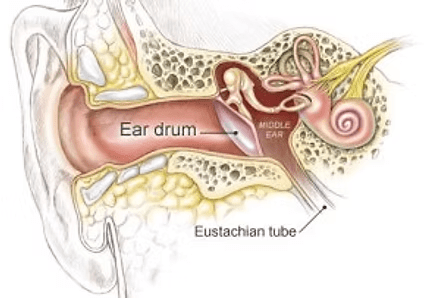
The use of the Hebrew word “ozen” (meaning “an ear”) does not mean that God physically spoke to Job and the sound vibrations registered in the small bones inside an ear, which sent electrical impulses to the brain for interpretation of sound waves. Instead, it is symbolic of “revelation” sent by God to the mind’s ear. Therefore, Job “listened” for insights from God, which would always make Job understand where the path of a righteous man would be.

Job then further revealed that his new understanding had come from seeing God. He wrote, “Now my eye sees you.” The power of this statement has to be grasped.

The power of that statement comes from remembering what God told Moses. God said, “You cannot see my face, for no one may see me and live.” (Exodus 33:20)

The same Hebrew root is found in those words by God to Moses and the word Job spoke to God.  Both spoke of “seeing” (from “raah”), which implies the physical sense of sight, registered through the eyes. However, that statement of truth does more than imply that the only way one can “see” the full glory of God is as a soul released from a human body of flesh, when the limits of physical “eyes” are lost.

Moses would wear the face of God after “seeing” God in the tent of meeting. Moses, obviously, did not physically physically die; he died of self-ego. Instead of wearing the face of Moses, he wore the face of God, because God had become one with Moses. This was the intent of Job’s statement.

Because Job had had the epiphany that Elihu was God within him, he then ceased trying to think what was right to do. When the singular number of “my eye” is stated (from “‘ê·nî”), this is then the ‘mind’s eye’ that has seen God. This is the equivalent of the Mind of Christ. It is one’s ability to wear the face of God and have sight based on the knowledge of God. While one can still listen for the voice of God to speak instructions of insight, the ability to “see God” comes from the complete surrender of self-ego and setting the Big Brain free to roam the wilderness like a “scapegoat.”

All the sins of the children of God ride on the back of stubborn intelligence.  That has to be released, so God can come into the hearts of the faithful and let them see the light of truth.

The sacrifice of the Big Brain is then stated by Job as, “I despise myself.”

The Hebrew written is: “’em·’as,” where the root word is “ma’ac,” meaning “to reject.” This says that Job had“cast off, rejected, and refused” to be “himself.” Job realized it was his own big, fat brain that kept him from “seeing” his righteousness was solely because God had been with him, leading him – in spite of his self-ego.

When this is seen, then one can understand that Job is not repenting from being a “darkness that counseled without knowledge,” but from keeping the light that was concealed within him from shining brightly. God spoke to Job after Elihu had been freed to openly express God’s perspective to the three friends of Job. Elihu spoke “by words” sent from God [“Verily I say to you … I speak for the Father who is within me.”], which was above and beyond the knowledge of Job the man. Therefore, Job repented for having tried to be important … as Job, a priest of God, known as a righteous man … until Satan had all hell fall upon Job unjustly.

Job had been incomplete because righteousness had kept him from repentance.  Elihu spoke “by words” saying that God can punish the righteous as a way of preventing future sins.  Job needed to understand that.  Therefore, Job repented by letting his self-ego become the concealed identity within him and letting God’s face be upon him forevermore.

The symbolism of “dust and ashes” goes beyond Job having sat down with a shard of pottery, which he used to scrape off his sores that were on him.  He burned the wounds with fire and clay, as an act of purification. The image we have of Job sitting in the dust of the ground and the ashes of a fire before him become inconsequential.

The “dust and the ashes” are the funeral service words, formed from the banishment of Adam from Eden: “In the sweat of thy face shalt thou eat bread, till thou return unto the ground; for out of it wast thou taken: for dust thou art, and unto dust shalt thou return.” (Genesis 3:19, KJV)  The use of ashes, dust, and death is written in  Job 17, where he began with, “My spirit is broken, my days are cut short, the grave awaits me” and ended by stating, “He has cast me into the mire, And I have become like dust and ashes.”

This means Job had repented through death. The death was not physical, but spiritual.  Job meant the end of his soul being tied to earthly things had occurred, because it had been transformed through Spiritual rebirth.

The ending of Job’s story then reads as do all happy endings in fairy tales. Many will find comfort in being given “twice as much as before.” It is always a motivation when great rewards are promised.  Such delight comes from minds that have not yet been sacrificed to God. That which is lost in the translation is the Hebrew that actually states, “kāl– ’ă·šer lə·’î·yō·wḇ lə·miš·neh,” which literally says, “all who were of Job’s lineage doubled.”

Bible Hub’s Interlinear translates those words literally as, “all in the face of Job twice as much as before.” When seen in this way, the friends of Job, for whom he prayed to Yahweh, were then also given double identities.  That says that all also became servants to the One God, as had been Job. This is then a statement of what an Apostle or Saint does, by passing on the Holy Spirit, so lots of Jesus Christs and Elihus are reborn in others.  Job touched his friends in that manner.

The specific numbers of livestock then stated as profit Job reaped are then representative of gains far greater than double what Job had before. By the story saying that Job then had ten children that acts as a statement that Job was still young when stricken by Satan’s ills. If so, then Job gave back to the Lord by not only through passing on the Holy Spirit to his friends, but by also touching his wife and the children they had in the same way. The specific naming of Job’s three daughters [Dove, Cinnamon, and Splendor of Color] and then saying they were given the inheritance of Job, this means that the servants devoted to Yahweh were both males and females, brothers and sisters.  Well before Jesus became known as the Son of God, so all born in the name of Jesus Christ were called brothers, this says those filled with God’s Holy Spirit has always included humans of both genders.

As an optional Old Testament reading for the twenty-third Sunday after Pentecost, when one’s own personal ministry for the LORD should be underway – one should have come to know the Christ Spirit has been within one’s being, so the self-ego has been killed so Jesus Christ can be known – the message here is to realize the inability of human eyes to see beyond the present. One can only imagine a future that is based on the personal experiences of the past; but one is blind to all possibilities of injustice [persecution] being heaped upon one’s being, as a test of faith and as a lesson of how to prevent future mistakes from being hurtful.

So many people these day put their faith in external beings and organizations. The doubts about the future are based on the personal failures in the past, where one missed this or ignored that and was totally misled to believe this was going to be … and none of it came as promised. The result of personal failures means one hesitates making important life decisions about the future matters – such as education, career, healthcare, savings, and retirement planning. It then seems easier to let others make the important decisions for us and just go with the flow. That works, until some unforeseen problem arises and all future plans have suddenly been jettisoned and one’s safety is threatened.

The story of Job is one man’s fight to alleviate the fears that come knocking, like all those “I told you so” friends that everyone knows. When one can no longer pay for external wisdom, to have another see the future for one, then one sits miserably with only free advice that can only point to past errors as the cause. Nothing said then can change the present circumstances and make a brighter future be assured. The saying is “misery loves company,” so the majority of Job reads like one big pity party.

The element that gets overlooked in the association of Job’s story to patience (there are 40 chapters to read before one reaches the happy ending) is Job was filled with the Holy Spirit of God from the very beginning. When one reads that Job was a righteous man, he began this story of withstanding punishment that many would call a curse of God from a point of belief that God would never punish the faithful without reason. That means Job was a man of deep faith, before Satan began to test that faith.

God had faith in Job, not only because Job had faith in God, but because God had sent His Son Elihu to be with Job.  Not only did Job not know the Holy Spirit was within him, neither did Satan.  God knew Job would not break because Job was God incarnate on earth … just to busy thinking to realize that asset.

Few people today – in this “I can’t take a step in any direction without my cell phone firmly in hand” society – can begin a test of Satan from a Job-like position of true faith. While there are many who say they believe in God [the one the Israelites identify as Yahweh], belief is dropped like a hot rock when the going gets tough. People routinely sell their souls for credit today, with no care for what the future might bring. Therefore, patience is not a virtue known today, in a world that demands immediate self-service.

This reading fits perfectly with the Epistle reading from Hebrew 7, where Paul detailed Jesus Christ as the high priest of God. Paul was not telling people to believe that Jesus held that title but to know that, by being one with the Christ Spirit, reproducing Jesus of Nazareth on earth. Job 42 has Job confessing to that presence within him, as the high priest of God [Elihu] was then known to Job. Paul wrote to the Hebrew-speaking Jews of Rome, who understood Paul’s meaning because they too had been prayed for and given double presence – they had souls cleansed by the Holy Spirit – reminding them they were expected to be high priests.  They all had despised themselves and repented to be reborn as Jesus Christ.

In the Gospel reading that accompanies this reading of Job 42, Jesus heard the cry of the Holy Spirit that came from a blind beggar on the side of the Jericho Road. That blind beggar had once been able to see, sometime before; but he had lost that ability. Bartimaeus is then a reflection of Job, who sat in misery, having once been known as a righteous man; but with the sores of sin all over his body, that view of Job was no longer visible. Bartimaeus had been named Son of Honor, but had been changed into Son of Uncleanness. In both their cases, God heard their cries and laments, which said all they wanted was to be able to serve the Lord. They confessed a willingness to sacrifice their self-egos to be whole again. Both were allowed to wear the face of God, as those who see the truth and know the future is blessed.

If one is looking for God to bring one “fourteen thousand sheep, six thousand camels, a thousand yoke of oxen, and a thousand donkeys,” as charges for services rendered unto God, one is praying up the wrong deity tree.

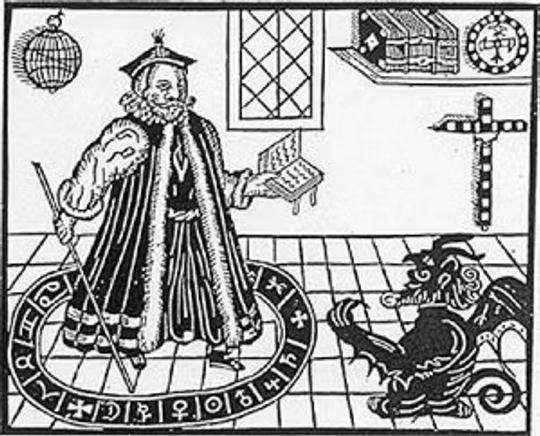
Dr. Faust and Satan’s field agent Mephistopheles.

Satan is the one who buys souls, with payment assured beforehand. One can have everything he or she desires by praying to evil spirits. The last laugh is always held by Satan, because things are nothing more than illusions created in the material realm.  Things are like dreams – here today, gone tomorrow, having never really existed. The only true existence is in the spiritual realm, which is eternal, never ending.  Satan loves selling pipe dreams to impatient souls.

The statement made here in Job 42 says, “The Lord blessed the latter days of Job more than his beginning.” Job was not without blessing before, as he had plenty that were the rewards of a faithful priest – more than he needed. However, Job became most blessed when he realized all he had to do to find the greatest reward ever was sacrifice his ego and experience the presence of God. No number of things could ever match that.

Job amassed things as a servant of the Lord. Others were supported by the things Job amassed, so they could also serve the Lord. Therefore, all the livestock stated was not so Job could be materially rich, but so a church of faith could keep many from feeling the need to sell their souls to Satan.  When one goes all in for God, God will make sure all the needs of one are met, knowing one multiplies into many with needs, all who serve God will not need to worry about earthly needs.

The blessings later in life are ones friends and family that have come together in their sacrifice of self-ego and service to God. Patience is required to reach that happy ending but the first step in that thousand miles is faith. Faith comes from a personal relationship with God.

Jeremiah 31:7-9 – Ephraim is my firstborn

Thus says the Lord:

Sing aloud with gladness for Jacob,

and raise shouts for the chief of the nations;

proclaim, give praise, and say,

“Save, O Lord, your people,

the remnant of Israel.”

See, I am going to bring them from the land of the north,

and gather them from the farthest parts of the earth,

among them the blind and the lame, those with child and

those in labor, together;

a great company, they shall return here.

With weeping they shall come,

and with consolations I will lead them back,

I will let them walk by brooks of water,

in a straight path in which they shall not stumble;

for I have become a father to Israel,

and Ephraim is my firstborn.

———————————————————————————————————-

This is an optional Old Testament selection from the Episcopal Lectionary for the Twenty-third Sunday after Pentecost, Year B 2018. In the numbering system that lists each Sunday in an ordinal fashion, this Sunday is referred to as Proper 25. If chosen, it will next be read aloud in an Episcopal church by a reader on Sunday October 28, 2018. It is important because God spoke to His people through the prophet Jeremiah telling His children He is their Father.

It is important to see in these three verses of Jeremiah 31 how pain and suffering are what draws children closer to their Father. As an alternate Old Testament reading choice other than the story of Job, the message of rejoicing is the same. The pain of defeat, unjustly brought upon the ignorant masses, will test their love of Yahweh and tell Him they despise their plight and repent their failures. Thus, as was the lesson of Job, where Elihu spoke from within Job telling his friends that God will allow the righteous to be persecuted to prevent sins, God spoke the same promise to the scattered remnant of Israel.

When Jeremiah wrote, “among them the blind and the lame,” this links this reading to the Gospel story of Jesus healing the blind beggar Bartimaeus. That story then becomes an example of this prophecy of Jeremiah being fulfilled (among other examples). The same presence of the Holy Spirit within one’s soul is required, just as Job realized that presence had kept him from capitulating to the pressures of evil. The remnant of Israel that maintained its faith in exile was like a blind beggar crying out for forgiveness. These verses offer the promise of redemption.

In the last verse, where it is written: “I have become a father to Israel, and Ephraim is my firstborn,” the name Ephraim is significant. In Hebrew the name means, “Two-Fold Increase” or “Doubly Fruitful.” This matches the story told in Job 42, where Job’s rejection of himself and his repentance was rewarded by God, such that “the Lord restored [Job’s] fortunes and gave him twice as much as he had before.” Rather than Ephraim representing a physical gain for the remnant of Israel, it represents a prophecy of Jesus and his Christ Spirit joining with those who will maintain faith in God. As the Son of God is His firstborn, God will “become the father to Israel” through their receipt of the Holy Spirit, being resurrections of the Son of Man.

Twins are a two-fold increase of physical cells, as two souls. One soul merged with the Holy Spirit becomes like twins within the same flesh, becoming doubly fruitful.

As an optional Old Testament reading for the twenty-third Sunday after Pentecost, when one’s own personal ministry for the LORD should be underway – one has cried out praises to God for Salvation – the message here is to be reborn as Jesus Christ, so one has “twice as much as one had before.” Rather than being only oneself, one needs to be reborn as Ephraim, with a “Two-Fold Increase.” One must be adopted in the holy family that is only Apostles and Saints as brothers and sisters in the name of Jesus.

In verse seven, where rejoicing and gladness are to be raised as “shouts for the chief of the nations,” one should see this as expressions of faith in the midst of persecutions. This makes the Gospel story of Bartimaeus stand out as one who praised God, even when the people largely shunned him. He cried out to Jesus, despite having been told to shut up.

Today, the concept of “democracy” and “republics” are proposing to give power to the people [“nations,” from the Hebrew “hag·gō·w·yim,” rooted in “goy”], when the power is always in the hands of revolving chiefs. Those leaders constantly persecute the faithful by giving away their rights (as the majority), so the minority will is assuaged. Regardless of this insult, the faithful have the power of God within them, which causes them to scream out praises to Yahweh, no matter how many silently pray to false and lesser gods.

All Hail the minority. It is patriotic to kill all faith in that which is against us.

While this short reading squarely places focus on the Israelites that were scattered across the face of the earth, it should be realized that the living humans thousands of years ago are no longer the same living humans. Those have died in the flesh, but their souls have always remained. Those souls of faith in the One God and His Son Jesus Christ are now called Christians, as a religious statement. Christians must be seen as the remnant of Israel, to whom God spoke through the prophet Jeremiah.

Especially today, as the Age of Faith is winding down and being absorbed in the coming Age of Technology [worship of the god for the Big Brain], Christians are a remnant. The birth and swell that spread the “Good News” via Apostles and Saints has now dwindled, as did the strength of numbers the faithful had before the fall of Israel and Judah. We see the end coming, but our faith keeps us praying that end will be averted. However, as the years pass by, the faithful pass away and the new souls filling human flesh are bound and determined to end religion (of all kinds), further tattering the remnant to shreds.

True Christians are blind to the low threshold the world has developed, relative to pain and suffering. Christians, like Job and Bartimaeus, suffer unjustly without losing faith. Modern human beings cower at the thought of being unsightly. They step on and over the homeless in the streets, seeing them as valueless in societies that worship value in things. True Christians are vastly outnumbered by the throngs and masses of heathen hearts.

He leads me beside quiet waters, he refreshes my soul.

As difficult as it seems, when so much news on television endlessly presents the images of turbulence and tumult, making it seem the norm, one needs to “walk by brooks of water, in a straight path in which [one] shall not stumble.” This is inner peace; and, inner peace comes from the love of God, the protection of the Holy Spirit and the adoption as the Son of God.”

Job 42:1-6, 10-17 – Happy days are here again!

Job answered Yahweh:

“I know that you can do all things,

and that no purpose of yours can be thwarted.

‘Who is this that hides counsel without knowledge?’

Therefore I have uttered what I did not understand,

things too wonderful for me, which I did not know.

‘Hear, and I will speak;

I will question you, and you declare to me.’

I had heard of you by the hearing of the ear,

but now my eye sees you;

therefore I despise myself,

and repent in dust and ashes.”

And Yahweh restored the fortunes of Job when he had prayed for his friends; and Yahweh gave Job twice as much as he had before. Then there came to him all his brothers and sisters and all who had known him before, and they ate bread with him in his house; they showed him sympathy and comforted him for all the evil that Yahweh had brought upon him; and each of them gave him a piece of money and a gold ring. Yahweh blessed the latter days of Job more than his beginning; and he had fourteen thousand sheep, six thousand camels, a thousand yoke of oxen, and a thousand donkeys. He also had seven sons and three daughters. He named the first Jemimah, the second Keziah, and the third Keren-happuch. In all the land there were no women so beautiful as Job’s daughters; and their father gave them an inheritance along with their brothers. After this Job lived for one hundred and forty years, and saw his children, and his children’s children, four generations. And Job died, old and full of days.

——————–

This is the Track 1 Old Testament selection to be read aloud on the twenty-second Sunday after Pentecost [Proper 25], Year B, according to the lectionary for the Episcopal Church. If an individual church is on the Track 1 path, this will then be accompanied by a reading from Psalm 34, which sings, “Look upon him and be radiant, and let not your faces be ashamed.” That pair of readings will precede a reading from Hebrews, where Paul wrote, “Jesus holds his priesthood permanently, because he continues forever.” All will accompany the Gospel reading from Mark, where it is written, “Jesus and his disciples came to Jericho. As he and his disciples and a large crowd were leaving Jericho, Bartimaeus son of Timaeus, a blind beggar, was sitting by the roadside. When he heard that it was Jesus of Nazareth, he began to shout out and say, “Jesus, Son of David, have mercy on me!”’

I wrote about this reading selection the last time it came up in the lectionary cycle (2018), and I posted my views on my website at that time. I have made this commentary available for your reading pleasure by searching this site. I feel this writing is a good interpretation of this reading; and, I stand behind is completely. I feel there is little more I can add to what I wrote in 2018, as an explanation of why it is chosen to be read on this Sunday. I will add some observations that expand this reading to a relationship with the other readings for this Sunday now. I welcome all readers to read what I wrote three years ago, as they are very valid points that should be understood. I welcome your input, if you feel a need to comment.

In 2018, I was not concerned with looking at the places where the Hebrew shows “Yahweh” and forms of “elohim” and “adonay” written, all which end up being obliterated in translations into English. I now see it important to point out those blinding factors. In this reading, there are five places where “Yahweh” was written; but all five were translated as “the Lord.” Because the story of Job is about his test by Satan, who is a “lord” [one of the “sons elohim” who met with Yahweh] that seeks to turn believers away from the named God Yahweh, God of all gods. It becomes Job-like to refuse to say “the Lord” when “Yahweh” is written, as the translators act as the ‘friends’ of Job who came to him telling him to turn away from Yahweh. Job knew Yahweh; and, it was his soul’s “blameless and upright” state of being that Yahweh knew could not be turned by Satan and his minions.

The place where Job 42 changes from song verses to prose is where four of the five uses of Yahweh are found. In those uses, we find that Job had his fortunes restored, so Job received in return twice what he had lost. Those who tried to sway Job away from Yahweh each gave Job worldly things of value. Job was blessed with all the wonderful things life in the material realm can afford. It is this relationship with Yahweh that has to be seen as the greatest gift any soul can ever receive; so, the moral of the story is Job passed his test and rejoiced forever after.

In the accompanying Psalm 34, there are twelve verses selected to be sung aloud (with four of those optional). In nine of those verses the name of “Yahweh” is specifically listed. In the twenty-two verses that total Psalm 34, there are sixteen times “Yahweh” is written, with only six verses not stating that name. That propensity is why Psalm 34 is accompanying the Job 42 reading, because it is David praising his experience with the presence of Yahweh in him. That was the value Job realized.

In the Track 2 optional Old Testament reading from Jeremiah 31, rather than hear Job respond to Yahweh, Jeremiah spoke the words of Yahweh (in the three verses read). This reflects on the ability to communicate with Yahweh, as a soul that has married with His Spirit. Job’s whole story was knowing his soul was married to Yahweh, but when he questioned his Husband, he could hear no response. Jeremiah sings delightfully about hearing the voice of Yahweh and letting that voice be heard by others. That is the value of Job’s reward.

The accompanying Psalm 126 is then David praising the restoration of Yahweh to Zion. This is like a return of life to that which had gone dormant. In the same manner that Job was restored by the voice of Yahweh being clear and open to him, David knew the value of that direct line of communication.

In Paul’s Hebrew letter, he continued his thoughts on Jesus being a high priest. When Paul wrote, “Jesus holds his priesthood permanently, because he continues forever,” that is the same eternal soul that existed in Job. Job, if not another name for Adam, was a “high priest” whose altar (his own body of flesh) was limited by the attacks by Satan. When Paul wrote of Jesus, “For it was fitting that we should have such a high priest, holy, blameless, undefiled, separated from sinners, and exalted above the heavens,” this was what kept Job from being swayed by evil elohim. Just like Jesus, Job was “a Son who has been made perfect forever.” Jesus and Job both knew the value of Yahweh’s presence was far greater than any worldly returns.

In the Gospel reading from Mark, where the blind man named Bartimaeus calls upon Jesus for his sight to be returned, there is more to that story than meets the eyes. Bartimaeus reflects how Job knew Yahweh was surrounding his soul, but his inability to hear the voice of Yahweh is symbolic of Bartimaeus being blinded, when once he could see. Bartimaeus cried out to see again, just as Job had cried out to hear the voice of Yahweh again. Both Job and Bartimaeus had faith that restoration would come; so, the arrival of Jesus to restore Bartimaeus’ sight is reflected in Job being restored all that he had lost in his test of faith.

As a reading for the twenty-second Sunday after Pentecost, when one’s own personal ministry for Yahweh should already be well underway, the lesson of Job is to have the faith that allows one’s soul to freely talk with Yahweh and hear His voice in return. The Holy Bible is not a collection of fairy tales created to fool the mentally weak and make them believe in a God that is make-believe. The stories read week after week are all telling one’s soul to open up one’s heart and receive the Spirit. That is a marriage proposal that only oneself can answer.

Oneself has to hear the voice of Yahweh speaking to oneself alone; and, oneself must answer Yahweh by saying, “I do.” One must submit one’s soul to Yahweh, which means dying of self-ego. Dying of self-ego means being a high priest with no one seeing one’s inner value. Dying of self-ego means being blinded, just as was Saul, before he changed his name to Paul. Dying of self-ego means seeing how everything one once had is of no value, as far as eternal life is concerned. One has to sacrifice to the Will of Yahweh and serve Him for the remainder of one’s life on earth. That is the prose story of Job 42, as it tells of the beauty of ministry as a high priest of Yahweh, who finds the blind seeking to see again and passes on the messages Yahweh sends.

Jeremiah 31:7-9 – Mourning turned to joy

Thus says Yahweh:

Sing aloud with gladness for Jacob,

and raise shouts for the chief of the nations;

proclaim, give praise, and say,

“Save, Yahweh, your people,

the remnant of Israel.”

See, I am going to bring them from the land of the north,

and gather them from the farthest parts of the earth,

among them the blind and the lame, those with child and

those in labor, together;

a great company, they shall return here.

With weeping they shall come,

and with consolations I will lead them back,

I will let them walk by brooks of water,

in a straight path in which they shall not stumble;

for I have become a father to Israel,

and Ephraim is my firstborn.

——————–

This is the Track 2 Old Testament reading selection that will be read aloud on the twenty-second Sunday after Pentecost [Proper 25], Year B, according to the lectionary for the Episcopal Church. If the church is set on this path for Year B, it will be accompanied by a singing of Psalm 126, which says, “Then they said among the nations, “Yahweh has done great things for them.” That pair will precede a reading from Hebrews, where Paul wrote, “The former priests were many in number, because they were prevented by death from continuing in office; but Jesus holds his priesthood permanently, because he continues forever.” All will accompany the Gospel reading from Mark, where it is written, “And they called the blind man, saying to him, “Take heart; get up, he is calling you.” So throwing off his cloak, he sprang up and came to Jesus. Then Jesus said to him, “What do you want me to do for you?”’

I wrote briefly about this reading from Jeremiah (only three verses), the last time it came up in the lectionary cycle (2018). I posted that commentary on my website then, which I have made available here. It can be read by searching this site. I welcome all readers to view what I wrote then and compare that to what I am about to add. Please feel free to comment, by signing up for access.

This song of Jeremiah is given a title by BibleHub Interlinear that says, “Mourning Turned to Joy.” That states the theme of Job 42, as Yahweh had finally spoken to Job again, leading Job to respond. Verse fifteen of this song of Jeremiah [not read today] is quoted by Matthew, when he wrote of the directive made by Herod to slaughter the children (seeking the child the Magi sought). While that verse is not part of this reading, one needs to see Jacob and Ephraim as relative to that weeping, coming from unnecessary loss from abuse. Seeing that as the theme that runs through these verses read aloud today is important to know.

When we hear Yahweh speak in Jeremiah’s song, it reflects back on the Job 38 reading from the past Sunday, when Yahweh spoke. This means todays’ alternate paths for the Old Testament selections, seen together as similar, has them present a two-way communication: Job speaks and Yahweh hears; and, Yahweh speaks and Jeremiah hears. This is a symbolic statement of the need for one’s soul to have the faith – from divine marriage and spiritual intercourse making two be as one – so being in a partnership of love makes it an expectation that a wife communicate with her Husband [“her” in the sense that a physical body animated by a soul is feminine essence, regardless of human gender].

When verse seven’s lyrics say, “sing aloud with gladness for Jacob,” where those songs of rejoicing sing, “save Yahweh your people the remnant of Israel,” it is mandatory to realize the word “Israel” is not intended to be seen as the name of the Northern Kingdom or the nation called “Israel.” The two must be seen as one and the same person, with Jacob being the name of a sinner and Israel being his elevated name, after his soul had married Yahweh. It is a name that means, “He Who Retains God.” The use of “el,” meaning “god,” needs to be seen as implying “He Whom Yahweh Retains” as His “el,” one of His “elohim.” When this is seen as the hidden truth of Yahweh speaking (not a lesser entity), the “remnant of Israel” becomes all the lost sheep of Yahweh’s flock, whose souls were indeed married to Him, but the sinful, evil ways of their rulers had them Unrightfully scattered throughout the world.

This becomes a parallel to the story in Job, where the hideous, painful sores that covered his body from head to toe, while his soul was still pure, becomes a reflection of the appearance of sin brought upon all the people of the Northern Kingdom. They were seen as wicked people by the Assyrians, and indeed the rulers of Israel [the nation] were. They were overrun because their souls were not married to Yahweh and the name Israel was not a statement of truth. Still, the punishment they brought on and they deserved did not have the good souls thrown out with the dirty bath water. Yahweh spoke to tell the lost sheep they were not lost after all. Like Job, Yahweh was still with them and they would be redeemed.

In my 2018 commentary, I wrote that the name “Ephraim” means “Two-Fold Increase” or “Doubly Fruitful.” When Yahweh said, “Ephraim is my firstborn,” this must be seen as a statement of the duality of a soul that has married Yahweh will not ever be left alone to fend for itself. When Yahweh has become the “father of one Who Retains Yahweh as His el, then that holy marriage brings forth a Son, whose name means “Yah[weh] Will Save” [Jesus].

“Celebrate, celebrate, dance to the music!”

This means the soul of a wife to Yahweh is then possessed Spiritually by an Advocate, so one becomes “Two-Fold Increase” or “Doubly Fruitful.” This divine presence within the body of Job, even though Yahweh had given Satan the right to test His Son and Yahweh remained silent through all the pleas of Job for answers, that was how Job always had the strength to resist the temptations of Satan’s minions, who came to influence Job to sin. This same presence would have remained in the lost sheep of the Northern Kingdom, which was reason for mourning turned to joy.

As a Track 2 reading to be read aloud on the twenty-second Sunday after Pentecost, when one’s own personal ministry for Yahweh should already be well underway, the lesson to gain from Jeremiah is to remain faithful no matter how lost the world seems to have become. The key for this state of confidence to arise is to have married one’s soul to Yahweh and transformed oneself (a “self” is a “soul”) from whatever name your parents gave you (your “Jacob”) so it has been placed in the name of Yahweh, as His Son resurrected (you being “Israel”). One needs to be blinded from all the power and influence you had in a sinful life, as was Saul, and become transformed Spiritually. Saul changed his name to Paul … willingly. You have to be willing to turn away from the world of sin (the test of Job and the remnant of true “Israel”) and face Yahweh, eternally. You need to sing aloud with gladness, enough to let others know they too can receive the same marriage proposal.

Hebrews 7:23-28 – Not prevented by death from priestly duties

The former priests were many in number, because they were prevented by death from continuing in office; but Jesus holds his priesthood permanently, because he continues forever. Consequently he is able for all time to save those who approach God through him, since he always lives to make intercession for them.

For it was fitting that we should have such a high priest, holy, blameless, undefiled, separated from sinners, and exalted above the heavens. Unlike the other high priests, he has no need to offer sacrifices day after day, first for his own sins, and then for those of the people; this he did once for all when he offered himself. For the law appoints as high priests those who are subject to weakness, but the word of the oath, which came later than the law, appoints a Son who has been made perfect forever.

——————–

This is the Epistle selection to be read aloud on the twenty-second Sunday after Pentecost [Proper 25], Year B, according to the lectionary for the Episcopal Church. It will follow either a Track 1 or Track 2 pairing of Old Testament and Psalms readings, depending on the track set for an individual church. Track 1 will offer Job’s response to Yahweh, where he said, “I had heard of you by the hearing of the ear, but now my eye sees you; therefore I despise myself, and repent in dust and ashes.” Psalm 34 then sings, “Taste and see that the Lord is good; happy are they who trust in him!” Track 2 offers a reading from Jeremiah, where Yahweh spoke, saying “See, I am going to bring them from the land of the north, and gather them from the farthest parts of the earth, among them the blind and the lame, those with child and those in labor, together; a great company, they shall return here.” Psalm 126 then sings [adjusted for truth], “Yahweh has done great things for us, and we are glad indeed.” All will accompany the Gospel reading from Mark, where it is written: “So throwing off his cloak, he sprang up and came to Jesus. Then Jesus said to him, “What do you want me to do for you?” The blind man said to him, “My teacher, let me see again.” Jesus said to him, “Go; your faith has made you well.” Immediately he regained his sight and followed him on the way.”

I wrote deeply about this reading selection the last time it came up in the lectionary cycle (2018). I broke the verses down by segments, which is a most important step for grasping the truth of all the Epistles, as the Apostles wrote divinely, in the language of Yahweh, which does not translate well with English syntax. Because I wrote in-depth about these six verses then and that interpretation is still very valid today, there is no need for me to rewrite what has already been written. I fully stand behind my observations then; and, I welcome all readers to see that commentary by searching this site. I welcome your input on those words; but today I will focus on how this reading selection fits the theme of this Sunday, as one of six possible readings.

In verse twenty-three, the NRSV shows written: “The former priests were many in number, because they were prevented by death from continuing in office.” From that translation, without any of the prior twenty-two verses read [entering the vacuum of a reading selection], it is easy to quickly become lost and assume “former priests” means a long list of names of Israelites who served as an official “high priest” of the Tabernacle-Temple (beginning with Aaron). Because they were all mortals, they died. That is not the intent of what Paul wrote, as this needs to be seen as a reference to Job and Jeremiah (et al like them), neither of which were official “high priests” in that way.

In the Jeremiah reading, where he sang that Yahweh said the people of Jacob should be happy, because Yahweh will save the remnants of Israel, that rejoicing was the expectation of those souls who had been truly married to Yahweh and were thus true Israelites [a name meaning “Those Who Retain Yahweh and His elohim”]. That means each soul married to Yahweh also possesses (animates) a body of flesh, which then becomes the Tabernacle in which Yahweh resides – He rests between the Cherubim atop the Ark that is one’s heart. This makes the soul be the ‘low’ priest who maintains that fleshy temple; but marriage to Yahweh then brings about the divine possession of a separate soul – the meaning of “Ephraim” is “Doubly Fruitful” – who is then the Spiritual “high priest.” That “high priest” is the soul of Jesus resurrected, merged with the host soul, who is then reborn in the name of Jesus” – a name that means “Yah[weh] Will Save.”

When Paul then wrote, “but Jesus holds his priesthood permanently, because he continues forever” [the referencing of “Jesus” comes from verse twenty-two, which is applied to “auton” here (meaning “of him”)], this speaks of the eternity of a soul, which extends both before and beyond birth and death of a physical body. A soul alone is not the “high priest” as it has to first become married to Yahweh [out of love], and from that divine marriage give birth [the purpose of marriage and the meaning of Husband and wife] to the Son of man, who is forever the one and only “high priest” of those Tabernacles given in marriage to Yahweh. Once this state of being comes, it lasts forever, and this means Redemption allows for marriage and Salvation is the result of becoming possessed by a most divine “high priest.”

When Paul then wrote, “Consequently he is able for all time to save those who approach God through him, since he always lives to make intercession for them,” this is how one needs to see the lives of Job, David and Jeremiah, all of whom are important figures of the “all time” that is portrayed in Biblical texts. The ‘characters’ of the Holy Bible are models for being “saved,” because of their “approach to God” and them being moved as God’s hands. The meaning of “intercession for them” is the ability to communicate with Yahweh directly, which is seen in Job 42 beginning by saying, “Job answered Yahweh” [the truth of that] and Jeremiah 31 beginning by saying, “Thus says Yahweh.’ [The truth of that also.] Intercession means a soul has become totally subservient to the Will of Yahweh, due to the divine marriage of one’s soul to His Spirit. The ‘intercessor’ is then the “high priest,” which is always “Jesus.”

When Paul then said, “For it was fitting that we should have such a high priest, holy, blameless, undefiled, separated from sinners, and exalted above the heavens,” this speaks of the character of Job, who was deemed to be “blameless and upright, who feared elohim and turned away from evil.” The use of “heavens” [from “ouranōn”] needs to be read as a spiritual term, where outer space is still the material realm of Creation. The “heavens” are the immaterial presence of all things, such as a soul is the “heaven” of one’s body of flesh. For one’s soul to be “exalted above,” this is the elevation of a mere soul (through divine marriage) to that of a saint. That state of being means a soul is no longer alone, but joined with the soul of Jesus, which makes one’s soul be also a Son of Yahweh (regardless of human gender) and a brother to all other souls likewise divinely possessed (regardless of human gender). One can presume Jeremiah was also “a high priest, holy, blameless, undefiled, separated from sinners, and exalted above the heavens,” as his soul had also been possessed by Jesus, made an Anointed one by Yahweh (a Christ), sent to do Yahweh’s Will.

When Paul then wrote, “Unlike the other high priests, he has no need to offer sacrifices day after day, first for his own sins, and then for those of the people; this he did once for all when he offered himself,” “other high priests” are those of religions, where the rulers of those religions have rooted their way into positions of organizational significance, while having absolutely no connection to any “god,” other than their own souls, which “lord” over their sinful bodies of flesh. Daily sacrifices are done by those souls who forever offer themselves up on the altars of service to Yahweh. This sacrifice is first done through marriage to Yahweh, when one’s agreement to the marriage vows (the Covenant) are forever and are a commitment to forevermore turn away from the past and go forward into the future, newly cleansed of sins. The element of ministry is then when a “high priest” further sacrifices of self-soul, so others can benefit. Here is where so many Christians are misled and misunderstand what Yahweh meant, when He had Paul wrote, “this he did once for all when he offered himself.”

Try presenting this excuse at the ‘Pearly Gates’ and see if it works as well as it did with your ninth grade homeroom teacher.

The presumption is Jesus of Nazareth became cross bait for all the filthy sinners of the world. The misunderstanding is Jesus’ death on a cross saved countless sinners forevermore. The sacrifice of Jesus of Nazareth freed that divine soul so it could enter into ALL of the souls of Yahweh’s wives, who themselves have followed the model of Jesus of Nazareth and placed their own bodies (figuratively) on a cross of self-sacrifice. In the reading from Jeremiah, Yahweh sang about the need to praise how Yahweh would save the remnant of Israel. Yahweh wasn’t going to search for the lost sheep whose souls led to the ruin of Israel. They got what they caused, which is just for them. Yahweh knew who His wives were, who had been cursed like Job by Satan, unjustly. It is to those Who Retain Yahweh as His elohim [Israelites] that Jesus would be reborn within, making them offer sacrifices for those wanting salvation.

When Paul then wrote, “For the law appoints as high priests those who are subject to weakness,” that not only spoke condemningly towards the rulers of the Temple of Jerusalem [possessed by the spirit of Herod the Great], who helped themselves to all the profits of religion, but it speaks loudly today [and always]. Paul spoke a prophecy of all who would clothes themselves with fancy clothes and expect preferential treatment by the public, simply because they can memorize things written by others well enough to pass exams at a seminary. Anyone who needs to see a man or a woman in a robe to feel saved is a weakling. Both those in robes and those worshiping those in robes are the reason Israel was scattered to the four corners of the globe.

When Paul ended these verses by saying, “but the word of the oath, which came later than the law, appoints a Son who has been made perfect forever,” that speaks of the marriage commitment that is the Covenant. The Law is written for all the berobed priests to nail on a wall in a church they call home, so they can point to it, letting all paying customers know how smart they are. What comes later is the realization that the Law is one’s soul’s marriage vows with Yahweh. That is not a group endeavor [like some mass marriage by a Asian guru]. Memorization becomes an act of defiance, refusing to bow down in submission to Yahweh, so one has faith Yahweh will always lead one to obey the Laws [His writing them on the walls of one’s heart]. This is when Jesus’ soul is resurrected within each wife of Yahweh [males and females they are made], so ALL become the “Son, made perfect forever.”

As a required reading for the twenty-second Sunday after Pentecost, when one’s own personal ministry for Yahweh should already be well underway, the lesson of Paul is to marry Yahweh, be reborn as His Son Jesus – be a Christ in his name – so one can enter ministry (without all the fancy robes) and lead others to do the same. The Ordinary time after Pentecost reflects the time of ministry. If one is listening to preachers or priests saying, “All you have to do is believe in JESUS! [pronounced “Geeez us] (and put a C-note in the basket)” and thinking everything is good to go, you are treading on thin ice. Only Jesus goes to heaven. If you plan on going there too, then you better start the ball rolling towards becoming Jesus reborn. The proof is then getting off your sinful ass and doing God’s work.

Mark 10:46-52 – Blind to the truth but still having faith

Jesus and his disciples came to Jericho. As he and his disciples and a large crowd were leaving Jericho, Bartimaeus son of Timaeus, a blind beggar, was sitting by the roadside. When he heard that it was Jesus of Nazareth, he began to shout out and say, “Jesus, Son of David, have mercy on me!” Many sternly ordered him to be quiet, but he cried out even more loudly, “Son of David, have mercy on me!” Jesus stood still and said, “Call him here.” And they called the blind man, saying to him, “Take heart; get up, he is calling you.” So throwing off his cloak, he sprang up and came to Jesus. Then Jesus said to him, “What do you want me to do for you?” The blind man said to him, “My teacher, let me see again.” Jesus said to him, “Go; your faith has made you well.” Immediately he regained his sight and followed him on the way.

——————–

This is the Gospel reading to be read aloud by a priest on the twenty-second Sunday after Pentecost [Proper 25], Year B, according to the lectionary for the Episcopal Church. It will follow one of two pairs of Old Testament and Psalm reading, either Track 1 or Track 2. Depending on the path predetermined for an individual church, the Track 1 route will offer a reading from Job 42, where Job told Yahweh, “I know that you can do all things, and that no purpose of yours can be thwarted.” Psalm 34 then sings, “I will bless Yahweh at all times; his praise shall ever be in my mouth.” Track 2 will offer a reading from Jeremiah 31, where Yahweh said, “See, I am going to bring them from the land of the north, and gather them from the farthest parts of the earth, among them the blind and the lame, those with child and those in labor, together; a great company, they shall return here.” Psalm 126 then sings, “Yahweh has done great things for us, and we are glad indeed.” One of those two sets will precede a reading from Hebrews, where Paul wrote, “Unlike the other high priests, he has no need to offer sacrifices day after day, first for his own sins, and then for those of the people; this he did once for all when he offered himself.”

I wrote about this reading selection when it last came up in the lectionary cycle (2018) and I posted my observations on my website at that time. I have made that article available for viewing by searching this site. Since I wrote that, as I wrote the book entitled The Star of Bethlehem: The Timing of the Life of Jesus my research for that book had me learn more about the man born blind, whom Jesus healed on a Sabbath. That man’s name was Sidonius. I have written a post for another blog, which has links to background sites, which can be viewed by clicking on this link. Because of those findings, I have come to see this short reading from Mark in a greater light, one that makes it become firmly set among the other readings it is read with. For that reason, I will now add new insight to this reading.

In Luke 18:35-43 and Matthew 20:29-34 are other accounts of this healing of a blind beggar. Both give slightly different accounts of this event. Neither of the other accounts mention a name for a blind beggar. Matthew says there were “two blind” (from “dyo typhloi”), which implies there were “two” beggars who were “blind.” This makes it important to realize that Mark’s Gospel name the blind beggar.

When we read in Mark’s Gospel, “Bartimaeus son of Timaeus,” the name Bartimaeus means “Son of Timaeus.” Timaeus means “Highly Prized,” and it is related in meaning to the name Timothy. Timothy was not a known disciple of Jesus; but the name became prominent as a convert and partner in ministry with Paul. Still, the naming here by Mark (who wrote the account of Simon Peter) becomes a statement that Peter came to know Bartimaeus closely. This makes this become relative of the information I found out about Sidonius, as simply being healed by Jesus was not a one-time windfall in one’s life, but the beginning of a remaining life-long commitment to service to Yahweh, as true Christians.

The last words of this reading are the indication of this, as Mark wrote, “followed him on the way.” The Greek of that segment of words is: “ēkolouthei autō en tē hodō,” which can be literally translated to state, “he began accompanying same among this journey.” When the word “autō” is realized to be more than the simple pronoun “him,” being able to translate as “self” or “the same,” that translation adds to this “following,” saying Bartimaeus was not the only one to do this after being healed by Jesus. All three Gospel writers agree that Bartimaeus followed Jesus out of Jericho; and, this should be seen as “the same” as the man born blind, who also followed Jesus after healing.

Sidonius was the man born blind. He is also known as Sidonius of Aix. Aix is a coastal commune in France (then Gaul). It is now called Aix-en-Provence, which is a region of southeastern France. It is roughly seventy miles to the east of Saintes-Maries-de-la-Mer. It should be realized that southern France is not close to Judea or Jerusalem; but the history of Sidonius of Aix is known to be that of the man born blind, who Jesus healed. Sidonius of Aix was one of the early saints of Christianity.

In my research, I found that Sidonius had become a willing servant in the house of Mary Magdalene, Martha and Lazarus. The word “Bethany” means “House of cohabitation,” from “beth-‘ona.” [Ref.: Abarim Publications] As a servant willingly assisting in the maintenance of that household, when Lazarus became ill and the two women needed to send a message to Jesus, Sidonius would have been the one to send. From Bethany to the place where Jesus was known to be spending the winter, beyond the Jordan, the path would have gone through Jericho, going and coming.

For a man born blind to then be healed miraculously by Jesus see a blind beggar in Jericho (or more than one), it would have been his ‘Christian’ mission to stop and talk with Bartimaeus, telling him his story of cure. Like Peter and John of Zebedee came upon the lame man outside the Temple in Jerusalem, when Peter said, “I have no silver or gold, but in the name of Jesus of Nazareth rise,” one would expect Sidonius also had no money to give. Instead, he gave more than money by telling Bartimaeus to expect Jesus of Nazareth to come by soon. He would have told him, “He healed me. He can heal you too.”

The story told by Mark is simple. Three Gospel writers tell the same basic thing; but none of them explain how Bartimaeus knew anything about Jesus of Nazareth, being able to call him the son of David. It leaves the impression that Bartimaeus was divinely inspired to know Jesus was there, when the aspect Matthew presents of “two” could mean that Bartimaeus had someone (who probably was not blind, but a relative who also suffered the stigma of being related to one who was blind) with him as his ‘lookout.’ Two sets of ears are greater than one set, when listening for murmurs by a crowd who would have recognized Jesus of Nazareth and mentioned his name when Jesus and his entourage began to walk through town.

It should be realized that Jericho was not a Jewish stronghold. It was a town where many travelers, of all kinds, crossed the Jordan and rested, before beginning the ascent along the Jericho road, towards Jerusalem. There are no other stories of Jesus healing anyone in Jericho. That says Jesus would not have been a household name in such a melting pot place. This makes it possible that the second person with Bartimaeus was asking question about who was there, when an entourage passed through. Here, it is important to realize that Jesus was not going to Bethany in a rush to save Lazarus; he was going to be close to Jerusalem because the Passover was nearing. Therefore, the road through Jericho would have been routinely filled with pilgrims on their way there, for that purpose.

To know this story and backstory then helps one see how this relatively short and simple reading is a perfect match for the other readings today. First, Job has to be seen as symbolic of Bartimaeus, in the sense that Job’s prayers had been answered, so he was again able to talk to Yahweh, expressing his relief to finally have a bad period of suffering behind him. Bartimaeus had his conversation with Yahweh when he threw off his coat, sprang up and went to Jesus. Having regained his sight meant he communicated with Yahweh by following Jesus, another of the healed becoming willing servants of Yahweh.

In the story of Jeremiah we find Yahweh speaking to His prophet, telling him to rejoice that Yahweh would be saving the people of Jacob, who were the remnant of Israel. In that, Jacob was the name of the sinner born of Isaac, whose name means “Supplanter” or “He who holds his brother’s heel,” which means he took what he wanted, in a selfish state of existence. The people of Jacob were those whose Northern Kingdom was destroyed and its people scattered to the ends of the earth. Israel, however, was the name given to Jacob after his soul married Yahweh, meaning “He Retains Yahweh” as one of Yahweh’s elohim” (one “el”). The “remnant of Israel” was saying Yahweh would save them, “among them the blind and the lame, those with child and those in labor, together; a great company, they shall return here” (with “here” being with Yahweh).

Jesus told a Gentile women, “I have come only for the lost sheep of Israel,” which means Jesus is the hand of Yahweh prophesied to come by Jeremiah. It says Bartimaeus was named “Highly Prized” or “Son of Honor” because he was a “remnant of Israel.” Like Job, Bartimaeus had been blinded unjustly, but it was his faith that knew he had not sinned. This means Bartimaeus was a soul married to Yahweh that had become blinded as a test. Yahweh sent Sidonius to forewarn him that the Son of Yahweh – a “son of David” – was coming soon and he had the powers of salvation. Only a man whose soul was married to Yahweh would then have the faith to hear that prophecy and believe it to be true. Thus, when Jesus came and heard the cries for salvation, Jesus knew he had found “one of the lost sheep of Israel,” who his Father had promised to save.

This makes Bartimaeus one who rejoiced like David, who sang, “I sought Yahweh, and he answered me and delivered me out of all my terror.” That song of praise matches both Job’s story and that of Bartimaeus. It also makes him sing like David: “Restore our fortunes, Yahweh, like the watercourses of the Negev. Those who sowed with tears will reap with songs of joy.” The song of rejoicing by David foretold not only the promise of Yahweh through Jeremiah, but also the joy that filled the heart of Bartimaeus, who then followed Jesus as a servant of the Father.

Finally, the joy of Bartimaeus being saved is like Paul writing, “Consequently he is able for all time to save those who approach God through him, since he always lives to make intercession for them.” This says Bartimaeus was a beggar by circumstances, as before he had been a man of means, with great faith. Perhaps he had been a rabbi or teacher that promoted adherence to the Law, living his life devoutly … until some accident befell him. Most likely, it was an unjust attack, like that of Satan against Job; but Bartimaeus prayed to Yahweh for forgiveness, as did Job. Jesus then became the intercessor that came to Bartimaeus, not as one who saves, but as an angel of Yahweh, sent to deliver the message, “You faith has made you well.”

Seeing this story in this light, Bartimaeus must be seen as how all readers of Scripture are. They are blind to the truth the words hold. Only those who have faith will know the truth will be exposed to them, as long as they continue to ask Yahweh to forgive them for not being able to see His truth. The intercessor is then the coming of Jesus, after one’s soul has married Yahweh’s Spirit, so one’s cleansed soul can become the place where the soul of Jesus resurrects. Jesus comes into one’s being as the high priest to guide one’s new life with crystal clear vision of Yahweh’s truth. One bows down to this most holy presence, becoming the keeper of the temple, who does as the high priest commands. In this way one lives up to the name: Highly Prized or Son of Honor.

As the Gospel reading to be read aloud on the twenty-second Sunday after Pentecost, when one’s own personal ministry for Yahweh should already be well underway, the lesson here is to have the faith of Bartimaeus and be willing to submit one’s soul to Yahweh and be reborn as His Son (a Christ), where “two” becomes symbolic of one’s soul being joined with the soul of Jesus. The sight of a saint is not from one’s own brain, but from the Mind of Christ, which allows one to see in ways that often found themselves blind, when the truth was right before the eyes. One needs to commit to Yahweh and see the truth, so the truth can go to those lost sheep of Israel seeking to be saved. One must be reborn as Jesus, so one becomes the intercessor for others to find the hope of their prayers answered.

Psalm 34:1-8, (19-22) – Kneeling at the altar of divine marriage

1 I will bless Yahweh at all times; *

his praise shall ever be in my mouth.

2 I will glory in Yahweh; *

let the humble hear and rejoice.

3 Proclaim with me the greatness of Yahweh; *

let us exalt his Name together.

4 I sought Yahweh, and he answered me *

and delivered me out of all my terror.

5 Look upon him and be radiant, *

and let not your faces be ashamed.

6 I called in my affliction and Yahweh heard me *

and saved me from all my troubles.

7 The angel of Yahweh encompasses those who fear him, *

and he will deliver them.

8 Taste and see that Yahweh is good; *

happy are they who trust in him!

19 [Many are the troubles of the righteous, *

but Yahweh will deliver him out of them all.

20 He will keep safe all his bones; *

not one of them shall be broken.

21 Evil shall slay the wicked, *

and those who hate the righteous will be punished.

22 Yahweh ransoms the life of his servants, *

and none will be punished who trust in him.]

——————–

This is the Track 1 accompanying Psalm that will be read aloud in unison or sung by a cantor on the twenty-second Sunday after Pentecost [Proper 25], Year B, according to the lectionary for the Episcopal Church. It will follow a reading from Job 42, where we are told, “The Lord blessed the latter days of Job more than his beginning; and he had fourteen thousand sheep, six thousand camels, a thousand yoke of oxen, and a thousand donkeys. He also had seven sons and three daughters.” That pair will precede a reading from Hebrews, where Paul wrote, “Consequently [Jesus] is able for all time to save those who approach God through him, since he always lives to make intercession for them.” All will accompany the Gospel reading from Mark, where we read, “The blind man [Bartimaeus] said to [Jesus], “My teacher, let me see again.” Jesus said to him, “Go; your faith has made you well.” Immediately he regained his sight and followed him on the way.

This Psalm is read in part several times in the lectionary cycle. In three consecutive Sunday that were Proper 14, 15, and 16 this Year B cycle all twenty-two verses were sung aloud. I wrote about the meaning of the verses at those times, relating them to the accompanying Old Testament readings for those Sundays. I posted my observations on verses 1-8 last July; and that article can be read by searching this site. I also wrote about the ‘optional’ verses for this twenty-second Sunday, which were included in the commentary I presented about verses 15-22. That was made public last July and that article also can be read by searching this site. Because the verses have all been explained, their truth is constant; however, the application of that truth is modified when applied to different bases. Therefore, I will now add some insight that makes this song of praise fit the theme of Job 42.

In the twenty-two verses of Psalm 34, there are sixteen times the proper name Yahweh was sung in praise, Each time the NRSV (following the model of all other translators) modified this name of David’s specific God, in whom his soul was in a loving relationship, as “the Lord.” If one calls oneself a Christian, but calls Yahweh “the Lord,” then one is lying. The reason is the truth of the identifying word “Christian” is one’s soul has been personally Anointed by Yahweh, which (by definition of the Greek) means one is a “Christ.” Yahweh can Anoint as many souls as Yahweh sees fit. Yahweh does not Anoint the souls of translation service, because they have none. So, protocol has a translation service bow down and translate “Yahweh” as “the Lord.” To admit a translation service is “the Lord” over you, causing your soul to repeat what they write, then you worship a lesser “god” than Yahweh. Nothing of merit will come from Scripture by the wise and the intelligent, who are not souls married to Yahweh (as was David), so reading “the Lord” will keep the blind always leading the blind … heading towards the pit.

It is also worthy to recall that this whole song written by David is identified as: “A Psalm of David when he pretended madness before Abimelech ; and who drove him away ; and he departed.” This is then a song about David being on the run (with his soldiers loyal to him) from Saul, when David entered the sacred tabernacle in Nob and asked the high priest to give him the showbread to feed his men. Abimelech is a name that means “My Father Is King.” There is confusion as to the actual name of the priest at Nob being Ahimelech, which means “My Brother Is King.” The twist on the name written by David changed Ahimelech to Abimelech because Yahweh (the Father) possessed His servant (who was a brother of Israel, with David) and led him to do as David requested, as the showbread was placed before Yahweh (on the Ark), for His benefit. That ‘bread of heaven’ was then given to David to feed his men with spiritual food in the form of fresh bread (it was always kept hot and fresh by the presence of Yahweh, like fresh baked), so they could continue their evasion of Saul and his army. As a side not, Ahimelech and eighty-six priests in Nob would be executed by Saul, for having helped David elude him. That makes Ahimelech be himself and his priests willing sacrifices to Yahweh for the higher cause of serving Yahweh as the Father and King, not Saul.

The lyrics of this song then praise this sacrifice, which was injustice at the hand of Saul. As an accompanying song of praise to the tests of Job, where he was unjustly tested by Satan, having done no sins that deserved painful sores all over his body, Ahimelech and his fellow servants of Yahweh were promised their souls would be cared for. Thus each verse can now be read in the light of a soul’s protection, more than the comfort of one’s human flesh.

Verse one says all souls married to Yahweh will be identified as those who “kneel before Yahweh at all times.” The Hebrew word “barak” not only means “bless,” but also “to kneel.” This is the position a soul takes in the marriage ceremony, when one’s soul is joined with Yahweh’s Spirit. That marriage then has the Word of Yahweh always coming from one’s mouth. Job spoke that way.

Verse two then sings praise for Yahweh is due to one’s sense of gladness within, which is worthy of boasting, so others will desire to be the same. This has nothing to do with self, as one’s soul is humble, in submission to Yahweh. Still, His presence will make one shout with delight. Job spoke that way.

Verse three then sings of the greatness that a single soul takes on in marriage to the divine. This is then the elevated state of being that a wife realizes, when a soul and Yahweh share the same name in marriage. That name is “Jesus,” which means “Yah[weh] Saves.” Job spoke that way.

Verse four then sings about one’s soul having sought Yahweh, leading Him to find one and establish mutual love that two will share. Job knew that love of Yahweh.

Verse five then sings about the surrender of the face of self-ego, as to wear that in the presence of one’s most holy Husband brings shame upon one’s soul. Job wore the face of Yahweh, which means it radiated as did that of Moses [the face of Yahweh glows like a halo].

Verse six then sings that every soul in a body of flesh is a poor man. All the riches of the physical realm are nothing more than the illusion of life, because when the body of flesh can no longer support a soul, all things are left behind. Those souls who realize this become seekers and cry out for Yahweh to save them. Job knew those shouts quite well.

Verse seven then sings about the “angel of Yahweh” that surrounds one’s soul-flesh. This is what makes one a Yahweh elohim, as the “angel” is the merger of Yahweh’s Spirit, which brings about the resurrection of His Son with one’s soul. It is the “angel” Jesus that says one’s price for redemption has been paid and delivered. Job 42 tells of that delivery that rewarded Job forevermore.

Verse eight then sings of the personal experience of Yahweh, which is the “taste” a soul has from His Spirit. It is this personal soul experience that brings true faith. It is that faith that allows one to trust that one’s soul has been forever saved, allowing one to enter ministry without fear. Job had this faith.

The optional verses then skip down to verse nineteen, which sings about the many afflictions that come to the righteous. Those who serve Satan are souls he no longer has to worry about leaving him, so their lives appear free of hindrances. It is the righteous, who like Job are souls married to Yahweh, who are tested in their faith. It is that faith in Yahweh that delivers them a passing grade for putting up with Satan’s unjust afflictions. Job knew that salvation.

Verse twenty then sings as a prophecy of Jesus, who had no broken bones in his persecution before death. The word translated as “bones” is [transliterated] “‘aṣ·mō·ṯāw,” stemming from “etsem,” meaning “bone, substance, self.” This means the “self” must be seen as a “soul,” where no souls joined with Yahweh in marriage will ever have that union “broken.” While the body of flesh (which includes “bones”) might find all kinds of punishments unfairly, that “self” as spirit in “substance” will never be separated or torn asunder. Once a soul is married to Yahweh, it will never find divorce possible – nor will it want to divorce. Job knew this, despite all the pains he suffered in his test of faith.

Verse twenty-one then sings of the triumph of the righteous over evil. Just as Jesus told Satan, “Away from me, Satan!,” the power of Yahweh is known by all demon spirits and evil forces. They cannot tread upon holy ground, and one’s soul-body is such earth given life magnified. Job was “blameless and upright,” who “feared elohim [demon spirits] and turned away from evil. That says evil was turned away by Yahweh within his being.

Verse twenty-two then sings of redemption, which is when one’s soul has paid all the costs of being placed in a body of flesh, in the material realm, and tempted by Satan to turn away from Yahweh. All souls released by Yahweh’s breath, set as the animating factor in death that awaits, it is usual for a soul to become dirtied by the sins of the flesh. The price to pay for those sins is repentance, which truly comes from the sacrifice of oneself [one’s soul], in submission to serving Yahweh as His wife [regardless of human gender], so one will then be tested in that sincerity of repentance. None of those souls will be returned to start over again in the flesh. All will be redeemed, with the rewards of eternal life being far greater than anything the world can offer. Job’s story tells of that wonderful return on investment.

As a standard Psalm in the Episcopal lectionary schedule, this heading must always be remembered when it comes up, partially or in whole. The aspect of Abimelech says one must be a servant of the Father, having received His high priest Jesus to guide one through all persecutions. Abimelech, as Ahimelech, would sacrifice his life in that service, allowing David to feed his soldiers the spiritual food they needed. Jesus likewise sacrificed his life in the flesh, so his soul could return into those in service like Abimelech. Job was (in my mind) the Son of Yahweh after being banished from Eden, for the purpose of being tested as the first high priest who would reflect My Father is King.

As a reading for the twenty-second Sunday after Pentecost, when one’s own personal ministry for Yahweh should already be well underway, the lesson here is to establish a close, personal relationship with Yahweh. That begins by not referring to Him as “the Lord.” Yahweh can only become one’s true “Lord” after divine marriage, when a soul is made one with His Spirit. That cannot take place when your soul has not taken steps to be on a ‘first name basis’ with Yahweh. Being able to say His name means one is “in the name of Yahweh,” which is “Jesus.” Ministry can only be done right by Jesus having been reborn within one’s soul, which is the purpose of marriage.

Psalm 126 – The streams of the Negev

1 When Yahweh restored the fortunes of Zion, *

then were we like those who dream.

2 Then was our mouth filled with laughter, *

and our tongue with shouts of joy.

3 [2] Then they said among the nations, *

Yahweh has done great things for them.”

4 [3] Yahweh has done great things for us, *

and we are glad indeed.

5 [4] Restore our fortunes, Yahweh, *

like the watercourses of the Negev.

6 [5] Those who sowed with tears *

will reap with songs of joy.

7 [6] Those who go out weeping, carrying the seed, *

will come again with joy, shouldering their sheaves.

——————–

This is the companion reading to the Track 2 Old Testament selection, which will be read aloud in unison or sung by a cantor on the twenty-second Sunday after Pentecost [Proper 25], Year B, according to the lectionary for the Episcopal Church. It will follow a reading from Jeremiah 31, where Yahweh said to the prophet: “With weeping they shall come, and with consolations I will lead them back, I will let them walk by brooks of water, in a straight path in which they shall not stumble.” That set will precede a reading from Hebrews, where Paul wrote, “For it was fitting that we should have such a high priest, holy, blameless, undefiled, separated from sinners, and exalted above the heavens.” All will accompany the Gospel reading from Mark, where it is written: “Jesus and his disciples came to Jericho. As he and his disciples and a large crowd were leaving Jericho, Bartimaeus son of Timaeus, a blind beggar, was sitting by the roadside.”

This song of praise for the promise of restoration is one of the “songs of ascent,” which means it would have been sung by Israelites as they walked up the steps of Mount Ophel, in the City of David, to the place where the Tabernacle had been set up. It is a six verse song; but for some unknown reason the Episcopal Church has divided the second verse into two verses, making it appear to be seven verses. The NRSV (the source of the Episcopal Church’s translations) shows this psalm as being six verses. Therefore, I have placed the real verse numbers in brackets; and, I will refer to the proper verse number in my interpretations.

In the translations by the NRSV (and presumably others), four times the proper name Yahweh was written by David and all times the translation is shown as “Lord.” There would be no generic “lord” who would “restore the fortunes of Zion.” It was not some generic “lord” who “has done great things for us and them.” The only legitimate excuse for degrading the name of Yahweh to a generic “lord” is to make it appear that Christians are not Jews and Yahweh is the name of the “God of Israel.” That is a confession of a soul’s failure to realize that to be “in the name of” Yahweh means to be both married spiritually to Him (as His wife) and to be the mother of His resurrected Son, who name is Jesus. The name “Jesus” means “Yah[weh] Saves.” Therefore, to be “in the name of Jesus” means to be in the name of Yahweh … not in the name of some generic lord.

Verse one is poorly translated, as there is nothing written that says “restored the fortunes.” That written is [transliterated] “bə·šūḇ Yah·weh ’eṯ-šî·ḇaṯ,” from the roots “shub and shibah,” which say “return, brought back … captivity.” As a song of David, when there was no known “captivity” that the Israelites knew, other than that as the slaves of Egypt, the meaning of “Zion” becomes key towards understanding this verse.

The name “Zion” means “fortress.” When one realizes the City of David was formerly the “fortress” of the Jebusites, which were peoples who lived underground and had never been defeated by any leader of Israel, with an agreement signed by Abraham never to attack Jesus from underground, the use here denotes marriage to Yahweh. David symbolically married the Israelites to Yahweh when he took the “fortress” as his own and joined it with the Ark of the Covenant [and Tabernacle]. By doing so (at the command of Yahweh), David “returned” the Israelites to “Yahweh’s captivity,” relative to them being His slaves replacing the servants of His that were the Jebusites.

The remainder of verse one then explains: “we were like those who dream.” In that, the Hebrew words “hayah” and “chalam” better translate as “we became like those who are strong,” with that being an indication of those who “recover” and are “healthy.” This is David singing about the taking of Zion as the enslavement of all future Israelites (and thus Jews, and thus Christians) to serve Yahweh as His wives. That state of service is “like those who dream,” where a soul is as real is a dream, with neither being able to be pointed to as proof that dreams or souls exist. It is this “return to captivity” that is like the Israelites were in Egypt, when they had become “captives of Yahweh,” their most holy Husband. Marriage of their souls to Him meant the captivity of His possession or ownership, so Yahweh was the King of each Israelite (not David or any other human lord) and expected to serve Him absolutely. All of this responsibility is because the protectors of the land promised to the Israelites – the Jebusites – had been removed from having any power to govern or administer to the people, after David took their “fortress” and made “Zion” his capital city.

As the first verse of this song, it acts as the theme statement that all subsequent verses support. This makes it imperative to realize that David’s Israel had no fortunes prior that could be restored. The only true fortune each Israelite had was his or her soul. This means the name “Israelites” was not relative to the name of land on the planet Earth, but a statement about the souls of those who had Yahweh-assisted power to keep that land, because they each were “Those Who Retained Yahweh,” as His “elohim.” The Jebusites were earthly “elohim” who served Yahweh and protected the people after Moses led them to enter Canaan. Their souls were yo-yos between commitment to the Law and infidelity to that commitment; so, the Jebusites played a role in the placement of Judges. When David became the final Judge of Israel, the responsibility “returned Yahweh captivity to the fortress” that was each individual body of flesh, animated by a soul.

In verse two, the literal translation of the Hebrew into English has it say, “then was filled with laughter our mouth and our tongue with singing at that time they said among the nations ; great things Yahweh has done with these .” This has to be seen as the joy that comes from being a Yahweh elohim, when one’s soul feels the elation of union with His Spirit. One wants to laugh and play while singing loudly. This came when the people entered the Promised Land and were seen as one collection of people who shared the same purpose in life. They were truly a nation unto Yahweh, unlike any other nation on earth. Yahweh was their King, because all were subservient to His Will. When that presence led the people, great things occurred.

Verse three then literally translates to state: “great things Yahweh has done for us , we are glad .” Here, David is repeating the second half of verse two, which says all things great done by Israelites are the deeds of Yahweh, not human beings alone. All that Israel accomplished once in the Promised Land was due to Yahweh, with His assistant elohim helping in the overthrow of enemies. It is, therefore, that success led by Yahweh that makes David repeat the gladness in the hearts of all Israelites, as they all Retained Yahweh, each an el in His name.

Verse four then contains two words written in parentheses and brackets, which are “[šə·ḇū·ṯê·nū]“ and “(šə·ḇî·ṯê·nū),” repeating the “return to captivity” that was stated in verse one. The brackets indicate the past “captivity” in Egypt, with the parentheses representing an unseen or hidden “captivity” as the Sons of Yahweh, His elohim. Thus, the symbolism of a “return to captivity” is reflected in “as the streams in the Negev,” which is the “dry place” [another meaning of “Zion”] that is semidesert. Thus, the return of Yahweh captivity is like the dry earth seeks the rain, so when it comes it carves out a path that the water desires to take.

The metaphor of the Negev should be seen as would happen much later in history, when Ezekiel was a prophet of Yahweh and was asked, “Mortal, can these dry bones life?” The “valley of dry bones” can be seen reflected in the picture below. Dry bones are nothing but earth, void of the animation that comes from the temporary life of a soul. More than a soul being symbolic of the “streams” that run through the dry bones and then dry up, returning the bones to a dry state again [symbolic of incarnation and reincarnation], the outpouring that comes from a return to Yahweh’s captivity is eternal life, which never dries up. Thus, Yahweh told Ezekiel to prophesy to the dry bones so they would reach that eternal state of being.

Verse five then literally translates into English to say, “those who scatter seeds in tears in joy shall reap .” This means the ministry of a true Israelite, who sows the seeds of commitment to Yahweh to his and her family, so the children grow to maturity with the same set of values, learning to have faith in Yahweh. This means the tears sown will be the necessary cutting of the apron strings from the children, so they enter the world as adult bodies of flesh with a soul that is still unmarried to Yahweh. The tears will be from their sins, coming from breaking the promises of their parents, as Yahweh elohim. The joy comes when the lessons scattered onto dry bones take root and grow when the rain of love for Yahweh brings a flood of emotion in return. This is when the children will mature as the first fruits each season; and, Israel – a nation of people in service to Yahweh – will reap the benefits of that ongoing harvest.

Verse six then literally translates into English as: “walking he goes forth and weeping carrying a bag of seed to come and come again with rejoicing ; carrying his sheaves .” This states the expectations that come from teaching your children to love Yahweh and become His brides, generation after generation. The Hebrew that translates as “bag of seed” [“me·šeḵ-haz·zā·ra‘”] can equally translate as “trail of offspring.” This is David singing of the truth of an Israelite, as Yahweh elohim who continuously plant the seeds of priesthood for Yahweh, so the dry bones of the earth can be returned souls to Yahweh, without the pains and agonies of eternal reincarnations. The “rejoicing” comes when souls have married Yahweh and told the true Promised Land is Salvation and a return to Eden.

As a song of praise to be sung on the twenty-second Sunday after Pentecost, when one’s own personal ministry for Yahweh should already be well underway, the lesson is that of verse one: Return to Yahweh through captivity as His priests of servitude. The ministry of a true Christian today is no different that it was when David was the final Judge of Israel and wrote prophetic songs for souls to know and love. A false shepherd in modern times pretends to care about everyone in the world, while stepping all over the children that watch and learn, “Do as I say, not as I do.” If the children are led astray by such planters of doubt, then how can they lead a flock to find Yahweh in marriage? They will reap sheaves of weeds. That is dry bones saying the holy water of Yahweh is global warning and causing destruction of a natural environment where lizards and snakes love the dry wilderness. They see only the physical, never the spiritual. Israel split and fell just as has Christianity, because the priests of Yahweh have lost their way. Marriage to Yahweh and becoming His elohim [angles in the flesh, or Saints] is the only way to harvest a crop that isn’t only weeds.