Tag Archives: Proper 29 Year B

John 18:33-37 – So Jesus is a king?

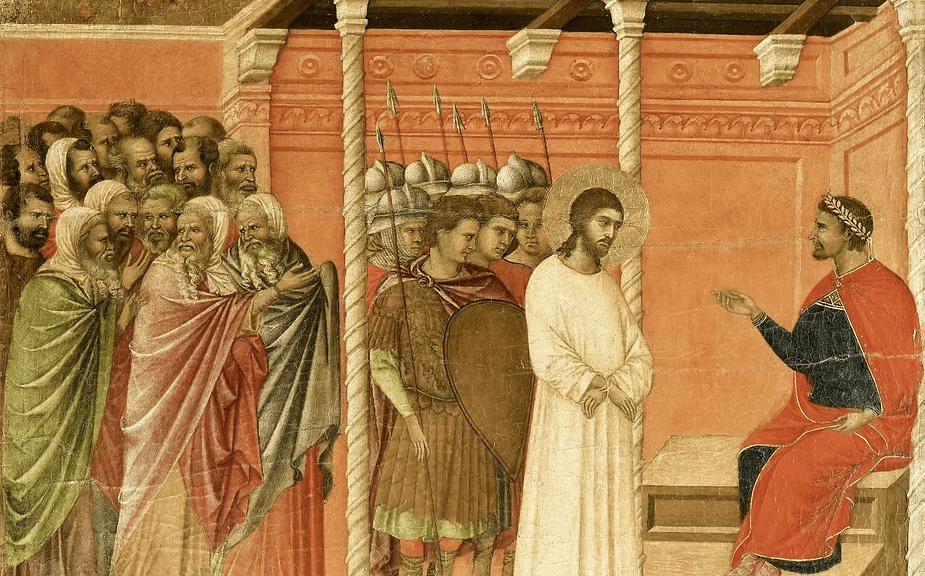
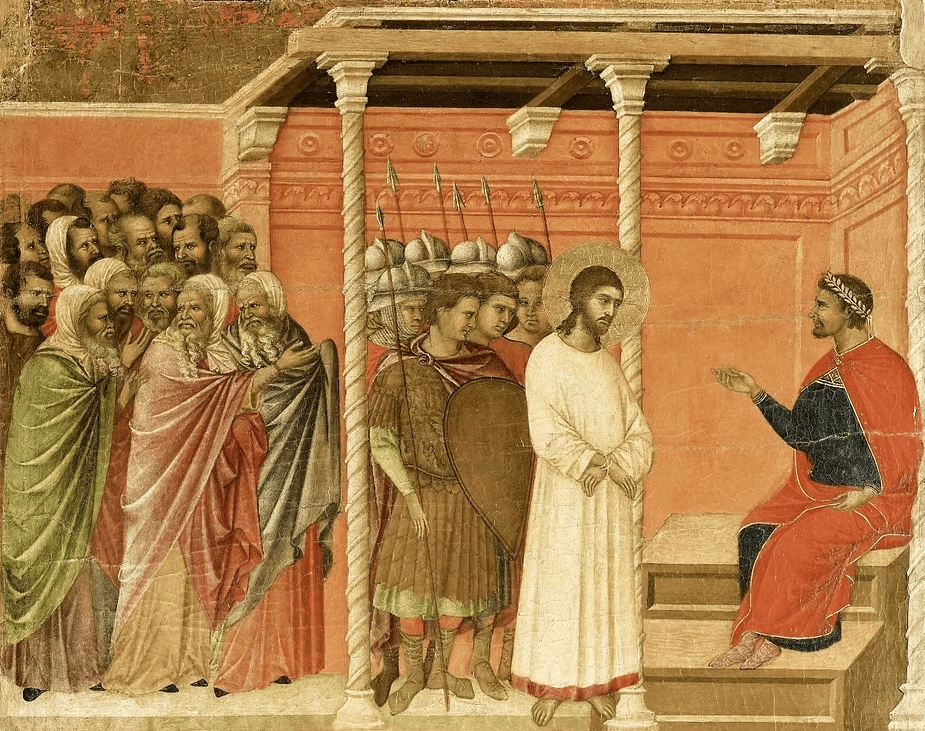
Pilate entered the headquarters again, summoned Jesus, and asked him, “Are you the King of the Jews?” Jesus answered, “Do you ask this on your own, or did others tell you about me?” Pilate replied, “I am not a Jew, am I? Your own nation and the chief priests have handed you over to me. What have you done?” Jesus answered, “My kingdom is not from this world. If my kingdom were from this world, my followers would be fighting to keep me from being handed over to the Jews. But as it is, my kingdom is not from here.” Pilate asked him, “So you are a king?” Jesus answered, “You say that I am a king. For this I was born, and for this I came into the world, to testify to the truth. Everyone who belongs to the truth listens to my voice.”

———————————————————————————————————-

This is the Gospel selection from the Episcopal Lectionary for the Twenty-seventh Sunday after Pentecost, Year B 2018, which is the Last Sunday after Pentecost. In the numbering system that lists each Sunday in an ordinal fashion, this Sunday would be referred to as Proper 29, but it is called “Christ the King Sunday.” It will next be read aloud in an Episcopal church by a priest on Sunday November 25, 2018. It is important because Jesus admitted to Pilate that he was a king, but that admission is left up to the whole world to discern (just like Pilate had difficulty understanding): Where is Jesus’ kingdom, if it is not from this world?

I will preface this reading interpretation with the basic statement that one has to have a firm grasp on the facts of reality, as far as Jesus’ final days are concerned.

1. Jerusalem was packed with Passover Festival pilgrim Israelites, local Jews, Romans and other Gentiles.
2. The Passover Festival in ancient Jerusalem lasted eight days.
3. Jesus had his disciples prepare for the Passover Seder meal [the first of two Seders: the night of 15 Nisan and the night of 16 Nisan] on Friday, 14 Nisan.
4. Jesus was arrested early in the morning of 15 Nisan, which was a most holy Shabbat [Saturday].
5. The written accounts of Jesus’ appearances before a Temple high priest, a Roman provincial governor, a Roman tetrarch [ruler of one quarter of a country] and back to the Roman provincial governor could not possibly happen on the same day and have his body taken down from a cross of death the following Friday.
6. The Romans were good record keepers and little is written of the trial and execution of Jesus of Nazareth, meaning the world did not stand still because of Jesus’ arrest.
7. Biblical records [the four Gospels] are so laser focused on what happened to Jesus that is appears that time stood still, just as it appears that a four-hour Passover Seder ritual meal was over in minutes.
8. The ignorance by Gentiles of the ritual of a Seder meal means the non-Jewish Christian thinks the Yachatz (breaking of the middle matzah) preceded the Beirach (Grace after Meals) and Kos Shlishi (the Third Cup of Wine), as quickly as a Christian priest can hold up a cup of wine and a large wafer, while reciting the Biblical text of Matthew.

With that understood, this reading from John must be seen as taken from the whole, as one part of an eight-day event that was surrounding the life of Jesus; this episode being one witnessed by John, who was not a disciple of Jesus. It is important to know that Mark [Peter’s Gospel writer] wrote of Peter’s disowning Jesus at the end of chapter fourteen. At the beginning of chapter fifteen, Mark wrote of Jesus appearing before Pilate. Matthew wrote of the same order, but he wrote of Judas hanging himself prior to witnessing Jesus before Pilate. Luke, likewise, followed the same order of Peter’s denial, such that Jesus appeared before Pilate later; but Luke [Mother Mary’s Gospel writer] then was the only one to write of Jesus being sent to appear before Herod, followed by Jesus standing before Pilate again.

All four Gospels then create a three-dimensional view of the truth surrounding Jesus before Pilate, such that this account by John is the first time Jesus was seen by the governor of Judea. However, this reading from John is seamlessly attached the account of Pilate offering Barabbas and Jesus to the people to vote on freeing.  That event, as told by Luke, clearly said it was Jesus’ second appearance before Pilate.  For the truth of all to emerge, one needs to be able to see an invisible point of transition appear in John’s words.

The word translated as “headquarters” is the Greek word “praitōrion.” When capitalized, this word is translated as “Praetorium,” which [in Latin] was the official residence of a governor, but when Herod visited Jerusalem it was his palace. Both Herod and Pilate were in Jerusalem at the time of the Passover Festival.  In Jerusalem there was both a Palace of Herod and a Hasmonean Palace within the temple compound, both of which would justify being identified in the upper-case as “Praetorium.” However, the spelling in John is in the lower-case, which means this can refer to the “praetorian guard,” which were Roman soldiers that were primarily housed in the Antonia Fortress, but also had guard houses surrounding the palaces.
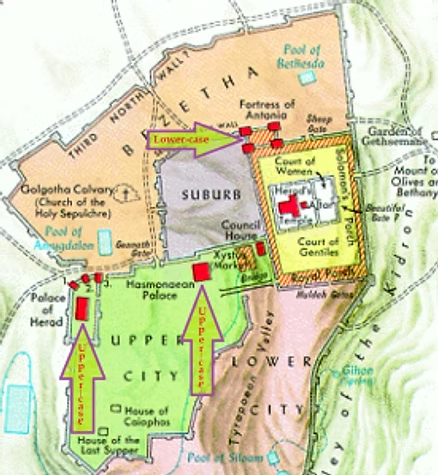
By understanding the intent of the lower-case spelling, this meeting by Pilate with Jesus was not in the palace.  Instead, the Sanhedrin had taken a prisoner to the guards of the fortress, which obviously had holding cells for prisoners.  The presence of Jews bringing in a Jewish prisoner necessitated Pilate be summoned to the fortress, to approve that imprisonment.  The last thing Pilate wanted was a riot ensuing, due to a Jew being falsely imprisoned by Rome, in Jerusalem, during the most holy time of the year when emotions were already high.

John’s verses twenty-eight and twenty-nine state, “Then the Jewish leaders took Jesus from Caiaphas to the palace of the Roman governor. By now it was early morning, and to avoid ceremonial uncleanness they did not enter the palace, because they wanted to be able to eat the Passover. So Pilate came out to them.”

This says it was after sunrise, after Peter had denied Jesus three times, and after Judas hung himself at dawn. The aspect of the elite Jews wanting “to be able to eat the Passover” says it was 15 Nisan, the Sabbath, with evening being when the second Seder would be eaten.  They, like Jesus and his disciples and family, had partaken of the first Seder meal before Jesus was arrested.

By reading that Pilate “again” went into the “praitōrion,” he had been outside talking to the Jewish leaders. That discussion was recorded by John, in verses twenty-nine through thirty-two. He had obviously been inside the first time to give the orders to imprison Jesus, before going outside to talk with the ones making accusations that Jesus was a criminal against Rome. When he returned inside the fortress and went to the holding cell of Jesus, he was “again inside” the fortress.  Pilate then asking “Are you the king of the Jews?” was based on nothing written by John that would indicates that title was expressly stated by the Jewish leaders.
This is why Jesus [who had the mind of the Christ for his insight] asked Pilate in return, “Do you ask this on your own, or did others tell you about me?” Jesus knew the true answer to that question, which means he immediately knew that no one had accused Jesus of claiming to be a king. John wrote they told Pilate, “If he was not doing evil, then we would not have delivered him to you.” (John 18:30) [In that verse, “kakon poiōn” translates as “evil doing,” not “criminal.”]

As far as Rome was concerned, a promised “Messiah” [in Greek a “Christ”] was nothing to worry about. As long as someone was not raising a sword against Rome [something to which they would gladly raise one in return], religious zealots (such as John the Baptizer) were nothing more than a lot of harmless hot air.
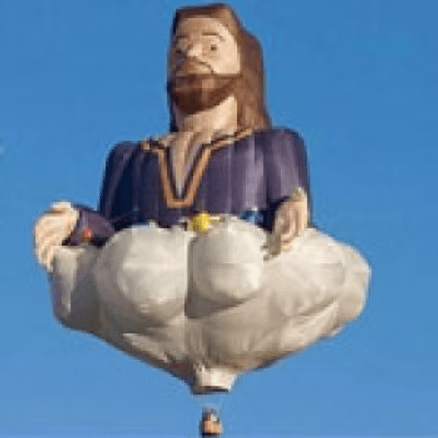
Look! Up in the sky! It’s the Messiah!

We then read that Pilate said to Jesus, ““I am not a Jew, am I? Your own nation and the chief priests have handed you over to me. What have you done?”

This is the mantra of all Gentiles, including the Christians of the Western world. The vast majority of Christians, as produced by the Roman Catholic Church, beginning in earnest in the Dark Ages, proclaim, “I am not a Jew, am I?”

As Romanized Christians, rather than Apostles who have been passed the torch of the Holy Spirit, those people act as if they are doing Jesus a favor by picking up what the Jews cast off. Christians of the West say, “Your own nation and the chief priests have handed you over to me.”

Finally, as those who have no bloodline connection to the lineage of Jesus of Nazareth [born in Bethlehem] and having never witnessed any of the miracles that Jesus was said to have performed, Christian Gentiles ask Christ, “What have you done?” Sure, they have been told what to believe, and like good pagans-turned-Christians, they believe.  However, they ask the same question as Pilate, with most muttering under their breath, “for me.”

While it can seem as though Pilate was speaking from a level of ignorance about the Jews, as a Roman citizen appointed as the fifth Perfect over Judea [there had been four Perfects of Judea prior to Pilate, him having succeeded Valerius Gratus], and only in that position for about the same length of time Jesus had been ministering the children of Israel, it is better to see Pilate working Jesus like a cop in an interrogation room. By playing ignorant, he hoped Jesus would begin bragging about all he had done, which would have allowed Pilate to hear for himself if Jesus was doing “wicked deeds” against the Jews of the temple, or against Roman dominion there.

When Jesus then said, “My kingdom is not of this world,” he admitted that he had allowed others, in one way or another, to hear him talk about a kingdom that he possessed. If cable TV and The History Channel had existed back then, and if Pilate had been a fan of Ancient Aliens, undoubtedly he would have been intrigued by Jesus’ answer. He might have wondered what ancient alien theorist would say about an “out of this world kingdom.”

Still, the Greek written by John, “ basileiaemē,” can say, “This authority [or rule] this my own.” The word “kingdom” is not to be understood as a worldly nation of people, but one person. While Pilate could not discern the importance of the capitalization of “” (meaning “This”), one can imagine Jesus gestured with his hands, by sweeping them along the form of his body from chest to waist. By his saying “This” along with that gesture, his word would then show that Jesus himself was where his reign was. By then repeating the word “this,” without gestures, Jesus was then saying [as Seinfeld made a running joke in one episode], “I am the master of this domain that stands before you.”

While Jesus had just admitted Jesus of Nazareth was a kingdom, he then added, “not is of the world this.” In actuality, the Greek of John says, “exists not in this realm” or “is not from here.” The paraphrase assumes that Jesus was not talking of a kingdom on earth, but his words could have been heard by Pilate as saying, “My kingdom is not in Judea.” Pilate’s ears could hear, but they were not geared to think in metaphysical ways. He was deaf to the proposition that the king of the kingdom of Jesus of Nazareth was not material in nature but spiritual.

Think about that for a moment and let that sink in. See if your ears can hear Jesus saying, “This (my body) kingdom this my own (body) [has a King] not from the material realm.”

[tick, tock, tick, tock, tick, tock]

Jesus said, “You will know that I am he and that I do nothing on my own but speak just what the Father has taught me.” (John 8:28) He also said, “I did not speak on my own, but the Father who sent me commanded me to say all that I have spoken.” (John 12:49) Jesus again said, “Don’t you believe that I am in the Father, and that the Father is in me? The words I say to you I do not speak on my own authority. Rather, it is the Father, living in me, who is doing his work.” (John 14:10)

What Jesus said to Pilate was no different than what he had said to others before. This is Jesus being exactly as the Israelites were all supposed to be, as priests to Yahweh. Each was to be a kingdom of which God was the king. When the elders of Israel went to Samuel and said, “Appoint for us a king, to be like other nations,” Samuel said, “God is your king.” Samuel, like Jesus, was a kingdom of God, as human flesh, with the king being the presence of God within them, via the Holy Spirit.

Pilate was having none of that out of this world namby pamby. The investigator in him came out; so we read, “Pilate asked him, “So you are a king?”

He must have missed the hand gesture. All he wanted was a confession. He did not realize that every word coming from Jesus’ mouth was the truth of God. The answer had been given, “Yes, I God am a King, but my Kingdom is Spiritual, which in Jesus of Nazareth stretches as far as the skin can go and inward to the soul.”  To Pilate, Jesus spoke, not Yahweh.

Since God had already answered Pilate’s question prior, He then told Pilate through Jesus’ lips, “You say that I am a king.” Jesus was saying that Pilate was only defining the word “king” in worldly terms. Jesus then said, “You are putting words in my mouth, which I did not say.” Jesus said he had “authority” that was solely his own. He did not say, “I am a king of a kingdom that is not from this land possessed by Rome.”

Jesus had explained to Pilate that, if he were a ruler of land, then he would command soldiers to fight for his release, as kings do. Those soldiers would have given their lives fighting against the tyranny of the Temple rulers, who had arrested Jesus. No soldiers had come to rescue Jesus, so Jesus was a kingdom of one. Only he was there defending himself. No real king would do that.

In this children’s game, the most important piece is the flag. It cannot move. It must have other pieces defend it.

To clarify what Jesus had previously spoken, which Pilate misunderstood, Jesus said, “For this I was born, and for this I came into the world, to testify to the truth.”

Twice Jesus said “touto,” which is again stating his use of “this” prior: “This authority this my own not of the world is this.” The word that was used to express “this kingdom not of this world” was “toutou.” At this time the verbiage was “this kingdom not of this world” was why Jesus was born. He said “this kingdom not of this world” was why Jesus came into the world in “this” body of his, which came with Spiritual authority … like a kingdom.

To be a kingdom of God on earth was the absent purpose that was not in existence in Judaism. All the high priests, all the scribes, all the lawyers and common folk were supposed to be kingdoms of God, but they all had failed God. Because they were not kingdoms of God, God sent Jesus to be the torch that would re-ignite that responsibility in all the children of God.

Jesus then said what his “authority” was. It was that “rule” he had been given by the Father [God] that the leaders of the Temple were mistaking as Jesus saying he was a king. Jesus was sent by God [the King] “to testify to the truth.” While Pilate would question, “What is truth?” [not part of this reading, so it might have been asked when Jesus returned for his judgment], the truth that was missing was the kingdoms of God that each Jew and scattered Israelite [as well as Samaritans and Gentiles later] were supposed to be was not.  They were dead to God in their hearts. Only the truth of Holy Scripture could awaken them from death’s slumber.

Jesus spoke the truth of Holy Scripture by being a living example of that truth.  Thus the truth proclaimed by him and his disciples was, “The kingdom of God has come near.”

Jesus then told Pilate, “Everyone who belongs to the truth listens to my voice.” The truth was then all of God’s people, as His chosen ones. They had been spoken for.  They belonged to God in marriage. They had broken the marriage contract and thus had been divorced; but God would open their hearts again with the truth. Jesus was sent to speak the truth of God, but God needed to release the Holy Spirit of Jesus Christ so that more than one human body of flesh could be the voice of truth.

Pilate, unwittingly, had a divine role to play in that release.  He had never been convinced that truth truly existed.  That was why he asked [not read in this reading]: “What is truth?”  That doubt is why God sent His Son to a world that lacked true Spirituality.

As the Gospel reading selection for the last Sunday after Pentecost, also known as Christ the King Sunday, when one’s own personal ministry for the LORD should be underway – one should be that voice of truth as Jesus Christ resurrected into a new bodily kingdom of God – the message here is to stop being like Pilate, refusing to hear what Jesus said. This does not mean reading the verses that the witnesses of Jesus of Nazareth remembered he said [or having someone read them to one] is the voice of truth.  While the words are always true, they are easily misunderstood [reference Pilate].  Therefore, hearing one’s own voice speaking as the voice of truth that comes from having been reborn as Jesus, through the Christ Spirit, is the only true way to hear Jesus speak.
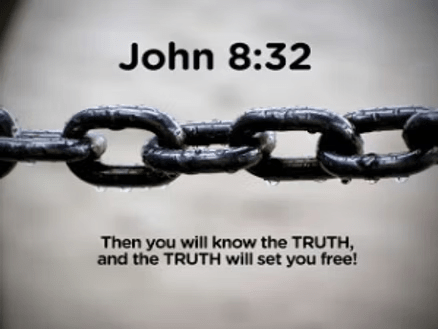
When one has been reborn as Jesus, one has become the womb from which Jesus could return into the world in Spirit. When one has resurrected the Holy Spirit of Christ and become Jesus again on earth, it is then “to testify to the truth.” The truth is not known by Gentiles, such as Pontius Pilate, as they ask, “What is truth?” Therefore, when one is reborn as the holy duplication of Jesus – an Apostle or Saint – one is tasked to make the truth be known.

While the truth comes from Scripture, which is the Word of God, leading others to facts and figures, those explanations and interpretations are only the essence of truth.  The Word of God comes alive and speaks as the voice of God to those whose hearts are then opened to receive the Spirit.  One has to become one with God the Father, becoming one with the Son, as one’s soul is joined with the Holy Spirit – the right hand of God.

The Trinity is when Heaven and earth meet in you.  The Trinity is Jesus again born into the world so the voice of truth can be witnessed … a holy kingdom, where Jesus Christ is the high priest and God is the King.

The whole concept of “Christ the King Sunday” is then a return to being like Pilate, who asked Jesus, “Are you the King of the Jews?”

To see Jesus of Nazareth as the Christ is missing the point. One is seeing the flesh of life that stands on two feet and talks. One is seeing a human ruler of a religion that has not yet begun. That is the wrong way to see how Christ is the King.

Jesus said he was the kingdom, all by himself. The “authority” that made Jesus of Nazareth [born in Bethlehem] a kingdom was God. God was [and still is] his King. God is always the King who is not from this world of matter. God Created the material world from His Spiritual realm.  Thus, God rules over His kingdoms that have been reborn as Jesus of Nazareth – the prototype of a fully committed wife of God, whose love of God has brought forth the Christ Spirit.
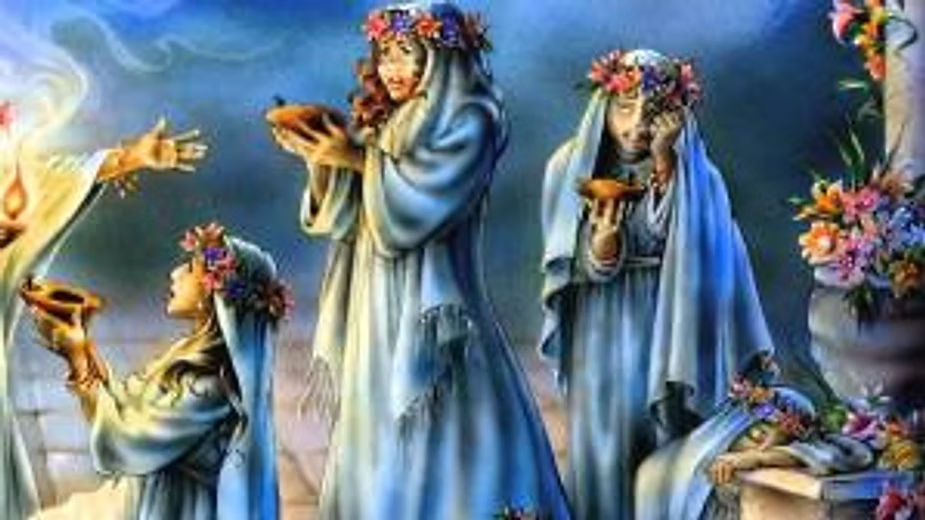
Those potential wives [virgins] not prepared for the coming of the Lord [death] will weep.

The Christ Spirit is the presence of God in a human soul [not of matter], so Jesus of Nazareth [a planned human birth by God the Father of Jesus] was born without a self-ego, being given the Christ Mind from birth. The sacrifice of Jesus of Nazareth, which Pilate was destined to order after inspecting the Lamb of God and finding him without blemish, was so the soul of Jesus Christ could be released from its prison of flesh and then fill countless other souls who sacrifice their self-egos in order to serve the Lord.

This means “Christ the King” is God. To choose Jesus the man to be one’s Christ is to make the same wrong decision Pilate made. Pilate heard what Jesus said and ignored the statement that implied, “God is King, I am the kingdom.” All he heard was, “So you are a king?”

One has to listen to Jesus’ response. Jesus said to Pilate just as he says to all who fail to recognize God is the King that loves his subjects and His subjects love God in return. God IS the Christ.

When Jesus said, “You say that I am a king,” he meant that the reader (just as Pilate) thinks human subjects must kneel before a human being and swear allegiance. To worship Jesus [a man born of a woman, thus made of matter] as king means to sentence that king to crucifixion and let his soul go away from oneself, as Arthur was sent sailing off to Avalon.  Jesus has been exiled by Christians, sent to a magical island that is not of this world.

“Bye bye Jesus my king!” his fans cry. “Watch over my sinful soul and wretched flesh from your new island home, so my soul can sail off to be with you when I die.”

God is the Christ. God is the King. God is Christ the King.

Jesus is the model of what a loyal, loving subject does for one’s King.

Live the truth.

Revelation 1:4b-8 – See! He is coming after clouds

Grace to you and peace from him who is and who was and who is to come, and from the seven spirits who are before his throne, and from Jesus Christ, the faithful witness, the firstborn of the dead, and the ruler of the kings of the earth.

To him who loves us and freed us from our sins by his blood, and made us to be a kingdom, priests serving his God and Father, to him be glory and dominion forever and ever. Amen.

Look! He is coming with the clouds;

every eye will see him,

even those who pierced him;

and on his account all the tribes of the earth will wail.

So it is to be. Amen.

“I am the Alpha and the Omega,” says the Lord God, who is and who was and who is to come, the Almighty.

———————————————————————————————————-

This is the Epistle selection from the Episcopal Lectionary for the Twenty-seventh Sunday after Pentecost, Year B 2018, which is the Last Sunday after Pentecost. In the numbering system that lists each Sunday in an ordinal fashion, this Sunday would be referred to as Proper 29, but it is called “Christ the King Sunday.” It will next be read aloud in an Episcopal church by a reader on Sunday November 25, 2018. It is important because it is the Apostle John [the Beloved, not of Zebedee] speaking of the coming of Jesus Christ, about to be introduced to the seven churches of Asia. This reading begins a most ominous book that strikes so much fear in Christian ministers that they often refuse to preach about the End Times message this introduction leads to.

First of all, let me remind the reader that this reading selection is the Epistle of John. John was filled with the Holy Spirit, and like all other Epistle writers, wrote in the language of God, which is difficult for simple translators to grasp. This means the reading shown above is a paraphrase of what was actually written and needs a literal translation to accompany it, so one can catch where the translation read aloud becomes misleading. To avert that, I will present this short reading in segmented format, with each segment determined by punctuation marks (real or imagined).

Second, I would like to remind the reader that my abilities in reading holy texts originated when I began to understand the holy prophet Nostradamus. The ‘rules’ that I follow here [in all Biblical readings, but in particular with the Epistles of the Apostles] are based on those I was shown in the writing style of Nostradamus. I mention this now because there is a significant reflection of the presentation of heavenly language [that which appears earthly, but is invisible when paraphrase takes place] that John used in these five verses that is strikingly similar to that used by Nostradamus. I will point that out.

Third, this selected reading begins in the middle of verse four, following a colon mark. A colon [by standards of punctuation that are modern and may not have been standard at the time of original writing – thus imagined rather than real] introduces language that follows that will clarify a previous statement, usually by listing examples or explanation. By separating this selection form the preceding verbiage, some intent is lost in translation. To overcome that confusion, I will make some references to what was written prior to this reading [from John 1:1-4a].

Before I can present the segmented literal translation, based on the Bible Hub Interlinear translation and alternative possibilities of translation, I need to explain the comparison to the writings of Nostradamus. I will say that there is no arguing that the essence of Nostradamus’ The Prophecies and The Apocalypse of John is similar in they both present messages of doom and gloom, which has both classified as having written of the End Times. That general assessment is based on paraphrased translations, which may or may not be accurate.

What most people do not realize about Nostradamus is he wrote two letters that have been included in all books representing The Prophecies following the death of Nostradamus [1566]. One is the “Preface” and the other is his letter to King Henry II of France. Both are “epistles,” and they explain what can be found as the intent for all the poems of prophecy that make up The Prophecies.

In an analysis of both of Nostradamus’ epistles, one finds there are very few period marks, which makes it appear he was very long-winded, writing very confusing “sentences,” filled with many commas and other marks [like colons]. Amid all that length are a great many ampersands (&), which are commonly shown in paraphrase as “and.” Often, a comma will precede an ampersand, as “,&”. This is bad grammar written in a mark and a symbol, where a comma implies the use of “and,” and an ampersand implies the use of “and,” so the result reads as “and and.”

In my segmented translations of the letter of Nostradamus, I have found that an ampersand must be read as a mark of separation, such that the symbol that implies “and” begins a new segmented line. In the cases where Nostradamus would use an ampersand between two words, without a comma present, it was to indicate a symmetry between that stated prior and that stated following. That also acted to join two concepts together as one, but for that union to be understood, one had to first understand each of two parts fully. To do that, one part would end a segment, with the ampersand beginning the next segment, followed by the symmetrical word. This means every ampersand is not simply a shortcut “and,” but rather the symbol for “and” means the reader is signaled to pause and reflect deeply on how to read the verbiage that surrounds an ampersand.

In this reading from John’s Revelation, there are no ampersand symbols. However, there are seventeen uses of the Greek word “kai,” which commonly translates as “and.” When one reads Biblical Scripture, one often finds this repetition, and all the ands are completely overlooked, seen as nothing but just another bullet point on an endless list of things said. We miss the power of one word being repeated, due to our haste; we so desire to get to the point quickly we fail to see the forest for the trees.

Of the seventeen uses of “kai” written in these five verses, eight follow a comma mark. Eight appear amid a segment, joining two words as one, but where symmetry should be given thought. Finally, there is one “kai” following a double-dash [em dash], which should be seen as similar to following a comma. In the segmented literal translation below, I have placed “kai” at the head of a segment of words, either a whole segment or a subset segment. I have not translated “kai” as “and.”

The Strong’s Concordance says the Greek word “kai” is a conjunction, meaning, “and, even, also, namely.” On the same page that links this word to the Bible Hub information, they state that the “NASB” [New American Standard Bible] shows this Greek word’s “translations” as an assortment of viable options. Those are: “accompanied (1), actually (2), after (2), again (1), again* (1), along (4), also (535), although (1), although* (1), besides* (1), both (37), both* (1), certainly (1), continue (1), either (2), else (1), even (132), forty-six* (1), if (1), including (1), indeed (20), indeed* (2), just (3), likewise (1), more* (2), moving about freely* (1), nor (4), now (2), only (2), only* (1), or (11), same (1), so (30), than (2), than* (4), then (105), though (1), though* (6), together (1), too (34), until (1), very (3), well (13), when (7), whether (1), while (1), whose* (1), without* (4), yet (9).” [NAS Exhaustive Concordance of the Bible with Hebrew-Aramaic and Greek Dictionaries]

The numbers in parentheses are the occurrences of that translation. The asterisks are not footnoted, but one can assume there might be debate about those translations. It is important to realize that “kai” is “the most common NT conjunction, used over 9,000 times” [HELPS-Word studies], meaning the most common translation is as “and.”  Therefore, the list above shows the exceptions to that common translation.

With that stated, I have not translated “kai” as a word that is limited in translation, denying other possibilities to be realized. Instead, I present it in its Greek spelling, so it is more like a symbol that implies “and” but is more [like Nostradamus used ampersands]. With this option now visible, I welcome you to read these five verses of John’s Revelation, while seeing “kai” as a time to pause and reflect on the importance of what has been said before and how an important transition is being made to that stated next.

Revelation 1

4b. Grace to you
          kai peace from him being
          kai who was
kai who is coming ,
kai from the seven Spirits that in the presence of the throne of him  ,
5. kai from Jesus Christ  ,
who witness [martyr] those who faithful  ,
those firstborn of the dead
          kai one ruler of the kings of the earth  .
Followers loving us
kai releasing us from the sins of us through the blood of him 
6. kai he has made us a kingdom  ,
priests all God
          kai Father of him 
to him this glory  ,
kai followers dominion into these ages  .
truly  .
7. behold!  ,
he is coming after this clouds  ,
kai will see him every eye  ,
kai those who him pierced  ,
kai will lament because of him all those races of the earth  .
certainly  !
truly  !
8. I am all Alpha
kai all Omega  ,
beginning
          kai end  ,
says the Lord one God  ,
one being  ,
kai who was  ,
kai who is coming  ,
one Almighty  .

Before beginning to understand the beginning of this reading, where verse four above is following a lead in from verse four that has been omitted, one should know what context was stated prior. Verse four begins by stating “John” as a one-word statement that identifies the writer of this epistle, but the capitalization is more than stating a proper name.

“John” is the translation of “Ioannes,” which has been adapted to “Joannes.” The meaning of that name is “God Has Been Gracious.” It is then that important Grace that is being told by the angel of Jesus Christ, “To those seven churches to those in all Asia.” This is to whom “Grace” is sent in a letter.

It is worthwhile to realize that verse four-A repeats the word “tais,” with the first one capitalized – the first word after the comma following “Ioannes.” I have translated both words as meaning “to those,” with “To those” having the importance of implying “God Has Been Gracious To those” who had been touched by John’s “Grace” from God. Those of the seven churches were then those who passed the truth of the Holy Spirit onto “all of Asia.” Therefore, “Grace to you” means all true Christians that had spread across the face of Asia, beyond the places in Greek Turkey [its modern name], eastward.

Verse three then plays into this aspect of “John,” who was the Evangelist that served the Lord by ministering to Jews and Gentiles, as an Apostle of Christ. When broken down into segments of words, it reads as such:

3. Blessed followers reading  ,
kai those hearing the words of this prophecy  ,
kai observing the things in it having been written  ;
those because opportunity close  .

This says that “Grace to you” is a “Blessing” from God to all “followers” (from “ho”) of Jesus Christ [like John], who walk in the footsteps of Jesus of Nazareth, having been reborn of the Christ. Those with that important “Blessing” will benefit from “reading” this epistle, where the Greek word “anaginōskōn” implies “discernment” (from the root “anaginóskó”) of the words read. That ability to “know certainly” comes from having been “Blessed” with the Christ Mind.

Next, one finds two segments that have been created with a comma leading to the word “kai.” To read “and” at those places lessens one’s ability to see the importance of a symbolic word that says, “and understand this.” One who is “Blessed” is given ears that hear the insight of the Holy Spirit, saying “Look closely here.” Look at how the “truth is being revealed” (from “prophēteias”) Then, look at how one should “observe the [hidden] things [that are] in it having been written.”

The Greek word “tērountes” means “observing,” but it is seeing what has been “kept intact” through a “guarded” way of “preserving” what has been written from being understood by those not “Blessed.” It is “those” (from “ho”) who understand the “opportunity” (from “kairos”) that comes from “close” inspection of the Word that is hidden in the words.

It is important to grasp that insight, especially when one wants to be responsible for a true prophecy of God, sent through Apostles. This is the purpose of God’s “Grace” – to be one of “those” who have seized the “opportunity” [the “time and season”] to be “near” or “close” to God.

Verse four-B then tells that God’s “Grace” bring “peace of mind” to those who have sacrificed their self-egos in subjection to God. This “well-being” comes “from him being” the replacement. This is the Christ Mind, which is born with the birth of Jesus Christ within one’s “being.”

The word translated as “being” is “ōn,” which is derived from “eimi,” meaning “I am, I exist.” While this can mistakenly be read as a statement of what “is,” in the present tense, that overlooks the value of having sacrificed an old state of “being” for what now “is,” through Christ. Jesus of Nazareth is “who was” the Christ alone, in his human flesh; but the sacrifice of that flesh and blood for others is then “who is coming,” where “erchomenos” is the present participle that “is” “coming” into Apostles and Saints.

The segment of words that follows a comma mark and begins with “kai” then places important focus on Jesus Christ being “from the seven Spirits,” where “Spirits” is capitalized. As one entity of two words – “seven Spirits” (from “hepta Pneumatōn”) – this is reference to Isaiah 11:2-3, which states: “The Spirit of the LORD shall rest upon him, the Spirit of wisdom and understanding, the Spirit of counsel and might, the Spirit of knowledge and of the fear of the LORD, and He will delight in the fear of the Lord.”[1]  As such, Jesus Christ is:

1. “The Spirit of the LORD,” meaning he is the Christ of God.

2. “the Spirit of wisdom,” means the Mind of Christ.

3. “[the spirit of] understanding,” means having the ability to discern Scripture.

4. “the Spirit of counsel,” meaning the role of a teacher.

5. “[the spirit of] might,” meaning the strength to withstand persecution.

6. “the Spirit of knowledge,” meaning the ability to know the hearts and minds of others.

7. “[the spirit] of the fear of the LORD,” meaning no sins or threats can influence.

All of this is made available to the servants who have been “Blessed” with the “Grace” of God, to be reborn as Jesus Christ. They all kneel before “the throne of him,” whose “presence” is within one’s heart, mind, and soul. That throne belongs to God. Those who have the presences of God in their flesh [as a soul in union with the Holy Spirit] will be at the throne of God as Jesus Christ, the right hand of God resurrected.

Verse five begins with the importance of that rebirth of Jesus Christ. The Greek word “martys” then says an Apostle or Saint becomes a “witness,” as “followers” (from “ho”) who were disciples of Jesus of Nazareth who became Jesus Christ reborn. They are therefore “faithful followers” (from “ho pistos”). Those first Saints were then the “firstborn of the dead,” where “firstborn” (from “prōtotokos”) means they were the “elders” of Christianity. They had been the “first reborn” as the Christ, having sacrificed their self-egos that kept them bonded to a mortal cycle of death. They were the first to break that cycle of reincarnation and sin.

The subset segment is then as symmetrical connection of “firstborn of the dead” AND “the one ruler of the kings.” The implication is the “firstborn” were initially twelve, with all twelve having the same ruler.

The Greek word “archōn” means “ruler, governor, leader, or authority.” It should not be read as “king,” because Jesus Christ is not only the ruler of Apostles [as their “governor” or “prince”], but also the same to the “kings of the earth” [a bloodline of European kings that would surface centuries after].

That last segment ended with the first period mark of this reading. The segments of verse five had focused on Jesus Christ. Now, there is a transition to the “Followers,” where the capitalized Greek word “” is written. “” has the same translation possibilities as “ho,” where “followers” is a viable translation to “the [one].” Either way, the importance conveyed by capitalization refers back to the “kings of the earth,” who will be “loving us,” who are the “firstborn” Christians.

The Greek word “lysanti” is translated as “releasing,” from the root word “luó,” but it is reference to the future when Christianity would be “unbound” from the Middle East and Eastern Europe, as a persecuted minority. Remember, the letter was written to the seven churches of Asia. The “sins” (from “hamartiōn”) being “released” are not wicked things done, but the “faults” seen in them by Eastern Jews. The rejection of Jesus by Jews [their own “blood”] would be soothed by the coming of Christian kings that would rise from the holy blood of Jesus of Nazareth.

The double-dash [also called an “em dash”] is not an often used punctuation in language. It is used today as a replacement for a comma, parentheses, or a colon. Because this extended hyphen ends verse five and a second is found amid verse six, one should see the two as marks that set aside the next two segments and the ensuing subset segment as a large aside [use of parentheses], which would act as a clarification of this element of “us through the blood of him.”

Verse six then makes one realize that the spread of Christianity is the “kingdom” John referred to. This is then where the “blood” (from “haimati”) of Christ is both the human sacrifice of him body and blood, “releasing” his soul so his Spirit could be in the “blood” of his “Followers.” That spiritual “blood” was then guarded by the physical “blood” of kings.

This physical bloodline plainly says Jesus of Nazareth had a child. That child was John the Evangelist [John the Beloved]. John, in turn had a daughter that traveled to Europe with Mary Magdalene, Mary Salome, Mary of Cleopas, and Joseph of Arimathea (see Saintes-Maries-de-la-Mer), which is the stuff of lore known as the Sang Real (Royal Blood).

This then leads to another symmetrical arrangement where this “kingdom” of Christianity would be both “priests all God” AND “Father of him [“in Christ”].” While it is easy to read “God and Father of him,” that redundancy really makes little sense. However, when one see how this is a prophecy of future times, when there will be Christian “kings of the earth” and “kingdoms releasing” Christianity to grow, the “priests all God” are the kings of Europe [royalty] and their subjects, AND the “Father in him” is a Roman pope. Remember, John is writing a letter to the seven churches and all Asia, where each church will suffer future failures. Rather than see a limitation in this prophecy of John as just the seven villages in Greek Turkey, one can see the “Father in him” as the failure coming that involves the Church of Rome.

This then says, “to him this glory,” where the Greek word “doxa” not only states the generic state of ‘glory,” but also the “honor” and “renown” that this spiritual and physical bloodline will bring. Europe would become a place known as a bastion of Christianity. Additionally, the European “followers” of Christ would find “dominion” [“power, strength” from “kratos”] as Christian nations. As John was writing around 90 C.E., that coming strength that glorified Jesus Christ would last “towards” (from “eis”) the time when “ages” (from “aiōnas”) meet. The Age of Pisces [Jesus’s age] will last until the Age of Aquarius [age of knowledge and technology], which could come any time now.

As we often end a prayer with the word “amēn,” the word means, “verily” or “truly.” At the end of a verse, it can be read as, “so let it be.” It is important to note that the word follows the second period mark, and also ends with the third period mark, which makes “amen” a stand-alone sentence.

Verse seven begins with the important one-word statement, which in Greek is the capitalized “Idou.” The translation read aloud adds an exclamation point, which is perfectly allowed. Still, this important word is followed by a comma, which cannot replace that mark; it simply highlights how a mark of punctuation is simply a symbol that tells one how to read Scripture. The word itself implying it be spoken emphatically means the comma is separating that word from the next, placing focus on just that. “Idou” says, “Look!” “Behold!” or “See!” Following a one-word statement that says, “So let it be,” the shout is to “Wake up!” “Behold what will be!”

Following verse six telling of the vast spread of Christianity, John’s cry to “See!” he said “he is coming” (from “erchetai” – third person singular future), which indicates Jesus will come into the Apostles that will lead that expansion. This will be “after” (from “meta”) the timing of John’s epistle, as he wrote a prophecy. The Apostles of John’s day (the “firstborn”) will lay the foundation of that which “will be coming after” them.

John’s use of “clouds” is then not a literal descent of Jesus coming in the future from “clouds” (from “nephelōn”), but the emotion of Christianity will fall like rain from the sky, flooding the “kingdoms” with belief. This emotion will lead to Jesus seeing through the eyes of God’s faithful, so the presence of true Christians will allow “every eye” to “see” (remember this verse began with “Behold!”) Jesus Christ in those who have been reborn as him.

[Let me add that it used to be a common mistake to find the astrological sign Aquarius stated to be a Water Sign.  This is because Aquarius [in Latin] means “Water-bearer” or “Water-carrier.”  Aquarius is actually an Air Sign, such that “clouds” are water vapors in the sky.  In terms of “after,” the Age of Aquarius will “be coming after” the Age of Pisces.]

When John wrote, “those who pierced [Jesus],” those were Romans. The soldiers of Rome nailed his hands and feet to a cross. A Roman guard pierced Jesus’ side with a spear, to see if he was dead. The Romans were seen to be the ones who would “Behold!” the emotion of repentance foremost. It will be from their sorrow that the Church of Rome will align with the “kings of the earth” and spread Christianity to “all those races of the earth” that the Holy Roman Empire will spread.

John then emphatically stated, “certainly!” (from “nai,” which also says, “yes!”). That was an emphatic “assurance” this future would come. He then, again, added, “amen,” this time adding another exclamation point. John shouted, “So let it be!” It will “truly” come! And, it has come, as the truth be told.

Verse eight begins with “I am,” which presents the capitalized word “Egō” and the lower-case word “eimi.” In actuality, the word “eimi” alone says, “I am” or “I exist,” as an expression of the Greek infinitive “to be.” The capitalized “Egō” means (importantly) “Myself,” as an emphatic statement of “Me.” However, John is not the true author of this epistle, as he was being told what to write by the Holy Spirit of Jesus Christ. Jesus Christ had thus become the “Ego” of John, with John having sacrificed his self-ego to the Lord. Therefore verse eight begins by saying, “from a most holy Ego am I.”

This is then linked to the simple word “to,” a variation of the Greek word “ho,” which could state “followers,” as has been used prior. That plural indication of one type of people that are associated to “the one” can now appear as one claim for “all” followers of Christ. This means “Alpha” (a capitalized word of importance) becomes a word pointing focus on the “firstborn,” as alpha is the first letter in the Greek alphabet.

John then importantly spoke as a sacrificed self-ego that allowed “all” Christians to become the “Ego” of Jesus Christ, who spoke for God the Father, again in human flesh. One must remember YHWH means, “I Am That I Am.” Such an “Ego” brings the Mind of God as what “I am” Christians say.

The symmetry of “Alpha” AND “Omega” (another capitalized word of importance) is then separated into the focus that will be set on future Christians, who will be the last of a line. Since omega is the last letter of the Greek alphabet, it is then importantly representative of those who will come last. This means it cannot be God who is “Alpha and Omega,” because God has no beginning and no end. God is always, forever and eternal. Jesus Christ is an Age of Man, the one that calls for self-sacrifice for a higher, Spiritual goal.

That Age of Christ then has “beginning” AND “end,” another symmetrical arrangement of principles that must be understood individually. The “beginning” of God’s Christ goes back to God creating His Son, who most know as “Adam.” Adam is thus the “Alpha,” who was the first Son of God, the only Son made as Man. Jesus is then the “Omega,” as the “end” of that line of holy men who would reincarnate as God’s individual servants, sent to lead the children of God. Jesus is not the “end” entity as a human of flesh and bones, because his “end” became the exponential spread of that “last” Son into all who would duplicate that “end.”

All who will be duplicates of Jesus Christ, from “beginning and end,” “say the Lord [is] one God.” That is the commonality of all Christians, as they have within them the “Master” in Christ, who serves only “one God.” This is not done from a perspective of God being external, as determined by one’s self-ego, or human brain. It is known by the Mind of Christ, which comes from “being one” with God, through the marriage of the soul with the Holy Spirit. That sacrifice is possible when one realizes what “one was.” One can then commit to God so a marriage “will be coming.” The marriage is the union of “one” with the “Almighty.”

As the epistle selection for the last Sunday after Pentecost, also known as Christ the King Sunday, when one’s own personal ministry for the LORD should be well underway – one should realize that one is of the Omega class of Christians, nearing the end of an age – the message here is obviously misunderstood by most people. The message is to understand prophecy as a real warning to “Behold!” danger is at hand, because one’s soul is at risk. Stop looking up in the sky for something to happen in the clouds, when the cloud is one’s own confusion and distractions from self-indulgence.

In the Acts of the Apostles says:

You will receive power when the Holy Spirit comes on you; and you will be my witnesses in Jerusalem, and in all Judea and Samaria, and to the ends of the earth.” After he said this, he was taken up before their very eyes, and a cloud hid him from their sight. They were looking intently up into the sky as he was going, when suddenly two men dressed in white stood beside them. “Men of Galilee,” they said, “why do you stand here looking into the sky? This same Jesus, who has been taken from you into heaven, will come back in the same way you have seen him go into heaven.” (Acts 1:8-11)

That same way was disappearing in “a cloud” that “hid him from their sight.” “See!” with your hearts, minds and souls. He has come in the same way, reappearing invisibly in Apostles and Saints. He returned the very next day [Pentecost, which happened to be a Sunday]. He has been here since that “Alpha” day in the “beginning.” “Why do you stand here looking into the sky?”

Who were those “two men dressed in white”? Well, they could have been the appearance of the constellation Gemini, which are the twins Castor and Pollux. That tells one the eve of Pentecost was during the time when the sun traverses Gemini, between late May and mid-June. Still, it could be Moses and Elijah, who Peter, James, and John of Zebedee saw with Jesus on the high mountain.

The point of this reading being public on a day that recognizes Christ the King is it paraphrases Scripture so it places Christians inside a cloud of confusion. God is the King. God is the Christ. Jesus is the Son of God, as God’s right hand reaching down to earth and filling human souls with the desire to please God, as did His Son Jesus Christ. It is now up to each individual to stop looking into the sky for Jesus to come save us. We need to become a cloud of love for God and let the rain of God’s love fall upon our souls.

We fear or are thrilled by the thought [a human ego minimal power] of John telling of the End Times to come.  That means people pour over documents, trying to find evidence of when this prophesied end will come … all for personal glory and profit.  Others refuse to “Look!” at the Revelation, because it frightens the paying members of a congregation.  No one has eyes that can see Jesus has long returned.  Had he not, there would be no pews for Christians to sit in.

John’s introduction of a holy prophecy points the loving finger at us today, who claim to be Christian but struggle to know just what that means.  We do not read today what each of the seven churches have failed to do, but failure is what all have done.  We are at the end of an age of man, when the time of Jesus Christ will collapse, caved in by the trinkets of invention.  You probably hold one in your hand now, or it is within easy grabbing distance.

These five verses [six including verse three] are pointing to our responsibility.  The time has come to bow down before the throne of God and commit our souls to His service.  God must be realized as one’s true King.  One’s only hope is to be knighted as the Son of God, the Prince of Peace.  We must hear from the clouds of emotion, a most holy voice say, “Rise Sir Christ, and serve your King with honor.”

[1] Some contend that Paul’s seven gifts of the Holy Spirit could be the “seven Spirits,” but the Holy Spirit is one Spirit, not seven.

#Acts1811 #Isaiah1123 #Revelation138

2 Samuel 23:1-7 – David’s last song

These are the last words of David:

The oracle of David, son of Jesse,

the oracle of the man whom God exalted,

the anointed of the God of Jacob,

the favorite of the Strong One of Israel:

The spirit of the Lord speaks through me,

his word is upon my tongue.

The God of Israel has spoken,

the Rock of Israel has said to me:

One who rules over people justly,

ruling in the fear of God,

is like the light of morning,

like the sun rising on a cloudless morning,

gleaming from the rain on the grassy land.

Is not my house like this with God?

For he has made with me an everlasting covenant,

ordered in all things and secure.

Will he not cause to prosper

all my help and my desire?

But the godless are all like thorns that are thrown away;

for they cannot be picked up with the hand;

to touch them one uses an iron bar

or the shaft of a spear.

And they are entirely consumed in fire on the spot.

———————————————————————————————————-

This is an optional Old Testament selection from the Episcopal Lectionary for the Twenty-seventh Sunday after Pentecost, Year B 2018, which is the Last Sunday after Pentecost. In the numbering system that lists each Sunday in an ordinal fashion, this Sunday would be referred to as Proper 29, but it is called “Christ the King Sunday.” If chosen, it will next be read aloud in an Episcopal church by a reader on Sunday November 25, 2018. It is important because it is reminiscent of what a true anointed king’s traits are.

The Hebrew word translated as “oracle,” as a repeated word in verse one, is “nə·’um,” meaning “utterance,” or “declaration.” The word “oracle” is understood to mean: “A person considered to be a source of wise counsel or prophetic opinions; an authoritative or wise statement or prediction; and/or, a command or revelation from God.” [American Heritage® Dictionary of the English Language, Fifth Edition]

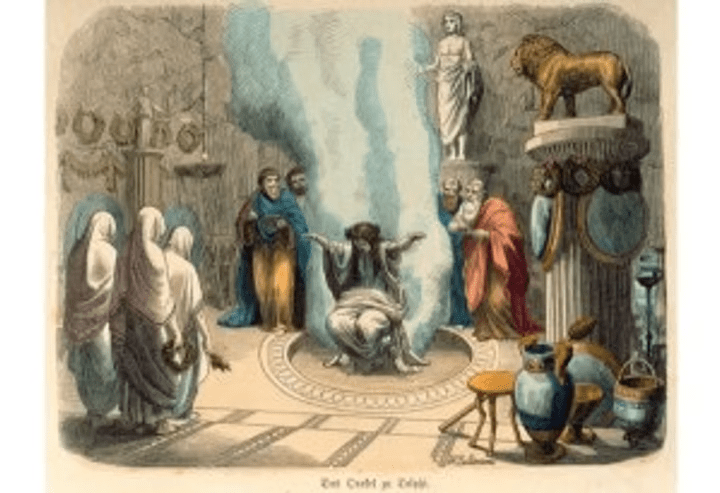
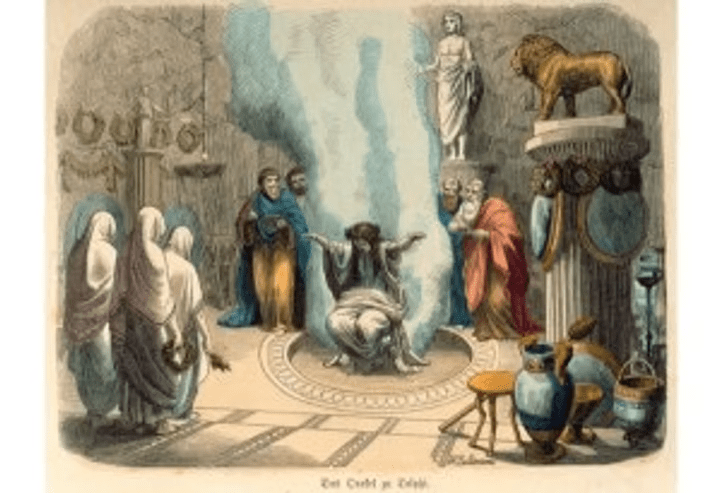
The oracle at Delphi.

This makes these last words of David be prophetic, more than a synopsis of David’s life. The repetition of this word is then important to all readers as a statement of a talent of the Holy Spirit.

When we read that David was “anointed of the God of Jacob,” this aspect of anointment has to be seen as a statement of the Messiah, such that the Hebrew word “mashiach” means both “anointed” and “Messiah,” as the “Anointed One.” To read “of the God of Israel,” one has to see “’ĕ·lō·hê” as stating “the god,” implying “God.” As “the god of Israel,” which is only YHWH elohim [the LORD of all gods], the Lord is who anoints the Messiah.

David was anointed by Samuel, at the command of YHWH, which is not quite the same as being the Messiah. David was “the man whom God exalted,” or “the man raised up on high.” This means his physical anointment was as the King of Israel. He was “raised up” to lead a nation of people.” The people were the children of Jacob [Israel].

Interestingly, this translation of verse one does not include the last segment of words, which says that David was “raised up on high  ,  the anointed of the god of Israel  ¸ the delightful psalmist of Israel .” The translation read aloud has the last segment saying, “the favorite of the Strong One of Israel.”

The Bible Hub Interlinear does not show any translation substitution of “psalmist” with anything that could be translated as “strong one,” unless one saw writing songs as David’s strength. It clearly shows “zə·mi·rō·wṯ” written, which translates as “psalmist (1), psalms (1), song (1), songs (1), songs (2).” [NAS Exhaustive Concordance of the Bible with Hebrew-Aramaic and Greek Dictionaries]

David the psalmist

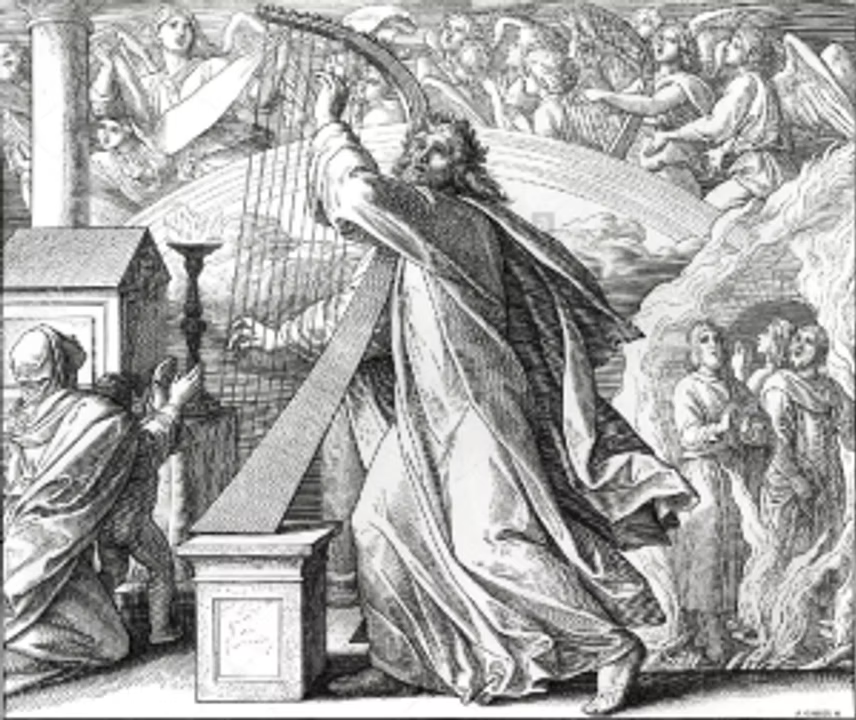
This says that David’s greatest connection to the Israelites was through his songs. David was like a popular singer-songwriter today, whose lyrics are learned verbatim by his or her fans. David was anointed to sing to the hearts of Israel [which is not the way David’s psalms are seen today]. To assume that strength through music [as David not only sang lyrics, he also played the harp in accompaniment] this makes more sense when verse two begins by saying, “The spirit of the Lord speaks through me, his word is upon my tongue.” That says the Holy Spirit touched the Israelites through the songs of David. It was through David’s psalms that he heard the LORD speak through him. YHWH was his musical inspiration.

When verse three says, “The God of Israel has spoken, the Rock of Israel has said to me,” this misses the first word, which stands alone as an important one-word statement of transition from the lyrics that came to David via the Holy Spirit [“ruah”]. That word is “’ā·mar,” which means, “said,” but often translates as “answered” or “answers.” While the second segment states “spoken,” which can make “said” seem redundant, when understood as “answered,” then “’ā·mar” means the words of the Lord on David’s tongue made the Psalms the answers sent by God, to soothe all the worries and praises the faithful would encounter as His priests.

This means the Psalms are how “the god of Israel has spoken.” It is then the Psalms that are both the “rock” of high praises and the “cliff” of trials and tribulations when the people fail the Lord (both translations from “tsur “). Rather than David making decrees for everyone to follow [a mundane kingly duty], God led the people through David’s songs of praise and lament. The Psalms were how God “ruled over men justly.” The people rule themselves by feeling God’s presence in the lyrics, knowing that God knows their deepest emotions. The people then fear God by seeing, hearing, and feeling the truth of David’s song lyrics.

To read “is like the light of morning,” means the “dawning” or “first light” of insight that comes to the people, through God’s Word. Like the sun “rises,” so too does the faith of the Israelites as more light of truth is shone. All of the “clouds” of nebulosity are gone, so the meaning of the words is vividly clear. The water of emotion forms like dew on the grass after a rain, when the rainbow is seen in the sky. David’s psalms brought forth sweet emotions to the Israelites.

Rather than asking a question, this psalm sang out that the house of David was not claiming divinity or ownership in the songs. The psalms were inspirations freely given by God and lovingly received by David, for the purpose of sharing God’s insight with all God’s people. That statement of separation was then followed by the reminder that all Israelites have a covenant with God – an unbreakable agreement that shall be everlasting. The Psalms are thus ordered by God for David to pass them along, which he willingly did. They were sent, written, and received by the Israelites to ensure the covenant would not be broken.

David’s own salvation was based on his servitude to the Lord, as he was anointed by God, not to be a King of Israel, but to be a prophet through song. David desired to please the Lord completely and lead all of Israel to have the same desire. The psalms were not adding to the covenant [“he will not make increased” demands], as they were simply speaking how God was still with them, as their King, even though David held the title of king.

All reigns are fleeting.

When we read, “The godless are all like thorns that are thrown away,” this is how all other human beings do not have a contract with YHWH. They have “worthlessness” (from “ū·ḇə·lî·ya·‘al”), as “wicked” peoples with the promise of “destruction” in their futures [born as mortals to die]. This comparison is then the future all Israelites will find, should they not maintain the covenant.

When God then said, “they cannot be picked up with the hand,” this is the physical limitations that keep them from being “raised up.” Gentiles could not feel the emotional power of YHWH in David’s psalms because the deep meaning could not be picked up by simply reading Hebrew words, without a Spiritual contract with the One God of Israel.  David did not write songs of praise and lament because his hand felt the pulse of the people.  He composed when the Holy Spirit would enter him … like an oracle.

As that was written to the Israelites to help them keep from choosing a state of worthlessness over righteousness, that righteousness was the power and strength of Israel, the nation of people, because maintenance of the covenant ensured the Ark of the Covenant would defeat all who threatened Israel with the weapons of war. Should anyone “use an iron bar or the shaft of a spear” against God’s priests, then they would find themselves “entirely consumed in fire on the spot.” That was what David represented to the children of Israel. Therefore, with his death always a certainty, as a mortal, the last words of David should not cause the Israelites to fear their enemies, because YHWH was with them eternally … as long as the covenant was maintained.

As an optional Old Testament reading for the last Sunday of Pentecost, also known as Christ the King Sunday, when one’s own personal ministry for the LORD should already be underway – one should be singing songs of faith, based on the words sent by God to share with others – the message here is to see how these are the last words of Israel’s greatest king. Only God can be an eternal King for His people to follow.

It is important to see that “Christ the King” is God. Jesus of Nazareth was a human, just as was David. Both loved God with all their hearts, minds, and souls. God loved both in return. God anointed David with the talent of prophecy, which he did through song. God anointed Jesus as a greater earthly man than David, because David was the epitome of “For those who exalt themselves will be humbled, and those who humble themselves will be exalted.” (Matthew 23:12)

“I wear this crown of thorns
Upon my liars chair
Full of broken thoughts
I cannot repair.” Nine Inch Nails

David would fail God because he exalted himself above the covenant, because he wore a crown on his head. Jesus wore the crown of God on his head, as the Christ Mind, but was exalted by the Father because he died a humble man, so his soul could be released and be placed on the heads of countless men and women – Christians.

This last song of David is then expressing the talent of the Holy Spirit that comes from prophecy. One understands that which is prophesied prior and one speaks prophecy as commanded by God, so others will benefit. For the Israelites to understand the prophecy of the Psalms, God had to be with them. They were then connected to God through the Word that came through David. They then taught the meaning to their children, through the love of those songs. This is the talent of all the writers of the Holy Bible, whether it is songs, stories, history, or prophecy. The words of true prophecy speak for an eternity, because they come from God.

Within the last twenty-five years, there was cable TV talk of a Bible Code [or Torah Code]. A system of letters pulled at expected intervals produce prophetic words, where many known historic events were said to have been prophesied in the Holy Bible [just not realized before those events occurred]. On a cable TV show that addressed that code, it was found present in the words of Herman Melville’s novel, Moby Dick. No one would expect that book to be seen as overtly religious.  Believers in the Bible Code said that was marvelous. Skeptics said it was happenchance. I believe God speaks through all of us when we write seriously, such that all writings that impact many have holy intent the writers did not realize was there.

Many popular songwriter-musicians today write lyrics that I doubt they intended a religious message to come forth. When one is ‘in tune’ with the Holy Spirit, then that meaning can be a way for God to communicate to individuals in a deeply spiritual manner, which the moneymakers in the music business reap the benefits of, while having no idea what deeper message is conveyed … they do not care. Still, God speaks to His people through poetry and song, through novels and news articles.

The later history of David, as King of Israel, was he failed God terribly. His failures brought down [they began the collapse of] the nation of Israel. The idea of kings to be like other nations was a failure with Saul, but showed promise with David. David was not seeking to be a king, but when he reached a point in his life when he no longer found pleasure in the fights of the spring – the zest from living for Yahweh – he began believing he was important enough to sin and there was no one who could punish him.  He began to worship his self-ego.

The value of this reading is seeing how God is always watching each and every devotee – each and every wife of His – to give them everything they need to remain faithful, while reminding them of all hell breaking loose upon their souls, should they cheat on God. The worthless souls can do as they wish, pleasing self for material gains. They are not married to YHWH.

This means the lesson of Christ the King Sunday is to be like Jesus of Nazareth and humble oneself to God’s Will. Letting God wear the noble robes and golden crown means His humble servants will be promised everlasting life, knowing this momentary physical impediment we find ourselves in [life on earth] will pass … as long as our eyes do not wander and we do not make idols of lesser gods.

We must each become a kingdom for the Lord of all the gods.

#2Samuel2317 #Matthew2312

2 Samuel 23:1-7 – One last song before death arrives

[1] These are the last words of David:

The oracle of David, son of Jesse,

the oracle of the man whom [-] exalted,

the anointed of elohe of Jacob,

the favorite of the Strong One of Israel:

[2] The spirit of Yahweh speaks through me,

his word is upon my tongue.

[3] elohe of Israel has spoken,

the Rock of Israel has said to me:

One who rules over people justly,

ruling in the fear elohim,

[4] is like the light of morning,

like the sun rising on a cloudless morning,

gleaming from the rain on the grassy land.

[5] Is not my house like this with el?

For he has made with me an everlasting covenant,

ordered in all things and secure.

Will he not cause to prosper

all my help and my desire?

[6] But the godless are all like thorns that are thrown away;

for they cannot be picked up with the hand;

[7] to touch them one uses an iron bar

or the shaft of a spear.

And they are entirely consumed in fire on the spot.

——————–

This is the Track 1 Old Testament selection that will be read aloud on the twenty-six Sunday after Pentecost [Proper 29], also called the Last Sunday after Pentecost or Christ the King Sunday, Year B, according to the lectionary for the Episcopal Church. If an individual church is set upon this path for Year B, then this reading will precede the singing of Psalm 132, which includes the verses: “Yahweh, remember David, and all the hardships he endured; How he swore an oath to Yahweh and vowed a vow to the Mighty One of Jacob.” That pair will be followed by a reading from Revelation, where John wrote, “To him who loves us and freed us from our sins by his blood, and made us to be a kingdom, priests serving his God and Father, to him be glory and dominion forever and ever. Amen” All will accompany the Gospel reading from John, where he wrote of Jesus saying to Pilate, “My kingdom is not from this world. If my kingdom were from this world, my followers would be fighting to keep me from being handed over to the Jews. But as it is, my kingdom is not from here.”

I wrote about this reading selection the last time it came up in the lectionary cycle (2018) and posted my views on my website at that time. That commentary can be read now by searching this site. In 2018, I was more accommodating to the NRSV translations than I now am. In the above translation you will note how I have placed in italic type the words “elohe, elohim, and el,” in addition to the removal of one translation of “God” that was not written [the brackets with a dash in between] and one translation of “Yahweh” as “the Lord.” Additionally, the Episcopal Church seems to flow through moods that sometimes think numbering verses is a good thing, while then shifting to think verse numbers are useless. They supply no verse numbers; so, I have placed them in bold text, between brackets.

I no longer allow such mistranslations and slackadasical presentations to stand, as they are misleading and need corrections. The points of change should demand explicit explanation, which is the only role a priest holds. Therefore, I advise against reading my views of 2018, even if they still support what I will now add, as I took a position that allowed errors to stand, with only minimal admonishment.

I have looked at the verses written [on the BibleHub Interlinear page] and the NRSV translations presented by the Episcopal Church. Let me say that all English translations of Scripture are paraphrases from the original texts [Hebrew and Greek], which are inclined to slant that which is written to fit a preconception. The preconception is the problem; and, I now see how poorly this English translation is. Therefore, I will present a literal translation that allows one to see more of the deep spiritual meaning that comes from these “last words of David.”

Verse one literally states: “and these words David last , said David son of Jesse , said the man raised up high , messiah elohe of Jacob , and delightful psalmist of Israel .” This verse is divided into five segments. Each segment must be seen as a separate statement of truth. First, these seven verses end with a pe [“פ”], the seventeenth letter of the Hebrew alphabet; but when used as a stand-alone mark, it means “to mark the end of a petuhah,” meaning the end of a section in a book or paragraph. All seven should be then seen as the “last words of David.”

Next, it identifies David as a human being, therefore a mortal. By stating his father was Jesse, a man who was born, lived, and died, David is likewise to follow suit, as having been born, lived, and then died, after stating his last words.

When the third segment then places focus on David having been a “man raised up high,” this says he was elevated spiritually, beyond the normal means of mere mortals. David was then a spiritual soul who was limited in a mortal body of flesh.

The fourth segment of words then explains this spiritual elevation. The Hebrew word written [transliterated] is “mə·šî·aḥ,” which is rooted in “mashiach,” which means “anointed.” That English translation is the equivalent of a “messiah,” which says David was both physically “anointed” by oil from a horn, by Samuel, and spiritually “anointed” by Yahweh, who poured His Spirit upon the soul of David, making him be “Anointed,” thereby a “Messiah.” This being followed by the Hebrew word elohe means David was Anointed by Yahweh, becoming one of Yahweh’s elohim, or extensions of Yahweh on earth. It is then that presence of Yahweh within David’s soul that “raised him up spiritual,” beyond that of a mere mortal man. This is then saying David was equally Anointed as an elohim, in the same way that Jacob was. This confirms the plural number of “elohe” as more than one, because both Jacob and David number two [with others not named included].

The fifth segment seems to be little more than adding to the obituary: “And David was a lovely harpist and songwriter, whose beautiful words we loved to hear.” That is wrong to think. This is furthering the divinity of David, as like that of Jacob, because David took delight in receiving insight from Yahweh, which came musically. His poetry and musical arrangement were received as one of Yahweh’s elohim. This can even include his abilities with musical instruments [more than the harp]. By then saying this is relative to the name “Israel,” the name meaning “He Who Retains Yahweh as one of His elohim” makes it clear that like Jacob, David was divinely raised by Yahweh’s Anointment, which allowed him to write prophecy in songs. This is then the last of those divinely inspired songs of David.

Verse two then literally sings, “spirit Yahweh spoke to me and his word was on my tongue .” These are said by David, through the use of “me” and “my.” The words “spirit Yahweh” [“rū·aḥ Yah·weh”] is a double-edged statement that cuts two ways. First, all souls are “spirit, breath, wind” of “Yahweh.” A soul is the eternal breath of Yahweh that animates all breathing lifeforms on earth [and anywhere else they may be]. This says David spoke these words as his body of flesh still had the life of a soul in it. Still, the second meaning is as the “Spirit Yahweh,” which is what “raised up” David, making his soul be an “elohe Yahweh,” like Jacob, with both becoming “Israel.” Seeing that second meaning as foremost, that was how David received the “utterances” of Yahweh, so those divine words became those spoken by David. The “language” [“lashon”] of David’s psalms [like this one] were the Word of Yahweh.

Verse three then literally sings, “uttered elohe of Israel spoke the rock of Israel , he who reigns over men righteous having dominion in fear elohim .” In this verse are two references to “elohim,” with the first being David saying the elohim of Yahweh speak as prophets, because they are Who Retain Yahweh in their souls [each an “Israel”]. They speak for Yahweh on earth to make themselves become the cornerstone for all who will likewise serve Yahweh, as His priests. This means the word “tsur,” meaning “rock,” made David (and Jacob) be like Jesus, where the “rock of Israel” is the presence of Yahweh’s Spirit within one’s soul. Once that “cornerstone” is set in place, one Who Retains Yahweh as one of His elohim is secured. The repetition of “Israel” means both an individual’s soul being married to Yahweh, as well as a nation of people, whose souls are all likewise married divinely.

The second segment of words then speaks of the presence of Yahweh’s Spirit within one’s soul as being that which rules the soul within hits body of flesh. Without that “King” over one’s being, one’s soul acts as the ruler, which is easily misled by wicked advisors, who lead a body of flesh to act in evil ways. The overriding presence of the “cornerstone” [the possession of the soul of Jesus] then leads one’s body of flesh to live in “righteous” ways. This inner “spirit Yahweh” is then so beloved that giving it free “reign” is desired. It becomes so loved that the only “fear” that an “elohim” knows is losing the presence within. Thus, the “fear” of Yahweh means not knowing Yahweh for eternity, which becomes one’s only “fear” after knowing Yahweh from divine union with one’s soul.

Verse four then sings literally, “and like the light of dawning rises the sun , morning without clouds , as brightness after rain the grass of the land .” In this verse there is the combination of sunlight, rain, grass, and earth. These are metaphoric statements of three basic elements that generate life on earth: air, water, and earth. The word “like” alerts us to this metaphor, where the combination of Yahweh [sun], His Spirit [clouds unseen], and souls in bodies of flesh [grass growing from the land] are the Trinity that becomes the spiritual food upon which others feed. The “grass of the land” is the wheat or grain crops, from which bread is made. The presence of Yahweh is known through the light of truth. All the confusions of Scripture disappear like the morning fog has lifted. That brightness is then shared with others, so fields of souls are grown for Yahweh’s use.

Verse five then literally sings in English, “that not so my house with el ; since a covenant everlasting he has made with me , arranged in all and secure for all my safety and all desire that not he will make sprout up .” In this verse there are two uses of the word “not.” This negative initially reflects back on the “grass of the land,” where “that not” being the source from which spiritual food comes means “not so my house with el.” In the singular use of “el,” which can be both one of Yahweh’s elohim and anything other than Yahweh worshiped as a false “god” – including self, a ruler of a nation or religion, things of the material realm, etc. – the use of “not” means marriage to Yahweh is optional, not a demanded slavery. The use of “house” can be as simple as one’s body being a temple unto Yahweh, or it can be a household of a family or town, while expanding to the nation of peoples who called themselves the children of Israel. This all depends on the choice one makes towards the Word of Yahweh, and how much light one sheds on Scripture and how much inspiration falls from heaven to make one’s inner mind grow.

That element of Scripture is then seen stated as “a covenant,” which is the foundation of Mosaic Law. This must be understood as a covenant of marriage to Yahweh, because anything less makes one become poor in terms of consuming spiritual food. That agreement between a soul (an eternal entity) and Yahweh becomes “everlasting; and, it is not some generic agreement that is between Yahweh and some large group. It is specifically an agreement between David [“me”] and Yahweh. In the final segment of words, the use of “all” [“kol”] is repeated three times. This is not only a reflection on the eternal length of the covenant, but it is the same for “all” who are to be like Jacob and David. It is an “arrangement” that is based on “desire,” which means love is the bond between two in marriage. The second use of “not” is now another statement that marriage is optional; but for that love to “not” bring a soul to seek Yahweh, from having been fed His spiritual food of Scripture, with enlightenment and growth in one’s heart, then what can be expected to “sprout up” will be weeds, not wholesome grains.

Verse six then literally signs in English, “but of worthlessness as thorns stray the whole ; because not with hands they are taken .” Here, the element of “sprout up” is confirmed to be weeds, rather than good grains, from which spiritual food can be threshed and milled. When “not” is the state of a soul’s covenant with Yahweh – unmarried, thus unsaved – those souls become thorns that mix in with the “grass of the land” and choke out all good growth. In the second segment of words, where “not” is again written, this is less about attempts to physically remove weeds and briars and more about a statement of those who are the evil mixed with the good.

They are “not” the “hands” of Yahweh, which are His elohim. Instead, they are elohim of lesser gods, the most destructive being Satan. This means the word “taken” [“laqach”] speaks as a soul “taken” in marriage. This is not a final or eternal marriage, per se, as it can mean “to be taken back,” which is redemption, which demands complete divorce from a lesser marriage to a lesser god [demonic possession]. For that to happen, those souls need to realize a need to reject their lesser subjection and use their own “hands” to win the favor of Yahweh. This is the sign of a seeker, as his or her “hands” are reaching out for salvation, knowing they have done wrong. Then, if they promise their souls to Yahweh, asking nothing but salvation in return, they can be “taken back.”

Verse seven then sings literally in English, “but man reaches must be full of iron on a shaft of a spear ; and with fire shall be burned burned in dwelling .” Here, the “reaches” must be seen as a continuation of the “hands” that have “not” been joined with Yahweh, becoming His hands on earth. For them to be redeemed, their “reaches must be full,” not some test of Yahweh or some halfway attempt to bargain with Yahweh, like one would bargain with Satan over a soul. This approach is either as warfare against the sacred or saints, where spearheads become a reflection of the cutting damage of thorns. If they reject Satan, those spears must be used to kill all desires for self or any other. The “iron on a shaft” of wood must be a spear through the heart of self-worth and self-ego, so one sacrifices self in order to fully submit to Yahweh. Again, seeing the double-edge capability of a “spear,” the same should be seen in the “fire,” where that is either the “burning” in hell a soul will reap after death; or, it can be the “burning” desire one’s freed heart and soul finds for Yahweh. The “dwelling,” as seen earlier in the “house of el,” is oneself. One’s soul will either burn in hell condemned, or one’s body of flesh will be burned, like the Phoenix, and reborn anew, better than ever before.

As a reading to be presented on the last Sunday after Pentecost, when one’s own personal ministry for Yahweh should already be well underway, the lesson is to realize death is unavoidable. David’s last words must speak to all who are living and seek salvation and eternal life, so one hears then saying, “You must marry your soul to Yahweh and serve Him as an elohim. There is no other way. Only with Yahweh’s help can one navigate the problems and troubles the world has to offer [even the lures of desire and easy temptations] and reach the point of death without regrets. David was a minister, leading many to be Israelites like him. This is a missing element in these wicked times. The world has become little green grass for spiritual food, having been overgrown with brambles and weeds. The last Sunday after Pentecost is when death needs to be felt in advance. It is a time to grow up or wither away.

Daniel 7:9-10, 13-14 – How to face Judgment Day without fear

[9] As I watched,

thrones were set in place,

and an Ancient One took his throne,

his clothing was white as snow,

and the hair of his head like pure wool;

his throne was fiery flames,

and its wheels were burning fire.

[10] A stream of fire issued

and flowed out from his presence.

A thousand thousands served him,

and ten thousand times ten thousand stood attending him.

The court sat in judgment,

and the books were opened.

—–

[13] As I watched in the night visions,

I saw one like a human being

coming with the clouds of heaven.

And he came to the Ancient One

and was presented before him.

[14] To him was given dominion

and glory and kingship,

that all peoples, nations, and languages

should serve him.

His dominion is an everlasting dominion

that shall not pass away,

and his kingship is one

that shall never be destroyed.

——————–

This is the Track 2 Old Testament selection to be read aloud on the twenty-sixth Sunday after Pentecost, also called the Last Sunday or Christ the King Sunday [Proper 29], Year B, according to the lectionary for the Episcopal Church. For a church following the Track 2 path, this reading will be followed by Psalm 93, where David sang, “Yahweh is King; he has put on splendid apparel; Yahweh has put on his apparel and girded himself with strength.” That pair will precede a reading from John’s Revelation, where he wrote of Yahweh saying, “I am the Alpha and the Omega,” and, “who is and who was and who is to come, the Almighty.” All will accompany the Gospel reading from John, where Pilate asked Jesus, “Are you the King of the Jews?”

I wrote about this reading selection the last time it came up in the lectionary cycle (2018), and I posted those views on my website at that time. I see this reading from a different perspective now, which does nothing to diminish my opinions of three years ago. Because these selected verses tell of a dream and are therefore metaphor that is not clear in meaning, it has become the focus of all kinds of wild thoughts. It is easy to be absorbed in that mentality. If you would like to read my 2018 commentary, it can be seen by searching this site. I will now offer a variation to that theme. Feel free to read this and that and make comparisons.

To even begin to understand these four verses, one has to read the whole of Daniel’s seventh chapter. The theme of this chapter is a vision of four beasts, which is a focus that is absent in these verses read. Still, verses nine and ten are words spoken by one of the four beasts. The omitted eleventh and twelfth verses are Daniel speaking about that beast being destroyed and the other three beasts losing what powers they possessed. Then, Daniel speaks verses thirteen and fourteen. While everything is metaphor and easily misunderstood, Daniel explains his dream in verses fifteen through twenty-eight. He made these verses read aloud clearer in what he wrote in verses twenty-one and twenty-two.

In those two verses, Daniel literally wrote this: “[21] was watching I and horn this [of the beasts] , was making war against the saints [or sacred, holy] , prevailing against them . [22] until that came , ancient of days , and judgment was made to the saints on high , and the time came for the kingdom to possess the saints .

When the Gospel reading for Christ the King Sunday is read, where Pilate is asking Jesus , “Are you the king of the Jews?” these two verses of Daniel’s explanation of his dream need to make it clear that the war of the beasts is the earthly attacks on souls, in an attempt to steal souls away from Yahweh. This ongoing war is always finding human souls suffering more defeats than victories. The turn in the tide of battle comes when the judgment of Yahweh is for each individual soul who submits to Him in divine marriage, so each and every saint individually becomes a kingdom ruled by Jesus the king, with the host soul submitting to his will. Thus, Daniel was saying the same thing as Jesus told Pilate, when he said, “My kingdom is not from this world.” A soul is not matter; but a soul has dominion over the flesh that is its body. It is the submission of that dominion – self-control – that marries a soul to Yahweh’s Spirit. At that point the “judgment” is the resurrection of His Son to be king of that soul, thereby lead that body of flesh to a righteous way of living.

With this new view of the beasts added to my understanding, the symbolism of “four” must be seen as an indication of the four elements of the earthly realm: Water, Earth, Air, and Fire. Each beast then reflects one aspect of the world, which becomes the “gods” or “elohim” that human being submit to, as each is a necessity for life on earth. This makes the repetition of the words denoting “Fire” important, as that is a reflection on the transformation of matter, changing from one state to another. It is then in this transitionary state that Yahweh – the Ancient one, who Created all in six “days” – came to pass judgment on those of His angels [elohim] who had disobeyed His command that mankind be served by His angels [Yahweh elohim].

Thus, the arrogance coming from the “horn” of the lead beast [Satan] tells of the judgment that cast Satan into the depths of the earth. The other three beasts were still in allegiance to Satan, but they were stripped of their abilities to attack human souls. All they could do was tempt souls to seek their gifts.

In verse ten, which ends with the words that say, “and the books were opened,” I wrote in 2018 about this being reference to the Akashic Record. While that is certainly applicable, as the Akashic Record is the Godhead and appeared to Moses when he was allowed to understand Creation and all the times prior to his coming to serve Yahweh, the plural number in “books” must be seen as ever book that would come, after Satan and his fallen angels were denied free reign over human souls. Thus the judgment against the four beasts was prehistoric, happening before the “books were opened,” telling of Yahweh and a need for souls to be led to Him in marriage. That marriage is then the making of a “saint,” from an ordinary soul.

From that understanding, which verses eleven and twelve state rather clearly (in metaphor), verses thirteen and fourteen are then Daniel being shown the soul of Jesus being sent by Yahweh to make those saints or holy human beings. This means the kingdom of Jesus existed after Satan was cast into the inner earth, with his supporting angels stripped of any powers to threaten human beings [souls in flesh] as lesser creatures. The soul of Jesus (unnamed as that soul was to Daniel) would allow human beings to elevate their common souls to the level of elohim, making them be equals to the beasts, who were elohim without material form. Prior to the initial coming of Jesus (which can be seen as the descending of Adam and Eve into the world), the beasts had possessed human souls, making giants and monsters that were hybrids that would cause the need for a Great Flood to eliminate. In a similar way, the hybrids that would become saints and holy men and women – all possessed by the soul of Jesus (unnamed) – would be those who would fight against the hybrids whose souls would have been sold to the four beasts, having fallen prey to their influences and therefore demonically possessed.

When this reading is seen as an alternate to the Second Samuel reading, which is David’s last song before his death, this view of Daniel’s vision should be seen reflected in David’s lyrics that sing, “But the godless are all like thorns that are thrown away; for they cannot be picked up with the hand; to touch them one uses an iron bar or the shaft of a spear. And they are entirely consumed in fire on the spot.” Those verses sing of the possession of souls by demon spirits. They prevent souls from finding the completeness that comes from marriage to Yahweh and being possessed spiritually by His Son, their bodies of flesh becoming the kingdoms for Jesus.

There, David sang:

“The spirit of the Lord speaks through me, his word is upon my tongue. The el of Israel has spoken, the cornerstone of Israel has said to me: One who rules over people justly, ruling in the fear of elohim, is like the light of morning, like the sun rising on a cloudless morning, gleaming from the rain on the grassy land.”

This is parallel Scripture to Daniel writing: “I saw one like a human being coming with the clouds of heaven” and “ To him was given dominion and glory and kingship.” David knew the same ethereal presence of a possessing soul, who had dominion over his body of flesh. The people led by David would become just like David, as those Who Retained Yahweh as His elohim [the meaning of the name “Israel”].

It is this vision of Daniel that led John to proclaim: “Look! He is coming with the clouds; every eye will see him, even those who pierced him; and on his account all the tribes of the earth will wail.” That sings not of some distant future, where some physical Jesus will come floating down from the sky and clouds to slay all the beasts of the world. Instead, it sings of the possessing soul of Jesus coming spiritually into one’s own soul. That presence will allow those souls of flesh to understand Scripture, led by the Mind of Christ. Those who “pierced him” are the demonically possessed “thorns” that mix with the other souls in flesh like weeds choking out the green grass [grains for spiritual bread]. When John wrote those words, countless other souls had hailed the coming of Yahweh as His Son; and, this would always be the case for souls celebrating marriage to Yahweh, receiving His Spirit.

As the Track 2 Old Testament reading to be read aloud on the last Sunday after Pentecost, when one’s own personal ministry for Yahweh should already be well underway, the lesson is to see the urgency of judgment. Those elohim who were punished by Yahweh, as the King of all Creation [including His angels], mirror the same judgment that will come to souls who have married the elohim of Satan, being possessed by unclean spirits. Daniel was shown the path that averts damnation, as only eternal entities are judged (not bodies of dead matter). This means Daniel was show a prophecy of your soul’s judgment. The way of the beast of arrogance is the judgment to be expected for the wicked. To avoid that, one needs to see the one like a man becoming you, as Jesus reborn into your flesh, possessing divinely your souls, making you sacred and holy – a Saint.

John 18:33-37 – My kingdom is not of this world

Pilate entered the headquarters again, summoned Jesus, and asked him, “Are you the King of the Jews?” Jesus answered, “Do you ask this on your own, or did others tell you about me?” Pilate replied, “I am not a Jew, am I? Your own nation and the chief priests have handed you over to me. What have you done?” Jesus answered, “My kingdom is not from this world. If my kingdom were from this world, my followers would be fighting to keep me from being handed over to the Jews. But as it is, my kingdom is not from here.” Pilate asked him, “So you are a king?” Jesus answered, “You say that I am a king. For this I was born, and for this I came into the world, to testify to the truth. Everyone who belongs to the truth listens to my voice.”

——————–

This is the Gospel selection that will be read aloud by a priest on the twenty-sixth Sunday after Pentecost, also called the Last Sunday or Christ the King Sunday [Proper 29], Year B, according to the lectionary for the Episcopal Church. It will follow one of two prescribed pairs of readings, either Track 1 or Track 2, which will be either the last song of David [2 Samuel 23] or the vision of Daniel shown four beasts being tried by Yahweh [called the Ancient of Days]. Those Old Testament readings will be accompanied by Psalms 132 and 93, which sing (respectively): “If your children keep my covenant and my testimonies that I shall teach them, their children will sit upon your throne for evermore;” and, “Ever since the world began, your throne has been established; you are from everlasting.” One of those two sets (depending on the pre-established path set for an individual church) will precede a reading from John’s Revelation, where is written, “I am the Alpha and the Omega,” says the Lord God, who is and who was and who is to come, the Almighty.”

I wrote about this reading the last time it came up in the lectionary cycle (2018) and those views can be read by clicking on this link. At this time, I will present different views than presented then. All views are valid, as Scripture is meant to have deep and evolving meaning; so, new insights will probably come three years from now.

The whole-view of this needs to be seen, in order to realize how John witnessed this conversation between Jesus and Pilate. The four Gospels are two sets of two perspectives. One perspective is that of immediate family (Luke and John) and the other is that of extended family (Mark and Matthew). Luke tells the account of Mother Mary, while John tells the story of the son of Jesus. Mark tells the perspective of Simon Peter, a cousin of Jesus, while Matthew tells the story of a sinner saved by Jesus, who became a disciple. In this whole-view, the extended family ran and hid out of fear when Jesus was being tried. Their absence distorts the real timeline of these events. Mother Mary was present with John when Jesus was before Pilate; but only Mary was allowed to witness Jesus before Herod Antipas. The disciples could then filter into a crowd setting, when Jesus was offered to the crowd, when it was to be him or Barabbas to be set free. Because John was able to hear the conversation between Jesus and the Roman governor of Judea, he was able to get close, while Mary (being a woman) was denied close access.

The reason John was allowed to write of this, when none of the other Gospel writers did, is it presents Jesus as a king. When asked if he was the “King of the Jews,” Jesus did not deny he was a king. His seeming avoidance to the question says the question was a false premise, simply because it used the term “Jews.” By saying, “My kingdom is not from this world,” Jesus was saying he could not be deemed a “king” in the sense that other human beings could claim that title. While he had been sent only to tell the lost Israelites the truth of the promised Messiah, his “kingdom” was not physical, but spiritual. It would be the soul of Jesus that would have dominion over other souls, individually and collectively, as their claim to flesh would be included in his domain.

For John to hear Pilate respond to Jesus’ use of the word “kingdom” and then clarify, “So you are a king?,” when John heard Jesus say, “For this I was born,” that was not stated as if Jesus had achieved kingship. The proof was clear; as Jesus’ thirty-something years on the earth had earning him no powers as an earthly king. The truth of what Jesus said to Pilate is this: Jesus was born to be executed as a sacrificial lamb.

The soul of Jesus “was born” when Yahweh took one of His purest elohim and joined it with the soul of Adam, making Adam be the birth of a Yahweh elohim. This is then said by Jesus to be “to testify to the truth,” which is personal knowledge of Yahweh in divine marriage. Yahweh is truth; so, all souls that are married to Yahweh are then His possessions, where each soul “belongs to the truth.” Those will then be the souls in which Jesus will be raised within as king [thus people today call him “Lord”], with his physical domain being within those spiritual kingdoms that are those souls-in-flesh who “listen to his voice.”

This reading is then closely aligned with the last song of David, who sang “The spirit of Yahweh speaks through me, his word is upon my tongue.” The “spirit of Yahweh” said David’s soul was married to Yahweh. Yahweh’s Spirit had been poured out upon David’s soul, which was a marriage that lasts forevermore. When David then sang, “his word is upon my tongue,” that is like John writing, “In the beginning was the Word, and the Word was with God, and the Word was God.” David spoke the word, because his soul had become the subject of Jesus – although that divine possession did not have that name at that time.

The reading from Daniel is a vision of the subjection of the elohim who refused to comply with Yahweh’s command to serve human souls. After the fallen angels [those who followed the beast of fire] were destroyed and subdued, the six days of Creation were finished. Then came the seventh day, when Yahweh made the soul of Jesus in the flesh we know as Adam. That plan for the seventh day was when the books were opened and religion would be found contained in Scripture. That means the spiritual element of Jesus is conveyed through the writers of the books opened, which then becomes one with the words they were divinely inspired to write. Jesus is the king whose kingdom is discernment of that truth contained in the word.

When John was divinely inspired to write in Revelation: “To him who loves us and freed us from our sins by his blood, and made us to be a kingdom, priests serving his God and Father, to him be glory and dominion forever and ever,” this refers to the marriage of a soul to Yahweh and the birth of Jesus the king within one’s being. The element of “love” denotes the bond that brings marriage to Yahweh. A soul is then “freed” from the worldly plane, where sins are the enslavement of souls to the four beasts. The blood is that of one’s sacrifice to Yahweh, like Jesus, like the paschal lamb, so one’s bodily flesh becomes infused with the spirit of Jesus. That is the resurrection of Jesus soul with one’s own soul – Jesus reborn as king over a soul in the flesh. That presence within makes Jesus be the high priest, with one’s soul being a priest that serves Father and Son. That union is everlasting life.

As a selection to be read aloud on the last Sunday after Pentecost, when one’s own ministry for Yahweh should already be well underway, the lesson here is to realize what Jesus said to Pilate. One needs to be a seeker of truth. That means one should yearn to learn to love Yahweh with all one’s heart, mind, soul and strength, so He will see one’s love for Him and propose marriage to one’s soul. With that divine union, a soul will merge with His Spirit. That becomes the source of truth. It means reading Scripture and being allowed to see the deeper meaning that is hidden from normal eyes. That then brings forth the resurrection of the soul of Jesus, as the king over one’s soul that has willingly entered into subjection to the truth. The Son is reborn back into flesh so the truth can be heard by other seekers of the truth, in apostleship. That is the point of ministry. Rather than play a role that kills Jesus, receive the Spirit and become Jesus reborn.

Revelation 1:4b-8 – The Law of Judgment

Grace to you and peace from him who is and who was and who is to come, and from the seven spirits who are before his throne, and from Jesus Christ, the faithful witness, the firstborn of the dead, and the ruler of the kings of the earth.

To him who loves us and freed us from our sins by his blood, and made us to be a kingdom, priests serving his God and Father, to him be glory and dominion forever and ever. Amen.

Look! He is coming with the clouds; every eye will see him,

even those who pierced him; and on his account all the tribes of the earth will wail.

So it is to be. Amen.

“I am the Alpha and the Omega,” says the Lord God, who is and who was and who is to come, the Almighty.


This is the Epistle selection to be read aloud on the twenty-sixth Sunday after Pentecost, also called the Last Sunday or Christ the King Sunday [Proper 29], Year B, according to the lectionary for the Episcopal Church. It will follow one of two parings of Old Testament and Psalms, either a Track 1 or Track 2 set, depending on the predetermined path an individual church has set upon. The Track 1 course offers a reading from Second Samuel, which is David’s last song. There he wrote, “The el of Israel has spoken, the rock of Israel has said to me: One who rules over people justly, ruling in the fear of elohim”. That will be accompanied by Psalm 132, where he sang, “Yahweh has sworn an oath to David; in truth, he will not break it: “A son, the fruit of your body will I set upon your throne.” The Track 2 pair will present a reading from Daniel, where his vision said, “I saw one like a human being coming with the clouds of heaven. And he came to the Ancient One and was presented before him.” That will be accompanied by a singing of Psalm 93, which sings, “Ever since the world began, your throne has been established; you are from everlasting.” All will accompany the Gospel reading from John, where Jesus told Pilate, “You say that I am a king. For this I was born, and for this I came into the world, to testify to the truth. Everyone who belongs to the truth listens to my voice.”

I have written quite deeply about this reading. I give a basic explanation as how I came to be able to read Scripture and see the truth of that written. I welcome everyone to read my background there, which I will not go into now. That commentary can be found at this link. Because I have discerned these five verses most deeply – segment by segment – I will not repeat those observations at this time. Instead, I will place a broader focus on this selection and show how it fits in with the other readings presented on the last Sunday after Pentecost, the ‘end times’ for Year B’s ordinary season.

One thing that I must point out is the translation that reads “Jesus Christ.” The Greek written is “Iēsou Christou,” which should not be translated as if John wrote the first and last name of Jesus. The Greek form that would say “Christ” is “Christos.” The form “Christou” is the genitive form of Christos, with the genitive case expressing possession. This means John wrote, “Jesus of Christ.” That is a statement that Jesus was possessed by Yahweh, as one “Anointed” divinely. The Greek word “christos” means: “anointed; messiah,” where “messiah” is an English variation of the Hebrew word “mashiach,” which means the exact same thing: “anointed.” The capitalization must then be seen as a divine level of importance placed on “Anointment,” which means by Yahweh. The man named “Jesus” was then “one of” all those souls who had likewise been “Anointed” by Yahweh; and, David was one who was so “Anointed.”

It is also important to point out that the word translated as “spirits” [“seven spirits”] is written “Pneumatōn,” where the capitalization has been erased in translation. Again, the capitalization must be seen and understood as a divinely elevated state of “spirit,” which makes it be the spiritual oil of Anointment, as Yahweh’s “Spirit.” The number “seven” (as I wrote about last week) has to do with the “completion, perfection, and rest” of a cycle. Thus, when the “perfection Spirit” is before the throne of Yahweh, it is importantly [use of “kai”] that which is displayed in Jesus, who was “of the Anointment” by that “perfect Spirit.”

The plural number of “Spirits” must be seen as all who appear before the throne of Yahweh in Judgement. It those are truly reflecting the “completion Spirits,” of those souls united as one with Yahweh, as “perfected Spirits,” those cleansed of all past sins through submission in divine marriage; and those “Spirits able to rest” knowing their service to Yahweh had been done, they all become the souls of the “faithful,” or those who have displayed the “obedience” of union and the “loyalty” of servitude [all uses of “pistos”]. This is because those souls, formerly in bodies of flesh, prior to death, are “witnesses” [from “martys”], where that denotes a personal experience as Jesus reborn within their souls, with all having that presence as the “Christs of” Yahweh.

This then reverts back to the segment that says, “kai from Jesus of the Anointed,” such that the “perfected Spirits” will all have been resurrection of “Jesus” [a name that means “Yah[weh] Will Save”], where that soul possessing one’s own soul [two souls in one body of flesh] is what makes all be “of Anointment” from Yahweh. This presence of the soul of Jesus, in union with one’s own soul [like twins] then makes belief to transform into true “faith,” which obediently allows the soul of Jesus to rule over one’s body of flesh [divine possession], all of which is personally witnessed by the host soul, experiences through the eyes and ears of its flesh.

When John wrote “firstborn of the dead” [“prōtotokos tōn nekrōn”], the use of “firstborn” must be seen as the Passover demands, which Moses said would bring Yahweh as the angel of death, so all firstborn males of families not marked by the blood of the sacrificial lamb would die. The “firstborn” would also be the demand of those so marked, where their firstborn male children were to be dedicated to serve Yahweh as a priest [Samuel is an example of this sacrifice of the “firstborn”]. The element of “dead” must be seen as what a soul in a body of flesh is marked by, as the body of flesh is like the doorway to the soul within. When that body of flesh dies, then the soul is released for Judgement, where it then stands before the throne of Yahweh. To be the “firstborn of the dead,” then one is covered in the blood of Jesus – the sacrificial lamb – so one’s soul is spared the repeat of death, which is Judgment of reincarnation [or worse].

The point I want to make now is the beginning what says, “him who is and who was and who is to come” and the end that says, “who is and who was and who is to come” repeats the eternal way of Judgment. All souls stand before the throne of Yahweh after release from their bodies of flesh. All will be judged as to whether or not those souls married Yahweh, received His Spirit and gave birth to His Son Jesus. The only way to secure Salvation is to follow this path; as it has been this way from the beginning, and will be that way until the end. To see John’s Revelation as a future thing to worry about is wrong. The future is always one’s own pending death and whether or not one has sought Yahweh in marriage, to become Jesus reborn and live a righteous life that earns Salvation.

When this reading is paired with David’s last song before his death, one needs to see that theme of a soul being released for Judgment. In the verse of his song [2 Samuel 23:3] that is translated to say “the rock of Israel,” the “rock” needs to be read as the “cornerstone” that becomes set in place, which ensures “Israel” means one “Who Retains Yahweh,” as one of His elohim. To be a Yahweh elohim is to be a soul married to Yahweh’s Spirit; and, to have the “rock” that makes this stay put, that is being resurrected as Jesus.

In David’s last three verses [5-7], his focus is on those who reject marriage to Yahweh, so their souls have become the “firstborn” who do not escape the Judgment of Yahweh, so they will be made to die again. David’s metaphor for them was “thorns,” which choke the desire to become saved by righteousness out of them and others surrounding them. This echoes the words of John, who wrote, “even those who pierced him; and on his account all the tribes of the earth will wail.”

In the Daniel reading, the first two verses speak of the Judgment Yahweh made against the evil spirits, who were not “seven Spirits,” but instead the elohim of the first six days of Creation. I see those verses as the Judgment against Satan [or Lucifer, or Azael], who was the beast that antagonized mankind, despite the commands of Yahweh. While Satan was cast into the inner darkness of the earth, the other three beasts were stripped of their abilities to attack humanity; but they could lure human souls to desire worldly things, possessing them demonically as being what those souls sought. This, again, matches the piercing and wailing of which John wrote.

As for the last two verses of Daniel, which are clear metaphor of the coming of Jesus, John’s metaphor matches well with this being all souls who stand before the throne of Judgment, after having welcomed the soul of Jesus coming from heaven, becoming a human being again in the flesh of another. It is that new body of flesh that becomes the kingdom of Jesus, the soul of a high priest merged with one obedient to Yahweh’s Will.

When John wrote in his Gospel of Jesus telling Pilate, “My kingdom is not from this world,” that means Jesus is not a king of matter or as a soul itself in a body of flesh. Jesus would die, so his soul stood before the throne of Yahweh and was judged as pure. With that Judgment, the soul of Jesus would be the soul sent to all souls who would receive Salvation, from the beginning to the times of Judgement, to the End Times, with all deaths of humans in flesh being the same repeatedly.

As the Epistle reading to be read aloud on the last Sunday after Pentecost, when one’s own personal ministry for Yahweh should already be well underway, the lesson is to let Jesus be one’s King, which means one’s soul must submit to Yahweh in loving marriage, so Jesus can come into one’s soul, as the Anointment of Yahweh upon His beloved. This is not only a guarantee of Salvation at Judgement, but the day one begins to serve Yahweh as His Son resurrected in the flesh. Ministry is how others are led to Salvation; and, one’s actions in life will be known when one’s soul stands before Yahweh to be judged.

Psalm 93 – Being a witness to the greatness of Yahweh

1 Yahweh is King;

he has put on splendid apparel; *

Yahweh has put on his apparel

and girded himself with strength.

2 [1] He has made the whole world so sure *

that it cannot be moved;

3 [1] Ever since the world began, [2] your throne has been established; *

you are from everlasting.

4 [3] The waters have lifted up, Yahweh,

the waters have lifted up their voice; *

the waters have lifted up their pounding waves.

5 [4] Mightier than the sound of many waters,

mightier than the breakers of the sea, *

mightier is Yahweh who dwells on high.

6 [5] Your testimonies are very sure, *

and holiness adorns your house, Yahweh,

forever and for evermore.

——————–

This is the accompanying psalm to the Track 2 Old Testament selection from Daniel 7, which will be read aloud in unison or sung by a cantor on the last Sunday after Pentecost, also called Christ the King Sunday [Proper 29], Year B, according to the lectionary for the Episcopal Church. If an individual church has predetermined to be on this path, this it will follow verses that include: “As I watched, thrones were set in place, and an Ancient One took his throne.” That pair of readings will precede one from Revelation, where John wrote, “To him who loves us and freed us from our sins by his blood, and made us to be a kingdom, priests serving his God and Father, to him be glory and dominion forever and ever. Amen.” All will accompany the Gospel reading from John, where Jesus told Pilate, “My kingdom is not from this world. If my kingdom were from this world, my followers would be fighting to keep me from being handed over to the Jews. But as it is, my kingdom is not from here.”

This is a five verse song of praise to Yahweh, not six. The Episcopal Church has split the first verse into two full verses and part of verse three. Verse two is the second half of what they show as verse three. That adds a number that is not present in the NRSV source they use. I have adjusted the numbering by placing the appropriate numbers in bold type, within brackets.

Also, according to the BibleHub Interlinear page for Psalm 93, they add the title to this psalm that says, “The Lord Reigns!” The NRSV places this title before Psalm 93: “The Majesty of God’s Rule.” These uses of “Lord” and “God” are paraphrases, as nowhere in this psalm are “lord” of “god” written. Five times, in five verses, David wrote the specific name “Yahweh.” That must be any presumed title for this song of praise: Yahweh Reigns!

This title comes from the first two words written by David [“יְהוָ֣ה מָלָךְ֮”], which transliterate as “Yah·weh mā·lāḵ.” Those words translate into English as stating (literally), “Yahweh reigns.” Because Yahweh is known to be the Father, as the supreme god, He is masculine essence; so, a substitution for “reigns” would be “in king.” In the word written by David that specifically names the one who reigns, as king, it lessen this specific naming to refer to Yahweh as a “lord” or “god.” That is because it says the translator: 1.) Does not personally know Yahweh; and, the translator lumps Yahweh in with all the lesser elohim, who are eternal angels, a.k.a. gods. Yahweh made all the elohim, so He is the Creator; and, that elevates Him to greater than god status. Plus, when Moses asks, “Who should I say sent me?” the answer was not tell them a lower “lord” or one of the many “gods.” He specified “Yahweh” [“יְהוָ֣ה”] and throughout Old Testament Scripture that specific name is written (as seen here in Psalm 93).

Because the NRSV translation is weak and absent of any specific naming of Yahweh, I will now present a literal translation of these five verses. Following each verse, I will then add commentary as to what David meant.

1. “Yahweh reigns is clothed is clothed Yahweh strength encompassing ; also set firm the world , not so it be shaken .

After beginning “Yahweh reigns” or “Yahweh is king,” the word (transliterated) “lā·ḇêš” is repeated, meaning “is clothed is clothed.” Here, one needs to be cognizant that Yahweh can only be understood in human terms, where humans have forms (bodies of flesh), which are so weak (compared to animals) they cannot exist in the climates of the world without wearing clothes (they have no hides, pelts, or fur to speak of). This repetition following a statement about “reign” means “is clothed” first becomes the cloak of presence that human souls who serve Him as king wear. The repetition a second time means this “clothing” is not only relative to the servant, but the master is denoted “king” by those He allows to wear Him. This says “is clothed is clothed” reflects the union of two joined as one (divine marriage). This then is the presence of “Yahweh” on earth, which is the “strength” of His kingdom, while also being the “strength” within each subject that makes up that kingdom. This presence of “Yahweh” is “strength encompassing” all.

Following a semi-colon mark, a separate but aligned to this theme of “reign” makes it clear where Yahweh’s kingdom is. It is “set firm in the world.” In that, “the world” must be seen as where souls fill dead matter that is flesh. The elements of a human body are all from the “earth,” thus physical and material. While “the world” is one of the elements of the Creation, which Yahweh ordered His elohim to make; and, all created in ‘six days’ would become “set firmly” in place, one aspect of His Creation was for “the world” to be where souls (eternal entities) would be released to enjoy “the world,” until death returned the souls to Yahweh for judgment as to where the souls would go next.

The final segment of words in this first verse then says this element of Creation would be “set firm,” “not so it would be shaken.” While that becomes a set-up of life on earth, where souls would be released and returned to “the world” through reincarnation, the advent of religion was a creation of Yahweh, when He made the first man and woman (Adam and Eve) who would be priests, set to teach “the world” about the “reign” of “Yahweh.” Once the seventh day began, Yahweh became the king of a kingdom of two souls in the flesh, which would grow greatly over time. They taught other souls in the flesh how “to be clothed” and how to “clothe others” in the presence of Yahweh as their king; so, the kingdom of Yahweh grew greater and greater. Once a soul marries with Yahweh’s Spirit, that union “not so it would be broken.”

2. “set firm your throne at that time ; from antiquity you .

In this verse the repetition of “set firm” [“tik·kō·wn” in verse 1] is continued in verse two [as “nā·ḵō·wn”]. Now the focus has moved from “the world” to “the throne.” One must realize that “a throne” is where a king sits, thus from where “Yahweh reigns.” The use of “at that time” [“mê·’āz”] is not only when Yahweh ordered His Creation, but when the seventh day was when He personally made man and woman to be where His “reign” would reside. Therefore, “from antiquity” [where Daniel named Yahweh “Ancient of Days”] means from the beginning of religion teaching a soul to serve Yahweh as king, to “you,” who sits reading these words. “You” would know nothing of Yahweh had He not “set firm” His “throne” in souls walking the earth in human flesh.

3. “have carried the rivers Yahweh have lifted the streams their voice ; take up the canals their pounding waves .

In this verse there are three uses of “nə·hā·rō·wṯ, from “nahar,” which means “a stream, river” or alternatively “canal, current,” implying “a flood.” Also repeated three times is “nā·śə·’ū” [once as “yiś·’ū,” all from “nasah”], which means “to lift, carry, take,” while implying “accept, advance, arise, able to, armor, suffer to bearer, up, bring forth.” The use of “voice, sound” [from “kol”] and “pounding waves” all tie together to show the fluidity of Yahweh’s presence, where the outpouring of His Spirit follows the course of His subject, who then become the voice of Yahweh that waters the land and makes it fertile with the knowledge of Yahweh. The “pounding waves” becomes metaphor for the heartbeat that denotes love for Yahweh, by a soul that seeks divine marriage.

4. “from the sound of waters many , more majestic the breakers of the sea ; great height Yahweh .

The element of “voice, sound” [from “qō·w·lām” in verse 3] is then made the focus of verse four [as “miq·qō·lō·wṯ”]. This says the “sound” for Yahweh sings out His name, just as David’s psalms sing praises to Yahweh. This is from the “waters” [“mayim”] that make up the bodies of flesh on the earth. This “sound” then comes from “many.” At the time of David, the “many” were the true Israelites. The meaning of that name [“He Who Retains Yahweh as His elohim”] is then compared in metaphor to the “breaker waves of the sea.” Here, the use of “waves” connect this verse to verse three, where were “lifted up the canals their pounding waves.” The rhythm of Yahweh’s presence is “more magnificent” than even tsunami waves caused by earthquakes under the Mediterranean Sea. As tall as those crashing waves might be raised, they are miniscule in comparison to the heartfelt “waves” of Yahweh’s Spirit upon one’s soul.

5. “your witnesses do confirm abundance , your house befits sacredness ; Yahweh length of day .

In this verse, all the “voice” and “sound” of verses three and four are stated as “your witness,” which can equally be translated as “your testimony.” In that, the pronoun “your” can be seen both from the perspective of Yahweh within His wives and those through from whom Yahweh speaks, from that marriage. The use of “witness” means a personal experience is the source of “testimony,” not hearsay. All who speak of the presence of Yahweh within “confirm” the truth of Him and all the “abundance” that comes with marriage to His Spirit. Therefore, all who give such “testimony” are where Yahweh resides, each a “house of the holy,” as Saints born onto the earth. The final segment of words then becomes a statement both of the eternity of those souls in submission to Yahweh, but also to the fact that His presence become the “length of day,” when only the light of truth shines forever. “Yahweh length of day” says the darkness of death has been overcome, through the promise of salvation; and, it says the remainder of one’s life will be to shed the light of truth to seekers, in ministry to His name.

In this song of praise that accompanies the Daniel reading that tells of the meeting of the elohim, who were all seated on thrones surrounding Yahweh, where judgment would be cast upon Satan and his wayward angels [at the end of the sixth day], this Psalm 93 message places focus on the seventh day, when Yahweh reigns as the king of one’s soul. This makes it important to see the name of this Sunday – Christ the King – as not being a direct reference to Jesus. Just as when Samuel spoke to Yahweh and told him the elders of Israel sought a king (to be like other nations), Yahweh told Samuel, “I am their king.” As such all who sing this song of praise truthfully are confessing to be each a Christ [Anointed by Yahweh’s Spirit], in whose soul Yahweh is their king. In turn, this brings about the resurrection within one’s soul of Yahweh’s elohim who saves each soul – Jesus. The soul of Jesus becomes one’s high priest, within the soul-body that has become the “house of Yahweh,” through divine marriage.

As a song to be sung loudly on the last Sunday after Pentecost, when one’s own personal ministry for Yahweh should already be well underway, the lesson to gain is submission of one’s soul to Yahweh, so one can receive His Spirit and let His presence reign over one’s soul. This is the only way for salvation, with redemption coming through self-sacrifice to His Will. One must serve Yahweh as a minister on earth, bringing other seekers into His realm.