Tag Archives: Proper 8 Year C

2 Kings 2:1-2, 6-14 – Elisha receiving the double portion of spirit

When Yahweh was about to take Elijah up to heaven by a whirlwind, Elijah and Elisha were on their way from Gilgal. Elijah said to Elisha, “Stay here; for Yahweh has sent me as far as Bethel.” But Elisha said, “As Yahweh lives, and as you yourself live, I will not leave you.” So they went down to Bethel.

Then Elijah said to him, “Stay here; for Yahweh has sent me to the Jordan.” But he said, “As Yahweh lives, and as you yourself live, I will not leave you.” So the two of them went on. Fifty men of the company of prophets also went, and stood at some distance from them, as they both were standing by the Jordan. Then Elijah took his mantle and rolled it up, and struck the water; the water was parted to the one side and to the other, until the two of them crossed on dry ground.

When they had crossed, Elijah said to Elisha, “Tell me what I may do for you, before I am taken from you.” Elisha said, “Please let me inherit a double share of your spirit.” He responded, “You have asked a hard thing; yet, if you see me as I am being taken from you, it will be granted you; if not, it will not.” As they continued walking and talking, a chariot of fire and horses of fire separated the two of them, and Elijah ascended in a whirlwind into heaven. Elisha kept watching and crying out, “Father, father! The chariots of Israel and its horsemen!” But when he could no longer see him, he grasped his own clothes and tore them in two pieces.

He picked up the mantle of Elijah that had fallen from him, and went back and stood on the bank of the Jordan. He took the mantle of Elijah that had fallen from him, and struck the water, saying, “Where is Yahweh elohe of Elijah?” When he had struck the water, the water was parted to the one side and to the other, and Elisha went over.

——————–

This is one of the two possible Old Testament selections that can be read aloud on the third Sunday after Pentecost (Proper 8), Year C, according to the lectionary for the Episcopal Church. This path is considered Track 1 and will be followed if the Track 1 option was chosen on the second Sunday after Pentecost. If a church is on that path, then a singing of Psalm 71 will follow, which includes the verse: “The sound of your thunder was in the whirlwind; your lightnings lit up the world; the earth trembled and shook.” This pair will then precede a reading from Paul’s letter to the Galatians, where he wrote: “Live by the Spirit, I say, and do not gratify the desires of the flesh. For what the flesh desires is opposed to the Spirit, and what the Spirit desires is opposed to the flesh; for these are opposed to each other, to prevent you from doing what you want.” All readings will accompany the Gospel selection from Luke, where we are told: “When the days drew near for Jesus to be taken up, he set his face to go to Jerusalem. And he sent messengers ahead of him. On their way they entered a village of the Samaritans to make ready for him; but they did not receive him, because his face was set toward Jerusalem.”

I posted my views on 2 Kings 2:1-12 back in 2021 (Year B), when that was the Old Testament selection for the last Sunday after the Epiphany. That posting can be read by searching for: A double share of your spirit. Because this reading selection omits verses three through five and adds verses thirteen and fourteen, I will address this from the Ordinary after Pentecost perspective [full-time ministry], rather than the Ordinary after the Epiphany [intern practice ministry].

Based on my having seen the reading from 1 Kings 19 as telling of Elijah having asked Yahweh to take his life, such that his going into a cave is a reflection of his death and entombment, I now see Elijah as a parallel story as that of Jesus’ death, resurrection and ascension. This reading tells of the ascension of Elijah, where he was accompanied by the one who would elevate into his position as high priest after his disappearance – Elisha. This transfer occurred in the same way the disciples who accompanied Jesus to the Mount of Olives on the Sabbath, when he ascended before their eyes, became Apostles the next morning.

In the same way that Jesus’ dead body was taken down off the cross and prepared for burial, when Elijah went to sleep under a broom tree and an angel appeared, that appearance was to take his physical body away from the material plane. Jesus’ physical body ceased being on the material plane once his body was sealed in the tomb. Likewise, the physical body of Elijah ceased being on the material plane when the angel first came to him. Here, one needs to realize this place is where Jacob saw the ladder to the spiritual realm; so, the angel took his body away.

The forty days and forty nights that passed must be seen like the time Moses spent surrounded by the cloud on Mount Sinai. The cave Elijah entered becomes the equivalent of his tomb; and, when Yahweh asked Elijah, “What are you doing here?” that question asked, “Why is your soul still in this tomb?” When Yahweh told Elijah to go outside the cave and wait for Yahweh to pass by, that is the equivalent of the stone sealing the tomb being rolled away for Jesus’ soul to exit. In both cases, the physical bodies of Elijah and Jesus had been taken away by angels; so, when Yahweh asked the soul of Elijah that question, it is the same as the angel asking the women who came to Jesus’ tomb, “Why do you look for the living among the dead? He is not here, but is risen.” Elijah was asked by Yahweh why his soul remained in the cave.

When Elijah exited the cave, he found that Yahweh was in the silence, not in the physical movements of the earth or its winds. That says his soul exited the cave, not his flesh. A soul is an extension of Yahweh, with neither physically visible. Without physical properties defining spirits, they are like soft whispers. Elijah’s prayer to be taken by Yahweh was answered. Like Jesus, Elijah willing sacrificed his flesh to Yahweh, so his soul could be enabled to enter the souls of others. Like Jesus appeared in the upper room, where his soul became one with the souls of those who had feared for their lives, Elijah left the cave as a soul that could appear to those who feared Ahab and Jezebel. His soul in theirs meant those who had true faith in Yahweh. This means Elijah had to replenish the land of the Northern Kingdom with true priests that were Apostles; after Jezebel had eliminated all but Elijah. Elisha would become the foremost of those; and this ‘farewell tour’ of Elijah must be read in the same way as the time Jesus spent with his Apostles, preparing them for the time when they would no longer see him as if in his flesh [an apparition].

In verse two, where we read, “Elijah said to Elisha, “Stay here; for Yahweh has sent me as far as Bethel.” This must be seen as the soul of Elijah having been raised in Elisha, in the same way that Jesus told his disciples, “Stay here in Jerusalem,” before he ascended. This says the angel that told Elijah the second time to eat and drink was the Yahweh elohim that was Adam (and also Jesus). That means Elijah can be seen as like Jesus (or very close to being him in a prior incarnation); and, his telling Elisha to stay and wait was like Jesus making his disciples wait a day before being filled with his soul, via the Spirit that made then Sacred.

When Elisha said he would not stay behind, the words he spoke are these: “alive Yahweh and alive your soul not I will leave you.” This is Elisha telling Elijah that he knows true life is only that experienced when one’s soul is married to Yahweh. Elisha knew Elijah was married to Yahweh and his soul had the eternal life of Yahweh in it. By knowing that – the truth of faith as personal experience (knowledge that is beyond belief) – Elisha’s soul knew the presence of Elijah’s soul (therefore Yahweh’s Spirit) was with his; and, he refused to give up that eternal life presence he knew was in him. He felt the life and would not let go of it. This is the meaning of a ‘fear of God,’ as the fear can only come from the thought of losing Yahweh’s life within.

Now, three times Elijah told Elisha to stay some place and three times Elisha said no. The omitted verses [three to five] include this second time he responded that way. Twice (in Bethel and in Jericho), we are told: “The company of prophets … came out to Elisha and said to him, “Do you know that today Yahweh will take adoneka away from you?” And he said, “Yes, I know; keep silent.” Here, the Hebrew word “adoneka” becomes proof that says Elijah as an inner spirit – the Lord over Elisha’s soul – and not a physical man walking beside Elisha. Further, the reality of the Hebrew written says “and came the sons the prophets” (“ḇə·nê-han·nə·ḇî·’îm”), which is two words joined as one. The use of “sons” says they were all like Elisha, as those disciples who had received the soul of Elijah in them as well. Thus, they all knew they had been told by the soul to “Stay” … in Bethel and in Jericho.

When we hear Elisha telling those “sons the prophets,” “Yes, I know; keep silent,” this was a conversation between the souls of “sons the prophets” and the soul of Elisha; so, his saying “keep silent” means “remain still.” This is a statement of Yahweh’s presence, as Elijah had found Yahweh passed by in silence – words actually better stated as “a fine whisper.” Thus, the “sons the prophets” were speaking in “a fine whisper” to Elisha, to which he responded the same, telling them to “keep” that presence of Yahweh in them. Elisha following Elijah would benefit them all.

Where the translation says, “Fifty men of the company of prophets also went, and stood at some distance from them, as they both were standing by the Jordan,” this again refers to “sons the prophets,” which was a presence within “fifty men.” That says the death and resurrection of Elijah was to rebuild the “sons the prophets,” because Elijah twice told Yahweh the “sons of Israel” had thrown down His altars (which caused him to act zealously). Elijah was reborn as Jesus, so he could touch the souls of new priests to lead the people. This says the “fifty men sons the prophets” were double that (one hundred), just as the twelve were double that number stated. That number would be those who would pass on the Spirit of Yahweh to others, so the evil could be addressed within each heart of the Northern Kingdom.

When the peripheral story has one hundred priests hiding in caves from Jezebel, here again their being in caves says they were killed and entombed. The tour of Elijah can then be seen as him going to raise the dead, either as Jesus raised Lazarus, or returning the souls of the priests killed unjustly into new bodies of flesh, as possessing spirits from Yahweh. This means Elisha being the assistant to Elijah means he sacrificed his flesh to become Elijah reborn. That is the story read aloud as the alternate Old Testament reading for the eighth Sunday after Pentecost.

When we read of Elijah rolling up his mantle: “and struck the water; the water was parted to the one side and to the other, until the two of them crossed on dry ground,” this becomes the holiness of Elijah being the same as that of Moses parting the sea and Joshua parting the Jordan, when the Israelites entered the Promised Land. It was not a rolled up robe that parted water and made the ground instantly dry, it was Yahweh’s presence – His Spirit – that surrounded everything in, on and around Elijah that he touched. The mantle cannot be seen as some magical piece of clothing that had amazing powers. Elijah held the mantle when it struck the water; so, Elijah was Yahweh incarnate (like Jesus, like Moses, like Joshua).

We then read of Elijah offering to do one last thing for Elisha, before he is taken up. In that we read, “Elisha said, “Please let me inherit a double share of your spirit.” He responded, “You have asked a hard thing; yet, if you see me as I am being taken from you, it will be granted you; if not, it will not.” In that request, the Hebrew written – “pî-šə·na·yim bə·rū·ḥă·ḵā” – literally says, “mouth-two of your spirit.”

Here, one needs to recall the name “Ephraim,” which means “Doubly Fruitful” or “Two-fold Increase,” where the dividing into two (multiplying) is relative to the cardinal word meaning “two” (“shenayim”), where both are placing focus on the duality of a soul within a soul (Jesus’s soul resurrected in Elijah, Elijah-Jesus soul resurrected in Elisha). When Elisha tore his own clothes in two [verse twelve], the words written imply Elisha ripped apart the clothes of duality that was a soul in a body of flesh [“biḇ·ḡā·ḏāw” means “of his treachery,” meaning the influence of the physical over the soul]. Elisha removing his commitment to all human desires is that symbolism of “rending his own clothes in two.” The Hebrew word “peh” clearly states “mouth,” rather than “portion,” with that often being a reference to the “mouth” of God. Thus, Elisha’s request was to be as Elijah was and speak for Yahweh, as His Son; but to do that, Elisha had to destroy the influence of the physical first. He sacrifice his soul to Yahweh fully, when he tore his clothes in two. More than be another “son prophet,” Elisha asked to be the “Son of Yahweh reborn.”
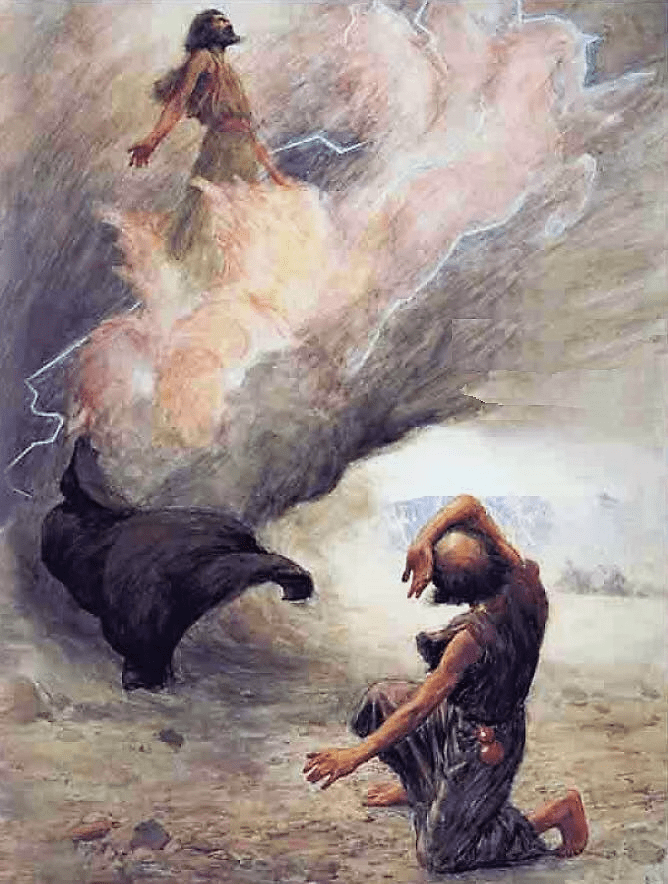
Because only Yahweh can grant that wish [think back to how young Solomon had no thoughts of speaking as God, like his father had, asking instead for wisdom], Elijah said, “if you see me as I am being taken from you, it will be granted you.” In that, Yahweh was speaking through Elijah, as the Son only speaks what the Father says to speak. This means that to witness an Ascension, rather than Elijah simply being hidden in a whirlwind and disappearing [and the disciples witnessed Jesus Ascend] means one will be resurrected in the same as the one departing. Of course, the Ascension was not the soul of Elijah leaving the worldly plane; it was his soul rising to be the seed spread by the hand of the Father. Because Elisha saw Elijah rise within his world, the mantle was thrown out of the chariot to land on the ground. This makes the mantle be like the shroud of Jesus (along with the robes he left for Joseph of Arimathea to repossess).

After Elisha picked up the mantle and walked back to the Jordan, he then acted the same as Elijah had. Again, knowing the cloth robe had no magical power that made it be capable of parting the waters of the Jordan, the power was in Elisha, just as it had been in Elijah. He saw Elijah ascend, so he had received the “mouth of two of the spirit.” Elisha became the spokesman for Yahweh on earth. The waters parted and the ground was again dry for him to cross.

This is where Elisha asked, “Where is Yahweh elohe of Elijah?” In that, the Hebrew words “Yahweh elohe” are written, which the NRSV has improperly translated as “the Lord, the God.” The Hebrew word “’ĕ·lō·hê” is a noun, written in the masculine plural construct. To translate “gods” as “God” is pure ignorance of that written. The word is a construct of “elohim,” as implying an article comes before that, as “the gods.” However, the root “elohim,” when directly following “Yahweh,” is a statement of Elisha asking, “Where is the soul of Yahweh’s Son?” Just as Elijah was the Son of Yahweh, which made the mantle strike the water and part it, when Elisha asked that question (the first time he struck the water with the mantle it did nothing), he called upon the name of Yahweh, as His Son. At that time, the second strike of the water with the mantle caused it to part as it had before, when Elijah did that.

When we read, “the water was parted to the one side and to the other, and Elisha went over,” a more accurate translation of the Hebrew says: “[the water] was divided this way and that.” In a division, the Jordan River was cut in two. The dry ground between the two halves is then symbolic of the dualities of a soul in a body of flesh – the “this way and that” – but the dry ground is the resurrected soul of the Yahweh elohim that commanded the soul and flesh to divine in two. The division was so the possessing soul of Yahweh’s elohim could become one with the two, while not part of it. This says the parting of water is symbolic of divine possession, which days Yahweh’s Son walks here … on dry ground. The meaning of “dry ground” is then flesh that is unchanged by worldly influences – no changing due to emotional winds.

As an Old Testament selection that can be chosen to read aloud on the third Sunday after Pentecost, when one’s personal ministry as Jesus should have begun, this says one should be like Elisha. One has to want to serve Yahweh zealously, not passively. When the soul of Jesus told John to write his Revelation, as a letter to the seven churches (the state of rest that true servitude can bring), the worst state of religious being was said to be “lukewarm,” as it was “neither hot nor cold.” The hot and cold reflect the zealous states of being totally committed to divine service, whereas being “lukewarm” made Jesus “want to spit you out” in disgust. We are told to be like Elijah, who sacrificed his life to serve Yahweh; so, he was resurrected as the Yahweh elohim that parts the waters of self and provides dry ground to walk righteously upon. There are no magic carpets that one can ride to heaven. Only Jesus can save a soul and return it to Yahweh; and, to become Jesus, one must feel his presence and refuse to let it go.


Psalm 77:1-2, 11-20 – Becoming a cloud above the sea that sounds thunder and brings lightning

1 I will cry aloud to elohim; *

I will cry aloud, and he elohim will hear me.

2 In the day of my trouble I sought adonay; *

my hands were stretched out by night and did not tire; I refused to be comforted.

—–

11 I will remember the works of YAH, *

and call to mind your wonders of old time.

12 I will meditate on all your acts *

and ponder your mighty deeds.

13 Your way, elohim, is holy; *

who is so great el as kelohim?

14 You are ha-el who works wonders *

and have declared your power among the peoples.

15 By your strength you have redeemed your people, *

the children of Jacob and Joseph. Selah.

16 The waters saw you, elohim; the waters saw you and trembled; *

the very depths were shaken.

17 The clouds poured out water; the skies thundered; *

your arrows flashed to and fro;

18 The sound of your thunder was in the whirlwind; your lightnings lit up the world; *

the earth trembled and shook.

19 Your way was in the sea, and your paths in the great waters, *

yet your footsteps were not seen.

20 You led your people like a flock *

by the hand of Moses and Aaron.

——————–

This is the Track 1 Psalm selection that will be read aloud in unison or sung by a cantor on the third Sunday after Pentecost (Proper 8), Year C, according to the lectionary for the Episcopal Church. If read, the Old Testament reading from Second Kings will have been chosen, which includes the verse: “[Elisha told Elijah], “As Yahweh lives, and as your soul lives, I will not leave you.” That pair of readings will be followed by the Epistle selection from Galatians, where Paul wrote, “Live by the Spirit, I say, and do not gratify the desires of the flesh. For what the flesh desires is opposed to the Spirit, and what the Spirit desires is opposed to the flesh; for these are opposed to each other, to prevent you from doing what you want.” All will accompany the Gospel selection from Luke, where we read: “As they were going along the road, someone said to [Jesus], “I will follow you wherever you go.” And Jesus said to him, “Foxes have holes, and birds of the air have nests; but the Son of Man has nowhere to lay his head.”’

It is important to take note of the places where forms of “elohim” and “el” have been casually translated (improperly) by the NRSV as the same: “God.” There are seven such references, where “elohim” is a plural masculine noun and “el” is singular; but neither should be capitalized, as an indication of Yahweh. The standard translation of “Yahweh” into English, as “the Lord,” becomes confusing where the NRSV shows “the Lord” in verse two and verse eleven. In verse two is written “adonay,” while in verse eleven is written “YAH” (my capitalization, as well as BibleHub Interlinear’s). The “yah” is short for “Yahweh,” while “adonay” is the masculine plural noun that says “lords” (no capitalization or attaching article). The words “elohim” and “adonay” are both references to an inner possessing divine presence (a soul-spirit-angel), as “Yahweh elohim.” That references the resurrected soul of Adam-Jesus. The difference between an “elohim” possessing a soul in the flesh (which is individually called an “el”) and an “adonay” is this: the “elohim” possessing has been prepared for ministry, such that “adonay” says one is sent to become the master and teacher of many other souls; so, they too will receive the Yahweh elohim.

Unstated by this presentation of the Episcopal Church is the intro contained in verse one. The NRSV shows this as a separate header, as: “To the leader: according to Jeduthun. Of Asaph. A Psalm.” In reality, this is the Hebrew transliteration of this part of the verse: “lam·naṣ·ṣê·aḥ ‘al-yə·ḏî·ṯūn [yə·ḏū·ṯūn ,] (lə·’ā·sāp̄) miz·mō·wr”. That literally translates to state: “to the preeminent above-praising [praising , ] (gatherer) a melody”.

In that, translators have placed the name “Jeduthun” and “Asaph,” along with the identification of this being “a Psalm,” but the meaning of those three words is as I have translated literally: “praising” (Jeduthun), “gatherer” (Asaph), and “a melody” (Psalm). In addition, the first Hebrew construct says, “to the preeminent,” where the translation of “the chief musician” or “leader” misses the point of “the preeminent” actually being the inner “elohim” that David recognizes in the “melody.” When that is seen, the conjoined words “‘al-yə·ḏî·ṯūn” are more than simply “to Jeduthun,” as they become “above-praising.”

Here, I have mentioned in previous commentaries that a soul in the flesh alone (without an inner “elohim”) is incapable of true “praise” to Yahweh. As such, the “above-praising” is another reference to the inner “elohim,” which is spiritually “above” one’s soul; and, it is the true source of “praising.” David, as a soul in a body of flesh, wrote his songs of praise (melodies or Psalms) from this divine inspiration; and, once divinely inspired by inner “praise,” he physically sang along; and, he wrote the song lyrics and notes down, so others would join along. This becomes the meaning for the brackets surrounding a repeating of “praising,” as the brackets indicate a silent or unseen source of “praising.” The comma placed after the bracketed “praising ,” then separates that spiritual “praising” from the spiritual “gatherer,” which can also translate as “collection,” which is the plural of “elohim,” versus one “el.” When the inner and the outer are joined in physical songs of “praising,” then that becomes “a melody” of many, all as one. This explanation of the introduction must then guide the way one understands the verses contained in Psalm 77.

When one is able to see the truth of this intro, to then listen to what David began singing it is literally translated now differently, knowing “elohim” and “el” are references to the inner presence of a divine spirit that praises and gathers, the same divine spirit in many like David. He sang, “with my voice into elohim and I cried out ; with my voice into elohim , and he listened to me .

The Hebrew preposition “’el-“ means “to, into, towards” and it is conjoined with the word “elohim” twice. The preposition constructed with the “voice” – “with” – becomes a statement of possession, as the “voice” of David has become the “voice” of Yahweh, from the inner presence of His Son. The conjunction construct twice applied to the verbs “cried out” and “listened” says two are joined in marriage, as one, which both speaks and listens. This means David wrote this verse as representing more than his voice calling to external “gods” (in the plural number). The preposition connected to “elohim” says David’s soul had gone “towards elohim” possession, such that it had come “into” his soul. This is the resurrection of the Adam-Jesus soul, which is “Yahweh elohim.” It is singular in one soul, while being plural as the same in a limitless number of other souls possessed by Yahweh’s Spirit. When David “cried out,” this says he sang “a melody” of praise to that inner presence.

In verse two, David literally sang, “in the day of my trouble adonay I sought my hand ׀ in the night was stretched out and not will grow numb , to be sorry my soul .” In the portion of the lyrics that leads to a vertical bar that reflects a moment of pause to reflect, David sang that both his soul saw “the day” as the light shining, exposing the remedy to “troubles.” The light of truth must bring the light of “day” to a sinful being, before it can see its darkness leads to death (the symbolism of “night”). The “adonay” is an inner teacher of the truth, which in turns transforms one’s soul-body into one who teaches the truth to others. For that to happen, one must first be led by a teacher – Jesus within leads to one becoming Jesus reborn (an “adonay”). That makes “my hand” be the “hand” of Yahweh that teaches, which turns “my hand” into that one extended within by Yahweh – a tool of Yahweh both inside and projecting outward.

This means “was stretched out” is also the extension into one’s soul, so that soul can be extended to others, as a helping “hand.” In no way will the extension of Yahweh’s “hand” “grow numb” or “weary.” It is an eternal presence. That presence can only come into one’s “soul,” when that “soul” confesses sins and is seriously seeking repentance, through complete self-sacrifice. One has to see the light of “day” and know one’s soul does not want to remain in “night;” and, that leads one’s soul to ask Yahweh for forgiveness, knowing if granted it will be forever.

At this point, the basic theme has been laid out for the whole of this song of praise, which is twenty total verses. The Episcopal Church has decided that this only public singing of Psalm 77 should never include verses three through ten. This selectivity of verses should be recognized as an effort to make this song of praise – which places focus on an inner “elohim” – be relative to the Ordinary after Pentecost theme of personal ministry (and David was a minister who led a nation of people to the truth of the name “Israel”).

One should take it upon oneself to personally go and read, then prayerfully discern verses three through ten of this Psalm. One should never see skips or optional verses as a time to celebrate less work towards understanding why one’s religion is important. Such work is what leads an “adonay elohim” to enter one’s soul and lead one to see the light of “day,” so the truth is exposed. The more truth one sees, the stronger the inner presence grows.

Verse eleven then begins with the first word repeated, with the second surrounded by brackets, making it unstated and silent. That is followed by another word placed in parentheses, which is again an unspoken and silent statement. The translators omit the repetition and make useless paraphrases that miss the spirituality that is contained in the silent statements.

The literal English translation is as such: “I will remember [will remember] (the deeds) YAH ; for I will remember from formerly your wonders .” Because the first string of words clearly state (not enclosed), “I will remember YAH (meaning “Yahweh”), this says one’s mind has become Anointed with the enlightenment of the Messianic or Christ mind. The brackets are Yahweh speaking in the first person, as the Spirit of remembrance. This makes “the [unspoken] deeds” of Yahweh be an instant recall of all sinful acts prior, which one’s soul is allowed to recall, when similar circumstances make it prompt an automatic reaction (like an addiction) response to a worldly stimulus. Rather than remembering regrets afterwards, coming from another sin committed, one remember the regret beforehand, helping on be inner motivated to control one’s “deeds” or “acts.” The motivation that assists oneself in not responding to worldly stimuli as one normally would is then the remembrances of the “wonders” that being righteous brings oneself. One remembers what has happened prior, since the “elohim” has come “into” one’s soul.

Verse twelve then literally translates into English, saying “and I have spoken of all your doings ; and of your deeds talk (of) .” This verse sings of the ministry one possessed by an “elohim” is sent into. It says the voice within (Jesus elohim) is “spoken” to others, so they know it is possible for them to transfigure as well. One’s own “deeds” become the source of knowledge that one conveys to others. It is from that personal experience that true faith can be passed onto others. They aren’t told to believe in miracles that no one alive has ever witnessed personally. They are given details as to how miracles actually happened to oneself; so, others can expect similar answers to prayers.

Verse thirteen then literally sings, “elohim to the sacredness your path ; whose el so great , as elohim ?” In this verse, we find two uses of “elohim,” surrounding one use of “el.” In the singular use of “el,” this is the eternal presence that is the life made possible in flesh by one’s own soul. A soul enters flesh at birth, as the first breath that comes from Yahweh. The soul will never die, but its body of flesh will always be nothing more than a temporal residence. The placement of a soul into flesh becomes a test of that spirit, to resist sins and remain pure. Only pure souls can return to Yahweh, without having the Judgment of failure be doled out, which is reincarnation. Thus, the first use of “elohim” says the presence of Yahweh’s pure elohim – Jesus – is what brings sainthood or “sacredness” into a soul. That makes a host soul able to return and be one with Yahweh. The question posed is then asking, “Who has a soul that can do this alone … without that divine elohim?” The answer is no soul.

Verse fourteen then literally says in English, “you the el doing wonder ; you have known in the peoples your strength .” Here, the singular usage of “el” (as “hā·’êl”) makes Yahweh be recognized as the source of all souls; such that, a soul comes from “the el,” where “el” says Yahweh is spiritual and eternal. The “wonder done” is sending an eternal spirit into a body of flesh and then returning it to Him, through the possession of His Spirit and the resurrection within of “the el” that is His Son. It is then the soul of Jesus (that placed into the Yahweh elohim named “Adam”) that brings the “wonder” of salvation.

Because David had been Anointed by Yahweh as a boy, he grew among those who knew him as a saint, possessed by Yahweh’s Spirit (a Messiah), thus he became the “adonayí” that made Yahweh be “known in the peoples.” David became their teacher and lord – anointed by Samuel to be their king – and through the inner presence in David, “the peoples” also became possessed by the same “elohim.” This is the truth of the name “Israel,” which means “He Retains Yahweh as one of His elohim.” This spread of Yahweh’s elohim into “the peoples” – Yahweh having become “known to them” – is what made Israel have “His strength.” No “nation” can ever have the “strength” of Israel, without all its “peoples” being saints.

Verse fifteen then sings literally, “you have redeemed in arm your people ; sons Jacob and Joseph . Selah .” In this the use of “gaal” as “redeemed” means, “the act of a kinsman taking on a widow who had no children to support her after her husband’s death.” Normally, a brother to the deceased husband would do this redemption; but, as told in the story of Naomi and Ruth, when no brothers are alive to redeem a widow, then another from the larger family (usually in the place of birth), who can afford the price of this redemption, will take on the widow’s debt as his own. As such, this is David singing of the Israelites being “your people” who were figuratively widowed in Egypt, where their deceased ‘husbands’ were “Jacob and Joseph.”

When David wrote “sons,” this must be understood as a word expressing divine possession, whereby “Jacob and Joseph” were “sons” truly in the name of Israel. This “arm” of possession becomes the truth about the strength of priests to Yahweh, where all will be His hands, from his “arm of strength” being outstretched. This “arm” is not to make any “peoples” become worldly special – for themselves and their own glory – but to take the knowledge of Yahweh possession to the world, so the world can find true redemption of their souls. All souls alone in a body of flesh are widows, without a masculine protector and a male inheritor of their debts. Yahweh is their redeeming Father, and His Son Jesus is their new spiritual husband, as the Son.

Verse sixteen then literally translates into English, saying “you saw them waters ׀ elohim , you saw them waters they will be in pain ; also , agitated by the abyss .” In this verse, one must be able to recall the metaphor David used in other Psalms, where the world has been seen as a sea of souls. Within the “depths” of that sea lurks the Leviathan, which seeks souls to swallow – symbolism of spiritual possessions, both good and evil. As such, a soul in a body of flesh becomes shaped by its container – the body, in a world of matter.

The placement of a vertical bar of pause, prior to reading “elohim,” says Yahweh “foresaw” this fluid nature of souls, which is why He created His “elohim” – Adam-Jesus. Yahweh knew the “pains” that would come from a world where spirits prey on souls, using the flesh to addict them to sins. The single word “also” says those spirits swimming in the sea of souls are likewise only powerful in the material realm, where lost souls there are their targets. This makes the sea of souls be “churned” or “agitated,” by souls fleeing from spiritual possessions, while spirits chase after souls to possess. The Yahweh “elohim” is created to allow souls to escape that realm.

Verse seventeen then continues this focus on water, with David literally writing (translated into English): “them poured out water ׀ the clouds the voice them given specks of dust ; also your gravel , they will walk .” Here, the “poured out” aspect of “water” leads to a vertical bar, letting one know to pause and reflect on that meaning. Yahweh is the source of all souls in the worldly realm. The pause then points one to understand what a soul is, relative to this “outpouring.”

Those which escape the “agitation of the abyss” elevate above the sea. They become like “clouds,” which is a soul in possession of the Yahweh “elohim.” This too is “poured out” by Yahweh, when His Spirit Baptizes a soul and cleanses it of sins. That allows a soul to rise from the sea, where “the voice of them that is given” is the resurrected soul of Yahweh’s Son. Each saint is little more than a “speck of dust,” thus miniscule in and of itself. However, when elevated souls possess the soul of Jesus, the “specks of dust” gather – as true Christians – which is the ”gravel” that comes together to form the “path” to salvation. The “gravel” becomes a reflection (today) of true Christianity. Each saint becomes a rock in that path to righteous living. It is then upon this path that is paved by saints that lost souls in the sea are led to a return to be one with Yahweh. This is being fishers of men. The ”gravel” produces the “path” of righteousness, which all souls in the flesh must walk first.

Verse eighteen then sings in literal English translation, “the voice your thunder ׀ to the whirlwind , they will become light the flashes of light world , them agitated and they will be shaken on earth .” In this metaphor, it must be realized that “thunder” comes from the “clouds” above. Just as verse seventeen sang of “the clouds the voice,” now that “voice” is said to be Yahweh’s “thunder.” Because “thunder” is booming and rumbling, it is now associated with “the whirlwind,” which is the circulation of “clouds.”

The reading of this Psalm attaches to is that of Second Kings, where Elijah’s soul ascended in a “whirlwind.” This becomes metaphor for a soul elevated, so it can find eternal life, while also leave behind the soul of Jesus for others to become “clouds” from. The “sound of Yahweh’s thunder” is generated by the “flashes of light” – “lightning bolts” – that bring the heavens (the spiritual) into the “world.” In that process of making “light flash,” a loud boom is heard over great distances. That divine “sound” brings fear in those souls alone in their flesh; so, they become “agitated” as souls afraid of being possessed, even when it is by Yahweh. Those souls whom the “lightning flashes” of truth strike – they “will be shaken.” Souls in their ‘flesh” (metaphor of “earth”) will no longer be addicted to the “earthly” delights, as they will have seen the ”light” of truth shake them awake.

Verse nineteen then literally sings in English: “in the sea your journey , your path [your path] (of the waters) many ; and your footprints , not they were known .” This verse sings of the lost souls that make up “the sea.” All have been sent on “a journey” when they enter the material realm.

Here, again, is found the silence of the spiritual realm speaking in brackets and parentheses. The “path” that leads the lost souls back to Yahweh is accepted by all souls prior to reincarnation, as “your path” becomes deeply placed into one’s soul, not found in the memory produced by a fleshy brain. It is the same “path” that is deeply hidden within all the lost souls that make up the “waters” of souls poured out by Yahweh. To make a “sea” of souls, “many” have failed to return and be one with Yahweh before. All of those lost souls have left “footprints” in the past, from having walked the wrong roads of life. This is because their brains could never be allowed to know the way; so, “not they were known.”

Verse twenty then sings in literal English, “you have guided as a flock your people ; as the hand Moses and Aaron .” This does not transfer the power of Yahweh onto such historical figures of Judaic history, such that “the people” are expected to be “led by Moses and Aaron.” Instead Yahweh has “guided as a flock His people,” where David’s Psalm 23 sings, “Yahweh is my shepherd.”

When each soul has sought Yahweh, as a lost sheep – a soul agitated in the sea of souls – then one submits one’s soul to Him as one of His “flock.” Once a soul has submitted to Yahweh and has been raised as a vapor (a “cloud”) “above the sea,” then one becomes possessed by Yahweh’s “elohim.” That “elohim” makes one be reborn as Jesus. Because Jesus is the high priest of one’s body (the tabernacle), then the “elohim” makes on be like “Aaron.” The name “Aaron” means “Bright,” so as Jesus reborn one become the “flashes of lightning” that shines the light of truth for others to see. Presenting that light of truth makes the inner “elohim” project outwardly as an “adonay,” or a teacher of others.

This makes one’s “voice thunder” as the Father within. This makes one “guide the people” in the same way as did “Moses.” Therefore, one cannot put greatness on any human form of a possessed by Yahweh soul, such that one bows down to “Moses,” because he orated the Law for others to agree with. David sang (inspired by Jesus within) that all saved souls will be “guided” to be “Moses” in ministry, with the name “Moses” meaning (among some scholars), “Hidden” or “Covered.”

As the accompanying Psalm that is sung after a reading from Second Kings, this song praises the salvation that comes from an inner “elohim,” which sends one out in ministry as an “adonay.” None of this is seen, when the translation-into-English services take a handful of specific words and present them all as “God.” To be sent into ministry, a soul must have become the “hand” of Yahweh on the “earth.” The world is a “sea” of lost souls, all who have been told to walk a path of righteousness, in order to stop returning to the earth plane as a soul trapped in a temporary body of flesh. The only way to stop that recycling is to become a soul in which Yahweh elohim (Jesus) is resurrected. To begin that process, one must seek salvation on one’s own soul. Then, once sincerity is seen by Yahweh, he will send one an “adonay” to be one’s teacher. This means the path to ministry demands teachers who are Jesus reborn. Without such a Lord in one’s personal life, the world becomes a bunch of agitates peoples, all afraid of each other’s shadow.

1 Kings 19:15-16,19-21 – Being Anointed means no going back

[15] Yahweh said to Elijah, “Go, return on your way to the wilderness of Damascus; when you arrive, you shall anoint Hazael as king over Aram. [16] Also you shall anoint Jehu son of Nimshi as king over Israel; and you shall anoint Elisha son of Shaphat of Abel-meholah as prophet in your place.”

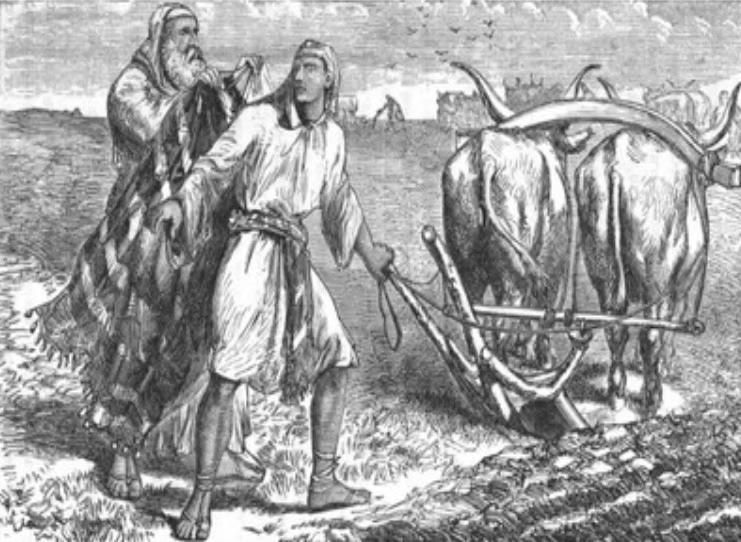
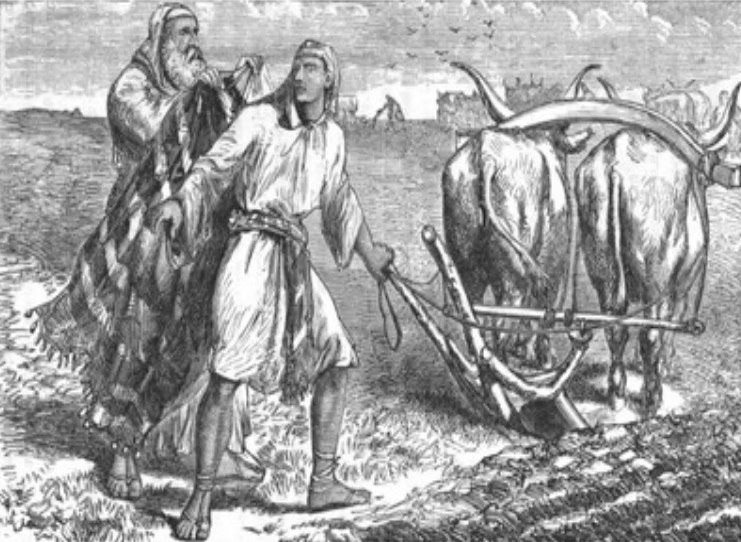
[19] So he set out from there, and found Elisha son of Shaphat, who was plowing. There were twelve yoke of oxen ahead of him, and he was with the twelfth. Elijah passed by him and threw his mantle over him. He left the oxen, ran after Elijah, and said, “Let me kiss my father and my mother, and then I will follow you.” Then Elijah said to him, “Go back again; for what have I done to you?” He returned from following him, took the yoke of oxen, and slaughtered them; using the equipment from the oxen, he boiled their flesh, and gave it to the people, and they ate. Then he set out and followed Elijah, and became his servant.

——————–

This is the Track 2 Old Testament selection that will be read aloud on the third Sunday after Pentecost (Proper 8), Year C, according to the lectionary for the Episcopal Church. If a church has set upon the Track 2 path, this reading will be followed by a singing of Psalm 16, which includes the verse that sings, “My heart, therefore, is glad, and my spirit rejoices; my body also shall rest in hope.” That pair will precede the Epistle selection from Galatians, where Paul wrote: “For freedom Christ has set us free. Stand firm, therefore, and do not submit again to a yoke of slavery.” All readings will accompany the Gospel selection from Luke, where we read: “To another [Jesus] said, “Follow me.” But [the other] said, “Lord, first let me go and bury my father.” But Jesus said to him, “Let the dead bury their own dead; but as for you, go and proclaim the kingdom of God.”’

In the selection of these verses, verse fifteen-a was the Track 1 Old Testament reading the previous Sunday. While this is a Track 2 optional reading path, the same words will not be repeated on back-to-back Sundays. As such, the whole of verse fifteen is presented today, along with verse sixteen, to show who Yahweh told Elijah to anoint. In this, the root verb is “mashach” (from the construct “tim·šaḥ,” as “you shall anoint”) must be recognized as the root source for the English translation “Messiah.” The word means “anoint” and is the equivalent to the Greek word “christos,” from which we get “Christ.”

In these first two verses are found several capitalized names, all of which are capitalized in English translation, because Hebrew has no capital letters. Those names are important to know the meaning that is behind them. The name Elijah is not stated, as the Episcopal Church has placed that name as replacement for the pronoun “him” (from “’ê·lāw,” as “to him”) and Yahweh needs no explanation, other than Yahweh IS (“I AM that I AM”). The names that follow need closer examination: Damascus; Hazael; Aram; Jehu; Nimshi; Israel; Elisha; Shaphat; and, Abel-Meholah.

Here is that meaning:

Damascus – “The Beginning Of Salvation” or “The Full Turn Of Being Drawn out”

Hazael – “God Has Seen”

Aram – “Elevated, Citadel”

Jehu – “Yah Is He”

Nimshi – “Rescued From Danger”

Israel – “He Retains God” or “God Is Upright”

Elisha – “God Is Salvation”

Shaphat – “Governor” or “He Has Judged”

Abel-Meholah – “Stream Of The Dance”

In these two verses, it is vital to grasp the story leading up to these instructions from Yahweh to Elijah. That is the story of Elijah praying to Yahweh to end his life, which Yahweh allowed when Elijah “fell asleep under a broom tree.” The angel that came took Elijah’s soul away to Yahweh and then prepared Elijah for what was ahead of him is internal to Elijah’s soul. The conversation only makes it appear two separate figures. That angel was the Yahweh elohim that is Adam-Jesus, which became the soul resurrected in Elijah’s soul. When Yahweh told Elijah to enter a cave, that is metaphor for his tomb of death. Elijah’s body of flesh did not exit that cave-tomb, as only his soul was sent to do these anointments. That spirituality must be understood, to discern the truth of this story.

In the story of young David, when the prophet Samuel was told by Yahweh to anoint one of Jesse’s sons, not telling Samuel which one, Samuel was a servant of Yahweh in the flesh (a prophet), who was not a Son of Yahweh. Samuel was married to Yahweh as a boy, when left with Eli to be raised as a priest of the Tabernacle. As a wife of Yahweh, Samuel spoke with Yahweh; and, those conversations were not some loud voice coming down from the sky.
Yahweh spoke to Samuel in his mind, so Samuel was hearing Yahweh tell him what to do. Samuel was an obedient soul-wife that did as told. When Samuel anointed David (made him a messiah by pouring oil on his head), that was a human-to-human encounter with David, which pledged David’s soul in his body of flesh to marry Yahweh, as another of His soul-wives. When Yahweh poured out His Spirit upon David’s soul that then made David’s soul not only be married to Yahweh, but it also implanted the Yahweh elohim into David’s soul. That was the soul of Adam-Jesus. That Spiritual Anointment (which made David a Messiah by divine Baptism) made David a Son of Yahweh, like a Jesus reborn (before Jesus was physically born). This story sets apart an anointment by a prophet (a human-to-human exchange) and an Anointment by a Son of Yahweh (a spirit-to-spirit exchange) as different.

The name “Elijah” means “YAH Is God.” Elijah had been a prophet of Israel – the Northern Kingdom. Like Samuel, Elijah could talk with Yahweh; and, Elijah was able to have faith that Yahweh would do as he asked, which was why he challenged Jezebel’s priests of Ba’al to an altar fire burn-off. When Elijah won that challenge and then killed four hundred fifty false priests, he did that as a prophet his body of flesh was sentenced to death by Jezebel. That caused Elijah to run in fear to the place where the stairway to heaven was [Bethel – a name meaning “House of God”], where he asked Yahweh to take his life (or take him up to be with Yahweh.

When Elijah’s soul exited from his cave-tomb, it was as a Son of Yahweh – the soul of Adam-Jesus resurrected. That made Elijah a spirit, as his body of flesh was taken by the angel, in the same way the angel took the body of Jesus’ flesh, leaving his soul to be seen by those whose souls were marked for his divine resurrection [those who would be raised from the dead – the death of their own flesh surrounding their individual souls].

It was this state of soul-being that was told by Yahweh to “anoint Hazael [“God Has Seen”] king over Aram [“Elevated”]. There is absolutely no mention of Elijah meeting Hazael. Hazael would meet Elisha; and, Hazael would become King of Syria (Aram); so, this means the soul-spirit of Elijah-Jesus entered into the soul of Hazael, making him be “anointed” by the outpouring of Yahweh unto his soul. Hazaek experienced a spiritual encounter like that which happened to David, with the caveat being the soul-spirit of Elijah-Jesus was that “Anointment.” That made Hazael become the possession of Yahweh, because “God Had Seen” his soul as worthy. It was not a physical anointment that came from a prophet pouring oil from a horn on Hazael’s head. It was an unseen, spiritual anointment. Hazael was made a Messiah by the soul-spirit of Elijah-Jesus.

In verse seventeen, where the soul-spirit of Elijah-Jesus was told to also anoint Jehu [“Yah Is He”], the son of Nimshi [“Rescued From Danger”], and make him king over Israel [“He Retains God”], the remainder of 1 Kings (three chapters) and the first chapter of Second Kings says nothing about Jehu. Most of that Scripture deals with Ahab still being the king of the Northern Kingdom. In that text, Yahweh called to Elijah and told him to “Arise” (from “qum”) and then “Descend” (from “rêḏ”), in order “to meet with Ahab” (from “liq·raṯ ’aḥ·’āḇ”). That says the soul-spirit of Elijah-Jesus was commanded Spiritually to make a stance (“arise”) in the physical realm (the flesh of Ahab) and “to meet” that soul. Once that union took place, the soul-spirit of Elijah-Jesus denounced Ahab; and, Ahab saw the errors of his ways and repented. Had Elijah the prophet walked in to see Ahab, in order to denounce him, then that prophet would have been chopped to pieces and Ahab would have never repented. In that exchange, there is absolutely no mention of Elijah ever going “to meet” Jehu; but Jehu would not become king until well after Elijah ascended and Elisha took his role in the flesh.

Only when we read that Yahweh told the soul-spirit of Elijah-Jesus to “anoint Elisha [“God Is Salvation”] … as prophet in your place” does that take place soon after. Still, that needs to be understood as a Spiritual encounter, not Elijah simply walking up to Elisha as he plowed one of his father’s fields, telling his, “You’re my guy! Come with me.”

It reads like this, but this misses the point.

When we read above [NRSV], “Elijah passed by him and threw his mantle over him,” the construct written that is translated as “passed by” is “way·ya·‘ă·ḇōr,” which can just as easily say “passed through” or “passed over” [as seen in other Old Testament uses of the same construct]. The root verb is “abar,” which is the word used to signify the “passover,” where that “passing by” was Yahweh, or the ‘angel of death’ (to all firstborn males not protected by the blood of the lamb). Here, with Elisha busy doing the work of his father Shaphat [“He Has Judged”], controlling a large plough, pulled by twelve oxen, Elijah spiritually “threw his cloak upon him” (Elisha). The NRSV translated “cloak” as “mantle,” which would have to then be the same “mantle thrown by Elijah” from the chariot taking him away from Elisha. However, the Hebrew word written (“’ad·dar·tōw,” rooted in “addereth”) means “glory, a cloak,” implying in usage “garment, mantle, robe, or splendid.” (Strong’s) When one realizes this is the soul-spirit Elijah-Jesus, which has been told to spiritually “anoint Elisha,” that “throwing of his glory upon Elisha” is the “anointment.” The “cloak” is the unseen “glory” of Yahweh’s Spirit being poured out upon Elisha’s soul; rather than a physical “garment” placed by a physical prophet over the shoulders of a man working in a field.

This is why we then read [NRSV], “[Elisha] left the oxen, [and] ran after Elijah.” The Hebrew written literally translates to say this: “and he forsake the bulls and ran following behind Elijah.” In that, the “twelve oxen” should be seen as metaphor for some sort of specialty that Elisha had as a prophet, which had been taught to him by his father Shaphat. This says “He Has Judged” can be discerned that Elisha’s father was a priest of the tabernacle, who wore the priestly breastplate that contained “twelve” stones. When this is related to the Urim and Thummim [the predecessor of the Kabala], the number “twelve” symbolizes a way to prophesy, one that is relative to “twelve.” That could well be the signs of the zodiac, where an ”ox” is relative to the astrological sign Taurus.

That would be an art of judgment [created by Yahweh, but misused by prophets not sworn to His guidance in the usage of His tool] that demanded the ‘astrologer’ be married to Yahweh to be truly accurate. The “oxen forsaken” would be the tools of divination that were more popular in ancient times [Abram was an astrologer unlike any other – per Nostradamus], when the bull was the idol of Ba’al. As Jezebel had imported priests of Ba’al into Israel (the Northern Kingdom), any prophets utilizing astrological tools would have been granted royal favor. Therefore, to “forsake the oxen” means Elisha immediately stopped being a prophet that ‘channeled’ Yahweh through any external ways for reading signs … such as the symbolic arrangements of planetary orbs. With that sacrifice made, Elisha then “followed behind Elijah.” This “following behind” must be read in the same way Jesus would tell his disciples to “follow me.” That was not intended to instruct one to physically walk behind one, but to be one spiritually reborn afterwards, of the same mold.

To then read Elisha telling the soul-spirit of Elijah-Jesus that had just possessed his soul, “Let me kiss my father and my mother, and then I will follow you,” that suggests that Elisha still recognized his physical parents as his creators. By making a brain-led decision that placed more immediately importance on physical blood, than on the Spiritual blood that just made Elisha become a Son of Yahweh, Elisha was attempting to retain himself as the ‘god’ of his body of flesh (its lord). It was then self that was calling the shots, not his new inner Yahweh elohim.

To “kiss” says metaphorically “to touch,” which says Elisha’s soul felt the presence of Spiritual Anointment. By expressing his desire to pass that Spirit on to those of his self-will, rather than fully submit himself to the divine Father and do the work assigned as His Son, he neglected that his own soul had become “the mother” of the soul-spirit of Elijah-Jesus. He became a wife of Yahweh, who then give rebirth to His Son’s soul in his own soul, making him have the Father within, with his own soul-flesh being the mother (spiritually) of Elijah-Jesus. This cause the inner voice he just birthed to say in response [NRSV], “Go back again; for what have I done to you?” That questioned Elisha’s commitment to Yahweh, as His Son reborn. The question asked, “Would you give up eternal life and return to being an ordinary son of a man and his wife, where you are born into assured death?”

The question posed by the soul-spirit of Elijah-Jesus pointed out that what Elisha proposed was to “walk backwards,” where to go to his human father and mother was to “return” to the flesh.” To give that earthly origin a “kiss” would be to stay in “touch” with the material realm. Thus, the soul-spirit of Elijah-Jesus asked if that reverse course could seriously be considered, “for what I have made you?” What Elisha “had been made” was a Son of Yahweh, who was a soul eternally saved. It was a salvation ordered by Yahweh and carried out by His Son soul-spirit – Elijah-Jesus. That voice within Elisha’s brain made him “return to following behind” the soul-spirit possession of Elijah-Jesus.

When we then see the imagery that came next, of Elisha slaughtering the oxen and using the equipment that yoked them together, connecting them to the plough, the aspect of “boiling” becomes confusing. The way this should be seen as Elisha sacrificing the tools of his prophesy trade, because he would never need to use them again. His success with metaphysical-astrological forecasting was led by his insight from Yahweh; but all of that depended on his “boiling” the calculations onto some chart and then praying for guidance. Since there is no mention of the number “twelve” in this sacrifice, that omission means it was only the tools that were gathered up and left for the people to use. Elisha no longer had any use for that which he did not need to know as a Son of Yahweh. The soul-spirit of Elijah-Jesus would lead Elisha to walk a path of righteousness, which let that Spirit become his voice, speaking only what the Father wanted spoken, without any calculations necessary. The soul-spirit of Elijah-Jesus would teach Elisha to become like Ezekiel, such that when Yahweh asked a question to his soul, then all he should ever say is: “Yahweh, you know.”

When the last verse says, “[Elisha] followed Elijah, and became his servant,” this can equally say this: “Elijah-Jesus became the Lord [the true meaning of “adonay”] of Elisha.” This says Elisha went into ministry for Yahweh as His Son reborn. Elisha was raised from the mortal status of prophet in Israel to become the next Son of Yahweh, who would then train true priests of Yahweh for their ministry. Elisha would be an “adonay” passing on the Spirit of “elohim” to others, who were married to Yahweh and committed to serving Him.

As the Track 2 Old Testament possibility for the third Sunday after Pentecost, this shows the need to see the spirituality involved in serving Yahweh. One needs to see the story of Jesus having been previewed in the story of Elijah. This spiritual aspect makes sense of the Track 1 reading from Second Kings, when Elijah ascended and again “threw his mantle” towards Elisha. In the same way, every priest of Yahweh must wear the mantle of resurrection, whereby all true priests in ministry are resurrections of Jesus. So often the desire is to “return” to the mortal realm and serve self, rather than Yahweh. That ‘fork in the road’ is the dilemma all souls in the flesh face. Yahweh allows souls in the sea of the world ‘free will.’ We like the feeling of being holy, but we prefer retaining the right to be sinful. This story asks us all, “Would you turn away from the gift of eternal life, just to play godlike for a few decades more?” We all must be like Elisha and turn away from our old lives and follow Jesus … which means being Jesus reborn. That path cannot be walked alone. It cannot be navigated by oneself.

Psalm 16 – The inner security of one at the right hand of Yahweh

1 Protect me, el, for I take refuge in you; *

[2] I have said to Yahweh, “You are adonay,

my good above all other.”

2 [3] All my delight is upon the godly that are in the land, *

upon those who are noble among the people.

3 [4] But those who run after others *

shall have their troubles multiplied.

4 [4] Their libations of blood I will not offer, *

nor take the names of their gods upon my lips.

5 Yahweh, you are my portion and my cup; *

it is you who uphold my lot.

6 My boundaries enclose a pleasant land; *

indeed, I have a goodly heritage.

7 I will bless Yahweh who gives me counsel; *

my heart teaches me, night after night.

8 I have set Yahweh always before me; *

because he is at my right hand I shall not fall.

9 My heart, therefore, is glad, and my spirit rejoices; *

my body also shall rest in hope.

10 For you will not abandon me to the grave, *

nor let your holy one see the Pit.

11 You will show me the path of life; *

in your presence there is fullness of joy, and in your right hand are pleasures for evermore.

——————–

This is the Track 2 companion Psalm that will be read aloud in unison or sung by a cantor on the third Sunday after Pentecost (Proper 8), Year C, according to the lectionary for the Episcopal Church. If a church has set forth upon the Track 2 course, this Psalm will be sung after a reading from First Kings, where is written: “[Elisha] left the oxen, ran after Elijah, and said, “Let me kiss my father and my mother, and then I will follow you.” Then Elijah said to him, “Go back again; for what have I done to you?”’ This pair will then be followed by the Epistle selection from Galatians, where Paul wrote: “The fruit of the Spirit is love, joy, peace, patience, kindness, generosity, faithfulness, gentleness, and self-control. There is no law against such things.” All will accompany the Gospel selection from Luke, where we read: “To another [Jesus] said, “Follow me.” But [that other] said, “Lord, first let me go and bury my father.” But Jesus said to him, “Let the dead bury their own dead; but as for you, go and proclaim the kingdom of God.”’

I have written about Psalm 16 before, back in 2021. At that time it was a possible song to be sung on the twenty-fifth Sunday after Pentecost (Proper 28). That was during Year B, as the Track 2 Old Testament accompaniment. That commentary can be found listed as: Raising a cup and singing a song in honor of one’s coming death. I welcome all readers to visit that opinion, as it offers valuable insight that remains valid now. However, because that selection of Psalm 16 was to accompany a short reading from Daniel, I will now direct the meaning to shine light on its relationship with Elijah anointing Elisha.

Following that reading, where we read of Yahweh telling Elijah to anoint a king over Syria and a king over Israel (who would take those positions well after Elijah ascended), the anointment of Elisha in the same set of orders given must be seen as spiritual Elijah, not physical Elijah. This means David sang as a soul understanding what Elisha experienced, when Elijah threw his mantle upon Elisha. That is the same spiritual anointment that David received from Yahweh, after Samuel anointed his head with physical oil. This spiritual outpouring upon David is then written of by his using the words “el” and “adonay” in his ‘theme’ verses to this psalm.

When David sings [NRSV], “Protect me, el, for I take refuge in you,” the construct translated as “protect me” is “šā·mə·rê·nî,” which is rooted in “shamar,” meaning “to keep, watch, preserve.” More than a prayer for Yahweh to act as his body guard, external to his body of flesh, David prayed to his inner “el,” which is the hand of Yahweh extended into David’s soul. That “el” was poured out into David’s soul when Yahweh anointed him to be king of Israel. Because David would not become king until decades of time had passed, he knew he had an inner “el” that kept watch over his soul. David then sang to that “el,” saying “that I take refuge in you,” where that says he submits totally to that “el” and gives it full permission to lead David’s actions. That is the theme of Elijah’s soul being raised in Elisha’s, where Elisha had to make the decision to “take refuge in Elijah” as his “el.”

In the real verse two, the words stated by David actually say, “you have uttered Yahweh adonay yourself.” This says the “el” is the soul that speaks for Yahweh, as David’s spiritual “lord” and teacher – his “master” – where the plural number says David is not the only Son of man so led. The word “’āt·tāh” translating as “yourself” becomes further divided into “your soul,” where a “self” is a “soul.” This verse being directed in the second person (a personal exchange) is not to Yahweh, as “you have uttered Yahweh” makes that a third entity. When identified as “adonay your soul,” this becomes a definition of the “el,” as the “lord” over David’s soul-body, who teaches his soul, while speaking what Yahweh tells the “el” to speak.

When the real verse two continues to sing: “my goodness is,” this says David following the “watch” of his “el” brings the “goodness” of Yahweh upon him. This is the mantle of goodness that was thrown upon David’s soul, when Yahweh poured out His Spirit on his soul. Elijah likewise did that covering of Yahweh’s “goodness” to Elisha. David then confessed, “nothing apart from you,” where the construct translating as “apart from you” centers on “al,” which means “above, over, upon.” Thus, David’s submission to the influence of his “el” brought him the “goodness of Yahweh,” such that without that spiritual presence from “above,” “nothing” of David’s soul alone could produce that “goodness.”

In verse three, David immediately says this “goodness of Yahweh” brought on by an inner “el” is what a “saint” is made of. The Hebrew word “liq·ḏō·wō·šîm,” from “qadosh,” means David knew that divine presence made him “sacred” and “holy.” This is a state of being that is brought upon one by a Spirit, such that the Spirit cannot be so defined as “sacred” or “holy” itself. It becomes synonymous with the “mantle” of Elijah, as his Spirit place upon the soul of Elisha. The mantle itself was neither “sacred” nor “holy,” as it was metaphor for Spirit. It was the presence upon Elisha that erased all the sins he bore from weaknesses of the flesh. Thus, the soul-flesh receiving the Spirit becomes that which is transformed into one who is “sacred” and “holy.”

The remainder of verse three sings, “[of saints] that on earth they ; and majestic ones , all my delight in them .” Here, “earth” is metaphor for “flesh,” as only “those of earth” can be considered “saints.” The plural pronouns – “they,” “ones,” and “them” – become the people of a true Israel, who like David received the same Spirit and also became “Those Retaining and el.” This transfer of Yahweh’s Spirit was done by the inner presence of David’s “el,” in a “majestic” way. The mantle of David was thrown over “those” he led. This meant David was surrounded by saintly people, who became the “delight” of the kingdom he led. The people all served Yahweh as His saints; and, that was the original intent and purpose of Moses leading the freed slaves of Egypt to become “sacred” priests in His name. Likewise, Yahweh told Elijah’s soul to anoint kings who would lead like David had led, returning the people away from evil and back to righteousness.

In the real verse four, where the NRSV translates “nor take the names of their gods upon my lips,” there is nothing directly written that states “gods.” Such a word could only be “elohim,” which is written and translated (when the urge strikes a translator of Hebrew into English) as “gods,” meaning lesser “gods” or false idols. The literal translation of this verse is as such:

“they will be many them in pain another they hastened not I will pour out them drink offerings of blood ; not will lift even their names , above my speech .

In this, the plural pronouns of verse three remain the focus. This can be seen as the enemies of true Israel, which included those who followed Saul as their king. To sing, “they will be many in pain,” that says those who David will lead will have been in the same predicament, prior to receiving his Spirit as their own. To then sing, “another they hasten,” says they serve self, which always leaves the weak falling into submission to a stronger “other.” When David then sang of those, “not will I pour out them drink offerings of blood,” this refers to the ‘blood of Christ,’ which was the truth of the “el” possessing David’s soul. Instead of receiving the spiritual “blood” of self-sacrifice – becoming truly Israel – the people were happy offering the “blood” of animals, refusing to make the “drink offering” of themselves to Yahweh. When David then sang, “not will lift even their names,” those “names” were given to human bodies of flesh, so their souls served the lesser “el” of their own soul. Only “the name” of Israel (or Jesus) says one’s soul has been ”lifted” up in sacrifice to Yahweh. The “speech” of David was only that of his “el,” thus from “above,” which came from his lips, through divine possession of his soul in his flesh. While this can project onto enemies (such as the Philistines), the true focus of David’s Psalms was to those soul inhabiting bodies of flesh, who called their bloodline their claim to fame (so to speak). To live up to that ‘bloodline,’ each individual must become the soul sacrificed to Yahweh, to become His “blood” – His Son resurrected.

The depth of this verse should then be heard singing out the reason why Yahweh transformed the prophet Elijah into His Son reborn, for the purpose of leading the wayward back to subservience. It was their kings who were their external ‘gods,’ but those ‘gods’ were far from eternal as wayward souls in bodies of flesh. Those whose souls were anointed by the soul of Elijah-Jesus would rise to take the places of the evil kings, who cause pain and injury to the people, leading their souls away from a commitment to Yahweh. Even the Gentile peoples of Syria needed a king who could sense the power of Yahweh in his own soul; so, knowing that divinity would cease the wars between Syria and the Northern Kingdom. David knew it only took one soul possessed by Yahweh, transfigured into His Son, to defeat all the lesser kings who served only self (a false god).

Verse five then presents “Yahweh” as the masculine noun that is followed by the feminine singular saying “portion” and “and my cup,” with the masculine construct linking “my inheritance” to “portion.” The masculine and the feminine combined needs to be seen as a marriage to “Yahweh,” where David’s soul-body was one “portion” of His soul-wives. As a masculine “inheritance,” this is the presence of his ”el,” which is the soul of Adam-Jesus – the Son of Yahweh. The “cup” becomes a feminine indication of a receptacle or vessel, where the out-poured seed of Yahweh has filled his empty soul with the Son. This is then separately stated by David to be “you,” where the Father and the Son are extensions of the same. In the Son in David was the presence of Yahweh, the Husband AND Father. Thus, the “lot” of David was “grasped” by that spiritual presence, holding it firmly, so it could not be taken away.

Verse six then sings, “cords they have fallen to me with delights ; yes possession , brought plenty above .” The plural form of “chebel,” meaning “cords, territories, or bands,” should be seen as an indication of marriage, where “bands” and “cords” are shared connections between two. For them to have “fallen,” with “plenty” having come from “above,” the “cords” connect the soul of David to Yahweh spiritually. In the middle, where he sings, “yes possession,” this sings of his soul’s complete sacrifice to Yahweh (as His soul-wife), so Yahweh has become his Husband in the more holy of matrimonies. The union is one that brings much joy to David’s soul, which is a sign of Yahweh’s love. His love comes in the presence of His “elohim.”

Verse seven then literally sings, “I will kneel , to Yahweh who has given counsel ; yes nights he has disciplined me inwardly .” Here, the English translation tendency is to take “’ă·ḇā·rêḵ” and artificially make that say, “I will bless.” There is absolutely no soul alone in flesh that has any powers of “blessing” anything. The Hebrew “barak” equally means “to kneel.” This is a function possible by the first person I, which is a reflection of one’s lone soul. To “kneel” means to prostrate one’s soul in total submission. Following the comma mark, this submission is said to be “to Yahweh.” Any “blessing” is done my “Yahweh,” as He ”who has given counsel.” David then sang, “yes nights,” where “night” must always be read as the darkness that comes from an absence of Yahweh’s light. The metaphor of “night” is death. As such, “to kneel” also means the “death” of self-sacrifice (on the altar of marriage). To then be “disciplined,” one has become the servant (or slave) to a higher Will. One’s own desires will be quelled. This is a suppression, willingly accepted in divine union, that is on one’s soul – “inwardly” kept from reacting uncontrollably to external influences.

Verse eight then literally sings, “I have agreed with Yahweh before me always ; for me a right hand , not I will slip .” In the first construct – “šiw·wî·ṯî” – the root word points to “agreement.” This must be seen as the marriage vows that are the Covenant. There must be total “agreement” for a soul to divinely merge with Yahweh’s Spirit. This “agreement” says one’s soul willingly accepts “Yahweh before me,” which says “me” is sacrificed, along with all self-will and ego. In return for this pledge of service, one become the “right hand” of “Yahweh.” As that – a minister of Yahweh sent into the world – nothing can “shake” that extension away from a saint.

Verse nine then sings, “thus it rejoiced my inner man and it will rejoice my splendor ; yes my flesh , it will dwell in security .” Here, the word usually translated as “heart” is shown as “inner man.” This can also state the “mind,” but the important thing to grasp is this is David singing of the wonderful experience that comes from knowing the presence of an “el” within. The word translated as “splendor” is often translated as “glory,” which is difficult to grasp that meaning. I see “splendor” and “glory” as the Yahweh elohim (the soul of Adam-Jesus), which represents the love of Yahweh. When this inner love is present (the only way to know the meaning of Spiritual love), that leads to a soul rejoicing greatly. The soul is within “the flesh,” so the “flesh” will “also” rejoice. This is the source of inner praise leading to the body likewise joining in with praise. The “splendor will dwell” within one’s being, resurrected within one’s soul, so both “abide” as one. The ”el” is one’s “adonay” or “lord,” to whom the soul surrenders. That submission is done with complete truth, knowing the soul is “secured” and ascension to Yahweh after death of the body is promised.

Verse ten then sings, “that ׀ not will you forsake my soul to underworld ; not will you put your pious , in to see pit .” In this verse is a vertical bar that signals a place to pause momentarily and reflect on that said prior. The word “that” becomes a statement about that sung in verse nine. To have an “el” “dwell within one’s soul” will never be “forsaken.” The “underworld” – “Sheol” – is actually the material realm, which is “under” the spiritual realm. To reject eternal salvation would me reincarnation (or worse). To further state that no “soul will you forsake,” where the second person “you” is the “el,” means the presence of the Son of Yahweh (the resurrection of the soul of Adam-Jesus in one’s soul) would never come in the first place, if one’s soul had not been made “pious,” by Yahweh’s Spirit. That is the Baptism that cleanses a soul, once it is poured out upon a soul. That having taken place prior means Yahweh will “not place His Son’s soul” into a filthy, sinful soul. This says the presence of an “el” within means one has become “sacred” by Yahweh first. Yahweh will not send His Son into a soul headed to the “pit” of destruction.

Verse eleven then sings, “you will know me the path living ones abundance of joy in your presence ; delights in your right hand everlasting .” Here, the first construct centers on the Hebrew word “yada,” which says “to know.” As the second-person imperfect, David sang “you will know me,” where the ‘Biblical meaning of “to know”’ implies penetration (for the purpose of reproduction). This “knowledge” is then the oneness that sets one’s soul on “the path” of those “alive” with the promise of eternal salvation. It is that promise from a divine presence that brings forth tremendous “joy” from that “presence.” This “joy” is increased by the “delights” that come from ministry; and, one is able to personally see the works of Yahweh, through His Son resurrected. It is these works of faith that assure a soul “everlasting life.”

As the accompanying Psalm to the Old Testament reading that tells of Yahweh’s orders to the Yahweh elohim that possessed Elijah, one sees that David was another like Elijah. This is the praise of an “el” that is an “adonay” for many others. This is the only way a soul in a body of flesh can truly enter ministry and not be destroyed by the world. The world is made to test the strength of a true priest; and, when a true priest is the rebirth of the soul of Adam-Jesus, then the world will be taught about true salvation.

Galatians 5:1,13-25 – Christianity 101

[1] For freedom Christ has set us free. Stand firm, therefore, and do not submit again to a yoke of slavery.

—–

[13] For you were called to freedom, brothers and sisters; only do not use your freedom as an opportunity for self-indulgence, but through love become slaves to one another. [14] For the whole law is summed up in a single commandment, “You shall love your neighbor as yourself.” [15] If, however, you bite and devour one another, take care that you are not consumed by one another.

[16] Live by the Spirit, I say, and do not gratify the desires of the flesh. [17] For what the flesh desires is opposed to the Spirit, and what the Spirit desires is opposed to the flesh; for these are opposed to each other, to prevent you from doing what you want. [18] But if you are led by the Spirit, you are not subject to the law. [19] Now the works of the flesh are obvious: fornication, impurity, licentiousness, [20] idolatry, sorcery, enmities, strife, jealousy, anger, quarrels, dissensions, factions, [21] envy, drunkenness, carousing, and things like these. I am warning you, as I warned you before: those who do such things will not inherit the kingdom of God.

[22] By contrast, the fruit of the Spirit is love, joy, peace, patience, kindness, generosity, faithfulness, [23] gentleness, and self-control. There is no law against such things. [24] And those who belong to Christ Jesus have crucified the flesh with its passions and desires. [25] If we live by the Spirit, let us also be guided by the Spirit.

——————–

This is the Epistle selection to be read aloud on the third Sunday after Pentecost (Proper 8), Year C, according to the lectionary for the Episcopal Church. It will follow either the Track 1 or Track 2 pairings of Old Testament and Psalm readings. If an individual church is on the Track 1 path, then they will hear read aloud from Second Kings, “Then Elijah said to [Elisha], “Stay here; for the Lord has sent me to the Jordan.” But he said, “As Yahweh lives, and as you yourself live, I will not leave you.”’ That will be followed by Psalm 77, which sings: “The clouds poured out water; the skies thundered; your arrows flashed to and fro”. If an individual church is on the Track 2 path, then the Old Testament selection will include this: “Yahweh said to Elijah, “Go, return on your way to the wilderness of Damascus; when you arrive, you shall anoint Hazael as king over Aram. Also you shall anoint Jehu son of Nimshi as king over Israel; and you shall anoint Elisha son of Shaphat of Abel-meholah as prophet in your place.” Following that will be sung Psalm 16, which says, “Protect me el, for I take refuge in you.” All readings chosen will accompany the Gospel selection from Luke, where is read: “When the days drew near for Jesus to be taken up, he set his face to go to Jerusalem.”

[Forewarning]

This is a L O N G commentary. It is a long reading selection that needs to be fully grasped. All casual Twitter expectations [140 character limit] will quickly be found not present here. This commentary will bore you to death. Run along. Go somewhere else. Shoo fly!

—–

These selected verses from Galatians will only be read on the Proper 8 Sunday, in the Year C. As it omits verses two through twelve, those words will never be read aloud in any Episcopal Church, as part of a Sunday service. They are important to realize; but the responsibility to read them is placed on all those who deem themselves to be “Christians.” A Church is nothing more than a sampler platter of opinions and Scriptural readings (mostly in selected parts), which should lead one to ask questions as to the meanings. Sermons are little more than personal experiences of a priest told (when not political propaganda preached to a choir of governmental believers), which can never be fully understood by anyone else. The role of a priest is to teach, not self-aggrandize (assuming a priest knows the meaning to preach). Christianity is a way of life (not a club joined); and, Scripture is the insight that must be learned, for that way of life to be realized. One must be taught how to personally find the truth of that way; not be told how much fun a priest’s life is. Therefore, the entire Holy Bible is meant to be discerned, more than read; and, all discernment demands a higher teacher – the Spiritual presence of Yahweh elohim.

Verse one of this selection is part of the reading because it sets the theme of this chapter in Paul’s letter to the true Christians he left behind in Galatia. That theme is set upon “freedom.” This topic makes this reading be one that can easily be twisted and contorted to fit personal agendas that bow down before the altar of “freedom,” as the philosophy of man that grew like a mushroom in the eighteenth century. It can become a motivator for patriotic sermons that worship a false concept … the god Freedom … one Paul knew nothing of. The Romans still occupied much of the world Paul knew; and, Jews owned no land to claim to be ‘free’ on. Simply because of the laws of physics, no one on earth is ‘free’ to effortlessly fly through the air, simply by thought powers. Everyone is enslaved by gravity, while on earth. Therefore, this human concept needs to be thrown out and understood not to be what Paul meant; and, when that realization has been made, then true discernment can begin.

Because verse one sets the theme of this chapter, it must be read as Paul wrote it, not as some translation service paraphrases it. The Greek written by Paul is this:

Tē eleutheria , hēmas Christos ēleutherōsen ; stēkete , oun , kai mē palin zygō douleias enechesthe .

My English translation of this is:

“This to freedom , our souls Christ it has set free ; you stand firm , therefore , kai not further to a heavy burden of slavery your souls are ensnared .

In this, the first word is a capitalized article, which takes on a divine elevation to the Spiritual level as “This.” Such a first word can only be divinely elevated as a word reminding one of that which has previously been written, while also being the focus upon which further insight is shared. The ending part of chapter four places focus on Hagar and Sarah, where Hagar was referred to by Paul as a “slave women” (from “paidiské,” meaning “a young girl, maidservant,” implying in usage “a female slave, maidservant, maid, young girl.”). The final verse in chapter four states (in literal English): “therefore, brothers, not we are of slave woman children [Christians are not the descendants of Ishmael], but of this of not under restraint.” Therefore, “This” must be seen as Paul expounding on this concept of “not under restraint.”

The second word in verse one is “eleutheria,” which is the Dative form of the word that says, “to liberty, freedom,” with a strong intent to imply “a state of freedom from slavery.” Thus, Paul begins a new chapter with the expectations of the readers of his letter to know he had previously reviewed Scriptural history [from Genesis] that spoke of Sarah’s inability to become pregnant (as Sarai), which allowed Hagar to be a princess gift to Abram (from the pharaoh of Egypt), who bore him the son Ishmael. The implication of this word written in a new chapter (rather than be continued in chapter four) says the story of Ishmael’s descendants was of those of slavery, while the descendants of Abraham and Isaac were given the ‘freedom’ to be Yahweh’s children. Not being outcast (for sins committed) means ‘freedom’ is relative to the teachings of selected Patriarchs (holy ones only).

This one word, “to freedom,” is now Paul addressing the children descended from Jesus, whereas those born of Jacob are to be seen as being cast away, in the same way as were Hagar and Ishmael. This makes “This” take on that divine elevation of Yahweh, as the path “to freedom” is the future becoming a reflection of the past, where the two sons of Abram (from two mothers) reflects on the duality of a soul alone and a soul married to Yahweh’s Spirit. The truth of “freedom” is then relative to this Spiritual relationship with Yahweh.

Following a comma mark, separating the first two words from the third, Paul wrote “hēmas.” This is commonly a possessive pronoun that is translated (in simpleton English) as “us,” the first-person plural form of “egó” (“I”). Because Paul wrote divinely inspired letters, it is easy to get lost in the mundane of English translations and forget all about how every word written comes through his hand onto paper from the Godhead (the Christ Mind). As such, every word written has a deeper meaning. The simple “us” can be rewritten as “ourselves,” with the “selves” part then seen as Yahweh pointing His focus on “us” Spiritually, which refers to “our souls.” The “souls” Paul wrote to were those in a relationship with Yahweh, which allowed them to find “freedom.” To see this translation then leading to “Christ he has set free,” this clearly says the chapter five direction of Christian “freedom” is based on a relationship with “Christ.”

It is the word “Christos” that so many struggle with understanding. The capitalization makes it appear to be a name. It so often is associated with the name “Jesus” that it becomes an automatic reflex to refer to “Jesus” by his ‘last name’ – “Christ.” The Greek capitalization simply alerts the divinely assisted reader to realize this is a signal to read divine elevation to the word “christos,” which (in the lower-case) means “anoint with olive oil.”

I will repeat one more time: David was a “christos” when Samuel poured oil from a horn on his head. David was made a “Christos” when Yahweh poured out His Spirit on David’s soul. The two are quite different; and, at no time can a “Christos” of Yahweh be limited to only being Jesus. David proves this point. Yahweh is limitless; but to be a “Christos,” one has to be those born into His family [like Isaac] and not cast away [like Ishmael]. Abraham and Sarah were each a “Christos.” Hagar was not. Therefore, Paul was not saying any souls [“ourselves” or “us”] had been set free by Jesus, because Jesus was also a “Christos.All who are reborn as him must likewise be a “Christos.”

By understanding this basic tenet of true “Christianity,” it is Yahweh setting souls free, when His Spirit makes one become a “Christos.” When Yahweh took clay and dust in Eden and formed it into the shape of “man” [“adam”], He then breathed Himself (as a Yahweh elohim) into that form, to become its soul. This means Adam (as “Jesus” – “Yahweh Saves”) was the first “Christos” made by Yahweh.

Yahweh has the power to make every soul in human flesh a “Christos,” if they all fall in love with Him, get His proposal of marriage, and then say, “Yes,” to all of the laws in the Covenant. Paul and those true Christians in Galatia had made that commitment to Yahweh; and therefore, Yahweh had made each and all [“our souls”] be “set free” from the “slavery” of a body of flesh.

Following that most basic statement by Paul, in his theme for chapter five, he separated that thought from that following (with a semi-colon), such that a new but related statement follows. That begins simply by stating, “you stand firm.” The metaphor of “to stand” means to get up off the ground and “stand.” That becomes a statement of a soul being divinely elevated, not a body of flesh; although, a body of flesh will also rise, along with its soul. This “upright” position can then be seen as the onset of the ways of righteousness, which become “firmly” entrenched in one’s soul. That “firmness” can be attributed to the resurrected soul of Jesus within one’s soul. The divine presence of Jesus – in a Christ, like his body was – leads that soul-body to “stand” and be “firm” in one’s way of righteousness.

Following a comma mark, Paul then wrote the single word that translates as “therefore” or “then” (from “oun”). That one-word statement becomes focus on a sequence of events, which is the transfiguration from human sinner to upright saint. As one word, Paul said Christians are changed. What is “there” now is not what was “there before.”

To follow that statement of change, Paul wrote a comma, followed by the word “kai.” The word “kai” does not say “and.” It is a marker word that signals importance to follow. That alert then has Paul saying the change in “their souls” was important because “not further to a heavy burden of slavery your souls are ensnared.” Here, the use of the word translating as “of slavery,” in the Genitive case, says “slavery” was not human, but spiritual. The soul was possessed by the material realm, where living up to the Covenant was impossible for a soul alone in a body of flesh to accomplish. The possession (“of slavery”) means their souls (“themselves” or “us,” including Paul’s) were each possessed by lesser spirits than Yahweh’s elohim. Therefore, the change, which would make one “stand firm” was the soul having committed to Yahweh in marriage, which means those souls doing so would be freed from ever having to come back into bodies of flesh – reincarnation.

This is the theme that the rest of the verses flow from. This must be understood. It must be seen that Paul has made absolutely zero references to “Jesus” at this point [He states that name twice in chapter five, only once in the verses read aloud on this Sunday]. This means everything that follows pertains to Yahweh having become the Husband of every soul that can truly claim to be “Christian.” The word “Christ” must be seen commonly to mean: 1.) a soul-wife of Yahweh; 2.) a soul cleansed in Holy Baptism by Yahweh’s Spirit; and, 3.) a soul that will give birth to the resurrection of the Yahweh elohim that is Adam-Jesus, such that one’s wifely soul will become the Virgin mother of the Son of Yahweh.

In verse thirteen, Paul began it with a capitalized “Hymeis,” which is the second-person version of the first-person (in lower-case) version used in verse one [“hēmas”]. Here, again, the second-person of “egó” is “su” (“you”), with the plural number turning that (in languages other than English) into a clear statement of “yourselves.” Again, anywhere in Scripture a “self” is found the focus, the spiritual essence is placed on a “soul.” This, verse thirteen is referring to the true Christians in Galatia (to whom Paul wrote), but all readers after publication means Paul wrote this lasting letter to “you” (English plural), meaning “your souls.”

Paul then wrote, “indeed on the basis of to freedom your souls were called,” the verb translated as “called” can equally say “invited” or “summoned,” but a less used translation says “named.” One is “called” by one’s name, thus what Paul wrote can be less about answering a “call” from Yahweh, and more about Paul saying all true Christians “indeed upon to freedom your souls were named.” That says, if one is to be promised eternal life beyond death of the physical body, then one’s soul will have married Yahweh and taken on His “Name” in union – like all wives do … taking their husband’s “name” in marriage. As such, a soul is “called” to marry Yahweh.

When one sees how ALL souls trapped in bodies of human flesh, enslaved in the material realm, are potentially wives to Yahweh, then one sees that all souls in bodies of flesh are feminine in essence. They are ‘girlie-girls,’ whether they have male sex organs or female sex organs. Souls cannot reproduce, in the same way that angels [“elohim”] do not need to propagate their ‘species.’ Only bodies of flesh need to reproduce, to make room for newly returned failed souls – the lesson of reincarnation is: You do not go to heaven filthy dirty from sins.

Souls, on the other hand are eternal, thus of masculine essence; but being put into a body of flesh is like multiplying a positive by a negative. The result is a negative, which is feminine. Therefore, both bodies of flesh that are male and female are souls that are wives-to-be.

When baby Jesus is resurrected within one’s soul, that trumps the soul-body femininity, making a saint have the masculine essence of Jesus. Every true Christian is Jesus reborn, thus of masculine essence. This overrides the limitation of being males and females in bodies of flesh. Thus, ALL souls resurrected as Jesus (after having become a Christ in divine marriage to Yahweh’s Spirit) become Jesus reborn; and, Jesus is masculine. So, ALL souls reborn as Jesus are “brothers.”

Yahweh has no Spiritual “daughters.” Mankind means being His daughters. Eve was not a daughter of Yahweh. She was Adam reproduced into a female form. Adam and Eve were thus “brothers” in Christ, both made by the hand of Yahweh. Neither came out of a woman’s womb; but the Earth was their Mother (offering up Her clay).

Realizing this, one will notice that Paul wrote “adelphoi” as a one-word statement. When it follows him stating “your souls” taking on the “name” of Yahweh, that “brotherly name” is Jesus. The “name” “Jesus” means “Yah Saves.” Being “Saved” by “Yahweh” means “your souls” have been “given freedom” from the slavery of the material world.

It is the modern Episcopal Church that had added “and sisters.” The only reason for an organization to pander to women is it is going out of business and wants to keep as many still attending their churches (all those rich widows) to feel welcomed, while not feeling a need to be a female in flesh (sterile as that body of flesh is after menopause) “called’ to be reborn as Jesus. Any religious organization that wants to keep its flock from achieving eternal life is one of the problems of the material world, certainly not one of the solutions. If I were a woman and I were still going to an Episcopal Church, whenever I heard someone read aloud “brothers and sisters” (when not written in Scripture), I would “stand firm” and yell out, “Brothers!” But, that is me; and, most rational women would prefer to talk to her female or gay priest privately; and, tell it or her, “My money ceases, unless you read the text of Scripture as written.”

Paul kind of said that, after a semi-colon is placed after “brothers.” There he began a new thought, one relative to the first statement. In that Paul said, “alone not this freedom for an opportunity to this flesh.” In that, the use of “monon” is translated as “alone,” where the primary translation is “merely.” As “alone” (an implied in usage validity), this says “brothers” implies “your souls” are no longer single swingers, like they were before. The words together, saying “alone not,” says (by inference) more than one soul is yours; and, that is a big change. That says Jesus has been resurrected within one’s soul (in all the plural number of Christians), which is “not this freedom,” meaning the rebirth of Jesus becomes one’s soul’s new slave master.

The “freedom” is not some ethereal philosophy – some kumbaya bull-crap. In the same way that the children led by Moses were freed from slavery to Egypt, to then become re-enslaved to Yahweh, through Moses, there is no freedom in the world. The meaning of “freedom” can only be known through death of the physical, when the soul is released. Here, Paul wrote that being all “brothers” (both men and women in flesh) Spiritually means souls still in bodies of flesh (live, by being raised in the dead) find: “not freedom as opportunity of the flesh.” This says “freedom” does not set one free to sin and sin some more. No siree! It means more slavery, as a minister to Yahweh – Jesus reborn; so, no more sinning is allowed.

To finish verse thirteen, Paul followed a period mark with a new statement about what is “not to this flesh.” There, he wrote “on the other hand because of of this of love,” where the Genitive case stating “of this” and “of love” are Paul saying “your souls” have been possessed spiritually, “of love.” The “love” of Yahweh is indescribable, according to human flesh definitions of “love.” This “love” means the presence of the Son of Yahweh. It is that “love” that makes one “stand firm” and walk righteously. That presence is because of divine marriage between a soul and Yahweh, where “love” is always the bond that binds two together. The child of Yahweh is His “love.” Jesus is the “love” Paul knew (and also did the true Christians of Galatia).

Verse fourteen then says, “this indeed law within to one to utterance it is completed within to this”. This says the “love” means saying “I do” to the Covenant; but after that commitment, the inner “love” is what makes every “law be completed.” That constant fulfillment is because of the presence of Yahweh’s “love” – Jesus. In that, twice is written “en,” which means “within” one’s body of flesh – “in” the soul. Jesus is “within” one’s soul, as that is where his soul is resurrected. That is the “love” that makes one walk the earth as Jesus reborn. It lasts until one’s soul is released to join the Father, having served Him as the Son.

Following a colon mark, Paul clarified this as a reference to the two words that ended verse thirteen: “you be a slave to one another.” Here, Paul began this statement with a capitalized “Agapēseis.” This is a second-person singular, future indicative form of “agapaó,” meaning “to love.” This is Paul speaking individually to each true Christian [not anyone of lesser status], where the divine elevation of “You will love” says “you will be where love resurrects.” That makes “You” be Jesus reborn; so, “You will love” says the “love” of Jesus will lead “You.”

To make that clearer, Paul then wrote: “this near of your soul even as your soul.” That clarity comes when one does not translate this to say, “You will love your neighbor as yourself,” when that only leads scholars to ask, “Who is my neighbor?” The same words written say, “You will love this near of your soul even as your soul;” and, that says Jesus is one with one’s soul, so his “love” is “near” within. It is so “near” that the soul of Jesus is “even as your soul [yourself],” due to his possessing it as one’s Yahweh elohim.

When one understands this “new commandment” [“Entolēn kainēn,” from John 13:34] Jesus spoke these word to Pharisees that tried to trick Jesus into heresy. This new understanding, where “neighbors” means one’s own soul living ‘next door’ to the soul of Jesus [a Spiritual ‘duplex’ within one body of flesh], can no longer be used by Churches, in attempt to condone every sin on planet earth … “because that’s what Jesus said to do.” A “neighbor” is not another human being. It is the soul of Jesus in a true Christian’s soul, one so “near” the other that they are one and the same.

The “love” is Jesus and only his resurrected soul, created by the hand of Yahweh. Only being reborn as Jesus can one go about the world as a state of love, while never once condoning sin of any kind. One in ministry in the name of Jesus speaks the truth to seekers, so their hearts will fall in human and spiritual love with Yahweh and marry Him. If that happens, the “love” of Jesus will be one’s own “neighbor.” Thus, one loves Jesus [the soul “near”] as oneself, because one’s soul has become where the soul of Jesus has resurrected. This “love” is what raised the dead to life.

In verse fifteen, Paul wrote this: “if now your souls one another you harm seriously kai squander , you perceive , not under of one another you could be destroyed .” This says nothing about one person mistreating another person. The Greek word “allēlous” is written in the Accusative Masculine Plural, with the root word meaning “one another.” The plural form means one must “refer back to a plural subject, so one is expressing an action done in two directions.” [Wiktionary] This means this word refers to “your souls” having two directions to go: be one with the soul of Jesus [love “one another” – him and you] or reject being one with Jesus and be two separates [love self, hate Jesus]. This is then Paul saying that “if” (a conditional that is up to the individual’s decision) one “perceives” one’s ways of life are “seriously harming” one’s soul, where it importantly feels like a good thing is being “squandered,” then one must take “a look” and “see” where oneself is ”now.” “If” one’s soul is “not” joined with the soul of Jesus, then one’s soul is in danger of being “destroyed.”

In these two verses, it is important to realize that Paul was not one of the disciples that followed Jesus in his ministry in the flesh. While it is possible (if not probable) that Paul heard Peter [he stayed with him in Jerusalem for fifteen days] or some other Apostle [he met with James also] tell him this “last commandment,” that Apostle would have been able to discern the truth of that order at that time, because all Apostles are Jesus reborn. The soul of Jesus raised within Paul’s soul means Jesus could have told Paul the same command, without Paul ever needing to hear it from someone else. The truth of Christianity says hearsay or gossip is not how soul are saved.

In my main resource for the Greek and Hebrew texts (BibleHub Interlinear), before verse sixteen is a header that they insert. It says, “Living by the Spirit,” and that heads the remaining verses in chapter five. In the NRSV presentation, verse sixteen is headed as “The Works of the Flesh.” Before verse twenty-two, they add a header that says, “The Fruit of the Spirit.” All such headers are derived from the verbiage in the text; and, this says the theme of “freedom from slavery” is now turning towards a focus that is relative to the Spirit of Yahweh (the cleanser of a Christ) and what acts those possessed by the Spirit will find themselves doing.

In verse sixteen, Paul began with a capitalized “Legō,” which normally translates as the first-person, “I say.” Because the word is capitalized, it takes on a divinely elevated meaning, where Jesus told his disciples, “I speak for the Father, because the Father is in me.” The same source of “speaking” must be seen here, where Jesus speaks for the Father through his Father’s wife-souls. This means Paul (as Jesus reborn) is the “I,” and his epistles are the words that he “spoke.” Therefore, “I speak” is divinely elevated in meaning when one realizes the “I” is as the Son. Because Paul followed “I speak” with the conjunction “now” (“de”), this says Paul (as Saul) did not always speak divinely. He thought his words as Saul were important and powerful; but he learned he was nothing of any merit, as Saul.

Following a comma mark of separation, Paul then wrote a capitalized “Pneumati,” which is of course divinely elevated as the “Spirit” of Yahweh. In the Dative case, Paul referred “to Spirit you conduct your lives” (from “peripateite”). [Notice how Paul wrote nothing that described “the Spirit” in any way, such as “holy” or “saintly”.] This says Paul knew the true Christians of Galatia also knew “I speak now, to Spirit (who) conducts (my) life.” This says what Paul next wrote would be understood as a direction towards Yahweh’s “Spirit,” when he next wrote, “kai longing of flesh not lest you should complete .

In that, Paul admitted that having a body of flesh in the material world meant it would naturally be inclined to “desire” worldly things. Those come across the brain as impulses to act. While that is a natural way of being for humans, the importance stated here says that natural state of being is “not lest you should complete.” To “not lest” act on natural desires and impulses means one must be supernaturally controlled. Thus, to “complete” those impulses by acting on impulse is “not lest” carried out, because of the “Spirit.” It controls the flesh.

In verse seventeen, Paul explained that the “desires” of the “flesh” are “contrary” to the “Spirit.” Paul added then how the “Spirit” is “contrary to the flesh;” so, the two are opposites and not aligned in purpose. Following a semi-colon, beginning a new, but relative statement, Paul returned to the “one another” of verses thirteen and fifteen, writing, “these indeed to one another it is opposed.” This says the ‘flesh” seeks to satisfy the material part of human duality, while the “Spirit” is only interested in the soul’s salvation; and, salvation means resisting the lures of the world. Only the “Spirit” can make that resistance possible. Paul said the “Spirit” makes it so you do “not wish desires of the flesh be done.”

In verse eighteen, Paul then added another “if” scenario, which says, “if now to Spirit you are led , not you exist under law .” Because the Greek word “nomon” is not capitalized, this does not refer to Mosaic Law. The lower-case spelling makes this more in line with “customs” or “local laws” and “rules.” Gentiles “exist under such laws,” but true Christians “exist under” the “Spirit,” which is the same as Yahweh writing the Law on the walls of one’s heart (where “heart” means “inner man” or soul). Thus, “being led by the Spirit” is how one maintains the marriage vows of the Covenant.

In verses nineteen through twenty-one, Paul wrote a list of acts that are motivated by “desires of the flesh.” He began verse nineteen with the capitalized “Phanera,” which is a divinely elevated word that translates as “Manifest.” The word also means “visible,” while implying in usage: “apparent, clear, and clearly.” The divine elevation says the “Manifestation” of the things then listed can be the sins of the ”flesh” that forbit a soul from salvation. The list is: “sexual immorality; uncleanliness; wantonness; [20] idolatry; enchantment; hostility; contention; jealousy; outbursts of passion [anger]; ambitions; divisions; separating opinions; [21] grudges [envies]; drunkenness; festive reveling; kai anything else that falls into these categories. [I paraphrase the last part.] Still, any of these sins of the “flesh” means the “kingdom of God not it will inherit.” So, this list says only the “Spirit” can keep these natural desires and urges from taking control over one’s soul.

Where the NRSV places it header that says, “The Fruit of the Spirit,” verses twenty-two and twenty-three state what comes to a soul in its flesh when the “Spirit” is in control. These are: “love; joy; peace; patience; kindness; goodness; faithfulness; [23] gentleness; and, self-control.” Paul then said there are no laws made by man that make these “fruits of the Spirit” illegal.

Everything listed by Paul has much deeper meaning that can be applied to understanding what each means. For example, I have written recently about “peace” being better stated as “wholeness.” I advise all serious disciples of Christianity to delve into each root Greek word and do your own investigative work. It will be quite rewarding.

In verse twenty-four is the only time the name “Jesus” is written in these selected verses. In that, Paul wrote: “These now of this of Christ of Jesus , this flesh it had destroyed [crucified] together with to these to emotions kai to these to desires .” This says the last listed (the divinely elevated “These” being the fruit of the Spirit) were due to divine possessions. From the Spirit one is possessed “of Christ” and that brings about one’s soul being possessed “of Jesus. Those prior mentions – “this of flesh” – are the sinful worldly “emotions” that led the Temple elite to “destroy” any possibility their souls had for becoming “of Christ” and reborn “of Jesus.” It was their “desires” of selfishness [add that to the list of sins] that “destroyed” their chances of eternal salvation.

In verse twenty-five, Paul wrote: “If we live to Spirit , to Spirit kai our souls should walk .” In this, the conditional begun leads to an expected result. The meaning of “walk” is taking the path of righteousness. A soul alone in a body of flesh cannot “walk” this path, as it will become distracted and led astray.

As the Epistle reading for the third Sunday after Pentecost, it should be clear that the road of ministry one should have just begun can only be lasting when one has been made free from worldly influences. That demands becoming a “Christ,” which means divine marriage between one’s soul and Yahweh. His poured out Baptism is His “Spirit.” That paves the way for one to be a soul where the soul of Jesus can resurrect. To “love” spiritually means to be Jesus reborn. One must “love” that “near” “neighbor as one’s own soul.” Only when one is filled with the “love” of Yahweh (His Son) can anyone else in the world become a neighbor, as a “brother in Christ” (males and females the same). One in ministry should promote all humanity is feminine, thus all are expected to become the wives of Yahweh and the mothers of Jesus reborn.

Luke 9:51-62 – On the road to Teaching Peace

51] When the days drew near for Jesus to be taken up, he set his face to go to Jerusalem. [52] And he sent messengers ahead of him. On their way they entered a village of the Samaritans to make ready for him; [53] but they did not receive him, because his face was set toward Jerusalem. [54] When his disciples James and John saw it, they said, “Lord, do you want us to command fire to come down from heaven and consume them?” [55] But he turned and rebuked them. [missing text 56] Then they went on to another village.

[57] As they were going along the road, someone said to him, “I will follow you wherever you go.” [58] And Jesus said to him, “Foxes have holes, and birds of the air have nests; but the Son of Man has nowhere to lay his head.” [59] To another he said, “Follow me.” But he said, “Lord, first let me go and bury my father.” [60] But Jesus said to him, “Let the dead bury their own dead; but as for you, go and proclaim the kingdom of God.” [61] Another said, “I will follow you, Lord; but let me first say farewell to those at my home.” [62] Jesus said to him, “No one who puts a hand to the plow and looks back is fit for the kingdom of God.”

——————–

This is the Gospel selection that will be read aloud by a priest on the third Sunday after Pentecost, Year C, according to the lectionary for the Episcopal Church. It will culminate either a Track 1 or Track 2 course of readings, depending on the path an individual church takes for Year C. The Track1 path includes an Old Testament selection from Second Kings, followed by a singing of verses from Psalm 77. In the Old Testament reading is said, “When they had crossed, Elijah said to Elisha, “Tell me what I may do for you, before I am taken from you.” Elisha said, “Please let me inherit a double share of your spirit.”’ The Psalm then sings, “I will meditate on all your acts and ponder your mighty deeds.” The Track 2 path has selections from First Kings and Psalm 16. The Old Testament says, “So [Elijah] set out from there, and found Elisha son of Shaphat, who was plowing.” Psalm 16 includes the verse that sings, “Their libations of blood I will not offer, nor take the names of their gods upon my lips.” One pair from those four will precede the Epistle selection from Galatians. There, Paul wrote, “The fruit of the Spirit is love, joy, peace, patience, kindness, generosity, faithfulness, gentleness, and self-control. There is no law against such things.”

To make the meaning of this reading selection clearly known, I will now translate each verse literally, rather than place focus on the paraphrases of the NRSV [the Episcopal Church’s reading source]. To assist the student to see the differences presented by my translations, versus those of the NRSV, I have applied verse numbers to the above reading.

  • Verse fifty-one literally translates into English saying, “it was Born now within to this to fulfill these days of this of lifting up of his soul , kai his soul this face it firmly established of this to travel into Teaching Peace [Jerusalem] .

This verse begins with a capitalized “Egeneto,” where the divine elevation to a spiritual level has the meaning be “It was born.” This word, in this specific form, appears over two hundred times in the New Testament. Rather than be read like a fairy tale, as “It came to pass,” when capitalized the third-person should be seen as Yahweh’s Spirit in Jesus, which was created by Yahweh for the purpose of saving souls. Thus, it is this “Birth” that was spread throughout the ministry of Jesus; and, this verse tells us of a new “Birth” of Spirit for others to witness in his ministry.

The NRSV makes this simply be “when the days drew near for Jesus to be taken up.” This account in Luke (Mother Mary’s memories shared), Jesus was still in the early “days” of his ministry. In Luke’s seventh chapter, John the Baptist was still alive, having sent messengers to ask Jesus if he was the one. In Luke’s ninth chapter, Jesus sent out the twelve in their internship ministry, with the feeding of the ’five thousand’ and the ‘transfiguration’ events told just prior to this one. This says Luke’s ninth chapter is a synopsis of three years reviewed at one time, as remembered by Mother Mary, rather than represent a chronological account of everything that happened between the events remembered in chapter nine. While Mary’s memories (divinely inspired) sped through Jesus’ ministry that she witnessed, the focus of this verse is less about the timing of “days,” and more about the coming end to the “light of inspiration” Jesus offered as a physical teacher in the world.

As such, the Greek written: “hēmeras tēs analēmpseōs autou” must be seen as heavily written in the Genitive case, where possession must be understood as the spiritual transfer of Jesus’ presence into others. This has the English say, “days of this of lifting up of himself” … where “himself” turns into a statement of “his soul.” This says “these days” of Jesus’ ministry were when he was seeding his own soul into the lost ‘sheep’ he found in ministry, which would mark them as souls in which his soul would fully resurrect, after his soul had been released in death – when “of lifting up of his soul” was complete. The external light of Jesus would become an internal light of Jesus, when his soul was “taken up” by another soul Jesus had marked as the Father’s.

Following the comma mark is written the word “kai.” Because a comma mark is a symbol that states “and,” the word “kai” must be realized as written letters that are never be read as that worthless word of conjunction. What can be stated in a mark needs not take up space in letters. The word “kai” is a marker word of importance to follow. That stated importantly here says, “his soul [himself] this face firmly established.” That means it is important to see “these days” of Jesus’ ministry had him wearing “the face” of his intent and purpose, having been a “soul” [self] made by the hand of Yahweh. This says Jesus wore the “face” of sainthood – call this pronouncement of a divine halo surrounding his head.

That being “firmly established” by Yahweh’s presence within his flesh, his purpose in ministry was “to travel” places where the scattered flock of Yahweh had been placed. The “face” Jesus took to those lost sheep would be recognized by those lost sheep who were Yahweh’s. They would come to his “face,” so Jesus could “Teach them Peace.” This is the meaning behind the name “Jerusalem;” and, that capitalized word should be seen as having greater value than the residual fact that Jesus was always headed [“facing”] towards Jerusalem, from his first day in ministry. Jesus was always going to be “Teaching Peace.”

  • Verse fifty two literally translates into English saying, “kai he sent angels before with face of his soul , kai having traveled , they came in to a village of Samaritans , even as to have made ready to his soul .

This verse begins with the word “kai,” which means it is important to grasp the third-person aspect of who “sent angels” (“angelous”). The NRSV translation makes it seem as if Jesus barked out some orders to his disciples, so some were “sent” ahead as “messengers;” but that should make one wonder, “What was the message sent?” The third-person seen as Yahweh “sending” His Son is not the first time Yahweh has done that. His “sent angels before the face of his soul” says the ”soul” of Jesus had come prior, with a different human face – all wearing the same “face” of Yahweh, as did Jesus.

Following this statement of the “days” of Jesus in ministry, which was like that of Elijah and David prior, Jesus “traveled” so the “face” of Yahweh could be shared with others. At this time, we are told Jesus and his disciples “came into a village of Samaritans.” It should be noted that Samaria was a city and a region, which had been slap-dab in the middle of David’s Israel. It had been where Elijah ran, because Bethel was in Samaria the region. So, despite the Jews hating Samaritans (and vice versa), due to them having remained in Samaria, while mixing with Gentiles, there were still lost sheep of Yahweh’s flock there [the focus of the Good Samaritan parable]. As wherever Jesus traveled was “to make ready his soul” to transfer into and mark the souls of Yahweh’s flock, so too was it in this “village” the group entered.

In the divine elevation of the capitalized “Samaritans,” it is valuable to realize the meaning behind the word says those people were “Watch Keepers,” where they kept “Watch” for Yahweh. When that meaning is realized, the Samaritans should have run towards Jesus, seeing Yahweh had sent their Good Shepherd to find them. Because they would be found uninterested, even resentful of a group of Jews coming into their village, the “Watch Keepers” had fallen asleep on duty.

  • Verse fifty-three then literally translates into English saying, “kai not they received his soul , because this face of his soul it existed traveling to Teaching Peace [Jerusalem] .

This verse also begins with the word “kai,” so it is important to grasp the meaning of those Samaritans “not they received his soul.” That says they refused to look upon the “face” of Yahweh that Jesus wore. That says they turned their backs to Jesus; so, his soul [himself] could find no seekers to receive the spiritual transfer that would mark them for salvation. The “because” is not explaining that somehow Samaritans knew Jesus was headed to Jerusalem, but explaining that the Samaritans (due to deep animosity for anyone robed as a Jew) refused to look upon “this face of his soul” [himself]. That “face” would have “Taught Peace” to the Samaritans, had they looked upon it; but they turned their backs to Yahweh.

  • Verse fifty-four then literally translates into English saying, “having Perceived now , these disciples He Who Closely Follows [James] kai YAH Has Been Gracious [John] they spoke , Master , wish you we should tell fire to have descended away from of this of spiritual heaven kai to destroy their souls ?

This verse says it became obvious to the disciples that their presence as recognizable Jews was not only “seen,” but divinely inspired by Yahweh’s Spirit, so they “Perceived” this rejection of Jesus. In the naming of “James” and “John,” when the meaning behind those names is understood as taking on a divinely elevated meaning from the capitalization, all of the disciples can be seen as identified by those two names. Each one of them becomes “He Who Closely Follows” Jesus. The name “James” is similar to “Jacob,” also meaning “Supplanter,” where all the disciples would become Jesus reborn after Pentecost Day, “Closely Following” him, “Supplanting” his soul in theirs. As such, the Apostles would all then importantly know that “YAH Has Been Gracious” to their individual souls.

This way of reading these names says each one of the disciples had received a portion of Jesus’ soul in them already, alongside their souls, each having been marked as Yahweh’s flock. This inner connection is why each truly called Jesus his “Master” or “Lord.” The capitalization here divinely elevates that relationship to a spiritual (soul) level.

When the NRSV makes it seem as if James and John (the brothers of Zebedee, a.k.a. “sons of thunder”) had some power “to command fire to come down from heaven and consume” the rude Samaritans … that is ludicrous. The correct way to read their question is as them requesting Jesus’ permission to become ‘fire and brimstone preachers,’ asking Jesus if they should preach to message of eternal damnation to the Samaritans, for them turning their backs to the Son of man. They knew that their failure to listen to Jesus would lead their souls to a ruinous end.

  • Verse fifty-five then literally translates into English saying, “having Changed (direction) now , he censured to their souls . < kai he said , Not you perceive of what manner of spirit exist your souls > ;

In this, the capitalized Greek word “Strapheis” is divinely elevated in meaning, so it means more than simply, “but he turned,” as the NRSV puts it. The root verb “strephó” means, “to turn, to change,” implying in usage “I turn, am converted, change, change my direction.” [Strong’s] The spiritual level of meaning becomes relative to the disciples rudely suggesting rejection of Jesus now will mean eternal damnation was assured in the future. Thus, the capitalized word places focus on times coming when that attitude is found “having Changed.” The disciple knew that “Change now,” so they knew why they had not rejected Jesus. This “Changed direction” is then Jesus ‘calming the storm’ that had arisen in his emotional disciples, where their reaction to rudeness was to become rude themselves. That “Turn” means their anger was quickly calmed and quieted.

Rather than think Jesus “rebuked them,” as that would be the ‘crying baby syndrome,’ where Jesus himself would have also become emotionally disturbed. Put one crying baby in a room with calm babies and the whole roomful of babies will soon also be crying. A better translation says “he censured;” but he did not do this vocally. We know this by the signal of an angle bracket before the word “kai.” The angle bracket denotes spiritual communication and the word “kai” denotes it is important to grasp what “Jesus said” without using his physical voice. In this, Jesus might have simply shook his head, “No,” while the soul of Jesus within his disciples spoke to them spiritually. Thus, no one spoke anything to the Samaritans; and, this is at the root of the command to love your enemies, because hatred is spread by adding condemnations to that fire. When people turn their backs in rejection, then they are saying to you, “Turn away from me.” You love them by understanding their silent statements; so, you do as they wish out of love.

It is at this point that there is missing text, which the NRSV saw no reason to translate words placed within angle brackets (< >). There are such angle brackets surrounding the remainder of this verse. The beginning of verse fifty-six also begins with much stated between angle brackets, with nothing of those words read aloud in any Episcopal church. This is like someone seeing divine text (Holy Scripture) as optional; and, then taking the lazy approach and turning his or her back to Yahweh’s servant Luke (as Mother Mary’s memory writer).

The angle brackets are seen as asides, thus translated as unnecessary to translate. In reality, they are equally important statements, just stated spiritually … not vocally. Just as Jesus gave a sign to his disciples not to throw fuel on the fire in the village, the importance was a whisper that their souls heard. Jesus said, “Not you perceive of what manner of spirit exist your souls.”

This follows verse fifty-four beginning by saying the disciples “Perceived” the rejection of the Samaritans. That “Perception” was not from any one Samaritan or group of Samaritans coming to them and telling them to leave. They “Perceived” their acts that ignored their presence. Thus, Jesus whispered to the souls of his disciples what they had not “perceived.” They saw the level of “spirit” in the “souls” of others and judged it as low. However, at the same time they were blind to the “spirit that existed in their own souls.” That whisper immediately was the “censure” placed on the disciples, because they all realized they were turning away from Yahweh in the same manner as were the Samaritans turning away from Jesus. Without saying a physical word, the disciples each “censured” themselves, after suggesting anger to be their response.

  • Verse fifty-six then literally translates into English saying, “< this indeed son of this of man not he has come breaths of life of humankind to destroy , on the other hand to save (rescue) > . kai they traveled towards a different (nearby) village .

This verse continues this silent conversation between Jesus’s soul and the souls of his disciples. Jesus whispered to them that what the disciples were suggesting was like any “son of mankind,” where “son” is in the lower-case spelling, as ordinary and human. The Samaritans saw a group of “men,” all of whom wore the garb of priestly students of Judaism. As men of ‘the cloth,’ they were not expected to serve Yahweh by threatening the souls of others with condemnation (destruction by fire). Only Yahweh “breathes the life of humankind,” so only Yahweh will take away that “life,” when it is time. Because Jesus was training his intern priests – as “sons of man,” not as his soul resurrected within each of them – he told them (as their Lord and Master – Teacher) the role of a priest of Yahweh is to lead souls to salvation.

This silent message taught by Jesus to his disciples is “censured” from the lessons of Luke, by the NRSV (and others). By doing so, they act as little translation gods on earth, determining what Scripture is worth presenting to the lost lambs. By doing so, they serve only themselves (their own egos), while condemning others to hell (by their omissions). This act of “censure” says those who omit these words of Scripture (as well as explain why they are contained within angle brackets) are failing to heed the silent recommendation Jesus made to his disciples. It shows pulpit hired hands turn their backs to Yahweh and Jesus, just as did the Samaritans.

  • Verse fifty-seven then literally translates into English saying, “Kai of traveling of their souls within to this path , he said a certain one advantageous for his soul , I will Follow to you where if you might depart .

Verse fifty-seven begins with a capitalized “Kai,” which means that which follows is most important to grasp. It can also signal an important change of focus in the text, as a new lesson to be learned. Here, the Genitive case that begins, “of traveling of their souls [themselves],” says this possession is then spiritual and “within” or “inside” (“en”) their souls. The disciples accompanied Jesus in his “traveling,” which was his ministry. As such, “to this path” is not a physical road or path they walked. It says “this path” was that of righteousness, which Jesus’ soul led their souls to follow. Importantly, after having learned a lesson in humility in the Samaritan village, as the group “traveled” in the possession of Jesus’ soul, the disciples felt a need to voice their commitment to Jesus.

In this verse is a repeated word that also will be found used in verse sixty-two. The word is “pros,” which the NRSV casually translates as “to,” connecting that to “auton,” as “to him.” Strong’s shows “pros” as meaning: “advantageous for, at (denotes local proximity), toward (denotes motion toward a place),” implying in usage: “to, towards, with.” HELPS Word-studies says it properly means, “motion towards to “interface with” (literally, moving toward a goal or destination).” In my mind, this makes a motion towards a goal (salvation) necessary to be read as “advantageous for” one’s soul, which is then stated in the verse, as “auton” – “himself,” becoming “his soul.”

The “advantage for a soul” is salvation. As such, “a certain one” (from “tis”) becomes a statement that one of the disciples is who “said” to Jesus, while “traveling,” “I will Follow to you where if you might depart.” Here, the “advantage for” a disciple would be to speak bravely about protecting Jesus, because (following the story in Luke of the Transfiguration, when Jesus told the disciples he would die) such a statement of personal commitment could earn ‘brownie points,’ relative to the pecking order that the disciples later began arguing about. This then makes the conditional scenario presented: “if you might depart” (with “depart” also possibly meaning “die”) a refusal to accept that death as a foretold certainty. The “if” statement is then said as an assurance to Jesus, saying, “if you die,” then this disciple would take over for him, as the leader of the school of disciples.

This means the probability of “a certain one” being Simon-Peter should be seen. The capitalization of “Akolouthēsō,” meaning “I will Follow” is divinely elevated to become a statement inspired by Yahweh. There are similar capitalized forms of this word also found in verses fifty-nine and sixty-one. This makes the three uses symbolic of the three times Jesus was shown (in John’s vision-dream) to ask Simon if he loved him. However, the series beginning here (in these selected verses) has Jesus being addressed by his disciples about his prior stern warning, “If you after me to come, then deny yourself, lift up the stake (cross) of your soul kai let him follow me.” [Luke 9:23]

As Peter was the one most often to be the one who spoke from divine inspirations, while not having a clue what he was saying, his thinking “follow” would be found true as “Follow,” after Jesus’ soul would be raised in Peter’s dead flesh on Pentecost (still some time away). This “certain one” was thinking he could become a Master of disciples, but the reality he would face before actually “Following Jesus” (as Jesus reborn) would mean Peter went through much weakness and denials. That says the commitment made boastfully would be realized after coming to terms with his own weaknesses of the flesh.

  • Verse fifty-eight then literally translates into English saying, “Kai said to his soul this Yahweh Will Save [Jesus] , Them crafty people (foxes) dens they possess , kai birds (those with wings) of this of heaven (spirituality) dwelling places ; this now Son of this of mankind not he possesses where this head he might make to yield .

Here, the name of “Jesus” is written, which is the first of only two times the name is found in these selected verses. As a capitalized word, the name should be read as being divinely elevated as “Yahweh Will Save.” While “the certain one” spoke in human terms to Jesus, Jesus not only replied in human terms (the manner of divine Scripture says more than immediately caught), the use of “auton” says Jesus spoke to “his soul” with these words, as the extension of “Yahweh that Saves” souls. What the deeper meaning of this said must be grasped.

It appears that Jesus said some more funky stuff that sounds good, but nobody explains what it means. Here the funky comes off as “foxes” and “birds.” One lives in “holes,” while the other lives in “nests.” To hear that and then hear Jesus saying he has no place to lay his head totally misses the point of divine possession. That is the truth of what Jesus said to “a certain one,” who had just promised to be there for Jesus, if he “departed.”

The Greek word translated as “foxes” is “alōpekes.” The word implies “a crafty person,” where being “foxlike” is metaphor. When the English word “foxlike” shows characteristics that include “cunning, artful and sly,” it does not take much of a leap to see Jesus is talking about the serpent who craftily lured Eve to do what it suggested to do in Eden. This makes the “dens” (or “holes, burrows, and lairs) “they possess” (from “echousin”) be the souls of their prey. This metaphor from Jesus says demons have the souls of the wicked to call their homes.

The Greek word translated as “birds” is “peteina.” According to Strong’s, this word means “winged,” while implying in usage “birds, fowl.” When one sees “foxes” as Satan’s little helpers, then “winged” becomes the spiritual equivalents to demons, as “angels.” The Greek word “kataskēnōseis” is translated as “nests,” simply because the NRSV translated “winged” as “birds,” and “birds” live in nests. In reality, the word means “lodgings,” implying “dwelling places.” When “angels” is read as the metaphor, their “dwelling places” would also be souls. This is what the ancient world deemed to be “Desdemona,” which was benevolent possessions, by fortunate spirits. We last saw one of these (the classification means “ill-fated, unfortunate”) when a spirit [Legion] possessed the girl in Philippi, which Paul cast out. Still, Jesus said souls received spirit possessions by “elohim” [common angels], so they found homes in humans as well as the “foxes.”

When Jesus then said, “this now Son of this of mankind not he possesses where this head he might make to yield,” the key word is “now” (“de”). While the soul of Jesus was trapped in his own flesh, he was unable to fully possess another soul (like could demons and spirits). The meaning of “this head he might make to yield,” is to enter into the soul given a body of flesh at birth and influence the fleshy brain to follow the will of the Mind of Christ. The Greek word “klinē” is the third-person singular, subjunctive form of “klinó,” meaning “to cause to bend.” It can imply “rest, recline” (thus “lay”), but the better direction to take in reading this meaning as: “cause to give ground, make to yield.” This says a soul must willingly submit control of its body of flesh to a divine possession – the resurrection of Jesus’ soul – but that can only happen after his body of flesh released his divine soul to possess others.

When this verse is read as a response to the first “certain one” [Simon-Peter], who said bravely that he would “Follow” Jesus, that “certain one” still did not know what spirit possession meant. All of the disciples had witnessed Jesus cast out demons and they themselves had enough of Jesus’ soul in them to cast out unclean spirits; but (just like Christians walking the earth today) none of them understood that Jesus had to die, to release his soul, so his soul could enter into their souls fully and “bend their heads” to his ways. Thus, Jesus’ response was, “You have the symbolic proof before you, seen in the homes of foxes and birds, but you do not yet understand what I means when I say, “Follow me.”

  • Verse fifty-nine then literally translates into English saying, “he Said now advantageous for a second (person) , you Follow me . this Now he responded < Lord > you Turned to me at the beginning ⇔ , to having departed , to have buried this father of me .

Here is a two-way communication, with Jesus now stating to “a second” or “another” disciple, instructions that will be “advantageous for” him. That instruction says, “you Follow me.” That can even be seen as a prophecy, stating what will happen. When the second-person form of “Follow” is extended to see “your soul Follows me,” then this is more spiritual talk between a disciple and his inner lord.

The response needs to be seen as including the capitalized word “Kyrie” written within angle brackets, meaning it is a silently stated whisper. After hearing Jesus give him an instruction to “Follow me,” the recognition of “Lord” could be a bow forward, towards Jesus, as an act of submission before one’s recognized “Lord.” That explains the angle brackets around “Lord.” Still, this response is shown to include a ‘left right arrow,’ which is a symbol (impossible for the NRSV translation to show) that says truth exists, if that before is true, then that after is true. That response needs to be analyzed.

The first word (following “< Lord >”) is a capitalized “Epitrepson,” which is written in the second-person, attaching “you” to the root that means, “to turn to, entrust, to permit,” implying in usage “turn to, commit, entrust; allow, yield, permit.” [Strong’s] The divine elevation leads this response to be a mutual level of “Commitment” between Jesus and this second disciple, where the disciple recognized Jesus “Turned” to face him “at the beginning” of Jesus’ ministry. That then “Turned” the disciple from his past ways, to the path his soul set out upon, led by Jesus. The left right arrow then says the disciple was “Committed” to “Follow” Jesus from the “beginning,” until the end, when Jesus will be found “to (be) having departed.” This statement of truth is interesting and needs further analysis.

The angle brackets surrounding “Lord,” say this disciple would not directly call Jesus by that title. He signaled submission with a gesture. When the left right arrow is realized to also point out false statements, where if that before is false, then so too is that which follows, one needs to consider this disciple as being Judas Iscariot. By not calling Jesus his “Lord” or “Master,” Judas would have been “Turned” to Jesus for all the wrong reasons, from the very beginning. To have his level of “Commitment” truly verified, then Judas would have to still be “Turned” to Jesus when he died. That was not the case; meaning the comma of separation, leading to the statement “to having departed,” says Judas was the traitor that “Turned” in Jesus, “having (him be) departed.” Since Judas was not alive when Jesus died (having killed himself), the left right arrow becomes the test of the “Commitment” in this disciple that Jesus told, “you Follow me.”

This would then make Judas saying, “to have buried this father of me,” seem as if a disciple committed to Jesus to Follow him, but after he buried his father. That can now be seen as not being the intent. Instead, it is Judas admitting “to have buried this,” who was Jesus. To call Jesus “father,” in the lower-case spelling, says Jesus was seen by him as an “elder, ancestor, or senior,” not as the “Son of mankind.” It can even imply that Judas Iscariot (where “Iscariot” means “Man of the City”) was related to a leader on the Sanhedrin, who was then sent to follow Jesus as a disciple, in order to report back to them what they wanted to know. This places Judas Iscariot in a classification of zealots, similar to Saul (who would become Paul), as Judas would have Jesus “Turned to him in the beginning , to have die,” as a way of proving to the other disciples that Jesus was only a ‘son of man,’ not a god. Judas would then realize the errors of his intellect, when the presence of Jesus’ soul beside his would let him know how serious an error his soul had made.

  • Verse sixty then literally translates into English saying, “he Responded now to his soul , you Permit these dead ones to bury these of themselves dead ; you now , having departed , you proclaim this of kingdom of God .

Here we find Jesus’ response to Judas (if it is indeed him that was the “second” disciple in these verses). Again, reading “autō” as “to himself,” which converts to “his soul,” we can see the truth of Jesus’ response to a known betrayer. The first word Jesus spoke is capitalized, as “Aphes.” This is divinely elevated, in the second-person, where the spiritual focus is on what “you Leave, Send away, or Permit,“ with that including “Permit to depart.” This leads to the “Permission” to allow “these dead ones to bury these of themselves dead.” This focus of the ‘dead” must be seen as a soul alone in a body of flesh, where all flesh is dead matter, which will eventually force the soul to “Leave” it. In this, Jesus certainly was not suggesting a disciple’s deceased father should be buried by some other dead father. All death is metaphor for the soul having not been assured eternal life. Therefore, Jesus’ answer makes perfect sense to have been made to Judas Iscariot, as he would sacrifice his opportunity for eternal life (he “Permitted dead” to himself), by following those who were equally “dead” in Jerusalem. They could “bury” each other.

  • Verse sixty-one then literally translates into English saying, “he Said now kai one different (a third) , I will Follow to you , Lord ; before now you permit me to take leave of to those among this house (dwelling) of me .

Here, a third disciple joined in with committing to Follow Jesus, where the use of “kai” signals this is an important disciple. In this statement, the NRSV makes it appear this says, “but let me first say farewell to those at my home.” There is nothing written that says “but.” After a strong commitment that plainly identified Jesus as his “Lord,” he said, “before now you permit me to take leave of to those among this house of me.” The Greek words “próton de” translate to say, “before now,” not “but.” This then says this disciple had already been “permitted to take leave of” anyone else he had been committed to – “those of his house” or family.

In pondering who this important disciple would be [knowing John the Beloved was not a disciple and did not routinely travel with Jesus], the thought has come to me that it could be Thomas. The name “Thomas” means “Twin,” and this was not a common name given to children by Jews in ancient times [it is a modern favorite]. As such, like Jesus told Simon, “You are Peter” (or Cephas), the name “Thomas” could be a nickname given to Thomas by Jesus, implying he either looked like Jesus or knew what Jesus would say, before he said it [like Radar on M.A.S.H.]. The fact that Thomas was the brave one of the twelve on the evening of Pentecost Sunday, not being locked up with the other; and, because Thomas spoke that he would not believe until faith had overcome him (by personal experience), all that points to Thomas being an important disciple. If so, we now learn that Thomas had said all his goodbyes to family and friends when he first met Jesus, as he was committed forever.

  • Verse sixty-two then literally translates into English saying, “he Said now advantageous for his soul this YAH Will Save [Jesus] , None having placed upon this hand on the basis of plow , kai perceiving into these after , suitable he exists to this kingdom of this of God .

In this response to the third disciple, Luke again said this attitude spoken was “advantageous for his soul” [himself]. The second naming of “Jesus” must again rise to the divine meaning that says “Yahweh Saves,” which indicates this disciple was committed to that salvation. When Jesus then said, “None,” as a capitalized “Oudeis,” the divine elevation of this word says there can be “Nothing” of oneself remaining in service to anyone other than Yahweh. There can be “No one” other than the One God. The statement of “Nothing” says All is the commitment.

The “hand” must then be seen as one’s soul becoming an extension of Yahweh on the earthly plane; and, that “hand” is as Jesus reborn. The “plow” is symbolic of the work of a servant, which becomes the entrance into ministry, in the name of Jesus. This reference to a “plow” then connects to the place Elisha was, when the mantle of Elijah was thrown over him. Just as Elijah said to Elisha’s request to say his goodbyes to his parents, the third disciple knew the work of ministry was a “plow” that could never be released. The work of the “plow” reaps salvation.

Jesus then next spoke words that Luke identified as important, where “perceiving into these after” is another prophecy of Jesus, knowing the result of his disciples’ commitment. This was then determined to be “suitable” for those souls truly committed to service for Yahweh. For those [not Judas Iscariot] “existing” as His Son, they would then be granted permission to enter the “kingdom of God,” after their souls leave their bodies of flesh.

As the Gospel selection for the third Sunday after Pentecost, when one’s personal ministry as Jesus reborn should have begun, one needs to see oneself as either a disciple of Jesus or a Samaritan, who turns away from him. One is either a follower or an enemy. When one chooses to be a follower, one is then asked to become Jesus, where “Following” means the complete sacrifice of one’s soul to Yahweh, so one’s soul become a Virgin womb in which the Son of Yahweh’s soul will be seeded. Because Judas Iscariot was a betrayer, one needs to be aware of the dangers such false commitment will play on one’s soul. If it was Jesus speaking to Judas Iscariot, as the second disciple, the same can be told to all like him: “you Permit these dead ones to bury these of themselves dead.” There are already way too many Judas Iscariots reborn into false ministry. It is time for those with serious commitments to step up.