1 Give thanks to the Lord, for he is good; *
his mercy endures for ever.
2 Let Israel now proclaim, *
“His mercy endures for ever.”
14 The Lord is my strength and my song, *
and he has become my salvation.
15 There is a sound of exultation and victory *
in the tents of the righteous:
16 “The right hand of the Lord has triumphed! *
the right hand of the Lord is exalted!
the right hand of the Lord has triumphed!”
17 I shall not die, but live, *
and declare the works of the Lord.
18 The Lord has punished me sorely, *
but he did not hand me over to death.
19 Open for me the gates of righteousness; *
I will enter them;
I will offer thanks to the Lord.
20 “This is the gate of the Lord; *
he who is righteous may enter.”
21 I will give thanks to you, for you answered me *
and have become my salvation.
22 The same stone which the builders rejected *
has become the chief cornerstone.
23 This is the Lord’s doing, *
and it is marvelous in our eyes.
24 On this day the Lord has acted; *
we will rejoice and be glad in it.
——————–
This is the Psalm selection that will be read aloud in unison or sung by a cantor on Easter Sunday, Year B primary service, according to the lectionary of the Episcopal Church. This same song of David was read during the outdoor presentation of the Liturgy of the Palm just last Sunday. The difference now is verses 14 through 18 have been added, while verses 25 through 29 subtracted from the Psalm 118:1-2, 19-29 selection read last week. As the theme transitions from Lent to Easter, or death to resurrection, that change makes the focus of a song of praise need to shift from pain and suffering to promise and hope. The additional five verses now come to the forefront of this reading at Easter, with the removal of the verses singing praise that matched Jesus triumphal entrance into Jerusalem [“Hosanna!]. Because of the duplication of verses 1-2 and verses 19-24, I will leave what I analyzed for Palm Sunday as is, as it too applies to Easter. I will only address the new verses with new interpretative text.
In this collection of verses, the translations of “Lord” are written as “Yahweh,” appearing here seven times, with an additional four written simply as “Yah.” Capitalization is only allowed for words of divinely elevated meaning, as Hebrew has no capital letters in it usage. The Hebrew words “yah-weh” and “yāh” should be seen as worthy of divine elevation, but that capitalization allowance must be seen as greater than any word equating to “lord,” “god” or “gods,” coming from words like “adonay, el,” and “elohim.” The repetition of “Yahweh” and “Yah” has to be known and recognized as the specific God to whom David sang praise.
Because verses 1 and 2 can be seen simply as David expressing his faith in Yahweh, from having surrendered his self-ego to serve God completely, these verses must apply to all who will be able to truthfully sing these words of praise. It can only be from that surrender of self to Yahweh that Yahweh is good and that goodness endures forever. That speaks of having received the gift of eternal life to one’s soul. Only a soul can know Yahweh. Therefore, when David sang to all Israel, verses 1 and 2 speak to all who proclaim faith in Yahweh as their Lord and Master. One must submit in that way for receipt of God’s Holy Spirit, through a marriage to one’s soul, in order to know God personally.
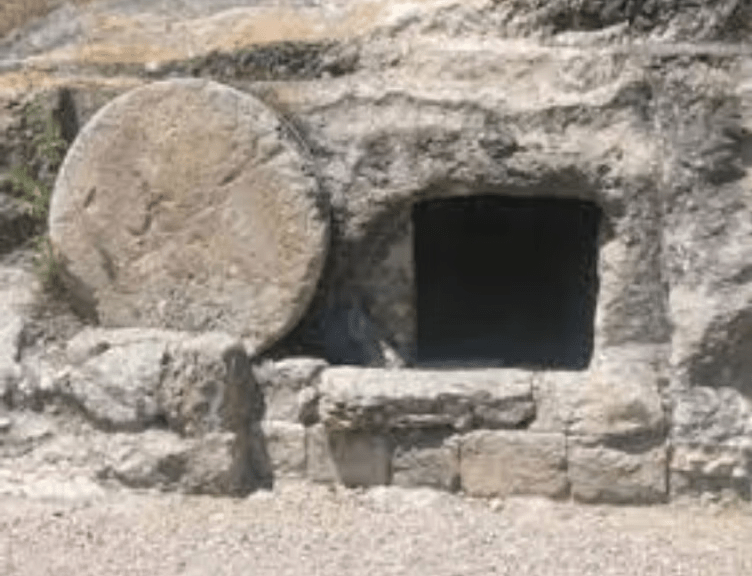
In verse 14, the NRSV translation shows David singing, “ The Lord is my strength and my song, and he has become my salvation.” As the new ‘first’ verse added for Easter Sunday, it is easy to hear and see these words and think only of Jesus, as this is seen as the day he resurrected. In reality, Jesus rose from death on the Sabbath, while in the tomb, prior to anyone leaving at the crack of dawn to go attend to his corpse. It is thus them who should be seen as singing the words of this verse, just as David sang them. Yahweh must be the strength of all who are seeking salvation. The name “Jesus” means “Yahweh Will Save,” thus we all, like David, must become resurrections as those whose faith sings, “Yahweh Will Save,” because Yahweh has sent me the strength to become Jesus reborn.
In the next verse, the song says “There is a sound of exultation and victory in the tents of the righteous.” Here, the Hebrew word translated as “sound” can equally be stated as “voice.” From singing about “my salvation,” rather than “sound,” David knew that was due to his hearing “the voice” of Yahweh speaking to him, leading him to “rejoice” from having defeated all fears of death. That means the true meaning of “salvation” comes from hearing Yahweh say, “Your soul is saved” [the meaning behind the name “Jesus”]. This inner voice then becomes the “sounds” of the “righteous,” who speak out within their “homes” or “tents,” so others will also find “salvation.”
Verse 16 then adds: “The right hand of the Lord has triumphed! the right hand of the Lord is exalted! the right hand of the Lord has triumphed!” Here, the Hebrew has “The right hand of the Lord has triumphed!” as the final segment of verse 15, with verse 16 beginning with “the right hand of the Lord is exalted!” It is obvious that the NRSV [possibly others?] has combined the three segments together, so they all act as a chorus. As they, they all sing the word “yə·mîn” [or “yamen”], which means “right hand,” while repeating “ḥā·yil” [or “chayil“], translated as “triumphed,” but meaning “strength.”
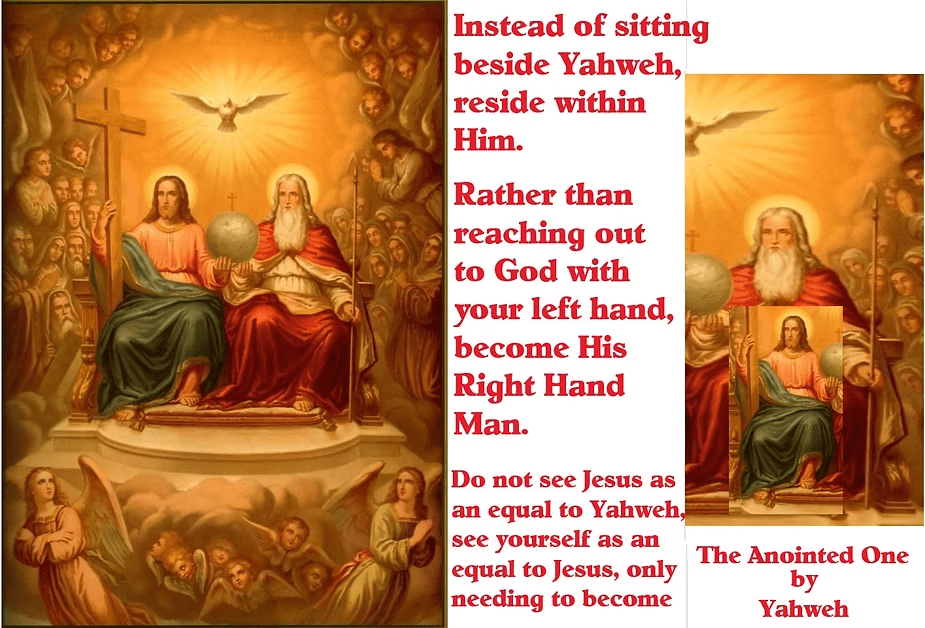
In all Scripture repetition is a statement of importance. The meaning of “right hand” or “right side” is to be seen as a position taken where Yahweh is within one. The English word “righteous” has roots in “right wise,” as a reflection of one being “right” in one’s actions, with “right” meaning one knows the ways of the Lord. Thus, the “right hand” refers to one who has married Yahweh and become an extension of Him on earth. It is from this ability to act righteously that one becomes victorious over the evils of the world and triumphs over the traps the world sets for lost souls. One’s soul has become “exalted” by the presence of Yahweh, an undefeatable presence.
From that repetition of a righteous state reached, David sang in verse 17: “I shall not die, but live, and declare the works of the Lord.” In this declaration of faith, one knows a body of flesh will forevermore cease to be a place of imprisonment for an eternal soul. All flesh is earth or clay, thus all flesh is death that can only temporarily be animated by a living soul. To triumph over death, David knew the life granted his being was freedom from the prison a body of flesh becomes for a soul. By not dying, David was saying his soul had been freed of reincarnation by Yahweh. The gift of life, while still in a body of flesh, means the soul leads its body to sing praises to Yahweh, doing the works of a Saint. The purpose of those works is to allow others to come to God and likewise be saved.
In the last of the Easter Sunday additions to this song of praise, verse 18 sings loudly, “The Lord has punished me sorely, but he did not hand me over to death.” This is an important verse to be sung aloud on Easter Sunday, because those who arrived at the tomb found Yahweh had released His Son from death, even though his body of flesh had suffered greatly at the hands of the Romans. Again, this has greater meaning when one hears the words singing to oneself, as one who has a lifetime of experiences that knows full-well the meaning of “punishment sorely.” Many wounds still linger and keep one’s past festering. It is therefore the promise of Yahweh, made to all who completely submit to His Will and become His wives, that the same freedom from reincarnation can be one’s own. All one has to do is commit to Yahweh in spiritual marriage.
[Note: From this point on, until verse 24 is explained, the same is presented here, as is written in the Palm Sunday interpretation. Please read them in the light of the Resurrection, keeping in mind it is your soul placed in the tomb that is a body of flesh. Therefore, it is your soul that needs to be found risen, just as was Jesus in the flesh on Easter Sunday.]
In verse 19 it is most important to see the “gates of righteousness” [“ša·‘ă·rê-ṣe·ḏeq,” from “shaar tsedeq”] are metaphor for the opening of one’s soul to receive the Holy Spirit. The “gates” are then reflections of all the inhibitions of a physical world, where the body has become the fortress in which the soul is imprisoned. In Jerusalem, all gates are entrances within high and imposing walls of defense from attack. The gates were opened at sunrise and closed at sunset, and always manned with guards. This is a projection of the way a human body of flesh defends against the unwanted; but for most sinners, Yahweh is unwanted, thereby the gates are closed to His presence. God will never force His Will to smash down any gates of resistance. It is up to one to lower one’s guard, as a bride must do for her husband to enter her body.
The thanks given to Yahweh represents praise to His presence. That becomes the willing receipt of the Holy Spirit and the birth of a righteous way of being. Because Jesus is the model of righteousness, the Holy Spirit’s penetration into one’s body, upon willing submission by marriage, means David became like Jesus [a name that means “Yah Will Save]. After that birth of righteousness, the gates of one’s body will forevermore refuse entrance to sin. The body of flesh becomes a fortress of righteousness, which is the freedom granted a soul, from a prison representing a body of flesh, so one wholly is granted eternal life. Verse 21 then sings of this salvation [“lî·šū·‘āh” or “yeshuah”].
When it is recognized how verse 22 sings, “The stone that the builders rejected has become the chief cornerstone,” that cornerstone is eternal life, which comes from salvation. The Hebrew word for “salvation” is (in essence) the name “Yeshuah,” which translates into a name as “Joshua” or “Jesus.” The main building block for one’s body to become a temple unto Yahweh is righteousness. Righteousness can only come from the presence of the Holy Spirit; and, the Holy Spirit can only become the ruler over a body of flesh through willing sacrifice of the soul to Yahweh.
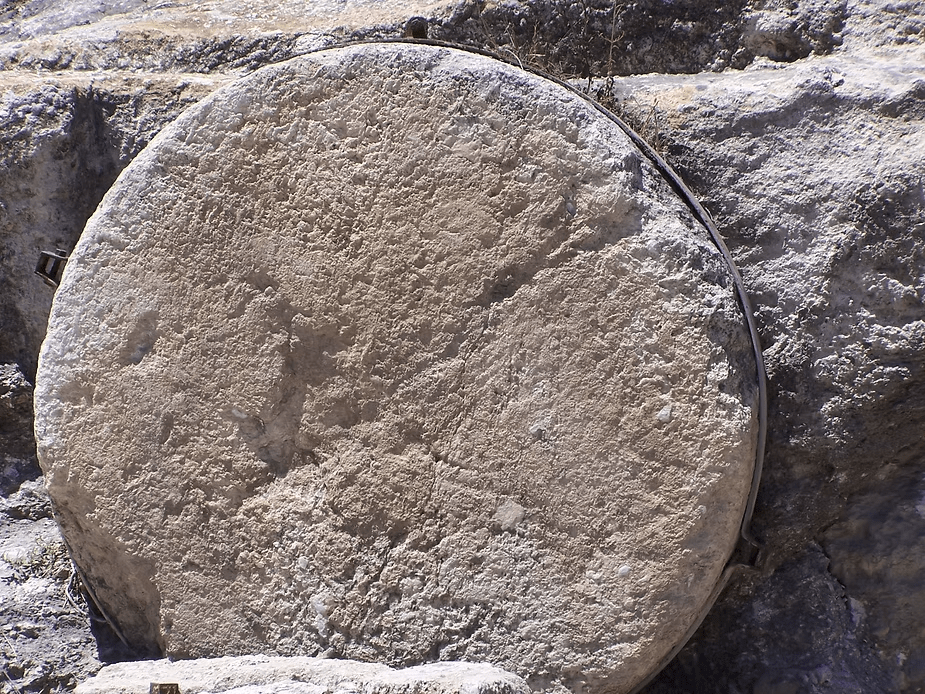
When David then sang, “This is the Lord’s doing; it is marvelous in our eyes,” that says no soul-body alone can transform one’s temple of flesh into a palace of righteousness. All the beautifications Herod the Great began to remodel the Second Temple, meaning decades of hard physical labor, was all thrown down in a sudden act of violence. That speaks against human will-power being enough to will oneself to resist sins of the flesh. Only the presence of Yahweh can bring about “marvelous” [from “nip̄·lāṯ,” from “pala,” meaning “to be surpassing or extraordinary”] acts of self to behold. The eyes of self cannot believe its own acts of body; and, the eyes of others find it miraculous that the human being they knew before has now been so remarkably transformed.
When David then followed that verse by singing, “This is the day that the Lord has made; let us rejoice and be glad in it,” that “day” is the Sabbath day, which was made holy. Jesus was risen on the Sabbath. The day of Resurrection becomes the day Yahweh has made holy for all who will be raised from death. It is the “day” when one’s soul is forever transformed through a spiritual marriage of one’s soul to Yahweh. It is as one’s wedding day. It is also when the “daylight” of truth entered into one’s being, never to leave. That “day” is when the rejoicing of a freed soul becomes glad it sacrificed self to God, a day never forgotten.
As a psalm that is sung within churches on Easter Sunday, it is important to take it upon oneself and contemplate the words of this song written by David as your praises to Yahweh, for all Yahweh has truly done for you personally. No one can do that for you. The words sing of David being in a loving relationship of commitment to Yahweh. The truth of that relationship – that marriage between a soul and God’s Holy Spirit – is it is not limited to just David.
While David was a king over Israel, it was when he was a boy that God had Samuel anoint David. It was that Anointing that made David a “Christ,” as a wife of God. Jesus was born with his soul married to Yahweh, so he too was the Anointed One. Still, this song sings praises that all can be just as was David and just as was the man Jesus, because marriage to Yahweh makes one a Son of man, as the Christ.
 Explaining the Readings