1 When Yahweh restored the fortunes of Zion, *
then were we like those who dream.
2 Then was our mouth filled with laughter, *
and our tongue with shouts of joy.
3 [2] Then they said among the nations, *
“Yahweh has done great things for them.”
4 [3] Yahweh has done great things for us, *
and we are glad indeed.
5 [4] Restore our fortunes, Yahweh, *
like the watercourses of the Negev.
6 [5] Those who sowed with tears *
will reap with songs of joy.
7 [6] Those who go out weeping, carrying the seed, *
will come again with joy, shouldering their sheaves.
——————–
This is the companion reading to the Track 2 Old Testament selection, which will be read aloud in unison or sung by a cantor on the twenty-second Sunday after Pentecost [Proper 25], Year B, according to the lectionary for the Episcopal Church. It will follow a reading from Jeremiah 31, where Yahweh said to the prophet: “With weeping they shall come, and with consolations I will lead them back, I will let them walk by brooks of water, in a straight path in which they shall not stumble.” That set will precede a reading from Hebrews, where Paul wrote, “For it was fitting that we should have such a high priest, holy, blameless, undefiled, separated from sinners, and exalted above the heavens.” All will accompany the Gospel reading from Mark, where it is written: “Jesus and his disciples came to Jericho. As he and his disciples and a large crowd were leaving Jericho, Bartimaeus son of Timaeus, a blind beggar, was sitting by the roadside.”
This song of praise for the promise of restoration is one of the “songs of ascent,” which means it would have been sung by Israelites as they walked up the steps of Mount Ophel, in the City of David, to the place where the Tabernacle had been set up. It is a six verse song; but for some unknown reason the Episcopal Church has divided the second verse into two verses, making it appear to be seven verses. The NRSV (the source of the Episcopal Church’s translations) shows this psalm as being six verses. Therefore, I have placed the real verse numbers in brackets; and, I will refer to the proper verse number in my interpretations.
In the translations by the NRSV (and presumably others), four times the proper name Yahweh was written by David and all times the translation is shown as “Lord.” There would be no generic “lord” who would “restore the fortunes of Zion.” It was not some generic “lord” who “has done great things for us and them.” The only legitimate excuse for degrading the name of Yahweh to a generic “lord” is to make it appear that Christians are not Jews and Yahweh is the name of the “God of Israel.” That is a confession of a soul’s failure to realize that to be “in the name of” Yahweh means to be both married spiritually to Him (as His wife) and to be the mother of His resurrected Son, who name is Jesus. The name “Jesus” means “Yah[weh] Saves.” Therefore, to be “in the name of Jesus” means to be in the name of Yahweh … not in the name of some generic lord.
Verse one is poorly translated, as there is nothing written that says “restored the fortunes.” That written is [transliterated] “bə·šūḇ Yah·weh ’eṯ-šî·ḇaṯ,” from the roots “shub and shibah,” which say “return, brought back … captivity.” As a song of David, when there was no known “captivity” that the Israelites knew, other than that as the slaves of Egypt, the meaning of “Zion” becomes key towards understanding this verse.
The name “Zion” means “fortress.” When one realizes the City of David was formerly the “fortress” of the Jebusites, which were peoples who lived underground and had never been defeated by any leader of Israel, with an agreement signed by Abraham never to attack Jesus from underground, the use here denotes marriage to Yahweh. David symbolically married the Israelites to Yahweh when he took the “fortress” as his own and joined it with the Ark of the Covenant [and Tabernacle]. By doing so (at the command of Yahweh), David “returned” the Israelites to “Yahweh’s captivity,” relative to them being His slaves replacing the servants of His that were the Jebusites.
The remainder of verse one then explains: “we were like those who dream.” In that, the Hebrew words “hayah” and “chalam” better translate as “we became like those who are strong,” with that being an indication of those who “recover” and are “healthy.” This is David singing about the taking of Zion as the enslavement of all future Israelites (and thus Jews, and thus Christians) to serve Yahweh as His wives. That state of service is “like those who dream,” where a soul is as real is a dream, with neither being able to be pointed to as proof that dreams or souls exist. It is this “return to captivity” that is like the Israelites were in Egypt, when they had become “captives of Yahweh,” their most holy Husband. Marriage of their souls to Him meant the captivity of His possession or ownership, so Yahweh was the King of each Israelite (not David or any other human lord) and expected to serve Him absolutely. All of this responsibility is because the protectors of the land promised to the Israelites – the Jebusites – had been removed from having any power to govern or administer to the people, after David took their “fortress” and made “Zion” his capital city.
As the first verse of this song, it acts as the theme statement that all subsequent verses support. This makes it imperative to realize that David’s Israel had no fortunes prior that could be restored. The only true fortune each Israelite had was his or her soul. This means the name “Israelites” was not relative to the name of land on the planet Earth, but a statement about the souls of those who had Yahweh-assisted power to keep that land, because they each were “Those Who Retained Yahweh,” as His “elohim.” The Jebusites were earthly “elohim” who served Yahweh and protected the people after Moses led them to enter Canaan. Their souls were yo-yos between commitment to the Law and infidelity to that commitment; so, the Jebusites played a role in the placement of Judges. When David became the final Judge of Israel, the responsibility “returned Yahweh captivity to the fortress” that was each individual body of flesh, animated by a soul.
In verse two, the literal translation of the Hebrew into English has it say, “then was filled with laughter our mouth and our tongue with singing at that time they said among the nations ; great things Yahweh has done with these .” This has to be seen as the joy that comes from being a Yahweh elohim, when one’s soul feels the elation of union with His Spirit. One wants to laugh and play while singing loudly. This came when the people entered the Promised Land and were seen as one collection of people who shared the same purpose in life. They were truly a nation unto Yahweh, unlike any other nation on earth. Yahweh was their King, because all were subservient to His Will. When that presence led the people, great things occurred.
Verse three then literally translates to state: “great things Yahweh has done for us , we are glad .” Here, David is repeating the second half of verse two, which says all things great done by Israelites are the deeds of Yahweh, not human beings alone. All that Israel accomplished once in the Promised Land was due to Yahweh, with His assistant elohim helping in the overthrow of enemies. It is, therefore, that success led by Yahweh that makes David repeat the gladness in the hearts of all Israelites, as they all Retained Yahweh, each an el in His name.
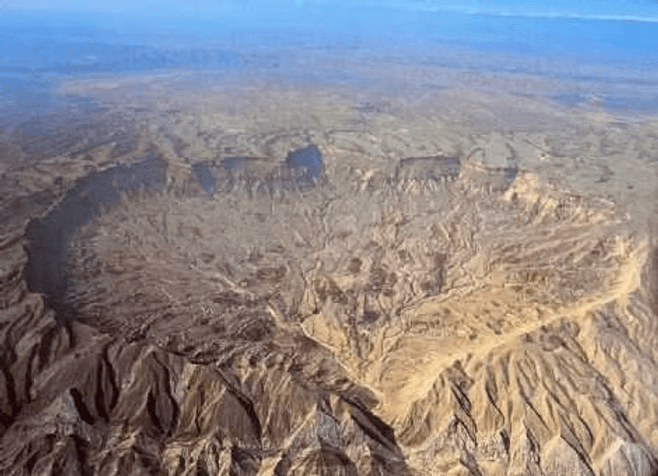
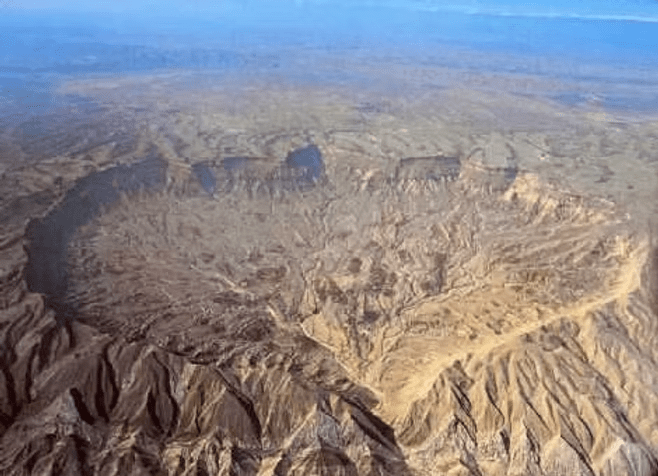
Verse four then contains two words written in parentheses and brackets, which are “[šə·ḇū·ṯê·nū]“ and “(šə·ḇî·ṯê·nū),” repeating the “return to captivity” that was stated in verse one. The brackets indicate the past “captivity” in Egypt, with the parentheses representing an unseen or hidden “captivity” as the Sons of Yahweh, His elohim. Thus, the symbolism of a “return to captivity” is reflected in “as the streams in the Negev,” which is the “dry place” [another meaning of “Zion”] that is semidesert. Thus, the return of Yahweh captivity is like the dry earth seeks the rain, so when it comes it carves out a path that the water desires to take.
The metaphor of the Negev should be seen as would happen much later in history, when Ezekiel was a prophet of Yahweh and was asked, “Mortal, can these dry bones life?” The “valley of dry bones” can be seen reflected in the picture below. Dry bones are nothing but earth, void of the animation that comes from the temporary life of a soul. More than a soul being symbolic of the “streams” that run through the dry bones and then dry up, returning the bones to a dry state again [symbolic of incarnation and reincarnation], the outpouring that comes from a return to Yahweh’s captivity is eternal life, which never dries up. Thus, Yahweh told Ezekiel to prophesy to the dry bones so they would reach that eternal state of being.
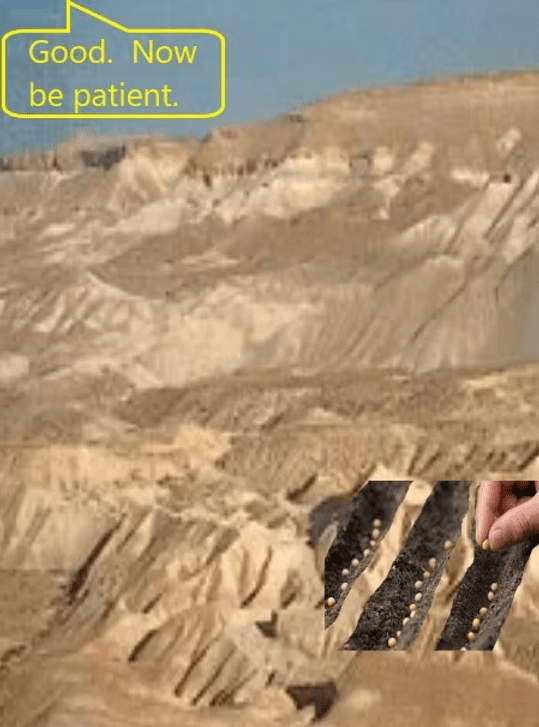
Verse five then literally translates into English to say, “those who scatter seeds in tears in joy shall reap .” This means the ministry of a true Israelite, who sows the seeds of commitment to Yahweh to his and her family, so the children grow to maturity with the same set of values, learning to have faith in Yahweh. This means the tears sown will be the necessary cutting of the apron strings from the children, so they enter the world as adult bodies of flesh with a soul that is still unmarried to Yahweh. The tears will be from their sins, coming from breaking the promises of their parents, as Yahweh elohim. The joy comes when the lessons scattered onto dry bones take root and grow when the rain of love for Yahweh brings a flood of emotion in return. This is when the children will mature as the first fruits each season; and, Israel – a nation of people in service to Yahweh – will reap the benefits of that ongoing harvest.
Verse six then literally translates into English as: “walking he goes forth and weeping carrying a bag of seed to come and come again with rejoicing ; carrying his sheaves .” This states the expectations that come from teaching your children to love Yahweh and become His brides, generation after generation. The Hebrew that translates as “bag of seed” [“me·šeḵ-haz·zā·ra‘”] can equally translate as “trail of offspring.” This is David singing of the truth of an Israelite, as Yahweh elohim who continuously plant the seeds of priesthood for Yahweh, so the dry bones of the earth can be returned souls to Yahweh, without the pains and agonies of eternal reincarnations. The “rejoicing” comes when souls have married Yahweh and told the true Promised Land is Salvation and a return to Eden.
As a song of praise to be sung on the twenty-second Sunday after Pentecost, when one’s own personal ministry for Yahweh should already be well underway, the lesson is that of verse one: Return to Yahweh through captivity as His priests of servitude. The ministry of a true Christian today is no different that it was when David was the final Judge of Israel and wrote prophetic songs for souls to know and love. A false shepherd in modern times pretends to care about everyone in the world, while stepping all over the children that watch and learn, “Do as I say, not as I do.” If the children are led astray by such planters of doubt, then how can they lead a flock to find Yahweh in marriage? They will reap sheaves of weeds. That is dry bones saying the holy water of Yahweh is global warning and causing destruction of a natural environment where lizards and snakes love the dry wilderness. They see only the physical, never the spiritual. Israel split and fell just as has Christianity, because the priests of Yahweh have lost their way. Marriage to Yahweh and becoming His elohim [angles in the flesh, or Saints] is the only way to harvest a crop that isn’t only weeds.

 Explaining the Readings