
1 Yahweh, who may dwell in your tabernacle? *
who may abide upon your holy hill?
2 Whoever leads a blameless life and does what is right, *
who speaks the truth from his heart.
3 There is no guile upon his tongue;
he does no evil to his friend; *
he does not heap contempt upon his neighbor.
4 In his sight the wicked is rejected, *
but he honors those who fear Yahweh.
5 [4] He has sworn to do no wrong *
and does not take back his word.
6 [5] He does not give his money in hope of gain, *
nor does he take a bribe against the innocent.
7 [5] Whoever does these things *
shall never be overthrown.
——————–
This is the accompanying Psalm for the Track 2 Old Testament reading option, from Deuteronomy, where Moses spoke to the Israelites about forever retaining Yahweh, so they can always obey the Commandments. If that set is chosen, they will be read before the Epistle selection from James, where he wrote, “For if any are hearers of the word and not doers, they are like those who look at themselves in a mirror; for they look at themselves and, on going away, immediately forget what they were like.” All will accompany the Gospel reading from Mark, where Jesus said, “For it is from within, from the human heart, that evil intentions come: fornication, theft, murder, adultery, avarice, wickedness, deceit, licentiousness, envy, slander, pride, folly. All these evil things come from within, and they defile a person.”
In the presentation above, it should be noted that I have restored “Yahweh” to the two places where the NRSV has made the common error of generalizing the proper name of the God of Israel, as “Lord.” In addition, it must be realized that this Psalm is only five verses, not seven. The NRSV shows five verses, but the Episcopal Church has modified this for some unknown reason. I have bracketed and listed in bold type the actually verse numbering. I will refer to the actual verse numbers in this analysis.
The literal English translation of verse one is this: “Yahweh who may sojourn in your tabernacle ? who may dwell , in hill of your sacredness ?”
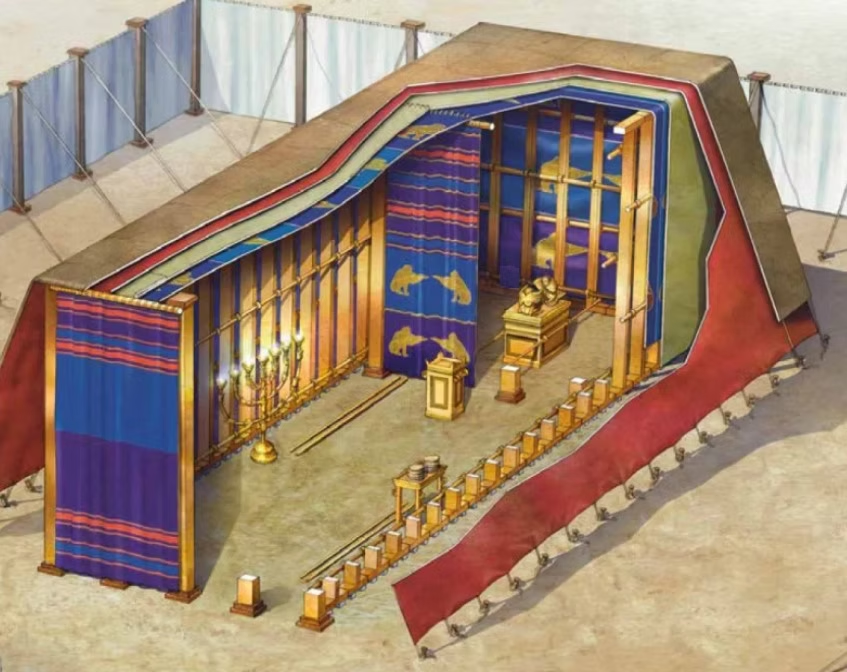
To understand this verse, one must have a firm grasp on the meaning of “bə·’ā·ho·le·ḵā,” which is rooted in “ohel,” meaning “a tent.” Because the first word addresses “Yahweh,” the proper name of the God of Israel, it has to be accepted that Yahweh rested atop the Ark, which was within the Tabernacle, which was an elaborate “tent” that surrounded that holy presence. From that realization, the Hebrew word “yā·ḡūr” is written, which stems from “guwr,” meaning “sojourn.” Strong’s Exhaustive Concordance expands this usage as “abide, assemble, be afraid, dwell, fear, gather together, inhabitant, remain.” I see “sojourn” as a reflection of the reason the Tabernacle was designed to be taken down, moved as needed, and reassembled, so it always went where the Israelites went. This mobility is best reflected in “sojourn,” still the movement allowed that “tent” to be where the people “dwelled.”
The questions asked are two: “who may sojourn?” and then “who may dwell?” In those is stated there is no certainty that all “may” enter that “tent.” The subjunctive assumes a condition that must be met first. The second question then centers on the subjunctive, “mî-yiš·kōn” (rooted in “shaken”), where the root means “to settle down, abide, dwell.” Again, the conditional is surrounding the essence of “living,” where “living” means “motion” and “rest.” The seemingly automatic answer to both would be: the Levites. It was they who were the ones allowed within the “tent,” with the High Priest also of that lineage. Still, that is not the intent of David’s song.
Verse two then answers the questions of verse one. It literally translates into English to state: “he who walks uprightly and acts righteously ; and speaks the truth in his soul .” When the first question of verse one is seen to ask about a “sojourn” or “temporary stay,” meaning after a major portion of life has passed, the aspect of “walking uprightly” fits this translation. The Hebrew word written, rooted in “tamin,” says the answer is “he who is complete or sound.” Thus, to enter Yahweh’s “tent” covering, one has to have been made clean of anything incomplete or unsound. This completeness is then equated to “righteousness” [“ṣe·ḏeq,” from “tsedeq”]. The final segment of words then sings about the “truth” [from “emeth”], which comes from the “heart” [“lebab”], meaning the “inner man” or “soul.” When the “soul” is seen as the point of truth’s origin, this is not a soul alone coming to an understanding of what is true or false. The “truth” can only come from Yahweh.
Verse three then literally translates into English as, “not does he slander with his tongue ,
not does he do evil to his fellow ; and a disgrace , not does he take up against those near .” In this, the first key word in Hebrew to examine is “rā·ḡal” (“ragal”). According to Strong’s, this word means “to go about on foot,” with the NASB informing us that the word has been used in Scripture twenty-six times, with the most times (20 total) being translated as “spies” or “spy;” but other translations used have been “slander, slandered, spied, taught to walk.” This means “to go about on foot” brings the connotation of being a gossip, where one is seen as part of the background, so others act naturally around one; but that witnessed is then talked about in a negative light. Obviously, this verse is now explaining the difference between the “truth” coming from one’s “heart” (“soul”) and that which does not come forth for the betterment of others. This now, instead, comes from a brain in a body of flesh that is controlled by a negative presence within. This is not what comes from the mouth of a soul married to Yahweh in the flesh, who is “righteous.”
In the next segment of words, the “not” (“lo-“) is repeated, where the key word now becomes “lə·rê·‘ê·hū,” rooted in “rea,” meaning “friend, companion, fellow.” Here, other uses found also translate as “another, lover, neighbor, and opponent.” From “rā·‘āh” (“ra’”) bringing “bad, evil” into the focus, the expansion moves from “not slandering with one’s speech” to “not making friends, foes, companions, lovers, or neighbors evil.” The operative word now is “‘ā·śāh,” which means “do [or] make.” This is a statement that one’s actions come forth as deeds, like words come forth from speech. A righteous person will neither say or do that which is “evil” or “bad” towards another, but the righteous also will not make another act or react in evil ways. While being righteous can elicit evil to come forth from others, in their own sinful acts of persecution, the righteous never make evil, because speaking the “truth” and acting “righteous” can only make others see the light of properly how to be.
Following a mark of separation, taking one’s focus from what a righteous person does not say or do, David wrote one word that was to be separate from the rest. That Hebrew word is “wə·ḥer·pāh,” from “cherpah,” meaning “a reproach,” while allowing that to also imply “contempt, disgrace, scorn, shame, and taunting.” (NASB Translations) This single word, set apart from the rest, must be seen as a summation of those who are not righteous and not filled with the truth of Yahweh. The summation of those souls is a “disgrace” to Yahweh, which is a soul that has turned away from Yahweh from “shame.”
In the final segment of words in verse three, the key word to contemplate is “nā·śā” (“nasa”), which means “to lift, carry, take,” with the implication being “accept, arise, forgive, exalt, spare, or take” [plus many other uses shown by the NASB]. This has been translated by the NRSV as “take back,” in “take back his word.” That misses the point of this series of segments. Here, the negative (“not”) places focus on one who is sinful and cannot “raise” others from their evil ways. This means a positive sign of one who is “righteous” is he or she does will uplift those near to them. That elevation comes by speaking the truth and demonstrating how the righteous act. In that way they pass on the desire to be like them, which opens their hearts to receiving the Spirit of Yahweh.
Verse four then translates into English literally to say, “is despised in whose eyes is a vile person , but those who fear Yahweh he honors ; he swears to his own evil , and not does change .” This furthers the view of one who does not marry his or her soul to Yahweh, as a sinner. Because humans love the saying, “Beauty is in the eye of the beholder,” the use of “eyes” (“bə·‘ê·nāw,” from “ayin”) should not be seen as physical “eyes,” but “in whose eyes” is Yahweh. The “eyes” are what highlights one’s face, so when one is not wearing the face of Yahweh [the First Commandment], then one is wearing the “eyes” of one who is “a vile person.” In that, the Hebrew word written, “nim·’ās,” from “ma’ac,” actually means “reject.” This is not description of a “reject” from a mold, but a statement that the reason one does not wear the “eyes” of Yahweh is because that soul “rejected” His face, refusing to marry one’s soul to His Spirit.
In the second segment of words another Commandment is stated, where those of faith “fear only Yahweh.” This comes when one’s soul is married to His Spirit; and, then the only “fear” is losing that relationship. This then says “he honors” those who wear His face in the presence of physical life that is “heavy, weighty, or burdensome,” the true meaning of “yə·ḵab·bêḏ” (from “kabed”). That fearlessness comes from the presence of Yahweh, as an “honor” shared by the faithful with Yahweh.
In the third segment of words, the Hebrew word “niš·ba” is written, which means “to swear.” This must be seen as a statement of one’s admission of past sins, coming at the altar of divine marriage, when a soul “curses” its past existence without Yahweh, while agreeing to the Covenant of marriage set by Yahweh, sent down by Moses. In this way one admits “to his own evil,” and begs for forgiveness, while bowing one’s face to the ground, submitting self-ego to wear the face of Yahweh. Still, this segment of words cuts two ways, as those who do not so submit to Yahweh will then “curse” their own soul, having instead married “his own evil.”
The final segment alludes to this failure to submit to Yahweh, where the sign of an evil human being is it becomes addicted to doing bad deeds and will never “change.” The twist in this segment that must also be seen, it the Hebrew written – “wə·lō yā·mir” – says, “and not does change.” This means the indication of “does change” for the good, when one chooses “not” to serve Satan. Both ways are marked in this segment, so the Word of Yahweh tells the whole “truth,” in unseen ways.
Verse five then literally translates into English as saying, “his money he does not pay in interest as a bribe against the innocent , not does he take he who does these ; not shall be shaken forever .” The first segment of words says no value can be placed on sins, such that it is impossible to do as the Roman Catholic Church once offered – indulgences. This says the “interest” (from “neshek,” meaning “usury”) for future sins cannot be paid in advance, as a way of using “silver” – a material substance – to pay the debts of a soul. This says donations given to charitable organizations [supposedly “the innocent”], while living a self-indulgent lifestyle, will not become a negotiation ploy, in some concept of weighing out the positives versus the negatives, hoping to find some slight advantage in one’s favor on the Day of Judgment. A soul is only saved when all past sins have been absolved by Yahweh, through one’s total submission of self-will at the divine marriage altar, forevermore.
The second segment of words is then focused on that Judgment of a soul, such that it is Yahweh who does not “take” pre-payments. Likewise, Yahweh does not take souls who try to sidestep innocence, where the Hebrew translated as that (“naqiy”) means, “clean, free from, exempt.” There is no way to enter into the realm of eternal salvation without having totally paid the price of one’s soul living in the flesh as a servant to Yahweh on earth – sin free from divine marriage until death do you part the flesh. There is nothing short of that payment in full that allows a soul to return to heaven.
This is then confirmed in the third segment of words, which places focus on “eternity” (“lə·‘ō·lām,” from “olam”). This usage is translated by the NRSV as “never,” but the same spelling is found in many other Old Testament verses, translated consistently as “forever,” which is a relative of “never.” To “never” be overthrown means to “forever” not be overthrown. The translation of the Hebrew word “yim·mō·wṭ” (from “mot”) as “overthrown” takes excessive liberties of paraphrase, for a word that means “to totter, shake, slip,” with allowances in usage to be “be carried, cast, be out of course, be fallen in decay, exceedingly, falling down.” Again, the initial focus being set on “not” allows for everything after to cut two ways. One whose soul is married to Yahweh will “never be shaken” from His Will. Conversely, those souls “not” married to Yahweh will “forever be shaken.”
It is important to realize this short Psalm was purposefully selected to pair with a short reading from Deuteronomy, which has Moses address the children calling themselves [a “self” equals a “soul”] “Israel.” The Laws were their marriage Covenant. Their souls had to be married to Yahweh forever, in order to receive the promise of eternal salvation (not some land of monetary value in the Middle East, and nothing else). This Psalm sings about the two ways of being that the future held: either a soul is married to Yahweh; or, a soul is married to the material realm of Satan. That is why Moses told them to teach their children’s children to never forget the marriage vows. One’s soul is either saved or not. There is no in between, when death comes [and death will always come to mortals].
As a Psalm to be read aloud in unison or sung solemnly by a cantor on the fourteenth Sunday after Pentecost, when one’s own personal ministry to Yahweh should already be well underway, the lesson is to hear David ask yourself the questions, “Who may sojourn in your tabernacle of Yahweh? And, “Who may dwell in the hill of His sacredness?” Those questions say not everyone will make that commitment, realizing how hard it is for a soul to sacrifice self for a higher goal. The tabernacle of Yahweh must be seen as one’s body of flesh, with one’s soul being the inner sanctum, where the Holy of Holies resides. One cannot pretend to be sacred, as that will be wearing a face with the eyes of wickedness; and, punishment will be harsh for those pretending to be righteous, while misleading the innocent to ruin. This song sings about marrying Yahweh and speaking the truth, so others can be saved.

 Explaining the Readings