1 [1a] Yahweh adonenu, *
how exalted is your Name in all the world!
2 [2a] Out of the mouths of infants and children *
[1b] your majesty is praised above the heavens.
3 [2b] You have set up a stronghold against your adversaries, *
to quell the enemy and the avenger.
4 [3] When I consider your heavens, the work of your fingers, *
the moon and the stars you have set in their courses,
5 [4] What is man that you should be mindful of him? *
the son of man that you should seek him out?
6 [5] You have made him but little lower than the angels; *
you adorn him with glory and honor;
7 [6] You give him mastery over the works of your hands; *
you put all things under his feet:
8 [7] All sheep and oxen, *
even the wild beasts of the field,
9 [8] The birds of the air, the fish of the sea, *
and whatsoever walks in the paths of the sea.
10 [9] Yahweh adonenu, *
how exalted is your Name in all the world!
——————–
This is the accompanying Psalm for the Genesis 2 reading about Adam being handed Eve to name, which will be read aloud in unison or sung by a cantor on the nineteenth Sunday after Pentecost [Proper 22], Year B, according to the lectionary for the Episcopal Church. This pair will precede the Epistle reading from Hebrews, where Paul wrote, “Now in subjecting all things to them, God left nothing outside their control. As it is, we do not yet see everything in subjection to them, but we do see Jesus, who for a little while was made lower than the angels, now crowned with glory and honor because of the suffering of death, so that by the grace of God he might taste death for everyone.” All will accompany the Gospel reding from Mark, where Jesus said, “Let the little children come to me; do not stop them; for it is to such as these that the kingdom of God belongs. Truly I tell you, whoever does not receive the kingdom of God as a little child will never enter it.”
In the above translation, you will notice that I have renumbered the verses, so the reality of nine is shown [not ten]. The NRSV shows the proper numbering; but the Episcopal Church has found some unexplainable reason to alter divine Scripture, changing nine verses into ten. They take a portion of verse one and slip it into verse two, changing the rest of verse two, while then changing the remainder of verse two into verse three. They add the extra verse in the process. In addition to that, the first and last verses begin with “Yahweh adonenu,” which translates as “Yahweh of lords.” The NRSV translates this as “O Lord, our Sovereign,” while the Episcopal Church shows, “O Lord our Governor.” Because both are errors of translation, I have restored the written text.
My main resource for the translations of the Hebrew is the BibleHub Interlinear website. That site assigns names for Psalms and also adds headers for segments of other texts. None of these are part of the actual text, but they are taken from key words in the text. Other translation versions do the same, while others add nothing. The ‘title’ for this Psalm is “How Majestic is Your Name!” The NRSV applies one that says, “Divine Majesty and Human Dignity,” with others getting further away from what is written by David, as summations of the content. I feel the BibleHub Interlinear ‘title’ is most appropriate, simply because it includes the key term used in verse one, which is “name.” It must be understood that the only way a “name” has any greater power or glory, as far as Yahweh is concerned, is when His name is part of one’s being. That becomes a statement of marriage, when a Husband’s “name” is taken by the wife. That is when all “divine majesty” can be known.
In verse one, as well as its repetition as verse nine, the beginning words written by David are “Yahweh adonenu,” which literally translates as “Yahweh lords of us.” The plural form of “adon” [a singular “lord,” which is not written] is the possessive case, as “our lords.” That can be restated as “lords ours” or “lords of us,” as long as the plural number of “lords” is maintained. This specific form of “adon” [“adonenu“] is found written seven times in the Old Testament, with two of those times in this Psalm. All English translations show it in the singular, as “our lord,” which is not the truth of the word written. The truth is “adonay” [plural “lords”] is much like “elohim” [plural “gods”], in the sense that both words are referring to divine possession [“our” or “of us”]. The divine is “Yahweh.” Thus, “Yahweh adonenu” is a statement about David being one of the hands of Yahweh on the earth, whose souls are governed by His Spirit, making them take positions of importance as guides over other souls that need to be led to marriage to Yahweh. This whole song is praising that presence in David, as he was one of those experiencing “Yahweh lords of us.”
Verse one then literally says, “Yahweh lords of us , how majestic your name in all the land ; who have been given your majesty , upon the heavens .” In this, “how majestic your name” means the definition of “majestic” [from “addir”] must be realized as: “having or showing impressive beauty or dignity.” (Google search, Oxford Languages) To grasp that “Yahweh” is the “name” of “us lords” means “us lords” then display (“showing”), via Yahweh possessing many (“having”), “in the land” that is called Israel. Still, “earth” can be the translation of “eretz,” with that a statement of “matter” or “substance,” from which human flesh is made. That says the “majesty” that is Yahweh is then the “majesty” displayed in human form … on “earth.” This presence is through divine marriage, between souls and Yahweh’s Spirit.
This is then stated to be a “gift” [from “nathan”], as “us lords” “have been given” the “majesty” of Yahweh. When the word “shamayim” is translated as a physical entity – as “sky” or “heavens” – it loses the ability to be clearly seen as a statement of the spiritual. This last segment of verse one must be read as a statement about how “the majesty has been given,” as it is placed “upon the souls.” In “‘al-haš·šā·ma·yim” the preposition attachment (“al-“) should be read as “upon,” rather than “above” or “over,” although those additions state an elevated state of being as becoming part of the “majesty” felt by a soul. A “soul” must be realized as the “heavens” within a dead body of flesh, which animates that flesh. Thus, the “gift” is an elevation of the “soul” to a “heavenly” state of being, within the “earth” of one’s flesh.
Because David sang this in verse one and then repeated it in the last verse, it is imperative to realize that “Yahweh adonenu” is more than some worthless statement that says, “Lord God.” That is much ado about nothing, because it means nothing of value. If begs the question, “”Lord of what, who, how many, etc., etc.?” By seeing “adonenu” as a statement of all who are divinely possessed by Yahweh, sent into ministry in His “name,” one can realize the truth of all the verses in between that theme.
Verse two then literally sings, “out of the mouth of children and sucklers you have established strength intent your binds ; you may cease enemy , and the avenger .” Here, the use of “children,” commonly translated as “babes,” must be seen purely as metaphor, where the focus is not on infants, but on newborns of faith. When verse one ended saying “upon the soul,” that “heavenly” presence within cannot be contained. Now it comes “out of the mouth,” which means the soul is led to speak as the presence of Yahweh on “earth,” which is the power of “lords” in His “name.” As those reborn anew, all that is said comes from Yahweh, just as Jesus regularly said, “I speak what the Father says.” Thus, souls “suckle” on that source of knowledge, as the source of their words.
It is here that the Hebrew verbiage is twisted to make it appear that “enemies” are why Yahweh possesses His “children.” That is not what is written, as “you have established strength intent your binds” becomes reflective of swaddling clothes wrapped tightly around a newborn. It is then the “intent” [from “le-maan”] for a newborn Saint to have no freedom to move beyond God’s Will. That becomes the “strength” possessed by a “lord” like David. Rather than be possessed because enemies threaten, the “intent” is then stated to “cease” all who would go against Yahweh, where unmarried souls become their own worst “enemy.” Rebirth in the Spirit then stops that self-abuse. By being divinely possessed, one has “avenged” his or her own sins, through the redemption of Yahweh.
Verse three then sings literally, “when I see your divinity the deeds of your fingers ; the moon and the stars , which you have set firm .” In this, the Hebrew word “raah” [transliterated as “’er·’eh,” – “I see”] must be understood as being beyond a meaning of physical sight. The word reads as “understanding,” such that the ones who are Yahweh’s “lords” on earth are able to intuit the vastness of the “works” and “deeds” that Yahweh has commanded. To write “’eṣ·bə·‘ō·ṯe·ḵā,” saying “of your finger[s],” the focus placed on a “finger,” rather than a whole hand, says that the acts of Yahweh demand little effort on His part. Therefore, each of the “lords” in His “name” are like “fingers” touching the earth with His presence.
To then make a comparison that one like David was as equal a creation by Yahweh, as were His commanding “the moon and the stars” to be “set firm” in place, says the “intent” of verse two is no different than the “intent” in stellar formations. The magnitude of a “moon” and all the “stars” become a reflection of the axiom ‘as above, so below,’ so all Yahweh adonenu” are equally as purposeful. Divine possession does not happen randomly, as scientists would propose, as if Creation were haphazardly occurring laws of physics, with no controls whatsoever. David is saying everything is “appointed” and has been “firmly established.”
Verse four then literally says in English, “what is mankind that you are mindful of it ; the son of man , that you appoint him .” Here, David has come down from outer space and placed focus on the presence of life on the planet, that of human brains, called “mankind.” It rhetorically asks, “what is mankind?” The answer is “mankind [from “enosh”] is eternal souls imprisoned [some would say freed] in bodies of flesh that are made of dead matter. David questions why souls in human bodies of flesh are any more than souls in animal bodies of flesh. All flesh will die, releasing their souls.
When David then sang, “the son of man,” where “man” in Hebrew is now “adam” [a change from “enosh”], the focus is explaining that Yahweh is “mindful of” humanity because it has been given the gift of a brain that creates a mind that will act in ways that other animals do not. The souls of animals are only able to act in natural ways, meaning they do not devise ways that hurt their own souls [the “enemy” that needs ceasing]. Therefore, Yahweh was “mindful” of the ability of “mankind” to sin, creating the need for Yahweh to forge the first divinely possessed “man” [“adam“], who would then be “appointed” to lead sinful “man” [“enosh”] away from its mind-driven lust with death.
Verse five then sings literally, “you have made him lacking a little than the angels ; and with glory and honor you have crowned him .” Here, it is imperative to realize that David wrote [transliterated] “mê·’ĕ·lō·hîm,” where “elohim” becomes a comparison to the “adonenu.” The tendency of translators of Hebrew into English is to see “elohim” and twist and turn it into “God.” Unfortunately (for them), they cannot do that here, as they would then be forced to translate this verse as, “you have made [man] lacking a little than God.” The reality is the truth says Yahweh [the One God] has “lowered” Himself into “man,” making “man” become an “elohim” or one of the “adonenu.” Thus, it is the presence of Yahweh within Adam [divine “man,” like divine David] that became [unlike “man” of “enosh”] his “crown of glory and honor.”
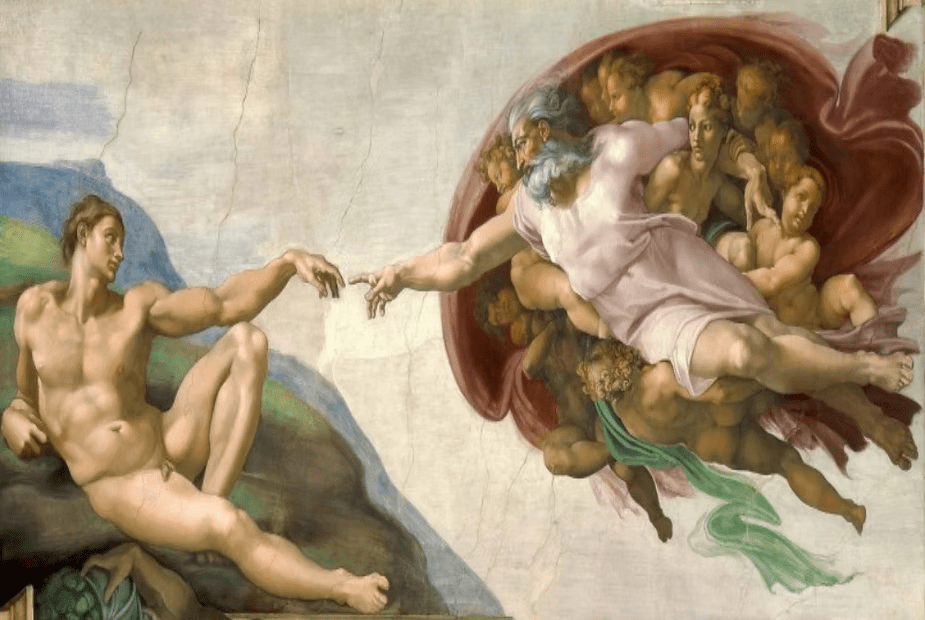
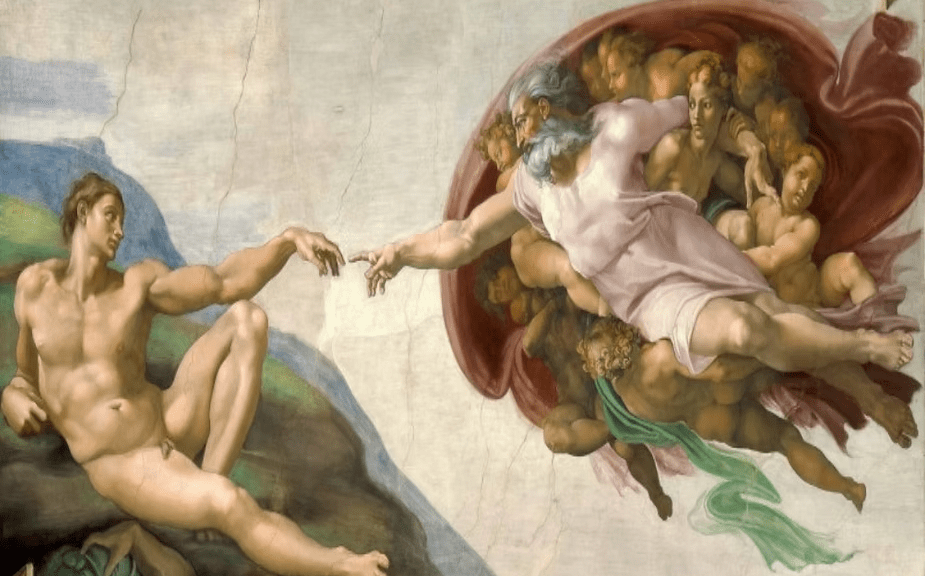
This verse and the verse to follow are quoted by Paul in his letter to the Hebrews. This Psalm is a companion to the Genesis 2 reading, which tells of the creation of Eve from Adam. In that Genesis reading, the truth stated is that both Adam and Eve were “mankind” from “enosh” that had been made into “sons of man” [male and female], which were “Yahweh elohim.” The elohim are “angels.” The “Yahweh elohim” are still angels, but those who support Yahweh. When “man” [as “adam”] is a “Yahweh elohim” [as were Adam and Eve] they were angels within bodies of flesh.
Realizing that, verse six then sings in English, “you have made him to have rule over the works of your hands ; all you have put under his feet .” This says that a divine Adam, or all “sons of man,” have been given the power of Yahweh incarnate into dead matter, placed on earth. When David then said, “all you have put under his feet,” that says divine man – all who are souls married to Yahweh – are angles, therefore they are on a higher level of consciousness than are mere mortals. This in no way implies divine “adonenu” will walk all over mere mortals. They simply are sent by Yahweh to show mankind [“enosh”] that there is a higher way of living: uprightness and righteousness.
Verse seven then sings in English, “sheep and oxen all ; moreover , beasts of the earth .” Here, the metaphor of “sheep” must be seen as those “under the feet” of divine “man,” who become the shepherds of the flocks. The Hebrew word translated as “oxen” [from “eleph”] can mean “herd, such that the first segment of words states, “sheep and herd.” For that to lead to a one-word statement that says “even, moreover, also” [“from “gam”], this says the shepherd and the sheep are the same: man [but one is “adam” and the flock is “enosh”]. Thus, all are “beasts of the world,” where the Hebrew word “sadeh” means “field,” implying “agriculture.” Thus, the purpose of mankind is to do the works of “beasts” that will bring forth a yield of good fruits for those labors.
Verse eight then sings, “the birds of heaven and the fish of the sea , that pass over the way of the sea .” In this metaphor, “the birds of heaven” are not flying, feathered creatures, but angels in the name of Yahweh. The metaphor of the “fish of the sea” is why Jesus told his disciples, “I will make you fishers of men.” This makes the “fish” be those willing to follow a divine leader, such as Moses, David, and Jesus. That then lead to the word “abar,” which means “to pass over,” which is the defeat of mortal death, through a soul’s commitment to Yahweh, becoming His “elohim.” That becomes the “path” the Israelites took, following Moses, where “the sea” was parted so they could cross.
Verse nine is then a repeat of verse one, which states that those who “pass over” will become the new “Yahweh adonenu.” It means taking on the “name” of Yahweh, as His spiritual wife. It is that commitment that purifies the soul of all past sins and forever leads one to do His Will.
As the companion Psalm to be sung aloud on the nineteenth Sunday after Pentecost, when one’s own personal ministry for Yahweh should already be well underway, the lesson here is to be reborn in the name of Yahweh. To be reborn in that name, one needs to learn the name and stop referring to Yahweh as a “Lord.” It is one’s soul’s responsibility to realize Yahweh “lords” the world through His Saints. Those are souls who divinely marry His Spirit and suckle His knowledge, so the truth comes out of their mouths. One does not come to this state of being by trying to memorize the library at the seminary where diplomas mean easy-money jobs in the religion industry. One must become a true shepherd of a flock; and, that means hard work in the name of Yahweh.


 Explaining the Readings