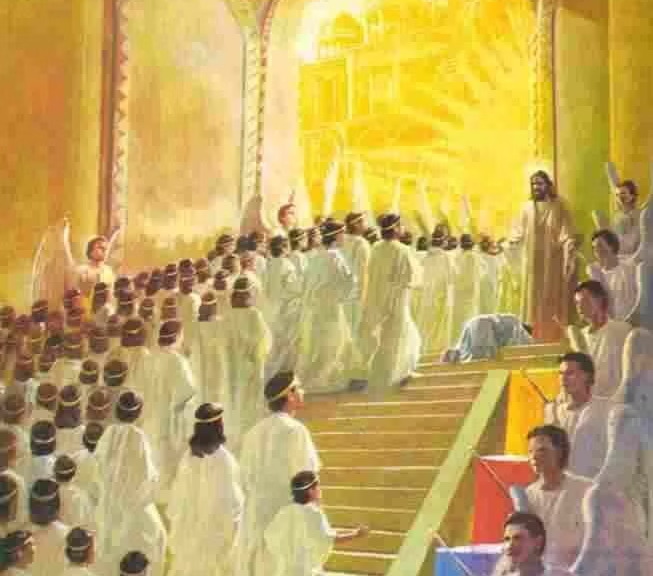
1 elohim takes his stand in the council of heaven; *
he gives judgment in the midst of the elohim:
2 “How long will you judge unjustly, *
and show favor to the wicked?
3 Save the weak and the orphan; *
defend the humble and needy;
4 Rescue the weak and the poor; *
deliver them from the power of the wicked.
5 They do not know, neither do they understand; they go about in darkness; *
all the foundations of the earth are shaken.
6 Now I say to you, ‘You are elohim, *
and all of you children of the Most High;
7 Nevertheless, you shall die like mortals, *
and fall like any prince.'”
8 Arise, elohim, and rule the earth, *
for you shall take all nations for your own.
——————–
Please note that in four places in the presentation of this Psalm 82 the word translated as “God” has been removed, with it replaced by the true Hebrew word written. That word is “elohim.” If you look at the NRSV translation which have verse one sing, “God takes his stand in the council of heaven; he gives judgment in the midst of the gods,” the exact same word – “elohim” is translated both as capitalized in the singular [“God”] and in the lower-case plural [“gods”]. The truth of “elohim” is it is the masculine plural form of the noun that is “el” in the singular. Because “elohim” is translated truthfully as “gods,” it cannot be anything else in translation. However, when one connects “Yahweh” to “elohim,” as appears eleven times in Genesis 2, the word means [per David’s usage and all others] the internal extension of Yahweh that is His Son resurrected in David. Because that same divine soul is not limited to only being reborn in one human soul in its flesh, all who possess [are possessed] by Yahweh’s Son have the same “elohim” within each soul that is a wife to Yahweh. Thus, the meaning of “elohim” at all times found written by David is his divine soul that lords over his natural soul, controlling his actions as a servant of Yahweh.
Not part of the translation, but the introduction to verse one is written: “miz·mō·wr , lə·’ā·sāp̄” or “a psalm , of asaph.” The word (or name) “asaph” means “Gatherer, Collector,” which identifies this psalm of praise to David being led to write divine inspiration in a song, designed to “gather” and “collect” all souls who would become equal servants of Yahweh. This “gathering” is then relative to the use of “congregation” in verse one [“ba·‘ă·ḏaṯ-’êl” – “in the congregation of the divine”], where the divinity of such a “collection” of souls is due to each having a Yahweh elohim leading them to righteous ways. Therefore, the whole of this Psalm 82 must be seen in that light of purpose.
Verse one [without the intro] literally translates into English singing, “elohim , taking his stand in the congregation of the divine , from inward parts [in the midst] elohim he will judge .” The separation of “elohim” from the second segment of words shows that “elohim” can actually be connected to the word “asaph,” where the introduction says, “gatherer elohim.” This then says it is the “elohim” that is the agent of “gathering” or “collecting” together. This then leads from that statement of “a gatherer elohim” to the second segment saying, “taking his stand in the congregation of the divine.” In that, the statement of “stand” says the common presence of an “elohim” is what makes a “collection” all become ‘upright,” where the “stance being taken” is that of “the divine.” Therefore, a gathering of souls possessed by Yahweh’s elohim Son becomes “divine” extensions of Yahweh, as His Son reborn. The third segment saying, “from the midst” means “from union made with each soul” that makes up this “divine congregation.” As the Lord of each member of that “divine congregation, each will act accordingly to how the “elohim will judge”.
Verse two then literally translates into English singing: “until when you will judge unjustly ; with face of the wicked , you will suffer selah .” In this, a question mark is shown in translation, as implied by the written text. The question mark should be intuited as a question that asks, “Why would a soul wear the face of the wicked and suffer punishment?” The addition of “selah” then says, this is a fact that comes from the “exalted,” which is Yahweh. The point of verse two is to state that all of those “gathered” and “collected,” who will be souls with “elohim” added through “divine” marriage to Yahweh, they will be a “divine congregation” that once was a scattered mass of single lost souls. All who are “collected” to become led by “divine elohim” will once have “judges” others “unjustly,” while wearing the “face” of a demon spirit [bad possession], setting those souls on a path of eternal destruction. Thus, “Why would any soul do that?”
Verse three then literally translates into English as: “they [souls possessed by elohim] judge the weak and orphaned ; the humble and needy to be righteous .” This says the answer to the question is found by those souls who reach rock bottom and realize they have created their own plight, due to having worn the “face of wickedness.” The souls that will receive a marriage proposal from Yahweh, to be reborn as His Son, are those “judged” as having recognized the “weakness” of a soul alone in its flesh [or those possessed by demons], because they have become lost and far from the Father, their Creator. Those souls who “humble” themselves before Yahweh, prostrating their souls in submission to His Will, will then express their “need” for divine guidance. They will request [through sincere prayer] to be led by Yahweh’s elohim to a life of “righteousness.”
Verse four then literally translated into English singing: “they [souls possessed by elohim] rescue the weak and needy ; from the hand of the wicked they save .” Here, again, the masculine plural indicates the masculine presence of the spiritual realm within souls trapped in flesh, transforming the “weak” feminine [the world of death] into souls “rescued” from that end. The one’s “rescued” are thos expressing “need” for divine assistance. Having once been wearing the “face of the wicked,” the demonic “hand” [Satan] that possessed spiritually through manipulation is cast out, no longer allowed to hold onto those souls. That removal and repossession by the divine elohim “saves” those souls.
Verse five then literally translates into English saying, “not they [saved souls] know ׀ nor will they [saved souls] discern , from darkness they [saved souls] come ; they [saved souls] are shaken all foundations of the earth [flesh] .” Here, the masculine plural is again “they,” as those souls who have received the masculine “elohim” from their “rescue” from Yahweh [divine marriage], but the souls themselves that have been “saved” have absolutely no “knowledge” how to “save” themselves. It is impossible without Yahweh. This then says no soul in a body of flesh can figure out how [“discern”] to “escape” from the “darkness” that reflects the death the paths they are on leads them to. They are “saved” by choosing to sacrifice their souls as the lords over their flesh, so they willing submit to Yahweh’s Will and “come” to Him on their knees. They do not make this choice because their ‘Big Brains’ have figured out it is more profitable to serve Yahweh, because a ‘Big Brain’ would refuse to sacrifice itself as the lord over a body of flesh; it would not allow the “elohim” of Yahweh to possess their souls. Only from utter and complete despair, having become “shaken completely,” do they beg Yahweh for help. The “foundations of the earth” say the prison that a body of flesh makes for a soul have been so “shaken” that the soul is promised eternal salvation after the remainder of life on ‘earth” is done as Yahweh’s servant.
In this verse, the vertical bar reflects the transition point of importance, where “knowledge” is a personal awareness of God and prophets and Sons of man, including Adam and Jesus. All of this is known; but that “knowledge” does nothing more than have a soul in the flesh be misled by false shepherds, who offer simplicity that says salvation comes from religious affiliations and checks written to prove one’s commitment. The vertical bar says most souls who become “saved” “know” of God and Jesus and “know” of Scripture; but they have never taken the time to “discern” the truth. This relates to the “wall” of Amos, which is not plumb. No one can “discern” the truth from “written law” that is in such disrepair that the teachers do not “know” what the truth is. They are ignorant of the truth because their souls have denied Yahweh in divine union; and, none of the leaders have been resurrections of the soul of Jesus, so they are led as Saints to teach the truth so others can be saved.
Verse six then literally translates into English to sing: “I say elohim you [all] ; and sons upon high you [all] entirely .” In this, the use of “they are shaken all” in verse five is implied in the second-person masculine plural here, in “attah” [“you”] and “kol” [“the whole”]. When the first-person pronoun “I” is used to begin this verse, each and every soul possessed by the Yahweh “elohim” that is Adam-Jesus then speaks in that name, as “I.” Because none of the saved souls have “knowledge” or an ability to “discern” for itself, the identification m of “I” says the “elohim” within “says” what the soul-flesh speaks. They (“you [all]”) have become ‘in the name of Jesus” – each a Christ, through the outpouring of Yahweh’s Spirit [His Anointment] on each soul’s ‘wedding day.’ By speaking ‘in the name of Adam-Jesus’ [elohim], all souls in this “gathered congregation” have become “sons upon high,” with “sons” being a designation of the masculine possessing “elohim,” where this possession takes place within souls of both genders in the flesh.
Verse seven then literally translates into English to say: “surely like Adam you [souls possessed divinely in bodies of flesh] you [all] will die ; and as one of the princes you will fall .” Here, the Hebrew construct “kə·’ā·ḏām” can be translates as saying, “like man,” which becomes a statement that all souls born into a body of flesh [males and females] are “humans.” In the same way that Adam was made by the hand of Yahweh and given the soul of an eternal and multipliable “elohim,” that soul born as a “human” on earth [outside Eden] died (after nine hundred thirty years). No “human” can escape the death of its flesh. Where the second segment places focus on “one,” which is then the singularity of Adam-Jesus, as THE soul of Salvation, made by Yahweh for that purpose, Adam was the first of man “princes” that have been saved by submitting their souls to Yahweh and being fused with the “one” soul of Salvation. In this way “princes” can be read as ‘Saints.’ In the same way that Adam “fell” to the earth, so too did Jesus “fall” to the crucifix the Temple Jews forced the Romans to use. This can then be read as the remainder of one’s life in a body of flesh, after having submitted sone’s soul to Yahweh and received His Son’s “elohim,” life becomes the endurance of persecutions by those who reject any soul finding Salvation. That pits the Son of “man” against the sons of “man,” who have sold their souls into demonic slavery.
Verse eight then literally translates into English singing: “[all] you [souls] arise elohim your judge the earth [flesh] ; for you [individually] you will be taken possession , in all peoples .” Here, the command sings as David the “gatherer” of souls to join the “divine congregation.” His recommendation [as the voice of Yahweh elohim within his soul] is “all souls to “arise” and “take a stance” through self-sacrifice to Yahweh, being “possessed” divine by His “elohim.” That command becomes “your judge,” where all the sins of your “flesh” [ “the earth” that imprisons a soul] can only be erased by the divine Baptism of Spirit that comes when one’s soul joins the “divine congregation.” Each individual soul [“you” personally] “will be taken as the possession” of Yahweh, as His wife-soul. As His wife-soul, “you” personally will give spiritual birth to the soul that is the Son of Yahweh – His “elohim.” It is that possession that keeps one’s soul forevermore clean of sin. This is not a circumstance where many people can herd together and say, “Jesus will save us,” where only Jesus was possessed by Yahweh’s elohim. Each and every soul born into human flesh has to make the same commitment to marry Yahweh and serve Him for the remainder of one’s eternal life; or, find the eternal punishment of rejecting His offer of Salvation.
As the accompanying Psalm to the Track 1 Old Testament selection from Amos, this is David singing praise for the same Salvation that all souls must find. Under David, the nation he led followed his lead to commit their souls to Yahweh and become true “Israelites” – those Who Retained [possessed by] Yahweh as one of His elohim. When Jesus responded to the question about an “inheritance of eternal life,” the only “inheritance” human beings find is the death their souls have become imprisoned by. The illusion they call ‘life,’ is merely souls walking the path to death and judgment. Jesus was sent to save the lost souls of Yahweh. If you are to be one of those saved, then you must learn the truth sung in this song of praise that David wrote, while inspired divinely by his elohim.


 Explaining the Readings