
Jesus began to teach his disciples that the Son of Man must undergo great suffering, and be rejected by the elders, the chief priests, and the scribes, and be killed, and after three days rise again. He said all this quite openly. And Peter took him aside and began to rebuke him. But turning and looking at his disciples, he rebuked Peter and said, “Get behind me, Satan! For you are setting your mind not on divine things but on human things.”
He called the crowd with his disciples, and said to them, “If any want to become my followers, let them deny themselves and take up their cross and follow me. For those who want to save their life will lose it, and those who lose their life for my sake, and for the sake of the gospel, will save it. For what will it profit them to gain the whole world and forfeit their life? Indeed, what can they give in return for their life? Those who are ashamed of me and of my words in this adulterous and sinful generation, of them the Son of Man will also be ashamed when he comes in the glory of his Father with the holy angels.”
——————————————————————————————————–
This is the Gospel selection from the Episcopal Lectionary for the second Sunday in Lent, Year B. It will next be read aloud in church by a priest on Sunday, February 25, 2018. It is important as it quotes Jesus, who said to those following him that to live for reincarnation is folly, when one can only be assured of eternal reward by setting one’s goal towards the divine.
The accompanying Old Testament selection is Genesis 17:1-7 and Genesis 17:15-16. The first set of verses includes God telling Abram, “I am God Almighty; walk before me, and be blameless. And I will make my covenant between me and you, and will make you exceedingly numerous.” As that reading continues, God added, “No longer shall your name be Abram, but your name shall be Abraham.” The last two verses then has God telling Abram, “As for Sarai your wife, you shall not call her Sarai, but Sarah shall be her name. I will bless her, and moreover I will give you a son by her.”
The accompanying Epistle choice is Romans 4:13-25. Paul there referenced the covenant God made with Abraham, saying, “For the promise that he would inherit the world did not come to Abraham or to his descendants through the law but through the righteousness of faith.” In his conclusion to this selection of verses, Paul wrote, “Now the words, “it was reckoned to him,” were written not for his sake alone, but for ours also. It will be reckoned to us who believe in him who raised Jesus our Lord from the dead, who was handed over to death for our trespasses and was raised for our justification.”
As always, the accompanying readings feed the lesson that rises from the Gospel. In the lineage of Abraham, his “exceedingly numerous” descendants are Christians. Jews and Gentiles who deny Jesus as Christ can only claim to be rightful heirs through law, which can be understood as genetics. Neither Moses nor Mohammed lead souls to God, as they only lead them to words. Christ is the only way to understand how to walk before God Almighty and be blameless (sin free). Jews and Muslims (of all branches, sects, and religious groups) are not descended from Abraham as the spiritual children of the same Father, cleansed by the Holy Spirit.
Thus Paul wrote, “If it is the adherents of the law who are to be the heirs, faith is null and the promise is void. For the law brings wrath; but where there is no law, neither is there violation.” The wrath of the law is the confrontation that exists today between Zionists Jews and Palestinians (children of Esau?) and Judeo-Christians and Muslims (children of Ishmael?) and the secular tyrants in the Middle East and the temporal rulers of the West (children of Cain?). Legalities in dogma are why Protestants hate Catholics and evangelical Christians cast condemnations at orthodoxy. The law will never be able to justify irreconcilable differences, where “faith” is defined by laws.
We can see this in the reading from Mark, when Jesus (a Jew) said that he would “be rejected by the elders, the chief priests, and the scribes, and be killed.” There was obvious conflict between the ruling elite Jews and ANY MAN who went around making people think he was the Messiah (Jesus was not the only one doing that then). For a common Jew to claim he was more special than any of the “elders, chief priests, and scribes,” he was denying the law that Abraham’s descendants were all promised favor. The punishment for denying favor to all Jews (those who turned a blind eye and deaf ear to the illegitimacy of Ishmael, the denied birthright to Esau, and rejected any rights of claim by those turncoats called Samaritans) was heresy or sacrilege, due punishment and death (coaxed out of the polytheistic Romans).
Even Peter, whose name means “Rock,” a name given to Simon by Jesus, was reflecting as one who was diametrically opposite of the elders, chief priests, and scribes, as a mirror image of the same corruption. When Peter confessed to his biographer Mark, “I took Jesus aside and began to rebuke him,” because he was saying God’s favored people were capable of doing evil, Simon Peter thought he was doing God’s work. However, Jesus would have none of that insolence.

Jesus not only knew that Peter was not yet cleansed of his worldliness, but so too was everyone else standing around varying degrees of unclean. All were hanging on Jesus’ every word, because they wanted to be clean. While Peter had pulled Jesus aside for a private scolding, Jesus would make an example of Peter, who was seen by the disciples as the cream of the crop – the best right hand man the Son of Man had.
It must have sucked the wind out of Peter’s chest when he heard Jesus say loudly, “Get behind me, Satan! For you are setting your mind not on divine things but on human things.” Imagine thinking one’s religious devotion was reason for a personal denial of filth, only to be told one needs a holy bathing. Jesus did that to Peter. However, the jab was not solely directed to one person alone.
That command was meant “to teach his disciples.” It was meant to be proclaimed to the “elders, high priests, and scribes.” It was meant for anyone who would “follow” Jesus to hear how close Satan was to their hearts. Thus, Jesus continued by commanding, “If any want to become my followers, let them deny themselves and take up their cross and follow me.”
I have addressed this prior, in sermons and notes on the Matthew account of this event (16:21-28; Proper 17, during the season following Pentecost, Year A), where the crowd listening to Jesus (including his disciples) heard, “aratō ton stauron autou.” Whether spoken in Aramaic, Hebrew or Greek, those present heard Jesus tell them to “raise up your stake.” A “stauron” would not have registered as a Roman crucifixion device (being “nailed to a tree” required no lifting and carrying). It would, however, be heard as those wooden crosses that vineyard owners used, which often leaned over to the ground when the grapes were growing full.
If you want to see the reality of impact that a parable told about servants hired to work in an owner’s vineyard, most of the people following Jesus had been there, and done that. They had stood on the town corner before, waiting for an owner’s servant, a field master, to come looking for workers to straighten up the wooden supports in a vineyard, so the grapes would not be eaten by ground animals. None of them had spent a Wednesday hiking up to Golgotha, just to watch the misery of a Jew being crucified, even if they knew the poor man being executed. Heck, the disciples didn’t even show up to watch Jesus be hung on the cross. They skedaddled out of fear. Raising grape crosses, however, they understood.
So, even though they might have heard “follow me” and thought, “Form a line behind Jesus,” the followers of Jesus knew Jesus had just called them all out for not being righteous enough. The reference to “Satan” helped in that regard. So, even the slow-witted ones figured out that “raise up your cross” was metaphor for them being the fruit of a Jesus grapevine, so they were never allowed tohang to the ground, where Satan could find an ear and influence the brain attached to it, like he did Cain, and like he did the elders, high priests, and scribes of Jerusalem, plus most recently Simon Peter.
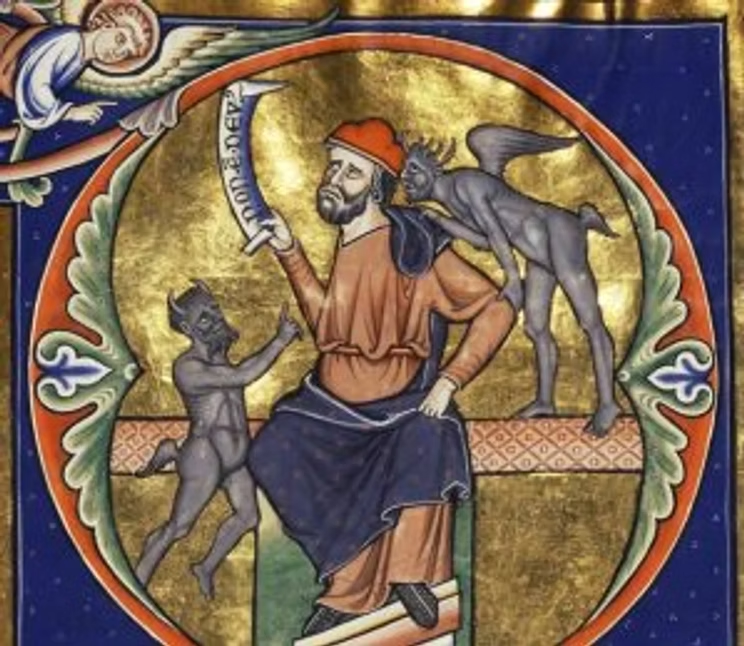
I know I talk a lot about reincarnation, which many American Christians shudder at the concept of not having one death be the final parting of a soul from a body, with anyone having a cross placed on their tombstone automatically allowed into heaven. The thought of good ole granny or mom being recycled back to earth just makes people nervous.
Mainly, that anxiety is because 99.9% of the population has a skeleton closet that is crammed full, including new memories one is ashamed of. Any thought that God will judge one by their sins is quickly forgotten when one presumes that how much money one gives to charity and how much one bakes cakes for the church fundraisers will make all the dirty little secrets and white lies be outweighed on an imaginary set of Justice Scales.
That becomes a gamble. Gamblers have a town in Nevada set aside for them (one big name) that is known for odds and games of chance. To think God will forgive is akin to praying to the gods of chance, where people see their souls stacked up neatly on a roulette number that says, “God forgives” or “Jesus saves.” Hope is all about that little ball landing in one of those slots.
The odds for winning that bet are slim, simply because there is nothing ever said by Jesus that promotes sin of any kind. To “love one another” does not mean sin with everyone, or bless the sins of another.
We get a good glimpse at the indirect statement that Jesus made about reincarnation, when he said, “those who want to save their life will lose it.” Anybody that wants to save a human life (his or hers, the only body one possesses) means someone who wants Jesus and God to forgive how much one keeps for oneself, despite all the pretense of giving.
A good example of how well this “give a little, keep a lot” plan works is found in Acts 5:1-11, which is the story of Ananias and Sapphira. Both of them wanted to “save their life” by keeping “some” of the price they received, when they sold land they owned; but they lied by saying they were donating the whole amount to the church. Both of them “gave up the ghost,” as soon as Peter questioned them about it (Peter was speaking through the knowledge of the Holy Spirit, not from sending out spies to make sure the church was well funded).
By knowing that story, one can see the prophetic nature of what seems like rhetorical questions, “For what will it profit them to gain the whole world and forfeit their life? Indeed, what can they give in return for their life?”
The answer is Ananias and Sapphira could have kept everything – their land or all the money they got for selling that land. No one forces anyone to say I am a Christian; but anyone who uses the name of God in a lie (“Christian” stems from “Christ,” the Holy Spirit of God that was in His Son Jesus) is going to die a normal mortal death and be recycled back in another human form. God forgives normal sinners by letting them try the world thing again, so maybe those souls will figure it out one lifetime.
“Crap out! Better luck next time. New roller [symbolic reincarnation]. Place your bets,” says the boxman [symbolic of a mortician].

Perhaps the most important message Jesus told (in this story) is at the end. He said, “Those who are ashamed of me and of my words in this adulterous and sinful generation, of them the Son of Man will also be ashamed when he comes in the glory of his Father with the holy angels.” Think about what that says.
<Jeopardy theme music plays during a moment of pause>
Someone who would be ashamed of Jesus can only be one [someone’s name here] who thinks he, she, or it is better off by being oneself, rather than BEING JESUS CHRIST REBORN in one’s [someone’s name here] fleshy body.
“Golly gee! I made millions over a lifetime. People look up to me! Am I supposed to give all that up and be like that rolling stone Jesus … who the important people detested?” says someone who would be embarrassed being Jesus.
In the accompanying Genesis reading, Abram became Abraham and Sarai became Sarah. They were the same bodies, but their names were changed to denote a new Spiritual presence within them. Their barrenness was taken away; and although that meant the birth of Isaac in the physical realm, it meant their sacrifice of self would beget innumerable descendants who would also be changed by the Holy Spirit, through a deep commitment to the One God. They were the precursors of the Christ Spirit in human beings.
Believe me when I say that the ones who ARE reborn as Jesus Christ AND thank God for that Spirit within them … nobody knows who they have changed into … no one can see the changed name they became. They are not ashamed to serve others. They gladly do so without fanfare, news articles, or golden awards of recognition. They don’t ask people to guess who they have become.
Anyone who is promoted as “a great man” … by the popularity they command, the books they have sold, or the charisma they use to melt the will of others … most have secretly had Satan wrap his arm around their shoulders, saying, “See. I told you all this could be yours.”
Jesus only became famous because he rose from the dead, and the Jews deny that ever happened, saying his disciples stole his body. Jesus did not return and appear as Jesus for the whole world to see and marvel at. Nope. Jesus returned as a gardener, as a stranger on the road to Emmaus, and as an old man by the sea.
He appeared as the Jesus the disciples knew, so he could teach them and then return in them, in unknown form as one Apostle after another, with nobody recognizing any of them as Jesus Christ. That is how “the Son of Man … comes in the glory of his Father with the holy angels,” … as Apostles … as Saints … those who welcome the sacrifice of self, have a deep-felt love of God, and know the reincarnation of the Christ Spirit in them leads them to eternal bliss, not a recycling into the worldly domain.
Those who are ashamed to make that sacrifice, because the here and now smells and tastes so sweet, looks so richly beautiful, and feels so comforting to put on, are keeping “some of the profits for themselves;” and Jesus Christ is ashamed of them because they call themselves Christians.
Don’t lie about loving God and Christ, while holding back some possessions for self. Things make sacrifice so difficult to commit to a loss of self power … just admit it. Being ashamed of Jesus means not truly being a Christian.
In this season of Lent, where the test is one’s willingness to sacrifice and be ALL IN, realize that it is hard to be all in when you have a lot to lose … real or imaginary. ALL IN is the only way to survive forty days of testing, because anything less will bring failure. However, when one puts everything on the table with absolutely no worry about losing things, then the saying goes, “It is not gambling if you can afford to lose.”

One’s Personal Lent can only come when one is truly ready to be tested, knowing failure is impossible. Sadly, some people have to be afflicted with sores all over their bodies, or become blinded from seeing the world as a place of beauty, or be crippled and made incapable of running to grab as much booty as one can, before they can beg for divine help. When destitute and poor, it is easier to give all one has left … a life … to God. Then one might be ready to serve God wholly, gladly letting the ego die.


 Explaining the Readings