
Tag Archives: Romans 8:12-17

Romans 8:12-17 – Heirs of God and joint heirs with Jesus as the Anointed

So then, brothers and sisters, we are debtors, not to the flesh, to live according to the flesh– for if you live according to the flesh, you will die; but if by the Spirit you put to death the deeds of the body, you will live. For all who are led by the Spirit of God are children of God. For you did not receive a spirit of slavery to fall back into fear, but you have received a spirit of adoption. When we cry, “Abba! Father!” it is that very Spirit bearing witness with our spirit that we are children of God, and if children, then heirs, heirs of God and joint heirs with Christ– if, in fact, we suffer with him so that we may also be glorified with him.

——————————————————————————–

This is the Epistle selection from the Episcopal Lectionary for the First Sunday after Pentecost, Year B 2018. This day in the lectionary schedule is also known as Trinity Sunday. It will next be read aloud in church by a reader on Sunday, May 27, 2018. It is important as Paul wrote of the debt all human beings owe to the Father, which has to be understood as beyond the time we spend on earth in the flesh.

Again, it is modern paraphrasing that identifies “sisters” in the above translation. Paul wrote, “Ara oun , adelphoi  ,” which says, “So then  ,  brothers”.  This states the result of (“So then”) what Paul had stated prior (Romans 8:1-11), with that now being “brothers.”  Because one has to believe that Paul wrote divinely (not just as some ordinary guy), every word he wrote has divine purpose, which should not be overlooked.  Therefore, “brothers” must be understood, rather than slap “sisters” to that word.

The word “adelphoi ” is set alone by commas, placing importance on its meaning.  It is a stand-alone statement of “brotherhood,” as “brothers” or “brethren.” The word “adelphoi ” says nothing about “sisters.” The Greek word “adelphé” means “sister” and “adelfés” says “sisters.” The exclusivity of women is NOT the point of what Paul wrote.  It should be read as a word similar to “mankind,” which includes all human beings under one heading.

By placing commas around the plural form of the word “brother”, Paul was placing emphasis on the relationship ALL Christians share. Both men and women are “brothers”, as “Sons of God”, because they ALL have been reborn as Jesus Christ. By adding the word “sisters,” the glaring differences between males and females is entered into the interpretation erroneously.

It is unnecessary, as ALL Christians are the wives of God (regardless of human gender), just as ALL Christians are reborn as the Son of God (regardless of human gender), making ALL Christians be brothers of the same Father.  One must get beyond the modern training that gender be given equal status, because that is only a distraction away from the truth.
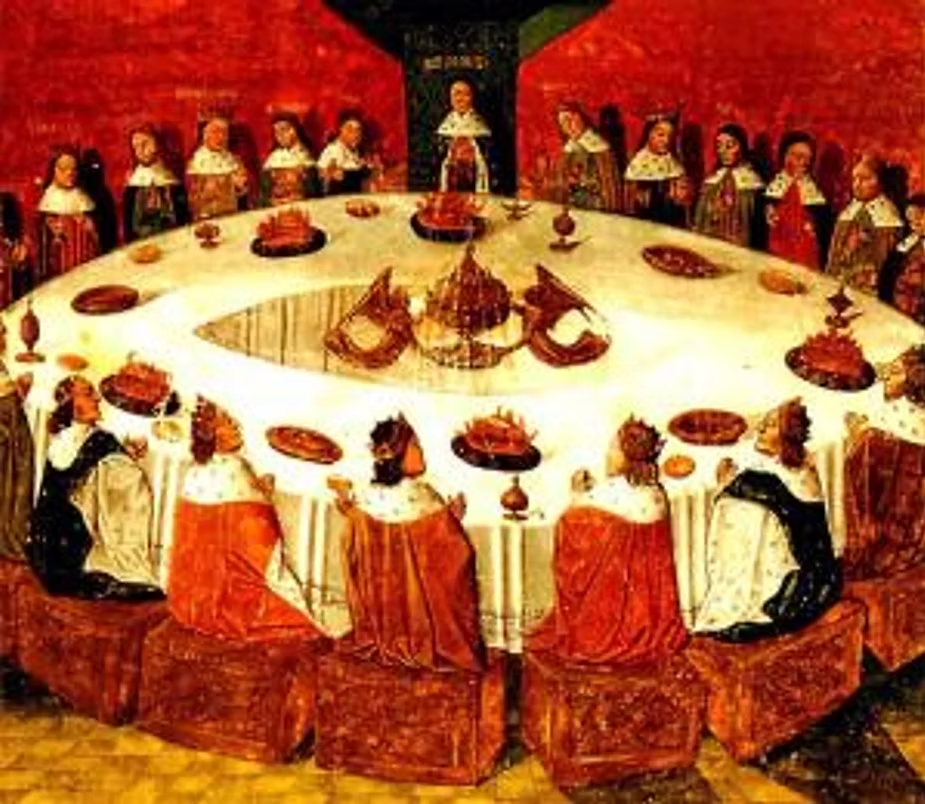
The same qualifications for a knight of the round table are the same for a Saint.

Seeing “brothers” as ALL who are related spiritually, one should then see this familial relationship with the Father as being what makes one a debtor. Thus, following the pause of a comma after “brothers,” this becomes stated as “we are debtors” (literally “debtors we are”).  This makes “debt” be relative to this announcement of “brothers.”

From that realization, Paul discounted how “brothers” were “not to the flesh.”  From this statement, one must grasp how it is the “flesh” that differentiates a man from a woman.  Thus, it is the “flesh” that separates “brothers” from sisters. This statement says (in essence): “Do not mistake “brothers” as saying “brothers and sisters,” because the debt owed has nothing to do with one’s sexuality on the earthly plane.

When Paul wrote, “If you live according to the flesh, you will die,” this was reference to all mortal human beings, who come in the shapes and forms of men and women, males and females. The only reason souls are incarnated (reincarnated) in different shapes and forms is to reproduce. Souls cannot reproduce souls, as souls are immortal, thus asexual by nature. The flesh reproduces so souls can be reincarnated.

To put that in gender terms, souls are masculine “energy,” while bodies (regardless of human gender) are feminine “energy.” God can be seen as masculine, as the Father, whereas the Earth is called a Mother.  In this sense, my use of “energy” should be seen as non-physical, but a compatibility, such as is positive and negative.  It is similar to the notion that opposites are attracted to one another, as compliments.

Thus, the feminine flesh of a baby (regardless of human gender) is penetrated by the masculine soul.  The flesh of the baby receives that breath of life.  The soul’s asexuality then aligns with the human gender, based on the flesh.  This union then stimulates an innate drive to procreate. That innate drive is a need of the flesh, because the flesh knows it is temporal and must reproduce to continue the possibility of life returning to the worldly plane, as returning souls need flesh to inhabit.

The aspect of “the Spirit,” as translated in verse 13, where we read, “If by the Spirit you put to death the deeds of the body, you will live,” is inaccurate.  The Greek actually shows “pneumati” in the lower case (“πνεύματι”). This is then a reference to “the breath” of life, which is the entrance of a “soul” into a form of flesh. A “spirit” that is a soul is eternal; but a returning soul into a form of flesh is not commonly holy.  There are exceptions, such as Jesus, born of a woman.

Verse 13 is also divided by commas, where the better translation can make this lack of holiness more evident.  Literally, the verse states, “If however the breath (wind, soul spirit)  the deeds of the body you put to death  you will live.” This is not a statement of God’s reward to a soul of eternal life, but a promise of reincarnation to a soul.  Reincarnation is a new “breath of life” in human form.  Still, that “spirit” of life brings about the opportunity to achieve eternal life – IF the normal deeds (normal “doings, acts, functions”) of a body of flesh lead an eternal soul to lose its host body (a mortal death).  If a soul directs its body wisely, then it will be reborn into a new body of flesh (i.e.: a newborn baby).

The condition (the “IF”) is then based on the soul somewhat controlling the actions of a body. This admits there will be sins accrued that will prevent the reward of everlasting return to the Father, but enough good deeds will have been done to warrant another chance on the physical plane.  It is just as do not punish a first grader to hard labor in the fields for failing to make the grades that would allow it to go to the second grade.  We also do not graduate straight A first graders to the college level.  This is a mirror of how much is required to be one with God again.  However, should the soul allow the body (by evil influence) to earn itself eternal damnation, then the soul will not find new life in human form. This is the proverbial “Hell.”

When Paul then wrote, “For all who are led by the Spirit of God are children of God,” the capitalized version of “Pneumati” was written (“Πνεύματι”). This is then a reference to those of humanity who are led by the Holy Spirit. The translation of verse 14 shown above, as using the neuter gender word “children,” actually states “huioi,” which means “sons.” The proper translation here then supports the initial claim of being “brothers,” as now the presence of the Spirit  makes one be identified as “son of God.”

This parental relationship with God is then stated as a relationship that reproduces the Son, Jesus Christ.  This masculine association also means the “Spirit,” which is masculine in nature, has caused this relationship to be. Since this masculinity is asexual, there is no sexuality implied by being “sons of God.” Spirits and souls have existed from the Creation and have no need (no ability whatsoever, for that matter) to reproduce.  This is, again, the masculine “energy” of Spirituality being within the feminine “energy” that is a human body.

Angels are neither male of female, in the sense that human beings are. Angels have no sex organs, which includes breasts that would only have a human purpose, such as to nurse babies.

It is then important to see how there is no capitalization of the word “spirit” in verse 15, where we read above it stating, “For you did not receive a spirit of slavery to fall back into fear, but you have received a spirit of adoption.” When one realizes the difference between the “spirit” of life (God’s breathing an eternal soul into flesh) and the “Spirit of God” (the Holy Spirit), then one can see how this translation is saying the renewing of a soul into flesh, giving that flesh life, is not done by God so that the soul will enter into a state of “slavery,” which is an addiction of the flesh to sin.

The reborn soul (reborn into new flesh) is meant to lead the flesh to serve God, not to “fall back into fear,” where “slavery” is to Satan and his material realm. Instead, a soul, as an extension of God that needs redemption to return to God, is placed back into new flesh so it can lead the flesh to “receive a spirit of adoption.” One is adopted by God when one is reborn anew (the transformation of the same soul in the same flesh) as Jesus Christ.

One is not adopted prior to birth into the flesh.  One is adopted after one has lived enough life to understand sin and experience guilt from sin.  Then one has to petition for adoption by repentance for the sins one feels remorse from.

That represents a spiritual change within, which means one’s whole being (soul in flesh) opens to God, through acts of repentance.  One becomes active in learning the messages of holy Scripture.  When one has proved to God one’s sincerity for seeking atonement, the love of God will enter one’s being.  The result of that union brings about a reproduction of the Son of God, so one is truly in the name of Jesus Christ.  True Christians are then those who become the “brothers” of all other Saints on earth (regardless of human gender). Until that transformation takes place, one is “a spirit to slavery” that all human beings are, since the soul is a slave to the flesh, just as the flesh is a slave to the soul.

Human beings are slaves to mortality. The only way to break those chains is through Jesus Christ.

Where Paul wrote about “you have received a spirit of adoption,” here again is an overlooked statement about “brothers” and “sons.”  The Greek actually states “elabete pneuma huiothesias,” where the literal translation says, “you have taken hold of (or received) the spirit [lower case] of adoption as sons.”  The implication of divine adoption can be read into this, but not as total adoption, as the sons of God.  The lower case “spirit” is a statement that one’s soul has “received” or “taken hold of” the ways of righteousness, as far as one can do good alone.  This is how one shows oneself worthy to progress to that point of being “adopted as a son” of God.

Still, the form of the word making the statement about adoption is masculine, thus more properly translated as “adoption of sons.”  This can be seen as how God saw the disciples of Jesus of Nazareth, prior to their official recognition as sons of God on Pentecost Sunday, the day after Jesus ascended to the Father.  While The Acts of the Apostles places focus on the male disciples becoming “adopted sons of God,” it still must be assumed that women (such as Mother Mary, Mary Magdalene, Mary of Cleopas, and other females in the crowds who received the Spirit) were also adopted “sons.” Their female human gender was not a limitation on their adoption worthiness.

Paul then wrote, “When we cry, “Abba! Father!” it is that very Spirit bearing witness with our spirit that we are children of God.”  Here, both the capitalized and lower case versions of “pneuma” are used. That says that the Holy Spirit has made entrance into one’s soul (one’s spirit), causing a thrill of awareness overcome one’s being, such that it knows (“bearing witness”) the Father is in one’s heart center.

By saying “with our spirit,” this is the baptism of one’s soul by the Holy Spirit’s presence, so both become one. When that happens, all baptized souls become the “children of God,” where “children” is the correct translation, from the Greek “tekna.” The use of “children” comes with the understanding of asexuality, since both human genders are equally incapable of reproduction, therefore “children” is a word deemed neuter gender. The word “children” then also implies a lack of adult mentality, where “children” are dependent on the Father for learning.

The aspect of mentality is then found in Paul writing, “and if children, then heirs, heirs of God and joint heirs with Christ.” It says that the “children of God,” as “sons of God,” will inherit the knowledge of God, which comes through the Mind of Christ. It then lets one realize that this awareness that comes from being “children of God,” “inheriting” the Mind of God’s Son, allowing Christians to become “brothers” in Christ (regardless of human gender) is to realize the debts of sins being washed clean by the Holy Spirit then makes one in debt to the grace of God.

The Mind of Christ frees our spirits from thinking we are slaves to a mortal body that will die. The Mind of Christ frees our spirits from the fears of a mortal existence. The Mind of Christ is the realization that we are indeed “heirs” to the same Holy Spirit that was made man by God and sent into the world as Jesus of Nazareth.

This selection then ends with Paul writing, “If, in fact, we suffer with him so that we may also be glorified with him,” which again poses a conditional requirement.  This tells how one knows that one’s “spirit” has indeed been “led by the Spirit of God.” IF that condition has been met, then “we suffer with him.”  The word “sumpaschó” means “I suffer together with,” but this is synonymous with “sympathize.”  This means one suffers by knowing so many in the world are still blind to being adopted by God.

The Greek word “sympaschomen” states “we suffer together with,” which implies the Spirit of God, as one being with Jesus Christ. This says that the Mind of Christ is what enables one to withstand the suffering that causes others to lament.  Personally, one knows the same agony that one faces when denying the pleasures and comforts offered by a sinful world. Still, that experience of suffering is what proved oneself as worthy for adoption by God.

The bond of togetherness – one’s soul spirit with the baptism from the Holy Spirit having brought about the Mind of Christ – is what brings one the “glory of being together with” (“sundoxazó”) Jesus Christ. This is how one can claim to be in the name of Jesus Christ. This is also how ALL who are likewise baptized by the Holy Spirit are “brothers” in Christ, where ALL SAINTS also share the same “glory [from being] together with” Jesus.

As a reading selection for the First Sunday after Pentecost, where the ministry of Apostles has begun, symbolically having taken its first step, we must then see how this is called Trinity Sunday because the Father, Holy Spirit, and Son have been reignited in a soul. All who have this Trinity within them are then “brothers” as having been reborn as Jesus Christ.  Christians are those who have truly become the adopted sons of God (regardless of human gender).

This is the message of the accompanying Gospel reading from John, where Jesus of Nazareth tried to explain this necessary requirement for salvation to Nicodemus, only to see how easy it is to deny this message. The first step of ministry leads to many others, where the “glory of being with Jesus Christ” does not stop with one soul being saved – one’s own. Christian souls are saved for the purpose of sending Jesus Christ into the world, as one with oneself, to save others. The brotherhood of Christianity goes well beyond the limitations and divisions of mortal life on earth, where men and women are called to serve the LORD as His Son.


Romans 8:12-17 – Being a child of God demands self-sacrifice

So then, brothers and sisters [adelphoi brothers only], we are debtors, not to the flesh, to live according to the flesh– for if you live according to the flesh, you will die; but if by the Spirit you put to death the deeds of the body, you will live. For all who are led by the Spirit of God are children of God. For you did not receive a spirit of slavery to fall back into fear, but you have received a spirit of adoption. When we cry, “Abba! Father!” it is that very Spirit bearing witness with our spirit that we are children of God, and if children, then heirs, heirs of God and joint heirs with Christ– if, in fact, we suffer with him so that we may also be glorified with him.

——————–

This is the Epistle selection for Trinity Sunday, Year B, according to the lectionary for the Episcopal Church. It will follow the Old Testament selection from Isaiah, which says: “Then I heard the voice of the Lord saying, “Whom shall I send, and who will go for us?” And I said, “Here am I; send me!’” That will lead to the singing of Psalm 29, where David wrote: “The Lord shall give strength to his people; the Lord shall give his people the blessing of peace.” This reading will accompany the Gospel reading from John, where Jesus said, “And just as Moses lifted up the serpent in the wilderness, so must the Son of Man be lifted up, that whoever believes in him may have eternal life.”

Last Sunday – Pentecost – the optional “New Testament” was from Romans 8, verses 22 to 27. The translation into English was so bad, it was nearly impossible to listen to it be read aloud and come away with any idea about its meaning. I did an in-depth analysis of the Greek text and a remarkable reading appeared, full of life and truth. I said it was an example of what “speaking in tongues” was all about. This reading selection is so much clearer to grasp, it is funny to see that reading and this reading coming from the same chapter of the same epistle. Still, as Paul did not change course as to the purpose of his letter [stating the same thing twice, differently], the Christians churches today refuse to understand what Paul wrote here, which is vividly clearly stated.

The problem with modern translations is evident in verse twelve, where the words read aloud say, “brothers and sisters.” This was not written. The word written is “adelphoi,” which means “brothers.” On top of that, it is one word separated by comma marks, so it is an important one-word statement. The word is a masculine noun in Greek. While it is possible to expand the translation to say “member of the same religious community, especially a fellow-Christian” (Strong’s Usage), it still is masculine.

As a stand-alone statement, one needs to realize Yahweh wrote that word using the hand of Paul. To change a Word of Yahweh is heresy. Jesus said, “For truly I say to you, until heaven and earth pass away, not the smallest letter or stroke of a letter shall pass from the Law, until all is accomplished!” The same philosophy should apply to all Scripture.

The curse modern churches have to deal with these day [if not always] is women make up the majority of those who sit in the pews. They are the gender most delighted by the pageantry of church services [especially the music]. For as little as males contribute to churches [other than money], the women have married their churches, putting more effort in to being a ‘church lady’ than being a wife to their husband. A ‘church lady’ definitely is not married to Yahweh. That means few these days are marrying their souls to Yahweh and few these days are being reborn as Jesus – the Son of Yahweh.

The only reason for Paul to only address “brothers” was Yahweh and the Spiritual realm of heaven is positive-masculine-light, while all made of matter is negative-feminine-darkness. This means Paul was addressing all who had been reborn as Jesus, their souls Anointed ones of Yahweh. So, even the females in Rome who would read Paul’s epistle were Sons of Yahweh, brothers in Jesus. [Not of Jesus, in Jesus.]

When churches pander to paying customers and not work to deliver the message of Yahweh [an Apostle is a Messenger], sent through His prophets [all Scripture], they then reduce themselves to being hired hands [or worse] and they keep lost souls lost. Under such ineptitude in pastoring a flock, no one is led to get up out of a pew and enter ministry, filled with Yahweh’s Spirit, made Saints, appointed as new Christs in the name of Jesus. Whenever that is not happening, then churches are an impediment to salvation, not an assistant to that.

That aspect of being lost and then being found is stated by Paul, when he wrote “debtors we are.” Paul and other true Christians were indebted to Yahweh for having been accepted in marriage, as their souls had been promised eternal life. That promise is their debt, as it does not come with a “Just sit in a pew and I’ll do all the work” card. The debt a soul owes Yahweh for the promise of Salvation is devoted service. Service means entering ministry – the point of the longest season of the Ecclesiastical Calendar – Ordinary time after Pentecost.

As a debt, ministry is an expectation, not an option. The option is either the salvation of a soul or the freedom to serve oneself and come back again in a next life. Reincarnation is a ‘been there, done that’ all souls know. Over eons, it gets old. All souls know past failures; and, all souls know it is a gamble to roll the dice and see what will come next, because all souls know the next incarnation might not have all the luxuries one has enjoyed in this failed life.

When Paul wrote, “not to the flesh,” that says humanity is not indebted to Yahweh for having breathed in the breath of life [a soul]. Being born in the physical realm is actually one’s sentence from the failures of a life before. Because souls are eternal [like Yahweh, having come from Him], they must have flesh in which to exist, if their eternal souls have become dirtied by a past life in the flesh.

While Yahweh is the Father and Jesus is the Son and all that is heavenly is masculine, the soul is neuter gender, having to adjust to life in new bodies of flesh, which can be male or female, but always negative-feminine-darkness. Thus, a soul takes on the femininity of the flesh [matter], regardless of the human necessity for opposite sexes. Souls have no need to mate, but flesh does; because so many souls keep failing to return to Yahweh. There is no debt for being placed in a physical prison for a lifetime. However, that lifetime is when one should be working towards ‘earning freedom.’

That is the meaning of Paul writing, “to live according to the flesh.” The literal translation of the Greek says, “of this according to flesh to live.” The word “tou” [not translated] says “of this,” which reflects back on the debt of the flesh. The part that then adds “according to the flesh to live” is a statement that the debt has nothing to do with being in a body of flesh and calling that being “alive.” The soul is always “alive,” as matter [flesh] is always dead, such that a soul animating flesh gives the impression of dead matter having “life.” That description of “life” comes with no debt owed, as that is debt being paid for past soul failures.

Verse 13 then furthers this by saying, “for if you live according to the flesh, you will die.” Here, the literal translation rephrases this, as “if indeed according to flesh you live , you are about to die.” The nuisance of this says calling the flesh “living” means the neuter soul has become controlled by the feminine matter that a soul has animated. This can be attributed to the fleshy brain, which is a most complicated computer that receives influences from all spiritual sources. When Satan gains control over a soul, it has used the lures of sin [the worldly pleasures] as a way to convince the soul that the flesh equates to “life.” It does not, as matter [flesh] is dead without a soul, thus it is called “mortal life,” meaning the flesh concept of “life” “will die.”

The second half of verse 13 [following a semi-colon] says, “but if by the Spirit you put to death the deeds of the body , you will live.” In that, “Spirit” [as a capitalized word] is not written. The actual Greek states “pneumati,” which refers to the “soul,” which is the “ruach” from Yahweh [with “ruach” meaning “breath, wind, spirit]. Thus, in essence, Paul said this: “If you put to death the influences of the flesh over the soul , then you will live.” This means the self-ego [a fleshy brain sense of self-importance] must die, in order for the soul to be marriage material [with soul] for Yahweh. Such a self-sacrifice must be made first, to be considered for such a divine union [holy matrimony].

It is then in verse 14 that Paul capitalized “Pneumati Theou,” which means marriage to Yahweh and the union of “His Spirit” with one’s “soul” [lower-case “pneumati”]. Knowing that can only happen if one has “put to death the deeds of the flesh,” Paul then wrote [according to the NRSV]: “For all who are led by the Spirit of God are children of God.” Herein lies another ugly snake of translation, where the self- patronizing churches of modern Christianity take the Greek word “huioi” – which clearly states “sons” – and transform it into the uselessness of “children.”

This is not so much ignorance, as it is a complete lack of understanding the masculinity of divine Spirit, which means there is no one alive in Spirit in the places that now translate the Holy Bible. The churches have no Spirit in their hired hands, so [in fear of running off some old ladies with lots of inheritance monies to will to a church organization] they pander to worldly sex organs, not souls.

According to Strong’s, the word “huios” [singular number] translates as “son, descendant.” That means a translation as “descendants” would be somewhat more acceptable, with the caveat being “male descendants.” According to HELPS Word-studies, this is written about “huios“: “hyiós – properly, a son (by birth or adoption); (figuratively) anyone sharing the same nature as their Father.” When one’s soul [“spirit”] has joined with the “Spirit of God” [“Pneumati Theou – Yahweh’s Spirit], then one becomes a “descendant” that “shares the nature of the Father:” i.e.: a son. This is most important to grasp.

The literal translation of the Greek text of verse 14 says, “as many as Spirit of God are brought , these sons are”. There, “agontai” can translate as “are led, are guided, or are carried.” This is reference to marriage, where a bride is “led” down the aisle and given away by her biological father, given wholly to her new husband as the rightful owner. [I feel sorry for any feminists who are disturbed by that thought.] Once “carried away” by Yahweh, the new Husband of a soul [“spirit”], “these sons are.” In that statement, “eisin” is a statement of “being, “ as “are,” but the intent of that word is to say those souls have changed possession.

It is here that a mathematical symbol is inserted in the Greek text, which is a symbol that cannot be translated by translators; so, they ignore it. The symbol is called a left right arrow, which looks like this: ⇔. The symbol appears between two elements that are true, as “if true [to the left] then true [to the right]. It equally applies to statements that are false; but the point is to state the truth being equal. The two words this symbols appears between are: “eisin” and “Theou.” Thus, the change occurring to a soul [“spirit”] says the truth of “being” [“are”] is the truth “of God.” There, the genitive case says the changed “being” has become that “of God,” therefore that soul has been divinely possessed.

As for the explanation that “a son” is either by “birth or adoption,” Paul then wrote in verse 15 [NRSV]: “For you did not receive a spirit of slavery to fall back into fear, but you have received a spirit of adoption.” In that, twice the lower-case “spirit” is used, which means “soul.” In understanding this double statement of “spirit,” it helps to realize the purpose of marriage.

The purpose of marriage is not to legally have sex, to legally play together, to impressively show each other off to friends and family [like the modern concept of marriage has degenerated into]. Marriage is all about having babies. The marriage of kings would bring about witnesses to the consummation of that union, because the purpose was to have a womb generate a male heir. The etymology of the word “husband” means to be the head of a family [household], which means more than two.

The literal translation of verse 15 must address how it beginning with a capitalized “Ou,” which becomes an important statement of what is “Not.” It then says, “Not indeed you have taken hold of spirit of slavery again towards fear.” That segment of words says a human being has already received a “soul” [“spirit”] that is the slave to a body of flesh. That has already taken place, so marriage will not bring that condition about again. Yahweh, that soul’s [“spirit’s”] new Husband, is not going to impregnate that soul with another lost soul [“spirit”]. That would put two lost souls in one body of mortal flesh, so twice the fear of death would arise. That is Not the purpose of divine union [holy matrimony of Spirit and spirit].

The second half of verse 15 then literally says, “on the other hand you have received spirit of adoption as sons.” Here, the NRSV has conveniently omitted the “of sons” [from “huiothesias”] part. That matches its ineptitudes earlier [“brothers and sisters” and “children”]. Here, the “receipt of spirit” has to remind all Christians how the resurrected Jesus appeared to his disciples and “breathed upon them, saying ‘Receive Spirit Holy.’” Jesus appeared as a “spirit” [his “soul” appeared and spoke], so the “spirit” his disciples “received” was his. Even the women of Jesus “received his spirit” so they too were “adopted as sons” of Yahweh, as Jesus reborn within them.

This element of being Jesus reborn was the theme of the seven week [eight Sundays] Easter season. One was supposed to already be married to Yahweh [spirit to Spirit], so the little baby Jesus soul could arise in one’s flesh. The Easter season was all about being comfortable being Jesus reborn in one’s flesh, beside [but leading] one’s soul, as “brothers” in Spirit. Ministry cannot begin until that transformation has occurred and the truth says “I am ⇔ of God.”

Verse 15 then ends by saying, “When we cry, “Abba! Father!” That means only those “adopted as sons” can call Yahweh “Abba!” It says only those who have received the soul [“spirit”] of Jesus can likewise call Yahweh “Father!” One who has not been “adopted as sons” by Yahweh, because one’s soul still hides snugly within its flesh, fearing sacrifice of self and a commitment to servitude to Yahweh as His wife, reborn as His Son Jesus, those have absolutely no right to call Yahweh their Father. Their only father such souls can claim is the man who made a deposit within his wife’s womb, which Yahweh formed into your flesh, before breathing your soul into that prison you refuse to give up. Calling oneself “Christian” does not make Yahweh one’s Father. Only idiots think God is the Father to Red Chinese and Communist Russians [i.e.: all atheists]. One has to marry Yahweh [a commitment of soul], so one can be reborn in the name of Jesus Christ, in order to be adopted as a son of Yahweh – one’s Father.

Verse 16 then states [NRSV]: “it is that very Spirit bearing witness with our spirit that we are children of God.” Here, the Greek word “tekna” is written by Paul, which does translate as “children.” Still, this misses the truth contained in the words written by Paul. To begin, he wrote “auto,” which translates as “self.” The meaning must be realized as referencing a “soul” [a “self”] and not the body of flesh it animates. The body of flesh is either the son or daughter of a human father. It is the “soul” that must be “adopted as the son.”

Next, the literal translation says, “soul this Spirit bears witness with the spirit of us because we are children of God.” That says the marriage between a “soul” and Yahweh is “soul this Spirit.” By becoming one with Yahweh – as His wife – one “bears witness.” This must be seen as giving birth from that divine union, where the truth of “symmartyrei” is it says, “bears witness together with” [Strong’s], where the union of a Husband and a wife “bears” a child that becomes “witness” to that union.

This is then the meaning of the Apostles saying they “bear witness to the resurrection of Jesus,” because Jesus was reborn within each of them, from the union of their souls to Yahweh. That says Jesus reborn is “the spirit of us,” where “spirit” means the “soul” of Jesus having resurrected alongside [but reigning over] one’s soul. As such, all who are created by this Spiritual nature are “children of God,” as “adopted sons.”

This then leads to the last verse in this reading selection, which is translated to state [NRSV]: “and if children, then heirs, heirs of God and joint heirs with Christ– if, in fact, we suffer with him so that we may also be glorified with him.” The Greek text here includes two uses of “kai,” which designates importance to two words written. The NRSV translation does not know to recognize “kai” in that way, so it is best to literally translate that now.

This begins with a conditional statement: “if now children.” This is an implication as one of the “children of God,” which ended verse 16. The “if” condition says “Not” everyone will have been “adopted as sons” by marriage to Yahweh. The conditional says the decision to marry Yahweh is left up to each individual soul, with the freedom to be the “children” of earthly fathers then given.

Following a comma mark of separation, Paul wrote the word “kai,” which then places significant importance on the word “heirs.” The implication of the “if” is then “heirs,” but the importance of “heirs” is elevated, above that of worldly “heirs.” As an “inheritor,” it is worthwhile to realize the ancient tradition of firstborn males being sole inheritors of a father’s estate, which included inheriting the responsibility of the family of that father’s household [as a husband]. This should be seen as a divine birthright, but one that is completely dependent on the “if” one decides to be reality. The inheritance of the Father [who will never die] is His Son. This is then stated in the following segment of words, which say: “inheritors truly of God.”

This then leads to a next segment that begins with the word “synklēronomoi,” which means “joint-participants,” as “co-inheritors” or “joint heirs.” While this can only be possible from a soul joining with the Spirit of Yahweh, the “joint-participants” become the reality of divine possession, where there are two “souls” [“spirits”] possessing the same body of flesh. Both are inheritors of the divine guidance of Yahweh. One is the host soul and one is the soul of Jesus. Since Jesus is the Son of man, so too does the host “soul” inherit that title. Thus, both are “joint-participants now of Christ.”

This selection is given the title by BibleHub as “Heirs with Christ.” This reflects the refusal of Christians to accept any responsibility that comes from being oneself a “Christ” of Yahweh. It sets an expectation that Jesus will adopt those who profess to believe he is the Son of God, so all a Christian has to do is wait for Jesus to die again and let the lawyers come bearing free stuff. It sounds like the last name of Jesus was “Christ.” It sounds like the nickname Christians give to Jesus is “Christ.” All this belittles Yahweh, as if He has not choice in the matter of designating who, what, how many and why a soul other than Jesus of Nazareth [born in Bethlehem] can ever be “the Christ.”

Yes, there is only one Jesus and Jesus is “the Christ,” as the one prophesied [the Messiah], but those word “Christ” [“Christos“] mean “Anointed one.” Yahweh has the power to Anoint whomever He pleases; thank you very much for recognizing that power. Therefore, EVERY APOSTLE-SAINT THAT EVER LIVED – has been, is, and will forever be “the Anointed ones” of Yahweh, ALL REBORN AS JESUS … ALL THE CHRIST.

At that point, Paul wrote: “if indeed [another conditional] we sympathize together.” That means one’s soul “suffers” along with the soul of Jesus. Being the Son of man is hard work, albeit wonderful work. This is how all of the disciples, who had received the soul of Jesus in them, could see the wounds of Jesus in their own flesh. They could witness Jesus resurrected because it was a resurrection within their own bodies of flesh, where they sympathetically could experience the crucifixion personally. It is that personal experience that transforms belief into true faith. It is how someone centuries later could witness the resurrection of Jesus, as a Saint adopted as the son of Yahweh … long after Jesus was born, lived, died, resurrected and ascended.

The final segment of words includes the second use of “kai,” stating: “in order that kai we may be glorified together.” The importance shines light on the conditional [as “may be”], such that the order of transformation demands sacrifice first. Just as Jesus had to die, “in order that” his soul could be inherited by a wife of the Father, so too must the host soul “die of self” to make all the “suffering together” bond two souls. Thus, it is only as two “spirits” in one body of flesh that two “may be glorified together” by Yahweh, the Father.

As the Epistle selection for Trinity Sunday, this has to be seen as the perfect match for Jesus talking to Nicodemus about being reborn from above. It makes bonehead Nicodemus out to be the one who ordered the NRSV to strike out all references to “sons” and “brothers,” because his view of religion is so failed it is wicked. This selection clearly says what needs to happen, if one is going to run around calling God the Father, when one has never considered sacrificing self-ego in order to serve Yahweh. Christians tremble at the thought of calling God Yahweh. Get over yourselves!