Tag Archives: Ruth 4:13-17

Ruth 3:1-5; 4:13-17 – A son has been born to Naomi

Naomi her mother-in-law said to Ruth, “My daughter, I need to seek some security for you, so that it may be well with you. Now here is our kinsman Boaz, with whose young women you have been working. See, he is winnowing barley tonight at the threshing floor. Now wash and anoint yourself, and put on your best clothes and go down to the threshing floor; but do not make yourself known to the man until he has finished eating and drinking. When he lies down, observe the place where he lies; then, go and uncover his feet and lie down; and he will tell you what to do.” She said to her, “All that you tell me I will do.”

So Boaz took Ruth and she became his wife. When they came together, the Lord made her conceive, and she bore a son. Then the women said to Naomi, “Blessed be the Lord, who has not left you this day without next-of-kin; and may his name be renowned in Israel! He shall be to you a restorer of life and a nourisher of your old age; for your daughter-in-law who loves you, who is more to you than seven sons, has borne him.” Then Naomi took the child and laid him in her bosom, and became his nurse. The women of the neighborhood gave him a name, saying, “A son has been born to Naomi.” They named him Obed; he became the father of Jesse, the father of David.

———————————————————————————————————-

This is an optional Old Testament selection from the Episcopal Lectionary for the Twenty-fifth Sunday after Pentecost, Year B 2018. In the numbering system that lists each Sunday in an ordinal fashion, this Sunday is referred to as Proper 27. If chosen, it will next be read aloud in an Episcopal church by a reader on Sunday November 11, 2018. It is important because we see that the commitment Ruth [“Beauty”] made to stay with Naomi, as a Gentile married into the family of Yahweh, paid off as she found a new husband and bore the grandfather of David [Obed].

In last Sunday’s ‘episode’ we left off with the camera zooming in on Naomi, who had nothing to say about Ruth’s promise to stay with her mother-in-law until death, because she was part of her dear family.

She would not return to her homeland [Moab] and her birth family. Now the story has progressed to Naomi doing the works of matchmaking, because Ruth has become Naomi’s full-fledged daughter.

Once again, the reader has to be fluent in the language of names, as all the names of the Holy Bible play a role in establishing the character of those given their names. The first name of importance is Boaz, the eligible Israelite bachelor who will be seduced by Ruth’s “Beauty.” The name “Boaz” means, “By Strength,” implying “In Him [the Lord] Is Strength”. Thus, Naomi knew that Boaz was a righteous man, whose strength was greater than physical.

Now, this reading is the beginning of chapter three [five verses] and then it skips to near then end of chapter four [five verses], which can leave the impression that some hanky-panky took place. Nothing of the sort happened. This reading simply tells how Naomi led Ruth to be introduced to a man of importance, so that a friendly relationship could begin. This then led to Boaz marrying Ruth, out of love, and conceiving a holy child by God’s assistance.

The name of the child is then Obed. The name “Obed” means “Servant” or “Slave.” Some sources say the name means “Serving.” For such a name to be given to an infant by his father means service was a valued characteristic in the Israelite people.

Ruth identified herself to Boaz as “your maidservant” (“’ă·mā·ṯe·ḵā”), because she and Naomi had to serve as slaves because they had no husbands.
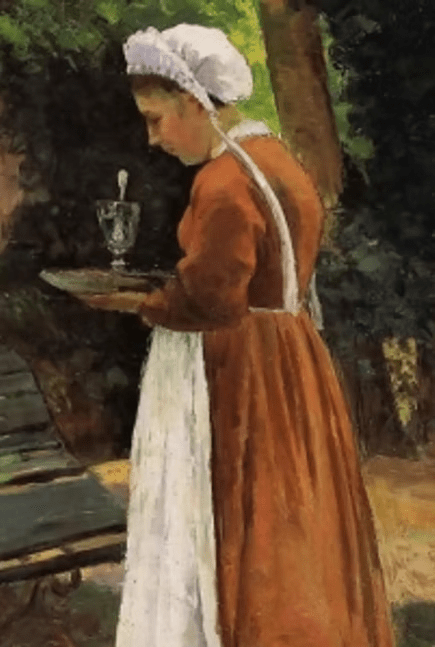
Boaz was identified as a “kinsman redeemer” (“ḡō·’êl”) because Naomi was from the same bloodline and as a kinsman with property and wealth, Boaz provided a service to widows by becoming their employer. Therefore, the pair bonded through their service to the tribe and their service to Yahweh; meaning their child was to reflect that value.

As an optional Old Testament reading selection for the twenty-fifth Sunday after Pentecost, when one’s own personal ministry for the LORD should be underway – one has entered into deep-felt Service to God – the message here is the redemption that comes from marriage to God. God is our Strength; and from God entering into our hearts is born the ultimate Servant, Jesus Christ.

The story of Ruth is she was seen as a Moabite, which is a Gentile. She was not born of the blood of the descendant of Jacob. She married into that family when she wed Naomi’s son Mahlon [“Great Infirmity”], but with his death coming before they had a child together, Ruth was free to return to her Moabite roots. She refused to be released from Naomi [“Pleasantness of the Lord”].

Christians [males and females] should all see themselves as Ruth. Being Christian means adhering to the principles of Mosaic Law, believing in only One God – YHWH. In today’s modern world, there is much rejection of the Old Testament stories, where people who sin are called abominations and the enemies of the Israelites were ordered slain [men, women, children and animals] by God’s prophets. Westerners of Christianity reject what they see as no longer viable. They reject it as uncivil and many lean on the concept of Jesus telling everyone to love, rather than judge others for what they are. That is not being a reflection of Ruth.

Ruth was the lowest of the low in the Israelite societal pecking order. She had no voice about what was right or what was wrong, according to the Laws of Moses. She had been given her freedom to practice whatever rules and customs the descendants of Lot had established which might have included idol worship and human sacrifices to please many gods. The same freedom is given to ALL human beings in the world, because God never sent a fireball from outer space to destroy the Egyptians or the Canaanites or anyone else. However, being one of God’s chosen people means: agreeing to the Mosaic Laws; and choosing to only SERVE Yahweh.

When those two stipulations are met, then one lays at the feet of God as His maidservant [regardless of human gender]. There can be no Big Head of self that tells God, “Hey God, we’ve been thinking and all this harsh legal stuff is just too much to agree to anymore. So, we are going to make a few changes here and there and instead of praying to You, we are just going to idolize You Son Jesus. How’s that sound to You?”

[SILENCE] [Cue the cricket chirping soundtrack]

That means turning one’s back on God, so call yourself whatever you want to call yourself, it does not make you one of God’s chosen people. You have rejected God, so God has rejected you. You have gone all Old Testament on your soul and killed its chance of eternal life in Heaven.

Ruth symbolizes a love of the Law – which is symbolized by Naomi being “Pleasantness of the Lord” – where nothing bad ever happened to those who followed the commandments of God through His Prophets. Only the evil suffered physical death – but those souls all lived to be reincarnated another day, with no real harm done. Ruth became a servant of the law, even though the law made he the lowest of the low, as a widow without issue. She did not rise in rebellion to the unfairness of the Law. She complied out of love, trusting in the God of Israel to show His love in return.

It is vital to realize that the STRENGTH of Israel was the Ark of the Covenant. When a judge or prophet was told by God to encounter an enemy, the Ark was always carried into the field of battle. The Israelites were able to defeat evil because God was with them. Israel was a body of parts [the Twelve Tribes] with the Ark of the Covenant being the heart of that body. This is how a heart symbolizes the strength of courage, which is also symbolized in the lion’s strength and kingliness.

When Ruth was taken in marriage by Boaz that symbolizes one today being married to God. One is totally committed to being God’s wife [regardless of human gender]. From that marriage is born Jesus Christ, which is the STRENGTH of God within that defeats all attacks by evil. The Ark of the Covenant has not been lost; it has been transformed into an inner tabernacle, where Jesus Christ serves the Father as one’s personal high priest. Wherever one goes, the Ark of the Covenant is there – in the battlefield of life.

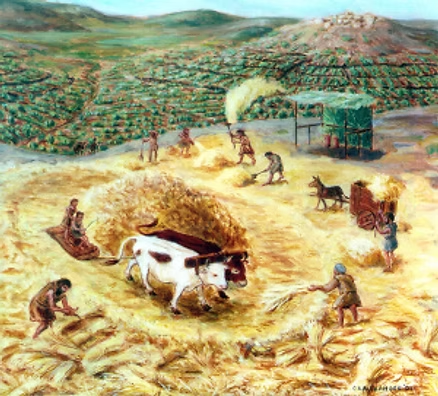
The threshing and winnowing of barley is a necessary work that separates the chaff from the grain.  Ruth was sent to the threshing floor to see the work that is necessary for the bread of life to be gained.  The STRENGTH of Boaz was witnessed, through the work that he did.
Whoever refuses to have the Law written into their hearts is not Ruth. Anyone calling himself or herself Christian, while bending the laws of Moses to suit one’s needs, is more in line with the ex-daughter-in-law of Naomi, Orpah [Mane or Neck]. One proudly holds high the head and its inner brain as the personal source of strength. While one kissed the “Pleasantness of the Lord” and the Law Naomi stood for, one feels strong enough to remember some of the Law, while rewriting that which was misunderstood. One has not then married Yahweh, but one has returned to pagan worship and idolizing multiple gods.

To truly be Christian, one must say to the Law the same as Ruth told Naomi: “All that you tell me I will do.” Jesus said, “Do not think that I have come to abolish the Law or the Prophets; I have not come to abolish them but to fulfill them.” (Matthew 5:17)

Jesus Christ being resurrected within a true Christian is the miracle blessing of the Lord, as one has been recognized as a “next-of-kin,” a Brother [regardless of human gender] in the holy bloodline of God’s chosen people, another Son of Man. Being reborn as Jesus Christ means, “he shall be to you a restorer of life and a nourisher of your old age.”

A true Christian has been redeemed by the STRENGTH of the Lord and made a SERVANT that offers salvation to other lost souls. As such, when one reads, “Naomi took the child and laid him in her bosom, and became his nurse,” this is the “Pleasantness of the Lord” [the Law] being written onto one’s heart and nourished daily. One does not seek to change the Law to match the laws of Gentiles. Instead, the Laws nourish the SERVANT that one has become, as the Son of God reborn. This is why the women [all Christians, regardless of human gender] gave a name to those who honor the Law: “A son has been born to Naomi.”

The Law’s Pleasantness has delivered one’s Savior, once again.

#Matthew517 #Ruth315 #Ruth41317
Ruth 3:1-5; 4:13-17 – Marrying God and having His baby

Naomi her mother-in-law said to Ruth, “My daughter, I need to seek some security for you, so that it may be well with you. Now here is our kinsman Boaz, with whose young women you have been working. See, he is winnowing barley tonight at the threshing floor. Now wash and anoint yourself, and put on your best clothes and go down to the threshing floor; but do not make yourself known to the man until he has finished eating and drinking. When he lies down, observe the place where he lies; then, go and uncover his feet and lie down; and he will tell you what to do.” She said to her, “All that you tell me I will do.”

So Boaz took Ruth and she became his wife. When they came together, Yahweh made her conceive, and she bore a son. Then the women said to Naomi, “Blessed be Yahweh, who has not left you this day without next-of-kin; and may his name be renowned in Israel! He shall be to you a restorer of life and a nourisher of your old age; for your daughter-in-law who loves you, who is more to you than seven sons, has borne him.” Then Naomi took the child and laid him in her bosom, and became his nurse. The women of the neighborhood gave him a name, saying, “A son has been born to Naomi.” They named him Obed; he became the father of Jesse, the father of David.

——————–

This is the Track 1 Old Testament selection that will be rad aloud on the twenty-fourth Sunday after Pentecost [Proper 27], Year B, according to the lectionary for the Episcopal Church. If an individual church is marked for the Track 1 course, then this reading will be accompanied by a singing of Psalm 127, which says, “Children are a heritage from Yahweh, and the fruit of the womb is a gift.” This pair will precede a reading from Hebrews, where Paul wrote, “he has appeared once for all at the end of the age to remove sin by the sacrifice of himself.” All will accompany the Gospel reading from Mark, where Jesus taught, “Beware of the scribes, who like to walk around in long robes, and to be greeted with respect in the marketplaces, and to have the best seats in the synagogues and places of honor at banquets!”

I wrote of this selection from two chapters in Ruth when it last came up in the lectionary schedule (2018). I posted my views on my website then, which can now be read on this website, by searching this site. Rather than repeat what I wrote three years ago, I will add new observations, including some that make this reading fit into the theme of the other reading also chosen by church elders to be read on this Sunday. Please feel free to read this commentary, the one from 2018, and all the others that are written for this same Sunday and let me know what you think.

In this split selection of readings from Ruth’s chapter three and four, it can be easy to misconstrue Naomi telling Ruth to go seduce Boaz after work, which then leads to her getting pregnant. This is a wrong conclusion to draw, as the text of the ‘in between’ story makes it clear that Boaz is a brother of Naomi’s deceased husband, Elimelech, thus much older than Ruth. Indeed, when Naomi told Ruth, “our kinsman Boaz, with whose young women you have been working,” those young women were virgin daughters of Boaz, so all the “young women,” including Ruth, were seen by Boaz and Naomi as children, not yet married.

Because Ruth had been the wife of Naomi’s son Mahlon, she was not a virgin. Because Mahlon died without having impregnated Ruth, Naomi freed Ruth and Orpah to seek other husbands who would supply for their needs in a male-dominated world, herself unable to guarantee such support with her husband and two sons then dead. Ruth clung to Naomi, because of Naomi’s spiritual marriage to Yahweh, which Ruth felt strongly pulled to have her soul serve also. Naomi and Ruth had been in Moab, seeking land that could afford life during famine, because Naomi’s husband, Elimelech, had sold his land in Judah. He sold what he possessed there because he felt a need to leave a land that was no longer supplying food (including spiritual food). Without property, without male heirs to support Naomi, Ruth became her daughter as the two returned to the Bethlehem area, where Elimelech had family still living.

The element of working the fields to harvest grain (barley) says the famine is past or at least rain had returned and the land was producing food. This becomes an indication that Israel, which had been in a spiritual drought, had been in times when led by judges, when a judge was in need but not present. The past famine now over says their wayward ways had been corrected.

Here, again, the names of Ruth’s first chapter are important. There Elimelech was named and is again mentioned [not in this reading], meaning it is important to recall that name means “My God Is King.” That name says Elimelech could no longer live in Judah, selling everything he owned and moving to Moab, because of the wicked ways. In Moab he died. This must be seen as symbolic of Moses and the Covenant [who died and was buried in Moab], where all Israelites were expected to have their souls each be married to Yahweh. When times suffered, this said the commitment to that marriage agreement was not being met. Thus, with the fields again producing grain, physical food reflects the spiritual food of souls returning to honor their marriage agreement.

As the brother of Elimelech, the name “Boaz” means “In Strength, By Strength,” with the Temple of Jerusalem’s left pillar also called “Boaz.” Strong’s alludes to this, as well as saying the word “boaz” means “quickness.” The pillar to the right [both free-standing and not supporting any structure above] was called “Jachin,” which means “He Establishes, He Will Give Certainty,” with “He” referencing “God” [as “Yah”]. This implies that Boaz was a pillar of strength upon which the return of commitment to Yahweh is symbolized. As the brother of “My God Is King,” Boaz was then the kinsman to whom Judah and Bethlehem relied.

When this broad-stroke meaning from the metaphor is seen, an arranged marriage between Ruth (a Moabite woman, not an Israelite) to Boaz (the elder revitalizing commitment to Yahweh), with Ruth realized to be the welcomed adoptee of Naomi (an Israelite soul married to Yahweh), the story develops as a new branch being spliced unto the tree of Israel. The symbolism of the marriage between Boaz and Ruth needs to be viewed as that renewal of the spirit of commitment to Yahweh. Ruth would be the new blood that desired to be one with Yahweh, who would merge with the old blood of those descended as chosen – marrying the dulled with responsibility to the sharpness of desire to please God, with all one’s heart, soul, and strength. It is that union that beget the grandfather of David (Obed).

The name “Obed” means “Servant, Slave.” This must be seen as a name given out of love and admiration for Yahweh. For Naomi to take this child to her bosom and become its nurse (at an old age, beyond that of a wet nurse), she was nurturing Obed to love servitude to Yahweh. From that nurtured love, Jesse and David would come. The name “Jesse” means both “My Husband” and “Yah Exists.” Here again is a name restating the Israelite commitment to Yahweh in divine marriage – soul to Spirit. The name “David” means both “Beloved” and “Weak, Flowing,” where this restates the total commitment to Yahweh through love, with a willingness to go with Yahweh’s flow of direction, letting Yahweh be one’s strength.

In the place where Naomi told Ruth what to do after Boaz ate and drank and laid down to sleep, the Hebrew words [transliterated] “wə·ḡil·lîṯ mar·gə·lō·ṯāw” [from the roots “galah” and “margeloth”] are translated as “uncover his feet.” This is perplexing as to what it means. In the text not read aloud, from Ruth 3, is said that Boaz awoke at midnight and found “there was a woman lying at his feet.” Possibly the words were indicating that Ruth should disrobe (“uncover) and then lie at “his feet.” This would then be both a sign of willingness to submit oneself into one’s service (laying at the feet), while also offering oneself physically in marriage. Boaz thanked Ruth for choosing him, rather than someone else, either poor (youthful passion) or rich (gold-digging). Regardless, there was no sex on the threshing room floor. Boaz told Ruth what needed to happen for the two to marry legally; and, he sent her back to Naomi with an allotment of grain. The meeting promised that Boaz would become the kinsman-redeemer [“gō·’êl”]; but when Ruth told this to Naomi, Naomi said, “We need to wait and see.” That attitude says Naomi had left Bethlehem with her husband and sons because in the times of judges many Israelites said things that were not backed by the truth. She did not distrust Boaz, but the other relative who Naomi knew had to approve Boaz as the kinsman-redeemer.

The jump forward to chapter four then has everything done as planned, with Yahweh guiding the marriage of the two souls that were both married to Yahweh. The land was again restored. Still, when a generation is twenty years, the two generations that would be Obed and Jesse (leading to the generation of David) would amount to forty years, this timing says the cycle of forty years in servitude to the Covenant had ended. That would be followed by forty years of spiritual famine, which coincided with the time David would be born, when the elders of Israel would go to their aging judge – Samuel – and tell him to appoint them a king, to be like other nations. That would make David the final judge of Israel, which makes this marriage between Boaz and Ruth significant to understand.

When this cycle of up and down is seen as continuous, the happiness of Ruth’s marriage saving Naomi and Judah is shown to then collapse in the times of Elijah, who was a prophet of the Northern Kingdom. Rather than be a judge, David had ceased those times. Elijah was a soul married to Yahweh who became a powerful voice of Yahweh on earth. The Track 2 Old Testament reading then tells of Elijah during a time of famine, when Yahweh sent him to Zarephath to be provided for by an old widow. The widow was preparing the last supper for herself and her son, after which they both prepared to die. That becomes a parallel of Naomi and Ruth, as they clung to one another during a time of famine in Judah. The miracle of Elijah should then be seen as a reflection of the miracle of Boaz marrying Ruth, having a son, who restored Naomi from worthless widow to a woman surrounded by the wealth of Yahweh’s love.

In the Hebrews reading, Paul writes that mortals only die once, so Jesus was “offered once to bear the sins of many.” This simply says Jesus was mortal, so he too only could die once. However, his one-time death released a pure soul that could return and fill many souls animating bodies of flesh, who also could only die once. Being possessed by the soul of Jesus would mean the sins of the many would not condemn them, once possessed and led to a righteous state of being. This means the soul of Jesus would become like baby Obed, who Yahweh would send to marry the souls of His wives and make them pure before that one death.

Naomi was married to Yahweh., Ruth marrying Boaz married her soul to Yahweh, so she gave birth to her own baby Jesus, meaning her past sins were erased and she would sin no more. When Paul said Jesus “will appear a second time,” that “second time” occurs many times, each as a second birth in the souls of those married to Yahweh.

Christians have to get beyond thinking ‘belief’ in Jesus as the Son of God will save them, because Jesus died on a cross for them to be saved. That is the fault of Israel obeying the Covenant for forty years, and then straying and breaking all the agreements the next forty. Belief in God does not work for long. One’s soul must marry YAHWEH and be made forgiven of all past sins. Then one’s soul needs to give rebirth to the resurrected soul of Jesus, so that high priest will keep one’s soul from sinning ever again.

Finally, the Gospel reading from Mark places focus on a widow woman. Both Naomi and Ruth were widows. Neither of them had any possessions or any rights. They were, in essence, beggars. They were the poor who could demand alms and the outer fringes of crops (when no famines were around). In the Elijah miracle of First Kings a widow woman and her son were about to die, because they had nothing. Jesus warned about the scribes, who preyed on widows.

That never goes out of style. Every church organization today makes guilt calls on old ladies with some form of security, reminding them to give to the church when they die. None of those berobed hired hands care about the souls of anyone. All they care about is taking from the poor and giving to themselves. This means the story of Ruth is like the time of celebration Job experienced, after he defeated the tests of Satan. Satan always comes looking like a priest, never as the wolf clothed robes.

As the Old Testament reading to be read aloud on the twenty-fourth Sunday after Pentecost, when one’s own personal ministry for Yahweh should already be well underway, the lesson to grasp is to marry Yahweh (as Ruth did Boaz) and then let Yahweh make one conceive and bear his Son Jesus. This is not having a baby with a husband, as if only women can marry Yahweh. Everything is spiritual, with nothing physical (other than servitude and ministry).
Likewise, there is no Jesus salvation without one’s soul marrying Yahweh OUT OF TRUE LOVE.

The message of Ruth chapter three is listen to your soul telling you how to get Yahweh to marry you. Expose your sins to Him in sincere confession and then lay your soul at His feet, in complete and willing submission to His Will. Let Yahweh reward you with a few pounds of spiritual food to chew on, while He watches to see what you do next. Then, follow go with the flow, with complete faith that Yahweh’s hand will be guiding one’s life. When Yahweh calls your soul to the marriage altar, then say, “I do.” Then, let baby Jesus be reborn within your soul, as your new high priest.