Tag Archives: second Sunday after Pentecost

1 Samuel 3:1-20 – Hearing the call of ministry

Now the boy Samuel was ministering to the Lord under Eli. The word of the Lord was rare in those days; visions were not widespread.

At that time Eli, whose eyesight had begun to grow dim so that he could not see, was lying down in his room; the lamp of God had not yet gone out, and Samuel was lying down in the temple of the Lord, where the ark of God was. Then the Lord called, “Samuel! Samuel!” and he said, “Here I am!” and ran to Eli, and said, “Here I am, for you called me.” But he said, “I did not call; lie down again.” So he went and lay down. The Lord called again, “Samuel!” Samuel got up and went to Eli, and said, “Here I am, for you called me.” But he said, “I did not call, my son; lie down again.” Now Samuel did not yet know the Lord, and the word of the Lord had not yet been revealed to him. The Lord called Samuel again, a third time. And he got up and went to Eli, and said, “Here I am, for you called me.” Then Eli perceived that the Lord was calling the boy. Therefore Eli said to Samuel, “Go, lie down; and if he calls you, you shall say, ‘Speak, Lord, for your servant is listening.’” So Samuel went and lay down in his place.

Now the Lord came and stood there, calling as before, “Samuel! Samuel!” And Samuel said, “Speak, for your servant is listening.” [Then the Lord said to Samuel, “See, I am about to do something in Israel that will make both ears of anyone who hears of it tingle. On that day I will fulfill against Eli all that I have spoken concerning his house, from beginning to end. For I have told him that I am about to punish his house forever, for the iniquity that he knew, because his sons were blaspheming God, and he did not restrain them. Therefore I swear to the house of Eli that the iniquity of Eli’s house shall not be expiated by sacrifice or offering forever.”

Samuel lay there until morning; then he opened the doors of the house of the Lord. Samuel was afraid to tell the vision to Eli. But Eli called Samuel and said, “Samuel, my son.” He said, “Here I am.” Eli said, “What was it that he told you? Do not hide it from me. May God do so to you and more also, if you hide anything from me of all that he told you.” So Samuel told him everything and hid nothing from him. Then he said, “It is the Lord; let him do what seems good to him.”

As Samuel grew up, the Lord was with him and let none of his words fall to the ground. And all Israel from Dan to Beer-sheba knew that Samuel was a trustworthy prophet of the Lord.

——————————————————————————–

This is one of two Old Testament selections from the Episcopal Lectionary for the Second Sunday after Pentecost, Year B 2018.  The lessons of this Sunday are placed in a Proper Ordinary Time grouping, numbered Proper 4.  If chosen, this will next be read aloud by a reader on Sunday, June 3, 2018.  It is important because it tells how a servant of the LORD heard His call and answered, “Here I am.”  This is how all Saints respond to the call of ministry.

To begin this reading, we hear stated, “Now the boy Samuel was ministering to the Lord under Eli. The word of the Lord was rare in those days; visions were not widespread.”  This is important information that should not be overlooked.

It first of all states that “the boy Samuel was ministering to the Lord.”  Typically, children were not important enough to be named.  Samuel is named because this is a book that bears his name, which says that even as a youth, he “was ministering to the Lord.”

Samuel was a miracle birth, having been granted to his barren mother as the answer to her prayers.  The mother dedicated Samuel to serve God at birth, but kept him until he was weaned.  Then, she turned Samuel over to the high priest Eli.  Therefore, Samuel “was ministering to the LORD under Eli,” meaning Samuel was learning the religion of the Israelites and the One God.
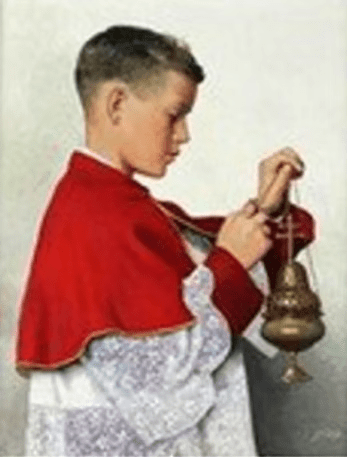
Think of Samuel as an altar boy, in the purest sense.

Second, we are told that “The word of the Lord was rare in those days; visions were not widespread.”  This explains why Eli would not immediately understand why Samuel was coming to him as he slept, saying, “Here I am, for you called me.”  Eli twice told Samuel just to go back to bed, before telling him to reply to any further calls by saying, “Speak, Lord, for your servant is listening.”  That says hearing the voice of God speak was rare then, but a priest like Eli (whose “lamp of God had not yet gone out”) would eventually have it dawn on him that young Samuel was having an auditory hallucination (only he could hear the voice), which was not artificially onset (because of his young age he had not been drinking alcohol).  The third time Samuel came to Eli meant he understood this call to Samuel was of divine origin.

To experience “visions” (divine visual revelations), such as Moses seeing the burning bush that was not destroyed by the fire, was even rarer.  Dreams, such as Jacob’s ladder, when he saw angels going up and down, from heaven and earth, and Joseph’s ability to interpret dreams,  as well as Abraham, Isaac and Moses regularly hearing the voice of God guiding them, that ability had seemed lost.  Where it once was written as normal for the Patriarchs to hear the voice of God, that frequency dropped to only the select few.  Still, for those dedicated to ministry to the Lord, hearing the voice of God, seeing angels of the Lord, and having dreams with voices was not deemed a psychiatric disease or mental disability.  It was a sign of righteousness.

Let that sink in, as Christians who are deeply devoted to a church (the building and organization that maintains it) are just as likely to say, “The word of the Lord was rare in those days; visions were not widespread.”  The only times the news reports someone saying, “The voice of God told me” is after some gruesome murder or other act of violence.  We are just as trained in our brains to deny voices and visions as ever being divine.  Thus, we are models today of that synopsis set up in verse 1, because we find it most rare to hear a voice that is not human created.  That has been the circumstances for the most part since the Israelites were deposited in the Promised Land, continuing to this day.

It is not insignificant that Samuel heard the voice of God calling him three times, before Eli told him how to respond, should a fourth call occur.  Three is a mystical number, which is symbolic of initial completion.  In the Sacred Tarot, the Three of Cups represents celebration and achievement.
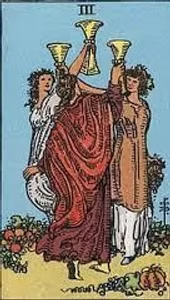
This is the accepted proposal of God’s love, as the celebration of engagement.  This is the promise of the Trinity.  Still, the Three of Wands projects the journey ahead still requires a road be traveled, before one reaches the end destination.  The three of Pentacles represents this is just the first recognition of work done, with more refinement required in the future.  Sadly, the Three of Sword represent the end of the old you, where heartbreaks of the past, over time to come, will no longer be the root cause of doubts and worry.  Samuel knowing to respond to God, not another human being, was such an initial accomplishment in his life.
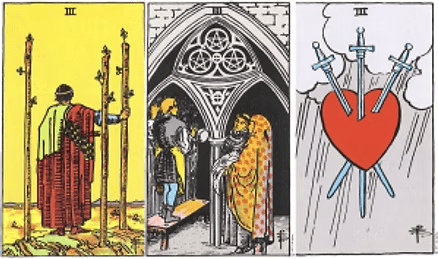
The number four is symbolic of a foundation.  Following the celebration of engagement, the Four of Wands represent a marriage to be celebrated.  The Four of Cups offers the symbolism of answered prayers, where the world’s attractions have lost their gleam.  The Four of Swords represents the call to step back from ordinary activity, where rest and sleep is the loss of self.  Finally, the Four of Pentacles represents a new sense of values that one holds dearly onto, not ever wanting to lose.

The fourth time God called Samuel, Samuel responded to God’s voice. The two were married in Spirit.  Samuel’s soul had been made pure by God.  As His servant, God told Samuel a prophecy of punishment coming to Eli, should he not correct the evils of his sons.  This was a prophecy Eli knew, from his time in service to the Lord.  Another prophet had sternly warned Eli prior.

When we then read how Samuel laid in bed until morning, when “he opened the doors of the house of the Lord,” this states the ministry Samuel had under Eli.  He was an attendant of a building.  He had been given routine duties and responsibilities, which he accomplished without fail.  Young Samuel did as instructed, probably not seeing the symbolic nature of making “the house of the Lord” be open to those who sought the Lord.  Samuel himself the night before had opened the door of his heart to God, becoming a human house of the Lord.

When we read, “Samuel was afraid to tell the vision to Eli,” this is the apprehension one feels when one has to stop acting as an underling to the Man – the establishment with powers of influence – and begin acting as God’s servant.  When we read, “Eli said [to Samuel], “What was it that [the Lord] told you? Do not hide it from me. May God do so to you and more also, if you hide anything from me of all that he told you,” those were the words of a servant of God who knew he was due punishment.

Eli knew his sins and was ready to be punished, because he loved his sons too much to punish them for blaspheming God.  Eli had become blind to the truth.  Still, Eli was old and tired, but he did not want Samuel to suffer his same mistakes as he.  Eli demanded that Samuel tell the truth about what God had told him.  Samuel then spoke the whole truth, and Eli accepted that fate.

This becomes a parallel to how Christians today read the Holy Bible, hear a reader read Scripture aloud, or listen to a sermon that speaks to their hearts.  They hear the truth be told through prophecy.  They know punishment is theirs to come, if they do not listen, hear the voice of God speaking to them, and act appropriately to prevent that end.  Like Eli, Christians whisper to themselves, “I accept my fate, because I simply cannot make myself change.  I’m in too deep.”

This also becomes a statement about the priest’s role who is preaching the sermons about the readings from Scripture.  They have to be like Samuel and speak the truth, even if that truth hurts the ones listening.  A priest should be able to hear the voice of God speaking the truth about Scripture.  It is the responsibility of a priest to maintain the routine of the house of the Lord.  They do that by preaching the truth, even if the truth hurts someone.  Otherwise, it is as Eli said, “What was it that [God] told you? Do not hide it from [the congregation]. May God do so to you and more also, if you hide anything from [the congregation] of all that [God] told you.”

Sadly, the buildings of the Lord today are finding more and more apologists of sins.  They speak to congregations as Eli would speak to his evil sons.  A priest who appeases sinners, for whatever reason, becomes the embodiment of Eli.  He or she who speaks to sinful congregations and does “not restrain them,” then the Lord will likewise “swear to the house of [that church and/or denomination] that the iniquity of [that church’s priest’s] house shall not be expiated by sacrifice or offering forever.”

In other words, it will be just as God’s messenger had told Eli, “Those who honor me I will honor, but those who despise me will be disdained.” (1 Samuel 2:30d)  Any priest who takes a position of piety and uses that for selfish reasons (politically motivated these days) are committing blasphemy.  The call is to not be a wicked priest (like Eli’s sons Hophni and Phinehas), just as the call is not to be a lazy priest to blesses sins because of human blood ties.  The call is to be like Samuel and minister to the Lord under God.
Pope Hophni and Pope Phinehas?

As an Old Testament possible selection in the early stages of Ordinary Time (when we are called to move into ministry, leaving the crib of helplessness), we are to become Samuel.  To be Eli, who was a priest with two evil sons acting as priests, who would be cursed by God for doing nothing to cease the evil-doings of his sons (the dilemma of family blood coming before spiritual blood), we are just as guilty of ignoring the call of our religion.

Too often the challenge to one’s faith comes when one must decide to pick between serving God and serving family.  Too often we choose to offer our souls up to God as sacrifices for protecting the sins of family and friends.  Too often we act priestly, where that pretense does nothing of value, nothing that has one hearing God’s call to serve Him.  Being Eli then reflects how we have to actually accept that God does call his servants, even though we have only read about such things in books.  We have to become Eli before we can become Samuel; but we stand as the evil sons of Eli, if we do nothing, while claiming to be Christian.

At the end of the reading, where we read, “As Samuel grew up, the Lord was with him and let none of his words fall to the ground,” and “all … knew that Samuel was a trustworthy prophet of the Lord,” this is how we should aspire to be.  Do you realize that this Scripture reading is the word of the Lord?  Do you understand that they fall to the ground when you refuse to understand them AND explain that understanding to others?

Samuel was righteous for all Israel, not just himself and his fellows in the school of priests, the house of the Lord before there was a Temple in Jerusalem.  We too are called to serve others, not serve ourselves.  We are expected to respond, “Here I am.”  We are called to serve God, beyond a dedicated service that tells the leaders of the church buildings that honor God, “Here I am.”

The leaders of the churches today are much like Eli, having lost their ability to see and the inner drive to do more than lay down and sleep on duty.  They seek to be near holy objects, rather than become themselves holy objects – the arks of the Lord’s power; the commitment to learn the words of the Covenant, while enabled to maintain those laws.  At some point in time, our commitment as God’s servants to God’s buildings will be rewarded: either as a call for more money and more time donated to a church; or a call to stand before evil and tell it to stand down in the name of the Lord.

If one is listening through one’s heart, one will hear the voice calling.  The rewards of commitment that comes from one’s heart is a call to be God’s wife.  God wants to marry with your soul, baptizing it with the Holy Spirit.  Once that engagement is celebrated, the marriage makes one a reborn Samuel.  The rewards of having answered God’s proposal are great; but one will have to wait until one reaches the end of one’s time on earth to reap those rewards.


Deuteronomy 5:12-15 – When is the Sabbath anyway?

Observe the sabbath day and keep it holy, as the Lord your God commanded you. Six days you shall labor and do all your work. But the seventh day is a sabbath to the Lord your God; you shall not do any work—you, or your son or your daughter, or your male or female slave, or your ox or your donkey, or any of your livestock, or the resident alien in your towns, so that your male and female slave may rest as well as you. Remember that you were a slave in the land of Egypt, and the Lord your God brought you out from there with a mighty hand and an outstretched arm; therefore the Lord your God commanded you to keep the sabbath day.

——————————————————————————–

This is one of two Old Testament selections from the Episcopal Lectionary for the Second Sunday after Pentecost, Year B 2018. The lessons of this Sunday are placed in a Proper Ordinary Time grouping, numbered Proper 4. If chosen, this will next be read aloud by a reader on Sunday, June 3, 2018. It is important because it states the Commandment that the Sabbath day be maintained as a day to honor God exclusively.

Deuteronomy chapter five states what is affectionately called the Ten Commandments. More laws would come, but the ten were written in stone by God. Today’s reading is Commandment number four, which (in short) states, “Observe the sabbath day and keep it holy.”

While not read today, chapter five begins by Moses stating to the Israelites, “Hear, Israel, the decrees and laws I declare in your hearing today. Learn them and be sure to follow them. The Lord our God made a covenant with us at Horeb. It was not with our ancestors that the Lord made this covenant, but with us, with all of us who are alive here today.” (Deuteronomy 5:1-3) What that says is clear: The Ten Commandments and all the following laws are not made as a pact between the whole world and God.

This means the whole world can do as it wants relative to the sabbath day. The sabbath day is just a day, unless one has made a pact with the Lord.  One has to have been removed from the world’s ordinary human beings, “brought you out from there with a mighty hand and an outstretched arm,” leading one to commit wholly to God.  Only then can one grasp how the sabbath day is deemed holy.

If one understands the Hebrew calendar, the word “yom” means day. Every day of the week is then Yom fill in the number. Sunday is “Yom Rishon,” which means “Day First.” Thus, Sunday is the first day of the week.

If one looks at a calendar today, Sunday is listed above the far left-hand column, which is the first day position. That then shows Saturday as the seventh day, above the seventh column.

In Hebrew, the day Americans call Saturday is “Yom Shabbat,” or Day Seventh. Still, God never told the whole world to make a calendar with weeks that are seven days long.  Somehow, everyone just fell in line with this idea.

It is worthwhile to realize that there are seven orbs in our solar system that can be seen by the naked eye, which are luminaries (2) and planets (5). Uranus, Neptune, and Pluto require telescopes and computers to see, so they don’t get special attention.  However, the orbs of light did.

The Romans named each day of the week after those seven visible (mostly at night for the planets) orbs: Sunday for the Sun; Monday for the Moon; Tuesday for Mars; Wednesday for Mercury; Thursday for Jupiter; Friday for Venus; and Saturday for Saturn. All cultures seem to adhere to a seven-day week, but some begin the week with Sunday, some with Saturday, and others with Monday. This makes a “seventh day” become confusing, but the confusion allows Christians to call the first day of the week (Sunday shows in that position on the calendar) the Sabbath (seventh day).

This reading selection is optional because the Gospel selection is about some Pharisees complaining to Jesus about his disciples picking grains from the field to eat on a Shabbat. Jesus then told the Pharisees, “The sabbath was made for humankind, and not humankind for the sabbath.”

That says, in essence, the Sabbath Day is less about when it is marked on a calendar and more about it being marked in one’s heart. Thus, the truest meaning of “the Sabbath” is realized when one of humankind stops being one of a sinful world and begins shining the light of Jesus Christ forevermore. One becomes the Son, who was like the Sun, having said, “I am the light of the world.” (John 9:5)  This transformation makes one become like Sunday, at all times, once one truly agrees to the Covenant with God – which become one’s marriage vows with the Lord (true holy matrimony).

By understanding this Commandment on a level that places oneself in-line with the Creation, where the Israelites were descended from a six-day period of formulation that led them to a commitment to remain righteous (and each day in that Creation was deemed good), the Sabbath is representative of a continual state of being, rather than just one 24-hour period each week.

This is why the Covenant is not between “our ancestors,” “but with all of us who are alive here today.” Just as Moses stood alive before a group of Israelites who were alive, the same words apply to living, breathing Christians today.  By being alive, we stand before God, through the words of Moses, making this Covenant be forever renewed by all current human beings willing to make a commitment to uphold these same Commandments. However, we need to see how permanent righteousness still requires a twenty-four hour period of rest, just as God rested after His Creation.

When we read, “Six days you shall labor and do all your work. But the seventh day is a sabbath to the Lord your God; you shall not do any work,” that simply goes in one ear and out the other.

When God said, through Moses, “The seventh day is a Sabbath to the Lord your God,” that does not mean, “Set aside a couple of hours one day a week to go sit on wooden pews and listen to a sermon.” When God said, “Six days you shall labor and do all your work,” that includes normal chores that are in the “hunter-gatherer” category of maintaining life for a family, but is also demands extended study of holy documents, including prayer and teaching one’s children all they must know. Only by having labors of devotion to God, where work is giving thanks to God, can one find a Sabbath day as a day of rest, when no work is done.

Think of it as being employed as a priest, where six days of work means tending to one’s flock AND preparing for a Sabbath event. Keep in mind the Israelites were separated from the world to be God’s priests, not His pet humans.  The day of rest is then when one stands and opens one’s mouth, letting God do all the work of speaking.

To read, “You shall not do any work—you, or your son or your daughter, or your male or female slave, or your ox or your donkey, or any of your livestock, or the resident alien in your towns, so that your male and female slave may rest as well as you,” this says you must recognize how you do not control how other breathing human beings act. If you have done good work the six days prior, then you have surrounded yourself with others who respect your day of no work, even moving them to personally choose to make the same commitment to God as you have. It is hard labor forcing others to do what they do not want to do, so it always behooves one to work smarter, not harder. You draw more flies with honey, than with vinegar.

When God said, through Moses, “Remember that you were a slave in the land of Egypt, and the Lord your God brought you out from there with a mighty hand and an outstretched arm,” this says, “Remember when you were a human being of the world, a slave to the influences of evil.” That memory is the guilt held within of past sins, based on a calendar that has no recognition of God’s Sabbath day. Egypt stands for all governments that separate their laws from those commanded by God.

In America now, we recognize how one man’s Sabbath is Friday, while another man’s Sabbath is Saturday, and still another man’s Sabbath is Sunday. To make laws that accommodate all men, let no Sabbath be recognized as holy.

I remember back in the days of my youth there were “Blue Laws.” Most businesses were closed on Sunday, for the purpose of promoting Christians being afforded a day of worship and rest. Those businesses that were necessary to keep open were required to pay their employees extra money. Those laws were challenged in the courts by people who did not believe Sunday was their Sabbath day and they won. Say goodbye to government mandating holy days.

The point is not for an outside entity, including governments or employers, to force recognition of holiness on people. That is hard work and always results in more problems being created than any problems solved. This is why Moses said, “Therefore the Lord your God commanded you to keep the sabbath day.”

You are the one who determines when the Sabbath occurs. It all depends on how you feel about doing nothing that demands others recognize your right to rest and worship. It is how you take twenty-four hours happily serving God, just basking in the glory of His presence.  You cannot keep the sabbath day holy, if you have not come to be holy.

As an optional selection for the Second Sunday after Pentecost, when one’s personal ministry should be underway, the message here is to a total commitment to God. The Jews wrote all kinds of amendments to this law, determining how far one could walk outside the city limits, what was deemed work and not deemed work, what acts of cooking were permitted and which were not, and so on. That becomes the focus in the Gospel reading from mark.  However, rules and checklists have no bearing on the Sabbath, as the Sabbath IS Ministry.

The point of this reading from Deuteronomy 5 is to see it as an understanding that once God is in one’s heart, and the Christ Mind is within one’s brain, and the Holy Spirit has baptized one’s soul clean of sins, the Sabbath day is the remainder of one’s life.  You rest because you have done the work necessary to bring God into your being.  The Sabbath day is when your love is God’s love and it radiates as a beacon to others; and it takes no effort to do so.  Ministry to the Lord is not work.

Let that be a lesson to those who leave church after receiving the sacraments of bread and wine, not capable of staying another ten minutes in the same building with others who are partaking of holy food. They are just too busy to stay in church on a Sunday, because they have no clue about keeping the Sabbath day holy. Those people should just stay home in bed or go play golf or shop in the stores that are all open on Sunday.  The world, like Egypt and Las Vegas, is open for business twenty-four seven.

Some cities glorify themselves by saying, “We never sleep.” That says those cities do not recognize the Sabbath.

Being a slave of Egypt means work, work, work, with no days designated as holy. It is like always being stuck in God’s sixth day of Creation, refusing to make a commitment that means no more hustling for personal gains, no more beating one’s head against a pyramid trying to make others do what you want them to do. Ministry to the Lord means letting God do all the work through you. The self-ego takes a long nap.

2 Corinthians 4:5-12 – In the face of Jesus the Anointed

We do not proclaim ourselves; we proclaim Jesus Christ as Lord and ourselves as your slaves for Jesus’ sake. For it is the God who said, “Let light shine out of darkness,” who has shone in our hearts to give the light of the knowledge of the glory of God in the face of Jesus Christ.

But we have this treasure in clay jars, so that it may be made clear that this extraordinary power belongs to God and does not come from us. We are afflicted in every way, but not crushed; perplexed, but not driven to despair; persecuted, but not forsaken; struck down, but not destroyed; always carrying in the body the death of Jesus, so that the life of Jesus may also be made visible in our bodies. For while we live, we are always being given up to death for Jesus’ sake, so that the life of Jesus may be made visible in our mortal flesh. So death is at work in us, but life in you.

——————————————————————————–

This is the Epistle selection from the Episcopal Lectionary for the Second Sunday after Pentecost, Year B 2018. The lessons of this Sunday are placed in a Proper Ordinary Time grouping, numbered Proper 4. This will next be read aloud by a reader on Sunday, June 3, 2018. It is important because Paul explained how the fragile state of a mortal body can only find shatterproof strength from within: by God’s presence in one’s heart, and by the rebirth of Jesus Christ be visible in our mortal flesh.

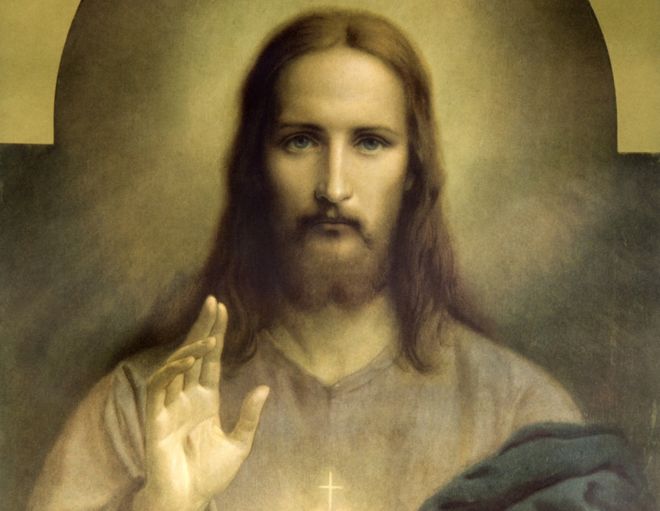
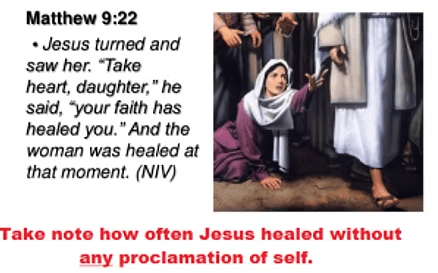
When Paul wrote, “We do not proclaim ourselves,” that is a statement that all Apostles (no matter how many “we” will be) have died of ego. One cannot stand before a group of people and pretend to have some mystical power that makes oneself capable of casting out damnation on others, by calling upon “the name of Jesus Christ.”  When a person uses those words in public, one is proclaiming oneself as special.  One then proclaims so others will think one is able to call upon God and Christ, so the divine serves that one.

Plenty “faith healers” have put on grand acts that have profited those special hands handsomely.

True Apostles (to whom Paul wrote) “do not proclaim the self.”  If one “does not proclaim oneself,” then one has lost all claims to self. Therefore, Paul wrote, “We proclaim Jesus Christ as Lord and ourselves as your slaves for Jesus’ sake.”

To “proclaim Jesus Christ as Lord,” this says a Saint is in the name of Jesus Christ.  A Saint takes on that persona by Divine Will, not personal choice.  One serves God, just as His Son Jesus was totally subservient to the Father.  It is the Father that gives the name to the Son, not the other way around.

As such, that identification that proclaims Jesus Christ as Lord has replaced the name of oneself, although that name of the self is still attached to the physical body. The identity one claims is Jesus Christ, and that entity is readily identified as the “Lord” to whom one’s self-ego has surrendered. That surrender of self then makes one a “slave for Jesus.”

The word translated as “sake” is the Greek word “dia.” That word means, “successfully across” or “thoroughly,” where the implication says Apostles have “crossed over” to being Jesus reborn.  This must be understood as a statement of one’s ego stepping aside willingly, for “Jesus’ sake,” where the Christ Mind takes over.  The Spirit of Jesus Christ then uses one’s body to do the biding of the Father, as did Jesus of Nazareth.

Modern Americans may balk at the concept of slavery, and even to the outdated models of wives being subservient to their husbands.  Americans lash out harshly at the idea of slavery.  However, the reality is all human beings are slaves, who serve many masters.

The soul is imprisoned in a “clay jar”body, one that can only be freed from that captivity through death.  This means human beings are slaves to the world.  Freedom, as a concept, is well and fine but not a reality.  Freedom is an illusion.

Is one free to fly away from earth and go to heaven at will?  Or, does gravity on earth and the lack of oxygen and life supporting elements in the void of space not enslave us?  The laws of physics master over humanity.  Needing a job to afford to buy things makes one a slave to necessities.  Needing the comforts of others makes one a slave to relationships.  We are never free, but we hate the idea of slavery.

When one becomes the slave of God, with the Christ Mind putting one to work, then the soul has been given the promise of true freedom, which comes by slavery to God’s Will, not human wants and desires.

Paul then wrote, “For it is the God who said, “Let light shine out of darkness,” who has shone in our hearts to give the light of the knowledge of the glory of God in the face of Jesus Christ.”  That says Apostles have become married to God, whose love is then placed solidly in the hearts of His beloveds. Marriage is two joined as one, where God commands and His wife (a “clay jar” is always the one penetrated by the Spiritual) obeys.  This is willing slavery to the power of God’s love.

The light of that love then permeates their being and radiates outward from within. It beacons to those who do not know this love of God, whose lives are still blind to this light of salvation. It is this inner presence that brings forth the “knowledge of the glory of God,” which is the Christ Mind. Therefore, Saints all become “the face of Jesus Christ” in Spirit.

The metaphor of being “clay jars,” where the Greek words “ostrakinois skeuesin” may be better grasped as “earthen vessels,” says that human beings are no more than the matter that makes up a human body. The body is form that is fragile, just as are clay jars.  It is a soul that is poured into our “vessels” that gives them life. Still, one understands that a soul “does not come from us,” as “this extraordinary power belongs to God.”

The “treasure” within our “clay jars” is our souls, which are God’s creations. A soul is God’s breath of life into an “earthen vessel.”  Our souls are eternal forms, whereas human bodies are eternal as matter that cannot maintain a constant state.  Bodies change, while the soul remains the same.  A soul gives animation to material, where life allows for growth as well as deterioration.  Unfortunately, the earth of one’s clay tends to soil its gift from God.  Therefore, the soul needs cleansing, just as the body needs washing.

This then makes the “extraordinary power” that Paul wrote of become the presence of God’s Holy Spirit. This Holy Spirit is separate from the soul; and likewise, this Spirit also is not a power commanded by “earthen vessels” or “clay jars.” It is this power that protects the jar from being smashed by the forces of the world, which are the afflictions, perplexities, persecutions, and beatings that comes from a world that looks at a lowly “clay jar” and cannot see the presence of God within it.

The Holy Spirit does not mean escape from worldly punishment, but survival through it. Ordinary life, without the Holy Spirit, can result in the soul being reduced to sins, becoming worthy of punishment.  Souls are thus recycled or banished from heaven, based on how well they reject sinful influences.  The Holy Spirit is what brings eternal salvation to a soul.

It keeps one’s soul from being crushed under the weight of evil influences.  It saves one from fears, sensed as the dangers of losing material things.  It soothes the wounds to one’s soul, which come from the persecution and rejection of enemies, friends and family.  The Holy Spirit keeps one’s soul standing strong, after harsh strikes that come from those who see the pious as weak targets to hit. When one becomes Jesus Christ reborn, one is always attracting the same satanic hatred that seeks to punish every human form the Christ Minds fills; but a holy soul, like the one possessed by Jesus, does not quit in the face of trouble.

This is how an Apostle wears the face of Jesus Christ, even though one’s human face still rides high atop the human form. We make the face of Jesus be known by acting like him, from sincere motivations as servants of God.  Paul still wore the human face of Saul, but wore the face of Jesus Christ once he became Paul. As such, Paul wrote, “For while we live, we are always being given up to death for Jesus’ sake, so that the life of Jesus may be made visible in our mortal flesh.”  This projects the death of one’s self-ego, to be exchanged for the ego of Jesus of Nazareth – the Christ Mind.

Once this alter-ego becomes one with an Apostle (a Saint), the soul has been cleansed by the Holy Spirit, with God’s love coursing through the body – the blood of Christ. From then on “we will always be given up to death,” and our souls will have it no other way.  Our egos may return as simpletons, seen in bodies that drool and seem inept; but Apostles will always rise to righteous states when confronted with evil choices.  The face of Jesus will take on all challengers.

As the Epistle reading selection for the Second Sunday after Pentecost, when one’s personal ministry for the Lord should have begun, the message given by Paul is clear. Ministry is not something a soul in an earthen vessel can achieve alone. It requires divine assistance. Ministry to the Lord requires the sacrifice of self and the love of God within.

To be a Saint is to enter ministry through a leap of faith, not a certificate of study. Of course, God will know the works one will have done, and His gifts of the Holy Spirit will use one’s education and experiences to one’s advantage.  One’s special talents will be utilized accordingly.  Still, before one can save the world, one must save one’s own soul through the sacrifice of self.

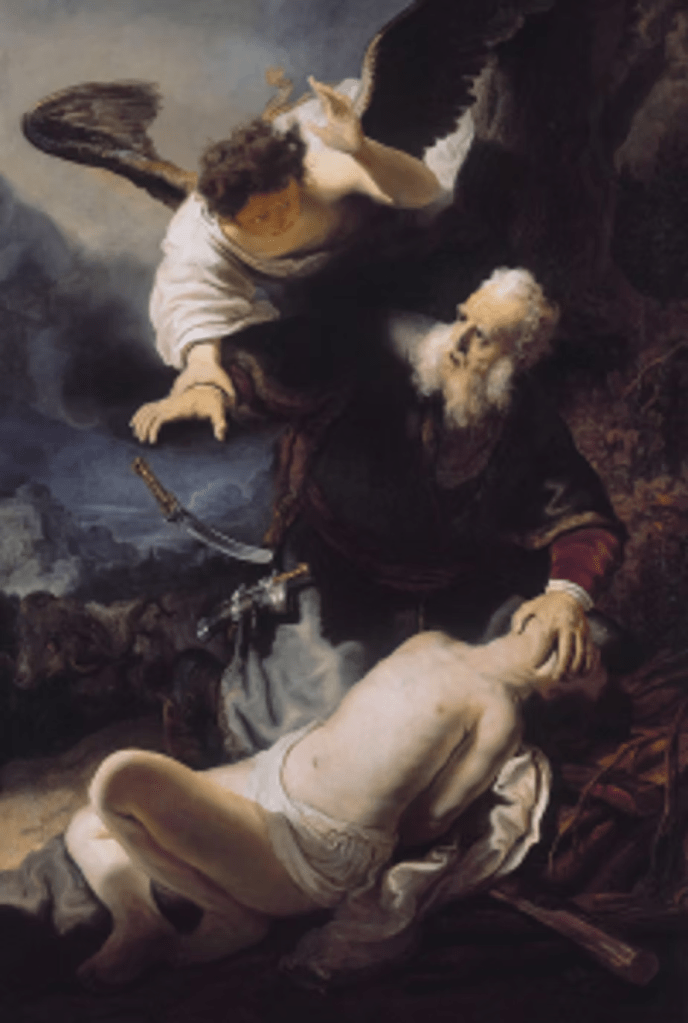
Hold on Abe. No need to do a physical death. We’ll handle the sacrifice Spiritually.

This is why Paul wrote, “So death is at work in us, but life in you.” A literal translation says that better, as “So death in us works,” where the Greek word “energeitai” is translated as “works.” That states “death” is figurative, not permanent.  The “death” of one’s ego is what allows one to “accomplish” and be “operative” in ministry. One is free to do the “work” of God, when one is not slowed down by the fears and anxieties of one’s self-ego.

When one slaves from joy and delight, one is truly free.  It is then those “works,” through “death,” that leads to eternal “life to you.”  That reflects a ministry that comes to all who have died to be in the name of Jesus Christ.

Mark 2:23-3:6 – Being lord of the Sabbath

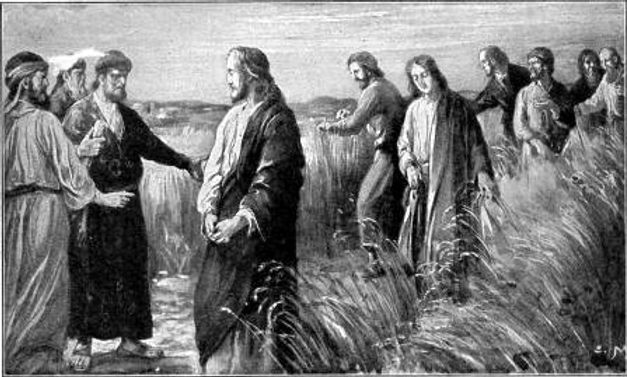
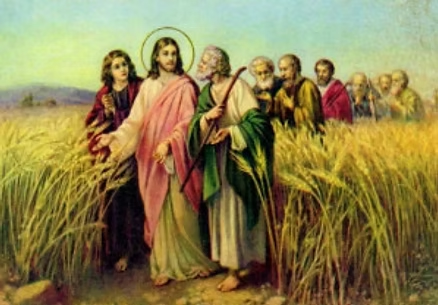
One sabbath Jesus and his disciples were going through the grainfields; and as they made their way his disciples began to pluck heads of grain. The Pharisees said to him, “Look, why are they doing what is not lawful on the sabbath?” And he said to them, “Have you never read what David did when he and his companions were hungry and in need of food? He entered the house of God, when Abiathar was high priest, and ate the bread of the Presence, which it is not lawful for any but the priests to eat, and he gave some to his companions.” Then he said to them, “The sabbath was made for humankind, and not humankind for the sabbath; so the Son of Man is lord even of the sabbath.”

Again he entered the synagogue, and a man was there who had a withered hand. They watched him to see whether he would cure him on the sabbath, so that they might accuse him. And he said to the man who had the withered hand, “Come forward.” Then he said to them, “Is it lawful to do good or to do harm on the sabbath, to save life or to kill?” But they were silent. He looked around at them with anger; he was grieved at their hardness of heart and said to the man, “Stretch out your hand.” He stretched it out, and his hand was restored. The Pharisees went out and immediately conspired with the Herodians against him, how to destroy him.

——————————————————————————–

This is the Gospel selection from the Episcopal Lectionary for the Second Sunday after Pentecost, Year B 2018. The lessons of this Sunday are placed in a Proper Ordinary Time grouping, numbered Proper 4. This will next be read aloud in a church by a priest on Sunday, June 3, 2018. It is important because Jesus gives a lesson that doing God’s work on the Sabbath is why God commanding the Sabbath day maintained as holy.

In this selected Gospel reading, we are presented two separate accounts of events, both of which occurred on a Sabbath. They are separate in time because one story ends Mark’s chapter two, with the next beginning his third chapter. By seeing how this separation places a week’s time (minimally) between one event and the next event, then that time can be seen as either being when nothing holy enough was done by Jesus (not worth writing about), or the disciples were not full-time (twenty-four seven) attendants of Jesus. If the latter is assumed, accepting that Jesus did holy things at all times (too many to record them all), then the space between events speaks about Jesus’ needs and those of the disciples.

As far as Jesus’ needs, he was a teacher, a “Rabbi” (“Rabboni” in Aramaic). His disciples and family loved Jesus; but life has a way of making everyone need space.  For as much as many children love their second grade teachers in elementary school, that love does not mean living with their teachers.

Likewise, there was a purposeful place and time for teacher and students to come together. Jesus needed disciples to teach. Rabbis were employed by Jews to teach, such that a synagogue was more a “school,” than a place of ritualistic worship.  That was a separate environment to the one Jesus had with his family (the ones Jesus loved and kissed on the lips). This separation explains why the books of the disciples (Matthew and Mark [for Simon Peter]) only occasionally told of the same events told by the family (John and Luke [for Mother Mary]).

The disciples needed someone to teach them; but the disciples all sought the Messiah to learn from, not anyone less. Therefore, the two were predestined to come together, as teacher and students. Still, Jesus did not teach students how to always require a teacher, as that would mean holding back on their lessons, leaving them always needing to learn more. Likewise, the students did not seek to learn from a master that would not graduate them into the world as self-sufficient teachers themselves.

This means that Jesus knew each of his disciples well, in the sense that a dedicated employer knows his or her employees. Most of the time they are together when there is work to be done (the Sabbath), but other times they travel together, with other times joining for special occasions. Jesus and his disciples would also spend separate time with their respective families, each in their homes. This separation would have been greater in the beginning of Jesus’ ministry, allowing the disciples more alone time. However, as Jesus began attracting large crowds during the “pilgrim seasons,” his disciples would be expected to be more in attendance of Jesus, as those encounters with the common Jews would greatly enhance their education of spiritual matters.  The students needed to witness all aspects of a religious teacher teaching religion.

With this background established, keep in mind how Mark is telling the story of Simon Peter. Peter was the disciple who sat on the front row in the classroom and always raised his hand to ask questions. He was like a “teacher’s pet,” in the sense that Peter acted as an NCO (Non-Commissioned Officer, more like a Corporal than a Sergeant) among the disciples.

He was expected to hand out the graded papers and tests for the teacher, which he gladly did. Still, whenever Peter thought his extra duties made him the greatest of the students, Jesus would scold Peter and let him know he still had a lot to learn. It is from those eyes that these two events were seen.

In this first scene, when Simon Peter recalled, “Jesus and his disciples were going through the grainfields,” that was a statement of their poverty. None of them were farmers, so none of the owned land or planted their own grain crops, from which they were then plucking “heads of grain” to eat. They were not breaking the law that said, “Thou shall not steal,” as the outer ten percent (notice that figure has become synonymous with standard tithing?) of one’s crops were for the poor to pick from. This says Jesus and his disciples were poor, thus able to lawfully pick from the outer fringes of grain fields. The law they were breaking was the work they did “plucking heads of grain.” Probably, they were hungry and eating raw grain, but they might also be storing some in their leather pouches, to make bread from later. Thus, it was their work that was deemed unlawful.

Another understanding that is revealed in the same verse that tells of Jesus and his disciples walking through fields of grain is that they were headed to a synagogue in Galilee. The lawful limits of travel on a Sabbath (roughly one-half mile outside of a city) would probably make wheat fields too far from Jerusalem for that to be the location. As Mark prior wrote about John’s disciples and Pharisees fasting (“Now John’s disciples and the Pharisees were fasting.” – Mark 2:18a), that was a statement of either Tisha B’Av[1] [the ninth day of Av[2], the fifth month], setting the timing in early August, or Yom Kippur [3], setting the timing of early fall (September-October), as it falls on the 10th day of the 7th month (Tishri [4]). This also has to be prior to the festival of Sukkot [beginning 15 Tishri], when the harvest would have removed all grains from the fields.  The period between Shavuot and Sukkot (spring and summer) was when one would be home in Galilee, not visiting Jerusalem.

Because the chapter three event begins by stating, “Again he entered the synagogue,” this means the fast mentioned prior was then identified as Tisha B’Av, such that the following week would not be a required pilgrimage period. This means the Pharisees referred to, in both events, were those in the same synagogue of Capernaum. However, as Capernaum was a city of about 1.500 people, it could well be there were multiple synagogues spread about, making one be closer to grain fields and another more urban.

The first location is assured as around Capernaum, by seeing how Mark’s Gospel told of Jesus calling upon Levi (Matthew) to be one of his disciples, which occurred prior to the event of John’s disciples fasting.  By Mark stating, “Once again Jesus went out beside the lake. A large crowd came to him, and he began to teach them” (Mark 2:13), the “lake” was the Sea of Tiberius in Galilee.  This then makes both synagogues be in the same area of Galilee.

When we read how Peter was close enough to hear the Pharisees complaints to Jesus, this shows the teacher-student relationship. Jesus was a Rabbi, as were the Pharisees. Thus, the teachers were talking amongst themselves. Simon Peter was close by Jesus, as his star pupil. One set of teachers were complaining to another about the lack of teaching (or the lack of testing what had been learned), by the obvious actions of one’s students.  They gave signs of having no idea they were breaking the laws of Moses. Jesus then responded as a teacher speaking to teachers, as students might not be aware of the details in the story of David.

Jesus said to the Pharisees, “Have you never read what David did when he and his companions were hungry and in need of food? He entered the house of God, when Abiathar was high priest, and ate the bread of the Presence, which it is not lawful for any but the priests to eat, and he gave some to his companions.” That was like a slap in the face, because the Pharisees knew full-well the details of David, the most revered ruler of Israel.

Prior to David being made king, but after he had been anointed by Samuel as God’s chosen one to replace Saul, David was deemed a common criminal and hunted by Saul’s soldiers. David often hid in the fields, but David had those who helped him avoid capture.  David’s story said he did worse than the acts of Jesus’ disciples had done on a Sabbath, so Jesus was asking the Pharisees, “What crime would you charge David with?”

Naturally, there was no criminal offense possible for God’s chosen ruler of the Israelites. Thus, Jesus (once again) shut the mouths of the ones who called themselves teachers of religion and Judaic history, yet suffered from selective blindness that allowed them to see only what they wanted to see. They were always so busy trying to find the faults in others that they could not see their own faults.

It was this failure in teachers that endangered the learning capabilities of their students. By standing so close to Jesus that Shabbat morning, Simon Peter learned, “The sabbath was made for humankind, and not humankind for the Sabbath.” That is not a lesson that could be found written anywhere in the Old Testament – stated that clearly – and it was a lesson that flew over the heads (the Big Brains) of the Pharisees. They had to think on that one for a while. However, two thousand years later the Rabbis of Israel still haven’t figured it out; but then neither have modern Christians.

I have found it very necessary to understand the root meaning of words as being most helpful in understanding why a word has been created. A word has to serve a purpose, beyond simply being a word. This means understanding the word “Shabbat” (as the root of Sabbath) is important, as it allows one insight into what Jesus just told the Pharisees. In that regard, and according to the article published that defines the word “Sabbath,” the website Bible Study Tools states:

“The origin of the Hebrew sabbat [שַׁבָּת‎] is uncertain, but it seems to have derived from the verb sabat, meaning to stop, to cease, or to keep.”

Please let that sink in before reading on.

<pause>

The very next statement in the article entitled “Sabbath,” says:

“Its theological meaning is rooted in God’s rest following the six days of creation (Gen 2:2-3).”

Using their assumption that “sabat” means “stop, cease, or to keep,” this becomes the explanation for why there are only seven days in a week. A week stops after seven days (Sabbath day), and a new week has to begin once that end has been met. This is because time rolls on.  However, this stop becomes the deep intent of what Jesus told the Pharisees.

For Jesus to say, “The sabbath was made for humankind, and not humankind for the Sabbath,” that can now be rephrased as, “The stop [God’s rest] was made for humankind, and not humankind for the stop [God’s rest].” That “end” is more important as a goal that has been set by God for mankind, more so than as some day at the end of the week that [“woe is me”] men and women have to honor, so the need has been sub-created by other men to create a checklist of dos and don’ts, by which Sabbath laws can be monitored.

In other words, Jesus just made the powerful statement that “the Sabbath” is when mankind stops living in a state of matter, with flecks of light and spots of darkness, part mineral, part vegetable, part animal and part human. It is then when mankind has reached the point of rest with God, because God has seen holiness and righteousness in mankind and deemed that good. It means Jesus just said David had reached a total state of being that made him be the Sabbath, so no laws of mankind could ever reduce him from that Spiritual oneness with the Lord.

The Pharisees were living as the lawyers of the Seventh day, teaching their students what time to show up for “church,” what to wear, and what to do and what not to do between 6:00 PM Friday and 6:00 PM on Saturday. Jesus, on the other hand, was teaching his students the Sabbath meant having the love of God in one’s heart, with a commitment made to serve God, so that whatever one does, at any time, on any day of a human week, is okay because God has rested with that servant, making that servant forever holy.

Once one stops being an ordinary thing of Creation and starts being righteous, then every day is the Seventh Day with God.

This is then how Jesus could add the clarifying statement that said, “the Son of Man is lord even of the Sabbath.” The literal Greek says this better in translation, such that Jesus actually said, “So then lord is the Son of humankind (from “anthrōpou”) also even of the week (from “sabbatou”).” Jesus was “the Son,” who was born of a woman, like all humankind. This means Jesus was “then lord” over the humankind part of himself, by virtue of his being led by the Will of God.  This “kingdom” was the domain of God at all times.

Rather than be “lord” over just one day – the seventh day of a week – Jesus, as the Son, was lord all seven days of a week. This is then not limited to only Jesus, as David also was the Son, by having been anointed by Samuel, chosen by God. David was also lord all seven days of the week.  So, he could enter the house of God and eat the bread of Presentation, and serve it to his followers, without ever breaking a law. Likewise, the disciples (not yet a full twelve, but all then and all who would later serve God in the same way) would be Sons, (including the female Apostles) being themselves lords (ruler over a Temple of flesh), who were chosen by God to be holy all seven days of every week.

In an article addressing this reading from Mark’s second chapter, Andries Van Niekerk published:

“The Jews, through their traditions, made man the servant of the Sabbath. They made Sabbath holiness the goal, and man the means to achieve this. But the Sabbath was created for man’s benefit. The Sabbath is the means and man’s welfare and happiness is the goal. For that reason human needs are always more important than the Sabbath,” (The Sabbath was made for man, “From Daniel to Revelation”: www.revelationbyjesuschrist.com)

I see this as a view that actually addresses this statement in verse 27, as an honest attempt to grasp why Jesus would make that statement. Most other websites offer minimal explanation of those words, instead skipping to next verse that makes it easier to be giving all honor and praise to Jesus, as “Lord of the Sabbath.” There is much that can be said in support of those interpretations; and Van Niekerk voiced similar views in his article. However, to see “man’s welfare and happiness as the goal” and “human needs” as the relevance of Jesus’ statement misses the point of one’s soul needing Salvation.

Salvation is one’s personal Sabbath.  It is the stop point of human needs, when God has deemed one holy.  Eternal life is no longer marked in calendars.

If Van Nierkerk is correct, then the Pharisees would have seen their welfare and happiness enhanced by the elimination of Jesus of Nazareth. Their human needs would be a thirst for unimpeded power and control over the lives of other Jews. For them to hear Jesus refer to the “Son of Man” and think that was anywhere close to saying “Son of God,” then that would be the blasphemy they sought. However, it was with ears that did not hear any capitalization applied to “lord” or “man” or “sabbath,” when they heard Jesus’ statements in verses 27 and 28.

The Pharisees most likely heard Jesus say, “The son of humankind [Adam?] is the ruler of even the seventh day.” This would have been heard by the same ears that had the clarification say, “The seventh day was because Adam was made [on the sixth day], and not about humankind for the sake of the seventh day.” Because that would have had no meaning to the Pharisees and was not anything that could be used against Jesus, they were left speechless. Being speechless meant they were disconnected from the truth of God’s Word.

Van Niekerk and other interpretations of this reading from Mark shows how easy it is for Christians to be likewise disconnected from the truth of God’s Word.  Just as the leaders of the Jews failed to offer meaningful interpretation of the Torah, Psalms, and Prophets, the same condition applies today.  The people search for answers, so people wanting to help feel obligated to learn that which confuses.  It never has been about how much knowledge your brain can store, as big brains always block out the truth that comes from connecting to God.

Again, to see this meaning in Jesus’ words requires one to stop thinking with the brain of a Pharisee and start hearing the message of Christ, where one is to start allowing God to control one’s mind and actions. Thinking that one only has to go to church for a couple of hours, for only one day a week (or less), is missing the point of all this Sabbath talk badly. Jesus did not allow himself to be nailed to a tree and die so all of mankind could play “children of the six days of Creation” 96.4% of the time (162 of the 168 hours in a week). God did not send His Son to be an excuse for sin – “Just say six ‘Hail Marys’ and then hold your breath for ten seconds, while clicking your heels together, and I forgive you,” says a priest.

The Pharisees obviously did not grasp the meaning of what Jesus told them because the very next Sabbath (one might assume the chronology to be a week later [5]) they were watching Jesus like hawks. They were in the synagogue with all eyes on Jesus, to see if he would do any work on the day that working was forbidden by Shabbat law. He might have confounded them when the Pharisees though the picking grains on the Seventh Day was work, by reminding them of the story of David; but they had another legal challenge up their tallits.

A tallit is worn by a Rabbi, like a shawl.

When we read, “a man was there who had a withered hand,” there is some degree of probability that the man was a plant, for the purpose of entrapping Jesus. He was truly crippled of hand; but ordinarily, Jews with visible physical abnormalities were deemed sinners, thus not allowed to worship with the normal Jews. He was allowed in as a trap for Jesus.  Because Simon Peter saw this man with the withered hand, the man was not trying to hide his hand from view. That means Jesus also saw this defect in the man, while also seeing the Pharisees watching and waiting for him to heal the man that they had let inside the synagogue.

In this story, which is also found in Luke’s and Matthew’s Gospels, Jesus should be seen as the invited reader and teacher of the scrolls. He would have been invited by the members of that synagogue in Capernaum, with the local Pharisees probably recommending his selection. Because we read that Jesus entered the synagogue, before calling to the man with the withered hand to, “Come forward,” Jesus entered after the synagogue had filled. As the one chosen to lead the Shabbat service, it is probable that Jesus was praying as the others assembled. His late entrance might then be seen as similar to the procession to the altar done in an Episcopal church (and others), where the priest enters last.

Once we read that the man with the withered had had reached the focal point of the synagogue, where the teacher would teach so all eyes could see, we read, “[Jesus] said to them, “Is it lawful to do good or to do harm on the sabbath, to save life or to kill?” The translation found in Luke 6:6 makes this be more clearly stated, as: “I ask you, which is lawful on the Sabbath: to do good or to do harm, to save life or to destroy it?”

That became the lesson Jesus would teach. The “them” he asked (as the teacher before students of the Torah) was everyone present.

Answers, based on scriptural evidence, would have been welcomed, as a Jewish synagogue is a place where questions and debate are signs of caring about living one’s religion. Some response would have been normal. Everyone knew the Torah was a book of question marks; and having the floor be opened up for comments was usually an invitation for many to speak at once. However, no one dared to speak up on this Sabbath, as “they were silent,” including the rabbis called Pharisees.

Christian churches I have attended over the years are likewise mute (save a few scattered “Amens” from time to time).  This biting on tongues is then a hidden lesson that needs to be learned.

When we then read Simon Peter’s assessment of the situation as “You could hear a pin drop” silence, telling Mark to write, “[Jesus] looked around at them with anger; he was grieved at their hardness of heart,” this was to everyone being silent. Jesus was angry at the lack of feeling in their hearts for the truth. Then, he was sorrowful for the same reason.  Their hearts were lifeless.

Such a response to a teacher’s question deserved the lesson that would then follow.  Jesus simply instructed the man with the withered hand to “Stretch out your hand.” That was the lesson in a nutshell.  His sermon was a command to a plant cripple to expose his malady.

Jesus’ question, “Is it lawful to do good or to do harm on the Sabbath?” was left for God to answer. Jesus’ question, “Is it lawful to save life or to kill on the Sabbath?” was likewise left up to God to answer. A synagogue filled with zipped shut mouths best be able to hear God answering with those cold, hard hearts, knowing the truth when it unfolded before their blind eyes, or they will feel like they went to learn some religion and got nothing in return.

This is not how lessons are taught in synagogues.

Without any assistant wearing a skimpy outfit with feather boas to distract the crowd, and without a wand in hand or any words saying, “Abracadabra,” we read, “He stretched it out, and his hand was restored.” God had answered the questions posed by Jesus. It was lawful to do good on the Sabbath, as God did good in healing the man’s withered hand. It was lawful to save life on the Sabbath, as God saved the man from being outcast from the teachings in the synagogue. The man’s life was saved because he could do good works with two good hands. He could do better works, works for the Lord, knowing God had answered Jesus’ questions when his hand was cured.

At least a few people knew what had happened; but none of them were Pharisees. We read, “The Pharisees went out and immediately conspired with the Herodians against [Jesus], how to destroy [Jesus].” Their plan was to convict Jesus for working on the Sabbath by doing miracle cures. Yet, Jesus did not touch the man with the withered hand. Jesus did not tell him to be cured. Jesus simply asked a question about what was lawful.

After ignorance prevailed, Jesus simply told the man to stretch out his hand.  That was a command any doctor would have made routinely, had a man with a withered hand showed up for a cure.  If the man’s withered hand could not be stretched out, the doctor would have said, “Well, there’s nothing more I can do. You will always have a withered hand.”  Some might question if that is really work, regardless of whatever bill is submitted.

The sad thing is this reading has a heading (some translation versions) that says, “Jesus heals on the Sabbath.” That is what the Pharisees ran off to tell the Herodians. In reality, Jesus did nothing to heal that day. He asked a question to the congregation, but the only one listening was God. God answered. God healed the man with the withered hand on a Sabbath. The fact that Jesus, the Son sent by God was there, asking the right questions, helped – for sure. However, God did the healing that day.

As the Gospels reading selection for the Second Sunday after Pentecost, when one’s personal ministry should be underway, the lesson is twofold. First, an Apostle is one who does not “save a date with Jesus” every Sunday. The question heard asked to YOU is, “Is it lawful to call Sunday the Sabbath, when Jews for Jesus still call Saturday the Sabbath?” Silence is the answer, quite frequently.  However, the truth is ALL SEVEN DAYS are the Sabbath, when one’s soul has been cleansed by the Holy Spirit.

So, it is lawful to call Sunday the Sabbath. To not be righteous all the other days and hours … that is where one breaks the law.

Second, one can assume Mary the mother of Jesus, Simon Peter, and a few more disciples living in Capernaum (James and John of Zebedee, Philip, Nathaniel, Andrew and the newcomer Levi [Matthew]) were there. All of them would be Saints in due time; but all of them kept their mouths shuts when asked a simple question of Sabbath law. They were as mute as were the Pharisees and the rest of the Jews in the synagogue that day. Even the lame man did not speak up; but he might have been thrown out for speaking, so he had an excuse.

All of the characters in every story told about Jesus are reflections of the reader.  Jesus is the last person one should think he or she models.  See the guilt first.

Thus, the lesson here says a ministry for the Lord cannot be silent.  One has to do more than whisper to yourself, “I think it is good Jesus,” when Jesus asks a question.  One cannot minister to the Lord if one is too afraid to stand up for Jesus. Silence places one hand-in-hand with the Pharisees, running away to plot to destroy Jesus.

We go about doing what we want to do – be that plucking heads of grain from the gain fields and eating them or taking them home with us or be that seeing answers that others cannot see, but doing nothing to speak up. Like the Pharisees, we want to cast down judgment on the wicked; but then we wet ourselves thinking someone might be watching our wicked deeds and cast down judgment on us.

You don’t have to worry about any of that if you just attract God with you desire to know Him better.  All you have to do is marry Him when he proposes; and then let the love of God produce a newborn baby Jesus in you, who will replace your ego.  With that accomplished, then go out and minister to the needs of others seeking eternal bliss.

When all that is on your side, you’re good to go.

———-

[1] Tisha B’Av is a day of sadness, which then marked the destruction of the Temple of Solomon by the Babylonians.

[2] Av is the fifth month, which is typically between late July and early August, which is when grains would be growing.

[3] Yom Kippur is the Day of Atonement and, when it falls on a Shabbat, it is the only Shabbat that calls for fasting.  Otherwise, fasting is forbidden on a Sabbath.

[4] Tishri is generally between September and October, which is the time of harvest.

[5] Matthew’s Gospel implies it could have been the same day (Matthew 12:9), but Luke says it was “On another Sabbath,” when Jesus “was teaching..” (Luke 6:6)