Tag Archives: Seventeenth Sunday after Pentecost

Mark 9:30-37 – Welcoming the boy Jesus and God the Father in your arms

Jesus and his disciples passed through Galilee. He did not want anyone to know it; for he was teaching his disciples, saying to them, “The Son of Man is to be betrayed into human hands, and they will kill him, and three days after being killed, he will rise again.” But they did not understand what he was saying and were afraid to ask him.

Then they came to Capernaum; and when he was in the house he asked them, “What were you arguing about on the way?” But they were silent, for on the way they had argued with one another who was the greatest. He sat down, called the twelve, and said to them, “Whoever wants to be first must be last of all and servant of all.” Then he took a little child and put it among them; and taking it in his arms, he said to them, “Whoever welcomes one such child in my name welcomes me, and whoever welcomes me welcomes not me but the one who sent me.”

——————–

This is the Gospel selection that will be read aloud by a priest on the seventeenth Sunday after Pentecost [Proper 20], Year B, according to the lectionary for the Episcopal Church. It will follow one of two pairs of Old Testament and accompaniment readings, based on a predetermined path for an individual church, being either Track 1 or Track 2. The Track 1 option reads Proverbs 31, where Solomon wrote, “[A capable wife] looks well to the ways of her household, and does not eat the bread of idleness.” That is balanced either by Psalm 1, which sings, “Happy are they who have not walked in the counsel of the wicked, nor lingered in the way of sinners, nor sat in the seats of the scornful!” Or, a reading from Wisdom 1-2, where Solomon wrote: “The ungodly by their words and deeds summoned death; considering him a friend, they pined away and made a covenant with him, because they are fit to belong to his company.” If the Track 2 path is the route, then the Old Testament reading will be from Jeremiah, where the prophet wrote, “But you, Yahweh of hosts, who judge righteously, who try the heart and the mind, let me see your retribution upon them, for to you I have committed my cause.” That will be paired with Psalm 54, which sings, “Hear my prayer, elohim; give ear to the words of my mouth.” One of the two pairing will precede a reading from James’ Epistle, where he wrote, “Submit yourselves therefore to God. Resist the devil, and he will flee from you. Draw near to God, and he will draw near to you.”

The last time this full reading came up in the lectionary cycle (2018), I wrote my observations and published them on my website. That commentary can be read by clicking on this link. What I saw then is still valid today; so, I welcome all to read that article and then compare what I wrote to what will follow now. As always, I welcome comments, suggestions, questions, and corrections. What I will address now will differ slightly, as additional thought that need to be expressed.

Last Sunday the Gospel selection was from Mark 8, the chapter before this. Jesus had gone to the north, to Caesarea Philippi, when he asked his disciples who they thought Jesus was. While in that same populated area, Peter rebuked Jesus for saying he would suffer, die and be raised; at which point Jesus rebuked Satan and told all his followers there to “take up your cross and follow me,” adding that “those who want to save their life will lose it, and those who lose their life for my sake, and for the sake of the gospel, will save it.” [NRSV] That took place before the “Transfiguration,” which was an event on a “high mountain,” which is Mount Hermon, not far from Caesarea Philippi.

With that logistical setting known, it was on the trip south, to Capernaum, that today’s reading is focused. This means that Jesus again made mention of what the near future held, to prepare his ‘children’ for what was coming. Whereas before Peter tried to tell Jesus he would hear no more of this talk of suffering and death, when Jesus said Peter was Satan-possessed, talk on this matter at this point in their travels did not elicit a response from the disciples. Mark says, “they did not understand what he was saying and were afraid to ask him.”

What Jesus said that the disciples fully understood was Jesus saying he would be made to suffer and be killed by the Temple elite. Because Jesus told everyone, clearly, do not tell me differently, they were afraid to talk back to the teacher again. However, among themselves they were trying to figure out who was the strongest among them; and thereby, who would be the best bodyguard to always stay close to Jesus. That needs to be seen as what Jesus knew they were “ arguing about on the way.”

The Greek word that is translated as “greatest” is “meizōn.” As an adjective, it represents a comparative by degrees of measurement, which can be read as them questioning, “Who is strongest?” or “Who is largest?” This would make James and John of Zebedee be immediately lead candidates, as their nickname was “Sons of thunder,” meaning they were probably the meanest and burliest looking pair of the lot. So, that would mean a discussion as to who might best intervene if someone came to take Jesus and make him suffer. After all, Peter would make sure he carried a knife with him to Gethsemane, like he saw himself as an armed guard. Still, the same word has a noun meaning.

The word “meizōn” also means “village elder.” If that were the intent of the word, then rather than a “village,” the disciples and followers would better classify as a “church” or “synagogue” – an “assembly” or “gathering” that would be similar to a “village.” This direction of argument would then be akin to someone questioning, “What if Jesus is right and there is nothing we can do to stop his being killed? Who leads then?” In this light, the “greatest” takes on the meaning that questions, “Who has learned the most, so he can take over running the gathering like Jesus?”

When this reading is read on a Sunday when Solomon is giving long and loud praise to what makes a capable wife, where “wife” is metaphor for the “greatest” smarts; and, when James was questioning where the “greatest” form of “wisdom” comes from [above or below], this needs to now guide this reading from Mark. This must then factor into explaining why Jesus said, “Whoever wants to be first must be last of all and servant of all.”

When Peter had before taken Jesus aside, he became the student chastising the master. Peter put himself above all the others when he did that, which was a statement of self-importance and self-will. While Peter figured [a wisdom from the brain thing] his views were in line with the views of all the other disciples and followers, making all be equally fearful of facing religious life without the guru Jesus to lead them, Peter was acting like a spoiled brat, jumping in the face of his parent who had told him something he did not want to hear. Because Peter (most likely) was a little older than Jesus, thus probably the elder of the disciples [measured by age], he felt that age superiority gave him the freedom to act like he knew more than the teacher.

In the Greek written by Mark, the word “prōtos” has been translated as “first,” giving the impression that “greatest” means being “first.” The word can also mean, “before, principal, most important” (Strong’s Usage), and “beginning, best, chief.” (Strong’s Exhaustive Concordance) The word translated as “last” is “eschatos,” which can also mean “extreme” (Strong’s Definition), “at the last, finally, till the end” (Strong’s Usage), and “end, uttermost.” (Strong’s Exhaustive Concordance) Thus, a different way of reading what Jesus said about their argument about who would lead them, should Jesus die, was: “Whoever wants to be the beginning must be until the end and most importantly [from the use of “kai”] servant of all.”

When Solomon has set a theme of “wives,” knowing that his intellectual focus was on females and women, take a moment to reflect on the concept of a mother-wife in a household. The mother-wife must become the reality of what Jesus told his all-male lead disciples. In a society that placed ALL importance on menfolk, so men constantly argued over who did the most work and needed to be given the most respect, the women-wives-mothers got no such respect, while doing all the day-to-day chores, including raising the children, to the point that their age meant nothing. They were the servants to all, from morning till night, from the beginning of the day until the end of night. Thus, Jesus just told his group of studs, “If you want to replace me, then you have to be a capable wife to Yahweh.”

From seeing this lesson being taught by Jesus to his twelve male disciples, knowing that they had come to Capernaum, where Jesus had purchased a house and lived, the followers of Jesus include his mother, aunts and uncles, and his wife Mary Magdalene, sister-in-law Martha, and brother-in-law Lazarus. The women followers did all the washing, cooking, mending, and getting water and food, to keep the ministry of Jesus thriving. Included in this mix was John, the son of Jesus and Mary Magdalene. At that point in time, John was a boy, probably around ten years of age. Without a wife, Jesus would have had no son. Thus, after having told his male disciples if they want to replace him, then they need to be prepared to serve everyone … like a wife … then they need to make a baby … like Jesus had done in his son John.
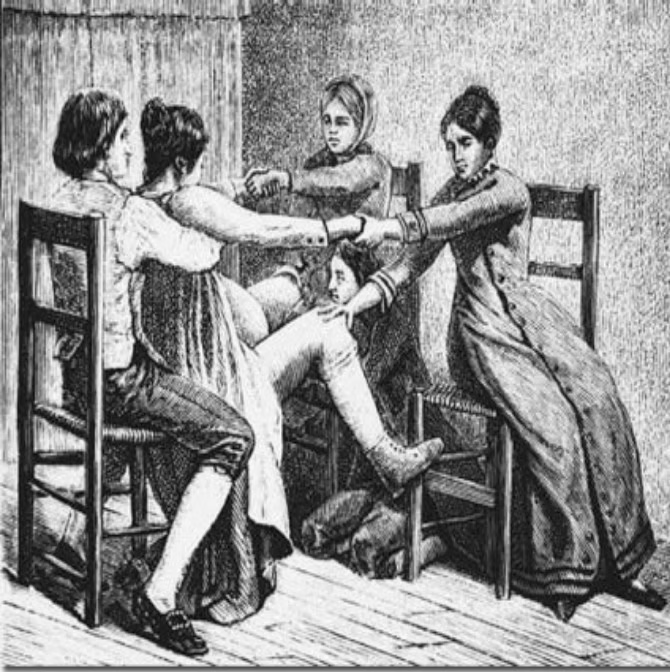

After a few hours of suffering, the life of self-importance will forever die and one will be reborn as a mother – slave to all that is family.

I went into my views on how John the Beloved, the Gospel writer, was the son of Jesus. The point does not require anyone believe that, in order to grasp the lesson of Jesus saying, “Whoever welcomes one such child in my name welcomes me, and whoever welcomes me welcomes not me but the one who sent me.” That says a lot.

First it says, “Whoever welcomes one such child.” That means a good wife bears children. Being Jesus’ replacement means more than being top dog. It means receiving the Spirit and giving birth to a baby boy soul within … a new you.

Second, it says, “one such child in my name.” That means receiving a specific soul that possesses one’s own soul and body, which comes with the name “Jesus.” The name “Jesus” means “Yah[weh] Saves.”

Third, it says a soul-body “welcomes me,” where the “child in my name” is not only named “Jesus,” but whoever that baby boy soul was born into “welcomes” being reborn in that identity. It means the love of a mother welcoming this new birth as as the extension of Yahweh to be His servant, as His Son resurrected.

Finally, when Jesus said, “whoever welcomes me welcomes not me but the one who sent me,” that says a soul who “welcomes a child named Jesus,” who is “not” the one named Jesus before [fill in your name here]. One’s self-ego has died and moved to the rear in submission to divine possession, which is the soul of Jesus raised again in the flesh. For one being who “welcomes the one who sent me,” that soul has married Yahweh [not some generic “lord”], having become His “capable wife.”

This means just as Jesus was not selfish [or gay], so that he did not made life be all about building up a singular ministry, refusing to not do any of the mandatory things demanded of all Jewish male adults, he exemplified obedience to the Laws. Jesus followed all the rules and expectations set upon a Jewish male. All the Jewish females did the same. As human beings devoted to a religious cause, they all followed the law that commanded, “be fruitful and multiply.” Jesus cursed a barren fig tree to wither and die. Had Jesus been fruitless [without child], it would have been hypocritical for him to have been that selfish. Jesus sired one son. That physical reality was Yahweh’s plan for all the followers of Jesus to do the same – SPIRITUALLY.

The true followers of Jesus must become wives of Yahweh – SPIRITUALLY. The true followers of Jesus must give birth to the one Son of their most Holy Husband – SPIRITUALLY. As a capable wife of the Father and the subservient mother of the Son, one must serve all, from beginning until end, in a ministry that is in the name of Jesus … another Christ of Yahweh raised from the dead of mortal existence. Ministry as Jesus reborn is led by Yahweh’s SPIRIT.

This means the message of this reading calls upon all who call themselves followers of Jesus – as a devotion to the human man, based on belief – to go beyond that belief and experience the truth of faith. To do that, one must:

1. Become a wife of Yahweh, through love and absolute submission of self-will to His Will.

2. Become impregnated with the soul of Jesus, which makes that soul be “in the name of Jesus,” no longer in the name of one’s biological father.

3. Enter into ministry as Jesus reborn, becoming a servant to all, as “a capable wife” for Yahweh.

As the Gospel reading to be read aloud on the seventeenth Sunday after Pentecost, when one’s own personal ministry for Yahweh should already be well underway, the lesson is to stop planning how great one’s future will be, when you die and go to heaven. That is a mindset that serves oneself alone and nobody else. One must die of self, which means one will follow in the footsteps of Jesus: suffer, die, resurrect – before one will amount to a capable wife of Yahweh. In order to die of self-ego, one must truly love Yahweh, so His love is returned in a proposal of marriage. One must enter the nuptial tent as the wife of Yahweh and receive His Spirit that makes one full of the fruit that is His Son [no daughters allowed, only Jesuses]. Then one lets Jesus lead one’s body of flesh into ministry, however Yahweh sees fit.


Psalm 1 – Choosing the right path [out of two]

1 Happy are they who have not walked in the counsel of the wicked, *

nor lingered in the way of sinners,

nor sat in the seats of the scornful!

2 Their delight is in the law of Yahweh, *

and they meditate on his law day and night.

3 They are like trees planted by streams of water,

bearing fruit in due season, with leaves that do not wither; *

everything they do shall prosper.

4 It is not so with the wicked; *

they are like chaff which the wind blows away.

5 Therefore the wicked shall not stand upright when judgment comes, *

nor the sinner in the council of the righteous.

6 For Yahweh knows the way of the righteous, *

but the way of the wicked is doomed.

——————–

This is the accompanying Psalm for the Old Testament reading from Proverbs 31, which will be read aloud in unison or sung by a cantor on the seventeenth Sunday after Pentecost [Proper 20], Year B, according to the lectionary for the Episcopal Church. This Psalm is optional and may not be sung, as the Proverbs 31 reading can be accompanied by a “First Lesson” that is from the Book of Wisdom. In either case, Proverbs 31 says, “ A capable wife who can find? She is far more precious than jewels.” The pair of readings will precede an Epistle reading from James, where the Apostle questioned, “Those conflicts and disputes among you, where do they come from? Do they not come from your cravings that are at war within you?” All will accompany the Gospel reading from Mark, which says, “Whoever wants to be first must be last of all and servant of all.”

Please take note of the two places where I have restored “Yahweh,” because that is the transliteration of the word written by David [“יְהוָ֗ה” – “YHWH”]. The NRSV [et al] love to transform this to “Lord,” as if using the name of God that David used is not allowed. David was not a Jew. David was an Israelite, a name that means “He Retains God.” To reduce David from that divinely elevated state of being to be a Jew whose God was named “Yahweh,” the name of the God of Israel, therefore not the name of the God of Christians, is demonic thinking. The name “Israel” was the holy name given to the soul of the flesh named “Jacob,” as Jacob had been Spiritually transformed into one “Who Retained God.” David was like that; and all should be like David, which is signaled by calling one’s God “Yahweh.”

The BibleHub Interlinear presentation of this Psalm shows a title that says, “The Two Paths.” The NRSV header is about the same, saying, “The Two Ways.” In this six verse song there are four times the word “wicked” is found. When “Yahweh” is found repeated also [twice used], the “two” roads taken must be seen as those walking “in the law of Yahweh” and those walking “in the counsel of the wicked.” One is a path of righteousness, while the other is “the way of sinners.” In this, it is valuable to realize the truth of the Hebrew word “rasha,” which has been translated as “the wicked.”

The word “rasha” means, “wicked, criminal” (Strong’s Definition), but implies “condemned, guilty, ungodly, wicked man, that did wrong” (Strong’s Exhaustive Concordance) According the NASB translations, it appears in Scripture 262 times, translated as: “evil (1), evil man (1), evil men (1), guilty (3), man (1), offender (1), ungodly (1), wicked (228), wicked man (21), wicked men (2), wicked one (1), wicked ones (3).” The BibleHub Interlinear translates this word as “the ungodly,” which I see as appropriately identifying all who walk an unlawful path, as being unmarried souls to Yahweh.

When this particular Psalm is seen as an accompaniment to the Proverbs 31 reading, where Solomon gave his opinions as to who qualifies as “a capable wife,” this now sings that Solomon’s views also follow two paths. In one way, “a capable wife” is metaphor for “wisdom,” which is an “elohim” [one of the gods] that possesses a soul and makes a brain become ‘book smart.’ That would be the path of the “wicked,” not the righteous. Thus, the righteous way to see “a capable wife” is as a soul in a body of flesh, which makes it a feminine essence bride-to-be of Yahweh, so once divinely united with His Spirit, then the body of flesh walks the path of the law … naturally, willingly, lovingly, and without needing a brain to determine which way to go.

In the first verse, the literal translation into English has it saying, “blessed the man , who ׀ not does walk in the counsel of the ungodly or the path of the sinful nor take that stance ; and in the dwelling place of the mockers not remains .” This translation makes it clearer that being “blessed” [as well as being “happy”] is a statement of love, because it is from one’s heart that happiness comes. This means being “blessed” is when the soul of a “man” [meaning mankind generally] has become possessed by Yahweh. Following the word “who” [“’ă·šer” or “asher”] is a bar [“׀”] that symbolizes a musical rest, therefore a verbal pause. The placement of the bar designates the first of two paths that “man” can take. In this, it is important to realize the Hebrew word for “man” is “ish,” which is what Solomon’s “wife-woman-female” comes from, as the Hebrew “ishshah.” This reflection says “man” can be either negative-feminine-receptive or positive-masculine-penetrating.

Following the bar marker, David wrote the word “not” [“”], which becomes a statement of the “negative-feminine-receptive,” as “man” is “blessed” by going the path that is positive-masculine-penetrating, and “not” the natural essence of the material realm. Here, it is important to realize that “happiness” can seem to be all the rewards of the material realm, but such ‘rewards’ are “not” based on love or heartfelt spiritual desires being satisfied.

Where the NRSV translates “lingered in the way of sinners,” the Hebrew word translated as “lingered” is “amad,” which translates as “to take one’s stand, [or] stand.” (Strong’s) While it can be seen that “standing” is akin to idling, thus lingering, that perspective should be seen as taking pleasure in the “path of the sinful,” implying that remaining in such a place says one enjoys sinful acts. According to Strong’s Exhaustive Concordance, the implication of “amad” is “abide behind, appoint, arise, cease, confirm, continue, dwell, be employed,” such that one sees sinful ways and takes a stance in support of those ways. Therefore, lingering becomes a sign of someone desiring to be sinful, enough to argue those ways of sin do have virtues.

The Hebrew word translated as “scornful” is “lê·ṣîm,” the plural form of “luts.” This word means “ambassador, have in derision, interpreter, make a mock, mocker,” such that to apply “scorn” [defined as “the feeling or belief that someone or something is worthless or despicable; contempt.”] reflects more on a directive towards those who are righteous; and, the usage becomes confusing otherwise. To make the translation “mockers” means one does not linger or “dwell” in a place where no shame is placed on sins, because one enjoys a sinful existence, becoming an “ambassador” that “interprets” one’s acts and beliefs not as sin, but as pleasures. This is justifiable because “happiness” comes to one when one does such acts. For one to be “mocked” in such a place, then one has to point out how those pleasurable acts are deemed against one’s laws, therefore “criminal.” It is then that which brings out mockery of such ideas. As such, the first verse paints a clear picture that mankind has two different paths in life; and, it will always remain that way. Life’s primary path leads a soul in the flesh to know sin, as a natural way of the world; and, from learning to walk a path that puts one alongside everyone else, the safety in numbers makes all who walk a different path be the focus of ridicule and condemnation.

Verse two then confirms the truth that began verse one, where those “blessed” are those who reject the path of the wicked are those who “take delight in the laws of Yahweh.” In this, one needs to realize that David knew “the laws” were not of Moses, but passed on by Moses to the Israelite people, by Yahweh. The “laws,” from “torah,” are the marriage vows that each soul must agree to as the only source of “instruction” that one’s life is led by. Being “chosen” means a soul proposed to; so, being chosen means agreeing to the vows of divine marriage. Those who are “blessed” are then those married to Yahweh; and, that marriage is not to be a partial commitment. It is full-time, as one must “meditate on those instructions day and night.” In that, “day” is during the easy times, while “night” is the dark times of trouble, when having the inner link to Yahweh’s voice (through divine marriage) keeps one’s soul from becoming lost and wandering back onto the path of the wicked.

Verse three then states this marriage metaphorically, saying “he shall be like a tree planted by the rivers of water so its fruit comes forth in its season.” There, the word “planted” is a direct statement of purposeful “transplanting,” not some natural luck of a seed falling onto fertile soil in a good location. By actually being purposefully “planted,” this becomes another statement of marriage, where one’s soul must make a decision that demands the commitment of putting down roots, so growth comes from a permanence of being in solid ground. This means a soul is planted in Yahweh, and He in turn with one’s soul. The “rivers of water” represents His Spirit; and, the “fruits” are the works of righteousness, which projects to others a way to live.

When David then continued in verse three, singing “whose foliage shall not wither , and whatever he does shall prosper .” this sings of eternal life. Because the divine spiritual realm is the place where it is always day and always happy and youthful, the acts in the material realm are irrelevant as far as what is determined prosperous. There can be nothing worldly that will ever diminish the reward of righteous living; and, that can only come through holy matrimony between a soul and Yahweh, while in the flesh.

Verse four then sings, “not so the ungodly ; for if like chaff , that drives away like by wind .” Whereas verse three sang of eternal life, verse four is singing of reincarnation. By not being married to Yahweh [as the “ungodly”] they will die. Their bodies of flesh will fall away, just like chaff falls away from the kernel of grain. The soul is that kernel, which is then blown back into the material realm, into a new body of flesh [a newborn baby], through reincarnation. This means the “wind” is like the recurring weather patterns, which are always the same, over and over and over again.

Verse five then sings, “upon this not shall stand ungodly in judgement ; nor the sinful , in the congregation of the righteous .” This sings the truth of Judgment, which will find the “ungodly” and the “sinful” not being able to achieve salvation. Seeing how all human beings are born with souls in bodies of flesh, set on the path of life that always offers two choices, the main road travelled is that of the sinners. That is why a soul must be “planted like a tree by rivers of water,” because without a conscious decision to change paths and commit to servitude to Yahweh [not self], one cannot find redemption. The “fruit” of one’s ways of righteousness is then how one can be considered to be “in the congregation of the righteous.” This places everything as the responsibility of the soul to choose, with Yahweh offering to help those who choose to marry Him.

Verse six then sings, “for knows Yahweh the way of the righteous ; but the way of the ungodly shall perish .” This says Yahweh knows which path one’s soul travels. He especially knows the way of the righteous, as those souls walk with Him, having been united as one with His Spirit. Those who do not walk as one with Yahweh will be known for that absence. When all souls come from death of the flesh to the time of Judgement, the righteous will live forevermore. Alas, the sinful will die and come back to die again. The place where souls “perish” is the physical world; and, their worship of the flesh will prophesy their way to find “happiness.”

As a companion song to the Proverbs 31 reading on the seventeenth Sunday after Pentecost, when one’s own personal ministry for Yahweh should already be well underway, the lesson is simple. There are two paths in life. One serves self and the other serves Yahweh. Any ministry taken into the world by a single soul, one ‘living together’ with ‘lady wisdom,’ has nothing of value to offer the world. One is then “lingering with sinners,” not to help them, but to wallow in their love of wickedness. To preach that sinners are loved by Yahweh is to mislead souls to ruin; and, that will bring a double share of their ruin upon one’s own soul. This says sacrifice your self-egos and become planted by the living waters that are Jesus Christ resurrected with one’s soul. Otherwise, expect to return to a world you love, perhaps not with all the blessing you enjoy in this life now being repeated in the next.

Wisdom of Solomon 1:16-2:1, 12-22 – How to use a Big Brain to belittle the children of God

[1:16] The ungodly by their words and deeds summoned death;

considering him a friend, they pined away

and made a covenant with him,

because they are fit to belong to his company.

—–

[2:1] For they reasoned unsoundly, saying to themselves,

“Short and sorrowful is our life,

and there is no remedy when a life comes to its end,

and no one has been known to return from Hades.

—–

[2:12] Let us lie in wait for the righteous man,

because he is inconvenient to us and opposes our actions;

he reproaches us for sins against the law,

and accuses us of sins against our training.

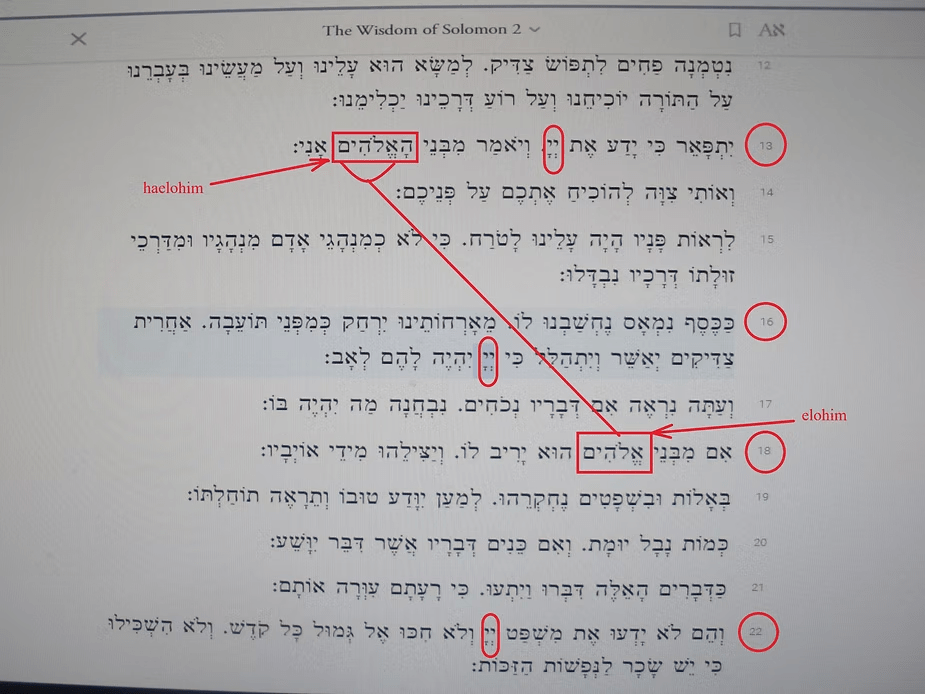
[2:13] He professes to have knowledge of יְיָ [HaShem],

and calls himself a child ha-elohim.

[2:14] He became to us a reproof of our thoughts;

[2:15] the very sight of him is a burden to us,

because his manner of life is unlike that of others,

and his ways are strange.

[2:16] We are considered by him as something base,

and he avoids our ways as unclean;

he calls the last end of the righteous happy,

and boasts that יְיָ [HaShem] is his father.

[2:17] Let us see if his words are true,

and let us test what will happen at the end of his life;

[2:18] for if the righteous man is elohim child, he will help him,

and will deliver him from the hand of his adversaries.

[2:19] Let us test him with insult and torture,

so that we may find out how gentle he is,

and make trial of his forbearance.

[2:20] Let us condemn him to a shameful death,

for, according to what he says, he will be protected.”

[2:21] Thus they reasoned, but they were led astray,

for their wickedness blinded them,

[2:22] and they did not know the secret purposes of יְיָ [HaShem],

nor hoped for the wages of holiness,

nor discerned the prize for blameless souls.

——————–

This is the “The First Lesson” that can be chosen over Psalm 1, as the companion reading for the Track 1 Old Testament reading from Proverbs 31 to be read aloud on the seventeenth Sunday after Pentecost [Proper 20], Year B, according to the lectionary for the Episcopal Church. It will be a companion for Solomon writing, “[A capable wife’s] children rise up and call her happy; her husband too, and he praises her: “Many women have done excellently, but you surpass them all.”’ That pair will be presented before the Epistle from James, where the Apostle wrote, “You do not have, because you do not ask. You ask and do not receive, because you ask wrongly, in order to spend what you get on your pleasures.” All will accompany the Gospel reading from Mark, where is written: “Then [Jesus] took a little child and put it among them; and taking it in his arms, he said to them, “Whoever welcomes one such child in my name welcomes me, and whoever welcomes me welcomes not me but the one who sent me.”’

To repeat my prior disclaimer about the Wisdom of Solomon being Apocryphal and thus not in my standard reference for the Hebrew text, it is too difficult for me to do any more than a rudimentary translation, which is quite taxing and time consuming. What I have done is number the verses, based on a Bible.com English publication of this reading, confirmed by the NRSV translation, which the Episcopal Church has deemed unnecessary to number. In this you will also find three more uses of “יְיָ” or what one Hebrew source stated as “HASHEM,” which means a proper name for “God,” like “adonay,” but not. It also is not a standard abbreviation for “YHWH,” but is thought to be from the Hebrew word meaning “to be” [“haya”]. I also point out where two translations as “God” are actually the word “ha-elohim,” meaning “of elohim,” with another that is clearly “elohim.”

In verse sixteen of chapter one, Solomon concluded a train of thought that dealt with soul marriage, although not one married to Yahweh. The words “ungodly,” “death,” and “covenant” all speak of a soul falling in love with the material plane and marrying that which disappears when “death” comes. Human being are mortals because “death” is the ‘god’ of the physical world. Satan is the “lord” that sways souls away from divine marriage to Yahweh, so their “covenant” can be seen as a ‘pact with the devil.’ Being “fit to belong to his company” means a soul denied eternal life in heaven; so, those souls get to rejoin the worldly plane they sold their souls for.

The transition from chapter one to chapter two should be seen as a change of theme [not running out of space on parchment]. Thus, verse one is stating the theme that changed from one of ‘righteous versus ungodly’ to one of knowledge, where Solomon begins by saying “poor thinking” [“For they reasoned unsoundly”] is the difference between having a happy, rewarding life on earth and going to Hell [“no one has been known to return from Hades”]. While chapter one [entitled “Exhortation to Uprightness,” with verse sixteen entitled “Life as the Ungodly See It”] is focused on the duality of good and evil [the wisdom Solomon prayed to receive], chapter two is now advancing the notion that wicked people are those who just don’t have good brains on their shoulders.

Solomon sings, “I’m too brainy for my head.”

The limitations that must be seen in Solomon’s worship of his own big brain is seen when he conjects that there is no return from “Hades,” which is actually written “sheól” [“שְׁאוֹל”]. For Solomon to think he could tell whether the guy standing next to him was not the reincarnated soul of some past king [or queen] of a foreign nation, one that crashed and burned, or even the reincarnated soul of one of the wicked Israelites who died in the wilderness, due to not obeying the Commandments, shows how little he knew in reality. To even surmise such an idea as wisdom is the same as science, saying it is the only way to good judgment when it is proved to be wrong many times (after declaring it was right), is idiocy.

The concept of Sheol [from the second Temple perspective] was all souls went there. The thinkers that returned from Babylon captivity divided into two main sects: One believe there was nothing after death [Sadducees]; and, the other thought death was a ticket to something akin to Purgatory [Pharisees]. By simply by being born a Jew [formerly Israelites], the Pharisees believed death meant that soul would be taken to heaven after the Messiah came. Of course, that mindset figured all Gentiles were either like dogs and cats [soulless], or they had evil souls, so death meant they went and roasted in Hell. That should be seen as who were the wicked people of whom Solomon was talking about, because (certainly) any right-minded Israelite of Solomon’s reign would see him as a god worthy of worship [smart as he was].

Skipping down from verse one of chapter two, to verse twelve, this is where Solomon is making himself out to be “a righteous dude,” as if Israel still had Gentile enemies they were worried about. Of course, David’s Israel was always at war with those who refused to accept their God Yahweh had given them that place to live, with the Philistines being those who still retained land that was not Israel’s. They, however, were not an issue, since Solomon had married an Egyptian princess and then had an ally that could put the squeeze on the Philistines, from the west. Still, verse twelve is Solomon’s self-worth as a hero of the righteous coming forth, as he equates all who would challenge his authority as being wicked.

It is in verse thirteen that the truth of Solomon’s wickedness is exposed. In this verse there are two references to [NRSV translator] “God” and “the Lord.” The reality of what is written (as best as I can look up the Hebrew) is this [using the NRSV otherwise]: “He professes to have knowledge of יְיָ [HaShem], and calls himself a child ha-elohim.” In Solomon’s reign, the prophet Nathan was still actively advising the king. Others like Nathan were those who claimed “to have knowledge of” Yahweh. For Solomon to not write that name, but to instead write marks that are confusing, as to whom or what is being referenced [some say the letters are an abbreviated form of the verb translating as “to be”], this says Solomon was not like his father David, nor the divine prophets who advised as the conduits of Yahweh. Solomon saw himself as a god, who was married to the goddess Wisdom, with Yahweh was believed by Solomon to be the servant god who served him: יְיָ [HaShem].

Look closely at the Hebrew text and see the “HaShem” marks [ovals] and the words “haelohim” and “elohim,” in the verses circled.

In the NRSV translation, the world “child” is footnoted, with the footnote saying the word written can equally translate as “servant.” For one to say he was “a servant of elohim,” that describes a prophet like Nathan to a T. The point of the Hebrew word “elohim” is not to state “God” [the error of all translators], but to state the reality of “gods” [in the plural number], which are those souls married to Yahweh and thus given His powers on earth, as His “servants” [His “children”]. Thus, in verse thirteen, Solomon is placing himself above that of true prophets, because of his big brain. This then equates his soul to a state of wickedness.

Verse fourteen then has Solomon scoff at the condemnations of the prophets, who say worldly wisdom is what condones evil ways. Verse fifteen is then Solomon belittling the true holy priests of Israel as the ones who take all the fun out of life. IIt was the true priests and true prophets of Israel who were reminding everyone of the laws, reminding the leader [Solomon] that maintenance of those vows is what keeps souls from infidelity, or breaking their marriage agreement with Yahweh. Solomon was calling the restrictions placed on being a true priest of Yahweh as unnatural. That is true, when a nation of people are being led away from adherence to their Covenant and finding normalcy in the ways of other nations.

In verse sixteen, Solomon again references the “HaShem” in a way that makes it be used as if he knew he would bring some physical condemnation upon his flesh [leprosy maybe?] by using the name “Yahweh,” as his father David had done frequently in his songs. Solomon took purposeful steps away from his father, by refusing to write the proper name “Yahweh” [“יְהוָ֣ה”] Here, Solomon belittles one who claims to be an “elohim” of Yahweh, because they make the claim that Yahweh is their “Father,” while also implying He is their Holy Husband. This becomes Solomon cursing Jesus, who routinely told his disciples [not the whole world, not all of Judaism] to address Yahweh as their “Father.” To call Yahweh “Father” means one must be His Son [all souls are masculine essence, especially when married to Yahweh’s Spirit … males and females in the flesh].

In verse seventeen, Solomon is beginning a series of verses that become the standard punishment governmentally set upon any who claim to be divine Sons of Yahweh. To make such claims means to be put to death. This concept would be viewed as holy wisdom, as Yahweh’s gift to Solomon, when in reality it was Satan’s serpent whispers [a marriage that made Solomon’s soul become the demonic elohim of his evil spiritual husband] that influenced all who would follow Solomon. The routine Solomon established would be for kings to marry foreign wives, import foreign priests, and then kill any priest who spoke out against that process. The culmination of this mindset of ‘wisdom’ was how the elite of Jerusalem could even fathom it would be okay to plan the execution of Jesus, the promised Messiah; but to even believe in a promised Messiah, one has to first believe in Yahweh. Solomon taught them not to believe in being “He [Who] Retains God” [the meaning of “Israel”].

In verse eighteen is a second use of “elohim,” which again must be seen as “gods,” specifically those whose souls have married Yahweh and become His hands on earth. At the time of Solomon’s reign, all true divine “elohim” were priests of the Ark of the Covenant [transferred from the Tabernacle of Zion to the Temple of Solomon] and the holy prophets [such as Nathan]. In this verse, Solomon laughs at those who make claims to be divine Sons of man, such that Solomon’s mindset was cast into the future, executed at Golgotha, when someone yelled out to a dying Jesus, “If he is the Messiah, let him save himself.” Here, Solomon scoffs that the test of death will bring out the truth of being a “servant” [same use of “child”], by having Yahweh physically rescue such a servant.

Verses nineteen and twenty are Solomon giving the go ahead from that point in time onward to torture and insult the prophets of Yahweh. To claim to be “peaceful” means Solomon’s plan was to beat hatred and anger into those who made such claims. In today’s world, the destroyers of Christianity love to promote that Jesus is the Prince of Peace and would bend over and take insults and torture all day long, rather than strike anyone down in wrathful anger. They persecute the believers to the point of forcing them away from Yahweh, by punishing their will to serve. What those do not realize is the truth that every hateful strike brings them in return. When they put forth persecution against one of Yahweh’s children, the same return blows will come upon their souls, a hundred-fold.

The NRSV then places one of its titles or headers before verse twenty-one, saying the rest of chapter two focuses on the “Error of the Wicked.” This is an assumption that “the wicked” are false prophets [like Solomon’s wisdom] and not the true prophets of Yahweh. Solomon reflected the intellect of humanity, as one who worshiped ‘Sherlock Holmes-like’ abilities to discern physical clues and make logical deduction that result in the truth. None of that worldly wisdom is divine, thus far from all-knowing, as that given to Yahweh elohim. Thus the title would be better stated as “Error of the Intelligent.”

Verse twenty-one is then a perfect summation of all Solomon’s views that have been written on parchment. By saying, “Thus they reasoned, but they were led astray, for their wickedness blinded them,” this projects as truth upon the priests of logic and reason that deduce wrongly and are blinded by the science of the visible world. No true priest of Yahweh is reading the Law [the Torah] and coming away with clear-cut, black and white knowledge. Divine Scripture is written [according to Jesus] so the truth is hidden from the wise and intelligent, but exposed to the children [insert “servants” here]. The truth known by Yahweh elohim does not come from carefully crafted thought processes. However, once the truth has been shown, all those arts and crafts can find a truth fully justified and true. Thus, a simpleton [one of those Solomon belittled, when he prayed to his god “wisdom”] can be shown the truth of God, while all the big brains could not see the truth before their eyes.

In verse twenty-two [not the last verse, as chapter two has twenty-four verses], Solomon returned once again to displaying his fear of naming “Yahweh,” using his code-word called “HaShem” [יְיָ]. In this verse, Solomon sings that his lost soul never once considered self-sacrifice for the unseen rewards that are postmortem. The wise and intelligent cannot possibly see that which is “secret” and thus spiritual. They seek the material rewards that are the “wages” of being the elite, not the commoners. They never seek to restrict themselves from that which can be freely taken, for the seeming bargain of one’s soul [everything material for nothing spiritual]. They have no desires for holiness. They do not believe anything exists beyond death. Therefore, they have no need for thinking blamelessness is a virtue.

As the optional “First Lesson” to accompany Proverbs 31 on the seventeenth Sunday after Pentecost, when one’s own personal ministry for Yahweh should already be well underway, the lesson here is to see the trap of intellectualism. Solomon could not see how his words were condemning his own soul, all the while thinking he was making light of those who said they served Yahweh. Solomon did not believe Yahweh was anything more than a stepping stone to a mastery of life on earth. He did not believe in an afterlife; as there was no proof that anyone had ever returned from the depths of the ground. The lesson that must be taken from this is being a “child of elohim,” which means having one’s soul be married to Yahweh, with His Son Jesus resurrected within one’s soul-flesh. Having a big brain keeps one from having access to All Knowledge, readily available to the children of Yahweh, when needed. No planning necessary.

Psalm 54 – Having not determined the enemy has Yahweh on their side

1 Save me, elohim, by your Name; *

in your might, defend my cause.

2 Hear my prayer, elohim; *

give ear to the words of my mouth.

3 For the arrogant have risen up against me,

and the ruthless have sought my life, *

those who have no regard for elohim. [Selah.]

4 Behold, elohim is my helper; *

it is adonay who sustains my life.

5 Render evil to those who spy on me; *

in your faithfulness, destroy them.

6 I will offer you a freewill sacrifice *

and praise your Name, Yahweh, for it is good.

7 For you have rescued me from every trouble, *

and my eye has seen the ruin of my foes.

——————–

This is the accompanying Psalm for the Track 2 Old Testament reading from Jeremiah 11 that will be read aloud in unison or sung by a cantor on the seventeenth Sunday after Pentecost [Proper 20], Year B, according to the lectionary for the Episcopal Church. In Jeremiah is read, “I did not know it was against me that they devised schemes, saying, “Let us destroy the tree with its fruit”. That pair will be presented before the Epistle reading from James, where the Apostle wrote, “Where there is envy and selfish ambition, there will also be disorder and wickedness of every kind.” All will accompany the Gospel reading from Mark, where is written: “Then they came to Capernaum; and when [Jesus] was in the house he asked them, “What were you arguing about on the way?” But they were silent, for on the way they had argued with one another who was the greatest.”

In the above translation [NRSV], you will note that I have amended the text in six places. In four places the Hebrew word “elohim” [“אֱ֭לֹהִים”] is written, which is the plural form for “el,” translating [unquestionably] as “gods.” In the first two places where “elohim” was written, the NRSV has translated “O God” [a theatrical addition], while in the third and fourth [verses three and four] the same word is translated simply as “God” [no theatrics]. All are wrong, so there is a need to recognize that. Additionally, also appearing in verse four is found the plural Hebrew word “adonay” [“אֲ֝דֹנָ֗י”] written, which is the plural form of “adon,” so the translation [unquestionably] should be “lords.” This also has been restored to the Hebrew text. In the cases of “elohim” and “adonay,” those words were written to indicate those who have a special Spiritual connection to Yahweh, like angels in human flesh, given the powers of Yahweh’s Spirit. Therefore, to simply correct the words to “gods” and “lords” would become confusing; so, I have restored the Hebrew for the reader to learn the importance of those words.

At the end of verse three is the word “Selah,” which the NRSV shows in its translation; but the Episcopal Church has deleted from their readings. It is worthwhile to realize why David wrote this word once in the Psalm and placed it where he did. Thus, I have restored it to the text, in brackets. Finally, in verse six David mentioned the proper name of his God, which is Yahweh. Yahweh is my God also. Yahweh should be your God too, if you are a true Christian. However, the translators of Hebrew into English transform that proper name to a generic “Lord” [here the theatrics return as “O Lord”], which is wrong because it diminishes the value of knowing Yahweh’s name. Therefore, I have restored that name for readers to learn and love.

Not included in the above translation is the precursor language that is technically part of verse one, but read as instructional, guiding one’s feel for the whole song. The NRSV translates all of this as such: “To the leader: with stringed instruments. A Maskil of David, when the Ziphites went and told Saul, “David is in hiding among us.”’ They also give this song a title, which is “Prayer for Vindication.” A literal translation into English for all this is: “to the chief musician of stringed instruments , an instructive poem of David . when went the Ziphites and spoke to Saul ; not is David hiding with us .

In that, the presence of “hă·lō,” meaning ‘is not,” seems to have been overlook by the NRSV, as it states the opposite of what the NRSV says. They say that because 1 Samuel 26:1 says, “Then the Ziphites came to Saul at Gibeah, saying, “David is in hiding on the hill of Hachilah, which is opposite Jeshimon.” While that is what they told Saul, David [who was a dignified person in Judah] might have sent the Ziphites to tell that to Saul, so Saul would make a move David was prepared for. In that reasoning, I see David as receiving divine insight from Yahweh; so, the Ziphites were more of an ally to David than Saul. Therefore they did tell Saul “David hiding with us,” but that information “is not” a betrayal of trust. It “is not” what it seemed to be to Saul.

Now, in the first four verses the plural Hebrew word “elohim” is written. Instead of translating what David wrote, translators read the translation manual, which must state, “Everywhere you see “elohim,” it must be translated as “God.”’ That means they then face the task of having to twist and turn the words written, in order to match everything up to “God,” not the human souls married to Yahweh, as His “gods” on earth. They are forbidden from giving Yahweh credit for making “elohim” and “adonay.” This means verse one does not make a plea for “God” to “save me.”

The literal translation into English one finds in verse one is this: “elohim by your name deliver me ; and by your strength judge me .” This becomes a statement that David is a divine extension of Yahweh on earth. The Hebrew word “bə·šim·ḵā” pulls from the root “shem,” meaning “name.” Seeing how the translation can equally be “in your name,” this speaks of marriage. The statement of “elohim” says David is claiming to be one of the many who are the wives of Yahweh, as His extensions on earth. Being “in the name” means being truly “Israelites,” a name meaning “He Retains God.” With “God” being “el,” then many retaining “God” are “elohim.”This means David is one and the Ziphites are others. By seeing the plural number as a reflection of many on earth who serve Yahweh through their souls united with His Spirit, this says the safety of David and the Ziphites was assured, because they followed the direction of their One God [named Yahweh]. By being assured of the “strength” of Yahweh in their being, the Ziphites could tell Saul the truth, exonerating the people of Ziph, while also preparing David to play the ‘cat and mouse’ game with Saul, as the winner.

Verse two repeats this aspect, using “elohim” again. This verse literally translates into English as this: “elohim hear my prayer ; give ear , to the words of my mouth .” In this, because one sees the people of Judah having been led to marry their souls to Yahweh, following the lead of David as obviously divinely led by Yahweh, the “prayer” of David is known not only by Yahweh, but by all His “elohim.” This says the majority of the Ziphites did not know where David was exactly, although they all knew where he was generally. This knowledge was due to all having divine insight. Therefore, they all listened to the whispers of Yahweh to lead them; and, from being led divinely, they would speak the “words” as directed – which would lead Saul into the place where David could further display how Yahweh protected his servant David.

Again, in verse three, the use of “elohim” is found, which confuses the translators following a false premise. The literal English translation of this verse says: “for the estranged have taken a stance against me , and ruthless men have sought after my life ; not they have determined they have elohim before them .” Here, the Hebrew word “zā·rîm” is written, pulling from “zuwr,” meaning “to be a stranger.” This usage can mean “become estranged,” where Saul and his followers were foreigners to Yahweh’s Spirit. Thus, they had taken up a stance against David, because they followed the orders of their king. The soldiers under Saul were “ruthless men” [“wə·‘ā·rî·ṣîm,” from “aritz”] in their pursuit of a military objective. They had been told to kill David, so that was their whole mission. However, as strangers to Yahweh’s presence within them, they had never before encountered “elohim,” who were those divinely possessed by the One God. Saul and his men professed to serve Yahweh, but none of them personally knew Him and none had ever been confronted by those who served Him truly.

It is here that the lone use of “Selah” is written. The word “selah” means “to life up, exalt.” Following David singing praise to the strength possessing “elohim,” which must be understood as how true Israelites routinely defeated their “stranger” foes. The ‘Promised Land’ was defended because Yahweh was with their souls, giving them unprecedented abilities in warfare. Thus, David sang high praise to the “elohim” that would bravely face the soldiers of Saul, because they were “uplifted” and “exalted.”

In verse four, there is not only the use of the fourth “elohim,” but also the use of “adonay,” with both words in the plural number [“gods” and “lords”]. The literal English translation here says, “behold! elohim helper me ; lords , with those who uphold my life .” In the NRSV translation that has “elohim” translated as “God,” they have David singing that “God is my helper.” While that rolls off the tongue easily and can act as the way things can be seen [in hindsight], think for a moment about how egotistical such a statement is. It makes Yahweh out to be some lackey that does what one commands, not the other way around. The truth is one must be a servant to Yahweh, through love and devotion, where one is then the helper of Yahweh, as was David and the people of Judah. Therefore, David was singing out loudly – “behold!” – because he was an “elohim helper” that all must see in his being.

That then leads to the one-word statement “adonay.” The singular ‘adon” means “lord.” Thus, “adonay” is a statement that says “lords.” Still, this is like “elohim” in the sense that all whose souls are married to Yahweh have Him [His Spirit] with them. This is an inner presence that makes Yahweh the “lord” of that body of flesh. Therefore, all who are “elohim” are those who have Yahweh as their “lord,” being those “lords” of Yahweh. As emissaries of Yahweh on earth [like Saints], they present Yahweh to the world as ‘tabernacles’ of His residence. Thus, the focus has now shifted from “See me! I am a Son of man!” to “See us all like me! We all are the “lords” on earth commanded by Yahweh!”

This then leads to the final segment of words, where the two prior segments are spliced together, as both are “with those who uphold my life”. Those are “elohim” and “adonay,” all of whom are promised eternal “life” through marriage and service in the name of Yahweh. When David’s life on earth is upheld, his life is assisted by others like him. The result is all are upholding a life in the name of Yahweh. The reward of such service is a true life that is Spiritual, not physical.

Verse five then literally translates into English to say, “[he will return] (for their evil) my enemies ; in your faithfulness , cut them off .” In this, the first words are bracketed, as an aside, and then comes words in parentheses, as an unspoken thought, where those additions in the verse become focused on “my enemies.” The enemies of David and his true Israelites were souls who had become reincarnated after having lived prior lives as sinners. The bracket “yā·šîḇ” [from “shub”] says the enemies of David are “returned” souls. The whispered reason for their returns is “for their evil deeds” [“hā·ra‘,” from “ra’”]. The “enemies” [from “sharar”] are the enemies of Yahweh’s goodness; and, they will always be souls returned to the worldly plane, due to being “estranged” from Yahweh.

When the segment following the semicolon says, “in your faithfulness,” this is a statement of David’s devotion to Yahweh as His servant. David has true faith, from personal experience of Yahweh within. David is not acting on beliefs taught to him, as his “faithfulness” [“ba·’ă·mit·tə·ḵā,” from “emeth”] is from a “firm” identity as one who is with Yahweh. This is contrary to his enemies, who are also the enemies of Yahweh, as there the souls have been “cut off” from a divine union with Yahweh. There is no love between sinners and Yahweh, being enemies.

The sixth verse then literally translates into English, saying “voluntarily I will sacrifice to you ; I will praise your name Yahweh for good .” In this, to “voluntarily” or “freely” submit in “sacrifice” to another means marriage, such that a wife becomes a submissive member of her husband’s family. This is done “freely,” out of love, whether the love is for her parents or her new husband. This is the “sacrifice” of self that must be made for any such transition to become anything more than forced slavery. Yahweh does not force any souls to marry Him. Thus, David sang that his soul willingly submitted itself to the Will of Yahweh; and, that is the name he specifically praised. By David writing “Yahweh” here, he has confirmed all the “elohim” and “adonay” to be equally submissive wives of Yahweh, in service to their One God. To do “good” means to do as Yahweh commands, as only Yahweh is “good” [per Jesus].

Verse seven then literally sings in English, “for out of all trouble he has delivered me ; and upon my enemies , has seen my eye .” As the concluding verse to a song that was introduced as about when David was being hunted by Saul and his army of soldiers, this says his being married to Yahweh is how he escaped capture and defeat. David was free to not only elude Saul, but to let Saul know he would never defeat David, because of his divine union with the Almighty. That is how the successes of David would always equate to the failures of his enemies. This is less about David having seen physically the results of that protection; but more about the foresight that allowed David to see what to do, because he had faith in the All-seeing Eye of God leading him.

As the companion Psalm for the Jeremiah 11 Track 2 offering, to be sung aloud on the seventeenth Sunday after Pentecost, when one’s own personal ministry for Yahweh should already be well underway, the lesson is to trust in Yahweh and let His Spirit lead one away from enemies and the troubles they bring. Ministry should be the unification of souls who are seeking release from evil ways and failed attempts at controlling the uncontrollable. Ministry is therefore showing others how to marry Yahweh and have their souls freed from the returns to the material plane, due to bad decisions. Yahweh sends out His priests so others will be allowed to have eternal life through soul submission into faithfulness. Of course, to be able to preach that message, one has to have been there, done that, like David and the people of Judah.