“The whole congregation of the Israelites complained against Moses and Aaron in the wilderness. The Israelites said to them, “If only we had died by the hand of the Lord in the land of Egypt, when we sat by the fleshpots and ate our fill of bread; for you have brought us out into this wilderness to kill this whole assembly with hunger.”
Then the Lord said to Moses, “I am going to rain bread from heaven for you, and each day the people shall go out and gather enough for that day. In that way I will test them, whether they will follow my instruction or not. On the sixth day, when they prepare what they bring in, it will be twice as much as they gather on other days.” So Moses and Aaron said to all the Israelites, “In the evening you shall know that it was the Lord who brought you out of the land of Egypt, and in the morning you shall see the glory of the Lord, because he has heard your complaining against the Lord. For what are we, that you complain against us?” And Moses said, “When the Lord gives you meat to eat in the evening and your fill of bread in the morning, because the Lord has heard the complaining that you utter against him—what are we? Your complaining is not against us but against the Lord.”
Then Moses said to Aaron, “Say to the whole congregation of the Israelites, ‘Draw near to the Lord, for he has heard your complaining.’“ And as Aaron spoke to the whole congregation of the Israelites, they looked toward the wilderness, and the glory of the Lord appeared in the cloud. The Lord spoke to Moses and said, “I have heard the complaining of the Israelites; say to them, ‘At twilight you shall eat meat, and in the morning you shall have your fill of bread; then you shall know that I am the Lord your God.’“
In the evening quails came up and covered the camp; and in the morning there was a layer of dew around the camp. When the layer of dew lifted, there on the surface of the wilderness was a fine flaky substance, as fine as frost on the ground. When the Israelites saw it, they said to one another, “What is it?” For they did not know what it was. Moses said to them, “It is the bread that the Lord has given you to eat.”
———————————————————————————————–
This is the Old Testament reading for Proper 20, Year A of the Episcopal Lectionary, the sixteenth Sunday after Pentecost (2017 and 2020; 15th in 2014). It will next be read aloud in an Episcopal church on Sunday, September 24, 2017 (September 20, 2020). It tells of the Israelites complaining to Moses about not having food, which leads to God providing food for them. This is least important as a story of God producing the miracle of manna and quail as sustenance, as its greatest meaning is directed to the individual who is reading (or hearing) these words. They, like everything in Scripture, should be read as a message intended for you to grasp. Therefore the manna and quail are likewise God’s gifts to you.
Again, the miracles of the Exodus story makes atheists crawl out of their holes and point to the quail of Exodus 16 as being a contradiction of what is written in Numbers 11. In turn, rejections of Scripture either makes Jews and Christians stop being active in their faith, or they just shrug their shoulders and say, “I dunno. I can’t explain anything. I just go to church (or the synagogue) and believe what they tell me to believe.” Reading the Holy Bible as a scholastic-history-story book, without the assistance of the Holy Spirit, leads many people to misunderstandings, like seeing contradictions or being blind to everything.
Atheists study the Holy Bible more than most Christians. They do it to make Christians tuck their tails between their legs and run away.
If one has read the whole Exodus story, one might think this story is eerily similar to the Israelites complaints about not having anything to drink. They did that in chapter 15, when they arrived at Marah (in the Desert of Shur), where they found bitter water. After complaining, Moses led them to “Elim, where there were twelve springs and seventy palm trees, and they camped there near the water.” (Exodus 15:27) There would also be complaints of thirst later, when Moses went to God and God told him to strike the ground with his staff, and lo and behold water flowed forth. (Numbers 20) This reading is about food, rather than drink, but both are to be understood as necessities of life being met and not the grumblings of selfishness being satisfied. Still, the specifics of what foods and what drinks were provided, as the result of miracles, are really less unimportant than the symbolism.
Missing from this reading is verse 1, which states the timing of this complaint: “On the fifteenth day of the second month after they had come out of Egypt.” The Passover meal was eaten after 6:00 PM, beginning the fifteenth day of the first month (15 Nissan, or the evening of 14 Nissan). This makes the complaint of this reading be 30 days after eating the roasted lamb, which is 15 Iyar (the second month). This information is important because 14 Iyar is a Jewish day of recognition named Pesach Sheni, meaning Second Passover. Therefore, the focus of this reading should begin with this realization. The symbolism of this reading is for a ceremonial remembering, even if their bellies felt empty.
When I wrote about Exodus 12, the instructions for the Passover (Proper 18), the food of the lamb and the blood of the lamb were the symbols of the Passover Seder (last supper), which are the same symbols of the Eucharistic wafers and wine. The roasted lamb with unleavened bread and bitter herbs was not God feeding hungry people. It was God feeding hungry souls with spiritual food. That same element of spiritual food has to be seen in the manna (“what is it?”) from heaven.
The reason this can be said confidently is the Israelites had livestock with them. In Numbers 20:4 the Israelites went to Moses, asking: “Why did you bring the LORD’s community into this wilderness, that we and our livestock should die here?” In Exodus 9:4, before the plague that would strike the Pharaoh’s animals, Moses said, “But the LORD will make a distinction between the livestock of Israel and that of Egypt, so that no animal belonging to the Israelites will die.’” Finally, the yearling lambs or goats that were to be inspected and slaughtered for the initial Passover meals came from Israelite livestock. These animals went with the Israelites when they left Egypt.
When you realize the complaint of hunger cannot be from lack of food for survival, then one has to read the complaints of the Israelites on a spiritual level. They complained, “If only we had died by the hand of the Lord in the land of Egypt, when we sat by the fleshpots and ate our fill of bread; for you have brought us out into this wilderness to kill this whole assembly with hunger.” This is a longing for the ways of the world and not the LORD.
Death is synonymous with living in the world without God leading one’s soul, as was life in Egypt, which is the true force of life (a soul) within a “pot of flesh” (“sîr hab·bā·śār,” rooted in “ciyr basar“). The Israelites were full of life as mortals born to die, before Moses took them away from their teat of addiction – worldly existence – like a mother weaning a child and leading it to eat solid food. Their complaint, as such, should be read as the cries of a baby not getting what it wants.
Rather than die a death of ego (symbolically die as common laborers and be reborn as servants of God), to serve the LORD as His priests, they wished to have died like all mortals who are born of death. They saw the cauldrons of boiled meats and vegetables with lust, as their memories of the offerings of the world were more pleasurable than those of the LORD presently (stuck in the wilderness, off the well-beaten path to Canaan). They remembered bread risen with yeast, which made them feel full inside, due to the gas releases of microbes. Leavened bread is symbolic of more than one’s basic needs being met.
This means Exodus 16:2-25 is the Israelites telling Moses, “We’re just not feeling why God chose us. Release us back to Egypt, or feed us with some tasty inspiration and promise that will make us feel alive, filled with spiritual knowledge.” Metaphorically, the Israelites were like a mixture of flour, salt, and some water, rolled into unleavened dough ready to be baked each day. (If dough could talk), they asked Moses for a pinch of yeast, so they could rise in the oven and be hot, fresh, desirable bread, like that the world loves to consume. The manna is then them gathering a daily amount of yeast to give rise to their spiritual connection to Yahweh. Without that, the Israelites would never amount to anything more appealing than crackers or flatbread.
The unknown substance that covered the ground in the morning (manna) was then spiritual additive to the life Moses had brought them to know, which gave the Israelites reason to continue following Moses and Aaron, as devoted disciples of the LORD. This is why the men would gather for themselves and their families, as the men were the rabbis of each, who taught the ways of the LORD to their own, passing on knowledge that came to them from that spiritual addition taken in as food. The men were thus “fathers,” and their families were their responsibilities, just as “fathers” are priests (or pastors) of flocks.
[This is a non-human gender-specific title, as anyone – male or female – who acts as a vehicle of God the Father is a “father” Spiritually. It is then wrong to identify female priests as “mother” because had Moses played the role of momma to a bunch of crying babies who wanted to go back to Egypt, then that is where they would have gone. The end of the story. However, the “father” principle is one that teaches, disciplines, and rewards good behavior, turning the weak into the strong, through ‘tough love’.]
This is indicated when God told Moses, “Each day the people shall go out and gather enough for that day. In that way I will test them, whether they will follow my instruction or not.” The manna of knowledge was like the title of this Word Press blog, where Our Daily Bread offers just enough to feed a Christian until another hunger pang for inspirational knowledge is felt. Scripture is written like unleavened bread, requiring the insight of the Holy Spirit – the true bread from heaven. This article also offers a test, as to whether or not the reader (or listener) is following these insights that I offer as manna from heaven.
As for the quail, one needs to look at what they symbolize, rather than see them as a truck load of Cornish Game Hens being dropped off in the wilderness (or U.S. military MRI’s after a disaster). A quail is a wild bird. Birds have wings, so they can easily transition from ground-pecking to airborne.
Supposedly (from the account in Numbers 11:31), the quail were blown off course from the “sea” (Red or Mediterranean?) in large numbers. So, their flight plan had been changed by God, so that they all landed in the same place as the Israelites. The Israelites also had a path they were following, but they had taken flight from Egypt (after crossing the sea). It was the breath of God (as an east wind) that blew apart the waters, so the Israelites crossed on dry land. The quail are thus symbolic of the Israelites themselves.
The quails died as food for the Israelites. That is metaphor that says the Israelites died as those doubting their faith in this guy with a magic staff (Moses) and whether or not YHWH really meant to choose them … for only God knows what purpose that is. Quails and Israelites together in the wilderness, with both surprised to be there.
In the song The Twelve Days of Christmas, six of the first seven days are represented by birds: partridge; turtle doves; French hens; calling birds; geese; and swans. (The fifth day is represented by a wedding ring, by the way – marriage to God, a soul forever united with the Holy Spirit.) In the hidden meaning of the song, it is the numbers that are symbolic of the Holy Bible and its messages. The birds are symbols of humans who leave the mundane world and fly as Christians. So, in that way of looking at birds, it is worthwhile seeing the Israelites as symbolic of quails.
Before anyone raises their hand to question how any Israelites could eat his fill of other Israelites, recall how Jesus said this: “Very truly I tell you, unless you eat the flesh of the Son of Man and drink his blood, you have no life in you.” (John 6:53) There are atheist sowing doubts & Bible study groups that delight in seeing this as the “cannibalism” of Christianity (even the Jews who heard Jesus say that were greatly offended).
Of course, the meaning of Jesus’ words are not literal but spiritual. To eat the body of Jesus Christ, you must consume the body of text that prophesied his coming, as he came – the Son of God, the Messiah. At that time, that body was the Torah, the Psalms, and the writings of the Prophets. Today, that body has a “New Testament” (two turtle doves = Old & New Testaments).
Since Jesus was not yet in the world and God had just begun to train His Israelite disciples, just as Jesus would train his many centuries later, the Israelites still had a history that needed to be shared. In the evening, a quail roasted over a spit dinner would pass by quickly; but the coming together of the groups so they could recall their histories, as to why God had chosen them – the descendants of Abraham, Isaac, and then Jacob (aka Israel) – that was spiritual food that filled them with the knowledge of their exclusivity.
The quail (symbolically) is representative of “communication and social relations. (link) Thus, being fed quail means their coming together as an “assembly, gathering, congregation” (i.e.: church – “edah” or “ecclesia“) for religious purposes.
The quail then represented how God told Abraham, “I will surely bless you and make your descendants as numerous as the stars in the sky and as the sand on the seashore. Your descendants will take possession of the cities of their enemies,” (Genesis 22:17) They became specifically bred to become quail. They were different than all the other ‘birds’ of the world that were likewise descendants, born without God’s prophets to lead them, those more numerous than the Israelites, because of being common to the world. The Israelites would become the blessed quail sent to the Gentiles, en masse, as the first Christians blown off course from Judaism, sent to feed hungry spiritual seekers.
From this perspective, one hears read aloud on Sunday, “When the Israelites saw it, they said to one another, “What is it?” [Hebrew “manna“means that] For they did not know what it was. Moses said to them, “It is the bread that the Lord has given you to eat.”’ Another way to read the Hebrew word “lechem” (“bread”) and “oklah” (“eating”) is Moses saying, “It is the additive to bread that the Lord has given to make this gathering be a tasty experience.”
The same words are spoken to each and every Christian today and forever. Scripture is the bread gathered to be eaten. Still, it is unleavened bread that is bland and difficult to eat alone. It needs the additive from the Lord making it desirable to eat, fulfilling to digest, and energizing as nourishment. Manna is why I write here and it should be why priests, pastors, and ministers preach each Sunday. It is why there is Bible studies offered in places where atheists fear to tread. Manna is the additive that makes the divinity of the Holy Bible rise and be consumed; but when first seen, Christians ask, “What is it? What does it mean? Who can understand it all?”
The answer is, “It is the bread that the LORD has given you to eat.” Only eat what you need for a day; but then in the evening gather with other Christians and feed on the knowledge that comes from the Holy Spirit. Instead of quail, eat the body of Christ and share that experience with others of like mind.
If you don’t, then your complaint is against the LORD, so you say, “You have brought us out into this wilderness to kill this whole assembly with hunger.”
Eat the manna! Have it with cheese, compliments of the cow near your tent, and put some cheese on unleavened crackers.
The LORD has provided you with spiritual food. You are supposed to gather it six days, with the seventh day’s portions gathered on the sixth day. How many only go hunting for a little manna on Sunday mornings, but never seek a quail gathering in the evening? Remember: The LORD said, “I will test [you], whether [you] will follow my instruction or not.”
You know He said that to you, because you heard it read aloud or you read it here. Who are you going to share this with now?
“To me, living is Christ and dying is gain. If I am to live in the flesh, that means fruitful labor for me; and I do not know which I prefer. I am hard pressed between the two: my desire is to depart and be with Christ, for that is far better; but to remain in the flesh is more necessary for you. Since I am convinced of this, I know that I will remain and continue with all of you for your progress and joy in faith, so that I may share abundantly in your boasting in Christ Jesus when I come to you again.
Only, live your life in a manner worthy of the gospel of Christ, so that, whether I come and see you or am absent and hear about you, I will know that you are standing firm in one spirit, striving side by side with one mind for the faith of the gospel, and are in no way intimidated by your opponents. For them this is evidence of their destruction, but of your salvation. And this is God’s doing. For he has graciously granted you the privilege not only of believing in Christ, but of suffering for him as well– since you are having the same struggle that you saw I had and now hear that I still have.”
——————————————————————————————————-
This is the epistle reading from the Episcopal Lectionary, Proper 20, Year A, the sixteenth Sunday after Pentecost. It will next be read aloud in church on Sunday, September 24, 2017. This reading is important because it addresses the struggles that come with being Christian.
A powerful verse in this reading is number 24, which states: “But to remain in the flesh is more necessary for you.” It isn’t supposed to be you live like a common human being and then get to go to heaven. In order to get your soul released from reincarnating into a sinful world, you have to “remain in the flesh” while serving God first. This states the core purpose of a true Christian, which is not for self-aggrandizement, but to wholly be a servant to God. This is what Paul meant by stating he was, “living is Christ.”
That servitude to God, proved by living a Christ-led life, is why Paul said, “That means fruitful labor for me.” “Fruitful labor” means the work that is involved in planting and sowing, so that an “abundance” of Christians develop, ripen, and mature. [The Gospel reading for Proper 20 is the Parable of the Laborers in the Vineyard, so this reading fits that theme.]
Remember how God instructed animal man and animal woman (not the two individuals who would be made on the seventh day, a.k.a. Adam and Eve), “Be fruitful and increase in number.” (Genesis 1:28) That was an instruction to beasts with big brains to reproduce more bodies that live in the flesh. Paul, speaking for God via the Holy Spirit, with the Christ Mind, was saying that a true Christian reproduces other Christians, increasing their numbers. Thus, Paul’s labor was spreading the seed of the Holy Spirit.
Christians that miss how Paul was writing to them (and everyone who reads Paul’s words) and do not likewise feel a strong urge to do “fruitful labor,” they need to question if their “alive [as] Christ.” Living [as] Christ [or another “Alive Christ”] means more than simply believing Jesus of Nazareth was the promised Messiah, who lived, died, was resurrected, and then floated away into heaven.
Living in Christ [or being “Christ Alive”] means you have lived in the flesh, but then you died of ego, becoming reborn as a brand new reproduction of baby Jesus (in your flesh). Your brain is what goes floating away into the cloud formed around you, which is the Mind of Christ.
Living is Christ means you gave up living as YOU. That means YOUR death [transition, change] represents “dying is gain.” Mortal death comes when God decides (other than suicide), but figurative death comes when humans decide to choose to serve God. Life stops being about “Me! Me! Me!” as one is thus reborn as Jesus was – a laborer of God for others. Living is Christ … from that point on.
Living as you is what common human beings do, with every you always seeking to please selfish desires. Because human beings are social creatures, with strong urges to eat, drink, and reproduce [carnal pleasures], the requirements of societal living mean every you has (at some point in time) to be somewhat “giving,” so that others will enjoy your company. That measure of generosity has to be viewed as selfish sacrifice, because you give in order to receive what it is YOU want. It is like giving to a charity in September and then amazingly having the receipt the next April to deduct on the income taxes.
“Your boasting in Christ Jesus” does not mean you drive a car with a Christian fish on the rear bumper or a decal for the Church you attend in the rear window. It is not exclaimed proudly by your wearing a cross pendant around your neck, for others to see. It is not proven because you “like” and “share” memes on Facebook that say, “share if you love Jesus.”
That is living as YOU, which is like carrying around a Jesus Christ fan club membership card in your wallet or purse. YOU cannot boast in Christ Jesus if you have never once reproduced Christ in another human being.
Paul was writing to Christians in Philippi, a city in eastern Macedonia. As Christians, they had received the Holy Spirit due to Paul’s fruitful labors there. Paul wrote to them afterwards as a continuation of those labors. Thus, Paul was taking the time to speak to others, some of whom he would never meet personally (in the flesh) again, to care for the fruits he had brought forth.
Paul stated that when he wrote: “Live your life in a manner worthy of the gospel of Christ, so that, whether I come and see you or am absent and hear about you, I will know that you are standing firm in one spirit, striving side by side with one mind for the faith of the gospel, and are in no way intimidated by your opponents.” Communicating – one Christian to another or others – is fruitful labor, a labor of love.
“A manner of life worthy of the gospel of Christ” means to live like Jesus lived, leading disciples to God and not being intimidated by any opponents. Being “firm in one spirit” means to not be divided, unable to decide if you should act like Jesus today or act like YOU once more. “Striving side by side with one mind” means your little brain standing behind the Mind of Christ, understanding everything that Mind reveals to you.
In more simple words, Paul told the Philippians (and you), “Remember to live by the Holy Spirit.”
To hear Paul speaking to YOU, it is important to understand just why YOU have such a hard time “letting go” and having faith that the world cannot harm the soul giving life to your flesh. A lifetime of struggles has made all adults wary of the promises of the world. Many have learned that YOU must take what YOU want, because nobody else will give YOU anything. The world is where survival goes to the fittest and only the strong get anywhere of value.
That fleshy YOU has been “intimidated.” YOUR “opponents” are those like YOU, who see religion as a trick that fleeces sheep for profit, while selling belief in the invisible. YOU are distracted by those opponents of Jesus Christ.
YOU do not want to be fooled by life again; but you know you need a warm security blanket to hold onto, just to keep being YOU. So, you go to church and you privately tell people you are Christian; but YOU have a hard time fully grasping what that really means, because it is YOU who keeps Christ a separate entity that you could never match. He lives outside of YOU. Jesus Christ was the Son of God and YOU could never make that claim.
I have said it before (many times), but I will say it again. YOU have to marry into wealth, where “wealth” means “eternal life.” YOU do that by marrying God (not Jesus … Roman Catholic nuns do that).
Marriage to God is how one stands “firm in one spirit, striving side by side with one mind for the faith of the gospel.” Forget all the “equality” stuff that buzzes in a human brain, where women have careers and men do housework. That is more of that distraction that is the opponent that must be destroyed.
Marriage to God means: 1.) One has a deep love for God, which is recognized and accepted through a proposal of marriage. 2.) God is the master of the union with the one to whom He is betrothed, who is totally subservient to God. 3.) God is the husband, a word that means the one who brings forth offspring, with the human being the wife (regardless of physical gender), meaning the womb in which God creates. 3.) The consummation of the marriage bears fruit through the Mind of Christ being born, with the human body caring totally for the needs of that “baby Jesus,” as its mother (regardless of physical gender).
The union is the point where the physical and the Spiritual become One. It is like the 0-point on a graph. That 0-point is where God resides – in the heart. The symbol of holy matrimony is the cross.
Vertical is the physical. Horizontal is the Spiritual. They meet at the heart when married to God.
What Paul wrote in this selection supports this conclusion I have made, as it is representative of his stating: “progress and joy in faith, so that I may share abundantly in your boasting in Christ Jesus.” A true Christian has “progressed” in his or her love of God (the husband), leading to the “joy” that the birth of the Christ Mind brings, greatly expanding one’s “faith.” As Paul was also married to God and had been blessed with the birth of the Christ Mind, he “shares” as a brother to this newborn of the same Father. Brothers and Sisters (depending on gender) “Living as Christ.” Together, all reproductions of Jesus Christ represent an “abundance” of duplicates, all who can “boast in Christ Jesus.”
The Greek word that is translated as “boasting” is “kauchēma.” According to Strong’s cognate of this word, it means: “boasting, focusing on the results of exulting/boasting (note the -ma suffix). This boasting (exulting) is always positive when it is in the Lord, and always negative when based on self.”* This usage by Paul, in the context of “progress” and “joy in Christ Jesus” is then better translated as “exulting,” as such receipt of the Holy Spirit is a triumphal success.
The element of suffering that Paul referred to, which is aligned with the struggles the Philippians had witnessed Paul have, and he knew they faced, can now be seen like birth pangs. The symbolic or metaphoric meaning of “birth pangs” is “Difficulty or turmoil associated with a development or transition.”** Paul is then stating the obvious, which is the joy of giving birth to a new YOU – a true Christian – will always come with tests that will bring aches and pains. Like Paul, YOU will survive this transitional stage and be elated with the new development within your being.
God will be in the delivery room holding your hand, “striving side by side with one mind” to guide you through all that this test brings. That is the fruitful labor that is required first, so all the work to come afterwards will be a piece of cake.
“Jesus said, “The kingdom of heaven is like a landowner who went out early in the morning to hire laborers for his vineyard. After agreeing with the laborers for the usual daily wage, he sent them into his vineyard. When he went out about nine o’clock, he saw others standing idle in the marketplace; and he said to them, ‘You also go into the vineyard, and I will pay you whatever is right.’ So they went. When he went out again about noon and about three o’clock, he did the same. And about five o’clock he went out and found others standing around; and he said to them, ‘Why are you standing here idle all day?’ They said to him, ‘Because no one has hired us.’ He said to them, ‘You also go into the vineyard.’ When evening came, the owner of the vineyard said to his manager, ‘Call the laborers and give them their pay, beginning with the last and then going to the first.’ When those hired about five o’clock came, each of them received the usual daily wage. Now when the first came, they thought they would receive more; but each of them also received the usual daily wage. And when they received it, they grumbled against the landowner, saying, ‘These last worked only one hour, and you have made them equal to us who have borne the burden of the day and the scorching heat.’ But he replied to one of them, ‘Friend, I am doing you no wrong; did you not agree with me for the usual daily wage? Take what belongs to you and go; I choose to give to this last the same as I give to you. Am I not allowed to do what I choose with what belongs to me? Or are you envious because I am generous?’ So the last will be first, and the first will be last.”’
——————————————————————————————————
This is the Gospel reading from the Episcopal Lectionary for Proper 20, the sixteenth Sunday after Pentecost. It will next be read aloud by a priest on Sunday, September 24, 2017. It is the parable of the workers in the vineyard, which concludes with the message, “The last will be first, and the first will be last.” (NIV)
This New International Version selection, as shown on the Episcopal Lectionary website, omits the full statement of verse 16 (beyond that conclusion), which says, “For many are called, but few chosen.” As this is a significant clarification to “the last will be first, and the first will be last,” I will interpret this Gospel reading as if the whole statement were to be read (as it is in the King James versions available).
According to the website Greek New Testament (http://www.greeknewtestament.com/B40C020.htm#V16), there are five versions of the Greek text, from which all translations are based. Verse 16 is shown to contain “outwV esontai oi escatoi prwtoi kai oi prwtoi escatoi polloi gar eisin klhtoi oligoi de eklektoi.” That shows in the Stephens 1550 Textus Receptus, the Scrivener 1894 Textus Receptus, and the Byzantine Majority copies. However, only “outwV esontai oi escatoi prwtoi kai oi prwtoi escatoi” is shown for the Alexandrian and the Hort and Westcott copies, omitting “polloi gar eisin klhtoi oligoi de eklektoi.”
The quote from Jesus (“Many are called, however few chosen”) appears in Matthew 22, verse 14, as a stand-alone conclusion to the parable of the wedding banquet. All five of the above copies show verse 14 of Matthew 22 as, “polloi gar eisin klhtoi oligoi de eklektoi.” It is the same text found in two verses, in two chapters.
As to this stand-alone parable, context may help to understand why Jesus would address “length of service” to the Lord. In Matthew’s seventeenth chapter, Jesus appeared transfigured on Mt. Hermon (in Gaulanitis), before going to Capernaum (Galilee) at the shores of the sea. In chapter 19, Matthew began by telling the readers that Jesus “departed from Galilee and came into the region of Judea beyond the Jordan.” That is where Jesus told this parable of the vineyard laborers.
One could then assume that the lessons Matthew remembered Jesus teaching, in chapters 18 and 19, were lessons on different Shabbats, as weeks were passing. In John, we learn that Jesus was in Jerusalem during the winter festival for the Feast of the Dedication (now known as Hanukah, beginning on 25 Kislev, usually in December). Then, after angry Pharisees tried to grab and stone Jesus, he eluded them and went to the other side of the Jordan. This means Jesus is telling this parable probably in January or February, in the dead of winter, quite some time after being in a high mountain that is known for being a ski resort today.
Immediately following this parable of the workers in the vineyard, Matthew wrote that Jesus told his disciples they will soon return to Jerusalem, where he will be arrested, killed, and rise on the third day. That would take place during the time of the Passover, usually in April or May, during the spring. On the eve of that return to Jerusalem, the news of Lazarus being sick reached Jesus while he was beyond the Jordan. During the return to raise Lazarus from death, soon before the Passover festival would begin, Matthew tells of Jesus healing a blind man in Jericho, as the group was returning from beyond the Jordan. This sequence of events recorded allows one to see a timeframe of months passing, which means the parables can be weeks apart. It is my belief that they were all told on Sabbaths, as Jesus was a rabbi for his disciples.
It may be that the reading that led to Jesus telling this parable was from the Songs of Solomon, chapter 8, verses 10-14, as that uses the metaphor of a vineyard and laborers.
10 “I was a wall, and my breasts were like towers;
Then I became in his eyes as one who finds peace.
11 “Solomon had a vineyard at Baal-hamon; He entrusted the vineyard to caretakers. Each one was to bring a thousand shekels of silver for its fruit.
12 “My very own vineyard is at my disposal; The thousand shekels are for you, Solomon, And two hundred are for those who take care of its fruit.”
13 “O you who sit in the gardens,
My companions are listening for your voice—
Let me hear it!”
14 “Hurry, my beloved,
And be like a gazelle or a young stag
On the mountains of spices.”
In this song, reality is not stated, as much as the Songs of Solomon are written as metaphor of the love between a human being and God. Because they appear strongly as human love in a setting of sensuality, there is higher meaning to such physical love. This makes his songs parables, which require explanation beyond the obvious.
A vineyard represents a productive land, amid a world less cultivated. Baal-hamon (the name of a deity of Carthage & Phoenicia) is representative of the surrounding barren lands, among which Israel was set as a jewel of fertility. This is why the vineyard was so valuable to tenants, who had a need for devoted caretakers of their fruit. Such an explanation by Jesus to his disciples would have raised questions about the loss of that vineyard of Solomon’s and if it still bore fruit. If so, who were the laborers then, in a Roman-dominated Judea and Galilee?
As the time neared when Jesus would return to Jerusalem his final time, such questions would have perfectly been answered as a new parable, remembering how Jesus had already told his disciples, “The harvest is plentiful but the workers are few.” (Matthew 9:37) That statement, which followed Jesus saying that the crowds who followed him “were harassed and helpless, like sheep without a shepherd” (Matthew 9:36). It was made prior to his saying, “Ask the Lord of the harvest, therefore, to send out workers into his harvest field,” (Matthew 9:38) Both of those truths are reinforced in this parable. With Jesus’ time on earth being ripe for harvest, it was time to have God call for laborers. That urgency is seen in how the landowner went out regularly during the day to hire workers for the harvest.
Because this landowner possessed a vineyard, this is metaphor for Jesus being the good vine (“I am the true grapevine, and my Father is the gardener” – John 15:1). As grapevines are cut back after each season, allowing for new growth each year, the roots are those coming from “the stump of Jesse” (Isaiah 11:1 – “A shoot will come up from the stump of Jesse; from his roots a Branch will bear fruit.”) The “landowner” is therefore a metaphor for God, with the “true grapevine” being the source for those feeding on the body and blood of Jesus the Messiah, and the grapes being harvested representing the souls saved. The good workers are thus true Christians, as devoted priests filled with the Holy Spirit, which the disciples would become (as well as all others they would affect). However, not all workers are good.
The various times of day, when the laborers were hired, reflects the history of God choosing people to “take care of his fruit.” They are representing: the Israelites freed from Egypt, who first entered Canaan (led by Joshua and judges) at 9 AM; They are the people of the nations Israel and Judah (led by kings and prophets) at noon; They are the scattered remnants of those fallen nations (led by Pharisees, High Temple Priests, and Scribes) at 3 PM; and, They are the disciples, family and crowds who sought their Messiah (led by John the Baptizer and Jesus of Nazareth), at 5 PM.
The grumbling of the workers, who were all paid the same wages at 6 PM, regardless of how long they had been working (poor babies “who have borne the burden of the day and the scorching heat”), are those made by Jews who believed they were closer to the landowner because they had been hired hands longer. This group can be generalized as the trail of tears so frequently shown by Israelites, Judeans and Jews – The Grumblers. They easily complain, as if being chosen by God demands their being due more in return than other “mere humans.”
Their bellyaching did not agree with the landowner, as the Covenant was clearly stated from the beginning, at 9 AM (“Did you not agree with me for the usual daily wage?”). Some things never change, as God told Moses, “”I have seen these people,” the LORD said to Moses, “and they are a stiff-necked people.” (Exodus 32:9).
Because the wages were all the same, the metaphor cannot be all getting the same reward of getting to live in the landowner’s palatial estate or heavenly kingdom manor. The agreement was not “work a day and get eternal rest.” The “usual daily wages” says the reward was limited (“daily” can be read as “most temporal,” not eternal), which means they are physical rewards for physical labors, rather than spiritual rewards for picking a few grapes.
The Jews often take pride in how many are doctors – medical and academic – and lawyers (the highest paid professions in worldly wages), while being known for always giving discounts to other Jews (generosity at the expense of Gentiles). As day laborers, they are not regular employees of the landowner, but they have been “chosen by God” to work for Him. Such an arrangement symbolizes how they (like all human beings) have been born of death, as mortals in new “chosen one” bodies, who then do as they want until they need the LORD to come and bring them some material gain. They hang out in the town square (“standing idle in the marketplace”), doing nothing to harvest the fruit of God, by taking no actions upon themselves (unsolicited) that seek to serve Him.
I hope God chooses me today.
Certainly, the whole world of humankind is just as self-serving, whether or not Gentiles earn more or less physical wealth than Jews. This is why the landowner showed up at the marketplace at 5 PM, asking, “Why are you standing here idle all day?” When “they said to him, ‘Because no one has hired us,’” this is the ignorance of all who have not been led to the LORD. Rather than be a seeker of higher meaning, many just idly wait for God to come serve them.
When the lateness of the five o’clock hiring’s is seen as work still needing to be done, one can assume that many of the workers hired earlier in the day were slackers, so work was left undone. Perhaps, they were too good to work in the fields of grapevines, especially when the sun was so hot overhead. While there, they probably hung out at the water cooler more than they filled baskets with grapes. They were hired hands who were just there to draw a paycheck at the end of the day. This means they were getting material reward, but doing nothing towards earning spiritual reward.
This is where the continuation of verse 16 is so important. “For many are called, but few chosen” is a statement less about the landowner not having enough laborers, as it is more powerful as a statement that those who call themselves laborers are simply pretending to work. It becomes an amphibological statement – with double meaning intended.
The Greek word translated as “few” is “oligoi.” The root form, “oligos,” means, “small, brief, few, soon, little,” with the implication, “hence, of time: short, of degree: light, slight, little.” (Strong’s Concordance) This word’s compliment, “many,” is the Greek word “polus,” which also denotes “much, or often.” (Strong’s Concordance)
This means the deeper meaning comes out when read as, “Often does God summon, little however choose.” This has the effect of stating, “The call to serve God is always there for everyone, but those who choose to answer most frequently do little of value.”
Christians disguised as empty pews
This means the other part of verse 16, “So the last will be first, and the first will be last,” is not a matter of everything about the harvest coming down to the bad planning of God (You should have known there are slackers and starting hiring well in advance of the harvest time), but the unwillingness of human beings to heed the continuous call of God.
A valid literal translation of “So the last will be first, and the first will be last,” is “Thus will be until the end most important, and the principal, extreme.” The Greek word translated as “last” is “eschatoi,” which is the root word (“eschatos”) for “eschatology,” or “the study of the End Times,” more properly defined as, “any system of doctrines concerning last, or final, matters, as death, the Judgment, the future state, etc..” (Dictionary.com) That word being used twice in this verse makes its deeper meaning have more impact as a parable that leads to the end of the day, when wages are paid individually. It reflects a time when the sun sets on one’s life.
Each human being chooses what is “most important” in his or her life (what comes “first”), until that life reaches its death (what comes “last”). It is a matter of whose “principal” one lives by (God is the “highest,” “the first”). That decision projects to the end of the physical time on earth, when the soul is released.
The “Text Analysis” of this Greek text on BibleHub.com shows a comma separating the last two words, as though necessary for an English translation, as if written: “prōtoi,eschatoi.” A separation indicates each word has equal importance, with one’s meaning preceding the second’s. Thus, the implication becomes one’s “principal” (“first” choice of philosophy) in life then determining the “extreme” (the “final” state) to come upon one’s soul.
As a matter of seeing “So the last will be first, and the first will be last” as some ranking of service to the LORD, or seeing the weak and poor as inheriting the earth being implied here in this parable, that is being misled. Neither is it a statement about having done little all your life for God, but on your death bed you confess all your sins, so you are then allowed to go to heaven. It is more in-line with Jesus being the Alpha and the Omega.
As such, length of service has absolutely nothing to do with this message. As a broad-stroke view, it says anyone, at any time, who has been filled with the Holy Spirit and had the Christ Mind born within him or her, that person will be alive as Jesus – the Alpha and the Omega. Moses worked in the vineyard. Elijah worked in the vineyard. Saint Paul worked for God during his day on earth. All the holy have worked for God, but they have done so alongside some riffraff who were just there for the paycheck. The point is that time ceases to exist when in the Spirit, as human bodily death represents an awakening to eternal life.
Again, as this parable comes not long before Jesus would head the gang of followers from beyond the Jordan to the vicinity of Jerusalem, for his End Time on earth, Christians today need to see this message as being told by Jesus directly to each reader or listener. Are you one of those who was hanging out at the marketplace at 9 AM, as a baby raised from “cradle to grave” in a church, but still do not know Jesus? By the time old age comes around at 6 PM, do you grumble at the thought of all those so-called Christians who are Johnny-come-lately’s, calling themselves Born Again Christians and acting like they deserve heaven more than you?
Or, are you one of those who escaped the real heat of being Christian, by acting atheist as long as that was cool and that got you places, only to find some life emergency made praying to an unseen God the only promise of hope still available, meaning you got hired at 3 PM?
The mega importance of this parable is to realize it is now 5 PM and you are still standing idle in the town square, with God once again offering the same employment as always. God says to open your eyes and realize NOW is the time to go to work for God. There are other parables about those fools who thought they could wait a little longer, only to find out that didn’t work out to well for their souls. The ones hired at the last hour of daylight are the ones who sincerely want to serve God with their whole heart.
God is asking you, individually, “Am I not allowed to do what I choose with what belongs to me? Or are you envious because I am generous?” If you are arguing with God about what you think He owes you, then you might want to re-read that contract you agreed to (both Old part and New part). Prove to God you belong to Him, not by how much you know, but how much you selfishly do. If you do service to the LORD without expectations (letting go of the ego), then you will find out His generosity extends well beyond the wages of one lifetime.
A good name is to be chosen rather than great riches,
and favour is better than silver or gold.
The rich and the poor have this in common:
the Lord is the maker of them all.
——-
Whoever sows injustice will reap calamity,
and the rod of anger will fail.
Those who are generous are blessed,
for they share their bread with the poor.
——-
Do not rob the poor because they are poor,
or crush the afflicted at the gate;
for the Lord pleads their cause
and despoils of life those who despoil them.
———————————————————————————————————-
This is an optional Old Testament selection from the Episcopal Lectionary for the Sixteenth Sunday after Pentecost, Year B 2018. In the numbering system that lists each Sunday in an ordinal fashion, this Sunday is referred to as Proper 18. If chosen, it will next be read aloud in an Episcopal church by a reader on Sunday September 9, 2018. It is important because Solomon’s wise mind was prophesying those who would become Apostles and Saints, through Jesus Christ.
The Hebrew Interlinear version of this proverb shows a mark of pause (a comma) in verse one. The Hebrew literally states: rather to be chosen a [good] name riches , than great rather than silver and gold favor loving .”
This can translate into conversational English as, “One should rather have a good reputation and the riches that comes with a good name , rather than be great based on the favor bought with silver and gold .” That is somewhat in alignment with the translation above, but here is a caveat to consider:
God leads wise minds to write what God wants, in the order of wording God KNOWS will be viable in all languages, simply by keeping the words that came from God in God’s order. Each word is then God’s word and each word has purpose that needs to be pondered.
That premise should always be considered when pondering every Holy Scripture. However, verse one’s first word is a classic example of how this works.
The Hebrew word “niḇ·ḥār” translates as “rather to be chosen” (from “bachar”). Before one attaches this word to the following implication of a “[good] name,” the question becomes, “Who chooses who?” The answer is that one should rather be God’s chosen, than to not choose to let God choose one.
The good “name” that comes from being chosen by Yahweh is “Israelite.” One has the good name of Israel, meaning “God Strives,” as well as one “Strives for God.” One expert on Hebrew believes “Is-ra-el” means “He Will Be Prince With God.”
Jesus has a seat saved within all his Apostle-Saints.
This is a viable translation when one sees how each Israelite was supposed to be a priest married to God. That failed until Jesus Christ became that earthly Prince With God, offering himself up so his Apostles could have his [good] name, as Jesus Christ reborn. Therefore, the prophecy of Solomon was (paraphrasing): “It is better to be chosen by God to be reborn as Jesus Christ and reap the riches of the heavenly realm, than to have greatness on earth be chosen to be measured in precious metals.”
When one sees Solomon writing a proverb about Jesus Christ, channeling God (and not even knowing it wasn’t a song modeled after his great fortune), then all the rest falls into place nicely. One has to be chosen by God and that means a proposal of marriage. One has to then choose God by accepting His proposal, with love in one’s heart. That truly makes one a priest for God, such that one acts as the Son of God, speaking for the Father, with no concerns about oneself. One then becomes the resurrection of Jesus Christ.
This is seen in verse eight with the word “‘Av·lah,” which translates as “injustice,” but also “iniquity” and “unrighteousness.” Following the Hebrew word “zō·rê·a‘,” translated as “He who sows,” but equally stating, “He who plants seeds, give birth, or yields.” That word is stating that one has not given birth to the presence of the Christ Spirit within (righteousness), instead giving birth to the opposite. The motivation is then to serve self and not God. The product of unrighteousness is the “calamity” or “sorrow,” as self will always come up short. This is due to the “rod” (also translatable as a shepherd’s “staff”) will turn self-failures against others, to no avail. A bad shepherd will have that staff be the cause of his or her soul’s failure.
The opposite is then one who chooses God and becomes righteous. Rather than seeking to be selfish and demanding of others to give, one who is filled with the Christ Spirit will give and be “generous.” When verse nine states, “share their bread with the poor,” the aspect of “bread” (from “lechem”) is less about sharing morsels of physical bread [remembering the lesson of Jesus feeding the five thousand], but sharing the gifts of the Holy Spirit with those lacking it.
When one recalls the “riches” that come from choosing to serve God, and His having chosen one as His wife, one is not given plenty of extra foodstuffs to share. Certainly, sharing bread is a good deed, but sharing the Holy Spirit turns one from being impoverished spiritually to being another one chosen by God.
This act of sharing the Holy Spirit is furthered in verses twenty-two and twenty-three. When it says “not to rob the poor because they are poor,” it is saying not to keep God’s gift of the Holy Spirit for oneself. God gives it to one to share, so there is plenty to go around. The poor are those seeking to be filled, so to not serve God and give the riches that God has given one to give away, one would then be robbing the poor. Since an Apostle-Saint is oneself poor (without the Holy Spirit of God), to not pass on that gift would mean robbing oneself, returning one to an impoverished state of being.
The world is not through with this one.
When verse twenty-two says to not “crush the afflicted at the gate,” this is the story of poor Lazarus and the rich man (Luke 16:19-31). Jesus told that parable to the Pharisees because their responsibility (as priests and rabbis to Yahweh) was to feed the souls of the poor and the afflicted. Instead, they locked them out and let them die, wanting just the crumbs of bread that fell from the rich men’s tables.
When one shares with the poor and the afflicted, one goes to the one who have been outcast as a healing agent of God. All who God sends an Apostle to (to help) will be helped by God, not the messenger of God.
This is stated when verse twenty-three says, “Yahweh [the Lord] will fight [plead, strive] for their cause [of affliction].” If one has brought an affliction upon oneself, then God will bless that person with an epiphany. He or she can receive the Holy Spirit from realizing their faults and showing sincere penitence before God. Whether or not the affliction is removed [poverty will not be remedied by God giving gold and silver], one will learn to not let the affliction be an affliction upon their soul. Healing comes through salvation given by the Lord.
This is stated in verse twenty-three actually stating, “and plunder them those who plunder the soul of.” The Hebrew word “nephesh” means “soul.” The word translated as “plunder or despoils” is “qaba ,” is actually another form of an act “to rob.” When a “soul” is “robbed,” the only one who can “plunder” a soul is oneself, led by selfish egotism. This repeating of “despoils” twice (“ve·ka·Va’‘et-koe·’ei·Hem) then presents this robbing in two ways.
The body is not the self. The self is the soul within the body.
First, by opening one’s heart to Yahweh, one has to plunder one’s own self-ego [death before resurrection]. No one external to self can harm or remove one’s soul, even if the physical body is placed in jeopardy. This despoiling of soul-self means, second, that God can plunder the evils that have misled one’s soul. Evil influences act in the opposite way as do the holy influences of God. Removing self eliminates the evil influences, so God is willing to give His world to all His wives, but His wives must pay the dowry of sacrifice first.
As an Old Testament selection for the sixteenth Sunday after Pentecost, when one’s own personal ministry for the LORD should be underway – one has chosen to serve God and take on the good name of Christ – the message is to help the poor. To grasp that in the deepest levels of understanding, one has to admit one is poor, as this will help recognizing another who is poor. To be poor, one has to sell everything one possesses and give to the poor, so one can follow in the footsteps of Jesus Christ.
The greatest failure Christianity faces is found in its pride as a charitable institution. Americans boast of being the most giving nation on earth. Unfortunately, donations of money do little more than make the organizations of Mammon rich; taking advantage of poor Christians that are trying to share their bread with the world, while they struggle with that never-ending load to bear. In addition to giving money to the poor, churches pull out the violin of sorrow and remind their congregations of their financial needs.
A true Christians [defined by what Jesus said to the rich, young Pharisee (Luke 18:18-21; Matthew 19:16-30; Mark 10:17-31)] has no things of value, because clinging to earthly possessions is a selfish endeavor. When one gives everything away, one is worldly poor. Of course, God does not plan on making one worthless, as God’s Spiritual riches includes what one needs to get by … and still have a loaf of bread to share with someone who seeks to come ask, “I know you are as poor as me, but how do you always have a smile and time to share with people?”
Being chosen by God means one has chosen to take a leap of faith. God never fails to provide a safety net to those who take that leap to serve Him.
This is an optional Old Testament selection from the Episcopal Lectionary for the Sixteenth Sunday after Pentecost, Year B 2018. In the numbering system that lists each Sunday in an ordinal fashion, this Sunday is referred to as Proper 18. If chosen, it will next be read aloud in an Episcopal church by a reader on Sunday September 9, 2018. It is important because Isaiah prophesied that God is the only way to turn one’s life around, from mortal born of death to soul freed to everlasting life.
Verse four, as translated above, makes God seem to come like a white knight in shining armor. Humans then can be imagined as fair damsels held captive in towers by the black knight, screaming in fear, “Somebody save me!” Such an image is misleading and this is because the translation fails to accurately make the wording clear. This is because “elohim” [the Hebrew word that states “gods,” in the lower case and in the plural number] is incorrectly shown as “God.”
The Bible Hub Interlinear translation of Isaiah 35:4 states [with my adjustments]: “Say to those fearful hearted 、 not 、 do fear behold 、 your gods with vengeance 、 will come with recompense — gods this will come and save you .”
In this “’eloheichem” says, “your gods” [my bold] and “elohim hu” says “gods this,” where “hu” can be “this” or “he.” The repetition is complimentary, as each is different from the other, as a parallel balance of opposites. By stating “your gods” [the gods of self], this is the source of one’s fears. One then moves to the opposite of “you” to “he,” where all gods are subservient to Him [“gods he”]. When one then realizes that the word “hu” can additionally translate as “one,” this then can estate how multiple “gods” serve “one” God.
It was at the elohim retirement party that Lucifer got all huffy and took his posse of evil spirits to Hell.
The opposition is then between “you” and God, where “your gods” do not recognize “He” is the Lord of all gods.
It is important to realize the tendency is for human being to become lost because they serve multiple “gods” (“elohim”), rather than Yahweh elohim – the Lord of all gods. These “gods” do not need to be given proper names, such as Venus, Mars, Zeus, or Poseidon, as man kneels before the altars of philosophy, politics, and selfish greed, without even realizing any temple present. Fear is the motivation for those “gods of yours.”
The commandment of Deuteronomy 6:13 says [amended to show “gods”], “Fear the LORD your gods, serve him only and take your oaths in his name.”
There it is written “Yahweh ‘eloheicha,” as “Lord of your gods.” That says (in effect) “Lord of all gods of you.” This then commands all the Israelites to have no fear of any gods; only fear the Lord.” That law recognizes all human beings serve the lords of the material plane, but none of God children are to worship them, much less fear them. That means turning one’s back to God and being on one’s own.
By understanding that starting point that deems one of true faith, as a true priest of Yahweh, it is easy to see how Isaiah was writing about a wayward people that served many “gods” that brought them great “fear.” Instead of the peace and serenity of Yahweh in the hearts of those of Judah, the Southern Kingdom, they had bowed down to all kinds of gods (Baal’s minions that enslave a soul), which filled their hearts with evil doubts. It was to them that Isaiah said (as one with Yahweh in his heart and without fear), “Be made secure,” as opposed to holding onto the weakness they had allowed themselves to become enslaved to.
The separation of the word “al-,” where there is a long pause before this joins to “tirau’nakam” (“do fear behold”), says “no!” first. Not only does Isaiah say, “Hang in there,” as an implication that help is on the way, he stomps his foot down heavily, saying, “Not” is fear allowed to the children of God of lesser gods.
He was telling them to “Say “no” to fear!”
The pause then allows one to linger longer on “beholding fear.” That becomes like screaming, “SPIDER!” to a woman, when there is a spider on the floor. Seeing one puts a sudden, fresh fear of awareness into their soul, so they stop failing to realize the fear that has become so normal it has become embedded in one’s being. Being made aware of a spider’s presence lets one imagine how close one was to being bitten.
Isaiah was saying, “LOOK at the fear you have gripping you!” It is a call to “WAKE UP!”
After that jolt, Isaiah said, “Your gods have control of you with vengeance.” The spider is threatening to bite, after it finishes spinning its web. It will not be easy on one, as it comes to kill. It brings a violent end that must be understood.
Still, in the sense that one must fight fire with fire, the same statement then says, “You must use vengeance to rid yourself of your gods.” If the spider comes to kill, you need to kill it first.
Because it is you your gods have possessed and it is you who must evict them from your being. This means the wakeup call is saying to stop being you … at least the you that you have become. This means Isaiah said to kill the self-ego that brings forth so many neuroses and fears, which are manifest from trying to bring you everything you want. Those gods come when one is finding out that the self is not a god of anything but generating fears.
This is why verse four continues, to state, “will come with recompense.” This means there will be compensation due to your gods. Amends must be made for damages caused. The Hebrew word “gemul” translates clearly as “recompense,” but implies this means “deeds” will be necessary to remove fears. It states that one will be held responsible for taking the steps that will “benefit” oneself.
This means one must begin doing what is necessary to stop oneself from serving other gods and stop all the self-doubt. One has to show God that one actually wants to change for the better. Once those deeds prove to God one is sincere, then the “Lord of gods will come to save you.”
Pay what you owe and be thankful you saw the truth from the light of day.
Verse four is then the most important of this reading. By understanding one’s need to act first, before God will gallop in and take you out of the tower of imprisonment, salvation awaits one’s deeds. In that imaginary scene, rather than waiting helplessly for God to rescue oneself, it means one’s acts will have oneself standing outside the tower, waiting for a lift from God.
Still, by taking those steps to remove the self that fears other gods, one’s eyes and ears will be opened. All crippling fears will be removed, so one throws away the crutches of excuse for doing nothing. One’s silence is removed and one begins singing praises to Yahweh, as well as preach God’s insight to those seeking the truth. These verses tell of more opposites coming, due to the Christ Mind and the Holy Spirit
The water metaphors then mean that one will be filled with the love of God, as His wife. One has to love God for Him to return with His love. Water is the fluid element that is like life blood, flowing from the heart to all the parts of the body. The symbolism is that all the dryness of sin will be removed [Spiritual Baptism]. Streams will bring forth fertility, making one the fruit in an oasis. Pools will be like wells of living water, for oneself and other to share. The springs are the gush of love for God that had been so missed, when fears made one thirst for salvation.
As an optional Old Testament reading selection for the sixteenth Sunday after Pentecost, when one’s ministry for the LORD should be underway – one has no fear of lesser gods in one’s soul – the message here is to prove you want to save yourself, so God can give you His helping hand. So often it is easier to play Nell in a Dudley Do-right cartoon, and just lay tied by ropes on the railroad tracks.
As Flip Wilson used to say – “The devil made me do it! – it is easier to blame all our shortcomings on Satan, and praise God for all our rescues, when we actually do very little to get ourselves out of danger’s way. Nell’s ropes are of her own doing (in this analogy).
If one’s life is a series of crises, one after another, then there is very little one is doing to elicit God’s help. If God is indeed helping some poor soul, rescuing one from Satan’s grasp, then it is for the purpose of God using that one to teach others not to fear. God wants to use His wives like he used Isaiah. He does not want to litter the world with helpless failures, because they will inevitably blame God for their own mistakes. The saying, “Misery loves company,” was built on the moans and complaints of those who are too in love with fears to ever seek change.
A prophet like Isaiah, who was talking to exilic Jews or those soon to be taken to Babylon, was acting for God by telling them all was not lost. They certainly had lost their way and were being punished for not fearing only Yahweh, but they could retain their souls. One prophet (or a hundred prophets of God) was not going to undo centuries of waywardness. Still, God preserved the words He spoke through His prophet, so we could benefit from them today; just as those in captivity would eventually benefit when their freedom finally came.
In today’s world where the television news has mastered the art of fear mongering, and few Americans are not addicted to hearing the latest fears of the day, the world makes it easy to promote fear.
One cannot help but be heavily influenced to fear the gods of politics, religion, race, poverty, and material gains (et al). Isaiah and the other writers of Scripture stand in our lives as God’s prophets, who are speaking directly to us. They all are telling the same message, given by God, so this reading today is still valid.
The fears Isaiah warned us about are masked and shrouded by bad translations and weak attempts to address an everlasting need to be faithful to God. We are the blind, the deaf, the lame, and the mute. We struggle mightily to do what we need to do to save ourselves, much less help save anyone else.
Without good shepherds to guide us (Saints), we become emotionally dry towards God; although we might have a moist tear to shed for Jesus to come save us … again. The call this week is the same as every week – deny self, love God, be eternally cleaned of sin by the Holy Spirit, and go out into the world as a resurrection of Jesus Christ.
The only thing that stops anybody from being a Saint is fear.
Can you remember when you were a small child, set on a place that seemed to be way up high; being told by a loved one, “Jump! I’ll catch you”?
Did you hesitate then? Or, did you have enough faith to gleefully leap?
My brothers and sisters, do you with your acts of favoritism really believe in our glorious Lord Jesus Christ? For if a person with gold rings and in fine clothes comes into your assembly, and if a poor person in dirty clothes also comes in, and if you take notice of the one wearing the fine clothes and say, “Have a seat here, please,” while to the one who is poor you say, “Stand there,” or, “Sit at my feet,” have you not made distinctions among yourselves, and become judges with evil thoughts? Listen, my beloved brothers and sisters. Has not God chosen the poor in the world to be rich in faith and to be heirs of the kingdom that he has promised to those who love him? But you have dishonored the poor. Is it not the rich who oppress you? Is it not they who drag you into court? Is it not they who blaspheme the excellent name that was invoked over you?
You do well if you really fulfill the royal law according to the scripture, “You shall love your neighbor as yourself.” But if you show partiality, you commit sin and are convicted by the law as transgressors. For whoever keeps the whole law but fails in one point has become accountable for all of it.[ For the one who said, “You shall not commit adultery,” also said, “You shall not murder.” Now if you do not commit adultery but if you murder, you have become a transgressor of the law. So speak and so act as those who are to be judged by the law of liberty. For judgment will be without mercy to anyone who has shown no mercy; mercy triumphs over judgment.]
What good is it, my brothers and sisters, if you say you have faith but do not have works? Can faith save you? If a brother or sister is naked and lacks daily food, and one of you says to them, “Go in peace; keep warm and eat your fill,” and yet you do not supply their bodily needs, what is the good of that? So faith by itself, if it has no works, is dead.
———————————————————————————————————-
This is the Epistle selection from the Episcopal Lectionary for the Sixteenth Sunday after Pentecost, Year B 2018. In the numbering system that lists each Sunday in an ordinal fashion, this Sunday is referred to as Proper 18. It will next be read aloud in an Episcopal church by a reader on Sunday September 9, 2018. It is important because James brings into focus one’s acts must be sincerely motivated (coming from God’s influence), or one is not truly being faithful. It is not simply acts based on belief that reward a soul, but those acts based on true faith, when there is no expectation of worldly reward.
In verse one, the Greek written and translated as “My brothers and sisters,” is “Adelphoimou.” The capitalization does not place focus on James, as “My.” Instead, it places focus on “Brothers,” stating the importance that ALL Apostles are related because ALL have been reborn as Jesus Christ. They ALL, like James, have the same Holy Spirit, such that what is “mine” is also theirs.
While this does allow for ALL human beings of both human genders (males and females), to alter the text [the paraphrase of translation] because of modern pressures to bring equality to women, weakens the strength that comes from two words intended by God to convey “Brothers” as a powerful message that James wrote to Saints [then and now]. ALL to whom James wrote (including ALL who read these words today and forevermore) were Spiritual “Brothers” in Christ … not simply “brothers and sisters” of a church or synagogue … not simply men and women of religious philosophies.
It should also be recognized that the Greek word “mou” is the personal pronoun for “I,” in the possessive case. The Greek word “ego” is the first person pronoun from which “mou” stems. This should be understood as God stating through James that the “Brothers” aspect, as multiple beings in Jesus Christ’s name, is due to the common sacrifice of their self-egos (egoism), in order to become the Sons of God (regardless of human gender), returned to the earthly plane as Apostles and Saints. The “I” shared by ALL Saints and Apostles is Jesus the Anointed one within them each.
The first verse also does not act as a question, as shown above. James was not questioning the acts of anyone reborn as Jesus Christ. Instead, James stated, “not with partiality hold the faith of us Jesus Christ the [one] of glory.”
The Greek word “prosōpolēmpsiais” does translate as “favoritism” and “partiality,” but a question makes it appear that James is asking Saints if they show favor towards others. James did not imply that. The statement says that Saints-Apostles of Christ have no “personal favoritism” that determines their level of commitment to God. The statement is than meant to be read as recognizing no Apostle’s faith is based on selfish ego reasoning.
James was stating that Saints and Apostles “hold the faith” because they personally know Jesus Christ. It is his Spirit that has become “the [one]” that is their “renown” [from the Greek word “doxēs”]. Such “fame” does not come from the name of any Apostle, as none of the Saints were famous prior to their deaths. The one of their renown is the one whose name they are given – Jesus Christ. Saints and Apostles have a totally committed grasp on “the unspoken manifestation of God” [from “doxa”] that grants them the favor of God, as His Son reborn.
Verses two through four are stating the conditional that was standard to a Jew in a synagogue, where one was expected to react to the wealthy as having been blessed by God. The poor, on the other hand were not to be seen in that light. The Greek word “epiblepsēte” says what one “should” do, as what “might” be expected by assumptions. The Greek word “eipēte” is then stating what a Jew “should say, as the “answers” that are expected to be given that are not based on spiritual guidance but protocol.
James then questioned that hypothetical approach, where one differs towards to the rich and the poor (“diakrthēte” as “made distinctions”). Such choosing who to welcome and who to spurn was then posing the question to such professed holy men and women, “Have you not become judges with evil thoughts?”
Was this good or bad, Abe?
Again, James referred to “brothers mine,” then adding that this relationship is through “love” (“agapētoi” as “beloved”), which is divinely manifested. This second address follows the capitalized word “Akousate,” which means “Listen.” That capitalization denotes a higher level of hearing, which goes beyond the physical limitations of human ears. To “Listen” means one is different from ordinary peoples, as identified by the prophets [David, Jeremiah, Isaiah, and Jesus] who wrote, “They have ears, but cannot hear.” When one is reborn as Jesus Christ, the sacrifice of self-ego makes one wholly observant to the voice of God, through the Christ Mind; so listening to that holy voice is how one answers the question posed.
In the answer one’s heart listens to, we see how James wrote the Greek word equivalent to that word in Hebrew, used by Solomon in Proverb 22:1 (an accompanying optional reading), where “God has chosen” is stated. James wrote, “Theos exelexato,” which was a “choice” known by ALL Saints and Apostles; because “God has chosen” them to serve Him and because they had “chosen” to sacrifice self-ego and love God. It is a “choice” that must be made by two in marriage, to be together as one.
The aspect of “the poor” relating to God’s chosen is then stating how one becomes materially poor in a close relationship with God. Being Spiritually wealthy, having all past sins absolved and being given the gifts of the Holy Spirit, while promised eternal happiness in heaven, is the trade for giving up all desires for worldly things. Knowing “the poor” is who “God has chosen” led James to then ask his fellow Saints, “Was than not what he [God] promised to those loving him [God] … to be heirs of His Kingdom?”
James then drove home this point by asking, “Is it not the rich who oppress you? Is it not they who drag you into court? Is it not they who blaspheme the excellent name that was invoked over you?” All of those questions are stating that an Apostle-Saint is seen by the rich as being poor, such that outward material poverty cannot project the inner riches of the Holy Spirit. The grace of God is invisible to those whose sensory organs only work in the physical plane.
In today’s world, human beings filled with God’s love and his glory of the Holy Spirit does not show through. One does not walk down the street looking holy. Christians do not run up to a Saint-Apostle, like autograph hounds seeing an entertainment star or sports hero. Fans of Jesus Christ do not wildly exclaim, “Jesus! Can I take a selfie with you?!?!” This is because Saints always look like the poor, which makes the rich always want to take advantage of them and the common poor push them out of the way, as they scramble to follow the rich.
Those questions about the rich taking advantage of the poor then led James to remind his fellow Saints that were in the name of Jesus Christ, “You do well if you really fulfill the royal law according to the scripture, “You shall love your neighbor as yourself.”’ For Christians, this Scripture is immediately thought to be the words of Jesus, but James had never read anything that we know as the New Testament or the Gospels.
James and all of his brothers in Christ (males and females) knew this was a reference to Leviticus 19:9-18, where it is written, as spoken by Moses: “You shall not take vengeance or bear a grudge against the sons of your own people, but you shall love your neighbor as yourself.” (Leviticus 19:18) Moses had led the Israelites into a desolate place, separating them from the distractions of other peoples and the rulers of other nations. God wanted them to know the value of depending on others whose lives were likewise set amid the same harsh and barren surroundings.
In all the namby pamby preaching of political pastors, who see the world’s poor as being who Jesus was speaking of when he said “love your neighbors,” using this Biblical quote as a poison arrow by which their political opponents can be shot to death, the words spoken by Jesus are from the same God that spoke them through Moses. The intent never changes with the political climates of a world always filled with heathen nations, none of which have sworn an oath to Yahweh elohim – the LORD of all gods. Therefore, James was also telling Jewish Christians (James was not sent to spread the Word to Gentiles) that maintaining this love of fellow Jews was doing good (from “kalōspoieite”).
The message of James applies to Christians. Apostles of Christ, to whom his letter was written, were Jews that had been filled with the Holy Spirit. They were Christians in the truest sense; not only from having accepted Jesus of Nazareth as their Messiah, but from knowing Jesus Christ by being reborn as him. ALL Christians are this, as brothers in Christ, so ALL Christians are “neighbors” (from “plēsion”) because they live “near” to one another spiritually.
This closeness is less about spatial proximity, as in one small location of land (a neighborhood), but more about being “neighbors” in the closeness Christians experience with the One God. This makes a “neighbor” a “friend,” which is different from an enemy and different from family. Thus, Moses was not telling the children of Israel to welcome all caravans of peoples with the love that is to be held by Saints and Apostles for one another, but to love those who were likewise poor in a wilderness setting [poor, but in relationship with God].
The same command goes to Christians, meaning one should not project hatred onto those of other religious beliefs. One knows the world is filled with different peoples, nations, and philosophies. To each his own. One does well to see the lack of love in others – to oneself and to one’s God – as reason to thank God for the love between those whose lives are equally blessed by God’s love.
This difference is then stated by James as: “But if you show partiality, you commit sin and are convicted by the law as transgressors.” This says that those who do not know the love of Yahweh are sinners, just as were ALL the Saints and Apostles before they committed to the One God of other gods. To pretend love of those who defame Yahweh (by not loving Him) is to sin and become selfish (in love of self and the self’s desire to please any and every one, except God and their fellow Saints and Apostles). One loves one’s enemies by allowing one’s enemies to hate them and to persecute them, acting as the rich of the world.
Willingly accepting an enemy’s beliefs as one’s own is cheating on God or divorce. An enemy’s beliefs being forced upon one is like rape. Because one appears materially poor, through sacrifice of self, one opens oneself up to abuse. In this way, one loves an enemy by accepting one has hatred in one’s heart, staying far away from that hater. One does not provoke anger in others purposefully. Partiality then shows an inner weakness and lack of faith, which project as selfish acts. As such, one’s true faith is demonstrated more in the face of war, than in times of peace.
James then went deeper into this vein of thought provided to him by God’s Holy Spirit. He wrote, “For whoever keeps the whole law but fails in one point has become accountable for all of it.” In reference to the specific law he had stated earlier, to love one’s neighbors as oneself, James compared this commandment to two laws that are deemed to be of the Ten Commandments (Do not murder and Do not commit adultery). That comparison makes this commandment of loving a neighbor be seen as an equal, as ALL the commandments spoken by Moses are to be maintained. To break any of God’s Laws – which differentiates His children [priests] from the other peoples of other nations – means to turn away from God [divorce].
To turn away from God is to return to sin and a life that worships self. When one has denied self, this is not an issue. However, when one starts picking and choosing which laws are okay to bend and break, one is kneeling at the altar of ego, not Yahweh.
When James wrote, “So speak and so act as those who are to be judged by the law of liberty,” he pointed out that one’s actions speak for one’s commitment to God. Words only get in the way, when written on paper scrolls or rotely memorized. When one is a wife of God and walking behind His lead, one acts from the heart, not the head. The way one acts then determines the letter of the law.
Pled guilty to covering up child sexual abuse.
Whereas some might get all excited about an American concept of “liberty,” the meaning of “to be judged by the law of liberty” means God allows each human being the “freedom” (from “eleutheria”) to choose what laws one will obey and follow. That choice is then how one’s soul will be judged when one’s life on planet earth ceases to be in the body of flesh presently surrounding one’s soul. It means one has the liberty to worship God or not worship God. However, if one chooses to serve God, and God has chosen one to serve Him, one is NOT free to pick and choose which commandments one will follow, as Saints and Apostles fully understand the ‘All or Nothing’ rule.
This is confirmed by James stating, “For judgment will be without mercy to anyone who has shown no mercy; mercy triumphs over judgment.” Since the word “mercy” is presented three times in translation, it demands one understand what “mercy” means.
The word “eleos” is translatable as “mercy, pity, and compassion.” This is not a word that should be interpreted as forgiveness, such as some allowance of sin that is based on a human’s discretion. For any human to determine what broken laws can be wiped clean, that would be selfish, would it not?
The word “eleos,” according to HELP Word-studies, properly conveys “mercy as it is defined by loyalty to God’s covenant.” Certainly, this is based on its usage in holy documents. By showing “no mercy,” then one is showing no ability to be “covenant loyal.” Therefore, a Saint-Apostle acts as God wills, through His Son’s Spirit controlling one’s self body, so covenant-love becomes the Triumph of judgment – one acts in accordance with God’s laws and God judges one with Spiritual wealth and eternal life.
This then leads to James asking the question that this reading is known for, and why it is chosen to preach: “What good is it if you say you have faith but do not have works?” In reality, this question is better stated (based on the literal written text) as, “What is the gain [or profit] if one says their faith is displayed in their works but those works do not?” This question fully addresses the issue of not showing the deeds that completely observe the commandments of God, through Moses.
Another word for “faith” (Greek “pistis”) is “fidelity.” That translation better shows how an Apostle-Saint is married to God, through love that promises total commitment and devotion. One’s “fidelity” is not the day-to-day words that repeat, “I love you,” as much as it is the daily acts of faithfulness. Marriage vows to God are His Commandments being fully agreed upon, with “faith” then being acts of observance; those completely matching one’s actions. Therefore, James is putting forth the question that cannot be answered in any way other than, “Faith without works is dead.”
“Till death do us part” applies to divorce too.
The word “dead” (from “nekra“) means the soul is condemned (as always when not committed to God) to experience the mortal end of a bodily existence. It means, rather than a soul forever going to some place like Sheol or Purgatory, it is sentenced to be reincarnated into another body of flesh that has a worldly “shelf life” that is temporary. All the wealth of possessions one slaved to amass are gone, with one’s soul having to start over. It means the judgment of not living up to the commandments of God [one’s Free Will allowance] is losing the fantasy of going to heaven when one dies.
James wrote, “If a brother or sister is naked and lacks daily food, and one of you says to them, “Go in peace; keep warm and eat your fill,” and yet you do not supply their bodily needs, what is the good of that?”
Here, he actually wrote “adelphos ē adelphē,” which includes both “brothers and sisters.” The inclusion of “sisters” means James knew “Adelphoi” [the “Brothers” this reading began with] was both human genders, filled with the Spirit of Jesus Christ. Because of the masculinity of God the Father and His Son Jesus, the presence of that Holy Spirit must be stated as “Brothers.”
This then points to those still without the loss of self-ego being told, “We are just like you, but God supplies our daily needs.” Those words spoken are empty if one is not seeing those who are poor, seeking God to choose them, need help with God passing onto them the Holy Spirit. A true Saint-Apostle must then reach out and act, as commanded by God, so His Son can touch more seekers of faith. This is how three thousand Jews were filled by the words of twelve disciples-turned-Apostles on that Pentecost day.
As the Epistle selection for the sixteenth Sunday after Pentecost, when one’s personal ministry for the LORD should be underway – one is doing the deeds of faith – the message here is to see oneself in others. Knowing that oneself was also poor in spirit, while capable of feeding and clothing oneself without asking for help, it was when one sacrificed self-ego that then one became spiritually “naked and hungry.” One’s marriage to God is not dependent of any other human being’s influence, which puts one totally at the mercy [remember “covenantal-love”] of God, both to and from. One must have faith that God will act from an equal committed stance, fulfilling His vows to a new wife [a.k.a. a new addition to the Brothers in Christ family].
A relationship built on complete trust.
This is how the works and deeds of faith manifest in the world. The wives of God are all Christians, as His priests ministering to His needs. ALL are family, of the spiritual blood of Jesus Christ. ALL are neighbors in faith. God then leads His new wives to seek and find His other wives, who will also be led to receive them.
Together they act as one church, such that ALL support one another’s needs in a communal setting, not unlike that which surrounded Jesus of Nazareth and his family and followers. The naked are clothed in the robes of righteousness, made for them by those who wear the same clothing. The hungry have their spiritual needs reinforced by those who also have been enlightened to the meaning of God’s Word. That fellowship of support means each can say, “Go in peace; keep warm and eat your fill.”
The problem that has befallen the churches of Christianity today is they feel a call to help the needy, as the works of faith. Because that does little more than put all churches on the list of “donation sources” (i.e.: charities) held by those who are addicted to sin, when none of the perpetual “needy” ever seriously consider a newfound life that is totally committed to God, the deeds of the churches are not the deeds of God. They are not acts of faith, meaning their results are dead.
It becomes a situation where sinners are welcomed with the love of neighbors, when it is regularly understood that the sinners are there to test one’s commitment to God’s commandments. God does not marry into Saints and Apostles that take on the name of His Son for the purpose of becoming priests that enable sinners to propagate. Charities help themselves more often than they help the needy: when not paying huge salaries to organizers, the donors are claiming their “gifts” as non-taxable. One cannot be given heaven, when one has already received worldly currency for helping the poor.
The communal setting of neighborhoods is lost. The total commitment to God, as an “all in” commitment that had all Apostles sell their possessions and give the profits to the poor – THE COMMUNAL NEIGHBORHOOD – so all Saints could go into the world as poor men with nothing material to offer, has been long lost. The “Church” has become the rich man with handout available. The poor go to there to get crumbs, not Spiritual uplifting. The “Church” is very comfortable passing out crumbs, while amassing large holdings of possessions and wealth.
And a crumb for you ….
A minister to the LORD has become like an endangered species. The “mating call” that goes out for other ministers to respond, now draws silence in return. The urge to share the love of God with another, so a true church can be formed simply by two or more coming together in the name of Jesus Christ, has morphed into club memberships with contact lists. Rare is a call answered with a howl back that says, “I am here! I love you brother of mine!”
Still, the world is where God sends His Saints and Apostles, and they never travel alone; not as long as Father, Son and Holy Spirit are in them.
Jesus set out and went away to the region of Tyre. He entered a house and did not want anyone to know he was there. Yet he could not escape notice, but a woman whose little daughter had an unclean spirit immediately heard about him, and she came and bowed down at his feet. Now the woman was a Gentile, of Syrophoenician origin. She begged him to cast the demon out of her daughter. He said to her, “Let the children be fed first, for it is not fair to take the children’s food and throw it to the dogs.” But she answered him, “Sir, even the dogs under the table eat the children’s crumbs.” Then he said to her, “For saying that, you may go—the demon has left your daughter.” So she went home, found the child lying on the bed, and the demon gone.
Then he returned from the region of Tyre, and went by way of Sidon towards the Sea of Galilee, in the region of the Decapolis. They brought to him a deaf man who had an impediment in his speech; and they begged him to lay his hand on him. He took him aside in private, away from the crowd, and put his fingers into his ears, and he spat and touched his tongue. Then looking up to heaven, he sighed and said to him, “Ephphatha,” that is, “Be opened.” And immediately his ears were opened, his tongue was released, and he spoke plainly. Then Jesus ordered them to tell no one; but the more he ordered them, the more zealously they proclaimed it. They were astounded beyond measure, saying, “He has done everything well; he even makes the deaf to hear and the mute to speak.”
———————————————————————————————————-
This is the Gospel selection from the Episcopal Lectionary for the Sixteenth Sunday after Pentecost, Year B 2018. In the numbering system that lists each Sunday in an ordinal fashion, this Sunday is referred to as Proper 18. It will next be read aloud in an Episcopal church by a priest on Sunday September 9, 2018. It is important because it shows how Jesus was sought out by both Gentiles and Jews, by seekers praying for help hearing news of Jesus having come near to them. Going to Jesus is symbolic of acting on one’s faith.
The city Tyre was in Phoenicia (the “region” now called Lebanon), as was Sidon. There were Israelites settled in the areas Jesus went, because both were cities of the Tribe of Archer. The path towards Decapolis was in land once part of the Tribe of Naphtali. This map shows the original allotment of lands to the twelve tribes and after Roman occupation.
With this reading beginning at verse 24, in the middle of Mark’s seventh chapter, there is a liberty of paraphrase taken that has us hear recited, “Jesus set out and went away.” The actual Greek of Mark (Simon-Peter’s story teller) states, “From there also having risen up , he went away”. The change keeps one from asking, “Where was there, from which he went away?”
The answer is Jerusalem, which is where Jesus went for the second (maybe third) Passover of his ministry, the first accompanied by disciples. This reference is not casual statement of transition, as it is worthy of analysis.
In Mark’s sixth chapter, Jesus fed the five thousand pilgrims that had begun flooding the areas surrounding Jerusalem, in preparation for the Passover-to-Shavuot observances. It would have been typical for the pilgrims to stay through the two months that surrounded two events that spanned fifty days. That means Jesus would have had plenty of Jews to minister to in Jerusalem or back in Galilee, but he left and went far north, “into the region of Tyre (and Sidon).” [“and Sidon” is an aside that is left out of the translation above.]
The reason is then stated as “From there,” which was Jerusalem in Judea. Over a week’s time (written by Mark in 7:1-23), Jesus had “raised up” those he encountered there. The word “also” (from “de”) means not only in Jerusalem, but also prior in Galilee, in Nazareth, in Bethsaida, in Capernaum, and in Gennesaret (Mark 6). The Greek word “anistémi” (“having raised up”) not only states Jesus “got up from lying down,” but it more importantly implies that he “caused to be born” and “gave rise” to others.
The important purpose of this to be written [knowing Mark was a man of minimal words] says then that Jesus caused those who had been destined to face mortal death to be reborn in spirit and be given new life. That was the good Jesus did. Still, he also raised the ire of the ruling class of Jerusalem, who were beginning to be quite displeased with the following Jesus was amassing.
When Jesus had begun his ministry the year before, Nicodemus had followed Jesus out of town, probably to the home of Mary, Martha and Lazarus [of which John wrote], seeking to recruit Jesus into affiliation with that ruling body (the Sanhedrin). Jesus had refused then; now he was accusing the Pharisees and scribes of being defiled, due to the actions that come from within them. Therefore, Jesus went to Tyre because he had done the works of faith in Galilee and Judea AND he had caused the Pharisees and scribes to increase their clandestine efforts to spy on Jesus, hoping to catch him breaking a law.
Jesus went to a region where Israelites lived, but the rulers of Jerusalem had little reach. Because this region (then Syro-Phoenicia) was not far from Nazareth, one could assume that Jesus had relatives that lived there, or someone he knew from an encounter in Jerusalem (who was staying there the fifty days) and had written him a letter that allowed him and his disciples to stay in his home. This would explain why Mark then wrote, “[Jesus] entered a house and did not want anyone to know he was there.”
Since the Greek word “oikian” means “house, household, or dwelling,” that would be different from an inn or campsite for travelers and imply Jesus was welcomed there in some way. Further, the use of “ēthelen” says that Jesus “wished, wanted, desired, intended or designed” to stay in Tyre anonymously.
We can still see you.
When we read, “he could not escape notice,” the better translation says, “he was not able to be concealed (or hidden),” where “lathein” states, “hidden, concealed, or escape notice.” While his “intent” would have been to not raise attention to himself, as the Son of God, sent to the Jews to announce “the kingdom of God has come near,” Jesus could not hide that purpose. God demands His Apostles go out and minister to the seekers.
When we then read, “a woman whose little daughter had an unclean spirit immediately heard about him,” this is because the attraction Jesus generated in Galilee and Judea was immediately attractive to the Jews of Tyre. Without any prior fanfare having those people laying palm branches on the street for Jesus’ entrance, he came in ‘under the radar’ but then quickly was healing the sick and opening the hearts of those who had been neglected all their lives, led by rabbis who knew nothing more than the words of the Torah, not the deeper meaning. This common ability of Jesus to attract crowds of followers is how the Syrophoenician woman (a Gentile) knew that a man of God was in town.
When we then read, “she came and bowed down at his feet” and “she begged him to cast the demon out of her daughter,” take a moment and capture this scene in your mind. The woman displayed subservience to a higher power and pleaded her wish before that power. The woman prayed to Jesus for help. The word “ērōta” means, “she asked, she made a request, and she prayed.” The word implies “she questioned,” which is like petitioning her Lord (from bowed subservience) through prayer.
Assuming her petition to Jesus was, “Lord, please help me by removing the demon that has possessed my little daughter,” it can be confusing to read that Jesus responded by stating, “Let the children be fed first, for it is not fair to take the children’s food and throw it to the dogs.” Often, the responses Jesus gave have this ability to seem like he did not hear what was said to him clearly. However, as always, the response by Jesus means we should ponder what he said; like so often our prayers to God are answered, just not in the way we wanted the answer to be manifest.
There was a “little daughter” that was the object of the mother’s prayer. By Jesus saying “children” (from “tekna”), it would seem that Jesus is answering her pray, saying (in effect), “Children should not be possessed by demons,” acknowledging the woman has a legitimate request. However, the word “teknon” is a statement that references the “descendants” of Israel, as the “children” of God. We are told that the woman, due to being of the Syrophoenician “race or origin,” is classified as a “dog,” with her “little daughter” considered to be a “little dog or puppy” (one of the “kynariois”).
This makes this statement by Jesus be comparable to the one he made, recorded by Matthew, “Do not give what is holy to dogs, and do not throw your pearls before swine, or they will trample them under their feet, and turn and tear you to pieces.” (Matthew 7:6, NASB) The Greek word used then was “kysin,” which was not a cute house dog but a “scavenging canine.” The implication was as “a spiritual predator who feeds off others.” Still, cute puppies filled with demon spirits will grow into these dangerous dogs, of which Jesus referred. Therefore, seeing this comparison means Jesus responded to the Gentile woman’s prayer, in effect stating that the One God, Yahweh, answers prayers petitioned by His faithful, before He grants the wishes of those who do not truly believe in Him.
When the woman heard Jesus’ statement, she immediately caught the true meaning and realized that her gods were what classified her (and her child) as those who did nothing that demanded her lineage (pedigree?) be devoted to laws of righteousness. Without defending her heritage, the woman said back to Jesus, “Sir, even the dogs under the table eat the children’s crumbs.”
The word translated as “Sir” is “Kyrie,” which is better translated as “Lord.” Still in a posture of subservience, the woman replied to Jesus as her “Master.” When she then said, “even the dogs under the table,” she acknowledged her lineage demanded she not worship other gods than those he ancestors worshiped. She accepted that that blood meant she and her kind were “under the table” of the Supreme God, not worthy of being seated at the table as God’s children. Still, she held no animosity towards the God of the Israelites, as she saw their commitment to Yahweh as worthy of being a model to live by. Therefore, she had heard of a Jew healer being served on the table of the Israelites and she went like a little puppy to beg for crumbs the children of Israel might pass down.
When Jesus heard this Gentile woman response, knowing in her heart she was speaking from a sincere emotional longing to know the God of Israel, but was forbidden, he was pleased with her words. Jesus knew the woman feared her daughter might become a scavenging canine in the unforgiving world of her people, who knew no true God. This caused Jesus to say, as the authority sent to earth by Yahweh, “For saying that, you may go—the demon has left your daughter.”
In that statement, the literal Greek has the word “hypage” separated between commas [according to the Bible Hub Interlinear presentation]. This is translated above as “you may go,” but the root word (“hupagó”) is more a statement of passing, as “you may go away, you may be gone, you may depart, and you may die.” Because the woman had spoken “the word” (“logon”), meaning “the thoughts of the Father through the Spirit,” more than simple uttering human words, this woman’s self-ego had been allowed to “go away,” making her an Apostle of the LORD, taking with her the Holy Spirit that made her as devoted to Yahweh as Jesus – a reborn Christ.
By Jesus saying, “the demon has left your daughter,” he was announcing that God had answered her prayer. The demon had left her daughter through her faith in the God of Israel and so the mother could pass the Holy Spirit onto her “little daughter,” raising her family from being scavengers of righteousness, to being those who set the table of God for others to be served.
We then read, “So she went home, found the child lying on the bed, and the demon gone,” the word “lying” is translated from “beblēmenon.” That stems from “balló,” which means the woman found her daughter had been “thrown or cast” onto her “bed or mat,” from the force of the demon having left her.
It implies that the “little daughter” has been wild and uncontrollable, due to the demonic possession, but the mother’s newfound faith and righteous state of her soul had caused the demon to itself become sick, rushing out of the girl from its own fears. Due to all the restlessness caused by the demon, the girl would have been relieved and remained in a state of peaceful rest on her sickbed. The symbolism here is that the daughter had also died of self-ego, giving her the faith of her mother and the protective presence of God’s Holy Spirit.
This encounter with the Syrophoenician woman then transitions to Jesus leaving Tyre. The translation above states, “Then he returned from the region of Tyre, and went by way of Sidon towards the Sea of Galilee, in the region of the Decapolis.” While that is stating the time had come for Jesus to head south to his home in Capernaum, staying to the east of the Jordan River, where the Jerusalem influence was weak, his going further north, to Sidon, is left to the imagination. However, the literal language offers more insight.
Verse 31 states, “And again having departed from the region of Tyre , he came through Sidon , to the sea the (one) of Galilee through the midst of the region of Decapolis .” In that first segment, the word “exelthōn,” translated as “having departed,” can also state, “having come out.” This is a parallel word to that stated prior – “apelthousa” – where verse 30 said the woman (in essence) “had departed” from Jesus, to go home. The immediate implication is that Jesus had made himself known as a healer (“having come out”), as demonstrated in the demons having been “cast out” of the “little daughter.” All of this took place in “the region” that was Syro-Phoenicia, the same region of Sidon. This means “again” (from the Greek “palin”) is a word stating a “further” act of healing that would result from the first.
When Jesus encountered the Samaritan woman at the well (John 4:1-42), the offering of the Holy Spirit (living waters that never need to be refilled) was so soul enriching that the woman asked Jesus (and his disciples) to spend more time with her whole town of Samaritans.
The same result should be seen in the Syrophoenician woman, whose news of her daughter having been healed spread to her kin in the same region, where a deaf and speech impeded Syrophoenician man lived in Sidon. This aspect of Gentiles being healed by Jesus is why “Jesus ordered them to tell no one,” because he was sent first for the children of Israel. The overall plan was to spread the Holy Spirit to all who would seek to serve God (including Gentiles), but that spread was to take off later. Still, the joy of the Holy Spirit flowing through God’s new Apostles was impossible to keep silent about.
This is how one should see that the Tribe of Archer blended into the Phoenician culture, which made many be religious but not completely devout to the Laws of Moses. The Samaritans knew of the Messiah promised to the Israelites, which means there were similar quasi-Israelites in the region now called Lebanon. This spread of God’s children into places that the Temple Jews saw as traitorous to Mosaic Law and Yahweh made them outcast publicly, but they still felt closeness to Yahweh, while bearing the guilt of their forefathers’ decisions. Jesus was drawn by God to Tyre, just as he was drawn to hold a conversation with a Samaritan woman at a well, because God knew the hearts of all seekers and where to send His Son to touch those hearts with His blessings.
This means that Jesus’ plan to return to Galilee would mean a slight detour to the north, to visit a man who, like the woman whose little daughter was possessed by a demon, prayed to the God of Israel for healing. Most likely, the Syrophoenician woman knew where this man lived, such that she led (or she had someone else lead) Jesus to him, accompanied by others she knew.
It is important to grasp the symbolism of a deaf Gentile, one who was also unable to clearly speak, due to his deafness. The metaphor is the man was unable to be led by religious mores or laws that were spoken to him. Had he been Jewish, or had access to reading Jewish holy texts (doubtful, due to his physical ‘sins’), he might have spoken the truth in ways that made no sense to those who had learned what to say Scripture meant. Because the man was not affected by what he could be told, he was not defiled by misinterpretations. The ones who led Jesus to this man probably knew he had something valuable to offer others, but the communication breakdown between him and others needed to be healed. Therefore, just as the woman was made a Saint set into a Gentile world, a woman was unable to speak freely to all; not like a man could.
We read, “[Jesus] took [the deaf man with a speaking impediment] aside in private, away from the crowd.” The crowd represented not only the noise of those who wanted to get a close view of Jesus’ work, but more the presence of “common people” (from “ochlou”). Even in complete silence (the world of the deaf man), there was psychic noise that was present; not all of which would have been positive thoughts. The privacy was so Jesus could hear the thoughts of the deaf man and he could hear those of Jesus. This would be why Jesus “put his fingers into [the deaf man’s] ears.” That touch was not because others had asked Jesus “to lay hands on him,” but because Jesus had to connect with the man through physical means first, before any spiritual change could occur.
When we read that Jesus then “spat,” the meaning should be understood as, “To express contempt or animosity, especially by ejecting matter from the mouth.” [American Heritage® Dictionary of the English Language, Fifth Edition.] Jesus was hearing the demon that was blocking a man of God from hearing and being heard. As a result of Jesus’ communication with the man, he reacted with disapproval for that demon. His disapproval then “spat” the demon out of the man’s brain.
After Jesus had removed that demon, with his fingers still physically touching the deaf man’s ears, we read, “touched his tongue.” This is a separated segment that literally states, “he touched the tongue of him,” where “hēpsato” is less a physical touch, but more figuratively, as “touching someone (something) in a way that alters (changes, modifies) them, i.e. “impact-touching.” [HELPS Word-Studies] The power of removing a demon blockage then deeply touched the man, so he could hear. The first words he heard spoken were when Jesus looked up to heaven, sighed and said, “Ephphatha,” that is, “Be opened.”
Symbol of a heart opening.
We then read that “immediately his ears were opened, his tongue was released, and he spoke plainly.” The word translated as “plainly” is “orthós,” which properly says “rightly.” It is a statement of the man speaking “correctly” and “without deviation.” We should read this and understand that Jesus was not healing people as some parlor trick, just to show people he could heal the sick and cause the lame to walk. Instead, the man began interpreting Scripture “correctly,” in the privacy of Jesus and himself. The man was freed from a demon that did not want the truth be told. Jesus then spiritually touched that man so he could go out and preach the Word of God for all to hear. He began speaking in the same way as would the Apostles on Pentecost day, after the Holy Spirit touched their tongues like as of fire.
After Jesus and the healed man rejoined the crowd, we read, “Then Jesus ordered them to tell no one; but the more he ordered them, the more zealously they proclaimed it. They were astounded beyond measure, saying, “He has done everything well; he even makes the deaf to hear and the mute to speak.” The segment that literally states, “more abundantly they were proclaiming,” this is due to the spread of the Holy Spirit being like fire set upon dried wood. The spread, once started, would burn as long as there were new seekers to add fuel to that fire. In the same way that the healed man began speaking “correctly,” he was verifying Jesus, as when the people said, “Well he has done everything,” the Greek word “Kalós” also means “Correctly and Rightly,” so they both spoke from the same source of Truth. The capitalization states the importance of being “Honorable, Commendable, Nobel and Rightly” in all things that a servant to God does.
As the Gospel lesson for the sixteenth Sunday after Pentecost, when one’s own personal ministry for the LORD should be underway – one has been freed of demons that keep one from serving God – the message here is to living in the border region that searches for scraps of righteousness in one’s life and serve the LORD with all one’s heart. This means being able to see an affliction in oneself and know the only way to change for good is through serious prayer and begging.
For Christians in America, who are vastly Gentiles with a wee bit of knowledge of the Laws of Moses, this reading should resonate loudly. American Christians are like the Syrophoenician woman, who lived in the region that was primarily pagan, with strong ties to a pagan culture. While America does not build altars to the multiple gods of Baal, many American Christians prostrate themselves before American Idol, NCAA sports teams, and the parties of political persuasion [et al the gods we say mean nothing, but yet there we go, once again kneeling before the gods of the common people].
In that regard, American Christians are the dogs under the table that live off the crumbs that fall from a Communion basket. Wafers are passed down to the cute puppies of Jesus, by the children who sit at the table as priests, pastors, ministers, and preachers. Why do American Christians enjoy being under the table, rather than sitting at it?
The call of this reading is “Ephphatha!” One must “Be opened!” and Receive the Holy Spirit. Otherwise, one is just groveling as a house dog of a church, until some traumatic event causes one to lose all beliefs and be outcast, forced to become a scavenging canine. Nothing holy is to be given to those dogs. However, if one can truly become a seeker and have God send a Saint into one’s region, one needs to be able to speak “the word” that can save one’s soul forever.
American Christians stand as those who wish to be raised up, but there is a demon spirit that blocks the brains of many, keeping them from clearly seeing the meaning of Scripture. That meaning has to be seen by each and every human being that ever expects to do the works of faith, and in return be blessed by God. All who sit and listen to sermons regularly presented on Sundays [or a few times a year], but then, ten minutes later, could not (and would not dare to) pass that meaning onto someone who was an outcast of a church is then equally a deaf person. That demon keeps one from clearly speaking the Mind of Christ and being an Apostle for the LORD. It keeps one a dog begging for crumbs fed to the children, but crumbs can never satiate one’s hunger.
A minster for the LORD has to go out into the world abundantly proclaiming the truth of the Word. This should be done, even if someone representing a reborn Jesus Christ says, “You have not yet graduated from seminary, so keep your thoughts to yourself a little longer.” One needs to know Jesus Christ personally – AS JESUS CHRIST RESURRECTED – to experience the joy and elation that comes with personal experience, not simply some things learned about him. When that has filled one’s being, there is no holding one back.
19 “There was a rich man who was dressed in purple and fine linen and lived in luxury every day. 20 At his gate was laid a beggar named Lazarus, covered with sores 21 and longing to eat what fell from the rich man’s table. Even the dogs came and licked his sores.
22 “The time came when the beggar died and the angels carried him to Abraham’s side. The rich man also died and was buried. 23 In Hades, where he was in torment, he looked up and saw Abraham far away, with Lazarus by his side. 24 So he called to him, ‘Father Abraham, have pity on me and send Lazarus to dip the tip of his finger in water and cool my tongue, because I am in agony in this fire.’
25 “But Abraham replied, ‘Son, remember that in your lifetime you received your good things, while Lazarus received bad things, but now he is comforted here and you are in agony. 26 And besides all this, between us and you a great chasm has been set in place, so that those who want to go from here to you cannot, nor can anyone cross over from there to us.’
27 “He answered, ‘Then I beg you, father, send Lazarus to my family, 28 for I have five brothers. Let him warn them, so that they will not also come to this place of torment.’
29 “Abraham replied, ‘They have Moses and the Prophets; let them listen to them.’
30 “‘No, father Abraham,’ he said, ‘but if someone from the dead goes to them, they will repent.’
31 “He said to him, ‘If they do not listen to Moses and the Prophets, they will not be convinced even if someone rises from the dead.’”
———————————————————
FOREWORD: This is a rather long explanation of a well-known Biblical story. It is a rather simple (seeming to be) story of a repeated lesson that warns the wealthy believers in Yahweh, while giving solace to the poor of faith. It is so seemingly simple to grasp that it is easy to ‘ho-hum’ it and just yawn. I was led to look at it deeper than I had before and was surprised to see what is sweetly hidden in the verbiage that makes this lesson told by Jesus take on a fresh appearance.
Recently, my writing on a book had me researching the mythology behind the names of the planets. What I learned about Pluto was very interesting, which is most befitting the discovery of that orb (since downgraded to a dwarf planet or planetoid). Pluto was discovered in 1930, with the element plutonium discovered in 1934, and produced and isolated in 1940, named as an honor to the discovery of a new planet. Pluto became the symbolic dawning of the nuclear age. The same Greek word from which “Pluto” comes is the same word from which comes “rich man” in this reading (and others of similar focus).
One important thing I found in this reading is relative to each of the characters being named, when it appears only Lazarus stands out. The name Lazarus is representative of a class of people, making the “rich man” also be representative of the same. Therefore, we are all today either one or the other. As such, I write this in-depth explanation for all who might want to know this. Still, it is less for the Christians that sit in pews and more for the ones who will stand before the pewples. My hope is they will give this lesson the proper attention it deserves.
————————————————————-
The Greek text of this lesson taught by Jesus, recounted by Mother Mary to the doctor Luke, begins with a statement about each of two men. Both are identified as “certain,” from the Greek word “tis.” This identifies each man as known individually, while identifying two who were associated with many like them. Their “certainty” is what bonds two of opposite status levels together in this story. As a lesson taught by Jesus to the Jews of Galilee, that use of “certain” then spoke of specific members from their religious group. Therefore, the two men identified in verses nineteen and twenty were not people of uncertain religious beliefs, as each adhered to the principles of Mosaic Law. Being Jewish was “certain” of both men.
The second man is identified as “certain,” with this further specified as “named Lazarus,” from the Greek words “onomati Lazaros.” The mistake that is made in reading those two words that way comes from thinking one man was named Lazarus, which eliminates other symbolic meaning. That not only ignores the meaning behind the name, but it disconnects all later students from relating to the characters of this story. Reading that there was a “man named Lazarus” into a teaching by Jesus leads all who read these words or hear them read aloud in a church and think, “Well this is about somebody long ago, “named Lazarus,” who I have no affinity with.” The mistake comes from not seeing oneself as “Lazarus.”
The truth that Jesus spoke to a Jewish audience bears deep meaning to all Christians also. Christians are supposed to be founded in the principles of Mosaic Law … at least those commonly termed “the Ten Commandments” … but are truly supposed to be seeking to be reborn as Jesus Christ. When one reading this lesson realizes that Jesus spoke in metaphor about Christians today (those who are supposed to be “in the name of Jesus Christ”), then understanding the meaning behind that name “Lazarus” is most important.
The name “Lazarus” (Greek spelling “Lazaros”) is “the Hellenized version of the Hebrew name אלעזר, Eleazar.” (Abarim Publications) The name is then like “El-azarus.” The Hebrew meaning of the root name is then “God Has Helped” or “Helped Of God.” (same Abarim Publications source)
The capitalization should then not be read as simply stating a proper name (a syntactical rule of the English language that misleads, taking one away from the importance of the meaning behind a name), but a significantly important word of meaning, which identifies more than one human being. “Lazarus” is intended to be one character of parable that reflects upon a whole class of faithful that are like “Lazarus.”
This means the capitalized word “Lazaros” is making two statements. First, it is stating the importance of the One God (El) in all who believe in Yahweh. Second, it is stating the importance of all who are “named” as “certain,” being relative to a specific religious set of beliefs commanded by El. That name is then a statement of all who see the value of the Laws of God, through Moses, as worthy of complete commitment and submission. Therefore, “Lazarus” is not naming one person but naming all Jews and Christians who “God Has Helped.”
When one has become comfortable overcoming that limitation of the word “Lazaros” and understand how the capitalization makes this lesson be pointed at every Jew and Christian who believes in Yahweh, the question should be, “Then why is Lazarus (one who God Has Helped) identified in the translation as a “beggar”?
It is important to read these verses (or have them read aloud in one’s presence) and question, “I feel like I have been helped by God, because I am a successful person; so why is one Helped Of God laid at a gate as a beggar?”
One needs to ponder, “If I am truly helped by the One God, how am I reflective of one who is covered in sores?”
The reasoning should be to find out who oneself identifies with in this teaching, as Jesus was not only speaking to a group of Jews in Galilee when he gave this lesson. The reasoning should be to see Jesus speaking to everyone who will read his words forevermore. The reasoning should be to understand what one has overlooked in the past, as a student called again to listen to a lesson with a more mature mind.
First of all, verse twenty begins by stating the Greek word “ptōchos,” a word that is not capitalized. English syntax calls for the first word in a sentence be capitalized, but Biblical Greek text is following divine syntactical rules. The word “ptōchos” translates as “poor, destitute, spiritually poor, either in a good sense (humble devout persons) or bad.” (Strong’s) The lack of capitalization says (silently) that poverty is not an important issue. The lack of material wealth is not an issue for any whom God Has Helped. As this story (eventually) tells of “Lazarus” going to Heaven, one should assume the identification is to one who is “a humble devout person,” whose “poor” status does not deter God from having his needs met, as a devoted servant. The result of one “Helped Of God” is one is “poor” due to a lack of material needs.
HELPS Word-studies states, relative to Jesus’ usage of “ptōchos,” the word’s usage acts as an assumption of a reduction in physical stature, which leaves one a beggar. They state: “ptōxós (from ptōssō, [meaning] “to crouch or cower like a beggar”) – properly [means], bent over; (figuratively) deeply destitute, completely lacking resources (earthly wealth) – i.e. helpless as a beggar. (ptōxós) relates to “the pauper rather than the mere peasant, the extreme opposite of the rich.”’
This word’s usage has led translators to paraphrase what Jesus said, making his words be twisted, creating a misleading visual by saying Lazarus “was laid a beggar.” In reality, those who belong to the class of people “God Has Helped” are “bent over” to Yahweh, subservient to His Will. They are “lacking earthly wealth” that simply keeps them from identifying with the materially “rich.” IF there are any sores visible on their bodies, the sores signify the admission of their sins, which places them prostrate before the gate of Heaven, begging for forgiveness from God.
Knowing this about the identification of one “God Has Helped” makes not seeing Lazarus as a beggar easier to fathom. The descriptive term that makes this lesson of Jesus more powerful says that the person identified as Lazarus was the “extreme opposite of [one who was deemed] rich.” [HELPS Word-studies] Seeing a lame beggar covered in sores as helpless, reduced to seeking crumbs (metaphor for alms for the poor) for survival, makes it quite difficult to grasp the evil of a “rich man.” It almost excuses being rich today, while caring little about how many poor people there are in the world, as if with the attitude, “They should pray to God more.”
Understanding that verse twenty is Jesus setting up a lesson where the one “Helped Of God” is the “extreme opposite of the rich” means looking closer at verse nineteen is important. The literal translation of that verse states, “A man now certain existed rich ,and he was clothed in purple and fine linen , making good cheer every day in splendor.” This verse has three segments of words, set off by the presence of comma marks. It is important not to erase this punctuation (whether it is imagined or real), as it keeps one from paraphrasing what was written. Paraphrase is a trick of human language, but it is the application of syntax not spoken by Jesus.
I have found that wherever the Greek word “kai” (typically translated as “and”) appears it should be read as a statement of importance to come (that which is stated next), rather than as simply stating “and.” English syntax frowns on placing “and” and a comma mark together, so when we see “,and” above this concept that “kai” is written-spoken as a mark of importance to come is supported. Strong’s Concordance states that “kai” is written in the New Testament 9079 times. That repetition should be viewed as more significant than simply being a sttutering use of “and,” like “oh yeah, add this.”
The comma mark separates like a conjunctive word (“and”), while the word “kai” acts as a signal of importance to follow. This non-translation of “kai” as a conjunction (which finds many are deleted from translation, due to redundancy) also means that where it is written “purple and fine linen” there are two statements made. By simply stating “and” (the trick of syntax again), the mind quickly computes “fine purple linen,” missing the importance of “purple.” The word translated as “fine linen” is a separately important description that follows the symbolism of the word translated as “purple.” The word “kai” says, “See the separate elements, “purple” followed by “fine linen.”
When one read verse twenty previously and found that “certain” was followed by “named Lazarus,” where “Lazaros” was less about the name of a specific person but an identification of all devout believers in the One God (and all to come), the parallel should be seen in verse nineteen. There, the word “certain” is followed by the Greek word “plousios,” which has been translated as “rich man.” This should be seen as a parallel ‘name’, just as is “Lazarus.”
The word “plousios” is defined as meaning, “rich, abounding in, wealthy; subst: a rich man.” (Strong’s) This says that the translation as “rich man” is a substitute for the true meaning. Realizing that means “plousios” is how this “certain man” is ‘named’, which separates him from all uncertain wealthy people, misses that he, like “Lazaros,” is named “Plousios,” without the importance of capitalization.
HELPS Word-studies adds to this understanding of usage as such: “ploúsios (an adjective, derived from 4149 /ploútos, “abundance”) – properly, fully resourced; rich (filled), by having God’s “muchness” – i.e. His abundance that comes from receiving His provisions (material and spiritual riches) through faith (4102 /pístis).” This is another way that seemingly justifies seeing value in the “rich man,” as his wealth is assumed to be due to his “faith.” That assumption allows one to wrongfully think, “rich duds on the outside correlates to a wealth of inner goodness.”
This later assumption of “God’s muchness,” which includes “material riches” must be seen as not fitting the set-up that is opposite the lack of material concerns sought by one “God Has Helped.” Yahweh, as the One God, does not help His believers become materially “rich,” making this lesson demand seeing that truth. Despite the mega-churches that have ‘slick Willy’ preachers in thousand dollar suits that only preach, “Jesus wants you to be rich,” that is a lie that does not match what this lesson by Jesus teaches.
It is better to remember what Jesus said to his disciples later in his ministry. Then he said, “Truly I tell you, it is hard for someone who is rich [“plousios“] to enter the kingdom of heaven. Again I tell you, it is easier for a camel to go through the eye of a needle than for someone who is rich [‘plousion‘] to enter the kingdom of God.” (Matthew 19:23-24) Jesus said that after he told a young man [one who owned lots of possessions] how to be assured of going to heaven. The young man walked away sadly, after being told following the Law was (of course) required, but the key to getting to heaven was this: “If you want to be perfect, go, sell your possessions and [“kai“] give to the poor [“ptōchois“] , and [“, kai] you will have treasure in heaven. Then [“kai” translated as a capitalized “Then”] come, follow me.” (Matthew 19:21)
It becomes important to see how the “certain man” of verse nineteen is then given the name of “plusious” (lower-case of insignificance), just as the “certain man” of verse twenty was “named Lazarus.” The lack of capitalization is then a statement of the lack of importance that Jesus gave to all believers who (exactly like the rich men of Jerusalem and Galilee when he taught) place wealth as a statement of their piety. This makes the substitute translation of “rich man” realize another substitute implication, as an identifying name – both for an individual and a group of Jews [and Christians].
The Romans named their god of the underworld Pluto, because Pluto was a form of “plusious.” Pluto’s etymology, according to the Wikipedia article “Pluto (mythology)” is: “Plūtō (genitive Plūtōnis) is the Latinized form of the Greek Plouton. Pluto’s Roman equivalent is Dis Pater, whose name is most often taken to mean “Rich Father” and is perhaps a direct translation of Plouton.” The Romans revered that lesser god as the god of abundance (and with abundance comes power and influence). The equivalent Greek god was named Hades, who was not revered in any way by the Greeks. However, the Romans saw the underworld as where the riches of the world came from, as mineral rich ores that were mined from under the earth’s surface.
By seeing this in verse nineteen, Jesus gave the rich man the extreme opposite name to “God Has Helped,” as being one specifically who the god of the underworld has helped. Verse nineteen can be read as naming an individual Jew named Pluto (or Shepha or Mamónas), if there is only one man named Lazarus. The two men, or those Jews and Christians who are just like one of those two men, claim to be believers in Yahweh, but the verse nineteen group prays to two gods, while those of the second group pray to One God.
This awareness means that it was abundance that enabled the “certain man” of verse nineteen to be “clothed with purple.” The Greek word “porphyran” is a color that represents “power or wealth.” (Strong’s) Purple is the color of the robes of kings, because they wield the power and wealth of nations of people, whose “certainty” is a nationality, more than religious beliefs. To wear that color was a statement of royal status. More importantly, it was a Self-assumed state of power and influence, as no Jews in Galilee or Judea were truly of royalty.
At the time that Jesus taught this lesson, the “certain” Jews of Jerusalem had the power and wealth of the Second Temple that allowed them to pretend to be royalty. The fall of Israel and Judah was due to having followed their human kings to ruin. The were no kings in Jerusalem after Herod the Great died, and Herod owed his royal dynasty to his Roman masters that placed him in power. As the Roman Emperor sought to pacify the Jews of Jerusalem, by letting them think they ran a city state within the province of Judea, that region was placed under a governor from Rome, after Herod the Great died. After their return from exile in Babylon, the ruling class Jews of the Temple had forgotten that God should be their King.
This means the use of “enedidysketo porphyrin” (“he was clothed in purple”) is a statement that one who claimed to be a Jew (today a Christian or believer in Jesus Christ) was “putting on airs.” He (and all like him) “was clothed in” the invisible robes of Self-importance, based solely on how much wealth one had amassed (at the expense of others). The extreme opposite view that fits this segment of words is “putting on the clothes of righteousness.” Righteous is not the view one should have, when reading what Jesus said identifying the one as “rich” (“pluto“).
Evidence in this regard comes from the Apocalypse of John, who wrote of righteous clothing in two verses. He wrote, “But you have a few people in Sardis who have not soiled their garments; and they will walk with me in white [not purple], for they are worthy.” (Revelations 3:4) John also wrote, “It was given to her to clothe herself in fine linen, bright and clean; for the fine linen is [metaphor for] the righteous acts of the saints.” (Revelations 19:8) Isaiah also wrote of righteous clothing (Isaiah 11:5; 59:17; 61:10; and 64:6), and Zechariah 3:4 also spoke of this. David wrote, “Let your priests be clothed with righteousness, And let your godly ones sing for joy” (Psalm 132:9). That was a statement that those of “certain” faith, who served in the Tabernacle. Those priests would wear the sacred garments of the servants of Yahweh, not the garments of kings.
The use of “kai” says that simply dying common clothing the color “purple” was not all the abundant ones did. They enhanced that signal of royalty greatly by adding that color to “fine linen,” which could have been “purple” or any other color when purchased. The Greek word used by Jesus is “bysson,” which [according to HELPS Word-studies] means, “fine linen, i.e. a very expensive (sought-after) form of linen – “a specific species of Egyptian flax or linen made from it that is very costly, delicate.” (J. Thayer).”
This means that in addition to putting on the clothes of self-glorification, rather than the clothes of righteousness, the people who were like this “certain man” always made sure people could tell their status by the clothes they wore, knowing their fabric was imported. This is like men and women today that wear expensive suits that clearly say, “I am powerful.” It reflects an inner drive that forces one to selfishly live up to the English saying: “You have to spend money to make money.” More money must be reinvested in self-appearances and airs.
The comma then leads to the final segment of words that add detail to this acting like royalty that separates oneself from the common class of people by dressing in finery, all because one is of a “certain” faith. The Greek states “euphrainomenos kath’ hēmeran lamprōs,” which literally translates as “making good cheer every day in splendor.” This says, basically, the abundance of one’s position of wealth has made them “feast” (“euphrainomenos “) twenty-four-seven (“kath’ hēmeran“) on the finest of everything (“lamprōs“).
This makes the sum of verse nineteen be about one’s opulence, which is a sign of one’s decadence caused by wealth. That means that if Yahweh has initially given one abundance, then it was as a test of faith. Jesus told the young rich Pharisee how to pass that test and be “perfect.” However, he walked away sad, reflecting how most rich Jews (and Christians today ) fail to deal with “abundance” properly. The projection of self-worth, while ignoring the “poor,” is an imperfect state of being that keeps one from heaven.
When one has a firm grasp of verse nineteen being about everyone of Judaic-Christian values (who believe in Jesus Christ’s lessons), it points to those who misjudge wealth as God’s blessing for them to rule the world. When one can see how “Lazaros” is a powerful statement of true Christians that have been filled with God’s Holy Spirit and been reborn as Jesus Christ (bearing his name as “God Has Helped”), then it is easy to see how verse twenty needs some translation adjustments, so that those who are the extreme opposites of the rich are not seen as crippled beggars.
Verse twenty’s Greek states two segments, separated by one comma mark: “ebeblēto pros ton pylōna autos , heilkōmenos.” That can literally say about “God Has Helped” that one of His faithful “was thrown to outsiders porch same , being full of sores.” This is because “ebeblēto” (from the root “balló“) means, “to throw, cast,” in a stronger sense than “laid” implies (somewhat) “with care” or “gently.” The Greek word “pylōna” refers to “a large gate; a gateway, porch, vestibule,” meaning something more significant than a private gate to a country villa on a dirt road. It implies an entrance to a palace, which fits the royal motif.
When “pylōna,” is realized to translate as “a large gate; a gateway, porch, vestibule,” then this word should be seen as representing Herod’s Temple – a fixture of Jerusalem. It then is a statement that this “certain poor man” of Jewish faith was denied access to the inner courts, deemed too poor to gather along with well-to-do Jews.
The Greek word “ton” simply translates as “the,” but NASB (New American Standard Bible) lists three times it translates as “outsiders,” and four times as “others.” The implication is then creating the imagery of one being “cast” or “thrown” outside the Temple proper, to the Court of the Gentiles, which was beyond the Beautiful Gate and near Solomon’s Porch.
Following the separation from a comma mark, the Greek word “heilkōmenos” states the one exception to this general banishment. If one was “covered in sores,” then one could gain access to the Court of Lepers, in the general area of the Women’s Court, not far from the Nicanor Gate. Still, it would be better to stand outside the temple with “outsiders,” even if the rich and powerful saw that association with Gentiles as sores covering one’s body.
When verse twenty-one begins by stating “kai,” this is again signaling a level of importance that is relative to “longing.” The Greek word “epithymōn” means “desiring,” usually in a negative sense of lustful wanting or longing; but it also means “setting one’s heart on,” where the heart is the seat of the soul. As one “named God Has Helped,” one can make the assumption that that soul’s heart is pure, in this case. Therefore, “to be fed” (from “chortasthēnai“) is less a reference to physical food, and more a statement of needing one’s heart be fed with spiritual food.
The Greek word “chortasthēnai” bears the meaning, “to be satisfied, filled,” where there is an emptiness that needs filling or satisfaction, but that does not necessarily mean in one’s belly. To desire such nourishment “to fall from the table of the rich man” is a statement of lack from the “rich man,” rather than plenty that is shared. Since no one places a “table” (“trapezēs“) in one’s ‘driveway’ by a “gate,” Lazarus was never able to see the “table” of the wealthy. That Greek word, when associated with money, implies a “money-changing or business” “table,” from which Lazarus was denied.
This means that those who pretend to be holy (based on abundance of wealth) and wear fancy clothes rather than priestly robes rarely (if ever) produce morsels of insight that nourish the souls of the faithful. Still, the sequence of words actually states (from the Greek), “from that falling from the table away from the table of the rich man,” where the Greek word “piptontōn” equally states, “falling under (as under condemnation)” and “falling prostrate.” This is then not waiting for food to fall from a dinner table, but “falling down” from having been outcast (“falling under” the decrees of royal priests) and praying to God (“falling prostrate”) outside the Temple gate.
The translation that has verse twenty-one concluding with the statement, “Even the dogs came and licked his sores,” needs refining. The new sentence is confusing, as the word for “dogs” (“kynes“) implies “scavenging canines,” who ran wild and were disdained by the citizens. For Lazarus to be portrayed as a lame beggar that was hungry for crumbs to keep him alive, one would assume a stray dog would likewise compete with him for any crumbs. To lick his wounds, after stealing his crumbs, would be like adding insult to injury. However, this segment of words is poorly translated.
Following a semi-colon mark (absent in the translation above) is the word of exception “alla.” That means “but” or “however,” such that there is a caveat being stated by Jesus, one that is relative to this “falling from the table of the wealthy.” After notice of an exception comes the Greek word “kai” again, which prepares one for an important statement to follow. That statement comes in three segments, which literally can say: “but kai outsiders dogs , coming , were licking clean this wounds the same.”
The exception is then pointing to the importance of “ta kynes,” or “the dogs.” It is the presence of “kai” that alerts the reader to look for meaning that is greater than a simple article (a, an, or the). In this regard, the word “ta” is another that typically translates as “the,” but the NASB lists the same translation options as “outsiders” or “others” (seen for the Greek word “ton“). This way of seeing that translation working here, where “ta” is identified as important, means that “outsiders” become the Gentiles that were also barred from the tables inside the Temple. This makes “dogs,” the literal translation of “kynes,” refer to the figurative translation of the word, so “dogs” is a statement (importantly) of the way the elite Jews viewed Gentiles.
The one-word statement next, following a comma mark, is “coming.” This is then relative to those who were not Jews, but came to the Temple just to stand outside. This would have been Samaritans and Greeks, or any of the scattered Israelites who had become mixed blood, while still believing in the God of their ancestors who were Israelites. It would be outside the Temple that teachers (like Jesus, and later his Apostles) would offer insight about Scripture. The Gentiles came for those morsels falling from the table, rather than hoping to get inside where nothing of importance was ever said. Thus, being among those who were seeking to find God, whether Jew or Gentile, all “were licking the wound” of banishment, exile, and rejection for past sins unforgiven. That is especially true for those of great faith, as not being able to join with those of “the same” stated religious beliefs (the “certain”) is hurtful.
The aspect of “covered in sores” and dogs licking “sores” is what makes it seem that some man named Lazarus was a leper and a poor beggar (perhaps lame too). In the times of Jesus, people like that would have been banned from holy spaces and blamed for their physical plights. “Sores” were seen as outward projections of imperfections stemming from one’s inner being, which were then deemed as evidence of sins.
The Greek root word “helkos” means “a wound, a sore, an ulcer,” often used to denote a “(festering) sore.” (Strong’s) Still, the one-word statement that assumes one person was “full of sores” can also allow for the assumption that one was treated like a leper, when the only ‘sores’ that covered his body were from the honest wear and tear a poor man of values earns from hard labors.
When invisible “sores” are angers that fester within one’s soul, due to unfair treatment at the hands of the rich and powerful (with no recourse other than suck it up and bear it), there is no doubt a faithful follower of Yahweh would be falling prostrate before God asking for forgiveness and strength to continue. Job was an upright man who suffered mightily from sores he did not deserve. Job fell prostrate before the Lord, as he blamed himself for not knowing what sins he did to bring about his plight. Never was Job found blaming God for his plight (although others advised him to do so).
It is very important to see this lesson of Jesus from the perspective of two who have been placed on God’s scales of judgment. God would judge both men (just as God judges all human beings), based on each individual’s faith as “certain men” who claimed to serve Yahweh. They would not be judged by how much wealth and abundance one had or who had physical maladies that others saw as evidence of sins. God’s judgment is based on souls that have no flesh to drape with finery and no flesh to ooze from sores.
This becomes quite evident after both have died. God’s judgment found the one who professed faith in Him (a “certain man”), but lived only to satisfy himself and deny others, as being worthy of entering an eternity of suffering. The one who served God (a “certain man”) and was identified as “God Has Helped” (“Lazarus”) was “carried away by the angels,” taken to the embrace of Abraham in the spiritual realm. The one who most pew-sitting Christians today would root for (as many see themselves in that man), would be the one to go to a burning place.
This is where one must understand that Jesus was not teaching about two imaginary individual characters. He was speaking instead with metaphor, of all who were identified as Jews, which has evolved today to the present state where it includes all who identify as Christians. Jesus told of the fate of everyone who claims to be devoted to Yahweh. His lesson says: Be rewarded in the material world by the joy of fleeting riches, and know the soul will suffer in the afterlife; or, be assured that the soul will be rewarded in the spiritual world by eternal bliss, after momentary suffering in a world that is careless.
This lesson is no different than when Jesus said, “No one can serve two masters. Either you will hate the one and love the other, or you will be devoted to the one and despise the other. You cannot serve both God and money.” (Matthew 6:24) The word for “money” is “mamónas,” which many have translated as the personified deity Mammon. The lower case can make that statement, as Mammon was a lesser god, not close to earning the distinction of personification, where capitalization states important. Still, so many worship “money” as their god, when that “love of money” means a hatred of Yahweh (regardless of what their tongues say).
[“For the love of money is a root of all kinds of evil. Some people, eager for money, have wandered from the faith and pierced themselves with many griefs.” (1 Timothy 6:10)]
It is again at this point of death that the ‘rich man’ is identified by the Greek word “plusios,” as Jesus said, “Died next kaithis plusios kai was buried.” The same words identify what appears to be an unnamed entity that bears the same name as everyone who serves the god of abundance, who the Romans called Pluto. It becomes important to read “plusios ” as one would read “mamónas,‘ where the lower case reflects the inferiority of the god they are named after. Thus, Jesus said, “Died next * this servant of abundance * was buried (i.e.: placed in the ground and covered with earth).”
This is then a powerful statement about the god of the underworld. Hades, according to the Greeks, hated those who attempted to escape the eternity of his unseen realm. Hades would find those who escaped to the surface and bring them back. The god of the Underworld is why it is so poetically stated, “ashes to ashes, dust to dust,” during funeral rites. The human body is said to now be worth one U.S. dollar, based on the breakdown of elements it contains. As little as that is worth in currency, you still cannot take anything you own with you when you die.
The Greek name of the god of the underworld is Hades, whose name means “the Unseen.” The Greeks paid as little attention as possible on this god, whom they loathed. Their ignorance, countered by the Roman’s adoration of Pluto as a god of abundance from within the earth (i.e.: iron, salt, gold, silver, copper, tin, etc.), left the name Hades relegated to being the name of the realm he ruled. The Underworld became synonymous with Hades.
[Although there is no Hebrew or Israelite mythology, the equivalent master of the Underworld would be the fallen angel that was cast within the Earth for going against God. There is the name Azazel, one of the fallen angels written of by Enoch, but Christians prefer the name Lucifer or Satan. Some Hebrews spoke of Beelzebub. They all share common threads with Hades and Pluto.]
By understanding this mythological ‘history’, then see how Jesus said one who worshipped Pluto in life died and was promptly placed back into the earth (interment underground, either in a tomb hewn into rock, or a six foot deep hole dug into soil), as the rightful property of his god. Jesus said next (in verse 23), “kai en tō hadē,” which very capably states, “kai in the realm of the one Hades.”
[Notice how “hadē” is written in the lower case, but loves to be capitalized in translation?]
Neither “plusios” nor “hadē” is given the respect of capitalization, because those ‘proper names’ are worthy of lower case identification (as lesser gods); but the lesson of Jesus here is: All who worship Pluto (the god of abundance, wealth, riches, and opulence) will find their souls going to Hell (Pluto’s realm), where their god Hades reigns. This is regardless of what came out of their mouths when in the flesh, which made them “certain” as believers in Yahweh.
When the one identified as Lazarus died, his body of flesh was not carried by angles to the bosom of Abraham. His flesh was returned to the earth (give unto Pluto what is Pluto’s). The burial of his flesh is inconsequential, as his flesh had no value to him, nor anyone God Has Helped. It was the soul of one whom God Has Helped that spiritual messengers lifted away. The implication is that Lazarus lived in the spiritual real while trapped in his body, having sacrificed his life in the flesh to serve God [like an Apostle or Saint]. This makes Lazarus like the Lazarus Jesus raised (his brother-in-law), who was then another soul living in the spiritual realm within a body of flesh that had been sacrificed to serve the Lord. When Jesus was resurrected, he too was a living Spirit in a dead and worthless body of flesh.
That identifies all who serve Yahweh in the flesh and suffer momentarily (twenty to sixty human years are like a split second in eternity) from the disrespect of the souls whose worship of Pluto (a.k.a. Mammon), who are treated as ‘second class’ or ‘lepers’ of society, as being “named Lazarus.” All who earn that name, especially those reborn in the name of Jesus Christ, are quite capable of withstanding the suffering of a material world, where the lures of riches no longer are appealing to them. They abstain from taking any more than is necessary to serve Yahweh with strength, meaning they refuse to sell their souls for temporary comfort.
[Joseph of Arimathea was a “rich man,” but he used his wealth to support God’s ministry in Jesus. He did not love money; he loved Yahweh. God rewarded him with money to use supporting God’s Apostles. Had he given all his wealth to those in the name of Jesus Christ, then God would know to trust him with renewed wealth, as an eternal flow of living waters flowing from the earth. This would be as opposed to the efforts required to dig riches from the Underworld.]
The soul of the “rich man” is immediately found unable to withstand an existence that has discomfort, to the point of torment. Fresh from a life in the flesh, where those like Lazarus saw his pretense of royalty and felt the finery of his imported clothing, that soul called out for his fellow “certain man” to serve him with a drop of water placed on the tip of his burning tongue. His soul was so used to living a life of decadence to the max, once removed from a physical body it screamed out for pity, when his former ears ignored the pleas for help that other living beings made to him daily. The karmic reward is shown as being that souls who worship lesser gods in the flesh will find no relief for their souls once removed from that flesh.
Finding that hard lesson too late, the soul that was the property of Hades begged that the one who God Has Helped show mercy on the wealthy brothers he left behind (who probably were even wealthier then, after their brother had died). He wanted Lazarus to go appear as a ghost to warn them of the fate that awaited them. However, Abraham said there would be no ghosts sent to those who serve the god of wealth and abundance; they have Moses and the prophets to guide them, because they profess to be “certain men.” Faith is based on a promise of future gains, not gains realized in the present. They would have to earn their way to the good place, as had “Lazarus.”
The lesson is one that speaks of everything one needs to serve the Lord. That need is Spiritual, not material. This is repeatedly written in the Holy texts. This lesson by Jesus is another in a long line of lessons that repeatedly say, “Love the Lord with all your heart, all you soul, and all your mind.” There is even a Charles Dickens novel that tells the rich to be warned against selfishness.
The problem now is, as it has always been, the souls who pray to “god” for wealth and get it will always make the mistake of thinking the “god” they prayed to was Yahweh. The sad reality is they are praying to Pluto; and Pluto will pay any price in material goods, knowing nothing material will ever be lost from this world. Hades is a hateful god that has claims on every soul in the flesh; and the only way to escape his realm is through Jesus Christ. Then one’s soul will be carried away to eternal bliss by angels.
When God saw what the people of Nineveh did, how they turned from their evil ways, God changed his mind about the calamity that he had said he would bring upon them; and he did not do it.
But this was very displeasing to Jonah, and he became angry. He prayed to the LORD and said, “O LORD! Is not this what I said while I was still in my own country? That is why I fled to Tarshish at the beginning; for I knew that you are a gracious God and merciful, slow to anger, and abounding in steadfast love, and ready to relent from punishing. And now, O LORD, please take my life from me, for it is better for me to die than to live.” And the LORD said, “Is it right for you to be angry?” Then Jonah went out of the city and sat down east of the city, and made a booth for himself there. He sat under it in the shade, waiting to see what would become of the city.
The LORD God appointed a bush, and made it come up over Jonah, to give shade over his head, to save him from his discomfort; so Jonah was very happy about the bush. But when dawn came up the next day, God appointed a worm that attacked the bush, so that it withered. When the sun rose, God prepared a sultry east wind, and the sun beat down on the head of Jonah so that he was faint and asked that he might die. He said, “It is better for me to die than to live.”
But God said to Jonah, “Is it right for you to be angry about the bush?” And he said, “Yes, angry enough to die.” Then the LORD said, “You are concerned about the bush, for which you did not labor and which you did not grow; it came into being in a night and perished in a night. And should I not be concerned about Nineveh, that great city, in which there are more than a hundred and twenty thousand persons who do not know their right hand from their left, and also many animals?”
——————–
It is impossible to read this reading about Jonah and not be reminded of what Jesus said in Matthew’s Gospel: “The men of the city of Nineveh will stand up with the people of this day on the day men stand before God. Those men will say these people are guilty because the men of Nineveh were sorry for their sins and turned from them when Jonah preached. And see, Someone greater than Jonah is here!” (Matthew 12:41)
Anyone who reads the Holy Bible and does not see every reading as God speaking directly to him or her, the reading will always make one be left with the impression that something happened a long time ago, with no bearing on my life. Anyone who reads the Holy Bible as if God has a message for her or her, personally, to read and make his or her life become a reflection of a lesson learned AND to teach that lesson learned (vocally and as an example) to others, then the reason God speaks through the Holy Bible is realized.
Jonah is then you. Not part of this reading above, but the wholeness of his story makes Jonah be the equivalent of a Christian today who spends a lot of time studying the Holy Bible and listens for God to explain the meaning to him or her. In a world filled with sin that makes it very difficult for a true Christian to walk a road of righteousness day after day, people like Jonah want to “run away to Tarshish.”
Christians flee their responsibility as servants of God all the time, bringing upon them the need for them to be swallowed up by a whale. Jesus spoke to Pharisees who asked for a sign, as if that would help them [the non-believers!]. The Pharisees had transformed into the Ninevites and Jesus had become a ‘land whale,’ complete with Jonah within his being, ready to swallow that wicked and adulterous generation like a swarm of krill. Christians often run away and try to hide, as Jonah did.
The Hebrew place named Tarshish is an unknown location, but scholars with big brains think it might be in Spain, near Gibraltar. The point is Jonah had to go by boat to get there, thus the whale became part of his story. That is not the point of the name Tarshish.
The name Tarshish is not clearly from Hebrew, as it probably has root in a local language. Some say it can mean “His Excellency” or “Refinery,” as a statement of wealth. Others draw in the Hebrew that makes the word sound like saying “Shatter” or “Breaking,” or “Subjection.” Finally, some say the Hebrew makes the word come across more as an indication of a “White Dove” or “A Search For Alabaster.” All can be true in Jonah’s story.
As a true prophet of Yahweh, who spoke to Him regularly, Jonah felt as if he was a prince of the true King. When the “White Dove” is added to that, Jonah becomes symbolic of the “Prince of Peace,” which is Jesus. Thus, Jesus said, “Someone greater than Jonah is here!” (with Jesus actually saying, “greater Jonah here!” [from “pleion Iōna hōde .“] That says Jonah is both a reflection of one who was reborn as Christ then and a projection of one who will become reborn as Christ today [forevermore].
As to the meaning of Tarshish meaning “Breaking” or “Subjection,” this is the way the devoted are tested by seeing disgusting sin all around and no lightning bolts, strong winds, heavy rains, or other acts of God coming to selectively take sinners and destroy them for their sins. Thus, Jonah admitted, “That is why I fled to “Breaking” at the beginning,” as he was fed up with living among sinners who never stopped sinning and never were punished for sins, while he was kept from judging others as a Son of God.
When that is seen and one realizes “Tarshish” can also mean “A Search For Alabaster,” my mind jumps to the unnamed woman [a known sinner, not Mary Magdalene] who anointed the feet of Jesus with fragrant perfume from a jar of alabaster. (Luke 7:37) Alabaster is metaphor for purity, transparency and protection. Thus, Jonah was like all men and women of true faith that seek to join with God and walk in His presence, which is the anxious desire brought on by the misery of life on earth – to ‘just die and get it over with.’
In this story above, Jonah became angry with God. God told him to go prophesy to the Ninevites and tell those sinners that if they did not change the way they lived, then they would be destroyed. Lo! and Behold! the Ninevites listened, believed and changed – they heard a prophecy, they believed the prophet, and they acted because of the prophecy. None of the Ninevites ever heard the voice of God talk to them. They all just heard some guy named Jonah passing on a message, but that worked. Thus, Jesus was “greater Jonah here” in Jerusalem AND Jesus is “greater Jonah here” in true Christians today [those reborn as Jesus Christ]. However, Jonah was angry because the Ninevites listened and changed, so God did not destroy them as promised.
The anger of Jonah has to be seen as the strength [actually a weakness] that self-ego plays in one’s life today. We do as God says to do, but we then say, “Dammit! Why am I the only one!?!?” Everybody wants to rule the world; but when we realize that is well beyond our grasps, we all sit down in a heap and pout, just like little toddlers that can’t have their way.
It is important to see that childish reaction to Jonah, because God treats him as His Son. As the Father of Jonah, God knows what is best, not Jonah. God the Father understands the heart of Jonah is pure, but the head of Jonah (his big brain) is tested by selfishness, as he refuses to let the Christ Mind rule over him. Childish Jonah wants all the sinners to be destroyed like the Father promised they would be [and they would be … later], but Jonah’s brain wants to be in charge and determine when that occurs.
Christians act like Jonah all the time, casting judgments onto the rest of the world and then pouting when no one comes to their door pronouncing [like Publisher’s Clearinghouse], “You’ve just been anointed King of the world for life!” Childish imaginations are because the brain is still trying to lead the flesh.
We read: “Then Jonah went out of the city and sat down east of the city, and made a booth for himself there. He sat under it in the shade, waiting to see what would become of the city.” This is childish Jonah telling himself, “I will show God what I expect to happen, by my sitting here to watch all the destruction coming below.” It is like a child thinking running away from home is possible, when they have absolutely no knowledge of what it takes to survive in the world.
Children cannot see just how much their parents watch over them and make life comfortable and safe for them. Servants of God cannot see just how much God keeps their labors manageable and not oppressive. [Note: This reading accompanies Matthew 20:1-16, which is Jesus telling the parable of the landowner hiring laborers for his vineyard.]
When we read that Jonah pitched a tent [or built a shelter or set up a booth-tabernacle], this was done symbolically as a statement of just how religious Jonah was. He was making the place where he sat be his ‘holy ground’ with him then representing the high priest at that new ‘center of the world.’
Take a moment to reflect how every church building in Christianity today is the same thing as Jonah erected. It sits to the east (the Holy Land) and looks to the west (Europe and America). Each priest, pastor, or minister running the show in a Christian church is safely inside a sanctuary that looks out upon the world, from a position of piety. There is no difference in Jonah and every Christian that looks out at the world as separate and due punishment, feeling oneself is safe and secure.
In Jonah’s part of the world [Nineveh was the equivalent of modern Iraq], it can get rather sunny and hot during the day; and it did just that. The heat built up, but God knew Jonah was not about to get out of the heat without a fight. So, God made a “bush” grow [actually, “qiqayon” translates as “a plant”], so it towered over the tent of Jonah and provided him some shade from the heat.
The use of “bush” implies the story of Moses and the burning bush, but the Hebrew word used there is “seneh.” There are scholars that think the burning bush was possibly a blackberry bush and the “plant” of Jonah was possibly a castor oil plant. Neither distinction matters.
The point of “plant” is metaphor, less than the reality of a growth that occurred where Jonah was. The metaphor of something that comes from the earth and grows tall must then be applied to Jonah himself. The “bush” or “plant” that provided shade from the heat is symbolic of a calmness that came over Jonah as he sat waiting for what he wanted to arrive. God was the source of that growing calm state, which cooled down the anger within Jonah and made him return to a state of normalcy as a child of God.
Likewise, what we read next must be seen as the inner peace brought on by God being evaporated by the reality of the situation Jonah had put himself in. We read: “But when dawn came up the next day, God appointed a worm that attacked the bush, so that it withered. When the sun rose, God prepared a sultry east wind, and the sun beat down on the head of Jonah so that he was faint and asked that he might die. He said, “It is better for me to die than to live.”
The advent of a worm is not some blight that overcame a plant, but it is the realization of mortality in Jonah. Since worms are the stuff that feed on dead flesh [proverbially], the bliss of peace that came over Jonah soon got slapped in the face with reality and Jonah knew he was just a child way in over his head. He felt just how weak his flesh was. Instead of sitting so he could watch the sinners of Nineveh die, there was Jonah thinking he was the one who was going to be destroyed; and, why? Because he tried to play god.
When we read that God asked Jonah if he was wanting to die because his peaceful state had evaporated, hearing Jonah cry like a baby, saying “Yes!” has to make every parent of a child laugh, having heard that confession before. God then said to Jonah: “You are concerned about the bush, for which you did not labor and which you did not grow.” [Note: This also links well to Matthew 20:1-16.]
The peaceful state that overcame Jonah was because he was God’s child, who protected His Son from great harm. The loss of that peaceful state was a lesson taught to the Son by the Father, which said, “Your comfort in the world comes from Me and only Me.” Jonah learned that turning away from God [being a childish brat] did nothing but bring on the misery the world, which is quite capable of being used to destroy – the natural state of death that always surrounds the flesh.
God explained to His Son, “[Calm] came into being in a night and perished in a night.” Thus are the ever-changing emotions human being live with. That says you [Jonah and all who read this story] are always one step away from finding out just how difficult life in the flesh is, when you act selfish and demanding. Likewise, Jesus said [as the voice of God to John in his Apocalypse] being hot or cold in faith is preferable to being lukewarm.
As such, God continued by saying, “And should I not be concerned about Nineveh, that great city, in which there are more than a hundred and twenty thousand persons who do not know their right hand from their left, and also many animals?” That is a statement that must speak to everyone as saying, “God cares for everyone, including animals – everything with the breath of life is God’s to do with as He sees fit.”
Animals do not know their right hand from their left, so the people of Nineveh were like animals in that sense. Jonah was sent to those animals to teach them to be human beings with hearts. That makes Gentiles also be like animals that need to be trained in how to heed God’s Word; but then who hasn’t been there and done that? [Arf!]
The moral of this story, just as is the moral of the parable told by Jesus [“greater Jonah here”] in Matthew 20:1-16, is the only human being that youneed need to worry yourself with is you. Leave the rest of the world up to God to manage. Know that God will manage the rest of the world just as fairly as God manages you.
Still, God’s protection of you is based on how well you comply with God’s wishes. For God to be one’s Father, one has to be His Son [God is masculine Spirit, thus not goddess spirit; so, all of God’s children will be masculine Spirit as well – Holy Spirit merged with soul]. To be God’s Son means to obey His Will – learn from His lessons and teach what His message is to the world. Beyond that, never think being the Son of God makes one greater than one drop of water in an ocean.
For Jonah to sit at a vantage point that awaited the mass destruction of Nineveh, God asked Jonah (in essence), “Am I not the protector of the children of sinful parents? Am I not the protector of the innocent animals of sinful people?” The question posed by God was not only to Jonah, but to all Christians scattered across the face of the globe today. It asks the same question, when between the lines it says, “Didn’t I send you as My Apostle to save the world?”
Knowing the answer, one can then intuit God asking, “Then why don’t you get up off you ass and go wait for Me to send you somewhere else to save lives?”
For as long as I have been posting explanations and interpretations here, assuming that not all of the readers of my posts are evil creatures looking for insight to Holy Scripture that can be used to destroy Christianity, my hope is that some actually are seekers of truth, who receive the message of God sent through me. Still, few readers ever say anything to me. That makes it seem to me that I am just some furry animal of God that waits for people to come take advantage of what I offer – freely – with no debt owed to anyone for taking what God freely offers [even the Russians, et al, who try to sell something like this to idiots]. While that makes me a servant of the Lord, willingly writing His message on a blog for all the Ninevites to read and heed, what does that make you, the reader?
Are you planning to go tell someone else what I wrote, pretending it is the Word of God spoken directly to you? Or, are you going to go tell others that R. T. Tippett says this! That is okay, as long as you use my name in the same sense that you use Paul’s name, or any other Apostle, as that means you recognize that I am in the name of Jesus Christ. What I write comes from the Christ Mind, as the voice of God in a servant on earth. Still, shouldn’t you be there too? Shouldn’t you be hearing the voice of God speak to you, saying something other than, “Go read a blog my son.”
Christianity seems to have become a nest of secret squirrels – all the same rodent, with each thinking it is the greatest detective on planet earth.
Everyone seems to have their religious tent pitched, waiting for the rest of the world to be destroyed. Do we need secret squirrels spying, in order to know when the end will come?
A “church” is the assembly of true Christians, meaning true Christians communicate with one another. Paul wrote letters in order to do that. Because none of the return letters were saved and made canon does not mean Paul wrote to ignorant bastards that simply shrugged and whispered to himself or herself, “Tha Paul sure is the writing fool.” Whatever you do, pass it on. Don’t not be a selfish, childish brat. Give thanks to the Lord in all that you do.
Jesus said, “The kingdom of heaven is like a landowner who went out early in the morning to hire laborers for his vineyard. After agreeing with the laborers for the usual daily wage, he sent them into his vineyard. When he went out about nine o’clock, he saw others standing idle in the marketplace; and he said to them, ‘You also go into the vineyard, and I will pay you whatever is right.’ So they went. When he went out again about noon and about three o’clock, he did the same. And about five o’clock he went out and found others standing around; and he said to them, ‘Why are you standing here idle all day?’ They said to him, ‘Because no one has hired us.’ He said to them, ‘You also go into the vineyard.’ When evening came, the owner of the vineyard said to his manager, ‘Call the laborers and give them their pay, beginning with the last and then going to the first.’ When those hired about five o’clock came, each of them received the usual daily wage. Now when the first came, they thought they would receive more; but each of them also received the usual daily wage. And when they received it, they grumbled against the landowner, saying, ‘These last worked only one hour, and you have made them equal to us who have borne the burden of the day and the scorching heat.’ But he replied to one of them, ‘Friend, I am doing you no wrong; did you not agree with me for the usual daily wage? Take what belongs to you and go; I choose to give to this last the same as I give to you. Am I not allowed to do what I choose with what belongs to me? Or are you envious because I am generous?’ So the last will be first, and the first will be last.”
——————–
First of all, I welcome seekers to read the article I posted in September 2017. I stand behind everything I wrote then today.
Because I wrote that then and because I just recently wrote about the accompanying Track 2 reading from Jonah 3:10 to Jonah 4:1-11, where I mentioned the parable of the vineyard owner, I just want to focus on the nuts and bolts coming from the text above (as presented by the Episcopal Lectionary’s NRSV rendition) and how that meshes with the Jonah reading. There is a sermon just in the connections there and this Gospel reading.
First, and foremost, Jonah 4:10 has God telling Jonah, “You are concerned about the bush, for which you did not labor and which you did not grow.” Also relevant is Jonah 4:2, which is Jonah’s assessment of God as being, “I knew that you are a gracious God and merciful, slow to anger, and abounding in steadfast love, and ready to relent from punishing.” Those play well into the parable setting of a landowner who put up with poor laborers.
The bush, an overnight, one day only appearance, becomes metaphor for the vineyard owned by the landowner. The bush was created by God to provide shade from the heat of the day, so the metaphor there is the good laborers are workers that happily do the work hired to do, not worried about the physical conditions. The bush acts as the creation within a worker of God’s Holy Spirit. No worker grows that by will, as it can only come as God’s blessing upon His servants.
The confession made by Jonah, about the mercy of God, His ability to not be angered by mistakes, and amazing love, disliking to mete out punishment speaks of the way a Father cares for a Son, which is not the same as a mother’s care. For Jonah to use that confession about God’s ways as his reason for running away from the work expected by the Father, one should intuit the vineyard theme being place where Mother Earth welcomes her sons – those who tend a garden.
It can then be seen how the laborers who stopped working, just as Jonah ran away from his obligation, were not punished by the landowner at the end of the day because the laborers were all the children of God – children who ran to momma saying, “It is too hot!” Momma then said, “Well lay down in the shade and rest. You have done enough.” As the children of a forgiving Father, each child was paid for a day’s wages, as agreed, but the sons who did what the Father expected (not what the Mother allowed without punishment) are the one most highly rewarded.
As a parable, where metaphor is the objective to grasp and not the literal picture painted by words, one must keep in mind this reading begins by stating clearly, “The kingdom of heaven is like ….” There was no earthly vineyard where a landowner went and hired human beings to pick grapes. The owner of heaven is God. Since no physical bodies of flesh ever go to “the kingdom of heaven,” the metaphor of laborers becomes focused on souls. That makes the metaphor for the vineyard be Christianity, where the good fruit of the vine is Christ; and that means the labor done is relative to those souls that has been merged with God’s Holy Spirit (reborn as Jesus Christ), harvesting new Christians.
The metaphor for Christians is clear: What was told to Pharisees by Jesus is told to all the leaders of Christian denominations (equally by Jesus). The comparison to Jonah is that he was a true prophet of the Lord – like Jesus, as a Son of God – and Jonah not only ran away from his responsibility, he had to spend three days and nights in the belly of a whale [more metaphor for another time to explain] before he was forced to go to Nineveh and work [thrown into the vineyard as a reluctant laborer].
It is important to realize that the landowner with the vineyard that needs harvesting is offering the opportunity for employment. The landowner going out looking for laborers is God speaking to the souls of human beings, asking them if they would like to work for Him. All of the laborers are idle, which means they are doing nothing for themselves or for others.
The Greek word “argos” is written and translated as “idle.” The definition says “inactive, idle,” but the usage implies “lazy, thoughtless, unprofitable, and injurious.” (Strong’s) When the landowner is seen as God the Father and the laborers given the opportunity to work for the Father, becoming His Sons, this says normal human existence is non-productive and selfish. To then see how that opportunity to be ‘adopted’ by God is only an opportunity taken for a short while, until the heat and work becomes too much, says those who enjoy the title of “God’s servant” [call it Christian, Jew, or Israelite] comes with most returning to the idleness of human life, doing nothing to save themselves or anyone else.
In that vein of thought of idleness, priests, pastors, minister, and rabbis for Jesus would rather run to some far away place and pretend they are righteous, sneaking off to some shade to hide and avoid the true work demanded. This becomes like some Roman Catholic pope that can retire to a villa and spend all the promised wealth of a day’s wages, when the “usual daily wage” is a “denarius” (Greek “dēnariou“), or the physical wealth of life, not the spiritual wealth of redemption. The Christian vineyard needs true Apostles-Saints-Prophets going into the world teaching others how to be good fruit of the vine, which requires self-sacrificing labors to receive that reward.
The problem with that plan is it is hard work, done in the hot sun of persecution. Priests, pastors, ministers and rabbis for Jesus love the titles they have and collars they wear and cars they drive (paid for by donations made to organizations that hire ‘temp laborers’), but none of them want to get their hands dirty. The reason is telling someone, “You are going the wrong way,” usually gets the response, “Who the f**k are you?” When a priest has one of the pewples say that to him or her, then he or she starts planning on looking for a new parish, because pewples like to hire a priest that says, “God loves you all, so you are all going to heaven. Amen.”
This make the time for payment for services, when the landowner said, “Call the laborers and give them their pay, beginning with the last and then going to the first.” That order of payment for services rendered meant the ones who did the most work, in the least amount of time, got the highest amount per hour. The ones who were hired first, who might have done an hour’s work, but had to stay all day to get paid, their grumbles were over thinking [a big brain malfunction] they should get paid the same hourly rate the first got paid, meaning their length of service demanded more money. That must be seen as metaphor and not the reality of twenty men all holding a denarius, with a few happy and the most unhappy.
The agreed wages for doing God’s work is not going to hell. All got paid that wage for serving God the Father. However, the ones who really did the work the Lord expected, they were given the price of admission to the kingdom of heaven – eternal life. All the rest who pretended to do the work got the price of admission to an new life on earth, as a reincarnated soul. This is the unseen aspect of day – when the light of life shines – and night – when a life comes to an end and the soul has to find a new place to call home.
A day’s labor in the vineyard is a lifetime of service to God. To be hired to work for God is the equivalent of when one hears the call to serve God and responds by saying, “Yessir, please use me.” That is one’s age at the time of becoming “Christian.” Some are sprinkled with water as infants, so they hide in the shade all their lives, having maybe picked a few Bible Stories grapes in children’s church. Some see the errors of their lives in their teens and turn to religion as the work to do for salvation, but then they too find the work too hot to enjoy, so they sit and rest. Others find God calling them to serve in their adult years and serve for a time, until distracted by selfish concerns. Those who hear the call later in life and thank God for the opportunity and do the work without stopping – until death – they are the last who become the first rewarded.
While it is easy to read this story, knowing the setting of Jesus being in Jerusalem talking to Pharisees, where the landowner was looking for workers that were first the twelve tribes of Israel, but they didn’t work. So, it then became the two nations of Israel, but they didn’t work either. So, then it was the returning from exile Jews, but they didn’t work either. So, late in the day, the Apostles went to work and the job got done. Still, the same can be said of Christians today.
The Holy Roman Empire was hired first, but then they got hot and went to sit in the shade. So, then the Lutherans and Anglicans (Henry-ites, who love their women with heads cut off), but they too stopped working. That led to the hiring of migrant workers: Baptists, Methodists, Presbyterians, and all the other breeds of Christianity that formed in the New World; but they too laid down and stopped working from the heat of persecution. That meant in the evening of day some true Christians not killed by all the others came to work and stuff got done.
The metaphor of this story is not who you know and who you blow [i.e.: born a Jew means as little as being baptized a Christian as an infant]. It is about works [thank you brother James]. All the ones hired to do the labor in this vineyard were those who walked up to the landowner and said, “I believe in God.” The landowner (God) then said, “You’re hired! Go bring me some souls!” Instead of souls, he found a bunch of malingerers pretending to be working, expecting to all get the same pay – A free ticket to Heaven [or: a Get Out of Hell Free card].
To go to a church in America today is to go hear some young pastor or minister tell people that come to, “Join in!” The people then watch a bouncing ball on the huge teleprompter that displays the song lyrics they sing [not the old standards]. The audience [cannot say “assembly” for a rock concert] stands and claps as they do the wave by their seats, while the five-piece band [not just an organist and pianist] play hot licks, with a choir of berobed swinging sisters dancing in place. There is some swarthy lead singer and lead guitarist acting like they are making musical love on stage [cannot call it an “altar”]. Those laborers long ago quit working for souls. They sit in the shade, got it made.
To go to an Episcopal or Anglican-Methodist-Lutheran-Catholic church and hear some young priest tell the pewples that protesting is a God-given right in a democracy, as if a protest that is only a smoke screen set up to protect rioters, thieves, and murders is all done in the Lord’s name is pure laziness and injurious. Taking a Scripture reading and twisting it into some false message that suits one’s agenda is ceasing work and sitting in the shade of clergyhood. Lying so someone seen as an evil president can be defeated in an election, is worse than being simply a quitter. It is someone who is eating the grapes he or she is supposed to be gathering; or destroying the souls of those they are supposed to be saving. When the pewples praise the young priest for having the courage to decry his or her own race, as a false way of projecting love of one’s lesser brothers, the only positive is showing up, although the results shows nothing positive was done.
All the early laborers are trying to be Jonah, knowing what work one was hired to do, but preferring to run away or tell everyone what they want to hear. All those answering the call because easy money could be made, while still being idle and useless is not something the Father sees as being responsible. Mother Earth might wrap her loving denarii around her babies, excusing all their sins as just being born of a woman, in the flesh; but God the Father is strict about who enters His realm.
Then, there are the laborers who love telling the world how evil it is and God is going to kill you for sure! The pewples who give them praise leap with joy, maybe even handling poisonous snakes to prove they are not afraid of believing in God. Then, they rally to protest the protesters, carrying crosses and bearing chains, knives, and guns, hoping that some BLM or Antifa rat tries to mess with them. Surely, God is on their side.
They are the workers hired that are like angry Jonah, certain that God is going to nuke Portland, Oregon and Seattle, Washington, just to prove to the adulterous and wicked that God don’t mess around with sinners. Then, when it goes on and on and on, never ending, or if their president is overthrown and some other worthless politician takes his place, they sit and pout in their houses of the holy, being anything but responsible laborers.
The ones who do the work and save souls are those who walk fearlessly into arenas and face the hungry beasts that will tear them limb from limb, all while praising God Almighty. They have been taught the lessons of Scripture properly. They do not fear death, so a little hard work and a lot of persecution in the heat of the day is know to be just a passing discomfort. They look forward to pay time. They might have come to the vineyard late, but they come wholehearted and willing to work until the job is done.
Of course, Jesus spoke in metaphor about the harvest taking until the end of an age. In human years, that means there is still time now. It is still only five o’clock, with plenty of daylight left to get the job done. The problem is too many have no Spirit within them to do the work. Their souls fear death, so they enter the vineyard under false pretenses. Their will-power is always short-lived and easily tossed away when the going gets rough.
This is where Jesus said [based on the above*], “So the last will be first, and the first will be last.” Jesus was telling parables like this for a week before his final Passover. He told parables like a vineyard laborer hired at 5 o’clock, with only an hour until nighttime. He told of sheep and goats being separated and judged. He told of virgins having oil in their lamps, with others forgetting to buy the oil needed to stay alert.
Night time is quitting time, because night is like darkness, which is like death and sleep time. Payment is made when the clock hits six and day becomes night. Payment being the option of Go to Heaven free and Get Out of Hell free means the true Christians get to go be with God at death, while all the pretenders get recycled through reincarnation. Pretending to do God’s work got them another chance at life in the flesh in a godforsaken world.




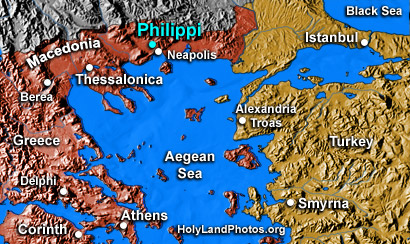






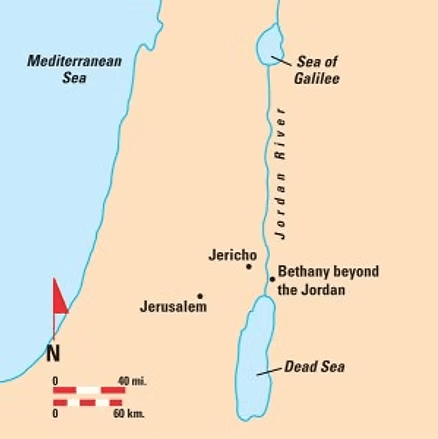






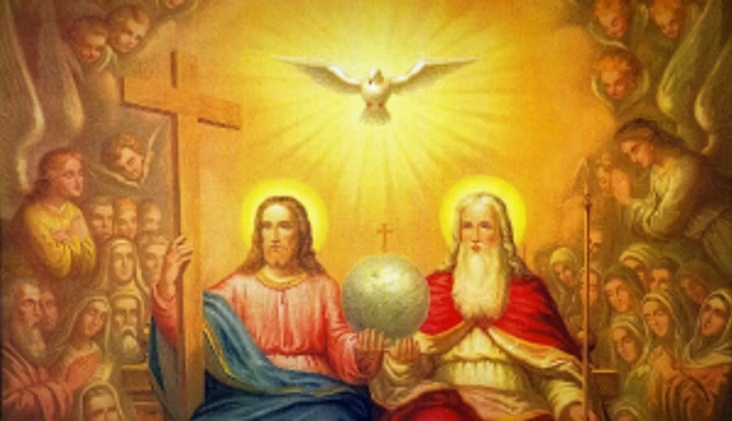
















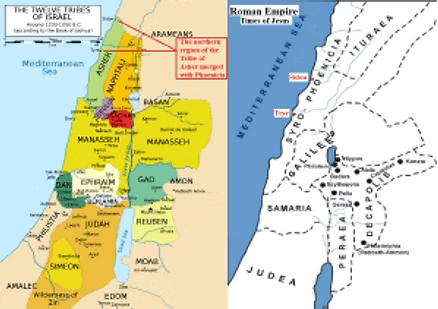




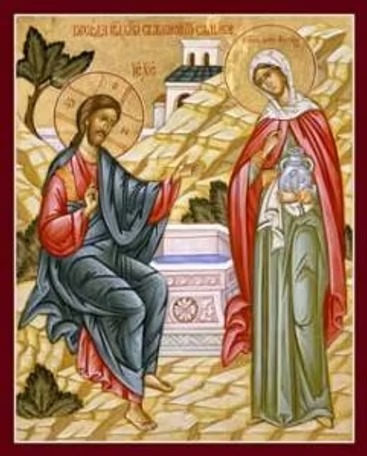



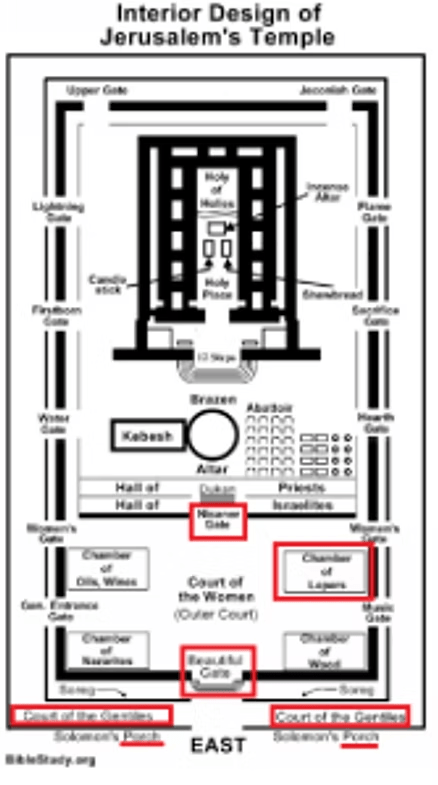



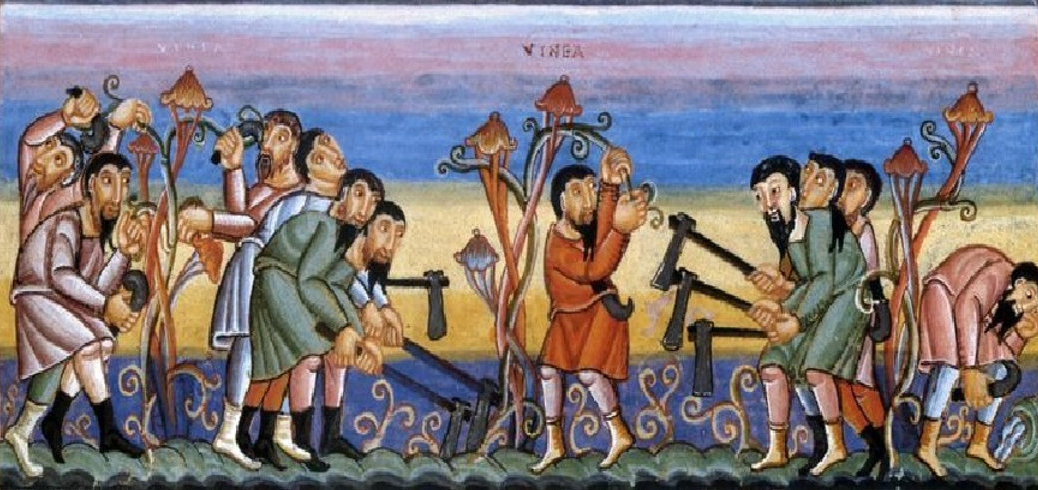
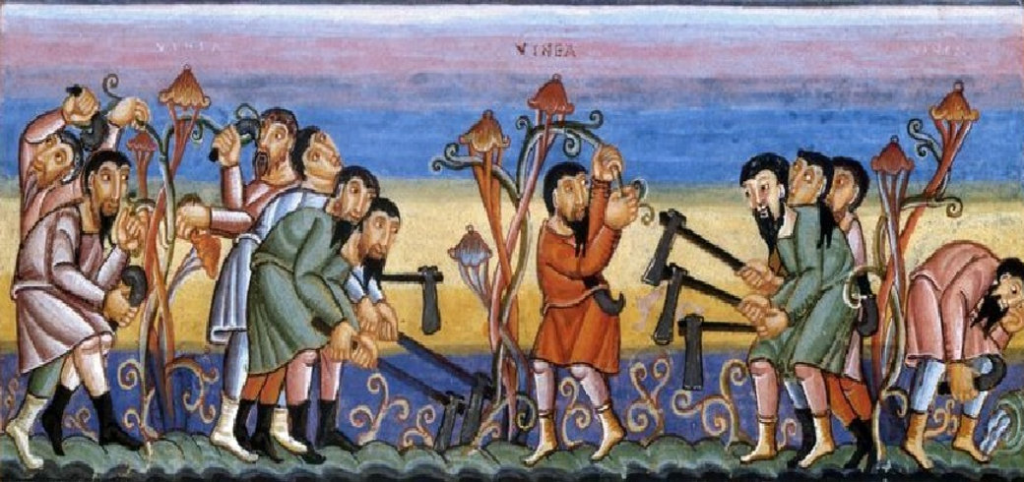
 Explaining the Readings