Tag Archives: Sixth Sunday after Pentecost

Mark 6:1-13 – Be careful who you reject

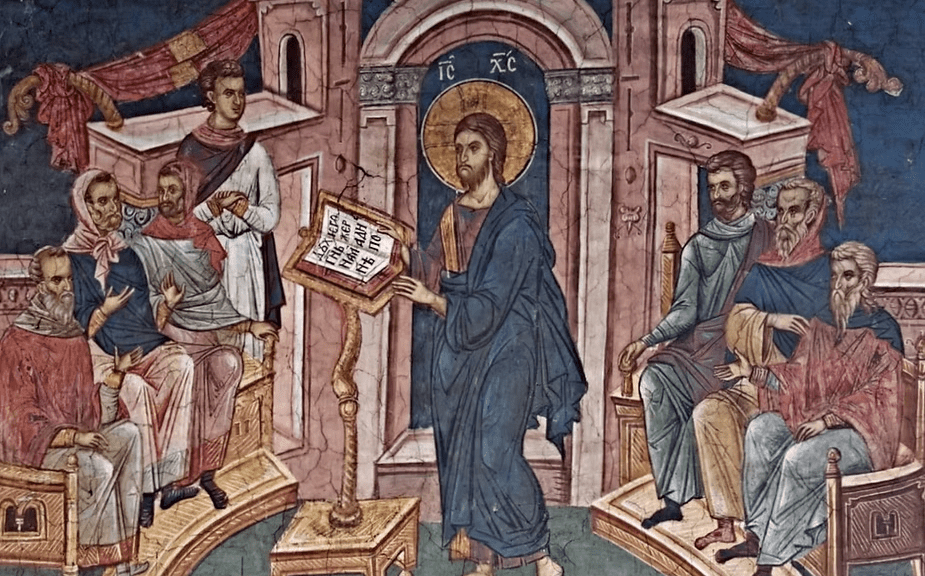
Jesus came to his hometown, and his disciples followed him. On the sabbath he began to teach in the synagogue, and many who heard him were astounded. They said, “Where did this man get all this? What is this wisdom that has been given to him? What deeds of power are being done by his hands! Is not this the carpenter, the son of Mary and brother of James and Joses and Judas and Simon, and are not his sisters here with us?” And they took offense at him. Then Jesus said to them, “Prophets are not without honor, except in their hometown, and among their own kin, and in their own house.” And he could do no deed of power there, except that he laid his hands on a few sick people and cured them. And he was amazed at their unbelief.

Then he went about among the villages teaching. He called the twelve and began to send them out two by two, and gave them authority over the unclean spirits. He ordered them to take nothing for their journey except a staff; no bread, no bag, no money in their belts; but to wear sandals and not to put on two tunics. He said to them, “Wherever you enter a house, stay there until you leave the place. If any place will not welcome you and they refuse to hear you, as you leave, shake off the dust that is on your feet as a testimony against them.” So they went out and proclaimed that all should repent. They cast out many demons, and anointed with oil many who were sick and cured them.

——————–

This is the Gospel reading choice for the sixth Sunday after Pentecost {Proper 9], Year B, according to the lectionary for the Episcopal Church. This will be accompanied by either a Track 1 reading from Second Samuel, where David is asked to be the King of Israel and Judah, when he took Jerusalem to be his city; or, a Track 2 option from Ezekiel, where Yahweh chose the prophet to go tell the leaders of the people that have done wrong. The Epistle reading will be from Paul’s second letter to the Corinthians, when he told them of a near-death experience he had, when he went to Paradise but then later carried a thorn of Satan that would always bring him pain.

I wrote deeply about this reading in 2018. I recommend anyone wanting to get to know Yahweh better, through deeper reflection on missed meaning in Scripture, read that posting by searching this site. Everything written in 2018 still applies today, as the translations of the original text have not changed. Now, I will address this from a different perspective, based on new insights about the Second Samuel, Ezekiel, and Paul’s letter readings that accompany this Gospel of Mark selection.

On the broad stroke view of this recollection of Peter, as written by Mark, it can be summed up as Jesus returning to Nazareth new to ministry; and, he was asked to speak [probably after offering his ministerial services] on a Sabbath meeting at the synagogue.
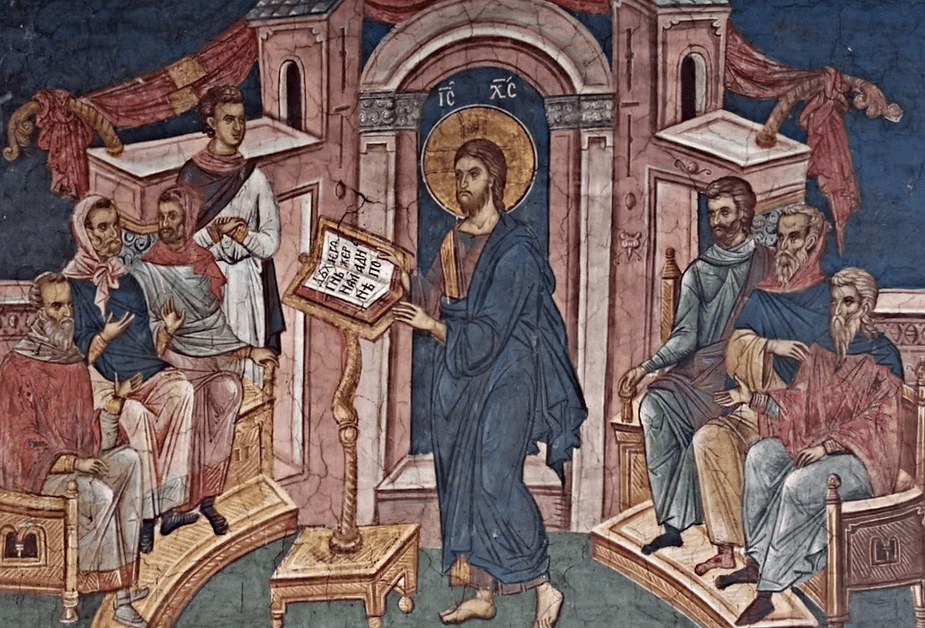
When he spoke, the people were shocked and angered. They struck out at Jesus for having the gall to use their offer as some way of making a name for himself. By mentioning the names of Jesus’ family, they were threatening him with holding them responsible for his actions. Such mention could have produced bad side effects, such as them being banished from their house of meeting. In the same way the Jews of Nazareth were shocked at what Jesus said, Jesus was led to wondering how anyone could reject the presence of Yahweh [by extension into flesh] in their midst. After all, the only reason for Jews meeting on a Sabbath was to keep in touch with Yahweh.

After Jesus left Nazareth, he commissioned his disciples to go out in pairs into ministry. He gave them specific instructions, along with the same powers of Yahweh to heal and cast out unclean spirits. Most likely, the disciples would go to their hometowns, where they would be recognized and more readily accepted. Jesus prepared them for the same rejection he experienced by telling them, “If any place will not welcome you and they refuse to hear you, as you leave, shake off the dust that is on your feet as a testimony against them.” They would do feats as Jesus had done in Nazareth. The unspoken message says they too were rejected in their hometowns, simply because everyone knew them as mere mortals.

The direction I want to take this rather simple reading is to see how the Jews of Nazareth were not ever expecting any real sign of Yahweh watching over them. For all the time they spent ritualistically doing the same things, Sabbath after Sabbath, nothing ever changed. The leaders of the synagogues and the rabbis would read dry scrolls and offer a few words that had little to do with the truth; and, then everyone would all go home happy, feeling like Yahweh was pleased with their rituals that were designed to impress Him. Woe be it to anyone who would come in and rock that boat and make waves.

For a people to consider themselves to be the children of God, one should expect them to be happy that Yahweh would send someone to fulfill the prophecies of the prophets, those which all expressed belief in. The problem the Jews had – and that problem went all the way back to the beginning with Moses leading the Israelites out of Egypt – is they never could take hold of the model intended for them all: to actually be a child of God. That model was designed so each individual Israelite was supposed to be a holy priest of Yahweh, which meant they were all supposed to be souls married to Yahweh. As such, they were all just as Jesus had said, “Today this scripture is fulfilled in your hearing.” (Luke 4:21 addition to this same story)

The problem was they all expected some kingly warrior to come in and announce, “Everyone stay where you are while I single-handedly defeat the Roman Empire and any others who object to my returning this land to its rightful owners!” Had Jesus said that – and looked the part (which he did not) – then everyone in Nazareth would have stood up and cheered. “Hip hip hooray for Jesus, our new king has arrived! Long live the king!” Then, they would have happily gone back to pretending to please Yahweh.

The significance of Jesus sending out his disciples after his being rejected in Nazareth says Jesus (himself) was the epitome of what a true synagogue was. When Jesus said, “Prophets are not without honor, except in their hometown, and among their own kin, and in their own house,” that said the responsibility for being a “prophet” [from “prophētēs”] means being “a person gifted at expositing divine truth.” (Strong’s Usage) Outside the family of kin – primarily those living under the same roof – everyone else was suspect. Rather than looking for reasons to believe, they were trained to look for flaws.

When a “prophet” is seen as the father-husband of a family, this brings out the truth of what Jesus said; which is: Not being a prophet is without honor.” Each head of household is expected to be “a person gifted as expositing divine truth.” When one does “Not” meet that requirement that lack means there is no “honor” coming from Yahweh. The same lack of respect for such a person who is “Not being a prophet” should make him an “exception” – an outcast – in his hometown. Their own kin should show them disdain; and, that includes a wife and children, those all under the same roof as one who does Not serve Yahweh as His priest. Jesus saying that called all the Nazareth Jews out as Not being able to tell him, “Hey Jesus, wasn’t that reading from Isaiah talking about you?”

Of course, the double-edge of what Jesus said says the truth that is the translation by the NRSV, which is the only way most people [if not all] read those words. The truth stated was Jesus was a true “prophet,” who was rejected in his hometown. Rather than him being rejected by his family and neighbors, the “kin” of Jews meant anyone born of a Jewish mother and practiced what is now called Judaism was his relatives, at least in his hometown. Those who knew the kin of Jesus [they did not really know Jesus, because he had gone away from many years] knew Joseph was a carpenter. While Joseph would have been homeschooled and taught his children what he knew, he was not recognized as a rabbi. The opposite edge of the sword of condemnation said, “If anyone other than a hometown boy had come in and said such things, he would be more believable than someone everyone knows is just as wayward as everyone else.”

When Jesus sent out his disciples in pairs, he “gave them authority over the unclean spirits.” That becomes a statement that those in Nazareth who rejected him had “unclean spirits,” but Jesus’ disciples had been made “clean souls.” That says the past does not make the future a certainty, as things [like redemption] can change.

In the Greek that is written, what is more appropriately stated by Mark is this: “he delivered to their souls power to act of them souls impure” [from “kai edidou autois exousian tōn pneumatōn tōn akathartōn”]. Because that statement is preceded by the marker word “kai,” that marks it as an important statement that “themselves” [from “autois,” where a “self” is a “soul”] were made spiritually pure, which is how one truly becomes a child of God. Only those whose souls have been cleansed of past sins become “clean” or “pure,” and all priests of Yahweh have that expectation. Along with that purity of soul, they are then empowered to go into ministry with the “authority” to lead other souls to become clean.

The history of the Israelites led them away from ‘the big city’ that was the hustle and bustle of Egypt. It took forty years alone in the wilderness, just so all the elders who remembered what civilization was like died. After that, all who entered the Promised Land knew marrying their souls to Yahweh was the only way to survive in a land that had peoples of unclean spirits wanting to kill them for not belonging there. Canaan was not their ‘hometown.’ After forty year the Israelites began to regress and they became influenced by those unclean spirits. Their souls likewise became unclean; and, once that happened, then things would go bad for them … until they prayed for saving. The message Jesus told his disciples to take was for “all to repent.”

Those prayers of repentance would have some judge be given the power of authority over the unclean spirits; and, from them leading the way the other Israelite people would follow suit. After they all got back on board the purity train, they would live in peace for forty years. Then the same thing would happen all over again, and again and again. It was the yo-yo effect of the people needing some one to be their priest of Yahweh that would keep reminding them all to repent and be pure. Then, the Israelites got tired of so much responsibility being placed on the individual souls that they told their judge [Samuel] to appoint them a king.

The point made by wanting a king, rather than a judge coming from out of nowhere – a true prophet of Yahweh who communicated with Him daily – a king would be a strong man who would force the people to follow rules. When a king died [and all judges also died eventually], then the oldest son would continue that line of rule; so, a blood line would replace a spirit line. When the elders went to Samuel, they asked for a king because his sons were not pure spirits like Samuel. The same fate befell Eli, the prophet before Samuel. They proved blood has nothing to do with a soul’s purity.

David was born of normal blood, as the youngest son of Jesse the Benjaminite. When Saul went against the command of Yahweh, given to him through Samuel, Yahweh anointed a boy’s soul to be the king-in-waiting. That anointment was spiritual, which made David’s soul clean. When David became the King of Israel and Judah, he was told by Yahweh:

“You’re it. I will anoint no more kings for the Israelites. They had me as their eternal king. You will be my hand on earth who will lead them like a judge in my name. After you die, the people will have to make a choice. Either they make me their individual king as it was before, or they choose your issue and become like other nations, which rise and fall like the tides and bend every which way with the changing winds of time.”

This conversation between David and Yahweh is unwritten; but the truth is what happened afterwards. After David’s illegitimate issue died [Solomon was born of David’s unclean spirit, not a pure soul], Israel and Judah once again split. The Israelites saw Solomon’s heir like their forefathers had seen the sons of Samuel [and Eli’s]. The reason for this split was a curse had been placed on the land, as the people began to worship the land [and whoever was named the king] much more than Yahweh. They called themselves the children of God, while doing nothing to repent and make their souls pure. The only ones who tried to warn them to return to Yahweh and repent were the prophets whose souls married Yahweh and became his priestly servants.

The curse began when Yahweh told David to take Jerusalem and make it his city of government. The Jebusites had played a role as servants of Yahweh, who protected the land for the Israelites. When things got bad for the Israelites, the Jebusites called out to Yahweh for a judge to be sent. When Yahweh anointed David’s soul as the King of Israel, he also told him to take Jerusalem and void that contract with the Jebusites. Once Jerusalem became the governmental center of Israel, it was up to David to lead the souls of the Israelites to likewise marry Yahweh and serve Him, because when David stopped being that judge over their souls, then there would be no more.

The loss of the lands then became the history of Israel and Judah. There is no land that is protected for them anymore. There never will be. When Jesus met with Nicodemus and told that ruler of the Jews, “Very truly I tell you, no one can see the kingdom of God unless they are born again,” [NIV] Jesus said that because Nicodemus approached Jesus as a recruit who clearly had the qualities of a judge. Nicodemus had told Jesus, “Rabbi, we know that you are a teacher who has come from God. For no one could perform the signs you are doing if God were not with him.” [NIV] Whether or not the ulterior motive of Nicodemus was to use this God-like powers of God, seen in Jesus, for the possible restoration of the land to renew Israel, Nicodemus was moved to speak in terms of the idiocy of that potential.

Nicodemus said to Jesus, “ How can someone be born when they are old? Surely they cannot enter a second time into their mother’s womb to be born!”

That was God moving his lips to say why Israel would never be resurrected. Israel had been born through its death as a nation [twice]. The baby had been born into the world, as soiled and as unclean as it was. There would never be a return to the former glory of having been a divine fetus implanted into the womb of Canaan, watched over by the midwife Jebusites. The stupidity of Nicodemus was spewing the curse of David moving his capital city to Jerusalem. The only way to be born again was to cleanse their souls through marriage to Yahweh, each soul in the flesh becoming a kingdom of Yahweh – a priest of God – each “a person gifted at expositing divine truth.”

This all means the reason Yahweh sent Jesus to be born was so his soul could pass the purity it possessed to disciples, who would then be reborn with souls pure. They would then be sent out in pairs, in much the same way judges would appear and move the people to follow their lead. Unlike the judges, the first Apostles were sent as reproductions of Jesus, each a soul that had married Yahweh and received His Spirit and the soul of Jesus to be their Lord. They would be multiple Jesuses who would spread the reality of what a true child of God is – a wife of Yahweh reborn as Jesus. There would be no worship of land in this process, as the flesh would become the temple, with Yahweh the King and Jesus the High Priest – in the order of Melchizedek, meaning a High Priest who would never die.

Herein lies the reason this reading is read, as nothing has changed. Everything remains the same. Christians have become just like the Israelites. They reject anyone who enters their churches and tells them they have it all wrong. They are not supposed to be sitting on their asses thinking they are the chosen ones of God, because that is a condemnation of their souls for thinking such. Each needs to be touched by a true Christian – an Apostle, a Saint – and led to feel the power of authority their souls have been given by Yahweh, as Jesus resurrected in new flesh. A true Christian then goes out into the world as a servant to Yahweh, as a priest reborn in the name of Jesus Christ.

As a Gospel selection for the sixth Sunday after Pentecost, when a personal ministry to Yahweh should be well underway, this says one is either Jesus reborn or one is those who reject Jesus. The rejection of a minister given divine authority means that is a soul’s right. The lesson one must be made aware of is this: You reap what you sow. To reject Jesus [in any human form presented before you] means your soul will be rejected when the true Judge determines your fate. The lesson is to do unto others as you would have others do unto you. To reject means to be rejected.
Psalm 48 – Becoming a citadel of Yahweh

1 Great is Yahweh, and highly to be praised; *

in the city elohenu is his holy hill.

2 Beautiful and lofty, the joy of all the earth, is the hill of Zion, *

the very center of the world and the city of the great King.

3 elohim is in her citadels; *

he is known to be her sure refuge.

4 Behold, the kings of the earth assembled *

and marched forward together.

5 They looked and were astounded; *

they retreated and fled in terror.

6 Trembling seized them there; *

they writhed like a woman in childbirth,

like ships of the sea when the east wind shatters them.

7 As we have heard, so have we seen,

in the city of Yahweh of hosts, in the city elohenu; *

elohim has established her forever.

8 We have waited in silence on your loving-kindness, elohim, *

in the midst of your temple.

9 Your praise, like your Name, elohim, reaches to the world’s end; *

your right hand is full of justice.

10 Let Mount Zion be glad

and the cities of Judah rejoice, *

because of your judgments.

11 Make the circuit of Zion;

walk round about her; *

count the number of her towers.

12 Consider well her bulwarks;

examine her strongholds; *

that you may tell those who come after.

13 This elohim is elohenu for ever and ever; *

he shall be our guide for evermore.

——————–

This is the accompanying Psalm for the Track 1 Old Testament possibility from 2 Samuel 5, which says, “David occupied the stronghold, and named it the city of David.” If selected, it will be the “Response” read aloud in unison or sung by a cantor on the sixth Sunday after Pentecost {proper 9], Year B, according to the lectionary for the Episcopal Church. The will precede a reading from Paul’s second letter to the Corinthians, where he said another and himself were “caught up into Paradise and heard things that are not to be told, that no mortal is permitted to repeat.” All will accompany the Gospel reading from Mark, where Jesus “called the twelve and began to send them out two by two, and gave them authority over the unclean spirits.”

I have amended the language above so it correctly states “Yahweh,” rather than the generic insult stated as “Lord.” More importantly, this song of praise accompanies a reading that tells of David taking Zion as his stronghold. He took Jerusalem from the Jebusites, who were not truly human beings. They were elohim, like David, due to their souls having been forever committed to serving Yahweh. David wrote about them in the Psalm, which is not readily seen because translators fail to translate what is truly written as what is truly written. I will explain these uses verse by verse.

In addition to liberties taken by translators, such as the New Revised Standard Version [NRSV], the Episcopal Church has waved its magic wand over this song and changed it from the fourteen verses it is, into one shown as thirteen verses. The NRSV agrees that this is fourteen verses, so the Church has condemned itself before Yahweh for promoting itself as a god that can mislead the flocks. I will explain each verse as is written, leaving the Episcopal Church to explain why it went against divine text as a false shepherd.

This song is identified by David as being written and composed as one “of the sons of Korah,” which needs to be understood. The Israelite Korah led a rebellion against Moses and Aaron in the wilderness [story told in Numbers]. As punishment, Yahweh caused the earth to open up, swallow Korah and then close up. Korah can then be seen as having gone underground. Samuel, a great prophet, was from the line of Korah – a name meaning “Baldness” [Abarim Publications] – and “the Korahites became doorkeepers and custodians for the tabernacle.” After David became king, the Korahites assisted him in battles. [Reference] Still, it must be understood that all of this history stems from the one man who led a rebellion against Moses and Aaron and who was swallowed up within the earth. The sons of Korah can then be understood to be Jebusite allies who assisted David’s reign, with eleven Psalms written and composed that are announced as being relative to them.

With this understood, verse one then sings, “Great is Yahweh, and highly to be praised; in the city elohenu is his holy hill.” This gives immediate praise to the greatness of Yahweh [not some generic “Lord”] as ALL elohim are His creations and from them were created the material universe, according to Yahweh’s plan. Mankind is then a breath of life in a body of flesh, which can be possessed by elohim.

When Korah rebelled, he was a custodian of the Tabernacle as a Levite under Aaron, but he also wanted to be a high priest as was Aaron. His followers among the Israelites were destroyed by fire and plague, to remove dissent from the midst of the whole. As punishment, Korah was forced by Yahweh to forever guard the city named Jerusalem, which was on and within Mount Zion [and beyond]. Yahweh made his descendants [his sons] be the protectors of the land given by Yahweh to those whose souls would be His wives. Thus, David moved from Hebron to Jerusalem, as a way of Yahweh releasing the Jebusites of that responsibility.

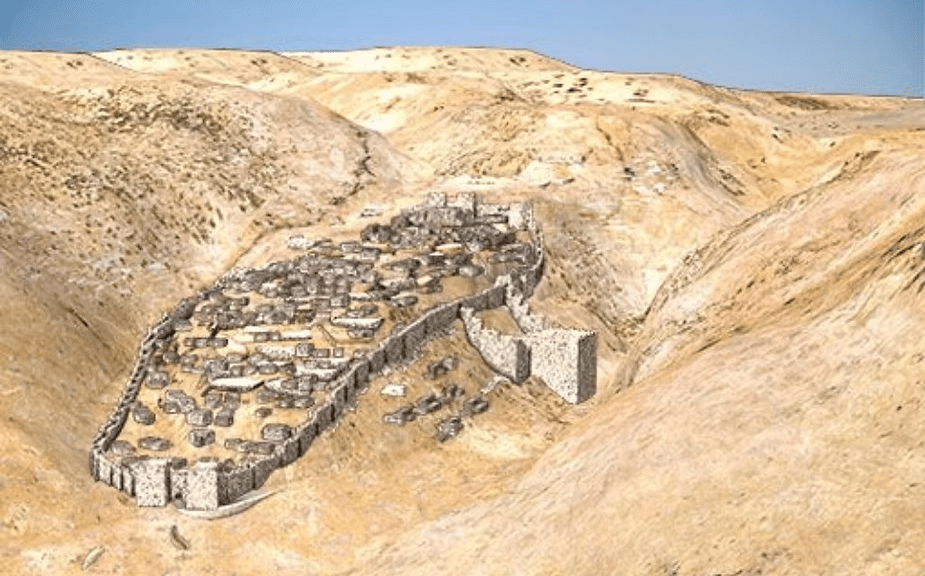
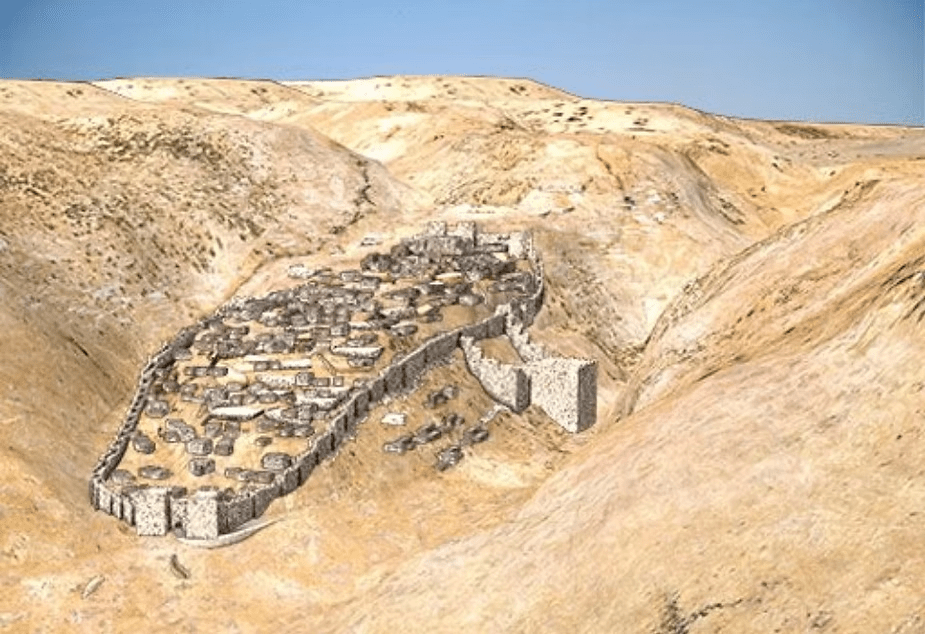
Verse two is then translated by the NRSV to state: “Beautiful and lofty, the joy of all the earth, is the hill of Zion, the very center of the world and the city of the great King.” In reality, the verse begins with the Hebrew words “yə·p̄êh nō·wp̄,” which actually say “appropriate elevation” or “fair [fitting] height.” When this then leads directly to naming “Mount Zion” [“har- ṣî·yō·wn”], this must be seen as a statement about the lowest of the seven hills in the Jerusalem area. That “height” is easily surmounted by all foes, thus a beautiful site for an invader’s eyes to see. To say that mount is “the joy of all the earth” misses the point that underneath that “hill” is the gate to Eden, which is truly “the joy of all the earth.”

This is a good representation of how everywhere other than Mount Zion was strategically superior.

The addition of “the very center of the world” is a mutation of that written, which literally says “the sides north” [“yar·kə·ṯê ṣā·p̄ō·wn”]. As far as Biblical symbolism is concerned, the meaning of “north” is this: “the north—represented by the left hand—is also a symbol of disaster. The enemy of God’s people came from the north (Jer. 1:14, 15; Eze. 38:6), bringing destruction. In a sense, the enemy was the false king of the north who tried to usurp God’s role and is finally destroyed by the Lord (Zeph. 2:12; Dan. 11:21-45).” [Reference] The inference as at “the center of the world” says insight makes this within the earth, not on the surface. However, the truth of “the sides north” says it was a place watched by those who were the enemy of the people, those who were not truly Israel reborn [a name meaning “He Retains God”].

To further grasp this darker meaning as the intent, when David then added “city of the king of many,” that “king” [“me·leḵ”] was Melchizedek. Melchizedek had become a son of Korah [a son of Hebron], who ruled Salem [or Jebus or Jerusalem] by the will of Yahweh. Melchizedek never died, he ascended, so he could always come back whenever needed.

Verse three then says, “elohim is in her citadels; he is known to be her sure refuge.” Here, the use of “elohim” must be seen as intended to define the “sons of Korah,” who were divinely married souls that were possessed by Yahweh, in the same way as was David. The “elohim” are the equivalent of demi-gods, in the sense that they have divine powers afforded them, through their complete subservience to Yahweh. This means “her citadels” are the strongholds underground, such that “her sure refuge” was not some low hilltop, but the depths of tunnels underground.

Verse four then sings, “Behold, the kings of the earth assembled and marched forward together.” This verse is better translated as: “when found the royals appointed they passed through together.” The true meaning of “the royals” or “the kings,” seeing how David wrote this as only the third King of Israel in their history, with Saul and Ish-bosheth being the two prior losers, the intent is to point out the judges who routinely saved the Israelites. Those judges [including Samuel] were “together with” the “elohim” sent by Yahweh to lead the people back to serving Him. That history is what David said to “Behold!”

Verse five then sings, “They looked and were astounded; they retreated and fled in terror.” The translation of “they” must be seen as double-edged, where the acts of the judges did amaze those they defeated, but likewise the people of Israel. The words of the second half of this verse say “they were troubled and they hastened away.” Here, “they” is more in line with the people of Israel being “terrorized” with how their waywardness was about to ruin all their souls. So, while the enemies also were filled with terror and fled, the Israelites turned away from their sins and gave praises to Yahweh again.

At this point the Episcopal Church has changed this song, so their translations will be tossed aside, so my literal translations can be presented. Feel free to compare this breakdown to the above presentation to see where they have become false shepherds.

Verse six then literally sings, “trembling took possession of them there , writhing as a woman in birth pangs.” Here, this must be seen as the transformation of the Israelite people, who had been led by judges “together with elohim,” where the souls of the judges had likewise been “taken possession” by Yahweh’s Spirit. This divine possession makes their demon spirits within writhe in pains as they are cast out, no longer having control over human flesh. Thus, the comparison to a woman in labor pains says the Israelites were being reborn as truly Yahweh’s people, divine “elohim.” Rather than giving birth to a baby, they were casting out demon spirits and themselves being reborn as clean souls.

The true verse seven then sings, “with a spirit east , you break to pieces the ships of Tarshish.” Here, one finds David balancing “the sides north” with “a spirit east” [“bə·rū·aḥ qā·ḏîm”], where “east” becomes a reference to Eden. [Reference] This then has the intent of saying that the divine “elohim” that possessed the judges and thereby transferred to the souls of the wayward Israelite people, the “tree of life” [guarded by the Cherubim who descended into Jebusites] made all who were so possessed empowered to defeat the influences of sin. Those influences are then said to be like “the ships of Tarshish,” where the name “Tarshish” means “Breaking, Subjection.” The root word means “to break down and shatter,” which would be the influences to break down one’s commitment to Yahweh and shatter the Covenant. Because Tarshish was known as a seaport with many ships in its fleet, so it could have a far-reaching effect of foreign shores, the metaphor used by David says the Spirit of Yahweh shattered and broke to pieces all such foreign influences that always led to sin.

Verse eight then adds, “who we have heard , thus we have seen the city of Yahweh’s army in the city of [His] elohenu ; gods will set firm there forever . Selah”. In this, twice is written “bə·‘îr,” the first time joined with Yahweh, as “in the city of Yahweh” and again as a separate word leading to “elohenu,” which are “His gods” as divinely possessed earthly beings. The meaning of “in the city of Yahweh” must be understood as “Eden,” such that the word translated as “city” actually means “excitement.” This says a “city” is a place of “excitement,” where the “excitement” of “Yahweh’s place on earth” is the place where “elohenu” praise Yahweh constantly – a heavenly place. Such a place on earth is Eden. Eden has been guarded by Cherubim ever since Adam and Eve [and serpent] were cast out. Those guards have “been set firm” to ensure the path to the tree of life is forbidden to sinners. With that “city of Yahweh” being seen as Jebus or Jerusalem, the “army” or “host” of Yahweh are the Jebusites.

At the end of this one verse [one of fourteen] is found the word “Selah.” This word is not fully grasped by Biblical scholars. Many believe it is a note to the musicians to recognize, in their accompaniment to this song. However, the word in Hebrew means “to exalt, to lift up” and that meaning the “heavenly host” – the “elohenu of Eden” – are constantly singing praises that exalt Yahweh, while Yahweh “lifts up” their souls as heavenly beings.

Verse nine then sings, “we have become like gods from your lovingkindness , in the midst of your temple.” In this, the Hebrew word “dim·mî·nū” is written, where the root word is “damah,” meaning “to look like, resemble.” This has erroneously been translated as saying “wait silently.” The meaning must be seen as like that stated in Genesis 1, where the “elohim” made mankind [males and females] in their likeness. Now, the souls of David and the Jebusites “have become resembling gods,” as having been souls reborn as the “elohim” by Yahweh’s divine Spirit possessing them. Thus, “in the midst” becomes the same as the tree “in the midst” of the garden [or enclosure], where a soul is “in the midst” of one’s body of flesh. When Yahweh’s Spirit possesses that flesh, joined in marriage with a soul, the flesh becomes a “temple.” Thus, the “kindness” and “goodness” is extended to the plane of the earth through the hands of Yahweh that are His “elohim.”

Verse ten then sings, “from your name elohim , thus your praise to the boundaries of the material plane , righteousness , it is fully placed into your right hands [by you].” In this David clearly wrote “in the name of gods,” which is no different than the association of Jesus and all his Apostles as “being in the name” that is holy. What David made clear is only elohim are in the “name” of Yahweh [not some lesser generic “lord”]. Bein a divine “elohim” means being a Saint. Jesus and David were both “elohim,” as both were divinely possessed by Yahweh, through having [a word meaning possession] His Holy Spirit poured into their souls, as Anointed by Yahweh. Thus, all who are the “elohim” on the material plane will forever “praise” Yahweh by speaking what He tells them to say. They will only live “righteously.” They will all become His “right hands” as His servants [souls having become His wives in marriage].

Verse eleven then sings, “let rejoice ׀ Mount Zion , let rejoice the daughters of Judah , the purpose , of your judgments.” Here, the element of “rejoicing” or “being glad” is repeated, once alone and once joined with “the daughters of Judah.” The stand alone rejoicing is the presence of Yahweh as a potential Husband, whose offer of marriage goes out to all souls, seeking all to become His “right hands” in marriage [soul to Spirit]. That proposal is worthy of celebration. Mount Zion is separately stated as that is the altar where a divine marriage takes place metaphorically. David placed the Tabernacle, with the Ark of the Covenant and altar, on Mount Zion, atop steps that ascended from below. Physically, “Mount Zion” is the mound of earth covering the gate to Eden and the tree of life. Marriage allows one’s soul to find that path to eternal life. Thus, the celebration of eternal life must be shouted by all the “daughters of Judah,” as Judah is where Mount Zion is located. The “daughters” means the bodies of flesh [males and females] whose souls will be married to Yahweh’s Spirit, with Him the Husband. The “purpose” of marriage is to gain eternal life, for all made of flesh will find death leading a soul’s release to judgment. Wives of Yahweh will rejoice for their souls will have been forever saved.

Verse twelve then sings, “turn about Zion , and surround her , and count her towers.” This is a statement about the move of David from Hebron to Jerusalem, where the control of that citadel had “turned about” and changed hands. The walls of Zion became the City of David, which became the outer shell of that temple. The “towers” were metaphor for all who had taken that place and flown the flags of human rulers over that spot. David was the first and the Jebusites flew no flag and took no pride in a fortress built on the lowest hill in that area.

Verse thirteen then sings, “set well her soul defenses , go through her citadel , purpose you may recount generations following.” This is a clear call for all the Israelites to become like Jerusalem and marry their souls to Yahweh, bringing about His “bulwark” of strength protecting them from being overtaken by invading sins. Each Israelite was asked to become a model of that sanctuary of strength. The reason was for the continued success of Israel – as individuals, a people, and a nation – was so that all would realize the necessity of being seen as “He Retains God” [the meaning of “Israel”]. The call by David was for future generations beyond that one under David to follow suit, forevermore.

Verse fourteen then sings, “for this gods our gods forever and ever , he will be our guide to death.” Here, the words “elohim elohenu” must be read as “gods our gods,” so it becomes a statement of the continuation of “elohim” in the name of Yahweh. The future “gods” in His name will then be due to the “gods” of David and the Jebusites and the following Israelites, so one set of divine “gods” produce regenerating souls married to Yahweh, possessed by His Spirit. This was David’s prayer in song, as all souls born into bodies of flesh will find death eventually. Only those who would be guided to salvation as an “elohim’ will not be condemned to repeat life and death, through reincarnation.

This reading certainly fits the theme established in every other reading choice for the sixth Sunday after Pentecost. It explains why David moved to Jerusalem and took control of the citadel of the “elohenu” who were the Jebusites. As a song of praise during a time when all true Christians should be in ministry for Yahweh [not some unspecified “Lord”], this sings praises about oneself becoming a fortress of God, as one of His “elohim.” The only way to lead another soul to salvation is to know firsthand the experience of Yahweh’s presence within, when one is “in the name of Jesus Christ.” One must have lived the truth of Yahweh in order to preach the truth for others to hear.

Psalm 123 – The scorn of the indolent rich

1 To you I lift up my eyes, *

to you enthroned in the heavens.

2 As the eyes of servants look to the hand of their masters, *

and the eyes of a maid to the hand of her mistress,

3 So our eyes look to Yahweh elohenu, *

until he show us his mercy.

4 Have mercy upon us, Yahweh, have mercy, *

for we have had more than enough of contempt,

5 Too much of the scorn of the indolent rich, *

and of the derision of the proud.

——————–

This is the Track 2 accompanying “Response” to the Old Testament reading choice from Ezekiel 2, when Yahweh told him, “son of man, stand up on your feet, and I will speak with you.” If chosen, this will be read prior to the Epistle reading from Second Corinthians, where Paul wrote, “Three times I appealed to the Lord about [a thorn that was a messenger of Satan to torment Paul], that it would leave me, but he said to me, “My grace is sufficient for you, for power is made perfect in weakness.” All will accompany the Gospel reading from Mark, when “Jesus came to his hometown, and … they took offense at him.”

In the above, I have made changes in the English translation where “Yahweh” is written but translated as some unknown “Lord.” David knew Yahweh because his soul was married to Yahweh and David called his Spiritual Husband by His name. In addition, I have returned the Hebrew word written – “elohenu” – rather than let the mistranslation as “our God” stand. First, the word is written in the plural and must be seen as a word that denotes a soul that has married with Yahweh’s Spirit, as those demigods who have become divinely possessed, as His wives on earth. Finally, the numbering of this song of praise – a Song of Ascent – has become the creation of the Satanic church calling itself Episcopal. The New Revised Standard Version [NRSV], which the Episcopal Church lectionary page claims to be the source of its translations, clearly lists this psalm as having four verses. Please contact them and inquire as to what god they worship that gave them the idea they could rewrite divine Scripture. I will write about the meaning of the four verses based on the numbers written by David.

In the first verse, the meaning of “I lift up my eyes” must be read as beyond the scope of physicality. There are no “eyes” that can see Yahweh. If one were to see Yahweh physically, one would be die. Being removed from one’s sack of flesh means one’s soul no longer has the limitations that a body of flesh places on a soul. Physical eyes cannot possibly see spiritual things. Therefore, “lift up” becomes a statement of divine elevation, so “eyes” takes on the figurative meaning of spiritual trust for insight.

This means the second half of verse one is then saying Yahweh is not external to oneself [a “self” equates to a “soul”], but within one’s being. The place where Yahweh “dwells” [mistranslated as “enthroned”] is with one’s soul in one’s flesh, together as one, due to marriage of one’s soul to the Spirit of Yahweh. As such, one becomes mereged, as His hand reached into the physical realm. Thus, “the heavens” are not some distant place [such as outer space or in a cloud in the sky] but within; such that “heavens” are the source of life within dead flesh – souls plus possessing spirits. The plural form, as “heavens” rather than “heaven,” means there is a soul within each human being and this soul become a “heaven” when married to Yahweh’s Spirit, so many “heavens” are possible.

When one realizes this is a Song of Ascent, it was designed to be sung by Israelites walking up the steps carved into Mount Zion to the altar at the Tabernacle. This song was then like a marriage march, so one’s physical “eyes” could be raised to see the fire burning on the altar of spiritual marriage to Yahweh. As such, the smoke rising from the altar fire would be representing the transformation of a soul, from the flesh to the spiritual. This song was meant for all devout Israelites to sing as a vow before marriage, with the Covenant being the bond that held the soul to the Spirit forever.

Verse two then sings, “behold! as the eyes of the servants to the hand of the masters , as the eyes of the maidservant to the hand of her mistress , so our eyes to Yahweh us gods , until he has shown favor to us .” In this, the first word places focus on “beholding,” where this is more than a vision, as a presence that is felt and understood as all-powerful. The two aspects of metaphor [“servants” and “maidservants”] reflect both men and women are called to be “subjects” or “slaves” as wives to Yahweh. This relationship shows a union recognitzing that a “master” or a “mistress” is a source of stability and security, as a symbiotic necessity. The “eyes” are not to be read as for physical sight, but symbolic of an ability to see the value of servitude. Both men and women are then called to become the “hands” of a greater source of wealth and benevolence than can ever be the worldly reality of most.

It is here that David combined “Yahweh elohenu,” which is a statement of possession [like the genitive in Greek], which says “the gods of Yahweh” or “Yahweh’s gods.” The possessive form is attached to the plural “elohim,” which then says all of these “elohim” are divinely generated by Yahweh alone. Again, the “elohim” are the demigods formed from a soul marrying Yahweh and receiving His Spirit which makes those souls special: one Anointed [a Greek Christos] and Sacred – Set apart as holy – a Saint-Apostle. The plural number here says David wrote a song for all the Israelites to sing as they celebrated their individual soul’s marriage to Yahweh, where they would begin to see [be the “eyes”] as Yahweh led them to see. Lastly, this transformation within one marrying Yahweh – becoming His servant as a wife – would bring about the greatest favor of redemption and salvation, so eternal life would be granted for one’s payment in servitude.

Verse three then sings, “show favor to us Yahweh be gracious to us , for a great many , we are satisfied with contempt .” This becomes a prayer of repentance, as it confesses one’s waywardness that must come before the marriage becomes official. This Psalm is sung in accompaniment with the reading from Ezekiel 2, when that holy prophet had become married to Yahweh and was then sent out into ministry with the purpose of telling the wayward they too must repent or suffer the fate of their evil souls’ judgment. One must respect Yahweh as one’s Husband, acknowledging only He can show favor to a soul. If accepted as His wife in marriage, that favor will be His gracious forgiveness of past sins. A soul’s past debt will be wiped clean. This cleansing of spirits says many are still unmarried to Yahweh, as all have been filled with some level of contempt, as unwilling to submit totally or unworthy to be forgiven. This confession must be made to Yahweh to receive His forgiveness.

Verse four then sings, “a great many are filled to our soul with the scorn of those who are secure , with the contempt of the proud .” The above translation differs, as: “Too much of the scorn of the indolent rich, and of the derision of the proud.” The NRSV translation demans one see this only on the material view, which is not wrong, only limited. Again, as a companion piece to the fall of Jerusalem and the enslavement of the Judeans to Babylon, when Yahweh sent Ezekiel to warn them of His anger with their waywardness, this verse sings of David feeling then like Yahweh would feel in the end days to come. There is a false sense of security that comes when the flesh [and brain] enslaves a soul to do its bidding. Those souls then do not see any reason to themselves become a servant to anyone or anything [denying they are slaves to the flesh]. They bring ruin upon themselves [again, “self” equals “soul”] and those surrounding them as well. This makes those who serve Yahweh also feel His “scorn” as His “hands” on earth. This then ends with the identification of “pride” as a most deadly sin.

In the final days of Jerusalem, it was the pride of those who reigned as all-powerful in the Temple of Solomon that forever lost the land their forefathers had been given graciously by their Husband Yahweh. Their pride was in bloodline, not the spirit-line of souls marrying Yahweh. Their pride was centered on a birthright, seeing themselves [their souls] as the descendants of some people in the past who earned the right to call Canaan “Israel” and then leave it to their heirs in their deaths. When Yahweh sent Ezekiel [and Yahweh sent other prophets as well] it was to make sure the “sons of Israel” knew a prophet had been among them. It is this same sense of pride that leads Christianity to the same ruinous end.

As a companion song of praise to join with that Ezekiel reading on the sixth Sunday after Pentecost, when one’s personal ministry to Yahweh should be underway, the message here says one must find divine insight through a soul’s commitment to serving Yahweh [not some generic Episcopalian “Lord”] and become His “hand” on earth. This says one should go into ministry – as did Paul, as did Jesus, as did his disciples, and as have all true Christian Saints – to warn the wayward that they must repent and return their souls to Yahweh, before they die in the flesh and are forced to begin again in a new body of flesh [reincarnation]. The “scorn” felt by the souls merged with Yahweh [His elohenu] will lead them to find many who will reject them, as well as Yahweh.