
Tag Archives: son of man

Ezekiel 2:1-5 – Knowing a prophet has been among them

The Lord said to me: O mortal, stand up on your feet, and I will speak with you. And when he spoke to me, a spirit entered into me and set me on my feet; and I heard him speaking to me. He said to me, Mortal, I am sending you to the people of Israel, to a nation of rebels who have rebelled against me; they and their ancestors have transgressed against me to this very day. The descendants are impudent and stubborn. I am sending you to them, and you shall say to them, “Thus says the Lord God.” Whether they hear or refuse to hear (for they are a rebellious house), they shall know that there has been a prophet among them.

——————————————————————————–

This is an optional Old Testament selection from the Episcopal Lectionary for the Seventh Sunday after Pentecost, Year B 2018. In the numbering system that lists each Sunday in an ordinal fashion, this Sunday is referred to as Proper 9. If chosen, it will next be read aloud in a church by a reader, on Sunday July 8, 2018. It is important because it states the truth that a prophet of God is His creation, through His Holy Spirit.

This short five-verse reading option from Ezekiel is fairly straightforward in the translation above, stating that God filled Ezekiel with His Holy Spirit. Once filled with the wisdom of God, Ezekiel was sent to prophesy before the wayward Judeans, before their exile to Babylon and after.
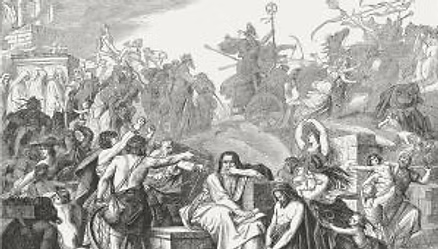
Ezekiel was called Buzzi (beyond being the the son of Buzzi), “because he was despised by the Jews.” (Ezekiel: Wikipedia article footnote: Radak – R. David Kimkhi – in his commentary on Ezekiel 1:3, based on Targum Yerushalmi). The name “Ezekiel” means, “God Strengthens” or “Strengthened By God.” He was of the priestly lineage (Kohen: “a member of the priestly class, having certain rights and duties in the synagogue.”), believed to have been descended from Joshua. The words Ezekiel spoke to the children of Judah, as read in the Book of Ezekiel (regardless of who wrote them onto scrolls of parchment), proves God’s statement, “Whether they hear or refuse to hear (for they are a rebellious house), they shall know that there has been a prophet among them.”

As for a few observations of the actual Hebrew text and the translations English-speaking Christians recognize, whenever Ezekiel is said to hear God speak to him, with a reference to “O mortal,” the reality is Ezekiel wrote, “ben-adam” – “son of man. The translation as a “mortal” human being is relevant to being one of “mankind.” As a male human being, all male human beings are “sons of man.” This means the address is to the physicality of being human, which all human males are.

In the way that Jesus of Nazareth addressed himself as “Son of Man” (such as in Matthew 18:11, but many others) where the capitalization is an application of translation and not what was written (“huios tou anthrōpou” or “υἱός τοῦ ἀνθρώπου”), the assumption that comes from the capitalization is that Jesus addressed himself as the Son of God, in the form of Man. Beyond that, one can assume Jesus (as the Christ Spirit) was the Son of God, whose soul was that of Adam – the Son of God. However, both Ezekiel and Jesus were stating they were both males of mankind, which is ordinary, normal, and typical – not special.

Le Fils de L’Homme (Son of Man) – Magritte

While Jesus was divinely conceived, always to be holy, he was to be born of a woman.  That made him a son of man.  Likewise, Ezekiel was a son of man born into a holy lineage, predestined to become a prophet.  The specialization and uniqueness then comes when ordinary men are transformed by the presence of God’s Holy Spirit; or as Ezekiel wrote: “A spirit entered into me.”

This realization means it is ordinary, normal and typical to read the Holy Bible (or have it read to one) and see Ezekiel like one sees Jesus – as special, as those blessed by God for holiness. It is this failure to see how Ezekiel and Jesus were just like all other men (and women) of the earth. They became special by welcoming the God into their hearts, so they could hear His voice through the Mind of Christ. They became special because of their sacrifice of self (God did not say, “O Ezekiel”) so the Holy Spirit could enter into them. They became special because they heard the voice of God speaking directly to each, such that each responded to what God said (“speaking” = “’ā·mar” = “commanding, advising, designating, and giving an order”).

Normal mortals are like Cain was when his sacrifice to the LORD was not shown favor. Normal human beings often get angry and let their faces become downcast (from Genesis 4:6-7), where “face downcast” or “countenance fallen” is derived from “nā·p̄ə·lūp̄ā·ne·ḵā”.

Those words of Hebrew literally translate to state “lie down before,” where one’s emotional outbursts when things do not go one’s way are like a child throwing a tantrum, lying on the floor and screaming. If children do this ordinarily, normally and typically, so too do mere sons of mankind, no different than Cain did. This is how one should see the statement here by Ezekiel, that God “set me on my feet.”

In the first two verses of this reading selection, we read how God told Ezekiel, “stand up on your feet” (verse 1) and then how God’s Holy Spirit “set me on my feet.” The same word, “amad,” is the root used in the translations “stand” and “set.” It is then important to see how “standing” is the opposite of “lying before,” such that a righteous prophet of the LORD must “rise up” from the ordinary, the normal and the typical and become “upright” before God. Because Ezekiel did this while he was a mere “son of man,” a simple “mortal, then so too can all human beings do the same. However, that requires a willingness to hear the LORD speaking AND it means releasing oneself from the rebelliousness, impudence, and stubbornness that makes life seem so much easier to transgress than to comply with what the LORD says.

In the heritage of Ezekiel, where he was descended from Joshua, who was a true servant of the LORD, as an assistant to Moses and subsequent leader of the Israelites. Joshua also was a prophet of Yahweh, just as was Ezekiel and Jesus. This unique stature was not among mere mortals, as much as it was among the children of God. All gods have their priests and prophets, in the same way that all nations have their kings and presidents, and all humankind has its teachers and guides. Ezekiel, as Joshua and Jesus, stood up among Israelites, Judeans and Jews, because it was those, chosen by God to serve only Him as His priests, who refused to be extraordinary, because they wanted to be ordinary, normal, and typical – like the people of other nations.
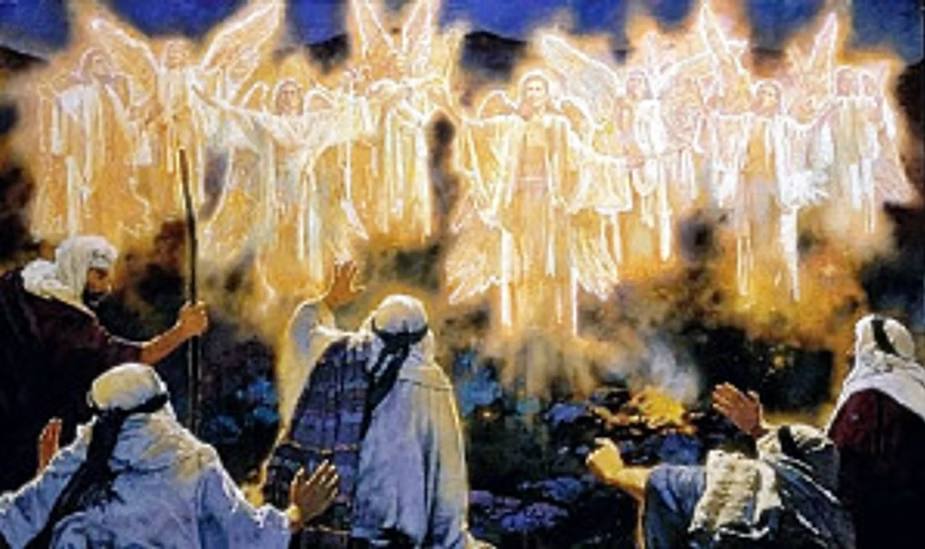
The humble bow down before the righteous.

Ezekiel, as Joshua before and Jesus afterwards, was a prophet that told the warning spoken by the LORD to His chosen priests. The Book of Ezekiel was not lessons of righteousness spoken to the whole of mankind, as it was the Word of God to those who had fallen into the gutter before their LORD. The lessons of the Gospel were likewise not to stories of Jesus being sent to save all the sons of man. He came to warn the Jews that they had also fallen into the gutter before their God. The message was to “Arise! If you want to be a priest of Mine, then you best become like Ezekiel, Joshua and Jesus; or you will become mere sons (and daughters) of man and lose the right for eternal life.”

As an optional reading selection chosen for presentation on the seventh Sunday after Pentecost, in the season of Church time when ministers (prophets) to the LORD should be well along the paths God has sent them to travel, the basic lesson here is to stand tall among mere men and women. A ministry then means being a pillar of strength in a cesspool of worldly beings. One is called by God to rise from that muck and be a standard-bearer of righteousness, so the rebellious, the transgressors, and the impudent can see that hope of salvation remains alive.

The English word “transgression” is defined as, “An act that goes against a law, rule, or code of conduct; an offense.” (Google Dictionary) Seeing this as a legal term, where the Law of Moses came from God to the Israelites, as the Covenant between their service as God’s priests, with the agreed rewards as God’s chosen people being eternal salvation, the prophets of the LORD have always only been sent to warn those who profess belief in the One God, and not anyone else. This means a transgressor is anyone who has sworn allegiance to Yahweh (Jews and Christians), expecting the reward of Heaven for simply believing in that God, but who have laid down with the non-believers, going against the Laws of Moses, the rules of Jesus of Nazareth, and the code of conduct that makes one truly a priest to the One God. Such acts by other sons and daughters of humanity do not constitute breaking those laws and covenants, because they serve the gods of the world – the gods of money, sexual stimulation, war, artificial means of transcendence, and any other worship of the physical, rather than the Spiritual.

This reading then focuses less on being sent into the world to right all the wrongs, as God told Ezekiel, “Whether they hear or refuse to hear (for they are a rebellious house), they shall know that there has been a prophet among them.” This says one who refuses to hear will still know that a prophet of Yahweh has come into the world simply because he or she stands among those who wallow in emotional instability. If one wants to hear what a prophet has to say, then that one will rise to ask questions, like, “What has the LORD said to you?”

This means a ministry today is no different than ministry was for Joshua or Ezekiel, as they had to rise above the level of being sons of man, mere mortals, so they could hear God speak. A minister has put oneself in a position so that the Spirit can enter one’s being and strengthen one’s upright position. Once standing, a minister can hear the voice of God speaking words that explain the meaning of Scripture. A minister then radiates the joy of that enlightenment, so the others of mankind can know that God has come near.

When we read in Ezekiel today, we can apply ancient words to today’s reality. We can see how this Scripture can state: “[God] said to me, [son of man], I am sending you to the people of [faith in the One God], to a [religion] of rebels who have rebelled against me; they and their ancestors have transgressed against me to this very day.” What was truth then is still truth today. Jews who have rejected Jesus as their promised Christ are doing nothing more than pretending to obey the Law are transgressors to this day. Christians who have entered the churches as political activists and apologists for sins against the Law are transgressors to this day.

The Hebrew word “pasha,” which translates as “transgressed” and “rebelled,” also infers “to break away (from just authority).” This means the plethora of denominations and sects of Judaism and Christianity, evolving over the millennia, are by definition “transgressors” of the true purpose of one’s original faith in God. Thus, ministers are sent by God for the purpose of replacing the lost with those found, as beacons that others can see.

This makes a minister be an example of the truth, so those who have fallen, like God came and spoke directly to Cain.  God speaks through His prophets indirectly, so they speak as symbols.  Thus, a minister can make it known that it is possible to do what is right by example, rather than words. The sight of a risen prophet shows the world it is possible to rule over sin, rather than have sin rule over a mere mortal.

#sonofman #Matthew1811 #Ezekiel215 #omortal #Genesis467

Ezekiel 33:7-11 – How can we live with sin?

You, mortal, I have made a sentinel for the house of Israel; whenever you hear a word from my mouth, you shall give them warning from me. If I say to the wicked, “O wicked ones, you shall surely die,” and you do not speak to warn the wicked to turn from their ways, the wicked shall die in their iniquity, but their blood I will require at your hand. But if you warn the wicked to turn from their ways, and they do not turn from their ways, the wicked shall die in their iniquity, but you will have saved your life.

Now you, mortal, say to the house of Israel, Thus you have said: “Our transgressions and our sins weigh upon us, and we waste away because of them; how then can we live?” Say to them, As I live, says the Lord God, I have no pleasure in the death of the wicked, but that the wicked turn from their ways and live; turn back, turn back from your evil ways; for why will you die, O house of Israel?

——————–

This is an important reading that might not be one many people are familiar with.  It comes up in the Episcopal Lectionary schedule every third year (Year A), on the fourteenth or fifteenth Sunday after Pentecost (always Proper 18), but it falls under the “Track 2” designation, so it might always be overlooked.  I want to focus primarily on what this reading says on a deeper level, while then tying it together with the other readings commonly accompanying it.  Pull up a chair and grab a refreshing drink and learn what God has spoken through the prophets for your benefit.

“You, mortal” is written “wə·’at·tāh – ben-’ā·ḏām,” which pulls from the words “attah, ben, and adam.”  This means “You, mortal” actually is an address that begins by saying “and you are” (or “and you’re”).  The Hebrew root, “אַתָּה,” can be either masculine or feminine, singular or plural.  Because of that flexibility coming from Yahweh, He was speaking to the male named Ezekiel, while also talking in eternity to all of “you,” who “are” the “son of man.”

You might recall how often Jesus referred to himself as the “Son of man,” with the Greek written being “Huios tou anthrōpou.” (Matthew 12:8 used as an example.)  Wikipedia reports on this as such: “The expression “the Son of man” occurs 81 times in the Greek text of the four Canonical gospels, and is used only in the sayings of Jesus. The Hebrew expression “son of man” (בן–אדם i.e. ben-‘adam) also appears in the Torah over a hundred times.”  They then add that another thirty-two times it is written in the plural, with “sons of man,” with that seen as a reference to “human beings.”  Another way of stating that would be “mortals.”  However, that is summed up in the plural form of “anthrōpou” (“anthrōpos,” as found used in Hebrews 13:6).

Hebrew does not used capital letters, as does Greek, so one needs to realize that the presentations of “Huios tou anthrōpou,” as a reference made by Jesus about himself, were capitalized by Apostles who wrote with a higher understanding of what they heard, when they were mere disciples of Jesus of Nazareth.  The vocalization of the word “son” has no means possible to convey capitalization to the one hearing the word.  That is, unless the mind recalling a word spoken is inspired through divine memory, where the spoken word is realized to be a statement about one’s relationship to God (Yahweh).  This means the Gospel writers were well aware, through the Christ Mind that possessed their brains, that Jesus was indeed the “Son” of Yahweh, while having been sent into this world as “a mortal” or “man” – “human being.” Capitalization in Greek denotes a word that must be discerned as having a higher level of meaning, relative to the divine.

In Ezekiel’s case, where Hebrew has no indication of capitalization, the mere fact that Yahweh was speaking to him, addressing his as “ben-adam,” says that Ezekiel, like Jesus, was a “Son of man.”  Ezekiel wrote his book as the equivalent of an Apostle, which means all the Apostles were like Ezekiel when they wrote their Gospels and Epistles.  It means they were all like Jesus (including Ezekiel), because all were the “Sons” of God (Yahweh) and elevated above mere human being status (mortals).

That is why the disciples of Jesus told him the people (and most likely themselves too) thought he was one of the prophets (after naming John the Baptizer, Elijah, and Jeremiah).  Normal people cannot hear the voice of God speaking to them.  Prophets do.  Thus, Ezekiel, as a recognized prophet, was like Jesus, who was also one who heard the voice of God speaking to him.  Yahweh then placed His Holy Spirit into Simon Peter, causing him to speak the word of God (beyond the capabilities of his own brain), saying, “Sy ei ho Christos  ,  ho Huios tou Theou tou zōntos  .” – “You are the Christ [Messiah]  ,  the Son of God of the living  .

When Simon Peter blurted those words out of his mouth, he was known by Yahweh to become an Apostle later.  His heart was known to be devoted to both Him and to His Son.  Simon Peter was thus receptive to the Holy Spirit and therefore easily moved to speak the Word of God.  This is then how one should read this lesson from Ezekiel, because Yahweh told him AND ALL LIKE SERVANTS FOREVERMORE: “whenever you hear a word from my mouth, you shall give them warning from me.” 

The translation that states “warning” is accurate, but reading that is misleading, in particular to those who feel they know God, thus they do not think they need His warnings.  The Hebrew written is “wə·hiz·har·tā,” which pulls from the root verb “zahar.”  The literal translation says “and illuminate” or “and enlighten,” as the root word means “to be light or shining.”  This then converts to a “warning” that one is walking in darkness, and darkness is metaphor for sin, which lurks everywhere in the realm of death.  Human beings, as mortals – a word that means death, as those born to die – walk in darkness as “sons of man” [not a statement about human gender].  Therefore, God (Yahweh) sends His Prophets to shine light to the world, which comes as a “warning” to stop sinning or suffer the known outcome of being mortal.

We know this is what the light of truth, spoken through God’s prophets, is meant to cease, because Ezekiel wrote multiple times in this reading the word (eight in the above translation) “rasha” and “resha” (as “lā·rā·šā,” “hā·rā·šā” and “rā·šā,” as well as “mê·riš·‘ōw“), meaning “wicked” and “wickedness.”  The Hebrew word “rasha” means “wicked, criminal,” where “criminal” must be understood as meaning one who breaks the Laws of Moses.  Still, Strong’s lists NASB Translations of this word as being: “evil (1), evil man (1), evil men (1), guilty (3), man (1), offender (1), ungodly (1), wicked (228), wicked man (21), wicked men (2), wicked one (1), wicked ones (3).”  This makes the purpose of God’s prophets (including Jesus) be to warn mere mortals not to sin against God.

The crux of this reading says: If you hear the voice of God telling you to shine light onto sinners, so they will see their sinful acts and change, then you will save your own soul from the condemnations of the sinful – whether or not the sinful change, from heeding the message brought by God’s messenger (a Greek word identifies such as “aggelos” or “angeloi“).  If you hear the voice of God telling you what to tell sinners, but you do not give them God’s message, then the sins of the sinful become the responsibility of the failed prophet.  Therefore, the warning that must be shared is to the prophet, warning him or her not to hide the light of God’s truth (divine illumination) under the cover of secrecy or personal privacy.

This is then a reading paired with Jesus giving the instruction to his disciples: “If another member of the church sins against you, go and point out the fault when the two of you are alone.”  That lesson is compounded by a failed prophet refusing to listen to another prophet of the Lord, such that an escalation of talks follow – a small group of prophets, followed by the whole congregation (all of whom are prophets).  All of this direct consultation must then be seen as God verifying what was heard by a failed prophet within his head (or her head) restated by external voices of God, all telling the failed prophet the same thing.  The process eliminates any confusion one might claim as justification for sinning.  Everyone involved must then be Apostles that hear the voice of God, meaning a church of Jesus Christ does not involve novice students or adoring fans. [They are the ones Apostles preach to.]

This brings up the need to clarify “If another member of the church sins against you.”  This translation comes from Matthew 18:15, but the word “ekklésia,” meaning “church,” does not appear in this reading until verse seventeen, when the congregation is called up to speak.  What is written is this: “Ean de hamartēsē <eis se> ho adelphos sou,” which literally states, “If indeed now does wrong *among you* this brother yours.” 

An observant reader will have noticed the use of two “angle brackets” that surround “eis se.”  According to the Wikipedia article entitled “angle bracket,” when used in “terminology,” the definition is this: “〈 〉, used to enclose the name of the domain in which a concept and a term is used.” 

This sets apart the “domain” as being this statement by Jesus [recalled by Matthew], where the “concept” of “church” is presented in the “term” “among you.”  Because the concept is relative to the translation of “eis se,” the first thing to do is fully understand “eis.”  The translation (NRSV) is “against,” setting the term as “against you,” making this “term” important to grasp.  I have translated this as “among you.” 

The Greek word “eis” is said by Strong’s to aptly translate as “to or into (indicating the point reached or entered, of place, time, purpose, result)” [its definition], with it also meaning “into, in, unto, to, upon, towards, for, among” [its usage].  HELPS Word-studies adds this about “eis“: “properly, into (unto) – literally, “motion into which” implying penetration (“unto,” “union”) to a particular purpose or result.” 

Seeing how the translation of “against you” implies one’s sins “penetrate you” this is hard to discern.  Translated differently (according to legitimate options), the use of “among you” gives a strong impression of a wolf (sinner) having penetrated the sheepfold (a church).  This says “you” reflects the one first coming to that awareness. [Certainly, led by the Holy Spirit to uncover the sins and the sinner.]

Still, there is another element of this untranslatable set of symbols that must be considered.  In Scripture, where all words written are those spoken by God to His devoted servants (Ezekiel, Jesus, and now Matthew), it becomes a bold move to see groups of words and read them as if they only have one meaning.  A perfect example is “Son of man.”  Christians see those three words and immediately think “Jesus,” without realizing the importance of “Son,” the value of “this” (the article between Son and man), and how all readers are named generally in the one word “man.”  This means that the angle brackets surrounding two words draw one’s attention away from two separate marks, one of which is a “less than” symbol, with the other being a “greater than” symbol.  This needs to be taken into account.

Seeing this, the word “eis” becomes “<eis,” where the symbol is pointing out a “lesser than” state that is relative to all the aforementioned translation possibilities for “eis.”  Here, it becomes important to realize verse fifteen began with a capitalized “If” (a “big If”), which places a scenario of possibility to the statement.  The “domain” is then one of choice, which is relative to the “concept” of true  Christianity, which had not yet begun when Jesus was giving this instruction.  At the time Jesus spoke these words, Judas sat and listened.  Judas was a specific “you” in the group of disciples, such that he was “among” the others, but no one (other than Jesus) knew he was “against” what Jesus offered.  Judas then becomes an example of one of the group who proves to be “less than” the rest.  This needs to be read into the whole of the term “among you.”

In this translation I have placed two asterisks, rather than angle brackets, because each word needs to be individually understood, before the whole can leave an impression.  The next Greek word, translated as “you,” needs to be understood similarly as was “<eis.”  The Greek transliteration written here is “se,” which is the second person singular accusative form of “.”  In this word written is another of the marks that are untranslatable.  This mark is “>,” which is a “greater than” symbol.  The actual word written is then “σέ›” and that has to be seen as meaning Jesus speaking as God to a collective of disciples, each of whom were second person singular “you,” with the greater than symbol indicating each of their souls will have then become married to the Holy Spirit (a greater than indication).  Relative to the concept of a “church,” each disciple  (including Judas) was then warned by Jesus speaking the word of God, as they would become true prophets of Yahweh, not run-of-the-mill disciples.  Any “failures among you saints” (“<eis se>”) must be addressed.

By realizing that small nuisance (one that requires close inspection of the written text, not just a translation), one can then see how the use of “brother” becomes a statement of that “greater than” state of being.  The word “adelphos” becomes more than just a group of guys (male versions of “anthrōpou“), but they all (males and females who would become part of the true “ekklésia“) are elevated as “brothers” in the name of Jesus Christ, as “Sons of God” [Huioi tou Theou], with “Huioi” translatable as “Children.”  The lower-case assumes this elevation to a capitalized meaning, simply because of that little-bitty “greater than” symbol.

Simply by realizing what Jesus said, based on the divinely inspired writing of Saint Matthew, one can see how this Gospel reading becomes a mirror of that written by Ezekiel.  Jesus spoke instructions that say what God told Ezekiel.  If one has been filled with God’s Holy Spirit, then one hears the voice of God within one’s soul.  If one claims to be filled with the Holy Spirit and is indeed able to hear the voice of God within one’s mind, but then does not speak the warning to those in darkness: “O wicked ones, you shall surely die,” then that failure needs to be addressed accordingly.

This become the truth of the phrase, “A chain is only as strong as its weakest link.”  The chain is formed by all who are prophets of the Lord, each who is a link between Him and human beings.  Christianity is the chain, where the only links that comprise it are those who are linked together in the name of Jesus Christ.  That is not a chain link forged by one saying, “I believe in the concept that Jesus is the Christ.”  A true link that joins into God’s chain is one who is reborn  as Jesus, so all links share the strength of God as Sons of man (regardless of human gender).  Anyone claiming to be a true Christian, who either cannot hear the voice of God (a liar) or will not share the voice of God (a failure) are then the weak links that break the chain; and this is why that weakness must be eliminated, not allowed to continue.

The reading from Ezekiel is often in competition with a reading from Exodus (Exodus 12:1-14), which tells of the commanded ritual of the Passover, including how the blood of lambs had to be spread over the doorposts of the homes of the Israelites.  That compliance would prevent their deaths, when the Lord told Moses: “I will pass through the land of Egypt that night, and I will strike down every firstborn in the land of Egypt, both human beings and animals; on all the gods of Egypt I will execute judgments: I am the Lord.”

God spoke a warning that was heard by Moses.  Moses was then a prophet of Yahweh, who spoke the warning to the Israelites as instructed, saving his life as well as all the Israelites who listened and obeyed.  Moses was then like Ezekiel and Jesus, as a Son of man.

Also paired with the Ezekiel reading is the psalm of David (Psalm 119) that begins by singing, “Teach me, O Lord, the way of your statutes, and I shall keep it to the end.”  It ends with the verse: “Behold, I long for your commandments; in your righteousness preserve my life.”  David wrote his song lyrics by listening to the voice of the Lord within his heart, pouring it out through his harp as he sang.  He taught the Israelites to sing the psalms and love them just as he did.  As such, the words of God were learned by all of Israel and loved.  Thus, we see David was another Son of God, in the form of mortal flesh.

Finally, Paul’s letter to the Romans is read, where we read, “It is now the moment for you to wake from sleep. For salvation is nearer to us now than when we became believers; the night is far gone, the day is near. Let us then lay aside the works of darkness and put on the armor of light; let us live honorably as in the day, not in reveling and drunkenness, not in debauchery and licentiousness, not in quarreling and jealousy. Instead, put on the Lord Jesus Christ, and make no provision for the flesh, to gratify its desires.”  Paul wrote to saints in the name of Jesus Christ, telling that “church” not to let any weak links remain.  He listed how a weak link looks back to the past ways of the world, not to the future ways God had blessed them with – shown the light of truth, which must be shared.

Paul was led by the voice of Yahweh to tell those who could also hear the voice of God speaking to them, to shine the light of truth that says, “Do not stop.  Do not let your attention be distracted by the lures of the world.  Do not become a weak link in the chain of Christianity.”  Thus, Paul was also a Son of God, as Jesus Christ reborn into the flesh of a man, united with his soul.

There is beauty in these words that come from God through various servants.  Those who need to listen to prophets speaking the truth, in order to believe and become transformed, rely on the words of human beings whose holiness is invisible, keeping saints from looking any different than anyone else.  The people living in darkness are all who hear the voice of Satan in a world that pretends to offer delights – as Paul wrote, “provisions for the flesh, to gratify its desires.” 

They are the ones who need to be shown the light of warning (“hiz·har·tā” stated by Ezekiel), so they can put on the armor of light (“hopla tou phōtos” stated by Paul) and find eternal life be felt in the strength given by God, His Holy Spirit, and the Christ Mind of Jesus.  As a seeker of truth, finding it spoken means it is possible for them to transform into new chain links of Christianity.  The failure of them not hearing the truth spoken then falls upon the heads of those who claim to offer the truth of God, but do not have that ability (liars).

God told Ezekiel that the seekers of redemption will say to the prophet, “Our transgressions and our sins weigh upon us, and we waste away because of them; how then can we live?”  Yahweh then told Ezekiel to tell Israel, “Say to them, As I live, says the Lord God, I have no pleasure in the death of the wicked, but that the wicked turn from their ways and live; turn back, turn back from your evil ways.” 

Jesus told his disciples to address failed prophets in the same way, because “whatever you bind on earth will be bound in heaven, and whatever you loose on earth will be loosed in heaven.”  There, to bind means to set the rules straight and to loose means to break or destroy.  An Apostle’s work, as a servant of Yahweh, is to make sure the links in the chain of Christianity are strong, otherwise removed.

Knowing this means it is hard to find one claiming to be Christian that sets any rules as hard and fixed.  There are few these days that will try to destroy those who sin, while they are putting gifts of offering into felt-lined trays.  Instead of telling a gathering assembled, “God will pass through this land and anyone whose body of flesh has not been painted with the blood of Jesus Christ will lose his or her life.”  Rather than tell an audience that does not want to hear the truth, “O wicked ones, you shall surely die,” or “If you do not long to keep God’s commandments, then your life will not be preserved through the righteousness of the Lord,” the people will stand and cheer that failed leader, that liar. 

Without one filled with the Holy Spirit saying to those believing they are Christians, “Let us lay aside the works of darkness and put on the armor of light, so we can no longer be reveling in drunkenness, in debauchery and licentiousness, and no longer be quarreling over petty jealousy,” the people will never change their ways.

It then becomes the responsibility of the serious disciple of Jesus to realize this shortcoming in their leaders.  They need to address their priests and pastors as Jesus said to do.  The reason is as God told Ezekiel: “If you do not speak to warn the wicked to turn from their ways, the wicked shall die in their iniquity, but their blood I will require at your hand.” 

Save a minister by telling him or her to stop preaching politics and racism, because the world is going to Hell because of liars and failed prophets, too selfish to risk losing a paying customer.

Can I hear an amen?